I OWA M AG A Z I N E
MAGAZINE
FOR UNIVERSITY OF IOWA ALUMNI AND FRIENDS
SUMMER 2023
F O R U N I V E R S I T Y O F I OWA A LU M N I A N D F R I E N D S
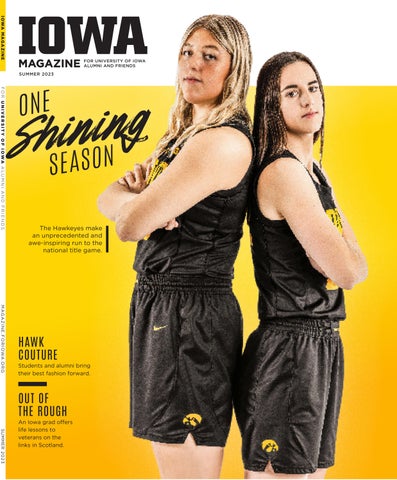
O NE
g n i n i h S ON SE AS
The Hawkeyes make an unprecedented and awe-inspiring run to the national title game.
M AG A Z I N E . F O R I OWA .O R G
HAWK COUTURE
Students and alumni bring their best fashion forward.
OUT OF THE ROUGH SUMMER 2 0 2 3
An Iowa grad offers life lessons to veterans on the links in Scotland.
WE KNOW YOUR CANCER DOWN TO EVERY DETAIL. Providing the best possible outcomes is in the DNA of our cancer center.” Every cancer is unique. That’s why care from an NCI-designated cancer center matters for diagnosis, treatment, and survivorship. Here, your team of pathologists, nurses, surgeons, and more are all specialized in your specific cancer. We tailor a plan to your body, needs, and your exact condition, because every decision matters for your outcome. That’s how we change lives at University of Iowa Holden Comprehensive Cancer Center.
See how at UIHC.org/cancer
Sonia Sugg, MD BR E AS T CA N C E R S U RG EO N © University of Iowa Health Care
CONTENTS F E AT U R E S
EDITORIAL EDITOR
Shelbi Thomas (05BA) ART DIRECTOR
Nick Beecher (03BA)
38
SENIOR WRITER/EDITOR
Josh O’Leary (00BA)
CONTRIBUTING WRITERS/EDITORS
Ben Frotscher Leah Klevar (93BA, 95MA) Tyler Strand Ellen Yandel GRAPHICS MANAGER
Jared Salasberry
CONTRIBUTING DESIGNERS
Danette Angerer (85BFA) Jodi Schmucker email : uimagazine@foriowa.org website : magazine.foriowa.org
28
Out of the Rough
An Iowa Writers’ Workshop alumnus invites military veterans to St. Andrews, Scotland, where they train to be professional caddies—and together find a path to healing.
DIGITAL LEAD WEB DESIGNER/DEVELOPER
Zack Schmidt (03BA)
Hawk Couture
Fashionable students and alumni bring style to Iowa City.
22
One Shining Season
CADDIE PHOTO COURTESY THE CADDIE SCHOOL FOR SOLDIERS; FASHION PHOTO: JOHN EMIGH; BASKETBALL PHOTO: BRIAN RAY/HAWKEYESPORTS.COM
The Hawkeyes dance all the way to the national championship game, drawing an unprecedented number of fans to the sport with an exciting style of play and an inspiring generational talent. COVER PHOTO: STEPHEN MALLY/HAWKEYESPORTS.COM
D E PA R T M E N T S
2 B I G P I C T URE 4 CA M P U S M AIL 7 ON IOWA
17
GO HAWKS
Hawkeye flamethrower Brody Brecht leaves football as the Big Ten’s top prospect for the 2024 MLB draft.
An Iowa research bank may hold the keys to unlocking 44 IOWA WRITERS new medical breakthroughs Abraham Verghese or overcoming a future pandemic. (91MFA) explores themes of family and medicine in his latest novel, The Covenant of Water.
49 FOR IOWA
A father supports schizophrenia research at Iowa in honor of his sons.
53
ALWAYS A HAW KEYE
Nationally acclaimed artist Oliver Lee Jackson
(63MFA) returns to see his paintings displayed on the campus where his creative journey began.
SENIOR WEB DESIGNER/DEVELOPER
Jimmy Losasso (09BFA) WEB DEVELOPER
Mike Miersen
SENIOR DIGITAL MARKETING STRATEGIST
Nicole Knoll (08BA, 22MS)
DIGITAL MARKETING STRATEGIST
Megan Walsh
MULTIMEDIA SPECIALISTS
John Emigh (11BBA, 13BFA) Jason Smith
LEADERSHIP PRESIDENT AND CEO
Lynette Marshall
VICE PRESIDENT, ALUMNI AND DONOR ENGAGEMENT
Colin Hennessy (01BA) ASSISTANT VICE PRESIDENT, COMMUNICATION AND MARKETING
Dana Larson (20MA)
OFFICE OF ALUMNI ENGAGEMENT One West Park Road Iowa City, IA 52242 phone : 319-335-3305 email : uiowa@foriowa.org website : foriowa.org
Iowa Magazine, Volume 76, Number 2 © 2023 University of Iowa Center for Advancement. The UI Center for Advancement publishes Iowa Magazine four times a year. POSTMASTER: Send address changes to Iowa Magazine, UI Center for Advancement, One West Park Road, Iowa City, IA 52242. Opinions expressed are not necessarily shared by the university, the publishers, or the editors.
BIG PICTURE
Beads for Bravery Christopher Turnis, 18, of Dubuque, Iowa, had his first surgery at two weeks old. Since then, he’s had dozens of surgeries—including a kidney transplant—and has spent more than 1,000 nights at University of Iowa Stead Family Children’s Hospital. As a way to remember his journey, the former Kid Captain participates in Beads for Bravery. The Child Life program provides patients with beads to signify certain medical moments, such as an MRI scan or a surgery. Today Christopher’s beads stretch more than 40 yards. These beads represent the various battles and triumphs UI Health Care patients, like Christopher, tackle every day. JOHN EMIGH
2
IOWA MAGAZINE | SUMMER 2023
CAMPUS MAIL Irving’s Iowa Connections
She will be a fantastic coach in her career, and many kids will benefit from her knowledge and skills.
I enjoyed reading the John Irving (67MFA) interview [“John Irving’s ‘Last Long Train,’” spring 2023, p. 26] and wanted to add that a University of Iowa alum appeared in The World According to Garp film. Mary Beth Supinger Hurt (68BA) graduated from the speech and dramatic art department. She acted in several films over the years and also did Broadway and off-Broadway. I think she also was the grand marshal at an Iowa homecoming parade.
Shannon Grecian Iowa City
Lifting for Life
I studied at the UI from 1964–70 and was a walk-on wrestler as an undergraduate. Later, as a young assistant professor of Portuguese, Spanish, and comparative literature at Penn State, I corresponded with John Irving about Iowa, wrestling, and his novels. One letter I remember well was about the character Merrill Overturf from The Water-Method Man. I asked if he knew my good friend Merrill “Meaux” Overturf (61BA, 70PhD), and I was surprised and amused when Irving replied that he did not, but had chosen his name out of the Iowa City phone book. Meaux was pleased to have his name catch the attention of the great John Irving. And a note to Irving, who could not have been nicer to a green professor: If you ever wish to resume our correspondence, I am now a professor at Vanderbilt University, where I continue to cheer on the Iowa Hawkeye wrestling team from afar. Earl E. Fitz (68BA, 70MA) Nashville, Tennessee
Second semester of my senior year, I wanted to take a break from my business courses, and I chose to take fiction writing. It turned out to be the most challenging and rewarding course I took while at Iowa. The instructor had a great sense of humor and told funny, interesting stories from his life. His command of the elements of writing and his enthusiasm for teaching really brought me in. In addition to discussing our writing, he had the class read other writers. Deconstructing their works illuminated my understanding and informed my thinking about my assignments. It also made me a better reader. At the end of the semester, I met with the instructor, and he asked me if I planned on 4
IOWA MAGAZINE | SUMMER 2023
Iowa Writers’ Workshop graduate John Irving will be at Hancher on Oct. 13 for a Literary Legends event. For more details, visit foriowa.info/irving-legend.
becoming a writer. I did not become a writer, but I appreciated his interest and advice. You may have already guessed that my instructor was John Irving. Needless to say, I have followed his career with great interest and have been an avid reader of his work from the beginning. Rick Petersen (67BBA) Edina, Minnesota
Nest Knowledge
I experienced the empty nest [“How Do You Adjust to an Empty Nest?” spring 2023, p. 13] in a different way. I was a single mom raising my three boys. Empty nest affects even those of us who are not married. One of the best things I did for myself was get a cat. I moved to a new location and started a new job. It was a challenging time in my life, but I enjoyed getting to know myself. Carol Harshman (10BSN) Tiffin, Iowa
Competitor and Coach
Adeline Kenlin [“In the Balance,” spring 2023,
p. 16] was my son’s coach at the gym she trained at in high school. Coach A was so amazing with the kids and had them doing things I don’t even think they thought they could do. I am so proud to see her back at something she has passion for.
Richard Gibbs (68BBA) Lake Forest, Illinois
Memory Mill
Thank you for sharing this beautifully written eulogy for The Mill [“Thirteen Ways of Looking at The Mill,” winter 2022–23, p. 50]. Each vignette brought back vivid memories of my med school days (and nights) in Iowa City. We had a loose rule that if you weren’t at The Mill by 10 on Thursday nights, then you were studying too hard and not to be trusted. This was very impactful for me, and I suspect that I’m not alone. Bob Walker (76MD) Hull, Massachusetts
Pete Nelson’s (79MFA) recollections of
The Mill brought back some long-dormant memories of my time tending bar in Iowa City in the early ’70s. The Shamrock was a neighborhood bar, a shot and a beer kind of place on South Gilbert about five blocks from The Mill. Nelson spoke of Brother John and Whale and their biker band of brothers, who were mostly skilled tradesmen, capable of discussing anything from rebuilding a Harley to Leon Festinger ’s (40MA, 42PhD) theory of cognitive dissonance. They were regulars at The Mill and at the Shamrock, scary looking, but loyal friends and customers. Fifty years doesn’t feel so long ago. Thomas Carter (74BA) Bettendorf, Iowa
PHOTO: DEREK O’DONNELL
Janet Teague-Grimley (69BA) Port Orchard, Washington
I was an athlete at the UI in the 1960s. Since that time, I have continued to do aerobic and weightlifting exercises. I absolutely feel that weightlifting has positively impacted my mental acuity and my physical flexibility and strength. And, as I read about people who are my age and younger suddenly dying, I am convinced that a regular exercise routine is the most effective “youth serum” that one can depend upon [“A Life Worth Lifting,” spring 2023, p. 9]. It isn’t easy, but exercise and weightlifting are key to quality of life after age 70. Start slowly, build your routine, and fully enjoy life.
live forever. I’d like to think I can somehow pay back the massive debt I have to the Hawkeye Marching Band by paying it forward to my students. Tim “Ruby” Anderson (98BM) Amherst, Massachusetts
Tradition Takes Flight
I enjoyed the article “Home of the Hawks” [winter 2022–23, p. 12], as it brought back a memory from perhaps the first raptor flight from the field at Kinnick Stadium. Iowa played Air Force in a 1958 game, and part of the halftime entertainment was a demonstration of the Air Force falcon. The bird was released, and it never returned. Iowa and Air Force tied 13-13 in the game. Larry Ely (70BBA) Loveland, Ohio
A Writer’s Review The Hawkeye Marching Band visits Disneyland in California during its trip to the 1959 Rose Bowl. The band also made Rose Bowl appearances in 1957, 1982, 1986, 1991, and 2016.
PHOTO: FREDERICK W. KENT COLLECTION OF PHOTOGRAPHS, UI SPECIAL COLLECTIONS AND UNIVERSITY ARCHIVES, UI LIBRARIES
Back to the Boom
I enjoyed the article on the Hawkeye Marching Band in the winter Iowa Magazine [“Ready for the Boom,” p. 38]. It brought back many memories of my 20 years working with the band. I can still remember the feeling of being in the stands with the band at our final home game in fall 1981 and realizing that we were going to the Rose Bowl. Growing up in Wisconsin, Big Ten country, I had watched the Tournament of Roses Parade and the game every year, never imagining that I would be part of it. That would be just the beginning of multiple bowl trips that took the Hawkeye Marching Band across the country. I found the information on the FlipFolder app quite interesting—no more hand-drawn, multiple-page field charts. Also long gone are the days when Hawkeye Marching Band Director Morgan Jones (60BM, 61MA) would hand me an eight- or nine-part piano score of his latest music arrangement from which I would
CONTACT US Iowa Magazine EMAIL uimagazine@foriowa.org One West Park Road Iowa City, IA 52242 PHONE 319-335-3305 or 800-648-6973 magazine.foriowa.org
extract, transpose, and write out the individual instrumental parts on flip-folder size manuscript paper. This was done on a volunteer basis and after hours, so it meant a lot of late nights and writer’s cramp! Sandi Dillon (76MA) Plano, Texas
I was in the Hawkeye Marching Band in the early- to mid-’90s, and I can honestly say I wouldn’t be where I am in life without it. I came to the UI, like so many others, to write the great American novel, but it didn’t take much more than my first game in Kinnick with the roar of the crowd to steer my mind to music. The late David Woodley (83BM, 85MA) was my first college band director and a hero to me. There are very few friends from my days at Iowa I am still in touch with who weren’t in band with me. My years in the uniform may have been limited, but the relationships made and the memories
CONNECT FACEBOOK The UI Center for Advancement INSTAGRAM @uiadvancement TWITTER @UIAdvancement LINKEDIN @UIAdvancement
Letters to the editor may be edited for style, length, and clarity. While we welcome feedback, we regret that we are unable to print or reply to every letter.
Having devoured most of the stories, I want to congratulate you on the winter edition of Iowa Magazine. I think it’s one of the finest journalistic works I’ve seen in a long time. As the first Daily Iowan Rose Bowl editor and sports editor (1956–57), I naturally found the stories on Hawkeye programs and athletes to be excellent, but no more so than those on the Iowa band, space, and The Mill. From the editorial content to the photos to the layout, it was just outstanding. Other observations: • The greatest concert I ever attended was Bill Haley & His Comets. Dressed in all pink suits for the first half, they all wore red for the second and marched through the Union playing “Rock Around the Clock.” Other campus guests during my time: Louis Armstrong, Eleanor Roosevelt, Bob Newhart, Peggy Lee, Duke Ellington, and Stan Kenton. • My best memory of the Iowa band: In the 1950s, the band practiced on an open field adjacent to the Iowa River and directly across from Hillcrest Residence Hall. In the 1957 Rose Bowl, I vividly remember the band starting with “On Iowa” and suddenly breaking into “California, Here We Come.” Thanks again for updating me on a great university, one which provided me with a great education and 64 years in newspaper and college public relations. Alan Hoskins (58BA) Kansas City
MAGAZINE.FORIOWA.ORG | IOWA MAGAZINE
5
ON IOWA
PHOTO: TIM SCHOON/UI OFFICE OF STRATEGIC COMMUNICATION
STREET ART
ON IOWA
BANK ON A CURE PSYCHEDELIC STUDY
CrossHawk Not since the Beatles’ Abbey Road album cover has a crosswalk looked this good. For the past school year, painted Tigerhawk logos have brought Hawkeye spirit to the T. Anne Cleary Walkway’s crossings with Jefferson and Market streets.
MAGAZINE.FORIOWA.ORG | IOWA MAGAZINE
7
ON IOWA
Production manager Brian Berger maintains more than 5,000 cell lines for the UI Developmental Studies Hybridoma Bank.
A Research Library for Our Medical Future How an Iowa Antibody Bank Stands Ready to Fight the Next Pandemic
On the corner of Dubuque Street and Iowa Avenue, just a block east from the Old Capitol, thousands of possible clues toward deciphering human diseases are stored in liquid nitrogen. Floating in glass tubes, the hybridomas—cell lines used to create antibodies, the foundational pieces of human and animal immunity—hold clues to how our brains work and our muscles develop. They point the way toward treatments for cancer, Alzheimer’s, and emerging viruses that have yet to be named. They could even help combat a future pandemic. Maintained by a small team at the University of Iowa’s Developmental Studies Hybridoma Bank, some of these hybridomas and the antibodies they create are routinely shipped to labs around the 8
IOWA MAGAZINE | SUMMER 2023
globe, while others wait to play a role in discovery. “You never know which obscure thing will suddenly be needed,” says Doug Houston, director of the bank. Of course, many who hadn’t thought about antibodies since high school biology got a crash course during the pandemic. These proteins are central to our bodies’ immune response. In the early months of 2020, as scientists scrambled to learn how COVID-19 spread and what might deter it, the DSHB provided antibodies to multinational pharmaceutical researchers who were racing to create a vaccine. The internationally respected depository has been located at the UI since 1996, after its formation by the National Institutes of Health a decade earlier. Scientists have used antibodies and their properties
PHOTOS: JOHN EMIGH
BY JENNIFER NEW
ON IOWA
to create vaccines and treat illnesses since the late 1700s, but it’s only been since 1975 that they could be produced in a lab. Lab-produced antibodies, such as the ones created at the DSHB, are known as monoclonal antibodies. Strictly speaking, what DSHB holds are cell lines that are used to produce monoclonal antibodies when requested by a researcher. With proper care, these cell lines and the monoclonal antibodies they produce are “immortal”—think of a sourdough starter that is refrigerated and occasionally fed, used, and restored. OPEN SCIENCE MODEL
The repository is built on a dedication to open science—the belief that scientific research should be accessible to everyone. It works like a library. Researchers can both deposit and purchase cell lines with DSHB. “We have a very egalitarian mission,” says Houston, who took the helm two years ago, following 25 years of leadership by David Soll. “We want to save researchers’ money on known, quality antibodies.” Since 1998, DSHB has been selfsustaining. Many of its expenses go toward managing its collection. The bank operates at cost, making it more affordable than commercial antibody companies. For comparison, DSHB charges $45 for a milliliter, while commercial distributors ask between $400 to more than $1,000—often for a smaller amount. So why does DSHB feel like a best-kept secret? Today, researchers can choose from many for-profit companies who sell thousands of antibodies with countless uses. DSHB, which operates more like a small, well-curated bookstore, doesn’t have the resources to host booths at conferences or advertise in journals. Researchers often learn about DSHB from their peers or mentors. Those who know about it, however, find it an invaluable resource. THE EFFECTS OF DSHB IN THE FIELD Tina Tootle, a professor of anatomy and cell
biology at the UI’s Roy J. and Lucille A. Carver College of Medicine, runs a lab focused on prostaglandins—lipids that control processes like inflammation and blood flow and which are produced at sites of tissue damage or infection. Her elevator pitch for her work is alluring: We
don’t know why aspirin works, and that’s a problem. It’s a problem in part because aspirin causes many off-target effects, like bleeding ulcers and impaired fertility. Central to Tootle’s research are Drosophila, or fruit flies. She is part of a group of researchers informally called “the fly community,” who create and share antibodies specific to their work. DSHB serves as an invaluable middleman; it is the place where they can deposit and obtain antibodies. Drosophila is a major part of the DSHB collection, and the repository is especially known and respected in the fly community.
We have a very egalitarian mission. We want to save researchers’ money on known, quality antibodies.” —Doug Houston
No matter how cooperative researchers are with each other, there simply isn’t time for them to make antibodies for another lab—a process that takes around a month—and ship them off. Nor could Tootle afford the large quantities of antibodies her lab needs if she was paying commercial prices. As a graduate student, she worked in a lab that routinely purchased Drosophila antibodies from DSHB—a fact she took for granted, unaware of the pricing differences between the UI bank and commercial distributors. “Once you’re the one managing a budget you really appreciate them,” she says. Another satisfied customer is Mark Peifer, a distinguished professor of biology at the University of North Carolina who’s also part of the fly community. His research is in
the area of developmental biology, with a focus on epithelial tissues that form the basic architecture of our bodies. Why, his research asks, are you a person and not a puddle? The reason is because our cells have machinery that build the tissue that comprises your organs. He uses fluorescent tags and ever-improving microscopy to study the cell machinery, including instances of when something goes wrong with it, such as with spina bifida. Peifer emphasizes that the savings his lab makes by purchasing antibodies through DSHB is essentially a savings for taxpayers since he is at a public university. “Their prices are phenomenally low, and they provide incredible information. Our work wouldn’t be possible without DSHB,” he says, adding that thousands of scientists would agree. GROWING DSHB’S REACH Karla Daniels (87PhD), a research scientist
and chief curator of the DSHB, hopes the bank can secure funding to double or even triple its current production. She’d also like to see DSHB have the resources to validate and provide documentation for its entire collection, not only its bestsellers. Cell lines often arrive at DSHB without much accompanying information. The repository inherits collections from retiring scientists as a way for a life’s work to be safeguarded into the future. Other times DSHB receives larger deposits, such as 300 antibodies recently deposited by NIH’s Brain Initiative. “Antibodies come to us and have been vetted for one or two uses,” says Daniels, “but we want to know what else they can be used for.” As an example, she cites an antibody deposited with DSHB more than two decades ago as a target against leech neurons. Recently, researchers have realized it is a target for cancer metastasis. Daniels and the DSHB team consider stewardship one of their most important roles. Daniels says while some monoclonal antibodies have been working for 10 years, others are very fragile. She says one of their most popular antibodies, used for fiber testing in skeletal muscle studies, must be frozen as soon as it is made.
What Are Antibodies? The COVID-19 pandemic showed the importance of antibodies in preventing or limiting the effects of contagious diseases. These Y-shaped proteins are sentinels on the lookout for foreign objects in our bodies, such as viruses and bacteria. At the ends of the two shorter, upper stems of each Y, unique receptors with various patterns—think puzzle pieces or Legos—are shaped to fit a specific invader, or antigen. Once an antibody locates and binds to an antigen, it’s as though the immune system has declared “Game on!” Various mechanisms begin the process of obliterating or neutralizing the invader.
MAGAZINE.FORIOWA.ORG | IOWA MAGAZINE
9
ON IOWA
Director Doug Houston and program coordinator Gemma Kerr monitor the inventory at the UI Developmental Studies Hybridoma Bank.
Plasma Cells
How a Hybridoma Works
Ensuring the longevity of the collection is the work of production manager Brian Berger (97BS), who tracks shelf lives in numerous spreadsheets, maintaining careful schedules for checking on the health and viability of the more than 5,000 cell lines in the DSHB collection. While commercial producers don’t have incentive to maintain rare antibodies because of the lack of profit in maintaining them, DSHB considers this central to its mission. Daniels has specifically solicited antibodies she believes should be in the bank. She also responds to researchers in need of rarer antibodies by trying to procure them for the collection. 1 0 IOWA MAGAZINE | SUMMER 2023
Hybridoma Tumor Cells
For example, an ALS nonprofit leader cold-called Daniels saying the organization was interested in funding production of ALSrelated antibodies; would DSHB be interested in partnering? Daniels’ reaction: “DSHB is made for that!” They started with two hybridomas—which are now in DSHB’s top 20 sellers—and multiple publications have deemed them the best in the world. Today, monoclonal antibodies are used in the diagnosis and treatment of many diseases, including some types of cancer, inflammatory and autoimmune disorders, osteoporosis, and migraines. They have enabled patients to receive organ transplants and advanced the possibilities
Monoclonal Antibodies
for immunotherapy, using the body’s own immune intelligence to fend off viruses. The body generates a unique immune response with specific antibodies depending on the disease it is fighting. With its vast library of monoclonal antibodies against known and unknown disease-related molecules, the DSHB can serve as a vital resource for researchers trying to find ways to study these unique disease processes when new outbreaks arise. We know there will be other COVID-like events in the future. And we don’t know what will be needed to stop them. What the DSHB team is certain of, however, is that its bank of nuanced biological information holds thousands of answers to questions yet to be asked.
PHOTO: JOHN EMIGH
A hybridoma is formed when B-cells (white blood cells that make antibodies) are added to a culture of myeloma (bone marrow tumor) cells, which can grow indefinitely under the right conditions. This hybrid cell line can produce monoclonal antibodies that can be used against specific antigens, including proteins, toxins, chemicals, bacteria, viruses, or other substances that come from inside or outside the body.
ON IOWA
An 1840s illustration by John James Audobon from The Viviparous Quadrupeds of North America depicts a dog native to North America, such as the ones UI graduate student Ariane Thomas researches.
NEWSMAKER: ARIANE THOMAS
Old Dogs, New Data ILLUSTRATION: JOHN JAMES AUDUBON/WIKIMEDIA COMMONS; PHOTO: JOHN EMIGH
An anthropology student uncovers a revealing secret in the history of man’s best friend. Ariane Thomas checked her results, then checked them again. But no matter how many
times she ran the DNA sequence, it told her the same thing: All the theories about these dogs were wrong. Thomas, a PhD candidate at the University of Iowa, was in Jamestown, Virginia, studying ancient dogs: those brought by colonists to the first permanent European settlement and their indigenous North American counterparts. These indigenous dogs were largely wiped out by the Europeans, and Thomas was interested in why and how, hoping to reveal more about the relationship between European and Indigenous groups. To find out, she has worked since 2019 with the Jamestown Rediscovery historical society to analyze dog remains from the settlement’s earliest years. All were assumed to be European, based on theories holding that colonists aided in the extinction of indigenous dogs by refusing to buy or breed them. But when Thomas sequenced the dogs’ mitochondrial DNA, she found that they were all native to the area. The discovery complicates assumptions about European attitudes—the presence of indigenous dogs suggests that they played a role in Jamestown life, just like their European cousins. And as Thomas points out, a more nuanced story also indicates a more nuanced relationship between European and Indigenous groups at the time, implications that have led to her discovery being
highlighted in publications from The Daily Iowan to The Washington Post. “Because dogs and humans have had this relationship for so long, they can be used to reveal other parts of history that we wouldn’t be able to get at with the available materials that we have,” says Thomas. “And so maybe dogs can be our window into the past in a way we didn’t even know we could use.” And there’s plenty more to reveal. Next, Thomas wants to sequence the dogs’ autosomal DNA for more insight on possible interbreeding between European and indigenous lineages. She also plans to analyze traces of the element strontium in the dogs’ jawbones, which may be able to indicate where they were raised by exposing what they ate when they were young. None of this, Thomas says, would be possible without the support she receives from the UI. Student grants have helped fund her research, including the expensive process of genomic sequencing, and collaboration with other researchers, such as UI associate anthropology professor Matthew E. Hill, has added depth and complexity to her work. “It’s been really nice to see people who have different specialties contributing their own knowledge and their own work to a larger collective,” says Thomas. “Bringing these interdisciplinary methods together to create one story has been really fascinating.” —ELLEN YANDEL
Ariane Thomas MAGAZINE.FORIOWA.ORG | IOWA MAGAZINE
11
ON IOWA
RAGBRAI 50th Anniversary July 22-29
Storm Lake Sioux City
Ames
Tama-Toledo
Carroll
Davenport Des Moines
IOWA CIT Y SCENE
Cycling Spectacle
ride quickly ballooned into the popular event it remains today. Now, RAGBRAI boasts 8,500 annual weeklong riders, and even more who drop in along the way. This year, RAGBRAI will visit 30 towns. Coralville is the last overnight stop, where riders will be able to celebrate both 50 years of RAGBRAI and the town’s 150th anniversary. Cyclists will then pass through Iowa City on the final day, July 29. The route will take them through the University of Iowa campus and downtown Iowa City, with possible attractions including the Old Capitol, Kinnick Stadium, and Big Grove Brewery, home of the official RAGBRAI beer. The 2023 RAGBRAI route begins on July 22 in Sioux City, with Storm Lake, Carroll, Ames, Des Moines, and Tama-Toledo also serving as host towns, and Davenport welcoming riders at the end of their journey. The “century loop,” an optional add-on route for participants who want to bike 100 miles in a single day, will take place between Carroll and Ames. RAGBRAI last visited Iowa City in 2018, when the town was an overnight host for the first time in 42 years. Organizers anticipate this ride to be just as memorable, mirroring the original route that first put RAGBRAI on the map for bike enthusiasts around the world. —ELLEN YANDEL
In its 50th year, RAGBRAI will make a historic ride through Iowa City. Iowa City will help RAGBRAI celebrate its 50th anniversary this summer as a pass-through town during the last leg of the statewide biking trek. RAGBRAI, or the Register’s Annual Great Bicycle Ride Across Iowa, is the oldest, largest, and longest multiday bicycle tour in the world, taking a unique 500-mile path across the state over the course of a week each summer. 1 2 IOWA MAGAZINE | SUMMER 2023
Traditionally, the ride makes its way from west to east, with riders dipping their back wheels into the Missouri River to start and their front wheels into the Mississippi as a grand finale. The event started in 1973 as a challenge between Des Moines Register staff members John Karras and Don Kaul to bike across Iowa and document their experiences. The next year, they invited a few friends to join them, and the
For more information, visit ragbrai.com.
PHOTO: JUSTIN TORNER/UI OFFICE OF STRATEGIC COMMUNICATION
RAGBRAI's last visit to Iowa City in 2018 celebrated the town's literary culture.
Coralville
ON IOWA
NEUROSCIENCE
Mushroom Medicine
PHOTO ILLUSTRATION: NICK BEECHER
A new UI study investigates the effectiveness of psychedelics as a treatment for alcohol use disorder. There was a time when psilocybin, a hallucinogenic drug commonly known as magic mushrooms, was more likely to be doled out at a Grateful Dead concert than as part of any medical treatment. But more than half a century after it was made illegal in the U.S., the psychedelic drug is being revisited by the psychiatric community as a potential tool to fight mental illness and addiction. University of Iowa doctors this year will be the latest to investigate the therapeutic effects of the naturally occurring compound found in some fungi. In a pilot trial, UI researchers plan to study the use of psilocybin coupled with psychotherapy to treat alcohol use disorder. Professor of psychiatry Peg Nopoulos (85BS, 89MD, 93R, 94F) says her team is interested in the drug’s ability to seemingly restructure the brain’s circuitry and perhaps offer patients struggling with addiction new and more effective treatment options. “In the past 20 years, psilocybin has gained a lot of attention in the context of rigorous scientific study,” says Nopoulos, principal investigator for the UI study. “As an academic medical center, it’s important for us to provide cutting-edge treatments. Alcohol abuse is a horrible disease, and people are quite desperate for treatment.” The double-blind study will treat 20 males ages 25 to 50 diagnosed with alcohol use disorder. Ten randomly selected participants will receive a 25-milligram dose of psilocybin during the third of four weekly individual psychotherapy sessions. The other 10 participants, meanwhile, will receive a 200-milligram dose of ketamine, a drug already approved by the FDA to treat depression. Researchers will study the differences between the psilocybin and ketamine groups by monitoring alcohol consumption and using periodic MRI scans to track any biological changes in the brain. They’ll also evaluate any adverse effects of the protocol.
Nopoulos says addictive behaviors like alcohol abuse are the result of negative brain circuits creating looping thoughts such as “I need a drink” or “I don’t feel good if I don’t have a drink,” and patients being unable to break free from those loops. “It’s thought that psychedelics actually dissolve or inhibit that negative circuit and essentially open up the brain to potential restructuring,” Nopoulos says. “Other circuits would then become more active that are more positive and not so rigid in that loop of negative behaviors and thoughts.” Produced in numerous species of mushrooms, psilocybin was once used by Indigenous cultures in Europe and the Americas in religious and healing rituals. The Swiss chemist Albert Hoffman, known as the father of LSD, gave the drug new life in 1958 when he isolated psilocybin in his lab and developed a synthesis for it. Scientists widely studied the drug as a treatment for alcoholism and other disorders in the 1960s—a decade when psychedelics were also adopted by the counterculture—but Congress’ Controlled Substances Act of 1970 made psilocybin illegal. Today, a resurgence of scientific interest in psilocybin has prompted two states, Oregon and Colorado, to legalize it for therapeutic use, and more are expected to follow. Several FDA-approved clinical studies have shown positive results for psilocybin-assisted psychotherapy in treating depression, anxiety, and post-traumatic stress disorder, as well as some addictions. The National Institutes of Health recently funded their first government-backed study of psilocybin treatment for nicotine addiction, and Johns Hopkins University has established a center for psychedelics research. The UI study, meanwhile, will join dozens of clinical trials associated with psychedelics around the nation that are currently underway. —JOSH O’LEARY MAGAZINE.FORIOWA.ORG | IOWA MAGAZINE 1 3
ON IOWA
ASK AN EXPERT
How Reliable is Your Fitness Tracker? Calories burned
Heart rate
Oxygen saturation
While activity trackers can give you an estimate, their readings aren’t exact. Arm movements can confuse the devices and skew results, though wearing them tightly can improve accuracy. There also isn’t a single “normal” heart rate: individual medical conditions, lifestyle, and fitness levels can all have an impact. Lee recommends talking to a doctor to judge the accuracy of your tracker’s heart rate data. Measured steps
Calculating daily steps is a popular metric for users looking to increase their mobility. However, these devices use computer algorithms based mainly on your height to assume the size and speed of your gait. Differences in body build could result in incorrect assumptions about your movement. “Don’t get hung up on the exact number of steps,” recommends Lee. “What’s important is making the effort to consistently move your body.” 1 4 IOWA MAGAZINE | SUMMER 2023
This measurement also relies on algorithms to make assumptions about your exercise intensity and metabolism, which could mean a less-than-exact number. “Instead of focusing on calories burned, you’re better off setting a goal to exercise 150 minutes a week,” Lee says. “If you are exercising, you’re burning calories.” Some trackers also include pulse oximeters, which measure how much oxygen is in the blood. This technology can yield fairly accurate results, but it’s not necessary for most people, Lee notes. Those with lung disease or low oxygen should discuss the benefits of tracking oxygen saturation with a doctor. The main takeaway? Activity over measurement
While activity trackers can provide a pretty good estimate of your metrics, they should not be your primary focus when setting health and fitness goals. “Focus on doing the exercise,” Lee says. “Worry less about measuring it, because the actual exercise is often more valuable than the numbers on the screen.” —JORDAN LUDWIG
PHOTO: UI HEALTH CARE; PHOTO ILLUSTRATION: NICK BEECHER
Linda Lee
From counting your steps to checking your heart rate, smartwatches and wearable activity trackers have become a popular way to measure exercise and health metrics for athletes and everyday users alike. But how accurate are the measurements on your wearable device? The answer, says University of Iowa cardiologist Linda Lee (16MHA), depends on what you’re measuring:
ON IOWA
BRIEFS
Moving Out The Board of Regents, State of Iowa, has approved the UI’s request to sell Mayflower Residence Hall and construct a new dorm on the east side of campus. The change, which could result in Mayflower’s closure as early as spring 2024, aims to bring students closer to the main campus and dining halls.
Cancer Count
IMPACT
Money Matters How the University of Iowa creates an economic boost felt across the state. The University of Iowa gives back—on a massive scale. As an economic powerhouse for the state of Iowa, it supports one out of every 19 jobs in the state and adds about $8 billion in additional annual value to the state’s coffers, according to a study commissioned by the Board of Regents, State of Iowa. That profound economic impact is equal to about 4% of the state’s $210 billion gross domestic product, according to the study by international consulting firm Lightcast. It’s also an increase of 22%, or $1.5 billion, over the past five years. As the state’s largest employer, the UI produces far more revenue for the state than it takes in. More than $261 million in taxpayer dollars went to the university last year, which fuels higher lifetime earnings and increased business output for students totaling nearly $800 million, while lowering demand for governmentfunded services in Iowa by more than $122 million. The return for taxpayers is about $3.50 for every dollar invested in the university. “The University of Iowa is an unrivaled engine of economic growth for Iowa,” says Jon Darsee (82BGS), the UI’s chief innovation officer who oversees the university’s economic development efforts. “Our research
spending and economic development bolster businesses across the state.” Here’s what the study found on the university’s annual economic impact on the state of Iowa: Alumni impact ($3.5 billion) UI Hospitals & Clinics spending impact ($2 billion) Operations spending impact ($1.4 billion) Economic development impact ($551.4 million) Research spending impact ($369.5 million) Visitor spending impact ($91.2 million) Construction spending impact ($72.3 million) Student spending impact ($64.2 million) Volunteerism impact ($12.2 million)
The UI, Iowa State University, and the University of Northern Iowa combined added $14.9 billion in income to the state of Iowa economy during fiscal year 2021-2022, according to the study. That figure is equal to about 7.1% of the total gross state product of the state. The study also notes that the total of university activity supports nearly 200,000 jobs in the state, which is 1 out of 10 jobs in Iowa.
The UI-based Iowa Cancer Registry’s latest report has revealed that while more Iowans are surviving cancer, the state has the secondhighest cancer rate in the nation. For the past 50 years, the registry has been gathering data that enables medical professionals across Iowa to better serve the needs of cancer patients.
Legal Aid The Law School Readiness Program in the College of Liberal Arts and Sciences works to narrow the resource gap for firstgeneration and minority students considering law. The program provides seminars to equip undergraduates for law school and the admissions process, as well as one-onone advising and free preparation for the Law School Admission Test.
MAGAZINE.FORIOWA.ORG | IOWA MAGAZINE 1 5
Always free and open to all stanleymuseum.uiowa.edu
ON VIEW NOW
Glory, 1981. Museum purchase with support from the Joyce P. Summerwill Art Fund, 2022.1. Elizabeth Catlett ©2022 Catlett Mora Family Trust/Licensed by VAGA at Artist Rights Society (ARS), NY.
H A W K E Y E W O M E N R I S E.O R G
GO, HAWKS
GO, HAWKS!
PHOTO: BRIAN RAY/HAWKEYESPORTS.COM
SWARM OF SUPPORT
FLAMETHROWER ON THE RISE
Heroes’ Welcome The Iowa women’s basketball team high-fives its way through a sea of supporters this past spring outside American Airlines Center in Dallas before the NCAA tournament championship game against LSU. Hawkeye fans showed up in full force throughout an incredible postseason run as Bluder's Bunch captured the country’s attention and helped bring record viewership numbers to the sport. Read more about Iowa’s historic season on p. 22.
MAGAZINE.FORIOWA.ORG | IOWA MAGAZINE 1 7
GO, HAWKS
PL AYMAKER:
BRODY BRECHT
Golden Arm Brody Brecht may throw 100-mph fastballs for Hawkeye
baseball, but the University of Iowa student-athlete started as a football recruit. “The early mornings, hours of conditioning and practicing, and bonding with teammates are what I loved,” says the Ankeny, Iowa, native about his gridiron career. Brecht let football drive his college plans, which is why he committed to Iowa and spent the past two years competing for the Hawkeyes’ baseball and football programs. In March, Brecht—the Big Ten Conference’s top Major League Baseball prospect in the class of 2024, according to scouting service Perfect Game—announced that he’s focusing on baseball. “Football is my first love,” says Brecht on Twitter. “But in the past few years, baseball has become my true passion.” Injuries limited his playing time as a freshman, but Brecht played a bigger role as a sophomore on Iowa’s baseball team this spring. In his first start of the season at pitcher, Brecht struck out 10-of-15 batters and was clocked at 100 mph on the radar gun in a 7-1 victory over Quinnipiac. He threw six strikeouts in a win over top-ranked LSU and only surrendered a 1 8 IOWA MAGAZINE | SUMMER 2023
combined seven runs in his first six starts. In a March home game against Maryland, Brecht registered an astounding 104-mph pitch while fanning 13 batters. Brecht attributes his growth and success to lessons he’s learned at Iowa. Making changes to his diet, the business major gained 25 pounds of muscle and now weighs 218 pounds. He credits Raimond Braithwaite, director of strength and conditioning for UI football, for developing a tailored workout plan for him. “I tried to eat healthy as a freshman, but I had more than one cheat day a week,” says Brecht, whose cheat meal was the chicken lips from Graze in downtown Iowa City. “I had to take a hard look at what I was eating, and I met with a nutritionist to put a plan together. Now my body is feeling good.” In March, Brecht said he would keep a close eye on this summer’s MLB Draft and wasn’t making any decisions about his professional aspirations just yet. “It’s been my dream to play in the league,” he said, “and if the opportunity presents itself—and I’m happy about it—I’m going to go.” —BEN FROTSCHER
PHOTO: HAWKEYESPORTS.COM
The former two-sport athlete with a 104-mph fastball focuses on his promising baseball future.
GO, HAWKS
BRIEFS
NFL Bound
Four Hawkeye football players were selected during the 2023 NFL Draft, including firstround picks Lukas Van Ness and Jack Campbell (22BA), pictured above.
FUTURE VISION
On the Rise
Open Market
The Hawkeye Women: RISE campaign launches to bring transformational benefits to women’s teams at Iowa.
PHOTO: BRIAN RAY/HAWKEYESPORTS.COM
Lisa Cellucci (98BA), Iowa’s field hockey
coach, desperately wants to bring a second national championship to Iowa City. Though she’s led the Hawkeyes to four straight Elite Eight appearances and three Big Ten Conference titles in the past four years, her program lacks one piece that would help it further compete for championships: a standalone facility at Grant Field. “Division I field hockey is unbelievably competitive—the Big Ten and ACC are the top conferences year in and year out,” says Cellucci. “We’re one of those consistent top 10 programs on the field, but we’re at the bottom when it comes to having a facility on-site.” Fortunately, the Hawkeye Women: RISE campaign will transform the student-athlete experience for Cellucci’s squad as well as benefit all other women’s teams at Iowa. The campaign—unveiled at the 50th anniversary celebration of women’s athletics in May—will help fund the construction of practice facilities for Iowa gymnastics and the spirit squads, as well as a field hockey operations center. The campaign vision will also include opportunities to support all women’s sports at Iowa through endowed scholarships, endowed coaching positions, and more. “Whether it’s being on the ground floor of Title IX 50 years ago, winning a field hockey national title, or becoming the first Power 5 school to offer women’s wrestling, the University of Iowa continues to be at the forefront of excellence and equity,” says Beth Goetz, deputy director of athletics and chief operating officer. “This campaign will support and empower future
female student-athletes—providing them with worldclass opportunities that will help them to continue to succeed in the Big Ten Conference and beyond.” For Cellucci, a new facility at Grant Field will provide her team with locker rooms, training space, a film room, and offices—a one-stop shop for her program that is celebrating 50 years as a varsity sport this fall at Iowa. “The margin between the top schools is razor thin, and a new operations facility is a necessary addition for our program,” says Cellucci. “Our student-athletes currently go to four to five facilities a day to get everything they need. A new facility will cut down on the amount of time they spend traveling around campus.” Gregg Niemiec, Iowa’s head cheerleading coach and spirit coordinator, can relate to Cellucci’s challenges, as his team practices in multiple facilities based on availability. The Iowa Spirit Squads—which include the university’s cheerleaders, dance team, and Herky the Hawk—split time between CarverHawkeye Arena, Halsey Hall, and the Field House. “For the Iowa Spirit Squads, this campaign is an acknowledgement of what we do and the time we put in,” says Niemiec. “There is so much work, training, and sacrifice that go on behind the scenes. And we do it all without a home. It’ll be great to have a training space to call our own.” —BEN FROTSCHER To give to Hawkeye Women: RISE, visit hawkeyewomenrise.org.
University of Iowa Athletics recently announced the creation of the Iowa Hawkeyes NIL Marketplace (opendorse.com/iowahawkeyes). This online platform allows fans, brands, and sponsors to contact and pay current and former UI studentathletes for name, image, and likeness opportunities.
Strong First Impression
This past spring, former Iowa men’s basketball player Keegan Murray set the NBA’s singleseason rookie record for 3-pointers and helped the Sacramento Kings clinch their first playoff berth in 17 years. The forward was twice named Western Conference Rookie of the Month and was one of 28 NBA Rising Stars who participated in a showcase of the league’s top young talent during All-Star Weekend.
MAGAZINE.FORIOWA.ORG | IOWA MAGAZINE 1 9
GO, HAWKS
Peyton Haack
Nia Carter Real Woods
JerQuavia Henderson
Kris Murray
HAWKEYE HIGHLIGHTS
Sweet Success From Iowa’s runner-up finish on the mat to record-setting achievements on the track, the Hawkeyes delivered spring performances to savor.
Hawkeyes claim second at NCAAs
Real Woods finished runner-up at 141
pounds to lead the UI men’s wrestling team to a second-place finish in March at the NCAA championships in Tulsa, Oklahoma. Woods was one of six Hawkeyes to finish as an AllAmerican, earning the distinction for the third time in his career and his first at Iowa. Spencer Lee (21BS) and Jacob Warner (21BBA) became five-time All-Americans, while Tony Cassioppi (22BA, 22BS) earned the honor for the fourth time. Max Murin (21BA) garnered his second All-American honor and Nelson Brands (22BS) claimed his first. Iowa set a Division I season attendance record with 118,870 fans and led the nation in attendance for the 16th straight year. The Hawkeyes are expected to return four AllAmericans and eight NCAA qualifiers next season. TR ACK AND FIELD
Bebe and Haack break records
The Iowa men’s and women’s track and field teams each finished third at the Big Ten Indoor Championships in Geneva, Ohio. Myreanna Bebe paced the women’s squad with a school record-setting victory in the 60-meter hurdles 2 0 IOWA MAGAZINE | SUMMER 2023
and matched her time at the NCAA indoor track and field championships in Albuquerque, New Mexico, to earn second-team AllAmerican honors. On the men’s side at the NCAA meet, Peyton Haack (22BBA) placed fifth in the heptathlon to capture first-team All-American honors. The Westfield, Indiana, native broke a 30-year-old school record in the pole vault, while also resetting his own program-best score in the heptathlon. James Carter Jr. tallied secondteam All-American honors in the long jump and triple jump, while Austin West earned the same recognition in the heptathlon. GYMNASTICS
Henderson enters elite territory
Iowa hosted this year’s Big Ten championships at Coralville’s Xtream Arena, with JerQuavia Henderson tying for the floor title and Adeline Kenlin earning runner-up on beam. The GymHawks advanced to the NCAA Norman regional second round, where they placed third. Iowa finished the season ranked 26th in the country. Henderson was named Women’s Collegiate Gymnastics Association second-team AllAmerican on floor, becoming the third Hawkeye to earn three All-American honors. The Peoria, Illinois, native twice matched the school record of 9.975 and announced in April that she will
return for a fifth year. Henderson and Kenlin each earned All-Big Ten recognition for the third time in their careers. MEN’S BASKETBALL
Another Murray ascends
Hawkeye forward Kris Murray earned consensus third-team All-American honors after leading Iowa to its fourth straight NCAA Tournament. Murray, who is projected to follow in his twin brother’s footsteps as a first-round pick in June’s NBA Draft, averaged a team-best 20.4 points and 7.9 rebounds per game. Iowa finished 19-14 and tied for fifth in the Big Ten with an 11-9 league record. BASEBALL AND SOFTBALL
Hawkeyes topple ranked foes Iowa baseball trounced top-ranked LSU 12-4 at the Round Rock Classic in Round Rock, Texas, in what was believed to be the program’s first win against a No. 1 team. Iowa coach Rick Heller also reached 1,000 career victories this spring. The Iowa softball team, meanwhile, upset No. 23 Mississippi State 2-0 at the Florida Atlantic University Paradise Classic in Boca Raton, Florida. One of the top hitters in the NCAA, outfielder Nia Carter also earned the second Big Ten Player of the Week honor of her career when she hit .667 to lead Iowa in a series sweep of Michigan State.
PHOTO: HAWKEYESPORTS.COM
MEN’S WRESTLING
GO, HAWKS
BRIEFS
Historic Hockey Run
My goal is to have softball become the most-watched and played sport in the country." —Carol Bruggeman
MODEL MENTORS
WHERE ARE THEY NOW? CAROL BRUGGEMAN (87BBA, 90MA) SOFTBALL STANDOUT, 1984–87
Growing the Game A former Hawkeye is set to be inducted into the softball coaches hall of fame.
PHOTO: NATIONAL FASTPITCH COACHES ASSOCIATION
Carol Bruggeman (87BBA, 90MA) thought
she was on the path to work in corporate America. But after playing softball at Iowa and receiving a grad assistant opportunity in 1987 with the Hawkeyes’ new coach Gayle Blevins, who became one of the most successful coaches in college softball history, Bruggeman decided to continue her journey on the diamond. That decision began Bruggeman’s storied softball career as a coach, broadcaster, speaker, author, and executive director of the National Fastpitch Coaches Association—a professional growth organization for coaches at all competitive levels of the sport. In December, the former All-Big Ten and All-Mideast Region selection and Academic All-American will be inducted into the NFCA Hall of Fame.
Not only did Bruggeman learn coaching at Iowa under Blevins, but she also forged a lasting relationship with her graduate school adviser, Christine Grant (70BA, 74PhD), an international advocate for women’s sports. “I was fortunate to learn from her and have her in my circle of people throughout my life,” says Bruggeman, an infielder and four-time letter winner at Iowa. “Every professional move I made, I always sought her advice.” ON DECK
Grant’s encouragement helped Bruggeman embrace new challenges throughout her career. In fall 1990, Bruggeman balanced serving as assistant coach at the University of Michigan with completing a master’s degree at Iowa via distance learning. In 1994, she started the Purdue softball program from scratch. From 2006 to 2014, she helped lead Louisville to nine straight NCAA Tournament appearances and coached the USA Athletes International team in the Czech Republic and Australia. After stepping back from coaching in 2014 with more than 700 victories, Bruggeman joined NFCA leadership and became its executive director in February 2016. She also began working as a softball color commentator for the Big Ten Network and ESPN. With the NFCA, Bruggeman works to grow softball through education, events, awards, networking opportunities, and legislative changes. The Charter Oak, Iowa, native aspires to connect more athletes to the game that captivated her from an early age. Says Bruggeman: “My goal is to have softball become the most-watched and played sport in the country.” —TYLER STRAND
The UI men’s ice hockey club reached the American Collegiate Hockey Association National Championships this past spring for the first time in history. The Hawkeyes won four games in four days, including a double-overtime victory against Indiana that advanced Iowa to the national championship. The club’s run ended against the University of Massachusetts-Amherst in the title game.
Texas Reunion
Four former Hawkeye football players have joined forces with the Arlington Renegades, a minor league football team in the XFL. The roster features head coach Bob Stoops (83BBA), co-offensive coordinators Jonathan Hayes (86BGS) and Chuck Long (85BBA), and tight end Shaun Beyer (19BA, 20BA).
Blood, Sweat, and Tears
The Daily Iowan Documentary Workshop, which serves as a training ground where students and young filmmakers collaborate on projects with seasoned professionals, released its first documentary that followed the Iowa wrestling program throughout a season. Chasing Greatness: Wrestling Life debuted on the Big Ten Network this past spring during the 2023 Big Ten Championships.
MAGAZINE.FORIOWA.ORG | IOWA MAGAZINE 2 1
g n i n i h S
O NE
S E A S ON
The Iowa women’s basketball team inspires a new generation of fans and brings greater attention to the sport during a record-setting March Madness run. BY T YLE R STR AN D
Caitlin Clark dashed past a trio of knowing the moment would forever live on in Hawkeye lore. Iowa’s stunning victory over defending national champion South Carolina in the Final Four was the crescendo of a dazzling postseason run. On their way to a runner-up NCAA finish, the Hawkeyes hoisted the Big Ten tournament trophy in Minneapolis, won two early-round NCAA games before a sold-out Carver-Hawkeye Arena, and captured the imagination of the nation.
Lisa Bluder, P. Sue Beckwith, MD, Head Women's Basketball Coach, and the Hawkeyes raise the Seattle regional championship trophy after conquering Louisville 97-83 in an Elite Eight matchup at Climate Pledge Arena. Iowa earned the program’s first Final Four berth since 1993.
2 2 IOWA MAGAZINE | SUMMER 2023
PHOTOS: BRIAN RAY/HAWKEYESPORTS.COM
defenders, leaped, and flung the ball over her head as the final buzzer sounded this past spring at American Airlines Center in Dallas. As the Hawkeye faithful erupted in the arena, Iowa City, and households and taverns across the country, the consensus national player of the year raised a hand to her ear after another magical performance that lifted the Hawkeyes and the popularity of women’s basketball to unprecedented heights. Coach Lisa Bluder embraced her assistant coaches and staff,
Caitlin Clark and Monika Czinano savor the moment after the Hawkeyes upset top-ranked South Carolina 77-73 in the Final Four at American Airlines Center in Dallas. The win gave Iowa a program-best 31 season victories and halted the Gamecocks' 42-game win streak.
MAGAZINE.FORIOWA.ORG | IOWA MAGAZINE 2 3
A record 5.5 million viewers witnessed Iowa's thrilling Final Four upset of South Carolina—the most viewed semifinal in ESPN history. Here, senior center Monika Czinano, who was selected by the Los Angeles Sparks in the 2023 WNBA Draft, attacks the basket over Gamecock star Aliyah Boston. 2 4 IOWA MAGAZINE | SUMMER 2023
PHOTOS: BRIAN RAY/HAWKEYESPORTS.COM; MARTIN PHOTO: ALYSSA SKALA/HAWKEYESPORTS.COM
The Hawkeyes (pictured at left in Seattle) captivated fans with their high-powered offense, cohesive chemistry, and unbridled passion and joy for the game. Fans fell in love with Caitlin Clark’s unlimited range and unbelievable passes, Monika Czinano’s clever footwork, McKenna Warnock’s (top middle) tough rebounding, Gabbie Marshall’s tenacious defense, and Kate Martin’s (top left) steady versatility. The Big Ten's Sixth Player of the Year, Hannah Stuelke (top right), added important minutes off the bench. Together, the players formed a sum greater than their parts—a seamless offensive machine that overcame any physical limitations through sheer belief, determination, and teamwork.
MAGAZINE.FORIOWA.ORG | IOWA MAGAZINE 2 5
What are your favorite moments from the season? Email uimagazine@foriowa.org. 2 6 IOWA MAGAZINE | SUMMER 2023
PHOTOS: BRIAN RAY/HAWKEYESPORTS.COM
“We feel like this team brings a lot of joy to the people of Iowa,” said coach Lisa Bluder, pictured at right cutting down the nets after her team’s Elite Eight victory in Seattle. “That is a real honor—to give people happiness who are maybe struggling. We go to the children’s hospital a lot, and when those kids get to watch that game for two hours, cheer for the Iowa Hawkeyes, and be happy about a victory, that’s almost as good as the win.” Below, Iowa senior Gabbie Marshall ball fakes as Louisville star Hailey Van Lith defends during Iowa’s 97-83 win in the Elite Eight. The Hawkeyes dedicated the win to assistant coach Jan Jensen (bottom right), the Women’s Basketball Coaches Association’s national assistant coach of the year, whose father died earlier that morning.
Ten million viewers tuned in to see Iowa face LSU for the national title in the most-watched college women's basketball game of all time. “I want my legacy to be the impact that I could have on young kids and people of the state of Iowa,” said Caitlin Clark, pictured here shooting between LSU’s Alexis Morris (45) and Angel Reese in Iowa’s 102-85 loss. “I hope this team brought them a lot of joy. I understand we came up one win short, but I think we have a lot to be proud of and a lot to celebrate. I was just that young girl, so all you have to do is dream and you can be in moments like this.” MAGAZINE.FORIOWA.ORG | IOWA MAGAZINE 27
Surbhi Saxena models on the runway during the annual Walk It Out Multicultural Fashion Show this past spring in the Iowa Memorial Union.
2 8 IOWA IOWA MAGAZINE MAGAZINE || SUMMER SUMMER 2023 2023
Meet these University of Iowa alumni and students who have a passion for fashion.
PHOTO: JASON SMITH
T
he satirical news outlet The Onion once poked fun at the style sensibilities of the Hawkeye State with the headline “Iowa Fashion Week Begins.” The article quipped: “This week is a chance to show off the hottest new Iowa looks—from long johns to windbreakers to hooded sweatshirts.” While our black-and-gold striped game day overalls may not land Iowa on a best-dressed list any time soon, living in a place where the unpredictable weather fluctuates between polar vortexes and August heat waves has made us appreciate the practicality of parkas and jorts.
Despite this, Iowa City—like many college towns filled with creative people—is a stylish place. The city boasts talented seamsters and seamstresses, sustainability-minded students experimenting with upcycling, and campus and community fashion shows. Recently, a new fashion house supporting Black designers opened its doors. So, let’s fasten our overalls and get to know a few of the Hawkeyes who are a part of Iowa City’s vibrant fashion scene.
BY JOSH O’LEARY MAGAZINE.FORIOWA.ORG | IOWA MAGAZINE 2 9
Cultural Threads
UI student Erica Coulibaly shares her style during the annual Walk It Out Multicultural Fashion Show this past spring in the Iowa Memorial Union.
T
he music thumped, the spotlight glowed, and the models worked the runway. The annual Walk It Out Multicultural Fashion Show brought together some of the University of Iowa’s most talented student designers and dancers for a night of international style this past spring inside the Iowa Memorial Union. The event was a fusion of modern and traditional fashion and music from an array of cultures, including African, South and East Asian, Latin American, LGBTQ +, and hip-hop. “What’s great about Walk It Out is that we have so many different, culturally specific organizations on campus, but seeing how they can connect with each other and building that bridge is what makes it so special,” explains Shivani Manikandan, who served as vice president on the event’s executive committee. 3 0 IOWA MAGAZINE | SUMMER 2023
The Black Student Union, Asian American Coalition, and Indian Student Alliance founded the event in 2009 to showcase the UI’s rich diversity. Since then, the fashion show has grown into a yearly tradition and one of the most popular studentorganized events on campus. Manikandan, who graduated in May with a degree in biochemistry, was vice president of Iowa’s Indian Student Alliance this past year. She says the fashion show not only connects students from diverse backgrounds, but also serves as a creative outlet. “Putting together the music and outfits, and accessorizing with things like henna art, is always interesting,” she says. “It’s such a rewarding experience to be able to build community in a safe space, especially when things are super stressful with school and political climates.”
Shivani Manikandan takes the mic It Out's Manikandan at a UI Walk fashion show Shivani that promotes cultural awareness.
PHOTOS: JASON SMITH
Israa Abdallah models during the annual Walk It Out Multicultural Fashion Show this past spring in the Iowa Memorial Union.
MAGAZINE.FORIOWA.ORG | IOWA MAGAZINE 3 1
Designed to Empower
UI alumnus and Humanize My Hoodie co-founder Andre Wright is pictured inside a workspace at the Wright House of Fashion in Iowa City.
3 2 IOWA MAGAZINE | SUMMER 2023
PHOTOS: JASON SMITH
W
hen André Wright (05BFA) took the keys to an old dry-cleaning shop last year, he saw past the faded façade and long list of needed repairs. Instead, he imagined a space where he could make a difference through fashion—and help others do the same. Less than a year later, Wright’s vision is taking shape. The community activist and fashion line founder has transformed the century-old building near downtown Iowa City into an incubator for artists from underserved communities. The Wright House of Fashion began hosting its first classes in graphic design and brand building this past spring while providing workbenches for aspiring clothing makers, graphic designers, hairstylists, shoe designers, and tattoo artists. Wright hopes Iowa City’s first fashion accelerator will give emerging Black artists and those from disadvantaged backgrounds the tools needed to become cultural changemakers. “The idea is to cultivate the next generation of people who want to be serious creators by providing them with education, career opportunities, and professional development—and the opportunity to just be themselves every single day,” Wright says. The Waterloo native and University of Iowa art graduate knows firsthand how fashion can serve as a vehicle for activism. Inspired by Trayvon Martin, whose 2012 killing ignited national debates about racial profiling and self-defense laws, Wright launched a clothing line with his childhood friend, Jason Sole, to bring awareness to racial injustice. The cofounders emblazoned their hooded sweatshirts with the slogan “Humanize My Hoodie,” which became the moniker of not only their clothing line, but also an accompanying educational campaign. The brand garnered national media coverage, as well as social media shoutouts from celebrities like John Legend and an invitation for Wright and Sole to New York Fashion Week in 2019. Now, Wright hopes to impart the lessons he’s learned through Humanize My Hoodie—along with the other apparel ventures and local fashion shows he’s organized over the years—to his students at the nonprofit fashion accelerator. He’s partnered with UI associate professor of art Bradley Dicharry (03MA, 05MFA), who directs Donate Design, which brings together students and community nonprofits. The UI School of Art and Art History has provided several computer workstations to the Wright House of Fashion, and Dicharry helped teach a free graphic design class this past spring to a group of local high school students. Wright has similarly tapped his connections with other local artists and experts to teach classes in screen printing, fabric dyeing, and modeling. This summer, in a partnership with Warner Music, Wright will lead a fashion activism program in which 10 students will design apparel for the record label’s musicians and learn the ins and outs of music marketing. Wright says that as someone who grew up with little resources or exposure to the arts, he knows the importance in providing underserved students new creative opportunities—as well as successful Black role models beyond professional athletes. “I’m hoping that I can change the perception of what people might think of as an artist,” Wright says. “It’s the people who look like me who are usually overlooked for these types of things. Those are the people I’m centering this around.”
Green is the New Black W
hile some clothing designers seek inspiration from the pages of fashion magazines or style blogs, Molly Kresse finds hers rummaging through bins of discarded craft materials and combing through the racks of thrift shops. For Kresse, it’s the process of discovering hidden gems and reimagining their potential that sparks her creativity. As a recent graduate of the University of Iowa with a BA in social justice and a certificate in sustainability, Kresse is part of a growing movement of upcyclers who breathe new life into discarded garments and fabrics. Rather than contributing to the negative environmental impact of fast fashion, upcyclers like Kresse make alterations to old clothing and combine them with other garments to create new, unexpected pieces. Kresse relishes the challenge of working with limited resources, and she finds the time she spends at her sewing machine to be meditative and therapeutic. Just as important is knowing that she’s doing her part to be mindful of the 92 million tons of textile waste produced globally each year. “It’s DIY, using what you have, and seeing what works,” she says. “There’s a lot of clothing that just gets thrown out, but you can find things at the thrift store or something you already have at home that’s outdated and give it new life.” Kresse began sewing about six years ago, selling her creations on Etsy and giving pieces to friends. Recently, she’s sold clothing at the Iowa City boutique White Rabbit and collaborated with other designers at the Wright House of Fashion. This past year, she and two fellow students organized the Iowa City Flea Market, a series of downtown events that featured local designers of handmade clothing, accessories, and artwork. One of the best things about upcycling, according to Kresse, is its accessibility. After all, each of us has a few old clothing pieces languishing in a drawer. “Anyone can do it, and it’s fun to get scrappy,” she says.
Above, recent UI graduate and fashion upcycler Molly Kresse wears a handmade dress while seated on a couch she reupholstered with thrifted fabrics. MAGAZINE.FORIOWA.ORG | IOWA MAGAZINE 3 3
T
A Case for Fashion
A
t first glance, the legal world and fashion industry may not seem like they have much in common. But Anna Wolle finds it fascinating how her two passions intersect. The third-generation University of Iowa law student aims to one day open a practice to provide legal support for arts organizations and independent creators, including those working in fashion. In her free time, Wolle is also a self-taught seamstress who aspires to create her own clothing line. Just this past spring, Wolle registered an LLC for her future clothing line, Annaconda, that she hopes to one day sell in boutiques. After law school, she intends to help other artists in her home state navigate the complexities of areas like intellectual property protection, labor and employment issues, and international trade. “My goal is to create a robust art practice in eastern Iowa where I can help emerging artists, fashion designers, and musicians—as well as established artists and organizations— all navigate these different issues,” says the Cedar Rapids native.
Last year, Wolle founded the Fashion Law Society at the UI to connect with other aspiring lawyers interested in the legal landscape of the fashion industry. The group hosted a panel discussion for students with two national experts, including the attorney responsible for trademarking the famous Tiffany Blue and Christian Louboutin red-bottomed soles. While the group dissolved after a year, the experience helped reinforce Wolle’s interest in pursuing the field after law school. At her sewing machine, Wolle creates clothing for all body types that she describes as edgy and feminine, with a focus on sustainable practices and materials. She lists the British designer Alexander McQueen, the Italian fashion house Bottega Veneta, and the French label Y/Project among her many inspirations. “Since the age of 10, I’ve been going to thrift stores, and I spend hours and hours every day looking at different designers and online retailers to understand trends in the fashion industry,” she says. “It’s been a hobby and a huge passion of mine all my life. I spend time every day learning and creating new things.”
UI law student Anna Wolle holds up the fabric she used to create this handmade floral top. 3 4 IOWA MAGAZINE | SUMMER 2023
he University of Iowa Department of Theatre Arts’ costume shop is filled with the usual tools of the trade for its student designers. There are worktables covered in fabric swatches, a wall lined with colorful spools of thread, and racks upon racks of costumes and footwear. Kaelen Novak, however, has spent much of the past year designing clothing in a nearby space that looks more like a computer science lab than a theater shop. Inside the Performing Arts Annex’s motion-capture studio, Novak explores how technology can be used to break new ground in fashion and theater. Novak, a theatrical and experimental designer who graduated with an MFA in theatre arts this past spring, uses the studio’s 3D-rendering software and dozens of motioncapture cameras to design garments for stage performances—real and virtual. In their early days of graduate school, Novak began experimenting with CLO 3D, fashion design software that allows users to digitally drape and test the viability of clothing. Once a garment is created virtually, the pattern can then be printed to match an actor’s measurements and used to create real-life clothing. That made Novak wonder: Could this process, coupled with 3D human modeling software used in the film and video game industry, be used to create digital costumes for avatars in virtual performances? The result has been multimedia productions like Pieces of Me, a virtual reality show in which an actor wearing a motion-capture suit played multiple characters in digital costumes created by Novak. The performance, held this past November, was successfully livestreamed in VR to a small audience. “My research allows incredibly lifelike theatrical productions to occur fully virtually with actors from all over the world working together,” says Novak, a Louisiana native. “It also allows incredibly complex and unique costumes to be produced for an actor without ever needing to waste materials or fitting time.” Novak finds traditional costuming and fashion just as rewarding. They served as the costume designer for the department’s production this past spring of Something Rotten, the satirical musical set in Renaissance England. They’ve also designed clothing for the UI’s annual Recycled Runway Fashion Show and showcased their handmade metallic jewelry at a student exhibition in the Visual Arts Building. As Novak considers future academic and professional opportunities after graduation, they’re excited to keep exploring the frontiers of digital design. From fashion shows in the metaverse to real-world plays with augmented reality components, the possibilities are endless. “We can do cool, magical things with this,” says Novak.
PHOTOS: JASON SMITH
Digital Drama
Recent MFA graduate Kaelen Novak stands in front of a projection screen wearing a suit affixed with reflective motion-capture markers.
MAGAZINE.FORIOWA.ORG | IOWA MAGAZINE 3 5
The Fast and the Fashionable W
hen University of Iowa track and field standout Myreanna Bebe won a Big Ten indoor championship this past season in the 60-meter hurdles, she did it with some added style. The senior from Orlando, Florida, turned heads with a school-record time—and a wave of bright pink hair flowing behind her. While student-athletes in some sports are hidden behind helmets, caps, and other gear, track and field offers a bit more freedom for personal expression. Runners can sport accessories like necklaces, bracelets, headbands, sunglasses, and piercings. “It’s really about what makes you feel good,” says Bebe, whose teammates jokingly refer to her as a real-life Bratz doll. On race day, the All-American wears a silver necklace with an inscribed message from her mother, as well as a piece of jewelry that her late older brother once gave to her mom. She also adds earrings, waist beads, and manicured nails for an added confidence boost. All-American sprinter and hurdler Julien Gillum is another Hawkeye known for his fashion savvy. The Biloxi, Mississippi, native and 2022 Big Ten outdoor 400-meter hurdles champion often dons a couple of chains and bracelets from his large collection for meets. “You can’t really change anything about the uniform, but jewelry is something that adds a little spark and makes you stand out,” says the UI senior. The team’s resident sneakerhead, Gillum owns several dozen pairs of shoes, including extensive collections of Jordans and Air Force 1s. Even more meaningful for Bebe and Gillum is their ink. Bebe has several tattoos that pay tribute to her late brother and father, while Gillum has an Interstate 10 sign on his right thigh to remind him of his Southern roots and how far he’s come. “It’s a constant reminder to keep going in the direction I want to go,” he says. RIGHT: Hawkeye track stars Myreanna Bebe and Julien Gillum show off their favorite accessories—their Big Ten championship medals and rings. OPPOSITE PAGE: Bebe wears a special medallion necklace from her mother, which she also wears when she competes. 3 6 IOWA MAGAZINE | SUMMER 2023
PHOTOS: JOHN EMIGH
MAGAZINE.FORIOWA.ORG | IOWA MAGAZINE 37
Out of
the Since its founding by Iowa alumnus Don Snyder in 2019, more than 30 military veterans have participated in the Caddie School for Soldiers in St. Andrews, Scotland. 3 8 IOWA MAGAZINE | SUMMER 2023
Rough In St. Andrews, Scotland, an Iowa Writers’ Workshop alumnus builds a caddie school where former soldiers learn to navigate the links—and their own emotional trauma. BY JIM SNYDER
2008, left his Maine home for a trip to In winter Scotland, motivated by a pledge to his son and a hope that
PHOTOS COURTESY THE CADDIE SCHOOL FOR SOLDIERS
Don Snyder
a change of scenery would help him shake off a “darkness” that had descended upon him in middle age. Three of his four children were grown and gone, their empty rooms a daily reminder time was ticking away. After graduating from the Iowa’s Writers’ Workshop, Snyder (86MFA) had written seven books and a screenplay for a movie starring Gary Sinise. Reassessing his life’s work at 58, however, he felt none of it had matched his ambition. But the thing that gave his darkness a “weight,” he says, was a discovery that his mother, who died 16 days after giving birth to him and his twin brother at age 19, had known the peril of taking her pregnancy to term. Researching a memoir of his parents’ brief love affair, he learned she had sacrificed her life so her sons could live. He was still haunted by the loss. In Elie, a small coastal town north of Edinburgh, Snyder wrote in the early morning and walked the town's golf course during the day, toting a bag filled with rocks from the North Sea shoreline along with his clubs. He was training to be a caddie to honor his commitment to carry the bag of his son, Jack—a golfer at the University of Toledo—should he make a professional tour. Snyder’s six-week stay eventually turned into six months when he got a job at the nearby Kingsbarns course, not far from St. Andrews, golf ’s famed birthplace. He felt his spirits begin to rise on the “loops” he took each day and in the camaraderie of the clubhouse.
“It was the brotherhood of my fellow caddies that lifted me,” Snyder says. “I looked forward to seeing them each day. And it was also the chance to leave behind my own story and enter the story of the person at my side who I was caddying for.” Jack later decided to not pursue a golf career, but Snyder thought about his experience as a caddie in Scotland years later when he read about soldiers who returned home and struggled to readjust to civilian life after deployments in places like Afghanistan and Iraq. A Brown University study in 2021 found that 30,177 U.S. soldiers had died by suicide since 2001—compared with 7,052 who died in fighting in post9/11 combat. Thinking of the benefits he got from caddying, Snyder opened the Caddie School for Soldiers in 2019 in St. Andrews with help of sponsors including the Kohler Co. More than 30 soldiers have graduated from the month-long residential program, which helps veterans from the U.S., Canada, and United Kingdom work through physical injuries and post-traumatic stress by training them to be caddies. Snyder is working to raise a $4 million endowment to expand the school, which now has a permanent 10-bedroom home at St. Andrews. This year he hopes to bring the first female veterans through. “You have to find some way to believe in yourself enough to keep going, to keep trying,” he says. “That’s really the battle that we face with the soldiers when they first arrive. You can look in their eyes, and you can see that they’ve lost their belief in themselves, in their own value. You have to build that back into them.” MAGAZINE.FORIOWA.ORG | IOWA MAGAZINE 3 9
After their monthlong training, many program participants go on to caddie professionally at some of the world's top courses.
You might think of caddying as a quaint vestige of the past, a service that outside of the professional tours has been replaced by golf carts—or perhaps something the sons of dentists do at their local country clubs. You wouldn’t be wrong. More than 90% of caddies in the U.S. are teenagers, according to the National Golf Foundation. But that type of caddying is just carrying bags. The caddies Snyder’s program produces are the sporting world’s version of a military officer. They navigate bunkers and other hazards, breathe confidence into their charges, and plot strategies of attack. Each day, they are motivated by a mission: to get their golfers around a course in the fewest strokes possible. Soldiers who come through the program have faced real hazards, of course. They’ve lost limbs, suffered concussions, torn muscles and ligaments, and sustained other injuries that continue to cause pain. Most have friends who died in combat and, like Snyder with his mother, struggle with survivor’s guilt. Yet participants say that in caddying they find a sense of purpose that reminds them of the service. In some cases, the graduates also find a new way to make a living, one that’s outside in lush, verdant settings and presents new challenges each day. Luke Cyr says he still felt unmoored when he joined the school in Scotland last year. Just a few days before arriving, the Canadian Armed Forces veteran had completed an eight-week stay at a treatment facility after he attempted to take his own life. By then, he had been out of the service for nine years, but the mental wounds he managed to suppress
4 0 IOWA MAGAZINE | SUMMER 2023
in school after his service and then as a personal support worker eventually began to surface. “You don’t feel normal around anybody else,” says Cyr, who served 13 years, including deployments to Bosnia and Afghanistan. “You just go shut yourself away and eventually just find a comfortable spot alone.” At the school, Cyr swapped stories with his classmates at night and learned the finer points of caddying by day. Soon, he felt an old sense of service and mission return. “The better you do, the better he does,” Cyr says of the relationship with his golfer. “You meet someone who normally shoots 91, and then you get them around [the course], and they shoot an 83; I mean, they’re looking at you like you’re some kind of messiah.”
A Simple Act
In conversations with the soldiers, Snyder has found that their struggles often lie in the shallowness of the relationships they develop in civilian life, as opposed to the intense bonds they had in the service. One soldier told Snyder that their conversation was the first time in a month that someone had talked to him without looking at their phone. Graduates of the program say they begin to feel better almost immediately when they arrive in Scotland and begin to swap stories around a dinner table with five other people who share similar experiences. Snyder limits each group to six soldiers, and veterans don’t have to be golfers to apply. The program, which is led by a professional caddie on the Duke’s Course above the town of St. Andrews, is free for the participants. Sean Sutherland completed seven tours in 14 countries, including in Bosnia and Afghanistan, during his military career with the Canadian Special Forces. He suffered several concussions but says his PTSD has more to do with the friends he lost in combat. “You have to accept that you can’t save everybody. That was the hardest thing,” says Sutherland, who owns a carpentry business and now also serves as a mentor at the Caddie School. “We talk about all of this stuff in Scotland for 30 days. It’s sharing it with six other guys who are just as f---ed up as I am, or worse.” The sense of fellowship extends to the golfers they take on too, Sutherland said. “The spirit of walking around that golf course—it’s serene, quiet. You have the birds and the bees flopping around, and you’re walking with this person. It’s powerful.” Steve Ogilvie has served 24 years with the Canadian military in places like Kosovo, Bosnia, Afghanistan, and Ukraine. Post-traumatic stress from his service nearly fractured his relationship with his wife, who had asked him to leave their home, separating him from his 2-year-old son. But Ogilvie says he felt revived by the open air and the simple act of walking with someone and sharing stories over a loop. “You just feel that brotherhood, like the fire team partner that you had in the military, I have this in a golfer now,” Ogilvie says. “It’s the two of you; we’re going to
PHOTOS COURTESY THE CADDIE SCHOOL FOR SOLDIERS
A
Sense of Purpose
James Dickerson hits the links at Finkbine Golf Course in Iowa City.
Iowa Writers’ Workshop alumnus and author Don J. Snyder serves as founder and chief executive director of the Caddie School for Soldiers.
SNYDER PHOTO COURTESY THE CADDIE SCHOOL FOR SOLDIERS; DICKERSON PHOTO: JOHN EMIGH
get through this course together, and we’ll finish these 18 holes and maybe go to the 19th and have a drink and celebrate the round.” Since returning home from the program, Ogilvie has reunited with his family in a new house and—in what is perhaps the ultimate measure of his mental health as a Canadian—is back playing hockey again.
Always in Sunshine
While the program lasts 30 days, Snyder also works hard to find the soldiers jobs after they leave, a critical piece of their recovery. Cyr, Sutherland, and Ogilvie have all caddied at Cabot Cliffs and Cabot Links, an almost absurdly beautiful setting that looks out at the Atlantic Ocean’s expanse from the high coastal cliffs of Nova Scotia. Other graduates have worked at St. Andrews’ Old Course, Royal Liverpool, Royal Portrush, and Coral Creek in Florida. The world’s best courses still employ skilled caddies who can read greens, judge distances, and quickly size up what their golfers are and aren’t capable of doing. The program has enough demand that Snyder says it has the potential to become a caddie factory. Some graduates have the ambition to work on professional tours, but you don’t have to carry a bag for Rory McElroy to earn a living. Snyder says he made about $40,000
In Iowa, the GIVE Program Teaches Golf to Wounded Veterans The lessons start with simply learning how to call a local course and set up a tee time. They move on from there, step-by-step: how to hit a drive, how to pitch, how to chip, how to putt. In all, the Golf for Injured Veterans Everywhere program offers five two-hour classes, culminating in an actual round on a course. At the end of the program, GIVE instructor James Dickerson (83BGS), a former golf pro at Finkbine Golf Course in Iowa City, said the veterans have learned the basics of the game, developed new relationships, and gained a new reason to spend time outside in the sun. “We gear the program to the person who has never experienced golf,” Dickerson says. “They get the opportunity to socialize, tell war stories, and drink coffee.” The GIVE foundation was started in 2007 by Lou King (48BSC), a World War II veteran, former University of Iowa quarterback, and executive director of the PGA of America. Since then, about 2,000 people have gone through the five-week program. Classes are held at one of three courses in Iowa including the Riverside Casino & Golf Resort just south of Iowa City where Dickerson teaches. The service members benefit from being introduced to people who share a common background, Dickerson says. “Once you’ve been through the service and you’re amongst service people, you understand that they will have your back,” Dickerson says. A neuropsychologist at the Iowa City VA Medical Center, which services about 42,000 patients, visited once, recalls Dickerson: “He said, ‘I don’t know what you guys are doing, but don’t stop.’” Dickerson is a veteran himself. He served in the Army for 23 years, including in An Khê in South Vietnam in 1968 as a member of the 173rd Airborne Brigade. He retired as a sergeant major in 1991. In addition to working as the golf pro at Finkbine, he coached men’s and women’s golf at Cornell College in Mount Vernon for 12 years. The UI last year presented Dickerson with a Hawkeye Distinguished Veterans Award. Now 78, Dickerson retired from Finkbine last year, but he’s not ready to quit the foundation. “I do not want to abandon my veterans,” he says. —JIM SNYDER MAGAZINE.FORIOWA.ORG | IOWA MAGAZINE 41
in cash over the 187 days he worked as a caddie in Scotland more than a decade ago. Paul Bonny served 14 years in the British Army’s Royal Military Police. In 1999, he was deployed to Kosovo, where returning Albanians were taking revenge on Serbians who had moved into their old neighborhoods. He said he helped investigate 17 murders in one month. In 2004, out of the military and then a member of the Northern Ireland police, he was diagnosed with PTSD. After a mild stroke in 2015, and with a host of other injuries from his time in the service, he was medically retired from the force two years later. Not only was the Caddie School therapeutic for Bonny, it was also a “career-changing opportunity,” he says. Since then, he’s caddied for the Women’s Irish Open and at the Honda World Invitational at his home course in Galgrom, Northern Ireland. “I love being out on the golf course every day,” he says. “When you’re talking about tournament caddying, the tour follows the sun, so, you’re always in sunshine.”
Connecting Through Stories
Learn more about the Caddie School for Soldiers at caddieschoolfor soldiers.com.
PHOTOS COURTESY THE CADDIE SCHOOL FOR SOLDIERS
Snyder was never a soldier but has always
held them up as heroes. His father was a World War II veteran, as were many of the men of his childhood who had thick arms, rudimentary tattoos, and stories from overseas. He was a star athlete in football and baseball and earned a college scholarship that spared him from the Vietnam draft. “It was 40 years before I began to think that someone had gone in my place,” he says. Soldiering has been a theme in his work. His first published book was A Soldier’s Disgrace, an investigation into the case of Maj. Ronald Alley, who was found guilty of collaborating with the enemy while a prisoner during the Korean War. Snyder argues that the decision was a grave injustice. His latest book, The Tin Nose Shop, is a novel about a place in England where World War I veterans with horrible facial injuries went to be fitted with masks. The world wars were bigger and more destructive, yet the soldiers in them, Snyder thinks, had a certain advantage in their recovery in that they returned to communities wholly invested in the fate of their sons overseas. Snyder believes sharing stories helps build connections that can alleviate the weight we carry, and he talks with the former soldiers about his own difficulties managing what he says is the gap between life’s expectations and reality.
4 2 IOWA MAGAZINE | SUMMER 2023
Finding Meaning
Snyder tells a story from his own experience as a caddie about a former collegiate golfer in his 50s who was suffering from multiple sclerosis. Before the man teed off, he told Snyder that this round would be the last with his son. Snyder, in addition to carrying the bag, had to help the man around the course. At the end of the round, Snyder set up to take a picture, but he noticed the son fidgeting around his father’s face. He soon realized the son was wiping his father’s tears away. Being a caddie provides the opportunity to witness poignant moments like that, he says. “My theory as a writer is that people can buy what they want at will, or they can even buy
what they need,” says Snyder. “But they can’t buy what they are longing for, and what they are longing for is meaning. “The darkness in time will heal if they find meaning. They will find meaning in caddying.”
Jim Snyder (01BA)— no relation to Don Snyder—is an editor at Radio Free Asia in Washington, D.C.
Any comments? Email uimagazine@ foriowa.org.
MAGAZINE.FORIOWA.ORG | IOWA MAGAZINE 4 3
IOWA WRITERS
IOWA WRITERS B O O KS H E L F P I C KS S U RV E I L LA N C E STAT E
An Oprah’s Book Club selection, Verghese’s newest novel is about an Indian family who gradually discovers the truth behind a generational curse that leads to drowning.
4 4 IOWA MAGAZINE | SUMMER 2023
PHOTO: JASON HENRY
V E R G H E S E ’ S LAT E ST
IOWA WRITERS
BOOKSHELF PICKS
AUTHOR Q& A
The Covenant of Water by Abraham Verghese (91MFA) Grove Atlantic, 736 pp.
Abraham Verghese’s newest
book, The Covenant of Water, is an epic novel spanning three generations of a family in Kerala, India, that opens with the arranged marriage of a 12-year-old girl to a much older widower. It’s an inauspicious start, says Verghese, but turns into a love story and the little girl becoming a wise matriarch. It was his own mother’s artistic prowess, in fact, that inspired the author. Some 20 years ago, his niece asked Verghese’s mother what it was like growing up in Kerala, which prompted her to write a 100-page manuscript by hand, complete with illustrations, detailing family stories and everyday life. Though Verghese’s family is from Kerala, he grew up in Ethiopia, where his parents were schoolteachers. Every summer, they traveled back to Kerala to visit his grandparents. “I had the unique experience of being an outsider looking at these rituals of a life that felt as if it had been cast back in time,” said Verghese, who is also a professor of medicine at Stanford University. Verghese’s first novel, Cutting for Stone, was a bestseller in 2009. He’s written two memoirs and received, among many other awards, the National Humanities Medal from President Barack Obama in 2015 and a 2023 Guggenheim fellowship in general nonfiction. Iowa Magazine spoke with Verghese about his time at the Iowa Writers’ Workshop and how his career as a physician and writer flow together. How has your life as a medical professional influenced your writing, and vice versa?
This might sound disingenuous, but I actually resist this attempt to chop me up into labels: writer, physician. I feel like my writing emanates from that worldview as a practicing physician. It doesn’t feel like something entirely separate; I worry that if I stopped practicing medicine, I would lose that lens through which I look and write. I’m sure that’s not true, but physicianhood feels very much a part of me. Iowa City is obviously a city of both medicine and literature. How did your time at the workshop lead to your first memoir, My Own Country: A Doctor’s Story?
The reason I was there was because I had a story to tell. I had just lived through an extraordinary experience of being an infectious disease expert in a small town in Tennessee, where the predictions in 1985 were that I might see one or two patients a year because AIDS was believed to be an urban disease. Instead, in a short time, I was following about 100 people with HIV. I realized that I had stumbled upon an American paradigm of migration. The paradigm is this: A young man grows up in a small town and leaves because he is gay and doesn’t want to live that lifestyle under the scrutiny of friends and relatives. And so, he went to the big city and found himself; decades later after his partner died from HIV, he was coming home to be cared for. I wrote a scientific paper describing this migration, but I felt at the time that that paper didn’t do justice to the tragic nature of this voyage, or the grief of the families, or my own heartache at seeing men my age succumb to a fatal infection. I came to Iowa at a very strange time in my life, in my mid-30s, with a wife and young children, slightly burnt out from the intensity of caring for so many with HIV, but determined to keep doing it forever, albeit with breaks to regroup. I came to Iowa with a mission, a story to tell.
Witness by Jamel Brinkley (15MFA) Macmillan, available Aug. 1 The National Book Award finalist’s latest short story collection explores what it means to bear witness and take action through its characters’ experiences of love, loneliness, and kindness in contemporary New York.
Romantic Comedy: A Novel by Curtis Sittenfeld (01MFA) Penguin Random House Sittenfeld offers a hilarious and clever observation on modern romance through the story of a comedy writer who has sworn off love and the charming pop star who challenges her every assumption.
As you talk, I’m thinking about the way in which medicine, the body, literature, and the spirit are connected. It seems these two things—medicine and literature—are much closer than we ever want to place them.
I have this great privilege—and sometimes misfortune—of being a witness to people at their most intense and dangerous and, sometimes, tragic moments in their life. There is a sensibility that comes out of that experience that informs the writing. Whether one’s a physician or not, we are all still engaged in that same uncertainty, the fear and denial of our mortality, the struggle to find meaning, the redemption that comes through love and family. We’re all juggling the same things. —BRITTANY BORGHI
The Sorrows of Others by Ada Zhang (20MFA) A Public Space In this debut collection set in China and America, Zhang examines the experience of being an outsider—in new places, with new people, and even among family.
MAGAZINE.FORIOWA.ORG | IOWA MAGAZINE 4 5
IOWA WRITERS
NONFICTION
Surveillance Is Made of Dogs BY KERRY HOWLEY (11MFA)
It’s too late, of course; you are already known, though the you that is known is not the you that you are. Willingly you have surrendered many bits of information that, taken together, form a sclerotic social identity with a strange relation to the real. Surveillance finds truths, and surveillance serves the creation of elaborate untruths. In our time we have cast disappearance as suspect—“ghosted,” we say, as if it’s a bad thing—while we celebrate the keeping of a kind of terrible track: I have the receipts. A paper receipt might get trashed or lost or misfiled, out of reach of digital discovery. But it is our fate to live in the age of the indelible. We all have to have the receipts, receipts for everything, receipts for texts and one-line emails and Facebook messages, an ageless record of the time I made a bad joke in a group thread and my friends twicetapped haha! so as not to leave me hanging. To study surveillance is to learn, over and over, that we cannot escape ourselves. On a trip with some of my dearest friends, undertaken largely but not exclusively for the reason of capturing flattering group selfies, every one of us had used up all the storage on our phones before we took a single photo. To take one selfie we had to delete, say three. By the time we went on our next trip together, everyone had upgraded phones. Now nothing would constrain us from taking pictures, all of which still exist, somewhere, because there is no incentive to delete them. How much of the burden is in the way we watch ourselves? In the early years of the twenty-first century, everyone is amassing digital information but no one knows how to sort through it. Closets are stacked with old computers. It would be better, of course, to go through all of one’s photos and keep only those worth keeping, but the thought of this induces paralyzing exhaustion. This would involve decision-making, which is cognitively taxing. This would involve delving deep into our personal histories, our pasts, which may involve feelings we don’t feel like feeling. It’s best to just take another photograph. Keep building up the database. Throw it into the cloud, whatever that is. It’s slightly stressful to know that one’s personal database is bloated and disorganized, but you can’t 4 6 IOWA MAGAZINE | SUMMER 2023
see my cloud. It’s my burden to bear, my weight to carry; luckily, since I’m physically small, it’s only a cloud. In the United States in the early years of the twenty-first century, this has been the approach intelligence agencies take toward information: Absorb everything, all of it, at once. Stash it somewhere. Worry about it later. I wanted to know what surveillance was. I wanted to know what it was made of. More data has been created and stored since the year 2000 than in the entire previous course of humanity. The NSA’s upgraded phone is a giant warehouse, the size of six city blocks, sucking in water in the middle of a Utah desert. Inside are racks the size of refrigerators, and on the racks, more metal boxes, these the size of dinner plates. Inside those boxes are magnetic switches—zero one, zero one, one zero—the computer’s translation of all the words it is possible to whisper. A server farm is our age’s answer to the industrial factory: row upon row upon row of racks, ten thousand of them, autonomous,
PHOTO ILLUSTRATION: NICK BEECHER
While researching a new book, a journalist learns how not to infiltrate an NSA building.
PHOTO: JORDAN GEIGER
IOWA WRITERS
whirring, sucking in a small city’s worth of electricity and pouring out heat. This one cost two billion dollars to build; maintaining it and its generators costs millions more per year. Around it the NSA builds a fence, and on the fence they mount cameras. The sum total of human knowledge from the dawn of man to 2003 could be contained in 5 exabytes. The warehouse can probably hold twelve. As you can imagine, you are not welcome on this piece of desert. But in the blueprints, one can see room for a kennel, where guard dogs must sleep, because American surveillance is partly made of electrons and partly made of tubes and partly made of dogs. The true enemy of data is not something against which dogs can protect. The enemy of all of this data, of all data, is heat. To cool the whirring racks, the NSA must pump in 1.2 million gallons of water per day, in the desert, in drought conditions. Data is physical. It can therefore be confronted. In the early years of the twenty-first century, a Japanese woman promises to declutter our homes. She teaches us to prioritize space over things. She counsels us to clear our countertops. We throw out everything. Thrifters report that it is a glorious time to thrift; the shops are full of treasure. We take photos of our decluttered homes and save them in an increasingly anarchic digital space. The photos don’t take up any room. They don’t require sacrifice. Most of us are good at not looking. Some people are very, very bad at it, which is perhaps a kind of evolutionary variance you’d want to have around. People who feel they must confront the nature of reality, whom we call “whistleblowers” or “traitors,” tend to feel that the rest of us should do the same, which makes those people annoying, because not looking is a skill, and after a while you too might lose the ability to not look. You might feel drawn to, say, NSA Georgia, because you wanted to understand the life of someone for whom the secret had become mundane. These pages are a strange history of a world burying itself in isolated fragments, “information,” data, the products of surveillance, and the twenty years in which these fragments come to be confused for fact. It is a polemic against memory cast into print. My first real job was at a newspaper in Myanmar, which is and was a military dictatorship closed to most foreigners. I was twenty-one and never more visible; the state was watching, and so were the neighbors. The newspaper was called The Myanmar Times and Business Review, and it was run by a vulgar portly Australian. Before we could publish anything, we faxed what we had written to a
censor, who faxed back the copy with big black X’s across it. You could then call the censor, whose name was Way Lin, and argue with him, at which point he would give reasons that your fluff piece on Halloween was inadmissible (ghost stories were illegal), or your profile of a rickshaw driver was axed (a driver with a degree in history suggested economic stagnation). Once, I met Way Lin at a party. He was friendly and eager to be liked. From this early experience I took a lesson in tonal complexity. What was ominous in the abstract was likely to be, in its specificities, absurd. Being a woman is a way of being unseen, and this invisibility renders a certain confidence, a certain obliviousness to boundaries. To get to the NSA’s Whitelaw Building, I needed access to Fort Gordon, an army base. I parked at a visitor’s center. I explained that I was a professor doing research, which was true, and received a pass. Fort Gordon is a bleak, overgrown, dated brick affair. The architecture is sometimes brick riot-proof high school and sometimes socialistcheap and occasionally horror-movie funhouse, as with the weathered “Bingo Palace” I passed as I circled and circled and searched for something that resembled the drawings I had seen. I felt the dirt road beneath my tires as I pulled behind some temporary buildings and passed a green scrubby field on which I may have seen some horses. There were massive satellite dishes surrounded by barbed wire. There were uniformed troops in formation. I saw nothing to contradict the idea that it was 1975. And then, in the distance, the $286 million, 604,000-squarefoot Whitelaw Building, more concert hall than facility, gleaming and white and gently, expensively curved. It looked like a giant piece of consumer technology newly unwrapped. It did not look like it had been built. It looked like it had landed. I walked up to some equally designed outdoor turnstiles, sleek metal detectors on which were posted signs: no cell phones. no thumb drives. An SUV pulled up with a police officer inside; she demanded my license and as I handed it to her I saw her notepad read “woman in a burgundy top.” I hadn’t thought of it as burgundy. As I sat on a patch of grass in the sun, increasingly hot, I worried about sun damage to my face, which is to say I was thinking about wrinkles as a second SUV pulled up. They wanted my phone. I asked if I could refuse, and they said no. The police officer called these new men “special agents,” though when I asked a guy for his title, he declined to say. There were two officials, then three, then six, and they were “just trying to figure out
what’s going on.” I asked a few times if I could leave and was told I could not in fact leave; I asked if I was under arrest and told no, this was “investigatory detention.” They asked me whether I would talk to the media and I said I didn’t know. They asked me who I was writing for and I said I didn’t know, who could say where this would end up, maybe Glimmer Train, a literary journal. I do not know why, when stressed, my instinct is to become more annoying. “Glimmer Train,” wrote the special agent on his special pad. They conferred away from me. The sun beat down and I continued to think about fine lines. “Who in the media will you speak to?” an agent asked for the third time. “I am the media,” I said grandly. To my surprise, they liked this answer; it involved a definable category. I was then turned over to a third jurisdictional authority, military police. I do not know how much time all of this took. I only know that in that thirty minutes or hour or two hours something shifted, because as I sat on that patch of grass I looked not at the building but at the parking lot. I looked at the cars: Jettas and Camrys. Thousands of regular people worked here. Thousands of middle-class people drove from their homes every day and parked here and went home and never told their mothers where they’d been. The eye is not always a metaphor. Surveillance, of course, is made of us.
Bottoms Up and the Devil Laughs: A Journey Through the Deep State by Kerry Howley (11MFA) Knopf, 256 p.
Iowa Nonfiction Writing Program alumna and former professor Kerry Howley (11MFA) recently released her second nonfiction book, Bottoms Up and the Devil Laughs: A Journey Through the Deep State, from which this essay is adapted. She’s also the screenwriter of WINNER, a film based on her New York Magazine profile of whistleblower Reality Winner that premieres later this year. This piece was reprinted with permission from Kerry Howley, Intelligencer, and Vox Media, LLC. It was originally published at nymag. com/intelligencer on March 14, 2023. MAGAZINE.FORIOWA.ORG | IOWA MAGAZINE 47
$200
cash back bonus offer*
The University of Iowa Customized Cash Rewards credit card Maximize your cash back by choosing how you earn rewards Carry the only card that helps support University of Iowa
• Get a $200 cash back bonus if you make at least $1,000�in purchases in the first 90 days of account opening* • To change your choice category for future purchases, you must go to Online Banking or use the Mobile Banking app.1 You can change it once each calendar month, or make no change and it stays the same. • Contactless card – The security of a chip card, with the convenience of a tap To apply for a credit card,
please visit bofa.com/uialumni This offer is unique to this solicitation. Our credit card offers may vary, and this offer may not be available elsewhere. You can take advantage of this offer when you apply now.
Earn 3% and 2% cash back on the first $2,500 in combined purchases each quarter in the choice category, and at grocery stores and wholesale clubs, then earn unlimited 1% thereafter.
For information about the rates, fees, other costs and benefits associated with the use of this card or to apply, please visit bofa.com/uialumni Residents of the US and its territories only. See full disclosure for details. *Bonus Cash Rewards Offer. You will qualify for $200 bonus cash rewards if you use your new credit card account to make any combination of purchase transactions totaling at least $1,000 (exclusive of any fees, returns and adjustments) that post to your account within 90 days of the account open date. Cash Advances and Balance Transfers are not purchases and do not apply for purposes of this offer. Limit 1 bonus cash rewards offer per new account. This one-time promotion is limited to customers opening a new account in response to this offer and will not apply to requests to convert existing accounts. Your account must be open with active charging privileges in order to receive this offer. Other advertised promotional bonus cash rewards offers can vary from this promotion and may not be substituted. Allow 8–12 weeks from qualifying for the bonus cash rewards to post to your rewards balance. The value of this reward may constitute taxable income to you. You may be issued an Internal Revenue Service Form 1099 (or other appropriate form) that reflects the value of such reward. Please consult your tax advisor, as neither we, nor our affiliates, provide tax advice. 1 Mobile Banking. Mobile Banking requires that you download the Mobile Banking app and is only available for select mobile devices. Message and data rates may apply. By opening and/or using these products from Bank of America, you’ll be providing valuable financial support to University of Iowa. This credit card program is issued and administered by Bank of America, N.A. Visa and Visa Signature are registered trademarks of Visa International Service Association, and are used by the issuer pursuant to license from Visa U.S.A. Inc. Bank of America and the Bank of America logo are registered trademarks of Bank of America Corporation. The Contactless Symbol and Contactless Indicator are trademarks owned by and used with permission of EMVCo, LLC. ©2023 Bank of America Corporation 4787762 AD-08-22-0135.A
FOR IOWA
FOR IOWA
LUCK OF THE IOWISH
SCHIZOPHRENIA SUPPORT STORM LAKE EFFECT
MUSIC
PHOTOS COURTESY MARK HEIDEL
Emerald Iowans A group of current and alumni UI band members traveled overseas this past spring to explore the music and culture of Ireland. The trip included time in the cities of Dublin, Galway, and Cork, as well as attractions including the Cliffs of Moher, the Blarney Stone, the Rock of Cashel, and the St. Patrick’s Day parade. Students and alumni also attended concerts, visited museums and cathedrals, and sat in on lectures at Trinity College. Of course, the band also performed, taking part in a joint concert with groups from the Cork Educational Training Board School of Music at Colaiste Choilm in Ballincollig. Director of Bands Mark Heidel says that for many students, it was their first time traveling and performing internationally. He noted the enthusiasm of the band and the way current students and alumni connected throughout the trip. “I hope the students realize that the world isn’t such a large a place after all, and that they are now inspired to explore other countries,” says Heidel. —ELLEN YANDEL
TOP: Hawkeyes show their Iowa pride at the Cliffs of Moher. ABOVE: The UI Ireland Concert Band performs a selection of Irish and American music, receiving a standing ovation from a crowd in County Cork.
MAGAZINE.FORIOWA.ORG | IOWA MAGAZINE 4 9
FOR IOWA
Support for Schizophrenia Motivated by his sons’ experience with the devastating mental illness, an Iowa-trained doctor donates $1 million to foster new research and treatments at his alma mater. Scott Estrem (76BS, 80MD, 85R,
86MS) spent his 37-year career as an ear surgeon and medical device inventor helping others achieve better health. But when members of his family were diagnosed with severe mental illness, Estrem had to come to terms with his inability to control an often uncontrollable disease. Two of Estrem’s adult sons have schizophrenia, a chronic brain disorder that distorts how a person interprets reality and can lead to delusions, hallucinations, and trouble thinking and speaking. After his family’s lives were turned upside down by the diagnoses, Estrem devoted himself to getting his sons the treatment and support they needed. Now, he’s helping others do the same through his philanthropy. Estrem recently donated $1 million to his alma mater to establish the Estrem Family Schizophrenia Fund in the Iowa Neuroscience Institute and assist the University of Iowa experts who study and treat the disease. The fund supports a collaborative research program in schizophrenia at Iowa, which has long been a national leader in psychotic disorders. The 5 0 IOWA MAGAZINE | SUMMER 2023
UI Department of Psychiatry was one of the earliest departments to advocate that psychotic disorders were a biological illness of the brain, and pioneering Iowa neuroscientist Nancy Andreasen (70MD) developed the first scales to measure the symptoms of schizophrenia. UI Hospitals & Clinics, meanwhile, has a 22-bed inpatient unit dedicated to caring for adults with schizophrenia and other psychotic disorders. “It’s hard to explain what it’s like to live with a person with schizophrenia,” Estrem says. “There’s no logic, but you can’t blame the person—it’s that abnormality inside the brain that makes that person do what they do. You do your best just to hang in there and take care of them.” Estrem was familiar with Iowa’s neuroscience tradition from his days in medical school, when his clinical rotation included psychiatry shifts. The Decorah native was a general science major at Iowa before beginning medical school his senior year through an earlyacceptance program. Estrem stayed in Iowa City for his residency and trained to become an ear surgeon under Brian McCabe, who was then the head of the Department of Otolaryngology.
—JOSH O’LEARY
Scott Estrem
Visit foriowa.info/im-neuroscience to support the research of the Iowa Neuroscience Institute.
PHOTO COURTESY COXHEALTH
NEUROSCIENCE
After leaving Iowa, Estrem spent 15 years as an otologist and neurotologist at the University of Missouri before moving into private practice in 2000 in Springfield, Missouri. He most recently was a surgeon at CoxHealth in Springfield until his retirement this past August. Estrem also found success as an entrepreneur, inventing a tool called the Ototek Loop that allows people to safely clean excess earwax without damaging their ear drums or inner ears. Even with his background in medicine, Estrem couldn’t have prepared for the challenges ahead when his oldest son was hospitalized with a psychiatric breakdown in college and diagnosed with schizophrenia. The family’s hardships compounded when, later, Estrem’s younger son was also diagnosed with schizophrenia after returning home from teaching overseas. “It’s emotionally and physically tough,” says Estrem of caring for two family members with the disease. “It’s kind of like a death of the son that you knew.” Today, Estrem’s oldest son requires 24hour care, while his youngest son has been able to successfully mitigate the disorder with medication. He’s hopeful that doctors at Iowa will continue to make progress understanding the vexing disease and that breakthroughs lie ahead in early diagnosis and treatments. “We’re in this for the long haul,” Estrem says. “It’s not necessarily always right around the corner. And as a former scientist myself, I understand that it takes time. But they are definitely making a lot of inroads.”
FOR IOWA
BRIEFS
Hometown Hawkeyes: Storm Lake
Show of Support More than 4,000 Hawkeyes gave a total of $1.85 million this past spring to help strengthen a range of campus areas and programs during One Day for Iowa, the university’s annual 24hour online giving day. To give to Iowa, visit givetoiowa.org.
Memory Making
TOP ROW PHOTOS: BEN GALLAGHER; BOTTOM ROW PHOTOS: DI DANIELS/SALUD! MULTICULTURAL HEALTH COALITION
The UI’s Equity in Health Science Practice Program collaborates with a rural community to offer accessible health care. From access and affordability of treatment to respectful and inclusive care, health equity can be difficult to cultivate. For Iowa’s minority and rural populations, the obstacles are even greater. But the University of Iowa’s Equity in Health Science Practice (E-HSP) program aims to clear the path through partnerships with diverse communities in the state. Funded through a three-year, $758,000 grant from the UI Strategic Initiatives Fund, E-HSP is focused on improving health equity for COVID-19 and diabetes, diseases that disproportionately impact minority groups. Now in its second year, E-HSP helps support patients affected by these conditions and identifies ways to improve access to care for underserved populations. E-HSP’s partnership with Storm Lake, Iowa, began last year with a diabetic foot study, a COVID-19 survey, and a series of health fairs. The fairs were conducted in collaboration with Salud!, a multicultural health coalition in Storm Lake that focuses on supporting immigrant and refugee populations. Coordinated by Aloha Wilks, the E-HSP program continues to take a hands-on approach to care. UI
researchers and students connect with community leaders and manage health fairs, including at a church and at the Tyson Foods plant, which is a major employer in the area. “Health fairs are very popular at Tyson, which include diabetes and blood pressure screenings, vision and dental care. People love them because we come to their workplace,” says Di Daniels, co-director and founder of the Salud! Multicultural Health Coalition. “For some, this is the only time they can get care.” As E-HSP looks to the third year of the grant program, its focus is on establishing permanent programs across the UI to support health equity in Storm Lake and across Iowa, built on the feedback and partnership of the communities served. “We wanted to ensure that we were connected to and investing in communities,” says Martha Carvour (12PhD, 12MD), a faculty member in the UI Roy J. and Lucille A. Carver College of Medicine and the principal investigator for E-HSP. “Our partnership with Salud! and Storm Lake has been terrific in exemplifying the university’s commitment.” —JAMES DYKEMAN
On July 13, Hawkeye grandparents and their grandchildren, ages 8-14, can enjoy a day of learning about everything from earthquakes to falconry together during the UI’s first Grandparents University. For more information or to register, visit foriowa. org/grandparentsu.
Day at the Fair Visitors to this summer’s Iowa State Fair in Des Moines are invited to stop by the UI booth in the William C. Knapp Varied Industries Building. Every day from Aug. 10–20, Hawkeyes can take photos with Herky and sports trophies, pick up new Iowa gear, and speak with an admissions counselor.
MAGAZINE.FORIOWA.ORG | IOWA MAGAZINE 5 1
FOR IOWA
3
ANN HOWARD JONES (64BM, 66MA, 84DMA) Jones is professor emerita in the School of Music at Boston University, where she taught conducting and served as director of choral activities from 1993–2016. After her retirement, she was invited to teach in several universities around the country, and she continues actively mentoring and guest conducting. At the UI, she created a residency program that brings professional choral ensembles to the university to teach masterclasses and perform for music students and the community. Her lifetime of scores, books, and notes has been donated to the UI’s Rita Benton Music Library.
4
JAMES KIMBALL (64MD) Kimball is a doctor and community volunteer with a passion for medicine, aviation, the arts, and economic development. He serves as a senior aviation medical examiner who certifies over 200 pilots per year and also started the Kimball Foundation’s scholarship opportunities for Osceola, Iowa-area students who are admitted to an accredited medical school.
5 Mary Joy and Jerre Stead
Recognizing Retired Hawkeyes The UI honors alumni who are making a difference. Last month, the University of Iowa held its second annual Eight Over 80 ceremony to recognize and celebrate alumni who exemplify what it means to stay involved and serve others in all stages of life. Here are this year’s honorees:
1
ELIZABETH CLOTHIER (74BA, 94MA) A teacher for the Iowa City Community School District from 1974–W2002, Clothier used her experience as a United Kingdom native becoming a U.S. citizen in 1998 to teach her third-grade classes about citizenship. She mentored elementary student teachers in association with the UI College of Education after retiring and currently delivers meals for Meals on Wheels twice a week.
2
NANCY (61BA) AND THOMAS (60BSME) HANSON Deeply supportive of the UI College of Engineering, the Hansons founded its Hanson Center for Communication and Virginia A. Myers Nexus for Engineering and the Arts. Both UI programs are recognized as strengths of the college that stem from the Hansons’ desire to assist students in developing communication and artistic skills to complement their engineering education. 5 2 IOWA MAGAZINE | SUMMER 2023
JEAN LLOYD-JONES (71MA) Lloyd-Jones served in the Iowa House of Representatives and in the Iowa Senate. She also represented Iowa at the National Women’s Conference of 1997. Most recently, she has worked as an advocate for increasing the number of women involved in politics in the state of Iowa by helping to make the history of Iowa women in politics more accessible to the public, including through a gift to the UI-based Iowa Women’s Archives.
6
PAUL MCKEEN (56BA) Alongside his brother, Dick, McKeen earned an honorary letter from Iowa in 1983 for his promotion of UI athletics and establishment of the Johnson County I-Club. Since then, McKeen has continued to devote time and energy giving back to his community. Most recently, he’s mentored young people in business, started a clothing drive for those facing homelessness, and established a lending library for his assisted living facility.
7
JERRE (65BA, 11LHD) AND MARY JOY STEAD The Steads are dedicated to impacting their community through philanthropy, volunteering, and leadership. Their visionary generosity and transformative gifts helped build the UI Stead Family Children’s Hospital and the Stead Family Department of Pediatrics, offering pediatric patients the highest level of care, comfort, and compassion. Most recently, they made a significant gift to create the Stead Family Scholars program, which funds research grants to outstanding early career scholars in the UI Roy J. and Lucille A. Carver College of Medicine. In addition, through their commitment to volunteerism and engagement, the Steads have chaired 16 campaigns for nonprofit organizations, including the UI.
8
ORVILLE “SPEEDY” TOWNSEND (67BS, 72MA) A former student-athlete who came to Iowa on a football scholarship, Townsend later worked at Iowa Vocational Rehabilitation Services for 42 years, including as a supervisor for 25 years at the Iowa City office. The former school board member and leader for the Iowa Black Alumni Association also serves as an advocate and expert for diversity and inclusion initiatives across the UI campus and Iowa City community. —ELLEN FOX For more on this program, visit foriowa.org/eight-over-80.
ALWAYS A HAWKEYE
ALWAYS A
HAWKEYE
PHOTO: JOHN EMIGH
PORTRAIT OF THE ARTIST
S N E A K E R V P I N M E M O R Y O F PA P PA J O H N
Artist Oliver Lee Jackson is pictured in front of one of his paintings on display inside the University of Iowa Stanley Museum of Art.
MAGAZINE.FORIOWA.ORG | IOWA MAGAZINE 5 3
ALWAYS A HAWKEYE
Oliver Lee Jackson’s Painting (4.78-I) and Painting (4.78-II) are featured in the UI Stanley Museum of Art gallery.
PROFILE OLIVER LEE JACKSON (63MFA)
An Artistic Calling Jackson Pollock’s Mural had been at the University of Iowa barely a decade when Oliver Lee Jackson arrived on campus. “It moved me, but I didn’t necessarily like it,” says Jackson (63MFA), a graduate of the UI School of Art and Art History. “I thought I knew what painting was, and I argued that you can’t paint like that. But there was the painting. It helped open my eyes and way of thinking.” Sixty years later, Jackson’s paintings hang along with Mural in the UI Stanley Museum of Art’s inaugural exhibition. In fact, the Iowa alumnus’s paintings, sculptures, and prints can be found in the collections of museums around the world, including the National Gallery of Art, the Metropolitan Museum of Art, Art Institute of Chicago, and San Francisco Museum of Modern Art. 5 4 IOWA MAGAZINE | SUMMER 2023
When Jackson enrolled at Iowa in the early 1960s after serving in the U.S. Army, he says he was welcomed by faculty including Byron Burford (42BFA, 47MFA) and James Lechay. “They gave me a job teaching figure drawing with Lechay so I could support myself and my family,” Jackson says. “They understood my circumstances and made it possible that I could make it here.” Jackson says he appreciated that Iowa didn’t separate the art historians from the makers like other schools did. Its innovative model, which began in the 1920s, became known as the “Iowa Idea” and would become the standard for arts programs nationwide. He also notes that art students often interacted with graduate students in other disciplines, especially writing.
GALLERY PHOTO: DAN BRACIN; JACKSON PHOTO: JASON SMITH
A UI grad’s artwork is exhibited in museums around the world—and on the campus where he began to find his voice.
ALWAYS A HAWKEYE
Oliver Lee Jackson speaks to attendees at a talk at the UI Stanley Museum of Art this past February.
If we were in Japan, Oliver Lee Jackson would be what they call a living national treasure.” —Harry Cooper, National Gallery of Art
Artist of Honor
“It was exciting to meet all these serious people, some of whom had already published,” Jackson says. “There was so much going on at that time, such as the Van Allen radiation belts and what they were doing in physics. It was an incredible mix of graduate-level people who were intensely involved in their disciplines. The exchanges were very intense and knowledgeable. It was really exciting.” During a trip back to campus earlier this year for a lecture and residency, Jackson recalled his time in Iowa as important for gaining a better understanding of his use of materials and assessing his intentions during the making process. But, he says, the work of finding his voice and confidence continued well after he left. “I had the skills; I had an understanding,” Jackson says. “But my vision—it took awhile for me to understand what I was doing and not copying anyone, and to become confident about each mark I was making and that I didn’t need anybody over my shoulder because I was my own best and worst critic.”
Over the decades, Jackson has created a masterful, complex body of work—one that led Harry Cooper of the National Gallery of Art to remark upon the opening of a solo exhibition by Jackson, “If we were in Japan, Oliver Lee Jackson would be what they call a living national treasure.” Lauren Lessing , director of the Stanley Museum of Art, says Iowa’s museum made acquiring work by important alumni a central goal—and a diptych of Jackson’s now offers visitors a master class in composition. “Like anyone who follows contemporary art, I’d known of Mr. Jackson’s work for years,” Lessing says. “He’s a beautiful, exciting, innovative painter whose deft handling of his materials is just so compelling.” Jackson, who now lives and works in Oakland, California, says creating is very personal to him. “It’s a calling, and I answer it the best I can,” Jackson says. “It has nothing to do with making a masterpiece or being successful. It’s demanded of me, and I yield to it.” —EMILY NELSON
The University of Iowa awarded Oliver Lee Jackson an Honorary Doctor of Humane Letters degree during its spring commencement ceremonies. The painter, sculptor, and printmaker says he is flattered by the honor. But he is even more moved by the inclusion of two of his works—Painting (4.78-I) and Painting (4.78-II)—in the Stanley Museum of Art’s inaugural exhibition upon reopening in 2022. “I think this museum is quite wonderful,” Jackson says. “That the objects I made are in company with these wonderful objects, I really respond to that personally.”
Watch a video of Oliver Lee Jackson speaking at the UI Stanley Museum of Art at magazine.foriowa.org.
MAGAZINE.FORIOWA.ORG | IOWA MAGAZINE 5 5
ALWAYS A HAWKEYE
Cheryl Davenport sits on the Nike Swoosh sculpture made by artist Jaehyo Lee for the Nike headquarters in Beaverton, Oregon.
PROFILE CHERYL DAVENPORT (05BBA)
All the Right Moves Cheryl Davenport (05BBA) was only five years old in 1988,
when an Oregon sneaker company debuted three words destined to shake up the sports world: “Just Do It.” Today that business is a global powerhouse, and the former Afton, Iowa, farm girl plays a key role in keeping the sportswear giant at the top of its game. As vice president of consumer creation strategy for Nike, Davenport heads a 40-person team at its sprawling world headquarters in Beaverton, Oregon. Her division uses consumer data and market research to craft successful strategies for the company’s Nike, Jordan, and Converse brands. Collaborating with dozens of teams and executives, Davenport’s group has a hand in everything from long-term innovations such as sustainable rubber and recycled polyester to the next season’s line of running shoes, soccer cleats, and streetwear apparel. “In the simplest 5 6 IOWA MAGAZINE | SUMMER 2023
terms, my team and I help Nike make informed bets and decisions to serve the future of athletes and sport,” says Davenport. She credits “grit and kindness,” along with good luck, for guiding her journey from the University of Iowa campus to the Nike campus. While putting herself through college, Davenport studied abroad and served as homecoming queen, president of the Delta Sigma Pi professional fraternity, and commencement speaker for her class. She graduated with highest distinction after completing a major in economics, a minor in Spanish and German, and an international business certificate. “There’s an Iowa culture of community and resilience that taught me how to build teams and confront obstacles,” says Davenport, who worked in management consulting and earned an MBA from Stanford University before landing at Nike.
PHOTO: CRAIG MITCHELL DYER
An Iowa grad ensures the 'Swoosh' stays fresh for one of the biggest players in the sports industry.
ALWAYS A HAWKEYE
1.
2.
1. Davenport (right) and Coach Kirk Ferentz (second from left) both spoke during Davenport’s 2005 UI commencement ceremony. They are pictured with Davenport’s father, Charles, and brother, William. 2. Davenport with her parents, Jean and Charles, at her UI homecoming queen coronation in 2004
DAVENPORT’S HIGHLIGHT REEL Most exciting celebrity encounter: Shaking Michael Jordan’s hand while she was 39 weeks pregnant
FAMILY PHOTO: CRAIG MITCHELL DYER; IOWA AND SHOE PHOTOS COURTESY CHERYL DAVENPORT/NIKE
Nike executive Cheryl Davenport is pictured at the company headquarters with her husband, Giovanni Salimena, and their children.
After eight years and five promotions, Davenport credits Nike’s commitment to sustainability and social responsibility for her deep belief in the brand. She sees herself as part of a “winning team” in the office and at home, where her husband, Giovanni Salimena, currently takes the lead in caring for their two young children. As a working mom, Davenport is keenly aware of the importance of access and equity for women and other underrepresented groups—whether in board rooms or on playing fields. Women comprise
Davenport’s Favorite Shoes
FLYKNIT RACER (2017) “Looks good, feels good, supports pride for all.”
44 percent of the company's leadership. Her division uses data-driven insights to help Nike create inclusive practices and products, and she also connects with other female executives in the industry. Davenport credits her parents for her own “Just Do It” attitude toward life and career. “Both of my parents have overcome significant adversity. My mom is a brave woman who broke her generation’s gender barriers and showed me how to persevere and to take on challenges with courage. I hope I’m setting the same example for others.” —LEAH KLEVAR
INVINCIBLE 3 “Feels like running on marshmallows!”
Memorable professional challenge: Navigating store and factory closures during the pandemic Number of Nike, Jordan, and Converse shoes in her closet: 55 and counting Favorite spot at the Nike headquarters: Nike Goddess of Victory statue in the Serena Williams Building Recent University of Iowa honor: 2023 Tippie Young Alum of the Year
AIR JORDAN 1 MID IN TAXI COLORWAY “Go, Hawks!”
MAGAZINE.FORIOWA.ORG | IOWA MAGAZINE 57
ALWAYS A HAWKEYE
2020s Kevin Drahos (22BA) has
been awarded a 2023 Thomas R. Pickering Foreign Affairs Fellowship, which supports his pursuit of a career in the Foreign Service of the U.S. Department of State. Daniel Arinze Ifeakandu (20MFA), a fiction writer, received the Swansea University Dylan Thomas Prize and the 2022 Republic of Consciousness prize for his short story collection God’s Children are Little Broken Things. Cindy Juyoung Ok (21MFA), a poet and instructor, received the 2023 Yale Younger Poets Prize for her poetry collection Ward Toward, which will be published by Yale University Press in 2024. 2010s Aamina Ahmad (13MFA), a
writer and assistant professor of English at the University of Minnesota, won Best First Novel at the Writers’ Guild of Great Britain Awards for her novel The Return of Faraz Ali. Doug Blake (19PhD) and his wife, Christine, are the new owners of the Brown Street Inn in Iowa City. Mitch Boe (19BS) is a volunteer assistant coach for the University of Iowa baseball program. Lakiesha Carr (15MFA), a writer and journalist, released her debut novel, An Autobiography of Skin, this past spring. Emily Green Daub (11BA), a kindergarten teacher in Rockford, Illinois, received a 2023 Golden Apple teacher award, which recognizes her commitment to educational excellence. Emily Duffy (12BA) is an associate attorney at the Ahlers & Cooney law firm in Des Moines, where she focuses on government law practice. Lorin Fisher (18PhR), a clinical assistant professor in the UI College of Pharmacy, has been named a 2022-23 National Association of Chain Drug Stores Foundation Faculty Scholar. Hannah Gruenwald (18BA, 22PhD) is a postdoctoral researcher at Sandia National 5 8 IOWA MAGAZINE | SUMMER 2023
Laboratories in Albuquerque, New Mexico. Nicholas Gulig (10MFA), an assistant professor at the University of WisconsinWhitewater, is the 2023-24 state poet laureate of Wisconsin. Matt Hawkins (12MFA), director of musical theatre and an associate professor of film, television, and theatre at the University of Notre Dame, directed and choreographed Peter and the Starcatcher this past winter for Penobscot Theatre Company in Bangor, Maine. Jamil Kochai (19MFA), a Hodder fellow at Princeton University, received the Aspen Words 2023 Literary Prize for his work The Haunting of Hajji Hotak and Other Stories. Sarah Thankam Mathews (19MFA), an author, received the Aspen Words 2023 Literary Prize for her novel All This Could Be Different. Okwiri Oduor (17MFA), a writer, received the Swansea University Dylan Thomas Prize for her novel Things They Lost. Chinelo Okparanta (11MFA), an associate professor of English and director of the creative writing program at Swarthmore College in Pennsylvania, received the Aspen Words 2023 Literary Prize for her novel Harry Sylvester Bird. Alexandra Pratt Sorenson (15JD) is a partner at the Shook, Hardy & Bacon law firm in Kansas City, where she focuses on product liability. Kristen Steenbeeke (18MFA) is a copy editor at Texas Monthly, a magazine and online publication for Texas news and culture. Brian Quijada (11BA), a playwright, actor, and composer, is a cast member in the off-Broadway return of Hansol Jung’s Wolf Play. 2000s Emily Buckel Ellingson (06BS,
09JD) joined the Ahlers & Cooney law firm in Des Moines as special counsel, where she focuses in education law. Jeff Houghton (00BA) is the creator of The Mystery Hour, a late-night live talk show that ran for 10 seasons on FOX, ABC, NBC, and CW affiliates and continues to run pop-up shows across the country. Samuel D. Hunter (07MFA), a playwright, wrote A Case for the Existence of God,
which was included on the New York Times’ Best Theatre of 2022 list. Mike Johnson (07BSE, 12MBA) is chief executive officer of Infinant Health, a Californiabased company that works to improve infant health through the gut microbiome. Yiyun Li (00MS, 05MFA) received the 2023 PEN/Faulkner Award for Fiction for her novel The Book of Goose. Dora Malech
(05MFA), an associate professor in the writing seminars at Johns Hopkins University in Baltimore, Maryland, and the editor-in-chief of The Hopkins Review, co-edited The American Sonnet: An Anthology of Poems and Essays. Shane McCrae (04MFA, 12MA), an associate professor at Columbia University, received the 2023 Arthur Rense Poetry Prize. Rebecca McKanna (07BA), an assistant professor
Shirley Schermer (82MA), pictured in 1986 with archaeologist Dale Henning (60MA)
Archaeological Honor Shirley Schermer (82MA), retired director of the University of Iowa Office of the State Archaeologist Burials Program, was recognized in May with an honorary Doctor of Science degree from the university for her international leadership in the respectful treatment of human remains, particularly those of the Indigenous people of the region. As the founder of the program and its director for 27 years until her retirement in 2014, Schermer helped build strong ties with Indigenous representatives involved in repatriation and historical preservation. Schermer’s career was also marked by a deep commitment to the field of archaeology as a whole. With 16 years of field experience, she taught courses, published papers, and was a principal investigator on more than 20 projects. She has served on organizations such as the board of directors of the Iowa Archaeological Society and chaired the State Preserves advisory board, the anthropology section of the Iowa Academy of Science, and the Association of Iowa Archaeologists. Says John Doershuk, the director of the Office of the State Archaeologist who collaborated with Schermer for many years: “The honesty, tenacity, and goodwill with which she [worked] remains the foundation on which OSA’s positive relationships with these tribes continues to thrive today.” —ELLEN YANDEL
PHOTO COURTESY OFFICE OF THE STATE ARCHAEOLOGIST
CLASS NOTES
ALWAYS A HAWKEYE
of English at the University of Indianapolis, will release her debut thriller novel, Don’t Forget the Girl, on June 20. Alexander Rubinow (01BA) was nominated last year for an Emmy award for Outstanding Picture Editing for an Unstructured Reality Program for Deadliest Catch, which he has worked on for 14 seasons. Melissa Meng Whisler (04BBA, 06MBA, 06MHA) is the interim chief administrative officer of UI Stead Family Children’s Hospital. Duane Wilson (08BA) received an Alumni Entrepreneurial Leadership Award from the UI John Pappajohn Entrepreneurial Center for his work as executive director of strategic partnerships for Junior Achievement of Northern California, which provides educational and leadership support to students. Jill M. Johnson Wilson (02BA) is senior director of brand management at Agency Habitat, a branding agency in Fort Worth, Texas.
1990s Mary Carlson Bis (98BBA), senior
director of emergency management at Amtrak, has been named a 2022 Women in Rail honoree by Railway Age magazine. Steven Cermak (98PhD), research leader of the Bio-Oil Research Unit with the U.S. Department of Agriculture in Peoria, Illinois, recently received the USDA Secretary of Agriculture Honor Award from USDA Secretary Tom Vilsack, the Agricultural Research Service Midwest Area Senior Research Scientist of the Year Award, and the Chemist of the Year by the Illinois Heartland Section of the American Chemical Society for his pioneering research promoting sustainability and expanded markets for agricultural commodities. Gina Arquilla DeBoni (97BA), a managing and senior partner at Romanucci & Blandin law firm in Chicago, has been named to the Illinois 2023 Leading Lawyer list. Kirsten Vaughan Fitzgerald (94MFA),
an artistic director and member of the ensemble at A Red Orchid Theatre in Chicago, received the Joseph Jefferson Award for direction of a play for her 2022 production of The Moors. Heather Willard Johnson (94BA), creator of The Food Hussy food and travel blog, released her new cookbook, The “I Love My Air Fryer” Cooking for One Recipe Book. Cindy Lovell (99PhD), director of education for Epic Flight Academy in New Smyrna Beach, Florida, co-authored a new textbook titled The Big Book of ESOL Activities: Preparation for Educators, Administrators, and School Counselors. Kristin Illian Mateja (92BBA) is a director at Relativity, a data management software company based in Chicago. Julie Orringer (96MFA) is author of a 2019 book, The Flight Portfolio, about a journalist who helped refugees escape Nazioccupied France, which has been adapted into the Netflix miniseries Transatlantic. John Schmidt
(94BSPh), a pharmacist with Graves Pharmacy in Emporia, Kansas, received the Sunflower Health Plan Medication Therapy Management Champion Award during the Kansas Pharmacists Association Annual Meeting. 1980s Angelica Hernandez (89BA,
93JD), a partner with the Linebarger Goggan Blair & Sampson law firm in Houston, received a presidential citation from the State Bar of Texas and was cochair of the State Bar Convention. Brett Nitzschke (85BA, 88JD) is a special counsel at the Ahlers & Cooney law firm in Des Moines, where he focuses in education law. Mark Sirett (87MA, 90DMA), founding director of the Cantabile Choirs of Kingston, has been appointed a Member of the Order of Canada, one of the country’s highest distinctions, for his commitment to the field of choral music.
PHOTOS: BRIAN RAY/HAWKEYESPORTS.COM
Hype Man A May graduate of the University of Iowa REACH program, Cooper Reaves spent the past year living out his passion for sports as a student manager for one of his favorite teams—the Iowa women’s basketball squad. UI REACH (Realizing Educational and Career Hopes) is a comprehensive transition program for college-age students with intellectual, cognitive, and learning disabilities nested in the College of Education. In addition to educational opportunities, UI REACH partners with more than 80 campus and community organizations to give students internship experience. Through his internship with the Hawkeyes, Reaves ran the game clock and shot clock during practices, helped with drills, and, most importantly, kept the team energized. “I’ve been told my main role is the hype guy,” says the Center Point, Iowa, native. “I love this team, and I love to celebrate and pump them up.” Now that his internship and time at Iowa is over, Reaves would like to learn more about coaching and eventually pursue a sports career. “I have learned a lot about coaching,” he says, “and it helps to have the best to learn from.” —SARA NELSON CLOCKWISE FROM TOP: Cooper Reaves with Coach Lisa Bluder, at practice, and with Hawkeye basketball guard and UI REACH volunteer Kylie Feuerbach.
MAGAZINE.FORIOWA.ORG | IOWA MAGAZINE 5 9
ALWAYS A HAWKEYE
Brendan Fraser held up an Academy Award for best actor this past spring, giving his heartfelt thanks to a University of Iowa screenwriter who helped make the moment possible. “It was written by Samuel D. Hunter [07MFA], who is our lighthouse,” said Fraser, accepting an Oscar for his performance in The Whale as the camera panned to the Iowa Playwrights Workshop graduate in the audience. Hunter was one of a few Hawkeyes in supporting roles on Hollywood’s biggest night. Blockbuster movie director Joe Russo (92BA) helped produce the top-winning film, Everything Everywhere All at Once, which captured seven awards including best picture and the remaining acting honors. Violinist Lisa Dondlinger (96BM) also acted as concertmaster for the onstage strings as Diane Warren and Sofia Carson performed their nominated song, “Applause,” from the film Tell It Like a Woman. —SHELBI THOMAS
was on the board of directors of Lionheart Acquisition Corp. III, a special purpose acquisition company that closed on a business combination with SMX, an Israel-based company now trading on Nasdaq that is a leading provider of next-generation supply chain integrity technology. Daniel Larson (78BA) is the filmmaker for The Power of The River, a documentary about the history of the Lower Fox River in Wisconsin, available on PBS Wisconsin. Trudy Huskamp Peterson (72MA, 75PhD), an archival consultant and certified archivist who once served as acting archivist of the U.S. at the National Archives, has been named a fellow of the International Council on Archives to honor her distinguished service to the organization. Michael Welsh (71BS, 74MD, 77R), a professor of internal medicine at the UI Roy J. and Lucille A. Carver College of Medicine and director of the Pappajohn Biomedical Institute, received the 21st annual Wiley Prize in Biomedical Sciences for advancements in the treatment of cystic fibrosis. Sandra Goldberg Wendel (71BA) and Scott Wendel (76BS) received a special giving award from Iowa Gov. Kim Reynolds for their family’s donation of 113 acres of Loess Hills prairie in Bronson, Iowa, to the Iowa Natural Heritage Foundation. 1960s Carroll Engelhardt (69PhD), an
Oscar concertmaster Lisa Dondlinger has played on the soundtracks to many popular films, including The Help and WALL-E.
6 0 IOWA MAGAZINE | SUMMER 2023
emeritus professor of history at Concordia College in Moorhead, Minnesota, published his fifth book, By the Sweat of His Brow: The R.M. Probstfield Family at Oakport Farm, which recounts the lives of a German pioneer family in Minnesota. Phil Haddy (69BA, 71MA), a former UI sports information director, has been elected to the College Sports Communicators Hall of Fame. Paul C. Juhl (66BA), a private collector and expert in 19th century photography, has donated his
collection of nearly 3,600 images to the State Historical Society of Iowa in Iowa City. Allan J. Kuethe (62BA), a scholar of Spanish history, has been knighted into the heraldic Hispanic Imperial Order of Charles V in Segovia, Spain. faculty & friends Azeez Butali, a professor in the
UI College of Dentistry, was named a 2022 fellow of the American Association for the Advancement of Science for his work in craniofacial genetics. Seth Gutz, an assistant chemist in UI Pharmaceuticals, received a College of Pharmacy Exceptional Performance Award. Michael Henry, UI professor of molecular physiology and biophysics, became interim director of the UI Holden Comprehensive Cancer Center in April. Jan Jensen, associate head coach of the UI women’s basketball team, received the Women’s Basketball Coaches Association’s Division I Assistant Coach of the Year award and was named to the 2023 A STEP UP Assistant Coaches Hall of Fame in recognition of her 23 seasons with the Hawkeyes. Grazyna Kochanska, a UI professor of psychological and brain sciences, has been named a 2022 fellow of the American Association for the Advancement of Science for her work in children’s developmental psychology. Beth Livingston, a professor in the UI Henry B. Tippie College of Business, co-authored the book Shared Sisterhood, which focuses on creating gender equity in the workplace and was recognized by Forbes as one of the top 10 business books of 2022. Waltraud Maierhofer, a UI German professor, published a translation of The Child Witches of Lucerne and Buchau by Swiss writer Eveline Hasler. George Weiner, a UI professor of internal medicine and the Dr. C.E. Block Chair of Cancer Research, recently stepped aside after more than 20 years as director of the UI Holden Comprehensive Cancer Center to focus on research and mentoring.
PHOTO COURTESY LISA DONDLINGER
Hawk Night at the Oscars
1970s James S. Anderson (72BBA)
ALWAYS A HAWKEYE
IN MEMORY
John Pappajohn: An Investor in Iowa 'The Opportunity Kid' transformed his home state through entrepreneurship, art, and education. A self-made entrepreneur, visionary philanthropist, and generous champion of Iowa students, John Pappajohn used his success in the business world to make the greater world—and particularly his alma mater University of Iowa—a better place. Pappajohn (52BS, 10LHD) died April 22 at age 94. Pappajohn was one of the nation’s earliest and most successful venture capitalists—elite investors who provide capital to emerging companies. His shrewd business instincts and
knack for striking a deal were legendary, as was his work ethic. Even in his 90s, Pappajohn could be found in his Des Moines office seven days a week, driven by the same entrepreneurial spirit that helped him launch more than 100 companies over the course of his 50-plus-year investing career. But Pappajohn always set his sights on something greater than just the bottom line. A close friend once said Pappajohn only made money so he could give it away. Indeed, he and late wife, Mary, donated to philanthropic causes around the world, with a particular fondness
for higher education and the arts. Pappajohn’s leadership and largess is nowhere more apparent than here at the University of Iowa, where his impact has been transformative. In 1993, the Pappajohn Business Building, home of the Henry B. Tippie College of Business and one of the UI’s largest academic buildings, opened its doors thanks to his naming gift. The campus landmark houses the John Pappajohn Entrepreneurial Center, one of five innovation incubators he established at Iowa colleges and universities in 1996. In 2021, the Pappajohns announced a new gift to JPEC to further entrepreneur education and programming. On the UI medical campus, his philanthropy led to the 1991 construction of Pappajohn Pavilion at UI Hospitals & Clinics. The John and Mary Pappajohn Clinical Cancer Center debuted two years later as part of Holden Comprehensive Cancer Center. And in 2014, the couple cut the ribbon on the John and Mary Pappajohn Biomedical Discovery Building and the Pappajohn Biomedical Institute, where researchers work to understand the fundamentals of disease and improve human health. The Pappajohns established numerous UI scholarship and faculty funds, and John was a dedicated member of several university boards and committees, including serving as a longtime board member for the UI Center for Advancement and former UI Foundation. The university presented him with its Distinguished Alumni Award for Service in 1996, the HancherFinkbine Medallion in 2004, and an honorary doctorate in 2010. “Mary and I feel strongly that a successful life must include service to society and our fellow man,” Pappajohn told Iowa Magazine in 2018. “This is how we will be judged. We must all try to make a difference in this world.” The Mason City, Iowa, native might have spent his career investing in promising companies, but he found his greatest joy investing in the future of young Iowans. Pappajohn told Forbes magazine in the 1990s that his ambition was to become “the greatest philanthropist in the history of Iowa.” Through his support of the arts, young entrepreneurs, the University of Iowa, and higher education institutions across the state, he made a strong case for himself. In 2015, Pappajohn visited the UI campus to give a lecture about the importance of philanthropy. “I dream a lot, I dream constantly,” he told a crowd of students at the Iowa Memorial Union. “I don’t have these wild dreams, I just dream about what I want to do and want to give away and what are my priorities in life. … How can I help the world with the time I have left?” —JOSH O’LEARY
MAGAZINE.FORIOWA.ORG | IOWA MAGAZINE 6 1
ALWAYS A HAWKEYE
IN MEMORY 1940s
Juanita Jack Christensen
(47DI, 47MS) of Evansville, Indiana, on Dec. 29, 2022. Jack Dauner (47BSC) of Pinehurst, North Carolina, on Dec. 18, 2022.
Agnes “Dorree” Hauser Eckhoff
(49BA) of Iowa City on Dec. 27, 2022. Theodora Stiarwalt Gates (48GN, 58BSN) of Bronson, Texas, on Aug. 23, 2022. Janithe Propst Lewis (41BA) of Burlington, Iowa, on Nov. 25, 2022. Doris Havercamp Nelson (48BA, 49MA) of Hesperia, California, on Oct. 20, 2022. Edgar Updegraff (43BA, 45MD) of Oracle, Arizona, on Dec. 23, 2022.
1950s
Fernando Aleu (54R, 56R) of
Boulder, Colorado, on Jan. 6, 2023. Allene Peterson Anderson
(53BSN) of Greenville, South Carolina, on Nov. 26, 2022. Dorothy Frank Anderson (51BA) of Rice Lake, Wisconsin, on Dec. 2, 2022. Thomas Baldridge (52BA) of Iowa City on Jan. 3, 2023. Lois Fincher Briggs (50BA) of Seal Beach, California, on Jan. 8, 2023. Roger Christensen (50BSC) of San Francisco on Jan. 11, 2023. Ann Corcoran Cooper (57BA) of Geneva, Illinois, on Nov. 16, 2022. JoAnn Lekwa Corrigan (52BA) of Milwaukee on Dec. 23, 2022. Brunhild Wegner Ericksen (57BSN) of Sioux City, Iowa, on March 5, 2022. Frank Gilliam (57BA) of Greensboro, North Carolina, on April 2, 2023. L. Clark Hamilton (52BA) of Alexandria, Virginia, on Dec. 14, 2022. Frederick Hansen (54BA) of Wichita, Kansas, on Nov. 4, 2022. R. Jerry Hargitt (55BA) of Lake Forest, Illinois, on June 11, 2022. Darel Hein (59BSC) of Stockton, Iowa, on Jan. 12, 2023. Louis Hurwitz (52BA) of West Des Moines on Jan. 13, 2023. Susan Starman Hutchison (53BA) of West Des Moines on July 31, 2022. Theodore Hutchison (54BA, 56JD) of West Des Moines on Nov. 26, 2022. Gary Long (59BSME) of Paradise Valley, Arizona, on Jan. 6 2 IOWA MAGAZINE | SUMMER 2023
10, 2023. David Lowe (56BSC) of Overland Park, Kansas, on Nov. 27, 2022. Robert Meisenheimer (52BSC) of Johnston, Iowa, on Dec. 23, 2022. Fred Patterson (55BA, 58MD, 67R) of Ann Arbor, Michigan, on Feb. 8, 2022. Paul Pechous (58MD) of Dubuque, Iowa, on Jan. 13, 2023. Irwin Pesetsky (54MS, 59PhD) of Lexington, Massachusetts, on Jan. 9, 2023. Richard Reitmann (57PhD) of Albuquerque, New Mexico, on March 14, 2022. Charles Roudebush (52BA, 56DDS) of Cedar Falls, Iowa, on Nov. 21, 2022. Warren Schultz (56BA, 58MA) of Burlington, Iowa, on Nov. 24, 2022. James Fraser Smith (50JD) of Charles City, Iowa, on Nov. 30, 2022. William Stanford (52BSPh, 56MD, 64R, 66F, 85R) of Iowa City on Jan. 24, 2023. Anna Law Stober (54BA) of Bokeelia, Florida, on Nov. 13, 2022. Kent Stufflebeam (56BSC) of Vinton, Iowa, on Nov. 27, 2022. James R. Walker (55BSC) of Lake Worth, Florida, on Dec. 7, 2022. William Whitmore (56BA, 56MD, 63R) of Highlands Ranch, Colorado, on Jan. 29, 2023. John Wicks (59BSC, 64JD) of Plymouth, Minnesota, on Jan. 21, 2023. Howie Wolf (56BA, 59MD) of Longmont, Colorado, on Jan. 5, 2023. Hugh Wolff (52BA, 55MD, 63R) of Alamo Heights, Texas, on Dec. 23, 2022. Sarah “Sally” Bailey Wulfekuhler
(53BA) of Storm Lake, Iowa, on Dec. 22, 2022.
1960s
Thomas Ayres III (62BSPh)
of Norman, Oklahoma, on Jan. 11, 2023. Lyle Bighley (63MS, 66PhD) of Overland Park, Kansas, on Jan. 3, 2023. Paula Ervin Boehlje (64BSN) of Pella, Iowa, on Dec. 21, 2022. Byron Clark (62MA) of Iowa Falls, Iowa, on Jan. 6, 2023. John Cotter Jr. (66BSME) of Hockessin, Delaware, on Oct. 30, 2022. Lake Crookham (61LLB) of Oskaloosa, Iowa, on Jan. 8, 2023. Ronald Feilmeyer (60BA, 66JD) of Ames, Iowa, on Nov. 22, 2022. Ellen Slusalek Francis (62MA) of Burlington, Iowa, on Dec. 24, 2022. Jack Galef
Simone Edwards (96BA)
Known as the “Jamaican Hurricane,” Edwards took basketball courts by storm as a star for the Hawkeyes and one of the first women in the WNBA. Originally from Jamaica, Edwards played for Iowa women’s basketball from 1994–97. In 1996, she was part of the team that earned a regular-season conference championship and a spot in the NCAA Sweet 16. As a senior in 1997, she helped the Hawkeyes to a Big Ten tournament title and to the NCAA’s second round. Edwards joined the New York Liberty roster during the WNBA’s inaugural season in 1997, and later played six seasons as a center with the Seattle Storm. She was also on Seattle’s 2004 championship team. After retiring from the WNBA in 2006, she coached Jamaica’s national women’s team to the Caribbean championships in 2014 and served as an assistant coach at Radford University and George Mason University. Edwards died of cancer Feb. 16, 2023, in Boynton Beach, Florida. She was 49.
(67MFA) of Hoboken, New Jersey, on Dec. 30, 2022. Brian Hoffmeier (67BA) of Arvada, Colorado, on March 8, 2020. Patricia Hynes Johnston (60BA) of Naples, Florida, on Dec. 8, 2022. William Joy (67BA, 68JD) of Iowa City on Dec. 31, 2022. Herbert Knudten Jr. (63BBA, 66LLB) of Grinnell, Iowa, on Jan. 5, 2023. Michael J. Lane (62JD) of Knoxville, Iowa, on Dec. 11, 2022. David McCoid (65BA) of Mount Pleasant, Iowa, on Dec. 28, 2022. Guy McFarland III (62MD, 68MS, 68R) of Iowa City on Jan. 24, 2023. Richard Paulus (60BA)
of West Branch, Iowa, on Dec. 26, 2022. Susan Scott (66BA) of Clinton, Iowa, on Dec. 23, 2022. Michael Sheets (69BS) of New Paltz, New York, on Jan. 8, 2023. H. Stanley Thompson (66MS, 66R) of Oxford, Iowa, on Jan. 15, 2023. David Treiber (68BBA) of Beresford, South Dakota, on Dec. 4, 2022. Maxine Mielke Triff (68MA) of Madison, Wisconsin, on Nov. 28, 2022. Stephen Turner (64JD) of Greenwich, Connecticut, on Jan. 20, 2023. Douglas Wallace (68MS, 71PhD) of Iowa City on Dec. 7, 2022. John Robert Warren (60BA)
ALWAYS A HAWKEYE
of Ottumwa, Iowa, on Feb. 21, 2022. Ralph Wentzien (61BA) of Fort Madison, Iowa, on Dec. 4, 2022. Barry Witham (64MA) of Redmond, Washington, on Dec. 26, 2022. Charles Wolle (61JD) of Broomfield, Colorado, on Dec. 6, 2022. Bernie Wyatt (62BS) of Iowa City on April 1, 2023.
1970s
Ayers Baxter (78MFA) of
Los Angeles on Dec. 23, 2022. Jeanne Ryan Droll (72BS) of Tipton, Iowa, on Dec. 4, 2022. David Dworzak (73BA, 76MA) of West Chester, Pennsylvania, on Dec. 26, 2022. Charles Gates Jr. (72MD) of Coeur d’Alene, Idaho, on Nov. 28, 2022. Voanne Miller Hansen (74BA, 77MA) of Marion, Iowa, on Nov. 25, 2022. Richard Heathcote (74BS, 87PhD) of Des Moines on Nov. 21, 2022. Larry Holden (79BGS) of Henderson, Nevada, on Jan. 1, 2023. Janet Homewood (78BBA, 83MBA) of Iowa City on Dec. 9, 2022. Jean Middleton James (78MA, 83PhD) of Shaker Heights, Ohio, on Dec. 20, 2022. Ralph Kephart (71EdS, 71MA) of Manchester, Iowa, on Jan. 20, 2023. Mary Bernadette Lenz Lynch (79BGS) of East Stroudsburg, Pennsylvania, on March 19, 2022. Bette Friedman Meisel (78MSW) of Silver Spring, Maryland, on Dec. 16, 2022. Kenneth Mobily (77MA, 81PhD) of West Branch, Iowa, on Dec. 30, 2022. James "Butch" Pedersen (75BS) of West Branch, Iowa, on April 3, 2023. Jerry Randall (72BBA) of West Des Moines on Nov. 21, 2022. Royce Schweizer (71BA, 72MA) of Des Moines on Dec. 4, 2022. Richard Taffe Jr. (70BA) of Boston on Dec. 15, 2022.
1980s
Steven Elliot (89BGS) of Loves
Park, Illinois, on Dec. 26, 2022. Geri Richards Hall (88MA, 98PhD) of Tempe, Arizona, on Nov. 10, 2022. John D. Hines (82MBA) of Urbandale, Iowa, on Dec. 27, 2022. Tascha Schulze Keettel (81BM) of Iowa City
on Nov. 10, 2022. Jay Levitt (86BA) of Los Angeles on Nov. 24, 2022. Juan Moran (88JD) of Greeley, Colorado, on Oct. 14, 2022. Timothy Rockafellow (81BA) of West Branch, Iowa, on Jan. 20, 2023. Julie A. Cummings Thomas (84MA) of West Des Moines on Nov. 21, 2022. David M. Tucker (84BS) of Denver on Nov. 28, 2022. Prem Virdi (82F) of Moline, Illinois, on Jan. 2, 2023.
1990s
Cari Bauman (93BS) of Ames, Iowa, on Aug. 18, 2022. Wendee Sands Chase (95BSPh,
97PharmD) of Rock Rapids, Iowa, on Jan. 5, 2023. Kelly Durian (91BA, 95MA) of Iowa City on Jan. 9, 2023. Russell Loven (91PhD) of Guttenberg, Iowa, on Dec. 27,
2022. Todd P. Smith (90BBA, 96MBA) of Iowa City on April 27, 2022. Nancy Thoma (90BBA, 94JD) of Osage, Iowa, on Nov. 28, 2022. Doretta Petersen Watson (91MA) of Deepwater, Missouri, on Dec. 11, 2022.
2000s
Marcus Beer (07BBA) of Sunbury, Ohio, on Jan. 19, 2023. Lorene Abbott Harden (01BBA) of
Muscatine, Iowa, on Dec. 27, 2022. Betsy Ziegenbusch Mudd (05BA) of Burbank, California, on Nov. 20, 2022. Jeffrey S. Roberts (05JD) of Denver on Nov. 8, 2022. Michael Slezak (09BA) of Iowa City on Nov. 28, 2022. Christopher Smit (04PhD) of Grand Rapids, Michigan, on Jan. 4, 2023.
2010s
Carol DeBoef Fischer (13PhD)
of Forest City, Iowa, on Feb. 25, 2022. Joshua Haugo (15JD) of Ankeny, Iowa, on June 13, 2022. Joseph B. Henderson (17BBA) of Iowa City on Jan. 2, 2023. Janelle Young Morio (19MBA) of Hiawatha, Iowa, on Jan. 8, 2023.
2020s
Millie Brewer (21BA) of Iowa
City on Dec. 10, 2022.
faculty & friends
Carolyn Carney of West
Branch, Iowa, on Jan. 5, 2023. Robert Holland of Fountain Hills, Arizona, on Dec. 28, 2022. Kenneth Starck of Iowa City on Jan. 8, 2023.
H. Rand Petersen (51BA)
Petersen spent a lifetime working to better his alma mater and community. Petersen met his wife, Mary Louise Anneberg Petersen (51BA), as a student at the University of Iowa, and they married in 1951, the same year they both graduated. The couple had four children: Steve (82BBA, 84MBA), Katharine (81BSPh), Allen (78BGS), and Margaret Lynn (76BGS). After returning from deployment as part of an artillery unit in Korea, he moved with his family to his hometown of Harlan, Iowa, where he joined Shelby County State Bank. He rose to president of the bank in 1970, a position he held for over 40 years. During this time, he and Mary Louise supported numerous health, wellness, and community space projects in Harlan, including the Shelby County Health Foundation, the Petersen Family Wellness Center, and the C.G. Therkildsen Activity Center. Petersen was also invested in the Iowa Natural Heritage Foundation and arranged the donation of his family farm as a wildlife management area that provides year-round public access to 450 acres of ponds and grasslands. Along with his wife, he dedicated much of his giving to the UI, supporting the Pentacrest Museums, the Iowa Women’s Archives, Hawkeye Athletics, and UI Hospitals & Clinics. The couple also founded the Walter and Margaret Anneberg Scholarship Fund in the Roy J. and Lucille A. Carver College of Medicine and the Mary Louise Petersen Chair in Higher Education in the College of Education, for which they received the UI’s IE2000 Campaign golden medallion in 1993. He was a member of the College of Liberal Arts Dean’s Club, the UI Alumni Association’s Directors’ Club, and the Foundation’s Presidents Club, and he received a Distinguished Alumni Award from the UI in 1996 in honor of his service. Petersen died March 15 in Fort Dodge, Iowa. He was 94.
MAGAZINE.FORIOWA.ORG | IOWA MAGAZINE 6 3
ALWAYS A HAWKEYE
6 4 IOWA MAGAZINE | SUMMER 2023
PHOTO: IOWA CITY PRESS-CITIZEN COLLECTION, STATE HISTORICAL SOCIETY OF IOWA, SPECIAL COLLECTIONS, IOWA CITY
ALWAYS A HAWKEYE
REFLECT
Locomotion Commotion For nearly 50 years, the CRANDIC interurban provided passenger rail service between Cedar Rapids and Iowa City. In this scene from 1942, a crowd gathers on South Clinton Street between College and Washington streets to send off military reservists leaving downtown Iowa City on the rail line. CRANDIC passenger service ended in 1953 with the rise of car ownership and a paved highway system. MAGAZINE.FORIOWA.ORG | IOWA MAGAZINE 6 5
Nonprofit Org. U.S. Postage PAID Permit No. 40 Iowa City, IA
The University of Iowa Center for Advancement One West Park Road, Iowa City, IA 52242
CHANGE CHANGE SERVICE SERVICE REQUESTED REQUESTED
Your years spent at the University of Iowa were the best of times...
“We have traveled all over the world and lived in nine different cities. Iowa City became home to us in the ’80s and ’90s when we worked at the University of Iowa – Wally, as Director of Hancher Auditorium, and Karen, as Associate Director of the Center for International and Comparative Studies. Even though we spent eight years in New York City in the 2000s, we chose to return to Iowa City to retire. We moved into Oaknoll East last year where we have found good friends, easy access to the artistic, athletic and intellectual communities of Iowa City, and where we have few concerns about home repairs, snow removal, IT services or other worries. We continue to live an active and engaged life.”
~Wally and Karen Chappell
Call me today for your personal tour
Make your retirement years even better by coming home to
319-351-1720 Steve Roe
Executive Director
An active LifeCare Life Plan community since 1966
Oaknoll and the land of the Hawkeyes!
LifeCare is the difference!
Visit our website to learn more www.oaknoll.com 1 Oaknoll Court ● Iowa City, IA 52246 ● www.oaknoll.com ● oaknoll@oaknoll.com