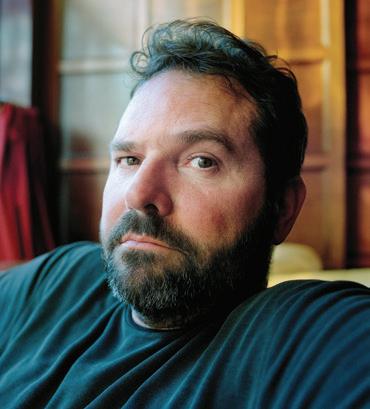
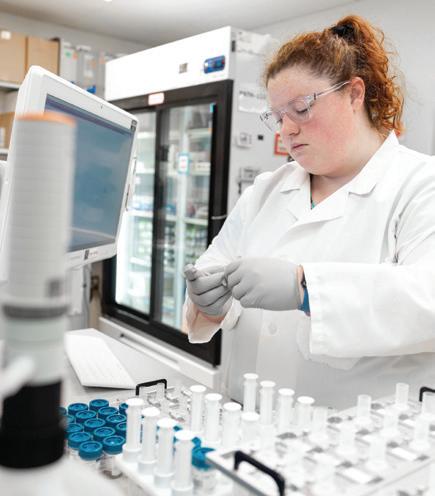
A discovery by UI researcher Michael Welsh enriches and prolongs the lives of cystic fibrosis patients.
HOW TO EMBRACE AGING
Iowa experts share the keys to growing older gracefully.
SHADOW OF THE MOUNTAIN
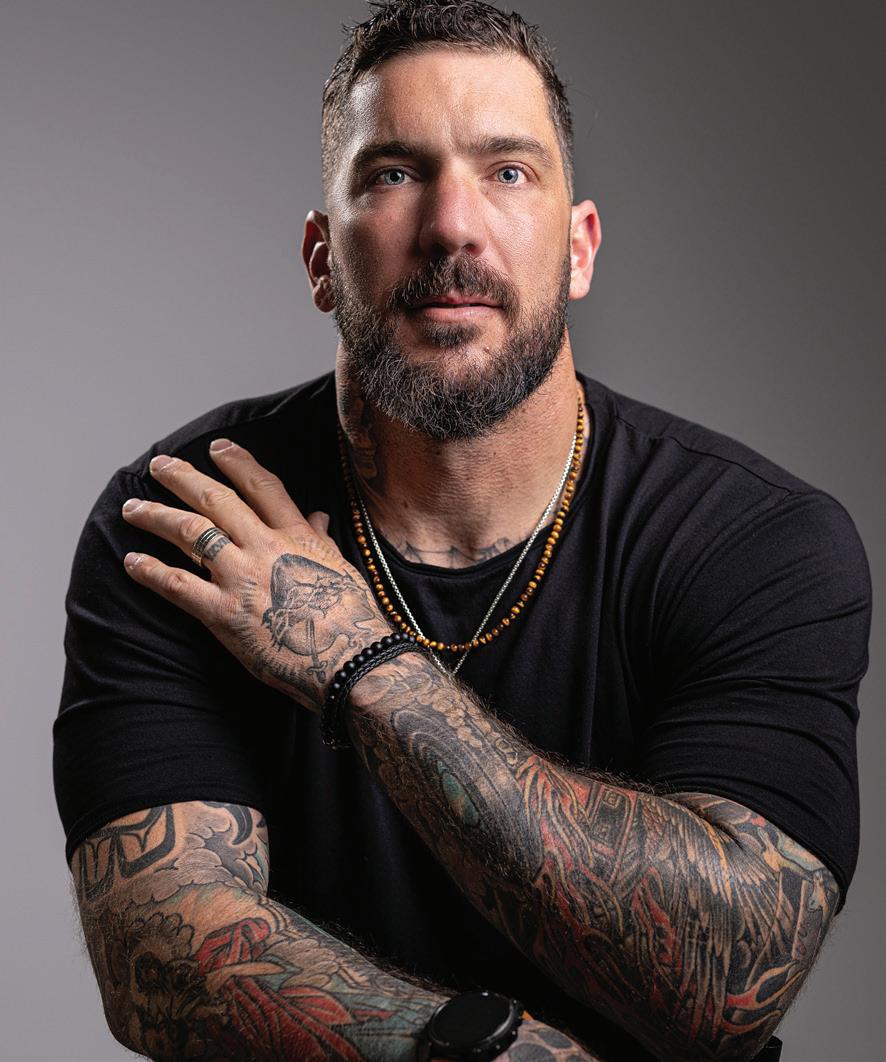
Former NFL player Robert Gallery reveals how an unconventional therapy saved his life.
Breath of Hope
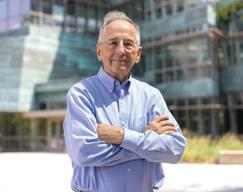
Patients with cystic fibrosis can now plan for a longer, healthier future due to life-changing discoveries made by internationally acclaimed University of Iowa pulmonologist and scientist Michael Welsh (71BS, 74MD, 77R).
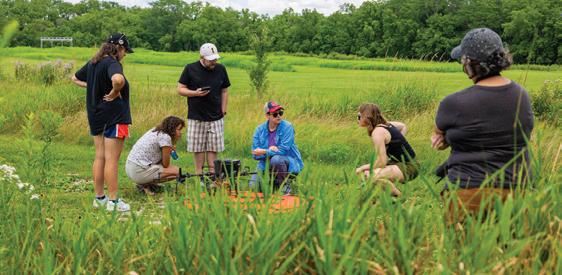
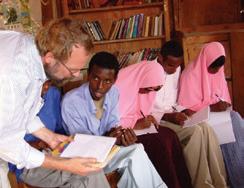
The National Science Foundation supports a UI biology lab’s fascinating foray into the world of parasitic wasps.
How to Embrace Aging
Research from experts at the UI’s Barbara and Richard Csomay Center for Gerontological Excellence helps older Iowans make the most of their golden years.
17 | Go Hawks
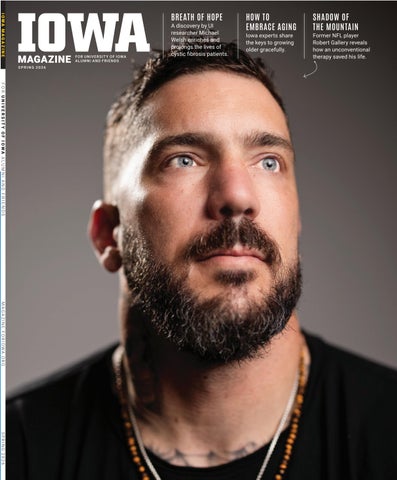
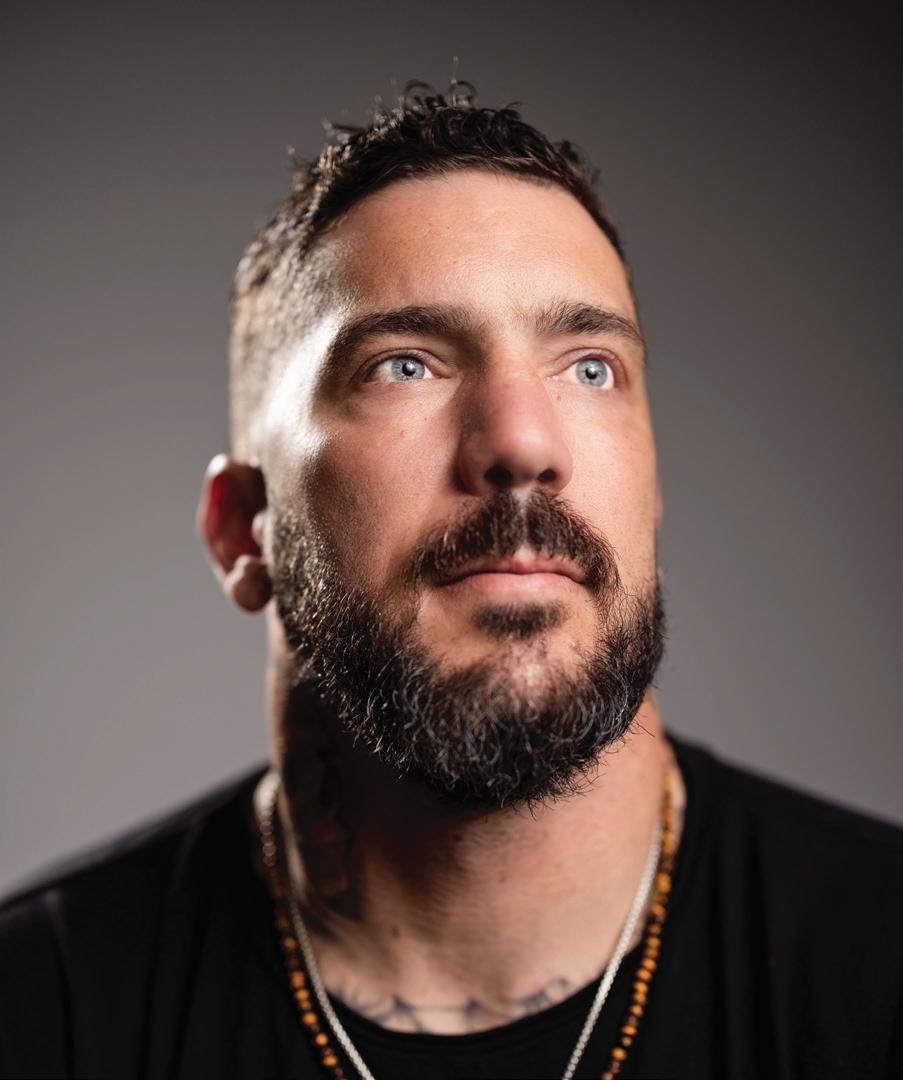
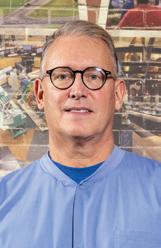
Shadow of the Mountain
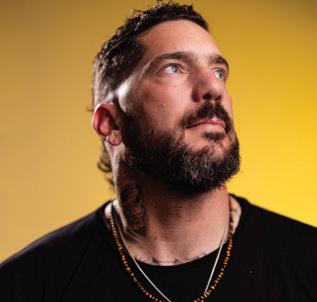
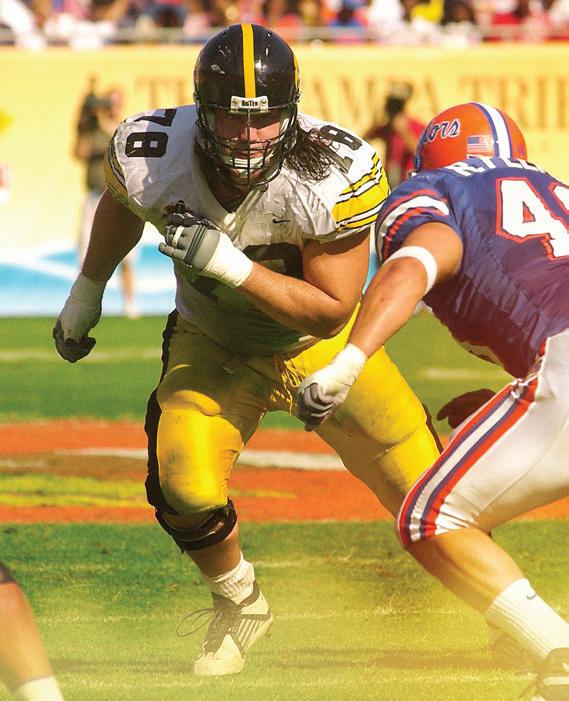
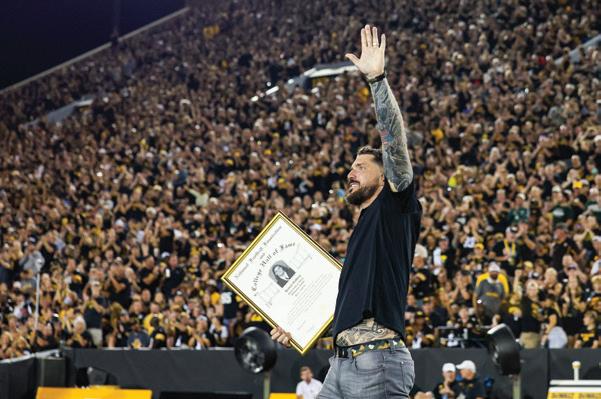
Former NFL playe r Robert Gallery (03BA) shares his journey out of the darkness of brain trauma through psychedelic-assisted therapy.
COVER PHOTO : CALEB SAUNDERS
Jess Settles (98BA, 05MA) and Lisa Bluder exchange the basketball for a mic as national sports broadcasters.
45 | Iowa Arts
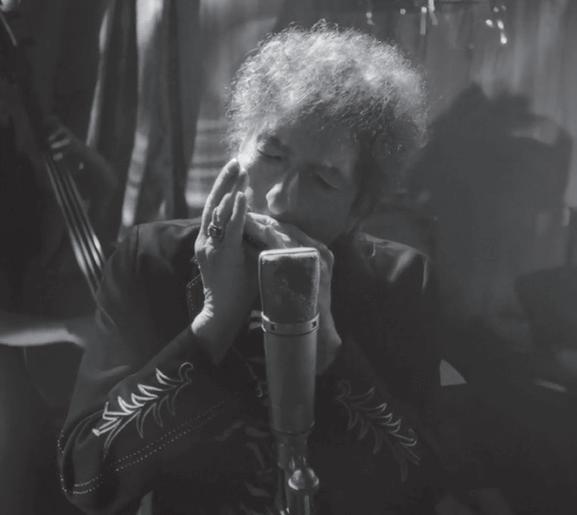
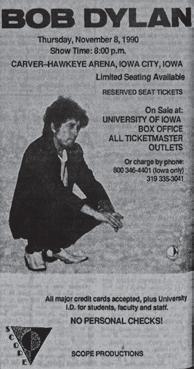
A scholar explores the poetry in Bob Dylan’s lyrics.
51 | For Iowa
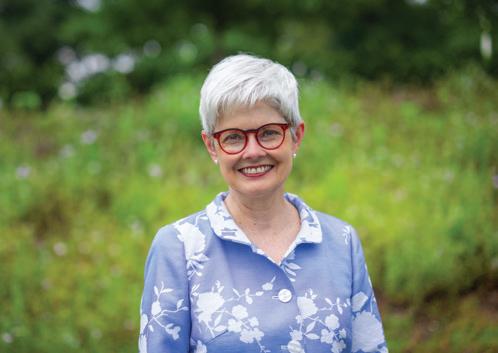
UI Center for Advancement president and CEO Lynette Marshall is set to retire after 20 years of service.
56 | Always a Hawkeye
An Iowa-trained actor portrays President Thomas Jefferson for America’s 250 th birthday.
POSTMASTER: Send address changes to Iowa Magazine, UI Center for Advancement, One West Park Road, Iowa City, IA 52242. Opinions expressed are not necessarily shared by the university, the publishers, or the editors.
The University of Iowa prohibits discrimination in employment, educational programs, and activities on the basis of race, creed, color, religion, national origin, age, sex, pregnancy (including childbirth and related conditions), disability, genetic information, status as a U.S. veteran, service in the U.S. military, sexual orientation, or associational preferences. The university also affirms its commitment to providing equal opportunities and equal access to university facilities.
Bubbles and Beats
To meet new friends during their first year at the University of Iowa, students joined a silent disco during an On Iowa! event earlier this academic year outside Hancher Auditorium. Floating bubbles and flashing lights set the mood, while students danced to music from one of three DJs that was transmitted to their wireless headphones. The dance party bonded the class of 2029, while creating a quiet but spectacular show for oblivious passersby.
BIG PICTURE
PHOTO: JUSTIN TORNER/ UI OFFICE OF STRATEGIC COMMUNICATION
Salute to Service
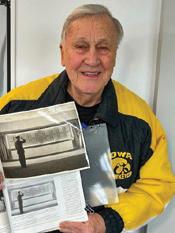
The military picture honoring our fallen members [“The M in IMU,” winter 2025–26, p.27] was taken in June 1957 as a part of the Air Force ROTC commissioning ceremony at graduation. As Colonel Cadet Corps Commander, I was honored to salute our members. I am 91 now and live independently in Des Moines.
Loy Brooks (57BA) Des Moines
Healing Journey
After reading “Inside Iowa’s Burn Unit” [winter 2025–26, p. 40], I completely just cried at my desk! What a sad but fabulous story. Thank you to the family and staff for sharing.
Lena Philips Peterson (04BA) Iowa City
What a great story! I used to work at the burn unit while I was in nursing school. I’m glad to hear about the new techniques used for healing and the new plans for upgrading the current facilities. It truly is a remarkable unit, and the staff are special people.
Eileen West Patterson (89BSN) Nevada, Iowa
IMU Memories
I enjoyed “Stories From 100 Years of the Iowa Memorial Union” [winter 2025–26, p. 22]. Starting in 1956, I worked for my board bussing tables in the Gold Feather Room at the Union. White jackets were furnished along with laundry service. Our meals were served in an undecorated part of the kitchen.
Thomas Wine (58BSC, 61JD) Davenport, Iowa
I started dental school in 1965, which at the time was just up the hill from the IMU. I lived on River Street and crossed the pedestrian bridge twice a day. I have never been colder in my life.
James Murtaugh (69DDS, 72MS, 72PedoS) Edmond, Oklahoma
Legacy in Communication Sciences
Iowa continues to be a leader in health care, as shown in “Built on Tradition” [winter 2025-26, p. 8]. As a former otolaryngology resident (1971–75), I remember the value of having Wendell Johnson Speech and Hearing Center colleagues for collaboration. I continue to be thankful for my education at Iowa and am proud of Iowa’s continued success.
Charles Koopman Jr. (75MS, 75R) Ann Arbor, Michigan
Burgers and Pinball
Your article titled “Iowa City EATS” [p. 20] in the summer 2025 issue mentioned the Hamburg Inn. This evoked such wonderful memories.
I was a pharmacy grad student from 1969–71. Back then, computer time was precious and data processing a big deal. The computer work was done by the university’s IBM System/360 Model 65 monster (compared to the relatively tiny HP I am using for this email).
I would bring my data to the computer center [in East Hall, later known as Seashore Hall] and then need
Iowa Keepsakes
to pass the approximately four-hour turnaround time. I would happily cross Iowa Avenue to Hamburg Inn No. 1 and order a magnificent burger with a slice or two of tomato and nothing else. After I finished this gourmet delight, I would pour quarters into my all-time favorite pinball machine, Flip-A-Card. This machine brought me such joy that I actually bought one a few years later. Thank you for the wonderful memories!
Arthur K. Yellin (72MS)
Olney, Maryland
In response to “Memories and Mementos” [winter 2025–26, p. 10], I have my student ID card from 1975, as well as a 50-year friendship with my college roommate, Kerry White Brannan (77BS). We’ll be roommates again on a river cruise this year, 50 years after my graduation from the School of Library and Information Science.
Renee Tobin (76MA)
Rancho Cucamonga, California
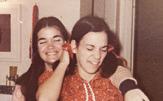
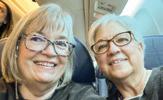
College roommates Renee Tobin (at left in both photos) and Kerry Brannan (at right) at Currier Hall in the 1970s and today
Lasansky in Iowa
I loved reading about artist Mauricio Lasansky ’s influence and your collection at the UI in your article, “Drawing Dignity and Disgust” [spring 2025, p. 44]. I wanted to share that Wartburg College in Waverly, Iowa, also has a large collection of Lasansky’s work on display throughout campus as part of the Waldemar A. Schmidt Art Gallery. A total of 25 intaglio and drypoint prints are available for the public to view in the Wartburg College Vogel Library and Bachman Fine Arts Center.
Mike Tyer
Art on Campus Committee, Wartburg College
Waverly, Iowa
California Connection
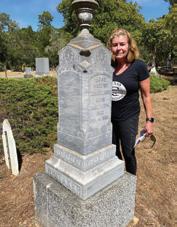
My wife of 36 years, Jeri Small Freeman (83BBA), graduated from Iowa with high distinction, and she retired in May 2025 from the AbbVie pharmaceutical company.
Jeri and I were visiting Cambria, California, and went to the Cambria Community Cemetery recently, where we found the final resting place for Iowa Sen. John McCormick (J.M.) Whitaker (1801–1891) and his wife, Jane. Whitaker was in the Iowa State Legislature, and for seven years he was the “locating agent” to select land donated to the state for internal improvement and in support of the schools. He was recognized as the person who chose the land for the UI. Tom Freeman Lake Forest, California
Remembering Jay Holstein
Editor’s note: Longtime University of Iowa religious studies professor Jay Holstein died Nov. 14, 2025, at 87. In his memory, author and former student John Shallman (86BA) wrote this letter to honor Holstein and his exceptional teaching career. Read Holstein’s obituary on p. 63.
To the students of Professor Jay Holstein—past, present, and eternal:
We’ve lost our teacher. But Holstein, being Holstein, would probably shrug and say, “Well, what did you expect? No one gets out of this gig alive.”
That was literally my first moment in his classroom in Macbride Hall. He walked in wearing a black leather jacket and aviators—like the frontman of a band named Rabbis of the Apocalypse—looked at all of us trembling freshmen, and opened with one of the greatest icebreakers in the history of higher education: “We are all going to die. Ecclesiastes. So, make every day count.” Welcome to college, kids.
That was the full Holstein package: irreverent, hilarious, startlingly direct, and in the very same breath, profoundly humane. He could demolish your naïve ideas about God, morality, suffering, or whatever half-baked philosophy you thought you invented in the dorms, all with one raised eyebrow. Then he’d quietly hand you something sturdier to build on: truth, humility, curiosity, maybe even hope.
Holstein teased us relentlessly. He mocked our seriousness, our certainty, our “I read half the book last night so I’m basically Socrates now—minus the thinking part” energy. And then he’d drop a line that cracked open the whole universe.
He taught The Death of Ivan Ilyich like Tolstoy wrote it for him personally. When Ivan realizes, on his deathbed, that his life was “not
the real thing,” Holstein would lean on the desk, lower his voice, and say: “So don’t wait for death to learn how to live.” Silence. Goosebumps. Holstein wins again.
He could jump from The Epic of Gilgamesh to Siddhartha without pausing for air—from the king seeking immortality to the seeker finding it in a river. “Gilgamesh tried to beat death,” Holstein said. “Siddhartha tried to understand it. Either way, you don’t win. But you can wake up.”
At first, I mostly loved Hemingway’s The Old Man and the Sea because, well, it was so short. I thought I had better things to do than read. But then I’d hear Holstein read this quote in class: “A man can be destroyed but not defeated.”
He didn’t just quote it—he lived it and wanted us to live it. The Old Man and the Sea wasn’t about the fish; it was about the fight. Holstein taught us to fight too. Not against the sea, but against complacency, cynicism, laziness, and the spiritual sleepwalking he could spot from across the room.
Holstein faced life’s absurdities, and ours, with a grin that said, “Relax. You’re not special. You’re confused like the rest of us.” And yet his swagger, his wise-guy grin, and his enormous generosity somehow made us feel special anyway. He gave you time he didn’t have. He’d tell you to “go back and read it again—slower,” and it was never an insult. It was an invitation.
Holstein always talked about how the best writing is iceberg writing, as Hemingway framed it: most of the meaning buried below the surface. Ironic communication, symbols, metaphors—these were the breadcrumbs I needed to follow. In a sense, Holstein didn’t just teach me how to read; he taught me how to see. Each book we read in class was a flashlight, illuminating a path in the dark, and every book he gave me wasn’t just a window into the world ahead, but into my own heart and soul.
Years after I graduated, I was invited to speak at his 50 th anniversary celebration and eventually to lecture in his class about the book I authored. It was surreal to stand in front of a classroom with Holstein sitting there, listening. I was unbelievably honored— and terrified—lecturing in front of the master. I did my best. I spoke about history, faith, family—all the things Holstein taught me were really one subject. At dinner that night, he made us laugh so loudly the waiter considered calling security.
He’d probably hate this letter. Too earnest. Too many metaphors. He’d smirk and say, “Shallman, you’re ladling it on a little thick.” And he’d be right. Because Holstein knew better than anyone that meaning isn’t declared—it’s discovered.
So, to all of Holstein’s students—from Iowa City to everywhere his voice still echoes—here’s what we carry forward: Read deeply. Laugh loudly. Question everything. And live awake.
Not only did Professor Holstein teach us how to read books—he changed how we read the world. And that ripple—that widening, widening ripple—is the legacy he leaves in all of us. May his memory be a blessing, a dare, and a lamp for those still finding their way. And may we, as Holstein insisted from day one, make every day count.
John Shallman (86BA) Encino, California
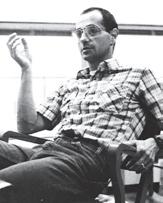
Jay Holstein, 1987
Cultural Curiosity
Leila Assadi , a University of Iowa economics and political science major, explores Wat Arun temple in Bangkok, Thailand, after a semester studying abroad in Seoul, South Korea. Assadi plans to find an international internship this summer and later earn a juris doctor degree to work in international and public interest law.
“The most valuable lesson I have learned through my international education experiences is the importance of cultural curiosity,” says the Bettendorf, Iowa, native, who received a 2025 UI Global Student Award. “In an ever-changing and globalizing world, the ability to connect and build relationships with people from different countries and cultures is of increasing importance.”
8 WORLD OF WASPS 12 AI IN WARFARE 14 WARRIOR FOR WOMEN ’ S HEALTH
Galls, Thieves, and Parasites
An Iowa lab discovers and names species within the wild world of oak-dwelling wasps.
Andrew Forbes , professor and associate chair of biology at Iowa , leads a lab focused on unraveling the ecological and evolutionary mysteries of parasitic wasps. The research team is using a nearly $900,000 award from the U.S. National Science Foundation to lead an effort to collect, study, and discover new oak gall wasps and their parasites.
Forbes expects the research to lead to the discovery of hundreds to thousands of new species of parasitic wasps, a largely understudied group that helps control insect pests in agriculture and forests. These findings would further support Forbes’ belief that parasitic wasps are among the most plentiful species on Earth. “I think it’s really interesting to understand where new species come from and to see how it happens,” he says. “It’s a basic science question, but I think it’s one that we should all be interested in.”
Parasitic wasps are one file card in Hymenoptera, the taxonomic order that includes ants, bees, and wasps. In that assemblage of insects, there are 150,000 described species.
This is second only to the order comprising beetles, Coleoptera, which has 350,000 known species. Beetles have been the frontrunner for centuries, thanks to their size, their riot of colors and appendages, and fawning descriptions about their collections from Charles Darwin and other scientists
But the gap between the two orders is narrowing. In a 2018 study, Forbes predicted wasps would surpass the beetles’ order by at least twofold. Scientists have since discovered and detailed a dizzying array of parasitic wasps, describing how they procreate, survive, and thrive.
There’s the crypt-keeper wasp, so named because it entombs another wasp and then eats it whole as it gnaws its way out to freedom. There are other parasitic wasps that seduce, or manipulate, insects—from caterpillars to spiders—into bizarre, trancelike states that seal their demise but allow the wasps to feed and live on. And, in these parasite-host transactions, there can be additional layers of parasitism—parasitic wasps that are preying on the original parasitic wasp, using it as a host to deliver its progeny.
BIOLOGY
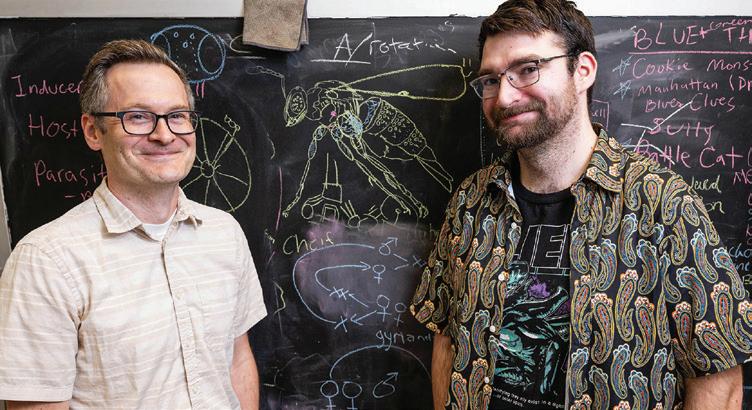
Biology professor Andrew Forbes (left) and postdoctoral researcher Louis Nastasi are pictured in Forbes’ lab.
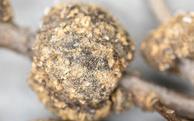
Oak trees create galls, like these samples from the Forbes lab, after being coerced by parasitic wasps that use them to lay eggs and grow their young.
parasitic wasp’s
Buzzworthy Names
Postdoctoral researcher and entomology expert Louis Nastasi shares the inspiration behind his five favorite wasp monikers.
Ceroptres jabbai
“I named this species after Jabba the Hutt from Star Wars because it has the most known host species of any member of its genus, which evokes the greed and opulence of Jabba’s palace in the movies.”
Kikiki huna
“Its name is derived from the Hawaiian word for ‘tiny,’ which is extremely appropriate, as adult wasps of this species measure just 0.15 millimeters long! The small size of this species makes it the smallest known flying insect.”
Euderus set
“Described by previous members of the Forbes lab in 2017, this species chews its way through its host to exit its gall. It is named after the Egyptian god Set, whose mythos mirrors this life cycle nicely.”
Microgaster godzilla
Forbes’ group is convinced that many more species await discovery. Over the summer, Louis Nastasi joined the Forbes lab as a postdoctoral researcher to assist Nastasi earned a doctorate in entomology, or the study of insects, from Penn State. Before coming to Iowa, he had partnered with Forbes on a study in 2024 describing 22 new species of oak gall wasps
To identify new species in the Forbes lab, Nastasi looks at gall wasps’ physical features under a high-powered microscope and sequences their DNA. When a new species has been identified and described, it will get a name. The research team has already been brainstorming, writing potential names on the lab’s whiteboard. “It’s kind of a reward after
doing all the hard work of figuring out what they are, how they’re different from each other,” says Nastasi. “There’s no other job like this.”
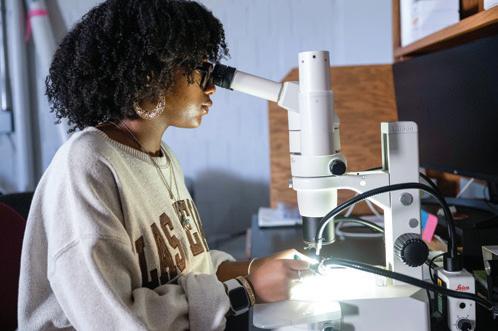
Undergraduate students are also getting in on the research, daily looking for newly emerged wasps or using high-powered microscopes to examine the physical features of parasitic wasps. “Being on the forefront of research is something I dreamed of doing ever since I was a kid,” says Amil Brown , a senior in the Forbes lab from the Quad Cities “I was thinking, by the time I grow up, everyone’s going to discover everything by now. But to know that there are areas out there that are undiscovered, it feels fun being a part of that.”
BY RICHARD C. LEWIS
“This species is named after the iconic Godzilla due to its life cycle. This wasp hunts caterpillars that live underwater and drags them onto land to parasitize them. This resembles Godzilla’s dramatic emergence from water in many scenes, and the battle between the parasitic wasp and its host is reminiscent of kaiju battles seen throughout the Godzilla films.”
Idris elba
“The genus name Idris already existed before this species was first identified, so the describers had the perfect opportunity to make the species name correspond to the well-known actor.”
Undergraduate researcher Amil Brown uses a microscope to help identify a
genus and placement in the taxonomic order.
Pieces of the Past
A professor’s research connects Native American boarding school survivors with documents from their childhood.
For many older Native Americans, one of their earliest memories is being snatched from their family. Taken hundreds of miles away to attend religious or government-run boarding schools, they were forced into a new language and religion, likely beaten, and given little food or medical care.
Carrie Lowry Schuettpelz (06BA) is well acquainted with these stories, documented for tens of thousands of Native children from 1860 until 1978. Most survivors, she says, left the schools with nothing tangible of themselves—no letters, no report cards, not even a photograph to chronicle their existence.
One survivor she interviewed had no pictures of himself before age 16. After connecting the
man with class worksheets and handwritten cards from his youth, Schuettpelz says, “It became clear to me that this was something more people should experience. I felt really compelled to do this work.”
The work has become known as Project Return—one of two endeavors that led to a prestigious $1.1 million grant from the Andrew W. Mellon Foundation for Schuettpelz, associate professor of practice and director of undergraduate studies in the University of Iowa School of Planning and Public Affairs. “Her efforts to return documents have had a transformative impact on the lives of survivors and their families,” says Libby Washburn, associate CEO of the Native American Agriculture Fund.
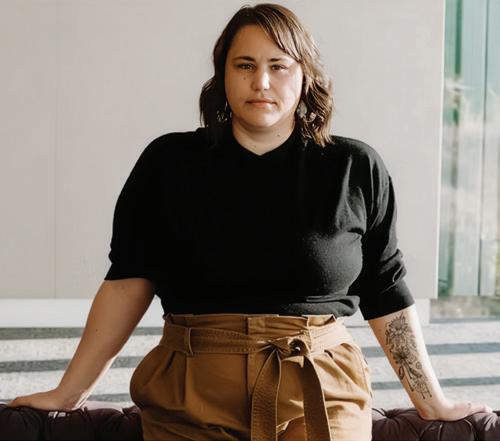
Carrie Lowry Schuettpelz, an enrolled member of the Lumbee Tribe of North Carolina, teaches public policy at Iowa, where she is also director of the Native Policy Lab.
Aiding Survivors and Involving Students
In 2024, while on tour for her first book, The Indian Card: Who Gets to Be Native in America, Schuettpelz met Native American readers frustrated at being unable to legally establish their heritage through documentation. The professor learned that no national initiative helped boarding school survivors retrieve their records from archives—a complex and often pricey process.
“I hadn’t fully appreciated how many survivors are still part of every community, every tribe. The sheer magnitude was eye-opening,” she says. “I wanted to expand this nationally. The grant allows us to do that.”
The Mellon grant, along with partnerships with the university’s Center for Social Science Innovations and its Digital Scholarship & Publishing Studio, has also allowed undergrad and graduate students to support research, which often takes them to other universities and repositories across the country.
“You can hear about these documents in the classroom, but traveling to Kansas City and Fort Worth literally put history in my hands,” says Joseph Maxwell , a UI student who graduates this year from the Master of Urban and Regional Planning program, with a concentration in land use and environmental planning. Maxwell, a descendant of the Wampanoag Tribe of Gay Head (Aquinnah),
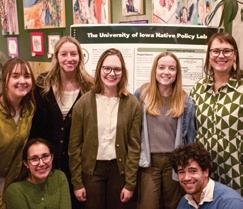
Schuettpelz’s students present their research.
NEWSMAKER CARRIE LOWRY SCHUETTPELZ ( 06 BA)
says that peering into the eyes of the schoolchildren in old photographs who are now elders helped connect him with the people his research serves.
“The experience has allowed the opportunity to ask my own research questions,” he adds, “and taught me a lot about where I fit into the broader picture.”
Past as Prologue
Schuettpelz also has a personal connection to her research, having become an enrolled member of the Lumbee Tribe of North Carolina at age 6. She earned bachelor’s degrees from Iowa in political science and anthropology before heading to Harvard. With a master’s in public policy, she spent seven years as a policy adviser at the U.S. Department of Housing and Urban Development, focusing on homelessness policy and Native issues. She then earned an MFA in creative writing at Wisconsin before joining the UI faculty and leading Iowa’s Native Policy Lab.
Schuettpelz’s Mellon grant also supports Project Trust, which uses land mapping tools and records to help Native Nations develop plans to regain ownership and access to land. How is the long history of land loss still affecting tribes? How much is recoverable—not just for monetary purposes, but for pride, worth, and a sense of heritage? Questions like these are “coming more into the public consciousness,” Schuettpelz believes.
Many of Schuettpelz’s research pursuits derive from talking with people about policy changes they’d like to enact. Through these projects and her writing, she brings greater public awareness and develops a new generation of researchers.
In any endeavor, “Professor Schuettpelz’s work is marked by a deep commitment to Native communities and a thoughtful approach to issues of identity and justice,” says Washburn. “She approaches her work with exceptional dedication and empathy.”
BY ELLEN RYAN
On Native Membership and Land
In 2024, Carrie Lowry Schuettpelz’s first book, The Indian Card: Who Gets to Be Native in America, was included in The New Yorker ’s best books of the year. It won acclaim for its mix of data analysis and observations on Native identity, such as “Treating ‘Native America’ as a monolith is a bit like claiming interest in ‘Asian culture.’ There isn’t just one.” In fact, the contiguous U.S. has 347 federally recognized tribes—all operating independently.
The University of Iowa professor recently contracted for her second book, Trust: How Native Land Was Stolen and How We Get It Back. Given that both individuals and entire Native nations were forced from over 1.6 billion acres of land, this book will explore options—working with governments, nonprofits, and individual donors—for reclaiming Native land.
Pathway to Pharmacy
The University of Iowa College of Pharmacy will launch a new Bachelor of Science degree in pharmacy sciences in August to provide undergraduates with a foundation to prepare for careers in the growing pharmaceutical industry. The new major offers tracks in business and regulatory affairs and can accelerate a student’s path to a PharmD degree.
Beyond the Solar System
David Nataf, a UI assistant physics and astronomy professor, has received a three-year, $313,000 NASA award to create an interstellar map that will improve the study of planets located outside the solar system—known as exoplanets—and their host stars.
Post-Cancer Support
The UI Department of Health and Human Physiology is establishing a new Exercise Oncology Clinic that will offer personalized exercise programs, rehabilitation, and clinical research on the benefits of physical activity for cancer survivors, while also providing hands-on learning experiences for students. Public-private partnership funding will support the threeyear, $642,896 project.
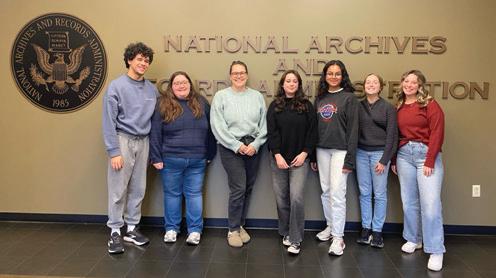
Joseph Maxwell (pictured at left) joins other UI students on a research trip to the National Archives and Records Administration.
Ethics in Action
A University of Iowa professor helps global leaders consider the risks of AI in warfare.
Originally from the former Yugoslavia, Jovana Davidovic thought she’d follow in the footsteps of her parents to become a medical doctor. But while she was studying abroad, the Yugoslav Wars broke out, leading to many civilian casualties and genocide. The atrocities prompted Davidovic to ask questions about the ethics of war, which she has spent her career addressing as a University of Iowa associate professor of philosophy and contributor to the UI Center for Human Rights.
Of critical importance to Davidovic is to minimize and prevent civilian harm. According to international humanitarian law, militaries must discriminate between combatants and noncombatants and ensure any action that might unintentionally but foreseeably threaten civilian lives is proportionate to the military objective. Davidovic works with governments, military academies, defense contractors, and peace institutes to help them apply these ethical principles to their day-to-day decision-making.
The ethics of warfare have become more complex in the past several years with the rise of AI-powered weapons and decision-support tools. Davidovic recently earned a $1 million grant from the Research Council of Norway
to develop ethical risk management frameworks that provide human oversight over these AI tools throughout their life cycle—from design to deployment. “We want to know that whatever the commander had in mind is what ultimately happened out there,” says Davidovic, who also is a senior researcher at the Peace Research Institute Oslo, where this collaborative project is based.
With the rapid rise of AI, militaries increasingly rely on semiautonomous AI-weapons systems, such as loitering munitions, to identify and engage targets. Davidovic’s work addresses concerns about the lack of explainability in how the AI systems make decisions, which leads to an overdependence on the technology for guidance and questions of accountability in failure. “You can imagine the scariness and risks there,” says Davidovic, a senior fellow for the Stockdale Center for Ethical Leadership at the United States Naval Academy. “When these things fail, they can fail on a grand scale.”
The stakes are higher than ever as the global community works to shape regulations to prevent the use of AI in nuclear weapons. Davidovic also calls for government regulation to mitigate the risks of AI’s application across industries. As the chief ethics officer for BABL AI, an AI auditing and ethics consultancy, she says organizations are generally eager to work with her on developing ethical frameworks around AI use, because “they understand the risks.”
Despite the dangers, Davidovic says she sees potential for positive change with AI. “I don’t want to sound like an AI alarmist,” she says. “I really do believe AI can cure cancer and solve climate change. I think it will play an essential role in those two [areas], and I think those are the greatest issues of our time. But you don’t need to be an ethicist to know that AI that causes more harm than it helps is not worth our time and effort.”
BY SHELBI THOMAS
Jovana Davidovic, UI associate professor of philosophy
AI at IA
Beginning this fall, the University of Iowa will offer an undergraduate certificate in artificial intelligence. Through several courses in a range of disciplines, students will gain an understanding of AI’s potential uses, limitations, ethical implications, and practical applications. Davidovic will teach the elective Ethics of Artificial Intelligence.
PHILOSOPHY
Why Should Kids Learn Handwriting?
Shawn Datchuk was at home when his 8-year-old son, Misha, brought him a birthday card from his grandma. “I can’t read this,” Misha said. When Datchuk, professor of special education at the University of Iowa College of Education, asked why, his son said, “because it’s in cursive.”
Datchuk believes these exchanges between children and their parents are common. “There tends to be this generational divide on people who grew up using cursive and those who did not,” he says.
To bridge the divide, Iowa public schools have been required to teach cursive since June 2024. The requirement states that students should begin cursive writing in second grade and show proficiency by third grade; however, not many educational handwriting resources exist.
That’s where CLIFTER (Cursive Letter Identification and Formation for Transcription and Early Reading) comes in. The free tool designed by Datchuk and a team at the Iowa Reading Research Center includes a customizable curriculum, where educators can play videos, download individual letter worksheets, and have students work toward spelling words. The research center also offers a similar resource called LIFTER (Letter Identification and Formation for Transcription and Early Reading) as a print handwriting resource.
Datchuk says the benefits of learning handwriting include and extend well beyond being able to read a grandmother’s card. Here are three reasons why handwriting benefits a young person’s education.
Shawn Datchuk, UI professor of special education
Handwriting improves learning.
“There’s something incredibly powerful about handwriting that isn’t really talked about in a digital age,” says Datchuk. When students handwrite notes, they synthesize rather than transcribe information. Doing so leads to critical thinking, which influences long-term memory.
Handwriting development leads to reading and writing development.
Datchuk says, “When we think about the basic building blocks of writing, the process occurs at the individual letter.” Once students feel confident in writing letters, cognitive space is then freed up for other activities like reading, writing, idea organization, and argumentation.
Its cost efficiency makes it widely accessible to students.
In the digital age, technology and device upkeep is expensive, but when a pencil tip breaks, it only needs to be sharpened. That’s why Datchuk says “handwriting tends to be the most cost-efficient and portable way for students to engage in writing at K-12 schools.”
As a free resource, CLIFTER supports many public schools across Iowa. For example, Des Moines Public Schools—the largest school district in Iowa—use CLIFTER in all their elementary buildings. It reaches over 15,000 students and saves the district hundreds of thousands of dollars each year on curriculum costs.
“Going into the future, I only see a deeper partnership between university research centers working collaboratively with schools to figure out what’s the smartest use of their precious time and resources,” says Datchuk. “This will only help the children of Iowa.”
BY EMMA CONWAY
The Iowa Reading Research Center receives all of its funding from donors. To give, visit givetoiowa.org/readingresearch
From Bench to Breakthroughs
A first-generation Hawkeye hopes to revolutionize women’s health care through groundbreaking cancer research.
Hiruni Sumanasiri ’s stroke of luck started with the University of Iowa staff directory. After graduating from Iowa City West High School in 2022, the aspiring physician spent her summer combing through these listings and “cold emailing” more than 60 UI professors in search of a research role for her freshman year. One reply changed her world—and is helping her change the field of women’s health.
A cardiology professor wrote back to connect Sumanasiri with his wife, Kristina Thiel , a UI assistant professor of obstetrics and gynecology. Thiel had funding to establish a lab dedicated to developing treatments for patients with gynecologic cancers—and she welcomed Sumanasiri to her new team.
“That decision transformed my entire life,” says Sumanasiri, a first-generation student who was born in Sri Lanka and came to the United States at age 6, “not knowing a single word of English.” She joined Thiel as a freshman volunteer, pitching in to clean up the research space and wash lab equipment.
Today, Sumanasiri is a senior microbiology major, a research ambassador for the Office of Undergraduate Research, and a key member of the Kristina Thiel Laboratory Group, which uses preclinical models of patient tumors to create precision treatments for women with uterine and ovarian cancers.
“Hiruni is one of the most dedicated individuals I’ve encountered in 20 years in academia,” says Thiel. “She excels in learning complex laboratory techniques and isn’t afraid to offer creative hypotheses.”
Thanks to these skills, Sumanasiri has been able to leverage ideas into her own research topic, joining the many undergraduates—1 in every 3—who participate in academic research at Iowa. Sumanasiri is authoring a paper about how to improve tumor biobanking and better represent
Hiruni Sumanasiri received recognition in the UI’s 2025 Capture Your Research Photo Contest for this picture of organoids, cells grown as models to help her laboratory study endometrial and ovarian cancers.
STUDENT SUCCESS
“ Don’t be afraid to take up space and ask questions. You never know what that might spark.”
— Hiruni Sumanasiri
a full cross section of women. She presented the project in Des Moines in March 2025 as part of the Research in the Capitol event, which annually sends 20 undergraduates from each regent university to present their research to state legislators.
“My brain doesn’t even see this as work anymore,” says Sumanasiri. “The lab is just my home.”
She also feels at home on Iowa’s campus, where she formed some of her most vivid childhood memories. Her father is a custodian in Lindquist Center, and her mother is a food coordinator for University Housing and Dining; as their only child, she often used to tag along with them to work.
“I walked through all these buildings, which seemed so gigantic then, and I just knew Iowa was my place; it had a huge impact on me,” she says.
Now she hopes to have an equally profound impact on others, especially those in rural Iowa, by becoming a doctor and working to close the gaps in women’s health care. She believes her Iowa experiences have helped make this achievable.
“I want other first-gen students to know: You belong in every single room,” she says. “Don’t be afraid to take up space and ask questions. You never know what that might spark.”
BY LEAH KLEVAR
In the News
For the fourth consecutive year, The Daily Iowan has earned a national Newspaper Pacemaker Award from the Associated Collegiate Press. It’s the 10 th time the paper has received collegiate journalism’s top honor.
Insect Collection
In the largest grant ever awarded to the Pentacrest Museums, the National Science Foundation provided more than $1 million for the UI Museum of Natural History to preserve and digitize more than 140,000 irreplaceable insect and invertebrate specimens from the Iowa Insect Survey Collection that was housed at Iowa Wesleyan University until its closure.
Expanding Screening
An initiative led by Jill Kolesar, dean of the UI College of Pharmacy, aims to reach thousands of at-risk Iowans with lung cancer screenings conveniently available at their local pharmacies. Funding from Eli Lilly and Company supports the Community Health Assessment and Monitoring in the Pharmacy (CHAMP) program, run in collaboration with the Iowa Pharmacists Association and CPESN Iowa.
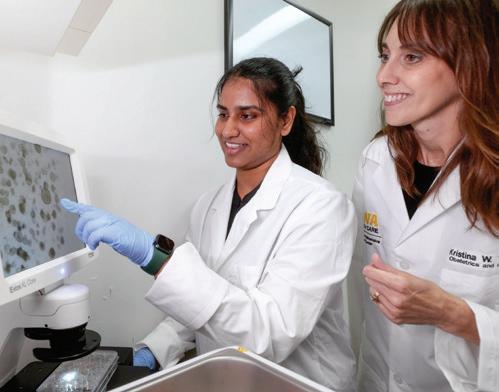
Hiruni Sumanasiri (left) and Professor Kristina Thiel collaborate in Thiel’s research lab.
Breakthrough Bowl
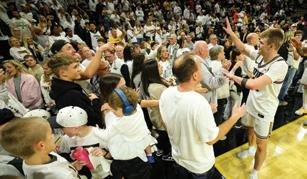
Kirk Ferentz, the Hawkeyes’ Moon Family Head Football Coach, celebrates Iowa’s 34-27 win over Vanderbilt on New Year’s Eve at the ReliaQuest Bowl in Tampa, Florida. Ferentz set a Big Ten record with his 11th bowl victory, and the Hawkeyes ended the season with a 9-4 record and ranked 17th in the final AP poll.
On the Air
Former Hawkeyes are making their voices heard on sports TV and radio.
It’s a new chapter for Lisa Bluder.
The former Hawkeye women’s basketball head coach made her debut as a color commentator on the Big Ten Network this past fall when Iowa beat Drake at Carver-Hawkeye Arena. In January, she started working as a studio analyst for NBC and Peacock.
After 40 years on the sidelines, Bluder says it’s an adjustment going from coaching to behind the camera.
“I’m going home happy every night, and that’s the great part about working on TV,” she says. “I have absolutely no impact on the game, and that’s something I’m still getting used to as a color commentator.”
When Bluder retired in 2024 after back-to-back national title game appearances, she wasn’t expecting to find herself in sports media. However, once the offers started to come, she liked the idea of continuing to work in the game.
“Being on TV is certainly new for me, but what’s not new is talking basketball,” she says. “I’ve been doing that for a long time.” BROADCASTING
While Bluder is adjusting to her new pastime, she’s not the only Hawkeye who is charting a path in sports media.
From Hawkeye Star to Long-Standing Color Commentator
Jess Settles (98BA, 05MA) has long had a love for basketball. Growing up in southeast Iowa, he led Winfield-Mount Union High School to two state tournament appearances, earned Iowa’s Mr. Basketball in 1993, and wrote about his experiences in the local newspaper.
When Settles joined the Iowa men’s basketball squad in 1993, he became an integral part of Coach Tom Davis ’ squad and was named Big Ten Conference freshman of the year. Starting 99 games over his six-year career, Settles concluded his time as a Hawkeye by leading Iowa to the Sweet 16 in 1999.
Since then, Settles has worked on his family farm in southeast Iowa and become a mainstay on numerous sports broadcasts throughout the winter as a color commentator for the Big Ten Network, FloSports, ESPN, NBC/ Peacock, and FS1.
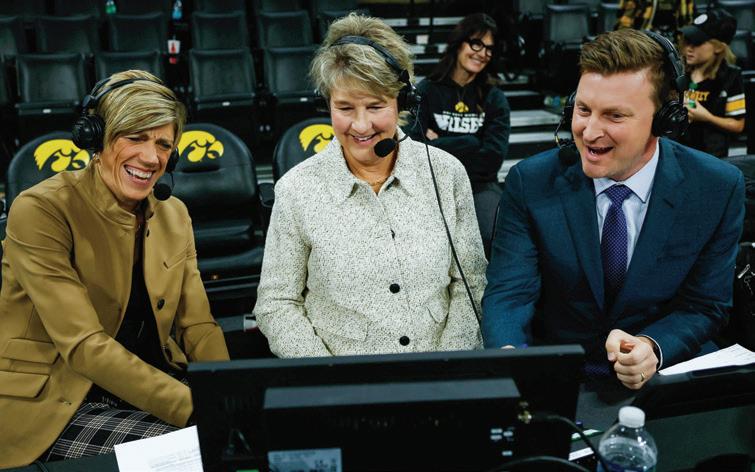
Lisa Bluder (center) and Mike Hall interview Jan Jensen, the Hawkeyes’ P. Sue Beckwith, MD, Head Women’s Basketball Coach, after Iowa’s win over Drake earlier this season. Bluder debuted as a color commentator for the Big Ten Network in November.
Settles works around 40 games a year, using his background as a Hawkeye to enrich the production.
“Audiences are really interested in what value you can add to a broadcast,” says Settles. “That’s more important than a big name. I strive to reach, explain, and entertain them by connecting the past to the future. People love stories, and if I’m covering an Iowa men’s basketball game, you know I’m going to share a lot of stories.”
To prepare for a game, Settles watches previous matchups and builds a legal-size clipboard with player names and statistics. He says, “You want to be able to glance down quickly and find what you need.”
He’ll also attend practices, meet with network staff to talk about storylines, and watch shootaround before the game. “You have to do your research, find the stories, and study the matchups,” says Settles, who now calls Pella, Iowa, home.
Throughout any given game, Settles—as a color commentator—shares his opinions, insights, and stories with viewers. However, much more is going on behind the scenes.
During a broadcast, Settles is constantly hitting the talk back button, which means he can speak to the producer while the game is happening—and the audience can’t hear it.
Settles is relaying what he’s seeing so that after a timeout, he can walk viewers through a key play or moment.
“There’s constant in-game communication,” he says. “People are talking in your ear while you’re live on TV—and that can be really hard to manage if you’re not used to it.”
Once the game is over, the process starts again.
“You have all this research and notes, and within 20 seconds of the game being over, you slide everything into a trash can next to the courtside table,” says Settles. “Coaches and players might be celebrating, but for me, it’s onto the next game.”
In a competitive industry, Settles and Bluder have built relationships with others in sports media to improve and grow. Settles has received advice from Coach Davis, ESPN’s Jay Bilas, and his wife, Joanna Woepking Settles (00MA, 12PhD), who also works part time in the industry. Bluder has relied on ESPN’s Debbie Antonelli and the Big Ten Network’s Shimmy Miller to adjust to being on camera.
“Being on TV for a couple hours straight is something I’m getting used to—it was a little terrifying the first time,” says Bluder. “But it’s still like coaching. You can’t always prepare for what’s going to happen, but you still have to do your homework, watch film, and figure out the keys to the game.”
BY BEN FROTSCHER
Success in Sports Media
Here are a few of the many Hawkeyes working in national sports broadcasting:
Pat Angerer (09BA), a former linebacker for Iowa, is a color analyst for Iowa games on the Hawkeye Radio Network.
Lisa Bluder, former Iowa women’s basketball head coach, is working for NBC/ Peacock as a studio analyst and as a color commentator for the Big Ten Network.
Paul Burmeister (94BA, 97MA), a former Iowa quarterback, is a play-by-play announcer for NBC/Peacock.
Bobby Hansen (83BBA), a former shooting guard for Iowa men’s basketball, is a color commentator for the Hawkeye Radio Network.
Reghan Coyle Harmer (21PHR), a former Iowa volleyball student-athlete, is a color analyst for the Hawkeye Radio Network.
Anthony Herron (06BA), a former defensive end for Iowa football, works for the Big Ten Network as an analyst.
Danan Hughes (17BA), a former wide receiver for Iowa football, is a color analyst for the Chiefs Radio Network and a football, baseball, and basketball analyst for the Big Ten Network and ESPN.
Mark Ironside (98BS), a former Iowa wrestler, is a color commentator for the Hawkeye Radio Network.
Jess Settles (98BA, 05MA), a former Iowa men’s basketball forward, works for various sports networks as a color commentator.
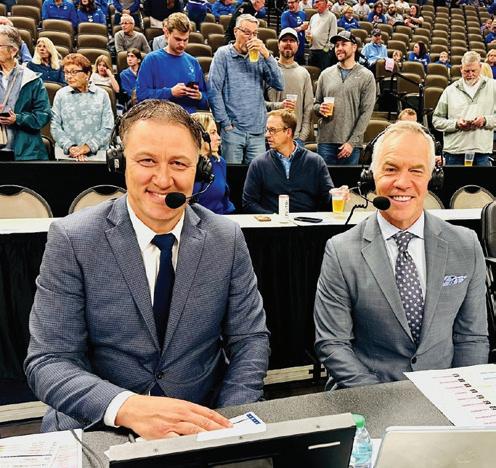
Former Hawkeye student-athletes Jess Settles (left) and Paul Burmeister report from the sidelines for NBC/Peacock during a Creighton men’s basketball game in Omaha, Nebraska, earlier this season.
Thunder and Lightning
Iowa offensive linemen
Logan Jones (24BS) and Beau Stephens were named Associated Press first-team
All-Americans, extending the football program’s active streak to a national-best seven straight years with at least one player earning the distinction. The Hawkeyes also earned the Joe Moore Award, which recognizes the most outstanding offensive line unit in the country, and Kaden Wetjen (24BA) became the first two-time Jet Award winner as the nation’s top return specialist.
Hat Trick
The Iowa women’s soccer team completed a historic run in November after reaching the NCAA tournament round of 32 for the third consecutive season. The Hawkeyes led the Big Ten in average home attendance and ranked fifth nationally, resetting their program record.
Dutch Duo
Netherlands natives Dionne van Aalsum and Fréderique van Cleef were named National Field Hockey Coaches Association All-Americans this past December after leading the Hawkeyes to the Sweet 16. The duo combined for 40 goals this season, including a national-best 28 from van Aalsum.
Construction is underway at the University of Iowa’s Finkbine Golf Course.
The Future of Finkbine
A renowned architect reimagines the home of Hawkeye golf.
Since its opening in 1955, Finkbine Golf Course has hosted many prestigious tournaments, ranging from Big Ten Championships to the Amana VIP Pro-Am that attracted famous figures such as President Gerald Ford and baseball star Joe DiMaggio. The 18-hole, par-72 course off Melrose Avenue in Iowa City is also home to the University of Iowa men’s and women’s golf teams.
Now, thanks to a generous gift from Fritz and Mary Lee (61BA) Duda , Finkbine is set for a major transformation. Finkbine’s irrigation system needed an upgrade, so refreshing the course now made the most financial sense. UI men’s golf coach and former letter winner Tyler Stith (02BBA) says, “If we were ever going to renovate, now was the time.”
The privately funded project will be led by Scott Hoffman, a renowned golf course architect who has contributed to high-profile courses like Gozzer Ranch in Harrison, Idaho, and Monterey Peninsula Country Club Dunes in Pebble Beach, California. Rather than coining this as a renovation or restoration, Stith says, “We have framed this as a reimagination project from the very beginning. The new layout will maximize the land to create
a completely new golf experience—one that will challenge golfers of all levels and create stunning visuals.”
New bunker placements and longer tee boxes will not only add variety to the holes but also increase Finkbine’s overall appeal, according to UI women’s golf coach Megan Menzel . She says, “We wanted the course to be playable for all levels of players: for families, for juniors, for collegiate players, all the way up to very elite golfers.”
Course construction began after the conclusion of the 2025 golf season. The reimagined Finkbine aims to open in summer 2027.
In the meantime, the men’s and women’s golf teams are relying on local partners for practice space.
Menzel says Blue Top Ridge in Riverside, Brown Deer in Coralville, the Cedar Rapids Country Club, and Pleasant Valley in Iowa City are a few of the places that have welcomed the Hawkeye golf teams. “It’s been a team effort,” says Menzel. “We are greatly appreciative of the Duda family and everyone who has supported this project.”
BY EMMA CONWAY
GOLF
Good Will Running
A student-athlete volunteers at the same children’s hospital that once cared for him.
Will Ryan knew something wasn’t right.
As a sophomore at West Des Moines Dowling Catholic High School in 2019, Ryan developed a puffed-up lip and bloodshot eyes—and lost his appetite. After going to the emergency room, Ryan and his parents had more questions than answers.
“They thought I had a fatal illness,” says Ryan of the doctors in Des Moines. “When I heard that, I honestly thought, ‘Oh my gosh, I might die.’”
Referred to University of Iowa Health Care Stead Family Children’s Hospital, Ryan was
diagnosed with mycoplasma pneumoniae-associated mucositis, an overactive immune response to an infection that caused Ryan to lose 15 pounds and develop sores on his nose, throat, and mouth.
“I was already a skinny cross-country runner; I didn’t have the weight to lose,” says Ryan, who missed the rest of his season to recover. “It was certainly an opportunity that was taken away from me, but it added fuel to the fire.”
During his final two years of high school, Ryan finished top 10 in the state and led his team to a state cross-country title. His performance propelled
him to Iowa, where he’s now a three-time Academic All-Big Ten honoree, four-year letter winner, and runs the 5,000- and 10,000-meter races as a senior on the Hawkeye track and field team.
While Ryan has earned accolades as a reliable long-distance runner for Iowa, his dedication to volunteering with the Iowa City Free Medical and Dental Clinic, UI Mobile Clinic, and Stead Family Children’s Hospital—inspired by his health journey—hasn’t gone unnoticed.
“When I was going through a lot of bad stuff as a patient, the bright spot was seeing studentathletes in the hospital,” says Ryan, who met former Hawkeye football defensive end Chauncey Golston (20BA) and basketball standouts B.J. Armstrong (89BA), Jordan Bohannon (20BA), and Joe Wieskamp (21BBA). “That gave me some great memories, and that’s why I volunteer as much as I can. I was in their shoes at one point, and I just want to give patients hope.”
In November, Ryan and women’s wrestling star Ava Bayless were selected as Iowa’s recipients of the Jackie Robinson Community & Impact Award, which honors Big Ten student-athletes who positively impact their communities and excel in competition. Ryan also was one of 20 studentathletes recognized for their contributions outside of competition through the Allstate National Association of Collegiate Directors of Athletics Good Works Team. Ryan’s experiences at Iowa—as a patient and now as a student-athlete—have led him to pursue dental school this fall.
“Much like volunteering at the children’s hospital, I hope to give patients confidence and strength as a dentist,” says Ryan. “I’ve seen how impactful a good doctor or dentist can be, and it’s something I’ve really found a passion for at Iowa.”
BY BEN FROTSCHER
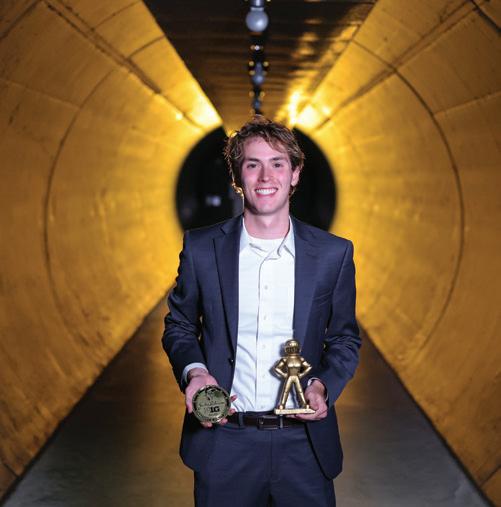
PLAYMAKER WILL RYAN
Student-athlete Will Ryan received recognition for his volunteer hours at the children’s hospital during UI Athletics’ 2025 Golden Herkys ceremony.
Ryan competes for Iowa track and field.
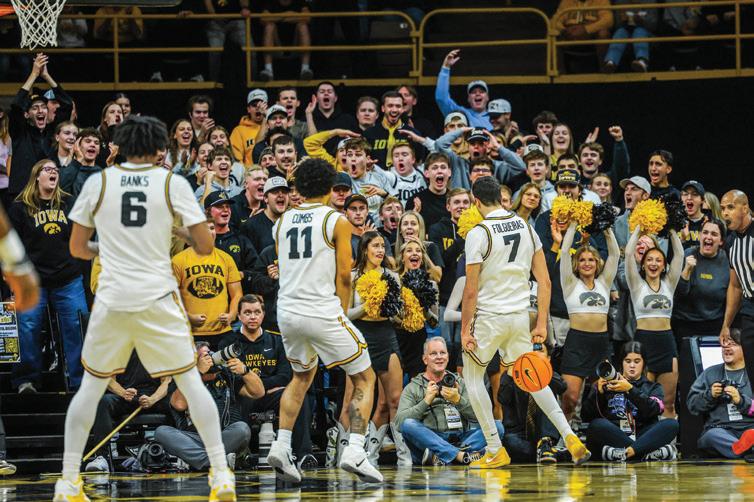
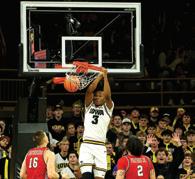
Hawkeyes Tavion Banks (No. 6), Kael Combs (11), and Alvaro Folgueiras (7) hype up the Hawks Nest at the men’s basketball game this past November against Western Illinois.
No Place Like Home
Carver-Hawkeye Arena’s new courtside seating brings more student energy to the floor.
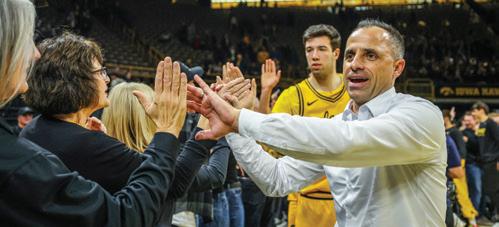
After each home game, Iowa men’s basketball coach Ben McCollum and his team high-five courtside Hawkeye fans to show their appreciation. While the home crowd’s impact can’t be quantified in a box score, the Hawkeyes feel its effect.
This past season, the UI Athletics Department added courtside seating behind Carver-Hawkeye Arena’s south baseline to move more than 200 fans closer to the action. The area is reserved primarily for the Hawks Nest, Iowa’s official student section, to help increase their engagement in the game and the Hawkeyes’ home-court advantage.
Matt Henderson (91BS), deputy director of athletics for external relations, gathered feedback from students, coaches, and student-athletes and reviewed the arena layouts of some of the nation’s top teams to inform this short-term solution. Henderson says he sought to answer the question, “How can we make it easier and entertaining for [students] so that not only they want to be there, but while they’re there, they’re having fun cheering on their fellow students?”
While UI Athletics is exploring plans to modernize Carver-Hawkeye Arena, Henderson says this interim fix has helped create a livelier environment and improve student ticket sales from last season. Since Carver opened in January 1983, Iowa men’s basketball has won nearly 77% of its games there, compared to 42.5% away from home. The Hawkeyes hope to build on that historic advantage, similar to how renovations to the north end zone at Kinnick Stadium in 2019 heightened a noisy atmosphere that rattles opponents.
Fan Support
While home teams benefit from being familiar with the venue, avoiding travel fatigue, and keeping their routine, those factors rarely match the impact of a supportive home crowd. Patricia Espe-Pfeifer, who has a Ph.D. in clinical psychology and is director of sports psychology and student-athlete mental health, says much of the research on home team advantage conducted during the COVID-19 pandemic—when student-athletes competed in front of cardboard cutouts instead of fervent fans—demonstrated this point.
MEN’S BASKETBALL
“There are a lot of studies that found a significant reduction of the home advantage effect during those ghost games where there weren’t any attendees,” says Espe-Pfeifer. “There are still some factors that were beneficial for the home team, but not having the supportive fans there really lowered the benefit.” And when home fans create a lot of energy to fuel scoring runs and strong defense, Espe-Pfeifer says they also can influence calls for the home team while disrupting the opponent’s communication and focus.
For McCollum and his team, that energy is contagious. “The crowd willed us to victory, and that’s why it’s important to have a [home] crowd,” he said after Iowa’s home win over UCLA. “In these kinds of games, it gets you 10 points. Just the atmosphere, the energy, people standing and cheering.”
BY TYLER STRAND
Super Setter
Hawkeye setter Claire Ammeraal became Iowa’s first Major League Volleyball draftee this past November after tallying the secondmost assists in the Big Ten last season. Drafted by the Omaha Supernovas, Ammeraal follows in the footsteps of Courtney Buzzerio (22BA), who signed with the Atlanta Vibe in 2024.
Campbell’s Best
Former Iowa linebacker Jack Campbell (22BA) recently garnered the Big Ten’s FordKinnick Leadership Award, which recognizes a Big Ten football student-athlete who achieves post-collegiate success in leadership. The Detroit Lion also received the NFL’s 2025 Pro Butkus Award for top linebacker.
Efficient Effort
Iowa men’s basketball alum Luka Garza (21BBA) maximized his extended minutes with the Boston Celtics to open the season. The 2021 consensus National Player of the Year scored in double figures in five of his first 13 games, including 16 points and eight rebounds in 17 minutes against the Orlando Magic.
Breath of Hope
Award-winning discoveries made in Michael Welsh’s University of Iowa lab have enabled patients with cystic fibrosis—once considered a fatal childhood disease—to live longer and healthier lives.
BY SARA EPSTEIN MONINGER
It was a blustery March morning in 2005 when Stacy Van Gorp paused outside the college classroom in Cedar Falls, Iowa, where she was about to teach. The twins she was carrying—usually active and insistent—had gone quiet. Her pregnancy had been unremarkable, so normal that her obstetrician had recently told her she’d likely make it to 36 weeks, maybe even 40.
But something felt off. She called her local doctor’s office, and a nurse urged her to skip class and come in. Hours later, after reviewing ultrasounds, a University of Iowa–trained OB delivered a startling directive: “You need to go to Iowa, and you need to go right now.”
Van Gorp (12PhD) and her husband, Chris Denison, didn’t hesitate. They drove straight to Iowa City, where experts at University of Iowa Health Care identified the cause of the distress: meconium ileus, a dangerous bowel obstruction almost exclusively associated with cystic fibrosis.
Cystic fibrosis (CF) is a rare genetic disease that causes thick, sticky mucus to build up in the lungs, pancreas, and other organs. The disease gradually worsens, and at the time there was no treatment for the underlying cause, only the symptoms. Earlier in the pregnancy, Van Gorp had tested positive as a CF carrier, but Denison’s test came back negative. Only later did they learn that labs then screened for a limited set of mutations—missing the one Denison carried.
With the babies in crises, there was no time to waste. Maren and Berne were delivered by emergency C-section on March 8, nearly two months early. Two full NICU teams waited in the room. Berne was blue and silent. A pediatric surgeon was called in from home and operated on their son within hours. Maren, also sick, required surgery days later.
The twins would spend nearly two months in Iowa’s NICU—63 days for Maren, 58 for Berne—battling infections, breathing trouble, and failing IVs. On Easter, Maren stopped breathing and was revived by a nurse practitioner who happened to be standing beside her crib.
“It just felt like they couldn’t catch a break,” says Van Gorp, who was living at the nearby Ronald McDonald House, clinging to each sign of progress. “One would be better, and then the other one would get worse. It was just overwhelming.”
Getting the green light to go home was a milestone, but the challenges continued. Cystic fibrosis shaped every hour, as treatments filled the twins’ mornings and evenings: chest physical therapy, inhaled medication, pills before every feeding, and vigilant monitoring.
“It was constant,” Van Gorp says. “There was never a moment when you could sit and relax.”
The disease prevents the pancreas from releasing enzymes to digest food, causing malnutrition, while also clogging airways with thick mucus that easily leads to infections and lung damage. Treatments available at the time could slow CF’s progression, but the prognosis was grim: The twins would be lucky to reach their 30s.
What the couple didn’t know was that discoveries had already unfolded in a UI research lab—close to the NICU where Maren and Berne struggled to survive—that would fundamentally reshape that outlook. Michael Welsh (70BS, 74MD, 77R), a physician-scientist trained and employed at Iowa, had led an investigation into CF. His work would lay the foundation for therapies that today give babies born with CF a life expectancy near 65, with many projected to live into their 70s and 80s.
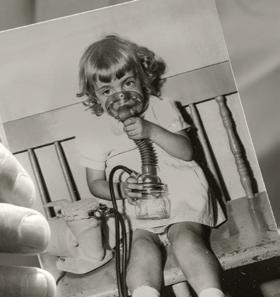
Reflecting on recent advances in cystic fibrosis treatment, University of Iowa physician-scientist Michael Welsh honors patients like Catherine “Kay” VanThournout, shown here as a child using a breathing machine. As an adult, she joined research studies at Iowa that, while not able to prevent her death in 2001, helped pave the way for the drug Kalydeco, approved by the FDA in 2012. That breakthrough later improved the life of her daughter with CF.
Mission in Motion
The first CF patient Welsh saw is burned into his memory. As a junior medical student at Iowa, he recalls hearing the young girl’s cough before entering the clinic room. Once inside, he smelled bacteria in her sputum and observed the tremendous effort it took for her to breathe and talk. He was shocked to learn she wouldn’t live beyond her teens.
“That made a big impression on me,” says Welsh, now a professor of internal medicine and director of the UI Pappajohn Biomedical Institute. “We worked as hard as we could to help people with CF, but we couldn’t stop the progression of the disease because we were dealing with the consequences, rather than the fundamental problem. So, understanding the basic defect became my goal.”
In 1989, when scientists supported by the National Institutes of Health, the Cystic Fibrosis Foundation, and the Canadian Institutes of Health Research identified the defective gene that causes the disease—the cystic fibrosis transmembrane conductance regulator (CFTR)—Welsh began investigating how its mutations disrupt the movement of salt and water in and out of cells. His team showed that when the CFTR protein malfunctions or is missing, mucus throughout the body becomes thick and sticky, clogging organs. They also found that the protein could be corrected if kept at a low temperature.
Welsh then helped classify the thousands of CFTR mutations into groups based on how the protein fails, creating a blueprint for medications tailored to specific defects. His team also created the first animal models that closely mimic the disease in humans, enabling
researchers to learn how CF disrupts the function of the lung and other organs and to test therapies in ways never before possible.
This scientific roadmap guided industry partners, including Vertex Pharmaceuticals, in creating CFTR modulator drugs that repair or enhance the faulty protein. For many patients, these treatments dramatically improve lung function, reduce hospitalizations, halt disease progression, and double life expectancy.
Welsh was astonished.
“Seeing young people with CF run cross-country or plan their futures—marriage, children, careers—still amazes me,” he says. “Years ago, people couldn’t plan their lives. Now they can. It’s unfathomable.”
These advances have rightfully shined the spotlight on Welsh, drawing accolades from world leaders in biomedical research. In 2025, Welsh received the Lasker-DeBakey Clinical Medical Research Award and was one of five individuals recognized with a Canada Gairdner International Award—honors that often precede a Nobel Prize.
Fear into Possibility
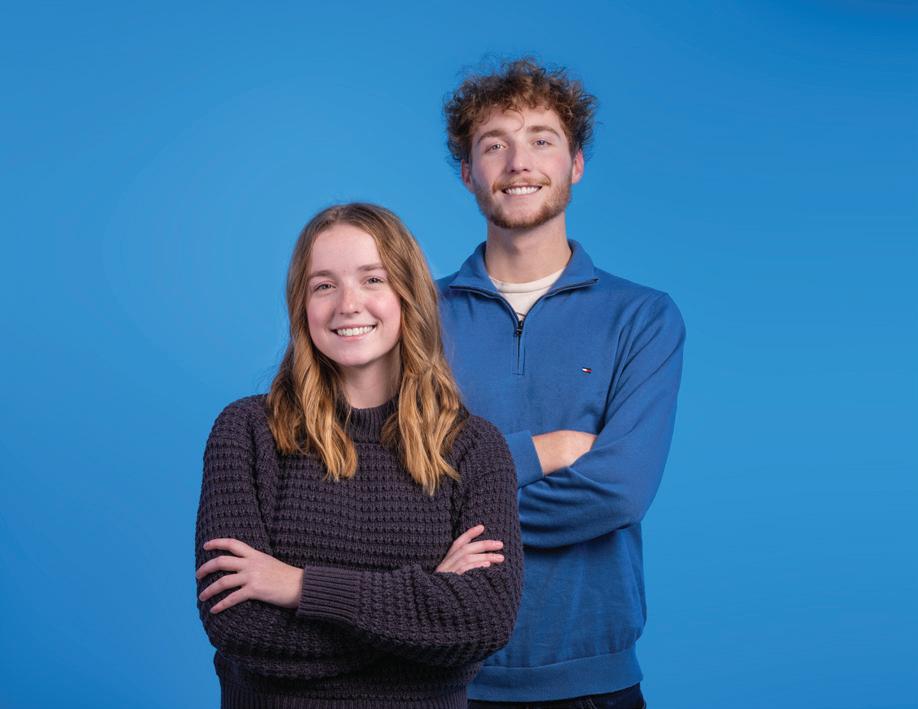
For the Denison twins, now 21, Michael Welsh’s work has been life-changing. Maren, who was eligible to participate in a clinical trial of the medication Trikafta in 2018, remembers nearimmediate improvement.
Before the trial, Maren says her lung function was around 65%, and she had just spent four weeks in the hospital with a resistant infection. “I’d wake myself up in the middle of the night coughing. All day long, I’d be coughing, so much so that I couldn’t breathe sometimes,” she says. “After taking Trikafta, I suddenly knew what it felt like to take a full breath.”
Within weeks, Maren’s lung function skyrocketed to nearly 100%. She began maintaining her weight, reduced her daily pill count, and—as a cross-country runner in high school—shaved five minutes off her 5K time.
Berne, whose lungs weren’t hit as hard by CF as his sister’s, wasn’t eligible to take Trikafta until it was approved by the Food and Drug Administration in 2019. But his health also improved. Within six months, he was able to maintain lung function without daily chest physical therapy or nebulizers, which deliver medication in the form of a mist inhaled into the lungs.
“My health is the best it’s ever been,” says Berne, who had spent 10% of his life hospitalized by the time he was 3. “CF used to be the first thing I thought about when I woke up in the morning. Now it’s not.”
Clinics Adapt to Change
The introduction of CFTR modulator drugs has dramatically transformed clinical care—at Iowa and across the country. Douglas Hornick (84R, 87F, 88F), a pulmonologist at UI Health Care, used to manage multiple adult inpatients with CF at any one time. Now, he says, there might be one. Or none.
“With these new therapies, the disease is not progressing as rapidly—or at all,” says Hornick, who joined Iowa’s clinical faculty in 1988.
Hornick says that about 90% of CF patients developed a respiratory condition called bronchiectasis. “I now see more patients with non-CF bronchiectasis than I do with CF bronchiectasis,” he says, “and we’ve been able to apply what we’ve learned treating CF patients.”
“
About 1,000 new cases of CF are diagnosed annually in the U.S. At UI Health Care, babies born with CF are seen monthly by a comprehensive team including pediatric pulmonologists, nurses, respiratory therapists, dietitians, gastroenterologists,
After taking Trikafta, I suddenly knew what it felt like to take a full breath.”
—Maren Denison
PHOTOS: JOHN EMIGH
Maren Denison, a graduating senior studying public health and public policy at Iowa, enjoys running in her spare time.
and pharmacists. After the first year, appointments are every three months. As children get older, they also see a pediatric endocrinologist and an ophthalmologist, given their elevated risk for diabetes and cataracts.
Ultimately, patients at Iowa can seamlessly transition to the adult CF clinic. Because new therapies have drastically increased the life expectancy for patients with CF, there are more adults living with CF today than there are children with it.
Early in his career, Anthony Fischer (09MD, 09PhD, 15F) regularly saw pediatric patients with CF whose health deteriorated until they needed a lung transplant or did not survive. Now, his patients on Trikafta stabilize and can go years without hospitalization.
“It’s a totally different disease now,” says Fischer, division director of pediatric pulmonary medicine at Iowa. “The people I worry about the most are the babies who are not yet eligible for Trikafta and the folks who have genotypes that are not eligible. For them, we need better treatments.”
The Next Frontier
Even with staggering progress, the work is not done. CFTR modulators have been a lifeline, but about 10% of patients have mutations for which the drugs don’t work, and some cannot tolerate the side effects.
Ashley Cooney (10BA, 18PhD), a research assistant professor of pediatrics–pulmonology medicine at Iowa, is working to change that by advancing gene therapy. Her postdoctoral research focused on improving gene transfer to airway stem cells and led to a discovery with major implications: mixing a viral vector with hypertonic saline, or salt water, dramatically improved its ability to reach the lungs.
“It’s been a game changer,” she says, noting that because people with CF already inhale hypertonic saline, the formulation has a strong safety track record and could accelerate translation to clinical use. “Now we need to get it to people.”
Seeing the momentum of gene therapy over the past decade, Cooney is optimistic that more advances will come, and she says Iowa is well positioned to be a major contributor.
“Not only is the CF research group here all on one floor, making collaboration much faster,” she says, “but with the clinic nearby, physician and scientist collaboration could accelerate bench-tobedside therapies at a faster pace.”
“
My health is the best it’s ever been. CF used to be the first thing I thought about when I woke up in the morning. Now it’s not.”
—Berne Denison
Berne Denison, who majors in urban planning at Iowa State, recently planned a ski trip with friends.
Did you know?
Cystic fibrosis (CF) is a rare genetic condition that causes thick, sticky mucus to build up in the lungs and other organs, leading to chronic infections and malnutrition.
Some 40,000 children and adults in the U.S. live with CF, with about 1,000 new cases diagnosed each year. For decades, patients with CF rarely lived through their teens.
Although there is no cure for CF, therapies introduced this century—thanks to research conducted at the University of Iowa—target the underlying cause, dramatically improving outcomes. Now, the median survival age for those born in 2020 or later is predicted to be 65.
UI Health Care is the only accredited CF center in Iowa that offers comprehensive care to both pediatric and adult patients with CF. Patients also have access to cutting-edge treatments through clinical trials.
A Future Rewritten
When the Denison twins were little, Stacy Van Gorp remembers being unsure what the future held for her children. Would they be healthy enough to attend college? Would such an investment even make sense?
Not only did the quality care they received at UI Health Care save her children’s lives, but the research that took place in Welsh’s lab has allowed the family the joy of planning. Maren is now studying public health and public policy at Iowa and will graduate this May, a year early; Berne is majoring in urban planning at Iowa State University.
“It’s almost indescribable how unexpected their quality of life is,” says Van Gorp. “This isn’t a cure, but it is transformational. It’s got to be one of the top science stories of the last 100 years.”
Extra
Chris Denison adds, “If we hadn’t gone to Iowa City that night in March 2005, both of our kids probably would have passed that night. But when we arrived, we had a whole team working together to care for the twins. That teamwork really built our confidence when we needed it the most.”
Echoing her husband, Van Gorp says, “We had a sense that Iowa was an important place for CF research, but I don’t think we understood just how important it was. We feel lucky that the University of Iowa is in our backyard.”
Any comments? Email uimagazine@foriowa.org
Watch UI Health Care’s Breath by Breath: Living with Cystic Fibrosis documentary at foriowa.info/im26-breath
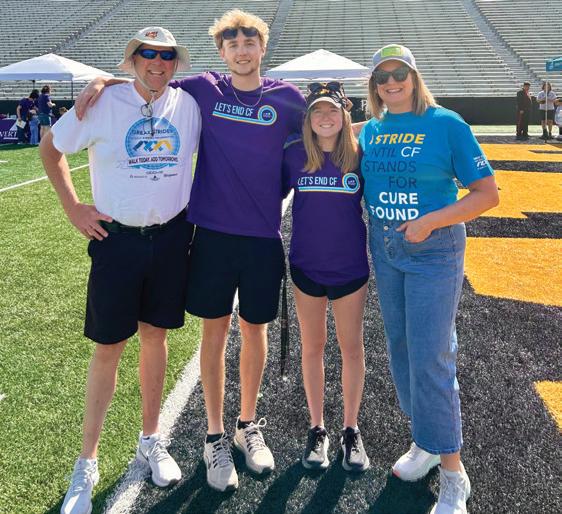
Berne and Maren Denison (in purple) stand with their parents, Chris Denison and Stacy Van Gorp, during the annual Eastern Iowa Great Strides walk at Kinnick Stadium that raises funds for cystic fibrosis research, treatment, and care.
Q&A MICHAEL WELSH ( 71 BS, 74 MD, 77 R)
A Life of Curiosity and Compassion
From rural beginnings to groundbreaking advances in the treatment of cystic fibrosis, the renowned pulmonologist has helped reshape what’s possible for patients.
What initially drew you to medicine and scientific research?
I grew up in the rolling hills outside Marshalltown, Iowa, near Haverhill. My parents instilled a strong work ethic in me. My father left school in 10 th grade, joined the Marines, fought in World War II, came home wounded, and worked two jobs—a foundry during the day, a bakery at night. My mother raised four kids, kept a large garden, canned vegetables and fruit, and made many of our clothes. I painted barns, made hay, sodded lawns, did the dirtiest jobs in construction, and worked at Maid-Rite. Farmers would give me runt pigs, and I’d raise them to sell. All that shaped me.
Eventually I decided to be a physician for a simple reason: I wanted to do something worthwhile with my life. I didn’t know any physicians, and I didn’t know anything about medicine or research. But I was profoundly influenced by President John F. Kennedy and his exhortation
Welsh at Iowa
to go beyond ourselves and contribute to society.
Why is a university essential for the kind of research you do?
Universities create the environment where discovery happens. My success depends on being surrounded by people with different ideas who challenge me.
Another advantage here is the tight connection between the lab and the clinic. That back-and-forth prevents us from losing sight of what patients experience and ensures that discoveries in the lab can be carried into clinical care. It keeps all of us focused on what matters.
And finally, Iowa matters. The university has given me so many opportunities. It encouraged my research and gave me freedom to choose my path. I want Iowans to be proud that they’ve supported research that’s changed lives not just in this state, not just in this country, but around the world.
“Universities create the environment where discovery happens.”
—Michael Welsh
You’ve emphasized the importance of funding, particularly from the National Institutes of Health. What do you want people to understand about the process of discovery?
There are three critical components: universities, funding, and industry. Funding underpins everything.
Philanthropist Mary Lasker famously said, “If you think research is expensive, try disease.” The NIH creates the bedrock on which biomedicine stands. Yes, the NIH funds disease-specific work, but they also fund curiosity-driven research and new tools. And those ideas and tools often come from scientists studying questions that seem totally unrelated to human disease.
Take CF as an example. A central technique we used came from a scientist who wanted to understand how frogs living in freshwater maintain their body’s salt balance. Another essential tool came from people asking why jellyfish glow. Now we all use CRISPR, a geneediting technology that originated from researchers curious about how bacteria defend themselves against viruses. None of these discoveries were made with CF in mind. But they became indispensable.
People sometimes ask, “Why fund curiosity-driven research? Shouldn’t we focus only on specific problems, such as heart disease, diabetes, or Parkinson’s disease?” We’re not wise enough to know what tool or idea will matter tomorrow or decades from
now. Curiosity builds a foundation everyone can use. You publish a paper, and suddenly the whole world has access to that knowledge. That’s how progress works.
Foundations are also essential. But foundations can’t replace the NIH. Foundations target specific diseases, industry must protect discoveries, and neither can fund open-ended exploration. Only the NIH can provide that broad scientific base. And then industry takes the final step. In CF, Aurora Biosciences and Vertex translated knowledge and understanding that came from scientific discovery into medicines that are extraordinary. That partnership between academia, funding agencies, and industry is how breakthroughs happen.
What do you enjoy most about the work?
I get the joy of discovery. It’s a thrill that never fades. I get to play with puzzles all day long. And I get to do it surrounded by young people and colleagues who challenge me, correct me, and push ideas further.
Research demands humility. Experiments fail. You make mistakes. But curiosity and patients keep you going. Curiosity is key not just for science and medicine but also for empathy. A good physician is curious about their patients. They want to understand why. That curiosity connects science and human care.
How to EMBRACE
Aging
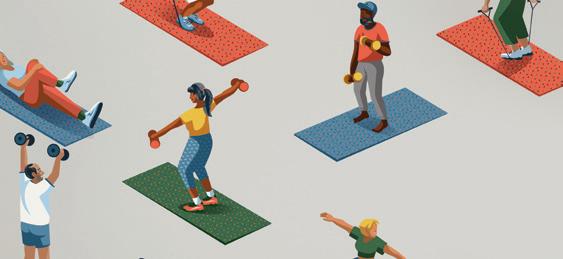
Iowa experts share insights to optimize our mind and body, as well as find community and purpose, as we grow older.
BY JOSH O’LEARY | ILLUSTRATIONS BY JACK HUDSON
Redefining the Second Half of Life
hen University of Iowa professor Amy Colbert (04PhD) and her husband, fellow Tippie College of Business faculty member Michael Colbert , sat down with a financial planner in their 30s, they were asked when they hoped to retire. They answered in unison: Mike said 55; Amy said 75.
Early in her career—and always a planner— Amy imagined working well into her later years. Retirement seemed a lifetime away.
Those plans unraveled in 2020. Colbert began feeling dizzy and unsteady on her feet. When she looked at her hands, she saw a slight tremor. After extensive testing, doctors with UI Health Care determined the cause: early-onset Parkinson’s disease, an age-related degenerative brain condition. At 48, her carefully mapped future suddenly became clouded with uncertainty. Because the disease progresses differently for each person, it was impossible to know whether she’d continue working for five years or 25 years.
“I was going to be the emeritus professor who hung around,” says Colbert, now 54. “But Parkinson’s unfolds very differently in different people. I had to realize that I don’t know how long I have left to work, that things may change very quickly. Most people don’t know what’s coming down the road. You may think that retirement age is 75, but what would you do differently if it were actually 55?”
Fortunately, Colbert is well-equipped to take on the unexpected changes that arise in the second half of life. A member of the leadership team for the UI’s Barbara and Richard Csomay Center for Gerontological Excellence, she’s among the experts at Iowa addressing the challenges—as well as the possibilities—that come with aging.
The Csomay Center’s affiliates work to advance innovations in research, education, and health care to promote optimal aging and quality of life for older adults. Housed in the UI College of Nursing, the center offers pilot grants for researchers who investigate aging and resources to support family caregivers. It also leads programs like the Optimal Aging Initiative—a statewide network that promotes age-friendly practices across Iowa.
The center’s interdisciplinary work is especially vital as the baby boomer generation reaches retirement age and the nation undergoes a profound demographic shift. By 2030, 1 in 5 Americans will be over age 65, and by 2060, that age group is projected to reach 95 million, according to AARP. In Iowa, adults 65 and older represent the state’s fastest-growing demographic, increasing by 10.6
percent between 2020 and 2024, according to U.S. census data.
Csomay Center Director Harleah Buck , the Sally Mathis Hartwig Professor in Gerontological Nursing, says that as our nation grows older, Americans are rethinking what it means to age. Not only are we living longer than previous generations, but we’re also striving for healthier, happier, and more meaningful lives in our later years, she says.
“Optimal aging is the goal of every human being,” says Buck. “We know that aging is inevitable, but you would like to do it to the best of your ability, and you’d also like to do it on your own terms. You know that you might pick up one chronic illness, then maybe a second one, and then the aches and pains of age. In previous generations, that was just always sort of the cost of doing business. You said, ‘This is what it means to be old.’ Well, the baby boomers have stopped and asked the question, ‘Is it really, or are there ways in which we can do this better?’”
Optimal aging ... is about your physical health, but it's also about your mental, spiritual, emotional, and financial wellness.”
—Jennifer Jones, Csomay Center Coordinator
Jennifer Jones , the Csomay Center’s outreach, education and programming coordinator, connects individuals and communities across Iowa with resources through the Optimal Aging Initiative. Her core message is simple: To age well, you must plan to age well. It’s never too early, says Jones, to imagine what you want your retirement years to look like.
“Optimal aging doesn’t mean that you’re the best health specimen ever,” says Jones. “You might not be without a disease or a diagnosis or something you’re monitoring. It’s despite that, you’re doing everything you can to age well. Yes, it’s about your physical health, but it’s also about your mental, spiritual, emotional, and financial wellness.” * * *
More than five years after her Parkinson’s diagnosis, Colbert has a new perspective on aging. A management and entrepreneurship expert, she
studies how professionals handle sudden transitions in their careers, including retirement, as well as how to find purpose in the workplace and beyond. Since her diagnosis, Colbert has shifted her research focus to study how people with Parkinson’s psychologically manage the losses that come with the disease. She’s used strategies from that research to deal with the losses that Parkinson’s has caused in her own life.
Unable to drive, Colbert moved into a house on a bus line, with everything she needs on a single level. She uses a cane to get around but enjoys walks with her family, knowing that exercise is one of the best ways to manage Parkinson’s symptoms. Stress can be a trigger for her symptoms, so she practices meditation. When she orders coffee, she asks for room at the top so her tremors don’t cause spills.
Colbert continues to teach, but as stiffness increased and her energy waned, she had to step away from her role as chair of Tippie’s management department and from leading the daylong executive education sessions she once loved. Instead, she’s leaned into mentoring, and she finds the one-onone meetings with students even more rewarding. She also launched a new initiative called the Social Impact Community—a hub for faculty, staff, and students working together to address societal challenges.
“When we’re connected with others and contributing to a broader purpose, there’s a shift from the concerns that come with aging,” says Colbert. “Does that mean that my Parkinson’s symptoms are better? No, that doesn’t. But I do have a broader perspective on what’s going on in my own brain, and so some of those associations with well-being have to do with seeing yourself as more than just a series of symptoms.”
Colbert is grateful to receive treatment at UI Health Care, home to one of 50 Parkinson’s Foundation Centers of Excellence in the world. She’s also become an advocate for the Michael J. Fox Foundation and its mission of finding a cure for Parkinson’s.
While Colbert has published dozens of academic papers, she’s discovered a love for personal essay writing since her diagnosis. Two years ago, she participated in the Iowa Summer Writing Festival, which gave her confidence to launch a Substack blog. There, she shares reflections on life as a middle-aged empty nester living with Parkinson’s.
Sitting down to write her first post in 2024, Colbert needed a name for her blog—one that would resonate with others whose lives, like hers, had taken unexpected turns with age.
“Who am I now?” she typed.
Iowa Experts on Optimal Aging
Iowa Magazine spoke with four University of Iowa researchers affiliated with the Csomay Center for Gerontological Excellence about optimal aging. Here’s what they say you should know about physical activity, cognitive function, community, and finding purpose.
For Healthy Aging, Start With Movement
When Chelsea Howland , an assistant professor at the UI College of Nursing, talks to people about preparing for their later decades, the first thing she asks is, “What’s your definition of healthy aging?” Often, they say they want to maintain their independence, age in place, and continue to do the activities they’re passionate about. The key to all those goals, she says, is physical activity.
Exercise can help mitigate age-related decline, including muscle loss, frailty, and falls, as well as reduce the risk of chronic health conditions such as diabetes, hypertension, and high cholesterol. Physical activity can also promote better sleep, reduce depression, and improve a sense of well-being. Howland notes that some research shows that physical activity can help older adults maintain cognitive function.
“Overall, it has a holistic impact on people’s lives to help them age,” says Howland, who has received grant funding through the Csomay Center to
study the use of wearable fitness devices in rural older adults with diabetes.
Howland recommends older adults get 150 minutes of moderate to vigorous aerobic physical activity per week. That includes activities like brisk walking, swimming, and pickleball. She also recommends two weekly sessions of resistance training, using bodyweight exercises like squats or sit-to-stands, hand weights, or gym equipment. Lastly, she says it’s important to incorporate balance and flexibility training to help mobility and reduce fall risk.
Howland says it’s never too late to start being active, and it’s best to start with small goals. If you’re getting 2,000 steps a day, aim for 2,200 and work upward from there.
“Sometimes it can seem like a lot to try to go from living an inactive lifestyle to getting 150 minutes a week, but anything is better than nothing,” she says. “Just getting out and doing movement that feels good and fits within people’s lifestyles is the most important part.”
Build Habits Today to Strengthen Your Mind
Juliana Souza-Talarico, an associate professor in the UI College of Nursing and a member of the Csomay Center leadership team, has spent her career researching cognitive decline in aging. But the topic became deeply personal when her mother was diagnosed with mild cognitive impairment 10 years ago. Often described as the transitional stage between typical cognitive aging and dementia, the condition can involve memory problems, as well as challenges with language and judgment.
Souza-Talarico noticed subtle signs, like her mother putting a diaper on her grandchild inside-out, and encouraged her to see a doctor. After receiving the diagnosis for mild cognitive impairment—which carries an increased risk for Alzheimer’s disease—Souza-Talarico ensured her mother was getting plenty of exercise, staying social with friends and family, and taking other lifestyle steps that can offer protection against cognitive decline. She also addressed other cognitive risk factors, including managing her mom’s high blood pressure, anxiety, and previously undetected sleep apnea. Ten years later, her mother’s cognition has remained steady, and she continues to live independently.
“The lesson learned is that early detection can be an opportunity to take systematic steps to reduce risk factors, which, in her case and according to scientific evidence, helped postpone
Create a Life of Lasting Connection
the disease and helped her stay stable for so long,” says Souza-Talarico.
Through her work with the Csomay Center, Souza-Talarico studies how psychological, social, and environmental stressors affect the aging brain. “Chronic stress triggers biological changes that can affect the brain as we age and increase the risk for Alzheimer’s disease,” she says.
Long-term stress can disrupt hormones, increase inflammation, and affect brain regions tied to memory and attention. Environmental exposures, health care access, social isolation, and community resources also shape stress and cognitive risk, she says.
Souza-Talarico emphasizes the importance of physical activity and a diet rich in fruits and vegetables—two key strategies for reducing oxidative stress and supporting cognitive reserve, the brain’s ability to maintain performance despite age- or disease-related changes. Midlife, she notes, is a critical time to detect and modify risk factors such as hypertension, diabetes, obesity, smoking, alcohol, air pollution, hearing loss, depression, stress, sleep disorders, and lack of social or mental stimulation.
“Don’t wait to get older to start thinking of this,” says Souza-Talarico. “There are several factors that we can tackle and reduce. Studies show that if you start doing this at midlife, your cognition tends to be better.”
Mercedes Bern-Klug (82BA, 84MSW) doesn’t plan to retire anytime soon, but now in her 60s, she’s preparing for the day she steps away. The UI social work professor recently remodeled her home so everything she needs is on the main level, allowing her to stay put even if she’s no longer able to negotiate the stairs. At the same time, she’s building something else that she knows is just as crucial for health in retirement: strong social connections.
“Acute, prolonged loneliness is more dangerous than smoking a pack of cigarettes a day,” says Bern-Klug, “so finding ways to stay healthy means finding ways to stay connected.”
Bern-Klug is coordinator of the UI’s Aging and Longevity Studies Program, which is one of the nation’s longest-running gerontology programs. Also a member of the Csomay Center leadership team, her research focuses on how social workers and health care providers can support older adults and their families.
Humans are inherently social, says Bern-Klug, and positive and meaningful interactions benefit our mental and physical health. Whether you’re a person who craves connection or solitude, everyone needs some level of human interaction to thrive, she says.
Bern-Klug has been a longtime volunteer at an array of
reliable internet access, devices, or comfort using technology.
Bern-Klug stresses the value of making intergenerational connections and has forged friendships with people of all ages that have broadened her perspectives.
“Some of the most delightful conversations I’ve had in my life were with people over 80 who knew how to contribute, listen, and ask good questions,” she says.
Above all, Bern-Klug views getting older as a privilege—an opportunity to nurture meaningful relationships. “There’s something yet to be gained, and there’s something yet to give,” she says.
Assemble a Portfolio of Purpose and Meaning
Just as we prepare financially for retirement through 401(k)s and IRAs, Tippie College of Business professor Amy Colbert (04PhD) says it’s important to make other kinds of investments— by midlife or earlier—that support long-term well-being.
“As we are working—and especially in our later years—we should have a variety of ways that we are finding purpose and meaning, so that our portfolio is diversified,” says Colbert. Work tends to concentrate both purpose and social connection in one place, but retirement removes that structure. As we age, says Colbert, it’s crucial that we look beyond our jobs to find sources of fulfillment—something experts say is linked to better health and well-being in older adults.
organizations in the Iowa City community and beyond—part of the ethos of social work, she says—and she plans to increase her volunteerism in retirement. She encourages people to seek out roles that fit their interests and skills, whether that means volunteering at a food pantry or mentoring a young person.
“It doesn’t have to cost money. Invite someone for a cup of coffee, meet at a park, take a walk,” she says.
Social media and other digital tools can help older adults build community, particularly when geography, mobility, or health limit face-to-face interactions, she says. At the same time, the digital divide can contribute to loneliness, she cautions. That can be especially true for those without
At any stage of life, Colbert encourages people to pay attention to what “lights you up.” By taking note of moments of joy, she says, we can find clues about the things that might offer lasting fulfillment in retirement. “When are you having the most fun? When are you feeling a sense of impact? Those may be at work now, but you’ll learn something about yourself so that you can find other contexts to achieve that same positive energy,” she says.
Many retirees feel restless or dissatisfied at first, even if they planned ahead. Colbert frames this as a liminal phase—an in-between time that allows for exploration and recalibration. She cautions against filling up your planner immediately. Instead, she recommends giving yourself the space to pursue new adventures—or revisit old passions.
Says Colbert: “You might need some time where you’re underscheduled, where it’s like, ‘Oh, I’m just going to wander into the library, and what am I going to pick up today?’”
Any comments? Email uimagazine@foriowa.org
Robert Gallery (03BA) could have said nothing. The largerthan-life Iowa football legend, whose name and No. 78 are permanently affixed to the Kinnick Stadium press box, could have shoved aside the darkest details of his postcareer mental health struggles. This was a small theater full of 100 strangers, after all—faculty and residents from the University of Iowa Department of Psychiatry, scribbling notes and listening intently while nibbling on deli sandwiches from a boxed lunch.
But on this late-fall afternoon, at the hospital across the street from where the 6-foot-7 inch, 325-pound lineman known as “The Mountain” built his football mythology, Gallery bared all. He spoke of his sweat-filled nightmares where he imagined putting a gun in his mouth, then woke up with a metallic taste on his tongue. He talked about morning jogs in his Northern California neighborhood when he thought about throwing himself in front of a semi. Or the high-speed, teetering out-of-control motorcycle rides where he pondered veering into oncoming traffic.
“To make it look like an accident,” said Gallery. “So nobody could say I quit.”
A lifetime of banging skulls with other 300-pound men had led to multiple concussions and troubling brain fog. Internally Gallery fought the war between the way the outside world perceived him—menacing, violent, relentless—and the way he often felt inside: inferior, inadequate, and insecure. The 2004 No. 2 overall pick in the NFL Draft struggled to equate the promise and potential of his franchise-altering selection with an eight-year NFL career that culminated without a Pro Bowl or playoff appearance.
Retirement made things even worse, with violent outbursts and erratic behavior creating an anxiety-fueled, walking-on-thin-ice atmosphere for Gallery’s wife and their three children. Spill the milk; make noise; look, say, or do the wrong thing; and Gallery would snap like a wire stretched too far.
“Then I would get angry at myself for not knowing why I was so angry,” Gallery explained to the audience that day. “I felt like such a failure. And that turned into ‘[my family] would be better off with me not here.’”
Becca McCann Gallery (04BA), the former Iowa women’s basketball player who met Robert on her first day on campus in 1999 and later became his wife, sat in the back corner of the room. She didn’t need to hear the stories. She lived them, wrestling with the fear that each time her husband left the house he may never return.
“It was scary,” she said. “Very real and very scary.”
It was also the reason the Gallerys were here, welcomed by Peggy Nopoulos (85BS, 89MD, 93R, 94F), chair of the UI Department of Psychiatry. Nopoulos, who leads research on the healing powers of psychedelic medicine for the treatment of alcohol abuse and other mental health disorders, wanted her department to hear firsthand the role psychedelics played in helping to transform Gallery from someone who believed he would be better off dead to the man they saw before them that day. Nopoulos moderated the event, at one point asking a delicate but pointed question about Gallery’s lowest moment.
“Did you ever attempt?” she asked Gallery.
Gallery paused. He looked to the floor. Nopoulos set her hand on his shoulder. “It’s OK. You’re in a safe space here,” she said. “I know I just touched on something.”
Gallery shifted in his chair, crossing then uncrossing his arms. He rubbed his right leg, the rising cuff of his olive-colored joggers revealing a mosaic of brightly colored tattoos. He looked up, his eyes now filled with tears.
“I was very close a couple of times,” he answered. “I did have a pistol in my lap. I thought it would make everything stop.”
On the football field, Gallery was the poster boy of toughness —an imposing, vicious NFL gladiator with dark brown hair that flowed out of his helmet and over the nameplate on the back of his jersey. His arms were covered in tattoos. And he took pride in the nicks and scuffs in his helmet and bends in his facemask.
“I tried to use my helmet as a weapon,” he says. “My goal was to make you so miserable that you didn’t want to play anymore so you would give up.”
But such ferocity comes with a price. Gallery had multiple concussions and more than 10 surgeries on his back, ankles, elbows, lower leg, and core. After being kicked in the head during one 2011 game in Seattle, Gallery headed to the wrong sideline before a teammate corrected him. He says he popped pain pills like candy and took a Toradol anti-inflammatory shot before most of his 104 NFL games.
“That was the mentality,” says Gallery, who grew up on his family’s farm near Masonville, Iowa. “I was the tough guy who would go through anything to be on the field.”
Gallery believes the first signs of his mental health struggles appeared his senior year at Iowa in 2003. That season, the Hawkeyes finished 10-3, and
“I FELT LIKE SUCH A FAILURE.”
—Retired NFL offensive lineman Robert Gallery
Gallery was a unanimous first-team All-American and winner of the Outland Trophy, given to the nation’s top lineman. Despite his on-field success, he spent much of the season fixated on a single play in the team’s Big Ten opener at Michigan State. Not the one everybody else couldn’t stop talking about, when Gallery chased down a Michigan State defender to save a touchdown after an Iowa interception. But the one in which he felt he failed to execute a proper blocking technique, and officials flagged him for a holding penalty.
“Here I am supposed to be the guy, the one everybody is talking about and looking at,” says Gallery. “And on that play, I made a mistake. One mistake out of probably 70 plays. And I couldn’t stop thinking about it.”
Later that season, Scott Pioli , then New England Patriots vice president of player personnel, visited Iowa City on a scouting trip and raved to Gallery about his dominant senior season. “You’re killing it,” Gallery recalled Pioli telling him. But the All-American wouldn’t have it, pointing out his penalty against the Spartans. Pioli told him to relax and handed him a business card before heading back to New England. Written on the back: the words “Lighten up, Francis,” a quote from the film Stripes
“The crazy thing is that’s what the NFL wants,” says Gallery. “They want you to be maniacal about your mistakes, so you can be this force of nature for them. But there’s this fine line. I wanted to be perfect, but no one is perfect.”
Greatness became even more challenging when the Raiders selected him in the draft. After starring for an Iowa program built on stability, Gallery played for five head coaches in seven Oakland seasons.
In 2007, the Raiders shifted Gallery from tackle to guard, an unofficial demotion in NFL circles. He heard NFL analysts refer to him as a “bust.”
Hawkeye great Robert Gallery’s dominance on the gridiron masked an inner struggle fueled by his drive for perfection.
GALLERY’S MENTAL HEALTH QUICKLY SPIRALED WITHOUT THE STRUCTURE OF PROFESSIONAL FOOTBALL IN HIS LIFE.
And one day, he came home to a note on his door imploring him and his family to move. Gallery didn’t play on a single winning team during his seven years in Oakland.
“I don’t care what people say; losing sucks,” says Gallery. “You don’t do it for the money. That doesn’t bring you joy. So I’m beating my head in for what?
“And what did we do after games when the times were rough? I’d go drink 40 beers with the offensive line. Everything was in excess.”
Gallery’s agent eventually connected him with a sports psychologist. Gallery hated the stigma that came with needing help. At one point he talked to his therapist in the bathroom so no one would find out. As time went on, Gallery would find himself easily triggered.
After one frustrating loss, Robert and Becca were pulling out of the Oakland parking lot, fans booing and throwing beers at their car, when Becca turned on the radio to listen to music.
“I absolutely lost it,” says Gallery. “I was just so angry. I was turning into a person I didn’t want to be.”
On the day Gallery knew his NFL career was over, he walked into New England head coach Bill Belichick’s office and thanked him for the opportunity. Gallery had signed with the Patriots in spring 2012 in pursuit of postseason greatness. But during training camp, he quickly realized he didn’t have it anymore. He found himself hoping he would tear his Achilles
or suffer another type of season-ending injury so the decision to retire could be made for him. But it didn’t happen.
He told Belichick that he didn’t want to waste his time and left. He packed up the house he had rented in New England and flew home to California. On the flight, he drank every drop of scotch the stewardess could find on the plane. “And I don’t even drink scotch,” he says.
Gallery’s mental health quickly spiraled without the structure of professional football in his life. His anger escalated. He snapped over the most innocent of things, like one dinner when Becca’s mom suggested they eat outside since the sun had come out. “I just had this rage, like, ‘How dare you change where we’re sitting?’” says Gallery. “And I remember her looking at me like, ‘What is wrong with him?’”
This is when the suicidal nightmares began. That led to a lack of sleep, which made his moods even more volatile. Then the suicidal ideations began popping up during the day.
“The Robert I knew in college was not the Robert I knew when he retired,” says Becca. “It was hard.
“I tiptoed around a lot. I tried to find out how I could help him without making him think that I was trying to help him. I didn’t want to take away from his self-confidence or make him feel like he was one of our kids.”
After one morning workout, Robert cracked. He told Becca he was a burden on the family. They would be better off without him. Becca couldn’t believe his words. She insisted what he was saying wasn’t true. He didn’t
believe her. Robert called NFL Life Line, an independent and confidential resource for NFL players and their families in a mental health crisis. In a few days, they helped connect Gallery with a therapist. He was involved in a workman’s compensation claim against the league at the time and that led to a brain scan to learn more about his condition.
At the time, the NFL was going through a concussion crisis, with PBS releasing its documentary League of Denial, which criticized NFL leadership for its handling of brain-related injuries. But Gallery struggled to make the connection to his struggles.
“Did I beat my brain up playing? Did I beat my body up? Of course,” he says. “And I would do it again. But did I think that could turn me into that sort of person? Naïvely, no.”
Although Chronic Traumatic Encephalopathy (CTE) can’t be diagnosed definitively until postmortem, doctors looked at Gallery’s scans and all but told him he likely had the degenerative brain disease found in so many former football players. They showed Gallery a scan of what a normal, healthy brain looks like at his age. Then they showed the image of his brain.
“It was mangled,” he says. “Like a baseball bat had been taken to the front of it.”
The images sent Becca into tears. Robert laughed. As troubling as it may have seemed, Gallery’s takeaway was a positive one. He wasn’t crazy. He wasn’t mentally weak. This wasn’t his fault. Doctors told Gallery if he did nothing, his brain would continue to deteriorate, his symptoms would worsen, and he’d eventually become another statistic.
Gallery met with brain specialists. He participated in light therapy and purchased a hyperbaric chamber to stimulate brain growth. He took antidepressants to try to improve his mood swings. He spoke to therapists. But he still struggled and endured suicidal thoughts. He stopped drinking excessively but still relied on alcohol in social situations.
“For a good year and a half, I did pretty much anything they told me to do,” says Gallery. “It was exhausting. When you do all these things that aren’t working, you want to give up. And that’s where I was at.”
Hope came in the form of a podcast Gallery listened to on a drive from the Bay Area to Lake Tahoe in 2021. Former Navy SEAL and Southern Illinois quarterback Marcus Capone was Marcus Lutrell’s guest on Team Never Quit. In his interview, Capone opened up about his struggles with mental health since retiring from service in 2013. With each word Capone spoke, Gallery became more optimistic.
“He talked about … how he found healing,” says Gallery. “It sounded like it was me on the radio. I remember thinking, ‘I’ve got to talk to this guy.’”
Gallery pulled over and called Becca, imploring her to listen to the podcast immediately. He emailed Capone, assuming he’d never hear back. But the next day he did. Gallery and Capone talked for two hours, with Capone quickly grasping the seriousness of Gallery’s situation. He mentioned the success he and other former military personnel had with ibogaine psychedelic therapy treatments in Mexico.
Gallery knew nothing of ibogaine, the psychoactive compound that comes from the root bark of the iboga tree. Ibogaine has long
“I WAS JUST SO ANGRY. I WAS TURNING INTO A PERSON I DIDN'T WANT TO BE.”
been used for medicinal purposes in central Africa and in studies has shown promise for treating addiction. Many researchers believe it can foster the creation of new neurons, prompting a rewiring of the brain that helps with self-destructive behavior.
But as a Schedule I controlled substance, it is currently illegal in the United States, prompting patients like Capone and Gallery to travel to Mexico, Brazil, or other countries for treatment.
Gallery spoke to Capone every day that week. He researched the treatment, speaking to others who had gone through it and the team in Mexico that facilitated the treatments. Capone offered Gallery the open spot he had with a group of veterans going to Mexico in three weeks. The group included Luttrell, the retired Navy SEAL who was the subject of the 2013 Hollywood film Lone Survivor. Gallery was in.
“If it would have been anyone else, I don’t know if I would have trusted them,” says Gallery. “But when this Navy SEAL ex-football player told me he’s saving guys, my intuition was to trust this guy.”
Becca was understandably hesitant. Gallery admits he didn’t care. He called his parents and told them his plan. He didn’t want their opinion but wanted them to know how he felt about them.
“I just want you to know I love you guys,” Gallery told them. “If I die during this or if something happens, I love you guys. But I have to try this. It’s my last resort.”
The day before leaving for Mexico, Gallery flew to San Diego to meet Capone and the rest of the group. He sat on the front porch after his morning workout with Becca, exhausted. Exercise had become a test in how far he could push his body to take his mind off the noise inside his head. As he looked out over the brush on the horizon, he saw a group of dead trees. He began to cry.
“THIS LITERALLY SAVED MY LIFE.”
“It was the picture of my life,” says Gallery.
Becca asked if he was scared of the upcoming trip. Gallery admitted that no, he feared something altogether different.
“What if it doesn’t work?” he asked. “Then what?”
Two days later, Gallery found himself in the back of an SUV rolling through the outskirts of Tijuana wondering what he had gotten into. Aside from the couple times he tried marijuana to cope with his mental struggles, he had never used recreational drugs. “The D.A.R.E. program worked on me,” he joked. Now he was in Mexico about to go on a psychedelic trip.
“I was scared I was gonna die,” he says.
Research has found that the biggest risk with ibogaine use is an increase in the likelihood of cardiac arrhythmias and even cardiac arrest. This was one of the reasons the FDA ended federal research on the drug in 1995. Ibogaine use can be grueling on the body, potentially lasting more than 24 hours while forcing patients to relive traumatic events of the past.
These were the reasons Gallery had to get all his medications, including antidepressants, out of his system before Mexico. As soon as Gallery arrived at the facility, a house just outside Tijuana, doctors drew blood, analyzed urine samples, and gave each patient an EKG to ensure their heart could handle the treatment. The group then held a burn ceremony, where each person wrote on a piece of paper what they wanted the medicine to take away from them. Then they threw the paper into a fire. Gallery wrote that he wanted the medicine to remove his anger and hatred for himself.
After ingesting the ibogaine in pill form, Gallery lay on the floor hooked up to an EKG. He fell asleep. When he woke up some 10 hours later, his body felt like it had played an NFL season. Everything hurt. He couldn’t walk, needing a wheelchair to use the bathroom. He was painfully nauseous, vomiting everywhere. But he didn’t sense any psychological changes. He felt the medicine in his body. He recognized something was “off,” but he didn’t immediately recall any life-altering hallucinations. As he listened to the others in the group share stories of their experience, he convinced himself the drug didn’t work on him.
“Just another thing I failed at,” says Gallery. “I was so pissed at myself.”
That night, as Gallery began to feel better, he started journaling, and gradually his experience came back to him. He recalled watching a stream of movie clips from his life fly past. He kept the good memories for himself and threw away the negative ones. Later that night, the group prepared for the second part of the treatment, inhaling the substance 5-MeO-DMT, a dried version of a venomous secretion from the Colorado River toad. Some researchers believe the substance helps with the reduction of depression, anxiety, and stress. Unlike the ibogaine treatment, which the group took collectively, 5-MeO-DMT was administered individually.
When it was Gallery’s turn, he made the sign of the cross, expressed love for his family, and inhaled. Upon his second inhalation, he had a vision of God, whom Gallery asked to send him to hell. As Gallery tells it, God replied that Gallery needed to talk to Becca. She then appeared in a calm, loving way. And Gallery says he felt peace.
“I remember just sitting there thinking, ‘I do belong here,’” says Gallery. “You can say it’s corny or whatever, but all this love came back.”
Gallery eventually peeled his eye mask off and walked to sit in the yard. The blades of grass against his skin felt unlike anything he could remember. He heard seagulls flying overhead and smelled the salt from the ocean. One prevailing thought raced through Gallery’s mind: He was so happy to be alive. He couldn’t wait to see Becca and the kids. He walked into the room where the rest of the group had gathered.
Athletes for Care
Robert Gallery (03BA) is cofounder and CEO of Athletes for Care, a nonprofit organization that supports research, advocacy, and solutions for athlete mental health. For more information, visit athletesforcare.org
UI Psychedelics Research Program
A multidisciplinary team of researchers and specially trained therapists at Iowa are investigating the potential therapeutic effects of various psychedelic and psychedelic-like substances on human participants in a clinical setting. For more information, visit psychedelics.lab. uiowa.edu
“I’m back, bitches,” he said.
Early the following morning, the SUV carrying Gallery and the rest of the cohort headed back to San Diego, where Becca waited in the same restaurant in which Gallery first met the group a few days earlier. Gallery smiled, gave her a huge hug, and told her he loved her.
“I remember her face was skeptical, like, ‘What did I get myself into?’” he says.
For the better part of four months, Gallery lived in the “pink cloud” of posttreatment euphoria. Nothing bothered him. But over time, normal life began getting under his skin. While his rage stayed under control, within a year-and-a-half he again felt depressed and believed his family would be better off without him.
When his parents came to visit that year, they told him how proud they were of his progress. Gallery responded, “If I f*** up and kill myself, it’s not your guys’ fault. You have been good parents.”
“That’s when they knew—and I knew—I was back to struggling,” he says.
Gallery and Luttrell returned to Mexico later that year for another round of treatment. This time, during Gallery’s 5-MeO-DMT session, he hallucinated that he killed himself on his motorcycle. He saw the impact his suicide had on his parents, kids, and Becca. In real life, Gallery began to vomit. As doctors cleared his throat, Gallery felt like he was undergoing chest compressions. Convinced he was dying, Gallery began to scream and yell. “I took it too far! I always take it too far!” he said. That’s when Luttrell came in, put his hand on Gallery’s chest, and told him he loved him.
“It sucked all this rage and hate out of me,” says Gallery. “It was so profound. And still, to this day, if I have a bad nightmare or something, that whole thing comes back. It rewired how my brain thinks about my love for my family. I know, no matter what happens to me, I’m better off being here for my family. They need me in their life.”
Gallery went back to Mexico for another round of treatment in 2024, “for growth, not survival,” he says. He has not been back since and hasn’t touched
a drop of alcohol since his initial treatment in 2021.
“His story is the fabric and foundation of the mental health stigma,” says Nopoulos, the UI psychiatry professor and researcher. “Because he is big and strong, there is this notion that he can’t have a mental illness. Or if he does, then he must be weak. It’s just a horrid narrative.”
In the time since Gallery underwent treatment, the ibogaine movement has grown. In early 2024, researchers at Stanford Medicine found that ibogaine safely led to improvements in depression, anxiety, and functioning among veterans with traumatic brain injuries. In June 2025, Texas Gov. Greg Abbott signed a bill approving $50 million in taxpayer funding for the “Texas Ibogaine Initiative,” creating a consortium of universities, hospitals, and drug developers to create clinical trials on the drug with the goal of FDA approval.
Because of the stigma surrounding psychedelics, Nopoulos understands there will be skeptics. She is currently leading a study about the impact of the psychedelic psilocybin on alcohol abuse.
“These are powerful drugs that change the connectivity of your brain and how it works,” says Nopoulos. “There are certainly people who will say, ‘That’s hooey,’ but the proof is in the pudding. This man objectively is dramatically better. The evidence shows this works. It’s the mechanism of how this works that we’re not certain about.”
Gallery started the foundation Athletes For Care with the goal of helping other athletes enduring similar challenges to consider ibogaine and other psychedelic treatments for their depression and mental health struggles. Athletes for Care has already helped more than 10 athletes receive treatment, including former teammates of Gallery’s.
“This literally saved my life,” says Gallery. ”And the more guys I talk to, the more I realize we need something like this. I truly believe this is my purpose. This is what I’m here to do.”
For much of Gallery’s football career, he would spend the night before a game in the hallway of the team hotel, tracing his footwork and perfecting the steps he would need to protect his quarterback and bulldoze holes through the opposition.
Now his daily preparations begin before sunrise. His body knows 4 a.m. Within a few minutes, he submerges himself in a 35-degree cold tub. He follows that with 20 minutes of meditation and breathing exercises in front of a fireplace. By 5, Becca joins for a morning workout, still designed by Gallery’s former Iowa strength coach. From there, he’ll sit in the sun for 10-15 minutes before relaxing in his hyperbaric chamber for an hour.
On Gallery’s bathroom mirror is a folded piece of paper with a typed prayer he received from Luttrell. Gallery has memorized it. He closes his eyes, puts his hand over his heart, and quietly repeats to himself: “Lord Jesus Christ, king of the universe, on this day I command my mind, my body, and my soul into your hands. Please tell me where to go, what to do, who to see, and what to say.”
Beneath the short prayer, four additional reminders: “Have a soul without fear. Smile. Think of gratitude. Attack the day.”
Hawkeyes Robert and Becca Gallery returned to Iowa this past fall to share their personal journey to mental health with students in the psychiatry and athletics departments.
“You can say it’s corny, but I’ve learned through this that if I want people to see and feel the good in me, then I’ve got to feel it myself,” he says. “That’s the energy I want to give out.”
He does the same thing before he goes to bed, visualizing the next day to calm his mind. If he feels triggered during the day, he goes back to his breathing techniques, like he did before he and Becca spoke to a group of Hawkeye student-athletes about the importance of mental health.
Ten years ago, speaking to a roomful of people would have been a nightmare. Anxiety and fear would have consumed him, pushing him to drink in hopes of “faking it.” But on this night, Gallery sat in his hotel room and executed his breathing exercises. He pushed aside his insecurities that no one would show up, calming his heart rate in a few minutes.
A little more than two hours later, in a meeting room at Carver-Hawkeye Arena, Gallery wrapped up his talk with Hawkeye student-athletes with one final message.
“Give each other grace,” he said. “You don’t know what they’re going through. … So be nice to each other. And be nice to yourself.”
Wayne Drehs (00BA) is a freelance writer and visiting associate professor of practice at the UI School of Journalism and Mass Communication. He previously spent 23 years as an Emmy-winning sports reporter for ESPN.
Any comments? Email uimagazine@foriowa.org
Extra Watch Robert Gallery share his story with Athletes for Care at foriowa.info/im26gallery
Love and Loss
Train Dreams, an O. Henry Award-winning novella by the late Iowa Writers’ Workshop alum Denis Johnson (71BA, 74MFA), is now an Oscar-nominated movie directed by Clint Bentley and starring Joel Edgerton (pictured above at right) and Felicity Jones. The Netflix film tells the story of Robert Grenier, from the time he arrives as an orphan on a train in Idaho at the beginning of the 20 th century, through his career as an itinerant laborer on logging crews in the North Woods, to his life as a loving husband and father, to his death as a hermit in a cabin in the woods. Grenier is unlike Johnson’s antiheroes, not victimized by his own bad choices, but he suffers all the more, from an unfathomable tragedy that he survives but never reconciles. —PETER NELSON
46 DYLAN THE POET 48 THE LIFE OF DENIS JOHNSON 49 BOOKSHELF PICKS
Singer-songwriter Bob Dylan
AUTHOR Q&A
Don’t Think Twice, It’s All Poetry
In an Iowa alum’s new book, 30 scholars examine Bob Dylan’s lyrics as literature.
For author and editor Mike Chasar (05MA, 07PhD), poetry isn’t an art form bound to the page. Bards recited The Iliad and The Odyssey centuries before the stories were written, he notes. Music accompanied the earliest renditions of Beowulf. And Shakespeare, of course, wrote for the stage.
So when the Swedish Academy named Bob Dylan as its Nobel Prize laureate in literature in 2016, Chasar wasn’t among the traditionalists who cried foul at the notion of a musician as poet. A University of Iowa Department of English alumnus and professor at Willamette University in Oregon, Chasar has spent his career studying how poetry intersects with popular culture and public life, and how literature can transcend its medium.
In his new academic book, The Poetry of Bob Dylan: Thirty Essays on Thirty Songs, Chasar enlists the help of 30 scholars who make a case for Dylan as a central figure in the history of American poetry. Among the essayists is UI English professor Loren Glass , who writes about “Rainy Day Women #12 & 35,” and Iowa alumna Joanna Davis-McElligatt (07MA, 10PhD), who breaks down “The Lonesome Death of Hattie Carroll.”
Other writers examine Dylan’s song structures, vocalization, recording methods, and the historic events that shaped songs ranging from 1963’s “A Hard Rain’s A-Gonna Fall” to 2020’s “Murder Most Foul.” Chasar, meanwhile, closes the book with a “bonus track” essay on “Knockin’ on Heaven’s Door.”
Mike Chasar, editor of The Poetry of Bob Dylan
Iowa Magazine recently spoke to Chasar—the author and editor of four books—about his Dylan anthology.
Was this book a labor of love for you as a Dylan fan?
Actually, when I started the book, I didn’t know anything about Dylan! I was approached by a colleague of mine in the psychology department who teaches a first-year seminar about Dylan’s life and career. He came to me saying, “Mike, how do I teach students how to read lyrics or how to read poems?” At one point, he mused that he could use a book that goes song by song through Dylan’s catalog explaining how the words to each one work. I told him that I didn’t know enough about Dylan to do that, but I do know lots of people in the field of poetry studies. And it would be really interesting to ask them, one by one, what they see or hear or read in Dylan that the average reader or listener might not.
Is it still up for debate whether song lyrics like Dylan’s should be considered poetry?
I don’t think it’s a debate, but when you pick up professional journals focusing on poetry or literary criticism, you don’t find a whole lot of material that seriously considers song lyrics as a form of poetry, even though many people in their personal lives would say those same songs are deeply meaningful to them. Why don’t they study them more often? Maybe they’re like biologists who have cats and dogs as pets: Just because you enjoy them in one realm of your life doesn’t mean you want to study them in another, let alone put them
The Poetry of Bob Dylan: Thirty Essays on Thirty Songs by Mike Chasar (05MA, 07PhD), anthology editor Bloomsbury Academic
Dylan at UI
Bob Dylan is set to return to Iowa City for the first time in nearly two decades March 25 when he brings his Rough and Rowdy Ways Tour to Hancher for a sold-out show. The 84-year-old icon previously played on campus in 1990 and 2007 at CarverHawkeye Arena (see Daily Iowan ads at left).
on the dissection table. They’re wondrous in many different ways.
How has editing these essays changed your perspective of Dylan?
When I began, I probably knew as much about Dylan as the casual listener. I mainly associated Dylan with his activist political songs of the early ’60s. But after studying the albums and then reading how people were approaching the lyrics in the book’s essays, I’m now astonished by the poetic and performance moves that Dylan has made over the years as a constantly changing, constantly growing songwriter. I now have deep respect and admiration for what he can do with words, and I wouldn’t have learned any of it had I not had these 30 authors being as smart as they are telling me about it.
What’s your next project?
A companion volume on Beyoncé is already in the works. Stay tuned for The Poetry of Beyoncé: Thirty Essays on Thirty Songs
BY JOSH O'LEARY
Iowa’s Son
Three takeaways from a new book on Iowa Writers’ Workshop great and Jesus’ Son author Denis Johnson
In Flagrant, Self-Destructive Gestures, the new biography of Denis Johnson (71BA, 74MFA), Valdosta State journalism professor Ted Geltner chronicles the troubled, brilliant life of one of the Iowa Writers’ Workshop’s most cherished and mythic graduates. Best known for his debut story collection, Jesus’ Son, relating the protagonist’s reckless, drug-and-alcohol-fueled misadventures, Johnson redefined the unreliable narrator, creating an endearing loser—a young man who is his own worst enemy, trying desperately to make peace with himself. That makes Johnson, who died in 2017, something of a moving target for the biographer, but here are three revelations from the book.
1. Geltner was surprised by the extent to which the stories in Jesus’ Son are autobiographical.
“I knew Jesus’ Son was based on real incidents, but I didn’t realize how closely it was tied to him, that these were all actual people,” says Geltner. “He barely even changed their names. They’re not amalgam or composite characters.
“I was operating under the impression that John Dundon (from the story ‘Dundun’) had died shortly after Denis went out of his life. But then I found an obit and tracked down his wife. He died two weeks before I called.
“And then finding the actual crash that was the basis for Johnson’s seminal story, ‘Car Crash While Hitchhiking.’ The couple who’d picked Denis up live in Northwood, Iowa. They live where they were driving that night 50 years ago. They were as shocked to meet me as I was to be able to find them.”
2. Johnson was not, as has long been assumed, a disciple of Raymond Carver.
They were friends who surely drank together at famous Iowa City literary watering holes like The Mill, but Johnson did not take Carver’s workshop, nor did he follow through when Carver introduced him to his editor, Gordon Lish.
“When Denis first started publishing novels, and people were writing things about him, they always said that he studied with Carver, because it was in the years that Carver was at his peak of his fame,” says Geltner. “[Carver] blurbed his first book. He introduced him to Lish, but it’s overblown to say that he was his guy.”
3. Johnson was a prodigy in literature, arriving at Iowa as an undergrad who seemed fully formed and attracting the attention of workshop founder Paul Engle.
Johnson published his first collection of poems when he was 19. As a graduate student, he fell under the tutelage of workshop professor Marvin Bell (63MFA), but before that, he was a protégé of workshop founder Paul Engle (32MA).
“There’s a connection, back to the birth of the writers’ workshop,” says Geltner. “He was super close with Engle. Engle got him jobs and took him to readings. They met when Denis was an undergrad. He’d discovered the beat poets, and he wanted to become a beatnik. Shortly thereafter, Engle started the International Writing Program, but he was a big part of Denis’ development.”
Johnson was born in 1949, part of the generation advised to “Tune in, turn on, and drop out.” And so he did. His characters are damaged, and they’re trying to undo the damage, or medicate the symptoms.
There is a moral lesson in Flagrant, Self-Destructive Gestures and studying the life of Johnson—not just that we should govern our worst instincts, but that although we may have walked a straighter, narrower path than Johnson did, our situation is no less precarious.
BY PETER NELSON
Flagrant, Self-Destructive Gestures by Ted Geltner University of Iowa Press
BIOGRAPHY
PHOTO:
Gear up this spring to read these three new releases from University of Iowa writers.
Partially Devoured: How Night of the Living Dead Saved My Life and Changed the World by Daniel Kraus (97BA) Counterpoint Press
This memoir—riddled with both grief and humor—examines The New York Times
bestselling writer’s favorite film, connects it to childhood trauma, and unpacks life lessons taken into adulthood.
BY EMMA CONWAY
Canon by Paige Lewis
Penguin Random House, available May 19
Lewis, a University of Iowa assistant English professor, delivers a witty novel that details two unlikely heroes’ quest to win God’s favor.
Ultranatural by Candice Wuehle (08BA, 14MFA) University of Iowa Press, available April 14
A small-town teen seeking stardom is at the center of this novel about the price of celebrity, which is written by a UI Honors Program instructor.
Festival of Discovery
On April 3-4, Hancher Auditorium will host its new Stop/Time Festival, which is dedicated to innovation and independence in contemporary music and the arts. For more information, visit hancher.uiowa.edu/ stoptime
Radio Play Revival
The Strangers, a rarely heard radio play written by playwright Tennessee Williams (38BA) while he was a UI student, was recently published for the first time in The Strand Magazine
Twain’s Torchbearer
Author, screenwriter, and Iowa Writers’ Workshop graduate Ben Shattuck (13MFA) received the 2025 Mark Twain American Voice in Literature Award for The History of Sound—a collection of interconnected stories set in New England. Four of the recipients in the award’s nine-year history graduated from Iowa, including T. C. Boyle (74MFA, 77PhD), Jennifer Haigh (02MFA), and Dawnie Walton (18MFA).
Prized Writer
Han Kang, a 1998 UI International Writing Program participant from South Korea and 2024 Nobel Prize in Literature recipient, is author of Light and Thread, a nonfiction book available for the first time in English on March 24.
10 YEARS OF HAWKEYE PRIDE
From first-generation scholarships to breakthrough discoveries, One Day for Iowa has fueled meaningful change for years.
On March 25, join Hawkeyes everywhere in making a difference—one gift, one student, one moment at a time.
The next decade of impact starts with you.
Historic Harmonies
Since the late 1950s, the University of Iowa’s Old Gold Singers have given non-music majors an opportunity to share their vocal talents. The choir has included some big names over the years such as Grammy Award-winning artist Al Jarreau (64MA) and world-renowned opera singer Simon Estes (86BM), who shared the stage during the early 1960s.
In 2014, the group rebranded as Old Gold A Cappella but has continued Old Gold’s legacy by hosting campus concerts and performing at community events. Former members of the Old Gold Singers and the Old Gold A Cappella group are invited to a reunion at the University of Iowa April 17–18 as part of the festivities for the inaugural Alumni Day. Register by March 30 at foriowa.info/im26-oldgold
Bass baritone Simon Estes, pictured in the second row, third from right, began his illustrious singing career as a member of Iowa’s Old Gold Singers.
A Career of Connection
UI Center for Advancement president and CEO Lynette Marshall retires after 20 years of transformational leadership for Iowa.
Back when Lynette Marshall led university phone-a-thons in the 1980s, she would jot down personal notes for volunteers to mention during fundraising calls to help make those conversations more meaningful. Often, she would take the phone herself to offer a warm hello.
Over the course of her career in university advancement, phone-a-thons eventually gave way to speaking at outreach events around the nation, facilitating major gifts, and orchestrating multibillion-dollar campaigns. But even as her work grew in scale, Marshall never stopped caring about those personal connections.
Building relationships and connecting alumni with their alma mater has been a hallmark of her 42-year career, including the past 20 as president and CEO of the University of Iowa Center for Advancement. Marshall plans to retire this summer, marking the end of a professional journey in which she’s helped transform the UI and set the standard for higher education advancement nationally.
“I try to focus on personal and authentic relationships with people, whether that’s colleagues or donors or university leaders,” says Marshall. “That’s fundamental to me. I feel like if we know one another, we’re more likely to get good work done together.”
After 22 years in development at the University of Illinois, her alma mater, Marshall succeeded Michael New (64BA, 67MA) as the third leader of the former UI Foundation—now the Center for Advancement—in 2006. At the time, the organization had 154 full-time employees, raised $169 million that year, and held an endowment of $548 million. Today, the center is home to 304 staff members, raised $336.6 million in the most recent fiscal year, and manages a university endowment of $1.8 billion.
All told, the organization has raised more than $4.5 billion during Marshall’s tenure, supporting everything from donor-funded scholarships and programs for first-generation students to the rebuilding of an arts campus devastated by the
Retiring UI Center for Advancement president and CEO Lynette Marshall
2008 flood and the construction of a new children’s hospital. Marshall guided the university through its For Iowa. Forever More. campaign, which raised nearly $2 billion by its conclusion in 2017. Currently, the UI is nearing the homestretch of its Together Hawkeyes campaign—the most ambitious university fundraising effort in state history—which aims to raise $3 billion, reach 300,000 alumni and friends, and establish 3 million points of connection by fiscal year 2028.
In 2017, Marshall oversaw the merger of the former UI Alumni Association with the UI Foundation, bringing alumni engagement and fundraising together under a unified advancement organization that now serves as a model for universities around the country. She’s also cultivated a culture of campus philanthropy by helping create the academic Certificate in Nonprofit Leadership and Philanthropy and launching programs for students interested in alumni outreach and careers in fundraising.
Marshall’s work in university advancement has been driven by a core belief in what she calls “the transformative power of public higher education.” “Fundraising and engagement is about inviting people to support the things they’re passionate about,” she says. “It’s something that people want to do—and do with joy—and it’s our job to help them understand the impact they make.”
Nearing retirement, Marshall looks forward to spending more time with family, studying piano, and volunteering with community organizations. But she knows she’ll miss the rhythms of university life—especially the people. After two decades helping others give back to Iowa, Marshall reflects on how much Iowa has given to her.
“The value of those relationships,” she says, “those are all gifts.”
BY JOSH O’LEARY
Marshaling Leaders
In recognition of Marshall’s career, Nancy Kittle (75BA, 77MA) of Naples, Florida, recently made a lead gift to create the Lynette L. Marshall Excellence in Leadership Fund. This fund will offer support for student success programs at the UICA, including internships, early professional mentoring, and the Student Advancement Network. To give to the fund, visit givetoiowa.org/lynette
PHOTO:
JASON SMITH
Together for Tomorrow
The new School of Earth, Environment, and Sustainability takes an interdisciplinary approach to solving environmental challenges.
As an ExxonMobil geologist, Leon Aden (80BS, 82MS) mentors students interested in Earth science who are as undecided as he was in college about which career path to take.
While Aden didn’t decide until his sophomore year to study geology, students today can explore a wide range of options early in core classes while working toward a degree. That’s thanks to the newly established School of Earth, Environment, and Sustainability (SEES) within the College of Liberal Arts and Sciences.
In July 2025, SEES combined the departments of geographical and sustainability sciences and Earth and environmental sciences with the environmental sciences program. Now, SEES undergraduate students can explore majors in Earth and environmental science, geographical and sustainability science, and environmental policy and planning, while SEES graduate students can study geography or geoscience.
“We really wanted to have one place, one door, where students who were interested in studying the environment and sustainability could come in,” says Emily Finzel, the department executive officer of SEES.
Under one roof, the interdisciplinary programs can better collaborate on research and equip students for meaningful careers that address today’s complex environmental challenges. Training includes hands-on courses, research, and opportunities for fieldwork both on campus at Ashton Prairie Living Laboratory and
around the world.
To Aden, the change is revolutionary— particularly in helping recruit students and faculty. That is why the 2014 UI Distinguished Alumni Award for Service recipient and his wife, Vicki Aden (81BSE), donated $450,000 to upgrade the home of SEES, Trowbridge Hall.
Built in 1916, Trowbridge Hall originally housed the dental sciences department. While the building has its limitations, a renovation project started last year. The lobby now bares SEES’s name, with plans to update furniture, modernize study spaces, and add faculty offices and research labs.
The upgrades are especially exciting to Henry Frederick (25BS), who graduated with a bachelor’s degree and is now pursuing a master’s in geoscience at Iowa. When considering where to go for the master’s, Frederick considered the hydrogeology research he had already done as an undergrad. He also thought about the improvements coming to Trowbridge Hall through the SEES rebrand.
“I felt like going anywhere else would be a step down,” says Frederick.
When thinking about the future of SEES, Frederick adds, “It’s very encouraging to see a commitment towards improving the program, both from the university and alumni.”
BY EMMA CONWAY
BRIEFS
Web Specials
Explore Iowa’s cutting-edge driving research, discover the hidden gems of UI Libraries, and go behind the scenes of UI Health Care’s innovative training spaces for future surgeons with Hawkeyes at Home. Watch the latest episodes of the university’s online video series at foriowa.info/im26-home.
Better Together
March 25 marks the 10-year anniversary of One Day for Iowa, the UI’s 24-hour online giving day. Last year, more than 7,000 Hawkeyes gave support to their favorite areas of campus. To join in this year, visit 1day.uiowa.edu
On Tour
Meet fellow Hawkeyes and hear from UI President Barbara J. Wilson about the latest university happenings on the Together Hawkeyes tour. Upcoming stops include Dubuque (March 31) and Des Moines (April 2). For more information, visit foriowa.org/events or email events@foriowa.org
Lifetime Achievement
On May 12, the UI will recognize eight Hawkeyes over the age of 80 for their accomplishments and service to their communities. For more on the honorees, visit foriowa.org/eight-over-80
To support SEES, visit givetoiowa.org/sees
Leon Aden, mentor to SEES students
EARTH SCIENCE
Ashton Prairie Living Laboratory in Iowa City
Lab Relaunch
An alum helps restart the medical laboratory science program at Iowa to address a national workforce shortage.
In his Springfield, Missouri, home, Dave Buhr (73BS) proudly displays a sign decorated with images of test tubes. “Life is drab without a lab,” it reads, an apt summary of Buhr’s long career as a medical laboratory scientist.
Lab scientists aren’t well known, but their work is. That’s because up to 70% of health care decisions related to disease diagnosis and treatment are based on lab results.
Buhr credits a medical laboratory science education from the University of Iowa for playing a pivotal role in his career. Following his retirement, he and his wife, Pam, offered to fund scholarships for UI students pursuing a similar career path. There was just one problem: the medical laboratory science major no longer existed. “That floored me,” he says.
The Buhrs changed that by making a gift that served as “a major catalyst” in restarting the program, according to Todd Redenius (97BS), executive director of development for regional gifts in the health sciences at the UI Center for Advancement. Their gift provides programmatic support and funds scholarships, while inspiring others to donate, he says.
AT LEFT: Laboratory technician Samantha Cassel (24BA) works in the cytopathology lab for UI Health Care.
ABOVE: Donors Dave and Pam Buhr
Redenius adds that Rose Meyer (73MedT, 91MBA), the UI Department of Pathology’s retired clinical administrator, supported the effort by writing curriculum and ensuring the program achieved accreditation.
According to director Kizer Friedley, Iowa’s medical laboratory science program plays a “vital role in meeting the state’s demand” for lab scientists by offering “flexible pathways and real-world laboratory training.”
The relaunched major, which debuted in the UI Roy J. and Lucille A. Carver College of Medicine in fall 2024, offers two tracks. Every student completes classes at Iowa and can opt to participate in hands-on laboratory and clinical site experiences at either the Kirkwood Regional Center at the UI or Mercy College of Health Sciences in Des Moines. Required classes include anatomy and organic chemistry, and clinicals cover topics such as hematology and urinalysis. Graduates are eligible to take a certification exam through the American Society for Clinical Pathology.
Buhr, a native of Maynard, Iowa, was a nontraditional student when he arrived in Iowa City in 1969, thanks to the GI Bill. He had already completed a medical laboratory technician program in Minnesota and served as an army medical lab specialist. During a tour of duty at the 36th Evacuation Hospital in Vietnam, he used his training and passion for laboratory testing in crossmatching blood and helping to detect malaria cases. He later evaluated labs for the Joint Commission and served in executive roles at Missouri’s Audrain Medical Center.
In addition to the program at Iowa, the Buhrs also helped launch a medical laboratory technician program and student scholarships at Moberly Area Community College in Missouri. Dave Buhr says medical laboratory science majors can work in many settings, including labs, veterinary clinics, blood banks, urgent care facilities, and infection control departments. At a recent event in Iowa, he told scholarship recipients, “You should be very pleased that you are helping people in the medical profession.”
BY KATHERINE HOUSE
To give to the medical laboratory science program, visit givetoiowa.org/buhr
GIVING
Smiles for Miles
Hawkeye dentist Thomas Roemer (84BS, 88DDS) provides care for truckers at Interstate Dental, located inside the World’s Largest Truckstop. See the story on p. 60.
57 LITERARY LEGACY
BECOMING JEFFERSON 61 LOVE FOR RED
PHOTO: JOHN EMIGH
Leader in Cultural Diplomacy
How the former director of the International Writing Program helped cement Iowa’s literary legacy
As he stepped down at the end of 2025 as director of the International Writing Program at the University of Iowa, Christopher Merrill reflected on a 25-year career welcoming hundreds of celebrated writers from all over the world to Iowa City for the fall residency program.
While IWP director, Merrill worked with the State Department to advocate for international artists, invent diplomatic literary programs, and work across time zones to make connections with writers and ambassadors in Myanmar, Iraq, and dozens of other countries.
When Merrill took the reins of the IWP in 2000, he grew a struggling program into one that has helped define Iowa’s legacy as the Writing
University. He led efforts to designate Iowa City as a UNESCO City of Literature. Merrill’s flexibility and resourcefulness helped the IWP weather changing administrations in Washington, D.C., and the state of Iowa, and to make the most of every opportunity when the State Department was investing in literary diplomacy.
In 2012, Merrill and UI English professor emeritus Ed Folsom launched WhitmanWeb, featuring Walt Whitman’s poem “Song of Myself” in nine languages: English, Chinese, French, German, Persian, Portuguese, Russian , Spanish, and Ukrainian. Translations from Arabic, Malay, Polish, Romanian, Khmer, Kurdish, and Filipino followed in 2013 and 2014, with two versions of translation into Turkish in 2021. The idea behind
the project was to have a conversation—across languages, borders, and time zones—about the multiple meanings of this foundational text of American literature.
Merrill also has published six nonfiction books and eight poetry collections, translated more than a dozen works, and has his work translated. “So much of [translation] is about trying to find a way to communicate, which means being patient, listening hard, hoping for the best,” he says. “Then, for me, it means trying to overcome whatever preconceived ideas I might have about a subject or somebody I’m meeting. I try to hear what’s going on, not just in what they might say to me or what the text might say to me, but to try to listen harder for what I might not be able to hear.”
The IWP is in another period of transition. In February 2025, the U.S. Department of State notified Merrill that three grants totaling more than $950,000 through the department’s Bureau of Educational and Cultural Affairs were being terminated. The grants no longer aligned with “agency priorities and national interest,” according to the State Department. This means the IWP has reduced its programming and is looking for a new path forward.
Merrill says he believes in his successor, longtime IWP employee Cate Dicharry, and her ability to forge a road ahead. “I’m afraid she’s going to have to keep her hat out,” says Merrill. “But Cate worked here on and off for quite some time. She knows what the IWP is all about, and I have every confidence that she’ll take it to its next place.”
As for Merrill, he plans to continue writing in his retirement. In Santa Fe, New Mexico, he will work on his next book, due to editors this fall. After that, he says, “I just hope to keep my eyes and ears open.”
Extra
To watch a video on Christopher Merrill’s storied career at Iowa, visit foriowa.info/im26-merrill
PROFILE CHRISTOPHER MERRILL
Merrill with students in Dadaab refugee camps
Author Christopher Merrill
Becoming Thomas Jefferson
As America turns 250, an actor brings the words of the father of the Declaration of Independence to life.
At Colonial Williamsburg, America’s preeminent living-history museum town in Virginia, young Thomas Jefferson is welcoming visitors. “Good day, friends. How are you faring?” he says cheerily. “You have no complaints? You must not be Virginians!
“If not Virginia, where from? Pennsylvania, land of religious anarchy? The Ohio territories? Welcome to civilization! Upper Canada? Bonjour! Are you immigrating here? Oh, you should. We are trying to encourage immigrants.”
Under a wig and tricorn hat, striding the boards with leather-soled shoes, Kurt Smith (12MFA) is in his element. At 42, a decade into portraying the Founding Father and third American president, he takes the rapt audience through the issues: natural rights versus civil authority, religion and society, slavery, voting (privilege or obligation?), and Jefferson as a man of his time or ahead of it.
On that last point, visitors are often surprised to hear that Jefferson proposed laws for public education of both sexes; for ending the slave trade; for equitable treatment of religions, from Quakerism to Judaism
LEFT: Kurt Smith (portraying Founding Father Thomas Jefferson) stands in front of Colonial Williamsburg’s Capitol, a reconstruction of the building that housed the Virginia General Assembly from 1705–80.
RIGHT, CLOCKWISE FROM TOP: Smith as Jefferson and actor Robert Weathers as Founding Father George Wythe respond to the dissolution of the Virginia House of Burgesses in May 1774 by Lord Dunmore, Virginia’s last colonial governor, for Colonial Williamsburg visitors; Smith portrays Jefferson writing the Declaration of Independence in 1776; and Smith, as Jefferson, reads the Declaration of Independence from the balcony of Colonial Williamsburg’s Capitol as part of Fourth of July festivities for the historic attraction.
to Islam; and for allowing daughters to inherit property. “Jefferson was pretty progressive for his time,” says Smith.
Classmates, in turn, may be surprised to hear that Smith, once a biology major, switched to theater as an undergraduate at the University of Montana. He hastily applied to graduate schools, intrigued by the Iowa program. “I was so deeply interested in working with the best playwrights in the world and creating new works alongside them,” he says. “In a way, that process, from concept through to product, is entirely in line with what I do now—with primary sources, of course.”
After graduating from Iowa, Smith and his wife, Michelle Greensmith (12MFA), sought to launch their theater careers in New York—maybe you caught his ads for Starbucks and Doritos. Meanwhile, Brandon Bruce (10MFA), who had directed Smith at Iowa, became senior manager of performance interpretation for the Colonial Williamsburg Foundation. Bruce hired Smith for summer stock in 2014, then sent a crucial email almost a year later: CWF was looking for a young Thomas Jefferson. “I would not have the job I have now if not for the University of Iowa,” says Smith.
PROFILE KURT SMITH (12MFA)
Winning the coveted role after several rounds of auditions, Smith had six months to study. He still does, turning to Jefferson’s 50,000 letters every couple of days. To prepare for something specific—an appearance with Virginia’s governor, say, or one of the four scripts he’s co-writing for CWF’s semiquincentennial celebration—he digs into sources ranging from minutes of the Continental Congress to negotiations for the Louisiana Purchase to Jefferson’s bar tabs. (“Which we have!” he says.)
Reflecting on the man’s legacy, Smith muses, “The things that are right about Jefferson are the things that are right about America, and the things that are complicated about Jefferson are complicated about America. He had faults, he had hopes … he was human.”
One way Smith keeps the portrayal fresh is by having Jefferson debate publicly with fellow Founding Fathers such as George Wythe and Patrick Henry. Another is through side projects like working with Katharine Pittman—who plays CWF’s Martha Washington—to create street performances that explain topics such as why the colonies voted for independence. With experience, Smith’s initial anxiety about answering visitors’ questions correctly has shifted toward handling questions posed to Jefferson but clearly about the 21st century. “It’s both powerful and a little terrifying that I’m talking to people with real concerns about the state of our nation, yet I have to respond as Jefferson” in both words and sentiment, he says.
Plus, he finds, listeners bring their own interpretations. When a partisan TV show broadcast a segment from Colonial Williamsburg, Smith—in character—read from the Declaration of Independence. He got resistance off-air. “They were certain I was pushing an agenda, editing Thomas Jefferson’s words,” he says. “If you hear
the Declaration, and there are parts of it that strike you as politically motivated …” He pauses to laugh. “It’s inherently political,” says Smith. “My glass-half-full side says that if [someone objects], that’s good; it means you’re listening, and the words are relevant.
“I genuinely think the work the foundation and I do has the potential to increase the lifespan of the nation,” he says. “People come to museums and to me as Thomas Jefferson seeking an understanding of where we were, where we are today, and how far we can still go.
“If we’re still talking about rights and national ideals in 2026, that’s a good thing,” Smith declares. “We should be.”
BY ELLEN RYAN
Class Notes
2020s
Nelson Brands (22BS, 24MA), a former Hawkeye All-American wrestler, is head boys wrestling coach for Regina High School in Iowa City. Emma Dabinett (24BA), a Hawkeye women’s rowing letter winner, became an assistant coach for the University of Iowa rowing team. Kayla Hutchins (24BA), a Hawkeye women’s track and field letter winner, has been inducted into the Royse City High School Athletic Hall of Fame in Texas. Xiaoyan Kang (25MFA) is a member of the Ensemble Studio Theatre’s Youngblood Playwrights Cohort. Billal Virani (20MBA), a Merrill Lynch wealth management financial advisor in Lisle, Illinois, has been named to Forbes ’ “Best-In-State Next-Gen Wealth Advisors” list.
2010s
Amie R. Barrodale (14MFA) is author of the novel Trip. Ruben Chavez (17BA), a former Hawkeye wrestler, is head coach of the new women’s wrestling program at Wesleyan College in Macon, Georgia. Cameron Cooper (18BA) is an associate attorney with the Ahlers & Cooney law firm in Des Moines. Meesha Vijayendran Dogan (11BSE, 12MS, 17PhD), CEO of Cardio Diagnostics, has been named to Crain’s Chicago Business’ 40 Under 40 list. Kristie Fortmann-Doser (11BA) has retired after 32 years with the Domestic Violence Intervention Program in Iowa City, including as executive director. Danielle Berndt Huber (12BSE), a former Hawkeye cross-country and track and field letter winner, has been inducted into the Kennedy High School Athletic Hall of Fame in Bloomington, Minnesota. Nick Melrose (15BBA), founder and CEO of Melrose Ascension Capital, has been named to Crain’s Chicago Business’ 40 Under 40 list. Tom Miner (11BA), founder and managing partner of Gold Miner Media in Denver, recently published Social First Brands: How Modern Brands Create Community, Loyalty, and Growth
Andrew Munson (16BA), a former Hawkeye men’s basketball student manager, is an assistant coach for the Denver Nuggets. Eliana C. Ramage (18MFA) is author of the novel and Reese’s Book Club selection To the Moon and Back Carl Rowles (16DMA), band director at Jefferson High School in Cedar Rapids, has been inducted into the Greene County High School Fine Arts Hall of Fame in Jefferson, Iowa. Arianna Russ (13BA, 13BS, 18MFA), director of the Modern American Dance Company in St. Louis, is leading the company’s 50 th year celebration. Stefan Schöberlein (16MA, 18PhD), an associate professor of English at Texas A&M University–Central Texas in Kileen, is coauthor of Whitman’s Southern Sojourn: Rediscovering the Poet in New Orleans, 1848 Derek St.
John (14BA), a former Iowa men’s wrestling letter winner who now serves as an assistant coach for Iowa State wrestling, has been inducted into the Glen Brand Wrestling Hall of Fame of Iowa. Abigail Tompkins (17MS) is a senior supervisor of industrial hygiene at Climax Molybdenum Henderson Mine and Mill in Colorado.
2000s
Martin Buincki (03PhD), founding director of the Center for Games and Interactive Entertainment at Valparaiso University in Indiana and lead writer for the tabletop roleplaying game company Gaming Honors, is author of Designing Tabletop Role Playing Games for Dummies Brandon Campbell (04BA) is author of the children’s book Oh Brother, My Brother: Two Brothers. Blended
The Filling Station
Just off I-80 in Walcott, Iowa, sits the World’s Largest Truckstop. Complete with nine restaurants, a movie theater, and a trucking museum, “it’s not your mom and dad’s gas station.” That’s according to Thomas Roemer (84BS, 88DDS), the truck stop’s full-time dentist.
Thomas Roemer, dentist at the World's Largest Truckstop
At the beginning of his career, Roemer had his own practice in the Quad Cities. His yellow pages ad attracted many truck drivers to his office. As the phone calls from drivers increased, Roemer saw an opportunity to fill a need.
He approached the owners of the World’s Largest Truckstop and asked if they had considered hiring a dentist. It didn’t take Roemer long to convince them of the benefits.
Once the truck stop agreed, he signed a three-month lease “to give it a shot.” His short-term lease has turned into 32 years at Interstate Dental, where he has provided countless truckers with emergency dental care alongside his wife and office receptionist, Amy Roemer.
Even though the truck stop is centrally located, the middle of
the Midwest isn’t on every driver’s route. Thomas Roemer says some drivers have traveled over 500 miles out of their way to receive dental care on the road. “So many people say, ‘Dr. Tom, I wish there were more of you around the country,’” says Roemer, who was featured on a recent CBS Sunday Morning segment. “I’m just happy that I am able to provide them with the dental services that they need.”
—EMMA CONWAY
Dentist Thomas Roemer
Family. A Journey of Healing CodyRose Clevidence (09MFA) is author of This Household of Earthly Nature Andrew Grimm (08BA, 12MPH, 12MHA) is chief integrated health operations officer at the Colorado Coalition for the Homeless in Denver. Allison Guernsey (08JD) is the Hershel G. Langdon Clinical Professor of Trial Advocacy and director of the Federal Criminal Defense Clinic at the UI College of Law. Ryan J. Hesseltine (02BSE), a Hawkeye Marching Band alum, competed with the Iowa Brass and won best baritone solo at the U.S. Masters Brass Band Entertainment Competition in Kansas City, Missouri. Liz Hollingworth (05PhD), a professor of educational leadership and director of the UI Center for Evaluation and Assessment, has been recognized for her role as a faculty athletic representative on the UI Presidential Committee on Athletics by 2025 National Football Foundation Faculty Salutes. Katherine Lock (00BFA) is owner of Katherine Lock Contemporary, a shop and gallery space in Des Moines. Anna North (09MFA), an author and senior correspondent at Vox, received the 2026 National Book Foundation Science + Literature Selected Title honor for her novel Bog Queen Wesley Obermueller (07BS), a former Hawkeye baseball letter winner, is the UI baseball team’s pitching coach. David Pendergast (06JD) is a partner with Goodwin law firm in Los Angeles. Micaela Schuneman (01BA, 09JD) is CEO of Southern Minnesota Regional Legal Services in St. Paul.
1990s
Scott K. Anderson (93MFA), a contributing writer for The New York Times Magazine, is author of King of Kings; The Iranian Revolution: A Story of Hubris, Delusion, and Catastrophic Miscalculation Ryan Bowen (98BS), a former Hawkeye men’s basketball player, is head coach of Denver Nuggets’ G League affiliate, the Grand Rapids Gold in Michigan. Rob Dengler (97BS), a math teacher at Southeastern Community College in West Burlington, Iowa, is the new Hawkeye men’s basketball public address announcer.
PHOTO: JOHN EMIGH
Break the Cycle
Five years ago, as a Waukee, Iowa, high school student, Maanya Pandey learned about women in prison who lacked adequate access to menstrual hygiene products and education. She soon discovered the problem didn’t end there, but that period poverty affects millions worldwide.
“The issue doesn’t just impact one kind of person; it’s everywhere,” says Pandey, now a University of Iowa College of Public Health pre-med student who is directly addressing the issue.
In 2020, Pandey started Love For Red, a nonprofit whose mission is to end period poverty through service, advocacy, and awareness. Since its founding, Love For Red has donated more than 285,392 menstrual products to 149 organizations in Iowa, including food pantries, public
Nicole Grosland (94BSE, 98PhD), associate dean for academic programs and a distinguished professor for the UI College of Engineering, has been recognized for her role as a faculty athletic representative on the UI Presidential Committee on Athletics by 2025 National Football Foundation Faculty Salutes. Viviana Martinez-Bianchi (96R), an associate professor and director of community engagement for the Department of Family Medicine & Community Health at Duke University in Durham, North Carolina, is president of the World Organization of Family Doctors, which represents family physicians in more than 150 countries. Alexis Nichelson Plath (98BA) and Brian Plath (98BA) are owners of Sneaker Box, an online sneaker shop featuring independent and international brands. Jason Snell (98BA), an electronic music producer, is one of five artists awarded a 2025–26 Iowa Artist Fellowship by the Iowa Arts Council.
1980s
Thomas H. Boyd (84BA, 87JD, 87MA), a shareholder with Winthrop and Weinstine law firm in Minneapolis, received a Minnesota Icon Award from Finance & Commerce. Roger W. Conely (86BSPh) has retired as a pharmacy manager after nearly 40 years with Walgreens in Arizona. Gish Jen (83MFA) is author of the novel
libraries, and community centers. Most notably, it has helped 118 elementary, middle, and high schools across 49 school districts supply their restrooms with free period products. Pandey says that with rising demand for its services, Love For Red has had to create a wait list. The nonprofit regularly raises awareness for its cause at the Iowa State Capitol, with an advocacy day in Des Moines planned for April 8. While Iowa does not tax period products, Pandey hopes the legislature will follow in 25 other states’ footsteps to provide free period products in schools. “Love For Red’s goal is to keep going until we don’t have to exist,” says Pandey, who graduates this spring.
For more information, visit loveforred.org
—EMMA
CONWAY
Bad Bad Girl David A. Kent (86MD, 90R), a psychiatrist who founded NuMe TMS Clinics in Idaho, is author of Why Me? The Brain on Tilt. Martin Klein (83MS) has been elected to the board of directors for MGIC Investment Corporation and Mortgage Guaranty Insurance Corporation. David A. Lang (88BM), a former Hawkeye drum major, competed with the Iowa Brass and won best euphonium solo at the U.S. Masters Brass Band Entertainment Competition in Kansas City, Missouri. Lana Lin (88BA), an associate professor of media studies at The New School in New York, is author of The Autobiography of H. Lan Thao Lam, which was longlisted for the 2025 National Book Award in Nonfiction. Bob Stoops (83BBA), former Hawkeye football letter winner, has retired as head coach of the UFL Dallas Renegades.
1970s
Robert W. Becker (71MA), emeritus CEO of New Orleans City Park, is author of Going South: Stories and Thoughts from a Northerner’s Career as a Southerner Richard Cherwitz (74BA, 75MA, 78PhD) is the Ernest A. Sharpe Centennial Professor Emeritus in the Moody College of Communication at the University of Texas at Austin. Major L. Clark III (71JD, 72MS), former chief of staff and senior administrative officer of the U.S. House of Representatives Committee on Small Business, received
the lifetime advocate achievement award from the National Association of Small Business. Dennis Dahl (71DDS), a 1970 Iowa City Open champion and a 40-time state Senior Games gold medalist, won sixth place in table tennis doubles in the 75-79 age group at the 2025 National Senior Games. Peter Hansen (79BGS, 82JD), a lawyer with Hansen Law Offices in Burlington, Iowa, has been included in the 2025 Lawdragon 500 Leading Global Bankruptcy and Restructuring Lawyers guide. Casey Mahon (73BA, 76JD), a longtime member of the UI Center for Advancement board of directors, has been elected to Lifetime Honorary Director status.
1960s
Raymond Benton (65BA, 66JD), a former Hawkeye men’s tennis letter winner and longtime tennis executive, received the 2025 Tennis Creates Visionary Award from the USTA MidAtlantic Foundation. Carroll Engelhardt (69PhD), a history professor emeritus for Concordia College in Moorhead, Minnesota, published the online memoir Schooling: A College Life
1950s
Julia A. Sherman (57MA, 57PhD), a psychologist, is author of The Neanderthal-Human Hybrid Is Us: Bipolar Disorder, A Behavioral Fossil. Robert C. Smith (58BS, 62MD, 68R),
university distinguished professor emeritus of medicine and psychiatry at Michigan State University in East Lansing, Michigan, is author of Has Medicine Lost Its Mind? Why Our Mental Health System Is Failing Us and What Should Be Done to Cure It and has been recognized on the wall of fame for faculty at the Michigan State Department of Medicine.
faculty & friends
Kevin Campbell, professor and chair of molecular physiology and biophysics at the UI Roy J. and Lucille A. Carver College of Medicine, has been awarded the prestigious 2025 Louisa Gross Horwitz Prize from Columbia University for his muscular dystrophy research. Rene Schilling-Arps has retired as an administrative services manager after 30 years with the UI College of Law.
Mary Joy Stead, a longtime member of the UI Center for Advancement board of directors, has been elected to Lifetime Honorary Director status. Edwin Stone, professor of ophthalmology and visual sciences at the UI Carver College of Medicine and director of the UI Institute for Vision Research, has been elected to the National Academy of Medicine.
Have news to share? Submit to uimagazine@foriowa.org
Maanya Pandey, founder and president of Love For Red
In Memory
1940s
Wanda Siebels Ahrendsen (47BA) of Pittsford, New York, on Oct. 19, 2025. Joseph S. Leo (48BA, 53JD) of San Diego, California, on Dec. 12, 2024. Elanor Strathman (47BA, 50MD) of Rocklin, California, on Oct. 25, 2025. Fernando Tapia (43BA, 47MD) of Rockingham, Virginia, on April 13, 2025.
1950s
Richard Beightol (55BA) of Milwaukee, Wisconsin, on Oct. 8, 2025. William Bernau (57JD) of Washington, Iowa, on Oct. 30, 2025. Carolyn Boerner (59BSP) of Iowa City on Oct. 20, 2025. Tom Burrows (59BA, 64JD) of Merritt Island, Florida, on Nov. 26, 2025. Thomas Colglazier (54BSC) of Cary, North Carolina, on Oct. 29, 2025. Richard P. Covert (59MS, 64PhD) of Chattanooga, Tennessee, on Nov. 6, 2025. Raymond R. Flores (57BA) of Sunnyvale, California, on Aug. 8, 2025. Arthur Fudge Jr. (54BA, 57MA) of Center Point, Iowa, on Dec. 27, 2025. Evelyn Dilts Gore (58BSN) of Chandler, Arizona, on Sept. 14, 2025. M. Jack Heins (50BSC) of Cedar Rapids on Sept. 22, 2025. Virginia Hirst (59BA) of Iowa City on Nov. 2, 2025. Larry Honeywell (57BSC) of Pittsboro, North Carolina, on Oct. 27, 2025. Joan O’Hara Hornby (57BA, 59MA) of Libertyville, Illinois, on Nov. 23, 2025. Leon Lammers (59BSE, 68MS) of Fairmont, Minnesota, on Dec. 4, 2025. Alan Leff (59BSEE, 63JD) of Coralville on Dec. 25, 2025. Daniel Longnecker (54BA, 56MD, 61R, 62MS) of Lebanon, New Hampshire, on Sept. 18, 2025. Jerry Luiken (59BSC) of Grundy Center, Iowa, on Dec. 11, 2025. Evelyn Mintzer (57BA) of West Des Moines, Iowa, on Dec. 15, 2025. Richard E. Morningstar (59BSME) of Cedar Rapids on Nov. 5, 2025. Joe Nutting (57BA, 59JD) of Las Vegas on Nov. 23, 2025. James E. Reed (57MD, 82BS) of Fort Dodge, Iowa, on Sept. 13, 2025. James Leland Rice Jr. (52BA, 63MA) of Indianapolis on Sept. 23, 2025. Norman Rinderknecht (58MD, 65R) of West Des
Moines, Iowa, on Oct. 15, 2025. Carol Crawford Ryan (58BA) of Langley, Washington, on Oct. 10, 2025. Irwin G. Sarason (53MA) of Seattle on Nov. 6, 2025. Robert A. Stein Sr. (56BSC, 68MA, 86MA) of Iowa City on Dec. 11, 2025. Patricia A. Ricketts Tallman (51BA) of Cedar Rapids on Nov. 12, 2025. Arnold Tammes (51BA, 56MD, 63R) of Rockford, Illinois, on Sept. 22,
2025. James A. Vickery (53BA) of Des Moines on Dec. 6, 2025. Kenneth Yerington (58BSC) of West Liberty, Iowa, on Dec. 2, 2025. James V. Young (58BA, 60JD, 64PhD) of Lee’s Summit, Missouri, on Dec. 20, 2025.
1960s
John W. Colloton
Through his vision and influence over four decades, John W. Colloton (57MA, 13LHD) established University of Iowa Hospitals & Clinics—now known as UI Health Care Medical Center—as one of the world’s premier medical centers.
Colloton was born on Feb. 20, 1931, in Mason City, Iowa. He enrolled at Loras College in Dubuque, Iowa, and graduated magna cum laude with a degree in 1953. After graduation, he joined the U.S. Army. Two years later, Colloton used the GI Bill to pursue a master’s degree in hospital administration at Iowa.
He then started as an administrative assistant with University Hospitals and advanced to become the youngest person ever selected as the hospital director in 1971. During Colloton’s tenure, it’s estimated that 3 out of 5 Iowa families received care at
or through UI Hospitals & Clinics. After more than 20 years leading UI Hospitals & Clinics, Colloton stepped away from directorship in 1993 and became the UI vice president for statewide health services. Colloton served in this capacity until 2001, when he became director emeritus of UI Hospitals & Clinics.
Colloton’s leadership and legacy touched many areas of the university. He and his wife of 54 years, Mary Ann Hagglund Colloton (57BSN), who died in 2014, were generous donors to UI Health Care Stead Family Children’s Hospital, the UI College of Public Health, the Medical Education and Research Facility, Hancher Auditorium, and various men’s and women’s athletics programs, among others.
Colloton died Nov. 14 in Coralville. He was 94 years old.
Joseph Arpad (65MA) of Wadsworth, Ohio, on Dec. 27, 2025. Edward Conway (61BA) of Danbury, Wisconsin, on Oct. 26, 2025. Alice Buelane Daugherty (62BSN) of Cedar Rapids on Dec. 7, 2025. Constance Dietsch (65BA, 74MA) of Hills, Iowa, on Sept. 16, 2025. Charles “Chick” Dykeman (60BA) of Beaufort, South Carolina, on Oct. 7, 2025. Arthur Echternacht (61BA) of Seymour, Tennessee, on Dec. 4, 2025. Larry L. Eilers (69BBA) of Freeport, Illinois, on Sept. 23, 2025. Susan Gerdes (69BBA) of Moline, Illinois, on Nov. 29, 2025. Joe Harding (64BA) of Boulder, Colorado, on Sept. 25, 2025. John R. Haydon Jr. (60BA, 63MD, 70R) of Scottsdale, Arizona, on Nov. 13, 2025. Jim Hopkins Jr. (60BSP) of Le Mars, Iowa, on Sept. 29, 2025. Gary Huxford (65BA, 73MA) of Marengo, Iowa, on Oct. 1, 2025. Roger Kerr (63BS, 65MA) of Red Oak, Texas, on Dec. 1, 2024. Thomas Kirlin (68MA, 74PhD) of Washington, D.C., on Aug. 19, 2025. Ross Madden (66MD) of Dubuque, Iowa, on Oct. 30, 2025. Lewis McMeen (67LLB) of Amana, Iowa, on Dec. 9, 2025. Robert E. Miller (60BA, 67JD) of Neenah, Wisconsin, on Nov. 12, 2025. Steve Mortimore (67BBA) of Swisher, Iowa, on Oct. 11, 2025. Duane Munson (65MA) of Cedar Rapids on Dec. 21, 2025. Harold Pidgeon (60BBA) of Rancho Santa Fe, California, on Dec. 1, 2025. Richard K. Riley (61BSME, 65MS) of Bellevue, Washington, on July 16, 2025. Larry G. Ryan (63BA, 68MA) of Waterloo, Iowa, on Oct. 19, 2025. Sue Seaberg (60BA) of Davenport, Iowa, on Sept. 18, 2025. Lindsay Arthur Sharpe (66BSN) of Riverside, California, on Aug. 9, 2025. Robert Sheets Jr. (67BS) of Aurora, Colorado, on Oct. 27, 2025. William L. Sherman (63BA, 65MA) of Des Moines on Oct. 27, 2025. Joel E. Swanson (67LLB) of Carroll, Iowa, on Nov. 11, 2025. Darrel Thomsen (60BSME, 66MS) of Camanche, Iowa, on Oct. 11, 2025. Arnie Twit (60BBA) of Urbandale, Iowa, on Oct. 4, 2025. Ellen Bryant Voigt (66MFA) of St. Paul, Minnesota, on Oct. 23, 2025. Diana McCoy Vollbeer (69BA) of Eldridge, Iowa, on Oct. 13, 2025. James White (63BA, 68MA) of Cedar Rapids on Dec. 16, 2025. Edward J. Whitmire (64BBA) of Kalona, Iowa, on Nov. 7, 2025.
1970s
Neil Blakeman (70MBA) of Olathe, Kansas, on Nov. 24, 2025. Donald J. Carpenter (70BA) of Cedar Rapids on Nov. 1, 2025. Peter Casazza (70MS, 72PhD) of Columbia, Missouri, on Oct. 26, 2025. Keith Christiansen (79DDS) of Blair, Nebraska, on Oct. 20, 2025. Michael Downes (71BBA) of Bettendorf, Iowa, on Sept. 28, 2025. Patricia M. Chelesvig Hunter Dunlap (77BS) of Iowa City on Dec. 9, 2025. Alan Frank (70PhD) of Iowa City on Oct. 3, 2025. Michael T. Hallahan Sr. (75BBA) of Shelby Township, Michigan, on March 31, 2025. Dean L. Halverson (79PhD) of Eldridge, Iowa, on Oct. 18, 2025. Robert S. Harris (74MedT) of Coralville on Nov. 15, 2025. Ruth Heffner (79MA) of Iowa City on Nov. 24, 2025. Nancy L. Honohan (76BA) of Iowa City on Dec. 9, 2025. Harry P. Jones (73MS) of Leavenworth, Kansas on Nov. 13, 2025. Katharine Janus Kahn (70MA) of Silver Spring, Maryland, on Oct. 6, 2025. William T. Keens (74MFA) of Falls Church, Virginia, on Sept. 14, 2025. John Kightlinger (71BA) of Plymouth, Minnesota, on Oct. 2, 2025. Howard Lewis (72BS) of Coralville on Sept. 24, 2025. Mark Macke (77MS) of Marshalltown, Iowa, on Dec. 11, 2025. Bonnie O’Neill Malone (78MA) of Cedar Rapids on Sept. 23, 2025. Foster A. Mattson (70MBA, 74JD) of Scottsdale, Arizona, on Feb. 21, 2025. Larry E. McKibben (72JD) of Marshalltown, Iowa, on Nov. 9, 2025. Arnold Menezes (74R) of Coralville on Oct. 30, 2025. Mary Ann Nihart (77BSN, 81MA) of Pacifica, California, on Dec. 11, 2025. Drexel M. Nixon (73BS, 76DDS) of Omaha, Nebraska, on May 23, 2025. Kathryn Byers Petershagen (71MedT, 72BS) of Meadows Place, Texas, on Oct. 20, 2025. Ronald Schope (71MD, 74R, 75F) of Dubuque, Iowa, on Oct. 15, 2025. Robert J. Stewart (72PhD) of Yorba Linda, California, on Sept. 18, 2025. Bruce D. Thomas (77BBA) of Algona, Iowa, on Nov. 15, 2025. Tom R. Thompson (71BBA) of Fairfield, Iowa, on Dec. 14, 2025. Anita Vaessen (75MA, 78MSW) of West Brooklyn, Illinois, on Nov. 24, 2025. Stephanie Vaughn (78MFA) of Ithaca, New York, on Nov.
12, 2025. Joanne M. Warner (76MA) of Portland, Oregon, on Dec. 7, 2025.
1980s
Gary Biderman (82BSME) of Cedar Rapids on Dec. 9, 2025. Deborah Scheckel Cobb (82DDS, 95MS) of Iowa City on April 2, 2025. Chris J. Ellerbroek (81MD, 85R) of Minneapolis on Nov. 8, 2025. Anne E. Gaskill (87BA) of Edina, Minnesota, on November 14, 2024. Susan Voss Goodenow (86BS) of Reno, Nevada, on Oct. 4, 2025. Steven J. Maravetz (84BA) of Mount Vernon, Iowa, on Dec. 5, 2025. Joanne E. Schoenwald (86BS) of Louisville, Colorado, on Nov. 29, 2025. Thomas Stautzenbach (87BBA, 89MA, 89MBA) of Hendersonville, North Carolina, on Sept. 15, 2025. Gregory Stroncek (80MS, 80R) of Spring Green, Wisconsin, on Nov. 26, 2025. Thomas Summers (80MD, 83R, 84F) of Des Moines on Oct. 15, 2025. Warren Tunwall (83BSME, 93MBA) of Iowa City on Sept. 25, 2025.
1990s
Greg Buenger (90PhD) of Charles City, Iowa, on Dec. 5, 2025. Brad J. Glass (97MA, 01PhD) of Delmar, New York, on Nov. 3, 2025. Mary Beth Anastasi Goeser (90BSN) of Norwalk, Iowa, on Nov. 8, 2025. Brian Turnquist (90DDS) of Waukee, Iowa, on Oct. 5, 2025.
faculty & friends
Gary “Smiley” Bloore of Maquoketa, Iowa, on Dec. 22, 2025. Susan Kuehn Boyd of Iowa City on Dec. 9, 2025. Norma Ensminger Brooks of West Liberty, Iowa, on March 2, 2025. Thomas R. Dekarske of New Berlin, Wisconsin, on Dec. 7, 2025. Barry Greene of Lisbon, Iowa, on Dec. 13, 2025. Marilyn J. Howard of Iowa Falls, Iowa, on Oct. 19, 2025. Joseph D. Howe of Sedona, Arizona, on Oct. 24, 2025. Robert N. Staley of Iowa City on March 27, 2025.
To honor a recently deceased loved one in the In Memory section of Iowa Magazine, please send their name, University of Iowa degree year, city and state of last residence, and date of death to uimagazine@foriowa.org
Jay Holstein
emeritus professor Jay Holstein taught tens of thousands of students and became one of the institution’s most beloved educators. Born in Philadelphia and raised in New York, Holstein started at Iowa as an assistant professor in 1970 and twice served as the J.J. Mallon Chair in Judaic Studies.
The ordained rabbi’s scholarship centered on the Hebrew Bible and Jewish experience. At Iowa, Holstein was known for his legendary lectures, which captured students’ attention through cultural references and humor. Word of Holstein’s dynamic and irreverent teaching style spread across campus fast and even passed through the generations. He regularly filled Macbride Auditorium, at times teaching more than 1,200 students annually. It is estimated that Holstein taught over 60,000 undergraduate students throughout his career.
Holstein’s unconventional contributions to the hearts and minds of UI students did not go unnoticed. Holstein received the President and Provost’s Award for Teaching Excellence and the Medallion for Distinguished Service. The university honored Holstein with a golden lecture in 2020, marking 50 years of teaching. Even after retiring in 2022, Holstein transitioned to teaching courses online.
At 87, he was teaching his popular Quest for Human Destiny course asynchronously this past fall before his death in Ames, Iowa, on Nov. 14. Ellen Davig Holstein (98MA), his friend and former wife, completed teaching the course in his memory. The many students taught by Holstein will never forget his legacy of inquiry, storytelling, and wit.
In honor of Holstein, the Professor Jay Holstein Scholarship Legacy Fund has been established to provide support for student scholarships, faculty, and courses in the UI Department of Religious Studies. To give, visit givetoiowa.org/holstein.
REFLECT
Architectural Revival
World-renowned architect Frank Gehry died this past December at 96, leaving behind a legacy in the many iconic buildings he designed—including the Iowa Advanced Technology Laboratories on the University of Iowa campus. Designed to attract the brightest scientific minds to Iowa, the IATL opened in 1992 along the east bank of the Iowa River. Now the stainless-steel building is gaining a cube-shaped addition, which will honor Gehry’s original design and provide the UI’s growing computer science program a new space by 2027.
PHOTO: TIM SCHOON/UI OFFICE OF STRATEGIC COMMUNICATION