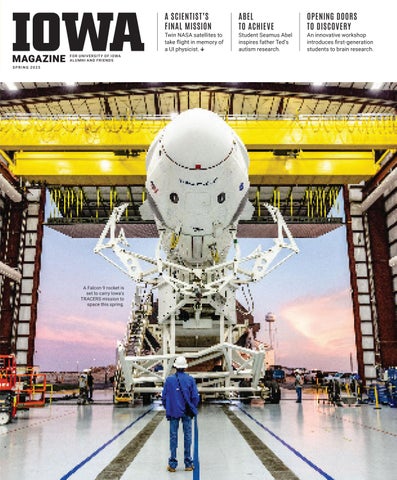
A SCIENTIST’S FINAL MISSION
MAGAZINE
Twin NASA satellites to take flight in memory of a UI physicist. FO R U N I V E R S I T Y O F I OWA A LU M N I A N D F R I E N D S
SPRING 2025
A Falcon 9 rocket is set to carry Iowa's TRACERS mission to space this spring.
ABEL TO ACHIEVE
Student Seamus Abel inspires father Ted’s autism research.
OPENING DOORS TO DISCOVERY
An innovative workshop introduces first-generation students to brain research.
TOGETHER, HAWKEYES MAKE A DIFFERENCE! On Wednesday, March 26, 2025, alumni and friends from around the world kick off One Day for Iowa– the University of Iowa’s 24-hour online giving day. Double your impact with exclusive matching gifts, and help support Iowa’s exceptional people and programs. Every gift, big or small, advances Iowa.
EDITORIAL
FE ATURES
EDITOR IN CHIEF
Shelbi Thomas (05BA) ART DIRECTOR
Nick Beecher (03BA) MANAGING EDITOR
Josh O’Leary (00BA) CONTRIBUTING WRITERS/EDITORS
Ben Frotscher Josephine Geiger-Lee Leah Klevar (93BA, 95MA) Tyler Strand Ellen Yandel GRAPHICS MANAGER
Jared Salasberry
CONTRIBUTING DESIGNERS
Danette Angerer (85BFA) Jodi Schmucker e m a i l : uimagazine@foriowa.org w e b s i t e : magazine.foriowa.org
Abel to Achieve
DIGITAL
UI neuroscientist Ted Abel was inspired to study autism by his son, Seamus (pictured), who graduates from Iowa this spring.
SENIOR WEB DESIGNER/DEVELOPER
Jimmy Losasso (09BFA) WEB DEVELOPERS
Mike Miersen Heidi Schmidt
SENIOR DIGITAL MARKETING STRATEGIST
Nicole Knoll (08BA, 22MS)
DIGITAL MARKETING STRATEGIST
Megan Magee
MULTIMEDIA SPECIALISTS
Seth Diehl (07BA) John Emigh (11BBA, 13BFA) LEADERSHIP PRESIDENT AND CEO
Lynette Marshall
VICE PRESIDENT, ALUMNI & DONOR ENGAGEMENT
Colin Hennessy (01BA)
42
COVER STORY
The Bigger Ten
A Scientist’s Final Mission COVER ART: SPACEX; ABEL PHOTO: JUSTIN TORNER/UI OFFICE OF STRATEGIC COMMUNICATION; TRACERS IMAGE: NASA; RESEARCH PHOTO: TIM SCHOON/UI OFFICE OF STRATEGIC COMMUNICATION
ASSISTANT VICE PRESIDENT, ALUMNI ENGAGEMENT
Leslie Prideaux (08BA, 12MA)
UCLA, the University of Southern California, Opening Doors to Discovery
A late Iowa physics and astronomy professor's colleagues rally to bring his NASA TRACERS mission to the launch pad.
the University of Oregon, andfirst-generation the University of A special workshop introduces Washington theof Big Ten Conference. students to the join basics neuroscience research.
ASSISTANT VICE PRESIDENT, COMMUNICATION AND MARKETING
Rebekah Tilley
EXECUTIVE DIRECTOR, CONTENT STRATEGY
Laura Kivlighan
EXECUTIVE DIRECTOR, MARKETING ANALYTICS AND WEB STRATEGY
Zack Schmidt (03BA)
SECTIONS
2 | Big Picture 4 | Campus Mail 7 | On Iowa
Nursing researcher Chooza Moon studies the benefits of light therapy for mood and quality of life.
15 | Go Hawks
Meet Ryan Reynolds (05BS), a former Hawkeye football intern who is now the strength and conditioning coach for the Kansas City Chiefs.
43 | Iowa Arts
Legendary Iowa artist Mauricio Lasansky’s most celebrated work finds a new home at the National Gallery of Art.
OFFICE OF ALUMNI ENGAGEMENT One West Park Road Iowa City, IA 52242
51 | For Iowa
New Iowa Clubs in Korea and Japan connect more than 150 far-flung alumni and friends.
57 | Always A Hawkeye
A graduate student in music therapy leads the Tremble Clefs, a singing group for people with Parkinson’s disease.
phone : 319-335-3305
email: uiowa@foriowa.org w e b s i t e : foriowa.org
Iowa Magazine, Volume 78, Number 1 © 2025 University of Iowa Center for Advancement. The UI Center for Advancement publishes Iowa Magazine four times a year. POSTMASTER: Send address changes to Iowa Magazine, UI Center for Advancement, One West Park Road, Iowa City, IA 52242. Opinions expressed are not necessarily shared by the university, the publishers, or the editors. The University of Iowa prohibits discrimination in employment, educational programs, and activities on the basis of race, creed, color, religion, national origin, age, sex, pregnancy (including childbirth and related conditions), disability, genetic information, status as a U.S. veteran, service in the U.S. military, sexual orientation, gender identity, or associational preferences. The university also affirms its commitment to providing equal opportunities and equal access to university facilities.
Big Pict u re
2
IOWA MAGAZINE
SPRING 2025
Big Pict u re
BIG P IC T URE
Forever 22
When Caitlin Clark (19BBA) made her debut in an Iowa jersey during the pandemic-altered 2020 season, the stands were empty inside Carver-Hawkeye Arena. Four unforgettable seasons and two Final Fours later, she was joined by family, former teammates, and nearly 15,000 fans as her No. 22 jersey made its ascent to the rafters. Iowa retired Caitlin Clark’s number Feb. 2 (or 2/2), when college basketball’s all-time leading scorer returned home to receive a hero’s welcome. The ceremony followed the Hawkeyes’ nationally televised 76-69 upset over No. 4 USC. The WNBA’s reigning Rookie of the Year, Clark is the third Hawkeye women’s basketball player to have her number immortalized. She joins Michelle Edwards (89BGS), whose No. 30 was retired in 1990, and Megan Gustafson (19BBA), whose No. 10 was hoisted in 2020. “I know my number’s up there, but it wouldn’t be if it wasn’t for all of you,” Clark told a group of former teammates, who were on hand with retired coach Lisa Bluder. “… I’m lucky enough that I got to play here, play for Coach Bluder—somebody who believed in me, probably more than anyone.” In conjunction with her jersey retirement, the Caitlin Clark Foundation delivered four $22,000 checks to local charities: University of Iowa Health Care Stead Family Children’s Hospital, the Coralville Community Food Pantry, the Boys & Girls Club of the Corridor, and East Central Iowa Special Olympics. This isn’t the last time fans will cheer on Clark at Carver. Her Indiana Fever will play an exhibition game against the Brazilian National Team May 4 in Iowa City. PHOTO: BRIAN RAY/HAWKEYESPORTS.COM
MAGAZINE.FORIOWA.ORG
IOWA MAGAZINE
3
Thank you for your “Rooted in Iowa” issue with its marvelous seed cover art, along with the article appropriately titled “The Seed Keeper” [winter 2024–25, p. 60] on contributions by Neil Hamilton (79JD) for the state of Iowa. I have long admired Hamilton’s leadership, especially with the Drake Agricultural Law Center. T he ar ticle appare ntly didn’ t have space to also note Hamilton’s authorship of two insightful books on Iowa’s legacy soil and water resources: The Land Remains and The River Knows. I encourage Iowans and others who
care about Iowa’s future to read these books and act on the stewardship required for an environmentally and economically sustainable future. I have also long admired Iowa’s Seed Savers Exchange. They are Iowa’s own Svalbard Global Seed Vault. Bill Crews (74BA, 78JD) Washington, D.C.
The Story Continues
I’m really happy that The Daily Iowan bought the Solon and Mount Vernon newspapers and is keeping them alive [“Students Keep Community Journalism Alive in Rural Iowa,” winter
Legacy of Leadership
In response to your Iowa basketball history request [“Calling All Basketball Historians,” winter 2024–25, p. 4], my grandfather, R.V. Leo (1914BA), was on the 1912–14 Hawkeye basketball teams and served as captain. I proudly possess his scrapbook of news articles from all those games. A successful businessman, he was elected to the Iowa Senate from 1939–51 and served as president pro tempore. Grandpa financed my college education and often told me with a smile that I could go to college anywhere—as long as it was in Iowa City! Mick Mickelson (68BS, 69MS, 72MD, 77R) Eagle, Idaho
4
IOWA MAGAZINE
SPRING 2025
Year of the Hawkeye
Alumnae Alissa Hamer Thompson (04BA) and Denise Venteicher (05BA) completed a quest this past October to attend events for 10 different Hawkeye sports in a single year, accomplishing their goal in just 344 days. “The goal was to get out of our traditional sports, expand our horizons, and support a broader spectrum of Hawkeye athletes,” says Thompson.
PHOTOS COURTESY MICK MICKELSON AND ALISSA HAMER THOMPSON
Preserving Iowa
Ca mpus Ma i l
2024–25, p. 38]. My hometown paper in Centerville, Iowa, the Daily Iowegian, ran six times a week when I was a teenager but is no more. It got bought up by the Ottumwa Courier and publication ceased. My first job in journalism was there, a summer job as a reporter after my junior year in high school. Its archive is still available. Dan Gleason (67BA, 70MFA) Scottsdale, Arizona
Writers’ Reunion
As a Native American woman, I loved to hear and meet the writers [Sandra Cisneros (78MFA), Joy Harjo (78MFA), and Juan Felipe Herrera (90MFA)] at the Iowa Memorial Union this past fall for the Latino Native American Cultural Center reunion [“Alumni Storytellers Return,” winter 2024–25, p. 54]. I wish more of these types of gatherings would and could exist. Debora Beyal Kalona, Iowa
Farm Flashback
I love the Secrest Octagonal Barn [“Echoes of Iowa’s Past,” winter 2024– 25, p. 58]. I’ve been in it many times when Joe Ryan and family owned it. My brother and I climbed up to the cupula and carved our names in the wood. It holds lots of memories. Brian Boxwell Solon, Iowa
PHOTO COURTESY DOUG SMITH
Leading the Return
The Universit y of Iowa S tanley Museum of Art’s return of artwork to the Kingdom of Benin is wonderful news [“Sacred Objects Return Home” fall 2024, p. 8]. Art historians have been discussing this issue since at least the early 1990s. To finally have someone take great care in finding the most respectful process for the return, returning the objects ceremoniously, and creating an easy path for others to follow is everything great about Iowa. Elizabeth Reynolds Keokuk, Iowa
Doug Smith celebrates with his family on graduation day at Carver-Hawkeye Arena.
The Long Haul
Doug Smith (24BA) began his college career in 1982, spending a year at Southeastern Community College before transferring to the University of Iowa. Though Smith enjoyed school, a job opportunity his senior year called him away before completing his degree. Smith returned to Iowa twice more: once in 2004 and again in 2024, sharing the academic experience with his son and granddaughter. Smith, who graduated this past August with a Bachelor of Arts degree in communication studies, writes, “Receiving my degree raised a final question about my experience across three generations of students: What did I learn by crossing the finish line? A quote from Sir Edmund Hillary of Mount Everest fame answered it: ‘It's not the mountain we conquer but ourselves.’”
CONNEC T W I T H
IOWA MAGAZINE magazine.foriowa.org
MAIL One West Park Road Iowa City, IA 52242 EMAIL uimagazine@foriowa.org PHONE 319-335-3305 800-648-6973
FACEBOOK The UI Center for Advancement INSTAGRAM @uiadvancement @UIAdvancement LINKEDIN @UIAdvancement
Letters to the editor may be edited for style, length, and clarity. While we welcome feedback, we regret that we are unable to print or reply to every letter.
MAGAZINE.FORIOWA.ORG
IOWA MAGAZINE
5
TRAILBLAZER AMBASSADOR HAWKEYE a d n e r B ez Ramir
First Gen Hawk Student Body Vice President University Student Government
Broaden our students’ horizons. Join the campaign at together.foriowa.org.
8 L I G H T E N U P 11 P I C K L E P A I N S 12 B I G E R E T U R N S
PHOTO: JOHN EMIGH AND PARAS BASSUK
STUDENT SUCCESS
On to Oxford
UI psychology major Paras Bassuk was one of only 32 students in the U.S. selected this year for the Rhodes Scholarship, a prestigious international award that funds study at the University of Oxford in England. Bassuk is the UI’s 23rd Rhodes Scholar, and Iowa was one of four public universities and the only Big Ten university to have a 2025 Rhodes Scholar.
MAGAZINE.FORIOWA.ORG
IOWA MAGAZINE
7
On Iowa
Iowa nursing professor Chooza Moon studies the effectiveness of
NUR SING
Enlightening Research UI experts examine the importance of morning light for a person’s sleep and mood. Mornings are important for University of Iowa researcher Chooza Moon. In addition to getting a full night’s sleep, eating a good breakfast, and exercising, Moon aims to start each day with a healthy dose of sunlight. “Morning-time routines really help me set up my whole day to be healthier,” says Moon, who notes that just a 15- to 30-minute walk in sunlight can be beneficial. An associate professor in the UI College of Nursing, Moon says light exposure is crucial for calibrating our brain’s circadian rhythms, which regulate our sleep-wake patterns and alertness. By getting outdoors or simply opening our curtains, morning light signals to our brain that it’s the start of the day, enhances
8
IOWA MAGAZINE
SPRING 2025
wakefulness, and helps us sleep better at night. Research has also shown that morning light exposure can help improve mood and quality of life for people with a range of conditions, including seasonal affective disorder, postpartum depression, and cancer. Moon’s research focuses on the relationship between sleep and heart disease, as well as its impact on brain health as we age, including in patients with Alzheimer’s disease and cognitive decline. Currently, Moon’s team is examining the importance of bright morning light for the sleep cycle, mood, and cognition of older adults. In Moon’s latest study, subjects ages 55 and older wear a pair of light therapy glasses for 30 minutes daily for two weeks. As the study participants go about their morning activities, the glasses—a product called Re-Timer—deliver 500 lux of safe, UV-free light to the wearer’s retinas, mimicking the effects of sunlight. The goal, says Moon, is to determine whether these types of commercially available light therapy glasses can be beneficial for older adults, particularly those who are at the beginning stages of Alzheimer’s or with a family history of the disease. “For now, we are testing feasibility to see how it works within the general older adult population, but in the future, I would like to work with patients who could benefit from this intervention,” says Moon. “I wouldn’t say this will cure or treat anything, but it might at least help on some of those behavioral symptoms.” In a previous study, Moon and her team measured the effectiveness of light therapy among college students to combat seasonal affective disorder, or SAD, a form of depression associated
PHOTOS: JOHN EMIGH
light therapy glasses on brain health.
On Iowa
BRIEFS
Expanding Patient Care
Associate professor Chooza Moon demonstrates a pair of commercially available light therapy glasses.
A ribbon-cutting ceremony takes place April 11 for the new University of Iowa Health Care Medical Center North Liberty. The 60-acre campus features a threelevel hospital, five-level medical office building, and spaces to support medical education and research.
Excellence in Online Education U.S. News & World Report has ranked nine UI online programs among the best in the country. Those include master's degree programs in nursing, business, and education.
Time to Move
Research has shown that morning light exposure can help improve mood and quality of life for people with a range of conditions, including seasonal affective disorder, postpartum depression, and cancer.
with a deficiency of natural light in late fall and winter. With research showing that college students are at a higher risk of developing SAD, which can lead to poor academic performance and other severe mental disorders, UI Student Wellness offers light boxes to check out. Moon’s team surveyed more than 200 UI students who used the light boxes for an average of 45 days. The study found that 97% of the participants believed the light boxes—tablet-shaped
lamps that mimic natural outdoor light—helped ease their SAD symptoms and improved their mood. While Moon’s research is ongoing, she’s anecdotally found that wearing light therapy glasses can be an efficient way to get some light during her hectic mornings. “With the light boxes, you have to stay in one place rather than moving around,” she says. “But on mornings when you’re trying to get things done, this might be helpful.”
A new UI study published in the journal Preventing Chronic Disease recommends physicians survey all patients about their physical activity levels and provide inactive patients with resources to improve their exercise. Patients surveyed who exercised moderately to vigorously at least 150 minutes per week were shown to have a significantly lower risk for chronic diseases such as cardiovascular disease, cancer, and diabetes.
BY JOSH O' LE ARY
MAGAZINE.FORIOWA.ORG
IOWA MAGAZINE
9
NE W S M A K ER: JIL L KOL E S A R
Targeting Ovarian Cancer The new dean of the UI College of Pharmacy works to advance a novel therapy for a disease that killed nearly 13,000 Americans last year. Treatment for ovarian cancer has not changed significantly in 40 years, says Jill Kolesar, dean and professor at the University of Iowa College of Pharmacy. But Kolesar and her team are working to change that, with support from an $8.8 million federal grant awarded in 2024 as part of a program to close the gaps in women’s health research. The funding will allow UI Health Care to offer the world’s first clinical trial of a new therapy for those with recurrent ovarian cancer. Scheduled to begin in 2026, the initial phase will involve nine to 15 patients, says Kolesar, the Jean M. Schmidt Chair in Drug Discovery. The Advanced Research Projects Agency for Health (ARPA-H) Sprint for Women’s Health awarded grants to 23 research teams worldwide from more than 1,700 applicants. Announced by First Lady Jill Biden in February 2024, the initiative provided more than $110 million to qualified teams working in six areas.
10
IOWA MAGAZINE
SPRING 2025
Jill Kolesar, dean of the University of Iowa College of Pharmacy
The innovative treatment to be tested at the UI recruits a patient’s own cellular messengers, known as extracellular vesicles (EVs), to target white blood cells in tumor clusters and “change them from cancer-supporting to cancer-fighting,” according to the grant summary. Researchers have been interested in using EVs to fight disease for a long time, but EVs are so tiny that it’s difficult to isolate them effectively, says Kolesar. Before joining the UI in July 2024, Kolesar collaborated with colleague Chris Richards at the University of Kentucky to develop a technique to create about 3,000 EVs from a single cell, a thousandfold increase from the previous technique, she says. Richards received $1.2 million from the ARPA-H to continue to refine this patent-pending process. Kolesar’s team also includes UI Health Care’s Michael Goodheart (01F, 02F, 05F), a gynecologic oncologist; George Weiner, a physicianscientist specializing in cancer immunotherapy; the DeGowin Blood Center; and Holden Comprehensive Cancer Center, which Weiner directed for many years. So far, the multimilliondollar grant has allowed the team to hire two people and buy essential equipment. “It’s always hit home what a bad disease [ovarian cancer] is,” says Kolesar, who has several relatives and a childhood neighbor who battled the disease. It’s often discovered at an advanced stage, and although most patients benefit initially from chemotherapy, 80% experience a recurrence two to five years later, she says. The American Cancer Society estimated there were 19,680 new diagnoses of ovarian cancer and 12,740 deaths in the U.S. during 2024. Kolesar says she is hopeful the UI’s research will “open the door on a new type of therapy.” T h e C o l l e g e o f P h a r m a c y ’s s t r o n g reputation for educating future generations of pharmacists attracted Kolesar to Iowa. So did UI Pharmaceuticals, the country’s only universityaffiliated, Food and Drug Administration-registered pharmaceutical manufacturing facility. A Wisconsin native, Kolesar says she’s delighted to be back in the Midwest and hopes the Sprint for Women’s Health grant will “catalyze drug discovery and development” in Iowa City. B Y K AT H E R I N E H O U S E
PHOTO ILLUSTRATION: NICK BEECHER
On Iowa
On Iowa
How to Protect Your Joints
A S K A N E X P ER T
How Can I Play Pain-Free Pickleball?
Tyler Slayman offers preventive strategies to avoid hurting your joints during pickleball:
Warm up “Don’t go from your car to playing right away,” he says. “Walk first or play a slow volley of pickleball to get warmed up.”
Stretch Dynamic stretches such as walking lunges, high knees, or arm circles can be more effective at preparing your muscles than static stretches that involve standing in one stretched pose.
PHOTO ILLUSTRATION: NICK BEECHER; MASK PHOTO: LIZ MARTIN/UI HEALTH CARE
Bring a partner Few hobbies have exploded nationally like pickleball, a unique blend of tennis, badminton, and pingpong that’s been the fastest-growing sport in America for the past three years, according to USA Pickleball. Despite its appeal, pickleball can take a toll on joints, says Tyler Slayman (16MD, 20F), a family medicine and sports medicine specialist with University of Iowa Health Care. “Many forms of exercise can be intimidating, but pickleball has a nice accessibility to it,” he says. “It’s fun, it’s growing, it’s exciting, and it can be as intense as you want. But don’t let possible joint problems stop you from
taking up pickleball. The human body was made to move.” It’s easy to be drawn to pickleball’s charm, especially because the social nature of the game encourages spending time with friends, says Slayman. But pickleball beginners who were previously inactive should be cautious about playing it many days a week or for many hours at a time. “Folks who were more sedentary will be at higher injury risk,” says Slayman. “Start playing pickleball in a gradual, progressive way. Rather than jumping in seven days a week for three hours at a time, start at twice a week for 30 to 45 minutes.” BY MAUREEN SAL AMON
PEDIATRIC CARE
Courage Behind the Mask
Volunteer artists decorate radiation masks for children undergoing radiation therapy treatment for cancer at UI Health Care. The thermoplastic masks, which are molded to fit the patient's face and upper body, are secured to a table to help keep children still as they wear them during the 15-minute treatment that targets cancer cells.
Playing doubles rather than singles will “decrease the amount of space you need to cover on the court,” he says, protecting joints from overuse.
Keep your play at waist level This will limit overhead movements that can be hard on your shoulders.
Skip backhand returns These movements can place stress on your elbows.
“Even though the treatment is painless and highly effective, it can still be a scary and emotionally overwhelming experience for them,” says UI Roy J. and Lucille A. Carver College of Medicine grad Weiren Liu (21MD), who created the pictured Super Herky mask and nearly 70 others before leaving to become a radiation oncology resident at Washington University. “Turning something that might have been a source of anxiety into something they looked forward to seeing was incredibly rewarding.”
MAGAZINE.FORIOWA.ORG
IOWA MAGAZINE
11
On Iowa
Extra
Ettore Ewen waves to the crowd during an appearance at Kinnick Stadium this past fall.
HE A LT H A ND W EL L NE S S
Stigma Smackdown A WWE star and former Hawkeye football player helps UI students by opening up about his mental health journey. Ettore Ewen (08BA), better known to pro wrestling
fans as Big E, returned to the University of Iowa campus this past homecoming to talk to students about mental health. As rates of anxiety and depression in college students rise nationwide, holistic wellness has become one of the UI’s top priorities. Efforts are in place to improve access to mental health information and resources across campus while decreasing stigma. Ewen’s presentation at the Iowa Memorial Union included sharing his own experience with depression while he was a student at Iowa. Originally from Florida, Ewen first came to Iowa on a football scholarship, but a series of injuries not only kept him off the
12
IOWA MAGAZINE
SPRING 2025
field but also increasingly affected his mental health, leaving him feeling like he let his team down. “I think one thing we often talk about with athletes in the time you’re injured is the physical toll, but what we don’t talk about is the mental toll, that loss of identity,” says Ewen. “Because when you’re hurt, you’re not able to do the thing you love.” A concerned coach encouraged him to seek counseling, and Ewen was diagnosed with depression.
He devoted the next several years to healing, including keeping up with therapy, searching for the right medication, and receiving some treatment in a psychiatric unit. “I truly felt like someone who was drowning, someone who was just trying to get air,” he says. “And for me, medication just allowed me to stay afloat for a bit until I could continue to get better and better.” Lost without football, Ewen wasn’t sure how he would finish college, much less what he would do next. But he credits his instructors, coaches, and friends for supporting him through his struggles and pushing him toward opportunities. One professor encouraged Ewen to continue attending Iowa for grad school, which gave him a new focus. That focus soon shifted again. While in grad school for health and sports studies, Ewen learned about a conversation Iowa wrestling alumnus Mike Doughty had on a plane with Jim Ross, a WWE announcer at the time who was interested in recruiting former Hawkeyes for pro wrestling. Ewen, a wrestling fan since childhood, answered the call. Now a past WWE world champion and tag team champion, Ewen says he enjoys using his platform to share his story and spread joy. “I love that now I have a testimony, that I can stand up here and speak earnestly, openly, and honestly about everything I went through,” says Ewen, who also served as an honorary captain for the Hawkeyes’ homecoming football game. Today, Ewen says he feels settled and driven to help others. He emphasizes finding daily ways to work on personal mental health, and above all, building caring and supportive communities. Says Ewen: “There’s still so much to live for, so much to fight for, so much to wake up every single day and push for.”
Ettore Ewen shares his mental health experiences with UI students. B Y E L L E N YA N D E L
TOP PHOTO: OWEN AANESTAD/HAWKEYESPORTS.COM; BOTTOM PHOTO: KIRK MURRAY/UI OFFICE OF STRATEGIC COMMUNICATION
Watch Big E’s full conversation about mental health at foriowa.info/IM-BigE-25.
On Iowa
BRIEFS
A Dose of Vitamin C Results from a UI Health Care-led clinical trial published in the journal Redox Biology show that adding high-dose, intravenous vitamin C to chemotherapy doubles the average length of survival of patients with late-stage metastatic pancreatic cancer from eight months to 16 months.
Transformed Space
RE S E A RCH
Drunk Driver Detection
PHOTO: JUSTIN TORNER/UI OFFICE OF STRATEGIC COMMUNICATION
The UI Driving Safety Research Institute tests new technology to identify alcohol impairment. A University of Iowa study this spring will examine whether new vehicle technology can help detect and prevent drunk driving. The Nationa l Highway Traff ic Safet y Administration awarded the UI Driving Safety Research Institute $2 million to analyze the effectiveness of a new generation of driver monitoring systems in determining if someone is driving while over the legal blood alcohol content level. Already, various types of driver monitoring systems found on new vehicles can use an internal camera to track eye and head movement, which helps assess and alert the driver on drowsiness or distraction.
For the UI study, participants will operate a driving simulator at four distinct times: when they are alert and sober, when they are drowsy and sober, when their blood alcohol content is at 0.08%, and when their blood alcohol content is at 0.12%. Investigators will collect data on driver performance, eye tracking, head and body movements, heart rate, and respiration to determine which measurements can best assess a driver’s condition. Tim Brown (94BSE, 96MS, 00PhD), the institute’s director of drugged driving research, says, “This study is significant because its results could be used in the future to help prevent or reduce the number of alcohol-related crashes.” BY KRISTINE ROGGENTIEN
The UI’s original Art Building is undergoing a $37 million renovation to become the new home of the Graduate College, the School of Planning and Public Affairs, and the College of Education’s Art Education and Maker Space. Construction is estimated to be complete by summer 2026.
Radon Risk UI radiochemistry researchers recently received an award from the Research Development Office to see if analyzing toenail samples for a radioactive element that occurs as radon decays can be a new, noninvasive method to determine the risk of lung cancer from lifetime radon exposure. Radon is the second-leading cause of lung cancer after smoking.
MAGAZINE.FORIOWA.ORG
IOWA MAGAZINE
13
GRANDPARENTS UNIVERSITY
®
JULY 17, 2025
Experience a day of discovery for the young and young at heart. Join the fun and make core memories together. Mark your calendars. Registration opens April 7. Learn more: foriowa.org/grandparentsu
The term Grandparents University® is a registered trademark originating at the University of Wisconsin–Madison and is used with permission. This intergenerational learning opportunity is for children ages 8–14. They may be accompanied by a grandparent or honorary grandparent.
Go Hawks
18 A L L I N O N W R E S T L I N G 19 C H I E F C O N T R I B U T O R 20 P I E C E S O F H A W K E Y E H I S T O R Y
PHOTO: JEROD RINGWALD/HAWKEYESPORTS.COM
WRESTLING
Up and Away
Kennedy Blades throws her opponent in a technical fall victory in January as the Iowa women’s wrestling team dominated its Carver-Hawkeye Arena home finale against Augustana College and Grand Valley State. Earlier that month, the NCAA added women’s wrestling as its 91st championship sport, allowing athletes across all three divisions to compete for a national championship beginning in 2026. The National Collegiate Women's Wrestling Championships were held this month in Coralville.
MAGAZINE.FORIOWA.ORG
IOWA MAGAZINE
15
Go Hawks
S E A S ON S N A P S HO T S
Highlight Reel Iowa student-athletes captivated fans in competition this past fall and winter. We’ve gathered a few of our favorite moments. 1. Catch and Release Junior men's basketball player Josh Dix drills a game-winning three-pointer to help Iowa edge Northwestern in its Big Ten home season opener. The buzzer-beater earned the No. 1 spot on ESPN’s SportsCenter Top 10 Plays.
1
2. Heart of Gold Former Iowa women’s basketball coach Lisa Bluder was honored for her record-setting career with the Hawkeyes during halftime of the Maryland game in January.
3. Up Her Sleeve Senior point guard Lucy Olsen scored 28 points to help the Iowa women’s basketball team upset No. 4 USC in February at CarverHawkeye Arena.
4. In Flight Iowa freshman Aurélie Tran captured the all-around title in a January dual against Minnesota at Carver-Hawkeye Arena.
4
In his final game as a Hawkeye football player, junior Kaleb Johnson (No. 2) scored a 72-yard, game-tying touchdown in Iowa’s Black Friday victory over Nebraska at Kinnick Stadium.
6. Record Rewrite Hawkeye goalkeeper Macy Enneking (facing camera) hugs Berkely Binggeli in November after Iowa topped Georgetown in the second round of the NCAA women’s soccer tournament in Los Angeles. The victory earned Iowa its first Sweet 16 berth.
7. UNI-fied The Iowa women’s wrestling team celebrates its second-straight National Wrestling Coaches Association National Duals title in January at the UNI-Dome in Cedar Falls, Iowa.
8. Make it 20 Iowa graduate student Stephen Buchanan II savors his major decision win at 197 pounds to clinch a Hawkeye wrestling dual victory over the No. 12 Cyclones this past November at Carver HawkeyeArena. Iowa rallied for its 20 th-straight win against Iowa State. BY T Y L E R S T R A N D
16
IOWA MAGAZINE
SPRING 2025
PHOTOS: HAWKEYESPORTS.COM: 1, 3, 6. STEPHEN MALLY; 2, 4, 5. BRIAN RAY; 7. JEROD RINGWALD; 8. OWEN AANESTAD
5. Best for Last
6
Go Hawks
2
3
5
7
8
MAGAZINE.FORIOWA.ORG
IOWA MAGAZINE
17
Go Hawks
BRIEFS
Birthday to Remember
Year of the G.O.A.T. Caitlin Clark (24BBA) was named Time magazine’s 2024 Athlete of the Year and the Associated Press and Sporting News Female Athlete of the Year this past December, and she was listed on the Forbes 30 Under 30. In February, Iowa retired Clark’s No. 22 jersey at Carver-Hawkeye Arena (see p. 2).
Milestone Met Hawkeye head wrestling coach Tom Brands (92BS) earned his 300 th career dual victory this past December as Iowa topped Army West Point at the Journeymen “Uncivil War” event in St. Charles, Missouri. The dual win marked Brands’ 283rd at the helm for Iowa.
18
IOWA MAGAZINE
SPRING 2025
P L AY M A K ER: BEN K UE T ER
Tunnel Vision A two-sport talent channels his focus to the mat. Living next door to former Iowa wrestling coach Dan Gable for two years, Ben Kueter made frequent trips to the Olympic gold medalist’s house for demanding and unpredictable workouts. “When you’re playing football or you’re wrestling, nothing’s ever planned out,” says Kueter, who began training with Gable in eighth grade. “Those workouts helped me in dealing with the situation and reacting in a positive way, no matter what.” After juggling football and wrestling in his first year at Iowa, Kueter has fully dedicated himself to the mat since June. The redshirt freshman claimed second at the U20 World Championships last summer and aspires to become an NCAA individual and team champion later this month.
Mind Over Mass
Kueter feels physically ready to compete with the best heavyweight wrestlers. The greater challenge is mental. “The biggest thing is keeping the same mindset each match, whether I’m wrestling [two-time NCAA champion] Gable Steveson or somebody who’s not even ranked,” says Kueter. “It’s ‘No, I’m
wrestling the best wrestler in the world every time I step out on the mat.’” Kueter views every match as a learning opportunity. The Iowa City native dissects each one with head coach Tom Brands (92BS), finding things to improve and applying it in practice. Kueter also emulates the leadership qualities of junior Drake Ayala. When the team runs, Kueter strives to stay up front with the reigning NCAA runner-up. “Drake lives a great life off the mat as well as in the practice room,” says Kueter. “To be successful in the college wrestling scene, you have to do those things off the mat that are hard to do. He goes to bed on time, wakes up early, he’s eating and drinking the right things. He has good relationships with his friends and family. It might not seem like a lot, but if it’s all in good terms, it can help your wrestling a lot.” Kueter will ultimately measure his success by his development. “I need to grow throughout the entire season, and if I don’t do that and don’t see that in my wrestling, I’d be very disappointed with myself,” he says. “It doesn’t even matter what the results are; the results will take care of themselves.” BY T Y L E R S T R A N D
DEJEAN PHOTO: GREGORY SHAMUS/GETTY IMAGES; KUETER PHOTO: BRIAN RAY/HAWKEYESPORTS.COM
Former Iowa football player Cooper DeJean returned an interception for a touchdown on his 22nd birthday in February to help the Philadelphia Eagles defeat the two-time defending champion Kansas City Chiefs in Super Bowl LIX. The rookie defensive back also made three tackles and returned three punts for 27 yards.
Go Hawks
Ryan Reynolds creates yearround training plans for the entire Kansas City Chiefs roster and has worked on the franchise’s strength and conditioning staff for nine seasons.
A L UMNI UP D AT E
Strength in Numbers A former Hawkeye football intern takes a data-based approach to lead the Kansas City Chiefs’ strength and conditioning program.
PHOTOS: CHIEFS.COM
Ryan Reynolds (05BS) played a key role
in the Kansas City Chiefs’ recent trip to a third-straight Super Bowl. The former Iowa football strength and conditioning intern managed the team’s training throughout the year, developing a plan for every player on the roster. “It’s your road map,” says Reynolds, who finished his second season as the team’s head strength and conditioning coach. “Things happen, the team gets beat up. So, you make modifications as you go.” Reynolds’ in-season program largely focuses on high-intensity and low-volume workouts. At different points in the season, the Iowa exercise science graduate measures each player’s power, strength, and speed to gauge progress and determine if training modifications are necessary.
Reynolds is also the team’s director of sports science and uses advanced tools to monitor the team’s strength and conditioning progress. He operates the Chiefs’ player tracking system, in which players wear electronic chips in their jerseys during practice and the offseason that monitor their movement and performance, including metrics like acceleration, deceleration, speed, distance covered, exertion, and fatigue. Reynolds also uses data on a player’s body composition and athletic power to help determine their optimal playing weight. But as technology plays an increasing role in the field, he cautions against an overreliance on it. “The number one thing is your coaching eye,” says Reynolds. “The problem with technology is that people let the
technology tell them something may be different than what their eyes see.” The Fulton, Illinois, native also emphasizes the human element in his relationships with the team. Besides Chiefs head coach Andy Reid, Reynolds is the only staff member to work with each player daily. Those frequent interactions make it vital for Reynolds to learn each player’s personality and earn his commitment to the plan. “You’re always trying to keep buy-in and increase buy-in from the guys on the team,” says Reynolds. “It’s developing a relationship with the players. The more they trust you and know that you have their best interests in mind, the more they’re going to buy into you and your program.”
Ryan Reynolds celebrates the Kansas City Chiefs’ Super Bowl LVIII victory Feb. 11, 2024, over the San Franciso 49ers. BY T Y L E R S T R A N D
MAGAZINE.FORIOWA.ORG
IOWA MAGAZINE
19
Go Hawks 2
AT HL E T IC S HIS T OR Y
Objects of the Game
3
4
Artifacts on display at a recent UI Libraries exhibition tell the story of a centuryand-a-half of Hawkeye sports.
1
6
7
8
9
1. Ticket from Iowa's 7-6 football win over Notre Dame on Nov. 11, 1939, in Iowa City. 2. Women's gymnastics jacket, donated by Tepa Haronoja (74MA), the program's first coach from 1973–79. 3. Football card printed in 1992 commemorating 1939 Heisman Trophy winner Nile Kinnick (40BA). 4. Buttons celebrating the women's sports movement of the 1970s. 5. Racing Louisville
20
IOWA MAGAZINE
SPRING 2025
jersey of Samantha Cary (23BA), who in 2024 became the first Hawkeye drafted to the National Women's Soccer League. 6. USA Basketball hat donated by former Iowa women's basketball standout Nadine Domond (98BA), who played on various national teams and was drafted to the WNBA in 1998. 7. Gym bag from the 1980s donated by Holly Wilson Greene (80PhD), one
PHOTOS: JOHN EMIGH
From the leather helmet days of college football to the rise of women’s sports, generations of University of Iowa student-athletes have left us with some indelible memories. They’ve also left us with some historically significant keepsakes. UI Libraries—a goldmine for athletics artifacts, ephemera, and historic papers— recently produced an exhibition titled Hawkeye Histories | Sporting Stories. The Main Library Gallery spotlighted nearly 150 years of Iowa athletics treasures while exploring the historical context behind them. The exhibit told stories from the gender equity movement of the 1970s, the emergence of Iowa’s wrestling dynasty in the 1980s, and the challenges of the COVID-19 pandemic, among other key eras. Jennifer Sterling , associate professor of instruction in sports media and culture in the Department of American Studies and School of Journalism and Mass Communication, curated the exhibit. Pictured here are a few of the exhibition’s highlights from the University Archives and Iowa Women’s Archives in UI Libraries Special Collections, the UI Athletics Hall of Fame, and Iowa alumni.
5
Go Hawks
11
10
13
12
14
15
18
16 17
of the first female athletic trainers in the U.S. 8. Undated women's rifle team patch. 9. Postcard from coach C. Vivian Stringer (10LHD) thanking fans after Iowa set an NCAA women's basketball singlegame attendance record with 22,157 fans in a Feb. 3, 1985, home game
against Ohio State. 10. Women's athletics bumper sticker from the 1980s. 11. Hawkeye wrestling program from the 1980–81 season. 12. T-shirt commemorating the 1985 women's basketball attendance record. 13. Undated women's basketball uniform. 14. Basketball
celebrating the 40 th anniversary of Title IX, donated by former UI women's athletics director Christine Grant (70BA, 74PhD). 15. Softball from 1987 marking the 300 th career win by former Iowa softball coach Gayle Blevins. 16. Association for Intercollegiate Athletics for Women
paddle from the 1970s. 17. Football helmet from the 1921 season. 18. Kansas-Iowa basketball game ticket from 1906, displayed in a record book from the university's Board in Control of Athletics.
MAGAZINE.FORIOWA.ORG
IOWA MAGAZINE
21
ABEL
TO
ACHIEVE
When his toddler was diagnosed with autism spectrum disorder more than 20 years ago, neuroscientist Ted Abel expanded his research focus to include the developmental disorder. Today, the University of Iowa provides an environment where both father and son have thrived. 22
IOWA MAGAZINE
SPRING 2025
PHOTOS: TIM SCHOON/UI OFFICE OF STRATEGIC COMMUNICATION
DISCOVER SUCCEED THRIVE SOAR
BY S A R A E P S T E I N M O N I N G E R
NEUROSCIENTIST TED ABEL
Ted Abel's son, Seamus, will graduate from Iowa in May with a bachelor’s degree in German.
MAGAZINE.FORIOWA.ORG
IOWA MAGAZINE
23
Ted Abel is pictured in his lab at the Pappajohn Biomedical Discovery Building.
Since being hired in 2017 as the founding director of the Iowa Neuroscience Institute at the University of Iowa, Ted Abel has overseen impressive progress: Neuroscience research funding at Iowa has increased from $65 million a year to $110 million, 30 new faculty members have come on board, and some 135 faculty across campus have joined the collaborative institute. The university, meanwhile, started an undergraduate major in neuroscience and opened a new building dedicated to psychological and brain sciences. But one of the best things to happen to Abel since arriving in Iowa City has been personal. His son, Seamus, who is on the autism spectrum, will graduate from Iowa in May with a bachelor’s degree in German. That Abel’s son would graduate from high school, let alone college, was not always a sure thing. Days after his birth, Seamus—named after the late Irish poet Seamus Heaney—stopped feeding. His parents were wracked with worry and fear in the neonatal intensive care unit at Children’s Hospital of Philadelphia.
A Son Finds His Niche
While Abel was busy establishing the neuroscience institute at Iowa, Seamus and his mother, Noreen O’Connor-Abel, remained in Philadelphia. After his high school graduation, Seamus attended a two-year education and support program for students with autism based at the Kinney Center of Saint Joseph’s University. There he learned to navigate a traditional college experience—and prepare for his future as a Hawkeye. Seamus and his mother joined Abel in Iowa City in June 2020, and Seamus started classes that fall. Though Seamus had been considering small colleges, Abel says enrolling at Iowa was the right choice. “I don’t know of very many other places where Seamus could have accomplished what he’s accomplished moving here. Both the University of Iowa and Iowa City have been extraordinary for him,” Abel says. “He’s been able to do intellectual work at a high level—and do it in a place where he has support and in a place of safety with a strong sense of community. We haven’t regretted moving to Iowa City for one second.” Abel and his wife, who works remotely as a managing editor at University of Pennsylvania Press, recall a definitive moment
24
IOWA MAGAZINE
SPRING 2025
PHOTO: LIZ MARTIN/UI HEALTH CARE
S
Imaging revealed low-grade bleeding in the ventricles of Seamus’ brain, which Abel says explained the symptoms. Seamus was stabilized and sent home, though pediatricians and neurologists closely monitored his progress. At age 3, Seamus was diagnosed with autism spectrum disorder. He didn’t see a typical classroom until the fourth grade. “The trajectory for him was very unclear,” says Abel, who had been a junior faculty member in biology studying behavior, learning, and memory at the University of Pennsylvania when Seamus was born. Early on, however, Seamus exhibited signs of high ability, especially in reading and math. As a young child, he always pronounced new words correctly. At 3, he would identify letters formed by broken pretzel pieces, and when he was 7, he drew a baseball and included every stitch. He quickly picked up German when he started learning the language in middle school and took Advanced Placement German in high school. Outside of school, he enjoyed playing piano, swimming, completing math and science lessons through Khan Academy, and beating his father in tennis. Although Seamus is high-functioning and likes being around people, Abel says his son, now 25, faces daily challenges. He manages anxiety and has difficulty making social connections. With support, he completed high school, but while most students in his cohort with special needs moved on to group-living programs to help them transition to adulthood, Seamus did not. “Because of his intellectual ability, we sought to find a path for him to go to college. We wanted him to have a chance to achieve a college education and learn how to write and think,” Abel says. “He’s still working to connect socially and live independently, but he’s about to graduate from college. That’s a tremendous accomplishment for Seamus. We’re extremely proud of him.”
FACTS ABOUT AUTISM SPECTRUM DISORDER Autism spectrum disorder (ASD), a developmental disability caused by differences in the brain, is a lifelong condition often marked by challenges with social communication and interaction and repetitive behaviors.
Seamus Abel, who graduates this spring from Iowa, has been able to further explore his
PHOTOS COURTESY ABEL FAMILY AND TIM SCHOON/UI OFFICE OF STRATEGIC COMMUNICATION
interests in languages, cultures, math, science, piano, horseback riding, and tennis.
during Seamus’ time at Iowa. He had been accepted into the Belin-Blank Center’s Academy for TwiceExceptionality, a program in the College of Education that works with high-ability neurodiverse students to support their campus experience and foster community engagement, and the three were at a lunch for academy students and their families. “We were talking to other parents, and suddenly we looked around, wondering where Seamus was. And he was sitting down at a table, talking with the student group. That had not happened before—and he was 23,” Abel says. “He’s never had a real friend. The twice-exceptional academy has provided a community for Seamus, and it has helped make a large campus feel smaller.” Through the academy, which started as a pilot program in 2021 with two students and now has 17 active students, Seamus sets academic and personal goals and attends weekly individual meetings with academy staff as well as group workshops. He also is connected to campus resources such as Student Disability Services, which arranges accommodations that help him focus during exams. Thanks to professors allowing breaks, giving alternate assignments when needed, and sharing class slides in advance to help him prepare, Seamus has succeeded academically—especially thriving in his German classes, where he prides himself on proper pronunciation and correct grammar. He joined the German Club and participates in Kaffeeklatsch, a German conversation
group. Phillips Hall, which houses the academic offices of the Division of World Languages, Literatures, and Cultures and a study lounge for students, quickly became a comfortable home base on campus. In addition to his affinity for languages—he is in his second year of studying French—Seamus is fascinated by math and science. He fulfilled his rhetoric requirement with a class focused on science and technology taught by Margaret Murray (05MFA), an emerita faculty member in rhetoric and mathematics and a 2024 recipient of the Hubbard-Walder Award for Excellence in Teaching. To satisfy another general education requirement, he enrolled in Murray’s Diverse Perspectives in the Mathematical Sciences, where some discussions and assignments allowed him to voice his viewpoint as a person with autism. Finding professors such as Murray, along with Glenn Ehrstine and Kirsten E. Kumpf Baele (05MA, 13PhD) in the German department, gave Seamus confidence in navigating change from one semester to the next. “I feel my professors are pretty understanding,” says Seamus, who made the dean's list in fall 2024 and rarely misses a class. “I don’t know if you can find any other professors who are more understanding.” Abel says the German department, with its small class sizes, has provided a supportive environment for Seamus to learn to think critically and write analytically, and its courses have given his son the skills to communicate his thoughts at a high level.
Research suggests that ASD develops through a combination of genetic influences as well as certain environmental risk factors, such as advanced parental age, prenatal exposure to air pollution or certain pesticides, extreme prematurity or very low birth weight, and birth complications leading to periods of oxygen deprivation. Early brain development appears to be key. One in 36 children is diagnosed with ASD, according to recent estimates from the Centers for Disease Control. The average age of ASD diagnosis in the U.S. is 5, with signs appearing about age 2 or 3. Boys are diagnosed with ASD four times more often than girls. Common co-occurring conditions are attentiondeficit/hyperactivity disorder, anxiety and depression, gastrointestinal disorders, seizures, and sleep disorders.
MAGAZINE.FORIOWA.ORG
IOWA MAGAZINE
25
A Father Finds His Niche
IOWA PART OF ELITE NETWORK INVESTIGATING DISABILITIES About 1 in 6 children is diagnosed with an intellectual or developmental disability, which includes autism spectrum disorder, attention-deficit/ hyperactivity disorder, blindness, and cerebral palsy. The University of Iowa aims to prevent and treat these disabilities through biomedical and behavioral research, and in 2021 the campus became home to one of 15 federally funded Intellectual and Developmental Disabilities Research Centers (IDDRC) across the country. Other locations include Children’s Hospital of Philadelphia, Boston Children’s Hospital, and Kennedy Krieger Institute in Baltimore. Funded through a five-year, $6.2 million grant from the National Institutes of Health, the Hawk-IDDRC, led by neuroscientist Ted Abel and developmental pediatrician Lane Strathearn, is tailored to benefit the underserved rural population. Learn more at iddrc.uiowa.edu.
26
IOWA MAGAZINE
SPRING 2025
When Seamus was diagnosed with autism, Abel broadened his research focus to include neurodevelopmental disorders. Male mice that model autism, his studies have revealed, exhibit deficits in reward learning and motor learning, behaviors mediated by circuits in the brain that enable us to learn from experience, predict what will happen next, and then choose a motor. “This may be key to why autism is more common in boys,” says Abel, who is chair of the Department of Neuroscience and Pharmacology in the UI Roy J. and Lucille A. Carver College of Medicine and has co-authored more than 250 scientific papers. “Many individuals on the autism spectrum have trouble predicting what will happen next or coping when what they expect to happen does not occur, and that leads to difficulties in social interaction and communication.” The field of neuroscience, Abel says, has introduced techniques from physics, engineering, chemistry, and biochemistry to manipulate and image circuits of nerve cells in the brain. He hopes to use those findings to understand how neurons in the brain work to drive behavior and then develop treatments. His lived experience with Seamus fuels his desire to make a difference in the lives of others. “My work on the molecular basis of memory has always been close to the field of neurodevelopment, but clearly Seamus’ diagnosis has driven me to focus on autism,” says Abel, a member of the National Academy of Medicine and a fellow of
“
evidence-based practices by evaluating the effectiveness of biological, biochemical, and behavioral interventions; developing assistive technologies; and advancing prenatal diagnosis and newborn screening.
Building on an Iowa Tradition
With psychiatric and neurological disorders accounting for nearly one-fifth of all disability leading to ill health or early death worldwide, gaining a better understanding of the brain has become an international priority. Innovative research in neuroscience had been a hallmark at Iowa long before Abel’s arrival. The university's first psychological laboratory opened in 1890, and the psychiatry and neurology departments in the UI Carver College of Medicine, founded in 1919, were two of the nation’s first. Buoyed by a $45 million founding grant from the Roy J. Carver Charitable Trust and support from the UI Carver College of Medicine, Abel says his job has been to continue this tradition of focusing on collaborative neuroscience research. “It was all here—it was just a matter of someone being able to synthesize it with resources and with
As a society, I think we are very much in the process of change for individuals with disabilities, moving from awareness to acceptance, and I hope that we’re able to continue that. At Iowa, you can see that in what Seamus has been able to do with the Academy for Twice-Exceptionality. That’s the biggest arc of all.” —Ted Abel the American Association for the Advancement of Science. “In fact, we recently established at the Iowa Neuroscience Institute a research center in intellectual and developmental disabilities, one of only 15 centers funded by the National Institutes of Health [see sidebar]. By understanding these disabilities more completely, we can develop better treatments.” Together, Abel says, the broader network of centers will contribute to the development and implementation of
people. The connections between the clinic and the bench at Iowa are seamless,” he says, motioning down the hall from his office in the Pappajohn Biomedical Discovery Building, where the institute occupies three floors. “In these offices you’ll find PhDs, MDs, and MD-PhDs, from dozens of disciplines, including pediatrics, neuroscience and pharmacology, and psychological and brain sciences.
PHOTO: JUSTIN TORNER/UI OFFICE OF STRATEGIC COMMUNICATION
Noreen O’Connor-Abel (left) and Ted Abel (right) plan to celebrate the upcoming Iowa graduation of their son, Seamus (center), with a family trip to Disneyland Paris.
You bump into people all the time. We have people who are returning from the clinic, maybe having worked with infants who won’t stop seizing, and then coming into the lab to do cutting-edge imaging of neurons using $1 million microscopes. It’s extraordinary.” Abel cites the work of institute member Aaron Boes (03BS, 09MD, 09PhD) as a great example. The Iowa-educated neuropsychiatrist collaborated with neurosurgeon and institute member Matthew Howard to advance a treatment for depression using noninvasive brain stimulation. They performed the first study combining transcranial magnetic stimulation (TMS) with intracranial recording of patients undergoing brain surgery to pinpoint how the human brain responds to TMS. “There are no barriers here. Whatever the problem is, we work together to understand it in creative and collaborative ways,” Abel says. “We do it this way because that’s how we will understand things better, and that’s just huge. Iowa has had an impact in neuroscience for decades, and the Iowa Neuroscience Institute has built on this legacy with the goal of transforming our understanding of neuroscience.” While little is understood about what causes autism spectrum disorder and how best to ameliorate it, Abel says he feels momentum. He notes recent developments in treatment for the most severe genetic forms of the disorder and points to fundamental advances in our understanding of neuroscience and the regulation of gene expression during development. Abel has identified an overarching goal for the institute to understand the genes and molecules that drive the circuits in the brain, a new field called molecular systems neuroscience. “We know that behavior is mediated by these circuits, but now we need to connect that to the tens of thousands of molecules in the millions of neurons that give rise to these behaviors,” he says. “And we are developing the tools to do that.”
A Family Looks Toward the Future
The cultural shift Abel has witnessed since Seamus was born is helping to speed up discoveries, and for that Abel is grateful. “As a society, I think we are very much in the process of change for individuals with disabilities, moving from awareness to acceptance, and I hope that we’re able to continue that,” says Abel. “At Iowa, you can see that in what Seamus has been able to do with the Academy for Twice-Exceptionality. That’s the biggest arc of all.” In addition to guiding his professional endeavors, Abel says being Seamus’ father has taught him compassion and appreciation. “It has helped me focus on the present, on what Seamus and I can do together. So often in life, we think about where we’re going, but what we really need to focus on is where we are. Life is about having fun, in many ways,” says Abel, who frequently attends Hawkeye athletic events with Seamus. “When you think about somebody like Seamus and the challenges he faced, being in NICU and wondering what’s going to happen to him, we’ve been able to identify strengths to focus on and help him develop and grow, something that happens one step at a time. And now he’s graduating from college.” The beginning of their parenting journey may have been marked with worry and fear, but this spring Seamus’ parents will experience one of their proudest moments as they watch Seamus cross the Carver-Hawkeye Arena stage in a black cap and gown to accept his diploma. Seamus plans to stay in the area and find a job, but before that: a celebratory family trip to Disneyland Paris.
Give Support the Iowa Neuroscience Institute's groundbreaking work at foriowa.info/IM-INI-25.
Any comments? Email uimagazine@foriowa.org.
MAGAZINE.FORIOWA.ORG
IOWA MAGAZINE
27
ROCKET PHOTO COURTESY SPACEX; KLETZING PHOTO: TIM SCHOON/ UI OFFICE OF STRATEGIC COMMUNICATION; TRACERS IMAGE COURTESY NASA
A SpaceX Falcon 9 rocket, like the one pictured here, is scheduled to deliver the TRACERS satellites into orbit.
28
IOWA MAGAZINE
SPRING 2025
A SCIENTIST’S
FINAL MISSION BY JOSH O'LEARY
University of Iowa space physicist Craig Kletzing’s life was cut short before he could complete his most ambitious NASA mission. The professor’s colleagues stepped in to bring TRACERS to the launch pad.
T
his spring, a 230-foot-tall Falcon 9 rocket is scheduled to roar skyward from California’s Vandenberg Space Force Base, heralding the start of a landmark University of Iowa-led mission. Aboard the SpaceX vessel, twin spacecraft known as TRACERS—Tandem Reconnection and Cusp Electrodynamics Reconnaissance Satellites—will begin their journey to study Earth’s mysterious magnetic interactions with the sun. The satellites will be packed with scientific instruments along with two small, but meaningful, tokens. Before shipping the technology payloads to California last summer for assembly, Iowa researchers embedded a pair of purple guitar picks atop the main electronics boxes in each TRACERS satellite. The mementos belonged to the mission’s architect, UI physicist Craig Kletzing, who died from cancer in 2023 at age 65. In 2019, Kletzing and his collaborators secured a $115 million contract from NASA for TRACERS—the largest research award in the university’s history—and Kletzing served as the mission’s principal
investigator until his death. The picks ensure that a symbolic piece of the guitar-playing professor will sail through the magnetosphere, a region of space that he spent much of his life studying. The launch of TRACERS—scheduled for May 11 at the earliest—will provide scientists with new insights about space weather and help them better forecast potentially catastrophic solar storms. It’s also a testament to the perseverance of Kletzing’s team, which ensured his vision became reality. “As Craig got sick, there was an enormous groundswell from all the people he knew, all the people working on his project; we had to make Craig’s mission a success,” said UI associate professor David Miles, who succeeded Kletzing as principal investigator, during a symposium honoring his late colleague last year in Iowa City. “We had to carry it forward, we had to deliver it, and we had to see it on orbit. One of the things you can recognize about the impact Craig left was how many people rose to the occasion to make his last mission a success.”
MAGAZINE.FORIOWA.ORG
IOWA MAGAZINE
29
TRACERS will study how the solar wind interacts with the Earth's magnetosphere, the region of space around our planet
A Magnetic Mystery
The mission’s origins can be traced, so to speak, to a dinner among colleagues during an American Geophysical Union conference about a decade ago. Kletzing was at a table that included Stephen Fuselier (83MS, 84PhD), a scientist at Southwest Research Institute, when they began spitballing NASA mission ideas—as space physicists are wont to do over dinner. At the time, Kletzing and Fuselier were collaborating on a NASA sounding rocket experiment named TRICE-2, which would launch in 2018 from Norway to investigate an enigmatic process in the Earth’s upper atmosphere called magnetic reconnection. The phenomenon occurs when charged space particles, known as the solar wind, stream into our planet’s magnetic field in a region over the poles called the cusp, where the Earth’s magnetic field lines converge. That coupling of energy helps create the auroras, or the northern and southern lights, but it can also wreak havoc on Earth’s technology. Kletzing hoped to answer a fundamental question that had puzzled physicists for decades: Is magnetic reconnection temporarily or spatially variable? In other words, does the solar wind enter Earth’s atmosphere like a water faucet turning on and off, or does it happen continuously across multiple points of the cusp, like a hose watering a yard? Or could it be a combination of the two? Kletzing and Fuselier wondered if they could build on their work with TRICE-2 to solve the mystery by sending two satellites into orbit around Earth’s poles, one following the other, recording data through a wide range of solar wind conditions.
30
IOWA MAGAZINE
SPRING 2025
That dinner conversation ultimately sparked a proposal through NASA’s Small Explorers program, which develops highly focused and—at least in NASA terms—low-cost scientific missions. Kletzing knew that determining precisely how the sun’s energy enters Earth’s atmosphere could lead to improved forecasting of solar weather, which NASA considers an urgent priority. Solar storms can disrupt the technology we depend on each day, including satellite communications, GPS systems, and power grids, as well as pose a threat to manned space flights. Collaborating with Fuselier and other physicists around the country, Kletzing’s initial pitch for TRACERS earned a $1.25 million grant from NASA to conduct a larger, 11-month mission concept study. The full-fledged 900-page proposal struck a chord at NASA headquarters. In mid-2019, Kletzing was in Germany with his wife, musician Jeanette Welch (00MA), at a scientific meeting when his phone lit up with congratulatory messages: TRACERS was a-go. NASA would provide $115 million to build and launch the satellites, and the University of Iowa would helm the mission. As principal investigator, Kletzing assembled what he called an “all-star team” from Iowa, Southwest Research Institute, University of California Berkeley, University of California Los Angeles, and other institutions. Though Kletzing had been involved in more than 30 near-Earth and space missions in his career, this was the first time he’d serve as the principal investigator on a NASA mission of this scale—what he called a “capstone career achievement.”
ILLUSTR ATION COURTESY NASA
influenced by its magnetic field.
PHOTO: TIM SCHOON/UI OFFICE OF STR ATEGIC COMMUNICATION
A TRACERS component undergoes testing inside Van Allen Hall.
MAGAZINE.FORIOWA.ORG
IOWA MAGAZINE
31
famously discovered the radiation belts in the Earth’s magnetosphere. Tragically, Kletzing was diagnosed with cancer again shortly after bringing TR ACERS to Iowa. As the mission progressed, so too did the disease. He died Aug. 10, 2023, at his home in Iowa City. But in the weeks before Kletzing’s death, NASA officials traveled to Iowa City to present him with signed documentation confirming that the satellites had cleared a critical development stage and were approved for launch. “He left this Earth knowing that TRACERS was going to go,” says Fuselier. “It was just a matter of when.”
Guitars and Rockets tribute to late UI professor Craig Kletzing that features one of his guitar picks.
A Lifetime of Curiosity
In late 2019, Kletzing sat down with Iowa Magazine as work commenced on TRACERS. Like the auroras he studied, the dynamic professor seemed to energize the atmosphere around him with his enthusiasm for physics. “TRACERS is a basic science mission,” Kletzing explained in his office at Van Allen Hall. “We’re doing it because we want to understand how things work. But there’s a long history of doing basic research and coming up with things that no one expected, which turns into something important. … That’s why it’s important we invest in basic science: because you just don’t know where the next payoff is going to come from.” Kletzing’s team developed six main research instruments for the twin satellites, including three components designed and built in Van Allen Hall’s labs led by UI researchers Miles, George Hospodarsky (88BS, 92MS, 94PhD), and Jasper Halekas. (Halekas had come up with the TRACERS acronym in the concepting phase, earning a bottle of red wine from Kletzing.) Meanwhile, Fuselier, a vice president at Southwest Research Institute, was tapped as deputy principal investigator and led the development of an instrument called the Analyzer for Cusp Ions.
32
IOWA MAGAZINE
SPRING 2025
Fuselier, who had also collaborated with Kletzing on NASA’s Magnetospheric Multiscale Mission that launched in 2015, recalls Kletzing’s rare ability to distill complex scientific challenges into achievable objectives. A common refrain from Kletzing on TRACERS, says Fuselier, was “How can we make this simpler?” “We had the advantage of having some extraordinary leadership from Craig,” says Fuselier. “Craig knew how to get input from his team, but he also knew when to make a decision. All the way along the proposal development process and mission development, his decisions were the right ones. It was an enormous privilege to work with Craig and TRACERS, and this mission is going to be a fitting tribute to his insight and leadership.” Kletzing grew up in Sacramento, California, where, as a child, he overcame a rare form of hereditary cancer that cost him his sight in one eye. His early health problems never tempered his curiosity, however. Kletzing studied at UC-Berkeley, where he became fascinated with the physics behind the auroras, then earned a PhD at UC-San Diego under the wing of professor Carl McIlwain (56MS, 60PhD), a former student of legendary UI physicist James Van Allen (36MS, 39PhD). In 1996, Kletzing joined the Iowa faculty, continuing a legacy of space research begun by Van Allen, who
Kletzing speaks at the UI Presidential Lecture in 2022.
PHOTOS: TIM SCHOON/UI OFFICE OF STR ATEGIC COMMUNICATION
The main electronics boxes aboard each of the TRACERS spacecraft include a
Last June, colleagues, friends, and former students from around the country gathered in Iowa City to celebrate Kletzing’s life and scientific legacy. They remembered him as a magnetic mentor and scientist who was as warm and generous as he was brilliant. During a symposium inside Van Allen Hall and a reception at Old Brick, physicists shared stories about Kletzing’s love of food, wine, traveling, and music. Kletzing played guitar in many bands over the years, including some with scienceinspired names like Brace for Blast and Bipolar. Most recently, he jammed with a rock, jazz, and blues ensemble called Fork in the Road, which also included his wife,
PHOTOS: TIM SCHOON/UI OFFICE OF STR ATEGIC COMMUNICATION
Associate professor David Miles, center, serves as the principal investigator for TRACERS. He leads a team of UI faculty, staff, and students that built several of the satellites' scientific instruments in Van Allen Hall.
MAGAZINE.FORIOWA.ORG
IOWA MAGAZINE
33
COUNTDOWN to LAUNCH T-minus five things to know about TRACERS, the UI-led NASA scientific mission.
5| 4| 3|
Launch Date
Rocket launches often face scheduling adjustments, but the earliest TRACERS is expected to take flight is May 11, its readiness date. The mission will lift off from Vandenberg Space Force Base, located between San Francisco and Los Angeles.
Rocket Rideshare
TRACERS will hitch a ride through NASA’s rideshare program, which combines multiple missions on a single launch. SpaceX has been contracted to deliver the satellites into low-Earth orbit aboard a Falcon 9, the world’s first reusable orbital-class rocket.
Twin Satellites
The mission includes two identical spinning satellites, T1 and T2, each equipped with six scientific instruments. These instruments, three of which were developed by UI researchers, will measure particles and study electric and magnetic fields and waves. Traveling 10 to 120 seconds apart, the satellites will orbit Earth’s poles thousands of times during the estimated one-year mission, before reentering the atmosphere and burning up.
2|
Scientific Mission
As part of NASA’s heliophysics fleet, TRACERS will investigate how solar wind—a continuous stream of ionized particles from the sun—interacts with Earth’s magnetosphere. Led by an Iowa team, the mission has a budget of $165.7 million, the largestever single UI research project.
The mission is part of NASA’s Small Explorers program, which conducts highly focused scientific investigations. UI space pioneer James Van Allen (36MS, 39PhD) helped kick off the long-running program with Explorer I, which discovered the Earth’s radiation belts in 1958. Van Allen's cosmic ray instrument made the first in-situ space science measurements. RIGHT: A SpaceX Falcon 9, similar to the rocket
pictured here, will serve as the launch vehicle for TRACERS.
34
IOWA MAGAZINE
SPRING 2025
PHOTO COURTESY SPACEX
1|
Explorers Legacy
PHOTO: TIM SCHOON/UI OFFICE OF STR ATEGIC COMMUNICATION; ILLUSTR ATION COURTESY NASA
Late professor Craig Kletzing in the classroom
Jeanette, on bass. Kletzing would sometimes bring his guitar to class to help students “get a little more enthusiastic about physics than they were before,” remembers UI associate professor Allison Jaynes. “They just loved that; they went crazy for it,” Jaynes said at the symposium. “Here’s this guy with a ponytail and an electric guitar who’s also a world-renowned physicist who does rockets and satellites.” Jaynes still remembers the day a student knocked on Kletzing’s office door while the two professors were meeting. Kletzing and Jaynes were co-teaching an undergraduate physics course at the time, and the student told them that a group from the class had procured a copy of the solutions manual and was using it to work out problems ahead of the test. “Let me get this straight,” said Kletzing to the informant. “There’s a group of students who are going through every chapter and practicing hundreds of physics problems in advance of my exam? That’s not cheating; that’s studying. Get a copy of that book and do it too.” While leading a $165.7-million space mission (NASA allocated an additional $50 million after the initial $115 million grant), Kletzing remained dedicated to the classroom. When NASA’s top officials paid a visit to Iowa City in 2019 to tour the UI’s facilities, Kletzing skipped a breakfast with the administrators so he wouldn’t miss his 8:30 a.m. lecture for College Physics I, an introductory course with 275 students. Even as his health deteriorated, Kletzing imagined new opportunities for students to gain hands-on training through TRACERS. Kletzing drew up a successful proposal to NASA for a smaller student-led mission that would complement the research of TRACERS, and he enlisted Jaynes to guide the project. Today, the $3 million project has allowed students to build instruments to investigate the cusp aboard a sounding rocket. Doctoral students from the UI and other institutions lead and manage the mission—named Observing Cusp High-altitude Reconnection and Electrodynamics, or OCHRE—alongside Jaynes and other senior scientists. “A couple of weeks before he passed, I’d go visit him and spend time with him, and he was still asking about that student project,” Jaynes said of Kletzing. “Even at the very end, he was wondering how that was going and when that was going to get started and all the cool stuff that was going to come out of that.”
A rendering of one of the TRACERS spacecraft
Music of the Spheres
After assembling the full instrument suite for TRACERS at Van Allen Hall, the UI team shipped the payloads last year to Boeing subsidiary Millennium Space Systems in California, where engineers constructed and tested the satellites. From there, the spacecraft are scheduled in early April to be transported to Vandenberg Space Force Base for integration in the launch vehicle, the SpaceX Falcon 9. “This team has been truly incredible,” Skyler Kleinschmidt, TRACERS program executive at NASA Headquarters in Washington, said after the satellites were completed in November. “Building a spacecraft is never easy, but seeing the team work together through all of the challenges that they have encountered is inspiring.” For Kletzing, launch days were always special, marking the culmination of years of design, development, and testing, and the start of the most important stage: data collection. “There’s a great satisfaction when you get something flying, and you get some good measurements back,” Kletzing said in a 2020 interview for the UI’s Chat From the Old Cap series. “You can predict all you want, but then you go and measure, and sometimes you go, ‘Oh, it’s not quite what I thought it was.’ Those are where the aha moments come, where you go, ‘Huh, that’s not what we expected to see; now we’ve got to go put on our thinking caps and figure out what happened.’” David Miles and other members of the UI TRACERS team will be on-site for liftoff to provide technical support. They’ll watch as the Falcon 9 rises from a column of flames, disappears into the upper atmosphere, then deploys the satellites 350 miles above Earth. If all goes to plan, “Craig’s mission,” as his colleagues fondly call it, will soon deliver new data to help scientists better understand the powerful forces harmonizing throughout the universe—something the ancient Greeks described as the music of the spheres. It makes it all the more fitting that a pair of purple guitar picks will be along for the ride. Says Miles: “A little bit of Craig’s curiosity will go to space one more time.” Any comments? Email uimagazine@foriowa.org.
MAGAZINE.FORIOWA.ORG
IOWA MAGAZINE
35
OPENING
TO
36
IOWA MAGAZINE
SPRING 2025
DOORS
Iowa neuroscientists introduce firstgeneration students to the basics of brain research. W h e n f i r s t- g e n e r a t i o n c o l l e g e student Bailee Kamerzell started her undergraduate studies at the University of Iowa in 2023, research wasn’t on her radar. “I knew that going into psychology, most people assume you’ll be a counselor or therapist, but I wasn’t sure that I wanted to go on that path,” says the sophomore from Sioux City, Iowa, who is working toward bachelor’s degrees in psychology and criminology, law, and justice. “I didn’t know what I would do.” Fast-for ward to the fol low ing summer when K amerz el l found hersel f sit ting in the UI’s Psychological and Brain Sciences Building, donning an electroencephalography electrode cap. Other Iowa students surrounded he r, pr e p a r i n g t he e q u ipme nt to g e t a reading on her brain’s electrica l activ it y.
BY EMILY NELSON
Kamerzell did not have an urgent medical need for this procedure; she was part of a hands-on session at the First Generation Brain Research Workshop, hosted annually by Jan Wessel, associate professor and Ronnie Ketchel Faculty Fellow in the UI Department of Psychological and Brain Sciences and the UI Health Care Department of Neurology. She learned about the workshop—designed to introduce first-generation students to research—in a behavioral neuroscience class during her first year as a UI student. “I wasn’t sure if I’d apply because I knew it would take me out of my comfort zone, but I knew it’s what I needed to do to get on the path that was going to lead me where I thought I wanted to go,” says Kamerzell. “And it was amazing. They gave us so many resources and made us feel comfortable about the fact that we didn’t know everything. I made so many connections that I know will last years after I graduate.”
| PHOTOS BY TIM SCHOON MAGAZINE.FORIOWA.ORG
IOWA MAGAZINE
37
An Intensive Four-Day Program
The workshop, which Wessel has offered since 2019, aims to increase first-generation college undergraduates’ participation in basic academic research, specifically the human neurosciences. The UI defines a first-generation student as any student whose parents or guardians have not completed a four-year degree, and in fall 2024, that applied to 1 in 5 undergraduates at Iowa. The first three days of the workshop provide participants with a high-level overview of three commonly used methods for noninvasive human brain research: electroencephalography (EEG), transcranial magnetic stimulation (TMS), and functional magnetic resonance imaging (fMRI). An EEG can be used to help diagnose and monitor such conditions as epilepsy and coma; TMS uses magnetic fields to stimulate the brain’s nerve cells to improve symptoms of major depression; and an fMRI maps brain activity to help doctors plan for surgeries and procedures. Wessel starts the day with informational lectures, answering three basic questions about that day’s topic: How do you define it? How do we measure it? What can we study? Wessel then leads the students through practical demonstrations of the brain research tools. Participants learn about the hardware and software involved in the data collection process, receive instruction on how to collect each type of data, and learn how the data helps Iowa neuroscientists in their work. The workshop’s final day allows the students to meet, network with, and get career advice from researchers in labs across campus. Iowa researchers who use EEG, TMS, and fMRI technology give presentations in the morning; Wessel’s lab members hold a Q&A over lunch; and representatives from the Neuroscience Graduate Program, the Office of Undergraduate Research, 1stGen@Iowa Initiative, and Iowa Sciences Academy speak with students about the resources and opportunities available to them at Iowa throughout the afternoon. “That always ends up being a mind-blowing part of the workshop,” says Wessel. “It’s all about explaining how to navigate the academic research environment, saying, ‘Here’s how all of this works, and here’s what you can do to be a part of it.’”
“
You don't know what you don't know. And many students don't know that these opportunities are there for them.” — Tawny Tibbits
38
IOWA MAGAZINE
SPRING 2025
Associate
19
%
professor Jan Wessel
Undergraduates at Iowa who identified as firstgeneration in fall 2024
23
%
First-generation college graduates in the U.S. who participate in a research project with a faculty member, compared with 30% of continuinggeneration college graduates
14
%
First-generation college graduates in the U.S. who had enrolled in a research or professional doctorate program within four years of earning a bachelor’s degree, compared to 24% of continuinggeneration college graduates
Understanding First-Gen Issues Firsthand
Wessel, once a first-generation college student himself, says he started the workshop because he knows that such experiences can change a person’s life. As an undergraduate student in Cologne, Germany, Wessel was considering a career in journalism when a psychology professor approached him about joining her lab as a research assistant. “Imagine if she didn’t do that, and I never found this thing I love?” says Wessel. “I had never met or talked to a scientist. I didn’t know this was a possible career path. I want to ensure that every student has the chance to try this out. And if they don’t become scientists because they don’t like it, that’s fine. But at least it wasn’t because it was just never on their radar.” According to the National Association of Student Personnel Administrators, fewer first-generation college students conduct research projects with faculty members than continuing-generation college students. Experts say firstgeneration students often don’t realize that research is even a pathway they can pursue in college. “You don’t know what you don’t know. And many students don’t know that these opportunities are there for them,” says Tawny Tibbits (09BA, 09BS, 16PhD), director of the UI Office of Undergraduate Research. “Even if they do, they don’t necessarily know how to go about finding a research position or how to do the networking to find it.” After earning BS and MS degrees in psychology, a PhD in cognitive neurology, and completing a postdoctoral fellowship, Wessel established a National Institutes of Health-funded lab at Iowa in 2015. In the Wessel Cognitive Neurology Lab, he and his colleagues—including undergraduate and graduate students—study the human brain’s ability to control thoughts and actions. To do this, they employ many of the techniques Wessel introduces to students in his First Generation Brain Research Workshop: EEG, TMS, and fMRI. In 2022, the 1stGen@Iowa Faculty and Staff Collaborative recognized Wessel’s advocacy and support of first-generation students with one of its annual 1stGen@Iowa awards. Wessel appreciates the efforts made on behalf of first-generation students at Iowa, including the First Gen Hawks program that provides coaching and experiential learning, and the 1stGen@Iowa Initiative that helps faculty and staff support and celebrate first-generation student success. “I wish any of that would have been available when I was in college,” says Wessel. “Nearly a quarter of our undergraduates are first-generation. I think it’s amazing what this university does for this population.”
First Generation Brain Research Workshop alum Bailee Kamerzell prepares a subject for study in the Psychological and Brain Sciences Building.
MAGAZINE.FORIOWA.ORG
IOWA MAGAZINE
39
Resources Help Put First-Generation Hawks on Research Path The University of Iowa offers a variety of resources and strategies to support first-generation students in their academic and career endeavors—from planning for college through their first day on campus and beyond. The First Gen Hawks program provides first-generation Hawkeyes in their first year at Iowa a way to engage in activities that enhance the college experience within and beyond the classroom through experiential learning. This includes Discover Research courses in the spring, which are a partnership between the Office of Undergraduate Research and First Gen Hawks program. New students can also participate in first-year seminars that focus on research. While these are open to any first-year student at Iowa, many first-generation students register for them. One obstacle that some firstgeneration students face in accepting a research position on campus is economical. “They sometimes have to pick between choosing to work or choosing to get these research experiences,” says Tawny Tibbits (09BA, 09BS, 16PhD), director of the UI Office of Undergraduate Research. “If the research isn’t a paying job, they may have a difficult decision to make.” To help overcome such barriers, the Office of Undergraduate Research offers a number of fellowships that provide funding to undergraduate students engaged in research and creative projects. 40
IOWA MAGAZINE
SPRING 2025
Successful Outcomes
While the First Generation Brain Research Workshop lasts just four days, it is intended to be a springboard to greater opportunity. Providing mentorship and helping students find mentors is one goal that Wessel strives for through his workshop. “I stress to students that one of the best things you can get out of your college experience is finding somebody who will be in your corner and who will go to bat for you, somebody who’s invested in your career, somebody who you can go to for advice,” says Wessel. “We’re trying to be that for them.” Following her participation in the 2024 workshop, Kamerzell began working with psychological and brain sciences professor and Ketchel Family Chair Bruce Bartholow in the SCANlab (Social Cognitive and Addiction Neuroscience Lab). The lab seeks to better understand the origin of addiction and provide research for early intervention. Kamerzell says she thinks her high school self would be shocked to see the work she is doing. “I never saw myself as someone who would thrive in science, but I’ve proved otherwise,” she says. “I love that through research you can get answers to
Give Support firstgeneration college students and the First Gen Hawks Experience program at foriowa.info/ IM-FirstGen-25.
CLOCKWISE FROM TOP: Workshop alumni Bailee Kamerzell, Olivia Kopp, and Héctor Sánchez Meléndez continue their involvement in neuroscience. RIGHT: First Generation Brain Research Workshop coordinator Nathan Chalkley (16BS) and organizer Jan Wessel pose with students from the 2024 group.
Resources for First-Gen Hawkeyes Iowa Edge This four-year mentorship program is open to all students, with an emphasis on assisting those from under-resourced schools, first-generation college attendees, and transfer students.
First Gen Hawks Students receive mentorship and experiential learning opportunities within and beyond the classroom.
1stGen@Iowa Initiative
“
I love that through research you can get answers to questions. And I definitely have plenty of questions I want answered.” —Bailee Kamerzell questions. And I definitely have plenty of questions I want answered.” Former workshop participant Olivia Kopp (24BS), who graduated this past December with a bachelor’s degree in psychology, says Wessel’s program gave her the confidence to start applying for research assistant positions—and the knowledge of where to find them. She has been working since January 2024 in the Sleep and Behavioral Development Lab led by Mark Blumberg , professor and chair of the Department of Psychological and Brain Sciences. As a research assistant, she seeks to understand how twitches in infants and toddlers during sleep contribute to their development. “Research has the ability to really open up your mind because you have to think about one question from all different angles,” says Kopp. “That has really helped me in general with my perspective on any sort of topic.” Another alum of the First Generation Brain Research Workshop is 2021 participant Héctor Sánchez Meléndez (23BS), who in 2019 came to the UI from Puerto Rico with the intention of becoming a doctor. “I was interested in the brain. I was interested in behavior. So, I thought, you have to be a doctor, right? That was the only thing I knew,” he says. “I hadn’t really been exposed to what it means to be a scientist or how to get there.”
Today, the first-generation student holds a bachelor’s degree in neuroscience and performs full-time research at the National Institutes of Health in Bethesda, Maryland, through its postbaccalaureate program. He also is applying to graduate schools and eventually hopes to return to Puerto Rico to start a research lab. Sánchez Meléndez says he found several strong mentors through his participation in the workshop and appreciates how they helped set him up for success. “I’m very independent, but independent people still need strong mentors and strong people behind them,” he says. “Everything I’ve been able to accomplish is partly because I’ve had people who have been there with me every step of the way. Having strong mentors makes you able to reach your goals without having to struggle as much as if you had to do it yourself.” Kamerzell says while it can be challenging to be a first-generation student, her experiences at Iowa have led to a lot of personal growth. “Iowa is an especially great college to go to as a first-generation student because they provide so many opportunities for us,” she says. “My future is anything but limited, and it’s really nice to see that.” Any comments? Email uimagazine@foriowa.org.
The initiative equips UI faculty and staff to support and celebrate first-generation students’ success, including through the 1stGen@ Iowa Mentor Network.
TRIO Student Support Services TRIO programs provide tutoring, counseling, mentoring, financial guidance, and other support to help students overcome barriers to education and retention.
Office of Undergraduate Research The office promotes undergraduate involvement in UI research and creative projects across all disciplines.
First Generation Brain Research Workshop Funded by the National Science Foundation, the workshop exposes students to careers in neuroscience research.
For more firstgeneration student resources, visit foriowa.info/ IM-FirstGenHawks-25. MAGAZINE.FORIOWA.ORG
IOWA MAGAZINE
41
WE CAN’T WAIT TO READ WITH YOU!
Join us for conversation and community: THE UNIVERSITY OF IOWA BOOK CLUB FOR ALUMNI AND FRIENDS
foriowa.org/bookclub
AWARD
Know a family that includes at least three generations of University of Iowa graduates who bleed black and gold?
NOMINATE YOUR FAVORITE
HAWKEYE FAMILY TODAY! foriowa.info/im-familyspirit
Iowa A rts
44 L A S A N S K Y I N D C 46 F O R M U L A O N E F I C T I O N 48 E M B R A C I N G I O W A
A R T E X HIBI T ION
A Revolutionary’s Roots
Pioneering artist and activist Elizabeth Catlett (40MFA) is the subject of a major traveling retrospective this year showcasing more than 150 of her works, including Roots, pictured here. After debuting at the Brooklyn Museum this past fall, Elizabeth Catlett: A Black Revolutionary Artist will be on display March 9 to July 6 at the National Gallery of Art in Washington and Aug. 30 to Jan. 4, 2026, at the Art Institute of Chicago. Catlett (1915–2012), who studied at the UI from 1938–40 with
Grant Wood as her instructor, was the nation’s first Black woman to earn an MFA degree. Considered one of the most important sculptors and printmakers of the 20 th century, Catlett used her politically charged artwork to address the social injustice she experienced living in the U.S. and Mexico. Accompanying the retrospective is the new book Elizabeth Catlett: A Black Revolutionary Artist and All That It Implies, edited by exhibition co-curator Dalila Scruggs.
OBJECT ID: 5758-149 ELIZABETH CATLETT ROOTS, 1981 SERIGRAPH, 14/40 SHEET: 35.6 X 50.2 CM (14 X 19 3/4 IN.) FRAMED: 71.1 X 83.8 CM (28 X 33 IN.) FROM THE HAMPTON UNIVERSITY MUSEUM COLLECTION, HAMPTON, VA © 2024 MORA-CATLETT FAMILY/ LICENSED BY VAGA AT ARTISTS RIGHTS SOCIETY (ARS), NY
MAGAZINE.FORIOWA.ORG
IOWA MAGAZINE
43
Iowa A rts
ART
Drawing Dignity and Disgust Once named “the nation’s most influential printmaker” by Time magazine, the late University of Iowa professor Mauricio Lasansky (1914–2012) didn’t limit himself to a single art form. One of his most notable pencil works—The Nazi Drawings—recently found a new, permanent home in the National Gallery of Art in Washington D.C. The Nazi Drawings show the atrocities of the Holocaust and World War II. The figures in the drawings—which include soldiers, religious leaders, women, and children—are life-size, with some reaching over 6 feet tall. Each tells a story of Lasansky’s disgust at the brutality of Nazi Germany.
44
IOWA MAGAZINE
SPRING 2025
Lasansky made the series of 33 works with pencil, turpentine wash, ink, and collaged elements such as Bible and newspaper pages. He completed the final work—a triptych—after the original series of 30, using scrapped drafts of earlier pieces. W hile Lasansk y is k now n for his advanced techniques in intaglio printmaking, he felt the medium d id not s u it t he me s s a g e of T he Nazi D raw ings. “He wanted The Nazi Drawings to be something that had no disconnect for people,” says Diego Lasansk y (16BFA), Mauricio Lasansky’s grandson and an artist residing in Iowa City. “It was important that the techniques were easily understandable so they did not distract the viewer.”
PHOTO AND ARTWORK COURTESY LASANSKY CORPORATION
Former professor Mauricio Lasansky’s “Nazi Drawings” find a new home at the National Gallery of Art.
Iowa A rts
Born in Argentina to immigrants from Lithuania, Mauricio Lasansky’s first introduction to printmaking came from his father. In 1943, Lasansky received his first of five Guggenheim fellowships to study the European print collection at New York’s Metropolitan Museum of Art. A printmaking renaissance had begun as more artists were embracing the craft. In 1945, Lasansky accepted a position to start the printmaking program at the UI, where he taught for 40 years, establishing one of the nation’s most renowned programs. “What attracted him to Iowa was a chance to build a new program,” says Diego Lasansky, “and he wanted to raise his kids in the United States ... and he always talked about really liking the people in Iowa.” From 1961 through 1971, Lasansky worked on The Nazi Drawings at his studio in Vinalhaven, Maine, on summer breaks from teaching at Iowa. The artwork—previously maintained by the Levitt Foundation in Des Moines—has now been donated to the National Gallery of Art for a larger audience to experience. BY JOSEPHINE GEIGER-LEE
Lasansky in Iowa While Mauricio Lasansky’s art appears in major museums across Argentina, Australia, Germany, Italy, Mexico, Spain, and the U.S., many pieces still find their home at these galleries in the Iowa City area. Lasansky Corporation Gallery AT LEFT: Mauricio Lasansky
works on The Nazi Drawings in his Vinalhaven, Maine, studio in the 1960s during a summer break from teaching at Iowa. ABOVE: Triptych and No. 27
are part of a series of drawings Lasansky created to address the horrors of the Holocaust,
The downtown Iowa City gallery is run by Diego Lasansky, who maintains his grandfather’s legacy and archives. UI Stanley Museum of Art The university's art museum used to house The Nazi Drawings until the 2008 flood, but it still holds many of Lasansky’s important pieces of art, from prints to drawings. Cedar Rapids Museum of Art
which became more fully
The museum houses four galleries
known when the trial of Nazi
dedicated to Lasansky, and the art rotates
war criminal Adolf Eichmann
to show the breadth of his talent.
was televised in 1961. MAGAZINE.FORIOWA.ORG
IOWA MAGAZINE
45
Iowa A rts
AU T HOR Q & A
Formula for Romance A pre-med student’s novels are discovered by a major publisher.
Two years ago, during an ordinary college chemistry lecture, Esha Patel ’s life took an extraordinary turn. Already accustomed to creating chemistry between the characters in her self-published Formula One romance novels, the University of Iowa student received an email from Avon Books, an imprint of HarperCollins Publishers, offering her a book deal. “When I got the email, I was definitely shocked,” says Patel. “I thought, ‘This can’t be real.’” Now a third-year pre-med student, Patel has settled into the reality of writing for one of the nation’s most esteemed publishing houses. Following the traditional release of her first book, Offtrack, last fall, Patel is set for the U.S. publication this May of Overdrive, the next installment in her series, and Cross My Heart, a lacrosse romance novel. Patel’s Formula One romance novels focus on protagonists who are strong women of color navigating the challenges of competing in a predominantly male sport—a topic about which Patel is passionate. “Powerful female characters are a way to break boundaries and create room for people who want to see change happen, who want to see more women in the sport,” she says. Iowa Magazine recently spoke with Patel at the Java House in Iowa City. What inspired you to write a romance novel that takes place in a Formula One setting?
I really got into Formula One my senior year of high school. I saw my dad watching the races, then I started sitting down to watch them too. Normally, sports have large teams and drafts, so more people are competing. In Formula One, there are only 20 people in the entire sport. That’s it: two people per team. I thought, ‘This is a breeding ground for drama. This could make a really good story.’ The dynamic between these people can be weird: A lot of them are very close friends, but on the track, they’ll cuss each other out. I liked the duality of that, and the struggle of managing a relationship in those circumstances, whether it be a friendship Esha Patel balances her studies as a premed student at the University of Iowa with writing romance novels for HarperCollins. Her latest books, Overdrive and Cross strong female protagonists competing in male-dominated sports.
46
IOWA MAGAZINE
SPRING 2025
PHOTOS COURTESY ESHA PATEL
My Heart, which release in May, feature
Iowa A rts
BOOKSHELF PICKS
What You’re Made For: Powerful Life Lessons From My Career in Sports by George Raveling Portfolio Books The former Hawkeye men’s basketball coach shares wisdom from his lifelong experience using the sport to promote social change.
or romantic relationship. In this world, you get on the track, and you can’t be nice. If you’re going to overtake someone, you have to go for the kill—even if you’re on the same team. Ultimately, the drivers are trying to get points for their team, but they are also racing for themselves. You self-published four books prior to your deal with HarperCollins. What has most surprised you about working with a major publisher compared to your past self-publishing experiences?
The turnaround time. When I was self-publishing, I worked on my own schedule. I think the hardest part, as a college student especially, is hitting the deadlines. When you’re writing 80,000 words, it’s hard to push that all off until the day before it’s due. It’s going to take a lot of coffee to get that cranked out. That’s why it’s been important for me to hold myself accountable and meet the deadlines. In that way, it is very much like a job. With selfpublishing, you’re already doing everything yourself, so having experience with that workload has definitely helped me in working with a major publisher. Also, there is always a sense of uncertainty when you’re writing. You’re always doubting what you just wrote and
want to go back and delete it. And then this crazy thing happened, getting picked up by HarperCollins, where it validated me a little bit. It’s helped me gain confidence as a writer, knowing that I have an incredible team behind me. You are currently a pre-med student, which is not a literary field of study. How have your career aspirations shifted since signing with HarperCollins, if at all?
The book deal has made me want to combine the two: medicine and literature. When I talk about where I see my writing going, I bring up authors like Kimmery Martin, who wrote medical drama romance and was also an emergency physician. I’ve started thinking about how my career can factor into my writing. I integrate physical and mental health into my books, and if I didn’t have my pre-med background, it would be a very different experience writing about my characters’ struggles in a sport that is so physical. I wouldn’t say I’ve been swayed away from one thing or the other. I think everything has come together for me since signing with HarperCollins, and I can see more where writing would belong in my future as a medical professional.
Lethal Prey by John Sandford (66BA, 71MA) Penguin Random House, available March 25 Two of Sandford’s most popular detectives must team up to solve a decades-old murder before the killer strikes again.
Goddess Complex by Sanjena Sathian (19MFA) Penguin Random House, available March 11 A woman confronts her choices about family and motherhood as she searches for her estranged husband.
BY CAITLIN BISSEN
MAGAZINE.FORIOWA.ORG
IOWA MAGAZINE
47
Iowa A rts
P ER S ON A L E S S AY
A Four-Year Portrait of a Reluctant Hawkeye Approaching graduation this spring, a student looks back on the college experience.
I didn’t want to go to Iowa. The day I toured—less than a week before the pandemic shut down the world in March 2020—it was about 30 degrees, with spitting rain and wind gusts exceeding 20 mph. The tour guide lied and said the weather was unusual, but I was too cold and wet to believe it, and by the end of the day Iowa was firmly at the bottom of my college list. The only reason I even applied was to humor my favorite teacher, Mitch Martin (90BA), a graduate of Iowa’s School of Journalism and Mass Communication and the adviser for my high school newspaper, which took up
48
IOWA MAGAZINE
SPRING 2025
most of my free time for 2½ years. Knowing I wanted to write—and generally knowing more than me—he would lean back in his office chair, hands behind his head, and repeat, “You’re going to Iowa.” I thought I was going to some tiny, fancy liberal arts college on the East Coast, but competitive admissions and uninspiring financial aid offers had their way with my options until only Iowa was left. I committed on the last possible day and pretended I was happy about it. After all, the writing program was unbeatable, and that gave me a stock line for friends and family until I arrived on campus in the fall—so nervous I couldn’t even finish my Asiago
PHOTO: JOHN EMIGH
BY ELLEN YANDEL
Iowa A rts
bagel, purchased at the World’s Largest Truck Stop. This time, the weather offered some variety by being 90 degrees and impossibly humid, and I didn’t like the city any better under the blazing sun. The writing, I reminded myself. I was there for the writing. The writing did not make me any less lonely. I had no friends from high school on campus and no one close enough to visit. COVID-19, though easing, made socialization nerve-wracking, and the masks most people still wore to class rendered everything slightly impersonal. My roommate and I were friendly but hadn’t had time to become close yet. I circled from classroom to dorm room, dutifully finishing homework and searching for part-time jobs. I don’t remember when the shift came; I think it was so gradual I couldn’t possibly have noticed until it had already happened. Suddenly, my roommate and our neighbors were playing card games and watching stupid reality TV together nearly every night. Suddenly, I landed a job at the University of Iowa Center for Advancement as a student writer for this magazine. Suddenly, I found myself falling in love with a class on creative nonfiction writing, a genre I had only ever encountered through journalism that now seemed filled with possibility. Suddenly, my promise to myself that I could look at transferring if the first year at Iowa stayed terrible was just ... forgotten. Unneeded. There were still things I hated: the 25-mph winds over the river on my way to work, for one, or the fact that the hall lights in Stanley Residence Hall, where I lived my sophomore year, turned back on at midnight on Thursdays and glared directly through the crack in the door and into my lofted bed. The sand that we tracked everywhere in the wintertime. The ice that we tracked everywhere in the wintertime. The mortifying experience of seeing a TA in the downtown Target. But I don’t think you can really belong anywhere until you can pinpoint exactly what it is about that place that drives you crazy—how else are you supposed to create lifelong bonds of mutual irritation? It wasn’t even a full semester before I discovered my favorite chair in the Main Library, hidden in the stacks, or the wonders of the public library downtown. With my friends, I quickly picked sides in the most important debates of Iowa City: Teamo or La Tea for boba (Teamo) and Formosa or Sumo for sushi (Sumo). I learned the best places to thrift, the best places to dance, and the best campus events with free food. And I did learn a little about writing somewhere in there—or so the 17 workshop-style classes would seem to indicate, not to mention my job.
I’ve never been particularly nervous about getting feedback, but Iowa Magazine brought with it the much deeper terrors of conducting interviews and seeing my work in print, no longer fixable. But it was only a few issues before the fear faded, replaced with excitement for unique stories about fascinating people.
I’m anchored here, like I’m anchored to my hometown, and little pieces of me will remain: in my apartment, on the walk to class, in my favorite chair at the library.
I already can’t remember a good chunk of my classes, though some stand out: a seminar on personal writing with nonfiction professor Melissa Febos, who had us writing thousands of words a week and digging deep into our stories, all while remaining kind, approachable, and insistent on loaning out books. The Undergraduate Playwrights Workshop, where for three-hour sessions each week we dove into live readings and critiques of each other’s plays, bonding over shared excitement and snacks. And both classes I took with Nonfiction Writing Program grad Gabriela Tully Claymore (22MFA), including the one my first semester that opened my eyes to nonfiction writing in the first place. It was in one of her classes, the second semester of my sophomore year, that I started to consider what might come next. By this point, I’d helped write about dozens of successful graduates from the Iowa Writers’ Workshop and had revelatory classes with many of its faculty and students. I was starting to feel comfortable as a writer in multiple genres, learning how to question and push at a draft
until it became something more than a series of words in a Google Doc. And I’d always known I wanted to write, so why not try to follow in those writers’ footsteps? I spent my junior year finding every possible reason not to follow them. Juggling high-level classes, independent study, and a series of increasingly involved profiles and features in the magazine, I occasionally carved out a few minutes to discover exactly what the acceptance rates of prestigious nonfiction MFA or English MA programs are and how involved the application processes can become. The sheer exhaustion brought on by that year gave me some of the best sleep of my life. It also gave me something else. When I first moved to Iowa, I learned to love it—slowly and begrudgingly—out of necessity. But by the time I hit the halfway mark of my time here, I figured out how to love it on purpose. I moved into an apartment with two of my first friends from freshman year and decorated my room just the way I liked it. I started going to Prairie Lights. Alone, I joined the local swing and social dance group, where I quickly made even more friends. It wasn’t just Iowa, though. It was more like my whole life. The bravery to join clubs and overcome interview anxiety became the bravery to study abroad all summer in Ireland and travel the country solo, which became the bravery to take on a research fellowship, which became the bravery to actually apply for all those intimidating grad schools. I even applied to the Nonfiction Writing Program here, thanks to encouragement, advice, and a million letters of recommendation from my professors and Shelbi Thomas (05BA), editor of Iowa Magazine. To get in would be a dream—I could learn from one of the most renowned writing programs in the world, and I could stay. Past me would never admit it, but I want to stay. But if I do leave, to follow some other adventure, I won’t leave entirely. I don’t think I could. I’m anchored here, like I’m anchored to my hometown, and little pieces of me will remain: in my apartment, on the walk to class, in my favorite chair at the library. Or maybe it’s that those places will remain in me. Iowa, anywhere I go. Ellen Yandel is a fourth-year English and creative writing major and theatre arts minor at Iowa. Originally from the Chicago suburbs, she has worked as a student writer for Iowa Magazine since 2021. She will graduate in May.
MAGAZINE.FORIOWA.ORG
IOWA MAGAZINE
49
CANCER SURVIVOR
FUTURE CEO
Kinley t h c e r Alb
LeClaire, Iowa Patient UI Health Care Stead Family Children’s Hospital
Rally around Kinley and all patients who need support. together.foriowa.org
For Iowa
PHOTO: TIM SCHOON/UI OFFICE OF STRATEGIC COMMUNICATION
52 F I R S T I N F A M I L Y 54 I O W A ' S I S L A N D 55 O V E R S E A S C O N N E C T I O N
DANCE MAR ATHON
Step Up for Kids
Students spent 24 hours on their feet this past February, dancing at the Iowa Memorial Union as part of a fundraiser to benefit pediatric cancer patients and their families at University of Iowa Health Care Stead Family Children’s Hospital. In the final hour, the tote board revealed Dance Marathon 31 had raised $1,558,324.31, a 7.11% increase from last year.
MAGAZINE.FORIOWA.ORG
IOWA MAGAZINE
51
For Iowa
S T UDEN T S UCCE S S
First to the Finish Meet five first-generation Hawkeyes who are blazing trails at Iowa. About 1 in 5 University of Iowa undergraduates identifies as being first in family to attend a four-year institution. They often arrive on campus with different needs and worries than their peers. From navigating financial challenges to balancing family expectations, they’re forging new paths for themselves—and for generations following in their footsteps. Iowa’s programs, including First Gen Hawks, which offers vital tools and support, help these students go from surviving to thriving. Join them for the journey.
“
How to Help Support Iowa’s First Gen Hawks program at foriowa.info/ IM-FirstGen-25.
I felt like a failure when I first dropped out of college years
ago, but at this moment—as a single mom, an Iowa student, and a cadet—I’ve achieved more than I ever thought I could. I am very proud of myself. As long as you get an education, it’s a success.” Eileen Zepeda-Castillo
“
The Hawkeye Marching Band is my family, and my happy
place is on the field at Kinnick. I feel like a whole new person after being at the University of Iowa. It’s helped me step into leadership roles and become confident in myself.” Clayton Garmon
“
My mom is breaking her back to keep me here so I
can make something of myself. Being the first person to go to college can feel difficult when somebody is doing everything possible to help you pursue your dreams. But hearing about other first-gen students’ stories and struggles makes me feel less alone.” Meliana Anderson
“
I remember my first day on campus. It’s such a huge
place, and everyone was walking around, acting like it was a normal day. For me, it felt like a giant boulder landing on my shoulders. But the people I’ve gotten to know here have made something really big feel really small. And I wouldn’t change it for the world.” Willie Zheng
“
I love the First Gen Hawks program. By the end of my
freshman year, I felt I knew more about the university than a student whose parents had been here. I also love the idea that something I do today will help students five years from now. Even if they don’t know who I am, they will know someone was thinking
Eileen Zepeda-Castillo
about them.”
Class of 2025 Coralville
Brenda Ramirez
Sociology; UI Air Force Reserve Officer
BY L E A H K L E VA R
52
IOWA MAGAZINE
SPRING 2025
For Iowa
Clayton Garmon
Meliana Anderson
Mechanical Engineering;
Nursing
Class of 2025 Floris, Iowa
Class of 2027 Des Moines
Hawkeye Marching Band
Willie Zheng
Brenda Ramirez
Class of 2028 Marion, Iowa
Class of 2025 Round Lake, Illinois
Pharmacy;
Economics and
1stGen@Iowa
Political Science;
Student Advisory
Vice President,
Board Member and
Undergraduate
Resident Assistant
Student Government
Extra
PHOTOS : JOHN EMIGH
Watch a video featuring these first-gen students at foriowa.info/ IM-FirstGen Video-25.
MAGAZINE.FORIOWA.ORG
IOWA MAGAZINE
53
For Iowa
The UI Museum of Natural History's rare Laysan Island cyclorama is one of many areas of campus that have benefited from One Day for Iowa, the UI's annual online giving day. Share your story about a UI department, organization, or program that impacted you most at uimagazine@foriowa.org.
The Hawkeyes Who Saved an Ecosystem Donors rally to restore a historic exhibit in the UI Museum of Natural History. When former Iowa zoology professor Charles Nutting (1896BPh) visited Laysan Island on a 1902 expedition, the wildlife he encountered inspired him to write, “Try as we may; this scene cannot be described.” Before him, a vast swell of birds swooped, soared, and strutted across the shoreline on the remote Pacific atoll, which today is part of the Northwestern Hawaiian Islands. “No one,” he wrote, “could possibly contemplate this assemblage of avian life without being profoundly moved.” Nutting returned to his work as curator of the University of Iowa Museum of Natural History, wanting to replicate the Laysan Island ecosystem in a cyclorama, an immersive 360-degree exhibit style that was popular in the 19th and early 20th centuries. Throughout the next 10 years, he shared his story with friends and colleagues, securing enough donations to fund a second Laysan expedition. That research team returned to Iowa with a scene and a story so compelling it would inspire others to invest in their UI Museum of Natural History exhibit for decades to come. Over a century later, Nutting’s vision lives on through Pentacrest Museums Director Liz Crooks (08BLS), whose own passion for preserving the cyclorama has inspired a new generation of donors—including
54
IOWA MAGAZINE
SPRING 2025
BY MEGAN MAGE E
Give On March 26, Hawkeyes can help areas like the UI Museum of Natural History continue to inspire. Support the UI programs that mean the most to you by giving during One Day for Iowa at 1day.uiowa.edu.
PHOTO: JOHN EMIGH
ONE D AY F OR IOWA
through One Day for Iowa, the university’s annual online giving day. The Laysan Island exhibit, which first opened in 1914, is one of the many campus programs and initiatives that have benefited from donor support on One Day for Iowa. Last year, more than 5,000 alumni and friends helped raise $2.6 million for their favorite UI causes during the 24-hour event, which returns this month. That included 80 donors who helped Pentacrest Museums raise $4,788 for the cyclorama’s restoration. With an estimated 30 cycloramas left globally, Crooks says the UI Museum of Natural History’s Laysan Island exhibit is important “not just to our campus but to the world,” making it critical to protect it for the future. Working with Travis Foss (07BA), a director of development at the UI Center for Advancement, and Jessica Smith (14BA), communications and engagement coordinator for Pentacrest Museums, Crooks has shared Nutting’s stories with donors during a fundraising campaign that’s collected over $500,000 for the cyclorama’s conservation. It’s a wonder the cyclorama ended up in Iowa, thousands of miles away from the island it depicts, tucked in the heart of a campus museum. Even more wondrous for the museum team is that more than 100 years later, the story of the cyclorama continues to inspire donors and connect staff with a network of cyclorama and panoramic scholars around the globe. “This is the power of storytelling,” says Smith. “It’s what can actually move the needle for people.”
For Iowa
BRIEFS Hawkeyes at Home Explore the cutting-edge research and stories shaping our world with Hawkeyes at Home, two new video specials from the University of Iowa. Watch at foriowa. info/IM-bones-25.
Hawkeyes recently gathered in Seoul to launch the Korea Iowa Club. Join an Iowa alumni network at foriowa.org/networks. IOWA CL UB S
Alumni Network Expands Across Asia
Spring Reunion
PHOTO COURTESY JOHN LEE
Hawkeyes band together to form two new Iowa Clubs an ocean away from campus. The University of Iowa’s alumni community is strengthening its international ties, adding Japan and Korea Iowa Clubs to the network of alumni groups around the world. Both the Japan and Korea Iowa Clubs already had long histories of gathering informally and became official clubs this past October. More than 40 Hawkeyes in Japan and 125 alumni and friends in Korea came together to launch these new clubs. Both groups have opportunity for growth, as more than 700 alumni live in Japan and 1,200 reside in Korea. With the help of the University of Iowa Center for Advancement, both clubs began to connect disparate alumni groups, find funding, and coordinate events. Alumni volunteers quickly stepped up to fill leadership positions. For some, it’s a way to give back. “When I looked back on my past 15 years, my life was not bad,” says Shogo Ara (07BA), president of the Japan Iowa Club, “and when I looked for why, I thought that one of the reasons was my time in Iowa. So, my motivation is appreciation for Iowa.” For others, volunteering is an opportunity to reestablish a community first found at Iowa. Korea Iowa Club leader John Lee (09BLS) and club president Ethan Lee (10BS)
Midwest Tour UI President Barbara J. Wilson and the Together Hawkeyes tour will make stops April 2 in the Quad Cities, April 9 in Des Moines, and May 29 in Chicago. To join or for more information, visit foriowa.org/events or email events@foriowa.org.
served as presidents of the Korean Undergraduate Student Association as UI students and used that background to help build the Korean alumni network. “We knew from our experience that ‘if we build it, they will come,’” says John Lee. “We took it on ourselves to just push forward and make it happen.” Both Iowa Clubs aim to support international students, establish scholarships to enable Japanese and Korean students to attend Iowa, and help with student recruitment. The Japan Iowa Club looks forward to partnering with many local high schools, including the U.S. military-run Nile C. Kinnick High School in Yokosuka, where UI College of Education alumna Chantal McNeil (08BA) is the guidance counselor. Meanwhile, the Korea Iowa Club works with the UI’s Korean undergraduate and graduate student associations to provide mentoring and resources for Hawkeyes seeking to move to Korea. “It was a very fulfilling experience to be able to put together this event and work with the more recent graduates,” says John Lee. “We are truly happy it was a success, and we look forward to the future where we can bring together all of the people we connected with this year.”
Registration is open for the UI Black Alumni Association reunion April 4–6 in Iowa City. Events include a recognition ceremony, campus tour, variety show, gala, and workshop led by journalism and African American studies professor Venise Berry (77BA, 79MA). Learn more at foriowa.info/ IM-IBAA-25.
Black-and-Gold Gift The Nagle-Duda Gymnastics and Spirit Squads Training Center opened in January thanks to a $5 million leadership gift from donor and former University of Iowa cheerleader Mary Lee Nagle Duda (61BA). The new practice home for the Hawkeye gymnastics and spirit squads is located near the Iowa soccer facility on Prairie Meadow Drive.
B Y E L L E N YA N D E L
MAGAZINE.FORIOWA.ORG
IOWA MAGAZINE
55
$200 cash back bonus offer*
The University of Iowa Customized Cash Rewards credit card Maximize your cash back by choosing how you earn rewards Carry the only card that helps support the University of Iowa • Get a $200 cash back bonus if you make at least $1,000 in purchases in the first 90 days of account opening* • Earn 3% cash back in the category of your choice: gas and EV charging stations; online shopping, cable, internet, phone plans and streaming; dining; travel; drug stores and pharmacies; or home improvement and furnishings. You’ll automatically earn 2% cash back at grocery stores and wholesale clubs, and unlimited 1% cash back on all other purchases. Earn 3% and 2% cash back on the first $2,500 in combined purchases each quarter in the choice category, and at grocery stores and wholesale clubs, then 1% thereafter. To change your choice category for future purchases, you must go to Online Banking, or use the Mobile Banking app.1 You can change it once each calendar month, or make no change and it stays the same. This offer is unique to this solicitation. Our credit card offers may vary, and this offer may not be available elsewhere. You can take advantage of this offer when you apply now.
To apply for a credit card, please visit bofa.com/uialumni
For information about the rates, fees, other costs and benefits associated with the use of this card or to apply, please visit bofa.com/uialumni Residents of the US and its territories only. See full disclosure for details. * Bonus Cash Rewards Offer. You will qualify for $200 bonus cash rewards if you use your new credit card account to make any combination of purchase transactions totaling at least $1,000 (excluding any fees) that post to your account within 90 days of the account open date. Returns, credits, and adjustments to this card will be deducted from purchases, even if this card was not the original payment method. Cash Advances and Balance Transfers are not considered purchases and do not apply for purposes of this offer. Limit 1 bonus cash rewards offer per new account. This one-time promotion is limited to customers opening a new account in response to this offer and will not apply to requests to convert existing accounts. Your account must be open with active charging privileges in order to receive this offer. Other advertised promotional bonus cash rewards offers can vary from this promotion and may not be substituted. Once you qualify, you will receive your cash rewards within your next 1–2 billing cycles. The value of this reward may constitute taxable income to you. You may be issued an Internal Revenue Service Form 1099 (or other appropriate form) that reflects the value of such reward. Please consult your tax advisor, as neither we nor our affiliates, provide tax advice. 1 Mobile Banking. Mobile Banking requires that you download the Mobile Banking app and is only available for select mobile devices. Message and data rates may apply. By opening and/or using these products from Bank of America, you’ll be providing valuable financial support to the University of Iowa. This credit card program is issued and administered by Bank of America, N.A. Visa and Visa Signature are registered trademarks of Visa International Service Association, and are used by the issuer pursuant to license from Visa U.S.A. Inc. Bank of America and the Bank of America logo are registered trademarks of Bank of America Corporation. The Contactless Symbol and Contactless Indicator are trademarks owned by and used with permission of EMVCo, LLC. ©2024 Bank of America Corporation 5919952 AD-09-23-0552.A
A lways a Hawkeye
58 P L A N T P O W E R 59 C A R I N G C H O R A L E 61 H A N C H E R H I G H L I G H T S
ROOMMATE DRAMA
PATIENT STORY
Life’s Peaks and Valleys
PHOTO COURTESY OWEN TRAMPE
Actors Mia Farrow (left) and Patti LuPone LifeLife's Peaks and Valleyscomedy written by Iowa Playwrights Workshop alum Jen Silverman As Des Moines native Trampe reached the endthey’re of his 2,650support I received during recovery,” Trampe, pictured here (11MFA). “They are bothOwen legends, but most importantly, real artists,” says Silverman about the play’s leads.says “My admiration and gratitude
mile hike on the Pacific Crest Trail this pastgetting fall, he on at the Bridge of the Gods that spans the Columbia River between have only been compounded as we’ve started toreflected work together.” all the steps hadThe taken to get there. The came in 2019 Oregon and bring Washington. “Thanks my care team, I themselves. have been Set in IowaitCity, Roommate follows twofirst women whose life circumstances them together in atodesire to reinvent after a surgery at University of Iowa Care to correct able forthe myquestion: goals and livesays without inhibition.” Silverman, who is also a prolific novelist andHealth screenwriter, says at the heart ofto thereach play is “Who you can’t upend severe scoliosis. “I would not have the confidence to live my Read more about Trampe's journey at stories.uiowa.edu. life and in this way your if it wasn’t for age?” the success of my surgery and the remake life at any
MAGAZINE.FORIOWA.ORG
IOWA MAGAZINE
57
A lways a Hawkeye
Luke Haverhals received international recognition as an Earthshot Prize finalist after tackling the environmental problem of microplastics.
Seeding Sustainability How one Iowa graduate is using plants to turn the global plastics industry on its head. T he average person ingests t he equivalent of one credit card per week in microplastic particles, according to some scientific studies. Not only are these tiny bits of plastic swirling in Earth’s waters by the trillions, but they’re also floating in human bloodstreams and brains. Microplastics are everywhere on the planet—from Antarctica’s ice sheets to the Atlantic Ocean’s murkiest depths—and even in the clouds. Luke Haverhals (08PhD) is keenly aware of the ways in which these invasive and invisible pollutants contribute to health and climate crises. That’s what drove the former chemistry professor to seek plantbased alternatives to plastics—and transform his discoveries into a revolutionary business that was a 2024 finalist for Prince William’s prestigious Earthshot Prize. “Many plastics are horribly toxic,” says Haverhals, who earned a doctoral degree in chemistry at Iowa before teaching at the U.S. Naval Academy and then Bradley University. “I’m the father of three beautiful girls, and I want them 58
IOWA MAGAZINE
SPRING 2025
to live in a better world, so I asked myself, ‘What can I do about it?’” Drawing on his chemistry knowledge and memories of the plants on his family farm near Sioux Center, Iowa, Haverhals turned to nature. There, he found the raw materials—everything from cotton and cork to tree sap and mineral pigments—that could help the global economy wean itself off plastics and fossil fuels. Haverhals took those products from research bench to board room in 2015, when he established Natural Fiber Welding (NFW). The company’s mission is to produce high-performance materials that come from, and can safely return to, the earth—ensuring a “circular, low-carbon supply chain, from the ground up.” “I’m a pretty simple guy, and I like to think of us as a recipe company,” he says. “We’re trying to birth a brand-new industry with plant ingredients and formulations that will work in existing manufacturing facilities.”
B Y L E A H K L E VA R
The Green Standard Salesforce+Fortune Brand Studio included Haverhals on a list of “ecopreneurs” and featured NFW in its award-winning documentary series. The Intellectual Property Owners Foundation named Haverhals as one of its 2022 Inventors of the Year. Haverhals has been an Unreasonable Group Fellow, a Forbes Council Member, and a World Economic Forum Technology Pioneer.
PHOTO COURTESY NATURAL FIBER WELDING
PROFILE LUKE HAVERHALS (08PhD)
A decade after its start, NFW uses these “recipes” to redesign auto interiors with BMW, collaborate with Stella McCartney’s luxury fashion label in making plant-based handbags, and assist Bared Footwear in transitioning to 100% biobased materials for its shoes. Such pioneering partnerships earned the startup inclusion among last year’s Earthshot Prize finalists. Taking inspiration from John F. Kennedy’s 1962 “Moonshot” challenge, Prince William and renowned biologist David Attenborough launched this initiative in 2020. Each year, they award approximately $1.2 million to five ecological innovators, in hopes of fast-tracking solutions to some of the world’s most urgent environmental challenges. Haverhals, who spent years courting potential business investors, knows exactly how difficult it will be to do so. Today’s global plastics market has a value of $609 billion, and subsidies in the fossilfuel sector—the primary source of raw materials for plastics—have reached nearly $7 trillion. He believes NFW has the ability to scale and succeed in these powerful industries, but it will require time and resources. “We can’t afford to ignore our problems any longer,” says Haverhals. “Humans have to take care of planet Earth; we don’t have any other habitable place to go.”
A lways a Hawkeye
Music therapist Sun Joo Lee directs a Tremble Clefs concert in Coralville.
P ROF IL E S UN JOO L EE
Songs of Healing
PHOTO: SETH DIEHL
A music therapist launches a choir to help Parkinson’s patients find their voice. Lloyd Bonifas used to play fiddle and sing lead in a Bellevue, Iowa-based country dance band called Radio Flyer. Then 11 years ago, at age 56, he was diagnosed with Parkinson’s disease—a neurodegenerative disorder that affects movement and speech. Lloyd’s wife, Mary Jo, says his strong voice was “something Parkinson’s took away.” Now, the Bonifases sing again beside Abbey Dvorak (04MA, 11PhD), an associate professor at the University of Iowa School of Music who introduced them to Tremble Clefs, a community choir that provides music therapy to people with Parkinson’s disease and their caregivers. The couple drives about two hours every week to rehearsal at the Iowa City Senior Center. At the group’s biannual concert this past winter, the Bonifases shared their story and introduced a new verse to the choir’s rendition of “This Land is Your Land” that Lloyd wrote to represent the state of Iowa. Says Mary Jo about the Tremble Clefs’ impact on Lloyd: “For the first time in many years, I heard his lovely voice again.” Sun Joo Lee, the founder and director of the Tremble Clefs choir in Iowa City, understands the healing power of music. A board-certified music therapist and UI doctoral candidate in music therapy, Lee originally aspired to become an opera singer but would experience stomach or back pain whenever she’d perform. Her mother suggested she take music therapy classes to learn how to manage her symptoms. She said learning about music therapy changed her life—and inspired her to help others do the same. While a voice performance and music therapy master’s student at Arizona State University, Lee first heard about Tremble Clefs, which began in 1994
Extra Watch a video clip of music therapist Sun Joo Lee directing a recent Tremble Clefs concert at foriowa.info/ IM-TC-25.
in Scottsdale, Arizona. In 2008, she started a Sun City, Arizona, branch and later became director of the Scottsdale choir. Tremble Clefs has since expanded to become a nonprofit organization with groups across Arizona and California. In October 2023, Lee founded the Tremble Clefs choir in Iowa City after Dvorak recruited her to join the UI’s music therapy program. The group sings show tunes such as “Oh, What a Beautiful Mornin’,” folk songs like “Yankee Doodle,” and classic pop hits that include “Can’t Help Falling in Love” to uplift spirits and encourage audience participation. The goal is not to teach singing, Lee says, but to use singing, music-assisted movement, and breathing-related exercises to help Parkinson’s patients maintain their motor and speech skills. It also builds self-esteem and provides opportunities for patients and their families to stay active, socialize, and find support. “Because of their voice difficulties, [many Parkinson’s patients] become socially withdrawn,” says Lee. “They decide not to use their voice for communication, which is a big problem that can significantly reduce their quality of life, so I just keep trying to provide different ways to inspire and encourage them to stay committed to therapy.” The Iowa City choir—which has around 20 members—doubles as a practicum for music therapy students, who work alongside Lee and Dvorak to serve participants. Lee has also used music therapy to help people with a range of health conditions, including launching the Shine Your Light Choir in Phoenix with the Banner Alzheimer’s Institute for people with memory loss and a UI REACH choir called Heavenly Hawkeyes for students with intellectual, cognitive, and learning disabilities. Following her graduation from Iowa this spring, Lee plans to join the faculty at the University of Missouri-Kansas City and start a new Tremble Clefs branch this fall. The Iowa City choir will find a new director. Lee calls the move “bittersweet” after building meaningful relationships over the years with choir members, whether through celebrating their treatment progress or singing songs of comfort at their deathbed. “For me as a music therapist, Tremble Clefs is not just a group of people I get to meet through my career,” she says. “This group has become my family.” BY SHELBI THOMAS
MAGAZINE.FORIOWA.ORG
IOWA MAGAZINE
59
A lways a Hawkeye
UI biology grad Jorge Moreno works as a postdoctoral researcher at the Stowers Institute, where he wants to learn how the so-called "immortal jellyfish" can
P ROF IL E
JORGE MORENO ( 18B S)
The Making of a Biologist How a first-generation college graduate rose from a migrant farm background to investigate the secrets of the “immortal jellyfish.” Born in America to migrant laborers, J o r g e M o r e n o (18BS) spent h is childhood on the move, following available work seasonally across the U.S. Shuttled between schools, it was difficult to acclimate to teachers and classes, let alone to prove his academic skill. On top of it all, he needed to work, rushing from the classroom to the field to support his family. By high school, Moreno thrived in advanced math and science classes. Yet he didn’t consider college, planning instead to join the Marines. A teacher bargained a ride to the recruitment office only if he applied to some colleges, including the University of Iowa. In the end, Iowa’s full-tuition offer was impossible to refuse. “Iowa said, ‘We’re paying for your school,’ and that settled it,” says Moreno, who attended high school in south Texas and Williamsburg, Iowa. “It’s one of the greatest decisions of my life.” Initially, Moreno struggled in college. He was stretched thin, working three jobs to support
60
IOWA MAGAZINE
SPRING 2025
himself. His grades fell, jeopardizing his scholarship and making him question his abilities. But Moreno pivoted against his doubts, and when a classmate recommended he look for research opportunities to burnish his credentials, he reached out to join biologist Maurine Neiman’s lab. “He wanted a foot in the door,” says Neiman, a UI professor who studies the evolution of sexual reproduction using a New Zealand freshwater snail. “And I wanted to give him that chance.” He started out feeding the snails. Rather than just working and leaving, Moreno went to lab meetings, talked to the graduate students and postdoctoral researchers, and observed their projects. “Joining Maurine’s lab was a time when I was just able to be curious,” says Moreno. Soon, Neiman offered him a summer job, leading his own research project supported by a U.S. National Science Foundation for undergraduates. The opportunity dramatically changed Moreno’s outlook. He was paid, meaning he could drop
his extra jobs. And as he acquired more research experience, Moreno became certain he wanted to be a scientist. “Maurine and everyone in the [UI’s] Iowa Sciences Academy made it their mission to help me progress in my studies and strengthen my applications to graduate school,” Moreno says. After graduating, he earned a doctorate in molecular biology from Princeton University. His research there, examining how three species of marsupials evolved the same molecular formula for flying, was published in Nature, one of the premier scientific journals in the world. Moreno is now a postdoctoral researcher at the Stowers Institute for Medical Research in Kansas City, Missouri. He studies the so-called “immortal jellyfish,” Turritopsis dohrnii, which reverts itself from adult to juvenile when threatened, then returns to an adult when danger passes. Moreno wants to understand the transformation on a molecular level and eventually apply it to reprogram human cells into different needed organs and tissues. It ’s a herculean task, but Moreno isn’t intimidated. “My life has been filled with many firsts and unexpected paths,” he says, “but I’ve learned that success comes from the willingness to challenge ourselves.”
Moreno collects specimens of a jellyfish called Turritopsis dohrnii off the coast of Panama last summer. BY RICHARD C. LE WIS
TOP PHOTO: TIM SCHOON/UI OFFICE OF STRATEGIC COMMUNICATION; BOTTOM PHOTO COURTESY JORGE MORENO
change stages in its life cycle.
A lways a Hawkeye
Class Notes 2020s
Tyler Ust (20MHA), CEO of Sanford Health Thief River Falls in Minnesota, was named to the 2024 Becker’s Health Review list of “90 Critical Access Hospital CEOs to Know.”
Home Stage From Broadway musicals to renowned lecturers, Hancher Auditorium attracts international talent each year. This season, that talent includes these UI alums, returning to teach, talk, and perform for their fellow Hawkeyes:
2010s
PHOTOS COURTESY HANCHER AUDITORIUM
Jamel Brinkley (15MFA), an assistant professor for the Iowa Writers’ Workshop, received the 2024 Maya Angelou Book Award, sponsored by the Kansas City Public Library and six Missouri universities, for his collection Witness: Stories. Jenna Ferdon (17MA) is the executive director of Birch Creek Music Performance Center in Wisconsin. Katie Jones (12MPH), program manager for the Comprehensive Cancer Control Program at the Iowa Department of Health and Human Services in Des Moines, received the Spirit of Collaboration Award at the 2024 Iowa Cancer Summit for her work connecting cancer control partners across the state. Michael Kemerer (19BBA, 21MS, 22BBA) is an assistant wrestling coach for the University of Minnesota. Kristi Mindrup (12PhD) is the 13th president of Western Illinois University in Macomb, Illinois. Rebecca Novacek (13R), a neurologist, is on the board of directors for Altru, a nonprofit health care organization based in Grand Forks, North Dakota. Cory Schlobohm (14PharmD), an assistant clinical professor at the University of California San Francisco, has been named EMPoweRx’s 2024 Emergency Medicine Pharmacist of the Year.
Percussionist and conductor Steven Schick (76BM, 78MA) visited campus this past fall for a weeklong residency. The Percussive Arts Society hall of famer gave lectures, master classes, and performances of both solo and ensemble percussion, including at an outdoor concert in Iowa City’s City Park.
Brian Quijada (11BA) returned to Hancher in October with his creative partner Nygel D. Robinson to perform songs from their musical Mexodus. The hip-hop musical tells the story of those on the Underground Railroad who escaped to Mexico.
2000s
Mary E. Hicks (06BA), an assistant professor of history at the University of Chicago, released her first book, Captive Cosmopolitans: Black Mariners and the World of South Atlantic Slavery. Sushil Nepal (07MS) is the planning director for the City of Gastonia, North Carolina.
David Lang (80MA), a Pulitzer Prize-winning composer, was in residence at the UI School of Music in February alongside soprano Anika Kildegaard (20MA). The UI choir Kantorei and professional choir The Crossing performed Lang’s newest work poor hymnal at Hancher.
MAGAZINE.FORIOWA.ORG
IOWA MAGAZINE
61
A lways a Hawkeye
1990s
Joel Burken (91BSE, 93MS, 96PhD), a Curators’ Distinguished Professor and Mathes Chair of Environmental Engineering at Missouri University of Science and Technology in Rolla, received the 2024 President’s Medal from the American Society of Civil Engineers. Michael Ernst (97PharmD), a professor of pharmacy practice and science and family medicine at the University of Iowa College of Pharmacy, received the Russell R. Miller Award from the American College of Clinical Pharmacy for his extensive publications in the field. Bill Field (94PhD), founder of the occupational epidemiology training program at the UI College of Public Health, posthumously received the George Weiner Cancer Control Visionary Award at the 2024 Iowa Cancer Summit for his worldrenowned radon research . Jeremy Glenn (97JD), a managing partner and board of directors member at Cozen O’Connor law firm in Chicago, has
62
IOWA MAGAZINE
SPRING 2025
been named to the 2025 list of Top Leaders in Corporate Employment L aw yers by L awdragon for the fifth consecutive year. Timothy Hill (93MA) is the director of marketing and communications at Palm Beach Opera in Florida. Daphne Hunt (98BA) is chief deputy director at the California Department of Community Services and Development in Sacramento. Tracy Ullman (90BA) is co-author of The Serial Killer’s Apprentice: The True Story of How Houston’s Deadliest Murderer Turned a Kid into a Killing Machine, which releases April 16 to accompany a two-part documentary and podcast of the same name.
1980s
Thomas Baer (89MD), a doctor based in Malvern, Iowa, received the Iowa Academy of Family Physicians’ 2024 Iowa Family Physician of the Year award. Thomas Boyd (84BA, 87JD, 87MA), a shareholder at the Winthrop & Weinstine law firm in Minneapolis,
1970s
Martha Haag Behlow (77BA) has retired from Geneva Community High School in Geneva, Illinois, after 32 years of teaching French. Deborah Darling (74BA), an Iowa Writers’ Workshop grad, published her first book of poetry, Into the Splashing, about the grief of losing her son. Stephen Gerkin (74DDS), a writer based in Tulsa, Oklahoma, released his fourth book, Echoes of Light: Images into Writing. Susan Neely (78BA), CEO emeritus of the American Council of Life Insurers, has been named to the Bipartisan Policy Center’s Commission on the American Workforce, which aims to improve national human capital challenges.
1950s
received a 2024 Hillsborough County Bar Association Excellence Award for Improving Access to Justice/Pro Bono Service. Carl A. Cook (87MBA), CEO of Cook Group, which manufactures medical devices and other products, has been inducted into the Indiana Academy for his advancement of Indiana private higher education. Kamala Martinez (87BA) is president and CEO of Big Brothers Big Sisters of the Sun Coast. Brian McClatchey (80BA, 82MA) retired from his position as manager of the UI CAMBUS transit system after more than 35 years of service. Martín-José Sepúlveda, (85F) a distinguished university professor at Florida International University in Miami, recently received the Walsh McDermott Medal, which recognizes a member of the National Academies of Sciences, Engineering, and Medicine for distinguished service. Kirk Speraw (80BBA), a former Hawkeye basketball player and assistant coach, has been inducted into the University of Central
Lyell D. Henry Jr. (59MA, 73PhD), a professor emeritus of political science at Mount Mercy University in Cedar Rapids, released his book Trekking Across America: An Up-Close Look at a Once-Popular Pastime through UI Press.
faculty & friends
Carri Casteel, a professor of occupational and environmental health for the UI College of Public Health, received the 2024 Distinguished Career Award from the American Public Health Association Injury Control and Emergency Health Ser vices Section. Bill Maxwell, UI strength and conditioning coach and director of athletic performance, retired after 22 years with the Hawkeyes. Alyssa Park, an associate professor of history at Iowa, is a Developmental Studies Hybridoma Bank Humanities Scholar for the College of Liberal Arts and Sciences. Edith Parker, dean of the UI College of Public Health, is chair-elect of the Association of Schools and Programs of Public Health board.
Have news to share? Submit to uimagazine@foriowa.org.
PHOTOS COURTESY CHRIS PIO
Mascot Master
Chris Pio, a patient access specialist for University of Iowa Health Care, may be the national authority on school spirit. This past fall, he released Mustangs, Mariners and Moose: Nicknames and Mascots of the NAIA and Other Non-NCAA Groups, the fourth book in his Nicknames and Mascots series. Together, the books catalog team nicknames, costumed characters, and images from nearly 1,500 colleges and universities, along with stories about their origins and evolutions.The University of Iowa's own Herky the Hawk is featured with other Division I logos on the cover of volume 3, Governors, Gauchos and Gaels: NCAA Division I Nicknames and Mascots From Aces to Zips. The mascot project got its start when Pio was working as a coach and sports information director for Monmouth College in Illinois. While putting together a record book for the school’s athletic programs, he became fascinated
with the story of the Fighting Scots nickname, and a deeper dive into mascot history led to his first book. Pio says his favorite mascot so far is Gus the Gorilla from Pittsburg State in Kansas, as it is the only gorilla represented in college sports. Pio is far from finished with his research. He’s now publishing the fifth book in the series, a compilation edition listing the mascots and nicknames of all 2,000plus two-year, four-year, and community colleges with athletic programs. After that, volume six will feature professional sports teams. Pio’s book series is also being featured this spring at the 2025 Tucson Festival of Books at the University of Arizona and can be purchased at nicknamesandmascots.com.
Florida Athletics Hall of Fame class of 2024.
A lways a Hawkeye
In Memory 1940s
D. Marilynn McQuoid Gillman (48GN) of Alexandria, Virginia, on Oct. 20, 2024. J o h n Ty r r e l l (47B A , 5 0 M D) of Manchester, Iowa, on Nov. 30, 2024.
1950s
Emily J. Pratt Brown (51BA) of McAlester, Oklahoma, on Nov. 6, 2024. D. Thomas Kincaid (52BA) of Lake Geneva, Wisconsin, on Oct. 1, 2024. Jack M c Neish (57DDS) of New Bedford, Massachusetts, on Sept. 27, 2024. Marilyn Long Neely (50BA) of
Jim Leach Representing eastern Iowa in the U.S. House of Representatives for three decades, former Congressman Jim Leach developed a close connection to the University of Iowa, eventually serving as a faculty member in the College of Law and as interim director of the Stanley Museum of Art. “Jim was a relentless advocate for our state, its people, and this university,” says Peter Matthes (00BA, 14MBA), UI vice president for external relations. “He lived a life of service that we should all aspire to emulate.” Serving in Congress from 1977– 2007, Leach championed academic research, supporting science and humanities programs that resulted in more than a half-billion dollars of peer-reviewed competitive grants to
Iowa City on Dec. 2, 2024. Patricia Mayer Shanahan (59BA) of Naples, Florida, on Sept. 14, 2024. Sylvester Sluka (57BA) of San Diego on Sept. 25, 2024. James A. Wiese (58BBA) of Iowa City on Nov. 5, 2024. Clarann Bekman Winslow (55BSC) of Blair, Nebraska, on Nov. 11, 2024.
1960s
Judith Smith Baughman (64BA, 66MA) of Elgin, South Carolina, on March 18, 2024. Robert Dockendorff (60BA) of San Francisco on Dec. 9, 2024. D. Hugh Drake (60BA) of West Des Moines on Sept. 16, 2024. H. Kent Hills (61BA, 64MS, 67PhD) of Silver Spring, Maryland, on Sept. 10, 2024.
the UI. He also acted as the chair of the Committee on Banking and Financial Services and as a senior member of the Committee on International Relations. After his time in office, Leach taught at Harvard and Princeton and served four years as chair of the National Endowment for the Humanities before returning to Iowa as the UI chair of public affairs and visiting professor of law. Leach also was a senior scholar with the college’s Center for Human Rights and sat on its advisory board. Leach served as the interim director of the UI Museum of Art from 2017–18, during which time the museum was renamed after benefactors Richard (63MS) and Mary Jo Stanley. Leach collaborated on the design of the new museum, and he and his wife, Deba (72MA), donated more than 300 artworks. Leach also donated his papers to the UI Libraries. Upon earning a UI Distinguished Alumni Award in 2015, Leach described the university as a place of warm friends and colleagues. “Ties of loyalty give compass and meaning to life,” he said at the time. “All of us need things to love that can be shared. This university is one.” Leach died Dec. 11 at age 82.
Morgan J. Jones (60BM, 61MA) of Redmond, Washington, on Oct. 30, 2024. Rodney W. Lundgren (67BBA) of Winston-Salem, North Carolina, on Aug. 30, 2024. Lucy Mitchell (60MA) of North Chatham, Massachusetts, on Sept. 17, 2024.
1970s
Richard Butikofer (79BSPh) of Cedar Rapids on Feb. 17, 2024. James Haddad (79BBA) of Hiawatha, Iowa, on Aug. 8, 2024. Lora Sturtz Harper (77BA) of Des Moines on Sept. 18, 2024. Roger Jerrick (74BS) of Coralville on Sept. 21, 2024.
1980s
Steven Banwart (81BSCE, 83MS) of South Anston, United Kingdom, on Dec. 30, 2023. James Branam (82MBA) of Cedar Rapids on Sept. 10, 2024. Kerry Burt (87BA, 90MA) of Waterloo, Iowa, on Oct. 1, 2024. Thomas M. Cook (87PhD) of Iowa City on Oct. 18, 2024. Stephen Forret (87MS) of Morton, Illinois, on Aug. 14, 2024. Patty A. Harris (85BBA) of Lisbon, Wisconsin, on Sept. 12, 2024.
1990s
John M. Brown (90BA) of Sauk Rapids, Minnesota, on Sept. 18, 2024. Pat McGhee (90BGS) of Minneapolis on Nov. 23, 2024. Brian R. Thompson (97BBA) of Maple Grove, Minnesota, on Dec. 4, 2024.
2000s
Jamie Cavey Lang (07BA, 13MA) of Solon, Iowa, on Dec. 21, 2024.
faculty & friends
Michael Bosch of Iowa City on Dec. 1, 2024. Joe Coulter of Beaufort, North Carolina, on Sept. 20, 2024. Peter M. Green of Coralville on Sept. 16, 2024.
To honor a recently deceased loved one in the In Memory section of Iowa Magazine, please send their name, University of Iowa degree year, city and state of last residence, and date of death to uimagazine@foriowa.org.
Krysty Bujakowska University of Iowa Kid Captain Krysty Bujakowska was a positive, strong, and joy ful presence throughout her extended battle with cancer. Born in Poland, Bujakowska moved to the U.S. with her family in 2013. The Coralville middle school student was passionate about swimming, theater, and chess, for which she won multiple trophies. Outside of school, she loved to read, write, and travel, visiting 49 U.S. states. A f te r h e r d i a g n o s is wi t h the aggressive bone cancer osteosarcoma in 2021, Bujakowska remained involved at school and in theater, starring in Jack and the Giant Beanstalk at the Young Footliters Youth Theatre. An Iowa women’s basketball fan, she served as the Kid Captain for the Crossover at Kinnick game in 2023 and an honorary assistant coach for an exhibition game in 2024. On Nov. 20, just before Bujakowska’s death, head coach Jan Jensen dedicated the team’s win against Kansas to her. Bujakowska died Nov. 21 at age 13.
MAGAZINE.FORIOWA.ORG
IOWA MAGAZINE
63
A lways a Hawkeye
REF L EC T
Flight Club
In fall 1946, a group of 10 students with the newly formed Iowa Flying Club pooled their membership dues to purchase a $3,300 Cessna 120 airplane, which they flew out of the Iowa City Airport. Later, the club held a contest for the creation of its logo, pictured in this 1948 photo, awarding an hour of free airtime to the winning artist. By 1956, the Iowa Flying Club had grown to 34 members, including Iowa City businessmen, farmers, and university students, according to a Daily Iowan article marking the organization’s 10 th anniversary. The club, which was open to men and women, offered rentals of its Cessna or Piper Cub planes for $6.50 and $4 an hour, respectively. In addition to mapping out its trips around the country, the club partnered with WSUI radio during football season to provide live traffic reports on game days. “Flights have included fishing trips into Canada, a honeymoon trip, weekend football game trips, and will possibly include a jaunt to the Rose Bowl game this year,” reported the DI. Today, student aviators still connect at Iowa. The modern-day Hawkeye Flying Club is among the UI’s 600plus student organizations operating on—and above—campus. PHOTO: FREDERICK W. KENT/IOWA CITY PUBLIC LIBRARY DIGITAL HISTORY PROJECT
64
IOWA MAGAZINE
SPRING 2025
A lways a Hawkeye
MAGAZINE.FORIOWA.ORG
IOWA MAGAZINE
65
Nonprofit Org. U.S. Postage PAID Permit No. 40 Iowa City, IA
The University of Iowa Center for Advancement One West Park Road, Iowa City, IA 52242
CHANGE SERVICE REQUESTED
A brain research workshop invites first-generation college students to explore the power of the mind. Read more on p. 36.
66
IOWA MAGAZINE
SPRING 2025