I OWA M AG A Z I N E
MAGAZINE
FOR UNIVERSITY OF IOWA ALUMNI AND FRIENDS
SPRING 2023
F O R U N I V E R S I T Y O F I OWA A LU M N I A N D F R I E N D S
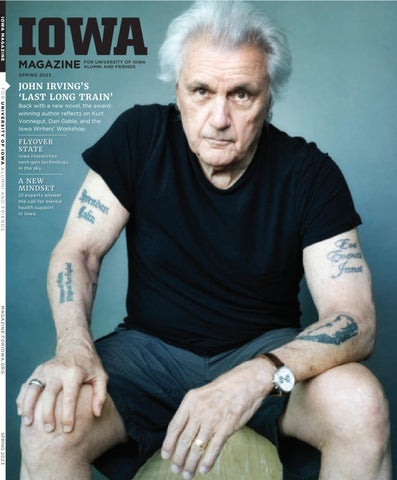
JOHN IRVING’S ‘LAST LONG TR AIN’ Back with a new novel, the awardwinning author reflects on Kurt Vonnegut, Dan Gable, and the Iowa Writers’ Workshop.
FLYOVER STATE
Iowa researches next-gen technology in the sky.
A NEW MINDSET
UI experts answer the call for mental health support in Iowa.
M AG A Z I N E . F O R I OWA .O R G SPRING 2 0 2 3
WE KNOW YOUR CANCER DOWN TO EVERY DETAIL. Providing the best possible outcomes is in the DNA of our cancer center.” Every cancer is unique. That’s why care from an NCI-designated cancer center matters for diagnosis, treatment, and survivorship. Here, your team of pathologists, nurses, surgeons, and more are all specialized in your specific cancer. We tailor a plan to your body, needs, and your exact condition, because every decision matters for your outcome. That’s how we change lives at University of Iowa Holden Comprehensive Cancer Center.
See how at UIHC.org/cancer
Sonia Sugg, MD BR E AS T CA N C ER S U RG EO N © University of Iowa Health Care
CONTENTS
EDITORIAL EDITOR
Shelbi Thomas (05BA) ART DIRECTOR
F E AT U R E S
Nick Beecher (03BA) SENIOR WRITER/EDITOR
Josh O’Leary (00BA)
36
CONTRIBUTING WRITERS/EDITORS
Ben Frotscher Leah Klevar (93BA, 95MA) Tyler Strand Ellen Yandel GRAPHICS MANAGER
Jared Salasberry
CONTRIBUTING DESIGNERS
Danette Angerer (85BFA) Jodi Schmucker email : uimagazine@foriowa.org website : magazine.foriowa.org
DIGITAL LEAD WEB DESIGNER/DEVELOPER
Zack Schmidt (03BA)
SENIOR WEB DESIGNER/DEVELOPER
Flyover State
Jimmy Losasso (09BFA)
Academics and aviation converge at the Operator Performance Laboratory, where new flight technology is put through its paces.
WEB DEVELOPER
Mike Miersen
SENIOR DIGITAL MARKETING STRATEGIST
Nicole Knoll (08BA, 22MS)
DIGITAL MARKETING STRATEGIST
Megan Walsh
MULTIMEDIA SPECIALISTS
John Emigh (11BBA, 13BFA) Jason Smith
LEADERSHIP PRESIDENT AND CEO
Lynette Marshall
VICE PRESIDENT, ALUMNI AND DONOR ENGAGEMENT
JET PHOTO COURTESY THE OPERATOR PERFORMANCE LABORATORY; IRVING PHOTO: CHRISTOPHER WAHL
Colin Hennessy (01BA)
20 A New Mindset
The UI rises to meet a national mental health crisis by providing support for students and educators and training the next generation of counselors.
ASSISTANT VICE PRESIDENT, ALUMNI ENGAGEMENT
26
Heather Wilensky
ASSISTANT VICE PRESIDENT, COMMUNICATION AND MARKETING
John Irving’s ‘Last Long Train’
The celebrated novelist and Oscar winner returns with a new book and revisits his time at the Iowa Writers’ Workshop. COVER PHOTO: CHRISTOPHER WAHL
D E PA R T M E N T S
2 B I G P I C T U RE 4 CA M P US M AIL 7 ON IOWA
Assistant engineering professor Caterina Lamuta is building a robotic octopus to explore the ocean.
15 GO HAW KS
Adeline Kenlin overcomes
The Late Americans, the latest novel from Brandon Taylor (19MFA), is set in a familiar place: Iowa City.
EXECUTIVE DIRECTOR, MARKETING AND DIGITAL STRATEGY
Karla Hurley (12BAS, 21MBA)
OFFICE OF ALUMNI ENGAGEMENT One West Park Road Iowa City, IA 52242
50 FOR IOWA
The Iowa KidSight program’s early screenings prevent vision loss in children across the state.
burnout in elite gymnastics to pursue an NCAA title.
44 IOWA WRITERS
Dana Larson (20MA)
53
ALWAYS A HAW KEYE Meet Samuel D. Hunter (07MFA), the playwright behind the award-winning film The Whale.
phone : 319-335-3305 email : uiowa@foriowa.org website : foriowa.org
Iowa Magazine, Volume 76, Number 1 © 2023 University of Iowa Center for Advancement. The UI Center for Advancement publishes Iowa Magazine four times a year. POSTMASTER: Send address changes to Iowa Magazine, UI Center for Advancement, One West Park Road, Iowa City, IA 52242. Opinions expressed are not necessarily shared by the university, the publishers, or the editors.
BIG PICTURE
Back on the Dance Floor For the first time since the COVID-19 pandemic emerged in March 2020, University of Iowa Dance Marathon held its annual Big Event completely in person. Students hit the dance floor at the Iowa Memorial Union last month, raising $1.17 million to help pediatric cancer patients and their families at UI Stead Family Children’s Hospital. Throughout the years, UI Dance Marathon has joined other high school and college-run student organizations across the state to advance Iowa’s only comprehensive children’s hospital. Wartburg College raised $176,000 at its PHOTO: JUSTIN TORNER/UI OFFICE OF STRATEGIC COMMUNICATION
Dance Marathon last year to support children’s mental health programs at Iowa, while UI Dance Marathon recently gave a $1.5 million gift to fund the hiring of a new professor to further pediatric oncology clinical care and research. “Without people treating the kids, families will still hear the words, ‘your child has cancer,’” says UI Dance Marathon executive director Raginya Handoo, who reduced registration fees and fundraising requirements this year to encourage participation. “The University of Iowa Dance Marathon is committed to being part of the solution in hopes that one day no parent will ever have to hear those words.”
CAMPUS MAIL Coming Up Roses
4
IOWA MAGAZINE | SPRING 2023
What Was Your College Style? Do you still have your bell-bottoms from ’60s, Ray-Bans from the ’80s, or flannel from the ’90s? What was in style when you were in college? Email us your fashion memories at uimagazine@foriowa.org for a story looking back at campus trends over the decades.
venue jammed with more people than I had ever seen in one place. The section high-stepped at a quick pace to the goal line and began the cadence, fast and loud. I could feel all eyes on us. Then the entire band followed and came to a halt facing the flag to play “The Star-Spangled Banner.” The halftime show went well, and Iowa won the game handily. Afterward, the band assembled on the field to play for the fans as they left. Quite an amazing day for a kid who had never been west of Des Moines. In the 1958 season, we once again won the Big Ten and were off to the 1959 Rose Bowl. Tom Davis was now the assistant band director. I had become the drum section leader and spruced up some of the cadences we played with Davis’ blessing and encouragement. Last I heard, these were still played.
Two things stand out for me with this second appearance. One is that Davis had the drum section perform outside the stadium before the pregame show, drawing a large crowd. Second, it was the peak of popularity for Meredith Willson’s The Music Man. He allowed the band to play his music during the season and for our appearance in the Rose Bowl. In fact, Willson conducted us to the delight of the crowd. We heard this also gathered an enormous TV audience. And we won the game handily. Those were the days. Keith Schulz (60BA, 63JD) Burlington, Iowa
Familiar Face
The back pages of the fall 2022 issue have a lovely photo of the Union Boys in the 1940s [“At Your Service,” p. 64]. My older sister
PHOTO: 1969 HAWKEYE YEARBOOK
In response to your request for memories of the Hawkeye Marching Band [“Ready for the Boom,” winter 2022-23, p. 38], I was a member of the drum section from 1956 to 1959. To march in the band was my main goal in attending Iowa. I don’t recall tryouts, but I had been taking lessons from UI assistant band director John Whitlock (41MA, 58PhD) throughout my senior year at Burlington High School. The band director was Fred Ebbs, who had been hired to transform the band from a traditional military style to a contemporary style. His arrival helped the band keep pace with the success of the football team under Forest Evasheski. The final conference game of the 1956 football season was against Ohio State for the Big Ten championship—and we won. At that time, the Big Ten champion played in the Rose Bowl on New Year’s Day. There was no precedent for this at Iowa, and the band and Scottish Highlanders’ attendance raised issues of money and logistics. After a few days, we were ecstatic to learn that a sponsor had been found, and we were all going to the 1957 Rose Bowl by train. Two days after Christmas, we boarded the train made up of two cars for band members, an observation car, two dining cars and another observation car, followed by cars for the Scottish Highlanders. Treading beyond the observation and dining cars was forbidden for both groups. Each car had an upperclassman as a monitor to enforce rules, such as no drinking and a quiet time for sleeping. In Los Angeles, we performed on the popular Art Linkletter TV show in a parking lot outside the studio. Then on New Year’s Day, we were bused to the Rose Bowl parade. We were warned the parade was over a mile long, so I carried two extra drumsticks, which was fortunate since one stick cracked along the way. I remember rolling it to a giddy child sitting on the curb. At the parade’s conclusion, we were driven with a motorcycle police escort to the stadium for the pregame show. Once there, we were taken to a tunnel that led to the field. The drum section was the first to take the field. I recall emerging from that tunnel into this massive
Karen L. McKinley (71BA) was flipping
through the hard copy, and the last page caught her eye. Soon I found my copy and confirmed—there indeed was our dad, Charles “Chas” McKinley (49BA), at the far right holding the tray. This picture would have been his freshman year before the war. When he returned to campus after the war, he resumed his job as a Union Boy. In addition to the GI Bill, this job at the Iowa Memorial Union allowed him to pay for college. I would be remiss if I didn’t point out that Dad also made time to be drum major for the Hawkeye Marching Band. Thanks so much for the memory of him. Leslie M. McKinley (75BA) Brooklyn, New York
Archaeological Impressions
I was pleasantly surprised to open the fall issue and see the illustration of Professor Robert Cargill [“One Man’s Dig for Meaning,” p. 34]. I was the secretary in the classics department when Cargill was hired. As secretary, I handled administrative duties but rarely knew much about the subjects the faculty were teaching. I knew Cargill as a very warmhearted colleague who would sometimes bring me a Pepsi when I wasn’t able to leave my desk. After reading this wonderful article, I wish I had asked him more questions! Jean Frazer Washington, Iowa
Memorializing The Mill
I worked at The Mill [“Thirteen Ways of Looking at The Mill,” winter 2022-23, p. 50] from 1970 through 1975. I sang, waited tables, bartended—whatever owner Keith Dempster needed. I was the last person to sing at the old Mill and the first person to sing at the new Mill (the one that recently closed). I’m the guy who carded Jane Smiley (75MA, 76MFA, 78PhD) and wound up marrying her and having a son who is now 30. I thought this story captured it
IMAGE COURTESY ROBERT DONNELLY
CONTACT US Iowa Magazine EMAIL uimagazine@foriowa.org One West Park Road Iowa City, IA 52242 PHONE 319-335-3305 or 800-648-6973 magazine.foriowa.org
perfectly. It took me back to after-hours parties in smoke-filled rooms. Stephen Mortensen (72BFA) Carmel-by-the-Sea, California
I worked as a waitress at The Mill from 1981 to around 1986. Besides the Iowa Writers’ Workshop folks, there were film and photography grad students who met there regularly. I remember sitting at the bar with Susan Kirchman (75BFA, 80MA, 84MFA) and Jan Ballard (73BA, 81BFA) after a shift. We all got jobs in the late ’80s teaching. We hadn’t a clue we would make it back then, but we were hopeful. I met my best friend, David Goodwin, at The Mill. He walked in, and I remember knowing he would be a significant person in my life. When I returned for his memorial service in 2009, I felt wafted on the love and condolences I received from many old Mill friends who knew I’d show up. I wish I’d been at Keith Dempster’s service. Part of being a waitress at The Mill was learning to walk backwards out the door when Dempster was talking at you. He barely stopped to take a breath. I really loved and miss my time there. I’ve never found such an exceptional group of creatives as I did in Iowa.
Commitment to Care
I had the honor of working with doctors Arlene Drack (92F) and Alina Dumitrescu (11F) [featured in “Hope in Sight,” winter 2022-23, p. 56] in the pediatric ophthalmology clinic. They are among the most amazing, caring providers I have ever met. They would go above and beyond to work patients into their already packed clinic schedules and then spend time with each and every family reviewing their child’s disease progress. They are truly an asset to the field of ophthalmology, and it is no surprise that families appreciate the care they provide to their children. Bev Vermace Tiffin, Iowa
Linda Bourassa (80MA, 87MFA) Chagrin Falls, Ohio
As one of those waitresses, I loved this description! I loved those people. It was always said that one had to be working on an MFA to be a waitress and a PhD to be a bartender. Those Mill peeps got me through a lot of hard times. So many memories. I got that MFA and a tenured position at a major university. I think that The Mill helped make me tough enough to succeed. Susan Kirchman (75BFA, 80MA, 84MFA) Johnson City, Texas
CONNECT FACEBOOK The UI Center for Advancement INSTAGRAM @uiadvancement TWITTER @UIAdvancement LINKEDIN @UIAdvancement
Letters to the editor may be edited for style, length, and clarity. While we welcome feedback, we regret that we are unable to print or reply to every letter.
Hancher Highlight
I really enjoyed Aaron Parker’s letter and picture of The Music Man playbill, marking the first production at Hancher Auditorium in 1972. At that time, I was a sophomore at Central High School in DeWitt. Each night of the production, a different high school band was invited to perform the grand finale of “76 Trombones.” Our band was picked to play on one of those nights. I played the bass drum. I’ve seen many stage performances of that musical, as well as the movie, but that is the only time I was actually in The Music Man. Thanks for reminding me of that wonderful night. Robert Donnelly (79BS, 82MD) Clinton, Iowa
MAGAZINE.FORIOWA.ORG | IOWA MAGAZINE
5
AWARD
Know a family that includes at least three generations of University of Iowa graduates who bleed black and gold?
NOMINATE YOUR FAVORITE
HAWKEYE FAMILY TODAY! foriowa.info/family-spirit23
Always free and open to all stanleymuseum.uiowa.edu
ON VIEW NOW
Guardian, 2021. Museum purchase with support from Sharman Hunter, 2022.8. Donté K. Hayes
ON IOWA
PHOTO: TIM SCHOON/UI OFFICE OF STRATEGIC COMMUNICATION
KEY PERFORMANCE
ON IOWA
OCTOBOT CRIMINAL MINDS
In Motion Dance Gala returned to the Hancher Auditorium stage this past semester for the first time in two years. The event, titled “In Motion,” featured choreography, performances, and music from University of Iowa faculty and students, along with works by guest artists. To watch a recording of the show, which covered a range of themes including community and mental health, visit foriowa.info/dance-gala.
MAGAZINE.FORIOWA.ORG | IOWA MAGAZINE
7
ON IOWA
Assistant professor of mechanical engineering Caterina Lamuta works with a prototype “softopus” in her lab at the University of Iowa.
Under the Sea with a Robot Octopus Inspired by nature, a professor is developing a ‘softopus’ that could help the Navy in its underwater missions. An octopus can swim and crawl into tiny spaces, change texture to blend in with its surroundings, and use its tentacles to grasp and manipulate objects. That flexibility and freedom of movement underwater interests the Office of Naval Research, which recently awarded Caterina Lamuta, a University of Iowa assistant professor of mechanical engineering, funding through the 2023 Young Investigator Program to develop an octopus-inspired intelligent soft robot. According to the National Oceanic and Atmospheric Administration, more than 80 percent of the ocean remains unexplored. An octopus-like robot could uncover the vast wonders of the ocean, as well as monitor hard-to-reach places and assemble, retrieve, or repair submerged equipment. Its size and adaptability would serve as an advantage over underwater drones and autonomous vehicles. “These robots can reach places where humans cannot go,” says Lamuta. Known as the “softopus,” Lamuta’s 1-meter-long robot would be made from soft rubber, which is stretchy and lightweight. Twisted and coiled artificial muscles inside could lift up to 8
IOWA MAGAZINE | SPRING 2023
12,600 times their weight and change texture with a small input voltage. By changing texture, the robot can become camouflage or more hydrodynamic. The softopus, which contains sensors and cameras, also can shed biofilms that tend to deteriorate other manmade items underwater. Lamuta and her lab will receive $502,242 over the next three years for the project, which builds upon previous work she has done for the Navy, Air Force, and Defense Advanced Research Projects Agency. In addition to recognition from the highly competitive Young Investigator Program, the UI’s Early Career Scholar of the Year also recently received DARPA’s Young Investigator Award for her innovative scientific research. Besides scientific papers, Lamuta’s research has included observing octopuses at the Monterey Bay Aquarium in California. She’s also a fan of the Netflix documentary My Octopus Teacher. “I’m originally from Italy, where we have a lot of salad and pasta dishes that are based on the octopus,” she says. “But since I started working on this topic and know how intelligent octopuses are, I quit eating them.” —SHELBI THOMAS
PHOTO: JUSTIN TORNER/UI OFFICE OF STRATEGIC COMMUNICATION
ENGINEERING
ON IOWA
UI assistant professor Jessica Gorzelitz, an expert in exercise oncology, works out at Magni Barbell in Iowa City.
NEWSMAKER: JESSICA GORZELITZ
A Life Worth Lifting
PHOTO COURTESY JESSICA GORZELITZ
A health and human physiology professor highlights the long-term power of pumping iron. Growing up in Wisconsin, Jessica Gorzelitz was an avid weightlifter. Her passion for health and fitness eventually bled into her professional aspirations as she studied to become an epidemiologist. “I was curious to see how weightlifting impacted my health, and I learned along the way that there wasn’t much information out there about weightlifting and its impact on health and mortality,” she says.
While pursuing postdoctoral training at the National Cancer Institute, Gorzelitz dug deeper into her interests—using prostate, lung, colon, and ovarian screening trial data from about 100,000 older adults to unearth whether aerobic exercise and weightlifting impact mortality. The results, published this past fall in the British Journal of Sports Medicine and drawing international headlines, found that both aerobic exercise and weightlifting could lead to a longer life.
“We already knew that aerobic exercise resulted in lower mortality, but it was a novel finding for weightlifting,” says Gorzelitz, who found that exercising with weights alone resulted in a 9–22% lower risk of death. “The greatest mortality benefit was for those who do both aerobic and weightlifting activities, resulting in a 42–49% reduction in mortality. It’s more proof that you should do both, but some is better than none.” While it’s not exactly known why weightlifting can extend lives, Gorzelitz—who is finishing up her first year as assistant professor of health promotion within the University of Iowa’s Department of Health and Human Physiology—is taking her research a step further by looking at how weightlifting can be beneficial for cancer survivors, focusing on female survivors and especially uterine cancer. Gorzelitz’s laboratory is also creating exercise plans that can be done remotely or through telehealth. “It’s important for everyone to have access to exercise—no matter where you are in Iowa,” says Gorzelitz. “It’s my hope to help others become more active—whether it’s through research and better studies or reducing barriers to entry.” —BEN FROTSCHER WAYS TO START WEIGHTLIFTING: Work with personal trainers who can help you learn proper techniques. Use machines at your local gym, which are low risk for injury. Watch instructional videos on YouTube. Use common household objects, such as cans of soup, for hand weights. MAGAZINE.FORIOWA.ORG | IOWA MAGAZINE
9
ON IOWA
CR ASH COURSE
The Truth About True Crime A first-year seminar helps Iowa students investigate society’s obsession with mayhem and murder—and dig deeper into the ethics surrounding the genre.
and airwaves. According to a recent YouGov America survey, one in three Americans consumes such content at least once a week, with women being twice as likely to identify it as their favorite genre. This true-crime obsession isn’t new. The invention of the printing press contributed to a proliferation of 16th century pamphlets detailing horrific murders. Since then, generations of crime buffs have chased the mysterious and macabre, whether they were attending public hangings in the 1800s or tuning into the televised O.J. Simpson murder trial in 1995. Berkley Johnson, a first-year student from Cedar Rapids, loves watching true-crime documentaries and enrolled in the course to learn what fuels society’s fascination with the genre. She says she felt like an actual investigator on the day the class visited the UI Main Library’s Special Collections and Archives. They used 19th century Bertillon cards—featuring suspects’ photographs, measurements, and criminal histories, along with other identifying information—to research historical cases. However, Johnson’s biggest takeaway from the course was a deeper understanding of the ethical issues and inequities within the genre. “We, as true-crime consumers, need to treat this subject matter with sensitivity,” she says. “Because these cases aren’t just stories—and they affect real people.” —LEAH KLEVAR
FROM THE FILES Hikers found 24-year-old Alberta Williams’ body in a ditch near Highway 16, outside of Prince Rupert, British Columbia, in 1989. A member of the Gitxsan tribe, Williams is one of at least 18 indigenous women who have gone missing or been murdered along Canada’s infamous Highway of Tears since 1969. Though Williams’ death remains officially unsolved, University of Iowa instructor Jenay Dougherty shared her case this past fall with first-year students in the course, True Crime: Society’s Fascination with Crime and Murder. Williams’ story was one of many Dougherty covered during the seminar’s 1 0 IOWA MAGAZINE | SPRING 2023
deep dive into the world of true-crime documentaries, podcasts, and books. The class explored the genre’s online fan communities and examined how race, gender, and socioeconomic factors affect crime coverage. “My main goal was to inspire students to think critically and ethically about true crime,” says Dougherty, an undergraduate engagement librarian. “I wanted to open their eyes to some of the genre’s complex issues.” From Dahmer, the popular Netflix series about notorious 20th century serial killer Jeffrey Dahmer, to Serial, an award-winning podcast that helped overturn a murder conviction, truecrime stories are sweeping America’s screens
Want to feel clued in about true crime? Check out a few of the resources Dougherty recommends: PODCASTS My Favorite Murderer Serial Missing and Murdered BOOKS Savage Appetites by Rachel Monroe You’re Dead. So What? by Cheryl Neely DOCUMENTARIES I’ll Be Gone in the Dark Canada’s Lost Girls
ON IOWA
DENTISTRY
Tooth Technology How 3D printing is helping enrich dental education.
CAMPUS
West Side Set for Transformation
Erica Teixeira (18MS), a
A range of campus construction projects pave the way for a new cutting-edge health care tower. Hawkeyes may notice transformations beginning to take place on the west side of campus this spring. These projects—which are part of the University of Iowa’s 10-year facilities master plan— include new buildings, equipment, learning spaces, and more to help the university in its missions of educating students and caring for patients. In January, UI Health Care announced plans for a new inpatient tower made possible by a $70 million gift from the Richard O. Jacobson Foundation. The state-of-the art tower will replace three existing structures: Hospital Ramp 1, a water tower, and the Wendell Johnson Speech and Hearing Center. The following projects will make this possible:
PHOTO: JUSTIN TORNER/UI OFFICE OF STRATEGIC COMMUNICATION
Construction of a new Hawkeye parking ramp north of Kinnick Stadium (Lot 43) is scheduled for completion in winter 2024. Hospital Ramp 1 will then be demolished. A larger water tower will be built northwest of the outdoor football practice fields. Completion is expected in mid-2025, after which the existing water tower near the main hospital will be torn down. The Wendell Johnson Speech and Hearing Center building is expected to be razed in summer 2025. A new academic building will be built for the Wendell Johnson Speech and Hearing Center and other medical programs on the existing South Quad and the adjacent parking lot. Construction is anticipated to begin in summer 2023 and finish in mid-2025.
The demolition of South Quad is expected in summer 2023. The north wing of the Pharmaceutical Sciences Research Building is being renovated to house Iowa’s Military Science and ROTC program, currently located in South Quad. Completion is expected in late spring 2023. Construction of the new inpatient tower aims to begin in late summer 2025. The tower will add more beds for UI Hospitals & Clinics, which is consistently at or above capacity. “This modernization plan is visionary,” says
Rod Lehnertz (02MBA), senior vice president
for finance and operations and university architect. “It will establish the University of Iowa as a destination for students, faculty, staff, and patients well into the future.”
University of Iowa College of Dentistry associate professor, noticed a solution to a problem that plagues dental educators while touring Protostudios in downtown Iowa City. Protostudios is a UI not-forprofit facility where innovators in the community can create prototypes of their ideas. Model teeth are often made of hard plastic, which cracks easily and does not accurately resemble real teeth. However, Teixeira noticed that the 3D-printed models at Protostudios contained materials that could be used in a better tooth model. Teixeira provided pictures, diagrams, and real teeth for Charles “Chuck” Romans (12BA, 14MA, 15MFA), 3D design director at Protostudios, to recreate with computer-aided design. Creating a realistic product for students was the top priority, and after over two years of collaboration, Romans and Teixeira were satisfied with their product, named Educational Caries Teeth (ECT). Diseases were simulated in an acrylic polymer, which closely resembles tooth enamel. The College of Dentistry now uses ECT in classes, giving students practice on procedures before working with patients. Teixeira and Romans continue to develop the ECT, and they are considering creating a simulated jaw next. By presenting their work to educators and making the product available online, they aim to raise the bar for simulated teeth in dental education worldwide. —JACK ROSSI
MAGAZINE.FORIOWA.ORG | IOWA MAGAZINE
11
ON IOWA
UI College of Public Health student Eric Ramos records an episode of From the Front Row.
IOWA CIT Y SCENE
The Talk of Campus Stream these five UI-hosted podcasts this spring.
From the Front Row
This student-produced podcast from the UI College of Public Health aims to make public health issues accessible, covering topics in weekly episodes that range from the opioid epidemic and mental health services to intimate partner violence and COVID-19. Fight For Iowa and HERkys’ Voice
Fight for Iowa updates a few times each week to discuss recent Hawkeye matchups, upcoming athletic events, and the latest news with coaches and student-athletes. The official Hawkeye sports podcast also includes special episodes of HERkys’ Voice, which highlights Iowa women’s athletics. 1 2 IOWA MAGAZINE | SPRING 2023
The Short Coat
The show’s tagline, “What they don’t tell you about med school, but should,” pretty much says it all. Student hosts from the Roy J. and Lucille A. Carver College of Medicine discuss everything from preparing for residency interviews to balancing a part-time job while studying, all with the goal of helping fellow medical students on their journeys—and providing a few laughs along the way. WorldCanvass
UI International Programs regularly records WorldCanvass, a live talk show focusing on global issues and their impact. Its rich archive of interviews with UI professors and international experts enables listeners to access 13 years of the show’s thoughtprovoking conversations. On The Record
The Daily Iowan produces this podcast, a discussion with student reporters about the week’s major stories that gives extra insight into breaking news around campus, in Iowa City, and throughout Hawkeye communities. —ELLEN YANDEL
PHOTO: TIM SCHOON/UI OFFICE OF STRATEGIC COMMUNICATION
From sports and health care to practically everything in between, Hawkeyes have plenty to talk about, and some have turned to podcasting to make their voices heard. As podcasts have exploded in popularity over the past several years, the University of Iowa community has ridden the wave, putting experts across campus at the world’s fingertips for discussion, education, and entertainment. Here, take a look at just a few of the major UI podcasts:
ON IOWA
BRIEFS
Focus on Forest The UI Center for Global & Regional Environmental Research released Iowa Climate Statement 2022: The Many Benefits of Our Trees, which emphasized the importance of a healthy tree population in mitigating the effects of climate change, including through providing shade, controlling stormwater runoff, improving the quality of soil, creating wildlife habitat, and cleaning the air.
ASK AN EXPERT
PHOTO COURTESY SYLVIA MIKUCKI-ENYART; ILLUSTRATION: NICK BEECHER
How Do You Adjust to an Empty Nest? The transition to an empty nest is a time of mixed emotions and seemingly endless questions. After decades of centering on your children and orbiting around their schedules, the abruptness of having a newly child-free home can be discomfiting. “For some, children leaving home highlights the distance that grew during the parenting years and culminates in both spouses starting a new journey, separately,” says Sylvia Mikucki-Enyart, a University of Iowa associate professor of communication studies and senior research fellow at the UI Public Policy Center. “Yet for others, it’s a time of renewal and reprioritization of themselves and their relationship.” Here are six tips from Mikucki-Enyart that can help you navigate this phase of life: Communicate. Discuss your thoughts and emotions openly, honestly, and directly. Disclosing your feelings will not only be cathartic but can increase intimacy and trust between you and your spouse. Provide support. When your partner shares their feelings, ask if they want support (just listen) or solutions (give advice). Although tempting, don’t immediately jump in and try to make sad feelings go away or douse them with toxic positivity. Listening helps validate their emotional experience.
Bioscience Boom
Accept both/and-ness. The transition to empty nest
is exhilarating and saddening. It creates freedom and a sense of loss. This inflection point is full of both/andness, and it’s important to acknowledge that. Get to know yourself. Your identity may center on being a parent, and that’s OK, but now is the time to learn about you the person, not the parent. Take time to explore local classes and determine what types of activities ignite your passion, provide comfort, or challenge you intellectually. Reacquaint with your spouse. Just like you’ve evolved, your spouse has too. What are their interests and hobbies? What are their thoughts on current events? Take time to listen.
Redefine your marriage. While you are reacquainting, it’s a great time to redesign the future. Maybe you both dreamed of a lake house in retirement; is that still true, or would you rather travel more? Take time to create and nurture the marriage you want for the people you are now, not who Sylvia Mikucki-Enyart you were 20-plus years ago.
Iowa Gov. Kim Reynolds awarded an $8.2 million grant this past winter to enhance the growth of bioscience research and economic development at the UI. The grant enables Iowa to create more lab space to support these endeavors.
Athlete Injuries Examined UI Health Care orthopedics researchers may have found a link between hormones and increased vulnerability to injuries in female athletes. Their study indicates that the female hormone relaxin aids in the breakdown of cartilage, increasing the risk of injuries such as ACL tears.
MAGAZINE.FORIOWA.ORG | IOWA MAGAZINE 1 3
WE CAN’T WAIT TO READ WITH YOU! JOIN THE UNIVERSITY OF IOWA BOOK CLUB FOR ALUMNI AND FRIENDS. Our next virtual book-club pick—Great Circle, by Maggie Shipstead (08MFA), which made the 2021 Booker Prize short list—launches on March 17.
foriowa.org/bookclub
GO, HAWKS
GO, HAWKS!
PHOTO: BRIAN RAY/HAWKEYESPORTS.COM
FROM THE LOGO
KENLIN Q&A FUTURE FACILITIES
Eye of the Tigerhawk Iowa women’s basketball guard Caitlin Clark celebrates a basket during the Hawkeyes’ 70-57 victory over rival Iowa State in December at Carver-Hawkeye Arena. Clark tallied 19 points, eight rebounds, eight assists, and five steals in front of a crowd of nearly 14,000. Later in the month, the junior superstar tied the Division I women’s basketball record for the fastest player to reach 2,000 career points (see p. 18).
MAGAZINE.FORIOWA.ORG | IOWA MAGAZINE 1 5
GO, HAWKS
What lessons did you gain from elite gymnastics that you’ve applied to your collegiate career?
PL AYMAKER: ADELINE KENLIN
In the Balance A Hawkeye gymnast and two-time All-American aims for a national championship. Once feeling like she’d lost her balance in life, Adeline Kenlin stuck the landing last spring on college gymnastics’ biggest stage. The Iowa City native flashed a huge smile and pumped her fist after a runner-up performance behind Olympic gold medalist Suni Lee in the balance beam at the NCAA championships in Fort Worth, Texas. Kenlin’s celebration reflected her renewed love for the sport after struggling with the demands of elite gymnastics in high school. This spring, the UI junior is again vying for an NCAA championship. Iowa Magazine talked to Kenlin about the pressure of competitive sports, rediscovering joy in gymnastics, and her dreams beyond graduation. You competed in elite gymnastics for several years. What were the main challenges of competing at that level?
It was very hard mentally and physically, and I couldn’t keep up with them both at the same 1 6 IOWA MAGAZINE | SPRING 2023
time. During the end of my elite career, I broke my hip, heel, and toe, and had ongoing ankle pain. How did your training affect your social life?
When I was a sophomore in high school, I did home school for the entire year—so I never saw my friends outside of the gym. I was in the gym from 8 a.m. to 6 p.m., and some nights I would work until 8 p.m. So, I never had a social life. I still had friends outside, but it was not the same. In 2019, you chose to step down from the elite level to compete in the top level of the development program and ease some of the demands of the sport. What impact did that have on your life?
I fell in love with the sport again. In the second semester of my junior year [of high school], I came back to school and felt a lot more balanced in life. That completeness has really helped me throughout the rest of my career.
Iowa hosts the Big Ten Championships this spring. What does that opportunity mean to the team?
It’s amazing. We’re really excited to have it back home, because we only get to host it once every 10 years, so it’s a really exciting moment. With all your success at Iowa, have you considered pursuing elite gymnastics again?
I’ve not thought about going back. This is where I want to be because I’m so happy, and I know I would not have the same amount of happiness in elite. You’re currently pursuing a sport and recreation management degree. What are your plans after Iowa?
I want to coach at the collegiate level. I’ve been coaching since I was 14 years old, and gymnastics is all I know. I just want to be that coach that I never had growing up to help lead kids to the path that is best for them. —TYLER STRAND
IOWA TO HOST BIG TEN CHAMPIONSHIPS Watch Kenlin and the Hawkeyes compete against their conference rivals at the Big Ten Women’s Gymnastics Championships. 11 a.m. on March 18 Xtream Arena in Coralville Details: hawkeyesports.com/sports/wgym
PHOTO: BRIAN RAY/HAWKEYESPORTS.COM
Adeline Kenlin performs on the balance beam during the regional final of the 2022 NCAA women’s gymnastics championships in Raleigh, North Carolina.
I know how my body works and how my brain works, and I know how many reps I need to feel confident in myself. I think that’s what college gymnastics is about—getting mentally prepared because all these skills are skills you’ve been doing since you were 10. It’s like riding a bike: Once you know what to do mentally, you can do it physically in your sleep.
GO, HAWKS
Armando Bryson
Erik Sowinski (center) competes in the first round of the 800 meters at the 2022 USA Track and Field Outdoor Championships in Eugene, Oregon.
TR ACK
WHERE ARE THEY NOW? ERIK SOWINSKI (12BS), TR ACK STANDOUT, 2009-2012
Keeping Pace As a globe-trotting, professional middle-distance runner, Erik Sowinski (12BS) has ranked among the world’s top 800-meter runners throughout the past decade and paced an Olympic champion to an indoor world record last year. A former five-time All-American for the Hawkeyes, Sowinski continues to train with University of Iowa track and field coach Joey Woody as he enters the homestretch of his career.
SOWINSKI PHOTO: MATT PARKER; BRYSON PHOTO: STEPHEN MALLY/HAWKEYESPORTS.COM
LATE KICK
In high school, Sowinski didn’t receive any Division I scholarship offers until a breakout senior year performance at the Wisconsin state track meet. The Waukesha, Wisconsin, native came to Iowa on a partial scholarship and set a pair of school records in his first two seasons. As a junior in 2011, Sowinski helped the Hawkeyes claim their first Big Ten conference outdoor title since 1967 with two runner-up finishes. He closed his senior campaign with a surge of 800-meter success, including a school record-setting victory at the Big Ten conference meet and runner-up at the NCAA championships. When Sowinski reached the semifinals of the 2012 U.S. Olympic trials, Woody told the young runner he believed he could compete professionally. MILLROSE MAGIC
Sowinski interviewed with several medical schools while completing his integrative physiology degree at Iowa but ultimately heeded Woody’s encouragement to go pro. “He’s been
like a father figure to me,” says Sowinski. “I take any advice he gives me because he has my best interest at heart and has a good feel for what I’m capable of.” Sowinski gained global track and field attention in February 2013. Invited to compete in the prestigious Millrose Games three days before the meet, Sowinski outran a pair of U.S. Olympians to win the indoor 600 meters in an American record time. Three weeks later, he won the 800 meters at the U.S. Indoor Track and Field Championships and signed a Nike contract that continued for seven years. MR. CONSISTENT
Sowinski remains a model of consistency and was the only 800-meter runner older than 30 to rank in the top 35 of last year’s final World Athletics rankings. The 2016 world indoor bronze medalist has qualified for three Olympic trials, reached 16 U.S. Championships finals, and broken 1:50 in the 800 meters more than 200 times. That steadiness has also helped Sowinski excel as a pacesetter who sets the pace at the beginning of races to lead other runners toward their goal. It’s another source of income for Sowinski, whose pacing has paved the way for two world records. Through it all, Iowa remains a training site for Sowinski and holds special meaning as the place where he got his start. “It’s like a family atmosphere,” says Sowinski, a former volunteer assistant coach for the Hawkeyes. “The community has been so supportive that I couldn’t have imagined doing it anywhere else.” —TYLER STRAND
Beyond the Uniform A Big Ten champion advocates for student-athletes. Armando Bryson is the
voice for Big Ten studentathletes. Handpicked by former league commissioner Kevin Warren, Bryson is the first Hawkeye to serve on the NCAA Division I StudentAthlete Advisory Committee. The 32-member organization—representing each conference—collaborates with U.S. Congress and NCAA legal staff to draft and vote on legislation affecting Division I athletics. “We take the core tenets of what the NCAA is trying to do and figure out how it can work for studentathletes,” says Bryson, a junior on the UI men’s track and field team. The SAAC protects student-athlete health and well-being, fosters a positive image and inclusive environment, and promotes engagement. The committee is currently working to establish required mental health curricula, implement more diverse hiring practices, and balance revenue distribution among conferences. Now more aware of the challenges that many of his peers face, Bryson says it’s important to achieve balance. “You have to find who you are outside of your sport,” says the political science and African American studies major. “Track and field has taught me the discipline and perseverance to thrive in life.” —TYLER STRAND
MAGAZINE.FORIOWA.ORG | IOWA MAGAZINE 1 7
GO, HAWKS
HAWKEYE HIGHLIGHTS
Masters of the Moment Iowa’s top athletes rose to the challenge in big moments this past season. These are a few of the Hawkeyes who maximized opportunities to make their mark. FOOTBALL
WOMEN’S BASKETBALL
Lauded Linebacker
Dynamic Duo
Consensus All-American linebacker Jack Campbell powered an Iowa defense that held nine opponents to 10 or fewer points. The Big Ten Defensive Player of the Year recorded a forced fumble, interception, and 10 tackles at Minnesota to secure Iowa’s fourth straight victory after a 3-4 start. The Hawkeyes attained their 10th bowl win under head coach Kirk Ferentz—shutting out Kentucky in the Music City Bowl to finish 8-5. Campbell became Iowa’s first recipient of the Butkus Award—given to the nation’s top linebacker—and earned the Campbell Trophy, awarded to one player nationally for academic success, football performance, and exemplary leadership.
All-Americans Caitlin Clark and Monika Czinano each surpassed 2,000 career points this winter, becoming the first pair of teammates in Big Ten women’s basketball history to reach that landmark in the same season. Clark achieved the feat in her 75th game—matching the NCAA Division I women’s basketball record as the fastest ever. The duo combined for 149 points in a three-game sweep of their in-state rivals. Czinano totaled 36 points and 11 rebounds in an overtime win at Drake, while Clark posted a triple-double in an upset victory at Ohio State—the program’s highest ranked road win in school history.
MEN’S BASKETBALL
Pins to Wins
With the Hawkeyes’ leading scorer Kris Murray sidelined in early December, fifth-year post Filip Rebra ča filled the void. The Sombor, Serbia, native led Iowa with 22 points and 11 rebounds in a 75-56 rout over Iowa State for Fran McCaffery ’s 500th career victory. Rebrača later earned Big Ten Player of the Week honors after registering 30 points, nine rebounds, and six assists in a victory over Southeast Missouri State. He surpassed 1,500 points and 1,000 rebounds for his career this season and tallied double-doubles in comeback wins over Indiana and Michigan. 1 8 IOWA MAGAZINE | SPRING 2023
Senior heavyweight Tony Cassioppi clinched an 18-15 triumph over Iowa State in a top-10 showdown at Carver-Hawkeye Arena in December. The three-time All-American sealed Iowa’s 18th straight victory in the Cy-Hawk Series and prevented the Cyclones from spoiling Spencer Lee’s return to the mat and Real Woods’ Iowa debut. Cassioppi pinned his first four opponents of the season and defeated a pair of ranked foes to help Iowa enter its conference slate unbeaten.
PHOTO: HAWKEYESPORTS.COM
Fired-Up Forward
MEN’S WRESTLING
GO, HAWKS
BRIEFS
On the World Stage
UI senior Felicity Taylor recently represented the U.S. in the 2022 United World Wrestling Women’s Freestyle World Cup at Coralville’s Xtream Arena. The event marked the first time men and women have wrestled freestyle simultaneously on an international stage.
The Iowa baseball stadium will undergo renovation as part of the university's 10-year facilities master plan.
FACILITIES
Upgrading the Game Five significant projects will provide student-athletes with state-of-the-art spaces. The University of Iowa Department of Athletics is advancing a set of projects that will provide Hawkeye student-athletes and their fans with facilities that rank among the best in the country. Gymnastics, field hockey, men’s and women’s wrestling, baseball, and men’s and women’s basketball facility projects will be funded through donor support and department revenue. All projects, which are part of the university’s 10-year facilities master plan, have been or must be approved by the Board of Regents, State of Iowa. GYMNASTICS
Construction on a new training center for the gymnastics team and the Iowa Spirit Squads is expected to begin in fall 2023, pending Board of Regents approval. The proposed facility will be built south of the Hawkeye Tennis and Recreation Complex and include training spaces, locker rooms, a team room, a multipurpose room, and other amenities. FIELD HOCKEY
A feasibility study for a new field hockey building adjacent to Grant Field calls for a facility that includes locker rooms, team space, and a press box. Discussions are ongoing to determine its size and possible locations. BASEBALL
PHOTO: BRIAN RAY/HAWKEYESPORTS.COM
Proposed renovation to the Iowa baseball stadium will update the press box, bleachers, concourse, dugouts, and entrance. The upgrades are intended to increase stadium seating capacity, provide improved ADA access and seating, and add premium seating opportunities, additional concessions, and restrooms. MEN’S AND WOMEN’S WRESTLING
Construction of the Goschke Family Wrestling Training Center continues adjacent to Carver-Hawkeye Arena and is expected to be completed in spring 2024. The facility for the men’s and women’s wrestling teams includes a state-of-the-art wrestling room, a strength training area, locker rooms, and athletic training facilities. It will also house staff offices, a student-athlete lounge, recruitment meeting rooms, and a street-level hall of champions.
Gone in 60 Meters UI track and field junior Myreanna Bebe broke the school record in the women’s 60-meter hurdles in January at the Larry Wieczorek Invitational in Iowa City. The Orlando native posted a time of 8.11 seconds, besting the previous mark of 8.21 seconds set in 2009 by Karessa Farley.
Active Inspiration
Hawkeye soccer player Delaney Holtey hopes to encourage young athletes who have Type 1 diabetes. This past November, the sophomore forward shared her experience living with the disease in a series of posts on the Girls Soccer Network website during National Diabetes Awareness Month. Says Holtey: “There are a lot of great things that can come out of being dealt a harder hand in life.”
CARVER-HAWKEYE ARENA
The department is in the beginning stages of an arena enhancement project to modernize the 40-year-old home of Hawkeye basketball. The project will include upgrades to concessions, restrooms, and seating opportunities. MAGAZINE.FORIOWA.ORG | IOWA MAGAZINE 1 9
2 0 IOWA MAGAZINE | SPRING 2023
New MINDSET A
W ith demand for mental health services sur ging in I owa and acr oss the nation , especially among young adults , the U niversit y of I owa is working to create a culture of well - being .
BY SARA EPSTEIN MONINGER MAGAZINE.FORIOWA.ORG | IOWA MAGAZINE 2 1
A N E W M I N DSET
When your child is struggling with mental health issues, it can be all-consuming. The questions feel endless:
W hy i s t h i s h appen i n g ?
•
I s t her e a d i a g nosi s we ca n sea r ch on l i ne?
•
W h at’s t he
d i f fer ence bet ween a ps ycholog i st , a ps ych i at r i st , a t herapi st , a cou n selor, a l icen sed
• •
soci a l worker, a nu r se w it h ps ych-ment a l hea lt h cer t i f icat ion? doesn’t h ave a ny of t hose pr ov ider s?
• •
W h at i f we f i nd one a nd it i sn’t a good f it?
W hy do we h ave t o wa it t h r ee mont h s for a n appoi nt ment? W h at about pr escr ipt ion med icat ion?
• •
W h at i f it doesn’t help?
•
W h at i f my com mu n it y
I s it sa fe?
•
Wi l l it i ncr ea se su icid a l t hou g ht s?
Do we h ave t o r emove sh a r p object s or lock up med ici ne?
At wh at poi nt i s it r ea son able t o wor r y i f t hey don’t come home?
• • •
t he pol ice or 911? att empt su icide? help?
•
If
W h at do I say ?
•
•
W hen shou ld I ca l l
W h at i f it’s t he w r on g t h i n g ?
•
W h at i f t hey
I s goi n g t o t he Emergenc y Depa r t ment t he on ly way t o get i m med i at e
Ca n I send t hem t o school? To col lege?
nex t 24 hou r s?
•
Ca n’t we get help now ?
•
W h at about t he nex t t wo hou r s?
this sounds familiar, you are not alone.
Children are increasingly susceptible to mental health conditions, a trend exacerbated by the pandemic. The National Alliance on Mental Illness reports that 1 in 6 youth aged 6–17 experiences a mental health disorder in the U.S. each year and that 37,000 Iowans aged 12–17 have depression. Shockingly, suicide is the second-leading cause of death among those aged 10–14. The situation is dire enough that in 2021 the American Academy of Pediatrics, the American Academy of Child and Adolescent Psychiatry, and the Children’s Hospital Association declared a national state of emergency in child and adolescent mental health, urging policymakers and advocates to “improve the access to and quality of care across the continuum of mental health promotion, prevention, and treatment.”
2 2 IOWA MAGAZINE | SPRING 2023
How a r e we goi n g t o get t h r ou g h t he
•
Wi l l t h i s ever end?
University of Iowa leaders are answering the call—by expanding mental health awareness and outreach, adding campus services and programming, and sharing research and expertise across the state. In fact, the UI named mental health as a priority in its strategic plan, including it as part of its commitment to holistic well-being and success. Sarah Hansen (90BA, 92MA), vice president for student life, says Iowa has long focused on mental health, but over the last decade more students have been arriving on campus with mental health diagnoses and experience with therapy. “The biggest change for us has been creating a constellation of help options for students, rather than assuming everyone will want individual counseling,” she says. “We also are investing in training for faculty and staff, so that as many individuals as possible on our campus are prepared to support students in distress. These efforts will help us create a culture of well-being on our campus.”
A N E W M I N DSET
First, a Focus on Our Students
Going to college is a huge life transition. Add the explosion of social media, an increasingly divisive national discourse, and a pandemic, and you have a recipe for disaster, Hansen says. Between 2013 and 2021, the number of college students meeting the criteria for one or more mental health problems doubled, according to a national study by the Healthy Minds Network. On the UI campus, University Counseling Service has experienced a 71% increase in student clients over the past five years, and Student Health logged some 4,000 visits related to mental health in 2020 alone. “There seems to be a never-ending feed of calamity that is hard to avoid and impossible to not feel on some level,” says Hansen. “I think our challenge is helping [students] understand that life has ups and downs and teaching them ways to manage the difficult times.” Anxiety and depression top the list of mental health concerns among students—at Iowa and across the nation. Hansen says one of her priorities is to increase access to campus resources. But she also wants to make sure students are aware of them. “Not everyone is comfortable seeking counseling, so providing lots of safe and open ways for students to get the help they need is critical,” she says. “In 2021, we started a local 24/7 crisis and support line, which offers texting and online chatting, so students don’t have to talk if they are not comfortable with that. We’re trying to remove barriers.” Campus programming on topics like stress management, mindfulness, and meditation has tripled in the last few years, and the university offers free wellness coaching to students and checks out light boxes to those managing seasonal affective disorder. Hansen also hopes to expand the university’s embedded counselor program, in which members of University Counseling Service staff practice in specific areas of campus. Currently, there are dedicated counselors in the colleges of business, dentistry, and law, while another serves the 11 residence halls. “Iowa’s embedded counselor program has been a model nationally, and one of the goals that President Barbara Wilson and I have talked about is having at least one therapist in every college,” she says. “That person becomes part of the college’s culture, and context is important—they know the rhythms of student life for that specific college.” To further promote the importance of mental health care and increase awareness of and accessibility to existing resources, the university plans to convert space in the centrally located Iowa Memorial Union into a well-being center that would house University Counseling Service,
O n t h e U I c am p us , U ni v e r sit y C ounse l in g S e r v i c e h as e x p e r ien c ed a 71% in c r ease in student c l ients o v e r t h e past f i v e y ea r s , and S tudent H ea l t h l o g g ed some 4 ,0 0 0 v isits r e l ated to menta l h ea l t h in 2020 a l one . Student Wellness, and Student Health. If approved by the Iowa Board of Regents, the project would be completed in 2025. Still, University Counseling Service is the university’s primary mental health service provider for students and has counselors available for both same-day and ongoing appointments, says director Michael Fletcher. The institution’s commitment to mental health was one of the things that attracted him to the job in 2022. “We can talk and talk and talk, but if leadership isn’t supportive of an idea or an initiative, it’s not going to be done right. To see that support at Iowa was exciting,” says Fletcher, whose office offers consultations with UI departments and provides training for developing professionals. “We must focus more on prevention than treatment. On the UI campus, we have permission to speak about mental health as a priority—and are encouraged to do so. Every single agenda from every single program, department, and student organization is affording us the ability to bring people into the discussion.” Kognito, an online suicide-prevention program that is mandatory for incoming UI students, recently added modules to be more relevant to faculty and staff. Ultimately, Fletcher says he would like to see everyone on campus trained in mental health first aid and in self-compassion. “Mental health and well-being are everyone’s concerns,” he says, “and the only way we are going to get to where we want to be as a community is for everyone to participate in supporting mental health.”
Visit Mental Health at Iowa at mentalhealth.uiowa.edu to connect with campus resources and find programming.
How to Get Help—for Yourself or Others Reach out to friends and family. See your doctor for an exam and get a referral to a mental health professional. Don’t wait for a crisis. Locate a provider at findtreatment. samhsa.gov, a confidential database maintained by the U.S. Department of Health and Human Services. If you need immediate help, call or text 988 or chat at 988lifeline.org.
MAGAZINE.FORIOWA.ORG | IOWA MAGAZINE 2 3
A N E W M I N DSET
Helping Iowa’s Schools
Rising rates of depression and anxiety in youth have implications for the well-being of Iowa’s schoolchildren. Educators often are the first to identify mental health issues in students and make referrals, but many lack appropriate training. The UI is hoping to change that by leveraging the expertise of its faculty in the College of Education. Allison Bruhn, UI professor of special education, spent three years teaching seventhand eighth-grade science in Tennessee before earning a doctorate in education and joining the UI faculty in 2011. She says she was surprised by the number of students in her classroom who had severe mental health and behavioral issues, making it difficult for them to learn. “I wanted to better serve those kids, many of whom came from really traumatic home environments and a lot of poverty, but I didn’t feel prepared to do so,” she says. “I decided to go back to school and learn more so I could have a bigger impact.” Now, as executive director of the UI Scanlan Center for School Mental Health, Bruhn serves students and educators across Iowa. A partnership formed in 2021 between the UI College of Education and the Iowa Department of Education, the center offers crisis services, short-term individual counseling via telehealth and in-person appointments, and training for pre-K–12 educators. There likely will never be enough counselors in schools, Bruhn says. The recommended caseload for school counselors in Iowa is 250 students to one counselor, but the actual number is more than 400 to 1. She hopes that the Scanlan Center can help alleviate some demands on teachers by providing them with tools and training. “The number of expectations we have for teachers makes it such a difficult job,” she says. “If we’re going to prioritize kids’ mental health and make social-emotional learning part of our curriculum—and I think the pandemic has made people realize how important that is— then we need to provide to schools the resources and systems that allow them to do that.” Through its team of directors, staff, affiliated faculty members, and graduate assistants, the Scanlan Center aims to provide social, emotional, behavioral, and psychological services to all of Iowa’s schools across 99 counties—for students as well as teachers. “Beyond what we’re seeing with kids, we’re also seeing an impact on educators. The level of stress and burnout that they have experienced because of COVID is causing them to leave the field, and that’s a big problem,” she says. “So, in addition to training educators to address mental 2 4 IOWA MAGAZINE | SPRING 2023
health issues in their schools, we offer them training in how to take care of themselves.” In its first year, the Scanlan Center engaged some 3,000 educators through free professional development, including workshops on suicide prevention, community-building pedagogy, mental health first aid, mindfulness and yoga, and assessment techniques. A clinic in downtown Iowa City began accepting referrals in fall 2022 for students, educators, and school staff with mental health needs. Clinicians also travel to schools to provide services. Additionally, the center has distributed more than $1 million in research grant funding and offered training fellowships to graduate students. One of those graduate trainees is Alex Reed, a doctoral student in counseling psychology in the UI College of Education. Through the Scanlan Center, he has been working with the Iowa City Community School District to start a psychoeducational group for high school athletes and has contributed to a crisis response toolkit, a guide intended to help educators and support staff handle crisis situations. He looks forward to conducting
fieldwork in the western half of the state, especially in rural communities. “I’m from western Iowa. The need is there,” says Reed, who grew up in Council Bluffs. “I want to work face-to-face with teachers, principals, and educators of all types and help train them to have better conversations with their students and to be more proactive than reactive. My passion, though, is to destigmatize mental health among student-athletes, since they are an exceptionally vulnerable population.” Reed, who played basketball and football and ran track in high school, says studentathletes tend not to seek help when they’re struggling, often due to a culture within sports that views it as a sign of weakness. He wants young athletes to know they can be strong competitors while also addressing their mental health needs. “Those don’t have to be mutually exclusive,” he says. “By teaching them to how to employ positive coping methods and access resources, we can change the trajectory of their lives. These are skills that will help them navigate life when it gets tough—because inevitably it will.”
T h e r e c ommended c ase l oad f o r s c h oo l c ounse l o r s in I owa is 250 students to one c ounse l o r , b ut t h e a c tua l num b e r is mo r e t h an 4 0 0 to 1.
A N E W M I N DSET
A b out 1.8 mi l l ion I owans do not h av e enou g h menta l h ea l t h p r o f essiona l s in t h ei r c ommunit y .
A Workforce Boost
Compounding the challenges posed by mental health conditions is access to care. When you decide help is needed, you want it now. But “mental health care deserts” exist across the country, especially in rural counties, and providers without waitlists can be hard to come by. Some 1.8 million Iowans do not have enough mental health professionals in their community. When Kara Carter (02BA) started out as a practitioner of social work in southern Colorado, she quickly found that her expertise in mental health was badly needed—not just by the hospice agency that hired her, but by the community she lived in. “I was probably one of the few licensed professionals in the county, and I’d be asked to speak with children who were going through various tragedies or to a youth club that had lost a student or to a support group for parents who have lost children. And I found myself feeling ill-equipped,” says Carter, now a fourth-year doctoral student in social work at Iowa. “Even though I felt prepared to tackle these difficult subjects by my social work education, I still found myself reaching out for more training.” In Colorado, Carter completed a bereavement counseling certificate, as well as training in a mental health therapy called eye movement desensitization and reprocessing. But she wanted to dig deeper into social behavior and have a bigger impact. Iowa’s PhD program was the perfect fit.
“Social workers are more and more understood to be allied health professionals, and at Iowa there are opportunities to partner and collaborate with people in the colleges of public health, nursing, and medicine,” says Carter. “I wouldn’t have as many opportunities to conduct research at an institution without an amazing hospital like UI Hospitals & Clinics.” The UI School of Social Work is the only school of social work at a major university in Iowa—and offers the only PhD program in the state. Increased student interest in social work, in part driven by rising mental health needs, prompted the school to bump up its incoming cohort of undergraduates from 45 to 60 students, starting in 2023. The school also recently redesigned its master’s curriculum—which is offered in Iowa City, Sioux City, and Des Moines, as well as online—to focus on specializations in clinical practice and leadership practice. An undergradto-grad program allows undergraduates to earn an MSW, a requirement for those seeking to become independent counselors, in just 12 months. The school’s goal, says director Mercedes Bern-Klug (82BA, 84MSW), is to educate social workers in all 99 counties of Iowa, boosting the state’s supply of mental health providers. “Social workers provide more mental health services in this country than all other mental health professionals combined,” she says. “We’re trained to look at a person in their environment and make changes if the fit isn’t good. Other times we work to change the system.” Carter, whose dissertation examines the lived experience of COVID-19 hospitalization for older adults in Iowa, plans to remain in the state and study the effects of long COVID-19. “We need to continue understanding and researching human behavior and mental health, because there’s always going to be something new, like COVID, that comes along and upsets the apple cart and turns things that we’ve known upside down,” she says. “Lives are at stake. Quality of life is at stake. When you’re just barely surviving and not thriving, not only is that a very uncomfortable place to be, but it can also become transgenerational. We’re teaching our kids everything.” Any comments? Email uimagazine@foriowa.org.
Campus Collaborative to Focus on Mental Health In 2021, UI President Barbara Wilson formed a crossdisciplinary group to holistically review mental health needs on campus. The Well-Being and Mental Health Campus Collaborative has two charges: embed well-being and mental health into all aspects of campus culture, and leverage research, collaboration, and action to improve the well-being of the campus, the state, and the world. Following the Okanagan Charter, an international guide developed for postsecondary education institutions to cultivate a campus culture around well-being, the group’s leaders have pulled together some 80 people from across campus. Over the next three years, they will assess the mental health needs of various campus groups, evaluate existing programming, make recommendations for new or expanded programming, create a framework of services and resources available across campus, and make sure those services and resources are accessible. MAGAZINE.FORIOWA.ORG | IOWA MAGAZINE 2 5
‘Last LONG Train’
One of the most acclaimed alumni to emerge from the Iowa Writers’ Workshop reflects on his time studying under Kurt Vonnegut, his friendship with Dan Gable, and his long-awaited new novel.
BY PETE NELSON
2 6 IOWA MAGAZINE | SPRING 2023
PHOTO: CHRISTOPHER WAHL/GETTY IMAGES
John Irving’s
MAGAZINE.FORIOWA.ORG | IOWA MAGAZINE 27
J Watch snippets from the Irving interview at foriowa.info/ IM-Irving.
Join John Irving for a Literary Legends event Oct. 13 at Hancher. To receive more details as they become available, visit foriowa.info/ irving-legend.
ohn Irving exploded onto the American literary scene with the publication of The
World According to Garp, which won the National Book Award in 1980. The book was everywhere, printed with multiple different-colored covers so that bookstores could display entire racks of it next to the cash register. Four years later, the film adaptation starred a young actor named Robin Williams. From his early days, Irving (67MFA) was dubbed a wunderkind, and indeed, he’d sold his first novel (his University of Iowa MFA thesis), Setting Free the Bears, in 1968 for $7,500 (about $65,000 today) while he was still a student in the Iowa Writers’ Workshop. It was a feat almost unheard of in graduate writing programs in those days, when students would be thrilled to publish a short story in a college literary quarterly. Despite his early success, his novel before Garp, The 158-Pound Marriage, had sold fewer than 10,000 copies. After leaving Iowa, Irving taught at Mount Holyoke College and at the short-lived Windham College in Putney, Vermont, where he feared failing an underperforming student meant the kid could lose his student deferment and end up fighting in Vietnam. He returned to teach at the Iowa Writers’ Workshop from 1972 through 1975, where he enjoyed mentoring students like T.C. Boyle (74MFA, 77PhD), but also wondered, like his character T.S Garp, if he was ever going to be a “real writer.” Oh yes. Garp changed everything, introducing us to Irving’s familiar themes and recurring obsessions: wrestling, New England prep schools, writing, sex, quirky characters, strong and powerful women, missing fathers, anfractuous relationships within self-configured families, and a resonant call for compassion in a world where we are all, as Garp says, “terminal cases.” The World According to Garp has the reader laughing one minute and sobbing the next, defining a landscape and a community as distinct to Irving as the fictional Yoknapatawpha County, Mississippi, is to William Faulkner. It’s an artistic terrain Irving has returned to in many of his 15 novels, including his latest 900-page epic, The Last Chairlift, recently published by Simon & Schuster. It may be his most autobiographical novel yet, if a book where the protagonist’s grandfather getting hit by lightning while wearing only a diaper to his daughter’s wedding can be considered autobiographical. With a plot spanning the last 60 years, The Last Chairlift reads as a reimagining of Irving’s adult life, beginning with growing up in a skiing family. At 81, Irving says this is his last long novel. We caught John Irving during his recent book tour for a conversation, edited for length and clarity.
Q:
When you were in the Iowa Writers’ Workshop, you supported yourself with three jobs. You were a teaching assistant, restacked books in the library, and sold pennants outside of Iowa Stadium, which is now Kinnick Stadium, during football games.
2 8 IOWA MAGAZINE | SPRING 2023
A:
I must say, I enjoyed that job. It was great for people exposure. My two worlds in Iowa were the old wrestling room, before there was Carver, and the old workshop. It broadened that exposure considerably, working at Kinnick. It was a great atmosphere. It’s a great stadium.
Q:
You grew up with dyslexia and weren’t diagnosed until you were an adult. But instead of turning away from writing, you turned toward it—how did that happen?
A:
I was always behind in school. I just accepted that I was in a school, Phillips Exeter Academy, where I was over my head. I just got used to asking my friends, “How long did the English assignment take you?” And whatever they said, I would, in my mind, double it. The difficulty notwithstanding, reading novels was a joy to me. How slow a reader I was didn’t matter. In fact, my habit of writing my novels in longhand is precisely because of how it slows me down. If I think of writing like drawing—it’s a conscious way of slower is better. It was reading that made me want to be a novelist. It was Dickens’ Great Expectations, where I said, after I read it, “I have to be able to do this.” And that happened to me when I was 15.
Q:
At the same time, you think of your stories in reverse. A lot of writers write to find out how the story ends. You know the ending before you start writing.
A:
I was only 17 when I first read Moby Dick, but that was the novel that showed me how much you should know about an ending when you begin a novel—namely, everything. You know, when The Pequod sets sail, that they’re not going to make it. And you realize, if you’ve read that novel closely, Melville knew from the beginning, not just that The Pequod would sink, but exactly how Ishmael was going to survive.
Q:
When you were in the workshop, there were only a couple dozen graduate writing programs in the country, and now there are close to 300, many established by Iowa graduates and based on the Iowa model. Thomas Williams (winner of the National Book Award in 1975 for The Hair of Harold Roux), your writing professor at the University of New Hampshire, was an Iowa alumnus who steered you to Iowa City.
A:
Tom Williams was the guy who put Iowa in my head and told me that was where I should go. When I was still in prep school at Exeter, I found some really wonderful readers for my first fiction. They raised my expectations about what other readers could do to help me. I was already predisposed to listen to a good teacher or a good reader. Before I met Tom Williams, Frederick Buechner was the minister at Exeter when I went there, but he was also a novelist, and he set me up for Tom, because he was so good, so supportive.
Irving’s Iowa City
The World According to Garp, while in Iowa City.
Avenue honors Irving with a plaque featuring a quote from Hotel New Hampshire, “To each other, we were as normal and nice as the smell of bread. We were just a family. In a family even exaggerations make perfect sense.”
| 4 | In Glenn Schaeffer (77MFA)
| 6 | When Irving won an Oscar
10 Things to Know About the Author’s Connection to the City of Literature | 1 | From 1965 to 1967, Irving
studied under Kurt Vonnegut at Iowa and alongside Gail Godwin (68MA, 71PhD) and Nick Meyer (68BA).
PHOTO: CHRISTOPHER WAHL/GETTY IMAGES
| 2 | Irving later became an
instructor at the Iowa Writers’ Workshop from 1972 until 1975, mentoring T.C. Boyle (74MFA, 77PhD), Allan Gurganus (75MFA), and Kent Haruf (73MFA).
| 5 | The Literary Walk on Iowa
| 3 | Irving began his fourth novel,
and Eric Olsen’s (74BA, 77MFA) 2011 anthology, We Wanted to Be Writers: Life, Love, and Literature at the Iowa Writers’ Workshop, Irving wrote, “I never felt so much that I was part of any community of writers as I felt in various times in Iowa City, and that’s a good thing because the work of being a writer is pretty lonesome.”
for The Cider House Rules, Dan Gable stayed up late to watch the ceremony on TV and left a message on Irving’s answering machine congratulating him on the award. | 7 | In The Water-Method Man
(1972), a graduate student in comparative literature sells football pennants and gazes
across the Iowa River at the Quonset huts that were once used for married student housing. | 8 | In The World According to
Garp (1978), T.S. Garp’s fatherin-law was a two-time Big Ten wrestling champion at Iowa, and one of the characters in Garp’s novel is a visiting professor. | 9 | In Last Night in Twisted River
(2009), Daniel is taught by Vonnegut at the workshop and becomes a famous novelist. | 1 0 | In Avenue of Mysteries
(2015), Juan Diego watches from his porch on Melrose Avenue as football fans flock to Kinnick Stadium.
MAGAZINE.FORIOWA.ORG | IOWA MAGAZINE 2 9
“Those of us who chose to be with Vonnegut from the
beginning were so lucky because we found ourselves in a very small class of students. ... I read Vonnegut and thought, this guy is amazing. This is the guy who’s original, and who’s funny and serious at the same time. I identified with him.” —John Irving, pictured alongside Kurt Vonnegut in 1990
You arrived in Iowa City with a young family in tow. Did that give you a greater emotional reservoir to draw from when you sat down to write?
A:
I was still an undergraduate when Colin was born. I was surprised because I thought I’d been in love before. I was unprepared for the unreserved, unrestrained love you feel for a child. You think, oh, my God, protecting this little person is—that is the rest of my life. Suddenly, there was no one I had ever felt as strongly about loving, or protecting, or as fearful for.
Q:
As an MFA student, you connected with a relatively unknown young teaching writer named Kurt Vonnegut, and you saw something in him that other students didn’t see. They dismissed him as a mere science fiction writer.
3 0 IOWA MAGAZINE | SPRING 2023
A:
I couldn’t have asked for a better mentor. Vonnegut’s early books were in print. Player Piano was one. Many of my snotty fellow students at the workshop were already buying into a writer’s reputation before they’d read the writer. I thought the first job of a student at Iowa was to look at who’s on the faculty and read all their stuff. Those of us who chose to be with Vonnegut from the beginning were so lucky because we found ourselves in a very small class of students. My fellow writers turned up their noses and said, “I’m gonna work with Vance Bourjaily. I’m gonna work with Nelson Algren.” I read Vonnegut and thought, this guy is amazing. This is the guy who’s original, and who’s funny and serious at the same time. I identified with him. He was a very candid and lovely man. He wasn’t afraid to put his finger on what you didn’t do well, as well as the other things you did better. What struck me about Vonnegut was something I recognized in Dickens and in Shakespeare—the simultaneity of the comic and the tragic—that you could be very funny when what you’re setting up is something very dark. And in fact, you might better prepare a reader for the very dark by being funny. Vonnegut was a master of that.
PHOTO: CELEBRITYARCHAEOLOGY.COM/ALAMY STOCK PHOTO
Q:
Irving on Film John Irving’s 2012 memoir, My Movie Business, describes his experiences having four books adapted for film: Setting Free the Bears, The Hotel New Hampshire, The World According to Garp, and The Cider House Rules. It’s a book any novelist thinking of trying the waters in Hollywood should read, with tales of working with brilliant directors like George Roy Hill and Lasse Hallström, and suffering idiot producers who shall remain nameless. Irving made cameos in the film adaptations of The World According to Garp (as a wrestling referee) and The Cider House Rules (as a railroad stationmaster) and won an Oscar for best screenplay in 2000 for The Cider House Rules.
PHOTO: RONALD GRANT ARCHIVE/ALAMY STOCK PHOTO
John Irving (pictured here with actor Robin Williams as Garp) makes a cameo in The World According to Garp.
The World According to Garp
The Hotel New Hampshire
The Cider House Rules
A Prayer for Owen Meany
A Widow for One Year
(1978; film 1982)
(1981; film 1984)
(1985; film 1999)
(1989; film
Floor, 2004)
Jenny Fields, a nurse in an English World War II military hospital (played in the film by Glenn Close), avails herself of a comatose soldier’s last functioning organ and impregnates herself with a son, T.S. Garp (played by Robin Williams). Garp struggles to become a writer, to be a good son, and to be a good husband who can keep his family safe—with mixed results.
In the film, directed by Tony Richardson and starring Jody Foster, Rob Lowe, and Beau Bridges, the more-thana-little eccentric Berry family opens a resort hotel. The plot leads them to Vienna and includes bears on motorcycles, girls in bear suits, wrestlers, prostitutes, bombthrowing communists, failed novelists, and true love blossoming in all the wrong places.
In rural Maine in the early
Simon Birch, 1998)
1940s, orphan Homer Wells (played by Tobey Maguire) apprentices himself to the St. Croix Orphanage’s Dr. Wilbur Larch (Michael Caine), who delivers babies but also safely terminates the pregnancies of women who aren’t ready to be mothers. Homer comes of age and works for an apple orchard, but ultimately replaces Dr. Larch .
John Wheelwright
As a child, Ruth Cole (played by Elle Fanning) finds herself in a dysfunctional family, affectively abandoned by a mother who cannot stop grieving the premature deaths of Ruth’s two older brothers, and raised by her father, Ted Cole (played by Jeff Bridges), a children’s book author and serial philanderer. Her family falls apart, but Ruth grows up to be a successful novelist.
and Owen Meany are childhood friends, growing up in Gravesend, New Hampshire. Owen joins the ROTC and foresees his own preordained death, believing himself to be an instrument of God, rescuing Vietnamese children. The novel was loosely adapted into the film Simon Birch starring Ashley Judd.
(1998; film The Door in the
MAGAZINE.FORIOWA.ORG | IOWA MAGAZINE 3 1
Quick Questions What do you do for immediate gratification? I drink beer.
If you had one do-over, what would it be? I wouldn’t worry so much about something happening to all the people I love. The more I love someone, the more I’m bugging them, asking them, “Is everything okay?” I try not to drive my children crazy, but I probably do.
If you could put a letter in a time machine and mail it back to yourself when you’re 20, what would you write? Don’t give up. I could have used more people telling me, “Don’t give up.” I spent too much of my 20s feeling sorry for myself. Self-pity is of no use in real life. It’s even less useful in fiction. Nobody wants to read about it.
Favorite singer-songwriter? Bob Dylan. And unlike a lot of literary snobs I know, I celebrated the Nobel Prize going to Dylan. Not that he would remember, but I met him when he was a young, scruffy kid at The Village Gate, where he played before he was famous. Somebody said, “You’ve got to hear this guy. He’s really wonderful.” And he was.
Knowing how personal my attraction to the 19th century writers like Dickens and Melville is, I don’t think I should impose my taste. I would say, however, that Stephen King’s book, On Writing, is wonderfully clear and wonderfully generous.
Both of them in their prime, both of them the same weight, Dan Gable versus Cael Sanderson—who wins, and what’s the score? Oh, come on!
3 2 IOWA MAGAZINE | SPRING 2023
PHOTO: CHRISTOPHER WAHL/GETTY IMAGES
Three essential books that any aspiring writer should read?
Q: A:
Did you know as you were writing The World According to Garp that it would be your breakthrough?
No, absolutely not. I even doubted my wonderful editor, Henry Robbins, when Henry said, “This book is gonna go big for you—you’d better get prepared.” I thought, Henry genuinely likes me, but he’s delusional. You have to realize that for the writing of my first four books, I not only was not selfsupporting as a writer, but I had no reason to believe I ever would be. I thought I would always be teaching English and creative writing, and coaching wrestling, and finding the time to write when I could. I rarely had more than two hours a day to write, and not every day. I knew that, give me a whole day, give me seven days a week, and I could write more and write better. I didn’t dislike teaching, but I longed for a time when I could be that [Dan] Gable-like horse with blinders on, writing seven days a week, eight hours a day. It was only after The World According to Garp was published that I had the chance. By the time I got to The Cider House Rules, I used to have to set an alarm to remind me what time it was, or I would have written right through the dinner hour.
Q:
What readers have found in Garp, and now in The Last Chairlift, is that they are about compassion, the moral calling to be sympathetic toward people who are not neurotypical or cisgender heteronormative. In Garp, we meet Roberta Muldoon, the transgender former NFL tight end. At the time you created her, in the late ’70s, the only benchmark might have been Corporal Klinger on M.A.S.H. It was a joke. You created this radically defiant woman who shocked people who were forced to empathize with her and see her as a human being. How did that reality affect your daughter, Eva, who is transgender?
A:
It’s funny to think, with hindsight, that I made a hero of Roberta a long time before Eva was born. I always had a mantra that I heard my mother deliver when I was only beginning The World According to Garp. She was a nurse who worked in a county family counseling service, which meant she saw a lot of underage girls who were pregnant. She had to talk to them about what they faced, either having an abortion or a child, as an unmarried, underage girl, in some cases. What I heard was, “If the men in power can treat women as if we’re sexual minorities, imagine how much worse they’ll treat gay men and women who are actual sexual minorities?” I’ve taken what my mother said, and I can’t tell you how many of my fictional mothers have said that. A man doesn’t have to look very hard at the legislation that has been passing or enacted in many states, banning books in schools and libraries, not only on abortion, but everything to do with LGBTQ content—to what purpose? To deliberately make gay, lesbian, and trans kids feel more alone and isolated than they already feel. That is the motivating cruelty behind that legislation. It’s another way of saying let’s abuse young people who are different.
Posters from the Iowa Writers’ Workshop archive show Irving’s past visits to campus. MAGAZINE.FORIOWA.ORG | IOWA MAGAZINE 3 3
Grappling with Greatness Irving’s longtime friendship with Dan Gable
W
hen John Irving (67MFA) returned to the University of Iowa to teach in the MFA program in 1972, he helped out in the wrestling room under coach Gary Kurdelmeier (59BA, 62MA). Kurdelmeier had just hired new assistant coach Dan Gable, fresh off an Olympic gold medal where he outscored his opponents a combined 130-1. You’d have to be pretty ambitious, and a bit crazy, to want to work out with Gable in 1972. Irving, who wrestled in prep school and at the University of Pittsburgh, was both. “Having been one of his many, and probably one of his most ineffectual workout partners,” Irving recalls, “I don’t think there’s a match for his intensity. If tunnel vision had a spokesperson, he’d be a good one. But I say that with the utmost admiration and appreciation. The wrestling room in the Field House was like a second home to me. And everybody wanted to work out with Dan Gable. Or try to. Those of us so-called graduate assistant coaches, sort of hang-around volunteers who were around Dan’s weight class, were largely there to get kicked around by him, and maybe learn something.” Irving describes the experience of wrestling Gable as both exciting and occasionally humiliating, but says he took away something important from “the greatest wrestler of all time.” Irving did not think of himself as a “born writer” and knew there were other students in the program more gifted, but if that were the case, he could outwork them, the way Gable outworked his opponents. “If you watch the best wrestlers in a wrestling room, you’re seeing people who have made this a full-time job,” Irving says. “They’re not just dedicated for the two or three hours into practice. You can see the carryover in everything about the rest of their lives. I was in wrestling rooms with people who were world champions, and I aspired to be like them. What you’re picking up on is those guys’ dedication, their sense of purpose. Writing a novel is like that. The parts you love, the parts you’re setting up, may be five years ahead of you, but you can’t lose sight of what you’re writing toward, and you can’t lose faith that you’re going to get there.” Irving and Gable found time to work out when the author returned to Iowa City on book tours, and they have remained friends, bonded by the only sport you can’t really practice on your own. “Though if you’ve ever seen Gable work out by himself on a mat,” Irving adds, “you would think he had a ghost partner—that guy could get a workout in about 10 minutes with nobody there. I’ve never seen anything like it.” 3 4 IOWA MAGAZINE | SPRING 2023
John Irving finds himself on the wrong end of a foot sweep while working out with Dan Gable in the Iowa wrestling room in 1973.
Q:
You say in The Last Chairlift, “Ghosts know who you are, and what you’ve done.” As one gets older, do the ghosts—the things that have haunted you all your life—get quieter and go away, or do they get louder and more insistent?
A:
As you get older, more and more of the people you love are gone. And as Molly in The Last Chairlift says, “Ghosts or no ghosts, we see them.” Let me frame it this way. As a nonreligious person, ghosts are as far as I can credibly imagine the so-called spiritual world. People I know, who are most sane and most rational, have had ghost sightings and experiences. Like A Prayer for Owen Meany, The Last Chairlift is a first-person narrative about someone you miss. In Adam Brewster’s case, there’s a bunch of people.
Q:
The Last Chairlift puts us firmly back in John Irving country, providing, among other pleasures, a missing father found. Did you feel, when you finished The Last Chairlift, a sense of, “Okay, I’m done, I can spike the ball, I’ve said what I have to say, and that’s good enough”? Or do you always have the next one pulling you forward?
A:
I always have the next several ones. When I deliver a manuscript to my editor, knowing it will be six weeks, two months, before it comes back to me, that’s plenty of time to look at the stacks of notes I’ve been taking, to look at the four or five trains in the train station, and pick the next one. And then I’m back to single-mindedness, focusing on mostly to do with the ending. In many cases, I have as much as the whole last chapter written first. Then I start thinking about the beginning. What happens to everybody? Where do we want the reader to start with these people? By the time I’m promoting a novel that’s being published, I want to have written the first four or five chapters of the next one, waiting for me to go back to. I can pick up the ball where I left it. But what a relief it is to realize, as I’ve said about The Last Chairlift, it really is the last long train in the station. All the other trains look a lot shorter to me. Pete Nelson (79MFA) earned an MFA in poetry from the Iowa Writers’ Workshop. Since graduating, he has published one poem, 30 books of fiction and nonfiction, and about 200 short stories or articles in national magazines. He lives in Northampton, Massachusetts. Any comments? Email uimagazine@foriowa.org.
READ
The Last Chairlift
PHOTO: GEOFF WINNINGHAM
by John Irving (67MFA) Simon & Schuster
Adam Brewster, a writer, tells the story of his mother, Rachel “Little Ray” Brewster, a ski instructor who is an absentee mother half the year. As he grows to be a man, he is apprised of a few of his eccentric family’s open secrets, that his mother is bisexual, with a partner, Molly, and a husband, Elliot, who transitions to become a woman, and that his biological father is a movie star. After a series of unfortunate girlfriends, Adam mainly spends time with his lesbian cousin, Nora, and her girlfriend, Em, who communicates only in pantomime (“show, don’t tell”) until she literally finds her voice.
MAGAZINE.FORIOWA.ORG | IOWA MAGAZINE 3 5
FLYOVER STATE At the Operator Performance Laboratory, University of Iowa pilots and engineers lock their sights on the future of aviation. 3 6 IOWA MAGAZINE | SPRING 2023
Professor Tom “Mach” Schnell leads the OPL, a go-to flighttesting laboratory for public and private sector partners around the nation to evaluate new technology.
BY // JOSH O’LEARY PHOTO COURTESY THE OPERATOR PERFORMANCE LABORATORY
MAGAZINE.FORIOWA.ORG | IOWA MAGAZINE 37
Go on a 360 virtual tour of the Operator Performance Laboratory at foriowa.info/ im-opl.
University of Iowa reveals its breadth of research activity. From the Pappajohn Biomedical Discovery Building, where scientists search for cures to disease, to Van Allen Hall, where physicists study the stars, Iowa researchers speed toward scholarly and scientific breakthroughs. For Tom “Mach” Schnell, that breakneck speed and bird’s-eye view of campus aren’t just figures of speech. The professor and test pilot soars over Iowa City in jets packed with experimental communication technology, artificial intelligence systems, and futuristic optical instruments. At a university known for excellence in research, Schnell’s laboratory in the clouds might be its most unique. Schnell, an associate director for the UI’s Iowa Technology Institute and the Captain Jim “Max” Gross Chair in the UI College of Engineering, is the founder of the Operator Performance Laboratory. Since arriving in Iowa City 25 years ago this spring, Schnell has built the OPL into a nationally trusted aviation research hub. Today, he guides an 18-person crew of students and staff who operate a small fleet of aircraft and an array of flight simulators. Their research targets safety, efficiency, and human factors in the cockpit. On a recent afternoon inside one of the OPL’s nondescript hangars at the Iowa City Municipal Airport, things are bustling. It’s a flight week, and Schnell and a team of engineers from Collins Aerospace are wiring prototype communications instruments inside 10-foot-long steel pods and attaching them, missile-like, under the wings of two UI research jets. Schnell and a fellow OPL pilot are scheduled to fly in unison to test the effectiveness of a directional data link developed by the Cedar Rapids-based defense
contractor. If all goes as planned, the tech will securely relay live, 4K video between the cockpits of the planes and the ground team. “The job of the airplane is pretty simple,” says Schnell. “The hard stuff happens here on the ground.” The OPL’s main hangar is home to the UI’s three small research jets emblazoned with Herky the Hawk logos—two L-29 Delfins and an L-39ZA Albatros—and a pair of camouflaged MI-2 Hoplite turbine helicopters. Two nearby hangars house more airplanes—a Beechcraft Bonanza and a Cesna 172—and a stable of unmanned aircraft. A team of Collins Aerospace engineers huddles around a conference table near a wall of monitors. A giant American flag hangs from the rafters, and there’s a whiff of jet fuel in the air. If Maverick and Iceman wanted to go back to school for their PhDs, they’d feel at home here in Hangar H. The focus this week is getting the Collins tech in the air for testing, but Iowa’s mid-December weather isn’t making things easy. Schnell checks his phone only to see more wind and snow flurries in the forecast. Months of work and planning for the Collins and OPL teams won’t mean much if the sky doesn’t clear up soon. Although waiting out the weather is part of life for a pilot, Schnell isn’t one to sit idly by. There’s a reason he was assigned “Mach” as his call sign in his early days as a pilot. In German, mach schnell means “hurry up.”
Flight Path to Iowa
Schnell grew up near Bern, Switzerland, at the foot of the Bernese Alps. But mountain climbing and skiing held little allure for the young gearhead. “Harleys, muscle cars, Apollo moonshots—that kind of stuff really fascinated me. I think I was always an American born into a Swiss body,” Schnell says. More than anything, Schnell loved airplanes. Schnell’s parents bought him his first model plane kit when he was in grade school, but after the boy struggled to get it airborne, his father connected him with a local radio airplane club. The hobbyists, whose members included several engineers, took Schnell under their wing and taught him the basics of small-scale engines and aeronautics. Before there were drones, the club would send model planes equipped with an 8-millimeter camera over the mountains to capture panoramic films. Schnell aspired to become a fighter pilot in the Swiss Air Force but was not selected. Instead, he worked as an apprentice at a telecommunications company as a teenager, then studied electrical engineering at the Bern University of Applied Sciences. Still, Schnell never gave up on his dreams of flying. He and his future wife moved to the U.S. so he could Professor Tom Schnell in the attend grad school at Ohio University, and cockpit of a UI research jet he earned a fixed-wing pilot’s license and helicopter accreditation alongside a master’s
3 8 IOWA MAGAZINE | SPRING 2023
PHOTO: JUSTIN TORNER/UI OFFICE OF STRATEGIC COMMUNICATION
A
10,000-foot view of the
Mee t the Flee t The UI’s Operator Performance Laboratory features 11 instrumented aircraft and six flight simulators. Here are a few of the OPL’s key research tools:
L-39 Albatros Jet The OPL’s largest jet is its most recent addition. Purchased in 2021, this refurbished Czech-
U.S. Air Force Major Kyle Smith is one of
built aircraft was originally
AV-L29 Delfin Jets
designed as a training jet and
The OPL owns a pair of these two-seated
for light missions. At the
fighter trainers retrofitted for its
OPL, the 40-foot aircraft has
research missions. Originally built in
expanded the lab’s flight-testing
Czechoslovakia during the Cold War, the
capabilities by being able to
36-foot-long jets are also equipped with
handle larger instruments than
simulation technology to conduct studies
the L-29s.
without the pilot leaving the hangar.
the latest active duty service members to work as a test pilot at the OPL. Smith is pursuing a PhD in industrial and systems
PILOT PHOTO: JOHN EMIGH; FLEET PHOTOS: JUSTIN TORNER/UI OFFICE OF STRATEGIC COMMUNICATION
engineering at the UI.
and PhD in industrial engineering. Schnell’s early research was focused on highway safety, particularly how to make signage and roadway markings more visible to drivers. That work eventually led him to an assistant professorship at the UI in 1998. “When I got out here, I asked where are all the university airplanes? They said there aren’t any,” Schnell recalls. With the backing of the department chair, the professor eventually scraped together grants to acquire the university’s first research plane, a single-engine Beechcraft A-36 Bonanza, and pivoted his academic focus largely from automobiles to aviation. Since then, the OPL has purchased and retrofitted three former military jets and two helicopters originally built in Eastern Europe during the Cold War (see sidebar)—relatively affordable aircraft on the used market built to last decades—to research how man and machine can work together in the skies. “As far as a university, faculty-run laboratory, this is quite unique,” says Schnell. “We’re not focused on aerodynamics or making better airplanes. Our focus is really the stuff you put in them. In the digital world today, that’s everything.”
Mi-2 Helicopters The OPL has two tri-blade Hoplite helicopters—originally developed by the former Soviet Union—that serve as airborne testbeds for a variety of sensor and instrumentation packages. In the wake of the 2020 derecho that devastated Iowa, Schnell piloted one of the OPL’s helicopters across the state to create digitized maps of the electrical grid for power companies through the use of Lidar scanners.
Humvee This three-ton vehicle serves as a mobile ground laboratory with high-performance computers, datalink equipment, and a retractable 30-foot communications mast.
737 Flight Deck Simulator The largest of the OPL’s simulators, this cargo jet cockpit features five screens that project simulated environments, as well as full flight controls, a control panel, and a flight management system. The simulator captures flight data, video, and the physiological data of its pilots. MAGAZINE.FORIOWA.ORG | IOWA MAGAZINE 3 9
As part of the Iowa Technology Institute, the OPL puts next-generation tech through its paces for government agencies like NASA, the Federal Aviation Administration, and the Department of Defense, as well as for civil sector partners like Collins Aerospace, Boeing, and Lockheed Martin. Over the past two decades, Schnell has brought in $31 million in research funding and conducted more than 400 studies in areas like advanced navigation and sensors, autonomous systems, and artificial intelligence. With its relatively low-cost flight capabilities and host of sophisticated simulators, the small but nimble OPL team can assess emerging technology for a fraction of the time and cost. “Our motto is to test early and test often,” says longtime OPL engineering coordinator Bradley Parker. “We can test ideas to see if they even pass muster, so you can save millions of dollars by not proceeding because it’s never going to pan out, or you can move forward if the fundamental ideas are great.” The OPL has spearheaded a number of high-profile government studies over the decades. In a pivotal project in the early 2000s, Schnell’s team developed a synthetic vision system for NASA’s aviation safety program that depicts mountains and other hazardous terrain in low visibility conditions. Today, that
4 0 IOWA MAGAZINE | SPRING 2023
Iowa-hatched tech is used widely in general aviation cockpits and can be found in thousands of planes around the world. In recent years, the OPL has been evaluating artificial intelligence systems in fighter jets—an emerging area known as tactical autonomy. In an ongoing project, the OPL assesses how pilots and AI systems can work in tandem in dogfights, and how humans can learn to trust their AI counterparts to make critical decisions. In the future, the technology could allow pilots to serve as “battle managers” and direct squadrons of AI-flown fighter jets. The OPL was also the first in the nation to test an advanced air combat training system being developed by Collins Aerospace for the U.S. Navy and Air Force that will transform how pilots prepare for war. The system allows reallife piloted jets to interact with digitally simulated enemies in warfighting scenarios. Instead of sending a halfdozen F-18s into the sky on Top Gun-like training missions, the new system— Tactical Combat Training System Increment II—allows a fighter plane to dogfight with synthetic adversaries, which appear as real enemies to the pilots on their cockpit displays. “Without dropping bombs or shooting actual missiles, they can go out on a training range and learn the craft of aerial combat,” explains Schnell.
Synthetic vision systems, AIcontrolled jets, and advanced aircombat training systems are among the many forwardlooking research projects conducted by the OPL.
PHOTOS: THE OPERATOR PERFORMANCE LABORATORY AND JUSTIN TORNER/UI OFFICE OF STRATEGIC COMMUNICATION
Small Crew, Big Impact
MAGAZINE.FORIOWA.ORG | IOWA MAGAZINE 41
Engineering High-Flying Careers
Any comments? Email uimagazine@foriowa.org. 4 2 IOWA MAGAZINE | SPRING 2023
A Lofty Laboratory
After three days of waiting out the weather to test the latest Collins Aerospace communications instruments, Schnell’s patience pays off. The morning fog dissolves into afternoon sun and a brief flight window at the Iowa City Municipal Airport. The OPL team rolls out two jets from Hangar H, and soon, Schnell and test pilot Aaron Williams, an Air National Guard veteran, throttle down the runway and skyward. “It’s what I call the miracle of flight testing,” Schnell explains later. “You need funding. You need the weather to be good. You need the people to staff all the stations to be available. Then, you need the tech that you’re testing for the first time to actually work. You’re asking for a lot to line up.” The pilots wing above eastern Iowa in a milewide tactical spread. Back in the hangar, OPL and Collins crews monitor the mission. The jets’ payloads—the cylindrical pods capped with 4K cameras and packed with radio equipment—do their job while the pilots perform a series of aerial maneuvers. The data link connects, and the two jets exchange real-time video feeds with each other and the ground team. The exercise is the latest proof of concept for a Collins project commissioned by the Defense Advanced Research Projects Agency that would allow warfighters to precisely and securely transmit high-speed data through the skies. It’s another notch on the OPL’s nosecone of impactful research that could one day transform aviation technology. Once again for Schnell and his team, it’s mission accomplished.
The OPL’s research team and its fleet of aircraft put next-generation aviation technology through its paces at its headquarters at the Iowa City Municipal Airport.
PHOTOS: THE OPERATOR PERFORMANCE LABORATORY AND JUSTIN TORNER/UI OFFICE OF STRATEGIC COMMUNICATION
The OPL’s longstanding ties to the Department of Defense make the UI an attractive destination for service members interested in aviation research. Schnell currently serves as academic adviser for two active-duty U.S. Air Force members, Major Kyle Smith and Major James Brown, who are pursuing PhDs in industrial and systems engineering while working as graduate research assistants alongside the OPL’s civilian team. Smith is a graduate of the U.S. Air Force Test Pilot School and has logged more than 1,300 hours piloting more than 30 aircraft, including 179 combat hours as part of Operation Inherent Resolve. He says the chance to help lead research on AI systems made Iowa the ideal fit to pursue his PhD. “Autonomy is getting worked in more and more into our aircraft and our tactics, and it’s going to become an important part of the Air Force and for all the other branches,” says Smith, who earned a master’s at MIT. “We want to make sure that we get it right early on. And we want to get as much buy-in as possible from the pilots who are going to be allowing these things to fly them around, or who will be flying alongside totally unmanned aircraft.” Dozens of accomplished Iowa engineering alumni earned their wings at the OPL before going on to highcaliber careers. Lockheed Martin, Collins Aerospace, the Federal Aviation Administration, and the Air Force are among the many landing spots around the nation for OPL graduates. Schnell’s alumni roster includes Kyle Ellis (07BSE, 09MS, 14PhD), a deputy project manager at the NASA Langley Research Center in Hampton, Virginia. A mechanical engineering major while at Iowa, Ellis first heard about the OPL when he attended a freshman seminar led by Schnell. “I basically begged him for about a year after that to work in his lab,” says Ellis. Schnell eventually found a spot on the payroll for Ellis washing planes and doing simple data collection projects. But soon, the undergrad was in the cockpit assisting pilots and training as a flight test engineer. Later, as a grad student at the OPL, Ellis worked on a NASA-funded project that turned into an internship and, ultimately, a career with the agency. Today, Ellis leads a team tasked with developing NASA’s advanced safety systems for aviation, creating the standards necessary for future generations of aircraft like drones and even flying cars to operate safely alongside existing technology. “I developed a core understanding of how to design experiments and how to communicate those findings in that apprenticeship experience at the OPL,” Ellis says. “Being able to work in the industry from the very beginning was instrumental for my career. Tom has high standards and expectations and wants quality deliverables for things, so he will work with you to achieve that. But he also gives you space to learn and make mistakes, which is what an educational experience should be.”
MAGAZINE.FORIOWA.ORG | IOWA MAGAZINE 4 3
IOWA WRITERS
IOWA WRITERS
Acclaimed author Brandon Taylor returns with The Late Americans, a novel that follows a group of friends in Iowa City on a journey of self-discovery.
4 4 IOWA MAGAZINE | SPRING 2023
B O O KS H E L F P I C KS T RAV E L I N G C I R C U S
PHOTO COURTESY BRANDON TAYLOR
IOWA CITY CIRCLES
IOWA WRITERS
BOOKSHELF PICKS
AUTHOR Q& A
The Late Americans by Brandon Taylor (19MFA) Riverhead Books, 320 pp. Available May 23 Brandon Taylor (19MFA) is fascinated by college towns. The scientist turned novelist’s acclaimed
debut, Real Life, was inspired by his time in Madison, Wisconsin, where he was a doctoral student in biochemistry when he wrote the manuscript. His story of a gay Black chemist navigating a mostly white Midwestern university not only mirrored Taylor’s life but changed it. The novel was shortlisted for the Booker Prize, and musician Kid Cudi purchased the rights to develop it into a film. Taylor followed that success with Filthy Animals, which was also largely set in Madison and won the 2022 Story Prize for the year’s best collection of short stories. Now Taylor returns with a new campus novel, The Late Americans, with Iowa City serving as the backdrop to the author’s complex and intimate storytelling. The book opens with a scene inside the Iowa Writers’ Workshop—where Taylor honed his craft after leaving the laboratory behind—and follows the entanglements of a circle of friends that includes poets, dancers, mathematicians, factory workers, and others who call Iowa City home, at least for now. “I’m always interested in college towns because they are these incredible spaces that seem almost designed for people to come to them in great numbers and then for them to leave, also in great numbers,” Taylor says. “I’m so interested in how that informs and shapes a community.” Taylor recently spoke to Iowa Magazine from his home in New York. Growing up on a farm in Alabama, what sparked your early interest in science and writing? I had a lot of cousins, but I was the youngest, so I always got left behind. I was very lonely as a child, and I would write little stories to entertain myself. I learned to read very early, and I would read my older brother’s textbooks and my aunt’s nursing home manuals. I became interested in science, and I would mix chemicals in our bathroom to make more efficacious cleaning products. How does your science background inform your writing? Science and writing are both means of discernment and ways of trying to understand some fundamental things about the world. Science taught me to be comfortable with contradiction and nuance. It taught me to ask better questions. It taught me to design systems of thought and to pursue them to their logical conclusions. All of those things are critical to writing in an engaging way.
Small Game by Blair Braverman (14MFA) HarperCollins Braverman’s debut novel explores comfort, trust, and courage as a group of survival reality show contestants find themselves truly stranded after the show goes terribly wrong.
Birnam Wood: A Novel by Eleanor Catton (10MFA) Macmillan The author of the Booker Prize-winning novel Luminaries returns with a story that follows a guerrilla gardening group’s efforts to work a seemingly abandoned farm and the mysterious billionaire who takes an interest.
How did The Late Americans take shape at Iowa? It started by wanting to write one short story about a workshop. As someone who was trained as a scientist first, I find writers a very fascinating subculture to interrogate. So it started out as a bit of a lark, and I was making fun of the characters in the story. But then it gradually grew to a point where I actually had a lot of sympathy for Seamus, who is one of the characters you meet in the first chapter, and his intense passion about poetry and art. The book opens in the workshop, but it quickly becomes about a group of people, some of whom are writers, some of whom are dancers, and some of whom have jobs and are living their lives. What was your Iowa City experience like? I came to the writers’ workshop with this intention that I was going to be friends with everyone, and it was going to be like summer camp. That was very much not the environment I encountered. It was difficult for me. There are a couple classmates who I became quite close with, but the people I most interacted with were the writer Garth Greenwell (15MFA), who became a very good friend of mine, and Jan Weissmiller (79BA, 84MFA), the owner of Prairie Lights bookstore. I would go into Prairie Lights, and she would pull books of poetry down and send me up to the cafe to read them. I found socializing initially very difficult, but eventually I found my community. —JOSH O’LEARY
What Napoleon Could Not Do by DK Nnuro (16MFA) Penguin Random House In this tale of desire, promise, and disappointment, America is seen through the eyes of a global family with different ties to Africa that shape their complex views.
MAGAZINE.FORIOWA.ORG | IOWA MAGAZINE 4 5
IOWA WRITERS
Author Mary Helen Stefaniak discovers early advertisements for “The Greatest Show on Earth” while renovating her Iowa City home.
PERSONAL ESSAY
Behind the Plaster, a Circus Mystery BY MARY HELEN STEFANIAK (84MFA)
It’s hard to imagine how excited people must have been the first time the circus came to Iowa City. It was on a Monday in September, two days after the show in Des Moines. There must have been a crowd to meet the circus train, which was 50 railroad cars long. One hundred and seventeen horses! Twenty-five animal cages holding lions and tigers and at least one bear, plus a live hippopotamus! Whether P. T. Barnum called it his Great Traveling Exposition and World’s Fair or simply the Greatest Show on Earth, people must have lined up to watch the animals being led from the train. How many of them had ever seen an elephant or a camel before the circus came to town? They must have been at least as astonished as my husband and I were in 2004 when, in the course of tearing out the walls of an upstairs bedroom in our former stagecoach inn, our daughter Liz spied the first signs of what lay hidden behind the plaster. “Come and see!” she called to me in the next bedroom. I squeezed through a pair of hand-hewn studs and soon we were wielding our crowbars side by side, exclaiming to one another in maskmuffled voices as chunks of plaster fell, revealing pictures of—what? Was that a barrel? A horse’s—tail? The dust rose and then settled around us. Finally, we stepped back and took in what we had uncovered. The entire wall of the bedroom—an exterior wall made up of 12-inch boards formerly covered by lath and plaster—was papered with circus posters. They were in strips and pieces as wide as the boards they were pasted to, some words and images right side up, others upside down. Along with “The Greatest Show on Earth” and “Well worth going 100 miles to see,” 4 6 IOWA MAGAZINE | SPRING 2023
we had uncovered the chests and pounding hooves of horses whose upper halves, we theorized, were on boards that faced the outside, under the clapboard siding. Balancing acts and trapeze artists appeared here and there. A woman in buttoned boots and a scandalously short skirt seemed to be lifting a barrel with her teeth. (This, we learned later, was “Millie DeGranville, the Woman with the Iron Jaw.”) In another picture, she lay back with an anvil resting on her midsection while a shirtless man with a handlebar mustache hoisted a sledgehammer over the anvil, as if in midstrike. (Apparently, she had an Iron Stomach too.) In other rooms, we found lettering that spelled out “P. T. Barnum,” “Music Chariot,” and “Iowa City,” “Saturday,” “Sept. 8.” A poster fragment in the bathroom promised “A Stupendous Bear” and “The Only Living Hippopotamus” in America. In a corner of the master-bedroom-to-be, a pair of bare-breasted ladies posed demurely. It was recycling, mid-19th-century style: a roadside barn or mill dismantled, the boards once papered to advertise the circus put into service a second time. My first impulse was to call all our friends—maybe the local paper and the historical society too. Then I remembered the deadline on our construction loan. We had a lot more interior to demolish and haul away before our contractor could move on to plumbing, wiring, insulation, and the walls. We called just a few friends and took plenty of pictures. Then we covered all the poster-bearing walls with heavy-duty craft paper, ready for the insulation man.
PHOTOS COURTESY MARY HELEN STEFANIAK
A writer uncovers a colorful piece of Iowa City history when she renovates her 19th century home.
IOWA WRITERS
But we weren’t through with those circus posters. In summer 2007, we made a research stop at the Circus World Museum in Baraboo, Wisconsin. The librarian helped us hunt for a poster that matched the pieces we had discovered in our house. No luck there, but when it came to finding out what year Barnum played in Iowa City on “Saturday, Sept. 8,” all we had to do was look at a few early route books. Circuses kept daily journals that listed not only dates and places but how many miles were traveled, what the weather was like, and whether any mishaps occurred. We told the librarian that we would need to see route books from the mid-1850s. Our house was widely believed to once be a stop on the Underground Railroad. In fact, I had recently read in Margaret N. Keyes’ Nineteenth Century Home Architecture of Iowa City that abolitionist John Brown might have once stopped at the inn. Local historian Irving Weber (1922BA) reported a construction date of 1857. Suddenly, the librarian looked doubtful. “Well,” he said, “I can see a few problems there.” The first problem was that Barnum didn’t take his circus on the road until 1871. The second was that Barnum didn’t even have a circus in 1857. The librarian believed that Barnum was still in New York City at that time, exhibiting Fiji mermaids at his American Museum. We turned to the route books. In 1871, Barnum and his circus hadn’t ventured any farther west than New York. In 1872, the circus had crossed the mighty Mississippi and played dozens of towns in Missouri, Iowa, and Kansas. The first show in Iowa City was on Monday, Sept. 9, 1872. The next was in August 1875. We finally found “Saturday, Sept. 8” in the route book for 1877—more than a decade after the Civil War. A little late for the Underground Railroad. Maybe too late for a stagecoach stop. We left the Circus World Museum feeling bereft. If part of the house was made of boards advertising a show in 1877, did that mean all the long-held lore about our home was incorrect? Were we living proof that, as Barnum reportedly said, “There’s a sucker born every minute”?
PHOTOS COURTESY MARY HELEN STEFANIAK
***
I guess nine years is as long as you can expect a feverishly scraped, hand-brushed exterior paint job on 150-year-old wooden siding to last. In summer 2013, nine years after we purchased our home, we decided to replace the old siding with “cement board”—long preprimed boards that look like wooden clapboard made new. When we took the old siding off, we weren’t exactly surprised to find the sheathing underneath haphazardly plastered with strips of circus posters.
The house looked even more like a colorful picture puzzle on the outside than it had from the inside nine years before. Afraid that our discovery debunked a lot of long-believed lore, we kept our circus posters to ourselves back in 2004. Now here they were again. We needed a bold new theory, one that accommodated both the Underground Railroad and the 1877 posters. I found one on a visit to Milwaukee. A historian who was showing me around an old house pointed out that the basement in which we were standing was, at first, the whole house. The two-story frame structure above was added later. Back home in Iowa City, I looked again at our pictures of the excavation in 2004, when the foundation had to be replaced, and saw the different colored layers of dirt that made us think that the limestone walls of the walk-out had been more exposed and less like a “basement” when the house was first built. I remembered that in Keyes’ notes for her book, our house was described as “a three-story house, the first story of stone.” It seemed clear to me that the ground floor of our house—the saloon level—is the pre–Civil War part. The rest was built on top of that “first story of stone” sometime after 1877. When I looked for evidence to support my theory, a photograph taken on the porch circa 1890 led me to a family history of Louis Englert, the Belgian brewer who built the house. There I learned that Englert’s young friend and fellow businessman Jacob Hotz (1853–1916) was a building contractor. Being a fiction writer and knowing that Hotz would eventually marry Englert’s daughter, Frances (1859–1934), I imagined a story that, in the immortal words of fiction writer Donald Barthelme, “does not contradict what is known.” Englert would have been in his late 60s when Hotz first suggested the idea. Why not construct a two-story house on top of the low stone building tucked into a hillside just north of town, where Englert had been operating a stagecoach inn and saloon for 20 years already? By 1878, stagecoach travel was limited to nearby towns, but Walter Terrell’s mill across the road still brought in business. There was no reason the Englerts couldn’t keep the saloon open while they enjoyed two new floors of living space above. Hotz, the young builder, would have done a fine job for his future father-in-law. He would have placed the exterior boards diagonally at the corners to keep the frame house so straight and true that a buyer in 2004 might open the double-hung windows with a single finger. He might have cut the lumber in his sawmill, except for the 12-inch boards recycled from somebody’s roadside barn—the same barn whose owner had gotten free tickets to the circus in 1877 by
Circus posters hidden behind the walls and siding of Stefaniak's home
allowing the display of colorful posters days before the circus train arrived. And perhaps Frances Englert made her first impression on her future husband while construction was underway. I can see her in the yard with her younger brother Frank and sister Clara, the three of them laughing with delight at the exterior wall going up like a great picture puzzle: part of a horse here and an acrobat there and the “Hippopotamus, Behemoth of Holy Writ,” and elephants cavorting around the name of “P. T. Barnum.” © 2022 MARY HELEN STEFANIAK. USED WITH PERMISSION FROM UNIVERSITY OF IOWA PRESS.
Iowa Writers’ Workshop graduate Mary Helen Stefaniak (84MFA) recently published her third novel, The World of Pondside. She is professor emerita of creative writing at Creighton University and teaches in the MFA program at Pacific University in Oregon. Stefaniak lives in Iowa City with her husband, John, in the 165-year-old stagecoach inn they restored. This essay is excerpted from her new book, The Six-Minute Memoir: Fifty-Five Short Essays on Life, which was published this past fall by University of Iowa Press. MAGAZINE.FORIOWA.ORG | IOWA MAGAZINE 47
A
re you ready to join thousands of other Hawkeyes to raise money for scholarships, on-campus programs, and student organizations?
Wednesday, March 29, 2023, is One Day for Iowa, the University of Iowa’s 24-hour online giving day! You can double your donation through limited-time gift matches and make an even bigger impact for Hawkeye students, programs, and faculty. 4 8 IOWA MAGAZINE | SPRING 2023
MAGAZINE.FORIOWA.ORG | IOWA MAGAZINE 4 9
FOR IOWA LO N G - D I STA N C E WAV E
I O WA K I D S I G H T P E N PA L P R O G R A M
CANCER RESEARCH
Classic for the Cause
Iowa cancer patients and their families wave to the Hawkeyes during the telecast of the 2022 Jimmy V Classic.
Young cancer patients receiving treatment at UI Hospitals & Clinics and their families gathered at Carver-Hawkeye Arena in December to watch the telecast of the Iowa men’s basketball game against Duke in the Jimmy V Classic at Madison Square Garden. Since its formation in 1993, the V Foundation has awarded over $310 million in cancer research grants nationwide, including to support the UI Holden Comprehensive Cancer Center and the Adolescent and Young Adult Cancer Program.
5 0 IOWA MAGAZINE | SPRING 2023
CARVER PHOTO: JASON SMITH; TEAM PHOTO: STEPHEN MALLY/HAWKEYESPORTS.COM
FOR IOWA
John Stoll, a volunteer from the Iowa City Noon Lions Club, conducts a vision screening through the KidSight program.
OPHTHALMOLOGY
A Focus on Childhood Vision
PHOTO COURTESY IOWA KIDSIGHT
Thanks to a network of Lions Club volunteers, Iowa KidSight identifies eye problems early in toddlers and preschoolers. Heather and Leon Hospodarsky’s son, Brady, was 2 years old when he brought home a manilla envelope from daycare. Inside were the results of a vision screening conducted by local Lions Club volunteers through Iowa KidSight, a statewide program based at the University of Iowa. The test identified a potential deficiency in Brady’s vision and recommended a follow-up with an eye care professional. A local eye doctor soon confirmed their son had amblyopia, a condition commonly known as “lazy eye,” which can occur in young children when their neural pathways fail to develop. Brady was legally blind in his left eye, limiting his depth perception and peripheral vision. Yet his parents were unaware until the KidSight screening. For the next several years, Brady’s doctor had him wear a patch periodically over his stronger eye to force his left eye to strengthen. “With amblyopia, you have a window of time to correct the vision while the nerve pathways are developing,” Heather Hospodarsky says. “Brady was given time to correct his vision through KidSight that he wouldn’t have had otherwise.” Since 2000, Iowa KidSight volunteers have helped thousands of children like Brady in each of the state’s 99 counties through a partnership between Lions Club of Iowa and the UI Department of Ophthalmology and Vision Sciences. Lions Club volunteers visit local daycares and preschools where they perform the free, voluntary vision screenings using specialized digital cameras. The images are then interpreted by a UI ophthalmology specialist for issues like farsightedness, nearsightedness, cataracts, muscle imbalances, and astigmatisms.
Of the 50,000 Iowa children that KidSight screens on average per year, about 5 percent are flagged for potential vision problems and referred to an eye doctor. The program has identified nearly 40,000 children with vision issues over the past 22 years. In some cases, it has detected problems that—if left untreated—could result in permanent vision loss, says Lori Short, program manager for Iowa KidSight. “The great thing about this program is that it helps asymptomatic kids,” says Short. “Almost every single letter we get back from parents starts with, ‘I had no idea that my kid wasn’t seeing that well.’” John Stoll, an Iowa City Noon Lions Club member who coordinates the KidSight program for Johnson County, estimates he’s screened nearly 10,000 children to date. One of the first kids he tested was his own grandson at a daycare in North Liberty. “That’s all they needed to do to get me hooked on it,” says Stoll, a retired loan officer who jokes that he now works for high fives and hugs from the kids. Stoll still remembers one combative boy whom he chased around a daycare room during a screening with his camera. When the boy hid under a table, Stoll laid on the floor to snap a quick image. He was glad he did—the results showed that the child’s vision was poor, and he was eventually fitted for glasses. The next year when Stoll returned to the daycare, the director told him the difference in the boy’s behavior was night and day. “They were literally days away from kicking the kid out of daycare because they couldn’t control him,” Stoll says. “He couldn’t see anything without putting it to his face—that’s the reason he was fighting anybody and everybody. He got his glasses and became the model daycare child.” The Hospodarskys likewise count themselves among KidSight’s many success stories thanks to early intervention. Today, Brady is a high school freshman who, with the help of his contacts, has near-perfect vision. He enjoys golfing with his father and grandpa, and he plans to play for his high school golf team this spring in Alburnett, Iowa. This past fall, the family participated in the annual Whirlpool Suppliers Tournament in Amana—a golf fundraiser that brought in more than $23,000 for Iowa KidSight. “We’re incredibly grateful for the KidSight program, the volunteers who make it happen, and those who contribute financially,” Heather Hospodarsky says. “We want to help give back too and spread the word about the program.” —JOSH O’LEARY
To support Iowa KidSight’s mission, visit IowaKidSight.org. MAGAZINE.FORIOWA.ORG | IOWA MAGAZINE 5 1
FOR IOWA
BRIEFS
Hometown Hawkeyes: West Liberty A UI pen pal program invites elementary school students to think about their academic futures.
reading
Read Like a Hawkeye The University of Iowa Book Club for Alumni and Friends offers an opportunity to read and discuss the work of Iowa-affiliated writers with others in an online community. For more information and to sign up, visit foriowa.org/ bookclub.
Writer Helping Writers Bestselling author James Patterson announced a donation to the Iowa Writers’ Workshop this past fall that will grant twoyear fellowships to 74 students. The donation aims to help make the workshop accessible to students of all financial backgrounds.
Honoring Sacrifice Retired Maj. Gen. Stewart Wallace (68BBA) is putting out one last call for names of UI students and alumni who died in military conflicts from Vietnam through today to add to the Memorial Honor Roll in the Iowa Memorial Union in time for Memorial Day. To submit a veteran’s name, visit foriowa. info/imu-honor.
5 2 IOWA MAGAZINE | SPRING 2023
Karla Madrigal can attest to the
transformative power of the University of Iowa’s pen pal program. The program’s new coordinator once participated as a fourth grader at West Liberty Elementary School, exchanging letters with a UI student throughout the school year before visiting campus for the first time that spring. Madrigal (22BA) later became a first-generation college student and studied social work at Iowa. “This program was one that inspired me to attend the University of Iowa myself,” she says. The pen pal program partnership between the UI’s Center for Inclusive Academic Excellence and the West Liberty School District began 30 years ago to encourage grade-school students to practice their writing skills and explore their academic interests. Through letter writing, children who might not have thought about college before receive an introduction from students actively involved in the university setting. Ideally, Madrigal says
this awareness may influence young students to see the importance of academic motivation and success. Next month, Madrigal welcomes more than 100 fourth-grade students from West Liberty Elementary School to the UI, where they will tour campus and meet the Hawkeye pen pals they have been exchanging letters with since October. Maria Sanchez (19BA), community outreach officer for the UI Department of Public Safety and a volunteer with the pen pal program, says she looks forward to being a positive role model for the latest West Liberty students to participate. “The pen pal letters I received as a fourth-grade student at West Liberty Elementary are personal to me, and I still have letters from a student who lived in Mayflower Hall,” she says. “That program was my first time ever visiting a college setting, and the first time I ever thought about being able to attend college.” —ELLEN FOX
ALWAYS A HAWKEYE
ALWAYS A
HAWKEYE
PHOTO: JOSIA BENIA
STAG E TO SC R E E N
C L I M AT E C H A N G E M A K E R F R I E N DS F LA S H BAC K
To me, cynicism is easy and intellectually bankrupt. The harder thing is to have faith in someone and to have hope, especially right now.” —Samuel D. Hunter
MAGAZINE.FORIOWA.ORG | IOWA MAGAZINE 5 3
ALWAYS A HAWKEYE
PROFILE SAMUEL D. HUNTER (07MFA)
A Whale of a Tale An Iowa Playwrights Workshop grad talks about writing his deeply personal play, The Whale, and adapting it into an award-winning film. For his creative work, playwright Samuel D. Hunter has earned a Drama Desk Award, an Obie Award, and a MacArthur “genius grant” fellowship, among other honors. But the University of Iowa graduate says one of his biggest feats was developing his 2012 play The Whale into a 2022 film of the same name. Hunter (07MFA) wrote the screenplay for the film, an A24 production starring Brendan Fraser and Sadie Sink and directed by Darren Aronofsky. The story centers on an online writing instructor named Charlie, whose severe obesity has confined him to his second-floor apartment in Idaho and is causing his health to rapidly deteriorate, and his attempt to reconnect with his estranged teenage daughter. Although Hunter, a graduate of the Iowa Playwrights Workshop, had worked in television before—he wrote for the FX series Baskets— this was his first time writing a film. It was an experience he suspects he will not top. “It is a very rare, if not impossibly rare, experience for a screenwriter to have a world5 4 IOWA MAGAZINE | SPRING 2023
class director preserve his script so faithfully and also be invited to be on set the entire time,” says Hunter, whose plays include A Case for the Existence of God and A Bright New Boise. “It was like a master class in filmmaking.” Aronofsky, who received an Academy Award nomination for directing Black Swan, saw the play in New York and called Hunter about securing the film rights. A decade later, the movie premiered at the Venice International Film Festival where it received a six-minute standing ovation. The film has garnered multiple award nominations, including a Golden Globe nod for Fraser, and several festival honors. Though fictional, the story draws on several real-life experiences for Hunter, who grew up in Moscow, Idaho, and was kicked out of his religious high school when he came out as gay. A public school teacher later encouraged Hunter to pursue his interest in writing, and at first he immersed himself in poetry. Then, he read Our Town and Angels in America. “Reading those two plays really lit something in me. I wrote my first play when I
was 16 and petitioned our community theater to give me $300 to produce it, with some very gracious local actors,” he says. “It was way too complex and almost three hours long. Then I learned that New York University had a dramatic writing program with a 25-page limit for application submissions, so I wrote a twocharacter, one-act play. Those constraints made me such a better writer immediately.” Hunter wanted to continue developing creative work in graduate school. Although he hadn’t spent time in the Midwest, when the Iowa Playwrights Workshop offered him a fellowship, he accepted. The location was ideal. “We got so much face time with our instructors at Iowa,” he says. “They’d be willing to get a meal or a drink with you, so here we were going out for pizza with Pulitzer Prize– winning playwrights. It was incredible. It’s not an experience you likely would get in a master’s program in the city.” Additionally, Hunter says, Iowa’s level of production support, including “an army of undergrads who were very willing to do your play in a moment’s notice,” is invaluable for budding playwrights. He saw three of his plays produced on campus, including I Am Montana, which later ran at London’s Arcola Theatre in 2009 and ultimately got him into the playwriting program at Juilliard. It was after his graduation from Juilliard that Hunter began writing what became The Whale. He was living in New York and had taken a job teaching an expository writing class at Rutgers, a course all first-year students were required to take. Hunter sensed that many of his students didn’t have faith in the course and simply wanted to get a passing grade. One day, he asked them to write something honest and promised they would work together to craft an essay. One of the responses made it into the play—and the film. “My students wrote incredible things. One wrote, ‘I think I need to accept that my life isn’t going to be very exciting,’ and it was such a heartbreaking and beautiful and vulnerable thing for this kid to write,” he says. “That was when I asked myself if I could write a play
PHOTO: NIKO TAVERNISE/A24
The Whale received three Academy Award nominations, including a nod to Brendan Fraser (pictured at center) for Best Actor.
ALWAYS A HAWKEYE
about an expository writing teacher. It seemed very intellectual and weird, but I thought maybe I could do it.” Hunter wrote about 25 pages, but to him it didn’t “jell,” so he took his own advice and made it more personal. “Up until that point, I had kept myself at somewhat of a distance from my own writing,” he says. “The Whale is set in my hometown. I attended a religious school, one I had to leave when they found out I was gay. That resulted in years of depression and self-medication with food. When I started bringing in sections of the play to various writer groups I was in, I was very trepidatious about it—I think on some level I knew how vulnerable it was—but it felt like there was a resonance with it that I hadn’t had with my previous plays.” The Whale, which premiered at Playwrights Horizons in New York, went on to win a Drama Desk Special Award, a Lucille Lortel Award for Outstanding Play, and a GLAAD Media Award. Hunter, currently serving as resident playwright at New York’s Signature Theatre, shares what it was like to adapt The Whale for film and work with the film’s director, Darren Aronofsky. Describe your experience adapting The Whale. It was a very slow process—10 years in the making. I would generate a draft and send it to Darren’s company. He would have some thoughts. His executives would have some thoughts. Then a year might go by, and he would have an opening in his schedule, so we’d reengage and continue developing it. I wanted
to be a good collaborator, but at the same time, this story and this character were so dear and so close to me that it was really hard for me to see a different way to do it. I expected Darren to want to add locations and characters, but in one of our early meetings, I was so glad to hear him say, “Let’s keep it in the apartment.” Did the film feel true to your play? Although I was very involved in the production process, being on set for two and a half months, I wasn’t involved in the edit. So, when Darren invited me to watch a rough cut, my heart was beating out of my chest and my palms were sweaty. About five minutes into the screening, I was like, “He did it. He did exactly what I was hoping it would be.” It’s heartfelt and keenly observed. It’s the story I wanted to tell. What do you want viewers/readers to take away from this story? Early in my career I made the decision that I wasn’t going to be a cynical writer. To me, cynicism is easy and intellectually bankrupt. The harder thing is to have faith in someone and to have hope, especially right now. My hope is that people get the sense that this story is about hard-won hope and dignity and about the importance of having faith in other people, which is something Charlie has in spades. The world has given him every reason to be cynical, every reason to not have faith in other people, but he refuses to lose that faith. That’s the heart of the film.
The film screened at multiple film festivals before opening in theaters. What was that like for you? I was surprised by how similar it was to the opening of a play. There’s opening night, the reviews, the anxiety, the audience, and the Q&As, but one of the nice things about a film is having the production set in stone. The anxiety of what’s going to happen from night to night is not there. Even though I don’t go to every performance of my plays, I still anxiously await the performance reports. With the film, I know exactly what people are getting, which is nice. —SARA EPSTEIN MONINGER
A PLAYWRIGHT’S FAVORITE LOCAL HAUNTS
Actors Brendan Fraser and Sadie Sink in The Whale
PHOTOS: NIKO TAVERNISE/A24
Samuel D. Hunter (left) works with producer Ari Handel on the set of The Whale.
Award-winning playwright Samuel D. Hunter (07MFA) met his dramaturge husband, John Baker (08MFA), while both were grad students at the University of Iowa. The couple hopes to introduce their 5-year-old daughter to Iowa City in 2023. Here are some of the places Hunter says they enjoy most: Squire Point Trail along Coralville Lake: “We named our 35-pound terrier–border collie mix Squire because in our early days we used to hike at Squire Point.” The Amana Colonies: “We love the familystyle dinners.” John’s Grocery: “I developed my deep love of beer there. I want to go back and raid the beer selection.” Stringtown Grocery in Kalona MAGAZINE.FORIOWA.ORG | IOWA MAGAZINE 5 5
ALWAYS A HAWKEYE
Africa
Iowa
PROFILE OSAMAMEN OBA EDUVIERE
Homebuilding in the Heartland A Nigerian graduate student aims to improve the immigration experience of African women. What draws African migrants to make their home in Iowa? As Osamamen Oba Eduviere poses this question as part of research to help some of the state’s newest residents, she reflects on the educational opportunities that brought her to the Hawkeye State. The University of Iowa PhD student previously taught religious studies at the University of Benin in Nigeria, where a colleague showed her a method of ethnography she’d learned in the U.S. that seeks to benefit not only the observer but the observed. “It opened my eyes to a different kind of scholarship,” says Osamamen, “and I was very much intrigued with knowing how she got data and the ethical ways in which she navigated.” Osamamen’s quest to learn more about this research method led her to The Virgin of El 5 6 IOWA MAGAZINE | SPRING 2023
Barrio, a book by UI professor Kristy NabhanWarren about a Mexican American community, which was based on a study involving a decade of participant observations and in-depth interviews. Eager to study under NabhanWarren, Osamamen enrolled in Iowa’s PhD program in religious studies in fall 2021. Osamamen now collaborates with UI faculty members Brady G’sell and Amy Weismann (00JD) on Homebuilding in the Heartland, a grant-funded project to learn how African immigrants adjust to life in Iowa. Osamamen created and maintains a database of organizations that provide services to immigrants in the state, interviews African Iowans about their stories, and invites migrants to keep journals of their experiences. “Once we brought Osamamen on board, the project just blossomed,” says G’sell, an assistant professor of
gender, women’s, and sexuality studies. “All of a sudden, we could go in all these new directions because of the expertise Osamamen Oba Eduviere she brought to the table and the kind of imagination she had for what our research could look like.” The collaborators hope their research strengthens the network of support for African migrants who come to Iowa for a variety of reasons, from educational and economic opportunities to political and religious freedoms. With guidance from the Obermann Center for Advanced Studies, Osamamen, G’sell, and adjunct assistant international studies professor Sunday Goshit (06MA, 09PhD, 12MS) also have applied for a grant from Humanities Without Walls to create public events where African women can share their stories with their new communities. In addition to her work with migrants, Osamamen recently published op-eds in Nigeria’s Guardian newspaper on topics such as the threat posed to education by the terrorist group Boko Haram and the pollution in the Niger Delta that has forced people to leave their homes. “That’s tremendous public-facing work,” says G’sell. “I think that just shows what an innovative, flexible scholar she is, and we’re just so lucky she’s here at the University of Iowa.” Osamamen, who received the UI’s M. Willard Lampe Scholarship last year for scholarship that engages the public in ways that foster religious tolerance, says her research is building toward a dissertation on Nigerian women, gender, and religion. After her graduation in spring 2026, she plans to bring her insights back to Nigeria and perhaps work for the United Nations Refugee Agency or another nonprofit that provides migrant support. “I feel that I am here to study, and then when I study, I can give back meaningfully to my community,” she says. “That has been one thing that has kept me going in all these works I’ve been doing on migration and has been the force behind it.” —SHELBI THOMAS
PHOTO COURTESY OSAMAMEN OBA EDUVIERE
Nigeria
ALWAYS A HAWKEYE
Marcelo Mena-Carrasco, CEO of the Global Methane Hub and a former Chilean environment minister, has been named one of the world's top climate action leaders.
PROFILE MARCELO MENA-CARR ASCO (03MS, 07PHD)
Methane Matters
PHOTO: GLOBAL METHANE HUB
A Chilean climate activist is at the forefront of helping reduce global temperatures through methane mitigation. As a small boy growing up in Chile, Marcelo Mena-Carrasco (03MS, 07PhD) witnessed the impact of a nearby oil spill on the world around him. “I remember touching a bird that was covered in crude oil and thinking how hard it was for the bird to get the oil scrubbed off,” says Mena-Carrasco, who later moved to Iowa City while his father, Jaime Mena (84MS, 88PhD), pursued degrees in mathematics. “We saw firsthand the environmental problems— illegal dump sites and pollution—that impacted our community.” Mena-Carrasco was recently named one of Business Insider’s 30 top global climate action leaders, and it was that oil spill that sparked his interest in tackling some of the toughest environmental issues of our time. That’s why Mena-Carrasco came to Iowa to study civil and environmental engineering, where he learned
more about climate change and participated in study abroad opportunities to teach grade-school children in Mexico about clean water. MenaCarrasco also helped establish the Engineers for a Sustainable World student chapter and developed a Sustainable Systems course with professor Jerry Schnoor on pollution prevention. “Through Engineers for a Sustainable World, I was exposed to highly successful, highly effective individuals who were fighting climate change,” he says. “I also had the opportunity to shape the curriculum, because what I really wanted to do didn’t exist in the early 2000s.” Mena-Carrasco has since moved back to Chile and spearheaded numerous environmental initiatives—including as the country’s national adviser on air quality, where he crafted legislation to phase out coal power generation, created 45,000 square kilometers of national parks, and protected 1.3 million square kilometers
of ocean. Now, as CEO of Global Methane Hub—the first-of-its-kind international alliance for developing and implementing methane reduction solutions—he’s working on lowering global temperatures by focusing on energy, food, and waste. According to Mena-Carrasco, the food system—including agriculture and waste— accounts for 60% of methane emissions. “Organic waste is generating huge amounts of methane in landfills, which are the largest sources of methane in the world,” he says. “We need to be doing more organic waste diversion— through food banking and composting, as well as preventing food waste upstream. Because landfills are nearing the end of their operational life, we have good incentives to divert organic waste—helping to extend the life of landfills.” In 2021, Mena-Carrasco launched the Global Methane Pledge, with a goal of reducing global methane emissions and limiting global warming. More than 110 countries—including the U.S.—have signed the pledge, with a goal of reducing methane emissions by more than 30% by 2030. “If everyone meets their commitments related to CO2 emissions, we will decrease temperatures 0.1 degrees by 2040,” says MenaCarrasco. “We can decrease it to 0.2 degrees with a methane focus.” While some countries are making progress, Mena-Carrasco knows that to reach these goals, everyone needs to do their part. “A lot of our methane emissions are based on what we buy—how much fuel you use, how much energy you use to heat and cool your home, and what you decide to eat every day,” says Mena-Carrasco. “There are decisions you can take every day that can contribute to climate change, and we all have the opportunity to help reduce our emissions and become a lot healthier at the same time.” —BEN FROTSCHER MAGAZINE.FORIOWA.ORG | IOWA MAGAZINE 57
ALWAYS A HAWKEYE
2020s Addison Miller Faldet (20DDS)
received the Young Entrepreneur of the Year award at the 2022 Entrepreneur Gala at the North Iowa Area Community College’s John Pappajohn Entrepreneurial Center as co-founder and coowner of Hometown Dental in Charles City, a dental practice that improves access to health care in rural Iowa. Hajar Hussaini (21MFA) released Disbound: Poems, her debut poetry collection on themes of war, nationality, and family. Matt Stahl (21PHR), CEO of Steel Therapeutics in
North Liberty, Iowa, received Corridor Business Journal’s 2022 Forty Under 40 Award, which recognizes those who have made a significant impact in their business and community early in their careers. 2010s Noaquia Callahan Banks
(12MA, 19PhD) is an assistant professor in the Department of History, Political Science, and Ethnic Studies at Long Beach City College in Long Beach, California. Drew Bratcher (16MFA) released his book Bub: Essays From Just North of Nashville, a collection that explores his experience with the
music and culture of the American South. Brendan Crowley (12BA) is an associate at Willig, Williams & Davidson law firm in Chicago. Reed Faldet (19DDS), received the Young Entrepreneur of the Year award at the 2022 Entrepreneur Gala at the North Iowa Area Community College’s John Pappajohn Entrepreneurial Center as co-founder and co-owner of Hometown Dental in Charles City, a dental practice that improves access to health care in rural Iowa. Elizabeth Moen (16BA), a singersongwriter based in Chicago, released her indie album Wherever You Aren’t. 2000s Aaron Boes (03BS, 09MD,
09PhD), an associate professor of pediatrics and director of pediatric neurology at the Iowa Neuroscience Institute, has been appointed to the Roy J. Carver Professorship in Neuroscience. Nicole Brogden (03BS, 07PHR) an associate professor at the UI College of Pharmacy, has been appointed to the UI Research Foundation board of directors. Tiffany Armstead Flowers
‘An Unlikely Folk Hero’ When the speakership of the U.S. House of Representatives stood in limbo in January, an Iowa alumna stepped into the presiding role and national spotlight. House Clerk Cheryl Johnson (80BS) wielded the gavel for 15 contentious votes before Rep. Kevin McCarthy (R-Calif.) was elected speaker. Johnson was sworn in as the 36th House clerk in 2019, then again in 2021. She became the first Black woman to preside over the chamber when the House struggled for four chaotic days to elect a new speaker, delaying the start of the 118th Congress. Bloomberg News called Johnson “an unlikely folk hero,” while the BBC declared that “with her calm and firm demeanour, Ms. Johnson and her gavel have at times felt like the only defence against total dysfunction.” During the proceedings, Johnson received a standing ovation and praise from both parties. A UI journalism and mass communication graduate, Johnson previously worked as chief education and investigative counsel for the House Committee on Education and the Workforce, as well as the director and counsel for the Committee on House Administration’s Subcommittee on Libraries and Memorials. Before becoming clerk, she most recently served as director of the Smithsonian Institution’s Office of Government Relations.
5 8 IOWA MAGAZINE | SPRING 2023
(00MA, 15PhD), an assistant professor of education at Georgia State University Perimeter College in Atlanta, launched the new Journal of Literacy and Urban Schools. Liz Hollingworth (05PhD), a UI College of Education professor and director of the Center for Evaluation and Assessment, was honored by the National Football Foundation and College Hall of Fame’s 2022 Faculty Salutes program, which recognizes the contributions of faculty athletics representatives in supporting student-athletes. Amy Lillard (00BA), an author based in Des Moines, received the BOA Short Fiction Prize for her story collection Exile in Guyville. Joseph Mirabella (04BA) is vice president of executive digital communications at WE Communications, a global public relations company based in Bellevue, Washington. Keith Wilhite (07PhD), an associate professor of English at
Siena College in Loudonville, New York, is author of Contested Terrain: Suburban Fiction and U.S. Regionalism, 1945-2020. 1990s David Bissinger (90BA), a
partner at the Bissinger, Oshman, Williams & Strasburger law firm in Houston, was recognized on the 2022 listing of the state’s top business litigators by Texas Super Lawyers. Steven Bucklin (93PhD), emeritus professor of history at the University of South Dakota in Vermillion, received the Larry Rowan Remele Award for his contributions to the Northern Great Plains History Conference. Monica Friedman (91BBA) was named the 2022 Dentons Davis Brown HR Professional of the Year by the Des Moines Business Record for her work as executive vice president and chief human resources officer at LCS, the nation’s second-largest senior living operator. Rick Gates (95BSPh), senior vice president of pharmacy and health care for Walgreens, based in Deerfield, Illinois, received the UI College of Pharmacy’s 2022 Distinguished Alumni Award. Paul Houston (95BA) is deputy assistant secretary and assistant director of the U.S. Department of State’s Diplomatic Security Service for threat investigations and analysis. Scott Karolchyk (90BSPh, 95MS), director of formulation development for MedPharm Research and principal for Novel Drug Solutions, received a U.S. patent for eye drops that combine antibiotics and steroids for use after LASIK and cataract surgery. Enrique Leira (98F, 07MS), a UI neurology professor, director of the Division of Cerebrovascular Disease, and head of the Comprehensive Stroke Center, has been appointed to the Stoppelmoor-Adams Professorship in Vascular Neurology. Mark Levine (90MFA), a professor of poetry at the Iowa Writers’ Workshop, released his latest collection, Sound Fury: Poems. Shaoling Li (94PhD), vice president of chemistry,
PHOTO: TOM WILLIAMS/GETTY IMAGES
CLASS NOTES
ALWAYS A HAWKEYE
Iowa On Screen manufacturing, controls and quality at Revolution Medicines in Redwood City, California, received the UI College of Pharmacy’s 2022 Distinguished Alumni Award. Troy Peters (94BA), a comedy mentalist in Iowa City, runs a comedy mind-reading show as the Mind Meddler, performing for corporate shows, private parties, and UI campus events. Jeff Robbin (91BS), an executive and software engineer for Apple in Cupertino, California, was named a tech leader in the 2022 Consumer Technology Hall of Fame for his work developing Apple’s iTunes software. David Schwebel (96MA, 00PhD), a professor, associate vice president, and director of the Youth Safety Lab at the University of Alabama at Birmingham, released his latest book, Raising Kids Who Choose Safety: The TAMS Method for Child Accident Prevention. 1980s Stephen Baird (86BSPh, 90JD),
a shareholder in the Greenberg Traurig law firm in Minneapolis, received the UI College of Pharmacy’s 2022 Distinguished Alumni Award. Candace McClendon Richardson
(82BSPh, 84PharmD) is head of field medical psoriatic disease at the Janssen Pharmaceutical Companies of Johnson & Johnson in Horsham, Pennsylvania. Peter Schmitt (83MFA), a senior lecturer in the English department at the University of Miami in Florida, has released his sixth collection of poems, Goodbye, Apostrophe, as well as edited and written the introduction for his late father’s work, Pan Am Ferry Tales: A World War II Aviation Memoir. Minda Zetlin (81BA), an author, speaker, journalist, and contributing editor at Inc., published her most recent book, Career Self-Care. 1970s William Patrick Davey (75BS,
87R), chief of dermatology service at the Lexington VA Health Care System in Kentucky and president of Davey Consulting in
Lexington, Kentucky, has been elected to a second three-year term on the board of directors for the Accreditation Association for Ambulatory Health. Bill Glasgow (75BA), a Tampa Bay Iowa Club board member, sang the national anthem with the Tampa Bay Heralds of Harmony this past fall at the Tampa Bay Buccaneers vs. Green Bay Packers football game. Linda Boyd Griffey (72BSPh), a retired partner in the law firm O’Melveny & Myers in Los Angeles who is active as an adviser and board member for many community organizations, received the UI College of Pharmacy’s 2022 Distinguished Alumni Award. Kerry Killinger (70BBA, 71MBA), founder and CEO of Crescent Capital Associates in Seattle, has received the Axiom Business Book Award for Business Commentary, the Nautilus Award for Journalism and Investigative Reporting, and the IPPY and INDIE Awards for Economics and Finance for his recent book, Nothing is Too Big to Fail: How the Last Financial Crisis Informs Today. Susan Neely (78BA), president and CEO of the American Council of Life Insurers in Washington, D.C., has been elected president of the Global Federation of Insurance Associations. Michael Welsh (71BS, 74MD, 77R), UI professor of internal medicine, received the Shaw Prize in Life Science and Medicine for his study of cystic fibrosis. 1960s Joan Hand Axelrod (68MFA),
a retired English instructor and poet based in Long Island, New York, recently published her fourth chapbook, Mommy and Other Poems, which celebrates a lifetime of family relationships. Carol Havemann-Lynch (69BA, 72JD), who retired in 2012 as associate general tax counsel at ExxonMobil in Houston, received the UI College of Law’s 2022 Alumni Achievement Award.
Three alumni-made films to add to your spring watch list
65 A new sci-fi adventure from A Quiet Place writers Scott Beck (07BA) and Brian Woods (07BA) hits theaters March 17. The Bettendorf, Iowa, natives are co-writers and directors of 65, which stars Adam Driver as a pilot who crash lands on an unknown planet, only to discover he’s stranded on prehistoric Earth 65 million years ago.
Strange World Don Hall (91BFA) co-directed Disney’s recent animated adventure movie, starring Jake Gyllenhaal as Searcher Clade, a man on a hero’s journey into a bizarre subterranean landscape. Hall has previously directed other Disney hits, including Raya and the Last Dragon (2021), Moana (2016), and Big Hero 6 (2014).
Standing Strong: Elizabeth Catlett New Mile Media Arts filmmakers Marie Wilkes (90BA, 93MFA, 08MA) and Kevin Kelley delve into the life of artist and activist Elizabeth Catlett (40MFA) in their latest documentary. The film follows her life and struggle as a Black woman in the visual arts and her lasting impact as an educator and advocate for social change.
1950s Anita Wildman Hockett (54GN),
clinical director and founder of the free clinic Volunteers in Medicine in St. Charles, Missouri, has had a nursing career spanning 68 years. faculty & friends Shehan Karunatilaka, a Sri
Lankan writer and graduate of the UI International Writing Program, received a 2022 Booker Prize for his 2020 satire novel, The Seven Moons of Maali Almeida. Craig Kletzing, a UI physics and
astronomy professor, has been named a fellow of the American Physical Society for his work developing plasma-based wave instrumentation and studies of Alfven waves. Christine Petersen, professor of epidemiology at the UI College of Public Health and director of the Center for Emerging Infectious Diseases at Iowa, has been elected to the National Academy of Medicine in recognition of her work on zoonotic diseases.
MAGAZINE.FORIOWA.ORG | IOWA MAGAZINE 5 9
ALWAYS A HAWKEYE
IN MEMORY WILL ARD ‘SANDY’ BOYD, 1927-2022
As Professor and President, Boyd Transformed UI The path of Willard “Sandy” Boyd ’s life was set early. His father, a faculty member at the University of Minnesota College of Agriculture, traveled the state teaching efficient methods of crop and livestock management, assistance craved by farmers pushed to the brink by the Great Depression. The younger Boyd occasionally accompanied his father, watching him work with often desperate people while his kindness and decency never wavered. This profoundly influenced Sandy’s life. “It instilled in me at a very young age the importance of public service and the value of giving people the tools that make their lives better,” Boyd (81LHD) once said. 6 0 IOWA MAGAZINE | SPRING 2023
Boyd’s commitment to public service spanned nearly nine decades, including more than 65 years of service to the University of Iowa, twice as president, and as law professor, champion, and never-ending friend. Boyd died Dec. 13 in Iowa City. He was 95. “Sandy was beloved by the entire university community, and he will always remain one of the major figures in University of Iowa history. His impact and influence are deeply embedded in the character and excellence of this institution to this day,” says UI President Barbara Wilson. “He represented who and what we are as an institution with integrity, grace, compassion, humor, and humanity, and he changed the university—and our society—for the better in profound and lasting ways.” Boyd was born in St. Paul, Minnesota, on March 29, 1927. He received Bachelor of Science in law and Bachelor of Laws degrees from the University of Minnesota, and Master of Law and Doctor of Juridical Science degrees from the University of Michigan. He practiced law for two years in Minneapolis before joining the UI law faculty in 1954, then became associate dean of the UI College of Law in 1964, the same year he moved into university administration as vice president of academic affairs. Boyd served as the UI’s 15th president from 1969 to 1981, when he left to become president of the Field Museum of Natural History in Chicago. After retiring from the Field, he returned to the UI as a law professor in 1996 and acted as interim president in 2002–03. He formally retired from the university in 2015, though he continued to stay involved. The university grew exponentially during Boyd’s 12-year presidency, adding new buildings, faculty, and researchers and expanding its outreach to the state while increasing its national and international stature. His goal, he said, was to make the UI a premier public university where Iowans could access excellent educational opportunities. Over the course of his tenure, undergraduate enrollment increased from 8,400 to 25,100, and he oversaw building projects that nearly doubled the size of campus. Among those buildings were Hardin Library for the Health Sciences, Lindquist Center, Carver-Hawkeye Arena, Bowen Science Building, Dental Science Building, and the College of Nursing. Boyd also was a dedicated patron of the arts, and during his presidency the UI assembled the largest art collection in the Big Ten and built a museum of art in which to display it. One of the biggest physical changes was the growth of University of Iowa Hospitals & Clinics, which was focused around the original 1927 building. Featuring a Gothic spire, the building had grown so old it no longer met patient needs. Boyd and John Colloton (57MA, 13LHD), then UIHC’s director, convinced the Board of Regents, State of Iowa, to approve a grand plan that included the construction of Boyd Tower (named for Boyd in 1981) and the Roy J. Carver Pavilion. Another of Boyd’s tasks was helping to establish the UI Foundation (now known as the UI Center for Advancement). In 1955, Boyd was appointed by President Virgil Hancher (1918BA, 24JD, 64LLD) to study other universities’ fundraising organizations. After extensive research, Boyd made his recommendations. The State University of Iowa
ALWAYS A HAWKEYE
Foundation was formed in 1956 with the goal of helping the university meet needs beyond those provided for by state support. The foundation raised about $28,000 (approximately $306,000 in 2022) from 1,300 contributors that first year. Both Boyd and his wife, Susan Kuehn Boyd, served on the foundation’s board—Sandy from 1969 to 1981, then again from 2002 to 2003. Boyd’s contributions to the university also are enshrined in the Boyd Law Building, which opened in 1986. Yet, as he was fond of sharing, people, not structures, make a great university. That’s one of the sayings that Boyd used to express his wisdom. The UI Center for the Book once published a collection of his commencement addresses titled Never Too Brief, and the UI Press published Boyd’s memoirs, A Life on the Middle West’s Never-Ending Frontier, in 2019. Boyd’s presidency was marked by a commitment to human rights and fairness, and by welcoming people from all races, genders, and cultures to the UI. He hired Phil Hubbard (46BSEE, 49MS, 54PhD) as vice president of student services in 1971, the first Black vice president in the Big Ten, and May Brodbeck (45MA, 47PhD) as dean of the faculties, the first woman to hold that role at the UI and the highest-ranking woman at any co-educational university in the U.S. at the time. Boyd’s presidency was not without controversy. Growth put pressure on university facilities and the budget, and the campus was rocked by protests during the Vietnam War. As with students across the country, UI students marched and demonstrated against the war. The demonstrations caused serious disturbances, and, in spring 1970, the threat of potential violence prompted university officials to end the semester early. But unlike many other campuses that saw violent riots, the protests at the UI led to no deaths or serious injuries. “In large part, this was because Sandy maintained a high degree of presidential visibility at all times,” says N. William Hines, dean emeritus of the College of Law. “He kept in close contact with law enforcement officers, he regularly made himself available to hear the grievances of disgruntled students, and he recruited a group of trusted faculty volunteers to walk the campus to help keep the peace during the peak of the disorders.” Boyd remained available, even during the height of the anti-war tumult. He was known for his handwritten thank you notes to faculty, staff, and students expressing his appreciation for their work and how well they represented the university. Boyd’s experience in nonprofit management led him to co-found the Larned A. Waterman Iowa Nonprofit Resource Center in 2001, which works to strengthen the organizations that improve the lives of thousands of Iowans every year. The center helps new nonprofits in the state to organize and existing nonprofits to meet their state and federal regulatory obligations. Boyd met his wife, Susan, while living in the Twin Cities. They married in 1954. The couple hosted frequent gatherings for students and other visitors at the President’s Residence and their private home. Boyd was a member of the American Academy of Arts and Sciences and the American Law Institute and was involved as a leader in many other public service activities, including as an original trustee for the Roy J. Carver Charitable Trust. Among his many accolades, in 1989, he was one of the first recipients of the National Endowment for the Humanities’ Charles Frankel Prize. The UI College of Law’s Boyd Service Award, presented annually to a law student dedicated to community service, is named in his honor. In 2016, as Boyd prepared to retire, an interviewer asked him, “What does the University of Iowa mean to you?” Boyd answered, simply, “One could say that it’s been my life.” —TOM SNEE
Remember Sandy Boyd Memorial service and reception 2 p.m. (CDT) Friday, April 7 Hancher Auditorium Livestream at president.uiowa.edu
IN MEMORY
Ted Wheeler (57BA)
Wheeler was a groundbreaking Olympic athlete who helped shape the track and field program at the University of Iowa. Wheeler first joined the UI coaching staff in 1972 as an assistant coach before being named head coach of the cross-country team in 1973. In 1978, he became head coach of the track and field team, spending the next 18 years mentoring student-athletes like Anthuan Maybank (94BA), who became an Olympic gold medalist. In addition to coaching, Wheeler had an accomplished track career of his own, becoming an All-American during his first year competing for Iowa as a student-athlete. In 1956, he was the Big Ten champion in both the indoor and outdoor 800-meter and mile events, and he qualified for the U.S. Olympic team in the 1,500-meter run the same year. He became the first Black American to run the 1,500 meters in Olympic history. Among his many achievements, Wheeler was inducted into the Drake Relays Hall of Fame as a two-time mile race champion and member of three relay championship teams. In 1967, a UI track scholarship was established in his name, and Wheeler also spent many years sponsoring scholarships for African American students at Iowa. He was an active member of the I-Club, which supports UI student-athletes, and was inducted into the UI Athletics Hall of Fame. Wheeler died Nov. 17 in Iowa City. He was 91. To give to the Ted Wheeler Scholarship Fund, which supports underrepresented students at Iowa, visit givetoiowa.org/wheeler. MAGAZINE.FORIOWA.ORG | IOWA MAGAZINE 6 1
ALWAYS A HAWKEYE
IN MEMORY 1940s
Ruth Bridgeland Alford (49BA)
of Evergreen, Colorado, on Sept. 9, 2022. Penny Binns Anderson (48BA) of North Mankato, Minnesota, on Sept. 10, 2022. Shirley Needham Beckett
(47DI, 47MS) of Davenport, Iowa, on Nov. 4, 2022. Maurice Bellis (48MS, 50PhD) of North Andover, Massachusetts, on Sept. 8, 2022. John Bogen (48LLB) of Emmetsburg, Iowa, on Oct. 2, 2022. Leland Hausler (47BSME) of Concord, Michigan, on Oct. 5, 2022. Imogene Casteel Judiesch (44BA) of Iowa City on Sept. 6, 2022. Marjorie Snyder Lidgett (45BA) of Omaha, Nebraska, on Oct. 9, 2022. Rex Ploen (49BA, 50MA) of Aurora, Colorado, on Oct. 13, 2022.
1950s
Clark Alexander (59MA) of
Franktown, Colorado, on Sept. 4, 2022. Laura G. Rush Alexander (51MA) of Boulder, Colorado, on July 16, 2022. M. Janet Patterson Allen (58DH) of Pleasanton, California, on Oct. 20, 2022. Carl Anderson (59MD, 63R) of Rochester, Minnesota, on Oct. 3, 2022. Leroy Berryhill (57MD, 61R) of Fort Dodge, Iowa, on Sept. 14, 2022. Sylvester Blank (58MA) of West Des Moines on Sept. 9, 2022. Charles Blunt (59BSME) of Pisgah Forest, North Carolina, on Oct. 24, 2022. Thomas Brooke (50BSC) of West Liberty, Iowa, on Sept. 12, 2022. William T. Brown (59BA, 63DDS) of Leon, Iowa, on Sept. 26, 2022. Samuel Christensen (55DDS, 58PedoS) of Waterloo, Iowa, on Oct. 16, 2022. W. Charlene De Witt Conklin
(53MA) of Rock Island, Illinois, on Sept. 3, 2022. Edward Duffie (51BA, 55MD) of Savannah, Georgia, on Sept. 25, 2022. Leo Goss (59BSC) of Crystal Lake, Illinois, on Oct. 4, 2022. Thomas Kalb (56MD) of Young America, Minnesota, on Nov. 7, 2022. Charles Kremenak (55DDS, 61MS, 61PedoS) of Iowa City on Sept. 1, 2022. Paul LeBuhn (57JD) 6 2 IOWA MAGAZINE | SPRING 2023
of St. Paul, Minnesota, on Sept. 17, 2022. James Lloyd (55BSC, 61JD) of Washington, Iowa, on Oct. 18, 2022. Jane Crawford Maher (57BA) of Middleton, Wisconsin, on Oct. 18, 2022. Norton Mezvinsky (54BA) of New York City on Sept. 16, 2022. William Myers (52BA, 54MD) of Phoenix on Oct. 6, 2022. David Neuhaus (53BSC) of Fairfax, Iowa, on Nov. 5, 2022. Mary Ann Thomas Park (57BSN) of Iowa City on Sept. 30, 2022. Maxine Voss Patterson (51GN) of Darlington, South Carolina, on Aug. 11, 2022. Thomas Quirk (50BA, 51LLB) of Grand Rapids, Michigan, on Sept. 18, 2022. Lawrence Rugolo (59MFA) of Columbia, Missouri, on Aug. 27, 2022. John Schuchmann (59MD, 62R) of Cedar Rapids on Oct. 26, 2022. Joyce Moburg Schuchmann (56BSN) of Cedar Rapids on Oct. 30, 2022. Robert LeRoy Schulz (50BSPE, 51MA) of Clive, Iowa, on Sept. 30, 2022. Barbara Wilson Skerry (58BA) of Coralville on Sept. 15, 2022. Sid Smith (50BA, 53MD) of Oskaloosa, Iowa, on Oct. 20, 2022.
2022. Carol Coffey Jr. (68MS, 89EndoS) of Knoxville, Tennessee, on Aug. 26, 2022. Dennis Dowell (68BM, 79MFA) of West Des Moines on Oct. 31, 2022. Linda Hartley Flinn (67BSN) of Iowa City on Sept. 26, 2022. William Friese (65BBA) of Chicago on Oct. 5, 2022. Ronald Hendricks (69BBA) of Solon, Iowa, on Sept. 11, 2022. Larrie Hindman (62JD) of Naples, Florida, on July 28, 2022. Larry Jansen (69BBA) of Grinnell, Iowa, on Oct. 3, 2022. Roy A. Johnson (62MS,
64PhD) of Pullman, Washington, on July 24, 2022. Donald Kahle (65MD) of Dubuque, Iowa, on Sept. 27, 2022. Craig Lloyd (64MA, 70PhD) of Cookeville, Tennessee, on Oct. 16, 2022. Eiji Maruko (63MA) of Fresno, California, on Oct. 31, 2022. John Mullen (63BA, 66MS, 68MD) of Carlisle, Pennsylvania, on Aug. 5, 2022. Barbara Overland Paull (66BA) of Independence, Iowa, on Sept. 22, 2022. Martin Peterson (68JD) of Algona, Iowa, on Oct. 12, 2022. Roger Petrich (68MA,
Margaret Schlampp Smith
(52BSC) of Seattle on Oct. 24, 2022. Murtis Gordanier Smith (50GN) of Waterloo, Iowa, on Sept. 19, 2022. James R. Snyder (57LLB) of Cedar Rapids on Oct. 5, 2022. Alan Tyree (50BA) of Naperville, Illinois, on Sept. 7, 2022. Donald Zavala (52R, 70F) of St. Simons Island, Georgia, on Sept. 21, 2022.
1960s
Durward Armstrong (69BS)
of Petaluma, California, on Sept. 13, 2022. Donovan Benson (61BA) of Waterloo, Iowa, on Sept. 12, 2022. Richard Bergstrom (67MD) of Waterloo, Nebraska, on Oct. 14, 2022. Gregory Bielawski (68MA) of Wheaton, Illinois, on Nov. 5, 2022. Louis Bradfield (64BA) of Las Vegas on Oct. 2, 2022. Warren Chadima (61BA, 65DDS) of Cedar Rapids on Oct. 7, 2022. Thomas Clark (61BBA) of Urbandale, Iowa, on Oct. 12, 2022. Phillip Cline (61BA, 87MA) of Eden Prairie, Minnesota, on Sept. 15,
Vernon Dvorak (55BA)
As a pioneer of using satellite imagery to forecast hurricanes, Dvorak made a significant advance in the world of meteorology that helps people stay safe and informed about the weather. Born in Cedar Rapids in 1928, Dvorak first studied meteorology while stationed in Europe for the U.S. Air Force. Following his service, he returned to the University of Iowa to continue his studies, where he met his wife, JoAnne Schafroth Dvorak (57BA), whom he married in 1958. After recovering from a car accident that left him partially paralyzed, Dvorak completed a master’s degree at UCLA, moving on from there to become a hurricane specialist for the National Oceanic and Atmospheric Administration. In that position, he developed the Dvorak Technique, which uses visible and infrared satellite imagery to more accurately track tropical cyclones and determine their intensities. The forecasting technique is still used today. Dvorak received the U.S. Department of Commerce Meritorious Service award in 1972 and the National Weather Association Lifetime Achievement in 2002 in recognition of his contributions to the field. After retirement, Dvorak turned to biking, philosophy, and writing, eventually publishing two books on philosophy. Dvorak died Sept. 19 in Ojai, California. He was 93.
ALWAYS A HAWKEYE 70MFA) of Dongola, Illinois, on Oct. 6, 2022. Dorsey Wetlaufer Phelps (63BA, 85MA, 92PhD) of Iowa City on Oct. 31, 2022. Janet Kathleen Marth Rawley
(60BM) of Iowa City on Oct. 19, 2022. Nicholas Rossi (62R) of Iowa City on Nov. 5, 2022. Merle Royce II (64BA, 67JD) of Indianapolis on Oct. 19, 2022. Terrance Rutherford (65BS) of Atlantic, Iowa, on Oct. 21, 2022. Richard Scott (63BA, 69MA) of Wellman, Iowa, on Oct. 22, 2022. Adrian Schoenmaker (68MA, 69EdS) of Iowa City on Sept. 28, 2022. Leslie Schweiloch (62BA) of Armonk, New York, on July 12, 2022. Thomas Smallwood (64BA, 67JD) of Elm Grove, Wisconsin, on Sept. 10, 2022. James A. Stewart (64BS) of West Des Moines on Nov. 4, 2022. Michael Stoline (62BA, 64MS, 67PhD) of Kalamazoo, Michigan, on Sept. 18, 2022. Ronald Strawn (61BA) of Bellevue, Nebraska, on Nov. 5, 2022. John Tanis (69MS) of St. Joseph, Michigan, on Oct. 3, 2022. Vincent Taormina (65R) of Lexington, Kentucky, on Oct. 23, 2022. William Van Vliete Jr. (68BA) of Des Moines on Oct. 9, 2022. Kay Ann Hofmann Volz (66BBA, 71MA) of Bettendorf, Iowa, on Sept. 13, 2022. John L. Williams (61MA) of Arlington, Texas, on Sept. 27, 2022. Raymond Wilson (65BSEE) of Fort Worth, Texas, on March 31, 2022.
1970s
Ronald Bechler (75MS) of
Marion, Iowa, on Aug. 23, 2022. Tony Clark (76BBA) of Urbandale, Iowa, on Oct. 23, 2022. David Cohen (73BBA) of Sioux City, Iowa, on March 19, 2022. Robert Cram (72BS, 75DDS) of Urbandale, Iowa, on Nov. 4, 2022. Dennis Feddersen (70BS, 72MA) of Fort Dodge, Iowa, on Sept. 20, 2022. Michael Gordon (74R) of Houston on Sept. 1, 2022. Jeffrey Harvey (76BS) of Encinitas, California, on Oct. 5, 2022. Barbara Howe (73BA) of Davenport, Iowa, on Sept. 27, 2022. Michael Kain (75BA, 76MA) of Olympia, Washington, on Sept. 24, 2022.
Marylou Ponzi Kay (74MA)
of Wimauma, Florida, on July 24, 2022. Jan Kibili (72BSPh) of Jacksonville, Florida, on July 27, 2022. Linda Schick Liedtke (71BA) of Coralville on Oct. 1, 2022. Larry Milne (70PhD) of Little Rock, Arkansas, on Oct. 3, 2022. Steven Mott (77DDS) of Knoxville, Iowa, on Oct. 4, 2022. Nancy Rehman Niles (73BA) of Carman, Illinois, on Sept. 17, 2022. Jim Norris (70MAT) of Iowa City on Oct. 1, 2022. Carole Parrinello (78MSW) of Sioux City, Iowa, on Oct. 29, 2022. Abigail Perez Pumroy (71MA) of Cedar Rapids on Sept. 12, 2022. Alan Ruback (77BS) of Coralville on Oct. 23, 2022. Janet Pringle Specht (73BSN, 81MA, 96PhD) of Boone, North Carolina, on Oct. 24, 2022. Larry Thorson (73BGS, 76JD) of Cedar Rapids on Oct. 29, 2022.
1980s
Thaddeus Anderson (89R)
of Dubuque, Iowa, on Oct. 15, 2022. Tom Aspenson (85BA) of Decorah, Iowa, on Sept. 17, 2022. Susan Boeding (81BBA) of Oconomowoc, Wisconsin, on Sept. 27, 2022. Randall Essing (82BA, 86MA) of Iowa City on Oct. 22, 2022. Mary M. Fisher (87MA, 93MSW) of Iowa City on Oct. 10, 2022. Bonnie Klinkenberg Fox (82MSW) of McFarland, Wisconsin, on Oct. 8, 2022. Stephen Hedges (82BS) of Columbus, North Carolina, on Sept. 6, 2022. Jean McDonald Hood (88CER, 92CER) of Iowa City on Oct. 19, 2022. Phyllis Haney Lamb (80BGS) of Iowa City on Sept. 24, 2022. John Lande (84BBA, 85MA) of Brooklyn Park, Minnesota, on Nov. 9, 2022. Douglas Milder (81BS, 85MA) of Pocatello, Idaho, on Nov. 2, 2022. Roger Nelson (81PhD) of Gettysburg, Pennsylvania, on Oct. 20, 2022. Dale Putnam (80BA) of Decorah, Iowa, on Oct. 14, 2022. Sharon Nippert Simmons (88MBA) of Des Moines on Sept. 9, 2022. September Wethington-Smith
(87JD) of Johnston, Iowa, on June 25, 2022.
1990s
Ronald Amiot (91PhD) of New York City on Sept. 3, 2022. Alan Andreasen (91BS, 96MAT) of
Dubuque, Iowa, on Oct. 3, 2022. Sandra Corey Enger (97PhD) of Jonesboro, Arkansas, on Nov. 7, 2022. R. William Field (94PhD) of Iowa City on Nov. 4, 2022. Keith Hartley (94BBA) of Marion, Iowa, on Sept. 21, 2022. David Krummel (93BS, 04MA, 13EdS) of Iowa City on Oct. 2, 2022. Robert Meyerhofer (99JD) of Hampton, Iowa, on Sept. 5, 2022. Scott Muters (93BM) of Cedar Rapids on Oct. 18, 2022. Joshua Schroeder (98BS) of Stillwater, Minnesota, on Oct. 8, 2022.
2000s
Angela Ames (01BA) of
Marshalltown, Iowa, on Oct. 12, 2022. John Ceilley (00MD) of Denver on Sept. 25, 2022. Gynger Ellis (01DI) of Waterloo, Iowa, on Oct. 8, 2022. Ann Peters Garvey (03MPH) of Norwalk, Iowa, on Nov. 1, 2022. Todd Smith (00BBA) of Omaha, Nebraska, on Oct. 31, 2022. John Weiler (08MBA) of Iowa City on Sept. 7, 2022. Jessica Dean Wray (06MPA) of Madison, Wisconsin, on Sept. 11, 2022.
2010s
Shawn Bender (12BA) of Solon, Iowa, on Aug. 1, 2022. Douglas Champagne (14BSE) of Decorah, Iowa, on Aug. 27, 2022. Jeff Erickson (16BA) of Coralville on Oct. 2, 2022. Aaron Huedepohl
(11BBA) of Canton, Georgia, on Aug. 20, 2022. Carla BrownMarble (10BA) of Des Moines on Oct. 8, 2022. Matthew Stutzman (17BA) of Iowa City on Oct. 28, 2022.
faculty & friends
Keith Guillory of Iowa City on Oct. 7, 2022. Art Kirk of Iowa City on Oct. 20, 2022. Don McClain of
Leawood, Kansas, on Oct. 7, 2022. Dean Young of Cincinnati on Aug. 23, 2022.
Bill Brashier
Brashier’s passion for coaching helped transform Hawkeye football. Brashier was a member of the University of Iowa coaching staff under Hayden Fry for 17 years, serving as a defensive secondary coach and defensive coordinator before becoming assistant head coach in 1983. The Hawkeyes won three Big Ten titles and appeared in 12 bowl games during his time at Iowa, including three Rose Bowls, and won at least eight games in 10 of his seasons on staff. Brashier retired in 1995, following an Iowa victory over Washington in the Sun Bowl. Originally from Eastland, Texas, Brashier began his football career at North Texas University, where he was a starting defensive back, quarterback, and punter for three years. After earning a master’s degree, Brashier transitioned to coaching, first as an assistant and head high school coach, then as a graduate assistant coach at University of Texas at El Paso. He then returned to North Texas, where he spent 11 years as an assistant coach before coming to Iowa in 1978 with Fry. Brashier died Nov. 4 in Iowa City. He was 93.
MAGAZINE.FORIOWA.ORG | IOWA MAGAZINE 6 3
ALWAYS A HAWKEYE
REFLECT
Back in 2004, the University of Iowa made a cameo in one of the most popular TV shows of all time. This shot of Calvin Hall (above) was used in a season 10 episode of Friends, serving as a flashback of Ross and Chandler’s dorm at their unnamed college. It was originally taken as stock footage for Coach, the ’90s TV comedy that followed an underdog college football team and was based loosely on former Hawkeye head football coach Hayden Fry. Though the show was set at the then-fictional Minnesota State, showrunners shot supplementary footage at Iowa for its Big Ten feel and familiarity to both the show’s creator, Barry Kemp (71BA), and associate producer Craig Wyrick-Solari (84BA). Coach featured B-roll from all over the university, including residence halls, the Pentacrest, and, of course, Kinnick Stadium. “It was pretty neat to see the school where I went, and there it is on film,” says Wyrick-Solari, who more recently has produced shows for Nickelodeon and the Disney Channel. “I was proud.” —ELLEN YANDEL 6 4 IOWA MAGAZINE | SPRING 2023
PHOTO: NICOLE XIN YI OOI/UI OFFICE OF STRATEGIC COMMUNICATION
The One With Calvin Hall
ALWAYS A HAWKEYE
MAGAZINE.FORIOWA.ORG | IOWA MAGAZINE 6 5
Nonprofit Org. U.S. Postage PAID Permit No. 40 Iowa City, IA
The University of Iowa Center for Advancement One West Park Road, Iowa City, IA 52242
CHANGE CHANGE SERVICE SERVICE REQUESTED REQUESTED
Your years spent at the University of Iowa were the best of times...
“We have traveled all over the world and lived in nine different cities. Iowa City became home to us in the ’80s and ’90s when we worked at the University of Iowa – Wally, as Director of Hancher Auditorium, and Karen, as Associate Director of the Center for International and Comparative Studies. Even though we spent eight years in New York City in the 2000s, we chose to return to Iowa City to retire. We moved into Oaknoll East last year where we have found good friends, easy access to the artistic, athletic and intellectual communities of Iowa City, and where we have few concerns about home repairs, snow removal, IT services or other worries. We continue to live an active and engaged life.”
~Wally and Karen Chappell
Call me today for your personal tour
Make your retirement years even better by coming home to
319-351-1720 Steve Roe
Executive Director
An active LifeCare Life Plan community since 1966
Oaknoll and the land of the Hawkeyes!
LifeCare is the difference!
Visit our website to learn more www.oaknoll.com 1 Oaknoll Court ● Iowa City, IA 52246 ● www.oaknoll.com ● oaknoll@oaknoll.com