A Policy Proposal for the European Union December 2025
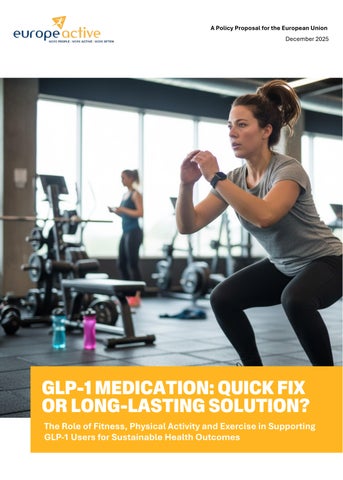
GLP-1 MEDICATION: QUICK FIX OR LONG-LASTING SOLUTION? The Role of Fitness, Physical Activity and Exercise in Supporting GLP-1 Users for Sustainable Health Outcomes
GLP-1 therapies are rapidly reshaping the global conversation around weight management, metabolic health and chronic disease. What was once viewed as a purely medical development has, in a remarkably short time, become a catalyst for wider transformation across society, influencing how individuals, communities, businesses and governments understand health, prevention and long-term wellbeing. At EuropeActive, we recognise both the extraordinary potential and the significant responsibility that accompany this moment. While these therapies offer meaningful benefits for many, they do not remove the need for lasting behavioural change, physical movement and functional capacity. On the contrary, their growing use reinforces a fundamental truth: sustainable health cannot be secured through clinical intervention alone. The fitness and physical activity sector is uniquely positioned to support this new phase in health through members that provide the trusted spaces, skilled professionals, evidence-based programmes and community access at scale that GLP-1 users need. EuropeActive’s standards and educational programmes, including the European Register of Exercise Professionals (EREPS), will play an increasingly important role in equipping coaches and personal trainers with the knowledge and skills required to support GLP-1 users safely and effectively. These capabilities are not supplementary to healthcare systems, rather they are vital to their evolution. This report explores how GLP-1 therapies are accelerating the convergence of medical, commercial and lifestyle-based approaches to health, and why the fitness and physical activity sector must be recognised as a core partner in this shift. It is an invitation to rethink traditional boundaries and strengthen collaboration, so that movement, resilience and physical capacity sit at the centre of Europe’s emerging health landscape. Kai Troll CEO, EuropeActive
01
A NEW RELATIONSHIP WITH THE BODY IS EMERGING
For years, conversations around weight loss have centred on restriction, discipline and personal failure, reinforcing the belief that change is simply a matter of willpower. In reality, body weight and health are shaped by complex biological, metabolic and environmental factors that extend far beyond individual control. GLP-1 therapies are challenging these long-standing assumptions. As people experience changes in appetite, energy and physical response, the narrative they hold about their bodies begins to shift. For many, this is the first time in years that their body feels more predictable and supportive, fostering a renewed sense of confidence, self-belief and agency. This internal shift often translates into greater openness to movement, connection and new lifestyle choices.
Self-reported data indicates that GLP-1 users experience higher levels of confidence, energy and perceived wellbeing than the general public. I have never felt better abou t my future I feel good about the world we live in I feel at tractive I feel healthy I feel better t han I ever have I feel co nfid ent I have more energ y 0%
10%
Non User s Source: Havas Health Prosumer Report 2024
20%
30%
40 %
50%
60 %
70%
80 %
GLP-1 Users
3
GLP-1s are changing how the body regulates hunger, digestion and blood sugar by working with natural pathways that influence satiety and glucose response. Put simply, they slow gastric emptying, help stabilise blood sugar levels and reduce appetite, which in turn alters eating patterns and energy balance. By working with, rather than against, the body’s internal signalling systems, they provide new insight into the complex biological mechanisms that underpin weight regulation and metabolism.
GLP-1 therapies are already seeing rapid and sustained adoption across Europe, with the regional GLP-1 agonist market valued at about 7.09 billion USD in 2024 and forecast to more than double by 2034 (Source: Research and Markets, July 2025). Persistently high and growing rates of obesity have driven adoption and demand for GLP-1 therapies across Europe, where they are currently approved for the treatment of type 2 diabetes and clinically supervised weight management in people living with obesity or obesity-related conditions like cardiovascular disease. On the basis of these established use cases, the demonstrated safety and effectiveness of GLP-1s has prompted an acceleration of research into possible future applications, with ongoing studies examining their potential role in conditions like certain types of heart failure, chronic kidney disease, metabolic liver disease, and in long-term diabetes and obesity prevention for high-risk groups. And with more than 39 GLP-1 therapies in clinical trial research (Source: Ozmosi, October 2025), including daily oral options and longer-acting, monthly injections, the expansion of this treatment landscape shows no signs of slowing down anytime soon.
“
GLP-1s shouldn’t just be labelled a ‘weight loss drug’, they’re so much more than that.
”
GLP-1 therapies are beginning to restore a long-lost sense of predictability, safety and trust in one’s own body. Years of fluctuating weight, repeated dieting and inconsistent results have left many people feeling that their bodies are unreliable or working against them. More than simply supporting weight loss, these treatments offer individuals the promise of control: control over the food noise, constant temptation and intrusive thought patterns that have long acted as limiting factors to success. To add to that, emerging research suggests that GLP-1s are contributing to improvements in mental health and overall quality of life, with many individuals experiencing a renewed sense of confidence and optimism during treatment (Source: JAMA, July 2025).
02
SUSTAINABLE HEALTH DEPENDS ON MORE THAN MEDICINE
GLP-1 users are experiencing significant changes in their food intake. While this can support meaningful weight reduction, it does not automatically strengthen the body’s underlying structures or improve long-term physical function. In fact, rapid physiological change can introduce new vulnerabilities that, without structured support, may undermine sustainable health outcomes. In this context, exercise and physical activity play a crucial and complementary role in supporting users’ strength, function and independence over time. During medically induced weight loss, a significant share of weight loss may come from lean tissue, not fat. In recent clinical studies of GLP-1 therapies, lean soft tissue, including muscle mass and bone density, has been shown to account for approximately 26 - 40% of total weight loss (Source: PubMed Central, October 2025). This means that while overall fat mass is being reduced, many users risk losing or undermining their strength, mobility, metabolic rate, recovery capacity and holistic long-term resilience as well. Additionally, metabolic shifts may lead to nutritional gaps, energy fluctuations, and changes in skin elasticity that can affect movement and day-to-day quality of life. These unmet needs require targeted support through structured exercise, progressive resistance training, balanced nutrition, and guided recovery protocols.
In this way, GLP-1 treatment can act as a catalyst to change, but physical activity is essential to preserve function, rebuild capacity, and help the body adapt in a healthy, sustainable way. The greatest risk to the long-term success of GLP-1 therapies is not biological, but behavioural. Sustainable health depends on the formation of new habits and routines that allow for regular physical activity, balanced nutrition, restorative sleep and positive mental wellbeing. Yet many individuals begin treatment without guidance on how to build these behaviours or how to transition from medically supported change to self-supported lifestyles, leaving them to have to fend for themselves. If the focus remains solely on the prescription and not the person, GLP-1 progress becomes fragile and early gains are at risk of fading as quickly as they appeared.
Beyond its physical impact, movement plays a vital role in regulating the nervous system during periods of rapid change. On GLP-1 therapies, both the brain and body must adjust to a new internal rhythm. Without a stabilising influence, this transition can feel disorienting. Regular physical activity provides a stabilising force that stimulates neurological and hormonal responses which support emotional regulation and mental clarity. It increases endorphins and supports dopamine activity, reduces stress-related cortisol and improves sleep quality, all of which contribute to greater psychological resilience. At a time when familiar cues around hunger, reward and comfort are shifting, these effects become especially important. Movement therefore acts not only as a physical practice, but as an anchor for emotional stability and self-trust during the process of change.
“The fitness sector can provide controlled, monitored and progressive programmes to fight lean muscle mass loss.” Tino Tsolakis, VP Global Alliances & Partner Strategy at EGYM, notes that the speed of GLP-1–driven weight loss can outpace the body’s ability to adapt, leaving strength, function and long-term stability vulnerable. Without structured support, early success may plateau or reverse as physical capacity declines. He emphasises that sustainable outcomes depend on preserving strength and rebuilding confidence in movement, requiring closer coordination between medical treatment, active living and long-term strategies.
IF THE FIRST WAVE OF TREATMENT WAS ALL ABOUT ACCESS, THE NEXT WAVE IS SHIFTING TO A FOCUS ON MAINTENANCE An emerging challenge with GLP-1 therapies is what happens after initial success, when discontinuation or plateau becomes common. Recent real-world evidence shows that up to two-thirds of people prescribed a GLP-1 discontinue treatment within a year (Source: JAMA, January 2025), and metaanalyses of GLP-1 withdrawal show a consistent rebound effect, with an average regain of several kilograms soon thereafter (Source: PubMed Central, May 2025). At the same time, many users who remain on treatment describe reaching a plateau, where progress slows or stalls despite continued dosing. For individuals who experienced rapid early change, this shift can be confusing and discouraging, adding a new psychological and physical dimension to the GLP-1 journey that is only beginning to be understood.
03
THE ACTIVE POPULATION IS RAPIDLY BEING REDEFINED
GLP-1 users looking to embrace exercise and movement today do not fit a single profile. These individuals sit across varied life stages, personal histories and emotional relationships with working out. Some are stepping into a fitness environment for the first time, others are returning after years away, and some have remained active but now feel newly capable of progressing beyond previous limits. For many, this moment is accompanied by a renewed sense of confidence, optimism and engagement with life, which may translate into greater openness to movement, structure and sustained participation in physical activity. GLP-1 therapies are unlocking a more purposeful approach to exercise. For many users, there is a growing recognition that resistance and strength training are essential to help preserve muscle mass, protect bone density and maintain functional capacity throughout their GLP-1 journeys. At the same time, many individuals are also turning towards low-impact and low-energy forms of physical activity that feel more accessible during phases of adjustment, reduced caloric intake or fluctuating energy levels. This can include walking, cycling, swimming, mobility work, stretching, yoga and other gentle forms of movement that support circulation, joint health and overall wellbeing, while encouraging consistency and long-term habit formation.
82% of GLP-1 users claim that treatment has had a moderate to significant positive impact on their fitness frequency. Q: Impact of GLP-1 on Fitness Frequency Significantly Negative Impact 0% Moderately Negative Impact 1% No Impact At All 17% Moderately Positive Impact 40% Significantly Positive Impact 42%
Source: Cure GLP-1 Report: Insights from Patients on the Future of Obesity Treatment, n = 155 2024
A new set of distinct GLP-1 user segments is now entering fitness environments. These audiences reflect a broader redefinition of the “active population” and highlight the need for environments, coaching standards and programme options that meet individuals exactly where they are. These segments include: •
People that have never consistently worked out or seen themselves as “gym-goers.” For some, previous attempts at physical activity felt intimidating, uncomfortable or inaccessible.
•
People who used to exercise regularly but fell out of routine for years due to life disruptions, health challenges, time constraints or discouraging past experiences.
•
People who have always participated in some form of exercise but struggled to reach or maintain goals.
•
People who are already consistent exercisers and are seeking a new level of optimisation.
While their motivations and histories vary, they share a common moment of re-entry into physical activity that requires tailored support, different forms of guidance and more inclusive pathways into exercise.
Life-stage and hormonal factors are also shaping who is entering fitness environments and how they engage with them. Many individuals beginning or returning to exercise while using GLP-1 therapies are navigating defined biological transitions such as menopause, andropause, post-partum recovery, perimenopausal change, mid-life metabolic shifts or the gradual loss of muscle and bone density that accompanies ageing. These changes can influence how the body tolerates load, how
quickly it recovers and how effective certain forms of training feel. In practical terms, this often translates into a greater need for progressive loading, longer recovery windows, joint-protective programming and more intentional integration of mobility and stability work. At the same time, hormonal fluctuation can affect sleep quality, mood, motivation and stress responses, shaping when, how and how often individuals are able to engage in physical activity. Fitness environments must be better equipped to recognise these life-stage realities and adapt programming accordingly, ensuring that entry points, progression tracks and coaching approaches reflect the biological, emotional and the evolving demands of health across the lifespan.
04
GLP-1S ARE ACCELERATING HEALTH SECTOR CONVERGENCE
The rapid uptake of GLP-1 therapies is beginning to reshape the wider health environment in farreaching ways. Beyond changes in individual behaviour, their impact is now being felt across healthcare delivery, retail, digital health, professional training and public health planning. Longstanding boundaries that once separated clinical treatment, commercial health services and lifestyle support are becoming increasingly fluid, as new combinations of products, services and experiences take shape around this fast-moving category. What is emerging is not simply a treatment trend, but a reconfigured health landscape in which medical, commercial and behavioural models are beginning to intersect in new and unexpected ways. Within the fitness sector, the rapid rise of GLP-1 use is prompting a reassessment of traditional operating models and value propositions. What began as a question of possible disruption has shifted into a longerterm strategic opportunity. Rather than stepping back, companies are leaning in, examining in more detail how their facilities, programming, staffing and content can remain relevant, supportive and commercially viable in a rapidly changing health and wellness landscape. This has led to internal reviews of member pathways, training protocols, service design and potential partnership strategies, as organisations recognise that a growing share of their current and future members will be navigating some form of medically supported weight or metabolic intervention.
Some operators are introducing GLP-1informed onboarding pathways that combine movement screening with nutrition awareness and recovery planning. Others are adjusting timetables to include more low-impact or progressive strength classes at off-peak times, recognising that energy levels and recovery patterns may differ for those on GLP-1 therapies. Investment is also being directed towards staff training, ensuring personal trainers and instructors are better equipped to understand muscle preservation, fatigue management and safe progression. Alongside physical changes on the gym floor, digital platforms are being updated to include tailored content, tracking features and educational resources designed to support members through different stages of medically supported weight and metabolic change.
While the impact of GLP-1 therapies is often discussed in relation to the fitness and wellness sector, the disruption now extends far beyond gyms and studios alone. These medications are beginning to influence a wider range of industries situated at the intersection of health, consumption and daily life. Retailers, digital health platforms, pharmacy networks and food brands are reassessing their role in this evolving environment, recognising that traditional product categories no longer map neatly onto shifting patterns of appetite, behaviour and wellbeing. The traditional boundaries of industry verticals are collapsing into new hybrid partnerships and models. In practice, this is translating into new types of commercial configuration outside traditional fitness settings. Some digital health and pharmaceutical-facing platforms are moving towards bundled health services that combine medication access, nutritional planning, behavioural support and biometric tracking within a single subscription. Insurers and employer benefits providers are beginning to explore incentive-based models tied to
PERSPECTIVE FROM THE FIELD
- Wais
“GLP-1 solutions have become an expectation of our retail stores. Customers now believe retail has a role to play in their healthcare.” metabolic health outcomes, while food, supplement and meal-delivery companies are adapting their pricing, packaging and positioning to reflect shifting patterns of intake and nutritional priorities. More broadly, the definition of the “health” ecosystem is expanding as the lived effects of GLP-1 use alter daily routines and consumption patterns. Workplaces are reconsidering wellness benefits, learning institutions are adapting health education, and housing developers are integrating movement-friendly environments. Transport and leisure industries are also responding to shifts in participation and physical capacity. In this way, GLP-1s are not only reshaping healthcare, but reconfiguring the everyday environments in which health is lived and supported.
As GLP-1 medications redraw the boundaries of modern health care, they are accelerating a convergence between pharmaceutical intervention, physical activity and everyday consumer behaviour. According to Wais Shaifta, Chief Growth Officer at the CO-OP and Chair of the Remuneration and Sustainability Committees at The Gym Group, the real opportunity lies not in replacing lifestyle change, but in enabling it. “At first, people thought this was a silver bullet,” he said. “But the reality is that GLP-1s are the first step. They manage cravings and shift physiology, creating the right conditions for better movement, better nutrition and long-term change.” Shaifta sees a new role emerging for businesses historically outside the medical system. “Gyms, retailers, community providers, they all have a role to play,” he said. “This isn’t just a weight-loss drug. It’s a systemic shift in how we think about prevention, longevity and health access.”
05
COORDINATING PATHWAYS TO SUSTAINABLE HEALTH OUTCOMES
The growing use of new therapies is reshaping Europe’s health landscape, but it also highlights an essential truth: long-term wellbeing cannot be secured by clinical intervention alone. Sustainable outcomes depend on systems that actively support movement, function and daily resilience. To reflect this reality, physical activity must be embedded deliberately within health policy, care delivery and community infrastructure.
Policy change considerations: Recognise the fitness and physical activity sector as essential partners in obesity management and longterm prevention
Fund and scale public health campaigns that position exercise as essential to sustainable health and weight maintenance
Embed structured physical activity into formal care pathways alongside pharmacological and clinical supports
Incentivise the inclusion of structured exercise within reimbursement and referral models
Support cross-sector pilot collaborations between health systems, fitness providers and community organisations
Review and evolve eligibility frameworks to reflect the wider clinical benefits of GLP-1s beyond weight loss
EuropeActive President Council Members: Aspria Basic-Fit David Lloyd GO fit L'Orange Bleue LifeFit Group Pure Gym Purpose Brands RSG Group SATS SC Fitness The Gym group VivaGym Bhout BRP Systems EGYM Funxtion Leisure Labs Les Mills
EuropeActive is Europe’s premier fitness and physical activity association championing healthier communities.
Life Fitness / Hammer Strength Matrix Milon Sport Alliance Technogym
Enervit
This report was created in collaboration with Havas Health, a global network focused on transforming health and wellness through meaningful brand experiences.
FIBO Yanga Sports Water
Issue: December 2025
WellHub Urban Sports Club