4 minute read
Recent Activities at Inya

Promoting EPSD through Evidence-based Activities in Rakhine State and Tanintharyi and Yangon Regions, by May Saung Oo and Pyai Nyein Kyaw
From March to November 2022, the Inya team together with the Minbya Youth Association (Rakhine State), Candle Light Youth Group (Tanintharyi Region), and Transform With Me (Yangon Region) developed a project focusing on ‘Education for Peace and Sustainable Development’ (EPSD) with funding from UNESCO. Ranging from skills and awareness training, production of community assessment report, community mobilization, and online talks and webinars, the project helped the participants not only to gain more general knowledge about peace and sustainable development but also offered them practical guidance on how to apply these principles in daily life and seek together alternative ways to be a more cohesive society and possible avenues for achieving Sustainable Development Goals (SDG) from various approaches.
Advertisement
Following a five-day research methodology training attended by a total number of 48 participants, the youth groups in Minbyar and Myeik conducted community assessments on the following topics:
“Rubbish Collection System in Minbya
Town” and “Mangrove Deforestation
and Natural Resource Scarcity in Kyun
Su.” These assessments led to reports highlighting the difficulties encountered by local communities in pursuing sustainable environment objectives and also to formulate recommendations on improved service provision and community-led conservation.
The findings of the community assessment reports then served the basis upon which the remaning activities of the project were developed, including two panel discussions and six community talks, covering topics such as ‘Attributes of social cohesion’, ‘Extractive industries and the environment’, or ‘Plastic recycliing and environmental protection’.
For the two series of events, the team mobilized a cumulative number of 234 participants. This, in turn, helped the team reach out to an even larger public through podcasts and videos on Facebook.
The EPSD project was a good collaborative project with partners working on different themes and lines of works but similarly focusing on youth groups. In the long run, some activities may be pursued by partner organizations in a sustainable way (if the overall conditions are met). Even if the project implementation was very short (9 months), it still provided valuable interaction and space for mutual learning between the core team and partner organisations.
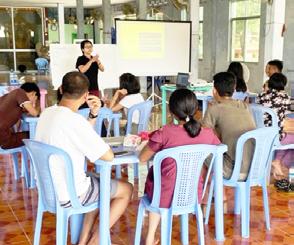
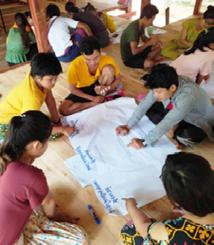
Training on Participatory Action Research in Myeik (Tanintharyi) and Minbya (Rakhine) in the early phase of the project
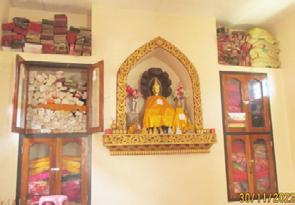
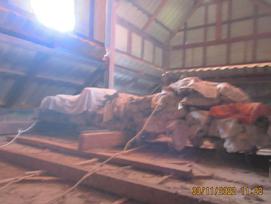
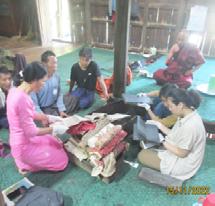
Monastic collections at a varying level of care and conservation in Southern and Eastern Shan State
Documenting Monastic Library Collections in Southern and Eastern Shan State
On November, 10–21, in Taung-gyi and November, 24–December, 5, in Kengtung, the institute ran a training course on cultural heritage preservation and conducted some field research with groups of local students, scholars, and monks. The one and a half-day training course on cultural heritage preservation and manuscript cataloging and preservation was led by Dr. Francois Tainturier and Dr. Jotika Khur-Yearn, Subject Librarian for Southeast Asia and Pacific Islands Collections, SOAS, who ran his training sessions remotely from London. A seven-day period of field research followed during which field researchers visited monasteries in both areas in search of monastic libraries holding materials of cultural, historical and religious significance.
Building on an earlier digitization project developed in Northern Shan State from 2016 to 2018 at Punlong Monastery, Kyaukme Township, the institute is now documenting colonial and post-independence monastic library collections from other parts of the Shan State with funding from the University of California-Los Angeles “Modern Endangered Archives Program.” The focus is on identifying written, printed, and photographic materials that are held in monasteries patronized by Shan (both Tai Long and Tai Khuen) and Pa-O communities in the Taung-gyi and Kengtung areas as well in Muang Pai and its surrounding areas in northern Thailand.
This will be the first step toward an assessment of the significance of these library collections, which in turn may warrant a digitization plan. Digital preservation of these collections will mitigate the risks associated with high humidity, bug-related damages, lack of maintenance, artifact smuggling and deliberate destruction. Another objective pursued with the digitization of these monastic library collections is to support on-going scholarship on Shan history and culture that examines colonial-era and postindependence religious dynamics and the mobility of Buddhist ideas, practices, and monks and lay persons across the Shan State and further beyond in Myanmar and northern Thailand.
While field research in Muang Pai is scheduled in mid-2023, the two field trips of 2022 made it possible to identify monastic library collections of high significance in the Taung-gyi and Kengtung areas. Overall very few monastic library collections still hold a significant number of palm-leaf manuscripts, Shan paper manuscripts and Shan paper bound scrolls, which makes the documentation project’s sense of urgency even more acute.
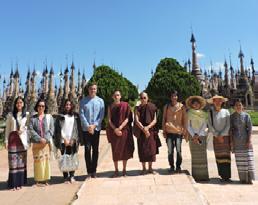
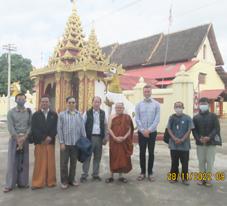
The local teams in the Taung-gyi area (left and middle) and Kengtung area (right)