va
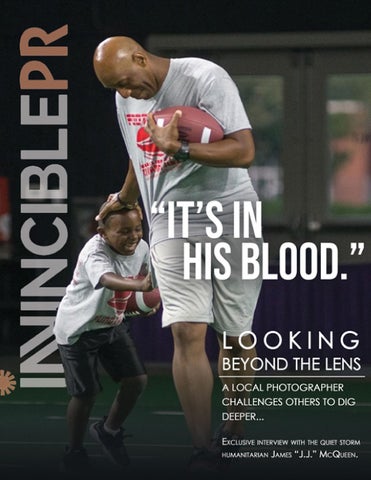
LOOKING BEYOND THE LENS with
JAMES “J.J.” MCQUEEN “Along your pathway of life you will observe that you are not the only traveler. There are others who need your help. There are feet to steady, hands to grasp, minds to encourage, hearts to inspire, and souls to save.” -Thomas Monson
James McQueen Jr. (respectfully known as “J.J.”) has always designed and walked his own pathway. A pathway that has led him to understand the dynamics of being an athlete, the fundamentals of being a CEO, the humility of being a distinguished photographer and videographer, courage as a blogger, patience as a mentor, hard work as an Alpha man, dedication as a husband,
sacrifice as a father, and consistency as a humanitarian. Many have always wondered the story of this High Point, North Carolina native, but only InvinciblePR was granted the one-time exclusive. We get up close and personal about the humanitarian’s power moves, how this year challenged him most, and how he charged others to dig deeper.
Sitting in James’s greenroom located in the basement of his conventional home church in Baltimore, MD. JM: Welcome to my home away from home [smiles] IPR: Thank you. Finally, I get to sit down with Mr. James McQueen Jr., CEO of Goal line Media Production and Vision Beyond the Lens. I must say you are a very hard person to catch up with, a very busy man [smiled]. Thank you for agreeing to do the interview. So tell me what a typical day looks like for you? JM: I wake up, go through the normal routine (shower etc.), have breakfast, look over my schedule, and make sure the kids get off to school, then I get into the thick of it. Whether its meetings, editing, phone calls, planning, mentoring, or sometimes fraternal things as it relates to Alpha might come up. I am also on the Joppatowne Council (in Harford County) sometimes I have go over things such as policies and procedures; making sure the county is adhering to the things that are happening. IPR: “Councilman McQueen” has a nice ring to it [laughs]. Maybe in the future? JM: Maybe, only time will tell.
IPR: You’ve had a busy year, tell me a little about that. JM: (he unpretentiously pauses) In March, I was chosen to have images from two of my series’: “The Sun Still Rises in the Ghetto” and “I am More Than an Athlete” to be displayed within the halls of University of Maryland (Baltimore); very humbling experience for me. In June, I was one of the designated photographers for the Football 52 Fundamentalz Camp in Greensboro, NC. IPR: Yes, I heard about that. The images were breathtaking. Thank you for the exclusive photographs [smile]. JM: [grins]. In August, I won the Outstanding Service Award for the Harford County chapter of my organization, Alpha Phi Alpha Fraternity, Inc. and we, Goal line Media Production had our annual Back-to-School drive. This is the 8th year we’ve provided school supplies to various schools around Harford County such as Edgewood, Joppatowne, Havre de Grace, and Riverside Elementary School.
IPR: You really have been busy this year. Con- immediately what those kids need and grats on all of your hard work and success. have an opportunity to provide it to them Now let’s back up a bit. through this camp because they were once them. Let’s talk about Football 52 FundamenI’ll never forget the moment when I saw talz. Tell me more about that because you coaches on their hands and knees with the described it as “one of the players pushing and encourbest training camps ever,” aging those young men as “I knew for sure that when they had tears in their eyes. but I never heard of it until you mentioned it to me last I was taking those images Those were character buildI wanted to make sure I year that you were attending moments for me! I’ve ing. painted athletes, my peers, never seen that happen at major brand camps. I’ve nevand African American JM: (his face begins to light men in a way that society er seen coaches really conup as he grins from ear to says we don’t exist. When nect with their players. Those ear) I’m a little biased beyou have a camera in your moments resonated with the cause a lot of my former coaches just as much as they hand and you are a true teammates are the coordidid with the players. Which photographer -- a true nators of the camp. It’s the is why the name of my blog journalist-I’ve always camp’s 4th year operating is “Vision Beyond the Lens” been of the belief that you it’s because it’s bigger for me and I do believe it’s one of the best training camps ever. have a responsibility to than just the images I take. I (McQueen leans to the edge tell stories in ways that really want to make impactnobody else will tell them, of his seat as he begins to ful moments. you have to take risk that describe his awe-inspiring nobody else will take, take trip to Football 52 Fundamentalz). risks or otherwise those I used to be these kids and images won’t portray the so did the ones who now run truth behind the story and the camp, therefore it’s easier the people that lie within for us to identify the needs of them.” those kids and our commu- J.J. McQueen nity for that matter. When the coaches walk into the arena and see kids with the same accents, body languages, or mannerisms they know
IPR: Would you then say it comes from your mom because she was in education which then inspired you to help othIPR: The reasons why I chose to interview you had nothing to do with how popular you er scholars and inspiring athletes or did are or how many titles you hold, but it is your it come from your grandfather who has compassion for others through pastoring? drive and what you do that made me look further into your story. You are mentoring other inspiring photogra- JM: I think it’s kind of a holistic thing. My dad phers and athletes, working within the com- is a heavy volunteer in our community and one of my grandmothers’ ran an assisted munity as a Joppatowne councilman, and formulating annual back to school drives for living home so I think from a family perspecunfortunate families. Where does that drive tive I had a great level of exposure. come from, that willingness to help and to IPR: Oh it’s just in your blood? [laughs] serve others? JM: Yea you could say that. [smiles] JM: I think it’s an earlier childhood DNA thing. During my childhood, I was 1 of 20 African-American kids in my rural town (roughly) so I was overlooked when it came to my individual needs and I believe that played a part in who I am today. Because I was overlooked and lacked what I needed it helps me to relate to kids and adults within my community because I once had the same need(s). I want to make sure that my energy and efforts always point back to being able to pay attention, highlight, and impact everything that points to advancement for under-privileged down-trodden communities. In addition, my grandfather was a pastor and my mom worked in an elementary school.
“Make a career of humanity, commit yourself to the noble struggle of equal rights, a greater nation of your country, and a finer world to live in.” – District of Columbia, 1959
IPR: Let’s talk about your last major project, “The Sun Rises in the Ghetto.” Tell me about that and how you came up with that series.
JM: Looking at moments way beyond what’s happening in the eye view of my camera. I made a decision a long time ago that I did not want to be a conflict photographer, but I want to be a resolution photographer. I JM: Last year I made up in my mind to go to want to be one of those people who looks a completely different level in photography. at images in some of the worst places in the One day I decided to go to various parts of world and be able to find the best moments Baltimore and just start taking pictures. One in those pictures. Even as a kid I made up in of my first stops was on the East side of Bal- my mind that I wanted to tell stories on my timore and as I looked around I noticed the terms; the way I want to tell them. sun rising ( on the east of course) and it was literally facing these dilapidated home and IPR: No fake news, right? [laughs] at that moment it came to me:- “The Sun Still Rises in the Ghetto.” I wanted to show JM: [laughs] others that it doesn’t matter whether your black or white, it doesn’t matter where the IPR: Not only do I think it’s remarkable, but I county lines versus the city lines lie-- wheth- also think it’s important to do things on our er it’s Greenmount or Greenspring Valley own terms. If someone told you every day there are good people and good things what to capture (who, what, when, where, happening in the “hood” as well. The ghetto and why) you aren’t telling or creating your isn’t this gruesome place where there is no own story, but you’re painting the picture hope, no possibilities, or no dreams. The sun they want you to. rises in these places so why wouldn’t great Good stuff, good stuff. people arise as well. IPR: It’s funny you say “gruesome” because that’s really what people think, right? And it’s not. JM: It’s not! IPR: Why is that? Why is the ghetto labeled as this “gruesome” place? JM: It is difficult for people that live outside of the ghetto to see the beauty that’s taking place within the ghetto. Its viewed such a “gruesome” place because the beautiful things are seldom highlighted on a regular basis. IPR: How did you come up with Vision Beyond the Lens and what does it mean exactly?
IPR: Do you think you’ve arrived? JM: No. I have a long way to go. IPR: Why not?
supposed to be, or do you feel that you have more work to do because you are so behind in meeting the mark?
JM: I believe I am where I’m supposed to be. I think the timing is right for this stage and JM: Financially there’s another place I need this platform to get out the kind of mesto get to, to make the type of impact I would sages that need to be seen and heard. But like to make especially in the community, I will never get comfortable with what I did within my fraternity, and in my hometown. yesterday, there’s always more; that’s what People say you cannot serve two masters, helps me to get up in the morning. I say to but I whole heartily believe that I can do myself “we’ve got more work to do” there’s work where I live, but never disconnect from never a content moment where I believe where I am from. So any opportunity that there’s never more to do. I get I try to get back home and give the same energy and efforts that I do when I am here in Baltimore IPR: “We’ve got more work to do.” I like that, speaking of more work, what do you want IPR: It’s interesting you feel that way beto leave as your legacy? cause I know many people who have accomplished much less but believe they JM: I want the children I have encounters have arrived, but you just see it as theirs still with to understand that they matter bemore work to be done; interesting. cause not every kid that walks in a room understands that they matter. I want them JM: Yup, definitely more work. to know that it does not matter what their circumstances were or currently are, it does IPR: I recently watched the interview with not matter what their households have or Charlamagne Tha God and Pastor Steven did not have. All of the men in my family Furtick and Furtick asked the same quesmade sure my siblings and I understood we tion and Charlamagne stated, “I don’t look mattered and anything we brought to the at it as I’ve arrived or I’ve come to the stage table was important so that is the one thing where you can go no further, but I believe I I have to leave my legacy. am where I’m supposed to be.” Would you agree that you are at least where you are
IPR: You have to?
IPR: Are they accepting of it when you say it or is it moreso “I’m going to try anyJM: Absolutely. I think your funeral should be ways”? the most observed day of your life. The line in between your birth and your death is how JM: Every athlete is in denial about that much work you did in between that time; so statement until it happens to them. I have to make sure that every encounter is an impactful moment and they understand IPR: Do you believe in order to be extremethat our relationship is unique and authenly successful that you have to give up tic, and it matters. something? IPR: Why aren’t you an athlete, besides the fact that your 41 years old? [laughs]
“As an athlete you get to the point where you have to err on the side of wisdom. You have to think about your future, but also understand that the game doesn’t love you as much as you love it...”
JM: I just answered this question the other day while speaking to a group of kids. From 2007-2008, I was playing arena football also began to have a family, and children when I realized that this was bigger than me. I didn’t want to be away from my children; I didn’t want to be an absentee father because I know what it was like to have a dad at home every day regardless of what was our economic status. While in training camp one of my children stayed sick the entire time and I walked into my coach’s office ( we were in Oklahoma City at the time) and said “Coach, thank you for the opportunity. I appreciate you putting me in front of all these fans and NFL scouts but it’s time for me to walk away. As an athlete you get to the point where you have to err on the side of wisdom. You have to think about your future, but also understand that the game doesn’t love you as much as you love it, and at certain points you have to think about those things. If you don’t, that means you’re missing things developmentally along the way prior to strapping on that helmet or stepping on that basketball court whether you’re in the Euro league or NBA. At some point all of us come to that conclusion; whether you’re 40 still trying to play or 23 coming out of college.
JM: A whole lot! [laughs] You have to give up a lot. IPR: Yeah? Name something that you’ve given up. JM: Yourself, your time, you sacrifice a lot. IPR: If you could boil your principles down into three words what would they be? JM: Hope, possibility, and expectation. IPR: Hope and possibility are so close.
JM: [shakes his head in agreement] Hope because if you don’t believe it or if you can’t see it 9 times out of 10 you won’t try it; possibility runs along the same lines of potential. I’ve seen potential be people’s greatest enemy if they don’t believe it’s possible. So for me possibility means potential; to live up to who you truly can be, but if you don’t have a vision you can’t live up the expectation. IPR: 19 years of marriage; correct? JM: Yeah. IPR: That’s a long time, congratulations. Based upon some of the characteristics that others say you have; would you say that your wife played a part in molding you into the man that you are today?
JM: Fortunately for her my parents and my family did a really good job of investing in me, because I was a lot more polished coming into marriage than guys at my age (23) would have been. I can say she definitely played a role, but she didn’t have to do as much as a lot of women have to do at a young age IPR: What’s the love story? JM: There isn’t one [grins from ear to ear]. IPR: [laughs] Everyone has a love story. JM: We met in the weight room in college. She played basketball as well. We actually didn’t like each other at first. It was not love at first sight. It was something we had to work at and I think that’s why it works because we had to work and a lot of times I think when it comes easy it doesn’t work; it won’t last. IPR: And that’s the love story folks! See you have one [laughs]. Thank you for the interview. JM: Thank you for asking, it was definitely a pleasure.