Impact report 2025–26
Impact report 2025–26
1
Welcome
There are times when the battle lines feel more drawn than ever. We see it in the way we talk about climate change, wildlife and Country. Too often, protecting nature is treated as a political position rather than a responsibility we all share. People retreat to their corners; misinformation travels faster than knowledge, and sometimes it feels like we are losing the ability to listen to one another. But Country does not belong to one side. It belongs to all of us – and all of us belong to it. For First Nations people, that understanding goes back thousands of generations. Country is not something separate from us, to be used until there is nothing left. It is family. It is culture, language, story and responsibility. We care for Country because Country cares for us. I sometimes wonder what Australia would look like if we treated the natural world with the reverence people give to our most sacred places. Imagine if destroying an ancient forest, losing a species or allowing an invasive species to overwhelm Country felt like watching someone tear apart a cathedral. Imagine if we understood that once some things are gone, no amount of money can bring them back. That is why the work in this report matters.
Invasive species do not care how we vote, where we come from or what we believe. Feral animals, weeds and diseases cross property boundaries, state borders and political divides. They damage the Country that sustains every one of us. It also means protecting Country can bring us together. At a time when so much is pulling people apart, nature can be common ground. We might disagree about plenty, but surely we can agree that our children should inherit a country where native animals still live in the wild, where rivers are healthy, where ancient landscapes remain alive and where culture and knowledge can continue to be passed down. The challenge now is to resist the forces that divide us. We need to listen more carefully, learn from each other and be willing to change when the evidence tells us we must. First Nations people have been caring for this continent for tens of thousands of years. That knowledge has survived enormous disruption and loss, and it has much to teach Australia about what responsibility to place really means. Country needs all of us now. This is something worth standing together for. Richard Swain, Invasive Species Council Indigenous Ambassador
The Invasive Species Council acknowledges the Traditional Custodians throughout Australia and their connections to land, sea, rivers and wildlife. We pay our respects to their Elders past and present and extend that respect to all Aboriginal and Torres Strait Islander peoples today. We recognise the devastating impact that invasive species brought by colonists have had and continue to have on Indigenous culture, cultural landscapes and totem species.
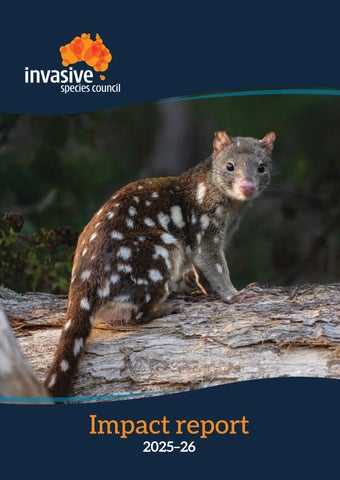
Front cover image. A spotted quoll rests on a log in northern NSW. Photo by Jake Wilton.
2
Invasive Species Council
Message from our CEO Whenever we hire someone at the Invasive Species Council, we ask them this question: What is going to get you out of bed in the morning?
Because we know protecting nature isn’t easy. There are setbacks, frustrations, and plenty of moments when change feels far too slow. Taking on some of Australia’s biggest environmental threats means challenging entrenched interests, shifting political priorities and knowing when to push harder or change tack. What this work needs is people who get out of bed every day determined to do whatever they can to protect nature. Those are exactly the people we have invested in – and they are behind every win you’ll read about in this report. Our greatest asset isn’t a campaign, a policy document, or even our growing influence. It is our people. People who spot opportunities others miss, build unlikely alliances, find solutions, convince decision-makers and keep pushing until something changes. And this year, a lot changed. After years of advocacy, Australia’s national fire ant eradication program is finally fighting back, supported by more than $1 billion in government investment, including $10.5 million in new funding that we secured this year. In Kosciuszko National Park, after more than a decade of campaigning, we secured the repeal of the law protecting feral horses across Australia’s precious alpine landscapes. On Kangaroo Island, we helped secure millions of dollars in state, federal and philanthropic funding to get the Dudley Peninsula cat eradication done – an effort that, once completed, will be the largest feral cat eradication
on an inhabited island anywhere in the world. These wins don’t belong to us alone. They belong to the Traditional Owners, scientists, farmers, Landcarers, conservation organisations and community champions who work alongside us. To the journalists who bring these issues into the national conversation. To the volunteers who give their time, and the donors and supporters whose belief in our work gives us the independence and capacity to act. Our role is to be the catalyst – bringing together the evidence, people, funding, public support and political will needed to turn an idea into change at a scale far bigger than ourselves. That is increasingly how we think about our impact: not simply what the Invasive Species Council can achieve, but what we can help make possible. And that matters because nature needs the Invasive Species Council to thrive. As Australia’s only environmental organisation dedicated solely to advocacy on invasive species, we have a responsibility to be ambitious, nimble and relentless in creating the conditions for change. As you read this report, I hope you see more than a list of campaigns and achievements. I hope you see the people behind them – and what becomes possible when people who care deeply about nature decide to get out of bed and fight for it. To our staff, partners, volunteers, donors and supporters: thank you for being those people. Jack Gough, Invasive Species Council CEO
This impact report covers the Invasive Species Council’s financial year, from 1 October 2025 to 30 September 2026.
Impact report 2025–26
3
Our impact
$160 million+ secured to protect nature from invasive species.
SUBMISSIONS This year we’ve written over 50 submissions to governments across Australia. Read some here:
9,000+
media stories featuring the Invasive Species Council.
146 million+ times Australians were reached through the media.
18 million+
WESTERN AUSTRALIA
• Protected the social licence of aerial culling of deer through a proactive media campaign.
campaign views on social media.
NATIONAL • 2-year, almost $100 million extension of the Saving Native Species Fund. • $31.2 million boost to wildlife resilience for Australia’s H5 bird flu response. • Eradication of invasive species on a range of islands commenced from previous bird flu funding win. • $4 million to restart Australia’s rabbit biocontrol pipeline. • The Chief Environmental Biosecurity Officer role was elevated to First Assistant Secretary. • Indigenous Land and Sea Corporation supported our call for a Caring for Country Commissioner.
4
Invasive Species Council
• Proposal to allow exotic parrots to be imported delayed. • Federal Labor platform amended to recognise importance of environmental workforce. • Invasive species action took centre stage at the national Bush Summit. • Overcame barrier to threat abatement planning through federal environmental law reforms. • 42,000 observations submitted to iNaturalist during Bug Hunt’s inaugural Bugs in My Backyard Week. • Developed citizen science school curriculum plans through Bug Hunt. • Helped establish Invasives International.
NORTHERN TERRITORY
• Worked with Traditional Owners to raise the profile of buffel grass in the media and with decision-makers to list it as a weed of national significance.
QUEENSLAND
• $10.5 million for fire ant eradication, taking funding we’ve helped secure to more than $1 billion. • Secured Queensland’s ban on Amazon frogbit. • Helped develop the City of Gold Coast’s regional feral deer eradication plan. • $21 million for yellow crazy ant eradication in the Wet Tropics.
SOUTH AUSTRALIA
• $5.1 million from state and federal governments to keep Kangaroo Island’s feral cat eradication on track, plus $370,000 in philanthropic support. • $1.5 million for South Australia’s feral deer eradication program.
NEW SOUTH WALES
• Repeal of the law protecting feral horses in Kosciuszko National Park. • $800,000 for rewilding across south-eastern Australia. • Funding for coordinated feral deer control across the Greater Blue Mountains World Heritage Area. • Helped develop a proposed $300 million invasive species package with NSW Opposition. • Completed a 218-hectare fence for the Shoalhaven Feral-Free Area.
VICTORIA
• $4.4 million in ongoing annual funding for feral deer control, plus an additional $1.7 million. • Approval of Felixer grooming traps for feral cat control. • Launched alliance with farmers and environment groups for stronger invasive species action. • Hosted community forums to bring farmers, landholders, conservationists and MPs together on deer.
TASMANIA
• Review of Tasmania’s feral deer plan and an additional $840,000 for deer control. • Review of Tasmania’s cat strategy.
Impact report 2025–26
5
Message from our President The Invasive Species Council today is a very different organisation to the one we were just a few years ago. We have grown from a team of 4 staff to around 25 people working across the country. We have greater reach, expertise and influence than at any point in our history. That growth has been extraordinary – and deliberate. The transformational support of The Ian Potter Foundation gave the Council the security to invest in its people, build our advocacy capacity and expand our reach. Other generous supporters have backed that growth, giving us the confidence to take on bigger campaigns and pursue opportunities that would once have been beyond our capacity.
Thank you to our indefatigable CEO, Jack Gough, and all of our dedicated staff, volunteers and partners. We cherish and are thankful for our resilient donors and supporters, who make our work possible and recognise the opportunity for change that the Invasive Species Council can deliver. Gayle Austen, President
The results throughout this report show what that investment has made possible. But as we grow, we are equally determined to protect what makes the Invasive Species Council effective. We remain fiercely independent, willing to speak up when others will not and nimble enough to respond quickly when an opportunity arises. We work across political divides, bring together people who might not normally find themselves on the same side of an issue, and are prepared to try unconventional approaches when that is what it takes to secure change. This year we have continued investing in an exceptional team of advocates, scientists, communicators, campaigners and organisational leaders. Growth gives us more expertise and greater reach, but our ambition is not simply to become bigger. It is to become more effective – and to ensure every additional person and dollar strengthens our ability to protect nature, which has never been more vulnerable. As I begin my term as President, I also want to acknowledge outgoing President David Rickards and outgoing Vice President Fiona Sutton who led the board through an important period of growth and change. I am delighted David will continue contributing as a member of the board and Fiona on our Conservation and Science Committee. We enter this next chapter from a position of strength, but with an enormous task ahead of us. Invasive species remain a leading driver of animal extinction in Australia, and the need for an independent organisation prepared to fight for the systemic changes nature needs has never been greater. Banksia flower, Dandenong Ranges forest, Victoria. Photo: F. Maliki.
6
Invasive Species Council
Black swan on the marshes in Tasmania, Australia. Photo: Oleh Slobodeniuk.
Bird flu and beyond Bird flu is giving the Invasive Species Council an opening to change the conversation about conservation in Australia. The expanding wave of death is showing Australians a new kind of environmental disaster. It is the latest awful vindication of the Council’s message that invasive species are an urgent problem demanding society’s full attention. Media stories are showing the Council at the centre of things, interpreting the tragedy and predicting what might come next. It is an opening to discuss introduced pathogens more widely – the chytrid fungus that wiped out 6 frog species, the myrtle rust endangering rainforest plants, the Phytophthora species killing Bunya pines and rare banksias, the diseases Australia will get if parrot imports are allowed. Bird flu has come at a time of increasing anger in politics, on both the left and the right. A virus that arrived earlier, COVID-19, has helped stoke public anger by wreaking social and economic havoc with ongoing repercussions. Conservation messaging may be getting angrier, but bird flu, unlike climate change and land clearing, doesn’t suit an angry narrative. This ancient waterfowl virus evolved into something deadlier inside goose farms in southern China, doing so before the farms mechanised and modernised. It can’t be blamed on business greed.
Nor can most invasive disasters. We can’t blame anyone for chytrid fungus and myrtle rust, not knowing how they entered Australia. Same for red fire ants and polyphagous shot-hole borers. We know that Asian wolf snakes reached Christmas Island on a supply ship, and pet cats wandered off into the bush long ago, but the terrible extinctions they caused don’t give us anyone to aim anger at. Australia needs better biosecurity to keep out further pests and diseases, but as this report says (p16–17), advocacy to strengthen prevention rarely makes the news. What makes the news is conflict. Anger at new coal mines and bulldozed forests helps make them newsworthy. Bird flu did not result from a biosecurity breach, but even so it will provide the Invasive Species Council with opportunities to talk up biosecurity by remaining topical for so long that journalists will consider its larger implications. The Council has already been in the news warning against it diverting public attention and government resources away from shot-hole borers. We must shift the national conversation about biosecurity so that the terrible bird and mammal deaths will not have been in vain. Tim Low AM, Invasive Species Council co-founder, ecologist and author
Impact report 2025–26
7
Nature needs the Invasive Species Council to thrive Invasive species are one of the greatest threats to Australia’s native wildlife and environment. As Australia’s only national environmental organisation dedicated to advocacy on invasive species, the Invasive Species Council fills a critical gap in the nature movement.
OUR MISSION
OUR VISION
Catalyse shifts in governments, communities and culture to improve action on invasive species, saving wildlife, stopping extinctions and protecting Australian landscapes and waters.
OUR 2030 GOAL
2030 A NATIONAL FORCE FOR NATURE
2050
Invasive species are no longer a major driver of extinction, biodiversity loss and ecosystem degradation in Australia.
By 2030, Australia is shifting from a short-term, reactive and narrow approach to invasive species towards a proactive, ambitious and wellfunded safety net for nature. As a powerful national advocate, the Invasive Species Council will help create the public, political and policy conditions needed to drive this systemic change.
FROM
TO
• Short-term • Reactive • Narrow
• Proactive • Ambitious • Well-funded
We are advocates and catalysts for change.
Our mission focuses us, passion fuels us and humility grounds us. Our values guide how we live our principle to ‘make it bigger than us’.
Advocates for nature
We speak up for nature and pursue the action needed to protect wildlife and stop extinctions.
8
Invasive Species Council
Collaborative with First Nations
We work with First Nations communities to protect Country and culture and elevate their voices.
Committed to science
Evidence and credible solutions are the bedrock of our advocacy.
Bold and persistent
We take on difficult issues, step in when others won’t and keep pushing until change happens.
The Invasive Species Council team. Photo: Heidi Fin.
Invasive species are Australia’s biggest threat to native ecosystems, yet most Australians have no idea of the scale and complexity of the problem. Tackling them requires coordinated, comprehensive, sciencebased actions, not sporadic, band-aid efforts. That’s why we support Invasive Species Council – the only organisation with the science and reach to align governments, industries and communities around solutions that match the scale of the threat. Purves Environmental Fund, donor
Read our Strategic Plan
When The Ian Potter Foundation supported the Invasive Species Council in 2022, we chose to strengthen its long-term ability to advocate for nature rather than fund a single campaign. Invasive species pose a serious but often overlooked and underfunded threat to Australia’s biodiversity, economy and human health. ISC has delivered a clear strategy and has formed catalytic partnerships that are making a difference. The Foundation is proud to support long-term capacity funding, which has supported the appointment of new staff to critical roles to allow ISC to build its expertise and achieve more for the community and nature. These achievements demonstrate the value of investing in an organisation’s people and capability.
Paul Conroy,
The Invasive Species Photo:donor Heidi Fin. IanCouncil Potter team. Foundation,
Impact report 2025–26
9
Saving the Saving Native Species Fund Addressing species decline and managing threats to nature depends on sustained investment. Without it, years of work controlling invasive species can quickly unravel – putting wildlife at greater risk and making successful eradication programs harder and more expensive to finish.
In late 2025, we identified a major risk: the federal government’s $225 million Saving Native Species fund was due to expire in June 2026, with no commitment to continue it. Behind the scenes, we were hearing alarm bells about the future of this critical program. The consequences would have been significant. Critical programs tackling yellow crazy ants in Queensland, gamba grass in the Northern Territory, feral animals in Tasmania and feral cats on Kangaroo Island were among those facing an uncertain future. We also knew there was a bigger strategic risk. Our ambition is for substantially greater and longer-term investment in protecting nature from invasive species. But if the existing program disappeared altogether – particularly ahead of the next federal election – the fight would shift from securing greater investment in nature to simply rebuilding what had been lost. With no other national environment groups actively campaigning to save the fund, we decided to step up. We worked across the government, briefing the Treasurer and finance minister and senior bureaucrats across Treasury, Prime Minister and Cabinet and environment portfolios on why allowing successful programs to fall off a funding cliff was both environmentally damaging and a false economy.
We also worked closely with the environment department and ministerial offices to understand the barriers to continued funding and build the case for a solution. At the same time, we made the programs at risk impossible to ignore. We brought together a coalition of 17 environment, land management and Indigenous organisations, elevated threatened projects through national and regional media, held a press conference at Parliament House and mobilised our supporters to send thousands of letters to the environment minister, demanding the fund be continued. In the May federal budget, we secured a 2-year, almost $100 million extension of the program, renamed Protecting Australia’s Native Species. It was an important win and one which would not have occurred without our campaign. Critical programs could keep going, hard-won environmental gains were protected and, crucially, the national funding architecture remained in place for us to build on. But it is still only a temporary reprieve. Year-on-year funding has fallen, and critical programs continue to operate within short funding cycles that make it harder to retain skilled staff, plan ahead and finish the job.
What’s next? Saving the fund was the first step. Now we are pushing for the much bigger prize: long-term, strategic investment that matches the scale of the invasive species threat and gives Australia’s most important eradication and control programs the certainty they need to succeed.
The Invasive Species Council team briefing the cross-bench in federal parliament about the Saving Native Species funding cliff ahead of the budget.
10 Invasive Species Council
A group of European rabbits at Phillip Island, Victoria. Photo: Goddard Photography.
A breakthrough for rabbit control
For many Australians, rabbit plagues feel like something from another era – black-and-white photographs of landscapes so thick with rabbits the ground appeared to move.
There is a reason those scenes have become a distant memory. Australia’s investment in groundbreaking biocontrols, from myxomatosis in the 1950s to rabbit haemorrhagic disease viruses, has kept rabbit numbers in check. But rabbits are not a solved problem. There are still an estimated 200 million rabbits across Australia, threatening 322 nationally listed species and costing agriculture more than $200 million every year. As rabbits develop resistance, new biocontrols are needed every 10–15 years to keep populations suppressed. The last virus was released in 2017. Yet funding for the national research pipeline ran dry in 2022. Over the past year, we worked with Rabbit-Free Australia and the Centre for Invasive Species Solutions to put rabbit biocontrol back on the national agenda. We briefed ministers, MPs and officials on the urgent need for investment in the nationally endorsed Rabbit Biocontrol Pipeline Strategy. We secured sustained national and regional media coverage as rabbit numbers surged across parts of the country – from front-page splashes in the Agriculture minister’s home state to prominent opinion pieces, national TV news and in-depth newspaper features. We also captured the experiences of landholders dealing firsthand with rising rabbit numbers, using social media to explain why biocontrol remains so critical. That pressure helped trigger a national rabbit biocontrol roundtable and, in July, delivered an important breakthrough. The Albanese Government announced a $4 million national partnership to begin the first phase of developing the next generation of rabbit biocontrol. It is an important win. The research pipeline is moving again.
I was born in the city but often visited schoolmates from the bush. This led to a love of rural Australia and agriculture so eventually I bought 30,000 acres of cattle country next to a State Forest. Over 40 years I watched as invasive species of foxes, deer, rabbits, goats, pigs and cats destroyed much of rural Australia with a lasting impact on farmers’ livelihoods, food production and our rural exports. Change is generational and takes an organisation like the Invasive Species Council to commit to Australia’s long-term best interests. It has demonstrated enormous resilience and purpose to turn up year after year implementing positive action to eradicate and control invasive species. I want the Australian countryside I fell in love with as a teenager to still be there for the next generation. Peter Howarth, donor
But the job is not finished. This first phase will identify promising new virus variants and prepare the groundwork for future approvals. Further research, testing, vaccine development, risk assessment and release planning will still be needed before a new biocontrol can be deployed.
What’s next? We’ll keep pushing to secure the long-term funding needed to complete the rabbit biocontrol pipeline. Australia has the science and expertise to stay ahead of rabbits – now we need to make sure short-term funding never again puts one of our most powerful tools for protecting nature at risk.
Impact report 2025–26
11
Fighting for wildlife through the bird flu crisis When H5 bird flu reached Australia in 2026, it brought one of the greatest wildlife disease threats our country has faced. The federal government’s own assessment found almost 1 in 5 native bird and mammal species assessed were at high, very high or extreme risk of severe population declines – from critically endangered orangebellied parrots and endangered sea lions, to common and iconic species like black swans. For the Invasive Species Council, the campaign began long before the virus arrived. In 2023, as H5 bird flu spread around the world, the Australian conversation was focused on poultry and agriculture. We knew wildlife risked being an afterthought. We worked to change that – putting the potential wildlife emergency on the national agenda and pushing government agencies to work together across agriculture, environment and environmental biosecurity. Major ABC coverage helped expose how poorly prepared Australia was, while our advocacy helped secure $100 million in national bird flu preparedness funding. Around $47 million of that package went towards measures to strengthen wildlife resilience, with the majority directed towards invasive species control, including ambitious eradication programs on islands. An additional $11.2 million was allocated in the 2026 federal Budget. It meant that before H5 even arrived, work was underway to reduce some of the other threats facing vulnerable wildlife.
We also helped create a platform for the environment movement to prepare and advocate. We brought organisations and experts together in person and through webinars attended by thousands and shared briefings and resources to help build a stronger, coordinated voice for wildlife. By the time H5 reached Australia in 2026, surveillance, testing and emergency response systems were significantly stronger. Australia was better prepared. But we knew preparedness was only half the job. Once H5 entered wild populations, it could not be eradicated. While emergency responses could contain outbreaks in poultry, for wildlife the options were far more limited – largely monitoring losses and minimising disturbance. Neither surveillance nor emergency response could protect vulnerable populations from the virus or ensure they recovered. From the first detection, we called for a $200 million Wildlife Resilience Fund to reduce the other pressures already pushing wildlife towards extinction – controlling feral cats, foxes and other invasive species, protecting critical habitat and breeding sites, and strengthening populations before bird flu hit them. That call was soon backed by environment organisations and politicians across the country.
Mother and pup fur seals on Kangaroo Island. Photo: John Stewart.
12 Invasive Species Council
The best way we can protect species most vulnerable to H5 bird flu is to have strong and healthy populations. This means work repairing habitat and managing threats like weeds, feral cats, foxes and pigs is more important than ever. Murray Watt, federal Minister for Environment
Birds flying into Victoria over the Twelve Apostles. Photo: Mwangi Gatheca.
We turbocharged the national and political conversation through major platforms including the Labor National Conference and the Bush Summit, secured front-page newspaper coverage around the country and undertook extensive television, radio, print and online media. Members of Parliament asked questions and delivered speeches about wildlife and bird flu, while we briefed and supported other environment organisations to advocate directly to the government. Together with BirdLife Australia, we met crossbenchers, senators, members of the Labor caucus, Minister for Agriculture Julie Collins and Minister for Environment Murray Watt. We distributed detailed briefings and held a press conference at Parliament House to keep wildlife resilience firmly on the political agenda. Thousands of our supporters also wrote directly to the environment minister demanding greater investment to protect wildlife.
In August, the federal government responded with another $125 million for biosecurity and emergency response, but just $20 million in new funding for wildlife resilience. The creation of further dedicated wildlife resilience funding was an important recognition of the case we had spent months making. But $20 million falls far short of the scale of the threat – and is less than half the roughly $47 million committed to wildlife resilience measures before H5 arrived.Gatheca.
What’s next? As bird flu continues to spread, we will keep pushing for the long-term investment needed to control invasive predators, protect critical habitat and breeding sites, and give Australia’s wildlife the best possible chance of surviving this outbreak and recovering in the years ahead.
Impact report 2025–26
13
Kosciuszko: we won the law – then held the line After more than a decade of campaigning, 2025 ended with one of the biggest conservation victories in the Invasive Species Council’s history.
In November, the NSW Parliament finally repealed the Kosciuszko Wild Horse Heritage Act 2018 – ending the extraordinary legal protection that had put feral horses ahead of native wildlife in Australia’s largest alpine national park. The repeal passed with support from Labor, Liberal, Greens, Legalise Cannabis and Independent MPs. It was a remarkable cross-party victory and the culmination of years of work by the Invasive Species Council, our Reclaim Kosci volunteers, Traditional Owners, scientists and local communities. Ensuring the bill passed both houses of parliament was not easy – we were in parliament late into the night for many weeks, negotiating on procedural votes, briefing MPs on amendments, building confidence among politicians under pressure, demonstrating the breadth of support and ensuring the media were well briefed. As a result, Kosciuszko can finally be managed first and foremost as a national park. But winning the law did not end the fight.
Then ABC Media Watch independently examined some of the most prominent claims being used to attack the program, finding that an alleged animal welfare case did not stack up and exposing the presentation of an actor as an expert. The sustained pressure could easily have pushed governments backwards. It didn’t. The NSW government held firm. The NSW Coalition maintained its support for aerial control. Attempts to build a broader political campaign against the program failed. And in July, another attempt to stop aerial culling through the courts was rejected, with the NSW Land and Environment Court finding no established breach of animal welfare laws or operating procedures. These may look like defensive victories, but they matter enormously. Effective invasive species control depends on governments having the confidence to make difficult, evidence-based decisions even when a vocal minority campaigns against them. Kosciuszko is showing that social licence can be built – and defended.
As horse control resumed and new surveys showed numbers had surged above 8,000 in the remaining horse retention areas, a highly coordinated campaign began to undermine aerial control. Pro-horse activists, politicians and sections of the media launched weeks of attacks on the program – and on the Invasive Species Council directly. False claims about animal welfare were amplified in the Daily Telegraph, talkback radio, social media and parliament, while park staff, our team and Indigenous Ambassador Richard Swain were subjected to disturbing personal abuse. Our job shifted overnight: from winning reform to defending it. We worked closely with politicians across the spectrum, responded rapidly through the media and challenged misinformation wherever it appeared. Our CEO Jack Gough took the argument directly into hostile media, including an opinion piece in the Daily Telegraph, while Richard Swain spoke powerfully about protecting Country and the abuse directed at those standing up for it. Reclaim Kosci founders Richard and Alison Swain and Invasive Species Council Advocacy Director Reece Pianta with long-time supporter, Peter Garrett AM, Chair of Landcare Australia and former federal environment minister.
14 Invasive Species Council
For the Reclaim Kosci volunteers, the year had its ups and downs. The repeal of the Kosciuszko Wild Horse Heritage Act in late 2025 was a definite high. Then the government’s announcement that the 2026 winter aerial culling program in Kosciuszko would include horses, as well as deer and pigs, triggered a frenzied campaign by brumby supporters. The volunteer admins of the Reclaim Kosci Facebook page were kept busy, countering misinformation and deleting insulting comments. By late winter, however, as the culling program continued, it became clear that the NSW government was standing firm. We are breathing more easily now and looking forward to 2027, when the government will prepare a new plan for managing feral horses in Kosciuszko. Linda Groom, Reclaim Kosci Volunteer Coordinator
Kosciuszko National Park. Photo: Tory.
Horses beyond Kosciuszko The challenge is not confined to the Australian Alps.
What’s next?
In Western Australia, we brought attention to feral horses around Lake Muir and the internationally recognised Muir-Byenup wetland system, calling on the WA government to act before the population and its impacts grow further. Horses can compact soils, erode waterways, trample vegetation and damage sensitive wetlands – the same lesson Kosciuszko has taught us about allowing populations to grow unchecked.
The current requirement to retain 3,000 horses expires with the existing plan. We will campaign to ensure the replacement finally allows Kosciuszko National Park to be managed like every other national park – with native wildlife, alpine wetlands and Country coming first.
Our volunteers are also documenting continuing horse damage across Victoria’s Alpine National Park and adjoining state forests, strengthening the case for coordinated control across state borders.
Our focus now turns to the next Kosciuszko management plan.
At the same time, we’ll keep countering misinformation, supporting governments to hold the line on humane, science-based control and pushing for action wherever feral horses threaten Australia’s most precious landscapes.
A special thank you to our dedicated volunteers led by the incredible Linda Groom, without whom we’d never be able to achieve these wins for wildlife.
Impact report 2025–26
15
Stopping new invaders Many biosecurity wins are invisible and unheralded – invaders that don’t arrive. Every new invader denied entry is one less species Australians may spend decades trying to eliminate, contain or manage. Yet serious new invaders continue to slip through the border. In the 6 years since the Australian Government established a priority prevention list of potential environmental invaders, at least 8 priority species have been detected as already established in the wild, with no prospect of eradication. They include tree-killing polyphagous shot-hole borers, river-transforming freshwater gold clams and seafloorblanketing carpet sea squirts. Each one adds to Australia’s growing invasion debt – damage to nature and control costs that future generations could be paying for centuries. That’s why some of our most important work happens long before an invasive species reaches the headlines. Led by Policy Director Dr Carol Booth and Senior Policy Analyst Claire Bookless, we scrutinise proposed imports, dissect risk assessments, write submissions, challenge weak policy and take the case for stronger environmental biosecurity to ministers, departments and parliamentarians.
Stopping risky parrot imports
One of our biggest prevention fights this year was over a proposal to reopen Australia to widespread parrot imports after more than 30 years. And we stopped it – for now. Our policy team dug into the government’s risk assessments and found serious weaknesses in how disease threats to Australian wildlife were being considered. We engaged with government and experts, met with the environment and biosecurity ministers and took the issue into the media to build pressure for a rethink. The stakes are enormous. Every imported bird can carry novel pathogens. The last time widespread parrot imports were permitted, between 1992 and 1995, they introduced 2 deadly new diseases. One particularly stark example of the problem is a pathogen acknowledged to cause ‘high mortalities’ in Neophema parrots assessed as having merely ‘minor’ consequences – despite the genus including the critically endangered orange-bellied parrot. After months of advocacy, the import proposal was paused. It was an important reprieve for Australia’s native birds – but not the end of the fight. The proposal could be resurrected, and the process exposed deep weaknesses in the way environmental risks are assessed. We’re now pushing for reforms to strengthen environmental protection – including taking a precautionary approach when risks are uncertain and giving proper weight to environmental and cultural heritage impacts.
Environmental biosecurity is critical to protecting Australia’s unique environment, wildlife and way of life. Preventing invasive species from entering, establishing and spreading requires strong partnerships and sustained national effort. The Invasive Species Council plays a critical role in raising awareness and advocating for action. The department values the Council’s contribution as we work to strengthen Australia’s biosecurity system. Justine Saunders, Deputy Secretary, biosecurity, at the Department of Agriculture, Fisheries and Forestry.
Orange-bellied parrot. Photo: David Cook.
16 Invasive Species Council
Shot-hole borer beetle. Photo: DPIRD.
A stronger voice for nature
Closing the loopholes
It might sound like a small bureaucratic change. It isn’t. It means environmental biosecurity has a stronger voice inside government when decisions are being made about threats that could permanently change Australia’s environment.
Reforms to the EPBC Act gave us an opportunity to change that. We made multiple submissions and gave evidence to a Senate inquiry pushing for stronger safeguards. We made the case that an ill-considered import approval can cause more harm than any mine or housing developments.
The reforms needed are not just in policy and law, but in bureaucracies and their culture. In November 2025, we secured an important change we had advocated for: the Australian Government elevated the seniority of the Chief Environmental Biosecurity Officer, bringing the role into line with equivalent senior industry biosecurity positions.
And we’re making sure that voice is heard wherever the big biosecurity decisions are being made. We are also represented on key Australian Government advisory bodies, including the Environmental Biosecurity Advisory Group, giving the environment an independent voice in important national biosecurity discussions. This year, we contributed to major reform processes, including the 5-yearly review of the National Environmental Biosecurity Response Agreement and proposed national biosecurity reforms. We made multiple submissions on reforms to Australia’s national environmental law, the Environment Protection and Biodiversity Conservation Act 1999 (EPBC Act) and engaged with federal and state governments on how Australia can build a stronger, better-funded biosecurity system.
More than 90% of the thousands of plant and animal species currently permitted for import into Australia have never undergone an environmental risk assessment. Many were simply grandfathered onto permitted lists before modern environmental standards existed.
But in its rush to push contentious changes through parliament before the end of 2025, the Australian Government abandoned opportunities to strengthen the regulation of live imports. We have since been working to persuade the government to instead use new standards-making powers under the EPBC Act to improve import decision-making.
What’s next? We’ll keep pushing for a stronger national biosecurity system that stops threats before they become permanent problems – working with governments, challenging weak risk assessments, closing import loopholes and pushing for stronger laws and sustainable funding.
Impact report 2025–26
17
Winning the fire ant fight
This has been a historic year in Australia’s fight against one of the world’s worst super pests – fire ants. For the first time in 20 years, eradication treatments have begun moving inward towards the core infestation. An area roughly the size of the ACT has moved from suppression into eradication, while outlying detections in northern NSW and on Minjerribah Island (North Stradbroke) have been successfully eradicated. After years of chasing an expanding invasion, Australia is finally starting to reclaim ground – a milestone our Advocacy Director Reece Pianta joined Minister for Primary Industries Tony Perrett to announce and celebrate publicly. This progress follows years of advocacy by the Invasive Species Council to fix fundamental flaws in the eradication program and secure the investment needed to finish the job. We have helped secure more than $1 billion in government commitments to fire ant eradication – and this year we began seeing what that investment can achieve. A major part of that turnaround has been tackling the heavily infested areas that were acting as a source for fire ants spreading further across Australia. Last year, our advocacy helped secure $24 million in targeted emergency funding to dramatically ramp up suppression in these areas. In 2026, we helped secure a further $10.5 million from the Queensland government to continue that work.
Cluster of fire ants. Photo: National Fire Ant Eradication Program.
18 Invasive Species Council
An independent review we helped secure provided further confirmation that the turnaround is working, finding the national eradication program was on track after receiving its first year of full funding. But just as the program is getting on the front foot, it faces another national funding cliff in 2027. We have been laying the groundwork for the next big fight: securing the long-term national investment needed to finish eradication. We brought community leaders and people living with fire ants to Canberra to take the case directly to federal decision-makers and the media. We then took that campaign around the country, working with mayors, Landcarers and impacted communities to build confidence among state governments that eradication is working and worth investing in. Our message is simple: every state and territory has a stake in eradication – and every jurisdiction will pay if it fails. We have also continued pushing back against misinformation that undermines trust in treatment and eradication. Keeping credible science at the centre of the debate is critical to maintaining the community support needed to succeed.
Gaining ground against yellow crazy ants In far north Queensland, there was another major eradication success. A further 180 hectares were declared free of yellow crazy ants, taking the total area cleared through the Wet Tropics program to more than 1,200 hectares. Over half that infestation has now been cleared. We also secured $6 million from the state government for the next 2 years of the eradication program and $15 million through the federal government’s extension of the Saving Native Species Fund, following our campaign to secure its continuation.
What’s next? Our next challenge is making sure governments do not repeat the mistakes of the past. We will keep pressure on the Commonwealth and every state and territory to commit the long-term funding needed beyond 2027 – while continuing to defend the science, support affected communities and hold governments to the commitments already made.
Yellow crazy ants. Photo: John Tann.
As a Landcare founder, I see firsthand the devastation fire ants are causing in my community and across our landscapes. It’s not just an environmental crisis – it’s deeply personal, because I know what we stand to lose if fire ants spread further. The Invasive Species Council gave us something we desperately needed: a voice. They shone a powerful light on this crisis, making sure the community, the media and politicians understood the urgency. For me, their work has been a turning point. I’m proud to stand with the Invasive Species Council in this mission – because protecting our environment is not optional, it’s everything. Rachel Hughes, Cedar Grove Landcare group Tony Perrett, Minister for Primary Industries of Queensland, with Invasive Species Council Advocacy Director Reece Pianta.
Impact report 2025–26
19
Stopping the cat-astrophe Few invasive species have done more damage to Australian wildlife than cats. Feral cats, along with foxes, have driven at least 25 native species to extinction, while roaming pet cats add to the toll in our suburbs and towns. Tackling cats is complex and politically sensitive, but it is also one of our greatest opportunities to prevent further extinctions.
A landmark win for Kangaroo Island
One of our biggest conservation wins came on Kangaroo Island, where the world’s largest feral cat eradication on an inhabited island is now within reach. In December 2025, we helped secure $1.6 million from the Australian Government to keep the eradication moving. Then, as the 2026 winter blitz approached, we worked across media, politics and philanthropy to secure the funding needed to finish the job.
We brought a Sydney Morning Herald/Age journalist to the island to see the program firsthand, helping turn the funding threat into a national story. Behind the scenes, we brought 7 philanthropic supporters together to commit $370,000, demonstrating that others were prepared to invest if governments stepped up. Combined with our political advocacy, the pressure delivered: an $800,000 South Australian government commitment, followed by a further $2.7 million from the Australian Government to provide 2 years of funding certainty. With only around 150 cats remaining on the Dudley Peninsula, the finish line is now in sight for what would be the largest feral cat eradication ever achieved on an inhabited island in the world.
The Invasive Species Council has been an invaluable advocate for the Dudley Peninsula Feral Cat Eradication Program. Through sustained media engagement and political advocacy, it has helped build national understanding of the devastating impacts feral cats have on Kangaroo Island’s threatened wildlife, primary production and nature-based tourism. Its persistence helped keep this ambitious program visible to decisionmakers and contributed to securing the funding needed to move into the final stages of eradication. We greatly value the Council’s commitment, expertise and partnership in helping protect Kangaroo Island’s unique environment and economy for future generations. Kangaroo Island Landscape Board
Feral cat eating possum on Kangaroo Island. Photo: Kangaroo Island Landscape Board.
20 Invasive Species Council
Defending the social licence to act Effective cat control depends on public and political support. This year, we countered a coordinated campaign seeking to undermine cat containment, mobilising leading scientists to challenge questionable research through a joint statement, media and social media. We also developed national messaging for the Feral Cat Taskforce, helping strengthen consistent, evidence-based communication on cat management.
Pet cat sits safely in an outdoor enclosure. Photo: Petra Richli.
Better tools, stronger control
In Tasmania, Little Dog Island was officially declared free of feral cats, more than 2 years after the last cat was detected. Little penguins are already returning, while the island’s important short-tailed shearwater colonies now have a safer future. We’re pushing to replicate that success on a much bigger scale. After securing an election commitment for a new statewide cat management plan, we have been using government consultation processes to call for greater investment in landscape-scale control and ambitious eradications on offshore islands. We also pushed to remove barriers to emerging technologies such as Felixer grooming traps and argued through Tasmania’s threatened species strategy that tackling invasive species must be central to preventing extinctions. In Victoria, our campaign helped secure approval of Felixer grooming traps, unlocking an important science-backed tool and helping projects such as the French Island cat eradication get back on track.
Keeping pet cats at home
We ramped up our campaign to make 24/7 cat containment the norm, securing major News Corp coverage across Australia to highlight the wildlife toll of roaming cats and the benefits of keeping pets safely at home. In Western Australia, our advocacy helped secure a government commitment to change laws preventing councils from introducing local containment rules. In NSW, we kept up pressure on the Minns Government to follow suit, while in Tasmania we pushed for a staged introduction of statewide containment backed by education, enforcement and properly resourced councils. With bird flu making cat containment more important than ever, we’re mobilising animal welfare and environment groups around the message that keeping cats safely at home protects both pets and wildlife.
What’s next? We’ll keep pushing to expand ambitious island and landscape-scale feral cat eradications – now even more critical as bird flu threatens vulnerable wildlife – while defending effective control tools and securing stronger cat containment laws across Australia.
Impact report 2025–26
21
Putting feral deer on the national agenda Feral deer are spreading rapidly across Australia, damaging farms, forests and waterways, threatening wildlife and creating growing risks on our roads. This year, we continued to work across the country – defending Australia’s most ambitious eradication program, building new campaigns and alliances, and pushing governments to act before deer become impossible to control.
South Australia: finishing the job
South Australia continues to set the national benchmark as the only state committed to statewide feral deer eradication. More than 29,000 deer have now been removed, and the population has roughly halved. This year, work led by our Senior Advocate, James Johnston, helped secure $1.5 million in new state investment. We continue to push for the remaining $4.5 million of federal funding needed to complete the 11-year program.
The organisations that Nature Impact Collective supports are selected through a rigorous process of research, consultation, and relationship-building. Members chose the Invasive Species Council because they are highly effective advocates for government policies and programs needed to deal with the scourge of invasives – a major threat to Australian nature.
The prize is significant: South Australia could become the first mainland state to eradicate feral deer – providing a blueprint for the rest of Australia.
Tasmania: putting a price on inaction
In Tasmania, we commissioned the state’s first comprehensive economic analysis of feral deer, developed by Frontier Economics. It found deer could cost Tasmania almost $1.4 billion over the next 30 years, with annual costs potentially rising from $53 million to almost $300 million. Our Conservation Officer, Dr Tiana Pirtle, took these findings directly to ministers, MPs, councils and the media. In response to Tasmania’s Deer Management Policy Review our advocacy helped secure the removal of some restrictions on deer control and an additional $840,000 for the peri-urban deer control program. We also helped develop and deliver the South-East Deer Management Plan – Tasmania’s first regional framework for coordinated deer management across public and private land. But significant barriers remain. Recreational hunting groups continue to push back against reforms and professional control. With a Shooter, Fishers and Farmers MP now in parliament, there are ongoing social and political licence risks as we campaign to shift Tasmania from managing deer as a hunting resource to actually reducing their numbers.
Nature Impact Collective, donor
Invasive Species Council advocacy team members Dr Tiana Pirtle (Tas), James Johnston (SA) and John Kelly (Vic) presenting at the National Feral Deer Conference.
22 Invasive Species Council
Deer footprint in cushion plant in the Tasmanian Highlands. Photo: N. Fitzgerald.
Victoria: building an election force
Ahead of the November election, we established a permanent presence through our Conservation Advocate, John Kelly, and allied with Environment Victoria, the Victorian Farmers Federation and other peak groups. Within months, we established a new presence across the Victorian Parliament, building relationships across the political spectrum and taking the deer crisis directly to decision-makers. Over the year we hosted regional community forums that drew hundreds of concerned locals, landholders and MPs together to talk about the impacts of feral deer and demand action. We also made deer a major media issue, securing high-profile coverage in The Age, Herald Sun, and ABC 7.30. Excitingly, as we write this report, that pressure resulted in $4.4 million in ongoing annual funding for feral deer control in Victoria, plus an additional $1.7 million to expand control in key areas.
Building stronger control across New South Wales, Queensland and Western Australia In NSW, we helped bring National Parks and Wildlife Service and Local Land Services together to begin coordinated feral deer control across the Greater Blue Mountains World Heritage Area, now backed by NSW government funding. In Queensland, we pushed for a fully funded south-east Queensland deer strategy and helped develop the Gold Coast regional deer eradication plan while eradication remains possible. In Western Australia, we built social licence for professional aerial control, helping counter opposition as operations removed almost 300 deer around Harvey and Esperance.
A national step backwards
Just as states are beginning to build more coordinated responses, the federal government failed to commit to ongoing funding for the Established Pest Animals and Weeds Program in the 2026 budget. That threatens national coordination, including the work supporting implementation of the National Feral Deer Action Plan and the national deer coordinator – exactly the kind of cross-border leadership needed for an invasive animal that does not recognise state boundaries. We took the funding threat into the media and directly to Canberra, arguing that dismantling national coordination just as deer populations are spreading is a false economy.
What’s next? We’ll keep pushing to end the protected status of feral deer in Victoria and Tasmania, ensure the national deer program continues, and secure the investment needed to seize a historic opportunity – eradicating feral deer from the vast area between Melbourne and Perth.
A BUCK TOO FAR
Protecting feral deer is a bill Tasmania can’t afford
Read our Tasmanian deer economic report Inset: Deer footprint in
the Central Highlands.
$1.4 BILLION
Image: Tom Guy
The projected cost of feral deer to Tasman ia over the next 30 years.
New economic analysi s reveals the growing
cost of inaction.
Impact report 2025–26
23
Taking on Australia’s weed invasion
Invasive weeds are transforming landscapes, fuelling hotter fires and pushing native wildlife and plants out.
A spotlight on escaped weedy garden plants
This year, we pushed for a stronger national response – defending critical funding, driving reform and putting the voices of Traditional Owners and communities dealing with invasive weeds at the centre of the debate.
Two-thirds of introduced plant species now established in the Australian environment are escaped garden plants – and they remain the main source of new weeds in Australia.
Putting buffel grass on the national agenda
This year, we worked with governments, Landcare groups and high-profile media to build support for a strong national escaped garden plant threat abatement plan – advocating a coordinated national approach to stop invasive plants being sold and planted in Australian gardens.
Across inland Australia, buffel is replacing diverse native vegetation with dense grasslands that fuel hotter and more frequent fires that threaten wildlife, ancient trees, cultural sites and remote communities. In March, we helped bring a delegation of Traditional Owners to Parliament House, where they met ministers, senators, political offices and senior officials. Here we hosted a press conference to tell decisionmakers directly what buffel is doing to Country, culture and community safety.
Separately, we’ve also been campaigning to maintain federal funding for established pests and weeds programs, essential to lift ambition and coordinate action on nationally significant invasions.
Later in the year, we took the campaign on the road, travelling from South Australia into Central Australia to meet with Traditional Owners, MPs and communities living with the impacts of buffel grass firsthand – and took their stories directly to decision-makers. Alongside this advocacy, we challenged misinformation surrounding the proposed national listing and made clear that national recognition is about coordinating action where buffel is causing severe environmental and cultural damage. In South Australia, this sustained pressure helped secure continued funding for the state’s buffel grass coordinator, with the role strengthened into a crossagency position. The government’s own national assessment has confirmed that buffel grass is causing nationally significant environmental and cultural harm and stronger coordination would improve Australia’s response. A final decision on listing buffel grass as a weed of national significance has been delayed while governments undertake further work. Work to assess buffel grass as a key threatening process is also ongoing. Invasive Species Council Indigenous Ambassador Richard Swain with Voice of Country Campaign Lead Taigen Ryan at the Parliament House buffel grass delegation.
24 Invasive Species Council
Working with the Invasive Species Council has helped shine a light on the Polygone Project and the damaging impact of Polygala myrtifolia on our native coastal bushland. From generating media attention to CEO Jack Gough narrating our video documentary, they’ve helped us reach new audiences and build greater awareness of the damage it is doing. William Crothers, donor
Buffel Grass taking over the native landscape in outback Australia. Photo: GeoNadir.
Stopping the next aquatic weed invasion
Amazon frogbit is an invasive aquatic plant that has been widely sold for aquariums and ponds, creating an ongoing pathway for it to escape into waterways. Once established, aquatic weeds can spread rapidly, smothering waterways and creating costly, long-term control problems. After years of campaigning alongside conservation groups and local governments and catchment associations from far north Queensland to Moreton Bay, our pressure led the Queensland government to finally ban the sale of Amazon frogbit and related species. This was part of new, more responsive biosecurity restrictions that were one of our key policy recommendations before the most recent Queensland state election.
Keeping up the fight on gamba
Federal funding supporting large-scale gamba grass control across Kakadu, Arnhem Land and other parts of the Top End was due to expire in June, threatening years of progress by ranger groups and control teams. We used media and submissions to back the Territory and defend against federal funding cuts to vital onground work.
What’s next? We’ll keep pushing for national coordination and sustained investment in weed prevention and control. We’ll also prepare a report documenting the damage caused by invasive plants sold for gardens and landscaping to advocate to governments across Australia for a strong national escaped garden plant threat abatement plan.
Impact report 2025–26
25
Our islands of hope
In 2026, we celebrated with Kangaroo Island conservation practitioners the eradication of feral pigs and the commitment of federal, state and philanthropic funding to eradicate feral cats from Dudley Peninsula (p20). We cheered the elimination of red fire ants on Minjerribah – part of the south-east Queensland eradication program (page 18).
Making up just 0.5% of Australian territory, our islands are extremely precious ecological real estate, and clearing them of invasive species is one of the few conservation strategies with a demonstrated capacity for genuine threat reversal – returning species from the edge of extinction, restoring breeding sanctuaries and re-establishing ecological processes.
Our advocacy for H5 bird flu preparedness also helped secure funding to strengthen the resilience of island wildlife – removing black rats from Deliverance Island in the Torres Strait, invasive dwarf poinsettia from Willis Island in the Coral Sea and seabird predators from Norfolk Island.
We’re campaigning for a $400 million, 10-year Islands of Hope program to accelerate invasive species eradications across Australia’s islands – creating a network of safe havens where vulnerable wildlife can recover and thrive.
Benefits of eradicating invasive species on islands
When Gina and I chose to support the Dudley Peninsula Feral Cat Eradication Program on Kangaroo Island, we weren’t just funding a program – we were backing a strategy. Philanthropic capital on its own can’t achieve eradication at this scale, but when it’s used to catalyse state and federal government investment, rather than replace it, the multiplier effect is extraordinary. Every dollar we and our fellow philanthropic partners committed helped unlock hundreds of thousands more from South Australia, and ultimately millions from the Commonwealth. That’s the model conservation funding in this country needs more of – philanthropy as leverage, not just as a line item. Seeing it work on Kangaroo Island gives me real confidence in what the Invasive Species Council is proposing through Islands of Hope – if we can replicate this kind of co-investment partnership across other islands, we’re not just protecting one peninsula, we’re building a repeatable path to ending extinction on a national scale. Chris Grubb, Invasive Species Council Treasurer and donor
26 Invasive Species Council
Permanent threat removal – achieving what is rarely possible on the mainland. Island species recovery – enabling the rebound of threatened wildlife populations. Conservation arks – providing for the reintroduction of locally extinct species or the assisted colonisation of threatened species at risk on the mainland. Marine breeding sanctuaries – restoring safe breeding grounds for seabirds, pinnipeds and sea turtles. Resilience to other threats – improving the capacity of island species to withstand unavoidable threats, such as H5 bird flu and climate change. Ecosystem restoration – reversing degradation and re-establishing ecological functions. Indigenous cultural protection – protecting and restoring the spiritual and cultural values of Indigenous Sea Country. Socio-economic benefit – boosting island economies and improving the wellbeing of island residents.
What’s next? We’ll launch our Islands of Hope report, making the case for governments to pool funding and expertise, deploy the best available technology and leverage philanthropic investment to deliver island eradications at a scale Australia has never attempted before.
Unlocking funding to support the restoration of Australia’s unique landscapes requires particular skills and flexibility to act when it’s most needed, and this is where the Invasive Species Council rises to the challenge every time. The Council plays a critical role in securing government funding to tackle the burgeoning crises of invasives and build the resilience of our native wildlife populations. Jo Norman, donor
Bruny Island, Tasmania. Photo: Keiichihiki.
Impact report 2025–26
27
Voice of Country Caring for Country is not about ownership – it is a responsibility to protect the land, waters, wildlife and cultural connections that sustain us. For more than 230 years, invasive species have damaged Country – degrading sacred places, transforming landscapes, fuelling destructive fires and pushing culturally significant native species towards extinction. Yet First Nations people, who hold generations of knowledge about caring for Country, are too often excluded from the decisions about how these threats are managed. Our Voice of Country campaign is working to change that by putting First Nations leadership and knowledge at the heart of Australia’s response to invasive species. In March, Indigenous Ambassador Richard Swain and Voice of Country Campaign Lead Taigen Ryan brought Traditional Owners to Canberra to take their priorities directly to federal decision-makers, calling for greater investment in practical, Indigenous-led care for Country. We also brought First Nations perspectives into some of Australia’s biggest invasive species challenges.
In Queensland, we elevated the impacts of feral pigs on Country through national and state media and submissions to the government’s Pig Management Plan, advocating for control in Bunya Mountains and Cape York. We contributed to national discussions on deer management, including presenting at the TransTasman Deer Conference, and brought Indigenous perspectives to discussions on tilapia and carp management, as well as considerations to make buffel grass a weed of national significance (p24). Importantly, our work is grounded in practical action too. We supported the successful southern brown bandicoot reintroduction at Booderee National Park and monitoring and relocation of rufous bettongs at Spicers Peak. Momentum for systemic change grew in June, when Indigenous leaders at the AIATSIS Conference backed our call for a national Caring for Country Commissioner. The proposal also secured support from the Indigenous Land and Sea Corporation, adding significant institutional weight to the campaign. Our national advocacy has been complemented by a growing program of regional engagement, creating more opportunities for First Nations voices to shape environmental decision-making at the local level. We’ve also worked to take those voices and stories to a much wider audience through media and public engagement. This has included a multi-part series on ABC’s Landline, national media and opinion pieces, and a growing presence at conferences and events across the country.
What’s next?
Voice of Country Campaign Lead Taigen Ryan in South Australia filming with ABC on buffel grass.
28 Invasive Species Council
We’ll continue our push for a national Caring for Country Commissioner, working with our alliance to develop model legislation and build political support. We’ll also keep working on Country with communities to turn cultural knowledge and local priorities into policy reform, stronger invasive species management and practical action to heal Country.
Where there’s a Will – there’s a way Every campaign in this report exists because someone, at some point, decided that Australia’s wildlife was worth fighting for. A gift in your Will is one of the most powerful ways to keep that fight going. Invasive species are the leading driver of animal extinction in Australia. But in so many cases, there are tangible solutions. New threats can be stopped at our borders. Feral cats can be removed from islands. Fire ants can be eradicated. Fences can come down, and wildlife can come home. What’s missing is the long-term funding to do it at the scale the crisis demands. That’s what a bequest provides: certainty. If you leave a gift in your Will to the Invasive Species Council, and let us know of your decision, you’ll help secure our financial future – so we can commit to the bold, strategic campaigns that create lasting results for Australia’s wildlife and wild places. Nature needs the Invasive Species Council to stay the course until recovery takes hold – until quolls return to the mainland, eradication programs finish what they started, and the next generation grows up with black cockatoos overhead and bandicoots in the undergrowth, not just in photographs. That is the legacy a bequest leaves. A standing commitment to a fight that is winnable – if we have the resources to see it through.
For more information:
I have been a keen supporter of the Invasive Species Council for quite a few years now. After my partner and I moved to a rural property in north-east Victoria from Melbourne some 30 years ago, I was immediately struck by the number of invasive species on our land and throughout the region. There were rabbits eating our new plantings and feral cats and foxes killing our birds and who knows what other small creatures. As well as learning how to take some action against these threats, along the track I became a supporter of the Council and have followed the organisation’s development ever since. From small beginnings, the Council’s excellent leadership and growing community awareness of invasive species have seen it grow to a nationally recognised authority and advocacy body on a wide variety of invasive threats, including fire ants, deer, weeds and many others. I think it is so important that the community supports organisations such as the Invasive Species Council. The real strength of such bodies comes from grassroots support. The range and severity of invasive threats is continually growing, and government funding will never be anywhere near sufficient to meet the need. I have left a gift in my Will to the Council which I hope will help fund a little of the organisation’s important work. Jenny Davidson, donor
Impact report 2025–26
29
Bringing Australia’s missing wildlife home What happens when you remove the threats that drove native animals out in the first place? They can come back. Over the past year, our Rewilding Australia program secured $800,000 for rewilding projects across southeastern Australia, helping return locally extinct wildlife while building the partnerships and safe landscapes needed to keep them there. In Jervis Bay, New South Wales, we completed the 218-hectare Shoalhaven Feral-Free Area – a fox-free haven supporting the return of eastern quolls and parma wallabies, with more locally extinct species to follow. We also partnered with Sydney Zoo and Hills Wildlife Sanctuary to strengthen captive breeding of eastern quolls for future mainland releases, while working with NSW National Parks and Wildlife Service to support the return of long-nosed bandicoots and rufous bettongs across 2,550 hectares of feral-free habitat. And at Booderee National Park, there was extraordinary evidence of what sustained predator control can achieve. A decade after southern brown bandicoots were returned to the park, monitoring confirmed the population is thriving. We’re continuing to work alongside the Wreck Bay community to monitor their recovery and support Booderee’s transition towards sole Indigenous management.
Beyond the fence
Safe havens are proving what is possible. Our next challenge is making much larger landscapes safe enough for wildlife to thrive beyond fences. That means securing more habitat for eastern quolls, building support for effective fox and feral cat control and advocating for new investment in the next generation of predator-control tools. We’ll keep putting pressure on governments – and keeping the issue in the media – to make landscapescale investment in fox and feral cat control a national priority, giving native wildlife a fighting chance beyond fenced safe havens.
What’s next? We’re working with Green Adelaide towards returning platypuses to Adelaide’s River Torrens, building relationships for future rewilding projects in Victoria, and working with the Northern and Yorke Landscape Board and Narungga Nation Aboriginal Corporation towards bringing bilbies back to the Southern Yorke Peninsula.
Rewilding Australia released rufous bettongs into a holding enclosure at Barrington Tops, NSW. Photo: Michael Milverton.
Rewilding Australia manager, Rob Brewster. Photo: Nicola Barton.
30 Invasive Species Council
The Invasive Species Council plays a vital role in defending Australia’s extraordinary biodiversity from the growing threats posed by invasive species. Its powerful, science-based advocacy, combined with practical initiatives like Bug Hunt, is exactly the kind of work the Australian Geographic Society seeks to support. We were delighted to award Bug Hunt our $50,000 Gold Award for Nature in 2025 and to see it empowering thousands of Australians to become active participants in protecting nature. Chrissie Goldrick, Chair, Australian Geographic Society Invasive Species Council Citizen Science Coordinator Jess Ward-Jones. Photo: Hayden Starr.
Building a nation of bug hunters Australia is a big country – and governments and scientists can’t have eyes everywhere. But millions of Australians are already in the places where the next invasive insect could first appear: our backyards, parks, schools and local bushland. That’s the thinking behind Bug Hunt Australia, our national citizen science program run in partnership with Invertebrates Australia and with the support of the federal Department of Agriculture, Fisheries and Forestry and Australian Geographic. Launched in October 2025, Bug Hunt encourages Australians to look, snap and report the insects, spiders, snails and other invertebrates they find using the free iNaturalist app. The goal is simple: get more people looking closely at the incredible small creatures around them, while building a powerful community of extra eyes for Australia’s biosecurity system. Community observations have previously helped detect serious invasive threats including fire ants, yellow crazy ants and the polyphagous shot-hole borer – showing just how important citizen scientists can be in finding invaders early.
We’ve taken Bug Hunt to Landcare groups, schools, libraries, museums, conferences, community events and Science Week activities, giving more Australians the skills and confidence to participate. Working with Cool.org, we developed curriculumaligned lessons for Years 3–10. In their first 6 months, the resources were used across 88 Australian schools, reaching almost 30,000 students.
What’s next? We’re working towards our biggest Bugs in My Backyard Week yet this November, while continuing to grow Bug Hunt year-round through schools and communities across Australia. The ambition is bigger than finding bugs: we want citizen science to become one of Australia’s most powerful biosecurity tools – with everyday Australians helping spot the next invasive species before it has the chance to spread.
Citizen science takes off
Our inaugural Bugs In My Backyard Week in November 2025 showed what’s possible when we get Australians searching together. More than 5,000 people submitted over 42,000 observations in just 7 days. That’sdouble the iNaturalist records for the same week last year.
Join the Bug Hunt:
Impact report 2025–26
31
Building the public mandate for action This year, we reached more Australians than ever, with over 9,000 stories featuring the Invasive Species Council, reaching Australians 146 million times and generating an advertising-equivalent value of $86 million. We also grew our social media audience, with our content viewed more than 18 million times, sharing important news, information and opportunities to take action to protect Australia’s wildlife and environment. But those numbers are not the end goal. We use traditional and social media as part of our advocacy infrastructure – building public understanding, creating social licence and giving governments the political confidence to act. That social licence is particularly important for invasive species. Protecting native wildlife often requires difficult decisions and control methods that can be complex, confronting or targeted by misinformation. Governments need confidence that the community understands not only the problem, but why effective action is necessary. That’s why our mass-saturation strategy is deliberate. This year, our campaigns were everywhere. We appeared across every major national newspaper, evening and breakfast television and radio network, alongside regional media, magazines, podcasts and documentaries – deliberately in places the environment is not always present. Our issues generated thousands of stories in major mastheads including The Sydney Morning Herald/Age, The Financial Review, The Guardian and The Daily Telegraph. Our campaigners appeared regularly on ABC 7.30, A Current Affair, Sunrise, 2GB and national news programs. Media Watch investigated misinformation surrounding feral horse management. We held national press conferences at Parliament House and published over 20 opinion pieces, putting our arguments directly before Australians.
Increasingly, our evidence, language and framing are being repeated by governments, politicians, journalists and campaign allies across the country. Journalists are also putting our questions directly to ministers. We’ve strategically built a bench of 12 spokespeople, establishing our campaigners as trusted thought leaders on both social media and traditional media as the go-to voices for journalists in their jurisdictions. We also work directly with journalists to explain complex science and control methods, challenge misinformation and improve the quality of public debate. Our growing influence can be seen in how governments engage with us. Ministers now invite our campaigners to stand alongside them for major announcements – from fire ant funding with Minister for Primary Industries Tony Perrett in Queensland to Kangaroo Island feral cat funding with federal Minister for the Environment and Water Murray Watt. And we know this movement needs to be bigger than one organisation. We use our platform to elevate First Nations leaders, farmers, scientists, landcarers and other trusted voices, while providing allies and government staff with media training, messaging and strategic advice.
What’s next? We’ll keep growing our media footprint and network of trusted voices, using that reach to counter misinformation and deliberately build social licence for the difficult decisions ahead. Our ambition is to make invasive species a national environmental priority on the scale of climate change – giving governments the public mandate and political confidence to take stronger action.
Read our latest media releases
Action on feral animals and weeds is critical for farmers and the environment, and the Invasive Species Council is making sure our audiences are hearing that message loud and clear. We were pleased to partner with the Council at the Bush Summit 2026 to ensure this issue was on the national agenda. Ben English, Editor, Daily Telegraph
32 Invasive Species Council
Impact report 2025–26
33
Mobilising political power for change Winning the fight against invasive species requires more than good science and good policy. Governments act when there is political pressure to act – and when farmers, Traditional Owners, scientists, conservationists and communities are standing behind change. This year, we worked hard to build that political power across the country.
In NSW, we worked with the Opposition as it developed a proposed $300 million invasive species package, and our years of relationship-building helped maintain political support for science-based feral horse control in Kosciuszko National Park despite a sustained campaign against it.
We strengthened relationships across parties and jurisdictions, took community voices directly into parliament, built new and sometimes unlikely alliances, and found new ways to get invasive species in front of the people making Australia’s biggest decisions. Our approach is non-partisan, because we know it’s not about the party in power – it’s about the policies that deliver for nature.
Going where decisions are made
In 2026, the Bush Summit gave us a rare opportunity to put nature in the room with the Prime Minister, premiers, senior ministers and bureaucrats, business and media leaders – and at National Cabinet, which met alongside the event. Thanks to a dedicated gift from one of our generous supporters, we became a sponsor – putting invasive species and environmental biosecurity on the agenda and bringing Landcare and regional voices with us. It also gave us a national media platform at exactly the right moment, helping secure front-page and major News Corp coverage as we pushed governments to act on fire ants and the escalating bird flu threat.
Invasive Species Council CEO Jack Gough meeting with Minister for Environment Murray Watt.
Creating our own opportunities
When an unconventional opportunity arose through parliament’s Midwinter Ball charity auction, we seized it – successfully bidding for a private dinner with Treasurer Jim Chalmers. We used the dinner to put the people closest to these issues directly in front of the Treasurer and Finance Minister Katy Gallagher – including former South Australian Deputy Premier Susan Close, Landcare leader Rachel Hughes from the frontline of Queensland’s fire ant infestation, and philanthropic leader Lisa Miller. Together, we made the case for 2 urgent priorities: securing longterm fire ant eradication funding and protecting the Saving Native Species fund. The dinner also generated national media attention and opened new doors with ministers and senior public servants.
Working across the political divide
On fire ants, we worked across political divides and jurisdictions to build the case for continued national eradication funding. On bird flu, we helped build crossparty support for a $200 million Wildlife Resilience Fund. 34 Invasive Species Council
Anyone can point to a threatened species and say something should be done – the harder job, and the one that actually changes outcomes, is building the relationships and the pressure that make governments act. Invasive species are the biggest driver of extinction in this country, and if the Invasive Species Council isn’t in the room fighting that fight, I’m not convinced anyone else will be. That’s why I back them. Rob Michael, The Coalition (Solutions), donor
Invasive Species Council Advocacy Director Reece Pianta with Media and Communications Manager Nicola Barton and allies from Landcare and Australian Land Conservation Alliance at a shared activation space at the 2026 Bush Summit.
Making it bigger than us Our greatest strength isn’t always being the loudest voice in the room. Often, it is getting the right people into the room – and helping their voices carry further.
This year we took BirdLife Australia to Parliament on bird flu, Traditional Owners and Indigenous Desert Alliance partners to Canberra on buffel grass, Queensland mayors and community leaders on fire ants, and regional Natural Resource Management leaders to advocate for investment in nature. In Victoria, we united the Victorian Farmers Federation and Environment Victoria behind a shared campaign on feral deer – bringing agricultural and environmental voices together at a critical time ahead of the November election.
On Kangaroo Island, we helped bring governments and philanthropists together to unlock the investment needed to push one of the world’s most ambitious feral cat eradications towards completion. We hosted community forums in Tasmania and Victoria that brought concerned locals and MPs face-to-face, and stakeholder events around election periods that put farmers, conservationists, community leaders and political decision-makers under one roof. We’re also continuing to build our presence at regional Landcare events, train local invasive species champions and support people to tell their stories publicly and advocate directly to decision-makers.
Taking Invasives International The Invasive Species Council’s support and leadership were instrumental in founding Invasives International in 2026. While the Council directly tackles invasive species threats in Australia, we know that we cannot stop invasive species without addressing the drivers – global trade and travel. Our partnership ensures that hard-won lessons from Australia’s biosecurity directly inform global policy advocacy, benefiting all nations. Together, we are building a biosecurity safety net that protects biodiversity both at home and across the globe. Andrew Cox, CEO Invasives International, former Invasive Species Council CEO
Impact report 2025–26
35
Ringtail possum in Elanora, Queensland. Photo: Steve Franklin.
Our board
The Invasive Species Council’s volunteer board continues to bring invaluable experience, leadership and dedication to our work. This year, we welcomed Gayle Austen as our new President, with Sara Phillips serving as Vice President and Secretary. We thank David Rickards for his leadership and contribution as President, and are delighted that his experience and commitment will continue as a member of our board. We also farewelled board members Fiona Sutton, Katherine Lake and Guy Fitzhardinge and thank them for their time, expertise and commitment.
THANK YOU Gayle Austen (President), Sara Phillips (Vice President and Secretary), Chris Grubb (Treasurer), David Rickards and Sandy Lolicato.
The Invasive Species Council advocates for preventing the introduction of new invasive pests and diseases and eliminating or managing the impacts of those already in Australia. Its work is based on good science, effective communication, and strategic partnerships, including with community organisations, other non-government organisations and government. Success with new funding for environmental impacts of bird flu, continued funding for red imported fire ant eradication, and maintaining feral vertebrate control demonstrates the value of its approach. Ian Thompson, Invasive Species Council Conservation and Science Committee Chair and former Chief Environmental Biosecurity Officer
Read all about our board
Our Conservation and Science Committee With Australia invaded by hundreds of species of plants, animals and pathogens, no other environmental issue is as ecologically or socially complex. The Invasive Species Council, therefore, relies on the work and advice of many different experts in invasion biology and policy. In particular, we are grateful to our Conservation and Science Committee, whose guidance has contributed to our work on issues such as escaped garden plants, social science research priorities and effective invasive animal control. 36 Invasive Species Council
THANK YOU Dr April Reside, Dr Sarah Legge, Dr Mark Lonsdale, Sue McIntyre, Professor Vanessa Adams, Ian Thompson and Fiona Sutton. Read all about our committee
Yearly income and expenditure Donations $1,918,546
FY26 Income $3,786,340 FY26 Income $3,786,340
INCOME
Grants, philanthropic $1,463,674 Donations Grants, government $1,918,546 $229,284 Grants, philanthropic Investment $1,463,674 income $17,931 Grants, government Fee for service $229,284 $70,912 Investment income $17,931 Other income $85,992 Fee for service $70,912 Other income $85,992
Donations $1,927,728
FY25 Income $3,171,756 FY25 Income $3,171,756
Grants, philanthropic $1,166,422 Donations Grants, government $1,927,728 $20,900 Grants, philanthropic Investment $1,166,422 income $19,860 Grants, government Fee for service $20,900 $15,240 Investment income $19,860 Other income $21,606 Fee for service $15,240 Other income $21,606
EXPENDITURE
FY26 Expenditure $3,400,393 FY26 Expenditure $3,400,393
Environmental Advocacy $1,329,063
Environmental Advocacy $1,144,537
Policy development $320,753 Environmental Advocacy Conservation $1,329,063 programs $598,023 Policy development Fundraising $320,753 $594,874 Conservation programs Management & Operations $598,023 $557,680 Fundraising $594,874
Policy development $218,160 Environmental Advocacy Conservation $1,144,537 programs $116,891 Policy development Fundraising $218,160 $766,522 Conservation programs Management & Operations $116,891 $461,982 Fundraising $766,522
Management & Operations $557,680
FY25 Expenditure $2,708,091 FY25 Expenditure $2,708,091
Management & Operations $461,982
Notes
1. Figures are for the financial year 1 October 2025 to 30 September 2026, with comparisons to 1 October 2024 to 30 September 2025. 2. Conservation programs include Bug Hunt and Rewilding Australia, which was brought into the Invasive Species Council from August 2025. 3. 2025–26 figures are subject to audit and adoption at the AGM, and may change. 4. 2025–26 income includes $99,620 carried forward from the prior year ($72,620 in philanthropic grants and $27,000 in government grants). 5. 2024–25 income includes $20,900 carried forward from the prior year, recorded in government grants.
Impact report 2025–26
37
Thank you Thank you for backing bold action for nature We are deeply grateful to the donors, foundations and partners who stood with the Invasive Species Council this year. Your generosity, trust and belief in our work give us the independence to speak up when others won’t, the agility to act the moment an opportunity arises, and the confidence to take on some of Australia’s toughest environmental fights. Every dollar you gave went further than you might imagine. It has helped move governments, build alliances and change the conditions for nature right across the country. For privacy reasons, we only name donors with their permission. We would like to acknowledge the following supporters for their extraordinary generosity: The Ian Potter Foundation, Nature Impact Collective, Illawong Avenue Pty, The Coalition (Solutions), Purves Environmental Fund, Purryburry Trust, Wedgetail Foundation, Curlew Fund, The Howarth Foundation, Chris and Gina Grubb, The Leith Hope Memorial Foundation, The David and Miriam Sitsky Foundation, Paddy Pallin Foundation, The Dyson Bequest, Brennan Family Foundation, Richard Bomford, Carrawa Foundation, Naylor Stewart Foundation, Tony Shields, Beetles Bones Sub Fund, Norman Family Foundation, Moonlit Sanctuary Wildlife Conservation Park, Ken Mason and Sue Emmett, Melliodora Fund, Letcombe Trust, James N. Kirby Foundation, The Raymond E Purves Foundation, Dr Roslyn Brooks, Linda Groom, Vicki Olsson, Maple Foundation, Harris Environment Fund, Rose Gilder, Prof Esther Gallant, Water Dragon Endowment Sub Fund, Rendere Trust, The Mullum Trust, Pool of Dreams Giving Fund and Lyndal Sullivan. Thank you also to probono and in-kind support provided by PremierState, Co Design Plus Sheldon and SMB Law.
Be part of change for nature If you would like to talk about how your giving can create change at scale, or explore ways to deepen your partnership with us, please email donations@invasives.org.au.
Leura, NSW. Photo: Josh Witherson.
38 Invasive Species Council
Protecting South Australia’s unique environment takes strong partnerships, good science and commitment on the ground. I’m proud to work alongside the Invasive Species Council to turn ambition into action. From helping deliver the world’s largest feral cat eradication program on an inhabited island on Kangaroo Island, to putting buffel grass firmly on the government agenda, the Council brings an evidence-based voice, strong advocacy and practical solutions to protecting South Australia’s precious native wildlife and landscapes. Emily Bourke MLC, South Australian Minister for Climate, Environment and Water
Managing invasive species threats like feral cats, deer, fire ants and weeds is one of the best ways to protect wildlife and ecosystems. I commend the Invasive Species Council for their dedicated work to raise the profile of these issues and work with governments to find solutions. In my own community in the Blue Mountains we have partnered with the Council on issues around improved deer and weed management. Trish Doyle MP, Member for Blue Mountains (NSW) and Parliamentary Secretary for the Environment
The Invasive Species Council has been a strong partner in Queensland’s efforts to protect the state, by helping to build community understanding of our shared biosecurity responsibilities. The Council is one of our most important allies as we continue a world-leading effort to eradicate fire ants from Australia. Their formal advocacy and efforts are valued, as is the important role they play by providing a knowledgeable and trusted voice on the impact invasive species have on our environment, economy and way of life. Tony Perrett MP, Queensland Minister for Primary Industries
The Invasive Species Council plays a vital role in protecting Australia’s unique wildlife and landscapes. Its science-based advocacy, collaboration with governments, and commitment to community engagement are helping drive real progress in invasive species prevention and control in Australia. The Council’s constructive collaboration with all levels of government ensures that decisionmakers are informed, accountable and ambitious in safeguarding our native wildlife. I commend the Invasive Species Council for its leadership and dedication to one of the greatest and most important challenges we face as a nation. David Pocock, ACT Senator
Victoria’s environment is in dire straits. If it weren’t for the Invasive Species Council and their consistent advocacy, Victoria would be even worse off. Recent gains are in large part because of the Council’s great work. Their relentless voice, reason and love for our native environment is to be celebrated and replicated. Their enthusiasm and expertise are invaluable, and I hope to be able to work with the Council for many years to come. Nick McGowan MP, Victorian Shadow Environment Minister
Australia’s environment is threatened by almost 3,000 invasive plants, animals and insects that harm biodiversity, prey on native species lacking defences against foreign invaders, ruin habitat and at the same time, present a huge financial cost to our economy. Control of these invaders can be challenging – but it’s essential. I am proud to have worked with the Invasive Species Council, which uses a scientific, evidence-backed approach in leading the fight against invasive pests to make a difference for our future. Dr Joe McGirr MP, Member for Wagga Wagga (NSW)
Along with climate change, the spread of invasive species is one of the most serious and significant threats to Victoria’s natural environment and ecosystems. Few in Victoria have done more to fight this threat than the Invasive Species Council. The Council is one of the most effective advocacy organisations I’ve come across: fearless, strategic and evidencebased. Thank goodness they exist.
The Invasive Species Council has been an important partner in ongoing efforts to eradicate fire ants from south-east Queensland and helping to make Australia fire ant free by 2032. This has included partnering on a delegation to Australian Parliament House with Council of Mayors (SEQ) and the Queensland government to highlight work underway to suppress fire ants, and the need for ongoing support to eradicate one of the world’s most destructive invasive pests from Australia.
Ellen Sandell MP, Leader of the Victorian Greens and Member for Melbourne
Scott Smith, CEO, Council of Mayors south-east Queensland
Impact report 2025–26
39
The Invasive Species Council is playing a crucial role in safeguarding Australia’s precious environment. It has taken threats that were too often overlooked and put them firmly on the national agenda. They’ve done this through determined, evidence-based advocacy, building public support, and bringing together scientists, conservationists, communities and political leaders to secure real change. I’ve long admired their persistence; just look at the successful feral horses campaign in Kosciuszko National Park, where good science and sustained advocacy translated into lasting change for Australia’s wildlife and environment. That work gives great confidence that, as the Invasive Species Council continues to grow stronger and reach further, it will leave future generations an Australia where our extraordinary native wildlife has the best possible chance to thrive. Peter Garrett AM Chair of Landcare Australia, musician and former federal environment minister
Nature needs us. And we need you.
Our vision is an Australia where invasive species no longer drive extinctions. Achieving it will take all of us. Everything in this report was made possible by people who believe Australia’s wildlife and wild places are worth fighting for. Together, we can protect them from invasive species and give nature the chance to thrive.
Please donate what you can today. invasives.org.au/donate Invasive Species Council Address: PO Box 818, Katoomba NSW ABN: Web: 40 Invasive Species Council Email:
27 101 522 829 invasives.org.au isc@invasives.org.au
Thank you
Strategic plan
Annual reports
Donate