





Managing Director
Shankar Shivaprasad
Co-founder & CEO
Shashank M
Head of Operation
James Smith
Head of Production
Tom Hanks
Head of Research
Catherine D’Souza
Head of Media Sales
John Smith
Advertising Contact info@wboutlook.com
Content Manager
Sathyanarayana B
Assistant Editors
Kevin Thomas
Amith Raj S
Content Writers
Laura Edwards
Somchai Srisuk
Vandana Ankitha
Mamatha A
Business Developers
Daisy Cooper, Mark Cooper, Justin Wong, Elena Davis, Eric Thomson
Graphic Designer
Charles Smith
Chandan R
Accounts Manager
Steve Smith
Office Address
32 Pekin St #05-01
Singapore 048762
Phone: +65 86159608

The modern corporate landscape is undergoing a monumental shift as changing power dynamics in global geopolitics mark the transition from a unipolar to a multipolar world. This evolution is fundamentally rewriting the rules of international commerce, injecting a layer of complexity that demands localized agility. Nowhere is this transformation more palpable than in the Southeast Asian region, which has rapidly emerged as a critical, neutral node for global supply chains and capital flows. To thrive in this fractured yet interconnected environment, businesses must move away from rigid, centralized frameworks and instead adopt regional strategies that balance geopolitical risk with operational resilience.
Simultaneously, the global marketplace in 2026 is grappling with a heavily regulated operational climate, where environmental, social, and governance (ESG) reporting has shifted from a voluntary disclosure to a strict corporate imperative. Driven by intensifying regulatory frameworks globally, companies are urgently transforming fragmented sustainability data into audit-ready business intelligence. In tandem with these compliance mandates, digital transformation continues to dictate market velocity. Organizations are heavily investing in intelligent go-to-market strategies and robust user-experience architecture to capture shifting consumer behaviours.
This 19th issue of World Business Outlook provides an in-depth analytical roadmap of the core sectors driving this global economic transformation. Our feature insights explore how artificial intelligence is rewriting corporate workflows, specifically through the implementation of advanced go-to-market platforms and automated human resource tools that streamline workforce planning. We delve into the changing dynamics of customer-centric industries, investigating the business psychology of workforce consistency, the global surge in experiential travel spending, and the cutting-edge UX design methodologies gaining ground across Europe. Furthermore, our analysis spans critical developments in international finance and compliance, from the evolution of digital payments and localized search engine optimization to the strategic tax structures drawing global investors to opportunistic sovereign jurisdictions.
To celebrate the exceptional visionaries navigating these complex industry frontiers, we are thrilled to invite our readers to the ‘7th Annual World Business Outlook Awards 2026’ event. This most anticipated evening of corporate recognition will take place at the Pullman Bangkok King Power Hotel in Bangkok, Thailand, on November 15th, 2026. The gala will be dedicated to honouring outstanding corporate achievement, spotlighting the innovative ideas, resilient strategies, and executive leaders who are successfully redefining excellence across the global marketplace. We look forward to welcoming you as we collectively chart the future of international business.
Be sure to check out our website at www.worldbusinessoutlook.com




Top ESG Reporting and Disclosure Platforms Transforming Corporate Sustainability in 2026
St. Kitts & Nevis Tax Benefits Every Global Investor Should Know in 2026
5 Enterprise-Ready SEO Reseller Program for Marketing Agencies Compared




36
38 42 46
The Business of Travel: Why Experience Spending Continues to Rise Globally
6 Credit Card Trends Driving Payments in 2026
AI GTM Tools: How Intelligent Platforms Are Redefining GoTo-Market Strategy
Top 5 Commercial Timber Frame Builders in Washington for Mass Timber Projects

Local search connects nearby buyers to businesses the moment purchase intent peaks – making it one of the highest-converting channels available to SMBs.
Most small business owners put their marketing dollars into social media ads, Google PPC, and word-of-mouth referrals. All of those have a place. But the channel with the best long-term return – the one most SMBs underinvest in – is local search.
According to the SOCi Consumer Behavior Index (2024), 80% of US consumers search online for local businesses every week. Nearly a third do it daily. That’s not a trend worth watching. It’s an audience that’s already looking, right now, for what you sell.
This guide breaks down why local SEO converts better than most paid channels, what the ROI data actually says, and how to build a strategy that holds up over time.
Local search results appear in Google’s Map Pack, giving top-ranked businesses immediate visibility to nearby buyers who are ready to act.
Not all search traffic is equal. Someone searching for “best running shoes” is browsing. Someone searching “running shoe store in Arlington, VA” has already made most of their buying decision – they just need to know where to go.
That distinction matters financially. Google data (cited in BrightLocal’s 2026 statistics roundup) shows 76% of people who search for something nearby on their smartphone visit a business within a day. And 28% of those local searches end in a same-day purchase.
Local SEO targets exactly that audience – searches with geographic intent, whether that’s “near me” queries, city-specific searches, or neighborhood-level terms. According to Google, 46% of all searches on the platform carry local intent. That’s nearly 1 in 2 searches, signaling that location matters to the person asking.
For businesses that haven’t invested in this channel yet, the gap between potential and actual visibility is wide. Working with a Local SEO company in Northern Virginia is one example of how SMBs in competitive markets close that gap quickly – accessing proven local ranking strategies without the cost of building in-house expertise.
The revenue case: what the ROI data actually says Local SEO isn’t just a marketing activity – it’s a financial decision. The numbers make that case directly.
First Page Sage data shows the average ROI for a local SEO campaign after three years exceeds 300%. That figure compounds because organic rankings don’t disappear when you stop paying for them, unlike PPC campaigns that go dark the moment the budget runs out. Paid ads buy attention; local SEO builds an asset.
The opportunity gap is also worth noting: only 35% of small- to medium-sized businesses maintain an active Google Business Profile, according to a 2025 SMB Marketing Report. That means most of your local competitors aren’t showing up where the buyers are looking. Early investment in local search has a compounding advantage precisely because adoption is still low.
Understanding how local search feeds into your broader conversion funnel is equally worth the time. This piece on building a revenue-driven marketing funnel covers how businesses connect top-of-funnel traffic to actual revenue outcomes.
Google Business Profile: the foundation of local visibility
Your Google Business Profile (GBP) is the single most important free asset in local SEO. It controls whether your business appears in Google Maps, the local pack, and knowledge panel results – the placements that capture the highest-intent clicks.
The impact of a complete profile is measurable. Google’s own data shows a fully optimized GBP makes customers 2.7x more likely to view a business as reputable and 50% more likely to consider a purchase. Yet only about a third of SMBs have one set up and actively maintained.
What “complete” actually means: accurate business name, address, and phone number (NAP consistency matters – mismatches hurt rankings), correct primary and secondary categories, at least 10 current photos, business hours kept up to date, Q&A answered, and regular posts. The Map Pack – Google’s top three local
results – gets 42% of all clicks in local searches. Getting into those three spots is the primary goal of most local SEO work.
The Google Business Profile help center walks through the setup process in detail. Worth starting there if your listing is unclaimed or incomplete.
Reviews, reputation, and your revenue stack
Reviews affect local SEO in two distinct ways: they influence your rankings, and they directly affect whether a potential customer picks up the phone.


BrightLocal’s Local Consumer Review Survey (2026) puts the threshold clearly: 68% of consumers won’t consider a business with a rating below 4 stars. That’s not a soft preference. It’s a hard filter that blocks more than two-thirds of your potential customers before they’ve even read a word about what you offer.
The practical fix isn’t complicated, but it requires consistency. Ask every satisfied customer for a review – via email follow-up, text, or a card handed over at the point of sale. Respond to every review, positive or negative. BrightLocal’s same survey found 89% of consumers are more likely to choose a business that responds to its reviews over one that doesn’t.
You don’t need hundreds of reviews to compete in most local markets. What you need is a steady, ongoing stream and a genuine response habit. Businesses with 20 current reviews from the last six months will typically outrank a competitor sitting on 200 reviews from three years ago.
For more on how digital reputation fits into a wider growth strategy, this overview of proven marketing tips to expand your reach is a useful companion read.
A Google Business Profile and solid reviews will get you far, but local backlinks are what separate businesses that rank in the top three from those stuck on page two.
Backlinks are links from other websites pointing to yours. Not all of them carry the same weight. Understanding dofollow and nofollow links helps business owners evaluate whether the links they’re earning actually move the needle in search rankings – or just add noise to their backlink profile.
The best sources for local authority links are local news sites, chambers of commerce, industry-specific directories, and community organizations. A feature in a regional business journal, a listing in your city’s chamber directory, or a sponsorship mention on a local nonprofit’s site all pass real link equity. These carry more weight than generic directory submissions because they’re editorially earned, geographically relevant, and typically from trusted domains.
One distinction worth keeping clear: local citations (NAP mentions on directories like Yelp and Apple Maps) aren’t the same as backlinks. Citations help with consistency and map-based rankings. Actual backlinks – editorial links with anchor text pointing to your site – are what build long-term domain authority.


For agencies or business owners who want to scale link acquisition without managing outreach internally, white label backlinks offer access to a specialist’s linkbuilding network through a partner arrangement –without hiring a full SEO team.
A strategy without steps doesn’t move anything. Here’s what the actual work looks like:
Claim and fully optimize your Google Business Profile first – if it’s incomplete, every other effort underperforms. Then audit NAP consistency across all your directory listings: Yelp, Apple Maps, Bing Places, and any industryspecific directories where your business is listed. Inconsistent addresses and phone numbers create ranking friction.
Build a review acquisition process that runs without you having to remember it manually. A short email or text sent 24 hours after a sale, with a direct link to your Google review page, is enough. Next, create locationspecific content on your website – service area pages, local blog posts that reference neighborhood names and nearby landmarks. That signals geographic relevance to Google beyond your GBP.
Finally, start earning local backlinks. Get listed in your chamber of commerce, sponsor a local event, and
pitch a regional news outlet with a story angle tied to your expertise. Google’s Think With Google research on micro-moments explains why showing up at the exact point of local intent drives conversions that paid campaigns often miss.
Businesses without a dedicated in-house SEO can also outsource this systematically. For a broader look at how to scale marketing without adding headcount, this guide on scalable marketing for growing businesses covers the decision framework well.
Local SEO isn’t a trend, and it’s not a technical nicety. It’s a durable competitive advantage for any business that serves customers in a defined geographic area.
The data is blunt: nearly half of all Google searches carry local intent, 76% of those searches lead to a store visit within 24 hours, and the average three-year ROI for a local campaign exceeds 300%. Meanwhile, most small businesses haven’t fully claimed their spot in local search. That gap won’t last.
The businesses putting in the work today – optimizing their profiles, earning reviews, building local authority – will be the ones filling the Map Pack when their competitors finally catch on.

Corporate sustainability reporting has moved from voluntary disclosure to a strategic business imperative.
Regulatory frameworks including CSRD, SFDR, ISSB and California’s SB 253 are reshaping how enterprises collect, manage and disclose environmental, social and governance data. At the same time, investor expectations, supply chain accountability requirements and stakeholder pressure are compressing the timelines within which companies must produce audit-ready, credible ESG outputs.

For enterprises managing complex reporting structures across multiple entities and geographies, the challenge is not only compliance. It is transforming fragmented sustainability data into intelligence that can support operational decisions and long-term strategy. Technology platforms have become essential to closing that gap.
This guide covers the leading ESG reporting and disclosure platforms in 2026, assessed on their suitability for enterprise-scale operations, regulatory coverage and data management capability.
Why ESG Reporting Matters More Than Ever Regulatory pressure has intensified across every major market.
In Europe, the CSRD requires double materiality-based disclosure aligned with ESRS standards. The SFDR imposes portfolio-level ESG transparency requirements on financial institutions. In California, SB 253 mandates Scope 1, 2 and 3 emissions disclosure for large companies operating in the state. Across the Asia-Pacific region, ISSB-aligned reporting is becoming mandatory for listed companies in multiple jurisdictions.
The consequence for enterprise teams is a significant increase in reporting complexity without a corresponding increase in internal capacity.
Manual processes, spreadsheet-based data collection and fragmented point solutions create material risk. Data gaps, inconsistencies and the absence of a clear audit trail expose organisations to regulatory scrutiny and investor concern. According to PwC’s Global Sustainability Reporting Survey, over half of companies that have begun reporting under CSRD or ISSB cite data quality as their primary challenge.
Sustainability data must also connect to business decision-making. Companies that treat reporting as a compliance output, disconnected from operations and finance, tend to produce disclosures that satisfy form but not substance. The platforms that are gaining ground in 2026 are those that treat ESG data as business intelligence.
1. Sweep
Sweep is among the best ESG Reporting and Disclosure platforms purpose-built for enterprise companies managing ESG and carbon programmes across multiple entities, teams and value chains.

image
The platform approaches ESG data as structured business intelligence rather than a reporting output. Its flexible data model adapts to any organisational structure, enabling companies to centralise ESG data across complex operations without forcing a rigid system onto existing processes.
Sweep covers carbon accounting across Scope 1, 2 and 3 emissions in alignment with the GHG Protocol, as well as multi-framework reporting across CSRD, CDP, GRI, ISSB, SFDR, TCFD and SB 253 from a single dataset. Organisations working toward Net Zero or SBTi-validated targets can use the platform to track reduction initiatives and model decarbonisation pathways alongside reporting workflows.
Real-time visibility into sustainability performance enables teams to identify data gaps and address exceptions before they affect disclosure quality. AIpowered analytics support hotspot identification and predictive insights, reducing the manual workload involved in interpreting large volumes of emissions and ESG data.


Audit-ready outputs with embedded compliance logic support assurance processes and reduce the risk of findings during third-party reviews. Supplier portals, role-based access and approval workflows extend data collection beyond internal teams to value chain partners, which is increasingly critical for Scope 3 completeness under CSRD and CDP requirements.
For enterprises managing sustainability programme challenges across distributed operations, Sweep’s combination of data centralisation, multi-framework coverage and operational integration positions it as one of the most comprehensive options available in 2026.
Best for: Large enterprises and financial institutions managing multi-framework reporting obligations across complex organisational structures.
Workiva is a connected reporting platform with established adoption in financial reporting and regulatory compliance.

The platform’s ESG capabilities are tightly integrated with financial disclosure workflows, making it a practical choice for organisations that need to align sustainability reporting with existing financial reporting processes. It supports CSRD, GRI, TCFD and SEC climate disclosure requirements with built-in controls and audit trail functionality.
Best for: Listed companies and enterprises already using Workiva for financial reporting that want to extend the same governance infrastructure to ESG disclosure.
3. Persefoni
Persefoni is a specialist carbon management and accounting platform focused on emissions calculation and disclosure for corporates and financial institutions.
The platform provides detailed GHG Protocol-aligned carbon accounting, financed emissions calculation for financial institutions, and support for TCFD and ISSB S2 disclosures. Its approach is methodologically rigorous, which appeals to companies and asset managers that require high-confidence emissions data.
Best for: Financial institutions tracking financed emissions and enterprises that need carbon accounting depth as the foundation for broader ESG reporting.
4. Sphera
Sphera is an enterprise risk and sustainability management platform with roots in environmental health and safety software.
Its ESG capabilities span carbon accounting, environmental compliance, supply chain sustainability and operational risk management. The platform is particularly well suited to manufacturing, chemicals, energy and industrial sectors where operational environmental data is central to ESG reporting.
Best for: Industrial enterprises and regulated sectors where operational EHS data feeds directly into sustainability disclosure.
5. Enablon
Enablon, part of the Wolters Kluwer group, is a governance, risk and compliance platform with dedicated sustainability and ESG reporting modules.
The platform covers environmental performance tracking, regulatory compliance management and sustainability data collection across large, distributed enterprise operations. Its long-standing presence in the EHS and compliance market gives it strong enterprise integration credentials.
Best for: Large enterprises with established EHS programmes looking to extend compliance infrastructure into ESG reporting and disclosure.
6. IBM Envizi
IBM Envizi is a sustainability performance management platform designed for large organisations managing high volumes of utility and operational sustainability data.
The platform focuses on energy, emissions and sustainability data aggregation from across enterprise facilities and operations. Its integration with the broader IBM technology ecosystem makes it a relevant option for organisations already running IBM infrastructure.
Best for: Large enterprises with complex property and facility portfolios that need robust operational emissions data management alongside sustainability reporting.
When assessing ESG reporting platforms, enterprise technology and sustainability leaders should focus on the following capabilities:
Data centralisation and governance. Fragmented data across spreadsheets and point solutions is the primary reason ESG reporting cycles take three to six months in many organisations. Platforms that provide a single, auditable dataset across entities and functions reduce this structural bottleneck.

Multi-framework reporting. Few enterprises report against a single standard. CSRD, CDP, GRI, ISSB and TCFD often apply simultaneously to the same organisation. Platforms that support multiple frameworks from a common data model reduce duplication of effort and version control risk.
Audit readiness. Third-party assurance requirements are increasing across CSRD, CDP and ISSB. Platforms that embed approval workflows, data lineage and calculation transparency into the reporting process reduce the time and risk associated with external review.
Scope 3 and supply chain coverage. Scope 3 completeness is the largest remaining challenge for most enterprises. Platforms with supplier engagement tools, data collection portals and Scope 3 calculation methodology support provide a structural advantage over those focused primarily on Scope 1 and 2.
Integration with enterprise systems. ESG data originates in ERP, HRMS, procurement and financial systems. Platforms with native integrations or robust API connectivity reduce manual data handling and improve the accuracy and frequency of sustainability reporting.
Platform selection should be driven by the organisation’s specific regulatory exposure, organisational complexity and internal resource constraints.
Enterprises facing CSRD obligations should prioritise multi-framework coverage, double materiality support and audit-ready outputs. Financial institutions managing financed emissions and SFDR compliance will require carbon accounting depth and portfolio-level aggregation capabilities. Organisations with complex supplier networks need platforms with structured Scope 3 data collection functionality.
The depth of operational integration matters as much as the reporting interface. A platform that requires manual data preparation upstream will create the same bottlenecks it is meant to resolve. Integration
architecture, data refresh frequency and the ability to adapt to evolving regulatory requirements should all inform the decision.

ESG reporting has become a data management and strategic intelligence challenge as much as a compliance requirement.
The platforms that are proving most effective in 2026 are those that treat sustainability data as a business asset, centralise it across complex organisational structures, and connect it to the multi-framework reporting workflows that regulators and investors increasingly expect.
For enterprises navigating this landscape, the right platform is not simply the one with the broadest feature set. It is the one that integrates most cleanly with existing operations, scales to the organisation’s reporting complexity, and produces outputs that hold up under external scrutiny.

Managing a modern workplace is becoming increasingly complex. Organisations are juggling hybrid working arrangements with evolving employee expectations and regulatory requirements. In this environment, time off management software has emerged as a vital tool for many businesses. By simplifying the process of requesting, approving and tracking leave, this technology ensures that teams can operate efficiently while employees maintain a healthy work-life balance.
Adopting software like this shows a commitment to employee well-being. Companies that implement effective leave management systems can reduce errors, improve transparency and build trust across the workspace. Additionally employees are more likely to engage in their roles when they see that the company values their time and respects their personal commitments. This cultural shift can lead to higher productivity and better collaboration across teams.
While time off software addresses a specific HR function, broader innovation comes from AI-powered HR tools.
These tools leverage artificial intelligence and machine learning to automate repetitive tasks, analyse large amounts of data and provide insights that support strategic decision-making.
Key applications include:
• Recruitment automation: Screening candidates and scheduling interviews with minimal human input.
• Predictive analytics: Identifying potential turnover risks or skill gaps before they affect business performance.
• Employee engagement monitoring: Detecting signs of disengagement and recommending interventions.
• Learning and development: Offering personalised training paths aligned with both employee and organisational goals.
Integrating AI-powered HR tools allows HR teams to focus on people-centric tasks while decisions are guided by data. This leads to more effective hiring, improved performance management and a more engaged workforce overall. In practice this means HR professionals can spend more time coaching employees, supporting development initiatives and building stronger workplace relationships.
A core component of workforce efficiency is leave management. Time off management software simplifies this process. This replaces spreadsheets and manual approvals with automated workflows.
Benefits include:
• Streamlined approvals: Employees can submit requests online and managers can approve them quickly.
• Real-time visibility: Teams can see who is available and when, reducing scheduling conflicts.
• Policy compliance: The system automatically enforces rules regarding entitlements and legal requirements.
• Reporting and analytics: HR teams can track patterns in leave usage to support informed decisions.
As flexible working becomes the norm, effective leave management ensures teams remain coordinated and productivity is maintained. Moreover, the system can provide insights into peak leave periods, helping managers plan ahead to prevent staffing shortages and ensure project deadlines are met without disruption.
When organisations integrate AI-powered HR tools with time off management software, the benefits multiply. Together they create a connected ecosystem that manages day-to-day HR operations efficiently while providing insights that drive business strategy.
For example, AI can analyse patterns in employee absences to predict periods of high leave and identify burnout risks. Managers can adjust workloads proactively.
Other advantages of integration include:
• Enhanced workforce planning: Optimise staffing levels based on data rather than guesswork.
• Personalised employee experience: Offer tailored time off recommendations and alerts.
• Better decision-making: Combine leave trends with performance data to inform promotions, training and retention initiatives.
• Scalability: Grow your business without adding administrative burden to HR teams.
This kind of integration transforms HR from a reactive function to a proactive partner in organisational success.
Beyond operational efficiency, these tools play an important role in supporting employee well-being. Time off management software ensures employees can take leave when needed. This helps to prevent burnout and maintain a healthy work-life balance. AI-powered insights provide managers with early warning signs of stress or disengagement. This allows for interventions before problems escalate.
Other ways these tools enhance satisfaction include:
• Transparent processes: Employees know exactly how leave is allocated and approved.
• Fairness and equity: Policies are applied consistently, reducing perception of bias.
• Recognition of patterns: HR teams can use data to identify high performers and reward contributions appropriately.

When employees feel supported and fairly treated, engagement increases, productivity improves and retention rates rise. Investing in technology that enhances well-being is therefore an investment in business performance.
HR operations carry significant compliance obligations. Failing to track leave correctly or mismanaging employee data can lead to disputes or regulatory penalties. These tools can help organisations maintain accurate records, stay compliant and mitigate risk.


Key compliance benefits include:
• Automatic enforcement of policies: The software ensures that statutory leave entitlements and internal rules are consistently applied.
• Audit-ready records: Detailed logs allow HR teams to demonstrate compliance if needed.
• Reduced human error: Automation eliminates manual tracking mistakes.
• Risk identification: AI analytics can flag unusual patterns like repeated absence or discrepancies in leave allocation.
By reducing risk, organisations can focus on strategic growth rather than firefighting operational issues, while also protecting their reputation and employee trust.
Companies that implement these technologies report measurable improvements across multiple areas. HR teams spend less time on administrative tasks and more time on initiatives that enhance employee engagement. Employees experience faster responses, more transparent processes and greater satisfaction.
Notable impacts include:
• Reduced absenteeism: Early detection of stress or overwork helps prevent unnecessary leave.
• Higher retention rates: Engagement insights support targeted interventions that keep top talent.
• Time savings: HR teams often reduce administrative workloads by up to 40 percent.
• Data-driven decisions: Analytics supports smarter workforce planning and strategic talent management.
These results show that adopting AI-powered HR tools and time off management software is both a technological improvement and a strategic business investment.
Investing in time off management software and AIpowered HR tools is no longer optional for forward-thinking businesses. These solutions enhance efficiency, improve employee experience and provide the insights needed for effective workforce management.
Organisations that embrace these technologies are better equipped to navigate the complexities of modern work. By streamlining administrative tasks, enabling smarter decisions and supporting employee well-being, these tools are changing the future of work and helping businesses thrive in a competitive global market.







Finding a jurisdiction with favorable tax treatment has become increasingly difficult. High-net-worth individuals face mounting pressure from their home countries, while global transparency initiatives make tax planning more complex than ever.

St. Kitts and Nevis stands out in 2026 as one of the Caribbean’s most compelling tax environments. The twin-island federation maintains a territorial tax system that exempts most forms of personal income, making it particularly attractive for global investors seeking legitimate tax optimization.
St. Kitts and Nevis imposes no personal income tax on residents or non-residents. This isn’t limited to foreignsourced income—the exemption applies to all forms of personal earnings.
Salaries, wages, dividends received as an individual, rental income, and investment returns remain untaxed at the personal level. This creates significant advantages for entrepreneurs, retirees with pension income, and investors with diversified portfolios.
The absence of personal income tax extends to capital gains as well. Selling shares, real estate, or other assets


typically generates no tax liability, especially for longterm holdings and worldwide transactions.
Companies registered in St. Kitts and Nevis face a 33% corporate income tax on profits. For resident companies, this applies to all profits. Non-resident companies only pay tax on income sourced within the federation.
The rate might seem high compared to some Caribbean competitors. However, the government offers substantial incentives that can reduce this burden significantly.
Export-oriented businesses may qualify for tax holidays lasting up to 15 years. Manufacturing and technology companies often receive preferential treatment, with some arrangements allowing for reduced rates or alternative licensing structures.
International business companies (IBCs) operating outside the local market may access special tax regimes, though recent reforms have aligned these more closely with international standards.
Wealth preservation becomes considerably simpler without these common tax burdens. High-net-worth families can transfer assets across generations without triggering tax events.
Estate planning in St. Kitts and Nevis avoids the complications that plague many developed nations. No inheritance tax means beneficiaries receive their full entitlements, and gift taxes won’t erode wealth transfers during your lifetime.


These exemptions apply regardless of citizenship status. Even non-resident citizens holding passports through the Citizenship by Investment program benefit from these advantages when structuring their global estates.
The federation applies a 17% Value Added Tax to most goods and services. This represents the primary revenue source for the government, replacing income taxes as the main collection mechanism.
Hotels and restaurants charge a reduced 10% VAT rate, supporting the tourism industry. Essential items including flour, rice, sugar, milk, oats, and bread carry a 0% rate, ensuring affordability for basic necessities.
Investors should factor VAT into their cost calculations, particularly when purchasing real estate or establishing business operations. The tax gets included in displayed prices, avoiding the surprise additions common in North America.


Non-residents face a 15% withholding tax on dividends, interest, and royalties paid from St. Kitts and Nevis sources. This typically applies when receiving payments from locally registered companies.
Residents avoid withholding taxes entirely, creating an incentive to establish proper tax residency if receiving substantial local-source income. The distinction between citizenship and tax residency matters significantly here.
Double taxation agreements may reduce withholding obligations, though St. Kitts and Nevis maintains a limited treaty network. Verify your home country’s status before assuming treaty benefits.
Annual property taxes stay remarkably low compared to global standards. Residential land faces a 0.2% rate, while buildings pay just 0.156% on assessed value.

A million-dollar residential property might generate annual taxes around $3,560—a fraction of what similar properties would cost in London, New York, or Singapore. Commercial properties pay slightly higher rates at 0.3% for both land and buildings.
Agricultural land receives full exemption, encouraging farming and food production. Hotels benefit from favorable rates designed to support the tourism sector.
Obtaining citizenship through the St. Kitts and Nevis tax advantages doesn’t automatically establish tax residency. These remain separate legal statuses with different requirements and implications.
Tax residency typically requires physical presence within the federation based on criteria set by the Inland Revenue Department. Citizenship through investment programs imposes no residency requirements, allowing holders to maintain their primary residence elsewhere.
This separation creates flexibility for global investors. Citizenship provides travel benefits and a tax-neutral second passport, while tax residency offers the full range of exemptions for those who choose to relocate.
The IMF’s 2026 Article IV consultation suggested potential tax reforms, including rolling back COVID-era business concessions and broadening the VAT base. However, the core zero-income-tax policy appears stable for the foreseeable future.
Global minimum tax initiatives from the OECD may affect corporate structures, but St. Kitts and Nevis’ 33% rate already exceeds the proposed 15% minimum. Individual tax benefits remain unaffected by these international agreements.
Advisors like Global Residence Index monitor regulatory changes closely, ensuring clients understand both current rules and anticipated modifications. Vancis Capital, as the parent company, provides additional resources for navigating these evolving frameworks.
The tax environment in St. Kitts and Nevis suits certain investor profiles. Entrepreneurs running location-independent businesses can organize operations to capture the zero-income-tax advantage while preserving corporate incentives.
Retirees with varied income—pensions, investments, rentals—gain from the absence of personal, wealth, and inheritance taxes, simplifying multi-generational planning.
Digital nomads and remote workers can use citizenship for visa-free travel without establishing tax residency, managing obligations through their home country.
Before deciding, confirm how your country treats foreign citizenship and residency changes. Some tax worldwide income, while others base taxation on residency, making relocation more impactful.
Professional advice is essential. The interplay of St. Kitts and Nevis law, home-country rules, and international agreements is complex and requires expert guidance.




Sustainability reporting has shifted from a voluntary exercise to a regulated requirement for a growing number of organisations globally. The EU Corporate Sustainability Reporting Directive, IFRS S1 and S2, Australia’s AASB climate disclosure standards, and California’s climate disclosure laws are all driving enterprises toward a new standard of rigour in how they collect, manage, and report environmental, social, and governance data.
The challenge is that ESG data is inherently complex. It spans multiple business units, geographies, data systems, and reporting frameworks simultaneously. Organisations that try to manage it through spreadsheets and manual consolidation processes quickly discover that the approach does not scale and cannot produce the data quality that regulators, investors, and auditors increasingly demand.
This is where ESG data analytics becomes foundational. It is not simply a reporting tool but the infrastructure
through which organisations collect, validate, analyse, and act on sustainability data with the same rigour and traceability that financial reporting has long required.
Understanding what ESG data analytics by KEY ESG actually encompasses, and what separates a capable ESG analytics platform from a basic reporting tool, is essential for enterprise sustainability teams, finance leaders, and private equity firms building out their ESG data infrastructure for 2026 and beyond.
ESG data analytics refers to the systematic collection, processing, validation, and analysis of environmental, social, and governance data to support decisionmaking, compliance reporting, and stakeholder disclosure.
At the collection layer, it involves ingesting data from across an organisation’s operations, including energy consumption, carbon emissions across Scope 1, 2, and
3, workforce metrics, supply chain data, governance disclosures, and financial data relevant to sustainability frameworks. For large enterprises with international operations, this means consolidating data from dozens or hundreds of sources with different formats, units, and update frequencies.
At the validation layer, it involves applying data quality guardrails that flag anomalies, missing values, and entries that fall outside expected ranges before they propagate into reports. This automated validation is what separates investor-grade data from data that cannot be verified or defended under scrutiny.

At the analysis layer, it involves drawing meaningful insights from the consolidated dataset, tracking performance against targets, identifying trends across reporting periods, and understanding where the biggest sustainability risks and opportunities sit across the business.
At the reporting layer, it involves translating validated, audit-ready data into the specific formats required by multiple regulatory frameworks and voluntary standards simultaneously, without duplicating the underlying data collection work.
The regulatory environment in 2026 makes ESG data quality a business risk, not just a reporting inconvenience.
EU CSRD, which is expected to return to focus in 2026 after a pause, requires large organisations to begin data collection in 2027 for first reporting in 2028. IFRS S1 and S2 are expanding adoption across jurisdictions globally. Australian companies are subject to AASB climate disclosure requirements with the first reporting cohort required in 2026. California climate disclosure laws are moving toward enforcement for large companies, with other US states expected to follow.
Each of these frameworks demands data that is traceable, auditable, and verifiable. Organisations that discover data gaps, inconsistencies, or attribution problems at the point of reporting are facing both compliance exposure and reputational risk with investors and stakeholders who are increasingly sophisticated in their assessment of ESG disclosure quality.
The cost of building robust ESG data analytics infrastructure before disclosure requirements hit is consistently lower than the cost of remediation, regulatory scrutiny, and investor questions that follow from inadequate data quality.
One of the most significant operational challenges in enterprise ESG reporting is the proliferation of point solutions. Many organisations have acquired separate tools for carbon accounting, ESG data collection, report building, and audit trail management, creating fragmentation that multiplies manual work and introduces reconciliation errors between systems.
An integrated ESG analytics platform that covers carbon accounting alongside broader ESG reporting in one environment eliminates that fragmentation. Scope 1, 2, and 3 emissions data sits within the same platform

as social and governance metrics, all validated by the same guardrails and available for the same reporting workflows.
This integration also addresses the multi-framework challenge directly. Rather than maintaining separate data collection processes for CSRD, IFRS S1/S2, SFDR, EU Taxonomy, and other applicable frameworks, an integrated platform maps the underlying data to multiple frameworks simultaneously, reducing the duplication that makes multi-jurisdiction reporting so resource-intensive.
Investor-grade, audit-ready data is now an expectation rather than an aspiration in enterprise ESG reporting.
Investors are using ESG data to make capital allocation decisions. Auditors are being asked to assure sustainability disclosures at levels approaching what is required for financial statements. Regulators are
building enforcement frameworks that assume the data behind disclosures can be verified.
Audit readiness requires more than accurate numbers. It requires a documented chain of evidence showing how each data point was collected, who reviewed and approved it, what changes were made and when, and what source documentation supports it.
This is only achievable at enterprise scale through review-and-sign-off workflow management, automated audit-trail export, document-upload support, and data-access permissions that allow internal and external reviewers to access the data they need without compromising the integrity of the underlying records.
Enterprise sustainability teams rarely work in isolation from the broader technology ecosystem. Finance teams use Tableau and PowerBI for management reporting.



Operations teams run business data through ERP and CRM platforms. Procurement teams manage supplier data in their own systems.
ESG data analytics platforms that connect to these existing systems via API integrations produce more accurate and more timely data than those that require manual exports and uploads. Pulling data directly from business applications into the ESG platform removes a category of error that manual data entry consistently introduces.
Exporting ESG data to BI tools for custom visualisation and integrated management reporting allows sustainability data to sit alongside financial and operational data in the executive dashboards that drive business decisions. This connectivity is what moves ESG reporting from a compliance exercise into a genuine management tool.
The organisations that will navigate the 2026 to 2028 wave of ESG disclosure requirements most effectively are those building their data analytics infrastructure now rather than in response to an immediate compliance deadline.
Getting the collection processes, validation frameworks, workflow management, and reporting infrastructure right takes time. The data quality required for credible disclosure cannot be achieved by compiling accurate numbers in the months leading up to a filing. It is produced by a system that has been collecting, validating, and refining data consistently over multiple reporting periods.
For enterprise organisations and private equity firms managing portfolio-wide sustainability obligations, the investment in robust ESG data analytics is the investment that makes everything else, the reporting, the assurance, the investor communication, and the regulatory compliance, achievable with confidence.

Organic search still drives revenue, but Google’s September 2023 Helpful Content update demotes pages written for algorithms, gutting sites that relied on thin, AI-generated copy.
Meanwhile, senior SEO talent is scarce and costly, making it hard to scale profitably.
Enter white-label SEO reseller programs: you keep the client relationship while an invisible partner delivers the work. Chosen well, they boost output, protect margins, and hand over branded reports—without adding headcount.
This guide compares five enterprise-ready resellers on reporting, scalability, content quality, and answerengine optimization so you can choose the partner that makes your agency look like a powerhouse.
How to evaluate an enterprise-grade SEO reseller program Before comparing vendors, set a common yardstick. Enterprise agencies face far higher stakes than a twoperson shop, so the checklist must go beyond “does it build links.” First, demand transparency you can share. A strong reseller should offer branded dashboards or
at least polished, client-ready reports. Programming Insider called Agency Platform “best for flexible, data-rich reporting” because it gives agencies clear proof of ROI. Second, prioritize future-proof content.
Google’s September 2023 Helpful Content update hit thin, AI-stuffed pages hard. Any partner still producing templated content can hurt your clients, so look for native-speaker writers, human editors, and schema that supports answer engines.
Third, evaluate scale. This means systems as much as staffing: campaign capacity, SLAs, and APIs that feed raw data into your BI stack. Fourth, insist on clear wholesale pricing so you know your margin upfront. Month-to-month terms are standard, and platform fees like Vendasta’s roughly $199 monthly can fund R&D you can resell. Finally, check support: enterprise clients need fast answers, with named managers, chat, or guaranteed response times.
Comparison snapshot: which reseller fits your agency?
Scan the grid below for a quick sense of who does what, at what price, and for whom. Use it as a launchpad, not a verdict; the deep dives that follow explain each program in context.
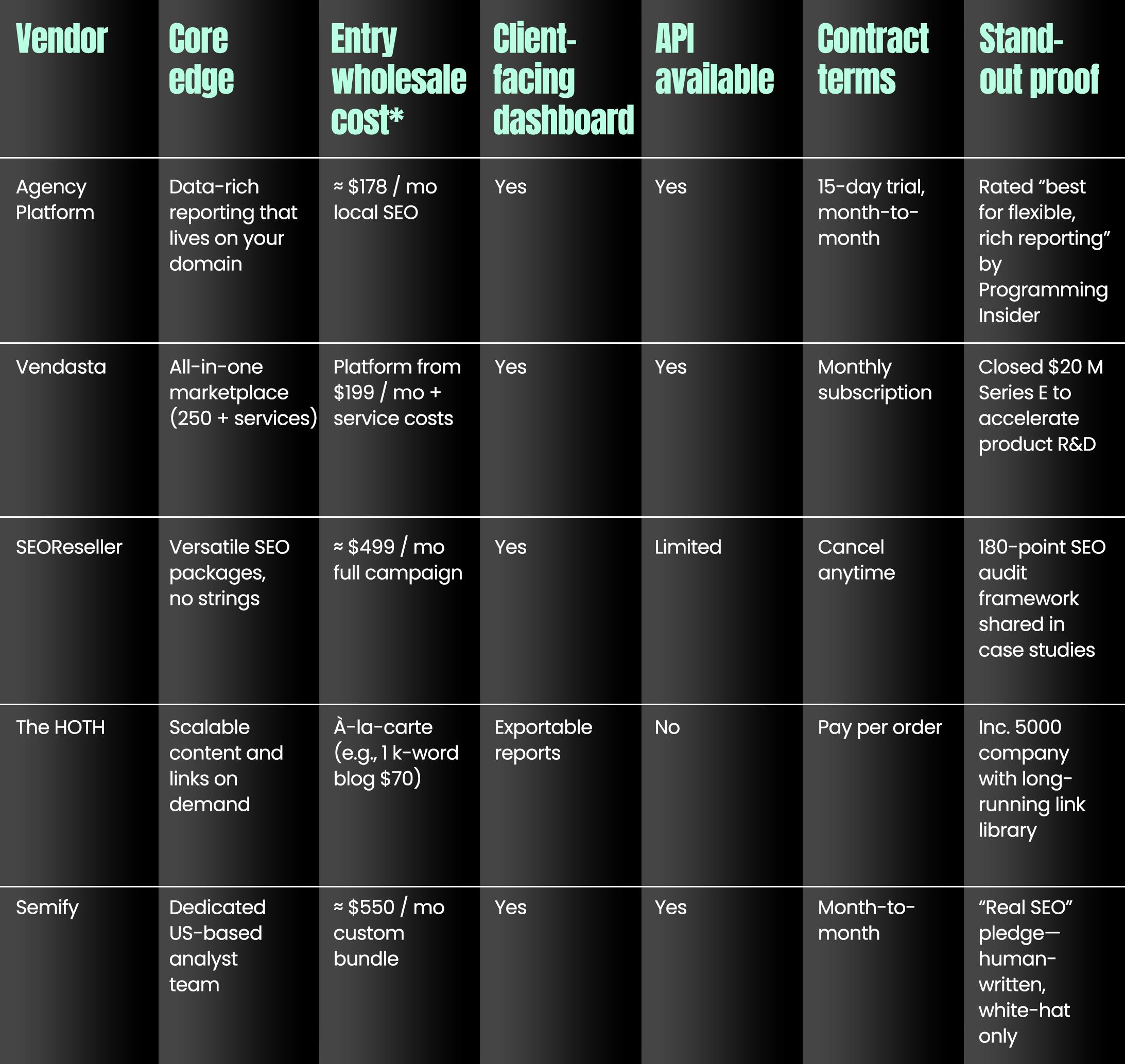
*Published prices current to Q1 2026; volume discounts or regional taxes may apply.
AgencyPlatform: best for flexible, data-rich reporting
Trusted by more than 1 200 agencies and proven across 150 000+ campaigns, AgencyPlatform’s SEO reseller program serves as mission control for every campaign you run. You log in, a fully branded dashboard greets you with live rankings, traffic trends, and lead tracking. More important, your clients can log in on your domain, so they see wins in real time without spotting the partner behind the curtain.
Programming Insider’s 2026 comparison called AgencyPlatform “best for flexible, data-rich reporting.”
The platform threads Google Analytics, Search Console, and call-tracking data into one view, then triggers anomaly alerts whenever a metric spikes or dips. You spend less time stitching spreadsheets and more time steering strategy.
Scale is baked in. Veteran agencies pull raw data into proprietary BI dashboards through the API, while smaller teams rely on the default reports. Either way, you can light up a new client workspace in minutes, handy when sales lands a 30-location chain on Friday and fulfillment must start Monday.


Pricing stays clear. A local SEO package starts near $178 per month wholesale, plus a modest platform fee that unlocks volume discounts. You can cancel any time, and a 15-day free trial lets you test the workflow before bringing clients aboard.
In short, choose AgencyPlatform if reporting is your competitive edge and you never want to scramble for proof of ROI. It turns raw SEO work into glossy, clientready narratives that help you retain big accounts and justify healthy mark-ups.
Vendasta: best end-to-end platform for agencies that sell everything
If your growth plan is to own the entire digital stack, Vendasta belongs on your shortlist. The Saskatchewanbased SaaS company gives agencies a white-label operating system: CRM, billing, marketing automation, and a marketplace of more than 250 resellable products, including SEO, listings, reputation, and productivity apps.
It matters because upselling becomes far simpler. Instead of juggling multiple vendor contracts, agencies can add services from one portal while keeping their own branding front and center. A client may need local SEO now, social ads later, and review tools after that; Vendasta lets you switch wholesale services without changing systems or delivery workflows.
Vendasta’s scale is substantial, supporting more than 200,000 SMB clients and generating over $100 million in annual revenue. A $20 million Series E in late 2023 helped accelerate product growth, including AIgenerated executive reports. Pricing starts with a platform subscription near $199 per month, plus wholesale service fees. For agencies selling a full marketing suite, its breadth and scalability can outweigh the added complexity.
SEOReseller: best for versatile SEO packages with no contracts
Some agencies treat SEO like an à la carte menu. One client
needs a quick citation cleanup, another wants an all-out push on a tough keyword set, and a third only cares about technical fixes. SEOReseller leans into that flexibility.
The company built its reputation on modular, monthto-month services. Agencies can order a one-time site audit, a small guest-post bundle, or a broader Bronze campaign that combines content, on-page work, and authority links for $499 per month. If a client pauses spend, service pauses too, with no early-termination fees.
Its depth shows in the details. Each recurring campaign begins with a 180-point audit covering technical issues, content gaps, and backlink risk. That creates a tailored roadmap, making SEOReseller a strong fit for agencies needing flexible, plug-and-play scale.
The HOTH: best for rapid-fire content and authority links Need 30 guest posts, 50 citations, and a month of blog articles yesterday? The HOTH turns that rush into a simple shopping-cart checkout.
The Florida company productised SEO early. Log in, choose a DA-30 guest post for about $100 or a 1 000word blog article for roughly $70, and track progress from “writing” to “published.” No minimum spend and no waitlist, ideal when client demands spike without warning.
Quality control is tight. Human writers draft every piece, editors run plagiarism and readability checks, and campaign managers approve final work. This assembly-line discipline lets you scale volume without losing coherence, a safeguard when Google’s Helpful Content update punishes filler.
Speed trades away customization. Packages are solid but standard, so intricate technical fixes or niche schema projects fall outside scope. If your agency owns strategy and needs a reliable production engine, the HOTH is a fit. If you require bespoke audits or one-off experiments, look elsewhere.
Bottom line: when deadlines loom and volume rules, the HOTH ships industrial-grade SEO parts on time and on budget.
Semify: best for hands-on partnership with a U.S.based team
Every agency has that marquee client who expects custom strategy slides, same-day answers, and copy that sounds like their in-house voice. Semify was built for that relationship.
Semify keeps its writing, editing, and account-management teams in the United States, giving agencies stronger language nuance, faster communication, and consistent weekly contact with the same analyst and project manager. That continuity builds trust internally and with clients, especially in silent-brand meetings.
Wholesale packages start around $550 per month and scale with campaign goals, all on flexible month-tomonth terms. A private-label dashboard gives realtime visibility into tasks, drafts, technical fixes, and outreach. Semify favors quality over sudden volume, so it may limit large spikes in orders. For agencies wanting attentive service, strong content, and reseller-scale support, it offers a boutique-style experience.
Conclusion
In the end, the best SEO reseller program depends on how your agency plans to grow. If reporting and clientfacing dashboards are your edge, AgencyPlatform stands out. If you want a full white-label ecosystem that goes beyond SEO, Vendasta offers the broadest platform. For flexible, contract-free campaigns, SEOReseller gives agencies room to adapt. The HOTH is ideal when speed and fulfillment volume matter most, while Semify is the strongest choice for agencies that value close collaboration and U.S.-based support. The common thread is clear: the right partner should strengthen your margins, protect your reputation, and help you scale without sacrificing quality. Choose the reseller that best matches your service model, and it can become a true extension of your agency’s growth engine.

For ages, uniforms have represented discipline, identity, and belonging. Coordinated apparel has long been woven into the fabric of military organizations, professional sports teams, and modern corporations to drive efficiency. In today’s business world, where organizational culture and employee engagement are paramount, team uniforms have evolved beyond mere dress codes into visual representations of unity and common purpose.
Behavioral research establishes a strong connection between clothing and psychology, showing that attire shapes confidence, cooperation, and performance. In sports, uniforms are the apex of shared identity, a practice now embraced by hospitality, retail, healthcare, and logistics. As organizations seek ways to perfect collaboration, uniforms remain a powerful yet often overlooked influence on group dynamics.
Social Identity Theory posits that individuals define themselves through groups. Visual symbolism, such as uniforms, strengthens this sense of belonging whether in a sports team or a corporate department. As clear symbols of collective identity, uniforms help employees align with group goals, combating isolation while promoting shared accountability.
This principle has been a pillar of sports for decades, where team colors and logos evoke emotional connections. Businesses now adopt this through branded apparel at corporate functions and retail activities. Research shows that employees attached to their workplace identity are more engaged, with visual consistency reinforcing the message that the team is working toward a single goal.
Uniforms foster equality, developing group cohesion by minimizing individual differences in favor of collective performance. In sports, wearing the same jersey reinforces the idea that success comes from working together.
Customer-facing industries like airlines and hotels use uniforms to both brand the company and encourage consistent teamwork among staff.
Modern custom apparel has merged identity with functional clothing. Beyond athletic competitions, schools and corporations use custom gear to boost camaraderie and professionalism. In the US, USportsGear has noted this growing trend. Coordinated appearance enhances trust and communication, which is vital during highstakes business or sporting events.
The theory of enclothed cognition suggests that clothing significantly impacts mental processes and confidence. Uniforms help individuals adopt professional or athletic roles, with athletes correlating them with preparedness.
Similarly, standardized attire fosters a professional image and “aesthetic authenticity,” instilling a greater sense of duty to meet expectations and boosting confidence during public interactions.
Uniforms aid in workplace discipline and operational consistency, especially in healthcare, aviation, and logistics. Standardized clothing creates an environment where decorum is expected, reminding employees they represent a larger organization. This positively affects punctuality, communication, and customer interactions.

Sports teams use uniforms to reinforce commitment to team rules and mental readiness. Despite the rise of casual workplace culture, organizations still invest in branded apparel for events and team-building to maintain a visual link to their mission even in flexible environments.
Uniforms are a potent branding tool, helping companies develop strong public personalities while reinforcing internal culture. Matching attire makes organizations appear more structured and reliable. Advances in digital printing and sublimation have enabled highly customized, durable designs at scale, making branded teamwear more accessible than ever.
Modern uniforms focus on performance, breathability, and mobility. With moisture-wicking fabrics and sophisticated printing, sportswear manufacturers have revolutionized teamwear to provide comfort while maintaining strong branding. Online tools allow teams and businesses to design custom apparel without high minimum orders, reflecting a global trend toward identity-based flexibility.


While effective, uniforms must be inclusive, culturally sensitive, and comfortable. Organizations must balance standardization with practicality, as poorly designed clothing can negatively impact morale. Thoughtful design, however, contributes significantly to employee satisfaction and productivity.
Team uniforms are much more than mere coordinated attire. They shape identity, confidence, discipline, and group performance in both athletic and business contexts. Uniforms still play an important psychological and cultural role in the modern organization from fostering collaboration to reinforcing organizational branding.
With a greater focus on teamwork and culture being put by workplaces, the impact of coordinated apparel is going to increase further. Whether on a baseball field or in a corporate environment, visual unity is still one of the most powerful ways to enhance connection, accountability and group performance.


Representational image
To identify the best AI for coding, we evaluate task completion, refactoring, test generation, debugging, security, privacy, and cost.
1. Cursor
Cursor represents a shift toward AI-native development environments that combine chat, editing, and project context.
Instead of isolated suggestions, it enables coordinated changes across files. This is important when AI needs to understand and work with many files at once.
It offers smart completions, answers questions about the code, and helps solve problems step by step.
It supports large project-wide changes, suggesting edits, tests, and consistent structure.
This helps teams move faster with testing, refactoring, and onboarding.
Its strength is coordinated changes across the codebase.
But there are rules to follow. Make sure you can use the code legally, keep secrets safe, and always check the code for quality.
2. JetBrains
JetBrains AI accelerates development through deep project understanding. It uses years of work in semantic indexing and code analysis. This helps IDEs know what the code is about, what it depends on, and what risks it has. It’s how real software is kept up to date.
IntelliJ IDEA AI focuses on simplifying development. It suggests code completions and navigation. It can even translate what you say into code changes.
This is critical in large systems where small changes can affect multiple components.
JetBrains AI is valued for its reliability. It helps keep systems simple and easy to understand. This is important when you’re working on big projects.
In PyCharm AI, it helps Python teams work faster. It keeps them focused on their tasks while making coding easier.
3. Qodo
Qodo focuses on preventing mistakes rather than simply accelerating typing. It’s about sticking to review discipline.
Qodo’s AI code review aims to speed up feedback while keeping quality high. It detects risky patterns, highlights edge cases, and suggests best practices. This improves code quality without slowing review workflows.

Qodo shines in test generation, focusing on meaningful coverage, not just passing tests. It promotes tests that reflect real-world scenarios, including inputs, boundaries, and failure modes.
Qodo helps maintain consistency in regulated environments. It’s perfect for Norway-based companies that need to balance compliance, teamwork, and reliable delivery. Here, secure coding is not just a goal but a must.
AI outputs should always be reviewed. Engineers must always check and double-check their work. They need to be humble, knowing that even confident suggestions can be incomplete or incorrect.
4. Tabnine
Tabnine prioritizes governance and control. It fits well in Norway’s regulated sectors.
Tabnine speeds up coding in common IDEs. It supports many languages. It promotes consistent, readable code.
It’s known for keeping sensitive data safe. This is key to secure coding practices. It acts like a governed system,


not an experiment. Platform teams value Tabnine. They can use it to improve coding safely. It integrates with enterprise policies.
5. Gemini Code AI
Gemini Code AI is on a path to improve how we work with code. It helps teams in Norway who use Google Workspace by making coding easier. This makes it feel like a natural part of their work, not just an extra tool.
Gemini excels when messy text needs to become clear code. It can turn a rough idea into working code, suggest patterns for APIs, and even write unit tests. It preserves intent while suggesting improved code structures.
Big companies look at how well the AI fits into their systems, who can use it, and how it follows their rules. This is important for keeping everything in check and making sure the AI works well with their security.
It’s also important to be careful with AI’s suggestions. Even the best AI can make mistakes. So, teams need to check and test the code carefully. This way, the AI helps, but doesn’t replace human judgment.
Representational image

The best AI coding assistant depends on your team’s workflow. In Norway, teams often face tight deadlines and strict rules. They need to pick an AI that fits their workflow, whether it’s focused on the editor or on Git.
Start by identifying your biggest bottlenecks. This could be switching between tasks, a long review list, security concerns, or slow learning.
• Cursor is great for teams that want to work quickly inside the editor. It keeps the workflow moving fast. JetBrains is perfect for teams that value deep editor knowledge and consistent work habits.
• Qodo is ideal for teams struggling with review quality. It helps improve the quality of tests and reviews, which is key for growing teams.
• For teams focused on governance, Tabnine is a good choice. It supports large-scale AI use without ignoring policy. Gemini Code AI is great for teams already using Google tools, as it fits well with their setup.
• GitHub Copilot is a popular choice for many teams. It works well with common projects and tools, making it easy to use. It’s a good default AI coding assistant for many teams.
• Aider focuses on transparent, auditable code changes.
It makes it easy to review and audit changes, which is important for accountability. Remember, the AI should be a partner, not a replacement for human judgment.
When choosing an AI coding assistant, measure its impact on your team. Look at lead time, defect rates, and review efficiency. Adjust settings like secret scanning and access controls as needed. The best AI is one that works with humans, not against them.
By 2026, AI coding assistants have evolved beyond autocomplete into strategic development partners. Their true strength lies in reducing barriers in the review process, expanding test coverage, and ensuring compliance with strict standards. For teams under pressure, these tools accelerate delivery while maintaining quality, making development more transparent and secure.
These tools enhance developer creativity rather than replace it. Developers who participate in the AI Engineer program will gain the skills to leverage these tools responsibly and strategically. Combining technical expertise with governance ensures AI remains a trusted partner in building software that is faster, safer, and smarter.





As the world shifts from buying things to collecting moments, there are roughly 4 million travelers crossing borders every day. Today’s tourism industry thrives on memories rather than material goods. Every flight and hotel stay is a high-value investment in oneself. But why is this? Why does a passport stamp seem to carry more weight than a new car in the driveway these days?
Consumers are no longer waiting for a distant retirement to see the world. Many are instead choosing to prioritize immediate exploration. If industry data is anything to go by, 74% of Millennials and Gen Z travelers now view travel as a non-negotiable expense in their annual household budgets. Such a shift shows one thing: the desire for connection and adventure is resilient against fluctuating global economic conditions.
Modern tourism focuses on the depth of the encounter rather than the number of locations visited in a single week. Travelers are seeking out culinary heritage and immersing themselves in new cultures. Many are after wellness retreats that offer a genuine break from the digital noise of daily life.
• Several distinct factors drive this evolution:
• Travelers want to participate in local traditions rather than just observing them from a distance
• Environmental awareness is pushing more people toward slow travel and sustainable transit options
• Multi-generational trips are becoming the standard way for families to reconnect after years apart
The shift toward global exploration is no longer reserved for those with years of accumulated savings. Modern financial flexibility has democratized the travel industry, allowing a broader demographic to capitalize on limitedtime offers and seasonal windows that would otherwise pass them by. This movement relies on the ability to bridge the gap between a travel opportunity and the available liquid capital.
Managing the costs of these essential trips requires careful planning and modern financial tools. Many travelers choose to get vacation loans from Republic Finance to keep their savings intact while securing early bird rates on international flights. When consumers have immediate access to dedicated travel capital, they can lock in lower prices for high demand seasons.
the journey, debt stays manageable, freedom increases.
The financial scale of this movement is staggering, with spending reaching heights that many analysts previously thought impossible. International tourism receipts reached an estimated $1.9 trillion in 2025 and continue to climb as new markets open. With this influx of capital, millions of jobs are supported.
It also revitalizes rural communities that rely on seasonal visitors. Corporate travelers are extending their stays to explore the cultural fabric of their host cities, blending work with personal discovery. Those planning a business trip get to experience these benefits as professional travel and leisure increasingly overlap.
Spending money on a trip provides a long-term happiness boost that a physical product simply cannot replicate. The anticipation of a flight and the memories shared afterward create a cycle of positive reinforcement. As long as people value stories over objects, the business of travel will remain the cornerstone of the global economy. Invest in memories, stress starts fading, life feels richer.
The travel landscape is constantly changing. As new destinations emerge and tech makes the world feel smaller, staying on top of the trends helps you make better decisions for your next great adventure.
And for travel agencies, staying on top of new experiences significantly improves the bottom-line. Check out the blog for more insightful topics on business, finance, tech, and travel.
Representational image


The credit card industry in 2026 is no longer just about plastic and interest rates. It is a high-speed data ecosystem where real-time underwriting, AI-driven fraud prevention, and the convergence of flexible lending models like BNPL are redefining how we move money. There are 2.8 billion credit card accounts used globally as the transition from physical wallets to digital-first stacks accelerates.
This shift means that the barriers to entry for those with limited credit history are finally dissolving through open banking. Whether you are an institution looking to retain deposits or a consumer trying to navigate a high-rate environment, understanding these nine shifts is the only way to stay ahead of the curve.
The rise of the “thin file” consumer has created a massive market for specialized entry-level products. Unlike the predatory secured cards of the past, today’s creditbuilder options focus on path-to-graduation models that reward consistent behavior with higher limits and lower rates.
For many individuals, the most effective way to establish a footprint is to request a credit card from 118 Money to access a manageable line of credit designed for

those looking to improve their standing. These cards often serve as the bridge between having no financial identity and accessing traditional mortgage or auto loan products.
The modern credit-builder landscape relies on three primary pillars of support:
• Automated reporting to all major credit bureaus
• Educational tools integrated directly into the mobile app interface
• No-interest buffers for small accidental overages
The line between Buy Now, Pay Later (BNPL) and traditional credit cards has vanished. We are seeing “Installments at the Point of Sale” become a standard feature on nearly every major card network. You no longer need a separate third-party app to split a purchase; your existing credit card now offers a toggle switch to convert any transaction over a certain amount into a fixed-fee loan.
This trend is largely driven by the EU Consumer Credit Directive (CCD II), which has brought BNPL under the same regulatory umbrella as traditional credit. This ensures that affordability checks are just as rigorous for a fourpayment split as they are for a standard revolving balance.

In the corporate world, the physical company card is becoming a security liability. Businesses are migrating toward virtual card stacks for every department, vendor, and recurring software subscription. These single-use or merchant-locked numbers provide a level of control that traditional accounts simply cannot match.
Because these cards are digital-native, they integrate directly with accounting software. This allows virtual cards to reduce payment cycle times by 80% through zero-touch automation, meaning finance teams no longer have to chase down receipts or manually reconcile spreadsheets at the end of the month.
Security is moving away from the “vault” model and toward the “token” model. Every time you save a card to a merchant site or a mobile wallet, it is replaced by a unique digital token. If a hacker breaches the merchant’s database, they find useless strings of code rather than your actual card details.
The adoption of “Click-to-Pay” is the primary engine behind this growth. Estimates suggest that global tokenized payment transactions will exceed 1 trillion by the end of 2026. This technology creates a frictionless checkout experience where you can pay securely across any device without ever typing in a sixteen-digit number.
Fraudsters are now using deepfakes and generative AI to bypass traditional security questions. In response, banks have pivoted to behavioral biometrics. This technology monitors how you hold your phone, the pressure of your thumb on the screen, and even your typing cadence to verify your identity.
It is a silent layer of security that works in the background. As synthetic identity fraud losses hit $40 billion annually, these invisible markers have become the most reliable way to distinguish a human user from an automated bot or a sophisticated impersonator.
AI can also help prevent fraud, although the risks posed by the tech should not be underestimated. More research and precautions are required.
Most people are suffering from subscription fatigue. Between streaming services, gym memberships, and software-as-a-service, it is easy to lose track of where the money is going. Card issuers have responded by building “command centers” directly into their banking apps.
These tools allow you to see every recurring charge in one list and, more importantly, cancel them with a single tap. Over 70% of consumers want subscriptions bundled through their financial provider to simplify their monthly outgoings. This turns the credit card app into a central financial hub rather than just a place to view a statement.

The common thread across all these trends is the demand for more control and higher transparency. The days of opaque credit decisions and “set it and forget it” security are over. For the consumer, this means more power to build credit and protect their identity. For the merchant and the bank, it means a race to provide the most seamless, data-rich experience possible.
As you look at your own wallet, consider whether your current card is actually working for you or just sitting there. Staying informed on these shifts ensures you aren’t paying for yesterday’s technology with today’s money. To learn more about the trends and market forces altering consumer behavior right now, read more of the insightful posts on our site.




Are you ready for a better blueprint to attract customers and build your business? Thanks to AI-fueled tools, companies at any level can deploy better Go-tomarket (GTM) strategies. Rather than investing hours into manual processes and making educated guesses, you can use the latest GTM tools to arrive at smarter business decisions.
The best GTM tools can connect the dots among internal teams and processes in your company. Stay with us as we look at how intelligent platforms are redefining GTM strategy.
Historically, a company’s internal teams operated as independent entities throughout the customer journey. Marketing campaigns would fall under one department, for instance, while sales teams would reach out to potential customers. Once a customer had signed a contract, customer success teams would work on upselling and contract renewals.
With the advent of AI, however, data from lots of sources can be pulled together. And rather than taking a compartmentalized approach to understanding customers, teams can collaborate. Robust AI GTM tools can cull information from emails, social media, and internal software that looks at customer engagement.
As a result, companies can be more data-driven in their approach to large-scale strategies and make even smaller adjustments to marketing campaigns. Today’s GTM enables companies to be smarter and learn from the customer information they collect.
Today’s GTM tools can look more specifically at how customers behave online and where they click. For companies, it’s possible to access more targeted insights that can inform business decisions.
AI tools can pinpoint which customers might provide the best chance of moving forward with a purchase. Tools can see when customers review emails or product
pages online. Through a process called lead scoring, the most promising customers will be flagged so sales teams can fine-tune their sales pitches.
With the help of AI, companies can assign customers to more detailed categories, or segments, to help with marketing plans. If a customer is actively looking for a particular type of software, for instance, they can be placed in a category with similar types of customers. With access to extra details, companies can send these potential customers more focused and relevant messages that could lead to a contract.

AI-powered GTM tools also help businesses automate more processes. In many situations, companies want to time their outreach carefully. AI tools can generate and send targeted emails at precisely the right moment.
Automation also includes tools like chatbots. Chatbots can tackle customer questions and arrange meetings throughout the day, saving companies from needing to assign team members to these tasks. Consequently, teams can focus their work on key meetings and projects that enhance their business prospects.
AI GTM tools can enhance your business strategies. The right tools can collect data from multiple channels, offer precise insights, and automate internal processes. You’ll be able to save time and arrive at more targeted marketing communication.
When you have AI GTM tools at your fingertips, you can drive your business forward.


Specialized surgery services are changing the way patients receive care across the globe. Hospitals are moving away from general models to focus on specific medical fields.
This shift helps facilities provide better results as they manage their resources more effectively. Focusing on niche areas allows surgeons to perfect their skills in complex operations. These changes are a major factor in the steady growth of the medical industry today.
Patient demand is a huge driver for the growth of specialized surgery centers across the nation. People now look for surgeons who have deep experience in one area rather than a wide range of skills.
Clinics are responding to this need by investing in tools for targeted operations. These investments allow for more precise work and shorter recovery times for

everyone involved. The result is a system where patients get the exact help they need without long wait times or extra visits.
Medical facilities that focus on specific procedures often see higher profit margins. By streamlining their services, they can reduce waste and focus their budget on the best staff.
Healthcare providers now focus on niche treatments to improve the lives of their patients. We see a rising number of women getting Uterine fibroids treatment in specialized centers since these procedures are now less invasive. This shift allows patients to return to their daily lives much faster than before.
Treating common health issues with specialized tools reduces the risk of long-term problems. Patients feel more confident when they know their doctor performs the same procedure every day.

The rise of these clinics provides patients with more choices for their medical care. Instead of relying on a single large hospital, people can find experts for their specific health needs.
Specialized centers lead the way in using new ways to perform surgery with tiny incisions. One recent study found that the use of laparoscopic methods grew from 45.1 to 75.5 percent and led to a 3.51-day reduction in the average time spent in a hospital bed.
Patients experience less pain and faster recovery compared to traditional open procedures.
These benefits allow individuals to return to their normal daily routines much sooner. Hospitals can improve efficiency by freeing up beds more quickly for other kinds of patients. Minimally invasive techniques improve both patient outcomes and healthcare system performance.
Technology plays a massive role in how specialized surgery drives growth in the medical field. A recent article mentioned that AI-assisted robotic tools led to a 25 percent reduction in operative time and a 30 percent decrease in complications.
These tools are becoming more common in top-tier clinics that invest over $2,000,000 in new hardware.
These systems allow surgeons to perform complex procedures with greater accuracy and control. Improved visualization and steady instrument movement reduce the margin for human error. Patients often benefit from shorter hospital stays and quicker recovery times.
As adoption grows, training programs are evolving to help medical professionals use this technology effectively.
Even with the best tech, specialized centers must keep a close eye on patient safety, recovery, and expenses.
One report on hip fracture surgery noted that surgical site infections happened in only 0.4 percent of patients, but created high costs for the system. Preventing issues after a procedure is a major focus for high-performing surgical teams.

The trend toward specialized surgery shows no signs of slowing down in the coming years. Facilities will likely keep investing in niche markets to stay competitive and provide top-tier help. This focus helps the industry expand and keeps the patient at the center of every choice.
Several factors contribute to the ongoing growth of this medical sector:
• Increased investment in specialized training for surgeons
• Faster adoption of new surgical tools and AI software
• Higher patient satisfaction rates from better recovery times
• Lower general costs for insurance companies and hospital networks
Specialized care is not just about the surgery but the whole experience for the patient. As more centers adopt these models, the quality of care will rise for everyone, a true win for the healthcare industry.
This shift leads to shorter hospital stays and fewer complications for patients. As the medical world continues to evolve, the move toward specialization will remain a key part of how we deliver health services. The future looks bright for patients who need targeted care.
Walk down a Seattle block today and you’ll spot warm wood where gray concrete once ruled. Washington already hosts more than fifty mass-timber buildings in design or in use. Engineered wood slashes embodied carbon, secures local forestry jobs, and arrives as precision-milled kits that compress schedules. Great— but who can deliver at commercial scale?
This guide answers that question. After weeks sifting through permits, project databases, and press releases, we ranked five firms—from boutique framers to national

GCs—on depth of work, footprint capacity, innovation, and published sustainability data. Scan the quickcompare table, then meet each team in candid, sourcelinked profiles.
Ready to raise the beam? Let’s dive in.
At-a-glance: how the top five compare
Before we explore each builder’s story, see them side by side in the grid below. Keep it handy as we move through the profiles; you’ll know exactly who excels where as soon as a project lands on your desk.
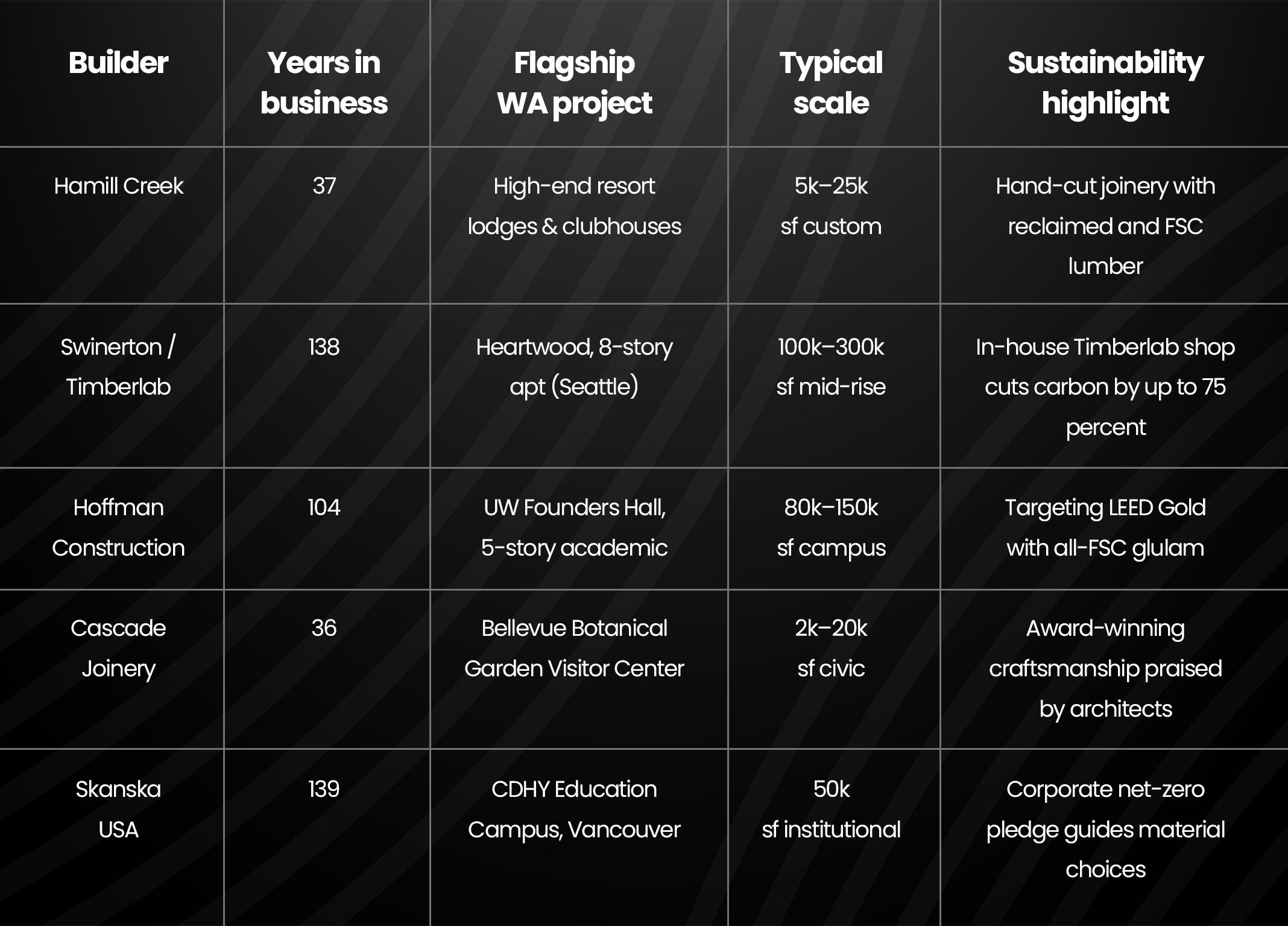



Consider it your quick reference. If a brief calls for boutique artistry, Hamill Creek or Cascade stand out. Need the horsepower for an eight-story lab? Call Swinerton. Looking for rigorous safety on a public school? Skanska fits the bill.
Keep this snapshot close, and we’ll refer to it as we go.
1. Hamill Creek Timber Homes – master craft, boutique service
Walk into a Hamill Creek raising and you feel the buzz of a century-old barn event, yet power tools hum with twenty-first-century precision. Founded in 1989, this British Columbia shop has spent more than three decades shipping bespoke heavy-timber packages across the border and into all eleven of Washington’s distinct climate regions, a record the company details for anyone comparing Washington timber frame builders.
What sets Hamill Creek apart is singular focus: they build timber, period. Every beam is cut, test-fit, and labeled
in their yard before the trucks roll. That preparation shrinks onsite chaos, keeps moisture out of the wood, and rewards owners chasing long-term durability.
Developers prize the firm’s dual personality. You get old-world mortise-and-tenon joinery that draws resort guests to look up, plus a design crew that models every joint in 3-D and exports CNC files straight into an architect’s BIM workflow. The result is less guesswork, fewer RFIs, and smoother schedules.
Recent Washington projects prove the range. A 20,000-square-foot clubhouse in Chelan pairs soaring king-post trusses with modern glass walls, wine barrels below, and cross-laminated terraces above. A boutique lodge near Winthrop shows the flip side: snug queenpost frames milled from reclaimed Douglas fir, erected in five crisp days despite snow on the ground.
Hamill Creek excels when aesthetics lead. If your brief depends on warm timber as the brand statement—
whether a tasting room, wellness retreat, or corporate off-site—this crew delivers showpiece quality without blowing contingency. They coordinate engineering, ship a kit that clicks together like giant Lego, and leave you with a structure guests photograph before they check in.
Representational image

Choose Hamill Creek when you need artisan timber that installs at modern-GC speed. Your Instagram feed, and your pro-forma, will thank you.
2. Swinerton + Timberlab – scaling timber to mid-rise heights
Ask any architect aiming for taller wood buildings and one name surfaces fast: Swinerton. The 138-year-old contractor couples traditional GC muscle with Timberlab, its in-house specialty arm that engineers, fabricates, and CNC-cuts mass-timber elements before the first panel leaves the mill.
That vertical control paid off on Seattle’s eight-story Heartwood apartments, where crews craned factoryfinished columns and floor plates into place, shaving weeks off the schedule and sidestepping downtown noise curfews. Residents now live in the city’s tallest engineered-wood structure, proof that timber works on both cost and carbon.
The math improves further at Northlake Commons, a 270,000-square-foot life-science hub on Lake Union. Swinerton estimates the timber frame avoids roughly 1,990 metric tons of CO2 compared with concrete, equal to parking 558 cars for a year.
Because Timberlab sits under the same corporate umbrella, one contract covers design-assist, shop drawings, procurement, and erection. That single throat to choke keeps lenders calm and change orders low.
Call Swinerton when speed and height intersect—a biotech lab of eight floors or a zero-carbon office that still needs a rooftop deck above setbacks. You will pay full GC rates, but you gain a library of lessons from dozens of mass-timber jobs nationwide, a playbook worth its weight in wood.
3. Hoffman Construction – campus-scale precision, university tested
If Swinerton proves timber can rise tall, Hoffman shows it can run a marathon. The employee-owned contractor has spent more than a century turning complex public work into opening-day reality, and its mass-timber playbook follows the same pattern: meticulous preplanning, self-performed structure, and no drama at hand-off.
The standout is Founders Hall, an 85,500-square-foot addition to the University of Washington’s Foster School of Business. Glulam columns and cross-laminated floor panels meet the school’s LEED Gold target, a tough mark when acoustics, daylighting, and tight logistics all converge. Hoffman led the integrated design-build team, coordinating LMN Architects, DCI Engineers, and WoodWorks advisers to weave timber through an active quad without disrupting student life.
Self-perform crews are the secret weapon. Hoffman places the glulam, installs the connections, and solves problems on the spot instead of waiting for a specialty sub. That control trims days off each floor cycle and lets the team fine-tune moisture protection and firestopping details during a rainy Seattle winter.
Beyond academia, Hoffman has installed mass-timber elements in civic and cultural projects from the Portland International Airport wood roof to the feature stair at WSU Everett. Each job feeds a growing knowledge bank that new clients tap on day one.

Choose Hoffman when your brief reads like a campus planner’s wish list: hundreds of occupants, ambitious energy goals, and stakeholders watching every inch. The team will map the entire timber sequence in four dimensions, lock the budget early, and deliver a building that students, donors, and code officials treat as the new normal.
4. Cascade Joinery – boutique artistry for civic charm and bespoke retreats
Cascade Joinery does not chase sky-high floor counts. Instead, the Bellingham crew focuses on timber structures that feel handcrafted and deeply rooted in place. Architects call when a civic pavilion or visitor center must look as if it sprouted from the forest floor yet stand up to Pacific Northwest storms for decades.
The origin story explains the ethic. Co-founder Craig Aument began carving mortises in a dairy barn more than thirty-five years ago, driven by a love of traditional craft. That DNA runs through every project, from the light-filled Bellevue Botanical Garden Visitor Center to a cedar-scented community hall in the San Juan Islands. Because Cascade provides design consulting, shop fabrication, and field erection, owners enjoy a single, detail-obsessed partner from sketch to ribbon cutting.
Ask architects why they return and you will hear the same praise: “They deliver across the spectrum, contemporary
to rustic, always protecting the design vision.” Cascade refines connection details, adjusts beam proportions, and tests stain samples until the wood sings with glass, steel, and landscape.
For developers, the value is clarity. Budgets stay lean because joinery arrives test-fitted and labeled, cutting crane hours and surprises. Schedules hold because a compact, cross-trained crew needs fewer site mobilizations. Most important, guests photograph and share the finished space, an organic marketing lift no concrete box can match.
If your brief starts with “make it unforgettable” instead of “stack it higher,” Cascade Joinery is the partner to call.
5. Skanska – global horsepower, local carbon conscience Skanska refined its craft on Scandinavian timber towers, so arriving in Washington felt more like a homecoming than a pivot. The Seattle office channels that Nordic experience into projects that pair big-firm rigor with a clear climate mission: every team tracks embodied carbon from day one, hunting for reductions the way others chase cost savings.
Consider the new campus for the Center for Deaf and Hard of Hearing Youth in Vancouver. An academic building and a physical education facility, together about fifty thousand square feet, rise from glulam

columns, CLT decks, and daylight-rich facades. Delivered with architect Mithun, the design-build scheme finished under budget, opened before the 2024 fall term, and now serves as a case study in how mass timber can humanize institutional space without sacrificing durability.
Scale is never a problem. Across the region Skanska is leading timber option studies for civic halls, healthcare wings, and a rumored mid-rise office that could push Washington codes again. Owners gain depth of bench: sustainability specialists, supply-chain analysts, and seasoned supers all sit under one roof, aligning carbon goals and safety plans long before procurement.
If the boardroom questions whether timber is resilient or just marketing varnish, Skanska brings data, peer-
reviewed models, and an executive-level ESG roadmap. When the project shifts from spreadsheet to jobsite, the same team fastens panels, monitors moisture, and guides inspectors through unfamiliar yet codecompliant territory.
Hire Skanska when you need the certainty of a Fortune 500 balance sheet and the energy of a climate-driven start-up. The team pours both into every Douglas-fir column it sets.
From boutique artistry to Fortune-500 horsepower, Washington’s mass-timber market offers a proven partner for every scale and brief. Keep this guide close when the next timber project hits your desk, and choose the team whose strengths align with your vision.


The current digital society, characterized by rapidity, makes streaming and downloading of video tasks a daily routine. Users want to view the newest music videos and get educational tutorials without waiting, which is why they want to use the Internet fast and without delay. However, one thing disrupts this experience: intrusive advertisements. Pop-ups, banner advertisements, and redirects interrupt downloads and decrease enjoyment. This has resulted in frustration, which has led to a need for solutions that are both convenient and functional.
This ushers in VidMateLite, a lightweight application that appeals to users looking to download videos without distractions. In contrast to traditional apps full of advertisements, VidMateLite preserves the strong functionality of the parent platform of VidMate without disturbances. To professionals, students, and casual viewers, a bare-bones method guarantees access to favorite videos in a fast and smooth process. Concentrating on an advertisement-free experience, VidMateLite addresses one of the most irritating problems of digital media today.
VidMateLite has an ad-free interface that is one of its best features. Users will no longer be navigated through several pop-ups and unexpected redirects that halt downloads. This continuous environment boosts productivity and makes the downloading process faster and easier. When time is minimal in the work environment, a stable tool that works without interruptions is priceless. There are no intrusive advertisements, minimizing the chance of accidental clicks, which reduces the risk of malicious software or phishing attacks prevalent in ad-heavy apps.
The no ads VidMate experience positions VidMateLite as a top choice for efficiency and safety. It makes sure the focus is on the consumption of content instead of handling interruptions. Streamlining the user experience, this tool establishes a new level of convenience in downloading videos, serving as evidence that high functionality and user-friendly design can coexist harmoniously.
Although it is a big plus, the absence of ads does not have an adverse impact on VidMateLite. All the usual VidMate functions are available to users, such as rapid downloading, support for different formats, and the option to store videos in local drives. The simplicity of this system of retro tools and a contemporary, distractionfree interface is attractive to both long-term users and beginners.
VidMateLite also allows high-definition downloads, maintaining video quality. For content creators, teachers, and media lovers, this feature ensures that downloaded videos meet professional standards. By combining trustworthiness and novelty, VidMateLite turns an ordinary digital activity into a more relaxing, enjoyable one.
Another area where VidMateLite excels is performance. The streamlined interface allows the app to run on minimal system resources, improving download speed and reducing device strain. Mobile users benefit from better battery life and smoother multitasking. The lightweight design ensures compatibility across devices without affecting functionality, important in workplaces where efficiency is key.


The app’s stability reduces download failures and crashes. VidMateLite increases user satisfaction and confidence by addressing performance issues common in ad-heavy alternatives. Its prowess, performance, and convenience make it a pioneer among ad-free digital media platforms.
As user expectations evolve, the demand for clean, efficient, and safe apps has never been higher. VidMateLite is a direct response with a product aligned with current digital consumption trends. Its distractionfree, no-advertisement policy reflects a broader movement toward user-focused software solutions in media and technology.
The app’s intuitive nature ensures it is user-friendly for both technical and non-technical users. VidMateLite exemplifies how digital tools can address current needs without complexity.


In this age of digital content, smooth accessibility is essential. VidMateLite is a convenient, user-friendly application that removes one of the largest inconveniences in video downloads: obtrusive advertising. It combines traditional features, high performance, and a clean ad-free interface, establishing a new standard of convenience and efficiency.
For people seeking to simplify media consumption, VidMateLite is both useful and convenient. Its thoughtful design and focus on user satisfaction demonstrate that the future of video downloading is here, and interruptions no longer define the experience. Applications such as VidMateLite ensure users remain in control, watching what they want without being forced otherwise.