Content Managers: Daniel Edwards, Sumana Shankar, Ana Watson
Content Writers:
Medhaj Nair, Baldeb Ram
Business Development
Leo Morgan, Alisha Taylor, Jane Sanders, James Smith, Jason Brown, David Johnson, Stella Grace, John Davis, Nancy Miller, Alex Milo, William Smith, Jessica Eden, Jackson Lyod, Ntasha Mayne, Tony Rogers
Graphic Designer Chandan R
Video Editor
Immanuvel S
Account Manager Agnes Wong
Registered Address: Sharjah Media City (Shams), Al Messaned City, Al Bataeh, Sharjah, United Arab Emirates, P.O. Box: 515000
Office Address: Suite No 502, Al Tawhidi 1 Building, Floor 5, Khalid Bin Al Waleed Road, Bur Dubai, Dubai, UAE.
Email: info@intlbm.com Phone: +971 503211164
From The Editor’s Desk
Charting Ease in the Age of AI
From logistics to law, from comfort at altitude to classrooms on the ground, intelligence is no longer artificial - it is the blueprint of tomorrow.
Artificial Intelligence today is not simply a tool; it is the architecture upon which the future of business and daily life revolves. It is spreading across personal routines and professional landscapes with a speed that demands not just adoption but thoughtful direction. The imperative is clear: design a course of action that enhances ease of living, working, and doing business.
In logistics, AI predicts demand, optimises delivery routes, and reduces inefficiencies. In real estate, it reshapes how developers assess markets and manage portfolios, while multitasking algorithms execute smart projects. Einvoicing frameworks accelerate transactions and enhance transparency. Finance is evolving as AI analyses trader behaviour in prop trading firms, balancing risk and opportunity. In aviation, Etihad’s focus on lip care at altitude may appear niche, but it reflects a broader trend of using sensory design. Robotics marks another frontier: the M1.5 hybrid robot embodies resilience and adaptability for missioncritical applications.
Corporate leadership transitions, such as General Motors’ AMEO reshuffle, highlight the need for leaders attuned to AI’s power. Digital platforms, meanwhile, have become the backbone of industry, where visibility and influence are shaped by AIdriven analytics.
Those who deeply understand AI will define the future - balancing innovation with responsibility, speed with sustainability, and technology with humanity.
Come November 29, International Business Magazine’s Grand Awards Night at Atlantis, The Palm, Dubai will honour the winners. Here is another edition of the emagazine in H2 of 2026.
Happy reading!
Be sure to check out our website at www.intlbm.com
Connect with us on x: @ibmag_magazine, Facebook:@intlbm and Instagram: @intlbm LinkedIn: @international-business-magazine Youtube: youtube.com/@internationalbusinessmagaz2457
8 Smart Reasons Businesses Rely on FBA Prep Services
For brands that sell online, speed and accuracy matter just as much as product quality. As order volume rises, even small mistakes in labeling, packaging, or routing can slow down operations and strain customer trust.
That is where FBA prep services fit into the picture. They help sellers move products through fulfillment requirements with less friction, cleaner workflows, and fewer avoidable delays.
1. They keep inventory moving
Inventory only creates value when it reaches the right channel on time, and a strong prep process ensures products are sorted, packed, labeled, and shipped without unnecessary delays. For growing sellers, this is often the point where outside support becomes useful, allowing them to shift focus from handling individual units to sourcing, pricing, and sales strategy that drives revenue growth.
2. They reduce common receiving errors
Marketplace fulfillment centers require products to arrive in the correct condition and format, and issues like mislabeled cartons, missing prep steps, or inconsistent packaging can slow receiving and processing, which is why FBA prep services help by standardizing preparation before inventory leaves the facility, reducing intake delays, cutting corrections, and avoiding unexpected costs later in fulfillment.
3. They support cleaner operations
Small businesses often start with a few products and small teams handling many roles, but as the catalog grows, operations can become disorganized across sourcing, listings, and order packing. A prep partner helps streamline this process by creating a more structured and reliable system for product preparation, making it easier to manage both domestic and international demand.
4. They help brands scale without adding clutter
Growth creates pressure as more orders require more storage, checks, packing, and coordination across suppliers and channels, and without a stable process, scaling can quickly become chaotic. Many sellers rely on FBA prep services to keep operations organized and avoid bottlenecks, especially for large volume FBA prep, allowing them to expand products, test new markets, and maintain consistent service levels.
5. They fit businesses with mixed sales channels
Many sellers operate across multiple channels like Amazon, DTC sites, and wholesale, each with different packing and shipping requirements that can quickly become complex. A prep service helps unify this process by ensuring products are handled consistently before distribution, reducing confusion and giving businesses better day-to-day control.
6. They make seasonal peaks easier to handle
Holiday spikes, promotions, and product launches put heavy pressure on operations, often stretching in-house teams with tighter deadlines, faster inventory turnover, and rising order volume. Outside support helps manage this surge by keeping products moving efficiently during peak demand, ensuring smoother execution for seasonal growth and critical sales periods, especially when large volume FBA prep is part of the plan.
7. They help protect brand presentation
Product condition and presentation both matters, as customers notice clean packaging, clear labeling, and consistent handling that reflect a professional brand. A strong prep workflow helps maintain this standard across shipments, ensuring inventory arrives in good condition and supports trust in a competitive marketplace.
8. They free teams to focus on the work that sells
Many sellers lose valuable time on tasks like packing cartons, checking labels, and fixing inbound errors instead of focusing on sourcing, pricing, marketing, and growth. FBA prep services help shift this workload
to specialists, allowing internal teams to focus on higher-value decisions and helping small and midsize businesses move from staying busy to actually growing.
“ “
A practical provider should offer clear processes, consistent communication, and a workflow that matches fulfillment requirements without making the seller chase details.
What businesses should look for
A practical provider should offer clear processes, consistent communication, and a workflow that matches fulfillment requirements without making the seller chase details.
Here are a few traits worth checking:
• Accurate labeling and item handling.
• Clear turnaround times.
• Reliable inventory tracking.
• Good communication when issues appear.
• Experience with products that need careful preparation.
These basics matter because prep work sits close to the point where mistakes become expensive. A seller that chooses carefully usually saves time later.
Why this matters for global sellers
International business adds complexity with different standards, timelines, and processes than local selling, making reliable prep support essential for smooth operations.
For brands on a global business platform, strong prep systems help keep operations organized, ensure steady product flow, and maintain a professional presence across multiple markets.
A practical closing note
In the end, FBA prep services are less about convenience and more about control. They help businesses stay organized, reduce avoidable mistakes, and keep inventory ready for the next step in the sales process. For sellers trying to grow without losing focus, that kind of support is straightforward and useful. It keeps the operation cleaner, the workflow steadier, and the business better prepared for what comes next.
How to Verify a Developer or Agency Before Buying Property
Property advertising is not a reliable source of information. After all, marketing materials, together with property presentations, demonstrate an ideal picture without reflecting the real terms of cooperation or the quality of services provided.
Therefore, potential buyers are interested in additional information, amongst which real customer reviews and experience of interacting with agencies hold a special place. The Ratetik platform is one of the main helpers in making a quick and correct choice.
Key Risks When Choosing a Developer or Agency
When choosing a developer or real estate agency, every potential client should remember the list of relevant risks:
• insufficient company transparency;
• inconsistent service quality;
• lack of verified reputation.
Additional difficulties are associated with information noise: for example, numerous advertising messages that may hide real problems. Such problems may be related to client communication or the quality of construction work.
What Information Should Be Checked First
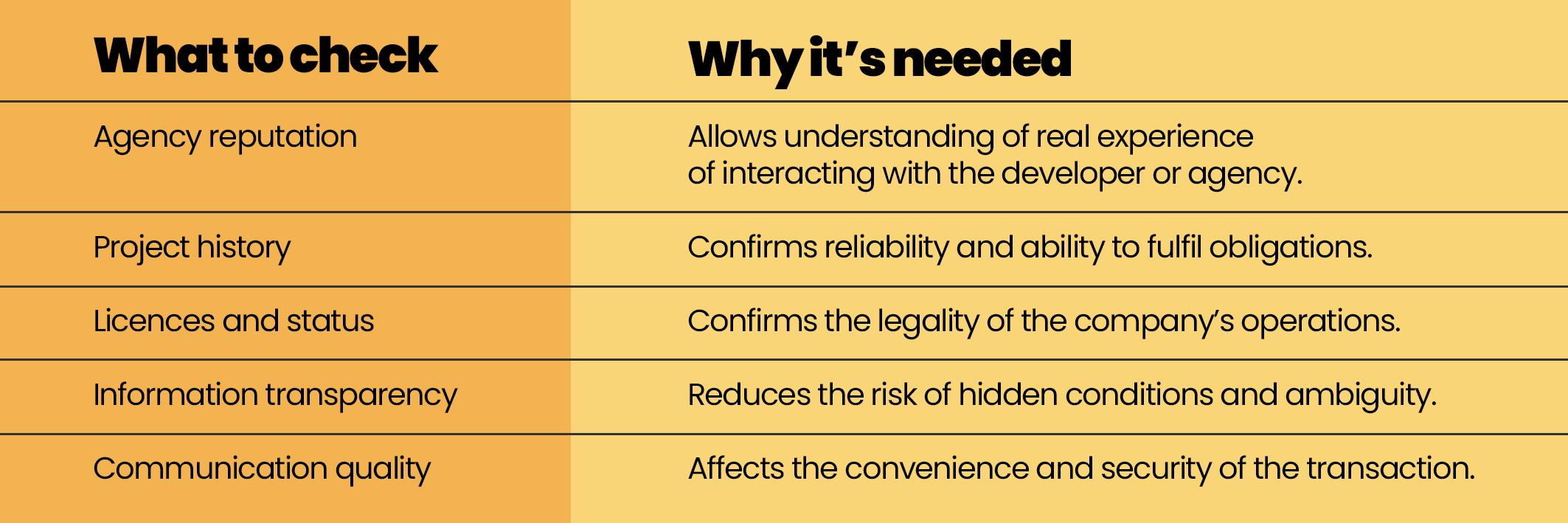
To reduce risks before purchasing property, the following information needs to be checked:
“ “
Property advertising is not a reliable source of information. After all, marketing materials, together with property presentations, demonstrate an ideal picture without reflecting the real terms of cooperation or the quality of services provided.
How Ratetik Helps Analyse Real Customer Experience
When choosing a developer or real estate agency, it’s important to consider real interaction experience. For this purpose, customer review analysis is used, thanks to which potential clients can evaluate the work in practice, not in advertising materials.
Ratetik structures user experience by combining into a single system:
• reviews;
• ratings;
• company profiles.
This approach helps to analyse the overall picture of an agency/company’s behaviour in the market. After all, reviews often contain useful information related to the level of communication, transaction specifics, quality of support, and more.
Red Flags in Reviews and Company Profiles
It’s important to learn to recognise potential ‘warning signs’ that may indicate the presence of hidden problems. Moreover, such problems often manifest themselves during the transaction process, meaning at later stages.
One of the main signals is frequently repeated negative reviews: when different clients mention the same list of problems.
Additionally, there’s a lack of specifics in reviews or the presence of template comments with a positive character.
Simple Checklist Before Making a Property Decision
Before making a final decision when choosing real estate companies in Dubai in the catalogue, it’s
Representational Image
necessary to go through the main verification points:
• Company reputation.
• History of all previously completed projects.
• Availability of licences and necessary documentation.
• Transparent terms of cooperation.
• Established client communication.
• Real client experience.
A special platform where all key information is collected will help simplify the search and subsequent selection process.
Why Reputation Checks Should Become a Standard Step
The modern market is becoming more complex, and the number of relevant offers is regularly increasing. Therefore, only the external characteristics of a company don’t provide complete information about reliability and security. Furthermore, mistakes made in the property sector are too costly for clients, meaning reputation checks are considered an integral procedure.
Uncertainty can be reduced, eliminating a large number of risks and future mistakes. Therefore, potential clients will be able to make informed decisions.
Representational Image
Why the Smartest Commercial Projects in Dubai Use One Firm
Why the Smartest Commercial Projects in Dubai Use One
for Everything
Firm for Everything
Here’s something that doesn’t get said enough: most fit-out budgets in Dubai don’t get blown by bad contractors. They get blown by good contractors working off bad information — drawings that weren’t coordinated with site conditions, specs that changed three times before anyone picked up a tool, design decisions made by people who weren’t around when the problems showed up.
I’ve had enough post-project debriefs with developers and corporate real estate teams to know how it usually goes. The original budget looked fine. Then the variations started. Then the opening date started moving.
The Split That Causes Most of the Damage
Standard commercial fit-out practice in Dubai separates design from delivery. You hire a design consultancy to produce the drawings and specifications. Those go out to tender. A contractor wins — often the one who came in lowest — and they take responsibility for building what the drawings show.
That handover between design and construction is where projects start going wrong, and here’s why: the contractor didn’t write the spec. They priced it based on their interpretation of it, which may or may not match the designer’s intention. When ambiguities surface on site — and they always surface on site — the contractor does what’s cheapest unless someone is standing there with the authority and the incentive to insist otherwise. The designer is usually long gone by then, or they’re a phone call away with no contractual leverage.
The result is what most clients eventually accept as ‘close enough.’ Finishes that look like the renders from a distance. Joinery that fits but doesn’t sit quite right. Lighting that works but doesn’t do what it was supposed to do for the space. A final product that functions without ever quite delivering on what was pitched.
This isn’t a contractor problem. It’s a structural problem.
Representational Image
What an Integrated Firm Actually Does Differently
When a single firm handles design and fit-out together, the dynamic shifts in a way that’s hard to overstate. The designer who drew the joinery is in the same building as the team manufacturing it. The project manager who built the delivery programme is also the one who signed off on the design phasing. When a decision needs to be made on site, it gets made by someone who understands both the design intent and the construction reality.
• Material calls get made with the build in mind, not just the render. Design changes that come up mid-construction get resolved in hours, not across a week of emails between separate companies.
• The programme is built around reality, not a tender price
• Snagging is a quality check, not a dispute
For the client it means one contract, one point of contact, nowhere to hide. The same firm that drew the space is the one that built it.
The MGS Sales Office: What This Looks Like in Practice
Sales offices are a good case study for integrated delivery because the brief is unusually specific. A sales office isn’t just somewhere staff sit. It’s the first physical experience a buyer has of a developer’s product — often before a single unit is built. The space has to carry the brand, guide visitors through a structured journey, create an emotional response, and hold up under heavy use during a launch period. And it typically needs to be ready yesterday.
The MGS Sales Office Villa Fit-Out, delivered by Spazio Interior Decoration LLC, is a useful example of what that brief looks like when it’s handled by an integrated team. The design concept centered on a restrained, neutral palette — premium materials that frame the developer’s product rather than compete with it. Bespoke joinery was produced in-house, which matters more than it might seem: when the firm manufacturing the millwork is the same firm that designed it, you don’t get a piece that’s ‘close’ to what was specified. You get the piece.
Representational Image
“sales office isn’t just somewhere staff sit. It’s the first physical experience a buyer has of a developer’s product — often before a single unit is built.
“ A
Lighting was handled with a level of precision that’s harder to achieve when you’re coordinating across separate contractors. Different zones — reception, presentation, private consultation — needed different light qualities, and getting that right required the lighting design and the fit-out execution to be developed together rather than sequentially.
The project was delivered on a compressed timeline. That’s only possible when you’re not waiting for a designer to approve a contractor’s RFI, or for a contractor to confirm whether a substituted material meets the original spec. The team making those calls was the same team that set the design intent.
The project is documented in full on Spazio’s portfolio: MGS Sales Office Villa Fit-Out by Spazio.
What to Actually Look For
The term gets used loosely. Plenty of firms in Dubai describe themselves as design-build because it sounds
better than ‘contractor with a design department.’ Before you sign anything, push on a few specifics:
• In-house manufacturing. Specifically, joinery and millwork. If a firm designs bespoke elements but outsources their production, you still have the design-to-build handover gap, just hidden inside the same contract. Ask explicitly whether they make their own joinery.
• Years in the Dubai market specifically. The 2008 correction and the 2014 slowdown wiped out a lot of firms. The ones still standing have been tested in ways newer entrants haven’t.
Spazio Interior Decoration LLC has been designing and building commercial, residential, and hospitality spaces in Dubai since 2008. As an interior fit-out company that handles everything under one roof — design, execution, and in-house manufacturing — the model hasn’t changed much over the past 16 years. Over 500 projects across the UAE and four international markets later, it still holds up.
Inside the Prop Firm Evaluation Process: How Trading Challenges are Structured,
Scored, and Why Most Traders Fail Them
The prop trading evaluation system is one of the more elegant risk management mechanisms to emerge from the retail financial services industry in recent years. From the outside, it reads as a simple commercial arrangement: pay a fee, demonstrate trading ability, receive funding. From the inside, it is a carefully calibrated talent filter designed to solve a specific capital allocation problem at scale, while limiting the firm’s downside exposure to any individual trader to a known, fixed quantity.
Understanding the mechanics matters for any professional considering the space – whether as a participant, an investor in prop firm equity, or a risk manager assessing the model’s structural soundness. What follows is a functional analysis of how challenges are built, what the rules are actually measuring, and why the failure rate is not an accident.
Why Prop Firms Use Challenges Rather Than Interviews
The fundamental problem a prop firm is trying to solve is adverse selection. It wants to identify traders with genuine, repeatable edge and deploy capital against that edge. The population of traders claiming to have edge is large; the population that actually does is small; and the two groups are essentially indistinguishable on the basis of self-reported track records, credentials, or interviews.
A structured evaluation with real financial stakes solves this by requiring the trader to demonstrate actual behaviour – disciplined position sizing, consistent risk management, performance under constraint – rather than describe it. The evaluation fee ensures that only traders with genuine conviction will attempt it, and the rules create conditions under
which undisciplined behaviour will reveal itself rapidly. This is a mechanism design problem rather than a recruiting problem.
The Economics: Who Bears the Risk?
From the trader’s perspective, maximum exposure is the evaluation fee – a fixed, bounded cost regardless of what happens on the funded account. If a funded trader loses beyond the defined limits, the account is closed. No debt is created.
From the firm’s perspective, the maximum loss on any individual funded account is the drawdown limit applied to the account size. On a $100,000 funded account with a 10% maximum drawdown, the firm’s maximum exposure is $10,000. Across a portfolio of uncorrelated traders, this is highly manageable. Firms that generate the majority of their revenue from challenge fees rather than from funded trader profit splits have mis-aligned incentives; the model works correctly when funded trader success is the primary revenue driver.
Challenge Structure Decoded
Daily drawdown limit is typically set at 5% of account value – tight enough to catch traders whose risk management breaks down under adverse conditions, while allowing a trader with genuine edge to operate without significant constraint. The daily reset creates a recurring test of session-by-session discipline.
Maximum overall drawdown is typically 10%. The 2:1 ratio between the profit target (usually 8–10%) and the overall drawdown limit means a trader cannot absorb large losses and trade their way back with outsized risk. Recovery from a 7% drawdown requires roughly 7.5% profit to reach breakeven, leaving little margin to also hit the profit target.
Profit target at 8–10% functions as proof of positive expectancy under controlled conditions. Combined with the drawdown constraints, it requires profitability through consistent, sized positions rather than concentrated bets.
In a structured evaluation like the OneFunded challenge, the rules are designed to simulate real fund management constraints – specifically the experience of managing capital within a defined risk budget over an extended period, where compounding losses are more dangerous than compounding gains are beneficial.
The Most Common Failure Modes
Daily limit breaches in the first week indicate that a trader’s position sizing is calibrated to an unconstrained account rather than to the challenge’s risk parameters. This is the most common failure mode: it reveals that the trader has not internalised the constraint framework before attempting the evaluation.
“ “
A trading challenge is a filter, not a guarantee. Passing one only proves a trader can hit a target and manage risk over a few weeks. Its value is purely statistical: it filters out the noise to yield a funded cohort with a significantly higher success rate.
Overtrading following drawdown – increasing position frequency or size after losses to recover – represents a fundamental failure of loss framing. Professional traders treat each session independently; the urge to recover a loss is the retail behavioural pattern the challenge is specifically designed to detect.
Time-out failures – reaching the evaluation deadline without hitting the profit target – typically reflect sound risk management but insufficient positive expectancy. These are paradoxically the most useful failures: they indicate a trader whose discipline is sound but whose edge is insufficient.
What Passing Actually Demonstrates
A trader who passes a well-designed challenge has demonstrated a specific and narrow thing: they can achieve a defined profit target while managing risk within defined constraints over a multi-week period. The challenge is a filter, not a guarantee. Its value is actuarial: it produces a funded trader cohort with significantly better average outcomes than an unfiltered cohort would.
The most sophisticated prop firms augment the binary pass/fail signal with behavioural metrics from the evaluation period – trade frequency, Sharpe ratio during the final evaluation days, drawdown utilisation rate – to produce a richer picture of which funded traders are most likely to generate sustained performance.
The Evaluation as Business Infrastructure
The prop trading challenge, viewed dispassionately, is a piece of business infrastructure that solves a genuine capital allocation problem. The rules are not arbitrary; each parameter measures something specific about the behavioural profile of the trader, and the framework as a whole is designed to produce a funded trader population whose aggregate risk is manageable and whose aggregate profitability exceeds the cost of running the evaluation pipeline.
The 23% average pass rate across the industry is not evidence that the evaluation is too hard. It is evidence that the filter is working: the majority of traders who attempt challenges have not yet developed the discipline, consistency, or risk management framework that the rules require. Those who have are exactly the traders the model is designed to find.
The UAE is moving fast on e-Invoicing. Finance teams across the country are witnessing one of the largest operational transformations since the introduction of e-Invoicing, driven by the Federal Tax Authority (FTA)’s new mandatory electronic invoicing framework. For accounts payable (AP) and accounts receivable (AR) teams, this is not just to keep in line with the law; it is a structural shift in how invoices are created, exchanged, validated, and settled.
The transformation is significant, but so is the upside. The question is not whether to adapt, it is how quickly and how effectively your team can make the shift.
If your business has not begun evaluating UAE e-Invoicing software, now is the time. Here is what AP and AR teams should look forward to from this directive as it transforms day-to-day finance operations.
The Invoice Lifecycle Is Changing Fundamentally
In the UAE, for invoice lifecycle, paper or PDF sent by email, an invoice lifecycle was manually entered into an ERP and matched and approved through multiple back-and-forth lines of communications.
The new lifecycle is built upon a digital exchange between buyer and seller systems, with government validation placed midway. The invoices, which should be standardized, communicated over an approved network and cleared or reported to the FTA before or at the time of delivery to the buyer. For AP teams, that does mean invoices arriving in structured machinereadable formats rather than unstructured PDFs.
For AR teams, it means that outbound invoices need to contain the data fields and be submitted through a compliant channel before they will be recognized legally.
Error Reduction Across the Invoice Cycle
Invoice errors are expensive. Mismatched amounts, missing tax information, incorrect supplier details, these cause rejections, delayed payments, and supplier disputes that consume significant resources. The structured data requirements of UAE e-invoicing act as a built-in validation layer.
“ “ How UAE e-Invoicing Will Impact Accounts Payable and Receivable Teams
Before an invoice reaches the recipient, it must pass format and data checks. A VAT number that does not match FTA records, a tax amount that does not reconcile with the line items, or a missing mandatory field will cause the invoice to be rejected at the point of submission.
This upstream error-catching fundamentally changes the quality of data flowing through AP and AR systems. Teams spend less time investigating and correcting historical invoice errors and more time operating with clean, accurate financial data. Month-end close processes become faster and more reliable when the underlying transaction data has been validated at source.
Payment Cycle Improvements Through AP/AR
Automation in the UAE
AP/AR automation UAE can provide tangible improvements in payment timelines; the business case for e-invoicing investment is evident from a point of view for such technology. For buyers receiving structured and pre-validated invoices, the transaction approval-to-payment cycle is significantly shortened.
The effect is felt equally strong by suppliers and their teams of AR. The disputes that cause payment beyond the agreed terms are much less likely when invoices are validated and acknowledged on the day they are submitted. Well-defined digital audit trails are now the reason not to delay payment by saying we never got it or the invoice was wrong.
AR teams can get real-time visibility into invoice status rather than chasing buyers with follow-up calls and emails. Faster, more predictable payment cycles improve the precision of cash flow forecasts, lessen short-term borrowing to compensate deficits, and strengthen the supplier relations for businesses on the AP side.
Choosing the Right UAE e -Invoicing Software
Choose the right UAE e-Invoicing software takes more than a tick-box-check.
Step 1: Assess Your Current Invoice Infrastructure
Audit what AP and AR workflows you currently have in place prior to taking any offer to the next level. Track the number of invoices that are processed each month, which ERP or accounting systems are used and which manual touchpoints cause the largest delays or errors. This baseline guides every subsequent decision.
Step 2: Verify FTA Compliance Certification
Different platforms are not created equal with the e-invoicing solutions. Make sure it is certified or compliant with the relevant UAE Federal Tax Authority technical requirements that the data fields require, if it supports approved transmission networks, and formatted structured invoices. No matter how feature rich, a non-compliant platform poses regulatory risk as much as ever.
Step 3: Evaluate ERP and System Integration
The software must tie in with what you’d like to have in place in your accounting, ERP, or procurement
Representational Image
systems. When integration is poor it will force them to resort to manual workarounds and destroy the whole point of automation.
Step 4: Check AP and AR Workflow Capabilities
Search for configurable approval workflows, three-way matching functionality, automatic exception handling or real-time invoice status detection. The platform ought to be a support to both accounts payable and receivable teams, not only to the payment team.
Step 5: Assess Reporting and Audit Trail Features
Robust reporting tools offer finance leaders visibility into outstanding payables, receivables aging and cash flow projections. For VAT compliance and FTA audit readiness, a complete digital audit trail must also be thorough.
Step 6: Review Scalability and Vendor Support
Select a solution that scales with the transaction volumes and your business scale. Assess the local presence of the vendor in the UAE within its implementation support and customer care – particularly since FTA requirements might evolve.
Step 7: Run a Pilot Before Full Deployment
Prior to a full launch, run a controlled pilot with a limited number of suppliers or invoices. This will surface integration differences, user experience weaknesses, and process incongruence before they become expensive problems at scale.
The Bottom Line
UAE e-invoicing is not coming eventually; it is already here. The Account Payable (AP) and Account Receivable (AR) teams that treat it as a compliance project alone will miss the broader operational opportunity it presents. The businesses that invest in the right UAE invoice automation infrastructure early will emerge with faster payment cycles, fewer errors, lower processing costs, and finance functions built for the digital economy.
The transformation is significant, but so is the upside. The question is not whether to adapt, it is how quickly and how effectively your team can make the shift.
Etihad Airways, the national carrier of the United Arab Emirates, will progressively roll-out the Destination Collection, a new collectable amenity kit line, in Business cabins across its network this summer. The Destination Collection will feature 14 designs to collect, each design inspired by a stunning city from within the Etihad global network and includes a new range of LANEIGE skincare products to elevate the guest experience onboard.
The Destination Collection: Inspired by the World We Fly
Designed to celebrate the breadth and diversity of the Etihad network, the Destination Collection draws inspiration from destinations across the airline’s global map, transforming a functional inflight essential into a collectible keepsake. Etihad’s new Business amenity kit builds on the success of the collectable Finjans offered to premium guests in First onboard Etihad flights; each Finjan is designed to represent an Etihad destination, the cups are randomly allocated to guests flying in First and the designs refreshed regularly creating a thoughtful keepsake for guests of Etihad that reflects the Emirati heritage the airline champions.
Arik De, Chief Revenue and Commercial Officer
Etihad Airways, said, “This new amenity kit collection reflects everything Etihad stands for: thoughtful design, a strong sense of place, and an elevated guest experience. Celebrating destinations across our network and partnering with LANEIGE to enhance inflight wellbeing, we’re going beyond to create an experience that feels personal, curated, and beautifully considered for our Business guests. Each kit a collectable keepsake inspired by the places we connect and meaningful even after your journey ends.”
He added, “This is an exciting move for Etihad, bringing our Business amenity kit design in-house allows us to empower the extraordinary talent across our organisation and provide the opportunity to create with purpose. The result is a collection that is authentically Etihad, designed by our people from start to finish.”
The collection features two distinct bag styles: Pouch and Slim. Each style is available in seven colourways, with every colour representing a different city within Etihad’s impressively expanding network. The bags showcase the destination name and geographic coordinates embossed on the exterior, complemented by a faceted zipper puller and a bespoke interior lining featuring faceted artwork inspired by the city it represents. Every bag includes a serial number (1–7), indicating its unique artwork within the collection.
“We are creating an effortless, sensorial experience designed to support comfort and energy at altitude. It is skincare you feel, lightweight and intuitive, powered by science.
“The initial rollout will feature seven incredible cities from the airline’s network, including destinations Etihad launched in 2025 such as Krabi, Addis Ababa and Atlanta, as well as Calgary which will launch in October 2026. Each year as the collection expands, additional cities and artworks will be introduced progressively.
At the heart of the collection is the Abu Dhabi Edition (#1), a tribute to Etihad’s home and strong Emirati heritage. Featuring the Zayed National Museum, the design reflects the city’s spirit of ambition and progress that continues to inspire the airline’s journey.
Abu Dhabi (#1), Krabi (#2), Mumbai (#3), Lisbon (#4) Addis Ababa (#5), Calgary (#6), Atlanta (#7)
Each flight will be loaded with a mixed selection of colours and destinations, ensuring guests encounter a different design each time they fly, encouraging collectability and making every journey feel unique.
Each kit continues to include Etihad’s signature comfort essentials, such as an eyeshade, earplugs, and dental kit, alongside an elevated skincare experience.
LANEIGE Joins Etihad Onboard
Etihad has partnered with LANEIGE, one of the world’s most loved K-beauty brands, to introduce a curated selection of hydration-focused skincare for guests in Business. Etihad is the first airline to collaborate with the brand, known for delivering innovative skincare experiences, and exclusively the only airline to offer LANEIGE products onboard to its premium guests.
The collaboration is a part of the airline’s efforts to create a holistic, wellness-oriented environment when travelling with Etihad, as part of the Etihad Wellbeing initiative. The initiative has driven the introduction of the airline’s Quiet Cabin, and intentional changes to it’s onboard offering, encompassing culinary, product, environment and more.
Built on a philosophy driven by curiosity and science, LANEIGE brings decades of Korean skincare expertise onboard, with clinically proven formulations designed to restore moisture and comfort during travel.
PilKyung Choi, Brand President of LANEIGE, commented, “We are immensely proud to partner with Etihad Airways as the first Korean beauty brand to be part of this global onboard amenity programme. This partnership represents a deeply meaningful milestone
for LANEIGE, bringing our skincare expertise into the flight environment and extending the LANEIGE universe beyond the ground.
“By uniting LANEIGE’s skin barrier science with recovery focused care for travel stressed, jet lagged skin, we are creating an effortless, sensorial experience designed to support comfort and energy at altitude. It is skincare you feel, lightweight and intuitive, powered by science. Through this collaboration, we invite guests to experience the LANEIGE Wonder in the air: an effortless, sensorial journey where skin barrier science supports recovery, comfort, and energy throughout the flight.”
Guests will enjoy a curated edit of LANEIGE’s iconic products:
• LANEIGE Water Sleeping Mask, powered by hyaluronic acid and squalane to replenish moisture and revive tired-looking skin
• LANEIGE Lip Sleeping Mask, delivering intense hydration with Berry Fruit Complex, Murumuru Seed, and Shea Butter
• Hand Cream, a deeply hydrating formula that restores softness and relieves dryness
Together, the collection ensures guests arrive feeling refreshed, radiant, and comfortably hydrated.
Micropolis Robotics, one of the UAE-based developers of advanced autonomous mobile robots and AIenabled systems, unveiled its next-generation M1.5 robot at Make it in the Emirates 2026, taking place in Abu Dhabi from May 4 to 6. The platform represents an enhanced-capacity evolution of the Company’s existing robotics systems, engineered for more demanding operational environments.
The new hybrid robot marks a step forward in performance and capability, designed to operate across longer distances, extended durations, and more complex terrains. With improved offroad mobility, increased endurance, and greater operational resilience, the platform is tailored for highintensity applications where reliability and sustained performance are critical.
Representational Image
The robot has been developed in direct response to the operational requirements of high-security and mission-critical environments, particularly for extended-range, off-road deployments. Its capabilities are shaped by real-world demands from entities such as the UAE National Guard, Saudi Arabia’s Ministry of Interior, and critical infrastructure operators, where continuous autonomy, reliability, and sustained performance are essential for remote surveillance, border control, and industrial operations, including oil and gas facilities.
“We take pride in building advanced robotics and AI systems in the UAE that are designed to operate in real-world, high-demand environments,” said Fareed Aljawhari, Founder and Chief Executive Officer of Micropolis. “The introduction of the M1.5 reflects our continued focus on extending performance and capability where it matters most: endurance, adaptability, and reliability. As the UAE accelerates the integration of artificial intelligence across government and national infrastructure, we see a clear alignment between policy direction and practical deployment. Our role is to translate that ambition into systems that can be implemented at scale, supporting critical operations locally and extending that expertise to global markets.”
The introduction of the M1.5 hybrid robot builds on Micropolis’ existing portfolio of autonomous systems, including the Patrol M1 and Patrol M2, advanced autonomous mobile platforms currently deployed across security, surveillance, and smart infrastructure applications. These systems are designed for continuous monitoring, autonomous navigation, and real-time data capture, supporting safer and more efficient operations across controlled and semistructured environments.
Also featured is Microspot, the Company’s proprietary AI and software platform, which serves as the intelligence layer across Micropolis’ ecosystem, enabling real-time monitoring, fleet coordination, data analytics, and integration with broader command-
and-control systems. Together, these technologies reflect an integrated approach that combines robotics, artificial intelligence, and software into scalable, real-world solutions.
Micropolis’ participation highlights the strength of Emirati engineering, manufacturing, and innovation capabilities, with its systems designed, developed, and produced in the UAE. The Company is working with leading national institutions, including Dubai Police, the UAE National Guard, DP World, and Aramco, supporting mission-critical applications across security, logistics, and infrastructure environments.
“Our role is to translate the ambition into systems that can be implemented at scale, supporting critical operations locally and extending that expertise to global markets
“
Listed on the NYSE American (MCRP), Micropolis is one of the UAE Robotics companies to achieve a public listing in the United States, reinforcing its position as a globally recognized technology developer. From this foundation, the Company continues to scale internationally, exporting UAE-built robotics solutions to markets across Saudi Arabia and Africa, demonstrating the global relevance of locally developed advanced technologies.
Corporate Leadership Transition at General Motors AMEO Region
In a move designed to accelerate regional growth and reinforce its commercial momentum, General Motors Africa and Middle East (AMEO) has recently announced a strategic realignment of its senior leadership team, effective June 1, 2026. This highprofile executive transition underscores GM’s commitment to operational excellence, homegrown talent development, and sustainable market expansion.
The New Executive Leadership Industry sources added that this newly appointed leadership structure introduces seasoned veterans to pivotal regional roles, ensuring a seamless transition of power and strategy:
1. Rohan Fernandes-Incoming Chair and Managing Director, GM Egypt and Africa:
• The Transition: Rohan Fernandes will succeed
Representational Image
Sharon Nishi, who concludes a distinguished career and will officially retire on August 31, 2026. Leadership responsibilities commence immediately to ensure corporate continuity.
• Assigned Roles: Leverage an extensive track record in commercial operations to drive vehicle portfolio expansion and solidify GM’s manufacturing and sales presence across the African continent.
2.
Mohammed Al-Fayyad – Incoming Managing Director, AMEO Commercial Operations
• The Transition: Succeeds Rohan Fernandes, stepping directly onto the GM Africa and Middle East Leadership Team.
• Assigned Roles: Report directly to Jorge Plata, President and Managing Director of GM AMEO, with a strategic focus on dealer integration, disciplined market execution, and next-phase profitability.
Executive Profile: Mohammed Al-Fayyad’s Global Expertise
Returning to the Middle East after a five-year tenure in elite international leadership markets, Mohammed Al-Fayyad brings an unparalleled blend of global strategy and deep regional talent.
• Proven Track Record: Most recently served as Director of Customer Care and Aftersales for GM Europe, successfully steering the division toward strategic transformation and profitability.
• North American Impact: Previously held the role of General Director of the Independent Aftermarket (IAM) in the United States, capturing double-digit top-line revenue growth and optimizing profit margins.
• Core Competencies: High-level mastery across International Sales, Corporate Strategy, Public Relations, and Global Aftersales.
• Academic Foundation: Holds a Bachelor of Arts in Economics from the University of Jordan, complemented by a Master of Business Administration (MBA) from Coventry University.
Driving the Future of Automotive Commerce
This strategic shuffle arrives as General Motors continues its aggressive pivot toward an all-electric future, backed by advanced, low-emission propulsion systems. By placing proven commercial strategists at the helm, GM ensures that its network of 17 distributors across 29 countries remains agile, integrated, and intensely customer-centric.
With Fernandes anchoring Egypt and Africa, and AlFayyad optimizing commercial operations from Dubai, GM AMEO is distinctively positioned to translate global innovation into localized market leadership.
Quotes from the Key Leaders: “Al-Fayyad brings strong regional knowledge, deep commercial experience and a clear understanding of our business and dealer partners,” said Jorge Plata. “His commitment to stronger integration and disciplined execution will help position GM for the
next phase of growth while delivering the sales and ownership experience our customers expect.”
Plata also thanked Fernandes for his leadership of the Commercial Operations business and wished him continued success in his new role.
“ “
The change marks a deliberate effort to align regional operations with General Motors’ global strategic pillars of zero crashes, zero emissions, and zero congestion.
“Rohan has played an instrumental role in building GM’s sales momentum and delivering consistent growth,” said Plata. “He has built strong relationships with our dealer partners across the region and helped lead a strategy that expanded our vehicle portfolio to provide customers different price points and propulsion systems.”
“Returning to the AMEO organization at such a pivotal time for the automotive industry is a meaningful opportunity,” said Al-Fayyad. “My experiences in the U.S. and Europe have strengthened my commitment to driving profitability through innovation, customer care and operational excellence. I look forward to working with our teams, dealers and partners to build on our momentum and deliver sustainable value across the region.”
Designing the Perfect Website with Artificial Intelligence
About 63% of web traffic now comes from mobile, 60% of designers use a mobile-first approach, and 73.1% of visitors leave a site that does not adjust to their device. The pressure on design quality is higher than the pressure on creation speed, which is why the AI design step that gets attention is rarely the one that produces the strongest output. The first generation is fast. The second pass, where the design becomes specific to the brand and useful to the buyer, is where AI tools earn their place.
This article covers what the design brief should contain, the decisions AI handles well, and the design judgment calls that still belong to a person.
Defining the Visual Goals Before Generation
A useful design brief tells the AI what role the site has
to perform alongside what it has to look like. A site that captures qualified leads needs different visual emphasis than a site that displays a portfolio.
The brief should answer four questions in writing before the prompt is sent. What action does the buyer take on the homepage? What three words would the operator use to describe the brand’s tone (precise, warm, technical, traditional, modern)? What are two reference sites the operator considers well-designed? What feeling should the buyer leave the site with? Specific answers produce specific output.
Operators who skip the brief end up rejecting the AI’s first attempt and asking for “something different” without being able to say what. The AI has no read on subjective taste. It needs vocabulary it can act on.
Representational
Color Palette and Contrast Decisions
AI tools now choose color combinations that pass technical accessibility checks by default. The work that remains is brand alignment and emotional accuracy.
A useful pattern is the four-color brief. One primary color tied to the brand, one secondary that supports calls to action, one neutral background, and one accent for highlights. Beyond that, the palette starts to feel decorative.
Contrast is the area where AI most often falls short.
WCAG 2.1 sets the minimum at 4.5:1 for normal text against its background. Mozilla’s developer documentation explains the color contrast calculations and the 3:1 floor for large text. Generated sites occasionally place light gray text on white because it looks elegant in mockups. The fix is the contrast checker, applied after the visual judgment.
Typography for the Generated Output
Most AI builders default to two safe fonts, a sans-serif for body and a contrasting display face for headings. The defaults are competent and rarely distinctive.
The sharper move is a single variable font set across the whole site. Smashing Magazine’s coverage of variable font technology shows how a single file can support weight, width, and slant variations, cutting font payload from around 150 KB per face to one shared file with all variations stored as deltas. Performance improves and visual coherence improves with it.
Typography size and rhythm matter more than font choice. A useful starting point is 18px body text with 1.5 line-height and a 1.25 type scale that climbs from body to H3 to H2 to H1. Most AI defaults use smaller body text at 14 to 16 px, which costs older readers comfort they should not have to give up.
AI-Assisted Design Platforms
Operators choosing an AI powered website builder have to weigh how much manual control the platform leaves on the table. Some platforms let the operator
regenerate sections, override colors, and edit copy directly. Others lock the design after the first pass and require a redo to change major elements.
The platforms that produce the best designs treat AI output as a starting point and leave full editing control with the operator. Locked-in templates dressed up with AI naming conventions produce visually similar sites.
“ “
There is no perfect website to design. A site that does its job well, on the device the buyer is holding, with copy the buyer recognizes and a layout that respects the buyer’s attention, is the realistic target the AI workflow can deliver.
Layout and Visual Hierarchy
AI builders tend to apply familiar layout patterns that work because users already know how to scan them. The Nielsen Norman Group’s F-pattern eye-tracking research found that users read web content in horizontal sweeps along the top of the page and then a vertical scan down the left side. The pattern holds across content types and across more than a decade of follow-up studies.
A site designed against this scanning behavior loses visitors. AI builders generally respect the F-pattern by default but sometimes push the most important content into the lower right of the viewport, where attention drops. Move calls to action and primary headlines into the F’s natural reading paths.
Visual hierarchy works through size, color, and typography weight. Research from the Sessions College design program quantifies the contribution.
Size accounts for around 45% of attention, color 30%, and typography weight 25%. AI tools tend to under-use size differentiation, producing sections where every element feels close to the same weight.
Responsive Behavior Across Devices
Mobile users represent 62% to 63% of web traffic, and most AI generators produce mobile layouts as part of the first pass. The fact that the layout exists does not mean it works.
Common failure modes on AI-generated mobile views include navigation menus that hide essential links behind a hamburger that takes up the whole header,
hero images that crop awkwardly on portrait screens, forms with input fields too small for thumb taps, and text that overflows containers because the AI did not anticipate the longer string the operator inserted afterward.
The fix is the same as for desktop. View the generated mobile site on actual phones rather than the desktop preview, and on at least 3 screen sizes (small Android, current iPhone, current iPad). The differences between preview and reality are often small but always present.
Design System Discipline for Consistency
A site that looks designed end-to-end follows a small set of rules across every page. The same heading sizes. The same button styles. The same spacing scale. AI builders generate consistency on the first pass but
Representational Image
lose it during edits, especially when the operator adds new sections by prompt rather than by component.
Mature in-house design systems like the Atlassian Design System handle this through documented components and tokens for color, type, and spacing. A small business site does not need that level of formality, but it benefits from a one-page reference the operator updates as decisions accrue. Without it, the third edited page will not match the first.
The Operator’s Remaining Decisions
A few design judgment calls the AI cannot make on its own. The brand’s actual personality, in plain words. The specific buyer the site is for, including the level of comfort that buyer has with the product category. The pricing tier the site has to communicate visually, from
premium to accessible to somewhere in the middle. The story the operator wants the site to tell about why this business exists.
These are prompts the operator writes. The AI executes them. A site that feels distinctive comes from an operator who fed the system distinctive instructions and rejected the output that pulled toward the average.
There is no perfect website to design. A site that does its job well, on the device the buyer is holding, with copy the buyer recognizes and a layout that respects the buyer’s attention, is the realistic target the AI workflow can deliver. The operator’s job is to act as the AI’s client, with the kind of explicit direction it can execute on.
Representational Image
Over the past three decades, technological advancement has shifted from basic multimedia consumption, such as streaming music and videos on smartphones, to a core utility driving daily necessities. Today, digital platforms seamlessly manage everything from food delivery and travel bookings to document editing, gaming, and cloud storage. Beyond these everyday consumer conveniences, however, modern technology has radically transformed the global industrial landscape. The next round of paragraphs details how cutting-edge technological applications are redefining operations across major sectors. Let’s dive deep into the various industrial sectors where recent technologies were implemented
Digital innovation
has matured from a tool for consumer entertainment into the vital backbone of global industry
Mining Industry
Immersive Tech (AR & VR) Use Cases
Drilling Operations: AR solutions superimpose live data regarding drill bit stress directly onto the operator’s field of view. This minimizes the likelihood of unexpected drill breakages during extraction.
Blast Training: Virtual environments are tailored to replicate exact mine layouts. Trainees can safely practice setting off explosives, while the software simulates subsequent rock weathering and shockwaves to mimic real-world conditions.
Team Communication: VR provides a shared, immersive view of mining sites. This allows geographically dispersed teams to collaborate remotely, making it easier to inspect and manage confined spaces or distant sectors.
Big Data & Analytics Use Cases
Telematics Tracking: Solves the issue of underutilized machinery by providing clear visibility into equipment availability and performance. Continuous data gathering and analysis optimize fleet management and boost operational efficiency.
Predictive Modeling: By leveraging machine learning, data mining, and statistics, companies can pinpoint exactly the location to optimize resource distribution. This interconnected data network cuts operational costs, refines production timelines, and minimizes downtime.
“ “ Blueprints of Tomorrow The Technologies Redefining Modern Industries
Market Demand Prediction: Companies use timeseries analysis to project future demand based on historical trends, alongside machine learning to
uncover intricate market correlations. This allows them to run simulations and understand how demand might shift due to policy changes, economic growth, or new technologies.
Tourism
Experiential Marketing: Extended reality (XR) and creative tech are shifting tourism marketing from static, traditional advertisements to interactive, engaging campaigns. This approach captivates target audiences by offering memorable, hands-on digital experiences before they even reach their destination.
Voice Search Optimization: The rise of AI assistants, smartphones, and smart speakers has made voice search highly relevant for travel bookings. Since more travelers now use voice commands to secure flights, hotels, and tours, businesses must optimize their websites for voice compatibility.
In-Room Voice Controls: Voice technology is reshaping hospitality, making every stay more
personalized, convenient, and connected. Guests use voice-activated devices to adjust room temperature, change lighting, or ask for local tourist information. Data from Statista highlights this shift, noting that 57% of travelers favor voice assistants for controlling room settings, and 48% utilize them to make service requests.
Healthcare
Diagnosis and Treatment: AI streamlines data processing such as analyzing medical imagery to help physicians diagnose conditions with higher accuracy. For instance, IBM Research demonstrated that AI can identify and interpret brain activity patterns in MRIs to monitor how neurodegenerative conditions like Huntington’s disease advance.
Medical Imaging: AI models excel at translating visual scans into quantifiable data and identifying hidden trends. This assists radiologists in managing massive volumes of images by automatically highlighting anomalies and high-priority findings.
Representational Image
Healthcare Operations: Building on the foundation of electronic health records, hospitals are upgrading their digital infrastructure. Utilizing cloud technology, mobile applications, and advanced analytics helps optimize day-to-day institutional workflows.
Clinical Research: The life sciences sector is using tech to decentralize clinical trials. By incorporating smart devices, remote telehealth consultations, and digital sensors, researchers can collect data more efficiently while making participation more convenient for patients.
Fashion
3D Printing & Sustainability: 3D printing contributes to sustainable fashion by producing garments layer by layer, significantly reducing material waste. Industry leaders like Adidas and Stella McCartney have adopted this method, and Statista reports the 3D-printed fashion sector is projected to expand by over 20% annually.
Consequently, fashion institutions are integrating this technology into their curricula.
Smart Textiles & Novel Fabrics: The USD 6 billion smart textile market features innovations such as:
• Self-repairing materials.
• Climate-regulating fabrics.
• Lab-grown, bioengineered leather alternatives.
• Nanotech-infused fabrics that shift colors dynamically.
• Energy-harvesting textiles that convert physical movement into power.
Digital Sketching: The traditional practice of paper sketching has evolved into a digital format. Designers now use vector-based software like Adobe Illustrator, Photoshop, and Sketchbook Pro to build precise, scalable patterns and technical drawings. This digital shift allows designers to examine the finest details without losing image quality and easily alter designs without starting over.
Computer-Aided Design (CAD): A staple in advanced fashion education, CAD software has optimized the industry through automation. It allows designers to generate 2D and 3D digital models, modify existing styles, and scan or digitally “stitch” garments. This allows companies to evaluate the appearance and fit of a piece before proceeding with production.
Supermarket & Business Operations
Enterprise Content Management (ECM): Utilizing ECM for document management is vital for cutting through red tape and maintaining tax compliance. It enables businesses to digitize invoices and contracts, secure clear audit trails, and review paperwork instantly from any connected device.
Self-Checkout Systems: Self-service checkout lanes are a growing global trend aimed at accelerating payments, shortening lines, and upgrading the retail experience. According to data from Toledo Brasil, grocery stores
implementing these systems see a 25% drop in wait times, directly boosting customer satisfaction.
The evolution of technology over recent decades highlights a profound shift. Digital innovation has matured from a tool for consumer entertainment into the vital backbone of global industry. Across high-stakes sectors like mining and healthcare, as well as consumer-focused fields like tourism, fashion, and retail, the integration of artificial intelligence, immersive tech, big data, and automation is rewriting traditional operational blueprints.
Conclusion
By adopting these advanced tools, industries are unlocking unprecedented efficiency, elevating workplace safety, minimizing environmental waste, and radically enhancing the end-user experience. As these technologies continue to mature and converge, they will push the boundaries of industrial capability paving the way for a smarter, more interconnected, and highly sustainable global market.
Representational
How to Boost Your Account Reach and Gain More Followers on Instagram
Reaching people on Instagram has become much harder than before. Some accounts post consistently, yet visitors feel no real reason to follow them. Meanwhile, other accounts are much simpler but grow quickly because they have clarity, presence, and content that makes people stop and engage. Keep reading to learn more.
8 Best Ways to Boost Your Account Reach and Gain More Followers on Instagram
1. Optimize Your Profile to Increase Followers
Your profile is the first real test for anyone visiting your account. If the account looks unclear or random, visitors will likely leave quickly, even if the content itself is excellent. People judge extremely fast on Instagram. Organized accounts with visual consistency give the impression that there is a real identity behind the content, not just random posts.
2. Grow Your Follower Base Strategically
Let’s speak honestly for a moment: accounts with a strong audience appear more trustworthy and
credible to new visitors. When someone visits an account with high engagement and activity, they often feel, even before fully browsing the content, that this account is “worth” their attention. That is why major content creators prioritize building an audience strategically from the beginning. To do this safely, you should buy real Instagram followers from Media Mister, as they provide high-quality followers from active accounts, helping ensure natural (organic) engagement on your profile.
3. Create Reels Regularly
Reels are currently the most powerful reach tool on Instagram, especially for smaller accounts. The reason is simple: Instagram shows them to people who do not already follow you, giving you continuous opportunities to reach new audiences. But success here is not only about “posting.” Your videos need to be fast, clear, and attention-grabbing from the beginning. Instagram users scroll incredibly quickly, and if it takes ten seconds to get to the point. Consistency is also extremely important. Accounts that rely consistently on Reels usually grow much faster than accounts that only post photos.
4. Use Instagram Trends Smartly
Trends can give your reach a strong boost, but the problem is that many accounts copy them exactly until they lose all personality. Suddenly, every account starts looking boringly identical. The smarter approach is to use trends in your own way. Take the popular idea, but add your personal style or connect it to your niche differently. Audiences like accounts that stay current, but they remember accounts that add something unique. Timing is also very important here. Trends rise quickly… and disappear quickly, too.
5. Use the Right Hashtags and Keywords
Hashtags are still useful, but random usage no longer works the way it once did. Adding twenty unrelated hashtags will not create miracles. It is better to use keywords and hashtags that are genuinely connected to your niche or the idea behind the post. Try writing naturally without annoying keyword stuffing
or excessive repetition. When Instagram clearly understands what your content is about, it becomes more likely to show it to people who are actually interested in that type of content.
6. Strengthen Engagement With Your Audience
Accounts that reply and interact with people build much stronger relationships than accounts that post and disappear. People want to feel that there is a real human behind the screen, not just a machine posting content every day. Replying to comments, asking questions, and even engaging in direct messages all help create a small community around your account. Instagram itself also favors accounts with active conversations and engagement.
7. Collaborate With Relevant Content Creators
“ “
Accounts that reply and interact with people build much stronger relationships than accounts that post and disappear.
Instead of trying to grow completely on your own all the time, why not benefit from an audience that already exists? Collaborating with accounts related to your niche helps you appear in front of people who are already interested in the same type of content. They do not have to be huge celebrities either. Sometimes, small but highly engaged accounts produce far better results because their audiences are closer and more active.
8. Cross-Promote Across Other Platforms
If you rely only on Instagram, you are slowing your growth for no reason. Many people discover accounts through TikTok, YouTube, or even Twitter/X before deciding to follow them later on Instagram. That is why repurposing content across multiple platforms is a very smart strategy, especially in the beginning. Every platform gives you another opportunity to appear in front of new audiences, and over time, your name starts becoming more familiar.
Conclusion
Increasing reach and followers on Instagram does not depend on one “magic secret,” but on a combination of small details working together consistently: good content, a clear identity, genuine engagement, and consistency without long disappearances.
What Happens When You File a Lawsuit Against a Corporation
“ “
While the road is long, the system ensures no company is too big to obey the rules
Most people feel like a tiny speck next to a massive company. These businesses have significant financial resources. They also have huge teams of lawyers who get paid to make you go away. If a big business hurts you, the idea of a fight in court can feel scary. But the law is there to make things fair for everyone.
The path to a win starts with a formal legal paper. If you decide to sue a corporation, you are telling a judge that the company failed to keep you safe. This move forces the giant to stop ignoring your calls. It is the very first step toward getting the money you need to pay your bills. You are setting a clear boundary.
Once the papers reach the company, they have to answer. They will likely try to find a way to get the judge to toss your case in the trash. But if the judge says your case is strong, the real search for the truth begins. This is when the power starts to shift.
The Discovery Phase: Hunting for Proof
Discovery is the longest part of the whole fight. This stage is when both sides have to trade their secrets. You have the right to ask for their private emails. You can demand their safety files. Often, big companies fight hard to keep these papers hidden from your eyes. They do not want you to see their mistakes.
Lawyers will also do depositions. This is just a way of saying they ask people questions while they are under oath. You will answer questions about your harm.
And bosses at the company will have to explain their choices. This proof is the heart of your entire claim. It makes the truth impossible to hide.
Settlement Talks and the Final Trial
Most cases against big companies never see a jury. Trials are expensive. They can make a company look terrible in the news. Because of these factors, both sides often sit down to talk about a price. If the company sees that your proof is solid, they might offer a check to end the fight quickly.
If you do not agree on a price, you go to a trial. A jury of regular people will listen to your story. They will look at the facts. The goal is to make things right for the person who was hurt. While the road is long, the system ensures no company is too big to obey the rules.
Key Takeaways
• Big companies use delay tactics to try to wear you out.
• The law gives you the power to see the business’s private files.
• Most legal fights end with a check instead of a trial.
• Discovery is when you find the proof that wins the case.
• Mediation is a talk where both sides try to find a fair solution.
• Hard proof, like emails, is what makes a company pay up.
• You have the right to hold any business responsible for their mistakes.
Business Management Skills
You Need for Running a Modern School Successfully
Starting and running a school is one of the noblest businesses you can venture into as an entrepreneur. However, managing a school successfully always requires some level of skills and training across the entire management department.
Since leading a school is primarily about imparting the best quality of education to young minds, you cannot fail at the management level, where every important decision starts. Below, we’ll explore a few crucial business management skills you should have as a school leader to run your modern institution successfully.
Strong Decision-Making Skills
Effective business leadership is strongly tied to one’s ability to make good decisions fast. As a school owner or leader, you’re required to know what needs to be done in your department or organization anytime there’s a crisis. Your decisions should be informed, firm, and practical enough to offer the right solution for different situations affecting the organization at different times.
For instance, if the school intends to purchase lockers at an affordable price to minimize costs, you can advise the procurement team to consider different purchasing options. They can buy second-hand lockers from reliable used school locker collections or buy new ones in small, affordable consignments rather than buying the entire costly consignment at once. Making the right decisions at the right time will help steer your school in the right direction faster and keep you in business for a long time.
Analytical Skills
Any successful business manager today requires impressive analytical skills to navigate the fastpaced business world, with Big Data in play. Business managers and leaders need to excel at creating and interpreting smart charts, business insights, and market trends to devise creative solutions to various problems. This makes analytics a powerful tool for school management at any level of growth.
School leaders and managers should undergo the requisite training or upskilling to acquire the analytical skills needed to manage a successful school business. Training equips leaders with effective management capabilities, such as foresight, effective
communication, and attention to detail, which are crucial for building strong analytical skills.
Mindfulness
As a business leader tasked with the responsibility of shaping the strong mindsets of tomorrow’s leaders, being mindful is a crucial skill for your overall success. Effective mindfulness in school leadership is all about becoming more observant so your eyes can catch what others easily miss. You need to stay alert to know when a staff member is behaving out of the ordinary or if overall organizational behavior is shifting and needs attention.
“ “
Most people feel like a tiny speck next to a massive company. These businesses have significant financial resources. They also have huge teams of lawyers who get paid to make you go away
If you’re not already a mindful person, the best place to start building this skill is by boosting your emotional intelligence. People who struggle to manage their emotions and stay resilient in times of disruption often fail to manage people effectively under them. You will need to accept and address the cognitive issues affecting your emotional intelligence so you can become a better leader for your colleagues and students.
Managing a successful school may not be the easiest job that exists, but it’s worth the sacrifices you make to become a better leader. By doing your best to build the above skills and traits, you’re helping improve your school’s reputation and longevity in the industry. Ensure you acquire and develop all these skills to set yourself up for admirable success as a school manager and leader.
KPMG and Anthropic launch global AI alliance
KPMG and Anthropic announced a global alliance, bringing Anthropic’s frontier AI directly into KPMG’s client delivery platform. The alliance will initially focus on tax clients and private equity firms, enabling clients to build agentic workflows in real time to help drive better outcomes. KPMG will also embed Claude into its PE-focused product offerings, and the two organizations will co-develop new Claude-powered products for portfolio companies.
“At KPMG, we’re innovating and redefining how work gets done,” said Bill Thomas, Global Chairman and CEO, KPMG International. “This global alliance with Anthropic reflects our shared commitment to responsible AI, prioritizing security, trust, and governance as KPMG firms scale these capabilities to our clients and people around the world.”
“KPMG works in industries where accuracy, accountability, and trust aren’t optional, and they’re applying the same standard to AI. They’re rolling Claude out to 276,000 people across the business and using it for client work in tax and private equity. They’re also bringing it into cybersecurity, where it helps find and fix vulnerabilities. That’s what a firm-wide commitment to AI looks like, and we’re proud to be the partner they chose,” said Daniela Amodei, Co-founder and President of Anthropic.
As organizations across Qatar move from AI experimentation to implementation, they need trusted partners who can help them adopt these technologies with confidence. This alliance with Anthropic together with our best-in-class global AI capabilities and teams strengthen our ability to support clients with advanced AI systems and use cases combined with the governance, sector insight, and practical expertise needed to drive real business value.” said Ahmed AbuSharkh, Country Senior Partner, KPMG in Qatar.
The alliance brings together Anthropic’s frontier AI, KPMG professionals’ domain experience, and a shared commitment to security and trust in AI.
Claude Cowork and Managed Agents are integrated into KPMG’s global technology platform, built on Microsoft Azure, combining KPMG insights, proprietary tools, and client data in one environment. KPMG professionals already use the platform to build AI tools that support client delivery. With Claude integrated, professionals and clients can work with AI directly within the platform, enabling new capabilities and real time innovation.
Rapid development of AI leaves no choice for businesses but to adopt these in their way of work in a responsible manner.
“ “Value creation for Private Equity (PE) clients. KPMG will be a preferred consultant for deploying Anthropic AI capabilities to PE clients, helping portfolio companies responsibly use Anthropic AI and agents to drive productivity gains and create new AI-driven products and services.
Modernizing work with Claude. KPMG’s 276,000 global workforce will have access to Anthropic’s Claude suite of AI capabilities, building on the successful adoption of Claude across KPMG’s Advisory, AI and Data Labs and enterprise support teams in the U.S. over the last two years. As part of the strategic alliance, KPMG and Anthropic will help shared clients reimagine their business functions and co-develop AI-enabled product offerings that will solve client challenges in ways that were
previously not possible. For example, the new portfolio of offerings for PE clients includes KPMG Blaze, which can embed Claude Code to help clients accelerate IT modernization, cut development lifecycles and enable faster delivery of AI-enabled technology systems.
Rapid development of AI leaves no choice for businesses but to adopt these in their way of work in a responsible manner. KPMG as trusted partners help clients translate AI ambition into tangible business outcomes, with a clear strategy and disciplined execution. This alliance enhances our ability to support organizations across the business and in their broader transformation agenda, combining advanced AI capabilities with deep sector and advisory expertise to help unlock sustainable value,” said Venkat Krishnaswamy, Partner, Head of Advisory, KPMG in Qatar.
For tax and corporate functions, AI has the potential to enhance the quality, speed, and insight behind decision-making, while also helping to simplify complexity and support compliance. Through our Digital Gateway, this alliance will allow us to bring advanced AI capabilities to clients in a structured and responsible way, working alongside them over time as these solutions evolve to unlock more strategic value across their operations.” said Barbara Henzen, Partner, Tax and Corporate Services, KPMG in Qatar.
Across the alliance, KPMG and Anthropic will embed cybersecurity, risk, and AI assurance into how AI systems and tools are designed and operated, with teams finding and fixing vulnerabilities and protecting critical systems. All work is guided by the KPMG Trusted AI framework.
Representational Image
Vodafone Egypt Commits EGP 20bn to Boost Digital Transformation
Vodafone Egypt has reaffirmed its position as a primary catalyst for national modernization by announcing an investment exceeding EGP 20 billion for the 2026–2027 fiscal year. This capital injection follows a legacy of over EGP 125 billion allocated over the past 28 years.
Industry sources added that this announcement underscores the operator’s long-term confidence in Egypt’s evolving economic landscape and its commitment to scaling advanced infrastructure to meet future technological demands.
Strategic Synergies and Global Scenario
The investment strategy took center stage during the Egyptian British Business Association (BEBA) mission in the United Kingdom. Operating under the theme “Egypt Moves Forward: Investment Opportunities and Sustainable Economic Reform,” the platform highlighted Vodafone’s role as a vital link between international capital and local market potential. By
participating in high-level ministerial dialogues, the company continues to champion the integration of foreign expertise to accelerate domestic economic competitiveness.
A Comprehensive Technological Blueprint
To maximize the impact of this fiscal commitment, Vodafone Egypt has structured an integrated infrastructure roadmap:
• Enterprise Architecture: Advanced data centers, localized cloud computing solutions, and robust cybersecurity frameworks.
• Emerging Tech Integration: Developing scalable Artificial Intelligence capabilities to support public and private enterprise transformation.
Driving Regional Hub Aspirations
During a ministerial panel titled “Digital Egypt: Infrastructure, Innovation, and Investment
Opportunities,” leadership from Vodafone Egypt, alongside H.E. Dr. Mohamed Farid, Minister of Investment and Foreign Trade, mapped out the nation’s trajectory. The discussions focused heavily on positioning Egypt as an unyielding regional gateway serving Africa, the Gulf, and Europe. Advanced digital framework development remains the core engine required to attract high-value foreign direct investment.
The session was attended by:
H.E. Dr. Mohamed Farid, Minister of Investment and Foreign Trade.
Mohamed Abdallah, CEO and Managing Director of Vodafone Egypt, and Regional CEO for International Markets at Vodacom Group.
Todd Wilcox, Deputy Chairman and CEO of HSBC Egypt.
“
“ Advanced digital framework development remains the core engine required to attract high-value foreign direct investment
Ian Gray (Moderator)*, Deputy Chairman of the Egyptian British Chamber of Commerce (EBCC).
This participation comes at a time of accelerating global focus on digital infrastructure, AI capabilities, cloud computing, and advanced digital services, as these factors increasingly shape economic futures and market competitiveness worldwide. This shift reinforces the vital importance of international dialogue and cooperation to drive investment and innovation in the sector.
Empowering a Knowledge-Based Economy
With an established user base of over 55 million citizens, Vodafone’s capital expenditure directly serves national socioeconomic goals. Preparing the market to seamlessly absorb next-generation tech ensures that domestic industries remain competitive on a global scale. Through these continuous network upgrades, the organization is effectively laying the groundwork for a highly sustainable, knowledgebased digital economy.
Zoom Unveils New Data Center with the Expansion in Saudi Arabia
Zoom has taken a decisive step in its Saudi growth journey with the launch of a new data center, adding valuable capacity to the Kingdom’s rapidly evolving digital landscape. The launch was held under the patronage of the Ministry of Communications and Information Technology (MCIT), attended by His Excellency Ahmed Alsuwaiyan, Governor of the Digital Government Authority (DGA), alongside representatives from Aramco.
Located in center3, a Saudi-headquartered provider of carrier-neutral data centers and subsea cable systems connecting Europe, Asia, and Africa, the establishment of the data center builds on Zoom’s broader investment in the Kingdom. Last year, Zoom pledged USD 75 million to Saudi Arabia with a strategic focus on innovation enabled by AI and the advanced infrastructure required to scale it, particularly as the nation designates 2026 as the Year of AI. As the country marks the 10th anniversary of Vision 2030, this designation signals a renewed emphasis on applying advanced technologies in practical, high-impact ways. The announcement builds on years of steady progress in data and AI initiatives, supported by major national institutions and large-scale infrastructure programs, and underscores Zoom’s long-term commitment to supporting progress across government and industry.
Zoom’s existing regional data center, established in 2023, already supports customers requiring local data residency, and the new facility enhances capabilities for government entities, enterprises, and critical national infrastructure organizations.
Commenting on the launch, Mohannad AlKalash, Vice President of Zoom for the Middle East, Türkiye, Africa, and Pakistan (METAP), said: “Saudi Arabia is one of the most forward-looking digital markets in the region, and we’re seeing remarkable momentum here. The new data center bolsters our ability to support customers locally and demonstrates Zoom’s belief in the country’s vision for a more connected, AI-powered future.”
The event follows a series of significant product announcements, including the launch of ZoomMate, the company’s first AI teammate designed to turn conversations into completed work, and the introduction of Zoom’s AI Productivity Suite, which allows teams to generate presentations, reports, and other deliverables directly from meeting context.
“ “
The new data center bolsters our ability to support customers locally and demonstrates Zoom’s belief in the country’s vision for a more connected, AI powered future.
As the country continues to advance its digital agenda, Zoom will work alongside partners to strengthen the local technology ecosystem and ensure organizations have the support they need as priorities evolve.