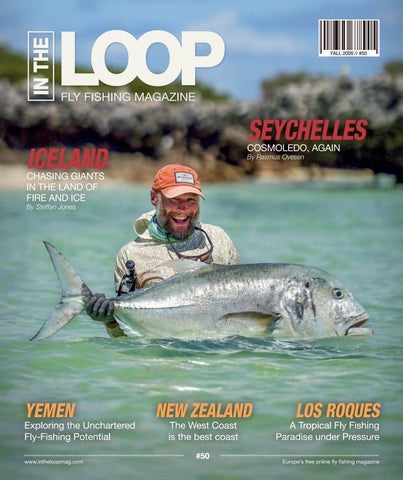
FALL 2026 // #50
SEYCHELLES
ICELAND
COSMOLEDO, AGAIN By Rasmus Ovesen
CHASING GIANTS IN THE LAND OF FIRE AND ICE By Steffan Jones
YEMEN
Exploring the Unchartered Fly-Fishing Potential www.intheloopmag.com
NEW ZEALAND The West Coast is the best coast #50
LOS ROQUES
A Tropical Fly Fishing Paradise under Pressure Europe’s free online fly fishing magazine
LEARN MORE AT YOUR LOCAL FLYSHOP OR ON GRUNDENS.COM
FEATURED PRODUCT: ROCK ARMOR WADING BOOT & VECTOR ZIP WADER
Born in Patagonia. Built on Authenticity.
Our 40 years of experience and tradition in Patagonia Still guided by those who know it best. Our guides bring unmatched experience and genuine passion to every day on the river, forming friendships that keep anglers coming back year after year.
info@elencuentroflyfishing.com
|
elencuentroflyfishing.com
Unforgettable fishing and relationship building with three unique destinations covering more than half of Chubut Province. We ooer exclusive access to private waters and hand-crafted itineraries tailored to you.
For us, visiting the Lærdal was yet another vivid reminder that, unless we stand together and fight for wild fish and the habitats they depend on, future generations may never experience the excitement, challenges and profound sense of connection that make our sport so special.
WELCOME...
We’ve just returned from the River Lærdal to put the finishing touches to this, our September issue of In the Loop Magazine. The late King Harald V of Norway was deeply fond of the Lærdal, which he famously referred to as his “second queen,” and he had fished its waters for Atlantic salmon regularly since the age of 15. King Harald passed away at the age of 89, having caught his last salmon – on the River Lærdal – earlier this year, on June 1. Norway lost a revered and highly respected monarch, and one who was a staunch supporter of the wild Atlantic salmon. Yet during his reign, wild salmon stocks declined dramatically. When we visited the Lærdal, we sight-fished for sea trout with nymphs and dry flies. That fishery alone is worth the long journey, but if we had been allowed, we would have been fishing for salmon. The sad truth is that there are now hardly any salmon left in what was once King Harald’s favourite river, and salmon fishing has been banned.
If you care about the Atlantic Salmon, please like and follow: www.instagram.com/reddvillaksen www.instagram.com/norskelakseelver www.instagram.com/nasfund
#INTHELOOPMAG
Presents
Cosmoledo, Again by Rasmus Ovesen The West Coast is the best coast by Jakub Kanok Chasing Giants in the Land of Fire and Ice by Steffan Jones Beyond the Surf by Johan Persson Friberg A small Icelandic salmon river with fierce fish! by Tarquin Millington-Drake A Tropical Fly Fishing Paradise under Pressure by Mattéo Pergent And much much more...
THE SEYCHELLES
NEW ZEALAND
ICELAND
YEMEN
ICELAND
LOS ROQUES
Contributors RASMUS OVESEN
In the Loop Magazine C/O Cast Away Media Org no: 999 320 147 www.intheloopmag.com
INQUIRIES / ARTICLES
info@intheloopmag.com
ADVERTISING
info@intheloopmag.com
FRONT COVER
by MARTIN EJLER OLSEN
VISIT US ON
Oslo-resident, Rasmus Ovesen, was handed his first fly rod at the tender age of eight, and he has been a borderline fluff chucking fanatic ever since. Rasmus has written articles for some of the world’s most renowned fishing magazines, and his travels take him to remote areas across the globe in search for fish that will test and challenge his skills to the maximum. He has seen his fair share of exposed backing in the tropics, but his heart truly belongs to the soulful realm of trout and salmon fishing.
MARTIN EJLER OLSEN
Danish fly fisherman and photo journalist, Martin Ejler Olsen, has years of experience fishing for the many and varied fresh- and saltwater species in the Danish rivers, lakes, and fjords. He has landed some truly massive sea trout on the fly, and he has a certain gift for hooking up with the biggest fish in the schools. Martin is also a keen tropical fly fisherman. His expeditions abroad has seen him battle bonefish, permit, barracuda, tarpon, GT and sailfish – and being a gifted photographer, these trips have resulted in some great footage.
TARQUIN MILLINGTON-DRAKE
We choose not to print this magazine and we are happy not to use paper and harmful inks as used in a conventional printing process. No portion of this magazine may be reproduced without the written consent of the publisher.
Although he has fished and photographed extensively around the world through his work as the MD of travel company Frontiers UK, TMD’s heart lies with the Atlantic salmon. He has fished Norway, Iceland and Russia every year for the past 20+ years. He was also President of the Ponoi River Company for 10 years and is an international Director of NASF. He is lucky to be a member of the 50lbs + salmon club. You can follow his travels and love of photography at: www.blog.millingtondrake.com
JAKUB KANOK
STEFFAN JONES
Born and raised in Czechoslovakia, “Kub” is a snowboarding fly fisherman who began his adventure in the fishing industry in Alaska. Since then, he has gradually made his way around the world, exploring rivers and mountains while promoting an active lifestyle through writing, photography, and videography. He is heavily influenced by his grandfather, Ivan, who loved the outdoors and introduced him to fly fishing at the age of seven. For the past decade, Jakub has called New Zealand home with a particular fondness for the South Island’s freshwater rivers and the Cook Islands when it comes to saltwater flyfishing. Nowadays, Fish and Game Ranger, Kub is a rare breed of adventurer, brimming with energy, who is sure to continue entertaining anyone who follows his travels for years to come. www.jakub-kanok.com
Steffan Jones is the founder of www.FishTravel.co.uk, specialising in fishing holidays to some of the world’s finest destinations. A fanatical angler since his grandparents bought him a telescopic rod at the age of four, he has fished for sea trout on his home rivers in Wales for over thirty years and guided on them for more than twenty-five. Steffan is also the author of Sea Trout Tips, Tricks & Tribulations, drawing upon a lifetime spent pursuing and studying the species. His fishing has taken him around the world in search of sea trout and many other species, and today he combines his passion for fishing and travel through FishTravel, creating and hosting fishing adventures across the globe.
MATTÉO PERGENT
Norwegian angler whose passion for fishing began at a very early age. Around 25 years ago, he got his first taste of tropical saltwater fishing - and has been hooked ever since. Fishing has always been at the core of his life, and choosing a single favorite species would be nearly impossible. Anything that can be sight-fished, preferably of a decent size and with an appetite for flies, is likely to be high on the list. Years of traveling, fishing, and exploring remote waters around the world eventually led him to work as an international guide and trip organizer with Wild Sea Expedition, helping other anglers experience some of the extraordinary places and fisheries he has discovered along the way. Photography has also become an important part of every journey, allowing him to capture not only the fish, but the landscapes, people, and unforgettable moments that make each adventure unique. www.instagram.com/johan_persson_friberg
French fly angler and photographer Mattéo Pergent has spent the past 15 years combining a passion for fly fishing, travel and visual storytelling. Drawn to DIY exploration and life on the road, he is constantly searching for new waters, authentic encounters and that unique atmosphere that surrounds time spent on the water. In 2021, together with his girlfriend Emeline Lemoine, he co-founded The Fin Chasers Media, a creative project dedicated to sharing their adventures and inspiring others to travel through imagery and fly fishing culture. Always on the move, the pair embraces self-guided expeditions, discovering new fisheries, meeting fellow anglers, and documenting the moments that make each journey unique. While European salmonids remain Matteo’s favorite quarry, he is always eager to chase any species willing to eat a fly. www.instagram.com/thefinchasers_media
JOHAN PERSSON FRIBERG
Do you have any great fly fishing photos, videos, or stories that you would like to share with our readers? If so, please don’t hesitate to get in touch with us. We are always looking for quality material for In the Loop Magazine, and we look forward to reviewing your material.
info@intheloopmag.com
w www.alphonsefishingco.com t +248 422 9700 [GMT+04:00] m +27 60 980 7316 [GMT+04:00 WhatsApp] e reservations@alphonsefishingco.com
Home of the worlds best saltwater fly fishing SEYCHELLES OUTER ISLANDS
OUR DESTINATIONS
Alphonse Island
|
Astove Atoll
Amirante Islands
|
|
Cosmoledo Atoll
|
Farquhar Atoll
Providence Atoll | Platte Island
Experience the world’s best fly fishing with Blue Safari Fly Fishing, a specialised Seychelles based operator that has spent decades pioneering the fly fishing at these remote Outer Atolls. Our trips are designed to make all your fly fishing dreams come true by providing the best guides, skiffs, lodging and atolls with abundant waters full of trophy fish.
FIND YOUR NEXT ADVENTURE We’ve had the privilige of traveling to some of the world’s premiere fly fishing destinations. Now, it’s your turn! Browse
Destinations
The Seychelles
Cosmoledo, Again
By RASMUS OVESEN Images by RASMUS OVESEN and MARTIN EJLER OLSEN
From above, Cosmoledo looks almost polite. A ribbon of pale sand divides dark, gnawed volcanic formations from water so clear it barely seems real. The flats glow in pealescent shades that don’t exist anywhere else - mint, jade, turquoise - each colour revealing depth, danger, and opportunity to those who know how to read it. A single skiff floats nearby, small and exposed, as if someone forgot it there by accident. From the air, it feels calm. Ordered. Quiet. On the water, however, Cosmoledo is none of those things.
I’ve fly fished my whole life, and along the way I’ve, somehow, gotten heavily infected with the saltwater bug. This is my fourth visit to Cosmoledo, the widely acknowledged GT Capital of the World, but by now I know better than to get too fixated - especially here. Cosmoledo Atoll is a somewhat deceptive place that strips everything down to essentials. Sun, wind, coral, current. There is no softness to hide behind, no forgiving water, no gentle fish. Life survives here because it must, and anything that grows large has done so by being ruthless, resilient, cunning or all three. Birds patrol the shoreline like scavengers. Sharks patrol the atoll perimeter with deadly intent. The flats stretch endlessly, broken only by coral bommies that rise from nowhere like submerged fortresses. Palm trees cling to the islands as if they’re unsure whether they’re welcome or not. Baitfish school up in their shade in the shallows clinging desperately on to dear life. I’ve spent ten years fishing the Seychelles, hopping between atolls like chapters in the same hypnotic book. Alphonse with its polish and consistency. Farquhar with its raw scale and
hectic days. Astove, compact and intense, where everything seems to happen fast. Each has its own rhythm, its own promise. But Cosmoledo Cosmoledo has always been different. Harder. Less predictable. Less generous. Or maybe just generous in a different way. Regardless, it has always been THE place for me.
“Anything that grows large has done so by being ruthless” Maybe it’s because Cosmoledo has never made things easy for me. My first trip was cursed by the dreaded red crab hatch. The flats looked perfect but the big fish had abandoned them entirely, heading offshore to gorge themselves in deeper water while we stood ankle-deep in disappointment. I left quietly obsessed and returned a year later only to have a tropical cyclone shut the entire operation down and send us packing, like an insult delivered by the weather itself. Still, I kept coming back, though.
POPLIPS
Because Cosmoledo is like a gem – multifacetted and somewhat unforgiving, relealing its brilliance only to those willing to turn it over again and again… Although I’d come specifically for the GT’s, my first trip to Cosmoledo gave me my biggest Indo-Pacific permit to date; a trophy fish that measured 75 centimeters and felt like an impossible achievement. Permit are the aristocrats of the flats: silver, aloof, and famously unwilling to cooperate. Indo-Pacific permit in particular are a special kind of cruel - rare, hypersensitive, and often encountered only once before vanishing like a rumour. Getting an eat from one is an achievement. Hooking and landing one is something else entirely. That fish alone would have justified my return – and so would the 102cm milkfish that I caught three years after the cyclone hit. I had searched for that particular fish for a long time and catching it felt like the closing of a long, unresolved chapter. This time, however, Cosmoledo went even further.
The giant trevally appeared the way they always seem to - without warning, without ceremony. One moment the water was empty and dark under a heavy, clouded sky; the next, there it was, materializing on top of a coral bommie like something summoned. One hundred and twenty centimeters of muscle, intent, and bad ideas. The cast stretched across the azure blue water depositing the Jointed Beast Fly in close proximity to the fish. The eat was violent enough to feel personal - an instant explosion of water and foam that seemed to leave a crater of shock on the surface film. And what followed was pure Cosmoledo chaos!
“The eat was violent enough to feel personal” The fish tried to coral me immediately and all I could do was to hang on tightly – as if to a rabidly mad dog on a leash. The guide, Brandon Poole, was already moving, running the boat, cutting angles, staying ahead of
the fish in a choreography that only comes from years of experience on these flats. Pressure was absolute. There was no room for politeness. When the fish finally came boatside, it felt less like a victory and more like a negotiation concluded on mutually hostile terms. The fish felt like the culmination of everything I’d been searching for in the Seychelles. After years of near-misses, broken plans, and moments that came agonisingly close to becoming something more, it finally all aligned. What washed over me first wasn’t elation, but relief - deep and physical - followed by a quiet sense of thankfulness for having been allowed this moment at all. With that weight lifted, something else settled in: a calm acceptance. For the first time on Cosmoledo, I stopped trying to make things happen.
I simply let the atoll unfold on its own terms, open to whatever it chose to offer next, knowing that sometimes the greatest reward is not what you catch, but the patience it teaches you along the way. Something shifted after that. Things just began to click… In the days that followed I landed my biggest yellow-margin triggerfish ever - brutal, stubborn, all teeth and attitude - followed by my largest bonefish, a thick 71-centimeter fish that burned line and reminded me just how powerful bonefish can be when they reach that size. And with that last fish, I came to realize that out of the big five in the Seychelles: GT, permit, bonefish, triggerfish, and milkfish, Cosmoledo had now conjoured up all my personal bests.
The rest of the week unfolded in a kind of flow - shots lining up, decisions happening without thought. And lots of fun on the boat! I caught my first Napoleon wrasse, a prehistoric, thick-lipped reef giant with eyes that seem far too intelligent for comfort. I added another small but flawless Indo-Pacific permit, the kind that feels like a quiet nod from the flats rather than a celebration. And also had my first-ever dog-tooth tuna on a fly rod. At times, I felt my consciousness drift and I could see the flats skiff from above - floating alone in the vastness of the Indian Ocean, surrounded by space, beauty and possibility, but also by consequence. As if nothing is ever promised. As if everything that’s important in life must be earned.
Ten years in, the Seychelles has taught me patience. Cosmoledo, specifically, has taught me stamina and to not become too myopically obsessed with certain ideas (or, in this mundane case, fish). On this fourth visit - after cyclones, crabs, and long stretches of doubt - it finally offered something else: the feeling that persistence, occasionally, is rewarded. Luck is luck. But this time, standing on that skiff in the middle of nowhere, I felt like I’d earned every fish that came my way. More specifically, it felt like that one particular fish – my arch-nemesis 1m+ giant trevally – had somehow always had my name written all over it. And that feeling is hard to beat!!! For more info on the Seychelles: www.bluesafariflyfishing.com
SWIFTCURRENTⓇ WADERS SWIFTCURRENTⓇⓇ WADERS SWIFTCURRENT WADERS
Traverse Traverse Zip-Front Zip-Front
For mobility and versatility. For mobility and versatility. For mobility The lightweight Swiftcurrent®and Traverseversatility. Zip-Front Waders are streamlined for long, overland approaches and technical wading in all environments. Rigorously tested The lightweight Swiftcurrent® Traverse Zip-Front Waders are streamlined for long, and equipped with essential features, they are comfortable and engineered The lightweight Swiftcurrent® Traverse Zip-Front Waders are streamlined for long, overland approaches and technical wading in sturdy, all environments. Rigorously tested for athletic movement in and out of the water. Plus, their durable water repellent overland approaches and technical wading in all environments. Rigorously tested and equipped with essential features, they are sturdy, comfortable and engineered fi nish is made without intentionally added PFAS chemicals. and equipped with essential they are sturdy, comfortable and engineered for athletic movement in andfeatures, out of the water. Plus, their durable water repellent for athletic movement in and out of the water. Plus, their durable water repellent finish is made without intentionally added PFAS chemicals. finish is made without intentionally added PFAS chemicals.
Learn More Learn More Learn More
Traveling by packraft, Thad Ferrell, Sarah Tescher and photographer Andrew Burr paddled 45 miles of Alaska’s remote Kongakut River. Deep in theSarah ArcticTescher National Wildlife Traveling by packraft, Thad Ferrell, and Refuge, the river’s wildBurr Arctic char and see photographer Andrew paddled 45grayling miles ofrarely Alaska’s Traveling by packraft, Thad Ferrell, Sarah Tescher and anglers.Kongakut Photo: ANDREW BURR © 2025 Patagonia, Inc. remote River. Deep in the Arctic National Wildlife photographer Andrew Burr paddled 45 miles of Alaska’s Refuge, Kongakut the river’sRiver. wild Arctic char grayling rarely see remote Deep in theand Arctic National Wildlife anglers. Photo: ANDREW BURR © 2025 Patagonia, Inc.see Refuge, the river’s wild Arctic char and grayling rarely anglers. Photo: ANDREW BURR © 2025 Patagonia, Inc.
New Zealand
The West Coast is the best coast By JAKUB KANOK
The time of year most of us fly fishermen eagerly anticipate has arrived again. We always put in a lot of effort to prepare for what we call the Opening Trip! However, just like every year, our biggest concern is always the unpredictable weather. You can have a solid plan in place, but it’s important to have a couple of backup options ready to go, allowing you to start and adjust the plan according to your needs.
To get into the right mindset, we packed the car with unnecessary gear and set off from Queenstown a couple of days before the season-opening. There’s always fishing to be done somewhere in Aotearoa, whether it’s stalking lake edges for cruising trout, chasing sea-run trout at the estuaries, or scoping rivers before judgment day. We had just over a fortnight ahead of us with the plan to spend the majority of our time up the northern parts of the west coast. However, as things quite often don’t go as planned, we were forced to change our game plan due to more than two days of torrential rain, which made the rivers unsuitable for fishing. The good ol’ Kiwi weather! We remained optimistic and made an impromptu decision to stay closer to home and stick to the area between the gates of Haast and the township of Whataroa. GO WEST The West Coast beckons with its diverse array of spring-fed rivers and creeks, where the underground water source ensures crystal-clear waters and consistent flow throughout the season.
The river we’d chosen to start our season winds its way through swampy farmland and had previously provided us with exceptional sight-fishing opportunities. While sea-run trout are likely to be found in the lower reaches, we’d opted to begin our journey in the smaller upper reaches, where the main river is joined by several spring creeks. And there we were, at the access point not far away from State Highway 6, needlessly at a very foolish hour, with temperatures just touching 1 degree Celsius. The previous clear night set up for a stunner of a day. We brewed the JetBoil, whipped up a warm hearty breakfast and hopped into our waders. That morning’s sunrise was a breathtaking display of radiant colours. The sun itself was just peaking over the hill and its rays shone brightly and began to warm the air. Golden light dribbled over the farmland and ignited the birds into a chorus of melodies. The smell of our coffee drew us right in.
LET THE FISHING TRIP BEGIN We began our walk towards the misty river off in the distance. Shortly, we found ourselves standing on the high bank amazed by the water clarity. We sat down watching the peaks of the Southern Alps pop through the remaining morning cloud. It was time to rig up. I decided to go for two nymphs and an indicator option, while Jason’s choice was to tie on a dry dropper rig. When the sun obliged, I spotted the first fish sitting just at the start of the riffle. Jason lined up behind the fish, unfortunately not being able to see it due to glare but listened carefully to my instructions and positioned himself into the right spot stripping out the fly line. Dropping his rig too far to the right, his flies went past the fish unnoticed, same on a second and third cast. If this was later in the season the fish would be most likely gone, it kept happily swinging for food as the fish likely had a 5-month break from anglers, “Gotta love October”!
FISH ON! The fly finally landed in the right spot and danced down the current towards the fish. His Blowfly acting as an indicator disappeared under the surface, and he lifted his fly rod with excitement.
“We admired the coloration and spots on this estimated 6-pound trout” The excess fly line was quickly gone through the guides and his hubless reel started to scream. As it turned out, Jason hooked and landed a brown trout in superb condition after an energetic battle. We admired the coloration and spots on this estimated 6-pound trout, followed by a cheeky nose kiss and a humble thank you. Over the next couple of hours, we were fishing at a pace one could call ‘’lazy angling’’. We were taking it extremely slow enjoying every aspect of it. I don’t think I have ever cov-
ered such a short amount of water in such a long timeframe. Fish numbers were much higher than either of us expected, offering double hookups and “YEAH BOI” cheers on multiple occasions. Practically every brown trout we landed that day had unique markings and pigmentation, all had one thing in common… a big pot belly and everyone was in exceptional condition. We were in high spirits and called it a day surprisingly early, eager to enjoy a couple of cold beers at our previously set up camping spot at Lake Mapourika. Lying in our tent wrapped snugly in our sleeping bags, the melancholy call of a Morepork put us to sleep with ease. SPRING CREEK EXPLORATIONS During the following 48 hours, we had an amazing time exploring the smaller mid-west coast spring creeks. The weather conditions were ideal, with clear skies, a gentle breeze, and pleasantly mild temperatures, creating the perfect setting for a spectacular mayfly hatch in the afternoon.
Fishing in these small creeks can be incredibly captivating, and we found more than enough to keep us thoroughly satisfied for several days. Both of us were eagerly looking forward to embarking on a hike into the mountains. The definition of backcountry is not something that can be easily defined. In my opinion, it holds a different meaning for each individual. There is no specific boundary that marks the beginning of the backcountry. For some, it might refer to a day trip to a somewhat remote location accessible by vehicle. For others, it could mean a helicopter ride to less frequented places, or even longer hiking adventures to remote areas involving overnight stays. Undoubtedly, the only true way to grasp the essence of the backcountry is to go out and experience it for yourself. UNPREDICTABLE WEATHER A powerful front swept across the area overnight, transforming the river into a thrilling course for whitewater rafting. Encouraged by a favourable forecast, we embarked on our jour-
ney through the valley towards the hut. While we were aware of the potential dangers of rapidly rising rivers after heavy rain, we also knew that they could subside just as quickly.
“The only true way to grasp the essence of the backcountry is to go out and experience it for yourself ” Choosing to forgo the middle reaches, we dedicated ourselves to reaching the headwaters. After navigating challenging terrain for half a day, we found ourselves near the river, with some parts of the track reminiscent of the memorable scene from the NeverEnding Story when Atreyu’s loyal horse, Artax, braved the treacherous swamp. While pushing forward, I could hear the river becoming closer to the track with each step and decided to bush bash through the mixture of a thick beech and podocarp forest.
In a space of about ten minutes, I found myself on a high bank staring at five decent-sized brown trout gulping down insects in a stretch of very attractive-looking water. Unfortunately for us, there was no way to get to them, but we were more than happy to just silently observe. According to our topographic map, we were no further than 20 minutes away from the next hut, which was to be our home for the next couple of days. With only a couple of daylight hours left, we dropped our bulging backpacks at the hut and backtracked a few kilometres downstream in search of some early evening fishing. We had an outstanding time on no more than 1 km of water, pulling out some decent-sized fish. Darkness came quickly, but we were at a place we wanted to be. There was no light pollution or disturbance apart from the crackling fire, we loved listening to such a blissful silence.
We woke up to a crisp fresh morning. Feeling refreshed, we ate breakfast, sipped coffee and chilled out waiting for our gear to defrost after foolishly leaving it outside overnight. There was no need to rush, however, as we were highly unlikely to encounter another soul. ANOTHER DAY BREAKS Sunlight filled the valley with warmth, the sky was blue without a single cloud in sight, we began our journey upstream. The fishing was not so fruitful. A couple of hours later we were fishless, not far from the hut and had already spooked over half a dozen fish. What the heck… such great fish numbers for a short stretch of primo water, but no luck. Still fishless by midday… it felt like we were cursed. I was personally dealing with some solid frustration and my mind was drifting. We headed further upstream where the river turned into a gorge full of boulders and fast turbulent water, sections of it were not passable. We decided to follow a track tucked into a beach forest, occasionally
checking some pocket water. There he was, a good-sized brown, actively feeding in the bottom column of a deep section of fast-flowing water. It meant I had to get as close as possible to achieve a drag-free presentation and fish super heavy.
“There he was, a good-sized brown, actively feeding in the bottom column of a deep section of fast-flowing water” I had a good feeling so unclipped my net in preparation. Two double tungsten nymphs went past my head way too close for my liking but landed exactly where I wanted them to be. No indicator with water so clear, I could see the fish intercept the nymphs. SET!! The startled fish darted towards me causing me to react and dive the net right in front of him, he surrendered in just a few seconds. The curse was broken, and my mood lifted.
We came across a couple more fish in the gorge but lost the battle, hooked but never landed. We were now in headwaters, the river had noticeably shrunk in size, shallowed and the valley opened. Birds suddenly started to appear swooping over the river. It was now 3 o’clock and the fight between the fish and birds over mayflies brought spectacular entertainment. We had to join in! There was no time for poor casts, the presentation was everything. The parachute Adams came out of our fly boxes ready to be torn apart, we were buzzing with happiness. It wasn’t just the fish we caught. At that very moment, we wouldn’t have wanted to be anywhere else. This is what we came for, it was just the beginning with us knowing we had another week ahead of us…
ROCK ARMOR WADING BOOT Burly Protection, Lightweight Construction
LEARN MORE AT YOUR LOCAL FLYSHOP OR ON GRUNDENS.COM
ICELAND
Chasing Giants in the Land of Fire and Ice By STEFFAN JONES
Few rivers in Europe offer the opportunity to hook a double-figure sea trout, and, historically, even fewer have done so with any consistency. In fact, you may fish for a lifetime on your home river without ever connecting with such a specimen. Given the right conditions and protection, sea trout can exhibit fantastic growth rates, particularly because of their multi-spawning nature. Nowhere has this been more evident than in the likes of the Río Grande in Argentina, where a tremendous increase in numbers and average weight was witnessed once catch and release was introduced. Nowadays, that winter flight to the southern hemisphere has been your best chance of landing the fish of a lifetime, with each week of the season producing sea trout weighing over 20 lbs, and most seasons even yielding fish over 30 lbs — an incredible size. However, in line with the transformation witnessed in Argentina when these protective measures were introduced, there is now a location much closer to home producing sea trout of the same calibre - both in terms of size and numbers. It is a pleasure to introduce you to
a new land of giants, intermingled with fire and ice – it is, of course, Iceland. When fishing in Iceland is mentioned, one immediately thinks of brown trout and salmon. There has always been great sea trout fishing available, but, as is often the case, they were by-catch or a distraction from the main target species. Take the Laxá í Kjós, just north of Reykjavik, for example, which offers fantastic sea trout fishing, but is very much marketed and presented as a salmon river. A SHIFT IN FOCUS There are now a handful of rivers emerging specifically with the sea trout angler in mind - rivers that give the species the limelight they deserve. These are not new rivers per se, but largely new to anglers outside Iceland’s fishing community. Until recently, many of these rivers were controlled by local angling clubs, where the sea trout were often seen as something to harvest.
The vast majority were killed, not given the chance to grow and repeat spawn. However, over the last decade or so, some forward-thinking Icelanders decided to take care of them, taking the leases on the rivers when they came up for renewal. One of the first measures introduced was a strict catch-and-release policy, allowing the sea trout and rivers not only to survive but thrive. The success was immense and is plain for all to see nowadays, especially given the numbers and average size recorded each season since.
“Over the last decade or so, some forward-thinking Icelanders decided to take care of the sea trout” Nowadays, these rivers produce a few specimens over a metre each season; these are fish certainly in the upper 20 lbs range, if not close to and over 30 lbs, depending on condition. Extraordinary fish, and certainly worthy of celebration, admiration, and protection.
A MECCA FOR A SEA TROUT ADDICT I will openly admit to being an absolute sea trout addict. Their unwavering allure captivated me from a young age, which led to me guiding anglers to them on my home rivers here in Wales, which I still do to this day – some thirty seasons later! This passion for the species materialised in me writing a book about them and how to target them, which was released a couple of years ago; ‘Sea Trout Tips, Tricks & Tribulations’. My love for the species invariably got me travelling to South America, which I have now done almost every winter for the past twenty-five years or so. Exploring a myriad of rivers on both the Argentine and Chilean sides. I love my South America trips and would be lost without that annual pilgrimage, especially given the time of year (January–March), which is a great period to escape the gloom associated with the depths of a British winter. I don’t mind the long-haul flight, as it gives me time to catch up on writing and sleep! However, it would be disingenuous to describe a thirteen-hour flight as
being enjoyable. As such, the flight to Iceland being around three hours is a godsend, especially with multiple departure airports across the UK and Europe offering direct flights that are relatively inexpensive. START SAVING MONEY… Let’s begin by stating the eye-wateringly obvious; Iceland is expensive. Hotels, food, drink, and the fishing (especially when anything sea-run is on the menu) all come at a premium. These sea trout rivers are no exception, with a week costing anywhere from US$7,000 to US$10,000 including meals, accommodation, guiding, and transfers. This is on a par with Argentina nowadays, but still not cheap. However, with a limited number of rods per week (Icelandic rivers have a maximum number of rods allowed per day, with the majority being ten or fewer), it is a case of supply and demand, with demand often outstripping supply, which leads to the hefty price tag. You also have some fantastic self-catering options worth exploring, especially if you are an experienced angler.
These rivers offer phenomenal value for money, as the cost usually doubles as soon as you add the guiding and meals. Where to start? I have done a lot of homework on what’s available in Iceland and offer some great options through my company www.FishTravel.co.uk where I assist with logistics, but also with pertinent and candid advice on when you need to travel, what to take with you etc. which can enhance your experience and also your time on the water. To give you a brief overview: if you want a catered and guided trip and specifically to target sea trout, then head to Battle Hill Lodge in the SouthEast of Iceland. If you want the same lodge experience, but also with a good head of salmon and closer to Reykjavik, then somewhere like the Laxa i Kjos is a fantastic option. Self-catering? A myriad of options open to you, such as the Tungufljot in the SouthEast, or rivers such as the Brynjudalsa and Lower Grimsa on the West coast. There are dozens of options, but these should whet the appetite and provide some initial insight.
WHAT SETS ICELAND APART? The fishing in Iceland is mainly sold in three-day slots. As such, if you’re heading for a week of fishing, I would highly recommend combining two different rivers and areas rather than spending the full week on one. It widens and enhances your experience in the process. As the fishing days are usually long, you could even have a day or two of sightseeing in between, which is a must in such a beautiful country.
the Rio Grande. Dare I say that what I’ve seen over the last couple of seasons has been better! With this likely to continue to be the case, if not improve over future years, given the protection they’re now receiving.
“As the fishing days are usually long, you could even have a day or two of sightseeing in between”
There’s no hiding from fish size and density in most Icelandic rivers; the clarity of the water is such that you can count every pebble, let alone every fish! There was one pool I fished this September in the SouthEast that was holding at least seventy sea trout, with the smallest being around 6lb and the largest certainly being over 20lb. That was one pool! I would also not hesitate in stating that every notable pool was holding a fish close to, if not over, one metre long, with the majority falling within a 65-85cm bracket.
Given the size and density of the sea trout, I cannot help but draw some comparisons with their Argentine brethren, especially as that is what the reader will probably know best. First and foremost, the size and number of sea trout found in the prime Icelandic rivers are comparable with Argentina and the likes of
THE APPROACH Targeting Icelandic sea trout varies immensely between rivers. However, overall, I would summarise the sea trout fishing in most Icelandic rivers as being more like traditional fishing for brown trout; dry-dropper, dry-fly, indicator, and French or Spanish nymphing.
They will react to a swung fly, of course, and some rivers will rely heavily on such approaches. However, I would say that the sea trout fishing in Iceland is more technical. Beyond this, I would highlight another significant difference and one that I am not shy about admitting catching me off guard, given my experience of larger sea trout elsewhere. Icelandic sea trout are still actively feeding when they return to freshwater.
“The sea trout fishing in Iceland is more technical” I often target and catch sea trout here in Wales on dry fly. However, seldom will you catch them over 3lbs or so when doing so. In Iceland, even the largest of sea trout will still feed if the scenario presents itself. Most rivers are home to a decent sedge population, alongside the usual terrestrials being blown in, and worms dislodged during floods.
In such extreme latitudes, fish are opportunistic, with the sea trout being no exception. As such, these food items will be intercepted if they enter their domain. I remember a guide relaying a memory to me, where soon after netting a football shaped sea trout the fish regurgitated a belly full of worms, which it had been hoovering during a falling flood. I have also seen them (and caught them) feeding on midge patterns – quite something when the fish is 6 lbs+. It is this relatively unique characteristic that largely reflects the tactics and techniques deployed – hence why the ‘brown trout approach’ makes sense. The patterns utilised too are often more imitative rather than attraction based. Looking for a short break? Tired of the long flight to Argentina? Then Iceland should be on your radar, and I hope I have helped fuel your appetite to visit. I, for one, cannot wait to return next season and am excited to monitor how this fishery evolves. Who knows — this could well be where the next record-breaking sea trout is landed. The foundations are certainly there for it to happen…
FROM OCEAN TO RIVER, FROM CITY TO WILD − WE’VE BOTH MADE IT HOME.
DESTINATION: SKEENA, BRITISH COLUMBIA
Every journey leaves its mark — on flanks of chrome, on worn in wading boots — on souls. But when you finally reach a place that feels like home, all the miles fall away and everything that matters comes into focus. You get one life. Fish It Well.
Bookings m for fishing b Start free trial
Features: ✓ Dynamic booking calendar ✓ Global booking agent network ✓ Client database ✓ Analytics dashboard ✓ Online payments ✓ Received payment ✓ Expenses ✓ Reviews engine ✓ Web and social media integration ✓ Custom vouchers ✓ Team roles www.flydreamers.com
made simple businesses Book demo
Manage all your booking channels in one place & increase your sales
BEYOND THE SURF Exploring the Unchartered Fly-Fishing Potential of Abd al Kuri Ever the adventurer, Johan Persson Friberg sets out to explore the remote flats of the Yemenite island, Abd al Kuri, in the Socotran Archipelago – to find fish in places that have never been properly chartered with a fly rod.
By JOHAN PERSSON FRIBERG
JUMP!! The panga gets hammered by a wave from behind. Water explodes over the stern. Two of us land on the beach carrying rods, the third angler arrives without a rod, and the cameraman realizes he’s got no camera bag. They were simply too slow, and - as a final reward, they get knocked over by another wall of whitewater that charges in behind them. A cameraman without a camera. Maybe that’s good luck? Like leaving the net at home? The beach looks nothing like it did a couple of days earlier. Then, it had been paradise: gentle surf, clear water, and baitfish showering across the flats while big bonefish and frenzied trevallies hunted in the shallows. Now it looks more like the inside of a washing machine. Huge eastern swells crash against the shore with violent rhythm. Between waves there are brief five-to-ten-second windows where the water clears just enough to spot fish before the
next breaker crashes through. This is not elegant fly fishing. More like combat. I strip line from the reel. A 12 cm size 2/0 Clouser hangs limp from 35 lb fluorocarbon. The undertow settles. Sand drops from the current. Visibility opens up and I start false-casting. Three milkfish glide past on the left. Then I see her. Straight out in front. Holy fuck! MY MOBY DICK A bonefish so absurdly large it doesn’t look real. Thick across the shoulders like a tuna, longer than any bone I’ve seen before. She moves slowly along the bottom with complete confidence, undisturbed by the turbulence in the surf. At that point, the cast is already in the air. The line shoots low beneath the wind, across the face of an incoming wave moments before it breaks. The fly lands five meters in front of her. The fish turns and accelerates instantly. The building wave explodes into me, knocking me backwards as the line comes tight in the whitewater.
«She ate!» For one impossible second, my brain short-circuits. A one-meter bonefish on fly? Conceivable? Close to shore it’s all clean sand. About 100meters out in deeper water deeper lies reef. Sharp coral. Disaster territory.
“For one impossible second, my brain short-circuits. A onemeter bonefish on fly?” I lock the drag and palm the spool hard as the fish empties line at a terrifying speed. The setup is brutally heavy for bonefish — a 10-weight, thick leader, oversized hook, lockeddown drag — but I still feel hopelessly undergunned. She tears backing from the reel like the drag is wide open, despite serious pressure right to the very edge of what the tippet is capable of enduring. Then it slows down Then come the deep head shakes. Heavy.
Somehow, she starts coming back, moving sideways and parallel to the beach. I backpedal onto the beach, trying to improve the angle and keep her away from the reef. I recover maybe thirty meters of backing, starting to think; maybe it’s possible? Then the second run kicks in. I start sprinting down the shoreline while palming the reel, trying to keep up with a fish that has absolutely no intention of stopping. The fish is unaffected. «POP!» The leader touches coral. Gone. No final glimpse. No closure. Just gone forever. AN UNBROKEN OBSESSION After years of chasing giant bonefish around the world - and having landed some truly remarkable specimens - I can honestly say; that fish was unique. While reeling in the slack line, I was feeling a lot less disappointed or empty than I had expected after
getting brutally violated by what would be a «fish of a lifetime». Rather a feeling of shock and awe, finally hooking one, and knowing that under the right circumstances it can be done. Also, this fish, was no coincidence. It was part of a pattern we are only beginning to understand. UNLIMITED POTENTIAL Over the past few years, we have only scratched the surface of the fly-fishing potential of Abd al Kuri. Our first exploratory trip in 2022 and ‘23 was nothing short of phenomenal, producing more species, larger fish, and more opportunities than we ever imagined possible. Unfortunately, government projects on the island forced us to temporarily pause our exploration. When things finally returned to normal, Nicola Vitali, who is the mastermind behind the fishing here, spent several days fishing from the boat again in October 2025. The results were ridiculous.
In only three days of fishing, they landed GTs between 25 and 40 kilos, several huge reef species such as Bohar Snapper and King Mackerel, multiple milkfish hookups, and two landed fish approaching 15 kilos. That was all the encouragement we needed. A plan was made. Four weeks on Abd al Kuri with one primary objective: «Explore the offshore fly-fishing potential». However, as often before, the plan immediately collided with reality.
“The plan immediately collided with reality” Strong El Niño-influenced weather patterns dominated the region. Day after day, southern winds pounded the island. Offshore fishing opportunities became limited, and many of the GTs appeared concentrated in deeper offshore spawning areas. At first, it felt like a bit of a bummer. Instead, it led us to some of the most exciting discoveries we’ve made on
the island. Nicola and I have explored several new fisheries together, and most of the time we have found gold. We just needed to dig for it… THE ABD AL KURI EXPERIENCE Almost four weeks before meeting the giant bonefish in the surf, I stepped onto the beach at our Abd al Kuri camp for the first time since 2023. Forty hours of airports, airplane food, and almost no sleep instantly disappeared. Abd al Kuri does that to you. The easternmost island in the Socotra Archipelago sits isolated in the Indian Ocean between the Arabian Peninsula and the Horn of Africa. Powerful nutrient-rich currents push plankton through the system year-round, supporting vast schools of baitfish and an astonishing concentration of predators. Commercial fishing is minimal and conducted offshore with hand lines. Netting is virtually non-existent. The result is a marine ecosystem that is in its pristine state. With an abundance of both deep and shallow water species for us to target.
The island itself is equally impressive. Towering mountains painted in black, rust red, brown, and orange rise directly from white sand beaches and impossibly clear turquoise water. Every sunrise promises adventure, and every bay, beach, and point seems to hold fish. The shoreline of AAK is truly a sight-fishing paradise that never really leaves my mind. Walking these beaches often feels like stepping two hundred years back in time and seeing tropical waters as they once were. Beaches stretch from a few hundred meters to more than seven kilometres, separated by rocky bays, sand flats, channels, reefs, and lagoons that provide habitat for an incredible diversity of species.
THE FIRST DAYS WERE WINDY Fortunately, we mainly fish the north shore, so while the wind is blowing south and southeast, the majority of beaches are surprisingly calm and fishable. During the first days, we experienced some of the best bonefishing we have ever encountered on Abd al Kuri. Fish after fish.
comes like a giant backwater. Huge concentrations of baitfish move in, and the predators follow. Which made a lot of sense. Suddenly, the wind that had ruined our offshore plans was creating entirely new opportunities.
“On a normal day, we usually have shots at six to ten different species”
Unlike many traditional bonefish fisheries, these fish are highly predatory. They hunt baitfish aggressively and readily attack Clouser Minnows. They often travel well outside conventional casting range, forcing long presentations - sometimes an entire fly line.
All measured between 65 and 70 centimetres, with multiple larger specimens lost. The second day alone, we had ten hookups, including snapping off a couple of fish clearly larger than anything we’d previously landed.
SPECIES GALORE Abd al Kuri never lets you focus on one species for long. Sometimes I wish I had four rods rigged, but those four setups have mostly been boiled down to a nine-weight, 16 lb tippet, and a size 6 shrimp or Clouser.
Initially, we figured the action would be linked to moon phase or tides. But after speaking with local fishermen, who explained that during the Kareef (monsoon), usually in early May, the lee side of the island be-
On a normal day, we usually have shots at six to ten different species. As a result, we’ve focused more on presentation over exact fly patterns, although there are a handful of flies that clearly stand out.
One afternoon, while fishing a relatively short stretch of beach, I landed Bluefin Trevally, Bonefish, and Permit within about an hour, all on light tippet and a small but heavy chartreuse Clouser. A DAY TO REMEMBER One of many memorable days was a solo mission, when the panga dropped me off about 15 kilometres from camp. When I arrived at «Jobfish Beach», the conditions looked perfect. And within minutes, I spotted a bonefish. Before it could reach the fly, a Three-spotted Pompano intercepted it, the bone spooked and was never seen again. Then the clouds rolled in. For a couple of hours, I sat on the beach waiting for visibility while entertaining myself by casting a shrimp fly at ghost crabs that seemed determined to eat me every time I lay down for a nap while waiting for the sun. Eventually, the clouds cleared. Two minutes later, the first thing I saw was a large Blue-barred Parrotfish. A short cast. The fish followed. And ate. Textbook.
As I came tight, the rod folded strangely. No cracking sound. No explosion. It had simply broken. Not textbook! Despite the damaged rod, I managed to keep the fish away from the coral and eventually landed a beautiful eight-kilo Blue-barred Parrotfish. After taping the rod back together with supplies from my first aid kit, I continued fishing. The improvised repair somehow survived long enough for two more bonefish, two more parrotfish, and one of the coolest encounters of the trip. A Yellowspotted Triggerfish. Most anglers call them Blue Triggers because, well, they’re blue. The fish was tailing on a rocky flat alongside a parrotfish. I waited until the parrotfish was safely out of range before casting. The crab fly landed perfectly in front of the trigger. One slow strip. The trigger locked on.
Another few strips without allowing the fish to eat. The trigger accelerated and pinned the fly against the bottom. Game on! After a nerve-racking fight around coral heads, pushing the tippet to its limit, I finally slid the fish into a shallow pool. Absolute bliss! Only my second Blue Trigger ever - and my biggest, easily 10 lb. A thick, ugly, beautiful fish with algae-covered teeth and a face only a fisherman could love. CRACKING CODES The offshore conditions frequently proved too rough for effective fly fishing from the boat, so we spent some time experimenting from small islands and elevated ledges. The results were excellent: Bluefin Trevally exceeding eighty centimetres. Plenty of fish in the 70–75 cm range. Big Bohar Snappers. Black Jacks and Groupers. And several very large GTs that unfortunately won their battles. This style of fishing is often ex-
tremely intense. Armed with a 12wt and 150lbs leader, you target the fish in the white water, right below your feet. You make short casts and let the fly hang in the current right where the white water ends. The strikes are crazy! And a big Bohar, Bluefin or GT that eats your fly only six meters from the rod tip will put any angler to the test!
After finding several bait-filled coves, he hooked a nice Bohar Snapper. As he got the snapper close to the rocks, preparing for landing it, a fifty-kilo-plus GT came up from the deep and ate the six-kilo snapper! The GT then proceeded to spool him before eventually breaking the leader against the rocks. Undeterred, he continued fishing.
Despite the heavy setup, you must be prepared to get your ass kicked by frantic runs that sometimes end up breaking your hook, leader or fly line. This was thoroughly proven by our AAK newbie Albert, who possibly set some kind of record in getting screwed - breaking everything except the rod. However, after a couple of evenings on the rocks, completely wrecked by multiple species, Albert got the hang of it and landed some impressive fish.
Later that same day, he sight-fished and landed a GT over thirty kilos directly from the rocks. Another reminder that this fishery will never stop surprising.
One particularly memorable story came from our guide James, who on his day off, took a fly rod and explored a remote stretch of coastline on foot.
NOT FOR THE FAINT-HEARTED Fly fishing on Abd al Kuri is not easy. But considering the number of shots per day, your learning curve is usually steep. Some species require long, accurate casts, often delivered after running into position. Despite receiving virtually no fishing pressure from shore, many fish are surprisingly suspicious and selective.
What we consider perfect presentations are often ignored - or simply not perfect. Even though there are plenty of shots, it’s always wise to treat each one as if it was the only one. Many fish will be missed due to various reasons. Being sloppy should not be one of them. Heartbreak is as common as extasy. But that’s also what makes the place so addictive. An emotional rollercoaster. The next shot might be at a Permit, Triggerfish, African Pompano, GT, maybe a Bonefish the size of a small tuna, or basically any species you’ve dreamed about, or will start dreaming of. After four weeks of exploration, we left with more plans and dreams to be fulfilled. The offshore fishery remains largely unexplored. The giant bonefish’ feeding pattern demands further investigation. So does the surprising abundance of Permit - and how to consistently catch more of them. Vast stretches of water need deeper exploration as new species continue to appear on every trip And every trip reveals something we didn’t know before, patterns are slowly but surely taking shape. There are more than enough reasons to come back. Because just when you think you’ve figured Abd al Kuri out, something you thought impossible appears in the surf and reminds you that you’re only beginning to understand it.
LEADING THROUGH
INNOVATION. SA Advisor Camille Egdorf McCormick
For over 80 years, we have been at the forefront of innovation. Sharpened by experience. Pushing the boundaries of material science to make our lines stronger and more durable. Then testing in the most demanding environments with the world’s best anglers. Those who demand the best choose Scientific Anglers.
Photo: Rasmus Ovesen
You make the effort. We make it effortless.
Introducing the new Swing series of rods from Scott. Engineered performance to perfect every swinging preferen Scott Fly Rod Company | Handcrafted in Montrose, Colorado
nce.
www.scottflyrod.com
DECIPHERING THE DEILDARÁ
A small Icelandic salmon river with fierce fish! By TARQUIN MILLINGTON-DRAKE
I admit, I have procrastinated about writing this piece. In truth it has been three or four years of procrastination! I am not sure of the reason, but I think it is because I am still getting to know, deciphering (!) and trying to understand Deildará and I am still not 100% sure I have achieved either! So why write now? In short because this little gem of a river deserves it. I have now witnessed Deildará in four different moods. The total drought of 2021, the week-long horrendous storm of 2022, relative calm/normal water (which looked low to me) of 2023 and high to medium water of 2024. Not only do I have my experiences to draw on but those of my clients and their experiences tell the story too. 2021 was a serious drought. A no-rainfor-16 weeks kind of drought. When I was on Deildará, it was at about week 12 of no rain and lots of sun. It was my first time on the river, but I was hopeful because a client of mine had been there a few days before and to his pleasant surprise caught fish, including fresh fish. I was fishing just the one rod of the three you can fish if you take the river. It is down time for me, so I took it easy, fished for salmon, wild brown trout, arctic char and small sea trout.
Getting to know a river with no guide and almost record low water is an interesting experience but I landed 8 fish for my three days plus a whole lot of trout and char on dry fly. My clients who stayed a week after I had gone caught 19 fish (two of 19lbs!) for their week – they were now 13/14 weeks into no rain and still the river produced. A DIFFERENT YEAR, DIFFERENT CHALLENGES 2022 was the year of the great storm – it was 50+ mph winds, horrendous rain and it never stopped for the entire three days I was there. As it happened, I had work issue after work issue so had the river been in good shape, I would have been frustrated. Of course, the river blew out, but it was nigh on impossible to cast anyhow and standing in the rain was like standing there having buckets of water thrown at you. But I did go out once and I did catch a fish so I have no doubt that had I been inclined, or work had allowed, I would have caught more. My clients who fished a few days later had
a great time until storm No 2 came! One day they had 18 in a day! 2023 was a ‘normal year’ which looked “low water” to me but there is no doubt the fish were more free-taking, and things began to gel somewhat in understanding the river. To some degree, I cracked the code, or at least the code of that season, I fished a small Arndilly Fancy casting upstream and caught fish after fish with wonderfully aggressive takes. I landed 15 fish to my rod for the three days. Again, my clients had an equally good time if not better and they always seem to catch bigger fish whether fresh or not. 2024 was, as a guide put it, slightly high water and clearing. It was the first time that swinging a fly was a real thing and I’ll come back to that point later. Indeed, at the start of my few days, most pools could be fished swinging a fly properly and there were some wonderful takes and some great battles running down the river after these crazy fish… more on them later too. My clients arrived three days after and had fabulous fishing.
They had another fresh refill of water but caught 70 fish over the two week stay with friends including trout and arctic char as well. They have had a guide from time to time over the years and they know the river way better than I particularly the lower river. The reason for explaining all this is to demonstrate that over the last four years my clients and I have seen the river from its most dry state to a flood and fish have been caught regardless. WHAT ARE THE DOWNSIDES OF THIS LITTLE THREE ROD GEM? Deildará is self-catering which, for some, is a problem. It does not have to be, a chef can be arranged, or one can bring a chef, which would likely be more cost effective especially if they liked to fish and were up for a trade! Buying the supplies you need, especially if only staying for three days is very easy. Your gateway is either Akureyri or Egilsstadir (the latter is better but has less flights), both have big supermarkets. Do a “big shop” there before heading to the river and you are sorted. In addition, from late July you can enjoy fresh arctic char. Then there is a decent shop in town where you can top up with milk etc. There is also a hotel with a restaurant if you want a night off from cooking!
The river is not a white-water tumbling river like the likes of which we all understandably prefer. I cannot make excuses for this – some years you will swing a fly properly and there is white water along the river, but the fish tend to hold in the softer pieces of water. Where there is moving water, the fish love the hitch, so it is very effective in higher water.
“Fishing upstream can be absolutely epic because of the calibre of takes” The lack of classic swing-the-fly water probably makes the fishing more complex and harder to get to grips with but if you apply yourself there is no doubt the rewards are there. In fact, it is pretty fun working out where these fish will lie and how to catch them and fishing upstream can be absolutely epic because of the calibre of takes but if your heart is set on swinging a fly over rushing water, and you are not open-minded be-
yond that no matter how many fish, how acrobatic they are or what size etc, then this is not the river for you. THE LOGISTICS You can drive to certain points on the river but from there you have to walk. The lodge comes with an old 4 x 4 banger so if you are two or three rods, you can drop one another off along the 12 kms of river (there is a lake at the top with trout and then more river if you are inclined for a long walk) and leave the car in strategic places for someone else to pick it up and then pick others up. The walking is not very hilly at all, but it is bumpy which is tiring because you always have to look where you are going. The best routes are always along the river on the flattened sheep track not across country. On the subject of cars, you will need to rent a car out of Akureyri or Egisstadir to get to the river which is an added cost. The river does not come with a guide included but you can take a guide for your first visit or even your first day. As you will see, this river remains very cost effective!
Travel is not a negative but let’s discuss it. The river is almost at the top of Iceland in the north-east tip. The best route to my mind (coming from the UK) is London – Keflavik (Reykjavik’s international airport), change airports to Reykjavik domestic in town and fly up to Egilsstadir and pick up your car and overnight somewhere like the Lake View Hotel. In the morning, do your shopping, and head north for about 3 hours to arrive about 2.30 passing lots of famous rivers on your way like Hofsa, Sela, Sanda, Holkna, Mio etc. This makes for a leisurely morning. You could even put your rods up and put them on the car, so you are “fishing ready” starting at Egilsstadir! I like to use a 5 or a 6 weight which works for salmon, trout and char. Floating line and an assortment of small flies. Using a bigger, stronger rod does not achieve a great deal because you cannot pull any harder because of small flies and lightish leaders at about 10lbs. On the return, finish fishing and leave the lodge by about 1pm, head back to Egilsstadir and fly down to Reykjavik and go to an airport hotel to overnight ready for the home-bound flight in the morning.
SECLUSION AND PRIVACY Besides its reliability in terms of catchable fish, what else does Deildará have going for it? Well, its location may be a little out of the way but that is why there are plenty of fish and having a lodge looking out onto nothing, but the Icelandic sea is rather beautiful and peaceful!
“The salmon take freely and aggressively and once hooked, they go completely crazy” The river/lodge location is lovely, near the town of Raufahofn but overlooking its own seemingly private bay. The lodge has a large sitting room/dining room and kitchen in one building and then in the other there are three twin rooms each with ensuite shower. It is a very peaceful location set on the estuary of the river surrounded by birdlife. Being self-catering and therefore being on your own, being able to fish
when you wish (within reason max 12 hours per day by Icelandic law), eat when you wish (and what you like) and not have to keep to anyone else’s lodge schedule can be a total and absolute pleasure. It makes such a trip properly relaxing. You can totally dance to your own tune. AGGRESSIVE TAKES The best, best, best part about this river is the fish, which are truly chaotic! They take freely and aggressively and once hooked, they go completely crazy, ripping off down the river, jumping all over the place etc. Most times one feels completely out of control for the first minute or two and all you can do is hold on and run! There are decent fish too, with 20lbs fish possible and certainly fish in their teens. I have caught a lot of fish in a lot of places, and these guys rank extremely highly. I am not talking about the odd fish, this is the majority of fish in high or low water. Another bonus is if you are searching for fish in new places, you can be fairly sure that if you find them, you will get a reaction!
I know this river will not be for everyone but if you can get over the few factors, or you want really good value salmon fishing on a reliable river, this is truly it at present. At £8,240 for the lodge and all three rods on the river that is very, very good value by any standards. £2,746 per rod, call it perhaps £4,200 each by the time you have bought food, rented a car, had a couple of nights in a hotel and flown from the UK. No tips of course apart from a small cleaning fee! Most Icelandic rivers start at £4,200 for three days and then you have flights, hotels etc. The Deildará gets a very big thumbs up from me for its solitude, its freedom and the amazing fish.
NASF NORWAY AUCTION
Bid and help protect wild Atlantic salmon
November 11th 2026 - 18:00 CET
Join this year’s auction in support of Wild Atlantic Salmon and bid on a vast number of exclusive salmon beats. More info can be found here: https://reddvillaksen.no
The Venture Sunglasses
Curtis Ciszek in the Venture Sunglasses
The Brand Buffet
Patagonia: GUIDEWATER ROLL-TOP PACK 41L We’ve been using the Patagonia Guidewater Roll-Top Pack 41L on our fly-fishing trips, and it has quickly become a piece of gear we really appreciate having with us. What stands out most is how well it keeps our gear protected from water. Whether we’re fishing in heavy rain, wading along the shoreline or dealing with spray from a boat, the waterproof construction gives us peace of mind. The 41-litre capacity is ideal for a full day on the water, with plenty of room for spare clothing, camera gear, food and other essentials. Despite its capacity, it remains comfortable to carry, even when fully loaded. We also like the simple roll-top closure and practical attachment points for keeping frequently used gear close at hand. For us, it’s a rugged, practical and dependable pack that simply does what it needs to do when conditions get tough.. For more info www.eu.patagonia.com
Lamson: SPEEDSTER S - BATTLESHIP The re-designed Speedster reels (Speedster S) now come in a subtle looking new colour, Battleship. They feature an enhanced spool machining technique, focusing material only where it’s needed - the reason why they’re significantly lighter and higher performing than their predecessors. The Speedster S in the colour Battleship comes in four different sizes optimal for both freshwater and saltwater fisheries: -3+, -5+, -7+, and -9+. More information can be found here: www.flyfisheurope.com/lamson
Scientific Anglers: MASTERY TROUT GP FLY LINES Designed for anglers who want a refined trout line without sacrificing all-round performance, the new Trout GP (General Purpose) builds on the tapered belly of the Infinity, but introduces slightly longer front and rear tapers combined with a ¼-size heavy weight scheme. The result is a line that leans more towards finesse than the Infinity, while retaining enough power and versatility to handle a broad range of trout-fishing situations. It is particularly well suited to anglers who don’t regularly fish heavy rigs with large streamers, bulky indicators or heavily weighted flies, but still want a line capable of turning over a variety of everyday trout setups. In short, Trout GP is aimed at the angler looking for a more delicate alternative to a general-purpose trout line – without giving up versatility. For more info: www.scientificanglers.com
Simms: FALL RUN HOODED JACKET Experience versatile warmth with this 3-season mid-layer puffy, perfect as standalone in cool conditions or as an insulating layer to wear underneath your favorite shell jacket. Featuring Primaloft Rise insulation for unmatched warmth to weight, the all-new Fall Run is constructed with a refined textile to reduce the shine of the exterior. Sustainable Primaloft Rise offers lightweight and durable warmth even when wet, made from 100% recycled materials.The hooded version includes a cinch to maintain peripheral vision and enhance stability in windy marine environments. For more info, please refer to the European distributor – www.Flyfisheurope.com/simms
The Brand Buffet Semperfli Perfect Quills: SYNTHETIC, ADHESIVE QUILLS THAT LAST For tying highly realistic nymphs and emergers, we have found the Semperfli Perfect Quills, which come in clear and a range of natural colours, to be extremely easy and effectful to work with. Perfect Quills are pre-defined with a darker edge to simulate the coloring of ribbing on a fly. Each Semperfli pack containr 25 tapered and slightly adhesive quills. Each quill is 100mm in length (you can get 2 flies per quill depending on your fly size). In a very short time these easy-to-use and super-durable quills have become a stable in our fly tying assortment. For more information, please refer to: www.semperfli.net
Smith Creek: FLY DOCK ADHESIVE FLY HOLDERS FlyDock™ is a low-profile, adhesive-backed magnetic fly holder designed for staging, drying, and quick access to a single fly. Its proprietary slot geometry channels the hook directly into the magnetic seat so flies snap into position and stand upright without crushing hackle fibers. A high-quality 3M™ VHB™ adhesive backing bonds securely to most hard, clean surfaces, allowing you to position FlyDock™ wherever it makes sense: on your FlyVue™ chassis, on a boat console, near your tying bench, or on a hard-sided gear case. Small. Strong. Exactly where you need it. For more info, please visit: www.flyfisheurope.com/smithcreek
Leader Protection: TROUTHUNTER LEADER WALLET TroutHunter has a huge following in Europe, and loads of dry fly and competition nymph fishermen swear by their leaders and tippet material. Now, Trout Hunter have introduced a new leather leader wallet. It is made out of prime-quality Japanese leather and is perfectly designed to safely carry all of your TroutHunter Leaders - protected from all the elements (most importantly the harmful UV rays from the sun). For more info, please refer to the European distributor, Flyfish Europe – www.flyfisheurope.com/trouthunter
Grundens: TURBULENCE INSULATED HOODIE Built as cold-weather armor for those who work the water when most head for shelter, the Turbulence Insulated Hoodie is the ultimate tool for sport anglers and commercial crews alike. Rugged, windproof, and splash-resistant, its 320D nylon shell is backed with 80g G-LOFT® Eco Plus insulation—delivering maximum warmth at minimum weight, even when wet, as in contrast to down, G-LOFT fibers do not absorb moisture. This guarantees a high thermal rating and efficiency, even in soggy conditions. Engineered for action with durable abrasion resistant face fabric, it also features gusseted sleeves and a modified raglan construction for unrestricted mobility wading deep. The scuba-fit hood, stretch snug fit cuffs, and zippered pocket system round out a design that traps heat, sheds spray, resists snags, and compresses for travel. When the temps drop but the fish still run, the Turbulence keeps you warm, dry, and moving. More info: https://grundens.com/products/turbulence-insulated-hoodie
Primal Fly Rod Review: 8,9’ 4-WEIGHT AT A WINNING PRICE POINT Designed, developed, and thoroughly tested in New Zealand by renowned fly rod designer, Rene Vaz from Manic Tackle Project, the Primal Point 8,9’ 4-weight fly rod is a delicate, precise, and intuitive piece of craftsmanship for dry fly and nymph fishing. The whole Point range includes four 4-piece rods ranging from 7,1’ #3 to 8,9’ #4. We’ve tested the 4-weight on our local trout streams and have found it to be a great tool for technical fishing in tight spots and whenever pin-point precision is needed. It is lightweight and has a progressive fast-action that allows you to stretch a leader, but also the feel needed to drop a fly softly and with the slack (whenever needed) to secure a long drift. At a VERY competitive price tag, the whole rod series should appeal to trout and grayling fishermen all across Europe. Especially since the rod range is guaranteed and serviced in Europe: www.flyfisheurope.com/primal
Magnify your
fishing experience
FlyVue™ Multi-Function Chest Pack System Smith Creek’s FlyVue™ is a premium-quality chest pack system that is loaded with smart features. If you have ever struggled to tie fine gauge tippet line while out on the water, FlyVue can help (even if your eyes are fine and you don’t wear glasses). FlyVue’s integrated 3X Fresnel magnifier gives you a generous field of view to tie even the smallest of tippet lines without fumbling, saving you time and trouble.
FLY TYER SPOTLIGHT
Hans van Klinken Hans van Klinken is one of the most influential and respected names in modern fly tying, but for him, fly tying has always been about much more than simply producing flies. It is a creative pursuit, a source of knowledge, a way of connecting with others, and, at times, even a means of finding balance in challenging periods of life. From his early days of experimenting with fur and feathers to decades of developing highly effective fishing patterns, Hans has explored many different sides of the craft. In this interview, he shares his thoughts on the evolution of fly tying, creativity and innovation, the therapeutic value of the hobby, and why tying a fly of your own can be every bit as rewarding as catching a fish on it.
By THE EDITORIAL STAFF
Full name: Hans van Klinken Born:1956 Married with Ina van Klinken-Stevens for 45 years Home country: Netherlands www.instagram.com/hansvanklinken Ambassador for: Semperfli (www.semperfli.net) How did you get into fly tying? That is an easy question to answer, because when I first started to tie flies back in 1976, the world was a very different place. There was no Internet to turn to for guidance, and the local tackle shops in the south of Holland were virtually devoid of any proper fly-tying materials or instructional books. What little they did offer were poorly made, mass-produced flies that seemed to fall apart almost immediately upon touching the water. The frustration and the experience of holding those falling-apart flies in my hands, became the spark that ignited my journey. I didn’t just want to buy flies; I needed to conquer them. So, I took matters into my own hands. I carefully untied the flies I had been gifted or managed to collect during trips to foreign countries, working backward to deconstruct their secrets. By patiently researching how each thread, feather, and hook was layered together, I finally unlocked the mystery of how they were made.
My education deepened dramatically in the early 1980s during my countless fishing trips to Scandinavia. Spending time on those breathtaking waters and making lifelong friends opened up an entirely new world. There, I was given the rare opportunity to experiment with unique, cutting-edge tying materials that had just begun making their way over from the USA. And then came that magical moment: casting a line, feeling the strike, and successfully landing my very first fish on a creation born entirely from my own hands, patience, and imagination. In that exact instant, a true fly tier was born. What is it about fly tying that attracts you? Fly tying is an awesome hobby, but a lot depends on the tier’s ability to be inventive and imaginative. A large number of people only tie well-proven flies; others just tie what they need for a successful day’s fishing; while another group dives into the serious art of creating the most beautiful, realistic imitations imaginable. Fly tying has many facets, and some
people simply enjoy collecting tools, vises, feathers, synthetics, silks, or furs. For me, it’s all part of our great hobby, and we should respect each other’s skills and try to help one another as best we can. Since my retirement from my ‘day job’ in 2012, I have conducted over 200 workshops or classes with kids worldwide, which only makes this hobby more amazing every single day. The fly-tying world looks very different today than it did when I started out. With so many great online tutorials, excellent Facebook fly tiers, instructional movies, step-by-step guides, free e-books, and an abundance of quality materials and tools, it has become a lot easier than back in the 1970s and early 1980s. I even know quite a number of fly tiers who actually never go fishing at all! Fly tiers can easily change their specialties or preferences today. One moment they are under the spell of making streamers, and the next they suddenly love tying emergers, North Country spiders, terrestrials, or realistic nymph patterns.
Although I went through many stages and even seriously tried classic salmon fly tying for seven years, I now concentrate my efforts on tying and developing effective fishing patterns, irrespective of the species. I believe many fly tiers have similar journeys. Fly tying means a lot to me. It is also an extraordinary activity that can help people reduce stress levels and frustrations. I’ve been able to assist quite a few people dealing with serious depression simply through the use of fur and feathers. For me personally, it has been an enormous help to de-stress; it kept my head clear and sharp at all times. Fly tying was essential for me throughout my military career, especially during particularly tricky and high-risk responsibilities in my past. It also helped a number of my army colleagues - both while on missions and after returning home - prevent or at least alleviate problems like post-traumatic stress disorder.
This is why I still send lots of fly-tying materials to soldiers on missions all over world, and why I have proudly supported organizations like Project Healing Waters, which does a fantastic job for military personnel in need. Fly tying makes you calmer, more creative, and of course, it helps you design and develop flies that you simply cannot buy in tackle shops. It allows you to improve existing patterns, build more durable flies, or even create ones that are virtually unsinkable. It is a wonderful pastime for winter or long stretches of bad weather. Catching your first fish on a fly you tied yourself can genuinely change your life. Fly tying can be a passion or even an obsession; it is an art form, and it widens your knowledge of insect life enormously. What kind of flies do you most enjoy tying and why? Fifty years at the vise. Half a century of bending steel, wrapping thread, and chasing perfection. That is not just a timeline; it is a lifelong love affair with the craft of fly tying, an evolution that started decades ago and continues to burn just as fiercely today.
My tides shift constantly, and I embrace every single one of them. One week, I am completely consumed by the raw, aggressive energy of tying massive, articulated streamers designed to hunt monster trout in the dark, cold waters of Finland. The next, my focus narrows to the exquisite, breathtaking delicacy required for Atlantic salmon dry flies, meticulously spinning parachute posts or crafting subtle, traditional wet flies for stubborn reservoir trout. There are entire seasons where saltwater patterns take over my desk, or I find myself dreaming up specialized creations for exotic tropical flats half a world away. Despite this endless wandering through different styles, my soul remains deeply rooted in natural materials. There is an unspoken alchemy in working with fur, feather, and quill, handling them simply because they are part of the natural order. I poured seven unbroken years of my life into tying fully dressed traditional salmon flies. Hundreds of hours spent on intricate wings and crests, every single masterpiece destined solely for shadow boxes and display, never once seeing the dark current of a river.
And yet, for all that artistry, the true heartbeat of my tying is forged in the wild, rushing white water of Scandinavia and Finland. My greatest obsession is engineering ultra-durable, stubbornly high-floating patterns capable of surviving the most rugged, unforgiving brooks and streams. This is the exact crossroads where the old world meets the new, where synthetic materials find their purpose at my bench. My ultimate crusade, the driving ambition behind decades of experimentation has been to fuse natural and synthetic elements into total, seamless harmony. My Klink pattern is one of the crowning achievements of that vision, a testament to what happens when tradition and modern engineering finally speak the same language. Even now, the work never truly ends. Whether I am meticulously repairing a battered, fish-chewed favourite for a close friend or swapping out a single fiber to coax out better action, enhanced mobility, and bulletproof durability, the vise is where I belong. The journey isn’t over. It’s only getting deeper.
What are the most important/determining factors when you design a new fly pattern? When I give birth to an entirely new pattern at the vise, I hold myself to an uncompromising, almost ruthless standard of perfection. There is no room for compromise. If it is a dry fly, it must possess the soul of a survivor, built to be exceptionally durable, riding the turbulent surface like a cork, and enhanced by a touch of Dilly Wax to defy gravity while slicing through the air with effortless, precise loops. If my hands are shaping a streamer, it must pulse with a living, hypnotic mobility and liquid action that commands attention, which is why soft hackle streamers reign supreme across my personal boxes. Every single pioneering creation that leaves my bench must endure a brutal, unyielding trial by fire. The testing ground begins immediately, with a simple bowl of water sitting right beside my vise, and extends outward to the most unforgiving, rugged rivers hidden deep within Scandinavia and Finland. A fly is never handed an easy pass.
Only when a pattern proves its absolute dominance across ten completely different, challenging river systems does it earn a sacred place in my private selection. Some of these proven warriors even transcend the bench to forge a legendary, permanent identity of their own, such as my famous Bondal series of hairwing Atlantic salmon flies, distinctively characterized by their matching mallard fiber toppings and tails. Because of this rigorous discipline, I refuse to write a single word of praise or publish a design until the pattern has proven its raw, undeniable pedigree across several continents. That unwavering commitment to field-tested perfection is precisely why my creations are trusted and embraced by passionate anglers across the globe. What do you look for in a fly for trout and grayling? When the conversation turns to the art of targeting ordinary trout and grayling, my heart belongs almost
entirely to the exquisite, demanding world of grayling. That is where my deepest fishing obsession lies. At my vice, my focus narrows to crafting the ultimate dry flies, delicate emergers, and subtle nymphs specifically engineered for their selective feeding habits, small mouth and sharp eyes. Honestly, whenever one of my creations turns out to be an absolute magnet for trout as well, it almost feels like pure, accidental magic, a happy bonus born from a completely different pursuit. Consider the lineage of my patterns: the Klink, the Caseless Caddis, the Leadhead, the Universal Baetis, and countless others. Every single one of them was originally conceived out of a singular, obsessive quest to fool wary grayling in swift, cold currents. They weren’t designed to be multi-species crowd-pleasers; they were born from a deep, specialized love for the grayling. Every wrap of thread, every carefully selected fiber, and every subtle proportion was forged with them in mind, turning a hyper-focused obsession into an enduring legacy on the water.
You’ve fished all over. Are there any special places in Europe that you’re particularly fond of fishing? The most remote, untamed rivers, especially those hidden away between vast lakes deep in the heart of Scandinavia and Finland, hold a magnetic pull on my soul. These are sacred places completely untouched by human footprints, where silence reigns and you find nothing left of the modern world except pure, unadulterated wilderness. In the blazing fire of my youth, when my body was strong, relentless, and unyielding, I would willingly hike five to eight gruelling hours just to reach such a forgotten ribbon of water. I would set up a tiny, solitary camp under the open sky and spend days exploring every hidden pool and fast-flowing run. Navigating that harsh terrain was second nature to me, forged by a proud military background, armed with nothing more than a trusty compass, survival instincts, and the finest topographic maps available. Today, while the calendar has turned and the years have grown heavy, making me rely on the deafening roar of a chopper or a floatplane to chase those
same distant horizons, the inner fire still burns just as bright as it did decades ago. Yet, time has also taught me how to find a profound, matching peace closer to hand. I have discovered that same wild solitude fishing the lonely, sprawling border rivers where Norway, Sweden, and Finland converge, hidden sanctuaries where the crowds fade away and hardly a soul ever casts a line. Do you use flies that require adapted/alternative fly fishing techniques? Yes, especially when it comes to my larger dry flies, monsters for which I painstakingly hand-craft my own custom-tapered, twisted, or hollow-braided leaders. Nowadays I order my twisted leaders from countryman Theo van de Poll because he became a real expert in making twisted leaders and they are of highest quality. There is an art to it, a vital engineering challenge, because only through these bespoke creations can I gently lay down a massive size 6 or 4 Klink onto the water with the exact same whisper-light, feather-soft precision as the tiniest micro-pattern in my box.
I am utterly in my element on massive, surging rivers, where my heart truly belongs to downstream presentations. There, I employ my own peculiar, unorthodox casts, intricate manoeuvres that leave even seasoned anglers completely baffled, unable to decipher the mechanics behind them. Yet, those exact secret motions allow me to execute flawless, drag-free drifts stretching up to twenty breathtaking meters across roaring currents. It is a wild, hybrid creation born from decades on the water: a seamless fusion of the parachute and snake cast, finished with a precise, razor-sharp pullback to inject just the right amount of heavy slack into my line, keeping the drag at bay. And when that explosive strike finally shatters the surface tension at the end of a long drift, you better believe I’ve learned to drive the hook home with fierce, unapologetic power. I prefer fishing the fly in front at all times!!! What’s your all-time favourite fly and why? (The Klinkhammer?) Of course, the Klink is the legendary, indomitable masterpiece that seems to work almost anywhere on earth.
Its reach is truly universal. I’ve even tied it in a menacing, stealthy black variant specifically designed to fool wily sea trout cruising the rugged, tide-swept coasts of Denmark and Norway. The story of its birth is rooted in pure, authentic field-craft. It was never drawn from a sterile catalog; it was conceived directly from nature as an exact, dead-on copy of the hatching caddis insects I discovered inside the stomach of a grayling we had just caught and cooked over an open campfire on the riverbank while we were living wild and free out under the stars. It quickly evolved into my absolute, unwavering favourite pattern for a deeply practical reason, too: that brilliant, glowing, oversized white wing acted as a vital beacon. It was a lifesaver for my weary, bad eyesight for distance, allowing me to track every single drift effortlessly, cutting right through the gathering gloom, and standing out masterfully across those dark, crystal-clear waters gleaming under the eternal, haunting magic of Scandinavian and Finnish nights.
Can you tell us a little bit about the history of the fly? On the 27th of June 1984, my first Klinkhåmer Special sliced through the air to land softly in the skin of Norway’s mighty, rushing Glomma River and an entire world of fly fishing changed forever from that exact moment. Back then, I lived outdoors, camping beside the wild, untamed riverbank day in and day out. The original pattern was born out of pure observation: I named it the LT Caddis, named directly after a cased caddis I found resting inside the stomach of a magnificent, heavy grayling I kept for dinner. That uniquely curved, plump little insect inspired the entire silhouette of my Klinkhåmer. It utilized a light tan poly dubbing that fit seamlessly into my series, proudly standing as the 6th pattern among my 46 LT flies—all of them sketched and tied right there on the raw, open banks of the Glomma during the 1980s. The legendary name Klinkhåmer Special wasn’t actually my idea. It was gifted to the pattern by the late Hans de Groot, Ton Lindhout, and Franklin Moquette during an editorial meeting
for a Dutch fly fishing magazine. They later told me in confidence that they simply didn’t feel “L.T. Caddis” carried enough thunder for such a revolutionary, powerful fly. While I was away, they boldly renamed it in my very first Dutch article, handing it this unforgettable, punchy, Scandinavian-sounding identity. Looking back, aside from the undeniable fact that the Klinkhåmer catches fish across every corner of the globe, that name was a massive engine behind its success—a word so rhythmic and distinct that anglers everywhere can pronounce it effortlessly, from Europe to China and Japan. The truth is, I never promoted the Klinkhåmer Special myself. It was the dedicated fly fishing journalists who shared the water with me, growing utterly spellbound by the fly’s relentless success, who picked up their pens and started the stories. They wrote passionately about my deep-surfacing, hanging parachute creation, and once those words hit the page, the news of the fly spread faster than wildfire through dry timber. That first prototype was an immediate triumph on the water, but it wasn’t without its early flaws.
The original wing was tied from calf tail, which stubbornly waterlogged after a few hard-fought fish. Realizing this, I quickly pivoted to poly-yarn, pairing it with dilly wax to keep it riding high in the surface film. A top-tier floatant combined with poly-yarn wings is the absolute heartbeat of this fly. Every single Klinkhåmer tied with poly-yarn will eventually sink without a quality floatant, because poly-yarn naturally absorbs water. The right floatant is your armor against the sink! Since that pivotal summer of 1984, I have gone on to design countless Klinkhåmer variations, with 40 of them proving to be wildly, phenomenally successful in their own right. By the way a full 63 page story about all the secrets of the Klinkhåmer you can find in my book: The Klink! Are there any specific fly tyers that have influenced and inspired you over the years? This list is endless and I am very worried I might forget some of my close friends. But I will mention a few who I am- or was very close with regarding my fly fishing, fly tying and writing. First, I would like to thank the late Dr Tom Sutcliffe. Tom is a South African flyfishing legend, writer and artist. Tom helped me a lot whenever I lost my writing inspiration or was struggling with the English language. Grateful thanks go to Leon Links, John Roberts, Oliver Edwards, James L. Hardy, Wayne Luallen, Hein van Aar, Philip White, Kenneth Boström, Gunnar Johnson, Tomas Olsson, Bo Gullefors, Simo Lumme, Juha Pusa, Lauri Sälevä, Antti Sorro, Matti Rantanen, Antti Vanninen, Juhani Kyllönen, Anne Hyytiäinen, Simo Yli-Lonttinen, Anni Yli-Lonttinen, Akki Rinne, and Ari Savikko. My gratitude also goes to Hans de Groot, Franklin Moquette and Ton Lindhout who came up with the amazing Klinkhåmer name for my best fishing fly.
American flyfishermen and flytyers like Lee Wulff, Eric Leiser, Dick Nelson, Al Worthington, Leon Chandler, Poul Jorgenson, John Betts, Gary LaFontaine, Dick Talleur, Ron Alcott, Dick Lemmerman, Al Caucci, John Randolph, Marvin Nolte, Maxwell MacPherson, Mike Martinek, Chuck Furimsky, Vince Marinaro, Doug Swisher, Carl Richards, Gary Borger, Darrel Martin and Dave Whitlock all had an enormous influence on my flytying development over the past 40 years. However, most thanks I must give to my best Canadian friend Billy Stephens who sadly died in February this year. Any advice to people who would like to get started fly tying – and why they should get started? If you’re thinking about getting into fly tying, my absolute best piece of advice is to start simple and master the fundamentals rather than trying to tackle complex, multi-material patterns right out of the gate. Grab a solid beginner starter kit, pick a few classic, durable patterns like the Woolly Bugger or a Red Tag, and focus entirely on thread control
and proportions. Don’t worry about making them look like museum pieces and just focus on durability, and remember that even a slightly messy fly will still catch fish. As for why you should start, it transforms fishing into a completely immersive, dual-layered hobby. There is an unmatched, deeply rewarding thrill that comes from outwitting a fish using a bug you designed, proportioned, and tied entirely with your own hands. Beyond that, it saves you money on lost tackle over time, gives you the ultimate customization to match the exact hatch on your local water, and serves as an incredibly relaxing, meditative creative outlet during the off-season. Start whenever you feel the need or desire to learn - don’t wait, just give it a try. Joining a fly fishing club is a great way to get started, as having someone experienced around can make learning to tie your own flies much easier. Fly fishing shows and fairs are also excellent places to begin, as they often have dedicated kids’ corners where you can get familiar with hooks, thread, feathers, and the basics of fly tying.
TEL: UK Head Office: +44 1757 333001 US Office: 00 1 208-357-3089 Email: sales@semperfli.net Catalogue: www.semperfli.us/catalog
WWW.BA JIOSUNGLASSES.COM @BAJIOSUNGLASSES
The Los Roques archipelago
A Tropical Fly Fishing Paradise under Pressure By MATTÉO PERGENT, THE FIN CHASERS MEDIA Images by THE FIN CHASERS MEDIA, JOHAN PERSSON FRIBERG and FEDERICO MACCAGNI
Although it has been renowned for many years, the Los Roques archipelago in Venezuela has somehow managed to stay under the radar in some way. Less heavily covered in the media lately than destinations like the Seychelles, northern Australia, or the Bahamas, Los Roques remains a world-class tropical fly-fishing destination that fully deserves its place among the very best. The variety of environments available to fly anglers, combined with the sheer diversity of species you can encounter makes Los Roques an ideal destination for everyone, from newcomers into tropical fly fishing to the most seasoned anglers. And that’s without even mentioning the size of some of the legendary fish that roam these waters, including those tied to the coveted Grand Slam, which would make even the most experienced fisherman’s head spin. With my plane landing on the island in the middle of the morning, the choice was already made for me to spend the first day on Gran Roque, taking the time to settle in, shake off the long trip coming from France, and organize the day as I pleased. The bits of information I’d gathered prior to this trip had all pointed to the same thing: good fishing opportunities could appear almost as soon as you stepped out of the airport. After a first meet-and-greet with the people who would host us for the week, and enjoying my first island breakfast, I quickly traded my travel shoes for my wading boots and set up two rods: an
8- weight and an 11-weight, the targets on this first day on the main island being bonefish and tarpon. My plan was to focus on the southern part of the island, a long beach where most of the island’s boats are moored each evening, with a few small docks that let you cast a bit away from shore. A slightly tricky environment full of ropes and moorings waiting to grab a fly line. My earlier research had also pointed to a very promising bonefish flat along the mangroves on the other side of the airport, but that area has sadly been closed off for some time now forcing me to only focus on the South side.
As soon as I was ready, I hurried over to the first dock right in front of the posada that would serve as our base camp for the week. And there, with a mix of surprise and excitement, I saw that the rumors were absolutely true. A tight school of baitfish had been holding there for days, and no fewer than a dozen big bonefish were patrolling through it, picking off some of the small fish from time to time.
“After a strong but short fight I landed my first Los Roques fish” After several unsuccessful attempts and a couple of missed hook-sets (surely the jet lag, and the fact that I hadn’t practiced a proper strip-set in a while) I finally came tight to my first Venezuelan bonefish. It ate a Gummy Minnow while cruising right along the edge of the shore, weaving between the ropes in the surf. After a strong but short fight I landed my first Los Roques fish. During that first day of fishing on Gran Roque,
several large tarpon also greeted me with a sweep of their fins, some easily pushing the 80 pound mark. Unfortunately, the windy weather never gave us another chance to see those fish again before almost the end of the trip. THE PLAYFUL BONEFISH Although many destinations around the world claim the title of “Bonefish capital of the world,” the Los Roques archipelago can legitimately place itself among the very best for fly fishing this species, and perhaps even as the top destination in the entire Caribbean Sea. Here, bonefish occupy nearly every type of habitat the archipelago has to offer, which makes their chasing incredibly varied. During our stay, we mainly searched for them on the flats bordering the islands, alternating between mangrove edges and small sandy beaches. On these coral, rock, and turtle-grass composed flats, the fish patrolled in small groups of four or five individuals, sometimes completely alone, with an average size that was notably large for the species.
We also targeted them in wide lagoons with sandy and muddy bottoms, where we encountered large schools of cruising fish, sometimes mudding intensely. Although the average size tended to be more modest in these areas, the frequency of opportunities and the possibility of chaining multiple catches made this fishing extremely fun. An excellent fallback option whenever our search for other species proved less productive. We also found great opportunities along certain long sand beaches, with fish cruising right in the skinny water, exactly where the small waves break, hunting tiny baitfish. In these spots, Clouser Minnows and Gummy patterns turned out to be particularly effective. But once again, in Los Roques, bonefish can quite literally be everywhere! THE MOODY TRIGGERFISH Coming to Los Roques, I already had a shortlist of species in mind, with three fish in particular that formed what I like to call my holy trinity: the Oceanic Triggerfish, the
Rainbow Parrotfish, and the mythical Permit. It was an ambitious challenge, considering the reputation these three species have earned and how notoriously difficult they can be when it comes to taking a fly. The season was not exactly working in our favor either. October and November are generally associated with migrating tarpon because of the Aguas Altas, the “high waters,” and the cooler temperatures. Unfortunately, or perhaps fortunately for me, the windy conditions that week and the lack of carnadas (baitfish) were not ideal for the tarpon migration, and we ended up seeing very few over the course of the trip. This left us with more time to concentrate on my target species. For many years, I have been genuinely passionate about reef fishes and, more broadly, about the slightly “odd” species that most anglers tend to look down on. It was almost inevitable that triggerfish would capture my attention.
Originally, it was the Indo-Pacific species that fascinated me the most, particularly the Titan Triggerfish and the Yellowmargin Triggerfish, ever since I first watched the legendary film 7 Degrees South, filmed in the Seychelles many years ago. Unfortunately, these two species do not exist in the Atlantic and therefore not in Los Roques, but one of their close relatives stands as a worthy representative of the family: the Oceanic Triggerfish. Although less colorful and more discreet in appearance than its Indo-Pacific cousins, the Oceanic Triggerfish is still a formidable adversary for any fly angler willing to invest the time to understand it. And the population of these fish in Los Roques is truly remarkable. Although triggerfish are very common in the archipelago, with individuals reaching more than respectable sizes and easily exceeding 15 pounds, fishing for them can be challenging. These fish seem to follow a behavior pattern that could best be described as on/off. Most of the time, when they are off, they are
extremely wary, completely ignoring any fly you offer or fleeing at the slightest glimpse of an imitation. When they are not in the mood, they also seem highly sensitive to the sound of footsteps on the flats, staying systematically beyond casting range. Yet when they switch into the on mode, they become some of the most aggressive and willing fly eaters I have ever fished for.
“The Oceanic Triggerfish is a formidable adversary for any fly angler willing to invest the time to understand it” I clearly remember one of my first encounters with one of them, along a beach edged with a few rocky blocks that held the fish in place. That day, I hooked (and lost) the same fish four times before the fly finally stuck in the corner of its mouth and I managed to bring it to hand.
In these moments of frenzy, the biggest challenge is choosing a small fly with a hook fine enough to find its way into their tiny mouth yet strong enough to withstand their powerful teeth. In certain parts of the archipelago, you can also come across the Black Triggerfish, an even more aggressive species than its relatives but with an even smaller mouth. Most often encountered along the outer edge of the barrier reef, the real difficulty lies in keeping constant tension on your fly line in the waves so that you can actually set the hook. Also present in the archipelago is the Queen Triggerfish, undoubtedly the ultimate trophy for anyone targeting triggers. I did not personally have the luck to cross paths with one, but Richard, a member of our group, had the chance to admire this true fashion model up close after fooling it with a small crab imitation. THE ELUSIVE PERMIT If there is one fish that truly holds a place of honor within the Fly Fishing
Community, it’s the permit. Known worldwide as one of the most challenging species to catch on a fly rod, the ones in Los Roques seem to be no exception. Yet real opportunities to land one of these incredible fish do exist here, and the average size of the permit encountered in the area seems to sit at the upper end of the species’ range. In Los Roques, permit seem particularly fond of the pancake flats. These coral formations rising in the heart of the archipelago are unique: they offer permit an abundant buffet of crustaceans and invertebrates while remaining close to deeper water that provides safety. That said, not all pancake flats are equal, and the guides’ knowledge and mastery of their territory are invaluable assets when it comes to finding, and hopefully catching one of these fish. On my side, I only devoted a handful of hours to chasing them, which resulted in a few missed chances and one briefly hooked fish. Unfortunately, my strip set left something to be desired, and the hook didn’t stick properly.
Within our small group of fellow anglers, however, Johan and Richard our two Scandinavians and most experienced fishermen among us dedicated nearly their entire week to the pursuit of these mythical fish. Almost every day they had multiple shots on permits estimated between 10 and 30lbs, and even spotted two record-size specimens close to 40lbs. They eventually wrapped up the week with one permit each, both more than respectable, marking permit number seven in their lives for both of them. THE MIGHTY RAINBOW PARROTFISH Although the permit is widely considered the ultimate challenge for tropical fly anglers, there is another fish in Los Roques that could easily claim the top spot when it comes to sheer difficulty. I’m speaking, of course, about the Rainbow Parrotfish. This large, reef-dwelling fish, built like a brightly colored bulldozer, can be found throughout much of the Caribbean, from Florida down to Venezuela, including the Lesser Antilles, but as far as I know, Los
Roques is the only place where its capture is consistently recorded on the flats and on a fly rod. Yet catching one represents a true challenge, one worthy of an entire trip in itself.
“Rainbow Parrotfish will unquestionably sit at the very top of my list when I return to the archipelago” Even though the Rainbow Parrotfish population in Los Roques seems to be in excellent health, getting one to show any interest in a fly can sometimes feel a little surreal. Indeed, this species is herbivorous and spends most of its time grazing on coral to extract the algae and microorganisms it contains. It will not chase a fly in any conventional sense, and any “strike” is more likely to be a reflexive act of aggression than genuine predation. During my stay, I had around thirty good shots at parrotfish in various habitats, and only two actual follows.
I managed to hook one but unfortunately didn’t land it. Because yes, getting the bite is only the first step. As mentioned earlier, these steroid-fueled muscle tanks love coral, which means they live in reefs and coral heads, terrible environments in which to fight a several-kilo fish whose only intention is to dive straight into a hole. But if you are lucky enough to bring one of these incredible creatures to hand and admire its unreal colors, it becomes a trophy that, according to those who have done it, leaves a permanent mark on your life as an angler. As an example, Johan, our Wild Sea Expeditions host for the trip, told me it took him hooking about a dozen of these creatures before finally landing his first one. Which means I only have eleven more to go before I get to experience that joy myself. Joking aside, the Rainbow Parrotfish will unquestionably sit at the very top of my list when I return to the archipelago. And for anyone who still doesn’t find this challenge demanding enough, Los Roques is also home to its close cousin: the Midnight Par-
rotfish. A species that behaves similarly but is far less common, and one for which, to this day, not a single confirmed fly-rod capture has ever been recorded. A PLAYGROUND WITH MANY FACES Although my experience with tropical fly fishing remains relatively limited, the Los Roques archipelago quickly struck me as a place unlike any other. From the very first moments, you are struck by the richness and uniqueness of the landscapes that unfold one after another. Located off the Venezuelan coast, at the extreme southern edge of the Caribbean Sea, Los Roques is made up of more than 300 islands, only a handful of which are inhabited. Formed primarily from coral structures, the archipelago now covers nearly 2,200 square kilometers and offers a mosaic of fishing areas, each with its own distinct characteristics. You quickly realize that what truly sets Los Roques apart is the diversity of its habitats, each providing very specific fishing conditions.
Long stretches of white sand beaches, for example, allow encounters with bonefish, good-sized tarpon, and constantly moving sierra mackerel. Moving into more sheltered areas, mangrove-edge flats hold bonefish and triggerfish, often patrolling in small groups along the submerged roots.
tionally well-rounded destination for fly fishing.
Farther inland, small lagoons tucked into the mangroves concentrate baby tarpon and snook in tighter environments where casting accuracy becomes essential. Rocky shorelines and coral reefs offer a completely different setting, frequented by rainbow parrotfish and large triggerfish perfectly adapted to these more turbulent zones.
A GEOPOLITICAL CONTEXT ON EDGE Until the very last days before departure, the trip remained uncertain. That is also one of the realities of traveling to Venezuela these days. In fact, I hadn’t even planned to visit this country this year; my plans were initially set farther north in the Caribbean arc, where a video project on tarpon fishing in Guadeloupe was supposed to take shape between late April and early May. But unpredictable weather and a massive sargassum invasion abruptly put an end to those ambitions.
Finally, the pancake flats, isolated out at sea, remain the prime ground for targeting permit, the emblematic species of the archipelago. This diversity of environments, all packed into a relatively compact area, allows anglers to multiply approaches and completely change tactics within minutes, making Los Roques an excep-
It was shortly after that cancellation, in late May, that an opportunity appeared: joining the Los Roques archipelago in the fall with Johan from Wild Sea Expeditions and a small group of clients. After a few WhatsApp exchanges and a handful of phone calls, the date was set and the tickets for late October were booked.
At that moment, everything seemed as green as it can reasonably be when dealing with Venezuela. What I had not anticipated, however, were the rising tensions between Caracas and Washington, which escalated dramatically in the middle of summer.
tility is still very real: several international airlines have recently suspended their routes to Caracas, some following U.S. warnings about increased military activity in the region’s airspace, others reacting to decisions by Venezuelan authorities revoking operating rights.
What had begun as a tightening of diplomatic relations quickly turned into a real show of force, reaching what many considered a peak back then with the deployment of American warships and troops in the Caribbean, close to Venezuelan waters. Caracas immediately interpreted this as a major provocation, while the United States described it as regional security operations. In this shifting context, the prospect of traveling to Venezuela naturally became more uncertain.
Traveling to Venezuela remains possible, but it now depends heavily on a changing geopolitical landscape whose implications go far beyond the scope of a simple fishing trip to Los Roques. For now, my thoughts are with the exceptional people I met there, our guides, hosts, and the island’s residents, and I can only hope the situation improves quickly for them.
The summer was marked by contradictory statements, threats of air travel restrictions, and military exercises, all contributing to an increasingly unstable political atmosphere. As I write these lines (December 11, 2025), this vola-
As for us, all we can do is wait for the situation to settle down, with the same burning desire to return to Los Roques and take our long-awaited revenge on the mythical fish that still haunt those waters. For more informations please refer to: www.wildseaexpedition.com/ the-los-roques-archipelago
NEW 2026//
US MADE
IDAHO BUILT
Long stick equipment
The anchor of our two-handed specialty reel line up, Arx II carries on the legacy of its predecessor. Burly, overbuilt and ready for action… if Speedster and Litespeed were receivers and tailbacks, Arx II would be a left tackle. Thin running lines have no chance escaping this full caged beast and when you finally get that tug from the silver torpedo the extra-large conical drag is ready to put the pressure on her. Increased line capacity and–dare we say–a little extra heft are the perfect complement to those long rods and fat lines. Crack open that classy leather fly wallet, pick out the right head and settle into a rhythm. This could take a while… or maybe not.
ARX II Available in -7+, -9+, -11+
Yellow tail fry PROVOCATION ON THE COAST It is not only in the rivers that seatrout can be provoked into taking a fly at this time of year. On the open coast as well, and particularly in the fjords, provocation can be the key to success. Most coastal seatrout start losing their hunting instincts long before they enter the rivers, but that doesn’t mean they can’t be caught…
By RASMUS OVESEN
SEPTEMBER AND OCTOBER can offer some fine coastal fishing, but you have to work for every fish. Many coastal seatrout will already have moved into the rivers, and the fish that remain are not alwaays particularly “grabby”. You will often experience days when the fish are obviously there, but the decisive take never comes. You may see fish jumping or plowing across shallow water, yet quite often it seems as though the fish are not feeding at all. THE PHENOMENON IS CAUSED by the fact that seatrout often begin their behavioral and physiological preparations for the spawning migration before they even enter the rivers. In other words, they start developing their spawning coloration while making their way toward their natal streams. At the same time, their behavior changes. For instance, they begin to reduce their food intake, and it is precisely this shift that can make fall seatrout so difficult to catch. ESPECIALLY DURING PERIODS when water levels in the spawning rivers are low or insufficient to trigger
an upstream migration, fish can accumulate along the open coast - particularly in the fjords. These fish are often partly or fully colored up and seem to simply circle around, waiting for conditions to improve. With a little luck, they can still be caught on conventional coastal flies, but on days when these flies are consistently ignored, it is worth trying something radically different - flies designed to provoke a response rather than imitate food. YELLOW TAIL FRY is one such joker fly for the notoriously difficult fall seatrout. It was specifically designed for late-summer and autumn fishing for coastal fish preparing to migrate upstream, and it has already accounted for several seatrout weighing more than 5 kilos.
TYING DESCRIPTION Hook: Ahrex NS 110 #2–6 (or similar) Thread: White Veevus D02 10/0 Tail: Yellow marabou Body: Gold-colored Flashabou Dubbing Rib: Copper wire Hackle: Orange Grizzly Hackle Head: Red Firestar Dubbing Eyes: Bead-chain eyes (optional) Its color combination is inspired by the seatrout’s spawning coloration: golden and coppery, with a distinctive yellow undertone. This combination appears to have a provocative effect on migrating fish - perhaps because, on some subconscious level, it signals rivalry and competition. Whatever the reason, the fly has a remarkable ability to provoke even the most lethargic autumn seatrout into striking, particularly when retrieved with fast, sharp strips. The takes are often explosive, and the chances of connecting with a truly big seatrout are particularly good. THE TYING INSTRUCTIONS for the fly are relatively straightforward. Start by tying in the yellow marabou
tail at the rear of the hook shank, then secure a length of copper wire for the rib. Dub the tying thread with gold-colored Flashabou Dubbing and dub the entire hook shank, leaving just enough room for the head. Next, tie in the orange Grizzly Hackle and wind it toward the hook bend and tail. Catch and secure the hackle with the copper wire, then continue ribbing the body all the way forward to the hook eye. Secure the copper wire, then tie in the bead-chain eye. Finish the fly with a series of whip-finish knots. As a final touch, give the fly a thorough brushing with a piece of Velcro. This softens and separates the hackle fibers while giving the body a fuller, more mobile appearance.
” h c t a W t s u M ”
VIDEO
THE SILENT SPOTTER | AWARD WINNING FLY FISHING FILM By OFF THE GRID STUDIOS
Tommy Batun is a deaf and mute fly fishing guide in Xcalak, Mexico — and one of the best permit spotters alive. Winner of Best Film (Viewers’ Choice) at the 2025 International Fly Fishing Film Festival. With wit, honesty, and jaw-dropping visuals, narrator Jesse Colten tells the story of a guide who leads anglers through the dance of flats fishing without hearing a sound — and asks what it really means to be a hero in saltwater fly fishing.
THE RIGHT
SPOT Eden Bleu Hotel Just 5 minutes from Seychelles International & Domestic Airports Ideally located on Eden Island, overlooking the marina!
www.edenbleu.com
The beginning of a great journey
COMPRESSED CARBON CHAIN
WEIGHS NOTHING, DOES EVERYTHING Introducing the new Raw CCC series. Higher density carbon blanks for increased sensitivity, quicker recovery and ultra light swing weight.
DESIGNED AND DEVELOPED IN NEW ZEALAND Av a i l a b l e v i a w w w . f l y f i s h e u r o p e . c o m
Unpressured
The Freedom of Native Trout Alarm. Damn. Two snoozes too many. Out of bed, throw on clothes, grab the bags, slam some coffee. In the car, run a yellow, dodge the slow ones, find the gaps. Park the car, bags again, drop them off, through security. Moving walkway, at the gate, on the plane, find a seat, buckle up, earbuds in… breathe.
By HENRY HOOKS
Every trip starts the same. Exuberance mixed with anticipation and a dash of anxiety. What if I forgot my stove, what if the water filters are shot, what if I miss my flight. So many variables that they begin to run together, and I resort to my last option: letting go. Luckily, seat 35A at 6:30 in the morning is the perfect place to let go. Two and a half hours and 872 miles later, we touched down in Denver under the watchful gaze of the red-eyed horse they call Bluecifer. From the plane to a car in a matter of minutes and within the hour we were surrounded by the jagged lines of the front range of the Rocky Mountains. The miles crawled by as we pressed deeper into the wilderness, stopping at the occasional stream to cast at the fleeting shadow of a skittish trout. After a night spent by the trailhead, the orange hues of morning dancing across the empty parking lot brought with them the promise of solitude and the hope of unpressured fish high in the backcountry.
Four hours into our first day on trail, I was struck with the thought that the entirety of my travel day had been accomplished in a roughly equal amount of time, yet we were a mere seven miles from the trailhead. In many of my fly fishing excursions of late, I have relied on means of transportation which manpower alone can only dream of duplicating. What would have taken five minutes by car had taken an entire morning on foot, and yet with every step, speed felt like more a burden than a blessing. That afternoon, after climbing a few thousand feet, we arrived at a small alpine lake still dotted with remnants of the winter ice cover. Even in early July, we knew there was a real threat of being turned away from the pass we needed to cross, but that threat loomed greater in our minds after seeing the ravines above the lake still shrouded in snowpack. As we wound our way through boulder-strewn switchbacks, we found ourselves on the edge of an angled wall of snow. It lay in the shade of the peak above and its dirty white slope plunged steeply into the deep blue water of the lake
below. Had it not been impeding the trail, it would have been frighteningly beautiful. With a shrug and a small rock in hand (to halt the slide should our feet give way), we started trepidatiously across the incline. My first step slid out from under me. Not a great start. I drove the rock into the snow above me and stood up, trusting my entire weight on the small shard in my hand. Every move from there on was calculated and intentional. I kicked snow into flat steps before making any progress, and the rock in my hand held my balance upslope. What was a mere sixty yards felt like miles until finally, we stood on loose scree once again. Twice more, we repeated the same process to cross snowy pitches leading to the bottomless blue below. Finally, with the pass in sight, there was only one slope remaining. It was the steepest, easily topping 45 degrees, and to say it was daunting after our past experiences was an understatement. We opted for the long circumnavigation, scrambling up the crumbling rocky slope well around the trail’s intended route, at last peeking over the pass we had been seeking all day.
The remainder of the day was uneventful as the trail carried us down into the next valley, eventually meeting with the creek that flowed from our destination. Climbing back up in elevation, we found ourselves at the tailout of a stunning alpine lake. It was framed by jagged peaks and towering trees, and in the fading light, it took on a cool green hue. In a relieved exhaustion, we made camp, started water for dinner, and rid ourselves of the shoes that carried us there. This trip was unique for me, especially in terms of backpacking. I have done more multi-day backpacking trips than I can count. I have done the John Muir Trail, more sections of the AT than I can remember, and plenty of smaller weekend loops in state parks all over the country. All of these shared a common theme: sleeping in a different place every night. Our plan was relatively simple. All we wanted to do was fish this lake, and because of that, we had nowhere to be but there. There was no pressure to pack up quickly in the morning nor a destination to reach the next night. I slept better that night than I had in years on trail.
We woke up to the lake frozen over. Completely. In July. So we built a fire and drank coffee and sat in silence, both enjoying the morning in our own way. When the sun crested the eastern peaks at last, the ice slowly began to melt away. Jackets and wool socks were traded for shorts and Chacos, and the day spent chasing cutthroat had begun. In the same way that this trip was unique in terms of schedule, the lake itself behaved differently than any alpine lake I had fished before. Instead of cruising fish on the hunt for any dry fly that disturbed the surface, they were cowered under fallen limbs and behind boulders. The morning was spent in frustration, our efforts consistently failing to reveal even the smallest fish willing to eat. After a brief lunch, I changed my approach. I tied on a small white streamer, hoping to elicit some sort of reaction strike when plopped near structure. First cast- wham. Immediately and without hesitation, a healthy cutthroat came blitzing out from underneath the log I was standing on and swal-
lowed the fly whole. The day had finally turned a new leaf and the optimism that had waned with every fishless hour came roaring back in full force. The rest of the day was spent pulling streamers through every logjam and rock garden. Success was an understatement as we brought fish after fish to the net, the largest of which cleared the coveted twenty-inch mark. At last tired of removing hooks from the mouths of hungry trout, we sat down for the evening and prepared dinner. As I lay in the tent that night, scenes from the day’s easy fishing replayed in my head. I have fished for unpressured trout before, but this seemed to be another level. The thought of what pressure means for fisheries is powerful. When these fish are unbothered, most of their daily life is spent happily feeding on whatever their heart desires. In the same way, when I spend time in the backcountry, away from people and violence and pain, I operate at a different wavelength.
My movements are more free, my mind is clear, my lungs are full of pure air. I feel the same pressure of society that I assume a fish must feel in a famous river. Lack of pressure whether for a fishery or from the turmoil of modern life leads to the freedom to roam and wander and breathe. In contrast to the way I had rushed to the airport only two days prior, not one step of that day on the lake had felt hurried. The next day saw the same frigid morning and an ice-covered lake. Another slow morning met by the rising sun signaled the day of our departure from that unspoiled wilderness and back towards the world. Two days later, we were back in the city, the memories of traversing snowy banks of steeply angled ice and bright red fins already starting to fade. Every stint in the wilderness only just begins to satiate the constant draw I feel towards escape. I feel the freedom that comes with carrying my life on my back and being solely responsible for my health and well-
being. I yearn for the air, the stars, the rhythm that comes with hiking for days on end. On a trip like ours to an alpine lake where that lifestyle is forced to slow even more, the pressure of performance and responsibility begins to sluff off exponentially. Like those native cutthroat cruising the clear waters of their home having never been targeted by anglers seeking a thrill, sharing a habitat with them seems to exude peace. By sleeping on the banks and drinking from the same waters they reside in, the lack of pressure they experience is imparted to me. The power of the mountains and the slow movement of the trees feels more like a life lesson to absorb than beauty to imbibe. What appears on the surface as unadulterated beauty is so much more. It communicates peace and wisdom and a life to emulate. It proves that one factor reigns above others as the way of the wilderness, the way to approach life, the freedom of native trout: unpressured.
Fly Tying
HARES EAR SOFT HACKLE There is something special about soft hackled flies. Their very appearance, for me, screams exquisite but deadly. As the generic name suggests, the defining element here is the hackle. These of course, should be soft, and preferably a little downy. These quintessential hackles can be found in various forms and sizes, on most game birds. The most common hackles used are from the partridge, grouse and those of domestic hens. By BARRY ORD CLARKE
Game birds and hens have what they call, hard feathers. These have a shorter tougher shaft. But the feathers themselves have a softer tighter web woven within the barbs and barbules. You can easily test this. When you wrap a rooster hackle, the barbs will separate immediately as you wind it, standing 90 degrees from the hook shank without any grooming. On the contrary, the barbs on a hen hackle when wrapped, are held together by the denser concentration of the softer barbules. These require persuading to free them from each other, with a dubbing brush or comb. It is however, these characteristics that give the soft hackle fly it’s desired effect when fished. This style of hackle will also absorb water quicker, helping the fly sink. When wet, the barbs will collapse over the body trapping air. This style of fly, doesn’t have to look like a natural insect or other food, but rather, just swim, and behave like something alive.
Hook: Mustad Heritage R30 # 12-16 Tying thread: Sheer 14/0 black Body: Super Fine dubbing black, polypropylene black Wings: Dun cock hackle tips Head: Super Fine dubbing black, polypropylene black Hackle: Brown saddle hackle
o e d i v g n i y t e Watch th The amount of hackle used, albeit, meagre or much, has always been a subject of heated discussion amongst fly tiers/fishermen. That being said they both have their advantages and you can decide what works for you. The bodies of soft hackle patterns can vary extremely, from a smooth flashy tinsel, to an ultra buggy body, as shown here, and everything in-between. Flashy tinsel and bright coloured floss bodies of various description,
on soft hackles, are intended to add an attractor element to the pattern. Buggy bodies have a somewhat more organic appearance, resembling something more natural. You can also go for a subtle fusion of the two, as here, a buggy body and a flashy tinsel rib. If you endeavour to learn to tie, just a handful of soft hackle styles, you can are able to master them all. This pattern can also be fished to great effect, as a March Brown.
INNOVATION
LEADERS. SA Pro Ben Paschal
For over 80 years, Scientific Anglers has been pushing the boundaries of material science to provide superior performance at every price point. Our leader and tippet are no exception. We offer the greatest breadth of product on the market, from the award-winning Absolute line-up that provides up to 40% higher wet knot strength compared to competitors, to the new Mastery series crafted from proprietary nylon copolymer blends.
If it says SA on the package, you can fish it with confidence.
The Bahamas
Fear & Hubris in the Caribbean To some degree, deep down, this was well overdue. The shame of it all stems from the fact that it took a sheer amount of spite from an occurrence that happened well over a decade ago to get me back here. Well, sort of. I always wanted to come back, mostly on accounts of what felt like unfinished business, but when both of my grandparents passed away within a couple months of each other – grandma from dementia, grampa from a broken heart – and the subsequent inheritance that, frankly, I never would have expected in a million to have received, things sort of just went from there.
By MIKE FITZERALD
Now I am here, in a Caribbean paradise tucked far away from the touristy locales and high-famed resorts. Six weeks of this. Six weeks to determine if my hubris and spite were, in fact, worth blowing away money that I could have allocated toward so many other more responsible things. Months prior there were whispered promises, self-imposed, to not get too caught up in the whole bonefish scene. There were, I reasoned, so many other species that the flats of those Bahamian out islands had to offer, but the selection of flies I had been spinning from behind the vice reflected otherwise. Not that there is anything wrong with bonefish, but anyone who has ventured into the heart of bonefish country will understand that being afflicted with a serious case of tunnel vision while there is a real risk. This tiny island in particular had a place in my heart. It left that awful feeling that, after five days of near-constant pursuit, nothing had been accomplished. The notion that I had not gotten around to putting my nails onto the surface, much less actually scratching it, led to two more visits in the subsequent years, but even after a full fifteen days in 2012, the feeling still lingered.
Then, in the way that life so often can get in the way of things, I wasn’t able to return for thirteen years. What strikes me most prominently about that last trip was not the fishing (it was incredible), or the people (the friendliest on earth), but a comment that my elderly grandfather made the following July at a family function. I sat with him on a deck while family members comingled around us, and he began to ask questions about my trip to the Bahamas. You know, “how was the fishing?” and “did I enjoy myself?”. But then financial questions started to seep in, and at the end of it, his blunt response to the collection of answers was “When are you going to get it together and do something instead of wasting money?”. And he was dead serious, too. In that moment, I didn’t have an answer. Maybe I still don’t, but what I did have, at his expense, was the opportunity to go back, this time for more than a month, to live like a dirtbag while trying to make sense
of why this place had somehow burrowed into my skin and took a cannonball jump into my bloodstream where it would stay for another fifteen years. Maybe the decision to do what I was now doing was because I knew my grandfather would have hated that I’m doing it. I think my grandmother would have, too. But more to the fact, a big part of it was to return and chronicle the whole thing. To fish and do so well. I wanted to fish with like-minded friends who, until this trip, I had never shared time on the water with, which can sometimes be a daunting risk, but in the end, it seemed to keep coming back to my grandparents. If nothing else, I figured that six weeks would, at some point, end up being an adventure. That the sheer amount of time dedicated to chasing shiny streamlined fish around on the flats would lead to a good story. The writer in me could barely wait to see what might unfold. The wait would not be a long one.
Truthfully, it may have started with the passing of a friend of mine, Fred Hubert. He had gone out to shovel snow during what would prove to be the last major snowstorm of February, but after a couple of hours, his wife grew worried and went to check on him. She found him dead in the driveway, having suffered a heart attack. The day after his funeral, I would receive more sad news. Ben Ayton is someone I consider to be one of the finest outdoorsmen that I have ever known, and we became good friends after spending a few days of camping and hunting white-tailed deer, of which I had been a casual observer. Consider that Ben is in remarkable shape and lives a life that revolves around the outdoors on the shores of Lake Superior and all the activities that come with it, he was precisely the kind of friend who I wanted to join me, for however long he could, down south. This, unfortunately, was not meant to be, either. The day after the funeral for Fred, I got a message from
Ben’s wife, Brianna, informing me that Ben had suffered a myocarditis attack and was bed bound in the hospital, stable, but certainly not flying anywhere, or launching double hauls, anytime soon. I knew he had been looking forward to the trip with a great level of anticipation, and that not going would, if nothing else, be a massive letdown for him. I was simply happy that, by all accounts, he was going to be okay. Four days leading up to flying from Toronto to Nassau, my rental host went radio silent. In the proceeding days, dozens of messages were sent from me to him, and all of them went unread. I reasoned that things sometimes come up, and that until now he had seemed like a good guy who was happy to accommodate my dirtbagging plans. Rob, a friend and fly shop owner in Toronto, seemed far less stressed about it than I was, and when our flight was delayed to the point where making it to our connecting flight to Eleuthera was all but impossible, it was Rob who had stayed levelheaded about the whole thing.
We landed, he rebooked our flight for the morning while I found us emergency accommodations for the night, and we hailed a cab to get us there, only to find out that our driver was piss-drunk and hung up on some girl who had given him gonorrhea. After a lengthy (not to mention extremely sketchy) drive, our driver dropped us at the gate of the wrong BnB and left us there. If it wasn’t right then that I knew we were both having an adventure, it was moments later when we found ourselves walking down the shoulder of a busy Bahamian highway, toting a hundred pounds of equipment with us. And, of course, there was still no word from the rental host. After a couple Modelo’s and a topnotch dinner from a beachside restaurant with a name I do not recall, we called it a night and hoped that someone might know that we were coming in the morning but had no way to know for sure. That night I had a strange dream.
I never did tell Rob about it, but it played out in this bizarre I-toldyou-so kind of theatric that only the brain and booze can do. In the dream I boarded the charter flight, and we landed on the tarmac under a hazy orange sky. My luggage in the dream was a pair of old school style suitcases. I gather them and head to the parking lot where the shuttle vans sit parked while their drivers stand near the gate with white washboards with last names on them of guests they’re here to pick up. I look around and behind all the other drivers are my grandparents holding a board with my name on it, wearing deadpan looks of disappointment and frustration. I woke up to the sound of Rob shuffling around and never went back to sleep. A couple of hours later on the morning of 4 March, he and I are on a tiny flight looking down at some of the finest islands to grace the Caribbean, between the dream of my grandparents and the ghosting of our rental host, this whole thing is starting to take on a different feeling altogether.
When we land at the airport in Eleuthera, which is more like a high school portable classroom located next to a landing strip, I’m amazed to see Calvin Pinder standing there holding a sign with my name on it. Someone actually knew we were coming. What felt then like against all odds, my messages had been received. There’s no way to know exactly when I had learned the lesson to do what I could to allow an adventure to unfold exactly how it’s going to – just like revelations, if you go out looking for adventure, you in turn may find adventure around everywhere you look. Not necessarily a bad way to live your life, but it’s possible for the word to become a little watered down – but somewhere along my way through time, it had dawned on me to let go of the reigns when stories began to practically write themselves, and the impression had come around that this was exactly what was happening now. It was me, Rob, and six other tourists who didn’t seem any bit inter-
ested in bonefish or fly fishing in general, tearing down the Queen’s Highway that stretched from the airport all the way up to the north end of the island. Calvin sat at the helm, speeding along while Bahamian scrub brush and jungle pass by the windows in a blur. We aren’t on the road for more than five minutes when Calvin’s cellphone starts ringing in the cupholder in front of the center console, and when he answers, he stares silently into the rearview mirror at the precious cargo in the back. “Mike Fitzgerald? Is there a Mike Fitzgerald?” he says, as though he’s already forgotten the names on his white board. “Yup, that’s me.” I say skeptically, now unsure of what the hell is going on. He hands the phone back to me and I say something along the lines of “Hey, this is Mike”. The voice on the other end is an older man who claims to be our rental hosts’ brother.
He’s calling to let me know that our host suffered a massive stroke a couple days ago and had passed away. After offering sincere apologies at the fatal misfortune, and a bit of reassurance that nothing regarding the accommodations for the next six weeks was going to change, I offered my phone number so that if anything needed to be done at his house, he could call me. The phone call was over and I was left to relay the news to Rob, who reacted the same as I did. A couple of hours after that phone call, Rob and I found ourselves firmly settled into our accomodations, luggage mostly unpacked, and with a couple hours of daylight left, we made our way down to the east end of the island where a long flat thick with turtle grass slowly becomes more exposed with the outgoing tide. I think the both of us have a lot on our minds, and rightfully so, but rather than process it all, we instead focus that energy on anything that remotely resembles nervous
water out there, where tails indicate potential and everything has to line up in order to feel what we’ve come all this way, and gone through all this trouble, pulling large lengths of line and backing from the spools of our fly reels. Long after darkness descends upon the flat, giving it back to much toothier predators, I remember we found ourselves back at the house with drinks in tow, toasting our lost host and to the life he must have lived. The books on the shelves indicated he was a devout Bob Dylan fan and had himself been a captain of a lobster boat for many years. I’ll never know exactly how much he appreciated bonefish and tarpon, but then again, you don’t have to catch a fish to be able to appreciate it, though sometimes it helps. Rob flew home seven days later, the both of us up until that point having never brought a bonefish to hand, though working out the kinks and figuring out the fish to the point that a day after, I landed my first fish of the trip.
Throughout the next five weeks, I’d learn all about the man who owned the house up at the top of twenty first street, on a tiny island two miles long by a half mile at its widest. The property manager, who was to look into us from time to time, never made an appearance until the day before I was set to fly back home five weeks later, leaving me and the handful of wonderful people who, for the next month, would sporadically join in on the Caribbean bonefish camp, to our own devices. I never heard from the hosts’ mourning brother again, either. I’d received that call on March 4, and by the time that I was on a charter flight back to Nassau on April 9, so much more had occurred that, indeed, the stories had begun to write themselves. But there was so much beauty to the whole thing, too. By the end of it all, and through the lens of perspective, it was hard not to realize that so much tends to happen for you, not “to” you. And, frankly, often perspective is everything when the world tosses
a wrench into plans. Ben Gibbard, the frontman for the band Death Cab for Cutie, wrote that “every plan is a tiny prayer to father time”, and though I could be paraphrasing that, it holds true. Time is the only teacher with a track record of killing all of its students, and those prayers we hold on to often come down to either sheer determination, or dumb luck. Either way, after my WestJet flight touched down in Toronto late in the evening of April 9, and after several hours of traveling home the next morning, I went down to my office and pondered the weeks of notes that I had taken, and the dozen or so SD cards full of photos to sort through. I sat down at the computer, took a long deep breath, and started to bleed six weeks’ worth of “what the fuck just happened?”. Because, at the end of it all, that’s sometimes all one can do to digest a meal that, really, we’d never suspected would end up on our plate in the first place but later become grateful that it had.
Artful. Soulful. Techful.
Introducing the rebirth of our legendary (G) Series, infused with lighter,sportier, and smoother (T)echnological advances. Check out the all new handcrafted high performance models at your Scott dealer. Scott Fly Rod Company | Handcrafted in Montrose, Colorado
www.scottflyrod.com
WE’RE ON I
@intheloopmagazine
N S TAG R A M
Pre vio us issu es
#34
#35
#36
#37
#38
#39
#40
#41
#42
#43
#44
#45
#46
#47
#48
#49
Get Involved Get Involved Join
the
fight
to
protect
our oceans, lakes, and Join the fight to protect rivers, the pristine aquatic our oceans, lakes, and ecosystems across the globe rivers, the pristine aquatic and thei precious fish stocks. ecosystems across the globe and thei precious fish stocks. It’s an acutely important battle - and one that we It’s an acutely important simply cannot afford to lose! battle - and one that we simply cannot afford to lose!
NASF NASF
North Atlantic Salmon Fund
North Atlantic Salmon Fund
We’ll keep yo u #intheloop