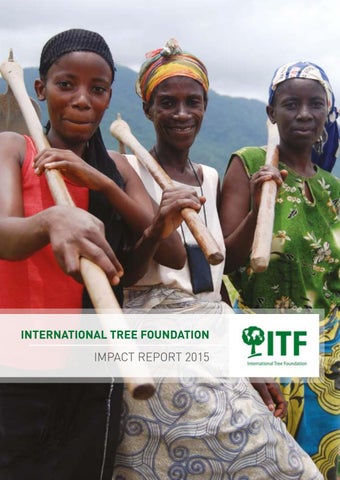
INTERNATIONAL TREE FOUNDATION
IMPACT REPORT 2015
INTERNATIONAL TREE FOUNDATION - IMPACT REPORT 2015
UK:
7 projects in 8 counties
Africa:
46 projects in 14 countries including Mali, Ghana, Cameroon, Uganda, Kenya and Malawi
Over the past five years ITF has supported 54 projects in 15 countries working with 46 community partners
Over the past three years ITF projects grew over 1.4 million trees which have directly benefited more than 45,000 people.
INTRODUCTION 2015 was a year of growth for ITF. We expanded our programme of activities in Africa and the UK. We launched a major new project in Malawi and re-launched both our Africa Drylands Programme and our UK Community Tree Planting Programme.
In 2015 we supported 6 projects in the UK and 21 projects in 9 countries in Africa: Burkina Faso, Cameroon, Ghana, Kenya, Malawi, Mali, Senegal, Tanzania, and Uganda. Local communities grew 332,586 trees. The projects we supported directly benefited 9,371 people and made a real difference to the lives of thousands more.
Working in partnership with local Community Based and Non-Governmental Organisations (CBOs and NGOs) is fundamental to our ethos. So on the International Day of Forests on 21 March we launched the African Community Forest Network to provide a forum for our African partners to learn and share from each other and to provide a platform for the promotion of community-led forestry and agroforestry. Then in September we jointly produced a paper with three of our partners for the 15th World Forestry Congress held for the first time in Africa. Quickly followed by the UN summit that agreed the new Sustainable Development Goals and the Paris Climate Agreement, there were a number of very significant commitments made to end deforestation and to restore millions of hectares of degraded landscapes.
Even at the relatively small scale that ITF works at, the threat of deforestation is very real. One of our partners, Pro Biodiversity Conservationists in Uganda (PROBICOU), had to suspend their forest enrichment project due to an imminent threat of forest clearance to make way for tea plantations. Instead of planting trees, PROBICOU had to refocus its efforts on securing support for a conservation plan to protect the forest in the face of commercial interests. We responded by helping PROBICOU to launch the Save Kafuga Forest campaign, gathering more than 160,000 signatures from Uganda and around the world on a petition presented to the Ugandan Minister of Environment.
On a global level we know that our planet has just over 3 trillion trees, which sounds like a lot, but is only half the number before the industrial age started. And we are continuing to lose 15 billion more trees every year, much of this being from natural forests. And while 5 billion new trees are planted, many of these are in monoculture industrial plantations. Andy Egan, ITF Chief Executive, with the Nkhata Bay Natural Way team, Malawi
Project: The Nkhata Bay Natural Way, Malawi Partner: Temwa Malawi and Deki Ltd Malawi is the 7th poorest country in the world, and Nkhata Bay is one of its poorest regions. With funding from the Big Lottery Fund, the JJ Charitable Trust and support from ITF and Deki Ltd, Temwa Malawi is implementing a major four-year project called the Nkhata Bay Natural Way (NBNW). The project started in July 2015, and was officially launched in September.
Achievements: A Strong Start ►►
86 Lead Farmers and 46 Community Extension Volunteers selected and trained.
►►
Already working with more than 1,000 local people.
►►
18 Village Natural Resource Management Committees are developing Village Action Plans, including tree planting sites.
►►
18 tree nurseries are raising over 100,000 seedlings to plant in 2016.
►►
Local institutions are being trained on environmental conservation, leadership and advocacy.
►►
Market surveys are being carried out to assess the viability of IGAs, and participants are being identified to benefit from micro-finance.
The Challenges The people of Nkhata Bay are smallholder subsistence farmers and fishers, yet many do not have secure food supplies throughout the year. Forest cover is lost every year as trees are cut for firewood, charcoal, building poles, and to clear land for farming. Fallow periods become shorter, the land is continuously cropped, and farmers cannot invest in soil conservation. The result is soil erosion, loss of soil fertility and declining crop yields. To compound the problem, recent years have seen climatic shocks and unreliable rains, with rivers drying up, crop failures, floods and landslides. High levels of HIV place huge pressures on households. Women, who do much of the agricultural work but have little control over resources, are especially impacted. NBNW seeks to address the needs of 39,000 people in 110 villages. The project aims to transform vulnerable households’ livelihoods through carefully targeted training and financing for integrated agroforestry and income generation activities (IGAs), and to embed community stewardship of natural resources.
IMPACTS These are impressive first steps against a challenging backdrop: the drought affecting Malawi since 2015. It is challenging for local people to devote time and energy to activities for longterm benefits. Yet they understand that agroforestry, natural resource management and income generation are the best ways to build resilience and productivity in the face of
climate change, while ensuring that activities deliver benefits as soon as possible. James Matemanga decided to get involved to encourage others to work responsibly to conserve the environment and replenish depleted natural resources: ‘Trees will be replaced and indigenous ones will be conserved’ leading to ‘more agricultural productivity due to the increased rainfall and water retention… and the restoration of fertile soils.’
INTERNATIONAL TREE FOUNDATION - IMPACT REPORT 2015
Project: Dom Community Food Forest, Nkwen, Bamenda, Cameroon
This project, and others in this report, benefited from generous support from...
Partner: Community Assistance in Development (COMAID) The people of Dom village in north-west Cameroon are coming together to protect their own forest and to plant a ‘Food Forest’ around it. They manage 472 ha of afro-montane forest in the Bamenda Highlands. It is a biodiversity hotspot with 23 threatened species – 12 new to science and 5 endemic. The forest used to be a rich source of forest products, but much has been cleared for farming or over exploited. Water flows have reduced and the community no longer obtain once-valued forest products. Now COMAID is helping them protect the forest by planting a buffer strip around it with native trees. This Food Forest will be a source of food and income for the Dom community, and help restore water flows as well as protecting the rich biodiversity.
Achievements ►►
242 people joined the project.
►►
21 community members established tree nurseries for 7 species valued for food and medicine.
►►
19,842 trees were planted in the buffer zone with a survival rate of 87%.
►►
20 ha of degraded land was restored with native species from the same ecosystem.
►►
Fire traces were cleared and sites were monitored, to prevent the young trees being destroyed by bush fire or cattle.
►►
200 posters were produced to raise appreciation of these species.
►►
The Forest Management Institution has been trained in community forest governance.
The project is educating the Dom community on the importance of the forest and the benefits it provides. Kenneth Kumecha Tah, Head of Conservation at COMAID, explains that: ‘The community is aware that the buffer food forest secures their interest with respect to income generation and other ecological services in the long term. They are ready to continue protecting the forest and its buffer.’
IMPACTS
►►
The project is supporting a process of long-term change.
►►
The community is more aware of the need to protect the forest, and value the species planted in the buffer.
►►
The Food Forest buffer has enhanced the conservation of the forest and the environment around the village. Most of the area planted was highly degraded; bush fire around the forest has been controlled and the area is being restored.
More trees are being planted on private land in agroforestry systems.
Long term sustainability is encouraged by training the community to consolidate the results, with regular fire tracing and monitoring. ITF will support further work on the Dom Community Food Forest in 2016.
Some participants are using new skills to establish private tree nurseries to sell seedlings; there are 6 permanent nurseries to supply seedlings for reforestation.
►►
INTERNATIONAL TREE FOUNDATION - IMPACT REPORT 2015
Project: Sustainable Land Management for the Mitigation of Land Degradation, Upper West Region, Ghana Partner: Sungmaale Integrated Herbalists Association (SIHA) In northern Ghana, near the Burkina Faso border, the people of Pase and Charia villages make their living from crops, livestock and tree products, and rely on brief rains to get them through the long hot dry season. But the landscape has been gradually depleted of trees. This leads to flooding and soil erosion during the rains, silting of water bodies and reduction in crop yields. David Moomen, Coordinator of SIHA, explains that, as a result, ‘many homes face food insecurity and malnutrition prompting young men and women to migrate south or to areas where illegal mining is being practiced. Sometimes they return home with diseases such as HIV AIDS. Land degradation increases the vulnerability of this poor community, fracturing their sources of income and undermining their livelihoods’. During the long dry season, fuel wood and charcoal selling is the main business. The bush is overgrazed, and burned by farmers, hunters and cattle owners. Women walk ever further to fetch fuel wood for cooking. Some highly valuable native trees such as Parkia biglobosa and Saba senegalensis are becoming scarce. And, as David Moomen says: ‘poverty is the driving factor for degradation of the environment’. SIHA takes an integrated approach to the challenges: building capacity and understanding;
engaging women and men in alternative ways of earning money; introducing woodlots and fodder trees; improving soil fertility and restoring degraded areas. The goal is to build their
capacity to reverse land degradation and to adopt practices that will improve food security and reduce poverty, leading to sustainable improvements in the environment and in livelihoods.
IMPACTS The project was especially successful in: ►►
Improving the livelihood situation of beneficiaries. ‘They are now able to produce and sell soap at the local market. The profit generated is shared among beneficiaries for use in procuring some basic necessities for their households’.
►►
Improving the local environment. In the short term this is largely due to improved protection. In the longer term, as the trees grow, people will ‘benefit from increased vegetation, providing fuel wood for the community and fodder for the animals.’ The eventual aim is that ‘streams and ponds will no longer dry up during the hot season… flora which was extinct will regenerate, while the fauna which abandoned the area will return to their natural habitat.’
►►
Changing the behaviour of community members. ‘They now view the forest as an important natural resource which demands their absolute protection and attention. Indiscriminate felling of trees is no longer an easy undertaking due to the bye laws’.
Achievements ►►
SIHA set itself ambitious targets in 2015. The project was affected by erratic rains and high prices. Not all its ambitions were realised, but the achievements are nonetheless impressive.
►►
12,500 trees raised and planted with an initial survival rate of 86%.
►►
Species included Senna siamea, Albizia spp, Teak and Moringa oleifera – all are good agroforestry species, and Moringa leaves and seeds are highly nutritious.
►►
40 women and 30 men took part in raising and planting the trees.
►►
A School Environmental Club was established and helped to plant the trees.
►►
40 women trained and equipped for soap making, and 30 young people for beekeeping, to ‘jump start income generating ventures’.
►►
An Environmental Management Committee established: 10 men and 10 women trained to implement sustainable land management.
►►
Bye laws to protect the forest from bush fires and indiscriminate tree felling were approved by the Chief and his elders.
►►
The Environment Management Committee patrols the project site to prevent fires and stop livestock browsing the plants.
Project activities are being sustained. The tree nursery is being managed by 3 women and 2 men. The Environmental Club encourages children to tell parents about the importance of trees. The Women, Men and Youth groups have been restructured with elected officers. The Women Group opened a bank account for proceeds from the sale of products. Part of the funds will be used to raise seedlings annually. SIHA’s capacity has grown, enabling it to take part in preparing the national reforestation strategy, and form collaborations with Government agencies. With funds from the Body Shop Foundation, ITF will is support further work in 2016, with a focus on promotion of Moringa, Mango and Cashew trees for nutrition and income; restoration of degraded land; and further development of beekeeping.
Albertina Wanaa, 32, says ‘The project …
has brought sanity in the way trees are being exploited. We have made rules to govern the felling of trees and we respect the rules.’ ‘The soap training …has enabled us to produce and sell soap in the local market. The number of times we visit the forest to fell trees has reduced because of the soap making.’
INTERNATIONAL TREE FOUNDATION – IMPACT REPORT 2015
Project: Ulmus Maritime, Cuckmere Valley, East Sussex, England Partner: The Conservation Foundation receives full information on caring for the saplings, which are recorded on a map for the long term. Community members also help collect Elm seeds from groups of mature Wych Elm (Ulmus glabra) and English Elm (U. procera), contributing towards a comprehensive genetic record for the Millennium Seed Bank’s UK National Tree Seed Project.
Achievements
The Conservation Foundation launched the Ulmus Maritime project to help communities take an active role in supporting Dutch Elm Disease (DED) control and conserving the Elm landscape.
►►
4 young women and 8 young men helped raise Elm saplings and learned about tree care and management with the horticultural charity Roots and Shoots.
►►
They collected Wych Elm seeds for the UK National Tree Seed project.
►►
More than 50 people took part in the walk-andtalk and in tree planting.
In 2015 ITF supported activities in the Cuckmere Valley, which has an unusually high density of Elms. It falls within the East Sussex DED control zone, and diseased trees are regularly felled to control the spread of the disease. Following a DED outbreak large numbers of Elms were felled, threatening a range of species that feed on them. Many residents feared that ‘all was lost for the Elms in the valley’. However, mature Elms remain and The Conservation Foundation believes it is possible to regenerate the population for future years. ITF supported replanting in areas where most of the felling occurred, around the villages of Alfriston, Littlington and Friston. The goal was to enable the community to take an active role in conserving their Elm trees and understand their importance. The project consisted of community Elm tree plantings, a walk and talk, and seed collection. The saplings came from The Foundation’s Great British Elm Experiment, which propagates saplings from Elms across the UK that seem to have resisted DED as mature trees for at least 30 years. These saplings, along with the ‘parent’ trees, are monitored to assess if they are truly resistant. Each site has a designated ‘guardian’ to look after the saplings, with a network of volunteers to share responsibility. Each network INTERNATIONAL TREE FOUNDATION - IMPACT REPORT 2015
►►IMPACTS They planted
120 Elm saplings from the Great British Elm Experiment.
Awareness was raised of the importance of Elms to
Cuckmere Valley, through project activities and ►►the Initial survival is 100%. local media coverage.
• The planted trees will help regenerate the Elm population, to replace those felled. It will take time for the saplings to become mature trees, but they will grow on with a little help from community members when required. • The project has encouraged greater responsibility for the Elm trees in the community. • Young people gained skills in caring for trees, while The Conservation Foundation gained experience in working with young people.
Project: Restoration of Pit Wood, Ham Hill Country Park, Somerset, England Partner: Friends of Ham Hill Ham Hill, a 164 hectare Country Park around an Iron Age hill fort, is a designated Local Nature Reserve, owned by the District Council, with open access and good links to several Rights of Way, providing excellent walking. The Friends of Ham Hill (FoHH) help the local Ranger team to implement the Country Park’s Management plan, including restoration of Pit Wood. Research into this historic woodland revealed that a mixed woodland on the site was linked to a large local estate in the 1600’s. The woodland was felled during/after WWII and much of the woodland is now dominated by Sycamore coppice re-growth. The aim is to restore the wood’s landscape character and its floral and eventually faunal biodiversity by planting native trees. At the same time FoHH want to involve and encourage local communities, visitors and educate people about the importance of woodland habitats, the plight of woodlands, tree species, and how to plant and maintain them. The wider aims are to build a local sense of ownership, ensure that there will be guardians of the wood for generations to come, and to promote physical and social well-being.
Mick Wooden (Chair of FoHH) explains, ‘The most amazing thing was watching people as they grew in confidence. Many had never planted a tree… It was fantastic to see how empowered they became and how the process increased their perception of the natural environment around them. Time will tell if people start to take ownership of the wood, but they will be able to look back in years to come and see what they achieved on the day. They have been empowered … and hopefully see their local natural environment in a new or refreshed light.’
The project was advertised locally and in social media. Participants were asked to ‘bring a spade’ and help plant 1,000 trees over three days.
Achievements ►►
1,020 trees were planted and are doing well.
►►
The trees include Field Maple, Birch, Hornbeam, Hazel, Hawthorn, Chestnut, Wayfaring Tree, Oak and Rowan, and initial survival was 100%.
►►
IMPACTS ►►
Planting 1,020 trees will help to increase faunal and floral diversity.
►►
While the tangible results are significant, the intangible benefits of bringing together 54 local people to take part in a physical activity and plant the trees were also important.
►►
People learned about the plight of woodlands, tree species, care and maintenance, and how to plant trees.
►►
Good community involvement: ‘The local community came together and shared an experience together. They chatted, shared stories, knowledge and drank tea together. People came as families, which was great to see.’
►►
These experiences contribute to social, mental and physical well-being.
54 local people took part in planting the trees.
INTERNATIONAL TREE FOUNDATION - IMPACT REPORT 2015
Project: Trees for Livelihoods, Mopti, Mali Partner: Sahel Eco Trees 4 Livelihoods (T4L), funded by the Big Lottery Fund, is making a major contribution to long term efforts to promote sustainable land use, encourage reforestation and restore soil fertility in Mali. In 2015 the project reached the mid-point in its four year programme. Mali is a vast country stretching south from the Sahara, and the project is located in the heart of the Sahel region. Communities in these landscapes live with and adapt to harsh conditions, with temperatures often above 40c and unreliable rainfall of about 500mm per year. The Sahel has known recurrent drought over history, and climate change only increases the extremes of weather. It is the natural tree cover of the Sahel, with its range of remarkable species, that makes agriculture, pastoralism and human life possible in these dry landscapes. ITF’s local partner, Sahel Eco, has been a pioneer in developing methods of forest and land restoration that are making real differences to people’s lives, and T4L builds on that long track record. The project aims to benefit almost 28,000 people in Konna, Borondougou, Koubaye and Ouro Modi communes in Mopti District, and focuses on four main project activities: ►►
Encouraging smallholder farmers to adopt more sustainable land management practices
►►
Restoring the productive potential of highly degraded land
►►
Fostering inclusive management of the Koubaye Forest to enhance forest resources
►►
Assisting women to increase incomes though harvesting, processing and marketing non-timber forest products such as fruits, nuts and medicines
The project is making strong progress despite challenging conditions. A mid-term review in late 2015 noted that ‘people . . . are unanimous on the quality [of] work carried out by the project.’ As if the climatic challenges were not sufficient, political events within and beyond Mali have conspired to open the door to the conflicts which are driving human migrations across northern Africa. Sadly, the threat posed by jihadists brought a halt to work in the Koubaye Forest throughout the year.
Sustainable Land Management Smallholder farmers in dryland areas (without irrigation) are adopting more sustainable land management practices, restoring their tree cover, reducing erosion and improving soil fertility. Men and women take part in video shows and discussions on land restoration methods, and there is an annual competition for the best practitioners of Farmer-Managed Natural Regeneration (FMNR). FMNR is a set of simple practices by which farmers identify, protect and manage naturally regenerating young trees of valuable species across their farms. The trees protect and fertilise the soils and provide a sustainable stream of benefits such as fruits and fuel wood from prunings. Crop yields are enhanced
INTERNATIONAL TREE FOUNDATION - IMPACT REPORT 2015
being established and helping women diversify into other income-generating activities through loans.
Achievements
by the presence of well managed trees within fields. The project is building local agreements to ensure that people continue to benefit from the land and trees they restore.
►►
76,634 trees regenerated.
►►
994 men and women trained on sustainable land management.
►►
4,013 men and 2,649 women participated in the video sessions.
►►
336 of those trained adopted FMNR plus at least two other techniques.
►►
836 hectares of land restored by FMNR, Zai pits, earth bunds and stone lines.
►►
140 ha of severely degraded land restored mainly using Zai and earth bunds.
►►
In Diambacourou village, 32 women given 27.5 ha of land; 1 ha allocated to a group of 60 women to produce trees for reforestation.
►►
In Oumere and Time villages 32 internally displaced people from the Bella, Dogon and Fulani ethnic groups given access to 306 ha of land to cultivate.
►►
The cumulative total of degraded land restored reached 244 ha.
►►
695 women in 33 groups trained in methods of increasing value from NTFPs.
Restoration of highly degraded land The plan was to restore the productive potential of 55 hectares of land. Following a thorough reassessment of land tenure issues, the project is reaching far more beneficiaries – notably women and displaced people – and covering a much wider area than originally intended. Contour stone lines or earth bunds are constructed to capture run-off, reduce erosion and increase water infiltration, and Zai planting pits are dug into impermeable soils and filled with compost to collect rainfall and create ideal conditions for crops.
Increased incomes from Non-Timber Forest Products (NTFPs) Women are harvesting, processing and selling NTFPs, including juices made from Tamarind, Balanites and Borassus Palm fruits, Jujube cake from Ziziphus fruits, and Henna soap. They are improving their organisation and access to markets and managing the trees they depend on, thus increasing incomes and security of access. T4L is training them to ensure high standards of hygiene and presentation. ‘Savings for Change’ Groups are
IMPACTS
►►
Restoring degraded land, re-establishing tree cover, and making money from trees – these sound improbable goals in the harsh conditions of Mali. But with determination and patience extraordinary results can be, and are being, achieved.
►►
A study of vegetation changes in areas where FMNR and other techniques are practiced found that over a third of all the trees inventoried could be attributed to T4L activities.
►►
Preliminary assessments show that crop yields increase on average by 18% in fields treated with FMNR and by 62% in areas treated with FMNR and Zai pits. 437 members of 20 women’s groups earned €3,200 from the sale of processed NTFPs. They saved more than €3,800 and gave out loans of nearly €1,700. These are remarkable figures. But they are based on a fundamental appreciation that a good quality of life is achievable in the Sahel – by working with nature rather than against it.
►►
INTERNATIONAL TREE FOUNDATION - IMPACT REPORT 2015
20 Million Trees for Kenya’s Forests – ITF Centenary Campaign ITF’s campaign to plant 20 million trees in and around Kenya’s forests by 2024 is underway. This is the most ambitious campaign yet in our 92-year history and we’re aiming to raise £4m for the planting of 20 million trees. Find out more at internationaltreefoundation.org/20milliontrees More about ITF ITF is one of the oldest established forestry organisations in the world, founded in 1924 by Dr Richard Baker. He was a forester in Kenya after the First World War and, dismayed by the deforestation taking pace, founded ‘Watu wa Miti’ or ‘People of the Trees’ with Chief Josiah Njonjo, a leader of the Kikuyu community. On returning to the UK he established ‘Men of the Trees’ which changed its name in 1992 to become International Tree Foundation. Richard Baker was generations ahead of his time in terms of environmental awareness and ITF continues his work promoting and funding sustainable community forestry projects in the UK and internationally and we have been responsible for the establishment of hundreds of millions of trees.
HOW WE WORK
THE FUTURE
ITF’s mission is to work with local communities to promote the role of trees and forests in improving livelihoods, protecting the environment, and developing the economic potential of native and traditional species.
In 2016 we are supporting 19 projects, including 2 education projects in the UK and 17 projects in 8 African countries. These include 4 new projects which were launched in 3 Sahel countries under ITF’s African Drylands Programme in late 2015. We also continue to support development of the African Community Forestry Network.
Our four strategic aims are:
ENVIRONMENT: increase tree cover, promote reforestation and appropriate tree cultivation.
EDUCATION: foster an understanding of the amenity, ecological and economic value of trees. LIVELIHOODS: enable communities to develop and restore sustainable and productive landscapes through tree cultivation.
CAPACITY BUILDING: build capacity in community organisations to advocate, share knowledge and implement community based forestry and agroforestry.
We are providing support to local partners and community members for the ‘Save Kafuga Forest’ Campaign – to save three small forests in south-west Uganda from clear-felling. We will be publishing the Tree Power Key Stage 2 teaching resource and expanding the programme to more areas of the UK. We are launching Fruit-Full Communities, a major 3-year programme with Learning through Landscapes, YMCA, and the Urban Orchard Project to support young people in Housing Schemes and Supported Lodgings across England to develop community orchards and to improve their skills, confidence and health.
For more details about ITF and all our work: web: www.internationaltreefoundation.org | email: info@internationaltreefoundation.org You can also follow us on Facebook and Twitter | Reg Charity no. 1106269