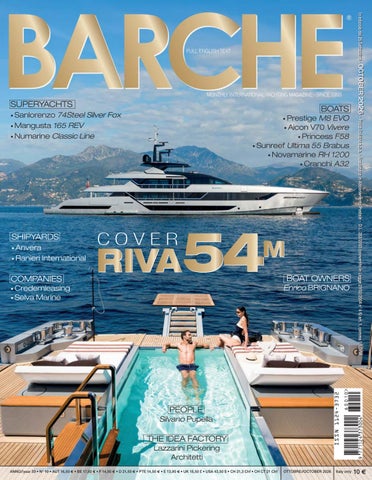
BOATS
• Sanlorenzo 74Steel Silver Fox
• Prestige M8 EVO
• Mangusta 165 REV
• Aicon V70 Vivere
• Numarine Classic Line
• Princess F58 • Sunreef Ultima 55 Brabus • Novamarine RH 1200 • Cranchi A32
SHIPYARDS • Anvera • Ranieri International
COMPANIES
RIVA
RIV
BOAT OWNERS
Enrico BRIGNANO
• Credemleasing
In edicola dal 25 Settembre - OCTOBER 2026 - Poste Italiane s.p.a. - Spedizione in Abbonamento Postale - D.L. 353/2003 (convertito in Legge 27/02/2004 n° 4 6) art. 1, comma 1, LO/MI
SUPERYACHTS
• Selva Marine
PEOPLE Silvano Pupella
THE IDEA FACTORY Lazzarini Pickering Architetti ANNO//year 33 • N° 10 • AUT 16,50 € • BE 17,50 € • F 14,50 € • D 21,50 € • PTE 14,50 € • E 13,90 € • UK 18,50 £ • USA 43,50 $ • CH 21,3 Chf • CH CT 21 Chf
OTTOBRE//OCTOBER 2026
Italy only
10 €
CONTRO IL FATALISMO
CHALLENGING FATALISM La rassegnazione non è contemplabile. Occorre agire con progetti concreti, figli di idee coraggiose. Perché il futuro, compreso quello dell’industria nautica, è nelle nostre mani, non in quelle di un’entità astratta Resignation isn’t an option. We need to implement tangible plans rooted in bold ideas, as the future – especially for the marine industry – is in our hands, not in some abstract entity by Francesco Michienzi
Ogni anno, l’editoriale di ottobre coincide con un momento topico: quello in cui il mare torna a chiamarci e la nostra industria si mette nuovamente in movimento. Sfogliando vecchi testi, però, emerge una realtà scomoda e incontrovertibile: molte questioni tornano in scena immutate. Il professor Giovanni Zuccon, già quindici anni fa, ci ricordava una verità che oggi risuona ancora più urgente: non basta la tecnica, non basta il progetto, non basta nemmeno conoscere la storia o saper leggere correttamente le parole chiave del mercato se, prima di tutto, non si mette al centro l’uomo. Uomo inteso non soltanto come armatore, ma come insieme di figure – architetti, tecnici, artigiani, operai, imprenditori, politici e giornalisti – che, con i propri comportamenti e le proprie passioni, costruiscono relazioni. Zuccon, inoltre, sottolineava l’importanza di alcuni termini spesso dimenticati, pur essendo la misura della nostra civiltà: etica, rispetto, disponibilità, onestà intellettuale e materiale. Termini che non devono ridursi a ornamento retorico, bensì tradursi in azioni quotidiane, in regole condivise, in cultura di settore. Queste riflessioni non sono dettate da un moto di nostalgia: sono piuttosto un monito. Siamo forse diventati fatalisti? Ho chiesto aiuto alle pagine di Contro il fatalismo di David Foster Wallace, libro in cui il saggista cerca, per l’appunto, di smontare la tesi sul fatalismo del filosofo americano 14
EDITORIAL
«Ci sono PAROLE troppo spesso dimenticate. Parole che sono la misura del nostro livello di CIVILTÀ e della nostra umanità, parole che guidano i nostri comportamenti entro binari sicuri e capaci di portarci alla meta: etica, rispetto,
disponibilità, onestà intellettuale e materiale».
«There are WORDS that are all too often forgotten. These words measure our level of CIVILISATION and humanity, guiding our behaviour toward safe paths that lead to our goals: ethics, respect, helpfulness, and both intellectual and material honesty». Professor and Architect Giovanni Zuccon
16
EDITORIAL
Richard Taylor. Quest’ultimo in sintesi sostiene che il futuro sia qualcosa su cui non possiamo incidere, una catena di eventi che rende inutile qualsiasi deliberazione. È una tentazione seducente, e pericolosa, anche nella nautica: accettare schemi di mercato, abitudini di servizio, pratiche scorrette come se fossero immutabili. I dati che circolano da anni dipingono un settore decisamente frammentato: il segmento oltre i 24 metri prospera, la fascia tra i 12 e i 24 soffre, mentre le imbarcazioni sotto i 10 arrancano o, addirittura, restano ferme. Se queste statistiche fossero vere – e vale la pena sottolinearlo – meriterebbero analisi più rigorose e sarebbe naturale interrogarsi sulle motivazioni. Perché una forbice così ampia? Perché l’offerta e i servizi non rispondono alle esigenze di chi ormai non è più la classe media di un tempo? Perché l’industria italiana, sinonimo di eccellenza e inventiva, fatica a mantenere un tessuto produttivo capace di sostenere tutte le dimensioni del diporto? Non possiamo e non dobbiamo rassegnarci. La rassegnazione è complice del declino. Affidarsi soltanto alla politica, in perenne campagna elettorale, produce spesso chiacchiere e pochi risultati concreti, o non del tutto risolutivi, dei problemi di fondo. Per non parlare dell’intelligenza artificiale a cui ci si affida senza più spirito critico per ottenere soluzioni chiavi in mano. La vera strada, quella concreta e combattiva, passa dal porto e dai cantieri: dal dialogo diretto con gli armatori, dagli occhi negli scali, dall’ascolto delle e-mail di protesta, dalle storie di manutenzioni mai effettuate, tuttavia fatturate a caro prezzo. Serve il coraggio di smantellare con fermezza sterili luoghi comuni, quello, ad esempio, secondo cui chi possiede una barca è ricco e pertanto può essere spennato. Ebbene, proporre alternative a degenerazioni culturali come questa non è soltanto un esercizio retorico: è un atto di responsabilità. Occorrono poi azioni concrete, urgenti ed emotivamente necessarie, come la ricerca di settore per citarne una, finanziando studi indipendenti che analizzino segmenti, domanda reale e barriere all’ingresso alla fruizione del mare. Del resto, i dati solidi sono la base per poter prendere decisioni efficaci. È necessario rimettere l’utente al centro, ascoltare gli armatori e i diportisti, raccogliere i loro bisogni e le loro denunce, tradurre il disagio in progetti reali, standardizzare e controllare i servizi portuali. Ci vogliono trasparenza nei listini, regole chiare per manutenzioni e forniture, sanzioni efficaci per pratiche predatorie. Un codice etico portuale non è certo un sogno: è una necessità. Servono anche formazione e cultura professionale, perché non si costruisce fiducia senza competenza, incentivi mirati, politiche che favoriscano l’accesso alla nautica per fasce più ampie, sostegno alle imprese che innovano nei segmenti piccoli e medi, agevolazioni per servizi condivisi e infrastrutture efficienti. È altresì importante promuovere iniziative che avvicinino la città al mare, che educhino al rispetto dell’ambiente e della proprietà altrui, che restituiscano alla nautica un valore sociale oltre che economico. Questi non sono incantesimi: sono percorsi che richiedono volontà, impegno collettivo e, soprattutto, una scelta culturale. Bisogna davvero tornare a usare parole come etica e rispetto non come slogan, ma come criteri di valutazione delle azioni quotidiane nella progettazione, nella vendita, nella manutenzione, nella politica. Smettiamo di raccontarci che il cambiamento è impossibile. Il fatalismo è una comoda scusa per non investire energie, ma la nautica è un mondo fatto di persone che sanno affrontare il vento e sfruttarne la forza. Riprendiamo il timone. Ascoltiamo, facciamo analisi serie, applichiamo standard, coltiviamo la cultura del mare e dell’onestà. Solo così la stagione che ricomincia potrà diventare un vero nuovo inizio, non soltanto per le barche grandi, ma per chiunque desideri sentire ancora il mare come una possibilità, non come una condanna.
Each October, the editorial highlights a key moment when the sea beckons us again, and our industry reactivates.
Un FATALISTA è una persona che non può fare nulla riguardo al proprio futuro. Crede che non dipenda da lui QUELLO CHE AVVERRÀ l’anno prossimo, domani, o addirittura tra un momento. Si suppone, di conseguenza, che per lui sia inutile deliberare su qualsiasi cosa. A FATALIST is someone who believes they cannot do anything about their future. They believe that WHAT WILL HAPPEN next year, tomorrow, or even in a moment’s time is beyond their control. Consequently, it is assumed that there is no point in their deliberating on anything.
18
EDITORIAL
However, leafing through old texts reveals an uncomfortable and undeniable reality: many issues resurface unchanged. Fifteen years ago, Professor Giovanni Zuccon reminded us of a truth that rings out with even greater urgency today: technology alone is not enough, nor is design alone, nor is it enough simply to know history or to interpret the market’s key terms if, first and foremost, we do not place people at the centre. By people we mean not only the shipowner, but a whole range of figures – architects, engineers, craftsmen, workers, entrepreneurs, politicians and journalists – who, through their behaviour and passions, forge relationships. Zuccon also highlighted the importance of certain often-overlooked terms that reflect our civilisation: ethics, respect, helpfulness, and intellectual and material honesty. These words should not be mere rhetorical devices but should be embodied in daily actions, shared norms, and sector-specific cultures. This reflection is not driven by nostalgia but as a warning. Have we perhaps become fatalists? I looked to David Foster Wallace’s Against Fatalism for insight—a book where the essayist aims to dismantle Richard Taylor’s thesis of fatalism. Taylor claims that the future is something over which we have no control, a chain of events that renders any deliberation pointless. This idea is both tempting and risky, especially in the boating industry: it involves accepting market trends, service standards, and unfair practices as unchangeable realities. Data circulated over the years shows a highly fragmented sector: the over-24-metre segment is thriving, the 12–24-metre range faces difficulties, while boats under 10 metres struggle to progress or are at a standstill. If these statistics are accurate – and it’s important to highlight this – they deserve closer examination, prompting questions about the reasons behind them. Why such a vast disparity? Why do supply and services fall short for those who are no longer part of the old middle class? Why does Italy, renowned for excellence and innovation, find it difficult to sustain a manufacturing base that supports all recreational boating sectors? We cannot and must not resign ourselves to this. Resignation is an accomplice to decline. Relying solely on politics – which is in a perpetual state of election campaigning – often results in a lot of talk and few concrete results, or in solutions that do not fully resolve the underlying problems. Not to mention artificial intelligence, which we now rely on without any critical thinking whatsoever, in the hope of obtaining ready-made solutions. The real way forward – the practical and combative one – lies in the ports and shipyards: in direct dialogue with shipowners, in keeping a close eye on port operations, in responding to protest emails, and in hearing stories of maintenance work that was never carried out but was nonetheless invoiced at exorbitant prices. We need the courage to dismantle tired clichés, such as the claim that anyone who owns a boat is rich and therefore can be fleeced. Proposing alternatives to cultural degenerations such as this is not merely a rhetorical exercise: it is an act of responsibility. Concrete, urgent, and emotionally essential actions are necessary. This includes sector-specific research, such as funding independent studies into market segments, actual demand, and barriers to accessing and enjoying the sea. Reliable data is crucial for effective decision-making. We must re-centre the user by listening to shipowners and recreational boaters, understanding their needs and concerns, and
translating these into tangible projects. Additionally, standardising and monitoring port services is vital. Transparent price lists, clear rules for maintenance and supplies, and strong penalties for predatory practices are also needed. A port code of ethics is more than just an ideal; it’s a vital necessity. Equally critical are proper training and a robust professional ethos, since trust relies on expertise, suitable incentives, policies that make boating accessible to more people, support for small and mediumsized innovative businesses, and encouragement for shared services and efficient infrastructure. It’s also crucial to promote initiatives that connect the city with the sea, educate people to respect the environment and others’ property, and restore the social and economic value of boating. These aren’t simple slogans; they are pathways that demand determination, collective effort, and a cultural shift. We must genuinely start using words like ‘ethics’ and ‘respect’ not just as slogans but as standards to assess our daily actions in design, sales, maintenance, and politics. Let’s stop telling ourselves that change is impossible. Fatalism is a convenient excuse for avoiding effort, but the sailing world is made up of people who know how to face the wind and harness its power. Let’s take the helm again. Let’s listen, conduct thorough analyses, uphold standards, and nurture a culture of the sea and of honesty. Only in this way can the season that is about to begin become a true new beginning – not just for large yachts, but for anyone who still wishes to see the sea as an opportunity, not a curse.
Sarebbe utile fare UN’ANALISI più approfondita sul perché alcuni segmenti importanti dell’industria nautica italiana soffrono da tempo. Non sarebbe saggio investire risorse per analizzare meglio gli SCENARI di mercato e gli sviluppi futuri? It would be useful to carry out a more in-depth ANALYSIS of why certain key segments of the Italian boating industry have been struggling for some time. Would it not be wise to invest resources in analysing market SCENARIOS and future developments more thoroughly?
20
EDITORIAL
Contents
Ottobre // October
2026
COVER RIVA
54M Columns 072 082 090 100 112 124
130
124
116
130 168
News Revenue on board 0 Lawyer on board Economy: The superyacht industry Events Sardinia Boat Show Lifestyle Boucheron Serpent Bohème Hypercar Porsche 911 GT3 Beyond Safety - Sea Fend
Companies
136
116 354
Credemleasing Selva marine
People 354 32
CONTENTS
136
Silvano Pupella
152
242
210
334
178
188
236
282
Boat Owners 152
Enrico Brignano
Shipyards 188 236 346
Anvera Lürssen 5 New Deliveries Ranieri International
The Idea Factory 178 210
MUVE Lazzarini Pickering Architetti
Preview 196 224 230 282 34
CONTENTS
News Numarine Classic Line Beyond Horizons 155 Meters Sunreef Ultima 55 Brabus
Superyachts 242 274
Sanlorenzo 74Steel Silver Fox Mangusta 165 REV
Cover Story 258
Riva 54Metri
Boats 290 302 314 324 334
Prestige M8 EVO Aicon V70 Vivere Princess F58 Novamarine RH 1200 Cranchi A32
Trade 369
Charter and broker top selection
BARCHE
®
FULL ENGLISH TEXT
MONTHLY INTERNATIONAL YACHTING MAGAZINE - SINCE 1993
DIRETTORE RESPONSABILE//Editor in chief
CONCESSIONARIA PUBBLICITÀ//Advertising
Francesco Michienzi f.michienzi@barcheisp.it
International Sea Press Srl, Viale Brianza, 17/A - 20821 Meda T. +39 0362 344140 b.borgonovo@barcheisp.it, info@barcheisp.it
DIRETTORE EDITORIALE//Editorial director
Gian Marco Lari T. +39 0773 742260 M. +39 335 6268932 m.lari@barcheisp.it
Barbara Borgonovo b.borgonovo@barcheisp.it
ART DIRECTOR
Giovanni Berruti M. +39 337 254344 g.berruti@barcheisp.it
Francesca Villirillo grafici@barcheisp.it
GRAFICA E PUBBLICITÀ//Graphic and Advertising Tamara Viganò info@barcheisp.it
Concessionaria per il Principato di Monaco e la Costa Azzurra Advertising for Principality of Monaco and Côte d’Azur
FOTOGRAFO//Photographer
INVESTOR MEDIA MONACO Sarl Andrea Dini a.dini@barcheisp.it
Andrea Muscatello redazione@barcheisp.it
DISTRIBUZIONE//Distribution
HANNO COLLABORATO A QUESTO NUMERO Contributing editors/writers Priscilla Baldesi, Alberto Mario Capelli, Olimpia De Casa, Berardo Lanci, Massimo Longoni, Filippo Michienzi, Barbara Morassut, Marco Negri, Sophia Negri, Chiara Risolo, Niccolò Volpati
SEGRETERIA DI REDAZIONE//Editorial assistant
Press-di Distribuzione Stampa e Multimedia S.r.l. Via Cassanese 224, 20090 Segrate (MI)
DISTRIBUZIONE ESTERO Sole Agent for Distribution Abroad JOHNSONS INTERNATIONAL NEWS ITALIA srl Via Valparaiso, 4 - 20144 MILANO
UFFICIO ABBONAMENTI
redazione@barcheisp.it
EDITORE//Publisher International Sea Press Srl, Viale Brianza, 17/A - 20821 Meda, T. +39 0362 344140, F. +39 0362 73790 redazione@barcheisp.it
STAMPA//Printing Tipolitografia Pagani Passirano (BS)
ON LINE Barche www.barchemagazine.com
Viale Brianza, 17/A - 20821 Meda, tel. +39 0362 344140 Abbonamento annuo € 75; abbonamento estero € 175 Europa; € 210 resto del mondo; un numero € 10,00; arretrati € 15. Pubblicazione mensile registrata al Tribunale di Milano in data 05/04/2004 al n. 233/2004. Tutti i diritti sono riservati. Vietata la riproduzione se non autorizzata per iscritto. Printed in Italy. Iscrizione ROC 34967 del 17/09/2020. How to subscribe - Subscription: International Sea Press Srl, Viale Brianza, 17 - 20821 Meda, tel. +39 0362 344140. Subscription rates (one year): Italy € 75,00 - Europe € 175,00 - all over the world € 210,00. Published monthly. All rights reserved: reproduction in whole or in a part of any article without prior written permission from the publisher is strictly prohibited. Printed in Italy. Questo numero è stato chiuso in Redazione il 3 Settembre 2026. This issue ended on 3rd September 2026.
CONFINDUSTRIA
MEDIA PARTNER YACHT CLUB PORTO ROTONDO
Manoscritti e fotografie, anche se non pubblicati, non si restituiscono. Gli articoli firmati sono la libera espressione degli Autori e non rispecchiano necessariamente la linea editoriale del giornale. Even if not published, handwritten manuscripts and pictures cannot be returned. The signed articles are the free expression of the writers and do not necessarily reflect the editorial policy of the magazine.
www.facebook.com/BarcheMagazine
56
COLOPHON
barchemagazine.com
Pressreader
#barchemagazineisp
ISSUU.COM
NEWS DELTA MARINE
DELTA MARINE
Delta Marine sta collaborando con lo studio di design londinese Bannenberg & Rowell per una nuova famiglia di yacht che combina un’estetica contemporanea con un sistema di propulsione ibrido, garantendo adattabilità a diverse piattaforme e dimensioni. La collaborazione offre l’opportunità di creare un linguaggio visivo all’avanguardia.
Delta Marine is collaborating with London-based design studio Bannenberg & Rowell to develop a new yacht line that combines contemporary aesthetics with a hybrid propulsion system, allowing versatile use across various platforms and sizes. This partnership offers an opportunity to establish a distinctive visual identity.
Ulysse Nardin presenta il Blast Moonstruck in oro rosa, un’edizione limitata a 20 esemplari, con una delle complicazioni astronomiche più sofisticate della Manifattura. Animato dal calibro UN-106, il Blast Moonstruck riunisce cinque indicazioni astronomiche in un unico display coerente. Ulysse Nardin introduces the new Blast Moonstruck in rose gold, a limited edition of 20 pieces, showcasing one of the brand’s most advanced astronomical complications. Driven by the UN-106 movement, the Blast Moonstruck combines five astronomical indications into a unified, elegant display.
Next Yacht Group Siman, azienda specializzata nelle lavorazioni metalliche, entra nell’ecosistema industriale di Next Yacht Group grazie all’acquisizione del 100% della società da parte di Continental Investment Srl, riconducibile alla medesima proprietà del Gruppo. Siman, a metalworking company, has become part of the Next Yacht Group’s industrial ecosystem after Continental Investment Srl, a subset of the Group, acquired 100% of it.
72
NEWS
Time shapes experience. Experience shapes design. 400 designs for clients from 28 countries. 75000+ yachts built. 135 Design and Boat of the Year awards. We Create Winners.
Carpet Edition
CATTELAN ITALIA Disegnata da Maurizio Manzoni, Baldwin Turn è una poltrona girevole rivestita in tessuto, con retro in pelle Glove. Con le sue linee prive di interruzioni rigide, la famiglia di sedute Baldwin raffigura un paesaggio domestico inedito dalle mille possibilità compositive, tra soluzioni lineari, angolari e freestanding. Designed by Maurizio Manzoni, the Baldwin Turn is a fabricupholstered swivel armchair featuring a Glove leather backrest. Its smooth lines, without harsh breaks, contribute to a distinctive domestic aesthetic and offer numerous arrangement options, such as linear, corner, and freestanding layouts.
Il tappeto si ispira allo Spazialismo di Lucio Fontana. La designer Margherita Fanti rilegge i celebri tagli dell’artista in una collezione essenziale e vibrante, disegnata per Carpet Edition. Un taglio preciso fende la tela bianca e apre un varco nell’infinito. Nel tappeto Lama il taglio non è la fine, bensì l’inizio di una nuova dimensione nello spazio.
Carpet Edition
Lucio Fontana’s Spatialism inspires this collection. Designer Margherita Fanti reimagines the artist’s iconic slashes in a minimalist yet lively design for Carpet Edition. A clean slash cuts through the white surface, creating an entrance into infinity. In the Lama rug, the slash signifies not the conclusion but the start of a new space dimension.
CUSTOM YACHT BENETTI 80 METERS
L’arrivo a Livorno dello scafo del Benetti Custom 80M segna la fase di outfitting di questa nave in acciaio e alluminio, in vista del varo programmato per il 2028. The arrival in Livorno of the hull of the Benetti Custom 80M marks the start of the outfitting phase for this steel-andaluminium vessel, ahead of its launch, scheduled for 2028.
74 74
NEWS NEWS
Il naufragio del Titanic è il titolo della raccolta di saggi e articoli redatti da Joseph Conrad tra il 1909 e il 1923 che Cluster-A riporta ora all’attenzione dei lettori. Tra questi, i due articoli redatti dall’autore all’indomani della tragedia nei quali riflette sulle possibili cause del naufragio.
BALTIC 80 CAFÉ RACER
BALTIC 80 CAFÉ RACER
Il nuovo 80 si basa sul feedback degli armatori e sull’esperienza maturata con la flotta 68. Sicurezza, semplicità ed esaltanti prestazioni di navigazione sono gli elementi imprescindibili del progetto. Lo yacht misurerà meno di 24 metri, così da consentire agli armatori di godersi le uscite in barca senza inutili complicazioni.
The new 80 is shaped by owner feedback and insights from the 68 fleet. The design emphasises safety, simplicity, and thrilling sailing performance. The yacht will be under 24 metres, enabling owners to enjoy sailing without unnecessary complications.
The Sinking of the Titanic is the title of a collection of essays and articles by Joseph Conrad, written between 1909 and 1923, which Cluster-A is now bringing to readers’ attention. Among these are two articles written by the author in the aftermath of the tragedy, in which he reflects on the possible causes of the sinking.
Cantiere delle Marche ha varato Deep Blue 115 Octopus, un explorer yacht di 35 metri di lunghezza il cui progetto deriva dal concept realizzato in collaborazione con il designer e architetto navale Horacio Bozzo. Cantiere delle Marche has launched the Deep Blue 115 Octopus, a 35-meter explorer yacht created in partnership with designer and naval architect Horacio Bozzo. 76
NEWS
REVENUE on
BOARD
TAX
REFORM 82 REVENUE on BOARD
Torniamo sul tema della tassazione dei marittimi imbarcati, poiché la relativa disciplina è stata recentemente rimodulata, introducendo una nuova ipotesi di esclusione dalla base imponibile IRPEF
Let us return to the taxation of seafarers on board vessels, as the relevant regulations have recently been revised, introducing a new exemption from the IRPEF tax base by Berardo Lanci and Simonè Saccon* OCTOBER 2026
83
In particolare, la norma interviene principalmente per coordinare il regime fiscale dei lavoratori imbarcati su navi battenti bandiera estera con quello proprio delle navi iscritte nel Registro Internazionale o nei registri degli Stati dell’Unione europea o dello
Spazio economico europeo annotate nell’apposito elenco di equiparazione tenuto dal Ministero dei Trasporti e delle Infrastrutture. Il novellato regime di tassazione prevede, da un lato, l’esclusione dalla base imponibile dei redditi derivanti dal lavoro dipendente prestato dai lavoratori marittimi imbarcati residenti in Italia e, dall’altro, l’esclusione da tali redditi delle disposizioni relative alla tassazione delle retribuzioni convenzionali in relazione al reddito di lavoro dipendente prestato all’estero in via continuativa da soggetti residenti in Italia. Sono quindi esclusi dalla base imponibile IRPEF i redditi derivanti da lavoro dipendente prestato dai lavoratori marittimi residenti in Italia, imbarcati per un periodo superiore a 183 giorni nell’arco di dodici mesi su navi battenti bandiera estera, diverse da quelle iscritte nei registri degli (ovvero battenti bandiera degli) Stati dell’Unione europea o dello Spazio economico europeo, adibite esclusivamente a traffici commerciali internazionali in relazione ad attività di trasporto marittimo internazionale, o attività assimilate, e annotate nell’apposito elenco tenuto dal Ministero dei Trasporti e delle Infrastrutture. Per questi ultimi, infatti, esclusi dalla nuova disposizione, trovano applicazione regimi fiscali di favore differenti, previsti da specifiche disposizioni legislative. Per quanto attiene, invece, ai lavoratori imbarcati su imbarcazioni e navi battenti bandiera estera destinate ad attività diportistiche, nei confronti dei quali trovano applicazione le disposizioni del rinnovato articolo 3 del TUIR, nulla dovrebbe cambiare rispetto al precedente regime. In ragione di tale circostanza,
si possono pertanto ritenere ancora valide le recenti pronunce con cui sono stati chiariti i criteri di calcolo dei 183 giorni. In particolare, si richiama la Risposta n. 10/2026, con cui l’Agenzia delle Entrate ha ricordato che la disposizione si applica a condizione che sia rispettato il requisito temporale di “periodo superiore a 183 giorni nell’arco di dodici mesi” e ribadito che, facendo la norma riferimento a dodici mesi e non all’anno o periodo d’imposta, la condizione deve ritenersi soddisfatta anche quando i 183 giorni sono computati a cavallo d’anno, non dovendosi necessariamente trattare di 183 giorni ricadenti nello stesso anno solare. Grande rilevanza assume poi la parte della citata Risposta n. 10/2026 in cui viene richiamato il paragrafo n. 1.5.7 della Circolare n. 207/E del 2000, in cui si legge, tra l’altro, che “Per l’effettivo conteggio dei giorni di permanenza del lavoratore all’estero rilevano, in ogni caso, nel computo dei 183 giorni, il periodo di ferie, le festività, i riposi settimanali e gli altri giorni non lavorativi, indipendentemente dal luogo in cui sono trascorsi”. È evidente, quindi, come, nella pratica, risulti di primaria importanza istituire un sistema documentale per il conteggio dei giorni di effettiva permanenza e operatività – nei termini di cui sopra – a bordo, al fine di poter dimostrare prontamente all’amministrazione finanziaria il soddisfacimento della condizione temporale dei 183 giorni. Non da ultimo, bisogna richiamare un altro chiarimento fornito dall’Agenzia delle Entrate – e valido anche con il nuovo regime qui in commento – in relazione al fatto che l’esclusione dalla base imponibile IRPEF si applica a prescindere dal luogo di prestazione dell’attività lavorativa. È, in altre parole, irrilevante che lo yacht su cui è imbarcato il lavoratore navighi principalmente in acque internazionali, comunitarie o italiane, ovvero che stazioni in un porto italiano o estero. E questo proprio in ragione del fatto che l’imbarcazione su cui sono imbarcati i marittimi rappresenta una specificità rispetto alla geografia dei luoghi, cui solitamente si collegano obbligazioni tributarie. Per completezza espositiva, va comunque sottolineato che il regime di favore qui in commento attiene esclusivamente al sistema impositivo interno italiano. Questo non esclude, quindi – in un’ipotesi anche solo “scolastica” – che vi possa essere un
L’art. 2-bis del D.L. 38/2026 contiene una disposizione sulla base della quale si tiene comunque conto dei redditi esclusi dei marittimi imbarcati per il riconoscimento della spettanza di benefici di qualsiasi titolo, anche di natura non tributaria, al possesso di requisiti reddituali.
84 REVENUE on BOARD
Article 2-bis of Decree-Law 38/2026 contains a provision under which the excluded income of crew members on board vessels is nevertheless taken into account when determining eligibility for benefits of any kind, including those of a nontax nature, where income criteria apply.
Il compenso percepito dai marittimi imbarcati su yacht battenti bandiera estera non costituisce reddito imponibile in Italia e pertanto non sussistono obbligazioni formali a carico dei contribuenti interessati, ferma restando l’opportunità che gli stessi conservino tutta la documentazione utile a dimostrare l’esistenza delle condizioni per l’applicazione del regime di favore. Remuneration received by crew members on board yachts flying a foreign flag does not constitute taxable income in Italy consequently, there are no formal obligations incumbent on the taxpayers concerned in this regard, although they should retain all documentation necessary to demonstrate that the conditions for the application of the preferential regime are met.
altro paese (per esempio, il paese nel cui registro navale la barca è iscritta, ovvero in cui ha sede l’impresa esercente) che, per propria disposizione interna, attragga a tassazione il reddito del soggetto italiano imbarcato. In questo caso, a nulla varrebbe la normativa italiana interna di esclusione in quanto questa, appunto, opera solo in Italia, non potendo escludere la tassazione in altri paesi terzi. Potrebbe, peraltro, accadere – eventualmente in aggiunta al caso di cui al punto precedente – che non siano soddisfatte le condizioni per l’applicazione in Italia dell’esclusione dalla tassazione dei redditi. Ebbene, in tutti questi casi, come in tutti gli altri nei quali si crea un ipotetico conflitto di norme che porterebbe a tassare lo stesso reddito da parte di due diversi paesi, si possono in linea di principio applicare due strumenti normativi quali (i) il credito d’imposta per le imposte pagate all’estero e (ii) le convenzioni internazionali contro le doppie imposizioni, le quali mediante specifiche clausole tendono ad eliminare o almeno ridurre detto rischio di doppia imposizione, anche con specifico riferimento alla posizione fiscale degli imbarcati.
In particular, the provision is primarily intended to harmonise the tax regime for workers employed on board ships flying a foreign flag with that applicable to ships registered in the International Register or in the registers of European Union or European Economic Area Member States, as listed in the specific equivalence register maintained by the Ministry of Transport and Infrastructure. The amended tax regime provides, on the one hand, that income derived from employment by seafarers on board ships and resident in Italy is excluded from the taxable income base and, on the other hand, that the provisions relating to the taxation of ‘conventional’ remuneration do not apply to such income in relation to employment income earned abroad continuously by individuals resident in Italy. Income derived from employment by maritime
workers resident in Italy, who are on board for a period exceeding 183 days within twelve months on ships flying a foreign flag – other than those registered in the registers of the (or flying the flag of) Member States of the European Union or the European Economic Area, used exclusively for international commercial traffic in connection with international maritime transport or similar activities, and listed in the specific register maintained by the Ministry of Transport and Infrastructure. For the latter, in fact, which are excluded from the new provision, different favourable tax regimes apply, as provided for by specific legislative provisions. As regards, however, crew members on board vessels and ships flying a foreign flag used for pleasure boating, to whom the provisions of the amended Article 3 of the TUIR apply, nothing should change compared with the previous regime. In view of this, the recent pronouncements clarifying the criteria for calculating the 183 days may therefore still be considered valid. In particular, reference is made to Ruling No. 10/2026, in which the Italian Revenue Agency stated that the provision applies provided that the time requirement of “a period exceeding 183 days within twelve months” is met, and reiterated that, as the provision refers to twelve months and not to the tax year or tax period, the condition must be deemed to be met even when the 183 days cover two calendar years, as they do not necessarily have to fall within the same calendar year. Of great significance, too, is the section of the aforementioned Ruling No. 10/2026 which refers to paragraph 1.5.7 of Circular No. 207/E of 2000, which states, amongst other things, that “For the actual calculation of the number of days the worker has spent abroad, the 183-day period shall, in any event, include holiday periods, public holidays, weekly rest days and other non-working days, regardless of where they were spent”. It is therefore clear that, in practice, it is of primary importance to establish a record-keeping system for counting the days of actual presence and work – as outlined above – on board, to be able to promptly demonstrate to the tax authorities that the 183-day time requirement has been met.
Simonè Saccon Simonè Saccon è titolare dello Studio di Consulenza Nautica Wind Service di Lignano Sabbiadoro. Opera da oltre trent’anni nel settore della nautica da diporto, assistendo armatori, cantieri e operatori professionali, sia in Italia sia all’estero. Ha maturato una consolidata esperienza nella gestione di pratiche amministrative, doganali e fiscali connesse alla proprietà, alla compravendita e alla registrazione delle imbarcazioni. Autorizzata ai sensi della Legge n. 264/1990 e mediatrice marittima, cura inoltre i rapporti con le autorità marittime, i registri navali, i cantieri e gli operatori internazionali, con particolare attenzione alla correttezza documentale e alla conformità normativa.
86 REVENUE on BOARD
Simonè Saccon is the owner of Wind Service, a nautical advice firm based in Lignano Sabbiadoro. She has been working in the pleasure yachting sector for over thirty years, assisting yacht owners, shipyards and professional operators, both in Italy and abroad. She has developed extensive experience in handling administrative, customs and tax matters relating to the ownership, sale and registration of vessels. Authorised under Law No. 264/1990 and as a maritime broker, she also manages relations with maritime authorities, ship registers, shipyards and international operators, paying particular attention to the accuracy of documentation and regulatory compliance.
Nonostante la disposizione sia stata riformulata, si ritiene che possano considerarsi tuttora VALIDI i precedenti chiarimenti, nonché le posizioni di prassi e di giurisprudenza in relazione alla verifica della condizione dei 183 giorni. Although the provision has been reworded, it is considered that the previous clarifications, as well as established case law and administrative practice, remain VALID in relation to the assessment of the 183-day condition.
Last but not least, it is worth noting another clarification provided by the Italian Revenue Agency – which also applies under the new regime discussed here – regarding the fact that the exclusion from the IRPEF tax base applies regardless of the place where the work is carried out. In other words, it is irrelevant whether the yacht on which the crew member is employed sails mainly in international, EU or Italian waters, or whether it is moored in an Italian or foreign port. This is precisely because the vessel on which crew members are employed constitutes a specific circumstance distinct from the geographical location to which tax obligations are generally linked. For the sake of completeness, it should also be noted that the preferential regime under discussion here relates exclusively to the Italian domestic tax system. This does not therefore preclude – even in a purely ‘academic’ scenario – the possibility that another country (for example, the country in whose shipping register the vessel is registered or where the operating company is based) might, under its own domestic legislation, subject the income of the Italian crew member on board to taxation. In this case, the Italian domestic legislation providing for the exemption would not apply, as it operates solely within Italy and cannot preclude taxation in other third countries. It could also happen – possibly in addition to the scenario referred to in the previous point – that the conditions for applying the exemption from taxation of income in Italy are not met. In all these cases, as in all others where a hypothetical conflict of laws arises that would lead to the same income being taxed by two different countries, two regulatory instruments may, in principle, be applied, namely (i) the tax credit for taxes paid abroad and (ii) international double taxation treaties, which, through specific clauses, aim to eliminate or at least reduce this risk of double taxation, including with specific reference to the tax position of crew members.
Berardo Lanci VAM Tax & Corporate Firm Mobile: +39 347 3441141 - T. + 377 643919404 berardo.lanci@vam-lawtax.com L’Avvocato Berardo Lanci è partner dello Studio VAM Tax&Corporate Firm, che aderisce al network internazionale VAM – Valuable Assets Management. L’Avvocato Berardo Lanci – che all’interno dello Studio ricopre anche il ruolo di responsabile del dipartimento Yachting & Aviation – vanta tra le proprie aree di specializzazione un’esperienza ventennale nell’ambito della tassazione della nautica da diporto, maturata sia prestando assistenza consulenziale sia rappresentando e difendendo i propri clienti davanti agli organi dell’amministrazione finanziaria e della giustizia tributaria.
88 REVENUE on BOARD
Berardo Lanci is a partner of VAM Tax&Corporate Firm, which is a member of the international network VAM - Valuable Assets Management. Berardo Lanci - who is also the head of the Yachting & Aviation department within the firm - can boast 20 years of experience in the field of yachting taxation, which he gained both by providing consultancy assistance and by representing and defending his clients before the tax administration and tax courts.
LAWYER on BOARD
REAL AI OR JUST A BUZZWORD? L’Intelligenza Artificiale che troviamo nei sistemi di bordo è vera? Oppure è un’etichetta ben confezionata?
Is the Artificial Intelligence found onboard a real thing? Or is it just a well-packaged label? by Barbara Morassut*
90 LAWYER on BOARD
OCTOBER 2026
91
Lo dicevamo in chiusura del numero scorso: il primo passo, di fronte alla rivoluzione tecnologica che sta investendo la nautica, è imparare a riconoscere quando ciò che ci viene proposto come “intelligente” lo è davvero, e quando è invece un’etichetta ben confezionata. È il momento di sviluppare questo punto, perché la distinzione non è un dettaglio semantico, ma incide su ciò che stiamo davvero acquistando, su quanto possiamo ritenere affidabile un sistema e su quanto dobbiamo restare vigili mentre lo usiamo. Partiamo da una premessa tecnica, ma spiegata in modo semplice. Un sistema di Intelligenza Artificiale autentico impara dai dati e modifica il proprio comportamento nel tempo, sulla base dell’esperienza accumulata. Ad esempio: un autopilota che apprende progressivamente lo stile di navigazione del comandante e adatta le proprie correzioni, o un sistema che affina le proprie previsioni meteo confrontando i propri risultati passati con quanto realmente accaduto. Un’automazione sofisticata, invece, esegue regole prestabilite, per quanto complesse e ben progettate: reagisce a soglie e condizioni predefinite, ma non impara né cambia strategia da sola. Entrambe le soluzioni possono rivelarsi utilissime a bordo. Il problema nasce quando la seconda viene venduta con il linguaggio della prima. Perché accade? Il termine “Intelligenza Artificiale”
vende, evoca innovazione, giustifica un prezzo più alto e distingue un prodotto dalla concorrenza. Non è necessariamente un inganno deliberato: a volte è un’estensione disinvolta del linguaggio del marketing. Ma per chi acquista, la differenza pratica è enorme, soprattutto in termini di aspettative. Un sistema realmente adattivo può migliorare le proprie prestazioni nel tempo e gestire situazioni mai incontrate prima; un’automazione avanzata, per quanto affidabile, resta vincolata agli scenari per cui è stata programmata e può comportarsi in modo imprevedibile al di fuori di tali confini. Pertanto, prima di un acquisto o di un refit di un’imbarcazione è necessario non dare nulla per scontato e porre domande chiare al cantiere o al fornitore, ad esempio: il sistema a bordo apprende dai dati raccolti durante la navigazione, oppure applica sempre le stesse regole indipendentemente dall’uso? Le sue prestazioni sono state validate con dati reali di navigazione e con quali risultati misurabili? Che cosa accade quando il sistema incontra una condizione che non aveva mai gestito prima: si blocca, chiede l’intervento del comandante o agisce comunque in autonomia? Chi ha accesso ai dati raccolti a bordo, per quanto tempo vengono conservati e con quali garanzie di sicurezza? Esiste, per ogni funzione automatizzata, un modo semplice e immediato per riprendere il controllo manuale? Le risposte a queste domande, più che la scheda tecnica patinata o l’etichetta sulla confezione, rivelano la verità su ciò che si porta a bordo. E non è un esercizio di diffidenza verso la tecnologia, tutt’altro, è la stessa attenzione critica che da sempre un buon comandante riserva a qualunque strumento nuovo, prima di concedere fiducia in mare aperto. In fondo, il messaggio che accompagna tutto questo percorso resta lo stesso: l’innovazione nella nautica è una risorsa preziosa, ma va compresa per essere davvero utile. Conoscere la differenza tra intelligenza reale e automazione ben vestita è il primo, concreto passo per restare comandanti della propria imbarcazione, anche nell’epoca dell’Intelligenza Artificiale.
Il linguaggio del marketing vende innovazione, ma solo POCHE DOMANDE MIRATE rivolte al cantiere o al fornitore rivelano la reale natura di un sistema di bordo.
Marketing language promotes innovation, but asking A FEW SPECIFIC QUESTIONS to the shipyard or supplier uncovers the real nature of an onboard system. 92 LAWYER on BOARD
As we noted at the end of the previous issue, the first step amid the technological revolution transforming the boating industry is to discern whether what is marketed as ‘smart’ truly is, or if it is merely a well-packaged label. It is time to explore this further, because the distinction is not merely a semantic one; it affects what we are actually buying, how reliable we can consider a system to be, and how vigilant we need to remain whilst using it. Let’s begin with a simple explanation of a basic technical idea. A true Artificial Intelligence (AI) system learns from data and adjusts its behaviour over time based on its experience. For instance, an autopilot that gradually learns the captain’s navigation style and modifies its course corrections accordingly, or a system that improves its weather forecasts by comparing its past predictions with actual outcomes. In contrast, advanced automation follows pre-set rules, regardless of their complexity or quality. It responds to specific thresholds and conditions but does not learn or adapt on its own. Both types of solutions are very useful on ships. The issue is when the latter is marketed as if it were the former. Why does this happen? The term ‘Artificial Intelligence’ sells well; it suggests innovation, justifies a higher price, and makes a product stand out. Sometimes it’s not intentional deception, but rather a casual extension of marketing language. For buyers, however, this difference is significant. A genuine adaptive system can enhance its performance over time and handle new, unseen situations, while advanced
automation, no matter how reliable, remains limited to its programmed scenarios and may behave unpredictably outside those parameters. Therefore, before purchasing or refitting a boat, it is essential not to take anything for granted and to ask the shipyard or supplier clear questions, such as: does the on-board system learn from the data collected whilst sailing, or does it always apply the same rules regardless of how the boat is used? Has its performance been validated using real-world sailing data, and with what measurable results? What happens when the system encounters a situation it has never dealt with before: does it freeze, require the captain’s intervention, or continue to operate autonomously? Who has access to the data collected on board, how long is it stored, and what security safeguards are in place? For each automated function, is there a simple and immediate way to resume manual control? The answers to these questions, rather than the glossy technical specifications or the label on the packaging, reveal the truth about what you’re taking on board. And this isn’t an exercise in mistrust of technology – far from it – it’s the same critical scrutiny that a good captain has always applied to any new instrument before placing trust in it on the open sea. Ultimately, the message underpinning this journey remains the same: innovation in the boating world is a valuable asset, but it must be understood to be truly useful. Understanding the difference between genuine intelligence and automation dressed up as something else is the first practical step towards remaining in the captain’s chair of your own boat, even in the age of Artificial Intelligence.
Barbara Morassut T. +39 051 4076026 - info@studiolegalemorassut.it *L’Avv. Barbara Morassut è titolare dello Studio Legale Morassut, con sede principale a Bologna dal 1996. Nel corso degli anni ha sviluppato una rete consolidata di corrispondenti in numerose città italiane e all’estero. Nel 2009 ha aperto un domicilio a Roma, frutto della collaborazione con professionisti del Foro Capitolino. Nel settembre 2021, a seguito del completamento del Master in “Arbitrato e tecniche di gestione delle controversie” l’Avv. Morassut ha conseguito il titolo di arbitro. Lo Studio offre servizi di consulenza e assistenza altamente qualificati sia in fase stragiudiziale sia in sede giudiziale, operando nei settori del diritto civile, commerciale-societario e, in particolare, del diritto marittimo e dello yachting. Tra le principali aree di intervento rientrano la consulenza e l’assistenza nella redazione e nella revisione di contratti di costruzione e vendita di yacht, contratti di central agency e di yacht management. Lo Studio si occupa inoltre della gestione del contenzioso in ambito marittimo e contrattuale.
94 LAWYER on BOARD
Barbara Morassut, Solicitor, is the founder of Morassut Law Firm, which has maintained its main office in Bologna since 1996. Over the years, she has built a well-established network of correspondents across numerous Italian cities and abroad. In 2009, she opened an office in Rome following a collaboration with legal professionals from the Roman Court. In September 2021, following the completion of a Master’s degree in ‘Arbitration and Dispute Management Techniques’, Morassut was appointed as an arbitrator. The firm offers highly specialised advisory and legal services in both out-of-court and court proceedings, operating in the fields of civil law, commercial and corporate law, and, in particular, maritime and yachting law. Key areas of practice include advice and assistance with the drafting and review of yacht construction and sales contracts, central agency agreements, and yacht management contracts. The firm also handles litigation in maritime and contractual matters.
mar-co.com
C O V E RECONOMY STORY
MAIORA INDUSTRY The superyacht
36
Exuma
L’industria dei superyacht è una potenza economica da 54 miliardi di euro. Una nuova ricerca condotta da Deloitte e dalla Vrije Universiteit di Amsterdam evidenzia che il settore sostiene la produzione manifatturiera, il turismo, l’innovazione e l’occupazione specializzata a livello mondiale The superyacht industry, valued at 54 billion euros, acts as a significant economic force. Recent research by Deloitte and the Vrije Universiteit Amsterdam reveals that it underpins manufacturing, tourism, innovation, and skilled jobs globally by Marco Negri
100
THE ECONOMIC
ECONOMY
IMPACT
OCTOBER 2026
101
Un importante e inedito studio internazionale ha quantificato per la prima volta l’impatto economico complessivo dell’industria globale dei superyacht, rivelando un ecosistema da 54 miliardi
di euro, che va ben oltre il turismo di lusso, coinvolgendo la manifattura avanzata, l’occupazione altamente qualificata e le economie costiere di tutto il mondo. Pubblicata nel momento in cui la flotta globale di superyacht supera le 6.100 unità, la ricerca, condotta da Deloitte e dalla Vrije Universiteit di Amsterdam, dimostra come il settore si sia evoluto, diventando una significativa potenza economica, che sostiene tutte le filiere complesse: dalle infrastrutture turistiche del Mediterraneo fino all’ingegneria, alla cantieristica e all’innovazione marittima d’avanguardia in Europa. Commissionato da The Superyacht Life Foundation (SYL) e dalla Superyacht Builders Association (SYBAss), il report costituisce una delle analisi economiche di settore più complete mai realizzate, focalizzandosi esclusivamente su imbarcazioni di oltre 30 metri di lunghezza. Dallo studio emerge che, nel periodo di riferimento (2022), l’industria ha
I risultati rivelano un settore capace di connettere la manifattura avanzata ai servizi di alta gamma, creando valore economico a lungo termine, ben oltre l’uscita dello yacht dal cantiere. Se da un lato la costruzione e il refit fanno da traino all’innovazione e all’occupazione qualificata, dall’altro il charter, la gestione operativa e il turismo generano benefici ricorrenti per le comunità costiere di tutto il mondo.
«Ciò che emerge da questo studio è un’ECONOMIA GLOBALE profondamente interconnessa, che sostiene la manifattura, il turismo, l’ingegneria, l’hospitality e MIGLIAIA DI POSTI DI LAVORO altamente qualificati». «What emerges from this study is a deeply interconnected GLOBAL ECONOMY that underpins manufacturing, tourism, engineering, the hospitality sector, and THOUSANDS OF HIGHLY SKILLED JOBS». Dilan Saraç 102
ECONOMY
Overall, the findings highlight an industry proficient in combining advanced manufacturing with premium services, producing lasting economic benefits that go beyond the yacht leaving the shipyard. While construction and refit foster innovation and skilled jobs, charter operations, management, and tourism offer ongoing advantages to coastal communities globally.
Economic impact
€54
BILLION
generato un volume d’affari diretto pari a 22 miliardi di euro, innescando un ulteriore impatto indiretto di 32 miliardi di euro attraverso le filiere internazionali, la spesa turistica e i servizi professionali. Il report mette in luce il rilevante contributo economico del settore, quantificando un impatto medio annuo per singolo superyacht pari a 9 milioni di euro. Le attività di gestione delle flotte e il turismo rappresentano il principale volano economico del comparto, con un apporto annuo di 27,1 miliardi di euro, pari a quasi la metà dell’impatto economico globale dell’industria. La spesa degli yacht in attività sostiene ristoranti, hotel, porti turistici, trasporti e imprese locali nelle principali destinazioni nautiche; in particolare, i superyacht di oltre 60 metri generano un volume di spesa circa 5,5 volte superiore rispetto alle unità di dimensioni inferiori. Il Mediterraneo si conferma il principale hub mondiale per i superyacht, registrando ogni anno 4,7 miliardi di euro di spese operative e 1,9 miliardi di euro di spesa turistica, a conferma dell’importanza strategica delle infrastrutture portuali, dei cantieri di refit e dei servizi turistici premium attivi nell’area. L’Europa mantiene il suo ruolo dominante nella costruzione di superyacht, detenendo circa il 90% del valore mondiale del mercato del nuovo. Italia, Paesi Bassi e Germania trainano il settore, coprendo quasi l’80% della produzione totale, con il comparto new-build che, da solo, genera un impatto economico di circa 20 miliardi di euro e sostiene una vasta rete di progettisti navali, ingegneri, artigiani e fornitori di tecnologia. Il report evidenzia inoltre la crescente rilevanza delle attività di refit e di riqualificazione, trainate dall’obsolescenza delle flotte e dall’evoluzione delle normative ambientali.
I PRINCIPALI DATI EMERSI DAL REPORT
• Impatto economico globale complessivo: €54 miliardi • Volume d’affari diretto del settore: €22 miliardi • Impatto indiretto (effetto indotto a cascata): €32 miliardi • Moltiplicatore economico: €2,40 generati per ogni
€1 speso
• Dimensione della flotta globale: oltre 6.100 superyacht
sopra i 30 metri
• Quota di mercato del charter: oltre un terzo della flotta
globale è destinato al noleggio • Contributo medio annuo per singola imbarcazione:
€9 milioni
• Operatività della flotta e indotto turistico: rappresentano
il 50% dell’impatto totale del settore
• Leadership europea: l’Europa rappresenta il 90% del valore
globale del mercato new-build.
KEY FIGURES FROM THE REPORT
• Total global economic impact: €54 billion • Direct turnover of the sector: €22 billion • Indirect impact (ripple effect): €32 billion • Economic multiplier: €2.40 generated for every €1 spent • Size of the global fleet: more than 6,100 superyachts over
30 meters
• Charter market share: over a third of the global fleet is
available for charter
• Average annual contribution per vessel: €9 million • Fleet operations and tourism-related activities: account for
50% of the sector’s total impact
• European leadership: Europe accounts for 90% of the
global value of the new-build market. 104 104
ECONOMY ECONOMY
THE SUPERYACHT LIFE FOUNDATION The Superyacht Life Foundation è un organismo di settore non profit, indipendente da vincoli commerciali, che promuove una maggiore comprensione dell’industria globale dei superyacht e del suo contributo più ampio alla società in generale. Collaborando con 20 partner provenienti da diversi ambiti del settore, la Fondazione offre una piattaforma imparziale dedicata a educare, informare e coinvolgere il pubblico sulle persone, le competenze, l’innovazione e le destinazioni che caratterizzano il mondo dei superyacht. Attraverso attività di ricerca, storytelling e cooperazione settoriale, la Fondazione mira ad ampliare la consapevolezza sul comparto, supportando il successo e la sostenibilità a lungo termine. The Superyacht Life Foundation is a non-profit organisation without commercial interests that seeks to enhance understanding of the global superyacht industry and its broader societal impact. Collaborating with 20 partners across various sectors, the Foundation offers an impartial platform focused on educating, informing, and engaging the public about the people, skills, innovation, and destinations associated with superyachts. Through research, storytelling, and industry partnerships, its goal is to increase awareness of the sector, promoting its long-term success and sustainability.
A groundbreaking international study has, for the first time, quantified the total economic influence of the global superyacht industry. It reveals an ecosystem valued at €54 billion that goes well beyond luxury tourism, including advanced manufacturing, high-skill jobs, and contributions to coastal economies worldwide. Published when the global superyacht fleet exceeds 6,100 vessels, the study, carried out by Deloitte and the Vrije Universiteit Amsterdam, shows how the industry has become a major economic driver, supporting complex supply chains – from tourism infrastructure in the Mediterranean to engineering, shipbuilding, and maritime innovation in Europe. Funded by The Superyacht Life Foundation (SYL) and the Superyacht Builders Association (SYBAss), this report is among the most detailed economic analyses of the sector, focusing solely on vessels over 30 meters. The study reveals that, during the reference period (2022), the industry generated direct turnover of 22 billion euros, triggering an additional indirect impact of 32 billion euros through international supply chains, tourism expenditure and professional services. The report highlights the sector’s significant economic contribution, quantifying an average annual impact of €9 million per superyacht. Fleet management and tourism are the sector’s primary economic drivers, contributing €27.1 billion annually – almost half of the industry’s overall economic impact. Questo report è uno studio in grado di fornire il quadro più nitido e accurato mai delineato finora sull’economia moderna dei superyacht e sulla loro crescente influenza nei settori della manifattura, del turismo e delle infrastrutture marittime.
Researchers describe this report as a landmark study, providing the clearest and most precise overview to date of the modern superyacht economy and its expanding impact on manufacturing, tourism, and maritime infrastructure.
Direct turnover
€22
MY AHPO ©Guillaume Plisson.
106
ECONOMY
BILLION
Spending by active yachts supports restaurants, hotels, marinas, transport and local businesses in the main yachting destinations; in particular, superyachts over 60 metres in length generate approximately 5.5 times more spending than smaller vessels. The Mediterranean remains the world’s leading hub for superyachts, recording €4.7 billion in operational expenditure and €1.9 billion in tourism expenditure each year, underscoring the strategic importance of the port infrastructure, refit yards and premium tourism services in the region. Europe retains its dominant role in superyacht construction, accounting for around 90 per cent of the global value of the new-build market. Italy, the Netherlands and Germany lead the sector, together accounting for almost 80 per cent of total production. The new-build segment alone generates an economic impact of around 20 billion euros and supports a vast network of naval architects, engineers, craftsmen and technology suppliers. The report also highlights the growing importance of refit and refurbishment work, driven by ageing fleets and evolving environmental regulations.
Il report “The Economic Impact of the Superyacht Industry” è stato commissionato da The Superyacht Life Foundation (SYL) e dalla Superyacht Builders Association (SYBAss). La ricerca è stata condotta da Deloitte e dal Dipartimento di Economia Spaziale della Vrije Universiteit di Amsterdam.
The report “The Economic Impact of the Superyacht Industry” was commissioned by The Superyacht Life Foundation (SYL) and the Superyacht Builders Association (SYBAss). Deloitte and the Department of Spatial Economics at Vrije Universiteit Amsterdam carried out the research.
6,100 superyachts MORE THAN
OVER 30 METERS
Fondata nel 2007, SYBAss rappresenta i principali costruttori di superyacht a livello mondiale e opera per delineare il futuro della cantieristica del settore attraverso la collaborazione, l’intelligence condivisa e il continuo innalzamento degli standard industriali, ridefinendo il concetto di eccellenza, accelerando l’innovazione ambientale e, al contempo, preservando l’artigianato d’alta gamma e promuovendo una gestione responsabile e sostenibile degli oceani. Founded in 2007, SYBAss represents the world’s leading superyacht builders and works to shape the future of the sector through collaboration, shared intelligence and the continuous raising of industry standards, redefining excellence, accelerating environmental innovation, preserving high-end craftsmanship and promoting responsible and sustainable management of the oceans.
108
ECONOMY
Fiera
NAUTICA di
SARDEGNA
La nautica sarda rafforza la propria presenza internazionale al Salone Nautico di Genova per presentare la prossima edizione
Pubbliredazionale/Advertorial
The Sardinian boating industry is strengthening its international presence at the Genoa Boat Show to present the next edition
Dopo il Cannes Yachting Festival, l’industria nautica della Sardegna approda al Salone Nautico Internazionale di Genova nell’ambito del programma promosso dalla Regione Autonoma della Sardegna e attuato dal CIPNES Gallura. Cantieristica, refit, ricerca, formazione e innovazione al centro di un percorso che proseguirà al METSTRADE di Amsterdam e, nel 2027, guarderà al mercato statunitense con Miami. Prosegue al Salone Nautico Internazionale di Genova il percorso avviato nel 2025 per rafforzare la presenza delle imprese regionali sui mercati nazionali e internazionali, con il programma sostenuto dagli Assessorati dell’Industria e della Programmazione della Regione Autonoma della Sardegna e attuato dal CIPNES Gallura. L’obiettivo è valorizzare un comparto che comprende cantieristica, refit & repair, componentistica, tecnologie e servizi, trasformando la forte presenza dello yachting nelle acque dell’Isola in opportunità di sviluppo produttivo. Dopo il confronto a Cannes con cantieri, progettisti, operatori e fornitori internazionali, Genova è la tappa italiana del programma e un’occasione di relazione con uno dei principali sistemi produttivi della nautica. Fiera Nautica di Sardegna costituisce uno degli strumenti di sviluppo del comparto regionale, favorendo l’incontro tra imprese, cantieri, operatori e interlocutori internazionali e creando nuove opportunità commerciali per le aziende della regione.
112
EVENTS
The Sardinia Boat Show is a key driver of development in the regional sector, facilitating interaction among businesses, shipyards, operators and international partners, and creating new commercial opportunities for companies in the region.
Following the Cannes Yachting Festival, Sardinia’s marine industry is heading to the Genoa International Boat Show as part of a programme promoted by the Autonomous Region of Sardinia and organised by CIPNES Gallura.
La crescita dell’industria nautica regionale passa anche attraverso lo sviluppo di nuove competenze. In questo quadro s’inserisce il rapporto con l’Università degli Studi di Cagliari e UniOlbia, dove ha sede il corso di laurea triennale in Ingegneria Navale, che ha già registrato iscrizioni anche da parte di un numero significativo di studenti provenienti da fuori Sardegna.
114
EVENTS
The growth of the regional maritime industry also depends on developing new skills. This is where the partnership with the University of Cagliari and UniOlbia comes in: the latter offers a three-year degree course in Naval Engineering, which has already attracted a significant number of students from outside Sardinia.
Shipbuilding, refits, research, training and innovation are at the heart of the initiative, which will continue at METSTRADE in Amsterdam and, in 2027, will turn its attention to the US market in Miami. Launched in 2025 to strengthen the presence of regional businesses on national and international markets, the initiative continues at the Genoa International Boat Show through a programme supported by the Departments of Industry and Planning of the Autonomous Region of Sardinia and implemented by CIPNES Gallura. The aim is to promote a sector spanning shipbuilding, refit and repair, components, technologies and services, transforming the yachting industry’s strong presence in the island’s waters into opportunities for industrial development. Following discussions in Cannes with international shipyards, designers, operators and suppliers, Genoa is the Italian leg of the programme and offers an opportunity to forge links with one of the marine industry’s leading production networks.
COMPANIES
Credemleasing Comprare una barca è un investimento importante: per molti appassionati e per le imprese del settore, il leasing nautico rappresenta una soluzione per accedere a un’imbarcazione senza sostenere l’intero esborso iniziale. Ne abbiamo parlato con Gabriele Decò, direttore generale di Credemleasing Buying a boat is a major investment, and for many enthusiasts and businesses, boat leasing provides a way to access a vessel without paying the full amount upfront. We discussed this with Gabriele Decò, managing director of Credemleasing by Francesco Michienzi - photo by Andrea Muscatello
WE
TURN
DREAMS INTO REALITY 116
COMPANIES
Gabriele Decò è entrato a far parte del Gruppo Credem nel 1991. Ha ricoperto vari ruoli e oggi è direttore generale di Credemleasing e consigliere di ASSILEA. Gabriele Decò has been part of the Credem Group since 1991. He has served in different roles and is now the managing director of Credemleasing S.p.A. and also a director at ASSILEA.
OCTOBER 2026
117
Le società di leasing nautico non sono soltanto finanziatori: sono partner di viaggio. Oltre a fornire il credito necessario per salpare subito, accompagnano l’acquirente in tutte le fasi, dalla valutazione tecnica e normativa dell’imbarcazione alla gestione delle pratiche di immatricolazione, dall’organizzazione delle polizze assicurative fino al supporto operativo in caso di sinistro o di necessità di interventi. Una società di leasing seria mette a disposizione competenza finanziaria e conoscenza del mercato nautico, mette a punto soluzioni su misura (durata, anticipo, servizi inclusi) e riduce i margini di incertezza, permettendo a chi sceglie di navigare di farlo con serenità. Una delle realtà più significative in Italia è guidata da Gabriele Decò, direttore generale di Credemleasing S.p.A. e consigliere di ASSILEA. In passato, il leasing nautico è stato un importante volano per la crescita del settore. La sua funzione si è evoluta negli anni. È ancora un elemento dirimente? Indubbiamente è ancora un elemento di forza imprescindibile per il settore, ma la sua natura si è trasformata radicalmente, diventando nel corso degli anni uno strumento sofisticato di pianificazione patrimoniale e di wealth management. Questa evoluzione risponde a un mercato in forte cambiamento, guidato da una clientela di altissimo profilo, spesso più giovane e internazionale, che cerca soluzioni finanziarie integrate e su misura. Nel 2008 i contratti di leasing nautico stipulati ammontavano a oltre 3 miliardi di euro. Qual è l’attuale dimensione del volume d’affari del leasing nel mercato nautico? Il 2008 ha rappresentato l’apice del leasing nautico in Italia, con un volume record superiore
DATA RO O M Totale generale di leasing fatti in Italia Total value of leases in Italy
36
oltre miliardi over 36 billion Totale di leasing nautici fatti in Italia To Total value of marine leases in Italy
Incremento percentuale sull’anno precedente:
+0,32% % a/a
Percentage increase compared with the previous year: +0.32% year-on-year. 118
COMPANIES
582 milioni nautica da diporto +75% a/a 582 million for recreational boating, up 75 per cent year-on-year
Quota di Credemleasing del nautico Share of the nautical sector accounted for by Credemleasing
20.4% V Volumi di nautico fatti da Credemleasing Volumes in the nautical sector accounted for by Credemleasing
119 milioni//million
a 3 miliardi di euro. Negli anni immediatamente successivi, la combinazione tra la crisi finanziaria globale del 2008 e l’introduzione delle tasse di stazionamento hanno provocato un crollo verticale del settore. Già nel 2009 il valore si era più che dimezzato, per poi toccare i minimi storici negli anni a venire. Tra il 2018 e il 2020 il comparto ha mostrato resilienza, crescendo da 407,9 a 593,7 milioni di euro, nonostante la pandemia. Sebbene il 2021 abbia registrato una contrazione a 163,8 milioni, causata dalle incertezze globali e dalle nuove direttive IVA, il mercato ha reagito prontamente: i valori sono raddoppiati nel 2022 (328 milioni), stabilizzandosi poi tra i 350 milioni del 2023 e i 333,3 milioni del 2024 (205 contratti). Di recente, il leasing nautico ha ulteriormente rafforzato il proprio posizionamento sull’altissimo di gamma. Infatti, il valore medio per operazione, già salito a 1,6 milioni di euro nel 2024, è esploso nel 2025, raggiungendo 2,4 milioni di euro, per un valore complessivo di 582 milioni di euro, con 247 contratti. Qual è la quota di Credemleasing e qual è stato l’andamento degli ultimi cinque anni? Abbiamo chiuso il 2024 a 118,5 milioni di euro, con una quota del 20,9%, e il 2025 in perfetta continuità a 119 milioni di euro, mantenendo stabile il nostro posizionamento sul mercato al 20,4%. Questo significa che, superata la fiammata del 2023, siamo riusciti a fidelizzare e consolidare la nostra presenza nel settore. Oggi, con orgoglio, possiamo dire che circa una pratica di leasing nautico su cinque in Italia è accompagnata dalla partnership con Credemleasing. Forse a causa di difficoltà intrinseche nella gestione di questo tipo di operazioni, negli ultimi anni molti operatori hanno abbandonato il settore. Ora quali sono state le dinamiche di chi opera nel settore del leasing? Nel 2020, la riforma fiscale introdotta sotto la spinta dell’Unione Europea, che ha abolito i tassi forfettari imponendo il calcolo dell’IVA basato sulla dimostrazione documentale delle miglia effettivamente navigate fuori dalle acque comunitarie, ha portato a una contrazione della domanda di leasing e da qui a una rivisitazione delle strategie dei partner finanziari. Dopo questa complessa fase di transizione e di riorganizzazione interna, il 2025 ha segnato una decisa e matura ripresa per il comparto. Secondo le rilevazioni di Confindustria Nautica sull’evoluzione dei servizi finanziari, le nuove regole del gioco sono ormai pienamente assimilate dal mercato e la domanda si è stabilizzata, concentrandosi su quelle pochissime realtà che, come noi di Credemleasing, hanno scelto di investire. Abbiamo trasformato la complessità in un punto di forza: la ripresa attuale ci dimostra che l’armatore cerca la sicurezza di un partner istituzionale capace di blindare l’operazione da ogni rischio fiscale e legale, confermando che la specializzazione è l’unica vera chiave per rimanere leader in questo settore. La situazione geopolitica generale sta influenzando il settore? Quali sono i segnali a medio e lungo termine? Lo scenario globale, caratterizzato dalle persistenti tensioni in Medio Oriente, dalla guerra tra Russia e Ucraina, dalle criticità logistiche nel Mar Rosso e dallo spettro di nuove barriere commerciali o dazi internazionali, imporrebbe un’estrema prudenza. Eppure, la nautica da diporto e il leasing stanno dimostrando una solidità straordinaria, rivelandosi ampiamente resilienti a questi shock esogeni, grazie a un posizionamento d’eccellenza assoluta e a una propensione all’export. Guardando ai segnali a medio e lungo termine per il biennio 2026-27, le previsioni declinano un cauto ma solido ottimismo, delineando traiettorie di sviluppo molto chiare. Nel medio termine, per mitigare il rischio legato all’incertezza macroeconomica, molti clienti finali si stanno orientando verso l’uso, anziché la proprietà, dell’imbarcazione; non è un caso che oltre il 64% delle imprese di charter e del turismo nautico stimi un ulteriore aumento del proprio giro d’affari. Nel lungo periodo, invece, la vera barriera difensiva contro gli shock geopolitici sarà rappresentata dall’innovazione guidata da due direttrici
IL QUADRO LEGISLATIVO Il quadro legislativo italiano ha compiuto passi da gigante, sebbene rimanga a tutti gli effetti un “cantiere aperto”. Tuttavia, mancano ancora dei correttivi strategici per rendere il sistema davvero competitivo e metterlo al riparo da shock macroeconomici: • Semplificazione fiscale (IVA) – Le modifiche del 2020 sulla misurazione dell’IVA basata sulle miglia di effettiva navigazione extra-UE risultano oggi complesse per l’armatore. Auspichiamo un correttivo che porti a una maggiore armonizzazione per non penalizzare la bandiera italiana. • Incentivi green – Serve un quadro normativo che incentivi economicamente la transizione ecologica e le motorizzazioni sostenibili. • Infrastrutture e burocrazia – È fondamentale standardizzare le procedure relative alle bandiere e predisporre un piano di investimenti che favorisca l’ammodernamento rapido dei porti e dei marina. Con questi correttivi, la nautica italiana potrebbe consolidare definitivamente la propria leadership a livello mondiale.
THE ITALIAN LEGISLATIVE The Italian legislative framework has made significant strides, although it remains, to all intents and purposes, a ‘work in progress’. However, strategic adjustments are still needed to make the system truly competitive and to shield it from macroeconomic shocks: • Tax simplification (VAT) – The 2020 changes to the calculation of VAT based on actual miles sailed outside the EU are now complex for shipowners. We hope for a measure that leads to greater harmonisation so as not to penalise the Italian flag. • Green incentives – A regulatory framework is needed to provide financial incentives for the ecological transition and for sustainable propulsion systems. • Infrastructure and bureaucracy – It is essential to standardise procedures relating to flags and to draw up an investment plan that promotes the rapid modernisation of ports and marinas. With these measures, the Italian yachting industry could definitively consolidate its global leadership.
Market SHARE
20.4% OCTOBER 2026
119
fondamentali: la sostenibilità e la digitalizzazione. Il successo futuro sarà sempre più legato alla capacità di proporre soluzioni di Green Leasing per il finanziamento di motorizzazioni ibride o elettriche e all’integrazione di intelligenza artificiale e di IoT (Internet of Things) a bordo. Finanziate le imbarcazioni usate? Qual è la dimensione media delle barche in contratto? Assolutamente sì. Valutiamo e finanziamo anche imbarcazioni usate, mettendo a disposizione la nostra competenza per strutturare l’operazione in totale sicurezza. Grazie alla flessibilità di Credemleasing e al nostro Nautical Team, siamo in grado di soddisfare le necessità di un target diversificato: dal grande armatore al cliente interessato, fino alle imbarcazioni di dimensioni medio-piccole. Le nostre soluzioni finanziarie coprono un ampio spettro di valori, partendo da poche centinaia di migliaia di euro fino a investimenti milionari.
Boat leasing companies are not just lenders: they are travel partners.
Contracts signed IN 2025
120
247
COMPANIES
They not only provide the finance needed to set sail straight away but also support the buyer at every stage, from the technical and regulatory assessment of the boat to handling registration procedures, from organising insurance policies to providing operational support in the event of an accident or the need for repairs. A reputable leasing company offers financial expertise and knowledge of the nautical market, develops bespoke solutions (terms, deposits, services included), and reduces uncertainty, allowing those who choose to sail to do so with peace of mind. One of the leading players in Italy is led by Gabriele Decò, managing director of Credemleasing S.p.A. and a board member of ASSILEA. Boat leasing once significantly fueled sector growth, but its influence has shifted over time. Is it still a crucial factor today? It remains an indispensable strength for the sector, but its nature has changed radically, evolving over the years into a sophisticated tool for asset planning and wealth management. This evolution is a response to a rapidly changing market, driven by a clientele of the very highest calibre – often younger and more international – who are seeking integrated and bespoke financial solutions. In 2008, the value of marine leasing contracts entered into totalled over 3 billion euros. What is the current turnover of the marine leasing market? 2008 marked the peak of marine leasing in Italy, with a record turnover exceeding 3 billion euros. In the years immediately after, the 2008 global financial crisis and the introduction of mooring fees led to a sharp decline in the sector. By 2009, the value had more than halved, before reaching all-time lows in the years that followed. Between 2018 and 2020, the sector demonstrated resilience, growing from 407.9 to 593.7 million euros despite the pandemic. Although 2021 saw a decline to 163.8 million, caused by global uncertainties and new VAT regulations, the market reacted swiftly: figures doubled in 2022 (328 million), before stabilising between 350 million in 2023 and 333.3 million in 2024 (205 contracts). Recently, yacht leasing has solidified its status as the market’s top segment. The average transaction value, which was already 1.6 million in 2024, increased significantly in 2025 to 2.4 million euros, totalling 582 million euros across 247 contracts. What is Credemleasing’s market share, and how has it performed over the last five years? We concluded 2024 with 118.5 million euros in sales, capturing a 20.9% market share. In 2025, we steadily grew to 119 million euros, maintaining our position with a 20.4% share. After navigating the peak of 2023, we have preserved our customer base and strengthened our presence in the sector.
Il Nautical Team è formato da professionisti capaci di coordinare tutti gli aspetti legati alle pratiche di leasing nautico, offrendo un canale di comunicazione diretto e flessibile che mette in connessione immediata l’armatore, il suo staff, i designer e i progettisti dei cantieri, sia italiani sia esteri.
122
COMPANIES
Our Nautical Team consists of specialized professionals skilled in managing and coordinating all facets of yacht leasing. They provide a direct, flexible communication channel that connects yacht owners, their staff, and designers and engineers at both Italian and international shipyards.
Today, we proudly oversee approximately one in five boat-leasing agreements in Italy through Credemleasing. Perhaps due to the inherent difficulties in managing this type of transaction, many operators have left the sector in recent years. So what trends have been observed amongst those operating in the leasing sector? In 2020, a European Union-driven tax reform abolished flat-rate charges. It mandated that VAT be calculated based on documented evidence of the actual miles sailed outside EU waters. This change reduced leasing demand and prompted a strategic review among financial partners. After navigating this complex transition and internal restructuring, the sector experienced a significant and mature recovery by 2025. According to Confindustria Nautica’s surveys on financial service trends, the market has fully adopted the new regulations, with demand stabilising and focusing on a few companies, including Credemleasing, that continue to invest. We have turned complexity into an advantage: the current recovery indicates that shipowners now seek the security of an institutional partner capable of protecting transactions from tax and legal risks, confirming that specialisation remains essential for leadership in this sector. Is the broader geopolitical situation affecting the sector? What are the medium- and long-term indicators? The global landscape – characterised by persistent tensions in the Middle East, the war between Russia and Ukraine, logistical challenges in the Red Sea, and the spectre of new trade barriers or international tariffs – suggests that extreme caution is warranted. Yet the recreational boating sector and the leasing industry are demonstrating extraordinary strength and resilience to these external shocks, thanks to their outstanding market positioning and strong export focus. Looking at the medium- and longterm forecasts for 2026-27, there is cautious but steady optimism with clear development paths. In the medium term, to reduce risks from macroeconomic uncertainties, many end customers are opting to rent boats instead of owning them; unsurprisingly, over 64 percent of charter and nautical tourism businesses anticipate further revenue growth. In the long run, tackling geopolitical shocks will rely heavily on innovation centered on two main pillars: sustainability and digitalisation. Future success will depend increasingly on offering Green Leasing solutions for financing hybrid or electric propulsion systems and on incorporating artificial intelligence and the IoT (Internet of Things) on board. Do you offer financing for second-hand boats? What is the typical size of the vessels you cover? Yes, we do. We evaluate and finance used boats, leveraging our expertise to structure secure transactions. With Credemleasing’s flexibility and our Nautical Team’s support, we cater to a broad client base, including major shipowners and individuals seeking small to medium-sized boats. Our financial options span from a few hundred thousand euros to multi-million euro investments.
LIFESTYLE
Boucheron Serpent Bohème
Boucheron presenta la nuova collezione Serpent Bohème, che reinterpreta l’iconica pietra del 1968, ispirandosi al concetto di eclissi, in cui ombra e luce interagiscono Boucheron introduces the new Serpent Bohème collection, reimagining the classic 1968 piece. It draws inspiration from an eclipse, symbolising the interplay of light and shadow by Sophia Negri
124
LIFE STYLE
MAGIC BETWEEN SHADOWS AND LIGHT
OCTOBER 2026
125
La collezione Serpent Bohème comprende 12 nuovi modelli che combinano oro giallo e onice, oltre a pezzi in oro lucido. La Maison presenta questa collezione come una rivisitazione di una campagna centrata sulla dualità, combinando l’onice nero intenso con l’oro giallo lucido per rappresentare i contrasti di luce e ombra che si evidenziano durante il fenomeno naturale. Descritto come il lato oscuro della collezione, l’onice compare in cinque gioielli essenziali: collana, anello, orecchini, bracciale e orologio, conferendo una profonda intensità. Tre creazioni luminose sostituiscono la pietra centrale con l’oro lucido, esaltando calore e radiosità. La direttrice creativa Claire Choisne introduce anche quattro modelli in materiali misti, tra cui bracciale XXL, anello, pendente e spilla, che esplorano il contrasto e il riflesso. Questi pezzi versatili possono essere indossati singolarmente o sovrapposti tra loro per uno stile audace e di grande impatto. Rappresentando l’ombra di un’eclissi, esaltano l’intensità della pietra dal colore profondo. I prezzi variano da 1.670 sterline per il ciondolo a 16.650 sterline per l’orologio da polso, tutti disponibili da Boucheron.
In Serpent Bohème, l’onice, emblema dell’Art Déco, torna prepotentemente alla ribalta. In un gioco di luci e ombre, tra opacità e brillantezza, il suo nero intenso contrasta con l’oro giallo. Tagliata e sfaccettata, la pietra rivela tutta la sua intensità. In Serpent Bohème, onyx – a symbol of Art Deco – makes a dramatic return. Through a dance of light and shadow, blending opacity with brilliance, its rich black hue stands out against yellow gold. Cut and faceted, the onyx showcases its full vibrancy.
126
LIFE STYLE
The Serpent Bohème collection comprises 12 new designs that combine yellow gold and onyx, as well as pieces in polished gold. The Maison presents this collection as a reinterpretation of a campaign centred on duality, combining deep black onyx with polished yellow gold to evoke the contrasts of light and shadow evident in this natural phenomenon. Described as the dark side of the collection, onyx features in five minimalist pieces: a necklace, a ring, earrings, a bracelet and a watch, lending them
a profound intensity. Three luminous creations replace the central stone with polished gold, enhancing warmth and radiance. Creative Director Claire Choisne also introduces four pieces crafted from a mix of materials – including an XXL bracelet, a ring, a pendant and a brooch – that explore contrast and reflection. These versatile pieces can be worn alone or layered for a bold, striking look. Evoking the shadow of an eclipse, they accentuate the intensity of the deeply coloured gemstone. Prices range from £1,670 for the pendant to £16,650 for the wristwatch, all available from Boucheron.
Serpent Bohème è una goccia di memoria. Nata nel 1968, questa vera e propria scultura in oro cattura il savoir-faire ancestrale degli artigiani della Maison attraverso un design senza tempo e profondamente radicato nella tradizione. Fin dalla sua creazione, Serpent Bohème ha incarnato quell’anima speciale che le ha permesso di trascendere i secoli e affermarsi come una delle icone della Maison.
Serpent Bohème is a memory fragment. Made in 1968, this iconic gold sculpture showcases the artisanal mastery of the Maison with a timeless, tradition-inspired design. Since its origin, Serpent Bohème has embodied a unique spirit, allowing it to transcend time and become a Maison icon.
128
LIFE STYLE
HYPERCAR
Porsche
911GT3
130
HYPERCAR
COLLECTIBLE
ITEM
Realizzata per festeggiare il quindicesimo anniversario di Porsche Moldova, questa speciale 911 GT3 Touring è una vera opera d’arte su ruote Created to mark Porsche Moldova’s fifteenth anniversary, this special 911 GT3 Touring is a true work of art on wheels by Massimo Longoni
OCTOBER 2026
131
La Porsche 911 GT3 Touring Tree of Life è una vettura nata per raccontare una storia, celebrare una cultura e mostrare fino a dove può spingersi il programma di personalizzazione più esclusivo della casa di Zuffenhausen.
Il motivo Pasha è stato utilizzato sui sedili, sui pannelli porta e su altre superfici interne. Un richiamo diretto agli abiti popolari moldavi tradizionali. The Pasha pattern has been used on the seats, door panels and other interior surfaces. It is a direct reference to traditional Moldovan folk costumes.
132
HYPERCAR
Il progetto è stato sviluppato in collaborazione tra Porsche Moldova, il centro stile della casa tedesca e il reparto Sonderwunsch, la divisione che si occupa delle personalizzazioni più estreme e sofisticate. Il risultato è una vettura che mantiene tutte le caratteristiche tecniche della celebre GT3 Touring ma aggiunge una forte componente artistica e culturale, ispirata a uno dei simboli più riconoscibili della Moldavia: l’Albero della Vita. Una Porsche 911 GT3 con una verniciatura unica al mondo. La carrozzeria sfoggia una complessa sfumatura cromatica che parte dal colore Viola purple metallic nella zona anteriore e arriva fino al Chroma flair Magic Magenta nella parte posteriore. La Tree of Life non è destinata alla produzione in serie e non rappresenta una nuova versione della 911 GT3. Si tratta invece di una vettura dimostrativa, concepita per mostrare le potenzialità del programma Sonderwunsch, il livello più elevato di personalizzazione di Porsche, che non riguarda solo la scelta di colori o accessori, ma anche la possibilità di trasformare un’automobile in un’espressione autentica della cultura, della storia e dell’identità di chi la commissiona. Attraverso questo servizio, i clienti possono richiedere configurazioni estremamente avanzate che superano le opzioni disponibili nel configuratore ufficiale.
The Porsche 911 GT3 Touring Tree of Life is a car designed to tell a story, celebrate a culture and demonstrate how far the Zuffenhausen-based manufacturer’s most exclusive personalisation programme can go.
Tra gli elementi più esclusivi spiccano le finiture in legno Paldao, presenti sul pomello del cambio manuale e sugli schienali dei sedili sportivi. Un dettaglio che vuole rappresentare il legame con la natura e con le radici culturali del Paese. Among the most exclusive features are the Paldao wood finishes, found on the manual gear knob and the sports seats’ backrests. This detail is intended to symbolise the connection with nature and the country’s cultural roots.
134
HYPERCAR
The project was developed in collaboration between Porsche Moldova, the German manufacturer’s design centre and the Sonderwunsch department – the division responsible for the most extreme and sophisticated customisations. The result is a car that retains all the technical characteristics of the famous GT3 Touring whilst adding a strong artistic and cultural element, inspired by one of Moldova’s most recognisable symbols: the Tree of Life. A Porsche 911 GT3 with a paint finish that is unique in the world. The bodywork features a complex colour gradient that starts with Viola Purple Metallic at the front and transitions to Chroma Flair Magic Magenta at the rear. The Tree of Life is not intended for mass production and does not represent a new version of the 911 GT3. Instead, this is a concept car, designed to showcase the potential of the Sonderwunsch programme – Porsche’s highest level of personalisation – which goes beyond simply choosing colours or accessories to offer the possibility of transforming a car into an authentic expression of the culture, history and identity of the person commissioning it. Through this service, customers can request highly advanced configurations that go beyond the options available in the official configurator.
SEE YOU IN GENOA
01 - 06 October 2026
salonenautico.com
SAILING Photographers
T H EPORTFOLIO G R E AT
SILVANO
PUPELLA
Nel 2008 una micidiale “scuffiata” affonda trent’anni di onorata carriera in azienda. Poi, grazie alla fotografia, arriva la risalita. Storia di un uomo che non si è arreso
In 2008, a devastating “capsizing” brought a thirtyyear career with the company to an end. Then, thanks to photography, he made a comeback. The story of a man who never gave by Chiara Risolo 136
THE GREAT PHOTOGRAPHERS
FOCUS ON THE
UNSPOKEN OCTOBER 2026
137
Silvano Pupella
2008
PHOTOGRAPHER SINCE
Ritrovarsi nudi a 50 anni. Non a venti, quando agli imprevisti si dà del tu e la precarietà è un affluente che alimenta le rapide dell’onnipotenza perché il treno perso oggi, tanto ripasserà domani.
La macchina fotografica, prima di tutto, deve catturare un’emozione, deve scavare tra le intenzioni che hanno portato alla realizzazione di questo o quell’oggetto. The camera must primarily capture an emotion and explore the intentions behind creating each object”.
138
Alla soglia del mezzo secolo, un inatteso cambio di rotta scatena cortocircuiti esistenziali. È il Walzer delle sinapsi. Ci si sente come la famosa pallina impazzita che rimbalza da un capo all’altro di un vecchio flipper, per poi infilarsi nel buco sbagliato. Game over. Eppure, al netto dello smarrimento più che comprensibile, arriva il giorno in cui, frugando nei cassetti della resilienza, spunta un’altra moneta per iniziare una nuova partita. Silvano Pupella ha iniziato la sua. Dopo 30 anni di ruoli apicali in importanti case editrici, ha avuto il coraggio di rimettersi in gioco, scrollandosi di dosso le ceneri della crisi del 2008. Ce la ricordiamo tutti: lo tsunami finanziario ha spazzato via teste e poltrone senza andarci troppo per il sottile. Barche ha avuto il piacere di incontrare il “fu manager” nella sua nuova veste di fotografo. Che, oltretutto, gli calza a pennello, così tanto da non far rimpiangere austeri consigli di amministrazione e grisaglia. Pupella, un tempo metteva a fuoco i target aziendali, ora la vita. Ho sempre avuto la passione per la fotografia. Ho ricevuto in dono la prima macchina fotografica a soli dieci anni e la sensazione che fosse un’estensione naturale di me stesso è stata pressoché immediata. Se la ricorda? Certo, era una Kodak Instamatic. Un plasticone, però faceva il suo dovere. Mah, forse più che della macchina, il merito era suo, non crede? Diciamo che il fatto di essere curioso mi ha sempre aiutato. Che cosa fotografa un bambino a 10 anni? Di tutto. Persone, oggetti, situazioni... Ciò che allora mi rapiva davvero era la magia della camera oscura. Durante il periodo dell’adolescenza ho sequestrato il bagno di servizio ai miei genitori e l’ho trasformato nel mio laboratorio. In quella manciata di metri quadrati, al buio, ho visto la luce.
THE GREAT PHOTOGRAPHERS
OCTOBER 2026
139
PORTFOLIO
SILVANO
PUPELLA
Quella del 2008, ahinoi, si era spenta. All’improvviso. Il suo mondo si è capovolto. Basta certezze, punti fermi, camicie inamidate, stipendi accreditati a fine mese... Una Caporetto. La fotografia mi ha salvato. Mi sono domandato “E adesso? Che cosa faccio? Che cosa so fare? Che cosa posso fare?”. Hai tirato fuori l’Instamatic. Metaforicamente sì. Ho iniziato a scattare qua e là, ma senza una strategia. Fotografare era più che altro una via di fuga dalla realtà. Finché? Finché un giorno ho deciso di trasformare la mia coperta di Linus in una professione vera e propria. Ho cercato di farmi conoscere esponendo i miei lavori al Mia Photo Fair di Milano, al Photefever di Parigi. Ho preso contatti con qualche galleria e finalmente sono arrivate le prime commesse. Da chi? Generali e Pirelli. Beh, se il buongiorno si vede dal mattino... Vero, due giganti. Ma devo fare delle precisazioni che esulano dalla retorica della fortuna del principiante. Allora ero certamente un signor nessuno nel settore. Tuttavia, 30 anni trascorsi in grandi aziende non sono serviti soltanto a capire come far tornare i conti. Quando vivi in prima persona realtà strutturate e complesse, impari a comprendere i famosi non detti, a leggere tra le righe del mestiere. Mi spiego: “Pensare di raccontare un’azienda attraverso i suoi prodotti, i classici still life, per intenderci, è riduttivo, svilente per certi versi. La macchina fotografica, prima di tutto, deve catturare un’emozione, deve scavare tra le intenzioni che hanno portato alla realizzazione di questo o quell’oggetto. Qualche esempio? Generali aveva la necessità di pubblicizzare offerte commerciali in tema di sicurezza stradale, ma non voleva farlo con immagini cruente, quindi stereotipate.
«Il BIANCO E NERO ti entra nella testa. Più che una scelta stilistica è un MODO DI SENTIRE la vita, le cose...». «BLACK AND WHITE gets under your skin. More than just a stylistic choice, it’s a way of experiencing life, of seeing things...». 140
THE GREAT PHOTOGRAPHERS
OCTOBER 2026
141
Niente sangue, niente morti. Da una ricerca emerse che la maggior parte degli incidenti avveniva a ridosso delle uscite delle scuole o a causa dell’utilizzo smodato del telefonino alla guida. Recuperai dei vecchi libri di mia figlia e li gettai a casaccio sulle strisce pedonali. Presi anche a martellate un vecchio smartphone e gli feci fare la stessa fine. Gli scatti piacquero moltissimo. Ricordo con particolare soddisfazione anche il lavoro svolto per la famiglia Mattioli, a capo di un’azienda di gioielli. Fui chiamato da mamma e figlia. Mi parlarono molto dei loro prodotti con il tipico entusiasmo che contraddistingue gli imprenditori innamorati della propria attività. Da subito mi parve chiaro quanto per loro, oltre ad anelli, bracciali e collane, contasse prima di ogni cosa, la manualità. Mi fecero fare un giro nei locali dell’azienda. Osservando qua e là mi venne un’idea che però decisi di non condividere nell’immediatezza. Alle signore dissi soltanto: “Fidatevi di me”. Loro probabilmente si aspettavano di ricevere immagini di donne bellissime, con mani curate, affusolate, impreziosite da oro e pietre. Io, invece, fotografai dall’alto le mani degli artigiani al lavoro. Riuscii a tradurre l’artigianalità di cui sopra. Fu un vero successo. Il non detto, in sintesi, è la sua firma. Assolutamente. Quando ho un appuntamento con un potenziale cliente chiedo sempre che ci sia anche la proprietà. Un direttore marketing, con tutto il rispetto per il suo ruolo, ha altri obiettivi... Arriviamo alla nautica. Quando, come, perché? Era il 2018. Conobbi Massimo Perotti in una circostanza che definirei alquanto curiosa. I nostri figli erano compagni di scuola. Una sera organizzarono una cena. Noi genitori andammo a prenderli. Nell’attesa, mi soffermai a chiacchierare proprio con lui. Parlammo molto. Lui di Sanlorenzo, io di fotografia. A un certo punto mi uscì un coraggioso: “Perché raccontate sempre le barche finite? Sono oggetti meravigliosi, per carità, ma non sarebbe interessante spiegarne anche la genesi?”. L’interrogativo lo colpì. Ci salutammo con una promessa da parte sua: “La farò contattare dal mio staff”. E? La telefonata arrivò. Mi ritrovai attorno a un tavolo a snocciolare per filo e per segno il mio progetto. Piacque, anche molto, ma a un certo punto qualcuno sollevò un dubbio: “Tutto bellissimo Pupella, ma al Cavaliere Perotti lo sporco non piace”. Risposi senza esitazione: “D’accordo, ma c’è sporco e sporco, e c’è sicuramente un modo migliore rispetto a un altro per raccontarlo. E? Lo “sporco”, che immortalai rigorosamente in bianco e nero, divenne addirittura materia per una mostra, I Naviganti. Raccontai il dietro le quinte, l’immane lavoro che c’è al di qua di ogni varo. Uno yacht, in fondo, non si costruisce in un giorno, ci vogliono mesi, a volte anni. È stato un privilegio poterli attraversare.
142
THE GREAT PHOTOGRAPHERS
«Ho iniziato a PASTICCIARE con la macchina fotografica da bambino. Mi ritengo un autodidatta. Se penso a chi mi ha ISPIRATO maggiormente non posso non citare Ansel Adams, Letizia Battaglia, Ferdinando Scianna e Gabriele Basilico». «I started MESSING ABOUT with a camera when I was a child. I consider myself self-taught. When I think of those who have INSPIRED ME most, I cannot fail to mention Ansel Adams, Letizia Battaglia, Ferdinando Scianna and Gabriele Basilico».
OCTOBER 2026
143
Per la mostra I Naviganti per il cantiere Sanlorenzo raccontai il dietro le quinte, l’immane lavoro che c’è al di qua di ogni varo. Uno yacht, in fondo, non si costruisce in un giorno, ci vogliono mesi, a volte anni. È stato un privilegio poterli attraversare. For the Sanlorenzo shipyard’s I Naviganti exhibition I shared the behind-the-scenes story, highlighting the immense effort involved in each launch. After all, a yacht isn’t built overnight; it takes months, sometimes years. Being part of that process was a privilege.
144
Ricapitoliamo: Generali, Pirelli, Sanlorenzo. Si vola altissimo, Pupella. Poi? Ho collaborato diversi anni anche con Benetti e da poco ho siglato un accordo con Fincantieri. Un accordo di che genere? Non posso anticipare molto. Sarà un lavoro enorme, un lavorone ecco. Vien quasi voglia di benedire la crisi del 2008. O più semplicemente doveva andare così. O forse aveva ragione quel tizio... come si chiamava? Ah sì, Friedrich Nietzsche. Diceva che bisogna avere il caos dentro per dare alla luce una stella danzante. E poi suvvia, in barba alla modestia, lei ci sa fare con l’Instamatic. Però mi dica: quanto conta la tecnica? È prossima allo zero. O zero virgola... Ha presente la foto di Robert Capa? Quella che immortala lo sbarco in Normandia? E chi non ce l’ha? Ammettiamolo: è sfocata, tecnicamente fa schifo, ma è di una potenza mostruosa. Vero. In quella foto sgranata c’è un uomo in acqua. Con i suoi non detti, la paura di morire per esempio, di non rivedere più chi ama. Ma c’è anche il suo coraggio. C’è il caos.
THE GREAT PHOTOGRAPHERS
OCTOBER 2026
145
Finding yourself naked at fifty. Not at twenty, when you’re on first-name terms with the unexpected and precariousness is a tributary feeding the rapids of omnipotence – because the train you miss today will surely come round again tomorrow. On the threshold of half a century, an unexpected change of course triggers existential short-circuits. It is the Waltz of the Synapses. You feel like that famous runaway ball, bouncing from one end of an old pinball machine to the other, only to end up in the wrong hole. Game over. And yet, once you’ve got past the more-than-understandable bewilderment, the day comes when, rummaging through the drawers of resilience, another coin turns up to start a new game. Silvano Pupella has embarked on a new chapter. After 30 years in senior roles at major publishing houses, he dared to start afresh, shaking off the ashes of the 2008 crisis. We all remember it: the financial tsunami swept away heads and positions without mincing its words. Barche had the pleasure of meeting the ‘former manager’ in his new role as a photographer. A role which, moreover, suits him down to the ground, so much so that he has no regrets about leaving behind austere boardrooms and the drabness of the past. Pupella, you’ve shifted from concentrating on business goals to focusing on life itself. I’ve always loved photography, receiving my first camera at ten years old, which quickly felt like a natural extension of me. Do you remember it? Yes, it was a Kodak Instamatic – rather plastic, but functional. Well, perhaps it was down to you rather than the camera, don’t you think? Let’s say that being curious has always helped me. What do 10-year-old children photograph? Everything – people, objects, moments... What truly fascinated me at that time was the magic of the darkroom. As a teenager, I took over my parents’ guest bathroom and transformed it into my darkroom. In that small, dark space, I discovered the light. In 2008, alas, that light went out. All of a sudden. Your world was turned upside down. No more certainties, no more starched shirts, no more salaries paid at the end of the month... A total disaster. My photography saved me. I asked myself, ‘What now? What do I do? What can I do? What am I capable of?’ You’ve got the Instamatic out. Metaphorically speaking, yes. I started snapping away here and there, but without any real plan. Taking photos was really just a way to escape reality. Until when? Until one day I decided to turn my ‘security blanket’ into a proper career. I tried to make a name for myself by exhibiting my work at the Mia Photo Fair in Milan and at Photefever in Paris. I got in touch with a few galleries, and my first commissions finally came in. By whom? Generali and Pirelli. Well, if the proof is in the pudding... Yes, two giants. But I need to clarify a few points beyond beginner’s luck rhetoric. Back then, I was certainly unknown in the sector. However, 30 years in large corporations didn’t just teach me to make the numbers add up. Experiencing structured, complex organisations firsthand helps you understand the unspoken rules and read between the lines of the trade. To clarify: “Thinking you can tell a company’s story solely through its products – like traditional still lifes – is reductive and somewhat dismissive. The camera must primarily capture an emotion and explore the intentions behind creating each object”. Any examples? Generali needed to advertise its road safety campaigns but didn’t want to use graphic – and therefore clichéd – images. No blood, no deaths. Research showed that most accidents occurred near school gates or were caused by excessive mobile phone use whilst driving. I dug out some of my daughter’s old books and scattered 146
THE GREAT PHOTOGRAPHERS
Silvano Pupella “Ho sempre avuto la passione per la fotografia. Ho ricevuto in dono la prima macchina fotografica a soli dieci anni e la sensazione che fosse un’estensione naturale di me stesso è stata pressoché immediata”. “I’ve always loved photography, receiving my first camera at ten years old, which quickly felt like a natural extension of me”.
OCTOBER 2026
147
«Per molti colleghi l’avvento del DIGITALE, con tutto ciò che ha comportato, quindi smartphone con fotocamere potentissime, social media, intelligenza artificiale..., è una MALEDIZIONE. Io, invece, ho un approccio più laico. Credo che, suo malgrado, abbia alzato l’asticella, nel senso che, al fotofinish, VINCE e vincerà sempre il ritratto d’autore».
Silvano Pupella, classe 1959, palermitano di nascita, milanese d’adozione. Dopo aver perso il lavoro a causa della crisi finanziaria del 2008, ha dedicato anima e corpo alla fotografia, trasformandola in una professione.
148
Silvano Pupella, born in 1959 in Palermo, has made Milan his home. Following his job loss during the 2008 financial crisis, he fully committed to photography, making it his profession.
THE GREAT PHOTOGRAPHERS
«Many of my colleagues see DIGITAL technology – with smartphones boasting powerful cameras, social media, and artificial intelligence – as a CURSE. I, however, adopt a more balanced view. I think that, despite himself, he has raised the bar, in the sense that, in a photo finish, the artistic portrait WINS and will always win».
“La famiglia Mattioli, probabilmente, si aspettava di ricevere immagini di donne bellissime, con mani curate, affusolate, impreziosite da oro e pietre. Io, invece, fotografai dall’alto le mani degli artigiani al lavoro. Riuscii a tradurre l’artigianalità di cui sopra. Fu un vero successo”. “The Mattioli family probably expecting to see images of beautiful women with manicured, slender hands, adorned with gold and gemstones. Instead, I photographed the artisans’ hands at work from above. I managed to capture the craftsmanship I’d mentioned. It was a real success”.
them haphazardly across the pedestrian crossings. I also smashed an old smartphone with a hammer and gave it the same treatment. The photos went down a treat. I also recall with particular satisfaction the work I did for the Mattioli family, who run a jewellery business. Both mother and daughter contacted me. They told me a great deal about their products, with the typical enthusiasm that characterises entrepreneurs who are passionate about their business. It was immediately clear to me that, for them, beyond rings, bracelets and necklaces, what mattered most was craftsmanship. They gave me a tour of the company’s premises. As I looked around, an idea came to me, though I decided not to share it straight away. I simply said to the ladies: “Trust me”. They were probably expecting to see images of beautiful women with manicured, slender hands, adorned with gold and gemstones. Instead, I photographed the artisans’ hands at work from above. I managed to capture the craftsmanship I’d mentioned. It was a real success. In short, what remains unspoken is your trademark. Absolutely. When I meet with a potential client, I always insist that the owner be present too. A marketing director, with all respect to their position, has different objectives... Let’s move on to boating. When, how, why? In 2018, I had a rather curious encounter with Massimo Perotti. Our children happened to be schoolmates, and one evening, they organised a dinner. As parents, we went to pick them up. While waiting, I engaged him in a lengthy conversation. He shared insights about Sanlorenzo, and I discussed photography. Eventually, I gathered the courage to ask, “Why do you always feature finished boats? They’re marvellous objects, but wouldn’t it be interesting to explore their origins too?”. His reaction was immediate, and it resonated with him. We exchanged goodbyes, and he assured me, “I’ll have my staff get in touch with you”. And? The phone call came through. I found myself sitting round a table, going through my project in minute detail. They liked it – a lot, in fact – but at one point someone raised a concern: “It’s all lovely, Pupella, but Mr Perotti doesn’t like dirt”. I replied without hesitation: “All right, but there’s dirt, and then there’s dirt, and there’s certainly a better way than another to portray it”. So? The ‘dirt’, which I captured entirely in black and white, even became an exhibition piece at I Naviganti. I shared the behind-the-scenes story, highlighting the OCTOBER 2026
149
immense effort involved in each launch. After all, a yacht isn’t built overnight; it takes months, sometimes years. Being part of that process was a privilege. Let’s recap: Generali, Pirelli, Sanlorenzo. You’re flying high, Pupella. What’s next? I’ve also worked with Benetti for several years and have recently signed an agreement with Fincantieri. What sort of agreement? I can’t say too much at this stage. It’s going to be a massive undertaking – a real slog, that’s for sure. It almost makes us feel as if we have to thank the 2008 crisis. Or perhaps it was simply meant to be. Or maybe that bloke was right… What was his name? Ah yes, Friedrich Nietzsche. He said you need chaos within you to give birth to a dancing star. And anyway, modesty aside, you’re quite the hand with the Instamatic. But tell me: how much does technique matter? It’s close to zero. Or zero point… Do you know that photo by Robert Capa? The one that captures the Normandy landings? And who doesn’t know it? Let’s face it: it’s blurry and technically rubbish, but it’s incredibly powerful. True. In that grainy photo, there’s a man in the water. With all that he leaves unsaid – the fear of dying, for example, or of never seeing his loved ones again. But there’s also his courage. There’s chaos.
Le fotografie realizzate per la mostra ACQUA - LIQUIDA BELLEZZA raccontano attimi di produzione, gocce, l’acqua che scorre dalla sorgente, il movimento delle imbottigliatrici, la silenziosa danza dei robot, i sorrisi dei dipendenti. The photographs created for the ACQUA - LIQUIDA BELLEZZA exhibition recount moments of production, drops, the water flowing from the spring, the movement of the bottling machines, the silent dance of the robots, the smiles of the employees.
150
THE GREAT PHOTOGRAPHERS
BOAT OWNERS
ENRICO
BRIGNANO
SAILING AWAY… ASIDE FROM A
152
BOAT OWNERS
JOKE
L’attore, che sul palco è un’esplosione di comicità, al timone della sua barca si fa serissimo. Non risparmia stoccate agli invidiosi. E al Ministero delle Infrastrutture e dei Trasporti che dovrebbe rimettere la testa sulla patente nautica... The actor, who is an explosion of humour on stage, becomes dead serious at the helm of his boat. He doesn’t hold back on jibes at the envious, nor at the Ministry of Infrastructure and Transport, which ought to get back to focusing on issuing boat licences... by Chiara Risolo - photo by Marco Portanova OCTOBER 2026
153
La prima volta che lui la invitò a bordo, lei disse: «Sì, mi porti, ma mi riporti». Non è necessario scomodare Freud per comprendere l’infinita tenerezza di questa frase.
Enrico Brignano, armatore di un Absolute 48, varato lo scorso maggio, in passato ha posseduto diverse barche: un Gozzo 32 dei Fratelli Aprea, un Jeanneau 36 e ben tre modelli made in Cranchi.
Absolute 48 Coupé.
154
BOAT OWNERS
Enrico Brignano, who owns an Absolute 48 launched last May, has previously owned several boats: a Gozzo 32 built by Fratelli Aprea, a Jeanneau 36, and at least three Cranchi models.
Il senso era: «Ti accontento certo, “mi affido”, ma devi promettermi che torneremo a casa sani e salvi». Un timore di bambina, anche se bambina non era, faceva il pari con il desiderio di assecondare una volontà. Non una qualunque, quella di un figlio più che adorato. I protagonisti di questa brevissima storia sono Enrico Brignano e sua madre, la signora Anna, scomparsa nel 2025. Barche ha incontrato l’attore, grande appassionato di nautica, nonché armatore di un Absolute 48 Coupé, Martinik. Al netto di alcuni passaggi esilaranti, dettati dalla proverbiale e irresistibile simpatia dell’artista, da questa intervista sono emersi spunti preziosi, che invitano a riflettere. Prendiamola alla larga: le barche, si sa, sono fatte della stessa materia dei sogni, possederne una sottintende una certa disponibilità economica che il buon senso suggerisce si sia raggiunta con impegno e sacrificio, lavorando duro. Spesso l’invidia sociale spariglia questa logica: è molto più facile etichettare gli armatori come soggetti viziati e capricciosi che, al posto di “risolvere il problema della fame nel mondo”, si fanno la barchetta con l’accento grave sulla e. Inutile dire quanto sia anacronistica e affrettata questa disamina, ma tant’è. Enrico Brignano, che non è certamente nato ricco – sulla morigeratezza di quando era ragazzino ha scritto testi strepitosi – ha ammesso di aver meditato l’acquisto di un’imbarcazione anche per non dare adito a chiacchiere da bar: “Purtroppo le persone, certe persone, non comprendono che se esiste una barca, significa che qualcuno l’ha costruita e che questo qualcuno con quei pezzi di vetroresina o metallo può arrivare a fine mese. Senza considerare il beneficio che ne trae l’industria del design se consideriamo gli allestimenti. Vogliamo parlare del carburante? Dell’Iva sull’acquisto che va allo Stato? O banalmente del ristorante che si prenota una volta ormeggiati in questo o in quel porto? Intorno a una barca c’è un mondo che si muove, produce, guadagna. Peccato non vederlo”.
Parole sante, eppure il tabù è duro a morire. Ciò detto, quando nasce in lei la voglia di barca? Poco più di una decina di anni fa, quando ho conosciuto Flora (Canto, ndr), che oggi è mia moglie e la madre dei miei figli, Martina e Niccolò. Era lei la vera appassionata. All’inizio abbiamo preso un gommone, o meglio, per la verità ne abbiamo noleggiati diversi, ma devo ammetterlo: con tutto il rispetto, i modelli al di sotto dei 7 metri, beh, ecco... insomma... sono per i giovani, per quelli che fanno giusto la traversatina e via. Vogliamo commentare le scalette? Le hanno inventate a metà, “se sono scordati l’altro pezzo”. E la doccetta? Non pervenuta. Bisogni fisiologici? Soprassediamo. Una volta decisi di portare un tenderino sul tetto della mia macchina fino a Trapani. Fu un incubo, anche perché l’albergo in cui soggiornavo con Flora non era vicino a un porto. Quindi era tutto un carica-scarica, riempi taniche di benzina, di acqua, svuota taniche di benzina, di acqua. Un’altra volta ancora, navigando nel Nord della Sardegna, rischiammo di essere travolti da un traghetto, quelli non guardano in faccia nessuno, “manco te vedono”. Quindi a una certa arriva il grande salto verso la comodità, la sicurezza. Arriva la barca, quella vera. A dirla tutta, dopo queste esperienze che vorrei sinceramente cancellare dalla mia memoria, per un po’ di tempo ho detto “basta”, facendo mio il famoso adagio per cui i giorni più felici della vita di un armatore sono due: quando compra la barca e quando la vende. Poi però il sacro fuoco si è riacceso e ho comprato un gozzo sorrentino dei Fratelli Aprea, un 32 piedi con cui Flora ed io ci siamo divertiti parecchio. Oltretutto fu la prima barca con cui iniziai a capire davvero il mare. Mi perdoni, ma la tentazione di chiederle come è andata con la patente nautica è irresistibile. Ha presente i passi del gatto e del gattino, quelli che fanno i militari? Avanzano nella foresta sornioni, truccati come nei film americani, con le foglie sull’elmetto, tutti belli mimetizzati. Hanno il Fal o il Garand, sei, sette, otto colpi al massimo. E il nemico? Il nemico ha il Kalashnikov automatico con il mirino termico. “Te vede, anzi vede n’imbecille che fa ‘r passo d’er gattino!”. Mi spiego? Ci siamo? Credo di sì. Intendo dire che sarebbe cosa buona e giusta svecchiare APRIL 2026 155
APRIL 2026
155
«Il mio lavoro non mi consente di sfruttare la barca come vorrei, ma anche se per poco tempo, NE VALE SEMPRE LA PENA. Finora le tratte sono state tutte abbastanza brevi: partenza dal Circeo con destinazione Ponza. Un giorno, con la mia famiglia, mi piacerebbe CIRCUMNAVIGARE LA SICILIA». «My job doesn’t allow me to make the most of the boat as I’d like, but even if it’s only for a short time, IT’S ALWAYS WORTH IT. So far, the trips have all been fairly short: setting off from Circeo and heading to Ponza. One day, with my family, I’d love to SAIL AROUND SICILY».
156 156
BOAT BOAT OWNERS OWNERS
il programma. La teoria è rimasta a quel dì, serve per carità, ma solo fino a un certo punto, forse giusto per chi va a vela. Oggi a bordo è tutto computerizzato. Sulla mia barca, con gli Ips, basta un sacchetto di plastica per bloccare tutto. Se rompo il motore, secondo lei chiamo i soccorsi oppure a remi seguo le stelle come facevano i naviganti? Aggiungo: sa dove ho preso io la patente nautica? Dove? Alla foce der Tevere, su un barchino con un solo motore a elica destrorsa. L’ormeggio è facile: basta puntare la prua verso la sponda e la corrente costante allinea la poppa. Peccato che la mia barca ha due motori e la manovra di ormeggio richiede ben altre competenze. Senza considerare poi lo scenario: il mare, mica er Tevere. Infatti, dopo aver conseguito la patente, ho preso lezioni private per colmare le lacune; ho studiato e approfondito. Già, con il mare non si scherza. A proposito, se l’è mai vista brutta tra le onde? Sì, con il gozzo. Abbiamo beccato un vento termico intorno a un’isola e l’acqua ha iniziato a ribollire. La barca non aveva lo stabilizzatore e abbiamo ballato un bel po’. Il vero problema, però, era un altro: Flora era incinta di 8 mesi. Voleva partorire lì. Io le ho detto: “Non ora, trattieniti che non so nemmeno dove siamo. Poi sul certificato di nascita che luogo ci scriviamo?”. In quel momento, giuro, avrei voluto essere in qualunque altra parte del mondo, ma non lì. Invece, quando è riuscito a imbarcare sua madre, beh, non c’era posto migliore in cui essere. Mamma ha attraversato la passerella con qualche difficoltà, avendo già 80 anni. Apro una parentesi: ma le volete fa’ più comode? Sono come le scalette dei piccoli gommoni. Ciò detto, a un certo punto l’ho presa di peso e l’ho fatta salire. E chi se la scorda la sua faccia? Ce l’ho nel cuore. Le onde, il sole e il mare blu l’hanno riportata indietro nel tempo. Le hanno fatto ricordare quando, con il traghetto, lei e mio padre andavano alle Tremiti. È stato un momento di grande emozione. Per me e per lei. I suoi genitori spesso sono i protagonisti dei suoi spettacoli in teatro. Li racconta con infinito amore. Purtroppo non ci sono più, ma se lei avesse la possibilità di riaverli qui ora con la barca pronta a salpare, là in mare aperto, nel silenzio più totale, a entrambi che cosa direbbe? Ma’, pa’, oggi sarò il vostro capitano. Mettetevi comodi che, accarezzati dal vento e cullati dalle onde, ce ne andiamo insieme in un porto sicuro.
The first time he invited her on board, she said: “Yes, take me, but bring me back”. There’s no need to consult Freud to grasp the infinite tenderness of this phrase. What she meant was: “Of course I’ll go along with you – I’ll ‘put my trust in you’ – but you must promise me that we’ll return home safe and sound”. A childlike fear – even though she was no longer a child – was matched by her desire to go along with his wishes. Not just any wishes, but those of a son she adored more than anything. The protagonists of this very short story are Enrico Brignano and his mother, Mrs Anna, who passed away in 2025. Barche has met the actor, a keen sailing enthusiast and owner of an Absolute 48 Coupé named Martinik. Apart from a few hilarious moments, down to the artist’s proverbial and irresistible charm, this interview yielded valuable insights that give food for thought. Let’s begin at the start: boats, like dreams, are made of similar material; owning one indicates a certain financial capacity, which, as common sense suggests, is attained through dedication and sacrifice by working hard. Social envy often throws this logic out of the window: it is far easier to label yacht owners as spoilt individuals who, instead of ‘solving the problem of world hunger’, go and build themselves a yacht. Needless to say, this line of reasoning is both anachronistic and hasty, but such is life. Enrico Brignano, who certainly wasn’t born into wealth – he has written some brilliant texts about his frugal upbringing as a boy – admitted that he had thought long and hard before buying a boat, partly to avoid giving people cause for bar-room gossip: “Unfortunately, people – certain people – fail to realise that if a boat exists, someone has built it, and that this person can make ends meet from those pieces of fibreglass or metal. Not to mention the benefits to the design industry when we consider the interior fittings. Shall we talk about fuel? About the VAT on the purchase that goes to the State? Or, quite simply, about the restaurant you book once you’ve moored in this or that harbour? There’s a whole world revolving around a boat – a world that moves, produces and earns money. It’s a shame people don’t see it”. True enough, yet the taboo dies hard. That said, when did you first feel the desire to own a boat? Just over ten years ago, when I met Flora (Canto, ed.), who is now my wife and the mother of my children, Martina and Niccolò. She was the one who was really passionate about it. At first, we got a rubber dinghy – or rather, to tell the truth, we hired several – but I have to admit: with all due respect, the models under 7 metres are for young people, for those who just pop across and that’s it. Should we comment on the ladders? They’ve only partially thought them through – they’ve overlooked the other part. And the shower? Nowhere to be found. Toilet breaks? Let’s save that for another time. One time, I decided to carry a small dinghy on top of my car all the way to Trapani. It was a nightmare, especially because the hotel where I stayed with
«Prima di salire in barca non faccio cose strane. NON SONO SUPERSTIZIOSO. Anzi, ora che ci penso, un gesto scaramantico ce l’ho: riempio sempre il serbatoio!». «I don’t do anything unusual before getting on a boat. I’M NOT SUPERSTITIOUS. Actually, now that I think about it, I do have one superstition: I always fill the tank!». 158
BOAT OWNERS
L’attore è in tournée con lo spettacolo BELLO DI MAMMA! Iniziato lo scorso giugno, si concluderà il 14 gennaio
del 2027 al Teatro Alfieri di Torino.
The actor is touring with the play BELLO DI MAMMA! The tour began last June and will conclude
on 14 January 2027 at the Teatro Alfieri in Turin.
160
BOAT OWNERS
Flora wasn’t near a harbour. So it involved a lot of loading and unloading: filling jerrycans with petrol and water, then emptying them. On another occasion, while sailing in northern Sardinia, we almost got hit by a ferry. So, at some point, you take the big leap towards comfort and safety. The boat arrives – the real one. To be honest, after these experiences – which I would sincerely like to erase from my memory – I said ‘enough is enough’ for a while, taking to heart the famous saying that there are only two happiest days in a boat owner’s life: when they buy the boat and when they sell it. But then the passion was rekindled, and I bought a Sorrento-style gozzo built by Fratelli Aprea, a 32-footer with which Flora and I had a great deal of fun. What’s more, it was the first boat on which I truly began to understand the sea. Please forgive me, but I simply can’t resist asking how it went with your boat licence. Do you recognise those ‘cat walk’ and ‘kitten crawl’ moves soldiers use? They move quietly through the woods, dressed like in American movies, with leaves on their helmets for perfect camouflage. They carry a FAL or Garand rifle, with just six to eight rounds. Meanwhile, the enemy has an automatic Kalashnikov with a thermal scope. “He can see you – or rather, someone doing the ‘kitten’s step’”. Do you understand what I mean? I think so. I mean, it would be a good idea to modernise the syllabus. The theory is stuck in the past; it’s useful, of course, but only up to a point – perhaps just for those who go sailing. These days, everything on board is computerised. On my boat with the IPS, all it takes is a plastic bag to bring everything to a halt. If I broke the engine, would I call for help, or would I row along, following the stars like the sailors of old? I’ll add this: do you know where I got my boat licence? Where? At the mouth of the Tiber, on a little boat with a single right-hand-turn propeller. Mooring is easy: you just point the bow towards the bank and the steady current aligns the stern. It’s a shame my boat has two engines and that the mooring manoeuvre requires quite different skills. Not to mention the setting: the sea, not the Tiber. In fact, after getting my licence, I took private lessons to fill in the gaps and studied in greater depth. Right, you can’t mess about with the sea. By the way, have you ever had a close call on the waves? Yes, on the ‘gozzo’. We got caught in a thermal wind around an island, and the water started churning. The boat didn’t have a stabiliser, so we were tossed about quite a bit. The real problem, though, was something else: Flora was eight months pregnant. She wanted to give birth there. I told her: “Not now – hold on a moment. I don’t even know where we are. What place will we put on the birth certificate?”. At that moment, I swear, I would have wanted to be anywhere else in the world but there. On the other hand, when you took your mum on board, it was truly the best place to be. Bening eighty years old, she struggled a bit while climbing the gangway, and I couldn’t help but wonder: could they make the steps any more comfortable? They looked like the ones on small rubber dinghies. Eventually, I lifted her up and carried her. The look on her face is one I’ll never forget, and I will always treasure that memory. The waves, the sun and blue sea seemed to carry her back in time, reminding her of the days when she and my father would take the ferry to the Tremiti Islands. It was a profoundly emotional experience for both of us. Your parents often are the main characters in your theatre productions. You speak of them with boundless love. Sadly, they are no longer with us. If you had the chance to have them back here now, with the boat ready to set sail, out on the open sea, in complete silence, what would you say to each of them? Mom, Dad, today I’m your captain. Get comfortable — we’ll be gently caressed by the wind and rocked by the waves as we sail together toward a safe harbor.
Marina Cala dè Medici (LI) Maurizio Granai +39 335 6113832 gpymarine.it
Sarl GPY Monaco Avenue Henry Dunant 1 Palais De La Scala 98000 Monaco
THE EMERGING FRONTIER IN
SECURITY
La sicurezza in mare è un tema in continua evoluzione che riguarda anche il modo in cui progettazione e competenze concorrono a gestire le situazioni più complesse 168
BEYOND SAFETY
Safety at sea is a constantly evolving topic that also concerns the way in which planning and skills contribute to managing the most complex situations by Priscilla Baldesi
Sea Fend è il sistema brevettato di ausilio al galleggiamento sviluppato per le imbarcazioni da diporto. Una tecnologia progettata per offrire un ulteriore margine operativo quando un’avaria, il cedimento di una presa a mare o il danneggiamento dello scafo compromettono l’integrità dell’unità e la sua riserva di galleggiabilità. La peculiarità di Sea Fend è intervenire in una fase particolarmente delicata: quando una situazione critica si è già verificata ma esiste ancora un margine per gestirla. È proprio in quel momento che il sistema offre un supporto concreto all’equipaggio, ampliando le possibilità operative e contribuendo a preservare l’imbarcazione. L’obiettivo di Sea Fend è affrontare uno degli scenari più complessi che possano interessare un’unità da diporto, attraverso una tecnologia in grado di offrire un ulteriore livello di protezione e di continuità operativa. Manuela Sandri, General Manager di Sea Fend, ha dichiarato: “Un’imbarcazione rappresenta molto più del suo valore economico: è il luogo dove si condividono esperienze, tempo e momenti importanti. Con Sea Fend abbiamo voluto offrire all’armatore uno strumento in più per proteggere ciò che rende speciale la vita in mare: le persone a bordo, la propria imbarcazione e l’ambiente che ci permette di viverla.
A FAMILY OWNED BRAND
COME FUNZIONA Progettato per essere installato sia in fase di costruzione sia su unità già esistenti, Sea Fend si rivolge a imbarcazioni tra 30 e 60 piedi fino a 45 tonnellate di dislocamento. In caso di ingresso d’acqua che comprometta la capacità dell’imbarcazione di rimanere a galla, il sistema attiva il gonfiaggio degli elementi di galleggiamento, offrendo all’equipaggio un prezioso margine di tempo per gestire l’emergenza. Il comando può essere effettuato dalla plancia o da remoto tramite app, con un’interfaccia semplice e intuitiva anche in situazioni critiche. L’applicazione dedicata consente inoltre di monitorare costantemente lo stato del sistema e delle sue componenti.
HOW IT WORKS Designed for installation both during construction and on existing vessels, Sea Fend is intended for boats between 30 and 60 feet in length and with a displacement of up to 45 tonnes. If water ingress compromises the vessel’s ability to remain afloat, the system inflates the buoyancy elements, giving the crew valuable time to manage the emergency. The system can be controlled from the bridge or remotely via an app, with a simple and intuitive interface even in critical situations. The dedicated app also allows continuous monitoring of the system and its components.
170
BEYOND SAFETY
Perché la sicurezza non riguarda solo la gestione dell’emergenza, ma anche la tutela di tutto ciò che rende la navigazione un’esperienza da preservare”. Sea Fend non si limita al proprio sistema. La tecnologia rappresenta il punto di partenza di una riflessione più ampia: la sicurezza di uno yacht non dipende da un singolo elemento ma dall’interazione tra progettazione, competenze, sistemi e conoscenze. Un ecosistema che coinvolge l’intera filiera nautica e mette in relazione professionalità diverse, al servizio dell’armatore. Molti degli aspetti che determinano la sicurezza di un’imbarcazione restano spesso nascosti agli occhi di chi la vive. Sono il risultato delle scelte progettuali dei cantieri, dell’evoluzione tecnologica, delle competenze dei professionisti e dei servizi che accompagnano ogni fase della vita dello yacht. È proprio questo insieme di contributi, spesso invisibili, a costruire una cultura della sicurezza più ampia e condivisa. Da questa consapevolezza nasce Beyond Safety - Oltre ciò che si vede, la nuova rubrica ideata da Sea Fend e realizzata in collaborazione con Barche Magazine, dedicata ad approfondire, a 360 gradi, la cultura della sicurezza nella nautica. La rubrica darà voce ai diversi protagonisti della filiera nautica – dai cantieri ai progettisti, dai produttori di tecnologie fino ai servizi specializzati – per raccontare come ogni ambito di competenza contribuisca alla crescita degli standard di tutela
e alla costruzione di una nautica sempre più evoluta. Perché la sicurezza in mare non è il risultato di un singolo elemento ma il frutto di un insieme di competenze, innovazioni e responsabilità condivise. È da questa visione che nasce un nuovo approccio alla sicurezza nella nautica da diporto.
Sea Fend is a patented buoyancyaid system designed for pleasure boats.
UNA NUOVA VISIONE DELLA SICUREZZA
A NEW PERSPECTIVE ON SAFETY
La sicurezza di uno yacht nasce dall’equilibrio tra molteplici elementi: progettazione, tecnologia, competenze e servizi. Con Beyond Safety, Sea Fend vuole raccontare anche ciò che di solito resta dietro le quinte, ma che contribuisce in modo determinante alla qualità e all’affidabilità della navigazione.
A yacht’s safety depends on a combination of factors: design, technology, expertise, and services. Through Beyond Safety, Sea Fend strives to highlight the often unseen but essential elements that significantly influence the quality and dependability of sailing.
172
BEYOND SAFETY
It provides an additional safety margin during breakdowns, sea connection failures, or hull damage that compromise the vessel’s integrity and buoyancy reserve. What sets Sea Fend apart is that it intervenes at a particularly delicate stage: when a critical situation has already arisen, but there is still scope to manage it. At that moment, the system offers practical support to the crew, expanding their operational options and helping to safeguard the vessel. Sea Fend aims to tackle one of the most complex scenarios a pleasure craft might face, using technology that provides an additional level of protection and operational continuity. Manuela Sandri, General Manager of Sea Fend, said: “A boat is not just its monetary worth; it is a space where people create memories, share moments, and enjoy life. With Sea Fend, we aim to give boat owners an extra safeguard to protect what makes life at sea meaningful: the people onboard, their vessel, and the environment that makes it all possible. Safety goes beyond handling emergencies; it includes preserving the entire experience of sailing”. Sea Fend extends beyond its own system. It uses technology as a foundation for a broader reflection
Dai cantieri ai progettisti, dai produttori di sistemi ai servizi specializzati: ogni protagonista della nautica porta un patrimonio di conoscenze che contribuisce all’evoluzione del settore. Beyond Safety nasce per mettere in relazione queste competenze e raccontare come, insieme, costruiscano una nuova cultura della sicurezza in mare.
Safety through the industry chain: from shipyards and designers to system producers and specialist services, each key player offers valuable knowledge that advances the sector. Beyond Safety was developed to unite these expertise areas and demonstrate how they collectively foster a new safety culture at sea.
that a yacht’s safety depends on the interaction of design, expertise, systems, and knowledge. This ecosystem encompasses the entire nautical supply chain and integrates various expertise areas, all aimed at serving the yacht owner. Many safety factors are often invisible to users, resulting from design choices by shipyards, technological innovations, professional skills, and support services throughout a yacht’s lifecycle. This combination of often unseen elements fosters a wider, shared safety culture. From this realisation, Beyond Safety was born: a new column conceived by Sea Fend and produced in collaboration with Barche Magazine, dedicated to exploring safety culture in the boating world from every angle. This column will give a voice to the key players in the marine industry – from shipyards to designers, from technology manufacturers to specialist service providers – to explain how each area of expertise contributes to raising safety standards and to the development of an increasingly advanced marine sector. Safety at sea is not the result of a single factor but the outcome of a combination of expertise, innovation and shared responsibility. From this vision, a new approach to safety in recreational boating has emerged.
SEA FEND porta la sicurezza oltre la logica dell’emergenza: verso una nautica capace di prevedere, proteggere e conservare più possibilità quando l’imprevisto decide di cambiare rotta. SEA FEND takes safety beyond emergencies: towards a boating field ABLE TO anticipate, protect, and preserve options when the unexpected changes course.
174
BEYOND SAFETY
MUVE
YACHT PROJECTS
2026
ACADEMY LAB Arrivato alla settima edizione, MUVE non è semplicemente uno spazio espositivo, ma un luogo vivo di incontro tra idee, persone e competenze
178
THE IDEA FACTORY
Now in its seventh year, MUVE is not merely an exhibition space but a vibrant hub where ideas, people and expertise come together by Massimo Longoni
Il progetto MUVE Yacht Projects 2026 – Academy Lab nacque dall’idea di Carlo Nuvolari, Naval Architect & Senior Partner della Nuvolari Lenard, in occasione della prima edizione del Salone Nautico di Venezia. Oggi l’iniziativa è cresciuta fino a diventare la vetrina in cui università, docenti, studenti e giovani progettisti si confrontano e possono far conoscere al pubblico lo stato dell’arte del design e della progettazione legata al mare, al mondo del diporto e della navigazione, in prospettiva futura e con particolare attenzione ai temi della sostenibilità. A guidare e sostenere il progetto è il Comitato Scientifico, coordinato da Carlo Nuvolari, che coinvolge figure di riferimento del mondo della progettazione, dell’industria e della comunicazione specializzata. Questa composizione assicura un dialogo costante tra la ricerca accademica e la realtà produttiva e contribuisce a definire indirizzi e criteri di qualità per l’iniziativa. La giuria dell’edizione 2026 era composta dal dott. Giorgio Mattei, Deputy Chairman di Next Yacht Group, e dall’ingegner Franco Michienzi, direttore della rivista Barche, del web magazine GentediMare2.0 ed editore della rivista Vela e Motore. In questo percorso, Fondazione Musei Civici di Venezia, presieduta da Mariacristina Gribaudi, attraverso MUVE Academy, rappresenta il motore che tiene insieme le diverse componenti del progetto, ma soprattutto ciò che permette al museo di uscire dai suoi confini tradizionali.
ECO-FOILING
Progetto del Team di Gennaro De Paola, Università degli Studi di Napoli “Federico II” Dipartimento di Ingegneria Navale
Sviluppato come progetto di tesi di laurea magistrale, l’intervento propone un refitting ingegneristico di un Didi Mini Mk2, scafo oceanico in compensato marino, nato dal progetto di Dudley Dix. Originariamente concepito per la navigazione semi-dislocante, il mezzo è stato riprogettato per integrare profili portanti a chistera capaci di abilitare il “Dynamic Lift” in sostituzione delle tradizionali zavorre liquide. L’obiettivo è capovolgere l’attuale paradigma costruttivo: invece di realizzare nuovi e costosi prototipi in materiali compositi altamente inquinanti, il progetto dimostra la fattibilità del riutilizzo di piattaforme esistenti, promuovendo un approccio virtuoso basato sulla reale economia circolare.
Project by Gennaro De Paola’s team, University of Naples “Federico II”, Department of Naval Engineering
Developed as a Master’s thesis, this initiative proposes an engineering refit of a Didi Mini Mk2, an ocean-going marine plywood hull based on Dudley Dix’s design. Originally conceived for semi-displacement navigation, the vessel has been redesigned to incorporate boxshaped lifting profiles that enable ‘Dynamic Lift’ as a replacement for traditional liquid ballast tanks. The aim is to overturn the current construction paradigm: rather than building new and expensive prototypes from highly polluting composite materials, the project demonstrates the feasibility of reusing existing platforms, promoting a virtuous approach based on a genuine circular economy.
180
THE IDEA FACTORY
Grazie al lavoro continuo di Pietroluigi Genovesi e dei suoi collaboratori, stabilisce connessioni, favorisce il dialogo tra mondi diversi e crea opportunità concrete di incontro tra formazione, ricerca e industria. Il risultato è un museo che non si limita alla conservazione, ma genera conoscenza, promuove relazioni attive e partecipa direttamente alle trasformazioni moderne. Fondamentale è la partecipazione delle Università, che nella Tesa 99 rappresentano il cuore scientifico del progetto. Il coinvolgimento di realtà come il Politecnico di Milano, l’Università degli Studi di Genova, l’Università degli Studi di Trieste e l’Università degli Studi di Napoli Federico II porta competenze diverse, che spaziano dall’ingegneria al design fino alla ricerca applicata. Questo permette di affrontare il progetto nautico in modo completo, come un sistema complesso in cui tecnologia, ambiente ed esperienza umana si intrecciano. Accanto al lavoro accademico, un elemento particolarmente dinamico è rappresentato dagli otto team provenienti da Trieste, Padova, Milano, Torino, Genova, Napoli, Pavia e Cagliari che collaborano stabilmente al progetto, esponendo le loro imbarcazioni autoprogettate e autocostruite. Nell’edizione 2026, alcuni di questi erano presenti con prototipi e sviluppi progettuali, e hanno offerto al pubblico un’occasione concreta per vedere come le idee prendono forma, trasformando la teoria in pratica, sperimentando soluzioni innovative e confrontandosi con sfide reali anche in ambito internazionale. È proprio questa combinazione a rendere unico MUVE Yacht Projects - Academy Lab, iniziativa che non è solo un concorso, ma anche uno spazio di confronto e crescita, rafforzando l’identità di Venezia come città capace di unire tradizione e innovazione e diventando un punto di riferimento internazionale per la progettazione e la cultura del mare.
The MUVE Yacht Projects 2026 – Academy Lab was initiated by Carlo Nuvolari, Naval Architect and Senior Partner at Nuvolari Lenard, during the first Venice Boat Show. Since then, it has expanded into a platform where universities, educators, students, and young designers can exchange ideas and showcase the latest in design and engineering related to the sea, recreational boating, and navigation. The initiative emphasises a forward-looking approach with a strong focus on sustainability. The project is led and supported by the Scientific Committee, coordinated by Carlo Nuvolari, which brings together leading figures from the worlds of design, industry and specialist media. This composition ensures an ongoing dialogue between academic research and industry and helps to define the initiative’s guidelines and quality criteria. The jury for the 2026 edition comprised Dr Giorgio Mattei, Deputy Chairman of Next Yacht Group, and Engineer Franco Michienzi, director of Barche magazine, the GentediMare2.0 web magazine and editor of Vela e Motore magazine. In this initiative, the Fondazione Musei Civici di Venezia, led by Mariacristina Gribaudi, serves as the central driving force through the MUVE Academy. It unites different project components and crucially allows the museum to transcend its traditional boundaries. Thanks to the ongoing work of Pietroluigi Genovesi and his colleagues, it forges connections and fosters dialogue between different worlds. It creates tangible opportunities for the convergence of education, research and industry. The result is a museum that is not confined
M/Y NOMADE
M/Y NOMADE
Il progetto trasforma gli spazi esterni degli yacht in estensioni fluide e funzionali della vita quotidiana, dove interni ed esterni si fondono armoniosamente. Elemento centrale del concetto è l’uso di forme circolari, tradotte in spazi funzionali che favoriscono l’interazione sociale, il relax e il movimento, pur mantenendo eleganza e apertura. Gli interni sono caratterizzati da linee morbide e spazi aperti. Materiali naturali come tessuti di lino, legno caldo e pietra di travertino, si fondono in un’armonia equilibrata. Ampie aperture e transizioni fluide creano una forte connessione con la natura. Il contrasto tra superfici chiare e tonalità più intense aggiunge una sottile profondità senza creare disturbo visivo.
The project transforms the yacht’s outdoor spaces into fluid, functional extensions of everyday life, where interior and exterior blend harmoniously. Central to the concept is the use of circular forms, translated into functional spaces that encourage social interaction, relaxation and movement, whilst maintaining elegance and openness. The interiors are characterised by soft lines and open spaces. Natural materials such as linen fabrics, warm wood and travertine stone blend in balanced harmony. Large openings and fluid transitions create a strong connection with nature. The contrast between light surfaces and deeper shades adds subtle depth without visual distraction.
Progetto del team di Christian Baltelli, Emir Gursoy, Bianca Sofia Cardelli e George Anagnostakis di Poli.Design Politecnico di Milano
182
THE IDEA FACTORY
A project by the team of Christian Baltelli, Emir Gursoy, Bianca Sofia Cardelli and George Anagnostakis at Poli.Design, Politecnico di Milano
PROJECT APOLLO
Progetto del team di designer Elena Ceccarelli, Francesca Donini, Antonio Peluso e di ingegneri Leonardo Bucci, Gioele Pison e Giulia Vaglica dell’Università di Genova – Promostudi La Spezia, Campus della Spezia Ispirato all’orizzonte del 2050, il concept di Apollo esplora il dualismo tra l’infinito tecnologico e l’intimità dell’essenza umana. In un futuro ipertecnologico, il lusso supremo risiede nell’autenticità del contatto, supportato da un’intelligenza artificiale silenziosa che assiste senza mai sostituire l’empatia. Questa socialità diffusa trova il suo cuore nello SkyDome, un anfiteatro che reinterpreta l’architettura classica per favorire un ritorno alle origini in chiave futuristica. Il culmine dell’esperienza si manifesta nel legame tra oceano e cosmo: il recupero della capsula di Space Perspective celebra il ritorno fisico delle persone dallo spazio, trasformando un traguardo tecnologico in un’emozione umana collettiva.
A project by the team of designers Elena Ceccarelli, Francesca Donini and Antonio Peluso, and engineers Leonardo Bucci, Gioele Pison and Giulia Vaglica from the University of Genoa – Promostudi La Spezia, La Spezia Campus Drawing inspiration from the 2050 horizon, the Apollo concept examines the tension between unlimited technology and human intimacy. In a highly advanced future, true luxury lies in genuine human connection, enhanced by quiet artificial intelligence that supports without replacing empathy. This community spirit centres around the SkyDome, an amphitheatre that reimagines classical architecture to reconnect us with our roots, infused with a futuristic touch. The experience reaches its peak with the link between the ocean and space: the recovery of the Space Perspective capsule, symbolising humanity’s return from space and turning a technological achievement into a shared human experience.
184
THE IDEA FACTORY
to conservation but also generates knowledge, fosters active relationships, and plays a direct role in contemporary transformations. The involvement of the universities is fundamental; at Tesa 99, they form the scientific heart of the project. Institutions such as the Politecnico di Milano, the University of Genoa, the University of Trieste and the University of Naples Federico II bring a range of expertise spanning engineering, design and applied research. This approach allows them to view the nautical project as a comprehensive system where technology, environment, and human experience are interconnected. In addition to academic efforts, a particularly lively aspect is
TECNOLOGIE WAPS
Progetto del team Fabrizio De Paola e Gianluca Perasole, Università degli Studi di Napoli “Federico II”
Il vento è tornato protagonista nella propulsione navale. A guidare questo ritorno c’è il piano di decarbonizzazione, che prevede normative internazionali sempre più stringenti. Indicatori come EEDI, EEXI e CII, insieme ai meccanismi economici quali ETS e FuelEU Maritime, rendono ogni consumo un parametro da ottimizzare. In questo contesto, la propulsione eolica ausiliaria emerge come una soluzione concreta per ridurre le emissioni, i costi e la dipendenza energetica. Per valutare l’applicazione delle Wind Assisted Propulsion Systems su una nave PCTC, sono state confrontate diverse tecnologie, evidenziando vantaggi e limiti dei rotori Flettner, delle vele rigide e delle suction wings.
WAPS TECHNOLOGIES
Project by the team of Fabrizio De Paola and Gianluca Perasole, University of Naples “Federico II”
Wind power has once again taken centre stage in marine propulsion. This resurgence is driven by the decarbonisation agenda, with increasingly stringent international regulations. Indicators such as EEDI, EEXI and CII, together with economic mechanisms such as the ETS and FuelEU Maritime, mean that every aspect of consumption must be optimised. In this context, auxiliary wind propulsion is emerging as a practical solution for reducing emissions, costs and energy dependence. To assess the application of Wind-Assisted Propulsion Systems on a PCTC vessel, various technologies were compared, highlighting the advantages and limitations of Flettner rotors, rigid sails and suction wings.
186
THE IDEA FACTORY
contributed by the eight teams from Trieste, Padua, Milan, Turin, Genoa, Naples, Pavia, and Cagliari. These teams collaborate continuously on the project, displaying their self-designed and self-built boats. At the 2026 event, some teams presented prototypes and design updates, giving the public a clear insight into how ideas are transformed into practice– testing innovative solutions and addressing real-world challenges on an international level. This blend is what makes MUVE Yacht Projects – Academy Lab unique – more than just a competition; it’s a platform for exchange and growth, highlighting Venice’s role as a city that blends tradition with innovation and sets an international standard for maritime design and culture.
COVER STORY
Shipyards MAIORA
36
ANVERA Exuma
188
SHIPYARDS
UNIQUE
and UNMATCHED Anvera è un atelier tecnologico dove artigianalità, ingegneria avanzata e stile inconfondibile consentono di costruire imbarcazioni progettate per offrire un’esperienza d’eccellenza in cui prestazioni, design e funzionalità coesistono in una creazione completamente bespoke
Anvera is a technological workshop where craftsmanship, advanced engineering, and distinctive style converge to create boats that deliver a first-class experience, combining performance, design, and functionality in fully personalised vessels by Massimo Longoni
OCTOBER 2026
189
Anvera è il frutto di oltre quarant’anni di esperienza nella nautica, di trentacinque nei materiali compositi e di un know-how maturato tra Offshore, Formula 1 e il mondo aerospaziale. A Misano Adriatico, nel cuore della Motor Valley italiana, prendono forma imbarcazioni interamente costruite in fibra di carbonio e realizzate in full in-house, dalla laminazione alla verniciatura finale. Ogni fase è seguita dal team Anvera, con un’attenzione maniacale al peso, alla sua distribuzione e all’equilibrio del progetto. In un settore che ha spesso inseguito la performance aumentando la potenza dei motori, Anvera segue un principio opposto: prima di aggiungere cavalli, occorre ridurre l’energia necessaria per muovere l’imbarcazione. Meno massa significa un miglior rapporto pesopotenza a parità di cavalli, accelerazioni più rapide, maggiore precisione di guida, consumi incredibilmente contenuti e maggiore autonomia. Il carbonio non è una scelta estetica, ma l’anima tecnica che unisce rigidità, resistenza, leggerezza e sostenibilità. Ogni Anvera è progettato e realizzato esclusivamente su commissione e interamente su misura. La personalizzazione non si limita alla scelta di materiali e finiture, ma parte dalla funzione: destinazione d’uso, configurazione degli spazi esterni, layout sottocoperta, dotazioni tecniche e integrazione con la nave madre o con la residenza estiva del cliente, fino a un’hypercar.
Every Anvera is designed and built exclusively to order and is entirely bespoke. Customisation extends beyond the choice of materials and finishes to the function: intended use, configuration of the outdoor spaces, belowdeck layout, technical specifications, and integration with the client’s mother ship, summer residence, or even a hypercar.
Anvera 48.
190 190
SHIPYARDS SHIPYARDS
Il risultato è l’ottenimento di imbarcazioni più leggere; i consumi e le emissioni sono ridotti, mentre una produzione attentamente ottimizzata consente di recuperare e rigenerare gli scarti della lavorazione del carbonio, reintroducendoli nel ciclo produttivo, riducendo al minimo gli sprechi e migliorando ed efficientando il ciclo di verniciatura. I numeri rendono concreta questa filosofia: Anvera 48, ad esempio, consuma 2,7 litri per miglio nautico a 35 nodi, mentre Anvera 58 consuma 4,8 litri a 40 nodi. Prestazioni che non compromettono lo stile di vita a bordo. Terrazze abbattibili integrate nella silhouette, beach area generose e interni ampi, con altezze fuori scala per la categoria, dimostrano come dinamismo e vivibilità possano convivere nello stesso progetto.
Anvera is the result of over forty years’ experience in the marine sector, thirty-five years’ in composite materials, and expertise gained across the offshore, Formula 1 and aerospace sectors. In Misano Adriatico, in the heart of Italy’s Motor Valley, boats made entirely of carbon fibre are taking shape, with every stage of production carried out in-house, from lamination to the final coat of paint. The Anvera team oversees every stage, with meticulous attention to weight, weight distribution, and the overall balance of the design. Anvera adopts a different approach in an industry focused on boosting engine power: it prioritises decreasing the Anvera 58.
Ogni unità è one-of-a-kind e multi-purpose: Day Cruiser, Weekender, Chase Boat o Mini Support Vessel. Una piattaforma capace di passare dalla navigazione sportiva al relax in rada, dal trasferimento degli ospiti al supporto operativo di un maxiyacht. Grazie alla divisione Chase Boat & Tender To, le imbarcazioni Anvera possono essere realizzate su richiesta con configurazioni e personalizzazioni dedicate, nel rispetto dei principali standard internazionali di certificazione per uso commerciale. Each unit is one-of-a-kind and multi-purpose: Day Cruiser, Weekender, Chase Boat or Mini Support Vessel. A platform capable of switching from recreational cruising to relaxing in the harbour, and from transporting guests to providing operational support for a maxi yacht. Thanks to the Chase Boat & Tender To division, Anvera vessels can be built to order with bespoke configurations and customisations, in compliance with the main international certification standards for commercial use.
192 192
SHIPYARDS SHIPYARDS
energy needed to propel the boat before increasing horsepower. Reducing the boat’s mass enhances the power-to-weight ratio, leading to quicker acceleration, improved handling, significantly lower fuel use, and extended range. Carbon fibre is more than just a stylish element; it serves as the technical foundation that offers rigidity, strength, lightness, and sustainability. The outcome is lighter boats with lower fuel consumption and emissions. Additionally, a well-optimised production process recovers and regenerates carbon-processing waste, reusing it in manufacturing. This approach minimises waste and enhances the efficiency of the painting process. The figures bring this philosophy to life: the Anvera 48, for example, consumes 2.7 litres per nautical mile at 35 knots, whilst the Anvera 58 consumes 4.8 litres at 40 knots. This performance does not compromise the lifestyle on board. Retractable terraces integrated into the silhouette, generous beach areas and spacious interiors, with headroom that is exceptional for this category, demonstrate how dynamism and liveability can coexist within the same design. Anvera 200, la nuova ammiraglia di 20 metri, ha portato la filosofia full carbon su una scala inedita, unendo oltre 70 nodi nella configurazione Racing, grandi volumi, tre cabine e una beach area di oltre 30 metri quadrati, inaugurando una nuova classe: quella degli HYPERYACHT.
ANVERA 200
Top Speed
70
KNOTS
194 194
SHIPYARDS SHIPYARDS
The Anvera 200, the new 20-metre flagship, elevates the full-carbon approach, achieving over 70 knots in Racing mode. It offers spaciousness with three cabins and a beach area exceeding 30 square metres, creating a new category: HYPERYACHTS.
a
ISA AMARCORD
ISA Yachts inaugura Isa Large Yacht Collection, una nuova piattaforma dedicata ai superyacht da 80 a 90 metri di lunghezza. La nuova Collection rappresenta l’evoluzione naturale del percorso intrapreso da Palumbo Superyachts nel segmento dei grandi yacht. Il cantiere è infatti già impegnato nella costruzione di tre yacht – ISA Custom 80, ISA Gran Turismo 80 e ISA Gran Turismo 100 – ai quali si aggiunge l’esperienza maturata nella realizzazione del Columbus Classic 80m M/Y Dragon. Un patrimonio di know-how progettuale, ingegneristico e costruttivo che oggi costituisce le fondamenta della nuova piattaforma. A inaugurare ISA Large Yacht Collection è Amarcord 82, firmato da Nuvolari Lenard, uno dei nomi più autorevoli dello yacht design internazionale e simbolo dell’eleganza senza tempo del Made in Italy.
ISA Yachts launches the Isa Large Yacht Collection, a new platform dedicated to superyachts measuring between 80 and 90 metres. The new Collection represents the natural evolution of Palumbo Superyachts’ path in the large-yacht segment. The shipyard is already building three yachts – the ISA Custom 80, ISA Gran Turismo 80 and ISA Gran Turismo 100 – and has gained experience through the construction of the Columbus Classic 80m M/Y Dragon. A wealth of design, engineering and construction expertise now underpins this new platform. The ISA Large Yacht Collection launches with the Amarcord 82, designed by Nuvolari Lenard, one of the most influential names in international yacht design and a symbol of the timeless elegance of Made in Italy.
196 196 NEWS NEWS
ISTITUTO EUROPEO DI DESIGN Pardo Yachts e IED Torino hanno dato vita a un progetto di ricerca stilistica, nato dalla collaborazione tra il Triennio in Transportation Design e il cantiere, che esplora diverse interpretazioni del catamarano attraverso il design, l’innovazione e una nuova idea di vita a bordo. Gli studenti sono stati invitati a reinterpretare il marchio attraverso una tipologia di imbarcazione non appartenente alla gamma di Pardo Yachts. Lo sviluppo del progetto didattico conferma che la sinergia tra formazione e industria può diventare un terreno di sperimentazione reciproca.
IED
and
Pardo Yachts
198 198 NEWS NEWS
EUROPEAN INSTITUTE OF DESIGN Pardo Yachts and IED Turin have initiated a stylistic research project stemming from a partnership between the three-year Transportation Design program and the shipyard. This project explores various interpretations of the catamaran by focusing on design, innovation, and a new onboard lifestyle concept. Students were asked to reinterpret the brand using a vessel type not currently included in Pardo Yachts’ lineup. The success of this educational initiative underscores how collaboration between education and industry can foster mutual experimentation and growth.
COLUMBUS PRINCIPESSA CAPRICCIOSA Columbus Yachts presenta il 38 metri Principessa Capricciosa, il modello più compatto della serie Atlantique e la quarta unità della gamma a scendere in acqua Columbus Yachts unveils the 38-metre Principessa Capricciosa, the most compact in the Atlantique series and the fourth vessel to be launched in the lineup
Il progetto rappresenta un armonioso equilibrio tra estetica, architettura navale e funzionalità, in cui gli spazi dialogano costantemente con il mare. Le linee esterne, firmate da Hot Lab, esprimono una raffinata sportività ispirata alle automobili gran turismo italiane. La silhouette dello scafo richiama quella dei panfili a vela di un tempo, reinterpretandone il fascino in chiave contemporanea. La poppa è posizionata a 50 centimetri dal livello del mare. L’architettura navale è stata sviluppata in collaborazione con Names di Francesco Rogantin. 200
NEWS
The design strikes a harmonious balance between aesthetics, naval architecture and functionality, with the spaces constantly engaging with the sea. The exterior lines, designed by Hot Lab, convey a refined sportiness inspired by Italian grand tourer cars. The hull’s silhouette evokes classic sailing yachts, reinterpreting their charm in a contemporary style. The deep-draft stern, positioned just 50 centimetres above sea level, further emphasises the yacht’s deep connection with the water. The shipyard developed the naval architecture in collaboration with Names, of Francesco Rogantin.
NANNI and
MAN ROLLO
Nanni ha siglato una nuova partnership con Man Rollo, il suo nuovo distributore nei Paesi Bassi.
Questa collaborazione strategica rafforza la presenza di Nanni in uno dei principali mercati nautici europei e supporta lo sviluppo dei segmenti yacht, superyacht e commerciale. Attraverso questa partnership, Man Rollo promuoverà la gamma di gruppi elettrogeni premium di Nanni, tra cui le serie Q4500 e Q6800, basate su John Deere con tecnologia Soundless, e le serie Q12000, Q24000 e Q30000 basate su Man.
Nanni has established a new partnership with Man Rollo, its distributor in the Netherlands.
This collaboration enhances Nanni’s visibility in one of Europe’s top marine markets and supports growth across the yacht, superyacht, and commercial segments. Man Rollo will now promote Nanni’s high-end generator sets, including the Q4500 and Q6800 series with John Deere engines and Soundless technology, as well as the Q12000, Q24000, and Q30000 series powered by MAN engines.
202 202 NEWS NEWS
SEMPRE CONNESSI Videoworks ha curato un importante intervento di refit dedicato ai sistemi audiovisivi e alla connettività a bordo del motoryacht Eleni, di 60 metri, costruito da CRN e varato nel 2011. “Il nuovo sistema di distribuzione audio multi-zona consente agli ospiti di ascoltare musica in modo indipendente nelle diverse aree oppure di sincronizzare la riproduzione in tutto lo yacht grazie alla modalità Party Mode. Inoltre, attraverso la tecnologia Sonos e AirPlay, è possibile trasmettere facilmente contenuti musicali direttamente dai propri dispositivi personali, offrendo un’esperienza d’uso semplice, intuitiva e perfettamente adatta sia alla navigazione privata sia all’impiego charter”, spiega Riccardo Marzioli, System Engineer di Videoworks responsabile del progetto.
Videoworks and
CRN ELENI
PERMANENTLY CONNECTED Videoworks has carried out a major refit project focusing on the audiovisual systems and connectivity on board the 60-metre motor yacht Eleni, built by CRN and launched in 2011. “The new multi-zone audio distribution system allows guests to listen to music independently in different areas or to synchronise playback throughout the yacht using Party Mode. Furthermore, using Sonos and AirPlay technology, guests can easily stream music directly from their personal devices, offering a simple, intuitive user experience that is perfectly suited to both private cruising and charter use”, explains Riccardo Marzioli, the Videoworks System Engineer in charge of the project.
204 204 NEWS NEWS
a
GALEON
420 FLY
Questo yacht introduce uno stile rinnovato e un comfort migliorato rispetto ai modelli precedenti.
Le ampie vetrate permettono alla luce naturale di illuminare la sovrastruttura stabilendo una connessione visiva con i modelli ammiraglia più grandi. Nonostante le dimensioni compatte, il 420 FLY offre un’ampia quantità di spazio utilizzabile su tre livelli progettati con cura. Il Galeon 420 FLY è disponibile in due configurazioni di propulsione: con piedi poppieri o con trasmissioni in linea d’asse. Sono previsti due motori di 353 kW ciascuno (480 cv). Questa flessibilità consente agli armatori di scegliere il sistema più adatto alle proprie zone di navigazione preferite, alla profondità dell’acqua, alle aspettative in termini di manovrabilità e al proprio stile di navigazione.
This yacht boasts a refreshed design and improved comfort compared to earlier models.
Its large windows let in plenty of natural light, creating a visual connection to larger flagship models. Despite its compact size, the 420 FLY provides ample usable space across three thoughtfully designed levels. It comes with two propulsion options: stern drives or in-line shaft drives, each powered by two 353 kW (480 hp) engines. This versatility lets owners choose the system that best fits their cruising preferences, water conditions, manoeuvrability needs, and personal style.
206 206 NEWS NEWS
34
SEAMORE ANTONINI
In questo yacht in acciaio e alluminio, il dialogo tra materiali e cromie genera un insieme armonico.
208
NEWS
On this steel and aluminium yacht, the interplay of materials and colours creates a harmonious whole.
Seamore 34, il primo yacht realizzato dal cantiere Antonini Navi, è stato varato dagli scali di La Spezia.
Seamore 34, the first yacht built by the Antonini Navi shipyard in La Spezia, has been launched.
Questo segna l’ingresso del brand nel segmento dei superyacht in acciaio sotto i 500 GT, un ambito altamente competitivo in cui convivono grandi cantieri italiani e nordeuropei. Il concept del progetto è stato sviluppato da Antonini Navi, mentre il design degli interni è firmato dal noto studio milanese Hot Lab. Gli interni si distinguono per un linguaggio progettuale che combina in modo calibrato elementi classici e contemporanei, dando vita a un ambiente elegante ma misurato. La palette materica è composta da finiture di pregio lavorate con texture a cannellatura, superfici vetrate anticate e pannellature laccate in tonalità pastello, scelte per modulare la luce e amplificare la percezione degli spazi.
This marks the brand’s entry into the under-500 GT steel superyacht segment, a highly competitive field in which major Italian and Northern European shipyards compete. Antonini Navi developed the project concept in-house, while the renowned Milanese studio Hot Lab designed the interior. The interiors stand out for a design language that skilfully combines classic and contemporary elements, creating an elegant yet understated ambience. The material palette features high-quality finishes with fluted textures, antiqued glass surfaces and lacquered panelling in pastel shades, chosen to modulate the light and enhance the perception of space.
YACHT DESIGN
LAZZARINI PICKERING ARCHITETTI Hanno firmato, e firmano, progetti iconici in diversi ambiti, dall’hôtellerie allo yachting. Sono le due facce della stessa medaglia. Una medaglia di gran valore, coniata ormai più di quarant’anni fa They have created – and continue to create – iconic projects across a range of sectors, from the hotel industry to yachting. They are two sides of the same coin, a coin of great value, minted more than forty years ago by Chiara Risolo - photo by Andrea Muscatello
SCULPTORS OF
DREAMS 210
THE IDEA FACTORY
OCTOBER 2026
211
Una volta un giornalista chiese a Monica Vitti quanto tempo dedicasse al lavoro e quanto a sé stessa. Con il suo inimitabile timbro graffiato, l’attrice fece notare che la domanda era decisamente mal posta: “Perché distinguere? Le ore che dedico al mio lavoro, le dedico a me stessa”. Lapalissiano. L’affermazione, oltre ad avere un’allure teatrale, sottintendeva un amore sincero e incondizionato per la professione e, meglio di qualunque altro giro di parole, sintetizza l’essenza di una chiacchierata durata 2 ore e 50 minuti con Claudio Lazzarini e Carl Pickering. I due professionisti, a capo dello studio romano che porta i loro cognomi, sono sentitamente e irreversibilmente innamorati del proprio mestiere. Un mestiere che li ha uniti anche nella vita, ormai oltre quarant’anni fa, a Venezia, nella cucina di un appartamento sul Canal Grande. Una cucina? Claudio: Sì. Era il 1981. Grazie ad amici comuni, fui invitato a cena a casa di Carl, che ovviamente non conoscevo. Mi ero laureato da poco e stavo terminando il servizio civile. L’appartamento era enorme e aveva una strepitosa serliana rinascimentale. Lui trafficava ai fornelli.
212
THE IDEA FACTORY
Benetti Motopanfilo 45M.
Oltre alla prestigiosa collaborazione con Wally, lo studio ha firmato importanti progetti per diversi cantieri, tra cui Benetti, Rossinavi, Nautor Swan, Latini, Sunseeker e Magnum Marine.
In addition to its prestigious collaboration with Wally, the firm has undertaken major projects for various shipyards, including Benetti, Rossinavi, Nautor Swan, Latini, Sunseeker and Magnum Marine.
Era alle prese con un menu cinese, cosa che – devo ammetterlo – non mi entusiasmava più di tanto. Però tra di noi ci fu subito intesa. Scoprimmo di avere un certo trasporto per gli stessi architetti e designer, fatto non poi così scontato visto che io sono italiano, mentre Carl ha origini australiane. Non solo. Molti di questi autori, quali Ernesto Nathan Rogers, Ignazio Gardella, Luigi Caccia Dominioni, Franco Albini..., non erano nemmeno contemplati nei programmi ministeriali. Carl: Vero. Pur arrivando da molto lontano, grazie a una zia che a Sydney aveva fondato una rivista di design, ebbi l’opportunità di scoprire fin da bambino l’architettura italiana. In particolar modo mi rapì quella del Dopoguerra. Fu vero amore. Non a caso decisi di trasferirmi a Venezia per proseguire il mio corso di studi. Era tutto già scritto. Claudio: A me piace pensare che ci conosciamo almeno da ottocento anni e che insieme trascorriamo almeno 48 ore al giorno su 24. Un tempo notevole. Che avete speso per realizzare progetti che hanno scritto capitoli importanti del grande libro dello yacht design e non solo per la verità. Da che cosa cominciamo? Barche? Ville? Alberghi? Boutique? Cioccolatini? Partirei dalla collaborazione con la maison Fendi. Ero molto giovane e dopo una breve, ma intensa, esperienza nello studio milanese di Enzo Mari, decisi di tornare nella mia Roma. Aprii un ufficio. Risultato? Scrivania vuota, telefono muto. Un giorno però mi chiamò un’amica che lavorava per Fendi giustappunto. Iniziai a occuparmi di allestimenti e scenografie per le sfilate. Carl stava ancora studiando, ma lo coinvolsi immediatamente. Devo riconoscere che da Carla Fendi abbiamo imparato tantissimo. Per lei non esisteva la parola “impossibile”. Era una macchina da guerra, una donna instancabile. Non mangiava mai e non distingueva il giorno dalla notte, chiamava a qualunque ora e nessuno, oltretutto, aveva il coraggio di mandarla a quel paese. Fu una gavetta straordinaria. Una “gavetta” durata 25 anni, a un certo punto interrotta e ripartita, è corretto? Esatto. Carl ed io nel tempo abbiamo progettato un’ottantina di boutique in tutto il mondo, oltre alle varie sedi aziendali. Con il recente ritorno di Maria Grazia Chiuri in qualità di direttore creativo del brand, abbiamo ripreso i rapporti. Abbiamo lavorato insieme al remake di un’iconica mostra del 1985 dedicata a Fendi e Karl Lagerfeld, inaugurata lo scorso luglio alla Galleria Nazionale d’Arte Moderna e Contemporanea a Roma. Se non sbaglio, il cognome Fendi ha a che fare anche con il vostro debutto nel mondo della nautica. Carl: Anna Fendi contattò lo studio milanese di Luca Brenta per i disegni di una barca a vela, però chiese a noi di occuparci degli OCTOBER 2026
213
interni. Abbiamo lavorato gomito a gomito e benché non avessimo esperienza nel settore, la collaborazione si rivelò vincente, tanto che Luca ci chiamò qualche anno dopo per la progettazione di una barca, Wally B. Yacht a vela che, di fatto, è stato il vostro vero battesimo del mare. Carl: Abbiamo sfogliato molte riviste di settore e ci siamo accorti che le imbarcazioni a vela avevano tutte interni un “po’ così”, ecco, per non dire altro. La tendenza era quella di riempire in modo ossessivo per coprire lo scafo che in realtà ha un fascino particolare. Basta osservare le barche da regata per rendersene conto. Claudio: Le linee curve sono davvero emozionanti, restituiscono una prospettiva completamente differente degli spazi. Danno un senso incredibile di fluidità. Così, sulla base di questa nostra convinzione, abbiamo suggerito l’idea di lasciare lo scafo di Wally B a vista. Abbiamo aperto un dialogo serrato con lo studio Brenta perché tutta l’impiantistica era prevista nelle contropareti che noi, per l’appunto, volevamo eliminare. Dopo una lunga serie di valutazioni, abbiamo proposto di far passare l’impianto elettrico a cielino e quello idrico sotto i paglioli. E così è stato. Del resto, niente è impossibile, Carla Fendi docet. Claudio: Fu qualcosa di assolutamente rivoluzionario per l’epoca e il successo non tardò ad arrivare. Con Wally la collaborazione è andata avanti. Ci siamo occupati degli interni ed esterni di Wally 80’, con cui abbiamo anche vinto il Compasso d’Oro. E poi ci siamo dedicati anche a Wally Power 118’. Barca avveniristica, dirompente e coraggiosa. Mai visto nulla di simile prima di allora. Carl: WP118 è stato il nostro primo progetto di styling esterno. Iniziato nel 1999, è stato varato nel 2003. Ispirato chiaramente dall’aereo Stealth, è uno yacht che ha lasciato il segno. A guardarlo oggi, è ancora molto attuale e senza tempo. In sintesi, abbiamo creato un paesaggio di piani di teak su cui abbiamo appoggiato un prisma di vetro e carbonio, creando tra interni ed esterni il famoso continuum di cui oggi tutti parlano. Pietre miliari a parte, in generale qual è il vostro stile? Carl: Non abbiamo uno stile definito, piuttosto un approccio. Tutti i nostri progetti nascono dai desideri del cliente. Ci mettiamo in ascolto e, sulla base delle informazioni raccolte, cerchiamo la famosa idea primaria e da lì partiamo. Claudio: Rifuggiamo qualunque tipo di etichetta. Siamo, come disse una volta il noto critico di architettura Luigi Prestinenza Puglisi, minimalisti onnivori. Ovvero? Claudio: Piuttosto che aggiungere, togliamo. Siamo sempre per il rigore, la pulizia delle linee e dei volumi. Non è semplice spiegare questo concetto... ha presente quella serenità che si avverte quando si osserva qualcosa di bello che non ha sbavature? Onnivori perché siamo pronti ad ascoltare tutti. Ogni committente ha un desiderio ben preciso. Bisogna riuscire a codificarlo.
Jewellery
Hermès
BOUTIQUE
ROME
214
THE IDEA FACTORY
215 OCTOBER 2026 215
Villa in Puglia @LPA.
Apartment in Rome ©josefobexer.
216
THE IDEA FACTORY
Siete cesellatori di sogni. Usate la matita come fosse uno scalpello. Claudio: Per arrivare al nocciolo in cui risiede la vera bellezza. Deve essere un viaggio sfidante, ma siete in due. Chi eccelle in cosa? Claudio: Carl ha una mirabile coscienza critica. Non si accontenta mai. Verifica il dettaglio del dettaglio del dettaglio. È maniacale nell’accezione positiva del termine. È un “raffinatore” per natura. Carl: Claudio ha una straordinaria capacità di sintesi. Io metto sul tavolo l’idea primaria, la seziono, la declino, la moltiplico. Lui raccoglie tutto e dà una direzione. Ci salutiamo con qualcosa che non vi siete mai detti l’un l’altro? Claudio: Carl, io ti ringrazio per quel modo straordinario che hai di relazionarti con le persone. Sei socievole, sempre disponibile, aperto alle conversazioni e, in questi anni, sei riuscito a “trascinare” nel mondo anche me. Io sono decisamente meno epicureo e più calvinista, ecco. E poi ti ringrazio anche per l’eco internazionale che con le tue conoscenze hai dato al nostro studio. Carl: Claudio, io ringrazio te perché sei la base di tutto. Io entro ed esco. Tu sei il centro permanente.
Many years ago, a journalist asked Monica Vitti how much time she dedicated to her work and how much to herself.
In her inimitable, gravelly tone, the actress pointed out that the question was poorly phrased: “Why make a distinction? The hours I devote to my work, I devote to myself”. It goes without saying. The statement, with its theatrical quality, implied a sincere and unconditional love for the profession and, better than any other turn of phrase, summed up the essence of a conversation lasting 2 hours and 50 minutes with Claudio Lazzarini and Carl Pickering. The two professionals, who head the Rome-based firm bearing their surnames,
«In qualunque ambito, i nostri progetti, anche quelli realizzati quarant’anni fa, SONO ATTUALI. Wally Power 118’ è EMBLEMATICO in questo senso. Ancora oggi è uno yacht dirompente». «Our designs, even from forty years ago, are still RELEVANT TODAY. The Wally Power 118’ is EMBLEMATIC in this respect. Even today, it remains a breakthrough yacht». OCTOBER 2026
217
«Le barche non sono case. Sono oggetti che navigano. Sembra un’ovvietà, ma non lo è perché oggi vediamo tantissime VILLE GALLEGGIANTI. Per noi la DIVISIONE tra yachting e residenziale è netta». «Boats are not homes. They are objects that sail. It sounds obvious, but it isn’t, because today we see so many FLOATING VILLAS. For us, the DISTINCTION between yachting and residential is clear-cut». Carl Pickering
are deeply and irrevocably in love with their craft. A craft that also brought them together in life, over forty years ago now, in Venice, in the kitchen of a flat on the Grand Canal. A kitchen? Claudio: Yes. It was 1981. Thanks to mutual friends, I was invited to dinner at Carl’s house – someone I obviously didn’t know. I’d recently graduated and was wrapping up my community service. The flat was huge and had a stunning Renaissance serliana. He was busy in the kitchen, tackling a Chinese dish, which – I must admit – didn’t exactly fill me with enthusiasm. But we got along immediately. We realised we both admired the same architects and designers, which was surprising since I’m Italian and Carl is Australian. That wasn’t all. Many of these figures, like Ernesto Nathan Rogers, Ignazio Gardella, Luigi Caccia Dominioni, Franco Albini… were not even part of the ministry’s syllabuses. Carl: That’s true. Although I came from far away, thanks to an aunt who founded a design magazine in Sydney, I had the opportunity to discover Italian architecture at a very young age. I was particularly captivated by post-war architecture. It was true love. It was no coincidence that I decided to move to Venice to continue my studies. It was all meant to be. Claudio: I like to believe we’ve known each other for at least eight hundred years and that, together, we spend at least 48 hours out of every 24. That’s an incredible amount of time. Time you’ve spent bringing to life projects that have written important chapters in the great book of yacht design – and, to tell the truth, much more besides. Where shall we start? Boats? Villas? Hotels? Boutiques? Chocolates? I’d start with my collaboration with Fendi. I was very young, and after a brief but intense stint at Enzo Mari’s studio in Milan, I chose to return to my hometown, Rome. I established an office, which initially resulted in an empty desk and a silent phone. However, one day, a friend working for Fendi called me. I then started handling set-ups and stage designs for fashion shows. Carl was still studying, but I immediately involved him. We learned a lot from Carla Fendi, who never accepted the word ‘impossible’.
Villa in Sydney @LPA.
218
THE IDEA FACTORY
Icebergs Bar and Kitchen Sydney Airport, photo by Josef Obexer.
OCTOBER 2026
219
She was a relentless force, seemingly tireless – skipping meals and working regardless of the time of day or night. She would call at any hour, and nobody dared to tell her to stop. This was an incredible learning experience. A 25-year ‘apprenticeship’, which was interrupted at one point and then resumed – is that correct? Precisely. Over the years, Carl and I have created approximately eighty boutiques worldwide along with various corporate offices. With Maria Grazia Chiuri’s recent return as the brand’s creative director, we have reignited our collaboration. We worked together on reviving an iconic 1985 exhibition dedicated to Fendi and Karl Lagerfeld, which opened last July at the National Gallery of Modern and Contemporary Art in Rome. If I recall correctly, the Fendi surname is also connected to your start in sailing. Carl: Anna Fendi contacted Luca Brenta’s Milanbased studio to commission designs for a sailing yacht, but asked us to take charge of the interiors. We worked side by side, and although we had no experience in the sector, the collaboration proved a great success. A few years later, Luca called us to design a yacht, the Wally B. A sailing yacht which, in fact, was your real baptism of the sea. Carl: We flicked through lots of specialist magazines and realised that sailing yachts all had interiors that were a bit ‘meh’, to put it mildly. The trend was to cram them full of stuff to cover up the hull, which has a charm all of its own. You only need to look at racing yachts to realise that. Claudio: Curved lines are truly captivating; they provide a fresh perspective on spaces and evoke a remarkable sense of fluidity. With this belief, we recommended leaving the hull of the Wally B exposed. We collaborated closely with Brenta Studio since all the services were initially intended to run inside false walls, which we aimed to remove. After extensive evaluations, we suggested rerouting the electrical wiring along the ceiling and the plumbing beneath the floor plate, and this plan was ultimately implemented. After all, nothing is impossible – as Carla Fendi teaches. Claudio: It was truly revolutionary for its time, and success was not long in coming. Our collaboration with Wally has continued. We designed the interiors and exteriors of the Wally 80’, for which we also won the Compasso d’Oro. We then went on to work on the Wally Power 118’ as well. A futuristic, groundbreaking and daring yacht. It had never been seen anything like it before. Carl: WP118 was our first exterior styling project. It began in 1999 and was launched in 2003. Clearly inspired by stealth aircraft, it is a yacht that has left its mark. Today, it still feels contemporary and timeless. In short, we created a landscape of
Magnum 60 @Matteo Piazza.
220
THE IDEA FACTORY
Benetti Motopanfilo 37M - @Michela Locci 2021. Negli interni del Motopanfilo 37M di Benetti tutto si muove su tre elementi chiave: cielino, pannellature, pavimenti.
In the interior of Benetti’s Motopanfilo 37M, everything revolves around three elements: ceiling, paneling, and floors.
222 222 THE IDEA FACTORY
teak decks and placed a prism of glass and carbon fibre on it, creating that famous continuum between interior and exterior that everyone is talking about today. Milestones aside, what best describes your overall style? Carl: We don’t have a specific style, but rather an approach. Each project begins with the client’s desires. We listen carefully and, using the information gathered, identify the core ‘primary idea’ to guide us. Claudio: We avoid any labels. As architecture critic Luigi Prestinenza Puglisi described us, we are ‘omnivorous minimalists’. What do you mean? Claudio: Rather than adding, we take away. We’re always in favour of precision, clean lines and volumes. It’s not easy to explain this concept… You know that sense of serenity you feel when you look at something beautiful that’s flawless? We’re ‘omnivorous’ because we’re open to listening to everyone. Every client has a very specific desire. We need to interpret it. You are sculptors of dreams. You use your pencil as if it were a chisel. Claudio: To get to the heart of where true beauty lies. It must be a challenging journey, but since there are two of you, who is better at what? Claudio: Carl has an admirable critical eye. He’s never satisfied. He checks every last detail. He’s obsessive in the best sense of the word. He’s a ‘refining expert’ by nature. Carl: Claudio has an extraordinary ability to distil ideas. I put the initial idea on the table, break it down, explore its various aspects, and expand on it. He brings it all together and gives it direction. Shall we round off with something you’ve never said to each other before? Claudio: Carl, I appreciate your exceptional way of engaging with people. You’re sociable, always willing to help, open to conversation and, over the years, you’ve managed to ‘draw’ me into the world. I’m definitely less of an Epicurean and more of a Calvinist; that’s it. I also thank you for enhancing our firm’s international presence through your connections. Carl: Claudio, I thank you because you are the foundation of everything. I may come and go, but you are the steady core.
P RPER VE V I EI EW W
NUMARINE NUMARINE CLASSIC XP
26.97m
27 line
9 36. 0m
224
PREVIEW
ENDURING
SOPHISTICATION
La Classic Line di Numarine comprende due modelli, il 38XPC e il 39MXPC, costruiti con scafo in acciaio e sovrastruttura in materiale composito Numarine’s Classic Line comprises two models, the 38XPC and the 39MXPC, each with a steel hull and a composite superstructure by Marco Negri OCTOBER 2026
225
Per questa nuova tipologia di superyacht il cantiere turco ha collaborato con cinque diversi studi di design internazionali per i nuovi concept di interni e con Can Yalman, responsabile del design esterno dell’intera Classic Line.
«La Classic Line conserva le qualità fondamentali di Numarine: autonomia, comfort per lunghe crociere, volumi generosi, spazi pratici e un forte legame con il mare. La differenza sta nel modo in cui queste capacità vengono espresse esteticamente. Il design esterno conferisce un carattere senza tempo, mentre gli interni portano l’idea un passo avanti».
«The Classic Line preserves Numarine’s key qualities: extensive range, comfortable long cruises, spacious interiors, and a strong sea connection. The main difference is how these qualities are visually represented. Its exterior design offers a timeless appeal, while the interiors elevate the overall concept». Can Yalman
TECHNICAL DATA Lunghezza f.t. 39.26m
Numarine
L.O.A.
Baglio//Beam
8.02m
Pescaggio Draft
2.57m
226
PREVIEW
39
MXPC
Tutti i nuovi modelli coniugano la sicurezza, l’autonomia e la praticità proprie di uno yacht explorer Numarine con un linguaggio esterno più classico. Le proporzioni e il carattere dei modelli sono stati ideati per durare nel tempo, al di fuori delle mode del momento, pur mantenendo sempre la funzionalità, il comfort e le capacità di navigazione a lungo raggio che contraddistinguono gli yacht del cantiere. Oltre a Numarine, ci sono cinque studi — Hot Lab (Italia), Ofist (Turchia), Vallicelli Design (Italia), Sturge & Toth (Regno Unito e Austria) e Carla Guilhem Design (USA) — che offrono cinque interpretazioni autenticamente diverse dell’abitare contemporaneo su questa piattaforma. Anziché creare cinque varianti dello stesso interno, ogni studio apporta i propri riferimenti culturali, il proprio senso delle proporzioni, il proprio approccio ai materiali e la propria comprensione dell’abitare contemporaneo, pur rimanendo sempre fedeli al Dna e all’architettura della Classic Line. La scelta dei materiali per i cinque concept d’interni (noti collettivamente come “Numarine Atelier”) mette in luce la personalità di ciascuno studio. Invece di essere vincolati a una specifica palette di materiali Numarine, a ogni studio è stata data la libertà di sviluppare la propria combinazione di legni, pietre, tessuti, metalli e superfici tattili.
This new superyacht range features collaboration with five international design studios for the interior concepts, while Can Yalman has created the exterior design for the entire Classic Line.
Nonostante le palette di colori differiscano da un concept all’altro, l’accento è posto su materiali autentici, artigianalità e qualità delle finiture. Although the colour palettes differ from one concept to another, the emphasis is on authentic materials, craftsmanship and the quality of the finishes.
TECHNICAL DATA
228
Cantiere//Shipyard
Numarine
Lunghezza f.t.//L.O.A.
37.90m
Baglio//Beam
8.02m
Pescaggio//Draft
2.57m
PREVIEW
All the new models blend the safety, range, and practicality typical of Numarine explorer yachts with a more traditional exterior look. Their proportions and overall style are crafted to withstand changing trends over time, while consistently providing the functionality, comfort, and long-distance cruising ability that distinguish the shipyard’s yachts. In addition to Numarine, five design studios – Hot Lab (Italy), Ofist (Turkey), Vallicelli Design (Italy), Sturge & Toth (United Kingdom and Austria) and Carla Guilhem Design (USA) – offer five distinct interpretations of contemporary living on this platform. Rather than creating five variations on the same interior, each studio brings its own cultural references, sense of proportion, approach to materials and understanding of contemporary living, whilst remaining true to the DNA and architecture of the Classic Line. The selection of materials for the five interior concepts, collectively called “Numarine Atelier”, emphasises each studio’s unique personality. Instead of limiting themselves to a fixed Numarine material palette, each studio was free to create its own mix of woods, stones, fabrics, metals, and tactile surfaces.
Numarine
38
XPC
C O V E RP RSETVOI ERW Y
Horizons
5S
Hyper
155m
BEYOND SACS
9 36. 0m
THE MAYBACH
OCEAN 230
PREVIEW
Lloyd Werft Bremerhaven costruirà il gigayacht di 155 metri di lunghezza per il Maybach Ocean Club. Disporrà di 30 suite, ciascuna con 74 metri quadrati di superficie abitabile e un balcone privato Lloyd Werft Bremerhaven will build the 155-meter gigayacht for the Maybach Ocean Club. It will include 30 suites, each measuring 74 square meters and offering a private balcony by Marco Negri - © Dölker + Voges Design
N CLUB
OCTOBER 2026
231
Maybach Ocean Club ha scelto il cantiere navale tedesco Lloyd Werft Bremerhaven come partner per la costruzione del suo megayacht Beyond Horizons.
Splendid Sea AG has developed Beyond Horizons. The exterior design and the more than 4,600 square metres of deck space feature elongated proportions, sculptural surfaces and distinctive Maybach design elements. The project is the result of a collaboration between Michael Hehn, Matthias Bosse (Co-Founders and Managing Directors of Maybach Ocean Club), Doreen Laubsch (CEO of Mercedes-Benz Customer Solutions), Thorsten Rönner (Managing Partner of the Heinrich Roenner Group / Lloyd Werft), and Friedrich Norden (CEO of Lloyd Werft). The Maybach Ocean Club represents the logical evolution of the Maybach brand within the ultra-luxury segment.
232
PREVIEW
La partnership strategica è stata formalizzata con la sottoscrizione di un accordo presso il Centro di Eccellenza Mercedes-Benz di Sindelfingen che garantisce lo slot di costruzione a Bremerhaven. Entro la fine del 2026 verrà firmato il contratto definitivo per la costruzone. La messa in servizio del megayacht di 155 metri è prevista per la stagione invernale 2029/2030. “Oggi segna un momento decisivo per il Maybach Ocean Club, poiché passiamo da una semplice visione alla sua realizzazione”, spiega il Capitano Matthias Bosse, co-fondatore e amministratore delegato del Maybach Ocean Club. “Lloyd Werft Bremerhaven apporta a questo progetto una straordinaria eredità di eccellenza ingegneristica tedesca, di precisione e di discrezione. Insieme stiamo creando un’icona del lusso contemporaneo in mare”. Beyond Horizons è stato progettato pensando ai futuri carburanti alternativi. Lloyd Werft equipaggerà il megayacht con un sistema di propulsione ibrido, tecnicamente predisposto per un futuro funzionamento a metanolo. Fino a quando il metanolo non sarà ampiamente disponibile nel settore marittimo, lo yacht funzionerà a biodiesel come soluzione transitoria.
Maybach Ocean Club has chosen the German shipyard Lloyd Werft Bremerhaven as its partner for the construction of its megayacht, Beyond Horizons. The strategic partnership was formalised by signing an agreement at the Mercedes-Benz Centre of Excellence in Sindelfingen, securing the construction slot in Bremerhaven. The final construction contract is expected to be signed by the end of 2026. The 155-metre megayacht is scheduled to enter service in the 2029/2030 winter season. “Today marks a decisive moment for the Maybach Ocean Club, as we move from a mere vision to its realisation”, explains Captain Matthias Bosse, co-founder and managing director of the Maybach Ocean Club. “Lloyd Werft Bremerhaven contributes a distinguished heritage of German engineering, precision, and discretion to this project. Together, we are shaping a modern luxury icon at sea”. Beyond Horizons is proactively designed with future alternative fuels in mind. Lloyd Werft will equip the megayacht with a hybrid propulsion system that is intended to operate on methanol in the future. Until methanol is readily accessible in the maritime industry, the yacht will temporarily operate on biodiesel.
Maximum length METERS
155
234
PREVIEW
C O V E SHIPYARDS R STORY
LÜRSSEN MAIORA
5 36
NEW Exuma Deliveries
Lürssen O3 è stato concepito per condizioni estreme, con un equipaggiamento in grado di garantire spedizioni e comfort per lunghi periodi. The Lürssen O3 has been designed for extreme conditions, with facilities that ensure comfort and support expeditions over long periods.
236
SHIPYARDS
RECORD-BREAKING
YEAR
Odisea, Deep Blue, Boardwalk, 03, Nausicaä e Nixie rappresentano la collezione di yacht più diversificata mai consegnata da un unico cantiere in un anno Odisea, Deep Blue, Boardwalk, 03, Nausicaä, and Nixie mark the most diverse collection of yachts delivered by a single shipyard in one year by Massimo Longoni - photo by Tom van Oossanen, André Konarske and Ruben Griffioen
OCTOBER 2026
237
Con queste ultime consegne, Lürssen ha raggiunto un altro traguardo. Ora sono in servizio oltre 30 yacht Lürssen di lunghezza superiore ai 100 metri. Più di un terzo dei 100 yacht più grandi del mondo sono di Lürssen. Eppure, non è la dimensione a definire il cantiere tedesco, bensì il suo rifiuto di inseguire le tendenze. Gli armatori hanno la libertà di progettare i propri yacht esattamente come desiderano, e tutto ciò che è tecnicamente possibile viene realizzato. “Il nostro ruolo è creare l’ambiente, le competenze e le capacità ingegneristiche necessarie per rendere possibili le idee”, afferma Peter Lürssen. “Consegnare sei yacht in un solo anno è un risultato straordinario e l’impegno di tutti coloro che vi hanno partecipato merita un enorme riconoscimento. L’ingegneria è un equilibrio tra competenza tecnica e creatività: la diversità delle imbarcazioni consegnate quest’anno lo dimostra perfettamente”. Le vetrate di Odisea creano una beach house che dissolve il confine tra spazi interni ed esterni. Boardwalk presenta una novità assoluta per Lürssen: un portello scorrevole e una scala retrattile sul ponte principale.
Odisea’s glass walls create a beach-house ambience that seamlessly blends indoor and outdoor areas. Boardwalk introduces a first for Lürssen: a sliding hatch and a retractable staircase on the main deck.
Odisea.
Boardwalk.
238 238 PREVIEW SHIPYARDS
With these latest deliveries, Lürssen has reached another milestone. There are now more than 30 Lürssen yachts over 100 metres in length in service. More than a third of the world’s 100 largest yachts are built by Lürssen. Yet it is not size that defines the German shipyard, but rather its refusal to chase trends. Owners have the freedom to design their yachts exactly as they wish, and everything technically possible is realised. “Our role is to create the environment, expertise and engineering capabilities needed to make ideas a reality”, says Peter Lürssen. “Delivering six yachts in a single year is an extraordinary achievement, and the commitment of everyone involved deserves immense recognition. Engineering is a balance between technical expertise and creativity: the diversity of the vessels delivered this year demonstrates this perfectly”.
Nausicaä. Il design futuristico di Nausicaä è opera di Marc Newson. Nixie ha rappresentato Lürssen al Monaco Yacht Show 2026. Nausicaä’s futuristic design is by Marc Newson. Nixie represented Lürssen at the Monaco Yacht Show 2026.
Nixie.
240 240 PREVIEW SHIPYARDS
Nausicaä
114.2M
LUXURY WOOD ITALY Srl - Via Delle Colline, 58 - 20821 Meda (MB) Tel. +39 0362 154 6424 - info@luxurywooditaly.com
COV SUPERYACHTS ER STORY
74Steel Exuma 36
73.40m
MAIORA
SANLORENZO
73.40m
242
SUPERYACHTS
SYMPHONIC
POWER
La nuova ammiraglia di Sanlorenzo è un capolavoro di architettura navale che abbraccia una dimensione mai esplorata prima Sanlorenzo’s new flagship is a masterpiece of naval architecture, venturing into an uncharted dimension by Olimpia De Casa photo by Rupert Peace
OCTOBER 2026
243
C’è un momento preciso in cui l’ingegneria smette di essere pura tecnica e diventa arte applicata. Quel momento, per il cantiere guidato da Massimo Perotti, coincide con il lancio del 74Steel, lo yacht più grande mai realizzato da Sanlorenzo. Con i suoi 74 metri di lunghezza e una stazza lorda di circa 1.900 GT, la nuova ammiraglia in acciaio e alluminio si impone immediatamente come l’icona più alta della Maison, con quartier generale ad Ameglia (La Spezia) e sei cantieri specializzati nella produzione di yacht e superyacht in composito e in metallo, distribuiti in tutta Italia. Il 74Steel non è semplicemente la punta di diamante, in termini dimensionali, del brand, ma un manifesto programmatico che ridefinisce il rapporto tra l’uomo, il design e la vita in mare su una scala inedita e ambiziosa. In un mercato globale spesso dominato dal gigantismo fine a sé stesso, Sanlorenzo sceglie di seguire la rotta che ha decretato il successo della sua produzione. I punti cardinali restano pertanto immutati e rispondono a un approccio basato su equilibrio, rigore estetico, tecnologia avanzata e made-to-measure. L’ultima capacità citata si esprime in un livello di personalizzazione profondo, al punto che, per quanto lo yacht sia sviluppato su una piattaforma tecnica preingegnerizzata, progettata per una lunghezza fuori tutto di 74 metri, tutti gli ordini arrivati sino ad ora al cantiere hanno dimensioni leggermente diverse a seconda della forma della prua. La filosofia bespoke non riguarda unicamente la configurazione prodiera, il layout e gli interni, ma anche il cuore tecnologico dello yacht. Mentre le prime due unità prevedono un sistema di propulsione diesel-elettrico, la terza adotterà invece quella tradizionale in linea d’asse. Accomunate dalle medesime integrità strutturale ed eccellenza ingegneristica, si distinguono pertanto per l’estrema flessibilità garantita al committente. Al riguardo, eloquenti sono le parole espresse da Tommaso Vincenzi, Ceo di Sanlorenzo: “Ciascuno dei primi tre scafi di questa linea è un vero e proprio esempio di design su misura. Gli armatori hanno lavorato a stretto contatto con noi, consentendo un livello di personalizzazione senza precedenti. Questi non sono semplici yacht, ma espressioni di individualità”.
244
SUPERYACHTS
Il salone principale, pensato come area relax e cinema, è separato da un mobile bar. L’intera area, che occupa 130 metri quadrati, è perimetrata da porte scorrevoli in vetro che si aprono a piacimento su entrambi i lati per godere anche dall’interno dell’aria e del profumo di mare.
The main lounge, designed as a relaxation and cinema area, is divided by a bar unit. The entire area, which covers 130 square metres, is enclosed by sliding glass doors that can be opened on either side, allowing guests to enjoy the sea air and the scent of the sea from inside as well.
Main lounge
130
SQUARE METRES
OCTOBER 2026
245
L’owner deck è un rifugio intimo e rilassato che si estende su 130 metri quadrati interni, cui si aggiungono gli esterni di esclusiva pertinenza. La suite dell’appartamento armatoriale, completa di salotto e studio privati, dispone di un’ampia cabina armadio, due sale da bagno in stile spa e un letto king size con vista impagabile sulla terrazza prodiera con vasca idromassaggio.
246
SUPERYACHTS
The owner deck is an intimate and relaxed retreat spanning 130 square metres of interior space, complemented by private outdoor areas. The master suite, complete with a private lounge and study, features a spacious walk-in wardrobe, two spa-style bathrooms and a king-size bed offering unbeatable views of the forward terrace with its hot tub.
Le linee esterne, firmate dallo studio Zuccon International Project, rappresentano un’evoluzione audace del linguaggio stilistico del cantiere. Bernardo Zuccon ha orchestrato un dialogo continuo tra volumi imponenti e forme sinuose, trovando una sintesi dinamica tra forza visiva ed eleganza senza tempo. Elementi caratterizzanti come la prua verticale e la poppa inclinata non rispondono solo a criteri estetici, ma migliorano l’efficienza idrodinamica e l’interazione funzionale con l’acqua. “Questo progetto segna un vero e proprio cambiamento di scala”, osserva l’architetto Zuccon. “Il design esterno è il risultato di un ampio processo di ricerca stilistica, attraverso il quale abbiamo abbracciato una dimensione mai esplorata prima dal cantiere: una vera espressione delle machines à habiter, per citare le parole di Le Corbusier”. Negli spazi al chiuso, lo yacht si sviluppa con un approccio progettuale orientato dall’interno verso l’esterno, in cui l’esperienza dell’armatore guida ogni singola decisione di layout. Per il primo esemplare, l’interior design è stato affidato a Francesco Paszkowski, che ha lavorato in stretto contatto con Margherita Casprini. Insieme hanno saputo tradurre la plasticità degli esterni in ambienti dominati da curve morbide e arredi scultorei, dove persino i tappeti sono stati disegnati con profili sinuosi per delimitare gli spazi senza imporre barriere visive. “Il 74Steel rappresenta un ulteriore traguardo in una collaborazione di lunga data che continua ad evolversi attraverso progetti sempre più ambiziosi”, spiega Francesco Paszkowski. “In questo caso, l’armatore ha posto particolare enfasi sugli interni e il nostro lavoro si è concentrato nel tradurre le sue esigenze in spazi di raffinata eleganza e funzionalità, mantenendo un dialogo costante con i codici stilistici e i dettagli classici che definiscono l’identità sobria e colta di Sanlorenzo”. Un risultato ottenuto anche attraverso una selezione materica meticolosa, come sottolinea Margherita Casprini: “Negli interni prevalgono finiture in legno opaco, che conferiscono allo yacht un aspetto naturale e raffinato, mentre materiali più eclettici apportano vivacità e unicità ai vari spazi.
«Questo è un momento cruciale per Sanlorenzo. Con il 74Steel ridefiniamo il concetto di grandezza liberandolo dall’idea di eccesso. Dimostriamo che è possibile applicare la stessa raffinatezza e precisione che ci si aspetta da Sanlorenzo anche in questa nuova categoria di dimensioni maggiori. Non è la scala a definire il progetto, ma la sua FILOSOFIA».
«This is a significant moment for Sanlorenzo. With the 74Steel, we’re reshaping the idea of grandeur by moving away from the concept of excess. We’re showing that the same level of refinement and precision associated with Sanlorenzo can be applied to this larger category. Ultimately, it is the PHILOSOPHY behind the design, rather than its size, that defines it».
Massimo Perotti, Chairman and Chief Executive Officer of the Group.
OCTOBER 2026
247
Ogni bagno ensuite, ad esempio, presenta una varietà diversa di marmo con colori e texture che si ritrovano nelle opere d’arte presenti a bordo”. Il cuore tecnologico del primo 74Steel è rappresentato da un sofisticato sistema di propulsione diesel-elettrico, la cui configurazione consente una maggiore libertà in termini di layout, rendendo possibile la riconversione degli spazi tecnici in aree ricreative. Questa opportunità emerge con forza osservando l’ampio beach club e le aree spa, che sono significativamente più grandi di quelle previste su uno yacht convenzionale di dimensioni simili. Progettato internamente in collaborazione con Siemens Energy per massimizzare efficienza e affidabilità, si avvale di sei motori Volvo Penta D13 700 IMO III e sei generatori Mase VS 500 a velocità variabile, che azionano due Schottel E-Pods da 1.000 kW ciascuno. La configurazione ibrida include sistemi di batterie Lehmann Cobra raffreddate a liquido, basati su celle al litio-ferro-fosfato (LFP), con una capacità combinata di 1,5 MWh. “Grazie alla ridondanza integrata sia nel sistema di alimentazione
Il beach club comprende una palestra con terrazza abbattibile, una sala massaggi, una sauna, un hammam, una piscina e una family room per i più piccoli. Con le murate laterali e il portellone di poppa aperti, l’area si trasforma in uno spazio walkaround a filo d’acqua.
248
SUPERYACHTS
The beach club features a gym with a retractable terrace, a massage room, a sauna, a hammam, a swimming pool and a family room for the little ones. With the side bulwarks and the stern hatch open, the area becomes a walkaround space at water level.
OCTOBER 2026
249
Bridge deck
56
SQUARE METRES
sia in quello propulsivo, gli armatori possono stare tranquilli, sapendo che le funzioni essenziali dello yacht rimangono inalterate anche in caso di guasto”, afferma Giovanni Bizzarri, direttore esecutivo dello sviluppo di nuovi prodotti. Il sistema HVAC (Heating, Ventilation and Air Conditioning) del 74Steel utilizza inoltre la tecnologia Variable Air Volume (VAV) per regolare la quantità di aria condizionata erogata alle diverse zone in base alla temperatura rilevata e alle esigenze, garantendo una circolazione ottimale e un controllo preciso delle condizioni termiche, a tutto vantaggio del comfort, dell’efficienza energetica e della silenziosità in ogni ambiente.
PLANCIA
Il bridge deck ospita la timoneria di 56 metri quadrati con plancia integrata Team Italia, oggi parte del gruppo Rolls-Royce, e la consolle walk-around. La zona prodiera può essere utilizzata come piattaforma touch-andgo per l’elicottero mentre all’interno, oltre alla cabina del comandante e a un’ulteriore suite ad uso del personale, è disponibile una sky lounge poppiera.
WHEELHOUSE The bridge deck contains a 56-square-metre wheelhouse with an integrated Team Italia bridge, now part of the Rolls-Royce Group, and a walk-around console. The forward section serves as a touch-and-go platform for helicopters. Inside, there is a captain’s cabin, an additional crew suite, and an aft sky lounge.
250
SUPERYACHTS
A specific point marks when engineering shifts from being purely technical to becoming an art form. For Massimo Perotti’s shipyard, that point is marked by the launch of the 74Steel, Sanlorenzo’s largest yacht ever built. At 74 meters long and approximately 1,900 GT gross tonnage, this steel and aluminium flagship quickly becomes the company’s most distinguished icon. Headquartered in Ameglia (La Spezia), the company owns six shipyards across Italy, specialising in building composite and metal yachts and superyachts. The 74Steel is not merely the brand’s cutting edge in size, but a manifesto that redefines the relationship between man, design, and life at sea on an unprecedented and ambitious scale. In a global market often driven by size alone, Sanlorenzo has committed to its proven approach that has underpinned its success.
Il sistema HVAC dello yacht utilizza la tecnologia Variable Air Volume (VAV) per regolare la quantità di aria condizionata erogata alle diverse zone in base alla temperatura rilevata e alle esigenze, garantendo una circolazione dell’aria ottimale e un controllo preciso delle condizioni termiche. Questo sistema avanzato garantisce il massimo comfort, l’efficienza energetica e un ambiente silenzioso e tranquillo in tutto lo yacht. The yacht’s HVAC system employs Variable Air Volume (VAV) technology to adjust the conditioned air delivered to each zone according to temperature sensors and requirements. This ensures efficient air circulation and precise thermal control. The system provides maximum comfort, energy savings, and a quiet, peaceful atmosphere throughout the yacht.
OCTOBER 2026
251
SUPERYACHTS
SANLORENZO
74Steel
252
SUPERYACHTS
Its core principles remain consistent, emphasising balance, aesthetic precision, cutting-edge technology, and bespoke craftsmanship. This is particularly evident in its high level of customisation, where, despite using a pre-engineered platform designed for a 74-meter length, each yacht’s dimensions vary slightly based on the bow’s shape. The bespoke philosophy extends not only to the bow configuration, layout and interiors, but also to the yacht’s technological heart. Whilst the first two vessels are fitted with a diesel-electric propulsion system, the third will instead feature a conventional in-line shaft system. Sharing the same structural integrity and engineering excellence, these vessels are particularly notable for the extreme flexibility they provide to clients. As Tommaso Vincenzi, CEO of Sanlorenzo, explains: “Each of the first three vessels in this range is a true example of bespoke design.
L’interior design di questa unità è stato affidato a FRANCESCO PASZKOWSKI, che ha lavorato in stretto contatto con Margherita Casprini. For the first vessel, FRANCESCO PASZKOWSKI was entrusted with the interior design, working closely with Margherita
Casprini.
OCTOBER 2026
253
The owners have collaborated closely with us, allowing for an unprecedented level of customisation. These are not just yachts, but expressions of individuality”. The exterior design, crafted by Zuccon International Project, represents a significant upgrade in the shipyard’s stylistic language. Bernardo Zuccon has created a harmonious interplay between bold volumes and flowing shapes, achieving a lively balance of visual strength and classic elegance. Features like the vertical bow and raked stern are not only attractive but also improve hydrodynamic performance and how the ship interacts with the water. “This project marks a real shift in scale”, observes architect Zuccon. “The exterior design is the result of an extensive process of stylistic research, through which we have embraced a dimension never before explored by the practice: a true expression of ‘machines à habiter’, to quote Le Corbusier”. Inside, the yacht’s design adopts an ‘inside-out’ approach, with the owner’s experience guiding every layout decision. For the first vessel, Francesco Paszkowski was entrusted with the interior design, working closely with Margherita Casprini. Together, they translated the fluidity of the exteriors into spaces characterised by soft curves and sculptural furnishings, with even the rugs designed with sinuous contours to define the spaces without creating
254
SUPERYACHTS
Sul sun deck, il punto più alto dello yacht, gli ospiti possono godere di una zona pranzo all’aperto con bar/cucina, una Jacuzzi circondata da prendisole e una suggestiva area lounge prodiera con divani disposti attorno a un braciere. On the sun deck, the highest point of the yacht, guests can enjoy an al fresco dining area with a bar and galley, a Jacuzzi surrounded by sun loungers, and a charming forward lounge with sofas arranged around a fire pit.
TECHNICAL DATA SANLORENZO Cantieri Navali di La Spezia Via San Bartolomeo, 362 I-19126 La Spezia welcome@sanlorenzoyacht.com www.sanlorenzoyacht.com Progetto Project
Sanlorenzo (naval architecture and engineering) • Studio Zuccon International Project (exterior design) • Francesco Paszkowski and Margherita Casprini (interior design)
Scafo
Lunghezza f.t. 73,40m • Lunghezza al galleggiamento 71,38m • Larghezza 13m • Immersione a pieno carico 3,65m • Dislocamento a mezzo carico 1.406 t • Dislocamento a pieno carico 1.490 t - Stazza internazionale 1.920 GT • Scafo in acciaio e sovrastruttura in alluminio • Posti letto ospiti 12 • Posti letto equipaggio 22 • Riserva combustibile 160.000 l • Velocità massima 17 nodi • Velocità economica 11 nodi • Autonomia massima alla velocità economica circa 6.000 miglia nautiche
Hull
LOA 73.40m • LWL 71.38m • Beam 13m • Full-load draft
3.65m • Half load displacement 1,406 t • Full load displacement 1,490 t • Gross Tonnage 1,920 GT • Steel hull and aluminium superstructure • Guest’s berths 12 • Crew’s berths 22 • Fuel tank volume 160,000 l • Maximum speed 17 knots • Economic speed 11 knots • Maximum range at cruising speed approximately 6,000 nautical miles Motori Main propulsion
6x Volvo Penta D13 700IMO III 6x Mase Generators VS500 Drive two 1,000kW Schottel e-pods and power is stored in a 1.5MWh Lehmann Cobra battery bank
Classificazione Classification
Lloyd’s Register
OCTOBER 2026
255
Engine room
In sala macchine ci sono 6 motori Volvo Penta D13 700IMO III con sistema SCR, 6 Mase Generators VS500, 2 Schottel e-pods di 1,000kW ciascuno e un banco batteria da 1.5MWh Lehmann Cobra. In the engine room there are 6 Volvo Penta D13 700IMO III engines with SCR system, 6 Mase Generators VS500, 2 Schottel e-pods of 1,000kW each and a 1.5MWh Lehmann Cobra battery bank.
visual barriers. “The 74Steel marks another milestone in a long-standing collaboration that continues to evolve through increasingly ambitious projects”, explains Francesco Paszkowski. “In this case, the owner placed particular emphasis on the interiors, and our work centred on translating his requirements into spaces of refined elegance and functionality, whilst maintaining a constant dialogue with the stylistic codes and classic details that define Sanlorenzo’s understated and sophisticated identity”. This result has also been achieved through a meticulous selection of materials, as Margherita Casprini points out: “The interiors are dominated by matt wood finishes, which give the yacht a natural and refined look, whilst more eclectic materials bring vibrancy and uniqueness to the various spaces. Each en-suite bathroom, for example, features a different variety of marble, with colours and textures that are echoed in the works of art on board”. The core of the first 74Steel features an advanced diesel-electric propulsion system. Its design offers increased layout flexibility, enabling technical spaces to be transformed into recreational zones. This benefit is especially noticeable in the large beach club and spa areas, which are much bigger than those on standard yachts of comparable size. Designed in-house in collaboration with Siemens Energy to maximise efficiency and reliability, it uses six Volvo Penta D13 IMO III, 6 Mase VS500 variable-speed generators that drive two Schottel E-Pods, each rated at 1,000 kW. Designed in-house in collaboration with Siemens Energy to maximise efficiency and reliability, it uses six Volvo Penta–Mase variable-speed generators that drive two Schottel E-Pods, each rated at 1,000 kW. The hybrid configuration includes Lehmann Cobra liquidcooled battery systems, based on lithium iron phosphate (LFP) cells, with a combined capacity of 1.5 MWh. “Thanks to the built-in redundancy in both the power supply and propulsion systems, yacht owners can rest assured that the yacht’s essential functions will remain unaffected even in the event of a fault”, says Giovanni Bizzarri, executive director of new product development. The 74Steel’s HVAC (Heating, Ventilation and Air Conditioning) system uses Variable Air Volume (VAV) technology to control the amount of conditioned air delivered to each zone based on temperature readings and specific needs. This ensures optimal air circulation, precise thermal control, and improved comfort, energy efficiency, and quiet operation in every room.
Top Speed
17
256 256 SUPERYACHTS SUPERYACHTS
KNOTS
8 54. 4m
COVER SUPERYACHTS STORY
Columbus RIVA Acqua 54MChiara 47m
258
COVER STORY
OFF THE USUAL
Riva 54Metri è l’ammiraglia del marchio. Costruita interamente in alluminio, ha una stazza lorda inferiore a 500 GT, è una nave da diporto perfetta per affrontare lunghe navigazioni in tutti i mari del pianeta The Riva 54Metri is the brand’s flagship model. Made entirely of aluminium. With a gross tonnage under 500 GT, it is a luxury pleasure craft ideal for extended voyages across the world’s oceans by Marco Negri
COURSE OCTOBER 2026
259
Immaginate di lasciare alle spalle le rotte battute, di seguire quelle tracciate dal vento e dal cuore: baie segrete, insenature di luce, scali in luoghi così suggestivi da togliere il respiro. Qui la natura si impone in tutta la sua forza e l’uomo non può che inchinarsi, stupito e piccolo davanti a panorami che restano scolpiti nell’anima per sempre. Nessuna fotografia potrà mai restituire appieno l’emozione di essere lì, circondati dal silenzio delle onde o dal rumore ancestrale del vento, anche solo per poche ore. Pensate a rotte che portano lontano: Micronesia, Melanesia, Papua Nuova Guinea, Kamchatka, Alaska, Isole Curili, Borneo, Kimberley Coast, Terra del Fuoco, le isole subantartiche, Giappone, Filippine, Indonesia, Nuova Zelanda. Ogni approdo è un incontro con culture millenarie, con fauna che vive ai margini del mondo, con paesaggi che sembrano dipinti da mani sovrumane. Per vivere queste avventure servono yacht progettati e costruiti per affrontare qualunque navigazione senza timori. Riva 54Metri è stato realizzato con scafo e sovrastruttura interamente in alluminio ed è lungo 54,83 metri, ha un baglio di 9,18 metri e una stazza lorda di 499 GT. La tecnologia e il rispetto per l’ambiente si incontrano nella classificazione dei Lloyd’s Register, che attesta il rispetto dei più elevati standard internazionali in materia di sicurezza, qualità costruttiva e ingegneria navale. Gli ampi spazi a bordo, la sicurezza e l’autonomia (con oltre 50.000 litri di gasolio nei serbatoi) consentono all’armatore e ai suoi ospiti di trascorrere lunghi periodi in mare, cullati dalle onde e senza fretta di approdare. Ogni rotta è una promessa di scoperta, ogni onda un racconto. Con il Riva 54Metri, l’esplorazione smette di essere un sogno distante e diventa un’esperienza reale, intensa, indelebile.
260
COVER STORY
Il salone principale è un ambiente luminoso, articolato tra una zona living a poppa e una zona dining a prua. Le aree all’interno del salone sono distinte anche grazie all’uso di diversi materiali, sia per i cielini sia per i pavimenti, che sono in continuità con l’area interna e con il pozzetto.
The main saloon is a well-lit space, with a living area at the stern and a dining area at the bow. These sections are separated by the use of different materials on both the ceilings and the floors, creating a seamless flow into the interior and the cockpit.
OCTOBER 2026
261
Il disegno è frutto del lavoro di Officina Italiana Design, lo studio fondato da Mauro Micheli e Sergio Beretta che da trent’anni si occupa in esclusiva dell’intera gamma Riva. Linee sportive e filanti esprimono il carattere di questa ammiraglia, sottolineato da una sofisticata combinazione dei colori Moon Grey, London Grey e Bright Black, impreziosita da dettagli in acciaio lucido ed esaltata da un profilo classico e scultoreo in cui spicca l’inconfondibile linea di galleggiamento color acquamarina. La nave si sviluppa su quattro ponti collegati da un ascensore centrale e accoglie fino a dieci ospiti in quattro cabine guest e in una suite armatoriale a prua del main deck, mentre l’equipaggio dispone di cinque cabine doppie e di una cabina del comandante adiacente alla postazione di comando. Il concept di questo progetto esalta la costante connessione con il mare, interpretata attraverso una sequenza di spazi ampi e panoramici che favorisce una continuità naturale fra ambienti interni ed esterni: dalle grandi vetrate a tutta altezza alle numerose aree outdoor, fino alle murate abbattibili che ampliano la beach area e il pozzetto, trasformandoli in terrazze sospese sull’acqua. Un attento studio delle percorrenze di bordo, con percorsi separati per ospiti ed equipaggio, garantisce la massima privacy e un servizio sempre discreto. Ampie e scenografiche, le aree esterne sono uno degli elementi distintivi del
262
COVER STORY
superyacht; gli interni rivelano invece una raffinata ricchezza materica, in cui il teak naturale dialoga con marmi pregiati come il Sahara Noir tunisino e il Bianco Rhino africano, con superfici in pelle e dettagli in acciaio lucido, che rendono gli ambienti sofisticati e armoniosi. Riva 54Metri esprime al massimo livello la competenza ingegneristica e la capacità d’innovazione del cantiere. Lo yacht è equipaggiato con due motori Mtu 12V2000 M96L di 1.432 kW ciascuno e una linea d’asse ottimizzata con eliche a passo fisso a sei pale. Questa configurazione consente di raggiungere una velocità massima di 18 nodi e un’autonomia di circa 3.600 miglia nautiche a 11 nodi, garantendo al contempo efficienza, affidabilità e comfort di navigazione. Due timoni elettrici, capaci di operare anche in modo autonomo, assicurano una migliore capacità di governo, efficienza energetica e integrazione con i sistemi digitali di bordo. Il comfort in navigazione e all’ancora è garantito da un sistema composto da quattro pinne stabilizzatrici elettriche Naiad Dynamics, progettate per ridurre sensibilmente il rollio e assicurare il benessere in ogni condizione operativa. L’alimentazione elettrica è affidata a due generatori Zenoro da 118 kW ciascuno, integrati con una connessione da banchina collegata a un convertitore di frequenza di 150 kVA dotato di filtro armonico,
MASTER SUITE La suite armatoriale comprende un’area office con vanity desk in pelle nera, posizionato sotto l’ampia finestra di dritta, e un guardaroba a tutta parete rivestito in pelle marrone con nicchie integrate in Sahara Noir sul lato sinistro. Una doppia porta scorrevole automatica introduce nella cabina armatoriale a tutto baglio. Le pareti alternano rivestimenti in teak naturale e marmo in un raffinato gioco di materiali, mentre un’ampia porzione della parete frontale, interamente rivestita a specchio, cela una TV da 65’’ integrata e incorniciata lateralmente da due pannelli in Sahara Noir. Il letto king size, rivestito in pelle, è valorizzato da una testiera con inserto in marmo e da comodini in pelle nera. Ai suoi lati vi sono un divanetto in tessuto chiaro a sinistra e due poltroncine in tessuto bianco a destra. La cabina armatoriale beneficia inoltre di una straordinaria luminosità grazie alle due ampie vetrate a scafo, apribili elettricamente, che consentono anche l’aerazione naturale dell’ambiente.
The master suite includes an office area featuring a black leather vanity desk beneath the large starboard window, a wardrobe spanning the entire wall, clad in brown leather, and recessed Sahara Noir niches on the port side. An automatic sliding double door leads into the full-beam master cabin. On the walls, natural teak and marble panels alternate in a sophisticated interplay of materials. In contrast, a large mirror-covered section of the front wall conceals a built-in 65-inch TV, framed between two Sahara Noir panels. The leather-upholstered king-size bed is complemented by a headboard with a marble insert and black leather bedside tables. To its left is a small sofa upholstered in light-coloured fabric, and two white fabric armchairs are to its right. The master cabin is also incredibly bright, with two large hull windows that open electrically to provide natural ventilation.
OCTOBER 2026
263
una soluzione che assicura la massima qualità e stabilità dell’energia disponibile a bordo in qualsiasi porto del mondo. L’intero sistema è gestito e supervisionato da un sofisticato impianto di automazione che monitora e controlla in tempo reale la maggior parte degli impianti e dei principali sistemi. Integrato in questa architettura, il Power Management System ottimizza automaticamente la produzione e la distribuzione dell’energia elettrica, garantendo continuità operativa, efficienza energetica e piena disponibilità della potenza necessaria in ogni condizione di navigazione e di utilizzo dello yacht. La connettività è uno degli elementi centrali del progetto e risponde alle esigenze degli armatori che desiderano vivere lo yacht anche come estensione del proprio ambiente professionale. Per questo motivo, Riva 54Metri è equipaggiato con un’infrastruttura di comunicazione avanzata che integra le tradizionali antenne TVSAT con i più recenti sistemi satellitari a banda larga Starlink e la predisposizione per OneWeb, garantendo elevate velocità di trasmissione, maggiore stabilità del segnale e una copertura globale estremamente affidabile. A supporto di questa infrastruttura digitale, il superyacht dispone di un sistema di cybersecurity integrato, basato su una piattaforma firewall di livello professionale, progettata per proteggere reti, dati e sistemi di bordo da accessi non autorizzati. L’architettura è inoltre predisposta all’implementazione di ulteriori livelli di sicurezza e di ridondanza, in funzione delle specifiche esigenze dell’armatore. La qualità della rete di bordo costituisce la base per il funzionamento dell’intero ecosistema domotico e di intrattenimento sviluppato da VideoWorks. Attraverso interfacce intuitive e dispositivi dedicati come gli iPad, gli ospiti possono gestire in modo integrato l’illuminazione, scenari personalizzati, sistemi audio-video e numerose funzioni di bordo. Gli schermi TV possono inoltre visualizzare in tempo reale le immagini provenienti dalle telecamere esterne e le carte nautiche, offrendo un’esperienza sempre connessa alla navigazione.
264
COVER STORY
STASSI ANASTASSOV FERRETTI GROUP GLOBAL CHIEF EXECUTIVE OFFICER «Riva 54Metri non è solo la barca più grande mai costruita dal cantiere, è l’espressione di oltre 180 anni di artigianalità, innovazione e rigorosa ricerca della bellezza. Ciò che rende Riva unico è la capacità di rispettare la sua straordinaria tradizione senza mai diventarne schiavo. Siamo fieri delle icone che hanno plasmato la nostra storia, ma abbiamo anche la responsabilità di creare le icone del futuro. Questo yacht rappresenta alla perfezione questa filosofia». «The Riva 54Metri is much more than the largest Riva ever built. It is the expression of over 180 years of craftsmanship, innovation, and an uncompromising pursuit of beauty. What makes Riva unique is its ability to honour its extraordinary heritage without ever being captive to it. We are proud of the icons that have shaped our history, but our responsibility is to create the icons of the future. This yacht embodies that philosophy».
OCTOBER 2026
265
COVER STORY
RIVA 54M
A poppa, una piattaforma transformer di 5 m², con passerella extra-wide lunga circa un metro e mezzo, conduce alla beach area sul lower deck, che si estende per 42,5 m². Al centro dell’area si trova una piscina di quattro metri di lunghezza per due di larghezza, rivestita in ceramica bianca e affiancata da ampi prendisole laterali. La piscina, dotata di due serbatoi dedicati all’acqua dolce e di un sistema di riscaldamento, è progettata per rimanere piena anche durante la navigazione. Ai lati della beach area, due murate abbattibili di 10 m² ciascuna ampliano la superficie disponibile di altri 20 m², portandola a oltre 60 m² complessivi.
266
COVER STORY
At the stern, a 5 m² transformable platform, with an extra-wide gangway approximately one and a half metres long, leads to the beach area on the lower deck, which covers 42.5 m². At the centre of the area is a swimming pool measuring four metres long by two metres wide, lined with white ceramic tiles and flanked by spacious sunbathing areas on either side. The swimming pool, equipped with two dedicated fresh-water tanks and a heating system, is designed to remain full even whilst the yacht is underway. On either side of the beach area, two retractable bulwarks, each measuring 10 m², extend the available space by a further 20 m², bringing the total to over 60 m².
OCTOBER 2026
267
Imagine abandoning common routes to follow the paths carved by the wind and your heart: hidden bays, sunlit coves, and stops in breathtaking locations.
LA TIMONERIA La timoneria, dotata di due sedute pilota in pelle nera e acciaio, affiancate da superfici tecniche in laminato Fenix nero opaco, unisce tecnologia e design in un ambiente che richiama l’eleganza e il comfort delle aree ospiti dello yacht. Al posto del tradizionale timone c’è una mini wheel più moderna. La plancia di comando è dotata di sistemi di navigazione di ultima generazione e di una consolle completamente integrata che comprende apparati NAVCOM, sistemi di governo, di comunicazione e di sicurezza, oltre a un sistema Full ECDIS con cartografia elettronica integrata, per una gestione efficiente della navigazione. Il layout è dominato da un display panoramico centrale stretch da 44”, affiancato da due monitor da 27”.
THE HELM STATION The helm station, featuring two black leather pilot seats and finished with sophisticated materials such as leather and steel, paired with matt black technical surfaces made from Fenix laminate, combines technology and design in a setting that evokes the elegance and comfort of the yacht’s guest areas. A modern mini wheel replaces the traditional version. The helm station is equipped with latest-generation navigation systems and a fully integrated console that includes NAVCOM equipment, steering, communication, and safety systems, as well as a Full ECDIS system with integrated electronic cartography, for efficient and safe navigation. The layout is dominated by a central 44-inch stretch panoramic display flanked by two 27-inch monitors.
268
COVER STORY
Here, nature dominates fully, and humans can only stand in awe, feeling small before views that leave a lasting impression. No photo can truly capture the excitement of being there, surrounded by the quiet of waves or the ancient sounds of the wind, even if just for a few hours. Envisage journeys that take you far afield: Micronesia, Melanesia, Papua New Guinea, Kamchatka, Alaska, the Kuril Islands, Borneo, the Kimberley Coast, Tierra del Fuego, the subAntarctic islands, Japan, the Philippines, Indonesia, and New Zealand. Each port offers a chance to encounter ancient cultures, wildlife on the world’s edge, and landscapes that seem painted by divine hands. To experience these adventures, you need yachts designed and built to tackle any voyage with confidence. The Riva 54Metri has a hull and superstructure made entirely of aluminium; it is 54.83 metres long, has a beam of 9.18 metres and a gross tonnage of 499 GT. Technology and environmental responsibility come together in the Lloyd’s Register classification, which certifies compliance with the highest international standards for safety, build quality and naval engineering. The wide spaces onboard, safety features and range (with over 50,000 litres of diesel in the tanks) allow the owner and their guests to spend long periods at sea, lulled by the waves and in no hurry to return to shore. Every voyage holds the promise of discovery; every wave tells a story. With the Riva 54Metri, exploration ceases to be a distant dream and becomes a real, intense and unforgettable experience.
Le quattro cabine degli ospiti, di cui due Vip e due guest speculari, sono tutte dotate di letti matrimoniali e bagno en suite, progettate per garantire comfort e privacy; la cabina guest a prua dritta della nave è dotata di un sistema che permette di trasformare il letto matrimoniale in due letti singoli, consentendo una configurazione flessibile dello spazio.
The four guest cabins – two VIP and two guest cabins in a mirror-image layout, all with double beds and en-suite bathrooms – are designed for comfort and privacy. The forward starboard guest cabin is fitted with a system that converts the double bed into two singles for flexibility.
La cabina del comandante è dotata di letto alla francese, ampia armadiatura, desk e bagno en suite, con lavabo in marmo, che richiama i dettagli materici dell’imbarcazione.
The captain’s cabin features a double bed, ample storage, a desk and an en-suite bathroom with a marble washbasin, echoing the boat’s distinctive design features.
OCTOBER 2026
269
«Riva 54Metri è uno yacht elegante e pulito: un mix equilibrato tra sportività e raffinatezza. Possiede un bilanciamento unico di volumi, proporzioni e masse che lo rende un oggetto quasi scultoreo. Pochi segni, ma riconoscibili - come l’andamento prodiero della tuga e del parabrezza, o i tagli inclinati di poppa, ripresi dagli acciai dei corrimano laterali sui ponti superiori - costruiscono un’identità forte di questo yacht, immediatamente riconducibile al mondo Riva. Il beach club a poppa ha una superficie senza eguali, grazie a quattro portelloni apribili su due livelli». «Riva 54Metri is a sleek and elegant yacht: a balanced blend of sportiness and sophistication. She achieves a unique equilibrium between volumes, proportions and masses, becoming an almost sculptural object. A few distinctive features – such as the forward sweep of the deckhouse and windscreen, or the angled lines of the stern section, echoed by the steel handrails on the upper decks – give this yacht a strong identity instantly recognisable as part of the Riva world. The aft beach club boasts unrivalled surface area, thanks to four side sections that swing out on two levels». Mauro Micheli, Chief Designer, and Sergio Beretta, CEO at Officina Italiana Design 270
COVER STORY
The design is by Officina Italiana Design, the studio founded by Mauro Micheli and Sergio Beretta, which has been exclusively responsible for the entire Riva range for thirty years. Sleek, sporty lines define the character of this flagship model, accentuated by a sophisticated combination of Moon Grey, London Grey and Bright Black, enhanced by polished steel detailing and highlighted by a classic, sculptural silhouette in which the unmistakable aquamarine waterline stands out. The vessel has four decks linked by a central lift. It can host up to ten guests in four guest cabins and a master suite located at the main deck’s bow. The crew are housed in five double cabins and a captain’s cabin next to the bridge. This project emphasises a continuous connection with the sea, showcased through a series of spacious, panoramic zones that seamlessly link indoor and outdoor spaces: from large floor-to-ceiling windows to numerous outdoor terraces, and extending to retractable side walls that transform the beach area and cockpit into terraces that hover over the water. The onboard layout is thoughtfully designed with separate pathways for guests and crew, ensuring privacy and discreet service. The outdoor spaces are spacious and striking, making them a key feature of the superyacht. Meanwhile, the interiors display a refined richness of materials, with natural teak paired with luxurious marbles such as Tunisian Sahara Noir and African Bianco Rhino, complemented by leather finishes and polished steel details, creating elegant and cohesive environments. The Riva 54Metri epitomises the shipyard’s engineering expertise and capacity for innovation at the highest level. The yacht is fitted with two MTU 12V2000 M96L engines, each rated at 1,432 kW, and an optimised shaft line with six-bladed fixed-pitch propellers. This configuration enables a top speed of 18 knots and a range of approximately 3,600 nautical miles at 11 knots, whilst ensuring efficiency, reliability and a comfortable sailing experience. Two electric rudders, capable of operating independently, improve manoeuvrability, energy efficiency and integration with the ship’s digital systems. Comfort while sailing and at anchor is maintained by a system featuring four Naiad Dynamics electric stabiliser fins, which greatly minimise rolling and enhance stability in all conditions. Two Zenoro generators supply power, each providing 118 kW, along with a shore power connection connected to a 150 kVA frequency converter equipped with a harmonic filter. This setup guarantees high-quality, stable power on board in any port worldwide. The system’s operations are managed by an advanced automation system that continuously monitors and controls most systems in real time. Additionally, the Power Management System automatically optimises electrical generation and distribution to ensure continuous operation, energy efficiency, and full power availability during sailing and use. Connectivity is central to the project, meeting the needs of owners who wish to use their yacht as an extension of their professional environment.
TECHNICAL DATA RIVA FERRETTI GROUP BRAND Via Predore, 30 I-24067 - Sarnico (BG) - Italia T. +39 035 9240111 www.riva-yachts.com
Project
Product Strategy Committee, (engineering department), Ferretti Group. Riva Superyachts Division (naval architecture) • Officina Italiana Design (exterior and interior design)
Hull
LOA 54.84m • Maximum beam 8.96m • Draft when fully laden 2.25m • Aluminium hull and superstructure • Gross tonnage 499 GRT • Full mass displacement 446 t • Fuel tank volume 50,000 l • Water tank volume 13,000 l • Grey water tank volume 7,000 l • Guest cabins 5 (4 guest cabins + 1 master suite) accommodating a total of 10 people • Crew and captain’s cabins 5 (4 on the lower deck + 1 on the upper deck next to the bridge) for a total of nine crew members.
Main propulsion
2x MTU12V2000 M96L of 1.432 kW at 1800 rpm • 2x Zenoro 118 ekW generators • 4x fins Naiad Dynamics stabilisers • Maximum speed 18,5 kn • Cruising speed 14 kn • Range 3,600 nm at a cruising speed of 11 kn.
Classification
100 A1 SSC Yacht Lloyd’s Register Mono G6 [ ] LMC and Statement of Compliance REG Yacht Code Part A
OCTOBER 2026
271
For this reason, the Riva 54Metri is equipped with an advanced communications infrastructure that integrates traditional TVSAT antennas with the latest Starlink broadband satellite systems and is pre-fitted for OneWeb, ensuring high transmission speeds, greater signal stability and extremely reliable global coverage. To support this digital infrastructure, the superyacht is equipped with an integrated cybersecurity system based on a professional-grade firewall platform, designed to protect on-board networks, data and systems from unauthorised access. The architecture is also designed to accommodate additional layers of security and redundancy, depending on the owner’s specific requirements. The quality of the on-board network underpins the operation of the entire home automation and entertainment ecosystem developed by VideoWorks. Through intuitive interfaces and dedicated devices such as iPads, guests can seamlessly control the lighting, personalised scenarios, audio-visual systems and a wide range of on-board functions. The TV screens can also display real-time footage from external cameras and nautical charts, providing an experience that remains constantly connected to the voyage.
Engine room
La sala macchine è stata progettata con grande attenzione all’ergonomia, all’accessibilità ai motori e ai sistemi di bordo. Lo yacht è equipaggiato con due Mtu 12V2000 M96L di 1.432 kW ciascuno e una linea d’asse ottimizzata con eliche a passo fisso a sei pale. Questa configurazione consente di raggiungere una velocità massima di 18 nodi e un’autonomia di circa 3.600 miglia nautiche a 11 nodi, garantendo al contempo efficienza, affidabilità e comfort di navigazione.
The engine room has been designed with careful attention to ergonomics and to ease of access to the engines and on-board systems. The yacht is fitted with two MTU 12V2000 M96L engines, each rated at 1,432 kW, and an optimised shaft line with six-blade fixed-pitch propellers. In this configuration, the yacht achieves a top speed of 18 knots and a range of about 3,600 nautical miles at 11 knots, combining efficiency, reliability and cruising comfort.
272
COVER STORY
Top Speed
18
KNOTS
C O SUPERYACHTS VER STORY
165 36
Exuma REV
9 49. 0m
MANGUSTA MAIORA
47m
274
SUPERYACHTS
INFINITE
EMOTIONS Nave da diporto di 499 GT, in grado di navigare a oltre 35 nodi di velocità grazie a 4 motori Mtu di 2.600 cavalli ciascuno
A 499 GT pleasure craft that can reach speeds over 35 knots, powered by four 2,600-horsepower MTU engines by Massimo Longoni - photo by Leonardo Andreoni
OCTOBER 2026
275
La quarta unità del 165 REV, evoluzione contemporanea della filosofia Maxi Open di Mangusta, si distingue per l’abile equilibrio tra design sportivo e soluzioni progettuali capaci di esaltare al massimo la vivibilità a bordo.
I ponti esterni sono generosi e offrono ampie e confortevoli aree in cui godere sia momenti di privacy sia momenti di socializzazione, per vivere una vacanza che ogni giorno può cambiare paesaggio, passando da una località all’altra in poco tempo.
276 276
SUPERYACHTS
The outdoor decks are spacious and offer ample, comfortable areas where you can enjoy both moments of privacy and socialising, allowing you to experience a holiday where the scenery changes every day as you move from one destination to another in no time at all.
Realizzato in composito, il Mangusta 165 REV, ammiraglia della linea Maxi Open, è una nave di 50 metri, sotto le 500 GT, frutto della collaborazione tra l’Ufficio Engineering del cantiere e lo studio Lobanov Design che ne ha curato le linee esterne reinterpretando il profilo classico degli open Mangusta attraverso un linguaggio più dinamico e contemporaneo, riorganizzando i volumi in ambienti ampi e luminosi, caratterizzati da grandi superfici vetrate a tutta altezza che favoriscono una connessione continua tra interni ed esterni e un costante dialogo col mare, in piena coerenza con il Dna di Mangusta. La nave può raggiungere una velocità massima di 35 nodi, in totale assenza di rumore e vibrazioni, grazie a quattro motori RollsRoyce da 2.600 cv abbinati al sistema di idrogetti Kongsberg Kamewa. L’ottimizzazione della carena e del sistema propulsivo consente inoltre una riduzione dei consumi di circa il 30% rispetto alla serie precedente. Con i suoi 69 metri quadrati, il sundeck è stato concepito come uno spazio multifunzionale, ideale per accompagnare i diversi momenti della giornata.
Gli interni sono frutto della collaborazione tra il design team del cantiere e l’architetto Marcello Pianosi e riflettono un’attenta ricerca di sintesi tra eleganza, funzionalità e personalizzazione. Elemento distintivo del modello è l’ampio beach club a poppa dominato da una parete in marmo verde Lepanto, presente anche nel piano di appoggio, allestito con lettini Talenti e divano Minotti Supermoon. Il garage, con accesso laterale, consente l’alloggiamento di un tender a idrogetto di circa 6 metri e di due moto d’acqua, garantendo la massima facilità di gestione.
The fourth model in the 165 REV series continues Mangusta’s Maxi Open tradition, blending sporty aesthetics with engineering features that enhance onboard comfort. La suite armatoriale è un vero e proprio loft che si sviluppa su due livelli ed è perfettamente integrata nello scafo. The master suite is a genuine loft spread over two levels and is seamlessly integrated into the hull.
278 278
SUPERYACHTS SUPERYACHTS
Owner suite
92
M2
The Mangusta 165 REV, the flagship of the Maxi Open series, is a 50-metre vessel built from composite materials, with a weight of less than 500 GT. It resulted from a collaboration between the shipyard’s Engineering Department and Lobanov Design, which handled the exterior styling. This design reimagines the classic Mangusta open yacht profile with a more dynamic and modern aesthetic. The interior spaces are reorganized into spacious, light-filled areas, featuring large floor-to-ceiling glazed surfaces that create a seamless connection between inside and outside, fostering a continuous dialogue with the sea – a core element of Mangusta’s identity. The vessel can reach a top speed of 35 knots, with absolutely no noise or vibration, thanks to four
TECHNICAL DATA Project Overmarine Group Lobanov Design (exterior) Marcello Pianosi (interior) LOA 49.90m Beam 9.2m Draft 2m Displacement, full load 310 t Gross Tonnage 499GT Construction Hull Singleskin composite Superstructure Sandwich composite Engines 4 MTU 2,600 hp Transmission 4 waterjets, Kameva Guests 12 Crew 9 Fuel tanks volume 40,000 l Fresh water tank 4,000 l volume
280 280 SUPERYACHTS SUPERYACHTS
Il pozzetto di poppa è dominato da un tavolo da pranzo estremamente versatile, estendibile fino a ospitare comodamente 20 persone. The aft cockpit is dominated by an extremely versatile dining table that can be extended to seat 20 people comfortably.
2,600 hp Rolls-Royce engines combined with the Kongsberg Kamewa waterjet system. Optimisation of the hull and propulsion system also reduces fuel consumption by around 30 per cent compared with the previous series. Measuring 69 square metres, the sundeck is designed as a multifunctional space, ideal for enjoying different moments of the day. The interiors, designed through a collaboration between the shipyard’s design team and architect Marcello Pianosi, aim to balance elegance, functionality, and personalization. A key highlight is the spacious beach club at the stern, featuring a green Lepanto marble wall – matching the countertop – and furnished with Talenti sun loungers and a Minotti Supermoon sofa. The garage, which has side access, can accommodate a jet tender of around 6 metres and two jet skis, ensuring maximum ease of use.
C O V EPRR S E TV O I ERW Y
MAIORA
BRABUS
ULTIMA Exuma 17m
36 55
9 36. 0m
282
PREVIEW
SPECIAL
EDITION
Ultima 55 è il primo catamarano di lusso nato dalla collaborazione tra Brabus e Sunreef Yachts The Ultima 55 is the first luxury catamaran to result from the collaboration between Brabus and Sunreef Yachts by Massimo Longoni photo by Leonardo Andreoni
OCTOBER 2026
283
Il Brabus Ultima 55 ha una lunghezza fuori tutto di 17 metri e una larghezza di 5,6 metri. L’architettura navale si sposa perfettamente con l’inconfondibile Dna del design Brabus. Gli esterni sono definiti da un concept in fibra di carbonio che conferisce al caratteristico design Graphite Black un aspetto ancora più potente, come le ali anteriori e posteriori in carbonio a vista, i montanti con logo illuminato e i fari a Led sul top. I rivestimenti esterni sono disponibili nelle colorazioni Graphite, Red o Pearl. La propulsione è affidata a due motori a sei cilindri, ciascuno con una potenza di 533 kW (725 cv), che consentono al catamarano di raggiungere velocità superiori ai 40 nodi. Un sistema avanzato di idrofoil genera portanza sotto la superficie, sollevando gli scafi al di sopra dell’acqua. La conseguente riduzione della resistenza e l’inclinazione praticamente nulla migliorano l’efficienza, la stabilità e il comfort di navigazione, creando la sensazione di volare sull’acqua. Il ponte di poppa è dotato di piattaforme laterali pieghevoli, che possono essere abbassate su entrambi i lati, aumentando la larghezza complessiva da 5,6 a 7,6 metri. Al centro dell’area relax ci sono prendisole trasformabili in divani e un tavolo allungabile in fibra di carbonio. The aft deck features folding side platforms that can be lowered on both sides, expanding the width from 5.6 to 7.6 metres. In the center of the relaxation area, there are sun loungers that can convert into sofas, complemented by an extendable carbon-fibre table.
284 284 PREVIEW PREVIEW
L’area di poppa comprende anche un barbecue elettrico e moduli wet bar con funzioni integrate di preparazione, stoccaggio e servizio, posizionati per un accesso diretto dalle zone salotto e pranzo.
The aft area includes an electric barbecue and wet bar units equipped with integrated preparation, storage, and serving facilities, accessible directly from the lounge and dining areas.
Gli interni si ispirano ai materiali e agli elementi di design del mondo delle supercar Brabus. I sedili e i divani sono rivestiti in pelle Moonstone Masterpiece e rifiniti con una cucitura realizzata a mano. Il cielino è rivestito in Alcantara, mentre la fibra di carbonio a vista è impiegata nella plancia di comando, nei sedili e negli elementi di finitura. Il pavimento presenta inserti in alluminio con loghi Brabus illuminati.
The Brabus Ultima 55 measures 17 metres in length and 5.6 metres in width. The naval architecture complements the unmistakable Brabus design DNA. The exterior is defined by a carbon-fibre concept that gives the distinctive Graphite Black design an even more powerful look, as seen in the exposed carbon-fibre front and rear wings, the illuminated logo pillars and the LED headlights on the roof. Exterior finishes are available in Graphite, Red, or Pearl. Power comes from two six-cylinder engines, each producing 533 kW (725 hp), enabling the catamaran to reach speeds in excess of 40 knots. An advanced hydrofoil system generates lift beneath the surface, raising the hulls above the water. The resulting reduction in drag and virtually zero trim improve efficiency, stability and ride comfort, creating Lo yacht è disponibile in due configurazioni. Quella standard prevede una suite armatoriale, una cabina Vip e una cabina dell’equipaggio. Oppure con tre cabine ospiti e una cabina dell’equipaggio. The yacht is available in two configurations. The standard configuration features a master suite, a VIP cabin and a crew cabin. Alternatively, it can be configured with three guest cabins and a crew cabin.
286
PREVIEW
TECHNICAL DATA SUNREEF VENTURE S.A. ul. Tarcice, 6 80-718 Gdańsk, Poland www.sunreef-yachts.com Progetto Project Scafo//Hull
Motori//Main propulsion
Sunreef and Brabus
LOA 17m • Beam 5.6m • Full load draft including IPS propellers 1.44m • Full load displacement 26 t • Guests 4/6 • Crew 2 • Fuel tanks volume 1,500 l • Fresh water tank volume 300 l 2x Volvo Penta 533 kW/725 hp
Top Speed
40
KNOTS
288 288 PREVIEW PREVIEW
the sensation of flying over the water. The interior draws inspiration from the materials and design elements of the Brabus supercar range. The seats and sofas are upholstered in Moonstone Masterpiece leather and finished with hand-stitched detailing. The headliner is upholstered in Alcantara, whilst exposed carbon fibre is used on the dashboard, seats and trim elements. The floor features aluminium inserts with illuminated Brabus logos.
La timoneria integra i dati di navigazione in un’UNICA INTERFACCIA centralizzata. The navigation workstation combines all navigation data into one CENTRALIZED INTERFACE.
SUPERYACHTS TEST
M8 EVO T55 Sportiva
19.98m
TANKOA PRESTIGE
8 23, 4m
290
TEST
NEW SPACES Tutto cambia: layout, finiture, arredi e motori. La nuova versione dell’ammiraglia di Prestige diventa più attuale, in linea con le esigenze e i gusti degli armatori di oggi Everything has changed: the layout, finishes, furnishings and engines. The new version of Prestige’s flagship model has been updated better to reflect the needs and tastes of today’s owners by Niccolò Volpati – photo by Nicolas Claris and Jean-François Romero
OCTOBER 2026
291
Exceptio probat regulam. Modificando l’ordine dei fattori, il risultato cambia, eccome! È la filosofia alla base della customizzazione. La vastità delle superfici consente di avere aree living, pranzo e relax sul ponte principale, sul fly, a poppa e a prua. Lo spazio all’aperto non manca. The generous floor space allows for living, dining and relaxation areas on the main deck, the flybridge, at the stern and at the bow. There is plenty of outdoor space.
292
Solitamente avviene su richiesta del singolo armatore, con cantieri e designer che storcono il naso, ma sono costretti ad adeguarsi. Con Prestige M8 EVO, però, le cose sono andate diversamente. Con le versioni EVO, “evoluzione”, Prestige ha modernizzato, aggiornato e ridefinito i modelli esistenti. Questo, grazie anche ai feedback ricevuti dagli armatori Prestige che, utilizzando appieno le imbarcazioni, hanno saputo trasferire al cantiere tutto ciò che poteva essere migliorato per un maggior comfort a bordo. Informazioni preziose, che Camillo Garroni ha saputo mettere a frutto. Il lavoro, infatti, si è concentrato nella riorganizzazione degli spazi. Sono cambiate anche le finiture, soprattutto degli interni, e i motori: due Man da 730 cavalli ciascuno, per avere più potenza a disposizione, con trasmissione in linea d’asse tradizionale e una marmitta in più. Di conseguenza, anche gli spazi della sala macchine sono stati rivisti. Strutturalmente l’imbarcazione non è stata toccata.
SUPERYACHTS TEST
L’architettura navale è sempre la stessa ed è opera di Marc Lombard. M8 EVO è un catamarano che misura poco meno di venti metri per 8,85 metri di baglio. Volumi e superfici sono pertanto proporzionati alle dimensioni. La nuova linea, denominata EVO, non è un pacchetto della serie “prendere o lasciare”. Il layout è stato modificato, ma resta comunque personalizzabile. Lo studio Garroni ha previsto diverse opzioni tra cui l’armatore potrà scegliere. L’importante è che lo faccia in fase di progetto. Il salone, per esempio, è un grande open space, ma è prevista anche la versione con una paratia collocata tra la zona pranzo e il living (che si trova verso il pozzetto) e la parte più prodiera della dinette, dove si trovano la consolle di guida e la cucina. Quest’ultima ha due layout differenti: galley up o galley down. Nel primo caso si trova sul ponte principale; nel secondo, su quello inferiore. Anche l’area notte ha due configurazioni: a quattro o a cinque cabine. Solitamente i catamarani incrementano il numero delle cabine frazionando gli scafi, ma non è il caso di M8 EVO, perché l’armatoriale è sempre collocata a prua, al centro
OCTOBER 2026
293
La cabina armatoriale MISURA BEN
21 M
2
THE MASTER CABIN MEASURES A FULL 21 M².
294
SUPERYACHTS TEST
degli scafi. In questo modo sfrutta per intero il baglio e si sviluppa su una superficie di ben 21 m². I volumi, e di conseguenza il comfort, di un catamarano sono imbattibili: le dimensioni sono quelle di una villa, nonostante la lunghezza fuori tutto si fermi due centimetri sotto i venti metri. Come è facile immaginare dalla sua ubicazione, dalla cabina armatoriale si gode di una vista particolare verso l’esterno. Le altre quattro cabine destinate agli ospiti si trovano invece nei due scafi. Per quanto riguarda gli spazi esterni, il nuovo layout si è concentrato in particolare sul fly. È più ampio della versione precedente, poiché si estende per tutta la larghezza dell’imbarcazione ed è protetto da un hardtop con parte centrale in tessuto e quindi apribile. Anche qui la sensazione è quella di trovarsi su uno yacht di dimensioni maggiori, merito anche della disposizione degli arredi. La postazione di guida è al centro – quella che preferisco – perché consente di avere tutto sotto controllo durante la navigazione. È importante per qualsiasi imbarcazione di una certa dimensione, ancor più per un multiscafo. Il baglio di M8, infatti, è di quasi nove metri e, se la plancia della postazione di guida sul fly fosse tutta da un lato, a dritta o a sinistra, si troverebbe a molti metri di distanza da una delle due fiancate. Gli arredi del fly includono un tavolo da pranzo per almeno otto persone, una zona living e un prendisole. Ci sono anche il mobile bar e la cucina, con ben tre piastre grill. In navigazione, la prima caratteristica che si nota è la stabilità, un vantaggio
OCTOBER 2026
295
A 10 nodi, M8 EVO consuma solo 53 litri/ora complessivi. At 10 knots, the M8 EVO consumes just 53 litres per hour in total.
scontato per un catamarano. Nel caso di M8 EVO, però, mi sembra perfino maggiore di quanto sia lecito aspettarsi. La barca non accenna a rollare né in navigazione né quando è ferma in rada. Lo spazio in sala macchine non manca, ma lo stabilizzatore sarebbe decisamente inutile. Buona la performance in virata. Gli scafi, ovviamente, restano fissi sull’acqua senza inclinarsi, ma la barca chiude comunque la virata con agilità. I due Man da 730 cavalli ciascuno consentono di raggiungere una velocità massima di 20,9 nodi, con un consumo complessivo di poco inferiore a 300 litri/ora. A dieci nodi si naviga con soli 53 litri/ora totali, pari a 5 litri/miglio. Al timone, M8 EVO regala comfort, sicurezza e tranquillità. Assomiglia alla navigazione che si faceva una volta con le navette dislocanti: si percorrono molte miglia, senza fretta, ma anche senza problemi.
Exceptio probat regulam. Changing the order of the factors really does make all the difference! This is the philosophy behind customisation.
It usually takes place at the request of the individual shipowner, with shipyards and designers turning up their noses at the idea, yet being forced to go along with it. With the Prestige M8 EVO, however, things turned out differently. With the EVO – “evolution” – versions, Prestige has modernised, updated and redefined its existing models. This has been made possible in part by feedback from Prestige owners who, having made full use of their boats, have been able to pass on to the shipyard all the areas that could be improved to enhance
296
SUPERYACHTS TEST
on-board comfort. Valuable information that Camillo Garroni was able to put to good use. The work, in fact, focused on reorganising the layout. The finishes have also been changed, particularly in the interior, and the engines have been upgraded: two MAN engines, each producing 730 cavalli, to provide more power, with a traditional in-line axle transmission and an additional exhaust system. Consequently, the engine room layout has also been reorganised. Structurally, the vessel has remained unchanged. The naval architecture is unchanged and is the work of Marc Lombard. The M8 EVO is a catamaran measuring just under twenty metres in length and 8.85 metres in beam. The volumes and surface areas are therefore proportionate to its dimensions. The new EVO range isn’t a fixed package. While the layout has been revised, customisation remains possible. Garroni Studio offers various options for owners to select, with the key being to make these decisions during the design phase. For instance, the saloon is a spacious open-plan area, but an alternative version features a bulkhead that separates the dining space from the living area, which faces the cockpit. The dinette’s front section, where the helm console and galley are located, can also vary. The galley is available in two configurations: galley up or galley down. The galley up is on the main deck, while the galley down is on the lower deck. The accommodation area also comes in two configurations: with four or five cabins. Catamarans usually increase the number of cabins by dividing the hulls, but this is not the case with the M8 EVO, as the master cabin is always located at the bow, between the two hulls. This allows full use of the beam and provides an area of at least 21 m².
GROUPE BÉNÉTEAU ITALIA Brand Prestige Via Consiglio d’Europa, 90 I-34074 Monfalcone (GO) T. +39 0481 283111 www.beneteau-group.com/en/italia/
VELOCITÀ MAX NODI TOP SPEED KNOTS
20 AUTONOMIA MN RANGE NM
400
CONDIZIONI DELLA PROVA CONDITIONS ON TEST Località//Place Monfalcone Mare//Sea state Calmo//Calm Vento forza//Wind speed Assente//No wind Persone a bordo//People on board 8 2.220 l Carburante imbarcato Fuel volume on board Acqua imbarcata 500 l Water volume on board
PROGETTO Garroni Design (concept, interni e coperta) • Marc Lombard Yacht Design (architettura navale) • Prestige Engineering (decor) SCAFO Lunghezza f.t. 19,98m • Lunghezza scafo 19,67m • Larghezza massima 8,85m • Pescaggio 1,73m • Dislocamento a secco 41.100 kg • Serbatoi carburante 3.700 l • Serbatoi acqua 1.050 l
CONSUMI L/H FUEL CONSUMPTION L/H
MOTORI 2x Man i6-730 • Potenza 537 kW (730 cv) • 6 cilindri in linea • Cilindrata 12,42 l • Alesaggio per corsa 126mm x 166mm • Regime di rotazione massimo 2300 giri/minuto • Peso a secco 1.215 kg
Rpm
kn
293
20.9
14.9
CERTIFICAZIONE CE CAT A
12.5 11.6
41 KG
KG
RAPPORTO LUNG./LARG. L/W
2.2
1600 1400
71.7
1200
46.8
8.2
PROJECT Garroni Design (concept, interiors and superstructure) • Marc Lombard Yacht Design (naval architecture) • Prestige Engineering (decor)
1800
108
9.8
PREZZO A partire da 5.176.000 €, Iva esclusa
2000
155
1000
27.6 0
RAPPORTO PESO POTENZA kg kw MASS OUTLET POWER
2200
194
10.9
KG
2350
244
18.5
50
100
150
200
250
300
minimo di planata//mi
L’autonomia a 11,5 nodi supera 400 miglia nautiche. The range at 11.5 knots exceeds 400 nautical miles.
HULL LOA 19.98m • Length 19.67m • Maximum beam 8.85m • Draft 1.73m • Dry mass displacement 41,100 kg • Fuel tank volume 3,700 l • Water tank volume 1,050 l
LITRO MIGLIO (VELOCITÀ DI CROCIERA) L/ NA MI (CRUISING SPEED)
MAIN PROPULSION 2x MAN i6-730 • Outlet mechanical power 537 kW (730 hp) • 6 in-line cylinders • Swept volume 12.42 l • Bore&Stroke 126mm x 166mm • Maximal rotational speed 2300 rpm • Dry weight 1,215 kg
9.3
EC CERTIFICATION CAT A PRICE Starting from 5,176,000 € Excl. VAT
Giri/min Engine rotational speed 1/min
Velocità kn
Consumi totali l/h
Consumi litro miglio
Autonomia mn
Rumore su scala A (in plancia) dB
Boat
Total Fuel consumption
Total Fuel consumption
Range
Sound level on scale A
(as volume flow) l/h
(as volume hanging) l/ na mi
na mi
(at the dashboard) dB
KG speed in knots
1000
8.2
27.6
3.4
1.088
51
1200
9.8
46.8
4.8
770
52
1400
10.9
71.7
6.6
560
1600
11.6
108
9.3
397
KG 53
53
1800
12.5
155
12.4
298
58
2000
14.9
194
13.0
284
58
2200
18.5
244
13.2
280
59
2350
20.9
293
14.0
264
61
OCTOBER 2026
297
Tutti i modelli della gamma M Line di Prestige sono realizzati presso la sede di Monfalcone. All models in Prestige’s M Line range are produced at the Monfalcone site.
The space – and consequently the comfort – of a catamaran are unrivalled: it is as spacious as a villa, despite its overall length being just two centimetres under twenty metres. As one might imagine given its location, the owner’s cabin offers a unique view of the surroundings. The other four guest cabins, meanwhile, are located in the two hulls. The outdoor areas, especially the flybridge, have been redesigned to enhance space and comfort. It is now more expansive than before, spanning the full width of the boat and covered by a hardtop with a fabric centre section that can be opened. This setup also gives the impression of a larger yacht, partly due to the arrangement of the furnishings. The helm is in the centre – my favourite spot – because it allows you to keep everything under control whilst sailing. This is important for any boat of a certain size, and even more so for a multihull. The M8’s beam is, in fact, almost nine metres, and
MONFALCONE PER I MAXI
MONFALCONE FOR THE MAXI MODELS
La divisione Motor Yacht del Gruppo Bénéteau è dedicata alle barche di maggiori dimensioni. Michelangelo Casadei ne è a capo da marzo 2024. “A Monfalcone c’è anche il team di sviluppo che si occupa della customizzazione delle imbarcazioni da 60 a 100 piedi. Nella sede di Les Herbiers, in Francia, invece si realizzano i modelli da 45 a 65 piedi. La produzione è diversificata, non per brand, ma per dimensione. Questa è stata l’evoluzione nell’organizzazione aziendale. La nostra filosofia è essere vicini al mercato e al cliente: ognuno ha le proprie competenze e l’azienda è organizzata per valorizzarle al meglio. Anche nella produzione”.
The Bénéteau Group’s Motor Yacht division focuses on larger boats. Michelangelo Casadei has been at the helm since March 2024. “Monfalcone is also home to the development team responsible for customising boats ranging from 60 to 100 feet. At the Les Herbiers site in France, models ranging from 45 to 65 feet are built. Production is diversified not by brand but by size. This reflects the evolution of the company’s organisation. Our philosophy is to be close to the market and the customer: everyone has their own areas of expertise, and the company is organised to make the most of them. This applies to production as well”. Michelangelo Casadei
298
SUPERYACHTS TEST
Sede operativa: Via Geirato 92 Genova (GE) 16138 Cell. + 39 347 7099245 - Cell. + 39 347 3988551 e-mail mmcallestimenti@libero.it - www.mmcallestimenti.it
Grande stabilità, comfort assoluto, facilità di conduzione: in una parola, una navigazione tranquilla.
Excellent stability, absolute comfort, and ease of handling: in a word, a smooth ride.
Engine room
Due Man da 730 cavalli ciascuno, con trasmissione in linea d’asse. La versione EVO di M8 offre più potenza in sala macchine, per avere più scelta tra le andature di crociera.
300 300 SUPERYACHTS TEST
if the flybridge helm station were situated entirely on one side – either starboard or port – it would be many metres from the opposite side of the vessel. The flybridge features a dining table that seats at least eight, a lounge area, and a sun deck. Additionally, there’s a bar unit and a galley equipped with three grill plates. During navigation, the first noticeable aspect is the vessel’s stability, typical for a catamaran. However, with the M8 EVO, this stability seems even more enhanced than expected. The boat remains completely steady – no rolling – whether sailing or at anchor. The engine room offers ample space, and the stabilisers seem unnecessary. Tacking performance is commendable; the hulls stay steady on the water without heeling, yet the boat executes tacks with ease and agility. The two MAN engines, each producing 730 hp, enable the yacht to reach a top speed of 20.9 knots, with a total fuel consumption of just under 300 litres per hour. At ten knots, the yacht cruises on just 53 litres per hour in total, equivalent to 5 litres per mile. At the helm, the M8 EVO offers comfort, safety and peace of mind. It’s reminiscent of the kind of cruising once enjoyed on displacement-type motorboats: you cover many miles without rushing, yet without any problems.
Engine room
Two MAN engines, each producing 730 hp, with in-line transmission. The EVO version of the M8 offers more power in the engine room, providing a wider choice of cruising speeds.
TEST
21.74m
Aicon V70Vivere
21.74m Il cantiere continua ad ampliare la gamma. Dopo V66 e 50 Audace, l’ultima novità è un 70 piedi che si distingue per la qualità della costruzione, dei materiali e delle finiture The shipyard is broadening its offerings. After the V66 and 50 Audace, the newest model is a 70-foot yacht notable for its high-quality construction, materials, and finishes by Niccolò Volpati – photo by Andrea Muscatello 302
TEST
BACK
TO THE FUTURE
OCTOBER 2026
303
Siamo volati fino a Milazzo per provare in anteprima l’ammiraglia di Aicon. Il V70 Vivere, di 21,74 metri di lunghezza per 5,34 metri di baglio, è un progetto curato da Sergio Cutolo di Hydro Tec, che si è occupato della carena e del design degli esterni. Gli interni, invece, sono opera del Centro Stile Aicon e, in particolare, di Alessandro Licciardello. La prima cosa che noto è la presenza dell’acciaio. Non si trova solo dove si è abituati a vederlo, come bitte, battagliole e montanti. Il metallo è stato impiegato anche per impreziosire le finiture. Ne è un esempio la bordatura della scaletta d’accesso al fly. Oltre al tradizionale legno, infatti, l’intero perimetro di ogni singolo gradino è rifinito in acciaio. Degno di nota è il portellone che separa il salone dal pozzetto. È progettato e realizzato in casa e rappresenta una delle migliori soluzioni che abbia mai visto. È composto da tre parti: due vetrate che arrivano fino al piano di calpestio e una finestra che poggia su un mobile al confine tra i due ambienti. Quest’ultima si alza fino ad ancorarsi al soffitto, cioè alla base del fly. Le due porte, invece, sono scorrevoli e si sovrappongono l’una all’altra e, in più, si possono ruotare di 90 gradi fino a raggiungere la vetroresina che delimita l’area del pozzetto. La movimentazione di questi tre elementi consente di creare un ambiente unico tra gli interni e la coperta. La sensazione, inoltre, è quella di un oggetto estremamente robusto, destinato a durare nel tempo. Ci sono altri dettagli che testimoniano l’impegno a realizzare arredi che migliorano il comfort a bordo. Il primo è rappresentato dai due tavoli da pranzo, identici, che si trovano in pozzetto e sul fly. Sono costituiti da due tavolini doppi con ante ribaltabili che, una volta uniti, formano un
L’ALLESTIMENTO è stato studiato per garantire all’armatore e ai suoi ospiti lunghe e confortevoli PERMANENZE A BORDO. The INTERIOR DESIGN is crafted to provide the owner and their guests with long-lasting, comfortable STAYS ON BOARD. 304
TEST
OCTOBER 2026
305
unico elemento in grado di ospitare molte persone. Il vantaggio è che, quando le ante sono chiuse, non costituiscono mai un ostacolo al movimento a bordo. Il divanetto lineare del pozzetto, per esempio, si raggiunge sia dai lati sia dal centro ed è quindi facilmente accessibile. Diverso sarebbe stato se il tavolo da pranzo fosse stato un unico piano. Il secondo l’ho trovato sul piano di calpestio del fly. Una parte di esso non è in teak, ma ha una vetrata; così la luce naturale filtra nel salone anche dall’alto, non solo dalle finestrature della dinette. C’è però anche un aspetto che mi ha convinto meno: l’altezza della battagliola dei passavanti laterali. Per non alterare l’estetica, la parte a centro barca del camminamento ha una battagliola un po’ troppo bassa che non aiuta a sentirsi sicuri quando la si percorre. L’area notte ha un layout con tre cabine e tre bagni. Ogni ambiente ha un’ottima abitabilità perché, ovunque, l’altezza è di almeno due metri. Molto particolari sono i due maxi oblò rotondi ubicati sulle fiancate, in corrispondenza della cabina armatoriale, che è a tutto baglio. Il cantiere li chiama “Aicon Eyes” e il nome mi sembra particolarmente appropriato. Le dimensioni sono davvero notevoli e regalano una duplice sensazione. Dall’esterno, questo yacht è perfettamente distinguibile da qualsiasi altro. Sono soluzioni di design molto forti. Inoltre, danno la possibilità di guardare attraverso la cabina perché sono perfettamente simmetrici. La sensazione è piacevole anche dall’interno dell’armatoriale, grazie alla vista eccezionale sul mare. Il tender è collocato sulla piattaforma abbattibile, poiché i volumi a poppavia della sala macchine sono stati dedicati all’equipaggio che
306
TEST
Tre cabine e tre bagni, tutti con box doccia separato.
L’armatoriale sfrutta per intero il baglio e anche la PROFONDITÀ dal disimpegno dell’area notte fino alla sala macchine. There are three cabins and three bathrooms, each equipped with separate shower cubicles. The master cabin MAXIMISES the use of the beam and spans from the sleeping quarters’ landing all the way to the engine room.
OCTOBER 2026
307
dispone di una cabina con due letti, una piccola cucina e un bagno con box doccia separato. I motori sono due Man V8 da 1.300 cv ciascuno e la trasmissione è in linea d’asse. In navigazione, il V70 si è comportato come ci si aspettava: all’insegna del comfort. I consumi non variano sensibilmente dal minimo di planata, intorno ai 14 nodi, fino alla massima che ho registrato a 29 nodi. I litri per miglio, infatti, passano da 12 a poco più di 17. La visibilità è ottima sia dal fly, sia dalla consolle di guida interna. La carena non s’inclina quasi per niente durante la virata. L’angolo, ovviamente, non è eccessivamente stretto, proprio perché la trasmissione in linea d’asse non prevede evoluzioni da slalom. In ogni caso, V70 chiude una virata di 360° con un diametro di circa 80 metri. L’assetto è aiutato dagli interceptor di Zipwake e dalle pinne stabilizzatrici di CMC. Entrambe le plance, sia quella esterna, sia quella interna, sono ampie e in grado di ospitare tutti gli strumenti di controllo e monitoraggio. È uno yacht tranquillo, come dev’essere un fly di 70 piedi. L’insonorizzazione della sala macchine è ottima, lo si avverte anche nella cabina armatoriale adiacente. E il risultato di questa silenziosità è un maggiore comfort durante la navigazione.
We flew to Milazzo for a sneak preview of Aicon’s flagship model. The V70 Vivere, measuring 21.74 metres in length and 5.34 metres in beam, is a project overseen by Sergio Cutolo of Hydro Tec, who was responsible for the hull and exterior design. The interiors, on the other hand, are the work of the Aicon Style Centre, particularly Alessandro Licciardello. The first thing I notice is the extensive use of steel, which isn’t limited to typical applications like cleats, railings, and stanchions. Instead, it also enhances finishes – such as the edging on the ladder to the flybridge, where steel borders the entire perimeter of each step alongside traditional wood. The most remarkable feature is the hatch that separates the saloon from the cockpit, which was designed and built in-house. It stands out as one of the best solutions I’ve seen. This feature includes three components: two floor-to-ceiling windows and a window resting on a piece of furniture at the boundary between the two rooms. The latter extends upward until it is fixed to the ceiling, at the base of the fly. The two doors are sliding, overlap, and can be rotated 90 degrees until they reach the fibreglass panel marking the cockpit boundary. The movement of these elements creates a seamless connection between the interior and the deck and gives an impression
Tutto all’INSEGNA del COMFORT. Il comportamento della carena trasmette tranquillità e sicurezza. COMFORT is KEY. The hull's handling creates a sense of calm and confidence. 308
TEST
AICON YACHTS Zona Industriale Giammoro I-98042 Pace del Mela (ME) T. +39 090 3505435 info@aiconyachts.com www.aiconyachts.com
VELOCITÀ MAX NODI TOP SPEED KNOTS
29 AUTONOMIA MN RANGE NM
300
CONDIZIONI DELLA PROVA CONDITIONS ON TEST
PROGETTO Sergio Cutolo – Hydro Tech (architettura navale e design esterni) • Alessandro Licciardello – Centro Stile Aicon (interni) SCAFO Lunghezza f.t. 21,74m • Larghezza massima 5,34m • Pescaggio 1,61m • Dislocamento a secco 42.000 kg • Serbatoi carburante 4.000 l • Serbatoi acqua 1.150 l MOTORE 2x Man V8-1300 • Potenza 956 kW (1.300 cv) • 8 cilindri a V • Cilindrata 16,16 l • Alesaggio per corsa 128mm x 157mm • Regime di rotazione massimo 2300 giri/minuto • Peso a secco 1.880 kg
KG
Località//Place Milazzo (ME) Vento forza Assente No wind Wind speed Altezza onda Assente No waves Wave height Persone a bordo//People on board 9 1.600 l Carburante imbarcato Fuel volume on board Acqua imbarcata 650 l Water volume on board
CONSUMI L/H FUEL CONSUMPTION L/H Rpm
kn
515
29.0
20.7 16.1
22 KG
KG
RAPPORTO LUNG./LARG. L/W
4
1500 1400
164 minimo di planata//min to glide
12.3
1250
122
10.6
PREZZO 2.900.000 €
1750
192
1000
78
6.6
RAPPORTO PESO POTENZA kg kw MASS OUTLET POWER
2000
270
13.9
CERTIFICAZIONE CE CAT. A
2250
404
25.6
600
12 0
100
200
300
400
500
600
Da 0 a planata in 15 secondi Gliding time of 15s from 0 to glide Da 0 a velocità massima in 34 secondi Gliding time of 34s for a speed change from 0 to 29 knots (maximum speed)
PROJECT Sergio Cutolo – Hydro Tech (naval architecture and exterior design) • Alessandro Licciardello – Centro Stile Aicon (interiors) HULL LOA 21.74m • Maximum beam 5.34m • Draft 1.61m • Light mass displacement 42,000 kg • Fuel tank volume 4,000 l • Water tank volume 1,150 l
LITRO MIGLIO (VELOCITÀ DI CROCIERA) L/ NA MI (CRUISING SPEED)
MAIN PROPULSION 2x MAN V8-1300 • Outlet mechanical power 956 kW (1,300 hp) • 8 V-shaped cylinders • Swept volume 16.16 l – Bore&Stroke 128mm x 157mm • Maximal rotational speed 2300 rpm • Dry weight 1,880 kg
13
EC CERTIFICATION CAT A PRICE 2,900,000 €
Giri/min Engine rotational speed 1/min
Velocità kn
Consumi totali l/h
Consumi litro miglio
Autonomia mn
Rumore su scala A (in plancia) dB
Boat
Total Fuel consumption
Total Fuel consumption
Range
Sound level on scale A
(as volume flow) l/h
(as volume hanging) l/ na mi
na mi
(at the dashboard) dB
KG speed in knots
600
6.6
12
1.8
1000
10.6
78
7.3
2.222 53 547 56
1250
12.3
122
9.9
404 57
1400
13.9
164
11.8
338 60 336 61
KG
1500
16.1
192
11.9
1750
20.7
270
13.0
307 63
2000
25.6
404
15.8
253 67
2250
29.0
515
17.7
225 70
OCTOBER 2026
309
A bordo di Aicon V70 L’ACCIAIO ABBONDA in COPERTA, anche come finitura per gli arredi. On board the Aicon V70 STEEL IS USED EXTENSIVELY on deck, including as a finish for the fittings.
310
of durability and robustness. Other details demonstrate the commitment to creating furnishings that enhance on-board comfort. The first of these is the pair of identical dining tables located in the cockpit and on the flybridge. They consist of two double tables with folding leaves, which, when joined, form a single unit capable of seating a large number of people. The advantage is that, when the hatches are closed, they never get in the way when moving about on board. The straight bench seat in the cockpit, for example, can be reached from both sides and the centre, making it easily accessible. It would have been a different matter if the dining table had been a single piece. I found the second one on the flybridge deck. Part of it isn’t made of teak but features a glass panel; this allows natural light to filter into the saloon from above as well as through the dinette windows. However, there is one aspect that I found less convincing: the height of the handrail on the side walkways. Amidships, to maintain the aesthetic, it is slightly too low, which can make you feel less secure when walking across it.
Engine room
Due Man V8 da 1.300 cv ciascuno consentono di raggiungere una velocità massima di 29 nodi. Navigando a 20 nodi, il consumo è di 13 litri per miglio nautico.
Ottima l’insonorizzazione della sala macchine. Sia in plancia, sia nella cabina armatoriale, il fonometro ha registrato un valore molto contenuto.
312
TEST
The soundproofing in the engine room is excellent. Both on the bridge and in the owner’s cabin, the sound level meter recorded very low readings.
Engine room
Two V8 MAN engines, each producing 1,300 hp, enable the vessel to reach a top speed of 29 knots. At a cruising speed of 20 knots, fuel consumption is 13 litres per nautical mile.
The accommodation area features a layout with three cabins and three bathrooms. Every room offers excellent living space, with headroom of at least two metres throughout. A particularly striking feature is the pair of large round portholes on the sides, opposite the full-beam master cabin. The shipyard calls them ‘Aicon Eyes’, and I find the name particularly apt. Their size is truly impressive and creates a dual effect. From the outside, they make this yacht instantly distinguishable from any other. They are a very striking design feature. Furthermore, as they are perfectly symmetrical, they allow you to look right through the cabin. The view is also delightful from inside the master cabin, thanks to the exceptional sea view. The tender is located on the folding platform, as the space aft of the engine room has been set aside for the crew, who have a cabin with two beds, a small galley and a bathroom with a separate shower cubicle. The engines are two MAN V8s, each producing 1,300 hp, and the transmission is in-line. Underway, the V70 performed as expected, with comfort as the priority. Fuel consumption does not vary significantly from the minimum speed at which the boat planes, around 14 knots, to the maximum speed I recorded at 29 knots. In fact, fuel consumption rises from 12 litres per mile to just over 17 litres per mile. Visibility is excellent from both the flybridge and the inboard helm. The hull barely heels when turning. The turning circle is, of course, not excessively tight, precisely because the in-line transmission is not designed for slalom manoeuvres. In any case, the V70 completes a 360° turn with a turning circle of approximately 80 metres. The Zipwake interceptors and the CMC stabiliser fins aid manoeuvrability. Both the exterior and interior bridges are spacious and can accommodate all the control and monitoring instruments. It is a quiet yacht, just as a 70-foot flybridge should be. The soundproofing in the engine room is excellent; this quietness is even noticeable in the adjacent owner’s cabin. The result is greater comfort whilst underway.
TEST TEST
PARDO PRINCESS 18.20m
43 F58
8 23, 4m
314
TEST
NEW PRINCESS!
WELCOME
L’ultima nata della gamma fly non tradisce le aspettative: dalle linee d’acqua della carena alla sala macchine, fino ai dettagli di coperta e interni, tutto è studiato per navigare nel comfort The latest Fly model meets expectations: from the hull’s waterlines to the engine room, and all the way to the deck and interior details, everything has been crafted for a comfortable sailing experience by Niccolò Volpati – photo by Andrea Muscatello OCTOBER 2026
315
Alla dinastia Princess Yachts si è aggiunta una nuova principessa, F58, un fly di oltre diciotto metri di lunghezza fuori tutto per poco meno di cinque di baglio.
Il dislocamento supera le 32 tonnellate e, per navigare a 30 nodi e oltre, sono stati montati due Man V8 da 1.000 cv ciascuno con trasmissione in linea d’asse. Per testare la qualità del sangue blu, scelgo di iniziare da ciò che non si vede: la sala macchine. È qui che si capisce se un cantiere sa davvero cosa significhi costruire una barca. Non è solo una questione di volumi, ma anche di come sono organizzati. L’accesso è facile poiché non c’è nulla da spostare per aprire il portello sul piano di calpestio del pozzetto: né divanetti né tavoli da pranzo. Motori e impianti sono installati con logica e c’è anche spazio per fare manutenzione. Non succede sempre così, poiché a volte vengono posizionati uno sopra l’altro rendendo difficoltosi anche gli interventi ordinari. La sala macchine dell’F58 è stata invece progettata al pari degli altri ambienti. L’altro elemento che determina la qualità di un’imbarcazione e la sua capacità di navigare è, ovviamente, la carena con le sue linee d’acqua. La firma è quella consueta per i modelli di Princess Yachts: lo Studio Olesinski. E il modo migliore per verificare le doti marine è mollare gli ormeggi. A Sanremo il mare è liscio come l’olio, ma l’estate regala un po’ di onde formate dalle scie delle tante imbarcazioni in transito. La sensazione al timone è molto piacevole. Se dovessi sintetizzarla in una sola parola, direi armonia. Linee d’acqua, dislocamento e potenza dei motori sono in equilibrio. Per planare servono meno di 14 nodi e circa dieci litri per miglio. Alla massima, il Gps ha segnato 31,4 nodi e solo 3 litri per miglio in più rispetto al minimo di planata. Il range delle possibili andature di crociera è di quasi 20 nodi, non poco per un’imbarcazione di questo tipo. L’armonia si avverte anche come sensazione al timone. La virata è equilibrata, né troppo stretta né poco. La trasmissione è in linea d’asse, ma F58 riesce comunque a virare facilmente con un angolo corretto. Anche l’inclinazione dello scafo è corretta. Non si ha mai la sensazione di perdere il controllo. L’angolo di deadrise della carena a prua consente di affrontare l’onda di scia senza problemi e non dubito
L’allestimento è tradizionale con una grande zona pranzo in pozzetto e una seconda area relax con divanetti e prendisole a prua.
316
TEST
The layout is traditional, with a large dining area in the cockpit and a second lounge area at the bow with sofas and sun loungers.
OCTOBER MAY 2026
317
La cabina armatoriale è a tutto baglio e i volumi consentono di disporre, oltre al letto matrimoniale, di un divanetto lineare e di diversi armadi capienti. Per gli ospiti ci sono una Vip a prua e una ospiti con cuccette parallele che condividono un bagno con box doccia separato.
318
TEST
The full-beam master cabin accommodates a double bed, a straight sofa and several spacious wardrobes. For guests, there is a VIP cabin in the bow and a guest cabin with parallel berths, both sharing a bathroom with a separate shower cubicle.
che lo faccia anche in mare più formato. Il feeling che si prova al timone non è casuale. È il risultato di un assetto praticamente perfetto durante la navigazione e della collocazione della postazione di guida, leggermente rialzata rispetto al piano di calpestio del salone, che consente una visuale ottimale sia verso prua sia lateralmente. Il parabrezza ha un montante centrale, ma il volante è molto vicino al vetro, così da avere sempre tutto sotto controllo, senza ostacoli. La seconda postazione di guida si trova sul fly ed è stata collocata a sinistra. Dei due seggiolini presenti, quello del timoniere è a dritta, risultando, pertanto, quasi a centro barca. È la soluzione che preferisco perché ritengo che una postazione di guida centrale sia molto più rassicurante. Un altro aspetto da menzionare è la dimensione della plancia della postazione sul fly. È molto ampia, tanto da poter ospitare tre grandi display, oltre ad altri schermi per motori e impianti, e perfino gli indicatori analogici. Solitamente, la seconda postazione viene concepita come una consolle di guida da utilizzare solo in fase di ormeggio, mentre su F58 sembra quasi la principale. Tutto il fly è protetto dal bimini e anche questa è una scelta più che condivisibile. Ripara, senza appesantire la struttura come l’hardtop. È solido e robusto. Lo abbiamo tenuto aperto anche mentre navigavamo alla massima velocità e non ha mostrato segni di cedimento. È consigliabile richiuderlo solo quando c’è vento forte, per evitare che il tendalino faccia l’effetto vela e si strappi. L’armatore ha comunque la possibilità di scegliere l’hardtop rigido tradizionale. I tientibene sono ovunque, anche nel grande salone, e denotano, se ce ne fosse ancora bisogno, che Princess costruisce barche progettate per navigare in qualsiasi condizione meteomarina.
OCTOBER 2026
319
A new addition to the Princess Yachts family is the F58, a flybridge yacht over eighteen metres long and nearly five metres wide.
Il FLY è disponibile in due versioni: con tendalino a scomparsa o con hardtop. The FLY is available in two versions: with a retractable awning or with a hardtop.
Weighing over 32 tonnes, it reaches speeds of 30 knots or more thanks to two MAN V8 engines, each with 1,000 hp, featuring shaft drive. To assess the quality of its prestigious lineage, I begin with an unseen aspect: the engine room. This space reveals a lot about a shipyard’s true understanding of boat construction. It’s not merely about size but also about how the space is arranged. The hatch on the cockpit floor opens easily, unobstructed by sofas or dining tables, ensuring straightforward access. The engines and systems are installed logically, and there is also space for maintenance. This is not always the case, as they are sometimes stacked on top of one another, making even routine maintenance difficult. The engine room of the F58, on the other hand, was designed in the same way as the other areas. Another important factor for a boat’s quality and seaworthiness is its hull and waterlines. Designed by Studio Olesinski, known for their work on Princess Yachts models, the best way to evaluate seaworthiness is to take it out and test it. In Sanremo, the sea is remarkably calm, though summer wakes from passing boats create some waves. Steering is very comfortable, and if I had to choose a single word, it would be ‘harmony’. Water’s lines, displacement, and engine power are ideally balanced. It planes at under 14 knots and uses about ten litres per mile. At its peak, the GPS recorded 31.4 knots, just 3 litres per mile above the minimum planing speed. The range of possible cruising speeds is almost 20 knots, which is no mean feat for a boat of this type. This harmony is also evident at the helm. The turn is well balanced – neither too tight nor too loose. Although the drive is in-line with the centreline, the F58 still turns easily at the correct angle. The hull’s heel is also just right. You never feel as though you’re losing control. The hull’s deadrise angle at the bow allows the boat to handle the wake with ease, and I have no doubt it can do so even in rougher seas. The feel at the helm is no accident. It is the result of virtually perfect handling whilst underway and of the positioning of the helm station, which is slightly raised above the saloon floor, allowing an optimal view both towards the bow and to the sides. Navigando a 20 nodi, il consumo totale è di 230 litri/ ora; a 25 nodi, invece, è di 300 litri/ora. Un valore piuttosto contenuto considerando le dimensioni e il peso di F58. When sailing at 20 knots, total fuel consumption is 230 litres per hour; at 25 knots, however, it is 300 litres per hour. This is a fairly modest figure, given the size and weight of the F58.
320
TEST
PRINCESS YACHTS LIMITED Newport Street, Plymouth PL1 3QG Devon, UK www.princessyachts.com
VELOCITÀ MAX NODI TOP SPEED KNOTS
31.4 AUTONOMIA MN RANGE NM
275
CONDIZIONI DELLA PROVA CONDITIONS ON TEST Località//Place Sanremo (IM) Mare//Sea state Calmo//Calm No wind Vento//Wind speed Persone a bordo//People on board 3 890 l Carburante imbarcato Fuel volume on board Acqua imbarcata 105 l Water volume on board
Dealer Princess Yachts Italia - Marine Group Portosole, Via del Castillo, 17 I-18038 Sanremo (IM) T. +39 0184 990770 www.princessitalia.it PROJECT Studio Olesinski (carena) • Ufficio tecnico Princess Yachts (interni e coperta) SCAFO Lunghezza f.t. 18,20m • Lunghezza fuori tutto escluso il pulpito 17,77m • Larghezza massima 4,90m • Pescaggio 1,53m • Dislocamento 32.318 kg • Serbatoi carburante 3.300 l • Serbatoi acqua 630 l
CONSUMI L/H FUEL CONSUMPTION L/H Rpm
kn
408
31.4 372
29 25.4
KG RAPPORTO PESO POTENZA kg kw MASS OUTLET POWER
22 KG
KG
RAPPORTO LUNG./LARG. L/W
3.7
CERTIFICAZIONE CE CAT B
2000 1800
238
16.3
MOTORE 2x Man V8 • Potenza 735 kW (1.000 cv) • 8 cilindri a V 90° • Alesaggio per corsa 128mm x 157mm • Cilindrata 16,16 l • Regime di rotazione massimo 2300 giri/minuto • Peso 1.780 kg
2200
306
21.4
1600
182
13.9
148
12.2
1500
minimo di planata//min to glide
1400
123
10.6
1200
83.3 0
50
100
2280
150
200
250
300
350
400
Da zero a planata in 11 secondi Gliding time of 11s from 0 to glide Da zero alla velocità massima in 27 secondi Gliding time of 27s for a speed change from 0 to 31.4 knots (maximum speed)
PREZZO A partire da 1.868.000 £, Iva esclusa HULL LOA 18.20m • Overall length excluding the pulpit 17.77m • Maximum beam 4.90m • Draft 1.53m • Displacement 32,318 kg • Fuel tank volume 3,300 l • Water tank volume 630 l
LITRO MIGLIO (VELOCITÀ DI CROCIERA) L/ NA MI (CRUISING SPEED)
MAIN PROPULSION 2x MAN V8 • Outlet mechanical power 735 kW (1,000 hp) – 8 90° V-shaped cylinders • Bore&Stroke 128mm x 157mm • Swept volume 16.16 l • Maximal rotational speed 2300 rpm • Weight 1,780 kg
12
EC CERTIFICATION CAT B PRICE Starting from 1,868,000 £, Excl. VAT
Giri/min
Velocità kn
Consumi totali l/h
Consumi litro miglio
Autonomia mn
Rumore su scala A (in plancia) dB
Boat
KG speed in knots
Total Fuel consumption
Total Fuel consumption
Range
Sound level on scale A
(as volume flow) l/h
(as volume hanging) l/ na mi
na mi
(at the dashboard) dB
1200
10.6
83.3
7.8
423
58
1400
12.2
123
10.0
330
60
1500
13.9
148
10.6
311
60
1600
16.3
182
11.1
297
1800
21.4
238
11.1
297
KG 61
Engine rotational speed 1/min
63
2000
25.4
306
12.0
275
64
2200
29.0
372
12.8
257
67
2280
31.4
408
13.0
253
68
OCTOBER 2026
321
La sensazione in navigazione è quella dell’armonia, di relax e di una conduzione senza problemi. Vale sia per la maneggevolezza sia per la capacità di affrontare le onde in totale sicurezza.
The feeling whilst sailing is one of harmony – in the sense of relaxation, balance and a smooth ride. This applies just as much to its manoeuvrability as to its ability to handle waves.
The windscreen has a central pillar, but the steering wheel is very close to the glass, so you always have a clear view of everything with no obstructions. The second helm station is on the flybridge and is positioned on the port side. Of the two seats, the helmsman’s one is on the starboard side, placing it almost amidships. This is my preferred arrangement because I believe a central helm station is much more reassuring. Another point worth mentioning is the size of the flybridge control panel. It is very spacious, large enough to accommodate three large displays, as well as other screens for the engines and systems, and even analogue gauges. Usually, the second control station is designed as a steering console for use only whilst moored, whereas on the F58 it almost seems to be the main one. The bimini top protects the entire flybridge, a decision we strongly support. It offers shade without adding weight like a hardtop. The bimini is durable and remains open even at top cruising speeds without any issues. We recommend closing it during strong winds to avoid the awning catching the wind and tearing. The owner does, however, have the option of choosing the traditional rigid hardtop. Handrails are fitted throughout, including in the large saloon, and serve as further proof, if any were needed, that Princess builds boats designed to sail in all weather and sea conditions.
Engine room
Due Man V8 da 1.000 cv ciascuno sono la potenza ideale per F58. Quando serve sprigionano tutti i loro cavalli, portando la barca a una velocità massima di 31,4 nodi. Two MAN V8 engines, each producing 1,000 hp, provide the ideal power for the F58. When required, they unleash their full power, propelling the boat to a top speed of 31.4 knots.
322
TEST
TEST
novamarine 12.41m
RH 1200
12,41m
324
TEST
MORE
MAXI RIB THAN THIS...
È l’ammiraglia della gamma RH, progettata per offrire il massimo comfort degli spazi all’aperto e per navigare veloci. Ma in totale sicurezza It is the flagship of the RH range, designed to offer maximum comfort in outdoor spaces and to sail at high speed, all while remaining completely safe by Niccolò Volpati - photo by Andrea Muscatello
OCTOBER 2026
325
Cosa distingue un battello pneumatico da una barca? Marco De Conte, technical office manager di Novamarine, non ha dubbi: “Per definirsi gommone, i tubolari devono essere in acqua e coinvolti nella navigazione”.
La cabina ha volumi contenuti, ideali per avere un po’ di privacy durante una giornata al mare. The cabin is compact, making it ideal for enjoying a bit of privacy on a day at the beach.
326
TEST
Lo sono, senza dubbio, quelli del 1200, il più grande della gamma RH. Oltre questa taglia, del resto, si rischia di non restare fedeli a questa interpretazione. “Forse si può arrivare a 14 metri — in realtà ci stiamo pensando — ma oltre è difficile, perché è un limite fisico”, spiega. In attesa di un’eventuale futura ammiraglia, mi godo la navigazione su questo dodici metri che, per amor di cronaca, benché si chiami 1200, misura di più. Fuori tutto, arriva infatti a 12,41 metri. Sullo specchio di poppa ci sono 3 V10 di Mercury da 350 cavalli ciascuno. Non è la motorizzazione massima. L’omologazione consente addirittura di arrivare a una tripla da 425. Il dislocamento è decisamente contenuto: la bilancia si è fermata a 5 tonnellate e mezzo, quindi penso che mille e 50 cavalli siano più che sufficienti. Affondo la manetta e ne ho subito conferma: in soli tre secondi la carena è fuori dall’acqua. Non tolgo gas, il mare è calmo e voglio subito testare la velocità massima. A 6 mila giri al minuto, e con un po’ di trim, ho superato i 50 nodi. I tre propulsori sono montati più o meno alla stessa altezza. Quello centrale è praticamente allineato ai due esterni. Le sensazioni al timone sono le stesse che ho provato su altri modelli del cantiere: stabilità, sicurezza, semplicità di conduzione, ma anche, e soprattutto, esaltazione. La scarica di adrenalina arriva dalle performance. I 50 nodi di velocità non sono più un tabù: ormai li raggiungono molti maxi rib (e anche tanti motoscafi). Quello che fino a non molto tempo fa sembrava un target da offshore, oggi è quasi la normalità.
OCTOBER 2026
327
L’HARDTOP è robusto e non vibra nemmeno quando si naviga a 50 nodi di velocità. Il PARABREZZA è privo di montanti al centro. La vista è ottimale, così come L’ASSETTO. The HARDTOP is sturdy and doesn’t vibrate, even at 50 knots. The WINDSCREEN has no central pillars. The view is excellent, as is the HANDLING.
328
TEST
Ma Novamarine non è soltanto performance e adrenalina. La percezione, chiara e netta che si ha, è quella del controllo assoluto: lo scafo è sempre incollato sull’acqua. Quando viro stretto mi chiedo quanto ancora potrei stringere, perché in effetti sembra sempre che si possa andare oltre. Ed è davvero così: si può virare a tutta barra anche quando il display del Gps indica 40 nodi e non viene mai il dubbio di poter essere catapultati in acqua. Il mare fuori dalla diga foranea del porto di Genova è piatto, ma il traffico non manca e mi consente di testare il passaggio sull’onda sfruttando quelle di scia dei mercantili e delle navi in transito. Non è la stessa cosa rispetto a un mare formato, ma la percezione è comunque molto simile. Il passaggio sull’onda è morbido, la carena non subisce né colpi, né sussulti. La V di prua è molto pronunciata e svolge egregiamente il suo compito. Dal punto di vista estetico, non si tratta di un battello imponente. Non ha un aspetto mastodontico. Osservandolo dall’esterno, le fiancate si sviluppano poco in altezza. Inoltre, non arrivano spruzzi in coperta, né sul parabrezza, né in pozzetto, e nemmeno nella zona di prua. Tanta superficie per godersi una giornata al mare. La prua è dedicata al living o al prendisole, il pozzetto ospita numerose sedute, tutte ben protette in navigazione.
Ample space to relax and enjoy a day at the beach. The bow serves as a lounge or sun deck, while the cockpit offers abundant seating, all well shielded during travel.
NOVAMARINE Via Rocco de Salvo I-07026 Olbia (SS) T. +39 0789 1980100 www.novamarine.com
VELOCITÀ MAX NODI TOP SPEED KNOTS
50.6 AUTONOMIA MN RANGE NM
310
PROGETTO Studio tecnico del cantiere SCAFO Lunghezza f.t. 12,41m • Larghezza massima 4,14m • Pescaggio 0,64m • Dislocamento 5.500 kg • Serbatoio carburante 1.400 l • Serbatoio acqua 94 l MOTORE 3x Mercury Verado V10 350 • Potenza 257 kW - 350 cv – V10 • Cilindrata 5,7 l • Rapporto di riduzione 2,08:1 • Regime di rotazione 5800-6400 giri/minuto • Peso 316 kg
7.1 KG
RAPPORTO LUNG./LARG. L/W
2.9 Giri/min speed 1/min
CONSUMI L/H FUEL CONSUMPTION L/H Rpm
50.6
344
6000
47.6
341
5500
41.7 36.7
3500
111
3000
84.3
12.6
46 0
HULL L.O.A. 12.41m • Maximum beam 4.14m • Draft 0.64m • Displacement 5,500 kg • Fuel tank volume 1,400 l • Water tank volume 94 l
4000
143
26.1
PROJECT Shipyard technical department
4500
201
31.5
PREZZO 596.000 € + IVA - base con 3 Mercury da 350 hp
5000
273
20.9
RAPPORTO PESO POTENZA kg kw MASS OUTLET POWER
Engine rotational
Località//Place Genova Mare//Sea state Calmo//Calm Assente//No wind Vento forza//Wind speed Persone a bordo//People on board 4 660 l Carburante imbarcato Fuel volume on board Acqua imbarcata 50 l Water volume on board
kn
CERTIFICAZIONE CE CAT. B
KG
KG
CONDIZIONI DELLA PROVA CONDITIONS ON TEST
50
2250
minimo di planata//min to glide 100
150
200
250
300
350
Da zero a planata in 3 secondi Gliding time of 3s from 0 to glide Da zero a velocità massima in 33 secondi Gliding time of 33s for a speed change from 0 to 50.6 knots (maximum speed)
MAIN PROPULSION 3x Mercury Verado V10 350 • Outlet mechanical power 257 kW 350 hp – V10 • Swept volume 5.7 l • Compression ratio 2.08:1 • Maximal rotational speed 5800-6400 rpm • Weight 316 kg
LITRO MIGLIO (VELOCITÀ DI CROCIERA) L/ NA MI (CRUISING SPEED)
4.5
EC CERTIFICATION CAT. B PRICE 596,000 € Excl. VAT - as standard with 3 Mercury engines of 350 hp
Velocità kn
Consumi totali l/h
Consumi litro miglio
Autonomia mn
Rumore su scala A (in plancia) dB
Boat
Total Fuel consumption
Total Fuel consumption
Range
Sound level on scale A
(as volume flow) l/h
(as volume hanging) l/ na mi
na mi
(at the dashboard) dB 73
KG speed in knots
2250
12.6
46.0
3.6
388
3000
20.9
84.3
4.0
350
76
3500
26.1
111
4.2
333
77
4000
31.5
143
4.5
311
KG 78
4500
36.7
201
5.5
254
79
5000
41.7
273
6.5
215
81
5500
47.6
341
7.2
194
83
6000
50.6
344
6.8
205
84
OCTOBER 2026
329
Il layout è quello di un gommone progettato per le uscite giornaliere e per dedicare quasi tutto lo spazio alla vita all’aperto. In pozzetto c’è un grande divanetto a U con un accesso centrale. Sollevando lo schienale si ottiene un’unica seduta per molte persone, tutte sempre ben protette. I seggiolini per pilota e copiloti sono avvolgenti e, inoltre, rivolti verso poppa ci sono altri tre posti per i passeggeri. Insomma, chi sale a bordo ha soltanto l’imbarazzo della scelta per trovare un posto a sedere. La prua è interamente occupata dal prendisole o, in alternativa, lasciando la gamba del tavolo più alta, si ottiene anche un’area living. I volumi interni sono contenuti. Per accedere alla piccola cabina c’è un portello ad ali di gabbiano a pruavia della consolle. RH 1200 è fatto per essere vissuto all’aperto e, soprattutto, è fatto per navigare.
What sets an inflatable boat apart from a traditional one? Marco De Conte, the technical office manager at Novamarine, clarifies: “To qualify as an inflatable, the tubes must be submerged in water and actively participate in navigation”.
Top Speed
50.6
KNOTS
330
TEST
This criterion is clearly met by the 1200, the largest model in the RH series. However, beyond this size, maintaining this classification becomes more challenging. “We might consider extending up to 14 metres – it’s something we’re exploring – but exceeding that length presents physical challenges”, he notes. While awaiting a potential future flagship, I’m enjoying sailing this twelve-metre yacht. Although it’s called the 1200, it’s actually longer – measuring 12.41 metres when fully extended. At the transom, three Mercury V10 engines are installed, each delivering 350 cavalli. This isn’t the maximum engine setup; type approval permits a triple configuration with 425 hp engines. The displacement appears to be on the low side, with the scales stopping at 5.5 tonnes, so I believe 1,050 hp is more than sufficient. I push the throttle fully forward and receive immediate confirmation: within three seconds, the hull rises out of the water. I don’t ease off the throttle since the sea is calm and I want to test the top speed immediately. At 6000 revolutions per minute and with some trim adjustment, I’ve surpassed 50 knots. The three engines are mounted at roughly the same height. The central one is almost aligned with the two outer ones. The feel at the helm is the same as I’ve experienced on other models from this shipyard: stability, safety, and ease of handling, but also – above all – a real thrill. The adrenaline rush comes from the performance. A speed of 50 knots is no longer offlimits: many maxi RIBs (and even plenty of motorboats) now reach it. What once seemed like an offshore target is now almost the norm.
Engine data
Tre motori da 350 cavalli sono più che sufficienti, ma chi cerca prestazioni estreme può addirittura optare per una tripla installazione con un fuoribordo da 425.
Sicuro, stabile, adrenalinico. La sensazione al timone è che si possa sempre osare di più e se lo si fa, non si ha mai alcun problema.
Three 350-hp engines are more than enough, but those seeking extreme performance can opt for a triple-engine setup with a 425 outboard.
Safe, stable, and adrenalinefueled, driving gives you a sense that you can always push your limits. When you do, you never encounter any problems.
332
TEST
But Novamarine isn’t just about performance and adrenaline. It provides a profound sense of control – the hull remains firmly glued to the water. When I execute a tight turn, I wonder how much sharper I could go, as it always feels like there’s room to push further. In reality, you can turn at full helm even when the GPS reads 40 knots, without any fear of being launched into the water. Outside the breakwater at the Port of Genoa, the sea is calm, yet there’s plenty of traffic, giving me the chance to see how the boat handles waves by trailing the wakes of cargo ships and passing vessels. While it’s not exactly rough seas, the experience closely resembles it. The boat glides smoothly over the waves, with the hull remaining steady and free of jolts. The V-shaped bow is very pronounced and does its job admirably. Aesthetically, it is not an imposing boat. It does not look colossal. From the outside, the sides do not rise very high. Furthermore, no spray reaches the deck, the windscreen, the cockpit or even the bow area. The layout resembles that of an inflatable boat built for day trips, with nearly all space allocated to outdoor living. In the cockpit, a large U-shaped sofa with central access is featured. When the backrest is lifted, it forms a single seating area for multiple people, ensuring they are well protected at all times. The pilot and co-pilot seats are wraparound, with three additional passenger seats facing aft. In short, anyone coming on board is spoilt for choice when it comes to finding a seat. The sun deck entirely takes up the bow; alternatively, by raising the table leg, you can create a lounge area. The interior space is compact. Access to the small cabin is via a gull-wing hatch forward of the console. The RH 1200 is designed for outdoor living and, above all, for sailing.
TEST
Cranchi
Despite its compact size, this boat has everything you could wish for. Perfect for short- and medium-range cruises, it is yet another example of how the Piantedo shipyard knows how to combine reliability, performance, aesthetic appeal and comfort by Niccolò Volpati - photo by Andrea Muscatello
334
TEST
8 23, 4m
Nonostante le dimensioni contenute, a questa barca non manca nulla. Perfetta per crociere a corto e medio raggio, è l’ennesima prova di come il cantiere di Piantedo sappia coniugare affidabilità, prestazioni, senso estetico e comfort
10.21m
A32
HAPPINESS IN
32
FEET OCTOBER 2026
335
Un tempo contavano la storia di questo o quel cantiere, l’esperienza e la cura che si mettevano nella costruzione e nella scelta dei materiali. Le barche erano fatte per navigare e gli armatori cercavano i modelli più affidabili. I tempi – e gli armatori – sono cambiati. Oggi contano, e sempre di più per la verità, anche l’estetica e il design. I venditori dal canto loro sono ben consapevoli del fatto che nella scelta di una barca la componente emozionale giochi un ruolo di primo piano. Ciò premesso, Cranchi, senza dubbio, è una di quelle realtà che ormai da anni coniuga tutto questo: prestazioni e senso estetico, facendosi brillante interprete del binomio forma-funzione. Ne è un chiaro esempio, tra gli altri, A32 che, ormeggiato nel bacino di San Giorgio di Nogaro, cattura immediatamente la mia attenzione. Lo scafo misura poco meno di otto metri e mezzo e la larghezza massima è poco più di tre. Le fiancate sono dritte e abbastanza alte da proteggere la coperta da eventuali e fastidiosi spruzzi. A riparare la zona centrale c’è un T-Top in carbonio: poggia su due montanti laterali decisamente robusti poiché doppi e dotati di piccola vetrata. Il layout di coperta prevede un prendisole a poppa, non particolarmente lungo, ma piuttosto largo. A poppavia della consolle di guida si trovano il mobile bar e il tavolo da pranzo capace di accogliere anche sette persone. Quest’ultimo ha la gamba telescopica; pertanto, una volta abbassato, permette di ottenere un secondo prendisole. Ce n’è addirittura un terzo e si trova sulla tuga. Diciamolo: è sorprendente che su uno scafo di queste dimensioni ci possano essere ben tre prendisole. Il ricco allestimento non penalizza il design complessivo dell’imbarcazione e nemmeno la facilità di muoversi a bordo. Anche se i passavanti laterali per accedere alla zona di prua non sono molto larghi, i tientibene non mancano e sono stati collocati all’interno delle fiancate, proprio per essere invisibili dall’esterno e non impattare sull’aspetto generale. In pozzetto la fiancata di sinistra è abbattibile. Il cantiere, che ha curato internamente il progetto, ha deciso di non adottare la stessa soluzione per quella di dritta. È una scelta condivisibile perché, se ci fossero state due fiancate abbattibili, il divanetto del pozzetto si sarebbe dovuto trovare al centro e, di conseguenza, avrebbe avuto dimensioni ridotte. Così, invece, è stato ubicato a dritta, contro la fiancata, e quindi è in grado di offrire un numero maggiore di sedute.
336
TEST
Price
WITH 2X VOLVO PENTA V6 280-CE
294.850 € EXCL. VAT
La fiancata abbattibile in pozzetto e la plancetta di poppa che si immerge rendono particolarmente agevole l’accesso al mare. The fold-down side in the cockpit and the submersible stern platform make access to the sea particularly easy.
OCTOBER 2026
337
I VOLUMI, considerato che si tratta di uno scafo di circa otto metri e mezzo, sono sorprendenti. Il comfort per crociere a corto e medio raggio è garantito. With a hull length of approximately eight and a half metres, THE INTERIOR OFFERS impressive space. Comfort is assured for shortand medium-range trips.
338
TEST
Oltre alla fiancata abbattibile di sinistra, l’accesso al mare è comunque garantito dalla piattaforma di poppa: ampia, immergibile e dotata di scaletta bagno a scomparsa. I volumi sottocoperta sono altrettanto ben sfruttati, proprio come le superfici all’aperto. La dinette è trasformabile e la cuccetta è confortevole per due persone. Il bagno è in un locale separato e, verso poppa, lungo il baglio, è stato ubicato un letto singolo. Quest’ultimo rimane sotto la consolle di guida, ma non in corrispondenza del piano di calpestio del pozzetto. In sostanza, non si trova in fondo e, pertanto, l’abitabilità, anche di questa cuccetta, è accettabile. La carena, come vuole la tradizione, è stata disegnata da Aldo Cranchi e realizzata dal Centro Studi e Ricerche del cantiere. In sala macchine ci sono due Volvo Penta V6 benzina da 280 cavalli ciascuno, ma ovviamente non è l’unica motorizzazione possibile. Si può optare anche per due propulsori più potenti, i V8 da 350 cavalli oppure per una coppia di diesel da 270 ciascuno, sempre Volvo Penta. Con i V6 abbiamo raggiunto una massima di 38 nodi e a poco più di 12 lo scafo era già fuori dall’acqua. A conti fatti, un range di ben 26 nodi. Il consumo è rimasto praticamente costante dal minimo di planata fino a oltre 30 nodi di velocità, di poco sopra ai tre litri per miglio. Al timone A32 mi è apparso estremamente maneggevole e facile da condurre. Perfetto anche per chi non è troppo esperto. Vira stretto anche quando si naviga oltre i 30 nodi e lo fa senza mai andare in crisi. Lo scafo s’inclina il giusto: né troppo, né troppo poco. Le fiancate proteggono bene tutta la zona del pozzetto perché non arriva mai un solo goccio d’acqua, nemmeno quando provo a incrociare le onde di scia di altre imbarcazioni in transito. L’assetto, aiutato dagli interceptor, è quello corretto e, pertanto, anche la visibilità dalla postazione di guida. La plancia è sufficientemente ampia per ospitare un plotter e i vari display. In sintesi, A32, benché di dimensioni contenute, ha tutto ciò che serve per crociere a corto e medio raggio.
Il layout e gli allestimenti ottimizzano la superficie a disposizione. C’è tutto ciò che serve, ma non risulta mai eccessivo. The layout and fittings make the most of the available space. It has everything you need without ever feeling cluttered.
OCTOBER 2026
339
Once, the focus was on the history of a specific shipyard, the craftsmanship, and the materials used. Boats were designed for sailing, and owners prioritised dependability.
La qualità delle linee d’acqua della CARENA, disegnata da Aldo Cranchi, si evince anche dal dato costante dei consumi tra 12 e 30 nodi di velocità: poco più di 3 LITRI PER MIGLIO. The quality of the HULL’s lines, designed by Aldo Cranchi, is also evident from its consistent fuel consumption figures at speeds between 12 and 30 knots: just over 3 LITRES PER MILE.
340
TEST
However, times – and boat owners – have evolved. Nowadays, aesthetics and design are increasingly important. Sellers also recognise that emotion greatly influences buying decisions. Cranchi stands out as a company that has successfully integrated all these elements over the years: combining performance with visual appeal, perfectly embodying the form-follows-function principle. A prime example is the A32, which, moored at San Giorgio di Nogaro, immediately catches my attention. The hull measures just under eight and a half metres, and the maximum beam is just over three metres. The sides are straight and high enough to protect the deck from spray. A carbon-fibre T-Top covers the central area, supported by two robust side posts that are double-walled and include a small window. The deck layout features a sun deck at the stern, which is wide despite not being very long. Behind the helm console, there’s a bar unit and a dining table that can seat up to seven people. The table has a telescopic leg, allowing it to be lowered into a second sun deck. Additionally, a third sun deck is located on the deckhouse. It’s quite remarkable that a hull of this size can have three separate sun decks. The rich fit-out does not affect the boat’s overall design, nor does it compromise ease of movement on board. Although the side walkways leading to the bow area are not very wide, there is no shortage of handrails, which have been positioned inside the hull sides specifically so as to be invisible from the outside and not detract from the overall appearance. In the cockpit, the port side bulkhead can be folded down. The shipyard, which handled the design in-house, decided not to adopt the same solution for the starboard side. This is a sensible choice because, had there been two folddown sides, the cockpit sofa would have had to be positioned in the centre and, as a result, would have been smaller. Instead, it has been positioned on the starboard side, against the bulkhead, and is therefore able to accommodate more people. In addition to the folding portside sideboard, access to the sea is provided by the aft platform: spacious, submersible and fitted with a retractable swim ladder. The space below deck is utilised just as well as the outdoor areas. The dinette is convertible, and the berth is comfortable for two people. The bathroom is separated into its own compartment. Toward the stern and along the beam, a single bed is installed beneath the helm
CANTIERE NAUTICO CRANCHI Via Nazionale, 1319 I-23010 Piantedo (SO) T. +39 0342 683359 www.cranchi.com
VELOCITÀ MAX NODI TOP SPEED KNOTS
38 AUTONOMIA MN RANGE NM
190
CONDIZIONI DELLA PROVA CONDITIONS ON TEST Località//Place San Giorgio di Nogaro Mare//Sea state Calmo//Calm Vento forza//Wind speed assente//No wind Persone a bordo 3 People on board Carburante imbarcato 340 l Fuel volume on board Acqua imbarcata 140 l Water volume on board
PROGETTO Centro Studi Ricerche Cranchi e Aldo Cranchi (carena) • Christian Grande (design) SCAFO Lunghezza f.t. 10,21m • Lunghezza scafo 8,41m • Lunghezza al galleggiamento 7,80m • Larghezza massima 3,05m • Dislocamento a vuoto 5.120 kg • Serbatoio acqua 140 l • Serbatoio carburante 600 l
CONSUMI L/H FUEL CONSUMPTION L/H
MOTORE 2x Volvo Penta V6 280-CE • Potenza 209 kW (280 cv) • 6 cilindri a V • Cilindrata 4,3 l • Alesaggio per corsa 99,6mm x 92 mm • Rapporto di compressione 11,0:1 • Regime di rotazione 5800 giri/minuto
Rpm
kn
168
38.0 146
35.4 31.6
KG
16.5
12.2 KG
KG
RAPPORTO LUNG./LARG. L/W
3.3
4000 3500
61
12.9
3000
45.4
2890
40.2 0
PREZZO 294.850 € + IVA (con 2x Volvo Penta V6 280-CE)
4500
72.7
12.2
RAPPORTO PESO POTENZA kg kw MASS OUTLET POWER
5000
86.3
21
CERTIFICAZIONE CE CAT B
5500
105
27.8
20
40
5800
60
80
100
120
140
160
Da zero a planata in 4 secondi Gliding time of 4s from 0 to glide Da zero a velocità massima in 25 secondi Gliding time of 25s for a speed change from 0 to 38 knots (maximum speed)
PROJECT Cranchi Research Centre and Aldo Cranchi (hull) • Christian Grande (design) HULL LOA 10.21m • Length 8.41m • LWL 7.80m • Maximum beam 3.05m • Light mass displacement 5,120 kg • Water tank volume 140 l • Fuel tank volume 600 l
LITRO MIGLIO (VELOCITÀ DI CROCIERA) L/ NA MI (CRUISING SPEED)
MAIN PROPULSION 2x Volvo Penta V6 280-CE • Outlet mechanical power 209 kW (280 hp) • 6 V-shaped cylinders • Swept volume 4.3 l • Bore & Stroke 99.6 mm x 92 mm • Compression ratio 11.0:1 • Maximal rotational speed 5800 rpm
3.1
EC CERTIFICATION CAT B PRICE 294,850 € Excl. VAT (with 2x Volvo Penta V6 280-CE)
Giri/min
Consumi totali l/h
Consumi litro miglio
Autonomia mn
Rumore su scala A (in plancia) dB
Total Fuel consumption
Total Fuel consumption
Range
Sound level on scale A
speed in knots
(as volume flow) l/h
(as volume hanging) l/ na mi
na mi
(at the dashboard) dB
2890
12.2
40.2
3.3
181
70
3000
12.9
45.4
3.5
171
71
3500
16.5
61.0
3.7
162
73
4000
21.0
72.7
3.5
171
KG 76
4500
27.8
86.3
3.1
193
79
5000
31.6
105
3.3
181
81
5500
35.4
146
4.1
146
83
5800
38.0
168
4.4
136
85
Engine rotational speed 1/min
Velocità kn
KG Boat
OCTOBER 2026
341
Engine room
Due Volvo Penta a benzina da 280 cavalli sono più che sufficienti per garantire ottime prestazioni senza eccedere nei consumi. Two 280-hp petrolpowered Volvo Penta engines are more than enough to ensure excellent performance without excessive fuel consumption. In sala macchine si possono scegliere motori a benzina o diesel, da 270 a 350 cavalli, sempre Volvo Penta.
342
TEST
In the engine room, you can choose between petrol or diesel engines, ranging from 270 to 350 cavalli, all from Volvo Penta.
console, though it’s positioned below the cockpit floor level. It is not placed at the very rear, allowing the living space in this area to remain functional. The hull, built by the shipyard’s Research and Development Centre and designed by Aldo Cranchi, reflects traditional craftsmanship. The engine room houses two Volvo Penta V6 petrol engines, each with 280 hp, but other configurations are available. Options include two more powerful 350 hp V8s or two 270 hp diesel engines from Volvo Penta. Using the V6s, the vessel reached a top speed of 38 knots, with the hull emerging from the water at just over 12 knots. Overall, this results in a range of 26 knots. Fuel consumption was consistent, averaging just over three litres per mile from minimum planing speed to speeds exceeding 30 knots. At the helm, the A32 struck me as highly manoeuvrable and easy to handle. It’s perfect even for those who aren’t particularly experienced. It turns tightly even when sailing at over 30 knots and never loses control. The hull heels just the right amount: neither too much nor too little. The sides provide good protection for the entire cockpit area, as not a single drop of water ever gets in, even when I try to cut through the wake of other passing boats. The trim, aided by the interceptors, is spot on, and consequently the visibility from the helm is excellent. The console is spacious enough to accommodate a chart plotter and the various displays. In short, the A32, despite its compact size, has everything you need for short and medium-range cruises.
COMPANIES
MOTONAUTICA F.LLI RANIERI
Un passo alla volta, ma sempre in direzione futuro. In occasione del 60esimo anniversario del cantiere, Pietro Ranieri ha presentato i nuovi modelli e una new entry Taking things one step at a time while keeping an eye on the future, Pietro Ranieri celebrated the shipyard’s 60th anniversary by unveiling new models and introducing a new addition to the range by Niccolò Volpati
346
COMPANIES
CHRONICLE OF A SUCCESS FORETOLD
OCTOBER 2026
347
Davanti a centinaia di persone, accorse in quel di Soverato per festeggiare i primi sessant’anni del cantiere, benché munito di microfono, Pietro Ranieri, il padrone di casa, ha parlato con un filo di voce.
Line
Non certo per timidezza. Chi lo conosce sa bene quanto sia modesto e riservato. In famiglia lo chiamano tutti Mastro Pietro e mai titolo fu più meritato: i gradi se li è guadagnati sul campo, senza sconti. Aspirante meccanico, ancora giovanissimo, ha fatto pratica in un’officina di Catanzaro. I suoi superiori capirono immediatamente che aveva una marcia in più e, infatti, lo mandarono ad Arcore per un corso di specializzazione alla Gilera, che si rivelò strategico per il futuro. Il 7 gennaio del 1966 Mastro Pietro decise di aprire la sua prima officina. Quando la Gilera fu acquisita dalla Piaggio, i vertici aziendali diedero proprio a lui l’incarico di vendita e assistenza per tutto il Sud Italia. I motori fuoribordo non se li è dovuti andare a cercare: se li è ritrovati tra le mani. Il primo con cui si misurò fu un Carniti. Le malelingue di allora usavano canzonare quel marchio con l’espressione: “Motori Carniti, mai partiti”. Non so se fosse vero, ma certamente era anche merito di realtà come quella di Ranieri se quei propulsori diventavano sempre più affidabili. La vera svolta è arrivata grazie all’incontro con Tullio Abbate, il quale, già pilota di motonautica, nella veste di imprenditore si era messo a costruire barche, dapprima in legno e poi in vetroresina. Fu proprio lui a insegnare a Pietro Ranieri la laminazione. Un insegnamento davvero prezioso, messo presto a frutto: alla fine del 1978, infatti, fece il suo debutto Junior, il primo modello di Motonautica Fratelli Ranieri e, soltanto cinque anni dopo, nel 1983, la famiglia partì alla volta del Salone Nautico di Genova. In questi lunghi 60 anni non ci sono state soltanto intuizione, perseveranza e capacità imprenditoriale, ma anche molto spirito di innovazione. Nel 2000 Ranieri ha inventato la coperta monoscocca, ancora oggi utilizzata su tutti i modelli del cantiere. Di cosa si tratta? In pratica, i gavoni e gli elementi che compongono gli interni sono laminati insieme alla coperta. In questo modo si ottiene una struttura più robusta e resistente. Inoltre, alla congiunzione tra scafo e coperta
TIME
Ai fuoribordo si affianca la vendita delle barche di Tullio Abbate. Sales of Tullio Abbate’s boats are added to the range alongside outboard engines.
1975
1966
Pietro Ranieri apre la sua officina meccanica. Pietro Ranieri opens his mechanical workshop.
348
Per la prima volta espone al Salone Nautico di Genova. The company exhibits at the Genoa Boat Show for the first time.
COMPANIES
1983
1978
Nasce Junior, il primo modello di Ranieri. Junior, Ranieri’s first model, is launched.
2000
Pietro Ranieri inventa la coperta monoscocca. Pietro Ranieri invents the monocoque deck.
DATA ROOM
L’azienda fu fondata nel 1966, esattamente 60 anni fa. Attualmente il cantiere dispone di una superficie di 35 mila metri quadrati al coperto e di 20 mila all’aperto. Nell’ultimo anno, infatti, sono stati realizzati nuovi capannoni e Ranieri si è dotato di una fresa a controllo numerico. I dipendenti sono 126; il fatturato è di circa 25 milioni di euro, così ripartito: 60% Italia, 40% estero. La produzione è divisa equamente tra barche e gommoni. La rete vendita è capillare: 42 dealer in Italia e 75 all’estero. The company was founded in 1966, exactly 60 years ago. The shipyard currently covers 35,000 square metres indoors and 20,000 square metres outdoors. Over the past year, new workshops have been built, and Ranieri has acquired a numerically controlled milling machine. The company employs 126 people; its turnover is approximately 25 million euros, with 60 per cent in Italy and 40 per cent abroad. Production is split equally between boats and inflatable craft. The sales network is extensive: 42 dealers in Italy and 75 abroad.
Turnover
25
IS APPROXIMATELY
CAYMAN 41.0 HT Lunghezza f.t. 11,90m • Larghezza 3,80m • Diametro tubolari 0,65m • Compartimenti 8 • Peso 4.500 kg • Serbatoio carburante 750 l • Serbatoio acqua 150 l • Potenza massima installabile 1.200 cv • Posti letto 4
LOA 11.90m • Beam 3.80m • Tube diameter 0.65m • Compartments 8 • Weight 4,500 kg • Fuel tank volume 750 l • Water tank volume 150 l • Maximum power rated 1,200 hp • Berths 4
I figli Antonio e Salvatore entrano in azienda e nasce la Ranieri International. His sons, Antonio and Salvatore, join the company, and Ranieri International is founded.
Inizia la produzione di gommoni che oggi vanta una gamma costituita da 26 modelli, dal tender al Cayman 50. Production of inflatable boats begins; today, the range comprises 26 models, from tenders to the Cayman 50.
2014
2005
2008
Il cantiere vara Shadow 30, uno dei modelli di maggior successo. The shipyard launches the Shadow 30, one of its most successful models.
MILLION EUROS
Allo storico marchio si aggiunge un nuovo brand: Vertex Yachts. Il primo modello sarà presentato in autunno. A new brand joins the historic line-up: Vertex Yachts. The first model will be unveiled in the autumn.
2026
2016
La novità si chiama Next 370, una barca ancora molto richiesta, tanto che è stato fatto un restyling proprio quest’anno. The new model is called the Next 370, a boat that remains in high demand, so much so that it has been restyled this year.
OCTOBER 2026
349
LE NOVITÀ, presentate ai Saloni di Cannes e Genova, sono i due gommoni CAYMAN 37.0 e 41.0, il restyling di Next 370 e la nuovissima QUARANTACINQUE VERTEX. THE NEW MODELS, unveiled at the Cannes and Genoa boat shows, are the two CAYMAN 37.0 and 41.0 inflatable boats, the restyled Next 370 and the brand-new QUARANTACINQUE VERTEX.
CAYMAN 37.0 HT Lunghezza f.t. 11,30m • Lunghezza di omologazione 9,98m • Larghezza 3,80m • Diametro tubolari 0,65m • Compartimenti 8 • Peso 4.300 kg • Serbatoio carburante 610 l • Serbatoio acqua 150 l • Potenza massima installabile 900 cv
LOA 11.30m • Length 9.98m • Beam 3.80m • Tube diameter 0.65 m • Compartments 8 • Weight 4,300 kg • Fuel tank volume 610 l • Water tank volume 150 l • Maximum rated power 900 hp
350
COMPANIES
vengono aggiunti anche dei silent block che consentono di attutire gli urti delle onde. È anche grazie a questa soluzione che le carene risultano particolarmente morbide sul mare formato. Nel 2005 i figli Antonio e Salvatore sono entrati a far parte dell’azienda e, di fatto, con il loro ingresso è nato il brand Ranieri International. L’obiettivo è stato chiaro fin da subito: conquistare mercati esteri. Un bel colpo di reni risale al 2008 con l’arrivo di Shadow 30, uno dei modelli di maggior successo del cantiere. Nel frattempo, la rete di vendita è cresciuta sempre più: oggi ci sono 42 concessionari in Italia e ben 75 nel mondo. Il nome Ranieri, portato con orgoglio da tutta la famiglia, suona conosciuto a tutte le latitudini. Come molti ricorderanno, nel 2008, arrivò la grande crisi e il contraccolpo fu inevitabile anche nella nautica. Nel 2014, però, ci fu un’altra intuizione: Salvatore, Antonio e Pietro Ranieri decisero che il cantiere doveva mettersi a produrre gommoni. “Molti dei nostri dealer ci riferivano che spesso gli armatori optavano per un battello pneumatico anziché per una barca in vetroresina, e quindi mi sono detto: perché no? Inizialmente, pensavamo di costruirne due o tre modelli al massimo, ma la richiesta è stata talmente forte che abbiamo implementato la gamma”, ha spiegato Salvatore. Sono passati dodici anni da quando è nata la divisione gommoni e oggi i modelli a catalogo sono ben 26. Gli ultimi due, Cayman 37.0 HT e Cayman 41.0 HT, hanno debuttato in anteprima a Cannes e sono presenti al Salone Nautico di Genova. I Ranieri, prima o seconda generazione che sia, non stanno mai con le mani in mano. È forse questo il segreto del loro successo e della longevità di questa azienda. Durante i festeggiamenti per il 60esimo anniversario, hanno annunciato la nascita di un nuovo brand che affiancherà Ranieri International: Vertex Yachts. “Ancora oggi testo personalmente in mare ogni nuovo modello. Lo faccio con i miei figli. Saliamo a bordo in tre e navighiamo in silenzio. Vogliamo ascoltare ciò che la barca ci dice per poter capire che cosa funziona e che cosa può essere ancora migliorato”, ha chiosato Mastro Pietro.
RANIERI RADDOPPIA L’obiettivo del nuovo brand Vertex è preciso: far comprendere che la costruzione e la qualità delle finiture dei modelli realizzati a Soverato sono ulteriormente migliorate. Quarantacinque TT e Quarantacinque Z sono le due versioni del primo modello. La coperta, come da tradizione, sarà monoscocca, con rinforzi in carbonio. Il progetto si è avvalso della collaborazione di un progettista esterno, Giuseppe Martines, che ha già lavorato, tra gli altri, con Benetti, Pardo Yachts, Bluegame e Persico. La V del logo di Vertex non è casuale. È formata dall’incrocio di due diagonali che indicano le esatte coordinate geografiche di Soverato, come a dire: si guarda al futuro senza mai dimenticare le origini.
RANIERI SCORES TWICE
In front of hundreds gathered in Soverato to mark the shipyard’s sixtieth anniversary, host Pietro Ranieri spoke softly into a microphone.
His quiet tone was not due to shyness; those who know him understand how modest and reserved he is. Everyone in the family calls him Mastro Pietro, and never has a title been more deserved: he’s earned his rank on the field, without any concessions. As a young aspiring mechanic, he gained practical experience in a workshop in Catanzaro. His superiors quickly recognised he was a cut above the rest and sent him to Arcore for a specialist course at Gilera, which proved crucial to his future. On 7 January 1966, Mastro Pietro opened his first workshop. When Gilera was taken over by Piaggio, the company’s senior management entrusted him with responsibility for sales and after-sales service across Southern Italy. He didn’t have to go looking for outboard engines: they fell into his hands. The first one he set out to tackle was a Carniti. Back then, cynics used to mock that brand, saying that those engines would never start. I don’t know if that was true, but it was certainly down to companies like Ranieri’s that they became increasingly reliable. The real turning point came after a meeting with Tullio Abbate, who – having previously been a powerboat racer – had, as an entrepreneur, begun building boats, first in wood and then in fibreglass. He taught Pietro Ranieri the art of lamination. This proved invaluable, and soon bore fruit: by the end of 1978, the Junior – the first model from Motonautica Fratelli Ranieri – made its debut, and just five years later, in 1983, the family set off for the Genoa Boat Show.
The new Vertex brand aims to emphasise the improved build quality and finish of the models made in Soverato. The initial line includes the Quarantacinque TT and Quarantacinque Z versions. Staying true to tradition, the deck features a monocoque structure reinforced with carbon fibre. The project was enhanced through collaboration with external designer Giuseppe Martines, who has previously worked with companies like Benetti, Pardo Yachts, Bluegame, and Persico. The ‘V’ in the Vertex logo is intentional, formed by two diagonals representing the exact geographical coordinates of Soverato, symbolising a vision of the future rooted in their origins.
VERTEX YACHTS – QUARANTACINQUE Lunghezza f.t. 14,00m • Larghezza 3,90m • Dislocamento 11.250 kg • Serbatoio carburante 1.450 l • Serbatoio acqua 265 l • Posti letto 4 • Potenza massima installabile 1.600 cv LOA 14.00m • Beam 3.90m • Displacement 11,250 kg • Fuel tank volume 1,450 l • Water tank volume 265 l • Berths 4 • Maximum rated power 1,600 hp
OCTOBER 2026
351
Over these 60 years, success has relied on intuition, perseverance, entrepreneurial skill, and a strong spirit of innovation. In 2000, Ranieri pioneered the monocoque deck, which remains a standard on all models today. What exactly is it? Essentially, the lockers and interior components are laminated directly to the deck, creating a more robust and durable structure. Additionally, silent blocks are installed at the hull-deck junction to absorb wave impacts. This solution ensures the hulls provide a particularly smooth ride in rough seas. In 2005, his sons Antonio and Salvatore joined the company, and their arrival effectively marked the birth of the Ranieri International brand. The objective was clear from the outset: to conquer foreign markets. A breakthrough came in 2008 with the launch of the Shadow 30, one of the shipyard’s most successful models. Meanwhile, the sales network has continued to grow: today there are 42 dealers in Italy and as many as 75 worldwide. The name Ranieri, proudly borne by the whole family, is familiar throughout the world. As many recall, the great crisis occurred in 2008, and its effects were felt across the boating industry. However, in 2014, a new idea emerged: Salvatore, Antonio, and Pietro Ranieri decided to start manufacturing inflatable boats at the shipyard. “Many of our dealers told us that boat owners often opted for inflatable boats rather than fibreglass boats, so I thought to myself: why not? Initially, we planned to build two or three models at most, but demand was so strong that we expanded the range”, Salvatore explained. Twelve years have passed since the inflatable boat division was established, and there are now at least 26 models in the catalogue. The latest two, the Cayman 37.0 HT and the Cayman 41.0 HT, made their debut in Cannes and are on display at the Genoa Boat Show. The Ranieri family – whether first- or second-generation – are never ones to sit idly by. This may be the secret behind their success and the longevity of this company. During their 60th-anniversary celebrations, they announced the launch of a new brand to complement Ranieri International: Vertex Yachts. “Even today, I personally test every new model at sea. I do this with my sons. The three of us climb aboard and sail in silence. We want to listen to what the boat tells us so that we can understand what works and what can still be improved”, remarked Mastro Pietro.
352
COMPANIES
SELVA SWAN
CLUB
C OM PAN IES
28
MARINE
354
COMPANIES
THE REAL ENGINE IS PASSION
Da settant’anni è un granitico punto di riferimento nella produzione di fuoribordo. Fenomenologia dell’azienda di Tirano, emblema di caparbietà. E competenza
It has served as a reliable cornerstone in outboard manufacturing for seventy years. The company, headquartered in Tirano, embodies determination and expertise
by Niccolò Volpati
photo by Andrea Muscatello OCTOBER 2026
355
Carlo Selva rappresenta la quarta generazione di Selva Marine, realtà specializzata nella costruzione di motori fuoribordo. Dopo averlo incontrato in azienda, a Tirano, in provincia di Sondrio, la frase, troppo spesso abusata, «svolgo il mio lavoro per passione» ha acquistato un significato autentico. Profondo. “Che cosa mi piacerebbe fare ancora? Ah, se potessi, comprerei Romeo e Giulietta”, ha confessato. Fermi tutti, la citazione non è letteraria. Romeo e Giulietta è il soprannome di un macchinario impiegato in Ferrari a Maranello: consente di inserire automaticamente le valvole nelle teste dei motori. Viene chiamato così perché la sede della valvola assomiglia in tutto e per tutto a un anello di fidanzamento. “Se non costa uno sproposito, lo portiamo a casa!”, ha esclamato. Nell’attesa che, prima o poi, arrivi il suddetto prodigio meccanico, questo passaggio in Selva si svolge ancora in modo artigianale. Proprio come una volta.“Una volta” parecchio lontana dal momento che l’azienda quest’anno spegne le sue prime 70 candeline. Tutto è iniziato nel 1956. Lorenzo Selva, a Sesto San Giovanni, alle porte di Milano, in mezzo a tante grandi fabbriche metalmeccaniche, si mette a produrre componenti per motocicli, in particolare, cavalletti e scarichi per la Lambretta. Un bel giorno, però, quest’ultima decide di portare la produzione internamente e Lorenzo si ritrova senza lavoro. Ma non si perde d’animo. Galeotta una gara di motonautica all’Idroscalo di Milano:
SELVA, I NUMERI L’azienda nasce a Sesto San Giovanni, alle porte di Milano, nel 1956. Inizialmente produce componenti per la Lambretta, ma in breve tempo, si specializza nella produzione di motori marini. Nel 1960 Selva si trasferisce a Tirano, in provincia di Sondrio, dove si trova ancora oggi. I metri quadrati coperti sono 10 mila, quelli esterni 3 mila. Conta 60 dipendenti e 180 collaboratori. Ogni anno produce circa 6 mila motori. Il fatturato si aggira intorno ai 17 milioni di euro. La gamma di fuoribordo conta ben 46 modelli, in 131 versioni, dai 2,5 ai 300 cavalli. Selva lavora per numerose aziende. Soltanto per citarne alcune: Evoy, Yanmar, Torqeedo, Neander Marine. Inoltre, è distributore delle imbarcazioni Karnic per l’Italia, Protagon per Italia, Francia e Spagna e dei gommoni Marlin per la Francia. I dealer in Italia sono 110, in Europa 400; le officine autorizzate sono 50.
SELVA, THE FIGURES Founded in 1956 in Sesto San Giovanni near Milan, the company initially produced Lambretta parts before quickly shifting focus to marine engine manufacturing. In 1960, it relocated to Tirano in Sondrio province, where it continues to operate today. The covered area is 10,000 square metres, with a further 3,000 square metres of outdoor space. It employs 60 staff and works with 180 contractors. Each year, it produces around 6,000 engines. Turnover stands at around 17 million euros. The outboard range comprises no fewer than 46 models, in 131 versions, ranging from 2.5 to 300 cavalli. Selva collaborates with many companies, including Evoy, Yanmar, Torqeedo, and Neander Marine. It is also the distributor of Karnic boats in Italy, Protagon in Italy, France, and Spain, and Marlin inflatable boats in France. The network includes 110 dealers in Italy, 400 across Europe, and 50 authorized service centres.
Dalla fonderia all’imballaggio. Nella sede di Tirano il ciclo produttivo è completo. From the foundry to packaging. At the Tirano site, the production cycle is complete.
356
COMPANIES
OCTOBER 2026
357
Ezio, il figlio del fondatore, si innamora di questo sport, tanto che decide di costruire un propulsore per sé con l’idea iniziale di partecipare a qualche competizione. Intanto – è il 1960 – l’azienda si sposta a Tirano e in breve tempo si specializza nella produzione di fuoribordo per la nautica da diporto: il primo motore viene commercializzato nel 1963. Azione, reazione. Sì, questi sono i Selva. Davanti alle difficoltà, schiena dritta e avanti, sempre. “Una delle cose che mi inorgoglisce di più è che quasi tutte le grandi innovazioni nell’ambito dei motori marini sono passate da qui. Siamo stati i primi fornitori di Torqeedo, abbiamo lavorato con Seven e, di recente, siamo stati scelti da Neander Marine per lo sviluppo del loro primo fuoribordo turbodiesel”, ha ricordato Carlo. Per Neander, Selva si è occupata della pre-serie dei primi cento motori: gambale, testa, cilindro. Ora che la produzione è avviata, l’accordo prevede, nel dettaglio, la fornitura del gambale e della parte endotermica. “Quest’azienda è ideale per noi perché ci chiede numeri perfettamente compatibili con la nostra capacità produttiva”, ha precisato. Selva va forte anche in versione “green”. Praticamente tutti i produttori di fuoribordo elettrici utilizzano i gruppi trasmissione fabbricati a Tirano. E-Propulsion, per esempio, vanta una gamma molto ampia: spazia dal modello da 500 W al più recente da 2 kW. Sono motori ideali per i piccoli tender e, per la verità, stanno mettendo in ombra gli endotermici (il 500 W, del resto, ha lo stesso prezzo di un 2,5 cavalli a scoppio). L’elettrico sta inoltre conquistando il mondo della vela. “Abbiamo realizzato il saildrive per Grand Soleil Blue, la day boat super sostenibile di Cantiere del Pardo”, ha riferito Carlo. Poi ci sono le collaborazioni storiche con Yamaha e Yanmar.
The outboard range comprises no fewer than
46 131 MODELS IN
«Sono arrivato nel 1994, prima all’ufficio tecnico, poi, per otto anni, sono rimasto alla progettazione. Quando nel 2012 è mancato LORENZO SELVA, sono diventato responsabile di tutto il reparto tecnico. Questa è un’azienda familiare, per discendenza o, come nel mio caso, per adozione. Il nostro motto è: Quando c’è una cosa da fare, la si fa!». «I joined the company in 1994, initially working in the technical department before spending eight years in design. After LORENZO SELVA passed away in 2012, I took on the role of head of the entire technical department. Our business is family-owned, whether by blood or through strong bonds, as in my case. Our motto is: When there’s a job to do, you get on with it!». Giovanni Franzini 358
COMPANIES
VERSIONS
OCTOBER 2026
359
Oltre alle partnerships storiche con YANMAR e YAMAHA, Selva collabora con altri blasoni del calibro di Torqeedo, Evoy e Neander Marine. In addition to its long-
standing partnerships
with YANMAR and YAMAHA, Selva works with other leading names such as Torqeedo, Evoy and Neander Marine.
360
COMPANIES
“La zona di assemblaggio dei piedi poppieri prevede che tutto sia tracciato e registrato, anche il test finale. Molte parti le realizziamo direttamente noi, altre arrivano da fuori. Il sistema è collegato al server aziendale a cui, nel caso specifico, ha accesso anche il personale Yanmar. È uno standard richiesto direttamente dalla casa madre per effettuare il controllo qualità durante le varie fasi di produzione”, ha spiegato Giovanni Franzini, business manager di Selva. A Tirano non manca davvero nulla: ci sono la fonderia, i reparti di sabbiatura e verniciatura, quelli dedicati alle lavorazioni meccaniche – tornitura, dentatura, rettifiche – i centri di lavoro a controllo numerico e un ampio magazzino per lo stoccaggio dei componenti grezzi. C’è persino un laboratorio per il trattamento dell’alluminio con verniciatura elettrostatica. Tutto ciò è stato possibile essenzialmente grazie a due fattori: un’eccellente capacità organizzativa e la presenza di professionisti seri che, in tanti anni di lavoro, hanno sviluppato competenze artigianali e tecniche oggi quasi introvabili sul mercato. Il segreto del successo, in fondo, è questo: offrire al cliente un prodotto finito, realizzato da personale competente. “Essere relativamente piccoli è un vantaggio. I nostri competitor lavorano soltanto su grandi numeri. Noi, invece, possiamo soddisfare anche ordini più contenuti se crediamo in un progetto e, naturalmente, la passione ci spinge a dare il massimo”, ha chiosato Carlo. La passione già, unitamente all’orgoglio, alla consapevolezza di saper fare bene il proprio mestiere e alla resilienza. Emblematico un episodio datato 2010: a Tirano si presentò un gruppo cinese con una valigetta piena di soldi per rilevare l’azienda. Maurizio Selva, con eleganza, declinò l’offerta e la famiglia coesa si impegnò a superare la difficoltà del momento. «Non ti perdoneranno la passione», diceva Pier Paolo Pasolini... beh, forse si sbagliava.
OCTOBER 2026
361
Carlo Selva is the fourth generation working at Selva Marine, a company that specialises in building outboard motors.
Praticamente tutte le INNOVAZIONI degli ultimi vent’anni sono passate di qui: dai motori elettrici ai
fuoribordo turbodiesel.
In practice, all INNOVATIONS of the past twenty years have originated here, from electric motors to turbo-diesel outboard engines.
362
COMPANIES
After meeting him at the company in Tirano, in the province of Sondrio, the overused expression «My work is my passion» took on real, deep meaning. “What would I like to do now? Ah, if I could buy a Romeo and Juliet”, Selva confesses. But hang on, this isn’t a literary reference. Romeo and Juliet is the nickname for a machine used by Ferrari at Maranello to fit valves into motor heads automatically. It is called that because the valve seat looks, in every respect, like an engagement ring. “If it doesn’t cost a fortune, we’ll bring one home!”, he exclaims. While they wait for this mechanical marvel to arrive – sooner or later – at Selva, they are still doing this step by hand. Just like back in the day. A day that feels a long time ago, with the company celebrating its first seventy years. Everything began in 1956, when Lorenzo Selva, in Sesto San Giovanni on the edge of Milan, surrounded by metalworking factories, started producing motorcycle parts, stands, and exhausts, particularly for Lambretta. But one day, Lambretta decided to bring production in-house, and Lorenzo found himself without work. But he didn’t lose heart. At a motorboat race at the Idroscalo in Milan, Ezio, the founder’s son, fell in love with the sport to such an extent that he decided to build an engine for himself, with the initial idea of competing. And so, in 1960, the company moved to Tirano, and in a short time it specialised in the production of yachting outboards: the first engine was launched in 1963. Action-reaction is what the Selvas are about. Always holding yourself up straight and getting on with it when faced with problems. “One of the things that I am most proud of is that nearly all of the most important innovations in marine engines passed through here. We were the first suppliers to Torqeedo, we worked with Seven, and Neander Marine recently chose us to develop the first turbodiesel outboards”, recalls Carlo. Selva also handled the pre-series for the first hundred engines for Neander: drive shafts, engine heads, and cylinders. Now that production has begun, there is an agreement to supply drive shafts and endothermic elements. “The company is perfect for us because they ask for volumes that are absolutely compatible with our production capacity”, he explains. Selva also excels in environmentally friendly production. Almost all electric outboard manufacturers use transmission units produced in Tirano. E-Propulsion offers a wide range, from the 500W model to the newer 2kW, ideal for small tenders and often outperforming gas-powered versions. Notably, the 500W model costs the same as a 2.5-horsepower traditional engine. Additionally, electric outboards are increasingly gaining popularity in the sailing community. “We made the saildrive for the Grand Soleil Blue, the super-sustainable day boat from Cantiere del Pardo”, said Carlo. Then came the historic partnerships with Yamaha and Yanmar. “The stern drive assembly area has tracking and recording for everything, including the final test. We manufacture many parts ourselves, while others are sourced from suppliers. The system is linked to the company server, which, in this case, is also accessible to Yanmar staff. This is a requirement from the parent company so they can run quality control checks at various stages of production”, explained Giovanni Franzini, Business Manager at Selva. They’ve got everything at Tirano: the foundry, the sanding and painting areas, the areas set aside for mechanical work – turning, gear cutting, grinding, and CNC machining – and a large warehouse for unassembled components. There is even a workshop for electrostatic painting of aluminium.
Basically, it has been made possible by two things: excellent organisational capacity and serious professionals who, over many years, have developed craftsmanship and skills that are practically impossible to find these days. The secret to their success is essentially delivering a final product made by skilled personnel. “Being fairly small is an advantage. Our competitors only handle big volume contracts, whereas we can handle smaller orders if we believe in a project and, of course, the passion pushes us to give our all”, says Carlo. So, passion, alongside pride, the awareness that they are good at their job, and resilience. An event in 2010 speaks volumes: a Chinese group arrived in Tirano with a briefcase full of money, ready to buy the firm. Maurizio Selva politely turned them down, and the closely-knit family pushed through the difficulties of the time. “They won’t forgive your passion”, said Pier Paolo Pasolini. Well, perhaps he was wrong…
Selva Marine
1956
SINCE
«Appena terminati gli studi, sono entrato in azienda. Ho fatto la gavetta in fonderia per poi approdare alla sala prove con il mitico Roberto Valbuzzi. Era il meccanico personale di mio padre quando correva in motonautica. Oggi, quando non sono a Tirano, sono in giro per il mondo a seguire fiere e saloni nautici». Carlo Selva
364
COMPANIES
«Immediately after completing my studies, I joined the company. I started at the bottom in the foundry and later transferred to the test workshop with Roberto Valbuzzi, who was my father’s personal mechanic during his motorboat racing days. Currently, when I’m not in Tirano, I travel internationally to participate in trade fairs and boat shows».
Barche propone ogni
mese IL MEGLIO delle proposte del mercato internazionale di imbarcazioni e superyacht
BROKER and CHARTER Barche brings you
THE BEST of the international boat and superyacht market every month
8
CONTENTS
Benetti B.Now 67 Symmetry
Rates from week + expenses high season € 775,000 Guests
Lenght (m)
Year
12
67
2026
Beam 11m • Draft 3m • Gross tonnage 1350 tonnes • Hull material Steel • Cruising speed 14 kn • Berths 8 • Cabins 6 • Crew 17 • Engines Hybrid Propulsion • Extensive range of Technogym equipment. u West Nautical https://westnautical.com
Astondoa Geminis
Year/refit 2006/2026, length 25.00m, beam 6.20 m, draft 1.50m, guest 10 in 5 cabins, crew 3, gross ton 95 gt, speeds cruise 16kn, max speeds 22kn, engines 2x MTU M93, featuring a relaxing jacuzzi and sunbathing areas. Rates from week € 40,950 Day Charter Rate: € 4,750 + VAT + 35% APA u World Yacht Group https://worldyachtgroup.com
368
Azimut Magellano 30m Proposition
Year built 2025, length 30m, gross tonn. 199, draft 1.83m, beam 7.01m, staterooms 5, twin cabins 1, double cabins 3 sleeps 10. 2027 Season. Price: rates p/week + expenses LOW $ 95,000 HIGH $ 115,000 u Northrop & Johnson www.northropandjohnson. com
Bolero
Year/Refit 1991/2026, length 32.5m, gross tonnage 97, beam 7.7m, max. draught 3.5m, staterooms 4, crew 5, guests 8, hull construction aluminium, superstructure construction wood, 1x MTU Range:1000 NM at 10 kn. Price: rates from (per week) € 42,000 u Ocean Independence www.oceanindependence. com
CHARTER and BROKER TOP SELECTION
Nikca
Year/Refit 2009/2023, length 27.3m, gross tonnage 70, beam 6.3m, max. draught 2.1m, hull construction grp, guests 8, staterooms 4, crew 4 Engines 2x MTU 12V 2000 M93 - 1800hp 1340kW. Price: rates from (per week) € 38,000 u Ocean Independence www.oceanindependence. com
Meira
Year built 2017, length 50m, staterooms 6, crew 11, guests 12, gross tonnage 550, beam 9.9m, max. draught 4.15m, hull construction steel, engines 1x Mitsubishi S12A2MPTK, KW. Price: rates from week € 105,000 u Ocean Independence www.oceanindependence. com
Anima II
Year Built 2021, length 22m, guests 6, staterooms 3, crew 2, gross tonnage 33, beam 4.7m, max. draught 3.1m, hull construction wood, engines 1x Yanmar Diesel, Osaka Japan 2018. Price: rates from (per week) € 25,000 u Ocean Independence www.oceanindependence. com
* immagini da catalogo
CUSTOM LINE NAVETTA 30
CONSEGNA / PROMPT DELIVERY
Layout 5 Cabins + 3 Crew
Fuel 14.500 l - 3,830 US gal
LOA 28,43 m - 93 ft 3 in
Water 2.500 l - 660 US gal
LH 23,98 m - 78 ft 8 in
Engines 2 x MAN V8 - 1.000 hp
Max Beam 7,31 m - 24 ft 0 in
People on Board 20
Draft 2,20 m - 7 ft 3 in
Max Speed 13 kn
Laden Displacement 135.000 kg - 297,624 lbs
Cruise Speed 10 kn
San Giorgio in Bosco (PD) 0499450555 info@italianyachtstore.com - www.italianyachtstore.com
Stella Maris
Rates from week (per week) € 625,000 Guests
12
Lenght (m) Max Speed
72.10
17
Year/refit 2015 / 2025 • Beam 12.60m • Draft 3.70m • Cabins 7 • Crew 19 • Speed cruise 13kn • Engines 2 x Caterpillar • Gross Ton 2,114 GT. u World Yacht Group https://worldyachtgroup.com SAF_Layout 1 30/01/20 09:10 Pagina 1
Emerald
Year Refit 1990/2023, lenght 50.4, gross tonnage 467, draft 2.5m, beam 7.92m, cabins 6, crew 11, single cabins 1, twin cabins 2, double cabins 4, convertible cabins 2, Guests 12. Price: rates from week HIGH € 240,000 u Northrop & Johnson www.northropandjohnson. com
s.r.l. Servizi Assicurativi e Finanziari s.r.l.
Choose a specialist to insure your boat Via Balduzzi, 26 and - 27036 MortaraTOP (PV),SELECTION Mobile +39 329 4790656 / +39 335 8182838 370 CHARTER BROKER Office +39 0384 93295, Fax +39 0384 93297, E-mail: info@safsrl.org - p.farina@safsrl.org
Baglietto 46 Mr. T
Year/refit 2014/ 2023, length 46m, gross tonnage 496, beam 9.5m, max. draught 2.95m, staterooms 5, crew 9, guests 12, engines 2x 3512B Caterpillar diesel, 1977 hp each, hull construction steel. Price: rates from (per week) € 205,000 u Ocean Independence www.oceanindependence. com
* immagini da catalogo
Pre Owned Selection Italian Yacht Store YEAR: 2024 LOA: 25,55 m, LAYOUT: 4 CABINS ENGINES: 2 X MTU 2638 mhp ENGINES HOURS: 195 PRICE: € 4.690.000 + VAT
PERSHING 8X PERSHING 6X YEAR: 2023 LOA: 18,94 m, LAYOUT: 3 cabins ENGINES: MAN V12 1550 ENGINES HOURS: 220 PRICE: € 1.990.000 +VAT
PERSHING 5X YEAR: 2024 LOA: 16,51 m ENGINES: 2 x Volvo D11 725 Hp ENGINES HOURS: 68 PRICE: Private Negotiation
SOLARIS POWER 60 COUPÈ YEAR: 2025 LOA: 16,43 m, LAYOUT: 3 cabins ENGINES: 2 x VOLVO PENTA D13 – 1000 ENGINES HOURS: 227 PRICE: € 2.290.000 + VAT
FERRETTI YACHTS 860 YEAR: 2025 LOA: 26,95 m ENGINES: 2 x MAN 2000 Hp ENGINES HOURS: 161 PRICE: € 5.990.000 + VAT
RANIERI CAYMAN 45.0 CRUISER YEAR: 2023 LOA: 13,90 m ENGINES: 3 x Yamaha 425 Hp ENGINES HOURS: 300 PRICE: € 549.000 Vat paid
FERRETTI YACHTS 670 YEAR: 2025 LOA: 20,24 m, LAYOUT: 3 cabins ENGINES: 2 x MAN 1200 hp MAX SPEED: 32 kn PRICE: € 2.890.000 + IVA
San Giorgio in Bosco (PD) 0499450555 info@italianyachtstore.com - www.italianyachtstore.com
Sanlorenzo SL96A
Anno 2020, lunghezza 29.06m, largezza 6.76m, motori 2x 2.216 Hp - MTU cabine 5 cabine ospiti + 2 cabine equipaggio. Prezzo: € 6.900.000 IVA pagata. u Forwardyachts S.r.l. Porto Mirabello - La Spezia. T. 0187934692 info@forwardyachts.com www.forwardyachts.com
AMER 94
Anno 2018, lunghezza 28.65m, larghezza 6.30m Motori: 3x 900 Hp - Volvo Penta IPS 1200, cabine 4 cabine ospiti + 1 cabina equipaggio. Prezzo: € 3.400.000 IVA pagata. u Forwardyachts S.r.l. Porto Mirabello - La Spezia. T. 0187934692 info@forwardyachts.com www.forwardyachts.com
Galeon 700
CHARTER and BROKER TOP SELECTION
Sanlorenzo SL78
Anno 2016, lunghezza 16.50m, larghezza 5m Motori 2x 570 Hp - FPT N 6 cabine 3 cabine ospiti + 1 cabina equipaggio. Prezzo € 790.000. u Forwardyachts S.r.l. Porto Mirabello - La Spezia. +39 0187 934692 +39 392 4685455 info@forwardyachts.com www.forwardyachts.com
Anno 2017, lunghezza 24.64m, largezza 5.74m, Motori 2x 1620 Hp - MTU, cabine 4 cabine ospiti + 1 cabina equipaggio. Prezzo € 2.800.000 / IVA pagata. u Forwardyachts S.r.l. Porto Mirabello - La Spezia. T. 0187934692 info@forwardyachts.com www.forwardyachts.com
Prestige 680
Baia B50
Pershing 82
Anno 2019, lunghezza 21.46m, larghezza 5.33m, motori 2x 900 Hp - Volvo Penta D13, cabine 4 cabine ospiti + 1 cabina equipaggio. Prezzo: € 1.290.000 / IVA pagata. u Forwardyachts S.r.l. Porto Mirabello - La Spezia. T. 0187934692 info@forwardyachts.com www.forwardyachts.com
Year 2011, LOA 17.10m, guest cabins 2, max speed 43 Kts, cruising speed 36 Kts, beam 4.65m, draft 0,90m, engines 2xman 800hp, heads 2, displacement 21.000 Kg. Price € 550.000 VAT Paid u Idea Yachting SARL info@ideayachting.com https://ideayachting.com
Perfect conditions, private use only, several improvements 2021. Price € 3.790.000 IVA pagata Central Agency. u CMM Yacht Service +39 0721 960511 info@cmmyachtservice.com www.cmmyachtservice.com
Pershing 90
P90 Invictus TT460
Pershing 80
Anno 2009, ottime condizioni generali, unico proprietario. New Asking price € 1.790.000 IVA pagata. u CMM Yacht Service +39 0721 960511 info@cmmyachtservice.com www.cmmyachtservice.com
372
Sundeck 550
Anno 2021, lunghezza 22.35m, larghezza 5.61m motori 2x 1.200 Hp MAN V8-1200, cabine 4 cabine ospiti + 1 cabina equipaggio. Prezzo € 2.500.000 Iva pagata u Forwardyachts Porto Mirabello - La Spezia. +39 0187 934692 +39 392 4685455 info@forwardyachts.com www.forwardyachts.com
Anno 2025, pari al nuovo. Unico proprietario, solo 90 ore motore. € 990.000 IVA non pagata. u CMM Yacht Service +39 0721 960511 info@cmmyachtservice.com www.cmmyachtservice.com
Prezzo € 1.550.000 IVA pagata. 1350 ore motore, disponibilità immediata. u CMM Yacht Service +39 0721 960511 info@cmmyachtservice.com www.cmmyachtservice.com
Colombo Atlantic 38
Raffaelli Calima 47
Abbate Primatist 53
Cranchi Smeraldo 37
Absolute 60 Fly
Galeon 445 HTS
2000, Como. Elegantissimo e sportivo. Letto a prua e locale toilette separato. Utilizzato solo in acqua dolce, d’inverno rimessato in capannone. 2xVolvo Penta 320 HP con 320 ore di moto! Manutenzioni regolari. Possibilità di permuta ove gradita. € 85.000,00. u Valbroker tel. 0039 3475006999 info@valbroker.com, www.valbroker.com
2007, Liguria. Flybridge di generose dimensioni: cabina armatoriale a prua e due cabine doppie a poppa con due bagni. 2x460 Caterpillar C7 in linea d’asse con 480 ore. Full optional aria condizionata, generatore, elica di prua, pozzetto e plancetta in teak. Intestata a società, fatturabile. € 175.000. u Valbroker tel. 0039 3475006999 info@valbroker.com, www.valbroker.com
Model year 2010, Toscana. Hard Top elegante e sportivo. 2x Volvo Penta D11 IPS 900. Tre cabine doppie e tre bagni. Generatore, Joystick, elica di prua, aria condizionata. Versione con plancetta di poppa in teak allungata. Manutenzioni e tagliandi regolari ufficiali Volvo Penta. € 359.000,00. u Valbroker tel. 0039 3475006999 info@valbroker.com, www.valbroker.com
2004, Liguria. 2x Volvo Penta KAD 300, poche ore. 2 cabine, bagno con doccia, salotto con dinette e cucina, aria condizionata e generatore Paguro 4KW. Generatore, pilota automatico, elica di prua, aria condizionata. Numerosi lavori eseguiti, pronta a navigare. € 100.000,00. u Valbroker tel. 0039 3475006999 info@valbroker.com, www.valbroker.com
2024, Liguria. Unico proprietario, come nuova! 3 cabine doppie con servizi e cabina marinaio allestita. 2x Volvo Penta IPS 1200 con solo 150 ore di moto. Full optional: stabilizzatore Seakeeper 9, piattaforma idraulica, aria condizionata, generatore, dissalatore. € 2.399.000,00. u Valbroker tel. 0039 3475006999 info@valbroker.com, www.valbroker.com
Year 2017, Francia.Cabina armatoriale a tutto baglio a centro barca e una cabina VIP a prua, entrambe dotate di servizi privati completi di doccia. 1x Volvo Penta IPS 600 e Joystick di manovra. Full Optional: aria condizionata caldo/freddo anche in pozzetto, elica di prua, generatore, radar. € 395.000,00 u Valbroker tel. 0039 3475006999 info@valbroker.com, www.valbroker.com
Chris Craft Corsair 32
Zanzibar
Teasing Machine
Swan 76 La Loevie
Navetta 30
61’ Garlington
anno 2016 visibile in capannone sul lago di Como. Rimessata per 9 mesi l’anno. 2x 380 HP Volvo Penta V8 benzina con 135 ore di moto, usato solo in acqua dolce. € 235.000,00. u Valbroker tel. 0039 3475006999 info@valbroker.com, www.valbroker.com
374
Year/refit 1993/2024, length 31,35m, beam 7,40m, draft 2,00m, engine 2x 180 hp cat – model 3208, fuel capacity 6,000 l, water capacity 6,000 l, cruising speed 10 knots, cabins 3, guests 7, crew 4. Price € 1,400,000 u Bernard Gallay Yacht Brokerage www.bernard-gallay.com
Year built 2017, length 16,50m, beam 4,64m, draft 3,43m, construction carbon fibre/epoxy, engine 54 HP Yanmar, fuel capacity 294 l, water capacity 200 l, cruising speed 7.5 knots. Price € 1,190,000 u Bernard Gallay Yacht Brokerage www.bernard-gallay.com
CHARTER and BROKER TOP SELECTION
Year: 2006 / Refit: 2024 LOA 23.20m, Beam 5.63m, Draft 2.62m, Three cabins, all with en suite bathrooms, convertible double cabin; the double bed can be separated into 2 twin beds. Price € 1,750,000 - Ex VAT u Bernard Gallay Yacht Brokerage www.bernard-gallay.com
Year built/refit 2007/2025, LOA 31m, beam 6.85m, draft 2.25m, cabins 4, guests 10, main engines 2x MAN V12 (2X1360HP) (3150 hours), cruising speed 12 knots, max speed 15 Knots. Price € 2.990.000 u Capital Yachting www.capitalyachting.com
Year/refit 2022/2025, length 18.6m, beam 5.5m, draft 1.5m, cruising speed 30 kts, max speed 35 kts, max bridge clearance 35’, dry weight 68,000 lb, hull material fiberglass, cabins 3. Price $ 2,299,000 u Florida Yachts International https://fyiyachts.com
Miss Candy
Price € 15,000,000 VAT NOT PAID Guests
Lenght (m)
Year
10
45
2022
Construction • Steel hull, aluminium superstructure • Tonnage 499 GT • Cabins 5 cabins • Crew 11 in 4 cabins • Range 6,000 nm @ 11 kn. u Black Orange blackorange-yachts.com
Cranchi 43
Year 2009, Engines 2 x Volvo D6 IPS 435 Hp, LOA 11,95 m, Beam 4,13 m. Price € 190.000 + comm. u Inmar snc 329.0907407 info.inmar@gmail.com www.inmar.it
376
Fairline Squadron 62
Year 1993, LOA 18,97m, beam 5,21m, max draft 1,45 m, sostituzione motori in corso. Price € 485.000. u Inmar snc 329.0907407 info.inmar@gmail.com www.inmar.it
DP 56’
Year 2001, LOA 17,71m, beam 4,90m, 2x800 MAN 8CIL. Price € 330.000. u Inmar snc 329.0907407 348.1250078 info.inmar@gmail.com www.inmar.it
CHARTER and BROKER TOP SELECTION
C&C 51.8
Year 1991, LOA 15,75m, beam 4,75m, max draft 3,40m. Price € 120.000. u Inmar snc 329.0907407 348.1250078 info.inmar@gmail.com www.inmar.it
Beneteau First 345
Year 1989, LOA: 10,56m, beam 3,44m, draft 1,90m, 1x Yanmar 3GM (1990) 20 Hp, 14,80 kW. Price € 38.900 + comm. u Inmar snc info.inmar@gmail.com www.inmar.it
Primatist 30
Year 1990, LOA 9.30m, beam 2.60m, max draft m 1.00, 2 x Volvo Penta 200 Hp. Price € 26.000. u Inmar snc 329.0907407 info.inmar@gmail.com www.inmar.it
BLUE or... YELLOW
same performance Strong and Durable
Forte e Resistente
STEEL Blue a 80°C risulta il primo della classe alla compressione. A 100°C è ancora superiore ai valori di 80°C richiesti dai Registri navali.
compression. At 100°C it is still higher than the 80°C values required by ship Registries.
Simple mix
Mix semplice
The color contrast between component A and B makes it easy to check for perfect mixing. Further guarantee of compliance.
Il contrasto cromatico tra componente A e B facilita il controllo della perfetta miscelazione. Ulteriore garanzia del lavoro.
Easily mixable
Facilmente mescolabile
The dedicated and free mixer is the result of practical tests made by users based on their suggestions.
Il mixer dedicato e gratuito è il risultato di prove pratiche fatte dagli utilizzatori in base ai loro suggerimenti.
In addition to facilitating mixing, it penetrates into every small crevice and adheres perfectly to surfaces,
Oltre a facilitare la miscelazione penetra in ogni
Fluid
Documented
Each package contains a full description of the tests carried out in the presence of the Registers at the CTS Experimental Technology Centre in La Spezia.
Fluido
5
Documentato
Ogni confezione riporta una completa descrizione dei test eseguiti in presenza dei Registri presso il CTS Centro Tecnologico Sperimentale di La Spezia.
inquadra i QR per i video applicativi frame QRs for application videos
Centro Tecnologico Sperimentale
Approvazione
23-2364249-PDA
RINA, RINAMIL e for Fast Patrol Vessel
2026/SP/01/658
2015
C-Systems 10 10 CFS, SPINNAKER Yacht Varnish, STEEL Blue, Nautilus mpt, Deco deck, Skinder, Gelplane...
CECCHI GUSTAVO & C.
Viareggio - via Coppino, 253 - tel. +39 0584 383694 - info@cecchi.it
www.cecchi.it
Reverie
Price USD 21,950,000 (No Duty Paid) Guests
Lenght (m)
Year
12
50
2000
Staterooms 6 • Crusing Speed 14 knots • Top Speed 15 knots • Last Refit 2022 • Gross Tonnage 692 • Beam 9.4m/31’0” • Max. Draught 2.28m/7’6” • Hull construction: Aluminum. u Ocean Independence
https://www.oceanindependence.com
Magnum Marine 50
Anno 1994, 15,30m, 2x1080 Stewart Stevenson, Sardegna, € 380.000. u Santa Marina Yachts +39 335 334 192 info@smy.it
Magnum 44
Anno 2003 - € 675.000. u Santa Marina Yachts +39 335 334 192 info@smy.it
Otam 58
Anno 2008, 18,70m, 2x1675 Caterpillar, Campania, € 990.000. u Santa Marina Yachts +39 335 334 192 info@smy.it
Magnum Marine 40
Anno 1990, 12,24m, 2x380 Caterpillar, Toscana, €2 60.000. u Santa Marina Yachts +39 335 334 192 info@smy.it
Magnum 63
Anno 1987, 2x 1675 Caterpillar anno 2011 Prezzo € 1.575.000. u Santa Marina Yachts +39 335 334 192 info@smy.it
Otam 45
Anno 2003, 14,90m, 2x715 Caterpillar, Liguria, € 380.000. u Santa Marina Yachts +39 335 334 192 info@smy.it
La Marina del Lago Maggiore
APERTI ANCHE I FESTIVI E LA DOMENICA - GIORNO DI CHIUSURA MERCOLEDÌ
Unica MARINA dei Laghi, Certificata Ri.Na. Dealer
378
CHARTER and BROKER TOP SELECTION
Via delle Ferriere, 15 - tel. +39 0331/92.11.08 21018 Sesto Calende (VA) Lago Maggiore www.verbella.it
186’ CRN Richar Price € 24,950,000 Year
2008
Lenght (m) Max Speed
57
15
Beam 33’ 6’’ • Cruising Speed 12.50 kn • Hull Material Steel • Max Draft 9’ 6” • Fuel Tank 33 gallon • Fresh Water 7 gallon • Holding 1 gallon • Cabins 6 • Engines 2x Caterpillar 3512 B DITA 1950.00hp. u Denison Yachting www.denisonyachtsales.com sales@denisonyachting.com Clase Azul
Year built/refit 2022/2024, length 48.24m, beam 8.4m, gross tonnage 350 gt, max speed 11 knots, cruise speed 9 knots, guests 12, cabins 6, crew 9, hull steel, superstructure steel. Price: € 7,500,000 u IYC - International Yacht Company https://iyc.com
Arcadia A96
Year 2024, length 29,7m, beam 7,92 m, draft 1,8m, water capacity 2.000 l, fuel capacity 12.700 l, engine type Volvo Penta, gross tonnage 214, guest cabin 5, crew cabin 3, air conditioning 214.000 btu/h, generator 2 x 35kW - 50 Hz, cruise speed 18 knots, max speed 23-24 knots. Price € 9.500.000 u Btwo Marine https://btwomarine.com
VALUABLE ASSETS MANAGEMENT www.valuableassetsmanagement.com
YACHTING & AVIATION TAX SPECIALISTS We are glad to meet our Clients in Rome - Milan - Monaco (Italian desk) - Viareggio For any information please contact our Partner Berardo Lanci at berardo.lanci@vam-lawtax.com | Mobile (IT): +39 3473441141 | Mobile (MC): +377 6 43919404 380
CHARTER and BROKER TOP SELECTION
Fast & Furious
Price € 14,995,000 Cabins
Lenght (m) Max Speed
5
45
42
Year 2016 • Beam: 27’ 3’’ • Engines: MTU • Max Draft 4’ 1’’ • Cruising Speed: 37 kn • Hull Material: Fiberglass • Fuel Tank: 1 x 23500 l. u Denison Yachting www.denisonyachtsales.com sales@denisonyachting.com
Dalla Pietà DP 48’
Altair. Year 2001 engines CAT 3196 2x660hp, hours 1100 ca, speed 30 kn. 3 cabin version with 2 bathrooms, semi-shiny cherry wood interiors, parquet flooring. Price 155.000. u Archipelago – Giorgio Dalla Pietà 39 333 7886745 info@archipelagodp.it www.archipelagodp.it
382
Dalla Pietà DP 58’ HT
Year 2008, engines MAN 1100 CR 2x1100 HP, hours 1360, speed 35 kn. 3 cabins+1 crew cabin. 3+1 bathrooms. Price 495.000. u Archipelago – Giorgio Dalla Pietà 39 333 7886745 info@archipelagodp.it
Dalla Pietà DP 48’ HT
Year 2007, engines CAT 3196 2x715hp, hours 860 ca, speed 34 kn, 3 cabin version with 2 bathrooms, semi-gloss cherry wood interior, carpeted flooring, Alcantara walls and ceilings. Price 295.000. u Archipelago – Giorgio Dalla Pietà 39 333 7886745 info@archipelagodp.it www.archipelagodp.it
CHARTER and BROKER TOP SELECTION
Jeanneau Sun Odyssey 50
Year 2011, length 49’5” draft 5’6”, beam 14’9”, max bridge clearance 65’, number of berths / staterooms 3, number of heads 2. Price $ 249,900.00 u National Liquidators https://yachtauctions.com info@yachtauctions.com
Apmonia
Year/refit 2022/2008, length 37m, gross tonnage 197, beam 7.3m, max. draught 1.7m, guests 8, staterooms 4, crusing speed 22 knots, top speed 30 knots, engines 2x MTU 12V 4000 M90 2,735 HP. Price € 4,900,000 VAT Paid u Ocean Independence www.oceanindependence. com
Ferretti Summer Camp
Year 2000, fully refitted between 2024-2025 length 17.5m, grt 79.98, guest cabins 3, max speed 32 knots, draft 2.80m, beam 5.10m guests 6 cruising speed 25 knots. Price € 395,000 EX VAT u Super Yachts Monaco contact@ superyachtsmonaco.com
SAN VINCENZO - TOSCANA
CARNEVALI C145 Anno 2016 - 3 cabine + 2 bagni 2 x 625 hp Volvo Penta EB linea asse TD € 380.000.
PORTOFINO MARINE 47 FLY Anno 2004 - 2 cabine + 2 bagni - 2 x 480 hp Cummins Entrobordo linea asse TD € 198.000.
ENTERPRISE MARINE 46 FLY Anno 2005 - 3 cabine + 2 bagni + cabina marinaio - 2 x 575 hp Volvo Penta Entrobordo linea asse TD - € 159.000.
CRANCHI MEDITERRANEE 41 Anno 2000 - 2 cabine + bagno - 2 x 370 hp Volvo Penta Entrobordo linea asse TD € 95.000.
CAYMAN 40 WA HT Anno 1998 - 2 cabine + bagno 2 x 425 hp Caterpillar EB linea asse TD € 125.000.
CRANCHI ENDURANCE 39 Anno 2003 - 2 cabine + bagno - 2 x 285 hp Volvo Penta EFB TD € 79.000.
ROSEWEST CAPE COD 9 Natante - Anno 2016 - 2 posti letto - 1 x 14 hp Nanni Entrobordo linea asse D € 58.000.
TRITON BOATS 310 XD Anno 2009 - 4 posti letto + bagno - 2 x 300 hp Yamaha FB Benzina € 99.000.
MARLIN BOAT 24 SR Anno 2019 - 1 x 200 hp Honda FB € 45.000
POSTI BARCA IN VENDITA, varie dimensioni: Marina di San Vincenzo (LI) • Marina di Scarlino (GR) • Marina Cala De’ Medici (LI) • Porto Mirabello (SP). Prezzi su richiesta.
NM NAUTICA MARE srl Via Pitagora 30, 57027 San Vincenzo (LI) - Tel. (+39) 0565 704961 - Mob. (+39) 3357112251 www.nauticamare.eu - info@nauticamare.eu
Numarine 32XP Ray
Year 2025, lenght 32.63m, gross tonn. 299, max speed 13.8 draft 2.71m, beam 8m, cabins 5, crew 6, min draft 2.71m, cruising speed 11 knots. Price € 12,490,000 u Northrop & Johnson www.northropandjohnson. com
Mercy yacht
Year/Refit 2009/2025, length 36.88m, beam 7.87m, draft 2.26m, max speed 23kts, guests 12. Price $ 6,250,000. u FGI Yacht Group www.fgiyachtgroup.com
Beauport yacht
Year/Refit 1960/2023, length 51.51m, beam 10.34m, draft 3.05m, max speed 12kts, guests 22. Price $ 2,995,000 u FGI Yacht Group www.fgiyachtgroup.com
Sanlorenzo Phoenix
Year/Refit 2019, length 34.14m, beam 7.64m, draft 2.11m, max speed 18kts, cruising speed 12 kts, staterooms 5, guests 10. Price $ 8,250,000 u FGI Yacht Group www.fgiyachtgroup.com
Azimut Grande 32m
Year/refit 2022, length 32m, beam 7.32m, draft 1.9m gross tonn. 218, max speed 26kts, cruising speed 21 kts, guests 11. Price $ 8,490,000 u FGI Yacht Group www.fgiyachtgroup.com
SISISI
Built/refit 1985/2026, length 29.4m, beam 6.3m, gross tonnage 130 gt, maximum speed 12 knots, cruise speed 11 knots, guests 10, cabins 4, crew 3. Price $ 4,300,000 u IYC - International Yacht Company https://iyc.com
Hatteras 65
Year/refit 1995/2025-4, length 19.80m, beam 5.38m, immersione 1,62m, dislocamento 46.270 kg, engines 2x 1450 hp gm, cabins 3, bath 3. Price € 110,000 vat paid u Media Ship marketing@mediaship.org
Viking Boats Anejo
Year/refit 2001/2019, length 16.76m, gross tonn. 58, draft 1.52m, beam 5.18m, range 1,200 nm, staterooms 3, sleeps 6, heads 2, max speed 34 Knots. Prezzo $ 819,000 u Northrop & Johnson www.northropandjohnson. com
Heesen Bilmar
Built/refit 2004/2020, lenght 43,9m, beam 9.1m, gross tonnage 414 gt, cruise speed 23 knots, max speed 28 knots, cabins 6, crew 7, guests 12. Price € 10,900,000. u IYC - International Yacht Company https://iyc.com.
Sea Bob
Vendo per inutilizzo del Sea Bob, carica batteria nuovo con relativa fattura al prezzo scontato di euro 500. u Cell. 335 6549615
384
CHARTER and BROKER TOP SELECTION