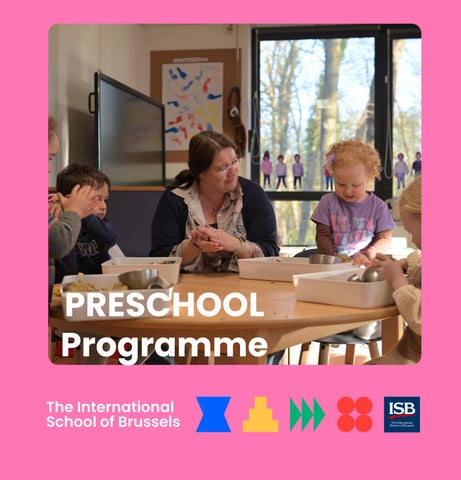
PRESCHOOL Programme The International School of Brussels
The International School of Brussels
THE PRESCHOOL EXPERIENCE
Key Developmental Milestones
Preschool marks a crucial developmental stage in a child's life, characterized by numerous significant milestones. Among the key achievements during this period are the development of social skills, as children learn to interact with peers and form friendships. Cognitive milestones include the acquisition of language and literacy skills, as well as basic mathematical concepts. Motor skills also see significant progress, with children refining their abilities in tasks such as drawing, cutting, and tying shoelaces. Emotional development is another vital aspect, with preschoolers learning to identify and manage their feelings, as well as developing empathy towards others. Moreover, Preschool serves as an introduction to structured learning environments, laying the foundation for future academic success. Through playbased activities and guided instruction, children in preschool embark on a journey of discovery and growth, preparing them for the challenges and adventures that lie ahead in their educational journey.
Personalising Learning In the Lower School at ISB we embrace the unique potential within each learner tailor educational experiences to individual strengths, interests & pace empower learners to explore their passions integrate technology seamlessly cultivate critical thinking, and collaborate across diverse perspectives develop learners who confidently navigate the complexities of our world
The International School of Brussels
A Balanced and Purposeful Approach
At ISB, we believe every child is strong, confident, and competent. Our Preschool and Prekindergarten program blends play-based learning with intentional teaching to ensure each child’s growth in knowledge, skills, and dispositions. A team of highly qualified early years’ teachers design and implement a program that lays the foundation for impactful and sustained learning outcomes. Our Approach Is: Developmentally Appropriate Learning experiences are aligned with each child’s age, stage, and individual needs, supporting holistic growth— cognitive, social, emotional, and physical. Rooted in a Continuum of Learning Teaching is based on a clearly defined progression of knowledge and skills from Preschool through Grade 12, ensuring coherence and continuity across all learning phases. Purposefully Play-Based Play is recognized as a powerful context for learning. Educators design rich, engaging environments where children explore, inquire, and build essential knowledge and skills through meaningful pla Personalized and Responsive Educators observe closely, listen deeply, and adapt learning to each child’s strengths, interests, and next steps—supporting differentiated pathways for success. Intentional and Reflective Teachers use open-ended questions, provocations, and scaffolding strategies to extend learning. Planning is informed by reflective practice and aligned with curriculum outcomes. Future-Focused Our Early Years educators work closely with colleagues across the school to ensure that foundational learning connects with long-term educational goals, preparing children to thrive as learners for life.
PRESCHOOL LEARNING MODULES: Splash, Pour, Discover
Little Explorers, Big Discoveries
In this unit, Splash, Pour, Discover: The Magic of Water Play, students transform a simple water table into a laboratory of endless wonder. The overall goal is to foster deep sensory exploration, allowing children to use their natural instincts to investigate how water moves, flows, and fills different spaces. By focusing on the joyful mechanics of pouring, filling, and measuring, learners meet key benchmarks in fine motor control and spatial awareness, which are essential precursors to mathematical and scientific thinking. Through these playful investigations, children encounter the fundamental concepts of cause and effect— observing how water interacts with various materials and experiencing the "magic" of absorption and evaporation. This unit is specifically designed to build a core vocabulary to describe change and movement. As they experiment with how water responds to their actions, students master the essential skills of observation and trial-and-error that turn simple play into significant discovery.
In this unit Little Explorers, Big Discoveries: Using Our Senses, students embark on a sensory-rich journey to understand how their bodies connect them to the vibrant world around them. The overall goal is to deepen their awareness of the five senses—sight, sound, touch, smell, and taste—as essential tools for scientific inquiry and communication. By engaging with a variety of natural materials and playful provocations, children meet key standards in observation and vocabulary development, learning to identify specific body parts and their functions while gaining the language to express personal likes and dislikes. This transforms everyday experiences into opportunities for critical thinking; through the illustrative contexts of exploring their immediate environment and sharing fiction and nonfiction books, learners move from simple physical interaction to purposeful investigation. Whether they are feeling the texture of a leaf or listening to the sounds of the classroom, students are mastering the foundational skills of gathering information and describing their discoveries, turning natural curiosity into a lifelong love for learning.
Watching Wonders In this unit Watching Wonders: Exploring Change and Growth, students become active observers of the world’s constant transformations, a skill that serves as the cornerstone of scientific reasoning. The overall goal is to help children understand the "how" and "why" of transformation by investigating cause and effect in both immediate and longterm contexts. By participating in handson cooking experiences, students witness rapid physical changes, while the patient process of planting seeds allows them to track growth over time. These illustrative contexts directly support key benchmarks in observation, sequencing, and vocabulary development, as children learn to use specific language to explain what they see. Whether they are engaging with fiction and nonfiction stories or capturing their discoveries through photos and creative markmaking, learners are not just watching the world—they are mastering the essential skills of inquiry and sharing their ideas as they begin to understand the natural and human-made world.
The International School of Brussels
FOREST AND OUTDOOR LEARNING Forest learning and outdoor education provide young children with a wealth of benefits that contribute to their overall development and well-being. At ISB, we believe that : exposure to natural environments fosters a sense of wonder and curiosity, promoting a love for learning from an early age. outdoor settings stimulate sensory experiences, allowing children to explore different textures, smells, and sounds, contributing to their cognitive development. physical activity is a natural outcome of outdoor education, promoting gross motor skills, balance, and coordination as children engage in activities like climbing, running, and jumping. outdoor learning enhances creativity and problem-solving skills as children navigate natural challenges and come up with imaginative solutions. spending time in nature has been linked to improved mental health, reducing stress and anxiety. socially, outdoor education promotes teamwork, communication, and cooperation as children engage in group activities and learn to share and take turns. developing a connection with the natural world at an early age instills a sense of environmental stewardship, fostering a lifelong appreciation for nature and a commitment to conservation.
The International School of Brussels
DEVELOPING EARLY SOCIAL, LITERACY AND MATHEMATICAL SKILLS
In the Preschool, children are in the early stages of developing their sense of self and becoming part of a group. They are being supported in developing independence, coping skills as well as beginning to follow classroom routines. The beginning of this process involves supporting children to develop skills necessary for a successful transition from home to school.
The Preschool years provide the opportunity for children to extend and develop language, listening and communication skills. Teachers provide an environment which is rich with stories, songs and rhymes where children can develop an interest and engage with meaningful literacy experiences. Children are encouraged to share their thoughts and ideas with their teachers and classmates and become confident participating in large and small group settings. Children experiment with drawing and writing by making meaningful marks.
The children are provided with a broad range of learning opportunities to develop their understanding of number, shape, pattern, measurement and space. Materials, such as, blocks, puzzles, and manipulatives encourage the development of mathematical language, counting, matching, and sorting.
The International School of Brussels
SPECIALIST PROGRAM
Specialist programs at ISB are essential components of a well-rounded education. These programs enhance problem-solving, critical thinking, decision-making, team work, and self expression.
Visual & Performing Arts
Physical Education & Health
Each program is taught by a Specialist in the respective field.
Body Awareness The Physical Education and Heath program focuses on the following areas: Motor Skills & Movement Patterns Concepts, Principles, Strategies & Tactics Understanding Healthy Lifestyles
Motor Skills
In Preschool Physical Education, students build early coordination, balance, and spatial awareness through playful, guided movement. Across thematic units, including Adventure Challenge, Gymnastics, Ball Fun, Health-Related Fitness, and Movement Expression, children explore fundamental actions like rolling, throwing, catching, and kicking with soft, lightweight equipment. Lessons emphasize sensory exploration, foundational motor skills, and safe participation routines over skill precision, encouraging trial-and-error discovery at each child's individual pace. Teacher-guided activities build foundational visual tracking, listening habits, and personal space boundaries in a safe, supportive environment. By focusing on active exploration and age-appropriate movement, Preschool PE fosters confidence, early motor skills, and a healthy attitude toward physical activity.
Visual Arts
The Arts program focuses on the following areas: Creating & Performing and Responding & Connecting to visual & musical artworks.
Spacial Awaeness
In our Preschool Visual Arts programme, students are introduced to an array of tactile artistic mediums, from soft modeling clay and finger paints to oversized crayons and textured papers. They explore paper arts by tearing, crumpling, and placing colorful shapes, developing fine motor control and hand strength as they transform materials into vibrant, layered collages. Hands-on engagement is at the heart of our approach, empowering children to immerse themselves in the sensory process of creating both personal expressions and shared group projects. Witnessing their individual contributions blend with those of their peers to form colorful collective displays fills our youngest students with boundless joy and pride. Within the welcoming spaces of our PS2 common area and Chateau, an everevolving gallery proudly showcases the imaginative endeavors of our young talents, shining a spotlight on both individual brilliance and collective achievements.
Music In Preschool Music, students step into the role of musical explorers, discovering how rhythm, melody, and sound shape their world. Through singing, movement, and hands-on instrument play, young learners explore how different sounds are made, learning to adjust their movements to play softly, shake energetically, or match high and low pitches. Guided musical story times and rhythm games encourage children to express how a song feels, identify musical patterns, and use their voices and bodies to tell their own creative stories. As they explore pitch and simple rhythms, students build the confidence to invent original songs, connect music to daily routines, and communicate their personal ideas. By celebrating active music-making and playful experimentation, our music program validates each child's voice while laying the foundation for lifelong artistic appreciation.
The International School of Brussels
LANGUAGES PROGRAM
Languages Pathways
Students, who have demonstrated proficiency in English, access our French language programme. Additional languages are offered as part of the ISB+ program, based on demand. ISB follows the Common European Framework for Languages.
English Proficiency
French Foundations A1 Intermediate A2 Independent B1 / C1
Grades 5 & 6 Science & Social Studies in French option
ISB+ Plus Languages Open to all regardless of English Proficiency
HOME LANGUAGE CLASSES Students who speak Hebrew, Spanish, Japanese, Korean, Dutch or Swedish have access to one hour a week of a home language class. For Prekidnerten and Kindergarten this has an oral langauge focus, for students in Grade 1 and 2 this has a focus on early literacy skills.
Hebrew
Spanish
Japanese
Korean
Dutch
Swedish
The International School of Brussels
Kattenberg 19, 1170 Brussels T: +32 2661 42 • F: +32 2661 42 00 www.isb.be