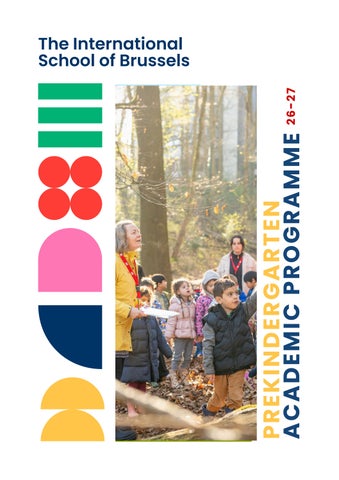
PREKINDERGARTEN ACADEMIC PROGRAMME 2 6 - 2 7
The International School of Brussels
The International School of Brussels
INTRODUCTION The Lower School at ISB is where children ages 2.5-12 years learn by exploring the world with curiosity, and by asking questions and developing skills in problem solving and interpretation. Further consolidating the understanding, skills, and knowledge necessary for a lifetime of learning, students develop independence and self-reflection as they grow from children to young teens. The key elements are the academic and specialist subjects, the engaging learning environment, and the highly-qualified and caring faculty and staff. Our Academic subjects build the foundational knowledge and skills for understanding our world, but also provide opportunities for extensive challenge. The Specialist programme provides a wide breadth of experiences for all students, supporting them in being performers, artists, language learners and building the habits of life-long physical activity. The age-appropriate learning environment provides flexibility and adaptability to a wide range of configurations for teaching and learning. Our faculty are all specialists in working with and supporting lower school-aged children. The ISB curriculum is based on a set of content standards selected from national systems and educational institutions. Standards are selected to align with ISB’s mission and vision to provide the foundation for our international curriculum which is accredited by The Council of International Schools and The Middle States Association (USA). Those standards are listed and linked below.
INTERNATIONAL ACADEMIC CONTENT STANDARDS Advisory: International School Counsellor Association
Mathematics: Common Core Standards
Arts: National Core Arts Standards
PE & Health: National Physical Ed Standards
Digital Citizenship: Common Sense Education
Science: Australian Curriculum
Language Arts: Common Core Standards
Social Studies: Education For Global Citizenship
Languages: The Common European Framework
The International School of Brussels
A BALANCED AND PURPOSEFUL APPROACH At ISB, we believe every child is strong, confident, and competent. Our Preschool and Prekindergarten program blends play-based learning with intentional teaching to ensure each child’s growth in knowledge, skills, and dispositions. A team of highly qualified early years’ teachers design and implement a program that lays the foundation for impactful and sustained learning outcomes. Our Approach Is:
Developmentally Appropriate Learning experiences are aligned with each child’s age, stage, and individual needs, supporting holistic growth —cognitive, social, emotional, and physical. Rooted in a Continuum of Learning Teaching is based on a clearly defined progression of knowledge and skills from Preschool through Grade 12, ensuring coherence and continuity across all learning phases. Purposefully Play-Based Play is recognized as a powerful context for learning. Educators design rich, engaging environments where children explore, inquire, and build essential knowledge and skills through meaningful pla Personalized and Responsive Educators observe closely, listen deeply, and adapt INTERNATIONAL ACADEMIC CONTENT STANDARDS learning to each child’s strengths, interests, and next steps—supporting differentiated pathways for success. Intentional and Reflective Teachers use open-ended questions, provocations, and scaffolding strategies to extend learning. Planning is informed by reflective practice and aligned with curriculum outcomes. Future-Focused Our Early Years educators work closely with colleagues across the school to ensure that foundational learning connects with long-term educational goals, preparing children to thrive as learners for life.
The International School of Brussels
LANGUAGE ARTS
Reading and Writing Prekindergarten is a crucial stage in a child’s early development, marked by several important milestones that set the stage for future academic success. Prekindergarten lays the groundwork for early cognitive skills, as students begin with phonological awareness, have opportunities to develop their oral language, listening and comprehension skills, fostering pre-literacy abilities.
Units
Becoming a PreK Reader
Students build academic readiness through wholeclass carpet discussions, small-group instruction, and targeted literacy games designed to strengthen foundational reading skills. Through daily practice, students explore books and immerse themselves in story concepts, building the sustained focus, curiosity, and engagement essential for early reading success.
Units
Becoming a PreK Writer
Students engage in structured classroom practice that connects spoken thoughts to written forms through guided instruction and creative expression. Through daily fine-motor exercises, purposeful mark-making, and opportunities to communicate ideas visually and through letter-like forms, students build the stamina, muscle memory, and confidence needed for early writing fluency.
PREKINDERGARTEN
Early Reading Skills
In Prekindergarten, students build early reading foundations by exploring book handling concepts, such as identifying the front and back covers, turning pages from right to left, differentiating letters from numerals, and recognizing that print carries meaning. Through rich oral language activities, students develop phonological and phonemic awareness by identifying rhyming words, isolating initial sounds in simple words, and counting, blending, and segmenting syllables. They begin recognizing upper and lowercase letters, especially those in their own names, while connecting letters to their primary sounds and recognizing familiar sight words in print. Additionally, students deepen their reading comprehension by examining illustrations with intention, joining in choral readings, retelling familiar stories using visual cues, and discussing characters, key events, and personal connections during shared read-alouds.
Early Writing Skills In Prekindergarten, students begin their writing journey by expressing ideas through a progression of markmaking, ranging from scribbles and symbols, to forming identifiable letters . As fine-motor skills and letter-sound connections develop, students practice writing their own names, copying familiar classroom words, and attempting word writing. Alongside physical letter formation, students expand their vocabulary and language comprehension by sorting objects into conceptual categories and exploring word relationships, like opposites. Through guided discussions and real-life connections, students deepen their understanding of word meanings and apply new vocabulary across both spoken and early written forms.
The International School of Brussels
MATHEMATICS The ISB mathematics programme is designed to develop a deep understanding of mathematical concepts while nurturing critical thinking skills and problem-solving abilities. Below are the key elements to our approach: Developing students’ concrete-pictorial-abstract thinking to build a solid foundation by connecting abstract concepts to tangible experiences Engaging students in hands-on activities, manipulatives, and interactive games to foster a deeper understanding of mathematical concepts Presenting real-world problems or open-ended questions to encourage students to think critically, apply mathematical concepts, and develop problem-solving skills Using visual representations such as diagrams, charts, and models to help students visualise abstract concepts, making them more accessible and easier to comprehend Providing multiple entry points to concepts, and offering support tailored to individual needs Cultivating a growth mindset towards learning math by emphasising effort, perseverance, and the belief that mathematical abilities can be developed through practice and learning from mistakes
Counting and Cardinality Students build early number sense by practicing rote counting up to 20, using one-to-one correspondence to count up to 10 objects, and instantly recognizing small groups of 1 to 5 items without counting. They develop mathematical reasoning by comparing small sets using language like "more than" and "less than," understanding positional terms like "first" and "last," and matching numerals 1 to 5 to equal sets of objects. Additionally, students begin recognizing written numbers and express quantities by writing numerals, number-like marks, or drawings during everyday play and routines.
Operations and Algebraic Thinking Students build early algebraic thinking by discovering that combining two sets of objects creates a larger group up to 10 and that larger groups can be separated into smaller parts. They apply these foundational concepts to everyday routines, using counting and keen observation during play and shared activities. Through practical scenarios, such as figuring out how many more paintbrushes are needed so every child at the art table gets one, students learn to ask and answer real-world problem-solving questions.
Geometry Students explore geometry by matching 2D and 3D shapes to physical outlines and recognizing geometric forms in their everyday environment. They combine simple shapes to represent realworld objects, such as gluing a square and triangle together to build a house in artwork. Additionally students learn and name basic shapes, noticing what makes a circle round or a square straight, and use position words to describe where things are during investigative play.
Measurement and Data Students explore measurement by using comparative terms like taller, shorter, and heavier, arranging objects by length, and hands-on tools like blocks to compare physical items. They develop sorting and patterning skills by organizing groups of objects by single attributes, such as color, size, or shape, and extending simple repeated sequences. Additionally, students build foundational data handling concepts by using concrete items to represent information, comparing quantities for "more" or "less," and using time vocabulary to navigate daily classroom routines.
PREKINDERGARTEN
The International School of Brussels
SCIENCE AND SOCIAL STUDIES In Prekindergarten, science and social studies come alive as students explore the world around them through hands-on discovery and meaningful play. They nurture their innate curiosity by investigating simple scientific concepts, asking questions, and discovering how things work in their daily lives. At the same time, students begin developing a foundational understanding of community by sharing their own experiences, learning about different cultures, and discovering what it means to be a caring, active member of our classroom society. Little Architects: Exploring the How and Why of Building Students embark on an inquiry into the process and purpose of construction, a journey that transforms simple play into foundational Thinking and Research Skills. Students engage in careful observation and description of structures during campus walks, identifying individual facts about materials to discover relationships, such as why a heavy stone provides a sturdier base for a bridge than a twig. While the specific building environment (from the classroom to the forest) is flexible, the mandatory core of the unit requires learners to move from passive observation to active inquiry by crafting their own research questions about how things work. By interviewing experts and experimenting with towers and enclosures, students use descriptive language to narrate their designs, ensuring that every model they build is a reflection of a deeper, planned conceptual understanding. Key Knowledge in this Unit: Physical structures are designed and built using specific materials based on their strength, stability, and intended use. Different building materials carry distinct attributes that determine how well they support structures. Active research involves noticing details, generating thoughtful questions about how things work, and gathering insights from experts and hands-on experiments. Designing and constructing models requires planning, testing ideas and making adjustments.
PREKINDERGARTEN
The International School of Brussels
SCIENCE AND SOCIAL STUDIES Tales and Tools: The Magic of Storytelling Students embark on an inquiry into how stories are told in different ways, a journey that transforms listening into foundational Thinking and Research Skills. The overall goal is for students to understand that everyone has a story to tell and that narratives can be shared through puppets, props, and art, moving beyond simple listening to active creation. Students engage in careful observation and description of story elements, identifying individual facts about characters and plots to discover relationships, such as making text-to-self connections and exploring how a character's feelings drive the action. By adapting familiar tales and recounting their own experiences, students ensure that every story they tell is a reflection of their growing ability to interpret the world around them. Key Knowledge in this Unit: Stories have a beginning, middle, and end, following a logical order of events that often includes patterns and repeated language. Narratives can be shared, retold, or adapted using books, pictures, drama, puppets, drawings, and imaginative play. Story characters experience feelings that change through their actions, words, and expressions, helping children relate narrative events to their own feelings and personal experiences. Sharing and recounting stories helps children practice attentive listening, express preferences, sequence key details, and create their own original tales using rich, descriptive vocabulary. Our Big Busy World: Discovering Where We Belong Students embark on an exciting inquiry into how local communities function in order to understand that they are active, important members of various groups, from their family and classroom to the wider ISB and Boitsfort communities, and that these groups provide essential resources to meet our health, social, and food needs. Students engage in careful observation and description of their surroundings, identifying individual facts about community helpers and locations to discover relationships, such as how a map connects a person to the resources they need to thrive. Students move from simply following rules to crafting their own research questions about how community agreements, like being safe and kind, keep our "world in action" running smoothly. Key Knowledge in this Unit: Local communities provide essential resources that support our health, social connection, and food needs. Community helpers play important roles in keeping groups functioning smoothly, while shared agreements guide our personal responsibilities. Observing surroundings and creating simple maps of spaces helps us understand spatial relationships and navigate our local environment. Formulating research questions, conducting observational walks, and using procedural communication allow us to explore how communities work and share our learning with others.
PREKINDERGARTEN
The International School of Brussels
VISUAL AND PERFORMING ARTS The Arts program focuses on the following areas: Creating & Performing and Responding & Connecting to visual & musical artworks. Music Students discover the joy of making sound through hands-on play, active listening, and creative movement. Through engaging experiences, they experiment with small percussion instruments to discover how tactile choices, such as holding, tapping, and moderating playing force, alter physical vibrations, volume, and tone quality. Beyond instrument play, students use their entire bodies to feel musical beats, developing steady pulse control, pitch-matching skills, and early awareness of simple rhythmic and melodic patterns. Listening to diverse musical styles from around the world, students translate changing melodies into spontaneous dance and expressive movement. Throughout these playful discoveries, they build essential self-control, sharpen their auditory awareness, and learn that music is a joyful outlet for personal expression. Visual Arts In our Prekindergarten Visual Arts programme, students are introduced to an array of artistic mediums, from sculpture and construction to painting, drawing, and textiles. They explore paper arts by cutting, folding, and weaving colorful strips, developing fine motor control as they transform flat paper into dynamic patterns and layered collages. Hands-on engagement is at the heart of our approach, empowering our budding artists to immerse themselves in the tactile process of crafting both individual masterpieces and collaborative works of art. Witnessing their individual creations seamlessly meld with those of their peers to form collective treasures fills our students with boundless joy and pride. Within the welcoming spaces of our PS-2 common area and Chateau, an ever-evolving gallery proudly showcases the imaginative endeavors of our young talents, shining a spotlight on both individual brilliance and collective achievements.
PREKINDERGARTEN
The International School of Brussels
PHYSICAL EDUCATION & HEALTH The Physical Education & Health programme focuses on the following areas: Motor Skills & Movement Patterns, Concepts, Principles, Strategies & Tactics and Understanding Healthy Lifestyles
Body Awareness, Gross Motor Skills, Well-Being: Beginning at an early age, students are actively involved in outdoor activities like forest exploration and bicycle riding, experiences that persist throughout their school years. These engagements not only forge connections with nature but also instill stamina for walking, laying down the groundwork for lifelong physical movement. In small groups, students delve into fundamental locomotor skills, fostering collaboration and teamwork from an early age, while also learning the importance of taking turns and providing individual feedback and coaching to aid in motor development and growth. Through activities like obstacle courses and building challenges, students refine their movement skills, further enhancing collaboration and play experiences while stimulating sensory and motor development. As they progress from preschool to prekindergarten, access to gym facilities expands the children’s gross motor skills within larger spaces, where they engage in ball activities and early games, fostering a holistic approach to physical development from the outset of their educational journey.
FOREST AND OUTDOOR EDUCATION Forest learning and outdoor education provide young children with a wealth of benefits that contribute to their overall development and well-being. Our Forest Learning experience immerses students in natural environments to inspire wonder, curiosity, and a lifelong love for learning. Outdoor settings engage all five senses as students explore rich textures and sounds, boosting cognitive growth, creativity, and imaginative problem-solving. Through active engagement and exploration, children build essential gross motor skills, physical confidence, and spatial awareness while benefiting from the calming effects of nature. Together in the forest, students learn to cooperate, communicate, and solve problems as a team, developing a deep personal connection to the outdoors that lays the foundation for environmental stewardship.
PREKINDERGARTEN
The International School of Brussels
LANGUAGES
Multilingualism and cultural understanding is a key part of being an International Citizen.
Students, who have demonstrated proficiency in English, access our French language programme. Additional languages are offered as part of the ISB+ programme, based on demand. ISB follows the Common European Framework for Languages.
English Proficiency
French Foundations A1 Intermediate A2 Independent B1 / C1
Grades 5 & 6 Science & Social Studies in French option
ISB+ Plus Languages Open to all regardless of English Proficiency
HOME LANGUAGE CLASSES Students who speak Hebrew, Spanish, Japanese, Korean, Dutch or Swedish have access to one hour a week of a home language class. For Prekindergarten and Kindergarten this has an oral language focus and is for 45 minutes. For students in Grade 1 and beyond this has a focus on the development of literacy skills.
Hebrew
Spanish
Japanese
FRENCH
Korean
Dutch
Swedish
In Prekindergarten French, students welcome a visiting specialist into their classroom for short, engaging language sessions designed to make French immersive, joyful and accessible. Through playful songs and interactive storytelling, students build an early foundation in basic vocabulary while making natural connections to their everyday learning in French. Activities are thoughtfully structured to accommodate different levels of familiarity with French, ensuring all students participate comfortably at their own pace. Students practice listening to native pronunciation, recognizing high-frequency words, and participating in simple group responses. By embedding French into creative movement and shared classroom themes, children develop strong auditory processing skills, cultural curiosity, and a confident, positive attitude toward learning new languages.
PREKINDERGARTEN
The International School of Brussels
ADVISORY The Advisory programme, led by the Lower School counsellor, builds the social and emotional understanding and skills of our students. Students develop social-emotional readiness by learning how to make friends, join in group play, and practice positive strategies for navigating everyday peer interactions. Through guided yearlong lessons, students expand their emotional vocabulary, learn to recognize non-verbal feelings in others, and practice simple breathwork to support self-regulation and emotional calm. They also cultivate key executive functioning skills by following multi-step directions, applying best effort and resilience through mistakes, and developing healthy personal boundaries and self-advocacy.
LIBRARY During Library classes, students step into a welcoming world of books designed to nurture a lifelong love of reading and storytelling. Through interactive read-alouds closely tied to classroom themes, they learn how books work, exploring cover illustrations, tracking print from left to right, and distinguishing between real-world information and imaginative stories. Students practice gentle book care, explore colorful picture-book displays, and begin to understand how our library collection is shared and organized. Engaging story discussions and book introductions spark curiosity, encouraging children to ask questions, make personal connections, and select books that excite them. By building comfortable library routines and celebrating shared reading moments, Prekindergarten students build foundational language skills, active listening habits, and a joyful enthusiasm for library visits.
PREKINDERGARTEN
Kattenberg 19, B-1170 Brussels, Belgium +32 2 661 42 11 www.isb.be