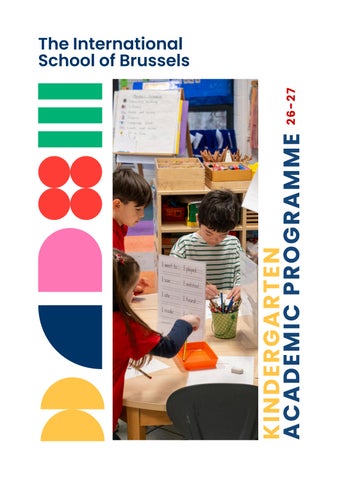
KINDERGARTEN ACADEMIC PROGRAMME 2 6 - 2 7
The International School of Brussels
The International School of Brussels
INTRODUCTION The Lower School at ISB is where children ages 2.5-12 years learn by exploring the world with curiosity, and by asking questions and developing skills in problem solving and interpretation. Further consolidating the understanding, skills, and knowledge necessary for a lifetime of learning, students develop independence and self-reflection as they grow from children to young teens. The key elements are the academic and specialist subjects, the engaging learning environment, and the highly-qualified and caring faculty and staff. Our Academic subjects build the foundational knowledge and skills for understanding our world, but also provide opportunities for extensive challenge. The Specialist programme provides a wide breadth of experiences for all students, supporting them in being performers, artists, language learners and building the habits of life-long physical activity. The age-appropriate learning environment provides flexibility and adaptability to a wide range of configurations for teaching and learning. Our faculty are all specialists in working with and supporting lower school-aged children. The ISB curriculum is based on a set of content standards selected from national systems and educational institutions. Standards are selected to align with ISB’s mission and vision to provide the foundation for our international curriculum which is accredited by The Council of International Schools and The Middle States Association (USA). Those standards are listed and linked below.
INTERNATIONAL ACADEMIC CONTENT STANDARDS Advisory: International School Counsellor Association
Mathematics: Common Core Standards
Arts: National Core Arts Standards
PE & Health: National Physical Ed Standards
Digital Citizenship: Common Sense Education
Science: Australian Curriculum
Language Arts: Common Core Standards
Social Studies: Education For Global Citizenship
Languages: The Common European Framework
The International School of Brussels
LANGUAGE ARTS KINDERGARTEN Reading Kindergarten marks a transformative period in a student’s early learning journey, fostering essential academic building blocks. Kindergarten marks the beginning of more formal literacy skills, as children learn to recognise letters, blends sounds and read simple early readers.
Units
Becoming a Kindergarten Reader
Concepts about Print
Accuracy and Fluency
Students begin their literacy voyage by engaging with rich storytelling, lively rhymes, and diverse visual resources. Through shared read-aloud discussions and smallgroup learning centers, students establish essential classroom habits and learning routines that foster early autonomy and agency. These structured daily practices empower students to navigate their environment, recognize print concepts, and take active ownership of their growth as readers.
Students learn to recognize familiar everyday logos and signs (environmental print), manipulate individual sounds within spoken words (phonemes), and connect letter forms directly to their corresponding sounds. Together with building a core vocabulary of kindergarten sight words, these critical benchmarks empower young learners to decode text, gain reading confidence, and establish a strong foundation for lifelong learning.
Students move beyond simple memorization and begin actively engaging with longer, more complex sentences. Students rely on a blend of foundational skills: applying phonics to sound out unfamiliar words, automatically recognizing sight words, and tracking print across multiple lines of text with steady pacing and expression.
KINDERGARTEN
Comprehenion Strategies
In Kindergarten, reading comprehension centers on making meaningful connections to stories through guided visuals, context, and collaborative discussion. Students learn to ask questions, retell key events, and analyze characters while sharing their insights in both group and play-based settings.
The International School of Brussels
Writing Students learn to express their ideas clearly across various writing genres while practicing simple steps to revise and publish their work. Regular handwriting instruction helps students distinguish between uppercase and lowercase letters and form them with accuracy. Students regularly engage in phonics practice, focusing on identifying simple spelling patterns, but also in developing strategies for understanding new words and expanding their growing vocabulary.
Units
Becoming a Kindergarten Writer
Narrative
Students explore early expression by turning their ideas and observations into pictures and emergent print. Guided by wholegroup modeling and interactive small-group writing centers, children establish simple classroom habits and expectations. These structured experiences allow students to safely experiment with letter formation, sounds and simple sentences as they learn to formulate their thoughts and ideas.
Students use a combination of drawing, dictating, and writing to narrate a single event or a sequence of loosely linked events in the order they occurred. Beyond simply listing facts, students practice adding a personal reaction to help the reader understand the emotional impact of the memory. This unit builds the foundation for narrative writing by teaching students to organize their thoughts and communicate their history clearly.
KINDERGARTEN
Opinion
Information
Students discover that Students transform into their opinions are experts, discovering important and worth that writing is a sharing. Recognizing that powerful tool for communication happens teaching others. Using a in many forms, students combination of use a combination of drawing, dictating, and drawing, dictating, and writing, they compose writing to express their informative texts. By personal preferences. focusing on facts rather This unit lays the early than stories, students groundwork for learn that non-fiction argumentative writing by writing requires them to teaching students that select specific details to authors use both pictures explain their world to and words to tell the others. world what they like and why.
The International School of Brussels
MATHEMATICS The ISB mathematics programme is designed to develop a deep understanding of mathematical concepts while nurturing critical thinking skills and problem-solving abilities. Below are the key elements to our approach: Developing students’ concrete-pictorial-abstract thinking to build a solid foundation by connecting abstract concepts to tangible experiences Engaging students in hands-on activities, manipulatives, and interactive games to foster a deeper understanding of mathematical concepts Presenting real-world problems or open-ended questions to encourage students to think critically, apply mathematical concepts, and develop problem-solving skills Using visual representations such as diagrams, charts, and models to help students visualise abstract concepts, making them more accessible and easier to comprehend Providing multiple entry points to concepts, and offering support tailored to individual needs Cultivating a growth mindset towards learning math by emphasising effort, perseverance, and the belief that mathematical abilities can be developed through practice and learning from mistakes
KINDERGARTEN
The International School of Brussels
Counting and Cardinality: Students build a strong foundational understanding of numbers by mastering counting up to 100 by ones and practicing one-to-one correspondence to accurately count physical objects. They also learn to evaluate and compare quantities and written numerals between 1 and 10, determining whether groups are greater than, less than, or equal to one another. Numbers and Operation in Base 10: Students develop critical early math fluency by breaking down numbers up to 10 into different addition pairs and finding the missing partners that complete a sum of 10. Through hands-on tools, drawings, and simple equations, students build quick addition and subtraction skills within 5. They also explore numbers 11 through 19 as a combination of "ten ones and some further ones," establishing a vital foundation for understanding place value. Operations and Algebraic Thinking: Students begin exploring foundational operations by understanding addition as putting groups together and subtraction as taking them apart. Using hands-on materials, drawings, physical actions, and simple equations, students visually and interactively model these math concepts. They apply these strategies to solve real-world word problems and accurately add and subtract within 10. Geometry: Students learn to identify, name, and describe two-dimensional shapes regardless of their size, orientation, or placement in the environment. Using everyday spatial terms like above, below, and next to, they analyze shapes by comparing their key attributes, such as sides and corners. Through hands-on building and drawing, students actively construct and compose shapes to model the world around them. Measurement and Data: Students explore measurement by describing and comparing physical attributes of objects, such as length, height, and weight. They practice directly comparing two items to determine which has "more" or "less" of a specific trait, such as identifying who is taller or shorter. Additionally, students build early data skills by sorting objects into categories and counting how many items are in each group.
KINDERGARTEN
The International School of Brussels
SCIENCE The ISB Science programme offers students the chance to explore essential science concepts and processes, understand the methods used to develop scientific knowledge, and appreciate science's role in our culture, society, and daily lives. The curriculum equips students with the knowledge, understanding, and skills needed to make informed decisions on various issues. It also fosters the joy of scientific investigation and discovery and nurtures their innate curiosity about the world around them. Physical Sciences: Forces and Motion: Students step into the role of young investigators to understand how physical principles can help us move things more efficiently, empowering them to creatively solve real-life physical challenges. While the specific objects they choose to test or build may vary, all students will develop essential physical science understandings by investigating how a push or a pull, along with an object’s size and shape, affects its movement and behavior. Through the highly engaging context of hands-on classroom experiments and a mini "Technopolis" of simple machines set up on the playground, students manipulate variables like friction, inclined planes, and mass to observe direct cause and effect. Driven by foundational thinking and research skills, students identify their current understanding, uncover potential misconceptions, and construct powerful questions to form and test their own hypotheses. The unit culminates in students capturing their ongoing investigations in a science journal, as well as, the creation of a Rube Goldberg invention that uses force, motion and chain reactions with an objective in mind. Students must synthesize their learning by using a combination of pictures, text, and comparative language (such as speed, volume, and weight) to clearly explain the forces at work in their world.
Biological Sciences: Life Cycles in Nature Students explore how the needs and external features of living things change as they grow, building a deep connection to our natural world so they can better appreciate and protect it. While the specific animals studied can vary based on student interest, students will develop essential biological science and research skills through the illustrative context of observing creatures like frogs, butterflies, and bean plants transform right in the classroom and the local forest. Driven by big questions about how and why nature changes, students practice foundational thinking and research skills: identifying their current knowledge, constructing guiding questions, and gathering facts about basic survival needs from hands-on observations and texts. This scientific inquiry is directly linked to Information Writing and culminates in a final project where students organize their findings and deliver a science presentation to parents during a gallery walk. By creating and explaining diagrams, students will confidently narrate the life cycle of their chosen animal, demonstrating their understanding of how living things survive, grow, change, and produce offspring.
KINDERGARTEN
The International School of Brussels
SOCIAL STUDIES Social studies are essential for helping children understand the world around them and their place within it. The Lower School Social Studies programme encompasses history, geography and civics providing students with a broad perspective on human experiences. Through social studies, students learn about different cultures, the interconnectedness of global communities and the importance of active engagement in society.
From Source to Product: Students discover the fascinating journey of everyday items, exploring how raw materials are transformed into the products we rely on. Students build a foundational understanding of how Earth’s resources are utilized and are introduced to the concept of global and local economic interdependence, how communities produce, buy, and sell goods to meet their needs. While the exact crafts, recipes, or materials they manipulate may vary, all students will investigate the distinct stages of production and compare homemade, factory-made, local, and imported goods. Through hands-on illustrative contexts, such as cooking, construction, and field trips to a local market and neighborhood shop that makes products from beeswax, learners see firsthand how altering a procedure changes the outcome, like how an apple becomes either juice or sauce depending on the steps taken. Key Knowledge in this Unit: Natural and human-made resources are transformed through multi-step production processes into the everyday products and items we use. Goods can be homemade, factory-made, sourced locally, or imported, and changing the specific steps in a procedure alters the final result. Communities produce, buy, and sell goods to satisfy needs, illustrating how local and global markets connect people to necessary resources.
KINDERGARTEN
The International School of Brussels
VISUAL AND PERFORMING ARTS The Arts program focuses on the following areas: Creating & Performing and Responding & Connecting to visual & musical artworks. Visual Arts In Kindergarten Art, students step into the studio as curious artists, discovering how lines, shapes, colors, and textures come together to express their world. Through hands-on experimentation, students manipulate drawing tools, paint, and clay to transform simple mark-making into shapes, textured clay tiles, and expressive 3D structures. Students investigate color theory by mixing primary colors to discover secondary shades, while observing intricate patterns in nature to inspire both regular and freeform designs. Guided by the works of inspiring artists, they analyze how simple visual elements can tell stories and convey feelings. By practicing observational drawing, sharing the narratives behind their collaborative sculptures, and independently managing studio materials, students build fine motor confidence, creative problem-solving skills, and a lifelong appreciation for visual expression. Within the welcoming spaces of our PS-2 common area and Chateau, an ever-evolving gallery proudly showcases the imaginative endeavors of our young talents, shining a spotlight on both individual brilliance and collective achievements.
Music When students understand the building blocks of music they can use them to make music together, express themselves and convey something through music. Keeping a steady beat allows us to stay together when we sing or play instruments. By changing the volume of music we can create surprising effects, and changing the speed of the music can influence the mood. We learn these and other principles through stories, movement, songs and playing a variety of small percussion instruments. By the end of the year each student is able to create a short melody which is then performed by a buddy from the Upper School orchestra. In addition to our scheduled music classes we have regular Kindergarten Singalongs which strengthens our sense of community.
KINDERGARTEN
The International School of Brussels
PHYSICAL EDUCATION & HEALTH The Physical Education & Health programme focuses on the following areas: Motor Skills & Movement Patterns, Concepts, Principles, Strategies & Tactics and Understanding Healthy Lifestyles Body Awareness, Motor Skills, Spacial Awareness: Throughout their journey in Kindergarten, our students embark on a captivating adventure aimed at nurturing their physical and spatial understanding. They immerse themselves in a diverse array of obstacle courses, daring to conquer heights and different surfaces increasing their determination and resilience. Through being encouraged to choose activities that safely test their limits, they courageously expand their comfort zones and further develop their motor skills and body awareness. In their year of Kindergarten, lessons will also bring an opportunity to explore a range of ball activities. With each toss and catch, they master the art of hand-eye coordination, skilfully maneuvering various objects to propel balls with increasing precision. As they partake in a multitude of games, they begin to explore a range of open spaces, discovering the exhilarating freedom of movement and navigation.
Swimming: Learning to swim at a young age is of paramount importance for several reasons. We believe that this is a crucial life skill that enhances water safety. Early exposure to swimming instills confidence in the water, helping children overcome any fear and building a strong foundation for aquatic competence. After their year of swimming in Kindergarten children can follow this passion through engagement in afterschool activities from Gr 1 on. We offer three different levels of swimming instruction to make sure that all students experience success and growth. The levels include: Beginner level, Intermediate Level and Advanced/Independent Swimmer.
OUTDOOR EDUCATION In the Lower School, Outdoor Education nurtures confident, curious, and caring learners through regular, high-quality experiences in nature. Our holistic approach gives students the freedom to exercise genuine agency, making choices, solving hands-on problems, taking ownership of their discovery and building a strong sense of environmental stewardship. Whether practicing practical outdoor skills, engaging in creative teamwork during imaginative play, or bringing classroom concepts and curriculum to life outdoors, students embrace personal challenges and calculated risks that build deep resilience and a growth mindset. Supported by time in nature that naturally boosts emotional wellbeing, students learn to listen, share, and collaborate in an open environment, developing a lifelong connection to the natural world alongside essential personal and social skills.
KINDERGARTEN
LANGUAGES Multilingualism and cultural understanding is a key part of being an International Citizen.
Students, who have demonstrated proficiency in English, access our French language programme. Additional languages are offered as part of the ISB+ programme, based on demand. ISB follows the Common European Framework for Languages.
English Proficiency
French Foundations A1 Intermediate A2 Independent B1 / C1
Grades 5 & 6 Science & Social Studies in French option
ISB+ Plus Languages Open to all regardless of English Proficiency
HOME LANGUAGE CLASSES Students who speak Hebrew, Spanish, Japanese, Korean, Dutch or Swedish have access to one hour a week of a home language class. For Prekindergarten and Kindergarten this has an oral language focus and is limited to 45 minutes. For students in Grade 1 and beyond this has a focus on the development of literacy skills.
Hebrew
KINDERGARTEN
Spanish
Japanese
Korean
Dutch
Swedish
FRENCH
Exploration of Seasons: Autumn (L’automne) Throughout Kindergarten, French learning is grounded in exploring the four seasons. In this fall unit, students build early literacy and problem-solving skills by exploring essential vocabulary for school and family, recognizing classmates' names, building sentences with visual symbols, and practicing polite requests alongside hands-on math and sorting activities. Meaningful story contexts are used to support student comprehension. Some learning targets in this unit: Foundational Identify foundational autumn and classroom vocabulary Express simple personal preferences Sort objects and shapes Intermediate Construct basic sentences to express personal information and preferences Practice making polite requests Compare letter features in peer names Independent Formulate complete spoken phrases independently to describe family members, favorite activities, and seasonal choices Analyze early print features Create and explain patterns using autumn objects and numbers
Exploration of Seasons: Winter (L’hiver) As part of the yearlong focus on the four seasons, students explore cold-weather topics, winter clothing, and seasonal celebrations and traditions while strengthening their communication skills. Through hands-on activities and story-based learning, children expand their ability to describe daily weather, share winter preferences, and make personal connections. Some learning targets in this unit: Foundational Identify winter weather conditions and cold-weather clothing Recognize winter holidays and seasonal traditions Sort seasonal items into appropriate categories Intermediate Describe daily winter weather and choice of attire using short, complete sentences Provide simple explanations of family winter preferences and family traditions Compare indoor and outdoor winter routines Independent Formulate oral descriptions of seasonal winter activities and personal preferences Compare and contrast different winter celebrations and festive traditions Classify winter animals according to specific characteristics and behaviors
KINDERGARTEN
FRENCH
Exploration of Seasons: Spring & Summer (Le printemps & L’été) Continuing the seasonal learning journey, the spring unit connects nature's renewal and outdoor observations to foundational language structures and early math skills. Students build functional vocabulary to describe plants, animals, and changing weather patterns while forming simple sentences to express personal experiences and curiosities. Concluding the four-seasons progression, the summer unit focuses on warm-weather activities, travel vocabulary, and end-ofyear reflections. Some learning targets in this unit: Foundational Understand vocabulary related to warm weather, spring animals, and nature Recognize growing plants, flowers, and natural changes around them Sort seasonal objects and animals Intermediate Describe outdoor recreation, warm-weather routines, and natural environments Explain family seasonal traditions and vacation activities Sequence the steps of a plant or animal life cycle Independent Explain what plants and animals need to grow Describe how a plant or animal changes over time Count and compare groups of natural items
HOME LANGUAGES In our Home Languages classes, students are supported to acquire and accurately use a range of general academic and domain-specific words and phrases for reading, writing, speaking and listening. Working towards reading grade-level appropriate text for comprehension is a priority for both fiction and non-fiction, supporting students to maintain and progress in their home language. (Language offerings: Dutch, Spanish, Korean, Japanese, Swedish and Hebrew; offerings are dependent on enrolment.)
KEY KNOWLEDGE & SKILLS Building vocabulary by acquiring and accurately using everyday and topic-specific words during classroom discussions, stories, and play Listening closely to read-alouds in their home language, using illustrations and print to identify main characters, key facts, and central ideas in simple fiction and non-fiction Sharing thoughts about a story by pointing to specific illustrations or words to show where their ideas and answers come from Retelling key events or important information in logical order using visual cues, helping establish early reading comprehension and language progression
KINDERGARTEN
The International School of Brussels
FOUNDATIONAL ENGLISH LANGUAGE DEVELOPMENT All About Me Students explore physical attributes and what their bodies can do, the range of emotions they experience, and their personal preferences. Through these themes students develop the simple present tense; a strong base of general vocabulary to express needs, wants, ideas, and to ask simple questions; and the appropriate use of pronouns.
My Home Students embark on an essential exploration of their immediate world by identifying the attributes of different rooms and the furniture within them. The goal of this unit is to build a foundational "toolkit" of English language skills, including the simple present and past tenses, prepositions of place, and the use of there is/there are, enabling students to describe their personal environments with confidence. The unit focuses on helping multilingual learners create coherent "text" through a mix of spoken words, pictures, and labels. While students are mandatory participants in developing these core grammatical structures and noun labels to communicate precise meanings, the unit uses the familiar, high-interest context of the "home" to make these abstract linguistic concepts tangible and relatable.
My Community Students explore their local neighborhood and the community helpers who work within it, building a sense of belonging while developing early language skills. The core goal is mastering foundational English structures, such as there is/there are, prepositions of place, and simple present tenses, to describe familiar places and local landmarks. Through guided map labeling, drawing, and picturesupported storytelling, students practice using new vocabulary and simple word patterns to share what they see in their everyday surroundings.
KINDERGARTEN
The International School of Brussels
ADVISORY The Advisory programme, led by the Lower School counsellor, builds the social and emotional understanding and skills of our students. Students deepen their social-emotional growth by expanding their emotional awareness, practicing positive play strategies, and learning how to distinguish between seeking teacher support for problem-solving versus independent peer communication. Through yearlong lessons, students build self-control and perspective during challenging moments by identifying personal relaxation techniques and practicing daily calming strategies. Student also develop crucial personal safety habits by recognizing the difference between safe and unsafe touch, helping them build healthy boundaries and advocate for themselves and others.
LIBRARY Kindergarten Library classes help students grow from listening to stories to finding their own books. Connected to classroom learning, students explore non-fiction books alongside storybooks, using picture clues and titles to discover new ideas. Students practice navigating easy-to-find library sections, caring for books, and checking out titles to borrow and bring home. Previewing new stories together encourages students to talk about characters, share predictions, and select books that excite them.
STEM STEM comes to life in the Lower School through hands-on, real-world design challenges that invite students to solve authentic problems using Science, Technology, Engineering, and Math. Guided by the Design Cycle (Define, Ideate, Prototype, Test, and Implement), students intentionally choose the best tools and/or technology to research, measure, and build their solutions. Students experience a range of design tools, including 3-D printers, laser cutters and green screen studios. They work with a range of recycled materials and engage in woodwork activities to create and construct. Through Vex robotics and block based coding, students build computational thinking. Along the way, science standards and math concepts become natural tools for problem-solving. Most importantly, through multiple tests and iterations, children build essential transferable skills like critical thinking, collaboration, and resilience, learning that thoughtful reflection turns every hurdle into a stepping stone toward a better solution. Alongside technical skills, we build responsible tech habits by teaching online safety, media literacy, and what it takes to be a positive digital citizen.
KINDERGARTEN
Kattenberg 19, B-1170 Brussels, Belgium +32 2 661 42 11 www.isb.be