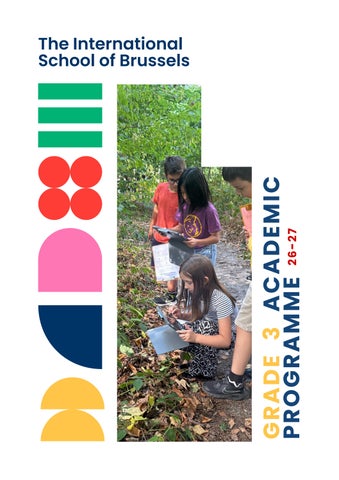
GRADE 3 ACADEMIC PROGRAMME 2 6 - 2 7
The International School of Brussels
The International School of Brussels
INTRODUCTION The Lower School at ISB is where children ages 2.5-12 years learn by exploring the world with curiosity, and by asking questions and developing skills in problem solving and interpretation. Further consolidating the understanding, skills, and knowledge necessary for a lifetime of learning, students develop independence and self-reflection as they grow from children to young teens. The key elements are the academic and specialist subjects, the engaging learning environment, and the highly-qualified and caring faculty and staff. Our Academic subjects build the foundational knowledge and skills for understanding our world, but also provide opportunities for extensive challenge. The Specialist programme provides a wide breadth of experiences for all students, supporting them in being performers, artists, language learners and building the habits of life-long physical activity. The age-appropriate learning environment provides flexibility and adaptability to a wide range of configurations for teaching and learning. Our faculty are all specialists in working with and supporting lower school-aged children. The ISB curriculum is based on a set of content standards selected from national systems and educational institutions. Standards are selected to align with ISB’s mission and vision to provide the foundation for our international curriculum which is accredited by The Council of International Schools and The Middle States Association (USA). Those standards are listed and linked below.
INTERNATIONAL ACADEMIC CONTENT STANDARDS Advisory: International School Counsellor Association
Mathematics: Common Core Standards
Arts: National Core Arts Standards
PE & Health: National Physical Ed Standards
Digital Citizenship: Common Sense Education
Science: Australian Curriculum
Language Arts: Common Core Standards
Social Studies: Education For Global Citizenship
Languages: The Common European Framework
The International School of Brussels
LANGUAGE ARTS Reading In third grade, students select and combine skills to read fluently with meaning and purpose. They apply comprehension and vocabulary strategies to a wider variety of literary genres and informational text. Students demonstrate comprehension by participating in discussions, writing responses, and using evidence from text to support their thinking. They read for pleasure and choose books based on personal preference, topic, or author.
Units
Becoming a Grade 3 Reader
Guided Novel Study
Non-Fiction Reading
The habits of good readers are built upon in this unit as students explore the strategies and behaviours which deepen these important foundational skills.
Extending the close reading skills that students practiced in the previous reading unit, students engage, guided by their teacher, with an ageappropriate novel to develop the skills of tracking & discussing key literary elements. Novels from quality children authors such as E.B. White, Eoin Colfer and Patricia MacLachlan are read.
We read non-fiction texts to seek information, to make connections and to understand the world and new concepts better. Key concepts of this unit are revisited twice in the year to help students build these essential foundational skills.
GRADE 3
Author Study
Exploring the novels and poems of Roald Dahl, students apply skills developed in previous units when reading multiple texts (poems, novels, short stories) by the same author allows us to compare common features. Students also begin to critically examine texts for their quality.
The TheInternational International School Schoolof ofBrussels Brussels
Writing Our authors write with clarity for a variety of purposes, audiences and across a range of forms. They use the writing process to improve their work and are consistently held to high expectations for published work. Handwriting and typing skills are practiced throughout the year. Students regularly engage in word study, focusing on identifying, understanding and internalising spelling patterns, but also in developing strategies for understanding new words and enriching their active vocabulary.
Units
Becoming a Grade 3 Writer
Students tap into their interest in making stories while practicing the key skills in generating ideas, revising and editing for sentence conventions.
GRADE 3
Information
Narrative
Argument
Building on student interest in the world around them, and connected to their Science unit, students write a detailed and organised report on an animal. Focusing on organising information logically and building sentence complexity skills.
This unit focuses on following a detailed plan to build a significant piece of narrative. The use of adjectives, strong verbs and variety in sentence structures help students create stories that engage the reader. The publishing party at the end of the unit is a highlight as students read each other’s stories.
Learning to support a point of view with facts is a key skill. Students learn the overall structure of an argument and the different ways writers use connectives to emphasise their facts. Paragraphing is introduced.
The International School of Brussels
MATHEMATICS The ISB mathematics programme is designed to develop a deep understanding of mathematical concepts while nurturing critical thinking skills and problem-solving abilities. Below are the key elements to our approach: Developing students’ concrete-pictorial-abstract thinking to build a solid foundation by connecting abstract concepts to tangible experiences Engaging students in hands-on activities, manipulatives, and interactive games to foster a deeper understanding of mathematical concepts Presenting real-world problems or open-ended questions to encourage students to think critically, apply mathematical concepts, and develop problem-solving skills Using visual representations such as diagrams, charts, and models to help students visualise abstract concepts, making them more accessible and easier to comprehend Providing multiple entry points to concepts, and offering support tailored to individual needs Cultivating a growth mindset towards learning math by emphasising effort, perseverance, and the belief that mathematical abilities can be developed through practice and learning from mistakes
GRADE 3
The International School of Brussels
Place Value, Addition & Subtraction This unit begins with a review of the base-10 place-value system to the thousands. Students are introduced to rounding and use rounding throughout the unit as part of an estimation strategy, to predict and validate addition and subtraction problems. Students solve addition and subtraction problems using strategies and algorithms based on place value, extending their understanding from 2nd grade to the thousands. Mass & Capacity Students begin this unit by measuring the mass of various objects using grams and kilograms. They determine reference objects that weigh 1 gram and 1 kilogram, and use those references to support them in their estimations and their reasoning about which unit is most appropriate to the context. Students gain experience with measuring liquid volume as they determine reference items/containers that hold 1 liter of water and use those references to support them in their estimations and measurements. They use a variety of representations to show or explain their thinking, including visual models, equations, and words. Multiplication In this unit, students develop an understanding of the meaning of multiplication by solving problems involving equal groups of objects. They interpret and represent these problems using visual representations and connect what they know about repeated addition and skip/double counting to multiplication. Students use the properties of operations and patterns in multiplication as strategies to efficiently multiply numbers using distributive and associative properties. Geometry & Measurement Students examine the attributes of different polygons to determine how to sort and categorise them. They focus on quadrilaterals, recognising that shapes with different attributes are in this category because of their shared attributes. Students develop their understanding of area as an attribute of 2D shapes. They learn how to calculate area and why the area of a rectangle can be calculated by multiplying side lengths. Students learn to differentiate between the area of a figure and its perimeter, investigating the relationship between area and perimeter, seeing that the two attributes are measured differently and change independently of each other.
GRADE 3
The International School of Brussels
Time Students review previous concepts of time. Students tell and write time to the nearest minute and measure time intervals in minutes and solve elapsed time, including word problems, by using a number line diagram. Students use analog clocks to solve problems they may encounter in everyday life. Division Students develop an understanding that division can be used to solve problems involving equal groups and arrays. They learn that division can answer the questions How many groups? or How many in each group? As students use manipulatives and various visual models to represent these situations (pictures, tape diagrams, number lines, and arrays), they find the unknown quantity using the strategies of counting all objects, skip counting, and using multiplication and the properties of operations leading to the interpretation of division as a multiplication problem with an unknown factor. Fractions Students explore fractions as a part:whole relationship and relate partitioning to division. They explore different visual models demonstrating fractional parts: division of area within regions, bar models, and tape diagrams, and division of length on a number line. Students explore the connection between unit fractions and fractions composed of unit fractions and construct strategies to identify equivalence and nonequivalence when comparing fractions. Data & Graphing In this unit, students are given an opportunity and a reason to create scaled bar graphs and picture graphs. Students use the information from bar or picture graphs to answer questions about the data. They use information from these graphs and line plots to answer questions and make observations about data.
GRADE 3
The International School of Brussels
SCIENCE
The ISB Science programme offers students the chance to explore essential science concepts and processes, understand the methods used to develop scientific knowledge, and appreciate science's role in our culture, society, and daily lives. The curriculum equips students with the knowledge, understanding, and skills needed to make informed decisions on various issues. It also fosters the joy of scientific investigation and discovery and nurtures their innate curiosity about the world around them.
Earth & Space: Every sunrise we watch and every shadow that lengthens across the schoolyard is driven by a predictable planetary movement: Earth’s rotation on its axis causes regular changes, including night and day. In this unit, students will explore how our spinning planet creates predictable rhythms that shape daily life on Earth. As an example of these celestial cycles in action, students may construct working sundials, track changing shadow lengths throughout the day, or create physical models of the Sun, Earth, and Moon to understand their relative sizes and movements.
Biological Sciences: From the feathers of a bird that help it fly to the bark of a tree which helps protect it from pests, scientists make sense of Earth's incredible diversity through classification: living things can be grouped on the basis of observable features and distinguished from non-living things. In this unit, students will explore how physical characteristics allow us to classify organisms and also understand how living things survive in their habitats. As an example of biological classification in action, students will sort local items into living, once-living, and non-living categories based on fundamental life processes, before focusing on how specific features like fur, scales, or leaf structures allow living things to adapt to their environments.
Chemical Sciences: Every time ice cream melts under the summer sun or water turns to ice in a freezer, we witness a fundamental rule of physical science: a change of state between solid and liquid can be caused by adding or removing heat. In this unit, students will explore how heat energy alters the properties of matter to change materials back and forth between solids and liquids. As an example of these thermal transformations in action, students will test familiar materials by heating and cooling them —observing processes like freezing water, melting chocolate, and seeing how heating allows us to reshape and recycle plastics and metals.
Physical Sciences: Rubbing your hands together on a chilly morning or warming a metal spoon in a cup of hot cocoa reveals a core rule of physical science: heat can be produced in many ways and can move from one object to another. In this unit, students will investigate how thermal energy is generated and how it travels through different materials. As an example of heat in action, students will experiment with various energy sources—exploring friction, and chemical reactions. They will test how thermal energy conducts directly through solids.
GRADE 3
The International School of Brussels
SOCIAL STUDIES Social studies are essential for helping children understand the world around them and their place within it. The Lower School Social Studies programme encompasses history, geography and civics providing students with a broad perspective on human experiences. Through social studies, students learn about different cultures, historical events, the functioning of governments, the interconnectedness of global communities and the importance of active engagement in society.
Childhood then & now Starting with interviewing family members and teachers about their childhood, students make comparisons about their own experience and others in years past. Students look at 19th century Belgium and how changes in laws and attitudes changed what childhood looks like here now and how childhood can look different around the globe. Key Knowledge in this unit: Universal human rights, include children’s rights and some reasons why these rights developed Comparing and contrasting schooling, cultural differences and change over time Significant individuals who shaped historical change for children, including Maria Montessori, Louis Braille Their family do things the same as and different from other people and groups How to ask questions respectfully and listen carefully and non-judgmentally
GRADE 3
The International School of Brussels
VISUAL AND PERFORMING ARTS Visual Arts Students engage in a variety of creative projects, experimenting with different materials and techniques. They design a mural inspired by the season, using experimental line drawings to capture the world around them. Students also focus on shapes and colour through detailed observational drawings of bicycles and nature studies. Constructing with clay, shaping and forming clay they create unique pieces. These projects provided opportunities to investigate colour, texture, and form, resulting in vibrant and imaginative works of art. Throughout the year relevant artists are discussed to enrich students' learning and inspire their creative processes.
Music Students engage in reading, writing, and improvising rhythms while reinforcing the concepts of beat and phrase. They work on pitch accuracy in singing and extend this to figuring out notes for short parts of songs on xylophones, using creativity to improvise melodies by following set rules. In grade 3, students begin to play the ukulele. In the second term, third graders continue working on duple and triple meter through rhythmic chants, multi-part music, and canons, adding dynamics to their songs. They explore improvisation from various angles, including writing and performing rhythms and identifying improvisation versus melody in recordings. Students have opportunities to perform in class and in public, while also experiencing music from around the world through watching, listening, and moving.
Expressive Arts Through selected units in the year which are connected to learning in the homeroom class, students focus on the exploration of skills relating to generating creative ideas, interpreting intent and meaning in artist works and the use of art, music, drama and movement to convey meaning.
GRADE 3
The International School of Brussels
PHYSICAL EDUCATION & HEALTH The Physical Education & Health programme fosters the development of motor skills, coordination, and balance. Beyond the physical benefits, it also promotes mental well-being and supports selfesteem. By participating in a variety of physical activities, children learn the importance of a healthy lifestyle, which can lead to lifelong habits of physical activity.
Students focus on team-building, chasing and fleeing, and hand-eye and foot-eye coordination, developing an understanding of key team skills, space awareness in games, and control and movement with a ball. They also work on target games and fundamental movements required for success, including tracking, accuracy, and positioning. During gymnastics, parkour, and outdoor activities, students enhance their movement skills such as agility, speed, and form. Additionally, they explore the foundations of movement in dance through a small dance unit.
OUTDOOR EDUCATION In the Lower School, Outdoor Education nurtures confident, curious, and caring learners through regular, high-quality experiences in nature. Our holistic approach gives students the freedom to exercise genuine agency, making choices, solving hands-on problems, taking ownership of their discovery and building a strong sense of environmental stewardship. Whether practicing practical bushcraft skills, engaging in creative teamwork during imaginative play, or bringing classroom concepts and curriculum to life outdoors, children embrace personal challenges and calculated risks that build deep resilience and a growth mindset. Supported by time in nature that naturally boosts emotional wellbeing, students learn to listen, share, and collaborate in an open environment, developing a lifelong connection to the natural world alongside essential personal and social skills.
GRADE 3
The International School of Brussels
LANGUAGES Multilingualism and cultural understanding is a key part of being an International Citizen.
Students, who have demonstrated proficiency in English, access our French language programme. Additional languages are offered as part of the ISB+ programme, based on demand. ISB follows the Common European Framework for Languages.
English Proficiency
French Foundations A1 Intermediate A2 Independent B1 / C1
Grades 5 & 6 Science & Social Studies in French option
ISB+ Plus Languages Open to all regardless of English Proficiency
HOME LANGUAGE CLASSES Students who speak Hebrew, Spanish, Japanese, Korean, Dutch or Swedish have access to one hour a week of a home language class. For Prekindergarten and Kindergarten this has an oral language focus. For students in Grade 1 and beyond this has a focus on the development of literacy skills.
Hebrew
GRADE 3
Spanish
Japanese
Korean
Dutch
Swedish
The International School of Brussels
FRENCH Fauna of Belgium (Faune de Belgique) Exploring the range of animals of Belgium, and utilising our forest environment to observe and inspire, students develop descriptive vocabulary, sentence structures and language features of descriptive writing. As a culminating task, students present a chosen animal. Some learning targets in this unit: Foundational Understand and follow short, simple instructions and directions. Recognise familiar words accompanied by pictures Describe concrete objects while showing them Intermediate Recognise familiar words and expressions in conversations around them Understand simple factual reports that do not contain unpredictable detail Can describe things in simple terms Independent Understand factual reports or short talks / lectures including descriptions Find specific information in newspaper articles and non-fiction texts Give straightforward descriptions, including comparing similarities and differences
Comic Strips (Les Bandes Dessinées) In this unit, students explore the tradition of Comic Strips in Belgium; building understandings of story lines, reading classic and modern comic authors, and practicing the use of dialogue through skits and writing. Each year students also work with visiting professional illustrators and story-tellers; a highlight of the unit.
The Sea & Belgian Coast (La mer & la côte belge) Learning about the habitat of the sea on the coastline and under the water, students develop the vocabulary and language skills of narrative and recount. Using their own experiences and the Grade 3 extended field trip as a personal starting point for this topic. Some learning targets in these units: Foundational Understand simple information being explained in a predictable situation Use days of the week, time, hour. Engage in basic social exchanges
GRADE 3
The International School of Brussels
FRENCH Intermediate Understand the main points of a simple narrative Give a short, rehearsed presentation on a familiar subject Write short recounts Independent Understand narratives, including the main points and important details Give opinions on subjects relating to everyday life with reasons and explanations Narratives / recounts which include descriptions of feelings and reactions
HOME LANGUAGES In our Home Languages classes, students are supported to acquire and accurately use a range of general academic and domain-specific words and phrases for reading, writing, speaking and listening. Working towards reading grade-level appropriate text for comprehension is a priority for both fiction and non-fiction, supporting students to maintain and progress in their home language. (Language offerings: Dutch, Spanish, Korean, Japanese, Swedish and Hebrew; offerings are dependent on enrolment.)
KEY KNOWLEDGE & SKILLS reading text closely to determine what the text says explicitly and to make logical inferences. citing specific textual evidence when writing or speaking in order to support conclusions drawn from the text. determine central ideas or themes of a text and analyse their development. summarise the key supporting details and ideas.
GRADE 3
The International School of Brussels
FOUNDATIONAL ENGLISH LANGUAGE DEVELOPMENT Reading Students develop their letter and phonic knowledge to build their reading skills. They progress from simple to more complex texts to read fluently with meaning and purpose. They apply comprehension and vocabulary strategies to a variety of narrative and informational text. Students build and demonstrate comprehension by participating in small group discussions, writing responses to comprehension questions and prompts , and using evidence from text to support their thinking. Writing Our authors write for a variety of purposes, using a range of forms. Students apply grammar and vocabulary practiced in short written exercises, to longer written pieces. Students use the writing process to revise and improve their work. Handwriting and Typing skills are practiced throughout the year.
All About Me Students build vocabulary related to their interests, family and school life. Students verbally express information about themselves in phrases and simple sentences, developing their knowledge of how to build meaning in the English Language. Students start to comprehend others and express their own ideas in simple written forms.
Procedures Students extend their knowledge of verbs and prepositional language to comprehend procedures for games and craft activities. Students start to give verbal and written instructions to others, using sequencing language to organise their work.
Daily Routines Students consolidate their knowledge of simple present tense, subject verb agreement and build vocabulary to comprehend daily routines. Students gain understanding of texts through reading and listening and express their understanding through speaking and writing simple paragraphs. Recount Students are introduced to the past tense, using texts at their reading level to read and verbally recount an event. Students continue to practice answering comprehension questions using evidence from the text to support their answers. Students produce written recounts, organising their work into paragraphs, connecting information using sequential language and text connectives, and building more detailed sentences.
GRADE 3
The International School of Brussels
Non-Fiction Report and Research Skills Students learn to identify nonfiction text features and how these can be used to research specific information. Students focus on asking questions on a specific topic and finding answers within nonfiction texts. Students use a model to write an organised report on an animal. Students focus on organising information logically, subject verb agreement with singular and plural nouns and building sentence complexity skills.
SKILLS Students who require consistent learning support have access to smaller group support during a Skills Learning support class which happens three times per week, instead of French and during Language Arts and /or Mathematics blocks. During this time, students have access to additional curricular support aimed at improved student access and success. In addition to this, students receive targeted support for their individual learning goals as part of their individual learning plan.
GRADE 3
The International School of Brussels
ADVISORY
The Advisory programme, led by the School counsellor, builds the social and emotional understanding and skills of our students. Learning over the year is structured around the following strands: SocialEmotional Development, Global Perspectives, Academics, & Future Goals and Planning. During the school year, we learn about Social Emotional Learning in our Advisory lessons. This helps us understand our feelings and how to get along with our friends. We discuss working together and developing relationships, solving problems, and making smart choices. We look at how the brain helps us with learning and feelings. We also learn to be safe in the real world and when we use the internet. We explore our behaviours, characteristics and our identity. We examine what makes each of us special. We look at how things change in our lives, like moving to a new grade or school.
LIBRARY Library classes are focused on developing student understanding of non-fiction texts, understanding how the library is organised and locating materials in the library. Read-alouds are connected to classroom topics. Frequent booktalks introduce new titles in the library to encourage students to read widely and regularly.
TECHNOLOGY Our students dive into computer science using block-based coding, where they learn fundamental programming concepts, step-by-step sequencing, and creative problem-solving. Alongside technical skills, we build responsible tech habits by teaching password privacy, online safety, media literacy, and what it takes to be a positive digital citizen.
GRADE 3
Kattenberg 19, B-1170 Brussels, Belgium +32 2 661 42 11 www.isb.be