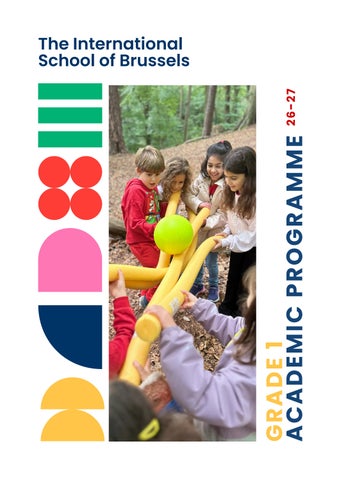
GRADE 1 ACADEMIC PROGRAMME 2 6 - 2 7
The International School of Brussels
The International School of Brussels
INTRODUCTION The Lower School at ISB is where children ages 2.5-12 years learn by exploring the world with curiosity, and by asking questions and developing skills in problem solving and interpretation. Further consolidating the understanding, skills, and knowledge necessary for a lifetime of learning, students develop independence and self-reflection as they grow from children to young teens. The key elements are the academic and specialist subjects, the engaging learning environment, and the highly-qualified and caring faculty and staff. Our Academic subjects build the foundational knowledge and skills for understanding our world, but also provide opportunities for extensive challenge. The Specialist programme provides a wide breadth of experiences for all students, supporting them in being performers, artists, language learners and building the habits of life-long physical activity. The age-appropriate learning environment provides flexibility and adaptability to a wide range of configurations for teaching and learning. Our faculty are all specialists in working with and supporting lower school-aged children. The ISB curriculum is based on a set of content standards selected from national systems and educational institutions. Standards are selected to align with ISB’s mission and vision to provide the foundation for our international curriculum which is accredited by The Council of International Schools and The Middle States Association (USA). Those standards are listed and linked below.
INTERNATIONAL ACADEMIC CONTENT STANDARDS Advisory: International School Counsellor Association
Mathematics: Common Core Standards
Arts: National Core Arts Standards
PE & Health: National Physical Ed Standards
Digital Citizenship: Common Sense Education
Science: Australian Curriculum
Language Arts: Common Core Standards
Social Studies: Education For Global Citizenship
Languages: The Common European Framework
The International School of Brussels
LANGUAGE ARTS
Reading Grade 1 marks a pivotal stage in a child's academic and personal development, characterised by notable milestones that lay the groundwork for future learning. One significant achievement during this period is the acquisition of fundamental literacy skills, as students transition from readers of simple sentences to exploring and reading a whole range of different text types. Phonics instruction plays a central role in this growth, as students explicitly learn sound-spelling patterns, practice blending letters to decode unfamiliar words, and build the reading fluency needed to tackle longer texts independently.
Units
Becoming a Grade 1 Reader
Fiction Reading
Non-Fiction Reading
Students participate in
Students apply a variety of
Students navigate
classroom activities and explore a diverse range of print resources. Through whole-
decoding strategies and context clues to read storybooks. They engage
informational texts and expand their understanding of the world. As they explore new
group read-aloud discussions and interactive small-group
deeply with fiction by retelling key plot events, asking
topics, students practice identifying main ideas and key
center rotations, students establish fundamental classroom routines and
thoughtful questions, and forming personal connections with characters and situations.
details while making personal connections to real-world facts. By asking questions,
expectations that create a supportive environment for
inferring meaning, and explaining concepts in their
growth. These structured daily habits empower students to acquire, practice, and apply
own words, students build critical reading skills that extend well beyond the page.
foundational reading strategies as they build early literacy confidence.
GRADE 1
The International School of Brussels
Writing Students write with clarity for a variety of purposes, audiences and across a range of genres. They use the writing process to improve their work and are consistently held to high expectations for published work. Letter formation and handwriting are practiced throughout the year. Students regularly engage in word study, focusing on identifying, understanding and internalising spelling patterns, but also in developing strategies for understanding new words and enriching their active vocabulary.
Units
Becoming a Grade 1 Writer
Information
Narrative
Argument
Students begin expressing their ideas by exploring diverse writing forms and
Stepping into the role of non-fiction authors and realizing they
Students evolve into structured storytellers by grounding their writing in
Beyond simply stating a preference, students learn to
engaging in rich classroom discussions. Through guided whole-group modeling and interactive
have expertise to teach others, students write informative texts
stories they already know. By first recounting and retelling familiar tales, students learn the
structure formal arguments where they introduce a topic, state a clear
small-group writing centers, students establish essential writing routines and expectations that foster a creative, supportive environment.
where they clearly name a topic and supply facts to explain it, ensuring the piece has a definite sense of
essential mechanics of storytelling before moving on to innovate with familiar characters or share their own real experiences,
opinion, supply a reason, and provide closure. By identifying their specific audience and purpose, students
These daily practices give children the confidence to experiment with letters, sounds, and sentence
closure. The writing process is central to this unit; students identify their topic,
strengthening their stories by adding vivid details and clarifying sentence boundaries.
utilize various tools to produce opinion pieces that are not only structured but
structures as they learn to share their unique voices and stories.
audience, and purpose before drafting, and then engage in active revision.
GRADE 1
meaningful to their community.
The International School of Brussels
MATHEMATICS The ISB mathematics programme is designed to develop a deep understanding of mathematical concepts while nurturing critical thinking skills and problem-solving abilities. Below are the key elements to our approach: Developing students’ concrete-pictorial-abstract thinking to build a solid foundation by connecting abstract concepts to tangible experiences Engaging students in hands-on activities, manipulatives, and interactive games to foster a deeper understanding of mathematical concepts Presenting real-world problems or open-ended questions to encourage students to think critically, apply mathematical concepts, and develop problem-solving skills Using visual representations such as diagrams, charts, and models to help students visualise abstract concepts, making them more accessible and easier to comprehend Providing multiple entry points to concepts, and offering support tailored to individual needs Cultivating a growth mindset towards learning math by emphasising effort, perseverance, and the belief that mathematical abilities can be developed through practice and learning from mistakes
Operations and Algebraic Thinking Students learn to solve addition and subtraction word problems within 20 by using diverse problemsolving strategies for various unknown scenarios. They build on foundational skills to demonstrate automatic fluency with basic addition and subtraction facts up to 10 while working comfortably with numbers up to 20. Additionally, students develop a true understanding of the equal sign by analyzing mathematical statements to determine if equations are true or false. Numbers and Operation in Base 10 Students build a strong foundation in place value by counting forward to 120 and backward from 100, learning that two-digit numbers represent specific combinations of tens and ones. They use this understanding to compare numbers using symbols and mentally calculate 10 more or 10 less than any given two-digit number. Using drawings, concrete models, and place value strategies, students comfortably add and subtract within 100. Place Value Students move beyond simple counting to understand the power of our place value system. By taking an inventory of classroom items, students learn that large quantities are easier to manage when we "bundle" them into groups of ten, a key skill for building a strong mathematical foundation. Through the illustrative context of creating class charts and visual patterns, students will practice identifying ten more or ten less than a number without having to count by ones. Students use grouping strategies and mental math to explain their reasoning and solve real-world problems.
Addition & Subtraction Students bridge the gap between simple finger-counting and the flexible mental math skills required for lifelong numeracy. The primary goal is to move students toward sophisticated addition and subtraction strategies, helping them find "friendly numbers" to solve problems with speed and confidence. Students will master techniques like "making ten," using doubles, and decomposing numbers to break apart difficult equations. By applying these skills to larger two-digit numbers, they learn to organize math by grouping tens with tens and ones with ones. We bring these concepts to life using concrete tools like base-ten blocks and real-world scenarios, such as organizing classroom supplies or keeping score in games.
GRADE 1
The International School of Brussels
Geometry Students become architects of geometry as they explore how shapes are built and divided. The primary goal is for students to look beyond color or size to identify the "defining attributes", like the number of sides and corners, that make a triangle a triangle or a square a square. Through handson building and drawing, children will learn to compose new designs by putting smaller shapes together and partition circles and rectangles into equal shares. By dividing shapes into halves and fourths, students discover the foundational concept that the more pieces a shape is split into, the smaller those pieces become. This unit builds the spatial reasoning and vocabulary needed for advanced geometry and fractions, turning everyday objects into a world of mathematical discovery.
Measurement and Data Students develop real-world measurement strategies by ordering objects from shortest to longest and measuring everyday classroom items using non-standard units laid end to end without gaps. Additionally, students practice gathering data through class polls and sorting information into clear picture graphs and tallies. By evaluating the data and comparing the results, students practice critical thinking to answer "how many more," "how many less," and "how many in all."
Time Students learn to recognize that time is a measurable attribute that can be captured and communicated using both traditional analog faces and modern digital displays. Students will develop the skill of identifying the "short hand" for hours and the "long hand" for minutes. By using the context of their own daily schedules, such as identifying that lunch starts at 12:30 or recess ends at 11:00, students see the standards as a tool for independence. This unit builds the foundational number sense and proportional thinking required for more complex elapsed-time calculations in future grades.
GRADE 1
SCIENCE The ISB Science programme offers students the chance to explore essential science concepts and processes, understand the methods used to develop scientific knowledge, and appreciate science's role in our culture, society, and daily lives. The curriculum equips students with the knowledge, understanding, and skills needed to make informed decisions on various issues. It also fosters the joy of scientific investigation and discovery and nurtures their innate curiosity about the world around them.
Chemical Sciences: Materials and Properties In the "Materials Matter" unit, students dive into the physical world to discover why things are made the way they are and how our choices as consumers affect the planet. The core goal is for students to understand that the specific properties of a material, whether it is waterproof or absorbent, flexible or rigid, determine its usefulness for a particular task. By investigating and testing these characteristics, students develop the essential skills to identify relationships between a material's structure and its function, ultimately using this evidence to solve real-world problems and make informed decisions. Through the illustrative context of designing experiments and asking "what if" questions about everyday objects, students will learn to record data systematically and evaluate which materials are best suited for a purpose. Crucially, they will also explore how these properties dictate whether an object can be physically changed, reused, or recycled, fostering a deeper understanding of sustainable disposal and the impact of our material world.
GRADE 1
The International School of Brussels
SOCIAL STUDIES Social studies are essential for helping children understand the world around them and their place within it. The Lower School Social Studies programme encompasses history, geography and civics providing students with a broad perspective on human experiences. Through social studies, students learn about different cultures, historical events, the interconnectedness of global communities and the importance of active engagement in society. Shaping our World: Nature, Humans and Change Students become environmental investigators, exploring the fascinating interplay between the natural world and human presence. The primary goal is for students to understand that landscapes, both local and global, are shaped by a combination of natural characteristics and human actions, and that these changes directly impact the survival of living things. Students will distinguish between natural forms and human-made features, while discovering that when an environment shifts, the basic needs of its inhabitants may no longer be met. Through the illustrative context of mapping their own surroundings and analyzing global regions, students will develop essential research and thinking skills as well as evaluate their own impact on the world around them. Key Knowledge in this Unit: Landscapes are shaped by a combination of natural geographic forms and features created by human activity. Everyday human actions alter the surrounding environment in ways that can be either helpful or harmful. When natural or human-made changes occur in an environment, the basic survival needs of local plants and animals can be disrupted.
Identity in the Spotlight: Celebrating Us Students explore the powerful ways the arts can communicate who we are and how we relate to the world around us. The primary goal is for students to understand that while we all belong to different groups with unique customs and values, our physical and cultural differences are something to be celebrated rather than a source of conflict. By investigating various art forms and narrative storytelling, students develop the essential skills to interpret information about identity and find evidence of what makes each person unique. Through the illustrative context of a grade-level theatrical production and original artwork, students will systematically record their thoughts and emotions, using their expressive skills to share a message of appreciation for themselves and others. Key Knowledge in this Unit: Our personal values, traditions, and daily customs are shaped by the families, cultures, and communities to which we belong. Every individual possesses unique physical traits, ideas, and backgrounds; recognizing these differences helps us navigate conflict and appreciate diverse perspectives. Creative mediums, including drama, storytelling, and visual arts, allow us to explore who we are, record our thoughts and emotions, and communicate our unique personal narratives. Using artistic expression and shared storytelling helps us evaluate different viewpoints, appreciate peer identities, and foster a welcoming, respectful community.
GRADE 1
The International School of Brussels
VISUAL AND PERFORMING ARTS The Arts program focuses on the following areas: Creating & Performing and Responding & Connecting to visual & musical artworks. Visual Arts In Grade 1 Art, students become observant designers and builders, exploring how lines, colors and shapes help us interpret the visual world around us. Through hands-on experimentation, they observe manmade and natural environments to create freestanding playground sculptures out of paper, translate observational drawings into clay tiles, and master techniques like slab-making, carving, and joining. Students dive into color theory by mixing warm and cool palettes and collaborating on large-scale group paintings that explore mood and atmosphere. They also examine urban landscapes by sketching portraits from observation, exploring scale and movement, and designing custom pattern motifs inspired by fashion designers and artists. By reflecting on how artists inspire one another, applying diverse techniques, and safely managing studio tools, students build technical skill, spatial reasoning, and creative confidence. Within the welcoming spaces of our PS-2 common area and Chateau, an ever-evolving gallery proudly showcases the imaginative endeavors of our young talents, shining a spotlight on both individual brilliance and collective achievements. Music Expanding the building blocks learned in kindergarten, students explore, play, and create with small percussion instruments as well as barred instruments such as xylophones. Moving to all musical styles from jazz to fijiri opens students’ musical worlds as they actually understand music through their bodies. Combining all these musical elements, each 1st grade class harmonises with a 2nd grade class in the spring concert where they experience the joy of performing and sharing their music. Students feel a sense of accomplishment as they later watch their performance and reflect on how they improved with practice. Expressive Arts During Drama students explore character, staging, and ensemble teamwork, as well as practice pantomime, expressive facial movements, and body language to convey distinct emotions and physical choices. Through collaborative games and performance routines, students discover foundational theatre concepts, such as characters, scenes, and scripts, while discovering how audiences experience various feelings when viewing art. Through these adventures, students not only build their confidence as presenters and performers but also develop vital collaboration and leadership skills, and have a chance to engage their imaginations in playful and challenging ways. Students have the opportunity to showcase their skills and understanding, in a culminating performance both in the classroom and for broader audiences within the ISB community.
GRADE 1
The International School of Brussels
PHYSICAL EDUCATION & HEALTH The Physical Education & Health programme focuses on the following areas: Motor Skills & Movement Patterns, Concepts, Principles, Strategies & Tactics and Understanding Healthy Lifestyles Games The Grade 1 PE programme is designed to nurture physical literacy and social development among children by immersing them in chasing and fleeing games, which not only improve their understanding of rule acceptance, turn-taking, and role-playing but also encourage collaboration and adaptability. Through active participation in modifying and adapting games, children develop a solutions-oriented mindset while internalising the concept of fairness. Basic Movement Skills They engage in various locomotor skill practices, including individual and group skipping with parental involvement, to seamlessly transition into fluid movements. Delving into running activities, they learn to discern appropriate jogging and running paces, fostering interests in both short and long-distance running, complemented by endeavors in track and field like long jumps. Ball Skills Within their ball skills unit, children focus on catching, throwing, and dribbling, developing hand and foot cordination skills. They have opportunitiy to practice these skills in the context of learning to play badminton.
OUTDOOR EDUCATION In the Lower School, Outdoor Education nurtures confident, curious, and caring learners through regular, high-quality experiences in nature. Our holistic approach gives students the freedom to exercise genuine agency, making choices, solving hands-on problems, taking ownership of their discovery and building a strong sense of environmental stewardship. Whether practicing practical bushcraft skills, engaging in creative teamwork during imaginative play, or bringing classroom concepts and curriculum to life outdoors, students embrace personal challenges and calculated risks that build deep resilience and a growth mindset. Supported by time in nature that naturally boosts emotional wellbeing, students learn to listen, share, and collaborate in an open environment, developing a lifelong connection to the natural world alongside essential personal and social skills.
GRADE 1
LANGUAGES Multilingualism and cultural understanding is a key part of being an International Citizen.
Students, who have demonstrated proficiency in English, access our French language programme. Additional languages are offered as part of the ISB+ programme, based on demand. ISB follows the Common European Framework for Languages.
English Proficiency
French Foundations A1 Intermediate A2 Independent B1 / C1
Grades 5 & 6 Science & Social Studies in French option
ISB+ Plus Languages Open to all regardless of English Proficiency
HOME LANGUAGE CLASSES Students who speak Hebrew, Spanish, Japanese, Korean, Dutch or Swedish have access to one hour a week of a home language class. For Prekindergarten and Kindergarten this has an oral language focus. For students in Grade 1 and beyond this has a focus on the development of literacy skills.
Hebrew
Spanish
Japanese
Korean
Dutch
Swedish
32
FRENCH My Community (Mon Village et Moi)
By exploring local places and community features in French, students build essential vocabulary and sentence structures to describe where they live and express everyday needs. As a culminating task, students create a board game featuring a character who navigates the town, sharing where they are going and why. Some learning targets in this unit: Foundational Identify key community landmarks within a town Express where someone lives and what exists in their area Use directional phrases to state where a person is going Intermediate Link destinations to specific physical needs using basic connective phrases Utilize plural forms, numbers, and basic adjectives to give more detailed descriptions of town features Express reasons for going to specific community locations Independent Explain multi-step movements across town Incorporate varied expressions to enrich spatial descriptions Formulate complete, complex sentences when describing travel The Market (Le Marché) Through role-play and market-themed stories, students build foundational vocabulary to name fruits, vegetables, and baking ingredients while exploring simple exchanges between buyers and sellers. As a culminating task, students collaborate to perform a market dialogue, practicing how to ask for items, check availability, and inquire about prices to make a favorite recipe. Some learning targets in this unit: Foundational Identify common fruits, vegetables, and basic recipe ingredients Use simple polite formulas to ask for items Ask for basic product availability and pricing Intermediate Express quantities and describe fresh produce Link questions and responses in routine transactional exchanges between buyer and seller Associate specific market ingredients with simple cooking steps or dishes Independent Use connecting words to explain a sequence of ingredients needed for a meal Formulate fluid questions and handle unexpected responses during transactions Express preferences and compare items
GRADE 1
FRENCH The 5 Senses (Les 5 sens)
Through interactive sensory explorations, students discover how to express what they see, hear, touch, smell, and taste using core vocabulary and basic descriptive phrases. As a culminating task, students create a visual timeline featuring each sense, sharing what they discover and enjoy across their everyday surroundings. Some learning targets in this unit: Foundational Identify the five body parts and their corresponding sensory actions Express simple personal likes and dislikes Describe basic textures and tastes Intermediate Link specific physical feelings or sights directly to familiar items in the environment Explain the reasons behind a sensory reaction using simple conjunctions such as because Sort objects into distinct sensory categories Independent Combine sensory descriptions with community locations to explain experiences in different places Explain simple safety habits related to the senses Construct complete, descriptive sentences to describe what they observe with their senses
HOME LANGUAGES In our Home Languages classes, students are supported to acquire and accurately use a range of general academic and domain-specific words and phrases for reading, writing, speaking and listening. Working towards reading grade-level appropriate text for comprehension is a priority for both fiction and non-fiction, supporting students to maintain and progress in their home language. (Language offerings: Dutch, Spanish, Korean, Japanese, Swedish and Hebrew; offerings are dependent on enrolment.)
KEY KNOWLEDGE & SKILLS Expanding language skills by learning and applying specialized academic vocabulary when reading, writing, listening, and expressing ideas about content topics Reading age-appropriate fiction and non-fiction texts with increasing independence to support ongoing language development and comprehension Answering questions and drawing simple conclusions about a text by speaking or writing, referencing specific sentences or picture details to support their thoughts Identifying the main idea or topic of a text and summarizing key supporting details from the beginning, middle, and end
GRADE 1
The International School of Brussels
FOUNDATIONAL ENGLISH LANGUAGE DEVELOPMENT All About Me Students explore their place within their school and local neighborhood, examining their roles, daily routines, and relationships with others. Through these themes, students strengthen their use of the simple present and present continuous tenses, expand their descriptive vocabulary to express personal opinions and choices, and practice using possessive adjectives and subject pronouns accurately. My Home Students explore their immediate environments by identifying different types of homes, rooms, and daily household activities. Through this familiar topic, learners build essential English tools—including prepositions of place, there is/there are, and the simple present tense—to describe where objects and people are located. Using a mix of spoken words, drawings, and simple labels, students practice combining short phrases to share how they live and help at home. By the end of the unit, students will transition from using isolated words to constructing meaningful phrases and multimodal representations that explain not just what a home looks like, but how we live within it. My Community Students explore their local neighborhoods and discover the diverse community helpers who work within them to build a sense of belonging. They master foundational English tools, such as prepositions of place, there is/there are, and simple present and negative sentence forms, to describe local landmarks and daily community roles. Through labeling maps, drawing, and speaking in short phrases, students build confidence describing the places and people right outside their front door.
SKILLS Students who require consistent learning support have access to smaller group support during core language arts and mathematics lessons as well as through a Skills Learning support class which happens three times per week, instead of French. During this time, students have access to additional curricular support aimed at improved student access and success. In addition to this, students receive targeted support for their individual learning goals as part of their individual learning plan.
GRADE 1
The International School of Brussels
ADVISORY The Advisory programme, led by the Lower School counsellor, builds the social and emotional understanding and skills of our students. Students deepen their social-emotional intelligence by expanding empathy, learning to recognize others' feelings and responding with care, while building positive habits around personal space and respectful communication using "I-statements." Through yearlong counseling lessons, students practice thoughtful decision-making, learning to reflect before acting and applying personalized strategies to calm strong emotional responses. Students also develop confidence in personal safety and self-advocacy by identifying situations where it is appropriate to say "no" and establishing healthy personal boundaries.
LIBRARY Students take their first steps toward independent library navigation, shifting from shared storytelling to active book discovery. Through read-alouds paired with classroom units, they learn to spot key non-fiction details and to gather information about topics that interest them. Students learn the layout of the library, practicing how to find favorite authors, return books responsibly, and locate specific sections using picture cues and category signs.
STEM STEM comes to life in the Lower School through hands-on, real-world design challenges that invite students to solve authentic problems using Science, Technology, Engineering, and Math. Guided by the Design Cycle (Define, Ideate, Prototype, Test, and Implement), students intentionally choose the best tools and/or technology to research, measure, and build their solutions. Students experience a range of design tools, including 3-D printers, laser cutters and green screen studios. They work with a range of recycled materials to create and construct. Through Vex robotics and block based coding, students build computational thinking. Along the way, science standards and math concepts become natural tools for problem-solving. Most importantly, through multiple tests and iterations, children build essential transferable skills like critical thinking, collaboration, and resilience, learning that thoughtful reflection turns every hurdle into a stepping stone toward a better solution. Alongside technical skills, we build responsible tech habits by teaching online safety, media literacy, and what it takes to be a positive digital citizen.
GRADE 1
Kattenberg 19, B-1170 Brussels, Belgium +32 2 661 42 11 www.isb.be