In order to ensure that all of our students are successful, challenged, and included, High School students are offered a number of pathways to support the development of their strengths and passions and help them move confidentlytotheirpost-ISBdestinations
All students who meet credit requirements at ISB graduate with a US High School Diploma. In addition to their High School Diploma, students may seek external credentialstoenablethemtoaccessthepost-secondaryeducationoftheirchoice.
We are committed to personalisation and allowing students to find the pathway thatisbestsuitedtotheirdestination,studentsmaychoosefromvariousrecognised and rigorous external qualification programmes, including the International Baccalaureate (IB) Diploma Programme and the completion of IB, BTEC, or Advanced Placement (AP) courses. This handbook is designed to offer you detailed information aboutyourchild’sjourneythroughoneofthesepathways,aswellasresourceswhich willhelpmakethisjourneysuccessful
ISBDiplomas
One of The International School of Brussels accrediting bodies is the Middle States Association (MSA). This accreditation from the United States allows for ISB to allocate official diploma documents based on their approved processes As a result, all ISB students work toward either an Individualised ISB Diploma, or the ISB HighSchoolDiploma.
IndividualisedISBDiploma
TheIndividualisedDiplomaistypicallytheleavingdocumentationforISBstudentswith intensive learning needs (ILS), or who have a learning profile that requires broader flexibilitythantheISBHighSchoolDiplomaallows
ISBUSHighSchoolDiploma
The ISB High School Diploma is a four-year credit based degree modelled after the liberal arts approach (breadth and depth) in the United States. Students working toward achieving this diploma earn credits by passing (grade 3 or above) their accreditedcoursesingrade9to12 Year-longcoursesearn1credit,semestercourses earn 05 credits In order to graduate, students must obtain a minimum of 19 credits from a specific range of identified courses, which then allows space for a student to dive deeper into their interest areas. Students must also engage in, reflect upon, and document authentic personal learning experiences that contribute to their own personal awareness and wellbeing as well as to the communities of others The specificrequirementsoftheHighSchoolDiplomaarebelow
It is highly advised that students who are planning to study at a university following graduationobtainadditionalcreditsineachoftheaboveareas,aswellasstudyingan additional language. The HS Counselling team works to advise students on their best optionsbasedontheirstrengths,interests,andfutureaspirations
The ISB HS Diploma is a recognised diploma that allows students to gain access to many university and college programmes around the world. Some universities/colleges have additional credential requirements which can be obtained whilestudyingatISB.TheHSCounsellingteamisbestsuitedtoprovideguidanceand helpstudentslocatetheinformationtheyneedtomakechoicesthatwillsupporttheir ambitions
Personal Learning
The High School Personal Learning Programme strives to provide each student with a space to grow both as a valued member of our HS community andasanindividualwithdiverseabilities, passions, and ambitions. The programme is designed to build communityandapositiveschoolculture, whilst also supporting students' socioemotional growth and providing students with a voice and choice in designing aspects of their Personal Learning/CASprogramme.
Support the students in planning and reflecting on their Personal Learning/CAS programme
CommunityEngagement (throughPLorCAS)
AllstudentsatISBfromGrades10to12participateinarobustCommunityEngagement programme Theprogrammeaimstohelpstudentsdeveloptheirownidentityandan understanding of the identity of others, creating a stronger understanding of citizenship.Thiscaninvolvevolunteeringoncampus,butfocusesonvolunteeringwith organisations across Brussels that work to address the authentic needs of the homeless,elderly,refugees,underprivilegedchildrenetc.
Through participation in the programme students develop their social, self management, communication, leadership, and collaboration skills It also provides studentswiththeopportunitytoidentifypotentialareasofstudyand/orfuturecareer paths. Students are supported through this programme by the CAS Coordinator, the CASsupervisors,andthePLadvisors.
Counselling
HighSchoolCounselling
AllstudentsatISBfromGrades10to12areindividuallysupportedbyadedicatedteam ofHighSchoolcounsellorswhooverseestudentpathwayswhileintheHS;thisincludes academic planning, monitoring, support and progress, goal-setting, personal and social happiness, balance and wellness. Counsellors are a point of contact for studentsandparentsrelatedtosuccessatISBandbeyond.
A significant focus within the HS Counselling programme is developing, preparing for, and in many cases applying to post-ISB pathways The HS Counsellors are global experts and run a team approach when working with students. This process is student-led, but we guide, support, scaffold, and track all along the way It is our commonobjectivetoworktowardseachstudent’sindividualgoalsandsuccess!
Counsellor allocation is divided by family names (with some exceptions) as outlined below:
For general communications, please email hscounselling@isbbe or ISB’s High School Counselling Office Coordinator, Marieke Eikendal de Groot eikendaldegrootm@isb.be. Toemailaspecificcounselor,theycanbecontactedatthefollowingemailaddresses: Karen Sagall sagalk@isb.be, Amy Durrant durranta@isb.be, Matthew Akitani akitanim@isbbe,CatherineIrvineirvinec@isbbe
SocialEmotionalCounselling
Students seeking or in need of added support are welcome to see the Social & Emotional Counsellor, Katie Cherry. The Social & Emotional Counsellor works with a specific focus on supporting students’ psychological, emotional, social, and mental wellbeing.Whenastudentmaybeinneedofprolongedsupportoriftherearetopics beyond the scope of what a school counsellor is able to support, ISB may suggest continued support outside of school. The Social & Emotional Counsellor is able to provide referrals Appointments can be made via email directly to Ms Cherry cherryk@isb.beorstudentscandropbyheroffice,room234.
Learning Support
ISB provides a wide spectrum of learning support, which includes provisions for students who require servicesidentifiedinthreebroadbands, although we know students don’t fit neatlyintotheseboxes In reality it is a continuum, and defining the degree of support students need helps us design and deliver flexible servicedeliveryoptions
Resource
Thisisanindividualisedcourseavailabletostudentswithadiagnosedlearningneed. Thefocusisonknowingwhenandhowtoaskforhelp Withthesupportoftheteacher, students identify individual strengths and weaknesses. Students enrolled in the Resourceclassdevelopanunderstandingoftheirownlearningprofile,developareas oftalent,andfocusonbuildingtheirstrengthswhiletargetingspecific,compensatory learning strategies to remediate underlying skill deficiencies Balanced with this skill work, students also receive re-teaching and revision support of the content of their courses,asnecessary.
IntensiveLearningSupport
The High School offers an intensive, life-skills based classroom, for students with cognitive or developmental disabilities Students work in a small group with personalised goals supported by specialised professionals, in collaboration with mainstream teachers on functional academic and social integration opportunities Individualtherapiesarewellintegratedintotheirdaytoensuretransfertothenatural environment Thereisanemphasisonindependentlife-skillsandinvocationalstudies, and community skills to prepare for a successful life after ISB. A transition plan is developed collaboratively with families to support these next steps Students earn an individualiseddiplomabasedontheirILPgoals.
Monitoring
Studentswhohavediagnosedlearningneedsbutdonotneeddirectinterventionare monitored to ensure that all faculty who work with this student know about their learning profile and will make the necessary accommodations for needs in the class. ThestudentisnotscheduledintoaResourceblock,butratherthestudenthascheckinappointmentswiththeircasemanager.
In order to keep formal accommodations legitimate and updated (regardless of the supportmodel),studentsintheLearningSupportprogrammeneedupdatedpsychoeducational testing (or other relevant assessment based on condition) every three years to confirm they continue to qualify for support and any formal accommodations. If they do not qualify, and there is no longer a presence of the previously identified condition, they will be exited from support and will no longer receiveformalaccommodations.
EnglishLanguage Development
The High School offers a series of courses for students entering ISB with a developing command of the English language. English Language Learners will be provided with the specialist support and scaffolding they need to enable them to successfully accessthecurriculuminEnglish,thepredominantlanguageofinstructionatISB.
For attending students, placement is made by the ELD teacher with the guidance of WIDAtestingandclassresults.Forarrivingstudents,aplacementtestwillbearranged bytheCounsellingdepartment Therearefourlevelstargetinginstructionforstudents toimprovetheircompetenceinEnglish.
ISBGrading& ConversionChartfor ExternalProgrammes
The chart below is a representation of the ISB grading structure in the Upper School The chart also shows the alignment of the external grading systems from organisationsofwhichweofferadditionalcourses(IB,AP,BTEC) CoursesthathaveIB, AP,orBTECinthecoursetitleatISBaregradedusingexternalcriteriaanddescriptors provided by their accrediting bodies Those grades are then converted to ISB grades asrepresentedbelowandreportedassuchonISBofficialdocumentation.
ISBisanaccreditedinstitutionthatawardsgradesandcreditsforcoursescompleted atISB;therefore,allISBreportsreflectISBgrades PredictedorawardedgradesforAP, BTEC, and IB can be provided as needed on separate documentation, and in the end willbeawardeddirectlybytheseexternalorganisations
Due to the transient nature of international school populations, and in line with our school’s mission and values, ISB does not weight grades, calculate GPA, or rank our students
APPhilosophy &Practices
AdvancedPlacement(AP)
Collegeboard (an external organisation that also coordinates the PSAT and SAT) has designed a number of courses referred to as Advanced Placement (AP) Courses. These courses, each one year in length, are modelled after introductory college/universitycoursesintheUnitedStates.StudentsareabletoenrolinAPcourses as part of their ISB Diploma requirements starting from grade 10, and on occasion grade9(whenanidentifiedchallengeisrequired).
StudentswhowishtoearnexternalAPqualificationswilltaketheexternalexamsatthe end of the calendar year in which they completed the course. As not all students partakeinexternalcredentialing,thecostchargedbyCollegeboardfortheexamand for test administration is passed on and billed to the parents for each AP exam. StudentswhodonotchoosetotaketheAPexamwillnotbeallowedtohave“AP”inthe coursetitleontheirtranscript.
AP Courses are offered from the various subject areas, some on a rotational basis every other year (for example, Microeconomics in one year and Macroeconomics in thenext).AfulllistofcourseofferingscanbeseenintheProgrammeofStudies.
Self-StudyCoursesandExams
Students who wish to study an AP course that is not offered by ISB in that year may choose to enrol in an independent study course and self study for the exam Some students choose to do this on their own, others choose to enrol in an online course. When this is the case, ISB will support students to enrol for and sit the AP exam at ISB, and therefore there is a fee that will be passed on to the family. Students who wish to register for self-study exams must complete the registration process with the AP Coordinator before 15 November of the year of their exam. ISB does not allow students toself-studyanAPcoursewithaportfoliocomponent.
APPrerequisitesandPlacement
As AP courses are university level courses and have required pre-knowledge in order for students to be able to access the level of learning, many have prerequisite recommendations or requirements to enrol in the course Some courses are more accessible than others for this reason, and therefore, a student's teacher and counsellor should be able to advise them best for enrolments, especially for students taking them in grade 10, and in some cases grade 9. These prerequisites are listed in theProgrammeofStudies
APAssessmentandGrading
AP Courses are scored on a 1-5 scale, each representing how qualified the student wouldbetoearncreditattheuniversitylevelforthedemonstrationoftheirknowledge This grade comes solely from the external exam that is administered in May of the year that the students complete the course The course offered at ISB is designed to help the student learn the material as well as prepare for the exam. ISB will award a grade on its report on a 1-7 scale based off the conversion chart listed in an above section.
APRegistration&Fees
In order to take external examinations, students must be registered with the external bodythatawardsthecertification.ForAPexaminations,studentsmustberegisteredfor their exam(s) with College Board. Student registration takes place in September of the yearoftheirexam.ItisanexpectationthatallstudentsenrolledinanAPcourse,withthe exceptionofAPFrenchLanguageandCulture/French4,willberegisteredtotaketheAP examinMay.
Howregistrationworks
Students receive a letter in September of the year of their exam asking them to confirm their personal details and their intention to take exams. Once students return thisletter,theyareregisteredwithCollegeBoard.
InNovember,theirregistrationisfinalisedandfamiliesareinvoicedforAPexamination fees (approximately 120 EUR per course) as well as ISB exam administration fees Any changestoregistrationstatusafter15Novemberwillincurlatefees.
GuidelinesforAP StudentsatISB
Homework
AP courses are considered rigorous, college-level courses. As such, students should expect to complete homework, assignments, and revision in order to ensure their successintheAPcoursestheyaretaking.
WhilethefinalscoreformostAPcoursesisentirelybasedonperformanceintheMay exams, some AP courses do require students to complete and upload portfolio tasks. When this is the case, students are expected to respect the internal deadlines set for these portfolio tasks by their teachers. Failure to make a deadline can have negative consequencesforthestudentorevenpreventthemfromsubmittingtheirfinalworkto CollegeBoard
All portfolio work will be checked for academic integrity. Faculty are required to declare that they believe that the work submitted is your own, and this means that they have to be confident that collusion with others or plagiarism have not taken place
You correctly and completely cite any work of others (including AI tools) that you refer to or use in your work This includes numerical data and images as well as text.
You do not receive non-permitted assistance in the completion or editing of work, suchasfromfriends,relatives,otherstudents,privatetutors,essaywritingorcopyeditingservices,prewrittenessaybanks,orfilesharingwebsites.
APcoursesdemandthatstudentsworkconsistentlythroughthedurationofthecourse, but also maintain a balanced lifestyle Careful thought should be given to strategies students can use to manage their stress during more demanding periods of the program Thismayinclude:
AtISB,inclusionisattheheartofourapproachtoourAPprogrammeandourmission to ensure all learners are challenged, included, and successful We are committed to supporting College Board’s access and equity policies by ensuring that all students are able to access their assessment, and that the assessment can most accurately measureastudent’sknowledgeandskills.
Access and inclusion arrangements for learning, teaching, and assessment for AP courses are considered when a learner is identified as needing support through the Student Study Team process. For AP courses, this will include (but not be limited to) instances when a learner faces long-term challenges or a chronic medical issue, illness,orcondition.
The school can provide inclusive access arrangements for students taking AP examinations that align with their normal way of working in the High School. The purpose of these arrangements is not only to ensure that all students have equal opportunities for success, but also to help students develop the academic and advocacyskillstheywillneedintheirpost-secondaryendeavours.Theneedforthese arrangementsisdeterminedbytheLearningSupportdepartment,inconsultationwith parentsandteachers.
If a student is deemed to require inclusive assessment arrangements, an application issenttoCollegeBoardforapprovalwiththeconsentofthestudentandthestudent’s family Applicationsshouldbesubmittedasearlyaspossibleandbefore15December of the student’s exam year in order to qualify for inclusive arrangements during their Mayexams
Access arrangements must not only apply to students during summative AP assessments, but also be available throughout the course of study (this includes all classroom work and formative assessments that are part of everyday learning and teaching).
AcademicIntegrity
AcademicIntegrityintheAPProgramme
APstudentsmustdemonstrateasustainedcommitmenttoacademichonestyintheir work. In order to avoid plagiarism in portfolio or other assignments, College Board recommendsthatstudents:
Be aware of the difference between common knowledge and information that requirescitation.
Ensure that all data, sources, and authors used in their work are legitimate and accurate.
In addition, students are held to high standards of integrity during their AP examinations.Misconductduringanexaminationincludes,butisnotlimitedto,taking unauthorised material into an examination room, disruptive behaviour, and communicatingwithothersduringtheexamination.
Students should be aware that any breach of College Board regulations will result in seriousconsequences,includingsuspensionandpossiblycancellationofAPscores
For more information about academic integrity and sanctions for academic misconduct at ISB, please see the Academic Integrity section of the HS Student and ParentHandbook
CodeofConductfor APExaminations
Both mock and externally-assessed AP examinations are governed by strict codes of conduct to make sure that the assessment takes place in a fair, safe and comfortable environment. All students will need to become familiar with the expectations for conduct duringtheexaminations
Arrivingfortheexamination
All students should arrive at school 30 minutes before the exams are scheduled to begin. When candidates are admitted to the exam room, they must enter in a quiet andorderlymanner.
Intheexamroom
Once they are in the exam room, students must not communicate with anyone other thantheproctorsforthedurationoftheexam.Nofoodordrinkcanbetakenintothe examination room unless the candidate has a medical condition. The proctor will tell candidateswheretositandcandidatescantakeonlythematerialspermittedfortheir exam to their desk No bags or mobile phones are permitted in the exam room Candidates are not allowed to borrow anything from another candidate during an examination.
Latearrivals
Candidates are allowed into the exam room while the general instructions for the examarebeingread Afterthistime,theyarenolongerallowedintheexamroomand willnotbeabletotaketheirscheduledexam
Academicmisconductduringexaminations
Allworkcompletedduringanexaminationandsubmittedforassessmentmustbethe authentic work of the student Any collusion, plagiarism, reference to unauthorised material, or communication between candidates may constitute misconduct and leadtothecancellationofthestudent’sscores.
Dedicated sessions will be held to familiarise all students with the rules and regulationspertainingtotheexamsbeforethemockexamstakeplace.
APcourseswithISB’sUSHighSchoolDiplomaisaviablepathwayformanyuniversities who require standardised measures for direct entry to their programmes. This could also include demonstrating proficiency on a College Board SAT score, or require passing a certain number of AP exams. Universities around the world understand the value of the standardised AP exam score and therefore will articulate their requirementsontheirwebsites.TheHSCounsellorswillhelpguidestudentstofindthis informationandtomakethebestchoicestosupporttheirfutureambitions
BTECGrading
Foreachunit,studentsareaskedtodemonstratetheirknowledgeandunderstanding bycompletingtasksthatareassessedaccordingtocriteriaatdifferentlevelsofPass, Merit, and Distinction Upon completion of a unit, the overall grade is determined holistically:
If all of the Pass criteria are demonstrated successfully, a Pass is earned for the unit
If all of the Pass, Merit, and Distinction criteria are demonstrated successfully, a Distinctionisearnedfortheunit
BTECWorkSubmission
Ineachunit,thereareusuallyseveraltaskstocompletethataresummativelyassessed. The BTEC programme models real-life situations in that students are expected to adhere strictly to the deadlines set out by their teacher. This means that their success depends on planning their time and managing their workload carefully When submittingtheirwork,studentswillneedtoensurethat:
Theysubmittheirworkontimeandmeetthedeadlinegivenbytheirteacher. They also submit a completed Assessment Record Sheet at the same time they submittheirassignment/task.
ResubmissionofWork
The BTEC programme does offer the opportunity to build on student learning and to improvetheirgradesiftheydonotgettotheleveltheywantontheirfirstsubmissionof theirwork.Hence,ifastudentdoesnotdemonstrateanyofthecriteriaatapointintime when they submit their work summatively for the first time, students are allowed to resubmittheirwork,aslongasallofthefollowingrequirementsaremet:
1.The initial deadlines set in the assignment have been met, or the agreed deadline extensionhasbeenmet.
2The teacher judges that the student will be able to provide improved evidence withoutfurtherguidance.
3The teacher has authenticated the evidence submitted for assessment and the evidenceisaccompaniedbyasignedanddatedlearnerdeclarationofauthenticity.
Work that is being resubmitted can be done in order to meet Pass, Merit, or Distinction criteria Every task in a unit that is submitted on time is eligible for one resubmission Whenworkisresubmitted,thefollowingrequirementsmustbemetfortheresubmitted work:
1The work can be completed by the student with no further guidance from the teacher.
2If the resubmission is an edited and improved version of the original work, then the newworkmustbeclearlyindicatedintheworkproduced–forexample,eitherina differentcolorfontorhighlightedfont
As this is a model of continuous and on-going work, it is important to have welldeveloped self-management skills The BTEC model of assessment suits many learnersasthereisanemphasisonapplyingknowledgetoreal-lifesituationsandon usingdifferentmodesofcommunicationtoexplain,analyse,andevaluateconceptsin context.However,thisdoesnotmeanthatthecourseiswithoutintellectualrigour,and the assessment structure of continuous and regular tasks that are set from the beginning of the course adds challenge. Students will be most successful if they develop and use strategies to organise their time and remain engaged with their teacherssothattheprocessofcontinuouslearningismosteffective.
InclusiveLearning andAssessment
AtISB,wearecommittedtoprovidingasupportivelearningenvironmentresponsiveto individual learner’s academic and pastoral needs, to identify those who need additional learning support and to inform learners of the resources and facilities available for their successful completion of the programme. In keeping with our school’s Learning Support Policy, we regularly monitor our learners’ academic and pastoralneeds,identifylearnerswhomayneedadditionalsupportandputinplacethe requiredsupportandresourcestoensuretheirsuccess
We also aim to support access to qualifications for learners who are eligible for reasonable adjustment or special consideration in internal assessments, without compromising the assessment of the skills, knowledge, understanding or competence beingmeasured.Itisourpolicytoreducetheeffectofanydisabilityordifficultywhich would place a learner at a disadvantage in an assessment In order to do so, we identify in advance whether any action is needed to help reduce the effect of a disability or difficulty, which will place a learner at a substantial disadvantage in the assessment. We also ensure that the reasonable adjustment does not affect the reliabilityorvalidityofassessmentoutcomesorgivealearneranadvantageoverother learnersundertakingthesameorsimilarassessments.
BTECCoursesand UniversityBoundStudents
Within the UK, over 100,000 students enter higher education with a BTEC every year. Internationally, over 260 universities recognise BTEC Nationals for admission to undergraduate study. North America is often happy to accept it in addition to the US HSDiplomaandinmanycasesEuropeanuniversitieswillacceptitaspartoftheUSHS Diplomaorevenonitsown.
Many universities do not have subject-specific requirements for BTEC. Students are able to apply to a wide variety of different subjects as well as those related to their BTECprogrammeofstudy.
Most universities accept BTECs as part of the student’s academic profile as a minimumrequirementformostoftheirhighereducationdegrees
BTEC Extended Diploma is considered a university preparation qualification and in most cases allows for the same eligibility as an IB Diploma or US HS Diploma with 3 APs ISB also makes it possible for students to complete different BTEC qualifications; these qualifications can be combined with IB Certificates, APs, and ISB courses for universityconsideration
TheInternationalBaccalaureateisaninternationalorganisationthatoffersexternally assessed and credentialed courses and programmes that can be completed during thefinaltwoyearsofhighschool.
At ISB students in grades 11 and 12 can choose from a number of two-year courses which include an option to earn certificates awarded by the IB upon completion. Students may also choose to complete the International Baccalaureate Diploma Programme(IBDP),wheretheycompletesixtwo-yearcourses,3atHigherLeveland3 at Standard Level, and meet the Core requirements in order to be awarded an IB Diploma Students not wishing to pursue the full IBDP may select individual IB courses within their US High School Diploma. These are officially known as “Diploma Programme (DP) Courses” and are recognised internationally Students can also choosetoenrolinthesecoursesforoneortwoyearsaspartoftheirISBDiplomaonly, and not sit the exams that take place after the second year in May for external credentials.
Students who work to earn the IB Diploma, or students wishing to earn IB Certificates for their IB Courses, will take the external exams at the end of the second year of the programme.StudentsmayalsoenrolinIBCourseswithoutearningtheIBCertificate.In thiscase,studentswillbeassessedonISBgradingcriteriaandnottaketheIBexamat theendofgrade12.
TheIBMissionStatement
“The IB aims to develop inquiring, knowledgeable and caring young people who help to create a better and more peaceful world through intercultural understanding and respect. To this end, the organisation works with schools, governments, and international organisations to develop challenging programmes of international education and rigorous assessment. These programmes encourage students across the world to become active, compassionate, and lifelong learners who understand thatotherpeople,withtheirdifferences,canalsoberight.”
(InternationalBaccalaureateOrganization,2023)
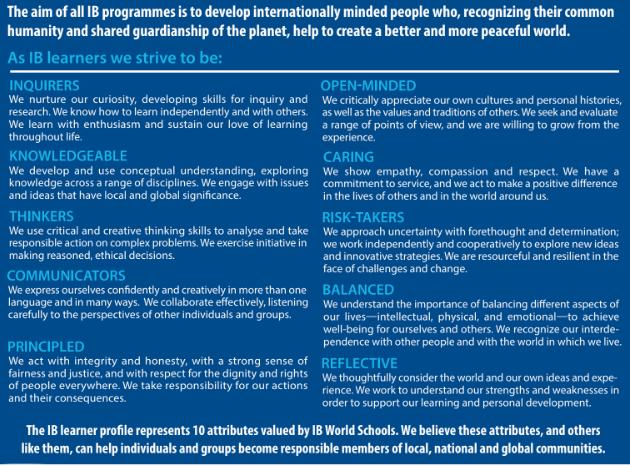
TheIBLearnerProfile
The IB Diploma Programme and IB Courses aim to help all members of the school community learn to respect themselves, others and the world around them through thedevelopmentoftheattributesoftheIBlearnerprofile
(International Baccalaureate Organization, 2023)
ISB’sTransferableSkills&theApproachestoLearning
BothISBandtheIBidentifykeytransferableskillsorapproachestolearningthatareembedded in student learning and should help all of our students succeed in their chosen pathway and beyondHighSchool.
1.Socialskills
Learning is a collaborative process and students will need to work constructively with other students and teachers. By discussing understanding, plans or concerns with others, students willmakemoreprogressthantryingtogoitalone Attimesstudentsmayalsohavetousetheir skillstoresolveconflictswhichmightarisewithinschool,orbetweentheiracademicandsocial lives.
2.SelfManagementskills
Oneimportantsteptowardssuccessisacceptingresponsibilityforworktobedoneandbeing able to set short or long term goals. Students need to develop emotional management, selfmotivation, perseverance, and resilience, as these are skills which will be required throughout their lives to face and overcome challenges The learning schedule for students in grades 11 and 12 is designed to ensure they can achieve balance in their daily lives. Most students will have time during the day when they do not have classes and there are many spaces throughout the school where students can work effectively during these study blocks It is essentialthatstudentsplancarefullyandmanagetheirtimeandtaskseffectively.
Finally, mindfulness and self-care are also important for student success Students should ensure that they adopt a healthy lifestyle that includes enough rest and relaxation, as well as ampleopportunitiestoexploretheirextra-curricularpassions.
3.Communicationskills
The key communication skills we employ are listening, speaking, writing, and reading, and students will be using all of these in their learning and assessment. In many IB courses there are specific criteria to assess these skills, and it is important for students to identify their strengths and areas for development. One student may need to develop the ability to write more clearly, especially when under pressure, while another may need to work on understandingandrespondingtoverbalinstructionsinvariouslearningenvironments
4.Researchskills
Independentlearnersemployavarietyoftoolstogathertheinformationtheyneedandhave systemstomanagethisinformation Technologycanhelpinmanagingresearch Studentswill need to plan ahead to make effective use of the information gathered, as well as understandingappropriatesystemsforreferencingandcitation.
5.Thinkingskills
All IB courses are designed to help students develop a range of thinking skills, from recall to transfertoanalysisandreflection Studentswillbeabletodeveloptheseskillsthroughouttheir lessonsbutalsointheirownindependentrevision
Formostcourses,EnglishisthelanguageofinstructionatISB.Forthisreason,students must have demonstrated proficiency in the English language in order to access IB courses and the IB Diploma programme. Current ISB students must enter the “Bridging” class or be exited from the ELD programme at ISB altogether by grade 11. External candidates are expected to score a WIDA Level 5 in all areas in order to demonstrateproficiencybeforetheybeginthemajorityoftheirIBcoursesorDiploma programme
Students study an additional language, either as a foreign language or through the language and literature of a language they are highly proficient in. By offering studentsthepossibilitytolearnadditionallanguagesorreinforcetheirmothertongue, IB courses allow for students to become multilingual, with access to educational and professionalopportunitiesworldwideandalsotodifferentculturesandperspectives
Itiscrucialthatstudentsarecarefullyplacedinthelanguageclassesthatallowthem the appropriate level of challenge. Students enter language acquisition courses with varying degrees of exposure to the target language(s) It is, therefore, important that students are placed into a course that is most suited to their language development needs The study titled “Benchmarking Selected IB Diploma Programme Language Courses to the Common European Framework of Reference for Languages” suggests that students already at CEFR A2 or B1 in the target language can comfortably take languageBSL.StudentsalreadyatCEFRB1orB2cancomfortablytakelanguageBHL.
It is important to note that misrepresentation of a student’s language proficiency in theselectionofIBcoursesisconsideredtoundermineIBassessmentsand,assuch,is academic malpractice. More information about languages at ISB is provided through courseselectionworkshopsandtheCourseSelectionPolicyforHSLanguages
HomeLanguages(School-SupportedSelf-Taught)
Forbothculturalandcurriculumaccessreasons,awidevarietyofLanguageAcourses are offered annually through our Home Language Programme Through these Language A courses, students are able to develop a deeper connection with their nativeculture,maintainanacademiclevelofproficiency,andhavetheopportunityto obtaintheIB’sBilingualDiploma.
Courses within this programme support students who want to study in their home language, develop their written skills and enhance their understanding of their home culturethroughthestudyofarangeoftexts.Itisanidealpreparationforuniversityor college as the course aims to develop oral, writing, and comprehension skills, as well as to encourage independent learning. Emphasis is placed on the development of analyticalskills,throughessayassignmentsandcommentariesontexts Studentsalso make frequent oral presentations to develop critical thinking skills and the ability to communicateclearlyandeffectivelyinanacademiccontext
Studentswhoopttostudytheirhomelanguagethroughthisprogrammeofstudyare enrolled in the IB’s Self-Taught Literature course and will receive regular support from a school-approved tutor In the first year, a member of the English department also supports the development of analytical skills for both courses, through scheduled classeswhichtakeplaceonceaweek Pleasenotethatthecoursesofferedaspartof thisprogrammeareofferedatStandardLevel(SL)only.
OnlineIBCourses
In order to best tailor the IB Diploma Programme to the needs of each learner, ISB may offer students the option of completing one of their IB courses with Pamoja Education. For an additional cost, students can enrol in courses not currently offered at ISB and complete them online. This option should be discussed with and approved by the student’sSchoolCounsellorandIBCoordinator.
Given the broad range of courses available at ISB, online courses are only recommended in unique circumstances, where students cannot satisfy requirements, duetoschedulingorotherconstraints,withthecoursesofferedatschool,oraspartofa student’s approved Independent Study programme. Students should note that not all DiplomaclassesareavailableonPamoja CoursescurrentlyofferedbyPamojainclude:
Students considering this option should be aware that there may be specific prerequisites to access Pamoja courses, particularly for those subjects offered at a HigherLevel Inaddition,studentsselectingthesecoursesmustbehighlymotivatedand committed to completing the course independently during designated study periods eachweek
The cost of the Pamoja course is the responsibility of the student and their family If studentswishtoenrol,theywillbeaskedtosignacommitmentletter.Enrolmentfeeswill be paid by ISB and invoiced to the families upon confirmation of enrolment For more informationaboutthecosts,pleaseseethePamojawebsite.
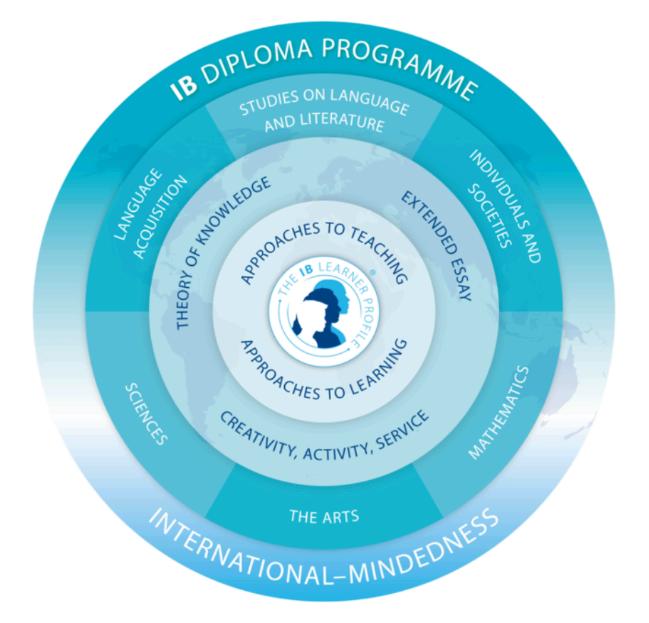
Provisionsintheprogrammecanbemadeinaccordancewithparticularneeds:studentsmay chooseadditionalsubjectsfromGroups1,2,3,4inlieuofaGroup6subject;studentsmaytake the trans-disciplinary Group 3-4 Environmental Systems and Societies permitting further flexibilityintheprogramme.
In addition, all full IB Diploma candidates must fulfil three central requirements: Theory of Knowledge,ExtendedEssay,andCAS.
TheIB DiplomaCore
Inadditiontothesixacademicsubjectsstudents take in the Diploma Programme, students must also complete the Core, which include an Extended Essay (EE), a Theory of Knowledge (TOK) course, and the Creativity, Activity, and Service(CAS)requirements.
ExtendedEssay(EE)
The EE is a research essay of 4,000 words which offers the opportunity for IB students to investigate a topic of special interest. It is often based on one of the student’s HL subjects and it is supervised by a specialist within the school The EE is intended to promote high level research and writing skills, intellectual discovery and creativity. SuccessfulcompletionoftheEEisrequiredforreceiptoftheIBDiploma.
TheoryofKnowledge(TOK)
The TOK course is designed to develop a coherent approach to learning that ties together the academic areas and encourages appreciation of other cultural perspectives.TOKencouragescriticalthinkingaboutknowledgeitselfandaimstohelp students make sense of what they encounter All IB Diploma candidates must successfullycompletetwoTOKassessments,anexhibitionandanessay,inordertobe awardedtheIBDiploma
ThegoaloftheTOKcourseistogivestudentstheopportunitytosynthesiseandreflect uponknowledgetheyhaveacquiredintheirotherclassesandtodeveloptheircritical thinking skills. Its core content is centred around questions such as: What counts as knowledge?Howdoesitgrow?Whatareitslimits?Whoownsknowledge?Whatisthe value of knowledge? What are the implications of having, or not having, knowledge? (IBO.org).
Creativity,Activity,andService(CAS)
CAS is at the heart of the Diploma programme, involving students in a range of activitiesthattakeplacealongsidetheiracademicstudiesthroughouttheIBDiploma Programme Thecomponent’sthreestrands,ofteninterwovenwithparticularactivities, arecharacterisedasfollows:
Creativity – exploring and extending ideas leading to an original or interpretive productorperformance;
Activity – physical exertion contributing to a healthy lifestyle, complementing academicworkelsewhereintheIBDiplomaProgramme;
Service – collaborative and reciprocal engagement with the community in responsetoanauthenticneed
CAS at ISB is piloting the IB’s new vision for CAS For the pilot, students must focus on twoquestions:
What are you doing to take care of yourself? (This is demonstrated through active engagementinexperiencesthatarebeneficialforastudent’sphysicaland/ormental health.)
What are you doing to take care of others? (This is demonstrated through sustained engagementinthecommunity)
CoreClassatISB
As Theory of Knowledge is a mandatory course for IB Diploma Candidates, students must meet the required number of course hours. The mandatory 100 hours of TOK takesplacewithintheCoreperiod Inaddition,timeisprovidedduringthisCoreperiod: Tointroduce,support,andcheck-inwithCASrequirementsandprogress.
To meet with High School counsellors regarding topics such as the post-ISB applicationprocessandcareerguidance.
Non-RegularIBDiplomas
If the entry conditions to a university or college of higher education require a student totakeacombinationofsubjectsoutsidethescopeofaregularorbilingualdiploma, thestudentmayapplytotheIBforpermissiontotakeanon-regulardiploma.
In order to apply, students must present documentary evidence, which can include pages from a university or college prospectus, to show that the entry conditions for theirproposedhighereducationcoursecannotbemetbythecoursesofaregularor bilingualdiploma.Whenpossible,studentsareencouragedtotakeaseventhsubject, outside of the IB programme, to meet these requirements. A candidate will not be allowed to make a substitution for a studies in language and literature or language acquisitionsubject.
If a student chooses to apply, their application (together with all documentary evidence) will be submitted by 15 November of their first year in the programme. Students may expect to receive a response from the IB by the end of the calendar year. Until the non-regular diploma is granted to the student, they are expected to take a seventh course which would make them eligible for the IB Diploma if the nonregular diploma is not granted. If the non-regular diploma is granted, the student will beabletoexittheirseventhcourse
For students who would like to study medicine in Finland, India, Kuwait, the Netherlands, Pakistan, Saudi Arabia, and Sweden, a fast-track scheme is open for the non-regulardiploma
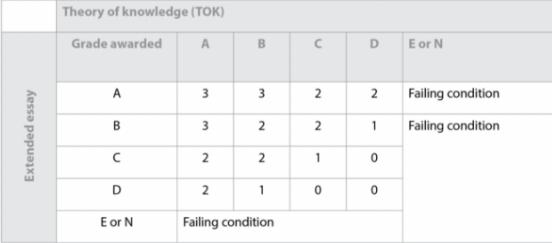
For IB Diploma students, successful completion of CAS, the EE, and TOKs are a requirementforawardingtheIBDiploma CASisnotassessed,butwillbereportedas completed or not. For TOK and the Extended Essay, up to three extra Diploma points are available The Extended Essay and the TOK essay and exhibition are measured against assessment criteria and students are awarded a letter grade (A-E) for each. The total number of bonus points awarded is determined according to the following matrix:
If students did not meet the conditions to receive an IB Diploma, or were not satisfied with the results of their examinations, they may retake some or all of their examinations in the following November session Please note that retakes in the November session must be registered by the IB Coordinator before the end of July of their examination session Candidates registered to retake their examinations will be invoiced IB fees for each of their examinations, as well as a school fee for the administrationoftheirexams
AssessmentintheIBProgramme
InIBCourses,therearethreetypesofassessment:
School-basedassessment
IBInternalAssessment
IBExternalAssessment
School-based assessments are used by teachers to monitor how well a student is progressinginaparticularsubject.Thesecanincludeassignmentscompletedinclass or at home, tests, quizzes, projects, or mock examinations. These assessments are createdby, assignedby, andmarkedbytheteacher School basedassessmentscan be used as a formative experience or to measure attainment School-based assessmentsarestandards-based,whichmeanstheyarebasedontheevaluationof course aims and objectives. They also take into account the components of each individual IB course, which are communicated clearly to students at the outset of the course.Allschool-basedassessmentsaredesignedtohelpstudentsunderstandwhat theassessmentexpectations,standards,andpracticesareintheirIBcourses
Internalassessment(IA)is an assessments that is completed during the duration of the course, with the guidance and supervision of a teacher. The work is then marked by the teacher and a sample is sent to an IB moderator. This sample is checked against worldwide marking standards and adjusted, if required. Internal assessments aresetaccordingtosubjects,andeachsubjecthasadifferentweightingattachedto itsIA Internalassessmentdatesarespreadoverthe2yearsofthecourses,according to the internal deadlines calendar. The internal assessments can make up between 20% and 50% of a subject’s overall mark. At the Department’s discretion, and with advanced warning, students may be given a school-based-grade (1-7) for their external or internal assessments that count as a major assessment. This has no impactonthefinalIBscoreawarded
External assessments are submitted to be examined externally. Unlike internal assessments,externalassessmentsarenotmarkedbytheteacher.Instead,themark is determined solely by an external examiner. Examples of external assessments include the Extended Essay, Language A HL essays, the TOK essay and all examinations Dependingonthesubject,upto80%ofagradeawardedcanbebased on externally marked exams (usually comprised of two or three exam papers) at the endofthetwo-yearcourse.
Admissions& EnrolmentProcedures
CourseSelection
IB courses are rigorous. They are taught at the college level and cover extensive bodiesofknowledge BeforeenrollinginIBcoursesortheIBDiploma,studentsshouldin consultation with their families, teachers and their counsellor, carefully plan their academic and extracurricular schedules to accommodate the demands of their coursework.
EnrolmentforISBstudents
Theenrolmentprocesstakesplacein10thgradewhenstudentsandtheirfamiliesare provided with information about the different pathways available to them, as well as anoverviewofallIBcoursesonoffer Aspartofthisprocess,familiesattendaCourse Information evening, which gives them the opportunity to ask questions about the different courses and reflect on what would be appropriate for their child Students also speak to their individual subject teachers who help them assess their strengths andweaknesseswithaneyetowardstheselectionofDPcoursesthatwouldhelpthem meettheirfutureaspirations.
Aspartoftheenrolmentprocess,allgrade10studentsandparentshaveanindividual meeting with their College and Careers Counsellor During that meeting, the counsellorswillbeabletohelpfamiliesdecidewhichpathwaywillbethebestfortheir child They will go through the option of completing the US High School Diploma requirementsonly,completingtheIBDP,orcompletingtheIBCoursesorotherexternal credentials The selection process is typically completed by early May Access to selected courses will depend on the availability of the courses, contingent upon sufficient enrolment or space For more information about admissions into the IB ProgrammeatISB,pleaseseetheschool’sIBAdmissionsPolicy.
Enrolmentfortransferstudents
Students who are transferring from another school will enrol in the same manner as current ISB students, discussing the pathways available to them, as well as their coursechoiceswithfamilyandtheircounsellors.
For students transferring halfway through their IBDP programme, every effort will be made to accommodate their courses Through consultations with their counsellor, coordinator, and their teachers, a plan will be developed to ensure that they address any gaps which may have occurred in their transfer They will also be expected to supportthetransferofalldocumentationandpreviouslycompletedcourseworkfrom theirpreviousschool.
Registrationandfees
In order to take external examinations, students must be registered with the external body that awards the certification. For IB courses or for an IB Diploma, students must be registered on the IB’s system IBIS. Student registration takes place at the end of Grade 11. Students who chose not to take an IB exammay still complete the IB course andreceiveISBcreditfortheirwork.Inthiscase,theywillnotberegisteredonIBIS.
Howregistrationworks
Students receive a letter in June of grade 11 asking them to confirm their personal details and whether they intend to take exams in all of their IB classes It is important for students to verify their personal details as these will appear on their Diploma or resultssummary
Once students return this letter, they are registered on IBIS Students will be able to changetheirregistrationstatusuntil15Octoberoftheirsenioryear.Theywillbeasked toconfirmtheirchoicesby15October
In November of their senior year, registration is finalised by the IB and families are invoiced for IB examination fees (approximately 92 EUR per course) as well as ISB exam administration fees Any changes to registration status after 15 October may incurlatefees.
TheIB&Post-SecondaryPlanning
RecognitionoftheIBDiplomabyuniversities
The IB Diploma and Courses provide excellent preparation for university and life beyond. IB students consistently demonstrate the critical thinking and research skills neededtoexcelintheiruniversitystudiesandsomecollegesoruniversitiesmayoffer advancedcredittostudentswithstrongexaminationresults.
The IBO published and maintains information about university recognition on their publicwebsite:https://www.ibo.org/recognition
ProjectedandPredictedGrades
When a student takes IB courses, teachers are asked to report on their forecasted progress three times during the two-year course. These forecasts are in line with the grades that students may receive on their progress reports but serve a different purpose The grades on progress reports will report the student’s achievement in the reportingperiodinaparticularcourse.Theprojectedorpredictedgrades,ontheother hand, will report how the teacher believes the student will perform at the end of the two-yearcourse,basedontheevidencegatheredatthatpointintime.
Projected grades are awarded three times during a students IB course: in June of grade 11, in October of grade 12, and in January of grade 12. The projected grades awardedinJunearedesignedtohelpfacilitateadiscussionwithteachersabouttheir progress to date and areas for improvement The projected grades in October and Januarycanbesharedwithuniversitiesaspartoftheuniversityapplicationprocess
At the end of the two-year course, in March of the senior year, students are awarded predicted grades, which reflect the grade the teacher believes the student will be awarded for the course, based on all available evidence These predicted grades are notsharedwithuniversitiesand,undernormalcircumstances,donothaveanimpact onstudentachievement.
GuidelinesforIB StudentsatISB
Homework
Homeworkisgiveninallcourses.Long-termassignmentswillrequirecarefulplanning. For students in IB courses, an internal assessment calendar is produced each year in order to spread out many of the different IB assessment tasks. The idea for this is to help you manage your time effectively and also to enable you and your teachers to checktheacademicintegrityofyourworkandassessit
Allstudentsareexpectedtorespectthesedeadlines.Arequestforanextensionshould onlybemadeinextremecircumstancessuchasaprolongedillness.Failuretomakea deadlinecannotonlyhavenegativeconsequencesforyou,butcanalsobeperceived asarequestforunfairtreatmentwhencomparedtoyourclassmates,andcouldwell prevent teachers from preparing your work for submission to the IB on time You are therefore expected to use the deadline calendar to create a personal work schedule thatdoesnotinvolveworkingonataskonlyinthelastfewdaysbeforeitisdue.
Teachers are also responsible for monitoring the progress of your work, and for providingformalandwrittenfeedbackononedraft Becauseofthis,youarerequired tocreateallwrittenworkthatispartofyourIAoreCourseworkusingGoogledocsthat aresharedwithyourteachers.
The submission of a draft on time is a vital step in the process. Teachers will store a copy of your draft before providing you with feedback This draft will be used as the finaldocumentintheunlikelyeventofyounotsubmittingafinalpieceofworkontime
All your coursework will be checked for academic integrity. Faculty are required to declare that they believe that the work submitted is your own, and this means that they have to be confident that collusion with others or plagiarism have not taken placeandthatanyprimarydatapresentedbyyouisauthentic Missingdeadlinescan beinterpretedasadeliberateattempttopreventteachersfromcarryingoutthisduty andmayresultinworknotbeingsubmitted.
You correctly and completely cite any work of others (including AI tools) that you refer to or use in your work. This includes numerical data and images as well as text.
You do not receive non-permitted assistance in the completion or editing of work, suchasfromfriends,relatives,otherstudents,privatetutors,essaywritingorcopyeditingservices,prewrittenessaybanks,orfilesharingwebsites.
By being familiar with your usual style of writing, by following the process of developingyourdocumentsinGoogle,andbyusinginternetchecksincludingTurnitin, yourteacherswillbeabletoverifytheauthenticityofyourwork.
Stressmanagement
IB courses are rigorous and demand that students work consistently through the duration of the course but also maintain a balanced lifestyle. Careful thought should be given to strategies students can use to manage their stress during more demandingperiodsoftheprogramme.Thismayinclude:
AtISB,inclusionisattheheartofourapproachtoourIBProgrammeandofourmission to ensure all learners are challenged, included, and successful. We are committed to supporting the IB’s Access and Inclusion Policy by ensuring that our IB learners are able to reach their full potential through a culture of collaboration, mutual respect, support,andproblem-solving,involvingthewhole-schoolcommunity.
The IB defines inclusion as “an ongoing process that aims to increase access and engagement in learning for all students by identifying and removing barriers.” (Learning diversity and inclusion in IB Programmes, 2016) Barriers are defined as “obstacles that may prevent or disadvantage a student from participating or effectively engaging in their learning and teaching and assessment” (Access and Inclusion Policy, 2022). Inclusion in our IB programme is based on the principles and procedures outlined in this document and the IB’s “Access and inclusion policy.” Inclusive practices can take many forms In teaching and learning, this can include affirming individual identity to build self-esteem, building on prior knowledge, scaffoldinglearning,andextendingthosestudentswhoarereadyandable(Learning Diversity and Inclusion in IB Programmes, 2020). This can also involve inclusive assessmentpractices,accordingtotheprovisionsmadebytheIB.
Access and inclusion arrangements for learning, teaching, and assessment for IB courses are considered when a learner is identified as needing support through the Student Study Team process. For IB courses, this will include (but not be limited to) instances when a learner faces long-term challenges or a chronic medical issue, illness, or condition that lasts for more than 12 weeks. Support for students experiencing adverse circumstances during the assessment process or examination periodaretreatedseparately
The school can provide inclusive access arrangements for students taking IB examinations that align with their normal way of working in the High School. The purpose of these arrangements is not only to ensure that all students have equal opportunities for success, but also to help students develop the academic and advocacyskillstheywillneedintheirpost-secondaryendeavours Therearetwotypes ofinclusiveaccessarrangements,thosewhichdonotrequireauthorisationfromtheIB and those which do. The need for these arrangements is determined by the Learning Supportdepartment,inconsultationwithparentsandteachers.
Accommodations for assessment which can be made without IB authorisation are arranged by the Head of Learning Support in the HS and the IBDP Coordinator accordingtoastudent’sneeds Theseincludebutarenotlimitedto:
Takingexaminationsinseparateroomstootherstudents
Providing special seating arrangements (for example close to the front to enable easierreadingoftheclock)
Providingacareassistantornurse
Providing magnifying aids, coloured overlays, sound cancelling headphones, or supportsforhearing
Ifastudentisdeemedtorequireinclusiveassessmentarrangementswhichdorequire IB authorisation, an application is sent to the IB for approval with the consent of the candidate and the candidate’s family. Applications should be submitted as early as possible and before 15 October of the student’s senior year in order to qualify for inclusivearrangementsduringtheirMayexams
Access arrangements must not only apply to students during summative IB assessments, but also be available throughout the course of study (this includes all classroom work and formative assessments that are part of everyday learning and teaching)
“Academic integrity is a guiding principle in education and a choice to act in a responsiblewaywherebyotherscanhavetrustinusasindividuals.Itisthefoundation for ethical decision-making and behaviour in the production of legitimate, authentic, andhonestscholarlywork
The IB defines student academic misconduct as deliberate or inadvertent behaviour that has the potential to result in the student, or anyone else, gaining an unfair advantageinoneormorecomponentsofassessment.
Behaviour that may disadvantage another student is also regarded as academic misconduct It also includes any act that potentially threatens the integrity of IB examinationsandassessmentsthathappenbefore,during,orafterthecompletionof theassessmentorexamination,paper-basedoron-screen.”
Plagiarism is when a candidate represents, intentionally or unwittingly, the ideas, wordsorworkofanotherpersonwithoutclearandexplicitacknowledgment Thisalso includestheuseoftranslatedmaterialsiftheyarenotindicatedandacknowledged In order to avoid academic misconduct, students must acknowledge the work of others throughcorrectcitationpractices,bothinthebodyofthetextandinthebibliography, usingthereferencingstyleselected.
Misconduct during an IB examination includes taking unauthorised material into an examination room, disruptive behaviour, and communicating with others during the examination
Communication about the content of an examination 24 hours before or after the examination with others outside their school community is considered a breach of IB regulations.
Duplication of work is when a student presents the same work for different assessmentcomponentsand/orDiplomaProgrammerequirements
As the IB cannot verify the intent of a student who commits academic misconduct, intent is never taken into account if the IB investigates an alleged breach of the DiplomaProgramme’sGeneralRegulations
Adaptedfrom“AcademicHonestyintheDiplomaProgramme”
Accurate and clear citation is a key element to academic integrity Students should knowhowtoindicateandciteanymaterialthatisnottheirown.Pleasenotethatthis alsoappliestoanymaterialproducedbyorwiththeassistanceofAItools.
Students should be aware that any breach of IB regulations will result in serious consequences, including suspension, and possibly even expulsion from the programme
For more information about academic integrity and sanctions for academic misconduct at ISB, please see the Academic Integrity section of the HS Student and ParentHandbook.
IBSanctions
Students found guilty of academic misconduct by the IB may no longer be eligible to receiveIBqualifications.AnawardedIBdiplomaorcertificatemaybewithdrawnfrom a candidate at any time in the future if misconduct is established subsequent to the awardofthecredentials
CodeofConduct forIBExaminations
Both mock and externally assessed examinations are governed by strict codes of conduct to make sure that the assessment takes place in a fair, safe and comfortable environment All students will need to become familiar with the expectations for conduct during the examinations.
Arrivingfortheexamination
All students should arrive at school 30 minutes before the exams are scheduled to begin When candidates are admitted to the exam room, they must enter in a quiet andorderlymanner.
Intheexamroom
Once they are in the exam room, students must not communicate with anyone other than the proctors for the duration of the exam. Apart from a transparent bottle of drinking water, no food or drink can be taken into the examination room unless the candidate has a medical condition The proctor will tell candidates where to sit and candidatescantakeonlythefollowingitemstotheirassigneddesk:
Pens,pencils,erasers,arule,pencilsharpener,highlighters,atransparentbottleof water
Acalculator(forexamswhichallowsitsuse)
A translating dictionary if approved by the Coordinator (permitted for all exams exceptlanguageexams)
Nobagsormobilephonesarepermittedintheexamroom. No candidate is allowed to borrow anything from another candidate during an examination
LateArrivals
Candidates are allowed into the exam room during the first 60 minutes after the beginning of the exam After this time, they are no longer allowed in the exam room Candidates who are late without a valid reason will not be given additional time for theirexamination.
Endingtheexamination
Candidates must ensure that they complete the cover pages for each examination before they leave the exam room. They must give all examination papers, answer sheets,androughnotestotheproctorattheendoftheexam.
Academicmisconductduringexaminations
Allworkcompletedduringanexaminationandsubmittedforassessmentmustbethe authentic work of the candidate. Any collusion, plagiarism, reference to unauthorised material,orcommunicationbetweencandidatesmayconstitutemisconduct.
Any attempt to gain information about the contents of an examination, or discuss an examination with a person or persons outside of the school within the first 24 hours afterithastakenplace,alsoconstitutesabreachofIBregulations.
Any breaches of IB regulations or instances of academic misconduct will be reported totheIB
Dedicated sessions will be held to familiarise all students with the rules and regulationspertainingtotheexamsbeforethemockexamstakeplace.
GlossaryofIBTerms&Abbreviations
CAS–Creativity,Activity,andService.CASisarequirementforalldiplomacandidates, to be completed between the summer after the sophomore year and the last semester of the senior year. The IB recommends a balance of hours in each component Sports, theatre, musical productions, and volunteer community service areafewoftheoptionsavailable
EA–ExternalAssessment ThisincludesimportantexamswhicharetakeninMayofthe second year by all IB students They are sent out to qualified IB examiners to be markedusingIBrubrics.
EE–ExtendedEssay.The4,000wordresearchpaperstudentswriteduringtheirtimein the programme. Students choose their own topic and are supervised during the processbyafacultymemberwhoservesastheirmentor
HL – Higher Level. These are classes that meet for 240 hours over the course of two years.DiplomaprogrammestudentsenrolinthreeHLclasses.
IA – Internal Assessment Oral exams, projects, essays, experiments, and case studies aresomeexamplesofworkthatmightbeassignedandgradedinternallybyteachers Samples of these assignments are sent out to be moderated by the IB to ensure that teachersarefollowingIBexpectations.
SL – Standard Level. Classes that meet for 150 hours over the course of two years. DiplomaprogrammestudentsenrolinthreeSLclasses.
TOK–TheoryofKnowledge ArequiredcourseattheheartoftheDiplomaProgramme The themes and experiences from this class are woven throughout the curriculum Studentsreflectcriticallyondiversewaysofknowingandareasofknowledge.