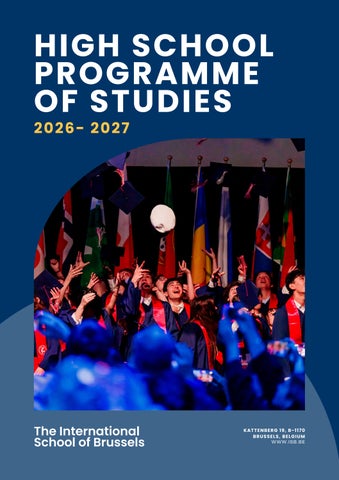
HIGH SCHOOL PROGRAMME OF STUDIES 2026- 2027
The International School of Brussels
KATTENBERG 19, B-1170 BRUSSELS, BELGIUM WWW.ISB.BE
TABLE OF CONTENTS HS PROGRAMME OF STUDIES
02
STUDENT SUPPORT
03
PERSONAL LEARNING
03
LEARNING SUPPORT
03
ENGLISH LANGUAGE DEVELOPMENT
04
LANGUAGE A
06
ENGLISH
07
FRENCH
11
DUTCH
14
HOME LANGUAGES (IB SCHOOL SUPPORTED/SELF-TAUGHT)
16
LANGUAGE ACQUISITION
17
ENGLISH
17
FRENCH
18
SPANISH
20
DUTCH
22
SOCIAL SCIENCES
24
MATHEMATICS
33
SCIENCES
39
PHYSICAL HEALTH EDUCATION
48
ARTS, DESIGN, AND TECHNOLOGY
52
VISUAL ARTS
52
PERFORMING ARTS
57
CREATIVE DESIGN AND TECHNOLOGY
61
INDEPENDENT STUDY
64
IBDP CORE
64
EXTENDED ESSAY
64
THEORY OF KNOWLEDGE (TOK) IN ENGLISH
65
THÉORIE DE LA CONNAISSANCE (THEORY OF KNOWLEDGE IN FRENCH)
65
CAS
66
The International School of Brussels
HS PROGRAMME OF STUDIES ISB High School offers a variety of courses and pathways to support students to learn a breadth and depth of subjects. To learn more about the HS learning programme, graduation requirements, and about the details of the programmes we offer, please see the Pathways Handbook. Below, you will find the course descriptions, credit information, and any details related to prerequisite recommendations for courses.
AP Courses
ISB HS GRADUATION PATHWAYS
IB Diploma Programme
BTEC Courses IB Courses
02
ISB Courses
The International School of Brussels
STUDENT SUPPORT PERSONAL LEARNING All students in HS are enrolled in Personal Learning. This program strives to provide each student with a space to grow both as a valued member of our HS community and as an individual with diverse abilities, passions and ambitions. The programme is designed to build community and a positive school culture, whilst also supporting students' socioemotional growth and providing students with a voice and choice in designing aspects of their Personal Learning/Community Engagement Program. Students meet with an advisor who follows them through the years in small groups of about 8-10 students. PL meets once a week for approximately 35 minutes. Expectations for G10 students: To participate each month in an activity that is beneficial for their
physical
and/or
mental
health
and
to
participate
in
community
engagement
experiences a minimum of 5 times over the school year. Expectations for G11/12 students: To participate each month in an activity that is beneficial for their physical and/or mental health and to participate each month in a community engagement experience. There are additional requirements for students enrolled in the IBDP (see CAS section below).
LEARNING SUPPORT ISB provides a wide spectrum of learning support, which includes provisions for students with identified learning needs. The program services are defined by three broad bands providing varied degrees of support using flexible service delivery options. Resource (Grade 10-12, Full year, 1 credit/yr) This is an individualised course available to students with a diagnosed learning need. The focus is on knowing when and how to ask for help. With the support of the teacher, students identify individual strengths and weaknesses. Students enrolled in the resource class develop an understanding of their own learning profile, develop areas of talent, and focus on building their strengths while targeting specific, compensatory learning strategies to remediate underlying skill deficiencies. Balanced with this skill work, students also receive re-teaching and revision support of the content of their courses, as necessary. Intensive Learning Support (Grade 10-12, Full year, Individualised Program) The High School offers an intensive, life-skills based classroom, for students with cognitive or developmental disabilities. Students work in a small group with personalised goals supported by specialised professionals, in collaboration with mainstream teachers on functional academic and social integration opportunities. Individual therapies are well integrated into their day to ensure transfer to the natural environment. There is an emphasis on independent life-skills and in vocational studies, and community skills to prepare for a successful life after ISB. A transition plan is developed collaboratively with families to support these next steps. Students earn an individualised diploma based on their ILP goals.
03
The International School of Brussels
Monitoring (Grade 10-12) Students who have diagnosed learning needs but do not need direct intervention are monitored to ensure that all faculty who work with this student know about their learning profile and will make the necessary accommodations for needs in the class. The student is not scheduled into a Resource block, but rather has check in appointments with their case manager.
ENGLISH LANGUAGE DEVELOPMENT The High School offers a series of courses for students entering ISB with a developing command of the English language. English Language Learners will be provided with the specialist support and scaffolding they need to enable them to successfully access the curriculum in English, the predominant language of instruction at ISB. There are four levels targeting instruction for students to improve their competence in English.
Intensive/Foundational English Language Development (Grades 10-12, 2 periods/level, 2 credits/level) Intensive/Foundational ELD is intended for beginner/near-beginner and pre-intermediate English language learners (A1 and A2 CEFR). Students have two blocks of intensive or foundational study in English, taught by specialist ELD teachers. In addition, they take ELD Social Sciences, taught by a Social Sciences subject area specialist with a further qualification in strategies for English language development. The rest of their program is in appropriate mainstream classes, and tenth graders are supported by an ELD teacher in their Integrated Science class. Both Intensive and Foundational ELD are one year courses. This course introduces and consolidates all of the basic structures and vocabulary up to the intermediate level. Strong emphasis is placed on students’ spoken English, vocabulary acquisition and use, the essential points of English grammar, and reading comprehension and writing skills.
Prerequisite recommendations: For attending students, placement by the ELD teacher. For arriving students, a placement test will be arranged by the Counseling department.
04
The International School of Brussels
Intermediate English Language Development (Grades 10-12, 2 periods in 1 year, 2 credits) Intermediate ELD is intended for intermediate level English language learners (B1/B1+ CEFR), who are ready to take almost a complete course load in mainstream English classes with support. Students have two blocks of intensive study in English, taught by specialist ELD teachers. The rest of their program is in appropriate mainstream classes, and tenth graders are supported by an ELD teacher in their History and Social Sciences 10 class. Intermediate ELD is a one year course. This course aims to develop learners’ confidence and fluency in their written and spoken expression, and to prepare them for mainstream English language and other academic courses. Students are introduced to a variety of English texts through a selective reading program, while they also study and practice more complex grammar structures, extend vocabulary and improve listening comprehension and writing skills.
Prerequisite recommendations: For attending students, placement by the ELD teacher. For arriving students, an online placement test will be arranged by the Admissions team. Bridging English Language Development (Grades 10-12, 1 year, 1 credit) Bridging ELD is intended for upper intermediate level English language learners (B2 CEFR), who are ready to take a complete course load in mainstream classes with some support. Students have one block of study of the English language and mainstream course support, taught by specialist ELD teachers. All students in Bridging ELD also take either English 10, English 11/12, or IB English B concurrently. Bridging ELD is a one year course with a pass or fail final mark. This is an upper-intermediate level course for those students who have already mastered the skills of ELD taught at the Intensive, Foundational and Intermediate levels. The primary aims of this course are to build reading and listening comprehension skills, increase vocabulary, review advanced grammar structures, and teach essay writing skills. In addition, the Bridging ELD class supplements and reinforces the work being presented in mainstream classes.
Prerequisite recommendations: For attending students, placement by the ELD teacher. For arriving students, an online placement test will be arranged by the Admissions team. ELD Social Sciences (Grades 10 -12, 1 year, 1 credit) This course is designed for students in Intensive and Foundational ELD. It is a modified course based on the History and Social Science 10 course, taught by a Social Sciences subject area specialist with a further qualification in strategies for English language development.
The
course
exposes
students
to
essential
geographical
and
historical
concepts, as well as the essential vocabulary, textual features and listening, speaking, reading and writing skills of the Social Sciences, thereby laying the foundation for a continued comprehensive study of social sciences in the following years. Prerequisite recommendations: Placement in Intensive ELD or Foundational ELD.
05
The International School of Brussels
LANGUAGE A ENGLISH English A Progression:
Grade 7
Grade 8
Grade 9
Grade 10
Grade 11
Grade 12
English 12 English 11
English 10 English 7
English 8
English 9 -AP Language & Composition* -AP Literature & Composition*
*Offered in alternating years Note 1: AP Courses have prerequisite recommendations (see programme of studies) Note 2: AP English is only offered to Grade 10 students who have met certain prerequisites and have been recommended to do so. If you are interested, speak with your counselor/English teacher.
06
-IB Eng. Lang & Lit SL/HL 1 -IB Eng Lit SL/HL 1
-AP Language & Composition* -AP Literature & Composition*
-IB Eng. Lang & Lit SL/HL 1 -IB Eng Lit SL/HL 1
-IB Eng. Lang & Lit SL/HL 2 -IB Eng Lit SL/HL 2 -AP Language & Composition* -AP Literature & Composition*
The International School of Brussels
LANGUAGE A
ENGLISH English 10 (Grade 10 students, 1 year, 1 credit) This course involves the integrated study of the four language areas: reading, writing, speaking, and listening. The content is partly literature-based and partly a study of nonliterary text types (including novels, poetry, and prose non-fiction) with a view to developing an improved understanding of the significance of purpose and audience in their own writing and in the writing of others.Learning is focused on conceptual understanding as well as skills to analyse spoken and written texts. In addition to formal written responses, we also use oral presentations, class discussion, and dramatic interpretations to enhance the study of text and encourage reflective and critical thinking. Vocabulary building and the development of a sophisticated, varied, precise, and appropriate use of language is both taught and assessed. Prerequisite recommendation: successful completion of Grade 9 English/equivalent and a level of Bridging ELD for students for whom English is a second language or additional language. English 11/12 (Grades 11-12, 1 credit each year) Students will explore literary genres and analyse non-fiction prose and modern texts such as
podcasts
or
graphic
novels.
Each
year
both
literary
analysis
and
persuasive
argumentative techniques will be taught and assessed. Students will develop strong critical reading, writing and digital literacy skills, deconstructing how meaning is created within texts. The choices of material and methodology will also allow students to explore creative and reflective expression and further develop essential collaborative and communicative skills through this course. Prerequisite recommendation: successful completion of English 10/equivalent and a level of Bridging ELD for whom English is a second language or additional language.
07
The International School of Brussels
AP Language and Composition (offered in SY 26/27) (Typically Grade 11-12 but also open to grade 9/10 based on evidence of readiness for success in this course including recommendation (teacher and counselor), 1 year, 1 credit)
The AP English Language and Composition course aligns to an introductory college-level rhetoric and writing curriculum.The primary goal of AP English Language and Composition is to develop the high-level skills students will need to read and write effectively in their college courses and in their personal and professional lives. Students will read and analyze college-level texts from a range of historical periods and disciplines in order to write analytical and argumentative essays as well as evaluate, synthesize, and cite research to support their arguments. To be successful in AP English Language, students need to have sufficient critical reading and writing skills necessary to handle a college-level composition course. In addition, a high degree of responsibility for class participation and independent learning is expected from students. Prerequisite
recommendation:
Successful
completion
of
English
10,
equivalent
or
recommendation, open to grade 9/10 students upon recommendation.
AP English Literature and Composition (next offering: SY 27/28) (Typically Grade 11-12 but also open to grade 9/10 based on evidence of readiness for success in this course including recommendation (teacher and counselor), 1 year, 1 credit).
The AP English Literature and Composition course aligns to an introductory college-level rhetoric and writing curriculum. This course focuses on reading, analyzing, and writing about imaginative literature (fiction, poetry, drama) from various periods. Students engage in close reading and critical analysis of imaginative literature to deepen their understanding of the ways writers use language to provide both meaning and pleasure. As they read, students consider a work’s structure, style, and themes, as well as its use of figurative language, imagery, and symbolism. Writing assignments include expository, analytical, and argumentative essays that require students to analyze and interpret literary works. To be successful in AP English Literature, students need to have sufficient critical reading and writing skills necessary to handle a college-level literature and writing curriculum. In addition, a high degree of responsibility for class participation and independent learning is expected from students.
Prerequisite: Successful completion of English 10, equivalent or recommendation, open to grade 9/10 students upon recommendation.
08
The International School of Brussels
IB English Language and Literature SL1 and 2 (Grades 11-12, 2 years, 1 credit each year) This is a rigorous, two-year course studying literature and the effects of language within a variety of non-literary text types, which is an ideal preparation for university / college as the course aims to develop oral, written and visual literacy skills, as well as to encourage independent learning. Students may also enrol in the first year only if that is what works best for their pathway. Students are required to study a minimum of four literary texts in two years and a wealth of non-literary bodies of work all with a specific language and / or communication focus. Through various fields of inquiry, students will examine the literary and non-literary texts in connection with global issues, ranging from culture and identity to politics and power. There are different forms of internal and external assessments. Emphasis is placed on the development of analytical writing skills, through essay assignments and commentaries on many varied text extracts. Students also make frequent oral presentations to develop their critical thinking skills. Students will produce a number of creative written tasks for a learner’s portfolio that displays their understanding of the crafting of text and the choices writers make. This course will further develop students' reflective, collaborative, and communicative skills as well as their digital literacy.
Prerequisite recommendation: successful completion of English 10 or equivalent
English Language IB English Language and Literature HL 1 and 2 (Grades 11-12, 2 years, 1 credit each year) This is a rigorous, two-year course studying literature and the effects of language within a variety of non-literary text types, which is an ideal preparation for university / college as the course aims to develop oral, written and visual literacy skills, as well as to encourage independent learning. Students may also enrol in the first year only if that is what works best for their pathway. Students are required to study a minimum of six literary texts in two years and a wealth of non-literary bodies of work all with a specific language and / or communication focus. Through various fields of inquiry, students will examine the literary and non-literary texts in connection with global issues, ranging from culture and identity to politics and power. There are different forms of internal and external assessments. Emphasis is placed on the development of analytical writing skills, through essay assignments and commentaries on many varied text extracts. Students also make frequent oral presentations to develop their critical thinking skills. Students will produce a number of creative written tasks for a learner’s portfolio that displays their understanding of the crafting of text and the choices writers make. This course will further develop students' reflective, collaborative, and communicative skills as well as their digital literacy.
Prerequisite recommendation: successful completion of English 10 or equivalent
09
The International School of Brussels
IB English Literature SL 1 and 2 (Grades 11-12, 2 years, 1 credit each year) This is a rigorous, two-year literature course which is an ideal preparation for university / college as the course aims to develop oral, written and visual literacy skills, as well as to encourage independent learning. Students may also enrol in the first year only if that is what works best for their pathway. Students are required to study 7 texts in two years in connection with global issues, ranging from culture and identity to power and politics. There are different forms of internal and external assessments, but considerable emphasis is placed on the development of analytical writing skills through essay assignments and commentaries on text extracts and poems. Students also deliver frequent oral presentations to develop their critical thinking skills. The choices of texts and methodology for exploring those will further develop students' reflective, collaborative and communicative skills and digital literacy, and is truly internationalist in its cultural values. Prerequisite recommendations: successful completion of English 10 or equivalent IB English Literature HL 1 and 2 (Grades 11-12, 2 years, 1 credit each year) This is a rigorous, two-year literature course which is an ideal preparation for university /college as the course aims to develop oral, written and visual literacy skills, as well as to encourage independent learning. Students may also enrol in the first year only if that is what works best for their pathway. The course is similar to SL but there is an extra written essay requirement and the assessment criteria are more exacting and rigorous. Students are required to study 10 texts in two years in connection with global issues, ranging from culture and identity to power and politics. There are different forms of internal and external assessments, but considerable emphasis is placed on the development of analytical writing skills through essay assignments and commentaries on text extracts and poems. Students also deliver frequent oral presentations to develop their critical thinking skills. The choices of texts and methodology for exploring those texts will further develop students' reflective, collaborative and communicative skills and digital literacy, and is truly internationalist in its cultural values. Prerequisite recommendations: successful completion of English 10 or equivalent
10
The International School of Brussels
LANGUAGES A PROGRESSION: French Grade 7
Grade 8
Grade 9
Grade 10
Grade 11
Grade 12
IB B Ab Initio SL 1
IB B Ab Initio SL 2
French A
French A
French A
French 1
French 1
French 1
French B
French B
French B
French 2
French 2
French 2
French C
French C
French C
French 3
French 3
French 3
French D
French D
French D
French 4 / AP French
French 4 / AP French
French 4 / AP French
French E
French E
French E*
French 10
IB French B SL/HL 1
IB French B SL/HL 1
IB French Lang & Lit SL/HL 1
IB French B SL/HL 2
Only allowed for students at the French Acquisition level. If successful in French E*, French 10 is the appropriate next course.
IB French Lang & Lit SL/HL 2
11
The International School of Brussels
FRENCH French 10 (Grade 10, 1 year, 1 credit) This course is designed for Grade 10 French native and near native with good command of the language. It promotes insight into French literature and is good preparation for students planning to study IB French A in the literature option or the language and literature option. This course involves the integrated study of the four language areas: reading, writing, speaking and listening. The content is literature based and features some exploration of the major literary genres: the short story, the novel, poetry, drama and prose non-fiction. Students are schooled in the skills that will be most frequently assessed in their High School courses. They will write essays, practice and develop skills of both oral and written expression, critically interpret and analyze literary and non literary texts of different styles. They will also reinforce the skills of grammar and spelling.
Prerequisite recommendations: demonstrated fluency in French and proof of written literacy.
12
The International School of Brussels
IB French Language and Literature SL 1 and 2 (Grades 11-12, 2 years, 1 credit each year) This is a rigorous, two year course studying literature and the effects of language within a variety of non-literary text types, which is an ideal preparation for university/college as the course aims to develop oral, written and visual literacy skills, as well as to encourage independent learning. Students are required to study 4 literary texts in two years and a wealth of non-literary texts all with a specific language and/or communication focus, and there are different forms of internal and external assessments. Emphasis
is
placed
on
the
development
of
analytical
writing
skills,
through
essay
assignments and commentaries on text extracts and poems. Students also make frequent oral presentations to develop their critical thinking skills. Finally, they will produce a number of creative written tasks that display their understanding of the crafting of text and the choices writers make. Students may also enrol in the first year only if that is what works best for their pathway. Prerequisite recommendations: strong academic background in French; recommendation of teacher, and/or placement. IB French Language and Literature HL 1 and 2 (Grades 11-12, 2 years, 1 credit each year) This is a rigorous, two year course studying literature and the effects of language within a variety of non-literary text types, which is an ideal preparation for university/college as the course aims to develop oral, written and visual literacy skills, as well as to encourage independent learning. Students are required to study 6 literary texts in two years and a wealth of non-literary texts all with a specific language and/or communication focus, and there are different forms of internal and external assessments. Emphasis is placed on the development of analytical writing skills, through essay assignments and commentaries on text extracts and poems. Students also make frequent oral presentations to develop their critical thinking skills. Finally, they will produce a number of creative written tasks that display their understanding of the crafting of text and the choices writers make. Students may also enrol in the first year only if that is what works best for their pathway. Prerequisite recommendations: strong academic background in French; recommendation of teacher, and/or placement.
13
The International School of Brussels
Dutch Grade 7
Grade 8
Grade 9
Grade 10
Grade 11
Grade 12
Dutch 7/8
Dutch 7/8 Dutch 8/9
Dutch 8/9
Dutch 10
IB-A L&L SL/HL
IB-A L&L SL/HL
Minimum of 2 years of Dutch Language
Dutch IB-B SL/HL 1
Dutch IB-B SL/HL 2
Up to 1 year of Dutch Language
Dutch IB Ab Initio 1
Dutch IB Ab Initio 2
Dutch Language (0-4 years)
Dutch Language (non IB)
Dutch Language (non IB)
Dutch 10 (Grade 10, 1 year, 1 credit) This course involves the integrated study of the four language areas: reading, writing, speaking and listening. The content is partly literature-based and partly a study of nonliterary text types. The students explore the major literary genres including novels, poetry, and prose non-fiction. They also explore a range of other text types with a view to developing an improved understanding of the significance of purpose and audience in their own writing and in the writing of others. The students will write essays, practice and develop skills of both oral and written expression, critically interpret and analyse literary and non literary texts of different styles. In addition to formal written responses we also use oral presentations, class discussion and dramatic interpretations to enhance the study of literature and encourage reflective and critical thinking. Students will also reinforce the skills of grammar and spelling. Field trips and workshops by Dutch authors are part of the programme as is the focus on Flemish-Dutch culture in relation to European cultural developments. Prerequisite recommendations: demonstrated fluency in Dutch and proof of written literacy. IB Dutch Language and Literature SL 1 and 2 (Grades 11-12, 2 years, 1 credit each year) This is a rigorous, two year course studying literature and the effects of language within a variety of non-literary text types, which is an ideal preparation for university-/college as the course aims to develop oral, written and visual literacy skills, as well as to encourage independent learning. Students are required to study 4 literary texts in two years and a wealth of non-literary texts all with a specific language and / or communication focus, and there are different forms of internal and external assessments. Considerable emphasis is placed on the development of analytical writing skills, through essay assignments and commentaries on text extracts and poems. Students also make frequent oral presentations to develop their critical thinking skills. Finally, they will produce a number of creative written tasks that display their understanding of the crafting of text and the choices writers make. Students may also enrol in the first year only if that is what works best for their pathway. Prerequisite recommendations: strong academic background in Dutch; recommendation or placement
14
The International School of Brussels
IB Dutch Language and Literature HL 1 and 2 (Grades 11-12, 2 years, 1 credit each year) This is a rigorous, two year course studying literature and the effects of language within a variety of non-literary text types, which is an ideal preparation for university-/college as the course aims to develop oral, written and visual literacy skills, as well as to encourage independent learning. Students are required to study 6 literary texts in two years and a wealth of non-literary texts all with a specific language and / or communication focus, and there are different forms of internal and external assessments. Considerable emphasis is placed on the development of analytical writing skills, through essay assignments and commentaries on text extracts and poems. Students also make frequent oral presentations to develop their critical thinking skills. Finally, they will produce a number of creative written tasks that display their understanding of the crafting of text and the choices writers make. Students may also enrol in the first year only if that is what works best for their pathway. Prerequisite recommendations: strong academic background in Dutch; recommendation or placement
15
The International School of Brussels
HOME LANGUAGES
All other Languages (including Japanese) Grade 9
Grade 10
Grade 11-12
NA (Independent Study is possible)
NA (Independent Study is possible)
IB School Supported Self Taught Language and Literature SL (school helps find appropriate tutor)
IB Languages A Literature SL 1 and 2 (IB School Supported Self-Taught) (Grades 12, 1 years, 1 credit each year) This is a rigorous, two year course designed for students whose best language is not taught at ISB. Students taking this course must also take an IB English course. This course gives the opportunity to students to study their home language, reinforce their written skills and develop their understanding of their home culture. It is an ideal preparation for university/college as the course aims to develop oral and written skills, as well as to encourage independent learning. Emphasis is placed on the development of analytical writing skills, through essay assignments and commentaries on texts. Students also make frequent oral presentations to develop critical thinking skills. The course is taught by a school-approved tutor, usually during regular school hours. Please note that this course is offered at Standard Level only. Languages A currently offered: Finnish, German, Hebrew, Icelandic, Italian, Lithuanian, Norwegian, Portuguese, Spanish, Swedish, Japanese Other languages A: Upon request Prerequisite recommendations: oral and written fluency and recent formal study of the national literature of the language to be studied. Students will complete a placement test to confirm their language level.
Swedish Home Language (Grades 9-10, 1 year, 1 credit each year) Students in Swedish Home Language continue developing essential academic language skills in Swedish, including listening, speaking, reading, and writing. The course prepares students to reenter the Swedish national system, and/or to take Swedish at the IB Home Languages level. Prerequisite recommendations: Proficient Swedish (Swedish as a home language)
16
The International School of Brussels
LANGUAGE ACQUISITION
ENGLISH Also see English Language Development in Student Support portion of Programme of Studies IB English B SL 1 and 2 (Grades 11-12, 2 years, 1 credits each year) This course is a language acquisition course designed for students who have some experience of studying in the English language and are taking a Language A other than English. The course focuses principally on interactions between speakers and writers of English. Authentic materials are used and students are exposed to language, using written and spoken texts, literary and non-literary. Texts are studied through the lens of five themes. The teaching of appropriate grammatical structures is integrated with the study of texts and acquisition of skills. Themes: Social Organization, Human Ingenuity, Experiences, Identities and Sharing the Planet Prerequisite recommendations: Eligibility for English B will be determined by the Head of English, Head of ELD and the 10th grade English and ELD teachers.
IB English B HL 1 and 2 (Grades 11-12, 2 years, 1 credit each year) This course is a language acquisition course designed for students who have some experience of studying in the English language and are taking a Language A other than English. The course focuses principally on interactions between speakers and writers of English. Authentic materials are used and students are exposed to language, using written and spoken texts, literary and non-literary. Texts are studied through the lens of five themes. The teaching of appropriate grammatical structures is integrated with the study of texts and acquisition of skills. Students at HL must also study two works of literature which will be a part of the formal IB assessment. Themes: Social Organization, Human Ingenuity, Experiences, Identities and Sharing the Planet; 2 works of literature. Prerequisite recommendations: Eligibility for English B will be determined by the Head of English, Head of ELD and the 10th grade English and ELD teachers.
17
The International School of Brussels
FRENCH French 1 (Grades 10-12, 1 year, 1 credit) The students will learn to use communicative skills to respond in various situations. They will learn to speak about themselves, their families and their countries and will be able to have a conversation in such places as restaurants and shops. They will master most verbs in the present tense and will be able to understand the future tense and the past tense. Prerequisite recommendations: none or placement test.
French 2 (Grades 10-12, 1 year, 1 credit) The students will learn to communicate in simple familiar routine matters. They will learn to give information about their cultural backgrounds. Students will revise regular and irregular verbs in the present tense and learn how to use them in the imperative, the future and the past. They will learn how to give orders, tell a story and express their opinions. Prerequisite recommendations: HS French 1, equivalent or placement test.
French 3 (Grades 10-12, 1 year, 1 credit) Students will learn to express their opinions and organise their ideas to exchange information about issues and current events. They will use appropriate vocabulary and structures to organise pieces of writing. The course works towards oral comprehension and communication, talking at a normal speed, pronunciation and fluency. Students will expand their vocabulary and knowledge of grammar. Students will become accustomed to improvising and responding to unexpected speech situations. Prerequisite recommendations: HS French 2, equivalent or placement test.
AP French Language and Culture/French 4 (Grades 10-12, 1 year, 1 credit) AP French/French 4 is a combined course. Students ready to take French 4 are adequately prepared to consider taking the AP French exam at the end of this course. Students who do not want this external qualification will have French 4 on their transcript, and students who plan to take the exam will have AP French Language and Culture on their transcript. AP French Language and Culture/French 4 course is equivalent to an intermediate level college course in French. It emphasises communication (understanding and being understood by others) by applying interpersonal, interpretive, and presentational skills in real-life situations. This includes vocabulary usage, language control, communication strategies, and cultural awareness. Prerequisite recommendations: HS French 3, equivalent or placement test.
18
The International School of Brussels
IB French Ab Initio SL 1 and 2 (Grades 11 – 12, 2 years, 1 credit each year) IB French Ab Initio SL includes the learning and practice of basic French, based on 5 theme area’s: Social Relationships, Human Ingenuity, Experiences, Identities and Sharing the Planet. Students learn basic grammatical structures and vocabulary, practice speaking and understanding daily conversational French. The focus is on reading comprehension, writing, listening and speaking. Texts are used as a means of exploring aspects of French speaking cultures. Students express themselves through oral presentations, debates and class discussions. Writing short texts, by using different text types is another important component of the programme. Students are prepared to sit the IB French Ab Initio exam. The course can only be studied at Standard Level. Prerequisite recommendations: No French; French 1; teacher recommendation.
IB French B SL 1 and 2 (Grades 11-12, 2 years, 1 credit each year) The course focuses principally on interactions between speakers and writers of French. Authentic materials are used and students are exposed to language, using written and spoken texts, literary and non-literary. Texts are studied through the lens of five themes. The teaching of appropriate grammatical structures is integrated with the study of texts and acquisition of skills. Themes: Social Relationships, Human Ingenuity, Experiences, Identities and Sharing the Planet. Prerequisite recommendations: Identification as an eligible French B student (not an option for French 10 students), Completion of French 2 (or French 3 or 4), equivalent or placement.
IB French B HL 1 and 2 (Grades 11-12, 2 years, 1 credit each year) This course is designed for students who are taking a language A other than French. The course focuses principally on interactions between speakers and writers of French. Authentic materials are used and students are exposed to language, using written and spoken texts, literary and non-literary. Texts are studied through the lens of five themes. The teaching of appropriate grammatical structures is integrated with the study of texts and acquisition of skills. Students at HL must also study two works of literature which will be a part of the formal IB assessment. Themes: Social Relationships, Human Ingenuity, Experiences, Identities and Sharing the Planet; 2 works of literature. Prerequisite recommendations: Identification as an eligible French B student (not an option for French 10 students). Completion of French 3 (or French 4), equivalent or placement.
19
The International School of Brussels SPANISH Grade 7
Grade 8
Grade 9
Grade 10
Grade 11
Grade 12
Sp1
Sp2
Sp3
X (ind. study possible)
IB.B SL/HL 1
IB.B SL/HL 2
Sp1
Sp2
Sp3
IB.B SL/HL 1
IB.B SL/HL 2
X (possibility to choose another language for IB) Sp1
Sp2
Sp3
IB.B SL/HL 1
IB.B SL 1
IB.B SL 2
Sp2
Sp3
IB Ab initio 1
IB Ab initio 2
Sp1
Sp2
IB Ab initio 1
IB Ab initio 2
Sp1
Spanish 1 (Grades 10-12, 1 year, 1 credit) The course stresses conversation and elementary comprehension. Daily life situations form the basis to practice speaking. Grammar is explained to show the systematic nature of language and is then practised in context. Reading and writing skills are developed in the context of real life situations, with authentic materials and workbook exercises. Prerequisite recommendations: none or placement test. Spanish 2 (Grades 10-12, 1 year, 1 credit) Students learn to read, write, listen and speak. They work with a holistic approach to language learning and have ample opportunities to practice their skills. The present forms, past forms, future, conditional and subjunctive forms of verb tenses are taught using daily, real life situations to obtain oral fluency. Reading short stories contributes to comprehension. Workbooks reinforce grammar. Students are required to present projects. Prerequisite recommendations: Spanish 1 or placement test. Spanish 3 (Grades 10-12, 1 year, 1 credit) In this course, communication skills and advanced grammar are developed. The indicative and the subjunctive tenses are studied. The students will read short stories and are required to write essays. They learn to express their opinions with an appropriate vocabulary. The programme emphasises the mastery of structure and vocabulary in its development of reading skills and in its introduction of complete selections of Spanish and Latin American literature. Prerequisite recommendations: successful completion of Spanish 2 or placement test.
20
The International School of Brussels
IB Spanish Ab Initio SL 1 and 2 (Grades 11 – 12, 2 years, 1 credit each year) IB Spanish Ab Initio SL includes the learning and practice of basic Spanish, based on 5 theme area’s: Social Relationships, Human Ingenuity, Experiences, Identities and Sharing the Planet. Students learn basic grammatical structures and vocabulary, practice speaking and understanding daily conversational Spanish. The focus is on reading comprehension, writing, listening and speaking. Texts are used as a means of exploring aspects of Spanish speaking cultures. Students express themselves through oral presentations, debates and class discussions. Writing short texts, by using different text types is another important component of the programme. Students are prepared to sit the IB Spanish Ab Initio exam. The course can only be studied at Standard Level. Prerequisite recommendations: No previous exposure to Spanish, or Spanish 1. IB Spanish B SL 1 and 2 (Grades 11-12, 2 years, 1 credit each year) The course focuses principally on interactions between speakers and writers of Spanish. Authentic materials are used and students are exposed to language, using written and spoken texts, literary and non-literary. Texts are studied through the lens of five themes. The teaching of appropriate grammatical structures is integrated with the study of texts and acquisition of skills. Themes: Social Relationships, Human Ingenuity, Experiences, Identities and Sharing the Planet. Prerequisite recommendations: Spanish 2 or Spanish 3. This option is dependent on eligibility to do Spanish B. Eligibility will be determined by the Head of Languages.
IB Spanish B HL 1 and 2 (Grades 11-12, 2 years, 1 credit each year) This course is designed for students who are taking a language A other than Spanish. The course focuses principally on interactions between speakers and writers of Spanish.. Authentic materials are used and students are exposed to language, using written and spoken texts, literary and non-literary. Texts are studied through the lens of five themes. The teaching of appropriate grammatical structures is integrated with the study of texts and acquisition of skills. Students at HL must also study two works of literature which will be a part of the formal IB assessment. Themes: Social Relationships, Human Ingenuity, Experiences, Identities and Sharing the Planet; 2 works of literature.
Prerequisite recommendations: Successful completion of Spanish 3 is recommended (for some students depending on demonstrated proficiency, Spanish 2 may suffice). This option is dependent on eligibility to do Spanish B. Eligibility will be determined by the Head of Languages.
21
The International School of Brussels
DUTCH Dutch Language - Beginner (Grades 10-12, 1 year, 1 credit) This course is designed for students who would like to learn Dutch or improve their Dutch language skills. Depending on the student’s existing level of Dutch, the course offers an integrated study of the four language areas: reading, writing, speaking and listening. The students
will
learn
to
use
communicative
skills
for
different
situations,
from
daily
conversations to the more advanced ones. Students will also learn to develop their written expression. For beginners, special focus will be put on listening and speaking. Vocabulary and grammar will be integrated into the four skills. The course will also promote insight into Dutch/Flemish culture and advanced students will practice and develop skills of critically interpreting and analysing different sorts of texts. After Grade 10, depending on previous exposure to the language, students have the possibility to continue this course, or opt for an IB Dutch B course. Prerequisite recommendations: None IB Dutch Ab Initio SL 1 (no SL 2 offered in SY 2026-2027) (Grades 11 – 12, 2 years, 1 credit each year) IB Dutch Ab Initio SL includes the learning and practice of basic Dutch, based on 5 theme area’s: Social Relationships, Human Ingenuity, Experiences, Identities and Sharing the Planet. Students learn basic grammatical structures and vocabulary, practice speaking and understanding daily conversational Dutch. The focus is on reading comprehension, writing, listening and speaking. Texts are used as a means of exploring aspects of Dutch speaking cultures. Students express themselves through oral presentations, debates and class discussions. Writing short texts, by using different text types is another important component of the programme. Students are prepared to sit the IB Dutch Ab Initio exam. The course can only be studied at Standard Level. Prerequisite recommendations: No previous exposure to Dutch, or Dutch Language 1 year IB Dutch B SL 1 and 2 (Grades 11-12, 2 years, 1 credit each year) This course is a language acquisition course designed for students who have some knowledge of the Dutch language. The course focuses principally on interactions between speakers and writers of Dutch. Authentic materials are used and students are exposed to language, using written and spoken texts, literary and non-literary. Texts are studied through the lens of five themes. The teaching of appropriate grammatical structures is integrated with the study of texts and acquisition of skills. Theme area’s: Social Relationships, Human Ingenuity, Experiences, Identities and Sharing the Planet A basic working knowledge of Dutch. Must be at a Dutch acquisition level (Dutch 10 is beyond this), recommendation or placement.
22
The International School of Brussels
IB Dutch B HL 1 and 2 (Grades 11-12, 2 years, 1 credit each year) The course focuses principally on interactions between speakers and writers of Dutch. Authentic materials are used and students are exposed to language, using written and spoken texts, literary and non-literary. Texts are studied through the lens of five themes. The teaching of appropriate grammatical structures is integrated with the study of texts and acquisition of skills. Students at HL must also study two works of literature which will be a part of the formal IB assessment. Themes: Social Relationships, Human Ingenuity, Experiences, Identities and Sharing the Planet; 2 works of literature. Prerequisite recommendations: A basic working knowledge of Dutch. Must be at a Dutch acquisition level (Dutch 10 is beyond this), recommendation or placement.
23
The International School of Brussels
SOCIAL SCIENCES
ELD Social Sciences (Grades 10 -12, 1 year, 1 credit) This course is designed for students in Intensive and Foundational ELD. It is a modified course based on the History and Social Science 10 course, taught by a Social Sciences subject area specialist with a further qualification in strategies for English language development.
The
course
exposes
students
to
essential
geographical
and
historical
concepts, as well as the essential vocabulary, textual features and listening, speaking, reading and writing skills of the Social Sciences, thereby laying the foundation for a continued comprehensive study of social sciences in the following years. Prerequisite recommendations: Placement in Intensive ELD or Foundational ELD.
History and Social Sciences 10 (Grade 10, 1 year, 1 credit) In this course students examine some of the most important and relevant questions of the 21st century: What challenges do the global distribution of resources and economic power pose for us? What factors influence economic, social and political development? How do people forge a common identity and what factors can challenge this unity? Why are some environments more affected by change than others? Promoting a spirit of inquiry is central to this course. Students will develop their skills of critical thinking, interpretation and analysis, and communicate their knowledge and understanding in a variety of ways. Students will deepen their understanding of key historical, geographical and economic concepts and use these to develop theories when answering questions. This course builds upon the Geography and History studied in the Middle School and prepares students for studying the varied Social Science subjects offered in Grade 11. It encourages students to consider the global, regional and individual responses to the challenges and changes in today’s world. Prerequisite recommendations: Intermediate ELD or above.
24
The International School of Brussels
Modern World History 1200-Present (Part I & II) (Part I offered in SY 26-27) (Grades 11 & 12, each course is one credit) This two-year Social Science course offers an alternative to IB and AP pathways, allowing students to explore world history and cultures from 1200 to the present. Year I (1200-1750) and Year II (1750-Present) can be taken independently or consecutively for a comprehensive study (2 credits). Covering significant events, individuals, and developments across Asia, Africa, Europe, and the Americas, this course provides a broad and engaging perspective on global history. Prerequisite recommendations: Intermediate ELD or above none. Individuals and Family Dynamics Across Cultures (Grades 11-12, 1 year, 1 credit) This course explores the complexities of family structures, relationships, and individual development within diverse societal contexts and cultures. Students will study the various stages of life from adolescence through adulthood, focusing on the interaction between individuals and families. Special emphasis will be placed on child development and effective parenting practices. The course will blend theory and practical application to prepare
students
for
responsible
and
informed
decision-making
related
to
healthy
individual growth, family life, and raising healthy children. Moreover, the course is designed to provide the introductory foundations for careers related to social work, education, or child care drawing from psychology, sociology, anthropology, economics, history, and geography. Prerequisite recommendations: Intermediate ELD or above.
AP Human Geography (Grades 9-12, 1 year, 1 credit) This course is equivalent to a first year university level course. It introduces students to the systematic study of patterns and processes that have shaped human understanding, use, and alteration of Earth’s surface. Students employ spatial concepts and landscape analysis to examine socio economic organisation and its environmental consequences. They also learn about the methods and tools geographers use in their research and applications. Prerequisite recommendations: For current grade 9 students: achievement grade of 6 in both Social Studies 9 and English 9, teacher/counsellor recommendation. For current Grade 10s, achievement grade of 5 in both Grade 10 English and History and Social Sciences with teacher
and
counsellor
recommendation.
For
current
Grade
11’s
counsellor
recommendation.
25
The International School of Brussels
AP European History (Grades 10-12, 1 year, 1 credit) This course is equivalent to a first year university level course. The study of European history since 1450 introduces students to cultural, economic, political, and social developments that played a fundamental role in shaping the world in which they live. In addition to providing a basic narrative of events and movements, the goals of AP European History are to develop (a) an understanding of some of the principal themes in modern European history, (b) an ability to analyse historical evidence and historical interpretation, and (c) an ability to express historical understanding in various forms. Units of study include Renaissance and Exploration; the Reformation; Conflict, Crisis and Reaction in the late 18th century; Industrialization and its Effects; 19th Century Perspectives and Political Developments; 20th Century Global Conflicts and, finally, Cold War and Contemporary Europe. Prerequisite recommendations: For current grade 9 students: achievement grade of 6 in both Social Studies 9 and English 9, teacher/counsellor recommendation. For current Grade 10s, achievement grade of 5 in both Grade 10 English and History and Social Sciences with teacher
and
counsellor
recommendation.
For
current
Grade
11’s
counsellor
recommendation.
AP Microeconomics (offered SY 26/27) (Grades 10-12, 1 year, 1 credit) This course is equivalent to a first year university level semester course. School districts have the option to offer AP Microeconomics and AP Macroeconomics as semester courses or year long courses. ISB has opted to offer these two courses on alternating years as yearlong courses. The purpose of the course is to introduce students to economics – the study of how to best allocate scarce resources among unlimited wants. AP Microeconomics is focused on the principles of economics that apply to the functions of individual decision makers, both consumers and producers, within the economic system. It places primary emphasis on the nature and functions of product markets, and includes the study of factor markets and of the role of government in promoting greater efficiency and equity in the economy. Prerequisite recommendations: For current grade 9 students, achievement grade of 6 in Maths 9 and a grade of 6 in Social Studies 9. For current grade 10s, achievement grade of 5 in Integrated Mathematics Standard or equivalent (and success in previous social studies courses).
26
The International School of Brussels
AP Macroeconomics (next offering: SY 27/28) (Grades 10-12, 1 year, 1 credit) This course is equivalent to a first year university level semester course. School districts have the option to offer AP Microeconomics and AP Macroeconomics as semester courses or year long courses. ISB has opted to offer these two courses on alternating years as yearlong courses. The purpose of the course is to introduce students to economics – the study of how to best allocate scarce resources among unlimited wants. AP Macroeconomics is focused on the principles of economics that apply to an economic system as a whole. Emphasis is placed on the study of national income and price-level determination,
along
with
economic
performance
measures,
the
financial
sector,
stabilisation policies, economic growth, and international economics. Prerequisite recommendations: For current grade 9 students, achievement grade of 6 in Maths 9 and a grade of 5 in Social Studies 10. For current grade 10s and 11s, achievement grade of 5 in both Grade 10 History and Social Sciences and Mathematics.
IB Business Management SL 1 and 2 (Grades 11-12, 2 years, 1 credit each year) This
SL
course
is
the
critical
study
of
the
ways
in
which
individuals
and
groups
(Stakeholders) interact in a dynamic and increasingly competitive and volatile business and organisational environment. Students will examine how business decisions are made and make an impact on internal and external environments. The concepts of Change, Culture, Ethics, and Sustainability are at the heart of the course “to allow students to reach beyond the classroom and their immediate school community to build intellectual and practical connections to the wider society” (IB Business Management Guide 2020). Emphasis is placed on understanding day-to-day business functions of organisational theory, marketing, operations
management,
human
resource
management
and
finance.
Students
must
appreciate ethical concerns and issues of social responsibility in the business environment and will learn to make sense of the forces and circumstances that drive change in an interdependent and multicultural world. Students are encouraged to follow current business media stories throughout the two years for class discussion and in order to apply the theory being taught. There is a wide range of Business theory and models to learn so the student must keep up with an intensive reading cycle and prepare constant and consistent supporting notes. The SL Internal Assessment Commentary (20% of holistic grade) is on an organisational or sector business issue using only Secondary Research. Objective: To develop an understanding of business theory and the ability to apply practical thinking and decision making to business principles, practice and skills. Please note this is primarily a theoretical course using case study stimuli to apply learning. The only independent real life application element is the Internal Assessment Project (see above). Prerequisite recommendations: none
27
The International School of Brussels
IB Business Management HL 1 and 2 (Grades 11-12, 2 years, 1 credit each year) This
HL
course
is
the
critical
study
of
the
ways
in
which
individuals
and
groups
(Stakeholders) interact in the dynamic and increasingly competitive and volatile business and organisational environment. The students will examine how business decisions are strategised and made and make an impact on internal and external environments. The concepts of Change, Culture, Ethics and Sustainability are at the heart of the course “to allow students to reach beyond the classroom and their immediate school community to build intellectual and practical connections to the wider society” (IB Business Management Guide 2020). Emphasis is placed on understanding business functions of organisational theory, marketing, operations management, human resource management and finance. Students must appreciate the growing importance of ethical concerns and issues of social responsibility in the business environment and will learn to make sense of the forces and circumstances that drive change in an interdependent and multicultural world. Students are required to follow current business media stories throughout the two years for class discussion and in order to apply the theory taught. There is a very wide range of Business theory and models to learn so the HL student must keep up with an intensive reading cycle and prepare constant and consistent supporting notes. The HL Internal Assessment Component (20% of holistic grade) is an in depth project and business report on a real organisation with a problem or issue. Objective: To develop an understanding of business theory and the ability to apply critical and strategic thinking and decision making to business principles, practice and skills.Please note this is a primarily theoretical course using case study stimuli to apply learning. The only independent application element is the Internal Assessment project (see above). Prerequisite recommendations: none
28
The International School of Brussels
IB Economics SL/HL 1 and 2(Grades 11-12, 2 years, 1 credit each year) Economics is a dynamic social science, essentially studying the concept of scarcity and the problem of resource allocation. It is a discipline that incorporates elements of History, Geography, Psychology, Sociology and Political studies. This course provides students with a clear
understanding
of
both
macro-
and
micro-
economics
from
an
international
perspective. Topics covered during the first year include resource allocation, market systems, elasticity, market structures, government intervention, measuring national income, inflation, unemployment and fiscal and monetary policies. The second year of the course focuses on international trade and development topics assessing benefits and costs of global
trading
and
competition
as
well
as
understanding
the
differences
between
developed and developing countries and the opportunities and obstacles to growth and development. The HL student will study extension topics in greater depth and breadth, as well as with much more rigour and demands than the SL student. Students must keep up with an intensive reading cycle and prepare constant and consistent supporting notes. The Internal Assessment Component comprises a series of written commentaries analysing economic theory and evaluation of economics concepts as applied to current news articles. Objective: To apply theoretical economic theory to real-world examples. To look at the world from an economist’s point of view and to explore and evaluate different economic systems. Prerequisite recommendations: none, but recommended that students who enrol in this course have good abstract mathematical skills (interpreting data and manipulation of graphs is key).
IB Environmental Systems and Societies SL 1 and 2 (Grades 11-12, 2 years, 1 credit each year) ESS
SL
provides
students
with
an
understanding
of
the
interrelationships
between
ecosystems and societies; one that enables them to analyse environmental issues and evaluate
strategies
for
addressing
them.
The
six
central
concepts;
stewardship,
sustainability, systems, equilibrium, perspectives, and justice permeate throughout the course. Units studied include ecology, water, land, biodiversity, atmosphere and climate change, natural resources, and human populations and urban systems. Practical work in the field is an integral part of the course. This course can count as a Group 3 and/or 4 subject (Social Science and or Science). NOTE: students should be aware that the exam requirement for this course involves the writing of essays which differs from the other IB sciences. Prerequisite recommendations: none.
29
The International School of Brussels IB Environmental Systems and Societies HL 1 and 2 (Grades 11-12, 2 years, 1 credit each year) ESS
HL
provides
students
with
an
understanding
of
the
interrelationships
between
ecosystems and societies; one that enables them to analyse environmental issues and evaluate
strategies
for
addressing
them.
The
six
central
concepts;
stewardship,
sustainability, systems, equilibrium, perspectives, and justice permeate throughout the course. Units studied include ecology, water, land, biodiversity, atmosphere and climate change, natural resources, and human populations and urban systems. In addition, students study higher level extension topics that include environmental geology and environmental economics, ethics and law. Practical work in the field is an integral part of the course. This course can count as a Group 3 and/or 4 subject (Social Science and or Science). NOTE: students should be aware that the exam requirement for this course involves the writing of essays which differs from the other IB sciences. Prerequisite recommendations: none. IB Geography SL 1 and 2 (Grades 11-12, 2 years, 1 credit each year) Geography is a dynamic subject and plays an important role in the understanding of contemporary
issues.
Students
will
investigate
the
interactions
between
individuals,
societies, and the physical environment in both space and time and connect what they learn to events occurring in the world around them. Students will apply geographic skills and techniques during the Internal Assessment fieldwork. Students will develop their understanding of the ways that people adapt and respond to change
and
evaluate
management
strategies
associated
with
such
change.
An
appreciation of the influence of different cultures and economies is encouraged through the use of case studies from around the world. Themes covered include: Changing Populations, Global Climate (Vulnerability and Resilience), Global Resource Consumption and Security, Tourism and Leisure, and Urban Environments. Prerequisite recommendations: none. IB Geography HL 1 and 2 (Grades 11–12, 2 years, 1 credit each year) Geography is a dynamic subject and plays an important role in the understanding of contemporary
issues.
Students
will
investigate
the
interactions
between
individuals,
societies and the physical environment in both space and time and connect what they learn to events occurring in the world around them. Students will apply geographic skills and techniques during the Internal Assessment fieldwork. Students will develop their understanding of the ways that people adapt and respond to change
and
evaluate
management
strategies
associated
with
such
change.
An
appreciation of the influence of different cultures and economies is encouraged through the use of case studies from around the world. The IB Geography Higher Level course offers students the opportunity to explore these geographical concepts at a deeper level than Standard level and requires a greater degree of critical evaluation and synthesis of the concepts.
30
The International School of Brussels Additional topics to standard level, specific to the Higher Level, include: Geophysical Hazards and the Higher Level extension topic of Global Interactions. This gives students the opportunity to explore the social, economic, cultural, and political connections that have led to our globalised world, and the variety of ways in which people respond to this growing phenomena. Themes
covered
include:
Changing
Populations,
Global
Climate
(Vulnerability
and
Resilience), Global Resource Consumption and Security, Geophysical Hazards, Tourism and Leisure, Urban Environments, and Global Interactions. Prerequisite recommendations: none IB Global Politics SL/HL 1 and 2 (Grades 11 – 12, 2 years, 1 credit each year) The Global Politics course explores fundamental political concepts such as power, liberty and equality, in a range of contexts and at a variety of levels. It allows students to develop an understanding of the local, national, international and global dimensions of political activity, as well as allowing them the opportunity to explore political issues affecting their own lives. Global politics draws on a variety of disciplines in the social sciences and humanities. It helps students to understand abstract political concepts by grounding them in real world examples and case studies, and also invites comparison between such examples and case studies to ensure a transnational perspective. All
standard
level
and
higher
level
students
complete
a
common
core
entitled
“Understanding Power and Global Politics”. They then study three thematic studies: Rights & Justice; Development & Sustainability; Peace and Conflict. Higher-level students also examine two contemporary global political challenges, through a case studies approach drawn from the following themes: Border; Security, Environment; Equality; Health; Poverty; Technology; Identity. Prerequisite recommendations: none. IB History SL 1 and 2 (Grades 11 – 12, 2 years, 1 credit each year) The IB Standard Level History course aims to promote an understanding of History as a discipline, including the nature of historical inquiry, focused on developing methods and interpretations for understanding the past via focus on a variety of contexts, applying key course concepts, and understanding specific and present content knowledge. The course focuses on four key skills and developing those skills in a global context at both levels, encouraging
students
to
make
assessments
and
comparisons
between
similar
and
dissimilar solutions to common human situations, whether they are political, economic or social. By overlapping content for the different assessments, where possible, we strive to allow students to gain an in-depth understanding of the chosen case studies while simultaneously developing strong analytical and evaluative skills. Prerequisite recommendations: none.
31
The International School of Brussels
IB History HL 1 and 2 (Grades 11 – 12, 2 years, 1 credit each year) The IB Higher Level History course aims to promote an understanding of History as a discipline, including the nature of historical inquiry, focused on developing methods and interpretations for understanding the past via focus on a variety of contexts, applying key course concepts, and understanding specific and present content knowledge. The course focuses on four key skills and developing those skills in a global context at both levels, encouraging
students
to
make
assessments
and
comparisons
between
similar
and
dissimilar solutions to common human situations, whether they are political, economic or social. The higher level course includes an additional study with more depth on the region of Europe. By overlapping content for the different assessments, where possible, we strive to allow students to gain an in-depth understanding of the chosen case studies while simultaneously developing strong analytical and evaluative skills. Prerequisite recommendations: none.
IB Psychology SL/HL 1 and 2 (Grades 11 – 12, 2 years, 1 credit each year) What explains human behaviour? Why do humans think, feel, and act the way they do? Are our behaviours shaped by our biology and physiology, our cognitive processes and mental frameworks, or the social and cultural environments in which we live? In IB Psychology, students move beyond a simple nature versus nurture debate to adopt an interactionist (biopsychosocial) approach, recognising that behaviour is best understood as the result of the interaction between biological, cognitive, and sociocultural factors. Across this two-year course, students explore psychological concepts through four contexts —health
and
wellbeing,
human
relationships,
learning
and
cognition,
and
human
development—allowing them to apply theory and research to real-world situations. Students learn to critically evaluate psychological research, consider ethical issues, and analyse how evidence is used to support competing explanations of behaviour. They engage with challenging questions such as whether memory is reliable, how globalisation influences adolescent behaviour, and whether prejudice can be examined using biological measures. All students conduct a simple experimental study with human participants as part of their internal assessment. In addition, Higher Level (HL) students develop a deeper understanding of psychology through dedicated study of research methods, ethics, and data analysis, equipping them with advanced skills in evaluating and producing psychological research. Prerequisite recommendations: none.
32
The International School of Brussels
MATHEMATICS
Grade 7
Grade 8
Grade 9
Grade 10
Grade 11
Math In Context* Math in Action *
Individ. Math 7
Individ. Math 8
Math 7
Math 8
Individ. Math 9 Math 9 Standard Math 9 Extended
Integrated Math Core
Integrated Math Standard
Integrated Math Extended
IB SL Apps 1
IB SL Analysis 1
IB HL Apps 1 IB HL Analysis 1
AP Calc AB AP Statistics**
*
Offered in alternating years.
**
Other AP Math courses available as
Grade 12
Math In Context* Math in Action *
IB SL Apps 1
Continue IB SL Apps/Analysis 2
AP Calc AB AP Statistics**
Continue IB HL Apps/Analysis 2
independent study courses (online). Typical, most prepared path. Rare path, possible with extra dedicated preparation and permission.
Note: AP Courses have prerequisite recommendations (see programme of studies).
33
The International School of Brussels
MATHEMATICS
Integrated Mathematics Core (Generally Grades 10, open to 10-12, 1 year, 1 credit) This
course
is
designed
to
develop
an
understanding
of
foundational
high
school
mathematics concepts through the application of mathematics in different areas. There will be several projects throughout this course that focus on linear and quadratic functions, geometry, basic trigonometry, statistics, and probability. Students will also make use of technology, such as the graphing calculator, to help them develop mathematically. In addition, students will also develop their communication skills through discussions and written work. Students completing this course will be best prepared for either Mathematics in Action or Mathematics in Context. Prerequisite recommendations: Teacher recommendation or placement Integrated Mathematics Standard (Generally Grade 10, open to 10-12, 1 year, 1 credit) This integrated course examines concepts in algebra, functions, trigonometry, statistics, and probability. The curriculum will also investigate transformations, graphing, and problemsolving, and introduce students to modelling with more complex functions. The course also incorporates the use of technology, such as the graphing calculator, as well as online resources. Students will develop their communication skills, which extends to include written pieces of work. Students completing this course will be best prepared for either of the IBDP Standard Level courses. Prerequisite recommendations: successful completion of Maths 9, equivalent or placement Integrated Mathematics Extended (Generally Grade 10, open to 10-12, 1 year, 1 credit) This integrated course is designed to move quickly through the topics described in Integrated Standard and then extend into additional topics. The curriculum includes a thorough treatment of functions, transformations, trigonometry, logarithms, sequences and probability. Students also make use of technology, such as the graphing calculator, as well as other online resources, to investigate concepts and mathematical proofs. They will develop their communication skills, which extends to include written pieces of work. This fast-paced and demanding course will best prepare students for either of the IBDP Higher Level courses or an AP mathematics course, but students may also consider either of the IBDP Standard Level courses. Prerequisite
recommendations:
performance
of
recommendation.
34
Maths
9
at
successful extension
completion
level,
equivalent
(passing) or
and
placement.
very Or
good teacher
The International School of Brussels
Mathematics in Context (next offering: SY 27/28) (Grades 11 or 12, 1 year, 1 credit) This is a non-IBDP course designed for students with a modest maths background. Students will learn and continue to develop skills in algebra, trigonometry, functions, probability, statistics, sequences and series, financial applications, and mathematical modelling. The course is organized to focus on the application of mathematical skills in real-world contexts. Students will participate in projects that challenge them to use their mathematical knowledge practically, while tests will supplement these projects to ensure they can demonstrate their understanding and skills in various ways. Accessible to all ISB students, this course requires active engagement and consistent effort to succeed. Students will also use technology, such as graphing calculators, to deepen their understanding
of
mathematical
concepts.
Furthermore,
the
course
encourages
the
development of communication skills through discussions and written work, fostering a comprehensive learning experience. Prerequisite recommendations: successful completion of Integrated Mathematics Core, equivalent or placement
Mathematics in Action (offering in SY 26/27) (Grades 11 or 12, 1 year, 1 credit) This is a non-IBDP course designed for students with a modest maths background. Students will learn and continue to develop skills in algebra, trigonometry, functions, probability, statistics, sequences and series, financial applications, and mathematical modelling. The course is organized to focus on the application of mathematical skills in real-world contexts. Students will participate in projects that challenge them to use their mathematical knowledge practically, while tests will supplement these projects to ensure they can demonstrate their understanding and skills in various ways. Accessible to all ISB students, this course requires active engagement and consistent effort to succeed. Students will also use technology, such as graphing calculators, to deepen their understanding
of
mathematical
concepts.
Furthermore,
the
course
encourages
the
development of communication skills through discussions and written work, fostering a comprehensive learning experience. Prerequisite recommendations: successful completion of Integrated Mathematics Core or placement.
35
The International School of Brussels
AP Statistics (Grades Generally 11 or 12, 1 year, 1 credit) AP Statistics is an introductory college-level statistics course that introduces students to the major concepts and tools for collecting, analysing, and drawing conclusions from data. Students
cultivate
their
understanding
of
statistics
using
technology,
investigations,
problem-solving, and writing as they explore concepts like variation and distribution; patterns and uncertainty; and data-based predictions, decisions, and conclusions. The four broad conceptual themes are exploring data, designing a study, anticipating patterns using simulations and probability, and statistical inference. The major emphases are reading, writing, conceptual understanding, interpretation and judgement, analysis, the ability to compare and contrast.
Prerequisite recommendations: For current grade 10s, successful completion of Integrated Extended with a minimum of 5 or successful completion of Integrated Standard with a minimum of 6, or successful completion of any IB Mathematics Year 1, or equivalent. ELD Bridging or higher.
AP Calculus AB (Grades Generally 11 or 12, 1 year, 1 credit) AP
Calculus
AB
is
an
introductory
college-level
course
that
focuses
on
students’
understanding of differential and integral calculus concepts and provides experience with methods and applications. Through the use of big ideas of calculus (e.g., modelling change, approximation and limits, and analysis of functions), this course becomes a cohesive whole, rather than a collection of unrelated topics. This course requires students to use definitions and theorems to build arguments and justify conclusions. The course features a multirepresentational approach to calculus, with concepts, results, and problems expressed graphically, numerically, analytically, and verbally. Exploring connections among these representations builds understanding of how calculus applies limits to develop important ideas, definitions, formulas, and theorems. A sustained emphasis on clear communication of methods, reasoning, justifications, and conclusions is essential. Technology is used regularly to reinforce relationships among functions, to confirm written work and to assist in interpreting results. Students who wish to take AP Calculus AB must have strong algebraic skills. Prerequisite recommendations: Successful completion of Integrated Mathematics Extended with a 5 and teacher recommendation, or completion of IB1 Mathematics Analysis SL with a grade of 6 or equivalent.
36
The International School of Brussels
IB Mathematics: Applications and Interpretation Higher Level 1 and 2 (Grades 11-12, 2 years, 1 credit each year) This course is designed to provide students with a practical and applied understanding of mathematics with an emphasis in real-world contexts. It aims to develop mathematical modelling, statistical analysis and critical thinking skills, preparing them for further studies in fields that require a strong foundation in applied mathematics such as studies in the natural sciences, social sciences, statistics, and other areas. Major concepts studied in this course include: number and algebra, including algebraic structures and manipulation of algebraic expressions, complex numbers; analysing, interpreting and modelling various types of functions; applying geometric and trigonometric concepts including vectors, matrices and graph theory; exploring probability theory and statistical and hypothesis testing; and differential and integral calculus. The course makes extensive use of technology to allow students to explore and construct mathematical
models.
Mathematics:
applications
and
interpretation
will
develop
mathematical thinking, often in the context of a practical problem and using technology to justify conjectures. Students who wish to take Mathematics: applications and interpretation at higher level should have good algebraic skills and experience of solving real-world problems. They will be students who get pleasure and satisfaction when exploring challenging problems and who are comfortable to undertake this exploration using technology. Prerequisite
recommendations:
minimum
guideline
of
Integrated
Mathematics
grade
performance
in
recommendations:
successful
completion
4)
Mathematics
Extended
with
recommendation
of
Integrated Standard
teacher
(suggested or
excellent and
additional preparation, equivalent, or placement. IB Mathematics: Applications and Interpretation Standard Level 1 and 2 (Grades 11-12, 2 years, 1 credit each year) This course is designed to provide students with a foundational understanding of applied mathematics and its practical applications. It aims to develop students' ability to analyse real-world situations, interpret mathematical models, and make informed decisions based on mathematical
reasoning.
Throughout
the
course,
students
are
encouraged
to
apply
mathematical concepts to practical situations, use technology effectively, and develop a strong understanding of the real-world relevance of mathematics. Major concepts studied in this course include: number and algebra, analysing, interpreting and modelling with a variety of functions; applying geometric and trigonometric concepts and spatial relationships; probability, data analysis and statistical tests; and an introduction to the foundations of differential and integral calculus. The course makes extensive use of technology to allow students to explore and construct mathematical
models.
Mathematics:
applications
and
interpretation
will
develop
mathematical thinking, often in the context of a practical problem and using technology to justify conjectures. Prerequisite
recommendations:
successful
completion
of
Integrated
Mathematics
Standard/Extended, equivalent, or placement.
37
The International School of Brussels
IB Mathematics: Analysis and Approaches Higher Level 1 and 2 (Grades 11-12, 2 years, 1 credit each year) This
course
is
designed
to
provide
students
with
a
comprehensive
and
rigorous
understanding of advanced mathematical concepts and techniques. There is an emphasis on the development of mathematical reasoning, critical thinking, and problem-solving skills. The course is structured around the exploration of mathematical theories, proofs, and applications with a focus on developing a deep understanding of the underlying principles. Major concepts studied in this course include: functions and equations and understanding their behaviours and properties; number and algebra, including complex numbers and vectors, while studying algebraic structures; differential and integral calculus; probability and
statistics,
including
probability
theory;
and
mathematical
proof,
specifically
understanding and constructing proofs while developing skills in logical reasoning and mathematical arguments. While this course allows the use of technology, as fluency in relevant mathematical software and hand-held technology is important regardless of choice of course, it maintains a strong emphasis on the ability to construct, communicate and justify correct mathematical arguments. Students who wish to take Mathematics: analysis and approaches at higher level must have strong algebraic skills and the ability to understand simple proof. They will be students who enjoy spending time with problems and get pleasure and satisfaction from solving challenging problems. Prerequisite
recommendations:
successful
completion
(suggested
minimum
grade
guideline of a grade 4) of Integrated Mathematics Extended, equivalent, or placement. IB Mathematics: Analysis and Approaches Standard Level 1 and 2 (Grades 11-12, 2 years, 1 credit each year) This course is designed to provide students with a foundational understanding of a variety of mathematical concepts and techniques. It aims to develop mathematical reasoning, critical thinking, and problem-solving while preparing students for further studies in fields relating to mathematics. The course covers a range of topics with an emphasis on understanding basic theory and proof as well as the application of mathematics in various contexts. Major concepts of study include: functions and equations, as well as algebraic structures; number and algebra, including properties and structures; an introduction to foundational concepts in differential and integral calculus and applications to real-world contexts; and exploring probability theories and analysing and interpreting data using statistical methods. While this course allows the use of technology, as fluency in relevant mathematical software and hand-held technology is important regardless of choice of course, it maintains a strong emphasis on the ability to construct, communicate and justify correct mathematical arguments. Students who wish to take Mathematics: analysis and approaches at standard level will have a strong understanding of fundamental mathematical concepts and strong analytical thinking skills. Prerequisite
recommendations:
successful
Standard/Extended, equivalent, or placement.
38
completion
of
Integrated
Mathematics
The International School of Brussels
SCIENCES
Grade 7
Grade 8
Grade 9
Grade 10
Grade 11
Biology Chemistry AP Physics 1 Integrated Sci. 10 Int. Sci. 7
Int. Sci. 8
Any IB SL/HL 1
Int. Sci. 9 Take 2: Int. Science Biology Chemistry AP Physics 1
*Course being considered for 2025-2026 Note 1: AP Courses have prerequisite recommendations
Any IB SL/HL 1 Biology Chemistry AP Physics 1 AP Chemistry AP Biology*
Grade 12
Biology Chemistry AP Physics 1 AP Chemistry AP Biology*
Any IB SL/HL 1
Continue IB SL/HL 2
Continue IB SL/HL 2
Any IB SL/HL 1
Biology Chemistry AP Physics 1 AP Chemistry AP Biology*
(see programme of studies). Note 2: The normal pathway for grade 10 students is to take Integrated Science, this prepares students for all IB Science subjects. Students who have a keen interest and aptitude for science or are planning to take AP courses in grade 11/12, must enroll in two sciences in grade 10.
Current IBDP Science Offerings IB Biology SL/HL IB Chemistry SL/HL IB Physics SL/HL IB Sport, Exercise & Health Science SL/HL IB Computer Science SL/HL IB Design Technology SL/HL IB Environmental Science SL/HL
39
The International School of Brussels
SCIENCES
Integrated Science (Generally 10 - open to 10-12, 1 year, 1 credit) Integrated Science is the normal course selection for grade 10 students to continue their exploration and preparation in sciences. It focuses on developing the skills and conceptual understandings required for success in any of the IB Sciences and broadens the scientific knowledge acquired in previous studies of science. This course has core content related to the IB Science subjects offered at ISB, and emphasis being put on developing scientific inquiry skills and aptitudes. Inquiry investigations are embedded within each unit of study, providing
students
with
ongoing
opportunities
to
apply
the
skills
and
conceptual
understanding they develop to the design and investigation of their own research questions. Prerequisite recommendations: Successful completion of a laboratory science Grade 9 credit Integrated Science Core (offering in SY 26/27) (Grade 10-12, 1 year, 1 credit) Integrated Science Core is designed to develop an understanding of foundational high school science concepts through the application of science in real-world contexts. Students engage with key concepts from biology, chemistry, and physics through a combination of instruction,
laboratory
investigations,
technology-supported
learning,
and
targeted
applications. These experiences support the development of scientific understanding alongside regular assessments of knowledge and skills. Students will also strengthen their communication skills through discussions, data analysis, and written work. Integrated Science Core covers a more focused range of content than Integrated Science, while engaging with that content at a similar depth. This more streamlined scope allows for pacing that prioritizes strong foundations in scientific understanding and learning skills. As a result, Integrated Science Core provides preparation for Standard Level IB science pathways in Grade 11, while Integrated Science supports access to both SL and HL options.
Prerequisite recommendations: none Science in Action (next offering in SY 27/28) (Grade 11-12, 1 year, 1 credit) This Science course is designed to build key Science competencies and understandings for life. Students will learn problem solving skills, how to support ideas with sound evidence, and the steps to safely explore scientific questions through experimentation. This course strengthens students' basic science literacy skills and their ability to make sense of the world through science. Prerequisite recommendations: none
40
The International School of Brussels
Biology (Grade 10-12, 1 year, 1 credit) This biology course provides students with a focused introduction to core concepts in biological science, emphasizing scientific practice, data analysis, and laboratory-based inquiry. Students explore the structure and function of living systems, the flow of energy and matter, patterns of inheritance, mechanisms of evolution, and interactions within and between ecosystems. Units of focus include ecological systems, evolutionary processes, cellular structure and function, and genetics. Through laboratory investigations and data-driven tasks, students develop key transferable skills including problem solving, evidence-based reasoning, data analysis, and scientific communication. The course builds a strong foundation for further study in biology, including AP Biology. Due to substantial content overlap, it is not recommended for students planning to pursue IB SL Biology in the following year. Prerequisite recommendations for grade 11/12 students: Successful completion of a laboratory science Grade 10 credit for
grade
10
students,
demonstrated
success
in
science
courses
(recommended
guideline of a grade of 6 or higher in Gr9 Science), concurrent enrollment in two Science courses (Biology + one from Chemistry, Integrated Science, or AP Physics 1 with special permission).
Chemistry (Grade 10-12, 1 year, 1 credit) This chemistry course provides students with a focused introduction to fundamental concepts in general and physical chemistry, with an emphasis on scientific practice and laboratory-based learning. Students explore the structure and properties of matter, phase transitions,
chemical
bonding
and
interactions,
chemical
quantities,
and
chemical
transformations, including electron and proton transfer reactions, thermochemistry, and kinetics. Alongside
developing
chemistry
knowledge
and
laboratory
skills,
the
course
builds
transferable skills such as problem solving, data analysis, evidence-based reasoning, and scientific use of technology, particularly spreadsheets and data loggers. The course prepares students well for AP Chemistry and remains accessible for students not planning to pursue externally examined science pathways. Chemistry is a required prerequisite for AP Biology and may be taken concurrently. Due to significant content overlap, it is not recommended for students planning to enroll in IB SL Chemistry in the following year.
Prerequisite recommendations: for grade 11/12 students: Successful completion of a laboratory science Grade 10 credit for
grade
10
students,
demonstrated
success
in
science
courses
(recommended
guideline of a grade of 6 or higher in Gr9 Science); concurrent enrollment in two Science courses (Chemistry + one from Biology, Integrated Science, or AP Physics 1 with special permission).
41
The International School of Brussels
AP Chemistry (offering in SY 26/27) (Generally grade 11-12, 1 year, 1 credit) AP Chemistry is a highly challenging introductory college-level chemistry course. Students cultivate their understanding of chemistry through inquiry-based investigations as they explore topics such as matter and its interactions, energy and thermodynamics, reaction kinetics and equilibrium, and atomic and molecular structure. Students learn the usefulness and relevance of chemistry in both their intended areas of study and in the everyday world. Laboratory investigations are integrated into the classroom and play a vital role in the understanding of chemistry. Prerequisite recommendations: Successful completion of one full year of a Chemistry course and strong mathematical skills.
AP Biology (next offering: SY 27/28) (Grade 11-12, 1 year, 1 credit) AP Biology is a highly challenging introductory college-level biology course. Students cultivate their understanding of biology through inquiry-based investigations as they explore topics like evolution, energetics, information storage and transfer, and system interactions. Students learn the usefulness and relevance of biology in both their intended areas of study and in the everyday world. Laboratory experiments are integrated into the classroom, and play a vital role in the understanding of biology. Prerequisite recommendations: Successful completion of one full year of a Biology and a Chemistry course (Chemistry may be taken concurrently) AP Physics 1 (Generally grade 11-12, 1 year, 1 credit) T he AP Physics program provides a systematic study of the principles of physics and emphasises the development of critical thinking and problem-solving ability. The course covers Newtonian mechanics including rotational dynamics and angular momentum, work, energy and power, mechanical waves and sound. It also introduces electric circuits. It is assumed that the student is familiar with algebra and basic trigonometry. This course offers the essential foundation in physics, preparing studentsof living systems through unifying themes. Students will take the external AP Physics exam at the end of the course. Prerequisite recommendations: for grade 11/12 students: Successful completion of a laboratory science Grade 10 credit for
grade
10
students,
demonstrated
success
in
science
and
math
courses
(recommended guideline of a grade of 6 or higher in Gr9 Science and Math); concurrent enrollment in two Science courses (AP Physics I + one from Biology, Integrated Science or Chemistry).
42
The International School of Brussels
IB Biology SL 1 and 2 (Grades 11-12, 2 years, 1 credit each year) Biology is primarily concerned with the study of life and living systems. Biologists attempt to make sense of the world through a variety of approaches and techniques, controlled experimentation and collaboration between scientists. At a time of global introspection on human activities and their impact on the world around us, developing and communicating a clear understanding of the living world has never been of greater importance than it is today. Through the study of DP biology, students are empowered to make sense of living systems through unifying themes. By providing opportunities for students to explore conceptual frameworks, they are better able to develop understanding and awareness of the living world around them. This is carried further through a study of interactions at different levels of biological organization, from molecules and cells to ecosystems and the biosphere. Integral to the student experience of the DP biology course is the learning that takes place through scientific inquiry. With an emphasis
on
experimental
work,
teachers
provide
students
with
opportunities
to
ask
questions, design experiments, collect and analyse data, collaborate with peers, and reflect, evaluate and communicate their findings. Prerequisite recommendations: Successful completion of a laboratory science Grade 10 credit.
IB Biology HL 1 and 2 (Grades 11-12, 2 years, 1 credit each year) Biology is primarily concerned with the study of life and living systems. Biologists attempt to make sense of the world through a variety of approaches and techniques, controlled experimentation and collaboration between scientists. At a time of global introspection on human activities and their impact on the world around us, developing and communicating a clear understanding of the living world has never been of greater importance than it is today. Through the study of DP biology, students are empowered to make sense of living systems through unifying themes. By providing opportunities for students to explore conceptual frameworks, they are better able to develop understanding and awareness of the living world around them. This is carried further through a study of interactions at different levels of biological organization, from molecules and cells to ecosystems and the biosphere. Integral to the student experience of the DP biology course is the learning that takes place through scientific inquiry. With an emphasis
on
experimental
work,
teachers
provide
students
with
opportunities
to
ask
questions, design experiments, collect and analyse data, collaborate with peers, and reflect, evaluate and communicate their findings. The HL course will study the same core content as SL along with added Additional Higher Level content. This content increases the depth of scientific understanding and requires a faster pacing through the course.
Prerequisite recommendations: Successful completion of a laboratory science Grade 10 credit.
43
The International School of Brussels
IB Chemistry SL 1 and 2 (Grades 11-12, 2 years, 1 credit each year) T here is a wide range of quantitative and qualitative material studied, and so skills in mathematics as well as critical thinking, communication and problem solving contribute to success. Chemistry is taught through a conceptual approach with wide ranging ideas introduced and developed over two years. The topics covered include atomic theory (which provides a basis for understanding the mole concept), bonding, periodicity, energetics, kinetics and equilibria, organic chemistry and spectroscopic techniques, acids and bases and redox processes. There is regular laboratory work to build practical and analytical skills, leading to a final piece of individual research in grade 12. For those taking the course for IB credentials, this project counts 20% towards the final IB grade, with the remaining 80% assessed by written examinations. Prerequisite recommendations: Successful completion of a laboratory science Grade 10 credit..
IB Chemistry HL 1 and 2 (Grades 11-12, 2 years, 1 credit each year) There is a wide range of quantitative and qualitative material studied, and so skills in mathematics as well as critical thinking, communication and problem solving contribute to success. Chemistry is taught through a conceptual approach with wide ranging ideas introduced and developed over two years. The topics covered include atomic theory (which provides a basis for understanding the mole concept), bonding, periodicity, energetics, kinetics and equilibria, organic chemistry and spectroscopic techniques, acids and bases and redox processes. There is regular laboratory work to build practical and analytical skills, leading to a final piece of individual research in grade 12. For those taking the course for IB credentials, this project counts 20% towards the final IB grade, with the remaining 80% assessed by written examinations. Although the topics overlap with those of standard level, they are studied to greater depth, using more complex theoretical approaches and with more emphasis on mathematical approach to problem solving. Prerequisite recommendations: Successful completion of a laboratory science Grade 10 credit. Suggested strong mathematical ability.
44
The International School of Brussels
IB Environmental Systems and Societies SL 1 and 2 (Grades 11-12, 2 years, 1 credit each year) Using a systems approach, the course provides students with a coherent perspective on the interrelationships between and within ecosystems and societies; one that enables them to analyse environmental issues, evaluate strategies for addressing them and adopt an informed personal response. Practical work in the laboratory and in the field is an integral part of the course. This course is only offered at Standard Level and can count as a Group 3 and/or 4 subject (Social Science and or Science). NOTE: Students should be aware that the exam requirement for this course involves the writing of essays which differs from the other IB sciences. Prerequisite recommendations: Successful completion of a social science and laboratory science Grade 10 credit.
IB Environmental Systems and Societies HL 1 and 2 (Grades 11-12, 2 years, 1 credit each year) ESS HL provides students with an understanding of the interrelationships between ecosystems and societies; one that enables them to analyse environmental issues and evaluate strategies for addressing them. The six central concepts; stewardship, sustainability, systems, equilibrium, perspectives, and justice permeate throughout the course. Units studied include ecology, water, land, biodiversity, atmosphere and climate change, natural resources, and human populations and urban systems. In addition, students study higher level extension topics that include environmental geology and environmental economics, ethics and law. Practical work in the field is an integral part of the course. This course can count as a Group 3 and/or 4 subject (Social Science and or Science). NOTE: Students should be aware that the exam requirement for this course involves the writing of essays which differs from the other IB sciences. Prerequisite recommendations: Successful completion of a social science and laboratory science Grade 10 credit.
IB Physics SL 1 and 2 (Grades 11-12, 2 years, 1 credit each year) This course provides an introduction to key topics in classical and modern physics, along with insight into the methods used by scientists. The course places emphasis on conceptual, mathematical and problem-solving aspects of Physics. There is continual laboratory work to build skills leading to a final piece of individual research. Prerequisite recommendations: Successful completion of a laboratory science Grade 10 credit. Suggested strong mathematical ability.
45
The International School of Brussels
IB Physics HL 1 and 2 (Grades 11-12, 2 years, 1 credit each year) This course provides a detailed study of key topics in classical and modern physics, along with insight into the methods used by scientists. Topics are treated rigorously and mathematical analysis is an essential part of the course. There is continual laboratory work to build skills leading to a final piece of individual research. Prerequisite recommendations: Successful completion of a laboratory science Grade 10 credit. Suggested strong mathematical ability demonstrated in Integrated Mathematics Extended.
IB Sports Exercise and Health Science SL 1 and 2 (Grades 11-12, 2 years, 1 credit each year) Sports, Exercise and Health Science (SEHS) is a course that offers students the opportunity to discover the scientific principles that underlie sport, fitness and well-being. As with other group 4 subjects, students develop understanding of scientific concepts through a combination of practical work and classroom study. It is important to realise that for this course, students are not assessed on their sporting ability or fitness, but instead on their knowledge and understanding of the science. This subject might well appeal to students who Are interested in understanding the science behind the sports they love. Are considering a career in the rapidly growing sports and leisure industries Would prefer to study a science where all the subject matter has relevance to human health and well-being. Want to find out more about the issues surrounding sport and physical well-being that feature in current affairs. The three themes studied in this course are exercise physiology and nutrition, motion and biomechanics, and sports psychology and motor learning. The course is organised so that the underlying concepts are emphasised, with authentic contexts from a range of sport and health scenarios providing links between the themes. The course also emphasises the development of key practical and mathematical skills that support the process of scientific inquiry. Practical work can involve laboratory experiments or fieldwork activities, and, as with other group 4 science subjects, there is an individual investigation involving practical work to complete. For SEHS this investigation counts for 24% of the final IB grade. Prerequisite recommendations: Successful completion of a laboratory science Grade 10 credit.
46
The International School of Brussels
IB Sports Exercise and Health Science HL 1 and 2 (Grades 11-12, 2 years, 1 credit each year) Sports, Exercise and Health Science (SEHS) is a course that offers students the opportunity to discover the scientific principles that underlie sport, fitness and well-being. As with other group 4 subjects, students develop understanding of scientific concepts through a combination of practical work and classroom study. It is important to realise that for this course, students are not assessed on their sporting ability or fitness, but instead their knowledge and understanding of the science. This subject might well appeal to students who Are interested in understanding the science behind the sports they love. Are considering a career in the rapidly growing sports and leisure industries Would prefer to study a science where all the subject matter has relevance to human health and well-being. Want to find out more about the issues surrounding sport and physical well-being that feature in current affairs. The three themes studied in this course are exercise physiology and nutrition, motion and biomechanics, and sports psychology and motor learning. The course is organised so that the underlying concepts are emphasised, with authentic contexts from a range of sport and health scenarios providing links between the themes. The themes are the same as those in the SL course, but for each one there is additional higher level material which offers the opportunity to gain a more in-depth understanding of the content. The course also emphasises the development of key practical and mathematical skills that support the process of scientific inquiry. Practical work can involve laboratory experiments or fieldwork activities, and as with other group 4 science subjects, there is an individual investigation involving practical work to complete. For SEHS this investigation counts for 24% of the final IB grade. Prerequisite recommendations: Successful completion of a laboratory science Grade 10 credit.
47
The International School of Brussels
PHYSICAL EDUCATION & HEALTH
Physical Education and Health (Grade 10, 1 year, 1 credit) The Grade 10 Physical Education and Health course provides students with opportunities to participate in a range of individual and team-based physical activities, while continuing their learning in key health curriculum areas. Health topics include mental health, first aid, healthy relationships, and sexual education. Through practical lessons, students develop and refine movement skills while applying their knowledge related to movement and fitness concepts. As students prepare for the next stage of their personal and academic development, the course places strong emphasis on self-management skills such as organisation, preparedness, cooperation, leadership and perseverance. Students are encouraged to work effectively with others, demonstrate positive attitudes, and challenge themselves in unfamiliar or demanding situations. These skills are not only essential in physical activity settings but are transferable to many aspects of life, supporting students’ success in future education, work, and relationships. Students will be assessed regularly throughout each unit, with personalised feedback provided to support progress, build confidence and encourage lifelong participation in physical activity. Prerequisite recommendations: none Personal Fitness (Grade 11-12, 1 year, 1 credit) This course will consist of personal fitness activities with an emphasis on weight training. Students will be introduced to anatomy, training principles, technique, and methods for a weight training program. Students will have the opportunity to develop and maintain a fitness plan that meets students’ individual goals. This course will be offered as an elective within the 8-block schedule. Prerequisite recommendations: none
48
The International School of Brussels
BTEC Sport 1 (offered each year) (Grades 10-12, 1 year, 1 period/1 credit) The BTEC Sport program provides a practical and project-based learning opportunity for students to explore, engage and develop skills in a future profession in the growing sport and related settings. The BTEC qualification provides industry and university recognised qualification. After completing this 1-year course, students are eligible to receive the BTEC Sport international Level 3 Certificate. Students may continue onward in the BTEC program in 1-2 block options each of the next 2 years - earning higher level BTEC qualifications like the Subsidiary, Diploma and up to the Extended Diploma. Units in this course include: Health, Wellbeing & Sport Fitness Testing Nutrition for Physical Performance Ethics, Behaviours & Values Prerequisite: interest in working in the sports industry, fitness or health-related professions. Grade 10 students may take this as an elective if they're on track with graduation requirements. BTEC Sport 2A (offered in alternative years, next offering: SY 26/27) (Grades 11-12, 1 year, 1 period/1 credit) The BTEC Sport program provides a practical and project-based learning opportunity for students to explore, engage and develop skills in a future profession in the growing sport and related settings. The Sport 2A course is offered for the 2026-2027 school year. This course is required for BTEC Sport Diploma & Extended Diploma tracks. This course alternates every other year with Sport 3A. Must also be enrolled in prerequisite/concurrent courses in order to earn BTEC qualification. Otherwise only ISB credit is awarded. Units in this course include: Applied Sports Anatomy & Physiology Careers in the Sport & Active Leisure Industry Sports Development Prerequisite or concurrent: BTEC Sport 1 for BTEC qualification. If concurrent with BTEC Sport 1, one independent study recommended.
49
The International School of Brussels
BTEC Sport 2B (offered in alternative years, next offering: SY 26/27) (Grades 11-12, 1 year, 1 period/1 credit) The BTEC Sport program provides a practical and project-based learning opportunity for students to explore, engage and develop skills in a future profession in the growing sport and related settings. The Sport 2B course is offered for the 2026-2027 school year. This course is required for BTEC Sport Extended Diploma track. This course alternates every other year with Sport 3B. Must also be enrolled in prerequisite/concurrent courses in order to earn BTEC qualification. Otherwise only ISB credit is awarded. Units in this course include: Sport Injury Management Business in Sport Enterprise & Entrepreneurs Prerequisite or concurrent Sport 1 & 2A for BTEC qualification. If concurrent with Sport 1 and/or 2A, recommend one independent study block in schedule. BTEC Sport 3A (offered in alternative years, next offering: SY 27/28) (Grades 11-12, 1 year, 1 period/1 credit) The BTEC Sport program provides a practical and project-based learning opportunity for students to explore, engage and develop skills in a future profession in the growing sport and related settings.The Sport 3A course is offered next for the 2027-2028 school year. This course is required for BTEC Sport Diploma & Extended Diploma tracks. This course alternates every other year with 2A. Must also be enrolled in prerequisite/concurrent courses in order to earn BTEC qualification. Otherwise only ISB credit is awarded. Units in this course include: Practical Sport Performance Technical & Tactical Skills in Sport Sports Psychology Influence of Technology in Sport Prerequisite or concurrent BTEC Sport 1 for BTEC qualification. If concurrent with BTEC Sport 1, one independent study recommended in schedule.
50
The International School of Brussels
BTEC Sport 3B (offered in alternative years, next offering: SY 27/28) (Grades 11-12, 1 year, 1 period/1 credit) The BTEC Sport program provides a practical and project-based learning opportunity for students to explore, engage and develop skills in a future profession in the growing sport and related settings. The Sport 3B course is offered for the 2027-2028 school year. This course is required for BTEC Sport Extended Diploma track. This course alternates every other year with Sport 2B. Must also be enrolled in prerequisite/concurrent courses in order to earn BTEC qualification. Otherwise only ISB credit is awarded. Units in this course include: Research Project (for Grade 12 only) Sports Journalism Prerequisite or concurrent Sport 1 & 3A for BTEC qualification. If concurrent with Sport 1 and/or 2A, recommend one independent study block in schedule.
51
The International School of Brussels
ARTS, DESIGN, AND TECHNOLOGY
VISUAL ARTS Studio Art (Grades 10 – 12, 1 year, 1 credit) Areas covered in this course: Drawing,Painting, Printmaking and Sculpture, Visual Culture and Art History. Studio Art is designed to give students a broad experience of diverse and contemporary art practices that will enable them to combine, juxtapose, deconstruct, reconstruct, experiment and invent original forms of visual expression. Students will be given instruction in the use of varied media that may include acrylic, watercolours, pastels, collage, printmaking and sculpture so they may effectively express their ideas in innovative visual forms. An emphasis will be placed on the development of investigative skills, in order to better prepare students who are considering studying IB DP or BTEC Visual Arts. Students will explore art works and visual culture to better understand a broad cross section of ideas that underpin making art, draw upon personal experiences, develop historical awareness and broaden cultural understanding. Arts Students are required to keep a sketchbook for documenting projects and idea development. This course is recommended for students interested in exploring all forms of artmaking. This is also an ideal course for those considering taking IB Visual Arts or BTEC Art and Design. Prerequisite recommendations: none Drawing and Painting (Grades 10-12, 1 year, 1 credit) Areas covered in this course: Explorations in drawing and painting through pencil, pen, a variety of 2D media, paint, and mixed-media approaches. Drawing and Painting is a foundation for the Visual Arts, and is highly regarded by all fields of art production and design today. In this class students will learn about the qualities of line, shape, tone, texture, rhythm, composition, space, colour, scale and proportion through artistic research and practice. Units of work include, still life, landscape, perspective, portrait, figurative and expressive drawing and painting. Students will develop skills and confidence in observation and mark making by exploring techniques and using their creativity to assist them in reaching their desired goals. This course is recommended for students interested in exploring the foundational skills of drawing and painting and wish to develop these skills in a variety of contemporary and traditional media. This is also an ideal course for those considering taking IB Visual Arts or BTEC Art and Design. Prerequisite recommendations: none
52
The International School of Brussels
Graphic Design (Grades 10-12, 1 year, 1 credit) Areas covered in this course: Illustration, iconology, graphic novels, typography, poster design, branding, photography and printmaking. Students develop skills using industrystandard tools including Adobe Photoshop, Illustrator, Procreate, and After Effects. This course will introduce students to the visual elements and design principles that are integral to Students will develop confidence and proficiency in creative processes, critical thinking, and innovative problem-solving while working with industry-standard design software such as Photoshop, Procreate, and Illustrator. Through hands-on projects, students will explore time-based and sequential art, including video and animation, while experimenting with diverse image-making practices such as printmaking, computer graphics, and digital photography. This course is recommended for students who wish to investigate visual communication and articulate ideas through digital media. Graphic design skills are fundamental to effective communication
in
today’s
visually
saturated
culture,
shaping
how
messages
are
constructed and interpreted across digital, print, and screen-based platforms. Developing these skills enhances visual literacy, technical competence, and creative problem-solving, providing a strong foundation for further study, creative industries, and a broad range of contemporary professions. Prerequisite recommendations: none Textile and Fashion Design (Grades 10-12, 1 year, 1 credit) Areas covered in this course include: Hand stitching and machine sewing, embroidery, textile craftwork, textile printing, research into designers, basic garment construction techniques, and digital portfolios. This hands-on design focused course is structured to offer students an introduction to the manipulation of various textiles and materials as well as an understanding of the design process and garment/product construction. Projects will be based around the Design Cycle, a process that focuses on research and development and the creation of an actual product with an intended purpose. The students will gain a sense of what it's like to work with textiles for both craft and fashion purposes. Projects will be balanced between research and practical tasks, and digital portfolios
will
include
concept
plans
with
designs/sketches,
material
planning,
and
reflections. Students will have opportunities to showcase their work and take their completed products with them for practical use. Assignments are set to encourage individual creativity while learning textile skills and the process of design. This course is recommended for students who love to create or want to explore using fabric and textile craft materials. Prerequisite recommendations: none
53
The International School of Brussels
Art Portfolio Prep course (Grades 11-12, 1 year,1 credit) This one-year Independent Portfolio Preparation course is designed for Grade 11 and 12 students who wish to refine and develop their creative practice. Students will design and build a comprehensive creative portfolio for university and academy applications, with content tailored to their individual interests, goals, and application requirements. Throughout the course, students will curate an individual investigative pathway under the guidance of their teacher and counsellors. Students will select a focused area of study and participate in teacher-led masterclass workshops. Areas of exploration may include, but are not limited to, drawing, printmaking, painting, sculpture, ceramics, textiles, photography, or Adobe design suites. Students will maintain a visual journal documenting experimentation, research, and creative development, which will be developed into a digital process portfolio. The course culminates in the selection and presentation of works for a final creative portfolio suitable for applications,
as
well
as
a
public
exhibition
that
showcases
each
student’s
artistic
development and conceptual growth. Prerequisite recommendations: grade 10 visual arts course and an interest in working in the Art & Design Industry or Visual Art related professions. IB Visual Arts SL/HL 1 and 2 (Grades 11-12, 2 years, 1 credit each year) This course offers an engaging exploration of visual arts and creative expression for both Standard Level (SL) and Higher Level (HL) students. Grounded in the IB principle of artmaking as inquiry and structured around Create, Connect, and Communicate, students work as independent, reflective artists while developing creative, analytical, and technical skills through experimentation with traditional and digital media. In the first year, students build strong foundations through teacher-led workshops in printmaking, painting, sculpture, photography, and digital media, applying these skills in personal projects recorded in an artist’s sketchbook. In the second year, students develop a cohesive collection of five resolved artworks around a central theme, culminating in a personal exhibition at the Senior Art Vernissage. Assessment includes an Art Making Inquiries Portfolio, artist research (a Connections Study for SL or an Artist Project for HL), and the final body of work. Field trips to major European art collections support research and contextual understanding. HL students produce a more extensive body of work and benefit from additional studio time. The
course
develops
visual
literacy,
critical
thinking,
and
creative
problem-solving,
providing a strong foundation for further study and contemporary creative pathways.
Prerequisite recommendations: None, however it is recommended that students have prior experience in a formal art class environment, and a strong interest in visual art. Studio Art and Drawing and Painting are great foundational courses.
54
The International School of Brussels
BTEC Diploma in Art and Design Year 1 (Grades 11-12, 2 years, 2 credits each year) This course offers an inspiring pathway for students who wish to pursue art and design as a central focus of their academic studies, alongside a complementary or contrasting subject within a two-year, full-time programme. Designed to support progression to higher education, it develops advanced practical, critical, and reflective skills that are highly valued by universities, art schools, and creative industries. Students respond to industry-relevant briefs through practical projects, workshops, and sustained studio practice, developing ideas from initial research to final resolution. This process-led approach ensures students graduate with a strong, coherent, and compelling portfolio which is a key requirement for successful university and academy applications. Equivalent in size to two International A Levels (720 GLH), the qualification provides excellent preparation for higher education when taken alongside other BTEC International Level 3 qualifications or International A Levels. It is an ideal choice for students who are serious about studying art and design and want to stand out through a professionally presented portfolio that universities value highly Students completing the first year of this two-year programme are eligible to receive the BTEC International Level 3 Subsidiary Diploma. Students continuing into the second year of this programme will then be eligible to receive the BTEC International Level 3 Diploma. Prerequisite recommendations: interest in working in the Art & Design Industry or Visual Art related professions. Grade 10 Visual Art classes are great foundational courses.
55
The International School of Brussels
AP Art History (Grades 10-12, 1 years, 1 credit) This course is equivalent to a first year university level course. The AP Art History course welcomes students into the global art world to engage with its forms and content as they research, discuss, read, and write about art, artists, art making, and responses to and interpretations of art. By investigating specific course content of 250 works of art characterized by diverse artistic traditions from prehistory to the present, the students develop in-depth, holistic understanding of the history of art from a global perspective. Students learn and apply skills of visual, contextual, and comparative analysis to engage with a variety of art forms, developing understanding of individual works and interconnections across history. The course framework includes two essential components: Art Historical Thinking Skills - central to the study and practice of art history. Students will develop and apply the described skills on a regular basis over the span of the course. Course
Content
-
organised
into
10
units
of
study,
this
includes
conceptual
understandings grounded in big ideas. Prerequisite recommendations: For current grade 9 students: achievement grade of 6 in both social studies and English 9, teacher/counsellor recommendation. It is recommended for students to have taken a trimester of Visual Arts in grade 9. For current grade 10 students: achievement grade of 5 in both grade 10 English and a History and Social Sciences course with teacher/counsellor recommendation. For current grade 11 students: counsellor recommendation. For both grade 10 and 11 students it is strongly recommended to have a strong interest in Visual Arts.
56
The International School of Brussels
PERFORMING ARTS Theatre (Grades 10-12, 1 year, 1 credit) Students will delve into a diverse array of drama techniques, fostering the enhancement of essential
life
skills
such
as
confidence,
interpersonal
dynamics,
public
speaking,
collaboration, creative thinking, and risk-taking. Throughout the program, students will actively engage in various projects, providing them with ample opportunities to apply the acquired drama skills in small-scale performances. The course encompasses a variety of disciplines, including acting, directing, the creation of original
theatrical
pieces,
fight
choreography,
theatrical
makeup
design,
puppetry,
improvisation, and mask work. Students will not only participate in these artistic endeavors but will also be challenged to pitch ideas, develop strategic action plans, collaboratively craft theatrical productions, master effective communication and leadership within a group setting, gain insights into production elements, and analyze dramatic texts. This course is tailored for students seeking to refine and expand their communication, self expression and creativity skills. Prerequisite recommendations: none
IB Theatre SL/HL 1 and 2 (Grades 11-12, 2 years, 1 credit each year) This course offers valuable benefits to students aiming to enhance their communication, interpersonal, collaboration, project management, and research skills within a creative and dynamic environment. Grounded in practicality, the first year of the program guides students through the essential four main IB Theatre assessment projects. As they progress into the second year, students enjoy the freedom to explore diverse theories, traditions, themes, and plays that align with their interests, applying them to the four assessment projects. The multifaceted nature of the course requires students to play various roles as actors, directors, and technicians, fostering a holistic understanding of the theatrical process. Throughout the program, students are encouraged to collaborate with peers, conduct indepth research on dramatic theory, execute performances based on theoretical concepts, pitch creative ideas, engage in original devised work, deliver oral presentations, and create reflective portfolios documenting their progress. A notable component of the course is a three-day symposium in London, included in the school fees, where students witness professional productions, participate in seminars and workshops, creating a shared reference point for their collective learning over the two-year duration. Prerequisite recommendations: none
57
The International School of Brussels
Technical Theatre (Grades 10-12, 1 year, 1 credit) Dive into the exciting world of scenic construction, lighting, and design! This course is ideal for students ready to roll up their sleeves and bring a show to life through technical artistry. Learn the fundamentals of scenic building, rigging, and safe tool use, master the essentials of
stage
lighting
and
electrics,
and
develop
your
eye
for
creative
design.
Work
collaboratively to design, build, and operate technical elements for live performances, and gain valuable behind-the-scenes experience in a real theatre environment. No previous experience is required—just a passion for creativity and teamwork! This class requires 5 hours of outside-of-class time participation each semester. Prerequisite recommendations: none
Advanced Technical Theatre (Grades 11-12, 1 year which can be repeated, 1 credit) Step into a leadership role and take your technical theatre skills to the next level! Designed for students with prior experience, this advanced course offers opportunities to refine your craft in scenic construction, lighting, sound, and design while exploring specialized areas like projection, automation, or advanced rigging. You'll take on leadership roles in live productions, mentor younger students, and complete independent projects tailored to your interests. Through collaboration, problem-solving, and creative thinking, you'll gain realworld skills and a deeper understanding of the artistry and technical precision behind professional theatre. This class requires 5 hours of outside-of-class time participation each semester. Prerequisite recommendations: none
Filmmaking (FULL for SY 2026-2027 so no further requests for this course are possible) (Grades 10–12, 1 year, 1 credit) Filmmaking is the Seventh Art, building on each student’s skills whether they be a visual artist, writer, actor, director, designer, musician, photographer or editor. As a bonus: filmmaking gives powerful evidence for university applications of a student’s creativity, grit, leadership and passions. Students learn to write, produce and edit short films with the best locations and equipment ISB has to offer, and enter them to represent ISB in festivals worldwide. Course work can be done strictly during course hours, but filmmaking students can borrow equipment for more ambitious projects beyond ISB, and earn course or CAS credit for recording Arts and athletic events. Students tell the stories they want to tell–both fictional and documentary–and along the way hone their skills, nurture their talents, and define their voice and vision. Prerequisite recommendations: none
58
The International School of Brussels
Digital Music (Grades 10-12, 1 year which can be repeated, 1 credit per year) This course is for students with an interest in composition and performance using keyboard synthesisers and computers. An understanding of basic keyboard skills and music theory is not necessary as these concepts will be covered throughout the course. Many styles of music will be explored. Prerequisite recommendations: none
HS Choir (Grades 10-12, 1 year which can be repeated, 1 credit per year) This course is designed to introduce students to a wide variety of vocal music. Classical, pop, jazz, music from musicals, and music from around the world, (to name a few) will be explored and performed. Singers will be expected to participate in at least two concerts, both on and off campus, during the year, as well as taking part in in-class performance preparation. Solo opportunities for those who wish, also form an integral part of the class. Students will also learn proper breathing and vocal technique and basic music sightreading skills. Ensemble building is also essential to the course. Singers will also learn, practice and perfect performance skills while exploring their passion for music. Prerequisite recommendations: none
Symphonic Band (Grades 10-12, 1 year which can be repeated, 1 credit per year) This course is designed for both returning and new students, focusing on advancing musicianship and music literacy through dynamic ensemble playing. Explore diverse literature spanning contemporary, jazz, pop, soundtrack, and rock genres, guided by comprehensive lessons to develop overall musicianship. Application of this knowledge to our performances, both on and off campus, is a fundamental aspect of the band program. Participation in the Symphonic Band opens doors to prestigious opportunities such as auditions for the International Honor Band, Solo and Ensemble festivals, and the Jazz@ISB program. Leadership opportunities are available to those aspiring to play a pivotal role in shaping the ISB Band program’s journey. Join now for a harmonious blend of music education and artistic expression. Prerequisite recommendations: A minimum of three years of experience with a wind, brass, or percussion instrument or teacher approval.
59
The International School of Brussels
Advanced Strings (Grades 10-12, 1 year which can be repeated, 1 credit per year) This course is designed to develop the students' passion for music and collaboration skills through exploring the strings repertoire from different musical periods and styles, including classical, jazz, pop, soundtrack music, fiddle and blues among others. Classes will focus on developing
the
students'
musicianship,
literacy
and
instrumental
technique
through
ensemble playing, both in a big orchestra setting and in smaller groups. Leadership and solo opportunities will be made available for those who wish. Students will be expected to perform in three evening concerts during the year, as well as other smaller performances on and off campus. Electric and period string instruments may be used as well. Students in the ensemble will have the opportunity to access additional opportunities, such as auditioning for the International Honour Orchestra and Solo & Ensemble Festivals, and participating in the after-school Chamber Music Club. Prerequisite recommendations: At least three years of experience playing a stringed instrument or teacher approval
IB Music SL/HL 1 and 2 (Grades 11-12, 2 years, 1 credit each year) The course is designed to introduce the student to the theoretical, historical, analytical, compositional and performance aspects of Western and non-Western music. The curriculum consists of a series of musical projects, performances, experiments and explorations which build on the student's individual strengths and interests. Music that is both familiar and uncommon forms the basis for explorations and experiments in a large number of musical styles and genres. Finding one's passion as a musician is a key element. Some music theory, performance, composition, improvisation, history, and expression are all explored in detail according to the interests and strengths of each student. Higher Level students choose a multimedia music / film project in addition to the SL coursework. Prerequisite recommendations: Some prior music experience, though not necessarily at an advanced level, and teacher approval
AP Music Theory (Grades 9–12 (or advice/recommendation), 1 year, 1 credit) The course is designed to introduce the student to theoretical and analytical aspects of Western music. You’ll develop skills by identifying features of pitch, interval, scales and keys, chords, metre, rhythm, and other musical concepts in performed and notated music while listening to, reading and writing about, and analyzing a wide variety of music. Sight-reading, ear training and musical dictation will also play a role. The class is comparable to a one- or two-semester college introductory music theory course. Prerequisite recommendations: Some prior music experience, such as familiarity with musical notation, and teacher approval.
60
The International School of Brussels
CREATIVE DESIGN AND TECHNOLOGY
Design Technology (Grades 10-12, 1 year, 1 credit) Design Technology is a course aimed at developing the skills of 21st Century product designers. The course is structured around a project based learning approach; focusing on developing analysis, design development, synthesis and evaluation competencies. The course is focused on developing computer aided design skills to create product design solutions to design challenges. The challenges aim to develop critical-thinking, conceptual modelling and design skills, which can be applied in a practical context using the design cycle. The projects incorporate design challenges and encompass the following concepts: Unit 1: Component - This foundational unit is based around the introduction to industry standard parametric software and developing competence in 3D modelling. Through the lens of Lego we investigate how products can be more sustainable by utilising standardised components to create a range of products. This unit also touches on design for manufacture and disassembly. Students develop advanced The design element in this unit is that each student will design 3 components that will transform a basic lego figure into a character. Unit 2: Graphic Design & Packaging - In this unit students are introduced to Adobe Illustrator. In the role of graphic designer students will design the decals and packaging for the Lego Minifigure. Unit 3: Wearable - In Unit 3 we explore the ergonomics of designing products for specific clients and situations. Students identify situations and individuals that require a wearable product. Unit 4: Smart Stand - Product Innovation - In this unit we look at how certain products (trigger products) act as a catalyst for new products. Students will learn to identify opportunities for designing through the analysis of how they (and others) use their smart devices. Prerequisite recommendations: none
61
The International School of Brussels
AP Computer Science Principles (Grades 10–12, 1 year, 1 credit) AP Computer Science Principles is an introductory college-level computing course. Students learn to design and evaluate solutions and to apply computer science to solve problems through the development of algorithms and programs. They incorporate abstraction into programs and use data to discover new knowledge. Students also explain how computing innovations and systems work, explore their potential impacts, and contribute to a computing culture that is collaborative and ethical. All students must complete a Create Performance task where they develop a practical project with their coding knowledge and demonstrate a range of skills. AP Computer Science Principles can appeal to students with a large variety of career interests or who wish to better understand the role of computers in modern society. The course is helpful for students thinking about exploring a career in technology. Prerequisite recommendations: none
Problems Solving through Programming (Grades 10–12, 1 year, 1 credit) This course provides a comprehensive pathway into the world of coding, beginning with a deep dive into Python to master foundational programming and computational thinking skills. Throughout the course, students engage in the complete creative design process to engineer digital products and apps that solve real-world problems. By focusing on the creation of practical, usable applications, students build a robust technical portfolio and gain the prerequisite knowledge necessary for success in AP or IB DP Computer Science courses. Prerequisites: none
Problem Solving through Robotics (Grades 10–12, 1 year, 1 credit) This course will introduce students to the world of robotics. The course's goal will be to give students an opportunity to develop coding and computer science skills in a fun and dynamic
environment.
By
familiarising
students
with
programming,
sensors,
and
automation, students will strengthen computational thinking and creative design process skills which are valuable in both the 21st century's workforce and in everyday life. Whether this is a student's first exposure to robotics or an attempt to dive deeper into the world of robotics, this course will challenge all students to think logically and to engineer solutions to problems using the design cycle. The foundation for this course will be taught using Vex Robotics equipment. Prerequisite recommendations: none
62
The International School of Brussels
IB Computer Science SL/HL 1 and 2 (Grades 11-12, 2 years, 1 credit each year) Computer
Science
explores
the
concepts
of
computer
science
(Theme
A)
and
the
techniques of computational thinking, programming, and problem-solving (Theme B) through
both
theoretical
and
practical
inquiry.
Students
investigate
computer
fundamentals, including hardware, data representation, and operating systems, alongside networks, databases, and machine learning. Furthermore, students analyze a contemporary pre-seen case study, requiring them to evaluate the impact of emerging technologies and address specific "challenge questions" within real-world contexts. Students taking Computer Science at the Higher Level (HL) extend their study into advanced network architecture, data preprocessing for machine learning, and complex computational thinking. This includes the investigation of abstract data types (ADTs)—such as stacks, queues, and binary search trees—and the construction of sophisticated systems utilizing multiple-class OOP. All students must complete an Internal Assessment (IA) known as the computational solution. This component requires students to demonstrate the full computational thinking process by identifying a real-world problem and developing a functional product. The final submission consists of a 2,000-word single PDF document covering five assessment criteria, a video demonstration of the solution, and relevant appendices. Computer Science appeals to students interested in engineering, software development, or data science. For external assessments, students demonstrate their programming skills by answering questions in Python. Prerequisite recommendations: Previous programming experience and a proficient level of mathematical problem-solving is highly recommended for HL candidates. IB Design Technology SL/HL 1 and 2 (Grades 11-12, 2 years, 1 credit each year) The course is aimed at developing an awareness of how designers work and communicate with each other. The course is structured around a project based learning approach; focusing
on
developing
analysis,
design
development,
synthesis
and
evaluation
competencies. The projects contextualise key areas of the syllabus and incorporate design challenges. They are based around the following concepts: Form vs Function – An analysis of form and function through concept modelling. Human Dimension – Ergonomic design considerations. Innovation – Developing products for identified markets and users. The emphasis of the course is on Product Design, requiring the use of the design cycle as a framework, used to structure the inquiry and analysis of problems, design development, and the evaluation of a solution to the set challenge. Standard level and higher level have a common core of study. Studying at higher level includes additional topics. The distinction between SL and HL is one of breadth and depth. Prerequisite recommendations: For students choosing HL, prior exposure to designing and 3D modelling is recommended.
63
The International School of Brussels
INDEPENDENT STUDY
Independent Study (Grades 10–12, 1 year, 1 credit) Students in High School are allowed to explore subjects and passions outside of the school’s articulated curriculum through an independent study model. Independent studies fit into a student's schedule to allow for ample time for the student to complete a comprehensive exploration of their proposed topic. Students must speak to their counsellors in order to pursue this option to discuss if it would fit appropriately into their 4-year academic plan. Independent studies are credit-bearing courses in which a student will earn a Pass or Fail mark. Criteria for passing and failing are outlined in the student’s independent study proposal form/contract and are assessed at the completion of the scheduled period. This form/contract can be obtained from the student’s counsellor. Independent studies can be student driven investigation/project based, they could be learning led by a tutor with a desired goal for completion, or may allow for a student to complete an online course. Prerequisite recommendations: Independent Study Proposal Form/Contract and Counsellor Signature
ISB AND IBDP CORE
EXTENDED ESSAY (OVER GRADES 11-12) From the IB Guide: The extended essay is an in-depth study of a focused topic chosen from the list of available Diploma Programme subjects for the session in question. This is normally one of the student’s six chosen subjects for those taking the IB diploma, or a subject that a course student has a background in. It is intended to promote academic research and writing skills, providing students with an opportunity to engage in personal research in a topic of their own choice, under the guidance of a supervisor (an appropriately qualified member of staff within the school). This leads to a major piece of formally presented, structured writing, in which ideas and findings are communicated in a reasoned and coherent manner, appropriate to the subject chosen. It is mandatory that all students undertake three reflection sessions with their supervisor, which includes a short, concluding interview, or viva voce, with their supervisor following the completion of the extended essay.
64
The International School of Brussels
THEORY OF KNOWLEDGE (TOK) IN ENGLISH (GRADES 11-12, 2 YEAR COURSE, 1 CREDIT PER YEAR) The Theory of Knowledge (TOK) is a required course for IB Diploma Programme students, but it can also be taken as an elective by any 11th or 12th grade student. The TOK course provides students with an opportunity to explore and reflect on the nature of knowledge and the process of knowing. In TOK, students reflect on the knowledge, beliefs and opinions that they have built up from their years of academic studies and their lives outside the classroom. The course is intended to be challenging and thought-provoking—as well as empowering—for students. The course centres on the exploration of knowledge questions (e.g. How do we know what we know? What counts as good evidence for a claim?) in the five Areas of Knowledge (Mathematics, Natural Sciences, Human Sciences, History, and The Arts) and through the core theme of Knowledge and the Knower and at least two of the optional themes (Language, Technology, Politics, Religion, Indigenous Societies). By the end of the course, students must write a 1600-word essay on one of the six prescribed essay titles given out by the IB, graded externally by an IB examiner, and they will produce an exhibition to be graded internally by their instructor. This course counts as a Social Science credit for the US High School Diploma. Prerequisite recommendations: The course is required for IB diploma candidates but is open to any Grade 11 – 12 student with teacher recommendation
THÉORIE DE LA CONNAISSANCE (THEORY OF KNOWLEDGE IN FRENCH) (Grades 11-12, 2 year course, 1 credit per year) See course description above. Prerequisite recommendations: TOK is required for IB Diploma Programme students but is open to any Grade 11 – 12 student with teacher recommendation * The course will be offered in French if sufficient student enrolment is achieved.
65
The International School of Brussels
CAS (Grades 11-12, 2 year course) CAS is a mandatory component of the IBDP. International Citizens understand that our world is made up of many different cultures, each of which has its own perspective on the world. They endeavour to understand these perspectives, and as a result become empathetic to the opinions and needs of others. Developing International Citizens is an integral part of the IB Curriculum. This is developed through the subjects we teach, the clubs we run, and immersion in a diverse student population as well as through the CAS (Creativity, Activity, and Service) Program. CAS is at the heart of the Diploma Programme. With its holistic approach, CAS is designed to strengthen and extend students’ personal and interpersonal learning. CAS is organised around the three strands of Creativity, Activity and Service defined as follows. Creativity - Arts and other experiences that involve creative thinking. Exploring and extending ideas leading to an original or interpretive product or performance Activity - Physical exertion contributing to a healthy lifestyle Service - Collaborative and reciprocal engagement with the community in response to an authentic need A Students’ portfolio should consist of evidence of regular participation in the above three strands and completion of a Super Project. A Super Project is a series of sequential CAS experiences lasting at least three months. The Super Project should be completed during year one of the IBDP. The CAS programme aims to develop students who: Enjoy and find significance in a range of CAS experiences Purposefully reflect upon their experiences Identify goals, develop strategies and determine further actions for personal growth Explore new possibilities, embrace new challenges and adapt to new roles Actively participate in planned, sustained, and collaborative projects Understand they are members of local and global communities with responsibilities towards each other and the environment.
66
Kattenberg 19, B-1170 Brussels, Belgium +32 2 661 42 11 www.isb.be