The Leading Magazine For International HR Professionals Worldwide
FEATURES INCLUDE:
Global Immigration Update
Talent Mobility Trends: From Movement To Meaning Immigration Reforms: What They Mean for UK Businesses
Delivering Talent Agility: Six Key Asks From Global Business Leaders
Navigating New Geopolitical Conflicts As A Global Mobility Manager
The Future Of Business Travel: Key Trend HR Leaders Must Prepare For In 2026
When Mobility Professionals Place Lower Emphasis On Cost Control, What's Really Going On?
Global Employment Solutions: A Taxonomy Of EOR, PEO, Global Payroll, And Contractor Of Record
ADVISORY PANEL FOR THIS ISSUE:
In This Issue
Delivering Talent Agility: Six Key Asks From Global Business Leaders
Teji Susheela Vishwanath, Deloitte LLP
When Mobility Professionals Place Lower Emphasis On Cost Control, What's Really Going On?
Kristin White, Sterling Lexicon
Talent Mobility Trends: From Movement To Meaning
Olivier Meier, Mercer
The Future Of Business Travel: Key Trend HR Leaders Must Prepare For In 2026
Jonathan Carter-Chapman, Business Travel Show
Immigration Reforms: What They Mean for UK Businesses
Anthony Hall, Smith Stone Walters
Supporting Organisations Navigating Middle East Travel Disruption
Envoy Global
Navigating New Geopolitical Conflicts As A Global Mobility Manager
Angela Weinberger, Global People Transitions
Global Employment Solutions: A Taxonomy Of EOR, PEO, Global Payroll, And Contractor Of Record
Robbin Schuchmann, Employ Borderless
WE ARE DELIGHTED TO INVITE YOU TO OUR
2026 Global HR Conference
on Monday 15th June 2026, from 12pm - 4.30pm at The Royal Automobile Club, Pall Mall, London, SW1Y 5HS
This event is free for Global HR Professionals to attend and the seminar programme is as follows:
Operational Excellence In Global Mobility: From Risk Management To Quality Assurance
This seminar will explore the increasing importance of embedding robust risk management and quality assurance frameworks with your Global Mobility programme. The session will address complexities for organisations dealing with a fast-evolving legislative and regulatory landscape, the compliance challenges that this can create (tax, immigration, social security), as well as the challenge all global mobility professionals face - balancing employee duty of care obligations, delivering consistent high-quality employee experience, whilst continuing to drive operational excellence.
Hosted by Luke Skirrow & Jordan Taylor, Deloitte LLP
AI And Global Mobility - What Does The Current Landscape Really Look Like?
It’s hard to go a day without hearing about AI, and varying perspectives on its adoption rates, safe and compliant use, and the value it can bring to a business. In this session, we’ll explore what it all means for HR and global mobility specifically. We will delve into how harnessing the power of technology and AI can help you optimise your mobility strategies and achieve significant business efficiencies. We’ll look at ways to improve service delivery levels while preserving the essential human touch.
Join us to learn how the synergy between AI and human expertise can support your employees and their families, creating truly tailored and effective mobility programs to meet your company's specific needs.
Hosted by Sterling Lexicon
The Hidden Immigration Compliance Risks - Delving Into How People And Technology Work Together To Fix Them
• Setting the scene: the compliance landscape
• The 10 overlooked risks
• What these risks reveal about weaknesses in HR/Global Mobility processes
• Where technology fits and where humans must step in
• A practical model for modern immigration programme governance
Hosted by Alastair Mason, Director of Strategic Growth - International, Envoy Global (formerly Smith Stone Walters)
From Structure to Advantage: How GECs Enable Agile Workforce Strategies
Many organisations view employment structures as administrative necessities rather than sources of competitive advantage. This presentation reframes the Global Employment Company (GEC) model as an architectural choice that directly influences workforce agility and strategic coherence. By examining the links between governance, transparency, and redeployment capability, the session will illustrate how GECs empower HR leaders to respond to uncertainty, support dynamic talent flows, and sustain alignment between global mobility and enterprise strategy.
Hosted by ITX
Talent Mobility Transformation: Reimagining Relevance In 2026 And Beyond
Global Mobility as a function and discipline continues to evolve, as organisations strive to integrate their talent strategies with the operational realities of managing their cross-border workforces in uncertain times. As mobility models fragment, international remote work normalises, and “hire from anywhere” scales, many organisations’ are struggling with governance and transparency: increasing cost, compliance, and equity risk. Drawing on Mercer's latest flagship Global Talent Trends research, this session will explore how leading employers are reframing mobility as a single workforce mobility ecosystem spanning business travel, remote work, assignments, and international hires.
Hosted by Mercer: A Marsh Business
To register your place/s at this annual conference, please email the names/s and job title/s of those who would like to attend, to helen@internationalhradviser.com
We look forward to seeing you there!
Delivering Talent Agility: Six Key Asks From Global Business Leaders
The world is increasingly complex, and the economic and business outlook are somewhat uncertain, accelerated by digitally-driven change, and with an array of business challenges to navigate.
But challenging as this may sound, this environment brings the potential for tremendous opportunity. For leaders in HR, Reward, Talent, Workforce and Mobility this evolving landscape is an opportunity to shape the global workforce, using new technologies to augment the human workforce. An agile talent pool can be key to accessing new markets and developing new products and services.
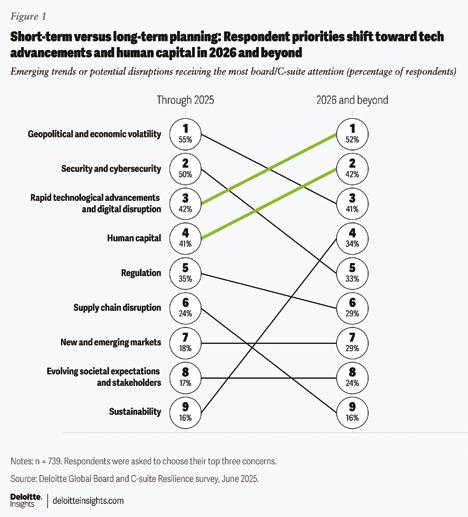
It is this potential that the Board and the C-suite have prioritised for 2026 and beyond according to the most recent Deloitte Global Board and C-suite resilience survey. As you will see from the responses in Figure 1, being prepared for rapid technological advancements and digital disruptions is the top priority for the Board and the C-suite. Having the right human capital is their second priority, followed by geopolitical and economic volatility. Whilst geopolitical and economic climate is a top 5 concern, the Board and C-suite do not want short-term focus on this to constrain longer-term growth.
To deliver on these priorities, the Board and C-suite indicate that they need an organisation that is agile, which sounds logical in theory.
But words like ‘agility’ can mean everything and nothing, so we wanted to understand, as tangibly as possible, what they wanted when they asked for talent agility.
To gain this insight, in a survey conducted in collaboration with Raconteur, we asked 822 business leaders globally for their thoughts in three key areas:
1. What do they see as the role of a global workforce in delivering business success, now and in the future?
2. What do they believe is needed at an operational level to tap into an agile global workforce? and
3. What are they willing to do to support their teams who manage their global workforce?
Based on their responses we have condensed the desire for talent agility into six key asks of the business. In essence, these asks are based on business leaders looking for the best talent and skills for their organisations across the globe. And they realise that for their asks to be successful, there will need to a significant shift in approach from where they are now.
Ask 1 – Champion Cross-Border Talent
The first ask is for more cross-border talent. This is in direct contradiction to the somewhat protectionist trends that we have seen in global immigration regulation recently, due to business leader actions being dictated by macrotrends such as aging populations in the west, AI skills that are currently concentrated in certain locations and geopolitical and climate challenges that may potentially impact business continuity.
In fact, an overwhelming 95% of leaders believe that cross-border talent – accessed physically and virtually – will be key to delivering business success now and in the future. This is great news for those who work in this field, but the same leaders have told us that there is a significant gap between the importance of cross-border talent and their approach to it. 75% of them tell us that they are currently static, reactive or only making incremental progress in their approach.
The key is to understand business leaders’ perspectives. How critical do they think global talent is and what are they willing to do to ensure that talent can be accessed, developed and deployed globally, now and in the future?
Ask 2 – Prepare For Greater Employee Autonomy
There has been a lot of debate over the last five to six years on whether organisations are looking to provide their employees with greater autonomy – on when, how and where work is done. Recent headlines suggest that the trend is a return to the office, especially for certain sectors. But with the rise of AI we are also seeing predictions of a move away from traditional employment and talent models like fractional working, portfolio careers and new ways of engaging with talent.
We wanted to understand if business leaders see autonomy as a short-term focus or a way of developing careers that is here to stay. Based on the business leaders second ask it appears to be very much here to stay. Respondents anticipate that employee autonomy will be three times the level that it is today by 2030.
But for autonomy to increase, a massive cultural and operational shift is required from where we are today. When we asked the leaders about the factors influencing their cross-border talent agility strategy they ranked workforce flexibility and agility in 10th place (out of 10 options). But the reality is without flexibility and agility there can be no true employee autonomy.
People leaders will have a key role to play in gaining clarity on what autonomy will look like within their organisations. Will it be working flexible hours, choosing flexible career paths, choosing different employment and talent models, working in different locations or a combination of all of these? Regulation can feel like it is changing faster than ever, thus, compliant autonomy especially across borders will require the right framework - policies, roles, technologies, processes etc. - and talent professionals are perfectly placed to help deliver this.
Ask 3 – Adopt Talent Intelligence
The quest for the best talent, irrespective of where it is, has seen a focus on data and AI-powered technology in workforce, HR and talent over the past two to three years. Specifically, there has been a lot of thought and activity on platforms providing talent intelligence and creating talent marketplaces. We sought to get business leaders’ insights on the role data and technology will play in enabling talent agility – which brings us to the third ask. Almost 99% of business leaders believe that talent intelligence platforms will become the norm over the next five years. If used correctly, talent intelligence and digital technology can enable organisations to make better informed decisions globally, on recruitment, talent development, and workforce planning. So, we can fully understand why leaders believe it is key to the future.
But the gap here is big. Even though 99% of leaders believe they have or will have platforms that facilitate talent intelligence –52% of them still feel they have no visibility of what skills are available in their organisation. We know that even if leaders were to have access to the right data, talent demand and supply data without a regulatory overlay does not tell the full story.
Even though 99% of leaders believe they have or will have platforms that facilitate talent intelligence52% of them still feel they have no visibility of what skills are available in their organisation
HR, Reward, Talent, Workforce
and Mobility practitioners have a clear role in understanding the talent intelligence data and platforms deployed within their organisations and posing appropriate questions to ensure optimal impact. Is technology alone the solution to organisational talent intelligence requirements? Jobs, skills, experience and competence data is nuanced and in certain cases requires on the ground research. If technology is the solution, have they adopted an appropriate platform? Does it hold the right data? How is that data being utilised? How are these platforms set up to manage bias? How are regulatory considerations being factored in?
Ask 4 – Pivot To Skills-Based Strategies
The fourth ask to enable agility focuses on transitioning to skills-based strategies. Much like talent intelligence, there has been a lot of talk about skills-based organisations over the past few years among HR and talent professionals, so we wanted to understand if business leaders believe this is the future, and it turned out that 60% of them feel that their organisations will be skills-based within five-years.
In theory, with the rise of digitisation, tasks are being automated and the role of humans is changing faster than ever. Thus, education, competence and experience will no longer be sufficient to assess suitability for a role, and this is where skills have a part to play. But as anyone who has been involved in this transition will know, it is a complex challenge, often with no clear skills taxonomy and no common means or methodology to assess them. While a number of organisations have commenced this transition, most are still on their transformation journey, thus it is no surprise that 74% of organisations are yet to start the process of becoming skills-based. There is a lot of aspiration, but a lot of work yet to be done in this area.
It is not only organisations that are adapting to becoming skills-based. We are witnessing country legislation, such as immigration regulation, responding to the changing world and formalising skills requirements for entry. Currently each organisation and each regulatory body have a different taxonomy, and formal skills passports are typically at the pilot stage. Those in people-related leadership will have a critical role to play in understanding the skills required by the organisation, mapping them to regulatory requirements and determining if and how skills can be accessed compliantly across borders.
Ask 5 – Invest In Human Skills To Fuel Success In The AI-Powered Future
The fifth ask is confirmation of what we have heard several times – that while the future will be AI-powered, AI will require human skills like empathy, resilience, adaptability and emotional intelligence to augment it. And while business leaders recognise the need for these human skills, only 50% of them are confident that they will be able to access these skills in fiveyears’ time. This is a perfect opportunity for HR, Reward, Talent, Workforce and Mobility. Firstly, to help the wider enterprise be ready to source these skills from across the world. Secondly, for cross-border work to be used as a tool to build the human skills that are so critical for the future, because research shows that those who have worked across cultures are highly likely to have developed these critical skills as a result of their experience.
The fifth ask is confirmation of what we have heard several times - that while the future will be AI-powered, AI will require human skills like empathy, resilience, adaptability and emotional intelligence to augment it
We are also starting to see the rise of technology/AI platforms that will help review current processes, along with business and technology strategies and to determine the tasks that may be automated in the future versus tasks that will still require human capabilities. Like all digital tools, to gain valuable outputs we require as close to 100% accuracy in data inputs, which can be extremely rare in the real world. Talent and Workforce teams need to ensure that the nuances and complexities of work processes are not lost when technology is applied to analyse their future at scale whilst also proactively identifying manual work that should be automated to successfully transition to the future.
Ask 6 – Overcome Structural And Cultural Rigidity To Retain Talent
The sixth and final ask is the result of us asking business leaders about the support system they need to help them achieve desired business outcomes. As we know from the previous five topics, business leaders see the value in greater cross-border talent, support enhanced employee autonomy, believe talent intelligence and technology will deliver benefit and support their pivot to being more skills-based. They also
see a future with an optimal mix of human and AI skills. Not too much to strive for!
71% of business leaders accept that to deliver all of their asks will require a future workforce strategy that is data-led and that provides a high level of personalisation in career paths and learning. A strategy that will require HR, workforce, talent and mobility functions to work cohesively with the business. People have been trying to work across functions for years and it is easier said than done for most of us. There is a clear reason for that – because even today only 15% of business leaders want to prioritise the transformation of their talent, workforce and HR functions. And we know that without proper buy-in and commitment from leadership, structural changes to the way we work across functions can be very difficult to achieve. But this low score could potentially be because business leaders believe that a significant amount of the transformation, particularly when it comes to technology and data, has already been achieved.
We hope that our findings provide you with insights that will help you as a peoplefunction leader engage with your wider business leadership, helping them understand the current gap in delivering true talent agility, and to continue being an ambassador for change, now and in the future.
71% of business leaders accept that to deliver their asks will require a future workforce strategy that is data-led and provides a high level of personalisation
TEJI SUSHEELA VISHWANATH Director
Global Employer Services
Deloitte LLP
T: +44 20 7007 7378
E: tsusheelavishwanath@deloitte.co.uk
Deloitte’s dedicated Global Talent & Mobility practice is a multi-disciplinary group of tax, immigration, talent, HR and digital professionals who support clients as they navigate complex global workforce challenges, developing focused strategies and delivering practical enablement.
Teji leads Global Workforce Strategy, designing and implementing plans to align talent acquisition, development and deployment with organisation's goals across international markets. She has over 16 years’ experience in helping organisation understand how they can transform their approach to global talent agility. She also focuses on helping global mobility programmes transform their strategic approach to impact all operational areas – onboarding, policies and processes, technology, offshoring and change management. www.deloitte. co.uk/globalworkforce
When Mobility Professionals Place Lower Emphasis On Cost Control, What’s Really Going On?
In a somewhat surprising development, Sterling Lexicon’s recent Global Mobility Blueprint survey revealed that cost-saving measures dropped from the second-highest priority last year to fifth place in 2026. It raises some important questions, like “Have we finally ‘cracked the code’ on managing expenses without sacrificing the employee experience?” Or “Does this shift signal something more nuanced about how organisations are viewing mobility's strategic value, seeing it less as a cost center and more as an investment?”.
To find the answers, we first need to look at the broader picture. As in previous years, respondents were asked to rank a list of 18 global mobility-related priorities as high, medium and low. Many of the top priorities were the same, but a new one appeared on the list, and the order has shifted. As it was last year, improving the employee experience remains priority number one, but what’s new is that it is essentially tied with using mobility as a strategic lever for talent attraction and retention, cited by 62% when rounded. Meanwhile, implementing cost-saving measures fell to fifth place at 46%, down from its second-place ranking in 2025.
Other high-ranking priorities included:
• Achieving better integration between global mobility, HR, and other business areas (52%)
• Improving data collection, analysis, and reporting (50%)
• Implementing cost-saving measures (46%)
• Aligning global mobility with talent management (42%).
The results suggest that organisations are moving beyond viewing global mobility purely through a cost-management lens. This doesn't mean expenses no longer matter, nearly half of respondents still rank cost-saving as a high priority, after all. But it might suggest that businesses recognise the
limitations of a cost-first approach when competing for top talent, especially given that attraction and retention vied so closely for the highest priority.
These Blueprint findings align with broader industry studies, too. McLean & Company's HR Trends 2026 report shows similar patterns, with controlling labour costs dropping from the second-highest priority to sixth place. Instead, organisations are prioritising leadership development, fostering a culture of innovation, and delivering exceptional employee experiences.
The movement of costcontainment lower on the priority list deserves a closer look
Why The Shift?
The movement of cost-containment lower on the priority list deserves a closer look. It’s worth considering a few different scenarios that could explain it:
1. We've Optimised Cost Management
One interpretation could be that mobility teams have not only become more efficient at managing expenses while maintaining quality, but have also improved educating stakeholders about what costs are realistic. Over the past several years, teams could have been focused on:
• Exploring and refining policies to eliminate unnecessary spending
• Negotiating better rates with service providers
• Implementing technology solutions to reduce administrative overhead
• Developing clear guidelines that balance mobility support with fiscal responsibility. If that’s what’s happening, then it stands to reason that the focus would shift toward maximising the value delivered within established budgets rather than continuously seeking new areas to cut.
2. Previous Cost Cuts Compromised Experience
The fact that elevating the employee experience remains a top priority could indicate that organisations are addressing problems created by cost-reduction strategies that proved too aggressive. Signs of that might include:
• Increased turnover among relocated employees
• Negative feedback in post-assignment surveys
• Declining acceptance rates
• Growing concerns about competitiveness in tight talent markets.
If your organisation implemented significant budget reductions in recent years, it's worth examining whether those changes negatively impacted the relocating employee experience, and whether current priorities could signal a need for some course correction.
3. Mobility Has Cemented Its Strategic Value
Another explanation could be that global mobility has successfully established itself as a strategic business contributor. In this scenario, stakeholders now understand that:
• Mobility investments directly support talent acquisition and retention goals
• International experience develops future leaders with crucial change management skills
• Cross-border assignments enable knowledge transfer and innovation
• Strategic deployment of talent drives business growth in key markets.
When mobility demonstrates clear ROI and truly aligns with broader talent management and business goals, discussions centre less
on asking "How much does this cost?" and more on "What value does this create for our business?".
What The Data Tells Us About Current Priorities
The near perfect alignment between improving employee experience (62.07%) and supporting talent attraction and retention (61.82%) as top priorities for this year suggests these aren't separate goals, but interconnected parts of a more comprehensive strategy.
It’s worth noting that three of the six highest priorities centre on strategic alignment and data-driven decision-making, further suggesting that mobility has proven its position as a strategic business enabler rather than merely a logistical facilitator.
Applying The Relevant Scenario To Your Own Business Needs
Regardless of which scenario you feel your organisation most closely aligns with, you can take specific steps to strengthen mobility's strategic value and improve outcomes. Focus on prioritising things like:
Regardless of which scenario you feel your organisation most closely aligns with, you can take specific steps to strengthen mobility's strategic value and improve outcomes
Measuring What Matters Most
You've probably heard some version of this before, but it bears repeating: what doesn't get measured doesn't get done. To genuinely improve employee experience, you need objective data that captures:
• Sentiment at multiple points throughout the assignment journey
• Acceptance and completion rates for different assignment types
• Post-assignment retention compared to non-mobile employees
• Career progression for assignees versus non-assignees.
This data can help you identify what's working well and where improvements are needed. It also provides the evidence required to make strategic recommendations to leadership.
Demonstrating ROI Beyond Cost Savings
To help shift the conversation from measuring spend to assessing value, consider building business cases that highlight things like how mobility supports strategic talent deployment in growth markets, the value of developing leaders with cross-cultural competencies, the knowledge transfer international assignments can facilitate, or what competitive advantages your recruiting team can bring to the table when candidates are comparing offers.
When you can quantify mobility's contribution to talent retention, leadership development, and market expansion, budget discussions centre far more closely on strategic outcomes.
The Real Story Behind The Numbers
So, what does all this really tell us? Most likely, the drop in cost-saving measures on the priority list reflects all three scenarios to varying degrees. Organisations have likely become more efficient at managing mobility expenses, learning from years of refinement and optimisation. Some may very well be addressing experience gaps created by previous cost-cutting measures, recognising that the savings achieved were at the expense of employee satisfaction and ultimately result in driving up costs. And hopefully, mobility leaders are increasingly successful in positioning their function as a strategic business lever that delivers measurable value.
The key is understanding where your organisation falls within this spectrum and using those insights to guide your strategy. If you've optimised costs, focus on maximising value delivery. If previous cuts compromised experience, make the case for strategic reinvestment. If you're building strategic credibility, continue demonstrating ROI through clear metrics and business alignment.
The organisations that thrive will be those that view mobility not as a cost centre to be minimised but as a strategic investment that drives talent attraction, retention, and development. They'll measure success not just in money saved but in leaders
developed, knowledge transferred, and competitive advantages gained. As you build your own mobility blueprint, the goal isn't to ignore costs, but to facilitate discussions that include the broader context of strategic value.
The organisations that thrive will be those that view mobility not as a cost centre to be minimised but as a strategic investment that drives talent attraction, retention, and development
Kristin White is Director, Communications & Thought Leadership with global relocation management company, Sterling Lexicon. She has more than 30 years of experience in the workforce mobility industry, including several as an expatriate. She can be reached at: kristin.white@sterlinglexicon.com
KRISTIN WHITE
Talent Mobility Trends: From Movement To Meaning
For more than a decade, global mobility has been evolving under the pressure of competing forces: talent shortages, employee expectations for flexibility, cost scrutiny, and rising regulatory complexity. Mobility is no longer solely about how efficiently organisations move people across borders, but by how clearly they can explain why they do so, for whom, and to what end.
Mercer’s Global Talent Trends 2026 reveals a function in transition. Assignment models are fragmenting, international remote work is becoming normalised, and hiring from anywhere is increasingly mainstream. Yet governance, transparency, and talent integration often lag behind.
The organisations that will succeed are not those with the most sophisticated policies, but those that embed mobility into workforce infrastructure, grounded in explicit talent intent and sustained by trust.
Transparency And Logic: Re‑Examining The Deal With Mobile Employees
Few organisations can clearly and objectively link international mobility to career progression. This single data point should give HR and mobility leaders pause. For decades, international experience has been assumed to be a career accelerator. In reality, in most organisations, it remains a promise that is implied rather than delivered, and rarely measured.
At the same time, transparency expectations are rising sharply. Pay equity legislation, particularly in the EU, combined with growing employee awareness, is making it increasingly difficult to treat mobility as a “special category” that operates outside standard reward and career frameworks. The traditional justification that mobility is too complex or too bespoke to explain is no longer credible.
The real challenge lies in designing segmented, explainable reward and career systems that reflect different types of mobility while remaining defensible. Equity in mobility does not mean uniformity. It
means being explicit about why different assignment types are rewarded differently, how (or if) mobility connects to career progression, and what alternative career routes exist for those who cannot relocate. In 2026, mobility programmes must be logical, consistent, and transparent.
AI In Mobility: From Operational Relief To Strategic Relevance
Artificial intelligence continues to dominate conversations about the future of HR, yet Mercer’s 2026 Talent Mobility Outlook* shows a cautious market. Only 23% of organisations plan to invest in AI for mobility, while nearly half remain undecided.
Artificial intelligence continues to dominate conversations about the future of HR, yet Mercer’s 2026 Talent Mobility Outlook* shows a cautious market
This reflects a deeper tension. Mobility functions are expected to become more strategic, more connected to talent, and more value-driven. Yet AI is often framed as a way to do the same work faster, rather than as an enabler of different, better decisions.
The real opportunity for AI in mobility is not automation for its own sake, but instead:
• Surfacing compliance risks earlier
• Improving visibility on cross - border activity
• Generating reliable data that links mobility decisions to career and workforce outcomes.
The question is not whether AI belongs in mobility, but whether mobility is ready to change how it works to use AI meaningfully.
Crossing New Boundaries: When Flexibility Becomes The Norm
Temporary international remote working, often referred to as “workations,” has crossed a critical threshold. What began as an experimental perk has become a normalised component of mobility and retention strategies. Employees increasingly see this flexibility not as a benefit, but as part of the implicit deal with their employer.
From the organisation’s perspective, international remote work has matured into a practical lever. It supports engagement and retention, expands access to international experience, and allows companies to respond to talent demand without defaulting to traditional assignments.
At the same time, this shift exposes the limits of fragmented governance. Business travel volumes are rising, yet responsibility for compliance remains dispersed across travel, finance, HR, and mobility. This is increasingly problematic because business travel sits on a continuum with short-term assignments, commuters, international remote work, and long-term assignments.
When mobility teams articulate what they want from AI, their priorities are telling. Reducing administrative burden and streamlining assignment processes rank highest. Cost-efficiency, compliance, and talent outcomes (areas where AI could deliver significant value) are secondary considerations.
Every cross - border movement can trigger tax, immigration, social security, and duty-of-care obligations, regardless of how it is labelled. Treating business travel as “light mobility” is no longer safe. Mature organisations manage all cross - border work as part of a single compliance and risk framework, with clear ownership and visibility.
Hiring From Anywhere: A Strategic Tool, Not A Policy Loophole
Global talent sourcing is no longer a future aspiration. It is already happening, often
faster than governance frameworks can keep up. Internationally hired foreigners and locally hired foreigners are among the fastest-growing forms of mobility, alongside short-term and virtual assignments.
What is striking is how closely international hiring mirrors traditional mobility in practice. Most organisations apply similar remuneration approaches, relocation support, and allowances. Yet while 77% have formal policies for permanent transfers, only 25% have a specific policy for international hires, and over a third have no policy at all.
This gap between practice and policy is risky. Hiring from anywhere is not simply a workaround for mobility constraints; it is a strategic response to tightening labour markets and skills shortages. But only organisations that combine policy rigor with talent insight will be able to scale these models without incurring excessive cost, tax, and compliance exposure.
In 2026, the question is no longer whether to hire globally, but when it makes sense relative to other mobility options, and whether the organisation has the governance to support that choice.
Who Should Move? The Most Persistent Question In Mobility
Despite decades of experience, international assignments are still rarely managed as deliberate talent investments. Selection, development, and mobility often sit in different parts of the organisation, with limited integration. Recruitment selects, talent manages careers, and mobility executes the move.
The consequences are predictable. Many organisations lack clear criteria for assignment readiness, defined skill outcomes from international moves, and consistent tracking of post - assignment careers. Success is assumed, not measured. Without shared frameworks, selection defaults to availability, manager sponsorship, or precedent. The fundamental question remains inadequately answered: who will benefit most from an international assignment, and what the business will gain in return?
Mobility will only create sustained value when it is fully embedded in talent strategy, skills development, and workforce planning. Until then, “Who should move?” will remain mobility’s most important, and least rigorously addressed, question.
Building Skills For A More Demanding Mobility Function
Sixty-one percent of mobility professionals feel equipped to meet the demands of 2026. That confidence is encouraging, but it masks significant skill gaps. Compliance and technology consistently rank among
the top challenges, reflecting the growing complexity of cross-border work.
The most pronounced gap lies in cost measurement, metrics, and reporting. Senior leadership is placing greater emphasis on justifying mobility spend, yet many teams struggle to articulate value beyond descriptive activity metrics. Return on investment remains elusive, not because it is impossible to measure, but because it is rarely defined upfront.
As mobility integrates new technologies and expands its scope, the need for financial literacy, data interpretation, and business case development will only intensify. In 2026, credibility will increasingly depend on the ability to translate mobility activity into outcomes that leadership understands.
In 2026, credibility will increasingly depend on the ability to translate mobility activity into outcomes that leadership understands
Protecting Purchasing Power In Uncertain Times
Economic uncertainty continues to heighten employee anxiety, particularly for mobile employees facing visible cost - of - living and housing differences. Protecting purchasing power remains a core objective of global mobility programmes, but it is becoming harder to balance fairness with cost containment.
Cost - of- living allowances remain the primary tool for long-term assignments and are widely reviewed, reflecting inflation and exchange-rate movements. Housing costs, however, are emerging as the most sensitive and volatile component, driven by affordability and availability challenges in many locations.
For short - term assignments and commuters, per diems remain effective, but repeated use can quickly escalate costs and tax exposure if movements are not monitored holistically. Across all mobility
types, the challenge is the same: ensuring allowances are fair, understandable, and sustainable, while maintaining control in an uncertain environment.
The 2026 Imperative: From Moves To Meaning
Mercer’s 2026 action priorities point to a clear direction. First, organisations must reframe mobility as a single workforce mobility ecosystem, encompassing business travel, remote work, assignments, and international hires. Fragmented governance is no longer tenable.
Second, talent intent must be made explicit. Clear criteria for who should move, who can work remotely, and who should be hired locally are essential. International mobility must be embedded into talent reviews, skills frameworks, and succession planning, with explicit outcomes defined in advance.
Finally, trust must be built through transparency and control. As employee financial anxiety rises and leadership scrutiny intensifies, mobility programmes will be judged on their clarity, consistency, and fairness. Technology and AI have a role to play, not as a cure-all, but as pragmatic tools to improve visibility, surface risk, and strengthen decision-making.
The defining question is simple, but demanding: can we clearly explain how mobility decisions affect pay, cost, compliance, and careers to employees and leadership alike? Organisations that can answer yes will move beyond managing traditional mobility. They will use it to build capability, confidence, and long-term value.
MEIER E: Olivier.meier@mercer.com Join us at the 2026 Talent Mobility Conference in Budapest to learn how to successfully manage a global talent workforce, international assignees and remote workers, business travellers and, ultimately, all employees crossing international borders. https://www.mercer.com/insights/ events/global-hr-conferences/talentmobility-conference/
The Future Of Business Travel: Key Trends HR Leaders Must Prepare For In 2026
As global business travel accelerates into a new phase of maturity, 2026 is shaping up to be a defining year for corporate mobility. What was once a primarily logistical function - booking flights, hotels and expenses - is now a strategic pillar of workforce performance, talent attraction and retention, well-being, risk management and organisational culture.
For international HR leaders, business travel is no longer solely a procurement issue. It is a people issue. A safety issue. A productivity issue. And - increasingly - a brand issue.
From geopolitical volatility and climate responsibility to AI-driven travel management and employee well-being, the corporate travel ecosystem is being reshaped at speed. Organisations that fail to adapt will expose their people to unnecessary risk, operational friction and dissatisfaction. Those that lead will unlock safer travel, happier employees and measurable performance gains.
KEY BUSINESS TRAVEL TRENDS
1. Traveller Safety Is Becoming A Strategic Priority, Not A Compliance Exercise
Duty of care is moving beyond policy documents and insurance clauses. In 2026, organisations are expected to actively demonstrate how they protect employees before, during and after travel, even when they choose to blend business trips with mini breaks or family holidays.
Key shifts include:
• Real-time risk intelligence and location tracking
• Dynamic risk scoring for destinations
• Integrated emergency response protocols
• Proactive disruption management against strikes, natural disasters, extreme weather conditions and political unrest, for example. The changing corporate travel landscape can present challenges including turbulent geopolitical situations and visa and entry
The changing corporate travel landscape can present challenges including turbulent geopolitical situations and visa and entry requirements, as well as the impact of natural disasters and extreme weather conditions on itineraries
The focus on duty of care and risk management in corporate travel has never been sharper. Whether employees are travelling domestically or internationally, it is vital for HR managers to have a robust support network and strategy in place to manage disruptions, minimise risk and protect their greatest asset - their people - while also being charged with managing internal resourcing and operational changes.
2. Traveller Experience Is Now An Employer Brand Differentiator
Today’s workforce places greater emphasis on work-life balance, well-being, purpose, employer transparency and aligned values (with review platforms like Glassdoor and social channels so easily accessible, brands simply cannot fudge their values; they must live them).
Employees enter the workforce with evolving expectations, and they move on quickly if/when those expectations aren’t met. And - with hybrid and remote working now the norm - they need more intentional ways to connect with colleagues and the company culture.
Increasingly, business travel is being seen as a key element of the employee value proposition especially for high-mobility roles, global teams and leadership pipelines.
Many employees (especially younger people and those early in their careers) see business travel as an opportunity to grow, connect with colleagues and the company culture, find meaning in their roles, and a welcome opportunity to blur work life balance by extending work trips for leisure.
Business travel directly affects employee satisfaction, engagement and retention, and more and more companies are now recognising that business travel plays a quiet but influential role in attraction and retention.
Leading organisations are now designing travel programmes that prioritise:
requirements, as well as the impact of natural disasters and extreme weather conditions on itineraries. Effective travel programme and traveller risk management requires solid understanding of environmental and political destination risks and gives employees 24/7 support with the right processes and protocols in place.
• Autonomy, flexibility and simple support tech
• Personalised travel options – key for millennials and Gen Z
• Mobile first booking and seamless digital journeys – a basic expectation of younger employees
• Reduced cognitive load to improve well being and – indirectly – productivity
• Clarity to improve compliance and reduce leakage
• Support when things go wrong.
3. AI And Automation Is Reshaping Travel Management
Artificial intelligence is transforming corporate travel from an operational function into a predictive system. Emerging capabilities include:
• Predictive disruption alerts
• Automated rebooking
• Personalised travel recommendations
• Risk-triggered routing changes
• Smart expense auditing.
For HR teams, this means:
• Less administrative burden
• Better traveller experiences
• Improved data visibility
• Stronger policy compliance.
AI will not replace human business travel managers, but it will fundamentally change how programmes are designed, governed, measured, communicated and optimised.
4. Sustainability Moves From Aspiration To Accountability
Sustainable travel is no longer about carbon offsets alone. In 2026, organisations are being judged on measurable impact. In Europe, for example, corporates may introduce a railfirst policy for domestic travel as opposed to taking very short flights.
Key developments include:
• Carbon budgeting for travel
• Sustainable supplier procurement
• Rail-first travel policies
• Data-driven emissions reporting
• ESG-aligned travel frameworks.
HR leaders now play a role in aligning mobility strategies with:
• Corporate ESG goals
• Investor expectations
• Talent attraction
• Brand reputation. Travel policy is becoming climate policy.
5. Bleisure And Flexible Mobility Become Embedded Norms
Bleisure travel (the blending of business and leisure travel) is not new, but the line continues to blur. This is why the most forward-thinking business travel programmes support:
• Bleisure extensions, where possible and relevant
• Remote work mobility, again where possible, but employers are increasingly allowing staff the flexibility to work from ‘anywhere’ for certain periods each year
• Hybrid travel models
• Multi-location working.
Bleisure travel (the blending of business and leisure travel) is not new, but the line continues to blur
This creates new HR challenges around:
• Insurance
• Tax
• Visas
• Compliance
• Well-being
• Data protection and cyber security
• Risk mitigation.
But it also unlocks powerful benefits:
• Improved well-being, including employees feeling empowered and more valued
• Higher attraction and retention levels
• Global talent access
• Workforce resilience.
6. Data Becomes The Foundation Of Intelligent Travel Strategy
Modern business travel programmes are built on insight, and data – access to it and the ability to analyse it in useful ways – is king. Organisations are increasingly using travel data to:
• Identify - and prevent - burnout risk
• Track productivity impact
• Optimise travel spend and identify costcutting opportunities
• Improve safety outcomes
• Enhance policy design.
For HR leaders, travel data is a strategic workforce planning asset so it’s crucial for HR to work closely with their business travel tech providers, whether that’s through a TMC (travel management company), third party supplier or internally.
Designing a modern corporate travel programme is complex, especially if it’s global and even if it’s being managed through a TMC. Business Travel Show is your shortcut to innovation, connecting you
with the information, suppliers, tech stacks and experts you need to create, refine or overhaul your policies.
They bring together the entire travel ecosystem in one place:
• Travel management companies
• Airlines
• Hotel groups
• Risk and security providers
• Travel technology platforms
• Expense management systems
• Sustainability specialists
• Mobility consultants.
Even better, Business Travel Show takes place all over the world so, wherever you are, there’s one at hand to help you. In 2026, the global calendar offers three anchor events:
• Business Travel Show Asia Pacific – 14-15 April
• Business Travel Show Europe –24-25 June
• Business Travel Show America – 14-15
October The future of business travel: Key trends HR leaders must prepare for in 2026.
This year, Business Travel Show - will identify and share key business travel trends HR teams must grasp in 2026. In addition to delivering a practical conference programme, the Business Travel Show events are the perfect place to find the suppliers and short cuts you need to build a future-ready corporate travel programme that protects and performs.
Marketing director, Business Travel Show
Jonathan Carter-Chapman is a marketing leader with nearly two decades of experience in driving audience growth and engagement for leading B2B events and media brands including Business Travel Show in Europe, Asia Pacific and North America.
He has a passion for business travel and a keen understanding of how industry trends impact travellers, as well as those responsible for managing their travel, including HR professionals.
Email: jcarter@ntmllc.com
JONATHAN CARTERCHAPMAN
March 2026 Immigration Reforms: What They Mean For UK Businesses
March 2026 has seen the UK Government introduce several updates to its Immigration Rules. The Statement of Changes published on 5 March 2026 outlines these amendments in detail. The updates span a wide range of immigration areas, including rules affecting refugees, the introduction of a visa brake for certain nationalities, and changes across the Global Business Mobility and Skilled Worker routes. The Statement also includes updates to Appendix EU, Part Suitability, and the English language requirements for Indefinite Leave to Remain (ILR).
Most of the changes are unlikely to have a direct impact on UK businesses, although there are several updates that employers should be aware of. One significant change is the increase to the minimum English language requirement for Indefinite Leave to Remain (ILR).
As part of the Earned Settlement proposals announced last year, the government has confirmed that the English requirement for most visa categories, including Skilled Worker visas will rise from CEFR level B1 to B2 from 26 March 2027. This development is largely expected, following the increase to the same English language level for Skilled Worker visas introduced in January this year.
Although ILR is not usually at the forefront of most employers’ minds when hiring, the higher English language requirement could result in some prospective hires being unable to meet the new threshold and therefore unable to take up their roles. It may also deter candidates whose English skills are not yet at the required level.
If the government proceeds with the broader Earned Settlement proposals expected later this year, the impact could be greater. Under these proposals, many prospective employees may face significantly longer qualifying periods, potentially up to 10 years or more, before becoming eligible for ILR.
If the ILR qualifying period is extended from five to ten years, the impact on employers, in particular smaller businesses could be significant. Extending sponsorship by an additional five years would substantially increase the administrative and financial responsibilities on employers. We are already hearing concerns from organisations about the rising salary thresholds that sponsored workers may need to meet to remain eligible under the new rules.
These changes could increase the financial burden for employers and, while they may support the government’s objective of reducing overall migration to the UK, they could also leave businesses struggling to access the skilled talent they need.
The introduction of a visa brake for certain countries is likely to lead to a reduction in visa numbers. A ban on Student visa applications for entry clearance from nationals of Afghanistan, Cameroon, Myanmar and Sudan is expected to result in a noticeable decline in university applicants from these countries. In addition, from 26 March 2027, nationals of Afghanistan will no longer be able to apply for entry clearance under the Skilled Worker route. This restriction will not apply to individuals already in the UK on other visa categories, nor will it affect applications made under the dependant visa routes.
Other changes affecting Skilled Workers include new provisions for prison workers and a new requirement for sponsored workers to be paid in line with minimum salary thresholds for specific pay periods. Rather than assessing salary on an annual basis, sponsors must now ensure that a worker’s pay meets the minimum rate for each pay period. For example, if the worker is paid monthly, their salary for that month must meet the required minimum threshold.
In Part Suitability, from 26 March 2026, visa applicants will be subject to mandatory refusal if they have been convicted of an offence resulting in a suspended sentence of more than 12 months. This change will primarily affect the small proportion of applicants who have received a suspended sentence but have not served any custodial time.
As well as changes to the Immigration Rules, several changes have been made to the Sponsor Guidance documents including a clarification that all sponsors are required to have read all relevant parts of the Sponsor Guidance and keep up to date with any
changes. A new subsection has also been added requiring sponsors to ensure that sponsored workers are aware of their worker rights in the UK. Several other updates have also been made so, if you have not recently read the Sponsor Guidance, you should take the opportunity to do so as soon as practically possible.
If you have any questions about these changes or would like to discuss how they may affect your organisation, our team is here to help. Please get in touch with a member of the Envoy Global (formerly Smith Stone Walters) team for support and advicehttps://smithstonewalters.com/.
ANTHONY HALL
Associate Director
Envoy Global (Formerly Smith Stone Walters)
Anthony qualified as a Solicitor in England and Wales in 2009 and joined Smith Stone Walters in 2010. Initially employed as a Consultant on one of our larger corporate teams, Anthony now leads the Private Client team. As well as assisting private clients on a wide range of immigration matters, Anthony also continues to manage some key corporate accounts focusing on the financial and technology industries. In addition to his caseworking responsibilities, Anthony leads an internal study group at Smith Stone Walters which is designed to facilitate technical learning and development within the company. Anthony has first-hand experience of the relocation process, having spent 10 years living in Indonesia. Prior to embarking on his immigration career, Anthony spent two years teaching English in Japan.
E: anthony.hall@envoyglobal.com
T: +44 (0)20 7362 2744
The
Visit our website www.internationalhradviser.com and complete the online registration.
For further information please call Helen Elliott on +44 (0) 208 661 0186
Email: helen@internationalhradviser.com
Website: www.internationalhradviser.com
Please share our website with your UK-bound expatriate colleagues, www.expatsguidetotheuk.com which is the digital platform for the Guide.
Global Immigration
Air travel across the Middle East is experiencing significant disruption as escalating regional tensions, have led to widespread airspace closures and operational challenges for airlines and airports. Several major airports have suspended operations, while carriers have been forced to cancel or reroute flights, causing extensive delays and stranding travellers throughout the region.
Organisations with staff or operations in affected Middle Eastern countries are navigating heightened uncertainty as conditions continue to shift rapidly. In response, many companies are activating contingency plans to ensure employee safety, maintain mobility, and safeguard business continuity. These proactive measures reflect the growing need for resilience as regional developments continues to impact normal operations.
Despite the widespread travel disruptions across the region, immigration systems outside the directly affected areas continue to operate for the most part. However, ongoing consular closures, reduced staffing, and continued flight cancellations are placing additional strain on administrative processes.
As a result, applicants are facing delays in visa processing, passport services, and document legalisation. Individuals seeking assistance in impacted jurisdictions should prepare for extended processing timelines and potential changes to scheduled appointments as governments work to manage the growing backlog.
CANADA
Temporary special measures for Iranian nationals extended
In response to instability in Iran, Canada introduced special measures in February 2023 to offer temporary support to eligible Iranians already in the country.
As the situation in Iran remains uncertain, Immigration, Refugees and Citizenship Canada (IRCC) is introducing a new set of targeted measures to continue supporting eligible Iranians who are already contributing to Canadian communities and the labour market. These measures allow individuals with a valid work permit, issued on or before 28 February 2025, to apply to extend it. These
measures will now expire on 31 March 2027 and standard processing fees apply. Those looking to extend their stay as a visitor or to extend their study permit can apply under regular IRCC processes.
Those looking to extend their stay as a visitor or to extend their study permit can apply under regular IRCC processes
DENMARK
Opening of the Working Holiday quotas for citizens of Chile and Argentina
The Danish Agency for International Recruitment and Integration (SIRI) has announced that a new quota period for residence permits under the Working Holiday agreements for citizens of Chile and Argentina opened on 1 March 2026.
A total of 150 residence permits per year are available to citizens of Chile and Argentina under the Working Holiday agreements. The programme allows stays of up to one year in Denmark, and participants may do salaried work for up to nine of the twelve months.
A quota year lasts from March through February of the following year and is divided into two quota periods. From March to August (the first quota period), SIRI may grant residence permits corresponding to half of the annual quota, which means up to 75 residence permits for each of the two countries.
Residence permits are granted on a firstcome, first-served basis. Once 75 residence permits have been granted to citizens of each country, any remaining applications will be refused. In such cases, the case processing fee paid to SIRI will be refunded.
Please note that any fee paid to VFS Global or to the Danish representation in Chile will not be refunded if an application is refused because the quota has been reached.
IRELAND
Extension of immigration permissions for beneficiaries of temporary protection
The Irish Minister for Justice, Home Affairs & Migration has extended immigration permissions for all people who are Beneficiaries of Temporary Protection up to 4 March 2027. This extension applies to beneficiaries of temporary protection who are residing in Ireland with a Temporary Protection Certificate (yellow paper) valid until 4 March 2026.
Eligible beneficiaries do not need to apply for a new Temporary Protection Certificate and expired certificates may be used as proof of entitlement to temporary protection and related state services until 4 March 2027. They will, however, have to renew their Irish Residence Permit card (IRP card). This can be renewed here.
ITALY
Further extension of deadline for registering minors born abroad for citizenship
The Italian consulate general in San Francisco has announced that, with the entry into force of law no. 26. Of 28 February 2026, converting Decree-Law No. 200/2025 (“milleproroghe”), the deadline for submitting declarations to acquire Italian citizenship for eligible minors born abroad has been extended from 31 May 2026 to 31 May 2029.
The extension applies to minors who, as of 24 May 2025, were children of Italian citizens by birth, as defined under Article 3-bis of Law No. 91/1992, and who may acquire Italian citizenship through a formal declaration submitted to the relevant consulate. Previously, citizenship was automatically granted at birth in these cases.
JAPAN
New integrated Specified Residence Card launch date announced
Japan’s Immigration Services Agency has announced that its new Specified Residence Card will be launched on 14 June 2026.
The specified residence card combines the functions of the residence card (or special permanent residence certificate) and the My Number Card into one card.
The My Number Card is a chipped photo ID card which shows the holder’s 12-digit My Number, and which can be used for identity verification in person and online, usually for social insurance, tax and disaster-related procedures.
Eligible residents can apply for a Specified Residence Card at immigration or municipal offices, but are permitted to keep two cards instead.
• Confirmation of key occupation lists, including the Trades and Technician pathway list, and the red and amber lists, which determine eligibility for residence pathways
• Simplified median wage settings that apply across all Skilled Migrant Category pathways
Eligible residents can apply for a Specified Residence Card at immigration or municipal offices, but are permitted to keep two cards instead
MALTA
Pre-Departure Course Requirement will now be formally verified
Identità, the Maltese migration and identity agency, has informed employers, prospective applicants, and current clients that, effective 1 March 2026, the Pre-Departure Course certificate is now formally verified as part of the work permit application process for new and still abroad third-country nationals (TCNs).
The Pre-Departure Course was officially launched on 5 January 2026, and forms part of Malta’s updated regulatory framework governing employment entry procedures.
Important Notice
Employers and applicants are advised to ensure that all required documentation is obtained prior to submission of applications as from 1 March 2026, to avoid unnecessary delays in processing.
NEW ZEALAND
Further changes to the Skilled Migrant Category to come into effect in August 2026
Immigration New Zealand (INZ) has announced further details of changes to the Skilled Migrant Category (SMC) ahead of these changes taking effect from late August 2026.
Details of the changes include:
• Clarified qualification requirements for claiming points
• Extended English language test validity for some applicants
• A new recognised occupational registration for accountants; and
• A future ability to extend an Accredited Employer Work Visa to complete skilled work experience requirements.
SINGAPORE
Upcoming changes for foreign workers
In a speech at the Ministry of Manpower (MOM) Committee of Supply on 3 March 2026, Dr Tan See Leng, Minister of Manpower announced several planned updates to the rules for foreign workers.
In January 2027, MOM will introduce a new Overseas Networks and Expertise (ONE) Pass “AI and Tech track” to replace the Tech.Pass.
Recognising that top talents in AI and Tech may be compensated through non-cash components such as Employee Stock Option Plans (ESOP) and Employee Share Ownership (ESOW), applicants under the new ONE Pass (AI and Tech) track will be allowed to meet the ONE Pass fixed monthly salary criterion through a combination of cash and non-cash components.
MOM will expand the Non-Traditional Source Occupation List (NTS-OL) from September 2026, by adding eight new occupations in the social services, food services and air transportation sectors.
UNITED KINGDOM
Visa brake imposed on four countries
The Home Office has announced that an ‘emergency brake’ on visas will be imposed for the first time on nationals from four countries following a surge in asylum claims from legal routes.
Asylum applications by students from Afghanistan, Cameroon, Myanmar and Sudan rose by over 470% between 2021 and 2025, and the number of Afghans on work visas claiming asylum is now outstripping the number of visas issued.
In response, the Home Office will end sponsored study visas from all four countries and skilled worker visas for Afghan nationals.
The visa brake will be introduced via an Immigration Rules change on 5 March 2026, and come into force on 26 March 2026.
If you have any colleagues or peers who are affected by the situation in the Middle East, or by any of these other updates, please get in touch with a member of the Envoy Global team for support and advice: https:// www.envoyglobal.com/.
ENVOY GLOBAL
(Formerly SMITH STONE WALTERS)
If you have any questions about these changes or would like to discuss how they may affect your organisation, our team is here to help. Please get in touch with a member of the Envoy Global, team for support and advice - https:// smithstonewalters.com/.
ENVOY GLOBAL WILL BE HOSTING THE FOLLOWING SEMINAR AT
The 2026 Global HR Conference
on Monday 15th June at The Royal Automobile Club, Pall Mall, London, SW1Y 5HS
The Hidden Immigration Compliance Risks - Delving into How People and Technology Work Together to Fix Them
Setting the scene: the compliance landscape
• The 10 overlooked risks
• What these risks reveal about weaknesses in HR/Global Mobility processes
• Where technology fits and where humans must step in
• A practical model for modern immigration programme governance
Hosted by Alastair Mason, Director of Strategic Growth –International, Envoy Global (formerly Smith Stone Walters)
To register for this conference that is for Global HR Professionals only, please email the name/s and job title/s of those wishing to attend to: helen@internationalhradviser.com
Navigating New Geopolitical Conflicts As A Global Mobility Manager
Over the last 30 years in HR, I have seen a fair share of globally traumatic events, disruptions to our everyday lives that we already found busy and overwhelming in Global Mobility. Over the years, I have compiled resources and best practices to share with Global Mobility Leaders worldwide in such situations, because we typically don’t train for a crisis. I also find that having the three principles in mind can help you navigate this terrain. The world has shifted once again. As headlines report on the escalation of conflict involving the US and new geopolitical fronts, we find our hearts heavy. In times of war, the role of a Global Mobility Manager shifts to that of a "First Responder".
Here is how you can help - and leadright now.
MAINTAIN THREE PRINCIPLES
1. From Policy To People
Standard relocation policies do not apply in war zones. You must be prepared to "break" policy to save lives, whether that means approving emergency housing, cash advances (if ATMs are down), or immediate repatriation.
2.
The Neutrality Of Humanity
In your role, you may have employees from both sides of a conflict. Maintain a "Human-First" approach. We support people, regardless of their passports. Focus on safety and empathy rather than political debate.
3.
Digital Media Literacy
Remind your employees that their social media activity can have security implications. In some regions, a "like" or a "share" can endanger a local employee. Provide clear guidance on digital safety. "We are not just managing moves; we are protecting human potential in its most vulnerable state".
Remember Four Immediate Actions
1. Verify Before You Share: In a high-tech conflict, disinformation is a weapon. Follow the SHARE checklist (Source, Headline, Analyse, Retouched, Error)
2. Mental Readiness: You cannot support your expats if you are running on empty. Check your own "Energy Battery" before stepping into a crisis meeting
3. Strategic Giving: Financial aid remains the fastest way to help. Support the ICRC, UNHCR, and Doctors Without Borders. Avoid sending physical goods (clothing/food) unless specifically requested by a local agency, as it clogs logistics corridors
4. The "Human Touch”: Reach out to your colleagues in affected areas. Sometimes, a simple "I see you" is the most powerful tool in your kit.
Follow The Global Mobility Manager Security Protocol
If you have an international population in an affected or neighbouring area, use this checklist to stabilise your operations. Use and Share my Global Mobility Manager Toolkit for Crisis Events
1. High-Level Strategy For Managers
As a Global Mobility Manager, your role transitions into a "First Responder" capacity during geopolitical conflicts.
• Establish Presence: Secure a seat on the company’s Emergency Crisis Committee
• Define Scope: Clarify your specific responsibilities for life-and-death situations regarding expats and business travellers
• Security Infrastructure: Verify membership and coverage details with International SOS. Ensure all local staff in affected regions have access
• Health Alerts: Follow official health alerts (e.g., WHO WhatsApp channel) to monitor ground-level conditions
• Legal Compliance: Inform yourself on Refugee Status and work authorisation (e.g., the Swiss "S Status") for staff who may become displaced.
2. Verified Humanitarian Resources And Donations
When donating or organising workplace fundraisers, prioritize established organisations with existing infrastructure in conflict zones.
Phase Action Item Responsibility
Triage Identify "Red Zone" Staff: Run a report of all expats, international business travellers, and local staff in the conflict zone.
Access Crisis Committee: Ensure Global Mobility has a seat at the company’s Emergency Crisis Table. You are the link between policy and people.
Safety Security Provider: Verify membership coverage. Are dependents included? Is evacuation (nonmedical) covered?
Comm. The "Safe and Well" Check: Implement a mandatory check-in protocol (WhatsApp, SMS, or Security App). Educate all staff about security and safety protocols.
Legal Immigration: Prepare for displaced staff. Can they work remotely from a third country? Check refugee status updates.
Support EAP Activation: Ensure the Employee Assistance Program offers trauma-specialized counselling in the local language.
GMM / Security Provider
GM Leader and HR Leader
GMM / Security Provider
GMM / Local HR
GMM / Immigration
GMM / Benefits
Organisation Best For...
ICRC (Red Cross) Neutral humanitarian aid, family tracing, and medical support. UNHCR Support and legal protection for displaced persons and refugees.
Doctors Without Borders Immediate emergency medical intervention in active zones. UNICEF / WFP Focused aid for children and food security in impacted areas.
Charity Vetting Checklist:
• Does the charity meet Better Business Bureau standards?
• Do they have a pre-existing presence in the specific impact area (e.g., Middle East, Eastern Europe)?
• Note: Avoid sending physical goods like clothing or food unless requested; they often create logistical bottlenecks. Financial aid is faster.
Does the charity meet Better Business Bureau standards?
Do
they
have a pre-existing presence in the specific impact area (e.g., Middle East, Eastern Europe)?
3. Digital Media Literacy And Social
Responsibility
In a 2026 conflict environment, information is a battlefield. Use the S.H.A.R.E. checklist before posting:
• S - Source: Is this a verified, trustworthy outlet?
• H - Headline: Is it sensationalist or clickbait?
• A - Analyse: Does the content show clear propaganda bias?
• R - Retouched: Do the photos or videos look manipulated?
• E - Error: Are there factual or grammatical inconsistencies?
Principles to Remember:
• Avoid Echo Chambers: Algorithms reinforce your existing bias. Seek out diverse, objective reporting
• Observe Before Posting: Sometimes silence is more respectful than uninformed noise
• Grief Space: Give people space to mourn without encountering hate or debate.
4. Grass-Roots And Immediate Personal Action
If you are in a position to help individuals directly:
• Accommodation: Use verified platforms to offer temporary housing or a shower for refugees
• Employment: Actively look into hiring refugees from affected areas.
• Direct Logistics: Support trusted non-
Employment: Actively look into hiring refugees from affected areas
profits like Human-Plus for refugee transportation
• Visibility: Share emergency phone numbers (from the ICRC or UNHCR) on your social channels to help confused refugees find official help.
Resources:
This overview also contains the most common security providers.
• Connolly, J., Weinberger, A. (2026), “Global Mobility: The Taxation and Management of Internationally Mobile Employees.”
If you’d like to stay updated on this publication, you can sign up here: http:// eepurl.com/dpfrrf.
ANGELA WEINBERGER
Founder, Global People Transitions Ltd.
Angela Weinberger, the Global Mobility Coach, is an inclusive entrepreneur in Zurich, Switzerland. She combines executive coaching skills with Global Mobility expertise and designed the Global Mobility Career Orientation programs for Expats. She is a Master Certified Coach with a gold medal from Dr. Eva Kinast, with a background in systemic consulting, the VERMEULEN® coaching method, and transactional analysis. She works as a group coach, workshop facilitator, intercultural trainer, speaker, author, and consultant. www.angieweinberger.ch/ Contact: angela@ globalpeopletransitions.com globalpeopletransitions.com
Global Employment Solutions: A Taxonomy Of EOR, PEO, Global Payroll, And Contractor Of Record
Over the past two decades, businesses hiring across borders have increasingly turned to thirdparty intermediaries to handle the legal and administrative complexity of employing people in other countries. Four categories of service now dominate this market: Employer of Record (EOR), Professional Employer Organisation (PEO), Global Payroll, and Contractor of Record (COR). The problem is that all four terms get used interchangeably, by vendors, advisors, and sometimes regulators, despite describing arrangements with meaningfully different legal structures, use cases, and risk profiles.
This paper proposes a formal taxonomy to distinguish the four. Drawing on regulatory definitions, the International Labour Organisation’s (ILO) framework for employment relationships, academic literature on platform work and worker classification, and over a decade of direct observation in the global employment solutions market, the taxonomy is built around four dimensions: (1) legal employer or engagement status, (2) entity requirement, (3) jurisdictional portability, and (4) co-employment or shared-liability structure. A practitioner decision framework is also offered.
This is a conceptual paper. Testing the taxonomy empirically across jurisdictions is beyond the scope of this work and is an explicit priority for future research.
Keywords: employer of record, professional employer organisation, global payroll, contractor of record, international HRM, taxonomy, employment outsourcing, worker classification, misclassification, triangular employment, cross-border hiring
JEL classification: M16 (International business administration), M54 (Labour management), J41 (Labor contracts).
Introduction
When a company wants to hire someone in a country where it has no legal presence, it hits a wall. Employment law in most jurisdictions requires a local employing entity. Setting one up takes months and costs real money. For workers engaged as independent contractors rather than employees, a different set of legal obligations applies, and the line between contractor and employee is drawn differently in almost every country.
A market of intermediary services has grown up to solve these problems. Four models now dominate that market: Employer of Record, Professional Employer Organisation, Global Payroll, and Contractor of Record. All four are widely used. All four are regularly confused with one another, sometimes in ways that create serious legal exposure for the companies using them.
Vendors routinely market “global PEO” services that are legally EOR arrangements. Payroll providers sell services that overlap with what EOR providers do. COR is sometimes called EOR-lite, or lumped in with agent of record models that work differently. Advisory content bundles all four under “global employment solutions” without explaining what separates them or when each one actually applies.
This is not just a branding problem. A company that signs up a Global Payroll provider expecting it to act as the legal employer in a new market, without realising that Global Payroll requires an existing local entity, has a compliance gap it does not know about. A company that puts workers on contractor agreements in a country where those workers legally qualify as employees is carrying misclassification liability, regardless of what the contract says. Carré and Wilson (2004) document state-level tax losses from misclassification running to tens of millions of dollars per jurisdiction, with unpaid obligations falling on governments and misclassified workers alike. A COR does not eliminate that risk, but it reduces it by bringing proper structure and documentation to the contractor relationship.
The academic IHRM literature has produced solid frameworks for multinational workforce management (Brewster et al., 2007; Collings et al., 2019), non-standard employment (ILO, 2016), and HR outsourcing (Cooke et al., 2005).
Researchers studying the gig economy have examined the employee-versus-contractor boundary in depth (De Stefano, 2015; Stewart and Stanford, 2017). But none of this literature treats EOR, PEO, Global Payroll, and COR as separate constructs with distinct definitions and boundary conditions. One market research firm estimates the EOR market at USD 4.42 billion in 2023, growing to USD 8.59 billion by 2030 at a 6.8% compound annual rate, though forecasts vary considerably across research providers (Verified Market Research, 2024). The market for contractor engagement intermediaries has grown alongside it. Neither has received the definitional clarity it needs. This paper tries to provide it. It defines each model precisely, identifies the dimensions that separate them, and builds a decision framework practitioners can use when choosing between them. This paper does not evaluate specific vendors, does not offer legal advice, and does not make empirical claims. The goal is to lay conceptual groundwork that future applied and empirical research can build on.
Note: nothing in this paper constitutes legal advice. How EOR, PEO, global payroll, and COR are characterised legally varies by jurisdiction. Anyone making decisions in this space should work with local legal counsel.
LITERATURE REVIEW Non-Standard Employment And Triangular Relationships
The clearest academic framework for understanding third-party employment comes from labour law, specifically the ILO’s concept of the “triangular employment relationship.” The structure is simple: one entity formally employs a worker, a second entity directs that worker’s day-to-day activities, and the worker sits in the middle, formally bound to one party while practically managed by another (ILO, Employment Relationship Recommendation No. 198, 2006). This is the basic architecture of both EOR and PEO arrangements. The difference lies in how the employer role is divided. Davidov (2004) points out that when employer functions are split across parties, it becomes genuinely unclear which party carries which obligations, and workers often end up with less protection than either party intended. The ILO has flagged this repeatedly in
its work on non-standard employment (ILO, 2016), particularly in countries where regulation has not kept pace with how these models actually work in practice.
HR Outsourcing In International Contexts
The HR outsourcing literature is also relevant here. Cooke et al. (2005) map a spectrum from transactional outsourcing, running payroll and administering benefits, to more strategic outsourcing where the provider takes on meaningful HR functions. EOR, PEO, Global Payroll, and COR occupy different positions on that spectrum. More importantly, they answer the two fundamental questions of international hiring, “do we need a local entity?” and “is this worker an employee or a contractor?”, in entirely different ways.
Brewster et al. (2007) document the persistent tension in multinational HR between global consistency and local legal compliance. That tension is precisely why these four models exist and why they differ from one another. But the IHRM literature has not treated the four as separate constructs with distinct definitions.
The Employer Of Record In Emerging Literature
The EOR model has been getting more academic attention. The World Economic Forum (2023) describes it as a structural innovation that gives smaller businesses access to international hiring without the cost and delay of entity establishment. Some countries have started formalising EOR-adjacent arrangements: the Netherlands has created a statutory framework for certain third-party employment structures, and the IRS in the United States has long maintained regulatory definitions distinguishing PEO co-employment from other third-party payer arrangements (IRS, 2024).
Dahan (2025) is among the first law review-level treatments of EOR, comparing frameworks across more than a dozen jurisdictions and mapping the inconsistent patchwork of domestic leasing laws, PEO regulations, and service intermediation rules within which EOR providers operate. This paper builds on that work by situating EOR within a four-construct taxonomy alongside PEO, Global Payroll, and COR, none of which Dahan addresses as distinct constructs in their own right.
Worker Classification And Contractor Engagement Intermediaries
To understand COR, two pieces of background are needed: the labour law work on worker classification, and the scholarship on platform work and the gig economy.
Classification, specifically who counts as an employee and who counts as an independent contractor, is among the most litigated
questions in employment law. The OECD’s position is consistent: status is determined by how the relationship actually works, particularly the degree of control, whether the worker can substitute someone else, and whether there is mutual obligation, not by what the contract calls the person (OECD, 2019). The US, UK, Germany, France, and Australia have all developed their own classification tests, and those tests regularly produce different results for the same factual scenario (Hogan Lovells, 2023).
Platform work has made this messier. De Stefano (2015) noted that gig workers do not fit neatly into either category: they are not employees in the traditional sense, but they are not genuinely independent the way independent contractor status implies. Courts have started responding. The UK Supreme Court’s finding that ridehailing drivers qualified as workers entitled to minimum wage and holiday pay is one example of a broader pattern where operational reality is overriding contractual labelling (Stewart and Stanford, 2017).
For companies hiring contractors across multiple countries, the regulatory variation creates what Carré and Wilson (2004) call a misclassification risk landscape: the same arrangement that is legally fine in one jurisdiction may be illegal misclassification in another. The COR model addresses this by inserting a specialised intermediary that checks classification eligibility, drafts compliant commercial contracts, handles cross-border payments, and keeps the documentation that regulators want to see. It does not change the nature of the relationship. It makes a genuinely independent contractor engagement easier to prove and manage.
PROPOSED TAXONOMY Methodology
This paper uses a conceptual taxonomy approach consistent with Doty and Glick’s (1994) typology criteria. The goal is not to generate empirical findings but to establish the definitional foundation that applied and empirical research can build on.
Scope definition. The taxonomy covers third-party employment and contractor engagement intermediaries used for crossborder hiring. Explicitly out of scope: staffing and recruitment agencies (which source workers but do not assume ongoing employer obligations), umbrella companies as used in UK domestic contracting (a distinct domestic structure), Agent of Record models in insurance and staffing (different origins, different legal function), and platformmediated gig work as the primary subject of study (addressed here only as context for worker classification debates).
Construct identification. The four constructs were selected because they are the four commercially dominant intermediary models with meaningfully different legal structures and
compliance implications. Other intermediary types exist but either overlap substantially with these four or occupy niche markets that do not yet warrant separate construct-level treatment. The goal was a parsimonious taxonomy, not an exhaustive catalogue.
Dimension selection. Four dimensions were selected because they are the ones that most directly determine: (a) what compliance obligations transfer to the intermediary, (b) what the client remains legally responsible for, and (c) whether a model is even legally applicable in a given scenario. Other dimensions exist, including cost structure, service scope, and technology platform, but they do not do the same definitional work as the four selected here. The dimensions were refined iteratively against practitioner cases and regulatory documentation until each construct occupied a distinct position on each dimension and no dimension was redundant.
Validation approach. The taxonomy is presented as a conceptual framework. Whether the four constructs and four dimensions adequately capture realworld practitioner decision-making across jurisdictions is an empirical question deferred to future research.
Terminological note. Two of the four constructs draw on definitions already established in regulatory sources: PEO is defined by IRS statute and NAPEO guidance; the triangular employment relationship is formalised in ILO Recommendation No. 198. The other two involve definitional contributions by this paper. Global Payroll as a formal construct distinct from EOR is clarified here by the explicit statement that it is an administrative consolidation service that does not transfer employer status, a distinction that vendor marketing consistently blurs. COR as a formally defined construct distinct from AOR and from EOR-lite descriptions is introduced here as a contribution of this taxonomy. The four-dimension framework itself, applying legal employer status, entity requirement, jurisdictional portability, and co-employment structure as the four boundary-defining axes, is proposed in this paper.
Dimension Definitions
The taxonomy uses four dimensions:
1. Legal employer or engagement status: who is the legally recognised employer of the worker, or, in contractor arrangements, who formally holds the commercial engagement?
2. Entity requirement: does the client need its own legal entity in the worker’s jurisdiction?
3. Jurisdictional portability: to what extent does the model’s legal structure function across different jurisdictions? This is a property of the underlying legal doctrine, not of market reach. High portability means the structure functions
wherever the intermediary can establish a local presence. Low portability means the structure depends on legal concepts absent from most jurisdictions.
4. Co-employment or shared liability structure: is employer responsibility shared between intermediary and client, held entirely by the intermediary, or absent because no employment relationship exists? These four dimensions are not the only ways these models differ, but they are the ones that most directly determine compliance obligations, liability exposure, and legal applicability in a specific situation.
Employer of Record (EOR)
Definition: An employer of record is a third party that assumes full legal employer status for a worker on behalf of a client company. Under local law in the worker’s country, the EOR is the formal employer of record. The client retains operational direction: it sets tasks, manages performance, and makes hiring and termination decisions. The legal infrastructure of employment, contracts, payroll, tax obligations, statutory benefits, and compliance, sits with the EOR.
How it works in practice: The EOR has, or establishes, a legal entity in the worker’s country. It issues the employment contract, runs payroll, handles tax withholding and remittance, administers statutory benefits, and maintains compliance with local labour law. The client has no direct legal employment relationship with the worker. What the client has is a commercial services agreement with the EOR.
The EOR is the formal employer under local law. The client retains operational direction and may bear certain liabilities, including workplace safety and anti-discrimination obligations, depending on jurisdiction. Country-specific legal advice is always required.
Where it fits: EOR works when a company wants to hire an employee in a country where it has no entity and is not planning to open one, whether that is because the team is small, the market is a test, or the business model is permanently distributed. Some countries restrict this: Germany’s Arbeitnehmerüberlassungsgesets (AÜG), amended in April 2017, limits how long an individual worker can be leased to the same hirer to 18 consecutive months, after which continuing the arrangement risks being treated as having created a direct employment relationship (AÜG, §1 Abs. 1b). Country-specific legal advice is always necessary.
Common failure mode: EOR selected without checking for jurisdiction-specific leasing restrictions, or used as a permanent staffing solution in markets like Germany where duration caps apply. In Germany, engagement beyond the 18-month AÜG limit risks creating a deemed direct employment relationship and associated back-liability.
Professional Employer Organisation (PEO)
Definition: A professional employer organisation is an HR services firm that shares the employer role with a client company. The PEO and the client are both employers of the client’s workers simultaneously, with the division of responsibility set out in a Client Service Agreement (CSA).
How it works in practice: The PEO model was built in the United States and works most cleanly there. The IRS treats the PEO as a “statutory employer” for tax purposes: it files and pays payroll taxes under its own Employer Identification Number, while the client remains the common law employer who directs the workers’ actual work (IRS, 2024). The client must have its own legal entity in the jurisdiction. The PEO augments what the client already has. It does not substitute for it.
NAPEO reports the industry collectively covers over 200,000 businesses and roughly 4.5 million workers in the United States. These figures are reported by the industry’s own trade association and reflect association rather than causation; independent peerreviewed evidence on PEO performance outcomes is limited (NAPEO, 2024).
“Global PEO” is probably the single biggest source of confusion in this market. Most services sold under that label are EOR arrangements. Co-employment, the structural core of a domestic PEO, does not exist as a legal concept in most countries outside the United States. Where local law does not recognise shared employer status, the intermediary either becomes the sole legal employer, which is EOR, or the arrangement has no legal foundation at all (ILO, 2006). “Global PEO” is a marketing label, not a legal structure.
Where it fits: PEO works when a company already has a legal entity and an existing workforce in a jurisdiction, and wants to hand off HR administration, payroll, benefits, compliance, and workforce risk management to a specialist. It does not enable hiring in new markets. It cannot replace entity establishment.
Common failure mode: “Global PEO” selected for international hiring where no local co-employment doctrine exists. The company believes it has transferred employer liability to an intermediary; legally, no such transfer has occurred. Compliance exposure remains entirely with the client.
Global Payroll Services
Definition: Global payroll is the outsourced management of payroll operations across multiple countries: wage calculation, tax withholding and remittance, statutory reporting, and benefits administration. A global payroll provider does not become the legal employer. The client company stays
the employer in every jurisdiction and keeps all the compliance obligations that come with it. Global payroll is an administrative consolidation service. It does not change who the employer is.
How it works in practice: The client needs a legal entity in every country where it has workers. Global payroll does not solve the “no local entity” problem. It handles payroll for workers the client already has the legal right to employ. The value is consolidation: instead of managing separate payroll vendors, systems, currencies, and compliance requirements in each country, the client works through a single platform or managed service.
The provider’s relationship with the client is a commercial services agreement. There is no employment relationship between provider and worker, no co-employment, and no transfer of employer liability.
In practice, many companies use global payroll alongside EOR: EOR covers markets where they have no entity, global payroll handles markets where they do. A single provider can consolidate both, giving the company unified reporting regardless of the underlying employment structure in each jurisdiction.
Where it fits: Global payroll suits established multinationals, or growing companies that have set up entities in their main markets, that need accurate, compliant, centralised payroll management across multiple countries. It is not a substitute for EOR when no entity exists. It is what you add once the entity problem is already solved.
Common failure mode: Global payroll selected for a market where the client has no legal entity, under the mistaken impression that the provider assumes employer status. The company has no legal employer in that market, creating a compliance gap that may not surface until an enforcement event.
Contractor Of Record (COR)
Definition: A contractor of record is a third party that formally holds the commercial engagement with an independent contractor on behalf of a client company. There is no employment relationship: not between the COR and the contractor, and not between the client and the contractor. The COR manages the contract, handles compliance assessment, processes payments across borders, and maintains the documentation that supports the contractor classification under local law.
In this paper, COR is treated as a distinct construct from Agent of Record (AOR). AOR originates in insurance and staffing markets, where it refers to the entity authorised to negotiate policies or contracts on behalf of a client, and it does not carry the classification compliance and cross-border payment functions that define COR as used here. Vendors sometimes use the two terms interchangeably; this paper does not.
How it works in practice: The COR signs a commercial services agreement with the contractor: the contractor delivers defined services for agreed payment. The client contracts with the COR to access those services. The COR does not employ the contractor. It structures and administers the engagement in a way that reflects its genuine commercial nature and holds up to scrutiny from tax authorities and labour regulators.
A COR does not fix a misclassified relationship. If a client directs a contractor’s daily work, sets their hours, provides their tools, integrates them into operations, and engages them on an exclusive or near-exclusive basis, that relationship looks like employment in most jurisdictions, regardless of what any contract says or what intermediary sits in the middle. The COR belongs in genuinely independent contractor relationships. Its job is to document and administer that independence, not to create the appearance of it where it does not exist.
The underlying risks are real. The OECD is clear that classification depends on how a relationship actually functions, not on how it is labelled (OECD, 2019). Misclassification penalties can include retroactive payroll tax obligations, back payment of statutory benefits, fines, and in some jurisdictions personal liability for directors. Carré and Wilson (2004) document state-level misclassification losses in the tens of millions of dollars per jurisdiction. Enforcement is getting tighter: the UK’s IR35 reforms put classification responsibility on the engaging client rather than the contractor (Hogan Lovells, 2023), and the EU Platform Work Directive, adopted in 2024, creates a rebuttable presumption of employment for platform workers, putting the burden of proof on the company that wants to maintain contractor classification.
Permanent establishment risk is a separate concern, and not one the COR model addresses. Under international tax law, having workers in a jurisdiction, whether employees or contractors, can create a taxable presence even without a formal entity. This is a question any company should assess alongside the classification question when engaging cross-border contractors.
Boundary conditions for COR applicability:
COR is appropriate when the following conditions are met:
• The engagement is deliverable-based and project-scoped, not time-based or openended
• The contractor controls their own method, tools, and work schedule
• The relationship is non-exclusive, or nearexclusive engagement is clearly justified by the nature of the work
• The contractor is not integrated into the client’s operational hierarchy or day-today management structure
• The contractor bears genuine economic risk: they can profit from efficiency and bear the cost of remediation.
COR is not appropriate, and should not be used as a substitute for EOR, when:
• The client directs daily work activities, sets hours, or provides the primary tools and equipment
• The engagement is exclusive or nearexclusive with no genuine independence
• The contractor is integrated into the client’s team in ways that mirror an employment relationship
• The engagement is time-based (hourly or daily rate) without defined deliverables. COR reduces documentation risk and administrative complexity for genuinely independent contractor relationships. It does not transfer classification liability to the intermediary. If a COR-structured relationship is found by a regulator or court to be employment in substance, the client remains exposed regardless of the COR structure in place.
Where it fits: COR works when a company wants to engage a genuinely independent contractor in a country where it has no entity, and the nature of the work actually supports contractor classification under local law. It is not a cheaper version of EOR. Choosing COR over EOR to reduce cost, when the working relationship resembles employment, creates more legal risk than it removes.
Common failure mode: COR applied to a relationship where the client directs daily work and provides equipment. The COR creates a documented record of a misclassified arrangement, typically worsening liability by making the misclassification explicit rather than ambiguous.
Structural Observations
Three things stand out from this comparison.
First, the legal employer status dimension and the entity requirement dimension are not independent. They follow from each other. Where the intermediary takes full formal employer status (EOR), the client needs no entity because the intermediary’s entity provides the legal foundation. Where the client keeps employer status, either fully (global payroll) or partially (PEO), it needs its own entity because it is still a legal party to the employment. COR looks like EOR on the entity requirement dimension, but for a different reason: there is no employment relationship at all, so no employment entity is required on the client’s side.
Second, EOR and COR are the only two models designed for companies without a local entity. They are not interchangeable. EOR applies when the worker is an employee. COR applies when the worker is a genuine independent contractor. Choosing between them should be
determined by the nature of the working relationship. Using COR for a relationship that is substantively employment does not reduce legal risk. It creates a documented record of a misclassified arrangement, which typically makes things worse.
Third, the “global PEO” labelling problem has a parallel in the contractor space. Some providers use “agent of record” (AOR) and COR interchangeably. The terms come from different industries, AOR has roots in insurance and staffing, and they are not precisely the same thing. Companies comparing providers under these labels may not realise they are looking at structurally different services. The same dynamic that produced the global PEO confusion is producing similar confusion in the contractor intermediary market.
Worker classification is the first question and must be answered before the entity question. A company that routes an employment relationship through a COR because it has no entity has not solved a compliance problem; it has created a larger one.
Decision Logic
Step 1: Is this worker an employee or an independent contractor?
Classification is determined by how the relationship actually works, not by what the contract says. If the client sets the worker’s hours, provides their equipment, manages their daily tasks, integrates them into the team, and is their only or main source of work, that relationship looks like employment in most jurisdictions.
• Relationship resembles employment: go to Step 2
• Relationship is genuinely contractorbased, project-scoped, deliverable-driven, non-exclusive: go to Step 3.
Step 2: Does the client have a legal entity in the worker’s country? (Employee models)
• No entity: EOR is the compliant option. Global payroll and PEO require an entity and do not apply.
• Entity exists: go to Step 2a.
Step 2a: Does the client want to transfer formal employer status to a third party, or keep it while outsourcing administration?
• Transfer employer status: EOR. Even with an existing entity, EOR can make sense for speed or compliance management, but compare costs against entity-based options
• Keep employer status: go to Step 2b.
Step 2b: Is the main need payroll and compliance reporting, or broader HR administration including benefits?
• Payroll and compliance reporting: global payroll provider
• Broader HR including benefits and workforce management: domestic PEO, where co-employment is legally recognised.
Step 3: Does the client have a legal entity in the worker’s country? (Contractor model)
• No entity: COR, provided the contractor relationship meets the boundary conditions set out in Section 3.6.
• Entity exists: the client can contract directly with the contractor under local law, or use a COR for administrative consolidation and compliance documentation across multiple markets. In practice, several things complicate this picture. As a rough practitioner rule of thumb, EOR starts to look expensive relative to entity establishment once a company has around 10 to 15 employees in a single country, though the actual break-even depends heavily on the jurisdiction and provider pricing. Co-employment has no legal standing in many jurisdictions, which limits the PEO’s usefulness internationally. COR is only as protective as the underlying classification is sound. And some countries have specific restrictions on both EOR and contractor arrangements that require specialist legal input. This framework is a starting map, not a substitute for local legal advice.
Limitations And Directions For Future Research
This is a conceptual paper with no empirical claims. The limitations are significant.
The taxonomy draws on regulatory and practitioner sources primarily from the US, Europe, and global-platform markets. Classification law, co-employment doctrine, and triangular employment frameworks vary considerably by jurisdiction. EOR in countries with protective labour regimes, France, Germany, Brasil, or with specific restrictions on third-party employment, China, South Korea, involves complications that country-specific legal research would need to unpack. The COR construct is especially sensitive to this: a contractor arrangement that passes classification tests in the US may not hold up in France or Germany, where the definition of employment is drawn more broadly.
The commercial boundaries between these models are also contested, deliberately so. Vendors have good commercial reasons to stretch category definitions, and many service offerings span multiple categories or use non-standard terminology. The “global PEO” and “agent of record” labelling problems discussed above are symptoms of this. The taxonomy is an analytical tool for understanding these models structurally, not a classification system for evaluating providers.
This paper does not address what these arrangements mean for workers. That is a real gap. The ILO has been clear that triangular employment structures, whatever their operational advantages, can fragment workers’ relationships with the organisations that direct their work and weaken the
protections employment law is meant to provide (ILO, 2006; ILO, 2016). De Stefano (2015) and Stewart and Stanford (2017) have made the same argument specifically about contractor classification: it can be used to deny protections workers are legally entitled to. Whether COR engagements improve or worsen outcomes for workers relative to unmediated contracting is an open question this paper cannot answer.
Four specific research questions follow from the constructs proposed here:
1. How do practitioners, legal advisors, and HR professionals in different regions actually distinguish EOR, PEO, global payroll, and COR when making hiring decisions, and where do their definitions diverge? Survey or interview research across jurisdictions would test whether the four-construct model reflects realworld practice or needs adjustment.
2. How do regulators’ formal definitions map onto the four taxonomic dimensions? Comparative regulatory analysis would clarify which dimensions are settled in law and which remain contested, and would make the jurisdictional variation this paper currently treats as a caveat more precise.
3. How do workers in EOR and PEO arrangements experience employer identity? Who do they understand themselves to be employed by, who do they hold responsible for their working conditions, and does that change their sense of security or commitment? Qualitative research here would connect this taxonomy to non-standard employment debates and organisational behaviour.
4. What actually happens when CORstructured arrangements are challenged by tax authorities or labour courts? Administrative data or case study research on enforcement outcomes would provide empirical grounding for the COR construct that practitioner literature currently cannot supply.
Conclusion
Four models dominate the market for international employment and contractor engagement: employer of record, professional employer organisation, global payroll, and contractor of record. All four are routinely conflated, in vendor marketing, in advisory content, and in the academic literature, which has not treated them as separate constructs with distinct definitions.
This paper has proposed a taxonomy built on four dimensions: legal employer or engagement status, entity requirement, jurisdictional portability, and co-employment or shared liability structure. The distinctions these dimensions reveal are not academic
hairsplitting. They determine what compliance obligations transfer to the intermediary, what the client remains responsible for, whether an employment or contractor relationship exists at all, and whether the chosen model is even legally valid in the relevant jurisdiction. Picking the wrong model can mean carrying compliance obligations a company thought it had outsourced, or misclassification exposure it did not know it had created.
Terminological contributions. Two definitional contributions in this paper go beyond restating established regulatory or academic sources. First, COR is formalised here as a distinct construct separate from AOR and from informal “EOR-lite” descriptions, with explicit boundary conditions for applicability. Second, the four-dimension taxonomy, using legal employer status, entity requirement, jurisdictional portability, and co-employment structure as the boundarydefining axes, is proposed in this paper as a framework for distinguishing these four models. Researchers and practitioners building on this work should note which elements are the author’s own formulation and which draw on prior regulatory or academic sources, as set out in Section 3.1.
One thing this paper has not fully addressed is what these models mean for the people working inside them. They do not only shift compliance obligations between legal entities. They also shift, and sometimes break up, the employment relationship itself. Under EOR, a worker’s legal employer is not the organisation managing their work. Under COR, there may be no employer at all. The ILO has consistently argued that the employment relationship exists to make sure workers get the protections they are owed, and that structures which obscure who the real directing party is undermine that purpose (ILO, 2006). That is the most obvious gap this paper leaves open.
ROBBIN SCHUCHMANN
Robbin Schuchmann is co-founder of Employ Borderless, an independent advisory and research platform in the global employment solutions sector, headquartered in Singapore. He has over a decade of direct experience advising companies on international employment and has personally evaluated dosens of EOR, PEO, global payroll, and COR providers.
Contact: robbin@employborderless. com www.robbinschuchmann.com
AI-use disclosure: Drafts prepared with assistance from AI writing tools. All subject matter expertise, analytical reasoning, taxonomic claims, and practitioner judgements are the author’s own.