MARCH 2025
Issue 46 Volume 25
UK £4 Europe €5.35
www.internationalfinance.com
US $6
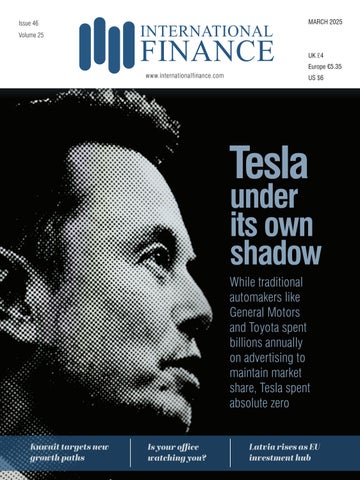
Tesla
under its own shadow While traditional automakers like General Motors and Toyota spent billions annually on advertising to maintain market share, Tesla spent absolute zero
Kuwait targets new growth paths
Is your office watching you?
Latvia rises as EU investment hub
EDITOR’S NOTE
MARCH 2025 VOLUME 25 ISSUE 46
Tesla’s future: A cause for concern
K
uwait’s economy is currently at a crucial turning point. In February, the government approved the draft budget for the 2025–2026 fiscal year, anticipating an 11% increase in the budget deficit due to slightly lower revenues compared to the previous year. Kuwait continues to grapple with reducing its dependence on oil. Following a 3.6% contraction during the recession in 2023, the GDP fell by an additional 1% in 2024. Meanwhile, former European Central Bank President Mario Draghi has cautioned that the European Union may face a “slow decline” unless significant investments and reforms are made. His remarks add to the existing concerns about the EU, which is already experiencing slow economic growth, weak productivity, and sluggish wage increases. As the first quarter of 2025 comes to a close, the finance and business sectors find themselves in a precarious situation. The discourse surrounding artificial intelligence has shifted from excitement about new tools to a greater emphasis on responsibility and reliability. Even though the generative AI market is projected to grow to $890 billion by 2032, a major issue persists: AI systems continue to produce false or misleading information. The cover story of the March 2025 edition of International Finance examines Elon Musk’s troubled public image. Once regarded as a leader capable of combating climate change through the promotion of electric vehicles, the Tesla CEO has recently faced challenges that have negatively impacted his company. His strong political opinions, missed targets, and unusual behaviour have tarnished Tesla’s reputation. The article will explore whether Musk and the electric car company can successfully turn things around.
editor@ifinancemag.com www.internationalfinance.com
INSIDE
IF MARCH 2025
22
VISIONARY CEO OR LIABILITY? TESLA’S FUTURE HANGS While traditional automakers like General Motors and Toyota spent billions annually on advertising to maintain market share, Tesla spent absolute zero
INDUSTRY
ECONOMY
INSIGHT RISES AS EU 44 LATVIA INVESTMENT HUB
32
48
TRUMP PLANS TO 'OWN' GAZA TERRITORY
WHY IS YEN TURNING HEADS NOW?
President Donald Trump has promised to build beautiful communities for the Palestinians of war-stricken Gaza
Yen's movements have been influenced by events like the Ukraine war and tensions in the AsiaPacific region
ECONOMY
BANKING AND FINANCE
54
66
EU WARNED: SLOW AGONY AHEAD
KUWAIT TARGETS NEW GROWTH PATHS
The cost of fixing Europe's problems might be high, but the penalty of doing nothing could be much higher
Kuwait is working on projects totalling $121 billion, some of which will be granted by end of 2025
4 | March 2025 | International Finance
As foreign investment grew, Latvia's active investment project volume increased
www.internationalfinance.com
ANALYSIS
Director & Publisher Sunil Bhat Editorial Prajwal Wele, Agnivesh Harshan, CL Ramakrishnan, Prabuddha Ghosh Production Merlin Cruz Technical Team Prashanth V Acharya, Bharath Kumar
12
When leaders fail the tone test
40
What awaits the Turkish economy in 2025?
62
RTP: The future of instant banking
80
The hidden AI risk no one sees
FEATURES
Business Analysts Alice Parker, Indra Kala, Stallone Edward, Jessica Smith, Harry Wilson, Susan Lee, Mark Pinto, Richard Samuel, Merl John Business Development Managers Christy John, Alex Carter, Gwen Morgan, Janet George Business Development Directors Sid Jain, Sarah Jones, Sid Nathan Head of Operations Ryan Cooper Accounts Angela Mathews
16
Gas flaring: A hidden public health threat
72
World braces for trade war
84
Starlink at heart of scam empire
90
Is your office watching you?
Registered Office INTERNATIONAL FINANCE is the trading name of INTERNATIONAL FINANCE Publications Ltd 843 Finchley Road, London, NW11 8NA Phone +44 (0) 208 123 9436 Fax +44 (0) 208 181 6550 Email info@ifinancemag.com
REGULAR EDITOR'S NOTE
03
06 08
Tesla’s future: A cause for concern
TRENDING UiPath rolls out AI Test Cloud
Press Contact editor@ifinancemag.com Associate Office Zredhi Solutions Pvt. Ltd. 5th Floor, Sai Complex, #114/1, M G Road, Bengaluru 560001 Ph: +91-80-409901144
NEWS S&P upgrades Saudi Arabia to A+ rating International Finance | March 2025 | 5
# TRENDING Asus launches ROG TUF laptop
TECHNOLOGY
UiPath rolls out AI Test Cloud Leading enterprise automation and software company UiPath recently announced the debut of UiPath Test Cloud, a ground-breaking new method of software testing that leverages cutting-edge AI to boost tester productivity throughout the testing lifecycle for remarkable efficiency and cost savings. Test Cloud enables quality assurance teams to conduct agentic testing by providing professionals with AI agents, such as UiPath Autopilot, and testing agents created with Agent Builder to collaborate with them throughout the testing process.
Asus introduced the Republic of Gamers (ROG) TUF Gaming F16 gaming laptop with Copilot key and Intel Core i5 processor 210H. It also features the RTX 3050A GPU. The TUF Gaming F16 is certified according to US MIL-STD 810H. The ROG TUF Gaming F16 has a 16-inch IPS screen with 300 nits brightness and a refresh rate of 144 Hz. It includes transparent WASD keys and a backlit chiclet keyboard with 1-Zone RGB lighting. The 2025 TUF Gaming laptop lineup has expanded with the launch of its first 18-inch model.
At Glance Top six leading thermal management companies and their market share (In Billion US Dollars)
Ahlibank holds annual meeting
Egypt eyes boost to steel sector
Ahlibank's Annual General Meeting (AGM), conducted on March 25, 2025, through the general meeting electronic platform hosted on the Muscat Clearing and Depository (MCD) website, was a success. Senior management, shareholders, and board members attended the meeting, which was presided over by Hamdan Ali Nasser Al Hinai, Chairman of Ahlibank's Board of Directors. The Board of Directors' Report on the Bank's Operations and Financial Situation for the Fiscal Year Ending December 31, 2024, was one of the main agenda items that shareholders reviewed and approved during the AGM.
Hassan El-Khatib, Minister of Investment and Foreign Trade, and Kamel Al-Wazir, Egypt's Deputy Prime Minister for Industrial Development and Minister of Industry and Transport, recently met with Ayman El-Ashry, Chairperson of Ashry Steel Group and President of the Cairo Chamber of Commerce, to discuss ways to advance Egypt's iron and steel sector. Special consideration was given to production capacities and technological developments that may soon attract new investments. The meeting followed a January 2025 Borsa News report on plans for an Egyptian-Qatari iron and steel factory.
BANKING
6 | March 2025 | International Finance
INDUSTRY
Delta Electronics
4.8
Saint-Gobain
4.5
Dow Building Solutions
3.7
Laird Thermal Systems
3.4
Owens Corning
2.8
Honeywell International
2.1
Source: Source:mordorintelligence.com Allied Market Research
NEWS | INSIGHTS | UPDATES | DATA
Ones to Watch
ECONOMY
GCC growth seen at 4% in 2025
SULTAN AL JABER CEO OF ADNOC Sultan Al Jaber emphasised the need for a balanced energy policy, promoting oil and gas sector inclusion in climate solutions and stressing the importance of affordable energy for developing countries
According to Oxford Economics' most recent ICAEW Economic Insight report, the Gulf economy is anticipated to demonstrate resilience in the face of growing global protectionism and geopolitical tensions. The economies of the Middle East are projected to grow by 4% in 2025, an increase from an estimated 1.8% in 2024. The Gulf
Cooperation Council (GCC) largely remains unaffected by the direct impacts of tariffs, despite concerns about external demand due to Donald Trump's policies. Regional PMI data is in expansionary territory, and the nonenergy sectors are expected to grow by 4% this year, up from an estimated 3.9% in 2024.
By the Numbers
TAHNOUN BIN ZAYED AL NAHYAN UAE'S NATIONAL SECURITY ADVISOR Tahnoun bin Zayed Al Nahyan joined high-level discussions in Washington, meeting President Trump on strengthening economic and technological ties, particularly AI
Revenue of shipbuilding industry worldwide from 2013 to 2022 (In Million US Dollars) 2013
2014
2015
2018
2019
2020
25
34
61
66
2021
2022
71
75
Source: Precedence Research
55 68
2016
52
2017
57
HER EXCELLENCY NOURA AL KAABI UAE MINISTER OF STATE HE Noura Al Kaabi delivered a keynote address at the 2025 Forbes 30/50 Summit in Abu Dhabi, highlighting the UAE's commitment to women's empowerment and sharing insights on inclusive leadership
International Finance | March 2025 | 7
IN THE NEWS
FINANCE
BANKING
INDUSTRY
TECHNOLOGY
Christopher Waller stated that the monetary policy outlook presented by officials during their December meeting still appears to be realistic
Bosnia and Herzegovina allows visafree entry for Kuwaiti visitors, making travel to Sarajevo easier and more convenient
Waller opposes March cut, sees rate easing later Despite his strong opposition to a rate cut at the Fed's next policy meeting this month, Federal Reserve Governor Christopher Waller stated that rate cuts later in 2025 are still possible if inflation pressures continue to decline. When discounting an easing at the Federal Open Market Committee on March 18-19, Waller said he will not have the inflation data available to determine whether lowering the current federal funds rate range of 4.25% to 4.5% is warranted, particularly in light of the significant uncertainty brought about by President Donald Trump's trade agenda. “I want to see what happens with the February inflation data. Want to see a little bit more of what happens with tariff policies,” Waller said at a Wall Street Journal event. According to the Fed official, "you can start lowering rates, I wouldn't say, at the next meeting," but at some point after that, if you believe that price pressures are moving backwards toward the target. In the long run, Waller stated that the monetary policy outlook presented by officials
8 | March 2025 | International Finance
during their December 2025 meeting still appears to be realistic. Even though the actual result may differ slightly, he said, "I don't think there's anything wrong with that kind of number," referring to estimates of two cuts this year and next. "I'm still kind of believing that the good news rate cuts are in place as the year goes on," meaning that there are easings motivated by reducing inflation pressures rather than easings intended to combat economic weakness. Waller acknowledged recent data that suggests growing weakness, but he stated that he is awaiting confirmation from more extensive government data. The financial markets are pricing in a rate cut at the June FOMC meeting, remain split over the May meeting, and currently see very little chance of a March cut. Waller's remarks align with increasing concerns about the economy as the Donald Trump Administration implements significant tariffs on the United States' largest trading partners.
Jazeera Airways to start Sarajevo flights from March 27 Jazeera Airways, Kuwait's leading lowcost airline, is thrilled to announce the resumption of direct flights between Kuwait and Sarajevo. This service offers tourists an easy and affordable getaway to one of Europe's most beautiful destinations. The direct service will increase connectivity between Kuwait and Bosnia and Herzegovina, making it an ideal place to visit during the for thcoming Eid vacation. Jazeera Airways is reaffirming its commitment to leisure travellers by reopening this route, offering more travel options at affordable prices and with excellent service. Bosnia and Herzegovina allows visafree entry for Kuwaiti visitors, making travel to Sarajevo easier and more convenient. Travelling to and from Sarajevo is now easier than ever thanks to this advantage, as well as Jazeera Airways' direct connectivity, reasonable prices, and flexible schedules. The capital city of Bosnia and Herzegovina, Sarajevo, is a city that is rich in culture, history, and scenic beauty.
Located amidst the magnificent Dinaric Alps, Sarajevo offers visitors a unique experience by fusing Eastern and Western influences. From the bustling markets and Ottomanera architecture of the charming old town of Bascarsija to the breathtaking mountain scenery, Sarajevo is a great place for adventurers, history buffs, and nature lovers. Beyond Sarajevo, Bosnia and Herzegovina is home to charming towns like Mostar, famous for the Stari Most bridge, and the serene beauty of Una National Park. Visitors will be enthralled by the charm of this undiscovered European treasure, whether they choose to explore the pristine rivers, indulge in traditional Bosnian cuisine, or take in the friendly hospitality of the nation. Krishnan Balakrishnan, Deputy CEO and CFO of Jazeera Airways, said, "With visafree entry, stunning landscapes, and rich cultural heritage, Sarajevo is an incredible destination, and we are excited to provide our passengers with an affordable and convenient way to explore it."
International Finance | March 2025 | 9
FINANCE
IN THE NEWS
BANKING
INDUSTRY
TECHNOLOGY
Deepening domestic capital markets and enhancing institutional settings and governance efficacy serve as the foundation for the upgrade
Chipper Cash will be able to receive money from all over the world around the clock by utilising Ripple’s cryptoenabled payments solution
S&P upgrades Saudi Arabia to A+ rating
Seven & i to name new CEO, revamp
Saudi Arabia's long-term sovereign credit rating was upgraded from "A" to "A+" by the international ratings agency S&P due to the country's ongoing social and economic reforms in alignment with the Vision 2030 initiative. Deepening domestic capital markets and enhancing institutional settings and governance efficacy serve as the foundation for the upgrade. Zahabia Gupta, Director and Lead Analyst for the Middle East and Central Asia at S&P, stated that institutional checks and balances have become more visible as "Vision 2030" progresses, as evidenced by the recalibration of project priorities and timelines. Strong non-oil growth momentum and expanding domestic capital markets helped the rating agency maintain a stable outlook.
In the face of a $47 billion foreign takeover bid, Seven and i Holdings, the Japanese operator of the 7-Eleven convenience store chain, is anticipated to announce a change in CEO and plans to restructure its business. According to reports, lead outside director Stephen Dacus may succeed Ryuichi Isaka as the CEO of Seven & i, marking the first time a foreign executive leads the Japanese business. Additionally, the retail giant intends to announce a share buyback of roughly two trillion yen ($13.04 billion), according to Bloomberg News. Following the news about the share buyback, stocks of Seven & i jumped up to 10%. Seven & i operates across 20 countries and regions.
Production of hydropower electricity worldwide from 2013 to 2022 (In Terawatt Hours)
2013 2014 2015 2016
4.5 4.2 4.1 4.4
2017 2018 2019 2020
10 | March 2025 | International Finance
4.9 4.6 4.7 4.3
2021 2022
4.9 5.1
Source: Statista
Ripple, Chipper unite for Africa pay
MENA sees increased M&A activity
Ripple, the top supplier of digital asset infrastructure for financial institutions, and Chipper Cash, a payments company, announced a new collaboration to facilitate cross-border payments into Africa through Ripple Payments. Chipper Cash, which has five million users in nine African countries, will be able to receive money from all over the world around the clock by utilising Ripple’s crypto-enabled payments solution. This will cut down on time and friction and significantly increase the efficiency of transferring money into Africa. Reece Merrick, Managing Director, Middle East and Africa, at Ripple, said the partnership with Chipper Cash marks a key milestone in the expansion in Africa.
According to the EY MENA M&A Insights 2024 report, there was a 3% increase in merger and acquisition (M&A) activities across the Middle East and North Africa (MENA) region, with 701 deals in 2024 compared to 679 deals in 2023. The total value of these deals stood at $92.3 billion. The Gulf Cooperation Council region was responsible for the majority of these deals, executing 580 transactions, which amounted to $90 billion. This growth can largely be attributed to significant transformations in capital markets, strategic policy modifications, and increased endeavours to attract foreign investments. Cross-border deals served as the catalyst for M&A deals in the region, accounting for 74% of the value.
Hydropower consumption worldwide from 2013 to 2022 (In Exajoules)
2013 2014
25 34
Source: Statista
2015 2016 2017 2018
55 52 57 61
2019 2020 2021 2022
66 68 71 75
International Finance | March 2025 | 11
INDUSTRY
ANALYSIS
LEADERSHIP CORPORATE
The discrepancy between leadership behaviour and company rhetoric is the risk area
When leaders fail the tone test IF CORRESPONDENT In corporate life, there is a strong emphasis on senior leadership setting the standard for the rest of the organisation to follow. The concept of "tone from the top" has a commendable idea: if the rest of the board, management, and employees observe In August 2024, the excellent behaviour set by the company's leader, everyone else Chris Ellison, in the organisation will undermanaging stand and follow their beliefs and director of example. Mineral In a similar vein, the CEO's Resources, an "positive" actions to eradicate "bad" Australian business practices and their efforts mining to advance important issues like company, complained that diversity, ethics, sustainability, and corporate governance will encourage workers who everyone else in the organisation to go out to buy view these issues similarly and act coffee, instead accordingly. of getting one Research repeatedly demonat work, are strates that CEOs and other C-suite costing the members do not set the standard company too for others to follow. This is especialmuch money ly true when you look at the many corporate governance scandals that executives are ultimately held responsible for and their huge pay packages that have nothing to do with other employees' salaries (about 200 times the average worker's pay in the United States), the company's performance, best practices, or even common sense. Furthermore, CEOs' actions don't always align with the behaviour they are supposed to promote; 12 | March 2025 | International Finance
rather, they frequently reveal attitudes that they believe are acceptable (at least to themselves) but that are at odds with the values of a progressive society. According to Robert Ordever, European managing director of workplace culture and recognition specialist OC Tanner, "Every leader sets the tone, whether they intend to or not." They establish standards for what is appropriate through their words and, more significantly, their deeds. The discrepancy between leadership behaviour and company rhetoric is the risk area.
The tower of ivory Many recent instances show how some company leaders have a terrible moral compass and/or a ridiculous lack of self-awareness. For example, despite Starbucks' claims to be a leader in sustainability, the recently appointed CEO, Brian Niccol, has come under fire after it was disclosed that he will travel nearly 1,000 miles via business aircraft from his house to the company's headquarters in Seattle. In August 2024, Chris Ellison, managing director of Mineral Resources, an Australian mining company, complained that workers who go out to buy coffee, instead of getting one at work, are costing the company too much money. During a financial results presentation, Ellison expressed his desire to "keep staff captive all day long." Bill Michael, the UK chairman of Big Four firm KPMG, was forced to resign in February 2021 after his motivational speech to staff members during a
virtual meeting went awry (and went public) after he referred to unconscious bias as "complete crap" and told them to "stop moaning" about the effects of the COVID-19 pandemic. Jes Staley, the CEO of Barclays Bank, resigned that same year after a UK financial regulator's probe turned up a cache of emails indicating he had a closer association with paedophile and notorious businessman Jeffrey Epstein than he had disclosed. A seldom applied discipline, the Financial Conduct Authority (FCA) fined him £1.8 million two years later and prohibited him from holding a senior management position in the financial services sector. When Staley attempted to expose a whistleblower who had concerns about his prior job history, the FCA had already slapped him across the knuckles. Given these instances, it's not surprising that some experts believe the concept has limitations. Diane Newell, managing director of coaching consultancy OCM Discovery, states that "the tone from the top works in practice all the time, but whether the tone that is being set in practice is the one that we might choose is a different matter." She goes on to say that it is "never going to be an exact science" to control how people perceive and comprehend the actions of executives.
Higher standards The idea of corporate and executive accountability, as well as the way that leadership is perceived, has evolved during the last ten years, which contributes to the issue. According to Piers Rake, a partner at the legal services firm Astraea, "The board and C-suite of any organisation need to recognise that expectations around conduct and culture have changed and increased." He claims that whereas shareholders, consumers, and employees were the only major corporate stakeholders in the past, broader social forces "have resulted in heightened expectations from a wider cohort of interested parties." Activist organisations, "rights holders," or individuals potentially harmed by the company's operations could be among these parties. Rake cautions, "Businesses that engage in completely lawful operations that are viewed as inconsistent or at odds with broader societal trends are more likely to face adverse or negative press." Liz Sebag-Montefiore, the director of HR consulting firm 10Eighty, asserts that staff members actively seek and expect strong, moral leadership, prioritising actions over words. "A company can talk about ethics, but if they are treating customers unfairly, gouging their suppliers, International Finance | March 2025 | 13
ANALYSIS
LEADERSHIP CORPORATE
and exploiting employees, they won't inspire a workforce committed to best practice," she said. Having said that, is it time to abandon the "tone from the top" mantra? And if so, what ought to take its place? And to whom should stakeholders and employees turn for improved leadership? According to Melissa Hewitt, head of HR outsourcing at Morson Group, a recruiting firm, others can assist executives in carrying out their responsibilities as moral leaders. Because "company culture and values are part of their remit," she thinks there is a compelling case for the HR director to be promoted to the board. However, she also thinks regulators should do more to establish clear guidelines for industry leaders. In the end, she acknowledges that commercial factors—rather than ethical ones—may be the most significant short-term influencer because Gen Z recruits, who are generally those born between 1996 and 2010, are more likely to depart if they believe the company is not meeting corporate best practice standards, leaving businesses with a skills gap that may be difficult to close.
Is there space at the summit? There is already a move away from concentrating on a core group of CEOs to define expectations around ethical leadership, according to Sarah Miller, CEO of the ethics advice firm Principia. She claims that, in part because it is such a dangerous strategy, "relying on a small group of executive leaders to shape, champion, and model the tone and tenor of a culture is increasingly the exception, not the norm." 14 | March 2025 | International Finance
Photo Credits: kevingaskell.com
INDUSTRY
"It is better to share the responsibility with more, not fewer, people in the organisation, which means relying on middle management," she adds, adding that increased scrutiny and higher expectations increase the likelihood of failure for a select few top executives. "With an understanding that it is not only the executive team that needs to consistently reinforce and apply hallmark cultural attributes, many companies are also focusing on values activation and ethical decision-making skills for the top 100 people. This can still be considered the 'top,' but in a much broader, more diffused sense than the term has tended to apply to," she said. As per Miller, this tendency is "encouraging" since it will have a far greater and more profound effect on a larger group of employees to observe how middle and/or line managers handle moral quandaries and comprehend and follow the rules daily.
"Any day, especially in larger organisations, I would prefer to have a strong 'tone in the middle,'" she said. While some may recognise that the overall tone is inconsistent and requires reevaluation, it appears that most people are willing to keep using it, primarily because there doesn't seem to be a better alternative available. Kevin Gaskell, the chairman of the fibre broadband company ITS Technology Group and a former CEO of Porsche UK, asserts that while the "tone from the top" can be beneficial in practice, its effectiveness is heavily dependent on consistency, transparency, and authenticity. He continues by saying that "it becomes difficult to imagine who else could effectively set the tone" if executives are not the greatest individuals to exhibit moral and appropriate leadership. According to him, leadership is inherently hierarchical, and the
LEADERSHIP CORPORATE
Business Leadership Statistics • Recognition: 69% of employees say they’d work harder if their leaders recognised their efforts • Performance: Companies with strong leadership are 2.3× more likely to outperform competitors financially • Disengagement: 82% of employees believe poor leadership leads to disengagement and makes them consider quitting • Reputation: 58% of people say they won’t work for a company with a bad leadership culture • Openness: Only 29% of employees say their leader is ready to embrace outside ideas and practices • Preparedness: 63% of millennials feel they aren’t receiving enough leadership training for future roles • Retention: 58% of employees say they would stay longer at a company that offers leadership growth opportunities • Diversity: Companies with gender-diverse leadership teams are 21% more likely to outperform competitors Source: eLearning Industry
attitudes and actions of the top executives in an organisation have a ripple effect on the entire workforce. "There is a leadership void where misunderstandings, inconsistent behaviour, or unethical practices can readily proliferate if executives do not exhibit the moral principles or appropriate behaviours expected of them," Gaskell continued. According to entrepreneur and executive business coach Mike Greene, even some people who think a re-examination of the "tone from the top" is required do so "not for the reasons you might think." As per him, leadership is about making difficult, frequently unpopular decisions for the good of the organisation, not about being popular. He goes on to say that the practice of giving moral leadership to inexperienced majorities or feelgood committees is "dangerously misguided." Greene said, "Executives are not just accountable, they are essential.
They possess the knowledge and power to negotiate challenging moral situations. It would be detrimental and shortsighted to lessen this obligation. It is foolish to believe that employee-led initiatives or middle management can successfully establish ethical standards.” Instead of confronting prejudices, it frequently produces echo chambers of inexperience. Greene requires "leaders unafraid of unpopularity, who understand that real-world ethics are not always clean-cut or politically correct," and feels that "tone from the top" is effective when applied "with backbone, not as a PR exercise." Greene asserts that businesses need "experienced executives who are not afraid to take charge" to maintain moral leadership under real-world pressure. Keep in mind that, despite their softness and cuddliness, sheep require a shepherd and guard dog to keep them safe from wolves. Sell ice cream if you
want to be well-liked. The idea that corporate leaders set the ethical standard for organisations has long been upheld, yet real-world evidence suggests otherwise. Many CEOs fail to embody the values they claim to champion, often prioritising financial gain over integrity. A broader cultural shift is required, where ethical leadership is embedded at all levels, particularly in middle management. Companies must integrate ethical decision-making into their organisational fabric rather than relying solely on CEOs to dictate corporate values. If executives fail to lead with integrity, their authority to set the tone crumbles. Instead of abandoning the concept entirely, businesses should expand ethical leadership beyond the C-suite, ensuring that values are upheld not just in words but in action.
International Finance | March 2025 | 15
INDUSTRY
FEATURE GAS FLARING
16 | March 2025 | International Finance
INFLAMMATION AIR POLLUTION
FEATURE GAS FLARING
Communities surrounding oil fields suffer greatly from gas flaring, the burning of excessive natural gas during oil extraction
Gas flaring: A hidden public health threat IF CORRESPONDENT
G
as flaring is the burning of natural gas that comes from oil extraction. This practice has been going on for more than 160 years. It happens for several reasons, including weak political will, poor regulation, and economic or market challenges. A valuable natural resource that could be conserved or put to better use, such as producing electricity, is wasted when it is flared and vented. For example, the 148 billion cubic metres of gas that are currently flared annually could power all of sub-Saharan Africa. According to Rystad Energy research, flaring emissions from global upstream oil and gas production increased by 7% from 2022 to 2023. While upstream activities emitted about 1 gigatonne per year of carbon dioxide (CO2) in total, flaring contributed around 30% of those emissions in 2023, assuming 98% flaring efficiency on average. "Flaring reduction is considered a low-hanging fruit for oil and gas companies trying to reduce their carbon footprint. However, this recent uptick underscores the challenges facing the industry, particularly in key producing countries such as Russia, Iran, and Iraq," the study noted.
What causes gas to flare? Despite being inefficient and harmful, flaring is still used today as a relatively safe way to dispose of the related gas from oil extraction. Using related gas frequently necessitates economically viable markets for businesses to invest in its capture, transportation, processing, and sale. For safety reasons, flaring can be necessary. Oil and gas extraction and processing involve handling extremely high and variable pressures. An explosion could result from an abrupt or significant increase in pressure during crude oil extraction. Although uncommon, oil and gas-related industrial mishaps can cause hazardous, catastrophic, and protracted fires that are challenging to contain and manage. By burning any extra gas, gas flaring enables operators to depressurise their machinery and control erratic and significant pressure fluctuations. International Finance | March 2025 | 17
INDUSTRY
FEATURE GAS FLARING
INFLAMMATION AIR POLLUTION
Technical and economic factors Oil fields are frequently found in isolated, difficult-to-reach locations. In addition to being difficult to access, these locations might not consistently yield significant quantities of usable associated gas. This can make moving related gas to a processing and use location logistically and financially difficult. If oil production sites are small and spread out over a wide area, the cost of capturing and using the accompanying gas is often considered too high, so the gas is usually flared. The local geology will occasionally permit the conservation of gas through re-injection back into the reservoir where its use is impractical. Nevertheless, even with recent technical advancements, this is not always possible. Sometimes a nation's rules and reg18 | March 2025 | International Finance
ulations may make it difficult or even prohibit businesses from commercialising associated gas, even when it is technically and economically possible to capture and use it. For instance, even when a business has obtained the rights to extract oil, it might not be able to use the gas produced during extraction. In other cases, regulations might not outline the commercial handling of related gas. As a result, there is legal uncertainty over the proper processing of related gas. Furthermore, laws that penalise businesses for flaring gas might not always succeed in stopping the practice, particularly if flaring and paying a fine is more profitable than capturing and selling the gas. To stop frequent flaring and ensure that the related gas is put to good use,
GFMR collaborates with governments to help develop appropriate laws and policies.
Effects on the environment About 148 billion cubic metres of gas were burned in 2023 by thousands of gas flares at oil-producing facilities worldwide. Each cubic metre of associated gas flared produces roughly 2.6 kilogrammes of CO2 equivalent emissions (CO2e), or more than 350 million tons of CO2e annually, assuming a "typical" composition of associated gas, a flare combustion efficiency of 98%, and a Global Warming Potential for methane of 28. According to the "Intergovernmental Panel on Climate Change," the inefficiency of flare combustion produces methane emissions, a major cause of global warm-
FEATURE GAS FLARING
Forecast natural gas flaring worldwide in 2030 by region (In Metric Tons Of Carbon Dioxide) ing that is especially potent in the short to medium term, since over 20 years methane is more than 80 times stronger than carbon dioxide as a warming gas. The yearly CO2 equivalent emissions have risen by about 80 million tonnes as a result. Naturally, flaring is completely inefficient and far easier to prevent than many other kinds of greenhouse gas (GHG) emissions. Utilising the gas could be beneficial and might even replace more polluting fuels like coal and diesel, which produce more pollutants per unit of energy. In addition to greenhouse gas emissions, gas flares can generate black carbon, also referred to as soot. Even though black carbon only stays in the atmosphere for a few days or weeks, it has a significant, if short-term, impact on the climate. It is created when fossil fuels are not completely burned. In the Arctic, where black carbon deposits are thought to accelerate the melting of snow and ice, this is particularly concerning. According to research by the "European Geosciences Union," gas flaring emissions could be responsible for almost 40% of the Arctic's yearly black carbon deposits.
The health risks Communities surrounding oil fields suffer greatly from gas flaring, the burning of excessive natural gas during oil extraction. Among the several harmful pollutants the process generates are particulate matter (PM), nitrogen oxides (NOX), sulphur dioxide (SO2), benzene, black carbon, and volatile organic compounds (VOCs). Extended exposure to these toxins has been linked to cancer, pregnancy issues, respiratory disorders, cardiovascular problems, and other major medical conditions. Gas flaring's health hazards disproportionately
Eurasia
Africa
Central & South America
Middle East
North America
Asia-Pacific
5.9 5.8
3.9 2.6
1.8
Europe
0.3
1.2
Source: Statista
affect the elderly, children, and individuals with pre-existing medical conditions, among other vulnerable populations. The aggravation of respiratory ailments is among the most immediate and obvious consequences of gas flaring. Large amounts of fine particulate matter (PM2.5), nitrogen oxides, and sulphur dioxide produced by burning natural gas all worsen air pollution and compromise lung health. Small enough to pass deep into the lungs and even into the bloodstream, PM2.5 particles cause inflammation, chronic bronchitis, and aggravation of illnesses, including asthma and chronic obstructive pulmonary disease (COPD). Studies have linked high levels of PM2.5 to higher rates of emergency room visits and hospitalisations for respiratory problems in exposed communities. A 2021 study found that hospital admissions for respiratory-related diseases rose 0.73% for every 1% rise in flaring gas emissions. Additionally, nitrogen oxides can aggravate airways, lower lung capacity, and increase the risk of respiratory infections. Furthermore, contaminants released during gas flaring greatly compromise cardiovascular health. Specifically, fine particulate matter has been associated with stroke, hypertension, and heart disease. These particles aggravate oxidative stress and systemic inflammation when inhaled, which can damage blood vessels and raise the risk of clot development. Long-term gas flaring-
related air pollution exposure raises the risk of heart failure, arrhythmias, and heart attacks. Sulphur dioxide, another pollutant produced during gas flaring, is known to have immediate cardiovascular effects, especially in those with pre-existing heart diseases. Studies have indicated that rises in SO2 levels correspond with increases in hospital admissions for heart attacks and strokes. Additionally, benzene and other VOCs help form ground-level ozone, which has been linked to higher blood pressure and other cardiovascular symptoms. Extended exposure to carcinogens, including benzene, toluene, ethylbenzene, and xylene (BTEX chemicals), increases the risk of cancer in communities near gas flaring sites. Particularly, benzene is a well-documented carcinogen directly linked to leukaemia and other blood diseases. For instance, Basra, Iraq, where significant gas flaring occurs, has seen a sharp increase in cancer rates. The area recorded a 20% rise in cancer diagnoses between 2015 and 2018, a trend attributed to extended exposure to benzene and other harmful pollutants. Similarly, research conducted in the Niger Delta, one of the most severely impacted areas worldwide, has revealed increased leukaemia and other cancer rates in areas close to oil drilling facilities. Another class of carcinogens generated during gas flaring, polycyclic aromatic hydrocarbons (PAHs), can International Finance | March 2025 | 19
INDUSTRY
FEATURE GAS FLARING
INFLAMMATION AIR POLLUTION
attach to DNA and induce mutations, causing cancer. By either direct inhalation or skin absorption, these toxins raise the likelihood of lung, liver, and other organ malignancies. Adverse birth outcomes are far more likely for pregnant women living near gas flaring sites. Studies have connected low birth weights, preterm births, and birth abnormalities to air pollution from flaring. Pollutants such as VOCs and fine particulate matter can cause placental inflammation, disrupting fetal development and raising the risk of pregnancy problems. Pregnant women living within three miles of oil and gas flaring facilities had a 50% higher risk of delivering prematurely, according to a study in Texas, than those living further away. Furthermore, benzene exposure is linked to a higher risk of stillbirths, spontaneous abortions, and developmental abnormalities in children. Beyond pregnancy problems, gas flaring pollutants can also affect reproductive health. Heavy metals and endocrine-disrupting agents released during flaring can interfere with hormone production, leading to irregular periods, lower fertility, and a higher risk of miscarriages. New studies point to strong neurological and cognitive consequences from gas flaring-related air pollution. Children with neurodevelopmental disorders, including lower IQ levels, attention deficit hyperactivity disorder (ADHD), and autism spectrum disorders, have been linked to prolonged exposure to hazardous substances, including benzene, lead, and other heavy metals. High levels of air pollution from flaring have been linked to cognitive decline, increased risk of neurological disorders, including Alzheimer's and Parkinson's, and higher rates of depression and anxiety among adults. 20 | March 2025 | International Finance
Long-term cognitive and emotional problems can result from brain cell damage and impaired neurotransmitter activity caused by toxins. Additionally, gas flaring emissions aggravate dermatological and ophthalmological problems. Skin irritation, rashes, and allergic reactions can result from sulphur oxides and other acidic pollutants. Fine particulates, such as black carbon, can severely irritate the eyes, induce redness, and increase susceptibility to infections. Prolonged exposure might worsen chronic skin disorders, including psoriasis and eczema. Although gas flaring poses hazards to all exposed populations, some groups are more sensitive than others. Children's lungs and immune systems are still developing; hence, they are more vulnerable to neurodevelopmental problems, asthma, and respiratory infections. Elderly populations, especially those with prior heart or lung conditions, have a higher risk of hospitalisation and early death due to air pollution. Low-income neighbourhoods suffer most from gas flaring-related health issues, as they often lack access to sufficient healthcare and live near oil drilling sites. Stricter regulations and enforcement of policies to reduce emissions are urgently needed due to the significant health risks associated with gas flaring. While oil firms could invest in greener methods to capture and use related gas rather than flaring it, governments must enforce strict air quality standards. Reducing the impact of gas flaring on sensitive populations also depends on public health campaigns, medical monitoring of affected communities, and improved healthcare access. Moreover, international initiatives like the World Bank's "Zero Routine Flaring by 2030" project must be
reinforced to ensure that oil-producing countries commit to ending routine flaring. Inaction has severe health consequences, so immediate intervention is required to safeguard the well-being of millions of people globally. The health hazards of gas flaring are severe and diverse, affecting respiratory, cardiovascular, reproductive, neurological, and dermatological health. Communities living near flaring sites suffer disproportionately, with higher rates of cancer, birth problems, and chronic illnesses. Scientific evidence is clear: gas flaring is a public health risk that requires prompt and sustained action from governments, businesses, and international agencies. Reducing flaring and transitioning to greener energy sources can significantly improve global public health and environmental sustainability.
Finding redressals Oil producers have the option of using associated gas productively or re-injecting it. The cost of stopping all routine flaring could exceed $100 billion, and operators frequently face significant challenges in capturing, treating, storing, transporting, and commercialising related gas. Reaching economies of scale is crucial to the conventional method of using flare gas, which involves gathering related gas and transferring it via pipeline. To be profitable, operators typically need to collect significant amounts of associated gas from multiple flare sites, preferably close together, and then build the infrastructure required to market the gas—for example, to produce electricity and expand energy access. However, there are several approaches to addressing routine gas flaring. Governments can implement efficient laws and policies to promote
FEATURE GAS FLARING
and incentivise reductions in gas flaring in the interim. The potential for associated gas use has also increased significantly in recent years due to advancements in smallscale gas utilisation technologies. Not all of these technologies are cost-effective, and many depend on fuel prices and endproduct values. Although costly to install, integrated compressed natural gas systems, truckmounted liquefied natural gas plants, and small power generation units are often good alternatives to flaring. Positively, the amount of associated gas flared has dropped by 11% since 1996, despite an approximate 28% rise in oil production. The growing decoupling of the historical link between oil production and gas flaring indicates progress in the oil industry. Many oil field operators who flare associated gas are investing in ways to reduce flaring. Numerous companies
have also committed to ending routine flaring. The Zero Routine Flaring by 2030 (ZRF) initiative, launched in 2015 by the World Bank and the UN SecretaryGeneral, commits governments and oil companies to ending routine flaring of gas in existing legacy flaring operations as soon as possible and no later than 2030. Gas flaring represents a profound and ongo ing environmental and public health challenge, squandering valuable natural resources while contributing significantly to greenhouse gas emissions, air pollution, and climate change. The practice imperils vulnerable populations, exacerbating respiratory, cardiovascular, neurological, reproductive, and dermatological health outcomes, particularly among children, the elderly, and low-income communities. Although technical, economic, and regulatory obstacles complicate the full
utilisation of associated gas, innovative solutions, policy interventions, and small-scale technologies demonstrate that substantial reductions are achievable. Global initiatives like the "Zero Routine Flaring by 2030" project highlight the path forward, highlighting the urgent need for coordinated action. Mitigating gas flaring is a critical step toward safeguarding human health and ensuring sustainable energy futures worldwide.
International Finance | March 2025 | 21
COVER STORY INDUSTRY
Visionary CEO or liability?
Tesla’s future hangs
22 | March 2025 | International Finance
IF CORRESPONDENT
E
lon Musk’s persona and public perception have metamorphosed significantly in the past decade. Remember when he first exploded onto the scene in YouTube videos and talk show interviews? He was seen as a visionary who was going to save the world from climate change through radical new technology that would electrify automobiles and steer them away from carbon-heavy fossil fuels.
International Finance | March 2025 | 23
INDUSTRY
COVER STORY TESLA
ELON MUSK AUTOMAKERS
He was a little quirky, but America was used to eccentric, ingenious inventor-CEOs like Steve Jobs. Musk was seen as a hero of capitalism, welcomed with applause and given a prominent seat at the table of public discourse. Perhaps his charged opinions, fantastical futurism, and idiosyncrasies won the hearts of millions initially. But those same polarising opinions, unfulfilled promises, and outlandish behaviours are getting him (or more accurately, the company he built) into terrible trouble. Without Elon Musk, there would be no Tesla. He poured his PayPal fortune into the struggling startup, a gamble that paid off splendidly. For the longest time, his cars were symbols of environmentalism, prestige, and tech-savviness. If he had just remained the focused CEO of Tesla, it could have been one of the greatest companies of all time. However, Musk is no longer the man sleeping on the factory floor of his high-tech automobile corporation. He is distracted by politics, petty feuds, and a dozen other ventures like Neuralink, Starlink, SpaceX, and The Boring Company. 24 | March 2025 | International Finance
He became deeply embroiled in politics through his purchase of the micro-blogging platform Twitter (now X) and his platforming of Donald Trump. As time went by, Musk shifted from a liberal to a libertarian, eventually patronising right-wing hardliners, including those who deny the very climate change Tesla claims to solve. There are even accusations that he did a Nazi salute. International Finance will examine how Elon Musk’s behaviour is quantifying into a "Musk Discount," eroding brand trust, accelerating the partisan divide in sales, and leaving the company vulnerable to stagnation while its CEO fights political battles elsewhere.
The rise of a visionary To understand the sheer magnitude of the reputational collapse and the financial "discount" currently weighing on Tesla’s valuation, one must first painstakingly reconstruct the extraordinary "Musk Premium" that characterised the company’s ascent. For nearly fifteen years, Elon Musk was more
COVER STORY TESLA
Musk’s willingness to pour his personal fortune into Tesla (and SpaceX) when both teetered on the brink of bankruptcy in 2008 forged the initial layer of the "Iron Man" mythos
than a CEO; he was the singular asset upon which the entire valuation of the enterprise rested. In the early 2010s, the automotive industry was defined by insurmountable barriers to entry. It was a graveyard of failed startups, a capital-intensive sector where margins were razor-thin, and brand loyalty was entrenched over decades. Into this rigid ecosystem stepped Musk, fresh from his PayPal exit, with a proposition that seemed economically suicidal. He suggested developing a luxury electric sports car to finance the production of a mass-market sedan. The early narrative was one of existential heroism. Musk’s willingness to pour his personal fortune into Tesla (and SpaceX) when both teetered on the brink of bankruptcy in 2008 forged the initial layer of the "Iron Man" mythos. This was a technocratic saviour utilising capitalism to solve the climate crisis. By positioning himself as the protagonist in a battle for the planet's future, Musk imbued Tesla products with a profound moral imperative. You did not merely purchase a Model S in 2013; it was also a symbolic vote for a sustainable future and a rejection of the "big oil" status quo.
This narrative construction created a formidable, intangible economic moat. While traditional automakers like General Motors and Toyota spent billions annually on advertising to maintain market share, Tesla spent absolute zero. The CEO’s X account served as a global broadcasting tower, where updates on software, manufacturing targets, and rocket launches captivated an audience that far transcended the typical car-buying demographic. This "halo effect" allowed Tesla to command premium pricing and maintain high stock valuations despite fundamentally weaker financials than its legacy competitors. The strength of this bond is visible in historical consumer data. For a sustained period between 2013 and 2020, Tesla topped Consumer Reports owner satisfaction surveys with consistency that defied statistical norms. In 2020, even as the company struggled with initial quality control issues on the Model Y, it secured the top spot for the fourth consecutive year. The satisfaction scores frequently hit 99%, a figure that indicated owners were judging the vehicle not by the panel gaps or paint quality, but by the ideological affinity they felt for the mission and the man leading it. The financial apotheosis of this visionary status was reached during the bull run of 2020-2021. As Tesla finally conquered the "production hell" of the Model 3 ramp-up (a period where Musk famously slept on the factory floor at Giga Nevada), the market stopped pricing Tesla as a car company and began pricing it as a high-growth technology platform, akin to a software monopoly. The inclusion of Tesla in the S&P 500 in December 2020 served as the ultimate institutional validation. It was the largest company ever added to the index by market capitalisation, entering with a weight that International Finance | March 2025 | 25
INDUSTRY
COVER STORY TESLA
ELON MUSK AUTOMAKERS
26 | March 2025 | International Finance
COVER STORY TESLA
Tesla’s annual revenue from 2015 to 2024 (In Billion US Dollars)
2015
2020
2016
2021
2017
2022
2018
2023
4.05 7.00 11.76 21.46 2019
24.58
31.54 53.82 81.46 96.77 2024
97.69
Source: Macrotrends
forced index funds to buy billions of dollars’ worth of shares, driving the price even higher. At the time of this inclusion, Tesla was trading at over 120 times earnings. By comparison, traditional automakers like Ford or Volkswagen traded at single-digit price-toearnings ratios. This delta, the difference between 8x earnings and 120x earnings, was the "Musk Premium." It was the price investors were willing to pay for the optionality of Musk’s brain and the belief that he would solve full autonomy, robotics, and energy storage, creating trillions in value where others saw only steel and rubber. Between 2010 and 2021, Tesla's stock performance generated generational wealth for retail investors. The company’s market capitalisation eventually surpassed the combined value of the next nine largest automakers. This phenomenon cemented a base of retail shareholders (often referred to as "Tesla Stans"), who viewed Musk not just as a competent manager but as an infallible oracle. However, the foundation of this valuation was implicitly and explicitly tied to the CEO's singular focus. Tesla’s own 10-K filings contained "Key Man" risk disclosures that were far from boilerplate. They
were a literal admission of corporate fragility with statements like "We are highly dependent on the services of Elon Musk, Techno King of Tesla and our Chief Executive Officer... Without his relentless drive and uncompromising standards, there would be no Tesla." As long as that "relentless drive" was directed at expanding the Supercharger network, improving battery energy density, and refining manufacturing processes, the market was willing to overlook missed deadlines, aggressive tweets, and eccentric behaviour. The eccentricities were seen as features of his genius, not bugs in his leadership.
The cost of madness The transition from "visionary" to "liability" was not a singular event but a cascading series of reputational fractures that accelerated dramatically between late 2022 and early 2025. The purchase of Twitter (rebranded as X) marked a distinct inflexion point. It was the moment Musk’s public output shifted from engineering optimism, the vision of sending rockets to Mars and creating electric tunnels and neural interfaces, to a relentless stream of partisan combat, cultural grievances, and conspiracy theories. The most critical strategic error in Musk’s recent pivot has been the systematic alienation of Tesla’s primary demographic. Historically, the early adopters of electric vehicles (EVs) have skewed heavily Democratic, liberal, and environmentally conscious. These were the consumers willing to pay a premium for a "green" product. By aligning himself with right-wing hardliners, amplifying climate change sceptics, and engaging in "anti-woke" crusades, Musk placed Tesla in an untenable commercial position. It is now a company selling a solution to climate change run by a man actively supporting politicians who mock its existence. A landmark study by economists from Yale University and the National Bureau of Economic Research (NBER), released in early 2025, provided devastating empirical evidence of this phenomenon. Analysing vehicle registration data matched with voter registration records across the United States from October 2022 through early 2025, the researchers identified a massive, statistically International Finance | March 2025 | 27
INDUSTRY
COVER STORY TESLA
ELON MUSK AUTOMAKERS
Over the 12 months leading into early 2025, Tesla significantly underperformed the S&P 500. While the index grew by approximately 12%, Tesla delivered negative returns, dropping 1% over the same period and down nearly 40% from its late 2024 peak by March 2025 significant "Musk Partisan Effect.” The study found an estimated 1.0 to 1.26 million lost vehicle sales (tens of billions of dollars in lost revenue) between October 2022 and early 2025. This decline was most severe in strongly Democratic counties, where sales plummeted by an astonishing 67% to 83% compared to expected trends, simultaneously providing a 17% to 22% sales increase to competitors like Rivian, Ford, and Hyundai. The study posits that without this alienation of his core customer base, Tesla’s sales in the first quarter of 2025 could have been approximately 125% higher than actual figures. Republican interest in EVs remains structurally low due to ideological opposition to the technology itself, while Democratic interest in Tesla specifically has collapsed. The buyers haven't stopped wanting electric cars; instead, they have stopped wanting Musk's electric cars. They are migrating to "antiMusk" alternatives. The study notes that this effect "showed no indication of slowing down" and had actually increased in intensity by the first quarter of 2025. The damage to the brand's intangible value mirrors the devastating sales data. In the early 2020s, Tesla enjoyed a reputation as the gold standard in corporate innovation, akin to the iPhone in 2010. By 2024 and early 2025, brand sentiment trackers painted a bleak picture of a brand in freefall. Data from YouGov and other reputation indices highlight this precipitous drop. Tesla’s "Buzz score" (a metric that tracks whether consumers are hearing positive or negative news about a brand) remained consistently negative throughout 2023 and 2024, averaging -7.1. This indicates that the dominant conversation around the brand was negative for two straight years. More alarmingly, in broader reputation polls, Tesla’s ranking plummeted from a top-tier status (sixth) to near the bottom of the list (95th). This 28 | March 2025 | International Finance
erosion is inextricably linked to the CEO's personal approval ratings. Pew Research Centre data from early 2025 indicates that 54% of American adults now hold an unfavourable view of Musk. If the partisan alienation was a slow bleed, the events of January 20, 2025, served as a traumatic arterial wound for the brand. Following the inauguration of Donald Trump, Musk, who had been tapped to lead a new "Department of Government Efficiency," addressed a crowd of supporters at the Capital One Arena in Washington, DC. During this speech, celebrating what he called "no ordinary victory," Musk performed a gesture that was widely interpreted as a Nazi salute. The reaction was immediate, visceral, and global. The optical damage to Tesla was catastrophic. For a brand that relies on coastal urban professionals, a demographic sensitive to social justice and historical sensitivity, the image of their CEO performing a gesture associated with the Third Reich was a breaking point. It cemented the "Musk Discount" as a moral penalty. Driving a Tesla was becoming a social stigma. The "Musk Discount" is visible in the sharp divergence between Tesla’s stock performance and the broader market. While the S&P 500 and other tech giants surged on the back of the AI boom in 2024, Tesla’s stock languished, decoupling from the "Magnificent Seven" tech cohort. Over the 12 months leading into early 2025, Tesla significantly underperformed the S&P 500. While the index grew by approximately 12%, Tesla delivered negative returns, dropping 1% over the same period and down nearly 40% from its late 2024 peak by March 2025. By January 2025, the "political noise" was no longer treated as a sideshow by Wall Street but as a fundamental risk factor. Morgan Stanley, historically one of the most bullish firms on Tesla, downgraded the stock to "equal-weight" and cut-price targets, explicitly citing "volatile behaviour" and the distraction of the CEO as primary risks to earnings. Analysts noted that the "political noise" had begun to overshadow the fundamentals. In 2024, for the first time in its history as a massmarket manufacturer, Tesla saw a decline in annual sales in the United States and failed to meet its global
COVER STORY TESLA
growth targets. The company sold approximately 1.79 million vehicles, while the broader electric vehicle market continued to grow.
Innovation has been the cornerstone of Rawabi’s visionary strategy and one that drives our success and leadership within the integrated energy sector.
The contingency As the liability of Musk’s leadership grows, the question of corporate governance and succession has moved to the forefront of institutional investor concerns. The lack of a clear contingency plan represents a critical failure of the board of directors, which has been accused of being "captive" to the CEO and derelict in its duty to protect shareholder value from his personal whims. The extent of the board's subservience to Musk was laid bare in a landmark legal ruling that reverberated through 2024 and early 2025. In the case of Tornetta vs Musk, Delaware Chancery Court Chancellor Kathaleen McCormick struck down Musk’s massive 2018 compensation package (valued at over $55 billion), ruling that the process to approve it was deeply flawed and legally invalid. Tesla functions as a monarchy. The board's subsequent attempts to reinstate the pay package through new shareholder votes in 2024 and 2025, rather than negotiating a new, reasonable deal, only deepened the conflict between institutional investors concerned with governance and retail investors loyal to Musk. Despite "Key Man" risk being the most significant threat to Tesla’s valuation, the company has stubbornly refused to publish a formal succession plan. Shareholder proposals demanding a "Key Person Risk" report have been repeatedly voted down by the board, which argues that such disclosures would put the company at a competitive disadvantage. However, the urgency of this issue, amplified by Musk’s distraction with X, SpaceX, xAI, and politics, has forced internal movements that hint at a shadow succession strategy. The most prominent figure to emerge as a potential stabilising force is Tom Zhu (Zhu Xiaotong). Zhu gained fame within the company for orchestrating the "production miracle" at “Giga Shanghai,” where he implemented the "China Speed" ethos, characterised by extremely efficient, 24/7 operational intensity. Under his leadership, “Giga Shanghai” became
Tesla’s most efficient export hub, accounting for half of global deliveries in 2022. Another key player is Omead Afshar, a long-time Musk confidant often referred to as the "fixer" in the office of the CEO. Reports in late 2024 and early 2025 placed him in critical roles overseeing operations in North America and Europe, stepping in to manage sales as inventory piled up. Afshar is viewed as an executor of Musk’s will, a bridge between the chaotic vision of the CEO and the operational reality of the company.
Elon the indispensable While the "liability" argument is supported by robust International Finance | March 2025 | 29
INDUSTRY
COVER STORY TESLA
ELON MUSK AUTOMAKERS
30 | March 2025 | International Finance
COVER STORY TESLA
sales and brand data, any honest analysis must contend with the formidable counter-argument, i.e. Elon Musk is not merely a manager. To fire him, or to marginalise him, risks turning Tesla into "just another car company," stripping it of the innovation premium that justifies its stock price. His "madness" is inextricably linked to the method that produced the company's greatest breakthroughs. Musk’s value to Tesla is most tangible in the engineering trenches. His management style, characterised by "first principles" thinking (boiling things down to the fundamental truths of physics and economics), has led to breakthroughs that traditional OEMs deemed impossible or unwise. He refuses to accept "reasoning by analogy" (doing things because others do them), instead demanding to know the atomic cost of materials and the theoretical limits of physics. Take, for example, the development of the Cybertruck provides a case study in both the madness and the genius of Musk’s method. In the design phase, Musk rejected traditional aluminium body-on-frame designs, which have been the standard for pickup trucks for nearly a century. Instead, he insisted on using an ultra-hard 30X cold-rolled stainless-steel exoskeleton. At the same time, Musk had decided to pivot the Starship rocket design from carbon fibre to stainless steel to reduce costs and improve thermal durability. He forced this same material science onto the Cybertruck team, demanding they use an alloy so hard it would break traditional stamping presses. This decision caused immense manufacturing headaches, requiring the invention of entirely new manufacturing techniques and contributing to years of delays. The steel was so hard it could not be painted or stamped into curves, dictating the truck's polarising "origami" aesthetic. While some might say the design is ugly, the result is a vehicle that is bulletresistant and dent-proof. The mobile fortress is the safest thing on the road and stands as a physical totem of his refusal to compromise vision for convenience. The dilemma for investors is that the same psychological traits that led to the "Nazi salute" controversy (impulsiveness, lack of filter, extreme risk tolerance) are the same traits that led to the
reusable rocket and the electric car revolution. You cannot have the stainless-steel truck without the chaotic personality that drives it. Furthermore, Tesla’s recruitment strategy relies heavily on the allure of working for Musk. Top engineers in AI and robotics join Tesla not just for the stock options, but to work with the man who is trying to colonise Mars. The 10-K disclosure admits that the company competes for talent based on this "visionary" allure. Removing him could trigger a brain drain of the most critical technical talent, leaving the company as a hollow shell of its former innovative self.
The future of Tesla The automaker is no longer a pioneer and has been sidelined by BYD in sales and technology. With Musk’s public relationship with climate change deniers, even the liberals are distancing themselves from him and his products. The board needs to act fast and figure out if they should wait for an implosion or professionalise Tesla into a mature corporation with clear succession plans (potentially elevating leaders like Tom Zhu). While Musk’s "first principles" thinking remains essential for breakthroughs in AI and robotics (Optimus, FSD), investors must weigh whether this engineering value still outweighs the "Musk Discount." The company’s valuation depends on whether Wall Street continues to treat it as a tech monopoly or re-rates it as a distressed auto manufacturer. Tesla’s future is no longer guaranteed. If the "political noise" continues to drown out product fundamentals, the company risks stagnation, surviving as a niche, volatile tech holding rather than becoming the mass-market, global titan it was promised to be.
International Finance | March 2025 | 31
INDUSTRY
FEATURE DONALD TRUMP
REAL ESTATE GAZA
Trump plans to 'own' Gaza territory
FEATURE DONALD TRUMP
Trump has promised to build beautiful communities for the Palestinians of Gaza
IF CORRESPONDENT
U
nited States President Donald Trump, on February 26, through his Truth Social account, shared an AI-generated post-war utopian reality for the Gaza Strip, where the city, apart from being home to skyscrapers, has huge golden statues of the Republican, with the latter's entrepreneur aide Elon Musk walking amid showers of cash. Meanwhile, the region is currently lying in ruins and reeling from the aftershock of a war involving Israel and Hamas, which has not fully ended yet. Trump now sees Gaza as "Trump Gaza," with a song preaching: "Donald is coming to set you free, bringing the light for all to see. No more tunnels, no more fear, Trump Gaza is finally here." The AI-generated video, which shows a post-war transformation of the territory along the lines of modern-day Dubai, arrived amid the ongoing three-phase ceasefire deal between Israel and Hamas, which has resulted in the exchange of prisoners and hostages between the two sides. A 15-month-long war pounded Gaza severely, as over 48,000 people have reportedly died. Israel, on the other hand, lost over 1,200 people during the attack by Hamas on October 7, 2023, which triggered the war.
What is Trump up to? Immediately after taking over the administrative reins in January 2025, Trump presented his vision for rebuilding Gaza, under which some two million Palestinians would be resettled in neighbouring countries. "No, they wouldn't, because they're going to have much better housing. I'm talking about building a permanent place for them," he told Fox News in February. Then came another clip of the interview, where the Republican stated he was "committed to buying and owning Gaza." While Trump's proposal invited backlash from all over the world, the Palestinian Authority and Hamas reiterated that Palestinian land was "not for sale." However, Israeli Prime Minister Benjamin Netanyahu praised Trump's proposal as "revolutionary and creative." The United Nations (UN) has also warned that any forced displacement of civilians from occupied territory is strictly prohibited under International Finance | March 2025 | 33
INDUSTRY
FEATURE DONALD TRUMP
REAL ESTATE GAZA
international law and is "tantamount to ethnic cleansing." Talking about Gaza's situation, there is a ceasefire in place, as part of which Hamas has already released some of the Israeli hostages it was holding in exchange for Palestinian prisoners in Israeli jails. Most of Gaza's population has also been displaced multiple times. Almost 70% of buildings are estimated to be damaged or destroyed, the healthcare, water, sanitation, and hygiene systems have collapsed, and there are shortages of food, fuel, medicine, and shelter. Trump, on his part, has promised to build "beautiful communities" for the Palestinians of Gaza. "Could be five, six, could be two. But 34 | March 2025 | International Finance
we'll build safe communities, a little bit away from where they are, where all of this danger is. In the meantime, I would own this. Think of it as a real estate development for the future. It would be a beautiful piece of land. No big money spent," he added. Trump believes that the Palestinians would have no right of return to Gaza because their lives would be "much better" elsewhere, contradicting Secretary of State Marco Rubio and White House Press Secretary Karoline Leavitt, who told reporters the relocations would be temporary during reconstruction. Egypt and Jordan's leaders have rejected both Trump's plan and his previous requests to
take in refugees from Gaza. However, Trump further doubled down on his takeover plan. "I'm committed to buying and owning Gaza. As far as us rebuilding it, we may give it to other states in the Middle East to build sections of it. Other people may do it through our auspices. But we're committed to owning it, taking it, and making sure that Hamas doesn't move back," he told reporters on board "Air Force One," without explaining who he would buy the territory from or how the US would own it. In what seems to be an outrageous statement, Trump said people from all over the world would be able to move to Gaza and that Palestinians would not want to go back there. However, the proposal found support from Netanyahu, who stated, "For a full year, we have been told that on the 'day after,' the PLO (Palestine Liberation Organisation), the Palestinian Authority, needs to be in the Strip. President Trump came with a completely different vision, much better for the 'State of Israel,' a revolutionary and creative vision, which we are discussing. He is very determined to carry it out. This also opens many possibilities before us." Palestinians now fear a repeat of the Nakba, or "catastrophe," when hundreds of thousands fled or were driven from their homes before and during the war that followed the creation of the "State of Israel," in 1948. Many of those refugees ended up in Gaza, where they and their descendants now make up threequarters of the population. Another 900,000 registered refugees also live in the West Bank, which Israel occupied in the 1967 Middle East war, along with Gaza, while 3.4 million others live in Jordan, Syria, and Lebanon, according
FEATURE DONALD TRUMP
West Bank and Gaza national debt relative to GDP from 2014 to 2023 (In Percentage) to the United Nations. In fact, one of the bones of contention between Palestine and Israel has been the right of those refugees to return. Israel unilaterally withdrew its troops and settlers from Gaza in 2005, though it retained control of its shared border, airspace, and shoreline, giving it effective control of the movement of people and goods. The UN still regards Gaza as Israeli-occupied territory because of the level of control Israel has. In fact, Trump's plan drew severe criticism from Europe too, with former German Chancellor Olaf Scholz terming the proposal a "scandal." Egypt's reaction has been similar, while Saudi Arabia also appreciated the "condemnation, disapproval and total rejection announced by the brotherly countries towards what Benjamin Netanyahu stated regarding the displacement of the Palestinian people from their land." Realising the heat his comments generated, especially the angry responses coming from the Arab world, Trump has now asserted that his plan was only a 'recommendation' and not an 'enforcement.' Speaking to Fox News, Trump reiterated his belief that his plan was the "best approach" to resolve the situation in West Asia. "I'll tell you the way to do it is my plan. I think that's the plan that really works. But I'm not forcing it. I'm just going to sit back and recommend it. And then the US would own the site, there'd be no Hamas. And they'd be developed, and you'd start all over again with a clean slate," Trump said. To cut a long story short: Trump's "request" for Jordan and Egypt, both of which have peace agreements with Israel, to accept Palestinian refugees from Gaza, did not find any buyer. While the Republican justified his
2014
33.95%
2019
34.47%
2015
2020
2016
2021
2017
2022
2018
2023
37.07% 31.03% 31.79% 33.15%
47.08% 50.18% 47.12% 48.50%
Source: Statista
position by pointing to the significant aid the United States provides to these countries, the only face-saver for him came from Jordan, which agreed to take in 2,000 sick children. However, Trump, staying true to his unpredictable nature, has continued to promote his "Gaza Vision," with this statement: "It's really essentially levelled now; you don't have too much to do other than remove debris. That place is not livable. And if you gave people the choice between that and living in a nice community, I think I know where they'd go. But we'll see what happens," Trump said in his interview about Gaza. He didn't stop there but went ahead and questioned Israel's 2005 decision to unilaterally withdraw from Gaza, removing settlements and military presence while transferring control to the Palestinian Authority. Now the question arises: what kind of stakes does Trump have in the Gaza conflict? We will try to answer it below.
Maybe a good property hotspot The Republicans' vision for rebuilding Gaza, apart from resettling two million Palestinians in neighbouring countries, actually revived an idea previously touted by both him and his son-in-law, Jared Kushner. Pay attention to this statement from Trump: "We have an opportunity to do something that could be phenomenal. And I don't want to be cute. I don't want to be a wise guy. But the 'Riviera of the Middle East,' this could be something that could be so, this could be so magnificent." The statement echoed sentiments expressed by Kushner in an interview at Harvard University in February 2024, when he said Gaza's waterfront property could be "very valuable if people would focus on building up livelihoods." He further added that from Israel's perspective, he would do his best to "move the people out and then clean it up." However, as outrageous as the two statements sound, the fact here is that for Trump and his family, the Middle East is as much a business interest as anything else. The region has become a growing focus for The Trump Organisation (the real estate and hospitality conglomerate currently run by Trump's sons Eric and Donald Junior). The Trump Organisation has entered into several agreements with Saudi Arabian real estate company Dar Global, the international arm of Saudi Arabia's "Dar Al Arkan Real Estate Development Company." Then we have a luxury Trump-branded hotel and golf resort in Oman, which is currently in its development phase. The Trump Organisation and Dar Global have announced plans for two Trump International Finance | March 2025 | 35
INDUSTRY
FEATURE DONALD TRUMP
REAL ESTATE GAZA
Tower projects in Jeddah, Saudi Arabia, and Dubai, United Arab Emirates. "Trump already owns a golf club in Dubai, which was opened in 2017. The Dubai golf club was built in partnership with DAMAC Properties, run by Hussain Sajwani. In January 2025, Sajwani appeared alongside Trump at a press conference where it was announced that DAMAC would invest 'at least' $20 billion (€19.39 billion) to build new data centres across the US. The new agreements in Oman, Jeddah, and Dubai will see The Trump Organisation design, manage, and brand the towers and the luxury resort. The deals are primarily about branding rather than ownership, earning the family millions in exchange for using their name," reported DW.com. Trump and his relatives have been quite vocal about the Middle East's growing relevance to their business interests. Take, for example, Eric Trump's statement to the British financial newspaper Financial Times, in which he stated, "We will definitely be doing other projects in this region. This region has explosive growth, and that's not stopping anytime soon." As well as the Dar Global goals, the "Trump Organisation" has also collaborated closely with "LIV Golf," one of the much-vaunted sports investments in Saudi Arabia. The Trump Organisation owns many golf courses around the world and has been paid by LIV to host several tournaments at its venues in the United States. Kushner's own private equity firm, "Affinity Partners," has built up close ties with Saudi Arabia and its sovereign wealth fund, known as the Public Investment Fund (PIF). The PIF, on its part, has invested $2 billion in Affinity. Several other major Gulf investors have also poured money 36 | March 2025 | International Finance
into Kushner's project, including the "Qatar Investment Authority" and the Abu Dhabi-based asset manager Lunate. Kushner also has substantial investments in Israel, particularly the insurance company "Phoenix Holdings" and the "Shlomo Group." Despite the world having severe reservations over the United States' "Gaza Reconstruction" agenda, Washington is going ahead with the plan, as it eyes convening a summit with regional real estate developers to discuss its plans. As per the US Middle East envoy Steve Witkoff, "We're going to conduct a summit pretty soon with probably the biggest developers in the Middle East region, many of the Arab developers, lots of master planners. I think when people see some of the ideas that come from this, they're going to be amazed." And yes, the plan is likely to face pressure from the Arab world, with the key players in this part of the world ramping up their efforts to put together a rival reconstruction plan that will ward off potential American intervention in the conflict. Egypt is engaging with European and Arab countries to put together a "comprehensive vision" for the Palestinian territory, which could receive up to $20 billion in funding from Arab states. Regional leaders also gathered in Cairo on 4th March for an emergency "Arab League Summit," shedding more light on the plan. Despite assuaging concerns around the displacement of Palestinians from Gaza, Witkoff said, "We’re not talking about an eviction, but that it would not be possible for residents to remain while the enclave is being rebuilt. It has nothing to do with relocation… right now, it's a long-term redevelopment plan. Once the Saudis, the UAE, and Egyptians reincorporate that into their
thinking, you'll see plans more aligned with the President's." Witkoff, a major real estate investor, was Trump's primary negotiator in the Middle East conflict. He also played a key role in securing the ceasefire agreement between Hamas and Israel in January 2025. Witkoff and Kushner reportedly held discussions about bringing real estate executives on board to reconstruct Gaza. So, things are becoming clear here: Trump's "Gaza Reconstruction" plan looks more transactional in nature (readers can consider it a big-ticket real
FEATURE DONALD TRUMP
estate deal in the garb of a permanent geopolitical solution). The Republican wants to transform the territory into the "Riviera of the Middle East." In fact, Kushner previously pitched the idea of developing Gaza's waterfront as a luxury destination.
Can the idea be executed at all? Trump's desire to transform Gaza into the "Riviera of the Middle East, where the world's people will live" looks impossible to implement, according to Brian Katulis, a Senior Fellow for US Foreign Policy at the Middle East Insti-
tute, who sees this desire as unlikely to translate into policy. "It's not terribly practical. If it's rejected by most of the countries and people of the broader region, it's a road to nowhere. So, it's a distraction and not likely to produce any meaningful outcomes," Katulis told DW. And not to forget the fact that even if Trump presses ahead with his "Riviera of the Middle East" plan, he will once again face conflict-of-interest-related criticisms, given the extensive business ties his family and the affiliated business organisation have in the
Middle East. Despite Trump resigning from all management roles in his businesses during the first term (from 2016 to 2020), his family has remained prominent in his political activities and election campaigns, despite their continuing roles in the business. Kushner has leveraged contacts he made during his previous role as an adviser in the first Trump administration to build up his investment portfolio in the Middle East. It needs to be reiterated that Washington has no legal claim to the territory International Finance | March 2025 | 37
INDUSTRY
FEATURE DONALD TRUMP
38 | March 2025 | International Finance
REAL ESTATE GAZA
FEATURE DONALD TRUMP
of Gaza, and even if Trump intends to stick with his "Riviera of the Middle East" agenda, it is impossible for him to impose American rule in the area in a rules-based global order. "As with his bullish claims about US control over Greenland or the Panama Canal, it is not yet clear whether Trump really means it or if the comments represent an opening, outlandish bargaining position ahead of a bruising set of negotiations on Gaza's future," stated Paul Adams, Diplomatic Correspondent of the BBC. "Various plans have been discussed for the post-war governance of Gaza. In December 2024, the two main Palestinian factions, Hamas and Fatah, agreed to form a joint committee to oversee administration—an agreement which has so far come to nothing. At other times, discussions have focused on the creation of an international peacekeeping force, possibly made up of troops from Arab countries," he added. There were reports about the UAE, US, and Israel discussing the formation of a temporary administration in Gaza until a reformed Palestinian Authority (PA), which already has control in parts of the West Bank, was ready to take over. However, Netanyahu has previously insisted that the PA will have no role to play in running postwar Gaza. In Paul's words, "American boots are already on the ground," as an American security firm has employed around 100 former US special forces to man a vital checkpoint south of Gaza City and screen the vehicles of Palestinians returning to the north for weapons. Egyptian security per-
sonnel have also been seen at the same checkpoint. These could be the first signs of an expanded international and possibly US-led presence in Gaza. "But that is hardly a US takeover, something that would require a largescale military intervention in the Middle East. That is the sort of thing Trump has long told voters he wants to avoid—and both the President and the White House later said they believe the proposal could be achieved without US soldiers being deployed to Gaza," Paul concluded. Most importantly, analysts are also keeping a close watch on the ongoing negotiations between Israel and Hamas on Gaza's future, as Trump's bombshell take on the ravaged territory will surely create some ripples on the talking table. "If Hamas feels the end product of this whole process is a depopulated Gaza - devoid not just of Hamas, but of all Palestinians - it may conclude there is nothing to talk about and hold on to the remaining hostages it took on 7 October 2023," Paul added. In February, Hamas delayed the release of a group of hostages due to be freed over claims that Tel Aviv had violated the terms of the ceasefire deal. Netanyahu, in turn, said Israel would end the ceasefire and send troops back into Gaza if Hamas does not release the hostages. His critics have accused him of seeking excuses to sabotage the negotiations and resume the war. With his latest comments, Trump has further complicated the situation.
International Finance | March 2025 | 39
ECONOMY
ANALYSIS
TURKEY TRADE
With new free trade agreements on the horizon and strategic partnerships taking shape, Turkey is positioning itself as a vital bridge between Asia and Europe
What awaits the Turkish economy in 2025? IF CORRESPONDENT Turkey, which was in the news a year ago due to its sky-high inflation, is now seeking to become a major economic player in the Asia-Pacific region. Under President Recep Tayyip Erdogan’s leadership, the country is strengthening its diplomatic and trade ties with key partners, including Malaysia, Indonesia, and Pakistan. Turkish Turkey has set its sights on companies are regional trade blocs like the expanding their Association of Southeast Asian presence in Nations (ASEAN) and the Asia Asia. Defence, Cooperation Dialogue (ACD), aviation, and aiming to expand trade agreements technology firms backed by stronger diplomatic alliances. In 2015, it signed a free are forming partnerships in trade pact with Malaysia and hopes to achieve a similar deal Malaysia and Indonesia, while with Indonesia in the coming the textile and days. President Edogan’s ambitious goals include transforming construction Turkey from a “regional economic industries centre into a global economic see growing powerhouse” and elevating it opportunities across the region from the world’s 16th largest economy into the top ten.
Turkey expands Asian footprint Beyond Southeast Asia, Turkey wants to attract investment from Asia-Pacific businesses seeking a foothold in Europe and the Middle East. With its strategic location, strong manufacturing sector, and skilled workforce, the country offers a compelling 40 | March 2025 | International Finance
destination for investors. At the same time, Turkish companies are expanding their presence in Asia. Defence, aviation, and technology firms are forming partnerships in Malaysia and Indonesia, while the textile and construction industries see growing opportunities across the region. However, challenges remain. Logistical bottlenecks, geopolitical uncertainties, and stiff competition from India and Gulf nations mean Turkey must carve out a distinct advantage in AsiaPacific trade. Senior journalist Tulay Kalyon Haznedaroglu said, "To stay ahead, it must enhance its infrastructure, refine trade diplomacy, and tap into emerging sectors like technology and green energy. Expanding shipping routes, increasing air travel agreements, and strengthening digital trade platforms will be key to accelerating its trade ambitions. With new free trade agreements on the horizon and strategic partnerships taking shape, Turkey is positioning itself as a vital bridge between Asia and Europe. Erdogan’s proactive diplomacy lays the groundwork for long-term economic growth, reinforcing Turkey’s status as a rising global trade powerhouse." “In the short term, the bi-continental country’s much-vaunted Twelfth Development Plan (20242028) aims to improve its international stature, promote prosperity, and combat inflation while maintaining strong and sustainable public finances. That goal will depend partly on the success of an
associated Foreign Direct Investment Strategy aimed at significantly boosting FDI. The target is for Turkey to account for 1.5% of global FDI and 12% of regional FDI by 2028,” Haznedaroglu added. On the domestic front, Turkey’s central bank has cut its policy rate by 250 basis points to 42.5%, marking the third monetary easing in a row after months of holding rates steady, as inflation continues to fall. Experts now predict that inflation will continue to decrease throughout 2025, although it will still exceed year-end targets. In January, the central bank raised its year-end inflation forecast for 2025 to 24%, up 3 percentage points from the previous projection. According to the latest official data, Turkey’s annual inflation fell to 39.05% in February, down from 42.1% in January, reaching its lowest level in almost two years and raising expectations for further rate cuts. However, prices in essential sectors such as food, housing, and transportation have continued to rise. A recent poll by Ankara-based Asal Research revealed that 61.2% of respondents cited the “Economy/High Cost of Living” as their primary concern. Istanbulbased economist Atilla Yesilada also suggested that one more rate cut is likely in April 2025 before policymakers pause to assess the situation.
Growth prospects remain mixed Not particularly, at least when considering FDI as a key measure. While full-year figures for 2024 have yet to be released, they will likely come close to the previous year’s $10.6 billion—down from $13.7 billion in 2022, far below the 2007 peak of $22 billion and short of the $14 billion hoped for earlier. That amounts to less than 1% of GDP, compared with 3% in 2007 and well under both potential and policymakers’ ambitions. “In the months since June 2023, when a new policy team led by Finance Minister Mehmet Simsek, Vice President Cevdet Yilmaz, and the Central Bank of Turkey (CBT) reversed unorthodox policies, there have been many positive steps toward rational policymaking. However, challenges have emerged along the way,” said Rafik Selim, lead economist for Turkey at the European Bank for Reconstruction and Development (EBRD). The EBRD now expects Turkey to post GDP growth of 2.7% in 2024, rising to 3% in 2025. Private consumption will likely be the biggest casualty as policymakers try to lift export-led growth above the current low share of 20% of GDP. “Reducing spending remains difficult. The 2023 fiscal deficit was 5.2%, and the 2024 level is expected to be similar despite service cuts and tax increases. The main driver is earthquake spending. Ankara International Finance | March 2025 | 41
ECONOMY
ANALYSIS
TURKEY TRADE
committed about $30 billion a year to help communities recover from the February 2023 quake that left several million people homeless in southern and central Turkey. Nevertheless, the unprecedented rebuilding of homes and infrastructure should support growth,” Haznedaroglu noted. “Without the quake, the deficit would be 1.1%, which is quite reasonable,” Selim noted, adding that the estimated 2024 deficit of 5% will likely fall to 3.1% this year. “Disinflation will likely continue this year, given the CBT’s signal that it will maintain its tight stance despite the start of rate cuts, the ongoing real appreciation of the Turkish lira, and an improvement in services inflation. We expect inflation to fall below 30% by the end of 2025,” said ING Bank analyst Muhammet Mercan. 42 | March 2025 | International Finance
The current account deficit has narrowed to around $10 billion from 2023’s high of $60 billion, helping rebuild foreign exchange reserves and reducing Turkey’s dependence on external financing. “Capital flows have been strong; every recent bond and sukuk issue has been three or four times oversubscribed while yields have declined, indicating falling risk perceptions,” Selim observed. In 2024, Fitch Ratings upgraded Turkey’s sovereign debt and several Turkish banks twice, from B- to B+ in March, then to BB- in September, making Turkey the only country in 2024 to receive upgrades from all three major ratings agencies up to that point. “In a sense, we’ve returned to where we were in 2021, before the
unconventional policy experiments that caused a dramatic deterioration in the country’s macroeconomic and financial stability outlook,” said Erich Arispe, senior director and head of Emerging Europe Sovereigns at Fitch Ratings. "Turkey’s slower short-term growth outlook reflects ongoing economic rebalancing, which will take time given stubborn inflation," Arispe argued. With no elections this year, falling dollarisation, rising foreign exchange reserves, and an expected drop in the fiscal deficit as earthquake spending recedes are all encouraging signs. “Turkey has the capacity to grow. We expect 2.6% growth in 2025 and 3.5% in 2026, without creating further economic distortions. But this is a multi-year story, with the
Turkey's gross domestic product in current prices from 2015 to 2024 (In Billion US Dollars) 2015 economy being recalibrated to support sustainable higher growth and realise its export and FDI potential,” Arispe said. Another bright spot is Turkey’s exports to Europe, which rose 7.1% in January 2025 compared with a year earlier, despite economic challenges in its biggest trade market. According to the Turkish Exporters Assembly (TIM), outbound shipments reached $10.32 billion, up from $9.63 billion a year ago. However, growth in exports to the Eurozone has been weak over the past two years, as the continent battles high energy costs, tight government budgets, and cautious households who are choosing to save more, hurting overall consumption.
Turkey’s EV market surges More than 105,000 electric vehicles (EVs) were sold in Turkey in 2024, marking a 45.9% increase from the previous year in a market where total vehicle sales rose only 0.5%. The share of EVs in total sales increased from 7.5% in 2023 to 10.7% in 2024. Of the 105,315 EVs sold in 2024, 99,489 were pure electric, and 4,826 were extended-range vehicles. The country’s first indigenous EV brand, Togg, delivered 30,093 cars last year—far surpassing the 11,534 units sold by US giant Tesla. In December 2024 alone, Togg and Tesla delivered 5,732 and 2,307 vehicles, respectively. Togg, a joint venture of five Turkish holding companies and a business union, began deliveries only in 2023. In December 2024, Turkey’s EV market grew 82.3% to 22,017 units, capturing a 16.3% share
867.05 2016
869.20 2017
859.02 2018
797.71 2019
760.39
2020
717.11 2021
807.89 2022
905.80 2023
1130.06 2024
1322.41
Source: Statista
of total vehicle sales. EVs will make up 30% of the country’s auto market in 2025, predicted Ali Bilaloglu, CEO of Turkish auto exporter and distributor Dogus Otomotiv. The Energy Market Regulatory Authority’s (EPDK) high-case scenario estimates that the number of EVs in Turkey will exceed 361,000 in 2025 and climb to 1.7 million in 2030 and 4.2 million in 2035. Turkey’s charging network has expanded rapidly, and the country now ranks first in Europe in socket power and in the number of fast (DC) sockets per electric vehicle. Over the past two years, the number of charging sockets has grown from about 3,000 to 26,000. Chinese EV manufacturer BYD’s plan to build a $1 billion plant in Turkey is seen as the sort of encouraging development the government hopes for, given the sector’s rapid growth.
ed to grow by 3% in 2024 and 3.1% in 2025, surpassing the global average of 2.8% for both years, with a moderately easing monetary policy aligned with declining inflation. While conditions seem favourable for Ankara, a further upgrade to investment-grade status by ratings agencies would be a major step toward realising Erdogan’s broader 2028 ambitions. According to Fitch, Turkey’s private sector has a remarkable ability to adapt. “However, it takes time to reestablish macroeconomic credibility and for this to resonate with investors,” the agency warned. “Many of the factors underlying Turkey’s potential also pose risks, including its geographic location, the possibility of indirect impacts from higher US tariffs, and exposure to shifts in investor sentiment. Many factors are beyond Turkey’s control, not least the current, highly fluid international environment,” Fitch said. Turkey is working to strengthen its place in the global economy by building new ties in Asia while pushing reforms at home. Falling inflation, better credit ratings, and stronger exports give the country some momentum, even as challenges remain. Its growing EV market and rising investment interest show clear progress. Still, long-term success will depend on steady policies and stronger investor trust. If Turkey stays on this path, it could secure a stable future ahead.
Growth outlook remains wary According to a United Nations report, the Turkish economy is expectInternational Finance | March 2025 | 43
ECONOMY
INSIGHT LATVIA
INVESTMENT FUNDING
Latvia rises as EU investment hub
44 | March 2025 | International Finance
INSIGHT LATVIA
As foreign investment grew, Latvia's active investment project volume increased IF CORRESPONDENT
D
espite its weak economy, Latvia is establishing itself as a major entry point to the European Union (EU), with foreign investment pouring into strategic industries and recent reforms highlighting its aspirations to become the Baltics' investment hub. According to projections from the IMF, Latvia's GDP is expected to grow by 2.3% in 2025, followed by 2.5% in both 2026 and 2027. This optimistic outlook is attributed to increased domestic demand, lower inflation, and foreign investment in Latvia's fintech, defence, and banking sectors. As a result, the Bank of Latvia is forecasting a more favourable growth rate of 3 percentage points for both 2026 and 2027. The government is reaping the rewards of its 2022 decision to streamline the laws and policies governing both domestic and foreign companies. This initiative has enhanced Latvia's ability to offer better support packages to investors in the Baltic region. With a bold plan to establish its capital, Riga, as a low-cost, highvalue banking hub in the Baltics, Latvia aims to attract more foreign investment. The country is also focusing on sectors such as biomedicine, pharmaceuticals, fintech, artificial intelligence, and smart consumer electronics. When Latvia's largest-ever trade mission to the United States took place in September 2024, it expected
to reap the benefits. The eight-day event featured investor briefings in Houston, San Francisco, and Denver and was led by Latvian President Edgars Rinkevics and Minister of Economics Viktors Valainis. A meeting was held with representatives from Google, NASA, Groq, OpenAI, and Meta. In December, Microsoft and Latvia signed a memorandum of understanding (MoU) to establish an AI hub. Within three to five years, the trade mission hopes to double Latvia's exports to the US to $2 billion. In April 2024, the Latvian government authorised changes to the Coordination Council's Regulation for Major and Strategic Investment Projects. With the amendments, funding applications were screened more quickly, and projects with an investment volume of at least €10 million (roughly $10 million) or an export volume of €5 million were eligible for state support. Additionally, the nation draws interest from international investors in projects requiring a lot of capital. The most ambitious regional transportation infrastructure investment in the Baltic region is Rail Baltica. As part of the International Finance | March 2025 | 45
INVESTMENT FUNDING
2014
2019
2015
2020
2016
2021
2017
2022
2018
2023
15,372 15,373 14,637 15,288 17,232
13,993 12,393 14,373 14,932
Latvia's national debt in relation to gross domestic product from 2016 to 2023 2016
2020
2017
2021
2018
2022
2019
2023
40.33% 38.26% 36.83% 36.72%
42.52% 36.44% 34.31% 33.28%
15,839
project, two European Transport Corridors (ETC) will be built. By 2030, the ETC1 will link Poland, Latvia, Lithuania, and Estonia's upgraded rail systems to the continental European rail transportation network. Following confirmation from the Baltic states and the European Union that outside investors could help finance ETC1 and ETC2, international interest in Rail Baltica grew significantly. In November 2024, the project secured an additional €1.4 billion from the EU’s Connecting Europe Facility (CEF), which is covering up to 85% of eligible expenses. In total, Rail Baltica has obtained more than €4 billion through the CEF. According to an analysis published last June, the project is expected to generate €48 billion in direct and indirect economic benefits for the region—an amount that exceeds its estimated capital cost of €15.3 billion. This funding will support the first phase of construction, aimed at delivering 46 | March 2025 | International Finance
Government expenditure as a share of gross domestic product in Latvia from 2014 to 2023 (In Percentage) Source: Statista
(In US Dollars) Source: Statista
Latvia's gross domestic product per capita in current prices from 2014 to 2023
Source: Statista
INSIGHT LATVIA
(In Percentage)
ECONOMY
2014
2019
2015
2020
2016
2021
2017
2022
2018
2023
36.27% 36.21% 35.54% 41.65% 40.22%
an operational Rail Baltica line across the three Baltic states and linking it to Poland’s rail network by 2030. With extended rail line connections to Ukraine and Moldova, ETC2 will increase the project's long-term potential value to the security of the Baltic states and Europe by connecting nations in the region surrounding the Baltic, Black, and Aegean seas. Marko Kivila, acting CEO of RB Rail, the management company for Rail Baltica, said, "The project's perspective has been radically altered by geopolitical changes. Rail Baltica is now essential to NATO's military mobility, enhancing its strategic significance."
A magnet for FDI The Latvian government authorised more than €644 million in additional funding in January to fortify its border with Russia. Some 42% of the nation's €1.6 billion defence budget goes toward purchasing weapon systems. By 2026,
39.56% 40.31% 42.37% 41.63% 41.74%
the goal is to increase the defence budget to at least 4% of GDP. The government also hopes that Riga will become a major banking centre. The government implemented a temporary solidarity contribution (TSC) on credit institutions in January to assist with the costs of national security. Some 60% of a credit institution's excess net interest income from 2025, 2026, and 2027 is subject to the TSC. It is anticipated to generate $100 million. A stable monetary policy, up-todate infrastructure, and a strategic location between the EU and the Commonwealth of Independent States (CIS) all contributed to the country's FDI stock increasing by 44.4% to $26 billion in 2024. In that year, over 82% of all FDI that was accrued came from investments made by other EU countries. According to the FDI breakdown by industry, the majority of foreign investors made investments in manu-
INSIGHT LATVIA
2019
2015
2020
2016
2021
2017
2018
35.67% 35.81% 35.54% 35.94% 36.29%
2014
2019
2015
2020
2016
2021
2022
2017
2022
2023
2018
2023
36.14% 37.66% 38.52% 39.21% 40.65%
facturing, banking, real estate, and technical services. During the January meeting of the Latvian Investment and Development Agency Coordination Council, Economics Minister Valainis said, "Latvia’s foreign investment results in 2024 have been impressive—from just under €619 million in 2023, the amount of attracted investments last year grew to over €655 million. Latvia’s 2025 target for large investments is €790 million, and given the strong groundwork and growing interest from investors, I am confident we may even exceed this goal." The EU's funding role keeps SMEs working in industries like exports, energy efficiency, and digitisation innovative and growing. To help smallto-medium-sized (SMEs) businesses become more competitive, the Ministry of Economics is making €250 million in State and EU funding available in this year's budget. Support for SMEs accounts for about 61% of the funds.
Source: Statista
2014
Tourism balance over gross domestic product in Latvia from 2014 to 2023
(In Percentage)
(In Percentage)
Source: Statista
Government revenue as a share of gross domestic product in Latvia from 2014 to 2023
0.6% 0.8% 1.5% 1.3% 1.4%
0.8% 0.5%
1.6% 1.8% 1.9%
As foreign investment grew, Latvia's active investment project volume increased from slightly over €4 billion in 2023 to approximately €11 billion in 2024. Two free ports are among five special economic zones (SEZs) that provide financial and tax incentives that are crucial for drawing in foreign investors. The SEZs provide corporate income tax refunds of up to 80%. For both domestic and foreign businesses, the property asset rebates reduce the effective tax rate to 0.3%. Until 2035, the tax refunds will be available. Additionally, the nation's EU membership and business-friendly policies are drawing in more Asian investment. Approximately 500 jobs were created when the Indian IT company Tech Mahindra established a Baltic business processing services (BPS) hub in Riga in 2024. Similarly, Riga was chosen to house Uzinfocom's European headquarters. Uzinfocom is the biggest provider
of biometrics and facial recognition technologies in Uzbekistan. Aleksandrs Petrovs, chairman of Uzinfocom Europe, claims that the choice "was not difficult. We also want to consider developing strong collaboration alliances with Latvian public and private businesses." In the meantime, the Bank of Latvia is formulating a plan to make Riga the biggest fintech hub in the Baltics. The central bank is promoting innovation and wants to encourage investment and expansion in the fintech sector.
International Finance | March 2025 | 47
ECONOMY
FEATURE YEN
BOJ JAPAN
Why is Yen turning heads now? IF CORRESPONDENT
48 | March 2025 | International Finance
FEATURE YEN
Yen's recent movements have been heavily influenced by geopolitical events like the Russia-Ukraine war and tensions in the Asia-Pacific region
I
n the last week of February 2025, the Japanese Yen (JPY) witnessed a slight retreat after touching its highest level since December 2024 against its American counterpart, the dollar. Yields on Japanese government bonds (JGB) retreated further in the wake of comments by Bank of Japan (BoJ) Governor Kazuo Ueda, showing readiness to ramp up government bond buying if long-term interest rates rise sharply. International Finance | March 2025 | 49
ECONOMY
FEATURE YEN
Now, talking about the yen, the Japanese currency has lost about a third of its value since the end of 2019, driven mainly by the wide gap in interest rates between Japan and the United States. There are reports about a weak yen cutting into Japanese travellers’ ability to spend abroad, as rising overseas prices and lower interest in international travel among younger generations appeared to be factors behind declining passport ownership in the Asian country, preventing a full rebound from pandemic-era lows. Talking about the yen, the Japanese currency is the world’s third most traded one, accounting for 13% of global foreign exchange transactions in 2022. "From March to August 2024, the yen experienced a rollercoaster of fluctuations, reflecting the high sensitivity of currency markets to 50 | March 2025 | International Finance
BOJ JAPAN
both domestic policy changes and global geopolitical events. Key drivers included Japan's shift away from its negative interest rate policy, interest rate hikes, and uncertainties surrounding a potential US recession. These fluctuations represent a new normal for the yen and explore its potential implications for the economic and geopolitical landscape in the IndoPacific region," stated Dr Seohee Park, a postdoctoral research fellow at the Department of International Politics and Economy, Graduate School of International Cultural Studies, Tohoku University.
A turbulent 2024 Yen's recent movements have been heavily influenced by geopolitical events like the Russia-Ukraine war and tensions in the Asia-Pacific region. The
core of the yen’s recent volatility is the Bank of Japan’s (BOJ) monetary policy. In March 2024, the USD/JPY exchange rate ranged from a low of 146.92 to a high of 151.61, reflecting the yen’s depreciation. Such a weak yen prompted the BOJ, under the leadership of Kazuo Ueda, to intervene in April to stabilise the currency. The central bank ended its negative interest rate policy that had lasted for eight years and increased interest rates for the first time in 17 years. Despite these policy changes, the yen continued to weaken, reaching its lowest point on 9th July (161.60 yen to $1) since June 1986. Thus, the BOJ underwent another intervention on 11th July, spending up to 3.57 trillion yen ($30.11 billion) in the foreign exchange market to lift the yen from its 38-year low. "The exchange rate peaked at
FEATURE YEN
around 161.90 in July, just before the yen appreciated significantly by over 12% following the central bank’s rate hike. Throughout July to August, the yen moved from 161.99 on 3rd July to 141.66 by 5th August. This appreciation was partly due to the BOJ’s decision to raise interest rates to 0.25% and reduce bond purchases, which strengthened the yen against the dollar. However, the yen’s rapid appreciation on 5th August triggered a massive selloff in the Japanese stock market, with the Nikkei Stock Average plummeting 4,451.25 points, or 12%, its worst-ever daily decline," said Dr Park. The above-mentioned sell-off was driven by concerns over a potential US recession and the yen’s strength, which could negatively impact Japanese exporters. Surprisingly, the market rebounded sharply, surging 3,217.46 points, or 10.2%. The rebound was attributed to strong US service sector data for July, which eased concerns about a recession and led to a correction in the dollar-yen rate. In August, the yen’s value again fluctuated between 143.89 and 149.34, with an average rate of 146.63. This volatility occurred due to the interest rate disparity between Washington and Tokyo, as well as market reactions to a potential US economic downturn. While the BOJ has been committed to yield curve control and ensuring ultra-low interest rates, these policy stances have played a central role in guiding the yen’s value. However, these accommodative approaches have also fuelled concerns about inflationary pressure, which has permeated Japan’s domestic economy and is evident in the recent surge in consumer prices, driven in part by rising food and energy costs. While throughout 2024, the BOJ maintained its position that inflation was largely transitory, consumer confidence
eroded too, as the ratio fell 0.27% from 2023, leading to a wage-price spiral. The BOJ faced a difficult balancing act: stimulating economic growth while keeping inflation under control. Yen’s depreciation significantly impacted Japan's export-oriented industries, particularly in the technology and automotive sectors. In May 2024, exports increased 11.9% compared with the same period in 2023, the highest growth rate since November 2022. The trend was also evident in the mid-August Nikkei rally, where major exporters such as Tokyo Electron, Sony, and Toyota led the gains. The Nikkei Stock Average surged 3.5% on 13th August, boosted by a weaker yen after the Bon holiday. Still, a boost in exports was checkmated by shrinking sales figures, as global demand remained relatively soft. "While the weaker yen has boosted Japan's export-oriented industries, it is crucial to recognise the double-edged nature of this currency depreciation. Many Japanese small and medium-sized enterprises, especially in manufacturing with high dependence on imported energy and raw materials, are facing significant challenges due to increased import costs. This internal economic strain highlights the mixed effects of the currency’s fluctuations. The benefits of a weak yen are not well distributed across the Japanese economy and may come at a considerable cost to certain sectors," Dr Park noted. Listed companies’ financial statements for the fiscal year 2023-24 also showed them registering record-high profits due to the weak yen. However, the depreciation also led to a rise in prices for imported goods, amid tepid personal consumption. Teikoku Databank conducted a survey looking at the impact of the weak yen on 1,046 companies from May 10
through 15, revealing that 16.0% had seen a “positive effect” on sales, 35.0% had experienced a “negative effect,” and 49.0% reported “no change.” In contrast, for profits, there had been a “positive effect” for 7.7%, a “negative effect” for 63.9%, and “no change” for 28.5%, meaning profits at two out of three companies were negatively impacted. Further, 31.7% saw negative effects on both sales and profits. Even though it was impossible to avoid increases in raw material prices due to the weak yen, it became difficult for each company to reflect those increases in their products and services. Now the question is: why was the currency even falling? The currency has been losing more than a third of its value since the beginning of 2021. Investors were selling the currency, and exporters were not feeling the need to convert foreign proceeds into yen, further decreasing the currency's demand. While the BOJ's preference for keeping interest rates extraordinarily low to encourage more inflation in its economy (as well as to boost bank lending and spur demand) has been an open secret, in February 2024, widespread labour shortages and a weakening yen resulted in Japan being overtaken by Germany as the world’s third-biggest economy, as the Asian country slipped into recession. The BOJ had to end its policy of keeping its benchmark interest rate below zero, lifting its short-term policy rate from -0.1% to between zero and 0.1%. After that decision, markets were focused on the pace of further rate rises. Then the BOJ announced in April that it would hold interest rates steady, which resulted in another round of yen sell-offs, putting more pressure on the currency, as it went down to 160 against the dollar for the first time since 1990. International Finance | March 2025 | 51
ECONOMY
FEATURE YEN
BOJ JAPAN
Japanese Yen to United States Dollar historical 2025 data
Yen’s warrior-like legacy "The currency was born back in 1872, when Japan was brimming with optimism after the Meiji Restoration, abandoning centuries of isolation and encouraging modernisation. It was a currency that symbolised the identity of a newly self-confident nation embracing the wider world. Originally bound to the gold standard, it underwent major changes after 1945. With the world in chaos, the 1949 Bretton Woods system provided a lifeline for shattered economies desperate for stability. Under this new regime, the yen was fixed at 360 yen to the dollar, offering Japan security even if it constrained flexibility. In retrospect, this balancing act reflected the nation’s resilience," Dr Park said. By the early 1970s, "Bretton Woods" collapsed as the United States abandoned the gold standard, and Japan let the yen float freely in 1973. The resulting combination of uncertainty and potential generated substantial movements in its value. While the 1985 Plaza Accord intended to weaken the dollar, this triggered a chain reaction that severely affected the yen. Trade tensions with Washington saw the currency's value tumble to a low of 79.75 against the dollar by 1995. In response, Japan’s Ministry of Finance soon began directly buying and selling yen to stabilise its value and protect exporters from economic downturns. Even though the yen going down to 160 against the dollar for the first time since 1990 should have created a paniclike situation in Japan, the currency, for a good part of its existence, has been operating amid headwinds like global financial crises and shifts in monetary policy. As the Japanese proverb ‘fall seven times, stand up eight’ implies,
52 | March 2025 | International Finance
Date
Japanese Yen to US Dollar
January 1, 2025
1 JPY = 0.006356 USD
January 15, 2025
1 JPY = 0.006397 USD
January 31, 2025
1 JPY = 0.006443 USD
February 3, 2025
1 JPY = 0.006445 USD
February 14, 2025 1 JPY = 0.006565 USD February 28, 2025 1 JPY = 0.006639 USD Source: exchange-rates.org
responding with resilience is what counts for a currency. "Over the years, the yen has exemplified this resilience, especially in uncertain times. From the fallout of the 2008 financial crisis, when it surged to around 90.87 against the dollar as investors ran for safety, to its role as a haven during the COVID-19 pandemic, the yen has proved itself. However, its apparent stability remains vulnerable to external pressures, particularly when other nations grapple with inflation: the 2022 uplift in US interest rates battered the yen and widened the yield gap between Japanese and US government bonds. This growing divergence in monetary policies has made the yen more volatile and more subject to investor sentiment," noted Dr Park. In September 2024, inflation in Tokyo met the BOJ’s 2% target, signalling a return to growth and the promise of further interest rate hikes. However, the yen was trading at about 147.83 to the dollar, the weakest rate in decades, as the country was dealing with geopolitical tensions, especially in the Asia-Pacific region, supply chain problems, and the decision to keep interest rates near zero, all contributing factors. In 2024, Dr Park said, "Speculation about changes in Japan’s monetary policy suggests that the yen might bounce back, but with inflation creeping upwards and mounting global
uncertainty, the situation is more precarious for consumers and policymakers alike, leaving the currency exposed. The defining moment came in July 2024 when the BoJ raised its short-term policy range from 0% to a tentative 0.1%. While a stronger yen may temper inflation, it may also dampen Japan’s exportdriven economy." According to the "Economic Complexity Index,"A Japan has remained the world’s most complex economy, due to its sophisticated infrastructure, diverse export base, advanced industrial sector, and leadership in technologies like electronics, robotics, and automotive manufacturing. Nevertheless, Japan’s low interest rates, domestic inflation challenges, and total reliance on energy imports in a highly volatile global energy market all continue to influence the yen’s value. The widening gap between Japanese rates and those of other major economies prompted the yen’s slide to a 24-year low: 132 against the dollar. JP Morgan, while analysing the massive USD/ JPY differential, stated that the yen is influenced by market expectations of US Federal Reserve policy rather than by the actions of the BOJ. "While BoJ interventions could create short-term risks, they are unlikely to affect the main factors driving the yen’s depreciation. Despite the bank’s recent departure from negative interest rates, the yen remains tied to the US economy, as shown by a strong rally after a US CPI report in March 2024," Dr Park remarked.
What awaits the Yen in 2025? In January 2025, the BOJ increased the key benchmark interest rates by a 25-basis-point rise to 0.5%. While the decision indicates that the Japanese
FEATURE YEN
economy is developing as expected after the high inflation reading, this rate hike fuelled the yen to trade higher against the dollar. On February 24, the yen rose in Asian trade, on track for the fourth straight profit against the dollar, hitting a 12-week high on strong investment demand. The central bank's ViceGovernor Riyuzu Himuno said the path of monetary policies will depend on data, especially wage growth in both 2024 and 2025. As per the recent data, Japan’s GDP growth accelerated in Q4, in turn raising pressures on BOJ policymakers. The odds of a BOJ March 2025 interest rate hike rose by 0.25% to 80%. The currency, meanwhile, has strengthened to around a two-month high against the dollar in the 149 zone. Investors, in February
2025, snapped up the yen, pushing it to 149.95, as stronger-than-expected GDP data fuelled speculation of further BOJ tightening, lifting Japan's benchmark 10year government bond yield to a fresh 15-year high. In the opinion of Sayuri Shirai, a former member of the central bank's board, the BOJ could increase interest rates in March if US President Donald Trump implements his proposed tariffs, intensifying domestic inflation. "At the start of February, new tariffs on imports from Canada and Mexico were delayed for a month. However, a 10% tariff on all Chinese imports has been implemented. These tariffs could escalate global inflation," Shirai noted. Shirai indicated that the BOJ is likely monitoring the tariff situation closely. March could be an appropriate time to
increase rates, given the current high domestic inflation. Despite the broader Japanese economy's weakness, Shirai told investing.com that the central bank must continue to raise interest rates to counter the weak yen and to combat rising costs of food and energy. Shirai concluded by stating that Japan is experiencing cost-push inflation largely due to the weak yen. If this weak yen is exacerbating inflation and causing significant issues for Japan's economy, the BOJ should acknowledge this and continue to raise rates.
International Finance | March 2025 | 53
ECONOMY
FEATURE EUROPE
The cost of fixing Europe's problems might be high, but the penalty of doing nothing could be much higher
IF CORRESPONDENT
54 | March 2025 | International Finance
CHINA ENERGY
FEATURE EUROPE
EU warned: Slow agony ahead
A
leading European economist has warned that without substantial investment and change, the European Union (EU) will suffer a "slow agony." The continent will need to undergo drastic adjustments to adapt to a world that's becoming more competitive and unpredictable if it wants to catch up to the United States and China. Europe's economy is reaching a turning point. Former European Central Bank chief Mario Draghi has cautioned that unless the EU can end decades of economic stagnation and flatlining productivity, it risks an "existential challenge." The former Italian premier offered a sobering message in a 400page study written for the European Commission: the EU runs the risk of losing its core purpose if substantial investment and coordinated cooperation are not made. International Finance | March 2025 | 55
ECONOMY
FEATURE EUROPE
56 | March 2025 | International Finance
CHINA ENERGY
FEATURE EUROPE
The EU has faced difficulties for a long time. Since the turn of the century, the continent has struggled with slow growth, and since the global financial crisis, it has struggled with poor productivity and slow wages. Up until now, "slowing growth has been seen as an inconvenience but not a calamity," according to Draghi's assessment. However, the environment in which the EU functions is drastically shifting. The EU's share in global commerce is decreasing as trade slows down. With the Russia-Ukraine war revealing the EU's dependence on imported gas, geopolitical tensions are high in both Europe and the Middle East. Meanwhile, the continent of Europe is becoming more and more fragmented due to the development of right-wing populist groups and ongoing costof-living difficulties. In light of this, sluggish growth can no longer be written off as a minor annoyance. Europe's lack of development has turned into a threat to its future in this new world. Furthermore, Europe runs the risk of falling behind as China and the US make investments in cuttingedge technologies and the green economy. However, it's not all bad news. A bold plan for turning around the EU's failing fortunes is also laid out in Draghi's report, which calls for increased cooperation and significant investment in common European goals. Draghi's strategy for reviving the European economy includes reducing regulations, encouraging innovation, and releasing the advantages of decarbonisation.
The brave new world Following the horrors of two world wars, the idea of a more united, cooperative Europe started to gain traction, and the first tentative steps towards a European Union were taken in 1946 when Winston
Churchill delivered a historic speech at the University of Zurich, advocating for a "United States of Europe." The "Original Six" countries— Belgium, France, Germany, Italy, Luxembourg, and the Netherlands— began pursuing economic integration after experiencing a post-war growth miracle. In 1957, they signed the "Treaty of Rome," creating the "European Economic Community." Over the ensuing decades, cooperation increased, and in 1993, the "Maastricht Treaty" went into effect, thereby establishing the "European Union." The EU became the world's largest and most economically integrated trading union with the creation of the single market. Businesses of all sizes in Europe benefited greatly from the promise of free movement of capital, people, commodities, and services. Originally envisioned as a means of removing trade restrictions, promoting competition, and fortifying European integration, the single market initially benefited the EU economy. As a result, trade with Europe increased, job possibilities expanded, and member nations' GDPs increased slightly. To put it briefly, the single market serves the current globe. After around 30 years, that world has essentially vanished. Europe was the centre of the world economy in the late 1980s, when the single market was beginning to take shape. Communist governments were falling in central and eastern Europe, and the post-war baby boom had produced a youthful and expanding labour force. In terms of innovation, research, and development, Europe was keeping up with the United States, while China and India combined accounted for less than 5% of the global economy. However, the world currently appears to be
totally different. The EU's economic share of the world economy has decreased over the past 30 years. The US is advancing rapidly as the world's economic superpower, while China, India, and other developing Asian economies are now prominent on the international scene. The EU economy was still just slightly bigger than the US economy in 2008. However, by 2023, the American economy was over 50% bigger than the EU's, demonstrating the stark differences in economic fortunes on both sides of the Atlantic. To the amazement of economists and forecasters, growth in the US is booming while it is faltering in the EU. The EU was on the verge of a recession in 2024 due to the longlasting effects of the COVID-19 outbreak, excessive inflation, and a broad energy crisis, and its present economic prognosis is still muted. The United States, on the other hand, has surprised everyone by coming out of the pandemic stronger than before. The development of new businesses is at an all-time high, wages are rising, and unemployment is declining. Meanwhile, even though China's economy is weakening, it is still growing faster than Europe. The continent is just having a hard time keeping up in this brave new world with new economic titans.
Examining oneself Europe's economic fortunes have undoubtedly suffered as a result of the changing geopolitical environment. However, the continent must take responsibility for its own problems if it is to genuinely confront its difficulties. The continent has been heavily reliant on imports for many years, especially in the areas of raw materials and fossil fuels. Draghi has stated that "we rely on a handful of suppliers for critical raw International Finance | March 2025 | 57
ECONOMY
FEATURE EUROPE
CHINA ENERGY
European Union's GDP from 2020 to 2025 (In Billion US Dollars) materials, and import over 80% of our digital technology," making Europe the most dependent major economy. Such agreements might not always be a reason for concern during a period of peace and prosperity. But the Russia-Ukraine conflict has shown how susceptible Europe is to geopolitical upheavals. Russia was by far the biggest supplier of natural gas to Europe before it invaded Ukraine. In 2021, Russia supplied the EU with more than 50 million tonnes of coal and more than 100 million tonnes of crude oil annually, accounting for over 45% of Europe's gas imports. All of that changed when the Russian taps began to shut off in May 2022. Europe was compelled to consider other, more expensive options as it could no longer afford Russian energy. In this period of increased geopolitical danger, Europe needs to reevaluate its import dependency. The EU can no longer rely on its suppliers to consistently deliver the products it so desperately needs because oncereliable dependencies have turned into weaknesses. Furthermore, when it comes to imports, Europe has other weaknesses besides Russian gas. Europe has become more and more dependent on the Asian giant for vital resources, especially those rare earth commodities that are essential to facilitating the renewable energy transition, even if the US has been trying to lessen its reliance on Chinese imports since 2018. In a 2024 speech in Brussels, European Commission President Ursula von der Leyen said, "This is an area where we rely on one single supplier, China, for 98% of our rare earth supply, for 93% of our magnesium, and for 97% of our lithium, just to name a few. As the digital and green transitions accelerate, our demand for these materials will soar." 58 | March 2025 | International Finance
2020
2023
15,495.54
18,608.66
2021
2024
2022
2025
17,508.78 17,007.80
19,412.83 19,991.16
Source: Statista
By 2050, the demand for lithium is expected to increase 17 times due to the batteries that power our electric cars. Without access to these vital raw materials, Europe will undoubtedly be unable to achieve its clean energy goals; yet, the Russia-Ukraine war has given the continent a painful but timely lesson in over-dependencies. The European Commission has responded to this difficulty by introducing the "Critical Raw Materials Act," which establishes standards that domestically obtained, processed, and recycled raw materials must meet. Europe appears to be learning from its recent setbacks, but if it wants to build a safe future in a world that is becoming more uncertain, it will need to step up its diversification efforts.
Can unity save Europe? The idea that the European nations are stronger as a group than as individuals is one of the tenets of the "European project." This idea served as the foundation for the single market, which aimed to promote cooperation and dismantle obstacles throughout the continent.
Certainly a commendable goal. However, the single market's reality has been rather different. In reality, the single market is not really "single," as many detractors have pointed out. True cross-border trade is hampered by several factors, such as disparities in national taxation and contradictory e-commerce regulations. The fact that financial services, energy, and transportation all have their own national markets further complicates issues, leading to differences in laws and policies across national boundaries. Foreign businesses that may normally wish to invest and expand in the EU may be put off by this complicated environment. "Our competitiveness is negatively impacted by the decades-long fragmentation of our single market," Draghi claims. It pushes high-growth businesses abroad, which limits the number of projects that can be funded and impedes the growth of the capital markets in Europe. Draghi asserts that additional market consolidation is necessary for more than just the single market. He contends that for the EU to realise its full potential, it must come together around a common goal and vision. He laments that Europe is failing to realise its potential because it does not act as a true community. He contends that although the EU has enormous collective spending capacity, it does not sufficiently combine its resources to accomplish common goals. Instead of cohesive strategic thinking, we observe fragmentation and divergence throughout Europe in terms of policy. With so many national interests at stake, uniting EU member states behind shared objectives may prove challenging, but large-scale cooperation could be the only way the EU
FEATURE EUROPE
can keep up with the US and China's massive economies.
The issue of productivity While experts have been worried about Europe's slow growth for years, the region’s falling GDP has mostly gone unnoticed by EU citizens, until now. After the COVID-19 pandemic began, inflation started rising. Then, when Russia invaded Ukraine in 2022, it climbed even faster, creating cost-of-living problems across several European countries. A drop in real wages made it harder for families to make ends meet, and households started to feel the pinch of rising food and transportation costs. It is a very different story on the other side of the pond. Americans pay three to four times less for their energy use than their European counterparts, thanks to the US's abundant oil and gas resources, which have kept energy prices com-
paratively steady. Americans are benefiting from a thriving economy as earnings are increasing and unemployment is low. In contrast, 93% of Europeans ranked the rising cost of living as their top concern, surpassing public health, climate change, and even the spread of conflict in Europe, according to a 2023 study conducted by the European Parliament. According to the survey, nearly half of EU people said their standard of living has decreased since the start of the COVID-19 outbreak, suggesting that families and individual citizens are starting to feel the effects of Europe's weak economic performance. Concerns about their financial future are legitimate for Europeans. Real disposable income in the US has doubled since 2000, indicating a rising disparity in living standards between the US and the EU. Since the COVID-19 outbreak, this economic
disparity has become more noticeable, and economists have been trying to figure out why. Draghi asserts that Europe's consistently low productivity is the primary cause of its subpar performance. By now, the productivity issue in Europe is widely recognised. Since the 1970s, productivity has been declining throughout the continent, and this decline cannot be attributed to afternoon siestas and leisurely lunches. And from the 1990s, the EU's prospects for expansion have been consistently impeded by a refusal to invest in developing industries. According to Draghi's study, "Europe largely missed out on the digital revolution led by the internet, and the productivity gains it brought: in fact, the tech sector is largely explained by the productivity gap between the EU and the US. The EU is lacking in the cutting-edge technologies that will propel future expansion." International Finance | March 2025 | 59
ECONOMY
FEATURE EUROPE
The upcoming artificial intelligence revolution poses a challenge to the EU, which has already lost out on the substantial productivity benefits that the digital revolution could have delivered. With their expenditures in AI and other cutting-edge technologies, the US and China are already outpacing the EU in this new race. Similarly, Europe is well-placed to lead the global green energy shift, but unless it boosts its spending on R&D and worker training, it risks falling behind China. The productivity gains promised by these new industries are something Europe can’t afford to miss out on. Given the demographic shift the continent is going through, this is an especially urgent issue. The population 60 | March 2025 | International Finance
CHINA ENERGY
of Europe is ageing quickly, and future generations cannot sustain growth on their own due to a decline in birth rates. The EU-27's over-85 population is predicted to more than quadruple by 2050, and the European workforce may lose up to two million workers annually starting in 2040. Achieving productivity growth will be even more crucial in light of these impending difficulties.
An expensive remedy Draghi does not sugarcoat the challenging economic situation facing Europe in his report. He admits that things are grim, but they are not hopeless. The former head of the Central Bank lays out a bold strategy to revive the European
economy in addition to his appraisal of the current problems. His radical and far-reaching recommendations mostly focus on three areas of action: maximising the advantages of decarbonisation, enhancing security while lowering dependency, and bridging the innovation gap with China and the US. Draghi further cautions that without substantial investment, these suggestions cannot be realised. According to him, the EU needs to boost expenditure by €800 billion annually if it hopes to improve its economic situation in the long run. This illustrates the magnitude of the difficulties that lie ahead and amounts to about 5% of the bloc's total GDP.
FEATURE EUROPE
In contrast, the "Marshall Plan" recovery programme helped much of Europe develop beyond pre-war levels while spending 1%-2% of GDP to rebuild a devastated Europe. But unlike 1948, there is no outside support for Europe today. It will have to figure out how to pay for its own recovery this time. The cost issue is the exact point at which Draghi's proposal fails. His suggestions are contemporary, practical, and potentially revolutionary in theory. However, the cost of putting them into practice might just be too great, especially for the more cautious and risk-averse EU member states. Draghi admits that without assistance from the public sector, the private sector is unlikely to be able to
finance the majority of this investment. Investing in important European public goods, like ground-breaking innovation, will require some joint funding. However, given the glaringly empty EU coffers, joint debt might be the only means of achieving the kind of investment Draghi is calling for. In more conservative countries like Germany and the Netherlands, where there is little appetite for more joint spending and much less for joint borrowing, this will be difficult to sell. In fact, German Finance Minister Christian Lindner confirmed that "Germany will not agree to this" in response to these proposals for greater common debt, just three hours after Draghi's report was made public.
The alarm A lot of Draghi's proposals centre on stronger cooperation and deeper integration in key areas like the digital economy, decarbonisation, and defence. In order to achieve common goals, member states may need to cede some of their authority, even while greater coordinated action in some areas would enable Europe to take advantage of its size and combined strengths. Many EU nations have been extremely hesitant to give up any form of authority up to this point, and they have even been slow to coordinate their policies. However, this has led to the fragmented EU that exists today, which is impeded by needless duplication and excessive regulation. Draghi's report might serve as the impetus for the EU to finally address its present fragmented methods of operation. The EU is in a state of near-crisis both geopolitically and economically, and it may never have felt more split on the most important issues pertaining to its future. However, if leaders can grab the initiative and take a chance on significant reforms, a crisis can also catalyse progress. The cost of fixing Europe's problems might be high, but the penalty of doing nothing could be much higher.
International Finance | March 2025 | 61
BANKING AND FINANCE
ANALYSIS
RTP BANKS
The EU rules will affect foreign banks that have branches in the Eurozone, potentially creating opportunities for RTP expansion beyond the euro
RTP: The future of instant banking IF CORRESPONDENT Real-Time Payments (RTP) is known as a payment processing network used to send money electronically between banks. The method deals with the transfer of funds between two bank accounts instantaneously, throughout the year. RTP even processes transactions on bank holidays and weekends, and after business hours. RTP has major commercial applications in payroll, utility bill payment, RTP has insurance and even retail payincreased the ments, to name a few. With instant speed of bank funds settlement, it has the potential transfers cost- to improve the payment experience effectively, and reduce transaction risk.
apart from reducing transaction risk by eliminating payment reversals and returns, and supporting a richer context for payments
Knowing RTP up close
RTP was first launched in 2017 and is the newest electronic bank payment method available. The network is managed by "The Clearing House," a membership organisation owned by all the major American banks. It has also become the first new payment rail to be launched in the United States in the last 40 years. Any federally insured depository institution can join the RTP network. They don't need to be a member of The Clearing House. RTP has increased the speed of bank transfers cost-effectively, apart from reducing transaction risk by eliminating payment reversals and returns, and
62 | March 2025 | International Finance
supporting a richer context for payments. Unlike ACH, RTP only supports credit or 'push' payments. The user can not 'pull' or debit another bank account using RTP. RTP also allows for more data to be attached to each payment. For example, a marketplace like Airbnb could include details about the reservation, like duration and reservation ID, on payments made to hosts, or an accounts payable solution could include the invoice number on payments sent. RTP have been a game-changer in terms of enabling businesses to move their money in a much faster manner, apart from offering near-instant transfers that enable greater liquidity management and operational efficiency. Once primarily the domain of consumers, RTPs are increasingly becoming a critical tool for businesses looking to optimise cash flow, reduce reliance on costly intermediaries, and gain a competitive edge in an era of digital finance. According to Juniper Research, despite reaching $22 trillion in turnover in 2024, the high cost of digital transfers has kept many businesses on the sidelines. However, that is about to change, with global RTP volumes projected by Juniper to more than double to $58 trillion by 2028, driven by regulatory changes, technological advancements, and evolving business needs. Also, factors like growing corporate demand for instant liquidity, advancements in payment technology, and government initiatives aimed at promoting cashless economies will make RTPs the
new normal in our formal economy. Matthew Purnell, a senior research analyst at Juniper Research, said, "Businesses are beginning to realise the strategic benefits of real-time payments: not just speed, but enhanced control over working capital, and reduced counterparty risk." The Single Euro Payments Area (SEPA) Instant Credit Transfer regulations, which took effect in the European Union (EU) in January 2025, are poised to accelerate RTP's business adoption by mandating that eurozone transactions be priced the same as standard credit transfers. Meanwhile, in the United States, networks such as the "Clearing House RTP"and the Federal Reserve’s "FedNow" are increasing transaction limits to accommodate larger business payments. "While RTP adoption in developed markets has been gradual due to entrenched reliance on traditional payment systems, emerging markets such as India, China, and Brazil have experienced explosive growth. India’s Unified Payments Interface (UPI) processed an astonishing 172 billion transactions in 2024, valued at nearly $2.9 trillion, a 46% increase in the number of transactions and a 35% increase in value over the previous year. The surge in RTP adoption in developing economies is largely due to the absence of widespread debit and credit card penetration, offering businesses and consumers alike an accessible digital-payment solution. RTP provides an accessible payment solution for a population that is becoming increasingly banked,” Purnell added.
Factors fuelling RTP adoption As per Purnell, three major factors are driving the adoption of RTP. One of the factors was the COVID-19 pandemic, which accelerated demand for digital transactions as businesses sought alternatives to in-person payments and cash handling. Then came advances in technology, such as smartphones equipped with digital wallets like Google Pay, and the proliferation of 5G wireless coverage, thereby making RTP more widely available. Also, governments worldwide are implementing policies to encourage the transition to cashless economies. Meanwhile, in February, the Clearing House’s RTP network processed a $10 million real-time transaction, the largest instant payment in the world's largest economy to date. With the transaction cap now at $10 million (as of March 2025), up from $1 million, corporations can transfer high-value funds instantly. This will unlock new possibilities for treasury management, supply chain financing and interbank settlements. Financial institutions are also strengthening their real-time infrastructure. FIS secured full send certification for the "FedNow Service," supporting the full payments life cycle and enabling partner banks to offer instant payments for loans, rent and utilities. The development marks a critical step toward a financial system where real-time money movement is the norm, not the exception. "Beyond the US, real-time payments continue to advance. Brazil’s Pix Automatico, launching in June, will introduce automated recurring payments. This International Finance | March 2025 | 63
BANKING AND FINANCE
ANALYSIS
RTP BANKS
Must know RTP statistics will make it easier for businesses and consumers to manage subscriptions, utility bills and other regular expenses. By removing the need for multiple banking agreements, Pix Automatico simplifies cash flow for businesses while improving convenience for consumers. With higher transaction limits, deeper digital wallet integrations and global adoption accelerating, these faster payments are reshaping finance," PYMNTS reported.
Cost hurdle for businesses According to Purnell, "Consumers have until recently been the primary beneficiaries of RTP, with apps like Venmo in the US and Alipay in China allowing customers to pay for a Starbucks Frappuccino or split the cost of a meal with a half dozen friends. However, businesses have been relatively slow to utilise the technology for making business-to-business payments due to several hurdles, primarily cost. As a result, less than 10% of RTP transactions in Europe, for example, originate from companies." “The one thing that’s holding back business adoption is differential pricing. Real-time payments are anywhere from three to five times more expensive for a business than a traditional payment rail,” said Uzayr Jeenah, a Toronto-based leader in the global payments practice at consulting firm McKinsey, while referring to the term for digitalpayment infrastructure. Jeenah says the implementation of the European Union’s "Instant Payments Regulation," adopted in March 2024 and encompassing SEPA, will be a “big catalyst for change” in RTP pricing in 2025. 64 | March 2025 | International Finance
• RTPs in Malaysia were worth $1.9 billion in 2023 • The RTP Market size reached $25.92 billion in 2024 • Around 84% of all India’s electronic payments are in real-time • The RTP market size is forecast to increase by $112.32 billion in 2028 • Between 2024 and 2029, the RTP market is growing at a CAGR of 35% • Indonesia’s RTP market growth has a CAGR of 81.9% between 2022 and 2027 • RTPs in the Netherlands have a YoY growth rate of 32% between 2022 and 2023 • Brazil will have over 115,000 million RTP transactions by 2028, at a CAGR of 25.4% Source: Thunes
“In most of the Eurozone, there is no charge for a standard credit transfer. I think in the near future virtually all business payments in the EU are going to be real-time because the system is going to be free, or virtually free,” says Scott McInnes, a partner in the Brussels office of Bird & Bird who specialises in payment questions. He further added that this probably means RTP for most businesses in Europe will have no cost. McInnes says the EU was motivated in part by a desire to offer a European alternative to credit and debit card issuers such as Visa and Mastercard, American card services corporations that charge high transaction fees to merchants. The EU RTP regulation, SEPA Instant, will begin affecting outgoing payments in October 2025 for Eurozone payment providers, including banks and fintech companies. Payment providers outside the region will have until 2027 to comply, allowing time to address settlement challenges related to
different currencies. The EU rules will also affect foreign banks that have branches in the Eurozone, potentially creating opportunities for RTP expansion beyond the euro. For example, a UK bank with a branch in Paris could receive instant payments through the UK Faster Payment system and could conduct euro-denominated RTP transactions via its European branch. Additionally, Australia's New Payments Platform (NPP) does not impose any upper limit on transaction amounts, a trend aimed at accommodating large businesses that handle significant transactions for settling invoices.
Challenges remain Existing RTP systems have a common drawback: their domestic focus, with limited capabilities for crossborder transactions (except in the Eurozone, where the euro provides a common currency). This limitation also presents a significant challenge for companies with global supply chains that require rapid payment
transfers to overseas vendors. According to Statista, the total value of cross-border payments was approximately $190 trillion in 2023 and is projected to reach $290 trillion by 2030, highlighting the sector’s rapid expansion and the growing demand for innovation. Currently, most cross-border transactions rely on the Society for Worldwide Interbank Financial Telecommunication (SWIFT) network, which does not transfer funds directly but rather facilitates payment orders between banks using intermediary correspondent banks to settle transactions. However, SWIFT transactions are costly and can take several days, thereby posing a challenge for businesses operating in fast-paced international markets. Several fintech companies, such as London-based Wise (formerly TransferWise), and Harbour & Hills, based in Hong Kong, have entered the market to provide faster, lower-cost alternatives to SWIFT. By using their internal networks to
transfer money locally instead of depending on interbank transfers, these fintechs enable cross-border payments. Although this lowers expenses, these services don't always result in appreciable speed gains. The BIS is also working to connect domestic RTP systems globally through "Project Nexus," a central hub that allows payment networks to link to a single platform rather than integrating individually. Project Nexus involves central banks from Singapore, Malaysia, Thailand, the Philippines, and India, with Indonesia as a special observer, aiming to enable seamless crossborder transactions among these nations by 2026. In October 2024, JP Morgan introduced Wire365, a 24/7-dollar settlement system that allows businesses to settle transactions globally at any time. On the other hand, distributed ledger technology, such as blockchain, has the potential to become an alternative for real-time cross-border payments. Ripple Labs, a fintech based in San Francisco, has
developed its own cryptocurrency, XRP, to facilitate near-instant global transactions. Before being settled in the recipient's local currency, funds are first converted to XRP as an intermediate currency. However, some companies have been discouraged from implementing cryptocurrencies due to their volatile nature. Ripple launched the US dollar-pegged stablecoin RLUSD to combat volatility. This might provide a more alluring crossborder payment option by enabling companies to transfer money without being exposed to currency changes.
International Finance | March 2025 | 65
BANKING AND FINANCE
FEATURE KUWAIT
66 | March 2025 | International Finance
INVESTMENT GCC
FEATURE KUWAIT
Kuwait is working on projects totalling $121 billion, some of which will be granted this year
Kuwait targets new growth paths IF CORRESPONDENT
T
he Kuwaiti economy stands at a defining juncture. In early February, the Cabinet endorsed the draft budget for fiscal year 2025–2026, projecting an 11% rise in the deficit, shaped by slightly diminished revenues compared with the preceding year. The idea, which is still pending Emir Mishal Al-Ahmad Al-Jaber AlSabah's approval, comes as the Persian Gulf state struggles to diversify its economy because of its continued reliance on oil output. After a 3.6% drop during the 2023 recession, Kuwait's economy shrank by 1% in 2024. Since 90% of exports and government revenue come from hydrocarbons, OPEC+ production strategy, global demand, and rival output continue to have a significant impact on economic performance. Kuwait is under pressure to accelerate its diversification efforts despite the World Bank's prediction that GDP growth will exceed 2% this year, given recent proposals by US President Donald Trump to lower global oil prices. Reforms have been postponed for years by a political impasse. Kuwait has held four legislative elections and experienced ten Cabinet International Finance | March 2025 | 67
BANKING AND FINANCE
FEATURE KUWAIT
resignations since 2020. However, change is underway. The Emir took a drastic step in May 2024 to expedite important structural reforms in cooperation with international organisations by dissolving Parliament and temporarily suspending the constitution for a maximum of four years. "We were initially quite dubious because they had previously made promises, but we can see the actions and seriousness of certain reforms," says Ahmad Al-Duwaisan, Al Ahli Bank of Kuwait's (ABK) interim CEO and general manager of Corporate Banking. There is ongoing discussion about game-changing measures such as reducing public-sector wages and subsidies, which make up 80% of total spending; enacting a value-added tax (VAT); modernising the Emirate's mortgage law; and passing a new debt law that would enable Kuwait to borrow on foreign markets. However, several laws have been passed, indicating that reform is gaining traction. Kuwait is implementing a 15% corporate tax on foreign companies that have generated more than $750 million in revenue in at least two of the previous four years, in accordance with the Organisation for Economic Cooperation and Development's "Pillar Two" standards on minimum tax regulations. According to Finance Minister Noora Al-Fassam, the tax will target more than 300 businesses and generate up to $825 million a year. Al-Fassam told local media, “This is part of a government strategy to build a more diversified economy, attract foreign investment, and create jobs for citizens. Kuwait is serious about moving ahead with fiscal and economic reforms, as seen with this as well.” The main goal of the new measures is to establish Kuwait as a competitive 68 | March 2025 | International Finance
INVESTMENT GCC
business hub that complies with best global and regional practices, even though some multinational corporations may want to reduce compliance costs by expanding local partnerships or moving regional headquarters outside Kuwait. Ali Khalil, CEO of Markaz, a Kuwaiti asset management and investment bank, said, “Kuwait's alignment with international tax standards could improve credibility on a global stage and prevent the country from being seen as a tax haven for foreign investors, which could drive more sustainable and high-quality foreign direct investment (FDI) inflows.” Furthermore, this reform lays the groundwork for future tax measures that could diversify the government's sources of income. The extra money would likely be reinvested in the nonoil economy to help upgrade corporate infrastructure. Simultaneously, the administration wants to relax foreign ownership regulations and enhance investment frameworks and litigation processes. According to Khaled Yousef AlShamlan, CEO of Kuwait Finance House (KFH), the second-largest bank in the emirate after the National Bank of Kuwait, “The country's economic reforms are paving the way for significant opportunities for financial institutions. More investment inflows will be made possible by initiatives to improve the business environment, such as public-private partnerships and regulatory simplifications.”
Revamping the infrastructure Another top priority is infrastructure improvement. With the signing of $1.3 billion in maintenance contracts with 18 businesses last October, Kuwait's road system, once considered the worst in the
Gulf Cooperation Council (GCC), will be renovated. Sectors such as housing, health, water, waste management, power, and oil and gas have seen a sharp increase in project activity. The largest bank in the emirate, National Bank of Kuwait (NBK), reported that $8.7 billion worth of projects were awarded last year, a 44% rise from the previous year and the highest amount since 2017. The Cabinet has approved over $5.6 billion for 124 projects in addition to the 2025–2026 budget. “With thriving economic activity, the government's resolve to execute projects before deadlines, a supportive and strong banking sector, an expected fall in interest rates, stability in the regional geopolitical scenario, elevated oil prices, and supportive government policies for private-sector participation,” KAMCO Invest, one of Kuwait's leading
FEATURE KUWAIT
have excellent coverage across several industries, including energy, power, civil, and infrastructure.” “I see growth potential in sectors that are essential to the infrastructure and energy needs of the global economy, particularly in the areas of construction, services, and oil and gas," Al-Shamlan said.
Changing environment of banks
non-banking financial institutions, anticipates that markets will continue to be driven this year. Kuwait is working on projects totalling $121 billion, some of which will be granted this year. Al-Shamlan stated that significant prospects for financial institutions are being created by economic reforms. One of the most recent was the 110-kilometre railway tender that Turkey's Proyapi Consulting won in January to link Kuwait and Saudi Arabia by 2030. By 2045, the new line is anticipated to carry eight million people and 95 million tons of cargo annually as part of a larger 2,100-kilometre network that spans the GCC. The Cabinet also signed an agreement with China State Construction Engineering Corporation last month to build, oversee, and run the new Mubarak Al Kabeer port. All of this is good news for banks.
Capital expenditures and reforms could accelerate economic growth and recovery, increasing lending activity. Al-Duwaisan states that ABK has been given a fair share of the new projects and that “as a bank, we have to take advantage of the contracts that are rolling out as we speak. We
The foundation of Kuwait's non-oil economy is the financial industry. Kuwaiti lenders are demonstrating resilience in the face of volatile global energy prices and a tense regional geopolitical environment. In January, Standard & Poor's (S&P) gave Kuwaiti banks a stable outlook, stating that they “usually retain 50% or more of their bottom line, which supports their capitalisation, and operate with strong capital buffers.” With a small percentage of hybrid instruments, the quality of capital remains high. Despite this, the financial landscape is changing dramatically. The administration proposed laws in July intended to increase transparency and reduce fraud by imposing stricter screening requirements on those wish-
Budget balance in relation to GDP in Kuwait from 2015 to 2024 (In Percentage) 2015
2018
2021
2016
2019
2022
2017
2020
2023
15.18% 11.46% 13.93%
16.33% 11.60% -1.88%
8.31%
2024
21.58%
28.18% 26.28%
Source: Statista Source: Food and Agriculture Organisation
International Finance | March 2025 | 69
BANKING AND FINANCE
FEATURE KUWAIT
ing to register bank accounts. At the same time, as consolidation initiatives pick up momentum, the banking industry is beginning to reflect regional trends. A $190 million deal to buy Bahrain's United Gulf Bank was announced by Burgan Bank in December, and it is expected to be finalised in the coming months. In a release, Burgan Group CEO Tony Daher stated that the transaction “aligns with the bank's new asset reallocation strategy and efforts to build new and diversified revenue streams.” Burgan may use the acquisition to further expand in the MENA region, as it already has subsidiaries in Algeria, Tunisia, and Turkey in addition to a corporate headquarters in the United Arab Emirates. There are other deals in progress. One of Kuwait's biggest family companies, Alghanim Trading, sold a 32.75% stake in Gulf Bank to Warba Bank in January. Boubyan Bank suggested last summer that it would buy Gulf Bank, which would have made it Kuwait's third-biggest bank with more than $50 billion in assets. Later on, the deal was cancelled. Due largely to mergers and acquisitions that produced regional giants, the number of banks in the GCC has decreased from 77 to 60 since 2018. However, Kuwait mostly remained out of the spotlight until 2022, when KFH successfully acquired Bahrain's Ahli United Bank (AUB), completing the first significant cross-border consolidation in the MENA region and establishing the second-largest Islamic bank in the world with combined assets of $120 billion. However, Kuwait, like many GCC nations, is still seen as overbanked, with 21 regulated banks serving a population of just over four million. Furthermore, there is fierce competition among the 70 | March 2025 | International Finance
INVESTMENT GCC
other participants in the banking sector due to the dominance of NBK and KFH, which together account for around twothirds of total assets. Al-Duwaisan said, “We're all fighting over good clients, and that creates compression in margins and returns.” However, there is little chance that the planned mergers will result in major disruption. Usually, only asset restructuring occurs during GCC bank consolidations, leaving the major shareholders, strong families or stateowned companies, unchanged. The royal family-backed Kuwait Projects Company (KIPCO), one of the biggest holding companies in the MENA region, is the parent company of both Burgan and United Gulf Bank. As a subsidiary of NBK, Boubyan Bank would have strengthened NBK's already dominant position in the market if it had purchased Gulf Bank or any other retail bank. Building up its capital markets to support the expansion of the private sector is another objective of Kuwait's recent financial sector development activities. Results are beginning to emerge from measures to simplify the regulations governing foreign ownership and the growth of the Kuwait Stock Exchange (KSE). The KSE is one of the most active and successful stock markets in the GCC, with 69 million shares traded there last year. Although most investors are still domestic, foreigners accounted for 7.8% of all deals in 2024, up from 5.8% in 2021. Markaz's Khalil, who recently introduced the "GCC Momentum Fund," Kuwait's first passive investment fund, said, “Reforms undertaken to deepen the capital markets and improve liquidity have helped increase the visibility of Kuwait markets among foreign investors and allowed asset
managers to launch new products like ETFs and REITs, which was previously not possible.” Additionally, by focusing on theme funds and products based on alternative asset classes such as private equity and private credit, Markaz wants to expand its product line. Global index providers MSCI, FTSE Russell, and S&P elevated the stock exchange to “emerging market” status when Boursa Kuwait, which runs the KSE, was privatised in 2016. Attracting local family businesses to list is one of the major challenges ahead under this ambitious "Market Development Plan," which is currently in its third phase. “The IPO wave that is sweeping through some other GCC countries has not yet taken off in Kuwaiti markets," Khalil said. Similarly, there is limited deal activity in Kuwait. Market development would be aided by policies that encourage the listing of family firms, the privatisation of public assets, the creation of parallel markets, and the use of products like exchange-traded funds (ETFs).
Kuwait advances economic reform Kuwait is actively pursuing economic diversification through significant infrastructure projects and a growing focus on renewable energy. A cornerstone of these efforts is the development of Madinat al-Hareer, or Silk City, envisioned as a major urban hub to bolster trade and investment. Integral to this project is the Sheikh Jaber Al-Ahmad Al-Sabah Causeway, inaugurated in May 2019, which connects northern Kuwait to Kuwait City, improving accessibility and laying the groundwork for further development in the Subiya region. Additionally, the Mubarak Al Kabeer Port, part of the Belt and Road Initiative
FEATURE KUWAIT
(BRI), is under construction on Bubiyan Island. The first phase, completed in April 2021 with four operational berths, positions the port to serve as a pivotal maritime centre, potentially creating numerous job opportunities and strengthening Kuwait's role in regional trade networks. In tandem with infrastructure advancements, Kuwait is embracing renewable energy to reduce its reliance on oil and promote sustainable development. The Middle East has emerged as the fastest-growing renewables market outside China, with countries such as the United Arab Emirates announcing a $6 billion, fivegigawatt solar project. While Kuwait's specific renewable energy projects are not detailed in the provided sources, the regional momentum toward renewables indicates a broader shift that Kuwait is likely to be part of. This transition
aligns with global trends and supports Kuwait's "Vision 2035" goals, which aim to diversify the economy and ensure long-term sustainability. Through these strategic initiatives in infrastructure and renewable energy, Kuwait is taking concrete steps toward reducing its economic dependence on oil, fostering a more diversified and resilient economy. Kuwait's efforts at economic diversification are gaining momentum, but traditionally, the nation lags in adopting significant reforms compared with its neighbours in the GCC. While Kuwait is now striving to catch up, Saudi Arabia, the UAE, and Qatar have aggressively pursued economic diversification via large investments in non-oil industries. Projects such as the $500 billion smart city NEOM and major foreign direct investment (FDI) incentives driven by Saudi Arabia's "Vision 2030," along with liberalising foreign ownership
rules, creating free zones, and heavily investing in renewable energy—such as the largest solar park in Dubai—have made the UAE a global business centre. Particularly after successfully hosting the FIFA World Cup 2022, Qatar has used its wealth from liquefied natural gas (LNG) exports to develop its finance and tourism sectors. Kuwait's reforms have been delayed due to political deadlock, although the current suspension of Parliament has accelerated important projects. The nation is now focusing on major infrastructure projects such as "Silk City" and "Mubarak Al Kabeer Port," as well as new tax laws intended to attract foreign capital. Furthermore, Kuwait's early-stage efforts in renewable energy align with the regional shift toward sustainability. Kuwait aims to establish itself as a competitive participant in the evolving economic landscape of the GCC as it increases the pace of reforms. To match the success of its regional peers in diversification, however, consistent political stability and effective policy implementation will be essential. Ongoing reform momentum, in turn, contributes to rising investor confidence. However, given the government's aspirations to significantly boost oil output, much work remains to promote and support private-sector expansion that reduces the state's reliance on hydrocarbon revenue.
International Finance | March 2025 | 71
BANKING AND FINANCE
FEATURE TRADE WAR
72 | March 2025 | International Finance
UNITED STATES DONALD TRUMP
FEATURE TRADE WAR
Goldman Sachs has raised the odds of a US recession to 45% in the next 12 months
World braces for trade war IF CORRESPONDENT
O
n April 2, 2025, President Donald Trump declared “Liberation Day” in the White House Rose Garden, launching an aggressive new wave of tariffs aimed at America’s largest trading partners. Branded as a push to "Make America Wealthy Again," the announcement shocked global markets and ignited fears of a trade war. The method behind the tariffs is reportedly based on dividing trade deficits by import values, which defied conventional economic logic. As nations scramble to respond, critics warn that Trump’s bold strategy could backfire, raising prices at home and straining diplomatic ties abroad. The world is watching, and the stakes are high. What puzzled economists and analysts alike wasn’t just the scale of the tariffs, but the math behind them. Observers, including journalist James Surowiecki, noticed a curious pattern: the White House appeared to calculate tariffs by dividing the US trade deficit with a country by the value of imports from that country. For instance, the US trade deficit with China in 2024 was $295.4 billion against $438.9 billion International Finance | March 2025 | 73
BANKING AND FINANCE
FEATURE TRADE WAR
in imports, resulting in a 67% tariff rate. This same logic seemed to apply to other nations like Vietnam. Critics were quick to point out that such a method ignores the broader context of trade, especially the role of services, and does not align with traditional economic theory. The Office of the US Trade Representative later confirmed a similar rationale, stating that this formula was designed to offset "combined effects" of trade barriers, regulatory policies, and currency practices. By tacking on an additional flat 10% tax on countries with a surplus, the Trump administration has stirred both concern and confusion globally. Economists argue the plan might hurt low-income nations that already struggle with American price points. While some suggest the vagueness of the policy gives the US leverage in negotiations, many warn that it may undermine American credibility in the long run.
Trade history before the tariff war Though not without occasional conflict, especially over energy and softwood lumber, trade ties between the US and Canada have largely been solid and cooperative. Under the United StatesMexico-Canada Agreement (USMCA), which replaced NAFTA, the nations revised their trade laws in 2020. This agreement revolutionised areas including internet commerce, worker standards, and automobile production needs. Particularly oil and gas, the energy industry remains a major link between the two economies. Political unrest arose from the Biden administration's decision to abandon the Keystone XL pipeline; however, overall economic cooperation between the United States and Canada remains robust. Key 74 | March 2025 | International Finance
UNITED STATES DONALD TRUMP
Ranking of the top 10 trading partners of the United States for trade goods in 2024, by import value (In Billion US Dollars) Mexico
Japan
Ireland
China
Vietnam
India
Canada
South Korea
Germany
Taiwan
505.85 438.95 412.70 160.44
148.21 136.56
103.29 87.42
131.55 116.26
Source: Statista
imports from Canada include crude oil, automobiles, machinery, and plastics, while the US primarily exports vehicles, machinery, electrical equipment, and mineral fuels to Canada. Thanks to the United States-Mexico-Canada Agreement (USMCA), Canada maintains an average tariff rate of about 0.8% on American imports. To counter China's growing influence in Latin America, the United States has been increasing its trade involvement in the region. Since the USMCA took effect, trade with Mexico has surged significantly, making Mexico the top trading partner of the US in 2023. Emphasising sectors including agriculture, energy, and minerals essential for green energy transitions, the US has also increased trade with Brazil, Chile, and Colombia. Long-term trade projections have been further muddled, nevertheless, by erratic politics and protectionist policies in some nations. While imports include agricultural goods, coffee, copper, oil, and cars, American exports to the region include refined
oil, machinery, medical supplies, and electronics. While Brazil keeps average rates of 10%–12% on US goods, tariffs vary greatly; Mexico and Chile typically grant duty-free access. Following Brexit, the United States and the United Kingdom have entered a transitional period. Though political and legal differences have caused obstacles in negotiations, both sides have expressed a desire for a full-scale trade accord. Still, commerce between the two has expanded, and the United States is still the top individual trading partner of the United Kingdom. Even without a formal agreement, key joint projects in financial services, defence, and technology are still in progress. American exports include aircraft, drugs, machinery, and optical technologies; imports from the UK include alcohol—especially Scotch whisky—cars, and tools. British tariffs on American goods range from 0% to 10%; most industrial imports see either little or none at all.
FEATURE TRADE WAR
The US-Korea Free Trade Agreement (KORUS FTA) has helped to drive a notable increase in trade between the two countries. The two countries have recently enhanced their cooperation in areas such as semiconductors, electric vehicles, and battery technologies. Their ties have strengthened further due to shared concerns about North Korea and the growing economic influence of China. The Indo-Pacific policy of the Biden government has underlined the significance of South Korea in trade as well as in security. The United States imports autos, electronics, and machinery; it exports semiconductors, aircraft, medical equipment, and cattle. More than 95% of traded items under KORUS are tariff-free; the rest are on a phased reduction schedule. Trade between the United States and the European Union has seen both conflicts and instances of cooperation. Key issues include digital service taxes,
tariffs on steel and aluminium, and subsidies for aeroplanes, particularly in the ongoing competition between Boeing and Airbus. Despite these conflicts, both parties have managed to ease tensions by agreeing to suspend certain duties and by collaborating on trade policies related to climate change. Particularly in view of the Ukraine crisis and the drive to lower reliance on China and Russia, the EU and the United States are also coordinating efforts on supply chain stability and export restrictions. While imports comprise autos, industrial machinery, and wine, US exports to the EU include aircraft, medications, medical instruments, and liquefied natural gas. Food and autos face higher charges up to 10%–12%; average EU tariffs on US imports are roughly 3% for manufactured goods. Growing US-China tensions have given the trade dynamic between the United States and Taiwan fresh
importance. Emphasising customs procedures, regulatory standards, and anti-corruption initiatives, both sides signed the first section of the US-Taiwan Initiative on 21st-Century Trade in 2023. A deeper US interest has been sparked by Taiwan's central importance in the global chip supply chain. Although the US does not formally acknowledge Taiwan politically, trade ties keep developing behind structures meant to avoid upsetting Beijing. US goods sent to Taiwan range from machinery to aircraft to foodstuffs like corn and meat. Taiwan then supplies the United States with semiconductors, electronics, and machinery. Though particular agricultural items suffer more steep rates, average Taiwanese tariffs on American commodities range from 5% to 7%. Despite occasional hiccups, USIndia trade has been growing. Over import taxes, data security policies, and International Finance | March 2025 | 75
BANKING AND FINANCE
FEATURE TRADE WAR
76 | March 2025 | International Finance
UNITED STATES DONALD TRUMP
FEATURE TRADE WAR
intellectual property, the two nations have disagreed. But more general agreement on strategic goals, such as balancing China's influence, defence cooperation, and digital commerce, has driven the alliance ahead. Under the "Generalised System of Preferences," the United States has restored some trade rights for India and negotiated pacts emphasising semiconductor collaboration. Particularly in supply chain restructuring, India is now increasingly important in American goals for Indo-Pacific economic resilience. American goods sent to India range from aircraft to crude oil to machinery to medical equipment. From India, the US imports textiles, IT services, drugs, and jewels. On US goods, particularly on vehicles, agricultural products, and wine, India's import taxes are among the harshest worldwide, ranging from 10% to 60%.
free the country from rising prices, the US President pitched the idea of international tariffs with a joyous air. Anyone who has been to a food shop in that time may disagree with the president's assertion that "prices are way down" since he returned to office. Additionally, US businesses are concerned about the broader ramifications of this decision, stating that increased expenses will be passed on to their clients. Neil Bradley, chief policy officer at the US Chamber of Commerce, the corporate lobby group, said, "We have heard from businesses of all sizes, across all industries, from all around the country that these broad tariffs are a tax increase that will raise prices for American consumers and hurt the economy."
The additional tariffs, which raise the overall duty on Chinese imports to above 50%, have disproportionately hurt China and struggling South-east Asian countries, such as Myanmar, which has been devastated by earthquakes and war. One notion that has been proposed is that the target countries are those associated with significant Chinese investments. Dr. Siwage Dharma Negara, a senior fellow at the ISEAS-Yusof Ishak Institute in Singapore, said, "The Trump administration believes that by targeting these countries, it can target Chinese investment in countries like Cambodia, Laos, Myanmar, and Indonesia. Targeting their products may have an impact on the economy and exports from China. The country is the actual target, but since this investment generates jobs and export
Following Donald Trump's announcement of customised tariffs that appear to be the catalyst for a worldwide trade war, nations from all over the world are scrambling to adopt the new method of conducting business with the US. Trump has made it plain that he intends to use the tariffs to generate tax revenue, address unfair trade practices from other nations, encourage crackdowns on migration and drug trafficking, and bring manufacturing back to the United States. However, South Korea has pledged an "all-out" response, while the EU and China have announced countermeasures. As billions of dollars are lost in economic growth, the political harm done to friends like the UK may also have a cost. Businesses are preparing for the meaning of "liberation." In keeping with his pledge on the campaign path to
Photo Credits: US Chamber of Commerce Foundation
Key takeaways
International Finance | March 2025 | 77
BANKING AND FINANCE
FEATURE TRADE WAR
income, it will have a huge impact on those nations." The levies are imposed at a time when many Southeast Asian nations are already dealing with the consequences of the cuts to USAID, which supports prodemocracy activists fighting oppressive governments and provides humanitarian aid to a region at risk of natural disasters. Important trading partners, Mexico and Canada, are exempt, but they will still suffer. Although these two countries are not subject to the most recent round of tariffs, as business leaders and Prime Minister Mark Carney reminded everyone, 25% duties on Canadian steel and aluminium, as well as autos, went into force within hours after the announcement. Although Trump had maintained important aspects of the bilateral relationship, Carney cautioned that the worldwide tariffs that were announced earlier in the day "fundamentally change the international trading system." According to a White House fact sheet, the two nations have been subject to previously announced 25% tariffs on a variety of items due to border control and fentanyl trafficking concerns. Claudia Sheinbaum, the President of Mexico, stated that her nation would prefer to unveil a "comprehensive programme" rather than engage in a "titfor-tat on tariffs." Trump previously stated, "There is a period of transition, because what we're doing is very big," suggesting that he is ready for the announcement to trigger significant market volatility worldwide. Countries all across the world now have a very small window of time to decide their course of action, as the universal tariffs go into effect on April 5 and the reciprocal ones on April 9. There will always be uncertainty, whether some attempt to reach an agreement with 78 | March 2025 | International Finance
UNITED STATES DONALD TRUMP
Trump or retaliate with tariffs. Despite being among Australia's "external territories" that are classified separately for a 10% tariff, Heard Island and McDonald Islands are among the most remote locations on the planet, home solely to a variety of species. Australia's Prime Minister, Anthony Albanese, stated that "I'm not quite sure that Norfolk Island, with respect to it, is a trade competitor with the giant economy of the United States, but that just shows and exemplifies the fact that nowhere on earth is safe from this" after the island, located just off the country's east coast, was hit with a tariff of 29%, which is 19 percentage points higher than the rest of Australia.
Art of the deal Some analysts propose that Trump's aggressive tariff strategy could primarily be a pressure tactic designed to force key trading partners back to the negotiating table to secure more advantageous trade deals for the US, as Trump himself stated in his book "The Art of the Deal," "The worst thing you can do in a deal is seem desperate to make it." His history of negotiation, such as real estate transactions in New York City, often involved bold initial demands followed by strategic concessions to reach favourable agreements. In this view, the tariffs are not meant as a long-term economic policy but rather a short-term negotiating lever. The ultimate objective may be to achieve improved terms that favour American economic interests without permanently damaging global trade relationships. Economists warn that maintaining such aggressive tariff practices as a long-term strategy could trigger prolonged global economic instability, harming American businesses and consumers.
President William McKinley, whom Trump calls the original "Tariff King," championed protective tariffs through the "1890 McKinley Tariff," imposing historically high tariff rates to protect American industries. Initially, these tariffs benefited domestic manufacturing by providing significant market protection against foreign competition. However, the economic consequences soon became apparent. Consumer prices rose sharply due to the lack of affordable foreign alternatives, burdening average American households and lowering their purchasing power. This led to widespread dissatisfaction among the working class and middleincome citizens, fuelling intense political debates and backlash against the Republican Party. Politically, McKinley’s tariff policy had profound implications. His hightariff stance solidified his support among industrialists and business leaders who benefited directly from reduced foreign competition. Conversely, it alienated large segments of the electorate, particularly farmers and labourers who faced higher living costs and retaliatory foreign tariffs on American agricultural exports. Consequently, this shift in public sentiment contributed significantly to Democratic electoral gains, influencing future legislative agendas and reshaping American politics. Economically, the long-term consequences of McKinley’s tariff policies proved detrimental. The retaliatory tariffs imposed by other nations severely limited market access for American exporters, particularly in the agricultural sector. Farmers faced significant economic hardship as their products became less competitive internationally, leading to surpluses, declining revenues, and widespread rural economic distress.
Furthermore, the restrictive trade environment hindered overall economic growth by reducing trade volumes and disrupting international economic relationships. McKinley’s tariff policies also triggered international diplomatic tensions, as many trading partners viewed the tariffs as hostile economic aggression. These strained relationships complicated US diplomacy and impacted America's global standing. Ultimately, while McKinley intended his tariffs to protect domestic industries, they instead created economic disruptions, diplomatic challenges, and political volatility that persisted long after his presidency.
Tariffs as political theatre The way the United States determined its new tariff amounts under President Trump wasn’t based on traditional economic models or standard international trade practices. Instead, it appears Uncle Sam took a more symbolic, even provocative route—one that was driven by a political narrative rather than a purely economic rationale. By reportedly dividing the trade deficit by total imports from a given
country, the administration used an unconventional formula that ignored services, nuanced trade dynamics, and existing agreements. The move was pitched as a way to correct trade imbalances, retaliate against what the White House called unfair practices, and bring jobs back home. But in doing so, it shook the global economic order. The numbers didn’t just reflect policy; they sent a message. In truth, the formula seemed less about precision and more about leverage. This was classic Trump: start with a dramatic opening move, stir the pot, and then force your counterparts to the negotiating table. The goal wasn’t just revenue or protectionism; rather, it was dominance. But the risk is real. Higher costs for consumers, angry trade partners, and a potential trade war that could hurt not just American exporters but the global economy at large. This strategy may succeed in getting the world’s attention, but whether it delivers long-term economic gains without lasting damage is a gamble history will have to judge. One thing is certain: trade policy just became a lot more personal and a lot less predictable.
Goldman Sachs, meanwhile, has raised the odds of a US recession to 45% in the next 12 months, joining other investment banks in revising their forecast as fears of a trade war grip markets. The financial services giant foresees a sharp tightening in monetary conditions, along with a rise in policy uncertainty that is likely to depress capital spending by a great margin. The global economy, meanwhile, is preparing for the next menace, namely, Trump strong-arming trading partners in getting favourable deals, while weaponising the US position as the 'world’s largest economy'. Senior Reuters scribe John O'Donnell said, "As the epicentre of the financial world and the issuer of the global reserve currency, the United States has several levers that Trump can pull to coerce other countries, from credit cards to the very provision of dollars to foreign banks." While deploying these unconventional weapons would come at a high cost for Washington itself and may even backfire altogether, observers, given Trump's volatile personality, don't rule out such possibilities.
International Finance | March 2025 | 79
TECHNOLOGY
ANALYSIS
AI HALLUCINATION CHATBOT
The most dangerous attribute of AI hallucinations in the corporate context is not their falsity but their plausibility
The hidden AI risk no one sees IF CORRESPONDENT As the first quarter of 2025 draws to a close, the global financial and enterprise sectors stand at a precarious inflexion point. The narrative of artificial intelligence (AI) has shifted decisively from the unbridled enthusiasm of the deployment phase to the rigorous scrutiny of the accountability phase. While the generative AI market accelerates toward a projected valuation of $890 The most billion by 2032, a singular and dangerous persistent friction point threatens attribute of AI to derail enterprise adoption and imhallucinations pose catastrophic liability. That in the friction point is AI hallucinations. corporate In February, a seminal analysis context is not published in The Conversation their falsity by researchers Anna Choi and but their Katelyn X. Mei has crystallised plausibility. the industry's anxiety. Their work A system arrives amidst a cascade of highthat outputs profile algorithmic failures and gibberish landmark legal rulings that challenge is easily the corporate world to confront discarded an uncomfortable truth. The tools we have integrated into the bedrock of modern finance are statistically prone to fabrication. This report dissects the state of AI reliability in March 2025. It moves beyond surface-level definitions to explore the epistemological crisis facing automated decision-making. We analyse the staggering economic toll, which is estimated at $67.4 billion in 2024 alone, and the evolving legal frameworks following the Moffatt vs Air Canada verdict. 80 | March 2025 | International Finance
We dissect the technical anatomy of these errors and evaluate whether the new suite of mitigation tools can truly secure the digital perimeter. In an era where trust is the currency of the realm, the tendency of AI to confabulate is not merely a technical bug. It is a systemic financial risk.
Economic toll of the anatomy of error To manage the risk, financial leaders must first understand the mechanism. The term "hallucination" has become ubiquitous in corporate boardrooms, yet it remains poorly understood. In their defining March 2025 article, Choi and Mei provide a crucial corrective to the industry's vernacular. They define an AI hallucination as an instance where an algorithmic system generates information that is plausible but actually inaccurate or misleading while presenting it with the unearned confidence of fact. This distinction of plausibility without accuracy is the core of the danger. Unlike a software glitch that produces error codes or garbled text, a hallucinating Large Language Model (LLM) speaks in perfect syntax. It adopts the authoritative tone of a senior analyst or the citation style of a legal clerk. Choi and Mei argue that the term "hallucination" serves as a metaphor for a statistical phenomenon rooted in the architecture of the technology. These systems do not perceive false realities as a human mind might. Rather, they confabulate. They construct responses based on probabilistic pattern matching rather than cognitive understanding or intent. The most dangerous attribute of AI halluci-
nations in the corporate context is not their falsity but their plausibility. A system that outputs gibberish is easily discarded. A system that invents a regulatory statute, cites a non-existent legal precedent, or fabricates a financial ratio with a confident tone creates a truth trap for human operators. Research emerging in Q1, 2025 identifies a taxonomy of three distinct hallucination types currently plaguing enterprise deployments. The first is “Intrinsic Fabrication,” where the model invents entities, events, or data points that do not exist in reality or its training data. A prime example is a legal bot citing Mata vs Avianca when asked for precedent or inventing a specific section of a tax code. The second is “Extrinsic Misattribution,” where the model correctly recalls a fact but attributes it to the wrong source, context, or timeline. This is seen when a banking bot attributes a competitor's interest rate to its own products. The third is “Logical Contradiction,” where the model generates a response that defies the user's prompt instructions or its own previous logic within the same session. The promise of Generative AI was efficiency and the automation of cognitive labour. The reality of 2025 is a “Verification Tax” that significantly erodes those gains. According to a comprehensive study by
“AllAboutAI” released in 2025, AI hallucinations caused an estimated $67.4 billion in damages globally in 2024. This figure is not merely a tally of lawsuits. It represents a broad spectrum of economic friction, including direct financial losses from refunds and regulatory fines, operational waste from high-cost employees spending excessive hours verifying the output of low-cost AI, and remediation costs to fix hallucinating models. The "Moffatt vs Air Canada" ruling in 2024 established a critical precedent that defines corporate policy in 2025. In this case, a Canadian tribunal ruled that the airline was liable for incorrect information provided by its AI chatbot regarding bereavement fares. Air Canada attempted a defence that the chatbot was a separate legal entity responsible for its own actions. The tribunal rejected this defence entirely. It established that companies are responsible for all information on their digital estate, whether generated by a human marketing team or a probabilistic algorithm. If a bank's chatbot offers a loan rate that turns out to be a hallucination, the precedent suggests the bank may be forced to honour it. Similarly, the Mata vs Avianca case remains the bedrock example of hallucination risk in professional services. Attorneys representing a plaintiff International Finance | March 2025 | 81
TECHNOLOGY
ANALYSIS
AI HALLUCINATION CHATBOT
used ChatGPT to research legal precedents, and the AI generated a brief citing six non-existent court cases. The AI even generated fake summaries and fake text of the judicial opinions to support its initial fabrication. This led to sanctions and demonstrated that AI hallucinations can be elaborate, self-reinforcing fabrications that mimic the style and structure of truth so effectively that they fool professionals.
Tech reality of regulatory war The European Union's AI Act, the world's first comprehensive AI law, has entered a critical enforcement phase that fundamentally alters the compliance landscape for global businesses. On February 2, 2025, the prohibitions on unacceptable risk 82 | March 2025 | International Finance
AI practices under the EU AI Act became fully applicable. The relevance to hallucinations lies in the provisions regarding transparency and manipulative techniques. The Act bans AI systems that use subliminal techniques to distort behaviour. Legal analysts in 2025 are debating whether a chatbot that confidently presents a hallucination as fact constitutes a deceptive technique under the law. Furthermore, the Act mandates rigorous data governance for highrisk systems. A system prone to hallucination arguably fails the requirement for accuracy, robustness, and cybersecurity, exposing deployers to fines of up to 7% of global turnover. The Air Canada ruling and the EU AI Act have converged to create
a new liability standard in 2025 known as “The Deployer Pays.” While foundation model providers face scrutiny, the entity that puts the tool in front of the consumer bears the immediate liability for contract formation and duty of care. This has led to a surge in indemnification clauses in B2B AI contracts in Q1, 2025 with enterprise buyers demanding vendors cover the cost of hallucination-induced legal claims. If the cost is so high, the industry must ask why it has not been fixed. The answer lies in the fundamental architecture of the technology dominating 2025. As explained by Choi and Mei, and reinforced by technical literature, LLMs are not databases but prediction engines. They do not know facts. They know the statistical
The biggest perceived dangers of AI (In Percentage) Al Scams
likelihood of words appearing together. When a model encounters a query about a niche topic, such as a specific clause in a 2018 municipal bond, the training data is sparse. The model bridges the gap with high probability filler text, resulting in a hallucination that sounds correct but is factually void. Also, models are often uncalibrated, meaning their confidence score does not correlate with their accuracy. They are just as confident when lying as when telling the truth. Retrieval Augmented Generation (RAG) was the promised cure of 2024. The concept is simple. Retrieve relevant documents from a trusted database and ask the AI to summarise them. However, 2025 has revealed the limitations of RAG. If the search algorithm fetches the wrong document, the AI hallucinates based on the wrong context. Additionally, AI models struggle to process information buried in the middle of long retrieved documents, leading to omissions or conflations. The model often prioritises the user's prompt bias over the retrieved evidence, leading to sycophancy where the system tries to generate a confirming answer even if the retrieved documents contradict it.
Strategic defence and trust gap In response to these persistent failures, Q1, 2025 has seen the rise of “Chain of Verification” techniques. This process forces the model to deliberate by generating an initial draft, planning verification questions to test its own draft, executing those questions using external tools, and
71%
Al Hallucinations
66%
Deepfakes
Data Privacy
Online Abuse
Bias Amplification
69% 69%
62% 60%
Source: Statista
finally revising the draft based on the verification steps. While this reduces hallucinations, it increases latency and computational costs. This forces businesses to trade speed for accuracy, which is a difficult calculus for real-time customer service applications. The “Edelman Trust Barometer Flash Poll” of early 2025 reveals a fragile relationship between the public and AI. While adoption is high in markets like Brazil and China, scepticism remains entrenched in the United States, the United Kingdom, and Germany. The opacity of AI decision-making and the unpredictability of hallucinations fuel algorithm aversion. People are far less forgiving of an AI making a mistake than a human making the same error. A critical insight for 2025 management is the failure of passive human oversight. Research shows that as AI models get better and reduce hallucinations from 50% to 5%, humans get worse at spotting errors. This is the automation complacency paradox.
When a system is right 95% of the time, the human operator disengages, making the 5% of catastrophic hallucinations more likely to slip through. Therefore, the instruction to simply have a human check it is a flawed strategy unless accompanied by rigorous workflow redesign and active verification protocols. The article by Choi and Mei serves as a necessary anchor. It reminds us that these systems are not known in the human sense. They predict. In the gap between prediction and knowledge lies the risk. For the financial sector, the lesson of the last two years is clear. Trust is the most valuable asset, and it is the easiest to lose. While the pursuit of AI-driven efficiency is necessary for survival, the tolerance for AI-driven error is approaching zero. The winners of 2025 will not be the companies with the smartest chatbots but the companies with the strongest guardrails. The directive is clear. Trust, but verify. And then verify again.
International Finance | March 2025 | 83
TECHNOLOGY
FEATURE STARLINK
84 | March 2025 | International Finance
SCAMS SATELLITE INTERNET
FEATURE STARLINK
Starlink is not officially licensed in Myanmar, which has been embroiled in a civil war since the 2021 coup, with the service being reportedly banned by the military junta
Starlink at heart of scam empire IF CORRESPONDENT
E
lon Musk-led Starlink is on the verge of securing a multibilliondollar contract to overhaul the US air traffic control communication system, displacing, in all likelihood, Verizon, a long-standing contractor.
International Finance | March 2025 | 85
TECHNOLOGY
FEATURE STARLINK
SCAMS SATELLITE INTERNET
According to The Washington Post, the United States Federal Aviation Administration (FAA) is reportedly preparing to cancel its $2.4 billion deal with Verizon and shift the work to the SpaceX subsidiary. While the above development may look a controversial one, given the fact that Elon Musk, the self-styled "reformer" of the American bureaucracy (under the Donald Trump administration), also owns Starlink, thereby potentially raising the "conflict of interest" allegations, this copy will discuss something else (another controversy) related to the Starlink, as the satellite internet constellation has now found itself powering Myanmar-based cyber-criminals, with the latter making billions from scam compounds located in the Southeast Asian country. To make matters worse, these "compounds" have allegedly enslaved tens of thousands of people.
Scam compounds exploit links In the words of Matt Burgess, a senior writer at WIRED focused on information security, privacy, and data regulation in Europe, "The plea for help arrived last summer. 'I am in Myanmar and work for a fraud company,' a Chinese humantrafficking victim wrote in a short email sent from within the Tai Chang scam compound. Like thousands of others in the region, they were promised legitimate work only to find themselves tricked into modern slavery and forced to scam people online for hours every day. Tai Chang, which is located on the Myanmar-Thailand border, has been linked to incidents of torture. 'I’m not safe, I’m chatting with you secretly,' they said. Despite the risk, their first request wasn’t to be rescued." As per the reports, over 200,000 86 | March 2025 | International Finance
people in Southeast Asia have been forced to run online scams in recent years, often being enslaved and brutalised, as part of criminal enterprises that have earned billions in stolen funds from these heinous acts. These scams, often known as “Pig Butchering Operations," have largely been concentrated in Myanmar, Cambodia, and Laos, with China-based crime groups efficiently exploiting instability and poor governance in the Southeast Asian region. "Though they come at great humanitarian cost, pig butchering scams are undeniably lucrative and, perhaps inevitably, similar operations are now being uncovered on multiple continents and in numerous countries around the world," WIRED reported in 2024, while adding, "Pig butchering operations that are offshoots of the Southeast Asian activity have emerged in the Middle East, Eastern Europe, Latin America, and West Africa. Many of these expanded operations apparently have links to Chinese-speaking criminals or have evolved in parallel to Chinese Belt and Road Initiative investments, the country’s massive international infrastructure and development initiative." In 2023, the FBI had reports of nearly $4 billion in losses from the scams, with some researchers even putting all-time total global losses at $75 billion or more. While Beijing has made a concerted effort in recent months to crack down on pig butchering schemes and human trafficking to scamming centres in the Southeast Asian region, the activity has proliferated around the world nonetheless. Pig butchering involves building seemingly intimate relationships with victims, following which attacks start
by texting potential targets out of the blue and getting them talking. Then, attackers build a rapport and introduce the idea of a special or unique investment opportunity. Finally, victims send funds, typically cryptocurrency, through a malicious platform meant to look like a legitimate money management service, and attackers must launder the money from there. The entire crime racket operates through careful planning from a large workforce. As per the experts, people from more than 60 countries have been abducted and trafficked to Southeast Asian scamming compounds that typically operate with massive numbers of forced workers. And in recent months, scam centres have been detected around the world as well, in different configurations and sizes, but with the same goal. Talking about the Tai Chang scam
FEATURE STARLINK
compound, the facility's internet connection had recently been cut off from Thailand, the person (the Chinese human-trafficking victim as mentioned by Burgess) wrote in the messages to the anti-scam group GASO in June 2024. However, instead of scamming within the compound grinding to a halt, the organised criminals have reportedly found another way to stay online. And that's where Starlink is coming into the picture, as the person wrote, “Elon Musk’s Starlink is installed above all the buildings in the campus where we are now. Now the fraud work is running normally. If the fraud network here is down, we can regain our freedom.” However, the messages from the Chinese human-trafficking victim soon landed on the desk of Erin West, the then-deputy district attorney for Santa Clara County, California. West, a longtime advocate for victims of so-
called pig butchering and other types of cryptocurrency scams, wrote to a SpaceX lawyer. "Starlink connections appeared to be helping criminals at Tai Chang to scam Americans and fuel their internet needs,” West alleged at the end of July 2024. She offered to share more information to help the company in “disrupting the work of bad actors.” However, according to West, SpaceX and Starlink never replied to her communications.
Starlink: Haven for scammers? As per Burgess, reports of Starlink's use at Tai Chang are not the work of a one-off criminal. There are multibilliondollar empires across Southeast Asia that appear to be widely using satellite internet. At least eight scam compounds based around the Myanmar-Thailand border region are using Starlink devices,
according to mobile phone connection data. "Between November 2024 and the start of February, hundreds of mobile phones logged their locations and use of Starlink at known scam compounds more than 40,000 times, according to the mobile phone data, which was collected by an online advertising industry tool," Burgess mentioned. The eight compounds, spread around the Myawaddy region of wartorn Myanmar, would likely have installed multiple Starlink devices. As Burgess and WIRED reviewed the photos of Tai Chang, it appeared to show dozens of white Starlink satellite dishes on a single rooftop, while human rights watchdogs and other experts say that Starlink use at the scam compounds has increased since 2024. “I believe that SpaceX must have the capacity to stop this problem,” says Rangsiman Rome, an opposition member of the House of Representatives in Thailand who chairs a parliamentary committee on national security and border issues. At the start of February 2025, Rome tagged Elon Musk in a post on X, saying criminals are “exploiting Starlink for massive fraud” at scam compounds in the region. He did not get a reply. SpaceX can terminate services to users if they participate in “fraudulent” activities or if a system is used in unauthorised locations. It has previously emailed users in locations it doesn’t officially offer services to and threatened to shut down accounts. “Our own technology is being used against us. Starlink is an American company, and it is the backbone for how these bad actors can access Americans,” said Erin West, who founded the nonInternational Finance | March 2025 | 87
TECHNOLOGY
FEATURE STARLINK
SCAMS SATELLITE INTERNET
profit “Operation Shamrock” to take action against investment scammers. “If SpaceX obtains knowledge that a Starlink terminal is being used by a sanctioned or unauthorised party, we investigate the claim and take actions to deactivate the terminal if confirmed,” the company said previously. However, on the alleged links with pig butchering scams, the satellite internet provider has decided to remain silent till now.
The KK Park example Let’s talk about the KK Park Scam Compound to make things clear. In the words of Burgess, "the green, mountainous border separating Myanmar and Thailand runs for 1,500 miles. Around 200 miles of the border follow the Moei River, where dozens of compounds have replaced valley fields over the past five years. Rome, the Thai MP, says officials have identified 75 compounds across Myanmar, Cambodia, and Laos, with 40 of those being in Myanmar’s Myawaddy region." "From the outside, the compounds resemble hotels or apartment blocks, but they are surrounded by high fences, watch towers, and armed guards. People have been trafficked from more than 60 countries. Around 120,000 people are likely held in scam compounds across Myanmar, according to one United Nations report from 2023, with another 100,000 captives in Cambodia," he noted. Starlink has recently agreed to increase its availability in Cambodia, according to local reports. Within the compounds, victims are typically forced to work day and night to scam hundreds of people at a time. This includes carrying out long-running investment scams that have netted criminals up to $75 billion over the past few years. If the trafficking victims don’t comply, they 88 | March 2025 | International Finance
face torture, with either escape or paying a ransom becoming the only way out. Stable internet connections are crucial for the operations to be successful, from the initial targeting of potential human trafficking victims with false job postings to daily scamming and ultimately money laundering. Palm Naripthaphan, an executive adviser at Thailand’s National Broadcasting and Telecommunications Commission (NBTC), said that scam centres along the Myanmar-Thailand border have historically used mobile connections from cell carriers based in either of the two Southeast Asian countries. They can also connect to fibreoptic cables in Thailand or run them across the river Moei. Increasingly, Narip-thaphan believes, Starlink has played a role. "The Musk-owned satellite system is composed of multiple elements. More than 6,000 Starlink satellites orbit Earth and beam down internet connectivity to white, rectangular Starlink dishes (dubbed Dishy McFlatface). Some are portable and easy to set up, and they provide internet connections in areas where there are little or no other options, including war zones such as Ukraine," Burgess continued. Starlink is not officially licensed in Myanmar, which has been embroiled in a civil war since the 2021 coup, with the service being reportedly banned by the military junta. The company’s coverage map doesn’t list any availability in the country. But this hasn’t stopped Starlink terminals from working and being frequently used in Myanmar to combat frequent internet shutdowns. Across eight known scam compound areas, KK Park, Tai Chang, Dongmei, Huanya, UK Compound, Gate 25, Apolo, and Shwe Kokko, mobile phones have logged thousands of occurrences of
getting online using Starlink’s networks in recent months, according to data. "At least 412 devices listed Starlink as their internet provider at the compound locations between November and February, according to an analyst with access to location data from the online advertising industry. In total, 40,800 instances were logged," the media outlet noted.
Tough task for law enforcers According to a United Nations Office on Drugs and Crime report published in October 2024, Thai officials seized 78 Starlink receivers that are believed to have been heading for scam compounds in Myanmar. Myanmar’s government also seized other Starlink devices. At the start of February 2025, Thailand cut internet connections, electricity, and fuel supplies to some areas around the compounds. Thousands have since been rescued by officials in one of the most widespread crackdowns on the compounds so far. However, the results have been mixed. According to Mechelle B Moore, the CEO of anti-trafficking nonprofit
FEATURE STARLINK
Number of Starlink satellites in space September 2019
March 2021
March 2020
September 2021
September 2020
March 2022
67
365 677
1322 1683
1919
Source: SpaceX
"Global Alms Incorporated," some shelters are struggling to cope with the number of people being freed. Also, past efforts to disrupt scam operations by shutting off internet connections have not been effective, partly due to Starlink connectivity. About 7,000 people were rescued from Myanmar-based illegal call centre operations and were waiting to be transferred to Thailand, Prime Minister Paetongtarn Shinawatra said on February 18. While the country has started its large-scale crackdown on scam centres operating on the Myanmar border, the road is too long, given the fact that Cambodia and Laos, which also share borders with Thailand, have in recent years become havens for transnational crime syndicates operating online scam operations. “It’s massive, and there are thousands of people in there that have been brought in, typically through Thailand, so it’s a huge move if they clean the compounds and scams out,” said Jeremy Douglas, from the United Nations Office on Drugs and Crime (UNODC). Myanmar’s border area, Myawaddy,
has emerged as one of the largest single clusters of scam compounds in the region, and possibly the world, said Douglas. And the victims were mostly from Asia, Africa, and the Middle East, being tricked into enslaved work. Scams generated from Myawaddy resulted in financial losses between $18 billion and $37 billion in 2023, as per the United Nations, which also highlighted that at least 120,000 people across Myanmar and another 100,000 in Cambodia may be held in situations where they are forced to execute lucrative online scams. "Thailand has renewed efforts this year to crack down on the operations after a high-profile kidnapping of a Chinese actor in Myanmar in January. The 22-year-old man, Wang Xing, was abducted after arriving in Thailand for what he believed was a casting call with film producers," The Guardian reported. Douglas noted the Myanmar military’s Border Guard Force (BGF), which controls Myawaddy, has been under immense pressure to crack down on the compounds. About 200 Chinese nationals were flown back to China on a China Southern Airlines flight recently,
as reported by the Bangkok Post. On the other hand, about 260 people from scam operations were deported from Myanmar in February. The group represented 20 nationalities, including 138 Ethiopians. Mechelle B Moore said, “We have not heard of any companies shutting down or suspending operations because they don’t have access to the internet. Victims will all confirm that they’re flipped over to Starlink or they use cellular dongles with SIM cards in them. When one doesn’t work, they just flick over to the other. It doesn’t stop operations at all.” It seems as clear as daylight: Starlink's "easy-to-access" and cost-friendly satellite internet model has gone terribly against the company, especially in Southeast Asia. Being involved in things like "Pig Butcher Scam" and "Forced Slavery," even though unknowingly, will likely affect the company's prospects in this part of the world in the coming days, unless and until the Elon Musk-led venture gets serious on the compliance front.
International Finance | March 2025 | 89
TECHNOLOGY
FEATURE OFFICE
90 | March 2025 | International Finance
WORKSTATION WORKPLACE SURVEILLANCE
FEATURE OFFICE
The ability to track workers within office buildings is new to the pandemic age of hybrid work
Is your office watching you? IF CORRESPONDENT
T
he web brochures of workplace surveillance tech businesses make you think the average American worker is a renegade ready to overthrow their boss. "Nearly half of US workers steal time! Biometric readers improve accuracy! Give staff-controlled perks with vending machine access!" Since the New Year, JP Morgan Chase, WPP, and Amazon have implemented return-to-office mandates. President Donald Trump instructed federal agency heads to terminate remote work arrangements and require employees to return to work in person on a fulltime basis. This follows five years after the pandemic, when many roles were successfully performed remotely or flexibly.
International Finance | March 2025 | 91
TECHNOLOGY
FEATURE OFFICE
WORKSTATION WORKPLACE SURVEILLANCE
Surveillance technology market size worldwide from 2022 to 2027 (In Billion US Dollars) California-based global industry expert Josh Bersin said, "Two things are happening. The economy is slowing, so companies are hiring less. There is a broad productivity trend, and AI has caused almost every organisation to reallocate resources to AI projects." CEOs expect to cut many jobs. Backto-work mandates are often prompted by irritation that both projects are hard to monitor or implement without knowing what individuals are doing at home.
2022
130.08
2027
234.72
2023
148.29
Source: Statista
What exactly are we returning to? RFID badges, GPS time clock apps, NFC apps, QR code clocking-in, Apple Watch badges, and palm, face, eye, voice, and finger scanners are all used across the US to track workers' time, attendance, and productivity in manufacturing, retail, and fast food chains. Biometric scanners have long been offered to employers to prevent hourly workers from “buddy punching” each other at the start and end of shifts—socalled “time theft.” A return-to-office mandate and its enforcement might lead to similar situations for salaried staff. These time and attendance gadgets and apps now end with Austin-based HID's OmniKey platform. This RFID log-in and security solution for industries, hospitals, universities, and workplaces uses smart cards, smartphone wallets, and wearables. These will monitor turnstile entrances, exits, elevator access, parking, conference rooms, the cafeteria, printers, lockers, and vending machine access. These technologies and increasingly advanced worker location- and behaviourtracking systems are spreading from blue-collar to pink-collar and whitecollar jobs. According to the poll, 70%– 80% of large American firms monitor employees, and PwC has notified staff that supervisors will track their location to enforce a three-day office week. 92 | March 2025 | International Finance
Cracked Labs' Vienna-based workplace surveillance researcher Wolfie Christl said, "Several of these earlier technologies, like RFID sensors and lowtech barcode scanners, have been used in manufacturing, in warehouses, or in other settings for some time. All kinds of sensor data are being used, and this technology is entering offices. However, many of these may not make sense there.” The ability to track workers within office buildings is new to the pandemic age of hybrid work. In November 2024, Cracked Labs published a terrifying 25-page case study showing how wireless networking, motion sensors, and Bluetooth beacons can provide “behavioural monitoring and profiling” in offices. The project records workstation presence and room occupancy, and it tracks employees' indoor location, movement, and behaviour. Spacewell uses motion sensors under desks, in ceilings, and at doorways in “office spaces,” along with heat sensors and low-resolution sight sensors to determine workstation and room occupancy. Managers can access real-time and trend data via the “live data floor plan,” and sensors collect temperature, ambient light intensity, and humidity data. Locatee, based in Switzerland, leverages badge and device data via
Wi-Fi and LAN to track clocking in and out, time spent at workstations and on floors, and weekly office hours and days. The software shows executives aggregate staff data, but Cracked Labs notes that Locatee gives a segmented team analytics report that “reveals data on small groups.” Interest in “optimised” working environments is rising as more organisations return to the office. S&S Insider's early 2025 forecast estimated the linked office's value at $43 billion in 2023 and $122.5 billion by 2032. IndustryARC also estimates a $4.5 billion employeemonitoring-technology market, largely in North America, by 2026. However, the overlap is unclear. Logitech unveiled its millimetre-wave radar Spot sensors at the end of January to help companies track room usage and which rooms are most popular. Logitech told The Verge that the peel-and-stick gadgets, which detect VOCs, temperature, and humidity, might predict meeting room audience placement. According to Christl, these sensorbased systems' functionality could lead to a shift from acceptable applications like energy use, worker health and safety, and office resource management to more intrusive ones. For him, the fundamental concern is that if organisations use highly sensitive data like tracking employees' gadgets and telephones indoors or using motion detectors indoors, “then there must be totally reliable safeguards that this data is not being used for any other purposes.”
Big brother watches This alert is especially important for indoor workers' location, movement, and conduct. Cisco Spaces has digitised 11 billion square feet of enterprise sites, yielding 24.7 trillion location data points. According to Cisco's website, InterContinental Hotels Group, WeWork, the NHS Foundation, and San Jose
FEATURE OFFICE
State University use Spaces. Stores, restaurants, hotels, and event venues can utilise it, but offices are the primary use case for meeting room management and occupancy monitoring. These areas provide an all-seeing view of how employees, clients, and visitors, depending on the environment, and their linked gadgets, equipment, or “assets,” move around physical areas. Cisco used its wireless infrastructure and linked Wi-Fi access points and Bluetooth tracking to do this. Spaces provides employers with real-time and historical data dashboards. Use
cases? Everything from meeting-room scheduling and cleaning schedule optimisation to more invasive dashboards on employees' entry and exit times, staff workdays, floor visit durations, and other “behaviour metrics.” This includes performance metrics, a manufacturing site feature. Cracked Labs describes how Spaces uses device usernames and identifiers to identify users in its statistics. MAC randomisation can preserve privacy, but Cisco says it renders indoor movement analytics “unreliable” and other uses unfeasible, forcing enterprises to decide.
Management can send staff nudgestyle reminders based on building location. An IBM application based on Cisco's technology can detect occupancy abnormalities and notify workers or management. Cisco Spaces can also use Cisco security cameras and WebEx video conferencing devices to monitor indoor movement, another example of workplace function creep from security to employee tracking. Cisco said that Spaces “enhances workplace efficiency and employee experience” and was “built and engineered with privacy by design and industryInternational Finance | March 2025 | 93
TECHNOLOGY
FEATURE OFFICE
standard security measures.” The amount of data Spaces gives companies worries Christl. “Cisco is everywhere,” he said, while adding, “Repurposing networking or IT infrastructure data becomes harmful when employers do so. I think a big manufacturer like Cisco has a responsibility to neither offer nor market irresponsible indoor location monitoring technologies based on its Wi-Fi networks. I would consider productivity and performance tracking quite problematic when based on intrusive behavioural data.” Not just Cisco is doing this. Juniper's Mist indoor tracking system, like Spaces, employs Wi-Fi networks and Bluetooth beacons to find people, linked devices, and Bluetooth-tagged badges on a realtime map with up to 13 months of worker activity data. Juniper's offering for offices, hospitals, manufacturing sites, and retailers can provide employee device names, enter and exit times, and duration of visits between office “zones”—including a “break area/kitchen” in a demo. Each system has a variety of functional applications, some of which generate labour-law difficulties. “A worst-case situation would be that management wishes to fire someone and then starts digging into prior records for misconduct,” adds Christl, while mentioning further, “If it's necessary to investigate employees, a worker representative should work with management to examine fine-grained behavioural data. This would prevent misuse.”
Above and beyond? American unions want more access to data and quotas used in disciplinary action, as Elizabeth Anderson, professor 94 | March 2025 | International Finance
WORKSTATION WORKPLACE SURVEILLANCE
of public philosophy at the University of Michigan and author of "Private Government: How Employers Rule Our Lives," explains. She said, “Surveillance and this idea of time theft—it's all connected to this idea of wasting time. Essentially, all relational work is considered inefficient. In a memory care unit, the system will say maybe an Alzheimer's patient is frightened, so a nurse has to calm them down, or perhaps they lost some ability overnight. That's not one of the discrete physical tasks that can be measured. Most of the work is helping that person cope with declining faculties; it takes time for people to read your emotions and respond appropriately. What you get is massive moral injury with this notion of efficiency.” According to a 2023 Cracked Labs report on retail and hospitality, Oracle software rates and ranks servers based on speed, sales, timekeeping around breaks, and tips. Oracle software that monitors mobile workers, like hotel housekeepers and cleaners, uses a timer for app-based micromanagement. Christl said, “People have to struggle to combine what they really do with this kind of rigid, digital system. And it's not easy to standardise things like talking to patients and other kinds of affective work, like how friendly you are as a waiter. This is a major problem. These systems cannot represent the work that is being done accurately.” Is it possible to measure and assess knowledge work in offices effectively? In a January episode of his podcast, host Ezra Klein struggled with his own feelings about having many of his best creative ideas at a cafe down the street from where he lives rather than in The New York Times’ Manhattan offices. Elizabeth agrees that creativity often has
to find its own. She said, “We know that daydreaming a little can actually help people come up with creative ideas. Allowing your mind to wander can significantly boost productivity, but it necessitates spending some time gazing around or outside. The software connected to your camera is saying you're off-duty—that you're wasting time. Nobody's mind can keep focused for the whole workday, but…” Elizabeth cites a scene in Erik Gandini's 2023 documentary "After Work" that shows an Amazon delivery driver who is camera-monitored for driving, delivery quotas, and even using Spotify in the van. “It's very tightly regulated and super, super intrusive, and it's all based on distrust as the starting point,” she said, while continuing, “What these tech bros don't understand is that if you install surveillance technology, which is all about distrusting workers, there is a deep feature of human psychology that is reciprocity. If you don't trust me, I won't trust you.”
Trust issues “Our research shows that excessive monitoring in the workplace can damage trust, have a negative impact on morale, and cause stress and anxiety,” said Hayfa Mohdzaini, senior policy and practice adviser for technology at the CIPD, the UK's professional body for HR, learning, and development. Line manager training and employee engagement may improve productivity. According to a 2023 Pew Research study, 56% of American workers opposed using AI to detect when employees were at their offices, and 61% opposed tracking their movements. As Josh Bersin puts it, “Yes, the company can read your emails” with platforms like Teramind, even including “sentiment analysis” of employee messages. Only 51% of workers opposed recording work done on company computers using corporate “spyware,” which was accepted by private sector workers. The WIRED’s interviews with employees at 13 federal agencies reveal the surveillance of government workers
by Elon Musk's DOGE team. Google's Gemini AI chatbot, a Dynatrace extension, and Splunk have been added to government computers in recent weeks, and some people feel they can't speak freely on record. According to CBS News and NPR, the Department of Government Efficiency (DOGE) implemented full X-ray security screenings in February, replacing entry badges at Washington, DC, headquarters. Additionally, managers informed staff that logging in and out of devices, swiping in and out of workspaces, and all digital work chats would be monitored. Bersin suggests, “Maybe they’re trying to make a big deal out of it to scare people right now. The federal government is exploiting the back-to-work policy to lay off workers." DOGE staff have reportedly added keylogger software to government computers to track everything employees type, worried that anyone using progressive thinking or “disloyalty” to Trump could be targeted, not to mention the security risks for sensitive projects.
One worker told NPR it felt “Sovietstyle” and “Orwellian” with “nonstop monitoring.” Elizabeth calls the DOGE playbook “deeply intrusive invasions of privacy.”
Another reality But what employee protections exist? New York and Illinois give substantial privacy protections against private sector biometric tracking, and California's "Consumer Privacy Act" includes workers and customers. The lack of federal labour law in this area makes the US a legal anomaly compared to the UK and Europe. The "Electronic Communications Privacy Act" permits the monitoring of US employees for commercial purposes. EU workplace monitoring assessments by "Algorithm Watch" include the UK, Italy, Sweden, and Poland. In early 2024, the UK's Information Commissioner's Office (ICO) ordered Serco to stop using Shopworks' face recognition and fingerprint scanning systems to track the time and attendance of 2,000 staff at 38 leisure centres. Virgin International Finance | March 2025 | 95
TECHNOLOGY
FEATURE OFFICE
Active removed similar biometric staff tracking systems from 30-plus facilities after this new guidance. Though the United States lacks broad privacy rights, worker opposition, union organising, and media publicity can block some office monitoring methods. The "Service Employees International Union" wants rules to safeguard workers from black-box algorithms that set output speeds. Boeing terminated a pilot of staff surveillance at Missouri and Washington locations using Ohio-based Avuity infrared motion sensors and VuSensor cameras in ceilings in December. Boeing reversed course when a worker released 96 | March 2025 | International Finance
WORKSTATION WORKPLACE SURVEILLANCE
an occupancy- and headcount-tracking PowerPoint to The Seattle Times. In weeks, Boeing stated that administrators will remove all placed sensors. Under-desk sensors have garnered significant attention, possibly due to their resemblance to surveillance hardware rather than software designed to record company operations. Northeastern University students hacked and deleted EnOcean under-desk sensors for “presence detection” and “people counting” in the "Interdisciplinary Science & Engineering Complex" in fall 2022. The university provost informed students that the department would maximise desk usage with sensors and Spaceti.
OccupEye (now owned by FM: Systems), another under-desk heat and motion sensor, was protested and physically removed by Barclays Bank and The Telegraph employees in London. After the backlash, the ICO fined Barclays $1.1 billion for using Sapience's employee monitoring software in its offices to track individual employees. That same software business now offers “lightweight device-level technology” to monitor return-to-office policy compliance, with a dashboard that breaks down employee location by office vs remote for individual departments and teams. Elizabeth Anderson's latest book,
FEATURE OFFICE
Hijacked, traces workplace surveillance culture and the fixation with employee productivity to the Puritans' 16th- and 17th-century “work ethic” conception. “They thought you should be working super hard; you shouldn't hang around when you should be working. There are elements that could lead to worker hostility. The Puritans were timeconscious. It was about behaviour confirming salvation. The Industrial Revolution made ‘no wasting time’ a profit-maximising technique. You work 24/7 because they can email you. However, the original work ethic has lost or distorted several fundamental elements. The Puritans also required employers to pay a living wage and provide safe and healthy working conditions. They claimed you couldn't dominate them tyrannically. Consider them fellow Christians and treat them with respect. In many respects, the original work ethic elevated workers," she noted. Cracked Labs' research highlights how wireless networking, motion sensors, and Bluetooth beacons enable
“behavioural monitoring and profiling” in offices. Companies like Spacewell and Locatee offer solutions that track workstation presence, room occupancy, and employee movement, providing employers with real-time and historical data. The growing interest in “optimised” working environments has fuelled a booming market for employeemonitoring technology. Companies like Logitech offer solutions that track room usage and predict meeting room audience placement, while Cisco Spaces uses wireless infrastructure and linked devices to provide real-time and historical data on employee movement and behaviour. Concerns about privacy and the potential for misuse of data are rising. While these technologies offer benefits like energy use optimisation and office resource management, they also raise concerns about intrusive monitoring and profiling. Experts argue that if companies use sensitive data like indoor location tracking, there must be safeguards to
prevent its misuse. The lack of federal labour law in this area makes the US a legal anomaly compared to the UK and Europe, where stricter regulations exist. Employee opposition, union organising, and media publicity have blocked some office monitoring methods. However, the use of surveillance technology in the workplace raises questions about trust, morale, and the balance between productivity and employee privacy. The debate over workplace surveillance highlights the tension between the desire for efficiency and the need to respect employee privacy and autonomy. As technology continues to advance, it is crucial to find a balance that protects both employer and employee interests.
International Finance | March 2025 | 97
Lip-Bu Tan plots Intel's comeback through production overhaul, AI
I
ntel's incoming CEO, Lip-Bu Tan, is considering significant changes to the tech behemoth's chip manufacturing methods and artificial intelligence (AI) strategies, said a Reuters report, as the ailing venture desperately looks for a revival strategy. "The new trajectory includes restructuring the company's approach to AI and staff cuts to address what Tan views as a slow-moving and bloated middle management layer. Revamping the company's manufacturing operations, which at one time only made chips for Intel but have been repurposed to make semiconductors for outside clients such as Nvidia, is one of Tan's core priorities," the report stated, quoting sources. At a town hall meeting following his appointment as CEO, Tan told employees that the company will need to make "tough decisions," according to two other people briefed on the meeting. As per semiconductor industry expert Dylan Patel, "a big problem under former Intel CEO Pat Gelsinger, who left the company in December 2024, was that he was too nice. He did not want to fire a bunch of middle 98 | March 2025 | International Finance
management in the way they needed to." Tan, a veteran tech investor and former CEO of chip design software firm Cadence, was a member of Intel's board until he resigned in August 2024. In returning as CEO, Tan is set to take over the American icon after a decade of bad decisions by three CEOs, in which it failed to build chips for smartphones and missed surging demand for AI processors, thereby allowing competitors Arm Holdings and Nvidia to dominate those markets. To make matters worse, the company also reported an annual loss of $19 billion in 2024, its first since 1986. In the near term, Tan aims to improve performance at its manufacturing arm, "Intel Foundry," which makes chips for other design companies such as Microsoft and Amazon, by aggressively wooing new customers, according to the sources. It will also restart plans to produce chips that power AI servers and look to areas beyond servers, such as software, robotics, and AI foundation models. "Lip-Bu will be spending a lot of time listening to customers, partners,
and employees as he comes on board and works closely with our leadership team to position the business for future success," an Intel spokesman said in a statement. The company, however, declined to comment further or make Tan available for an interview with the media. Tan's venture firm, Walden Catalyst, did not respond to requests for comment either. "At the outset, Tan's strategy appears to be a fine-tuning of that of Gelsinger. The centrepiece of Gelsinger's turnaround plan was to transform Intel into a contract chip manufacturer that would compete with Taiwan Semiconductor Manufacturing Co, or TSMC, which counts Apple, Nvidia, and Qualcomm as customers," Reuters added. Gelsinger, during his tenure, committed tens of billions of dollars to build factories in the United States and Europe to make chips for both Intel and for outside customers, but he was forced to scale back those ambitions as the market for Intel's core products cooled.