
¡NO PASARÁN!
International Brigade Memorial Trust l 3-2025 l £5


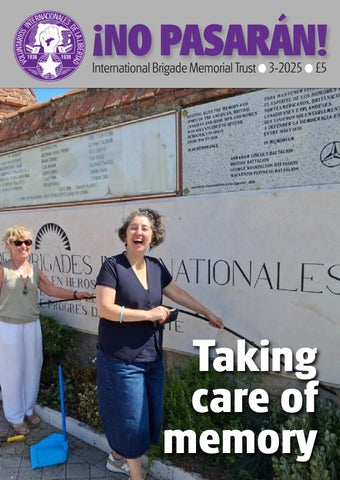
Taking care of memory

¡NO PASARÁN!
Magazine of the International Brigade Memorial Trust
No.70 l 3-2025
6 Memory
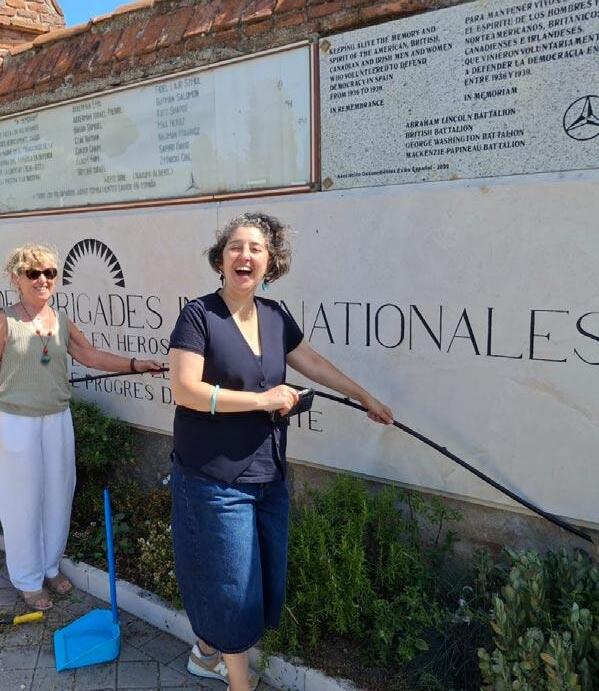
t Volunteers Nieves Hernández and Maica Gómez tend to the plants in Fuencarral Cemetery in the scorching Madrid sunshine.
l Meirian Jumps calls on us all to harness the power of our history.
9 Nehru
l Ameya Tripath uncovers the Indian independence leader’s links to Spain.
12 Last letters home
l A collection of letters written in Spain by Brigader Harold Laws.
14 Aid Spain
l Jim Jump considers a new study of British responses to the war in Spain.
16 Solidarity International
l Artist Rob MacDonald describes how he uses art to engage young people and local communities.
21 Books
l Reviews of ‘The Last Days of Alicante’ and ‘We Shall Pass’.
22 Final word
l The Trust lauds the work of volunteers in Madrid to keep memory and plants alive.
¡NoPasarán!(formerly the IBMTMagazineand the IBMTNewsletter) is published three times a year. Back numbers can be downloaded from the IBMT website. All content is the © of the IBMT and credited contributors and cannot be reproduced without written permission. Views expressed are not necessarily those of the IBMT.
Editor Helen Oclee-Brown
IBMT, 37a Clerkenwell Green, London EC1R 0DU 07865 272 639 admin@international-brigades.org.uk
International Brigade Memorial Trust www.international-brigades.org.uk

Praise for a generation of ‘heroism and sacrifice’
Hundreds gathered at the International Brigade memorial on London’s Southbank on 5 July for the annual commemoration of the 2,500 volunteers from Britain and Ireland who took part in the fight in Spain against fascism from 1936 to 1939.
Speakers included Meirian Jump, Director of the Marx Memorial Library (see page 6), and Gawain Little, General Secretary of the General Federation of Trade Unions, who praised the heroism and sacrifice of the volunteers, along with the ambitions of that generation of activists to create a world without exploitation and class divisions.
'They were there because of a belief that the working class, united across borders, could together build something incredible – a society fit for our children and grandchildren.'
There was music from Maddy Carty, and wreaths were laid by various organisations and individuals,
including the Spanish embassy in London, Basque Children of '37 Association, IB Cymru, Oxford International Brigade Memorial Committee, train drivers’ union Aslef, Marx Memorial Library, Communist Party of Britain and the London branch of the PCE Spanish Communist Party.
In his address, IBMT Chair Jim Jump welcomed Antonio Casado Rigalt, Political Counsellor at the Spanish Embassy, and applauded the Spanish government's efforts to support the cause of historical memory, aiming to heal the wounds of repression and restore posthumous justice to those whose only crime had been to support democracy.
‘There is, however, unfinished business for us in Spain,’ he added, in the form of up to 500 bodies of British and Irish International Brigaders in unknown and unmarked graves across the country.
Jump acknowledged the work of the Catalan government to locate and identify all the International Brigaders who fell in the Battle of the Ebro, including more than 90 from the British Battalion.
But he lamented the situation in other regions of Spain, where memory laws are being torn up under the influence of rightwing parties.
He added that the IBMT would counter these challenges by keeping alive the inspirational story of the International Brigades.
‘Their story, ‘ he declared, ‘is one of antifascism, of international solidarity and of men and women whose blood, in the words of Spanish poet Rafael Alberti, could sing across frontiers. l ‘This is our history’, pages 6-7.
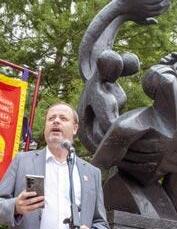
t Gawain Little speaking at the national memorial.

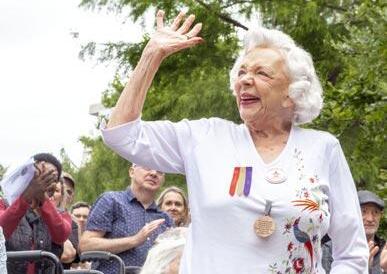
p Thelma Ruby, aged 100, widow of Canadian volunteer Peter Frye, acknowledges the applause for her. Andrew Wiard
Andrew Wiard
The International Brigade Memorial Trust keeps alive the memory and spirit of the men and women who volunteered to fight fascism and defend democracy in Spain from 1936 to 1939
International Brigade Memorial Trust
37a Clerkenwell Green, London EC1R 0DU
Executive Officer Helen Oclee-Brown 07865 272 639
admin@international-brigades.org.uk
www.international-brigades.org.uk
Registered charity no.1094928
President Marlene Sidaway
president@international-brigades.org.uk
Chair Jim Jump
chair@international-brigades.org.uk
Secretary Megan Dobney secretary@international-brigades.org.uk
Treasurer Paul Coles
treasurer@international-brigades.org.uk
Ireland Secretaries Luke O’Riordan & Lynda Walker ireland.international.brigades@gmail.com
Scotland Secretary Mike Arnott
scotland@international-brigades.org.uk
Wales Secretary David McKnight wales@international-brigades.org.uk
Other Executive Committee members
David Chanter, Alex Gordon, John Haywood, Jonathan Havard, Alan Lloyd, Dolores Long
Founding Chair Professor Sir Paul Preston
Patrons Professor Peter Crome, Professor Helen Graham, Ken Livingstone, Len McCluskey, Christy Moore, Jack O’Connor, Maxine Peake, Baroness Royall of Blaisdon, Mick Whelan
Historical Consultant Richard Baxell
Teaching resources lauded
The June issue of Teaching History (the secondary education journal of the Historical Association) carries a feature on how to teach Year 9 school students about the ‘ordinary people’ who fought in the Spanish Civil War.
It describes the teaching resources created by the IBMT as part of the Trust’s Schools Project.
The article is written by Professor Peter Anderson of Leeds University and Alex Clifford, who teaches at Newcastle High School for Girls. Both have overseen the production of the teaching tools for Key Stage 3 pupils that can be downloaded from the IBMT website.
The teaching packages contain lesson plans, PowerPoint presentations, knowledge organisers, marking schemes and reading suggestions.
Welcoming the article in Teaching History, IBMT Chair Jim Jump said the IBMT Schools Project is one of the Trust’s key priorities. ‘The aim now is to get the message out to the history teaching profession that these resources are available.’
He went on: ‘We’re also telling teachers that they can find out about the volunteers from their area or town who went to Spain by searching the Volunteers page of our website.’
Burnley memorial unveiled
M en from East Lancashire who volunteered to fight fascism in the Spanish Civil War have been honoured with a new memorial in Burnley.
The memorial was unveiled at a ceremony on 10 May by the Mayor of Burnley, Councillor Shah Hussain, and Chris Keene of North East Lancashire Trades Union Council.
It lists James Bridge and George Buck from Nelson, Freeman 'Frank' Drinkwater of Burnley, H Eastwood-Taylor of Rawtenstall, Harry Edward Gaze from Accrington, David Hartley King of Salterforth, Jack Howley from Colne and John Jolly Samuel Martin and Frank Welsby of Burnley.
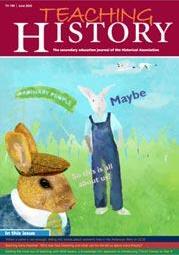
p TeachingHistory addresses how to teach 13- and 14-year-olds about the volunteers who fought fascism and appeasement.
The unveiling ceremony featured a talk from local historian Lewis Ashworth and songs from the Burnley and Bolton Clarion Choir.
The memorial has been supported by organisations including North East Lancashire TUC, the University of Central Lancashire, IBMT members and Burnley Council.
Talk given about fascism in Ireland
On 1 August, a 70-strong audience attended the Féile Lecture 2025, organised by the IBMT- affiliated International Brigade Commemoration Committee (IBCC).
The speaker this year was renowned historian Dr Brian Hanley, who spoke on the topic 'Blueshirts, and Blackshirts: fascism in Ireland north and south'.
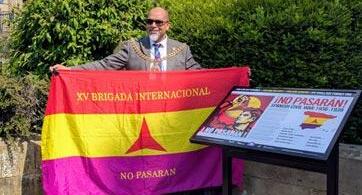
q The then Mayor of Burnley, Councillor Shah Hussain, at the unveiling, holding the flag of XV International Brigade alongside the new memorial.
Féile an Phobail is Ireland's biggest community arts festival. Held each summer in July and August, it is the flagship event of a programme of inclusive arts, cultural and community-based activities throughout the year.
The venue for the talk, the Shankill Road Library, is home to a plaque dedicated to the nine Shankill men who died in Spain.
MPs hear about IBMT's work
I BMT representatives have briefed a group of parliamentarians on the work of the Trust and the Spanish Civil War’s legacy in Britain and Spain.
It is hoped this will be the first of a series of sessions where MPs and peers can be kept informed of matters of interest to them and the IBMT.
Chaired by Jon Trickett, the Labour MP for Normanton and Hemsworth, the meeting on 24 June heard historian and IBMT Historical Consultant Richard Baxell talk about what happened to the International Brigade volunteers after they returned from Spain.
IBMT Chair Jim Jump went into the detail of the Trust’s commemorative and educational activities. He highlighted ongoing efforts, both in the classroom and beyond, to make sure that the story of the volunteers and the impact of Spain’s war is properly taught and understood.
‘We’re especially excited by the IBMT Schools Project,’ he told the meeting. ‘We hope to expand on the two teaching modules for Key Stage 3 that are now available on our website.’
Jump went on to speak about Spain’s ‘memory wars’. He deplored rightwing-led Madrid City Council’s plans to build a waste facility on or near a mass grave of 450 International Brigaders, including several Britons.
This was in contrast, he said, with the ‘positive partnership’ developed with the Catalan government to identify, in some cases with the help of family DNA, the remains of the 90 British Battalion volunteers who were killed in the Battle of the Ebro.
The meeting also heard from Michaela Tracey - Ramos, a Unison national executive member with proud part-Spanish Republican heritage. She reported on the solidarity trips to Spain she had been on with the North West Trade Union International Committee.
Both Jon Trickett and fellow Labour MP Ian Lavery (Blyth and Ashington) said they would be willing to take up in Parliament the issue of the graves of British Brigaders.
Another Labour MP, Chris Hinchliff (North East Hertfordshire), said he would like to invite an IBMT speaker to give a talk in his constituency.
Lord Richard Balfe, a Conservative peer, recalled as an MEP in the 1970s and 80s meeting descendants of Spanish monarchists who had gone into exile in Lisbon because they opposed Franco.
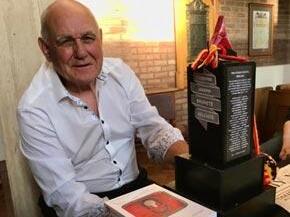
u North West activist Barrie Eckford at the 'Songs of Protest and Struggle' concert on 17 May at Wilbraham St Ninian's Church, Chorlton. He is pictured with a maquette of the future Salford memorial. The fundraising campaign for the new memorial has been a great success and it is hoped the obelisk will be unveiled next year in the square by the Working Class Movement Library in Salford.
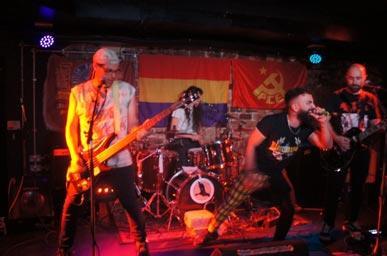
'Zona Norte' from Brussels perform on 17 May in Glasgow at the ¡No Pasarán! Fest 2025, organised by PCE Exterior GB, the UK-based branch of the Spanish Communist Party, in aid of the IBMT and a new memorial plaque at Carbeth, north of
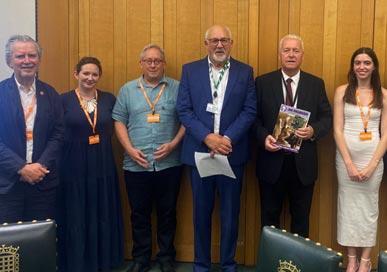
MPs Jon Trickett and Ian Lavery (third and second from left), with Michaela Tracey-Ramos (right) and (from left) Jim Jump, Helen Oclee-Brown (IBMT Executive Officer) and Richard Baxell.
the city.
Your local IBMT affiliated memorial group
The IBMT supports the work of affiliated local International Brigade memorial groups. Annual IBMT affiliation costs £40.
You can affiliate through our website: www.internationalbrigades.org.uk/membership.
DIRECTORY
l Aberdeen XV International Brigade Commemoration Committee
Contact: Tommy Campbell tommy.campbell@outlook.com
l Belfast International Brigade Commemoration Committee
Contact: Ernest and Lynda Walker lyndaernest@btinternet.com
l IB Cymru
Contact: Mary Greening ibcymru@gmail.com facebook.com/groups/314892162181123
l Hull International Brigades Memorial Group
Contact: Gary Hammond thehutpeople@gmail.com
l North West International Brigade Memorial Group
Contact: Dolores Long doloreslong@fastmail.fm twitter.com/ibgtrmanchester
l Oxford International Brigade Memorial Committee
Contact: Colin Carritt colin.carritt@tiscali.co.uk
l Sussex Brigaders Remembered
Contact: Pauline Fraser pbf262@myphone.coop
Contact the IBMT to add your group to the Directory
International Brigade Memorial Trust
www.international-brigades.org.uk
Words spoken by MEIRIAN JUMP, director of the Marx Memorial Library, at the commemoration on London’s Southbank on 5 July.
My name is Meirian Rosita Jump. I am the granddaughter of International Brigader Jimmy Jump and Director of the Marx Memorial Library & Workers School, which houses the archive of the International Brigade Association.
It is a true honour to stand here with you today. I was first brought to this memorial in October 1985 by my parents, Jim and Myra, when I was just six months old – along with my twin sister, Clara. That day marked the unveiling of this monument, a day filled with pride and memory.
My grandfather Jimmy had been instrumental in its creation, having served as secretary of the International Brigade Memorial Appeal. He was also a poet and wrote these lines to mark that day:
We, and the monument that commemorates us Have passed into history.
And you, Meirian and Clara, Though young Are part of history today
Because you were present.
You will not recall this day –You do not remember it now –
But when you are grown,
When you have children of your own, You may bring them here to play
And, pointing to the date carved in stone, will say,
‘My sister and I were there that day’. And so here I am – almost 40 years later – with my own child, my wonderful four-year-old son, Victor Alan Jump.
Grandad was right. The International Brigades have indeed passed into history – but not into obscurity. Their story, their courage, their resistance to fascism, militarism and tyranny, remain profoundly relevant. Their stand for democracy and peace continues to inspire.
Today, the International Brigade Memorial Trust plays a vital role in ensuring we continue to speak to our children –through educational resources, memorial events, conferences and publications.
But we know history is not neutral. It is a battleground – a contested space. The term
This is our history
‘fascism’ is often cynically deployed today to justify foreign wars, while the legacy of the Brigaders is distorted by Cold War and anti-communist narratives.
But this is our history. And we must hold onto it. Understanding the past is essential if we are to change the future. History is a weapon in our hands.
At the Marx Memorial Library, we hold powerful tools to support that struggle. We are the proud home of 152 archival boxes – more than 100,000 pages – of materials related to the International Brigades. These include photographs, ‘Aid Spain’ leaflets and deeply personal items.
These fragments tell us not just what happened, but why it mattered. They help us understand the motivations, the human cost, and the enduring values of those who fought. They let us feel history – and bring it alive.
In 2018, we secured funding from The National Archives to catalogue the collection fully. Now, in partnership with Adam Matthew Digital, we are working on an ambitious project to digitise the entire archive. From 2028, this globally significant resource will be freely available online to all MML and IBMT members. It will change how we access and preserve this vital history.
The news of our digitisation project prompted my father, Jim, to donate the rest of Grandad’s papers to the MML. Among them was a message he had written: ‘Do not let Thatcher visit me in the event of an accident.’ These were once published in Tribune, where he was also known as the house poet.
‘Understanding the past is essential if we are to change the future. History is a weapon in our hands.’
One of those poems, written during the Thatcher years, feels particularly relevant again today – with militarism on the rise, nuclear threats looming larger and political leaders recklessly pulling us toward another global conflict. It's called ‘Her Idea of Peace’:
When somebody presses the nuclear button
This country of mine will be deader than mutton
But I’ll be quite safe in my underground den With a well-supplied larder, beneath Number 10…
Months later I’ll climb from my hide underground
With all my dear family I’ll travel around
To inspect the dear land which from tyrants I’ve saved…
I’ll feel the most wonderful sense of relief When it dawns on me that there’ll be no more CND’ers
Nor unemployed workers to rouse my worst fears
No women protesters at Greenham air base For of them and their kind there’ll remain not a trace…
At the press of a button my worries will cease And, wherever I look there’ll be peace perfect peace.
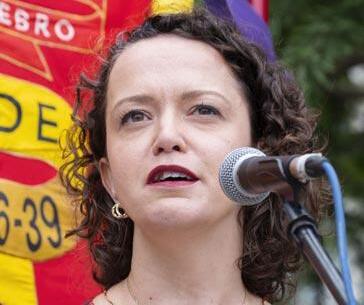

p Meirian Jump: digitisation of the Spanish Civil War archives will enhance access
Andrew Wiard
IBMT’s 2025 Annual General Meeting
Saturday 4 October
BELFAST
Part of a weekend of activities
See the IBMT website for the AGM agenda and documents and for more details about the weekend’s activities.
PROVISIONAL PROGRAMME
Friday 3 October
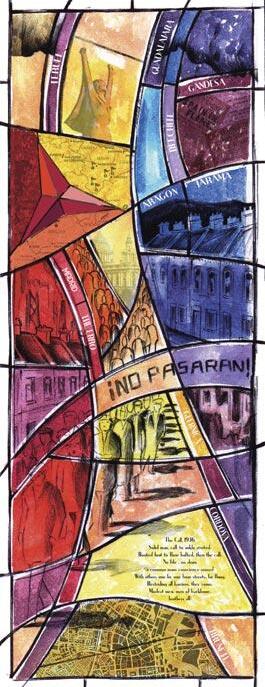
l 5.30pm: Belfast City Hall, Donegal Square North, Belfast BT1 5GS to see the famous stained-glass window dedicated to the International Brigades.
l 5.45pm: Civic drinks reception at City Hall.
l 6.30pm-8.30pm: Opening of AGM weekend at City Hall, hosted by Deputy Lord Mayor Paul Doherty, with contributions from International Brigade family members and international and trade union speakers.
l 8.45pm: Buffet upstairs in the Fountain Lane Bar, 16 Fountain Street, Belfast BT1 5ED.
Saturday 4 October
l 10.30am: Meet at City Hall for a bus tour, taking in Shankill Road Library to see International Brigade plaque and posters, Milltown Cemetery to see the gravestone of Jim Straney, and murals along the Falls Road.
l 1.15pm: Lunch provided by Unite, 26-34 Antrim Road, Belfast BT15 2AA.
l 2.30pm-4pm: IBMT Annual General Meeting at the Unite office. All welcome, but only IBMT members may speak and vote.
l 5pm-7pm: Optional visit to Seatons of Sailortown bar or the American Bar, Dock Street, Belfast BT15 1LF. Both close to the Dockers Club.
l 7pm until late: Dockers Club, Pilot Street, Belfast BT1 3AH for a concert, social and buffet. Buffet provided by Unite.
Sunday 5 October
l 11am: Gathering at the International Brigade memorial at Writer’s Square, Donegall Street, Belfast BT1 1DL.
l 11.30am: Irish Congress of Trade Unions, 45-47 Donegall Street, Belfast BT1 2FN for the launch of a booklet on the International Brigade Commemoration Committee, ‘20 Years of Action’, and a light buffet lunch.
l 1pm: Retire to The John Hewitt pub, 51 Donegall Street, Belfast BT1 2FH, where there is a memorial to the International Brigades.
REGISTRATION
Registration and payment of minimal charges for events are essential because of the need to know numbers. Consult our website at www.international-brigades.org.uk/news-and-blog/agm-2025 for the schedule of charges and payment options.
AGM BUSINESS
Proposals for agenda items under ‘Any Other Business’ must be received in writing by the IBMT Secretary by 27 September. Nominations are invited for candidates to fill five vacancies on the Executive Committee (see more information online at the web address below). If necessary, a ballot will be held at the AGM. Send nominations and proposed agenda items to: secretary@international-brigades.org.uk.
international-brigades.org.uk/news-and-blog/agm-2025
International Brigade Memorial Trust

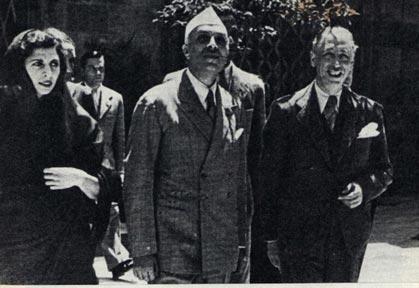
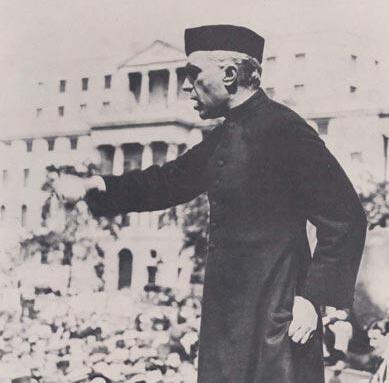
u Jawaharlal Nehru in Spain during the Civil War, with the Catalan President Lluís Companys (right) and Bhicoo Batlivala, the Parsi lawyer and Indian independence campaigner.
Cultural and political ties drew the Indian independence leader to Spain, writes
AMEYA TRIPATH.
Why did Jawaharlal Nehru, future Prime Minister of India, visit civil war Spain in 1938? As it turned out, the triangular relationship between Britain, Spain, and India had deep cultural and geopolitical implications.
As collectors well know, the extant copies of the ‘Book of the XV Brigade’, a richly illustrated volume edited by Frank Ryan that was distributed among hundreds of Englishspeaking Brigaders in 1938, are considered bibliophile gems because they are often handsigned by dozens of fellow soldiers.
The copy held at the Working Class Movement Library in Salford, however, features two surprising autographs: from Jawaharlal Nehru, who in 1947 would become the first Prime Minister of India, and VK Krishna Menon, India’s representative to the United Nations and founder of the Non-Aligned Movement.
They signed the book during a visit to Spain in June 1938, when Nehru and rest of the Indian delegation met with the British Battalion of the XV International Brigade, which, as it happened, was named after Shapurji Saklatvala, the Bombay Parsi who served as MP for North Battersea, first for the Labour Party and later as a Communist.
Campaign
What was Nehru doing in Spain, when there was so much to campaign for in British-ruled India? The truth is that the Spanish Republican cause attracted many Indian intellectuals in both Britain and the subcontinent. While the cultural ties between Spain and India go back centuries, in the early 20th century, the triangular relationship between Britain, Spain and India,
When Nehru went to Spain
with Gibraltar as a gateway to the East, had deep cultural and geopolitical implications.
Saklatvala’s had been a rare Indian voice in Britain’s parliament. He was only the third Indian representative in parliamentary history and the country’s lone Communist MP, winning a re-election for his seat for the CPGB after Labour expelled all Communists from their
‘What was Nehru doing in Spain, when there was so much to campaign for in British-ruled India? The truth is that the Spanish Republican cause attracted many Indian intellectuals .’
party in 1923. Saklatvala had died from a heart attack in January 1936; his daughter, Sehri Saklatvala, organised events for the Spain-India Committee, run by the India League.
By the 1930s, the British Left was quite transnational and included many anti-colonialists protesting the British Empire. In London, Indian activists organised aid for Ethiopia, China and Spain. Indians in Britain also took part in the India Home Rule Society, India League, League Against Imperialism, Independent Labour Party, Communist Party, Workers Welfare League, and myriad other organisations. As Nancy Tsou and Len Tsou have shown in ‘Los brigadistas chinos en la Guerra Civil: La llamada de España, 1936-1939’ (their book about Chinese Brigaders), some Indians joined the Brigades as doctors, journalists and soldiers, including Gopal Mukund Huddar, Mulk Raj Anand, Atal Menhanlal, Ayub Ahmed Khan Naqshbandi, Manuel Pinto and Ramasamy Veerapan.
Nehru and his daughter, future Prime Minister Indira Gandhi, saw themselves as part
CONTINUED OVERLEAF
FROM PREVIOUS PAGE
of both British and Indian society. Educated at Harrow, Nehru later joked that he was the ‘last Englishman to rule India’. In his book ‘AntiColonialism and the Crises of Interwar Fascism’, Michael Ortiz discovers that Indira, educated at Badminton School in Bristol and later Oxford, was especially preoccupied with the fate of the Basque children.
According to Richard Baxell, the British Battalion’s official name, Saklatvala, ‘never caught on’. Naming an International Brigade Battalion after Abraham Lincoln worked well in the US context.
Though a prominent MP, Saklatvala did not have that kind of legendary historical reputation, and his name might well have been harder to pronounce for many volunteers. Nor was there a settled view on Britain’s ongoing rule of India. (Nehru and Saklatvala certainly had their differences: Nehru was not a Communist like ‘Comrade Sak’, who protested Gandhi’s absolute insistence on nonviolent resistance.)
Most referred to the Saklatvala as the ‘British Battalion’ while most Spaniards simply called it el batallón inglés. As Baxell points out, this was not a very satisfactory name for a unit that included many non-English soldiers – not only Irish, but also volunteers from many current or former British colonies. In fact, when Nehru, Krishna Menon and Batlivala visited the British volunteers they were greeted by cries of ‘Long Live Independence!’
Nehru’s interest in Spain was not surprising. By 1936, he had grown frustrated with Gandhi’s leadership of the Indian independence movement.
‘Did Britain’s many machine gun atrocities such as the Jallianwala Bagh massacre of 1919 occur to Nehru in this moment?’
As he mourned the death of his wife and struggled to manage the splintered Congress movement, he considered resigning as president of the Congress.
But then, as he writes in his autobiography, ‘a far-away occurrence … affected me greatly … This was the news of General Franco’s revolt in Spain. I saw this rising, with its background of German and Italian assistance, developing into a European or even a world conflict.’
Nehru was one of many Indian intellectuals drawn to the Republican cause, as were Bengali Nobel Laureate Rabindranath Tagore and Telegu poet Srirangam Srinivasarao. (Tagore’s global fame had reached Spanish poets such as Zenobia Camprubí and Juan Ramón Jiménez, who translated his work.) Cultural affinities, such as the possible influences of ancient Indian dance styles on flamenco drew interest about Spain from Indian artists and intellectuals.
Parallels
There were also political parallels. The Indian Congress and Spanish Second Republic shared goals in the 1930s, such as tackling illiteracy and the problem of large and unproductive agricultural estates.
As Maria Framke writes, Congress Socialists organised a ‘Spain day in different Indian cities in August 1936’ and in December of that year asserted at their annual meeting that ‘this struggle between democratic progress and Fascist reaction is of great consequence to the future of the world and will affect the future of imperialism and India.’ Ole Birk Laursen describes a major protest in January 1938, on Trafalgar Square in London, in solidarity with the Indian, Chinese and Spanish people:
As around 1,200 people marched from Mornington Crescent, four bands accompanied the processionists. Flags of the Spanish Republic, Irish Republic, Indian National Congress and Sama Samaja Party, and banners with portraits of Subhas Chandra Bose, Jawaharlal Nehru, Gandhi, Rabindranath Tagore, the Emperor of Abyssinia,
Chiang Kai-Shek and ‘La Pasionaria’, were carried.
The British Library India Office Records shows that British intelligence was concerned by Nehru’s trip, actively tracking his departure from London to Barcelona, and reporting in great detail on every speech Nehru made once he returned to London.
British authorities were worried by the ability of Nehru, and other speakers in London such as Paul Robeson, to synthesise a broader anti-imperialist movement and connect it with what authorities considered a dangerously Communist anti-fascism in Spain.
Nehru’s five-day visit to Spain in June 1938 was widely reported in newspapers worldwide. His ‘tight schedule’ included meetings with President Manuel Azaña, Foreign Minister Julio Álvarez del Vayo, Communist leader Dolores Ibárurri, receptions with the Cortes, the national parliament, the foreign ministry, and, at the battlefront, with officers from the Republican Army and the International Brigades.
Photographs of Nehru with Spanish Republican generals and politicians underscore the friendship between the Spanish and Indian peoples; but there was also a geopolitical and pragmatic calculus in Nehru’s decision to go to Spain.
After his return from Barcelona, Nehru addressed a 5,000-strong crowd in Trafalgar Square, during an event organised under the auspices of the Aid to Spain Committee. Still, Nehru also faced criticism for his trip. Why was he touring around Europe and agitating for Spain when there were flood victims in Bengal and widespread famine around the country?
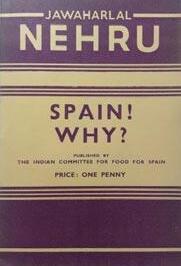
In the Manchester Guardian and the National Herald (the newspaper Nehru founded in Lucknow), Nehru responded to his critics in a text that was later published as a pamphlet, ‘Spain! Why?’ (1938), by the India League. In it, Nehru defends himself against those who see him as naive. Since the British government is effectively aligned with Fascists, he argues, supporting the Spanish Republican cause is an act of anti-colonial resistance:
By sending a Medical Mission to China, by our giving food-stuffs to the Spanish people, we compel the world’s attention to our view-point. Thereby we begin to function in the international sphere and the voice of India begins to be heard in the councils of the nations. This is our way of building up a foreign policy and of giving effect to it. Thus, our giving practical shape to our sympathies has a vital significance in giving India a position and prestige which usually only free countries possess. …. The free aid that we give medically or otherwise to China and Spain stamps us as people who have a view and will of their own.
q Nehru’s 1938 pamphlet.
u Nehru addresses a meeting at Trafalgar Square, London, in support of the Spanish Republic on 17 July 1938.
As Michael Ortiz has pointed out, moreover, for Nehru the Spanish Civil War ‘underscored the hypocrisy of Britain’:
During the Waziristan Campaign (19361939), British colonial forces brutally quashed the Waziri and Mahsud tribesmen of Waziristan … How, Nehru argued, could English citizens condemn the bombing of Guernica while ignoring a similar tragedy in Afghanistan?
While other Indian campaigners for independence such as Mulk Raj Anand and V Krishna Menon openly compared British colonial rule with German and Italian fascism, Nehru and the Congress movement did not directly challenge the patently undemocratic British Empire.
Bombings
Still, Nehru’s comparison of the bombings of the Waziri with those of Guernica shows he was certainly able to make the comparison between British colonial rule and German and Italian fascism.
The overwhelming majority of the British Empire’s subjects lived in a dictatorship backed by the same imperial navy that blockaded aid from the Soviet Union and Mexico from reaching Republican Spain.
The images of Nehru’s visit, and his report on it in his memoirs, gloss over some of the contradictions involved in supporting the Spanish Republican side, let alone calling for British intervention in Spain.
For one, the Spanish Republic itself continued to be a colonising power in Morocco, Western Sahara, and Equatorial Guinea. For another, calling for British intervention in Spain meant advocating for Britain to use its imperial might: in particular, the very same navy that patrolled India, often with colonial troops, sepoys, in its ranks.
Ortiz notes that ‘during Nehru’s visit, British machine gunners put on a thrilling display with their maxim gun’; from Richard Baxell, we know that the commander of the machine-gun company was ‘Harold Fry, an ex-sergeant from the British army who had served in India and China’. Did Britain’s many machine-gun atrocities such as the Jallianwala Bagh massacre of 1919 occur to Nehru in this moment?
Michael Ortiz suggests that Nehru found his visit to the British Battalion refreshing after years of Gandhi’s doctrine of non-violence.
Jimmy Jump, a British volunteer who served as Nehru’s translator, wrote about the visit in his memoir, ‘The Fighter Fell in Love’, published in
Nehru Memorial Fund

International Brigade Memorial Trust
by
Nehru spent quite a long time in the barranco, chatting to us. He displayed great interest, despite being a pacifist, in our machine guns, and the gun-crew, led by ex-miner from Fife, George Jackson, put on an exhibition of accurate firing. With a few short bursts of fire from their First World War Maxim, they chopped down a sapling growing a couple of hundred yards away. ‘Would you like to have a try yourself?’ Jackson asked him, but Nehru politely refused.
Like it did for the African-American volunteers, Spain provided a release for
‘Attlee’s government granted India independence. Yet, to the disappointment of many Brigaders, it made no move to depose Franco.’
oppressed dissidents from elsewhere in the world who were militarily outmatched at home or tired of demands for only nonviolent civil disobedience. In Spain, they had a way of striking back at the enemy, arms in hand, even in the knowledge of the contradictions involved in supporting the Republican side.
Considering the tensions between pacifism and armed struggle, and between anti-fascism and empire, naming the British Battalion after Saklatvala was quite appropriate.
As Priyamvada Gopal explains, Saklatavala was a thorn in Mahatma Gandhi’s campaign for non-violence, arguing against a pacifist position. Their correspondence shows a revolutionary Saklatvala seeking to radicalize the liberal Gandhi towards a position that would require both nonviolent and violent resistance.
A gunner company in the Saklatvala Battalion was named after Clement Attlee, the Labour MP who made several visits to Spain and features in significant images from the war, including photographs with ‘Guernica’ at the Whitechapel Gallery in London. Attlee became Prime Minister in 1945. It was his government that granted India independence. Yet, to the disappointment of many International Brigade volunteers from Britain and India, it made no move to depose Franco.
2021
The Clapton Press:
Last letters home
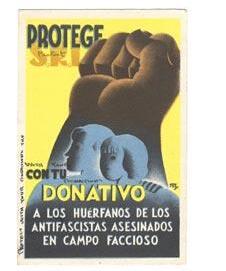
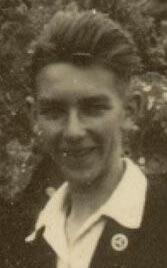
Southampton Brigader HAROLD LAWS died aged 26 at Segura de los Baños on 17 February 1938. Transcribed here are some of his newly available final messages to his mother and sister Peggy.
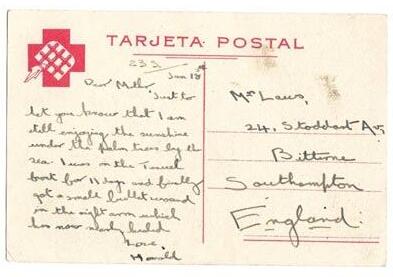
Postcard, 18 January 1938
Dear Mother,
Just to let you know that I am still enjoying the sunshine under the palm trees by the sea. I was on the Teruel front for 11 days and finally got a small bullet wound in the right arm which has now nearly healed.
Love Harold
Letter, 19 January 1938
Dear Peggy,
So much has happened in the last few weeks that hardly know what to tell you of first. There was the fairy land of snow and glittering mountains of the Teruel when we took up reserve positions. The cruel march across snow and ice to the front line when we had to stop every 15 min and rub our ungloved hands in snow to prevent frostbite. There was a nightmare trek over 3 kilometres of no man’s land for guns and ammunition. How it had thawed and made the going treacherous. A
glorious daybreak disclosing the fascist positions in front of a ruined building with a red, blue, gold and white mountain at the back. Cocks crowing somewhere then the rattle of a fascist machine gun broke the peace. Pretty soon our artillery from away back starts to shell a man and a mule. I wake up and execute a few lice. I think I got the ring leaders but it must be a genuine rank and file movement for they are very active.
Plenty of bullets flying about mostly fascist now. The artillery man is trying to hit another mule. I make my way back to the trench in safety and volunteer to fetch the dinner. 3 kilometre walk, swell scenery. Returning with the food, a fascist machine gun starts to bark at us. We make it in safely and report the road under fire. More sleep with a Boom Boom Boom as a lullaby. To be continued.
Harold
Letter, undated, written after being wounded at Teruel in January 1938 [Text missing] Have been sleeping between sheets since. Finally I have arrived at an American hospital just of the [deleted in blue] south of Tarancón. I feel pretty good now and am looking forward to joining the boys again.
I wish I could speak Spanish and if you would send me a dictionary and Spanish grammar I should be very pleased.
I’ve an ambition to get a motorcycling job. It
Harold Laws at home in Hampshire.
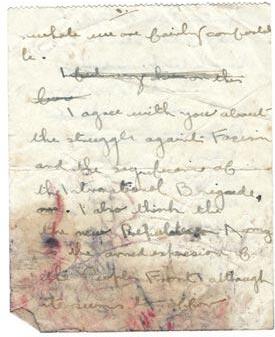
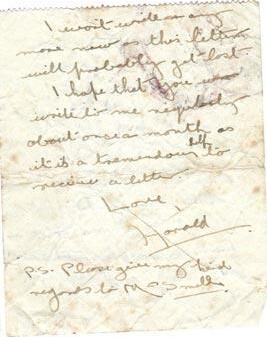
z The last remaining letter message Harold sent to his mother. His other letters to his parents did not survive.
p Two pages of Harold’s last known letter home. Despite being injured at Teruel, this ‘splendid soldier’, as Sam Wild called him, remained positive.
must be grand to tour over this Spanish highways which are built like race tracks, and also I think I could be more use that way than behind a gun.
I do not know what else to say. The Spanish people are very kind and friendly and I wish I could talk to them and read their newspapers. I do not think they are quite so advanced as the Russian people when they seized power but they are mostly bitterly anti-fascist and they will not rest content until they have swept the fascists out of Spain. And as for a division of Spain, such as is the aim of the National Government I believe that that is impossible and that there
‘The mood of the civil population is unshaken and we are all fairly confident that we shall win.’
will never be peace while there is a fascist left alive in the whole of Spain.
When you write to me, my address is: Harold Laws, [deleted], c/o S.R.I. No 270, Plaza del Altozano, Albacete.
Love and Best Wishes
Harold
Final letter, undated
[Text missing] the square and salute the Flag and the Battalion officers. Then we go on manoeuvres. Always we practise how to attack the enemy also we practise with handgrenades and at firing and cleaning a riffle. I enjoy firing very much and I guess I shall like it more when there is a fascist at the other end of the barrel.
The comrades here are a mixed crowd, most of them are decent working class but there are a few [illegible] amongst us.
The mood of the civil population is unshaken and we are all fairly confident that we shall win. There is a library here and a canteen and on the whole we are fairly comfortable.
I agree with you about the struggle against fascism and the significance of the International Brigade. I also think the new Republican Army is the armed expression of the Peoples Front although it seems to offer opportunities for the beggar to climb on horseback.
Thanks for Harry’s good wishes. There is something lacking in England that most of the other Internationals from democratic
countries have and that is an organised link with the British Battalion.
Com. Fletcher the Commander of the British Battalion of the 15th Brigade was telling us of this the other day. He said it would be great if there was some organisation in England which would get the Brigade more publicity. He said that this would not only prove of great material benefit to the boy in the Brigade but would also help the peoples front movement in England and the Spanish Government, as there are many people in England of confused political ideas who would be very proud of the Battalion and would like to be enrolled as one of its friends.
Since I have been here the company has been reorganised to conform with the rest of the Spanish Army. This has created a flock of Cabos, Sargentos and Tenientes. I am a Cabo which is the equivalent of a corporal.
I won’t write any more now as this letter will probably get lost.
I hope that you write to me regularly about once a month as it is a tremendous help to receive a letter.
Love
Harold
PS Please give my kind regards to Mrs Smith
The IBMT thanks the Laws family for donating Harold’s archive and is grateful to his niece Henrietta Quinnell for transcribing these letters.

People went ‘Spain mad’
JIM JUMP considers a new study of British responses to the Spanish Civil War.
There was ‘indeed something unique’ about the impact of the Spanish Civil War on Britain, Tom Buchanan tells us in his latest book on of the topic, titled ‘Spain Mad’. Most people familiar with the war know about the 2,500 Britons who volunteered to join the International Brigades, more than 500 of whom died in Spain. Less well known is the popular mobilisation of support that took place across the country.
The scope of activities undertaken, the amounts raised (an estimated £180 million in today’s money) and the multitude of organisations that sprang up were truly remarkable. So too were the range and numbers of people involved – though always only a ‘significant minority’ of the population, Buchanan is at pains to point out – who
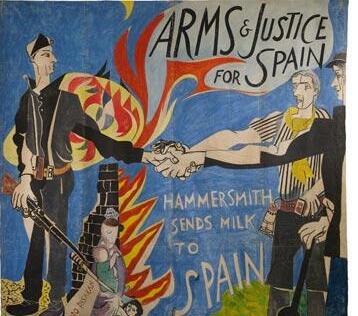
organised street collections, sent food ships to Spain, looked after child refugees or marched in favour of ‘Arms for Spain’.
A police informant said his colleagues at the Royal Aircraft Establishment in Farnborough, which in the 1930s was a hotbed of political radicalism, had all gone ‘Spain mad’.
Buchanan has in the past challenged the idea that a unified Aid Spain mass movement, one inspired by Popular Front sentiment, emerged in solidarity with the Spanish Republic. Here he sets that controversy aside, while giving the reader plenty of examples of the ‘unprecedented and outsized’ passions and sacrifices that were made for the cause.
Unemployed workers in Hawick reopened a textile mill to produce garments – pullovers,
‘Spain’s war left a deep and lasting impression on many, especially those who fought in it. ’
scarves, socks and balaklavas – for the International Brigades.
Communist Party leader Harry Pollitt said he was never so moved as when he received a £60 collection from the Rhondda consisting of pennies and halfpennies despite ‘the appalling poverty that is rampant in these mining valleys’.
Jim Mortimer, later to become a prominent trade unionist and the general secretary of the Labour Party, remembered how easy it was to collect money from the council estates in Brixton. It was ‘the most positive experience of my life’, he later recalled.
He was not alone. Spain’s war left a deep and lasting impression on many, especially those who fought in it. Daily Worker correspondent and former International Brigader Sam Russell (real name Lesser) admitted as such when challenged by a Daily Telegraph reporter on his repeated mentions of the war during a trip to China in 1954. ‘Everyone has his own particular subject, his first woman or his school or North Africa and so on, said Lesser. ‘Mine is the Spanish Civil War.’ Scottish veteran Steve Fullerton said Spain had been ‘perhaps the most vivid year of my life’. Former British Battalion commander Bill Alexander spoke of the difficulty in adjusting to
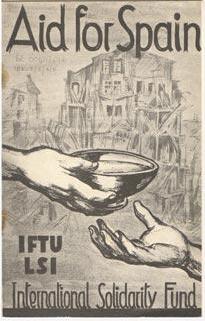
t Solidarity with the Spanish Republic: on left, a banner created by the Hammersmith Communist Party and, on right, the cover of pamphlet produced by the International Federation of Trade Unions and the Labour and Socialist International, which provided humanitarian suppliers to the Spanish Republic during the civil war.
the ‘lower gear of political life’ after his time in Spain and later as a British Army officer in North Africa and Italy.
The book’s first and longest chapter offers an entertaining and interesting overview of these collective and individual efforts in support of the Republic. The other 10 chapters are essentially biographical.
Two are dedicated to groundbreaking historians Hugh Thomas, author of the magisterial ‘The Spanish Civil War’ (1961), and Jim Fyrth, whose ‘The Signal Was Spain’ (1985) first documented the breadth and depth of the Aid Spain movement.
Fyrth was also Buchanan’s adversary in the disagreement over how the movement should be interpreted. Buchanan concentrates here on what was left out of Fyrth’s book under pressure from fellow communist Bill Alexander, who as president of the International Brigade Association jealously protected the reputation of the International Brigades as well as the party’s role in the war.
In other chapters we meet Philip Jordan, a Spanish Civil War correspondent for the News Chronicle who became a press secretary in the postwar Attlee government. Another figure rescued from obscurity is Anglican parish priest EO Iredell, who visited Spain four times as part of his campaigning. Like Jordan, his subsequent political journey took him away from admiration
of communism.
The writer and Labour politician GT Garrett stood unsuccessfully in a parliamentary by-election in Plymouth Drake in June 1937 on a platform critical of the Conservative-led government’s ‘non-intervention’ policy towards Spain. He lost by 15,778 votes to 11,044.
Buchanan could have mentioned that in nearby Bridgwater in November of the following year an Independent Progressive candidate, Vernon Bartlett, another former News Chronicle reporter in Spain, won a spectacular by-election victory standing on a Popular Front anti-appeasement platform.
Five chapters are given over to combatants in the war, including two controversial
‘Tom Buchanan mounts a spirited defence of Orwell, portraying him as a political innocent.’
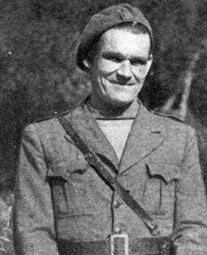
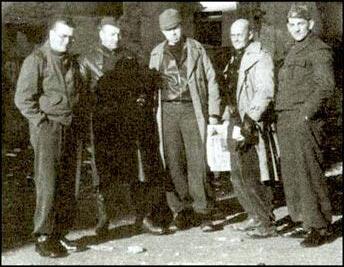
commanders of the British Battalion in Spain. Wilfred Macartney, who never led the battalion in battle, was perhaps accurately described in police files as ‘an unscrupulous adventurer’. Fred Copeman’s military record in Spain was patchy but brave. He later converted to Catholicism and spent time as a leading figure in the Moral Re-Armament movement, though never fully disavowed the International Brigades.
The other volunteers profiled include Frank Whitfield, an English-born Canadian killed near Zaragoza in March 1938, who is a distant
relation of the author. Artist Felicia Browne shares a chapter with her friend, the Hungarian-born journalist Edith Bone, with whom she travelled to Spain. Browne was killed as a militiawoman in Aragón early in the war. Fellow communist Bone was arrested in Budapest in 1949 and imprisoned for seven years as a spy. Buchanan charges both the Communist Party and the British government with abandoning her.
Soldier
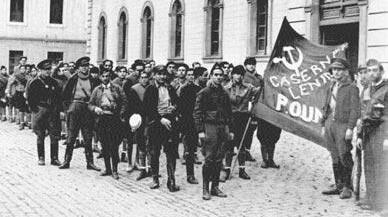
Under his real name of Eric Blair, George Orwell was also a soldier in Spain. He spent six months in the militia of the revolutionary POUM (Partido Obrero de Unificación Marxista), serving on the Aragón front before being caught up in the fighting in Barcelona in May 1937 between communist-backed government forces and the POUM and some anarchists. The spark was the move by the authorities to take over the city’s telephone exchange, which was being run by a workers’ committee. Support came not just from the communists, but from all the other parties in the Popular Front government: socialists, leftliberals and Basque and Catalan nationalists.
Orwell’s account of his experiences in Spain, ‘Homage to Catalonia’, is the most widely read book about the Spanish Civil War. Partly for this reason it has also become a target for criticism from historians both for its accuracy and for giving a misleading and narrowly-focused view of the war being waged by the Republic.
Buchanan mounts a spirited defence of Orwell, portraying him as a political innocent who is appalled by the ‘savagery’ of the ‘vendetta’ waged against the POUM. In what he
q Two contentious inclusions in the Brigaders profiled: Fred Copeman (left) and and (right, on far left) Wilfred Macartney, pictured with (from right) Frank Ryan, Tom Wintringham, Peter Kerrigan and Dave Springhill in February 1937.
AID SPAIN
sees as a reflection of the political paranoia evident at the Moscow show trials that were going on at the same time, the party was banned and its leaders arrested and vilified by the communists as Trotskyist fifth-columnists and ‘auxiliaries of fascism’. Its leader, Andreu Nin, was murdered by Soviet agents.
Buchanan argues that, whatever the limitations of ‘Homage to Catalonia’ stemming from Orwell’s ignorance of Spanish politics and the wider war, the importance of his testimony is that it shows how in later works his experiences ‘had been transmuted into the basis of his new thinking about the dangers of totalitarianism’.
This may be true but misses the point made by critics that Orwell’s memoir is an unreliable and myopic guide to the momentous events in Spain that were then shaping the course of world history.
Moral
By framing the May Days, in Buchanan’s words, as a ‘moral rather than political’ issue, Orwell was holding the Spanish Republic and its supporters to a standard that no other government fighting for its survival would be expected to live up to. Censorship, mendacious propaganda and the repression of internal enemies are sadly not uncommon in wartime. If Orwell didn’t know that already, he would soon find out in the Second World War.
Would any other government have tolerated the telephone exchange of its main city being held by political opponents who prioritised their revolutionary ambitions above the war effort? Any other government would also have taken urgent steps to incorporate the militias into the national army and to assert centralised control over arms and food production.
Barcelona was already in crisis, its population swollen by starving refugees. The war was going badly for the Republic. Málaga, which had been
‘Buchanan concedes that the main problem for historians is one of selection.’
defended by militias, had not long ago been overrun by the enemy with barely a fight but followed by an orgy of violence inflicted on its population. In the north, Guernica had just been flattened by Hitler’s Condor Legion. Bilbao was under siege and was weeks away from falling.
Buchanan, like Orwell, ignores this wider context, viewing the events in Barcelona as ‘a crisis in relations between the POUM and the communists’ – with the communists as the culprits. For an alternative perspective see the chapter ‘Lights and Shadows in George Orwell’s Homage to Catalonia’ in Paul Preston’s ‘Perfidious Albion: Britain and the Spanish Civil War’ (The Clapton Press, 2024).
In his afterword, Buchanan admits that many – in fact it’s most – of the individuals profiled in his book became disaffected with communism. Elsewhere, quoting Jim Fyrth, he concedes that the main problem for historians is one of selection.
He argues that, in the case of Fyrth’s ‘The Signal Was Spain’, ‘there was a rather different book struggling to get out’. The same is surely true of ‘Spain Mad’. A very different though just as meticulously researched and elegantly written book could have been produced about British engagement with the Spanish Civil War had other individuals been selected.
‘“Spain Mad”: British Engagement with the Spanish Civil War’ by Tom Buchanan (Liverpool University Press, 2024).
ARTIVISM
Multidisciplinary artist ROB M AC DONALD talks to the IBMT’s Helen Oclee - Brown about setting up Solidarity Park in Catalonia, using participation art to teach young people about the International Brigades and starting projects in the UK.
Can you explain the name ‘Solidarity Park’? I think we all understand ‘solidarity’, but some people have visited the site in Malgrat de Mar expecting to see a leafy, green park. Solidarity Park is not a park. The word ‘park’ is about a collective space where we all come together. So it's a community area centred around the monument.
Describe the monument and the inspiration behind it.
The monument is on the beach at Malgrat, opposite the spot where the SS Ciudad de Barcelona sank. It features 60 Brigader figures aboard a ship, sculpted out of stone, all singing ‘The Internationale’ with their fists raised. On the base are a number of portholes – we add more every year designed by students. The ship is sailing over a map of the world, symbolising solidarity between peoples across the globe.
The SS Ciudad de Barcelona was carrying some 250 Brigaders from Marseille when it was torpedoed by an Italian submarine supporting Franco’s fascists on 30 May 1937. Around 60 died in the sinking. People from the town rallied round and did their best to stage a rescue effort, but casualties were still high. The monument itself is not about sinking. It’s actually about the rise of the International Brigades. And it’s specifically designed so that we can replace individual sections without having to redo the whole thing, which is handy if it gets damaged or attacked. I’ve done two repairs already!
q A column of POUM militiamen in Barcelona, 1936; the tall figure at the rear is purportedly Orwell.
Bringing solidarity home
You’re originally from the UK. How did you get involved in a project in Catalonia? When I moved to Catalonia, I wanted to learn the history of a new country and learn the political landscape. I already knew about the history of the International Brigades, but then I came across a post on historian Alan Warren’s website, written by civil war tour guide Nick Lloyd, about Brigader Robert MacDonald, my namesake.
When I read that, I thought, wow, I want to know more about this, because I’m a sculptor, I’m an artist. I want to create something about this other Rob MacDonald, so I went up to Malgrat
and met historian and teacher Sònia Garangou. Together, we felt an immediate need to recover this memory and create a project that had to be community-led, with community participation and specifically aimed at the next generation.
How did you garner local support?
Everyone has been great. I initially pitched the idea of a memorial park to the council in 2016. From there, with the help of a crowdfunding campaign, I began working on the sculptures with the general public so that by 2018, 30 of the Brigaders could go on display.
In 2019, we developed a mapping
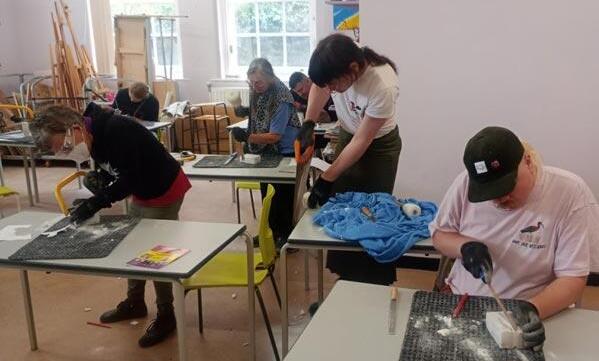
Solidarity Cymru workshop attendees at a Cardiff event in March 2025 sculpting miniature figures inspired by the International Brigade volunteers.
installation about the sinking with brilliant images and contributions from about 120 artists, local and international.
Then along came Covid, which scuppered our plans for an in-person festival, but did present other opportunities.
During lockdown, a local teacher got in touch. She got her students to work on a porthole project, which resulted in 70 brilliant designs. These became the basis of an online festival, with a different artist featured every day.
The monument was finally unveiled in 2022 at our first fully in-person festival, held in May to mark the 85th anniversary of the sinking.
But it’s not finished – nor is it supposed to be. It’s an ongoing project that people can add to. Living history. Students have submitted over 100 porthole designs this year, and you can vote for those you want added to the memorial (see www.facebook.com/Solidaritypark).
There is always a strong youth element in everything you do. How do you engage young people?
In several ways. The first thing is going in schools. It’s fairly common in Catalonia for these projects to exist now, but it wasn’t when we started. We’ve worked with kids from age 13 up. That’s when they start to feel they can to take on the world. I try to make the history real for them: this happened in your town. It hits harder
That focuses them on their communities, their homes. It’s about linking the history and the politics to that. I’m not shy about talking about politics in the classroom. When we’re
CONTINUED OVERLEAF
FROM PREVIOUS PAGE
talking about history, I ask if they think it’s relevant today. What is fascism? What do the far right want to say about these questions? And then on top of that, you layer internationalism.
As you get older, it can be hard to keep your mind open and fresh. Young people are open and fresh. They’re not beaten down, and they get most that internationalism is actually understanding somebody who’s different but is also the same.
Most of the guys on the ship were rank and file. They weren’t the leaders. They didn’t know what they were coming to. But they still came. All the different colours still came. It symbolises all of them, all from all the different countries, of all the different ideologies on the left – they were there. This has to serve us as a reminder that we mustn’t let fascism divide us.
History becomes relevant. It’s very easy, particularly in Catalonia, to ask why did the Brigades come? They weren’t tourists. Why did they come and get killed? It’s the same thing you say to the students in the UK, because they all also understand that Spain is a tourist hotspot, even if they can’t go themselves. It is something that's part of our daily lives now. Kids get it.
So for me, focusing on young people is not about having a special thing for young people. It’s about being fresh and young ourselves, and I’ve got a very strong driving force in me, particularly for a rebuilding of the international movement.
I think the approach to young people is based on being creative, fresh, and making history relevant to their lives on both a local and international level, and explaining it in that manner. And that’s where the art comes in.
You specialise in participation art, which helps people connect with the history on a tactile level. Then when you’re sculpting, I imagine everyone is still chatting around the art and the wider project. It doesn’t seem as heavy. The magic word to pull out is ‘heavy’. It’s about going in and being emotional about it. The history is just a starting point and the art solidifies the connection.
I have got a very clear agenda, and it’s about people being creative and developing critical thinking, with their own art first and then with the subject matter, because a finished piece of art is useless, in my opinion, for a project like this. That’s again why the monument has upgrades every year because its history is not dead.
The day that fascism no longer rears its head
then the monument can get old and crusty. The idea of this monument is not to be just symbolic, but to be alive and part of the dialogue. And that’s one of the problems with the Spanish Civil War in the last 30 or so years since the Transition: the dialogue hasn’t been there.
When I first talked to Sònia on the beach in 2013, that’s what we were talking about. We were talking about dialogue. We were talking about how to make it connect. Because Sònia is a historian. She's written books, she’s got a doctorate, but she’s just a regular teacher – by choice, I think, to connect with real people and local students.
The concept of living art isn’t limited to Malgrat. It’s the same with the monument in Reigate, Surrey, dedicated to Felicia Browne, unveiled this year.
Let’s talk about your latest projects. How are you using your hard-won experience in Catalonia in the UK?
All the work in the UK draws on our experience in Catalonia. The interesting thing about the projects in the UK is that each of them uses the same methodology from a
‘Young people are open and fresh. They know that internationalism is understanding somebody who is different but is also the same.’
slightly different angle, each developing organically. Solidarity Surrey has been built around the Surrey Unison branch. The branch has been very involved in Solidarity Park from a very early stage. And Surrey-born Felicia Browne was the perfect figurehead – she’s like the first participation artist. She’s so symbolic of what we’re doing and the sculpture in Surrey Unison’s memorial garden is dedicated to her.
Next, we're doing an exhibition and inviting the schools along.
South Wales is different. South Wales is about artists and Brigader families, who have been very involved from the start and have visited Malgrat. We work very closely with Mary Greening, of IBMT Cymru and the IBMT itself. South Wales has a rich culture of
plaques and monuments, in part because of the labour movement. So we’re injecting the artistic, creative element through singing and choirs and art workshops.
Hull is different again. There it starts with the young people first. That project began with the students at the Hull School of Art. Excitingly, one of the MA students will be taking the lead in future.
Solidarity Sunderland has great potential. It’s an area with great history, but also where the far right is making great strides. So Sunderland is actually the place to engage because of the real challenges locally.
We have fantastic activists in the area, including Jamie Tucknutt, who wrote ‘Sunderland Connections to the Spanish Civil War: its people and its ships’, and local teacher Tony Fox, who is the driving force behind many local events, and PCE (Spanish Communist Party) member Julio Romero Johnson. There’s real ambition to make a difference – ambition and urgency given the local political climate. We’re very much in the planning stage, but I’m very optimistic about what we can achieve locally.
I’m doing a month-long residency at Sunderland College. In these workshops, students can work on their technical skills, working with stone and alabaster, and also learn about their local history and politics. The college has been great, so I’m very positive about what we can do together.
We’re also holding a public meeting with Sunderland Culture and Sunderland City Council invited too.
It’s early days – and no formal plans have been submitted – but we’d like to start building work next year, obviously drawing on support from students and the community. It has to come from them.
All of the UK projects are under the banner of Solidarity Park International. What are you plans for that?
S olidarity Park International is a cross - border space where people can come together. The idea is to condense the information and experience we have to help other people do similar kind of projects and keep our history alive.
But it all takes time and money.
How can people get involved?
By donating to our crowdfunder (www.chuffed.org/project/126722-solidaritypark-uk-seed-money) and coming along to one of our events. See www.solidaritypark.com and if you’re in the North East, write to Solidaritysunderland@gmail.com.
u Rob MacDonald at the launch of Solidarity Sunderland.
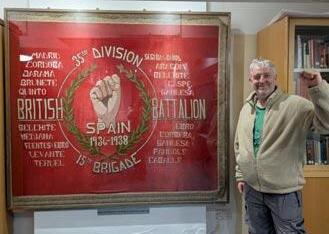
q MacDonald next to the British Battalion banner in the Marx Memorial Library.
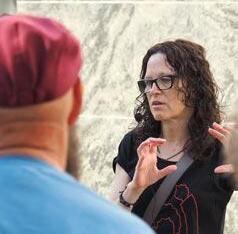
y Historian and Solidarity Park co-founder Sònia Garangou leading a tour in Malgrat de Mar.
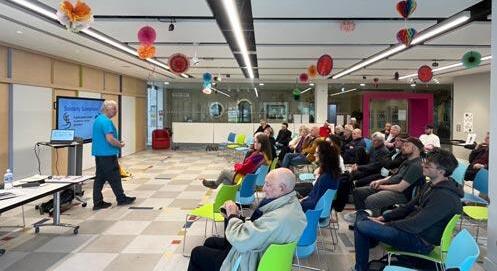
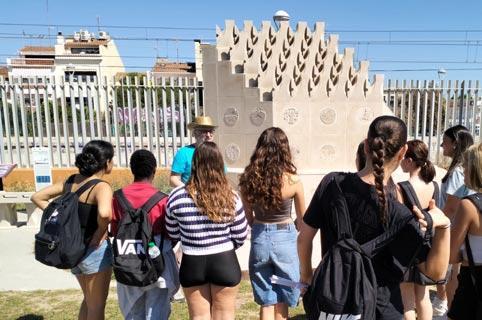
u Unveiled in 2022, the Solidarity Park monument in Malgrat de Mar, Catalonia, honours International Brigaders from the SS Ciudad de Barcelona that was sunk by Italian torpedoes in May 1937 only 400m from the shore. Besides the Brigader casualties, over 100 other passengers and crew perished.
Pictured right is Rob MacDonald using the monument to talk to local students about the sinking and the wider context at the annual festival, held each year in late May.

The past is never far away
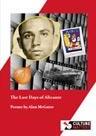
‘The
Last Days of Alicante’ by Alan McGuire (Culture Matters, 2025)
Like any keenly observant Briton living in Spain, poet Alan McGuire can see the legacy of the country’s civil war all around him. In this collection of 21 of his poems, Spain’s troubled past mixes with the everyday routines, sights, sounds and tastes of his adopted homeland.
With Eoghan Gilmartin, McGuire is the presenter of the groundbreaking Sobremesa podcast. Together, and with the help of expert guests, they explore contemporary Spanish politics and culture. Inevitably this frequently involves scrutiny of Spanish society’s unresolved problems with the civil war and the decades-long Franco dictatorship that followed it.
The past is never far away in this collection
either. There are tender love poems, mixed with snapshots of Spanish life – fresh bread, a cup of coffee in a bar, a sudden downpour, adoration of the Virgin at a fiesta, children playing in a plaza, the bustle of a restaurant:
the waiter of Casa Lucia / never stumbles, always grumbles, the olive groves of Jaén: Cris crossed braids / Earth worn veins / Carry the sign of peace / Across sweat-drenched fields.
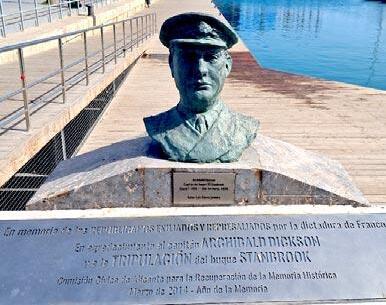
But the most powerful poems are those in which McGuire conjures up the tragic events of the last century. The title of the collection is a clue to one of them. Towards the end of March 1939, in the dying days of the Spanish Republic, the London-registered Stanbrook , captained by Welshman Archibald Dickson, took nearly 3,000 Spanish Republican refugees from Alicante to safety in French Algeria. thestanbrook,the30-year-oldsteamership gotawaywithwomen,menandkids butleftbehindsomanymore condemnedtocampsandtheworstofall “…nightwasclearbutcold andithinkthesufferingsofthesepeople standingondeckallnight
‘Time stands still or merges with the present throughout Alan McGuire’s always engaging and often moving poems.’
musthavebeenprettybad” archibald said theycrossedthemed withrefugeesforalgeria thefrenchtriedtostopthem, a thousand men had to live on the boat thenacampwithlittlehope somefoughthitlerandmussolinitoo neveragaintoseetheirhomelandofsun livinginexileuntilfrancodied hisheadonapillow
There are five poems dedicated to Miguel Hernández. Pictured on the booklet’s cover, Hernández was a poor, self-taught goatherd from Alicante province who became a renowned poet. He died in extraordinarily harsh conditions in Franco’s gulag, having been sentenced to death, commuted to 30 years imprisonment, for being a communist commissar and for writing poems harmful to the Francoist cause.
In one of these poems, McGuire is on a bus to visit Hernández’s grave: thetouristsprawlisthinnerhere/anindustrial sizedfuneralhomeoppositeanabandonedgastro bar/thisleadsthewaytomiguel'slasthome.
The poet’s tomb inspires more verse in another poem: sittingbelowapalmtree with his wife and son miguelwritesverseasthemoon changestothesun an inscribed lemon sits
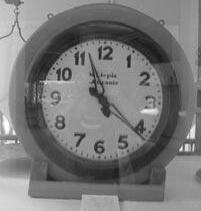
p The clock in Alicante’s market remains stuck at the exact moment when the market was bombed on 25 May 1938.
u Bust of Archibald Dickson in Alicante harbour.
‘The poems are interleaved with photos to explain what is going on when some of the historical references are not apparent.’
on the tomb alongwithletters tothepoetwhowasonlythirty-one who wrote about bombs, lemons onion milk and love
There is just one explanatory footnote in the entire collection. But the poems are interleaved with photos that help explain what is going on when some of the historical references are not immediately apparent.
This is the case for one of the most effective and eloquent poems, ‘Mercado Central’, about the carnage at Alicante’s market when it was bombed during the civil war by Italian airplanes. Today, some 300 points of light on the ground represent the number of lives lost, most of them women and children.
The action in the poem flits from the present to the past in lines that must surely be inspired by Pablo Neruda’s masterpiece ‘I’m Explaining a Few Things’ about the bombing of Madrid. shoppersbuyflowers fortheirgraves redpetalsfallwithdust from the bombs flowers wilt in the heat stems snap as screams fall silent reflectionsofscarsinglassshards irongirdersgroan as life leaves fishlayonabedofice jamonlegnotcut tomatoessquashedflat marketclockstaysstuck at eleven twenty
The clock did indeed stop on 25 May 1938, when so many people were mercilessly slaughtered. Time stands still or merges with the present throughout McGuire’s always engaging and often moving poems.
JIM JUMP
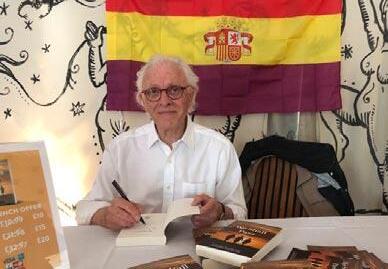
p Author Clifford Thurlow’s works have tackled the care
Page-turner makes for perfect present

Th is is another novel that uses events in Spain as the setting for its main characters, fairly accurately, and is to be welcomed. The first of these is tough Glaswegian Robbie, who meets nurse Alice following a bout of police brutality at the conclusion of a hunger march in London. She gives him the money to make the trip to Spain. By an incredible coincidence, he bumps into her twin brother Simon in an alley in Paris, just in time to prevent him from being stabbed by a couple of Franco-supporting thugs, and the bonds of comradeship are thus forged.
Simon is heading to Spain on something of a moral mission, escaping a career soldier/diplomat father who is on very friendly
‘Certainly, the author has captured the horror of the Battle of Jarama.’
terms with German Ambassador Ribbentrop, and is angry that Simon is not finishing his degree and then joining ‘the regiment’. They arrive as the British Battalion is being formed and are then thrown into the carnage of the Battle of Jarama.
Certainly, the author has captured the horror of that battle, as he also does later when describing the equally terrible Battle of Brunete.
A wound sustained in battle brings about a blissful reunion with nurse Alice, who has also decided to travel to Spain to do her bit for the cause. This gives the author a chance to highlight the terrible circumstances under which the medical aid personnel had to operate.
An unnecessary anti-communist bent to the story is highlighted after the village of Villanueva de la Cañada is taken, thanks to Lieutenant Robbie disobeying orders.
He is then torn off a strip, in front of the battalion, by his British commanding officer, who is portrayed as a clueless Stalinist martinet.
The story concludes following events at Brunete – no spoilers here. Despite the unlikely plot twists, this makes for a nice, easy read, especially taking into consideration the number of British Brigaders who did marry a nurse. It would make a good gift to introduce someone to the events in Spain.
ALAN LLOYD
‘We Shall Pass’ by Clifford Thurlow (Luath Press, 2025).
system, bank robberies and army interpreters.
Keeping memory and plants alive in Madrid
The IBMT hails the work of volunteers in Madrid and calls on members to care for their local memorials.
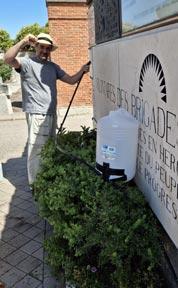
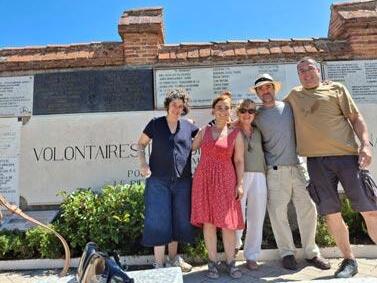
Hats off in the hot summer weather to a group of Spaniards who looked after the memorial garden for the International Brigades at Fuencarral Cemetery in Madrid.
Each week they visited the cemetery to keep alive the flowers around a memorial wall dedicated to the international volunteers.
Among the plaques is one for the 15th Brigade, which included the British Battalion and battalions of American and Canadian volunteers. It was unveiled in 2009 by British ambassador Denise Holt, with funding shared between the IBMT and the US-based Abraham Lincoln Brigade Archives.
The need to tend the plants in Madrid’s infernal summer temperatures was underlined by Álvaro Angosto, one of the team of volunteer
gardeners. ‘We try to water them a couple of times a week,’ he says. ‘A large water drum has also been installed to ensure continuous irrigation.’
He adds: ‘And when money is needed for replanting, it’s really heartening that so many people pitch in.’
Other plaques on the memorial wall remember the French, Italian, Jewish and Yugoslav International Brigaders. There is also a memorial to the Soviet aviators who died in the Spanish Civil War.
Some 450 Brigaders, including several Britons, were buried in the cemetery. Following Franco’s victory their bodies were exhumed and dumped nearby in 1941.
Searches for the site of the mass grave have been conducted this year, so far without success. They have been organised in the face of controversial plans by Madrid City Council to build a waste facility adjacent to the cemetery.
The memorial in Fuencarral Cemetery is not alone in needing some TLC. There are nearly 200 memorials to the International Brigades around Britain and Ireland.
They come in all shapes and sizes, from plaques to grand public sculptures, from paintings
t Helios Lizcano makes adjustments to the irrigation tank.
p From left: Nieves Hernández, Paula Cabildo, Maica Gómez, Helios Lizcano and Álvaro Angosto. Three other volunteers not pictured are Sofía Amechqar, Isabel d'Olhaberriague and Enrique Ruiz.
to mosaics and from benches and trees to stained-glass windows. Some just need a good clean; others have suffered damage or – worse still – have been removed or destroyed.
The IBMT is calling on members to go out and check on local memorials. Please contact the Trust if you find any damaged or missing memorials (admin@internationalbrigades.org.uk). Or roll up your sleeves and give your local memorial a quick spruce if necessary by clearing leaves or giving it a brisk clean.
To find your local memory, search the IBMT directory of memorials (https://internationalbrigades.org.uk/memorials/). To view the online map, go to https://international-brigades.org.uk/ uncategorized/map-of-memorials/ or scan the QR code below.

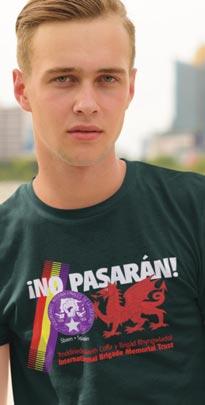
Choose your IBMT t-shirt



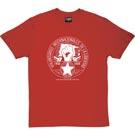



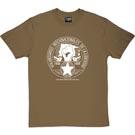
The IBMT has a range of new t-shirt designs highlighting the contributions of volunteers from Ireland, Scotland and Wales (below).
We also have a t-shirt featuring the iconic emblem of the International Brigades, in a variety of colours (left).
All t-shirts are on sale for £20 (plus £3.99 p&p) in a range of sizes (S-5XL) and are made from ethically sourced cotton.
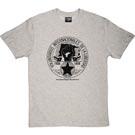
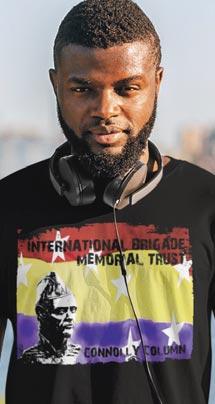
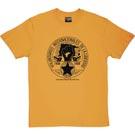
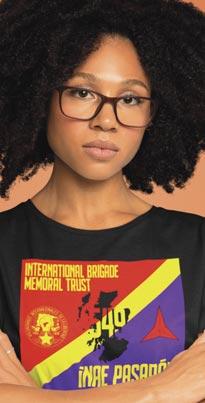

The t-shirts are produced in partnership with specialist radical apparel outfitter Red Molotov. All proceeds from sales help fund our vital commemorative and educational work.
To place an order online go to the Shop page of the IBMT website: www.internationalbrigades.org.uk/catalog
Help us inspire new generations with the story of the men and women who fought fascism and defended democracy in Spain from 1936-1939. Please consider leaving a legacy to the IBMT. To make a donation now go to: www.international-brigades.org.uk/ donation-page
International Brigade Memorial Trust
37a Clerkenwell Green, London EC1R 0DU
07865 272 639
admin@international-brigades.org.uk www.international-brigades.org.uk