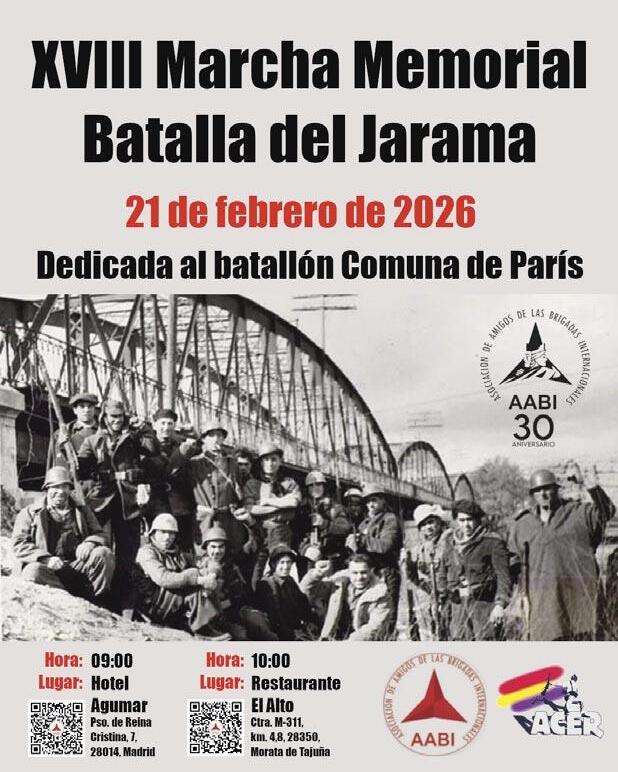
If you plan to attend this year’s Battle of Jarama commemoration, email IBMT Scotland Secretary Mike Arnott (scotland@international-brigades.org.uk) for more information, including details of a visit on Friday 20 February to Tarancón, where there is a memorial to the Scottish volunteers who were killed in the battle.
PASARÁN!
Magazine of the International Brigade Memorial Trust No.71 l 1-2026
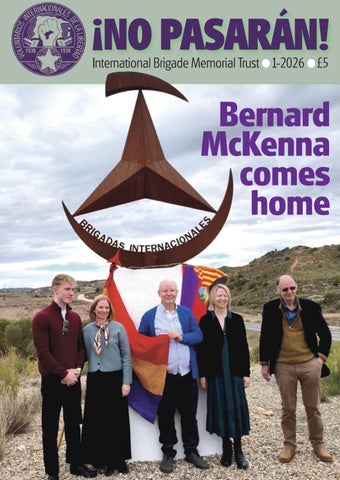
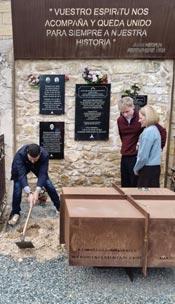
Bernard McKenna comes home
6 Embassy event
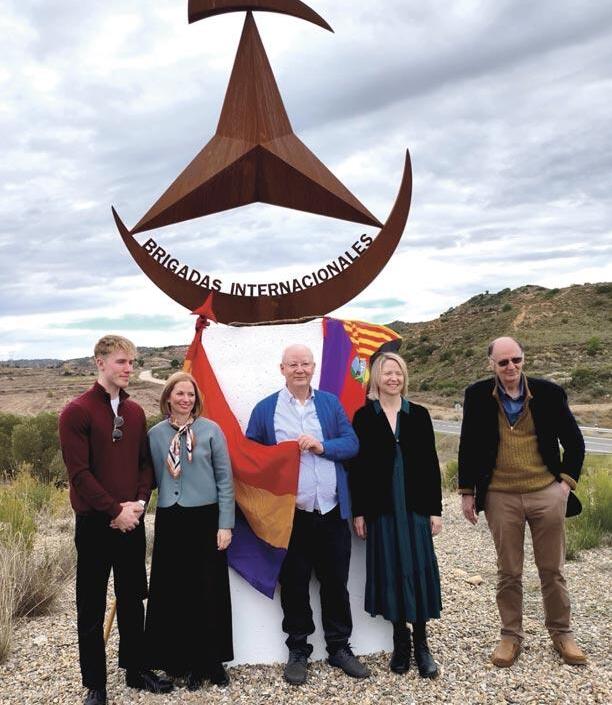
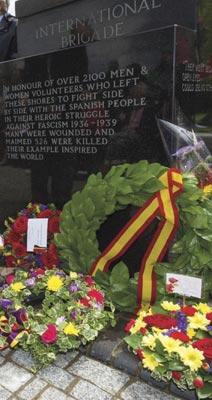
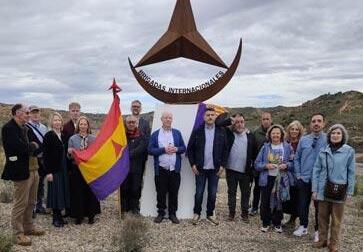
t The family of Bernard McKenna stand in front of the International Brigade memorial outside Caspe, near where his ashes have now been interred.
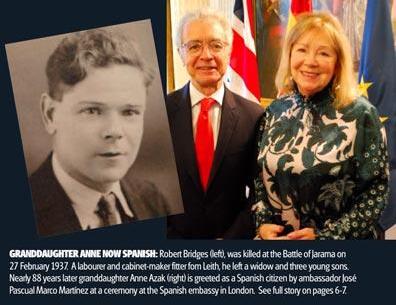
l London ceremony celebrating the granting of Spanish nationality to Brigader descendants.
8 Franco
l Jim Jump looks back at the Spanish dictator’s blood-soaked rule and toxic legacy on Spain today.
11 Home truths
l Nancy Wallach shares a letter written by her Brigader father Hy to her younger sister.
12 Testimonies from the camps
l Brigaders write of their experiences as prisoners of the Nazis.
15 Family history
l Luke O’Riordan on being the grandson of a prominent Irish Brigader.
16 Book preview
l Chris Hall introduces his new book about the volunteers at home and in Spain.
17 Oldham
l Rob Hargreaves welcomes the Oldham memorial back to its rightful home.
18 Books
l Reviews of ‘Stalin’s Failed Alliance: The Struggle for Collective Security, 1936-1939’ and ‘Travels Through the Spanish Civil War’.
IBMT, 37a Clerkenwell Green, London EC1R 0DU admin@international-brigades.org.uk www.international-brigades.org.uk
Memorials directory to undergo major update
The IBMT is launching a project to update and enhance the online directory of memorials across Britain and Ireland dedicated to the International Brigades. These take the form of sculptures, plaques, memorial benches and trees.
Along with the database of volunteers who served in Spain, the directory (www.internationalbrigades.org.uk/memorials/) enables IBMT members, historians and researchers to search for details of memorials and volunteers.
Members are regularly encouraged to send in updated details on the placement and condition of these memorials, as well as any new
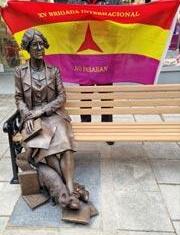
q The latest addition to the memorials directory: a statue of Sylvia Townsend Warner (novelist, writer and active supporter of the Spanish Republic) created by Denise Dutton and unveiled on 14 December 2025 in Dorchester, Dorset.
memorials that have been raised – or old ones that have been removed.
Despite this, some of the information in the directory is out of date. It is with this in mind that the IBMT is launching the memorials project. The aim will be allow for more accurate searches, more precise location data and better images where necessary.
The work will be carried out by a volunteer IBMT member, Greg Pasco, an LSE graduate who is a former speech therapist and researcher specialising in autism.
If you have any information, updates or queries about memorials or this project, contact Greg at memorials@international-brigades.org.uk.
Westminster and Holyrood praise
IBMT
MPs marking the 50th anniversary of the death of Spanish dictator Franco applauded the IBMT’s work in preserving the memory of the volunteers who fought fascism during the Spanish Civil War.
The praise is contained in an Early Day Motion tabled in the House of Commons by Labour’s Jon Trickett (Normanton and Hemsworth) to coincide with the anniversary of the dictator’s death on 20 November.
The EDM’s full text says: ‘That this House notes that 20 November marks the 50th anniversary of the death of Spanish dictator Francisco Franco; congratulates the Spanish people, along with their constituent nations in the Basque Country, Catalonia and elsewhere, on the restoration of democratic rule and their ongoing efforts to
The International Brigade Memorial Trust keeps alive the memory and spirit of the men and women who volunteered to fight fascism and defend democracy in Spain from 1936 to 1939
Treasurer Paul Coles treasurer@international-brigades.org.uk
Ireland Secretaries Luke O’Riordan & Lynda Walker ireland.international.brigades@gmail.com
Scotland Secretary Mike Arnott scotland@international-brigades.org.uk
Wales Secretary David McKnight wales@international-brigades.org.uk
Other Executive Committee members
David Chanter, Alex Gordon, Jonathan Havard, Denis Lenihan, Alan Lloyd, Dolores Long
Founder President Marlene Sidaway
Founding Chair Professor Sir Paul Preston
Patrons Professor Peter Crome, Professor Helen Graham, Ken Livingstone, Len McCluskey, Christy Moore, Jack O’Connor, Maxine Peake, Baroness Royall of Blaisdon, Mick Whelan
Historical Consultant Richard Baxell
eradicate the toxic legacy of decades of brutal repression; and applauds the vital educational and commemorative work of the International Brigade Memorial Trust to preserve the memory and spirit of the volunteers from Britain and Ireland who fought fascism during the Spanish Civil War, more than 500 of whom died in Spain.’
Support came immediately from Labour MPs Kim Johnson (Liverpool Riverside), Neil DuncanJordan (Poole), Ian Lavery (Blyth and Ashington) and Chris Hinchliff (North East Hertfordshire) and Democratic Unionist Jim Shannon (Strangford).
A similarly worded motion was presented to the Scottish Parliament by Labour MSP Mercedes Villalba
t Claire Hanna MP, leader of the SDLP, at Writer's Square, Belfast, who spoke about her great uncle, Richard McAleenan, from Banbridge, County Down. Richard spent a year in the British Battalion in Spain and was a battalion observer. He was a source of inspiration for her family, said Hanna.
(North East Scotland) and was supported by fellow Labour MSPs Katy Clark, Richard Leonard and Paul Sweeney, along with SNP members Clare Adamson, Alasdair Allan, Colin Beattie, Bob Doris, Jamie Hepburn, Bill Kidd, Fulton MacGregor, Stuart McMillan, Kevin Stewart and David Torrance and Independent members Foysol Choudhury and John Mason.
Motion S6M-19623 tabled at Holyrood notes that 120 Scottish International Brigade volunteers died in Spain. It also praises the work of all those who maintain the memorial in Tarancón to the 39 Scots volunteers who fell at the Battle of Jarama.
IBMT members gather in Belfast
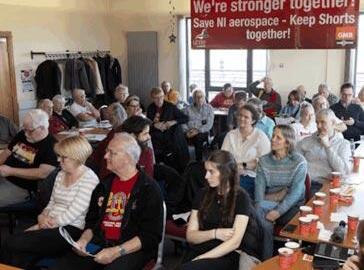
The IBMT held its Annual General Meeting (AGM) in Belfast on 4 October as a part of a weekend of commemorative, educational and social activities in the city.
Events began at Belfast City Hall on 3 October. Attendees were treated to music provided by Brenda O’Riordan (daughter of Brigader Michael O’Riordan) and the Cairde Community Choir. There were also moving speeches by Brigader descendants: sisters Gerry Abrahams and Anne O'Hara (daughters of Gerry Doran, from Antrim); Liz Shaw (daughter of Joe Boyd, from Cookstown, County Tyrone), Nancy Wallach (daughter of American Brigader Hy Wallach – see page 10) and Luke O’Riordan (grandson of Irish Brigader Michael O’Riordan – see page 15).
Saturday began with a bus tour taking in the
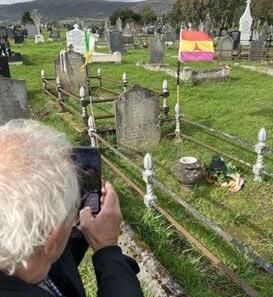
t A visit to the Straney family grave in Belfast's Milltown Cemetery, on which is inscribed a dedication to Jim Straney, who was killed at Gandesa during the Battle of the Ebro in the summer of 1938.
Kevin Cooper Photoline NUJ
Jim Jump
Shankill Library and the Milltown Cemetery. That afternoon, the Trust held its formal AGM to look back over the year’s work and plan for the future. This was followed by a social at the Dockers Club.
The weekend ended with a commemoration in Writer’s Square with speakers including Claire Hanna MP and Spain's Honorary Vice Consul in Belfast, José Andrés Lázaro Villanueva, who also laid a wreath.
At the AGM itself, Mike Arnott, Megan Dobney, Jim Jump and David McKnight were re-elected to the Executive Committee. Denis Lenihan was also welcomed on to the Executive Committee to serve a three-year term.
Former Trustee John Haywood decided to resign from the IBMT Executive Committee, effective from the AGM. John was thanked at the AGM for his unwavering support and work for the IBMT and the Oxford group over many years and was sent best wishes from the meeting.
Landmark achievement for library
documenting the history of Marxism, trade unionism, working-class struggle and the International Brigades.
The ASA accreditation recognises institutions that demonstrate excellence in governance, collections care, and user services.
‘This is a major milestone for us,’ said MML Director Meirian Jump. ‘It’s the result of years of focused work to professionalise our service, safeguard our collections, and ensure the stories of working class people are accessible to all.’
The MML is home to the country’s largest archive of the International Brigades and the Spanish Civil War.
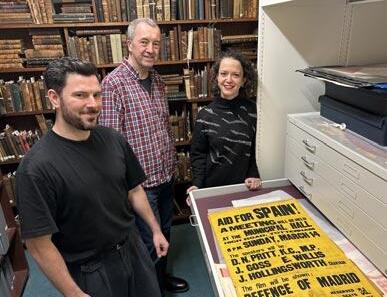
The Marx Memorial Library (MML) has been awarded Archive Service Accreditation (ASA), the UK’s gold standard for archive management and public access.
This prestigious ASA recognition confirms the library’s position as one of the country’s most trusted and professionally run historical archives. Founded in 1933, the MML is home to a unique and internationally significant collection
Historians lament Franco’s toxic legacy
The IBMT’s 2025 Len Crome Memorial Conversation was held at a well-attended Marx Memorial Library on 1 November.
Fifty years after the death of Franco, three leading historians of the Spanish Civil War – Paul Preston, Helen Graham and Richard Baxell –discussed the topic 'Toxic legacy: the lasting impact of Francoism on Spanish Democracy’.
A drinks reception followed the spirited, entertaining discussion, which included a message from Peter Crome, son of Len Crome, born Lazar Krom in 1909 in Latvia, after whom the annual event is named. Len was a GP in Blackburn in 1936 when he volunteered to go to Spain. He rose to the rank of major and headed the medical services of the 15th and 11th Brigades.
Marlene Sidaway is Founder President
Founding IBMT Secretary and partner of Brigader David Marshall, Marlene Sidaway (right) has stepped down from the IBMT’s Executive Committee after many years of service.
A committed activist and former President of the Trust, Marlene has been a frequent speaker at IBMT events and a regular presence on these pages. Her resignation was confirmed at the 2025 Annual General Meeting in Belfast. The meeting sent best wishes to her, thanked her for her outstanding contribution to the Trust and agreed she should continue to serve as IBMT Founder President.
Marlene combined her IBMT activism with a successful career on stage and screen.
u Marx Memorial Library staff from left: Archivist & Volunteer Coordinator Matt Dunne, Office Manager Ralph Gibson and Director Meirian Jump with a poster from the Spanish Collection.
p A packed meeting room in the Unite offices for the IBMT's AGM in early October 2025 in Belfast.
Marx
Memorial Library
Jim Jump
Your local IBMT affiliated memorial group
The IBMT supports the work of affiliated local International Brigade memorial groups. Annual IBMT affiliation costs £40.
You can affiliate through our website: www.internationalbrigades.org.uk/membership.
DIRECTORY
l Aberdeen XV International Brigade Commemoration Committee
Contact: Tommy Campbell tommy.campbell@outlook.com
l Belfast International Brigade Commemoration Committee
Contact: Ernest and Lynda Walker lyndaernest@btinternet.com
l IB Cymru
Contact: Mary Greening ibcymru@gmail.com facebook.com/groups/314892162181123
l Hull International Brigades Memorial Group
Contact: Gary Hammond thehutpeople@gmail.com
l North West International Brigade Memorial Group
Contact: Dolores Long doloreslong@fastmail.fm twitter.com/ibgtrmanchester
l Oxford International Brigade Memorial Committee
Contact: Colin Carritt colin.carritt@tiscali.co.uk
l Sussex Brigaders Remembered
Contact: Pauline Fraser pbf262@myphone.coop
Contact the IBMT to add your group to the Directory
International Brigade Memorial Trust
www.international-brigades.org.uk
Spain welcomes home Brigader descendants
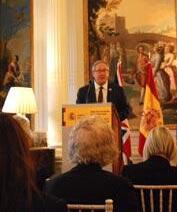
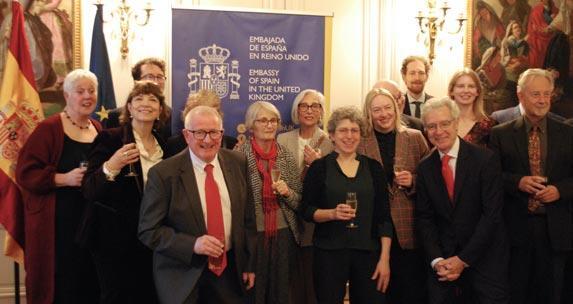
Some 40 children and grandchildren of International Brigaders attended a reception on 1 December 2025 at the Spanish embassy in London to mark the granting of Spanish nationality to descendants of the volunteers.
Spanish ambassador José Pascual Marco Martínez warmly welcomed his new compatriots and honoured their forebears who left their homes to fight for a free, democratic Spain.
Attendees listened while Luis Cernuda's poem 1936, written after the poet met several American Brigaders, was read aloud; it includes the lines:
Gracias, compañero, gracias
Por el ejemplo. Gracias porque me dices
Que el hombre es noble.
Nada importa que tan pocos lo sean: Uno, uno tan sólo basta
Como testigo irrefutable
De toda la nobleza humana.
In translation: Thank you, comrade, thank you / For your example. Thank you for telling
‘ We also pay tribute to the ordinary women, men and children of Spain who suffered so much under
fascist rule.’
me / That man is noble. / No matter how few there are: / One, just one, is enough / As an irrefutable witness / Of all human nobility.
Speaking at the event on behalf of the families was Peter Crome, IBMT Patron and son of Brigader Len Crome. He spoke with immense pride of the Brigaders’ courage in defending freedom and democracy in Spain. He also hailed the support work of Patricia Ure in Madrid, who had helped descendants with their applications.
Those who never returned home were not forgotten. Crome called on all present to ‘remember the over 500 Brigaders whose remains lie buried in Spanish soil, killed in battle or who died or were executed in
t Richard Baxell, IBMT Historical Consultant, speaking at the Spanish Embassy about the history of the International Brigades and the veterans’ fight against Francosim.’
Franco’s prisons and camps’. He added: ‘We also pay tribute to the ordinary women, men and children of Spain who suffered so much under fascist rule.’
In his speech, IBMT Historical Consultant Richard Baxell chose to remember Eddie Swindells (1912-1937), a Brigader who arrived in Spain on 1 December 1936 and never returned home to Manchester.
Baxell also recalled the words of an
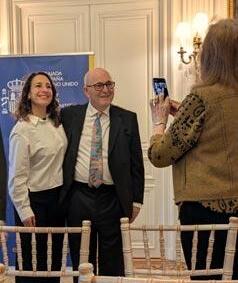
u New Spaniard Peter Crome poses for a
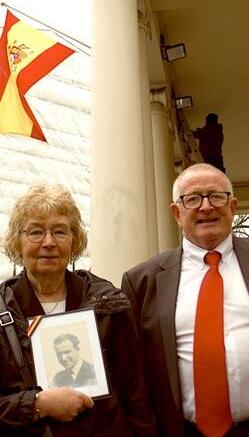
uu Outside the Spanish embassy in London, Frieda and Ian Park with a photo of their grandfather
Alec Park from Glasgow, who was killed at Belchite on 10 March 1938.
earlier Spanish Ambassador, Carles Casajuana, who, in 2009, assured seven nonagenarian Brigaders receiving Spanish passports at the embassy: ‘Your efforts were not in vain. Your ideals are part of the foundations of our democracy in Spain.’
As Baxell highlighted, this 2025 ceremony proved that the efforts of the Brigaders’ descendants to uphold the memory and spirit of the volunteers had also not been in vain.
Jim Jump
p Spanish ambassador José Pascual Marco Martínez (third from right, with red tie) welcomes children and grandchildren of International Brigaders as Spanish citizens at a ceremony in London on 1 December.
photo with his daughter, Susie.
Jim Jump
The struggle against Francoism continues
JIM JUMP looks at the malign legacy of Francisco Franco, who died 50 years ago in November 1975 and who, 90 years ago in July 1936, led the revolt that sparked the Spanish Civil War.
‘Spaniards, Franco has died,’ came the announcement 50 years ago on Spanish TV. If there was any truth to the widely held story that Barcelona immediately ran out of cava, the corks would have been popping behind closed doors. Most Spaniards held their breath on 20 November 1975, fearful of what might happen next.
After nearly four decades of brutal dictatorship, reactionary forces dominated the country’s institutions and the generalísimo himself had boasted that everything was being left ‘well tied up’.
Expectations
Confounding expectations, however, King Juan Carlos appointed a government that steered Spain towards free elections in 1977, the first since the Spanish Republic. In 1981 he helped face down a botched coup attempt by diehard army and civil guard units, who briefly seized the Cortes, the Spanish parliament. In the following year the PSOE socialists – the dominant party in the Republic’s Popular Front government – won the general election.
Today Juan Carlos, who abdicated in favour of son Felipe in 2014, is again at the
centre of controversy. His autobiography, published last year, praises Franco’s ‘intelligence and political sense’. But it says nothing in 500 pages about the victims of Franco, nor the scars that the Spanish Civil War have left on Spanish society.
Publication of the memoir comes at a time of heightened political tensions in Spain. Far-right Vox is surging in the polls. In half a dozen autonomous regions the party props up right-wing administrations fronted by the more mainstream Popular Party (PP) –which is itself a haven for Franco apologists.
‘ Hailed as a triumph of peaceful top-down politics, the transición to democracy was far from bloodless.’
The recent anniversary of the dictator’s death also saw anti-immigrant fascist groups on the streets of Madrid giving Nazi salutes, singing Francoist anthems and waving SSinspired flags.
Applauded
Though many have applauded Juan Carlos’s role in Spain’s transition to democracy, they often overlook the tide of popular agitation that was also forcing his hand. Hailed as a triumph of peaceful topdown politics, the transición was far from bloodless. Hundreds died in political violence, including terrorist attacks by a shadowy far-left group, Grapo, that is now known to have been heavily penetrated by Francoist secret police.
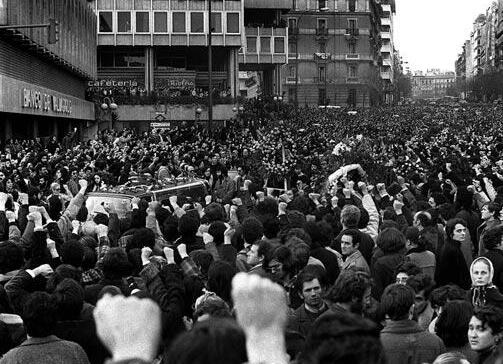
Among the worst atrocities was the assassination in 1977 of five communist lawyers by fascist gunmen in Madrid’s Atocha Street. More than 100,000 people attended their funeral – one of the first mass demonstrations since the Caudillo ’s death. This was followed by strikes and displays of solidarity across the country. A few weeks later the PCE communist party was legalised. The blood on Franco’s hands never dried. After launching the military uprising that
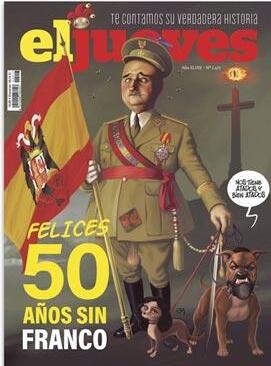
t 50th anniversary cover of the Spanish satirical magazine ElJueves with the headline ‘Happy 50 years without Franco’. The two dogs bear the faces of the right-wing president of the Madrid region, Isabel Díaz Ayuso, and the leader of far-right party Vox, Santiago Abascal, who paraphrases Franco by saying, ‘He’s got us tied up and well tied up.’
u Hearses with the bodies of communist lawyers killed by fascists in 1977 pass through crowds in Madrid
sparked the country’s civil war in 1936, he climbed to power over the dead bodies of more than 150,000 summarily executed Republicans, leftists and trade unionists. Their toll easily outnumbered the victims of revenge attacks against supporters of the coup.
Troops
Victory in 1939 was secured courtesy of troops, aircraft and weapons sent by Hitler and Mussolini. When their planes mercilessly bombed Guernica, Barcelona and Madrid, the world was shocked. But in characteristic Perfidious Albion fashion, the British government chose to appease the fascist dictators by covertly favouring Franco with an arms embargo on the Republic – all under the guise of ‘non-intervention’.
Even when the war ended, the systematic torture and killings continued in Franco’s vast network of penal camps. In 1940 in Madrid alone there were 30 prisons housing 100,000 Republican prisoners, a quarter of them on death row. And so it went on, year after year, with the terminally ill Franco signing the last five death warrants as he was about to climb into his death-bed.
In Britain, veterans of the International Brigades, who had fought so bravely during
the civil war, kept up their struggle in other ways. The International Brigade Association helped organise frequent protests and embassy pickets. The IBA worked with socialist lawyers to send observers to trials of political prisoners along with food for their families. Others went further. Dublin-born Brigader Bob Doyle, for example, used family trips to Spain to take money to the anti-Franco underground and on one occasion scattered leaflets on a Madrid bus and among football crowds before making a swift getaway.
There had been a glimmer of hope at the
‘Even when the war ended, the systematic torture and killings continued in Franco’s vast network of penal camps.’
end of the Second World War that Franco’s regime, by then an international pariah, might be toppled. But the US cavalry rode to the rescue, finding in Franco a dependable anti-communist stooge during the Cold War. Generous long-term loans began in 1950 and three years later the US was handed air and naval bases in exchange for more economic and military aid.
Spain today is a vibrant, open society, though one with all the familiar social problems of advanced Western liberal democracies. Scratch the surface, however, and historic divisions open up and old attitudes forged by 40 years of censorship and dictatorship lies re-emerge.
Century
It wasn’t until the start of this century – a full quarter century after Franco’s death –that the unofficial pact of silence that accompanied the return to democracy was broken. Younger people began asking what had happened to their grandparents during the war, why they didn’t have a grave and why no one dared speak about it.
Soon they found out the awful truth that Spain is a country covered with mass graves of
Republicans. There were – and still are –thousands of them – including ones with remains of International Brigaders whose bodies were dug up and dumped after Franco won the war.
The man who initiated the first exhumation was Emilio Silva. He was trying to find the remains of his grandfather in the village of Priaranza del Bierzo in north west Spain. But in the process he launched a social movement of Spaniards demanding to know the truth about the past.
Bury
‘What I wanted was to bury him with my grandmother and go back to my life as a journalist,’ Silva recalled in a recent interview. ‘I thought I was going to return to how things were before finding the mass grave, but everything became unstoppable.’
Many thousands of murdered Republicans have since been given proper burials, though it is estimated that the remains of more than 100,000 of Spain’s ‘disappeared’ still lie unidentified in the Spanish earth.
Propelled by this mass movement for the recovery of historical memory, the PSOE-led governments of José Luis Zapatero and current prime minister Pedro Sánchez have made worthy efforts to help Spain come to terms with the crimes of Francoism.
Memory laws have acknowledged old injustices and addressed the issue of mass graves. Streets glorifying fascists have been renamed. Franco’s body was removed from the grotesque mausoleum he built for himself with Republican
‘Anti-Francoists in Britain had ensured that Franco and his underlings were never accepted by the British people.’
Help keep their memory alive
Please consider leaving a legacy to the International Brigade Memorial Trust when you make or renew your will.
We depend wholly on donations and support from people who believe the example of solidarity and anti-fascism set by the International Brigades must be preserved for future generations.
Any gift, however small or generous, will fund our vital educational and commemorative work.
Thank you for thinking of us.
slave labour north west of Madrid. Exiles, International Brigaders and their descendants have been welcomed as Spanish citizens.
Unsurprisingly Vox and the PP have resisted all these moves, with regional authorities led by them rolling back memory laws and refusing to identify and protect mass graves.
Yet, as one historian has pointed out, Spain is the only country in western Europe where it is possible to randomly dig a hole in the ground and run the risk of unearthing human remains. Meanwhile those who call for an end to this scandal are accused of stirring up old hatreds.
Bill Alexander, former commander of the British Battalion in Spain, noted proudly after the country’s return to democracy that anti-Francoists in Britain had ensured that Franco and his underlings were never accepted by the British people.
Their campaigning had ‘remembered the heroic struggles of the Spanish people and recognised that only the end of Francoism could bring freedom’.
Sadly, the toxic legacy left by Franco has still not been properly expunged and Bill’s words remain true to this day.
Dearest Vicky, Congratulations on your second birthday. They tell me you are quite an amazing young lady. Although you cannot be expected to recall, I have seen you quite often from the time you were born until you were six weeks old.
Even then, you were a beautiful child, and your progress was ‘amazing’, and that is as it should be for you’re part of the first generation of a new world. A world as bright and beautiful as you are.
As a matter of fact, it could be neither more nor less than that. The world and everything in it is a reflection of the people who inhabit it. A simple truth – and to your generation it will seem so obvious. But that is because this people’s war that
‘That is what we are fighting for –the historic task of our generation –to make this a people’s world.’
¡Salud y victoria!
DAVID
HYMAN ‘HY’ WALLACH (1914-1999) was a Lincoln Brigader who also served in the US Fifth Army in the Second World War. He wrote this letter to his two-year-old daughter, Victoria, in anticipation of the victory over fascism. It was read by her sister, Nancy Wallach, at Belfast City Hall last October as part of the IBMT’s Annual General Meeting programme.
your father, mother and their generation are engaged in will have been won. That is what we are fighting for – the historic task of our generation – to make this a people’s world.
You see, darling, we are taking the world away from the greedy few and giving it to you. It is wonderful and something worth dying for but carries great responsibilities.
You will have the greater task of running the world – and you must be equal to it. You are the future, and that is why you, all your playmates, your cousins, must be beautiful and intelligent in every way and in every sense.
But above all, you must learn to appreciate one another and work together, for that is the way the world is going to be run and on the extent of it does our future progress depend.
way to your generation, a generation of architects who will not reconstruct but construct a bright new world on new foundations in which man’s inhumanity to man will no longer exist.
And so, Vicky, on your birthday, your father salutes you and the future. In our fight for the freedom of Spain, we learned to express these things with the words, ¡Salud y victoria!
And now for your birthday, I want to make you the promise, my darling, that this year shall see the first concrete signs of your world with the defeat of fascism in Europe and go on from there to the utter destruction of fascism everywhere!
This is the least we can do before we give
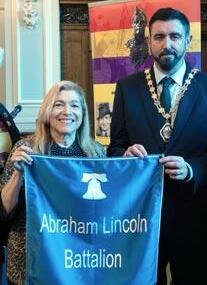
u Nancy Wallach, daughter of Hy Wallach and Executive Committee member of ALBA (Abraham Lincoln Brigade Archives) with the Deputy Lord Mayor of Belfast Paul Doherty, pictured on 3 October 2025 in Belfast City Hall.
Kevin Cooper Photoline NUJ
Old bonds endured
A recent study, collectively authored by the Spanish Republican prisoner remembrance group Amical de Mauthausen, sheds light on the camaraderie and solidarity between Spanish Republican soldiers and International Brigaders imprisoned in Nazi concentration camps during the Second World War.
After the International Brigades disbanded in autumn 1938, Brigaders faced mixed outcomes. Some returned to their countries, where they were not always welcomed – the Dutch and the Swiss, for example.
The Canadians, for their part, were subjected to close surveillance and had difficulty finding work, yet did not hesitate to fight against fascism in the Second World War. The Americans were investigated because of their links to communism and, under McCarthyism, were blacklisted or even incarcerated.
It was another story for those who could not return to their places of origin, such as Germany, Italy or Austria, which were under the yoke of National Socialism or Fascism.
Many continued to fight during the last battles in defence of Catalonia: the Czechs, whose government refused their repatriation, formed a battalion of around 450 men, and the Romanians covered the retreat of the civilian population.
All began their long journey into exile in February 1939, to be interned, along with Spanish Republican exiles, in French camps, where they often worked together and supported each other.
After the signing of the armistice between Hitler and Pétain, on 22 June 1940, the following orders were given: foreign ex-combatants of the Republican International Brigades, along with Spanish citizens who, in enemy countries, particularly in occupied France, have been detained or interned, will be, by order of the Führer, removed from war prisons, placed at the disposal of the Gestapo and conducted to the corresponding concentration camps.
‘ I asked: “Are you Spanish?” “No, we are your brothers. We are International Brigaders,” they replied very kindly in Spanish.’
‘ These chance encounters signified, for both groups, a strengthening of the old bonds forged in the struggle against fascism.’
Committees were then set up to find and process Spaniards and Brigaders incarcerated in prisonerof-war camps or interned in the south of France.
Republican soldier Joan Escuer Gomis (1914- 2004) recalled:
In late August or early September [1940], a Nazi delegation of the German Armistice Commission came to the camp to oversee all our friends from the International Brigades from European countries occupied by the Nazi army. A few days later – with the exception of some Germans, a few Austrians, Poles, Czechoslovakians and others, around 14 or 15 men who were able to escape – everyone was loaded on to lorries and taken away from the camp. That is how those unforgettable comrades left Argelès.1
Shared ideals and the struggle that had united Republicans and Brigaders in Spain and in the resistance in the occupied countries brought them back together in Nazi camps.
Groups of International Brigaders were delivered from French camps or detained as resistance fighters and handed over to the German political police, the Gestapo. Like political enemies, they were deported to Sachsenhausen, Dachau, Mauthausen, Buchenwald, Ravensbrück and other camps, and were identified as Rotspanienkämpfer (‘combatants in Red Spain’).
French volunteer Lise London (1916-2012) described her experience: We were surrounded by armed men and taken to the last carriage of a passenger train. On the platform a detachment of the SS prevented civilians from approaching (…) When the train left the station, several rail workers waved to us, some surreptitiously raising their fists, others making the V for Victory sign with their fingers (…) We scribbled some words to our families on little bits of paper and threw them onto the tracks. Most were picked up and sent to the addresses written on them 2
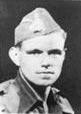
Austrian International Brigader Hans Landauer (1921-2014) described his experiences: After the defeat of France, we became prisoners of war and were subsequently imprisoned in
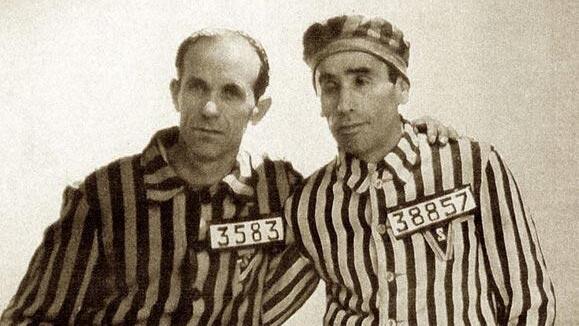
z Republican soldier Prisciliano García Gaitero wearing number 38857 in Dachau with a fellow prisoner. He never recovered from the tuberculosis he caught in the camp and died on 30 June 1949 at just 39 years of age.
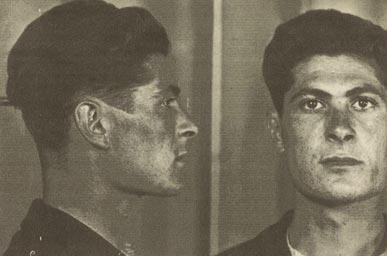
p Police mugshots of Spanish Republican Joan Escuer Gomis taken in Nantes, France, on 5 September 1942. He survived the war and returned to Spain in 1972. He later served as chair of Amical de Mauthausen (an association that remembers Spanish victims of Nazi camps), and dedicated his life to honouring deportees and victims of Nazism.
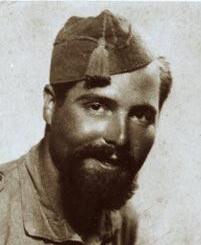
u Spanish Republican José Carabasa was imprisoned in Sachsenhausen. He never returned to Spain after the war.
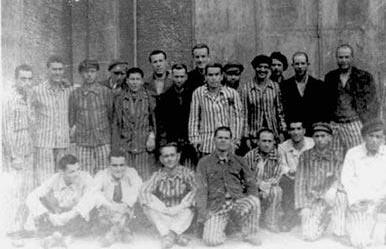
q Austrian Brigader Hans Landauer (back row, centre) with Spaniards after the liberation of Dachau.
Amical de Mauthausen
Amical de Mauthausen
DÖW
several concentration camps like Dachau, Buchenwald, Sachsenhausen, Mauthausen, (…) along with our Spanish companions and comrades-in-arms. Our fate was once again linked to Republican Spain. In the camps where the political prisoners had some influence, solidarity came naturally.3
Dachau was the camp where Republicans and Brigaders came across each other most. On 8 September 1942, around 100 Spaniards arrived from Mauthausen on one of the ‘ghost trains’ bound for an unknown destination, possibly the gas chamber at Schloss Hartheim.
They were in a pitiful state – weak, sick and exhausted. Everything indicated that their end was near but when they were identified by the Brigaders, their luck changed drastically.
Republican soldier Prisciliano García Gaitero (1910-1949) wrote: At around midnight, the train came to a halt. The doors of my carriage opened and began spewing wraiths. Then a miracle happened: a lorry of SS guards and, with them, prisoners in blue-striped uniforms, who spoke Spanish. Pinching myself to come to my senses, I asked ‘Are you Spanish?’ ‘No, we are your brothers. We are International Brigaders,’ they replied very kindly in Spanish.‘Come, come on, Spaniard.’
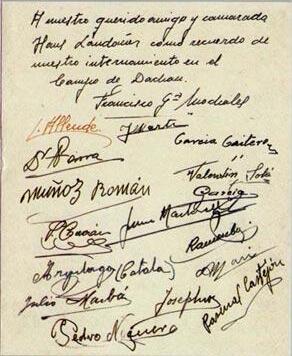
t ‘For our dear friend and comrade Hans Landauer as a souvenir of our internment in Dachau’, signed by around 30 Republican prisoners.
DÖW/Spanish Archives
the Nazi concentration camps were repatriated to their countries of origin. That was not the case for the Spanish who were claimed by no one, which confirmed their true condition of stateless persons, just as they had been classified in Mauthausen camp (they wore blue triangles).
With the liberation of Dachau, in April 1945, when emotions overflowed and new hope for life and freedom was rekindled, around 30 Republicans signed a card expressing their gratitude and in which they wrote: ‘to our dear friend Hans Landauer as a souvenir of our internment in Dachau’.
Such camaraderie, forged in the struggle against fascism, in exile and in Hitler’s concentration camps, would endure beyond liberation and was maintained in the decades following the physical demise of the protagonists.
I gazed in wonder at their shadows, trying to guess the nature of those beings that seemed to me more heavenly than kind-hearted, wondering whether I was still in this world or already in another. Most surprising of all was that those strange angelic voices were speaking to me.4
These chance encounters between Brigaders and Spanish Republicans in Nazi concentration camps signified, for both groups, a strengthening of the old bonds forged in the struggle against fascism, but in a new situation in which their military conviction lauded solidarity and the development of clandestine resistance as supreme values.
Josep Carabasa Marso (1912-2003), a Republican fighter, recalled: The head cook was a fabulous chap and had fought with us in the International Brigades. That man did a lot for the Spanish and his name will forever be etched on my memory: Willi Remmel. It was he who gave me the first piece of advice: ‘Comrades, what really works here is keeping your eyes peeled. Don’t forget it!’ (…) On 14 April 1943, after arranging (stealing) things in the kitchen, I was able to hide around fifty kilos of potatoes and several large loaves of bread. Thanks to the help of another International Brigader, Fritz Aykermaye, who loaned the keys to an empty hut, we Spaniards were able to celebrate ‘our national holiday’ with a feast of boiled potatoes and bread. 5
After the defeat of Nazism, survivors from
l This is an edited translation of a longer study financed by the Spanish Ministry of Territorial Policy and Democratic Memory, carried out by Amical de Mauthausen y otros campos (Friends of Mauthausen and other camps) and Amical de les Brigades Internacionals de Catalunya (Friends of the International Brigades of Catalonia), supported by archive library Pavelló de la República and FIR (International Federation of Resistance Fighters). It was translated from the Spanish by Kim Eddy.
1 Joan Escuer Gomis, ‘Memorias de un Republicano Español Deportado al Campo de Dachau’, Amical de Mauthausen, Barcelona, 2007, p.124.
2 Lise London, ‘La Madeja del Tiempo: Memoria de la Resistencia’, Ediciones del Oriente y del Mediterráneo, Madrid, 1997, p. 426.
4 Prisciliano García Gaitero, ‘Mi vida en los campos de la muerte nazis’, Edilesa, Léon, 2005, pp.134 - 135.
5 Eduardo Pons Prades y Mariano Constante, ‘Los cerdos del comandante’, Editorial Argos Vergara, Barcelona, 1979, p.124.
‘ Such camaraderie, forged in the struggle against fascism, in exile and in Hitler’s concentration camps, would endure beyond liberation.’
Growing up with Michael’s legacy
LUKE O’RIORDAN reflects on being the grandson of a prominent Irish Brigader.
Many readers will have known my grandad Michael
‘Mick’ O’Riordan (left) and many more of you will have known my dad, Manus.
We are indebted to my father and so many IBMT members for their work in preserving, researching and bringing to life the stories of all those brave volunteers from Ireland, Britain and further afield who fought for what they knew was right.
I attended the AGM in Belfast in 2007. It was the first such meeting I had attended since the passing of our grandad a year and a half previously.
As a 19-year-old who was very close and immensely fond of his grandfather, I felt there was an extra layer of nostalgia to the occasion. Another layer was added later that evening at the social event in the Europa Hotel, where Tommy Sands was among the performers.
His song ‘Your Daughters And Your Sons’ includes the following verse: They tortured you in Belfast and they taunted you in Spain / and in that Warsaw ghetto they tied you up in chains. / In Vietnam and Chile they came with tanks and guns, / It's there you sowed the seed of Peace in your daughters and your sons.
The song draws upon the many global injustices of the 20th century, handed down over time, and highlights the value in sowing the seeds of freedom, justice, equality and peace for the next generation.
And that is exactly what the IBMT does. In keeping alive the memory of the International Brigades: it sows those seeds for future generations. Unlike my father, I am neither a historian nor a researcher, but I do remember what it was like growing up as the grandson of someone like Michael O’Riordan, and how both he and my parents, Manus and Annette, sowed those seeds for me, Jess and Neil.
Our grandfather had a bit of a presence about him. Holding court in Connolly Books, he would size you up. And if he wanted to engage with you, he was very generous with his time and insights.
And as a grandfather, he was loving and kind, and always had great time for all of his grandchildren, and for other children and young people as well, as his lifetime of activism and want for a better world never faltered.
Memories of grandad speaking about his time in the International Brigade, and his views on politics and the world more generally, are seared into the memory of my childhood.
I will forever be grateful to my parents for bringing me to Spain in 1996, the 60th anniversary of the beginning of the Spanish Civil War, and the biggest-ever reunion of Brigadistas in Spain.
The experience of walking through the streets of places such as Barcelona, Madrid and Guernica and visiting battle sites such as Jarama alongside our grandad and his comrades from all over Europe are memories I cherish and will never forget.
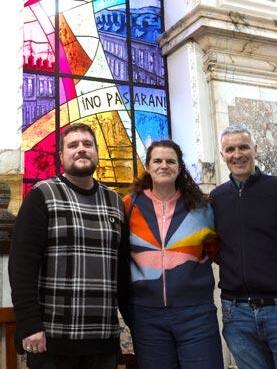
t Luke O'Riordan (left) with siblings Jess and Neil next to the stained-glass window dedicated to the International Brigades in Belfast City Hall. They are pictured during the IBMT’s AGM weekend in early October last year.
Even though I was only eight years of age, it imparted on me the great sacrifice so many of these men made.
Equally impactful on that trip were the throngs of Spaniards and Catalonians who rushed to greet and embrace the Brigadistas on the streets. They had been silenced for decades under the brutality of fascism, their stories left untold. But those who survived still remembered, and their sheer emotion showed that they were still forever grateful.
Not long after that trip to Spain in 1996, my grandad addressed my primary school about his experiences, his audience enthralled.
While remembering and commemorating the Brigaders is important, educating, engaging and inspiring future generations is essential. Because the world is, once again, in a dark place.
Never again is now. In the words of Christy Moore: Let us all remember them tonight
‘In 1996, my grandad addressed my primary school about his experiences, his audience enthralled.’
IN THEIR OWN W ORDS
This is their story
Author CHRIS HALL previews his new book about the volunteers at home and in Spain.
Ninety years ago, a civil war broke out in a then little-known country. For thousands of British, Irish and Commonwealth people, the Spanish Civil War was their main focus for three years.
Over 2,500 ‘British’ (including Irish and Commonwealth) men and women fought in the International Brigades or served in the medical services of the Spanish Republic. Over 500 volunteers were to die in Spain.
Other ‘British’ volunteers served as mercenary pilots and in the revolutionary militias; some even served on the side of the rebel forces.
At home, thousands participated in ‘Spanish Aid’ activities, raising funds for food ships and medical supplies for Republican Spain. During
‘For many volunteers, the Spanish Civil War was the “passionate cause” and the outstanding episode of their lives.’
the civil war, 4,000 Basque refugee children were supported by public donations. Picasso’s Guernica painting toured England to raise funds.
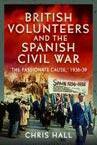
My new book, ‘British Volunteers and the Spanish Civil War: “The Passionate Cause”, 1936-39’, is the story of these ordinary men and women, told in their own words, reflecting the whole gamut of emotions from ecstasy to despair. Many volunteers went on to fight in the Second World War, and some became leading figures in postwar Britain. But for many volunteers, the Spanish Civil War was the ‘passionate cause’ and the outstanding episode of their lives. This is their story.
The book concentrates as much as possible on the experiences of the volunteers told in their own words. The usual suspects appear in the book: Sam Wild, Fred Copeman, Jack Jones, Frank Ryan and George Orwell. You will also find some you may not have come across, such as John Loverseed, Jane Orme, Miriam and Maurice Clyne, Roland Penrose
and Mary Elmes, to name just a few.
There are five sections. The first looks at the background to the Spanish Civil War, including what motivated people to volunteer and the journey to Spain. The next covers other military units and includes mercenary pilots, revolutionary volunteers, fascist fighters and men who served alongside Orwell.
The third and fourth sections look at the British Battalion of the International Brigade and humanitarian aid. In the closing section, we hear about the return of the volunteers and their involvement in the Second World War.
At the end of each chapter is a short biography of a volunteer or a married couple who both have a connection with the civil war.
The book ends by examining how the volunteers are remembered today.
Several members of the IBMT sent me information about their relatives as well as rarely seen photographs, some of which appear in the book and on the front cover. Many thanks again to all who assisted me.
In my previous books, I have interviewed International Brigade veterans Maurice Levine, Bernard McKenna and Dave Goodman, as well as Stafford Cottman, a lifelong friend of Orwell.
I am perhaps most proud of this, my seventh book, because it covers all types of volunteering in the Spanish Civil War, from rattling a tin to risking – and sometimes losing – one’s life in battle.
Readers will find information and stories with which they are familiar; they will also discover something new about previously unknown men and women who resisted fascism in any way they could.
In its own small way, this book serves to bring their stories to light. By purchasing the book, you will learn more about these remarkable people, and, with royalties going to the IBMT, you will be supporting the Trust.
I dedicate this book to all those unknown volunteers who supported the Spanish Republic.
ROB HARGREAVES welcomes
the
Oldham
memorial back to its rightful home.
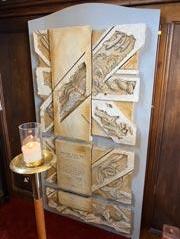
Oldham’s moving memorial to the town’s fallen International Brigade heroes has come home at last.
Thanks to the painstaking efforts by the North West International Brigade Memorial Group, the memorial to six Oldham volunteers killed in Spain is back on display, enjoying pride of place in the newly refurbished civic centre. It took two years of patient negotiations with officials by local stalwart Graham Briggs to get the memorial reinstated after a period of exile from the town hall. Said Graham: ‘Although it was originally commissioned by Oldham Council in 1986, to mark the 50th anniversary of the outbreak of the Spanish Civil War, the memorial has enjoyed mixed fortunes since then.’
Founding IBMT member Hilary Jones, whose father Sam Wild sustained four bullet wounds at the Battle of Jarama fighting alongside Oldhamer Clem Beckett, recalled that at one time the memorial – beautifully crafted by Holmfirth sculptor Jim Robison – had been relegated to a cellar, where for years it lay covered in dust and cobwebs.
In 2014, it was rescued by the parish church of St Mary with St Peter, whose Catalanspeaking priest promised grateful IBMT members that the memorial would be offered sanctuary and displayed in the church.
At a re-dedication ceremony in the civic centre on 29 November 2025, IBMT member Rob Hargreaves thanked the church for its custodianship, and, in particular, long-standing friend of the North West International Brigade Memorial Group, Canon Daniel Burton, for the church’s help.
‘British Volunteers and the Spanish Civil War: “The Passionate Cause”, 1936-39’ by Chris Hall (Pen & Sword History), published on 30 January 2026.
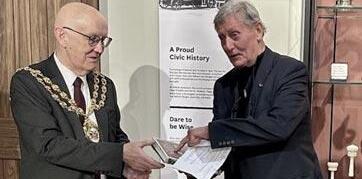
The Mayor and Mayoress of Oldham, Councillor Eddie Moores and wife Kath, presided over the well-attended ceremony. In appreciation of the council’s facilitating the return of the memorial, they were presented with a copy of Rob’s biography of Clem Beckett. Rob told listeners: ‘Nowhere in Britain was the cry of ¡No pasarán! taken up more passionately or more determinedly than by the people of Oldham.’
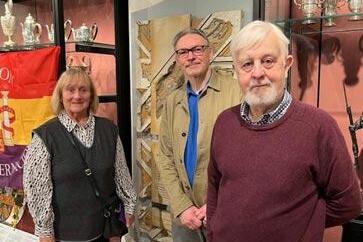
Special guests at the event were Sue Critchley and Andrew Spence, proud descendants of Oldhamer Joe Lees, killed at Brunete.
Speaking after the ceremony, Graham paid tribute to Oldham’s principal heritage officer, Sean Bagguley, for his support in bringing the memorial ‘home’.
Back where it belongs
Clockwise from top left:
l Brigader Joe Lees’s descendants, Sue Critchley and Andrew Spence, with Graham Briggs.
l The Oldham memorial, home at last.
l Rob Hargreaves presents a copy of his biography of Clem Becket to the Mayor of Oldham, Councillor Eddie Moores.
l Attendees at Oldham Civic Centre for the re-dedication of the memorial.
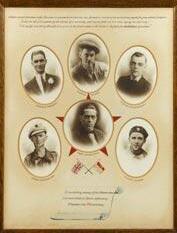
l Images of the 10 Oldham men: Cliff Wolstencroft, Billy Jackson, Harry Heap, Clem Beckett, Ken Bradbury and Joe Lees, who did not return home; and Albert Charlesworth, Joe Buckley, Charlie Hanson and Charlie Armitage, who survived.
Photos: Rob Hargreaves
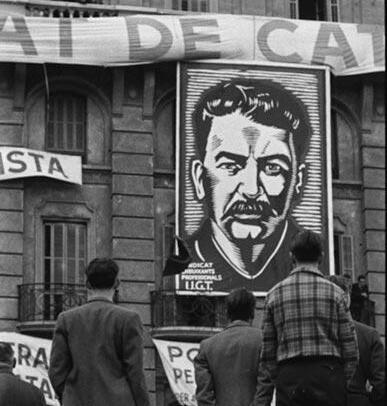
t Stalin’s portrait on the headquarters of the PSUC, the Catalan communist party, in Barcelona’s Plaça de Catalunya in 1936. The photo was taken by Antoni Campañà.
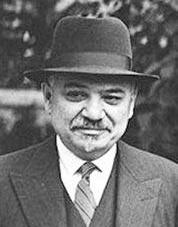
q Ivan Maiskii, the Soviet ambassador in London during the Spanish Civil War. In English his name also appears as Maisky or Maysky.
D efeat the fascist mutiny in Spain, warned the Soviets
M‘Stalin’s Failed Alliance: The Struggle for Collective Security, 1936-1939’ by Michael Jabara Carley (University of Toronto Press, 2024).
ichael Jabara Carley has completed an exhaustive trilogy tracing Stalin’s responses to the rise of European fascism and the menace that Nazi Germany posed for the Soviet Union (USSR). The author takes us up to 1941, when Germany launched Operation Barbarossa –the invasion of the Soviet Union and the horrific war of extermination that went with it.
‘Stalin’s Failed Alliance’ is the second volume and
covers the years of the Spanish Civil War. It details the efforts made by Soviet diplomats to persuade Britain and France to abandon the policy of non-intervention, which prevented the Spanish Republic from buying arms, and to wake up to the advantage that Germany would gain from a Franco victory in Spain.
Hitler’s intentions were hardly a secret. His blueprint for eastward expansion and his hatred of Russian Bolsheviks and ‘subhuman’ Jews and Slavs were laid out in his 1925 manifesto, ‘Mein Kampf’. Stalin took the Führer’s words seriously and reached out to the Western democracies. The objective was a military alliance against Hitler.
It was a hard task. Political elites, in Britain in particular, were, with only a few individual exceptions, blinded by their dislike of communism and socialism. Sentiment often tipped over into outright sympathy for
Nazi Germany, along with the hope that its war machine would leave the British Empire alone and guns would instead be turned on Moscow.
Stalin’s purge of the Soviet high command and the country’s diplomatic personnel also made things more difficult. Carey tells us that the sudden disappearance of Soviet contacts unsettled their Western interlocutors. Czech leaders were especially concerned. It also provided a pretext, for example among French generals, to pull back from rapprochement.
In the book’s biographical notes, the author lists all the key international politicians, diplomats and military figures who took part in the scheming and manoeuvring between the European powers. Out of a total of 35 Soviets, 20 have asterisks by their name, meaning they were executed in Stalin’s Great Terror of 1937-38 and its aftermath – usually because of past
associations with Trotsky or because they were accused of being spies.
The initial French reaction to the military uprising in Spain in July 1936 was to help the Spanish Republic. Prime Minister Léon Blum promised war materiel, but immediately ran into opposition from the French right-wing press and from London. As a way out he proposed an international policy of nonintervention. But in secret he also appointed a trusted customs official to organise an ‘underground railway’ for the clandestine delivery of arms to Spain. Machine guns were labelled ‘potatoes’ and ammunition as ‘sewing machines’.
From the start of the conflict British policy was to avoid any involvement and to stop the French from intervening. ‘It was the usual disappointing reaction from London, the usual wrong road taken,’ Carley notes.
Moscow at first responded cautiously. The priority remained an anti-Nazi alliance. Though the Comintern (Communist International) called for the defeat of the mutiny, government officials worried that the Western powers would be deterred if the Spanish masses armed themselves and formed workers’ soviets.
Such fears help explain why the Soviet Union quickly accepted a non-intervention agreement between the major powers. There would also be logistical difficulties in supplying the Republic. But policy soon began to shift once the extent of military assistance being sent by Germany, Italy and Portugal to the rebels became apparent. First came a decision to sell oil to Madrid on favourable terms; next a warning to the French and British that the USSR would not be bound by non-intervention if the flow of arms was not stopped.
In a briefing note sent to Stalin early in September, Foreign Minister Maksim Litvinov urged renewed efforts to consolidate mutual assistance pacts with France, Czechoslovakia and other countries. ‘There cannot be the slightest doubt,’ he wrote, ‘that Hitler’s efforts are directed at the creation of an opposing bloc to counter the USSR or at least to isolate it. The chances of implementing such a bloc have of late increased significantly.’
September 1936 also saw the Comintern begin organising the International Brigades, while Stalin approved the first shipments of weapons to Spain. Then on 7 October, the London-based non-intervention committee was informed that the USSR considered itself free of any obligations under the agreement. Four
‘Political elites in Britain were, with only a few exceptions,individual blinded by their dislike of communism and socialism.’
days later the Politburo approved a resolution drafted by Stalin concluding that ‘the Soviet Union sees only one way out of the resulting situation; return to the government of Spain the right and possibility to buy arms outside Spain, such rights and possibilities being enjoyed by all governments in the world’.’
Ivan Maiskii, the Soviet ambassador in London, demanded an immediate meeting of the nonintervention committee, but this was ignored by Lord Plymouth, the minister in Britain’s Foreign Office who presided over the committee.
Maiskii reported back to Moscow that the British were ‘clearly irritated’ with the defiant Soviet position. The USSR, Carley explains, was expected to toe the line, behave like any other country, ‘abandon Bolshevism’ and not risk war with Germany over Spain. One French official speculated that Stalin, in his determination to help the Republic, was under pressure from ‘the ideologists of the Russian Revolution’.
In London, Maiskii lobbied hard behind the scenes. In a meeting with Churchill early in the war, the ambassador said he managed to persuade him to maintain neutrality in upcoming Parliamentary debates, despite his opposition to the idea of a ‘Red Spain’. The press baron Lord Beaverbrook – owner of the Daily Expressand other titles – didn’t share Churchill’s misgivings. He considered Germany to be Britain’s main enemy and hoped for the success of the Republic. He joined Maiskii in a toast for its victory over the fascists.
Maiskii emerges as the leading champion of Spain’s cause. Litvinov and other officials were concerned that Soviet support for Spain was hurting relations with Britain and France and even questioned carrying on with assistance to the Republic. For Maiskii, however, Spain was an opportunity to strike a blow against Hitler and Mussolini. He argued the case repeatedly in London in meetings with Foreign Secretary Anthony Eden, assuring him at the same time that the USSR was not out to provoke a communist revolution in Spain.
Spain’s war was part of a larger struggle in Europe, Maiskii contended, and the fascist mutiny had to be defeated. In one meeting he warned Eden not to take the Soviet Union for granted, telling him: ‘This weakness in the foreign policy line of England and France is causing in well-known circles of Soviet public opinion a mood of disappointment in collaboration with the Western democracies.’
Eden was later to resign from Neville Chamberlain’s government in protest at appeasement and was replaced by Lord Halifax, a more reliable supporter of the policy. Soviet approaches to form a defensive alliance against Germany continued to be spurned and in September 1938 Britain and France agreed the Munich Pact with Hitler and Mussolini that sacrificed Czechoslovakia in exchange for ‘peace for our time’.
Franco declared victory in Spain in April 1939. On 23 August, in ‘a stunning although not entirely unexpected’ move, Stalin concluded a non-
‘The USSR was expected to toe the line, “abandon Bolshevism” and not risk war with Germany over Spain.’
aggression pact with his ideological foe in Nazi Germany. It was a pact, insists Carley, that was the logical end result of Britain and France leaving the USSR in the lurch. It was signed under duress, a ‘plan B’ in place of an Anglo-Franco-Soviet alliance.
On 3 September Britain declared war on Germany following the invasion of Poland. The Soviets occupied a buffer zone in the east of the country. Hitler waited nearly two years before attacking the USSR. When he did, US and British intelligence agents thought the Soviets would last four to six weeks at most.
‘Stalin’s Failed Alliance’ is a timely demolition of the view now fashionable among European politicians that Nazi Germany and the Soviet Union share equal responsibility for the Second World War. Their revisionist line is in tune with current hostility towards Russia and also provides cover for the resurgent nationalist movements in parts of Europe where Nazi collaborators are being posthumously rehabilitated. But the flimsy case for it rests on focusing solely on Stalin’s nonaggression pact, while ignoring the preceding years in which Britain and France – with Britain in the lead –rebuffed Soviet offers of mutual defence, made pacts with the European dictators and betrayed the democracies of Spain and Czechoslovakia.
The author also takes a swipe at fellow historians for continuing to distort Soviet intentions during the 1930s. He blames lingering Cold War assumptions and the fact that Soviet archives were closed until the early 1990s. False perceptions nonetheless persist and are founded on beliefs that promoting world socialist revolution was more important to Stalin than protecting the USSR, that foreign policy was determined by the Comintern and not the Commissariat for Foreign Affairs and that the Soviets preferred relations with Germany to those with the Western powers.
Few could argue with the verdict of English poet WH Auden that the 1930s were a ‘low dishonest decade’. But not all players and motives were dishonourable – as anyone familiar with the story of the International Brigades and the Spanish Civil War will know. For the author of this excellent study, the Soviet archives ‘bring to life the important role that the USSR and its officials and diplomats played in the 1930s in organizing resistance against Nazi Germany. If the USSR finally abandoned collective security in August 1939, France and Britain never really embraced it.’
JIM JUMP
‘Travels Through the Spanish Civil War’ by Nick Lloyd (Hurst, 2025).
This must be one of the most original books on the civil war published in recent years, at least in English. Its author will be familiar to some readers for his civil war tours in Barcelona and for his earlier book ‘Forgotten Places’.
Here, in journeys that include visits to some of the lesser-known sites of the conflict, he considers the war, its effects on Spain and the current debates over this violent past.
His account benefits from his many years of living in Spain, his tour-guide experience, his broad understanding of Spanish history and society and his interest in wildlife and environmental issues.
This book is not another history of the civil war, although a brief introductory chapter provides a background to the conflict. Neither does it cover the entire peninsula: beginning with the defeat of the July 1936 coup in Barcelona, the author’s focus is mainly on Catalonia, Aragón and on France,
‘Boix’s story is used to recount the experiences of the more than 7,000 Spanish Republicans who endured Mauthausen.’
Journey back through time
where he follows the exiles’ trail to the concentration camp at Argelès-sur-Mer and the prison at Collioure.
There are also are excursions to Gernika and the former Valley of the Fallen, known as the Valley of Cuelgamuros since 2022. Less well-known places visited include Bujaraloz (Durruti’s headquarters in 1936), La Jonquera on the French border (site of the Museum of Exile) and San Pedro de Cardeña (the Francoist concentration camp that held hundreds of International Brigaders between 1938 and 1939 as well as thousands of Asturian and Basque prisoners).
Neither is this another volume about George Orwell, although he often looms large, especially where Lloyd describes a visit to Aragón with Richard Blair (Orwell’s son) and Quentin Kopp (Georges Kopp’s son).
Several other figures who appear and reappear in the narrative help give the book unity. Perhaps two in particular stand out: the translator Marina Ginestà, famously photographed aged 17 on the Hotel Colón with a rifle in July 1936; and the Catalan photographer Francesc Boix, who survived the Mauthausen concentration camp to become the only Spaniard to testify at Nuremberg. (Boix grew up near the author’s house in Poble Sec and it was a plaque to him which kick-started the author’s interest in the conflict.)
Boix’s story is used to recount the experiences of the more than 7,000 Spanish Republicans who endured Mauthausen, at least 4,379 of whom – along with tens of thousands of non-Spaniards – were murdered.
At each stage the author’s keen eye spots features that he uses to explain and illustrate aspects of the war and its devastating aftermath. Some of these are more obvious than others, like the T-26 tank on the banks of the Rio Segre in Villanueva de la Barca or the restored trenches in Los Monegros.
Others, however, are less so, such as the concrete grain silos, now abandoned, which dot the
‘At each stage the author’s keen eye spots features that he uses to explain and illustrate aspects of the war and its devastating aftermath.’
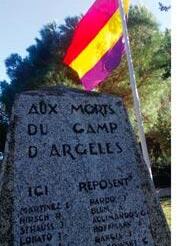
uu Memorial in the Republican cemetery in Argelès-sur-Mer. Many Brigader names feature among the Spanish dead.
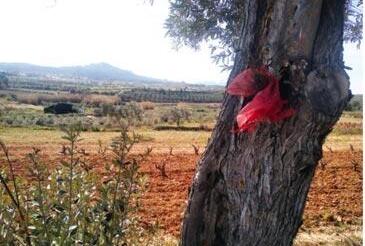
u A ribbon tied to a tree in Gandesa by a relative of an American Brigader executed there.
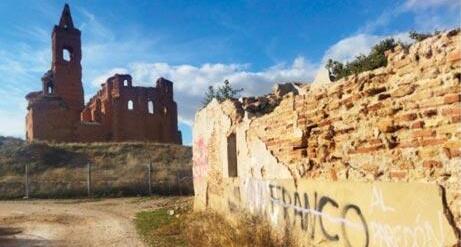
t Franco’s legacy looms large in Belchite; the town’s church of San Martín de Tours is pictured in the background.
Photos: Nick Lloyd in ‘Travels Through the Spanish Civil War’
landscape, reminders of the failed drive for autarchy in the postwar period. Just as on his tours the author also discusses the role of every-day items: alpargatas (rope sandals worn by the Republican soldiers), a cigarette lighter and even a sardine can.
The narrative is punctuated by material from the author’s interviews with survivors of the period, their descendants, participants on his tours and others who work to keep alive memories of the conflict and its aftermath.
These include Ulrich Eumann, retracing the footsteps of the International Brigader Willi Remmel, survivor of the Ciudad de Barcelona in May 1937, who later fought at Brunete, Quinto, Belchite, Teruel and the Ebro before surviving Mauthausen.
Although this is clearly not a volume on the International Brigades, their stories appear regularly, in some cases in relation to some of the lesser-known contingents such as the Poles and the Irish. A final chapter discusses the current state of the memory wars in Spain.
The book benefits from 40 pages of colour prints, most of them the work of the author, as well as two useful maps, a helpful glossary, along with suggestions for further reading and an extensive index.
This work will appeal to many readers for the author’s understanding of Spain, his eye for detail, for his insights into the lives of many of those affected by this brutal conflict and for his reflections on its continuing relevance.
Eagle-eyed readers might spot this reviewer’s name in the book’s acknowledgements section. My knowledge of the project dates back to a coffee with the author in Barcelona in May 2022. At the time, I confess, I did not appreciate the scale of the undertaking, nor imagine how rich and varied the outcome would be.
International Brigade Memorial Trust
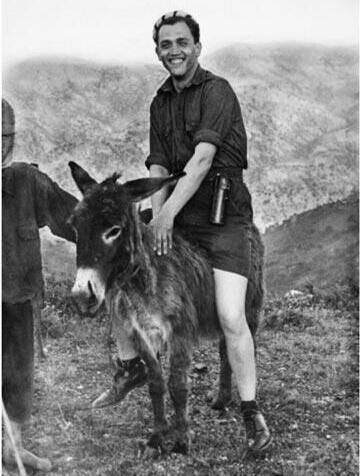
Francesc Boix in Kabylie, Algeria, in 1946. Author Nick Lloyd notes Francesc’s ever-present ‘winning smile’ that he always wore for the cameras after Mauthausen.
Lloyd, who runs civil war walking tours in Barcelona, uses this as the final photo on his tours.
CHARLIE NURSE
‘
The single most important act’ of Bernard McKenna’s life
This is a day of sorrow and remembrance, a day when we stop and remember all those who lost their lives in the Spanish Civil War.
My father, Bernard McKenna (pictured), was lucky. He survived the Spanish Civil War. He was wounded twice, and the second time he almost died. Finally he was captured and imprisoned in the notorious concentration camp of San Pedro de Cardeña, near Burgos, where he daily expected to be executed.
Many others were not so lucky. Of the 2,400 British Brigadistas , 500 were killed. And of the 32,000 International Brigadistas as a whole, coming from the four corners of the world to fight fascism, somewhere between 5,000 and 15,000 lost their lives.
And that figure pales into insignificance when compared to the number of Spanish people who were killed in this most brutal of civil wars, a figure somewhere between 500,000 and one million.
Words spoken by NEIL M C KENNA , son of Bernard McKenna, at the burial of his father’s ashes at Caspe in Aragón on 15 November.
My father’s journey began 110 years ago. He was born in the most abject poverty in Hulme in Manchester. Six children had been born before him, and all six children had died in infancy. Bernard was the first to survive.
My father was a communist, a member of the Young Communist League. At the age of 21 he decided to volunteer to fight fascism in Spain. He was convinced that the civil war in Spain was part of a larger war against fascism, a war that sadly continues today.
In the concentration camp of San Pedro de Cardeña, Bernard was sure that he would die. Every day, the guards would take men out. Some
would be executed, other not. Fortunately, Bernard was selected to be part of a prisoner exchange and was released in October 1938 into British custody and repatriated.
The British Foreign Office later sent him a bill to cover the cost of his repatriation, but, Bernard being Bernard, he refused to pay.
Bernard carried on the fight against fascism, joining the RAF and spending six and a half years in North Africa, the Middle East and Italy, fighting the forces of Hitler and Mussolini.
My father lived a long life. He was 92 when he died. In his later years, Spain and the civil war loomed large in his thoughts. He believed that volunteering to fight in Spain was the single most important act of his entire life.
On many occasions he expressed a wish to move to Spain and to die in Spain. But because of his declining health, this never happened.
So today is also a day of celebration and of joy. For today, here in Caspe, in Aragón, where my father fought, was wounded and was eventually captured, Bernard has returned to the country he loved so much, and lies in rest and peace with other Brigadistas. He has come home.
p Family, friends and supporters at the International Brigade memorial outside Caspe, where the British Battalion was ambushed by Mussolini’s troops in March 1938. Neil McKenna is pictured centre. u Bernard’s grandson Scott Paynter and daughter Nicola Garbett look on as the ground is prepared for the burial of the ashes at the cemetery in Caspe.
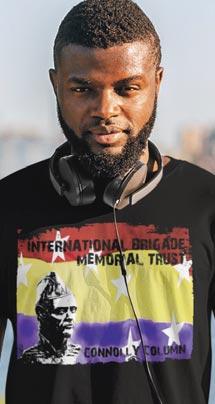
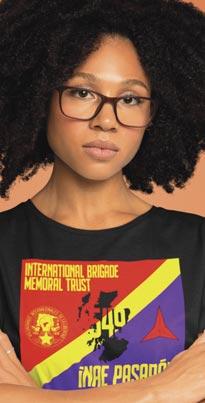
Choose your IBMT t-shirt
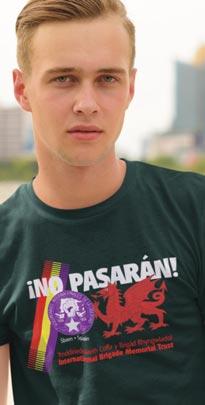
The IBMT has a range of new t-shirt designs highlighting the contributions of volunteers from Ireland, Scotland and Wales (below).
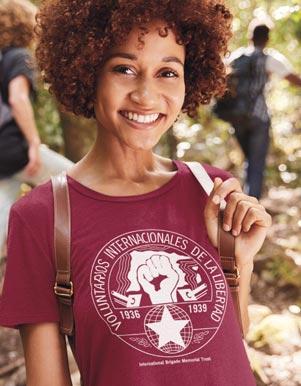
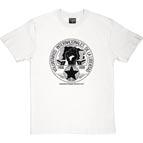
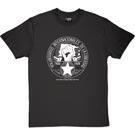
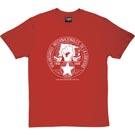
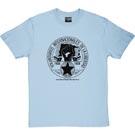
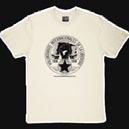
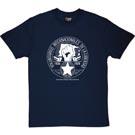
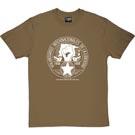
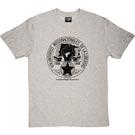
We also have a t-shirt featuring the iconic emblem of the International Brigades, in a variety of colours (left).
All t-shirts are on sale for £20 (plus £3.99 p&p) in a range of sizes (S-5XL) and are made from ethically sourced cotton.
The t-shirts are produced in partnership with specialist radical apparel outfitter Red Molotov. All proceeds from sales help fund our vital commemorative and educational work.
To place an order online go to the Shop page of the IBMT website: www.internationalbrigades.org.uk/catalog
Help us inspire new generations with the story of the men and women who fought fascism and defended democracy in Spain from 1936-1939.