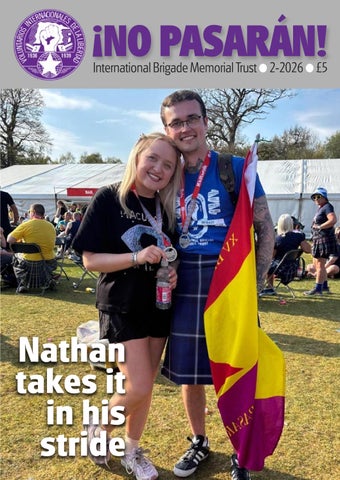
¡NO PASARÁN!
International Brigade Memorial Trust l 2-2026 l £5


Nathan takes it in his stride

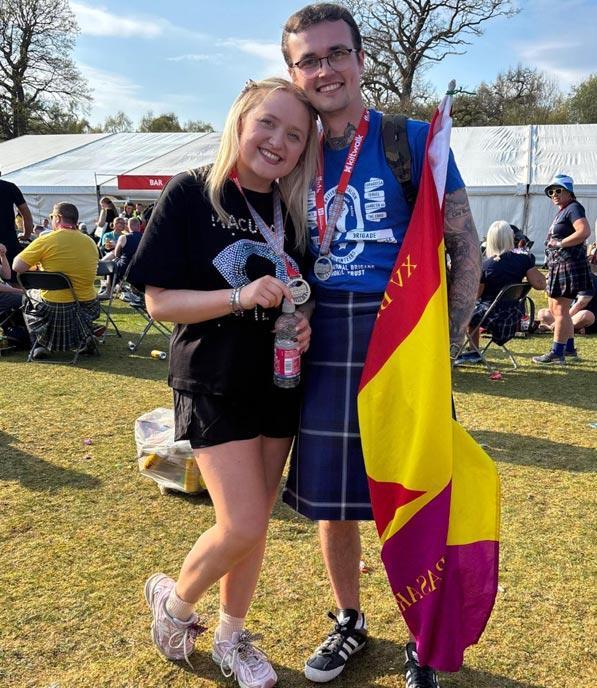
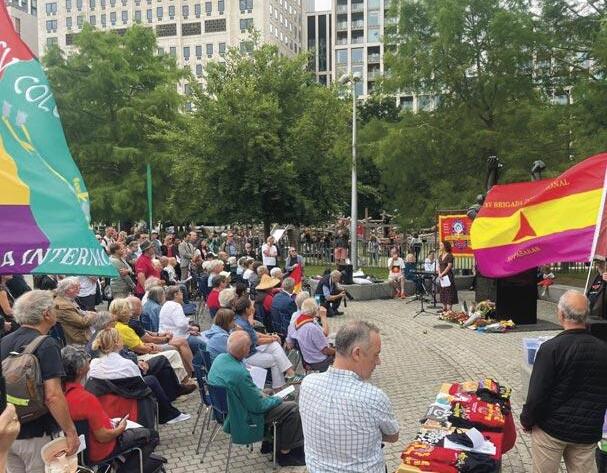

Photo: Andrew Wiard
Andrew Wiard
¡NO PASARÁN!
Magazine of the International Brigade Memorial Trust No.72 l 2-2026
6 Thelma Ruby
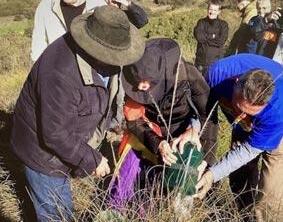
t Nathan Hennebry and fiancée Sophie on completing the 2026 Glasgow Kiltwalk. See story on page 5.
l The actress and widow of Canadian Brigader Peter Frye speaks about her life on stage and screen and her commitment to the memory of the International Brigades .
8 Popular Front
l C J Atkins looks back at the 1936 election victory of a popular alliance in Spain.
12 Art for the cause
l Jim Jump explores the role of the Artists International Association in supporting the fight against fascism in Spain and elsewhere.
15 Aid Spain in Oldham
l Graham Briggs tells the story of local activism on the home front.
18 Books
l Review of ‘El Generalísimo Franco: Power, Violence and the Quest for Greatness’, preview of ‘The Heart Has its Reasons’ and author insight from David Ebsworth.
22 Final word
l Colin Edwards, son of Brigader Jack Edwards, is remembered by his family.
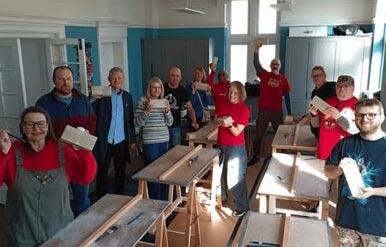
First stones carved for Solidarity Sunderland memorial
Local activists have started work on a new memorial to remember the Sunderland International Brigaders. Nearly a year on from its launch, the Solidarity Sunderland project is working with groups in the city, including Sunderland College and Sunderland Culture.
The project is spearheaded by artist Rob MacDonald, who co-founded Solidarity Park in Malgrat de Mar, Catalonia , near to the site of the sinking of the Ciudad de Barcelona by an Italian submarine on 30 May 1937. Many of the 200 Brigaders travelling onboard perished. Julio Romero
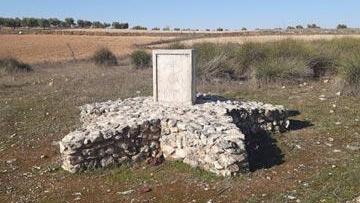
Campaign launched for missing Jarama plaque
The IBMT is supporting the Madrid-based Association of Friends of the International Brigades (AABI) to replace the plaque taken from the Battle of Jarama memorial.
A crowdfunding campaign is underway to raise € 950 for three methacrylate replacement plaques. There will be multiples to cover any future damage or theft.
The plaque names the 30 British Battalion members who were killed in that sector of the battlefield.
Donations can be made directly to the ABBI
bank account (go to the AABI website for details: www.brigadasinternacionales.org) or via the IBMT fundraiser (please add the reference ‘Jarama’): www.international-brigades.org.uk/news-andblog/jarama-fundraiser.
The memorial itself is a replica of the battlefield memorial built by the XV International Brigade in the immediate aftermath of the battle. Its exact site was located by researcher José María Olivera Marco in 2022.
The modern memorial was then unveiled in April
CONTINUED OVERLEAF
q The Jarama memorial as it is now, without the plaque listing some of the British dead at Jarama.
All content is the © of the IBMT and credited contributors and cannot be reproduced without written permission. Views expressed are not necessarily those of the IBMT.
Editor Helen Oclee-Brown
IBMT, 37a Clerkenwell Green, London EC1R 0DU
The International Brigade Memorial Trust keeps alive the memory and spirit of the men and women who volunteered to fight fascism and defend democracy in Spain from 1936 to 1939
International Brigade Memorial Trust
37a Clerkenwell Green, London EC1R 0DU
Executive Officer Helen Oclee-Brown 07865 272 639
admin@international-brigades.org.uk www.international-brigades.org.uk
Registered charity no.1094928
Chair Jim Jump chair@international-brigades.org.uk
Secretary Megan Dobney secretary@international-brigades.org.uk
Treasurer Paul Coles treasurer@international-brigades.org.uk
Ireland Secretaries Luke O’Riordan & Lynda Walker ireland.international.brigades@gmail.com
Scotland Secretary Mike Arnott scotland@international-brigades.org.uk
Wales Secretary David McKnight wales@international-brigades.org.uk
Other Executive Committee members
David Chanter, Alex Gordon, Jonathan Havard, Denis Lenihan, Alan Lloyd, Dolores Long
Founder President Marlene Sidaway
Founding Chair Professor Sir Paul Preston
Patrons Professor Peter Crome, Professor Helen Graham, Ken Livingstone, Len McCluskey, Christy Moore, Jack O’Connor, Maxine Peake, Baroness Royall of Blaisdon, Mick Whelan
Historical Consultant Richard Baxell
NEWS
FROM PREVIOUS PAGE
2023 before being rededicated in February 2024 as part of the annual Jarama commemorations.
Clapton CFC keeps spreading the word
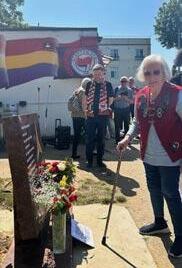
IBMT Founder President Marlene Sidaway laid flowers at the memorial to the 16 or more International Brigade volunteers from the Newham area of east London. The occasion was the final home match of Clapton Community Football Club’s men’s team on 2 May.
The memorial is prominently located in the fan-owned club’s Old Spotted Dog ground in Forest Gate and features words from a poem written by Marlene’s late partner and International Brigader David Marshall (19162005), who settled in the area. At least five of the Newham volunteers died in Spain.
Other speakers included Clapton CFC representative Kevin Blowe, who was a driving force behind the erection and unveiling of the memorial last year. IBMT Chair Jim Jump thanked the club for keeping alive the memory and spirit of the anti-fascist fighters who went to Spain. This had been achieved in large part by its internationally popular away shirt in the colours of the Spanish Republic and featuring the three - pointed star of the International Brigades and the words ‘NO PASARÁN’.
The afternoon’s game ended after extra time with a 4-2 victory for Clapton CFC over Rayleigh Town in front of 2,375 supporters. Clapton CFC thereby secured promotion to the Essex Senior League.
Belfast’s night to remember
The Sunflower pub in Belfast was alive with people on 29 May. They came to commemorate this year’s 90th anniversary of the Spanish Civil War. The room was full to capacity to hear two great singers and two guest speakers, reports Lynda Walker.
Dr Brian Hanley launched the book ‘A Time for Heroes: International Brigade Commemoration
Committee – 21 years of action’. He emphasised the need to continue the work of the International Brigaders and how the book was an example of that work.
Emmet O’Connor spoke about his International Brigader father, Peter O’Connor, who was born in Waterford and who went to fight in Spain. He said it was an honour to speak at this Belfast event and to see a large and enthusiastic turnout.
The singer-musicians captured the spirit of wanting to change the world for the better – for the many not the few.
Fergus O’Hare sang the more traditional songs like ‘Connolly Column’ by Joe Mulheron, whereas Joe Solo sang numbers like ‘Punk Rock Prepared Us For This’ – cheered on by some of his local fans. With Dooley Harte of Craigavon Trades Council doing all the introductions, it was a night to remember.
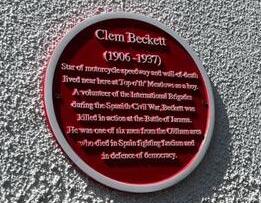
t Oldham Brigader and speedway champion Clem Beckett was honoured with a plaque on 30 May. Almost 100 years after 40,000 fans witnessed one of Beckett’s record-breaking rides at Manchester’s White City stadium, his 96-year-old niece Margaret Barlow unveiled the plaque in Top o’ th’ Meadows, Oldham, commissioned and erected by sheep farmer Karl Jones. Beckett was killed in February 1937 at the Battle of Jarama.
p Marlene Sidaway steps back after laying flowers at the Clapton CFC memorial.
Plaque unveiled at Falls Road AGM
On 25 April the IBMT-affiliated International Brigade Commemoration Committee (IBCC) held its annual general meeting in the Falls Road Library.
Two highlights were the launching of a booklet based on the talk that Dr Brian Hanley gave at the IBCC’s Féile an Phobail 2025 lecture in the Shankill Road Library, titled ‘Blueshirts and Blackshirts: Fascism in Ireland North & South’.
IBCC secretary Ernest Walker, presenting the booklet on Brian’s behalf, drew attention to the rise and defeat of fascism in Europe and Ireland in the 1920s to the 1940s, but with a note of caution in that the action and ideology of fascism has not gone away.
Following this, a plaque was unveiled to commemorate the 10 Brigaders from the Falls Road area of Belfast who went to fight fascism in Spain.
Ciaran Crossey, chair of the IBCC, introduced James Moyna a relative of Jim Stranney, and also the deputy Lord Mayor, Paul Doherty. Both said how proud they were to be at the unveiling.
Nathan’s fundraising walk
On 26 April, IBMT member Nathan Hennebry (pictured on cover) took part in this year's 23-mile Kiltwalk in Glasgow, raising over £1,000 for the Trust.
In even better news, his work scheme is matching that total, so that's £2,000 for the IBMT. Congratulations and thank you to Nathan for all his efforts.
Explaining why he chose to support the Trust, Nathan said: ‘The IBMT is very close to my heart and I belive it’s vital to champion the history of the brave men and women (some as young as me) who risked it all to fight fascism.’
Thanks also go to Totally Tartan Kiltmakers in Dumbarton, which donated the kilt hire fee.
Kiltwalk is Scotland’s largest mass - participation walking event, with over 216,000 people taking part since 2016.
Battersea Plaque for Clive Branson
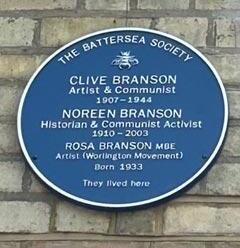
A blue plaque was unveiled on 30 May on the flat in south London where International Brigader Clive Branson lived with his wife Noreen and daughter Rosa after returning from Spain.
Raised by the Battersea Society, the plaque is on the corner of Bullen Street and 310 Battersea Park Road.
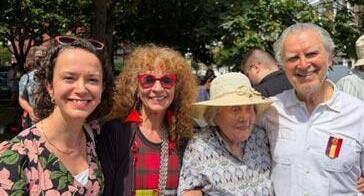
Rosa Branson, aged 95, a professional artist, was in attendance, along with multiple generations of the Branson family.
Having arrived in Spain in January 1938, Branson was captured in the British Battalion’s retreat through Aragón in the spring of that year. The rest of his time in Spain was spent as a prisoner of war at camps in San Pedro de Cardeña, near Burgos, and Palencia. He left in October in a prisoner exchange for captured Italian troops. Branson died serving in the British Army in Burma in 1944.
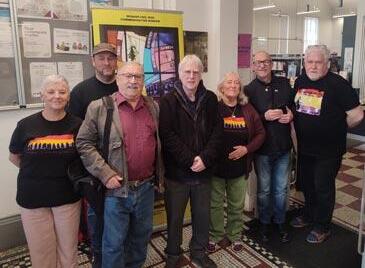
p At their AGM (from left): IBCC activists Geraldine Kelly, Mark Roberts, Ernest Walker, Frank Cammock, Lynda Walker, Paul Kelly and Ciaran Crossey.
u The plaque to Clive Branson and family. Branson is remembered for, among other things, his poems and striking portraits of his fellow prisoners of war in Spain.
q Among the attendees at the Battersea unveiling (from left): Meirian Jump (Marx Memorial Library), Peggy Prendeville (granddaughter of Clive and Noreen Branson), Rosa Branson and Jim Jump (IBMT).
Your local IBMT affiliated memorial
group
The IBMT supports the work of affiliated local International Brigade memorial groups. Annual IBMT affiliation costs £40.
You can affiliate through our website: www.internationalbrigades.org.uk/membership.
DIRECTORY
l Aberdeen XV International Brigade Commemoration Committee
Contact: Tommy Campbell tommy.campbell@outlook.com
l Belfast International Brigade Commemoration Committee
Contact: Ernest and Lynda Walker lyndaernest@btinternet.com
l IB Cymru
Contact: Mary Greening ibcymru@gmail.com facebook.com/groups/314892162181123
l Hull International Brigades Memorial Group
Contact: Gary Hammond thehutpeople@gmail.com
l North West International Brigade Memorial Group
Contact: Dolores Long doloreslong@fastmail.fm twitter.com/ibgtrmanchester
l Oxford International Brigade Memorial Committee
Contact: Colin Carritt colin.carritt@tiscali.co.uk
l Sussex Brigaders Remembered
Contact: Pauline Fraser pbf262@myphone.coop
Contact the IBMT to add your group to the Directory International Brigade Memorial Trust
www.international-brigades.org.uk
THELMA RUBY
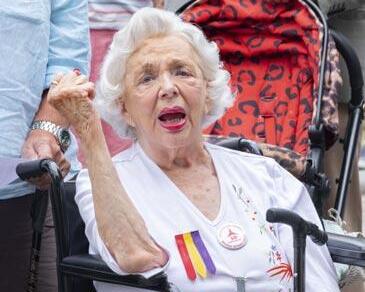


THELMA RUBY, actress and widow of Canadian International Brigader Peter Frye (left), talks to Helen Oclee-Brown about her life, career and enduring support for the memory of the late volunteers.
Thelma Ruby is a celebrated British actress, who has combined a long career on stage and screen with unfailing activism. Married for over 20 years to Brigader and fellow actor Peter Frye, she has also been a popular, smiling face at many commemorations over the last 40 years.
Born in Leeds, Thelma was a shy child who only came out of her shell when living in New York. Evacuated there during the Second World War with her actress mother, Paula Ruby (from whom she took her stage name), Thelma took the first steps in her 80-year career at theatre school.
Her major stage roles include Fiddler on the Roof and Cabaret, while on the small screen she appeared in British classics Coronation Street and Dad’s Army.
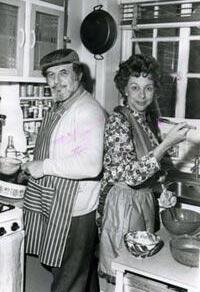
A true partnership, Thelma and Peter also worked together across genres, some surprising – sadly, there are no recordings of the food-lovers’ cooking show, The Better Half . Their most celebrated collaboration was Thelma's long-running one woman show Momma Golda about Israeli Prime Minister Golda Meir, which the couple had adapted from an earlier Broadway show.
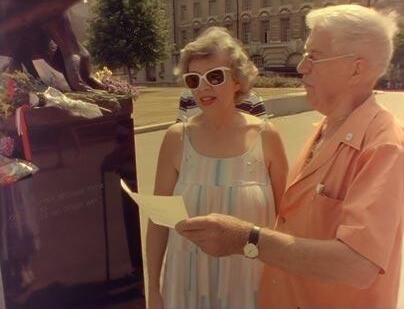
p Photos above (from left to right):
l Thelma Ruby in 2025 at the annual commemoration on London’s South Bank.
l Peter and Thelma filming their short-run cookery programme.
l Thelma with Brigader Bill Alexander (Secretary of the International Brigade Association) at Jubilee Gardens in the late 1980s. They sing ‘Valley of Jarama’ together. Romero
Thelma and Peter also wrote a joint autobiography ‘Double or Nothing: Two Lives in the Theatre’. It is a fabulous read: a personal history of the 20th century and of Jewish identity, the intertwined careers of two actors, anti-fascist activism and, most of all, a love story.
They first met in Israel in 1959, introduced to each other by Thelma’s brother Geoffrey. For the next 11 years, they maintained what Thelma calls
Andrew Wiard
Stage, screen and solidarity
a ‘theatrical collegiate friendship’, meeting up when Peter was in England or Thelma in Israel. When their lives realigned later on, Peter made a romantic dash across the Atlantic (he had gone back to Canada) to follow Thelma on tour in Fiddler on the Roof. Then began a life together,
‘ What magnificent people, remarkable human beings those veterans were.’
devoted to each other, their art and activism.
As Thelma says: ‘Peter spent all his life fighting for a better world.’ He decided to volunteer to fight in Spain after seeing a photograph of eight slaughtered Spanish children – the victims of the first civilian bombings of Madrid in 1936. He sailed for
Europe as soon as he could in January 1937.
Once in Spain, he was hailed for his linguistic prowess (he spoke English, French, German, Spanish and Yiddish). It was Yiddish that he used most often, simply because he could talk to other Jewish volunteers from multiple countries.
Indeed, his Jewishness was key to his reasons for joining the fight. He said in the 1986 documentary Forever Activists, ‘In 1936, Spain was the first place in the world where we as Jews could fight back against Hitler.’
Peter fought at Quinto and Belchite, where he was shot in the arm, thereafter suffering the permanent loss of use of three fingers on his right hand. He returned to the United States on 12 March 1938 aboard the Queen Mary. Thelma says that Peter’s experience in Spain informed his whole life as that of an idealist and a fighter.
One of Peter’s great dreams was a victory parade in Madrid. That did not come to pass, but in 1986, after Spanish democracy had been restored and on the 50th anniversary of the outbreak of the
Spanish Civil War, he decided something had to be done. Serendipitously, Thelma found an advert in the New Statesman announcing the dedication of a statue on London’s South Bank.
This stroke of luck began Peter and Thelma’s long association with the International Brigade Association (IBA), which grew into the IBMT.
IBA Secretary Bill Alexander put Peter in touch with the Veterans of the Abraham Lincoln Brigade in New York, which organised not a victory parade but a reunion in Spain with hundreds of veterans in 1986. Among the swathes of Spaniards to welcome them back to Spain was Dolores Ibárruri, better known as La Pasionaria
Thelma was there too. Of the Brigaders, she said: ‘What magnificent people, remarkable human beings those veterans were and are. Like you [Peter], they have continued to fight injustice wherever they see it.’
Now in her prime at 101 years of age, Thelma continues to attend the Trust’s annual commemoration at London’s Jubilee Gardens. Peter died in 1991, but as Thelma says: ‘For as long as I live, Peter lives.’ She is one of the last of her generation, a unique link to the past. The IBMT looks forward to seeing Thelma on 4 July at the London Southbank commemoration.

‘Double of Nothing: Two Lives in the Theatre,’ (Janus Publishing Co, 1995 ).
David Hill
Thelma Ruby
Spain’s Popular Front at 90
C J ATKINS marks one of the most dramatic moments in working-class history: the 1936 Spanish election victory of a popular alliance.
Ninety years ago, the people of Spain delivered a forceful rebuke to right-wing extremism and opened one of the most dramatic chapters in working-class history. The election victory on 16 February 1936 of the Popular Front (Frente Popular) – an alliance of socialists, communists, republicans and other democratic forces – was much more than a routine parliamentary transition of government.
It was a mass uprising at the ballot box, fuelled by workers, farmers, women and youth. They were determined to defend democracy and push forward with reforms that had been long delayed by a series of right-wing administrations. Soon, that broad coalition would be fighting not only to rescue the Spanish Republic but to save the entire world from fascism.
Though the battle was just getting underway, they already knew what they were up against. As Mundo Obrero (Workers’ World), the newspaper of the Communist Party of Spain, put it the next day: ‘It would be a grave mistake to think that reaction will accept its defeat. It will do all in its power to rob the people of their election conquests. Today, they are already threatening civil war.’
The Popular Front’s triumph came at a decisive moment for Europe. Hitler and the Nazis had crushed opposition and consolidated their power in Germany. Mussolini held Italy in his dictatorial
grip. Across the continent, reactionary forces sought to smash labour movements and parliamentary democracy alike. In Spain, too, powerful landowners, monarchists, military officers and clerics plotted to reverse the gains made since the proclamation of a republic in 1931.
The roots of the Popular Front victory lay in the unfinished business of that earlier democratic breakthrough. When King Alfonso XIII fled the country in 1931 after municipal elections signalled overwhelming support for an end to the monarchy, hopes ran high for social
‘Soon, that broad coalition would be fighting not only to rescue the Spanish Republic but to save the entire world from fascism.’
and economic transformation.
The newly established Spanish Republic promised land reform in a country where vast estates dominated the countryside, secular education in a society long controlled by the Catholic Church, regional autonomy for Catalonia and the Basque Country and expanded rights for workers and women.
Spain’s working class – which was organised into socialist and anarchist trade unions – and its growing Communist Party pressed for structural change. But the Republic faced fierce resistance. Thanks to intense opposition from landlord-linked politicians, plans for land reform moved slowly.
The generals who commanded the military and had enjoyed broad authority under the monarchy resented efforts to curtail their power. The Church – which was also a large landholder –opposed both the secularisation of public life and limits on clerical influence over the state.
Capitalist industrialists and conservative politicians rallied their forces and prepared to strike. By 1933, with the country gripped by economic crisis and political fragmentation amid the Great Depression, right-wing parties regained control in elections.
The two years that followed brought intense repression of labour union militancy and a rapid
rollback of the halting land reforms that had been initiated by the Republic. In October 1934, a mass uprising by miners in the Asturias region of northwest Spain was brutally crushed by the army, with General Francisco Franco playing a key role. Colonial troops were shipped in from Spanish-controlled Morocco, and more than 2,000 people were killed, while thousands more workers were jailed.
The lesson was clear: Spain’s ruling class was prepared to use violence to defend its privileges.
It was in this climate that the Popular Front was forged. Inspired by the anti-fascist unity strategy advanced by the Communist International after 1935, the Spanish left and republican parties agreed to a common electoral programme.
The three major parties of the left – the Spanish Socialist Workers Party (PSOE), the Communist Party of Spain (PCE) and the Republican Left (Izquierda Republicana) – joined forces in January 1936. They were supported by progressive Galician, Basque and Catalan nationalists, and inconsistently by a Trotskyist group called the Workers’ Party of Marxist Unification (POUM), along with a handful of other smaller left parties.
Foundation
The organised working class was the foundation of the coalition’s support, as both major trade union
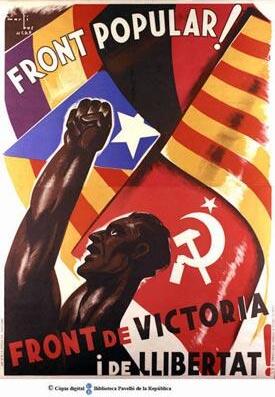
u A poster encouraging support for the Popular Front coalition.
Col·lecció Cartells del Pavelló de la República, Universitat de Barcelona
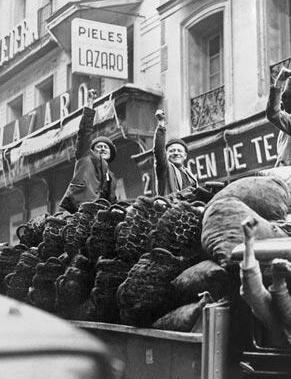
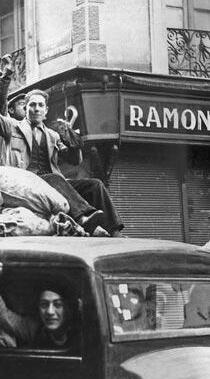
t A group of workers celebrating the triumph of the Popular Front in the 1936 elections, Madrid.
‘The lesson was clear: Spain’s ruling class was prepared to use violence to defend its privileges.’
federations backed it – the socialist-aligned Workers’ General Union (UGT), unconditionally, and the anarchist-oriented National Confederation of Workers (CNT), with some reservations.
The Popular Front pledged amnesty for political prisoners, restoration of democratic reforms and renewed efforts at land redistribution and social justice. It promised a new Law of Public Order to protect the constitutional rights of citizens from arbitrary police and state actions.
Essentially, the Popular Front’s aim was to protect and restore liberal democracy in Spain. The programme was moderate in scope but radical in implication: it sought to mobilise the broadest possible coalition to defend democracy from fascist encroachment.
On 16 February 1936, the Popular Front won a narrow but decisive victory in elections to the Cortes, the Spanish parliament. Its deputies took 278 seats compared to the right’s 124, a feat all the more impressive because, as the US Daily Worker reported in New York: ‘30,000 anti-fascist leaders are in jail’ and the election machinery ‘was in the hands of the right and fascist groups’.
Among the most electrifying deputies elected that day was Dolores Ibárruri, La Pasionaria, who embodied the fusion of working-class militancy and democratic resolve that defined the Popular Front.
Around the country, celebrations erupted in working-class neighbourhoods on election night. Over 250,000 Socialist and Communist Party members held a victory march through Madrid.
Georgi Dimitrov, the famed anti-fascist leader who had announced the popular front strategy to the world at the Communist International congress just months earlier, hailed the victory in Spain, saying that ‘the establishment of the people’s front signifies a turning point in the relation of forces between the proletariat on the one hand, and the fascist bourgeoisie on the other; to the advantage of millions of the working masses.’
Within days, political prisoners and workers still detained since the days of the Asturias strike
ANNIVERSARY
were freed. Public-sector workers who had been fired for their politics were reinstated. General Franco was removed as army chief of staff and demoted to a position in the Canary Islands. The new government moved to reinstate regional autonomy in Catalonia and restart land reform. For millions, it seemed the promises of 1931 might finally be fulfilled.
Yet even before the ballots were counted, a conspiracy to overturn the people’s will was already underway. Sections of the military, backed by monarchists, Falangists and powerful capitalist economic interests, refused to accept the legitimacy of the result.
They framed the Popular Front as a ‘Bolshevik threat’. Reactionary newspapers whipped up hysteria. Assassinations and street clashes heightened tensions.
According to the US Daily Worker’s reporter
‘Spanish
fascism was threatening civil war.’
The Communist Party of Spain warned that ‘the material base of power for the privileged… is their ownership of the land’. The PCE urged its allies in the new Popular Front government to move decisively to ‘give the toiling masses the land which rightfully belongs to them’ and expropriate the ‘big landlords and the church’ to cut off reactionaries’ funding sources.
Government
The communists said that the new government had to act quickly against the ‘pistoleros (gunmen) who murder workers and attack their organisations’. Time was not on the Popular Front’s side, however.
On 17 to 18 July 1936, the plotters launched a military uprising, beginning in Spanish Morocco and spreading to the mainland. When
the fascist generals rose in rebellion, it was Ibárruri who issued the defiant cry that would echo around the world: ‘¡No pasarán!’ – They shall not pass.
The generals’ coup did not immediately succeed. In key cities – Madrid, Barcelona and Valencia – workers seized arms and, alongside soldiers still loyal to the Republic, defeated the rebel army units. The ruling class’s hopes for a swift coup vaporised, so they turned instead to full-scale civil war.
Regimes
The fascist regimes of Germany and Italy intervened on the side of the ruling-class rebellion. Hitler sent his Condor Legion, whose planes bombed Spanish cities, including Gernika. The German dictator would later say that Spain gave his troops a ‘dress rehearsal’ for their later conquests across Europe.
The Republic, by contrast, was strangled by the so-called ‘non-intervention’ policy of the US, Britain and France. The US Congress put an arms embargo on Spain, but US corporations did intervene in the war, on the side of the fascists. Texaco gave Franco oil on credit (with free shipping), for instance, and General Motors provided trucks for his army.
On the continent, London and Paris also blocked the sale of arms to the legitimate government and refused to stop the flow of fascist aid to Franco. Only the Soviet Union sold significant military assistance to the Republic –including aircraft, tanks, artillery and advisors –although it was limited by geography.
From around the world, however, came volunteers who refused to stand by and let fascists kill democracy in yet another nation. The International Brigades, workers, intellectuals and anti-fascists from more than 50 countries, fought and died on Spanish soil in defence of democracy.
Within Republican-held areas, the war unleashed profound social transformation. Factories were collectivised in parts of Catalonia. Peasants took over land in Aragón and elsewhere. Women organised militias and demanded equal rights. At the same time, internal tensions among the Republic’s diverse forces complicated co-ordination.
The Communist Party, growing rapidly during the war, argued for prioritising a united war effort and centralised government to defeat fascism first, while others – like the Iberian Anarchist Federation (FAI), which controlled the CNT labour federation, and the Trotskyist POUM –pressed for immediate revolutionary transformation.
Their tactics split the united front against fascism and diverted Republican government forces from the front with their behind-the-lines
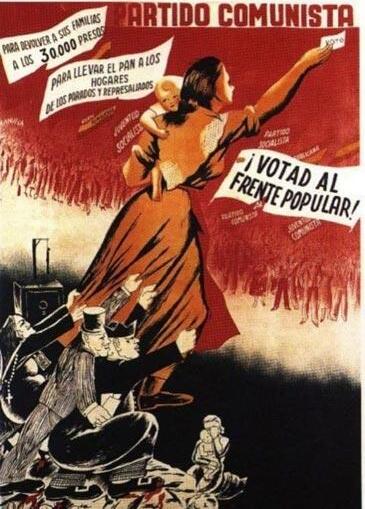
Communist Party poster for the February 1936 general election in Spain.
rebellion in Barcelona in May 1937.
Despite heroic resistance – immortalised in the defence of Madrid and the protracted battles along the Jarama and Ebro rivers – the Republic’s position deteriorated. Superior fascist firepower, unified command under Franco, and sustained foreign backing from Hitler and Mussolini took their toll. By early 1939, Barcelona had fallen. Madrid surrendered in March. On 1 April, Franco declared victory.
The consequences of the fascist triumph were devastating. Hundreds of thousands fled into exile. Tens of thousands were imprisoned, executed or forced into silence. Even more disappeared into concentration camps, their fates never known.
US Daily Worker reporter Art Shields went to Spain as a correspondent but ended up a combatant. In 1939, just before the fall of Madrid, he was among a group of communists captured by anarchist FAI troops who were co-operating, in practice, with Franco’s forces as a ‘Fifth Column’ inside the capital.
Escaped
Shields told of how he narrowly dodged execution and barely escaped from Spain in his book ‘On the Battle Lines’. He would write that
‘Being timid in the face of fascist threats or underestimating their danger can prove fatal.’
the Spanish people and the international volunteers ‘left a glorious tradition…that has inspired lovers of liberty ever since’.
Franco’s dictatorship would endure until his death in 1975. Spain became a warning of what fascism meant in practice: mass repression, cultural darkness and the systematic destruction of democratic life.
Yet the legacy of the Popular Front endures. Its 1936 victory demonstrated that broad unity against fascism is not only possible but necessary. Workers, peasants, middle-class democrats, and national minorities found common cause in defence of shared freedoms. The International
Brigades embodied global solidarity at a time when Western capitalist governments failed.
Ninety years later, we still need a Popular Front. Today, with fascist leaders and far-right movements again actively working to destroy democratic institutions in many countries, the Spanish experience offers urgent lessons. Division among progressive forces can open the door to reaction. Being timid in the face of fascist threats or underestimating their danger can prove fatal.
At the same time, the courage shown by those who defended the Spanish Republic is a reminder that history is shaped not only by generals, corporate bosses and dictators but by organised people.
Ninety years after the Popular Front’s election, Spain’s anti-fascist fighters remain symbols of resistance. Their struggle did not end in 1939: it lived on in exile, in clandestine organising and in the eventual re-emergence of democracy.
Remembering 1936 is a call to build the broad, democratic alliances needed to confront the dangers of our own time, and to ensure that ‘¡No pasarán!’ is more than just a slogan.
This is an abridged version of the article that first appeared in People’s World: peoplesworld.org.

ART FOR THE CAUSE
The role of the Artists International Association in supporting the fight against fascism in Spain and elsewhere is spotlighted in a new exhibition and book, JIM JUMP writes.
The Towner Gallery in Eastbourne is hosting an eye-opening exhibition that highlights the engagement of artists in Britain and beyond in the 1930s and 40s in the fight against fascism.
The Spanish Civil War features prominently in Comrades in Art: Artists Against Fascism, which runs until 18 October. Exhibits showcase the work of painters, sculptors and illustrators associated with the Artists International Association (AIA), which was founded in 1933 explicitly to counter the rising threat of fascism.
The artists were responding to a world in crisis, reeling from the economic crash of 1929, mass poverty and unemployment and the drumbeat of war – themes that are reflected in much of their output.
Among those represented at the Towner Gallery are AIA founder members such as Pearl Binder, James Boswell, James Holland, Betty Rea, Cliff Rowe and Nan Youngman. Their works are shown alongside ones by other artists who supported the association, including Laura Knight, Paul Nash and Lucien Pissaro.
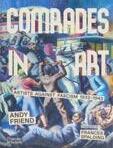
The Eastbourne exhibition has been curated by Andy Friend, whose newly published book with the same name as the exhibition brings together years of research into this often overlooked period of British artistic activity.
Last year he organised a display in Tate Britain exploring the founding of the AIA,
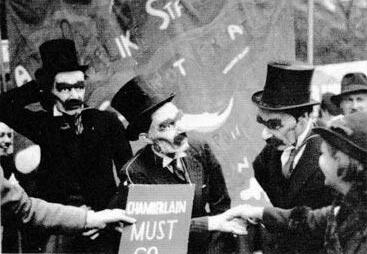
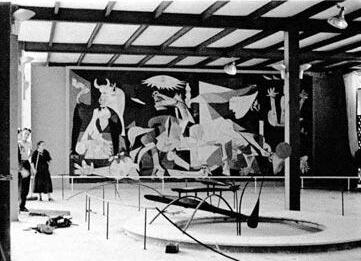
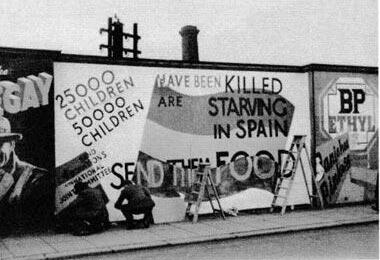
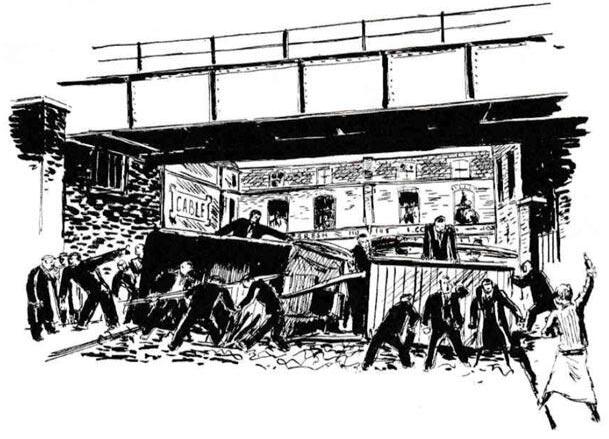
t Images taken from the book ‘Comrades in Art’ (anti-clockwise from top left):
l A group of surrealist artists, which included Roland Penrose, James Cant and Julian Trevelyan, wearing Neville Chamberlain masks in London’s May Day procession in 1938.
l Picasso’s ‘Guernica’ in the Spanish Pavilion at the Paris world fair in 1937. Photo by José Lino Vaamonde Valencia.
l AIA hoarding calling for food for Spain in February 1939. Unknown photographer.
l Sketch by James Boswell, ‘Leman Street
Barricade’, depicting the Battle of Cable Street on 4 October 1936 (facing page).
‘We cannot remain unmoved’
drawing on material in the Tate’s archives. He has also spoken on the topic at the Marx Memorial Library in London.
In his book, ‘Comrades in Art’, Friend describes how the death of artist turned militiawoman Felicia Browne in Spain in August 1936 had a profound impact on AIA artists. Julian Trevelyan, for example, said their ‘thoughts and consciences’ were turned to Spain.
The surrealist painter wrote: ‘Until the Spanish Civil War started in 1936, there was an air of gentle frivolity about our life in London. True, the Hitler terror had begun, and refugees were pouring into England. Moreover, it was clear from Abyssinia and Japan that war and violence were to be the order of the day.’
Even artists who didn’t do overtly ‘political’ work became involved in the AIA’s fundraising activities. The ‘Portraits for Spain’ scheme saw more than 100 members offer their usual fees to go towards food and
‘ The artists were responding to a world in crisis, reeling from the economic crash of 1929, mass poverty, unemployment and the drumbeat of war.’
medicine for Spain and to help refugees. Among those who took part were Augustus John and Eric Ravilious.
Speaking three years after the end of the war in Spain, renowned art historian Kenneth Clark, then director of the National Gallery in London, praised the AIA for making artists ‘more conscious of the world of political ideas’. He went on to recall the banners painted to ‘show sympathy with the Spanish government during the Spanish Civil War’.
Comrades in Art is the most comprehensive exhibition on the AIA ever staged and the first since a groundbreaking retrospective at Oxford’s Museum of Modern Art in 1983.
More recently, many people came to learn about the important role played by the AIA through the Conscience and Conflict: British Artists and the Spanish Civil War exhibition, which received critical acclaim in 2014/15 at Chichester’s Pallant House Gallery and the Laing Art Gallery in Newcastle.
The accompanying book by curator Simon Martin describes how the association
ART FOR THE CAUSE
FROM PREVIOUS PAGE
brought together artists of varying styles –from Royal Academy stalwarts to younger modernists and surrealists – and differing political persuasions on the left.
Artist Reg Turner recalled: ‘The factor that kept us together was the anti-Fascist business and the Civil War in Spain… however varied we were in work or outlook.’
It was the AIA that created the British Battalion’s now iconic banner. Its central image of a clenched fist surrounded by the words FREEDOM DEMOCRACY PEACE on a red background now features on countless t-shirts, badges and tea towels – and has been replicated by the IBMT for its own banner. It was originally designed by James Lucas and embroidered by Phyllis Ladyman. Betty Rea sculpted a clenched-fist pole for it.
Several exhibitions and events were organised by the AIA to raise money for Spain. In London, Artists Help Spain, with contributions from the likes of Vanessa Bell, Jacob Epstein, Eric Gill, Augustus John, Paul Nash, Ben Nicholson, Lucien Pissaro and Eric Ravilious, raised enough money to pay for an ambulance and £500 worth of supplies.
Many of these artists, along with Henri
‘ Until the Spanish Civil War started in 1936, there was an air of gentle frivolity about our life in London.’
Matisse, Virginia Woolf and others, signed a letter to the Manchester Guardian in June 1937 in which they proclaimed: ‘Our work may seem far removed from politics, and still more from war; but, widely as our activities vary, they all depend on the liberty to know, to utter, and to argue freely according to conscience. We have seen this liberty attacked in recent years; our friends in Fascist countries have been silenced, imprisoned, or exiled. Now in a country [Spain] which has contributed in no small part to our culture, a struggle is going on before our eyes… Whether we wish it or not, we cannot remained unmoved.’
The legacy of the AIA was not just to show how artists could be mobilised to support antifascist and progressive causes. It also made the
case for art – from fine art to graphic design – to be an integral part of society. Wider access, for example, could be achieved through affordable prints and commissions for murals and other public art.
The AIA was also highly influential in the 1940s in policy planning that led to the founding of many vocational and technical art schools throughout the country by the postwar Attlee Labour government.
By 1950 there were 150 art schools in England alone. Art education was viewed by its proponents, according to one 20th century historian, as a component in the building of a new ‘socialist commonwealth’ and a ‘New Jerusalem’. Comrades in Art: Artists Against Fascism 1933-1943’ by Andy Friend (Thames & Hudson, 2025).
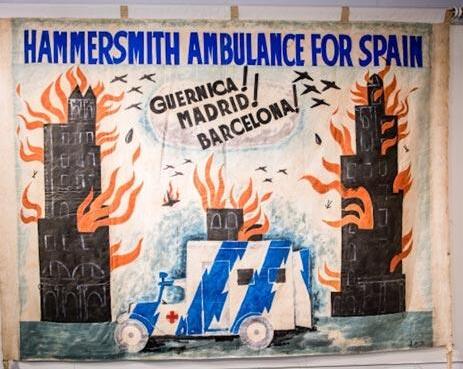
t Banner by Julian Trevelyan, one of a series painted by different artists for Hammersmith Communist Party, which are in the archives of the Marx Memorial Library.
SPAIN IN OLDHAM
Battling on the home front
GRAHAM
BRIGGS recounts how Oldhamers dug deep to help war-torn Spain.
In the late 1930s, Oldham was enduring hard times. In the aftermath of the Great Depression, its renowned cotton industry was on its uppers, and unemployment and poverty were widespread.
Yet despite this, the people of the town responded promptly and generously to the cry
of help that went up from the beleaguered Spanish Republic when it came under attack from fascist generals.
Of the 10 men from Oldham and district who volunteered to fight for the Spanish Republic in the International Brigades, six of them gave their lives. Those who survived, having given up their jobs, risked their lives and suffered wounds and privation at the battlefront, returned home to rejoin the campaign to help the people of Spain.
The outbreak of the Spanish Civil War in the summer of 1936 provoked an immediate response from large swathes of British society, who recognised the dangers of fascism. Nowhere was this response channelled more resolutely towards
were there to publicise the sale of Christmas cards for Spanish Aid.
the suffering Spanish people than in Oldham.
As in other towns and cities across the land, supporters of the Republic organised marches, rallies, meetings, concerts and bazaars to raise funds for what became known as the Aid Spain movement.
The committee in Oldham was one of more than a thousand formed in every city and every large town, with the overall aim of getting humanitarian aid to the people of Spain.
The decision was made by majority vote, and the seven-man committee probably split on party lines, the minority being three International Brigade Memorial
At first, however, they encountered obstruction and downright opposition. When, a month into the war, Secretary Mayall of the Oldham Communist Party applied to the council’s Watch Committee for permission to have a street collection for Spaniards ‘in need of food and other necessities’, he was met with a curt response: that the application ‘be not granted’.
CONTINUED OVERLEAF
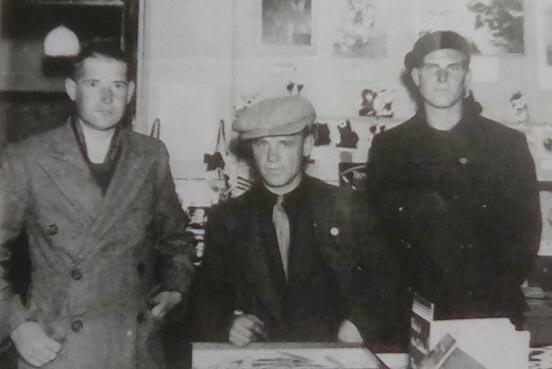
p Repatriated Brigaders (from left) Joe Buckley, Charles Hanson and Albert Charlesworth in the offices of the OldhamChronicle , December 1938. They
AID SPAIN IN OLDHAM
FROM PREVIOUS PAGE
Labour councillors.
Yet it was to be another year before Labour Party leaders became bold enough to condemn the British government’s farcical policy of non-intervention in Spain – a policy that allowed free rein to the militaristic powers of Hitler’s Germany and Mussolini’s Italy, who, from the outset, had poured in men, materials, ammunition, tanks and planes to assist the unlawful revolt of Spanish generals against a democratically elected government.
Meanwhile, the people of Oldham got on with raising money for Aid Spain. The main activity of the Communist Party in Oldham and elsewhere became raising money for food parcels.
Prominent among the organisers in Oldham were the secretary of the Young Communist League (YCL), Les Bates, a 29-year-old hairdresser from Fitton Hill, and his comrade Ben Duffy, 28, from Derker.
The campaign, however, soon broadened its base, attracting supporters and workers from other organisations in Oldham. James Caro, president of the Oldham and District Sunday School Union, became a leading organiser, joined by rank-and-file members of the Labour Party and the Independent Labour Party (ILP).
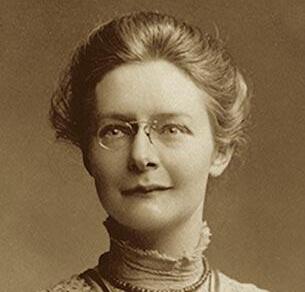
Another notable supporter was women’s suffragist Marjory Lees, a venerated local philanthropist and former Liberal councillor, who echoed the need for humanitarian help for an estimated three million refugees driven from their homes by war and the fear of barbaric reprisals at the hands of advancing fascist troops.
In January 1937, Oldham Trades & Labour Council, meeting at the Co-op Hall, King Street, Oldham, heard from two Labour Party MPs who had recently returned from Spain. William Dobbie (Rotherham) and Frederick Seymour Cocks (Broxtowe) expressed firm support for the Spanish Republic and the International Brigades, and a collection was made.
It is a sad but admirable fact that men who gave their lives serving as International Brigaders also played an active part in fundraising for Spanish Aid before leaving for Spain.
Brigader Harry Heap (aka Harry Rawson), the first Oldhamer to be killed in action, in December 1936, was honoured with a memorial meeting, attended by 300 people, held the following February at Greenacres Co-op Hall. Tributes were paid on behalf of Oldham Trades & Labour Council, the Communist Party, the ILP, and the Labour Party. The sum of £7-6s-4d was collected for ‘relief of distress in Spain’. Responding to appeals for foods such as
‘It is a sad but admirable fact that men who gave their lives serving as International Brigaders also played an active part in fundraising for Spanish Aid before leaving for Spain.’
sugar, coffee and milk, made via the Oldham Chronicle, Brigader Joe Lees, later killed in action at Brunete, was among workers who went house to house collecting foodstuffs. Likewise, only a short time before he travelled to Spain, Brigader Ken Bradbury, killed in action at Teruel, was busy on the streets of Oldham collecting money for Spanish Aid.
Saddleworth-born Brigader Clem Beckett, killed in action at Jarama, had originally gone to Spain as the driver of an ambulance, part of a convoy of vehicles dispatched by volunteer workers for Spanish Medical Aid.
Funds for medical aid received a boost when, in early February 1937, an appeal was launched in the Oldham Chronicle by Dr Paterson of Didsbury, on behalf of the Spanish Medical Aid Committee (SMAC), for £450 to provide an ambulance for Spain. It was noted that £400 had been raised in Manchester towards the organisation’s central funds. SMAC had been formed by the Socialist Medical Association and the Hospital Socialist Society in August 1936.
At the end of March 1937, the secretaries of
local youth and religious organisations called a meeting at the Friends Meeting House on Greaves Street to discuss setting up an Oldham branch of the National Joint Committee (NJC) for Spanish Relief. Les Bates and James Caro, together with Miss D Nadin, emerged as elected officials, and the new body was given an immediate fillip by a £5 donation towards running costs from Marjory Lees.
Bates appealed for support in a letter to the Oldham Chronicle, and the first open meeting of the branch was held in the Friends Meeting House in early April. Soon afterwards, a wellorganised meeting of the Oldham NJC resolved to prioritise fundraising and to arrange a public meeting with prominent national speakers. In July, the Oldham NJC put an ‘Ambulance for Spain’ on display at the Star Inn, Union Street, to help with fundraising.
Yet, Spanish Aid was still not without its detractors, and those who, for political reasons, wished to undermine it. In January 1937, the Civil Service Clerical Association, a trade union, had agreed to donate £100 for ‘relief of distress in Spain arising from the civil war’. The donation was challenged in the Chancery
Court by an individual union member, but the challenge failed.
Oldham International Brigader Charlie Armitage sponsored Basque brothers Ángel and Julio Lasheras as part of this evacuation. He paid 10 shillings a week into a fund to provide for them while they were on home soil. The brothers kept in regular contact with Charlie, with many letters and photographs, even after they returned to Spain. In July, the Oldham Relief Committee in a town centre meeting presided over by Mayor Frank Tweedale, rallied support for the Basque children.
A popular venue for open-air meetings in Oldham, especially on Sundays, was at the gates of Alexandra Park, where on 11 July the Oldham NJC held a fundraising rally which produced £1-3s-6d (roughly £90 today). As the war in Spain wore on, memorial meetings for fallen Brigaders became an all too regular event.
Because of his Manchester connections in the world of speedway, the memorial service for Clem Beckett was held at the Coliseum theatre in Ardwick Green, under the auspices of the Manchester Spanish Aid committee. Speakers included Clem’s widow Lida, actress Dame Sybil Thorndike, and Dave Springhall, senior commissar of the British Battalion.
The death of Joe Lees was first marked by the publication of a tribute leaflet sold for a penny, with funds going towards the Oldham Dependants and Wounded Aid Committee. Once again, Bates and Duffy were prominent among the organisers.
The national Dependants Aid Committee was a new fund set up in June 1937 to help
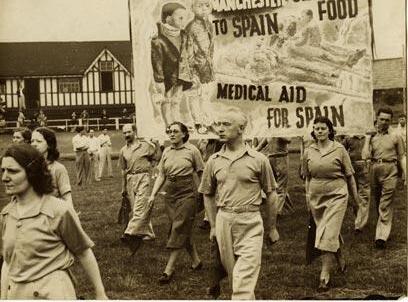
tt Aid for Spain rally in nearby Fallowfield, Manchester, on 18 June 1938
t Marjory Lees: local suffragist, activist and politician.
Fittingly, they were welcomed home as they stepped onto the platform at Oldham Central station by Les Bates, on behalf of the Oldham Dependants Aid Committee. Bates had been the rock of the town’s Aid Spain campaign. He had worked tirelessly for two-and-a-half years, been involved in every fundraising initiative, attended almost every demonstration and meeting, and helped to achieve a broad-based movement, drawing support from all sections of the population.
It was fitting too that the repatriated Brigaders were guests of honour at a reception in the Co-op Hall – scene of so many passionate denunciations of fascism and fundraising events for Spanish Aid.
bereaved families cope in the aftermath of Brigaders being killed – and to help rehabilitate the wounded. It assisted by way of grants, allowances and payment of medical expenses. Between June 1937 and October 1938, it raised over £41,000 (more than £3.5 million in today’s money).
At the December memorial meeting for Lees, held in the King Street Co-op Hall, tributes were paid by Brigaders George Leeson, George Aitken and local Brigader Albert Charlesworth, from Delph, Saddleworth.
Charlesworth had returned from Spain in the autumn to embark on a speaking tour for Spanish Aid, and, at a November meeting in the Co-op Hall, he had helped raise £14-4s-9d (worth more than £1,200 in today’s money).
After Oldham Brigader Ken Bradbury was killed in action at Teruel in January 1938, the Oldham Dependants Aid Committee published a memorial leaflet, again organised by Bates and Duffy. This was followed by a memorial meeting in the Co-op Hall, which charged an admission fee of 3d, and was addressed by Marjory Lees, Professor JBS Haldane of London and Dr Margaret Camps from Barcelona.
Following the withdrawal of the Brigades in October 1938, repatriated Brigaders carried on the fight to alleviate the suffering of the Spanish people. At Christmas, Brigaders Albert Charlesworth, Charles Hanson, and Joseph Buckley attended the offices of the Oldham Chronicle to publicise fundraising for a Manchester food ship.
In January 1939, the International Brigade Association organised a ‘convoy’ of repatriated Brigaders that travelled to towns and cities publicising the tremendous efforts of the International Brigade. When the convoy called in at the Co-op Hall, the main business of the event was to promote the collection for Spain, raising £36 (more than £3,000 in today’s money)
In the dying days of the defeated Spanish Republic, as Franco’s vengeful forces occupied the areas that had resisted him most determinedly, Britain’s aid was focused on stocking and chartering food ships. Throughout January and February 1939, Oldham continued to raise funds for the Manchester food ship, which eventually sailed from Liverpool.
At the end of the civil war in 1939, hundreds of Spaniards fled to France. After the fall of France, they became prisoners of the Germans, and some were used as forced labourers. Incredibly, although hundreds of exiled Spaniards went on to fight in the British Army, many of their countrymen liberated by the British in Europe were interned in camps in England, including Camp No. 168 at Glen Mill in Oldham.
Later, around 226 of them were moved to a ‘Spanish Camp’ at Hall o’th Hill near Chorley. Their cause was rightly taken up by Brigader Sam Wild and the Dependants and Wounded Aid Committee, but there were inexcusable delays in their release.
Richard Baxell, in his comprehensive history of the British Battalion, ‘Unlikely Warriors’ (Aurum Press, 2012), has calculated that over the course of the Spanish Civil War, British Aid Spain organisations raised between one and two million pounds (equivalent to £177million in 2026).
The Lancashire town of Oldham can be rightly proud of its citizens who fought and sacrificed for the Spanish people. We must ensure that their efforts are never forgotten.
Franco’s battlefield tourism. It was tempting. I was working on a novel about the Spanish Civil War, but wanted an original angle. I’d researched several issues relating to the Abraham Lincoln Brigade and this put me in touch with Professor Sandie Holguín (University of Oklahoma), who had written a paper with the intriguing title, ‘National Spain Invites You’: Battlefield Tourism during the Spanish Civil War.
An extraordinary tale. With Franco’s rebels now established in the alternative Nationalist capital at Burgos, they had organised a Tourism Department. Its specific aim was to encourage foreign visitors to take part in tours of northern Spain, in the company of a fascist guide who would lead them on a week-long excursion during which their heads could be filled with proFranco propaganda, to be taken back and spread among friends and colleagues back home. Most notably, the lie that Guernica had not been bombed by Germans and Italians but, rather, destroyed by Republican dinamiteros
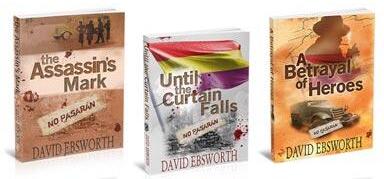
And so my novel ‘The Assassin’s Mark’ was born. It was described by an early reviewer as ‘“Homage to Catalonia” meets “Murder on the Orient Express”‘. That pretty much sums it up. Yes, it is a Christie-esque murder story but
The story behind the stories
DAVE M C CALL explains what inspired him to write historical mysteries about the Spanish Civil War under his pen name David Ebsworth.
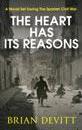
‘The Heart Has its Reasons’ (2025), by Brian Devitt is available to buy online.
‘The Heart Has its Reasons’ is a work of historical fiction loosely based on the life of Annie Murray (renamed Annie Munro in the novel) and her remarkable service in the International Brigades. It presents the reader with a dramatisation of her life incorporating actual events. The additional embellishment of fictional characters and their involvement in actual events at the time provides an imaginative reflection of what it was like to be part of that brave movement that came to support the Spanish Republic in its time of need.
The book is a coming-of-age story of a young girl, Annie Munro. Born into a poor tenant farmer household outside Aberdeen. Her father schooled her on the burgeoning workers’ rights movement and the building social unrest for equality.
After losing the farm, Annie’s father was lucky to find a factory job in Aberdeen and moved his family there. Surrounded by other struggling, impoverished families, Annie befriended a boy named Eddie Frazer, who would later be an on-again, off-again romantic interest.
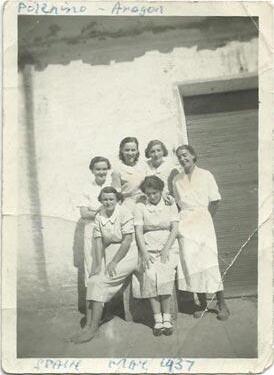
t Annie Murray (back row, second from right) with (back row, from left) Margaret Powell and Susan Sutor and (right) Patience Darton; and (seated from left) Agnes Hodgson and Mary Slater.
Annie pursued her dream of becoming a nurse and was accepted to nursing school in Edinburgh. While there, she joined the Young Communist League and led a protest march against the school administration for basic rights for all nursing students, which nearly got her expelled.
When it was time for Annie to graduate, she learned of the fascist coup against the Spanish Republican government. Like many other young, communist-
‘The Second World War did not begin with the invasion of Poland but rather with the siege of
Madrid.’
set against a hopefully accurate background of the conflict during (and before) September 1938. Published in 2013, it has been well - received – but also given me the chance to speak at many author events about the Spanish Civil War. That has meant plenty of opportunities to talk about the role of the International Brigades.
Recently, it was published for the first time as an audiobook, narrated by the irrepressible Gill Mills. Great for long journeys!
In 2017, ‘Until the Curtain Falls’ picked up the story. The book deals mostly with the final months of the siege of Madrid, and finishes with the well-known escape of the Stanbrook from Alicante harbour, as well as its arrival in Oran,
carrying all those refugees from the war.
By then, I was also intrigued by what had happened to the Spanish Stanbrook passengers who had fought for the Republic. The ‘stranger than fiction’ story of men like Amado Granell, eventually serving as part of a Free French armoured infantry regiment, and its mostly Spanish ninth company – always and forever, now, famed as La Nueve
For it was those Spanish troops who were the first to fight their way into Paris in August 1944. Their true story is the background to my 2021 blockbuster, ’A Betrayal of Heroes’.
Between the three novels, I hope I’ve given ‘ordinary readers’ a different perspective on the Spanish Civil War and aspects of the conflict they may not otherwise have come across –making the point that the Second World War did not begin with the invasion of Poland but rather with the siege of Madrid; or that the Spanish Civil War did not end in 1939 but continued far beyond, especially for the tens of thousands of Spanish Republicans who carried on the fight, as part of the Allied forces, right through the Second World War.
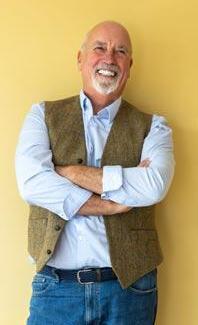
u Dave McCall: perspectives on the war in Spain.
Inspired by my Scottish roots
BRIAN DEVITT presents his new book, whose protagonist is inspired by Scottish nurse Annie Murray, a volunteer in the Spanish Civil War.
minded folks, she was appalled by the lack of support from the British government and decided to join the call from the International Brigades.
Annie endures a tough trip down to Spain, meeting other volunteers and, fleetingly, Eddie, crossing the Pyrenees with the help of mountain guides.
Once in Spain, she takes a train to Grañén. At the hospital, she is assigned to work with Caitlin McDade and other nurses from Britain and Ireland. Together, they struggle to improve conditions in the antiquated hospital while caring for the wounded, men and women from both sides of the conflict.
Later, Annie and the others volunteer for a hospital train assignment and work with Dr Joe Thomson, from America, to treat wounded soldiers near the battlefield. At each stop, they must triage the wounded, deciding whom to save and whom to let die.
But that is only the beginning of her ordeal on the hospital train. Several unforeseen events occur, challenging Annie’s beliefs and her commitment to
the Republic. Only through her strong courage does she make it through to the end of the war.
More today than ever, history shows us the consequences of failing to act in time of need. Even with all the technology available it is often easier for countries to turn a blind eye than to lend a hand to those in need. Yet there are certainly individuals who take it upon themselves
‘More today than ever history shows us the consequences of failing to act in time of need.’
to try and make a difference in those or other areas of war-torn strife.
Hemingway and Orwell kindled my interest in the Spanish Civil War, a topic sadly neglected during my school days in the US. In Orwell’s account, I read about British volunteers and wondered whether any of my relatives from Scotland might have been involved.
Born in Aberdeen in 1925, my mother, who later settled in the US, would have been too young, but she came from a working-class family who might have been represented in the Brigade ranks.
None of my cousins from Scotland knew of any relative who might have volunteered.
Undaunted, I started my own genealogy research and searched for any matches on my mother’s family tree. There were none. So, I examined my father’s lineage and determined that my great-grandmother’s name was Murray and that she was born in England.
This led me to Annie Murray and her amazing story. I realize it is a stretch to say she is a distant relative. But the vivid accounts of her service in the Brigades were fascinating to me. As I did more investigation into her life’s work, including requesting copies of letters she wrote while in Spain, I felt there was a great story to tell.

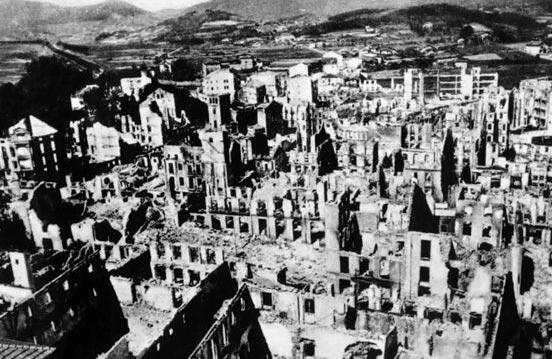
Franco: a legacy of violence and conceit
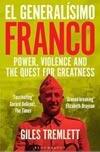
‘El Generalísimo Franco: Power, Violence and the Quest for Greatness’ by Giles Tremlett (Bloomsbury, 2025).
In 2026, the United States is being ruled by an administration led by a wannabe dictator named Trump. His ego seems to dominate his decisions, while his paranoia encourages him to surround himself with authoritarian individuals eager to prove a
strength they have always doubted existed in their persona.
Not an intellectual by any measure, Trump’s position in the world of finance and politics is a testimony to the power of ego, cruelty and bombast in the sectors of society he has existed in his entire life.
A recent book on the life of the Spanish fascist Francisco Franco convinced me that Trump’s closest historical model could well be the man who liked to be called El Generalísimo, often compared to Hitler, Mussolini and other authoritarians familiar to Western media.
A journalist and historian, Giles Tremlett has provided the public with a comprehensive exploration of El Generalísimo’s life and politics, well situated in the history of the time Franco
lived, ruled and died.
It’s a story of a man who believed he represented the one true Spain – a Spain that was
‘It’s a story of a man who believed he represented the one true Spain, a Spain that was Catholic and extremely conservative.’
t On 26 April 1937, Nazi Germany's Condor Legion and Fascist Italian forces bombed the Basque town of Gernika at the request of Franco, destroying over 70 per cent of the town.
u Spanish dictator Francisco Franco (1892-1975) ruled Spain for nearly four decades. Historian Paul Preston estimates that during the White Terror (the Spanish Civil War and the first nine years of the dictatorship) Nationalist forces killed up to 200,000 people. Today, mass graves still scar the country.
Catholic and extremely conservative, with anyone not of that makeup fair game for detention and even death as enemies of Spain. This was especially true as regards leftists, anarchists, Catalan, Basque and other separatist groups and liberals. Not only were these people considered enemies of Spain, they were also enemies of Franco: in his mind, the two were synonymous.
Like other fascist rulers, Franco’s personal idiosyncrasies often frustrated his advisors, occasionally ruining military and political campaigns that would otherwise have succeeded. It is clear from reading the biography that Franco needed to be in control.
Tremlett discusses Franco’s traits early on in the text, providing the reader with a biography of the man’s youth and family life. His philandering father left the home when Franco was still in school; his mother, already quite religious, turned even more to the Church after her husband’s departure. It is reasonably suggested that this helps explain Franco’s hatred of any type of sexual relationship outside of traditional monogamy in the Catholic tradition.
The influence of the Catholic and military education he received (even desired) explains Franco’s fear of and loathing of the arts and politics of Spain’s leftist and liberal classes: a loathing that was publicly quite deep. Like most conservative Catholics then and now, Franco’s moral outrage focused more on sex and sexuality than on war and conquest.
In fact, Franco’s love of military action was deeply influenced by this belief that it was blessed by his God, from his colonial exploits in Morocco to his war on those Spanish people fighting for the Republic and against the fascist Falange. More grotesquely, Franco believed the killing of his Spanish opponents in the civil war was ordained by God and the Catholic Church, which had provided Franco with its approval.
One can also assume from reading this biography that the corruption that ran rampant during Franco’s decades-long reign was part of God’s reward for his victory. Despite the corruption of Franco’s government, the author makes it a point to state that Franco was not much of a participant
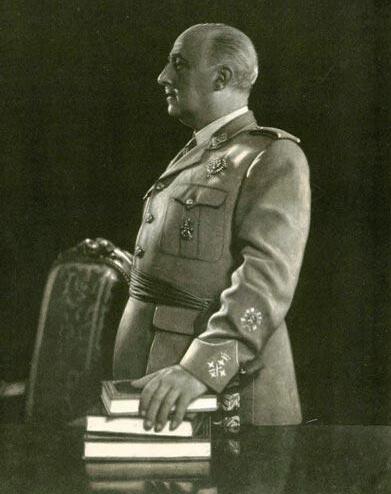
‘ Franco’s personal idiosyncrasies often frustrated advisors, ruining military and political campaigns that would otherwise have succeeded.’
in it, if at all. In other words, his moral beliefs forbade him from thieving, but not from killing.
The life told in these pages is of a man who revelled in violence, seeing it as a statement of and a testing of his virility. The history that is the foundation of the text is similarly violent, with the colonial campaigns described at the onset of Franco’s military career echoing throughout the civil war and its eventual dissolution into the bloody madness of the Second World War.
It is also the biography of a man whose conceit convinced him that his fate was Spain’s
fate and that any other concept of Spain was treasonous and had to be neutralised by extermination, if he considered it necessary.
The fact of his survival (and of the survival of his rule) is instructive. Once in power, Franco never intended to leave it, except via his death. Previous governmental norms and laws were ignored, overturned or reinterpreted to serve the agenda put forth by Franco. In his mind and the mind of most of his followers, Francisco Franco was not quite of this Earth.
RON JACOBS
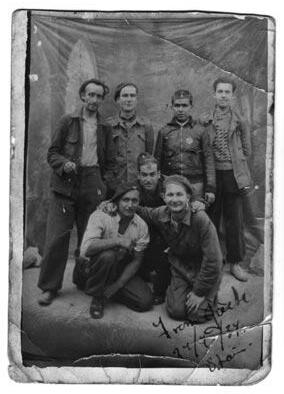
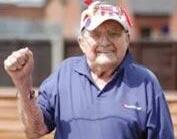
tt Jack Edwards (bottom right) in Spain in 1937 with other volunteers.
p Jack Edwards’s children, Peter, Margaret and Colin, scatter his ashes at Jarama in February 2014.
t Jack Edwards, one of the last British Brigaders.
A legacy handed down
The family of the late COLIN EDWARDS (below), son of Brigader Jack Edwards, share his lifelong work to keep the Brigaders’ memory alive.
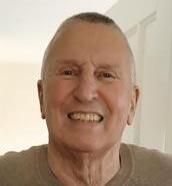
Colin Edwards, son of International Brigader Jack Edwards, has died aged 77. A retired headteacher living on the south coast, he died suddenly and unexpectedly on 9 February.
Donations in memory of Colin – and specifically for the IBMT – totalled over £300 and have been given by his family to support the Trust’s work in keeping alive the memory of the Brigaders and their fight for democracy and against fascism.
Colin was a dedicated supporter and member of the IBMT and regularly attended the annual commemoration at Jubilee Gardens in London with his brother Pete, their late sister Margaret and father Jack.
Along with Pete and Margaret, Colin was fiercely proud of Jack's decision to fight in Spain.
Colin was a voracious reader on the Spanish Civil
War and was always happy to spend time telling people about Jack and the Brigaders, and was regularly asked to explain the background of the IBMT badge, which he wore every day on his jacket.
His Liverpool-born father, Jack, a vocal and active veteran and member of the IBMT, died aged 97 in January 2011.
In February 2014, Colin, with his daughter Rachel, Pete and Margaret, fulfilled Jack's wish for his ashes to be spread on the Jarama battlefield outside Madrid, where he fought and was wounded in action with the British Battalion in February 1937.
They also spread the ashes of their mum and Jack's wife, Ivy, who went round Liverpool with a handcart collecting food for Spain when Jack left to fight. Ivy trained as a nurse, intending to go to Spain, but the war was over before she finished her training.
The ceremony was held close to the memorial to the International Brigades.
Jack was a member of the IBMT Executive Committee from 2004 to 2011. Colin would proudly accompany him to EC meetings.
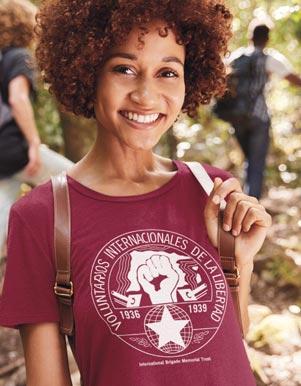
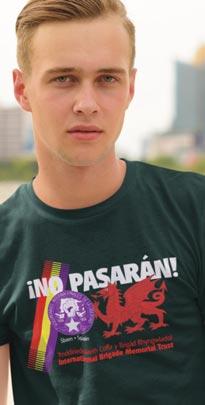
Choose your IBMT t-shirt
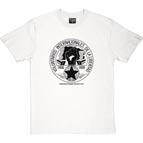
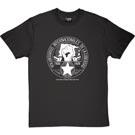
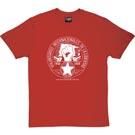
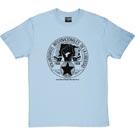
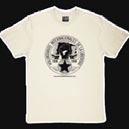
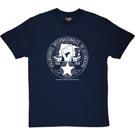
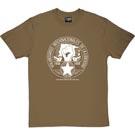
The IBMT has a range of new t-shirt designs highlighting the contributions of volunteers from Ireland, Scotland and Wales (below).
We also have a t-shirt featuring the iconic emblem of the International Brigades, in a variety of colours (left).
All t-shirts are on sale for £20 (plus £3.99 p&p) in a range of sizes (S-5XL) and are made from ethically sourced cotton.
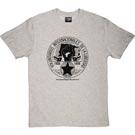
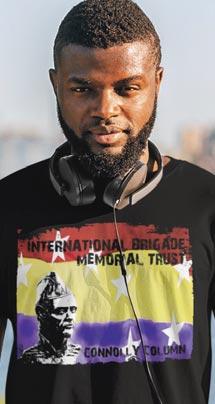
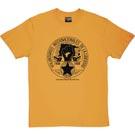
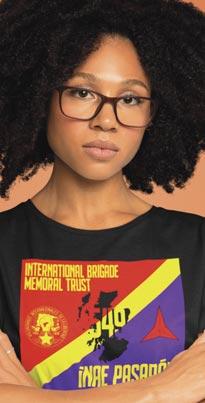
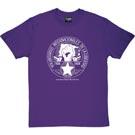
The t-shirts are produced in partnership with specialist radical apparel outfitter Red Molotov. All proceeds from sales help fund our vital commemorative and educational work.
To place an order online go to the Shop page of the IBMT website: www.internationalbrigades.org.uk/catalog
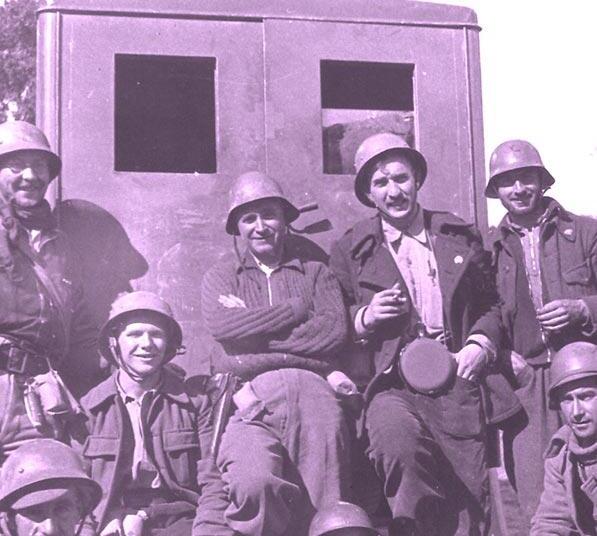
Help us inspire new generations with the story of the men and women who fought fascism and defended democracy in Spain from 1936 to 1939. Please
International Brigade Memorial Trust
37a Clerkenwell Green, London EC1R 0DU
07865 272 639
admin@international-brigades.org.uk
www.international-brigades.org.uk