In June 2020
INTERNATIONAL ART CENTRE offered three Banky prints in one of our auctions
After that, we never looked back


BANKSY (British b. 1974)
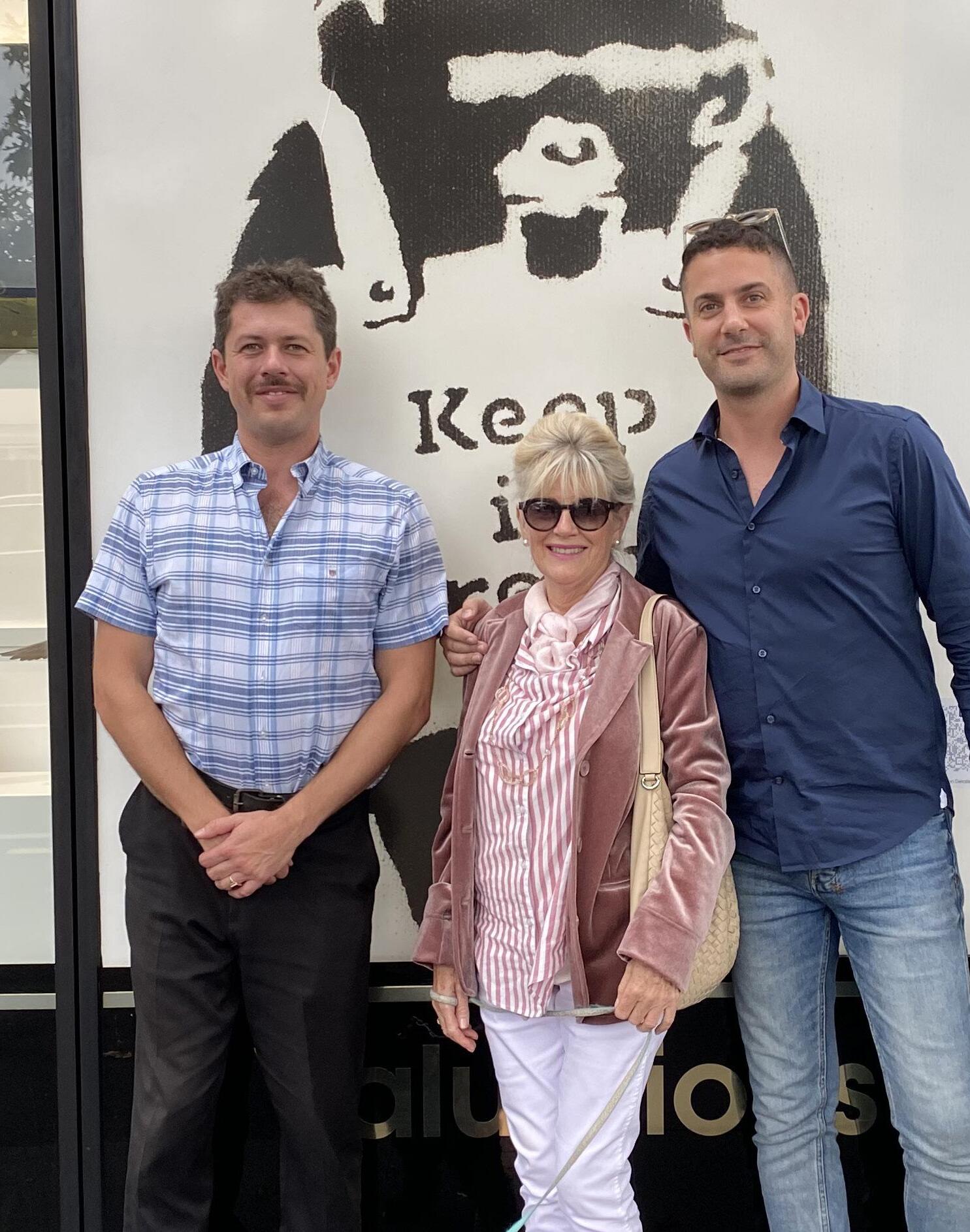
Keep it Real, 2003
Spray paint on canvas 30 x 30 (35 x 35 including overlap)
Signature tagged on right hand overlap
$600,000 - 1,000,000
PROVENANCE
Framed by Leonard Villa, London with framers label affixed verso
Gifted to original owner by the artist, 2003
Subsequenlty sold to private collector, 2014
This collector now based in Auckland, New Zealand
This work is accompanied by a Certificate of Authenticity from Pest Control
When Banksy was emerging as a street artist he spent time with a renowned graffiti artist who spray painted trains in the 1980’s. Banksy accompanied him at night in Bristol to see where and how they sprayed, in return Banksy sent him Keep it Real as a thank you. Keep it Real was sold privately to the current owner in 2014.


Nobody ever listened to me until they didn’t know who I was - Banksy


BANKSY (British b. 1974)
Girl With Balloon
Screenprint, edition 290/600 70 x 50
Numbered on unsigned embossed
POW stamp
$250,000 - 350,000
PROVENANCE
Private Collection Wellington
Purchased from Pictures on Walls by current owner 2005
This work is accompanied by a Certificate of Authenticity from Pest Control
Girl With Balloon, is one of Banksy’s most important works, demonstrating the artist’s graffiti stencil technique, it was released in small editions of unsigned and signed prints in 2004/2005. There are just 150 Girl With Balloon signed prints, and 600 unsigned making it one of the artist’s most sought-after works.
Banksy depicts a young girl reaching for, or releasing, a red heart-shaped balloon that has slipped from her grasp. The gesture and the red balloon, an archetypal symbol of childhood and freedom, present a powerful message that can be read in a number of ways. Whether you see the little girl as losing the balloon, or about to catch it, the meaning can be interpreted as a portrayal of loss or the arrival of new hope and love. In 2002, when the original mural appeared in London’s Southbank, it was accompanied by Banksy’s quotation There is always hope. The street souvenir was later painted over by the council.
In 2017 Girl With Balloon was voted the UK’s favourite work of art. The following year, Girl with Balloon was the subject of the now infamous public art stunt. As the Sotheby’s auctioneer brought the hammer down on a US$1.4M bid, the work partially self-destructed through the activation of a mechanism installed in the frame. Later that same day, Banksy posted an image on his instagram account of the work shredding itself with the caption: Going, going, gone. The successful female bidder proceeded with her purchase, commenting that while at first she was shocked, she realised that she would end up with a piece of her own art history.
In October 2021 the shredded and renamed Love is in the Bin was offered through Sotheby’s auction, realising NZ$35M. Pest Control, Banksy’s only authentication body, retitled the work.
GIRL WITH BALLOON unsigned
$360,375

29 BANKSY (British b. 1974)
Pulp Fiction
Screenprint, edition 419/600, 50 x 70
Numbered, unsigned (Signed in plate)
$90,000 - 150,000
PROVENANCE
Private Collection, Otago
Purchased from Outré, Melbourne 4/02/2005 by current owner. Original purchase receipt available for inspection Comes with facsimile copy of Outré catalogue
This work is accompanied by a Certificate of Authenticity from Pest Control
Banksy’s Pulp Fiction depicts a famous scene from Quentin Tarantino’s 1994 blockbuster film Pulp Fiction. The work depicts the two main characters played by actors Samuel L. Jackson and John Travolta. Rendered in white stencilled forms on a black background, Banksy presents the protagonists Vincent and Jules, side-by-side and aiming their firearms in synchronisation. In a humorous twist, their pistols have been replaced by bright yellow bananas, the only touch of colour in the otherwise monochrome composition.
Pulp Fiction first appeared in 2002 as a stencilled composition near Old Street tube station, London. It was visible until 2007 when Transport for London painted over the wall, later estimated at £300,000, on the grounds that the work lent an atmosphere of social decay and neglect in the capital. When the mural was covered, a local street artist sprayed COME BACK in its place, addressed to Banksy. Banksy then re-tagged his original Pulp Fiction in exactly the same place, but this time the characters were holding real pistols and wearing banana costumes instead.
In January 2007, graffiti artist Ozone wrote over the new piece with the words If it’s better next time I’ll leave it. Shortly afterwards, the 19-year-old artist and his close friend, Wants, were both hit and killed by an underground train in Barking, East London. Banksy then created another piece over his original Pulp Fiction mural in tribute to the two young graffiti artists. This work depicted an angel wearing a bulletproof vest and holding a skull in his right hand. Banksy posted a note on his website . . . When we lost Ozone we lost a fearless graffiti writer and as it turns out a pretty perceptive art critic. Ozone - Rest in Peace.
The tribute mural was quickly referred to as Ozone’s Angel. Subsequently, Banksy’s original Pulp Fiction mural also became immediately popular, and was mass-reproduced on commercial merchandise. Pulp Fiction was released in 2004 as an edition of 150 signed and 600 unsigned prints.

PULP FICTION unsigned realised $113,500
BANKSY (British b. 1974)
CND Soldiers
Screenprint, edition 130/350, 70 x 50
Signed & numbered
$80,000 - 120,000
PROVENANCE
Private Collection, Wellington
Purchased from Pictures on Walls by current owner, 2005
This work is accompanied by a Certificate of Authenticity from Pest Control
Banksy’s powerful anti-war work, CND Soldiers is a limited edition silkscreen print released by Pictures on Walls of London in 2005, in an edition of 350 signed, and 350 unsigned prints. The image first appeared in 2003 as a mural outside the Houses of Parliament during an anti-war protest led by Brian Haw, an English peace campaigner who lived for a decade in the Westminster peace camp. At the time the UK’s involvement in the Iraq war had been brought to light, and the fact that millions of people, including soldiers, protested against the invasion was reportedly ignored. The anti-war art statement was later removed by the authorities.
The work depicts two soldiers painted in the artist’s black and white stencil trademark style on a monochromatic background. Whilst one soldier holds a machine gun on lookout, the other is painting a large peace symbol in red paint – the only coloured element in the image. The satirical juxtaposition of soldiers and their guns alongside the iconic, almost completed peace sign is intended to make the viewer question the army’s role of keeping the peace.
Questioning the validity of the nanny state is a central theme in Banksy’s work. The red peace sign originally symbolised the British Campaign for Nuclear Disarmament (CND) of 1957 and is now widely known as an international symbol of peace. Banksy’s inclusion of it here, painted in dripping red paint, overtly evokes the bloodshed and human cost of war. Further contrasts are drawn as the soldiers, who act on behalf of the government, are now represented as activists and vandals, graffitiing the wall in protest.

BANKSY (British b. 1974)
Choose Your Weapon - Soft Yellow Screenprint, edition 8/25, 70 x 70
Signed & numbered
$150,000 - 250,000
PROVENANCE
Private Collection, Auckland
Purchased from Walton Fine Arts, Chelsea, 2012 - original purchase receipt available to buyer
This work is accompanied by a Certificate of Authenticity from Pest Control
Banksy’s Choose Your Weapon first appeared on a wall outside London’s Grange pub, Bermondsey in 2010. Shortly after the stencil appeared on the street, it was boarded over. It then reappeared, framed and covered in perspex. In August 2016, it was reported that the perspex itself had been covered in posters and advertising flyers obscuring it from view entirely.
In December 2010 Pictures On Walls released limited edition prints of the mural to a multitude of fans who queued for hours in the cold to get their hands on a work by Banksy. The queue notoriously got out of control, with desperate fans pushing and shoving, which resulted in Banksy releasing a special queue jumping edition in grey for those who missed their chance.
The collection of prints were available in fifteen different colours - all editions of 25. Choose Your Weapon Soft Yellow features a hooded man with dark clothing and a bandana hiding his face, a visual motif recurrent in Banksy’s stencil work and meant to signifying Britain’s disaffected youth. His menacing appearance is contrasted by his casual hand-in-thepocket posture and his cartoon Haring dog, chained and barking.
Here Banksy implies the dog has become an alternative weapon on the UK streets.
The minimalist animal, painted in a hieroglyphic all-white silhouette, is in contrast to the hyperrealistic representation of his master and the style is a clear nod to the late Keith Haring (1958- 90) whose Barking Dog is one of the most recognised motifs of contemporary art in the 1980s.
This represents an opprotunity to acquire a signed Banksy from an edition of 25. The lowest commercial edition ever published by the artist.


CHOOSE YOUR WEAPON - SOFT YELLOW REALISED $468,480
BANKSY (British b. 1974)
Morons, 2007
Screenprint, edition 101/150, 56 x 76
Signed & numbered
$100,000 - 150,000
PROVENANCE
Private Collection, Auckland
Originally purchased from Pictures on Walls, original receipt affixed verso Original Pictures on Walls tissue included within frame.
This work is accompanied by a Certificate of Authenticity from Pest Control
Morons portrays Christies art auction room full of collectors bidding for a number of artworks, including one in an elaborate frame that reads, ‘I can’t believe you morons actually buy this shit’. Banksy uploaded the image on his then website, following a recordbreaking auction result for one of his canvases. Morons is an example of Banksy’s unapologetic critiques on the extraordinarily high prices of his, and many other artists’ artworks pointing a mocking finger at their buyers.
Banksy’s relationship with the art dealers and auction houses is ironically notoriously controversial, which some believe is why he is so successful. The artist has expressed similarly critical opinions of the art world’s commercialism through public pranks such as the famous incident in 2008 at Sotheby’s auction of Girl With Balloon, ceremoniously shredded itself in front of the audience soon after the auctioneer knocked his gavel down.

It is widely thought Banksy based Morons on a famous press photograph of Christies auctioneer Charles Hindlip selling Vincent van Gogh’s ‘Sunflowers’ on March 30, 1987 for £22m.

BANKSY (British b. 1974)
Chocolate Donuts
Screenprint, edition 40/299, 55 x 76
Signed and numbered
$70,000 - 100,000
PROVENANCE
Private Collection, Australia
Purchased from Pictures on Walls, 2009
This work is accompanied by a Certificate of Authenticity from Pest Control
Chocolate Donuts came after the original Banksy Strawberry Donut work, this time featuring a giant chocolate donut covered in sprinkles affixed to the roof of a police van. The blue and red spots as flashing lights of the police vehicles add splashes of colour in the artwork. It could represent Banksy’s ironic commentary on police values in America, the police are stereotyped for their love of takeaway coffee and donuts. Alternatively it could be a satirical suggestion police prioritise the safety of their snacks over the safety of their suspects.
The image could have a broader meaning, if we view the police as mere enforcers, perhaps they are protecting the very essence of commercialism, represented by the donut. It is rare for Banksy to create a piece that doesn’t have some form of social, environmental or political message so it seems unlikely the artist is refering to just donuts. The police were a frequent subject of Banksy screenprints, such as in his notorious Rude Copper, Have A Nice Day and Flying Copper works.
The number of prints released – 299 for each flavour is widely belived to be a reference to the Krispy Kreme financial troubles in 2007, the year it closed down 299 of it’s stores.

BANKSY (British b. 1974)
Soup Can (Original), 2005
Screenprint, edition of 250, 50 x 36
Numbered in pencil
$80,000 - 120,000
PROVENANCE
Private Collection, Auckland
This work is accompanied by a Certificate of Authenticity from Pest Control
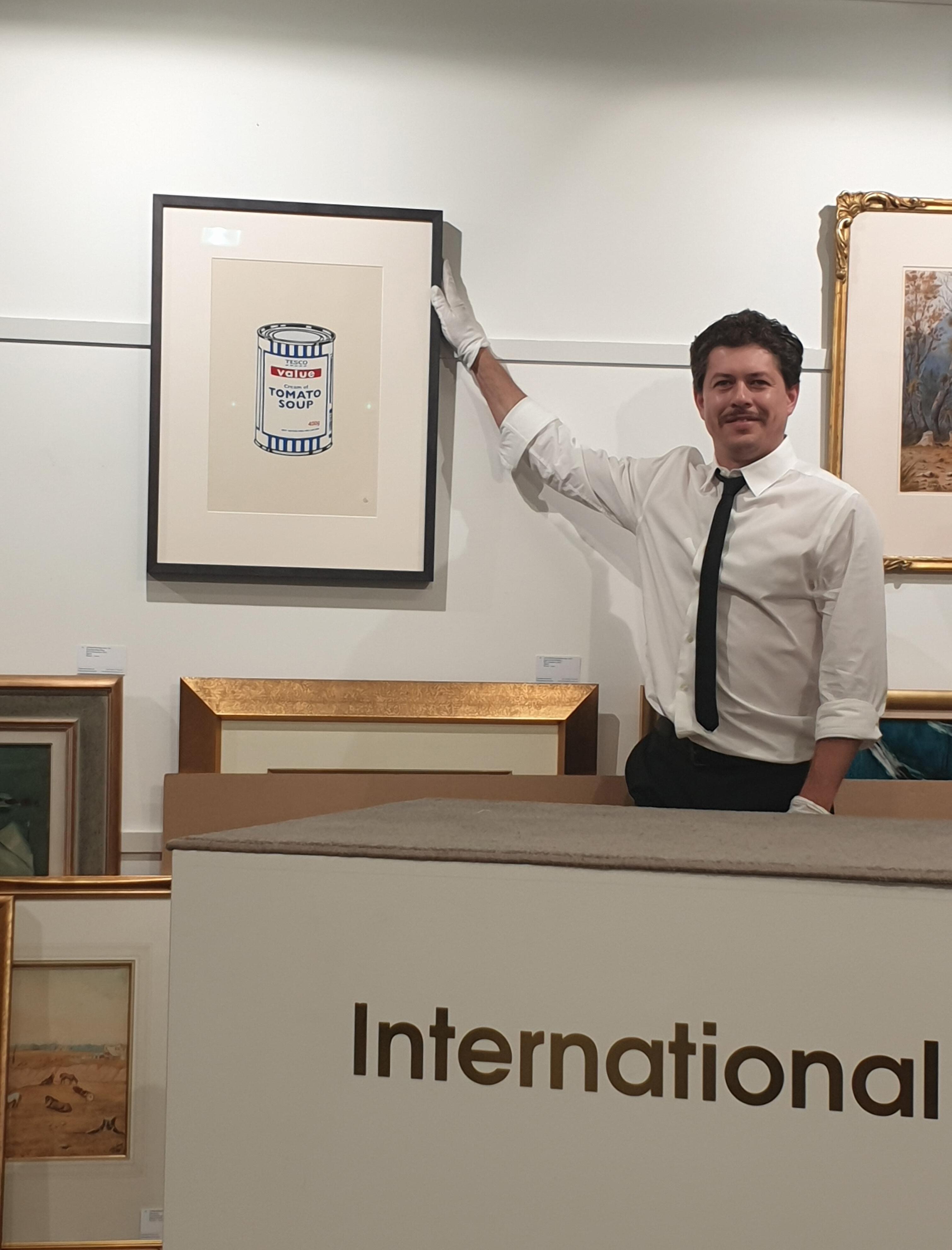
Banksy’s original four-colour screenprint Soup Cans, is a play on Andy Warhol’s now infamous Pop Art Campbell’s Soup Cans. Banksy has taken the idea that commercial products can be art, as is the Pop Art ethos, but has rendered it in his tongue-in-cheek style with Tesco Value cans of cream of tomato soup.
This limited edition screenprint is one of Banksy’s most iconic. Four different variations were released. The number of cans featured on the print and their colours vary. Banksy first turned to graffiti as a young, disillusioned adolescent. Inspired by the thriving graffiti community in his home city, Bristol, Banksy’s works began appearing on trains and city streets in 1993, and by 2001 his signature, stencilled works had cropped up all over the United Kingdom.
Typically crafting his images with spray paint and cardboard stencils, Banksy is able to achieve a meticulous level of detail. His aesthetic is clean and instantly comprehensible due to his unique ability to distil complex political and social statements into simple visual elements.
His graffiti, paintings, and screenprints use whimsy and humour to satirically critique war, capitalism, hypocrisy and greed. His anti-establishment wit has had an undeniable impact on today’s contemporary street culture.

BANKSY (British b. 1974)
Gangsta Rat
Screenprint, edition 110/350, 49.5 x 34.5
Numbered in pencil over POW embossed stamp
$40,000 - 60,000
PROVENANCE
Private Collection, Auckland
Purchased from Pictures on Walls, 2006
This work is accompanied by a Certificate of Authenticity from Pest Control
Gangsta Rat was originally a mural that appeared in Farringdon in 2004, then Old Street in 2006 and finally New York in 2013 on the occasion of the artist’s painting residency: Better Out Than In. In 2004 it was subsequently produced as a sceenprint in Banksy’s iconic spray-stencil style.
The work depicts a rat sitting next to a boombox wearing accessories typical of “gangster” street wear, such as a New York Mets baseball cap, an ear piercing and a long chain. In the background the tagged letters IPOW appear as a central splash of colour. This is an ironic social commentary on the ubiquity of Apple products and POW is a reference to Banksy’s print publisher: Pictures on Walls.
The rat character portrayed is reminiscent of the New York underground style that emerged across the United Kingdom in the 1980s and 90s, also drawing inspiration from Blek Le Rat, the French graffiti artist who originally started using rats as his symbol. In the publication Wall and Piece, Banksy said: Every time I think I’ve painted something slightly original, I find out that Blek le Rat has done it as well, only 20 years earlier’.

BANKSY (British b. 1975)
Toxic Mary
Screenprint, edition 229/600
68.5 x 49
Unsigned, (Signed in plate)
$40,000 - 60,000
PROVENANCE
Private Collection,Whanganui, NZ
Purchased at Art Republic, London, 2004, by current owner.
Accompanied by a Certificate of Authenticity from Pest Control (pending) Authentication request number available to purchaser
Toxic Mary is an early street art work by Banksy that first appeared as a painting in his exhibition Turf War in 2003. It was a limited edition of 750 prints, with 150 signed and 600 unsigned prints.
Toxic Mary is an original spin on one of the most important symbols in the history of orthodox iconographic art: The Madonna and Christ child. Banksy’s half-figure Madonna resembles the style associated with Italian Renaissance art, and is an image which easily embeds itself into popular iconography.
In Toxic Mary, Banksy satirizes the relationship between mother and child, but also between religious authority and layperson. To a layperson, religion may offer security, but it does not always equal safety. The figure of Madonna is seen feeding a poisonous formula to the infant Christ.
Banksy implies that many across the world feel that religion has disproportionately sparked more wars, caused more death, and fostered a sense of cultural intolerance.


BANKSY (British b. 1974)
Love is in the Air, 2003
Screenprint on wove paper, edition 115/500 50 x 70
Unsigned (Signed in plate)
NZ$175,000 -260,000
This work is accompanied by a Certificate of Authenticity from Pest Control
PROVENANCE
Purchased from Eat My Handbag Bitch, London, 2004 by current owner
ILLUSTRATED
Front cover, Wall and Piece, Banksy, 2005
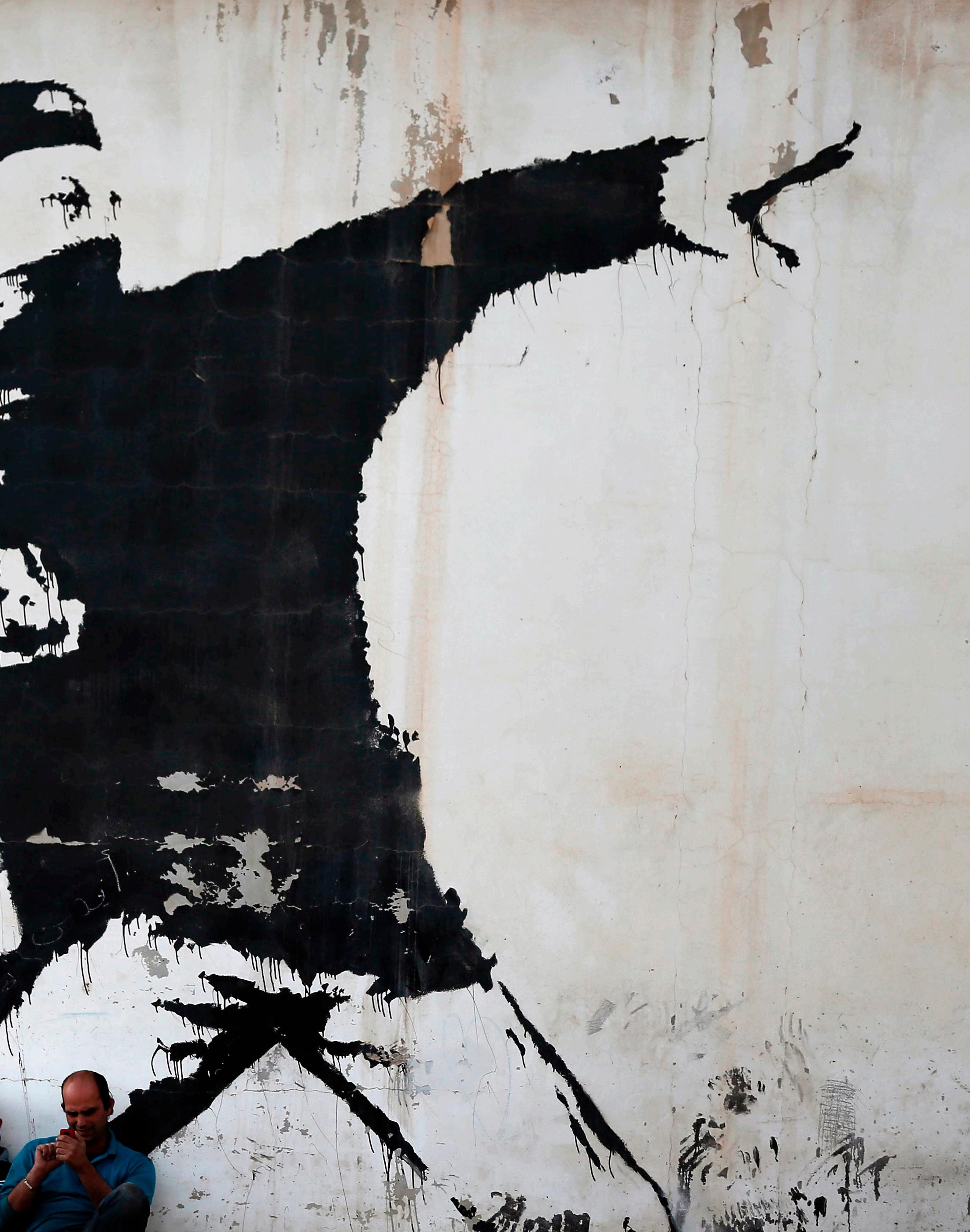
Love Is In The Air, also known as Flower Thrower first appeared in 2003 as large format, stencilled graffiti in Jerusalem shortly after the construction of the West Bank Wall. It was graffitied on the wall separating Palestine from Israel.
The wall rapidly became a giant canvas for paintings and writings protesting against its construction.
Banksy returned to the region in 2005 to paint a series of nine provocative works supporting freedom and equality. In 2015 he contributed again, painting four new pieces amongst the ruins of a bombed city with the intention of highlighting the plight of those living in the Gaza Strip.
In Banksy’s iconic and characteristic signature stencilled style, Love Is In The Air depicts a protestor wearing a baseball cap and a bandana to mask the lower half of his face.
The artist adds an inevitable twist, placing a bunch of flowers into the thrower’s hand instead of a molotov cocktail or grenade.
Despite what appears to be anger and frustration in the subjects pose, he prepares to launch a universal symbol of love and peace as opposed to a weapon.
Love Is In The Air is one of Banksy’s most iconic and sought after works. It has been reproduced on posters, phone covers, T-shirts and other merchandise all over the world. The image also features across the cover of the 2005 publication Wall and Piece, Banksy.
Although completed in 2003, this image with it’s masked subject possesses a powerful relevance.

BANKSY (British b. 1974)
Barcode
Screenprint, edition 428/600, 50 x 70
Unsigned (Stamped in plate)
$80,000 - 120,000
PROVENANCE
Private Collection, Auckland
Purchased from Pictures on Walls, 2005
This work is accompanied by a Certificate of Authenticity from Pest Control
Barcode dates back to 2002. The monochrome screen print is among Banksy’s most famous and now one of the most sought-after works. There were only 150 Barcode prints signed by the artist and 600 unsigned prints with the red stamp.
Depicting a majestic leopard seemingly emerging from a barcode that resembles a cage on wheels, the subject remains open to numerous interpretations. Barcodes were introduced in the mid-1970s with the intention to make people buy more and faster and here it is used by Banksy as a symbol of consumerism and capitalism. It resembles a cage from which there is escape. The leopard can be seen to be demonstrating the ability we all have to free ourselves from the shackles of consumerism.
Banksy maybe linking the choice of the leopard and the barcode by their unique character. Both leopards and barcodes have unique patterns, The big cat suggests diversity of form, whereas the notion of consumerism suggested through the image of the barcode evokes homogeneity. This link can also be seen to refer to the way in which an individuals unique and private information is now easily bought and sold, to be integrated into giant data banks.
The work could also been seen as a less complex comment on the treatment of wild animals placed in cages for amusement. As always Banksy makes a bold and memorable statement

BANKSY (British b. 1974)
Happy Chopper, 2003
Screenprint, edition 569/750, 70 x 50
Unsigned (Signed in plate)
$70,000 - 100,000
PROVENANCE
Private Collection, Canterbury
Purchased from Pictures on Walls, 2005
This work is accompanied by a Certificate of Authenticity from Pest Control
Happy Choppers was created on the occasion of Banksy’s Santa’s Ghetto exhibition, intended to draw attention to the Israel-Palestinian conflict and the poverty of the West Bank. Then original Happy Choppers appeared as a sprayed mural on a wall outside London’s Whitecross Street Market in 2002. Since then, Banksy has revisited his helicopter motif many times, making Happy Choppers an iconic part of his repertoire.