Auction 7:00pm Tuesday 9 April 2019
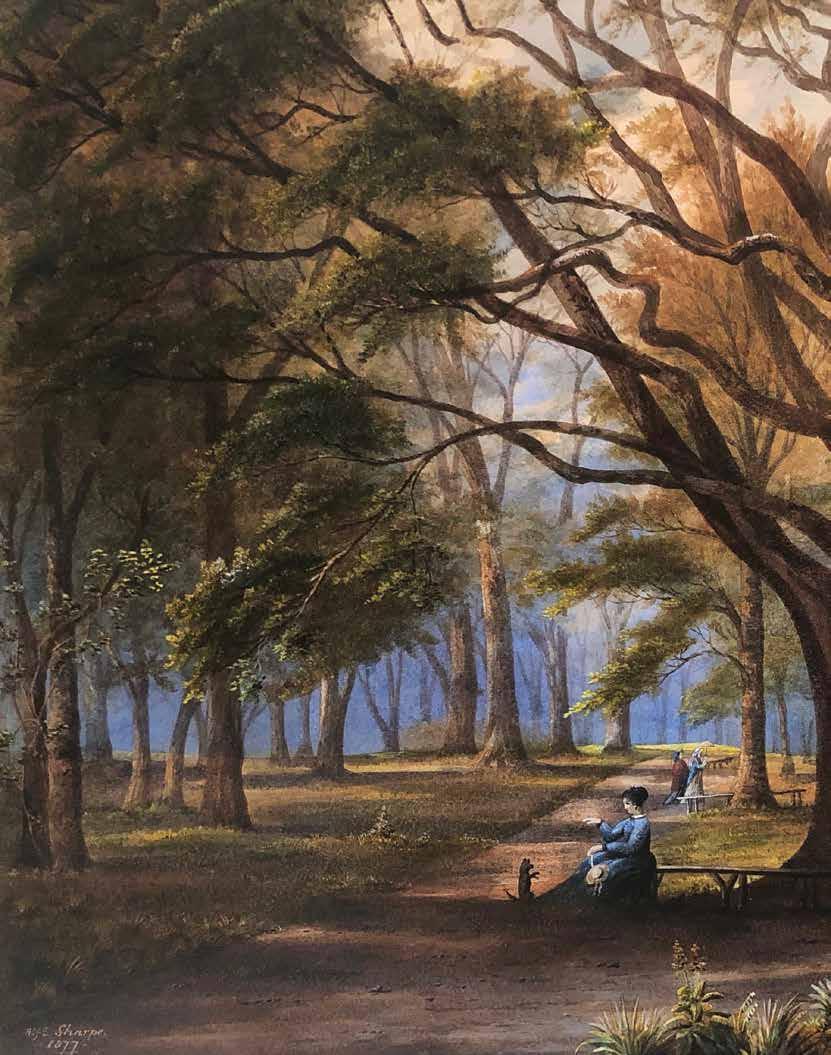
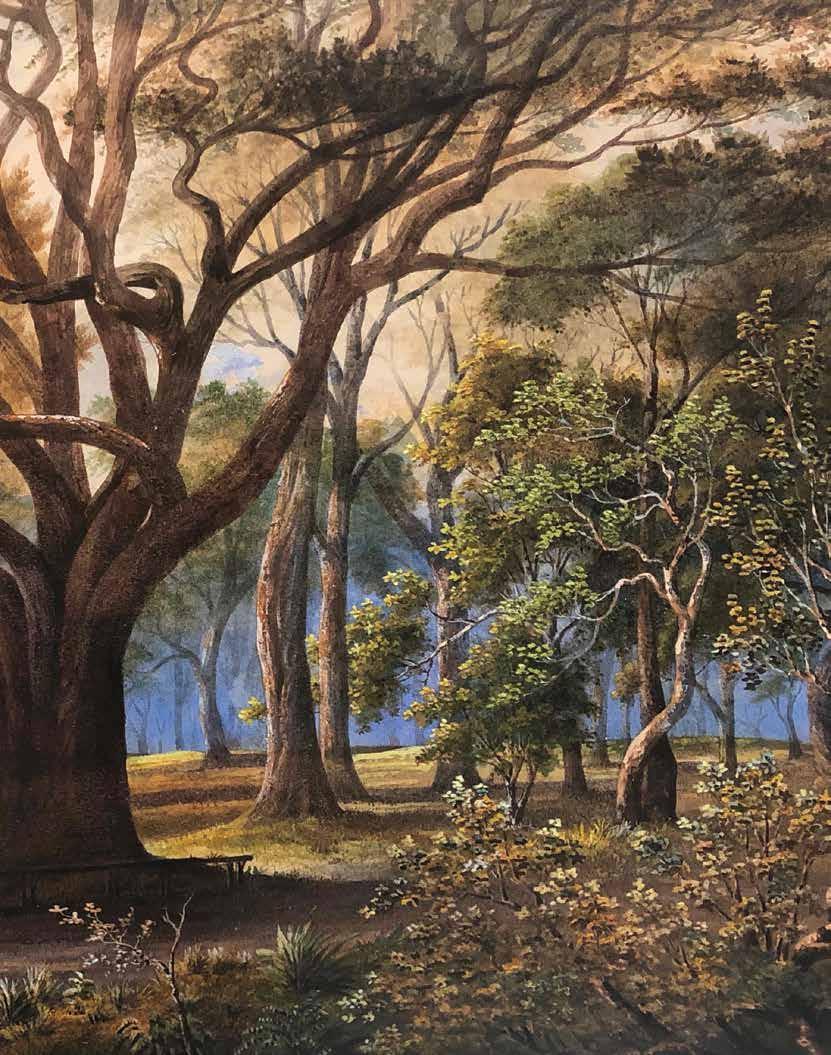
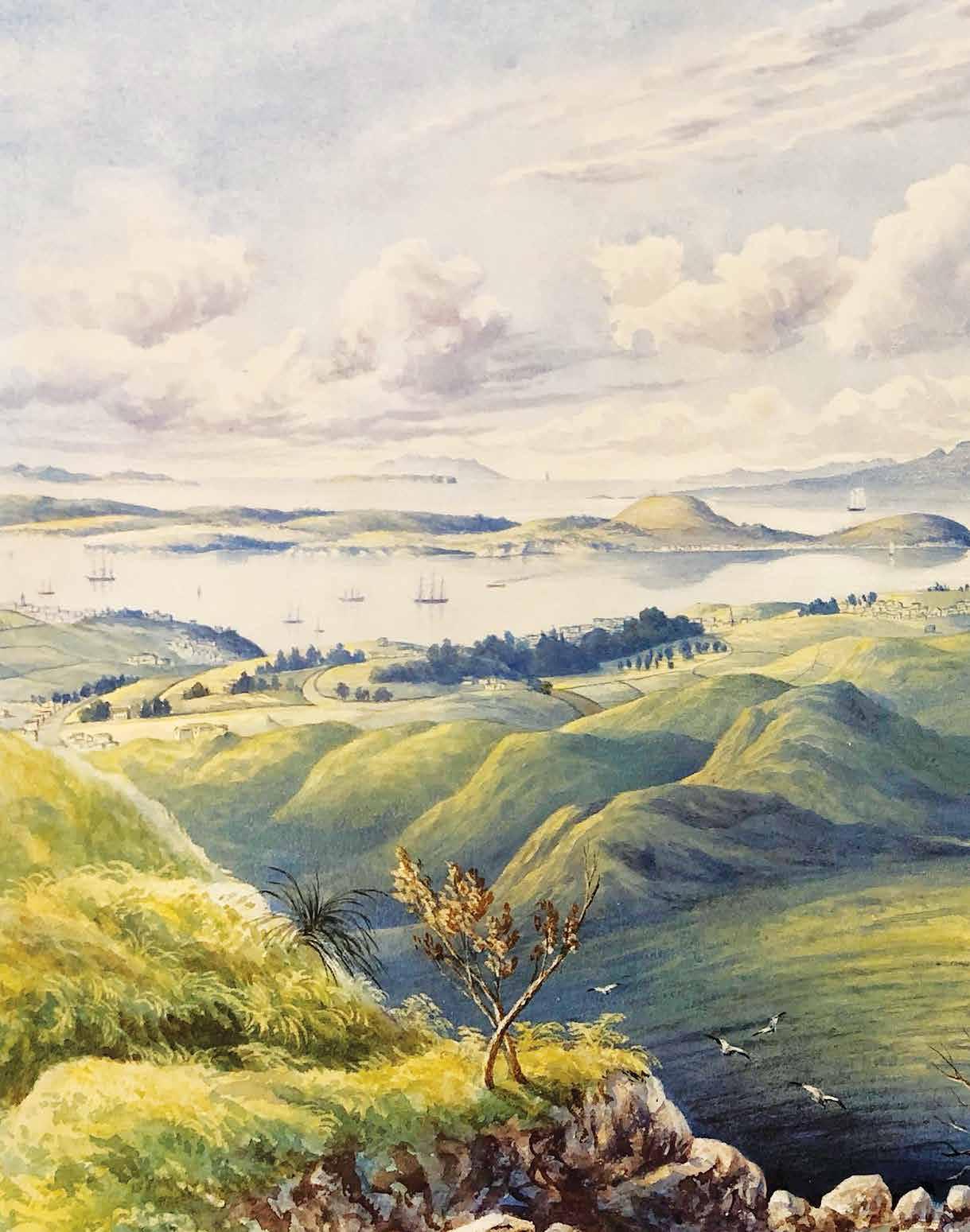
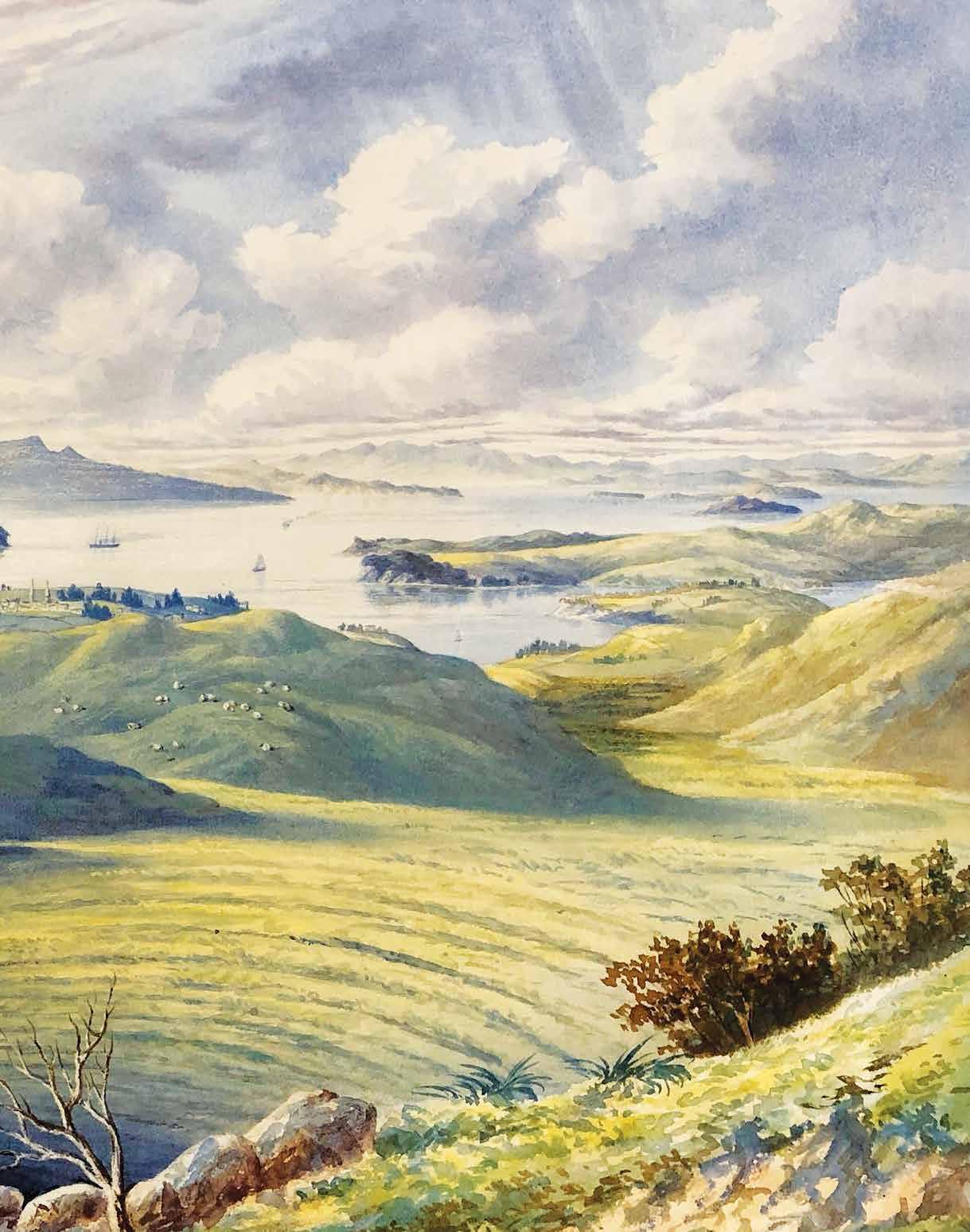
Lot 34
Alfred Sharpe
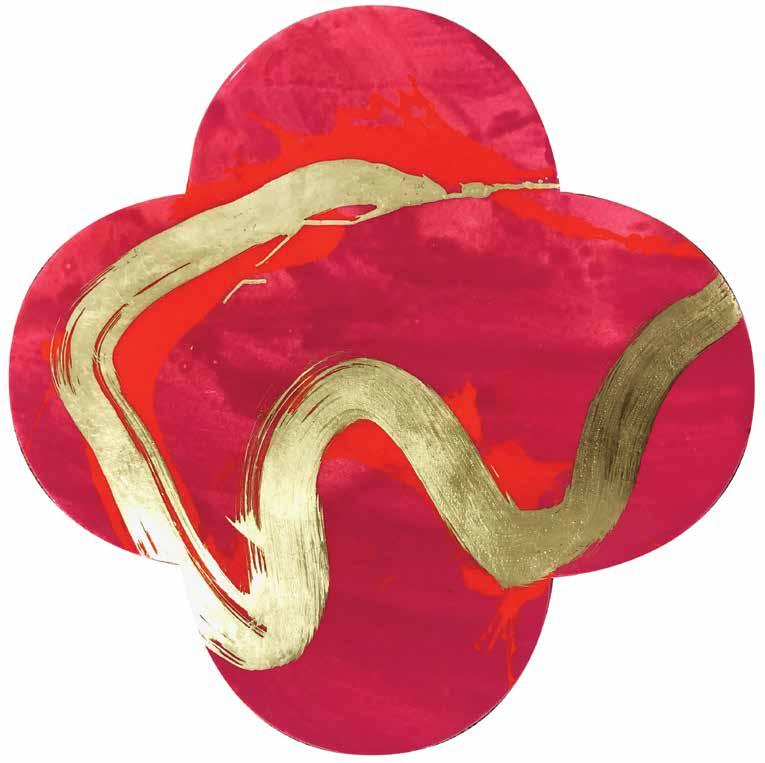
Lot 25
Max Gimblett

Auction 7:00pm Tuesday 9 April 2019
7:00pm Tuesday 9 April 2019
AUCTION contacts
Richard Thomson
Ph +64 9 379 4010 richard@artcntr.co.nz Mobile 0274 751071
Maggie Skelton
Ph +64 9 379 4010 maggie@artcntr.co.nz
Luke Davies
Ph +64 9 379 4010 luke@artcntr.co.nz
Viewing times p. 5
Conditions of Sale p. 139
Absentee bids p. 135
Telephone bid form p. 135
Internet bidding via liveauctioneers.com
Auction streams live on Facebook
Front cover illustration: Lot 48
Back cover illustration: Lot 10
lllustrated left: Lot 25
202 Parnell Road, Auckland, New Zealand
Telephone + 64 9 379 4010 Toll Free 0800 800 322 www.internationalartcentre.co.nz
7:00pm Tuesday 9 April 2019 at 202 Parnell Road Auckland
Viewing exhibition times
International Art Centre, 202 Parnell Road, Auckland
Wednesday 3 April 9:00am - 5:30pm
Thursday 4 April 9:00am - 5:30pm
Friday 5 April 10:00am - 5:30pm
Saturday 6 April 10:00am - 4:00pm
Sunday 7 April 11:00am - 4:00pm
Monday 8 April 9:00am - 5:30pm
Tuesday 9 April 9:00am - 3:00pm
Auction commences 7:00pm Tuesday 9 April
Please join us for pre-auction refreshments from 6:00pm on evening of sale
Parking During Viewing:
Allocated carparks located directly behind International Art Centre
Parking During Auction:
Upper and lower carparks at rear of International Art Centre
Further parking at St John’s Car Park, entry at 244 Parnell Road, 40 metres up from International Art Centre
202 Parnell Road, Auckland, New Zealand
Telephone + 64 9 379 4010 Toll Free 0800 800 322 www.internationalartcentre.co.nz
SAT 4 MAY — SUN 1 SEP 2019 at auckland art gallery toi o tāmaki
BECOME A MEMBER TO ENJOY FREE UNLIMITED ENTRY
with
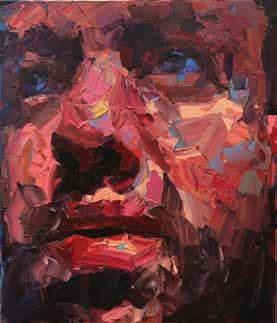
and Don
Peter
crossing Cuba StreetDominion, 23 September 1971
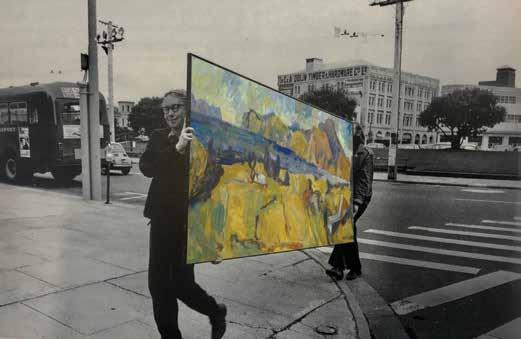
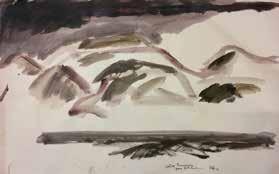
TOSS WOOLLASTON
Mapua, 1971
Realised *$168,900 April 2018
NOW
Confidential no obligation appraisals
Richard Thomson richard@artcntr.co.nz Phone +64 9 379 4010 Mob. 0274 751 071
Important & Rare Art auctions are our proven, pre-eminent sale category for major works of art offered for sale in New Zealand
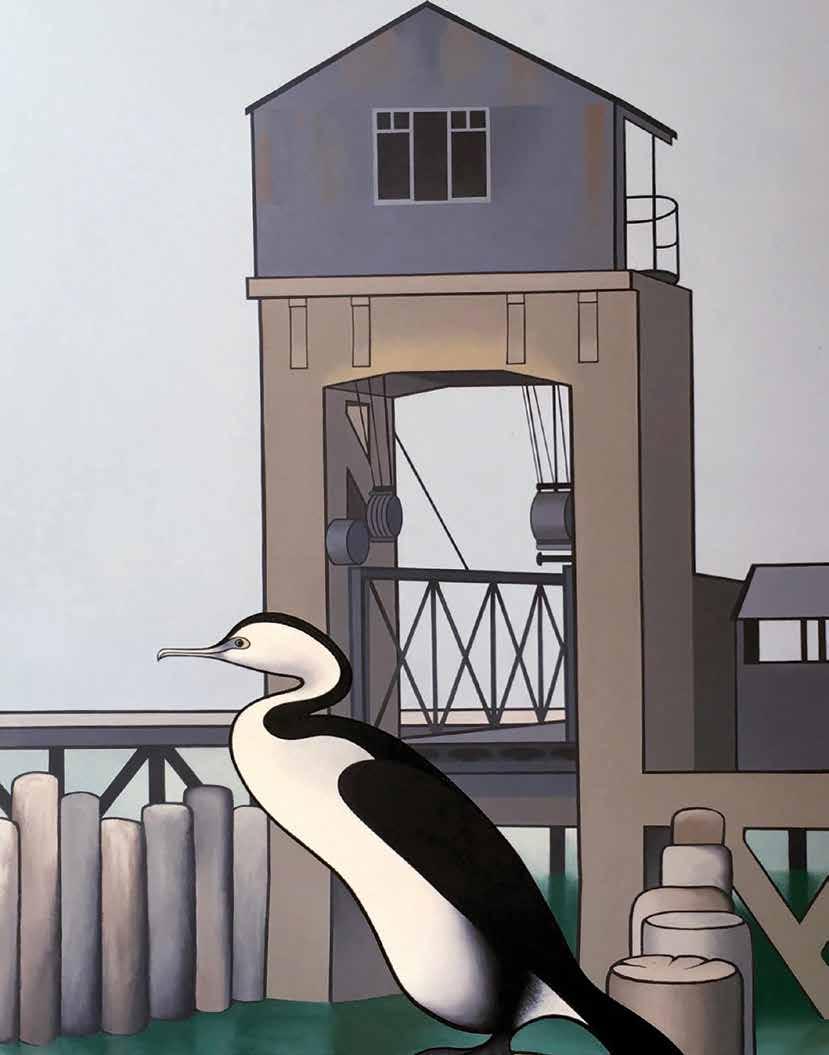
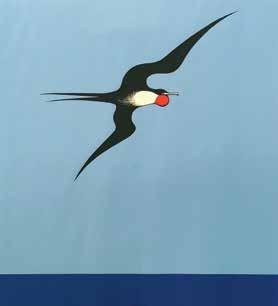
DON BINNEY
Shag and Vehicular Ferry
Realised *$416,000 August 2018
* price includes buyers premium
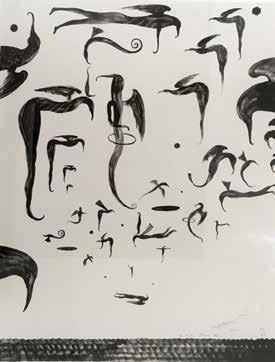
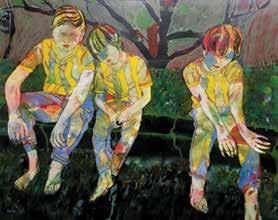
International Art Centre is currently accepting entries for May’s Modern & Contemporary Art Auction
Works will span the vital period from mid-century modernism through to the cutting-edge of today’s Contemporary art in New Zealand.
This sale category is an increasingly significant event in our auction calendar.
Contact
Richard Thomson richard@artcntr.co.nz
Phone +64 9 379 4010 Mob. 0274 751 071
Maggie Skelton maggie@artcntr.co.nz
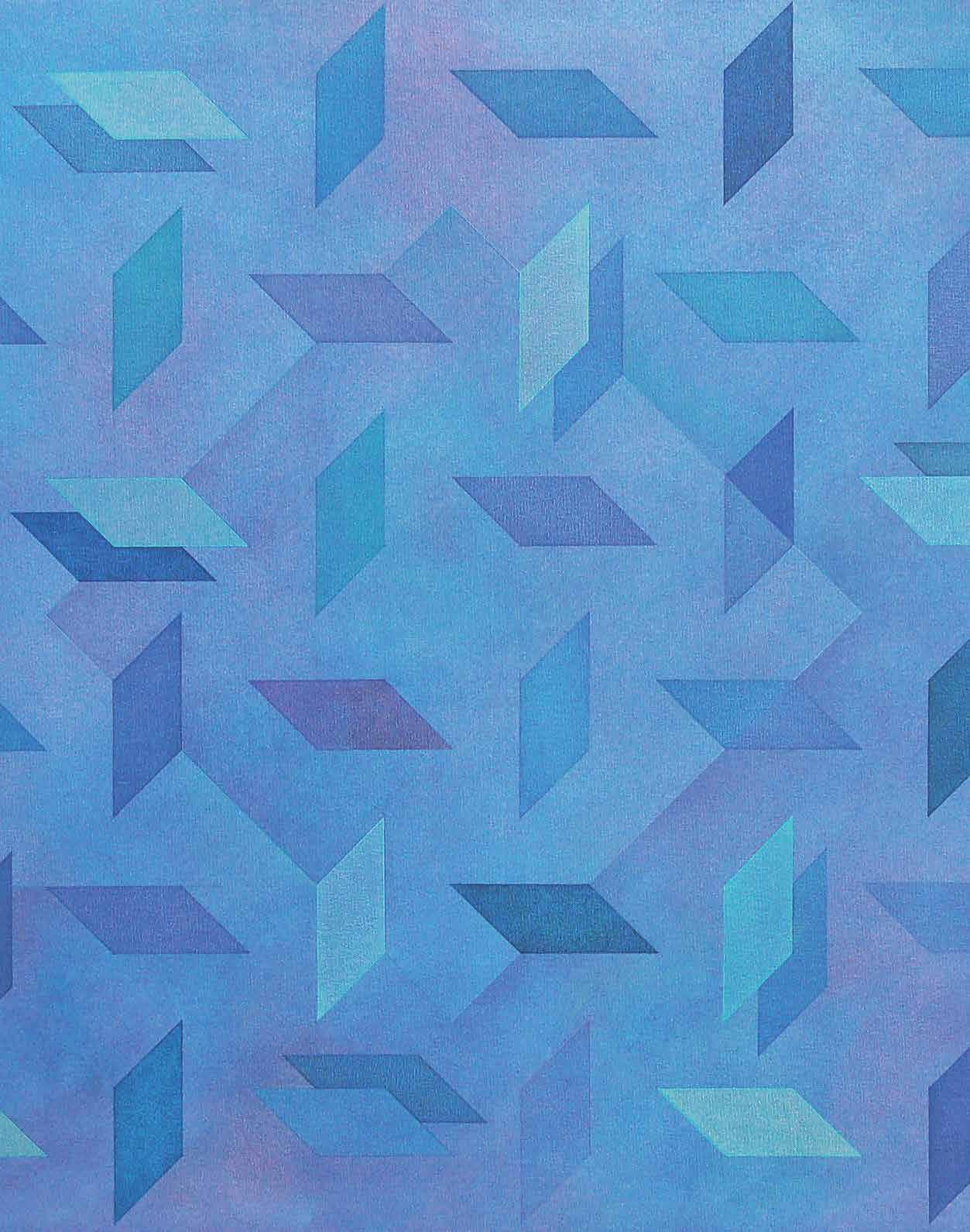
ROY GOOD
Optical Diamonds - Tapestry, 2014 (detail)
Acrylic on canvas 116.6 x 191
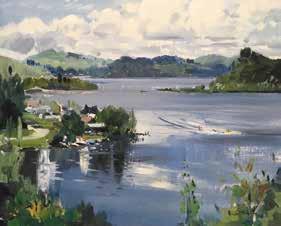
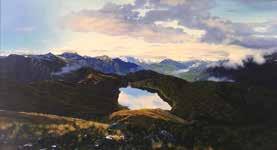
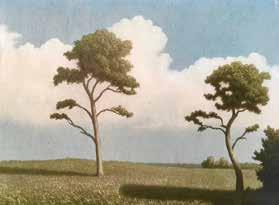
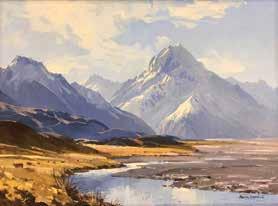
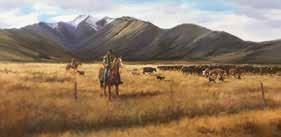
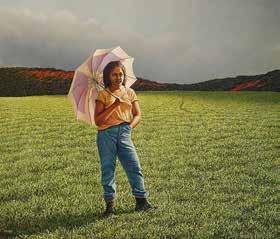
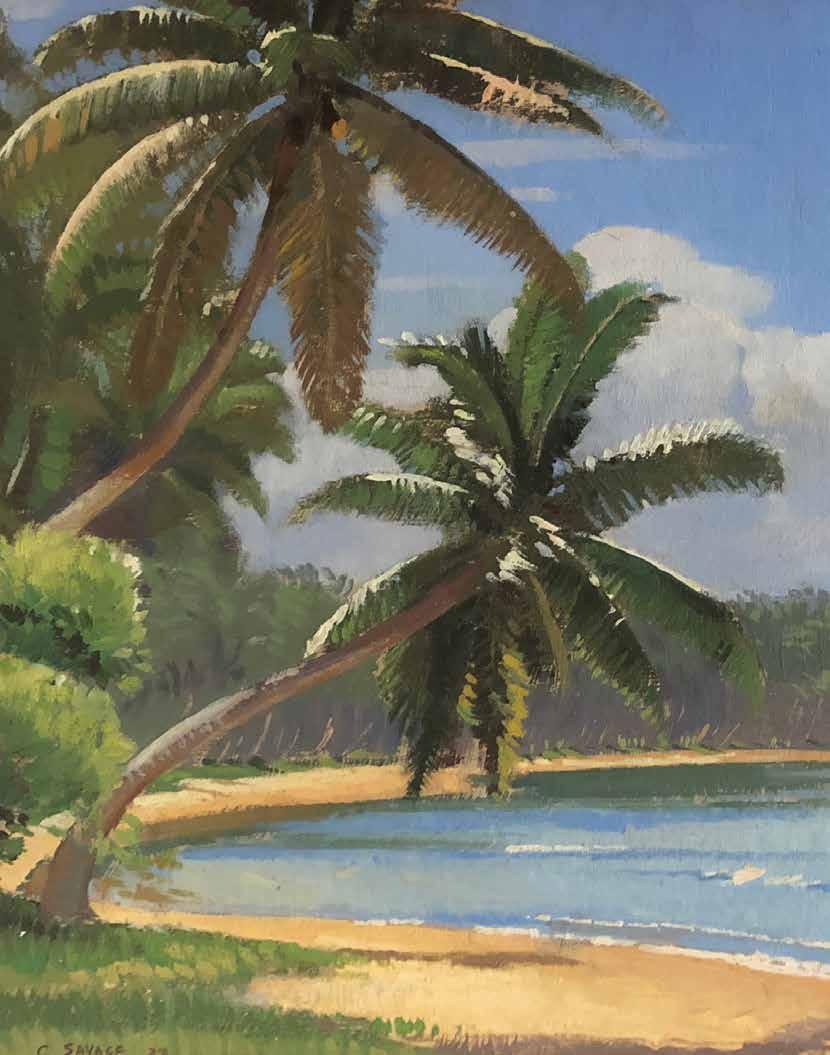
CEDRIC SAVAGE Fiji (detail) Oil on board 24 x 28.5cm
To consign contact: Maggie Skelton maggie@artcntr.co.nz Luke Davies luke@artcntr.co.nz
Phone +64 9 379 4010
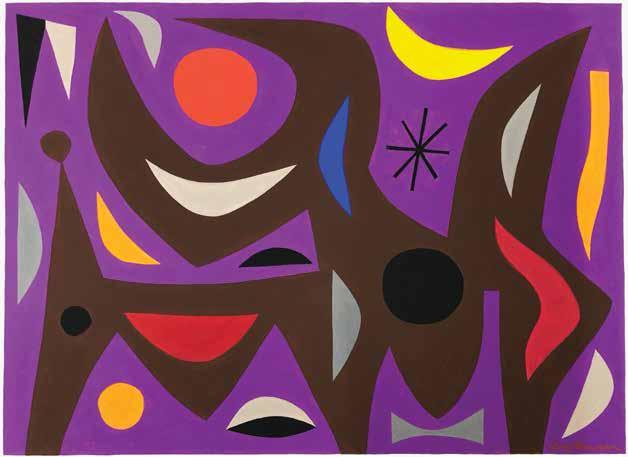
1 JOHN COBURN
Australian 1925 - 2006
Creature
Gouache on paper 57 x 76.5
Signed
Signed, inscribed Paris & dated 1971 verso
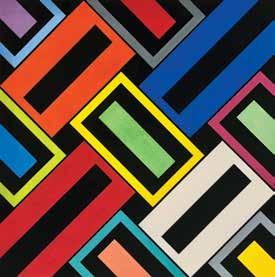
$4,000 - 6,000
2 IAN SCOTT
Drawing No. 13
Acrylic on paper 50 x 50
Signed, inscribed & dated 1981 verso
$3,000 - 5,000
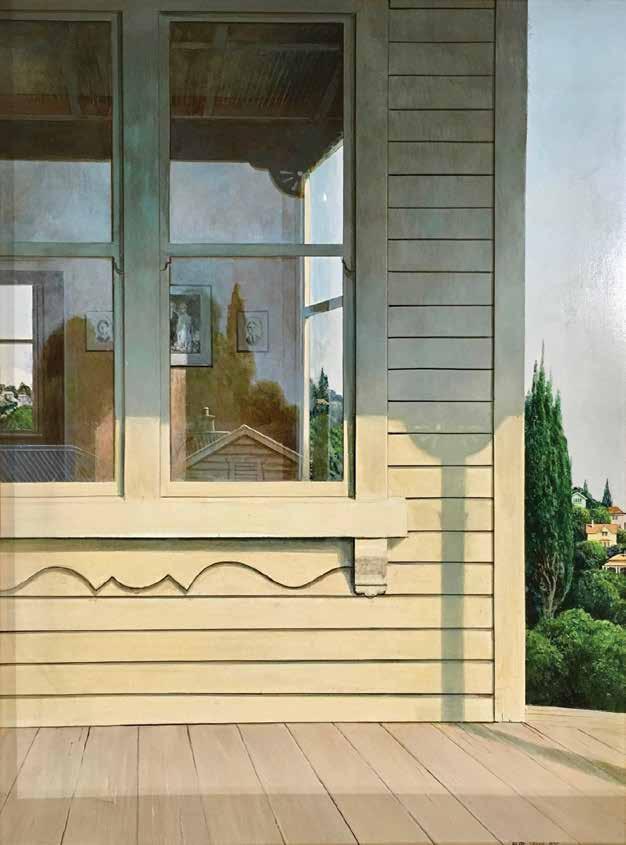
3 PETER SIDDELL
Porch
Oil on board 52 x 38.5
Signed & dated 1975
$8,000 - 12,000
Provenance:
Purchased directly from artist, 1975
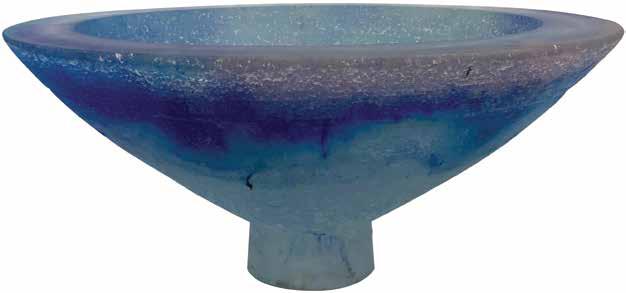
ANN ROBINSON
Pedestal Bowl, 1989
Blue pate de verre cast glass 14 x 36
$7,000 - 10,000
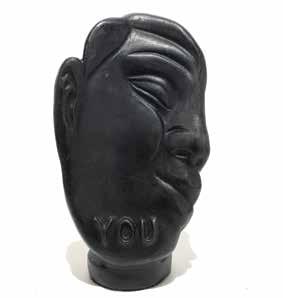
Provenance: Purchased directly from artist in 1989 5 TERRY STRINGER
Do Be You
Cast bronze, edition 19/20, 12 x 6.5
Signed, inscribed & dated 2018
$800 - 1,400
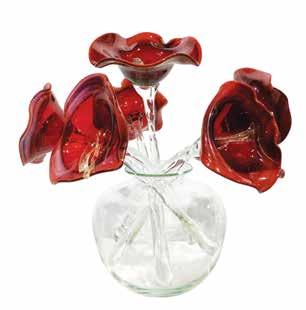
ANN ROBINSON Vase of Flowers
6 hand blown glass sculptured flowers in a clear glass vase 38 x 34
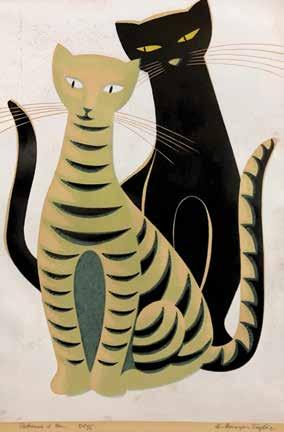
$4,000 - 6,000 7 e mervyn taylor Petunia & Tom Linocut, edition of 55, 41 x 28
Signed & inscribed
$1,500 - 2,500
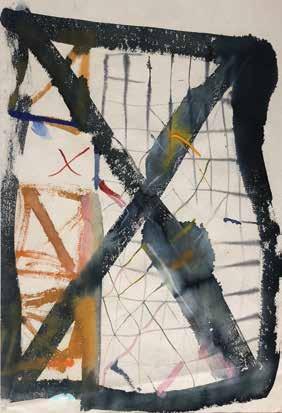
Untitled
Watercolour and acrylic on paper 75 x 55
Signed
$4,000 - 6,000
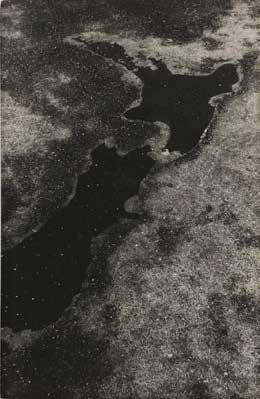
9 PETER
New Zealand 15.3.1991
Gelatin silver print 42.7 x 27.8
Signed & inscribed
$5,500 - 7,000
Exhibited:
Peter Peryer, Gow Langsford Gallery, Auckland, 1992
Paradise Now?: Contemporary Art from the Pacific, Asia Society Museum, New York, 2004
New Zealand Photography Collected, Te Papa Tongarewa, Wellington, 2015 - 2016
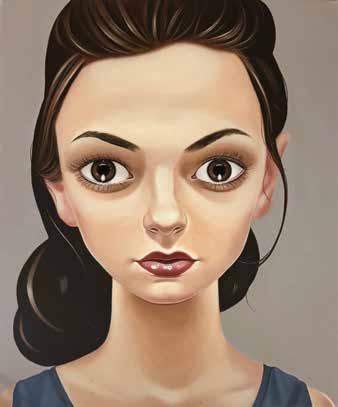
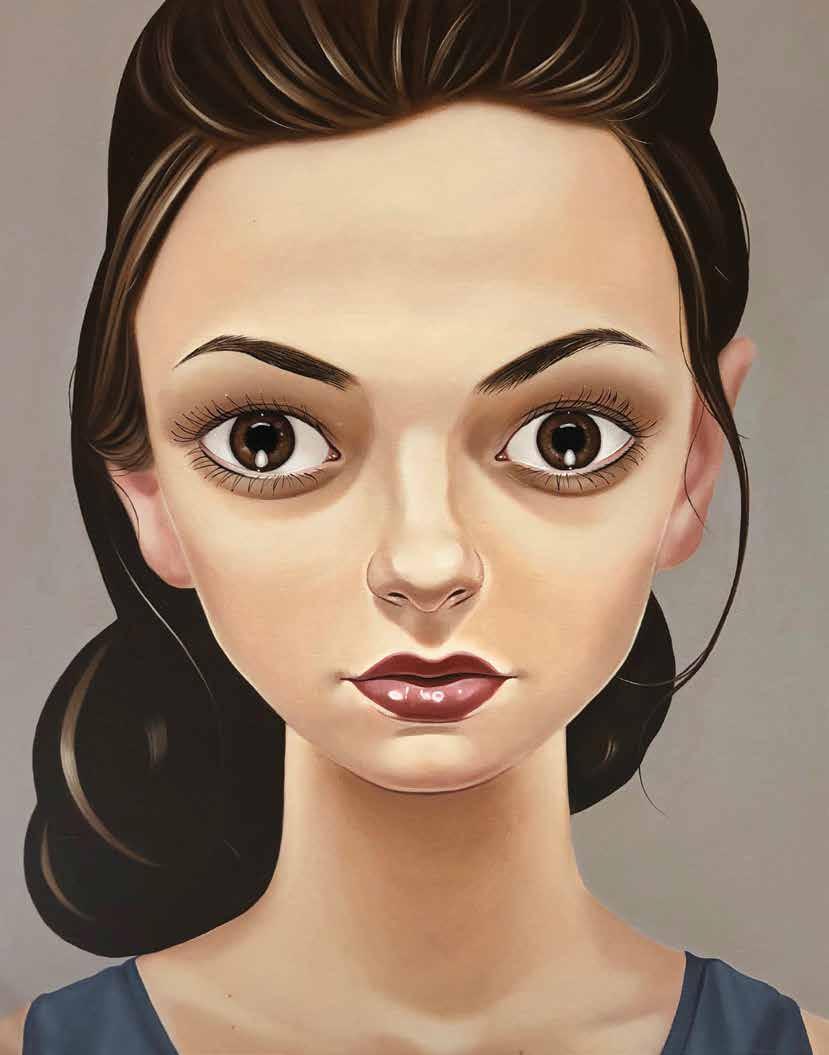
Anna Paquin, 2004
Acrylic on linen 60 x 50
Signed & dated 2004 verso
$40,000 - 60,000
Provenance:
Illustrated cover Pavement, Issue
66, Summer 2004/05
Painting & issue launched at Starkwhite, 2004
p. 53 The Alumni: Peter Stichbury, Te Tuhi Centre for the Arts, 2010
Exhibited:
The Alumni: Peter Stichbury, Te Tuhi Centre for the Arts
12 July – 21 September 2008
Dunedin Public Art Gallery
29 November – 22 February 2009
This lot is to be sold with:
A copy of Pavement magazine
Summer 2004/05 issue #66
An A2 poster of the cover
A copy of The Alumni: Peter Stichbury, Te Tuhi Centre for the Arts, 2010
Once upon a time, Peter Stichbury had his studio in the same High Street office building as Pavement magazine. They admired each other’s work, with a number of early Stichbury subjects drawn from the pages of Pavement. This led to a decision to collaborate on a painting for the cover. The issue was chosen – Pavement’s second Special Local Talent Issue. The subject agreed upon: Academy Award winning star of The Piano, Anna Paquin.
A photo shoot by acclaimed expatriate photographer Regan Cameron was arranged with Paquin in New York City.
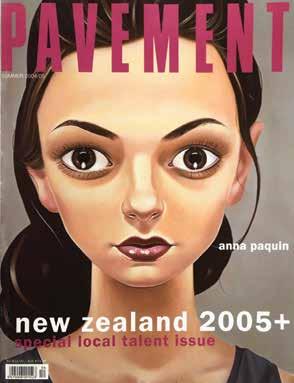
Based on these images, Stichbury produced a beautiful acrylic on linen portrait of the elusive yet enduring actress. Stichbury himself features in the pages of the aforementioned Pavement issue. He is pictured holding his cat in front of a blank canvas, shortly before commencing work on the Paquin portrait. This is that painting. A one-of-a-kind Stichbury, never before offered for sale. It comes with the accoutrements of collaboration: the Summer 2004/05 issue of Pavement and an A2 poster of the cover, along with a book featuring the Anna Paquin painting and a discussion of the artwork.
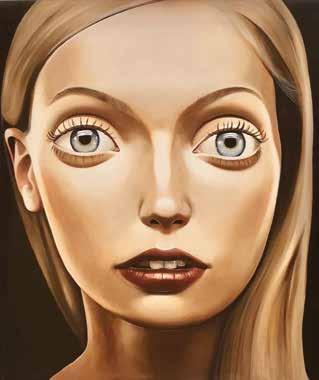
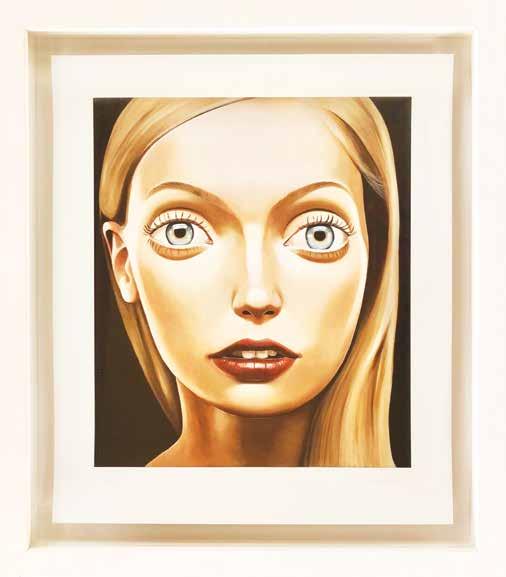
Akin to a modern Steptoe, Peter Stichbury plunders identities and ideas from magazines, the internet, popular culture and his childhood to develop a body of work that explores, interprets and reflects the nature of identity. Contrary to common opinion, Stichbury’s stunning paintings, art prints and sketches of gorgeous waifs and nerdy yet strangely cool boys or professors aren’t merely the musings of an artist obsessed with surface aesthetics.
Whilst fascinated by appearances, his interest cuts deeper and a little darker. Stitchbury’s talent lies in making beautiful people look interesting and interesting people look beautiful. And it’s proving
lucrative, at least for the collectors. Furthermore, the American market is sitting up and taking notice, a fact reinforced by several appearances of his work at the influential annual ArtLA fair and the burgeoning fanfare enjoyed through his NYC dealer, to the point where new works are rarely available in his home country these days. It’s gratifying that collectors who supported the work early on can benefit from their investment, Stichbury, who graduated from Elam School of Fine Art in 1997, the same year he won the James Wallace Art Award, reflected a decade ago.
11
PETER STICHBURY
Glister, 2008
Giclee print on Ilford Gallerie gold paper 27 x 23, edition 26/100
Signed & dated 2008
$3,500 - 5,000
Provenance: Private Collection
12
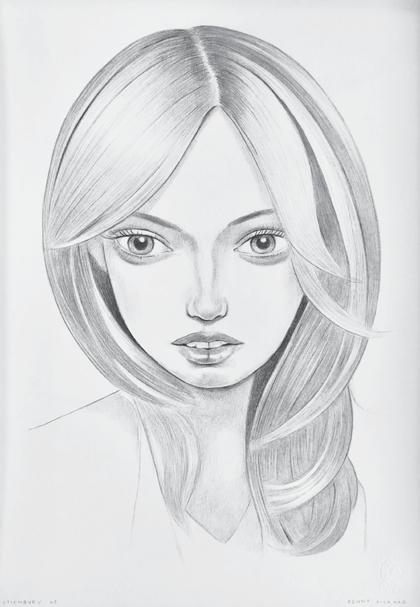
PETER STICHBURY
Penny Pickard, 2005
Pencil on Schoeller Durex paper
29 x 20.5
Signed, inscribed & dated 2005
$4,000 - 6,000
Provenance: Private Collection
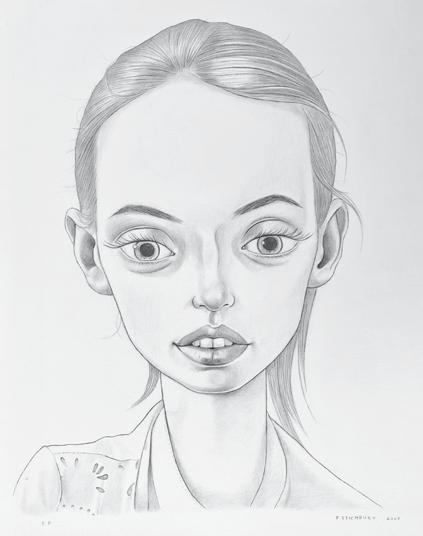
13
PETER STICHBURY
P.P. (Penny Pickard), 2005
Pencil on paper 47 x 37
Signed, inscribed & dated 2005
$5,000 - 7,000
Provenance:
Produced by Stichbury for Pavement magazine t-shirt 2005
(edition of 100 t-shirts printed in blue, grey or white)
This lot to be sold with: Blue ‘Penny for Pavement’ by Peter Stichbury t-shirt (size M)
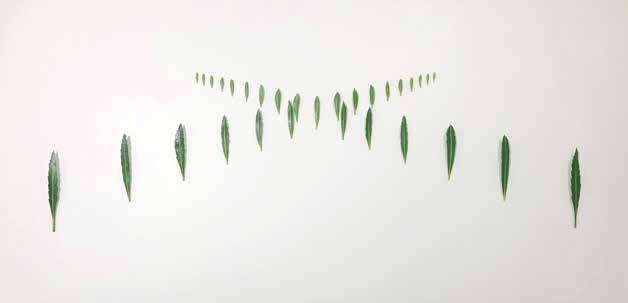
14 ELIZABETH THOMSON
Study for Consuegra, 2008
Patinated bronze and oil paint on white board 60 x 122
Signed, inscribed & dated 2008 verso
$8,000 - 12,000
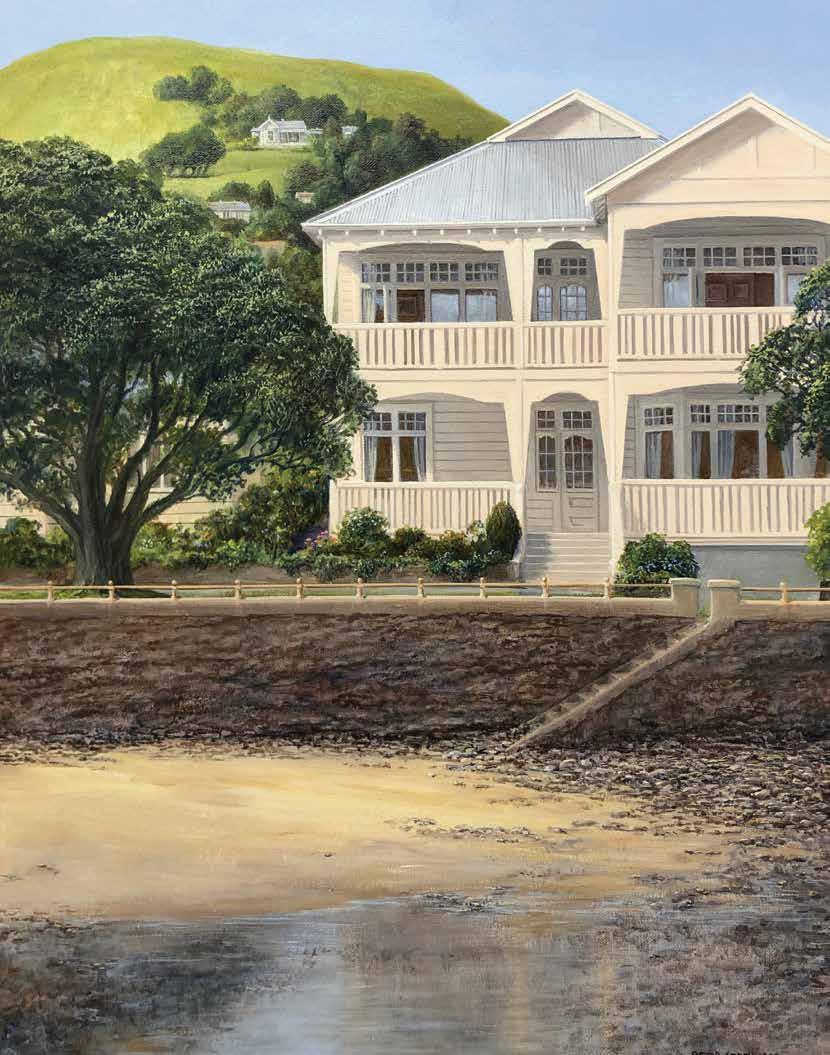
15 PETER SIDDELL
King Edward Parade, Devonport
Oil on canvas 52.5 x 42
Signed & dated 1990
$30,000 - 40,000
Provenance:
Private Collection, Auckland
Purchased directly from artist, 1992
Sir Peter Siddell’s paintings breathe the suburbs of Auckland. Siddell was born in Auckland in 1935 and attended Mount Albert Grammar. He initially worked as an electrician and then a teacher but after his 1972 sellout solo exhibition at Moller’s Gallery in Auckland he took up painting full time. He went on to become one of New Zealand’s most admired painters with works in most public and corporate collections.
In 1978 he won the Air New Zealand Travel Award and the Benson & Hedges Supplementary Art Award.
In 1991 Siddell received a Queens Service Order (QSO). He was made a Distinguished Companion of the New Zealand Order of Merit for services to art in 2008, an honour that was redesignated as Knight Companion of the Order in 2009.
A 290 page book The Art of Peter Siddell by Peter Siddell was published in 2011.
Siddell passed away in October 2011 in Auckland.
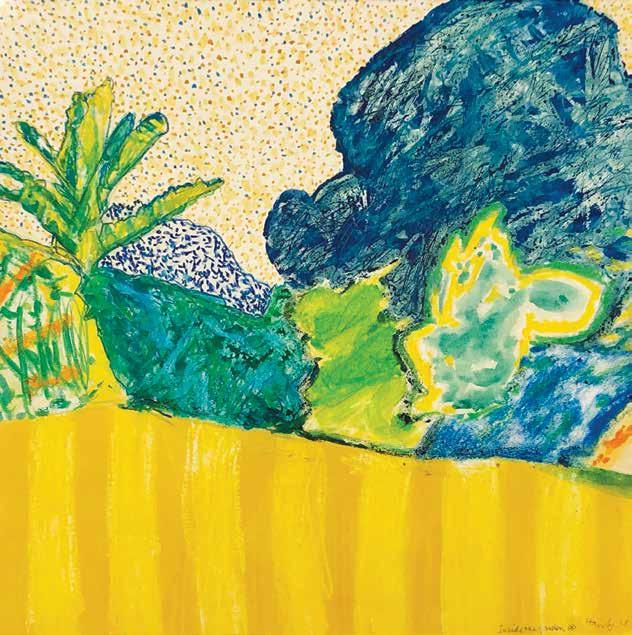
Inside the Garden No. 29
Watercolour & pastel on paper 53.7 x 53
Signed, inscribed & dated 1968
$8,000 - 12,000
Provenance:
Private Collection
Current owner acquired directly from artist
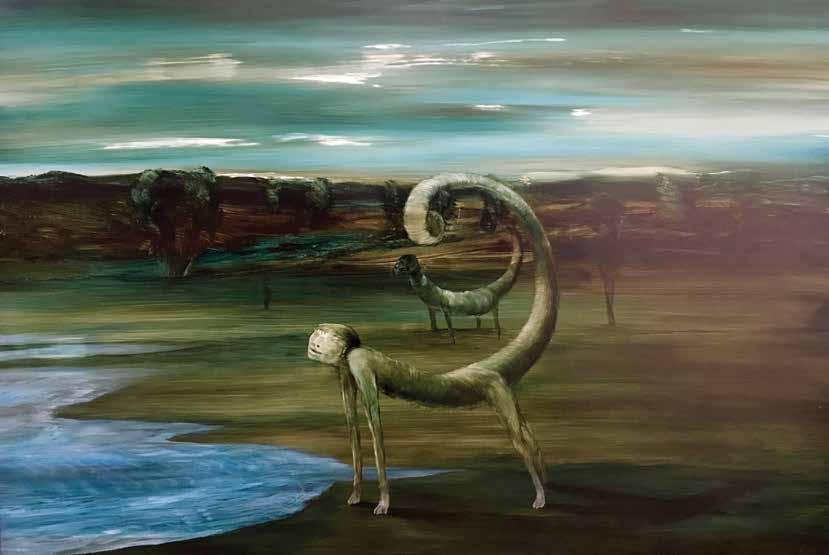
JOHN WALSH Migrating Koru Oil on board 75 x 112
Signed, inscribed & dated 2005 verso
$15,000 - 18,000
Provenance:
Purchased from exhibition titled John Walsh, John Leech Gallery, 2005 Original label affixed verso
18
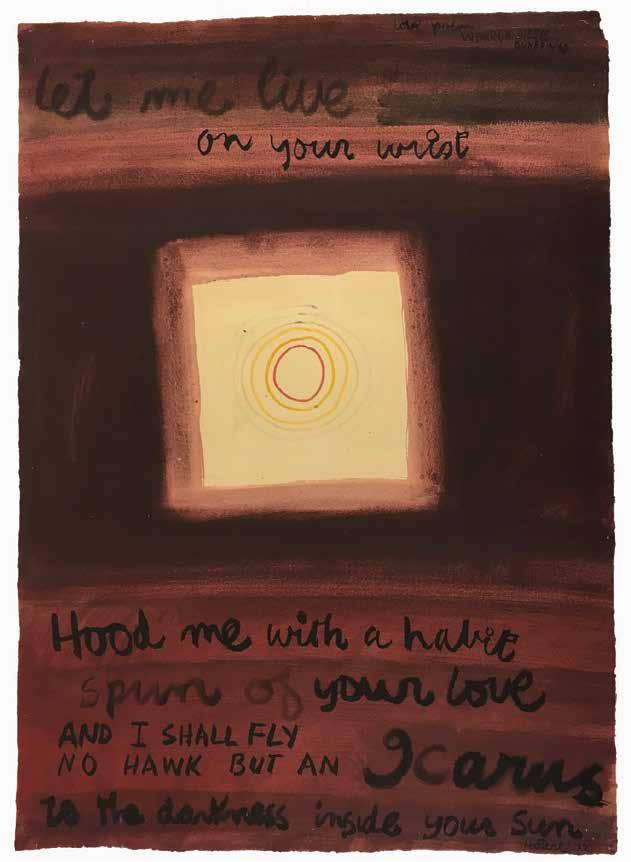
RALPH HOTERE
Love Poem, Warren Dibble ‘69
Watercolour 70 x 50
Signed, inscribed & dated 1972
$10,000 - 20,000
Provenance:
Private Collection, since 1972
Acquired directly from artist
Let me live, on your wrist Hood me with a habit
Spun of your love And I shall fly
No Hawk but an Icarus To the darkness inside your sun
Warren Dibble
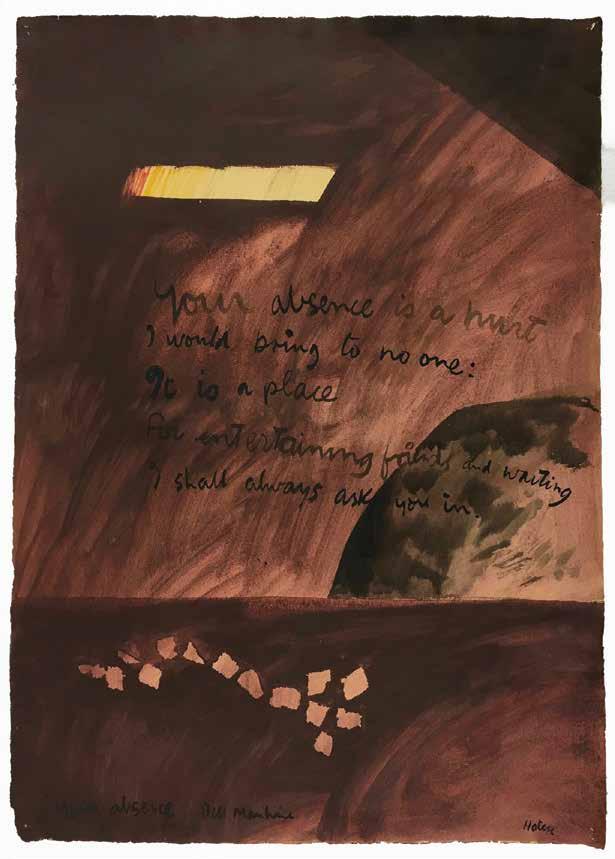
19 RALPH HOTERE
Your Absence, Bill Manhire, 1972
Watercolour 70 x 50
Signed & inscribed
$10,000 - 20,000
Provenance:
Private Collection, since 1972
Acquired directly from artist
Your absence is a hurt
I would bring to no one: It is a place for entertaining friends and waiting I shall always ask you in Bill Manhire
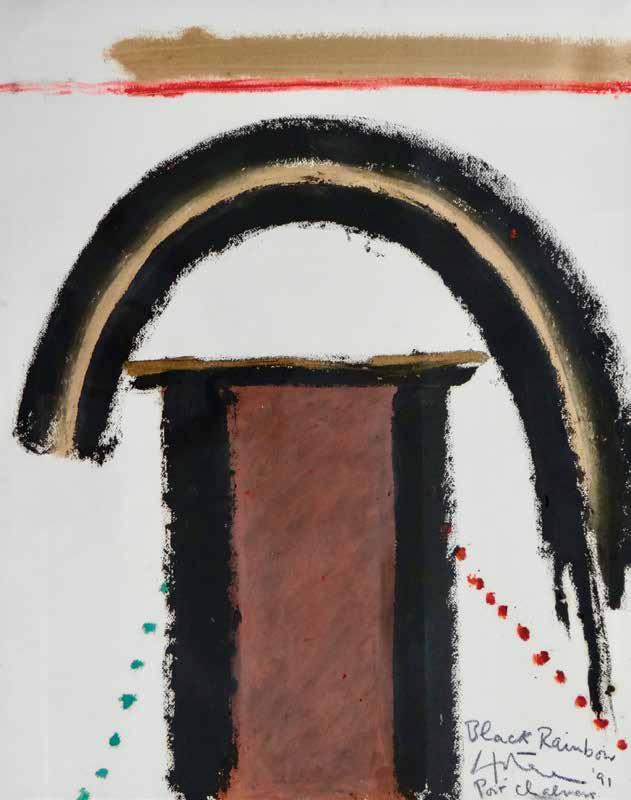
Black Rainbow
Oil stick on paper 65 x 50
Signed, inscribed Port Chalmers & dated 1991
$15,000 - 20,000
Hotere’s Black Rainbow series was originally conceived in the 1980s: these paintings comprised a didactic and elementally mournful response to the bombing of the Rainbow Warrior.
Several years later, in the early 1990s, Hotere renewed his engagement with the subject of the Rainbow Warrior and produced this newer version of Black Rainbow. Into that icon of hope and protest, the artist once again poured the black stickiness of pigmented tar, draining the rainbow of all life. But most strikingly, the return to form this time involved an infusion of colour into which he has added blue, brown, red and gold.
Through Black Rainbow, we are able to encounter the raw spirit of the artist as activist and protestor. Perhaps as a result of the circumspection offered by time, the work has been conceived through a more abstract lens than those earlier works. Religious imagery such as the dove and Sacred Heart have been replaced by more subtle deployments of geometric form: take the golden rectangle which brushes the upper-right edge of the canvas. This is the Rainbow Warrior itself, now a ghost ship, buoyed along by a neat red horizon of blood.
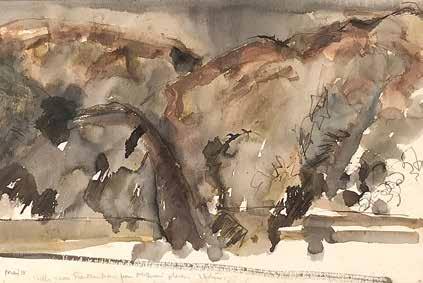
Queenstown
Watercolour and ink on paper, 37 x 55
Signed, inscribed Hills Across Frankton Arm from McQueen’s Place & dated May, 1975
$8,000 - 12,000
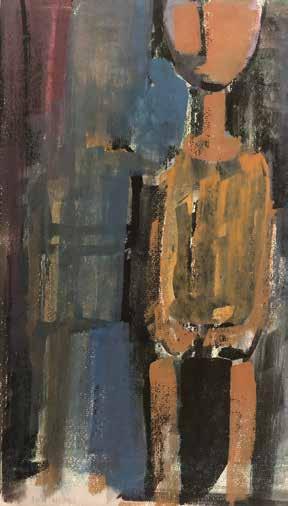
Children of the Pioneers
Tempera on paper 50 x 30
Signed
$3,000 - 5,000
Provenance: Private Collection, Wellington
Exhibited: The Pioneers, Jan Nigro Solo Exhibition John Leech Gallery, Auckland, 1965
On Journey’s, Jan Nigro Tinakori Gallery, Wellington, 1993
Born in Auckland in 1942, Buck Nin Ngati Ruakawa, Ngati Toa taught art at Hamilton College for more than twenty years. He graduated from the University of Canterbury in 1965, later gaining a Masters in Education from the University of Hawaii, then a Doctorate in Fine Arts from Texas Technical University. In the 1970s he tirelessly campaigned to raise the profile of Maori Art. Dr Buck Nin's work was inspired by both his Maori and Chinese ancestry. His work is in the collections of University of Hawaii, Te Papa, The New Dowse, Manawatu Art Gallery, COCA, Aigantighe Art Museum, Rotorua Museum of Art and History and Waikato Museum of Art and History.
Buck Nin became a major force in the contemporary Maori art movement with his strongly individual style
Untitled Acrylic on canvas 185 x 139
Signed
$25,000 - 35,000
Provenance: Buck Nin Estate Collection
of painting, his teaching, and his willingness to work with people from all walks of life. Buck was a larger than life person not only because of his physical size but also because of his considerable intellect, his energy, his powerful and often large paintings and his commitment to the development of art and its people. The imagery in the work of Buck Nin is drawn from Maori carving, weaving and rafter patterns, spread across a minimalist landscape, like a sacred cloak, warming, embracing and caressing the earth. This is his Maori earth Papatuanuku.
History will show him as one of Maoridom's and subsequently New Zealand's great contemporary artists...
Friend and fellow artist, Darcy Nicholas
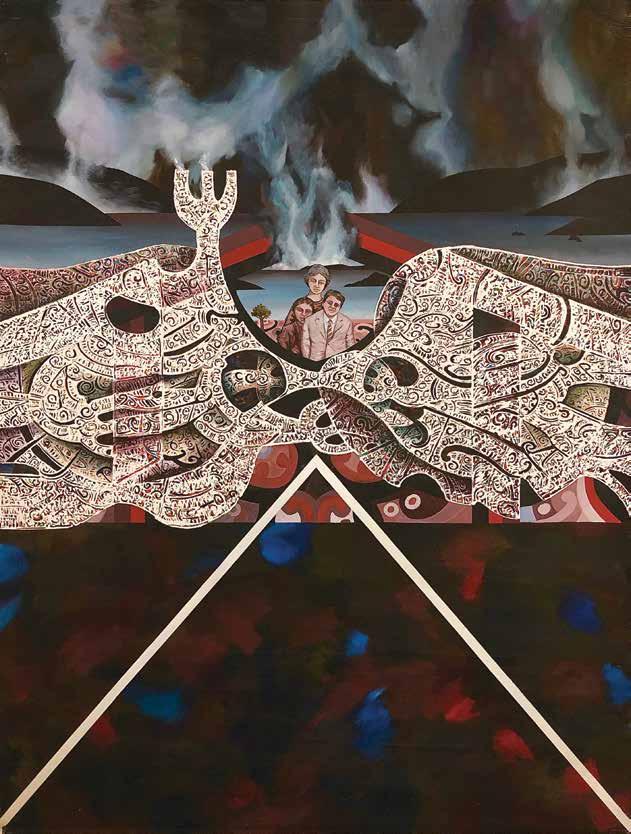
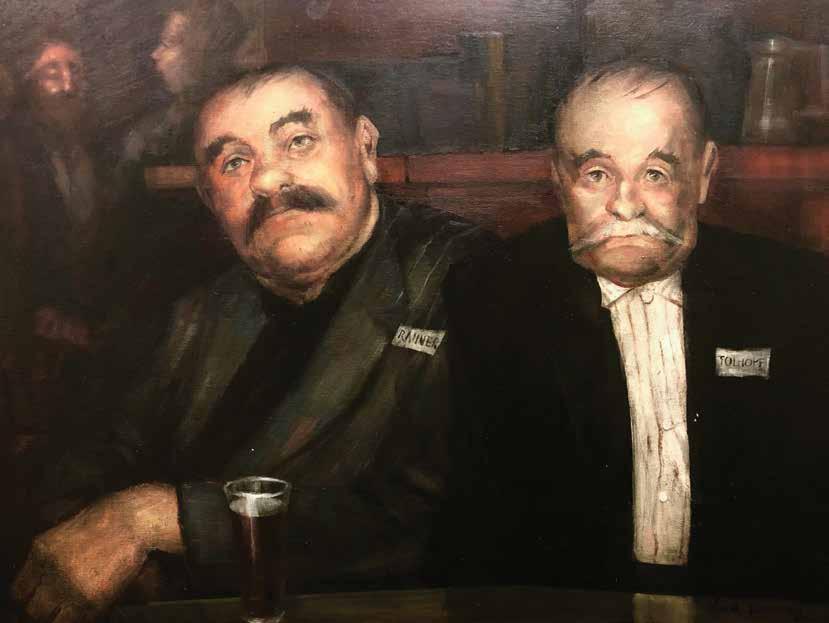
Reunion of the Bohemians, Puhoi
Rauner & Tolhopf Oil on canvas 72.5 x 98
Signed & dated 1986
$15,000 - 20,000
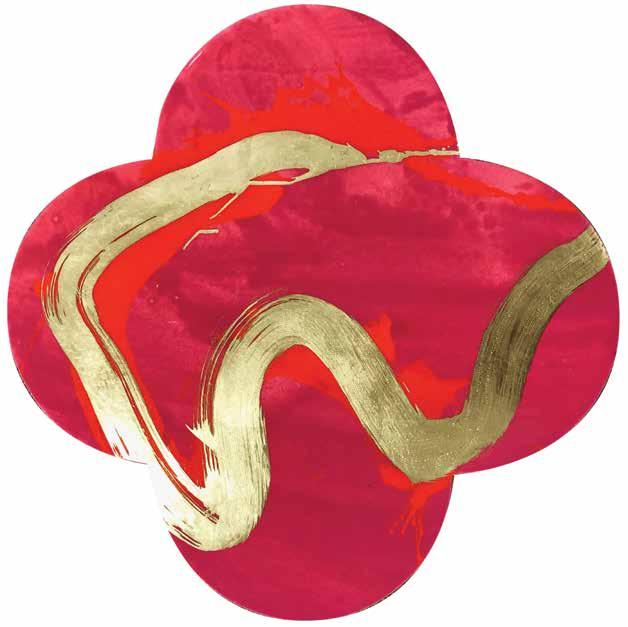
The Bite of the Golden Snake Gesso, acrylic & vinyl polymers, epoxy, oil size, lemon gold leaf, clear acrylic overcoat on canvas 63.5 x 63.5
Signed, inscribed & dated 2011 verso
$18,000 - 26,000
Provenance:
Private Collection, Northland
Andy Warhol Museum, Pittsburgh, PA, USA, label affixed verso
Exhibited: Word of God, Max Gimblett - The Sound of One Hand, September - November, 2011
The Andy Warhol Museum, Pittsburgh, PA, USA
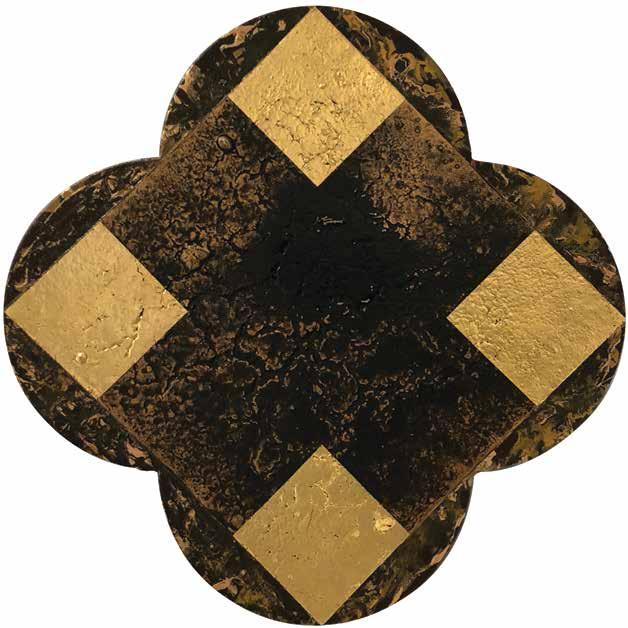
Acrylic polymer, 23.5 k gold & copper on canvas 54 x 54
Signed, inscribed & dated 1988 verso
$10,000 - 15,000
Provenance:
Purchased 1997, Gow Langsford Gallery
Original gallery label affixed verso
Signed & dated 1998
$18,000 - 25,000
Provenance:
Purchased, John Leech Gallery, Auckland 1998
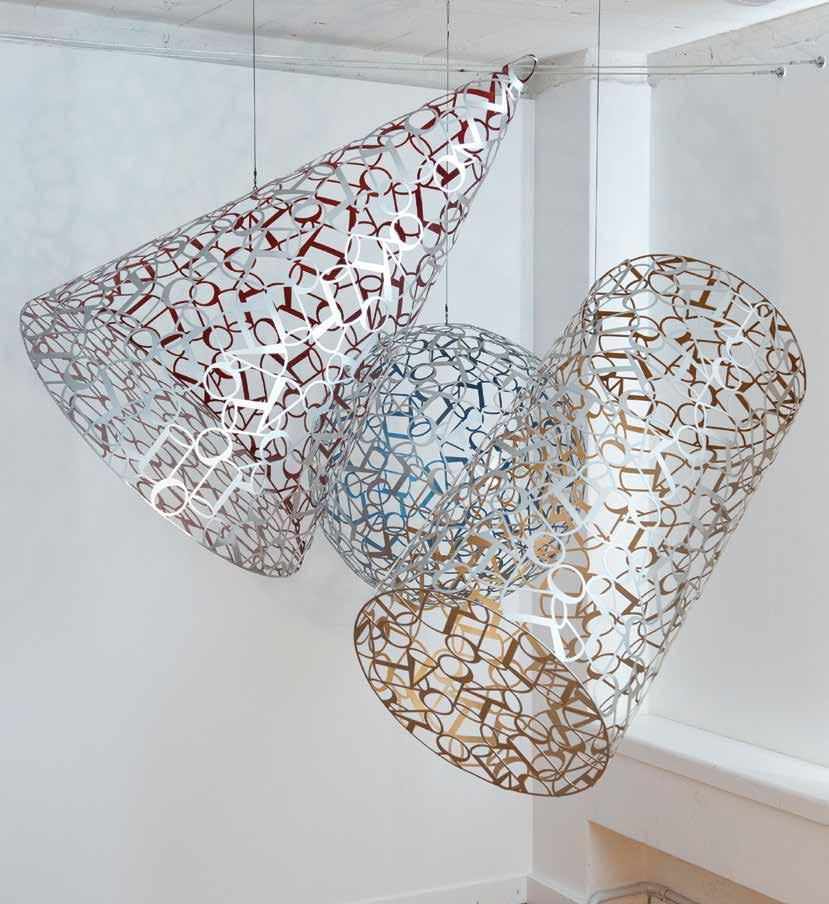
Sphere, Cone, Cylinder, 1999
Painted steel sculpture 100 x 210
$50,000 - 75,000
Neil Dawson b. 1948 is a prominent New Zealand sculptor of international standing. His work emphatically echos aspects of this nation’s sociocultural environments and, literally, elevate these in spatial celebrations that are at once accessible and challenging.
His best known works are large-scale civic pieces crafted from aluminium and stainless steel, often made using a lattice of natural forms which between them form a geometric whole. Dawson attended the University of Canterbury (1966–1969) where he studied under Russ Williams, Tom Taylor and Eric Doudney. He gained a Diploma of Fine Arts and then spent a year at teachers’ college. This was followed, with the help of a Queen Elisabeth II Arts Council grant, by a Graduate Diploma in Sculpture from the Victorian College of the Arts, Melbourne, in 1973. On his return, Dawson taught drawing and design at Christchurch Polytechnic from 1975 to 1983.
Dawson’s best-known pieces include The Chalice, a large inverted cone in Cathedral Square, Christchurch, and Ferns, a sphere created from metal fern leaves which hangs above Wellington’s Civic Square.[4] Major overseas commissions include Globe, for the Pompidou Centre in Paris, and Canopy, for Brisbane’s Queensland Art Gallery.[3]
Dawson’s smaller works often use illusion and such optical patterns as moiré to achieve their effects. Many of these works are wall-hangings, though stand-alone pieces using such everyday patterned items as the forms of playing cards and willow pattern crockery are also among Dawson’s works.
Dawson has worked as a full-time sculptor since the late 1980s. In 2003, he was awarded the Arts Foundation of New Zealand Arts Laureate
Dr. Michael Dunn, Emeritus Professor at the University of Auckland and a former head of Elam School of Fine Arts, describes Dawson in his book New Zealand Sculpture : A History: Dawson’s sculpture is individual, unique and easy to recognise. In fact his sculptures flout convention in their lightness of feel, their transparency and their escape from the conventions of earthbound pedestalbased display.
Dawson’s epic sculpture Fanfare was first suspended from the Sydney Harbour Bridge to welcome the 2005 year. The sculpture is made up of 350 reflective pinwheels arranged in a sphere. Sydney’s Lord Mayor, Clover Moore, subsequently presented the sculpture to the Christchurch City Council as a gift. After a long time in storage, it was eventually decided to install Fanfare next to State Highway 1 just south of the Waimakariri River Bridge to welcome visitors coming to the city from the north. Fanfare was officially unveiled on 10 June 2015 by mayor Lianne Dalziel and Dawson. Dalziel, with reference to Fanfare’s first installation in Sydney and to the destructive Christchurch earthquakes, said at the ceremony: Today feels like it’s come home and it’s really going to be a big statement about what our city is and what it’s going to become.
Dawson was more humble and described his artwork as basically just a ball with some propellers on it.
Sphere, Cone, Cylinder, 1999 is one of the most ambitious of the artist’s practice to appear on the secondary market. Each piece is individually painted on the inside - Sphere - blue, Cone - gold, and Cylinder - red. The laser-cut, steel sculpture appears to defy gravity and the weightiness of the medium. It poses ever-shifting perspectives as each co-opts the space and light in and around it, playing visual tricks with shadow, perspective, and volume. The fine detailing is drawn from sources as diverse as porcelain patterns, building materials and flora and fauna.
It has been held in private ownership since 1999.
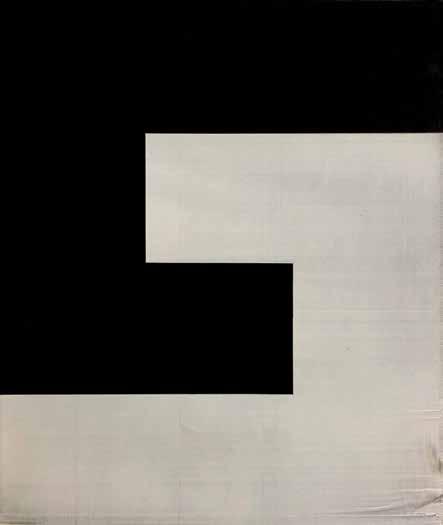
31 JOHN EDGAR
Flying Cross, 1997
on canvas 132 x 112
Signed, inscribed & dated 1998 verso
$6,000 - 9,000
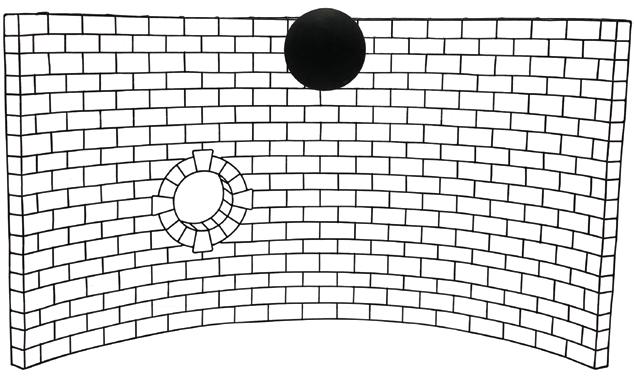
Wall/Ball, 1985
Wire & plastic sculpture 82 x 46.5
Signed, inscribed & dated 1985
on lid of artist made travel case
$8,000 - 12,000
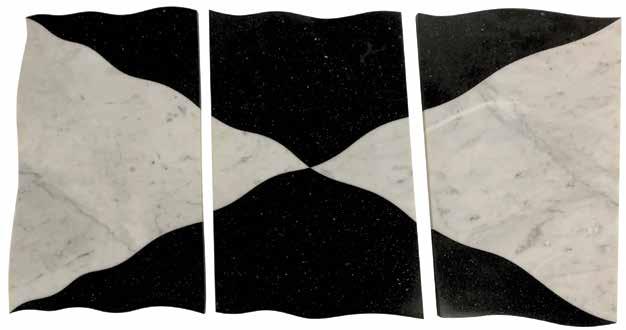
Three granite & marble sheets 56 x 99
Signed artist’s certificate affixed verso
$7,000 - 10,000
Provenance:
Private Collection, Auckland
Exhibited:
John Edgar: Lie of the Land
Touring Exhibition 1998 - 1999
Auckland Museum
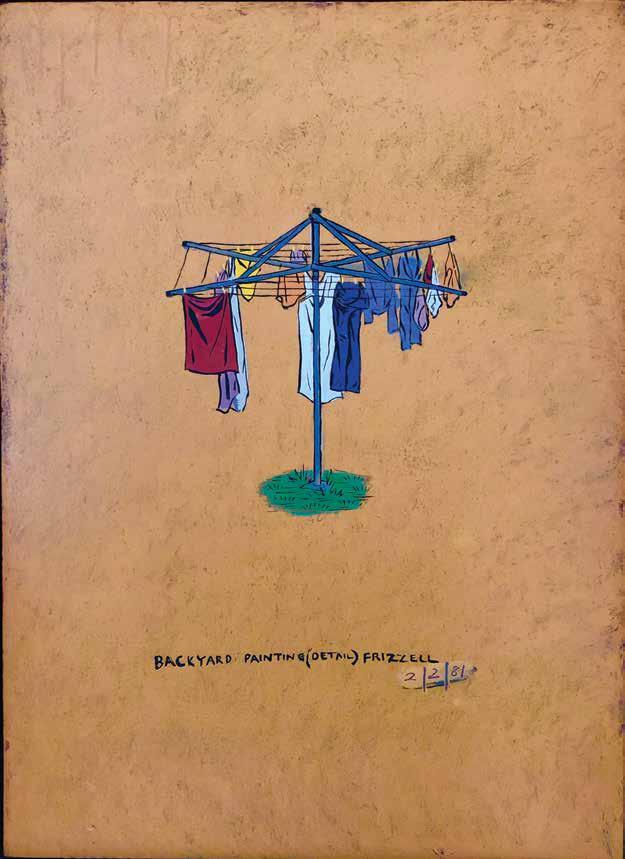
Provenance: Gow Langsford Gallery, Auckland 33
Backyard Painting, 1981 Oil on hardboard 90 x 65.5
Signed & dated 2/2/81
$10,000 - 15,000
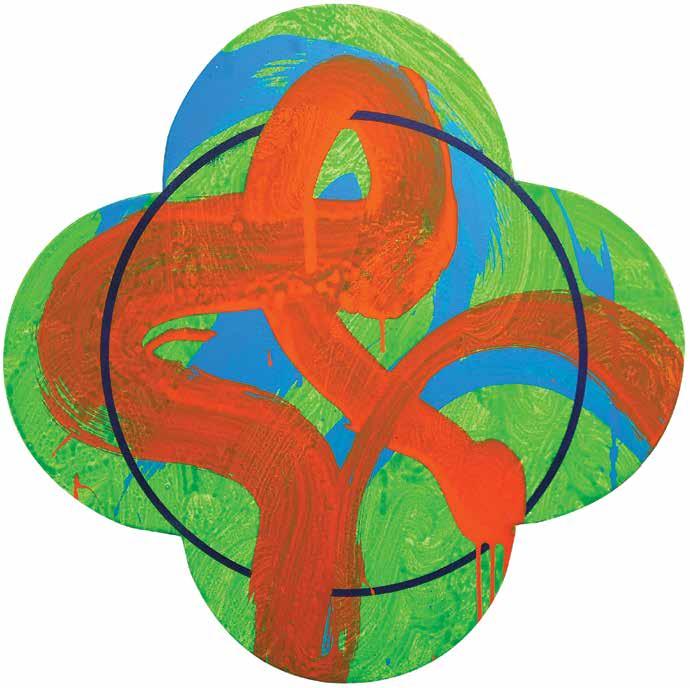
The Stillness of the Self Gesso, acrylic and vinyl polymers, fluorescent on canvas 63.5 x 63.5
Signed, inscribed & dated 2012 verso
$15,000 - 20,000
Provenance: Nadene Milne Gallery label affixed verso
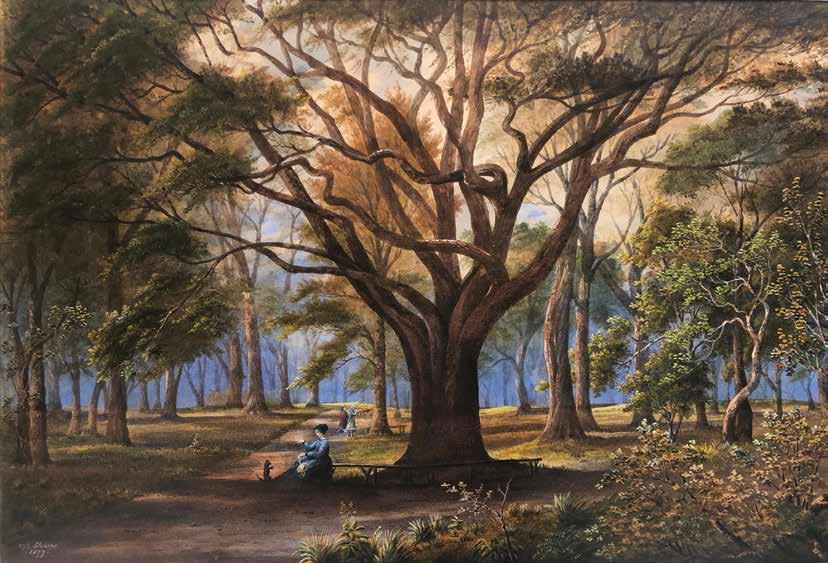
Auckland Domain
Watercolour 44 x 63
Signed & dated 1877
$40,000 - 60,000
Provenance:
Commissioned by the late Thomas Bannatyne Gillies in 1877, held in the same family collection since
In this historical watercolour of a 19th Century Auckland Domain both artist, Alfred Sharpe and patron, Thomas Bannatyne Gillies were united in their affection and vested interest relating to Auckland’s oldest park and its surrounds.
Scottish born Thomas Bannatyne Gillies (1828 -1889) settled in Otago in 1854. An articled solicitor who had practiced law in Manchester, Gillies tried his hand at farming in Warepa, only to return the profession he was better suited to. Turning his talents to politics he was elected to the House of Representatives. In 1865 Gillies moved to Auckland and was elected to the House of Representatives for Auckland City East. At one time he held the post of Superintendent of Auckland and in 1875 succeeded Sir George Arney as Judge of the Supreme Court for the Northern District.
Beyond his public career, Gillies was a man of wide and varied interests. In 1868, with Professor Hutton and J. C. Crawford, he founded the Auckland Institute, later donating £500 towards purchasing the site for Auckland Museum. Around 1866 Gillies was overseeing the construction of a palatial home, Rocklands Hall situated at 187 Gillies Avenue (named after him). Set in what was then open farmland, Rocklands Hall was once a centre for hunting on horseback. The major addition of a ballroom was made in 1889 and Gillies imported many exotic trees and plants for the gardens. Today the ‘grand old dame’ designed by architect John Currie (1849 - 1919) is a student hostel.
In commissioning Alfred Sharpe (1836 - 1908) to paint Auckland Domain, Gillies exhibited sound judgement. By the 1870’s Sharpe was acknowledged as one of he colony’s leading artists. In 1858 he had emigrated from England, arriving in Auckland where he eventually settled. During the 1870s Alfred Sharpe exhibited large-scale watercolours with the newly founded Auckland Society of Artists and at venues in Wellington, Sydney and Melbourne.
The Auckland Domain was a familiar and favoured subject of the artist and in March 1877 an article in the Star newspaper reports: Mr Alfred Sharpe has added a beautiful and highly-finished picture of the ‘picnic ground in the Domain’ …… the picture does the artist great credit …’ Writing to a Melbourne based colleague in October 1878 Sharpe says: I have been fully occupied during my spare time since our last exhibition, last November - 1877 - in painting to orders.
In the Gillies commission we see Sharpe at his distinctive best, the viewer partakes of a timeless Victorian scene set in what was destined to become one of Auckland most important landmarks. This is a historical work of consequence.
Reference:
The Art of Alfred Sharpe - Roger Blackley Auckland City Art Gallery / Bateman 1992
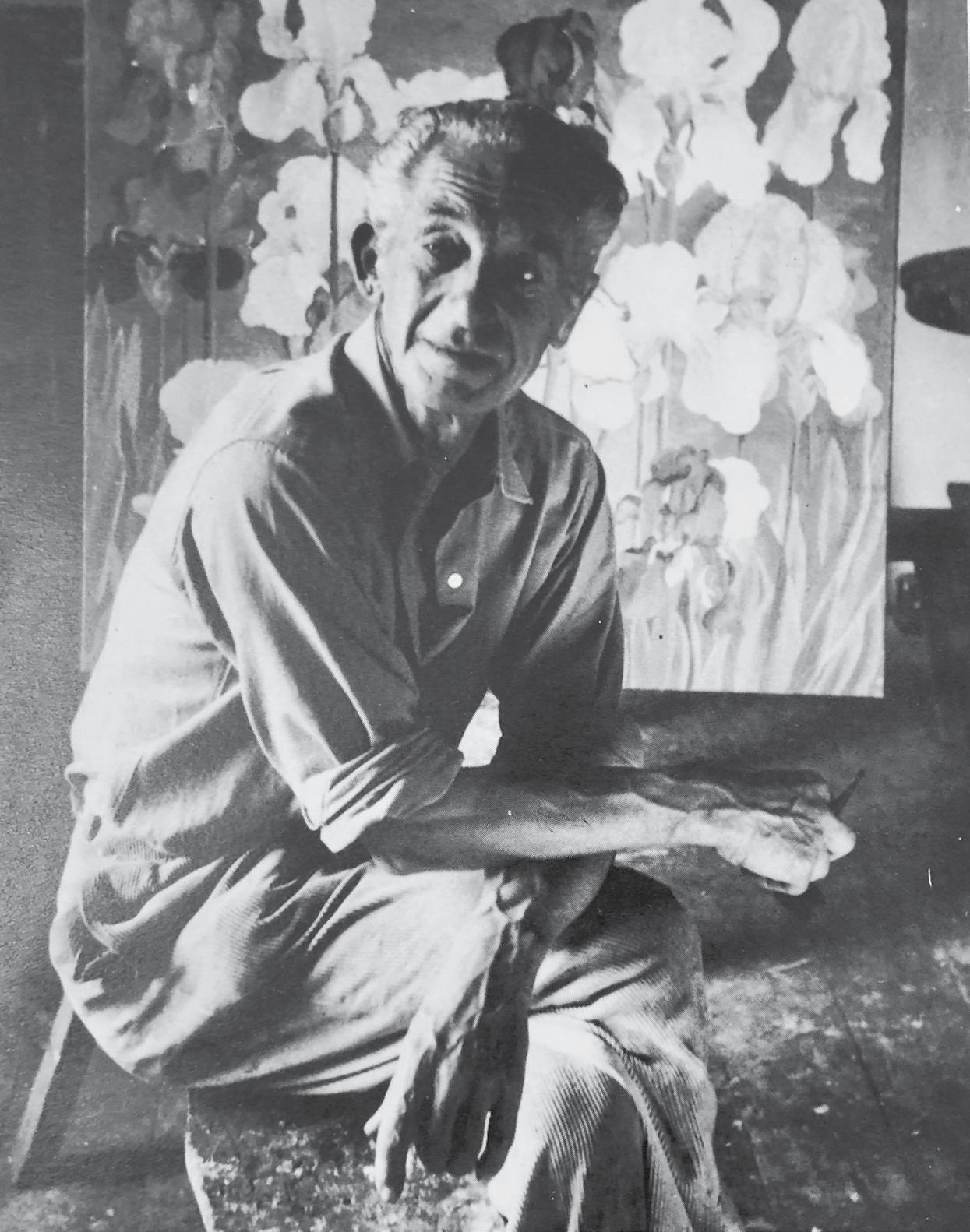
It was Morris’s incredibly close contact with his subject and deep understanding of their design that enabled him to paint flowers as if they were people – with a mood and personality.
Lawrence Hendra, art historian, Director at Philip Mould & Company, and specialist on the Antiques Roadshow
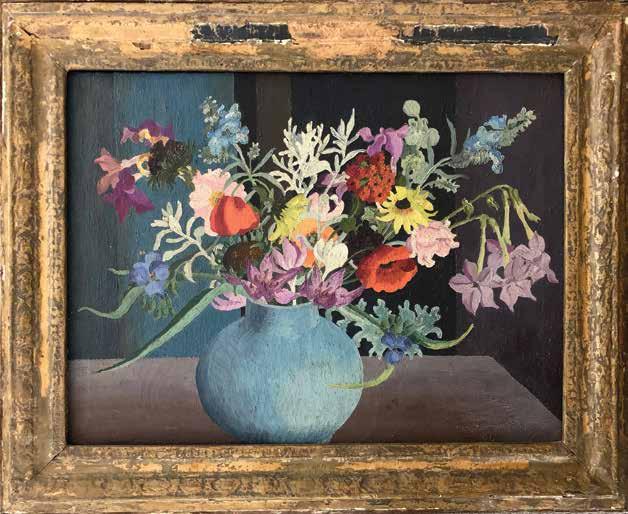
British 1889 - 1982
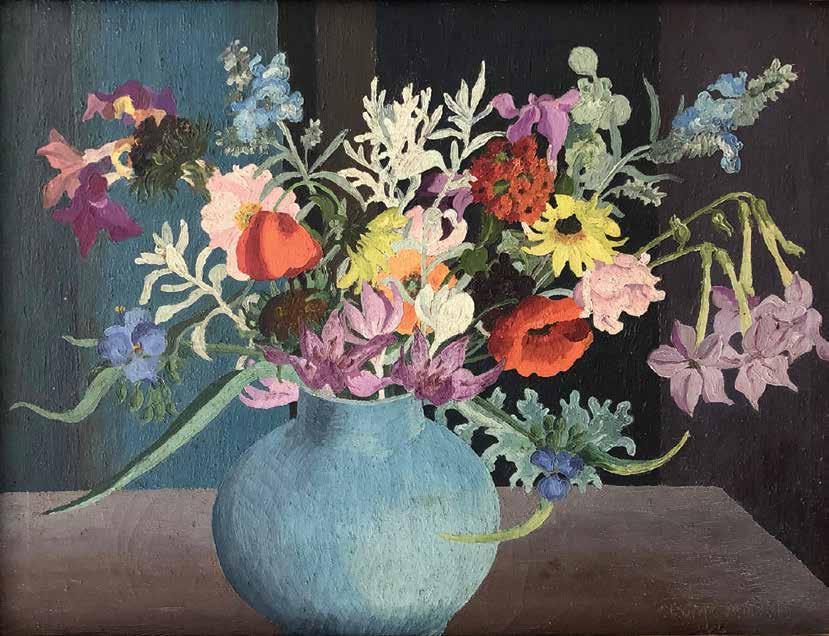
Flowers in a Blue Vase Oil on canvas 44.5 x 61
Signed & dated 1942
$170,000 - 260,000
Provenance:
Clement Butson Esq, purchased from The Leicester Galleries, London Above named on original purchase label affixed verso
Ernest Brown & Phillips label affixed verso
Purchased from Abbott and Holder, London, c. 1968, by New Zealand owner
Cedric Morris was a painter of the natural world and one of the twentieth century’s most original British artists. Born in South Wales, he was the son of George Lockwood Morris (later Sir George Lockwood Morris, 8th Baronet) and Wilhelmina (née Cory). The Morris family rose to prominence in Swansea in the mid-18th century through their success in the copper smelting business.
In 1909 at 19 years of age, after failing examinations to join the army, Morris travelled to Port Nelson Canada, returning to Wales in 1910. He enrolled at the Royal Academy of Music, London but by 1914 was following his true passion and studying art at the Académie Delécluse in Montparnasse. Paris was an incredibly exciting place for a young artist to be, but all of this changed with the outbreak of war. Morris returned to London where he worked in the Remount Service which trained horses to serve on the front line. At an Armistice Day party in 1918 Morris met his life-long partner, Arthur Lett-Haines (1894–1978), known as Lett. In 1919 they moved to Newlyn in Cornwall, retaining a London base by sub-leasing New Zealand expatriate artist, Frances Hodgkin’s studio in Kensington. In that year Morris painted a watercolour portrait of Frances Hodgkins and a long friendship ensued which lasted until her death. Morris’s 1928 oil portrait of Frances Hodgkins hangs in the Auckland City Art Gallery, and hers of him, Man with a Macaw 1930, hangs in the Towner Art Gallery, Eastbourne.
It was in Newlyn that Morris began painting in oils, the media suited him well and his method of applying paint quickly and confidently to the canvas caused great excitement among his fellow artists. Morris and Lett remained in Newlyn until late 1920 when they moved to Paris. At this time Paris was one of Europe’s most artistically vibrant cities. Its cafes and bars were the meeting points and melting pots of great artistic creativity. Morris and Lett counted amongst their friends luminaries such as Marcel Duchamp, Peggy Guggenheim and Man Ray. During this time Morris and Lett, along with their friends, travelled extensively throughout Europe as well as Algeria and Tunisia, painting all the while.
After seven years in Paris the couple embraced a new life chapter, setting up a home and studio in London’s Great Ormond Street. As in the past, their home was a base not only for work, but many joyful social gatherings. The subject matter for Morris’ paintings, whether it be animals or the plants and flowers he
collected and loved to paint, all co-existed under the one roof. In 1928 Morris represented Britain at the Venice Biennale. Later that year, a major solo exhibition of his work was held by prominent London dealers, Arthur Tooth & Sons. The show was a resounding success and a complete sellout. Morris’s position as a leading British painter of the day was firmly established.
By 1930 a yearning for the countryside and a quieter life saw Morris and Lett leave London to live at Pound Farm in Suffolk. It was here that Morris painted some of his most important still-life works. Of this time, former student, Joan Warbuton recalls a visit to the studio: to go in their quietly when Cedric was painting the favourite of all his flowers, Irises, was a revelation. In 1937 Morris and Lett opened the East Anglian School of Painting and Drawing, the summer school based in Dedham, Essex adopted a rather unique approach in that it set out to reassure and encourage, rather than criticise its students. Lucien Freud was one of many great artists who attended classes held by Cedric Morris. In 1939 the school building was destroyed by fire suspected to have been started accidentally by Freud who was smoking inside the building. By the mid 1940s Morris and Lett had not only set up home at Benton End, Suffolk but had also re-established the school there.
Since before the war, Morris had been gaining prominence within the gardening world as a breeder of irises and collector of exotic plants, and from the late-1940s onwards, during the winter months when the school was closed, Morris would disappear abroad hunting for new plant specimens. As well as rare plants, Morris would also return with souvenirs such as plant pots and ancient pottery, as well as more practical mementos such as vegetable seeds which later in the year provided Lett with the exotic ingredients for his famously delicious dinners.
By the 1960s during the winter months when the school closed its doors, Morris continued to travel and paint as he had done all his life. Lett chose to stay at home, while Morris explored venues such as St Helena, Libya, Tunisia and Cyprus. In the early 1970s his eyesight began to fail and one of his last trips abroad was to Portugal in late 1973. Lett passed away in 1978 and four years later Cedric Morris died at 92 years of age
Reference:
Cedric Morris: Beyond the Garden Wall, Philip Mould Ltd, England, 2018, published for the exhibition of 18 April - 22 July 2018
Cedric Morris, Tate Gallery, The Hillingdon Press, Uxbridge, Middlesex, 1984, published for the exhibition of 28 March - 13 May 1984
Cedric Morris: Artist Plantsman, Andrew Lambirth, Garden Museum, London, 2018
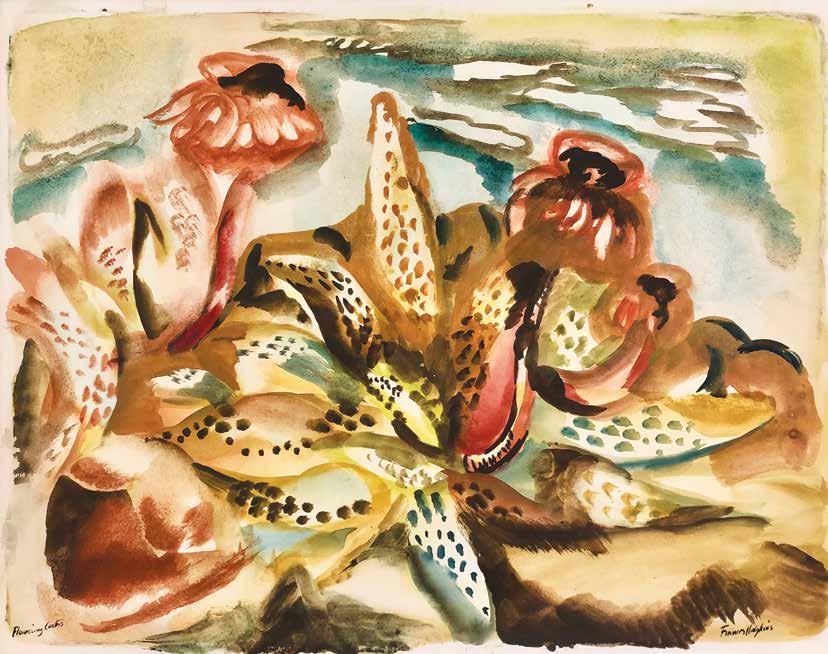
Flowering Cactus, 1933
Gouache on paper 40 x 51.3
Signed & inscribed
$40,000 - 60,000
Provenance:
Ex Collection of Art Patron, Lady Charlotte Bonham-Carter
Originally purchased from Lefevre Gallery
November 1933
Exhibition Catalogue No. 11.
Ex Collection Sir Ivor & Lady Richardson, purchased from Gillian Jason Gallery, London 11 October, 1991
Private Collection, Wellington, purchased from Sir Ivor & Lady Richardson Art Collection, Dunbar Sloane, 22 March 2006
Reference:
p. 100 Arthur Howell Frances Hodgkins: Four Vital Years
Salisbury Square, London 1951
Acquisition: Gillian Jason Gallery, London 11/10/91
Frances Hodgkins was a widely travelled artist. In the winter of 1932-33 at 63 years old, she visited Ibiza. Her reputation as an international artist was of course well-established by this time and the year before, she had established relationships with two prominent dealer galleries in London where she was living and painting on a full-time basis.
Staying at the Hotel Balear, Ibiza with a view of the sea, the brightness of Mediterranean light was magnified. The flowering cactus, which is the subject of this work, exudes a raw, slow heat which seems to bleed out, modulating the spines of the plant. The directness of the gouache medium allows for the relationship between artist and colour to be translated directly to the viewer.
This period of time in the Balearic Islands was more than an artistic reprieve for Hodgkins. The dry, bright essentialism of the Mediterranean instilled new perspective into her work, having effected a dramatic change in environment. Hodgkins revisited certain themes from her earlier work with a fresh intensity, creating works which hint towards abstraction of form, and of such excellence that many consider the gouaches from this time to be amongst her finest work.
1870 - 1947
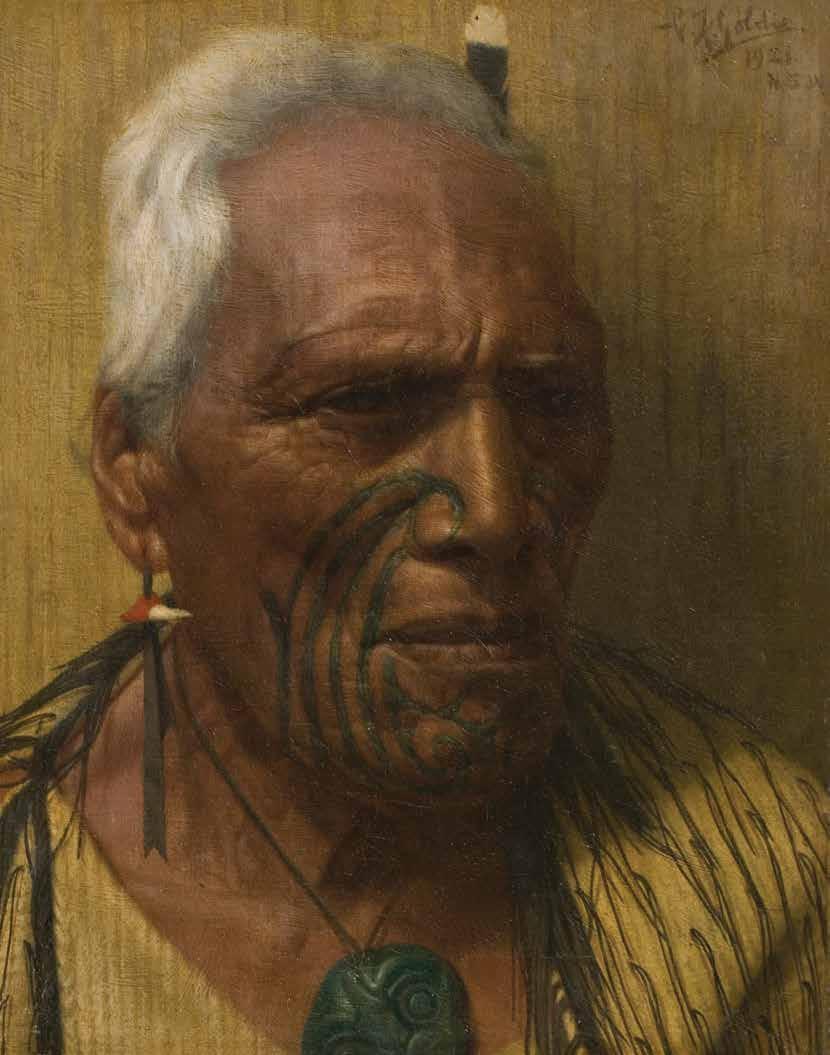
The Aristocrat
Te Kamaka, Ngati Maniapoto Tribe, Aged 90 Years
Oil on canvas 26.5 x 21.8
Signed & dated NSW 1921
$300,000 - 400,000
Inscription in artist’s hand on stretcher verso reads:
Fought at Pukerangiora ‘An Aristocrat’ A noted Chieftain of the Ngatimakata Tribe, Aged 90 Years
Provenance:
Ex collection of F R Strange, Sydney, Australia
Sold by private sale to a Wellington collector, August 1974
Private Collection, Auckland
Exhibited:
Goldie, The Exhibition, Auckland Art Gallery, 1999, curated by Roger Blackley
References/ Publications:
F. R. Strange Catalogue, July 1974
Illustrated: p. 261 C F Goldie, His Life & Painting
Alister Taylor & Jan Glen, Martinborough 1977
Goldie’s inscription reads Ngatimakata Tribe, however it is now known that Te Kamaka was from the Ngati Maniapoto Tribe, King Country. Te Kamaka fought in the historical battle of Pukerangiora on the shores of the Waitara River, Taranaki. It is understood that on arrival at Pukerangiora, the Ngati Maniapoto tribe embarked on a siege of such savagery that the land ran red with blood and Pukerangiora was forever changed.
Goldie painted at least four other portraits of Te Kamaka. They are catalogued in C F Goldie, His Life & Painting Alister Taylor & Jan Glen, Martinborough 1977, as follows:
Te Kamaka, 1916, Private Collection
The Diplomatist, Te Kamaka - a chieftain of the Ngati Maniapoto, Tribe, King Country, 1918, Private Collection
The Whitening Snows of a Venerable End - Te Kamaka, 1918
An Aristocrat, Te Kamaka, 1921
Through his lifetime and legacy, Charles Frederick Goldie greatly influenced our nation’s artistic and cultural consciousness. Born in Auckland on 20 October 1870, one of eight children from the marriage of Maria Partington and David Goldie, he was named after his material grandfather, Charles Frederick Partington, builder of the landmark Auckland windmill.
In 1883 the young Goldie was enrolled at Auckland Grammar School. His youthful artistic talents shone, and it was not long before he was winning prizes at the Auckland Society of Arts. On leaving school, Louis John Steele become his mentor and tutor. Two of the young artist’s still life paintings so impressed Sir George Grey, that he convinced David Goldie to allow his 22 year old son to attend the Académie Julian in Paris. Goldie spent over four years at the Académie Julian tutored by leading lights of the Paris Salon such as William-Adolphe Bouguereau.
In 1898, fully informed in the French academic style, the artist returned to New Zealand and began collaborating with his former tutor Louis John Steele. The two worked on a number of paintings including The Arrival of the Maoris in New Zealand, a large scale history painting after Gericault’s Raft of the Medusa. Before long, however, the relationship deteriorated likely caused by tensions around the former student’s growing success. Goldie went on to open his own studio and establish himself as a successful portraitist of Maori.
A visit to Rotorua in 1901 was the first of several field trips during which the artist was introduced to local Maori and persuaded them to sit for portraits. Goldie’s works from this point forward strongly reflect the European tradition in which he was trained, and possess a stunning power and visual clarity. On the one hand, his remarkable dedication to realism belies an ethnographic interest. At the same time, he was also striving to capture the mana of his sitters who included chiefs, tohunga and kaumatua.
Goldie formed long-standing relationships with several Maori he met and painted around this period, including Wiremu Patara Te Tuhi and Te Aho-o-terangi Wharepu (Ngati Mahuta), Ina te Papatahi (Nga Puhi), and Wharekauri Tahuna (Ngati Manawa).
Over the next two decades, Goldie gained national and international acclaim and steady demand formed a strong market for his portraits, a number of which would later be exhibited at the Royal Academy of Arts in London and the Paris Salon throughout the 1930s.
In 1920 the artist moved to Sydney, where despite original plans to continue on to Paris, he was married, at age fifty to thirty five year old Olive Cooper. Marriage in Sydney circumvented Goldie family disapproval of the relationship between Auckland’s famous artist and the milliner from Karangahape Road. After two years in Sydney, apparently disillusioned with his work at this time and suffering from health problems Charles and Olive returned to New Zealand.
Goldie’s return to Auckland in 1924, ultimately represented a moment of artistic reckoning. Goldie received encouragement to resume painting from Governor General Lord Bledisloe. Devoting himself once again to his work, he began to apply a more liberal, impressionistic approach to the realisation of his portraits and repainted a number of his former subjects. Works from this later period are distinguished by their soft luminescence, offering a rhythmic departure and disconnection from the rigours of formalism to which he had so strictly adhered in the past.
Goldie died in Auckland in 1947, his exquisite, spiritually-charged, often unsettling and ever powerful portraits of Maori having made an unsurpassed contribution to the history of art in New Zealand.
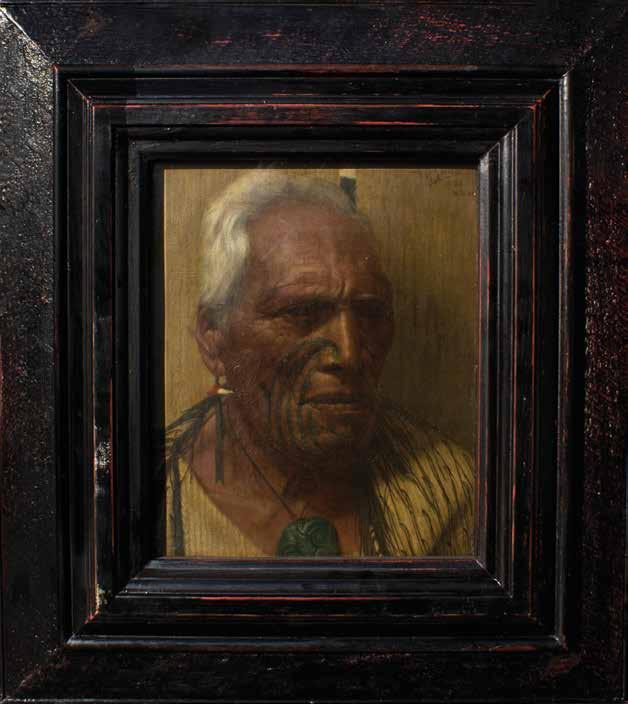
38 CHARLES FREDERICK GOLDIE
Wharekauri Tahuna
A Chieftain of the Arawa Tribe Oil on canvas 47 x 41.5
Signed & dated 1938
Inscribed verso
$500,000 - 750,000
Provenance:
Olive Goldie Collection - Artist’s Wife
Lot 115, Webb’s Fine Paintings & Jewellery, July 1985, illustrated p. 54
Private Collection, Auckland
Reference: p. 120,121, 141
C F Goldie, His Life & Painting
Alister Taylor & Jan Glen, Martinborough 1977

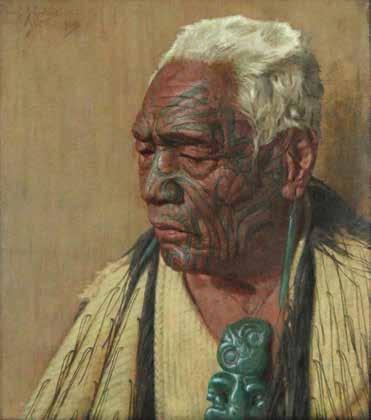
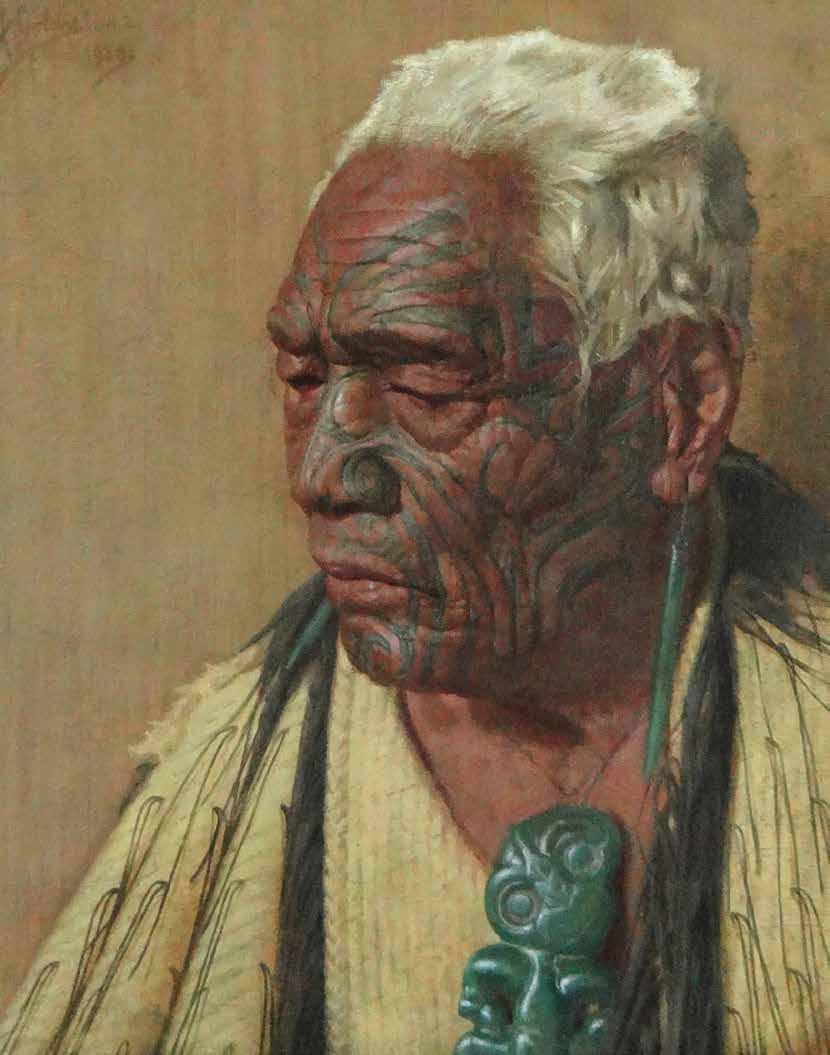
Whakakauri Tahuna
Photographer Unknown
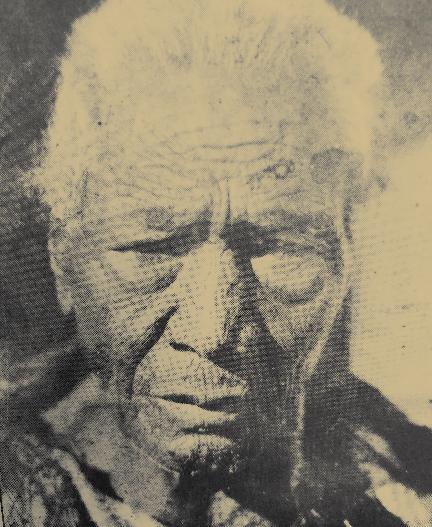
Goldie’s portraits of Maori are celebrated for their ability to realistically capture the mana and likeness of his sitters. This immortalised image of Wharekauri Tahuna, chief and tohunga of the Ngati-Manawa tribe, with full facial moko and greenstone adornments of his high status, does indeed embody both the mana of Wharekauri Tahuna and the skill of C F Goldie.
It is though that the two met in 1901, when Goldie visited Rotorua and asked local Maori to sit for him for the first time. Goldie painted a number of portraits of Wharekauri Tahuna over the course of his career and notably, this kaumatua was the subject of what is believed to have been the artist’s last ever portrait, completed in 1941. Though it was not unusual for Goldie to paint multiple portraits of individuals with whom he had maintained good relationships, the significance of his connection and friendship with Wharekauri as one which bookended his artistic journey with Maori must not be understated.
The 7 foot tall Wharekauri was a mightily impressive warrior and an inspiring subject for Goldie. He was one of the 1,600 warriors who made the full fighting strength of the Te Arawa against Te Tumu pa, the Ngai-te-Rangi stronghold on the coastal sandhills between Tauranga and Maketu. In later life he became a recluse living in the Kai Mokopuna range.
He was bought back to Murupara Pa to die at age 102. Whakakauri Tahuna’s ancestral connection ties with Te Arawa, the Ngaiti Manawa tribal canoe which sailed across the Pacific arriving in New Zealand c. 1530.
When two Goldie paintings depicting Wharekauri and Atama Paparangi were accepted for the Paris Salon in 1935, the works (and, by association, his sitters) aroused great interest. Newspaper reviews meditated on the character of Wharekauri including his tohunga status. Wharekauri and Atama were described as the finest natives of which he has any records and Wharekauri (with the exception of one other subject) as the most fully tattooed Maori Goldie has ever painted.
The history of Te Arawa waka and Wharekauri’s iwi, the replication and dissemination of his identity nationally and internationally, and the artist’s decision to repeatedly draw artistic life from photographs of this last of the tohungas all inform this magnificent painting. Depicted in profile with his eyes downcast, the work untethers Wharekauri from any single moment in time to establish him within the collective consciousness of Aotearoa and his descendants.
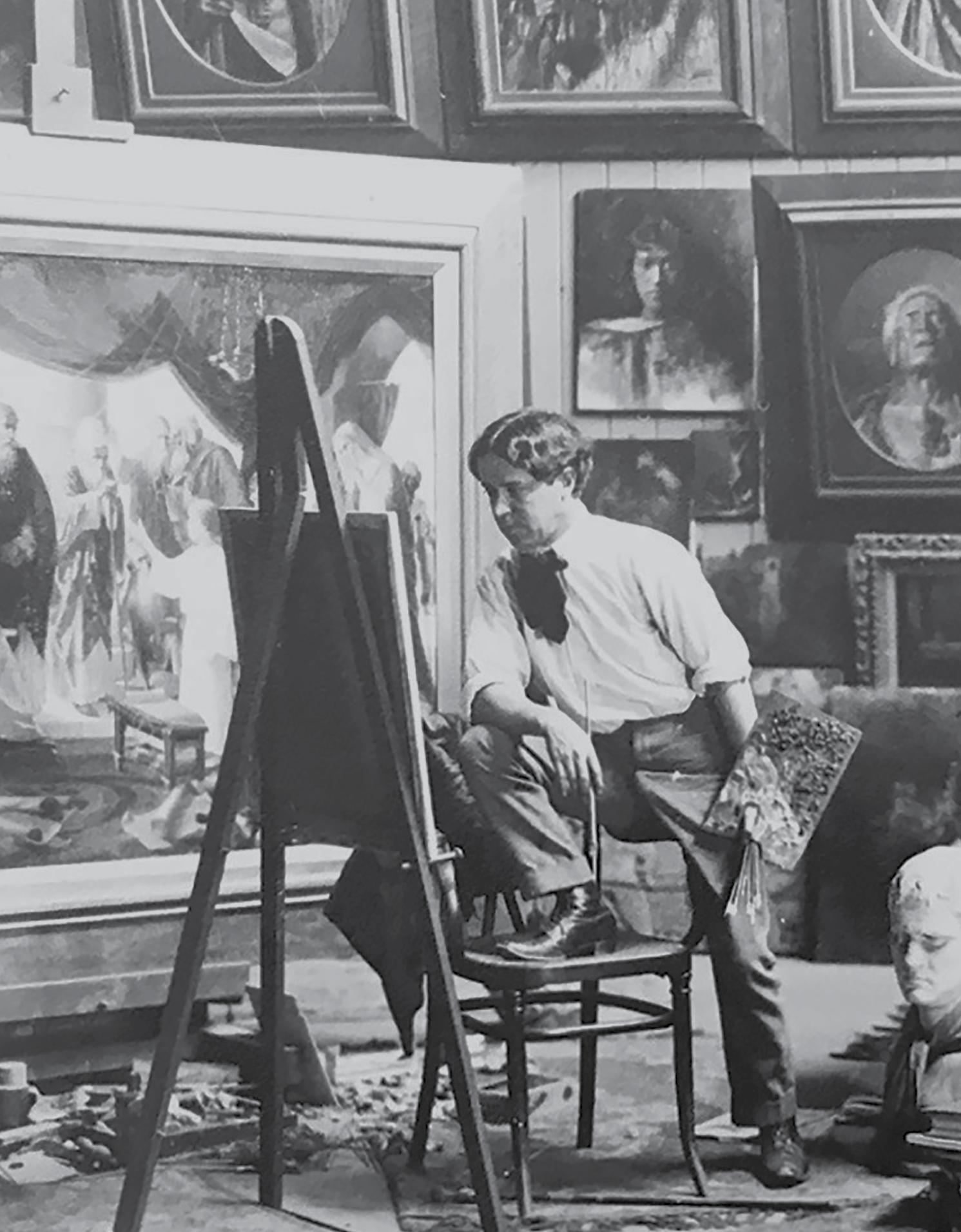
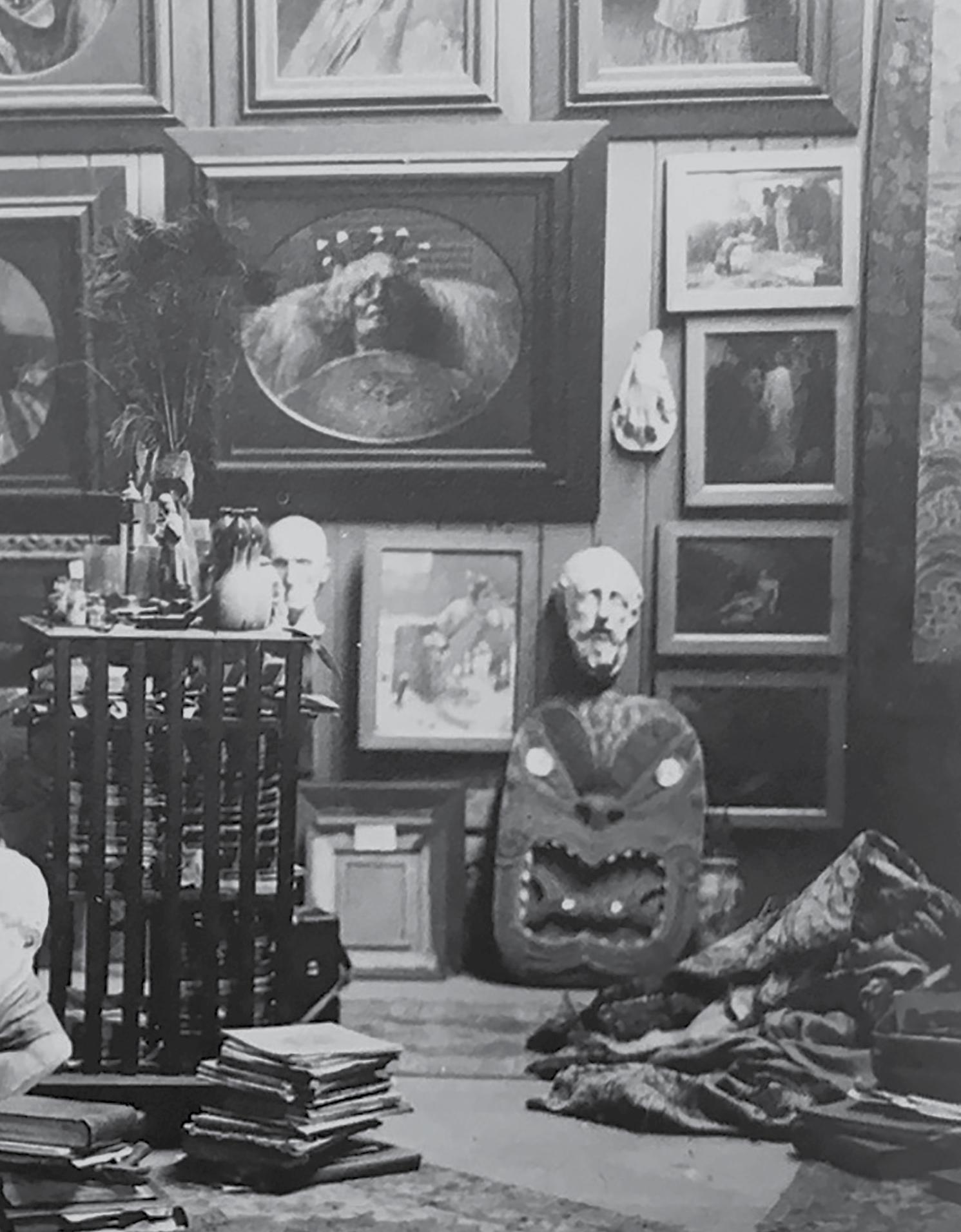
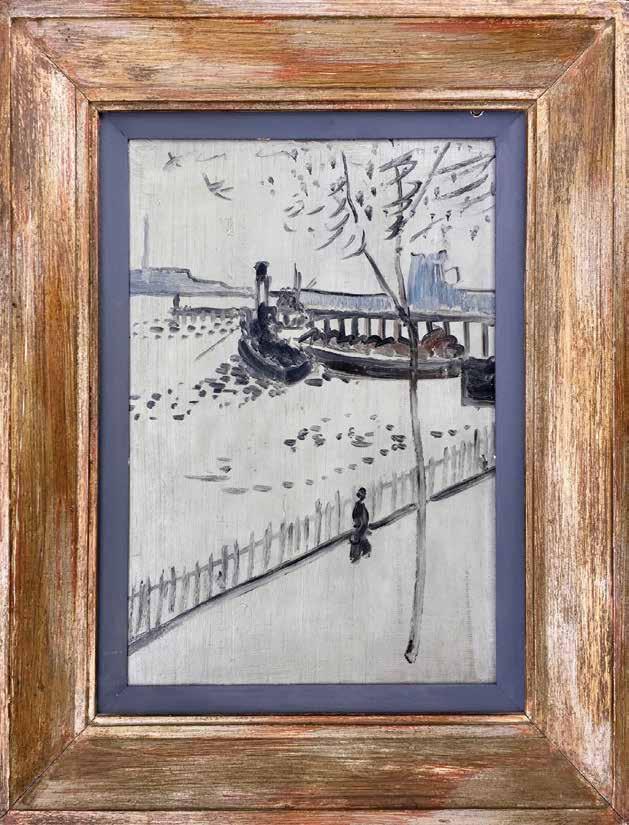
MCINTYRE
Cremorne Wharf
Oil on board 30 x 21
Inscribed on original backing board verso
$20,000 - 30,000
Provenance:
Acquired directly from the artist Major Frederick Charnley, MC, Indian Army, RWF, RA, RE who lived in Chelsea, London at the time when McIntyre was painting there.
Charnley family collection, UK
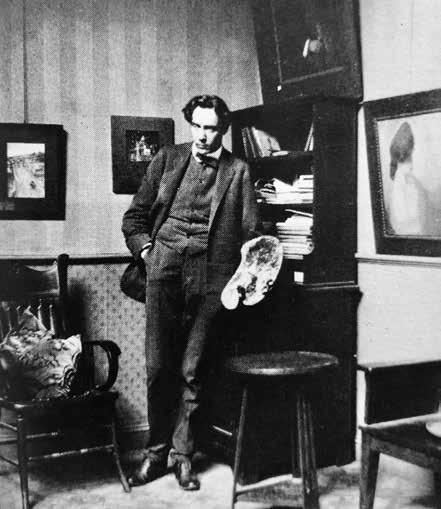
Raymond McIntyre arrived in London in 1909 and soon after set out to investigate art schools with the intention of furthering his studies. This was his primary reason for coming to London. In London has all the confidence and informal character of en plein air sketching which the Barbizon school and then the impressionists - for whom working in natural light became particularly important - had made so influential from the mid-19th century.
Following the direction of Les Nabis (1888-1896), who had in turn built upon the example of Cézanne
and the encouragement of Gauguin, McIntyre arrived at the point where linear perspective and modelling almost disappear; and a flattened, decorative surface of grid-lines and colour planes emerges.
McIntyre left New Zealand to immerse himself in the influence and stimulus of European art and he would have probably, modestly, admitted that his work became, to use his own words, more interesting viewed from the standpoint of modern artistic developments in Europe as a result.
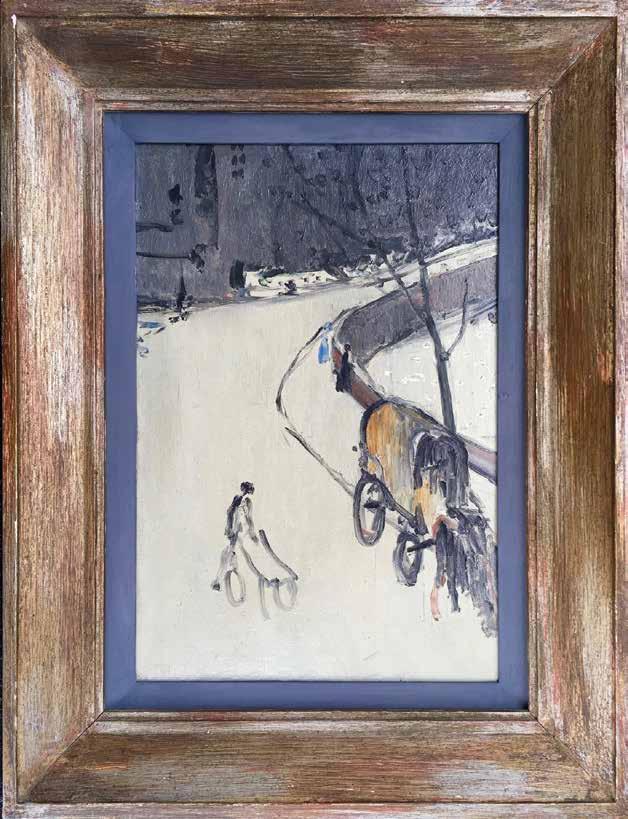
Street Scene, London
Oil on panel 30 x 21
$20,000 - 30,000
Provenance:
Acquired directly from the artist Major Frederick Charnley, MC, Indian Army, RWF, RA, RE who lived in Chelsea, London at the time when McIntyre was painting there. Charnley family collection, Europe
Raymond McIntyre (1879 - 1933) was an emigre New Zealand artist whose departure was an enormous loss to painting in this country. Born in Christchurch he studied with Petrus van der Velden and attended evening classes organised by the Canterbury College School of Art. In 1905 he joined a sketch club where he met Sydney Lough Thompson who had recently returned from four years study in Europe. From 1906 -1908 McIntyre shared a studio in Cathedral Square with Leonard Booth who described him as an enthusiastic disciple of Whistler
In 1906 -1907 McIntyre was able to observe for himself the new techniques of impressionism when twenty works by English Art Club members were shown at the New Zealand International Exhibition in Christchurch.
These were to be enormously influential in forming McIntyre's modern style of painting, a factor which did not always endear him to the art establishment in New Zealand. Consequently, in 1909 at the age of thirty, he left for England where he began an intensive period of study with such noted artists as Walter Sickert and William Nicholson.
Diverse work included street scenes, a subject he shared with the Camden Town Group, and from 1920 he began to paint rivers and parks. McIntyre was also a talented musician, writer, printmaker, theatre and music critic. For some years he was art critic for Architectural Review. He was a Christian Scientist from 1907 and in 1933 refused an operation for a hernia. The resulting infection caused his death which could have been prevented if he had permitted medical treatment.
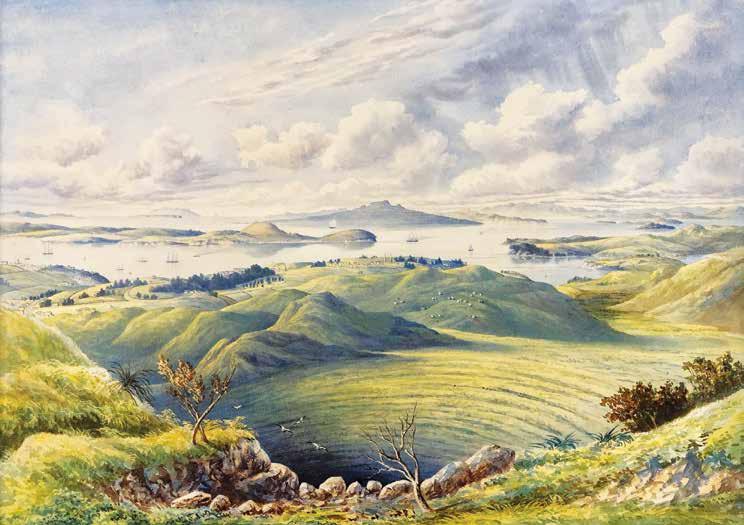
An Auckland Panorama
Watercolour 38 x 52.5
Signed $30,000 - 40,000
Provenance:
Collection of an Auckland Doctor until 1989 It is believed the work was acquired by the above from the Logan homestead, Cornwall Park by the Doctor’s father
Same family collection by descent
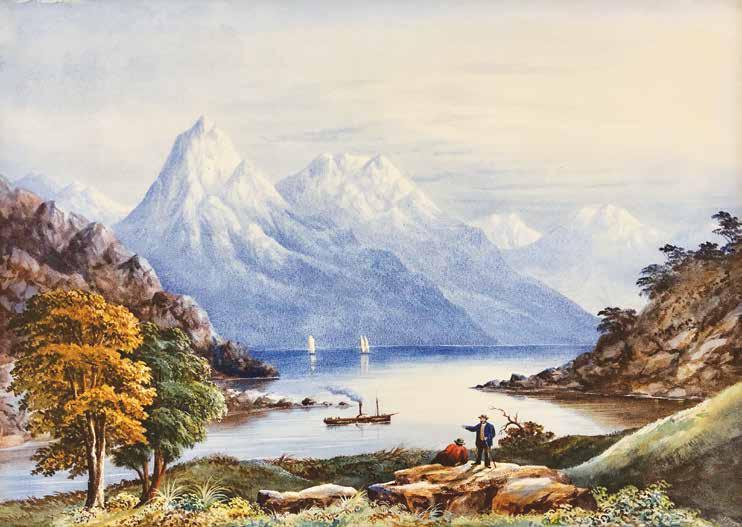
Walter Peak
Watercolour 38 x 52.5
Signed
$12,000 - 18,000
Provenance:
Collection of an Auckland Doctor until 1989 It is believed the work was acquired by the above from the Logan homestead, Cornwall Park by the Doctor’s father
Same family collection by descent
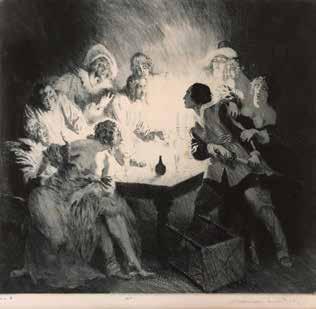
Australian 1925 - 2006
Cards and Women, 1926
Etching, edition 16/45, 23 x 24.5
Signed
$2,000 - 3,000
Provenance:
Private Collection, acquired directly from the artist 1926 by the family
44
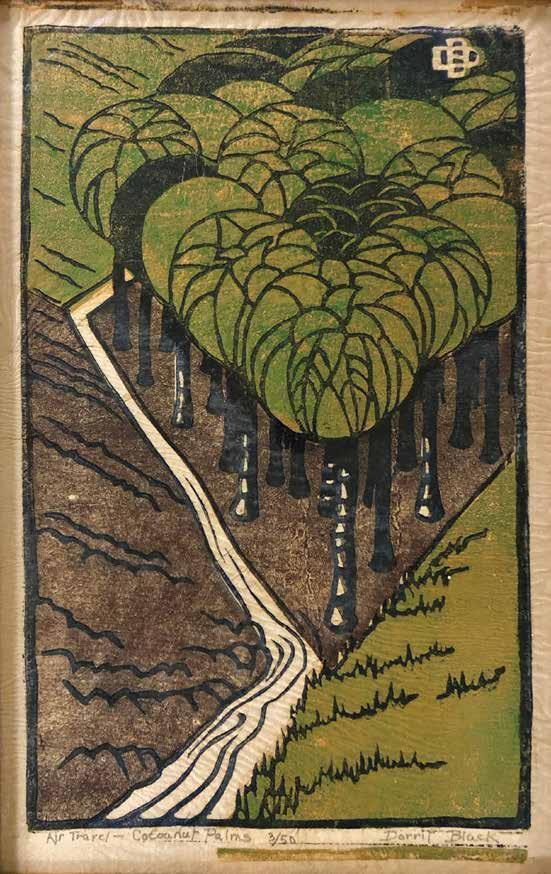
DORRIT BLACK
Australian 1891 - 1951
Air Travel: Coconut Palms
Linocut on Oriental wove paper, edition 3/50, 27 x 17
Signed & inscribed
$20,000 - 30,000
Provenance:
Collection of the artist’s friend
Private Collection, Hawkes Bay by descent from above collection, mid 1990s by current owner
Illustrated: p. 165 Dorrit Black: Unseen Forces, Tracey Lock-Weir
Art Gallery of South Australia, 2014
This work is the second in a series of four linocuts Dorrit Black produced from her Air Travel series.
The Air Travel series shows Black’s emotional response to the land. Inspired by an aircraft trip to North Queensland soon after the Second World War, she records the contrasting organic and ordered formations of the natural world vividly apparent from the air: two depict pristine landforms.
(free-form coastal mud flats and mountain ranges), and two are ordered agricultural landscapes (manmade palm and pineapple plantations). Dorrit initially studied printmaking under Claude Flight at London’s Grosvenor School of Art, alongside fellow print-maker Ethel Spowers. By the late 1940’s, however Dorrit had developed her own experimental technique, using a mixture of rolled colour and brushed on, rather like the Japanese, but against the advice of Flight.
Maurits Cornelis Escher (1898-1972) is one of the world’s most famous, internationally recognised graphic artists. He is best known for his so-called impossible constructions, such as Ascending and Descending, Relativity and Transformation. One of his most iconic and collectable images is Dag en Nacht - Day And Night, 1938.
During his lifetime Escher made 448 mathematically inspired woodcuts, lithographs and mezzotints and over 2,000 original drawings and sketches. Escher also illustrated books, designed tapestries, postage stamps and murals. Born in Leeuwarden, the Netherlands he was the fourth and youngest son of a civil engineer. The family moved to Arnhem and after failing his high school exams Escher was enrolled in the School for Architecture and Decorative Arts in Haarlem. In his first week of attendance the young Escher informed his father that he would rather study graphic art than architecture. On viewing his drawings and linoleum cuts resident graphic tutor, Samuel Jessurun de Mesquita supported and encouraged Escher in this decision.
Following his graduation from the School of Decorative Arts Escher travelled extensively throughout Italy. It was here that he met Jetta Umiker whom he married in 1924. The young couple settled in Rome, remaining there until 1935. The years spent studying, travelling and working in Italy yielded a wealth of inspiration and many of the sketches and studies made at this time supplied material for later woodcuts, lithographs and wood engravings.
The background in the lithograph Waterfall stems from Escher’s Italian period, as do the trees reflected in the woodcut entitled Puddle. These same trees appear in his 1932 woodcut, Pineta of Calvi. Escher’s lifelong fascination with the regular Division of the Plane was initially ignited during his first visit in 1922 to the Alhambra, a fourteen century Moorish castle in Granada, Spain. Later, during the years spent in Switzerland and throughout the Second World War, Escher completed 62 of his total 137 Regular Division Drawings.
Working in a many mediums throughout his life, Escher possessed a mind of limitless creative capacity, juggling reality and illusion. He viewed the world and created intriguing works of art from his own very unique perspective.
Institutional collections of original works by M C Escher are the Escher Museum in The Hague, National Gallery of Art, Washington DC, National Gallery of Canada, Ottawa, Israel Museum, Jerusalem and Huis ten Bosch in Nagasaki, Japan.
An international retrospective exhibition Escher X Nendo | Between Two Worlds, is currently on show at NGV International, Melbourne, Australia
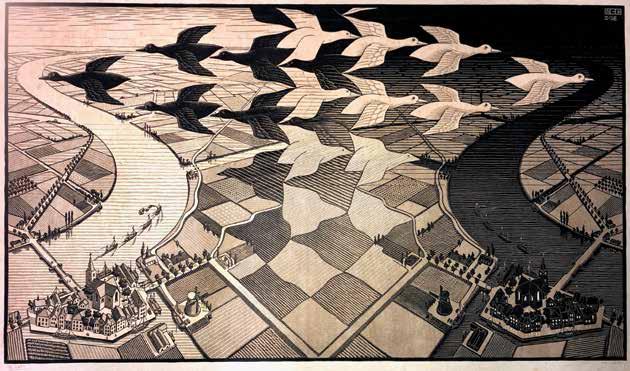
Dag en Nacht - Day And Night, 1938
Woodcut, 39 x 66.6
Signed in pencil
Inscribed in pencil Dag en Nacht
$20,000 - 30,000
Provenance:
Collection of the late A.M.E. van Dishoeck by descent
Van Dishoeck was a Dutch publisher and a friend and colleague of Escher. Together they published Maurits Cornelis Escher (1898-1972) - Ex Libris van A.M.E. van Dishoeck - 1943. On a visit to New Zealand van Dishoeck gifted this woodcut to his daughter Christina. It hung in her farm home for 55 years. Christina’s daughter who lives in New Zealand, along with other family members, has decided the time has come to pass on the work to new hands and those that will appreciate it. The new owner will be able to make contact with the family for further details on its remarkable provenance.
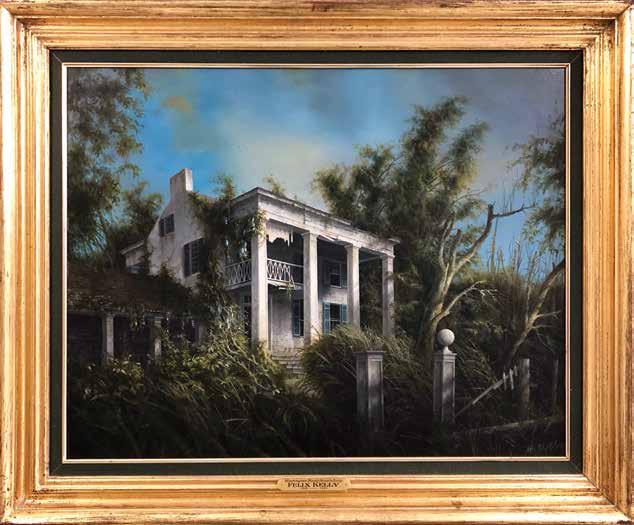
Felix Kelly is one of New Zealand’s most interesting expatriate artists. Born in Epsom in 1914 he claimed to be two years younger most of his adult life. Kelly studied briefly, and even seems to have taught drafting at Elam School of Fine Art. He was only 21 when he left New Zealand in 1935. He never returned. In London Kelly continued his New Zealand occupation of graphic design, working for Lintas, the advertising wing of Unilevers. He also freelanced as an illustrator and cartoonist, especially for Lilliput. His cartoons are not unlike those of the slightly younger Ronald Searle. After the war and the RAF, the focus of his graphic art shifted to book illustration, dust-jacket design and contributions on interior decoration to such fashion magazines as Ideal Home and Harper’s Bazaar. In the 1950s and 60s he was acknowledged as one of England’s top designers for the theatre, working with the likes of Sir John Gielgud and Dame Sybil Thorndike.
Kelly’s ambition had always been to succeed as a painter. Emerging in the context of Surrealism and British Neo-Romanticism, he exhibited alongside important British artists such as Lucian Freud, John Piper and fellow New Zealander Frances Hodgkins. He attracted the attention of the prominent critic and writer, Herbert Read. Kelly’s paintings are characterised by his interest in a world forgotten by progress, great houses falling into dilapidation, windblasted trees, abandoned locomotives often invested with an eerie watchfulness. Rapidly, Kelly assembled a client list resembling a page from Who’s Who or De
Brett’s. In late career, his knowledge of architecture led to involvement in house design, most notably his collaboration on the redesign of Highgrove for the Prince of Wales.
His most celebrated project was, however, the mural cycle at Castle Howard associated with the filming of Brideshead Revisited in the 1980s. Kelly travelled a great deal. Paintings of Spain and Italy in the 1940s were followed by West African scenes in the 50s and ante-bellum houses in America’s Deep South in the 60s and 70s. Trips to Russia, Thailand, India and Egypt in the 70s and 80s each led to an exhibition of exotic paintings. In late career, Kelly would execute a small sketch characterised by loose brush-work, which would then be converted into a carefully executed big-scale painting. Both types of work appear for sale from time to time. Kelly completed paintings of Auckland subjects done decades after he had left home. Auckland’s West Coast beaches or Takapuna with Rangitoto beyond, or paddle-steamers on the Waitemata, were evoked with an increasing degree of fantasy well into the 1960s. A quirky humour pervades his work.
Felix Kelly has to be one of New Zealand’s most individual artistic exports. A comprehensive exhibition of his earlier work, curated by Donald Bassett and mounted by the Hawke’s Bay Museum and Art Gallery, toured several New Zealand centres in 20089. A second edition of Donald Bassett’s book Fix; The Art and Life of Felix Kelly, was published in 2013.
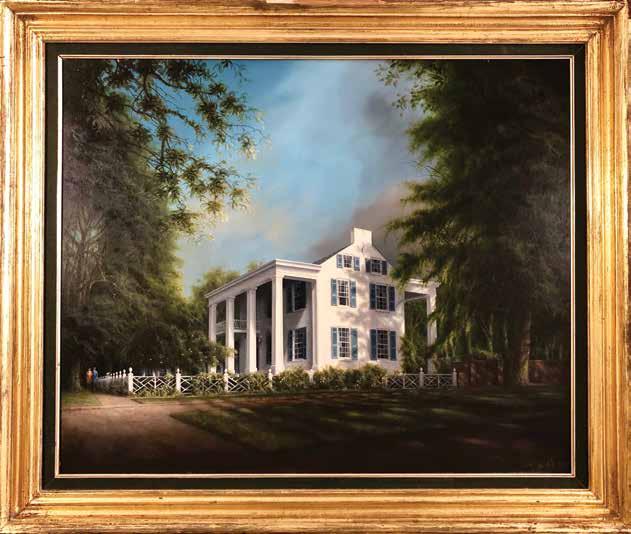
Washington Moody House Oil on board 66 x 81
Signed & dated 1977
$15,000 - 20,000
Original Kennedy Galleries, Inc. label affixed verso
Provenance:
Commissioned by the late Jack Warner, Gulf States Paper Corporation Collection Private Collection, Alabama, USA
The Moody-Warner House was built around 1822 by Alabama merchant Davis Scott as his Tuscaloosa home.
The house had a series of owners until it became the home of the Washington Moodys. Moody was the grandson of the founder of the First National Bank.
The house was restored in 1977 by art collector Jack Warner and eventually became a museum named in honour of Jack Warner's mother, Mildred Grace Westervelt Warner (1893-1974).
The museum closed and the house was put up for sale in 2003.
47 FELIX KELLY
Washington Moody House in Decay Oil on board 55.8 x 71.2
Signed & dated 1977
$8,000 - 12,000
Original Kennedy Galleries, Inc. label affixed verso
Provenance:
Commissioned by the late Jack Warner, Gulf States Paper Corporation Collection Private Collection, Alabama, USA
American architect, philanthropist and art collector Jack Westervelt Warner was born in Illinois in 1917. The family moved to Tuscaloosa, Alabama when his grandfather Herbert E. Westervelt consolidated Alabama’s first modern pulp and paper mill in 1929.
For nearly 50 years Jack Warner presided over Gulf States Paper Corporation, creating a quality leader in the American paper industry. He expanded operations from a single product and a single plant, creating a large, diversified company with operations in timber, lumber, wood pulp, paperboard, moulded wood products and folding cartons spread across five states. Along the way, the company garnered environmental protection awards from the National Wildlife Federation, the American Paper Institute and the Environmental Protection Agency.
Jonathan ‘Jack’ Westervelt Warner created one of the premiere collections of American art in the world today. As the third generation CEO of his family company, Gulf States Paper Corporation, Jack began collecting in the 1950’s with his first Audubon prints. Over 400 masterpieces eventually found their way into his collection. Masterpiece paintings, furniture, sculptures and decorative arts from the late 1700’s to the early 1900’s attested to his discerning eye for quality.
A veteran of WWII and an expert horseman, Jack’s collection expresses his passion for life and his passion for America.
Warner’s own artistic creativity is on display in the permanently unfinished four acre garden surrounding his nearby home on the shores of North River Lake, Whispering Cliffs. He designs it continuously, and has a crew working on it daily. The many waterfalls and planted dead trees suggest it is his own personal Hudson River landscape painting.
In walking through the garden in March one is impressed by the fact that it is as he describes it: an all season garden. He believes one can find God in a leaf, a flower and a landscape. Warner was well known for his generous philanthropy to many causes including the University of Alabama as well as Auburn University, Culver Military Academy, Washington and Lee University, the First Presbyterian Church, the United Way and the City of Tuscaloosa, where he built community swimming pools and provided programs for many underprivileged children to receive swimming and water safety lessons as well as art and history education at his Westervelt Warner Museum of American Art.
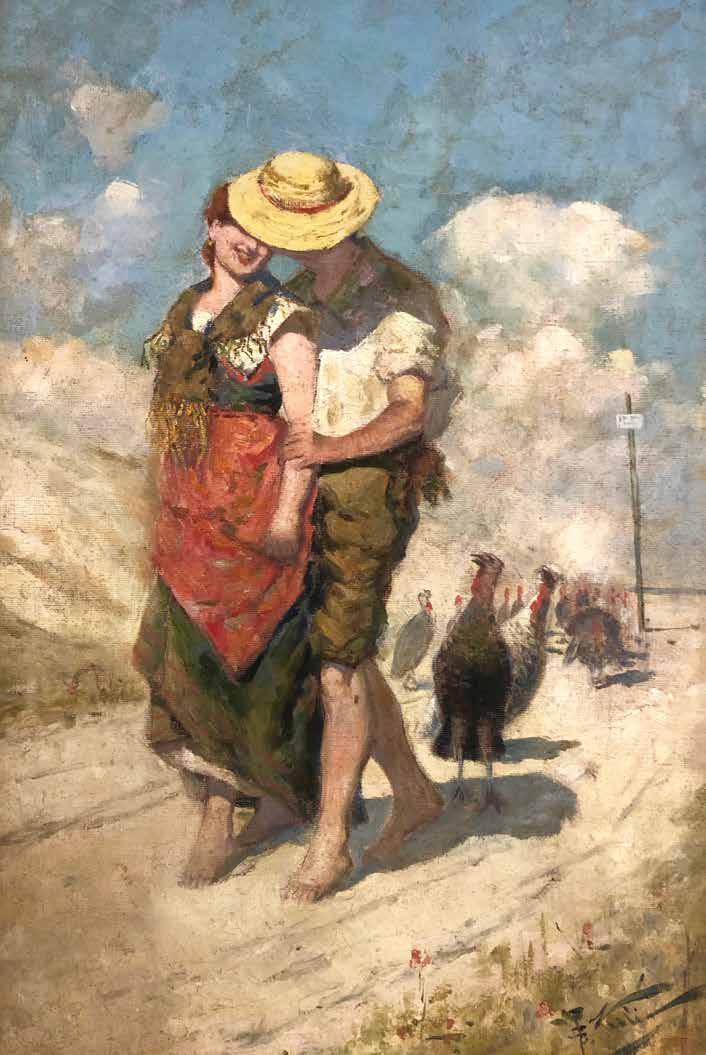
48
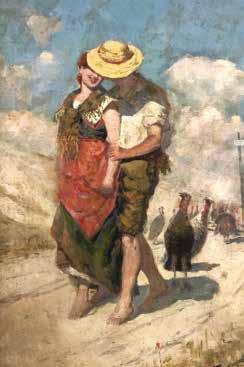
The Springtime of Life, 1890 Oil on canvas 39 x 26.5
Signed
$25,000 - 35,000
Provenance:
Private Collection, Auckland since c. 1960
This version of The Springtime of Life has never before been offered for public sale.
Another version of this painting is illustrated p. 102 Nerli - An Exhibition of Paintings & Drawings, Peter Entwisle, Michael Dunn & Roger Collins, Dunedin Public Art Gallery, 1988 and p. 57 Nerli - An Italian Painter in the South Pacific, Michael Dunn, Auckland University Press, 2005
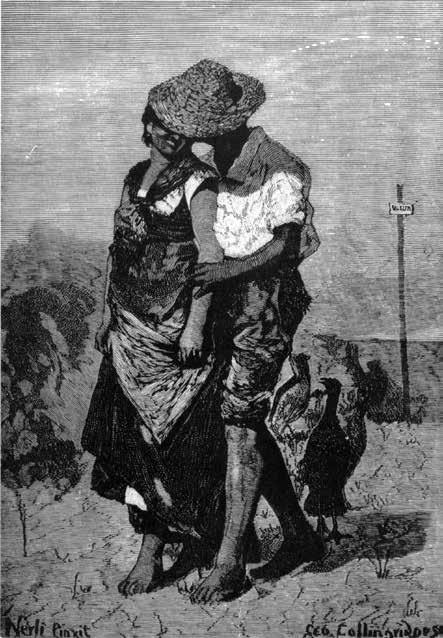
Engraving after In Transgression, published as the frontispiece of The Centennial Magazine Vol. 2, June 1890
Nerli painted a number of variations on this composition while he was in Australia and New Zealand. He first exhibited the subject in Sydney in 1887 with the title In Transgression, which suggests the immoral dimension of the behaviour of the peasant couple. The young man is making advances to the girl, who is neglecting the turkeys entrusted to her care. Her smiling face tells us that she is responsive to her lover’s words and is not about to reject his ardent grasp of her arm. She is evidently being led astray. Such subjects were common in European painting of the late nineteenth century and Nerli undoubtedly sourced the composition in Italy before he left for the antipodes in 1885. There was a demand for Italian peasant subjects in New Zealand and Australia because they seemed exotic and picturesque. The painting is pitched in a high key and conveys well the heat of a hot Mediterranean day with bright sunshine, blue skies and the dust of the road between the toes of
the carefree barefoot lovers. The turkeys can be seen as symbolising carnal desire unrestrained by higher moral values and considerations. The slightly risqué subject-matter would have been more acceptable from Signor Nerli, as he called himself, than from local painters, who rarely if ever attempted a work of this sort. As an Italian and a Catholic he would have been seen as not quite respectable in a Scottish settlement like Dunedin with its strong Protestant religious heritage. Nerli exhibited a painting of this title at the Otago Art Society’s annual exhibition in 1894, which may have been this work or another version of the same subject. He sometimes exhibited the same works at different venues years after he had first painted them.
Text: p. 56 Nerli - An Italian Painter in the South Pacific, Michael Dunn, Auckland University Press, 2005
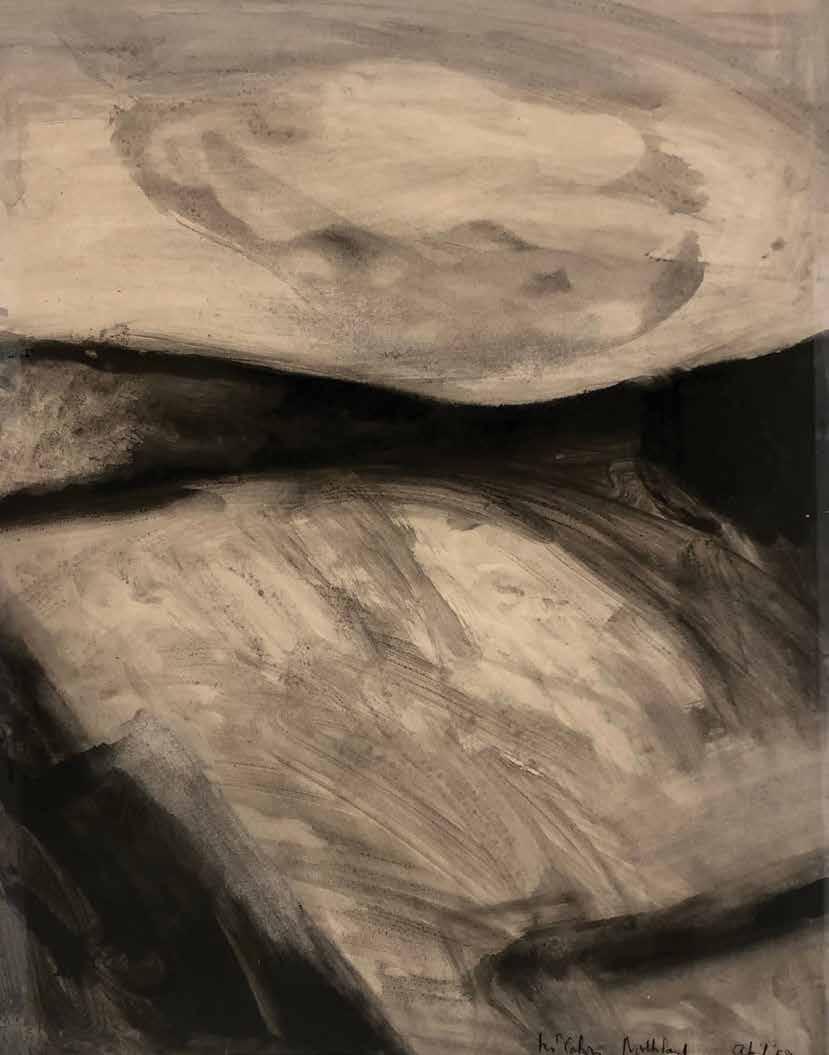
49 COLIN MCCAHON
Northland, 1959
Brush, ink on paper 63.6 x 50.7
Signed, inscribed Northland & dated 1959
$40,000 - 60,000
Provenance:
Private Collection, Auckland
McCahon database record number cm000193
Exhibited: 1959 Colin McCahon. Recent Paintings, November 1958 - August 1959 Gallery 91, Christchurch 6/10/1959 - 18/10/1959
This work on paper from McCahon’s Northland Series precedes art historical explanation. Partly, this is because it is so instantly recognisable in both subject matter and style - Northland, 59 captures the essence of McCahon’s deeply spiritual relationship with the land. It expresses the purity of that point of convergence between sky and landmass.
McCahon’s use of an ink on paper medium lends immediacy to this work: a raw aesthetic smudginess to the conception of Northland geography which
the artist knew intimately. And directly his ability to transcend our human condition, and express something of Aotearoa’s unique identity - not in a nationalistic sense, but through a more broadly existential lens.
The richness and evolution of New Zealand’s art tradition is built on a foundation of intermediary dialogue and exchange. At the very heart of this is the path forged by Colin McCahon.
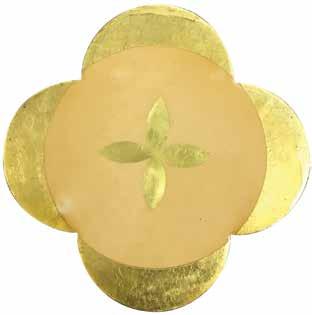
50 MAX GIMBLETT
Choice, 2000
Gesso, polyurethane, Swiss gold, wood panel 38 x 38
Signed, inscribed & dated 2000 verso
$7,000 - 10,000
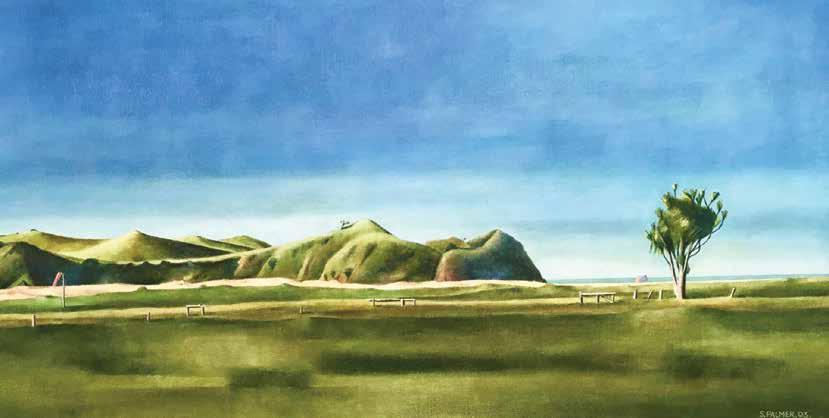
Waikaro
Signed & dated 2003
$15,000 - 20,000
Provenance:
Exhibited Stanley Palmer’s, Islands Janne Land Gallery, 2003
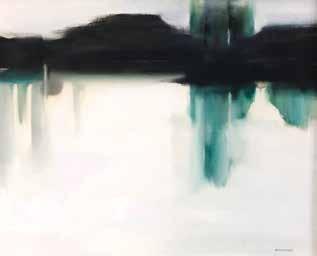
Bon Accord Harbour, Kawau Island Oil on board 59 x 74
Signed
$3,000 - 5,000
Provenance:
One Man Exhibition, Held at the John Leech Gallery, 14th November to 1st December 1967
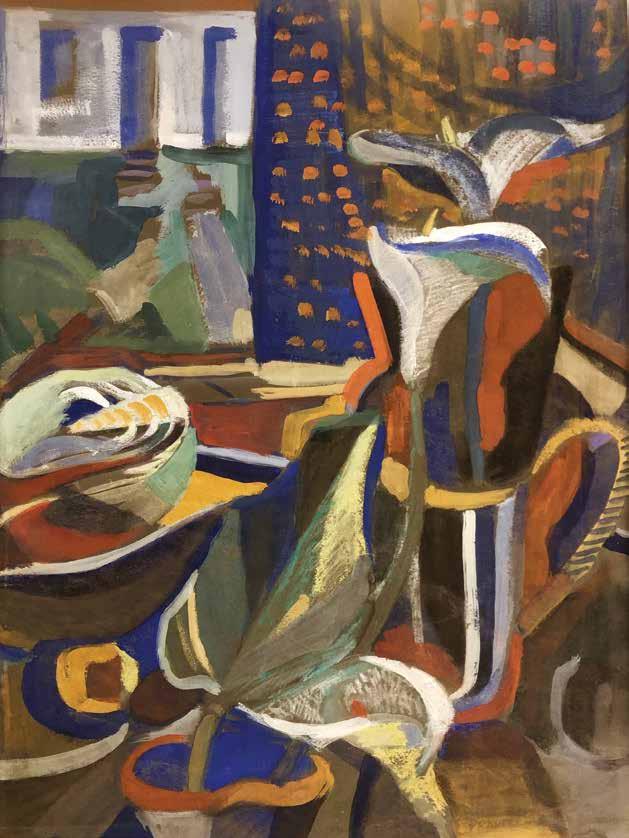
The Window Still Life Gouache and watercolour on paper 48 x 35
Signed
$4,000 - 7,000
Provenance: Tinakori Gallery, Wellington Private Collection, Wellington
54
Viennese / British 1902 - 1995
German 1920 - 1981
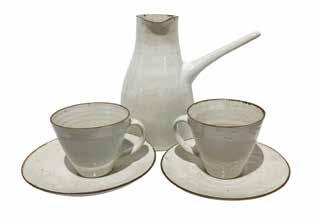
Two Cups with Matching Saucers & Coffee Pot
Glazed stoneware 6.8 x 8 (cups)
14.5 diameter (saucers)
17 x 8 x 16 (coffee pot)
Monogrammed by both artists on base of cups. Lucie Rie monogram on base of Coffee Pot
$3,500 - 5,500
Provenance:
Private Collection since c. 1954
Passed down by descent
55
Viennese / British 1902 - 1995
German 1920 - 1981
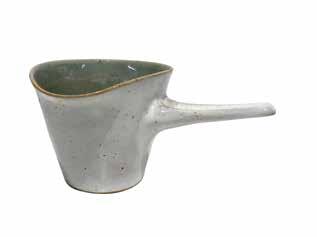
Pouring Vessel
Glazed stoneware 7.2 x 11 x 14
Monogrammed by both artists on base
$1,500 - 2,500
Provenance:
Private Collection since c. 1954
Passed down by descent
56
Viennese / British 1902 - 1995
German 1920 - 1981
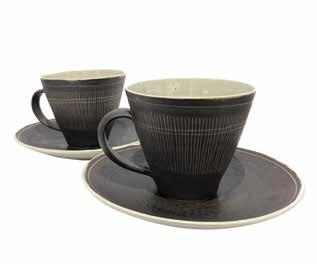
Two Sgraffito Cups with Matching Saucers
Stoneware 7 x 8 x 10 (cups)
14 diameter (saucers)
Monogrammed by both artists on base of cups
$1,500 - 2,500
Provenance:
Private Collection since c. 1954
Passed down by descent
57 FRANCIS BACON Irish 1909 - 1992
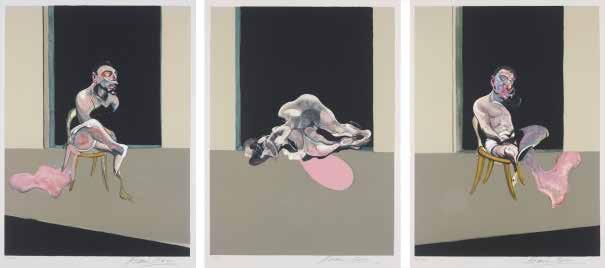
Triptych, 1972
Three lithographs on Arches paper, edition 91/190, 89.8 x 62.9 each
overall 89.8 188.7
Image size 65.4 x 48.4 each
Each signed & numbered
$40,000 - 60,000
Provenance:
Purchased from Coskun Fine Art London
Francis Bacon was a larger-than-life figure during his lifetime, and remains so. Famous for his controversial depictions of papal subjects and bullfights, often in the form of triptychs. Bacon’s work signified the blinding dawn of a new modern era. His signature blurred portraits weren’t murky enough to stave off his reputation as highly contentious - his paintings were provocations in the eyes of many. However, as Bacon often said, You can’t be more horrific than life itself. Bacon challenged the conventions of modern art with his triptychs which brutalized formalist truths. This is particularly evident in Three Studies for Figures at the Base of a Crucifixion, which Bacon debuted in London in 1944, and Three Studies of Lucian Freud, which became famous when it set the record for most expensive work of art at auction at the time it sold in 2013.
58 GERHARD RICHTER German b. 1932
Heiner Friedrich (nach einem Foto von Brigid Polk)
Offset lithograph on lightweight chromo card, edition of 250, 39 x 29.5
Signed in pencil, dated 1970 with artists stamp verso
$3,000 - 5,000
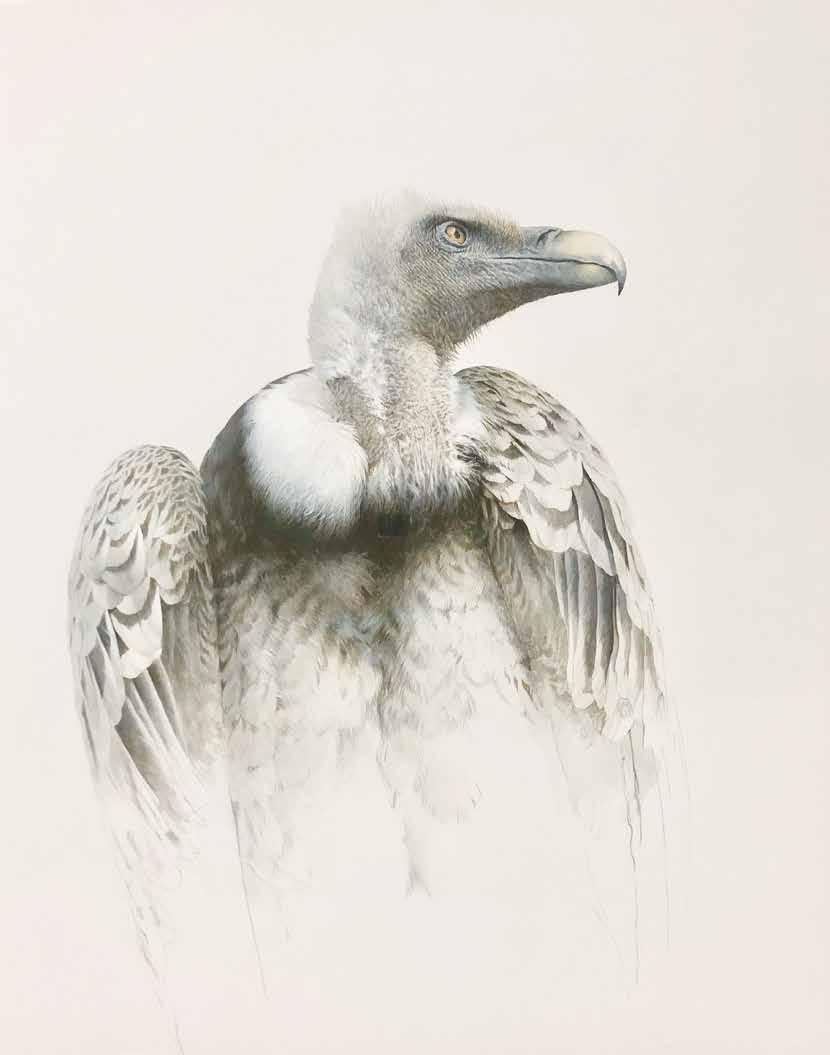
59 RAYMOND CHING
Ruppells Griffon Vulture
Watercolour 60 x 45
Signed
$15,000 - 20,000
Provenance:
Private Collection, Northland International Art Centre, 1998
Original label affixed verso
Illustrated:
p. 161 Studies & Sketches of a Bird Painter, Paintings drawings and text by Raymond Ching, Lansdowne Editions, Melbourne, 1981
Ruppell’s Griffon Vulture Gyps rueppelli is a native of Africa. A large bird, its size and impressive threat display enable it to compete successfully for carrion with most other predators. Considerable numbers of these birds may gather around a carcass, fighting and jostling for position. Such a group, on occasion, can devour a quite large animal in little more than an hour. After feeding heavily, the birds sometimes experience difficulty in rising from the ground.
The species is gregarious and, in addition to feeding socially, may roost and nest communally. The nest is a flimsy construction of sticks, arranged on a rocky cliff, within which a single white egg is laid.
(Exceptionally, there may be two.) The chick spends over three months in the nest.
Text: Studies & Sketches of a Bird Painter, Paintings, drawings and text by Raymond Ching, Lansdowne Editions, Melbourne, 1981
Ruppell’s Griffon Vulture’s can fly as high as 36,000 feet, the highest of any bird and the same as a passenger airline.
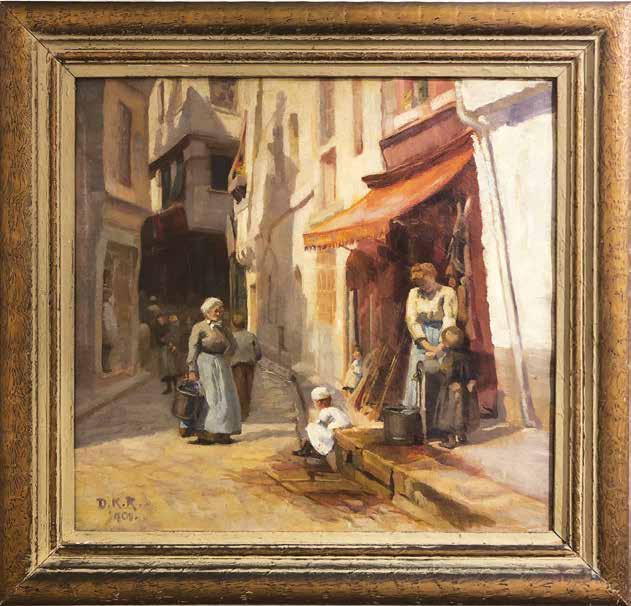
A Street in Brittany Oil on canvas 31.5 x 30
Signed & dated 1901
$10,000 - 15,000
In 1901 Dorothy Kate Richmond (1861-1935) travelled to Europe for the second time to further her education. In the same year Frances Hodgkins (18691947) travelled to Europe for the first time where she met with Richmond. 'The two women attended art classes with Norman Garstin in Normandy. They became close friends and travelled together not only in England, but also in France, Belgium and Holland
before returning to New Zealand in December 1903. p. 22 New Zealand Women Artists, Anne Kirker, Reed Methuen Publishers, 1986
In a letter home, Frances Hodgkins describes Richmond as the dearest woman with the most beautiful face and expression. I am a lucky beggar to have her as a travelling companion.
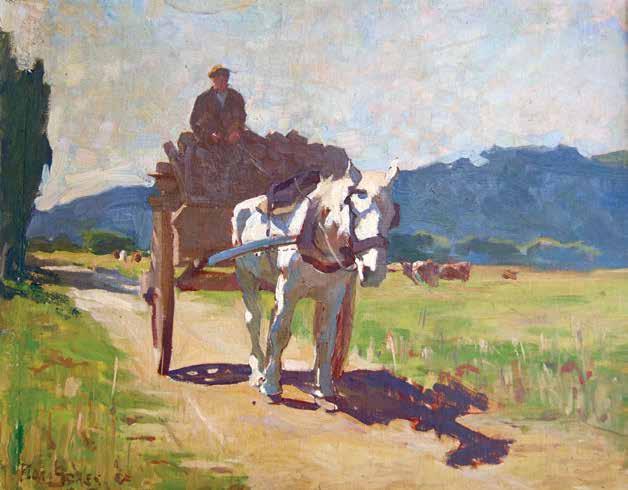
61 FLORA SCALES
A Days Work
Oil on board 41 x 63
Signed
$8,000 - 12,000
Provenance
Private Collection, Auckland
Private Collection, Bay of Plenty
Purchased by the above collection from Modern, Contemporary & Collectable Art International Art Centre, December, 2011
Exhibited:
Flora Scales Retrospective Suter Gallery, Nelson, 17 November 2018 27 January 2019
Helen Flora Scales was born in Lower Hutt 1887. She attended the Canterbury College School of Art and exhibited at the Academy of Fine Arts in 1906. In 1908 Scales left for England to attend Calderon’s School
of Animal Painting. A work from this period, Cattle Mustering in New Zealand was hung at the Royal Academy Summer Exhibition of 1911. Returning to New Zealand Scales joined the Academy Studio Club in 1914. By 1928 the artist was studying in Paris at the Académie de la Grande Chaumière and then Munich’s Hans Hofmann School of Art where she was introduced Hofmann’s principles of modernism.
On her return to New Zealand in 1934 she passed on these principals to Toss Woollaston. Apart from Woollaston, W H Allen and Frederick Page, few in New Zealand understood the modernism featured in her work. In late 1935 Scales returned to paint in England and France. She attended lectures at the Académie Ranson and in 1959 the Heatherley School of Fine Art. During World War II she was interned for two years in France. In 1972 Flora Scales resettled in New Zealand, in 1975 a solo exhibition was arranged by Colin McCahon at the Auckland City Art Gallery. Scales died in 1985. Her papers and paintings are held at the Alexander Turnbull Library.
William Henry Allen ((1894-1988) was one of a group of British art teachers recruited in the 1920s by William Sanderson La Trobe, the nation’s Superintendent of Technical Education, whose intention it was to greatly improve the quality of art education in New Zealand. W H Allen had attended London’s Royal College of Art from 1919 to 1923. His contemporaries there included Henry Moore and Barbara Hepworth; fellow students Roland Hopkins, Jenny Campbell and Robert Nettleton Field also immigrated to New Zealand and became lifelong friends.
The contribution of the La Trobe artists, particularly W H Allen and R N Field had an on-going and profound effect on the development of New Zealand art. Their teaching of early modernism opened the door to an avant-garde post-impressionist period in New Zealand’s art history. They influenced artists such as Toss Woollaston, Colin McCahon and Doris Lusk who embraced these new ideas, attitudes and techniques. Hocken Librarian Sharon Dell says the influence of W H Allen and his fellow La Trobe teachers produced landscapes and portraits in a style that was at first deeply unacceptable to painters and art societies in New Zealand - still entrenched in their Victorian style of art.
W H Allen taught in Dunedin and Nelson. He was President of the Suter Art Gallery Society, teaching Workers Education Association (WEA) classes and participating in the Canterbury Summer Schools which attracted artists Doris Lusk and Leo Bensemann to Nelson. Colin McCahon and Toss Woollaston also regularly spent their summers there.
After returning to England in the late 1930s, W H Allen’s art and reputation as a teacher were all but lost and until recently, little research done on his contribution to New Zealand art. Following the family’s return to England in 1946 W H Allen taught at the South West Essex School of Art, London, retiring in 1961.
In 2008 a significant collection of W H Allen’s work was repatriated from the United Kingdom and gifted to Dunedin’s Hocken Library. The Tui Rata Frowd bequest contained about 80 artworks including oil paintings and works on paper, and a large archival collection of letters, correspondence, photographs, catalogues and articles relating to William Allen. In 2015 the Hocken Library held a major exhibition, W H Allen & The La Trobe Effect. This exhibition shone a light on W H Allen’s contribution to the emergence of early regionalism in New Zealand. In addition to showcasing W H Allen’s practice the show included works by his La Trobe peers, several of Allen’s students and a sample of work by the early twentieth century British artists associated with the Camden Town Group whose post-impressionist style and subject matter inspired W H Allen, his peers and a swathe of this country’s regionalist painters.
International Art Centre sincerely thank the Robyn Notman and Sharon Dell of the Hocken Library for their assistance.
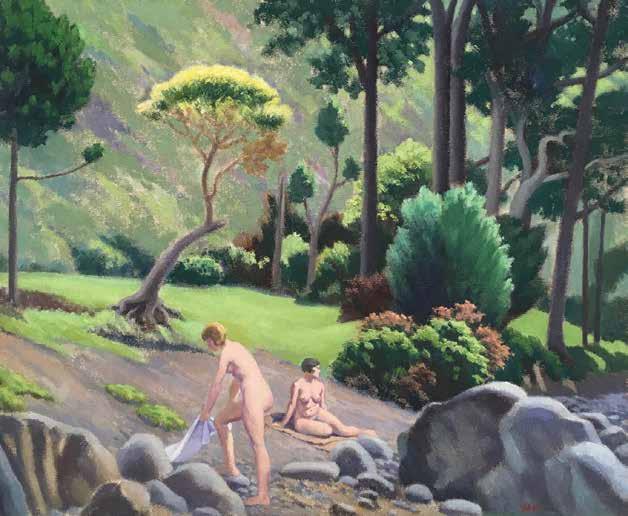
Bathers
Oil on canvas 36 x 48
Signed
$5,000 - 10,000
Provenance:
Sheila Allen Estate Collection
Sheila Allen (W H Allen’s daughter) was born in New Zealand in 1926. She lived in Dunedin until aged four, when she moved with her mother, father and Tui, back to England for a new role for her father. The family returned to New Zealand for a teaching role in Nelson when she was sevenleaving again at age 20.
She had told the University of Otago her childhood in New Zealand was idyllic, yet she returned again to live out her years in the UK, eventually having a career as an artist herself, training to be a silversmith in her 70s. Sheila died in early 2018.
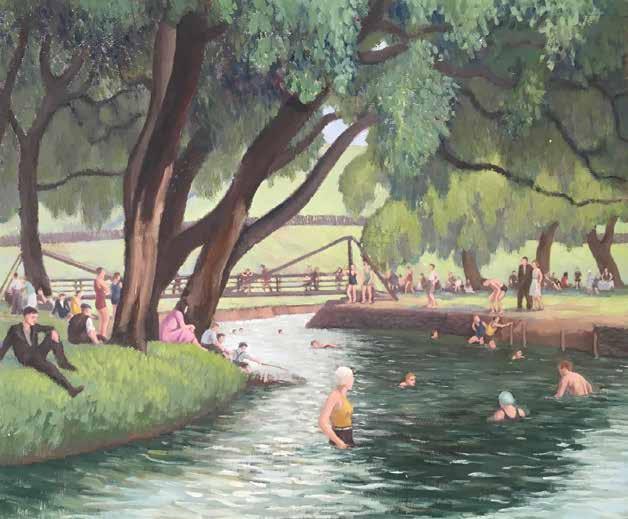
Preliminary study included with this lot
A Sunday Afternoon
Oil on canvas 50 x 60
Signed
$5,000 - 10,000
Preliminary study
Oil on canvas board 30 x 40
Provenance: Sheila Allen Estate Collection
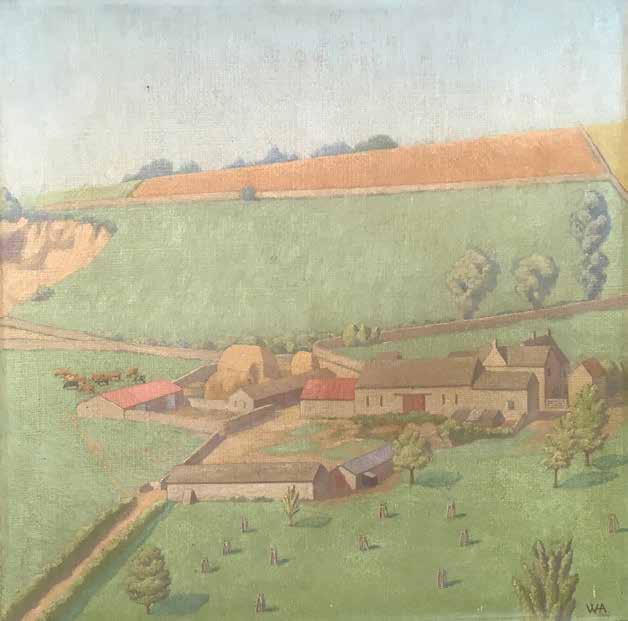
Landscape Village - Cotswold Farm Oil on canvas 51 x 50
Signed
Original label affixed verso
$4,000 - 6,000
Provenance: Sheila Allen Estate Collection
65 PETER MCINTYRE
Rangitikei River
Oil on board 50.5 x 72
Signed
$20,000 - 30,000
The Rangitikei River, it’s headwaters located to the southeast of Lake Taupo in the Kaimanawa Ranges stretches 185 kilometers, making it one of the New Zealand’s longest rivers.
It flows from the Central Plateau south past Taihape, Mangaweka, Hunterville, Marton, Bulls and to the South Taranaki Bight at Tangimoana, 40 kilometers southeast of Wanganui. The river gives its name to the surrounding Rangitikei District. In 1897 the river flooded and all six bridges over it were damaged or destroyed. The port at the mouth of the river was also washed away and never rebuilt. The river is a popular leisure and recreation area for jetboating, white water rafting, kayaking, fishing and includes public camping grounds along its banks. Its sheer vertical paapa (clay) cliffs, unique to this part of New Zealand, and deep canyons provide the perfect setting for adventure activities. The lush green bush is the crowning glory of my country and in its depths the tui and bellbird sing the purest song of them all.
The river in the painting flows out of the bush, cutting deep into the white paapa clay to make cliffs that catch the sun and the moon all along its course.
Text: Peter McIntyre’s Pacific, A H & A W Reed 1966
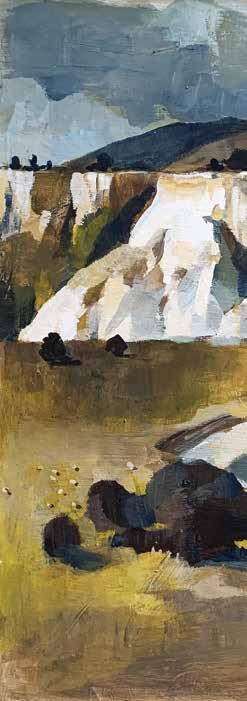
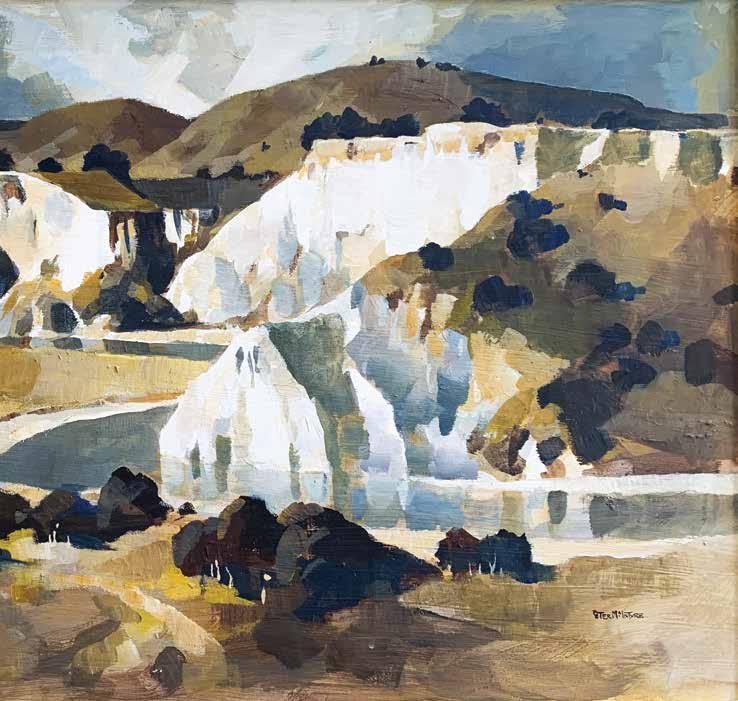
Years ago I went far up the Rangitikei beyond Taihape to visit my friend David Russell, whose farm at that time was as far as you could drive up the river into the bush. The river is so deep between high paapa cliffs that down at the bottom where the river flows there is only a sort of twilight, even on a sunny day. Once I crossed the gorge at a wider place in the bush in a tray slung on a logger’s wire rope, and we sat in mid-air watching a large trout feed in the river
below where a patch of sun broke through the overhanging bush. From that time on I have painted the river up and down its length, and always there has been delight in painting those lovely cliffs that are that most paintable of all colours - white.
Text: Peter McIntyre’s New Zealand, A H & A W Reed 1964
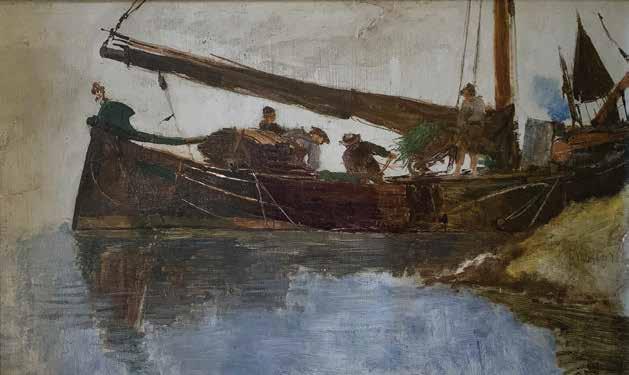
Sailing Barge Study
Oil on board 26 x 43
Signed
$3,000 - 5,000
Provenance:
Lady Diana Isaac Collection until bequeathed to The Isaac Conservation and Wildlife Trust, 2012.
Waimakariri Near the Staircase Oil on canvas 72 x 53
Signed & dated 1938
$8,000 - 12,000
Provenance:
Lady Diana Isaac Collection until bequeathed to The Isaac Conservation and Wildlife Trust, 2012.
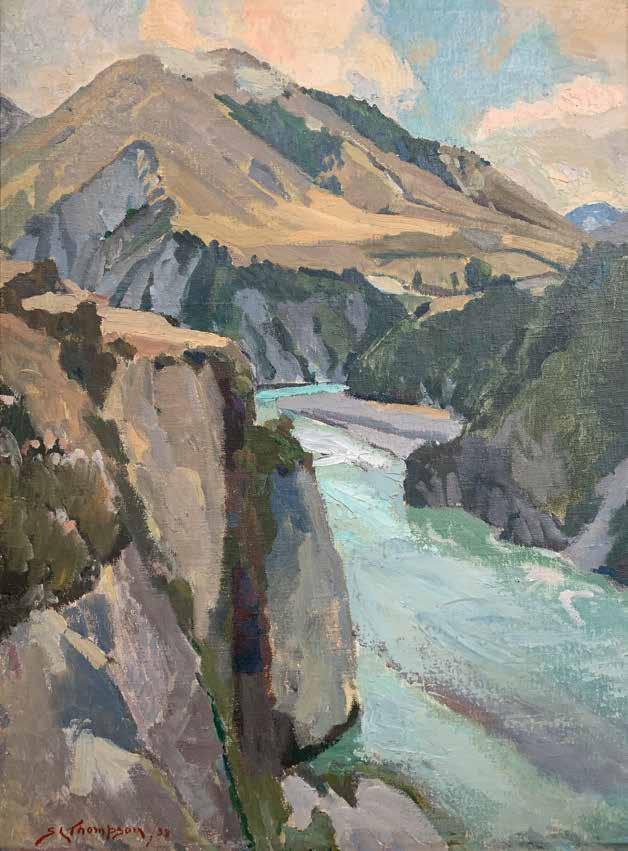
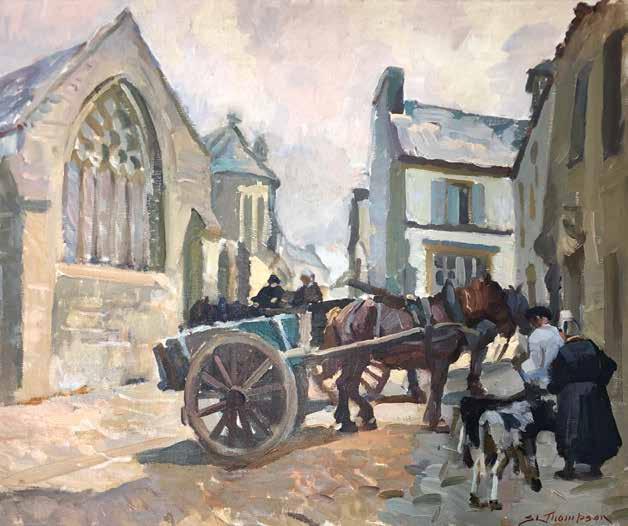
Signed
Inscribed on stretcher verso
$16,000 - 22,000
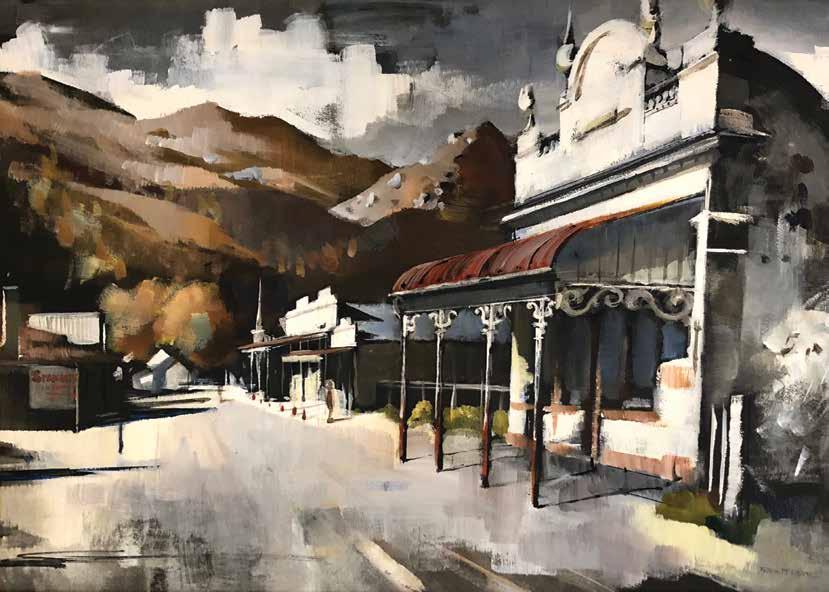
Arrowtown Oil on board 52 x 74
Signed
Inscribed on John Leech Gallery label affixed verso
$15,000 - 25,000
Provenance: John Leech Gallery, Auckland Private Collection, Auckland
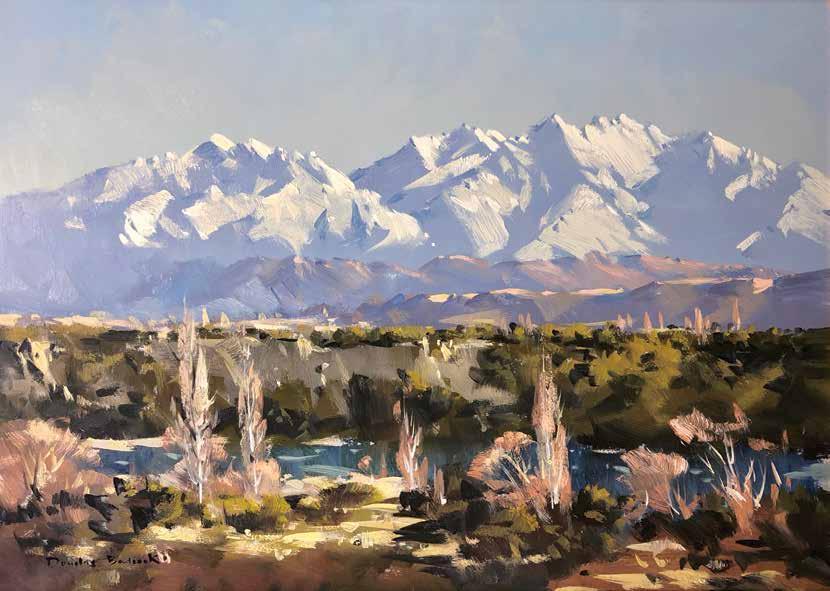
Cold and Frosty, Hawea River Oil on board 50 x 74.5
Signed
$10,000 - 15,000
Provenance:
Estate Collection
Autumn Bannockburn, Central Otago Oil on board 44.5 x 60
Signed
$10,000 - 15,000
Provenance:
Artist’s Estate Collection Plate 9 p. 30 Douglas Badcock, My Kind of Country, Whitcoulls Publishers 1978
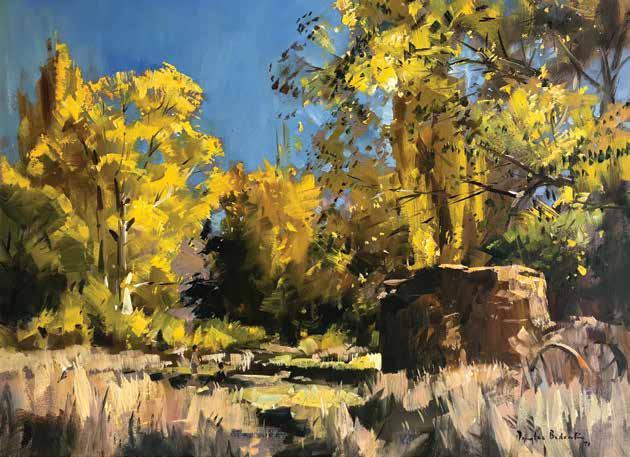
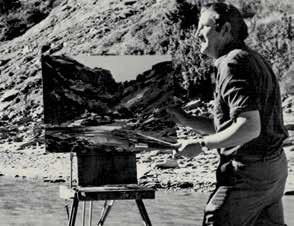
Born in Balclutha 1922 Douglas Badcock had a highly successful professional art career. Preferring to paint en plein-air, mostly in oil, Douglas earned a reputation as one of New Zealand's leading landscape painters. His paintings are included in the Queen of England's collection and King of Thailand's collection. Douglas was a Kelliher art award winner and several books have been published on his work. He came second in the 1959 Kelliher Art Award and third in the 1962 award.
Badcock held his first exhibition in Wellington in 1960, selling out within two days. A review at the time described him as 'a realistic painter and absolutely sincere with a natural talent and a high technical standard ... A master of the New Zealand landscape, he paints New Zealand as he sees it'. He produced at least three publications: My Kind Of Country then later My Kind of Painting and A Painter in Fiji.
In a Listener article in 2004, Mr Badcock said: paint seas, skies, mountains. I paint the world I know, as it
appears to me. I have an image that is there and I have to record it. When I'm painting I let the subject reveal itself. Picasso said I don't seek, I find. And finding is a revelation - intellectually, emotionally, spiritually. The primary motivation is self-expression, but if there's no vision, if we don't see beauty in nature any more, then we're nowhere.
72
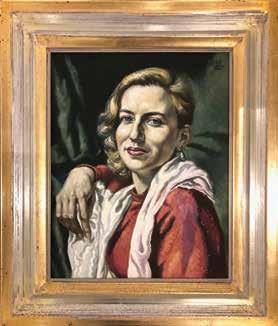
LEONARD MITCHELL
Portrait of Artist’s Wife, Patricia Marion Nickalls
Oil on canvas 50 x 39
Signed & dated 1955
$1,500 - 2,500
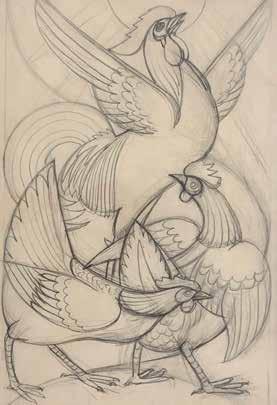
73 ANNA LOIS WHITE Rooster Study
Graphite on paper 51 x 34
Certificate of authenticity signed by Allison Disbrowe, the artist’s niece
$1,500 - 2,000
74
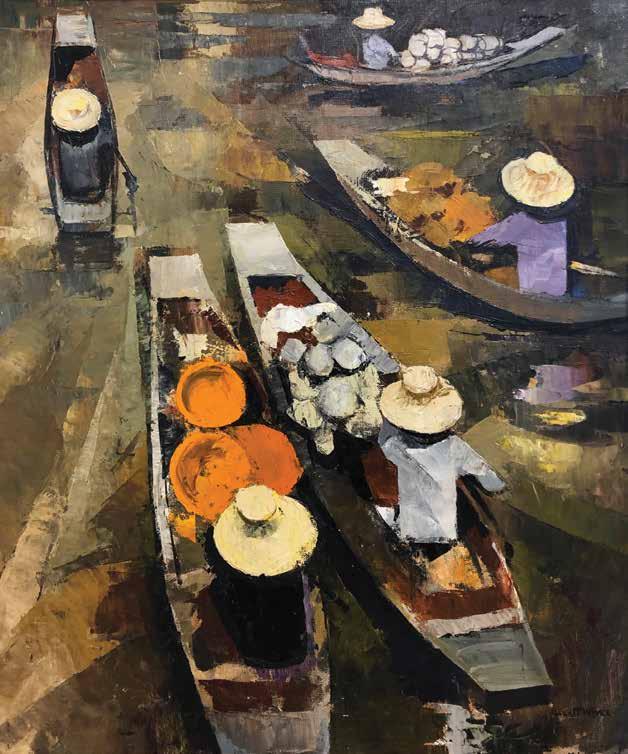
PETER MCINTYRE
Floating Market, Bangkok
Oil on canvas 71 x 60
Signed
$8,000 - 12,000
Illustrated: Plate 38 Peter McIntyre’s Pacific
A H & A W Reed 1966
All through the waterways this procession, as in the painting, passes endlessly, graceful and swiftlychanging, with colours that charm, merge and clash, constantly exciting the senses. The Kodak shutters go click, clickety, click. A priest in a yellow robe, shaven head, with an alms-bowl and an aloof, withdrawn face; add a woman peddling fruit, and that is any street in Bangkok. In the early morning you will see the priests collecting their food for the day from devout housewives; then the heat comes down and Bangkok becomes a steam bath.
Peter McIntyre’s Pacific
A H & A W Reed 1966
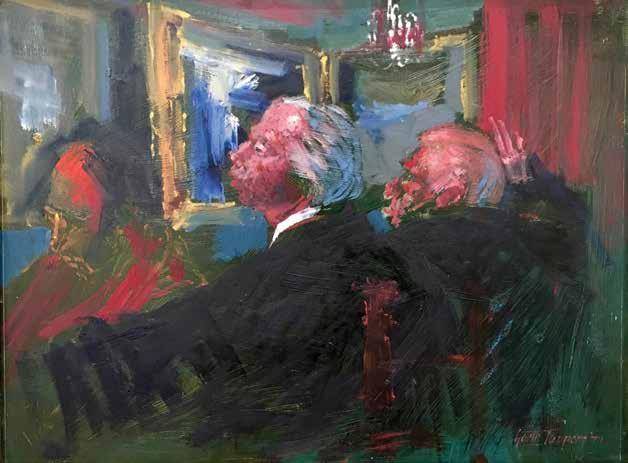
76
$6,000 -
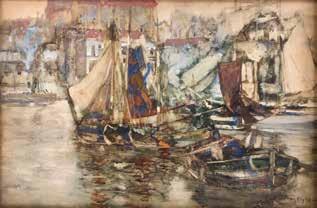
77
Scottish 1858 - 1942
The Fishing Harbour
Gouache and watercolour on paper
29.5 x 44.5
Signed; Original Jas. McClure & Son, Fine Art Dealers, Glasgow label affixed verso
$2,000 - 3,000
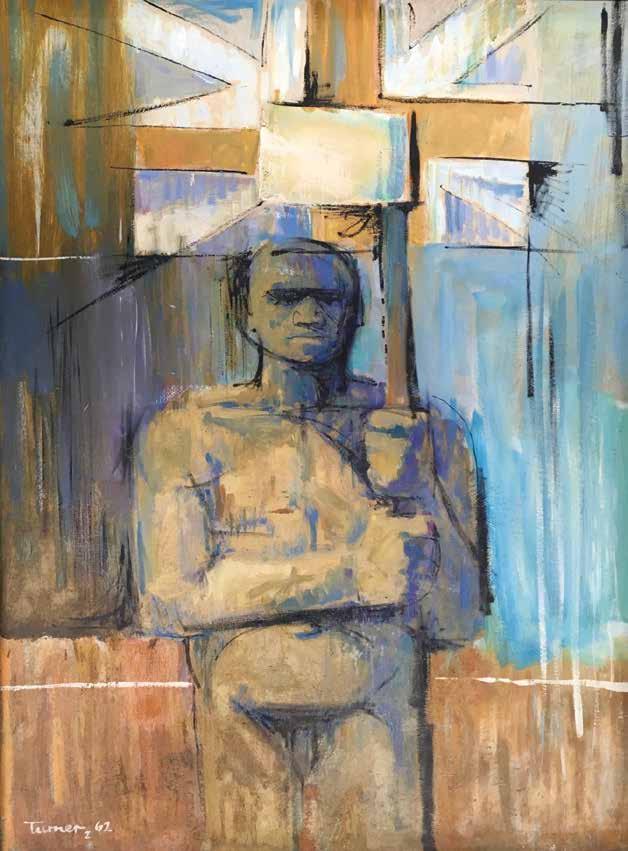
Standing Figure from the Hone Heke series
Acrylic on board 121 x 90
Signed & dated 1962
$4,000 - 6,000
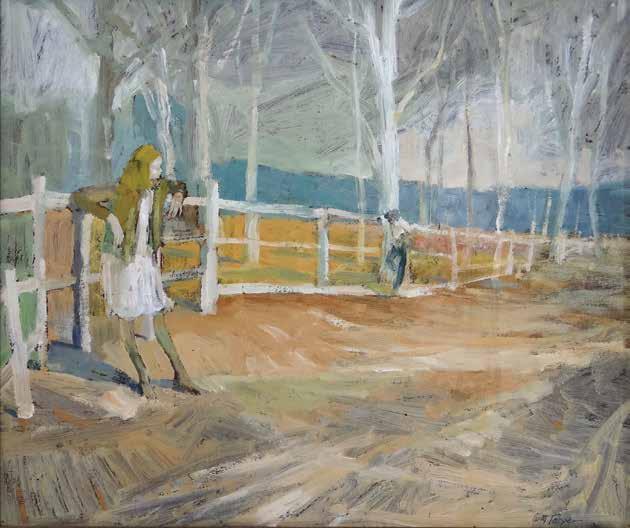
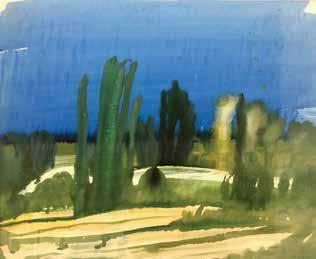
Waiting Oil on board 48 x 56
Signed
$8,000 - 12,000
Untitled Landscape
Watercolour 51 x 63
Signed
$4,000 - 6,000
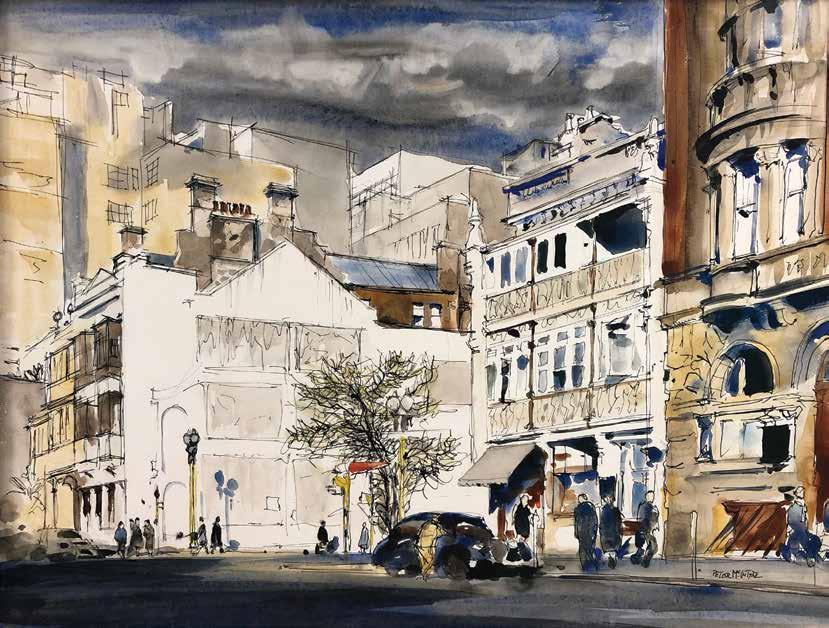
Sydney Street Scene
Watercolour and ink on paper 52 x 70
Signed
Inscribed on original label affixed verso
$7,000 - 10,000
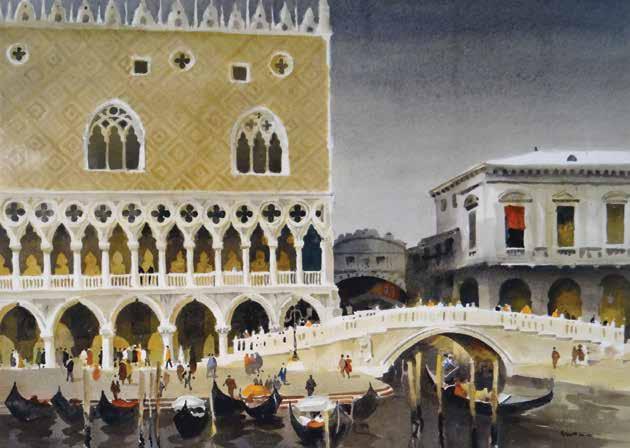
The Ponte della Paglia & Ducal Palace
Watercolour 51 x 70.5
Signed
$8,000 - 12,000
Provenance:
McGregor Wright Gallery, Wellington, c. 1975
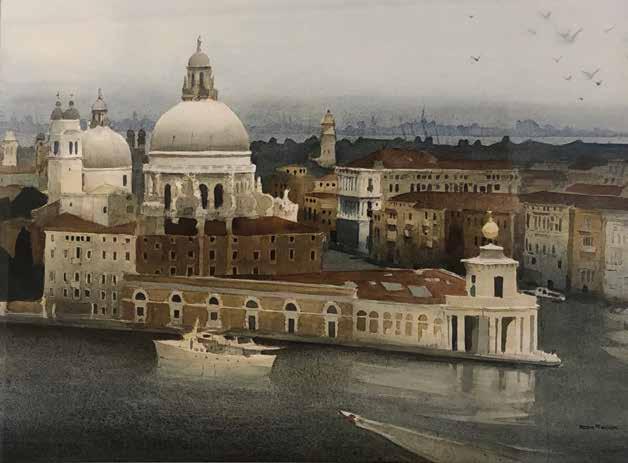
Early Morning from St Marks Square
Watercolour 52.5 x 71
Signed
Inscribed on original McGregor Wright Gallery label affixed verso
$8,000 - 12,000
Provenance:
McGregor Wright Gallery, Wellington, c. 1987
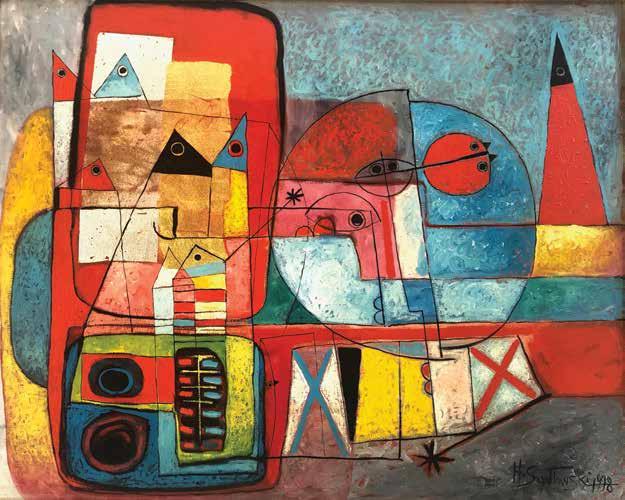
Magic from the Imaginary Field Oil on canvas 75 x 80
Signed & dated 1998
$4,500 - 6,500
Provenance:
Private Collection, Northland
International Art Centre, 1998 Original label affixed verso
84
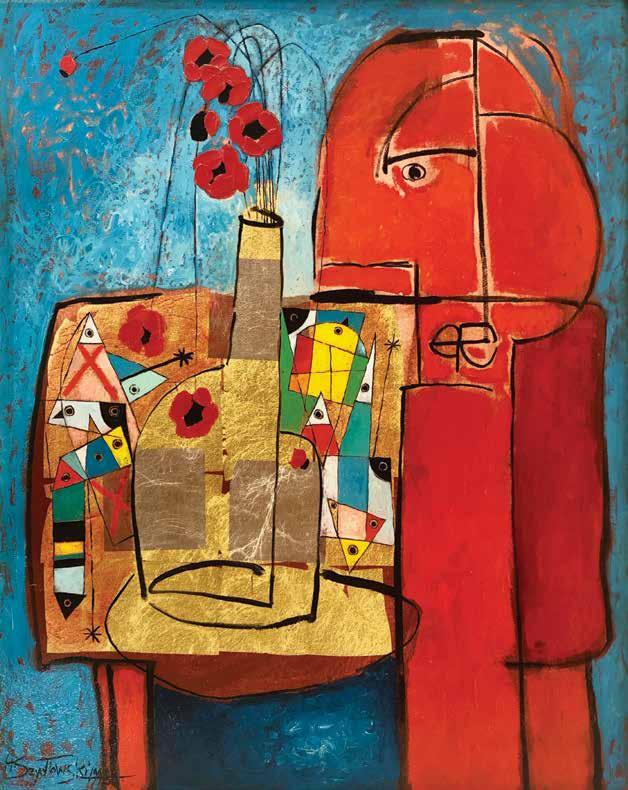
HENRYK SZYDLOWSKI
Magic Table with Poppies and the Spirit of the Bed Oil on canvas 75 x 60
Signed & dated 1998
$4,500 - 6,500
Provenance:
Private Collection, Northland International Art Centre, 1998 Original label affixed verso
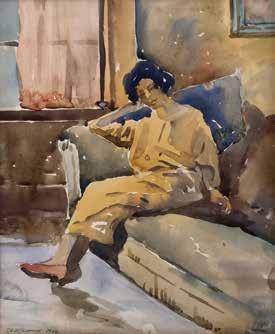
Watercolour 23 x 27
Signed & dated 1924
$2,500 - 3,500
Provenance: Private Collection, Wellington
The portrait features McCormack’s wife Mabel nee Craddock. It was painted at their home, 83a Hill Street, Wellington in 1924
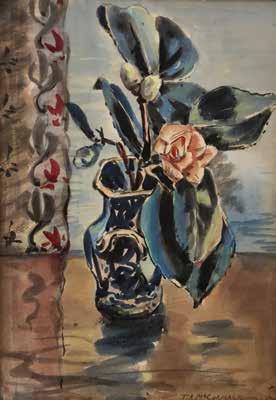
86
87
Japanese Vase with Camelias
Watercolour 26 x 19
Signed
$800 - 1,200
Provenance: Private Collection, Wellington
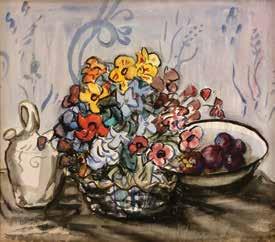
Watercolour 40 x 46
Signed
$2,000 - 3,000
Provenance: Private Collection, Wellington
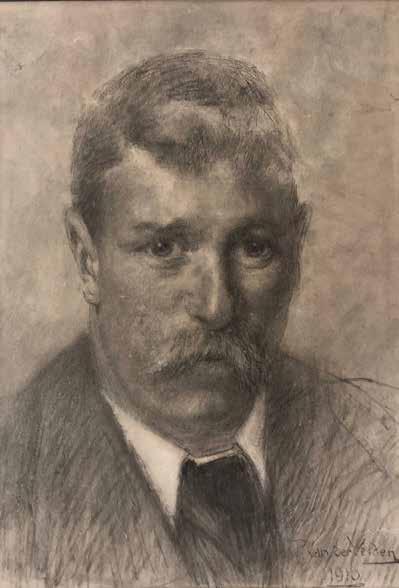
Son of the Artist
Charcoal on paper 35.5 x 24.4
Signed & dated 1910
$3,000 - 6,000
Provenance: Private Collection, Wellington
Exhibited: Robert McDougall Art Gallery, Christchurch 1963
Original Robert McDougall Art Gallery loan label affixed verso
Illustrated: p. 193 Volume II, Petrus van Der Velden, A Catalogue Raisonné T L Rodney Wilson, Chancery Chambers, 1979
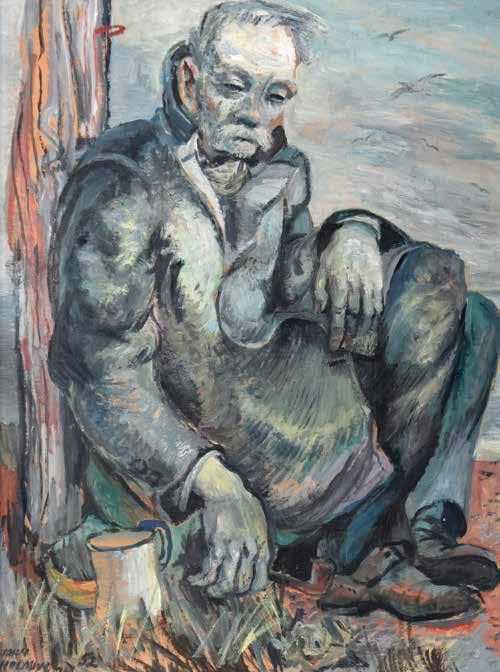
Signed Inscribed Old Man verso
$3,000 - 5,000
Provenance: Ex Holmwood Family Collection
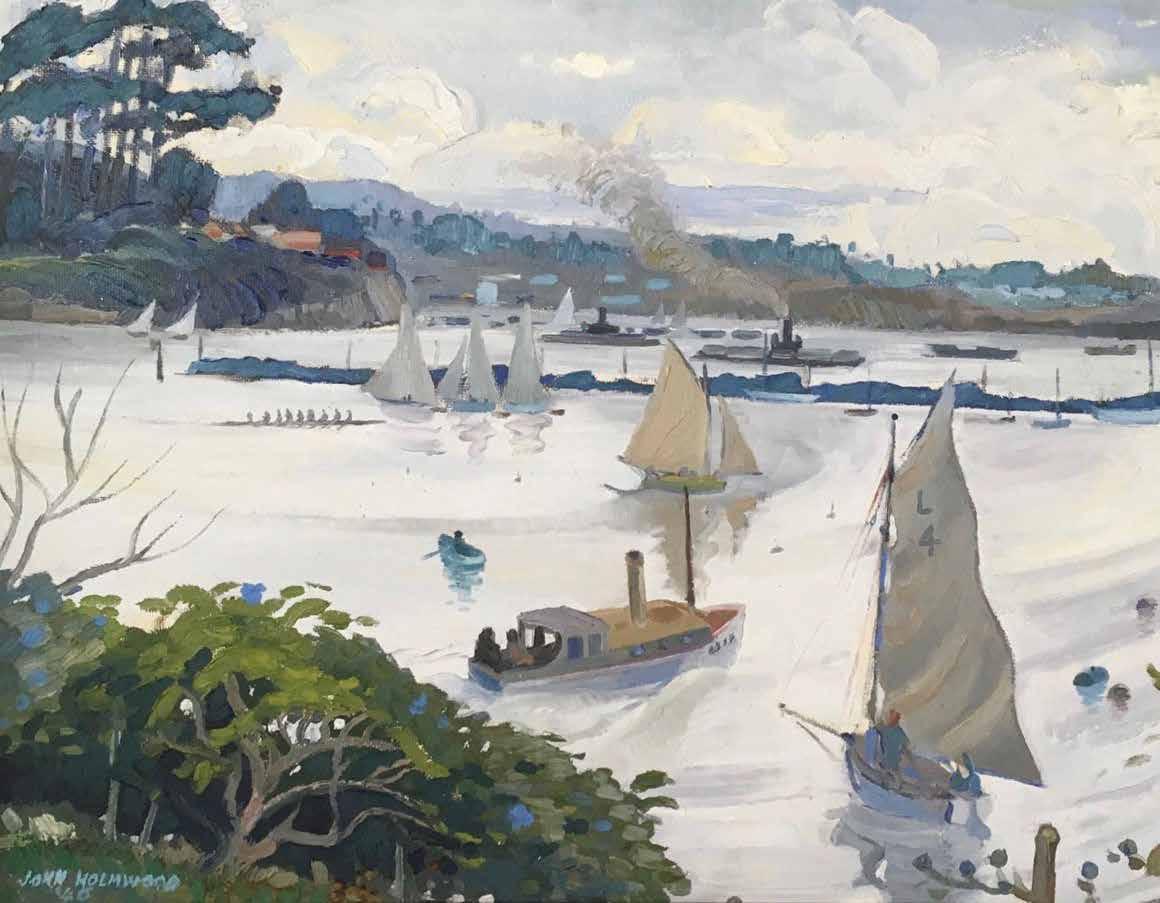
Signed & dated 1946
Inscribed verso $4,000 - 6,000
Provenance: Holmwood Family Collection
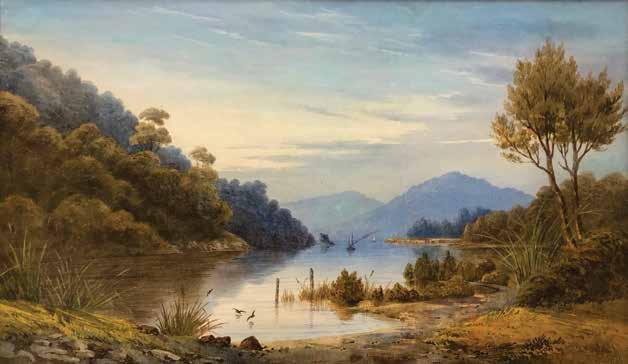
Pelorus Sound
Watercolour 27 x 47
Signed
$3,000 - 5,000
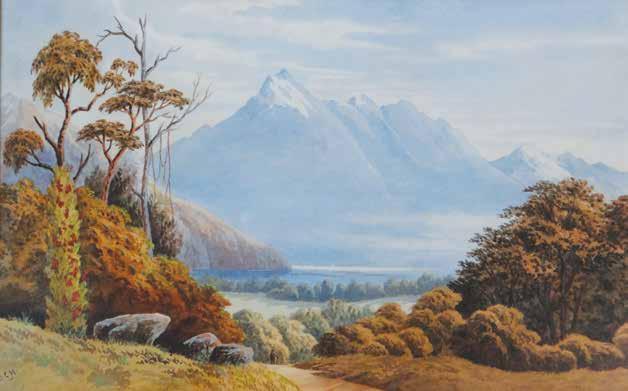
Cecil Peak, Queenstown
Watercolour 30 x 47
Signed
$7,000 - 9,000
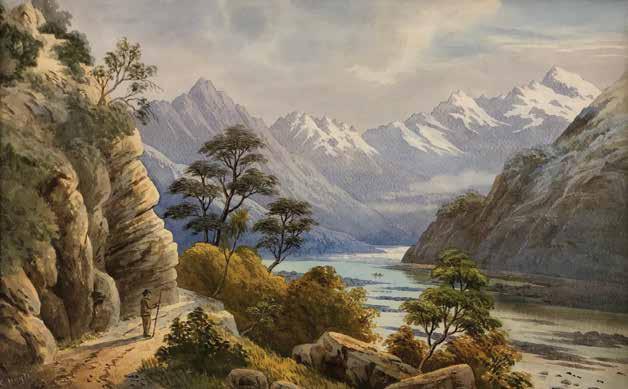
$7,000 - 10,000
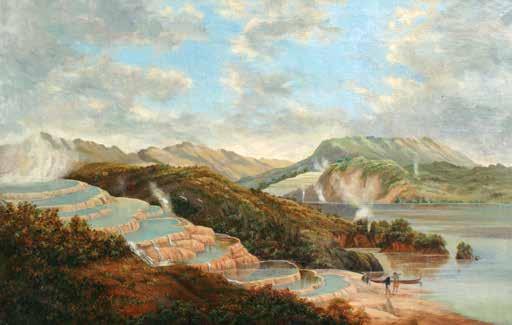
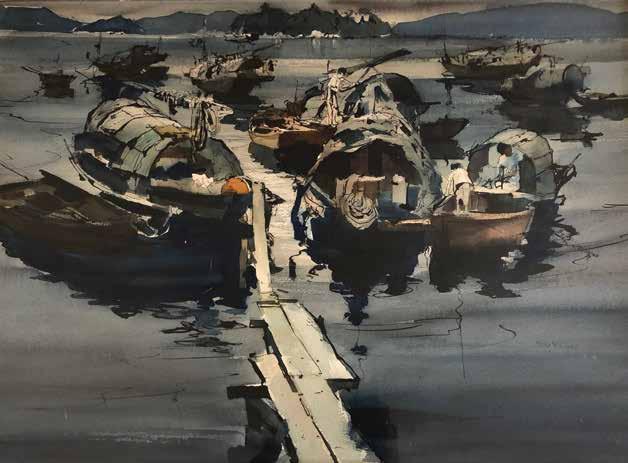
Sampans, Hong Kong
Watercolour 53 x 72
Signed
$6,000 - 8,000
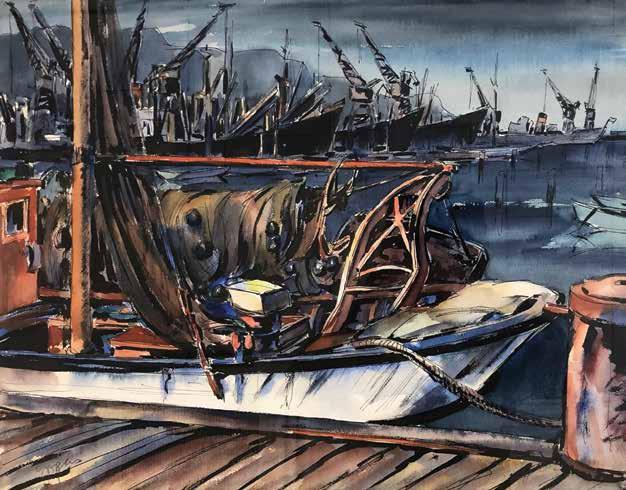
Fishing Fleet from Queens Wharf, Wellington
Watercolour and ink on paper 46.5 x 60
Signed
$3,000 - 5,000
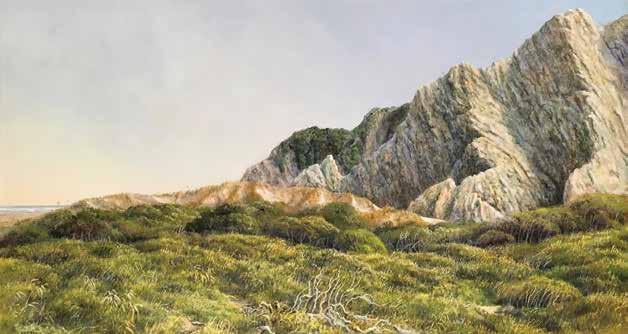
Landscape, Karekare
Oil on board 39 x 71
Signed & dated 1975
$3,000 - 5,000
Provenance:
Purchased directly from artist, 1975
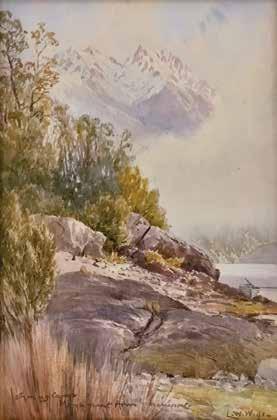
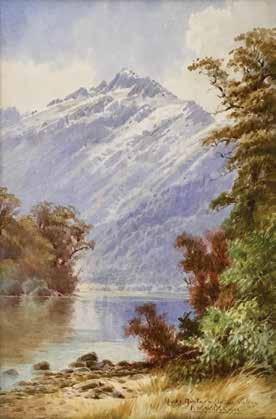
Isthmus Camp, Monument Arm, Manapouri & Lake Mintaro, Clinton Valley - A pair
Watercolour 25.5 x 17.5
Signed, inscribed & dated 1891 & 1902
$3,000 - 5,000
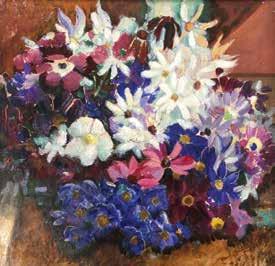
Pink and Blue Bouquet Oil on board 38 x 39
Signed verso
Certificate of Authenticity affixed verso
$2,000 - 3,000
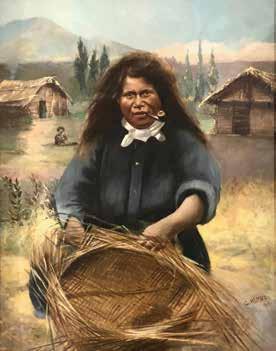
100 CHARLES HEMUS
Maori Woman Weaving Oil on board 39.5 x 31
Signed & dated 1916
$2,500 - 3,500
101 CHARLES BLOMFIELD
Whanganui River Oil on board 25 x 45
Signed & dated 1903
$3,000 - 5,000
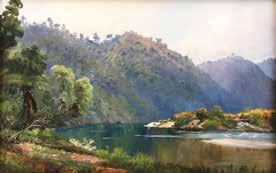
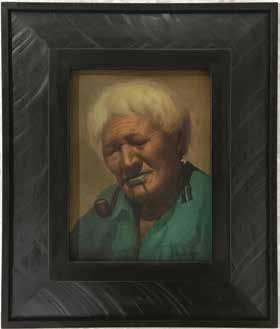
102 VERA CUMMINGS
Maori Elder with Pipe and Moko Oil on canvas 19.5 x 14.5
Signed
$6,000 - 8,000
103 tom peerless
Mt Egmont, Taranaki Watercolour 39 x 55
Signed & inscribed
$1,000 - 2,000
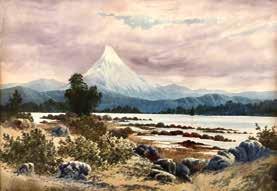
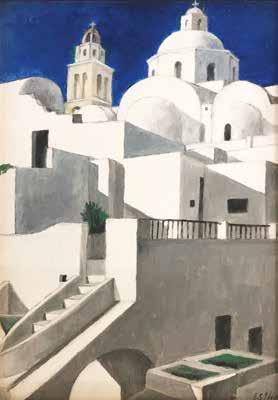
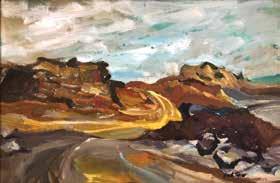
Oil on board 33 x 23
Signed
$4,500 - 6,500
105
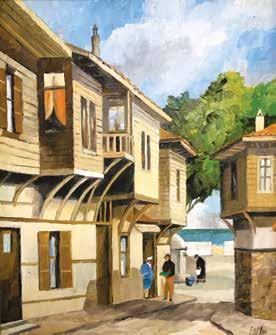
Bulgaria
Oil on board 36 x 30
Signed
$2,500 - 3,500
106
Oil on board 40 x 58
Signed
Inscribed verso
$1,000 - 2,000
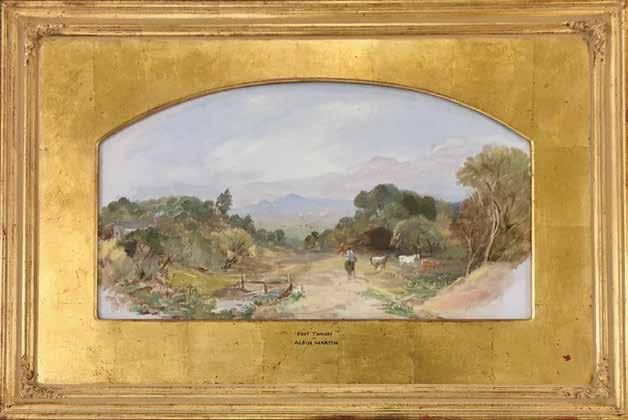
Sketch at East Tamaki Oil on panel 23.3 x 43
Signed & inscribed verso
$4,000 - 6,000
Kotuku - White Heron at Okarito Oil on canvas board 80 x 65
Signed
$5,000 - 8,000
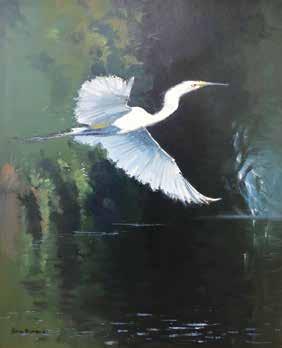
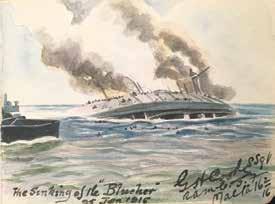
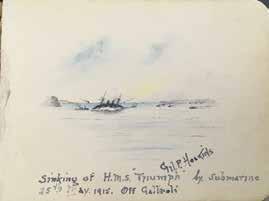
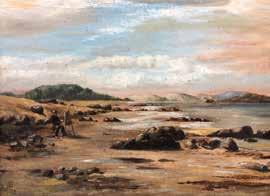
109
Various watercolour illustrations including the Sinking of KMS Blucher
The Beaching of the Albion, Gaba Tepe
Signed & dated 1915 by various Military Personel with other historic events
$800 - 1,200
Each page of this lot can be viewed as a PDF on our website www.internationalartcentre.co.nz
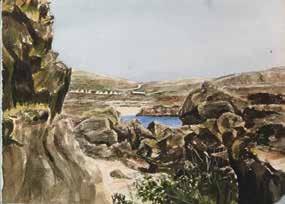
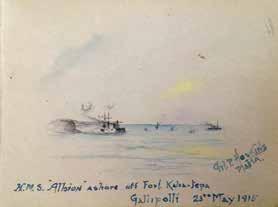
Signed
$1,000 - 2,000
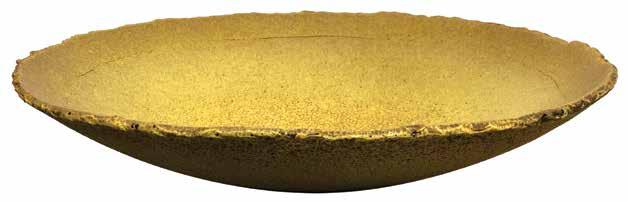
111 LEN CASTLE
Yellow Sulphur Bowl
Stoneware with yellow cracquelure
interior glaze 51 x 12
Impressed initials on base
$3,500 - 5,500
112 robert thorburn ross
Scottish 1816 - 1876
Children in a Farmyard Oil on board 24 x 21
Signed
$800 - 1,200
113 ARCHIBALD FRANK NICOLL
A Moonlit Evening Near Cairo Oil on canvas 63 x 75
Signed
$1,500 - 2,500
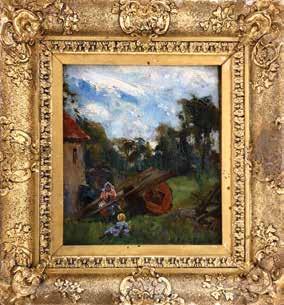
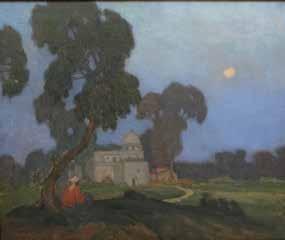
Important & Rare auctions are the proven, preeminent sale category for major works of art offered for sale in New Zealand. These auctions take place three times annually. As we fast approach our 50th year in business, experience continues to equal results. 2014 saw Important & Rare auctions realise five of New Zealand’s top ten auction prices. The following year saw new records set with the two top prices in Auckland achieved. With the addition of the record $1.377 million paid for a C F Goldie in April’s 2016 sale, International Art Centre achieved the three highest art auction prices in New Zealand’s history. Due to an appreciative, and greatly valued clientele of nationwide and international buyers and sellers we look forward to breaking new ground.
Twice a year our Modern & Contemporary Art auctions play an integral role in enabling market access to the most sought-after artists who have defined New Zealand’s art narrative over the past 50-years. These sales never fail to present an exciting offering of both painting and sculpture by a range of our modern and contemporary greats. Spanning that vital period from the establishment of mid-century modernism through to the cutting edge of our national contemporary art discourse, this is an acclaimed and significant event in the auction calendar. Our new state-of-the-art premises will ensure contemporary art is now exhibited and auctioned in a dynamic and appropriate environment.
The buzz generated by our Artists’ Estates & Collectable Art auctions reflects the popularity of this sale: an event at which seasoned connoisseurs and budding collectors alike converge to appreciate one of the most eclectic and diverse offerings available to the market. Because this auction specifically caters to the more affordable end of the market - generally presenting works valued at $5,000 and less, this is an exciting opportunity to unearth some real treasures. Artists’ Estates & Collectable Art auctions offer a number lower-priced works from highly-sought after artists in print and edition form, as well as quality works from artists whose presence on the secondary market is just beginning to crystallise.
From time to time, the secondary market is fortunate enough to be exposed to one of those rare collections which transcends the value of its individual works of art, and stands to represent something iconic in its entirety. Our team is well-versed in the process of offering single-owner collections for sale, and take pride in the process of curating a single-owner sale when the opportunity arises. We offer a targeted marketing campaign and maximise the use of both electronic and print-based collateral to effectively showcase such collections to maximum effect. The strong networks we have established locally and internationally are reflected in some of the private collections which have been entrusted to us in recent years.
CONTACT
Richard Thomson
Ph +64 9 379 4010
M. 0274 751 071
E. richard@artcntr.co.nz
Maggie Skelton
Ph +64 9 379 4010
E. maggie@artcntr.co.nz
Luke Davies
Ph +64 9 379 4010
E. luke@artcntr.co.nz
www.fineartauction.co.nz
202 Parnell Road, Auckland
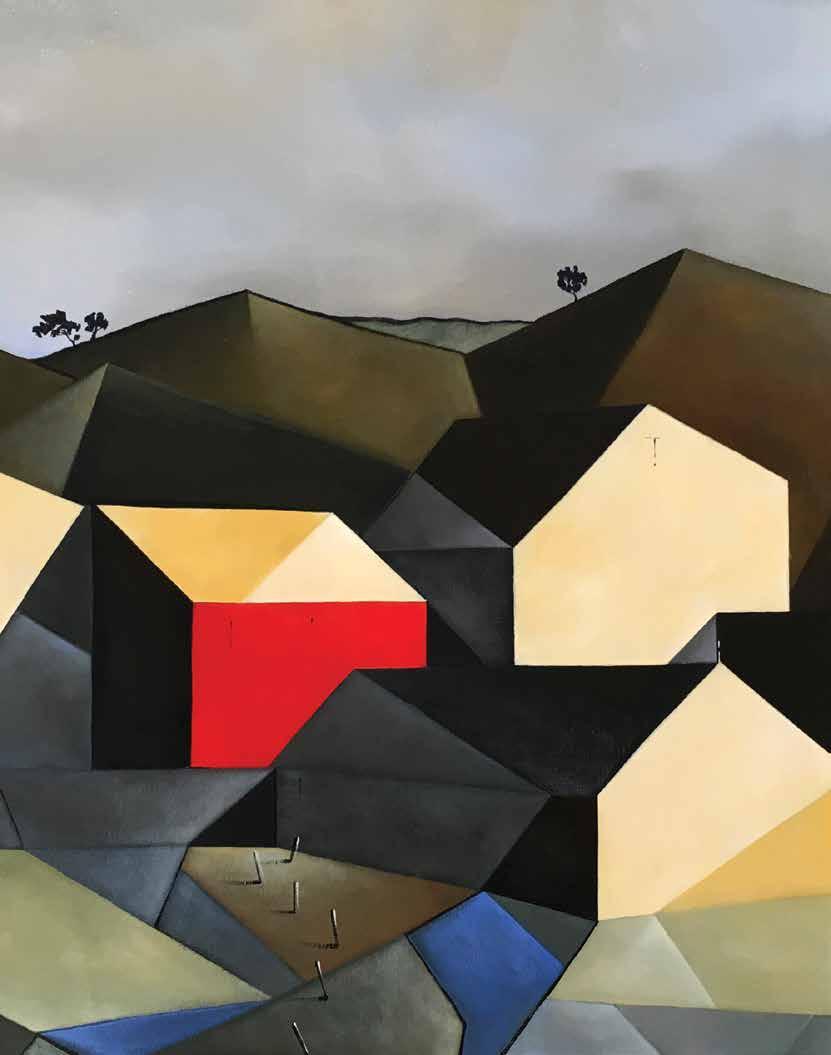
11 - 20 April
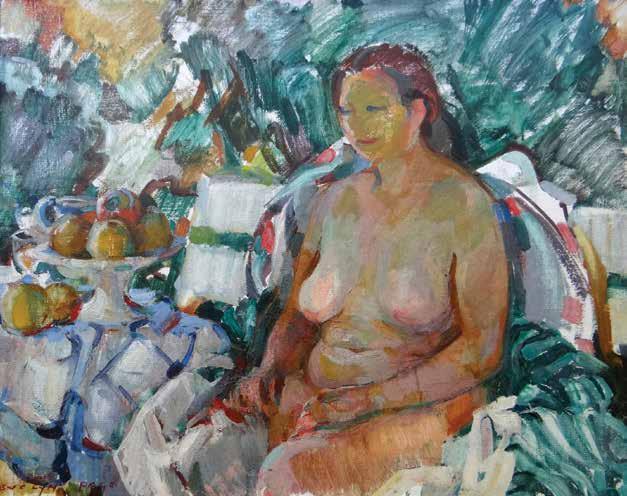
Evelyn Page’s Seated Nude, 1962, Oil on canvas 60 x 75cm, features Khura Skelton, partner of Poet and Publisher, Denis Glover. The work is illustrated in Selected Letters of Denis Glover, ed. Sarah Shieff, Otago University Press 2017.
It was in the collection of New Zealand writer, poet and educator, Sylvia Constance Ashton-Warner MBE until she died in Tauranga, 1984.
Contact: Richard Thomson
Ph +64 9 379 4010 richard@artcntr.co.nz
www.internationalartcentre.co.nz
International Art Centre provides formal valuations for insurance purposes, specialising in the preparation of catalogued and photographed inventories. Written valuations can be arranged by appointment. We provide free informal, verbal estimates for any of the works in your collection. For valuation enquiries & quotes contact Maggie Skelton maggie@artcntr.co.nz
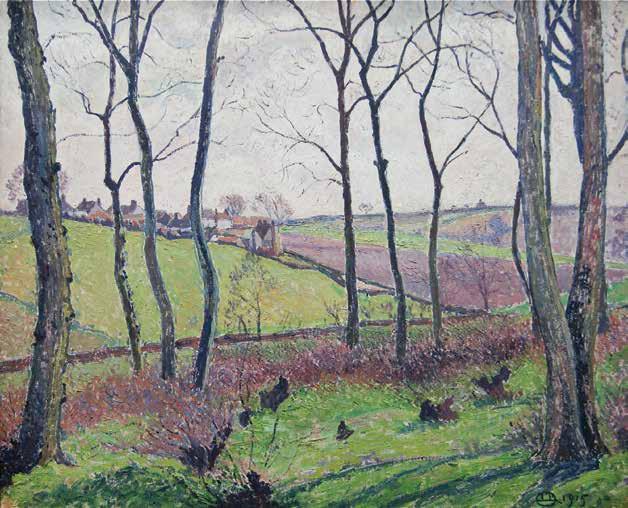
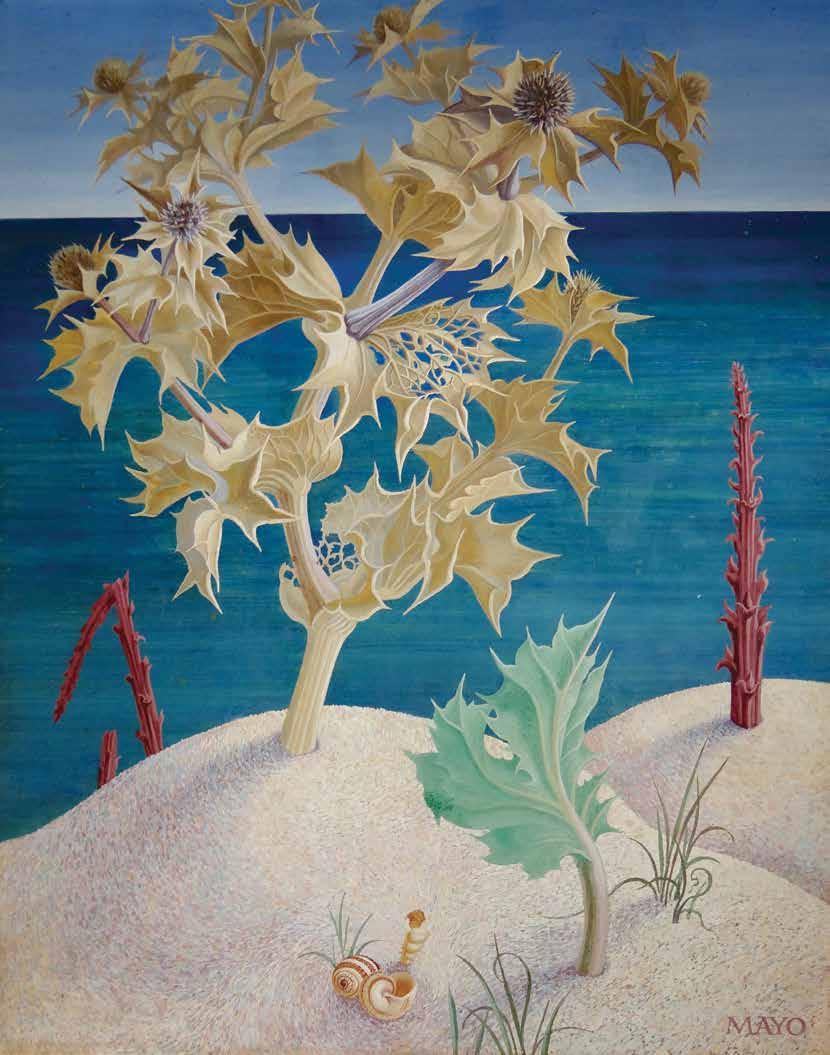
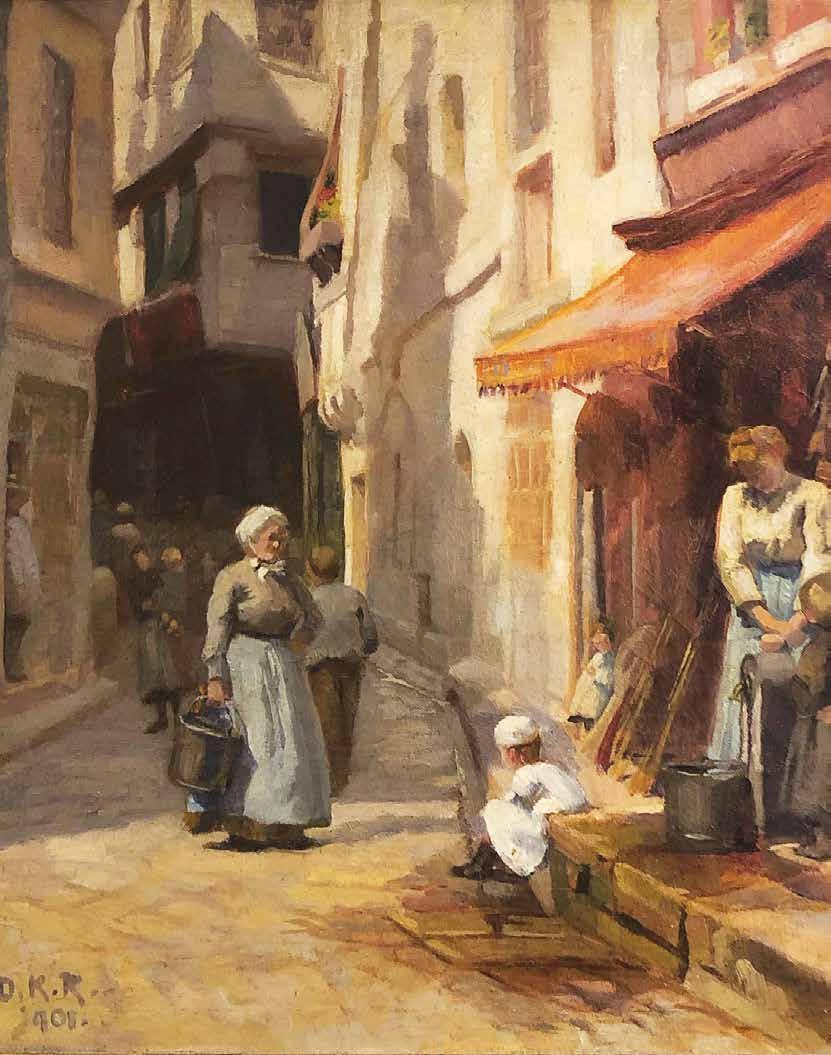
HOYTE J B C 91, 92, 93, 41, 42
P 65, 69, 74, 80, 81, 82, 95
G ........................................................... 48 NICOLL A F .................................................... 113 NIGRO J 22
B 23
S 51
T .................................................. 103
P ........................................................... 9 RICHMOND D K .............................................. 60
G 58 RIE L & COPER H 54, 55, 56 ROBINSON A ................................................ 4, 6 ROSS R T ......................................................... 112 SCALES F .......................................................... 61
SCOTT I .............................................................. 2
SHARPE A 34
SIDDELL P 3, 15, 97
SMITHER M ............................................... 27, 79
STICHBURY P .................................. 10, 11, 12 ,13
STRINGER T ...................................................... 5
SZYDLOWSKI H 83, 84
TAPPER G 24, 75, 78, 106
TAYLOR E M 7
THOMPSON S L ......................................... 67, 68
THOMSON E .................................................... 14
TURNER D K .................................................... 77
VAN DER VELDEN P 66, 88
WALSH J 17
WEEKS J........................................................... 99 WHITE A L ....................................................... 73
WILLIAMS M ................................................... 29
WILSON L W .................................................... 98
7:00pm Tuesday 9 APRIL 2019
I instruct International Art Centre to bid on my behalf for the following lots up to the prices indicated below. I understand my bids are to be executed at the lowest attainable price level. All bids are subject to Conditions of Sale printed in this catalogue.
REGISTRATION NUMBER
NAME
ADDRESS
TELEPHONE
Signature ........................................................................................... / / 2019
International Art Centre offers this service to clients unable to attend sale and is not responsible for error or failure to execute bids.
Fax +64 9 307 3421 or post to PO Box 37344 Parnell, Auckland 1151 before 3pm day of sale
Alternatively, register then bid online www.fineartauction.co.nz
202 Parnell Road, Auckland, New Zealand Tel + 64 9 379 4010 Fax 09 307 3421 email info@internationalartcentre.co.nz www.fineartauction.co.nz
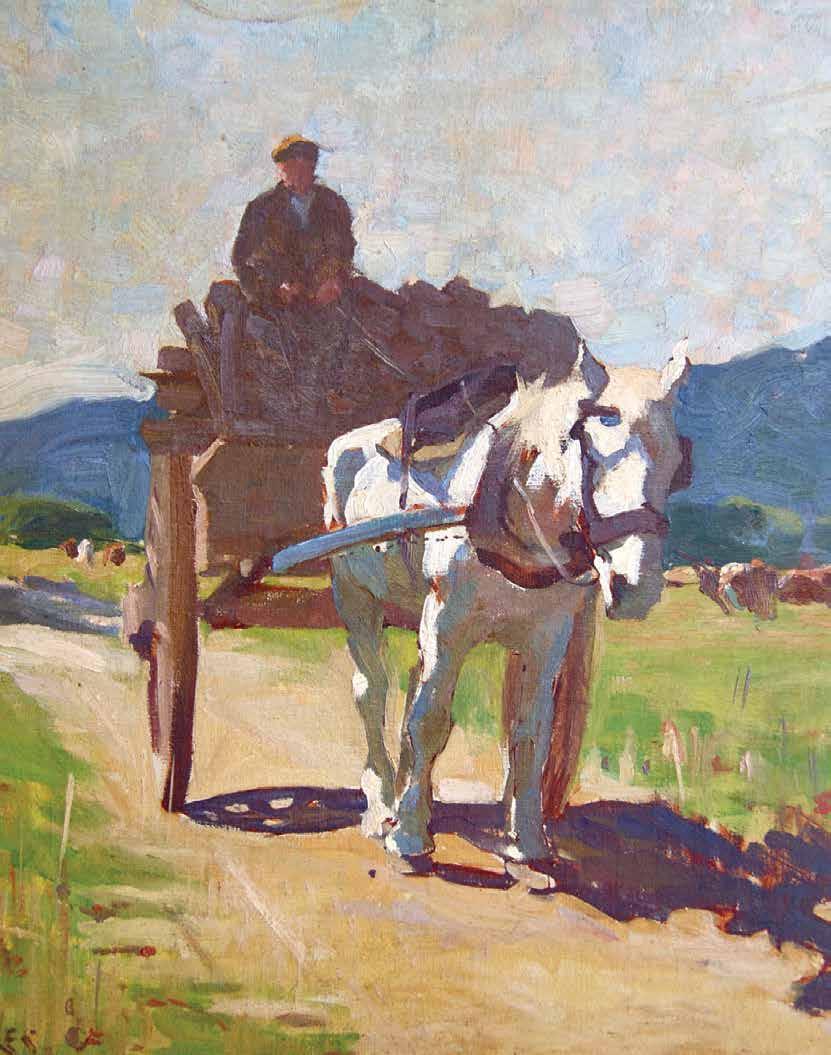
The highest bidder shall be the buyer. In the event of any dispute as to the bidding in respect of any lot, that lot may be offered again at the discretion of the auctioneer whose decision shall be absolute and final.
The auctioneer has the right -
(i) to refuse any bid;
(ii) to advance the bidding at his absolute discretion;
(iii) to place a reserve on any lot;
(iv) to place a bid or bids on behalf of the seller;
(v) to withdraw any lot from sale;
(vi) to require a successful bidder to pay forthwith the whole or any part of the purchase price.
The auctioneer acts as the agent of the seller and neither he nor the seller shall be responsible for any defects or faults in any lot or for any errors of description or for genuineness or authenticity of any lot and no compensation shall be paid in respect of same.
From the time of lot being sold, such lot will be the responsibility of the buyer.
Successful bidders are required to pay for purchases immediately on completion of sale unless otherwise arranged.
All intending buyers are required to register for a bidding number prior to auction commencing. Subscribers can use their permanent bidding number. We reserve the right to ask for identification if you are a first time client of International Art Centre.
Each lot shall be paid for and removed at the buyers expense by no later than 5pm Thursday 11 April 2019 unless otherwise arranged failing which the auctioneer and/or the seller shall have the right to forfeit any deposit paid by the buyer and to resell the lot either by public or private sale and any deficiency on costs of resale shall be borne by the defaulting buyer.
No lot may be collected whilst auction is in progress. Payment can also not be made until completion of auction.
When the auctioneer declares a lot ‘subject’ this means the bid is below the set reserve and is subject to vendor accepting, rejecting or negotiating the bid. International Art Centre will endeavour to make contact with the vendor immediately after sale or the following day. If the bid is accepted, the highest bidder is obligated to make purchase.
Estimates are provided for each entry and act as a guide only. They are prepared well in advance of sale and are subject to revision at any time. Estimates are based on hammer price and do not include buyers premium.
Absentee bidding arranged - please refer to absentee bidding in back of catalogue Fax to (09) 307 3421 or post to PO Box 37 344 Parnell before 3pm day of sale. Please do not be offended if a member of our staff ask for your credit card details as security.
Absentee bids can also be left via our website to registered members. Our website www.fineartauction.co.nz acts as a useful auxiliary to the catalogue but we recommend inspection or a condition report prior to leaving a bid. Our staff will gladly supply you with a condition report on any lot.
Telephone bidding available to subscribers and registered bidders. There is no charge for this service.
Eftpos: Available for transactions depending on your daily limit.
Bank deposits: Bank instructions on invoice if paying by direct debit.
Quote the Lot number(s) purchased and Surname as reference.
Cheques: Accepted by known clients of International Art Centre or at our discretion. When posting cheques please ensure they are sent to the following address. International Art Centre PO Box 37 344 Parnell, Auckland 1151. Make cheque payable to ‘International Art Centre’. International Art Centre reserves the right to release goods once cheque proceeds have been cleared.
Credit cards: Visa and Mastercard accepted - with a 2% surcharge.
As a general rule, anyone exporting New Zealand works over 60 years of age should apply for an export certificate from the Ministry for Culture and Heritage. This does not apply to non New Zealand works. For full details visit www.mch.govt.nz
International Art Centre arrange door to door delivery both nationally and internationally. Please arrange insurance on your items prior to them leaving our premises.
Should you have any questions relating to the sale or if we can be of any other assistance please contact us during business hours on (09) 379 4010, Toll Free 0800 800 322 or email info@internationalartcentre.co.nz
17.5% Buyers premium plus GST on premium applies to all lots. (Total buyers premium is 20.12% including GST)