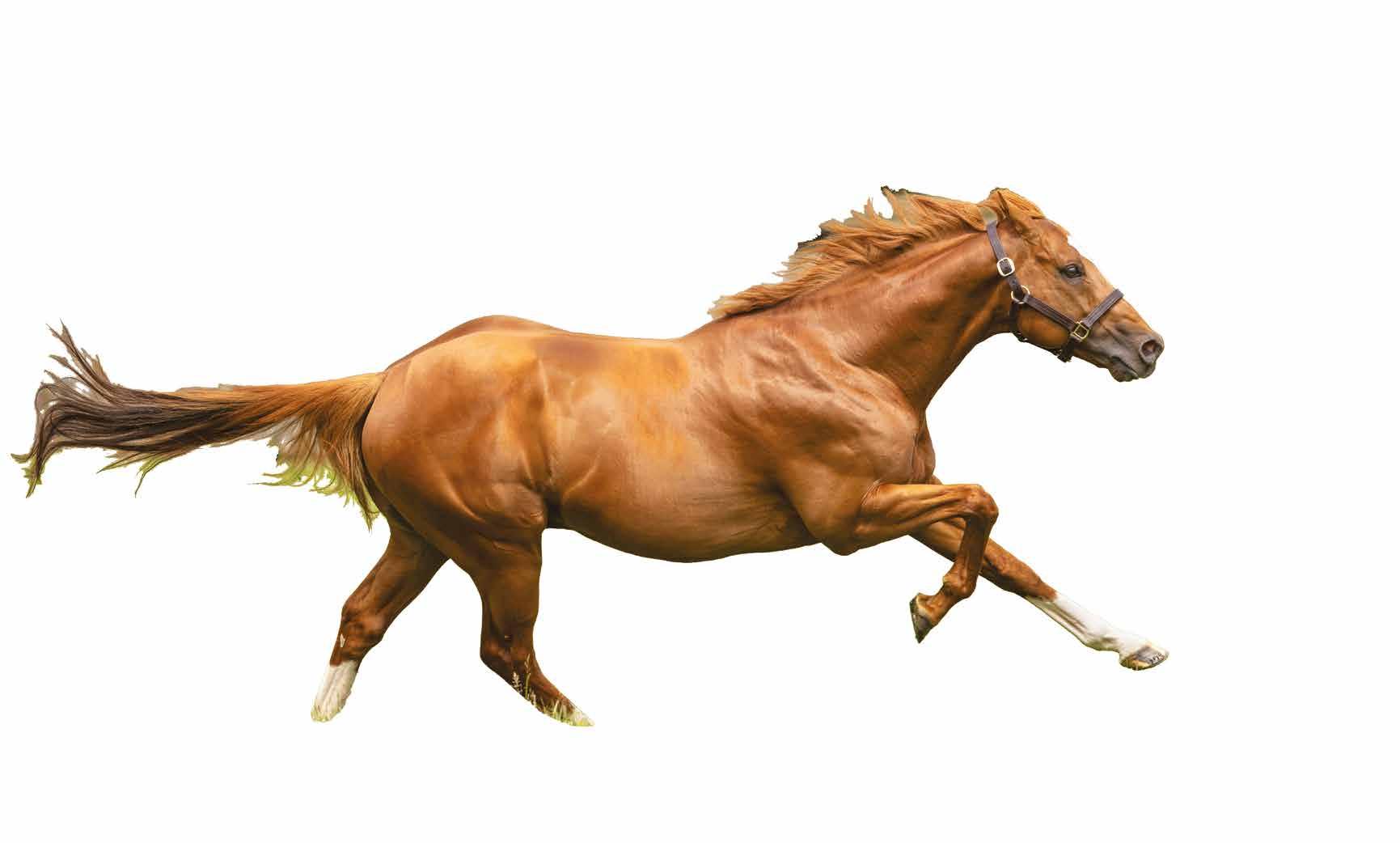
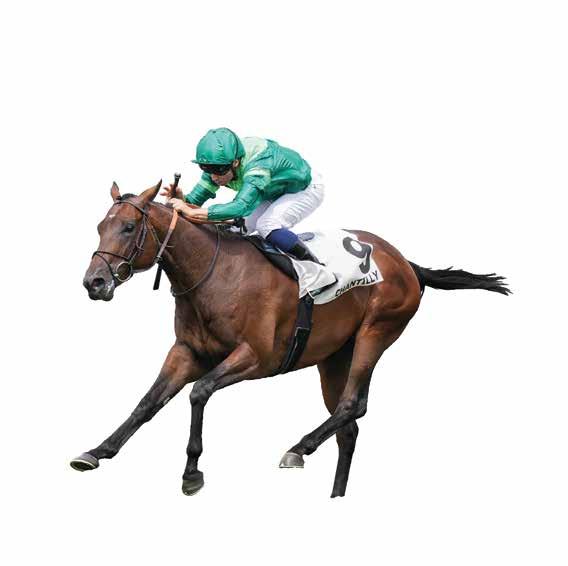
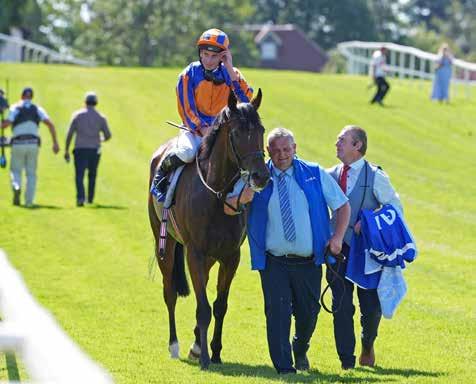
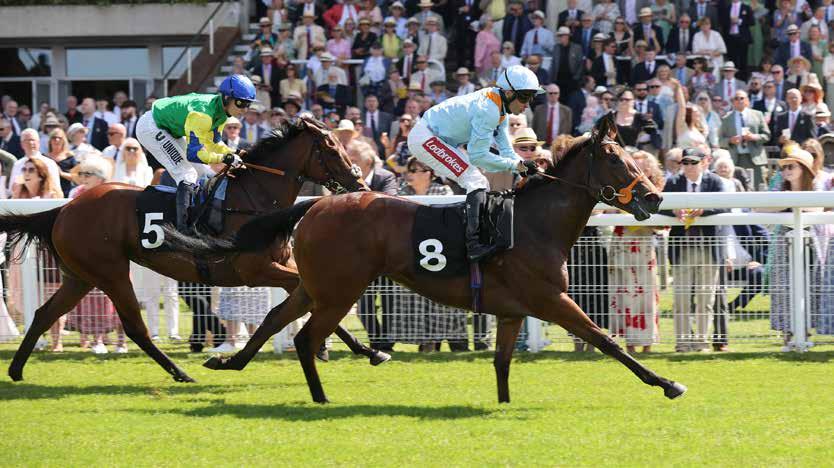
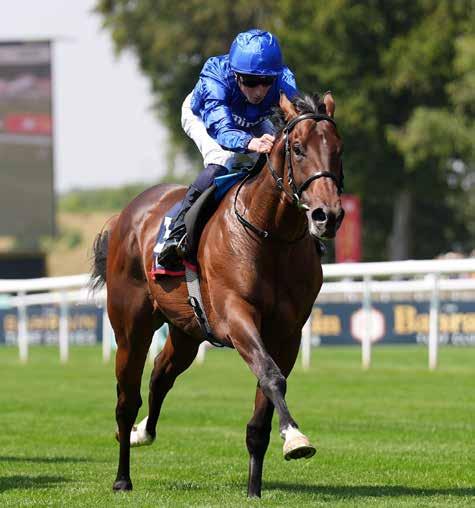
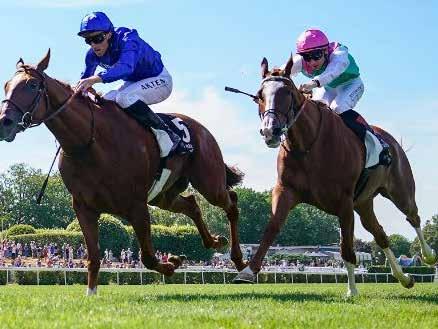
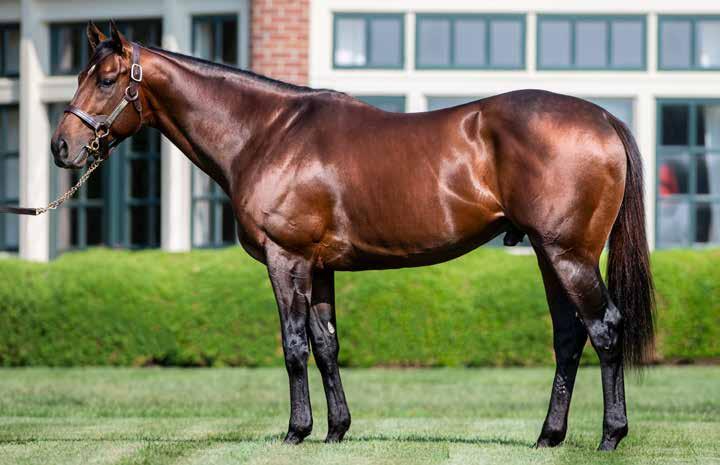
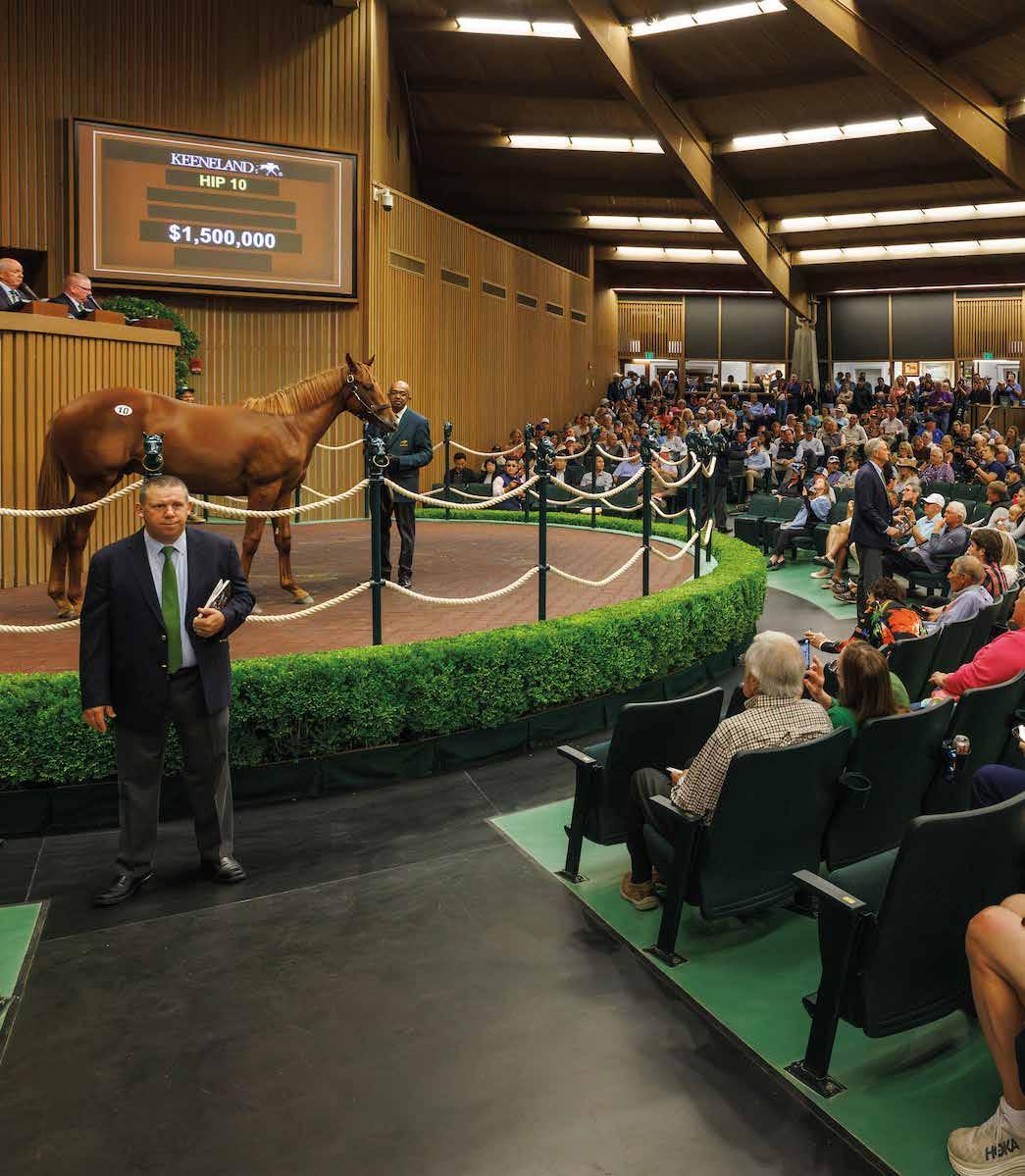
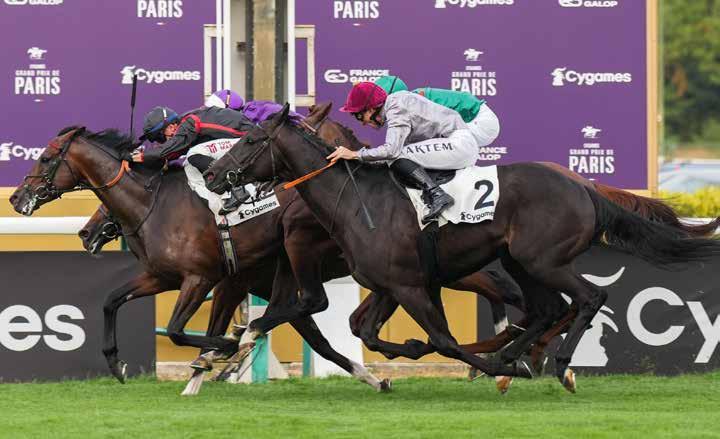
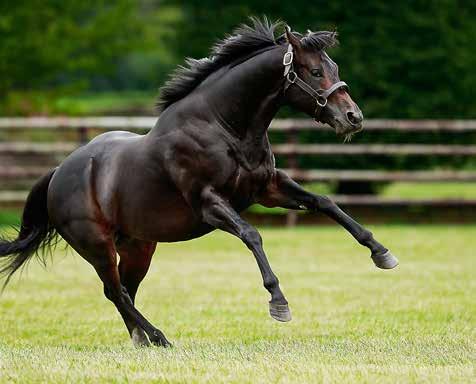
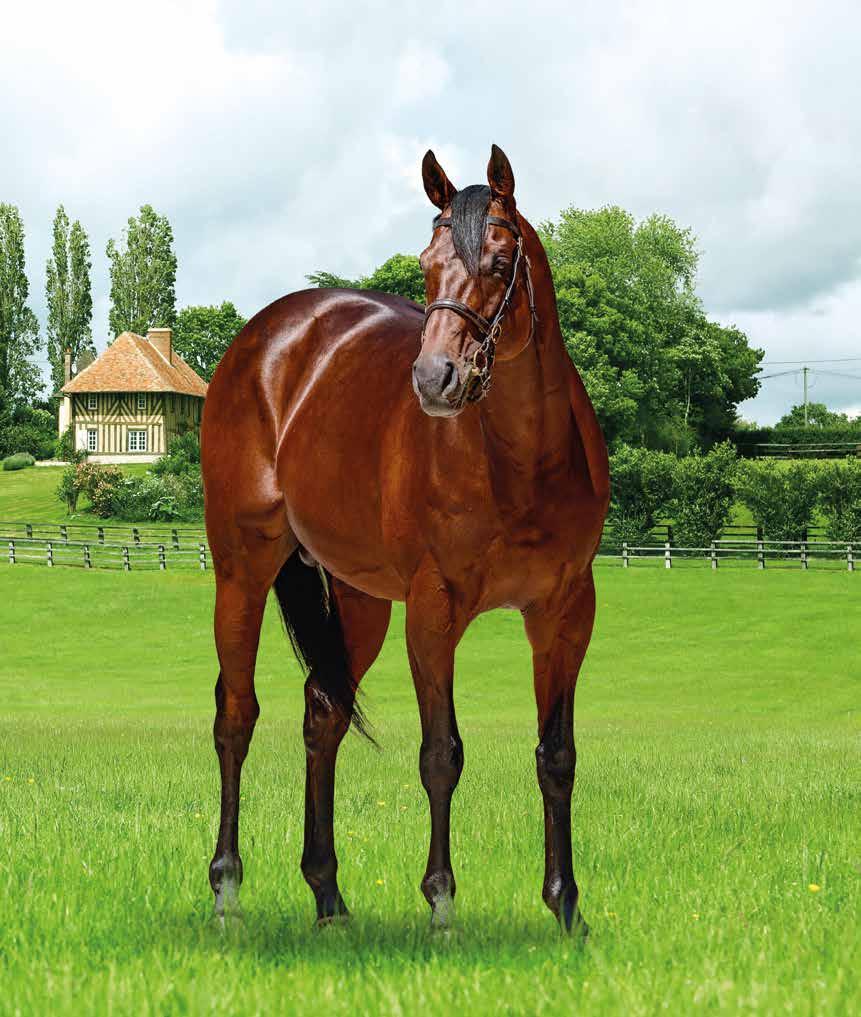
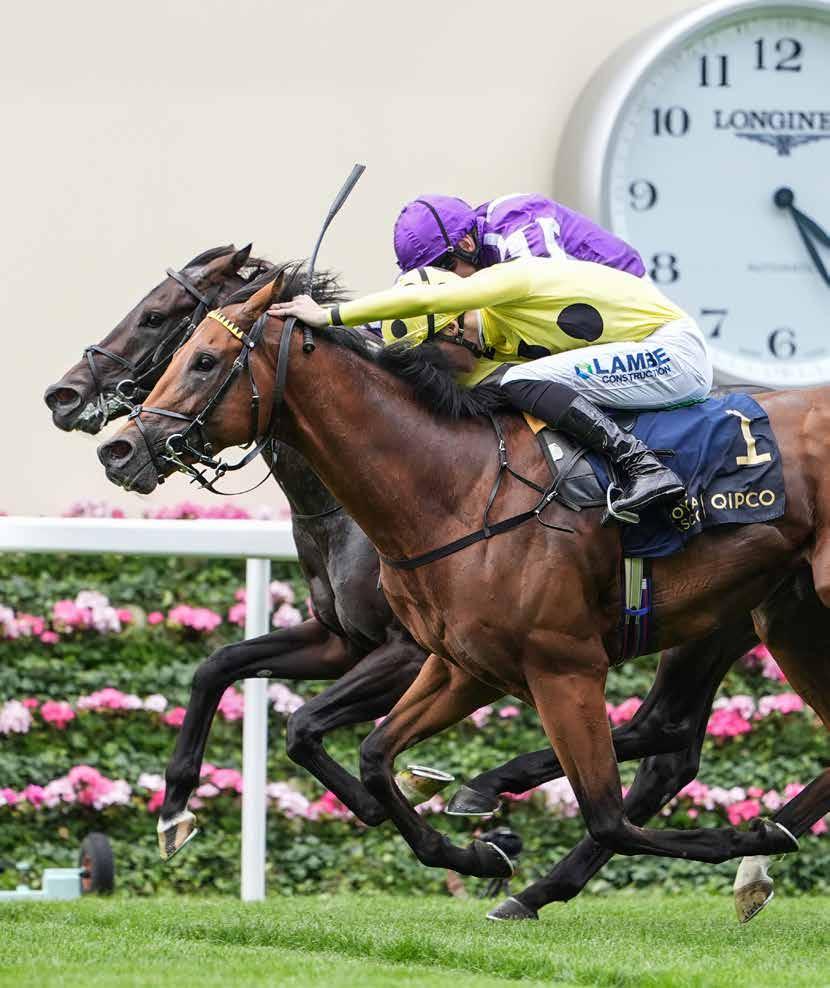
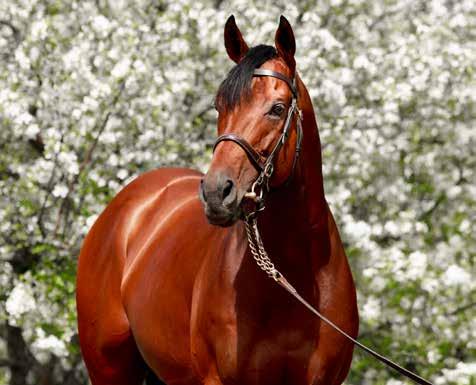
Lot 29 – Half brother by Modern Games of: ABRAHAM LINCOLN
Realised €2,300,000 yearling at Arqana Debut winner at 2YO at The Curragh in June
2nd G2 Superlative Stakes - Newmarket
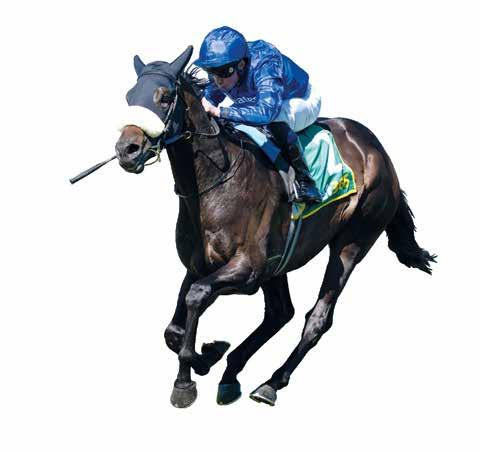
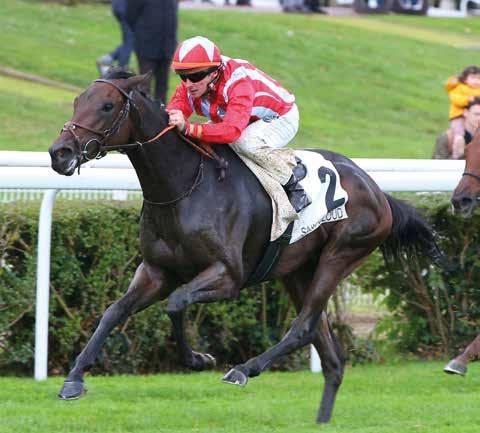
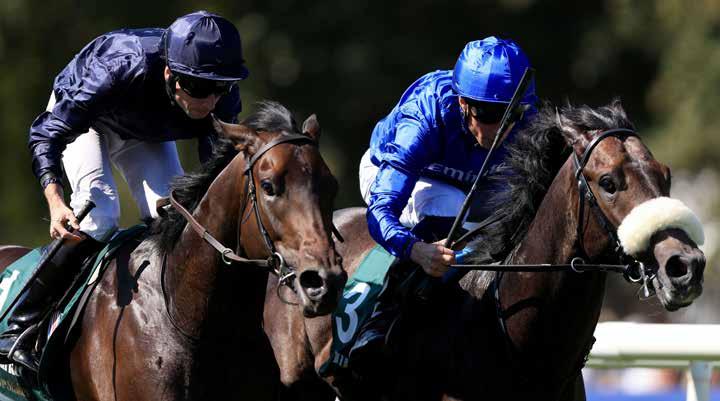
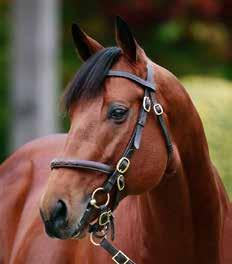
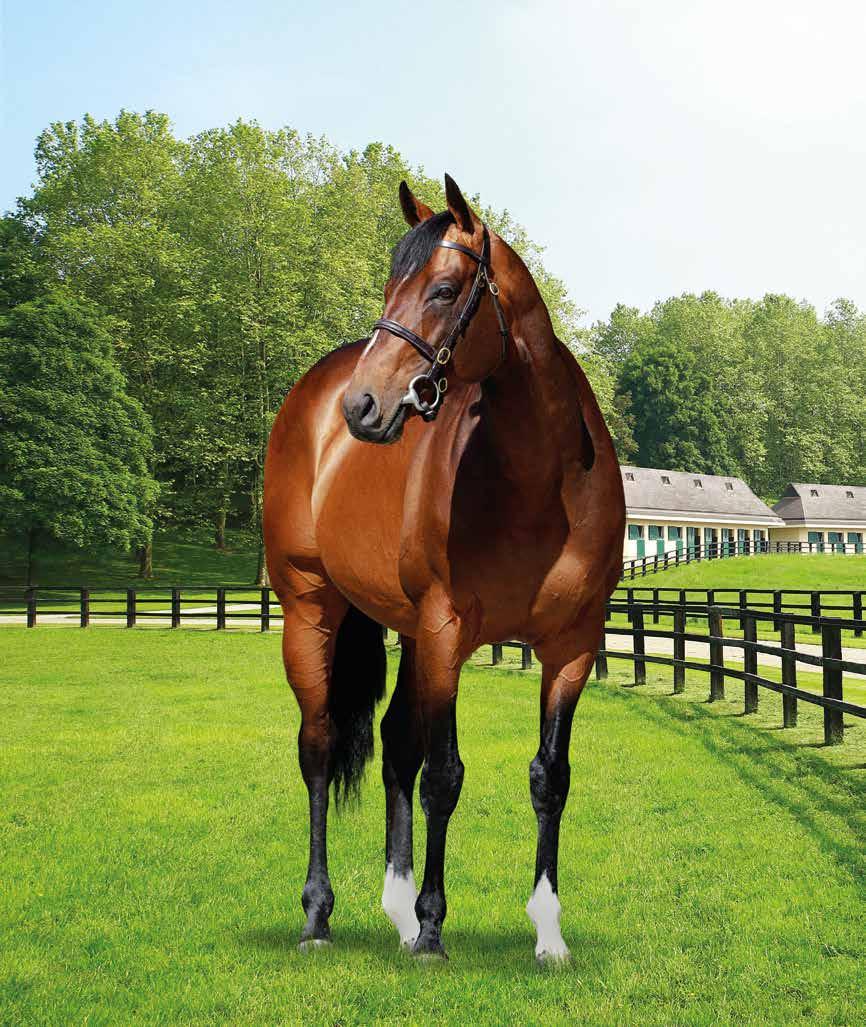
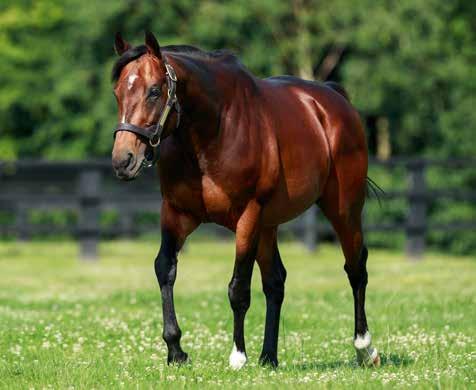
Lot 86 – Full sister by Wootton Bassett of: SPEAK OF THE DEVIL
2nd G1 Poule d’Essai des Pouliches
3rd G1 Prix Rothschild G2 winner
This month, Leo’s Diary was penned in Lebanon, a country which has had its share of troubles
Cathy reports on an enjoyable July Week with stud graduations, a Darley stallion parade, Tattersalls sales and top-class racing
The Lloyd Report
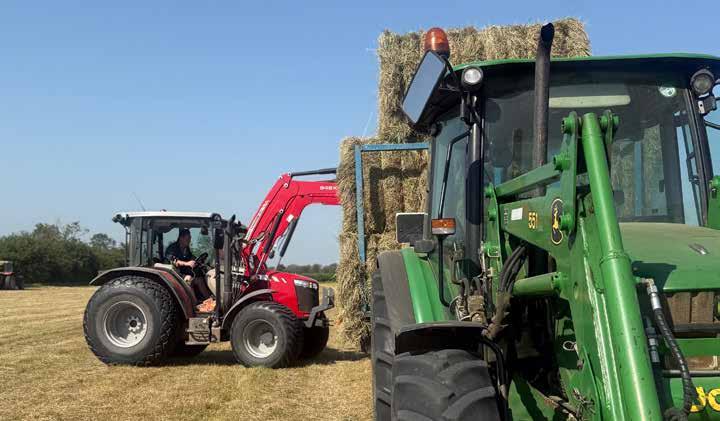
Jamie has been out on the tractor getting in a bumper crop of hay at Far Westfield Farm, but has learnt the lessons of trying to grow commercial, profitable arable crops
A Royal winner with Classic hopes, a three-timer for Blue Point, a juvenile Group winner for Dark Angel and a progressive July Cup hero
It was another unforgettable and enjoyable Deutsches Derby meeting, while in France Calandagan was back to his brilliant best
Flightline’s first runners are starting to fire, and Magnitude is taking command of the US older horse division
Stallion Scene
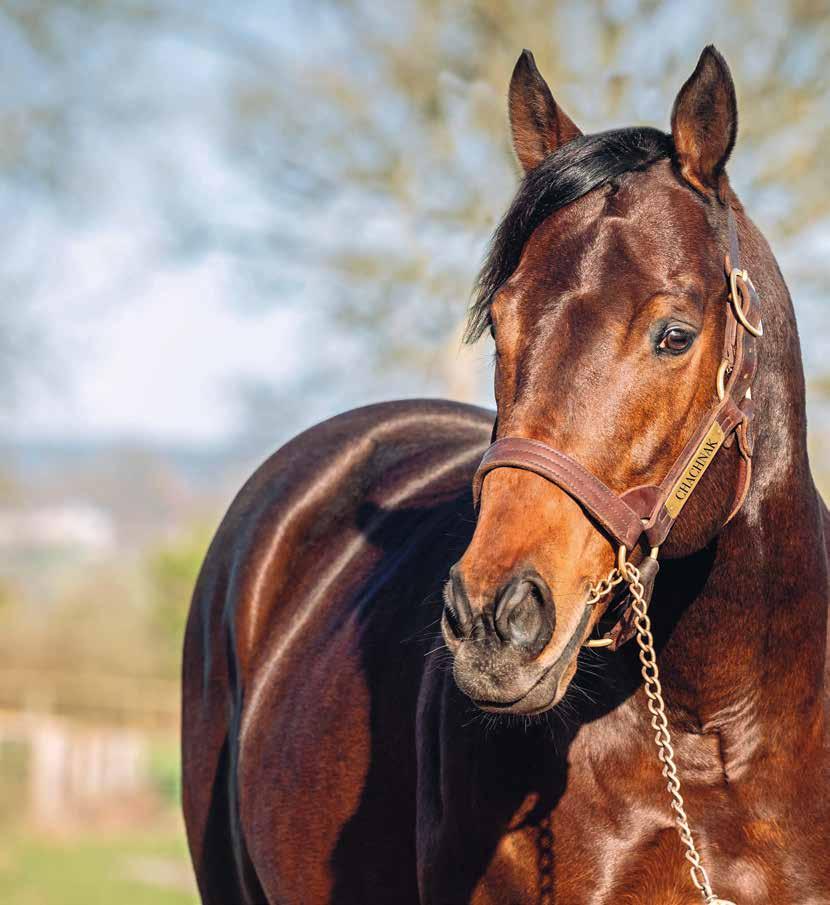
Unheralded sire Chachnak came within a hair’s breath of a European Group 1 double – the stallion is making his mark and is reminiscent of the young Wootton Bassett
Al Shaqab’s roster is rolling – it is headed by the leading French-based stallion Zelzal, who has a top three-year-old for this year
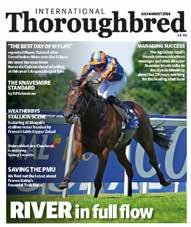
64 A strong Constitution
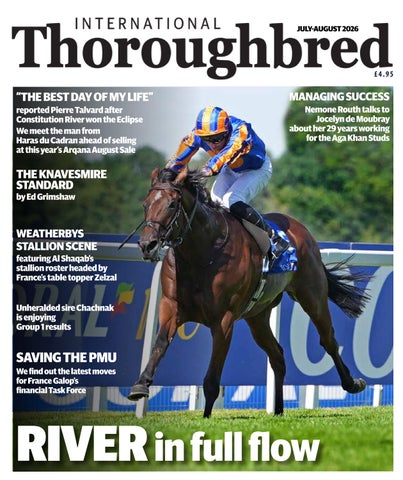
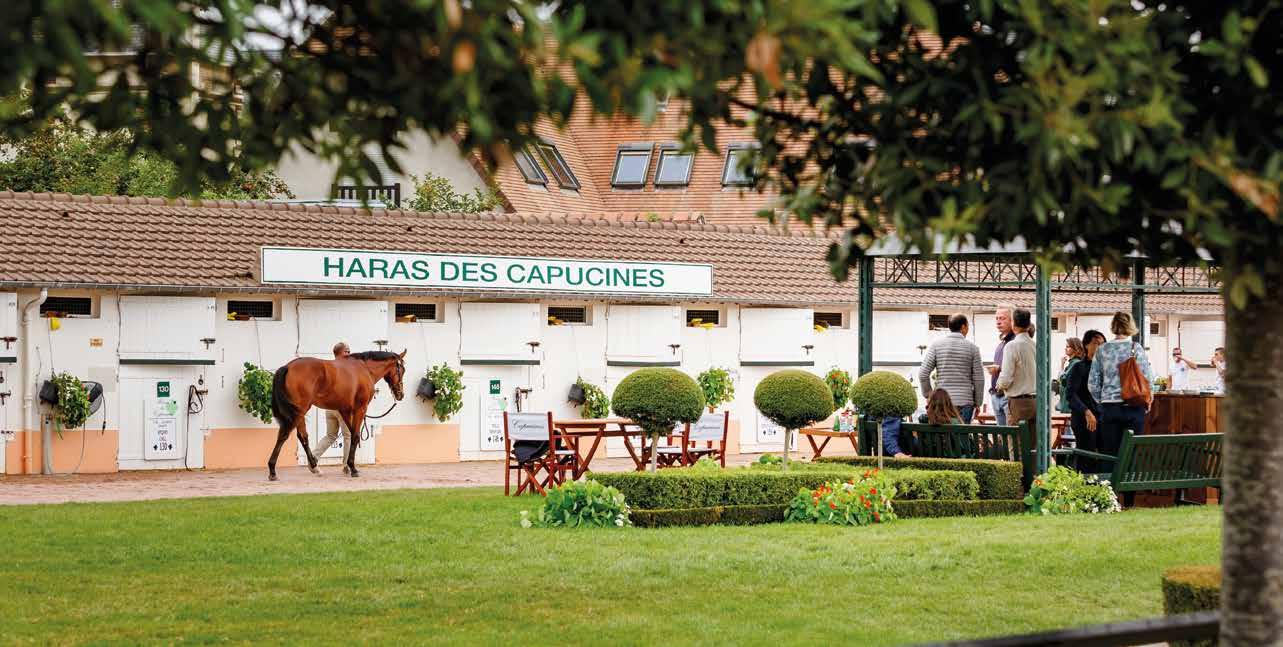
Pierre Talvard has spent a lifetime developing Haras du Cadran and has been rewarded by star graduate Constitution River – the farm is set to offer the Classic winner’s Kodiac yearling half-sister at the Arqana August Sale
70 Managing success
Nemone Routh has worked for the Aga Khan Studs for 29 years –she talks to Jocelyn de Moubray about her role, the farm, the stallions, and the privilege it has been working for His Highness and Princess Zahra
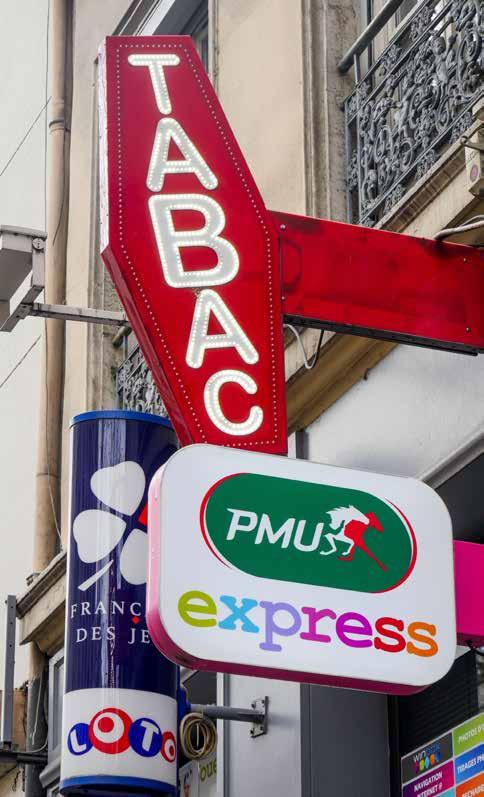
76 Saving the PMU
France Galop has set up a financial Task Force to see what can be done to save costs and generate revenue, Jocelyn de Moubray reports
90 Photo finish
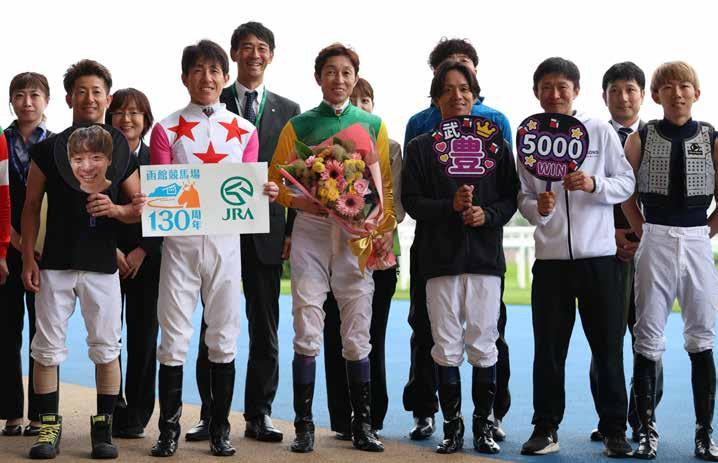
Top Japanese jockey Yutaka Take rides his 5,000th winner
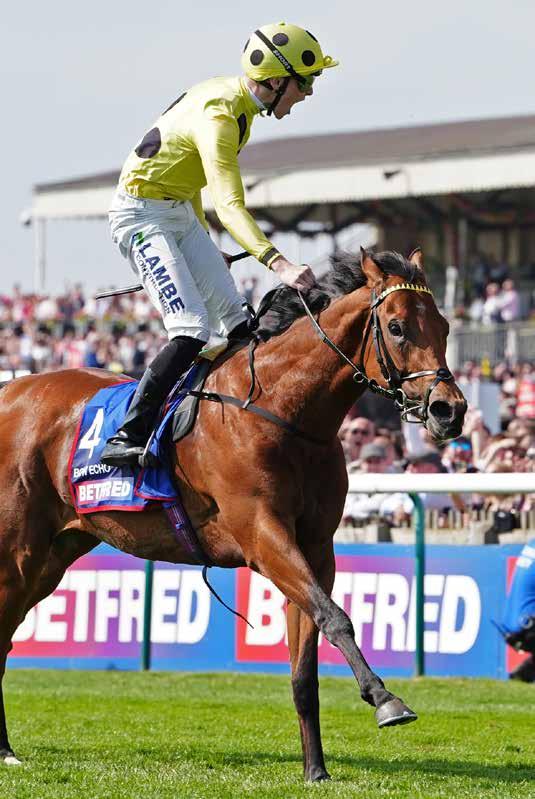
It takes a team to make a racehorse –Leo Powell chats to some of those who have been involved in producing Bow Echo into a leader of his generation
82 The Knavesmire standard
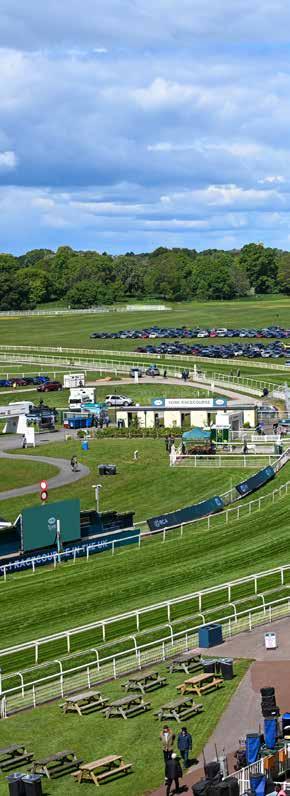
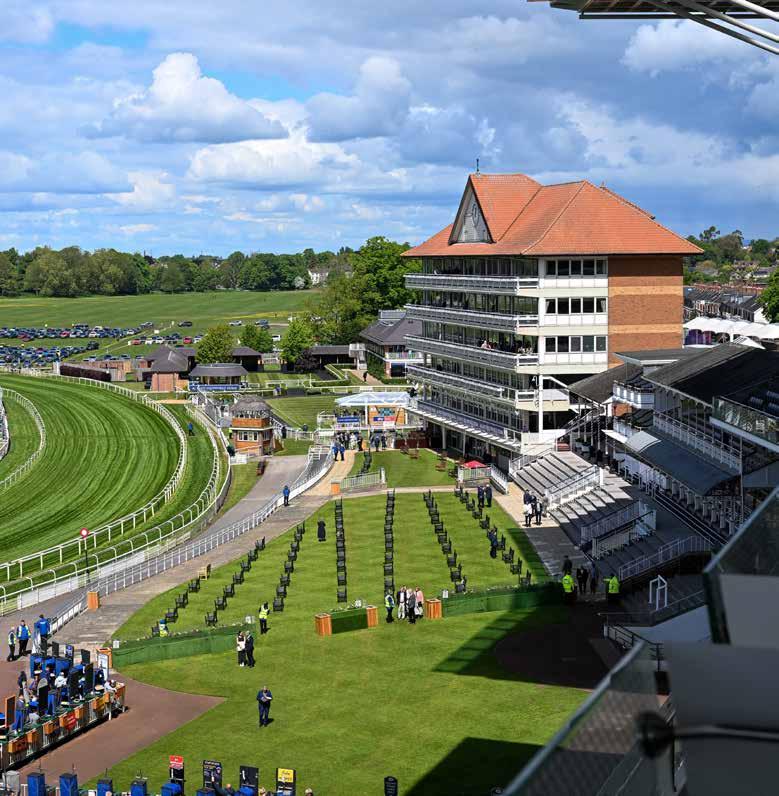
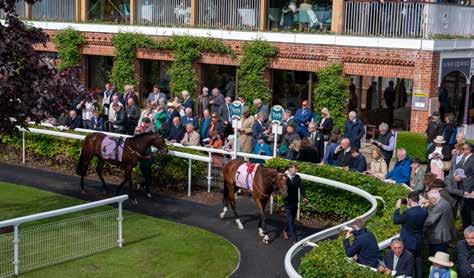
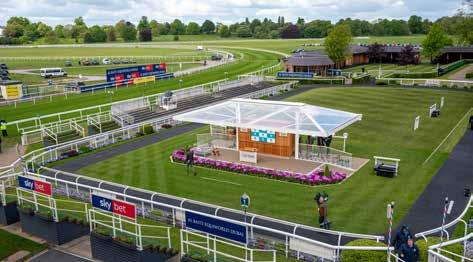
York sets a level that all racecourses should aspire to – Ed Grimshaw looks at the reasons for the track’s continued success
Photo by Debbie Burt
the team
editor sally duckett
publisher declan rickatson photography trevor jones design thoroughbred publishing
subscriptions: email or call as on the left, or log on to www.facebook.com/internationalthoroughbred
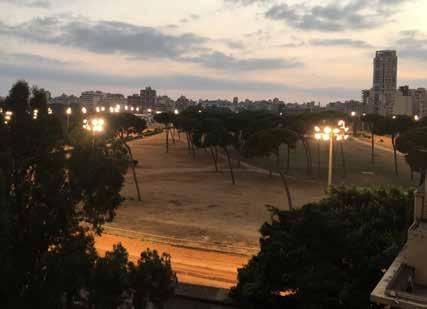
This month, Leo’s Diary comes from one of the oldest cities in the world, Byblos (Jbeil) in Lebanon
On location
JUST OVER THREE WEEKS after my last diary submission, I am here with another, and I have swapped the tranquillity of Donadea in County Kildare for another place I call home too, the troubled state of Lebanon.
Few places in the world have suffered as much as this place has, a country that is about half the land mass of Ireland, but with a similar population.
War, a devastating port explosion, corruption at government and institutional level, rising inflation (very noticeable in the past six months and year) and high levels of poverty, all would suggest a place to be avoided, but any negatives you might suggest can be countered by the most gracious and caring people, the freshest and tastiest of food, good weather, and a country that is steeped in history.
I am sitting in a former family home, Beit Faris wa (sic) Lucia, nestled in a privileged position within the Roman and medieval wall of Byblos.
The house has a 2,000-year history; its foundations form part of a Crusader tower, an arch on the ground floor dates back to the Middle Ages, and the house boasts many great architectural features. From its rooftop terrace we look on the Mediterranean Sea and we are a 9-iron shot away from the ancient Citadel of Byblos.
This city, less than an hour from Beirut, is a UNESCO World Heritage Site, and has been
Happier days when the Hippodrome du Parc de Beyrouth in Lebanon was in full working order. The track’s directeur général, Nabil Nasrallah, is determined to revive the now unused racecourse, return it to its former glory and create a place of fun, community, sport and horseracing
Racing at the hippodrome was one of the rarest of phenomena , a place where different religious communities converge
continuously inhabited for over 7,000 years. It is the birthplace of the 22-letter Phoenician alphabet, while the origin of the word “Bible” is derived from Greek for the city’s papyrus scrolls. Many cultures have had a home in Byblos, including Egyptian, Phoenician, Roman, Assyrian, Persian, Canaanite, Hellenistic and Ottoman. It is a place of great learning,
Four years ago I attended racing at the Hippodrome du Parc de Beyrouth, though the last time a thoroughbred race took place there was some 15 years ago.
Racing at the hippodrome was one of the rarest
of phenomena, a place where different religious communities converge.
But today the place is a mirror for what is happening to this beautiful country, but it has one last hope, a dream, and that belongs to one man.
The directeur général, Nabil Nasrallah, is now 82 and a qualified engineer. He began working at the hippodrome in 1971, has served as the director since 1976, and single-handedly, for half a century, worked against the odds to keep racing going. Though he has seen a once-great activity decline, to the point where it holds a few races with local horses and beams racing from France, he has drawn up plans for a new development at the site.
This dream would see racing continue – and grow – but the venue would also host concerts and festivals, a show jumping arena, an elegant new grandstand and facilities, including modern stables.
Can this dream become a reality? One would be fearful that Nabil is tilting at windmills, but it is people of such vision who are needed in times of crisis, and it would be a shame were racing to finally end in Lebanon.
Tears of joy at the Derby Sale
For me personally, and I am sure for others on the sales circuit, I love it when vendors are overcome with emotion, outwardly displaying a passion for what they do, and being grateful to see all the hard work, sometimes over years, being rewarded with a great price. There were two particular examples of this at the Tattersalls Ireland Derby Sale, and tears were literally flowing.
I have known John Bleahen for a long time. Galway-based, he and his brothers Niall and Hugh work both independently and together, buying youngstock to sell on as stores. Their three farms, Lakefield, Liss House and Clifton, are regularly among the leading consignors, and often at the top of the pile. They are the ultimate professionals.
After day one of the Derby Sale, Walters Connors was the possessor of a new record price for a store when a Not This Time son of the amazing broodmare Matnie sold for €370,000.
Within 24 hours that mark was surpassed, and €400,000 was spent on a gelding with the great name of Walk The Talk, though he is not by the sire you might imagine him to be.
John’s Lakefield Farm, run with wife Elaine and son Luke, sold this French-bred son of Karaktar, whose older sibling, Talk The Talk, was a Grade 1 winner at
I have a great team, and they deserve so much credit. They live and die for these horses: they are the ones coming back at 11pm to look after them
the Dublin Racing Festival for Simon Munir, Isaac Souede and Joseph O’Brien, to Mags O’Toole and Robcour’s Rob Acheson.
John owned the gelding with his brother Hugh, and they embraced in the aftermath in a display of pure joy. John then put into words what the sale meant.
“It is a tough game. I have the best guy in the world, Wesley Hayes, working for me. He drives 45 minutes to me every day from Cloughjordan [in Tipperary]. He is my eyes and a great friend.
“My son Luke has come home. He is great guy to work with. I have a great team, and they deserve so much credit. They live and die for these horses: they are the ones coming back at 11pm to look after them.”
There were a few members of the Bleahen clan not present, though referenced by John, and he could not hold back the tears when mentioning them. Clearly, his recently deceased sister was to the forefront of his thoughts.
The second bucket of tears came ten lots later, and belonged to Ralahine Stud’s Ger Hannon, who is a member of the sales company’s bloodstock team.
He sold a son of Goliath Du Berlais to Ian Ferguson for €260,000. Hannon related the gelding’s story in a breaking voice: “I bought him as a foal here when Goliath Du Berlais hadn’t had a runner, and I probably gave a good price [€40,000] for him.
“The sire took off and has done so well.
“I have been looking forward to bringing him to
The Lakefield Farm crew after selling the son of Karaktar for a store horse record price of €400,000 at the Tattersalls Ireland Derby Sale Photo: courtesy of Tattersalls Ireland
the Derby Sale. My family has had great days here. My father is gone three and a half years, and it is so special to have my mother, my wife and children with me today.”
Hannon’s dad Pat was one of the nicest people to meet on the sales and racing circuits, and father and son were close. Edmond Mahony joined to congratulate Hannon, remarking that “the old man would be happy”. That got the tears flowing again.
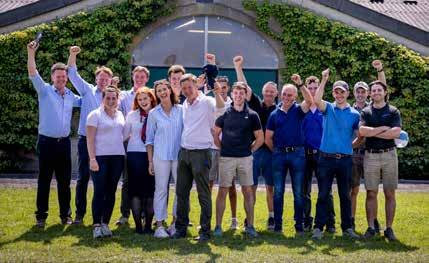
The Irish National Stud class of 2026
If I was a member of the circus, many might suggest that I would be a clown, but I would like to imagine myself as a juggler, and I had to do a bit of the latter on the final day of the Derby Sale.
The reason for this was that it clashes with the Irish National Stud’s graduation ceremony, an event that I have been honoured to act as ringmaster, sorry, master of ceremonies, for the past few years.
The graduation ceremony is a day of joy for the students, their parents and guardians, and one of immense relief when the CEO Cathal Beale utters the hoped for words, “and I am glad to say that you have all passed”.
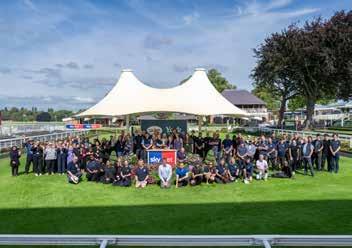
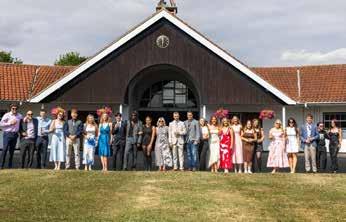
Some 25 students from around the world successfully completed the renowned sixmonth course, which combines academic study with practical industry experience and is designed to prepare them for careers across the global thoroughbred sector. Beale highlighted the importance of education and professional development in maintaining Ireland’s position as a world leader.
A number of graduates received individual honours in recognition of their academic achievements and outstanding contributions. They spent half a year in the care of Anne Channon, the education manager at the Irish National Stud. Extra interest on the day was added with the return of members of the Thoroughbred Breeding Management class of 2001 to celebrate 25 years since completing the course.
The reunion provided an opportunity to reconnect, reflect on their paths within the industry, and share experiences with the newest generation of graduates. Reflecting on the global reach of the course, and of this publication, it is worth listing the students who graduated and their country of origin.
The Gold and Silver Medal winners were Joe Moore (New Zealand) and Ophélie Stroumza (France).
Other award winners were Jackson Gwynne (Australia), Caithlin Kenneally (Ireland), Harvey
The graduation ceremony is a day of joy for the students, their parents and guardians, and one of immense relief when the CEO Cathal Beale utters the hoped for words, “and I am glad to say that you have all passed!”
Williams (UK) and Niamh Carr (Ireland), while internships went to Jack Sherwin (UK) and Katie Willis (Northern Ireland).
The remaining members of the Class of 2026, featuring some well-known racing surnames, were Martin Bozo (France), Dylan Cassidy (Ireland), Libby Coster (New Zealand), Maxime de Chambord (France), Catherine Donworth (Ireland), Hannah Kelley (Australia), Senan MacRedmond (Ireland), Millie Malbon (UK), Abhinav Mitra (India), Chance McKeever (USA), Xavier Pegum (Australia), Mackenzie Porter (Australia), Bobby Ryan (Ireland), Tom Rokuroda (Japan), Joey Ryan (Ireland), Mark Schrenger (USA) and Zania Slabber (New Zealand).
Breeders of the Year honoured
It was a coming of age, of sorts, but I take great pride and pleasure organising the annual Breeders of the Year dinner on behalf of the co-sponsors, Connolly’s Red Mills and The Irish Field. The 21st such awards were held just a few days after the Irish Derby, and the venue was Orby’s By Lucy, which is at the entrance to The Curragh racecourse.
Each month, readers of the paper are asked to vote for a shortlist of four nominated breeders for a monthly prize, after which a Flat and a National Hunt winner are chosen for the overall awards.
For a decade of the competition, there was a single award, and all were won by Flat breeders. Now there are two sections, and both are made up of a who’s who of the best in the business.
I was delighted for both winners, each of whom I have the highest professional and personal regard for, as they are outstanding practitioners.
They are also modest about their success.
Ken Parkhill won the National Hunt trophy, and he really should have done so on previous occasions. A beauty of the monthly awards is that the winners are voted for by their peers, making them even more special, and Parkhill’s record as a breeder, following his father Marshall, is nothing short of outstanding. He has also kept the family of the champion hurdler Morley Street very much alive and relevant.
Ken attended the dinner with his wife Lulu, and both were stunned when their names were called.
They had earned their monthly prize this year, following the Grade 1 victory of Bob Olinger at the Punchestown Festival on what was known in advance was going to be the horse’s final start. There are few comparable families in the stud book.
Leo with Anne Channon, the education manager at the Irish National Stud
A veterinary surgeon, Parkhill began breeding in 1975 when his father bought him a little filly named Sharpaway. Young Ken rode and trained her to win and she then became his foundation broodmare. For a short period of time, Parkhill worked with me on the National Hunt team at Goffs.
Modestly, Parkhill said: “We’ve been very lucky. We got into a few nice fillies, and we raised some of them, and we put ourselves under quite a bit of pressure to hold on to the families, and I’ve been doing so ever since dad gave up, and we’re kind of reaping the benefits of it.
“The business has changed. In the days when we started, there used to be three days of National Hunt yearling sales. Now there’s half a day. The whole emphasis seems to be on getting them there quicker. We bring them through to the store sales, it doesn’t always work, but it does sometimes.”
Praising his wife Lulu and their sons Peter and Nicky, he added: “It’s a family business. This award means everything to me. I had no idea in the world that I was going to get this tonight. I’m absolutely delighted.”
If you were to believe James Hanly, nominated for the brilliant Ombudsman and days after Estrange,
We persevere. I don’t give up easily. I keep trying. There’s a lot of bad days, as everybody knows. The ups are hugely up and the downs are hugely down, but if you surround yourself with good people you can do anything
whom he bred in partnership with Anthony Stroud and Trevor Stewart, he had almost nothing to do with producing that brilliant Royal Ascot hero.
Not a man who is happy to be in the limelight, Hanly did tell me that the award meant so much to him that he couldn’t really put in words its importance.
He was keen to stress the collaborative effort, and the significant role played by his wife Charlotte in the success story of Ballyhimikin Stud.
“I’m representing a team. It’s people like Dermot and Helen Jones at home, who are there right now, checking horses and again in the morning. I am just a maintenance man, keeping busy.”
I asked him if there was a secret ingredient to their success that he would care to share.
“We persevere. I don’t give up easily. I keep trying. There’s a lot of bad days, as everybody knows. The ups are hugely up and the downs are hugely down, but if you surround yourself with good people you can do anything.
“I wake up and ask myself how did we breed such a good horse? Many people here have bred wonderful horses. They will know that you just have to keep going.”
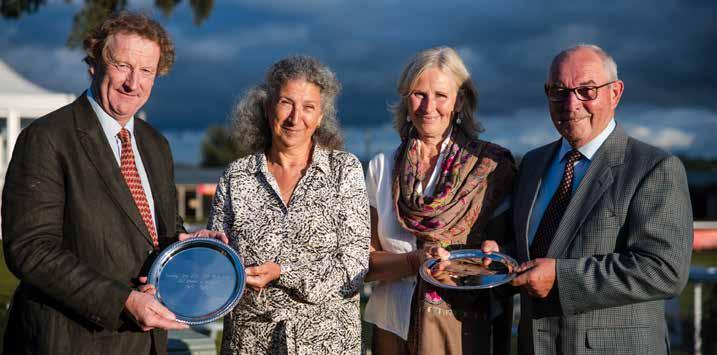
The Connolly’s Red Mills The Irish Field Breeders of the Year: James Hanly and wife Charlotte (left), winners of the Flat award for Ombudsman, and the NH winners Ken Parkhill and wife Lulu honoured for breeding the brilliant, five-time Grade 1 winner and now-retired Bob Olinger
....Girls aloud
A July Week full of fun reports Cathy Grassick Irish Thoroughbred Breeders’ Association
The graduation
xxxxxxxxxxxxxxxxxxx
I had the privilege of being invited to the Irish National Stud Graduation – it was a beautiful day at the stud and, as always, we were treated to fantastic hospitality in beautiful surroundings.
I was there to support my previous sales assistant Senan MacRedmond and new team member at BGB and Newtown Stud, Niamh Carr. It was wonderful to see them both do so well with Senan earning a Gerry Dilger Scholarship to work in the US and Niamh winning the Veterinary Award.
Yet again, huge credit goes to INS chief executive Cathal Beale and course director Anne Channon on the high standard of students.
Getting a head start
I started my July Week at the National Stud’s graduation for the Level 1 and 2 Thoroughbred Industry Access and the Level 3 Stud Management and Sales Consignment courses.
I was delighted to be supporting a recent addition to the Newtown Stud’s team, graduate Michelle Viile Lage, and I must congratulate Anna Kerr and her wonderful team at the stud for the excellent job they have done with the course and for the lovely ceremony.
The evening started with a stallion parade at the stud and followed by a prize-giving ceremony overseen by guest speaker Sir Mark Prescott and National Stud chairman Lord Grimthorpe. Michelle was awarded the John Pearce Award for excellence and dedication to a career in the thoroughbred industry.
Return of the king
In the post-COVID world, there are now far less social occasions and events focused around July week than before, and many people had previously lamented the absence of the additional attractions.
So it was with much joy, I imagine, that Darley clients received invitations to a parade of stallions at Dalham Hall Stud.
The great and the good of breeders gathered on Thursday evening to see a magnificent parade of stallions, which included a surprise appearance by future stallion Notable Speech. It was wonderful to see how calmly the young horse handled the experience and he delighted the audience under the watchful eye of his trainer Charlie Appleby.
Ghaiyyath made a trip over from Ireland to show people that all the fuss about him is worth it, and he did not disappoint, but the evening highlight was undoubtedly seeing Dubawi.
Heralded into the show ground with well-deserved praise from compère Nick Luck, Dubawi arrived like a prize-fighter and quickly put any idea of his sons taking his crown to rest, for now.
It was wonderful to see the stallion play to his fans and you could see he enjoyed the occasion as much as the spectators.
The evening was rounded off with a delightful supper, which gave everybody a chance to socialise and meet the Darley stallion team.
King of the track
King Charles III got the July week meeting off to a regal start with his homebred colt Point Of Law (Frankel) winning the Bahrain Trophy (G3) for John and Thady Gosden and jockey James Doyle. However, the undisputed king of the track was William Buick with eight winners over the three days, the highlights of which were Inner City Blues (Blue Point) winning the July Stakes (G2), Rebel’s Romance (Dubawi) winning the Princess of Wales Stakes (G2) and Al Hudaiba (Dark Angel) taking the Superlative Stakes (G2)coincidentally all three were trained by Charlie Appleby for Godolphin.
I was delighted to see Al Hudaiba win as not only had I purchased a lovely Dark Angel filly, Dark Angel Star, for an existing client to breed from in the UK earlier in the week, but one of our weanling purchases for the team at Newtown is a cracking Sergei Prokofiev colt who hails from the same family – his dam Lacey’s Lane is a sister to A’Shaari, the dam of Al Hudaiba.
Billy the Kid
Another jockey on top form is the rising star Billy Loughnane and he shone in the July Cup (G1) aboard Comanche Brave.
Trainer Donnacha O’Brien had a delighted owner in Muhaideb A Almuhaideb and an equally delighted family as the colt was bred by his mother Annemarie’s breeding operation Whisperview Trading, which is enjoying a fantastic year on course.
We are all familiar with the success of Wootton Bassett’s progeny over more Classic distances, but this sprint victory for his son really shows his versatility and class as a stallion and reflects, once again, what a huge loss he was to the breeding ranks.
The National Stud 2026 graduation
The Lloyd Report
Hay days
Jamie Lloyd has been busy getting in this year’s hay crop, but has found that a commercial arable enterprise at Far Westfield was a cost-producer not a profit-earner
AS THIS YEAR’S DRY BRITISH SUMMER begins to take hold of our countryside, and we watch the evermore dramatic change from lush green fields to burnt brown landscapes, it’s easy to overlook the economic effect that evolving climate patterns are having on the day-today operational costs of the British horseracing industry, and our country as a whole.
Speaking for someone who plays a very minor role, albeit on the coalface of a small and specialised area of the farming industry, horseracing has existed in the UK in its current form for over 850 years, and, as the sport
has evolved, one constant has been the reliance on affordable straw for bedding, and quality hay for feed.
Over the years these two mainstays have seen challengers compete with their dominance, but most would agree their importance in the UK is still paramount.
We have farmed arable crops and hay at Far Westfield since 2011 when we purchased the property from trainer George Baker upon our return from a 14-year stint in the US.
Initially, our business model required very little of the land at the farm. So, with a great deal of assistance and guidance from my wife Roz’s farming family, the decision was taken to plough the majority of the farm and
return it to arable. It was something our new neighbours remarked hadn’t been done in some fields for over 100 years.
This switch from grassland to cereal allowed us both the opportunity to produce a commercial crop, but also to re-drill the land with a bespoke grass mix designed specially for grazing and hay production.
Our journey into the production of arable crops provided so much more to a 30-year-old retired horse trainer, who then had some time on his hands – I learnt to plough, drill crops and even drive a combine harvester.
In a very similar, and comical fashion to the famed Clarkson’s Farm, we learned many lessons along the way.
Looking back on those first few years the memories that remain strong are the excitement that came with each summer brought as harvest began and crop yields rose as the grain stores filled.
But in my ignorance and inexperience I would find myself adding up in my head the value of that year’s hard work.
Then, like all farmers, reality would ever so quickly and unapologetically assume control of any temporary joy that I had dared to indulge myself in.
I would be faced with reconciling our grain sales against the production costs – seed purchase, cultivation, drilling, fertilizing, spraying, harvesting, carting and drying.
With these costs factored in, as well as accounting for further rising production costs, as well as the enormous price of the machinery needed to facilitate the whole endeavour, we would more often than not be left in either debt or very little profit.
I should say at this point I would not, and have not ever claimed to be a good farmer, although I do very much appreciate our acceptance it has afforded us into our local community.
AS DEMAND for quality grassland increased at the farm as the equine population grew, so too did the need to produce top quality hay.
We started off in a shared hay production agreement with our neighbours, but we soon switched to a solo enterprise, which allowed us complete control over the production of the hay, the timing and manner of its harvest.
This brought, too, the need to
“
One other major change to my life since returning to the UK is an obsession with the weather forecast...
“purchase all the machinery required to be self-sufficient, and all the responsibilities of the crop.
One other major change to my life since returning to the UK is an obsession with the weather forecast, a daily ritual rarely observed in Los Angeles with its reliable climate.
This year has provided us with a bumper crop of top quality hay, and so far we have produced around 9,000 conventional bales.
Unfortunately, that comes off the back of one of the worst years which saw hay production down more than 50 per cent in most areas.
This led to widespread shortages across many of the UK’s stud farms and racing yards, with many needing to import from Europe.
The price of last year’s domestic feed stores rose to around £150 per tonne, a sharp rise from the average of between £40 and £60 per tonne over the last 10 years.
Farming data from 2024 shows an increase of 44 per cent since 2019 in the costs of production.
Racing, unlike most industries, doesn’t share that common bond between rising costs and rising prices – we are all very aware of the difficulty for owners to continue to meet the rising costs of their horses.
With the current prize-money available to our sports participants there is little or no margin left for breeders and trainers to operate within, leaving us to absorb the burden of these rising costs.
This, of course, coincides with stark changes in the recent political landscape of the UK, changes to farm inheritance tax and conflicts around the world raising the raw costs further.
We give thanks for this year’s hay crop and hope to sell some at a fair price.
The same may not be the case for straw in 2026/27, as most farms have depleted the stores that would usually carry them over and allow uninterrupted supply to trainers and stud farms alike.
With the country’s combines firing up and starting to harvest wheat in the first week of July again this year, that could mean a shorter crop and less straw to bale and further increases for us all.
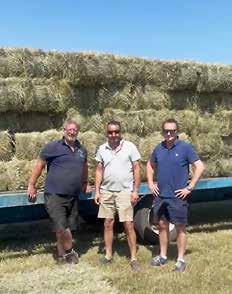
From left to right: Dean Hanson, Richard Clarke and Jamie after a good day making hay
Hot action at the July Festival
A Royal hope for the St Leger, three winners for Blue Point, a new juvenile star for Dark Angel and a progressive July Cup winner, the July Festival gave us it all, writes
APATRIOTIC CROWD roared home the opening winner of Newmarket’s July meeting and there wasn’t a football in sight. Rather it was Point Of Law’s success in the Group 3 Bahrain Trophy that so stirred the feelings of a Ladies’ Day audience that hadn’t yet wilted in the grip of the heatwave.
Point Of Law is owned by King Charles III and Queen Camilla and the manner of his success raised the prospect of a Royal Classic winner at Doncaster.
Queen Elizabeth II enjoyed Leger success with her Oaks winner Dunfermline in 1977 and almost half a century later there would be a poignancy to any Doncaster win for Point Of Law.
The son of Frankel is from the first crop bred by King Charles III, but it was the result of the final matings decided upon by his late mother.
John Warren, racing manager to the king and queen, did not preclude the possibility when asked about a Royal winner of the St Leger.
“I would have thought one of the options to be considered has to be the Leger, just to look at,” Warren commented.
“What John [Gosden, co-trainer] flags
Aisling Crowe
up before then we will obviously discuss, but he is a lovely horse, a big, raw horse with a future in front of him, so it has been nice to take it step by step.
He needs to make continued improvement, but if he can, then why wouldn’t the Leger be a target?”
Point Of Law is the first foal out of Deep Impact mare Portfolio, who earned her black-type on the July course when third in the Listed Chalice Stakes at the track over 1m4f. Trained by Sir Michael Stoute for Queen Elizabeth II, Portfolio won twice at three with both wins at 1m2f.
There have been four winners from six runners by Frankel out of Deep Impact mares and Point Of Law is the first stakes winner bred on the cross.
Portfolio foaled a Churchill colt in February, her first offspring since Point Of Law.
His second dam - Diploma - won the Listed Lyric Stakes at York for Stoute and the Queen and the Dubawi mare foaled five winners from five runners.
She is out of Enticement, who was purchased for 310,000gns at Tattersalls in October 2007 by John Warren.
Sent into training with Stoute, the daughter of Montjeu also won her stakes races at Newmarket - the mile Montrose
Point Of Law: the Royal homebred Frankel colt could be bound for the St Leger after putting in an impressive performance in the Bahrain Trophy (G3)
racing review
Fillies’ Stakes at two and the Severals Stakes over 1m2f as a three-year-old.
In the first year of their reign King Charles and Queen Camilla came close to Leger glory with Desert Hero when he finished third to Continuous, but Warren feels that Point Of Law may have achieved more than the Sea The Stars colt had at this stage of their respective careers.
Warren said: “He is a similar horse to Desert Hero, but I guess the Queen’s Vase at Ascot was probably a classier race than the King George V at the same point, but I think it will be interesting to see how he comes out of this race, what the next start will be, but why not have a go in the Leger and aim that way?”
Blue enjoys a three Point turn Brendan and Anne Marie Hayes’
To look at her in the ring, Blue Bolt is a big, powerful filly. She didn’t run at two –she had a couple of little niggles – but she has improved from three to four and is an impressive horse to look at
glorious Group 1 summer continued at Newmarket with the victory of Blue Bolt in the Group 1 Falmouth Stakes for Juddmonte and Andrew Balding.
The four-year-old filly was bred by the couple, who have enjoyed a stellar summer. Just three weeks earlier
Ten Bob Tony (Night Of Thunder) stunned Royal Ascot in the Group 1 Queen Anne Stakes a day before Blue Bolt won the Group 2 Duke of Cambridge Stakes.
Both horses were bred by the couple, who were at Newmarket to witness Blue Bolt make the Group 1 breakthrough on Friday.
“She’s a marvellous filly, to give 9lb to Precise, she’s just amazing,” said a delighted Brendan Hayes.
“We’re very pleased, it’s brilliant to see her win that race so well. We’re only in early July so there could be Goodwood, Deauville, who knows? She could appear anywhere now.
“It has been fantastic and she is a beautiful filly on top of it. She has loads of speed - whether that comes from Blue Point or from Whipper, [broodmare sire] I don’t know. Whipper won the Morny and the Maurice de Gheest, he had loads of speed.”
Blue Bolt’s dam, the Group 3 Prix Allez France winner Mayhem, is in-foal to Starman and Hayes is excited about her yearling.
“We have a yearling colt by Baaeed going to Book 1. He is very a goodlooking colt and he is a three-parts brother to Sea Theme [Sea The Stars] who William Haggas trained to win three Listed races,” he added.
Ten Bob Tony’s dam, the Dark Angel mare Hug, has a Little Big Bear foal which Hayes reports as “very nice”, and the couple sold her yearling filly by Bayside Boy to SackvilleDonald for €140,000 as a foal last November.
Blue Bolt was bought by Juddmonte for €400,000 at Arqana’s August Yearling Sale from Ballylinch Stud and Barry Mahon, representing the owner, remarked on the filly’s handsome physique.
“She’s like a colt,” Mahon said. “To look at Blue Bolt in the ring, she is a big, powerful filly. She didn’t run at twoshe had a couple of little niggles - but she has improved from three to four and is an impressive horse to look at.”
Blue Bolt: was purchased by Juddmonte as a yearling at the Arqana August Sale for €400,000
Like her breeder, the owners’ team also believed that the task set at Newmarket would be a serious test of her mettle.
“Before the race we thought Precise would be hard to beat, she had looked exceptional so it was going to be tough to give a filly like her 9lb.”
Mahon added: “This filly showed here in the autumn when she chased up Fallen Angel that she was a Group 1 filly so we purposefully started the season slowly, not to have a penalty for Royal Ascot and the second part of the season was where it was going to be with her, so it’s nice to see her make the jump to Group 1 winner.”
The Prix Rothschild, the Matron Stakes and the Breeders’ Cup are all under consideration for Blue Bolt, who is the fourth individual Group 1 winner sired by Blue Point.
Blue Bolt is from the second crop of Blue Point, while his first Group winner of the meeting is from his fourth crop, his cheapest produced at €35,000.
Inner City Blues won the Group 2 July Stakes on the meeting’s opening day beating Coventry Stakes (G2) runner-up Adaay Of Scarlett (Mehmas).
The Charlie Appleby-trained colt has been busy in his short life. Bred by the Banahan family of Ridge Manor Stud out of the Muhaarar mare Dancin Inthestreet, he was bought as a foal by Yeomanstown Stud at Goffs for €180,000. Sent to Tattersalls for the October Book 1 Sale he made 375,000gns to Archie Watson and JS Bloodstock.
Yeomanstown consigned him at the Arqana Breeze-Up in May where he impressed in his gallop and made
€900,000 to Godolphin, the highest price for a colt at the sale.
And the two-year-old has not stopped since winning a York 6f maiden on debut and then taking the Newmarket Group 2 on just his second start, giving his trainer his first win in the 6f contest.
York’s Gimcrack Stakes (G2), a race won by Blue Point, could be next on the agenda for Inner City Blues, who is bred on a variation of the hugely successful Blue Point-Oasis Dream cross.
Worldwide there have been 18 winners from 19 runners by Blue Point out of Oasis Dream mares with three of them coming at Group level.
Breeder Brendan Hayes: at the July meeting
Inner City Blues: bred on a variation of the hugely successful Blue Point-Oasis Dream cross
The cross boasts an excellent 21 per cent stakes winners-to-runners rate.
The Group winners bred on this cross include Tally-Ho Stud’s exciting young sire Big Evs, winner of the Group 1 Breeders’ Cup Juvenile Turf Sprint, Elmonjed and Samangan, who are both Group 2 winners.
Inner City Blues’ broodmare sire is Muhaarar, who emulated his sire Oasis Dream by winning the July Cupone of four Group 1 sprints the Shadwell homebred won at three, having won the Gimcrack Stakes.
This colt is the second foal and winner out of Dancin Inthestreet, who won at two and is a half-sister to Dr Zempf, a Dark Angel colt who won the Group 3 Ballycorus Stakes and the Listed Leopardstown 2,000 Guineas Trial for Ger Lyons and was third in the Phoenix Stakes (G1) at two.
Their dam of Souvenir Delondres was
Worldwide there have been 18 winners from 19 runners by Blue Point out of Oasis Dream mares with three of them coming at Group level
a Group 3 and Listed winner at two from the first crop of Siyouni.
Blue Point netted a July meeting hat-trick when Planet Seeker claimed the Class 2 fillies handicap over 7f for owner-breeder Jeff Smith.
The three-year-old filly, trained by Ralph Beckett, is a great-granddaughter of Smith’s Nunthorpe winner Lochangel
herself a half-sister to Smith’s brilliant Lochsong.
Planet Seeker is also bred on a variation of the Blue Point-Oasis Dream cross as her dam, the Group 3 Sceptre Stakes winner Dancing Star, is by Oasis Dream’s Prix du Moulin (G1) and Jersey Stakes (G3) winner Aqlaam.
New juvenile Group winner for Dark Angel
The big league could await for Group 2 Superlative Stakes winner Al Hudaiba, but if he is to emulate Quorto, Master Of The Seas and Native Trail, previous Charlie Appleby-trained winners of the 7f contest who went on to Group 1 glory, the talented son of Dark Angel will have to knuckle down and concentrate.
The winning trainer remarked: “He has a lot of talent.
“As Will [Buick, jockey] said there,
Al Hudaiba (right): became Dark Angel’s 75th Group race winner in the Superlative Stakes (G2) – the colt could go far, if he keeps his mind on the job!
Some diamonds are worn. Others are crowned. Sourced at The August Sale.
DIAMOND NECKLACE
Gr1
Listed
CONSTITUTION RIVER
Champion 3YO in Europe
Gr1 Prix du Jockey Club
Chantilly
Gr1 Coral Eclipse Stakes
Sandown
KHOVIKHOV
Gr2
LEFFARD
Gr3 Prix de la Porte Maillot Longchamp
Listed 2nd Prix Maurice Zilber Longchamp THE
GODSPEED
Gr1 2nd Prix Aga Khan IV, Prix d’Ispahan Longchamp
‘The first half of the race I was happy where we were and at the three marker I was thinking how far he was going to do it, then all of a sudden he started shifting under me.
“‘He’s a job to stay on, let alone try to get him to gallop out, staying on is the hardest part!’
“I wasn’t confident, not when they get as close as that and with the kind of luck we have had recently, but I did think that if he got his head down and started to rally he would get there because he has a lot of ability.
“He does this at home too, full credit to the lads at home for staying on him
Group 1 National Stakes with Quorto and Native Trail winning the 7f contest.
It’s the natural target for Al Hudaiba, especially given his pedigree.
“Will said he was feeling the ground today,” added Appleby. “He’s a Dark Angel and we know they generally like a bit of juice in the ground, so I would imagine that the National Stakes would be his most likely target.”
Al Hudaiba is the second Group winner Dark Angel has sired out of a Dubawi mare - the other is Real World, a Group 2 and Group 3 winner for Godolphin, who was placed in the Group 1 Lockinge Stakes and Group 1
double at the meeting and both winners were Godolphin homebreds.
Acting Lady showed the benefit of her experience over course and distance to win the 6f fillies’ maiden, but didn’t make life easy for herself or jockey William Buick by racing keenly.
She is a half-sister to Crimson Rose (Lope De Vega), who won the race in 2025 for connections, and they are the first foals out of the Prix Saint-George (G3) winner Ideal Beauty (Invincible Spirit).
Ideal Beauty’s dam is the Listed Prix Six Perfections winner Discernable, an Elusive Quality full-sister to Group 2 winner True Quality.
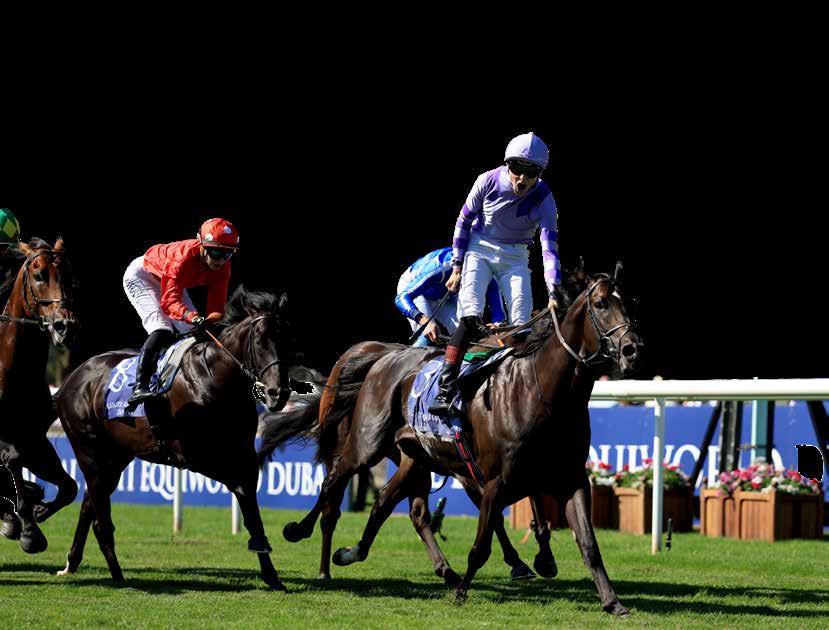
July Cup winner: Billy Loughnane on Comanche Brave
Susan Magnier until March of this year and as a three-year-old had been placed behind Henri Matisse in the Group 3 Red Rocks Stakes and Noble Champion in the Jersey Stakes (G3).
He was also placed at Group 2 level over 7f and a mile until his trainer’s audacious decision to send Comanche Brave to tackle Ya King Rising in his Sha Tin kingdom.
A fine fifth in the Group 1 Chairman’s Sprint Prize confirmed that speed was the colt’s metier and he subsequently went on to win the 6f Group 2 Weatherbys Greenlands Stakes at The Curragh.
He was then seventh in the Group 1 Queen Elizabeth II Jubilee Stakes at Royal Ascot.
He was beaten less than 3l by Almeraq (Dark Angel) at the Berkshire track and he firmly overturned that form in the July Cup.
His dam Ishvana won the Jersey Stakes (G3) and was runner-up in the Irish 1,000 Guineas to Samitar, but at the age of 17 she has produced just three
runners, however they are all winners. Out of Song Of The Sea by Bering, the broodmare sire of Blackbeard and Stradivarius, she is a full-sister to the dam of Group 1-placed Mountain Bear (No Nay Never) and Group 3-placed Moon Bear by Australia.
IT IS A BRANCH of the storied Ballymacoll Stud family that includes the champion Islington – Comanche Brave’s third dam Calypso Run is a Lycius half-sister to Grecian Sea, the second dam of the Breeders’ Cup Filly and Mare Turf heroine.
The win is the latest for a cross that has proved successful and one that breeders using Wootton Bassett’s sons at stud will be noting.
Comanche Brave is one of two black-type winners from just five runners by Wootton Bassett out of mares by Holy Roman Emperor.
The son of Danehill is enjoying a successful spell as a broodmare sire with
his daughters also producing this year’s Poule d’Essai des Poulains (G1) winner Rayif (Sea The Moon) and Caballo De Mar (Phoenix Of Spain), who won the Group 1 Prix Vicomtesse Vigier.
Holy Roman Emperor is also the broodmare sire of the Group 1 Breeders’ Cup Juvenile Fillies Turf and Just A Game Stakes winner Newspaperofrecord, who is the dam of Irish Derby winner Benvenuto Cellini (Frankel).
Billy Loughnane needed a screenshot of the message trainer Donnacha O’Brien sent confirming the jockey’s booking for Comanche Brave (Wootton Bassett) for the Group 1 sprint, but there was no doubt about the outcome of the race.
The jockey is fast becoming a crowd favourite and the reception he and the four-year-old colt received on their return to a sun-drenched winner’s enclosure was louder than any of the more fancied runners would have heard.
“I’m 20 years old and fortunate enough to pick up rides in these big races and learning from that is everything,” Loughnane commented.
“To win these Group 1s is brilliant and I set myself a target this year to ride two or three Group 1 winners in England.
“I didn’t know Bow Echo was going to flourish into what he has but that is my third now and we are only halfway through!”
Loughnane feels that Comanche Brave could become even quicker.
“The race today couldn’t have gone better; I got onto the back of the Japanese horse who was the perfect target. My one instruction was to nurse him as long as I could and I managed to wait until the furlong pole.
“Fast ground is ideal and I do think he is a fast horse. I wouldn’t be afraid to drop him in trip, I was taking him back the whole way through.
“He has a lot of gears this horse and now that he is learning to sprint, the sky is the limit.”
Aidan and Annemarie O’Brien (left): did not train the winner of the July Cup, but the couple were still on the podium as breeders of Comanche Brave joining the trainer, their son Donnacha (third right)
THE DUBAWI DYNAST Y
TOO DARN HOT
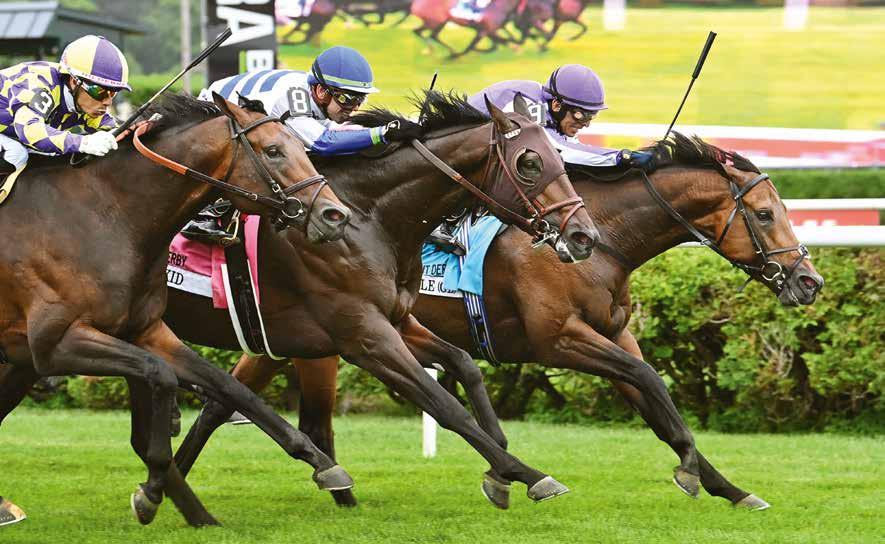
Classic winner Title Role follows up in the G1 Belmont Derby at Saratoga, becoming a fifth European-bred G1 winner for the international supersire. That’s more G1 winners than Kingman, Lope de Vega, New Bay, Zarak and Night Of Thunder at the same point in their stallion careers. Too Darn Hot joins Galileo, Frankel and Kingman as the only European stallions since 2000 to sire a G1-winning threeyear-old in each of their first three crops.
RETURN ON IN VESTMENT
Since 2003, we have fed
29 Sales Toppers
55 Millionaire Lots
153 Lots sold for 500k or more
Yearlings fed on Saracen realised 41% more than the 2025 Book 1 average
Delight in Germany
Once again the Deutsches Derby is a real crowd pleaser
Homegrown joy: the Deutsches Derby-winning jockey Waldimir Panov congratulated after his Classic success
ONCE AGAIN, the Deutsches Derbv produced a fine racing spectacle, and a result that was enthusiastically received on the racecourse.
Year after year the German Classic has the three essential components for a compelling sporting event –an open competitive field, a large and enthusiastic crowd, and winners whose emotion and delight are obvious to all those watching on the track and on the free livestream provided by German Racing.
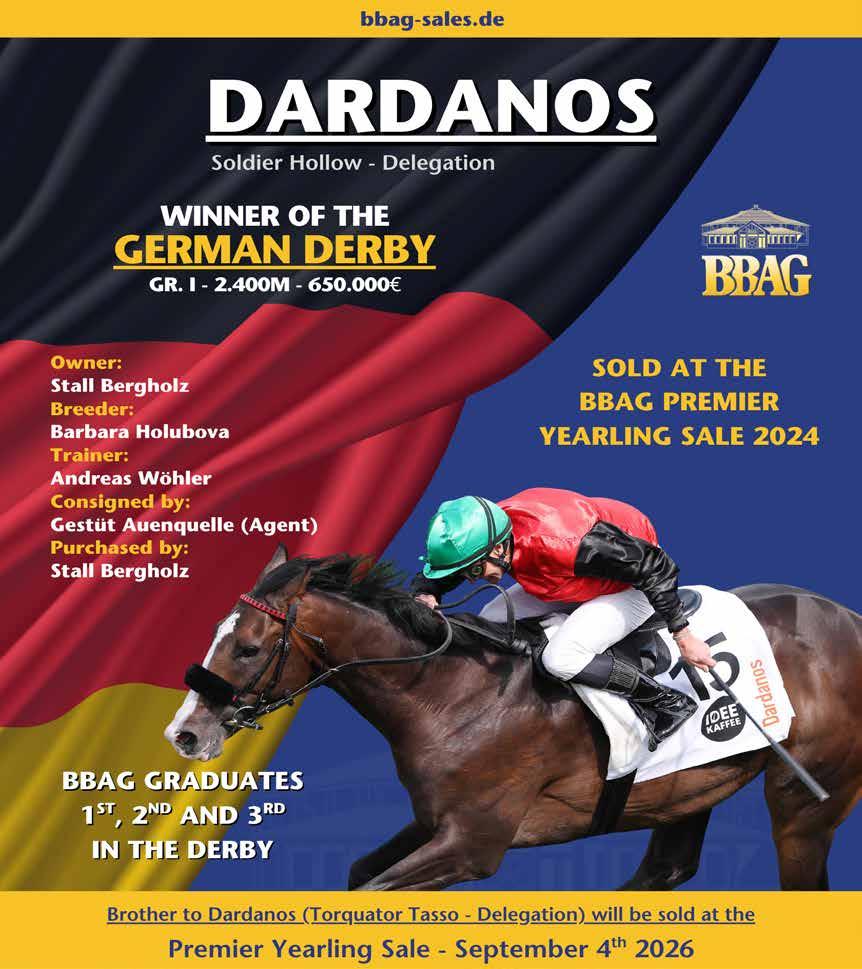
This year’s winner was the Soldier Hollow colt Dardanos, who was sent off at 84-1, but with hindsight had shown plenty of promise since moving to the care of master trainer Andreas Wöhler at the beginning of the year.
Stall Bergholz’s colt had won his maiden at Dortmund on his seasonal reappearance beating the filly Noble Lips, Group-placed at Hamburg on Derby Day, with the remainder 7l behind. He was then second in the Listed Derby Trial on the same track beaten by the Iquitos colt Quitos, who was himself a fine fifth in the Derby despite not getting the run of the race.
This was a sixth Derby win for Wöhler, who took over his Adolf’s stable
in 1985 when only 23 years old, and he won his first Derby in 1992 with Pik Konig.
In the years since Wöhler has not only won Germany’s best races regularly, but with horses such as Novellist and Protectionist has been successful in top races in Britain and Australia, too.
Stall Bergholz is a partnership between Hans-Wilhelm Jenckel and Friedrich von Lenthe, two racing enthusiasts who have kept a horse or two in training for more than 20 years.
Dardanos is a half-brother to the useful stakes horses Delgardo and De La Soul, who both raced for S tall Bergholz, as well as to Dancing Dunes, a two-year-old Torquator Tasso colt who is in training with Ralph Beckett having been bought by Alex Elliott for €115,000 at last year’s BBAG September Sale.
As had been the case at Epsom this year the race was transformed by unexpectedly heavy rain in the days leading up to the race. There was persistent heavy rain throughout the Saturday before the Derby which turned the ground to soft.
There was also the added complication, which became apparent as the racing took place, that there was a strip on the outside close to the stands’ rail which was far faster than the rest of the course.
When the 18 Derby runners went into the stalls all those involved were aware of this, but it turned out that only Lars-Wilhelm Baumgarten’s Liberty Racing Syndicate, responsible for Chiefland, Salitos, Kairos and Abacus, four of the 18 runners, had made a strategic plan.
Normally those drawn wide in the Derby move across as quickly as possible to try to get a position on the rails before the first turn, but this year Chiefland, who was drawn 18 and ridden by Cieren Fallon, chose instead to race wide on the stands’ rail cutting across only when the turn starts.
The next surprise came when the field reached the back straight and once again Fallon and another Liberty runner Salitos tracked out to race up the far rail.
The rest of the field were as surprised as those watching, but several including Dardanos and Waldimir Panov and
Winning owners Hans-Wilhelm Jenckel and Friedrich von Lenthe with jockey Waldimir Panov
Kairos edged out towards the middle of the track following the two leaders.
The three Liberty contenders Chiefland, Salitos and Kairos led into the straight and so were able to come across and take up the best places close to the stands’ rail. The plan had worked brilliantly and those who had stayed on the inside, including the favourite Englishman, were never able to get into the race.
The only flaw was Dardanos who followed the “Libertys” into the straight and produced a turn of foot to go past and win decisively defeating Chiefland by a length with Salitos a length in third, Kairos fourth, followed by Quitos and Englishman, who were finishing best of all but too late to be involved in the finish.
LIBERTY may not have won a third Deutsches Derby, the syndicate having won the race previously with Fantastic Moon and Palladium, but the race was a triumph for Baumgarten’s organisation nevertheless having bought both Chiefland and Salitos at the BBAG September Sale for €50,000 and €36,000.
There has been talk in the British racing press in recent weeks about the lack of Classic three-year-olds in Britain and Ireland.
The German example shows the principal explanation is simple: there are few because breeders are not trying to produce them.
In Germany there are only around 800 foals born every year and yet there is always a full competitive field for both the Deutsches Derby and the Diana as more or less all of the country’s 900 matings are made in the hope of producing a Classic horse.
And those in England and Ireland should also keep in mind that many of these potential German Classic horses are offered at the BBAG September Sale.
The Derby winners Dardanos, Palladium, Fantastic Moon were in the sale as were the Derby-placed horses Chiefland, Salitos, Borna, Lazio, Mr Hollywood and others.
Some years the Deutsches Derby is a top race, as in 2020 when In Swoop beat Torquator Tasso, sometimes it is a very good one as last year when Hochkönig just beat Convergent, or as in 2023 when Fantastic Moon beat Mr Hollywood. But there are also some years when it is only an ordinary race, which is the case for all Classic races.
Whatever the form of the race, one thing is for certain – the Deutsches Derby is never a dull race.
If Hamburg can be a tricky track when weather conditions are difficult, Dusseldorf, where the Diana is run at the beginning of August, is always a difficult course.
The bends and gradients of the
And those in England and Ireland should also keep in mind that many of these potential German Classic horses are offered at the BBAG September Sale
2200m course present a severe test, and it has been some time now since a Diana winner has gone on to win more top races afterwards.
As is the case with the Deutsches Derby it is rare for any three-year-filly to stand out before the Diana as most of the possible contenders are backward horses trained to be at their peak at the beginning of August.
Photo: ScoopDyga, courtesy of France Galop
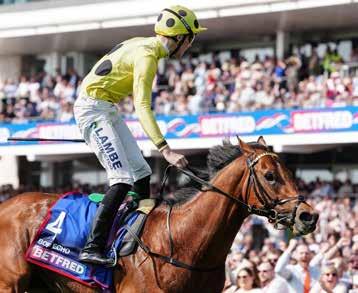
Calandagan put in a sprint finish to land the Group 1 Grand Prix de Saint-Cloud
The current favourite is the Gestüt Fährhof-owned Soreanga, a Siyouni filly trained by Wöhler, who won the Group 3 Hamburger Stutenpreis over 2200m on Derby Day, just holding the challenge of Believe In Me, an Intello filly, who has been running against the best of the generation since she beat the champion two-year-old Alsterperle in a Listed race last September.
Soreanga, who is a half-sister to the Group 1-placed Salt Bay out of a Galileo mare, broke her maiden in a Listed race at two and, after disappointing in the Berlin Diana Trial, bounced back to win by a neck in Hamburg.
Believe In Me was also second in the Berlin Diana Trial beaten by the Cloth Of Stars filly Gua Lipa on very soft ground. Gua Lipa returned to gain experience of the Dusseldorf track in a June Listed race when third giving 2kg to her rivals in a race won by Night Breath, a Gestüt
Wittekindshof-owned Bated Breath filly, who is unbeaten in two starts.
The official handicapper rates Soreanga, Gua Lipa and Believe In Me level ahead of Night Breath with Alsterperle just behind.
Another possible winner is Stall Nizza’s Sottsass filly Nachtuelle, who beat Gua Lipa on debut and has won a handicap against older horses since.
Nachtuelle is out of the Group 1-winning mare Nightflower, who was second in the Diana in 2015.
Calandagan on form
Calandagan returned to his best form to win his second Group 1 Grand Prix de Saint-Cloud at the beginning of July.
This year’s renewal was a competitive race and the Francis Graffard-trained horse had to produce his best to come from well off the pace and beat
Cualificar and the filly Sunly by a neck and three-quarters of a length.
Calandagan ran the final 400m in 21.73s, 12 per cent faster than his race average and over the final 600m he made up 4l on Cualificar and 6l on Sunly.
Calandagan now has 12 wins and five seconds from 17 career starts, finishing out of the first two only on his two-year-old debut and on the heavy ground at Epsom in June.
Godolphin’s Cualificar, a son of Lope De Vega and the Oaks winner Qualify, was second in the Jockey-Club last year and should be able to win a Group 1 soon, while Juddmonte’s Night Of Thunder filly Sunly also has the ability to win at the highest level, particularly on the firm ground she prefers.
THE FORM of the Prix du Jockey-Club (G1) looks better than ever a month later after Constitution River, A Boy Named Susie and Hawk Mountain dominated the Eclipse Stakes at Sandown, and in France the seventh, the Aga Khan Studs’ Daryzan, came out to win a Class 1 race at Chantilly with the greatest of ease.
The ninth Pearled Majesty returned to win the Group 2 Prix Eugene Adam by over 2l at Saint-Cloud at the end of June.
A son of Persian King bred by Newsells Park and Fittocks Studs, Pearled Majesty never settled in the Jockey-Club but, back at Saint-Cloud and reunited with Christophe Soumillon, he made all the running to win unchallenged.
Owned in partnership by his trainer Maurizio Delcher Sanchez and Criquette Head, Pearled Majesty is to be prepared for the Prix de l’Arc de Triomphe.
Daryzan, a Zarak half-brother to Daryz, had no trouble winning a slowly run race running the final 400m of the 2000m race in 21.63s, nearly 18 per cent faster than his race average.
Daryzan, too, will be heading back to Group 1 races in the future.
Flight on time
Runners by this season’s US freshmen sires are starting to emerge, Flightline is on the winners’ sheets and trainers are giving good reports, writes Jill Williams
SUMMER RACEGOERS in the US, particularly at the top-notch Saratoga and Del Mar meets, subsist on a steady diet of sunshine and stellar racecards, seasoned heavily with anticipation and promise as the top trainers in the nation unveil their best two-year-olds.
Although yet to race, some of the juveniles have already been in the public’s eye for a few months, such as the Flightline colt named Zedan, who sold for an Ocala Breeders’ Sales record of $10.5 million in April, or the yet-to-be-named $4.1-million Into Mischief yearling, who topped the Fasig-Tipton Saratoga Sale last August.
There will be plenty of offspring out of familiar mares to watch out for too, like Tumoohaat, the first filly and first foal out of 2022 Eclipse champion Malathaat, or 2024 Broodmare of the Year Puca’s son Woodburn, a full-brother to Classic winners Mage and Dornoch.
Racegoers at Saratoga and Del Mar are treated to the two-year-olds with the flashy pedigrees and those burdened with expectancy as they face the starter for the first time.
The air fairly buzzes with potential. Not only is it the two-year-olds who have brilliance and precocity that thrill us now, but also those juveniles who will appreciate more distance and time. Which ones look like men among boys and might still be ahead of their class at
Breeders’ Cup time? Will we see the next Kentucky Derby winner?
Or perhaps it’s simply a handy winner on a Thursday afternoon or a debutee who got caught in traffic, yet wasn’t deterred and caught the eye when rallying late to finish just off the board.
Whatever it is, these two-year-olds carry so much more than the riders on their backs. They also carry our collective hopes and dreams and the promise of tomorrow.
The Flightlines take flight
It’s not often a freshman sire generates substantial buzz among the public as well as insiders, but it’s not often we have a Flightline, either.
The sensational and undefeated 2022 Horse of the Year dazzled in all six of his career starts, winning by a combined margin of 71l.
His first weanlings (conceived on a $200,000 cover) sold in 2024, averaged over $650,000, and included two sevenfigure sellers in Japan. Flightline’s first yearlings maintained that momentum, averaging nearly $740,000, included a number of seven-figure sellers as well as Keeneland September’s $2.2 million filly topper.
When the first two-year-olds by the Lane’s End stallion sold at breezeup sales this spring, and included a $2.1million colt in addition to the record breaker, anticipation reached fever
pitch. After a first winner in Japan, Flightline followed up with his first US winners and they have more than impressed.
The exciting thing is no one expects his runners to be precocious.
He needed plenty of time to get to the races himself, waiting until spring of his three-year-old season. He’s by the legendary Tapit, who holds the modern record for siring the most winners of the Grade 1 Belmont Stakes – America’s longest Classic at 1m4f.
While he sprinted 6f at the start of his career, Flightline’s best races were probably at 1m2f, when he walloped top-class horses in both the Grade 1 Breeders’ Cup Classic and the Grade 1 Pacific Classic.
“Raw talent” is what trainer after trainer has said on record about the Flightline two-year-olds in their barns.
While it’s still early days, and the true measure will come with the graded races and top competition throughout the fall as the babies mature and stretch out in distance, Flightline is already giving every indication he might be as extraordinary as a sire as he was as a racehorse.
It’s a bold statement, but he just might be America’s version of Frankel.
Early impressions of other freshmen
As the summer unfolds and we look forward to fall racing, a few other first-
crop sires have caught the eye.
The early winners by Life Is Good, a consistently brilliant son of Into Mischief and a Breeders’ Cup Dirt Mile winner, look special, too. Like Flightline, he had an exceptional first book of mares and it wouldn’t be a surprise to see his progeny be among the best by freshman sires this fall. He stands at WinStar Farm.
In a feel-good success story, the first runners and winners by Early Voting have been making an impact. A son of Gun Runner and winner of the Grade 1 Preakness Stakes, Early Voting stood his first year at stud for $25,000 – an eighth of Flightline’s initial fee and a fourth of Life Is Good’s introductory $100,000 fee.
After getting 120 mares in-foal during the first months of his first season
at Coolmore America, he developed Anejaculatory Syndrome or the inability to ejaculate.
Successfully treated for the condition by Dr. Padraig “Paddy” O’Casaigh and moved to Taylor Made, Early Voting returned to the breeding shed the following season.
Perhaps breeders were skeptical about his ability to get a mare successfully infoal as his fee eventually dropped to just $8,000. Those who kept the faith must be thrilled, however, as his first winners have shone brightly and have been among the more visually impressive early juveniles.
While Flightline, Life Is Good, and Early Voting each look capable of siring runners who will continue to make an impact in the fall, a freshman sire
making good on his expected early precocity is Golden Pal.
A scintillating sprinter and dual Breeders’ Cup winner, who also shipped across the pond to finish second to The Lir Jet in the Group 2 Norfolk Stakes, Golden Pal’s two-year-olds have indeed proven to be early and fast.
The Coolmore America stallion and son of the late Uncle Mo delivered on his promise by pulling to an early lead among freshman sires by winners.
Magnitude shakes up the older
division, while his sire Not This Time tops the charts
With the top three-year-olds in the nation resting after the Triple Crown in advance of late summer and fall prizes,
Flightline: as we went to press, the Lane’s End Farm champion and first-season sire has had three winners, one in Japan and two in the US
the US’s older male division is heating up. No one has shaken up that division more than Magnitude, who has firmly established himself as the top horse in America this summer.
Magnitude was a smart two-yearold and a very good three-year-old, sandwiching early-season and lateseason graded wins around a placing behind Horse of the Year Sovereignty in the Grade 1 Travers Stakes.
But at age four? Oh my. This is a different animal.
The son of Not This Time is unbeaten in three starts this year, including a victory over the all-conquering global superstar Forever Young in the Grade 1 Dubai World Cup, and he returned to the US to trounce both Sovereignty and the best field assembled so far this year domestically in the Grade 1 Stephen Foster Stakes.
He looks unstoppable with his trainer Steve Asmussen plainly stating Magnitude is capable of a Horse of the Year campaign and the team has yet to find a limit in his ability.
Magnitude is being pointed at the Grade 1 Whitney Stakes in August at Saratoga. There it’s expected he’ll have a rematch with Sovereignty, as well as the powerhouse Eclipse champion Nitrogen, the top older mare in the land.
Mirroring Magnitude’s own meteoric rise is the ascent of his sire Not This Time.
The son of Europe’s own iron horse Giant’s Causeway began his stallion career modestly. With his racing days cut short due to a soft tissue injury, he entered stud at Taylor Made at just three with only four starts to his name, although they included a graded win and Breeders’ Cup runner-up finish.
Not This Time has gone from strength to strength as a sire and now threatens to knock Into Mischief off the pedestal he has solely inhabited since 2019.
He chased Into Mischief from second throughout 2025 and actually topped the latter by sheer number of black-
Not This Time has gone from strength to strength as a sire and now threatens to knock Into Mischief off the pedestal he has solely inhabited since 2019
type winners for the year, although he missed the title by a few million dollars in earnings.
Not so in 2026. Led by Magnitude, Not This Time’s statistics by every metric stack up favourably with or exceed Into Mischief’s.
He has more than the kingpin in earnings this year – as befitting a stallion whose son won the Dubai World Cup – and he has just seven crops at the races compared to Into Mischief’s 15, with more than 1,000 fewer lifetime foals.
To sweeten the pot, the Not This Time two-year-olds are the 12-year-old stallion’s first from six-figure covers after starting at just $15,000.
As Not This Time’s runners continued to excel year after year, his fee skyrocketed and the quality of his mares greatly improved.
This past spring his fee matched Into Mischief’s at $250,000.
Thanks for the memories, Aqueduct
While the US likes to be ahead of the curve, both innovators and traditionalists alike are smarting over the loss of Aqueduct Racetrack.
The Queens track has been part of the landscape for 132 years, more than half of the official existence of the country.
Witness to so much of America’s racing history, from Man O’ War to Secretariat and so many more, Aqueduct officially ran its last race June 28.
Located only about eight miles from Belmont Park, which is wrapping up a massive three-year renovation, Aqueduct is victim of an economy which prioritises practicality over sentiment.
In addition to Aqueduct commanding 210 acres of valuable land, foal crops continue to drop and racing continues to consolidate, and Aqueduct joins a growing number of major US racetracks to have closed their doors forever.
Aqueduct racecourse: opened in 1894 and closed in 2026, Belmont is due to re-open next year
Chachnak catching attention
In June
2026
the son of Kingman came close to completing an extraordinary Group 1 double and he made sure that, from now on, his name as a stallion will be a familiar one in the European bloodstock world
CHACHNAK STARTED HIS STALLION CAREER IN OBSCURITY, however, from the moment his first crop turned three in 2025 he began to catch the attention of people in France.
In June 2026 the son of Kingman came close to completing an extraordinary Group 1 double and he made sure that, from now on, his name will be a familiar one in the European bloodstock world.
Pink Panthera, carrying the colours of Alain Jathiere and owned in partnership with Jean Pierre Dubois, her breeder and Chachnak’s principal owner, started a 34-1 outsider in the Group 1 Prix de Diane, despite having beaten colts to win a Listed race on her previous start.
The three-year-old daughter of Chachnak came from the rear with a run that, for a long time, looked
like carrying her to victory but at the line she was just a short neck behind the Coolmore partnership’s unbeaten Champion Diamond Necklace.
About a week later Stolen Kiss, a four-year-old son of Chachnak owned by Louis Baudron, Dubois’ grandson, and Gousserie Racing, was a 33-1 shot in the Group 1 Queen Elizabeth Jubilee Stakes at Royal Ascot. He, too, came with a dramatic late run only to finish fourth, beaten a nose, a short head and a head by Almeraq and the international sprinting superstars Satono Reve and Joliestar.
The obscure French sire had come within a half length of an international Group 1 double and now has a top level performer from each of his two small first crops.
France has fewer expensive stallions than either England or Ireland, many fewer who cover 150 mares or more, (in 2025 there were 33 in Europe, three in France, seven in Britain and 23 in Ireland), however, there is one aspect of the stallion market, and it is not the least important, in which it is the leader.
Over the last ten years there has been a succession of French-based sires who became successful and popular in the market after starting their careers both relatively cheap and with little or no commercial profile. Kendargent, Le Havre, Siyouni, Wootton Bassett, Galiway and Zarak all started out with few believers. Chachnak, a Group 3 winner by Kingman out of the top race mare Tamazirte, who finished second in
I was watching him in his paddock one day and I realised that he had never been in such magnificent condition...
the Poule d’Essai des Pouliches (G1) and the Prix de Diane, stands at Jean Pierre Dubois’ Haras de la Gastine and clearly belongs on this list now.
Chachnak’s statistics are impressive, and in many ways are similar to those Wootton Bassett put together at the beginning of his stud career at the Haras d’Etreham.
There are 51 named foals in his first two crops born in 2022 and 2023. At the time of writing 37 of these have raced and 27 have won, so 53 per cent of his foals and 73 per cent of his runners.
HE HAS A TOTAL of four black-type performers, 11 per cent of his runners, including the Group 1 horses Pink Panthera and Stolen Kiss as well as the Group filly Ginalyah, who is currently in training in the US. There are 31 two-year-olds by Chachnak, and for the time being he has one winner from three runners.
In comparison, Wootton Bassett had even fewer foals in his first two crops, a total of 32, and they included the champion Almanzor, while 68 per cent of the 25 runners were winners and 12 per cent black-type performers.
So, from first two small crops both sires produced a high proportion of winners and black-type performers as well as horses able to compete at the highest international level. For Chachnak’s second crop it is still early days and he has several other runners, such as Sahimaa, Testify or Charly who could gain black-type over the next six months.
Like Wootton Bassett he seems able to produce horses capable of winning over every distance, Stolen Kiss is a sprinter while Pink Panthera is a quality filly with a Group 1 win seemingly within her grasp. Even the stallion’s runners with average ability more often than not win multiple races.
And yet even his owner Dubois didn’t
Jean Pierre Dubois: the shrewd horseman bought into Chachnak after the colt was not sold as a yearling
send Chachnak his best mares at the beginning. Chachnak was bred by Herve Morin, a former French Defense Minister and currently the President of Normandy’s regional government, and he offered the colt as a yearling at the Arqana August Sale but failed to find a buyer at €95,000.
Dubois bought into the colt at this point and Chachnak was sent into training with Fabrice Vermeulen.
After winning his first two starts he ran in the Group 1 Prix Jean Luc Lagardère, but was well beaten.
The following year he won the Group 3 Prix de Guiche and Prince d’Orange, trials for the Prix du Jockey-Club (G1) and Prix de l’Arc de Triomphe, yet was well beaten in the main events.
Dubois still believed in Chachnak and having taken a majority share in
the horse stood him at his Haras de la Gastine in 2021.
“I was sure,” he remembers, “that he was better than a Group 3 horse. For some reason he was never quite right in training, he never looked at his absolute peak. The first year I didn’t send him any of my good mares, just the ones that had disappointed me as I wanted to see what he was capable of producing!”
But before there were any foals on the ground Chachnak went back into training as a five-year-old.
“This is something we do the whole time with trotters,” explains Dubois. “I was watching him in his paddock one day and I realised that he had never been in such magnificent condition and so thought it was worth trying to see if he could finally fulfill his potential. He won a race but it didn’t work out as he no longer had the temperament
of a racehorse. He returned to the Haras de la Gastine to continue his stallion career.”
In Chachnak’s second year at stud, Dubois sent Peintre Rose, a Storm Cat half-sister to Peintre Célèbre whom Dubois had purchased from Daniel Wildenstein for a million guineas in 2003.
“She was 22-year-old and had been barren the two previous years,” says Dubois, “so I thought we might as well try her with Chachnak.”
The result was Pink Panthera and the following year a full-brother called Paintnak, who is in training with Kevin Tavares for Dubois.
Dubois has achieved every possible pinnacle in the trotting world in a long career as a driver, trainer, breeder and stallion owner. He drove his first winner as a 13-year-old in 1953 and his
Chachnak: the three-year-old son of Kingman with Mickael Barzalona winning the 1m1f Group 3 Prix de Guiche in 2020
most recent in April this year when he won a race at Oak Crown in Kentucky at 85! He has won the Prix de l’Amerique, trotting’s version of the Arc de Triomphe, as a driver, trainer, owner, and breeder.
He pioneered crossing French trotters with American blood and has owned and stood many of France’s best trotting stallions, including Coktail Jet and Love You.
As a Flat breeder his most influential purchase so far was the Dashing Blade filly Soignee, whom he bought from Baron Georg von Ullmann at the 2003 Baden-Baden Yearling Sale for €150,000.
Soignee came from the famous Schlenderhan Schonbrunn family from which Wildenstein, with whom Dubois was associated for many years, had
produced the champions Sagace and Steinlen. Dubois matched Wildenstein’s achievement as Soignee’s first foal became the champion Stacelita, winner of the Prix de Diane and five other Group 1 races. She is now dam of the Japanese Oaks winner Soul Stirring. Recently, Dubois has bred the Prix de Diane winner Sparkling Plenty and the Prix du Moulin winner Sauterne from daughters of Soignee.
Last year Dubois held a dispersal sale of his Flat breeding stock in August, but a fair proportion of those offered were not sold, and many were bought by his sons, grandsons and extended family who own breed and train in France and further afield.
Dubois himself still has 30 Flat horses in training in France and so his retirement is only relative.
He has tried to establish Flat stallions before – he stood the Storm Cat stallion Alex The Winner, as well as Martinborough, a son of Deep Impact, but it looks as if Dubois has finally found the one who could emulate the success of his trotting sires
Chachnak is son of Kingman, a sire Dubois clearly appreciates and the father of his Group 1 winners Sparkling Plenty and Sauterne.
The future looks good for Chachnak himself even if he has two more small crops to get through. He covered 75 mares in 2025 and this year more than 110 at the new high fee of €3,000.
Next spring, Chachnak is likely to match those numbers at a significantly higher fee, and will no doubt cover some of the best mares belonging to his owner. ■
Stolen Kiss: the four-year-old by Chachnak (red and white cap) finishing fourth in the Group 1 Queen Elizabeth II Jubilee Stakes Photo: Debbie Burt
Normandie Breeding & Partners
The roster is rolling at Al Shaqab
ZELZAL is the leading sire in France and with a top three-year-old, ARMOR has two good crops of runners with smart juveniles, LUSAIL’s first yearlings hit the sale ring this autumn, AL HAKEEM has a lovely draft of first foals, WOODED is embarking on southern hemisphere shuttle travel, and AL GHADEER, the best Arabian racehorse in the world, is covering first mares
Stallion photos courtesy of Al Shaqab, by Zuzanna Lupa
THE AL SHAQAB TEAM of stallions has put in a noteworthy season to date with timely results for the roster as the yearling sales season fast approaches.
Zelzal and Armor who stand at the beautiful Haras de Bouquetot near
Deauville, have been enjoying strong seasons on course, while all eyes will be on Lusail, the Gimcrack and July Stakes winner by Mehmas, with his first yearlings set to face market judgment at the nearby Arqana sales ground.
In his sixth season with runners Zelzal is on course to record the best results of his career. He has headed the
French sires’ list for much of the year, only recently giving way to Wootton Bassett by prize-money won, but is still clear by the number of winners bred.
For Al Shaqab’s general manager Bertrand Le Metayer, the world is only waking up to what he and the team have known for quite a while.
“Zelzal is the real deal,” he states.
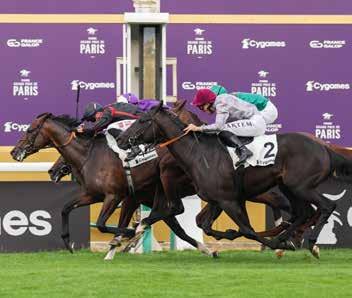
Alam (purple cap), the son of Haras de Bouquetot-based sire Zelzal, finishing a great close-up third in the Group 1 Grand Prix de Paris for Al Shaqab
Photo: ScoopDyga, courtesy of France Galop
“His results on the track are showing now just what he is capable of and we are very excited for the future with him.
“We are looking forward to his yearlings selling at Arqana October, a sale he did very well at in 2025, and on the back of good sales and racecourse results his fee is likely to incease for 2027.”
Already this year, Zelzal has notched a career-high tally of stakes winners with five to date, two of them Group winners, which matches last year’s total and is just one shy of his best from 2022.
The 13-year-old, who won the Prix Jean Prat (G1) and was third in the Group 1 Prix du Moulin, is a lively reminder that his sire - Sea The Starsis not just a source of middle-distance class.
Unraced at two, Zelzal is bred on the outstanding Sea The Stars-Kingmambo cross that has a remarkable 37 stakes winners-to-runners with five of them victorious at the highest level, including champion Baaeed and his full-brother Hukum.
Zelzal is the sire of 16 stakes winners from 288 runners, which gives him a respectable stakes winners-to-runners percentage of 5.5.
Five of those black-type winners are at Group level with the possibility of a first Group 1 winner for the captain of Al Shaqab’s team looking ever more likely.
Alam, Al Shaqab’s homebred three-year-old son of Zelzal, is the most recent Group winner for Zelzal, who stood for €10,000 in 2026.
Winner of the Prix Greffulhe (G3), Alam was a close fifth in the Prix du Jockey-Club (G1), the best placed of the French runners behind the Aidan O’Brien 1-2-3 and Donnacha O’Brien’s fourth placed colt.
Alam has since confirmed himself a three-year-old of the highest quality when a head and a neck third in the Group 1 Grand Prix de Paris on his first attempt at the 1m4f trip. He just failed
Leading
sires
in
France
2026
(to July 13, 2026)
to catch Maltese Cross, who is a son of Zelzal’s sire Sea The Stars, and proved he stays the trip.
Le Metayer is particularly pleased by the emergence of Alam.
“We were delighted with Alam’s
performance in the Grand Prix de Paris and he is going to be trained with the Arc as his aim, taking in one of the trials on the way.
“It is very important for us to have a homebred by one of our stallions
Sire To stud Rnrs Wnrs Races Wins Places Earnings
Zelzal: recording his best year on the track, he is this year’s leading French-based sire in France
flying the flag for Al Shaqab in the most prestigious domestic races,” says Le Metayer.
The colt is a second generation homebred for the operation and the third generation to have carried the Al Shaqab silks. Alam is the first foal of Katara, a dual Listed winner by Deep Impact and out of the Group 2 Park Hill Stakes third Asyad. The New Approach mare was bought as a yearling and is out of the multiple Group 1 winner Elle Danzig.
Zelzal second crop son Aalto regained the Bunbury Cup at Newmarket’s July meeting with the six-year-old delighting trainer Ian Williams. Winner of the race in 2024 and second by a nose last year, 7f over the July course brings out the best in the gelding.
So taken is Williams with Aalto that earlier this month he went to Arqana and spent €42,000 on Al Ghariya, a very well-related three-year-old daughter of Zelzal.
Bred by Al Shaqab, she is a halfsister to the Listed Prix Charles Laffitte
winner Mashael (Dubawi) and out of Al Jassasiyah, an unraced Galileo full-sister to Oaks winner Was.
Zelzal’s success this season has come around the globe with three-year-old stakes winners such as Piana, successful in the Listed Jumeirah 1,000 Guineas at Meydan, and
Bandiagara, winner of the Penn Oaks. Haras de Saint-Voir’s homebred fouryear-old Zelzal colt Mise En Boite has progressed with age, earning his first Group win at the beginning of July in the Prix de Ris-Orangis at Deauville. Out of the winning Acclamation mare Acclamee, he is a full-brother to
Aalto: below, winning the Bunbury Cup for the second time, the Zelzal gelding loves 7f on fast ground at Newmarket, and, above, a post-race cool down
the Listed winner and Group 3-placed sprinter Knock On, who was from Zelzal’s second crop.
The stallion’s three-year-olds are his biggest crop by far with 123 named foals, more than double the size of each of his previous four crops. They were conceived after the juvenile exploits of his first crop, which produced 11 winners, one at stakes level.
In total, that first crop has yielded four stakes winners, a figure matched by his 2020 and 2022 crops with his 2023 crop on course to achieve or better that result.
So far this year he has produced four juvenile winners from 12 runners with Weatherbys recording 50 two-year-olds registered on their database.
Le Metayer revealed that on the strength of Zelzal’s success he was the third busiest stallion in France this year, covering 136 mares and that his fee is likely to be even higher again next year.
Armor impressing with two crops of racing age
The third crop of Armor is due to come under the hammer shortly, and its predecessors’ racing results will ensure the yearlings will be high on the shortlists for trainers and breeze-up consignors.
From the stallion’s first crop have come eight winners from just 17 runners with three of those winners (37.5 per cent) winning at two.
In total, Armor had just 14 juvenile runners from his first crop, but they included Canalejas.
He won on his second start at Toulouse over 7f in June and went on to earn black-type in three races last year, finishing third in the Listed Prix Bernard Ferrand on his third start, and claiming the same position in the Group 3 Prix des Chenes at Chantilly before completing his hat-trick of black-type bronzes in the Criterium du Languedoc (L).
He was beaten by a day in the race
to become Armor’s first stakes winner, his victory in ParisLongchamp’s Prix de Pontarme coming on May 14.
That debut stakes winner for Armor was his second-crop filly Valentina Bella, who won the Listed Prix des Rêves d’Or at Vichy on her second start.
Owned by a collective which includes her breeders, Camille and Guillaume Vitse of Normandie Breeding, on her most recent outing Valentina Bella finished a respectable seventh of 25 in the Group 3 Albany Stakes at Royal Ascot, beaten just over 6l by Libertango, who is by No Nay Never, also the sire of Armor.
The filly’s breeding is a source of particular pleasure for the team at Al Shaqab as her broodmare sire is Mehmas, whom they stand at Tally-Ho Stud in partnership with the O’Callaghan family.
Christophe Soumillon, her jockey on that occasion, reported that the filly had
been denied the opportunity for a clear run so there is likely more to come from this exciting two-year-old.
Armor’s second crop have outshone their predecessors’ efforts. Despite having just the 14 juvenile runners at the time of writing, he is the sire of five winners.
Armor Supreme, trained in Ireland by Diego Dias, is one of that quintet and she was runner-up in the Listed Marygate Stakes at York’s Dante meeting.
The filly was snapped up for just €4,000 by DNA Equine in Part 2 of last year’s Tattersalls Ireland September Yearling Sale, consigned by Browne Brothers Bloodstock.
Barry Irwin’s globally successful Team Valor International have bought into Armor Supreme.
She, too, ran at Royal Ascot, the Queen Mary (G2) in her case when she was ninth, beaten just 4l by Victorious.
Armor: the young son of No Nay Never is more than holding his own in the sire ranks
That debut stakes winner for Armor was his second-crop filly Valentina Bella, who won the Listed Prix des Reves d’Or at Vichy on her second start
She holds some big mid-season juvenile entries.
To this point, Armor is the sire of 31 runners from his first two crops with 13 winners, two of them at stakes level.
That is a better figure than many of his contemporaries can boast and given the smaller numbers he has covered and at a fee of €5,000 in each of his first four seasons at stud, marks him out as a stallion to watch.
Armor was bred by Christopher Steadman and sold at Arqana’s October Yearling Sale by La Motteraye.
At €55,000 he is one of the least expensive of Al Shaqab’s yearling purchases but proved a shrewd buy.
Sent to England and the yard of Richard Hannon, Armor made an immediate impression with success on debut in a 5f Doncaster maiden, defeating El Caballo (Havana Gold) by a length. Almost two months elapsed between that win and his next runRoyal Ascot’s Windsor Castle Stakesand he was fifth to Chipotle.
The Group race breakthrough came on his third start, winning Goodwood’s Molecomb (G3) easily before a close fourth to Perfect Power (Ardad) in the Group 1 Prix Morny. He followed that up with second in the Flying Childers (G2) and earned his Group 1 black-type when third in the Middle Park, a race that was also won by Perfect Power.
Armor’s final start came in the Breeders’ Cup Juvenile Turf Sprint (G2) and with so much speed and precocity, he was retired to Haras de Bouquetot for the 2022 breeding season.
Out of Hestia, a winning daughter of High Chaparral, Armor’s second dam - Perruche Grise - is a Mark Of
Esteem half-sister to Pinson (Halling), who won the Group 2 Prix Guillaume d’Ornano and Group 3 Prix Daphnis and their dam, Tadorne, was placed three times in Listed company.
Tadorne is an Inchinor half-sister to four Group-placed Listed winners and to the dam of Native Khan, successful in the Craven Stakes (G3) and third in the 2,000 Guineas and now a leading sire in Turkey.
A dark bay, almost black horse, Armor resembles his sire strongly with a sprinter’s physique to match.
Lusail first yearlings for sale
Lusail stands alongside Zelzal, Armor, Wooded and Al Hakeem and was bred by Tally-Ho Stud, who stands his sire Mehmas in partnership with Al Shaqab for whom the Acclamation colt raced.
A 160,000gns purchase at Tattersalls Book 2, Al Shaqab elected to send the second-crop son of Mehmas into training with Richard Hannon who had masterminded his sire’s career.
Lusail emulated Mehmas by winning the Group 2 July Stakes and was the sire’s second successive winner of the Gimcrack at York, following in the hoof prints of Minzaal.
Unlike his sire, Lusail remained in training beyond his two-year-old career and displayed good form early in the season as he was runner-up to Perfect Power (Ardad) in the Group 3 Greenham Stakes, fifth in the 2,000 Guineas, second in the Group 1 St James’s Palace Stakes and third in the Group 1 Prix Jean Prat.
Lusail had four starts as a four-year-old and was fifth of 12 behind Modern Games in the Group 1 Lockinge Stakes.
He began his stud career at a fee of €6,000, and that has been reduced by €1,000 in each subsequent season.
Out of a Diamond Green half-sister to the Golden Jubilee Stakes (G1) winner Fayr Jag (Fayruz), Lusail is bred for speed.
Al Hakeem’s first foals delight
The team at Al Shaqab is admits to some excitement about the first foals of the homebred Siyouni stallion Al Hakeem.
“We are delighted with Al Hakeem’s first foals, he has stamped them very well and they are a lovely group,” says Le Mettayer.
“It is very encouraging for us and for the breeders who use him to see that he has started so well.”
Bred on the Siyouni-Galileo cross that has produced St Mark’s Basilica, Al Hakeem won the Group 2 Prix Guillaume d’Ornano and finished fourth in both the Group 1 Prix du Jockey-Club and Group 1 Prix de l’Arc de Triomphe.
An attractive and well-made horse, he is out of the Group 3 Prix Penelope third Jadhaba, who is a daughter
Lusail: has first sale yearlings this autumm and he is profiled in detail in our First Yearling Sires
of the multiple Group 2 winner Naissance Royale by Giant’s Causeway.
With Siyouni established among the elite of Europe’s stallions and St Mark’s Basilica producing two Group 1 winners in his first crop, Al Hakeem represents a sire line that is gaining in influence and prominence.
Wooded seals Swettenham alliance
Al Shaqab’s stallions are not just based in France – Mehmas is in Ireland and Toronado, who is resident in Australia at Swettenham Stud.
Formerly shuttling between Normandie and Victoria, the Group 1 winner by High Chaparral has been based permanently in Australia for four years now and is riding a wave of success.
He will be joined again for the southern hemisphere season by Wooded, Al Shaqab’s Group 1 Prix de l’Abbaye-winning son of Wootton Bassett, who has departed France on the journey to Swettenham as Al Shaqab and Adam Sangster team up once more.
“We are pleased to continue our association with Adam and his team at Swettenham Stud, where Toronado is thriving and Wooded is proving popular as a shuttle stallion,” says Le Metayerd.
A full-brother to Group 1 Phoenix Stakes winner Bucanero Fuerte, Wooded’s oldest northern hemisphere crop are four-year-olds and include last year’s Group 1 Prix Jean Prat winner Woodshauna and Jawwal, who came close to emulating his sire in the Abbaye when second to Australian star mare Asfoora.
Both Woodshauna and Jawwal were bred by Al Shaqab proving yet again the operation’s commitment to supporting its stallions. The former was sold at the Goffs London Sale to American owner John Stewart’s Resolute Racing.
Fast making his presence felt globally, Stewart’s first European
Group 1 winner in his colours was Woodshauna.
The stallion’s first southern hemisphere crop are two-year-olds and his first runner - Crank - was a winner on debut with the promise of more to come.
Al Ghadeer continues to smash records
Standing alongside the Thoroughbreds at Haras de Boquetot is an Arabian stallion who earned legendary status on the track.
Al Ghadeer was world champion every year he raced and claimed Arabian racing’s Triple Crown not once but twice, an unprecedented achievement.
The seven-year-old is a son of Al Shaqab’s brilliant Al Mourtajez, and retired to stud this year as the winner of ten Group 1 races. Those victories including three consecutive successes in the Group 1 Qatar Arabian World Cup, which is held at ParisLongchamp on
Al Shaqab stands Arabian stallions in Qatar and at Haras de Thouars near Castella in south-west France, a farm at the cutting edge of equine reproduction.
It is where Al Mourtajez stands, but when it came to his outstanding son, the bold decision was taken to stand Al Ghadeer in Normandy and the results have amazed the team.
“It was remarkable to stand an Arabian stallion of Al Ghadeer’s quality in the north of France as it is not the usual location for top-class Arabian horses but he has been incredibly popular,” says Le Metayer.
He adds: “Already he has ‘covered’ 200 mares using fresh and frozen semen. We are delighted with how well it has worked.”
Arabians or thoroughbreds, the future looks exceptionally bright for the Al Shaqab stallions. ■
European Sires 2026 (by
A close-run thing in the Group 1 St James’s Palace Stakes saw Bow Echo have to go into battle for the first time in his career, all the hard work by the
team at Darley came to fruition
Take a Bow
It takes a team to make a racehorse
From foal to a Classic winner, Leo Powell chats to the Darley stud team, who has produced Bow Echo to become the leader of his generation
Racing photos by Debbie Burt
LIAM O’ROURKE, a lynchpin of the Darley operation for many years, crossed paths with the late Sheikh Mohammed Obaid Al Maktoum, and what was at first a professional connection became a very personal friendship.
But it is the words “team effort” that are often used by O’Rourke, and the endeavour put in by him and the team for the late Sheikh have been celebrated this year with two most iconic victories in the Sheikh’s distinctive yellow and three black-spotted silks.
Those wins, the 2,000 Guineas (G1) and the St James’s Palace Stakes, were recorded by the interim leading European sophomore miler of 2026, Bow Echo.
Sadly, the Classic winner’s ownership is now in the name of the executors of Sheikh Mohammed Obaid following his untimely death four days after Christmas. But despite his physical absence, the spirit of the Sheikh is evident as the colt fulfils both the Sheikh’s dream and his strategic plan.
An unbeaten career to date positions Sheikh Mohammed Obaid’s homebred at the head of his age group over a mile, and the popularity of his victories at Newmarket and Royal Ascot is a credit to the colt, his late owner and breeder,
as well as his young trainer George Boughey, and even younger jockey Billy Loughnane.
Racing fans have much to anticipate for the remainder of the season, and, hopefully, as with Frankel, next year.
A look back at the life of Bow Echo reveals a few important elements.
While perhaps now a few people are responsible for his racing career, a massive team of people shaped him to become the racing titan he is now. He is an example of a colt who, in some ways, almost flew under the radar, not being an obvious standout, but whose mindset and talent was just waiting to be cultivated.
In the paddock after Bow Echo’s Royal Ascot victory, gained in a race when little went his way, O’Rourke was understandably moved and proud.
The key cog in the success story of Bow Echo, following Sheikh Mohammed Obaid’s death, is O’Rourke, though this typically modest Irishman inevitably plays down his own role, deferring to many others.
O’Rourke’s initial interaction with the Sheikh was an occasional conversation – Sheikh Mohammed Obaid was in constant communication with the Darley racing and bloodstock teams, and they would pass him over to O’Rourke when an opinion was needed.
Thus began a more than two-decade long relationship.
“That was many years ago, and he might have a question about his broodmares, though he didn’t have too many in those days,” recounts O’Rourke. “We established a relationship then, and he began to call me, and we
became more friendly, and I met him on occasions. It was a time when Dubawi was developing as well. He had a lot of questions for me, because Dubawi was here [Dalham Hall] with us, and we were taking him step by step in terms of his stallion career trajectory.
“This involved things like setting
And on the podium together after the Newmarket 2,000 Guineas success, O’Rourke (right, second row)
The team enjoying that Group 1 feeling in the Royal Ascot winners’ enclosure, O’Rourke (second left)
Dreams came true on Bow Echo for young jockey Billy Loughnane in the 2,000 Guineas
stud fees and more, we liaised closely and became good friends.
“He was terribly proud of the stallion. From the time that Dubawi was trained at Godolphin, and even when the horse went to Dubai over the winter, Sheikh Obaid would go and look at him every day with Simon Crisford. He took a great interest in him throughout his career, albeit he was running in the blue silks in those days.
“When Dubawi retired, Sheikh Obaid retained that interest and wanted him to sire horses who would run in his silks. He always rang me on a Monday, and we discussed various things, such as what entries there were for horses in the week ahead, or what happened with his breeding stock over the weekend, and if there were updates in the previous week.
“He was passionately interested. He never missed anything; he really had a super passion, which runs in the Maktoum family, and it was evident in him.
“This was what gave him pleasure and joy; watching young horses coming along, and families develop. When you think about it deeply, the modern-day thoroughbred traces back to Arabia, and it’s in the gene of the Maktoum family to have a deep-rooted interest in such animals.”
While the racecourse and breeding successes of Sheikh Mohammed Obaid Al Maktoum are well-known, what was he like away from the spotlight?
“Well, he was a compassionate man, but one who would not, and never did, suffer fools. Any trainer would tell you that!
“Every Monday I would have to be certain I had my ducks in a row, but as I said, he was a very, very compassionate and caring man about many aspects away from horses.
“He would always inquire about my family members. He was also a philanthropist, which isn’t generally known, a generous man to various causes within our industry without
taking any credit for it.
“He was a very broad-minded, caring and extremely knowledgeable man, with an inquiring and sharp mind.”
O’Rourke has no doubts about what Bow Echo’s Classic win would have meant to Sheikh Obaid.
“I think it would have been a career high for him in terms of achievement, because he was sure in his own mind what the capability of this horse really was. I wasn’t, I must admit, but he had a very clear vision, and George [Boughey] would say the same thing. He had mapped out the colt’s career path.
“He was adamant that the horse was not going to run in the Dewhurst; he wanted to make him the champion three-year-old. He had his path mapped out in the sense that he told George that the horse was to go to the Guineas without a further start, for some reason better known to him than anyone else.
“His faith in him was unwavering, I must admit that I probably had my doubts. You win a Group 2 race, it doesn’t always mean you should be winter favourite for the Guineas, but Sheikh Obaid was certain.
“He had an innate sense of understanding. Yes, the horse was unbeaten, and he was known to be a horse with ability, but Sheikh Obaid was the one who was sure.”
Most trainers of champions can remember a particular moment when they had a realisation there was a champion in their midst. Did O’Rourke get this feeling with Bow Echo?
“I think George knew from an early stage, because the horse did go into training quite late,” recalls O’Rourke.
He laughs: “George and the horse are very similar; they suit each other well. They’re both laid back characters, and don’t say too much, but they certainly tell you when they do speak!
“I think George felt, without saying much, that what Bow Echo achieved at two was only a precursor to what he could achieve at a higher
level as a three-year-old, I don’t think George was in any doubt.
“He kept that quiet, but you could tell by his demeanour he was extremely pleased with the horse. He’s never been anything other than positive about him.”
WHAT WAS THE
occasions, did all the other matings, and then came back to this one. I couldn’t come up with a better solution.
“In my mind, I wanted to use Night Of Thunder, with Aristocratic Lady because he was emerging and the mare needed miler speed, and class miler speed.
“She also needed a sire with
Former champion sire and Bow Echo’s grandsire Dubawi and, below, Bow Echo’s sire, Night Of Thunder
Photos courtesy of Darley
substance. Her first foal was a bit weak and first ‘foalish’, so we needed performance, needed substance definitely, but the catching point was the inbreeding, which I always tried to avoid as much as possible.
“However, I kept coming back to this and I thought, there’s two ways of looking at it – I’m either going to be a hero or a villain!
“It was a punt, and that’s really what it was. There was no science attached –I’d like to be clear on that.”
How did the Sheikh respond to the proposed mating?
“For many years he said he didn’t want to talk about the matings, just saying ‘if you’re happy with them’, and he left that to me.
“The dam was a late developer herself, but she was a decent mare, rated in the 90s. She didn’t achieve black-type, but she was up to Listed class.
“Aristocratic Lady was well bred, and I wanted to give her a good chance with a proven sire from the get-go. We sent her to Lope De Vega [that filly is now owned by Monceaux], and there’s a bit of a back story there, too.
“The filly never raced and Sheikh Obaid didn’t want her, and I couldn’t convince him to hold on to at least until December. He insisted she go to Tattersalls in July, and made 10,000gns, bought by Tom Blain, who resold her five months later when Bow Echo had come up for 150,000gns! That’s a reason Sheikh Obaid was a great man; he made those decisions and never regretted them.
“It’s a family which develops well, and they go on. They’re enduring, they really improve with age, and they’ve a lot of class. It shows as time goes on. Look at Royal Champion; he’s won a Group 1 as an eight-year-old! They are sound.”
Royal Champion’s Group 1 win in Saudi Arabia came just weeks after Sheikh Obaid’s death
“That certainly was emotional,” says O’Rourke, adding, “but undoubtedly the
In my mind, I wanted to use Night Of Thunder with Aristocratic Lady, because he was emerging and the mare needed miler speed, and class miler speed
most emotional was Bow Echo’s win in Newmarket. You felt his presence almost: he was looking down and cheering.”
AFTER THE DEATH of a major owner or breeder, there is a question about the future for their racehorses and broodmares.
Have any decisions been made yet concerning Sheikh Mohammed Obaid’s valuable collection?
“Everything will continue as it is, at least in the short term, and hopefully longer.”
Finally, O’Rourke paid tribute to the many who have made a contribution to this great success story.
“Bow Echo was foaled at Kildangan under the auspices of Jimmy Hyland and his team.
“The colt moved over to Ragusa under the direction of Pat Murphy, a great man, and his team.
“He was then off to one of our yearling farms, Ballysheehan, and the care of two great men Willie Brogan and Paddy Dunne.
“Bow Echo returned to Kildangan for breaking, and then spent time with Patrick Prendergast.
“The colt really is a team product and I’d like to thank everyone immensely for their great input”.
Sheikh Obaid’s influence on breeding will endure, and Darley stands four stallions he bred – Dubawi,
Triple Time, Rosallion and Inisherin.
“Dubawi’s still ticking over, and he’s got about 35 mares in foal this year, it’s amazing.
“His dam Zomaradah was a wonderful broodmare. When I came here she was in training with Luca Cumani, and he did a great job with her. That marked her down as a lovely prospect for Sheikh Obaid and the rest is history.
“One final thing is that this is an old Stackallan Stud family of Mrs Elizabeth Burke [Sonia Roger’s mother], going right back to High Tern and Sunbittern.
“It is the family also of Sheikh Obaid’s Derby winner, High-Rise.
“It’s a wonderful old Irish family that keeps coming to the fore.”
Godolphin Ireland’s CEO Jimmy Hyland: was in charge of the Kildangan foaling team when Bow Echo was born
Photo courtesy of Darley
Arrival at Kildangan
In an effort to gain a complete picture of Bow Echo, from foal to dual Group 1 winner and the leader of his generation, as O’Rourke has alluded to, there were many people involved.
An important player was Jimmy Hyland, Godolphin Ireland’s new CEO, and he has a clear memory of the colt.
He says: “Bow Echo was foaled at Kildangan before he went on his journey. He was a horse who had a lot of quality, but an injury meant we had to ease off with him.
“There are a lot of people involved in his development and career, including Ken [Donoher, Kildangan’s stud manager].
“We have been using Patrick Prendergast for pre-training for the last couple of years and he does a great job with them. The horse was a bit backward when he was here, and we just gave him a bit more time before he went to Patrick.
“He has turned out to be such a good horse and, hopefully, there is more to come. He has continued to develop. He was even a bit unfurnished in the Guineas, particularly behind the saddle, but he will get stronger over the summer.
“Night Of Thunder’s stud career is something like that of his sire. Dubawi stood his third year here for only €40,000 [and the following year in the UK dropped to £15,000] and he couldn’t attract 100 mares.
“He passed on his ability to Night Of Thunder, and both have done it the hard way, coming through the ranks, and Night Of Thunder is doing so well now.
“Both sires throw similar types with lots of substance, but their temperament is extraordinary, and that is one of the key attributes of their stock.
“They can adapt to change, are easy to work with, are honest every day. They are sound and have this will to win; they put their head down close to the line and give you everything.
“We are fortunate to have this line
going back to Dubai Millennium.
“We have a number of sons of Dubawi, and Ghaiyyath is on the verge of greatness, and he could make the breakthrough, just as Night Of Thunder has done.”
The young foal brought up at Ragusa
Just three days into his young life, Bow Echo travelled half an hour from Darley’s flagship Irish farm Kildangan Stud to Ragusa Stud.
Near the scenic village of Ballymore Eustace, Ragusa has a storied history, being named after a Paddy Prendergasttrained 1963 Irish Derby winner, who raced for Jim and Meg Mullion. They also owned the nearby Ardenode Stud.
Pat Murphy is the man in charge at Ragusa, and while many young foals have gone through his hands there, he has an unusual reason to recall Bow Echo.
“Bow Echo came to us in March, and was with us for six or seven months.
“He is a foal that I do rememberand to my shame I don’t remember them all - but for a funny reason really.
“His dam went to Starspangledbanner that year, a sub-fertile horse, and so unusually we left the mare at Coolmore to give her a better chance. Therefore, we isolate them when they come backpurely a precautionary measure.
“It can be a bummer for a young foal as they are usually in groups of four here, and we don’t like to upset that routine.
“I hate taking them out of their groups, it goes against my nature, but we have to do it sometimes. This little chap went into isolation on his own in a little paddock with his dam, no other horses around, for two weeks.
“Unfortunately the mare wasn’t in-foal, and she had to go back to be covered.
“The thing that really stood out to me was that he was such a happy chappie on his own.
“In my notes I have down him as
Bow Echo’s great-grandsire Dubai Millennium seen here in the February of his three-year-old season
Photo courtesy of Darley
average size, quality profile, average condition, walks and tracks well, and he got a B+, a good score considering he was not a big robust horse that would fill your eye.
“He was so happy that we left him there until the end of July. He was not the best doer in the world, but was eating well in the paddock with mammy, and he was just so chilled.
“He was independent, happy with life, and that’s stuck with me.”
He added: “Bow Echo had a few niggles along the way in his early life, but it just goes to show that if the engine is there, and the ability is there.
“My daughter rode in the charity race at Punchestown on the day of the 2,000 Guineas, and I was watching both and it was just a wonderful day.
And again we come back to temperament.
“The standout about Bow Echo for me was his temperament – he was so chilled,” adds Murphy.
“The other thing for me was the reception after winning the Guineas at Newmarket, for the horse, Sheikh Obaid,
Pre-trainer
Patrick Prendergast
George and Billy The Kid.
“That was as good as the win nearly!
“George was getting bear hugs from his fellow trainers – you don’t see that too often. There was genuine goodwill.”
Young horse development down to a top-class team
Willie Brogan manages the two Godolphin farms in Tipperary, Ballysheehan and Victor, and it was at the former that Bow Echo spent the largest amount of time during his formative years.
He moved there from Ragusa Stud, and left after 14 months or so under the watchful eyes of Brogan, his aide-decamp Paddy Dunne, and a great team.
At various times in their lives, a horse can be a different character, though some traits will be mentioned by everyone.
“From the start he was just a straightforward foal who didn’t cause many problems, he went under the radar really,” recalls Dunne.
“I must admit that I didn’t identify him as being a top foal at that point.
“We had him from about September of 2023 until November the following year. I checked my notes on him and he was a medium-sized horse, athletic.
“At the time he didn’t look really early, so we were giving him a bit of time to mature and fill out; he wasn’t the strongest individual.
“He has done really well, and once he won his first race we had him on the radar straight away. It’s lovely to see the babies go on and do well.”
What was the colt’s normal routine at Ballysheehan?
“Every day, Monday to Friday, they come in for their breakfast; we make sure they are healthy or if there’s any veterinary treatment needed. Farrier work is done once a month, usually a
straightforward hoof trim. His legs were pretty good, and there was no major issue with him. He was turned out a little bit, typical of the sire line.
“If Bow Echo was in a box, he was a horse who rested; he would lie down and sleep!
“There are so many people who play a part in the career of a horse, from the team here with myself and Paddy, the veterinary advisors, farriers, the dentist – it is all in attention to detail.
“These people need to be acknowledged for what they do behind the scenes, and we are very lucky to have them. I’d like to thank our staff here on the ground.
“I’m with the company 20 years, working in Kentucky, Virginia and Japan, and there is one man here, Willie Lonergan, who has been at Ballysheehan for years. People like that are just amazing!”
Pre-training with Prendergast
While the former trainer Patrick Prendergast had the shortest time with Bow Echo in his career path, overseeing his essential pre-training with the young two-year-old with Prendergast at Melitta Lodge for just a month,
The late Sheikh Mohammed Obaid
he saw huge potential in the young son of Night Of Thunder.
Prendergast comes straight to the point: “What I remember of Bow Echo was that he did everything right.
“I also remember that he was more precocious than most of the bunch, and he was quite clever. It hasn’t surprised me that he’s turned out to be as good as he is. He was quick to learn. He always had the potential to be a champion.
“He went to the Guineas without a prep run, and Sheikh Mohammed Obaid was very aware of his mind. He knew he didn’t need a prep run.”
Summing him up, Prendergast says, “He is something special.”
Joins the up-and-coming Boughey
The scenes that welcomed Bow Echo back into the winners’ enclosure at Ascot were joyous, with high-fives and hugs aplenty.
The importance of this victory for the stable superstar, on Flat racing’s biggest stage, was not lost on his trainer George Boughey, who didn’t overlook the importance to his career that an owner such as Sheikh Mohammed Obaid Al Maktoum placed in him.
Bow Echo joined the Newmarket trainer six months after the first of the owner’s horses moved to Craven House Stables.
Still on a high after the St James’s Palace Stakes win, Boughey, who had earlier described Bow Echo as “a freak”.
“Bow Echo makes our lives easy because he is so easy to train,” says the trainer. “This means the world to me. It is what we all dream of, and what makes us get up every day. So many people have contributed to this, and none more so than Sheikh Obaid.
He bred this horse and has had the whole family for three generations.
“It is just so sad that he is not here to see the result of his selective breeding. He had a clear vision for the horse, and Liam has been good to me and carried on with the Sheikh’s vision.”
Above, left, trainer George Boughey: “Bow Echo makes our lives easy because he is so easy to train”
Jocelyn de Moubray interviews
Pierre Talvard of Haras du Cadran, producer and consignor of the Classic and Group 1 winner Constitution River and with a Kodiac half-sister to sell at this year’s Arqana August Sale
A strong Constitution
Racing photos by Debbie Burt
Stud photos courtesy of Haras du Cadran and by Zuzanna Lupa
Pierre Talvard greets Ryan Moore after Constitution River’s Eclipse victory (inset)
PIERRE TALVARD has been breeding horses at Haras du Cadran for a long time. The stud has changed. Talvard started out in the early 1980s in what had been a veterinary clinic with about 40 acres of land, today the stud totals nearly 1,000 acres. However, the man himself has changed less – the filterless cigarettes may have been replaced by fine cigars, but the moustache is still there as is the unashamedly Gallic look.
One thing has not changed – from the very beginning and through to this year, which looks set to be the stud’s best year so far, Cadran and Talvard have produced horses capable of winning the best races.
His first Jockey-Club horse was Ghost Busters, a son of Pampabird, who was trained by François Doumen and was beaten only a short head by Hours After in the 1988 race.
“I watched at home,” Talvard remembers, “and in my excitement broke the table in front of me during the race!”
In 2014, Cadran had its first JockeyClub winner with The Grey Gatsby, who was bred at the stud by Malcolm Parrish and sold as a yearling at
the Arqana October Sale for only €24,000, and this year its second with Constitution River, bred at Cadran by Talvard’s friend and long-term client Gerard Laboureau.
Constitution River was sold to MV Magnier for €400,000 at the Arqana August Sale.
“Every year,” Talvard explains, “Laboureau’s maiden mares come to Cadran from their racing stables, and we decide together what to do with them.
“When Chuppy arrived I told him that for her he had to make an effort, and she deserved to go to a top stallion. She has always been a beautiful mare and, though she showed nothing on her only two starts, her first trainer Pascal Bary believed she had plenty of ability and her full-sister Wonderful Tonight had already proved herself to be a top filly.
“We agreed she should go to Wootton Bassett, who was standing at €150,000.”
Chuppy has an unraced Mehmas two-year-old filly called Sensational Filly, who is in training with Paddy Twomey for Bond Thoroughbred, and a Kodiac yearling filly who is going to the August Sale. Chuppy is safely back in-foal to Lope De Vega.
“There are plenty of people who want to buy Chuppy for a lot of money,” Talvard says, “but for the time being Monsieur Laboureau has said no, and she remains on the farm.
Constitution River’s dam Chuppy is in-foal to
“I have told him he has bred the best three-year-old colt in Europe, but it is of course for him to decide whether she stays or goes.”
Talvard is now living out what had been his dream from the start, raising horses good enough every year to compete in the best races. Last year Leffard, bred by Cadran and principal partner Écurie Melanie, won the Group 1 Grand Prix de Paris for owner Gerard Augustin Normand and trainer Jean-Claude Rouget, an emotional moment for all of those closely involved as Rouget was just recovering from a serious illness.
“Jean-Claude is,” Talvard says, “my friend, and Leffard was the third Group 1 winner he has trained for the stud, and it was a special moment for all of us.”
This year the stud’s other top horses include the Iffraaj filly The Last Dance, who was second in the Poule d’Essai des Pouliches (G1), and there are five foals of 2023 raised on the farm for important client Alain Jathiere, including two Group winners in Dostoievsky and Khovikhov.
There are around 130 mares based on the farm and many of these belong to either Jathiere or Jean-Claude Seroul, whose breeding stock has been at Cadran for decades.
Over the years Talvard has succeeded in attracting long-term boarding clients such as Seroul and Jathiere, while at the same time finding partners to help the farm upgrade its own broodmares.
For this project, a decisive moment came at the 2011 Arqana December Sale when Talvard bought the Rainbow Quest mare Kartica with two partners for €130,000, which was at the time a huge investment for the farm.
Kartica was bred by Newsells Park and sold as a yearling in Deauville and over three years racing was Group and Listed placed several times.
“She was,” Talvard recalls, “trained by Philippe Demercastel, who was a great horseman, and he told me that it was
There are plenty of people who want to buy Chuppy for a lot of money, but for the time being Monsieur Laboureau has said no, and she remains on the farm
only problems with her joints that had stopped her from being a Group 1 filly.”
Kartica’s first foal was a Danehill Dancer filly, who was sold to Al Shaqab at the August Sale for €200,000. Named Qemah and trained by Rouget, she went on to win Group 1s at Royal Ascot and Deauville.
Kartica’s foals sold well – there was a Charm Spirit colt who made €500,000, and the mare herself was sold to Shadai Farm for whom she produced the Kikuka Sho (St Leger) winner and Tokyo Yushun (Japanese Derby) third Ask Victor More.
Cadran now had the means to invest in mares.
“I am not interested in buying mares at the bottom of the market,” Talvard confirms, “if you want to compete in the best races you have to invest.”
The next step forward in this regard was a meeting with Gerardus Beemsterboer, a Dutch businessman whose family company Bejo is a world leader in the breeding, production and sale of vegetable seeds, and present on every continent.
“I received an email out of the blue,” Talvard recounts, “saying that he was visiting several stud farms in Normandy and would like to come to Cadran.
“At the end of the tour, he asked me what I would like to sell him and I replied nothing but that I would like to buy in partnership with him. Fifteen years later we are still working together and his Ecurie Melanie was the co-breeder with both Leffard and The Last Dance.
“Every year after the August Sale we sit down together and he tells me how much he wants to invest in
Constitution River’s half-sister by Kodiac, catalogued as Lot 287 in the Arqana August Sale
haras du cadran
broodmares, and then we go to the breeding stock sales and I match his investment.”
Last year purchases included the Galileo mare Lily Hart, a Listed winner in-foal to Wootton Bassett from the family of Green Tune and Pas de Response bought at Arqana for €1,050,000.
Cadran has come a long way from its beginnings. Talvard himself comes from the west of France and first started working with horses in the Camargue.
A chance encounter with thoroughbreds decided his destiny and he applied to a classified advertisement and went to work for Jean Louis Lucas at Haras de Preaux, which is now part of Sumbe.
“After a year I had had enough,” he remembers. “I decided I would do better
This year’s draft is the best we have ever had, on pedigrees and the individuals themselves
concentrated on keeping mares for clients and presenting yearlings for sale, though this does bring about a conflict of interests for him.
“I am not,” he says, “a big fan of the sales. Watching a horse win I can jump up and down, scream, cry even, but a sale is a sale, and the job is only half done. I want more than anything to win races.”
Cadran sells its yearlings at Arqana.
Goffs and buy at their breeding stock sales regularly, but my yearlings go to Deauville.”
His son Emmanuel, who has returned after a spell at the Haras du Beaufay to work with his father, is the one who follows the sales statistics closely.
The statistics suggest Cadran is more successful in this domain too – last year in August it sold 19 yearlings for a total of €3.8 million.
“This year’s draft is,” he insists, “the best we have ever had, on pedigrees and the individuals themselves.
“Emmanuel and I work closely together. We go out and look at the horses together, we work on matings and go through the sales catalogues together.
“We are equals at the stud and one day he will take over, but not just yet!
“Jean-Pierre Dubois told me the
success
Nemone Routh started working for the Aga Khan Studs 29 years ago. She is now one of the stud’s directors, its French racing manager and is in charge of the organisation’s press communications in France.
She talks to Jocelyn de Moubray about her extensive role, the farm, its stallions and its racehorses with the Aga Khan Studs enjoying an excellent 2026, set to be one of its very best years on the track
EMONE ROUTH has been an important part of the Aga Khan Studs’ management team for some years now but over the last few years she has also acquired a public profile, taking over communication with the racing press for the horses trained in France – this came at the suggestion of the stud’s principal French trainer Francis
“Considering the size of his own stable and his considerable other responsibilities Francis thought,” explains Routh, “that it would be a good idea if I took over dealing with the press and this idea was validated by Princess Zahra.”
Before an important runner and after the big wins Routh has become a familiar figure not only on Equidia, France Galop’s racing channel, but also on Racing TV and At The Races. In recent years there have certainly been many opportunities for communications with the press as there have been plenty of big wins for the green and red colours of the Aga Khan Studs in France, Britain, Japan, Dubai and, very nearly this spring,
in the US, too, when the fillies Cankoura and Mandanaba finished second in Grade 1s at Saratoga.
The Aga Khan’s family has had good, excellent and ordinary years over its 100-plus years in European racing, but there can be no doubt that 2026 is going to be among the excellent ones.
At the time of writing the Frenchtrained horses have already won 19 Group and Listed races and placed in ten more – it will almost be inevitable that by the end of the year the totals will be better than the excellent record of 24 wins and 44 places achieved in 2025.
Between them Calandagan and Daryz
have won four Group 1 races and the three-year-old colt Rayif took the Group 1 Poule d’Essai des Poulains, joining past Aga Khan winners of the ParisLongchamp Classic – Ashkalani, Nishapour, Daylami, Zeddaan, Kalamoun, Sendawar and Blushing Groom.
“I believe,” Routh continues, “that it is important when speaking to the racing public, or when selling our horses, to be transparent and honest with everybody.
“And of course some of the horses will become stallions and we want everybody to know about our stars.”
Routh’s official title within the
organisation is director and French racing manager.
“The bloodstock management team was for many years made up of Princess Zahra Aga Khan, Georges Rimaud, manager of the French studs, Pat Downes, manager of the Irish farms, Constantin de Lencquesaing, the chief financial officer, and myself,” says Routh.
“We would report to His Highness the Aga Khan IV. Georges retired at the end of 2024, and Pierre Gasnier has taken his place.
“Since the death of His Highness last year, Princess Zahra now represents her
Princess Zahra Khan congratulates Calandagan after the son of Gleneagles won Royal Ascot’s King Edward VII Stakes in 2024 By Zuzanna Lupa
family at the head of the organisation.
“His Highness was responsible for the family’s bloodstock for a long time as he was only 23 when he inherited the horses following the death of his father Prince Aly Khan and he was 88 when he passed away, and Princess Zahra has already been part of the team for a long time.”
ROUTH HERSELF was not in any way destined by birth or upbringing to play such a role in the Aga Khan Studs.
She was brought up in London where her father, the renowned structural engineer Peter Rice, worked in the offices of Ove Arup & Partners.
Rice was at the forefront of his vocation and worked on many of the most famous buildings built in the 20th century from the Sydney Opera House, the Centre Pompidou and the Louvre Pyramid to the Lloyds of London building in the City of London.
“I am not at all from a racing family,” she laughs. “When I was young more than anything I wanted to have a horse. I had taken up riding with Mum when we went to the country at the weekends, but as we lived in Shepherd’s Bush it was just not possible.
“In those days there was a lot of racing on terrestrial television in Britain, on the BBC and ITV, and I started watching and, from the time I was ten or 11, I became transfixed.
“My father was Irish and so he knew about racing. He was the structural engineer of the new Queen’s Stand at Epsom and he used to take me to Sandown and Kempton evening meetings, we would go together with Mum after he had finished work.
“I was fanatical about horses and racing.”
... there was a lot of racing on terrestrial television in Britain, on the BBC and ITV, and I started watching and, from the time I was ten or 11, I became transfixed
After studying American and English Literature at Manchester University, (“There,” she remembers, “I kept quiet about my love of racing, not a cool student pastime!”) she looked for a way to work in the racing world and found
an opportunity at the International Racing Bureau in Paris under the direction of Desmond Stoneham.
“My father died during my last year at university,” she continues, “but we still had the flat he used when working in Paris, and in February 1994 I arrived to work for Desmond.
“We became friends, particularly when I was no longer working for him. He was a loyal friend and without him I would certainly not be here.
“After three years it was time to move on, and I applied for a post in the marketing department at Tattersalls.
“Desmond had, however, decided that I would be a good fit for the Aga Khan Studs and he even went to speak to His Highness about me.
“A few weeks later I got a call out of the blue and was asked to go and meet Princess Zahra. I went to the Dubai World Cup for the IRB and then in April 1997 took up my new position working with Princess Zahra at the Aga Khan Studs.”
Princess Zahra had recently returned to Europe after completing her studies at Harvard University and at the beginning Routh worked with her.
However, soon after the management structure changed with Pat Downes taking over the Irish studs and Routh joining the team in France, and in 2000 Georges Rimaud joined as manager of the French studs.
For the next 25 years Routh worked closely with His Highness
The Aga Khan IV.
“His Highness was both highly intelligent and a man with great power and responsibilities,” she remembers.
“You might have thought he would be distant and difficult to work for, but with me he was not like that at all.
“When my children were younger, I used to not work on Wednesdays and one week he called and asked if I could nevertheless
Routh’s career in racing started with the legendary Desmond Stoneham By Zuzanna Lupa Photo: courtesy of The Aga Khan Studs
come and help him with an interview. It happened to be the birthday of my daughter Sofia, but, of course, I said nothing and went.
“When we had finished, he came over and asked me to be sure to apologise to Sofia on his behalf, and he was being completely genuine.”
In 1960, His Highness the Aga Khan IV had not been at all sure whether he wanted to take on his family’s racing tradition, but it became something which fascinated him for more than 60 years.
“When I was with the IRB and part of the press huddle after a big race, I was always pleased when the Aga Khan won as he always had something interesting to say, always had a point of view, and we [the press] all had the impression that he had been speaking directly to us,” Routh recalls.
THESE IMPRESSIONS from the outside were confirmed once Routh was part of his team.
“His Highness was,” she says, “very passionate about the horses, he was dealing with big issues in the world much of the time and I think maybe the horses were his escape at the weekends.
“He seemed to really enjoy a beautiful winner at Longchamp. We have all been formed by his ideas. He used to say that every link in the chain counts, from the person who gets up in the morning to prepare the horses for exercise, to those who get up during the night to oversee the foalings; if you want to succeed at the highest level everyone involved is important.”
At the beginning of the century the Aga Khan Studs’ new management team decided to move a large part of its bloodstock to France to take advantage of the premiums given to the owners and breeders of French-bred horses.
At the time the stud had only a few ordinary mares based in France and its
Above, Erevann, and, below, Vadeni, both of the stud’s stallions have first yearlings selling this year
Photos: courtesy of The Aga Khan Studs, by Zuzanna Lupa
stallion station had been temporarily closed.
In 2001, the Poule d’Essai des Poulains winner Sendawar retired directly to Haras de Bonneval, and he was followed by the Derby winner Kahyasi, who had started his stallion career in Ireland.
In 2005, Jean-Luc Lagardère’s stud farms and bloodstock joined the Aga Khan Studs, and fillies coming off the track began to be retired directly to the French farms.
The French stallions have proved to be very successful with the partially syndicated horses Siyouni and Zarak now among the best European stallions.
This year the Prix du Jockey-Club and Eclipse (G1) winner Vadeni and the Prix Daniel Wildenstein (G2) winner Erevann will have their first yearlings for sale, the first drafts to be offered at the Arqana August Sale.
FOR THE FUTURE there are more stallions likely to come as the Prix de l’Arc de Triomphe, Prix Ganay
des Poulains winner Rayif have already earned places at stud. even if for the time being there are no firm plans as to where they, and other potential stallions such as Varandir, might stand.
There was a new shift in policy from 2020 when it was decided to move some of the mares who were based in France to Ireland.
“We have,” Routh says, “twice as much land in Ireland as in France and it made more sense from a numbers perspective to start keeping more mares in Ireland than in France.
“Today the mares are divided with approximately two-thirds based in
Ireland and a third in France.
“One of the first mares who moved to Ireland was Calayana, whose Gleneagles foal of 2021 is Calandagan – he was born and raised in Ireland and doesn’t have French-bred premiums.
“All of the French-breds race in France, along with some of the Irish-breds such as Calandagan, his three-year-old half-sister Calasita, the siblings Rayif and Rayevka, and the promising three-year-old gelding Erdenali.”
Routh believes this is one of the many factors contributing to the stud’s current run of success.
“Today, we breed more mares to proven stallions including those we stand such as Siyouni and Zarak in France and Sea The Stars in Ireland.
“We are also lucky that we have a lot of their daughters and all three stallions work together well – you can send mares by Sea The Stars or Siyouni to Zarak, for instance.”
Other changes to the team have also played a part with Francis Graffard taking over at the Aga Khan Studs training establishment Aiglemont in
becoming the retained jockey in 2025.
“Francis has been a big positive influence,” Routh says. “It was not easy at the beginning as he changed many things from the training to the feed programme and it takes time to have all the staff on board.
“Mickael [Barzalona] is also an asset. He is a team player, he comes to ride every work morning and is respectful of the horses in their races.”
Recently, Calandagan came back from his poor run at Epsom to win the Grand Prix de Saint-Cloud (G1) in the manner of one of the world’s best racehorses, Behrayna remained unbeaten in the Prix de Malleret (G2), while the Zarak colt Varandir ran a fabulous race in the Grand Prix de Paris (G1) when fourth beaten only by a head and two necks.
“Varandir has been a backward colt,” Routh says, “who won his Group 3 very well. He is the first foal of a big Pivotal mare Varkesha.
“I have always thought it would be a little special if Varandir does become a top horse as when his dam won in Deauville in August 2021 it was the last time His Highness came in person to see
Daryz upsides
Minnie Hauk before going on to success in the Group 1 Prix de l’Arc de Triomphe
FEED YOUR DESIRE TO WIN
ULTRA MIX NEW HORSE CARE
A cereal grain free, ultra-low starch conditioning mix with RED MILLS
Nutrition Care package
SPECIALLY FORMULATED TO SUPPORT
Energy levels in an ultra-low starch format
Muscle function and post-exercise recovery
Condition and topline
Healthy gastric balance and hindgut function
Bone strength and integrity
Immune function
Hoof condition and quality
Feed acceptance is hugely important in a training yard, and the new HORSE CARE ULTRA MIX has impressed us straight away. Even the horses that can be a bit particular are eating it well, which gives you confidence they’re getting what they need.
CHARLIE HILLS Trainer
Connolly’s RED MILLS, Woodland Granaries, Narrow Lane, Wymeswold, UK.
T: 01386 552066 E: info@redmills.co.uk
Saving the
PMU
With the PMU’s declining returns having reached crisis point, France Galop is taking action, – earlier this year it set up a financial Task Force.
Guillaume de Saint Seine, the president of France Galop, tells Jocelyn de Moubray of the progress made so far.
Guillaume de Saint-Seine: is focused to make a positive plan for the future
FRANCE GALOP has made every effort to ensure that everyone involved in French racing and breeding is aware of the crisis posed by the decline in the PMU’s betting turnover, a turnaround after many good years of rising incomes.
From the end of the 20th century up to 2012 when turnover reached a new high of €10.5 billion the news was, year after year, good.
During this time, as the PMU adapted to the modern world, turnover rose by 40 per cent in real terms and French racing was once again, as it had been in the 1970s, in a privileged position compared with its European counterparts.
Since 2012 it has, though, been a different and more challenging story.
In 2024, turnover was €9.8 billion, a fall in real terms of 30 per cent, and in the years since the decline has accelerated with the money available for France’s two racing disciplines, thoroughbreds and trotters, falling from €837 million in 2024 to the €725 million announced in the PMU’s budget at the end of June, another 13 per cent fall.
France remains one of Europe’s major gambling countries, behind only Britain and Italy in terms of overall turnover and ahead of Germany and Spain, but it is a market that has been transformed with the arrival of sports betting and new competitors to the PMU – Winamax, Betclic and, since this April, bet365 among others.
Too slow to move
The PMU failed to adapt in time, and as it provides 90 per cent of French racing’s income, the crisis is a pressing concern for everybody involved.
Of the PMU’s turnover, 75 per cent is returned in winning bets, five per cent covers the expenses of the PMU and then the remaining 20 per cent is split equally between the state and the two racing organisations – thoroughbred and trotting.
The budget for 2026 accounts for
€725 million for the two racing bodies, down from €802 million the year before.
“It is obvious,” Guillaume de SaintSeine, the president of France Galop explains, “that this is not one poor year but rather a structural decline that is putting the whole of French racing
under severe pressure.
“Could we have seen this coming? Probably – there is no doubt that France Galop has not invested enough in the PMU, but then particularly for an association and not a commercial enterprise, it is difficult to convince members to invest for the future when the sky seems to be blue with no clouds to be seen.
We will do everything possible to ensure that 2026 is the low point and put into action a process of restructuring and construction, and above all an investment plan
“The fatal error came in 2015-16 when the PMU halted its fledgling investment in sporting betting, there can be no doubt that it was a strategic error to reduce what the PMU was offering, all our competitors such as Betclic are today profitable businesses.
“It is expensive to acquire new clients, but it is the strategy which pays off in the medium term.
“The PMU made the proposal and both the racing bodies thoroughbred and trotting agreed.”
Saint-Seine was elected President of France Galop in December 2023 and has been dealing with the problems posed by the decline of the PMU from the beginning.
In 2025, prize-money was reduced by about
€20 million or seven per cent but for the time being he is determined to maintain current levels.
“We have to maintain prize-money,” he says, “to avoid falling into a negative loop –if you reduce prize-money the number of horses in training falls and so there are fewer runners, which leads to a further drop in turnover.
“For the time being the number of horses in training in France is stable as is the number of foals born every year for Flat racing, and it is important to keep these indicators positive.”
The latest crisis led to the introduction of new management at the PMU.
Eric Woerth, a long-serving mayor of Chantilly, former deputy and minister and a major political figure in France, became president of the PMU at the end of March.
At the beginning of May, Saint-Seine announced the creation of a Task Force with five members –Stephanie Daburon, Xavier Papot, Xavier Hurstel, Olivier Delloye and Patrick Klein. The team made its first report a month later.
“The Task Force was instructed to draw up a viable financial future to respond to the fall in income,” SaintSeine explains.
“Its report prepared for savings of €28.9 million, which, once the reduction in social charges is included, should come to €30 million.
Eric Woerth: the president of the PMU. When serving as a mayor of Chantilly, he ensured that the racecourse and training centre (overleaf) survived
“In many ways this was the easy part with the savings coming from a reduction in France Galop’s own workforce and from the budget of some of its offshoots, including the racing channel Equidia and the jockeys’ school AFASEC.
“Yes,” Saint-Seine agrees, “it is always possible to be more efficient, but I assure you it is not easy to reduce France Galop’s workforce by 10 per cent, even if I hope it will be done with early retirements and voluntary redundancies.”
Satellites given free rein
Difficult as these discussions may have been, the next stage will undoubtedly be harder. There are now five discussion groups, which France Galop calls “satellites”, each including a member of the Task Force, working on five areas of change which France Galop wishes to be ready at the beginning of 2027.
“I told all of members of these groups,” Saint-Seine says, “to work without any preconceived ideas.”
The first is the organisation of France Galop itself. Not only is it the bureaucracy of French racing, licensing its members and distributing prize-money, but it also runs the major training centres, the Paris racecourses and employs all of those who work on these sites.
Significant changes have already been made with the closure of the MaisonsLaffitte racecourse and the offices of France Galop itself moving to a building shared with the trotting authority.
The next two are the cartography of France racecourses and the racing programme.
There are 233 functioning racecourses in France, around half of the European total, spread all over the country. The first step here will be to look at ways of making their use coherent, holding meetings where there are the horses available to run and avoiding the inefficiencies of moving horses and
I have asked these two groups to look at everything done to help owners and breeders and to pose the question as to whether this is the best way to spend the money available
all the people needed to put on a day’s racing when there is no need to do so.
“For the programme of races itself, Saint-Seine emphasises, “we are not looking to put the interests of major players against those of the smaller ones.
“The aim is above all to optimise the programme for the PMU and then to answer such questions as, does it make sense to have mixed meetings with both Flat and jumping races on the same card? Do we want the best races to be run during the week or at weekends?
“There are aspects of racing here which are specifically French and we
have no intention of changing this –some of our Group races are worth less than those in Britain and Ireland, while small races at Pompadour or Wissembourg are worth more than their equivalents in England or Ireland, but we have no intention of changing these aspects of the French model.”
The final two subjects being considered are the efforts made and money spent by France Galop for owners and breeders.
“Supporting breeding in France is one of the aims laid out in France Galop’s charter.
“It is an essential part of our activity, but I have asked these two groups to look at everything done to help owners and breeders and to pose the question as to whether this is the best way to spend the money available.”
Conseils to make decisions
The five groups or satellites will report in the coming months, and their conclusions and recommendations will then be discussed by the Conseil du Plat and Conseil d’Obstacles.
These committees have 20 members,
An early cost-cutting measure has been to cut budget for AFASEC, the French jockeys’ school
chaired by France Galop representatives – Arnaud de Seyssel for Flat racing and Frédéric Landon for jump racing – and including those elected to represent all racing professionals, owners, breeders, trainers, jockeys, racecourses, and the regional associations.
Once the councils have come to an agreement it will be validated by the full board of France Galop, ready to be put in place at the beginning of 2027.
“We are,” Saint-Seine says, “all living under the same roof and are all trying to find the solutions to respond to a strong
external pressure, the decline in the income of the PMU.
“The members of the councils are elected and represent a wide diversity of experience and situations. I am confident they will carry out this task and assume their responsibilities.”
Woerth to find the answers for the PMU
THE SECOND ASPECT of the response is, of course, the PMU itself and Saint-Seine believes Woerth may be able to make a difference.
“Eric Woerth is not a senior civil servant,” he explains, “he is a politician and one who has already done great services for French racing. He was instrumental when mayor of Chantilly in saving the racecourse and training centre when their future was threatened.”
Woerth has been a major figure in French politics for 30 years working closely at one time or another with Jacques Chirac, Nicolas Sarkozy, and Emmanuel Macron. He has often been involved in fund raising for political parties or figures and has also been mentioned in several high profile court cases, but has been cleared of any wrongdoing in each case.
As mayor of Chantilly from 1995 to 2017, Woerth is also familiar with racing and all the economic activities it supports.
Woerth outlined his position when presenting the PMU’s budget for 2026 at the end of June.
“We are at a moment,” he said, “when the profit of the PMU has gone from €802 million in 2025 to much less in 2026. This is a transformation…and one which at first creates anxiety, how will we be able to cope? There is a time when
there is no choice and you must adapt to the new temperature which in this case is not a heatwave but more of a severe cooling.”
He went on to outline his hopes for the future.
“We will,” he said, “do everything possible to ensure that 2026 is the low point and put into action a process of restructing and construction, and above all an investment plan more consequential than those of recent years.
“Turning this situation around is not an option. It must be done. And evidently, we believe in betting on horseracing, otherwise we wouldn’t be the PMU.
“We believe as strongly as iron in the future of pari-mutuel betting on racing and there is no reason at all why a long term decline in betting on racing is inevitable.”
Saint-Seine shares Woerth’s belief that it is possible to turn around the situation.
“We need to lose our fear of change,” he says, “and invest in the future. We hope to be able to persuade the government, which does after all share the same interests as the racing authorities, to invest with us in this future.
“The French racing system has a great deal to offer at every level of the game. We are determined to put racing back into the heart and minds of everybody in France.”
Vapour releasing gel to open the airways for instant and effective respiratory support
KENTUCKY KARRON OIL
Superior quality, emulsified oil providing beneficial Omega-3 fatty acids to support digestive function and overall well-being
COPPERVIT
Chelated minerals, antioxidants and B-vitamins combined to support growth and development
NUTRI-CALM LIQUID & GEL
A concentrated formula containing L-tryptophan, magnesium and B-vitamins all of which help to promote composure and concentration
Setting the Knavesmire standard
What York does that the rest of racing dares not even try
THERE ARE PLACES in this sport that do something to you the moment you walk through the gate — something that has nothing to do with whether you have backed a winner or whether it is raining, which at least spares York the indignity of geographical prejudice since it manages to be magnificent in both conditions.
The Knavesmire is one of those places. It has been one of those places, give or take a wartime interlude as a prisoner of war camp and the occasional reminder from the River Ouse that it retains a proprietary interest in the low ground, for three centuries of organised racing.
The sensation begins before you see a horse. It is there in the scale of the grandstands as they come into view, in the width of the galloping Turf laid out to the south-west, in the particular quality of summer light over the Vale of York on an August afternoon.
It becomes the kind of noise, when something extraordinary happens on the Knavesmire, that travels down the spine and lodges itself somewhere permanent. It is in the small things too
By Ed Grimshaw
— the standard of the catering, the ease of movement through well-designed enclosures, the sense that every decision about this place has been made by people who actually care about the people inside it.
Most British racecourses are experienced as places where things happen. York is experienced as a place that has been thought about. That distinction, compounded across decades of consistent investment and strategic discipline, is the whole story.
The governance that made everything possible
Racing on the Knavesmire began in 1731, but it was not until the York Racecourse Committee was formed in 1842 that the institution found its governing purpose — and by then racing at York had drifted into the kind of torpor that afflicts any organisation which mistakes heritage for strategy.
The nobility had retreated. The race programme had withered. Several cards had been reduced to walkovers of grim comedy. The place was in genuine danger of becoming a charming footnote
The stunning York racecourse on the Knavesmire and run by the York Racecourse Committee
knavesmire standard
rather than a living institution.
What the committee created — and what matters commercially to this day — was a governance structure with no mechanism for financial extraction. No shareholders. No absentee owners requiring quarterly returns. No corporate parent with a volume model to satisfy.
The lease from the City of York Council sat inside an organisation whose sole financial obligation was to return every pound to racing at York. That structure, forged in institutional crisis, is the foundation on which everything else rests — not the Knavesmire’s setting, not the Ebor’s heritage, but the governance: the aligned incentive, the radical proposition that the institution exists for the racing and not the other way around.
That continues to this day, with the seven-member York Race Committee acting as a non-executive board of the racecourse — unpaid, each bringing their own distinct skill set, and united by a passion for racing at York.
“With no shareholders to be taken into consideration, all financial decisions are made in the best interests of racing at York, with all returns reinvested in prize money, facilities, and the racing
experience,” explains William Derby, chief executive and clerk of the course.
Twenty-three words that explain more about York’s commercial success than any strategy document the sport has produced in a generation.
Derby and deliberate excellence
Derby arrived from Ascot in 2002 with a first-class economics degree,
a postgraduate executive education from Harvard Business School, and a professional qualification as a chartered accountant, combined with a lifetime around horses — together with a set of instincts about racing that those credentials, in isolation, would not have produced.
When asked about Yorkshire upon his arrival, he said he loved the fact that people were so engaged with racing — not the landscape, however genuinely he appreciated it, but the engagement. Here is a man who immediately identified his market and understood that it was a living relationship, not a transaction.
Derby is also keen to stress that York’s success is emphatically not a one-man achievement.
The York committee is composed of hand-picked volunteers who bring exceptional depth of knowledge and genuine commitment to the institution, working in close concert with a professional management team whose collective expertise shapes every strategic decision. It is, in Derby’s own framing, a team effort in every meaningful sense — and the quality of that team, assembled with the same deliberateness that York applies to everything else it does, is itself a
The jockeys’ changing room at York: a rare track where jockeys have a window out on the world
The winners’ podium: enlarged so that all members of winning syndicates can be accommodated
strategic asset that rarely receives the recognition it deserves.
“At York, our philosophy is to focus on staging the very best racing we can, and to keep the horse at the centre of the action — and in the case of the Ebor Festival in August, to maintain that fixture’s place as one of the great events of world racing.”
You will note the absence of the word “growth.” There is no reference to maximising fixture count, optimising revenue streams, or leveraging the asset base. There is a horse at the centre of the action — and, critically, a racecourse receiving the same close and continuous attention as the horses that run upon it — and a festival that must be one of the great events of world racing.
Everything else is in service of those two things, or it does not happen. It is the clearest expression of what Michael Porter called the essence of strategy — knowing what you will not do — that British racing has produced in living memory.
Derby is equally precise about audiences: different fixtures serve different racegoers who can be nurtured along a deepening path of engagement, from a music evening to a Saturday fixture to a festival. It is customer journey thinking applied to horseracing a decade before the sport’s governance bodies began using the terminology.
The experience of being there: what York sells that others don’t York does not sell horse racing. It sells an occasion — a social and cultural event in which horse racing is the centrepiece, but emphatically not the totality.
The distinction has profound consequences for investment priorities, staffing decisions, pricing strategy, and the entire architecture of the raceday.
Attending the Ebor Festival begins for many people months before it happens, because York is a place people plan for, not a place they drift into. It involves
Our philosophy is to focus on staging the very best racing we can, and to keep the horse at the centre of the action
travel to a city worth visiting, arrival at a racecourse designed and continuously refined to move people comfortably, feed them well, and position them within sight of something genuinely beautiful: a 1m2f track of outstanding natural quality on which the world’s best middle-distance horses will shortly be asked the most serious questions of their careers.
Pine and Gilmore’s foundational
satisfaction cannot produce.
York is a working illustration of that framework, implemented systematically. In 2008 it undertook one of the largest drainage and irrigation programmes ever seen on a British racecourse.
In 2015 it spent £15 million transforming the northern end of the site, completely redesigning the pre-parade ring, saddling boxes and jockey facilities.
In 2018 it spent £5 million on the Clocktower Enclosure — the lowest entry point on the course — improving facilities for the most price-conscious racegoer.
In 2024 the course spent a further
York’s CEO and clerk of the course
William Derby, and Anthea Leigh, racing manager and race day clerk of the course
knavesmire standard
£10 million on the grandstand and paddock, where the fundamentals of race viewing, hospitality and comfort have been remade for the ordinary racegoer.
The expanded 2026 presentation platform — three or four times its previous size, now capable of holding 20 or more people — reflects a precise understanding of modern ownership: syndicates and partnerships gathered under the summer sky, waiting for a moment York has decided the physical architecture should match in grandeur.
The 2026 programme of investment extends this discipline to every corner of the experience. The boxes in the Knavesmire and Melrose stands have been refurbished from carpet to ceiling with bespoke joinery, new furniture, and improved screens.
A six-figure connectivity upgrade and a new permanent bandstand through the Princess Mary Gate complete the programme.
None of these investments produces a headline. All contribute, incrementally and cumulatively, to the quality of being at York — and the connectivity investment makes clear that the institution’s obligation to its audience does not end at the grandstand roof.
Walking the ground: the stakeholder experience as strategic tool
There is a management discipline, more practised in architecture and retail than in sport, called the “stakeholder walk”.
You move through your venue as each of your key stakeholders moves through it, inhabiting their temporal sequence and their specific concerns, asking what the experience is communicating from inside their position rather than from the vantage point of those who designed it.
York does this — not formally, perhaps, but systematically, in decisions that keep returning, year after year, to the same question: what is it like to be here? The answer is different depending on who you are.
In 2024 the course spent a further £10 million on the grandstand and paddock, where the fundamentals of race viewing, hospitality and comfort have been remade for the ordinary racegoer
The owner
For the racehorse owner, York begins weeks before raceday, when the trainer calls to say the horse will take its chance in the Dante, the Ebor, or the Juddmonte.
The first experience delivered is the credibility of the occasion itself — the sense that this race is worth entering, that winning here will mean something in the biography of the horse and its connections.
That credibility is rebuilt, race by race, through prize-money that confirms the entry is commercially rational and fields that confirm it is competitively meaningful. At the racecourse, the parade ring sits at the emotional centre rather than its operational periphery. And back again to the enlarged presentation platform: 20 people who have been waiting 18 months for a moment like this. York has made that moment large enough for them.
The racegoer
The racegoer arrives by various means, all of which York has considered: on foot through a city worth walking, by car to peripheral parks served by efficient shuttles, by train.
The entry decision has usually been made months in advance, because York’s ticketing strategy encourages forward commitment.
Inside the gate, the experience is governed by legibility — the capacity of a built environment to be understood without instruction. Enclosures flow logically. Catering is positioned where people naturally pause.
The pre-parade ring was deliberately designed to allow racegoers to watch horses being prepared and saddled in a serene, quiet, landscaped environment — the working life of the racehorse made visible and approachable rather than hidden in a functional backroom.
Sight lines to the galloping Turf are protected at almost every point, which sounds basic and is in practice vanishingly rare.
The jockey
The jockey’s experience of the Knavesmire is primarily physical and unlike almost any other track in Britain.
The galloping ground — 1m2f of wide, true, summer Turf — rewards the complete horse rather than the specialist.
Pace judgement matters enormously, as does knowing which part of the track rides fastest at any given going.
Winning jockeys here tend to talk in the language of craft rather than fortune.
The crowd reinforces this: riding into the home straight in a Group 1 field, with the stands full and the noise matching the quality of the contest, communicates to horse and rider alike that something important is happening.
The weighing room facilities and the working infrastructure of the jockey’s day have been subjects of sustained investment, consistent with the institution’s philosophy that every stakeholder’s experience should be the best its class allows.
One telling detail: one-way glass windows onto the pre-parade ring were incorporated into the jockey facilities at the express request of riders who wanted natural light and sight of their intended mounts — not the black box in
the bowels of a facility that passes for a weighing room at many British tracks.
The stable staff
Stable staff arrive before the public does — before most of the press, often before the city has fully woken.
What they find at York, characteristically, is a working environment that has been thought about. The logistics of lorry parking, horse unloading, stable allocation, and the route from lorry park to parade ring represent considerations that most racecourses never seriously interrogate.
York does, and staff who regularly bring horses here reference the efficiency of the operation with a matter-of-factness that is itself revealing. The stable yard quadrangles are serenely quiet and well-appointed, allowing horses to relax away from the bustle of a raceday.
Stableside accommodation provides tasty, home-made food — a detail that costs comparatively little and communicates volumes about institutional character.
They also can see the same horses being saddled, hear the same crowd, watch the same race — and they have worked, often for months, on one of the animals at its centre.
The experience York creates for the people doing the work is not accidental. It is the product of designing the whole.
The 2026 numbers: counter-cyclical discipline made visible
Total prize money in 2026 rises by £400,000 to a record £12.5 million. Every race at the Dante Festival carries a minimum purse of £30,000 — a £5,000 uplift on the previous year’s floor.
Prize-money for the Juddmonte International has increased to £1.5 million, and 44 races across the season carry a six or seven-figure prize fund.
In 2022, York committed to a record £10 million prize fund. By 2024 it had
risen to £11.2 million — a 30 per cent like-for-like increase on 2019.
The £12.5 million it now carries has been maintained and extended despite conditions that York’s own team acknowledges are commercially challenging.
That counter-cyclical investment discipline — increasing prize-money precisely when commercial conditions argue for caution — is the single most important strategic signal in the 2026 announcement.
Most organisations retreat when
conditions deteriorate. York advances, compounding the advantage the flywheel has already built.
The Juddmonte International at £1.5 million has attracted Japanese runners in consecutive seasons — endorsement from an industry meticulous about the calibre of races it enters.
The race has hosted moments that transcend the sport entirely.
Frankel’s victory in the 2012 Juddmonte International was a historymaking run: a performance awarded a Timeform rating of 147, the highest-
The crowds flocked to see Frankel after his victory in the Juddmonte International in 2012
ever assigned to a thoroughbred, and widely regarded as the finest single display of racing ability witnessed in the modern era.
It did not happen by accident. It happened because York had built a stage worthy of the occasion — the prizemoney, the fields, the atmosphere, the reputation.
The race has been rated the world’s best by the Longines World Rankings three times in the last 11 years.
That ranking is not a marketing achievement. It is the consequence of sustained investment in every dimension of the product, compounded into a reputation that cannot be manufactured at short notice by any amount of commercial persuasion.
The flywheel nobody else is building Jim Collins, studying enduringly great organisations in his management book Good to Great, identified what he called the “Flywheel Effect”: the accumulation of consistent, aligned decisions building self-reinforcing momentum over time.
York’s flywheel moves like this: clear strategic identity produces investment discipline, investment discipline produces prize-money growth, prize-money growth attracts better horses, better horses produce better fields, better fields generate stronger betting product and international media attention, that attention drives attendance and sponsorship, which returns to prize-money and facilities, which reinforces the strategic identity
that started the cycle.
Each rotation is slightly faster than the last, and the flywheel spins because there is no mechanism to extract energy from it. The governance model is the commercial model. They are not separate things at York.
The contrast with the sport’s volume operators is almost geometrically precise.
Where York concentrates value into fewer, higher-quality occasions, the volume model distributes it thinly across a maximum number of fixtures. Where York’s brand accumulates compound interest, the volume operator’s brand erodes under the relentless pressure of the unremarkable. The British racing landscape in 2026 contains both models in clear and adjacent operation, which is
The Blueprint: six lessons for every British racecourse
THE GENIUS OF THE YORK MODEL is that its underlying logic is scale-independent. The specific execution is not. The critical move for any racecourse seeking to learn from York is to separate the principles from the implementation details and re-implement them honestly, in context, without pretending to be something they are not.
LESSON
ONE: prize-money as a signal, not subsidy York’s prize-money is not a cost. It is a communication — to owners, trainers, breeders, and the international community — about what racing at York is worth.
At York, no race carries a purse of less than £25,000; the floor rises to £30,000 at the Dante Festival and to £100,000 at the Ebor — a structure that rewards every level of ownership and signals that entry is commercially rational at every point. Every racecourse should ask what its prize-money is communicating? A Ludlow with a £5,000 minimum is communicating something very specific about how it values the connections that come to it.
The same track with a £10,000 minimum — achieved through a prize-money club developed with regional agricultural businesses who have never been properly approached — communicates something different entirely. The numbers need not be large. The direction must be consistent.
LESSON TWO: invest counter-cyclically or lose ground
For a Redcar or a Carlisle, the instinct in a difficult year is to reduce. The York lesson is that reduction in a difficult year compounds the disadvantage that made the year difficult in the first place.
A track that finds ways to increase its prize-money floor during a difficult Levy cycle will emerge from it with a stronger competitive position than one that cuts and waits for better times.
LESSON THREE: experience architecture at all price points
The connectivity upgrade at York costs six figures. The new bandstand costs less. The expanded presentation podium less still. None is a luxury. Each acknowledges that every touchpoint of every raceday, at every price point, matters to the institution.
A rural jumping track cannot replicate York’s box refurbishments. It can replicate the discipline of asking, at every point in the raceday, whether the experience being delivered matches the potential of the occasion. Usually it does not. The gap is the strategic opportunity.
LESSON FOUR: concentrate on signature events
York runs fewer fixtures than its license permits. The Dante
Photo: Megan Rose Photography
useful from an analytical standpoint and somewhat painful from a sporting one.
The lesson that won’t go away
There were tears speckling the cheers when City Of Troy won the Juddmonte in 2024 and confirmed York’s place as the home of the world’s best race.
Not because anyone present was particularly surprised. Because it felt, as the great occasions at York always feel, like a confirmation that when this sport is run properly — with the right priorities, the right governance, and the right determination to keep investing when everyone else is cutting — it is still capable of producing something that quickens the pulse and justifies
York maintains an extensive community and charity programme — not only through racing-related partnerships, but also through sustained engagement with local institutions
every affection you have ever felt for it.
York has built and sustained the conditions for that experience, deliberately and consistently, across more than two decades of strategic discipline inside a governance model that gave it the freedom to think in decades rather than quarters.
The rest of British racing looks at the Knavesmire and sees the product.
What it should be seeing is
and Ebor Festivals are built to be genuinely special, not merely scheduled.
York limits the Ebor to seven races a day so preserving the quality of the racing and the integrity of the Turf.
Every track should identify one or two genuine signature occasions and invest disproportionately in making them extraordinary — accepting that other fixtures are lower priority. This requires the strategic courage Porter identifies as the necessary consequence of genuine strategy: choosing what not to do.
For Redcar it means the one raceday that Teesside treats as a civic occasion — and the investment required to make that occasion genuinely worth belonging to.
LESSON FIVE: build the civic relationship deliberately York maintains an extensive community and charity programme — not only through racing-related partnerships, but also through sustained engagement with local institutions including the Collective Sharehouse food bank and primary schools in the city.
Racing in Yorkshire contributes £230 million to the regional economy annually. York’s own contribution has been measured at £58 million to the city.
These numbers are not background facts. They are arguments in every conversation York has with the City Council, regional sponsors, and anyone whose co-investment the institution requires.
Every British racecourse has a civic footprint. Very few have
the process: the unglamorous, unspectacular, relentlessly repeated process of making the right choices, in good times and in commercially challenging ones, over a long enough period that the compound becomes visible and the flywheel is unstoppable.
York has been showing the sport how to do this. The question — the only question — is whether anyone is watching carefully enough to begin
bothered to measure it, articulate it, or deploy it as a strategic asset.
The racecourse that can demonstrate its significance with evidence rather than sentiment is the one that attracts planning support, political goodwill, and the institutional resilience that insulates it from periodic crisis.
LESSON SIX: think in decades, not seasons
York’s prize-money has risen from £10 million in 2022 to £12.5 million in 2026 — a consistent upward trajectory across four years of varying economic conditions.
The trajectory exists because the governance structure permits long-horizon thinking and the management team exercises it.
That same temporal horizon is expressed in the environmental sphere through Green Knavesmire 300, York’s environmental policy aimed at safeguarding the racecourse for the next three centuries.
Since 2017 it has reduced the course’s carbon emissions by 52 per cent — a commitment whose ambition matches the governance model that produced it. Creating governance conditions for long-horizon investment — through stable ownership, clear strategic mandates, and performance frameworks built around genuine long-term health — is the structural prerequisite for everything else.
For generations to come. Not this season. Not this quarter. That temporal horizon tells you everything about the institutional character that produces it.
photo finish: yutaka take
ON JULY 12, at Hakodate in Hokkaido, north Japan, the 57-year-old Yutaka Take, rode his 5,000th race winner when successful aboard the fouryear-old filly Himino Etoile.
In a tightly contested stretch battle, Himino Etoile found another gear late to edge clear, the move prompting a huge cheer from the grandstand.
“I first heard about the record around three weeks ago,” said Take to Japanese press. “Since my father's hometown is Hakodate, I felt I really had to reach the milestone during the Hakodate meeting.”
He added: “I’d been hoping to get it done as soon as possible, but everyone kept stopping me, I had quite a few second-place finishes along the way!”
Reflecting on the milestone, he added: “It’s a number I’ve built up one victory at a time. I’m also happy that I ended up winning more races overseas than I expected. It’s been 40 years now [riding], but I’d still like to keep adding to that total.”
Take has won 4,669 JRA races, 212 local Japanese races and 119 races abroad. He made his race riding debut in 1987 and he currently holds seven all-time records in Japan, and in 2005
Take rode the winners of 212 races, the most victories for any Japanese jockey in a single year.
He has collected victories in the important Japanese stakes races numerous times, including the Japan Cup five times on Special Week (1999), Deep Impact (2006), Rose Kingdom (2010), Kitasan Black (2016), Do Deuce (2024).
In 1994, he became the first Japanese jockey to win a European Group 1 race when winning the 1994 Prix du Moulin aboard Ski Paradise. He has won a further four Group 1 races in France.
In the UK, he won the July Cup on Agnes World in 2000, and has ridden two winners on Dubai World Cup night – in 2001 he won the Dubai Sheema Classic on Stay Gold and the Dubai Duty Free Stakes aboard Admire Moon in 2007.
Perhaps the most influential horse ridden has been the breed-shaping Deep Impact. Take was aboard the colt in all of his 14 races, losing just once when second in the Arima Kinen (G1) and when third in the Prix de l’Arc de Triomphe (G1). The horse was later disqualified for a banned substance.
As a three-year-old Deep Impact won the Japanese Triple Crown – the Satsuki Sho, the Tokyo Yushu and the Kikuka Sho.
Yutaka Take (yellow sleeves): his achievements recognised by his fellow jockeys
The August Sale
9 Yearlings including:
Half-brother to TIPINSO, Listed winner – by Lope De Vega
The only Soldier Hollow yearling eligible for French breeders’ premiums this year
Full sister to Aralia, 2-year-old winner at Chantilly and Listed-placed – by Muhaarar
Half-sister to G1 winner SHAKEEL – by Ace Impact
Half-sister to Ruler’s Control, 2-year-old winner entered in the G1 Prix Morny – by St Mark’s Basilica v.2 Yearling Sale
5 Yearlings: by Angel Bleu, Calyx, City Light, Good Guess & Sergei Prokofiev