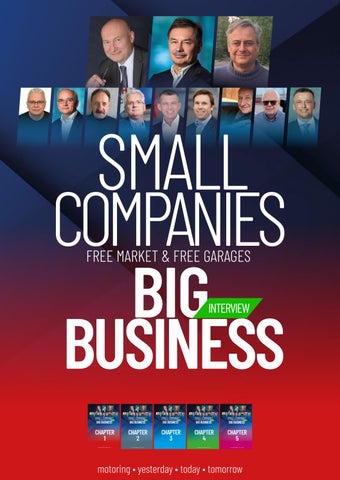
SMALL COMPANIES BIG BUSINESS FREE MARKET & FREE GARAGES INTERVIEW
motoring • yesterday • today • tomorrow
The independent garage services and spare parts distribution market in Poland is an absolutely incredible phenomenon. There is probably no other country in Europe where its share in the entire automotive segment is as large as in our country. The companies that have successfully grown into it have also taken the foreign automotive markets by storm, posing a threat to their local leaders. These companies started out as small family businesses with modest capital, yet they have effectively resisted their much wealthier Western competitors. It should be pointed out that the Polish independent automotive aftermarket has developed not only without any aid from the state, but also without its knowledge. One day, to its amazement, the government discovered that Poland had a completely new and effective sector of the economy, which had grown all by itself, without any support from the government agencies or funds. Although the Polish independent aftermarket is over 30 years old and accounts for a significant part of the history of entrepreneurship in free Poland, it has not been subject to any academic study or research. Who knows, maybe one day someone will write a chapter on it in a dissertation devoted to the contemporary economic history of our country. Its authors would certainly appreciate access to source documents and memories of those who witnessed the birth of the independent aftermarket in Poland as well as those who created it. The interviews included in this book refer not only to the past but also to the present and the future. They also make an interesting tale of how resourcefulness, ingenuity and hard work have turned into success.
SMALL COMPANIES
BIG BUSINESS
Alfred Franke Founder of SDCM (Association of Automotive Spare Parts Distributors and Producers) and long-time President of its Board; member of the boards of FIGIEFA and CLEPA, European organizations safeguarding the interests of companies trading in automotive spare parts as well as the automotive industry as such, currently CEO of the MotoFocus Media Group operating in many countries of Central Europe. Expert and consultant of, and a friend to the automotive aftermarket. He has been involved with motoring for so long, that in terms of car categories, he is certainly eligible for an old-timer status and yellow license plates. He claims that he has only worked a few days in his entire life - the rest of his career has been basically about pursuing his passion for motoring. And if it hadn’t been for that, he would have devoted himself to his other passions as a ski instructor, carpenter or wooden house builder.
Krzysztof Oleksowicz Founder of Inter Cars and its CEO for 20 years; currently its advisor and a motoring enthusiast. A graduate of the Catholic Academy in Warsaw. A philosopher by education and a mechanic by passion. During his college years, he pursued both hobbies with equal zeal, studying Thomistic Existentialism and the complexity of combustion engines. Before commencing his adventure on the independent aftermarket, he was employed with the Transport Services Centre, owned a towing service business and worked as a car mechanic in Germany. A sport enthusiast - a mountaineer and a participant of numerous mountaineering expeditions. He loves high-octane gasoline and adrenaline - he has taken part in many car races as a driver. Currently, he seeks meditational peace and more business inspirations on gulf courses.
Grzegorz Kacalski Editor of the Warsztatowiec.info. website. While still a student, he took a job with a newspaper, and soon discovered that journalism was not only a vocation but also hard work. Over the next few years, he worked as a reporter for a magazine, which he later found to have been an enriching yet exhausting experience. He eventually found peace among spare parts. He has been writing about the independent aftermarket for 17 years. His achievements as a mechanic include several successful repairs of a Polish Fiat 126.
Witold Kmieciak
Waldemar Bacławski
Stanisław Wróblewski
Former long-time representative of Sachs in Poland and the CEO of the Feber company.
CEO of Inter Parts sp. z o.o., co-owner of Inter Land sp. z o.o.
Born to a family deeply rooted in motoring, he was bound to work in the industry right from the very beginning. He did try to escape his fate by enrolling in English studies and learning the basics of jewellery-making yet, together with his brother Michał, he ended up putting his family business back on its feet after the difficult period of communism ended. . To thoroughly get to know the business, he began with mounting suspension springs on Fiat 126 cars and replacing silencers on Fiat 125 cars. For thirty years, he did everything to make sure that drivers associated the “Wróblewski Brothers” brand with top quality. He is currently in the process of making another major change in his life, but the blue gas fumes from his childhood won’t go away.
Michał Łyziński A former long-time head of the representative office of Federal Mogul in Poland.
He got into motoring by pure chance - he had been studying in Germany when he began thinking about setting up his own business and returning to Poland after 7 years abroad. Shortly after Poland’s economic and political transformation at the beginning of the 1990s, he started importing used cars and opened a small spare parts store in Olsztyn. He says he has never been into repairing cars but at one point he realized that motoring was a prospective industry. Once a volleyball player, today he’s a fan of this sport and also loves to play golf. He manages a golf course in the Mazury region, where he spends most of his free time...playing golf.
SMALL COMPANIES
BIG BUSINESS
He intends to become a jazz double bass player, claiming music to be the greatest of all arts, helping him bring a sense of balance into today’s crazy world.
Robert Dzierżanowski
Paweł Hańczewski
Michał Tochowicz
Head of Service Concept Development at Robert Bosch Sp. z o.o.
Eastern Europe Region Director at Bosch Automotive Aftermarket.
CEO of Moto-Profil
He has worked on the automotive market for the last three decades being entirely involved in the development of service chains. He claims it was the motoring that chose him, not the other way around, and that it all began when he started studying at the Warsaw University of Technology. This marriage of reason has not only proved lasting but also happy.
He studied economics at the University of Warsaw and the Saarland University, yet he is 100 percent into motoring. He has worked for Bosch’s automotive department for 25 years. Before that, he worked in the German industry. This skilful manager is also comfortable with technical issues. He has been attracted to pistons, bushing and valves since he was a child. By the 1980s, he had gained enough skill to repair his first motorcycle, the legendary MZ 250 ETZ.
Maciej Trociński A long-time CEO of Hella Polska
Mariusz Dankowski Co-founder of BHMD; co-founder and a long-time CEO of Groupauto, currently deputy CEO of Groupauto CEE. He studied economics and foreign relations. He is a living proof that the automotive aftermarket can be more attractive than diplomacy and journalism, which he quit in favour of motoring. Formerly a passionate bridge player and a fisherman, today, a music and food connoisseur as well as a comfortable travel lover.
LATA 80. ŻYCIE W DEFICYCIE
SMALL COMPANIES
BIG BUSINESS
Following the so-called Edward Gierek1 decade and a few years of prosperity driven by credits from Western banks, which ended in the mid-1970s, Poland’s economic situation began to deteriorate dramatically. The scheme aimed at building a “new, better country” didn’t work out. The massive investments in heavy industry, construction and farming did not yield the anticipated results. The centrally controlled economy, which did not go by the freemarket laws of demand and supply proved more than inefficient. The basic consumer products became scarce, while goods such as washing machines or TVs were extremely hard to get. Yet, on the other hand, the Polish society underwent an accelerated motoring process following the launch of the Polski Fiat126 p car in 1973 at the Fabryka Samochodów Małolitrażowych (Small Engine Plant). Those passenger cars were sold against a prepayment and their servicing and spare parts distribution was handled by a state-owned chain called Polmozbyt. But the automotive market as such was completely dysfunctional. The car owners faced a constant shortage of the basic consumables, which had to be “arranged for'' through informal connections rather than simply bought, or purchased on a parallel, illegal market at much higher, market prices. The country entered the 1980s in a deep crisis, stricken by an increasing shortage of consumer goods. The government tried to save the situation by increasing prices and rationing the basic products much to the society’s dissatisfaction. These measures proved futile. Many of the goods, including fuel and spare parts, leaked out of the official trading chain into the black market. 1 1st Secretary of the Polish United Workers’ Party between 1970 and 1980
The authorities tried to stop this by prosecuting the “profiteers.” To this end, they established a special authority called the Worker’s and Farmer’s Inspection. Despite high penalties and stigmatization of the practice of profiteering, the market deficit accompanied the socialist government until its collapse. At the end of 1988, when Mieczysław Rakowski was appointed prime minister, the authorities made an attempt at liberalizing the centrally controlled economy. One of the measures was to sell the so-called nonrationed, “commercial” fuel at a much higher price than the rationed one. A breakthrough came in 1988, when the parliament passed the Business Activity Act, which came to be known as the Wilczek Act, named after the then minister of industry. It allowed people to set up and develop small businesses. But it wasn’t until the first non-communist government led by Tadeusz Mazowiecki took power, when the centrally controlled economy was transformed into a free-market one.
photo: Rutowska Grażyna
MOTORING INITIATION AND A WIND OF FREEDOM
SMALL COMPANIES
BIG BUSINESS
GRZEGORZ KACALSKI: By the 1980s, Poland had plunged into a deep economic crisis. A quick look at some of the newspaper articles published back then make one realize that many of the scenes from Bareja’s1 movies are not just some made-up comedy gigs but are based on real-life situations. For example the scene from the movie “Brunet wieczorową porą,” where a Syrena owner (a Polish-made car) not only buys a clutch cable at a butcher’s but the shop assistant produces it out of a cooler. Did you have anything to do with motoring back then? KRZYSZTOF OLEKSOWICZ: Shortly after graduating from university I worked at a state-owned transport services centre for a few months. More specifically, I worked at the engine repair department, which was in line with my interests. I can’t say that I gained much practical experience there, but at least I read all the books on car servicing available back in the day. I was an expert in the Polish Fiat 125 p carburettor, which I was capable of disassembling, reassembling and adjusting with my eyes closed. ALFRED FRANKE: You’re talking about your experience with cars from the socialist block. But how about the Western cars? When did you start dealing with those? 1 Stanisław Bareja – Polish film director, mostly known for films depicting the absurdities of everyday life in the Polish People’s Republic
KO: Still in the 1970s, I went to West Germany, where I got a job at a scrap yard. Its owner, Harald Ricken, would strip old cars down and sell the individual parts obtained this way. He also repaired cars. He was not only a great mechanic but also a superb trader - he traded used parts and whole cars, and he did with an unprecedented skill. Under his supervision I not only learned the trade of a mechanic but also discovered how the free market works. I’d like to share an anecdote with you, if I may. Well, Harald was quite a character - a gigantic man with a gladiator’s physique. By a stroke of luck, one day, Jerzy Kulej, a two-time Olympic champion in boxing, showed up at Harald’s yard.
photo: Narodowe Archiwum Cyfrowe
I remember that he was not so much interested in the cars standing in the yard as in Harald himself and his extraordinary body-build. Kulej made a funny comment about it and with an expert’s touch felt Harald’s biceps saying that he would make him into a heavy-weight boxing champion in just one year. As you know, Kulej was a light welterweight boxer and was not much of Goliath, which made the whole scene even more humorous. AF: A truly charming anecdote. But going back to motoring, did you observe the independent aftermarket back then? Did you try to figure out how independent garages operated and how the spare parts distribution was organized? In other words, did you try to get the know-how to use it in Poland after the collapse of the communist system? KO: In a sense, yes, although no one expected that communism would soon give way to democracy and freedom, also in economy. I just wanted to make some money, just like I did as a student, when I would take up different summer jobs. I remember that at one point I even took a leave of absence as an opportunity had come up for me to go to the United States to wash windows in Sears Tower in Chicago. The money I earned for a month’s work there was equivalent to a year’s salary in Poland. In addition, from each of my trips abroad I would bring a car to sell in Poland with a profit. This way I earned quite a lot of money already as a student. AF: And that is something to which you easily get used, isn’t it? KO: Exactly. Back then, I had no idea that I would deal with motoring in my professional life. All I knew was that I wanted to own a profitable business to secure a comfortable life for myself. I remember a situation when shortly before defending my thesis at the Catholic Academy, my friends and I were going by tram down Marymoncka street, talking about what each of us planned to do after graduation. One of the guys said he was hoping to get hooked up with Pax (editor’s note: a catholic association cooperating with the Polish communist government) be-
photo: Lata 90. Archiwum Inter Cars
cause he had some connection there. One girl said she was going to be a librarian. As for me, I didn’t see myself pursuing a similar career. AF: So, what were your plans? The government allowed private businesses to a very limited extent. Private companies were a thorn in the authorities’ flesh, but they didn’t have a problem with one-man businesses. KO: You’re right. Business possibilities were very limited back then. You could import a used injection moulding machine from Western Europe and produce plastic bowls or toys, or grow flowers in a greenhouse. But I didn’t see myself doing that. I was into motoring. I wanted to run my own garage, as a garage owner was allowed to have six employees plus three interns, which made him a true businessman by then standards. As I happened to have a commercial driving license, I thought about buying a used commercial vehicle to transport goods, for example furniture. It was a good business back then.
AF: So, on the one hand you were a private car importer, and on the other, you were thinking about setting up a logistics company. But when you were working at Harald’s scrap yard, your eyes suddenly opened to a whole new perspective. Do you remember that moment? KO: Yes. That was in 1984. One day, Harald and I went to a wholesaler company named Egon vonRuville to get some spare parts. That’s when I met Klaus, a sales representative, with whom I cooperated later on. Let me describe the situation: While buying the spare parts he needed to do repairs in his garage. Harald asked Klaus why the discount he had been getting was so small. He meant that as a joke. To which Klaus answered: “Honestly, Harald, you’re just too small a customer to get a bigger discount.” Well, it sounded really funny given that Harald was a huge, 200 cm tall guy. We all burst into laughter, but I suddenly had an idea. I asked Klaus: “Listen, what discount would you give me if I wanted to buy a bigger quantity of spare parts and export them to Poland? Klaus was stunned as this “request for proposal” caught him completely off guard. But he took it seriously and went to ask his boss about what his company could offer. Klaus’ boss asked: “Do we have any customers in Poland?” “We don’t. This one would be our first one,” said Klaus. “Well, then give him the maximum discount.” That was the first time I ever bought new spare parts with the intention of selling them in Poland. I perfectly remember that I bought Glyco bushings for the OM 615 engine Mercedes cars in three of the most wanted sizes. AF: Did you have any problems exporting them to Poland? I mean, didn’t the customs officers cause any difficulties? KO: My cargo didn’t catch their attention at all. One of them just asked me casually what I was carrying. I told him that those were bushings - metal plates for cars. And they let me go. It wouldn't have been so easy had I been carrying a bag of pantyhose or groceries from Aldi. I’m sure they would have seized them. I didn’t even pay a custom duty for
photo: Narodowe Archiwum Cyfrowe
my bushings because the customs officers didn’t even bother to weigh them. Back then, all passengers had to pay a duty fee per kilogram of the goods they carried, regardless of whether they were carrying bushings or an engine block. In other words, the duty fee was really small and the total amount for a bag of bushings would have been ridiculously small. They just didn’t care. I should mention that I had a towing business registered in Poland, and in my personal ID there was a stamp confirming that I was employed. Otherwise, I wouldn’t have been able to live a normal life as I would have been considered to be avoiding employment, which always invited trouble in confrontation with the authorities. Plus I wouldn’t have gotten my passport. So, I paid some fees and taxes back in Poland, which amounted practically to nothing. And just in case, I had towed a car or two to make it look like my business was working. All to be able to travel to Germany without any problems. AF: And that is how you became an importer and, at least temporarily, an exclusive representative of Egon von Ruville in Poland. Ok, so, you’ve imported the goods. Now, you have to find customers. Did you put an ad in a newspaper, something like “bushing for Mercedes, only serious offers by mail accepted” (laughter)? KO: I found customers in no time, so there was no need for an ad. When I came to Poland, I went straight to this garage that I knew that repaired Mercedes cars. I told the owner: “Listen, I have a few sets of bushings here, in such and such sizes. Are you interested?” He asked “How much”? I told him the price and he took an entire pack. He told me to come back the following day to pick up the money. That is how I started trading new spare parts. That’s when I knew I would no longer import used cars, bother to repair them, pull an all-nighter to take them to a car boot sale and wait for a customer to buy it. It just didn’t make sense once I realized I could import and sell new spare parts on such a large and hungry market.
photo: Rutowska Grażyna
AF: So, in other words, you quit the car-selling business and switched to the aftermarket (laughter). You could say that historically Inter Cars’ roots date back to the socialist times. KO: Back then I wasn’t thinking about building my own company. Like I said before, my motivation was simple. I just wanted to make money. So, I started making regular trips to Germany, where I’d buy spare parts and sell them on the spot to befriended garages. My German colleagues from Egon von Ruville noticed that I was doing well and kept asking: “Krzysztof, why don’t you start your own business?” We would give 50 thousand Deutsche Marks worth of goods with a deferred payment deadline. AF: They probably couldn’t comprehend that setting up a company in Poland just like that was impossible, and that import and export were the exclusive domains of state enterprises.
KO: Exactly. Such companies were not welcome by the authorities. It was my dream for Poland to finally become a normal country, just like all the countries in Western Europe. A country where I could open my own business without any problems, hire employees, pay normal custom duties and taxes. That wouldn’t have only benefited me, but my country as well. But that normality didn’t come until a few years later. GK: What about you, Alfred? Did your adventure with motoring also begin during the People’s Republic of Poland? AF: You could say so. My first encounter with the motoring industry was back in college, when, shortly before the martial law was imposed, I went on vacation to Munich, where, mind you, I got a job with the lighting department of the BMW plant. KO: I didn’t know that part of your biography! AF: Being a rather reserved person, I have never bragged about it (laughter). So, you can say that I started my career with the automotive industry in an authorized manufacturer segment. And it was a “top” job too. It required climbing up a rather shaky ladder to wash ceiling lamps in production plants during stoppages, so you had to be highly qualified, especially in acrobatics (laughter). KO: You could say that the experience you gained there balancing in high places came in handy many years later when you had to deal with government institutions during your employment with SDCM1 (laughter). AF: Indeed, although I had no idea that I would end up working in the automotive industry. Anyway, that summer job with BMW made me realize the gap between Poland and Western Europe.
1 SDCM-Polish association representing car part manufacturers and distributors
photo: Narodowe Archiwum Cyfrowe
The lamps at the Munich plant were cleaned regularly, while the oldest layers of dirt covering the wooden floor of the FSO1 factory in Poland probably dated back to president Bierut’s times. I thought about opening my own business back in college as I knew exactly that a 9 to 5 job in a state company was not for me. I tried different things, all completely unrelated to motoring. But since any private business was more profitable than working for a state company, I had no reason to complain. Nevertheless, I continued to seek my own way until I eventually came across motoring and spare parts trading. As you said, the market demand was so big that even though I had become a middleman between newly established import companies and garages as well as stores, I developed my career in the American traveling salesman’s style until I ended up hooking up with a distribution company. 1 FSO-Passenger car factory in Warsaw
GK: The ever memorable Stefan Kisielewski1 once said that socialism was a political system which heroically overcomes problems non-existent in any other political system. Did that heroic problem-solving skill ever come in handy in developing businesses in free Poland? KO: One skill we gained back in those days was the ability to overcome obstacles, which were plenty in the People’s Republic of Poland, and which also appear completely absurd from today’s perspective. For example, the market operated based on two price lists, one official, applied by the government, the other one unofficial, reflecting the true market prices. Because of that, the value of the cars produced in Poland was higher once they left the production line. In other words, their market price was much more different than the official price. The catch was that you could buy a car for the official price only if you had a special government voucher. Consequently, a Fiat 126 p offered at a car boot sale was worth much more than the same car sold by the state trading agency called Polmozbyt. Do you remember the story when a ferry carrying Fiat 126 p cars sank? The cars were eventually recovered and sold to private individuals on the same auction on which they had been bought for, but their price was higher than that offered by Polmozbyt. AF: That’s more or less what our automotive market looked like back in the day. But cars could also be purchased for foreign currencies. If you happened to have US dollar or deutch marks, you could buy a 126 or a Fiat 125 through Pewex2 - an international trade agency, naturally for a market price. You could buy spare parts, oils, tires etc. for foreign-made cars there as well.
1 Stefan Kisielewski – a Polish anti-communist journalist 2 Pewex – a chain of state-owned stores selling goods for foreign currencies
photo: Narodowe Archiwum Cyfrowe
KO: Because of the constant shortage of practically all goods, which the government claimed was due to temporary difficulties here and there, drivers had to take special care of their car batteries knowing that replacing them was not an option. So, in winter, you would have to take the battery out of your car and bring it inside the home for the night if you wanted your car to start the following morning. I will never forget that, as I lived on the 14th floor and often had to carry my battery up the stairs, because the elevator would be out of order. My neighbours would say jokingly that I was preparing for an expedition to the Himalayas. AF: A part of the then automotive landscape consisted of spare parts made by small private businesses, which the authorities tolerated. If the original parts for a Fiat 126 or a Volkswagen Golf were not available, you could buy their copies made by those private businesses, but they were not very durable.
KO: Shortly speaking, It was a time of gigantic advantage of demand over supply, which, paradoxically, was conducive to setting up all kinds of micro businesses, which proved profitable despite the restrictive laws in place. You just had to have a little bit of courage to quit your official job and some money to invest, because the state banks refused to finance private ventures. You would earn the investment money working abroad as a student, engaging in transborder trade on a small scale or borrowing it from your family, if you happened to have well-to-do relatives. Running a business was easy in the sense that no one had any strategy, a future vision nor bothered to think about cost optimization. The demand was so high, that you’d sell everything you had to sell with a high margin. AF: For example, I remember how popular copies of the Fiat 125 radiator grill were made of poor quality plastic. That was when FSO decided to stop applying steel radiator grills. They were very stylish, but difficult to make. They were replaced with elements made from imported ABS plastic. A Fiat 125 equipped with such a radiator grill was considered to be more modern. The small plant owners took advantage of the situation and produced copies of the radiator grills using quite primitive methods. And even though they were of poor quality, they would still sell on the spot as Fiat 125 p owners wanted to replace their steel grills with the plastic ones. Home-made face lifting. GK: What about private garages? What was their situation like during the time of constant deficit?
KO: There existed two types of garages - those which repaired Polish cars and cars produced in other socialist countries, and those which specialized in repairing western-made brands, but there were very few of them. Firstly, there weren’t all that many western-made cars in Poland. Secondly, repairing them required specialty tools, which were extremely expensive and difficult to get. You would bring them from the West - by yourself or through your friends. Finally, there were a few authorized garages, which offered better standards. They were capable of repairing a few cars at a time, had a lounge for customers and were usually located close to the city canter. Volkswagen, Opel and other carmakers would authorize such garages. AF: I think that we should explain to the younger readers that in those times these authorized garages did not operate as part of dealerships as those just did not exist. Only the state trade agencies such as Pewex or Baltona were allowed to import cars. KO: Foreign car dealerships simply did not exist in Poland. You could say that the socialist equivalent of a dealership and an authorized garage in one was the Polmozbyt chain, where people bought and repaired their Fiats. The stories of how people would buy their dream car at Polmozbyt sound as if they had been taken out of Stanisław Bareja’s movies, which depicted the absurdities of the socialist system. For example, you’d use your personal connections to get through to an employee of Polmozbyt just to ask them if a given Fiat 125 rolled out of the production line on Monday. The common conviction back then was that a Fiat produced on a Monday was of poorer quality because the staff assembling it still hadn’t sobered up after a christening or a birthday party.
photo: Lata 90. Archiwum Inter Cars
AF: And coming back to the independent garages that repaired Western-made cars - they usually specialized in one particular brand due to the lack of the necessary equipment, accessories, and of course, the appropriate technical knowledge needed to repair vehicles that were much more advanced than their socialist counterparts. GK: At a time when you had to liberally hunt for a V-belt or a battery, where did garages source the spare parts they needed? KO: As we’ve already mentioned, parts for Western-made brands, such as belts, filters, spark plugs could be bought at Pewex stores. More advanced parts, such as engine parts, bushings, pistons or shock absorbers were available in specialized foreign trade agencies.
You would order your part from them and then you’d wait for weeks to get it. And it would cost a fortune too, taking into account the average salary back then. AF: In those days there were also garages that would give a second life to worn parts, but it was usually very short. Their cottage industry methods were used, for example, to “remanufacture” old shock absorbers or replace clutch disc linings. There were garages specializing in repairing different engine components. Naturally, this had little to do with today’s factory remanufacturing of various parts. KO: I remember that one such shock absorber remanufacturing garage was located at the Theatre Square in Warsaw. The owner boasted that the shock absorbers he repaired were even better than new ones. There were also small plants, which specialized in the production of parts for Western cars. For example, one of such plants, located in the city of Łódź, was famous for the rings it produced. GK: I assume that repairs carried out using such low-budget methods probably weren’t very effective? KO: Well, they did differ in terms of quality. Engines were repaired using the methods available at the time: cylinders were sleeved as oversized pistons were not available, new rings and shells were fitted, valves were ground and everything was put back together. An engine repaired this way had to be run-in for a very long time, and its service life was understandably quite limited. Such repairs made sense from an economic point of view, because new parts from Western manufacturers were terribly expensive and hard to come by, while the cost of labour of a garage was ridiculously low compared to the prices of parts.
TIMES OF TRANSITION AND YEARS OF “COMMON HAPPINESS” GRAND REFORMS
SMALL COMPANIES
BIG BUSINESS
The early 1990s saw radical economic reforms aimed at transitioning the country from a centrally planned economy to a free market one. These reforms went down in history as the “Balcerowicz1 Plan.” Initially, the country had to curb the inflation exceeding 600% in 1989. Thus, the budget deficit was reduced and the printing of empty money was halted, capital expenditures were reduced, tax breaks were cut and subsidies were radically reduced, resulting in higher prices of coal, gas and electricity. Interest rates on bank deposits and credits were raised. Internal convertibility of the PLN was introduced, with the exchange rate determined according to the so-called currency basket. At the same time the liberalization of the country’s economy began. The state’s monopoly in foreign trade was abolished - from now on, any entity wishing to trade internationally was allowed to do so. New customs tariffs were introduced. Changes were introduced into the tax system to align it with the Western standards. The introduction of settlements in USD in relations with the USSR caused a sharp rise in fuel prices and a collapse in exports to the former Eastern Bloc countries. This resulted in a decline in production, a deterioration in the balance of payments and an increase in the budget deficit. 1 Leszek Balcerowicz – a Polish politician and economist, former finance minister
To increase the competitiveness of the Polish exports, the Polish zloty was depreciated. The Sejm passed a law on enterprises with foreign participation to encourage foreign capital to invest in Poland. The reforms succeeded in lowering the inflation, reducing the budget deficit, and eliminating shortages of goods. A partial debt forgiveness was also negotiated with foreign creditors. The state’s foreign exchange reserves increased. A wave of bankruptcies and liquidations of many state-owned enterprises, as well as a reduction in employment in those that survived, led to a rise in unemployment, which exceeded 16%. Initially, the so-called shock therapy caused a sharp decline in GDP: by 9.68% in 1990 and 7.02% in 1991. However, as early as 1992, the country entered a path of economic growth, which reached nearly 7% in 1995, stipulated by the rapid development of private entrepreneurship. Between 1989 and 2018, Poland’s GDP grew by 826.96%, more than any other country in Europe. In 1990, Poland’s national income amounted to $ 65.978 billion, and rose to $524.5 billion by 2017. GK: In 1989 came a breakthrough. The freedom of economic activity was introduced at the end of 1988 under the so-called Wilczek1 Act, but it wasn’t until after the 1989 elections, when Tadeusz Mazowiecki became the prime minister, that both political and economic freedom literally exploded throughout the country. What consequences did that have for the market? KO: First of all, a gigantic wave of used cars from the West flowed into Poland. People began to buy Western-made cars on a mass scale. Although sometimes very old, they were still better than the socialist Fiats, Wartburgs, Ladas and Skodas. This, in turn, resulted in an instant increase in the demand for spare parts and garage services. 1 Mieczysław Wilczek – Minister of industry in the last communist government of Poland
AF: Formally, we already had economic freedom, but the free market was still in its infancy. The Polmozbyt chain inherited from the previous regime was unable to supply parts for even the few models of domestically produced cars. It was a giant yet inter company, completely unfit to trade in parts for Western-made cars. Suddenly, there was a huge new segment to be taken care of by brand new players. KO: In the early 1990s, the demand still significantly exceeded the supply. Garages were busy repairing cars, and demand for spare parts and tools was growing by the day. The borders had been opened, yet mechanics had to wait up to a week for the ordered parts, and the imported goods sold on the post, straight off pallets. It’s really hard to imagine from today’s perspective, when customers are delivered parts even a few times per day. But that’s how it was - around 6 a.m. a truck with goods would arrive, and that’s when the first customers showed up. Quite a few of them, to be specific. The same day, the goods would disappear like camphor and we’d have to go get a new batch. AF: I also have a very vivid memory of goods selling out on the spot. They were usually delivered to our warehouse located in the basement in the afternoon. At night, we would carry everything inside, up the stairs. I don’t really see why we did that, knowing that the goods would sell out first thing in the morning. By the end of the day, the shelves were completely empty and in that context our store resembled a butcher store or a liquor store from the early 1980s (laughter). KO: In other words, the demand was so big that all you actually had to do was bring the goods to Poland and they would sell out in no time without any further effort on your part. There was no need to look for customers, they’d still come. It is worth mentioning here that keeping in touch with the garages was really easy, as those specializing in repairing Western-made cars were usually located close to the centre of Warsaw, many of them near the Daszyńskiego traffic circle, in exactly
the same spot where an impressive complex of office buildings stands today. Back then, the area was full of all kinds of warehouses, scrap yards and garages. Speaking of which, it’s worth mentioning that there was also a great demand for the tools needed to repair Western-made cars. This is why we included garage equipment in our offer right from the start. Interestingly, in those days of creeping prosperity, the garage owners wanted the best quality equipment from reputable manufacturers, which was quite expensive. GK: I remember the great popularity of car boot sales during that time. Did they play an important role in the parts market? AF: Lots of used parts were sold there, often of unknown origin, although there were also stands with new products. For companies being at the early stage of their development, a car boot sale was important not so much as a place where parts were sold, but more as a venue in which to acquire new customers, hold discussions and make all kinds of arrangements. You could say that car boot sales resembled a Greek agora in a way. They were popular meeting places for owners of spare part stores from all over Poland. It should be explained to the generation “Z” that maybe only a handful of people had heard about the Internet at the time. Thus, a car boot sale was a place where people from the crawling automotive industry would meet to discuss and do business, which would frequently result in long-term cooperation. For the distributors it was a place where they could also obtain some information about their competitors. We’d just started sniffing around then. And we’d often find out that someone new had appeared on the market from our customers.
KO: New distributors would just pop up like mushrooms. I remember that already back then some of us worried that due to the growing competition the parts trade would soon stop being such a good business. But in the first half of the 1990s, the increase in the number of cars was so great that even the growing number of new market players could not compensate for it. We still couldn’t keep up with the growing demand. In fact, all other industries had to face exactly the same experience. AF: I remember from that period something completely unimaginable today - catalogues were sold like the most popular novels, rather than left in a garage or a store for customers to take. They were considered a hot commodity and every garage even had a bookcase with catalogues of various companies, which were treated as professional literature, a kind of compendium of technical knowledge. GK: To summarize - the early 1990s was a period of imbalance between demand and supply. New companies had no access to capital, and goods were traded almost instantaneously. KO: After 1989, companies popped up like mushrooms and, with a few exceptions i.e., small private businesses established during the People’s Republic of Poland, none of them had any capital whatsoever. So, each of them acted in a similar way - they’d buy goods to immediately sell them. Rotating goods as quickly as possible was a necessity. AF: It’s worth mentioning that a few distributors originating in the segment of cars manufactured in Eastern Europe managed to switch to parts and accessories for Western-made cars. Some of these companies are still on the market.
KO: Indeed. We have examples of such successful conversions, but mainly in the truck market. Few have succeeded in the passenger car segment. But there was this big company, a real tycoon specializing in parts for domestic cars. I remember a conference where they announced that they were about to enter the market of spare parts for Western-made cars and that they had the funds to do so. They failed, though. Meanwhile, the distributors that once specialized in parts for Star, Jelcz and Kamaz - that is, commercial vehicles manufactured in socialist countries, succeeded in the Western-made cars spare parts market. AF: Generally speaking, although they all shared a similar business model, different assortment profiles began to take shape. And so, for example, a company from Gdansk offered parts from Italian manufacturers, which were cheaper than the parts made by German companies. Those Italian parts were considered a budget commodity at the time, and for a while there was a high demand for them on the not-so-rich Polish market. I remember that everyone was jealous of their success. They sold their parts literally on the spot. They didn’t even have to bother carrying their parts to the basement for storage, like we did (laughter). KO: As I didn’t have access to the “Italian stuff,” I traded only premium products through German distributors. AF: And so you got into engine parts, which is what you started your business with. Many other companies were more focused on consumable parts - belts, filters, pads, etc.
KO: In general, there were two ways of building the assortment. One was the typical product management - for example, focusing on shock absorbers, building the offer covering as wide a range of models as possible. The other system, which we implemented at Inter Cars, let’s call it a picking system, was based on building a full assortment of parts for a given segment of the car fleet. We started with Mercedes and Volkswagen, to which other German brands were added later on. Then we added French, Italian, Swedish, American, Korean and Japanese cars. In general, our assortment policy was to have an entire stall with a wide range of parts needed for complex repairs. We were supplied by German distributors like Hans Pries at the time.
photo: Narodowe Archiwum Cyfrowe
AF: On the other hand, the company I had worked for years built its offer based on the product management model. So we offered parts for practically all cars, but only in several or so assortment groups. At the same time, unlike your company and a few other distributors, we had our goods supplied indirectly by a Danish company called Tridon, which was a typical packager. So, for example, we had fantastic V-belts by Gates in a Tridon box (laughter). At first, this form of sales worked great, but when we started competing in the market with companies that had Gates directly from the manufacturer, our product turned out to be too expensive, because the price had to include the extra margin charged by the packager. KO: Well, that’s right, after those first “romantic” years of the 1990s decade, when you sold everything in any quantity straight off the pallet, there finally came a point when you had to figure out how to build an offer. I learned this by sitting through long hours in garages, trying to figure out what they needed. Here’s an interesting fact - 30 years ago, just like today, according to recent surveys, garages were interested in buying primarily premium products in premium product manufacturers’ boxes. This seemed rather odd considering how poor the Polish market was back then. AF: Indeed, the survey conducted by MotoFocus shows that today garages choose primarily premium products, although in the more than 30-year history of the independent market there was also a period when they sought lower-end products. Therefore, one can say that today the selection of parts supplied by reputable manufacturers comes from a wealth of experience. KO: Because garages already know that manufacturers who also produce first assembly parts supply the aftermarket not only with the highest quality products, but also with knowledge, technical data and training - without which it is simply impossible to repair increasingly complex cars.
photo: Archiwum Inter Cars
GK: What intrigues me the most as an observer is why, after a period when the market absorbed goods like a sponge and all players were doing just great, there came a time when some companies continued to grow dynamically, while others suffered stagnation or even began to decline. Many of them disappeared altogether. KO: We owe our success primarily to the right assortment of goods, namely the aforementioned process of selling whole sets of items, that is, putting together all elements necessary to carry out a given repair. If a garage owner purchased e.g., a shock absorber from a distributor, but the bearing or bumpers were not available with that distributor, then, in order to repair a car, they had to look for those parts elsewhere. That is, they would have to go from one wholesaler to the other, wasting their time and money. Yes, there were companies that offered a wide assortment of products at very competitive prices, but they did not offer to sell them in complete sets.
AF: So, those customers would end up buying from you. But when it came to product groups such as pads, discs, shock absorbers, and silencers, we couldn’t compete with distributors who offered a complete range of these items for all car makes and models. KO: But we did have that stall I mentioned before, where a mechanic could find a pin, a washer, or a gasket—you name it. In other words, a lot of small but important items, which, taken individually didn’t amount to much, but when put together into a set, they gave us a competitive advantage. Sometimes a garage would buy a shock absorber from our competitor but they’d come to us to buy the remaining items, that is the bearing, the bumper and the buffer cover. Eventually, they’d come to the conclusion that it was more convenient for them to buy everything from one supplier - Inter Cars. It’s worth mentioning that it was car mechanics who were in charge of selecting the product range sold by our company, i.e. practitioners, who created product sets based on their garage experience. AF: So, it looks like you had a very clever concept of building your product range. The product range policy was indeed the framework of the development strategy in the parts market. We must keep in mind that in the early 1990s, companies were not looking at costs yet, because the margins everyone was getting were so high that you just couldn't care less about such minor things as costs. That didn’t change until sometime later. Some companies had disappeared from the market because they’d started other ventures unrelated to motoring. With time, only those companies which had concentrated on selling parts remained on the market.
KO: Well, that’s right, I myself repeatedly received proposals to get into the computer or fuel business, but I always turned them down, which some people just could not understand. Right from the start I was interested in building a company in an industry that I was familiar with and that I understood. Let me tell you an anecdote. In the 1990s, by pure chance, I ran into a guy I had studied with. We started talking and we soon realized we each had been running a business, mostly with the money inherited by his wife. He bragged about having several businesses. He told me that they were to make sure that your business was diversified. “If you stick to one industry only, then when a downturn comes, you’re done,” he said. He asked about the industries I operated in. I said that I traded in spare parts. “And how many businesses do you have?, he inquired. “Just one, the one selling parts, to be more precise," I replied. He shook his head with pity hearing my nonfiction (laughter). In those days Polish businessmen tried to kill all birds with one stone and had a dozen companies each.
photo: Narodowe Archiwum Cyfrowe
AF: If I were to point to the exact moment when long-term development strategies began to be designed and implemented on the spare parts market to replace the hitherto simple yet popular “buy-and-sell” approach, I would point to the years 93/94. And as early as ‘92, the first automotive trade fair was held in Poznań, where you could meet a lot of people, get an idea of how the competition operated and how you looked against this background. KO: For us, the breakthrough year was ‘94, when the manufacturers of consumable parts, such as clutches, opened up to us, and we were able to add entire product lines from A to Z to our offer. I will stress it again, those were premium products, which we focused on right from the very beginning. In retrospect, it is evident that this has significantly contributed to our success. Despite the lower margin on these products compared to what you could have earned with cheaper parts, the higher per-unit earnings were substantial. This is because premium products command a higher price, and their distribution costs remain the same as those of cheaper parts. AF: In the mid-1990s, Western manufacturers had already begun to take a keen interest in the Polish market and no longer saw us as some kind of exotic country from behind the recently fallen Iron Curtain. It was thanks to those companies that the Polish automotive market started to be more civilized, while we had an opportunity to learn many new things.
photo: Archiwum Inter Cars
GK: Did suppliers, especially the big manufacturers, somehow try to arrange the Polish market in their own way? KO: Some had their own strategies. There were companies that carefully selected their distributors and made sure that together they formed a group of entities that understood each other and respected each other’s territorial boundaries, which we’d refer to as: "from river to river." There was a group of suppliers that did have their own distributors, but did not impose any territorial restrictions. But there were also a few manufacturers who chose one distributor and gave them exclusive rights. AF: There were also supplier companies which operated through agents, who pursued a commercial policy of their own. Sometimes, wishing to arrive at the highest possible turnover, they’d sell goods to everyone, which frequently resulted in quite funny situations. For example, a brand would have as many as 13 "exclusive" importers. I remember that one such agent had irritated so many distributors by playing them off against each other, that as a precaution, he had set up a special back exit in his office, through which he could escape at a moment’s notice, if some irate businessman wanted to force his way through the front desk and barge into the agent’s office with the intention of grabbing him by the lapels or maybe even by the tie... (laughter).
KO: There were also times when manufacturers who had two commercial brands arranged the market in such a way that they’d give each brand to a different distributor. In effect, they were both selling the same thing, although formally under separate brands. GK: And once the market became more civilized, you had to have some new ideas to be able to compete effectively. KO: After securing a sufficiently big product range and, most importantly, ensuring its availability, which in itself required a substantial capital, the next element of creating a growth strategy was to introduce new sales tools. I remember how happy we were after we printed the first price list! AF: Setting prices and creating price lists was a difficult task, especially because of the inflation, which was still very high. The margin usually varied depending on whether a given product was a fast or a slow-moving one. I remember though an odd situation when a tie rod end that fit both a Ford Escort and a Mini Morris, because technically it was exactly the same product, had two prices. If you bought it for a Mini, you were charged way more than if you bought it for a Ford. It is also hard to imagine today that we started our business without a computer, that orders were made by hand, and the only electronic tool in the company was a calculator. “Excel” charts were made with a ruler and pencil, and orders were sent by fax and the connection would often fail. KO: We even used a telex machine before that. I used to go to the national telecommunications company branch, where I had a trusted lady who operated the device. There was always a line of entrepreneurs from across all industries waiting to use the telex machine. I would give the lady operator the reference numbers, she would enter and send them, and by the afternoon, I would receive a reply from my supplier.
photo: Archiwum Inter Cars
The fax machine, which we started to use some time later, was much more convenient, but sometimes the printouts came out all black. In general, in the early 1990s, we had dramatic problems with communicating by phone. Getting through to someone abroad was a real feat. There was a special line intended for overseas calls, but using it was terribly expensive. AF: Do you remember how, back then, you obtained information on the popularity of particular references, something that special algorithms provide today? I remember that the term informatyk [Eng. IT guy] referred to someone responsible for providing information rather than to a computer programmer (laughter).
KO: My way was as simple as it was effective. I would take a catalogue - for example with pistons, then I would visit a few garages whose owners I knew, and they’d put a tick by the items they were interested in. Three ticks next to one item meant that it was really needed, two ticks - that it would be nice to have it, while a single tick meant that the customer might occasionally be interested in buying a given part. Items without a tick were not even worth looking at. GK: Well, everyone in the market did their best, with better or worse results, until finally things started to get tough. What was the turning point? KO: A dramatic change came with the Russian crisis in 1998. Customers from the East had accounted for one third of Polish distributors’ turnover. Suddenly, the whole post-Soviet market collapsed. Customers from Russia, Ukraine and Belarus were out of the picture. We found ourselves in a completely new situation. The time of, what I call, common happiness was over. A new, key factor had to be taken into account cost saving.
SMALL COMPANIES BIG BUSINESS FREE MARKET & FREE GARAGES
INTERVIEW
CHAPTER 2 motoring • yesterday • today • tomorrow
BRANCHES AND RETAIL CHAINS
SMALL COMPANIES
BIG BUSINESS
After the political breakthrough of 1989, one of the most important goals of Poland’s foreign policy became joining the European Communities, and since 1993, the European Union. In 1997, the European Council decided to commence the accession negotiations with five Central and Eastern European countries, including Poland. The EU enlargement process was inaugurated on March 30, 1998.
POLAND IN THE EUROPEAN UNION
Poland declared that it would reach readiness for membership by the end of 2002. The accession negotiations did not really begin until after the Polish law was analysed against its compatibility with the EU law. As many as thirty-seven task teams were set up, each responsible for preparing the EU’s and Poland’s positions in specific areas. The negotiations were concluded on December 13, 2002, during the EU summit in Copenhagen. The Accession Treaty was approved by the European Parliament on April 9, 2003, and adopted by the Council of the European Union on April 14, 2003. It was subsequently ratified by all EU member states. In Poland, the treaty was adopted in a nationwide referendum held on June 7-8, 2003. Nearly 80% of voters voted in favour of Poland’s accession to the European Union. The Accession Treaty, which is the legal basis for the accession of Poland and other Central and Southern European countries, was signed in Athens on April 16, 2003. On May 1st, 2004, Poland became a full member of the European Union.
Alfred Franke: After the Russian crisis, that is, in the late 1990s and early 2000s, there came a period of fierce competition and price wars, which lasted for many years. In fact, we can still feel its consequences. The time of skyrocketing margins was over. Companies that had accumulated capital and invested in warehouses, goods or IT systems were now able to benefit from their decisions. Grzegorz Kacalski: Have any of the models proven to be the most successful? Krzysztof Oleksowicz: The main argument for selling through a store rather than a branch is that the store owner is the garage owner’s partner. They both have similar problems, i.e. dealing with employees, the tax office, the social security institution, the fire department, theft, etc. So they understand each other perfectly, and after work they can go out for a beer together. Also selling through business partners generates lower costs, because it does not require any controlling. All you have to do is deliver the goods and make sure you get paid on time. AF: It is the duty of the wholesaler to make sure that they have a sufficient quantity of goods in the right range. Their duty is to control the costs, sell as much as possible, because that’s how they build their own business. Such cooperation is beneficial for both parties. KO: Well, that’s right. It would be difficult for the head office to choose the right location for a retail outlet that is conveniently located from the point of view of customers. They also need to determine where the parking lot should be, decide on the colour of walls, furniture, the display, and a whole host of other issues. AF: Building a chain based on retail partners meant a lower margin, because you had to share it, but also lower costs, because you didn’t have to maintain branches. However, no one expected loyalty from a business partner. Besides, such a store wouldn’t have survived if it hadn’t put together product sets using products obtained from several
distributors. The franchise model used by Inter Cars, on the other hand, combines the advantages of cooperation with an independent entity, where the loyalty is ensured by the partner running a branch. GK: Was an Inter Cars branch allowed to source items from other distributors if the head office didn’t offer a particular item? KO: The goods on the shelves rotated automatically, but since our offer was not perfect at the time and we were unable to provide all possible set combinations based on it, the branches had the right to source certain products from other importers, that is, to run, as we called it, their own “kiosks.” In other words, the branches were still supposed to provide garages with product sets, even if they had to be sourced from the devil himself, not to mention our competitors. The priority was the satisfaction of the garages, not blind loyalty to us as the franchisor. AF: We also briefly operated a branch. Back in 1992, we launched a branch in Katowice. It was located near the Spodek arena and was managed from the head office. But it performed very poorly - it generated significant costs and had a very small turnover, so we eventually closed it down without regret. We then switched to a model of cooperation with independent trading partners, following the suggestion of our main supplier. KO: The failure of selling directly to garages stemmed from the fact that we didn’t offer product sets- i.e., the assortment of various small parts necessary for car repairs. Instead, the product sets could be assembled by a store that had several different suppliers and good access to garages. AF: I remember that many industry experts argued that creating branches didn’t make any sense; they believed cooperation with wholesalers was more rational and economically viable. This approach didn’t require significant capital commitment, and the costs associated with investments were shared by the distributor and its trading partners.
KO: One of the experts who shared this opinion was Van Heck, one of the industry’s gurus. He argued that it only made sense to work with trade partners, as the owner of a store was a small business owner who knew another small business owner, that is, an owner of a garage, so together they were capable of building partnership relations. As I mentioned before, I didn’t question this approach. AF: But yet you didn’t choose this model. You wanted to go your own way. KO: I wanted to build a more efficient system in terms of the flow of goods. I also saw the downside of the distribution model based on cooperation with independent wholesalers, which you mentioned, that is, the risk of lack of loyalty on the part of business partners, who can buy goods from different importers, because they have total freedom in this regard. The franchise system allowed us to avoid this. A franchisee is completely relieved of the obligation to think about the goods, because this is our domain as a franchisor. Their responsibility is to find the right location for the branch, hire staff, reach out to garages, control costs, in other words, do everything a business partner does. Likewise, they remain close ties with garages and easily find common ground with their owners. GK: Since your franchise network model has been so successful, it would seem that everyone should follow this path. KO: The franchise system could have been built only by a company that had a leading position in the market and offered a wide range of products, so that subsidiaries, with a few exceptions, wouldn’t have had to turn to other importers for product sets necessary for carrying out repairs. It is also worth pointing out that the franchise-based branch chain is a Polish invention, and no foreign company has ever applied
this idea at home. But we have been successfully exporting our franchise system. Inter Cars has been creating its own branches abroad through its subsidiaries. GK: Why hasn’t any foreign distributor copied this idea from you? KO: There is a certain sensitive point to our franchise concept. There might occur a situation where a branch owner earns more than the CEO, which the latter might find difficult to accept for psychological reasons. Thus, the franchise system can be implemented effectively only where the board of directors is controlled by the owner, which is virtually no longer the case in the West. In our country, many branch owners earn more than the board members. AF: It should also be pointed out that there are also successful distributors on the market, who run their own branches and sell parts only based on the B2B system, sometimes even forgoing retail sales. KO: That’s right. I never claimed that our strategy was the only viable strategy out there. On the other hand, observing the development of our market, I think that consistency is the key. I mean, for example, if you sell through wholesalers, you can no longer directly serve garages, because this way you become a competitor to your own business partners. Once you create a franchise network, you can’t create your own branches managed by the head office right next to the franchises. GK: A certain distribution company from the Tri-City area, which once ranked among the market leaders but no longer exists, operated both its own as well as franchised branches. KO: Initially, it operated a chain of “state-owned” subsidiaries, as they are colloquially referred to in the industry, i.e. its own outlets managed by the head office. However, seeing how rapidly our franchise branches were growing, it began to open franchises in addition to its own branches, and, in pursuit of the largest possible market share, also coope-
rated with independent wholesalers. This led to internal tensions and conflicts. In such a “mixed” arrangement, the company-operated branches are favoured by the head office staff, which results in branches competing with each other on unequal terms. As long as there were only a few such outlets and they were located far from each other, that wasn’t much of a problem. But as the chain grew, things started to get out of control. There were simply too many mushrooms in that borscht. AF: But, if I remember correctly, your first branch was not a franchise, was it? KO: Theoretically, it was a branch of its own, but it was created to carry out other tasks. On Waryńskiego street we had a branch that specialized in parts for French and Italian cars, while the main branch at Powsińska Street offered parts for German cars. So, it was not a classic branch. Our franchise branches were established later based on the existing stores, and sometimes even small importers. GK: What prompted those companies to get involved with Inter Cars and give up full control in favour of cooperation? KO: It all came from the good relationship we had with our partners. I remember a conversation I had with Krzysiek Pietrzak, who became our franchisee in Warsaw. This whole idea didn’t seem very appealing to him at the beginning. He said: “Business is going well for me, why should I change anything?” And I said to him: “Krzysiu, first of all, you will free the money you have frozen on the shelves at the moment, because from now on the warehouse will be fully financed by Inter Cars, and the goods will move automatically. You won’t have to think about what you are missing and where to get the funds to expand your assortment, we will provide you with the whole system. You will increase your turnover, and on top of that you will sleep peacefully.” And so Krzysiek decided that it was worth giving it a try.
AF: Unsurprisingly, Krzysiek was not easily “convinced” of the idea (laughter). We met when I was fresh in the motoring business, while he was an “old hand” by then. I think this may have been a negotiating tactic on his part. I remember my first meeting with Krzysiek while establishing a business partnership. He had successfully pressed me to get favourable purchasing terms and that turned out to be just the beginning. He then offered to get us a new big customer for each additional 2% discount. Well, he delivered on his promise and we gained five new big customers.
photo: Archiwum Inter Cars
KO: It’s true, the initial negotiations were difficult, but pretty soon the branch owner candidates themselves recognized that the system was working, because the stores that had become branches recorded a huge increase in turnover, which strengthened their position on the local markets. In just 2-3 years, a branch was able to increase its turnover by as much as 10 times compared to the sales it generated as an independent store. AF: I think there was one more factor that encouraged former independent stores to become branches. Their owners noticed how other distributors’ branches opened right next door. They saw that as a threat and figured they’d be better off hooking up with a stronger partner. They just had to choose which one they were ready to build a future with. KO: Inter Cars was the largest distributor; it offered the widest product range and the best availability. And that’s what determined the local position of a branch owner. Thanks to our support they were able to get ahead of the competition in the region, which is crucial for a private entrepreneur. GK: Can the Inter Cars branches compete with each other? KO: Yes, but they must follow certain rules. They must not offer lower prices and extended payment terms. We can’t allow a situation where a subsidiary gives a customer an extra discount as long as they buy a given product from it. AF: And what about situations when a new branch would open and a customer who had purchased products from an old branch suddenly decided to buy them from the new one simply because it was located closer to him?
KO: He would just buy them where it was more convenient for him. Frequently, customers would find it convenient to buy products from both branches - from one of them on the way to work and from the other one on the way back home. Initially, we wouldn't allow more than one branch in the same city. But in the 2000s, our branch owners created more branches, and that’s how branch groups were formed, consisting of up to several outlets each. This resulted in a cost reduction and streamlined logistics as well as the work of sales representatives, who could now take responsibility for specific product range sectors, which proved particularly effective when we entered the truck parts segment. GK: Did building your branch chain go smoothly or did you encounter occasional obstacles? I realize that in business, in addition to talent, you also have to have plenty of luck, but I find it hard to believe that even in a company as organized as Inter Cars, everything went smoothly. KO: We did make some mistakes and even had to part ways with some of our branch owners. AF: In hindsight, would you have done anything differently regarding the building of your franchise model? KO: I would certainly have changed some things. The present model was based on the idea of sharing, that is, each branch owner is a beneficiary and is guaranteed profits. But at the same time, they should be obliged to reinvest a certain portion of their profit and share it with their employees. Unfortunately, this part was never clearly defined, but looking back in perspective, it should have been. I strongly believe that employees should be treated as partners, because they are engaged in the business building process.
GK: Changing the topic, I have a question about a certain peculiarity of the Polish automotive segment. Well, years ago someone explained to me that in the well-ordered Western markets each distributor has one leading supplier in a given product range group, so companies share their manufacturers and everyone is happy. Meanwhile, in Poland there is a complete mess in this regard (my interlocutor used a coarser word), because everyone offers exactly the same products, which causes incredibly fierce competition and leads to lower margins. KO: This follows from the fact that when the Polish spare parts distribution market was in its infancy, the suppliers were unable to ensure continuous availability of goods. One day a given product was available, the next day it was not. The thing is that we, Polish distributors, were initially treated as second or third category customers. German manufacturers had built long-standing relationships with their domestic customers, and German distributors then looked like Gulliver next to the Lilliputians compared to Polish ones. Consequently, they were served before us in the logistics queue and got the ordered goods first. In short, we had no choice but to turn to multiple suppliers for the same products. This way, if parts from one manufacturer were in short supply, we were able to offer to our garages parts from a different one. This ensured better availability of parts, although on the other hand it made our work more difficult. GK: Speaking of difficulties. Today, success in the spare parts distribution market depends largely on the right sales tools, including IT. Companies now operate huge IT departments and use advanced software. And they all started out, as Alfred put it, with an “analog excel” requiring but a pencil and a ruler. How did the process of computerization start?
photo: Archiwum Inter Cars
AF: In the beginning, we had a one-man IT department run by a Mr. Jacek, who handled our company from the IT point of view. His job was basically to modify the purchased sales software in such a way that it almost became a proprietary product designed specifically for us. The way our IT operations progressed was that we would write down the modifications we urgently needed and then have Mr. Jacek implement them. In other words, computerization of our company was initially improvised and chaotic. To give you an idea of how low the general awareness of IT was at the time I’ll tell you an anecdote about this warehouseman, who one day announced solemnly that he had decided to quit his job. When asked what he was going to do for a living, he replied that he had found employment as an IT specialist. We were stunned to hear this. He went on to clarify that he would be sitting in the main lobby of the new office building providing the people entering it with information on which floor the company they had come to see was located (laughter).
KO: So, in this way, he began a whole new career in IT. We also had only one IT specialist, Mr. Ryszard, who initially didn’t have much work and simultaneously worked for other companies., . But as the number of our IT tasks gradually increased, he focused only on Inter Cars. However, at one point, the workload became too much for a single person to handle. We literally saw him slowly shrink and fade. We realized that if something happened to him - like getting abducted by aliens, deciding to become a monk or leaving for Tibet- we would be in a tough spot.. That’s when we started building a legitimate IT department But, returning to the pre-IT era, I’d like to share a few words about the pricing system I developed using only a calculator. Well, the boxes containing car parts had tags with prices in Deutsch marks on them, coded in between some random looking digits. You would take a box, look at that seemingly random sequence of digits and convert the price from Deutch marks to PLN at the current exchange rate. It was a simple trick but the customers thought that I had learned the entire price list by heart (laughter). Later on, after we had introduced computers into our company, you’d enter a reference number and check the price. AF: At that time, most distributors had densely stacked shelves in their warehouses, whereas your company introduced a self-service sales model.. Customers would walk around with carts as if they were in a supermarket, selecting the goods themselves. Your competitors envied you for your sales model. KO: At that time, catalogues were not yet readily available, so the store owners who’d buy goods from us knew exactly what they were buying. They were genuine professionals. They resembled resourceful housewives picking vegetables at the food market. Our sales model significantly accelerated the sales. Later, once we started using reference numbers, we introduced the possibility of placing orders by fax.
AF: But that also showed how much you trusted your customers. Indeed, they had to have a really vast practical knowledge. For example, If you showed them a random silent block, they’d immediately know what kind of car it was intended for. One of our customers, a silencer specialist, was so good that he recognized particular products only by their shape. He would just walk into the warehouse and, without looking into the catalogue, he’d pick exactly the parts he needed. This way he was able to fill up an entire truck. KO: If you remember, the most wanted parts were those that had the car manufacturer's reference number scrubbed off. Suppliers would remove this number from a car part before transferring it to the aftermarket because they were bound by agreements with car manufacturers. Customers knew exactly that the parts with removed numbers were first-assembly products. AF: Well, and they were also convinced that some premium brands were better than other ones. Some customers would buy only parts produced by Company A, while others were convinced that the parts manufactured by Company B were better, and nothing would make them change their opinion. In general, the most popular parts were those from German suppliers. The legendary German quality was also highly valued by customers from Eastern Europe.
GARAGE CHAINS GK: In the mid-1990s, distributors began creating garage chains with the aim of securing the loyalty of their best customers, whom they also supported in various ways. Which company was the first one to come up with this idea? KO: The idea came to us from Germany, where all the major distributors had their own service networks. Our suppliers also endorsed the concept of ‘points of fixing,’ ensuring that distributors have access to repair points. In 1996, we established the Q-Service network. The letter “Q” in the name stood for “quality”, and was not to be confused with the word "quick". This is because right from the very start our idea was to create full-service garages capable of carrying out not only the most complicated repairs, but also handling air conditioning, tires, etc. As soon as we launched the Q-Service network, our competitors reacted extremely aggressively, immediately approaching our affiliated garages and attempting to entice them with discounts. This coincided with the beginning of the aforementioned price wars, which intensified over time. AF: We started building our own garage chain shortly after you created yours. It was named Partner Service, and the garages associated within it used a special stamp reading “A Garage to be Trusted ." Only the best garages were invited to join the chain, namely those whose owners were aware of the need to develop, invest and expand the range of their services. So, you could say that the garages that joined the chain were the most promising ones, while others sensed the competitive pressure that began to appear on the market.
GK: I assume that there were also garages which were not interested in joining your chain due to the traditional Polish reluctance to get organized and cooperate? AF: Some of the garage owners claimed that they wouldn't benefit from joining the chain, and that they wouldn’t have anyone tell them how to run their garage, and so on. Many of them later changed their mind, seeing that those who had joined us were reaping tangible benefits from mutual cooperation. Presently, about 3,000 garages are associated in chains organized by distributors and car part manufacturers. GK: When did logistics begin to play a role in building a competitive advantage in the context of garages? KO: First of all, this concept has two meanings. On one hand, there is the external logistics of delivering goods to the customer. On the other hand, there is internal logistics, which involves proper warehouse stocking and the orderly storage of goods to facilitate quick retrieval from the shelf. We developed the internal logistics right from the beginning. At our very first warehouse on Powsinska Street, we used literally every bit of space, including the boiler room (except during the heating season) to store goods. At first, the warehouseman simply remembered where he had put a given part. Then, the stacking of products from a particular manufacturer, such as shock absorbers, began by number. The next step was to transition to dynamic warehousing, where each item had its own address in the warehouse, and the shelves were filled with products by different manufacturers. AF: Our warehouse was also so packed with goods that it was difficult to walk between the shelves. The warehousemen used every bit of space, even the walls in the stairwell, where brake repair kits hung on hangers. If I remember correctly, the warehouse on Powsińska street also used shipping containers for storing goods.
photo: Archiwum Inter Cars
KO: That’s correct. Whenever we ran out of free space, we’d just keep our surplus stock in containers to protect it from adverse weather conditions. Another advantage of those containers was that you could lock them up. You also didn’t need any special building permits to use them, because they were not permanently connected to the ground, like the legendary Drzymała’s wagon in the Prussian partition. Fortunately, we didn’t have to move them around every day like Drzymała (laughter). Those containers helped us cope with a sudden surge in sales.
STANISŁAW WRÓBLEWSKI OF “WROBLEWSKI BROTHERS” COMPANY FOUNDED IN 1910 I don’t want to sound like a boomer, but having worked more than 30 years in the industry, I have seen enough to appreciate the benefits of working in a group. Before I started running my own business, I observed my dad’s involvement in guild activities (in communist Poland, guild membership was compulsory), which translated into good relationships with fellow garage owners. In those, praise God, bygone days, being a member of the so-called guild cooperatives was often the only way to buy materials, tools or even fuel. After the transformation of 89’, when the market was not only hungry but also wild, representative offices of Western companies began to penetrate it. There were no large automotive wholesalers yet, but small networks of importers formed around some well-known brands. From today’s perspective it may seem unbelievable, but those companies actually cooperated with each other. Manufacturers provided considerable advertising support, organized technical training and supplied materials or shared their knowledge. In the age of widespread Internet access, we forget that back in the late 1990s, a good, up-to-date, paper catalogue with car parts was a very precious thing.
Garages that are clustered around those small importers also cooperate with each other. Sometimes (using the national railway company), we exchanged parts, for example with a garage in Bialystok or Poznań. That spontaneous cooperation was possible thanks to manufacturers promoting their products. However, full-fledged garage chains did not start to develop until the turn of the century. But once they did, they significantly improved the cooperation with with the distributors, which had grown very big by then. Some of the chain’s requirements may have seemed trivial, but in my opinion, for example, proper branding may have motivated some of my coworkers to take better care of the garage’s external appearance. Of course, the most important thing was the technical expertise of the staff and the easier access to modern equipment. It was thanks to joining the chain that we were able to obtain, as one of the first garages in Łódź, a shock absorber tester - an important asset for a company specializing in car suspensions. Garages obtained a lot of tools and equipment thanks to the cooperation between distributors and oil manufacturers. Today, we take for granted many of the things that make our daily work easier, which the distributors offer to their most valued customers. Even without being affiliated with a specific distributor’s chain, we still receive favourable terms, which is another reason why joining a garage chain is a good idea.
FOREIGN EXPANSION AND BUYING GROUPS SMALL COMPANIES
BIG BUSINESS
GK: Speaking about the history of the Polish aftermarket, I must pose the following question: how is it that Western distributors failed in our market despite their efforts, while our companies are thriving in foreign markets? KO: Polish distributors are thriving. For instance, Inter Cars is now a market leader not only in Lithuania, Latvia and Estonia, but also in Greece. We are also making significant progress in the German market, where, as it once seemed, the cards have long been dealt. AF: The lack of success of Western distributors in Poland can be attributed to the initial perception that the Polish market seemed too small and unattractive for them to develop their operations. However, when it eventually grew large enough, they realized that the competition within it was too fierce. KO: There have been attempts at entering the Polish market, all of them unsuccessful. There have also been a few acquisitions, but nothing came of them, and the resulting potential was wasted. Meanwhile, the largest Polish distribution companies are already earning over a half of their turnover in foreign markets, much to the amazement of their Western European counterparts. We have everything their markets need - the products and their availability. And on top of everything, we know how to do business. We ceased to be local companies a long time ago.
The reason why Polish distributors have been able to penetrate the Western European markets with such ease is that the companies there have lost their flexibility and ability to compete. So, we’ve been nibbling at them from all sides. AF: Polish companies are very innovative. They invest in state-of-the-art IT systems. Meanwhile, Western European distributors continue to utilize older, proven solutions, which of course, are being developed and expanded but are nevertheless outdated. One could say that, in this respect, foreign competitors have remained in the 20th century. KO: Competing fiercely with each other on the Polish market, we are constantly improving something, looking for more efficient solutions. Meanwhile, our Western counterparts continue to work the way they always have, with the belief that they are the best and will always remain so. GK: And why is it that it is Polish companies that are doing so well in the Western European markets, and not distributors from other former Eastern Bloc countries? AF: Poland quickly became a relatively large market, providing our companies with the opportunity to grow and develop \enough to be ready to enter foreign markets. Simultaneously, Polish distributors learned to operate on much lower margins than companies not only in the West but even in the neighbouring Czech Republic. KO: Additionally, our country’s diversified vehicle fleet has made Polish companies efficient from the logistics perspective, enabling them to build an extremely broad product range. And, as Alfred rightly pointed out, the largest distributor in the Czech, Hungarian or Slovak market is a midget compared to the largest distributor in the Polish market. In addition, Polish companies have become large enough to negotiate better purchase prices with manufacturers.
GK: But the German, French and Italian markets are bigger than the Polish market. So, theoretically, companies there should have even greater opportunities. KO: Our advantage over them lies in the boldness, ingenuity, and the ability of Polish managers to overcome obstacles. It’s called entrepreneurship. When we, with our ability to improvise and make quick decisions, enter these established markets, where companies are run by managers because their owners can only be seen on portraits adorning the CEOs’ offices, we manoeuvre between these ossified players like Diego Maradona. AF: Polish companies learned to react instantly in the fast-growing market, where you constantly had to change something, implement something new every now and then, and introduce a new product range. The Western European markets seem way less dynamic, if not stagnant; every day for a typical manager there looks exactly the same. KO: I’ve noticed an interesting situation on the Austrian market. There are quite a few trading companies there that source their goods mainly from Poland and are unbelievably flexible, bold and innovative. They are owned by 40-year-olds with Central and Eastern European roots. These companies currently have a turnover of a few million euros each, but they are effectively nibbling at the three largest distributors, who continue to stick to their old ways without realizing what’s happening. These small, nimble players remind me of us from the early 1990s, the period immediately following the political and economic changes in Poland. So you can observe an interesting confrontation between the management skills learned at universities and those acquired in real life.
GK: How significant has the accession of Polish distributors to buying groups been? KO: The first one was Inter Cars, which joined ATR, and it all happened quite spontaneously. I was at a dinner organized by one of the manufacturers at a trade fair in Frankfurt. Earlier that day, I spoke to Robert Lang, a distributor from Hungary, who told me about buying groups, including ATR, to which he belonged himself, as that’s where the most common suppliers were associated. I also figured that ATR would be the best option for Inter Cars. By some incredible stroke of luck, during that dinner, I was seated next to the ATR manager, with whom I engaged in an interesting conversation. We struck the deal the following day. GK: What are the benefits of being a member of such a group? KO: Well, naturally, it offers tangible financial benefits. But besides that, it brought us closer to what's going on in Europe. Western companies did look down on us a bit at first, but we were able to establish very close relations with companies from Central Europe, with whom we share similar experiences. I mostly met with colleagues from Hungary and the Czech Republic. I remember that during one meeting we were all sitting together in this “Visegrad group,” when one of our German colleagues said half-jokingly, half-viciously: “drei Kameraden aus dem Warschauer Pakt,” (three comrades from the Warsaw Pact), referring to the title of Remarque's novel. Our membership with ATR also allowed us to establish even closer relations with suppliers, but at a higher level during ATR meetings, we had a chance to talk to ATR’s bosses.
Waldemar Bacławski CEO of INTER LAND Sp. z o.o. Half-jokingly, half seriously, I can say that I decided to join the Nexus Group driven by the desire to experience a new adventure (laughter). And in all seriousness, the idea of buying groups wasn’t new to me, because since 2004, Inter Parts had been an active shareholder and member of Groupauto Poland, so it had had a lot of experience in Waldemar this area. I have always believed that memBacławski bership in any of the existing international buying organizations offers more benefits than it poses risks, especially in the context of running an independent business with your own vision for its development. The fear of some Polish distributors losing their independence kept them from joining such structures, but now the number of "independent and unaffiliated" entities in our country is negligible. Most have decided to join some kind of a “club,” because it is better to act in a group than individually. Over a decade ago, four large buying chains dominated the European market, associating most of the key distributors. There was a common belief that there was no more room on the market for another one, but life has proven otherwise. Few people know that the first attempt at establishing the Nexus Group took place as early as 2009, five years before its formal launch. This is because even back then, part of the current executive board of Nexus, headed by Gael Escribe, recognized the need to create a new structure that would revitalize the static picture of the automotive market. To achieve this, they needed capital and a dozen or so large European distribution partners who wished to have a real impact on the changes
taking place across the market as a consequence of the development of electromobility, carsharing, autonomous vehicles, and so on. A meeting of several important players from the European market was held in Brussels, most of whom were not affiliated with any other purchasing organization at the time. However, the new Group was not established. There seemed to be a lack of determination and understanding of Nexus' development plans. We all found the idea of creating Nexus Automotive International very interesting. Unfortunately, that was the end of it, and we parted ways without any binding decisions or even a declaration to continue talks. Less than three years later, I unexpectedly received a call from an old acquaintance, Philippe Guyot, who informed me about another attempt at creating Nexus. I admit that I approached this information with a bit of reserve, quite wrongly, as it later turned out. In the beginning of 2014, Nexus Automotive International SA finally came into being. The reason why Inter Parts eventually decided to join Nexus was innovation. N! from the beginning offered a wide range of programs and initiatives to choose from. Another argument was trust in the people behind the project and full transparency of cooperation (contracts with suppliers, billing methods, etc.). As a founding partner, we also received an offer to become a shareholder in the group, which turned out to be a good investment. Another important factor is the global range of the venture and Nexus’ expansion outside Europe with the goal of becoming the largest buying group in the world, while building responsible regional structures and implementing plans adapted to the local conditions. From the perspective of 10 years of partnership with Nexus, I can say that the decision to join in, although not easy, has turned out to be the right one and has brought us many benefits.
AF: Then Auto Distribution International entered the Polish market. They had been preparing for this move for a long time and even engaged in discussions with many companies until they finally struck a deal with a group of distributors who formerly sold parts for cars made in Eastern Europe, which I must say was quite surprising. ADI played a significant role in helping them make this transition. KO: There was a logic behind it. Garages that had previously serviced "socialist" vehicles had to switch to Western cars in order to survive. That is, they had to invest in tools, hire qualified mechanics, or train the existing ones. The reasoning, then, was like this: garages servicing Fiat 126 and Polonez cars would also service Western-made cars, but they would continue the relationships with the existing distributors. And so, the three competitors managed to cooperate and merge, which is a rarity in Poland. Hats off to them! AF: There have been many more consolidations among distributors. One of them happened most recently and it impressed me a lot - two fiercely competing distributors from Olsztyn joined forces to build a common warehouse and combine their logistics into one. Today, all the major purchasing groups are present in Poland. We also have Temot, Nexus, Groupauto and Global One. And they each pursue a different policy. Some choose only one partner in a given country, while others collaborate with multiple companies.
SMALL COMPANIES
BIG BUSINESS
DISTRIBUTORS PACK PRODUCTS IN THEIR OWN BOXES GK: Another trend observed in the 2000s was related to distributors creating their own brands. I have an impression that everyone was suddenly packing the products they distributed in their own boxes. KO: Distributors started looking around the world for products that could be bought cheaply, packed in their own boxes and put into a single catalogue. There were three concepts. The first was to name the new brand after the distribution company. The second option was to create a separate brand name but including many different product lines. Both of these concepts have one important advantage, namely, they facilitate marketing activities. However, we chose yet another concept, that is, the creation of multiple brands under which different product lines would be offered. One disadvantage of such a policy is a marketing-related problem, as you have to handle several brands all at once. However, at the same time, you reduce the possible negative consequences of a quality slip-up. This way, a potential slip-up wouldn’t affect the entire joint label under which a wide range of products is offered, but just this one brand.
GK: Correct me if I’m wrong, but I don’t recall Inter Cars’ own brands ever being promoted in any special way. AF: Private brands are also a great temptation for distributors, but they should be avoided. As Christopher said, “it’s ok to buy cheaply,” but you can't overdo it, because too low of an entry price may ultimately turn out to be a big cost for the company. KO: Indeed, you need to be able to find a proper balance between the price and the quality. It is also true that we have always approached marketing of our own brands with moderation. We should remember that marketing expenses increase the price of a product. If a cheap product is sold under a company's own brand, it must be priced low.. So, in this case, the best marketing is ensured by a low price. Inter Cars has never advertised its own brands because we have always treated them only as a supplement to our basic offer of low-budget parts of acceptable quality. However, we focus on premium products and persuade garages to buy them. The argument we use is as follows: when you’re buying a premium product, you are also investing in your future, i.e. know-how, training and technical support. And this is essential because cars keep changing and getting more complicated. Another argument in favour of premium products which I’ve already mentioned is that even though the margin obtained is lower in terms of percentage, you earn more on them per unit.
AF: Selling under your own brand generates additional costs. Your company has to package the product itself, create catalogues, etc. And these costs necessarily eat up a part of the margin. And then there is another issue that’s important from the point of view of the company’s commercial policy. For obvious reasons, promoting a company’s own brands is not welcome by manufacturers supplying premium products. Many of them don’t like it when distributors build their offers around private brands, and they may be right. However, when such a private label only complements the offer, it is a good solution. KO: I’d like to point out an interesting fact here. When we entered the German market with online sales, we thought that the online customer would be seeking the cheapest products, which we believed would increase the demand for our own brands. Meanwhile, it is the premium products that are selling there.
Grzegorz Kacalski: Why do companies join and co-found international buying groups?
Michał Tochowicz: “One for all, all for one.” That’s the first thing that comes to mind when speaking of international buying groups. As you know, the automotive market is a powerful branch of the global economy, and in Poland alone it accounts for about 8% of the country’s GDP. Whenever I am asked to illustrate this, I usually say that a traditional car (that is, a combustion engine -powered car) consists of - depending on how you look at it - about 12,000 parts, and usuMichał Tochowicz, CEO of Moto-Profil ally only a few percent of them are made by the manufacturer itself. The rest are provided by suppliers, and in the course of the vehicle’s use, you need to add the spare parts that are sent to wholesalers, stores or garages, including our company. So, we are talking about a huge number of companies - manufacturers and distributors of original parts and the so-called “substitutes” - that compete in this vast market. So it is only natural that at some point a need appears for someone to put these companies together into one body of mutually cooperating entities. International buying groups (ITGs) include organizations or associations that represent the automotive market, support its development and, last but not least, influence industry-related legislation.
One of them is TEMOT International, of which Moto-Profile is the sole country representative (in terms of passenger vehicles). And in Poland there is SDCM, together with which we have been building the aftermarket industry for years. We try to be very active in both organizations. I have the pleasure of leading the Task Force Data Management group, which is a part of TEMOT, and a member of the association’s supervisory board, while our deputy CEO, Adam Kapek, is a member of the management board of SDCM. Why do we do this? If you ask me about the reasons why distribution companies join or form buying groups, I would say that they are mainly practical. Being part of an ITG gives you better access to products or better sales terms. That’s one reason. Another advantage is that being part of them gives you a greater awareness of the business environment and the ability to influence industry-related legislation and the rules governing it. In fact, on behalf of our customers and the aftermarket, we are now defending the right of drivers to be able to have their vehicles serviced in the garage of their own choice, rather than the garage the car manufacturers tell them to go to. Few drivers are aware of the so-called GVO directive - the European legislation entitling car owners to service their cars outside authorized garages (that is car dealerships), without losing their warranty. Earlier this year, these regulations were clarified by the European Union, and so, if your car is still under a warranty, you no longer have to repair it at an authorized garage, but, for example, at our ProfiAuto chain, which offers cheaper yet equally professional services (in my opinion frequently even more professional). On top of that, there is the issue of the so-called “data access”: just as in the case of GVO, few people know that automotive corporations are now doing everything to make it difficult for independent garages to service cars. How are they doing it?
By preventing or restricting them from hooking up to the car’s computer system, thus making it impossible to perform a service or a repair. Consequently, the driver will be forced to go to an authorized garage and pay more money. So, thanks to SDCM or TEMOT, we can together fight for a free market and, thus, for the future of the industry. This may all sound a bit “scary,” but the facts are that the automotive industry has never undergone such a revolution as it has in the last few years. Therefore, we must act together and simply represent the interests of our industry, and, above all, our customers: garages, stores, wholesalers and, ultimately, drivers. I am convinced that there is a bright future ahead of the aftermarket in Poland and Europe. Let’s be honest - not all Poles and Europeans will have switched to electric cars by 2035 (and even if they do, we are already preparing for their comprehensive servicing, for example, in the ProfiAuto Garage chain). We are not like Norway or California and will not be like them for a long time. But then on the other hand, do we really want to be like them? As for me, I prefer the Masuria lake district to the Norwegian fjords.
SMALL COMPANIES
BIG BUSINESS
SMALL COMPANIES BIG BUSINESS FREE MARKET & FREE GARAGES
INTERVIEW
CHAPTER 3 motoring • yesterday • today • tomorrow
SALES TOOLS Grzegorz Kacalski: Let’s go back for a moment to sales tools to talk about how they have evolved over the years. Historically, your first tool was a printed price list. What came next? Krzysztof Oleksowicz: The price lists printed back in the 1990s were valid only for a few days. First of all, our offer was expanding rapidly. Secondly, high inflation meant that prices had to be adjusted almost daily. One solution to this problem was to quote them in Deutschmarks. The way of communicating with customers has also evolved. Initially, they would come to pick up goods - that’s when we operated our open warehouse system, where customers got to pick the products they wanted from the shelves on their own. Then came the time when orders could be placed by fax. Those who placed them this way would get a 2% discount from us and we delivered the goods to them. This may seem like economic nonsense, but there was a method to that madness - this way, we encouraged customers from outside Warsaw to buy everything from us. We figured that once they arrived at the store, they would probably also visit our competitors and buy goods from them as well. So, we decided we would be better off delivering the goods they ordered to their doorstep while still giving them a discount. In addition, when processing orders placed by fax, we were able to get the goods ready for delivery at a convenient time, such as in the evening when we were not serving customers on site, and this greatly improved our work.
Alfred Franke: I remember a customer whom I tried to dissuade from coming to pick up the goods himself, but to no avail. He visited us, he would also stop by other companies to buy goods. On his way back to Lublin, he would almost visit every village to deliver the goods to customers. We never thought of giving a customer a discount just for staying at home. KO: Another big change in the way we processed orders was the introduction of the online catalogue and electronic order forms. One time, while visiting a friend’s garage, I noticed that the owner searched for parts online, but ordered them by phone, giving the dealer the appropriate reference numbers. I was curious as to why he was making life so difficult for himself, when he had access to a very convenient tool and could simply put all the products in the cart with a single click. And he said: “It is indeed more convenient to click, but you know, if I order over the phone, the guys get a bonus for it.” Then I realized that there was a bug in the system that needed to be fixed. Since then, sales groups have been assigned customers, and regardless of how they place their orders, it is the actual sale that serves as a basis for calculating bonuses for employees. I remember that back in the 1990s our electronic catalogues also became popular overseas. The so-called logisticians, or those who traded in those countries, installed the catalogue for their customers who in turn selected the products they wanted. Orders would then flow down to the logisticians, who would collect them, order the goods from us, and then take them abroad. There is no way you can succeed in our business without a proper catalogue.
AF: Computerization has improved our sales beyond imagination. In the mid-1990s, our customers didn’t have a possibility to order goods online, but at least they could check our inventory. Unfortunately, in those days, inventory movements were not recorded in real time but with a few hours’ delay. We would upload an updated inventory status to a server every four hours. This way we tried to provide them with the most reliable inventory information possible. Today, a well-designed online catalogue is an absolute must, and it’s extremely important to properly cross-reference parts from all manufacturers and describe products decently so that the customer doesn’t have any problems with selection. KO: It’s fair to say that all of Poland’s leading distributors have very well-designed catalogues to cater for the increasingly broad product range and to ensure better product availability. AF: In the case of some product groups, product pictures are of great importance. I understand that most of the data included in distributors’ catalogues comes from car parts manufacturers, for example packaging dimensions or the product weight. This information is crucial from the point of view of efficient logistics. But what about pictures? I know you have a special photographic studio. Do you do everything yourselves? KO: We get some of the pictures from the manufacturers. Actually, we’ve been getting quite a lot of them recently. But we still take the pictures of some items ourselves. It’s equally important to provide dimensions - the external and internal diameter, etc. Product management is also tasked with creating cross-references - for example, when we have the same reference coming from several different suppliers.
AF: In the old days, the final verification consisted of putting the old part against the drawing in the garage catalogue to make sure that they matched. Today, the process is a bit more difficult as the drawings are available only on the computer screen, but you can still put brake pads against it to make sure that you’re ordering the right ones (laughter). And what do you do when, for example, you happen to have brake pads for one vehicle model from different suppliers? Generally, they have the same shape, although there are often subtle differences between them. Is there a separate picture for each of these products in the catalogue? KO: Each reference number, that is, a product from a particular supplier, has its own picture in the catalogue. Take a break pad for car X by company Y, for example - you’ll see a picture of that particular pad. If there are five suppliers, then the catalogue has pictures of five pads for the same application. In general, the idea behind the catalogue is to provide as much information as possible to facilitate customers' proper selection of parts. In this context, an insightful analysis of returns is also very important, because it can help to correct all these data. Of course, returns result from the fact that a customer orders two parts because they don’t yet know which one will fit, and then returns the other one. AF: Because mechanics are not always certain about the type of car they will be repairing- for example, the braking system it will have- as very often, the same car model comes with different braking systems. KO: Or a mechanic hears a clatter but he is not sure whether it is coming from the tie rod end, the stabilizer bar or the control arm pin. So, just in case, he’ll order all these parts with the intention of returning the ones he will not use.
photo: Magazyn Inter Cars
AF: This increases the logistics costs, but sometimes there is just no other choice. KO: Precisely. All distributors try to limit returns somehow, because they are killing them economically. Issuing goods from the warehouse is relatively cheap, but when you have to accept a returned product, open a box, check it, enter it back into stock, the cost of the whole operation is gigantic. Unfortunately, some customers treat distributors as a rental company. AF: Everyone complains about this practice, yet no one has managed to reduce it, mainly because of the fierce competition between the distributors, none of whom wants to take any serious action in this regard.
KO: Unfortunately. We have to admit that we are losing the war against returns. There are still far too many of them. Suffice it to say that returns from online sales on the German market are twice as low as the returns from garages in Poland, and the latter are certainly much more competent when it comes to part selection. GK: By the way, how is that online channel developing? I remember interesting discussions about the future of e-commerce a few years back. The predictions varied, and so did attitudes toward these changes. Some companies decided that they were unavoidable and that all you could do was adapt to them. Other companies complained, somewhat along the lines of: “things used to be just fine,” or “who had a problem with it?”.... KO: Looking around Europe, we see that in some markets this form of sales is beginning to dominate. In Bulgaria, for example, 80% of parts are sold online. In Poland, that figure has not exceeded 50% in the case of parts for passenger cars. Garages usually place their orders by phone as follows: ‘I have such and such a car and I want you to choose the right parts for me.’ Of course, one could imagine a situation where the customer registers the vehicle in the system and selects a particular part from the list, for example the aforementioned brake pads, to choose from products by several suppliers. This solution could be used instead of placing orders by phone. When it comes to truck parts, orders are still placed mainly by phone, while only twenty-something percent of transactions are handled online. So, in this segment, the vendor helps to select parts and will probably continue to do so for a long time to come.
Michał Łyziński A former long-time head of the representative office of Federal Mogul in Poland. A good catalogue is the key to success in sales. Making the right product choice is of key importance for a garage because that’s what decides how long a car will hang on the lift, and time is money, after all. When it turns out that you’ve bought a wrong part, the repair is unnecessarily prolonged, causing understandable frustration on the part of the buyer. In the case of chassis components, for example, creating a well-developed catalogue is in many ways easier than in the case of engine and engine-related parts, where various details, such as dimensional tolerances or material hardness are also of great importance. Therefore, gathering the relevant knowledge and recording it in the form of a paper or electronic catalogue is one of the most important tasks of a parts supplier, which largely ultimately determines its position on the market.
Michał Łyziński
Today, the most widespread form of catalogues are online catalogues. It takes you less time to find a part using them, and they always contain up-to-date and accurate information. However, the old-fashioned printed catalogues, which you could find in every single garage years ago, have not disappeared completely. I have recently visited several garages specializing in engine repairs, and, to my surprise, several years old paper catalogues with pistons, pans or rings are still in use there, because they contain the necessary technical information on dimensions, strength, etc. The owners of these garages handle them with utmost care, as if they were librarians dealing with antique books. Speaking of catalogues, it should be mentioned that a great improvement in this respect came with the creation of the VIN system, which accurately identifies the car, production date, etc., and thus allows you to accurately select the right part for a given car. However, selecting engine components is a completely different story, mainly due to the fact that garages often service cars whose engines were previously replaced, and then the VIN alone is frequently insufficient to identify particular components. You also need the so-called engine code, which should also be included in the catalogue. Efficient and comprehensive use of both these systems supports the correct selection of spare parts. Every major car parts supplier, especially engine components, should provide its distributor with a full set of information to be included in its catalogues. The greater their coverage, the greater the chance of market success.
AF: It seems to me, on the other hand, that in your case this difference between Poland and Bulgaria is precisely due to tradition. Garage owners are often accustomed to dealing with vendors, whom they have often known for years. But when it comes to markets you have not penetrated before, you enter them equipped with an entire set of new tools and that's how you communicate. So, in other words, the customers there haven’t had the time to pick up those old-school habits in dealing with your employees. KO: To know for sure, you'd probably have to conduct an in-depth sociological and psychological research, but my intuition is telling me that you are right. AF: I wish you hadn’t been so quick to admit I was right, because I’ve now lost the chance to commission such research for my company (laughter). GK: The fact that the Internet has become a popular sales channel has probably contributed to a fiercer competition and the flattening of prices, as customers can compare different suppliers in terms of their products and prices in a matter of seconds. KO: Of course, this leads to more fierce price competition, but it’s important to remember that price isn’t the only factor determining competitiveness. What also matters in this regard is the product range and availability, logistics and support tools. If you don’t have these, the price doesn’t really matter. Of course, you need to offer goods at market prices, but you can successfully sell them at a price slightly higher than the average market price. I think that it is the Polish market that is the most competitive in Europe, which is evidenced by how well the Polish distributors are doing in Germany. I suppose that by the end of this year, the combined revenue earned by all Polish companies in Germany will have amounted to several hundred million euros.
AF: Speaking of the support that distribution companies provide to garages, we should also mention the projects aimed at helping them to finance their equipment, for example the lease. Another interesting idea is providing assistance in buying replacement cars for customers. KO: That’s true, but the most fundamental projects involve initiatives aimed at ensuring a continuous flow of technical expertise to garages. We recognized the need for such training a long time ago, as exemplified by our Show Car. I remember the discussions about this idea. Some argued that organizing them in this format was unnecessary since training could be conducted in a school. What’s the point of having this touring theatre, they questioned? However, it turned out that a mobile training room pulled by an American truck was the right approach.. The Show Car has generated significant interest among garages. GK: By the way, let me ask you this, because it has always bothered me - where did you get such an exotic vehicle? It looks like Willie Nelson’s or some other Nashville celebrity’s tour truck. KO: Sitting behind its steering wheel makes you want to sing “On the road again” (laughter). It is a true rarity, extremely difficult to find on European roads. And it has an interesting history to it. Originally requisitioned from a smuggler, the truck languished in the customs office parking lot for two years, broken and rusting away, until it was finally put up for sale. We took pity on it, though I must clarify that its original appearance was nothing like it is today. Despite acquiring it at a low cost, a major overhaul and a pimped-up makeover transformed it into a mobile advertisement for American pop culture. We affectionately named it ‘Beauty.”
photo: Mobilne centrum szkoleniowe Show Car
AF: The idea seems to have worked well, with many companies following suit. Today, you even own several of these beautiful trucks today. KO: Yes, it has been a smashing hit not only in Poland, but also abroad. The idea behind Show Car was very simple - we wanted the truck to go from one branch to another, where we would set up this "circus" of ours. I should add that a training room on wheels is not only visually attractive, but also very convenient and comfortable. It unfolds, inflates by itself and suddenly there is plenty of space inside. On top of that, all the necessary equipment is there, including TV screens. AF: And who has performed on this stage of yours worthy of Dolly Parton? (Laughter)
KO: Mostly our suppliers, who have delegated their coaches. The truck would park by a garage for a week, hosting training sessions in various areas, including demonstrations with a training car. At the end of the week, typically on a Saturday, we organized an event for the garage staff. Here, they could grab a snack and a beer, creating a relaxed atmosphere. Additionally, we set up a special tent showcasing garage equipment, each item offered at a promotional price with delivery included. Once the show concluded, the truck would move on. AF: I understand that suppliers highly valued these training sessions because they provided a direct line of communication with garage owners, their end customers. These sessions also offered invaluable feedback straight from the market. Another venue providing a similar opportunity for suppliers to engage with their end customers, albeit on a larger scale, is trade fairs. While other distributors have long organized such fairs, including local ones more recently, the most significant events have been those organized by you and Moto-Profil. KO: Our fair was conceived first and foremost as a celebration of motoring meant for the garage staff. Let me stress, just in case anyone thinks I’m bragging about my own genius, that we borrowed the idea from ATR. German distribution companies organized their Hausmesse long before our events. We picked up their idea, only we modified it to fit our conditions. GK: And what was the Polish version of that proven German trade fair idea? KO: They held their fairs in conference rooms, but we opted for huge tents. This not only allowed us ample exhibition space but also provided room for various attractions, shows, contests- you name it. Attendees could engage in a sparring match with a boxing champion, arm-wrestle with an arm-wrestling champion, and more.
GK: I particularly remember a show organized by a big parts manufacturer. It was a body painting show featuring a female model of a truly statuesque physique. Dressed only in a working suit with the company logo painted on her body by an artist, she walked right across the venue, causing a great stir among the audience.... KO: Our fairs also offer plenty of attractions, both in terms of sport and art. There is always something interesting for everyone (laughter). AF: Initially, your fairs were held in your warehouse in Czosnów. If I remember correctly, the very first fair was held at the warehouse to celebrate its opening. KO: Precisely. A few years later, we decided that we needed something more ambitious, and so we changed the venue to the Bemowo airfield in Warsaw. There, the highlight was the Motor Show featuring amazing cars, top racing drivers demonstrating their skills on a track, as well as motorcycles and other stunts, many of them defying the laws of physics. There was also the Jet Car, a vehicle that is a complete defiance of common sense, powered by a jet engine. The driver, or rather the pilot of that crazy vehicle, would announce its take-off with a series of powerful thunders. This caused people to rush to the runway to witness the monstrosity reaching an absurdly high speed in just a few seconds, only to brake at the other end of the runway with the help of a parachute, akin to a fighter jet. Another awe-inspiring stunt involved motorcyclists riding inside a steel cage. At times, you could feel weak at the knees watching what they were doing.
AF: We probably won’t see these attractions in the foreseeable future, as the formula of the fair keeps changing and the event is being gradually decentralized. Instead of one big event, many smaller, local events are now being organized. Last year, on my way to Masuria, I saw billboards near the town of Pułtusk advertising a car show organized by one of the local companies. I immediately decided to go there and check it out. Well, it was a copy of your events, only on a mini scale. They had stalls, an outdoor display, food and a show featuring very original cars. I bumped into many friends there. One of them told me that on Saturday, when his family was still asleep, he sneaked out of the house to go to Pułtusk to attend the fair. Later, he had to explain himself as his family listened to his story with disbelief. KO: Everything is changing and so are the ways in which companies operate. The industry professionals have always traditionally been interested mostly in the exhibition of garage equipment. There was even a special day set aside just for garage owners, who could take their time to examine the exhibits. Nowadays, new equipment is presented on the Internet, largely as a result of the pandemic. AF: As you know, I’ve been using the Internet for the last 20 years, but I still prefer eye-to-eye meetings and conversations. However, I think that this virtual form probably suits the younger generation better, although I also hope that they find great joy in building personal relations.
KO: We have recently held a semi-virtual event in cooperation with beer producers who provided six-packs to the participants. As car mechanics meet up at each other’s homes from time to time, we figured that we could use that as an opportunity to organize an online garage equipment presentation for them. The branches themselves frequently held such meetings for customers, which was a bit like watching a soccer game together. These meetings also gave the brewers an opportunity to tell the participants about how different kinds of beer are brewed. I remember that during one of such meetings we learned that in an ancient brewery in Ireland a bit of goat poop is added to the mash, as a result of which the beer acquires special qualities during fermentation. Supposedly, this tradition dates back to the time of the Celtic druids (laughter). AF: Let me go back to Internet technology for a moment. How is the idea of electronic garage booklets developing? As the garage chains developed, we came up with the idea that they could issue paper booklets to their customers, in which a car’s service history would be recorded, just like at authorized service centres. Today, both the authorized garages and the aftermarket entities offer digital booklets as a way of tying the customer to the garage and the garage to the distributor. KO: We are considering the creation of a repair register, which would be a valuable tool for garages. During my time working in Germany, I observed that when a customer arrived for car repairs, the initial inquiry was about their recent visits to garages and the previous repairs conducted. The objective was to identify potential causes of the current car issues at the outset. After all, mishaps during repairs are not uncommon, such as forgetting to tighten a screw or unintentionally damaging components in the electrical system without immediate detection. With a repair register in place, we could promptly gain insights. For this system to function effectively, however, every garage would need online access to it
photo: Książka napraw samochodu Partner Serwis
AF: So, such a digital service book available in a cloud would belong to the car owner, who would give access to it to the garage? KO: Exactly. The book would also contain the VIN number, based on which individual parts would be searched for. Another benefit for the owner would be that a car with a transparent repair record like that would be easier to sell. We even came up with a working name for the register: National Repair Registry. Sounds serious. AF: Such initiatives show that the independent garage market is capable of offering the same standard as authorized garages. Some independent garages, for example, connect with the customers online to show them what needs to be replaced and explain why. This form of contact with the car owner builds not only the reputation of the garage as a reliable company, but also allows it to expand its service range. Seeing with their own eyes the condition of particular components, the customer is more likely to agree to their replacement.
KO: Let’s now talk about what the dealer offers the customer? First of all, comprehensive care of the vehicle, which means not only full service, but also added values: for example, an inspection with each repair. If we, members of the independent aftermarket, want to take over the authorized garages’ customer, we must give them exactly the same offer. Car owners switch to independent garages after their warranty expires for three reasons. Reason number one is the lower prices. Secondly, distance becomes a factor, especially for those living outside big cities where reaching an authorized garage can be a considerable journey. Thirdly, the ability to communicate directly with the garage owner, is often impractical in authorized garages, where interaction is typically limited to the manager. Independent garages offer easier communication, often with the owner also serving as an advisor to the customer. However, it’s important to note that all services must still adhere to a correspondingly high standard. GK: I’ve always been annoyed by how difficult it is to obtain even the approximate price of a repair from an independent garage. I’ve always heard: I don’t know, we have to see, check etc. KO: A good idea for garage chains would be to introduce a price list of services - not just a universal one, but one tailored to each make of car and type of repair, so that the driver could enter the website of a garage and check the cost of replacement of, say, shock absorbers in their car. I see it this way: the customer registers their car in the app, providing the VIN for accurate vehicle identification, then selects a service from the menu, chooses a garage in a convenient location and enters the price list. The price must include not only the cost of the service, but also the price of the parts. If the customer accepts the price, they can immediately make an appointment with the chosen garage.
AF: But prices sometimes vary quite a bit. The same thing may have a different price depending on the garage. A shock absorber by one manufacturer may be more expensive than a shock absorber by another one, and then there is the discount that a garage gets from their distributor. KO: This can be differentiated. Each garage has its own man-hour price and its own level of discounts it gets from the distributor. The price list would be dynamic, incorporating these parameters, while allowing garages to determine the cost of a man-hour at their discretion. would shape the price of a man- hour price at their discretion. GK: Let’s change the topic. Years ago, when Inter Cars announced its entry into the truck segment, many voices were heard saying that IC’s chances of success were slim, because this market is completely different from the passenger car market. Many believed you would fail. KO: Inter Cars is basically the only company that has managed to build an offer for cars, trucks, body parts and tires all under one roof. Many companies in Europe have tried to expand into the trucks market, but we happen to be the only one to have succeeded. AF: Don’t exaggerate about that single roof of yours. When it comes to roofs, you have quite a few of them (laughter). The truck parts market is quite unique. The products there rotate more slowly than in the passenger segment, and warehouses must offer wide availability, because that's what customers expect. A transport company that has a vehicle breakdown can’t wait, because waiting means losses. But ensuring availability of parts requires distributors to commit sufficiently large resources, especially since truck parts are much more expensive than those for passenger vehicles.
photo: Jedna z pierwszych ciężarówek Inter Cars dedykowanych rynkowi truck
KO: It’s like trying to square a circle, because if a distributor wants to ensure their availability, they should have as many branches as possible, and will take a lot of money to fill the shelves there. So combining one with the other is practically impossible. In Europe, historically the largest company in the truck parts segment was Europarts, but it has been dethroned by Inter Cars. Europarts lost its leading position after the owner left and sold his shares in the company. This shows how difficult successful succession in this industry is. AF: But you have succeeded. I must admit that whenever I visited your company, I was filled with admiration when I saw your son, Maciek, working on an equal footing with everyone else. You could have told him, ‘Son, have fun, and when the time comes, I’ll send for you to make you the CEO.’ However, he went through all levels in the company. It was a great decision to have him do that.
KO: Let me tell you an anecdote from my student days. During a vacation, I worked in a hotel in Sweden with a group of young people from different countries. One of them was a guy from Malaysia. During one conversation, he mentioned that his father was very wealthy. His statement made us all laugh because a boy working as a dishwasher didn’t quite fit the stereotype of a rich man’s son. Jokingly, we asked him that he, as the heir to his father’s fortune, was doing working in a hotel. He explained that his father had sent him abroad to work and learn something. This revelation amused us even more because, after all, what could one possibly learn about washing dishes, right? With utmost seriousness, he clarified that he was learning while engaging in conversations with us, discovering all sorts of interesting things about the countries he didn’t know, including Poland. AF: And you had Maciek work in a warehouse to learn things. KO: Maciek’s first job as a warehouseman was still at home when I used to store car parts in our apartment. He managed the pan department located on a shelf in the hallway, which was easier for him to reach than for me. He already knew the specific dimensions \and competently selected the goods I asked for (laughter). AF: It’s now clear why you started with pans and not, for example, mufflers. That shelf was really small! (Laughter) KO: So, Maciek has been connected with the company from the beginning; he had colleagues at Inter Cars and didn’t start out like someone parachuted in. This is very important because our industry is full of examples where those who came from the outside led their companies to a disaster.
photo: Magazyn Inter Cars
AF: That’s what happens when you derive your knowledge about the industry solely from Excel tables. I once heard an anecdote about a manager who was temporarily “thrown” into an automotive company. While reviewing sales data, he discovered a reference item stocked in only one branch on the eastern border, selling very well there, yet it was not in stock in other branches. It seemed obvious to him that all branches should have this hot commodity in stock in large numbers. That product turned out to be a V-belt for a Lada, purchased by only one customer who had come all the way from Ukraine for that particular product (laughter).
KO: As a rule, automotive companies managed by their owners tend to develop faster than other companies from the segment. The industry is very demanding and specific, so individuals from outside the sector often lacked the experience necessary to understand certain nuances. Ideas born out of experience gained in other industries didn’t work as effectively in this market segment. GK: I have one more question about those truck parts. Where did you get your inspiration from? How has your company, so unique on the passenger parts market, become a tycoon in the truck parts segment? KO: The inspiration for entering the truck market came from abroad. As mentioned earlier, I know many people in the industry from other countries, and I’ve often engaged in conversations with them, listening carefully, because there is always something to learn from others. AF: You sound quite like that Malaysian guy you mentioned before. That is, there is a life wisdom to this anecdote. It’s important to talk, but it is equally important to listen to others. KO: That’s right. During different international meetings, I spoke with Robert Lang, the number one distributor in the passenger segment in the Hungarian market, who had entered the truck segment before us. He came up with a nice and distinctive name for this business, namely Cargo. As I had been thinking about getting into the truck market for quite some time, I asked Robert for advice. He said that the key was to strictly separate the trucks and the passenger car segments. He claimed that if the same people who manage the passenger car segment were to build an offer for the truck segment, they might easily fail. Besides, it’s important to keep in mind that building the truck segment means, so to speak, “impoverishing” the passenger segment because money is taken from it to establish a business that may not work out. Many companies have attempted to enter the truck segment, but we are the only one which has succeeded.
Witold Kmieciak Former long-time representative of Sachs in Poland and the CEO of the Feber company. The truck parts segment is so specific that only a handful of distributors have succeeded in this market. Parts for commercial vehicles are much more expensive than those for passenger cars. They rotate more slowly, and on top of that, you must ensure their high availability because the owner of a transport company, whose vehicle has broken down, cannot wait a long time for a part to be delivered. Each day of downtime means severe financial losses for them. Hence, the price of the parts themselves is of less importance than their quality, as they must ensure the maximum possible mileage. In other words, investing in a more expensive yet higher-quality part translates into lower costs in the long run. From the distributor’s point of view, on the other hand, maintaining a stock of expensive and slow-moving parts requires a significant commitment of resources, a capability only a few]companies possess.
Witold Kmieciak
At the turn of the millennium, a significant technical leap in truck manufacturing was prompted by stricter emission standards and fuel economy, posing new challenges for the aftermarket but also creating certain opportunities. What is the recipe for success in the truck parts market? It’s basically very simple. You have to offer complete sets of parts for repairing individual vehicles, and you have to have competent people who know how to sell those parts. After all, in this segment, the salesman also serves as a consultant, making the building of a team of specialists crucial. I have always attached great importance to offering part sets, enabling garages to buy everything they need for a given repair, including the smallest components. I kept repeating that to my colleagues all the time. This earned me the nickname of “Mr. Part Set.” Yet no one denies that, for example, it is complete nonsense to keep four pistons for a six-cylinder engine in stock, just because they are slow-rotating parts. They \rotate slowly, but when they are needed, they are required right here and right now for all cylinders. \ Add to that all the parts needed for a major repair of a given engine, and we have a complete set of parts available under one roof. This perfectly streamlines the work of a garage and reduces the downtime of the transport company. The distributor thus acquires a satisfied customer and prospects for long-term cooperation. As I mentioned before, spare parts should be sold by specialists. This can't be done by the employees who handle the passenger car market on a daily basis. Truck garages are sensitive to the incompetence of salespeople and do not want to work with those who can’t tell the front of a truck from its back. There are only a few truck specialists, it’s not feasible to have one in every branch. The solution is a truck competence centre, which gives customers constant access to specialized advisors who know how to choose parts correctly.
KO: So I listened to Robert. The passenger car and truck divisions share logistics, accounting, and the customs department, but their sales have been completely separated. Michal Wisniewski, who built the truck segment, had his own team and a separate product management. One manager orders clutches for passenger cars and a different one for trucks, even if both parts come from the same manufacturer. AF: You have even created separate branches, so to speak, intended solely for handling the truck market. KO: The locations remained the same for logistics and cost-related reasons. Truck parts sales are handled by a separate manager who hires their own staff so the sales operations are separated. The distinction between the passenger car and the truck markets is further highlighted by the following story. Back in the 1990s, when we had just started out in the truck segment, one of the tycoons warned us that since we had trespassed his “backyard,” he was going to trespass ours. He did deliver on his threat but without any success. AF: I assume that since he didn’t succeed, he backed out from the market just as quickly as he entered it (laughter). AF: You have also succeeded in the tire segment, which once seemed to be the exclusive domain of specialized companies. KO: I remember our discussion at a board meeting 10 years ago. I had a habit of analysing the performance of companies and market segments before those meetings, just to know what was going on around us. As far as tires are concerned, it was clear to everyone that there were many tire distributors, all of them selling their products just fine. There was only one little problem. Their margins were so low that they weren’t making much profit. Our management board was divided. Some of its members claimed that since there was no margin there, and, consequently, no profit, it made no sense to enter that market segment.
The other board members, including myself, recognized that with no profit in that area and the companies selling tires being monocultures, how long could they continue like that? In short, it became evident from the analysis results that tire distribution companies lacked the resources to grow. Simultaneously, tire manufacturers were hesitant to supply goods to companies with poor financial results because insurance companies would not insure such transactions. Therefore, I concluded that the segment was in such a dire situation that it was the right time to penetrate it. Another finding of the market analysis pointed to the fact that in Poland, tire service was handled mainly by specialized tire garages, whereas we figured that a well-equipped garage also needs a balancer, because sometimes a wheel needs to be balanced to find the causes of its vibrations. So we began persuading garages to invest in assembly machines and broaden their services to include tire service. The costs of the whole operation were relatively small, and no special training was needed. Potential customers came on their own, so there was no need to invest in marketing. In short, we saw potential in that market segment. AF: But not everyone thought you would succeed. Some predicted that you would have your fingers burnt. KO: I remember a meeting with representatives of tire manufacturers at our trade fair in Bemowo, when we presented the idea to them. We said that we would sell tire changing equipment on favourable terms, so that garages could expand their service range. In short, I told them the same thing I’m telling you right now. The reaction was such that, in the end, no one asked any questions, there were no backstage conversations, and everyone left quietly. AF: Let me use this metaphor: had the meeting been a theatre play, it would have been announced a total flop.
KO: Definitely! A few years later I had a conversation with one of the directors of a big tire company and mentioned that meeting to him, he smiled and said: “Krzysztof, after that meeting, we had a discussion in our closed circle about what you said then. But none of us believed in it. We considered it to be total bullshit. AF: It turns out that you are an avant-garde artist, and such artists are not appreciated until many years after their work is presented to the public (laughter). Anyway, the independent garages have thus extended their offer to provide comprehensive car repairs and servicing. On the other hand, the tire companies responded to Inter Cars’ move by consolidating and extending their own services to include car repairs. KO: Indeed. We should keep in mind, though, that while it is relatively easy for a garage to extend its offer to include tire service as all it has to do is buy a balancing machine and a fitting machine, it is extremely difficult for a tire service garage to add car repair and maintenance services to its offer as doing so requires a significant investment in equipment, people, training, and the profits do not come until much later. Such investment may turn out to be a financial suicide. AF: I think we should also mention the so-called fast-fit garages, which used to offer tire replacement and a limited range of mechanical services while operating as large retail stores. Several international chains of these garages once tried their luck in Poland, but their concept failed. KO: They failed because they offered a limited scope of services, whereas customers expect garages to provide a full service. Besides, why do customers choose independent garages? The main reasons were the price, followed by a convenient location, and an owner ready to provide professional advice. All that the fast-fit garages offered was a procedure, with hardly anyone to talk to. Consequently, they disappeared. Despite substantial investments, the transferred know-how didn’t catch on in Poland. transferred to Poland did not catch on, despite huge investments.
THE CONFLICT -OF-INTEREST TRIANGLE
SMALL COMPANIES
BIG BUSINESS
GK: Let’s talk about car body parts. You have entered that market segment too, although it is in many ways a very specific and therefore difficult segment. KO: In the 1990s, there were quite a few companies that extended their offer or even specialized in these items. Car body elements don’t sell very well. However, original parts are often necessary for body repairs. On top of that, the market is full of parts from salvage cars, often of unknown origin. AF: Well, and this segment is very specific in the sense that its operation is highly dependent on insurance issues. If there is damage, the insurer makes the necessary calculations, indicates the parts that are to be used for the repair, determines its cost, and so on. All this plays out in this peculiar triangle of conflicting interests. The insurer wants to insure the car as much money as possible and repair the damage as cheaply as possible. The customer would like to pay the lowest possible insurance premium and have the best possible repair made, and the garage would like to fit an expensive product with a high margin in order to earn as much as possible on the service provided. And on top of that, there is the distributor offering aftermarket components.
Mariusz Dankowski Co-founder of BHMD, currently deputy CEO of Groupauto CEE My first encounter with the auto body market happened by pure chance. More than 30 years ago, I took part as an interpreter in negotiations between the state-owned Polmozbyt chain, which was being privatized, and potential suppliers from Denmark. I was intrigued by a company selling "body parts." A quid pro quo ensued, as those “body parts” turned out to be car body parts, Mariusz and that’s when this topic became a Dankowski business project. I did a quick market research. I stood by one of the busiest streets in Warsaw and counted the number of Western-made cars to check their share of the total car fleet. I came up with a figure of between 1% and 2%. I figured that this market would grow, mainly due to salvage cars imported from the West, while tinsmiths would not repair them with hammers but rather fit whole new panels on them, purchased at affordable prices. In those days, the market was dominated by European manufacturers, and Denmark was the most specific market. Due to horrendous taxes on new cars, people drove mostly old, though very well-maintained, cars. It was in Denmark that a number of exceptional makers of body repair components (sills, wheel arches) emerged.
Body repair had become a good business and it quickly expanded to include the distribution of salvage repair parts, such as lights, radiators, mirrors, etc. In addition to Danish manufacturers, companies from Italy, Spain, Portugal and even Taiwan also had a share of the market. Today, this segment is dominated by Chinese companies. The former leaders from Europe are still present, but mainly in the “vintage” market, as, unlike their Far Eastern counterparts they have introduced a negligible number of new references to their offers over the past decades. I remember how a once highly respected Italian supplier proudly communicated to me that, after years of stagnation, they had introduced fenders for the Fiat 500, making them the first company in the world to do so. This caught our interest, because that model was new on the market at the time and was rapidly gaining popularity, and the body business is based on “young” cars whose repair pays off. However, the car turned out to be the 1950s model. The company went bankrupt eventually. A characteristic feature of this market is the lack of brands and the great importance of the price, as it would be difficult to advertise the advantages of more expensive parts from a producer not having a recognizable brand. This would lead to murderous competition. Distributors try to create their own brands by choosing better suppliers, their certified assortment and better packaging (products are fragile, damaged ones are virtually worthless, so packaging plays a big role and can cost a lot). With the advancement of so-called reverse engineering, the quality of alternative parts has become virtually flawless. Building production machines costs up to several hundred thousand dollars, so companies do their best to make sure the alternative parts they make are flawless. Defects still happen, though. How do they originate? One time in Italy, I had the opportunity to visit a laboratory where three original hoods (engine covers) for the same model, from three different markets,
had just been prepared for measurements. It turned out that their dimensions differed by a few millimetres. “Which one should I copy?”wondered the company owner. A similar story happened to a Turkish manufacturer who was persuaded by someone to produce fenders for Polonez. The Turks bought the original - one side, and made a mirror image of it to fit on the other side. It turned out to be a total failure. One side did not fit at all, because the original was 5 mm shorter. It did not occur to anyone that you could produce cars with fenders of different lengths. Interestingly, the body parts aftermarket, which accounts for only a few percent of the OEM-dominated market, is vigorously fought against and undeservedly discredited by automakers. Perhaps some light will be shed by the following data compiled a few years ago by KPMG, according to which body services and parts account for about 3% of carmakers' turnover but bring them as much as 10-20% of total operating profits. The monopoly of car makers for most parts makes this business very lucrative, and it is the insurers and the drivers who pay the price. However, according to KPMG, the prospects for this market are not very encouraging, mainly due to the increasing number of cars that are more technologically advanced in terms of safety and autonomy. The body parts market is expected to decline by more than 70% over the next 20 years, even though the value of individual damages is expected to be significantly higher due to more expensive components. The saturation of cars with sensors, cameras, lidar, etc. tuned to the car’s software and OEM-certified components significantly increases the costs of their repair.
KO: All this is true, but when it comes to the aftermarket repair parts, the most significant comes from thermal elements: radiators, fans, and housings. More than 50 percent of these components are sold in garages because they are susceptible to mechanical damage, not only due to collisions but also very vulnerable to corrosion. Another product group are headlights, which are replaced not only due to collisions, but also due to damages caused by a pebble. These elements sell well too, even though they are expensive. AF: The fact that there are practically only two companies left in the post-collision parts segment, although there used to be a lot of them, is the best indication of how difficult this market is. GK: Let’s talk about the situation of garages in 2023 and the years to come. KO: Small garages are bound to face more and more problems as the role of mechatronics in servicing modern vehicles increases. Without these competencies, it is impossible to repair complex systems. A small garage with two or three workstations simply does not have the opportunity to hire a mechatronics technician, because these specialists are scarce and therefore expensive. In short, small garages will not be able to provide full vehicle care and will have to refer their customers to their competitors. And those customers might not want to come back. In turn, full-service garages will be able to price their man-hours higher. AF: So you can expect prices of services to vary even more. KO: We have three levels here. Authorized garages have the highest price per man-hour. After the warranty period expires, car owners no longer have their cars serviced by those garages, primarily because of the cost, but also because they can usually find an independent garage closer to where they live. Larger independent garages have five or six stations each, so they are capable of handling air conditioning,
mechatronics and tire replacement services. In addition, they offer tire storage and have a decent waiting room. So they offer a correspondingly high standard of service and take over the former customers of authorized garages. Unable to provide full service, the smallest garages can no longer cope with the costs and are slowly closing down. Some of them officially suspend their business operations for “tax optimization” purposes, but, in fact, they are simply moving into the shadow economy. In my opinion, this process will continue. AF: Those smaller garages that are still trying to stay afloat often hire external specialists to handle advanced electrical, electronic or mechatronic repairs on the spot. But these repairs are all carried out only on a particular day of the week when such specialist is available. KO: I believe there are two things that can help those garages survive. The first is the aforementioned “flying mechatronics technician,” who can be called in to perform a specific repair. The second is tool rental. A small garage may not be able to put together a sufficiently wide range of equipment, because the specialized repairs they are needed for are carried out too rarely for such garages to consider buying them. Tool rental could be a convenient solution in this case. But the major problem that the smallest garages have is training. If you have one employee and send him to training, the garage cannot operate. But then again, there is no future without training.
NOT AN EASY SUCCESSION
SMALL COMPANIES
BIG BUSINESS
AF: MotoFocus’ survey of garages shows that in most Central European countries garage owners expect a decline in the number of garages, mostly the small ones. The reason for that is the limited access to technical data, which unfortunately they will not be able to afford. GK: So, where will the customers of these small garages go once they all wither away? Will the larger garages be able to handle them? KO: Undoubtedly, the larger garages are becoming increasingly efficient. Well-equipped garages with know-how, trained employees, and effectively arranged space have been using their time more and more efficiently. When managed by an agile owner, a garage like that will eventually experience a significant increase in the number of customers. GK: Speaking of garage owners - how does the succession process work as far as garages are concerned? Frequently, the older generation is not particularly open to changes. KO: Succession can be difficult in the case of smaller garages. Historically, a garage owner was a well-to-do entrepreneur and could afford to provide their children with education. However, the younger generation often prefers to pursue a different career, usually unrelated to motoring. If you’re a computer programmer earning good money, it’s unlikely that you’ll return, for example, from Portugal, where you’ve settled down and work remotely-spending your free time surfing in the ocean- to take over your father’s garage in a small town such as Pasłęk. That’s the reality of today.
AF: In addition, the general perception of garage work as being hard and dirty, is not conducive to succession. Most people imagine a garage worker as a guy in grease-covered clothes and dirt under his fingernails, although this stereotype is becoming increasingly removed from reality, and good garages are staffed by highly qualified engineering specialists. Undoubtedly, the entire automotive market must make an effort to change that perception because we do want young people to work in this profession. KO: Is it even possible? I don’t know about you, but I see a change in the public attitude towards motoring. During the communist years, the topic of cars was brought up at practically every social or family gathering, with uncles having long disputes about the superiority of Fiat 125 over Wartburg or the other way around. A car mechanic was a profession of prestige. I have the impression that today people couldn’t care less about motoring, and the profession of a car mechanic is not perceived as attractive. After all, who wants to have their hands damaged and constantly dirty? So, it appears to me that no matter how much we encourage and persuade young people to choose this profession, the industry will permanently face a shortage of workforce. GK: It’s a rather ominous prediction. What do you think should be done to improve the situation? KO: We need to think of how to optimize work in garages to increase their productivity. This issue requires a thorough scientific analysis and practical conclusions to be applied to the daily operations of garages. While I was in France, I came across a very cool idea: f repair packages! It involves preventive replacement of those parts that happen to be available for some other repair and are cheap enough to be worth buying when, for example, a car is already on the lift anyway. This way, the customer is provided with a more complementary service and garages benefit from an increased number of customers. I think this idea is worth applying in Poland in the form of an extended service.
GK: Sounds interesting and is definitely customer-oriented. But who will do it if car mechanics will be in short supply? KO: That’s why it’s also necessary to optimize their work to make it as efficient as possible. The key issue in this context is the ergonomics of the so-called “dirty part” in an independent garage. A mechanic should not have to come out from under the car twenty times a day and run to the reception desk. So, we need to think about what to do so that parts can be ordered more efficiently, and the time spent identifying and selecting them reduced to a minimum. AF: The problem with ergonomics in independent garages is that they were often built many years ago when no one even thought about it. Subsequently, they were expanded, and they are what they are today. In addition, optimization requires investment. KO: You're right. Moving the driveway, the gate or the situation of the customer service office is not an option. We’re not talking about investments requiring tearing a garage down and building it again from scratch. But we can, for example, improve the communication between the mechanic repairing a car and the staff at the front desk, so that the mechanic doesn't waste time walking back and forth. This requires a small investment in, for example, voice communication. I sometimes see scenes like this in garages: a mechanic goes to the reception desk to report on what is wrong with a particular car, so that the reception desk can contact the customer about the scope of the repair and order the necessary parts. And since the reception desk employee happens to be serving some other customer, the mechanic has to wait. And time goes by.
AF: When it comes to the efficiency of car mechanics, the situation is much easier for authorized garages, whose services are limited to vehicles of a particular brand, and whose activities are highly repeatable. So they have all the special tools at hand and don’t have to worry about where to get, say, a camshaft locking tool for a certain model, whereas repairs of this kind happen very rarely in independent garages. KO: Perhaps independent garages will focus on specific brands to make their tasks as repeatable as possible, at least in terms of servicing more complex systems, which would make the mechanics’ work more efficient. I believe that some of the garages will consider this possibility. AF: It’s also worth mentioning that in the near future, garages will be confronted with increasing environmental requirements to which they will have to adapt. Regulations are constantly being tightened. But here’s where a problem arises. On the one hand, there are legally operating garages that have to incur high costs resulting from increasingly stringent requirements. On the other hand, there are the shadow economy garages that don’t care about the regulations nor incur any costs, resulting in unfair competition. KO: Indeed, the ever-changing regulations and state-imposed requirements are a torment for garages. A large garage with an accountant on its payroll somehow manages to cope with this situation, but small garages are drowning in this regulatory thicket. The atmosphere surrounding the automotive industry is generally very unfavourable. Garages are, by definition, treated as part of the shadow economy, which will eventually force the smallest ones among them to indeed operate within it.
SMALL COMPANIES BIG BUSINESS FREE MARKET & FREE GARAGES
INTERVIEW
CHAPTER 4 motoring • yesterday • today • tomorrow
SMALL COMPANIES
BIG BUSINESS
CONSOLIDATION WITH A VIEW TO DEFENDING THE INDUSTRY’S INTERESTS Grzegorz Kacalski: SDCM plays a key role in the struggle for good regulatory solutions for the automotive industry. I think this is the right moment to talk about the Association which the policymakers must reckon with. Alfred Franke: Our conversation has been rather casual and anecdotal, meanwhile, SDCM’s undertakes very serious activities aimed at defending the interests of automotive companies and, consequently, thousands of jobs.... GK: How about a more light-hearted topic: Alfred is known for being a notorious runner. “Everywhere he goes, he runs.” Besides that, we have accounts from credible witnesses who saw Alfred in two different places at exactly the same time. This sounds a bit mystical, but this can be explained by a scientific theory derived from quantum mechanics, which claims that it is not possible to say unequivocally that Alfred is or is not in a given place, but only to determine the probability that he is somewhere more than somewhere else.
AF: I now realize that I tend to run rather than walk, as I’ve heard complaints about this from people who have accompanied me during various events, such as trade fairs. I’ve also been accused of blowing papers off people’s desks as I pass by them. But this is the first time I’ve heard about my alleged bilocation, as well as the quantum theories about me (laughter). Krzyszto Oleksowicz: I can confirm that Alfred is known in the industry for being hard to keep up with, and in all the years that he has been the CEO of SDCM, he has had the opportunity to get a fair share of running, including obstacle runs in both Polish government offices and European institutions. AF: Ok, I’ve lightened up now (laughter). Let’s start with the fact that there have been numerous attempts at establishing the association and countless meetings of distributors initiated by different people. However, it took a while to find a common ground. I happened to participate in those meetings as a representative of the industry media. I knew everyone from my days back in parts distribution, but I was no longer associated with any distributor. So I was perceived not as one of the competitors but as someone completely impartial, although closely connected to the industry. Suddenly, one day, Christopher called me to ask if I could form an industry organization on behalf of several distributors. KO: We, as distributors, have been persuaded to establish and get organized into an association by FIGIEFA, a European organization of national industry associations. In 2004, Poland became a member state of the European Union and got to co-create its policies. What we needed was an institution that would be capable of reaching Polish decision-makers. The task of creating the organization was unanimously entrusted to Albert. Simply put, we all felt that he was suited for this task like no one else, not only because he was not associated with any company, but mainly because he was an efficient organizer and negotiator. On top of that, he was a man of legendary diligence, which even became an object of affectionate jokes.
AF: So there was a founding meeting, at which, in addition to Christopher and myself, there were several other heads of other distribution companies. The very fact that such a meeting was held was quite unusual in itself because otherwise, those distributors competed fiercely with each other and sometimes held various grudges against each other. But that day, they decided to put them all aside. KO: It was indeed an event of great significance, especially if one takes into account our national vice, that is, our quarrelsome nature. It is said that where there are two Poles, there are three opinions, and in that case, there were several of us, and we all had one resolve - to establish an association and entrust its organization to Alfred. AF: When I was asked to do it, I had already been involved in developing MotoFocus, which I still wanted to continue. I decided that establishing the association was a great idea that could be enhanced by the synergy between my media activity and the needs resulting from the lobbying activities. I agreed immediately and swiftly convened a founding meeting. It was attended by fourteen companies - more than I expected. It was a heartening moment to see the hitherto competitors engaged in a discussion about their future together. GK: And what made those companies finally decide to cross paths and forget about their mutual prejudices? AF: Undoubtedly, the project to introduce a repair clause, that is, a provision allowing the trade of aftermarket parts for salvage repairs, was significant. This was a period when car makers were reserving the rights to designs of components such as bumpers, hoods, fenders, etc. on a massive scale, thus wanting to eliminate independent distributors from the market. The sales of these products was the core business of many companies. We began working closely with the aforementioned international federation, FIGIEFA, as well as the European alliance for the freedom of repairs, ECAR.
Conferences
I remember my conversation with Gerard Riehle, the head of ECAR. I told him how stressed I was in my new role, since all my life I had been into the car parts business, not lobbying. And he said: “And it’s very good that you have such experience. Now you will sell the idea.” That short conversation cleared up all my doubts. And that’s how I started my adventure in “trading” a completely new product (laughter).
KO: For all of us, representatives of the young independent automotive market in Poland, acting in a public forum, both domestic and European, was a completely new experience. So, Alfred had to jump right in at the deep end. Unexpectedly for us, SDCM members, and for Alfred himself, it turned out that he could not only swim but he was also good at it.
photo: Archiwum SDCM
AF: Not only did you have to swim, but you also had to carve your way through the ice like an icebreaker (laughter). I remember meeting with a certain MP to persuade him of the merit of the proposed solutions. Before I even said anything, he asked if there was any company in our organization from his constituency. If so, he would be happy to help us. Otherwise, he had no time for us. In the beginning we bounced around a lot like that. GK: But once the distributors had opened their branches in every major city, I guess our venerable MPs could no longer treat you like that, could they? AF: Well, we encountered other obstacles: They'd say: “Well, yes, but you represent only ‘dealers,’ not manufacturers. And we are interested in factories - we would be happy to help them.” This was a clear signal that we needed to get stronger and invite manufacturers to join us. And then there was a sudden breakthrough in the way the politicians perceived our Association. KO: And it did strengthen us. Previously, the decision-makers who shaped the whole legal environment of our industry didn’t have the faintest idea about the automotive market. For them, parts distributors were seen as some kind of wholesalers who didn’t mean much. AF: I don’t know if you remember how I once brought an important official from the ministry to your warehouse in Czosnów. When I came to pick him up, he said with a wince: “Mr. Alfred, I understand that you are taking me to something between a dealership and a chicken coop.” I didn’t even respond and just changed the topic. But it was nice to see the look on his face when he saw the 15,000-square-meter high-bay warehouse. Suddenly, he was willing to listen to what we had to say, although previously all the letters and presentations would disappear forever in the vast ministerial drawers.
KO: I remember those tours for decision-makers organized by Alfred. We admired the power of his gentle persuasion and his personal charm, because in those days, getting an important official to attend such a tour was a big deal.
Market it's people
GK: For me, as an observer of SDCM’s activities, the most impressive thing years ago was the visit of the deputy prime minister to the Inter Cars trade fair, and not just because someone like that had agreed to come to the fair, but because after it, he suddenly started talking about the industry using the same words and arguments as Alfred. I later repeatedly heard him stress during various conferences that Poland was a big exporter of automotive parts.
photo: Archiwum SDCM
AF: It should be added that initially he wasn’t inclined to help us, which he made clear to us especially when we were lobbying for reasonable regulations on parts approval. And then later we held press conferences together. But let me say this for the record - winning the favour of decision-makers did not necessarily mean getting things done. KO: That’s when Alfred got the idea that since he was supposed to “sell ideas,” as Gerard Riehle once said, a good thing would be to introduce some marketing into it. So he started organizing various campaigns with such flair and ingenuity that many professional public event organizers could learn from him (laughter). AF: We had to find some idea of how to get our message across. At that time, I held regular meetings with a certain director at the ministry. Whenever I articulated our demands to him, he’d just nod, pat me on the back and change the topic. No reaction. We could not get anyone important to help us. We felt like we were running out of time. Well, so, a little out of desperation, we decided to resort to trick. We ordered mouse pads with special graphics on them and hired hostesses who then handed them out to all the officials entering the ministry. The whole event was observed by the journalists we had invited. Guess what? The following day, things finally took off. GK: It looks like you had a lot of fun back at SDCM. I also remember me and my child putting together some jigsaw puzzles. AF: It was made especially for SDCM. We would send them along with a letter outlining the demands of the industry to all the MPs we had contact with. The puzzle came with an instruction: put it together and find five differences. It makes me want to laugh when I picture dignified MPs sitting in the parliament and putting that puzzle together.
But I guess we were right to anticipate that it would be the children of the decision-makers, and maybe even their grandchildren, who would do the work for us and brag about how quickly they’d found the differences in the pictures. Those magical differences showed how the market would have changed if the regulation we demanded had not been introduced. The campaign was incredibly successful. You could just feel the change in attitude of the majority of MPs. GK: It appears that such events prove more effective than long and serious letters.
Politicians and officials
photo: Archiwum SDCM
AF: I would say that they made our demands resonate in the public forum, which inevitably meant that decision-makers had to take an interest in them. Do you remember that event with ponies? At one point, supermarkets started to sell pink, plush ponies. Some of them cost two zloty, and some ten. The only difference between them was that the more expensive ones were marked with a square, which symbolized the car manufacturer's logo, and the cheaper ones had a circle, a trademark symbolizing an independent manufacturer. Those customers who chose the cheaper mascots, and it turned out that 98% of them did, were then asked to sign a petition. The effect was amazing, as we managed to collect more than 100,000 signatures in favour of the repair clause, while the money earned from the sale of the mascots went to charity. Of course, this would not have been possible without the help of a broader coalition of entities supporting our cause. KO: The repair clause was our big win and a huge success for everyone from the industry. It was also an important proof for the organization’s members of the significance of its activities. It helped make people believe that they do have a say and can make things change. Additionally, it proved that you can achieve a great deal thanks to hard work and creativity. When the repair clause went into effect, no one questioned the significance of SDCM anymore. It really worked well for all of us. AF: In retrospect, I have to say that we probably wouldn’t have gotten anywhere with the repair clause if the community representing the interests of the car corporations hadn’t completely disregarded us. They ignored us entirely. But when they finally woke up, it was too late. At some point, though, they began to lobby hard against the clause, and they succeeded to certain extent, as the case got stuck somewhere along the way. Luckily, though, it had already been present in the public discourse for some time, so it could no longer be completely disregarded by the policymakers.
photo: Archiwum SDCM
Strong market distribution
GK: As far as I remember, in addition to the lobbying itself, the car corporations started to reserve their rights to their parts on a massive scale, with a view to banning the trade in alternative parts altogether. As a result, a few distribution companies found themselves on the verge of a disaster.
AF: Things had started to roll. When we started our attempts at pushing the repair close through the parliament, the car manufacturers had reserved the shapes of 70 most popular components. Two years later, that figure grew to more than 400.
GK: What arguments did the association put forward in its negotiations with the legislators? I’m asking because the car corporations kept invoking copyrights in such a way as if they represented the music industry or as if the fender shape were a Beatles hit. AF: We were very clear about our point of view right from the very start - the repair clause is a fair solution, because it protects car manufacturers from their products being copied, but at the same time, it prevents them from stretching this protection to individual vehicle replacement parts, and in this context is supports the entire independent market. Let me just stop here, because I could go on like this until the morning about it. KO: Soon SDCM gained additional prominence, as it joined FIGIEFA and then CLEPA, thus sailing into international waters. AF: You could say so. We also became active in Brussels, where we met with the Polish members of the European Parliament. It turned out that the European perspective somehow mitigated the political divisions. Polish MEPs spoke with one voice on important issues. So, we had support from representatives of all political options. By the way, I remember the days spent in Brussels as exceptionally busy. I would run from one meeting to another, sometimes having as many as eight per day, navigating the entire parliament building like crazy. I explained the situation, the industry’s demands, emphasizing how many jobs depended on the solutions that would be introduced. We even held working breakfasts in the parliament building, during which we presented the latest market reports. GK: In short, running SDCM requires not only the right qualifications and diligence, but also good health. I can only imagine how exhausted you were after a whole day of chasing MEPs.
AF: It’s true, it was tough, but the satisfaction I got from the conversations during which I convinced MEPs of our arguments made the fatigue pass and I had the energy to work again the following day. In 2008, the future of GVO, which was to expire in 2010, was to be decided, and the shape of these regulations was crucial to the functioning of the independent automotive market. KO: This grassroots work, i.e., “educating” decision-makers in the Polish parliament, the government and the European Parliament, was influenced by elections, during which important politicians would frequently be replaced. AF: That was probably the biggest problem. Referring to that metaphor you mentioned earlier, according to which my job was to sell ideas, you could say that after the elections, we’d lose our existing clients and had to acquire new ones. KO: Before SDCM, the automotive market was understood to mean only the sale of cars, and the automotive industry was synonymous with their production. The independent market was not recognized at all. GK: And some time later, I remember looking with amazement at the deputy prime minister speaking with pride about Poland being Europe’s “automotive components production hub." He took this term straight from SDCM materials. AF: That’s because the government had eventually noticed us. We had finally managed to make them understand that it was us who represented the industry, which provided hundreds of thousands of jobs. So, it became easier for us to reach out to legislators, especially regarding parts approval and the implementation of European regulations. It should be pointed out that the original draft bills were extremely unfavourable for Polish entrepreneurs and put them in a very difficult position as regards the competition with companies operating in other European countries.
Kampanie lobbingowe
photo: Archiwum SDCM
KO: We should also mention one more aspect of SDCM’s activities, namely all those studies that provided plenty of very valuable data on the market, which has also been very helpful to us as members of the Association in creating our strategies. AF: That's true. For example, our study on telematics was absolutely unique. FIGIEFA itself claimed that it was the first document ever to contain so much data on this field: therefore, it has been used across the entire Europe, not only with regard to Polish decision-makers. GK: I remember the impact of the report on invalid data and errors in the Central Register of Vehicles. All the media were talking about ‘dead souls’ in the register. AF: It was a very important report because it proved that the actual average age of Polish cars was much lower than that shown in the CRV registers. According to these registers, there were more Syrena than Toyota Yaris cars in Poland, and that 23,000 registered vehicles were older than the first mass-produced car, the Ford T. These false statistics were used to justify the restriction of imports of used vehicles and prevent a surge in scrapped cars flooding the country. It’s also worth recalling that at the beginning of the 2000s, analysing the Polish market and its potential was incredibly difficult, because the CRV data was completely removed from reality. In fact, we still have false data on automotive companies in Poland, for example. According to the official data, there are more than 90,000 garages in our country, which is a completely fabricated figure. This results from the official statistics categorizing individuals working under B2B contracts as separate garages. For example, if four mechanics work in the same garage underB2B contracts, they will be counted as four distinct automotive companies in the official statistics. Adding the owner of the garage to this count brings the total figure to 5.
Maciej Trocinski former long-time CEO of Hella Polska How important is the Repair Clause from the point of view of the large, global alternative spare parts manufacturers? The Repair Clause gives car manufacturers full Maciej protection for their car designs. As far as alterTrociński native parts manufacturers are concerned, the clause guarantees them the right to supply the parts they produce, shaped exactly as the original parts, to be used on all cars in all EU countries, in which the clause applies. And then there is the consumer, who gets to choose the parts that will be used to repair their vehicle. From the point of view of an alternative parts manufacturer, the Repair Clause promotes competition, innovation and investment. And what exactly does this mean? A car design is something that catches the buyer’s attention and interest in a particular car model. To be competitive, it must stand out from other designs in its category in terms of shape. The external appearance and performance of a car is of great importance to a potential customer. As much as this analogy applies to vehicles, it does not apply to replacement parts. These components simply have to fit, as they are used to restore the original appearance of a car in the process of its repair. This means that they must be identical with the original parts they are to replace. And this is why the Repair Clause is so important - it protects the overall design of the car, but not its individual components. In this case, there are no alternatives regarding appearance.
Therefore, manufacturers of replacement parts have a choice - they can either produce parts that look exactly like the originals or to collectively withdraw from the visible parts aftermarket. This, however, would result in a monopoly of car manufacturers, as drivers would be forced to buy replacement parts only from them. Let me give you another example to illustrate this situation. When you buy a car, it becomes your property. If it breaks down, you have to repair it. But what If you decide to redecorate your house? Will you buy new windows or other items from the architect who designed it? And what about clothes? If you want to mend them, do you take them to the store where you bought them? Well, you don’t. Therefore, no one should be forced to buy visible replacement parts to repair their car from the company that manufactured the car. In the absence of the Repair Clause, customers would be forced to use car manufacturers’ services and buy their parts throughout the entire life cycle of their car. However, the customer should have the right to choose, just as the entrepreneur should have the right to compete in the market to establish their place in the hierarchy of the supply chain. At the same time, the clause, just like any other mechanism regulating the competition in the market, serves as an incentive for the manufacturers to continually improve their products, work on innovative solutions, and invest in the development of their business on multiple levels.
SMALL COMPANIES
BIG BUSINESS
photo: Archiwum SDCM
Rynek to ludzie
KO: A rough estimate shows that the actual number of garages ranges between 24-25 thousand. At the same time, we’ve been hearing that the market is shrinking because, unfortunately, more garages are suspending their operations than new ones are being set up. GK: The report on ‘dead souls’ in the CRV was, of course, accompanied by an artistic component, providing additional context and insight. AF: We organized a small event. We rode on a rented English vintage double-decker bus between the Parliament and the Ministry of Economy, accompanied by a group of journalists, and had a group of young people shout through a megaphone that there were nearly 7 million ‘dead souls’ in the register. Thanks to our actions, those outdated entries are still visible in the official databases but are at least classified as archival. Fortunately, no one sane relies on them to determine the number of cars on Polish roads or their average age. GK: Speaking of performances, it’s worth recalling that SDCM has even staged a true theatrical play, and an avant-garde one too! AF: That’s right. It featured young professional actors. The play was devoted to the activities of vehicle inspection stations. SDCM not only prepared a detailed report on the subject and a list of demands that, if implemented, would significantly improve the situation, but also employed high-brow art in its activities (laughter). This approach proved successful as it gained attention from both the media and politicians, though the journey is not complete yet. GK: Let’s talk about the long-announced changing of the guard at SDCM.
KO: Well, to start with, when Alfred mentioned that he wanted to hand over the reins of the association to someone else after having managed it for so many years, all the members’ first reaction was to talk him out of it. Simply put, he was so important to all of us, that we just could not imagine how SDCM would manage without him. Fortunately, he did it his style, ensuring that this change would be seamless. Consequently, the association continues to operate as smoothly as ever. AF: That’s what I cared about the most, not only because I wanted to stay loyal to you all, the companies that trusted me years ago, but also because I am emotionally connected to SDCM. It’s been an important part of my life, and that’s why I really wanted to see it flourish. Today, it is managed by Tomek Bęben, who’s been doing an excellent job as its head. I am always ready to help him or the other members, if need be. I remain at your disposal. KO: To finish this topic off, I can assure you that we do not treat this declaration as pure courtesy and that we will be happy to use your help. GK: It’s nice to hear that the industry has become so civilized and has created an opinion-making environment. So, is it fair to say that the Polish aftermarket is now mature and properly organized? KO: In the 2000s, as far as the major players are concerned, there weren’t many changes, because a barrier to entry had already been created. On the other hand, the companies that were established in the early 1990s took the wind in their sails, although some of them were blown out of the water. In any case, this was already a time when it was impossible to enter the market just like that, even if you had substantial capital at your disposal. I remember that somewhere around 2000, a friend of mine asked me if the parts market was cool.
I mentioned that it was very cool; the business was thriving with a growing number of cars, and overall, it was doing great. So he said he’d talk to his father, because they had some money to invest and they were thinking of getting into the distribution market. But in an established market like ours, that was not an easy thing to do. To use a western movie metaphor - the territories west of the Mississippi had already been taken. GK: Do you think there’s a risk that the Polish distributors could become as complacent as their western counterparts once did, making them susceptible to competition from small business abroad? AF: I don’t see this happening in the foreseeable future. The Polish distributors are too agile thanks to having been exposed to such fierce competition, so they won’t be easily fooled. GK: Are companies in Western Europe taking any measures to defend themselves against competition from Polish companies? KO: For now, they are just waiting and complaining to suppliers. In the past, when, for instance, German distribution companies lamented their challenges to German manufacturers, it worked. The manufacturers, in solidarity with their long-time partners, would advise us to stick to the Polish market. However, as Western distribution companies have become international, acquired by various investment funds, this dynamic has shifted. Suppliers now openly assert that Europe is the sales market for European manufacturers, and Polish distributors, being European companies, happen to fall under this umbrella.
SMALL COMPANIES BIG BUSINESS FREE MARKET & FREE GARAGES
INTERVIEW
CHAPTER 5 motoring • yesterday • today • tomorrow
LOOKING TO THE (NEAR) FUTURE Alfred Franke: Let me begin by explaining that our storytelling and discussion club has recognized the importance of hearing from experts closely connected to garages, individuals who possess in-depth knowledge of the latest trends and technological solutions. Krzysztof Oleksowicz: Instead of asking a question, I’d like to suggest a discussion topic, namely: Garages in 2023. What’s next? On the market, there are authorized garages that provide a comprehensive range of services and specialize in a specific brand, and sometimes more than one brand, depending on the company. They have the most advanced tools at their disposal, which, combined with repetitive procedures, makes them highly efficient. There are also chain-associated garages that offer nearly the same range of services as authorized garages. Unlike the latter, these garages handle vehicles of all brands and are generally more accessible to customers. In addition, their owners are usually in person onsite, so the customers get to talk to them directly. We also have large unaffiliated garages that do what the chain garages do. Finally, we have medium and small-sized garages, and it seems that ominous clouds are gathering over them.
Sieci warsztatowe
photo: BOSCH SERWIS LEŃ
photo: Bosch Servie BS Carbelgium Oświęcim
These establishments lack the conditions to provide a full range of services, potentially causing their customers to shift towards competitors. This is my rough interpretation of the situation. How do you all see it? Robert Dzierżanowski: We should also include specialized garages that focus on tasks such as machining engine components, repairing turbochargers, servicing diesel engines, etc. These garages offer services not included in the portfolio of authorized garages. that is, offering services which the authorized garage segment does not have in their portfolio.
Robert Dzierżanowski
We should also include Paweł Hańczewski: When considering the chal- specialized garages that focus on tasks such lenges garages will encounter in the near future, as machining engine extending beyond the Polish market to encomcomponents, repairing pass all of Europe, the foremost issue to highlight turbochargers, serviis the shortage of labour force. Another issue we cing diesel engines, etc. These garages offer observe is related to succession problems, speservices not included in cifically the reluctance of young people to take the portfolio of authoover garages from their fathers. rized garages. that is, offering services which the authorized garage segment does not have in their portfolio. Another problem is the issue of digitization and dealing with car software. And here we want to offer specific and tangible help to strengthen the aftermarket. I have prepared a little puzzle for you.
What’s this?
In his picture it still looks like it's improvised, because it’s only a working version.
The number of young people who would like to work in garages is also decreasing. What’s more, studies show that the situation will get worse with each year. There is little we can do. Another problem is the issue of digitization and dealing with car software. And here we want to offer specific and tangible help to strengthen the aftermarket. I have prepared a little puzzle for you. What’s this? In his picture it still looks like it's improvised, because it’s only a working version.
Paweł Hańczewski
When considering the challenges garages will AF: It looks a bit like a small server room.... encounter in the near future, extending beyPH: It does, in a way. The idea is similar. ond the Polish market to encompass all of KO: My guess is that it’s a “flying mechatroEurope, the foremost nics engineer”. issue to highlight is the shortage of labour PH: Yes, you can put it that way metaphoforce. Another issue we rically. Well, it’s a rack with factory testers observe is related to for different car brands. We bought them succession problems, together with access to the data. We want specifically the reluctance of young people to provide independent garages with acto take over garages cess to them, which will help address the from their fathers. The shortage of trained mechatronic enginumber of young people neers and limited access to data. This who would like to work equipment will be placed in European in garages is also decreasing. What’s more, hubs and will be handled by our experts. studies show that the situation will get worse with each year. There is little we can do.
Sieci warsztatowe
photo: EuroWarsztat-NexDrive Auto-Kubik
photo: Q-Service Auto-Matunin Wrocław
A garage will connect the device to the car and link up with our online specialists; they can then handle the rest, including diagnostics, software updates, and more. In short, we can overcome the problems associated with digitization. RD: This concept still has an important economic dimension, because a garage using the solution, we have prepared will spend much less money on diagnostics than in the pass-thru access mode. Grzegorz Kacalski: What about the universal diagnostic devices offered by companies like Bosch? Will they become a thing of the past? PH: They are becoming less and less useful with every year. It’s just that the pace of technical development of vehicle software is so fast that manufacturers of universal devices can’t keep up with it, if only because of the proliferation of the ADAS systems, which increase road safety. We go to Bosch Car Service garages for warranty inspections, so we have a pretty accurate picture of the situation. Well, today even in pass-thru mode it is not possible to do everything, and access to the car manufacturer’s service device is indispensable to carry out certain activities. With the digital hub, an independent garage will have this access. In Scandinavian countries, this solution has been in use for a year and a half now. KO: But once we have diagnosed a problem and a direct intervention in a car is necessary, a garage will still need a competent mechanic to handle it. Well, we've already talked about it before our meeting. It could be a beneficial concept to have a “mobile mechatronic engineer”-an independent specialist- offer services to garages as needed. I’m referring to smaller garages that may not be able to afford hiring such a professional on a full-time basis. to hire someone like that full time.
PH: It seems to us that people with such unique competencies will not want to work this way or their services will be very expensive. In the case of our diagnostic hubs, this solution will work only because we plan to have just a few of them across Europe, and they will have specialists speaking two or even three languages to handle a few markets at a time. Garages will have to make appointments with such a specialist in advance. The solution you are talking about seems to make sense. But as I mentioned before, there is the question of money. RD: A small garage that is currently struggling in the market may not find this solution beneficial. On the other hand, there are garages that are small only in terms of infrastructure but otherwise performing quite well. They charge an appropriate amount for their man-hours, making the service we’re discussing a convenient and cost-effective solution for them. Remote diagnostics, combined with a consultation with our specialist, will enable them to carry out even complex repairs. KO: It all sounds good. I’m just afraid that following such diagnostics a small garage like that would have to remove the failure itself and might not be able to cope with it. This situation could be then remedied by a mobile professional who would carry out the necessary repair, utilizing for example, your solution. PH: Everything will depend on the money. In general, labour costs are rising, and perhaps the smallest garages won’t be able to afford to hire such employees in the first place. I recently spoke with a colleague from Słubice. It turns out that the whole area has been stripped of mechanics, who had gone to work at the Tesla factory near Berlin. Thus, the financial expectations of “mobile mechatronic engineers” and garage owners must meet at some point. Let’s keep in mind that such an independent professional will have to bear the costs of equipment, data access and training. These costs would be passed on to the garage and, ultimately, to the customer.
RD: For now, we observe that many garages resort to what could be termed as ‘ reconnaissance through combat .’ Instead of conducting a proper diagnosis, which they can’t do due to a lack of proper equipment and qualifications, they opt to replace parts one by one, hoping to eventually identify the issue. Unfortunately, car owners bear the cost of unnecessary part replacements. It often turns out that nothing needed replacement, and a simple software update would have sufficed.” AF: I feel like I have to come to the defence of independent garages. I personally know more than one case where a diagnosis was also carried out by an authorized garage, so these problems apply to both segments of the market. KO: I couldn’t agree with you more. GK: And why do the garages have problems finding employees in the first place? I understand that there are objective reasons behind this situation, such as demographics. But aren’t garages a bit guilty of the situation themselves ?
PH: I’ll answer this question by sharing a little story. Sometimes, Robert and I tour around garages together. On occasion, we hear a garage owner lament, ‘I can’t find anyone to work in my garage. It seems like everyone is so well-off that they don’t want to work’ .When asked about training, he insists there’s no point because trained individuals will leave right away, making it a waste of money. Now, in that same locality, there's also another garage. The owner there expresses having employees, many of whom have been with him for several years. In addition to regular employees, he also has a few interns. A revealing insight is to take a closer look at the break rooms in both garages. In the first one, people have only a cramped locker room combined with a kitchenette. In the second one, there’s a kitchen, a bathroom with showers, and the walls adorned with pictures of them fishing or picking mushrooms together. Given this scenario, would you have any doubts about which garage you would prefer to work for? AF: Well, there it is. KO: Do you provide garages with training in how to organize their space in an ergonomic way? The idea is to make the most of their working time. RD: Ergonomics in the profession of a mechanic is one of the elements of training. The starting point is that a garage must have an efficient customer service process in place. What we do is we try to find those elements that comprise this efficiency. In some cases, the problem lies in the inadequate organization of the mechanic’s work and the logistics of providing everything for their work: parts, equipment, documentation, etc. For garages seeking assistance in this regard, we monitor their operations and identify the areas requiring improvement.
Częstotliwość dostaw części samochodowych przez hurtownie regionalne do warsztatów
Źródło danych: MotoFocus.pl
3 i więcej razy dziennie 2 razy dziennie 1 raz dziennie nie dowozimy
Duże miasto (powyżej 500 tys. mieszkańców) Małe miejscowości (do 20 tys. mieszkańców)
Liczebność próby: N=386 (CAWI)
KO: The organization of a mechanic's work is a compelling issue as it often becomes the bottleneck in each garage. How can we streamline a mechanic’s work so that they don’t have to unnecessarily leave their working area, waiting for the consultant at the reception desk to finish talking to a customer and order the necessary parts? In other words, what changes can be made to reduce or eliminate the mechanic’s downtime? PH: You’re right, of course, ergonomics does have a huge impact on efficiency. I think we should primarily focus on the organization of work of the garage owner himself. For example, effectively managed garages order the parts that will be needed for the next day’s repairs in advance. We’re talking about the most frequently replaced parts, of course. This way, the mechanic can begin to work right away without having to wait for all the necessary elements to be brought from the branch.
AF: To some extent, this also solves the issue of frequent deliveries. RD: That’s why we are introducing in our chain digitization processes thanks to which the mechanic will not have to leave the shop floor at all, except, of course, to take a break. KO: And what percentage of the garages of the Bosch Car Service chain have stores in them? Because theoretically, such a solution would give the possibility to offer an instant service of replacing consumable car parts on the spot. RD: Of the 450 Bosch Car Service garages, only a handful operate a store. The competition between the distributors makes them deliver parts with such frequency that it makes no sense to maintain such a store. It’s easier to stock up on parts for specific cars that you’ll be repairing in the near future than to set up a separate warehouse. It doesn’t make much sense given the diversified car fleet and the broad range of services offered. KO: That brings us to the next question: do garages really know how much they earn on particular services? RD: Not really. This is because good garages close each month with a very handsome profit. And when we tell the owner that we can show him how to increase that amount by 30%, very often he’ll say that he’s not ready for the changes because they require effort, and that he’s satisfied with what he’s got. KO: It seems to me that now is the right time to raise this awareness, especially considering the dramatically rising costs.
RD: You're right. I could provide numerous examples of how garages often overlook the fact that certain repairs may appear highly profitable due to the substantial amount on the invoice. However, upon analysing the time spent and the resources used, it becomes evident that one could potentially earn more through a variety of other activities. By issuing several invoices for lover amounts that yield a higher total, one could achieve better overall profitability. Fortunately, we have an efficiency calculator designed for such analyses, and it is actively used in our garages. AF: I have recently presented an analysis prepared by MotoFocus based on a survey conducted among garages comparing the profitability of changing tires against the profitability of replacing other products. For example, during the time needed to replace one clutch, you can change tires on many cars. So, a lower per unit income from tire replacement translates into a much higher aggregated profit. And seeing the garages’ surprise at the results of these calculations, I believe that training on garage time economics is highly valuable. RD: In general, with every service, even those seemingly economically challenging, there is still room for additional profit. I personally experience this with a tire garage where the owner earns substantial revenue through added values. Despite charging two or three times more than competitors for changing tires of the same size, the customers receive extra benefits. I never experience delays, and the tire change is consistently completed within 30 minutes, which is crucial for me as it saves time Additionally, the wheels removed from the car are washed and packed in new bags before being handed back, preventing any ness in my trunk or seat. Furthermore, the owner ensures the service quality by overseeing his staff, resulting in consistently perfectly balanced wheels.
Sieci warsztatowe
photo: Eurowarsztat Auto Serwis Pawlik Włoszczowa
photo: Eurowarsztat Telgum Iława
In short, I pay more for the same service compared to other garages, but my satisfaction level is beyond measure. to the customer. This way you don’t get your trunk or seat dirty. On top of that, the owner controls the quality of the service carried out by his staff and so the wheels are always perfectly balanced. In short, I pay more for the same service than in other garages, but I am more than satisfied. PH: Unfortunately, this is a very rare case. Back to reality. It should be stressed that most garages do not extend their services beyond the basic offer. They’ll usually replace a given part and that’s it. And yet the mechanic, while already under the car anyway, could carry out a quick inspection and prepare a list of elements that need repairing or replacing, and then offer the customer an additional service. Few garages call the customers to ask if they are satisfied with the service, or to remind them that something needs replacing and schedule a visit. That is, they don’t do what should already be standard today. GK: What’s the reason for that? PH: "In essence, creating detailed procedural algorithms for a garage, similar to those applied by McDonald’s, is quite challenging." The challenge lies in the fact that at McDonald’s, for instance, there are only about 10 items, and the preparation of each follows a strict procedure. In contrast, the International Organization for Standardization (ISO) faced great difficulty in describing repair once. Another factor contributing to the difficulty in implementing changes is the owner’s attitude, often marked by a strong resistance to any alterations, a preference for the status quo, and a reluctance to embrace reforms. Some owners may not perceive the need for change, especially when customers continue to queue up at the garage, even if a few are dissatisfied. The prospect of a new customer on the ph0ne might seem more pressing to them.
Zaangażowanie warsztatów w relację i komunikację z klientami Czy często klient komunikuje się drogą e-mailową? Zwykle
Czasami
Nigdy
10,8%
Czy przed naprawą klient otrzymuje drukowany lub elektroniczny kosztorys? 48,1%
45,4%
40,5%
35,1%
47,0%
33,7%
19,5%
12,5%
18,2%
Czy firma sprawdza satysfakcję klienta z obsługi? 49,0%
62,7%
44,8%
44,4%
Opinie warsztatów z małych miejscowości (do 20 tys. mieszkańców)
Źródło danych: MotoFocus.pl
10,5% 9,8%
40,5%
27,5%
Opinie warsztatów z dużych miast (powyżej 500 tys. mieszkańców)
Liczebność próby: N=612 (CAWI)
RD: This attitude hampers the development of the entire aftermarket industry. We have new hardware and software tools that could greatly improve the operation of independent garages, but the barrier is frequently the lack of ability or the will to invest. The thing is that if you, as a garage owner, don’t change your attitude, a few years from now, you may suddenly realize that you’ve fallen way behind your competitors and that catching up with them is no longer possible. GK: What about the younger generation that is taking over their parents’ business? Are they more open to this knowledge and modern management methods than their parents? RD: The succession is often only virtual. It usually looks like this: a young man takes over a garage from his father but doesn’t have much say in terms of running it, as the father controls everything from the back seat. True successions are very rare. But the young show a better understanding of the modern market than their parents.
PH: Interestingly, it is often the case that individuals who haven’t worked as mechanics themselves and adopt a more managerial approach to running a garage- especially when employing several people- are more likely to comprehend the need for changes. Implementing appropriate forms of accounting for employees and introducing incentive schemes, despite seeming simple, can significantly impact efficiency. Consider a scenario where a mechanic is about to finish their work for the day, and there’s still; unfinished tasks in the garage. - these seemingly simple things do matter from the efficiency point of view. Imagine a mechanic is about to finish his work for the day, and there is still something to be done in the garage. If he is not rewarded for staying in a little longer to finish the extra work, it is only obvious that he will change his clothes and leave. But if he’s compensated for working overtime or the garage offers a commission on the parts replaced, he will stay and finish the job. Unfortunately, many garage owners don’t understand that it is worth sharing their profit with the employee because that’s one of the factors that drive their business. GK: What is the importance of electrification, the favourite topic of most automotive magazines today, from the point of view of modern garage management and potential efficiency gains? RD: The discussion around garages getting ready to service electric cars is often exaggerated. If we observe the pace at which combustion engine cars are being replaced by electric vehicles, it becomes evident that by the time electric car owners become the major customers of garages, today's young generation, who have recently taken over their parents' businesses, will themselves be preparing to pass them onto the next generation. Therefore, there is no immediate need to worry about how garages will adapt once electric cars dominate the market, as this transition is expected to take many years."
Sieci warsztatowe
photo: Maxserwis-Auto-Dino-Janusz-Gorzynski
photo: Premio
KO: In five years, there will be merely 5 million electric cars of the aftermarket age across Europe. So, statistically, there will only be one electric car in the vicinity of an average local garage in Poland. RD: Indeed, there will be independent garages that find it profitable to extend their services to handle electric cars, especially in cases where, for example, there is a courier base next door with a fleet of such vehicles. However, such situations will likely be rare. Therefore, instead of anticipating an electrical revolution, we should expect a slow evolution in the automotive landscape. AF: And so, the media-created exaggerated visions of a rapid change in the structure of the car fleet have been brought down to earth by experts. KO: To sum up our brief discussion on the future of electromobility, one can say that electric cars in independent garages will continue to be as rare a thing as the deposits of rare earth metals necessary for the production of car batteries. GK: And we have come to the end of our long conversation. I have one final question to ask you: Each of your biographical notes states: former long-time CEO. That means you now have the free time you didn’t have before. How do you spend it? AF: When I handed over the reins of SDCM, I thought I would have a whole lot of free time. I didn’t even really know what I would do with it. But I finally decided to implement some ideas in the MotoFocus Group that had already been on my mind. And I got so caught up in it that I still haven’t had the time to be bored. But at least I now live a more peaceful and slower life. I ride my bike a lot, which has become my main means of transport.
KO: I have formally retired, but I remain an advisor to the Inter Cars’ management board. I share with them my opinions on the most important topics, mainly sales. I finally have the time to pursue my hobbies, namely sports. I used to relax as a racing car driver, a hobby which I began to pursue quite late, because initially I had no money and later no time for it. By the time I had both, my reaction time had become a bit too slow. Now, my passion is golf. It’s a fascinating game. AF: And how are you doing after the surgery? I’ve seen an animation illustrating what it was about - it resembled training videos for garages on how to replace some complicated component. Are you back in shape? KO: Surprisingly, I've been playing better than before the surgery. I have a brand new ankle joint and additional stabilizing components. I no longer have pain in my leg and can concentrate on playing. I recently won a tournament, and I won it by a big margin. My envious opponents said I should have been disqualified for using spare parts without type approval (laughter). AF: Type approval can be problematic in our country. There are constantly some problems with it because our regulations in this regard are far removed from life (laughter). Speaking of sports, my great passion since childhood has been skiing. I’ve also even won a few skiing tournaments in my life. Who knows, maybe I will take part in a tournament in the near future again. I still have type-approved parts, so I’m sure I won’t be disqualified (laughter). GK: Thank you for the interview
SMALL COMPANIES BIG BUSINESS FREE MARKET & FREE GARAGES
INTERVIEW
info bar info bar info bar info bar info barvr info bar info barvr info bar info barv info bar info bar info bar info barr info bar info barvr info bar info barv info bar info bar info bar
INTER CARS 2024