We live in a fast-paced era where almost everything we want can be obtained in an instant. The information we want is just a click away. In many places, food arrives at our doorstep within minutes. We have fast transportation options, including airplanes, Uber, and taxis, to get us where we need to go without delay. Purchases made from home arrive the next day, and sending money, domestically or internationally, can be done in seconds from our cell phones. Today, almost everything is immediate.
However, when we think about Christian life and the relationship we should have with Jesus, an important question arises. Can this relationship also be built quickly? The Bible shows us that Jesus took time to pray and be alone with His Father. In the story of Martha and Mary, He makes it clear that although chores are important, “Mary has chosen the better part”. She sat down to listen to Jesus. There were many things to do, such as preparing food for the guests, but Mary was captivated by the Master. She decided to stop, sit down, and take time to learn from Him. Sometimes, without realizing it, we neglect what is essential.
“The cause of Christ needs careful, energetic workers. There is a wide field for the Marthas, with their zeal in active religious work. But let them first sit with Mary at the feet of Jesus. Let diligence, promptness, and energy be sanctified by the grace of Christ; then the life will be an unconquerable power for good” (The Desires of Ages, 524,525).
Today, I would like to encourage you to be intentional and set aside a specific time to learn more about Jesus. We all lead busy lives, so it’s easy for our devotional and study time to be brief. However, what is truly important and valuable requires time. Don’t let anything steal your time alone with Jesus. If you do, I am sure that, by God’s grace, your life will become an ‘unconquerable power for good’.
Blessings, with love!
Leticia
“Don’t let anything steal your time alone with Jesus.”
MOMENTS OF STILLNESS
“Very early in the morning, while it was still dark, Jesus got up, left the house and went off to a solitary place, where he prayed”.
Mark
1:35 (NIV)
When I first came across this text, I asked myself a question: What time did Jesus get up to pray? I must confess that I am not an early riser, although my husband is. He is used to getting up early, but I find it hard to tear myself away from the warmth of the bed and the sleepiness of my eyes in those early hours of the morning. So, when I read the verse, I was interested to know what time Jesus got up. Before finishing my devotional time that day, I asked Jesus, ‘What time did you wake up?’ Then I added, tomorrow ‘Please wake me up at the same time you did.”
The day passed as usual. I was busy with household chores, office work, meal preparation, childcare, answering phone calls, and getting everything ready to fulfill my many responsibilities. After our evening family worship, everyone went to bed except me. I have more energy at night than in the morning, so once everyone has gone to bed and the house is quiet, I like to read and reflect. That night, just before I fell asleep, I said to Jesus, ‘Remember to wake me up at the time you used to so that I can pray.’ Then I fell into a very deep sleep. Suddenly, I opened my eyes and looked at the clock. It was 2:45 a.m. What was I doing awake at this hour? I thought. Then I remembered my request to Jesus. ‘Are you telling me that you got up this early just to pray? I can’t believe it! I don’t think you understood me when I asked
you to wake me up at the same time as you wake up to pray. Mark said it was early, but I don’t think it was this early.” I went back to bed and quickly fell asleep again. The next morning, I went to my usual place for personal worship, but I felt a little embarrassed and troubled. I had asked Jesus to wake me up at the same time as Him, and He had woken me up at 2.45 am. That’s impossible! At that time of night, everyone else was asleep, and my body couldn’t cope with being awake so early. Thinking that perhaps I hadn’t been clear enough in my request, I decided to talk to Jesus about it again that night. As the hours passed, I was ready to sleep again. This time, I was more careful in my conversation with Jesus. ‘Last night, I asked you to wake me up at your usual time, but I think we got confused because you woke me up at 2:45 a.m. Today, please wake me up so that I can find out what time you used to get up to pray. That’s all I want, and I hope we understand each other now. Amen.’
I went to bed that night with that thought. Once again, I opened my eyes at 2:45 a.m. ‘I can’t believe it!’ Did you get up that early? Did you not understand me?” I had trouble falling back asleep because I felt restless. I was almost certain that Jesus was right, but I did not want to accept the reality that the Master sought the early hours of the day for his communion with the Father. I was sure that Jesus had answered me, but I did not want to accept that. I told my husband about the past two nights’ events, and we studied what Mark meant by the expression ‘very early in the morning’. He explained that the Romans divided the night into four watches, and
that Jesus woke up during the last one, between 3:00 a.m. and 6:00 a.m. According to the Adventist Bible Commentary, the sun rose at around 5:00 a.m. in the summer, and the first visible light could be seen in the city of Capernaum at 3:30 a.m. Now it all made sense to me!
Friends, Jesus got up very early! What a great lesson for us sleepyheads! The Son of God sought guidance and help from His Heavenly Father early in the morning. And what about us? I can imagine what you’re thinking:
• “Jesus didn’t have children who woke up several times during the night.”
• “Jesus didn’t have someone snoring next to Him who kept him awake.”
• “Jesus didn’t have to do as many things as I do: the house, work, my problems...”
These are all excuses that we have created to justify ourselves in the face of a reality that we know is not as it should be. We urgently need to seek God’s presence and guidance in our daily lives.
For many years, I felt guilty about being inconsistent with my devotional routine. Although I never stopped taking time to read my Bible and pray, I felt that my routine was not as good as that of many of my church friends and sisters. That changed one day when I read the following statement: ‘What you need to grow spiritually is not a list of requirements. God has never made a list of things you need to do in the morning or at night to have a relationship with Him. What he seeks is friendship with you’ (Tamyra Horst — Time for All That’s Important). Friendship is not governed by time or requirements, but by the desire to spend time together every day.
Since then, I have learned several lessons that I am sharing with you in case you are struggling to develop the habit of fitting time with Jesus into your daily routine:
1- The first lesson we all need to learn, and I include myself first, is to go to bed early. Our household chores should be organized in such a way that we can go to bed at a reasonable hour so that we can get the sleep we need. Jesus went to bed early, so he could wake up early. We need to do that too.
“What you need to grow spiritually is not a list of requirements. God has never made a list of things you need to do in the morning or at night in order to have a relationship with Him. What He seeks is friendship with you.”
2- The second lesson is to schedule moments of quiet. The day brings its own busyness, and no matter how well organized we are, there will always be things to do. Our priority should be to have a time of quiet and intimacy with Jesus every day. Decide what your best time will be and adjust your personal schedule accordingly.
3- The third lesson is to make every effort necessary to seek that daily encounter with Jesus. Satan will try to prevent it at all costs, placing other interests in the way. He does not like you connecting with the source of power. Remember that he takes advantage when your spiritual batteries are low to make you fall; therefore, we need to seek the Lord at an early hour. Whether it is early in the morning, in the quiet of the evening, or before bed, do not overlook having an encounter with Jesus. Those moments of quiet will give you the strength to face the day with the certainty that you are under divine care and direction. Jesus sought the company of the Father; let us do the same.
With
love,
Evelyn O.
Evelyn Omaña writes from North Carolina where she enjoys gardening with her husband and the company of her dog Fiona.
SAFEGUARDING THE SANCTUARY OF THE HOME: Strategies Against Ministerial Infidelity
Perhaps in recent years, we have been surprised by the news of pastors in various parts of the Adventist world leaving the ministry for different reasons. It is a reality that personally saddens and shocks me. I believe that this situation is a wake-up call to the heart of our church and to the heart of each of us as wives of Adventist pastors, because the fall of a minister of God is not an isolated event. The servant of the Lord points out that “Angels of heaven are looking on with shame and grief and disgust... Ministers who defile their vocation are, in the eyes of heaven, more responsible than Belshazzar himself” (Testimonies for Ministers and Gospel Workers, p. 427). The spiritual gravity of this matter and the constant threat that Satan maintains over ministers’ homes requires each of us, as wives, to be aware of this danger and to take a stance of constant vigilance and permanent dependence on God to care for our homes.
When we unite our lives with a pastor, we often embrace the naive idea that it will be a perfect marriage. We dream of a relationship where there
will be no friction or discord, imagining that we will walk ‘almost without touching the ground’, immersed in a world of complete happiness, dedicated only to prayer and service. However, this vision is only half true, because while it is true that ministerial life involves constant prayer and continuos service, it is also true that it involves a deeply human, real experience that requires total dependence on divine grace and the search for tools to preserve our marital relationship.
To paraphrase Willie and Elaine Oliver, directors of Family Ministries at the General Conference: “Like spiritual life,
“Marriage is like the spiritual life; if you neglect daily disciplines, vitality is lost.”
marriage requires daily discipline; neglect it and vitality is lost. Therefore, we cannot take the strength of our marriage for granted just because we are working in God’s ministry. In this article, we will explore how a pastor’s wife can nurture the sanctity of her marriage and guide her husband, safeguarding her home and ministry. This includes protecting him from potential dangers involving other women, as marriage is a sacred union reserved solely for God.” H. Adv. P. 26.
Let’s evaluate our marriage
Every marriage goes through stages, and as Mark Twain wrote, “No man or woman really knows what perfect love is until they have been married for a quarter of a century.” But whether you have been married for a long time or a short time, we must take quality time to identify the strengths of our relationship and how to work with its threats or weaknesses.
As pastors’ wives, we must be aware that ministry work is demanding and very challenging. Difficult situations may arise that lead us to ask ourselves introspective questions that allow us to evaluate our marriage and help us prevent disastrous situations: Are we truly aware of the dangers that threaten our home, or do we believe ourselves to be immune to them? How solid is my marriage? What weaknesses in my marriage raise red flags? Has the flame of love been extinguished? Are there constant, irreconcilable arguments and quarrels that cause us to go to bed angry? Is there a third party who is capturing our attention? What am I doing to protect my home? Although we are exposed to the danger of marital breakdown, the good news is that divorce can be prevented.
Dangers in marriage
Since the pastor, by virtue of his position, is a public figure of great influence, the enemy will seek to make him the target of inappropriate interests and attention. Faced with this, the wise wife, instead of giving in to insecurity,
will avoid falling into unfounded jealousy or seeing a rival in every sister in the congregation. Instead, she will help her husband to wisely establish clear boundaries with the women around him, and she will do so with such tact that he will perceive her unconditional support and clearly understand that integrity is non-negotiable. With an elegant image and a heart filled with the Holy Spirit, her presence will gracefully communicate to the entire congregation the privileged and firm place she occupies alongside her pastor, which should never be occupied by another.
The wise wife will seek to stay close to her husband, accompanying him whenever possible, because no pastoral visit or counseling should be conducted in private with a sister who needs his support. No! Exposing oneself to danger is not wise, nor does it measure strength. It is not a lack of Christianity; it is prevention. “Freedom is not the absence of limits; it is the ability to choose our own limits” (B. Brown). Infidelity destroys both spiritual life and marital union; however, it can be prevented when one acts promptly and wisely, and, as Schnarch, David (2009) said, by being transparent and honest, both in actions and words.
DIGITAL TRANSPARENCY: A FUNDAMENTAL NECESSITY
One of the contemporary traps that the enemy uses very effectively to gradually undermine and destroy marriages are those virtual relationships where danger enters through cell phones or computers, where messages with inappropriate tones and themes are exchanged, imperceptibly bringing people closer together and creating an exciting, malicious, and addictive relationship. Both the pastor and his wife should wisely refrain from writing or receiving personal or intimate messages with third parties of the opposite sex, which can create dangerous emotional bonds. On the contrary, “absolute digital transparency” should be encouraged, because true love should have no secrets, but walk in the light with honesty and transparency in the use of social media. Marriage is protected not only by prayer, but also by maintaining transparency with shared passwords and applying the rule of never writing a message or sending an audio that the spouse cannot read or hear. This is not about mistrust, but about authenticity and wisdom, because “the wise see danger and turn away from it” (Prov. 14:16).
Consecrated wives who protect their home
To strengthen the marital relationship, the pastor’s wife must be a woman filled with God’s presence, because the greatest blessing a minister can have is a woman who makes her relationship with God the priority in her life every day. In the home, there are many distracting activities, from caring for and educating children to maintaining the home and preparing meals. Added to this is the fact that most of the pastor’s work is outside the home, which can easily cause the pastor’s wife to become like Martha, running from one place to another without remembering that “one thing is most important” and forgetting that if we seek the kingdom of God, all else will be added unto us. The personal relationship we have with God, our Father, will have a direct influence on the happiness or failure of our marriage. As ministers’ wives, we must strive every day to be filled with the Holy Spirit
so that we can be that suitable helper and that wall that will wisely protect our home.
Shepherding my pastor to strengthen him
The pastor is a spiritual authority figure who requires great strength and a solid home to support him.
Therefore, he needs a wife who supports him, cares for him, and even shepherds him. Biblically, we know that the pastor is the priest of the home, but that does not mean that he alone is responsible for the spiritual life of the home or that he never needs to be spiritually shepherded. The wife has a solemn responsibility to care for and nurture the spiritual life of her children, her own, and that of her husband. She observes with tact whether her pastor has a close and growing relationship with God, whether he prays and studies his Bible, his lessons, and the prophetic writings consistently and deeply. Ellen G. White clearly warns: “The reason why so many are left to themselves in places of temptation is that they do not set the Lord always before them. When we permit our communion with God to be broken, our defense is departed from us “ (Temperance, 135.3).
With wisdom, the wife recognizes her pastor’s many responsibilities and ensures that he is not so busy with the Lord’s work that he forgets the Lord of the work. She makes sure that her husband’s time is not spent solely on preparing sermons, thus preventing him from neglecting his own communion and spiritual nourishment. Be careful! Preparing sermons for church should never replace personal devotion, because there is a big difference between studying to fulfill a ministry and reading so that the Word powerfully nourishes and transforms your life.
The wise wife does not criticize her husband’s many responsibilities, but with love, tact, and the power of God, she invites him to pray, lovingly reminds him of what she learned in her personal devotion, and even prepares a special place in the home for the family, and particularly her pastor, to study God’s Word alone, without distraction. By caring for and shepherding her husband, she not only protects her home but also the holy ministry to which God has called them.
Fall in love and make your husband fall in love with you every day
A home where love abounds between spouses creates an impenetrable barrier for the “other woman.” Adultery does not begin in bed but, is a process of moral decline that begins with a disconnection from God, followed by a marital disconnection. The heart of a husband who is overflowing with love for his wife and who feels fully loved has no need to “seek food in another’s house.” Therefore, a wise woman makes every day an opportunity to fall in love with her husband again and captivate his heart. She finds beauty and joy even in the most mundane things in her relationship and thanks God and her husband for it.
With a smile, I recall my mother’s witty advice, which she cleverly applied to the situation, saying: “Never go to the supermarket hungry, because then you’ll want to put everything that looks good in your shopping cart.” We must take care of the emotional fulfillment in the home so that our husband will not “go hungry on the street,” but rather will go to work every day feeling satisfied, fulfilled, and loved, and no matter how many attractive “things” he sees outside, he will not desire any of them or put them in his cart. To complement this, let’s periodically plan romantic dates and activities that keep the marital relationship full of love and joy, where we surprise him with little details that will help maintain passion and physical intimacy.
Emotional support and assertive communication
The pastor feels continually overwhelmed by difficulties in his pastoral work, listening to everyone, but who listens to him? The answer is clear: his wife, who must be the shoulder on which the pastor cries out his frustrations, the attentive ear that listens to what only she can hear, and the open arms that receive the love
and strength to continue. She makes sure she is always there for him, listening attentively, lovingly, and without judgment. She talks to her husband about her feelings and fears. She establishes an atmosphere of mutual respect and trust where he feels comfortable talking about anything and where the trust between them strengthens their relationship. She promotes transparency by encouraging her husband to be pure in his relationships with other women and to be able to tell her if someone is crossing boundaries. As John Gottman wrote, “Communication is the key to a successful marriage. When we talk, listen, and understand
each other, we can overcome any obstacle.” Therefore, the ministerial couple must prioritize their relationship and not allow anything or anyone to affect it.
Conclusion
Although there is much more to say, let us always remember that our marriage is not a steel structure that stands on its own, but a sacred union that Satan attacks in many ways. It requires vigilance, attention, and divine protection. Protecting our home against infidelity is not an act of distrust, but the greatest expression of love and responsibility responsibility—so that we may be happy, honor God, and serve the church faithfully. By setting clear boundaries, we maintain total transparency, and by tenderly shepherding our spouse’s heart, we will not only have happy homes, but we will also be shielding the sacred ministry that God has entrusted to us.
Dra. Xenia M. Gamboa, a pastor’s wife of 38 years, has three adult children. She has worked as an Children Ministry and Women Ministry Coordinator. She holds a doctorate in Education and currently serves as Assistant Director of Education for the Inter-American Division. She loves serving God.
References
- New International Version. Proverbs 4:23 y 14:16.
- Brown, Brené (2010). El poder de la vulnerabilidad. Editorial Urano.
- Chapman, Gary (1992). Los cinco lenguajes del amor. Editorial Unilit.
- Gottman, John (1999). Los siete principios para hacer que el matrimonio funcione. Editorial Paidós.
- Oliver, Willie y Elaine. Married and Frustrated! Part 2. Adventist Family Ministries.
- Schnarch, David (2009). Pasión en la pareja. Editorial Paidós.
- Twain, Mark (1889). A Connecticut Yankee in King Arthur´s Court. Charles L. Webster and Company.
- White, Elena G. The Adventist Home. Ellenwhite.org
- White, Elena G. The Ministry of Healing. Ellenwhite.org
- White, Elena G. Testimonies for Ministers and Gospel Workers. Ellenwhite.org
THE NOT-SO-SIMPLE ART OF HAVING FEMALE FRIENDS
(Part I)
I suppose most of us have heard the saying, ‘Friends are the family you choose.’ This is because we cannot choose our blood relatives, but we can choose our friends. Friends are kindred spirits with whom we share life’s joys. It’s a beautiful phrase! It highlights a person’s ability to build strong relationships and form unconditional friendships that enrich their life.
Aristotle, one of the most influential ancient Greek philosophers, frequently discussed the nature of human relationships. He offered a unique and well-considered perspective on the different types of friendship that can exist: friendship based on utility; friendship based on pleasure; and friendship based on character or virtue — the most sublime form of friendship. Aristotle explained it as follows:
FRIENDSHIP BASED ON UTILITY: In this type of friendship, genuine affection is not the main bond, but rather the advantages or benefits that each person receives. Such friends come together because they can provide each other with experiences, resources, and favors. Examples of this type of friendship include comrades, colleagues, and classmates. It is important to note
that these friendships are often temporary and may dissolve once the usefulness of the relationship ends. Nevertheless, they can be useful for opening doors and providing support during certain stages of life.
FRIENDSHIP BASED ON PLEASURE: It is based on enjoyment, fun, and the joy of sharing interests and spending time together. Sharing the same hobbies and tastes enables people to enjoy pleasant experiences together, making their lives more enjoyable and interesting. However, friendships formed for pleasure tend to be fleeting and can dissolve when interests change, life circumstances differ, or the shared pleasure diminishes over time for various reasons. Such friendships lack depth because they
“Having a good, sincere, loyal friend who loves us, understands us, and doesn’t judge us fills us with hope, recharges our batteries, and strengthens our faith.”
are not based on virtue. Nevertheless, these types of friendships are crucial for our mental health, as the experiences we share with friends fill our lives with joy and happiness.
FRIENDSHIP BASED ON CHARACTER OR VIRTUE:
Aristotle considered it to be the purest and most enduring form of friendship because it is based on mutual admiration, reciprocity, and symmetrical communication, as well as the sharing of very similar moral qualities and character traits. The main bond between friends is love, loyalty, respect, empathy, recognition, and appreciation of each other’s intrinsic goodness. People are united not by what they can obtain or enjoy from each other, but by who they are in essence. This type of friendship can only exist between virtuous individuals who share moral values and seek each other’s well-being.
How can we apply this knowledge in our sphere?
Throughout our lives, we have all experienced the three types of friendship that Aristotle spoke of. But how can we apply this to our ministry? A few days ago, a lovely
girl in ministry told me that, in her previous job, they were often warned: “No one can be friends with anyone because there comes a time when half the world will betray you”.
But can we have female friends in the ministry? What would your answer be? I’ll share mine with you: ‘Yes, I believe so.’ I refuse to think that the ministerial body is made up entirely of ‘Judases’. My advice would be to look for a John, a James, or even a Peter who may have judged us incorrectly at some point, or said something indiscreet or imprudent that caused us pain, but who later showed genuine signs of repentance.
It is important at this point in the conversation to recognize that we are made to live in community, and that while we will never be more than ministry partners with most of the women in the ministry, we can be friends with those virtuous, God-fearing, sincere women whom we can rightly admire, with wisdom, kindness, and tact. The title of this article is ‘The Not-So-Simple Art of Having Friends’. Making and maintaining friendships is not easy; it is a true art form. The dictionary defines art as ‘the ability or skill to do something’. As friends, we demonstrate our ability to build healthy, reciprocal relationships grounded in love and solidarity. However, we must be wise when choosing friends because there are certainly ‘false friendships’ that can hurt us: ‘Bad company corrupts good morals’ (1 Cor. 15:33).
WHY ARE TRUE FRIENDSHIPS VALUABLE?
FOR OUR MENTAL HEALTH: Good friendships can have a powerful effect on the brain, releasing a “cocktail” of neurotransmitters and hormones associated with happiness and well-being. The main hormones are oxytocin, endorphins, dopamine, and serotonin, all of which are generated by positive friendships. This combination of hormones generates joy and reduces stress, strengthening the immune system and encouraging balanced, healthy behaviors.
Ministerial families are under a lot of stress most of the time. Having a good friend who loves us, understands us, and doesn’t judge us fills us with hope, recharges our batteries, and strengthens our faith. Have you ever joined a group of friends to pray for a difficult situation or a family member? I think we all have. You have surely prayed with them for God to help solve countless problems. God answers those prayers! Praise the Lord!
FOR OUR SPIRITUAL HEALTH: Good friendships play a vital role in our spiritual lives, acting as pillars that support us when we are feeling fragile and edifying us through their example, prayers, and faith. In this way, they nourish our inner lives. When we are sad, angry, frustrated, or discouraged, we turn to our dear friends, asking them to pray with us or repeat a Bible passage to help us regain our faith and peace. By praying for one another, we are filled with courage, joy, and tranquility. ‘As iron sharpens iron, so one friend sharpens another’ (Proverbs 27:17).
Friendships based on unconditional love reflect God’s love. The phrase ‘no one has greater love than this, to lay down one’s life for one’s friends’ (John 15:13) defines the ultimate expression of true friendship as extreme sacrifice. May God allow us to develop the art of being good friends and to find friends who serve as powerful catalysts for emotions, empathy, and critical reflection. May they accompany us not only in our earthly life, but in heaven also.
TO BE CONTINUED.
Dra. Raquel Coello, Psychologist and Family Therapist. She enjoys offering therapy and psychological support to those who need it. Her hobbies include reading, research, writing, traveling, and spending time with her family. raquelcoello092@gmail.com
HOLISTIC HEALTH AMIDST THE REALITY OF SUFFERING
IN A WORLD OF PAIN, HOPE WAS BORN
Life was precarious in the Roman world of the first century. Deadly plagues for which there were no known treatments tore through entire communities. Numerous deaths have been caused by diseases such as leprosy, tuberculosis, and malaria. Intestinal disorders and dysentery were brought on by poor sanitation. Famine and malnutrition were widespread, and wounds from hard labor or combat frequently resulted in infection and death. People carried invisible wounds, such as trauma, grief, fear, and despair, in addition to their physical suffering.
Persecution and uncertainty were added to these health issues. Because they didn’t know if they would be imprisoned or killed tomorrow, early Christians lived in constant fear. Both the Hebrew people and society as a whole endured great suffering during this time. As a result of this shared suffering there was a strong desire for something better, something long-lasting,
The apostle John received a vision of hope from God into that broken world. While living in exile on the island of Patmos, John looked beyond the illness and misery of his era to a time when suffering would be eradicated. He wrote the following in Revelation 21:4: “He will wipe away all of their tears.” The old order of things has died, so there will be no more deaths, mourning, tears, or suffering. This was a divine promise that has an enduring impact.
HEALTH ISSUES IN THE CONTEMPORARY WORLD
Despite the passage of centuries, people still struggle with illnesses. Non-communicable diseases (NCDs) are distinct but no less serious health crises that face the world today. The World Health Organization estimates that 74% of all worldwide deaths are the result of NCDs. These illnesses are caused by a complex
“In a world of pain, hope was born.”
interplay of genetics, environment, and lifestyle choices rather than being transmitted from person to person. Among them are:
• Heart-related conditions
• Cancers
• Long-term respiratory conditions
• Diabetes
• Mental and neurological conditions
• Musculoskeletal disorders
Systemic issues in healthcare systems around the world coexist with these illnesses:
• Inadequate infrastructure and scarce resources
• Lack of qualified healthcare workers
• Growing medical expenses and insufficient insurance coverage
• Facilities that are overcrowded and have lengthy wait times
• Inconsistent care, outdated drugs, and incorrect diagnoses
• Fear, stigma, and discrimination related to mental health conditions, HIV, and tuberculosis
The meaning of Revelation 21:4 takes on great significance when we take these factors into account. This world’s suffering won’t have the last say.
THE CALL OF ADVENTISTS FOR RESTORATION AND HEALING
The Seventh-day Adventist Church is a prophetic movement founded on the Bible. We are not a people who watch suffering from a distance. It is our duty to react. The director of health ministries for the worldwide Seventh-day Adventist Church, Dr. Zeno Charles-Marcel, reminds us: “God’s people have been called to a ministry of healing and restoration throughout history. According to Matthew 9:35, Christ’s mission was to teach, preach, and heal— embodying a holistic approach to human well-being” (Page 29, Adventist Review, vol. 202).
The Adventist health message has always placed a strong emphasis on Comprehensive Health Ministry (CHM), which integrates physical, mental, social, and spiritual care. It is based on Scripture and the inspirational writings of Ellen G. White. This message has been spread throughout communities worldwide for decades by Adventist medical professionals, medical missionaries, and lay health advocates. Lives have been impacted and changed through services rendered by our hospitals, clinics, schools, and churches as well.
As medical science and technology progress, we must keep in mind that genuine healing entails more than just treatments and medications. Preventive care, lifestyle modifications, natural remedies, nutrition education, and spiritual support are all included. These all work to address the underlying causes of disease rather than just its symptoms. Whole-person care must be implemented in real life. Our pastors, medical professionals, and lay leaders must collaborate to incorporate these health principles into outreach programs and discipleship.
JESUS: THE WHOLISTIC HEALING MODEL
Jesus’ ministry of healing extended well beyond the treatment of illnesses. He gave people their families, communities, and self-worth back. Yes, He healed bodies, but He also healed souls and hearts. This holistic approach is beautifully illustrated in Luke 10:25–37 through the parable of the Good Samaritan. In addition to providing the injured man with immediate medical attention and continuing support, the Samaritan made a personal commitment to his healing. Christ calls us to emulate this example.
A HOPEFUL PEOPLE
We are a hopeful people despite the difficulties in our personal lives and health systems. Revelation 21:4 says: “He will wipe every tear from their eyes”. Tears represent the weight of the human heart. The imagery depicts God bending down to wipe away His children’s tears, much like a loving parent. Angels are not given this task. He Himself does it. This is an assurance of hope for all who suffer now.
The Value of Having a Relationship with God
It is crucial to remember that this promise, though given to all, is only available to those who intentionally embrace it and have a close relationship with God. For this reason, the Church’s mission cannot be contained inside its walls. The early church did not remain in the upper room where it started. Believers were thrust into homes, streets, marketplaces, jails, and palaces. Jesus stated, “I am sending you, just as the Father has sent me” (John 20:21). We are sent, empowered by the Holy Spirit, to bring hope and healing to a world that is experiencing physical, emotional, and spiritual suffering.
Healing Right Now, Hope Forever.
To control disease and prolong life, we diligently work in clinics, hospitals, and homes today. This work is very important, as it is a reflection of God’s love and compassion for His people. However, Revelation reminds us that even though medicine is necessary, it cannot be our only hope. According to Ellen G. White: “The third angel’s message to the world includes health reform” (Counsels on Health, p. 121). Death cannot always be prevented by the best medical care. God promises a future free of illness, pandemics, and even grief. In the hereafter, all the evils that plague us will be eradicated.
LIVING BETWEEN THE PROMISE AND THE FULFILLMENT:
God’s plan includes full, holistic healing—body, mind, and spirit— and according to Revelation 21:4, this healing is eternal. What a glorious day we have ahead of us. A day when diseased bodies, broken families, and damaged minds will no longer exist. The Great Physician Himself will make all things new.
Until then, as His workers, we provide compassionate service and bring hope as we direct people to Christ. – Let’s participate in fulfilling His mission!
Referencias
i. Adventist Review, July 4, 2026, Volume 202, Numbers 8–15.
ii. Ellen White, Counsel on Health, p. 394.
iii. Taken from the website of the World Health Organization; https://www.who.int/health-topics/noncommunicable-diseases#tab=tab_1iv.
iv. William H. McNeill, Plagues and Peoples (Anchor Books, 1976);
v. Ralph Jackson, Doctors and Diseases in the Roman Empire (University of Oklahoma Press, 1988);
vi. Kyle Harper, The Fate of Rome: Climate, Disease, and the End of an Empire (Princeton University Press, 2017).
Anett C. Braham, Registered Nurse (RN) with years of experience as a dialysis nurse. She enjoys being a pastor’s wife.
FAMILY MATTERS RAISING COMPASSIONATE KIDS
I was just three years old when I discovered the joy of serving others. My father was working at the mission hospital in the Kwahu region of Ghana. Every day, I saw the line of sick and injured people outside the clinic, and every day, I saw the joy on people’s faces when their wounds were cleansed and bandaged, when they were handed a bottle of medicine, or when they lay resting in a comfortable bed after an urgent surgery.
When we returned to England, I watched my parents quietly caring for struggling families and refugees. I realized that helping others made my parents happy, and I also felt a glow in my heart when I saw the gratitude of those they helped. Later, my dad worked for ADRA, driving trucks with food into war zones. One day, my mom packed a box with party food, gift bags, and dresses for two little girls who had never had a birthday party because of the war.
THE BLESSING OF COMPASSION
I recently learned how the brain responds when we relieve the suffering of others. When we empathize with people and sense their distress, the pain networks in our brain are stimulated, and we feel sad too. But when their pain inspires us to respond with compassion and help alleviate their suffering, the pleasure and reward networks in our brains are activated. We feel peace, gratitude, and joy. Amazing! God has wired our brains to be rewarded for blessing others! Helping others is one of the best ways to experience joy and overcome the sadness and distress in our own lives. When we help children feel the joy of helping others, we give them a gift that will bless them and others for a lifetime.
COMPASSIONATE GOD
God is compassionate (Psalm 103:8). His compassionate love for all His children is the motivation behind His desire to save us and to prepare a home where we can live with Him forever (John 14:1–3). Jesus was compassionate to others (Matthew 14:13–21). His compassion moved Him to heal, help, forgive, and encourage people, as well as to feed the multitudes who came to hear His teachings. God shows His loving compassion for us in thousands of ways every day. When we recognize His care in our lives, it fills our hearts with love, helping us show love for others (1 John 4:19).
SMALL THINGS, BIG DIFFERENCE
Even small acts of compassion can make a huge difference to someone who is suffering. Researchers discovered that
“Every child is unique. Help them discover their special ways of helping others so they can experience joy.”
when doctors expressed compassion in a 45-second message, their patients experienced many health benefits—and these positive effects lasted for months. They told the patients that they did not know how their illness would progress, but they promised to be with them every step of the way, to support and help them.
A smile, a listening ear, a comforting hug, a gentle touch, a tiny gift, a thoughtful action, or an encouraging message may take very little time. Still, these gestures can bring hope, peace, joy, love, and gratitude to others, which the Holy Spirit can expand in their lives and ripple out into their community.
Think about a time when people showed you compassion and relieved your suffering. What effect did it have on you? How do you feel when you remember the moment of kindness? When my family experienced a tragedy, someone left a tiny bunch of flowers on our doorstep. The memory of that small action brings me joy every time I think of it, and I thank God for the neighbor who took a few minutes to gather the flowers for us.
EXPLORING COMPASSION
Use the story of the Good Samaritan to help your children learn about compassion (Luke 10:25–37). The Good Samaritan believed it was important to help those who were suffering, regardless of their nationality or social status. He used what he had available to treat the man’s wounds and to take him to safety. He acted quickly and generously. The Good Samaritan needed to travel further, but knew the injured man needed to rest and recover in comfort. So he paid the innkeeper to care for the man and promised to cover any extra expenses upon his return.
Explore this story together with your children, and learn the process the Good Samaritan used to help others so that your children understand their responsibility to be compassionate, to look for opportunities to help others, to ask or notice how they can help, and then to act quickly—and find others who can help, too.
COMPASSION GROWS AT HOME
Loving families nurture compassionate children who love to serve God and others. Look for ways that God is showing compassion for you and your family. Help your children experience God’s compassion for them. Find ways to show comfort and compassion to your children when they are sad and struggling. Involve them in acts of compassion for your neighbors, friends, church members, and community. As you model compassion to your children, it will become more natural for them to show compassion to others. Encourage them to notice how being kind and compassionate helps them feel happier, too.
IDENTIFY THEIR GIFTS
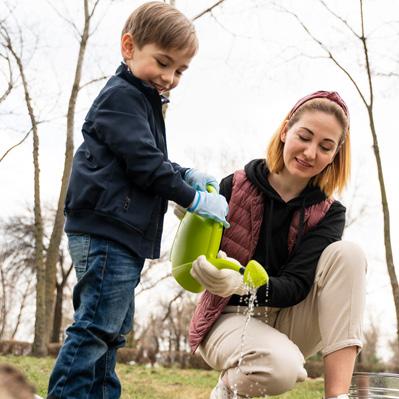
Help your children discover their spiritual gifts and talents. They may enjoy playing music, singing, drawing, cooking, or gardening. How can they use their simple skills to be a blessing to others? Their gifts don’t need to be perfect. When I was a child, I wrote poems for people and made little cards. The poems were not amazing, and the cards were childish. But they made other people smile and feel loved because I had thought about them.
Every child is unique. Help them discover their special ways to help others so they can experience joy. Creative children might prefer to make a gift. Others will enjoy singing songs in care homes, visiting lonely neighbors, or helping you to make soup for homeless people. Affirm whatever they do to care for others. Your positive response will inspire them to keep trying.
ONE SIMPLE COMPASSION CONCEPT
Whenever Jesus met suffering people, He found a way to bless them with love and left them much happier than they were when He met them. This is a simple concept to help you and your children make compassion a way of life. You can practice this at home by aiming to leave each other feeling happier and blessed. You can help your children bless others by thinking of kind things to do and say to everyone they meet at school, in church, and even in the grocery store.
COMPASSION SHARES GOD’S LOVE
Compassion is a powerful way to share God’s love. It helps us become salt and light in our communities (Matthew 5:13–16), and bless others as the Good Samaritan blessed the injured man. The “sheep” in Jesus’ parable noticed those in need and blessed them with kindness (Matthew 25:31–46). Whenever we show compassion to others, they will taste God’s love and see that it is good (Psalm 34:8).
Karen Holford, works for the Trans-European Division and enjoys studying research on compassion, which affirms God’s character and the biblical principles of caring for others.
IF I WERE AN ANGEL
If I were an angel, O Lord, I would sing to You through endless days and nights, lifting songs of worship and praise; I would behold Your face forever, lost in wonder and in awe.
If I were an angel, my voice would echo round Your throne; I would race across the heavens like lightning, proclaiming salvation to the world.
If I were an angel, I would be clothed in spotless white, untouched by sin or stain; I would ride on chariots of fire, answering the cries of Your children.
If I were a heavenly being, I would speak the language of heaven; but here I am, O Lord—just a sinner, like a wandering sheep, seeking the Good Shepherd.
So give me joy to sing Your praise, let my life reflect Your face in every person I meet.
Use my voice like a trumpet, to carry Your gospel to the ends of the earth; give strength to my feet to walk wherever You may lead.
Take these tattered garments of mine and clothe me in Your righteousness and grace; and though I won’t ride on chariots of fire, let me bring help to those in pain.
Teach me the language of love, to comfort hearts that are broken; make my hands a vessel of blessing, a refuge for the weary and worn.
Use me, O Lord my life is Yours, my heart is Yours; I am not an angel but I am Your faithful daughter.
Nizaya Soto Solórzano
NEWS FROM OUR TERRITORY
From the French Antilles-Guiana Union
Saturday, January 31, 2026, will remain etched in our memories. The pastors’ wives of SIEMA in French Guiana had the immense privilege of receiving their official certification, the culmination of several months of dedication to spiritual and ministerial training.
SIEMA and P’KIDS had the honor of celebrating Guadeloupe’s Pastoral Family Day, an event marking the end of the 2025. This festive occasion brought the community together in a spirit of gratitude and sharing.
At the certificate presentation ceremony, we had the pleasure of hearing a pastor’s wife perform a beautiful piece on the flute.
Sabbath January 17 was a memorable one for the pastors’ wives of SIEMA Guadeloupe as they received their official certification after months of spiritual and ministerial training.