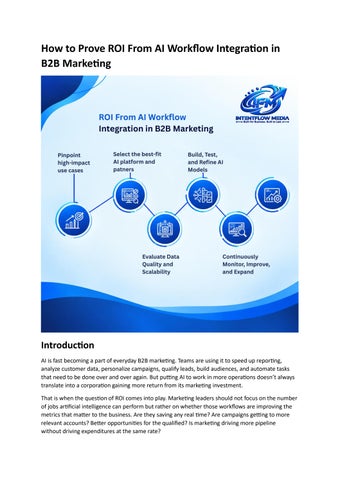
How to Prove ROI From AI Workflow Integration in B2B Marketing
Introduction AI is fast becoming a part of everyday B2B marketing. Teams are using it to speed up reporting, analyze customer data, personalize campaigns, qualify leads, build audiences, and automate tasks that need to be done over and over again. But putting AI to work in more operations doesn’t always translate into a corporation gaining more return from its marketing investment. That is when the question of ROI comes into play. Marketing leaders should not focus on the number of jobs artificial intelligence can perform but rather on whether those workflows are improving the metrics that matter to the business. Are they saving any real time? Are campaigns getting to more relevant accounts? Better opportunities for the qualified? Is marketing driving more pipeline without driving expenditures at the same rate?
A strong B2B marketing strategy would view AI as a means to improve business processes, not just another technological investment. When B2B demand generation teams connect AI workflows to measurable campaign and revenue results, it’s easy to see where AI is delivering actual value. Blending workflow performance with buyer insight can also help companies understand if AI is enhancing audience selection, engagement, and buyer intelligence. It is not the aim to prove that AI is in operation. The goal is to provide insight into how AI is enabling marketing teams to operate more efficiently and achieve better business results.
What Does AI Workflow ROI Mean? ROI of AI Workflow It is the measurable value of business that is created by applying AI in a marketing process. That figure can be derived from a number of sources: • Less manual labor • Faster campaign delivery • Enhanced lead qualifying • Better conversion rates • Better targeting of the audience • Decreased operational expenses • Enhanced sales productivity • Improved pipeline contribution The main idea is that ROI isn’t only about the amount of time an AI technology saves. The broader concern is what happens to marketing and revenue outcomes after the workflow changes? 1. Start With a Clear Business Problem Before measuring ROI, identify what the AI workflow is supposed to improve. For example, a marketing team might use AI to:
Qualify incoming leads faster
Personalize email campaigns
Identify high-value accounts
Automate reporting
Score prospects
Repurpose content
Analyze campaign performance
A specific problem creates a measurable starting point. Instead of saying, “We use AI to improve marketing,” define the objective as, “We want to reduce lead qualification time by 50% without reducing lead quality.”
That gives the team something concrete to measure.
2. Establish a Baseline Before Adding AI You can’t show you’ve improved if you don’t know where you started. Document the current performance of the workflow prior to AI implementation. Watch: Depending on the method • Hours per task • Cost per campaign • Lead time to reply • Rate of conversion • Cost per qualified lead • Opportunities approved for sales • Campaign participation • Created pipeline This baseline provides you with a relevant comparison following implementation.
3. Measure Time Savings Time savings are frequently the most obvious AI advantage. Let’s say a marketing team spends 20 hours a week on manual account research and building audience lists. The AI-assisted process brings it down to 8 hours. That's 12 hours of extra capacity a week. But only stop there if you're tracking productivity. To show real business ROI, tie those saved hours to what the team performs with the newfound capability. If marketers put the recovered time to use with additional campaigns, better targeting, or working on higher-value activities, the business benefit becomes easier to quantify.
4. Track Marketing Performance At the end of the day, AI workflow integration needs to matter for marketing outcomes. Monitor metrics like depending on workflow. • Conversion rate • Cost of each opportunity • Lead-to-opportunity ratio • Email response rate • Meeting rate • Account Engagement • Created pipeline
• Revenue driven for example, if AI is assisting with account selection and personalized outreach, compare the outcomes of AI-assisted efforts against past campaigns with similar audiences.
5. Measure Quality, Not Just Volume One common error is to focus on how much AI produces. More leads, more emails, more content pieces, and more campaigns don’t necessarily guarantee greater marketing. A workflow that leads to 5,000 leads but very few qualified opportunities may be less value than one that leads to 500 highly relevant prospects. For B2B organizations, quality measures like sales-accepted deals, qualified pipeline, account engagement, and revenue often give a better insight into the impact of AI.
6. Calculate the Actual ROI The simple ROI calculation is: ROI = (Financial Gain – AI Investment) / AI Investment x 100 The following can be invested in by AI: • Software cost • Integration costs • Run time • Education • Data preprocessing • Continual management The financial benefit could be through higher revenues, lower operating expenses, higher productivity, or a mix of these things.
FAQs 1.How do you measure AI ROI in B2B marketing? Measure the difference between the value generated by an AI workflow and the total cost of implementing and operating it. Track productivity, conversion, pipeline, and revenue-related metrics. 2.What is the most important AI marketing ROI metric? There is no single metric for every workflow. Pipeline contribution, revenue impact, conversion rates, cost savings, and productivity improvements can all be relevant depending on the use case. 3.How can B2B marketers prove that AI increased revenue? Connect AI-assisted activities to measurable downstream outcomes such as qualified opportunities, sales-accepted opportunities, pipeline, and closed revenue.
4.Should time savings count as AI ROI? Yes, but time savings are stronger when they are connected to business outcomes. For example, saved hours that allow a team to launch more effective campaigns have greater measurable value than unused time. 5.How long does it take to measure AI workflow ROI? It depends on the workflow. Productivity improvements can often be measured quickly, while pipeline and revenue impact may require a longer measurement period.
Conclusion AI workflow integration should not be viewed as just a technical endeavor. For B2B marketing teams, the real value is in how these routines change your day-to-day marketing performance. Artificial intelligence may help teams analyse data faster, identify the right accounts, personalise communications, automate repetitive tasks, and make campaign decisions with less human intervention. But those enhancements only count if they lead to measurable business outcomes. A targeted B2B marketing automation approach can help teams automate monotonous operations and free up marketers’ time to focus on strategy, understanding customers, and revenue-generating activities. And when paired with intent-driven demand generation, teams may also get a sense of whether AI is helping them find better buying signals and engage accounts at the correct point. And then the next step is to correlate those gains to company performance. More sales accepted chances, higher pipeline, improved conversion rates, reduced operating costs, and greater B2B lead generation are all signs that an AI process is doing more than saving time. Ultimately, showing AI ROI is about connecting the dots between the technology, the workflow, and the business result. Teams in marketing that measure that link may make better judgements on which AI operations to preserve, improve, or scale. AI should not be used everywhere. We want AI to be deployed where it can actually add value.