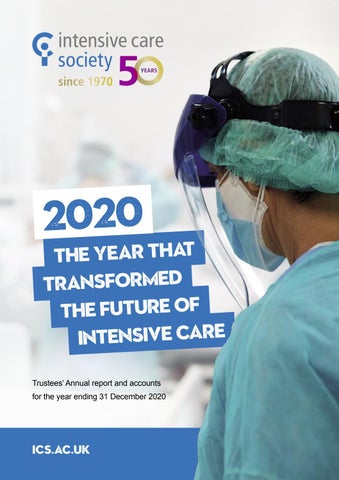
2020 THE YEAR THAT TRANSFORMED THE FUTURE OF INTENSIVE CARE Trustees’ Annual report and accounts for the year ending 31 December 2020
ics.ac.uk
2
ABOUT THE INTENSIVE CARE SOCIETY
E H T T U O B A E V I S N E T IN Y T E I C O S E CAR We are the national charity for intensive care. We help provide all those that work in intensive care with the tools they need to look after the sickest patients. We do this through funding vital research, producing clinical guidance, education, services such as psychological and wellbeing support, and lobbying for change. On the 8 June 2020, we celebrated 50 years of being the voice for intensive care.
CONTENTS
S T N E T N CO About the Intensive Care Society.....................................................................2 Contents.............................................................................................................. 3 Our President and Chief Executive.................................................................. 4 Our Charitable Objects, Vision, Mission and Values..................................... 7 Our Response to COVID-19...............................................................................8 Strategic Priority 1: Your Voice - Our Influence................................................ 10 Strategic Priority 2: Your Region - Our Network..............................................20 Strategic Priority 3: Your Patients - Our Research Based Care..................... 30 Strategic Priority 4: Your Professional Practice - Our Education.................... 40 Coming Up in 2021............................................................................................48 The Future of the Society.................................................................................48 Thank You......................................................................................................... 50 Trustees, Senior Management and Advisors................................................. 51 Structure, Governance and Management...................................................... 52 Financial Review...............................................................................................56 Independent Auditors Report......................................................................... 60 Financial Statements........................................................................................66
3
4
OUR PRESIDENT AND CHIEF EXECUTIVE
T N E D I S E R P OUR U C E X E F E I AND CH
DR STEPHEN WEBB President
DR SANDY MATHER Chief Executive
Every year we publish our Trustees Annual Report to showcase our achievements and explain publicly how we have used our funds to further the aims of our charity. This year is no different, however, due to the COVID-19 pandemic we changed our business plan and priorities in the first quarter of the year.
OUR PRESIDENT AND CHIEF EXECUTIVE
5
We pivoted very quickly and focussed all available resources on the COVID-19 pandemic and our response to it. We remember so vividly convening
UTIVE
our first National Emergency Critical Care Committee (NECCC) on 18 March, 2020 and looking at the screen to see over 100 faces from across the UK. NECCC was an essential knowledge exchange forum open to individuals and organisations and met weekly throughout COVID-19. We initiated many productive workstreams and collaborations at NECCC which involved with as wide a range of stakeholders as we could identify who could contribute to the national
We refocussed our plans and adapted our public
push to find treatments for COVID-19 and to produce
engagement and educational events to support
professional guidance for the multi professional
our wider stakeholders and beneficiaries to enable
intensive care and wider enhanced care communities
the intensive care community to respond to
including professional associations, Royal Colleges,
COVID-19 pandemic.
with educationalists, policy makers and researchers
2020 was planned to be a year of celebrations for
and government officials.
our landmark 50th birthday as a Charity and showcase intensive care. Although we didn’t celebrate we did showcase intensive care and what we can achieve for our beneficiaries. We worked collaboratively with a wider range of professional associations and Royal Colleges, with educationalists, policy makers and researchers as we reprioritised to deliver increased activities and support to our beneficiaries. When we reflect on the year of the COVID-19 pandemic we recognise that, as a charity, we were well prepared to support the intensive care community. Our digital transformation programme over three years included
We have taken great inspiration from our members, staff and supporters for their resilience and resolve throughout the past year and how despite all the challenges they continue to radiate our values in everything they do.
the target to transfer all staff to cloud based working with laptops by January 2020 and we achieved this. It allowed us to move swiftly to home based working
COVID-19 brought with it immense challenges
when the pandemic and first national lock down started
and the emotional toll on the intensive care community
in March 2020 and enabled the organisation to be
will continue to be felt for some time to come.
agile in its response. We quickly set up digital systems
We recognised this early on and launched the
for remote education and meetings. Whilst this was
first of our urgent appeals to create psychological
planned for 2020/21 we accelerated the transition
and wellbeing support directly for those working in
and by March, 2020 we were running regular webinars
intensive care. We have been incredibly humbled
to exchange knowledge nationally and internationally
by the support we have received over the past year
to share learning about COVID-19 between clinicians
which in turn has enabled us to grow and expand
and across specialisms and international boundaries.
our support to ICUs all over the UK.
6
OUR PRESIDENT AND CHIEF EXECUTIVE
The intensive care community trusts us to be their voice
Through the education we will be running, we will be able
and this year we have made extra effort to make sure
to ensure that the intensive care community and those
we are heard. We amplified our media 100% to ensure
supporting on the peripheral are given all the knowledge
we told the story of what we were seeing in a clear and
they need to provide first class care to patients.
factual way. We also knocked on Government’s door to provide support and a deeper understanding of our specialty and what is needed to support it long term.
In 2021, thanks to generous donations received during 2020 we will be able to modernise our education and learning benefits and dramatically increase them as
Before 2020, intensive care was something many knew
part of a new Digital Learning Strategy. We will be
little about, even some of our NHS colleagues didn’t
launching a whole new programme of work in 2021
understand the full extent of what goes on behind the
which will offer online learning and a dedicated new
doors of an ICU, now because of the pandemic, it has
learning portal. This will enable more opportunities
become a household name.
for our community to be able to access continued
Collaboration is the first of the Society’s core values and binds us together. This year has shown exactly
professional development at a time that suits them and their 24-hour working lives.
why it is so important to us and is a core value. It is
In 2021 the wellbeing agenda and workforce support
by working together that we can really make change,
will remain at the very top of our agenda. This year
and this has been proven throughout 2020 with
has stretched our community to the extreme with
providing everyone with a seat at the table to ensure
many seeing more deaths in 2020 than they would
there is one joined up approach.
in their entire career. We must protect this workforce
As we look forward to the future of the Society and our plans for 2021, we not only take the lead from the
and we will be continuing to do this with our wellbeing programmes funded by generous donations.
second half of our five year Strategy (Your Society -
Our plans for 2021 also include supporting our
Our Strategy) but we take the learnings from the past year.
members with new workstreams on Equality,
We are presented with a unique opportunity to ensure that
Diversity and Inclusion and Sustainability.
intensive care receives the appropriate support it needs
We will also be continuing to modernise our
in both provision and prioritisation of research.
governance and holding elections for new
We will be championing the intensive care agenda and its evolution following a post COVID world to ensure
professional advisory groups to represent the voices of our wide multi professional membership.
our members, patients and their loved ones’ needs
We are one team and one community. We are thankful
are supported and represented locally, regionally,
for all the donations we have received which have
and nationally. This also includes taking the voice
enabled us to support our important and valued
of the intensive care community directly to
intensive care professional community. They have
Government and making sure it is heard.
repeatedly gone above and beyond the call of
If this year has taught ICUs anything, it is that research plays an essential part of intensive care. The Society’s
duty to do everything they can to care for patients during the most difficult of times. Thank you.
research work has been invaluable during the pandemic with its work being instrumental in finding treatments for COVID-19 such as Tocilizumab. This work will need to increase to offer more opportunities to find lifesaving advancements in the care we deliver. In 2021 will see the Society increase fundraising to enable more funds
Dr Stephen Webb President
available for research work. The support from our wider NHS colleagues throughout the pandemic has been not just welcomed but a necessity to cope. The education we provide to help
Dr Sandy Mather
train these non-ICU staff must be a priority for the future.
Chief Executive
OUR CHARITABLE OBJECTS, VISION, MISSION AND VALUES
: E R A S T C E J B O E L B A OUR CHARIT
7
To advance and promote the care and safety of critically ill patients, by...
1
the advancement and promotion of those branches of medical science concerned with critical care, and
2
the promotion of study and research into critical care and the publication of the useful results of such study and research.
We implemented our charitable objects as set out in this report. However, importantly during 2018 the Society agreed the following vision, mission and values to enable us to achieve our outcomes and make an impact on our beneficiaries.
Our Values Our Vision
Our values define our culture and are at the very heart of the Intensive Care Society - who we are, what we do and how we do it.
The Society’s vision is a world where every member of the multi professional critical care team has a voice and plays a part in research, education and standardsdevelopment.
Collaboration We work with others to maximise our impact.
Freedom of expression We are bold in our actions and words and encourage diversity of views.
Accept and respect
Our Mission
We represent the views of the multi professional critical care community and help them by providing opportunities for knowledge exchange to support learning. We enable them to contribute to research and standards development.
We treat everyone with dignity and respect and accept differences delivering our mission more effectively
How we work
The infrastructure we established and completed by the
Our strategy is a living document that guides
The upgrades to our IT systems, our Divisional structure
everything our Trustees, Council, Committees,
and our governance enabled us to respond quickly
volunteers, and staff do for the intensive care
to pivot and re-prioritise our resources to support our
community and our wider beneficiaries. It gives
beneficiaries during the pandemic. Trustees and senior
us a framework and acts as a moral compass to
management retained a close eye on our charitable
remind us why we do what we are do, how we should
object throughout the pandemic to ensure we acted
do it and the difference we make to wider society
in the best interests of those our charity was set up to
and the charity sector as a result of our activities.
support including the multi professional intensive care
We set out the Society’s work under four Strategic Priorities (SP): SP1 Your voice - our influence SP2 Your region - our network SP3 Your patients - our research-based care SP4 Your professional practice - our education
end of 2019 enabled us to start 2020 on the front foot.
community, our patients and their relatives, the public, policy makers, researchers and government. Our operational clinical activities were delivered via a Divisional structure with an elected Council member as chair of each division collaborating with a senior manager.
8
OUR RESPONSE TO COVID-19
9 1 ID V O C O T E S N O OUR RESP SOCIAL
WELLBEING
455 developing psychological
737 tweets
2690 workforce wellbeing
93,262 profile visits
services documents downloaded framework best practice downloads
6,415,000 impressions
6 journey to work podcasts released with 6,772 listens
9,450 new followers
6 YouTube videos released with 3500 watches
15,442 mentions
1 million written resources views worldwide
Facebook 837,100 views 3,212 new followers 161,069 engagements
NECCC UK wide involvement from healthcare, Royal Colleges and Societies for healthcare, NHS, Government, technology and corporate sectors.
115 group members
RESEARCH
41 weekly meetings Work streams: • Ventilatory support and capacity • Oxygen supply
COVID-19 advisory panel collaboration with the Physiology Society
• Renal support • Anti-coagulation • Tracheostomy • Wellbeing • Rehabilitation post ICU
26 members
• Training for non ICU staff
29 questions submitted
• Decision making
bit.ly/ICS_Physiology
• Research • Data collection and access
OUR RESPONSE TO COVID-19
WEBPAGE 1,818,030 website views 309,380 guidance page views
MEDIA ENGAGEMENTS 161 media engagements 25 TV interviews 120 articles in print and online
COVID-19 LEADS GROUP 257 ICU leads across the UK 14,189 messages exchanged
16 radio interviews
KNOWLEDGE SHARE • 4x knowledge shares • COVID-19 clinical experience in UK intensive care settings
194 guidance documents sent
• COVID-19 shared experience in international intensive care settings
416 links to useful COVID-19 guidance
• UK, China, Spain, Italy, Germany, Demark, USA, Qatar, and France
339 images added of data
• Thromboprophylaxis and anti-coagulation in patients with COVID-19
and COVID-19 support material
GUIDANCE 48 pieces of new guidance created 25 endorsed guidance documents
• Wave one knowledge share
PATIENTS AND THEIR LOVED ONES 7 guides released to help patients coming off mechanical ventilation understand the care they have received 18 visual graphics to help patients, loved ones and the public understand ICU equipment bit.ly/ICU_Guide
Issued the guidance for use of video communications between patients and their loved ones.
9
10
YOUR VOICE - OUR INFLUENCE
E C I O V YOUR E U L F N I R OU
ENCE
YOUR VOICE - OUR INFLUENCE
11
The Society’s Public Affairs Division has the responsibility for acting as the collective voice of the Society’s members and wider intensive care community to influence and educate policy makers and the public about the value of the multi-professional team providing intensive care.
12
YOUR VOICE - OUR INFLUENCE
GOAL 1
E IV T C E L L O C E H T S TO ACT A E S R E IV D R U O F O E IC VO L A N IO S S E F O R P IT L MU MEMBERSHIP
13
YOUR VOICE - OUR INFLUENCE
NECCC played an instrumental part in the country’s response managing patients with COVID-19 both in and out of intensive care, enhanced care, and acute and emergency care. We continue to chair these meetings on a bi-weekly basis.
Members of NECCC identified new and We celebrated our 50th birthday in 2020, and what
emerging themes throughout the pandemic
a year it has been. What started off as a year of
and the following list includes some of the key
celebrations, quickly turned in to a year that we will
workstreams. These led to the development
never forget because of the COVID-19 pandemic.
and publication of numerous rapid knowledge
For the last 50 years, we have represented the
sharing guidance documents and webinars.
incredible intensive care community and championed
Ventilatory support and capacity
their work acting as their collective voice to explain their
Personal Protective Equipment
needs and those of their patients. Our community looks after the sickest of patients in any hospital, and in 2020
Oxygen supply
the world was given an insight into exactly what we
Renal support
do behind the closed doors of an ICU.
Anti-coagulation
Our 50th year was not what we anticipated,
Tracheostomy
and our community faced the toughest healthcare
Wellbeing
crisis in a century.
Rehabilitation post ICU Training for non-ICU staff
National Emergency Critical Care Committee (NECCC)
Decision making
We launched NECCC on 18 March 2020 to bring
Data collection and access
Research
together stakeholders and share knowledge across the UK and globally and raise awareness about existing work, avoid duplication and to maximise impact of our collective efforts against COVID-19.
Our communications Our clear, effective and timely communications both
NECCC consists of 115 UK based healthcare
internally and externally were essential during the
professionals, and representatives from professional
pandemic. Very quickly our digital platforms were
bodies for healthcare, the NHS, Government,
transformed to incorporate COVID-19 specific content
technology, and the private sector.
and act as a centralised point from which the intensive
During the first wave, we met weekly so the group could
care community could access live updates from the
keep up to date with the ever-changing intensive care landscape as COVID-19 swept up the country. NECCC also became a vital place to troubleshoot common issues, learn from other areas of the country and gain access to stakeholders such as the NHS to help raise concerns. This could then be then transferred back through their local networks.
Society, other Health bodies, and Government.
14
YOUR VOICE - OUR INFLUENCE
In February 2020 we developed our Instagram feed and in doing so have grown our followers by 2,318 people. We achieved this by posting on our timeline 152 times, sending out 3092 stories, creating fun videos that have been watched 30,911 times and even ventured into the realm of Instagram TV, posting videos for our fundraising campaigns as well as our public information campaigns which have been seen 949 times.
WhatsApp On 7 March 2020 we invited FICM to collaborate with us to set up a WhatsApp group for COVID-19 leads across
Website We created a dedicated COVID-19 hub on our website to house all the up-to-date information our intensive care community needed to help support them and their patients. We also created dedicated webpages for our wellbeing campaign and our fundraising.
the UK to facilitate troubleshooting, support, guidance, and situation reports which could be shared across the country within seconds. We set up the group and invited FICM, the Operational Delivery Networks and the Presidents of the Welsh, Northern Irish and Scottish Intensive Care Societies to join. Within 24 hours 187 people had joined the
Our website was visited 793,360 times
group and within 48 hours it had reached WhatsApp’s maximum capacity. Members of this group use it to share knowledge and experience around the clock and remains active 24/7.
We also partnered with the Royal College of Anaesthetists (RCoA), Faculty of Intensive Care (FICM)
Media work
and Association of Anaesthetists (AABGI) to create
Intensive care has never been in the media as much as
a new standalone website as a central repository for
it has this year and many members of the public have
collaborative guidance between the four organisations
very little understanding of what we do, unless they
to enable both the intensive care and anaesthetics
know of someone who has (or have themselves)
communities to access joint guidance via one portal.
been on an ICU. As the voice of intensive care, it is extremely important to represent our
www.icmanaesthetics.org
profession in the media and raise public awareness of what we do.
Social media Social media has been a huge asset for the Society
Throughout the pandemic, the
HANDS
Society has proactively engaged
as we use it to engage with the wider intensive care
with the media to provide a greater
community, the public, patients and relatives, policy
understanding of what intensive
makers, the media and other interested parties.
care is, debunk myths, and raise
Twitter - this year alone we have seen our Twitter
public awareness of the roles both
following rise by 7.5k people. We have sent over
Face
healthcare professionals and the
420 tweets most including links to our policies and
public play in the fight against
guidance and information for health care professionals.
COVID-19.
Those tweets have had over 3.9 million impressions.
In 2020 the Intensive Care Society
Our followers included key influencers in public health policy and intensive care.
appeared in the media 183 times
Space
across TV, broadcast and print.
15
YOUR VOICE - OUR INFLUENCE
Intensive Care 2020 and Beyond: Co-developing the future At the first Council meeting of 2020 we planned to start work on a major new strategic policy setting out our view of the future of intensive care. We deferred this because of the pressure of work in the first wave of the pandemic and launched it in the second quarter of the year. We were able to integrate our experience of the
Safety alerts
first wave of COVID19 with the project which was led by Council member, Charlotte Summers.
Safety alerts issued by the Medicines and Healthcare
This project working group involved 54 other
products Regulatory Agency (MHRA) were included
representatives from more than 20 organisations
in the Society’s regular communications to ensure all
that comprise the multi professional intensive care
areas of the community were able to stay abreast of
community, including Royal Colleges, Specialist
the latest updates.
Societies, ICNARC, NHS England and the National
On Saturday 4 April, a major incident concerning
Institute for Health Research (NIHR) to conduct a
oxygen supply at Watford was announced. One of the Society’s Council members was involved in the response to the incident and within 24 hours had worked with the Society’s Head of Communications
horizon scan of intensive care to answer all of our questions. This enabled us to create policy document to provide policy makers, research funders and Government Departments with a clear road map
to get the ICS Oxygen Supply Safety Alert design
to improving intensive care provision in the UK.
an issued to the Intensive Care Community.
2020 was a difficult year for us, but it also allowed us to assess what we currently do, why we do it,
Our policy work The Society’s President was invited by the Department of Health and Social Care to be one of three high-level
and how can we make it better. Download Intensive Care 2020 and beyond: co-developing the future at:
expert advisors along with the Co-Chair of the Moral
www.ics.ac.uk/ICU/Guidance/PDFs/
and Ethical Advisory Group and Past Chair of RCGP
Intensive_Care_2020_and_Beyond
and Chair-elect of the Academy of Royal Colleges representing critical care, primary care, and bio-ethics, to write ethical and decision-making guidance for the four Chief Medical Officers and the NHS Medical Director. The Society’s newly formed Legal and Ethical Advisory Group would support the President in this work and help to inform and guide national policy. At a later date, the resulting ethics guidance was handed over for ownership and release by the Society, supported by endorsements from the Royal College of Physicians, Royal College of General Practitioners, the Scottish Intensive Care Society, the Welsh Intensive Care Society, and the combined critical care networks of England, Wales and Northern Ireland.
16
YOUR VOICE - OUR INFLUENCE
Patients and relatives Public Advisory Group (PRPAG)
Use of video communications
Our Patients and Relatives Public Advisory Group
unable to come into intensive care units and see them.
(PRPAG) have first-hand experience of what it is like to be on an ICU and volunteer to support the Society in our work contributing to the delivery of our strategy and advising on new guidance and resources for
To help safeguard our patients, their loved ones were ICU staff did their best to be both their carers, and family, however, sometimes nothing can beat a familiar voice. Working with our PRPAG, and LEAG we created new guidance on the ‘use of video communications
patients, their families and carers and the wider public.
for patients and relatives in intensive care’.
As part of our response to COVID-19 we created
This guidance sparked a collaboration with Apple
a suite of materials to explain what an intensive care unit is to both patients and their loved ones. Two sets
whereby ICUs across the country could order a free iPad to enable patients to call home.
of guidance were issued; one for the use of video communications for patients and relatives in intensive care, and our guide to help explain to families the care their loved ones is receiving.
Information for patient and their loved ones Intensive care can be a scary place and the care can be complex. We created guidance for staff to help them explain the care their patients were given in a way that would be easily understood by their loved ones. We also created guidance to help patients understand the care they have just received for those who were coming off mechanical ventilation.
Awards As part of our 50th anniversary celebrations we were due to host our first ever Intensive Care Society Awards to celebrate the exceptional talent in our specialty on the 8 June, coinciding with the day the Society was founded. This event was subsequently postponed due to the pandemic. Following the pressures of the first wave, we wanted to be able to lift the spirits of our intensive care community and decided to host a virtual event to announce our award winners and celebrate their achievements in September.
In collaboration with ICUSteps we wanted to lift the spirits of our intensive care community and show our gratitude to all those working over the December holidays, so we produced a video where ICU survivors said thank you and Happy Holidays to staff. The video can be found here: bit.ly/ICS_Patient_Thankyou
17
YOUR VOICE - OUR INFLUENCE
... E R E W S R E N IN W R U O Improvement project award
Research award
Brendan McGrath,
Patientcentred care award
Doctor
Rehab legend project,
Physiotherapist
Eve Corner,
Kate Tantam, Nurse
Innovation award Airways checklist card, Sam Goodhand, Doctor
Education award Transplant (NHSBT)
Welfare and wellbeing award Staff wellbeing and diversity group, UCLH intensive care
Outstanding contributions award Professor Jerry Noland, Doctor
18
YOUR VOICE - OUR INFLUENCE
GOAL 2 TO INCREASE OUR Y IT C A P A C G IN IS A R D FUN AND CAPABILITY
19
YOUR VOICE - OUR INFLUENCE
Fundraising
The Intensive Care Society is unique in looking after the interests of all our intensive care professionals,
We planned to increase our fundraising activities during
wherever they work and whatever their profession.
2020 as part of our 50th anniversary celebrations
We identify and share best ICU practice. We develop
and to help to inform the public about the professionals
protocols of patient care. We teach and train.
involved in caring for patients in intensive care.
And we are working hard to support the wellbeing
We accelerated these public fundraising activities
of our staff, ensuring that each gets the support
between March and December 2020. As the pandemic
they need, where and when they need it.
thrust intensive care into the public domain, - it sparked a flurry of supporters wanting to give back to those working on the sharp end of the front line.
Our urgent appeal campaign to raise funds for the Wellbeing and Resilience through Education (WARE) project helps provide direct support to intensive
There are far too many supporters to mention,
care professionals across the UK with psychological
and we cannot thank each and every one of them
interventions and education.
enough for their kindness. It is because of these donations that we have been able to provide the essential support our intensive care community needs.
The money raised through this campaign has been used across our Divisions to deliver an increased number of charitable activities and this
We have dedicated a section at the end of this report
report shows the impact we have made by using
to our fundraising to highlight a few ways that our
these donated funds.
supporters got involved to give you a flavour of how they have contributed. See page 50.
Pro bono support
What did we do with the funds that were generously donated?
We have been extremely lucky to have received kind support of volunteer offering their expertise in marketing, media, TV and Film, and journalism.
Even the most experienced among the ICU team
Together we were able to blend our knowledge to
have never faced such personal and professional
help raise the profile of the Intensive Care Society
pressures before the pandemic, yet each has risen
and create public campaigns that would help support
to the challenge and still comes back into work,
our beneficiaries. We are grateful to the Society’s chair
day and night.
of the Public Affairs Division, Hugh Montgomery, who
But COVID-19 is taking its personal toll on our
introduced many of these individuals to the Society.
doctors, nurses, physiotherapists, occupational
We are deeply grateful to all those who contributed
therapists, speech and language therapists, dietitians,
to our fundraising campaigns to help our beneficiaries.
pharmacists and many others. The price of their commitment is already being paid in lost sleep and anxiety. We can expect more to be affected, and more severely. As the NHS ‘re-boots’, ICU patients will not just be COVID-19 patients. The numbers we care for will go up, not down. The need is clear: to provide our ICU professionals with the technical and emotional support they need to continue fighting for those we know and love.
20
YOUR REGION - OUR NETWORK
N O I G E R YOUR O W T E N OUR
ON ORK
21
YOUR REGION - OUR NETWORK
This strategic priority is delivered via our Professional Affairs Division. We know that most opportunities for tacit knowledge exchange lie in serendipitous interactions with peers, in a safe environment, where openness and trust can be built up so that learning can take place. We are committed to working for our members to provide these safe environments and build up local, national, and global communities of multi professional intensive care members.
22
YOUR REGION - OUR NETWORK
GOAL 1
E U L A V E H T E V O R P TO IM R U O O T E ID V O R P WE R E V E R E H W S R E B M ME K R O W D N A E IV L THEY
23
YOUR REGION - OUR NETWORK
Psychological impact of COVID19 on intensive care professionals
Written resources for Wellbeing
We recognised early in 2020 that we would need
designed specifically for ICU staff and free to
to develop a wellbeing programme to help support our intensive care community through the pandemic.
We have a series of 21 posters, leaflets and handouts download and print from our wellbeing page www.ics.ac.uk/wellbeing
Between February and June 2020, we developed online resources to help provide basic wellbeing advice and support. These resources have been downloaded over a million times across the world and have been translated into several different languages.
“I found the sessions incredibly useful and have allowed me to cope far better with the current demands (particularly at the
We know that sustaining the wellbeing of staff means
beginning of this year). The support given
that they can provide a better service for patients,
was extremely tailored to my needs.
make safer decisions and fewer mistakes. Wellbeing
Thank you so much!”
at work is not just about how individuals manage the stress of work; it is about creating the core conditions to thrive at work such as job design (including valuing staff, enabling autonomy and a sense of control), the way the intensive care unit is managed and how
Developing psychological services in UK Intensive Care Units
the ICU team is led, and the workplace culture
Although we welcome temporary pandemic measures
and peer support.
across the UK, we aim to support the longevity of integrated local psychological services for
Our Wellbeing and Resilience through Education (WARE) project
intensive care staff. We benchmarked the UK provision of Psychology in intensive care which showed just 20% of intensive care
This project was a new area of work for the Society
units in England, Scotland and Wales having direct
and for the first time it took us into service delivery by
access to a practitioner psychologist. The Society
providing psychological support directly to intensive
deems this unacceptable, and we are engaging
care professionals across the UK. It was funded by
with NHS England & Improvement and devolved
generous donations from our fundraising campaign
nations to make it a priority to increase this
in May 2020. These funds enabled us to recruit a
percentage over the next couple of years.
practising consultant clinical psychologist and Society member (Julie Highfield) to work for the Society for two days a week to lead the project as our National Project Director for Wellbeing. This was quickly followed by the recruitment of an Assistant Manager to work alongside to deliver and manage the project.
In the meantime, we have developed a baseline business case for those 80% of units to develop their own local service through their own Trust. So far, we have worked with 48 units to help develop the provision of psychology to intensive care.
“I am indebted to the Intensive Care Society for their support in providing this. Thank you very much indeed.”
24
YOUR REGION - OUR NETWORK
Providing 1-1 psychological intervention to intensive care staff Between July and November 2020, we recruited 16 professional psychologists, inducted and trained them to enable them to confidently provide tailored 1:1 sessions for intensive care staff. Importantly this service is unique in that it is tailored specifically for intensive care staff and is accessible by them directly via a self-referral.
Wellbeing framework Through reviewing the generic NHS evidence base for wellbeing, we designed and released our Wellbeing Best Practice Framework for intensive care. This document provides a best practice framework to guide commissioners and budget holders, senior hospital management and the intensive care team on ways to provide the best possible employee experience within intensive care.
Peer Support Training Program Our programme upskills intensive care staff to be able
“The members I have worked with so far
to support their peers. We provide them with the tools
have commented about the significant
they need to help sustain wellbeing, support those who
positive impact on their wellbeing. One
are struggling, and ensure that staff who may be unwell
member said they realised how many
receive the timely assessment and mental healthcare
strengths they had through our sessions
they require.
and became much more aware of
Between August and November, we commissioned
themselves and their own stress signals. Another member noted a change very quickly in their self-care because of the sessions. This has improved their ability to feel engaged and connected with others, both in and outside of work.”
expert trainers to develop a “train the trainers” peer support programme and training materials for ICU staff. We trained 16 ICU staff from across the UK as master trainers so that they could work with us to deliver free one-day training to more ICUs. Between September and October, we worked with ICU staff from pilot sites in Cardiff, Papworth, Poole, Coventry, and
They receive up to six free one-hour sessions of tailored psychological support. We promoted this service throughout the UK for those staff who felt they
East Lancashire and ran the first pilot programme in December 2020. This peer support training program is tailored specifically to the needs of intensive care.
needed a little extra 1:1 support to find ways to deal with their experience of the pandemic.
“Peer support Master training has provided myself and my CRCU unit with
“I found this service really useful. It was so beneficial to speak to someone who understood the environment. Understood some of what I had been through and helped to normalise these feelings as well as validate my experience. Particularly that even though I’m not a nurse or doctor I have still experienced the pandemic and some trauma through it. I do still have some difficulties, but I recognise that this is understandable and OK.”
the foundations to make a ‘Big’ impact and improve the culture of ‘it’s good to talk’ with minimal resources required in rolling it out. A simple concept with a fantastic return. Always the best combination, I’d say”
Royal Preston Hospital
25
YOUR REGION - OUR NETWORK
Leadership in Intensive Care A significant part of thriving at work is being governed by good leadership. In December we piloted an ICU leaders peer group reflective session to provide a safe space where intensive care leaders could reflect and share their experiences. Due to the success of this pilot, we will be developing the WARE project to include an offer specifically for leaders in 2021.
MEMBERSHIP TYPE
11
43 1589 221 Honorary
Consultants
Nurses
96
38
722 Trainees
6
Psychologists
31
13
101
50
Distinguished
SAS
Students
AHP Other
Dietitian
Physiotherapist
Pharmacists
21
36
6
76
Speech & Language Therapists
Retired & Retired Nurses
Occupation Therapists
Advanced Practitioners in Critical Care
TOTAL: 3060
26
YOUR REGION - OUR NETWORK
Our Professional Advisory Groups (PAG)
One clinician said:
Council voted for a special resolution in December
“I am a different person to the one
2020 to increase our democratic legitimacy and
I was yesterday morning.”
to establish new Professional Advisory Groups to represent the largest segments of our membership. They are:
Another said:
Advanced Practitioners in Critical Care (APCC) Allied Health Professionals (AHP)
“We are waiting for the tsunami to hit -
Nurses
there’s lots of crying - emotionally
Pharmacist
draining - not just clinical - but to
Physiotherapist
be there for the staff.”
Specialty doctor The chairs of these PAGs will have an equal seat on
LEAG provides the Society with first class advice
Council and help shape the future direction of the
and has been instrumental in supporting the creation
Society. The elections will take place in 2021.
of guidance for both intensive care staff and patients,
The Nurses PAG and Trainees PAG played a vital role supporting the Society to ensure our nurses’ and trainees’ voices were heard, both at a local and national level. They were involved with our guidance work,
supporting the National Emergency Critical Care Committee, and releasing legal and ethical advisory statements for ICU staff. LEAG also runs a regular webinar series - see Learning Division.
including rehabilitation, and were represented on the National Emergency Critical Care Committee (NECCC). We ran national elections for new members of the Trainee Advisory Group. We engaged more trainees than in previous years with 21 nominations received from across the UK. Voter turnout was also higher, at 15.2%, compared to 14.8% in 2019.
Legal and Ethical Advisory Group
Ethical considerations for inter-hospital patient transfer & unit capacity This statement was produced to give decision-makers guidance on the ethical considerations relevant for patient transfer alongside The statement was endorsed by the Critical Care Networks of England, Wales and Northern Ireland.
The Society’s Legal and Ethical Advisory Group (LEAG) was established as a source of advice on legal matters of professional relevance to our intensive care membership. It comprises Society members with
Legal liabilities of clinicians as individuals during COVID-19
experience in medico-legal matters relevant to Intensive
The Society and the Association [Anaesthesia]
Care and we also benefit from pro bono legal advice
released a statement to provide a clear outline
by Rob Tobin, Partner at Kennedy’s Law.
of the legal liabilities of clinicians as individuals
LEAG had its inaugural meeting on 18 March 2020 which was an emotional meeting with clinical members initially debriefing about what they had experienced and seen during the first two weeks of COVID-19 and how traumatised some of those who were most exposed felt.
during the pandemic. The full LEAG statements are found here: www.ics.ac.uk/ICS/COVID-19 /Legal_and_Ethical.aspx
27
YOUR REGION - OUR NETWORK
28
YOUR REGION - OUR NETWORK
GOAL 2
T C A P IM R U O E S A E R C TO IN E G N A H C X E E G D E L W AND KNO L A IC IT R C L A B O L WITHIN THE G Y IT N U M M O C E R A C
29
YOUR REGION - OUR NETWORK
International engagement Our engagement with our intensive care colleagues across the world was fundamental to our fight against COVID-19. Our National Emergency Critical Care Committee identified emerging areas of clinical disease and diagnosis which required new knowledge and we set up several Knowledge Sharing Webinars with international input. The learning from these was summarised into rapid dissemination reports which were then circulated across the UK within 24hrs. With special thanks to UCLPartners and NIHR for their
The Society and Association of Anaesthetists international webinar The Society joined the Association as a result of the NHS declaring COVID-19 was now a level 4 incident on Saturday 14 March. The Society’s President gave a presentation at the first AAGBI international webinar which attracted approximately 1,000 viewers when it was broadcast live. It has subsequently been downloaded many 1,000’s of times. The Society’s presentation included the latest data on the pandemic and modelling, the relevant research trials that
support in writing these knowledge sharing summaries.
The Society’s Research Directors were involved in
On the 13 April 2020, we brought together our
wellbeing posters (including the links to the Wellbeing
colleagues from China, France, Germany, Italy, Spain, the UK, the USA, and Qatar to share the collective experience of ICU management of patients with COVID-19. You can access our knowledge shares at: www.ics.ac.uk/Knowledge Other knowledge shares can be found on page 43.
(REMAP-CAP and ISARIC) and promotion of our posters we had just launched). Importantly one of the questions asked of the President at this webinar was “Will the four bodies have our backs when accusations fly?” The answer was a very strong “yes”. This leadership and clarity of support for the community was crucial.
30
YOUR PATIENTS - OUR RESEARCH BASED CARE
N E I T A P YOUR A E S E R OUR E R A C BASED Standards and Guidelines Division The Society’s Standards and Guidelines Division is responsible for the development, endorsement and production of professional guidance, standards, clinical and service guidelines across the UK. The Division’s work has been critical in supporting intensive care’s response to COVID-19.
Research Division The Society’s Research Division leads the operational delivery of our strategic plans for research. This year the Directors of Research and our wider research community made an outstanding positive impact on diagnosis and treatment of COVID-19.
NTS ARCH E
31
YOUR PATIENTS - OUR RESEARCH BASED CARE
32
YOUR PATIENTS - OUR RESEARCH BASED CARE
GOAL 1 TO EXPAND THE , S D R A D N A T S S Y T IE C SO DEVELOPMENT
33
YOUR PATIENTS - OUR RESEARCH BASED CARE
Our COVID-19 Guidance
The Society’s prone positioning in adult critical care
COVID-19 guidance was being created at a such
year, seeing over 22k downloads. We created a simple
a rapid rate that it was being released every few
and easy to follow document with high quality images
days in the first wave.
depicting the step-by-step procedure. Its benefits in
The Society released an astonishing 48 pieces of individual guidance, endorsed a further 18 documents, and had seen 150k downloads via our website.
Our other guidance
guidance published in 2019 was hugely important this
treating critically ill COVID-19 patients was identified early on and it triggered a number of subsequent proning guidance documents (including guidance on prone plexopathy with the British Orthopaedic Association and Prone enteral feeding with British Dietetic Association).
Early in 2020 strategies were agreed to sustain work
There have been requests from as far as the US (NY),
where possible and to pause workstreams and redirect
Canada (Quebec) and Spain (Mallorca) to translate,
resources to priority guidance, as we knew that in
adapt and reference the proning guidance for local
addition to supporting our standards work, many
use. Many contacts both in the UK and internationally
members of our Standards and Guidelines Committee
have shared their thanks for this resource and
were involved in the development of their own local
emphasised how invaluable it has been in their
guidance and local response efforts.
local COVID-19 response efforts.
Members of our Council were also heavily involved
You can find all our guidance at:
in the development of professional guidance, some of which has been captured below: Tracheostomy Standards COVID-19 Pandemic PPE guidance Peripheral Vasopressors Standards for Concentrations of Medicines in Critical Care Animal Assisted Intervention (AAI) in a Critical Care Setting Prevention, Diagnosis and Management of Plexopathy during prone position Guidance for Prone Positioning of the Conscious COVID Patient Renal Replacement Therapy for Critically Unwell Adult Patients
www.ics.ac.uk/guidance
Consultations we engaged in during 2020 Each year the Society is approached to provide input into consultations that may benefit the intensive care community. This year we supported: Scoping review use of medical gases Renal Replacement Therapy (RRT) Prevention and management of thrombo-embolism in COVID-19 Extra corporeal membrane oxygenation (ECMO) for bridge to lung transplant consultation Extra-corporeal membrane oxygenation (ECMO) for acute heart failure in adults GIRFT Anaesthesia and Perioperative Care GIRFT Critical Care Second opinions in complex decision making (new)
34
YOUR PATIENTS - OUR RESEARCH BASED CARE
Rehabilitation
The Chair of NECC
In the first meeting of the National Emergency Critical
The Society’s framework and Post Intensive Care
Care Committee (NECCC) in March 2020 we raised
Presentation Screening (PICUPS) tool was completed
concerns about the extent of rehabilitation that patients
in five weeks and enables ICU staff to triage a patients’
would require following treatment on ICU and the lack
rehab needs early on, ready to support them when it
of current service provision in this area. We know
comes to them being stepped down off the ICU on to
that our patients require up to 18-months’ worth of
an acute ward.
rehabilitation when they leave intensive care to get them back on their feet. For example, the average patient on a ventilator loses 0.2% of muscle mass per day. So, we knew early on that the volumes of patients
The framework for assessing early rehabilitation needs following treatment in intensive care was launched in July 2020 and piloted across 26 sites in the UK.
needing rehab would be far greater than we had
We also adapted the framework to be used in a
experienced before.
community setting, providing a tool for those in primary
We established the National Rehabilitation Collaborative reporting into the NECCC in summer 2020 and appointed Zudin Puthucheary as Chair and Special Advisor to Council in September 2020. The Collaborative s made up of over 70 intensive care, rehab medicine and sports and exercise experts to develop and implement a framework that could be adopted by intensive care units (ICUs) across the UK.
care, such as GPs, to be able to assess patients who had a milder case of COVID-19 but are still displaying symptoms such as breathlessness. Find our more: www.ics.ac.uk/rehab
35
YOUR PATIENTS - OUR RESEARCH BASED CARE
U IC T S O P E H T G IN T O PIL S) P U IC P ( N E E R C S N IO PRESENTAT N IO T A IT IL B A H E R D N TOOL A PRESCRIPTION Since launching the Post ICU Presentation Screen (PICUPS) tool and rehabilitation prescription earlier in 2020, we have focused our efforts on engaging the wider critical care community around the use of the tools and recruiting pilot sites. We are very grateful to those who attended the engagement webinars and to everyone who took part in the data collection activities.
13
endorsements including:
26
acute hospitals
participated in the pilot of the PICUPS tool and rehabilitation prescription representing a good geographical spread of sites.
Breadth of multi-professional teams Pilot sites actively engaged the breadth of their multi professional teams including physiotherapists, occupational therapists, speech and language therapists, dietitians, nurses and doctors.
276
patient assessments were completed
43% of patients had COVID-19
36
YOUR PATIENTS - OUR RESEARCH BASED CARE
GOAL 2 TO BE A GLOBAL LEADER IN CRITICAL CARE RESEARCH
37
YOUR PATIENTS - OUR RESEARCH BASED CARE
Research Division
aimed at supporting the development of new and emerging researchers and are open to all members of the multi professional ICU team.
“As part of the Department of Health and
This year we received a restricted donation
Social Care, NIHR is the nation’s largest
of £10,000 which was applied to this grant fund.
funder of health and care research, providing the people, facilities, and technology
Directors of Research
that enable research to thrive. As one of
The Society’s Directors of Research (DoR) play
the world’s largest and most successful
instrumental roles in delivery of our strategic plan
integrated national research systems, NIHR
and supporting the next generation of researchers.
leads the way in funding and delivering
While doing their own world-leading research they
primary research evidence to guide the
also mentor researchers and support the Society
organisation and delivery of NHS care.
on a voluntary basis.
The Intensive Care Society successfully
This year their research helped the world understand
delivers crucial charitable pump-priming
the virus and find ways to treat it. They are involved in
research funding to help guide NIHR
over 95% of the intensive care clinical trials in the UK.
research priority, develop people and
They are:
determine study feasibility for the most important unanswered questions in critical
Professor Anthony Gordon, Imperial College London
care. The Society has an outstanding
Professor Danny McAuley, Queen’s University Belfast
track record of supporting world-leading
Professor Gavin Perkins, The University of Warwick
research from initiation and through to
Dr Kenneth Baillie, University of Edinburgh
widescale delivery in partnership with NIHR: a partnership that has been most successful leading up to and during COVID-19 pandemic.”
Paul Dark, NIHR National Specialty Cluster Lead, National Specialty Lead for Critical Care
Dr Nazir Lone, University of Edinburgh
The ISARIC 4C The Society is part of is a leading consortium of professionals known as The ISARIC 4C Group. In 2020 this group provided the UK with an informed understanding of COVID-19 and assisted in resource management cross the country. It also identified answers to:
The Society’s research grant giving programme is entirely funded by donations. This vital work enables
1. How long are people infectious, and what body fluids are infectious?
investigators to explore intensive care more deeply to
2. What puts people at higher risk of severe illness?
better understand diseases, medicines, and treatments
3. What is the best way to diagnose the disease?
to help improve patient outcomes. This year, this work has never been so important as the race to understand the COVID-19 virus and find a vaccine began.
New Investigator Awards (NIA) This year the Society identified three £15k grants for COVID-19 specific research studies through its New Investigator Award (NIA). These grants specifically
4. Who should we treat early with drugs, and which drugs cause harm? 5. Does the immune system in some patients do more harm than good? 6. What other infections (such as pneumonia or flu) happen at the same time?
38
YOUR PATIENTS - OUR RESEARCH BASED CARE
Over the past 8 years the consortium has been
REMAP- CAP
preparing for such a major outbreak worldwide with the International Severe Acute Respiratory
REMAP-CAP is an international adaptive platform
Infection Consortium Clinical Characterisation Protocol.
trial specifically designed to be employed in
The team were deployed immediately and collected
a pandemic to evaluate multiple interventions
data and samples following the first cases were
simultaneously in critically ill patients. A Director
reported early 2020 in the UK.
of Research from the Society leads this study in conjunction with ICNARC. It has received UHP
GenOMICC The Society first pump primed the GenOMICC Study in 2016 and has continues to support its work. This study has been instrumental into the global fight
badging by the CMOs office and is listed as one of the UK’s prioritised platform trials. Out of the 6,200 global patients recruited, over 4,400 patients are from 142 UK intensive care units.
against the pandemic by looking at the whole genome
Results also demonstrated have demonstrated that
sequences of people who were severely affected
hydrocortisone improves outcomes in COVID-19.
by COVID-19 and compares it with those who only
These were incorporated into NICE and WHO treatment
had it mildly. They are leading the COVID-19 study
guidelines. The results from REMAP-CAP build on the
to understand why some people were more severely
previous dexamethasone results and demonstrate
affected by COVID-19 than others.
the effect of corticosteroids is a class effect. This is
This study recruited 212 ICUs across the UK. The first analysis found genes that make people susceptible to life-threatening COVID-19. In some cases, this led to directly to therapeutic targets.
important in a global pandemic to ensure adequate drug supplies.
COVIDTrach
The findings are reported in Nature.
COVIDTrach is a UK multi-professional collaborative
Genetic evidence is second only to clinical trials
project that aims to evaluate the outcomes of
as a way to tell which treatments will be effective
tracheostomy in COVID-19 patients. It also examines
in a disease. Existing drugs that target the actions
the implementation of national guidance in COVID-19
of the genes reveal which drugs should be
tracheostomies and the incidence of COVID-19
re-purposed to treat Covid-19 in clinical trials.
infections among those healthcare workers involved in the procedure.
RECOVERY- respiratory support The RECOVERY-respiration is the trial to study using high-priority intervention on patients with confirmed COVID-19 that require hospital admission, to determine their effect on the likelihood of death or requirement for invasive ventilation. It is because of this study that the discovery of the first effective treatment for COVID-19, dexamethasone. This trial was commissioned by the Chief Medical Officer with the Society’s support as an urgent Public Health research priority.
1605 126 Patients
UK hospitals
39
YOUR PATIENTS - OUR RESEARCH BASED CARE
40
YOUR PROFESSIONAL PRACTICE - OUR EDUCATION
YOUR N O I S S E F PRO E C I T C PRA A C U D E OUR
41
YOUR PROFESSIONAL PRACTICE - OUR EDUCATION
NAL
ATION
Our learning division is responsible for the operational delivery of our educational activities. It evolved throughout 2020 to ensure that we can continue to provide the vital education our members need.
42
YOUR PROFESSIONAL PRACTICE - OUR EDUCATION
GOAL 1 TO EXPAND OUR L A N IO S S E F O R P IT L MU N IO T A C U D E E R A C L CRITICA PROGRAMME
43
YOUR PROFESSIONAL PRACTICE - OUR EDUCATION
To expand our multi professional critical care education programme
Knowledge share On 1 April 2020, the Chair of the Public Affairs Division introduced the Chief Executive to UCLPartners who were offering pro bono support. We agreed to collaborate on ways to extend our knowledge sharing
Between 3 and 10 March 2020, our Trustees met on
about treating patients with COVID-19 which was
three occasions to review the impact on our financial
being discussed during NECCC meetings. The Chair
situation and our contractual obligations for event
of Public Affairs provided the first knowledge share
venues in light of the pandemic and made the strategic
webinar with staff at the Nightingale Hospital in London
decision to cancel all our face-to-face events.
which was nearing completion on Friday 3 April 2020.
This included our flagship annual conference, State of the Art (SOA), which was due to be held on the 7-8 December 2020. We are grateful for the pro bono legal advice we received to support us to navigate the contractual clauses for our event bookings and to minimise the costs to the charity.
Digital learning We adapted the Learning Division quickly to a digital model as we knew how important it was to make sure we continued providing education. With the introduction of Zoom, we were able to provide weekly
COVID-19: A synthesis of clinical experience in UK intensive care settings The panel of 11 clinicians were from those NHS trusts who had experienced and cared for the greatest number of COVID19 patients. It was led by the Chair of the Public Affairs Division who spent considerable time preparing the panel in advance so it would run smoothly on the day. The subjects covered in the knowledge sharing national event included.
webinars focusing on education about guidance to the
Ventilation
community to support them to care and treat patients
Fluid balance
during COVID-19. These webinars were offered free of charge to all beneficiaries thanks to the generous donations we received.
Antibiotic use Renal support Workforce
28 webinars 94 speakers 2700 attending live:
Thromboprophylaxis and anticoagulation in patients with COVID-19. Discussions and questions arising from clinicians during the NECCC meetings and the knowledge sharing meetings led to another national knowledge sharing session focussing on Coagulopathy in COVID19 which was held on 22 April 2020. On this
11,784 YouTube views
occasion we collaborated with additional partners - the key Societies and groups with expertise in this field to discuss alongside our NECCC representatives.
Our live webinars were made freely accessible to all during the pandemic and to allow those working shifts and unable to watch live we also posted then on the ICS YouTube channel. www.youtube.com/channel/ UClK8ynnLZ5uYbF_RCp_lSzw
44
YOUR PROFESSIONAL PRACTICE - OUR EDUCATION
The additional subject specific experts were
The second webinar allowed the primary care
from the following groups.
community to hear from the multi-professional team
The Society’s NECCC members British Society of Haematology Royal College of Radiologists British Society of Thoracic Imaging British Thoracic Society British Association of Critical Care Nurses HSE/I - National Clinical Director for Critical Care The Society’s Pharmacists Professional Advisory
in intensive care to understand some of the rehabilitation needs of patients post-COVID-19 critical illness. It covered: The challenges around recovery of communication and swallowing post ICU The psychological impact of COVID-19 recovery and what to look out for The breathless ICU survivor post coronavirus infection - heart, lungs or muscle as the problem?
Group co-chairs
Wellbeing webinars Other knowledge shares included COVID-19 wave one: reflections and learnings from practice across a sample
We launched our wellbeing webinar series in April
of UK ICUs and renal support.
2020 which we designed to share knowledge about all
All knowledge shares were turned in to rapid dissemination reports by UCLPartners and cascade across the county. You can access these reports here: www.ics.ac.uk/Knowledge
aspects of the multi-professional work of intensive care staff, from ventilation to rehabilitation, and to help staff make sense of their experiences during the pandemic. Pause and reflect: how are we doing now? Understanding and preventing burnout in the intensive care
Intensive Care Society and Royal College of GPs webinars COVID-19: The Patient Journey Through Intensive Care Developed in collaboration the Royal College of GPs, we created a webinar to allow GPs
PTSD in the workplace and traumatic impact at work Understanding our pandemic related grief and loss From debrief to safe story telling What do our critical care nurses need right now? ICS Education: Staff wellbeing in ICU during the pandemic - stories of joy and pain
to hear first-hand what admission into intensive
Legal and Ethical Webinars
care entails and shed light on the impact of
Our Legal and Ethical Advisory Group started a new
a COVID-19 hospital admission on patients and their families. It covered:
series of webinars for the intensive care community and our wider NHS colleagues covering the following topics:
What is critical care?
The Ethics of inter-hospital transfers
A COVID-19 case story / patient journey
Death reporting during COVID-19
Cardiovascular critical care
Advanced decisions to refuse treatment
and complications around COVID-19
Pandemics and deemed consent
COVID-19 respiratory complications COVID-19: The patient journey from rehabilitation to recovery
Wellbeing podcasts Recognising that not everyone has had the time to watch our webinars, we produced a series of podcasts called “Journey to Work”, for staff to reflect on wider work-related wellbeing issues.
45
YOUR PROFESSIONAL PRACTICE - OUR EDUCATION
Educational grant We awarded an educational grant of £5K to Brunel University and 33N to deliver the COVID-19 ICU Remote Learning Course that raised awareness and preparing for an increase in post-intensive care syndrome project led by Dr Eve Corner to assist the primary care team to understand more about the rehabilitation needs of patients after ICU care and treatment.
NECCC advisory panel
Education and training to the wider NHS team We endorsed a course delivered by Brunel University
We collaborated with The Physiology Society to
and 33N and led by Dr Eve Corner to induct and train
create the COVID-19 advisory panel to help provide
our wider NHS colleagues via the specifically designed
an evolving understanding of the physiological
COVID-19 ICU Remote Learning Course (CIRLC)
and pathophysiological mechanisms underpinning
one-day online training course, which prepares
COVID-19. This arose as a result of the NECCC.
non-ICU doctors, nurses and physiotherapists
26 COVID-19 Advisory Panel members - 29 questions
for redeployment in intensive care.
submitted from front line clinicians dealing with patients - 6 questions still ongoing. bit.ly/ICS_Physiology
Learning Management System Thanks to the generous donations we received during our Wellbeing and Resilience through Education
Online conference in collaboration with Physiology Society
(WARE) fundraising campaign we were able to recruit and appoint a new member of staff, Head of Learning, with specific expertise in education and also source
Thanks to generous donations we were able to
and procure a new Learning Management System
co-develop a free online conference. This COVID-19
(LMS) - the Agylia system. Work immediately began
conference was a collaboration with the Physiological
to convert all our webinars into a range of digital
Society called: Lessons learnt from the frontline
learning material and add our extensive catalogue
three-day virtual conference, which brought together
of guidance into the digital system which is accessible
intensive care and physiology professionals to review
via an app on a smartphone so that intensive care staff
the challenges of understanding the pathophysiological
can access this learning during the working day as
changes occurring throughout the body following
“learning moments”.
COVID-19 infection.
We developed the system in 2020 and will launching
www.youtube.com/playlist?
it in Spring 2021. It will provide Intensive Care Society
list=PLQ-hRcZeNfwwZwbGyyo1
members with free educational content which can
_qAZv5jwp1Guw
be accessed across desktop and mobile. A bank of current education assets transformed ready for launch,
COVID-19 ICU remote learning course One in 10 patients with COVID-19 needed intensive care but there are not enough ICU doctors and nurses trained to manage ventilated patients to meet demand. This meant that we relied heavily on the support of our wider NHS colleagues.
with future content in development which will aim to include short learning modules for intensive care junior doctors, nurses and allied health care professionals. We will also be looking to produce material that will benefit our wider NHS colleagues who work closely with intensive care, for example acute medicine.
46
YOUR PROFESSIONAL PRACTICE - OUR EDUCATION
GOAL 2 TO EXPAND OUR E M M A R G O R P N IO T A ACCREDIT D N U O S A R T L U D E S U C FOR FO ) IC S U F ( E R A C E IN INTENSIV
47
YOUR PROFESSIONAL PRACTICE - OUR EDUCATION
After the successful merging of the Society’s ultrasound
Since transitioning online on 28 September 2020,
accreditation offering in December 2019 to enable
we have seen 397 delegates complete the training.
delegates to design their own learning pathways, we have seen 630 new delegates start their FUSIC journey.
Recognising the enhanced workload would make it harder for those in the middle of the FUSIC
The demand for FUSIC increased with the pandemic,
accreditation journey to be able to complete the
however, face-to-face courses were unable to take
total number of cases to sign off their logbook,
place. To overcome this, we filmed our committee
the Society granted an automatic 18-month extension.
chairs delivering the fundamentals of the course so that it could be used as online training.
48
COMING UP IN 2021 / THE FUTURE OF THE SOCIETY
COMING UP IN 2021 2020: The story of us
The future of the Society
After 18 months of working with Oscar-winning director
As the Society enters in to the second half of its five-
Kevin Macdonald and top UK production company,
year strategy, it is important that it looks to the next
Docsville, to tell the story of the incredible care the
evolution in is offering. It is also imperative that the
intensive care community provides for the sickest of
lessons learnt from the pandemic is applied to the
patients in hospital, the Society will be premiering its
future of intensive care and its provision across the UK.
documentary, 2020: The Story of Us, in March 2021.
The Society was created 50 years ago by the intensive
It will follow two of the Society’s members Hugh
care community, to support the intensive care
Montgomery, and Shondipon Laha, as well as
community, and this year has proven that the work that
dedicated nurses and patients as they paint
we do provides an essential crutch for our specialty,
a vivid picture through first-hand accounts
and we could not be prouder to stand beside them.
of what it was like to be at the very front of the frontline during the first wave of the pandemic.
As we look forward, we do so with our members at the epicentre of our planning. Research, standards, education, and wellbeing are engrained into the
Sustainability Climate change is one of the greatest challenges of our time, and we all must do our part to significantly
Society’s DNA, however, when we emerge from the backlash of COVID-19 we must be prepared to pivot again to ensure the needs of community are met.
reduce the carbon emissions which cause it. Recent
What is clear, is that we must ensure that the voice
human activity has caused atmospheric greenhouse
of the intensive care community is heard, and the
gas concentration to soar, with CO2 emissions rising
Society will continue to ensure it is heard loud and
to levels not seen for the past 3 million years.
clear. We must look to keep intensive care at the top
The Society will be launching its Sustainability Project
of Governments and healthcare sector agenda to
led by Council member, Hugh Montgomery, which
safeguard the future of the professionals that work
will explore where we are in the battle against rising
in ICUs across the country.
emissions, and what action we can take as a Society,
Inspiring the next generation of intensive care
a specialty and as individuals to do our part.
professional is key. We will be working with all areas of our community to better understand the workforce
Diversity and inclusion We are committed to ensuring that our renewed vision for the future of intensive care puts accountability for championing equality, diversity and inclusion at the core of what we do. Despite the challenges of the past year, we have seen countless examples of good practice and outstanding leadership. If we are not actively supporting, representing and recognising the potential of every individual available to us, we are quite simply missing out. So, in 2021 we will be launching our Diversity, Equality and Inclusion working group.
and the barriers some may face getting into intensive care to ensure we can continue to grow the our community well in to the future.
49
COMING UP IN 2021 / THE FUTURE OF THE SOCIETY
PAGs After the Council voted for a special resolution to amend the articles of association of the Society to increase our democratic legitimacy by increasing the number of our Professional Advisory Groups will be holding national elections for junior doctors, specialty doctors, nurses, pharmacists, physiotherapists, advanced practitioners in critical care (APCC), and allied healthcare professionals (AHPs) to join us and help shape the future of our specialty.
Developing our future leaders We are planning to develop a leadership program for intensive care staff. The course is likely to be delivered one day a month and will be designed to enable leaders within the unique setting of leading a 24-7 service with unpredictable clinical flow.
Wellbeing
“ICU Engage” Preventing burnout and reconnecting with your core purpose at work: a course to tackle the specific problem of burnout and disengagement. “ICU Sustain” Managing the psychological impact of working in ICU. A closed group across four sessions providing group psychoeducation and selfmanagement of repeated exposure to trauma and it’s impact, for making sense of clinical experience. Closed group of 6 - 10 staff for each group.
The future of the Society As the Society enters in to the second half of its five- year strategy, it is important that it looks to the next evolution in is offering. It is also imperative that the lessons learnt from the pandemic is applied to the future of intensive care and its provision across the UK. The Society was created 50 years ago by the intensive care community, to support the intensive care
During 2020 we followed a competitive process to
community, and this year has proven that the work that
apply for an educational and wellbeing grant from
we do provides an essential crutch for our specialty,
the COVID-19 Healthcare Support Appeal. This
and we could not be prouder to stand beside them.
was successful and starting in January 2021 we will delivering a bespoke series of psychoeducational courses tailored specifically to intensive care, enhanced care and broader respiratory care staff and their clinical experiences. Staff members can sign up for the courses which are delivered online and facilitated by trained Psychologists. These courses are free of charge to all staff involved in “ICU Aware” Stress Awareness for Managers: How to recognise stress in staff you manage and respond quickly and effectively. “ICU Share” Recognition & awareness of stress in yourself and others: how to recognise the signs of stress in yourself and colleagues, and team interventions. “ICU Protect” Managing my stress in the ICU: explore stress awareness and self-care techniques in greater detail in intensive care staff.
As we look forward, we do so with our members at the epicentre of our planning. Research, standards, education, and wellbeing are engrained into the Society’s DNA, however, when we emerge from the backlash of COVID-19 we must be prepared to pivot again to ensure the needs of community are met. What is clear, is that we must ensure that the voice of the intensive care community is heard, and the Society will continue to ensure it is heard loud and clear. We must look to keep intensive care at the top of Governments and healthcare sector agenda to safeguard the future of the professionals that work in ICUs across the country. Inspiring the next generation of intensive care professional is key. We will be working with all areas of our community to better understand the workforce and the barriers some may face getting into intensive care to ensure we can continue to grow the our community well in to the future.
50
THANK YOU
THANK YOU It is because of our supporters that we can continue
Sobi
to support the intensive care community by providing
Isabel Spearman
them with the tools they need to care for the sickest of patients. We are grateful to each and every one of our
Matthew Vaughn
supporters and organisations who have helped us this
UCB
year. Here are just a some of those who have made our
Restore the Planet Foundation
work possible:
The JP Marland Charitable Trust Cargill’s
The intensive care community research donations Florence Welch Laura Symons Duncan Heath Collette Cooper Mike Handson Kevin MacDonald Anya Hindmarch Julian Walford Philip Keller Independent Talent Group Liz Thorburn Laurance Elman Hugh - QC Gruum Beverly Craven Ted Baker London Gilead Patisserie Valerie The Protein Ball Co UCB Pharma
HG Capital Wellside Trust 7im Tim Allen Jonathan Baliff Mr Garton JJ Charitable Trust Ralph Trustees Charitable Company Admiral Group Danson Foundation Publisal UK Scottish Enterprise Sanger Family Rony Berrebi Stitching West Coast Foundation Fabulous Flowers Oliver Simpson & Dirk Odendaal Simplex Influence Digital Richard Marshall Robert Tobin
51
TRUSTEES, SENIOR MANAGEMENT AND ADVISORS
Trustees, Senior Management and Advisors Patron HRH, Princess Anne
Chair of Trustees and elected President Ganesh Suntharalingam (until 8 December 2020 then became Immediate Past President for one year) Stephen Webb (from 8 December 2020)
Paul Dean Sam Clarke Sarah Dyson Stephen Wright
Specialist advisors to Council Dan Martin - Editor in Chief, JICS Marcus Peck - Co-Chair for FUSIC Zudin Puthucheary - Chair of National Rehab Collaborative Nandan Gautam - Programme Director SOA conference
Trustees and Company Directors Shondipon Laha - Honorary Secretary Steve Mathieu - Honorary Treasurer Martin Creswell - Lay Trustee Sarah Anderson - Lay Trustee Stephen Posey - Lay Trustee Tony Whitehouse - Council Member Trustee
Chief Executive
Bankers HSBC Bank Plc PO Box 6201 Coventry CV3 9HW
Auditors MHA MacIntyre Hudson Chartered Accountants and Statutory Auditor
Sandy Mather
6th Floor 2 London Wall Place
Senior Management Team Alex Day - Head of Communications Asha Abdillahi - Head of Standards and Policy
London EC2Y 5AU
Lawyers
Carmel Sweeney - Head of Office and Member Services Peter Bushell - Head of Learning
Elected Council and ICS company members Aoife Abbey - resigned 8 Dec 2020
Bates Wells 10 Queen Street Place London EC4R 1BE
Registered Address The Intensive Care Society
Ashley Miller
Churchill House, 35 Red Lion Square,
Charlotte Summers
London, WC1R 4SG
Emma Jackson
Telephone: +44 (0)207 7280 4350
Hugh Montgomery
Email: info@ics.ac.uk
Jagtar Pooni - resigned 8 Dec 2020
Website: www.ics.ac.uk
Jeremy Bewley
Company registration no: 02940178
Marlies Ostermann
Charity no: England and Wales 1039236;
Nitin Arora
Scotland SC040052.
Research Committee
Learning Division
JICS Editorial Board
FUSIC Committee
Professional Affairs Division
Learning Committee
State of the Art Conference Committee
Executive Committee
Legal and Ethical Advisory Group
Public Affairs Division
Professional Advisory Groups (8 x groups)
Digital Media Committee
Standards Division
Patients, Relatives & Public Advisory Group
National Rehabilitation Collaborative
Standards and Guidelines Committee
52 TRUSTEES, SENIOR MANAGEMENT AND ADVISORS
E C N A N R E V O G , E R U T STRUC AND MANAGEMENT
TRUSTEE BOARD
Council
Research Division
53
TRUSTEES, SENIOR MANAGEMENT AND ADVISORS
Trustee Board
Senior Management team
Our Trustee Board comprises eight members who meet
Our Trustees delegate the day-to-day operations
at least four times a year where they discuss strategy,
of the Intensive Care Society to our Chief Executive,
performance and assurance.
Sandy Mather, who leads the operational delivery
Lay trustees are recruited through open competition
a Senior Management Team (SMT) and some external
and appointed for a two-year term which can be extended for a further two years with mutual consent. The Council member trustee is appointed for two years. The Honorary Secretary and Honorary Treasurer trustees are elected by council for a period of three years which cannot be extended without a break. However, they can stand for election to other Honorary Officer roles which they have not previously held.
of the charity’s activities. She is supported by contractors providing expertise in finance, audit, HR, legal, professional conference organisation, digital strategy, IT support, membership database support and publications. Trustees work with the Chief Executive to develop our long-term strategic plans and sign off on our yearly Operational Implementation Plan (OIP).
The President and Chair of Trustees is a role for two years and they also hold the role of President-elect trustee for one year prior to that and Immediate Past President trustee for one year after their presidential term.
Staff Our staff are vital to the delivery and success of our organisation, and it is with their dedication, passion, and expertise that we have been able to support the
Our lay Trustees are recruited based on an
intensive care community through the worst healthcare
assessment of the skills gaps within the Trustee
crisis in a century.
Board, and each have a unique skill set which enables the charity to punch well above our weight. The lay Trustees are recruited through national campaigns, with successful candidates being selected through a rigorous interview process.
Due to our growth in 2020, our staff grew from eight to 13 with two additional vacancies still to be filled. All new members of the staff team were recruited for their alignment with the Society’s values as much as for their competence and their commitment. Our team are
All Trustees have a comprehensive induction with
the essence of our values and help shape the unique
our CEO and legal advisor to ensure they fully
character of the Society.
understand their roles and responsibilities as well as the Society’s activities and culture.
Volunteers
Executive Committee
In partnership with private healthcare providers,
Our Executive Committee comprises the Honorary
positions to trainee consultants. These positions
Officers who are elected by the Council which itself
support the Charity’s work in areas such as public
is elected by the membership of the Society:
affairs however, due to the pandemic they returned
President: Stephen Webb (from 8 December 2020) Immediate Past President: Ganesh Suntharalingam (completed his term of office as President 8 December 2020) Honorary Treasurer: Steve Mathieu Honorary Secretary: Shondipon Laha
we were able to offer four voluntary Medical Fellow
to the NHS fulltime.
54
STRUCTURE, GOVERNANCE AND MANAGEMENT
Public benefit statement
Where possible, personal thank you messages
In accordance with the Charities Act 2006,
our gratitude was felt far and wide.
we confirm that the activities we undertake to achieve our objectives are all carried out for the public benefit as described by the Charity Commission. Our beneficiaries are intensive care professionals and patients who are experiencing intensive care and their loved ones. The Society’s Trustees have described in this report the charitable public benefit of our activities; they regularly review our progress against our aims and objectives. They confirm that they have complied with the duty
were issued by our CEO to supporters, to ensure
Our Senior Management Team work closely with organisations looking to support us so to provide a window into our charity so they can understand our ethos from the start. Every member of the Society’s team is given a thorough briefing on our beneficiaries and supporters when they start by our CEO and then regular updates thereafter to ensure they are always at the centre of everything we do.
in section 4 of the Charities Act (2006) to have due
Our Trustees have considered the Charities
regard to public benefit guidance published by
(protection and social investment) Act 2016 so that
the Charity Commission.
our fundraising activities are in compliance, are not
Fundraising The Society recognises its supports as an extension of the intensive care community and treats them in the same way as its members. This year we have increased our donor engagement and made it our mission to ensure that they feel welcomed and part of the Society’s family. We have described our
unreasonably persistent and do not apply undue pressure, particularly to vulnerable people, to donate to the Society. The Intensive Care Society is registered with the Fundraising Regulator and is committed to meeting the standards as set out in the Code of Fundraising Practice:
fundraising activities as part of the Public Affairs
www.fundraisingregulator.org.uk
Division at the beginning of this report.
/code The Charity received no complaints in 2020.
55
STRUCTURE, GOVERNANCE AND MANAGEMENT
Strategic Partners We are working in partnership with likeminded
Infrastructure, Office Services and Digital Improvements
organisations that are in the best interests of our
In January 2020, we completed the first phase of
beneficiaries and that meet our charitable objects
our office’s digital infrastructure upgrade, whereby
and strategic vision. The Trustees have due regard
we moved our virtual environment across to Office
to Charity Commission guidance on collaboration
365. Hardware was also upgraded to remove all
and consider all partnerships as opportunities to
tower PC’s and replace them with docking stations.
fulfil our charitable objectives and deliver increased
Laptops were issued to staff enabling them to be
public benefit.
more agile and remove barriers to homeworking
Association of Cardiothoracic Anaesthesia and Critical Care Association of Chartered Physiotherapists in Respiratory Care British Dietetic Association Critical Care Specialist Group Critical Care Medical Network Leads Critical Care Speech and Language Specialist
due such as connectivity issues when accessing the network through VPN. With cloud-based systems in place including telephonic capability, we were able to smoothly transition into remote working when Government restrictions came in to play. In addition, we moved our bookkeeping package to QuickBooks online and brought this previously outsourced function inhouse. This saved on costs
Group (nomination delayed and received in
and gave us improved financial reporting. Other plans
February 2020)
on the horizon for 2020 include refreshing the website
Faculty of Intensive Care Medicine (FICM) Intensive Care National Audit & Research Centre (ICNARC) National Critical Care Network - Directors Group National Critical Care Network - Medical Leads Group Network for Improving Critical Care System and Training (NICST) Northern Ireland Intensive Care Society Paediatric Intensive Care Society Psychologists in Critical Care-UK Specialist Critical Care Sub Section of the Royal College of Occupational Therapists Scottish Intensive Care Society Society of Critical Care Technologists UK Clinical Pharmacy Association UK Critical Care Nursing Alliance UK Critical Care Research Group (UKCCRG) Welsh Intensive Care Society
for a better user experience: www.ics.ac.uk
56
FINANCIAL REVIEW
L A I C N FINA REVIEW
57
FINANCIAL REVIEW
In the Financial Year ended 31 December 2020 the Society demonstrated well managed control of costs and also received an unprecedented level of donations to record net income (before investment gains and losses) of £625,622 (2019-£54,194). This was impacted by a loss in the value of investments held of £89,850 (2019 gain of £16,789) so the Society recorded an overall surplus of £535,772 (2019 -£70,983).
Income Diversity
Costs The total costs of administering the Society were well controlled although there were some increases against 2019 as the activities of the Society have been expanded and the impact of the Pandemic has been felt. Not all cost impacts of the Pandemic were increases however, as the move to online meant a reduction in expenditure on travel related items. The Society also benefited from a reduction in office and premises costs. Year on year comparison of costs are
The income for the Society has been significantly
complicated, as there was no SOA which contributed
different for 2020 over previous years. The COVID-19
a significant amount to the costs of 2019 overall,
Pandemic caused the cancellation of our annual
however there has been a reduction in expenditure
conference, State of the Art (SOA), which had a major
from £1,408,544 in 2019 to £795,873. The Society
impact on both income and expenditure. The society
has benefited in the year from considerable pro
was fortunate to avoid cancellation costs and no loss
bono support, principally in the area of fundraising
was incurred as a result of the cancellation. There was
but we also received valuable legal support at the early
a large reduction in income and expenditure and the
stage of the Pandemic when activities of the Society
Society did not benefit from any surplus which may
needed to be drastically changed and events needed
have been generated. The seminar programme was
to be cancelled.
moved online causing a similar loss in net income.
Allocation of staffing and administration costs relating
Subscription income was steady and grew by
to strategic activity streams are made to reflect
£12,251 from £585,040 to £597,291 and continues
the proportion of time and cost incurred. This is
to be the core of the society’s income. Income from
reassessed each year in line with usage. Governance
Accreditation which forms the major part of the
costs are directly allocated or apportioned on an
meetings and seminars income is growing and
assessment basis.
funds the administration and management costs
Remuneration policy is based on offering a market level
of providing the service.
employment package, including pension, for central
Fundraising donations received by the Society
London charity employees with the skills required by
have grown dramatically in 2020 and were £754,103
the Society. These are reviewed annually and after
for the year (2019 - £62,262).
adjustment for inflation approved by the Council. In 2018 a pricing model was adopted across our charitable activities that is fair to members and that ensures that the Society works on a “not for loss” basis. This is to allow our activities to be priced in a way that makes a fair contribution back to the charity by funding all direct and indirect fixed and variable costs associated with them. Any surpluses generated are used to further the Society’s objectives and charitable activities in education. This year this principle has been affected by the pandemic and all educational activities were free of charge as part of the Society’s response to COVID-19. In 2021 we will see a return to the principle of undertaking activities on a not for loss basis.
58
FINANCIAL REVIEW
Donations in the past year have been at unprecedented
Reserves Policy
levels and have allowed the Charity to undertake a significant growth in its activities. The WARE Learning
The policy on reserves, represented by cash and
programme and the WARE Wellbeing programme will
invested funds, is to use these to support and develop
both provide significant benefit to the intensive care
the Society’s long-term activities. The Society has
community and are described fully on pages 23 to
made use of reserves in recent years as it has
24 of this Trustee Annual Report. As these activities
implemented its reorganisation plan. Unrestricted
commenced towards the end of this financial year
funds are held as cash on deposit or readily realisable
the impact on spending will be greater in subsequent
investments to meet approximately three months
periods than is the case in 2020.
operating expenditure and an amount to ensure that
We are grateful to all the donors listed in this report for their support for the Society and for the many fundraisers who have contributed their time and effort to raise funds. The restricted fund balance stood at £14,709 at the end of the year (2018 £22,602). The investment portfolio comprised mainly shares and investment trusts in line with the Society’s agreed ethical policy. The market value of investments was severely affected by the fall in the value of stock markets caused by the Pandemic. Whilst there has been some recovery in the value since its low point the value on 31 December 2020 resulted in a significant downward revaluation in the value of investments. The investments represent funds held for the development of the Society’s activities in the medium to long term and have generated income over the year. Surplus cash is held on deposit.
an unplanned loss on the annual conference can be absorbed without detriment to the activities of the Society. Cash deposits held include amounts set aside for research spending. The unrestricted reserves of the Society are represented by the General Fund. The administration costs are covered primarily by regular income from annual membership subscriptions, which are due at the beginning of each year. The reserves policy was met, which requires a minimum of £200,000 in cash or readily realisable investments to cover three months operating expenditure. The balance of cash reserves is being used to maintain spending levels until these are matched by income generation.
Our Risk Management The Executive Committee and CEO review the strategic risks to the Society regularly and the Trustee Board
Investment Powers and Policy Under its Memorandum of Association, the Society has the power to invest without restriction. The Society has adopted an ethical investment policy reflecting its position as a medical charity. The Society has set risk objectives, together with guidelines on diversification of the portfolio. Periodic reviews are undertaken with the investment manager, whilst council regularly reviews cash and investment balances. The investment strategy is reviewed formally, at least annually.
reviews them at each of their meetings. All risks have a risk owner and mitigating actions in place which brings down the risk rating of all risks to some exposure but manageable. The Executive identified the following top two strategic risks: Staff and sustainability risk and impact of being unable to recruit or retain competent people who want to work to our charity’s values. The mitigating actions include reviewing the non-pay terms and conditions of staff. Ensuring all staff have objectives and development plans with opportunities to attend courses relevant to their
In 2020 our Council as the professional advisory body
role. Regular one to ones with their line managers
to the Trustees asked that the investment portfolio be
and formal performance development reviews every
reviewed and converted to a climate friendly portfolio
six months.
to meet the Society’s sustainability targets. During 2021 we will initiate a tender exercise to review the alternatives available to the Society.
59
FINANCIAL REVIEW
Reputational risk of the intensive care community
State whether applicable UK Accounting Standards
and strategic stakeholders not seeing the Society as
(FRS 102) have been followed, subject to any
having a leading role in development or ownership
material departures disclosed and explained
of the Guidelines for Provision of Intensive Care
in the financial statements.
Services (GPICS). In 2019, we reported recognising our annual conference, State of the Art (SOA) to be medium
Prepare the financial statements on the going concern basis unless it is inappropriate to presume that the Society will continue in business.
risk to the Society due to the fact it is managed
The Trustees are responsible for keeping adequate
appropriately and generates a small surplus back
accounting records that are sufficient to show and
to the Charity. However, in March 2020 at the beginning
explain the Society’s transactions and disclose with
of the COVID19 pandemic this risk was raised
reasonable accuracy at any time the financial position
to extremely high, and the Trustees met on three
of the Society and enable them to ensure that the
occasions to make strategic decisions about how
financial statements comply with the Companies
best to mitigate the risks to the charity.
Act 2006 the Charities and Trustee Investment
The mitigating actions to manage this included
(Scotland) Act 2005 and the Charities Accounts
receiving pro bono expert legal advice so that
(Scotland) Regulations 2006 (as amended).
we were able to negotiate out of our contract with
They are also responsible for safeguarding the
no financial ramifications, which could have been
assets of the Society and hence for taking reasonable
seriously damaging for the Society.
steps for the prevention and detection of fraud and other irregularities.
Statement of Trustees’ responsibilities Statement of disclosure to auditors The Trustees (who are also the directors of the Society for the purposes of company law) are responsible for preparing the Trustees’ Report and the financial statements in accordance with applicable law and United Kingdom Accounting Standards (United Kingdom Generally Accepted Accounting Practice).
In so far as the Trustees are aware: There is no relevant audit information of which the Society’s auditors are unaware; and They have taken all the steps that they ought to have taken as Trustees in order to make themselves
Company law requires the Trustees to prepare financial
aware of any relevant audit information and to
statements for each financial year. Under company law
establish that the Society’s auditors are aware
the Trustees must not approve the financial statements
of that information.
unless they are satisfied that they give a true and fair view of the state of affairs of the Society and of its incoming resources and application of resources, including its income and expenditure, for that period. In preparing these financial statements, the Trustees
Signed:
are required to: Select suitable accounting policies and then apply them consistently. Observe the methods and principles of the Charities SORP (FRS 102). Make judgments and accounting estimates that are reasonable and prudent.
Date: 17/08/21
60
INDEPENDENT AUDITORS REPORT
N E D N E P INDE R S R O T AUDI T S L A I C FINAN
61
INDEPENDENT AUDITORS REPORT
NT & T R O P E R S T N E M STATE
62
INDEPENDENT AUDITORS REPORT
Independent Auditors’ Report to the Members if the Intensive Care Society INDEPENDENT AUDITORS' REPORT TO THE MEMBERS OF THE INTENSIVE CARE SOCIETY Opinion We have audited the financial statements of The Intensive Care Society (the 'Society') for the year ended 31 December 2020 which comprise the Statement of Financial Activities, the Balance Sheet, the Statement of Cash Flows and the related notes, including a summary of significant accounting policies. The financial reporting framework that has been applied in their preparation is applicable law and United Kingdom Accounting Standards, including Financial Reporting Standard 102 'The Financial Reporting Standard applicable in the UK and Republic of Ireland' (United Kingdom Generally Accepted Accounting Practice). In our opinion the financial statements: • • •
give a true and fair view of the state of the Society's affairs as of 31 December 2020 and of its incoming resources and application of resources, including its income and expenditure for the year then ended; have been properly prepared in accordance with United Kingdom Generally Accepted Accounting Practice; and have been prepared in accordance with the requirements of the Companies Act 2006, Charities Act 2011, the Charities and Trustee Investment (Scotland) Act 2005 and regulation 8 of the Charities Accounts (Scotland) Regulations 2006.
Basis for opinion We conducted our audit in accordance with International Standards on Auditing (UK) (ISAs (UK)) and applicable law. Our responsibilities under those standards are further described in the Auditors' responsibilities for the audit of the financial statements section of our report. We are independent of the charitable company in accordance with the ethical requirements that are relevant to our audit of the financial statements in the United Kingdom, including the Financial Reporting Council's Ethical Standard, and we have fulfilled our other ethical responsibilities in accordance with these requirements. We believe that the audit evidence we have obtained is sufficient and appropriate to provide a basis for our opinion. Conclusions relating to going concern In auditing the financial statements, we have concluded that the Trustees' use of the going concern basis of accounting in the preparation of the financial statements is appropriate. Based on the work we have performed, we have not identified any material uncertainties relating to events or conditions that, individually or collectively, may cast significant doubt on the charitable company's ability to continue as a going concern for a period of at least twelve months from when the financial statements are authorised for issue. Our responsibilities and the responsibilities of the Trustees with respect to going concern are described in the relevant sections of this report.
63
INDEPENDENT AUDITORS REPORT
Independent Auditors’ Report to the Members if the Intensive Care Society (continued) INDEPENDENT AUDITORS' REPORT TO THE MEMBERS OF THE INTENSIVE CARE SOCIETY (CONTINUED)
Other information The Trustees are responsible for the other information. The other information comprises the information included in the Annual Report, other than the financial statements and our Auditors' Report thereon. Our opinion on the financial statements does not cover the other information and, except to the extent otherwise explicitly stated in our report, we do not express any form of assurance conclusion thereon. In connection with our audit of the financial statements, our responsibility is to read the other information and, in doing so, consider whether the other information is materially inconsistent with the financial statements, or our knowledge obtained in the audit or otherwise appears to be materially misstated. If we identify such material inconsistencies or apparent material misstatements, we are required to determine whether there is a material misstatement in the financial statements or a material misstatement of the other information. If, based on the work we have performed, we conclude that there is a material misstatement of this other information, we are required to report that fact. We have nothing to report in this regard. Opinion on other matters prescribed by the Charities Act 2011 In our opinion, based on the work undertaken in the course of the audit: • •
the information given in the Trustees' Report for the financial year for which the financial statements are prepared is consistent with the financial statements. the Trustees' Report has been prepared in accordance with applicable legal requirements.
Matters on which we are required to report by exception In the light of our knowledge and understanding of the charitable company and its environment obtained in the course of the audit, we have not identified material misstatements in the Trustees' Report. We have nothing to report in respect of the following matters in relation to which Companies Act 2006 and the Charities Accounts (Scotland) Regulations 2006 (as amended) require us to report to you if, in our opinion: • • • • •
adequate accounting records have not been kept, or returns adequate for our audit have not been received from branches not visited by us; or the financial statements are not in agreement with the accounting records and returns; or certain disclosures of Trustees' remuneration specified by law are not made; or we have not received all the information and explanations we require for our audit; or the Trustees were not entitled to prepare the financial statements in accordance with the small companies regime and take advantage of the small companies' exemptions in preparing the Trustees' Report and from the requirement to prepare a Strategic Report.
64
INDEPENDENT AUDITORS REPORT
Independent Auditors’ Report to the Members if the Intensive Care Society (continued) INDEPENDENT AUDITORS' REPORT TO THE MEMBERS OF THE INTENSIVE CARE SOCIETY (CONTINUED)
Responsibilities of Trustees As explained more fully in the Statement of Trustees' Responsibilities, the Trustees (who are also the Directors of the charitable company for the purposes of company law) are responsible for the preparation of the financial statements and for being satisfied that they give a true and fair view, and for such internal control as the Trustees determine is necessary to enable the preparation of financial statements that are free from material misstatement, whether due to fraud or error. In preparing the AUDITORS' financial statements, the THE Trustees are responsible for assessing theSOCIETY charitable company's INDEPENDENT REPORT TO MEMBERS OF THE INTENSIVE CARE ability to continue as a going concern, disclosing, as applicable, matters related to going concern and using the (CONTINUED) going concern basis of accounting unless the Trustees either intend to liquidate the charitable company or to cease operations, or have no realistic alternative but to do so. Auditors' responsibilities for the audit of the financial statements We have been appointed as auditor under section 44(1)(c) of the Charities and Trustee Investment (Scotland) Act 2005 and under the Companies Act 2006 and report in accordance with the Act and relevant regulations made or having effect thereunder. Our objectives are to obtain reasonable assurance about whether the financial statements as a whole are free from material misstatement, whether due to fraud or error, and to issue an Auditors' Report that includes our opinion. Reasonable assurance is a high level of assurance, but is not a guarantee that an audit conducted in accordance with ISAs (UK) will always detect a material misstatement when it exists. Misstatements can arise from fraud or error and are considered material if, individually or in the aggregate, they could reasonably be expected to influence the economic decisions of users taken on the basis of these financial statements. Irregularities, including fraud, are instances of non-compliance with laws and regulations. We design procedures in line with our responsibilities, outlined above, to detect material misstatements in respect of irregularities, including fraud. The extent to which our procedures are capable of detecting irregularities, including fraud is detailed below: • • •
• •
Enquiry of management and those charged with governance around actual and potential litigation and claims; Enquiry of staff in tax and compliance functions to identify any instances of non-compliance with laws and regulations; Performing audit work over the risk of management override of controls, including testing of journal entries and other adjustments for appropriateness, evaluating the business rationale of significant transactions outside the normal course of business and reviewing accounting estimates for bias; Reviewing minutes of meetings of those charged with governance; and Reviewing financial statement disclosures and testing to supporting documentation to assess compliance with applicable laws and regulations.
Because of the inherent limitations of an audit, there is a risk that we will not detect all irregularities, including those leading to a material misstatement in the financial statements or non-compliance with regulation. This risk increases the more that compliance with a law or regulation is removed from the events and transactions reflected in the financial statements, as we will be less likely to become aware of instances of non-compliance. The risk is also greater regarding irregularities occurring due to fraud rather than error, as fraud involves intentional concealment, forgery, collusion, omission or misrepresentation. A further description of our responsibilities for the audit of the financial statements is located on the Financial Reporting Council's website at: www.frc.org.uk/auditorsresponsibilities. This description forms part of our Auditors' Report.
expected to influence the economic decisions of users taken on the basis of these financial statements.
65
Irregularities, including fraud, are instances of non-compliance with laws and regulations. We design INDEPENDENT AUDITORS REPORT procedures in line with our responsibilities, outlined above, to detect material misstatements in respect of irregularities, including fraud. The extent to which our procedures are capable of detecting irregularities, including fraud is detailed below: •
Enquiry of management and those charged with governance around actual and potential litigation and claims; • Enquiry of staff in tax and compliance functions to identify any instances of non-compliance with laws and regulations; Auditors’ Report to the Members if the Intensive Care Society Independent • Performing audit work over the risk of management override of controls, including testing of journal entries and other adjustments for appropriateness, evaluating the business rationale of significant (continued) transactions outside the normal course of business and reviewing accounting estimates for bias; • Reviewing minutes of meetings of those charged with governance; and • Reviewing financial statement disclosures and testing to supporting documentation to assess compliance with applicable laws and regulations.
Because of the inherent limitations of an audit, there is a risk that we will not detect all irregularities, including those leading to a material misstatement in the financial statements or non-compliance with regulation. This risk increases the more that compliance with a law or regulation is removed from the events and transactions reflected in the financial statements, as we will be less likely to become aware of instances of non-compliance. The risk is also greater regarding irregularities occurring due to fraud rather than error, as fraud involves intentional concealment, forgery, collusion, omission or misrepresentation. INDEPENDENT AUDITORS' REPORT TO THE MEMBERS OF THE INTENSIVE CARE SOCIETY A further description of our responsibilities for the audit of the financial statements is located on the Financial (CONTINUED) Reporting Council's website REPORT at: www.frc.org.uk/auditorsresponsibilities. This description forms part of our INDEPENDENT AUDITORS' TO THE MEMBERS OF THE INTENSIVE CARE SOCIETY Auditors' Report. (CONTINUED) Use of our report Use our report This of report is made solely to the charitable company's Trustees, as a body, in accordance with Chapter 3 of Part 16 of the Companies Act 2006, and to the charitable company's trustees, as a body, in accordance with This report10 is of made solely to the charitable company's Trustees, as aOur body, in work accordance withundertaken Chapter 3 so of regulation the Charities Accounts (Scotland) Regulations 2006. audit has been Part 16 might of thestate Companies Act 2006,company's and to theTrustees charitable company's trustees, as awe body, accordance with that we to the charitable and Trustees those matters are in required to state to regulation of the Report Charities Accounts (Scotland) Regulations 2006. Ourpermitted audit work them in an 10 Auditors' and for no other purpose. To the fullest extent byhas law,been we doundertaken not acceptso or that we might state to the charitable company's and Trustees those matters weas are state to assume responsibility to anyone other than theTrustees charitable company and its Members, a required body, fortoour audit them in Auditors' Report and for no other purpose. To the fullest extent permitted by law, we do not accept or work, foran this report, or for the opinions we have formed. assume responsibility to anyone other than the charitable company and its Members, as a body, for our audit work, for this report, or for the opinions we have formed.
Rakesh Shaunak FCA (Senior Statutory Auditor) Page 38 Rakesh ShaunakHudson FCA (Senior Statutory Auditor) MHA MacIntyre Chartered Accountants and Statutory Auditor MHA MacIntyre Hudson 6th Floor Chartered Accountants 2 London Wall Place and Statutory Auditor 6th Floor London 2 London EC2Y 5AUWall Place London Date: 5AU EC2Y Date: 29.9.21 Hudson are eligible to act as auditors in terms of section 1212 of the Companies Act 2006. MHA MacIntyre MHA MacIntyre Hudson are eligible to act as auditors in terms of section 1212 of the Companies Act 2006.
66
FINANCIAL STATEMENTS
L A I C N A FIN S T N E M E STAT
67
FINANCIAL STATEMENTS
STATEMENT OF FINANCIAL ACTIVITIES (INCORPORATING INCOME AND EXPENDITURE ACCOUNT) FOR THE YEAR ENDED 31 DECEMBER 2020 STATEMENT OF FINANCIAL ACTIVITIES (INCORPORATING INCOME AND EXPENDITURE ACCOUNT) FOR THE YEAR ENDED 31 DECEMBER 2020
Unrestricted funds 2020 £
Restricted funds 2020 £
Total funds 2020 £
As restated Total funds 2019 £
Charitable activities
4 5
1,387,567 69,426
96,627 9,500
1,484,194 78,926
647,302 675,693
Other trading activities Investments
6 7
3,901
-
3,901
143,265 13,431
Other income
8
14,124
-
14,124
8,177
Note Income from: Donations and subscriptions
Total income Expenditure on: Raising funds Charitable activities
9 11
Total expenditure Net (losses)/gains on investments
19
1,475,018
106,127
1,581,145
1,487,868
159,650 704,461
100,162
159,650 804,623
25,130 1,408,544
864,111
100,162
964,273
1,433,674
(89,850)
-
(89,850)
16,789
527,022
70,983
521,057
5,965
13,858
(13,858)
Net movement in funds Reconciliation of funds:
534,915
(7,893)
527,022
70,983
Total funds brought forward
455,269
22,602
477,871
406,888
Net movement in funds
534,915
(7,893)
527,022
70,983
990,184
14,709
1,004,893
477,871
Net income Transfers between funds
Total funds carried forward
22
-
The Statement of Financial Activities includes all gains and losses recognised in the year. The notes on pages 70 43 to 93 66 form part of these financial statements. All income and expenditure derive from continuing activities.
-
68
FINANCIAL STATEMENTS
BALANCE SHEET AS AT 31 DECEMBER 2020
BALANCE SHEET AS AT 31 DECEMBER 2020
2020 £
Note
2020 £
As restated 2019 £
As restated 2019 £
Fixed assets Tangible assets Investments
18 19
174,982
379 262,845
174,982
263,224
Current assets Debtors Cash at bank and in hand
Creditors: amounts falling due within one year
20 25
21
51,576 893,879
135,800 409,235
945,455
545,035
(115,544)
(330,388)
Net current assets Total net assets
829,911
214,647
1,004,893
477,871
Charity funds Restricted funds
22
14,709
22,602
Unrestricted funds
22
990,184
455,269
1,004,893
477,871
Total funds
The Trustees acknowledge their responsibilities for complying with the requirements of the Act with respect to accounting records and preparation of financial statements. The financial statements have been prepared in accordance with the provisions applicable to entities subject to the small companies regime. The financial statements were approved and authorised for issue by the Trustees and signed on their behalf by:
................................................ Dr S Mathieu, Honorary Treasurer Date: 17/08/21 The notes on pages 43 to 66 form part of these financial statements.
Page 41
69
FINANCIAL STATEMENTS
STATEMENT OF CASH FLOWS FOR THE YEAR ENDED 31 DECEMBER 2020 STATEMENT OF CASH FLOWS FOR THE YEAR ENDED 31 DECEMBER 2020
Note
2020 £
As restated 2019 £
482,730
9,424
Cash flows from operating activities Net cash used in operating activities
24
Cash flows from investing activities Investment income
7
3,901
13,431
Proceeds from sale of investments Purchase of investments
19 19
20,411 (34,207)
65,276 (68,390)
Movements in cash account
26
11,809
Net cash provided by investing activities
-
1,914
10,317
Change in cash and cash equivalents in the year
484,644
19,741
Cash and cash equivalents at the beginning of the year
409,235
389,494
893,879
409,235
Cash and cash equivalents at the end of the year 93 form part of these financial statements. The notes on pages 70 43 to 66
25
70
INDEPENDENT FINANCIAL STATEMENTS AUDITORS REPORT
NOTES TO THE FINANCIAL STATEMENTS FOR THE YEAR ENDED 31 DECEMBER 2020 NOTES TO THE FINANCIAL STATEMENTS FOR THE YEAR ENDED 31 DECEMBER 2020
1.
General information The Society is a company limited by guarantee and is registered with the Charity Commission in England and Wales (Charity Registration Number 1039236) and Scotland (Charity Registration Number SC040052) and the Registrar of Companies (Company Registration Number 02940178) in England and Wales. The Society is governed by a Trustee Board and an advisory council comprising ICS company members. Trustee Board comprises Hon Officers elected by Council, Council Member Trustee and three Lay Trustees. In the event of the Society being wound up , the liability in respect of the guarantee is limited to £1 per member of the Council. The address of the registered office is given in the Society information on page 1 on these financial statements. The nature of the Society's operations and principal activities are listed in the Trustees Report. The significant accounting policies applied in the preparation of these financial statements are set out below. These policies have been consistently applied to all years presented unless otherwise stated.
2.
Accounting policies 2.1 Basis of preparation of financial statements The financial statements have been prepared in accordance with the Charities SORP (FRS 102) Accounting and Reporting by Charities: Statement of Recommended Practice applicable to charities preparing their accounts in accordance with the Financial Reporting Standard applicable in the UK and Republic of Ireland (FRS 102), the Financial Reporting Standard applicable in the UK and Republic of Ireland (FRS 102), the Charities and Trustee Investment (Scotland) Act 2005, the Charities Accounts (Scotland) Regulations 2006 and the Companies Act 2006. The Intensive Care Society meets the definition of a public benefit entity under FRS 102. Assets and liabilities are initially recognised at historical cost or transaction value unless otherwise stated in the relevant accounting policy. The financial statements are presented in pounds sterling which is the functional currency of the Society and amounts are rounded to the nearest pound.
71
FINANCIAL STATEMENTS
NOTES TO THE FINANCIAL STATEMENTS FOR THE YEAR ENDED 31 DECEMBER 2020 (continued) NOTES TO THE FINANCIAL STATEMENTS FOR THE YEAR ENDED 31 DECEMBER 2020
2.
Accounting policies (continued) 2.2 Prior year adjustment The Trustees have reflected on a number of past accounting treatments in the 2019 accounts. Following this review it has been decided that prior year adjustments are required in respect of the following; • • •
Reclassify expenditure across the revised charitable activities and expenditure on raising funds; Cash held as part of the investment portfolio should be recognised within Fixed asset investments, rather than Cash at bank and in hand; and Grant commitments recorded within Creditors: amounts falling due within one year should be disclosed separately from Accruals and deferred income.
Items and balances that have been restated have been marked as such. In making these prior year adjustments there has been no impact on the total expenditure, no impact on the net result for the year nor the amount of reserves reported in total or by fund at 31 December 2019. 2.3 Going concern The financial statements have been prepared on a going concern basis as the Trustees believe that no material uncertainties exist, considering the impact of COVID-19. The Trustees have considered the level of funds held and the expected level of income and expenditure for a period of at least one year from the date of the approval of these financial statements. The budgeted income and expenditure is sufficient with the level of reserves for the Society to to be able to continue as a going concern.
72
INDEPENDENT FINANCIAL STATEMENTS AUDITORS REPORT
NOTES TO THE FINANCIAL STATEMENTS FOR THE YEAR ENDED 31 DECEMBER 2020 (continued) NOTES TO THE FINANCIAL STATEMENTS FOR THE YEAR ENDED 31 DECEMBER 2020
2.
Accounting policies (continued) 2.4 Income All income is recognised once the Society has entitlement to the income, it is probable that the income will be received and the amount of income receivable can be measured reliably. Grants are included in the Statement of Financial Activities on a receivable basis. The balance of income received for specific purposes but not expended during the period is shown in the relevant funds on the Balance Sheet. Where income is received in advance of entitlement of receipt, its recognition is deferred and included in creditors as deferred income. Where entitlement occurs before income is received, the income is accrued. Where the donated good is a fixed asset, it is measured at fair value, unless it is impractical to measure this reliably, in which case the cost of the item to the donor should be used. The gain is recognised as income from donations and a corresponding amount is included in the appropriate fixed asset class and depreciated over the useful economic life in accordance with the Society's accounting policies. On receipt, donated professional services and facilities are recognised on the basis of the value of the gift to the Society which is the amount it would have been willing to pay to obtain services or facilities of equivalent economic benefit on the open market; a corresponding amount is then recognised in expenditure in the period of receipt. Income tax recoverable in relation to donations received under Gift Aid or deeds of covenant is recognised at the time of the donation. Income tax recoverable in relation to investment income is recognised at the time the investment income is receivable. Other income is recognised in the period in which it is receivable and to the extent the goods have been provided or on completion of the service.
73
FINANCIAL STATEMENTS
NOTES TO THE FINANCIAL STATEMENTS FOR THE YEAR ENDED 31 DECEMBER 2020 (continued) NOTES TO THE FINANCIAL STATEMENTS FOR THE YEAR ENDED 31 DECEMBER 2020
2.
Accounting policies (continued) 2.5 Expenditure Expenditure is recognised once there is a legal or constructive obligation to transfer economic benefit to a third party, it is probable that a transfer of economic benefits will be required in settlement and the amount of the obligation can be measured reliably. Expenditure is classified by activity. The costs of each activity are made up of the total of direct costs and shared costs, including support costs involved in undertaking each activity. Direct costs attributable to a single activity are allocated directly to that activity. Shared costs which contribute to more than one activity and support costs which are not attributable to a single activity are apportioned between those activities on a basis consistent with the use of resources. Central staff costs are allocated on the basis of time spent, and depreciation charges allocated on the portion of the asset’s use. Expenditure on raising funds includes all expenditure incurred by the Society to raise funds for its charitable purposes and includes costs of all fundraising activities events and non-charitable trading. Expenditure on charitable activities is incurred on directly undertaking the activities which further the Society's objectives, as well as any associated support costs. Grants payable are charged in the year when the offer is made except in those cases where the offer is conditional, such grants being recognised as expenditure when the conditions attaching are fulfilled. Grants offered subject to conditions which have not been met at the year end are noted as a commitment, but not accrued as expenditure. 2.6 Interest receivable Interest on funds held on deposit is included when receivable and the amount can be measured reliably by the Society; this is normally upon notification of the interest paid or payable by the institution with whom the funds are deposited. 2.7 Tangible fixed assets and depreciation Tangible fixed assets costing £1,000 or more are capitalised and recognised when future economic benefits are probable and the cost or value of the asset can be measured reliably. Tangible fixed assets are initially recognised at cost. After recognition, under the cost model, tangible fixed assets are measured at cost less accumulated depreciation and any accumulated impairment losses. All costs incurred to bring a tangible fixed asset into its intended working condition should be included in the measurement of cost. Depreciation is charged so as to allocate the cost of tangible fixed assets less their residual value over their estimated useful lives, using the straight-line method. Depreciation is provided on the following basis: Office equipment Computer equipment Database
-
20% to 33% straight line 33% straight line 20% straight line
74
INDEPENDENT FINANCIAL STATEMENTS AUDITORS REPORT
NOTES TO THE FINANCIAL STATEMENTS FOR THE YEAR ENDED 31 DECEMBER 2020 (continued) NOTES TO THE FINANCIAL STATEMENTS FOR THE YEAR ENDED 31 DECEMBER 2020
2.
Accounting policies (continued) 2.8 Investments Fixed asset investments are a form of financial instrument and are initially recognised at their transaction cost and subsequently valued on a market to market basis at the Balance Sheet date, unless the value cannot be measured reliably in which case it is measured at cost less impairment. Investment gains and losses, whether realised or unrealised, are combined and presented as ‘Gains/(Losses) on investments’ in the Statement of Financial Activities. 2.9 Debtors Trade and other debtors are recognised at the settlement amount after any trade discount offered. Prepayments are valued at the amount prepaid net of any trade discounts due. 2.10 Cash at bank and in hand Cash at bank and in hand includes cash and short-term highly liquid investments with a short maturity of three months or less from the date of acquisition or opening of the deposit or similar account. 2.11 Liabilities and provisions Liabilities are recognised when there is an obligation at the Balance Sheet date as a result of a past event, it is probable that a transfer of economic benefit will be required in settlement, and the amount of the settlement can be estimated reliably. Liabilities are recognised at the amount that the Society anticipates it will pay to settle the debt or the amount it has received as advanced payments for the goods or services it must provide. Provisions are measured at the best estimate of the amounts required to settle the obligation. Where the effect of the time value of money is material, the provision is based on the present value of those amounts, discounted at the pre-tax discount rate that reflects the risks specific to the liability. The unwinding of the discount is recognised in the Statement of Financial Activities as a finance cost. 2.12 Financial instruments The Society only holds basic financial instruments as defined in FRS 102. The financial assets and financial liabilities of the Society and their measurement bases are as follows: Financial assets - trade and other debtors are basic financial instruments and are debt instruments measured at amortised cost as detailed in Note 20. Prepayments are not financial instruments. Cash at bank is classified as a basic financial instrument and is measured at face value. Financial liabilities - trade creditors, accruals and other creditors are financial instruments, and are measured at amortised cost as detailed in Note 21. Taxation and social security are not included in the financial instruments disclosure definition. Deferred income is not deemed to be a financial liability, as the cash settlement has already taken place and there is an obligation to deliver services rather than cash or another financial instrument.
75
FINANCIAL STATEMENTS
NOTES TO THE FINANCIAL STATEMENTS FOR THE YEAR ENDED 31 DECEMBER 2020 (continued) NOTES TO THE FINANCIAL STATEMENTS FOR THE YEAR ENDED 31 DECEMBER 2020
2.
Accounting policies (continued) 2.13 Operating leases Rentals paid under operating leases are charged to the Statement of Financial Activities on a straight line basis over the lease term. 2.14 Pensions The Society operates a defined contribution pension scheme and the pension charge represents the amounts payable by the Society to the fund in respect of the year. 2.15 Fund accounting General funds are unrestricted funds which are available for use at the discretion of the Trustees in furtherance of the general objectives of the Society and which have not been designated for other purposes. Designated funds comprise unrestricted funds that have been set aside by the Trustees for particular purposes. The aim and use of each designated fund is set out in the notes to the financial statements. Restricted funds are funds which are to be used in accordance with specific restrictions imposed by donors or which have been raised by the Society for particular purposes. The costs of raising and administering such funds are charged against the specific fund. The aim and use of each restricted fund is set out in the notes to the financial statements. Investment income, gains and losses are allocated to the appropriate fund.
3.
Critical accounting estimates and areas of judgement Estimates and judgements are continually evaluated and are based on historical experience and other factors, including expectations of future events that are believed to be reasonable under the circumstances. Critical accounting estimates and assumptions: • •
Depreciation rates for tangible fixed assets Allocation of support costs
The Society makes estimates and assumptions concerning the future. The resulting accounting estimates and assumptions will, by definition, seldom equal the related actual results. The estimates and assumptions that have a significant risk of causing a material adjustment to the carrying amounts of assets and liabilities within the next financial year are discussed below. Critical areas of judgement: • •
Useful economic lives of assets Holiday pay accrual
76
INDEPENDENT FINANCIAL STATEMENTS AUDITORS REPORT
NOTES TO THE FINANCIAL STATEMENTS FOR THE YEAR ENDED 31 DECEMBER 2020 (continued) NOTES TO THE FINANCIAL STATEMENTS FOR THE YEAR ENDED 31 DECEMBER 2020
4.
Income from donations and subscriptions
Unrestricted funds 2020 £
Restricted funds 2020 £
Total funds 2020 £
Donations
657,476
96,627
754,103
Subscriptions
597,291
-
597,291
Donated services
132,800
-
132,800
Total 2020
1,387,567
96,627
1,484,194
The Society launched an Urgent Appeal fundraising campaign in March 2020, followed by a second fundraising campaign for Wellbeing and Resilience through Education Campaign in May 2020. This funded our charitable activities and support for our beneficiaries which was delivered across our five Divisions as set out above.
Unrestricted funds 2019 £
Restricted funds 2019 £
Total funds 2019 £
Donations Subscriptions
585,040
62,262 -
62,262 585,040
Total 2019
585,040
62,262
647,302
77
FINANCIAL STATEMENTS
NOTES TO THE FINANCIAL STATEMENTS FOR THE YEAR ENDED 31 DECEMBER 2020 (continued) NOTES TO THE FINANCIAL STATEMENTS FOR THE YEAR ENDED 31 DECEMBER 2020
5.
Income from charitable activities
Meetings and Seminars
Meetings and Seminars
6.
Unrestricted funds 2020 £
Restricted funds 2020 £
Total funds 2020 £
69,426
9,500
78,926
Unrestricted funds 2019 £
Restricted funds 2019 £
Total funds 2019 £
666,659
9,034
675,693
Income from other trading activities
Total funds 2020 £ -
Sponsorship and Industry Membership income
Sponsorship and Industry Membership Income
Unrestricted funds 2019 £
Total funds 2019 £
143,265
143,265
78
INDEPENDENT FINANCIAL STATEMENTS AUDITORS REPORT
NOTES TO THE FINANCIAL STATEMENTS FOR THE YEAR ENDED 31 DECEMBER 2020 (continued) NOTES TO THE FINANCIAL STATEMENTS FOR THE YEAR ENDED 31 DECEMBER 2020
7.
Income from investments
Unrestricted funds 2020 £
Total funds 2020 £
Dividends and interest receivable Bank interest receivable
3,760 141
3,760 141
Total 2020
3,901
3,901
Unrestricted funds 2019 £
Total funds 2019 £
Dividends and interest receivable Bank interest receivable
13,289 142
13,289 142
Total 2019
13,431
13,431
79
FINANCIAL STATEMENTS
NOTES TO THE FINANCIAL STATEMENTS FOR THE YEAR ENDED 31 DECEMBER 2020 (continued) NOTES TO THE FINANCIAL STATEMENTS FOR THE YEAR ENDED 31 DECEMBER 2020
8.
Other income
Unrestricted funds 2020 £ Advertising and royalty income Other income Total 2020
Total funds 2020 £
9,156 4,968
9,156 4,968
14,124
14,124
Unrestricted funds 2019 £
Restricted funds 2019 £
Total funds 2019 £
Advertising and royalty income Other income
7,249 916
12
7,249 928
Total 2019
8,165
12
8,177
80
INDEPENDENT FINANCIAL STATEMENTS AUDITORS REPORT
NOTES TO THE FINANCIAL STATEMENTS FOR THE YEAR ENDED 31 DECEMBER 2020 (continued) NOTES TO THE FINANCIAL STATEMENTS FOR THE YEAR ENDED 31 DECEMBER 2020
9.
Expenditure on raising funds
Unrestricted funds 2020 £ 150,052
Total funds 2020 £ 150,052
Investment management fees
1,774
1,774
Support costs (Note 10)
7,824
7,824
159,650
159,650
As restated Unrestricted funds 2019 £ 7,448
As restated Restricted funds 2019 £ -
As restated Total funds 2019 £ 7,448
Investment management fees Support costs (Note 10)
2,283 14,679
720
2,283 15,399
Total 2019 as restated
24,410
720
25,130
2020 £
As restated 2019 £
Staff costs
2,987
5,256
Depreciation Office costs
11 2,407
199 5,027
Event costs Legal and professional fees
1,637 206
2,524 748
Other costs
111
204
Governance costs
465
1,441
7,824
15,399
Direct costs
Total 2020
Direct costs
10.
Analysis of expenditure on raising funds - support costs
81
FINANCIAL STATEMENTS
NOTES TO THE FINANCIAL STATEMENTS FOR THE YEAR ENDED 31 DECEMBER 2020 (continued) NOTES TO THE FINANCIAL STATEMENTS FOR THE YEAR ENDED 31 DECEMBER 2020
11.
Analysis of expenditure on charitable activities - by fund
Unrestricted funds 2020 £
Restricted funds 2020 £
Total funds 2020 £
58,032
7,492
65,524
Professional Affairs Learning
153,190 223,959
49,179 -
202,369 223,959
Standards Research
102,417 166,863
43,491
102,417 210,354
Total 2020
704,461
100,162
804,623
Public Affairs
Expenditure is analysed between the five divisions of activity which operationally deliver the four Strategic Priorities as set out in our 5 year strategy and the Trustees Annual Report. Public Affairs Division comprises our external media, public communications and fundraising functions and also includes the Patients, Relatives and Public Advisory Group. The Professional Affairs Division includes our Wellbeing activities and our eight advisory groups relevant to the professional activities of our members as well as our Legal and Ethical Advisory Group. The Learning Division includes the State of the Art Conference, our seminars and digital learning webinars and programmes and our FUSIC accreditation schemes. The Standards Division includes the Society’s work in relation to setting and codifying professional standards and the wealth of guidance we provide to the community. The Research Division is responsible for the strategic research representation and engagement we have across the UK and also oversees the research grants made by the Society and includes the research based peer review Journal of the Intensive Care Society. Staff costs are attributed to each Division by reference to the time taken by individual staff members to fairly reflect the appropriate cost.
As restated Unrestricted funds 2019 £
As restated Restricted funds 2019 £
As restated Total funds 2019 £
83,284
6,313
89,597
Professional Affairs Learning
135,891 789,731
3,600 3,600
139,491 793,331
Standards
129,531
4,140
133,671
Research
198,227
54,227
252,454
1,336,664
71,880
1,408,544
Public Affairs
Total 2019
82
INDEPENDENT FINANCIAL STATEMENTS AUDITORS REPORT
NOTES TO THE FINANCIAL STATEMENTS FOR THE YEAR ENDED 31 DECEMBER 2020 (continued) NOTES TO THE FINANCIAL STATEMENTS FOR THE YEAR ENDED 31 DECEMBER 2020 12.
Analysis of expenditure on charitable activities - by type Activities undertaken directly 2020 £
Grant funding of activities 2020 £
Support costs 2020 £
Total funds 2020 £
23,471
65,524
Professional Affairs Learning
155,429 130,296
5,000
46,940 88,663
202,369 223,959
Standards Research
52,870 122,531
43,491
49,547 44,332
102,417 210,354
Total 2020
503,179
48,491
252,953
804,623
As restated Activities undertaken directly 2019 £
As restated Grant funding of activities 2019 £
As restated Support costs 2019 £
As restated Total funds 2019 £
Public Affairs
Public Affairs Professional Affairs Learning
42,053
-
47,248 62,495 716,335
-
42,349 76,996 76,996
89,597 139,491 793,331
Standards
45,127
-
88,544
133,671
Research
113,727
54,033
84,694
252,454
Total 2019
984,932
54,033
369,579
1,408,544
83
FINANCIAL STATEMENTS
NOTES TO THE FINANCIAL STATEMENTS FOR THE YEAR ENDED 31 DECEMBER 2020 (continued) NOTES TO THE FINANCIAL STATEMENTS FOR THE YEAR ENDED 31 DECEMBER 2020
12.
Analysis of expenditure on charitable activities - by type (continued) Analysis of support costs
Staff costs Depreciation Office costs Event costs Legal and professional fees Other costs Governance costs Total
Total funds 2020 £
As restated Total funds 2019 £
96,558 368 77,812 52,931
126,146 4,776 120,655 60,564
6,664 3,595
17,958 4,888
15,025
34,592
252,953
369,579
84
INDEPENDENT FINANCIAL STATEMENTS AUDITORS REPORT
NOTES TO THE FINANCIAL STATEMENTS FOR THE YEAR ENDED 31 DECEMBER 2020 (continued) NOTES TO THE FINANCIAL STATEMENTS FOR THE YEAR ENDED 31 DECEMBER 2020 13.
Analysis of grants Grants to Institutions 2020 £
Total funds 2020 £
Learning division Research projects
5,000 43,491
5,000 43,491
Total 2020
48,491
48,491
Learning Division awarded a grant of £5,000 to Brunel University to their project “To produce the COVID19 ICU Remote Learning Course (CIRLC) to raise awareness of Post Intensive Care Syndrome in Primary Care.'' (2019 - £NIL) The Intensive Care Society funded research and incurred management and other costs in developing the Society's research activity. In 2020 the Society awarded 3 grants as New Investigator Awards (2019 - two grants for Research Prioritisation). Details of these awards can be found in the Research section of the Trustees Annual Report.
Research projects
14.
Grants to Institutions 2019 £
Total funds 2019 £
54,033
54,033
2020 £
As restated 2019 £
4,328 1,290 9,872
25,151 2,426 8,456
15,490
36,033
Governance costs
Council expenses Elections, Annual Report and Meeting Auditors' remuneration
Total Governance costs above are comprised of Expenditure on raising funds of £465 (2019 - £1,441) and Expenditure on charitable activities of £15,025 (2019 - £34,592).
85
FINANCIAL STATEMENTS
NOTES TO THE FINANCIAL STATEMENTS FOR THE YEAR ENDED 31 DECEMBER 2020 (continued) NOTES TO THE FINANCIAL STATEMENTS FOR THE YEAR ENDED 31 DECEMBER 2020
15.
16.
Auditors' remuneration 2020 £
2019 £
Fees payable to the Society's auditor for the audit of the Society's annua accounts
6,872
6,056
Fees payable for the preparation of the financial statements
3,000
2,400
9,872
8,456
2020 £
2019 £
291,068 29,823
265,732 21,471
13,745
12,084
334,636
299,287
Staff costs
Wages and salaries Social security costs Pension costs
The average number of persons employed by the Society during the year was as follows:
Projects, fundraising and management
2020 No.
2019 No.
9
8
The number of employees whose employee benefits (excluding employer pension costs) exceeded £60,000 was:
In the band £60,001 - £70,000
2020 No.
2019 No.
1
1
The total amount of employee benefits received by Key Management Personnel, including Employers National Insurance Contributions and Employers Pension Contributions, is £76,885 (2019 - £75,190). The Society considers its Key Management Personnel to be the Trustees and the Chief Executive.
86
INDEPENDENT FINANCIAL STATEMENTS AUDITORS REPORT
NOTES TO THE FINANCIAL STATEMENTS FOR THE YEAR ENDED 31 DECEMBER 2020 (continued) NOTES TO THE FINANCIAL STATEMENTS FOR THE YEAR ENDED 31 DECEMBER 2020
17.
Trustees' remuneration and expenses During the year, no Trustees received any remuneration or other benefits (2019 - £NIL). During the year ended 31 December 2020, expenses totalling £2,221 were reimbursed or paid directly to 12 Trustees (2019 - £5,096, to 6 Trustees). The amounts reimbursed were for travel expenses.
18.
Tangible fixed assets
Cost At 1 January 2020 and 31 December 2020
Office equipment £
Computer equipment £
Database £
Total £
35,404
6,720
162,787
204,911
35,025
6,720
162,787
204,532
Depreciation At 1 January 2020 Charge for the year At 31 December 2020
379 35,404
6,720
162,787
379 204,911
Net book value At 31 December 2020
-
-
-
-
At 31 December 2019
379
-
-
379
87
FINANCIAL STATEMENTS
NOTES TO THE FINANCIAL STATEMENTS FOR THE YEAR ENDED 31 DECEMBER 2020 (continued) NOTES TO THE FINANCIAL STATEMENTS FOR THE YEAR ENDED 31 DECEMBER 2020 19.
Fixed asset investments Listed investments £ Valuation At 1 January 2020 (as restated)
262,845 34,207
Additions at cost Disposals at carrying value Revaluations
(20,411) (89,850)
Movements in cash account
(11,809)
At 31 December 2020
174,982
All fixed asset investments are held in the UK. 20.
Debtors 2020 £
2019 £
Due within one year Trade debtors Other debtors Prepayments and accrued income
-
29,570
3,505 48,071
6,958 99,272
51,576
135,800
88
INDEPENDENT FINANCIAL STATEMENTS AUDITORS REPORT
NOTES TO THE FINANCIAL STATEMENTS FOR THE YEAR ENDED 31 DECEMBER 2020 (continued) NOTES TO THE FINANCIAL STATEMENTS FOR THE YEAR ENDED 31 DECEMBER 2020
21.
Creditors: Amounts falling due within one year
2020 £
As restated 2019 £
Trade creditors Other taxation and social security
19,870 9,751
71,058 -
Other creditors Accruals and deferred income
1,767 84,156
165,504 43,826
Grant commitments
-
50,000
115,544
330,388
2020 £
2019 £
Deferred income at 1 January Resources deferred during the year Amounts released from previous periods
6,770 10,571 (6,770)
12,065 6,770 (12,065)
Deferred income at 31 December
10,571
6,770
Deferred income
Deferred income relates to subscriptions and seminars paid for in advance of the next financial year.
89
FINANCIAL STATEMENTS
NOTES TO THE FINANCIAL STATEMENTS FOR THE YEAR ENDED 31 DECEMBER 2020 (continued) NOTES TO THE FINANCIAL STATEMENTS FOR THE YEAR ENDED 31 DECEMBER 2020
22.
Statement of funds
Statement of funds - current year Balance at 1 January 2020 £
Income Expenditure £ £
Transfers in/out £
Gains/ (Losses) £
Balance at 31 December 2020 £
Unrestricted funds Designated funds IT upgrade project
11,780
-
(14,978)
3,198
-
-
General funds General funds
443,489
1,475,018
(849,133)
10,660
(89,850)
990,184
Total Unrestricted funds
455,269
1,475,018
(864,111)
13,858
(89,850)
990,184
Other restricted funds
5,901
38,398
(47,491)
3,192
Bennett Fund UK Critical Care Research Group Anya Hindmarsh Holdster Appeal
3,909
Restricted funds
Total of funds
12,792
-
-
-
3,909
-
-
10,800
1,500
(3,492)
66,229
(49,179)
(17,050)
-
22,602
106,127
(100,162)
(13,858)
-
477,871
1,581,145
(964,273)
-
-
-
-
(89,850)
14,709 1,004,893
The IT Upgrade Project reflects funds designated for upgrading the software system. The transfer into this fund from the unrestricted general funds of £3,198 is to offset a deficit of the fund due to spending in the year being higher than expected. Unrestricted funds are general funds which are available for use at the discretion of the Trustees in furtherance of the general objectives of the Society and which have not been designated for other purposes. The transfers out of this fund of £3,198 and £3,192 were both to offset deficits in both funds. The transfers into this fund from the Anya Hindmarsh Holdster Appeal restricted fund of £17,050 was due to any surplus funds at the end of the appeal would be transferred to the unrestricted general fund. The Bennett Fund was established to provide funding for the travel costs of eminent speakers to attend the Society's State of the Art Scientific meeting and conduct a session with trainee intensivists.
90
INDEPENDENT FINANCIAL STATEMENTS AUDITORS REPORT
NOTES TO THE FINANCIAL STATEMENTS FOR THE YEAR ENDED 31 DECEMBER 2020 (continued) NOTES TO THE FINANCIAL STATEMENTS FOR THE YEAR ENDED 31 DECEMBER 2020
22.
Statement of funds (continued) Statement of funds - prior year Balance at 1 January 2019 £
Income £
Expenditure £
Gains/ (Losses) £
Balance at 31 December 2019 £
Unrestricted funds Designated funds IT upgrade project
25,000
-
(13,220)
-
11,780
General funds General funds
357,994
1,416,560
(1,347,854)
16,789
443,489
Total Unrestricted funds
382,994
1,416,560
(1,361,074)
16,789
455,269
11,894 5,909
62,274 -
(68,267) (2,000)
-
5,901 3,909
6,091
9,034
(2,333)
-
12,792
23,894
71,308
(72,600)
-
22,602
406,888
1,487,868
(1,433,674)
Restricted funds Other restricted funds Bennett Fund UK Critical Care Research Group
Total of funds
16,789
477,871
91
FINANCIAL STATEMENTS
NOTES TO THE FINANCIAL STATEMENTS FOR THE YEAR ENDED 31 DECEMBER 2020 (continued) NOTES TO THE FINANCIAL STATEMENTS FOR THE YEAR ENDED 31 DECEMBER 2020
23.
Analysis of net assets between funds Analysis of net assets between funds - current year Unrestricted funds 2020 £
Restricted funds 2020 £
Total funds 2020 £
Fixed asset investments
174,982
Current assets
930,746
14,709
174,982 945,455
Creditors due within one year Total
(115,544)
-
(115,544)
990,184
14,709
1,004,893
As restated Unrestricted funds 2019 £
Restricted funds 2019 £
Total funds 2019 £
379 262,845 522,433
22,602
379 262,845 545,035
Analysis of net assets between funds - prior year
Tangible fixed assets Fixed asset investments Current assets Creditors due within one year
Total
(330,388) 455,269
22,602
(330,388) 477,871
92
INDEPENDENT FINANCIAL STATEMENTS AUDITORS REPORT
NOTES TO THE FINANCIAL STATEMENTS FOR THE YEAR ENDED 31 DECEMBER 2020 (continued) NOTES TO THE FINANCIAL STATEMENTS FOR THE YEAR ENDED 31 DECEMBER 2020
24.
Reconciliation of net movement in funds to net cash flow from operating activities
Net income for the period (as per Statement of Financial Activities) Adjustments for: Depreciation charges
18
Losses/(gains) on investments
19
Investment income Decrease/(increase) in debtors Decrease in creditors
26.
2019 £
527,022
70,983
379
4,975
7 20
89,850 (3,901) 84,224
(16,789) (13,431) (12,721)
21
(214,844)
(23,593)
482,730
9,424
2020 £
As restated 2019 £
Cash in hand
893,879
409,235
Total cash and cash equivalents
893,879
409,235
Net cash provided by operating activities
25.
2020 £
Analysis of cash and cash equivalents
Analysis of changes in net debt
As restated At 1 January 2020 Cash at bank and in hand
£ 409,235 409,235
The Society had no Debt in either the current or previous financial year.
Cash flows £
At 31 December 2020 £
484,644
893,879
484,644
893,879
93
FINANCIAL STATEMENTS
NOTES TO THE FINANCIAL STATEMENTS FOR THE YEAR ENDED 31 DECEMBER 2020 (continued) NOTES TO THE FINANCIAL STATEMENTS FOR THE YEAR ENDED 31 DECEMBER 2020
27.
Pension commitments The Society operates a defined contribution pension scheme. The assets of the Scheme are held separately from those of the Society in an independently administered fund. The pension cost recognised as an expense in the year was £13,745 (2019 - £12,084). There were £1,767 of outstanding pension contributions payable to the fund at the Balance Sheet date (2019 - £NIL). This is recognised within unrestricted funds.
28.
Operating lease commitments At 31 December 2020 the Society had commitments to make future minimum lease payments under noncancellable operating leases as follows: 2020 £
2019 £
Not later than 1 year
44,100
44,100
Later than 1 year and not later than 5 years
29,400
73,500
73,500
117,600
The following lease payments have been recognised as an expense in the Statement of Financial Activities:
Operating lease rentals
29.
2020 £
2019 £
35,972
44,100
Related party transactions Trustee and Key Management Personnel transactions are detailed in Notes 16 and 17. Trustees also made donations of £275 (2019 - £2,220). There were no other related party transactions during the period (2019 - None).
94
95
Churchill House, 35 Red Lion Square London, WC1R 4SG +44 (0)20 7280 4350 Info@ics.ac.uk
ics.ac.uk