ESGReport

ENVIRONMENTAL, SOCIAL AND GOVERNANCE (ESG)
INTRODUCTION
Approach to ESG
Integrated Wind Solutions ASA (“IWS” or the “Company”) was established with the ambition of contributing to the ramp-up of offshore wind power as a part of the transition to renewable energy sources. The Company aims to take a leading role in this transition by providing a suite of services, ranging from the operation of service vessels to engineering, construction, and maintenance, as well as consultancy across different stages of windfarm construction and operations.
To a large extent, the services are supplied through the Company’s subsidiaries, IWS Fleet, IWS Services, and the associated company, PEAK Wind. This means that the greatest opportunity for IWS to have a significant impact on environmental, social and governance issues is through its influence and the requirements it imposes on these companies. The following sections outline not only matters for IWS directly but also provide a summary of expectations and actions for the individual group companies.
As a step towards structuring and focusing the work on social responsibility across all companies in the group, IWS has implemented a common set of KPIs that are reported by each group company on a quarterly basis. The KPIs cover Social, Environmental, Quality, and Governance, enabling comparison and aggregation to evaluate the Group's status and progress in each area.
ENVIRONMENTAL IMPACTS
The companies in the Group offer services of varying natures and, therefore, have significantly different environmental impacts. Environmental goals and actions are therefore stated separately by company/segment.
Environmental KPIs for Scope 1 and 2 emissions (as per the GHG Protocol), energy mix, and company policies and strategies are collected and aggregated for subsidiaries within the group.
Targets and benchmarking are based on the initial reporting from 2022.
Stakeholders and material issues
IWS’ main stakeholders are our employees, customers, suppliers, regulators, lenders and investors. An assessment of the issues important to our stakeholders guides where we focus our efforts and what we consider most material for the Group. These areas also outline where we believe IWS can make a meaningful contribution toward solving the global challenges summarised in the UN’s Sustainable Development Goals (SDGs).
Based on the assessment, the primary material issues for IWS are the environmental impact of our operations, in particular greenhouse gas emissions, and the health and safety of personnel employed and engaged by the group who work on our vessels and at our sites.
These primary issues align with the UN SDGs No. 7 –Affordable and clean energy, No. 13 – Climate action, and No. 14 – Life below water.
In addition, we will strive to contribute toward SDG 8 –Decent work and economic growth
Finally, IWS will focus on upholding high ethical standards and human rights, and preventing potential issues of human trafficking and modern slavery, both within the Group and in our supply chain.
Integrated Wind Solutions ASA
Integrated Wind Solutions ASA operates with a small number of employees in an office environment, and its direct negative environmental impacts are primarily related to energy use and waste from office facilities, as well as emissions from employee travel.
In 2025, there were no recorded Scope 1 emissions for Integrated Wind Solutions ASA (2024: no recorded Scope 1 emissions). Scope 2 emissions from office locations amount to roughly 0.29 tCO2e for 2025 (2024:
0.29 tCO2e). IWS ASA has an agreement guaranteeing that 100% of the electricity consumed by our office comes from green energy sources.
Through its role as a leading service provider in the renewable energy sector, IWS has a significant positive impact on the reduction of greenhouse gas emissions, both directly through the use of modern, low-emissions vessels and equipment, and through increased efficiency in the operation of the wind farms.
IWS aims to be an integrated part of the renewables industry and has no revenue streams from the exploration, production, or distribution of fossil fuels.
IWS Fleet
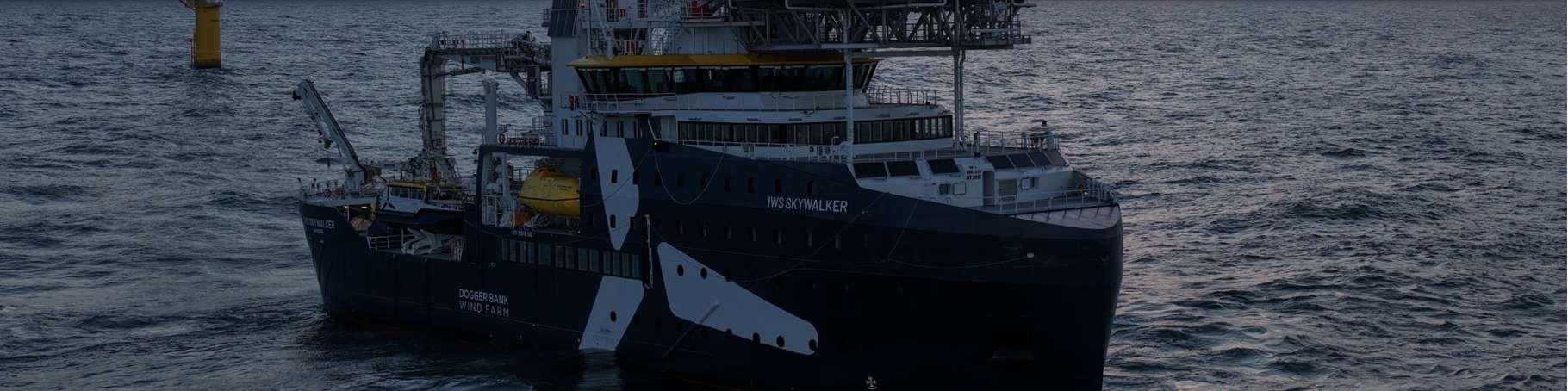
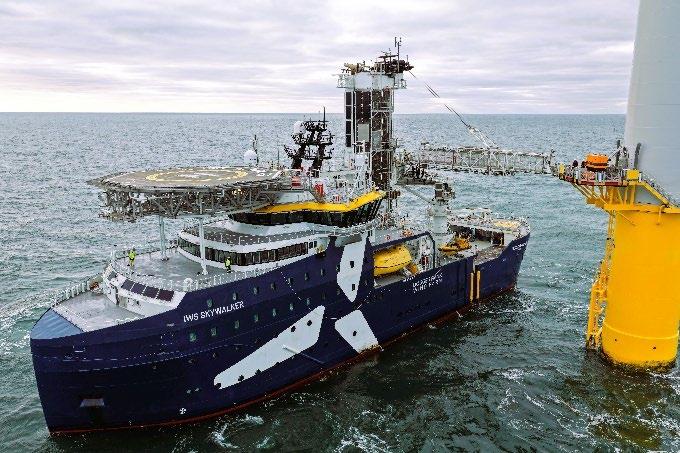
IWS Fleet, as an operator of CSOVs, has environmental impacts associated with resource use and operational emissions, as well as emissions from the construction of CSOVs delivered in 2025. The company has a goal of zero emissions to both sea and land.
CSOV operation
IWS Fleet has a management system certified to ISO 14001 - Environmental management. The management system and processes in place ensure that the vessels are operated in a way that continuously improves and reduces our environmental impacts.
The vessels’ design is optimised for high efficiency and consequently low emissions to the air. Among the features contributing to the high efficiency are:
- Double-ended design – improving dynamic positioning (DP) capability and quick turnaround at wind turbines
- Extended battery capacity, enabling optimised and part-time zero-emissions operation
- Solar panels
- Energy-saving features for onboard HVAC and lighting systems
The Norwegian Ministry of Climate and Environment through Enova granted funding to support the environmental initiatives on IWS’ CSOVs advanced technology that helps in reducing annual emissions by more than 1,300t CO2 equivalents per vessel. This is granted for all six sister vessels.
The vessels were the first in the industry to have the “DNV SILENT” notation, which focuses on minimising the impact of noise on marine life below water.
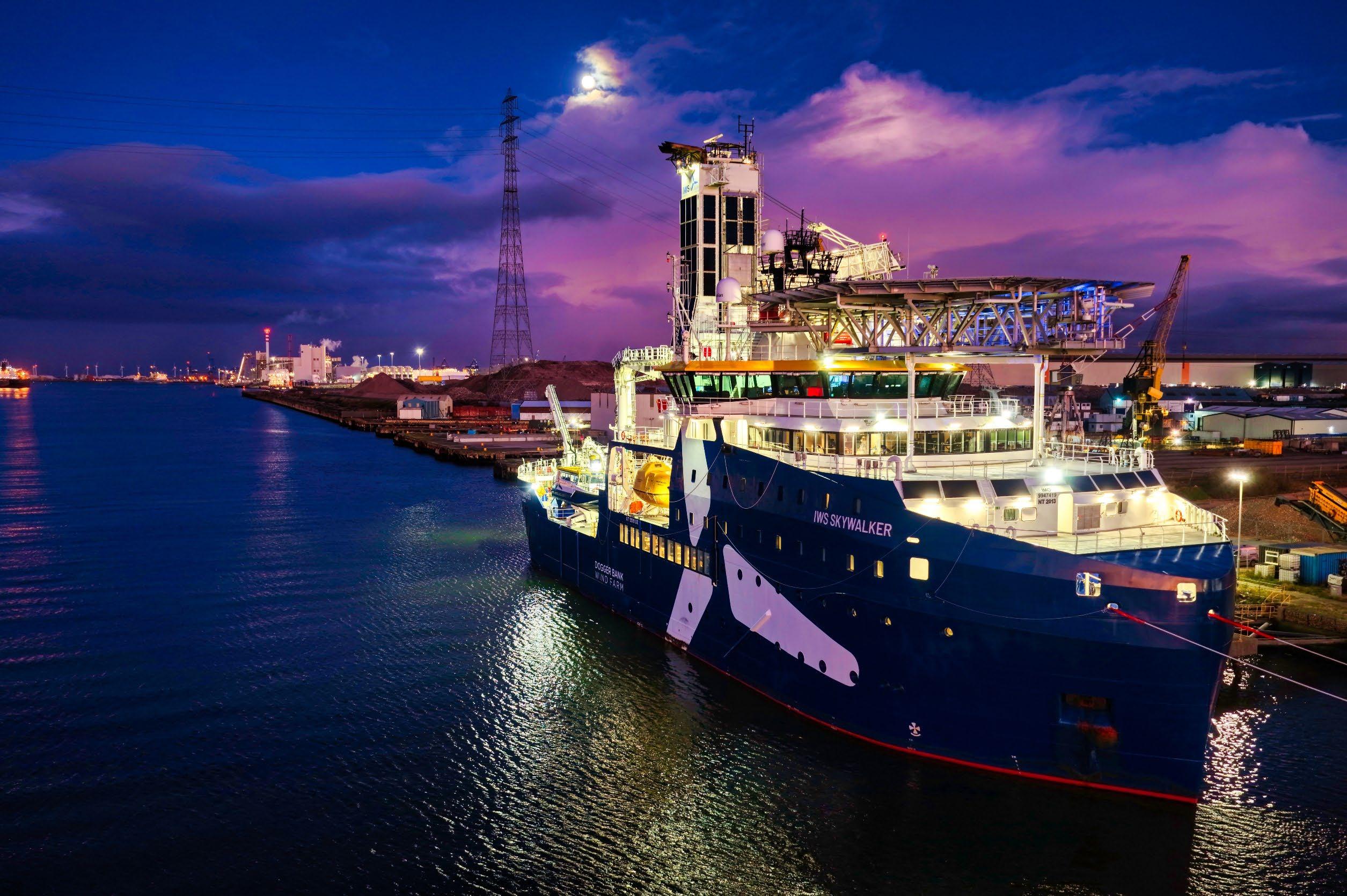
IWS Starwalker, IWS Moonwalker and IWS Sunwalker started their client operations in 2025. Together with IWS Skywalker, IWS Windwalker and IWS Seawalker, the fleet of six vessels combined emitted about 27,900
tCO2e during these operations. During 2025, the vessels produced 35,000 kWh of solar power.
CSOV construction
The first CSOV, IWS Skywalker, was delivered at the end of 2023. IWS Windwalker, IWS Seawalker and IWS Starwalker were delivered in 2024, and IWS Moonwalker and IWS Sunwalker were delivered in 2025 IWS Fleet has conducted an assessment of the total equivalent GHG emissions resulting from the construction and mobilisation of these vessels. Based on the assessment, each vessel contributes approximately 10,900 tons of CO2 emissions at the time of delivery from the yard The aggregated construction and sailing from the shipyard to Europe for IWS Moonwalker and IWS Sunwalker contributed a total 5,900 tCO2e in 2025 (scope 1)
Office operations
Scope 2 emissions from office operations for IWS Fleet are included in the IWS ASA calculations, as the Group shares locations.
IWS Services
IWS Services works with both construction and consultancy related to offshore wind. The group has a large focus on sustainability in its work and has positive impacts as an integral part of the transition to renewable energy.
The main environmental impacts from the segment originate from the construction services. This work is certified according to ISO 14001 - Environmental management IWS Services actively works to reduce its environmental impact by minimising travel, compensating for unavoidable travel, and choosing more environmentally friendly company cars, offices, consumables, and components. Scope 1 and 2 emissions were not reported for IWS Services in the period.
HEALTH AND SAFETY
The safety and well-being of the employees of IWS and its subsidiaries are a top priority for the company. Our objective is to have zero accidents and zero personnel
injuries. We will work towards this goal by fostering a clear culture of prioritising safety and always taking the time to perform operations safely, and by continuously improving through the promotion of best practices identified in our own operations and across the industry.
KPIs on incidents, injuries, near-miss reporting and sick days are continuously recorded.
Integrated Wind Solutions ASA
The operations of IWS are conducted in a controlled environment, with risks largely related to travel and visits to subsidiary or customer sites.
There have been no fatalities, personnel injuries, or accidents in IWS in 2025 (2024: nil)
IWS Fleet
The construction of vessels at a shipyard is an activity with significant hazards for on-site personnel, and IWS Fleet has had a high priority to ensure that the site team present at the shipyard was experienced, well-trained and with the proper equipment and safety mindset to minimise the risk of injuries during the construction period. The newbuilding program was completed in 2025.
The company’s management system is certified according to ISO 45001 – Occupational health and safety and ISO 9001 – Quality management systems, including project-specific procedures for the construction project. The procedures include the identification and reporting of hazardous situations occurring at the shipyard, integration with the yard procedures for work planning and risk assessment, and regular follow-up of any accidents, near misses or nonconformities that may occur at the yard, with the aim of identifying lessons that reduce the risk of reoccurrence.
There have been no fatalities in IWS Fleet in 2025 (2024: nil). One Lost Time Injury occurred in the fleet in 2025 (2024: one Lost Time Injury). In total, over 1,100,000 working hours were completed for the offices and sites of IWS Fleet, including contractors (2024: over 600,000 hours)
IWS Fleet has a strong focus on employing and training suitable, motivated crew, maintaining safe, effective vessels, and preparing comprehensive, suitable, and safe procedures.
IWS Services
The consultancy operations are conducted in a controlled environment, with risks largely related to travel and customer visits.
Through activities related to engineering, pre-assembly and installation in the construction services, IWS
Services has significant hazards related to its operations. To minimise the risk to personnel, this part of the group has extensive policies and procedures that guide their safe operations, and its management system is certified to ISO 9001 – Quality management systems and ISO 45001 – Occupational health and safety. There have been no fatalities in IWS Services in 2025 (2024: nil)
Three Lost Time Injuries occurred at sites in 2025 (2024: two Lost Time Injuries)
Gender equality
The Group strives to ensure equal opportunities and effective participation in all areas of the organisation. This includes on board the vessels, which has traditionally been a male-dominated area. The current status of the subsidiaries is set out below. The numbers include all workers employed on a permanent basis and on contracts.
Gender balance (percentage of women in the workforce)
Segment 2025 2024
Integrated Wind Solutions ASA 28% 32%
IWS Fleet 15% 10%
IWS Services 17% 14%
Modern slavery
IWS strictly prohibits the use of forced labour, child labour, and human trafficking in all company operations and in our global supply chain.
Suppliers undergo a screening process, with the level of thoroughness based on the scope of their delivery. Major suppliers, such as the shipyard constructing CSOVs for IWS Fleet, are audited for compliance with the expected standards, and areas of improvement are followed up with the supplier.
Any employee of IWS and its subsidiaries is expected to report any concerns regarding modern slavery or human trafficking as per the company's reporting procedure. There were no reports in 2025.
IWS publishes its Transparency Act Report on the Group’s website. An updated report for 2025 will be published on the Group’s website by 30 June 2026.
Anti-corruption
IWS has a zero-tolerance policy towards bribery and corruption in any form. IWS strives for fair and open competition in all markets, both domestically and internationally. Our policy is to comply with all applicable laws, governmental rules, and regulations in the countries where we operate
This policy applies to all entities controlled by the company and their employees, as well as to workers and third-party consultants acting on behalf of the Company, wherever they are located.
The company has guidelines for hospitality, gifts and entertainment to ensure employees are aware of when and how such practices may be acceptable.
KPI tracking related to corruption was initiated in 2022 for IWS and its subsidiaries, and remains in place
There were no operations in countries with high corruption risk (bottom 20 according to the TICP index) in 2025. There were no monetary fines or requested facilitation payments reported in 2025.
IWS has not become aware of any breaches of the company’s policy on anti-corruption in 2025.