
The Critical Importance of Safe
Radioactive
Gas Cylinder Handling
Managing compressed gas cylinders requires extensive technical expertise, specialized safety procedures, and advanced containment systems. When radioactive or hazardous materials are involved, the risks become significantly greater. Proper radioactive gas cylinder handling is essential to protect workers, facilities, surrounding communities, and the environment from potentially catastrophic incidents.
Compressed gas cylinders present unique hazards because of the combination of chemical properties and extreme internal pressure. Even inert gases stored at high pressure can become dangerous if a cylinder or valve fails. A typical cylinder pressurized to 2000 psi contains energy comparable to nearly one and a half pounds of TNT. In the event of structural failure, the cylinder can rapidly become a high-speed projectile capable of causing severe destruction and injury.
The chemical hazards associated with compressed gases vary widely depending on the substance stored within the cylinder.
Extremely toxic gases can quickly disperse into surrounding areas and reach lethal concentrations within seconds of an uncontrolled release. Oxidizing gases such as oxygen and fluorine can intensify fires and trigger explosions. Flammable gases create additional fire hazards, especially in confined spaces where ignition sources may be present. Effective radioactive gas cylinder handling requires understanding the behavior of each gas and implementing strict containment and control measures.
Certain materials present even more severe risks. Pyrophoric substances may ignite spontaneously upon contact with air, while unstable gases such as hydrogen cyanide and ethylene oxide can undergo dangerous chemical reactions. Corrosive gases like anhydrous hydrogen fluoride can react with moisture in the atmosphere to form highly dangerous acids. In some cases, gases may react internally and over-pressurize the cylinder, increasing the possibility of catastrophic rupture.
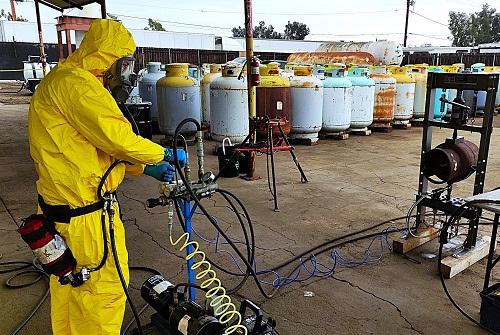
Additional complexity arises when cylinders contain unknown substances or have been abandoned, buried, or improperly stored. Unknown cylinders must always be treated as potentially hazardous because any combination of toxic, reactive, flammable, corrosive, or radioactive materials may be present. Specialized excavation and containment procedures are often required to safely recover buried cylinders without triggering accidental releases.
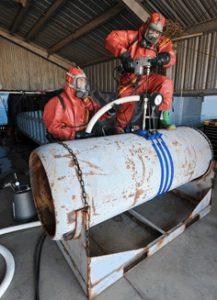
IES has successfully developed and refined specialized techniques for handling and excavating unknown compressed gas cylinders in high-risk environments. Their advanced containment systems and operational expertise enable safe identification, management, and neutralization of hazardous materials under controlled conditions. These proven methods are critical in modern radioactive gas cylinder handling operations where safety and precision are non-negotiable.
Proper management of hazardous compressed gases involves more than transportation and disposal. It requires detailed risk assessment, engineered containment systems, highly trained personnel, and continuous monitoring throughout the process. Organizations dealing with hazardous or radioactive materials must partner with experienced professionals capable of addressing the full range of chemical and pressure-related dangers.
As industrial safety regulations continue to evolve, the importance of reliable radioactive gas cylinder handling practices continues to grow. Through innovation, technical expertise, and specialized field experience, companies like IES help ensure hazardous compressed gas cylinders are managed safely, responsibly, and in full compliance with modern safety standards.