But where do you start when everything looks the same?
SOLUTION //
Start here. Risky Future Demo Days deliver rapid-fire demos of the most relevant tools in insurance—so you can quickly see what works, what doesn’t, and what’s worth your time.
JOIN THOUSANDS OF YOUR PEERS ALREADY REGISTERED
Finds ‘Alarming’ High Flood Risk for 17M Americans on Atlantic, Gulf
How
EY and IIF: Four in Five CROs Rank Cyber Among Top Risks
Manufacturing Industry Top Target of Costly Cyberattacks: Report
Shifting Landscape Creates Uncertainty in
of Prediction
Consultant Urges
and Brokers to
Competitive Advantage: Important but Often Overlooked
Your Business: Deals Makers & Deal
Demands: Strategic Leverage, Exposure, and Risk From Both Sides of the ‘V’
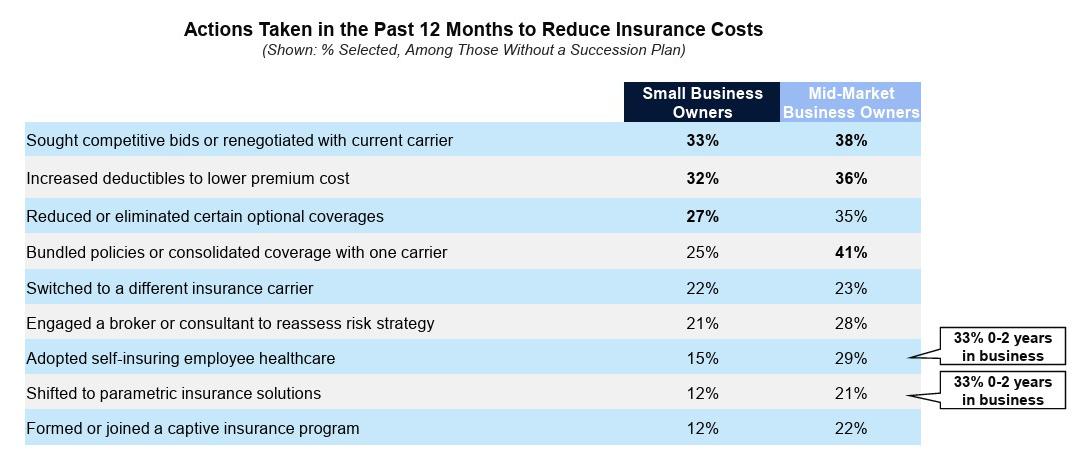
Market Businesses Cutting Costs While Overall Risks May Be Rising
the Insurance Recruiter: What Insurance Agencies Should Anticipate for Summertime Hiring
Marketing Connection: Why Most Insurance Websites Fail Before the First Conversation Ever Happens
Quote: The Church Insurance Exodus: Why Agents Who Lean In Now Will Own This Niche
Opening Note
Why Classification Matters
Misclassification of employees as independent contractors robs workers of thousands of dollars per year and reduces revenue for social safety net programs, according to a new Economic Policy Institute analysis of 11 commonly misclassified jobs.
The report estimates that as many as 10% to 30% of employers misclassify workers as independent contractors. That leads to those workers missing out on critical protections, benefits, and labor rights, including minimum wage, overtime pay, unemployment insurance, the right to form a union, and anti-discrimination protections in most states.
Additionally, these workers must bear the full financial costs of Social Security and Medicare contributions, rather than split it evenly with their employer.
The report, which focuses on state-level reports on employee misclassification, estimates that social insurance systems can lose up to 30% of per-worker revenue when workers are misclassified as independent contractors because independent contractors make no contributions to unemployment insurance and workers’ compensation systems.
For example, a typical construction worker misclassified as an independent contractor would lose as much as $20,399 in annual income and job benefits compared with what they would have earned as an employee.
Lost compensation due to misclassification varies by state. Estimated annual per-worker costs in lost compensation are as high as $31,326 for truck drivers in New Jersey. On average, misclassified workers stand to lose more in higher-wage states and occupations.
The report noted that construction workers, truck drivers, and home health aides are some of the commonly misclassified jobs. Also, the issue disproportionately impacts people of color, women, and immigrants, who are more likely to be in occupations where misclassification is common.
‘Illegal
misclassification of employees as independent contractors deprives workers of their labor rights, slashes their pay,
and undermines funding for crucial social safety
net programs.’
Given the high stakes of misclassification for workers’ access to fundamental rights and protections, embedding strong legal definitions in state and federal law is fundamental to ensuring that employees are not improperly classified as independent contractors, the report’s authors said.
“Illegal misclassification of employees as independent contractors deprives workers of their labor rights, slashes their pay, and undermines funding for crucial social safety net programs,” said Nina Mast, EPI economic analyst and co-author of the report.
Andrea Wells V.P. of Content
Chairman of the Board Mark Wells | mwells@wellsmedia.com
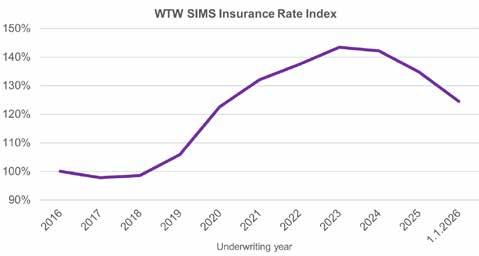
Specialty insurance market rates declined in 2025 and during the January 1, 2026 renewals, with the pace of change exceeding expectations, according to WTW’s Specialty Insurance Marketplace Survey (SIMS).
Data from the January 1 renewals and new business point to continued rate softening, with a 10-point decline in the insurance rate index, back to 2020 levels, WTW added.
The findings also highlight the speed of recent market movements. An approximate 45% cumulative rate increase was achieved between 2017 and the market peak in 2023, with around half of that increase eroded over the past two years.
Based on the SIMS insurance rate index, expected performance (which is net of exposure trends) in 2025 has unwound the rate strengthening gains of the last few years back to levels last seen in 2021, said WTW, noting that 2025 was the first year since 2018 for which rate adequacy for new business was lower than for renewal business.
The most pronounced rate decreases are in property and energy, followed by marine, financial institutions, and professional liability, reflecting benign catastrophe experience and distorted frequency/severity trends offset by higher geopolitical tensions, WTW continued.
The general liability and medical malpractice markets are behaving counter-cyclically to the overall insurance markets, the survey found. “Substantial concerns relate to social inflation, nuclear jury verdicts, and the expansion of litigation funding in this market. We do not believe this trend is sustainable, but how this might change in the short-term remains uncertain.”
During the January renewals, 75% of the 42 material classes show rate decreases (on a gross-of-claims-trend basis), compared with 30% of classes in 2024.
WTW said that the inclusion of claims trend data within SIMS allows for a more complete picture of expected profitability
movements. In particular, the survey shows that aggregated insurance rates decreased by 5% gross of claims trend and 8% net of claims trend (i.e., adjusted for actuarial-estimated inflation in claims costs over and above what is captured in rate change data).
Survey Details
The WTW survey reflects around $250 billion of gross written premium over a 10-year cycle, including $45 billion in 2025, and covers specialty insurers operating across the London, Bermuda, and the U.S. excess and surplus (E&S) markets.
Rather than using broker-derived data, the survey is built exclusively on data contributed by clients of WTW’s Insurance Consulting and Technology business that participate directly in SIMS.
“Our intention is to provide insights on specialty market dynamics that hasn’t been possible before—using market-derived data to deliver a consistent view of risk-adjusted rate change over a large number of classes and key geographies, aligned
to how underwriting teams are organized,” commented Richard Clarkson, global market leader, Global Specialty, WTW, in a statement. “Our clients already use this to validate business plans, compare current year rating trends, assess impact of new and renewal rate adequacy, and support reserving processes.”
WTW said SIMS aims to provide a consistent view of rate movements across specialty markets, allowing carriers to assess how conditions are evolving across both new business and renewals.
Specialty insurance rates across London, Bermuda and the U.S. excess and surplus (E&S) markets declined at a faster than expected pace in 2025. Source: WTW SIMS Insurance Rate Index
Staying ahead starts with a carrier that’s involved.
22 points
The amount the average combined ratio improved for carriers in the once-distressed Florida insurance market over the last year as direct written premium rose and policyholder surplus levels climbed, according to Gallagher Re.
21%
The percentage of newly registered California vehicles last quarter that were gas-electric hybrids. Zero-emission vehicles accounted for less than 14%, according to Experian Automotive.
34.5 million
The number of people at “very high” and “high” flood risk along the Atlantic and Gulf coasts, according to researchers at the University of Alabama. The results are drawn from compiling 16 different factors, including the geographic hazards, the population and infrastructure exposed and the vulnerability of people living there, as well as past damages from the Federal Emergency Management Agency’s database.
33,000
The number of insurance agents added in Pennsylvania in the last three years. In 2023, the state eliminated various licensing fees and reduced agent application review times from 20 days to under eight days. The Pennsylvania Insurance Department (PID) claims this streamlining of credentialing made entry for new insurance agents into the industry faster, while also encouraging a new generation of individuals to consider a career in insurance.
1.4
billion
The amount State Farm paid out for Texas hail claims in 2025, up 27% year over year. State Farm said that it paid out $5.6 billion nationally for such claims in 2025, a yearover-year increase of 12%.
Declarations
Talent War Tally
“At the end of March, the start-up [Howden] has taken customers representing approximately $31 million of annual revenue as compared to the $23 million we announced last quarter.”
— R. Andrew Watts, Brown & Brown’s chief financial officer and treasurer, speaking on the cost of the Howden-driven talent war. Watts and the broker’s CEO, J. Powell Brown, spoke during an analysts’ call to discuss Q1 2026 results. Watts said the revenue hit includes $10 million from Q1 alone. Brown & Brown previously revealed that 275 of B&B’s former teammates joined Howden’s U.S. start-up—a figure that is expected to rise this year.
Soybean Hurdles
“Our biggest struggles are our inputs, be it fertilizer, seed, chemical, parts. There has been so much drastic markup in all of these. And I just kind of feel like the farmer’s kind of painted in the corner.”
— Doug Bartek, a fifth-generation farmer and chairman of the Nebraska Soybean Association, discussing the challenges facing the nation’s soybean farmers this year. The high cost of fuel, equipment, and fertilizer— compounded by the Iran war—along with tariffs, perceived “price gouging” by suppliers, and low soybean prices driven by a global supply glut are all eating into potential profits as soybean prices remain low.
Recognizing AI Risk
“Without clear policies and tested controls, insurers are leaving their organizations open to risk with regulators and customers, fueling financial pressure that could ultimately erode product profitability. Tested and provable governance gives insurers confidence to deploy AI across higher-value workflows, leading to improved ROI and revenue growth.”
— A warning from Grant Thornton's 2026 AI Impact Survey Report, in which 44% of insurance executives said governance or compliance challenges have contributed to AI project failure or underperformance; only 24% are very confident they'd pass an independent AI governance review in 90 days.
Powering Progress
“It’s taken us two months longer to build the houses than what it did before the data centers were coming in. That’s the downside.”
— Abilene builder Gene Lantrip on the Texas population boom that has homebuilders competing with data centers for skilled electricians. The state has added more than 2.6 million residents since 2020, bringing in a surge of workers and families who need homes. But Texas doesn’t have enough electricians to meet the demands. Between 45% and 70% of the entire budget for data center construction goes to electrical subcontractors, according to the International Brotherhood of Electrical Workers, a labor union that represents electricians.
Short-Staffed State
“We are really, significantly understaffed, especially as the department has taken on new responsibilities. It’s really left us shortchanged.”
— New Jersey’s acting Commissioner of Banking and Insurance Susan Ochs on the department’s push for a roughly 18% hike in the budget for the next fiscal year. The $80.8 million boost would go to overcome what the department called a 25% staff deficit. Officials with the department said they need to hire at least 94 additional employees, upgrade technology, and shift more work to outside consultants to effectively regulate banking and insurance products used by millions of state residents.
Night Fires Keep Burning
“Fires normally slow down during the night, or they just stop. But under extreme fire hazard conditions, fire actually burns through the night or later into the night.”
— Xianli Wang, a fire scientist with the Canadian Forest Service and co-author of a study recently published in Science Advances. Places such as California have 550 more potential burning hours than in the mid1970s. Parts of southwestern New Mexico and central Arizona are seeing as many as 2,000 more hours a year when the weather is prone to burning fires, the highest increase seen in the study, which looked at Canada and the United States.
News & Markets
Trend of Fewer Insurance M&A Deals ‘Bottoming Out’: OPTIS
By Chad Hemenway
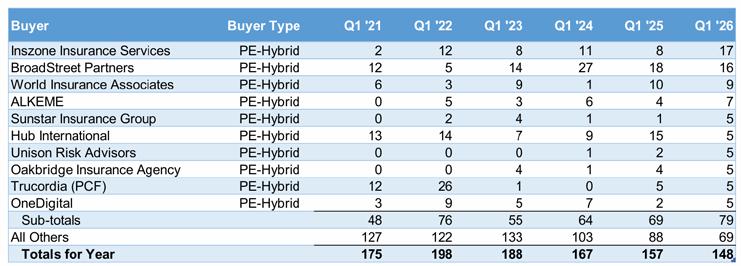
Insurance agency mergers & acquisitions in the first three months of 2026 were down 6% compared with the same period last year.
It was the 10th consecutive quarter of deal volume below the long-term trend line, but investment banking and financial consulting firm OPTIS Partners said the trend is “probably bottoming out.”
During first-quarter 2026 there were 148 insurance agency deals, which was the lowest total for the time period since 2016, said OPTIS Partners’ M&A database.
“The industry has ridden down a three-year slide in deal volume, which we believe is beginning to bottom out to about 650 deals per year,” said Steve Germundson, a partner of the firm. Insurance agency M&A finished at 695 deals in 2025, down 12% from 2024.
Looking ahead, the tally of about 30 active private-equity-backed brokers, as well as private and public buyers, continues to fuel demand for the 25,000 to 30,000 agencies nationally—a majority of which are “very small and will have to be sold eventually,” said OPTIS managing partner Tim Cunningham.
“We are seeing an emerging group of new ventures backed by private-equity
and family-office capital pursuing this group because of the large supply of future sellers, enhancements in technology, and long-term changes in the way insurance at the smaller end will be sold and serviced,” Cunningham added. OPTIS also said somewhat larger firms will be attractive to buyers, partly due to a “perceived scarcity factor” and improvements the businesses have made.
Active Acquires with 5 or More Deals in Q1 2026
Of the 55 unique buyers identified in the first quarter, 29 were private equity and four announced their first deal. PE-backed buyers accounted for 72% of announced transactions during Q1. Private companies had 19 deals, with five first-timers. OPTIS also keeps track of publicly held brokers and all others. Inszone and BroadStreet Partners led all buyers in Q1 deals with 17 and 16, respectively.
News & Markets
Study Finds ‘Alarming’ High Flood Risk for 17M Americans on Atlantic, Gulf Coasts
By Seth Borenstein
More than 17 million people along the U.S. Atlantic and Gulf coasts are at the highest risk of being affected by flooding, with New York and New Orleans standing out, according to one of the most comprehensive studies ever of flood risk.
Researchers at the University of Alabama used 16 different factors including the geographic hazards, the population and infrastructure exposed, and the vulnerability of people living there. They then brought in past damages from the Federal Emergency Management Agency’s database and applied three different artificial intelligence tools to figure out flood risks from Texas to Maine, calculating that 17.5 million people were at “very high” risk and an additional 17 million were at “high” risk, the next level.
The authors looked at all sizes of flooding and examined separately what FEMA considers the most extreme, which are the top 1% of events. The study found 4.3 million people along the coasts to be at the highest level of risk of extreme flooding and 20.5 million to be at high risk, the second highest level.
They found a lot of vulnerability, highlighting eight different cities from Houston, which flooded in 2017’s Hurricane Harvey, to New York, which was inundated in 2012’s Superstorm Sandy.
The study published in the journal Science Advances found that New York City has 4.75 million people at the two highest risk levels for all flooding, with more than 200,000 buildings likely to be damaged.
And while the number of people at risk in New Orleans is far lower, about 380,000, it involves 99% of the city’s population. That doesn’t mean 99% of the people will be affected in the next hurricane or non-tropical flood, but that they might be depending on the storm’s individual path and rain pattern, said study co-author Wanyun Shao, a climate scientist at the
University of Alabama.
“Just look at the magnitude,” Shao said. “Those numbers are shocking, are alarming.”
Elderly, Poor Most At-Risk
“When the next big storm hits New York City, when the next Hurricane Katrina-like hurricane makes landfall in New Orleans, people will get hurt—especially those socially vulnerable populations,” Shao said referring to the poor, the elderly, children, and the uneducated.
Shao and outside experts said the numbers stunned them even though they were familiar with the worsening effects of climate change.
“New York is known to be susceptible to floods, and it has the largest population. But the fact that New York has nearly an order of magnitude more flood-exposed population than any other city is surprising,” said Alex de Sherbinin, a geographer who directs Columbia University’s Center for Integrated Earth System Information. He wasn’t part of the study.
Flood problems are becoming more frequent in New York and New Orleans because of human-caused climate change, the study said.
Other Cities
Jacksonville has 679,000 people at high or very high risk of flooding, while
Houston is just behind at just under 600,000. Other cities highlighted include Miami; Norfolk, Virginia; Charleston, South Carolina; and Mobile, Alabama.
Shao and outside experts said what separates her study from others is the sheer comprehensiveness of all the factors it considers, including sinking land and pavement that doesn’t allow water to seep into the ground, as well as incorporating human social vulnerability such as poverty and age.
“This could be applied to other places in the world, such as Manila,” said University of Virginia engineering professor Venkataraman Lakshmi, who heads the hydrology section of the American Geophysical Union, referring to the capital of the Philippines. He wasn’t part of the study, but said the flooding problems it highlights will get more frequent and intense due to human-caused climate change.
Columbia University’s Marco Tedesco, who also wasn’t part of the study, said “it reinforces the crucial concept that future flood disasters are not just about water—they are about where people live, how cities are built, and who is least protected.”
Copyright 2026 Associated Press. All rights reserved. This material may not be published, broadcast, rewritten or redistributed.
This image made from video shows cars submerged in floodwaters in Rahway, NJ., on July 14, 2025. (WABC-TV via AP)
News & Markets
‘The Arms Race Is On’: Chubb’s Greenberg on Mythos, Middle East
By Chad Hemenway
When it comes to Anthropic’s Mythos as friend or foe, Chubb CEO Evan G. Greenberg said the “arms race is on.”
Speaking during a conference call to discuss first-quarter earnings, Greenberg told analysts Anthropic’s Mythos artificial intelligence model has lowered the threshold for vulnerability.
“What were minor vulnerabilities can now be aggregated in a much more insightful way,” he said. “It’s not just that you can use this to find your own vulnerabilities.”
Because many organizations use open-source cybersecurity, AI tools like Mythos can “find vulnerabilities maybe even before suppliers do.” But, he added, “it doesn’t mean the patch has been created.”
using agentics so far,” he said. But are AI cyberattacks coming?
“From an underwriter’s point of view, policy conditions and pricing are on our minds,” Greenberg said. Large companies, with capabilities and money to invest in cybersecurity, may be better at cyber hygiene. Small companies aren’t targeted as much but “create more systemic concerns.” The sweet spot—the “biggest meatball,” as Greenberg described— are middle-market organizations.
“They are a target,” he said. “They have more money, and they’re less capable at hygiene and focus on it less. They have weaker perimeters.”
The Mythos model has yet to be released to the general public. Anthropic has allowed a select few to experiment with Mythos, which the company admits poses security risks while simultaneously identifying “thousands” of vulnerabilities.
“The government wanted to support shipping through the Gulf and open up when they think that the risk environment is such that they can support with military convoys,” he explained. “That has yet to occur.”
The facility is conditional. Ships will be insured only as part of the convoy run by the U.S., with the government taking 50% of the risk, he said.
Chubb’s motivation, he added, is to support the country, the military, and the economy. However, premium revenue has yet to be generated. “Stay tuned,” he said.
The evolution of use may get to a point at which holes in network systems are identified and patched very fast with AI, but that’s the defense. The offense is “just around the corner,” Greenberg said to give analysts a sense of how Chubb is being thoughtful about the topic.
Thus far, cyberattacks have yet to progress beyond human involvement. “Humans are in the cockpit when they’re
In a recent brief on the cyber insurance marketplace, Fitch Ratings that while AI tools can certainly help with vulnerability analysis, “this lowers barriers for attackers, expands third-party risks, and could materially increase attack volume.”
Hormuz Reinsurance Facility
Greenberg said Chubb was approached by the U.S. government to create a program to support ships’ passage through
In earlier comments on the war, Greenberg expressed concern for higher inflation and slower economic growth.
“To what degree…the timing and the pattern are all unknowable at this time,” he said. “However, the impact of the war adds a degree of pressure to certain financial, fiscal, and economic stresses such as underlying inflation, fiscal deficits and sovereign debt, global supply chains, and financial valuations.”
the Strait of Hormuz—which has been materially disrupted by the war with Iran.
Evan G. Greenberg
Chubb: Cyber Claim Severity Nearly Doubled for Large Businesses
Average cyber insurance claim severity for large accounts in the U.S. nearly doubled in 2025, according to a new Chubb report.
The insurer’s 2026 Cyber Claims Report found that average severity for businesses with $1 billion or more in revenue reached about $4.4 million in 2025, up from roughly $2.2 million in 2024. That represented a 586% increase from 2021.
“While severity remained stable in the SME segment, it increased considerably in the middle market and even more dramatically in the large account segment,” the report said. “There are several contributing factors to this increase, including the rise in business interruption
expenses and the increasing cost of both data breach- and privacy-related litigation.”
The report explores Chubb’s historical claims data through last December.
Cloud outages and ransomware attacks continued to make headlines in 2025. Forrester Research predicted in October that written cyber insurance premiums
would rise 15% in 2026. Pointing to an increase in data theft-only attacks in the second half of last year, Resilience called for a shift from recovery-focused strategies to prevention-focused approaches.
In its cyber claims report, Chubb reported that middle market claim severity rose from about $619,000 to roughly $759,000 year over year. SME severity, meanwhile, fell from roughly $215,000 in 2024 to about $142,000 in 2025.
Large account claim frequency dropped from about 15 claims per 100 cyber policies in 2024 to roughly 10 in 2025, Chubb shared. Middle market frequency also declined, falling to just over five claims per 100 policies from about six the prior year. SME frequency, meanwhile, was relatively stable at about one claim per 100 policies.
GOT RISK?
LET A WSIA MEMBER HELP YOU MANAGE IT.
Some decisions are too precarious to take on alone; you need a partner to help you create the right solution for your client’s risk, while minimizing yours. And, it’s cost-effective. A Conning, Inc. analysis concludes that wholesale distribution does not increase the cost to the insured. That’s a safe decision.
Business Moves
National
Liberty Mutual Retires Safeco Brand
Liberty Mutual officially retired the Safeco Insurance brand in the independent agent channel, effective April 25.
All personal lines products are now solely marketed and sold as Liberty Mutual.
Personal lines Safeco customers can keep their agent relationship, and policies will not change, said Liberty Mutual, which purchased Safeco in 2008.
Boston-based Liberty Mutual said its direct and independent agent channel product offerings will remain differentiated.
Oliver Wyman, CR3 Partners
Global management consulting firm
Oliver Wyman has agreed to acquire CR3 Partners, a consulting firm specializing in restructuring, management consulting, and bankruptcy advisory services.
The terms of the transaction, which is expected to close later this quarter, were not disclosed.
CR3 Partners is a Dallas-based national turnaround and performance improvement firm with additional offices in Atlanta, Boston, Charlotte, Chicago, Houston, Los Angeles, New York, and Richmond. The firm has led transformations across industrials, retail, healthcare, energy, and financial services.
As part of the transaction, 62 professionals from CR3 Partners will join Oliver Wyman in multiple cities.
William Snyder is senior managing at CR3 Partners.
East
World Insurance Associates LLC, Baldon Insurance Group
World Insurance Associates LLC acquired the business of Baldon Insurance Group of Patchogue, New York. Terms of the January transaction were not disclosed.
Baldon, established in 2000, is a Long Island independent agency with a focus on New York’s commercial insurance market for hospitality operators, real estate investors, and construction businesses.
World Insurance, based in Iselin, New Jersey, serves clients from more than 300 offices across the U.S. and U.K.
Trucordia, Paradiso Financial and Insurance Services
Trucordia acquired Paradiso Financial and Insurance Services in Stafford Springs, Connecticut.
Paradiso offers auto, home, life, business, and specialty lines insurance. Joining Trucordia will give Paradiso’s team and clients access to more carrier relationships, shared resources, and national support.
The Utah-based Trucordia group of agencies has 5,000 employees across the country.
Marketplace 4 Insurance, Swann Insurance Agency
Georgia-based Marketplace 4 Insurance (M4I) acquired Swann Insurance Agency, an independent insurance agency based in Columbia, Maryland. Terms were not disclosed.
The acquisition of Swann expands M4I’s footprint in the Mid-Atlantic region. All Swann employees will join forces with Reilly Insurance Agency, M4I’s existing Crofton, Maryland location. Swann Insurance Agency, led by principal Joseph Swann, CLCS, offers auto, home, life, and business policies.
Founded in 2019 by Jerad Kirk and Adam Herring, M4I has nine offices across four states.
Newport Specialty Partners, Complex Coverage Inc.
Newport Specialty Partners, a new specialty insurance platform backed by Lovell Minnick Partners, announced that it has acquired Complex Coverage Inc. (CCI), a managing general agency focused on homeowners and personal lines coverage in New York.
The transaction is Newport’s first platform acquisition, which the company said establishes a foundation for its strategy of building a diversified MGA and specialty insurance distribution platform.
Founded in 1997 by Mike Mahoney, CCI is headquartered in Huntington, New York. The company administers insurance programs in homeowners, dwelling fire, builder’s risk, boat, umbrella, flood, and related personal lines coverages through partnerships with insurance carriers. CCI’s leadership team, including Michael Eigen, president, will continue to manage the business and remain involved going forward.
Private equity firm Lovell Minnick partnered with Newport to support the launch of the new platform and the acquisition of CCI. Lovell Minnick targets middle market companies with a particular focus on companies in the financial services, business services, and financial technology sectors.
Marsh McLennan Agency, TriBridge Partners
Marsh McLennan Agency (MMA) announced that it has reached an agreement to acquire TriBridge Partners, an independent benefits broker and retirement and wealth advisor headquartered in Columbia, Maryland. Terms of the
acquisition were not disclosed.
TriBridge Partners was founded in 2013 upon the strategic merger between three regional brokerage and advisory firms serving the Mid-Atlantic.
According to the agreement, all employees, including co-founders and co-owners Heath Hykes, chief executive officer; Dane Rianhard, founding principal; John Morris, principal; and Paul Younkins, chief growth officer, will join MMA and continue to operate out of the firm’s existing Columbia office location.
Midwest
Inszone Insurance Services, James R Vozar Insurance Agency
Inszone Insurance Services acquired James R. Vozar Insurance Agency. The Vozar agency has offices in Athens, Quincy, and Union City, Michigan, strengthening Inszone’s presence in the Midwest and adding specialized knowledge in the agricultural sector to its portfolio.
Founded in 1969 by James R. Vozar, the agency specializes heavily in agricultural and farm insurance, alongside comprehensive personal and commercial lines. Under the leadership of Mike Vozar and Brian Earles, the agency expanded its footprint across three Michigan locations. Both Mike Vozar and Earles will remain with the agency during the transition.
Lockton Moves Global Headquarters to Leawood, Kansas
Lockton is moving its global headquarters to a new campus located in Leawood, Kansas. The insurance brokerage will be based in a 12-story building that will serve as the centerpiece of a 34-acre project. Lockton first announced the headquarters project in December 2025. The project is scheduled to break ground this summer, and Lockton is expected to relocate in early 2030.
Lockton’s headquarters will be part of a mixed-use development that includes restaurants, a luxury hotel, retail space, childcare facilities, outdoor amenities, multifamily housing, and additional office accommodations. The Lockton building will feature limestone terraces to reflect
the company’s Midwest heritage.
Lockton is celebrating its 60th anniversary in the Kansas City region.
Ohio Mutual Insurance Group, Gem State Insurance
Ohio Mutual Insurance Group will merge with Gooding, Idaho-based Gem State Insurance as a subsidiary under Ohio Mutual Insurance Group’s mutual holding company structure.
The merger is still subject to approval by Gem State policyholders and insurance regulators in both Idaho and Ohio, and is expected to be completed in the third quarter of 2026. Plans are to continue to market products under the Gem State brand and to maintain its Idaho operations.
Gem State will join Ohio Mutual’s intercompany pool: Ohio-domiciled Ohio Mutual Insurance Company, its wholly owned subsidiary United Ohio Insurance Company, Casco Indemnity Company, and United Mutual Insurance Company—all entities of holding company Ohio Mutual Insurance Group, Inc.
Ohio Mutual Insurance Group, founded in 1901 and based in Bucyrus, Ohio, partners with more than 500 independent agencies to distribute property and casualty insurance products throughout Connecticut, Indiana, Maine, New Hampshire, Ohio, Rhode Island, Vermont, and Wisconsin.
Southeast
Keyes Coverage, Seibert Insurance Agency
Keyes Coverage, part of Keystone Agency Partners, acquired Seibert Insurance Agency in Tampa, expanding its western Florida presence.
Seibert Insurance was founded in 1971 by Keith Seibert. He retired in 2012, and his daughter, Karyn Roeling, was named president of the agency. She is the immediate past chairperson of the Florida Association of Insurance Agents. The agency offers personal and commercial coverage.
Keyes Coverage, headquartered in Fort Lauderdale, was founded in 1976 and became a partner with Pennsylvania-based
Keystone in 2022, the company said. Keystone has grown steadily in recent years and now ranks as one of the largest retail brokers in the country.
Protective Life Insurance, Obsidian Insurance Holdings Inc.
Alabama-based Protective Life Insurance Co. is moving to expand into property/ casualty lines by acquiring Obsidian Insurance Holdings Inc., a New York-based property, casualty and specialty insurance platform.
The purchase agreement was signed with Obsidian’s private equity founder, Genstar Capital, and involves acquiring Obsidian Insurance Holdings, Inc. and its affiliates Obsidian Specialty Insurance Co. (Delaware), Obsidian Insurance Co. (Ohio), and Obsidian Pacific Insurance Co. (Delaware).
Obsidian’s admitted and non-admitted insurance carrier subsidiaries issue policies underwritten by managing general agents, managing general underwriters and program managers.
Through its platform, Obsidian sources, underwrites and manages programs and reinsures the majority of the business to select reinsurers.
Obsidian was established in 2020 by Genstar. Since its founding, Obsidian has provided nationwide insurance capacity through its carrier subsidiaries.
Protective Life Corp. is a U.S. subsidiary of Daiichi Life Group, Inc. In addition to its headquarters in Birmingham, Alabama, it also has offices in the greater Cincinnati area and St. Louis.
This transaction will mark Protective’s 62nd acquisition and its ninth since becoming part of Tokyo-based Daiichi Life in 2015.
South Central
Inszone Insurance Services, Mena Insurance Agency
Inszone Insurance Services announced the acquisition of Mena Insurance Agency Inc., headquartered in Arkansas.
Founded in 1911 by H.G. McLafferty, Mena Insurance is now led by P.T. Plunkett.
National ReSource Pro, headquartered in New York City, appointed Su-Ting Fu as senior vice president, data strategy. Fu will lead the development and execution of the company’s enterprise-wide data strategy. Fu joins ReSource Pro from Morgan Stanley, where he most recently served as executive director in firm risk management.
Marsh named Chief Financial Officer Mark McGivney to the additional roles of executive vice president and chief operating officer.
Marsh also appointed Janelle Griffith as global logistics practice leader, Marsh Risk. In this newly created role, Griffith spearheads global logistics strategy.
Based in New York, Griffith has nearly 20 years of experience, previously holding leadership roles at Kuehne + Nagel Inc. and Hapag-Lloyd AG.
Brooke Stringer joined The Council of Insurance Agents & Brokers as vice president of government affairs. Stringer previously served a decade-long tenure at the National Association of Insurance Commissioners. Stringer joins the council from the Federal Insurance Office at
the U.S. Treasury Department.
Audra Jackson has been promoted to vice president of government affairs.
Luca Vallada has been promoted to director of political affairs.
Bernadine Vassor joined the team as government affairs associate. Vassor is a former special advisor at the U.S. Department of the Treasury, serving in the office of the general counsel and the office of the executive secretary.
Ascot appointed Kristyn Smallcombe as chief underwriting officer, Ascot U.S. Smallcombe joins from CRC Group, where she served as national casualty director for the company’s commercial solutions division. Smallcombe previously served at Argo Group U.S. as senior vice president and head of construction and held senior casualty and industry practice group leadership roles at Swiss Re Corporate Solutions and AIG/Lexington.
Howden hired Patrick Thomas as Howden U.S. managing director within the company’s trucking specialty vertical. Thomas leads Howden’s U.S. trucking strategy, overseeing the continued build-out of a dedicated, nationwide trucking practice serving motor carriers, owner-operators, fleets and logistics providers. Thomas joins Howden with over 18 years of experience in the trucking and transportation sector.
Clyde and Co appointed Jeff Cottle as head of regulatory and investigations, white-collar crime and sanctions, Americas, and co-head of white-collar
crime and sanctions, EMEA, marking the launch of a dedicated regulatory and investigations (RandI) capability in the Americas. Cottle joins Clyde and Co from Eversheds Sutherland, where he was co-head of the national security practice and global co-head of the industrials sector. He will be based in Clyde and Co’s Washington, D.C. office.
Scott Stephenson, former chairman, president, and CEO of Verisk Analytics, joined the board of directors at ZestyAI, a San Francisco, California-based risk and decision intelligence platform for the insurance industry. Stephenson spent more than two decades at Verisk, including nine as chairman, president, and CEO.
ReSource Pro appointed Michael Costonis as president of insurance business services. Costonis leads ReSource Pro’s efforts to bring AI into a unified operating layer. Costonis spent 26 years at Accenture, where he served as senior managing director and global insurance industry practice leader.
WTW appointed Haibin Li as director and data scientist within its pricing, product, claims and underwriting consulting team in North America. Li has 12 years of insurance carrier experience across data analytics roles at Everest, The Hartford and Chubb.
Before joining the insurance industry, he spent 15 years in academia, holding positions at Rutgers University, Princeton University, and the Chinese Academy of Sciences.
East
Lawley, headquartered in
Buffalo, New York, Hired Ryan Lynn Fisher as an employee benefits consultant in Buffalo and Carrie Street as a property and casualty insurance advisor in Rochester.
Fisher has over 25 years of experience across carriers, third-party administrators, and pharmacy benefit management, specializes in benefit planning, alternative funding solutions, pharmacy optimization, and long-term cost management. She previously served as a senior account executive at Independent Health.
Street specializes in insurance programs for manufacturing, construction, and non-profit sectors, as well as risk management, group captive, and alternative risk financing. Before joining Lawley, Street held roles at USI and Brown and Brown of New York Inc.
Patriot Growth Insurance Services, headquartered in Fort Washington, Pennsylvania, hired Andrew Drayer as regional president, Northeast.
Drayer succeeds Bill Donato, who previously held this role and now serves as president of retail insurance. Drayer most recently served in a senior executive role at HUB International New England, where he led business and financial operations. Earlier in his career, he held leadership roles at MAPFRE Insurance and at Salem Five Bank.
Su-Ting Fu
Janelle Griffith
Brooke Stringer
Ryan Lynn Fisher
Carrie Street
SterlingRisk, headquartered in Woodbury, New York, promoted Marci Waterman, Esq., to deputy CEO and appointed John S. Beres as chief operating officer (COO).
Waterman joined SterlingRisk in 2013 and served as COO for nearly a decade. In addition to her newly elevated role, she will continue to serve as president of Sterling Analytics, which is owned by SterlingRisk.
field operations and agency development. Most recently, he served as a regional vice president at Amerisure.
South Central
Swingle Collins and Associates appointed Dan Curtis as CEO.
In conjunction with the appointment, Founder and CEO Frank Swingle will transition to the role of executive chairman, where he will continue to provide strategic guidance to the organization.
Beres has over 40 years of senior-level experience, joining SterlingRisk in 2017 and most recently serving as chief business officer and director of client services and development.
Southeast
Encova Insurance, headquartered in Columbus, Ohio, hired Ben Nichols as regional vice president, Commercial Lines. Nichols oversees Encova’s Commercial Lines Large South region, serving agents across Alabama, Georgia, North Carolina and South Carolina.
Curtis joined Swingle Collins one year ago as president. With over 30 years of experience spanning the logistics and financial sectors, Curtis previously served as COO of TriumphPay and as president and CEO of BNSF Logistics.
The Professional Insurance Agents of Arkansas (PIA Arkansas) announced that Executive Director Staci Shearon will retire effective May 29, concluding nearly 20 years of leadership and service to the association and the independent insurance community. During her tenure, she played a central role in strengthening the association’s presence across advocacy, education, and member engagement, helping position PIA Arkansas as a leading voice for independent agents in the state.
Midwest
His appointment follows the retirement of Len Hampton, who concluded his career with Encova at the end of March.
Nichols has over 30 years of insurance industry experience, spanning underwriting,
experience, serving at Everest Insurance, Marsh, Gallagher, GCube, AEGIS, Starr Technical Risks, and AIG.
Pekin Insurance hired John Colvert as vice president, sales and marketing. Colvert has over 20 years of leadership experience across property and casualty insurance and life and financial services. Colvert most recently served as regional vice president of commercial sales and underwriting at Utica National Insurance Group.
Mendy Friedman joined Alliant Insurance Services as first vice president within its employee benefits group. The Chicago, Illinois-based consultant will partner with a diverse portfolio of employers to design and implement data-driven health and welfare strategies. Before joining Alliant, Friedman was a senior principal with Mercer.
West
XPT Specialty hired Travis Hirschi as a producer and branch manager and Kristin Miller as an underwriter in its Salt Lake City, Utah, office.
years of experience in property and casualty insurance. Most recently at CRC Group.
The Doctors Company, headquartered in Napa, California, made several leadership appointments.
Todd Zeiter has been promoted to chief underwriting officer. Zeiter most recently served as senior vice president of national underwriting.
Christian Groux has been promoted to interim Region III regional operating officer. Groux has over 30 years of medical professional liability experience and most recently served as vice president, business development, for Region III.
IMA appointed Al Caceres as senior vice president, national energy property leader. Caceres has over 20 years of underwriting and brokerage
Hirschi has over 20 years of insurance experience spanning both the retail and wholesale sides of the market, previously serving as regional director for Scottish American/Novatae Risk Group and as senior team leader at CRC Group.
Lou Sicilian will transition to senior vice president, MPL business and financial strategy, from his current role as Region III regional operating officer.
Miller joins XPT with over 15
Laura Archer will transition to vice president, underwriting strategy & transformation, from her current role as vice president of underwriting in Region III, supporting national underwriting.
Marci Waterman
John S. Beres
Ben Nichols
Al Caceres
Travis Hirschi
Kristin Miller
Todd Zeiter
Christian Groux
Lou Sicilian
Laura Archer
Spotlight: Property/Casualty
Rational Market? How About ‘Dumb’ and ‘Bizarre’?
By Susanne Sclafane
Industry executives who described insurance and reinsurance markets as “rational” in the not-so-distant past are now using words like “dumb” and “bizarre” to characterize soft-market competitor moves happening faster than expected, and in unusual places.
W. Robert Berkley Jr., chief
executive officer and president of W.R. Berkley Corporation, began his opening remarks on a first-quarter earnings call last month by highlighting “a notable shift in the appetite of the standard market” over the past 90 days. In particular, national carriers seem to be broadening their appetite, he said, juxtaposing this observation against remarks he made in recent prior quarters about
“They are active on the property side. And to the extent that it’s on the casualty side, ironically, it’s been in pockets of the casualty market that are OK but not great,” he responded to an analyst later asking for this detail. “It’s really bizarre. They’re not going after the good stuff. They’re going after the marginal stuff,” he said of the standard national carriers.
Even more “bizarre” in Berkley’s view: “In some cases, they’re taking it for 30% off, [when] they could have had it for 10% off,” he said.
A day later, Evan Greenberg, chair and CEO of Chubb, said he wasn’t seeing exactly the same picture of admitted markets competing on E&S business but wouldn’t be surprised to see more of it. “It’s a classic pattern in a softening market. Where I’m seeing it is more on the margin on the property side—retail that will all of a sudden get so excited to write habitational wood-frame business in Texas.”
“OK. Good luck to you,” he commented.
competition coming from MGAs, MGUs—entities with delegated authority—backed by capacity from the reinsurance market and from Lloyd’s.
Competition from standard markets has “reached a new level…that we haven’t seen in some number of years,” Berkley stated, adding, however, that it “tends to be focused in certain pockets.”
Which ones?
Many of Greenberg’s remarks were more focused on MGAs incented on volume that are impacting the property insurance market—particularly large-account shared-andlayered property, retail and wholesale in North America, and wholesale in London, which Chubb has been moving away from because of irrational competition.
Chubb’s leader began his conference call commentary with a broad overview statement alluding to this: “In a number of important markets, property and financial lines pricing conditions are soft, with property pricing in those
markets softening at a pace that, frankly, I’ll only describe as dumb.”
He went on to highlight Chubb’s top-line growth figures, with and without large account shared-and-layered property business. Chubb shrunk that business, he said, noting, for example, that “major accounts retail and E&S wholesale” premiums in North America grew just 1.5% in the first quarter—but it jumped by 10.9%, excluding the sharedand-layered property accounts shed in the quarter.
“Going a step further, property pricing was down 14.3% on shared-and-layered major [accounts] business [that] we wrote. Market pricing for the business we gave up or passed on was down between 30% and 40%…”
‘In a number of important markets, property and financial lines pricing conditions are soft, with property pricing in those markets softening at a pace that, frankly, I’ll only describe as dumb.’
“On the other hand, in middle market and small commercial, property pricing was up 1.5%,” Greenberg noted.
“The larger the premium, the greater the price discount,” he said, later reporting that Chubb shed half of its E&S commercial property volume for the quarter. “And by the way, that half the volume we shed, most of it was because we walked away,” he said.
Asked specifically to explain
what’s causing the level of large-account competition, Greenberg said, “It’s always supply/demand. It’s the amount of supply, which is capital that is chasing a relatively finite amount of business…”
“The structural difference this time is simply how the capital is showing up”—much of it “in a volume-based incentive system,” he said, calling out MGAs specifically.
“What do they bring? They bring a cheaper price and a higher commission,” he said.
“And it’s the reinsurance market, and it’s alternative capital,” Greenberg said, referring to the breadth of supply, “and the number of bites of the apple in the supply chain taken by intermediation. That is what you are reflecting here,” he said, offering a highly condensed version of a longer discussion included in Greenberg’s letter to shareholders in Chubb’s 2025 annual report.
Reinsurers and insurers who support MGAs are making “a bad bet,” he wrote in the letter. “As agents, they don’t retain underwriting risk. Instead, for a commission, they bind others—insurers, reinsurers, hedge funds, private equity—to risk gathered from retail and wholesale brokers who generally do business with them because they offer cheaper prices and good commissions.”
He went on to describe “four or five layers of intermediaries” that are part of a “volume-based incentive system that amplifies the supply cycle,” including brokers taking commissions from fronting carriers (who take fees) and “broker underwriting facilities” through which
Small and Middle: A Different Story
Unlike Rob Berkley and Evan Greenberg, who offered negative commentary about the state of the property reinsurance and large-account commercial property insurance markets last month, The Hartford’s CEO Christopher Swift highlighted property opportunity for his company, which is focused on small business packages and middle market accounts. “Property continues to remain highly profitable and an attractive area for growth, though pricing moderated in the quarter,” said Swift, noting price increases rather than decreases. Prices remained “fairly steady in the mid-single digits” for the small and middle business, which represents 60% of the carrier’s property book, he reported.
brokers “lay off coverage automatically to insurers for additional commission.”
“[A]ll of these intermediaries make their money through commission dollars, which are a function of volume. The clear losers are the ultimate risk takers,” he wrote, referring to business taken at “cheap prices with huge intermediation costs.”
During the earnings call, Greenberg noted that because this system is now operating on short-tail business, “the report card” will come quickly. “Stay tuned,” he said.
At one point, he noted that loss costs are moving up at 4% to 5% on shared and layered property. “You can work out the math there,” Greenberg commented.
Reinsurers Lead the Way Down
During the W.R. Berkley call, Berkley drew attention to the speed of softening in the property and property-catastrophe reinsurance market. “It has been more and more competitive. We’re not surprised with it directionally, but we have been taken aback a bit by the pace of change and how that level
of competition has really taken hold at an accelerating pace.”
Casualty reinsurance is problematic as well, he suggested.
“The liability market within the reinsurance space never seemed to have gotten much of the bounce that we saw in the property market. Nevertheless, it remains very competitive,” Berkley said. “And we remain concerned for the health and well-being of that marketplace over time, as there is more competition in the property market that will undoubtedly, at least history would suggest, create more irrational behavior that will be plentiful in both the property-cat market as well as the liability market.”
Extending his commentary to the insurance side of the business, Berkley said the catastrophe-exposed property insurance marketplace is quickly eroding. While rate remains available in general liability and umbrella insurance lines, D&O “seems to be continuing to flirt with the bottom,” Berkley noted.
Asked specifically about the current adequacy of pricing in the property market, Berkley said, “There’s still margin in a
continued on page 22
Spotlight: Property/Casualty
continued from page 21
lot of places, but it’s fallen off pretty quickly”—most quickly in the reinsurance marketplace. “Then it would waterfall down into cat-exposed or E&S property.”
“Probably the place where there’s been the least level of sea change would be the admitted or standard risk property market overall. That having been said, that part of the market probably got the least bounce.”
He concluded: “In my mind,
the reinsurance market led the way up and the reinsurance market is leading the way down.”
On the Chubb call, an analyst asked Greenberg whether the steep pace of the property pricing decline might mean that the soft cycle will be short-lived.
Noting that property pricing encompasses attritional and cat losses, he said, “I haven’t noticed a diminution in the attritional loss environment. That’s pretty steady…And on
the cat side, well, unless you believe that the models are wrong, or that somehow the climate environment is going to change or has changed and is going to become something other than what it has been, then we have inadequate pricing. And inadequate pricing in property tends to reveal itself pretty quickly,” he said.
“The only way out for capital providers at that point is to adjust pricing and to ensure they got the right terms and conditions.
“So, generally, in my mind, [if] you go to a dumb place pretty quick, then the reaction the other way ought to be quicker,” he concluded.
‘We’re not
surprised with it directionally,
but we have been taken aback a bit by the pace of change and how that level of competition has really taken hold at an accelerating pace.’
In between the two conference calls, Marsh published its Global Insurance Market Index for the first quarter, reporting that property insurance rates declined by 9% globally—the identical average rate decline reported in fourth-quarter 2025, with 10% drops for the U.S. and the UK.
Casualty rates increased 3% globally, down from a 4% increase in Q4, according to the report, which also said the first quarter’s increase was driven by a second consecutive increase of 9% in the U.S. “Casualty rates declined in every other region in Q1, particularly for companies without U.S. exposures,” Marsh reported.
Sclafane is Executive Editor of Carrier Management, a publication of Wells Media Group serving property/casualty insurance carrier executives. She is a media professional with deep background in the P/C insurance industry including 25 years as editor and reporter for trade magazines, online news services, digital journals. Her prior experience includes 14 years as a casualty actuary.
News & Markets
As Organic Growth Rate Slows, Consultant Urges Agents and Brokers to Embrace Tech
By Allen Laman
Amid intense consolidation, continued technological advances, and changing macroeconomic conditions, Harrison Brooks believes that privately held brokers are more valuable than ever—if they’re doing the right things and growing their business in the right ways.
During a recent InsurBanc webinar, Brooks, partner at Reagan Consulting Inc., said that in a softening rate environment with pressure against them, brokers must find ways to organically grow their business.
“If you’re going to remain privately held and continue to compete, you have to lean in on the technology side,” Brooks said. “You have to be thinking about the tools that are available to you—many of which are off the shelf—to improve the performance of your agency. And the customer experience has to be different than what it was even a year ago [or] two years ago.”
That message comes as the average organic growth rate for independent agencies and brokers slows. A recent Reagan Consulting growth and profitability survey found average organic growth declined from a peak of 11.2% in the second quarter of 2023 to 7.1% in the fourth quarter of 2025.
“What this signals to me, in a softening P&C environment, I would bet that organic growth is going to continue to go down,” Brooks said. “Meaning, I don’t think this is going to reverse trend and we’re going to tick back up and brokers will be at 10% organic growth next year. I think we have some headwinds in the rate environment.”
Still, Brooks said he remains “incredibly bullish” on the independent agent distribution channel. The industry has repeatedly proven its resilience, he added, “and I think that’s what we will do in the face of a soft market, AI and technology disruption and change.”
Brooks did say “there is a flight to quality and size” and that investors want to buy
middle market, commercial, or benefits operations. Some buyers are hesitant to buy personal lines operations because of the threat of AI disruption, he said.
He also noted that while announced merger and acquisition deal volume fell to an 11-year low in 2025, pricing has remained strong. Between 2023 and 2025, guaranteed EBITDA multiples ranged from just under 10x for smaller deals to roughly 15x for the largest transactions.
At the same time, competitive threats are accelerating, and new strategies are needed to retain and motivate talent, Brooks said.
To retain employees, Brooks encouraged agencies to spread ownership according to value creation, expand the percent of value creator participation in equity-like rewards, and ensure contracts include enforceable economic penalties.
When it comes to tech, Brooks said brokers who emphasize technology will separate from the pack. In a collaborative study with BrokerTech Ventures, Reagan surveyed top producers from nine Top 100 brokers and found that tech-enabled producers consistently generate more new business and operate more efficiently.
Among producers under age 35, 82% were considered tech-enabled and generated a median of $172,000 in new
commissions in 2024, compared with $104,000 for their non-tech-enabled peers. For producers 35 and older, about 45% were tech-enabled. Those producers generated a median of $358,000 in new business, compared with $281,000 for those who were not.
AI adoption remains uneven. Reagan’s recent Best Practices Study found just 11.5% of firms with less than $1.25 million invested in AI in 2025, compared with 84.2% of larger brokers with more than $100 million in revenue.
“This needs to be 84% to 100% across the board for our distribution channel—the independent agent and broker—to be able to thrive,” Brooks said. “Agents powered by technology is a winning and dynamic combination. Agents not powered by technology and doing things the same way we’ve done them for the past five years is a losing proposition.”
Brooks’ presentation also highlighted other ways brokers can punch above their weight, including specialization and leveraging best practices. A recording of the webinar is available on the Insurbanc YouTube page.
Harrison Brooks
Spotlight: Cyber & Security
How Leaders Can Maintain Humanity in the Modern Insurance Era
By Elizabeth Blosfield
As artificial intelligence and automation become faster and more precise, insurance industry leaders are finding that the differentiator isn’t just better technology but how the people behind the technology are using it. That’s according to experts at InsurTech New York’s annual spring conference, held this year in March.
“It’s an art,” said Gaurav Vasisht, executive director and CEO of The New York State Insurance Fund. “We
believe that in the end, data and analytics getting you better insights to make better decisions means using the analytics in the right way.”
He explained that advanced tools, analytics, and models provide a starting point for understanding risk and pricing over time. From there, human expertise takes over.
“And then our people take over from there and start to craft what’s really the outcome of what you need to change moving forward,” he said. “We think that’s a big part of how you build specialty insurance
and reinsurance companies, putting those two things together. Yes, I want the data analytics, but I also want the people making the judgments.”
Greg Hendrick, CEO of Vantage Group, agreed, noting that striking the right balance between humans and technology starts with culture and ensuring employees feel secure.
“This is not about a journey to replace swaths of people,” he said. “I know a couple of CEOs have come out over the past 12 months or so and said they expect the workforce to shrink.
Thankfully, we’re a young company and growing, and so I can say we’re not going to do less people. We’re going to do more with the same people we have. So, either way, you’ve got to get back to that cultural piece of making them feel secure.”
While no one knows exactly where technology transformation will lead, Hendrick said, organizations must embrace it with intention, starting with clear governance.
“The regulators are rightfully paying very close attention to this, and so we want a governance layer in there to
help assure the regulator, help assure our investors and management, that we are not getting off the rails,” he said. “And so, it’s a very, very simple one-pager kind of framework of how we keep everybody moving in the right direction.”
From there, insurance leadership shifts into advocacy.
“The CEO becomes the chief cheerleader,” Hendrick said. “You really get people comfortable with it, you put some guardrails in place, and then your job is just to be rahrah and to encourage three sets of things. One is continuing
to try to use the tool on your desktop to make yourself a little bit more efficient. Two is a bunch of experiments that people can run inside those guardrails: How could I ingest this submission faster? How could I go out and find another data set to bring it in? And then industrialize the ones that have been what we would call worthy of company-wide or underwriter-wide or claimswide rollouts.”
Vasisht added insurance leaders have the privilege and responsibility of looking at an organization horizontally, or across all departments. This means as friction points are identified in the system, it’s important to go as deep on those issues as possible to address them. The biggest pain point is often not the technology itself, he said, but human resistance to change.
“The limitations often are not the limitations put upon us by the state or any other element you might think would be a possible obstacle. It’s really ourselves often, right?” he said. “Because you’ve got an organization that’s been around for a while. You’ve got deep expertise with people running different divisions who have incredible knowledge, who quite frankly have become used to doing things a certain way. And when you look at innovation, it often means doing things differently. One of the biggest obstacles is to get buy-in from people who’ve been doing the job a certain way for a long period of time.”
Vasisht said it’s important for insurance leaders to focus on their people, not just the technology, to move past these obstacles.
“You have to develop those relationships with your people. As a CEO, you cannot accomplish these things alone. You need to have a team that is focused on achieving those innovations, crossing that finish line,” he said. “So, it becomes important to persuade people, to lead people and to get them to row in the same direction.”
One way Vasisht has done this is to cross the finish line on some important projects so that people begin to see that it is possible to accomplish these things. Then, it becomes easier for the rest of the agenda to be completed, he said. Hendrick added that it’s also important for insurers to remember that it’s a business about people and to not lose sight of keeping those people in the loop.
‘The human owns the decision. Trust is not available between two machines. They can trust each other from an electronic standpoint, but they can’t trust each other as humans do.’
“I think getting people made whole again when something bad has happened to them is the fundamental purpose of an insurance company,” he said. “So, when you can automate payments, I think that’s fantastic and we should keep doing that. But I don’t think that’s where this ends. We actually need to rethink how we do things altogether, and we need to rethink how we
actually price and analyze risk.”
Hendrick said he doesn’t see jobs like claims and underwriting going away or being replaced by automation, but instead, he sees automation as a tool that frees human employees to do more difficult tasks.
“I just don’t think the humans win and AI doesn’t. In the end, you need to start with the AI, start with the model, get as many insights as you can, but in the end, the human is accountable,” he said. “The human owns the decision. Trust is not available between two machines. They can trust each other from an electronic standpoint, but they can’t trust each other as humans do.”
For Vasisht, this moment presents an opportunity for insurance leaders to reflect and recalibrate.
“I think this is a great opportunity for the industry to take stock…to ensure that our ultimate purpose is fulfilled, that we’re not sort of engulfed by all of this technology in a way that makes us less human, makes us less inclined to achieve our overall objective and the objective of the industry at large,” he said.
Blosfield is the deputy editor or Carrier Management, a sister publication to Insurance Journal. She can be reached at: eblosfield@carriermanagement. com
Gaurav Vasisht Greg Hendrick
Spotlight: Cyber & Security
EY and IIF: Four in Five CROs Rank Cyber Among Top Risks
By Allen Laman
Eighty percent of insurance chief risk officers rank cyber among their top five risks, according to a new report from EY and the Institute of International Finance. That was up 14 percentage points year over year.
The third annual EY–IIF global insurance CRO survey found that cybersecurity ranked well above strategic risk (44%), regulatory/compliance risk (41%), third-party risk (40%), and geopolitical/market risk (38%) when respondents were asked which risks will require the most attention from the CRO.
One in four respondents said data privacy and protection—including regulatory compliance—was their organization’s most important aspect of cyber risk. This was followed by protection against phishing (19%) and third-party/vendor cyber risk management (16%).
“The most notable shift in the CRO agenda over time is the rise of third-party risk as a persistent top-tier concern,” the report said.
“This highlights growing recognition of dependency risk across extended value chains—particularly as operational resilience requirements, outsourcing oversight, and vendor concentration concerns increase.”
Overall, 77% of respondents identified third-party and vendor cyber risk management as an important aspect of cyber risk for their organization.
EY and IIF said that in the Americas, third-party risk
is increasingly viewed through a technology and cyber lens tied to data access, control automation, and vendor governance.
The findings come as insurance industry analysts raise concerns about emerging cyber risks tied to artificial intelligence. Fitch Ratings said Anthropic’s Mythos model has raised eyebrows in the financial and cybersecurity worlds. In the short to medium term, vulnerabilities will probably outnumber patches as the artificial intelligence tool is applied to cyber threat intelligence and incident response.
“AI is particularly disruptive to cyber risk because traditional vulnerability analysis was labor-intensive and offered limited financial upside for researchers, a gap AI now fills at scale and speed,” Fitch said in its brief on the cyber marketplace on February 15. “This lowers barriers for attackers, expands third-party risks, and could materially increase attack volume.”
EY and IIF’s research shows that planned risk management enhancements over the next year “reinforce a shift toward stronger infrastructure and integration across both financial and nonfinancial risk management.”
‘The
most notable shift in the CRO agenda over time is the rise of third-party risk as a persistent top-tier concern.
Enhancements on the financial side remained anchored in core quantitative disciplines, the report said. Fifty-five percent of respondents, for example, pointed to risk appetite and limits as a planned enhancement in the next year, while 52% said they planned to enhance risk measurement, stress testing, and scenario analysis.
Enhancement plans related to risk technology jumped
by double digits year over year in both the financial and nonfinancial risk management arenas. Risk technology (58%) and controls/control framework (53%) were the top-planned nonfinancial risk management enhancements, followed by a three-way tie at 47% between governance, frameworks and policies, and talent development.
“Overall, the data points to greater focus on infrastructure, integration, and the critical role of human capital, rather than incremental, siloed improvements,” the report said.
CROs and other senior risk executives from 106 IIF member firms and other insurance companies in EMEIA, the Americas, and Asia-Pacific were surveyed between November 2025 and January 2026. Participants were interviewed, completed an online survey, or both. The research included a cross-section of the insurance sector by asset size, geographic reach, and line of business.
Manufacturing Industry Top Target of Costly Cyberattacks: Report
Areview of five years of proprietary claims data revealed just how vulnerable manufacturers are to cyberattacks and the high cost of disruptions, according to Resilience, which found more than 90% of total incurred losses in its manufacturing portfolio were attributable to ransomware, despite ransomware making up only 12% of claim volume among manufacturers.
In the report, “The State of Cybersecurity in Manufacturing,” the cyber risk analyst identified the key drivers of financial losses based on real claims data and security practices that deliver measurable reductions in financial risk across its manufacturing portfolio.
In its fifth year as the top target, Resilience said the manufacturing industry has no choice but to address ransomware risk, especially since attacks increased 61% year over year.
Reasons for the increase have been attributed to rapidly evolving informational and operational technologies, dissolving the boundaries between the two, as well as cyber thieves’ knowledge that the manufacturing industry has little appetite for downtime.
The report found that phishing and transfer fraud accounted for 30% of manufacturing claims, indicating human error remains one of the leading causes of cyber disruption. Phishing is primarily accomplished via compromised credentials through the use of infostealer malware embedded in emails and through credential phishing sites masked as
legitimate login pages.
An estimated 26% of all portfolio losses came from a multi-factor authentication (MFA) misconfiguration as the point of failure. In fact, the single most expensive event in Resilience’s manufacturing portfolio, attributed to BlackCat, was enabled by misconfigured MFA.
Software vulnerability accounted for 13% of losses.
Wrongful data collection caused 12% of claims, driven primarily by website tracking and pixel-related litigation, rather than operational data collection from connected manufacturing systems, but most resulted in zero payout.
The top loss causes were:
• Ransomware (90%)
• Transfer fraud (4.2%)
• Ransomware-vendor (2.2%)
• Email compromise (<1%)
Besides the IT/OT convergence threat, legacy systems
also pose vulnerability issues for manufacturers because patches may no longer be enough to secure systems. A skills gap along with a historical underinvestment in cybersecurity add to the problem, the report noted.
For manufacturers concerned about lost production time as controls are taken offline to implement security measures, they may be reassured to learn that there are implementable security controls that manufacturers can undertake to meaningfully address material risk and harden their defenses against cyber threats.
“Recent high-profile attacks on manufacturers show the vulnerability of the sector to high-dollar ransomware attacks, but those headlines are only half of the story,” said Vishaal “V8” Hariprasad, co-founder and CEO of Resilience. “Our research is
focused on equipping security leaders with the knowledge required to better defend their organizations from devastating business interruption and financial loss.”
As threats evolve, the report offers some reassurance that simple adjustments are all that’s needed to strengthen manufacturers’ posture against cyber risk.
“Manufacturers don’t need to reinvent the wheel in the face of a growing threat,” said Jud Dressler, head of the Risk Operations Center (ROC) at Resilience. “Our claims data, coupled with threat intelligence from the ROC, found that auditing and validating MFA deployment, implementing procedural controls for financial transfers, investing in ransomware containment and response, and instituting other easy-to-implement practices can materially combat risk,” he said.
Special Report: Entertainment
Shifting Landscape Creates Uncertainty in Entertainment Market
By Andrea Wells
The overall landscape of the entertainment world is changing. Increasing cost pressures, labor challenges, the emergence of AI, and the changing appetite of consumers are pushing TV and film makers in new directions.
“The business in general has been a little weird over the last year and a half or so,” said Marc Idelson, CEO at Reel Media, a Burbank, California-based managing gen-
eral agency that specializes in insurance for the entertainment, sports, and leisure industries. He said it’s not been business as usual since the industrywide shutdown from May to November 2023 due to labor disputes. “It’s just been not the same as it’s been in the past,” Idelson said. “It’s been less production.”
That has meant less business for insurance specialists in the entertainment industry as well.
Financial challenges for TV and film
makers have driven significant changes in recent years. According to the Bureau of Labor Statistics, U.S. Department of Labor, motion picture and video production shed 49,000 jobs from 2016 to 2026, a decline of 21%, while motion picture and video exhibition (mostly movie theaters) cut some 25,000 jobs over the same time, a decline of 17%. Employment in both industries was flat for years until the pandemic-related decline in April 2020. But in the past three years, the pace
of job loss in the sector has ramped up. According to the DOL, from late 2022, the motion picture and video production industry cut more than 100,000 jobs, or more than 30% of the workforce. Since 2023, labor disputes have persisted and again reached a near strike before agreements were settled in May 2026.
Some of the financial pain the industry faces come from recent “streaming wars,” or intense competition between video-on-demand platforms driven by increased demand from consumers for more content. That led to deep cutbacks from many large production firms, Idelson said. “And then Wall Street put pressure on some of the studios to actually make money from the streaming, not just spend money on the content.”
Today’s shifting landscape in entertainment creates some uncertainty for insurance specialists in the TV and film sector, and consolidation isn’t helping.
The pending $110 billion merger of Paramount and Warner Bros has the industry worried about what lies ahead, said John Hamby, senior managing director, National Entertainment Practice Leader, at Brown & Brown.
“Is that going to mean a change in the number of projects that are going to be created, or the types of projects, or will that reduce the ability to hire all the actors and crew?” he said. “And so there’s some fear in the industry about that right now.”
That fear also extends to how consolidation will affect smaller production firms. “There’s going to be continued consolidation in the ‘mini’ studio space, where smaller studios that might do one or two or three projects a year want to stay independent, but they can’t and may get swept up by the big guys going forward.”
Hamby said that’s the biggest risk for insurance specialists. “If our clients get acquired, then that account is gone,” he said.
Another challenge is the current geopolitical climate worldwide.
“We’re seeing a little slowdown in what they call ‘green lighting’ of new projects because they can’t go anywhere near where there’s political difficulties,” Hamby
said. He said his firm had film projects planned for Abu Dhabi and in the United Arab Emirates this summer, but those are now on hold.
Hamby said while there’s been a slowdown in projects over the past year or so, it’s not going to be a long-term worry because consumers want more content. “I think there still will be a lot of new productions, in both film and TV,” he said.
Wanda Phillips, executive vice president and head of North America Entertainment at Arch Insurance North America, agrees. “While production activity has experienced some fluctuations over the past year, we are seeing renewed momentum driven by strong demand for new content across streaming, film, and live events,” Phillips said. “The entertainment insurance market continues to demonstrate resilience and adaptability in a rapidly evolving risk landscape.”
‘The business in general has been a little weird over the last year and a half or so.’
Stable Insurance Market
For most TV and film projects today, insurance market conditions have stabilized after a few challenging years following the pandemic, specialists said.
“We’re not necessarily seeing softening premium reductions, but there’s still a solid commitment from the underwriting community to properly underwrite and assess the risks and get the right premium for good risks,” Hamby said. That’s critical because the market for film and TV is a tight niche pool with limited carrier options.
According to Brown & Brown’s 2026 Outlook Market Trends report, there are approximately 10 carriers operating in this space, and for certain specialized subsectors, that number can drop to as few as two or three. This concentration of risk means that while rates are stabilizing, competition can be limited as carriers are highly sensitive to their exposures.
But Idelson said it’s a much different insurance market than just a few years
ago. “We even see a few carriers trying to get into the space, trying to come into market, and that trend is lowering rates and deductibles, especially for the larger budgeted productions,” he said.
Idelson admits that given the tight niche space, there’s a big barrier to entry, so it’s rare to see new entrants for these risks. “And the only way they can really get any attention is by giving better terms, lower rates and deductibles than some others,” he said.
Entertainment risks are more expensive than ever, driven by record-breaking budgets for film and TV productions, so finding carriers with the capacity to offer needed coverage is a challenge.
“They need to be able to provide very large limits because the budgets are extremely high today,” Idelson said. He often sees TV budgets as high as feature film budgets, which wasn’t always the case. “So, if you don’t have the capability to write those high limits, you can’t really get into the market.”
International offerings are critical as well because nearly half of all big-budget productions are produced overseas in order to take advantage of tax credits offered by other countries and less expensive labor and construction costs.
AI’s Impact
Artificial intelligence is also playing a role as industry workers grapple with the possibility of further job cuts as studios consider AI-generated content, often at reduced costs.
Hamby said that the use of AI as it relates to acting talent is a key issue with union negotiations for SAG-AFTRA (Screen Actors Guild and the American Federation of Television and Radio Artists). “The unions do not want the studios to start creating characters, AI characters, that look like real actors without paying the actors,” he said.
The SAG-AFTRA unions maintain that “the right to digitally replicate a performer’s voice or likeness to substantially manipulate a performance, or to create a new digital performance, is a mandatory continued on page 30
Special Report: Entertainment
continued from page 29
subject of bargaining.” Hamby said AI will continue to be a big topic of contract negotiations as technology evolves.
‘The unions do not want the studios to start creating characters, AI characters, that look like real actors without paying the actors.’
From an insurance standpoint, the exposure related to AI is still developing, according to Idelson. AI is helping to make production a less expensive process, which is a good thing. AI is also helping to create entirely new film productions, without human actors.
While replacing actors and other indus-
Festival Spotlight
As the summer season of outdoor music festivals gets ready to begin, organizers and their insurance partners must prepare for all risks. One critical safety protocol is adequate security.
While security has always been a hot-button issue in festival risk management it’s become a problem that needs a better solution, according to Mona Grabowski, producer and entertainment practice leader for HUB International.
“The difficulty that we’re facing in the marketplace now is security companies are having a much more difficult time securing liability limits that are considered ‘baseline’ requirements by a lot of the larger festivals and live events,” she said. “What we used to see as a baseline of $5 million to $10 million is almost impossible for a lot of these security companies to even obtain. And if they can get it, can they financially afford it?”
Another safety risk is the well-being of employees as the talent pool for event workers continues to experience strain. The industry is relying more heavily on smaller, less experienced crews, and that can contribute to more workplace injuries and claims activity, Grabowski said. Burnout among event workers has become
try workers through AI is a huge concern, so are copyright issues when it comes to AI filmmaking. “I don’t think we really understand the exposures yet,” he said. “I don’t think we truly understand what the true exposure is, so we’re still trying to figure that out.”
Arch’s Phillips said she views the AI movement in entertainment as an exciting period of innovation, where technology and creativity are intersecting and expanding what is possible in entertainment production. It’s one of the most significant developments shaping the market, she told Insurance Journal. But she admits there are both opportunities and challenges in any industry when it comes to AI.
“On one hand, it is enhancing efficiency in areas such as risk assessment, claims processing, and production planning.
On the other, it is prompting important conversations around intellectual property, contractual clarity, and evolving risk exposures,” she said.
Even so, in her view it’s no different than previous technological shifts. “If we step back and reflect on previous evolutions, AI represents a natural evolution in how we advance as an industry and a society, no different from the transformative shifts we experienced with mobile phones, laptops and the internet. Each brought uncertainty but ultimately created new opportunities.”
She believes that overall, the entertainment market is approaching AI thoughtfully. The market is embracing its potential while working collaboratively with clients, brokers, and legal experts to ensure that proper safeguards are in place, she said.
a meaningful concern, she said, especially given the physically demanding nature of festival production and stage setup work. “Event companies investing in mental health resources and employee well-being are seeing advantages in talent retention and operational stability,” she said.
In general, the live event insurance market has moved to a more stable environment than in recent years, she said. Underwriters are increasingly rewarding insureds that can demonstrate sophisticated safety and operational planning, she said.
when it comes to renewals, she said.
“The market has definitely stabilized,” she said. “For well-run accounts with clean loss histories and strong risk management, we’re seeing meaningful rate relief. On the GL, lower risk accounts are seeing between 5% and 15%, but for a lot of the high-capacity venues and CAT-exposed outdoor events, it’s still a hard market,” she said. However, event organizers that treat risk management as “a financial strategy, not a compliance exercise” are winning
“The clients that are winning in renewal right now are the ones who can walk into an underwriting conversation with documentation like weather protocols, crowd management plans, loss trends analysis.” They know their risks, they manage those risks, and they have evidence to support getting better terms, better limits, and better relationships with their insurance carriers, she said.
“In 2024, my message was about getting creative. In 2026, it’s about getting credible. The bar for being a desirable risk has gone up, and the clients that are investing in managing risk are seeing rewards.”
My New Markets
Allied and Miscellaneous
Healthcare Professionals
Market Details: RPS Healthcare offers customized coverage for nurse registries, home health agencies, hospice organizations, and staffing agencies. Professional liability and general liability insurance designed by underwriters who understand the insurance needs of allied healthcare professionals and their facilities.
Professional liability claims: unlimited extended reporting coverage for claimsmade insureds, extended reporting coverage for death, disability and retirement, and incident trigger.
General liability: occurrence or claimsmade coverage, sexual abuse, employee benefits liability, and HNOA.
Deductibles starting at $2,500. Limits available up to $2 million per patient incident or occurrence. Defense is in addition to the limits of liability. Filed and admitted nationwide.
Available Limits: $2 million per patient incident or occurrence.
Carrier: Not disclosed.
States: All 50 states and the District of Columbia.
Market Details: DealerPlus Insurance is a specialized Property and Casualty MGA focused on franchised auto dealers throughout the country. DealerPlus partners with independent agents to deliver dealer-specific coverage solutions, underwriting expertise, and responsive service built around the realities of modern franchise operations. Programs are designed to support complex dealership footprints, manufacturer requirements, and evolving risk profiles.
Supported Dealer Exposures: Multilocation, including multi-state operations, high-value inventory and open lot exposure, coastal, flood, weather-driven risks, employment and cyber-related liability. Coverage solutions: Property coverage tailored for franchised dealer operations, dealers’ open lot (physical damage) with enhanced protection options, garage
liability with broad dealer-friendly forms, cyber liability and employment practices liability designed for dealerships, and umbrella and excess structures aligned with dealer risks.
Has pen.
Available Limits: Not disclosed.
Carrier: Admitted and non-admitted.
States: Alabama, Arkansas, Florida, Georgia, Louisiana, Mississippi, North Carolina, South Carolina, Tennessee, and Texas.
Market Details: Access MGT Insurance now for standard, admitted Business Owner Policies (BOP) built for small to mid-sized businesses. Coverage is available across 43 states, including AR, TX, NE, and WA, and CA coming soon, with building limits up to $2M per location.
Coverage highlights: Broad appetite across retail, office, restaurant, service, and contractor ops. Standard BOP package: property, general liability, and business personal property. 400+ eligible classes across retail, office, restaurant, service, and contractor operations. Built for small to mid-sized accounts.
Appetite: Retail and mercantile, professional and office risks, food service/ restaurants, service/personal services, and contractor risks (standard). Has pen. Available Limits: Not disclosed. Carrier: Not disclosed. States: All 50 states and the District of Columbia, except Alaska, California, Florida, Hawaii, Louisiana, New York, North Carolina, North Dakota, and South Dakota.
Market Details: Berkley Small Business offers coverage for 400+ class codes nationwide, including construction, manufacturing, services, and transportation. User-friendly online platform helps agents quote and bind quickly. Berkley Small Business is part of Berkley, whose
member insurance companies hold an A+ (Superior), FSC XV rating from AM Best.
Target appetite: Janitorial and cleaning, janitorial services (no above-ground window cleaning), mobile pressure cleaning — ground level only, residential indoor cleaning — contractors.
Other services: Landscaping and gardening, residential and commercial lawn maintenance, and eligible driver exposures included where applicable.
Trucking: General freight trucking — long distance, truckload; trucking — long distance hauling; trucking — NOC; milk hauling; water truck service; sand and gravel hauling; and freight forwarders. Has pen.
Available Limits: Not disclosed.
Carrier: Admitted. Rated A+ by AM Best. States: All 50 states and the District of Columbia, except California, Colorado, Nebraska, North Dakota, Washington, and Wyoming.
Contact: Ronnie Odell, rodell@berkleysmallbusiness.com, 818-818-1081
Day Care
Market Details: Garlic Insurance offers comprehensive and affordable insurance solutions designed for commercial day care and adult day care facilities. Coverage options include general liability, abuse and molestation, property, professional liability, and more. Ideal for licensed centers seeking dependable protection tailored to daily operations. Has pen.
Available Limits: Not disclosed.
Carrier: Non-admitted.
States: All 50 states and the District of Columbia.
Could a market that facilitates millions in wagers on how many times Vice President JD Vance claps during a State of the Union address, or whether Elon Musk will finally be unmasked as Satoshi Nakamoto—the elusive, pseudonymous creator of bitcoin—actually provide a serious hedge for global insurers?
Although the insurance industry has always been in the business of calculating the odds, it has long been uneasy with the optics of betting. But as prediction markets like Polymarket and Kalshi seize global headlines with such high-volume wagers, a provocative question is stirring: If these platforms can price the hyper-specific behavior of a politician or the identity of a crypto-founder, could they also provide a new layer of capacity for catastrophic threats and more mundane risks?
The answer appears to be yes.
The transition from a speculative wager to a legitimate layer of insurance or reinsurance protection for large businesses and insurance carriers has entered its preliminary phases, with parametric event contracts like hurricane and
seasonal storm prediction contracts available on Polymarket, Kalshi, and Interactive Brokers. Winning trades are triggered by objective data like a hurricane’s wind speed and/or its geographic location.
While this event-contract approach offers speed and transparency, its core challenge lies in reconciling volatile, crowd-sourced sentiment with the disciplined, data-driven rigor of the actuarial profession. Nevertheless, sources interviewed for this article suggest value in heeding the wisdom of the crowd, with several observers maintaining that the financial stakes involved in prediction markets force a level of objective forecasting that traditional underwriters fail to replicate.
“I think a market is possible, but we’re still in the early days,” said Sridhar Manyem, senior director of industry research and analytics at rating agency AM Best. “Increasing capacity is a good thing, so long as there is certainty the product will deliver.”
In prediction markets, the “house sets the odds” model common in gambling is replaced by a peer-to-peer market in which participants trade binary contracts on whether an event occurs. Each contract represents a single outcome,
Yes or No, where the trading price reflects the real-time probability of the event.
For example, if a contract for a specific rhetorical trope from President Trump—such as his frequent use of the word
‘By aggregating diverse, decentralized information from participants incentivized to be accurate, the platforms create a continuous forecast of high-stakes events such as natural disasters or geopolitical shifts.’
— Patrick Brown, Interactive Brokers
“hottest” in a campaign rally—trades at $0.65, the market is signaling a 65% chance of occurrence. Similar to binary options, the contracts pay out a fixed $1.00 if the event happens and drop to zero if it does not, providing a 35-cent profit per share for successful Yes traders. By using predefined data thresholds to automate payouts, the platforms convert complex risks like earthquakes or tornadoes into simplified, binary formats. Instead of
navigating multi-layered insurance terms and conditions, traders use straightforward contracts that settle based on objective third-party data from agencies like NOAA and USGS. This eliminates the need for traditional claims adjustment, allowing for settlement to occur within hours of the data being published.
Trading on the likelihood of future events, speculators effectively create a real-time price for uncertainty. For organizations facing specific
exposures—such as a utility company vulnerable to storm damage—the platforms are touted as a practical risk transfer tool. By purchasing Yes contracts on a potential disaster, the utility can create a financial hedge that pays out if the event occurs, helping to further offset its actual losses.
“Prediction markets for natural disaster risk function as a live, flexible complement to traditional insurance by pricing contracts based on the realtime probability of an event
of a given magnitude,” said Patrick Brown, climate scientist and head of climate analytics at Interactive Brokers. The trading platform’s subsidiary, ForecastEx, is a U.S.-regulated exchange that began offering
Commodity Futures Trading Commission (CFTC)-approved hurricane prediction contracts in 2025.
“By aggregating diverse, decentralized information from continued on page 34
‘The speed of prediction markets is something that insurers would find especially compelling.’
— Benedict Altier, Cactus Risk Studio
Closer Look: Prediction Markets
continued from page 33
participants incentivized to be accurate, the platforms create a continuous forecast of highstakes events such as natural disasters or geopolitical shifts,” Brown said, providing the example of hurricane-prone Miami-Dade County in Florida. “If historical data suggests a 10% annual chance of a Category 3 hurricane, a Yes contract would initially trade at about 10 cents to pay out $1.00 upon occurrence. Because the markets pool societal information and align financial incentives, the price shifts as participants ‘speak with their dollars’ to reflect the most accurate probability.”
Put another way, if heightened demand for disaster hedging drives the price to 15 cents against the 10% baseline, the corresponding No contracts become mathematically undervalued. This creates a profitable entry point for speculators seeking to capture the variance between historical data and current market sentiment—a price discrepancy that exists because the hedger is prioritizing safety over pure odds.
“As the Yes bid rises above 10%, the No bid moves in the opposite direction. You’re even willing to pay more as a hedger than what you think the actual price is because you are paying to transfer the risk,” said Brown. “Under liquid market conditions, participants
can instantly adjust or close their positions based on new information, such as a shift in a weather model, in a way that static insurance policies do not allow.”
A Minor Player for Now
While prediction markets are growing rapidly, they remain a fraction of the insurance-linked securities (ILS) market. In February 2026, Polymarket and Kalshi combined for over $18 billion in monthly trading volume, a massive jump from the under $2 billion they saw just six months prior. By contrast, the ILS market—the established vehicle for securitizing major disaster risks for institutional investors—hit a record $61.3 billion in early 2026. (Source: Q42025 Catastrophe Bond Market report, Artemis, bonds outstanding as of 12/31/2025)
This disparity in market size reflects a fundamental difference: Whereas prediction markets track the sheer volume of money changing hands— much like the total bets placed at a racetrack window—the ILS market measures the actual safety net of cash held in trust to pay out claims. In other words, the ILS market continues to offer a far deeper pool of locked, guaranteed capital dedicated to covering major losses.
Nevertheless, the gap is projected to narrow now that Polymarket, Kalshi,
‘It’s unlikely that regulatory credit would be granted to an insurer using the platforms at their current stage of development.’
— Cole Mayer, Aon
Interactive Brokers, and other platforms offer live contracts that mirror parametric triggers. Since these contracts settle based on objective data rather than a manual claims adjustment, payments reach the policyholder within hours of a triggering event.
“The speed of prediction markets is something that insurers would find especially compelling,” said Benedict Altier, chief operating officer at Cactus Risk Studio. The firm’s Catamaran platform allows institutional investors to trade parametric Yes and No contracts on hurricane landfall and intensity. “Pricing is real-time and instant, not structured around traditional renewal cycles. That’s a completely different tempo, and it gives underwriters a live read on how risk is shifting rather than waiting months for the next data point.”
Opinions remain mixed on whether insurance carriers
can truly replace or augment traditional reinsurance capacity with binary contracts. Altier is among the optimists, noting that the recent explosion of market interest signifies that there is finally enough volume for the industry to take note.
To Altier, the platforms deliver on three fronts where the traditional ILS market has often struggled: transparency, liquidity, and continuous price discovery. By functioning on objective data rather than historical models, prediction markets provide an earlier signal of emerging threats before they are reflected in static datasets.
“Risk modeling companies are slow to update in response to new threats, and insurers are even slower to adopt those versions,” he explained. “Data from prediction markets complements these traditional approaches by giving insurers a live read on how risk is being priced by the broader market.
‘If you’re a homeowner in Florida, your deductible might be $10,000 or more, and your policy likely excludes certain types of water or wind damage. By purchasing a Yes contract on a hurricane, a homeowner can effectively create their own supplemental coverage that pays out instantly, providing the liquidity needed to begin repairs while they wait months for a traditional insurance settlement.’
— J. Robert Hunter
This real-time calibration allows them to refine their internal forecasts against live data.”
Institutional Hurdles
Despite the clear advantages of speed and transparency, the transition from speculative trading to institutional risk management faces significant headwinds. While prediction markets excel at price discovery, they currently lack the formal credit and security that the global insurance ecosystem requires.
“Conceptually, what is happening is that the nature of the trades on Polymarket can be fundamentally the same as what reinsurers and insurers do from a parametric perspective, [but] there are a couple of different dimensions to consider,” said Cole Mayer, managing director and head of parametric at insurance broker Aon.
Mayer explained that an insurer or corporate entity choosing to access either traditional reinsurance markets or prediction markets must assess two different scenarios: payment reliability and regulatory capital credit. The first is a matter of capital stability—specifically, the certainty of payment. While agencies like AM Best and S&P provide a high degree of confidence in the solvency of traditional insurers and reinsurers, the
creditworthiness of prediction market platforms remains unrated.
However, concerns over capital availability from prediction markets are premised on traditional betting models where a bookmaker’s solvency may be questionable. In contrast, prediction markets require full collateral for every trade. Platforms like Kalshi and ForecastEx hold customer funds in segregated accounts, preventing their use for operational costs. By locking the total potential payout in escrow, the markets effectively eliminate counterparty risk, ensuring that winning participants are paid regardless of the platform’s operational health.
On decentralized platforms like Polymarket, funds are managed by smart contracts to minimize human interference, though this shift toward automation introduces technical risks where code bugs or security breaches could potentially impact the accessibility of winning capital.
Regarding his comment on regulatory capital credit, Mayer explained that regulators allow an insurance carrier to reduce mandatory reserve capital by transferring risk to a certified reinsurer. In other words, by essentially “renting” a reinsurer’s balance sheet, an insurer “can write more business on the front end and receive regulatory capital credit
for its reinsurance structures.” This credit “opens up the balance sheet to take on more risk,” he said. “It’s unlikely that regulatory credit would be granted to an insurer using the platforms at their current stage of development.”
A deeper philosophical divide remains over whether the wisdom of the crowd can truly replicate the rigor of actuarial science. Critics argue that market sentiment—no matter how well-incentivized—is a poor substitute for the empirical modeling that underpins the global insurance industry.
Former California Insurance Commissioner Dave Jones, for instance, questions whether prediction markets are “fit for purpose.” He noted that when an insurance company enters into a contract with a reinsurer, it relies on modeling the likelihood of a particular physical event occurring based on millions of simulations and sophisticated computational models.
“That’s very different from prediction markets, which are essentially based on what everyone is betting in a market regarding an event occurring or not occurring,” Jones said. “It’s very different from the kind of empirically based probabilistic modeling that insurers use to determine how to price reinsurance, a cat bond, or a parametric policy.”
Economist Robert Hartwig
offered a similar perspective, noting that insurers base their purchase decisions on complex negotiations over terms and conditions that prediction markets currently lack.
“The prediction markets are pretty inflexible when it comes to things like retention levels and coverage limits,” said Hartwig, clinical associate professor of finance and director of the Risk and Uncertainty Management Center at the University of South Carolina. “It’s not just the probability of a hurricane making landfall; it’s a negotiation about what the retention is going to be, what the limits are going to be, and what is available for retrocessional reinsurance.”
Opportunities Beckon
The recent influx of professional capital and institutional participation undoubtedly has shifted the perception of prediction markets from speculative curiosities into essential components of global financial and information infrastructure. Altier pointed to professional brokerages like Interactive Brokers launching its regulated prediction products and hedge funds and proprietary trading firms like Jump Trading and Susquehanna serving as market makers to provide the liquidity needed for largescale hedging by insurance companies. Major institutions
continued on page 36
Closer Look: Prediction Markets
like Intercontinental Exchange, a Fortune 500 company that operates 13 regulated exchanges and six clearinghouses worldwide, also have made multibillion-dollar strategic investments in the space.
While the platforms continue to build upon this institutional infrastructure, their utility is expanding to the retail level, where a more immediate application for prediction markets is emerging for individual policyholders reeling from a historic surge in property insurance premiums and a retreating private market. According to J. Robert Hunter, a former Texas insurance commissioner and director of insurance for the Consumer Federation of America, the platforms offer a streamlined mechanism for an average homeowner to hedge against basis risk—the financial gap created by ballooning deductibles and excluded losses.
Hunter noted that while traditional homeowners policies are becoming increasingly restrictive, prediction markets
provide a transparent, binary alternative for those in highrisk zones.
“If you’re a homeowner in Florida, your deductible might be $10,000 or more, and your policy likely excludes certain types of water or wind damage,” Hunter explained.
“By purchasing a Yes contract on a hurricane, a homeowner can effectively create their own supplemental coverage that pays out instantly, providing the liquidity needed to begin repairs while they wait months for a traditional insurance settlement.”
However, Hunter warns of the potential for predatory pricing in unregulated markets. “The challenge is ensuring that these platforms are seen as a regulated financial tool with clear consumer protections,” he said. “Without oversight, the very people these markets are meant to help could find themselves on the losing side of a very expensive transaction.”
Beyond natural catastrophes, reports suggest that outdoor
event organizers and farmers are relying on CFTC-regulated global event contracts to offset losses from adverse weather. Similarly, shipping companies are using them to buffer fuel price spikes caused by geopolitical instability, such as the current conflict in Iran. This form of risk transfer allows for highly customized protection that traditional carriers may find too slow or expensive to underwrite.
Prediction markets are also offering event contracts to travelers through automated, on-chain logic—pre-programmed code that replaces manual claims processing with immediate liquidity. For instance, by separating risk pricing from capital provision, a passenger can hold a contract that automatically triggers a digital wallet payment the moment a flight delay is verified by third-party data.
Other frequent disruptions, ranging from wedding cancellations to project delays or the loss of key personnel, are also being managed
through the same real-time market consensus. This suggests a future of hybrid risk management, where dynamic exchanges provide immediate liquidity alongside the broader, long-term security of standard insurance policies.
“The ultimate goal of insurance has always been to spread the burden of risk as broadly as possible,” said Altier. “Diversifying the capital base is essential if we’re going to bridge protection gaps and improve market stability, and prediction markets offer a powerful way to open up risk to a broader pool of participants. The infrastructure to make that happen efficiently and at scale is being built right now. There’s a long road ahead, but if this market matures, it would be genuinely transformative for insurance.”
Banham, a Pulitzer-nominated journalist and best-selling author, is a longtime contributor to Carrier Management, a Wells Media Group publication.
Idea Exchange: The Competitive Advantage
Important but Often Overlooked Coverages
Below is a list of a few important but often overlooked coverages to consider.
Auto: Uninsured Motorist/ Underinsured Motorist
By Chris Burand
When I teach auto liability classes, I often ask the audience what coverage, and what amount of that coverage, is most important. The coverage that receives the least attention is UM/UIM. Yet, for good drivers, UM is likely more important than liability coverage. UM should not be an afterthought or sold only as state mandated coverage.
Why is it important to good drivers? Bad drivers are more likely to be uninsured because insurance for bad drivers is really expensive. Is a good driver more or less likely to cause an accident than a bad driver? Bad drivers, by definition, are more likely to cause an accident. Therefore, good drivers need more protection against bad drivers than they need for themselves in the unlikely—and it is unlikely—event they cause an accident. Good drivers causing accidents is a relatively rare event as a percentage of all policy years.
This is especially important in those remedial states and for those policies with archaic definitions of underinsured. In those places and policies, underinsured may be defined quite unethically. It will be defined along the lines of under the state minimum. For example, if the state minimum is $50,000 and the driver carries only $25,000, the underinsured amount is $25,000. The underinsured amount should be the difference between the claim total and the amount of insurance carried. Be very, very careful in these situations because selling only an extra $25,000 is pretty useless.
Property – Ordinance
Aside from the fact that a huge proportion of property is materially underinsured on a regular basis, it is safe to
say that a majority of property is materially underinsured for ordinance coverage. Ordinance coverage is a separate replacement cost estimate, and it is not just for older properties, especially in states bent on mandating massive “green” energy initiatives. Rebuilding a property with all the carbon neutral, energy efficient, solar panels, vehicle charging stations, likely soon “greener” concrete, and so forth can add 100% to the replacement cost of some properties. Add in the upgrades for wind, and you have a situation where people cannot afford to rebuild, which is common.
Then consider earthquake and flood. Can you even find adequate ordinance coverage for these perils? Elevating a build-
ing 14 feet or adding earthquake-resistant structural supports may be cost-prohibitive. If so, can the client rebuild elsewhere?
Property – Assessment
The collapse of the condominium in Miami was a wake-up call on many levels. One aspect I do not see resonating adequately within the insurance world is the importance of assessment coverage. The assessments on some properties by homeowners’/condo owners’ associations are now in the six figures. When owners cannot afford the assessments, they may lose the value in their property.
Even when the homeowner has no direct damage to their property, these assessments still apply, and educating
insureds about this possibility is important. For example, I recently read in a local paper how a homeowners’ association is insolvent, and each homeowner has been assessed more than $100,000. How many policies have you sold that would cover that assessment?
The condo situation is more obvious because rehabbing a condo that has structural problems is far more expensive than paying for the homeowners’ association’s pool and common area. And yet coverage is usually far more limited because much less coverage is generally purchased on most condo policies.
Workers’ Compensation
Workers’ compensation is often thought of as simple coverage, and relative to most coverages, the policies are simpler. But there is a myth that will not go away:
business owners cannot qualify for workers’ compensation. And beyond that myth, many agents tell business owners they don’t need workers’ compensation because the law does not require them to buy it for themselves.
The fact that the law does not require someone to buy insurance is not a reason to forego it.
Workers’ compensation for owners is likely the best health insurance they can buy for the price. There are often no limits outside statutes. There is no deductible in standard policies. It is a disability policy that may pay forever. It is a life insurance policy. And it is cheap for owners. What does a health insurance policy cost versus a workers’ compensation policy? Health insurance is running 10-20 times more expensive for less coverage. And the coverage is not redundant.
A majority of health insurance policies likely now exclude coverage for any injuries that could have been covered by other insurance. This does not mean “covered.” It means “could” have been covered if the insured had purchased it. To advise someone not to buy comp on themselves because their health insurance covers them, especially without reading their health insurance policy, is to invite one big E&O claim that should be a slam dunk for the plaintiff.
Business Income/Business Interruption
There are at least seven types of business income coverage commonly available, and likely closer to 10. Can you name them? If you cannot name them, you are likely not offering what is probably the most important property coverage. Replacing a building is relatively easy compared to replacing a revenue stream.
The reason cyber claims are so damaging to small and medium-sized businesses is the revenue interruption, more than the ransom.
Business income coverage is complicated from many perspectives. One is that the way it is typically taught in insurance classes, particularly how the limits are calculated, does not track with the way claims are often settled. The calculation methods are different, especially when litigated.
Another reason is because standard business interruption has so many exclusions. One reason there are so many types of business interruption is to address the exclusions.
And last, the idea that Actual Loss Sustained (ALS) is the easy-button solution that solves everything and keeps agencies out of E&O claims is a myth. ALS has so many holes that it should only be recommended when the insured signs off on all the caveats.
These are just a few important coverages that need more attention if you truly care about your clients’ welfare.
Burand is the founder and owner of Burand & Associates LLC based in Pueblo, Colo. Phone: 719-4853868. E-mail: chris@burand-associates.com.
Idea Exchange: Minding Your Business
Deals Makers & Deal Breakers
There are several factors that come into play when transactions are in process, and those of us in the industry call them deal makers and deal breakers. Why are some transactions or “deals” most likely to happen or not happen? Every deal needs to be judged on its own merits. However, there is often a pattern that develops during the merger
By Catherine Oak
and acquisition (M&A) process. This article comes from 35 years of personal experience working with numerous buyers and sellers of insurance agencies
5 Deal Makers
Build Rapport. An automatic real connection should develop between buyer and seller. Synergy is when 1+1=3 or 4! These are the special deals when the potential seems boundless. The key is to make sure that the connection is real and not two salespeople trying to wow each other.
• Ideal post transaction roles. This occurs when the seller and buyer will be able to do what they like to do best. The role might include things like the ability to write accounts they could not land before due to having additional markets and being able to provide new services to their clients. Or perhaps a seller wants to just service key accounts and not worry about management.
• Resolving weakness. Agency weaknesses that the seller or buyer cannot
solve themselves are resolved with the transaction. The ideal transaction includes complementary strengths and weaknesses, rather than just more of the same strengths or weaknesses.
• Effective Business Succession. The deal should provide the much-needed perpetuation plan for the owners that they were unable to do with their own key people and/or family members.
• Smooth Transition. When both parties are straightforward about the future integration of the firms. The owners will feel that change will be acceptable and not too drastic. The seller might secure from the buyer an “office” to go to where they can stay as long as they want. This is the opposite situation of Deal Breaker No. 5 below, when the two parties ignored that change would occur and both sides underestimate how much and its impact. The ideal scenario is when the transition is planned and the buyer and seller remain flexible.
‘The seller needs to sit down and review everything, including selling the business, life after the sale, and financial equity.’
5 Deal Breakers and How to Avoid
• Compatibility. Lack of good compatibility between the parties occurs when due diligence is not done properly. For example, merging a sales and service organization might sound good initially, but in the end it can lead to disaster. Buyers and sellers need to understand and appreciate each other’s background and business philosophy before closing a deal.
How to Avoid: Bring in a third party to properly assess each firm. An unbiased opinion will prevent issues being overlooked by rose-colored glasses. The key is for the seller to factor in how the buyer will run the business. The buyer also needs to understand and
appreciate how the business was run to date and take proper steps for a smooth transition.
• Owners are not ready to sell. The owners may think they are ready to sell but aren’t. This happens when it comes right down to the wire and they can’t pull the trigger. Some sellers are afraid to go home to do the “honey do” list. They have no real hobbies and look at selling/retiring as “dying.” We have actually had clients contract illnesses before signing the final deal.
How to Avoid: The seller needs to sit down and review everything, including selling the business, life after the sale, and financial equity. Again, outside experts can assist with this process. Unfortunately, some sellers will get cold feet no matter what, so the buyer needs to exercise patience. Selling a firm can be like facing death for some people. After all, business is often the largest part of the typical seller’s life. The key to this deal breaker is getting career counseling and having patience for the process to unfold.
• Price. Owners often have an over-inflated opinion of the price of their firm. They have “heard” today that firms are going for 2.5x to 3.5x commissions, but their profit margin is only in the 15% to 20% range. The rumors on the street are usually a case of terms that require a good deal of growth in revenues and profit in the future to get the top dollar or multiple and/or the firm is very profitable—i.e., EBITDA in the 25% to 35% range.
How to Avoid: Buyers needs to know what a fair price is for an agency and stick to it. Every once in a while, a buyer will pay an over-inflated price for an agency. Buyers should understand what price makes financial sense for them. Sellers need to educate themselves on agency value, especially their own, and the full impact of the terms of deals.
• Giving up Control. Many owners/sellers like sales and often become tired of
management of the agency. Despite that, they are usually afraid to give up control of the firm. They aren’t sure what life will be like when they aren’t calling the shots. Most sellers have been running their own business for many years and might lack the skills or temperament to work with a partner or work for a new owner.
How to Avoid: Sellers need to evaluate what it is they are really getting into and future pace what it would be like to work for someone else. Buyers need to provide a way to make the transition seamless, such as providing the seller with as much authority as possible, and to understand what the seller’s “hot” buttons are.
• No plan. A lack of a transition plan will make a closed deal go sour. A buyer might tell the seller that nothing will change, and the seller looks forward to that promise. In those cases, both the buyer and seller might not have understood each other’s business model and may be kidding themselves. How to Avoid: The seller needs to understand that things will change, and the buyer needs to realistically state that fact. During the “courting” process buyer and seller must consider how the integration will take place and try to preserve the best aspects of the culture of each firm.
Summary
The difference between a successful transaction and one that falls apart is a clear understanding of the relevant facts. Use of a third party will remove the biases and personal feelings that too often cloud judgment. The making of a good deal for all parties takes time, patience, and expertise.
Oak is the founder of the international consulting firm Oak & Associates, based in Northern California and Bend, Oregon. The firm specializes in financial and management consulting for independent insurance agencies, including valuations, mergers, acquisitions, sales and marketing planning as well as perpetuation planning. She can be reached at 707935-6565 or by e-mail at catoak@gmail.com.
Idea Exchange: Claims
Policy-Limit Demands: Strategic Leverage, Exposure, and Risk from Both Sides of the ‘V’
Policy-limit demands sit at the intersection of claims handling, litigation strategy, and risk transfer. They are simple in form—often a letter with a deadline and supporting records—but they carry outsized consequences.
By Collin Hite
Whether a case resolves early or evolves into years of litigation frequently turns on how the demand is crafted, how it is evaluated, and how the insurer documents its reasoning when rejecting it.
Unfortunately, it is not uncommon that plaintiffs and/or insurers stumble in this scenario.
Understanding these demands requires appreciating the two competing narratives that drive them:
1. The plaintiff’s use of the demand as a leverage tool.
2. The insurer’s obligation to evaluate and
respond reasonably under the policy and applicable law.
Both sides see the same moment very differently. Like so many things related to insurance, the devil is in the details.
From the plaintiff’s side, a policy-limit demand is not merely a settlement offer; it is a strategic device designed to force clarity, accelerate evaluation, and create potential exposure for the insurer if the claim is undervalued.
Plaintiffs’ counsel use policy-limit demands to:
• Define the settlement opportunity with precision.
• Create a record that the insurer had the opportunity to protect its insured.
• Trigger the insurer’s duty to evaluate risk promptly and reasonably.
A well-timed demand can shift the litigation landscape. Of course, if there is a statutory framework that dictates the timing and substance of the demand,
strict compliance is warranted. If liability is clear and damages exceed limits, plaintiffs know the insurer is under pressure to act.
Plaintiffs often set deadlines to:
• Prevent unnecessary delay.
• Force the insurer to prioritize the evaluation.
• Create a clear point in time where the insurer’s conduct can later be judged.
The deadline itself becomes part of the narrative: Did the insurer act reasonably with the information it had at the time?
Plaintiffs understand that a policy-limit demand can:
• Highlight deficiencies in the insurer’s investigation.
• Expose gaps in communication with the insured.
• Create a record that may support a later bad-faith claim.
In high-exposure cases, plaintiffs know that a misstep by the insurer can open the
door to recovery far beyond policy limits.
Insurers’ View
Insurers view policy-limit demands through a different lens. The demand is a moment of heightened duty, requiring disciplined evaluation and clear reasoning. Insurers must ensure that:
• Liability and damages are evaluated based on available evidence.
• Additional information is requested promptly when needed.
• The file reflects a real-time understanding of exposure.
A policy-limit demand often arrives before the claim is fully developed. The insurer’s challenge is to make a reasonable decision with imperfect information. Throughout the life of the litigation each such demand requires an evaluation and reasonable response.
A critical component of defensible claims handling is:
• Timely notice to the insured.
• Clear explanation of exposure.
• Documentation of the insured’s input.
Courts frequently scrutinize whether the insured was informed of the
opportunity to settle and the potential consequences of not doing so. The optics of failing to inform the policyholder never look good. In some states, failure to inform the policyholder may lead to certain liability for the insurer.
In litigation, the insurer’s file becomes the story. Strong claims organizations ensure the file shows:
• What information was considered.
• Why additional information was needed.
• How exposure was evaluated.
• Why the decision was reasonable at the time.
The absence of documentation is often interpreted as the absence of reasoning. The response needs to be clear and supported as well.
‘A well-timed demand can shift the litigation landscape.’
Insurers must make decisions based on what they know at the time, not what becomes clear later. Courts understand this distinction—but only when the file demonstrates a disciplined, timely evaluation. In addition, the rejection must articulate a reasonable basis for why the demand itself is not reasonable at the time it is made. Therein lies the real trap insurers fall into far too often, a cursory response that on its face looks unreasonable.
Policy-limit demands become litigation flashpoints when:
• The insurer undervalues exposure.
• The investigation is incomplete or poorly documented.
• Communication with the insured is lacking.
• The demand is ignored or not meaningfully evaluated.
If not careful, each of these on its own can lead to exposure to an excess verdict. In combination, these factors make unreasonableness a strong argument to juries.
Plaintiffs frame the narrative as a missed opportunity to protect the insured. Insurers frame it as a reasonable decision
based on the information available at the time.
The truth—and the litigation risk—often lies in the quality of the insurer’s process, not the demand itself. This is especially true if the plaintiff sends additional information and a new demand down the line.
From both sides, the policy-limit demand is a moment of clarity:
• Plaintiffs use it to apply pressure and define the record.
• Insurers must respond with disciplined evaluation and defensible reasoning.
When insurers execute the fundamentals well—investigation, communication, evaluation, and documentation—they dramatically reduce bad-faith exposure and strengthen their position in litigation. However, when plaintiff provide a well-supported demand that justifies acceptance, or looks like it, then insurers reject such a demand at their own risk. Why? Because most policyholders will quickly assign their rights against the insurance company to avoid the excess exposure on the verdict. Now you have a wronged plaintiff with an excess verdict stepping into the shoes of an insured also claiming to have been wronged by the insurer. That is a difficult position in the bad-faith case for the insurance company and puts a plaintiff more likely in the driver’s seat. Juries do not love insurance companies, and the optics of an insurer obstructing the plaintiff and policyholder will not sit well at the bad-faith trial.
The bottom line is that both sides need to take policy-limit demands, in whatever form, seriously. The demand needs to articulate a reasonable and supported basis to settle at the time made. Any rejection by the insurer needs to articulate a reasonable basis as well, or the policy will be open, and the financial exposure also surely borne by the insurer.
Hite is the president of Hite Insurance Consulting LLC. He provides expert witness services and consulting on bad-faith insurance cases as well as litigation advisory services. He was previously in-house counsel at Markel Insurance and USAA Insurance. www.hiteinsuranceconsulting.com.
Idea Exchange: Middle Market
Middle Market Businesses Cutting Costs While Overall Risks May Be Rising
When I talk with our agents that serve middle market clients, the same themes consistently emerge: middle market businesses are optimistic, but they’re also fatigued and looking for more than traditional risk transfer from their insurance partners. Many owners are walking a tightrope, balancing persistent cost pressures with the need to continue investing in their people.
By Kristina Talkowski
That tension shows up in our research as well. Nationwide’s latest survey of business owners shows 75% of middle market leaders feel positive about their current business conditions, even as they grapple with ongoing financial pressures that influence how they manage expenses, staffing, and risk.
Workforce Strain, Investment Rise Together
Middle market businesses report a range of financial concerns, led by inflation, high interest rates, the potential
for an economic downturn, and supply chain disruptions.
Despite these pressures, most leaders aren’t turning to layoffs to control costs. In fact, 8 in 10 middle market firms have either hired workers or plan to do so in the next 12 months. Another 17% say they’d cut their own salary before reducing employee benefits that help them attract talent.
Yet, at the same time, many companies are asking more of their existing teams:
• Nearly three-quarters say they’ve increased responsibilities for current staff or plan to soon.
• One in four reported more mistakes tied to heavier workloads over the past year.
With competition for skilled workers remaining high, strong risk management practices that keep employees safe can be a valuable tactic for businesses focused on retaining and optimizing talent.
However, as our team meets with business owners and leaders, we are instead hearing that they are cutting or plan on cutting spending in risk management, safety, and training—another trend identified in our survey. This is a trade-off that
can lead to greater lost time for employees, jobsite vulnerabilities that cause work to be delayed, and lower work quality that could expose a business to greater liability or litigation costs later.
As insurance professionals, businesses are leaning on the data we can provide to help them understand the risks and cost implications of reducing their safety, quality, and risk management programs. When we can connect loss drivers to business costs, we can help business owners see the full value and benefit of maintaining or strengthening their programs.
Insurance Programs Under Review
Economic pressure is also prompting many businesses to re-evaluate their insurance policies, and many middle market owners are exploring strategies to manage premium costs—including renegotiating policies, increasing deductibles, or reducing coverages and limits.
For example, we’ve seen mid-sized manufacturing clients opt to postpone equipment coverage renewals to save cash—a move that could magnify losses after a breakdown.
play out across their client base in the past 12 months; one-third report clients delaying the purchase of insurance policies or canceling optional coverages.
Some middle market businesses are also exploring alternative risk structures. In the past year:
• 29% report adopting some degree of self-insurance.
• 21% have shifted some coverage to parametric insurance.
While these approaches can offer greater control of costs for the customer, they also require a clear understanding of the risks being retained. Increasing deductibles, reducing coverage limits, or shifting risk into alternative structures can create unintended exposure if decisions are made without careful planning.
Accelerating Efficiency Investments
Not every response to economic pressure involves cost cutting. Many middle market companies are also investing in technology and improvements designed to streamline operations.
More than three quarters are currently investing in AI tools to help improve productivity, and 9 out of 10 report positive returns.
These investments can help organizations manage staffing pressures and operate more efficiently. But they can also introduce new exposures.
For example, a regional retail chain
recently rolled out an AI-based inventory tool to automate restocking and reduce manual counts. The system improved efficiency almost immediately, but it also introduces a cyber risk should the system be tampered with by a bad actor—which would prevent accurate stock visibility and possibly lead to lost income.
As technology continues to become central to business’ daily operations, agents and brokers must stay close to understanding how these changes reshape risk needs, coverages, and limits.
‘When we can connect loss drivers to business costs, we can help business owners see
the
full value and benefit of maintaining or strengthening their programs.’
A Critical Moment for Guidance
Our research and conversations point to a business environment where middle market companies are balancing cost pressures with operational resilience. For agents and brokers, that creates an opportunity to provide more proactive guidance as clients navigate these decisions.
Here are some key conversations to prioritize with middle market clients:
• Coverage trade-offs. As businesses look to renegotiate policies, increase deductibles, or cut certain coverages, insurance
professionals can help businesses understand the long-term implications and avoid unintended coverage gaps.
• Workforce-related risk. Increased workloads, staffing changes, and shifts in training or safety investments can cause unintended risks to worker safety, which in turn can cause labor shortages, operational risks, and increased liability exposure.
• Technology-driven exposures. As companies adopt AI and other digital tools to improve productivity, agents and brokers can help ensure liability, cyber, and professional liability exposures are properly addressed.
• Risk financing strategy. For some middle market companies, alternative structures including self-insurance, parametric coverage, or other risk retention approaches may become part of the conversation as they seek more control over costs.
Economic uncertainty is likely to remain a feature of the business landscape, but the next year won’t be defined by cost pressure alone. It will be defined by how well agents and brokers help clients navigate the trade-offs those pressures create.
Talkowski is senior vice president, Commercial Middle Market at Nationwide. She serves as leader of Nationwide’s Middle Market Commercial Lines business to execute a long-term commercial lines insurance strategy for mid-sized businesses.
Idea Exchange: Ask the Insurance Recruiter
What Insurance Agencies Should Anticipate for Summertime Hiring
As we look ahead to summer, your agency should seize the opportunity to ramp up hiring efforts while competitors might be preoccupied. June-August is the perfect time to recruit and be fully staffed to make a strong push toward the end of the year.
By Mary Newgard
The Hottest Insurance Job: Marketing Roles
There’s a huge demand for marketing
people within the insurance agencies. The 2008 recession forced agencies to cut placement roles; account managers absorbed the responsibilities, a trend that continued for many years. In today’s insurance market, this practice is unsustainable. Account managers are overwhelmed, unable to juggle new and renewal marketing alongside their service duties, especially with the added complexities of specialized markets and the diversity of risks.
• The Ideal Candidate Profile Is Rare:
If your goal is to recruit this exact person from a competitor, you might be surprised at how limited the talent pool is. Many agencies lack centralized placement teams, and even those that have them may not put pure marketers in every office.
• Explore Alternative Sources: Look at account managers whose current job is 50%. Underwriters and wholesale brokers possess substantial risk analysis and process expertise. Just be sure to ask pointed interview questions to determine if they will be happy long
term in a completely different role.
• Flexibility with Qualifications and Location: Most marketers are generalists, so this is likely to be who you’ll find in your natural market. However, if you require large account or vertical expertise, you should expand your search to remote for the best chance to find experienced P&C specialists.
‘Nothing disrupts the hiring process like a hiring manager on vacation for 7-14 days.’
Scale Back the Interview Process
Just like your agency might have “summer hours,” you want to reduce the interview steps between Memorial Day and Labor Day. Time feels like it goes much faster, and there are a lot of distractions that can derail the process.
• Start Recruiting Before June 1: The search process can take several weeks
to gain momentum, especially if candidates don’t respond immediately to your ads or outreach. Begin your search in May to protect you from any initial slowdowns in sourcing candidates.
• Prepare for Vacation-Related Delays: Nothing disrupts the hiring process like a hiring manager on vacation for 7-14 days. Waiting for feedback or to schedule another interview feels like an eternity to candidates, who during that time will probably start interviewing with other companies. While you can’t eliminate this issue entirely, steps can be taken to insulate you. Avoid letting a single hiring manager control the entire process. If they are going to be away, introduce other team members who can conduct interviews, make decisions, and present offers.
• Streamline the Interview Process: Conduct panel interviews or eliminate this step entirely if having candidates meet your team has no bearing on your
decision. After they’ve accepted your offer, you can schedule lunch or invite them to the office to meet their new colleagues.
• Work Ahead of the School Calendar: Getting kids into a new routine is chaotic, so no one wants their first day at a new job to be during the start of a new school year. It’s always easier to speed up the interview process and slow down the start date then vice versa. Make your goal to race to the offer and acceptance stage as quickly as possible, which gives you the flexibility to finagle the start date a week or two around the start of school.
Newgard is partner and senior search consultant for Capstone Search Group, a national recruiting firm dedicated to the insurance industry. Email: asktherecruiter@ csgrecruiting.com.
Idea Exchange: The Marketing Connection
Why Most Insurance Websites Fail Before the First Conversation Ever Happens
Fbefore reaching out. In many cases, that visit determines whether a conversation happens at all. If the messaging is unclear, outdated, or overly generic, visitors are left to fill in the gaps themselves. And when that happens, they often move on.
A website doesn’t need to say everything. But it does need to say the right things clearly and quickly.
‘Many
insurance websites serve as digital brochures rather than decision-making tools.’
Unclear Positioning Creates Immediate Disconnect
One of the most common reasons insurance websites underperform is unclear positioning.
Many sites try to appeal to everyone. They list multiple lines of business, broad capabilities, and general value statements, but they don’t clearly define who they serve or what makes them different. To an internal team, the message may feel comprehensive. To an outside visitor, it often feels vague.
Insurance decision-makers are busy. They’re scanning for relevance. If they can’t quickly tell whether a company specializes in their space, understands their challenges, or offers something distinct, they’re unlikely to dig deeper.
or many insurance organizations, the website is treated as a necessary checkbox. It exists, it looks professional enough, and it includes the basics: services, contact information, maybe a few pages of content. But in today’s environment, that’s not enough.
By Anita Nevins
Long before a phone call is scheduled or a meeting is booked, insurance decision-makers form opinions based on what they see online. And often, insurance websites aren’t helping that process. In fact, they’re quietly working against it.
The issue isn’t effort—it’s how the website is being positioned. Many insurance websites serve as digital brochures rather than decision-making tools. They describe what a company does, but they don’t help visitors understand why it matters, who it’s for, or what to do next.
First Impressions Matter
Insurance is still a relationship-driven industry, but those relationships don’t always start with a handshake anymore.
A retail agent researching new markets, a carrier evaluating partners, an insurtech exploring integrations, or a consumer looking for coverage will often visit a website
Clear positioning isn’t about narrowing opportunities. It’s about making it easier for the right audience to recognize themselves in your message.
Outdated Messaging Signals Problems
In insurance, credibility is everything. And credibility is often judged by the smallest details. A website can raise red flags if it:
• Hasn’t been updated in years.
• References outdated market conditions.
• Uses language that feels disconnected from today’s environment.
Risk managers, insurance professionals, and even consumers are trained to assess risk and pay attention to signals. An outdated website can unintentionally
communicate stagnation, lack of attention, or resistance to change. Keeping messaging current doesn’t require constant overhauls. But it does require regular attention to ensure that what’s being presented reflects how the business operates today.
When Compliance Overpowers Clarity
Insurance is a regulated industry, and accuracy matters. But in some cases, the effort to be precise results in messaging that is difficult to understand.
Websites filled with dense, compliance-heavy language can feel overwhelming, especially for visitors who are trying to quickly assess whether a company is a fit. Clarity doesn’t mean oversimplifying important details or ignoring regulatory requirements. It means structuring information in a way that is accessible, readable, and useful.
Plain language, clear headlines, and thoughtful organization can make complex topics easier to navigate without sacrificing accuracy. When visitors can quickly grasp what you do and how you do it, they’re far more likely to continue the conversation.
Missing Conversion Paths Mean Missed Opportunities
Even when a website successfully communicates value, it often falls short in one critical area: guiding the next step.
Many insurance websites include a generic “Contact Us” page but little else to encourage action. There’s no clear path for different types of visitors, no prompts to engage, and no indication of what will happen after someone reaches out. A strong website anticipates intent.
• A retail agent might want to explore available programs.
• A potential partner may want to start a conversation.
• An existing client may be looking for resources or support.
• A consumer will want ease of use when securing coverage.
Clear calls to action, intuitive navigation, and purposeful content help visitors move forward easily. Without that guidance, even interested prospects can stall.
A Website Is Part of the Sales Process
In many organizations, sales and marketing are viewed as separate functions. But when it comes to websites, that line doesn’t really exist.
A website plays a role in shaping expectations before any direct interaction happens. It sets the tone for future conversations, reinforces credibility, and helps visitors feel more confident in reaching out. When a website is aligned with how the business communicates and operates, it supports the sales process. It helps move conversations forward rather than starting from scratch. When it’s misaligned or unclear, it creates additional work for the sales team to overcome initial hesitation or confusion.
From Brochure to Business Tool
The most effective insurance websites aren’t the ones with the most pages or the most polished design. They’re the ones that:
• Make it easy for visitors to understand, engage, and take the next step.
• Clearly define who they serve and how they help.
• Communicate in a way that reflects both expertise and accessibility.
• Guide visitors toward meaningful action.
In a competitive, relationship-driven industry, small improvements can have a significant impact.
Clarity Builds Confidence
Insurance decision-makers don’t expect perfection from a website. But they do want clarity. They want to quickly understand what a company does, who it works with, and whether it’s worth a conversation. When that clarity is missing, opportunities are often lost before they ever begin.
A website isn’t just a digital presence. It’s often the first step in a relationship. And in insurance, first impressions still matter.
Nevins is the founder and co-CEO of Direct Connection Advertising & Marketing. She manages the company and is heavily involved in strategy and planning for the agency’s clients. Visit directconnectionusa.com.
May 18, 2026
Wichita National Life Insurance Company HiPoint Office Building, Suite 140 Norman, OK 73072
The above company has made application to the Division of Insurance to obtain a Foreign Company License to transact Life, Accident, and Health Insurance in the Commonwealth of Massachusetts.
Any person having any information regarding the company which relates to its suitability for the license or authority the applicant has requested is asked to notify the Division by personal letter to the Commissioner of Insurance, 1 Federal Street, Suite 700, Boston, MA 02110, Attn: Financial Surveillance and Company Licensing within 14 days of the date of this notice.
May 18, 2026
CorePointe Insurance Company Brandywine Plaza 1521 Concord Pike, STE 201 Boca Raton, FL 33487
The above company has made application to the Division of Insurance to amend their Foreign Company License to transact Life, Accident, and Health Insurance in the Commonwealth of Massachusetts.
Any person having any information regarding the company which relates to its suitability for the license or authority the applicant has requested is asked to notify the Division by personal letter to the Commissioner of Insurance, 1 Federal Street, Suite 700, Boston, MA 02110, Attn: Financial Surveillance and Company Licensing within 14 days of the date of this notice.
Closing Quote
The Church Insurance Exodus: Why Agents Who Lean In Now Will Own This Niche
By Kevin Edwards
The church insurance market is fracturing, and most independent agents are watching from the sidelines. That’s a mistake.
Over the past 18 months, the landscape for insuring houses of worship has shifted faster than at any point in recent memory. Specialized carriers that once dominated the space—names that church administrators trusted for decades—are shrinking their appetites, non-renewing accounts in catastrophe-prone regions, and tightening underwriting standards across the board. Some have exited entire states. Meanwhile, generalist carriers that dabbled in church coverage are pulling back, spooked by rising claim severity and the complexity of risks they never fully understood.
The result is a growing population of churches—hundreds of thousands across the country—that are either underinsured, paying dramatically more for less coverage, or actively seeking a new agent who understands their world. For independent agents willing to invest in this niche, the opportunity has never been better.
The Numbers Tell the Story Churches renewing policies
in 2026 are seeing rate increases of 12-30%, and many are also absorbing significant coverage reductions. Property valuations that haven’t been updated in five years leave congregations dangerously underinsured, as construction and labor costs have surged. Sexual misconduct liability—once a standard inclusion—is being carved out or sub-limited by carriers that can no longer absorb the loss history. Directors and officers coverage, counseling liability, and hired-and-non-owned auto are increasingly difficult to place through a single program.
For the churches caught in this transition, the experience is disorienting. Many have never shopped for insurance. Their previous carrier handled everything for 15 or 20 years. Now they’re getting non-renewal notices with 60 days to find replacement coverage, and they don’t know where to turn.
That’s exactly where independent agents add the most value.
Why Generalists Struggle Here
Church insurance is deceptively complex. A house of worship is not a standard commercial property account. It’s a community center, a daycare facility, a counseling office, a concert venue, a food bank, and a fleet operator—sometimes all in the same week. The liability exposures span premises, professional, pastoral, vehicular, and employment practices. Many churches host third-party events, operate schools, run international mission programs,
and house vulnerable populations. Agents who try to write church accounts the same way they write a retail storefront will miss critical exposures and leave clients unprotected. That complexity is precisely what makes specialization valuable. Agents who take the time to understand denominational governance structures, the nuances of religious exemptions, the specific claims patterns that drive church losses, and the handful of carriers and wholesalers still actively writing this class will find themselves in a market with enormous demand and very little competition.
The Window Is Open—But It Won’t Stay Open Forever
Niche markets reward early movers. The agents who are building church insurance books today—developing relationships with denominational networks, attending church leadership conferences, creating educational content that demonstrates expertise—will be the ones that displaced churches find when they start looking. And once a church finds an agent they trust, they tend to stay. Retention rates in
religious institution accounts have historically outperformed most other commercial lines.
The carriers haven’t abandoned this market because churches are bad risks. They’ve pulled back because the catastrophic environment and claims trends demand more sophisticated underwriting and risk management than many were prepared to deliver. Agents who can bridge that gap—who can help churches implement safety protocols, update property valuations, and present clean submissions to the carriers still writing this class—will find that the business is there for the taking.
The exodus of carriers from the church insurance market is creating short-term pain for congregations across the country. But for the independent agent who sees what’s happening and decides to lean in rather than look away, it’s also creating the kind of niche opportunity that builds a career.
Edwards is the owner of Integrity Now Insurance Brokers, specializing in houses of worship insurance coverage. He can be reached at kedwards@ integritynowins.com.
Winning today takes dedication, expertise, and talent
Today driving distances on tour are over 320 yards.
In 1985 driving distances averaged 256 yards.
Luke Donald knows the game has evolved. As a winning Ryder Cup Captain, he chooses his players carefully.
At United Risk, we unite elite capability backed by proven results. A magnet for apex underwriting professionals committed to free enterprise and success.
The Global Choice for Apex Underwriting Professionals.
Luke Donald Ryder Cup Captain, Team Europe 2023 & 2025