But where do you start when everything looks the same?
SOLUTION //
Start here. Risky Future Demo Days deliver rapid-fire demos of the most relevant tools in insurance—so you can quickly see what works, what doesn’t, and what’s worth your time.
JOIN THOUSANDS OF YOUR PEERS ALREADY REGISTERED
GAO: Wind Risk Linked to Larger Insurance Premium Jumps Than Wildfire
Verisk: Insurance Claims Volume Fell to 5-Year Low in 2025
AI Use in Cybersecurity Could Show Holes in Short Term, Says Fitch
NIPR Warns Agents of Email Phishing Attempts
Closer Look: Telematics, AI, and the Future of Fleet Risk - How Tech Is Reshaping Fleet Risk Management
Spotlight: Reinsurance Rates Continued Softening During April Renewals, Despite Iran War
Spotlight: Could Social Media Open the Door to Medical Liability Exposures?
Spotlight: Claim Severity Trends for Medical Malpractice ‘Stand Out’: S&P Global Market Intelligence
Special Report: Workers’ Comp: What to Know About Workplace Violence
2026 Workers’ Compensation Directory
Is It Covered?: If an Endorsement Is Missing from a Policy’s Schedule of Forms, Is It Enforceable?
When Injuries Occur Over Time: Pharmaceutical Claims & The Continuous Trigger Theory
Emerging Risks to Watch: AI, Data Centers, and Autonomous Vehicles
How Young Agents Find Their Community
Closing Quote: MGA M&A Activity in a Softening Property/Casualty Market
Opening Note
Cybercrime Report
As agentic AI took over the digital world in 2025, so did synthetic identity fraud, a recent report by LexisNexis Risk Solutions found. According to its latest Cybercrime Report based on more than 100 billion online transactions in 2025, LexisNexis said 11% of frauds now involve a synthetic identity, representing an eightfold global increase over 2024.
“While organizations are strengthening defenses across channels, cybercriminal networks are scaling automation, shifting tactics, and probing for any available weaknesses across the digital customer journey,” said Stephen Topliss, vice president of fraud and identity at LexisNexis Risk Solutions. “Increasingly, attackers rely on advanced bots and AI-driven tools to mimic human behavior and test defenses with unprecedented speed and accuracy.”
Synthetic fraud represents a shift in tactics away from short-term opportunism by fraudsters since it takes months to stitch together new identities from various stolen attributes to long-term goals, since they can take months to properly establish. Fraudsters stitch together new identities from various stolen identity attributes and use them to commit a variety of crimes.
There had been a clear line between human and automated bot traffic. But after first-quarter 2025, agentic artificial intelligence—agentic commerce traffic—grew rapidly. Agentic commerce accounted for 1,000 events in January and increased 450% in the fourth quarter.
The traffic, according to LexisNexis, was mostly related to credit card payments, but there was also some activity on gaming and gambling sites. Overall, gaming and gambling sites experienced a notable 76% rise in global attack rate in 2025, LexisNexis said.
‘Increasingly,
attackers rely on advanced bots and AI-driven tools to mimic human behavior and test defenses with unprecedented speed and accuracy.’
Bot attacks were up 59% in 2025, with ecommerce and gaming and gambling bearing the brunt of the surge (attack volumes up 123% and 84%, respectively).
Bot attacks that targeted financial services were also up sharply, the report said, doubling the growth seen last year. “It remains to be seen how much of this increase in automated attacks is being orchestrated in the back end in some way by AI, even if this cannot yet be defined as agentic commerce.”
LexisNexis said that the most noticeable change in attacks in 2025 has been the 100% growth in attack rate via the desktop browser channel (rising to 4.3%), which was offset by a strong decline (down 56% YOY) in the attack rate via the mobile app channel (falling to 0.4%). The general shift away from mobile attacks has resulted in a nearly equal balance of attacks between mobile and desktop. There is no single reason for this, the report noted. “But as organizations have invested more in defenses for the mobile app channel, it’s likely acted as an impetus for fraudsters to revert back to the traditionally easier desktop browser channels for their attacks.” Plus, browser-based services are easier to attack for emerging AI agents used for malicious purposes.
Andrea Wells V.P. of Content
Chairman of the Board Mark Wells | mwells@wellsmedia.com
Contributors: Abbye E. Alexander, Cash McMillen, Kaitlyn Nassab, Henry E. Norwood
Columnists: Lee Shavel, Bill Wilson
SALES / MARKETING
Chief Marketing Officer
Julie Tinney | jtinney@insurancejournal.com
West Sales Dena Kaplan | dkaplan@insurancejournal.com
Romeo Valdez | rvaldez@insurancejournal.com
Kelly DeLaMora | kdelamora@wellsmedia.com
South Central Sales
Mindy Trammell | mtrammell@insurancejournal.com
Southeast and East Sales (except for NY, PA, CT)
Howard Simkin | hsimkin@insurancejournal.com
Midwest Sales
Lisa Whalen | (800) 897-9965 x180
East Sales (NY, PA and CT only)
Dave Molchan | (800) 897-9965 x145
Advertising Coordinator
Erin Burns | eburns@insurancejournal.com
Insurance Markets Manager
Kristine Honey | khoney@insurancejournal.com
Sr. Sales & Marketing Coordinator
Laura Roy | lroy@insurancejournal.com
Marketing Director Derence Walk | dwalk@insurancejournal.com
DESIGN / WEB / VIDEO
Graphic Designer
Chris Johnson
Web Team Lead
Josh Whitlow | jwhitlow@insurancejournal.com
Ad Ops Specialist
Jeff Cardrant | jcardrant@insurancejournal.com
Web Developer
Terrance Woest | twoest@wellsmedia.com
Web Developer Jason Chipp | jchipp@wellsmedia.com
Digital Content Manager
Ashley Cochrane | acochrane@insurancejournal.com
Videographer/Editor
Ashley Waldrop | awaldrop@insurancejournal.com
ACADEMY OF INSURANCE
Director Patrick Wraight | pwraight@ijacademy.com
Online Training Coordinator
George Jack | gjack@ijacademy.com
A Legacy of Malpractice Defense
The 1970s saw a malpractice crisis with soaring claim frequency and severity, making medical liability coverage costly or unavailable. In response, physicians nationwide created insurer-owned mutuals—sometimes derisively called “bedpan mutuals”—to protect themselves.
Mutual Assurance of Alabama was one such company, which, after decades of mergers and adapting to changes in healthcare, evolved into ProAssurance.
As we mark our 50th year, we honor the physicians, partners, and professionals who shaped our story.
24,000+ MPL Policies
$5.5B Assets/$4.2B Liabilities
ProAssurance Corporation, as of 9/30/2025.
News & Markets
GAO: Wind Risk Linked to Larger Insurance Premium Jumps Than Wildfire
Anew report from the Government Accountability Office finds that average premium increases between risk levels are larger for wind than for wildfire.
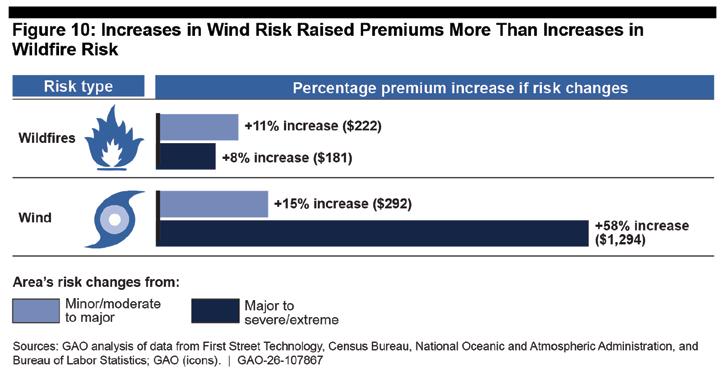
Between 2019 and 2024, homes in areas classified as severe or extreme wind risk had premiums about 58% higher on average—approximately $1,294 more per year—than similar homes in major wind risk areas, the next lower category.
By comparison, premiums for homes in severe or extreme wildfire risk areas were about 8% higher—roughly $181 more annually—than those in major wildfire risk areas.
The findings highlight differences in how premiums vary across catastrophe risk categories, particularly at the highest risk levels. The report also shows a 15% premium increase, or about $292 per year, between minor/moderate and major wind risk areas. This compares with an 11% increase, or roughly $222 per year, for wildfire risk over the same range.
Premiums in areas at severe or extreme risk for wind and wildfire also grew faster
than premiums in areas at major risk, the office reported.
“For example, for each year since 2021, premiums in ZIP codes with severe or extreme risk for wind or wildfire grew by 6–10% on average, and premiums for ZIP codes with major risk grew by 1–4%,” the report said.
Overall, the GAO reported that U.S. homeowners premiums generally tracked inflation between 2019 and 2024 but rose more in disaster-prone areas.
The average premium rose about 3% during that time after adjusting for inflation, while rates in parts of certain states, particularly southern coastal areas at high risk of wind damage, rose by 25% or more.
Many coastal areas of North Carolina and Texas saw increases of more than 50% in real terms, the report said. The highest percentage increases in estimated average premiums occurred in parts of North Carolina, Texas, Utah, Florida, and
California.
After being asked to review issues related to homeowners insurance, the GAO analyzed 2019–2024 data on private homeowners coverage and 2014–2023 data on insurers of last resort to produce its trends report.
The office also interviewed representatives from the Federal Insurance Office, four insurance industry groups, three consumer advocacy organizations, and four state insurance regulators.
& Markets
Verisk: Insurance Claims Volume Fell to 5-Year Low in 2025
By Ezra Amacher
Insurance claims volumes in the United States declined across most lines in 2025 due at least in part to less severe weather, but risks remain elevated as insurers navigate complex and concentrated claims, according to an annual report from Verisk.
Claims volumes were lower in 2025 than 2024 across personal and commercial lines, Verisk’s Annual Insurance Claims Trends Report found. The report draws on insights from ClaimsSearch.
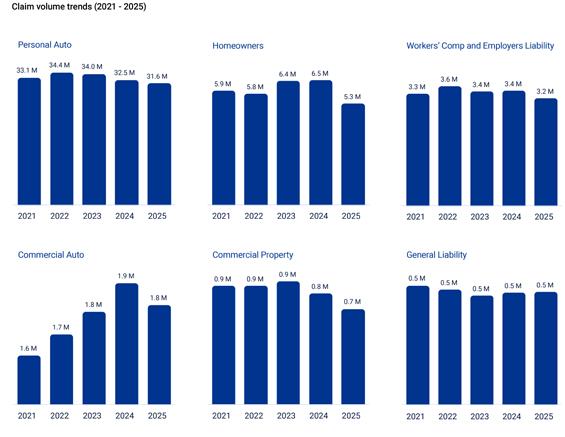
There were 5.3 million homeowners claims in 2025, the lowest level in the past five years and down 19% year-over-year from 6.5 million in 2024.
Personal auto claims fell to 31.6 million last year, extending a streak of three straight years of declining claim volume.
Commercial property saw 710,000 claims in 2025, down from 910,000 in 2023. Commercial auto claims volume fell to 1.8 million in 2025, down 5% from the
prior year.
While insurers saw declines in claims in 2025, major weather and natural catastrophe events such as the Los Angeles wildfires show how underlying risks are becoming more complex, according to Verisk.
Smoke damage emerged as a significant driver of claims due to the January 2025 Los Angeles wildfires. More than 7,800 smoke claims were filed in the first 30 days post-fire. More smoke claims could be filed in the years to come, as historical patterns indicate smoke claims may continue to develop for years. The fires prompted state officials to look closely at smoke damage, and now a bill to create a statewide framework for handling wildfire smoke damage insurance claims is working its way through the California Legislature.
The report also highlighted emerging risks already visible in claims data from the past years.
From 2021 to 2025, commercial auto claims involving gig-related workers climbed 96%, rising to 10% of all commercial auto claims.
Over the same period, the number of claims related to silica dust (cancer-causing substances) rose from just over 100 claims to roughly 2,000 claims.
Additionally, the popularity of e-bikes has led to a rise in claims involving battery-related fire risks and rider injuries. The number of claims involving e-bikes quadrupled from roughly 1,000 claims in 2021 to more than 4,000 claims in 2025, the report found.
“Claims data is often the earliest signal of how risk is changing,” said Shane Riedman, president, anti-fraud analytics, at Verisk. “Even as overall volumes declined in 2025, the underlying loss patterns tell a very different story. This report analyzes claims activity at scale, and can help insurers better gauge risk, anticipate emerging risks, identify subrogation opportunities and make smarter decisions for the year ahead.”
Source: Verisk’s ClaimsSearch Trends Report
News & Markets
AI Use in Cybersecurity Could Show Holes in Short Term, Says Fitch
By Chad Hemenway
U.S. cyber insurers in 2025 reversed a couple of years of decline in direct written premiums to post growth of 11%, but according to Fitch Ratings, there are some underwriting concerns brought on by developments with artificial intelligence.
Fitch said Anthropic’s Mythos model has raised eyebrows in the financial and cybersecurity worlds. In the short to medium term, vulnerabilities will probably outnumber patches as the artificial intelligence tool works on cyber threat intelligence and incident response.
“AI is particularly disruptive to cyber risk because traditional vulnerability
NIPR Warns Agents of Email Phishing Attempts
Beware, agents. That email from the National Insurance Producers Registry may not be legit.
NIPR said it has learned of an active phishing email campaign referencing past-due invoices. The emails may look like they are from trusted sources such as @nipr.com, @naic.org, or @stipe, but they are fraudulent and insurance agents are urged to use caution.
Agents should not open any attachments, click links, or send payments if they receive an email asking for payment. Contact NIPR before taking action at niprbillingdept@nipr.com.
“The emails impersonate NIPR and request payment. Agents should be aware
of any unexpected or unsolicited invoices received, and these should be treated as suspicious,” said NIPR, adding that it and the National Association of Insurance Commissioners (NAIC) are investigating and monitoring the phishing activity. A notification was sent to all insurance commissioners, who have been spreading the word on their websites.
NIPR said to look for the following to identify an
analysis was labor-intensive and offered limited financial upside for researchers, a gap AI now fills at scale and speed,” said Fitch in its brief on the cyber marketplace on Feb. 15. “This lowers barriers for attackers, expands third-party risks, and could materially increase attack volume.”
Growth in the cyber market was mostly driven by volume, with policies-in-force up 35% to offset soft aggregate pricing. This, said Fitch, indicates a great awareness among buyers of cyber exposures, as well as a competitive underwriting environment. Larger companies are still more likely to have cyber insurance protection while smaller companies lag behind.
Yet, Fitch said, demand overall has “strengthened as boards and management teams recognize that cyber events can disrupt operations, trigger legal liabilities, and impair revenue even when direct financial losses are limited.”
Meanwhile, insurers have and will continue to assess and adjust contract language while integrating cybersecurity assessments into underwriting. Policy wordings related to war exclusions, silent cyber, business interruption, and contingent losses “will be critical,” added Fitch. A more detailed look at the cyber market is expected this summer, said the credit-rating agency.
email phishing attempt:
• Sender’s email address: Fraudulent email addresses can impersonate real addresses.
• Generic greetings: May begin with “Dear Customer” instead of personal information.
• Tone and grammar: Spelling mistakes, unusual phrasing, and a sense of urgency can all be signs of a fraudulent email.
• Hover over links (don’t click): This reveals the URL and can help determine if it is legitimate.
1.4%
Residential flood coverage penetration across the state of California. Neptune Flood released a new report showing residential flood insurance penetration across the state, which found that 2.3 million properties face flood risk over the next 30 years.
182%
The amount residential property taxes paid has risen in Chicago, Illinois, since 1995. Chicago-area residents face some of the country’s highest property taxes, paying a total of $19.2 billion in taxes in 2024. Inflation in Cook County, which is home to Chicago and 134 other suburban Illinois municipalities, rose by less than 91% in the period.
600,000+
The number of unique vehicle configurations sold in the U.S. in the 2025 model year. Rising vehicle complexity—combined with a strong used vehicle market—is leading to “a widening gap between the values insurers assume during underwriting and the costs they ultimately face when repairing or replacing vehicles after a claim,” according to a recent report by JD Power.
$4,688,362
Penalties proposed against a Massachusetts water and sewer line construction contractor for safety violations related to a trench collapse that claimed the life of an employee and seriously injured another at a Cape Cod worksite.
200
Million
The number of gallons Tesla’s Giga Texas increased its annual treated water use over two years. From 2023 to 2025, Tesla’s annual treated water use rose about 68% to 556 million gallons, becoming Austin Water’s third-largest customer—up from fifth in 2023.
Declarations
AI Law
“We are telling our clients: You should proceed with caution here.”
— Alexandria Gutiérrez Swette, a lawyer at New York-based law firm Kobre & Kim, commenting on a ruling by a federal judge in New York stating that the former CEO of a bankrupt financial services company could not shield his AI chats from prosecutors pursuing securities fraud charges against him. In the wake of the ruling, attorneys have been advising that conversations with chatbots like Anthropic’s Claude and OpenAI’s ChatGPT could be demanded by prosecutors in criminal cases or by litigation adversaries in civil cases.
E-Bike Claims Quadruple
“Sometimes, what looks like an e-bike or is marketed as an e-bike is not a bike at all. We are seeing a surge of safety incidents on our sidewalks, parks, and streets. Bike riders and parents: If your or your teen’s electric two-wheeled vehicle goes too fast, it might be a motorcycle or a moped—not an e-bike.”
— California Attorney General Rob Bonta on e-bike risks. The popularity of e-bikes has led to a rise in claims involving battery-related fire risks and rider injuries. The number of claims quadrupled from roughly 1,000 claims in 2021 to more than 4,000 claims in 2025, a Verisk report found.
Solar Farmland
“Many communities want to decarbonize and probably theoretically support renewable energy. When it’s your community and your backyard, balancing these processes so people feel like they’ve had a say without creating so many veto points that nothing can get done, I think, is the trick. And it’s not easy to do.”
Juniper Katz, an assistant professor at the University of Massachusetts who focuses on environmental policy, discussing the push/pull between landowners and local governments regarding renewable energy projects. A 2025 Columbia University study found that from 2023 to 2024, there was a 16% increase in local laws across 44 states restricting such projects.
NYC Insurance Plan
“The skyrocketing cost of insurance is putting affordable, rent-stabilized housing at risk and risks setting back our efforts to build a more affordable city. This groundbreaking effort will use the City’s purchasing power to lower insurance premiums, helping our own investments in affordable housing go farther and reducing operating costs for owners of rent stabilized housing. This is just one step in how we’re working to bring down housing costs across the board.”
— Leila Bozorg, New York City deputy mayor for Housing and Planning, on a plan to lower the cost of property and liability insurance for affordable and rent-stabilized housing through a city-run insurance program by 2027.
Protecting Mobile Homes
“If it’s 1994 or newer, you have options. If it’s older, there really aren’t many,” — John Gardner, principal at Lee County Insurance Agency and one of the top writers of mobile home coverage in Florida. Insurance agents and others in the state agreed that, 24 months after St. Petersburg-headquartered American Mobile began canceling policies, finding coverage for many mobile and manufactured homes remains difficult and eye-poppingly expensive. The average mobile home annual premium in parts of southwest Florida is now about $5,000—more than that for some non-mobile, single-family dwellings in a comparable area.
Omaha Sinkholes
“It’s great for growing corn, but terrible for building roads.”
— Omaha, Nebraska, City Engineer Austin Rowser on sinkhole hazards. Much of Omaha sits atop a fine-grained sediment called loess, which can be easily carried away by water, leaving behind gaps underground. Omaha’s sinkholes are generally shallow and often result from human-made infrastructure interacting with the fine-grained sediment. Reported cave-ins have decreased in recent years from more than 500 in 2021 to about 340 last year, but as Omaha’s underground infrastructure ages, it could put the city at greater risk of sinkholes, geologists said.
Business Moves
National
Acrisure, Vave
Fintech Acrisure acquired managing general agent Vave from its parent company, Canopius.
Vave will continue to operate under its brand name and be a part of New Yorkbased Acrisure Underwriting, a platform of 12 MGAs operating in the U.S. Vave will also continue to be led by its management team, led by CEO Marek Shafer.
With its principal place of business in Chicago, Illinois, Vave operates under London’s Canopius. Canopius will continue to be one of several capacity providers to Vave.
Vave combines science, data, and underwriting to offer instantly bindable quotes to distribution partners on catastrophe-exposed E&S property risk in the U.S.
Vave recently launched a Californiaspecific home and commercial property product and expects to launch a commercial package product focused on cat-exposed areas soon.
Terms of the deal were not disclosed.
East
World Insurance Associates LLC, C&A Insurance Agency
Insurance broker World Insurance Associates LLC acquired the business of C&A Insurance Agency of New York, New York, on December 31, 2025.
Established in 1985, C&A Insurance provides insurance to individuals, families, and businesses across New York and New
Jersey. Terms of the transaction were not disclosed.
King Risk Partners, New England Property & Casualty Inc.
King Risk Partners acquired New England Property & Casualty Inc., an independent insurance agency headquartered in Wallingford, Connecticut. This agency is King Risk’s sixth location in Connecticut; other offices are in Avon, Essex, Groton, Meriden, and Wethersfield.
New England Property & Casualty has served individuals and families throughout Connecticut for nearly 40 years, offering auto, home, property, and health insurance. Robert Borruso is the owner of the agency.
Florida-based King Risk Partners continues to grow through partnerships and acquisitions. King Risk Partners has more than 50 locations on the Eastern seaboard from New Hampshire to Florida.
NFP, Hamilton Group LLC
Global insurance broker NFP acquired the Hamilton Group LLC, a multi-disciplinary insurance broker based in Cedar Knolls, New Jersey.
Hamilton Group’s Greg Frankel and David Page will join NFP as senior vice presidents reporting to Lauren Kim, regional managing director of P&C in NFP’s Northeast region.
Family-owned and operated, Hamilton Group has served small and mid-sized businesses across New Jersey and the tri-state area for nearly 70 years. It began as the Frankel Agency in 1958.
NFP, an Aon company, has offices across the U.S., Canada, UK, and Ireland. It provides property/casualty insurance, employee benefits, life insurance, executive benefits, wealth management, and retirement plan advisory services.
Midwest
NFP, Sherman Insurance Agency Inc.
NFP, an Aon company and leading property and casualty broker and benefits consultant, acquired Sherman Insurance Agency Inc., a full-service agency specializing in trucking, commercial, personal, and benefits insurance solutions.
Based in South St. Paul, Minnesota, Sherman strengthens NFP’s presence in the upper Midwest and enhances its transportation and logistics practice. As part of the transaction, Sherman leaders John Glieden, Kyle King, and Peter Lobe will join NFP as senior vice presidents, and Jennifer Carter will join as vice president. All will report to Amanda Ruback, managing director, P&C, Central region.
Founded in 1931, Sherman Insurance Agency serves small and mid-market businesses in the trucking and transportation industries across the Twin Cities, upper Midwest, and beyond. Over the years, Sherman has broadened its offerings to include innovative risk management solutions for commercial clients and personal insurance needs.
Inszone Insurance Services, Insurance Resources Group Inc.
Inszone Insurance Services acquired Insurance Resources Group Inc., located in Olathe, Kansas. Insurance Resources Group was founded in 1996 by Kenton Grigg and Lora Ewbank. The agency offers home, auto, business, and life insurance.
World Insurance Associates, Heuring Crop Insurance
World Insurance Associates acquired the business of Heuring Crop Insurance of Boonville, Indiana, on November 1, 2025. Terms of the transaction were not disclosed.
Heuring has provided farmers with comprehensive crop insurance coverage
for over 25 years. They offer Federal MultiPeril and Private Product Crop Insurance to farmers and ranchers throughout the Midwest and the United States.
South Central
Trucordia, JJL&W Insurance Consulting
Trucordia acquired the assets of JJL&W Insurance Consulting, an employee benefits brokerage based in Baton Rouge, Louisiana. JJL&W was founded in 2020 by partners Jeff Joffrion, Troy Jones, Mitch Lansing, and Jeff Wampold.
The JJL&W team focuses on employee benefits for employers of all sizes, as well as individuals, with medical, dental, vision, life, disability, and voluntary benefits, along with support for funding strategies, compliance, and administration.
Inszone Insurance Services, Schuessler Insurance Inc.
Inszone Insurance Services announced its expansion in Oklahoma through the acquisition of Schuessler Insurance Inc., a long-standing independent insurance agency based in Alva, Oklahoma.
Founded in 1973 by Harvey Schuessler, Schuessler Insurance primarily serves personal and commercial clients, with a strong focus on farm, agriculture, and small business coverage in the surrounding rural communities.
The agency team will remain in place, continuing to serve clients locally with the added backing, infrastructure, and market access of Inszone Insurance Services.
Southeast
Prestige Trucking Insurance, Mulligan
Prestige Trucking Insurance, a retail brokerage and parent company of CSMV Underwriters, acquired Mulligan, an artificial intelligence-based insurance automation platform.
The platform will now be offered under the name Insure Stack, led by Prestige Trucking’s Christina Torres as CEO, Daniel Hausman as chief operating officer, and David Zhang as chief technical officer.
Mulligan was developed by Y Combinator and Pyq Inc. Pyq founder
Aman Raghuvanshi will serve in an advisory role, and members of Pyq’s team will now join the Insure Stack team.
Hatcher Insurance Group, Level 3 Benefit Advisors
Orlando, Florida-based Hatcher Insurance Group, part of Unison Risk Advisors for almost a year, has expanded its employee benefits practice with the acquisition of Level 3 Benefit Advisors.
The Level 3 firm, founded in 2021, is based in Winter Park, Florida. Founder Tom McGaffic will join Hatcher and will lead Hatcher’s benefits practice and additional acquisitions, the company said in a news release.
Hatcher also announced it is moving its headquarters from College Park to the new Dr. Phillips Charities building in the Packing District of Orlando.
Hatcher, a brokerage for personal and commercial lines and benefits, has continued to expand in recent years through acquisitions and organic growth.
DOXA, Jupiter Underwriting Group
Indiana-headquartered DOXA, a specialty insurance firm built on acquiring and growing program administrators and MGAs, has expanded into Florida with the acquisition of Jupiter Underwriting Group.
The group is a managing general agent that specializes in admitted umbrella and follow-form excess liability. Jupiter was founded in 2019 by David Folkes and Dennis Burton. Jupiter has focused on underwriting complex risk for contractors, hospitality firms, real estate, import/export companies and light manufacturing and oil and gas contractors. Folkes and Burton will remain in place at the combined company.
DOXA, with offices in Fort Wayne, Indiana, plans to continue expanding in 2026 in specialty casualty insurance.
Higginbotham, Harmon Dennis Bradshaw Inc.
Higginbotham, the Texas-based insurance brokerage ranked as the 12th-largest broker in the country last year, has added Harmon Dennis Bradshaw Inc., an independent agency in Alabama and Georgia, to its growing list of partner agencies.
Harmon Dennis, known as HDB, has offices in Birmingham, Montgomery, and Troy, Alabama; and in Duluth, Georgia. It was founded in 1977 as The Harmon Agency. David Dennis is president of HDB. Terms and structure of the deal were not disclosed in a news release.
The employee-owned Higginbotham has headquarters in Fort Worth and offices across the country, including 15 agencies in Alabama.
West
Marsh McLennan Agency, Seitz Insurance Agency
Marsh McLennan Agency (MMA) acquired Seitz Insurance Agency in Montana. All employees, including David Seitz and Camila Skinner, the agency principals and co-owners, will join MMA and continue to operate out of their existing office locations.
Seitz is a Sidney, Montana-based independent agency founded in 1961. It primarily provides commercial and personal lines of insurance services, with a specialization in agriculture, crop, and energy industries. Seitz acquired Polson, Montana-based Bishop Insurance Services in 2023, adding to its personal and business insurance offerings in the Flathead and Mission Valley area.
MMA is a business of Marsh, an international provider of risk, reinsurance and capital, people and investments, and management consulting services.
Inszone Insurance Services acquired Tucson, Arizona-based Benchmark Insurance Group LLC, doing business as Randall Realty & Insurance.
Founded in 1973 by Larry Randall, the agency was later acquired by Frank Fletcher. The firm specializes in mobile and manufactured home insurance, homeowners, auto, and Medicare services.
Sacramento, California-based Inszone Insurance Services is a brokerage firm offering a range of property/casualty and employee benefits services.
National
Chubb Limited named Kevin Rampe, senior vice president, Chubb Group, as global claims officer, responsible for global claims management. He will also retain his responsibilities as head of North America Claims. Rampe joined Chubb in 2005 as the company’s global compliance officer. He subsequently served as general counsel of North America and global deputy general counsel before being named head of North America Claims in 2021
commercial officer. Izzo works out of the company’s Red Bank and New York offices. He joins AXIS with 35 years of industry experience, most recently serving as EVP/group chief commercial officer at Everest.
lead at AIG, where he managed a significant cargo portfolio.
Jersey City, New Jerseybased Verisk appointed Will Murphy as senior vice president of sales for its claims solutions division. Murphy leads sales strategy and execution. Most recently, he was vice president of marketplace and technology alliances at Guidewire.
John Galaviz as CEO. Galaviz succeeds Matt Gardner, who founded Patriot Growth in 2019. Gardner has left the company to pursue other opportunities.
Jacqui Canney, chief people and AI enablement officer at ServiceNow, was elected to the Liberty Mutual Insurance board of directors. Liberty Mutual is headquartered in Boston, Massachusetts. Canney has held her current role at ServiceNow since January 2025, leading the company’s global talent strategy and workforce planning initiatives. Before joining ServiceNow in 2021, Canney was chief people officer at WPP and executive vice president and chief people officer at Walmart.
The Hartford, headquartered in Hartford, Connecticut, appointed Natalie Burns as head of enterprise sales and distribution. Burns began her career with The Hartford in 2002 as an executive underwriter and has held positions of increasing responsibility in underwriting and distribution across the enterprise. Most recently, she was head of alternative distribution, leading The Hartford’s Middle & Large Business Centers and Middle Market Underwriting Center. Burns replaces Stephen Screen, who was recently named head of alternative placement solutions in The Hartford’s Global Specialty business unit.
AXIS Capital Holdings Limited, headquartered in Pembroke, Bermuda, appointed Anthony Izzo as chief
Liberty Mutual Insurance announced new leadership structure across the company's Global Risk Solutions (GRS) and Liberty Mutual Investments (LMI) businesses.
Vlad Barbalat was named president, Global Risk & Capital Solutions. He will continue to serve as chief investment officer of Liberty Mutual Group. Matthew Moore will remain president of GRS.
Adam Winn and Patrizio Urciuoli have been appointed co-presidents of LMI.
Markel appointed James Shankland head of ocean cargo, U.S., leading the growth of Markel’s U.S. cargo portfolio. Most recently, Shankland served as an underwriting team
Kalepa, headquartered in New York City, appointed Audrey Howell as head of product. Howell has over a decade of product leadership experience, previously serving as product manager at Palantir Technologies, vice president of product at Butterfly Network Inc., and head of product at Deep Origin.
Marsh, headquartered in New York City, appointed Katrina Zafiriadis as leader of its newly established service delivery practice (SDP), U.S. and Canada, Marsh Risk. Based in New York, Zafiriadis has two decades of leadership experience, most recently serving as chief of staff to Michelle Sartain, president of Marsh Risk, U.S. and Canada. Before joining Marsh in 2018 as business resiliency head of the Americas, she was regional head of operational resilience risk at Deutsche Bank and global operations and program manager at AllianceBernstein.
East
Galaviz joined Patriot in 2023 as chief financial officer and was promoted to president in 2025. He has over 20 years of industry experience, including both brokerage and carrier environments.
Patriot Growth Insurance Services also named Jason Bowie as national cyber practice leader. Bowie has over 15 years of insurance brokerage experience, with a background in cyber liability, errors and omissions (E&O), and management liability.
RT Specialty’s Hamilton, New Jersey office, which is part of RT Specialty’s Environmental and Construction Professional (RT ECP) Practice, promoted four team members to new roles.
Zack Kalet is advancing to consultant. Kalet joined RT ECP in April 2022 as a part-time account administrator.
Pennsylvania-based insurance brokerage Patriot Growth Insurance Services appointed
Stacy Burrows was promoted to account executive. Burrows joined RT ECP in 2012. She has worked in multiple roles at RT ECP.
David Hart joined RT ECP in 2024. He is being promoted
Kevin Rampe
Natalie Burns
Vlad Barbalat
Katrina Zafiriadis
John Galaviz
Zack Kalet
Stacy Burrows
from account administrator to account manager. Jeff Youmans joined RT ECP in 2022 as an account administrator and is now a senior account manager. His expertise includes the operation of construction drones.
TDC Specialty Underwriters, headquartered in Unionville, Connecticut, promoted Steven Spina to chief underwriting officer. Spina previously served as executive vice president for TDC Specialty and oversees underwriting performance/ portfolio profitability and leads strategic underwriting for TDC Specialty Underwriters and HRA.
Trident Marine Managers, a Ryan Specialty managing general underwriter, appointed Karolina Krol as chief operating officer. Krol has over 20 years of insurance industry experience and oversees day-to-day operations and operational strategy.
Emily Ryan joined Alliant Insurance Services, headquartered in Irvine, California, as vice president within its Employee Benefits Group. Based in Wayne, Pennsylvania, Ryan previously served as an enterprise account executive with Care.com and as an account executive with MetLife.
Insurance Advisory Partners appointed veteran
investment banker Lou Caltavuturo as a partner in the U.S. Based in New York, he will focus on broker/insurance distribution mergers and acquisitions (M&A) and capital raising. Caltavuturo joins from Sica Fletcher, where he served as managing director. Before that, he was president of Vantage Insurance Partners, a private equity-backed insurance brokerage investor that he co-founded in 2020.
Southeast
The Alabama Department of Insurance (ALDOI) named Stephanie Tompkins manager of the department’s Consumer Services Division, succeeding Dusty Smith, who was promoted to deputy commissioner for insurance regulation.
Tompkins has 25 years of experience in the insurance business and regulation, including the past 10 years as education and outreach coordinator and as consumer service specialist at ALDOI. Before that, she was a senior underwriter at Associated Insurance Administrators.
South Central
West
CopperPoint Mutual Insurance Holding Company named Kellen Booher president and CEO. Booher succeeds CEO and Board Chair Marc Schmittlein, who announced his retirement last year. Schmittlein joined CopperPoint in 2016 and was appointed executive chair of the CopperPoint board of directors in 2024. He will remain as chair.
experience, most recently serving as an employee benefits consultant with USI.
Booher joined CopperPoint in 2025 as president and chief operating officer and most recently served as executive vice president and head of consumer and small commercial for key international markets at Chubb, after previously leading digital transformation in North America and then international markets.
Lockton, headquartered in Kansas City, Missouri, expanded its presence in California across the evolving life sciences sector, hiring Cristina Varner as senior vice president and life sciences practice leader for the West region. Varner has over 25 years of experience in the life sciences and healthcare sectors.
IBC Insurance has appointed Zee Zepeda as Business Development Strategist. Zepeda is responsible for aligning insurance and banking initiatives to drive growth, enhance client relationships, and expand cross-functional opportunities.
Melody Gray joined Alliant Insurance Services, headquartered in Irvine, California, as vice president within its employee benefits group. Gray is based in Portland, Oregon, and will design and deliver a range of employee benefits solutions to a client base throughout the Pacific Northwest and Alaska. With more than 20 years of industry
Crest Insurance Group hired Jesus Solis as a commercial insurance broker in the firm's Tempe, Arizona, office. An Arizona
native, Solis joins the team with a focus on providing comprehensive risk management and insurance services to local businesses. Solis previously managed both commercial and personal lines. Crest is headquartered in Tucson, Arizona.
Keith Storie joined Alliant Insurance Services as senior vice president within its employee benefits group. The Washington State-based consultant joins Alliant with a background spanning ancillary carrier operations and consulting. Before joining Alliant, Storie was a senior principal and health and benefits consultant at a national employee benefits consulting firm. Alliant is headquartered in Irvine, California.
The Doctors Company named Brittnie Hayes interim senior vice president of claims. Hayes succeeds Michael Meyer, who is retiring after 42 years in the medical professional liability insurance industry. Hayes leads the national claims team and oversees the planned ProAssurance integration. She joined The Doctors Company in 2023, and most recently served as vice president of claims for the Northeast region.
David Hart
Jeff Youmans
Stephanie Tompkins
Zee Zepeda
Kellen Booher
Jesus Solis
Closer Look: Transportation
Telematics, AI, and the Future of Fleet Risk
How Tech Is Reshaping Fleet Risk Management
By Allen Laman
Telematics technology has long been touted as a viable risk management tool for improving fleet safety. But as telematics and video tools capture increasing volumes of on-road data—and artificial intelligence helps to analyze it—experts are now talking about how these connections can improve communication and information sharing.
A panel of experts recently joined Insurance Journal to
discuss how these advancements are shaping the future of fleet risk management.
A central theme of the discussion was how connected platforms can serve as a catalyst for conversations between drivers, safety professionals, and other departments across an organization—leading to benefits beyond safety alone.
“You’re seeing it more than just out of the safety arena,” said Gary Johnson, head of safety and compliance strategy at Motive. “You’re seeing it from all aspects of an organi-
zation. Because it really is no longer a tool that is focusing on one department.”
The speakers keyed in on how interconnected data generated by AI-powered driver safety platforms can inform fleet optimization strategies and maintenance actions, creating cross-company impacts with clear return on investment.
Trent Zempel, senior director of corporate safety at Takkion, believes that being more efficient makes an organization inherently safer
and reduces that risk on the road.
“That AI technology having more data … interconnected with each other gives us better insights to make work better [and] more efficient—and we think safety follows that, as well,” Zempel said.
From One Daily Ping to Tens of Thousands Per Minute
Vehicle telematics technology has evolved significantly over the past two decades, an evolution that Zempel traced from simple GPS tracking to
monitoring of acceleration, braking, and cornering behaviors. For example, today, in-cab cameras equipped with machine vision can flag driver fatigue and risky on-road performance issues.
It’s a metamorphosis that Zempel said has taken telematics from a single daily ping to tens of thousands of data points per minute within a single vehicle.
“It is a great tool,” Zempel said of AI, “but at the end of the day, it really is the ability to create forward-looking accountability between that front-line person—the person driving the vehicle—and their partner looking at and reviewing that data, and then having those conversations in real time.”
According to David Turner, head of telematics at The Hartford, these new tools also help alert drivers to unsafe patterns, highlighting areas on the road to which they should pay more attention while helping to inform coaching and training strategies for employers.
“I think it’s that ecosystem that we see the best effect in,” he added. “When a company leans in on driver safety using that technology, that’s where
you really start to make a difference.”
Holistic Feedback and Coaching
When asked whether any of his clients have uncovered previously unrecognized or underestimated risks using new telematics tools, Turner pointed to the power of video to bring management into the driver’s seat and build empathy.
For example, older technologies could signal hard-braking events, but with video, “that’s built the ability for management teams to recognize drivers who are adapting to situations quickly,” he said.
A big potential that Johnson sees with the technology is the ability to show a holistic view of a driver—which can improve performance and coach skills beyond single behavioral markers. He likened the capabilities of AI telematics systems to the technology that professional athletes use to master their craft.
“Now, you’re at a level where you’re really taking it at a full performance,” Johnson said, “and the tools of today, and the advanced technology, the AI, gives you that athlete perspective. And you coach
more toward that level.”
Implementation Challenges
Despite the excitement about the technologies and their potential applications, introducing developments like dual-facing cameras into vehicles can present challenges. Many fleet drivers use their vehicles as homes for extended periods. In such cases, Zempel believes that consistent, transparent communication can help to build trust and address privacy concerns.
Other potential hurdles for these technologies are ever-changing state laws, noted Turner.
“Privacy is critically important,” he said. “Protecting our customers’ data is critically important. We take it very, very seriously, and I think it’s a key point that customers, providers, [and] carriers need to continue to stay connected with, to talk about [and] understand.”
With the massive volume of data these systems can generate, data overload can also present a challenge for organizations of all sizes. Johnson said prospective cli-
ents often go through product trials with all features turned on, and “they want to drink through that firehose.”
This excitement can bog organizations down, Johnson said.
“Ultimately, you then have to re-look at what you want to achieve out of the expectation of the technology,” he said. “And that’s why I always implement the crawl, walk, run [strategy]. Start small. Start adopting to the levels of what you can get, and then open that up to the bigger levels once you get to that run phase.”
Go Deeper
The webinar also explored telematics technology’s potential to impact claims and litigation, as well as how AI-powered camera and route detection capabilities could expand in the future.
“There’s varying challenges, and that’s why first and foremost, I’d emphasize that you’ve got to really partner, and partner well, with each other,” Johnson said.
“Technology should never take over your organization. It should be a support tool.”
To watch the full webinar visit: https://www.insurancejournal.com/ research/research/telematics-ai-and-the-future-of-fleet-risk/
Gary Johnson
David Turner Trent Zempel
Spotlight: Reinsurance
Reinsurance Rates Continued Softening During April Renewals, Despite Iran War
By L.S. Howard
Reinsurance rates continued to soften during the April 1 renewals despite the unstable geopolitical landscape and uncertain economic outlook, according to major reinsurance brokers.
“The orderly completion of the renewal, with no structural disruption, disciplined capacity, and cedent-friendly pricing outcomes, is testament to the underlying health of the market even in a period of heightened geopolitical uncertainty,” said Howden.
The main reasons for the ongoing competitive market conditions were lower natural catastrophe losses in 2025 and Q1 2026, robust reinsurer balance sheets, and abundant capacity, indicated brokers Aon, Gallagher Re, Guy Carpenter, and Howden Re, in their separate renewal reports.
April 1 is the main renewal period for insurers in Japan, Korea, and India, with some U.S. ceding companies also renewing. (An Aon representative said approximately one-third of the industry’s treaty business is renewed in April by U.S. cedents.)
“Risk-adjusted property-catastrophe rates-on-line returned to levels last seen in the early 2020s even as geopolitical turmoil in the Middle East drove acute stress across multiple specialty lines globally,” said Howden Re in a report on the April renewals titled “Howden Re: 1 April renewals reflect continued softening, insulated from Middle East volatility.”
“Insurers renewing at April 1 achieved significant savings in all regions, building on the competitive conditions seen at January 1,” said Aon in its April renewal report, titled “Reinsurance Market Dynamics Cycle Management Moves Center Stage, April 2026 Renewal.”
“Record levels of industry capital, aggressive competition from ILS markets, and relatively benign catastrophe losses in Asia Pacific helped drive double-digit reductions and more flexible terms and conditions at April 1, the main renewal for insurers in Japan, Korea, and India,” Aon continued.
‘Insurers
renewing at April 1 achieved significant savings in all regions, building on the competitive conditions seen at January 1.’
Global demand for reinsurance increased by approximately 10% at the April renewal, “as buyers used favorable market conditions to secure more comprehensive protection, with some expected to return to the market post-renewal to explore additional purchases,” Aon said. “In certain Asia Pacific markets, rate reductions of up to 20% underscored the strength of buyer leverage supported by abundant capacity,” Aon said in a press release accompanying the report.
“The headline renewal outcomes were a continuation
of January 1 themes, as cedents achieved material risk-adjusted rate reductions across property and specialty lines, while casualty pricing held broadly stable,” according to Gallagher Re’s First View report, titled “Rethinking the Art of the Possible, April 2026.”
Iran War
Several of the brokers’ reports confirmed that the Iran war did not affect outcomes during the April renewals, although loss potential could be high.
Guy Carpenter said for war and political violence lines, current estimates for regional exposures are around $70-$80 billion for war on land.
In the marine sector, vessels greater than 50,000 gross tonnes have an estimated exposure of $14 billion, while the total of hull-only exposures is expected to exceed $45 billion, Guy Carpenter said, noting that, with the addition of cargo, potential claims “could be significant.”
“In aviation, aggregated hull exposures on the ground in eight of the largest airports across the region are estimated to total approximately $35 billion — notwithstanding there are additional exposures in smaller airports, too,” said Guy Carpenter in its report, titled “Reinsurance macro trends and market softening continues in Asia and India against backdrop of Middle East conflict.”
“This renewal was completed in a largely benign property-catastrophe environment, insulated from the immediate disruption in
the Gulf,” said David Flandro, head of Industry Analysis and Strategic Advisory at Howden Re, in a statement.
“That said, a sustained energy supply shock raises the risk of renewed inflationary pressure and higher interest rates, dynamics that have historically affected reinsurance capital and pricing across all lines, not just those directly exposed to the conflict.”
“The Middle East conflict has heightened global uncertainty, but the re/insurance sector has responded promptly, maintaining capacity despite rising premiums,” said Gallagher Re in an introduction to its report. “Supply chain disruptions and other economic concerns are still developing, which could lead to increased demand for tailored re/insurance solutions.”
Gallagher Re said it is still too early to determine the ultimate insured loss from the conflict, but “the market remains open and responsive to the needs of insureds.”
Drivers of Softening Market
Despite competitive pricing globally, market stability is being driven by strong reinsurer balance sheets and relatively low natural catastrophe losses over the past year in the Asia Pacific.
“Global reinsurer capital hit a new high of $785 billion at the end of 2025, a year-on-year increase of almost 10%, driven by strong retained earnings, investment gains, and record third-party capital of $136 billion,” according to Aon.
“The 18% rise in third-party
capital helped lower retrocession costs and has enabled many traditional reinsurers to expand sidecar and catastrophe bond programs,” Aon added.
Aon explained that most reinsurers have reported three consecutive years of strong underwriting results in 2025, continuing to reap the benefits of the market reset in 2023.
“Aon estimates that equity reported by global reinsurers rose to a new high of $649 billion at Dec. 31, 2025, an increase of $49 billion relative to the end of 2024, driven principally by strong retained earnings.”
Discussing the lower insured losses of natural catastrophes, Aon noted that nat cat claims in Asia Pacific during 2025 were 54% below the 21st century averages. (Swiss Re estimates global insured losses in 2025 were $107 billion—24% lower than the $141 billion in 2024.)
Aon said that peak peril losses of $9 billion were unusually low in 2025, which it attributed to the absence of U.S. hurricane
landfalls for the first time in a decade. Further, the record secondary peril losses of $118 billion were largely retained by the primary market, Aon said, noting that, as a result, the average reinsurance sector combined ratio was 88.5 in 2025, down from 90.1 in 2024.
And 2026 is starting on a similar footing, with insured catastrophe losses for the first quarter of 2026 projected at around $13 billion, more than 50% below the five-year inflation-adjusted average, according to Guy Carpenter.
“Reinsurers’ share of global catastrophe losses continues to decline due to higher attachment points and fewer catastrophe events.”
April Renewal Territories
All of the major April renewal regions saw competitive pricing.
India’s renewals benefited from benign loss experience and strong local capacity, resulting in one of the most competitive renewal seasons
in recent years, said Guy Carpenter, adding that loss-free excess-of-loss business saw price cuts exceeding 20%.
“Pricing remained competitive across liability and specialty lines, including cyber,” Guy Carpenter added.
“In the India and Middle East markets, we are seeing a strong commitment from reinsurers to maintain coverage despite the complexities posed by ongoing conflicts,” commented Atish Suri, CEO India, Middle East & Africa, Guy Carpenter.
Guy Carpenter said that Japan, which is the largest Asia Pacific territory renewing in April, saw pricing continuing to soften in casualty and specialty lines as capacity exceeded demand.
Indonesia, Korea, the Philippines, and Singapore experienced continued softening, with double-digit price reductions on loss-free catastrophe business, Guy Carpenter said.
“Terms and conditions remained largely stable, and
renewals proceeded on time. Abundant capacity and new reinsurers seeking portfolio diversification led to increased quoting activity, demonstrating added value to cedents.”
US Market
“In the U.S., competition across traditional and insurance-linked securities markets responded to increased buyer demand and led to double-digit pricing reductions,” Aon said in its press release. “U.S. insurers also used favorable buyer conditions to transfer more risk to reinsurers through increased limits, frequency covers, and proportional transactions.”
In its report, Aon said terms and conditions continued to improve in the U.S. following the hard market of 2023.
“Retention levels were broadly flat, although there was growing interest from insurers in frequency products, including third and fourth event covers and buy-down retentions for multiple events.”
Spotlight: Medical Liability
Could Social Media Open the Door to Medical Liability Exposures?
By Patrick Wraight
If you are on any social media platform, you’ve likely seen them. Medical professionals who are gaining a following because of the funny way they portray the medical community. Medical professionals who are fighting against misinformation (as they define it). Medical professionals who are selling their own products, or their content, including advertisements for someone else’s products.
It used to be that to get medical advice, you had to go to your doctor—the one in your town, who had an office and everyone knew where “Doc” was, especially if he wasn’t in the office that day. Today, you can hear about all kinds of medical things online from real medical professionals who are talking about things that matter to you.
It doesn’t matter if you suffer from a common illness, or a chronic disease that only a few hundred people deal with. You can find someone who knows things about it, or at least they’ll talk about it online. What happens when you search online, find a doctor who is talking about your symptoms, and what she has done with other patients that has worked, or who may be talking about an experi-
mental treatment option that your normal physician hasn’t recommended to you?
Having reviewed several medical professional liability policies, I haven’t found an explicit “social media exclusion,” which would exclude a doctor’s social media activity, but as with everything insurance-related, there’s more to it than that.
The bigger question is whether a YouTube video triggers coverage for a medical professional. Here’s how the ISO PR 00 01, Physicians, Surgeons and Dentists Professional Liability Coverage Form reads. (Note: Because of the sheer volume of both admitted and non-admitted coverage forms available, we have chosen to limit our discussion to this ISO form. Your coverage forms will vary, and don’t forget to read the full policy.)
We start with selections from the Coverage A – Insuring Agreement.
We will pay those sums that the insured becomes legally obligated to pay as damages because of injury to which this insurance applies…
The insurance applies to injury only if: The injury is caused by a “medical incident” that takes place in the “coverage territory”; The injury occurs during the policy period; The injury arises out of the individual insured’s profession as a physician, surgeon or dentist; and…
Immediately, we see that coverage is limited to injuries
that are caused by a medical incident (as defined in the policy) that takes place in the coverage territory (as defined in the policy) and arising out of the individual’s profession as a physician. The first hurdle in making a medical professional claim is whether posting content to social media would be considered the insured’s profession as a physician. Is it normally within the duties of a doctor to post content online?
‘The well-meaning doctor who just wants to help someone could enter the arena of professional liability simply because they tried to be kind to some stranger on the internet.’
No. It couldn’t be considered part of the normal duties of a physician, especially since according to the American Medical Association, there are roughly 900,000 active physicians treating patients in the United States as of January 2026, and according to the Journal of the American Medical Association, only about 7.5% of them have any measurable monthly social media activity. We can use this information to state that it doesn’t appear that posting online content falls within a physician’s profession. That leads us to ask whether the posting of content online
could be considered related to a medical incident as the policy defines it.
“Medical incident” means any act or omission: Arising out of the providing of or failure to provide professional medical or dental services by: The insured; or Any person acting under the personal direction, control or supervision of the insured.
Is posting content online providing or failing to provide professional medical services? That seems like a stretch in most contexts.
One popular medical professional parodies different
medical specialties, including conversations between doctors and discussion of fictional patients. Could that be considered providing medical services? Not at all, since this doctor is essentially performing a skit, not treating any particular patient.
Another popular medical professional posts responses to TV medical dramas and viral medical TikToks. He’s not responding to any particular patient. He’s trying to give general information and deal with misinformation.
From this information, we’re going to look at the content that the doctors are putting online. While
educational, entertaining, and sometimes even binge-worthy, it’s not actual medical advice.
The doctor isn’t talking to a patient about their particular case, so therefore they aren’t providing any kind of medical service or even offering to provide any medical service.
That is, until someone in the comments section asks a pointed and specific question. hat’s where the doctor must make a decision on how to engage with that person.
The doctor begins to walk in gray areas when he or she engages in conversations, whether through direct messages, responding to comments, or answering live
questions in a live stream. Those conversations could give rise to developing a physician/patient relationship, where there is a duty of care owed.
The well-meaning doctor who just wants to help someone could enter the arena of professional liability simply because they tried to be kind to some stranger on the internet.
That’s not to say that all interactions instantly create a relationship, but doctors who are building a following online by producing content need to be aware of what they’re saying and to whom.
Of course, none of this is
a promise that a physician who is posting online content could never be sued for malpractice because of a video, a comment, or direct message conversation that they have with someone on the internet.
The promise is that whatever the physician is doing, in some ways, they’re always physicians, and because of that, they can’t simply “take off the doctor hat”—especially when they’re still wearing their custom scrubs in their videos.
Wraight, CIC, CRM, AU, is director of Insurance Journal's Academy of Insurance. He can be reached at pwraight@ ijacademy.com.
Spotlight: Medical Liability
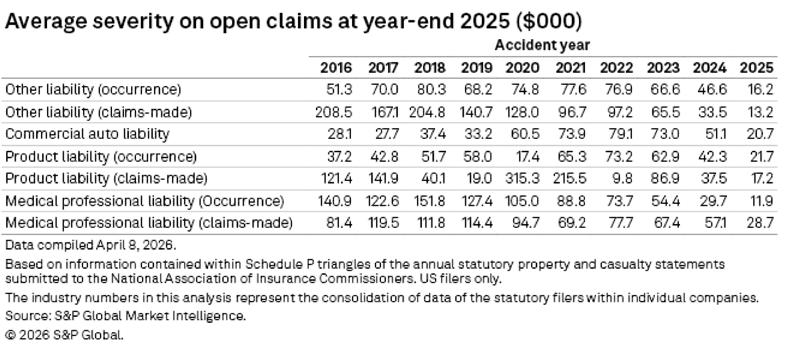
Claim Severity Trends for Medical Malpractice ‘Stand Out’: S&P Global Market Intelligence
Casualty claims are becoming more expensive at a faster rate, but medical professional liability stands out as one casualty line where compounding factors are turning severity deterioration into a heightened risk.
According to an S&P Global Market Intelligence report written by Husain Rupawala, Tim Zawacki, and Jason Woleben, medical professional liability “stands out as the most severity-pressured line in casualty insurance, with the highest figure across all lines.”
While severity steps down as claims mature and paid amounts reduce outstanding balances, the authors note such “moderation in newer years” primarily reflects claim immaturity rather than genuine improvement in underlying loss costs.
Medical professional liability occurrence reached $151,768 per open claim in accident year 2018, which represents the highest severity figure across all casualty insurance lines before moderating in more recent years, a typical trend for newer claims where cost pressures continue to emerge and mature.
The report’s authors also
state that the drivers behind medical professional liability’s severity trend can differ from other lines of casualty.
“Third-party litigation funding has imposed substantial and rising cost burdens on insurers by lengthening litigation timelines and raising settlement targets, while attorney advertising has further intensified the envi-
ronment and nuclear verdict benchmarks have increased, with median awards for major cases more than doubling in 2025,” the report said.
The report also analyzed data from the National Practitioner Data Bank, which found that payments of $500,000 or more accounted for 36.5% of total medical malpractice payments in 2024 when measured in real 2025 dollars, marking a new high for the line.
The report also noted that medical professional liability claim severity varies significantly by state due to legal environments and the presence or absence of caps on noneconomic damages, with New Mexico being one of the most difficult markets. New Mexico posted a 2025 direct incurred loss and defense and cost containment expense ratio of 128.8, versus a U.S. aggregate of 75.9. Other high-stress jurisdictions include Utah at 143.8 and South Carolina at 125.7, the report said.
Overall, S&P estimates that the medical professional liability business generated a calendar-year combined ratio excluding policyholder dividends in excess of 105 in 2025 for the fifth time in the past eight years.
News & Markets
NYC Mayor Eyes Insurance Program for Affordable Housing
By Andrew G. Simpson
New York City Mayor Zohran Kwame Mamdani is seeking to lower the cost of property and liability insurance for landlords of affordable and rent-stabilized housing through a new citybacked insurance program.
Mamdani plans to hire independent actuarial experts to design and launch the insurance program. By 2027, the city hopes to lower the cost of insurance coverage for 20,000 homes and, by 2030, for as many as 100,000 homes.
According to the city, the cost of insurance has hit affordable and rent-stabilized housing particularly hard. The city believes the new proposal will also drive down city spending in its affordable housing programs.
“We cannot take on the housing crisis without confronting one of the fastest-growing costs facing New Yorkers: insurance. That’s why we’re creating the first city-backed insurance program—to help New Yorkers stay in their homes, give building owners the support they need to make repairs, and build a city that New Yorkers can actually afford,” said Mayor Mamdani.
Leila Bozorg, deputy mayor for Housing and Planning, said the cost of insurance
is putting affordable, rent-stabilized housing at risk. This idea is to “use the city’s purchasing power” to lower insurance premiums, helping the city’s own investments in affordable housing go farther and reducing operating costs for owners of rent stabilized housing.
According to the Association for Neighborhood and Housing Development (ANHD), rising insurance premiums have become one of the most destabilizing forces facing nonprofits that have to operate affordable buildings on thin margins. The group told state lawmakers last year that insurance costs have more than doubled in just four years, from roughly $869 to $1,770 per unit. For portfolios where most units rent below $1,000 per month, these increases now consume as much as a quarter of total rent revenue.
“High insurance costs also severely constrain our ability to develop and finance new affordable housing at a time when there is a desperate need to add to the nation’s housing supply. Although the property markets have shown some improvement over the past year, it is still challenging to place insurance policies at rates that affordable developments can support,” the group testified.
Fairview Housing Partners, a New York City-based non-profit affordable housing owner, told lawmakers that the rise in premiums has been the most significant increase in the cost of operating affordable rental housing.
An interagency working group comprised of the New York City Economic Development Corporation (NYCEDC), Housing Development Corporation (NYCHDC), and Housing Preservation and Development (HPD) will manage the selection and partnership of the insurance program.
Connecticut Senate Confirms Hershman as Insurance Commissioner
The Connecticut Senate has confirmed Josh Hershman as the state’s 34th insurance commissioner.
Hershman has served as commissioner in an interim capacity since December 2025, replacing Andrew N. Mais who retired from state service last year after nearly seven years as commissioner.
“Each day reinforces how essential our work is to Connecticut residents and businesses,” Hershman commented upon the news of his confirmation. “I remain focused on advancing solutions that improve the affordability and availability of insurance across all lines.”
Hershman is a former deputy insurance commissioner who was serving as chief
executive officer of the Immigrant Life Insurance Co. of America, a Connecticutdomiciled and wholly owned subsidiary of IDT Corp., when he agreed to become commissioner. At Immigrant Life, he helped build an admitted-market life insurance carrier designed to close the coverage gap faced by immigrant families.
He also served as executive director of openIDL, a Linux Foundation project modernizing data exchange through creating data standards across the property/ casualty insurance insurance industry.
From 2019 to 2022, Hershman was deputy commissioner and chief operating officer of the Connecticut Insurance
Department, focused on AI’s impact on insurance, data-driven regulatory modernization, and innovation across the industry.
Prior to his public service, he practiced law with a focus on complex business planning and litigation.
The Connecticut Insurance Department has about 150 full-time employees. It is funded through assessments on insurance companies; its budget for the 2025 fiscal year was approximately $35.5 million.
The department oversees 1,609 licensed companies, 107 of which are domestic insurers. According to its annual report, Connecticut’s P/C insurance industry ranks fifth in the nation for DWP.
Maryland Reaches Settlement With Ship Owner, Operator Over Bridge Collapse
By Andrew G. Simpson
The state of Maryland has reached a settlement in principle with Grace Ocean Private Limited and Synergy Marine Pte Ltd., the owner and operator of the M/V Dali, resolving a portion of the state’s claims arising from the cargo ship’s allision with the Francis Scott Key Bridge two years ago.
Attorney General
Anthony G. Brown did not disclose any details of the settlement that is still being finalized. Brown said the settlement resolves claims brought against the vessel interest by the state and its agencies, including the Maryland Transportation Authority, the Maryland
Port Administration, and the Maryland Department of the Environment.
He said the settlement does not resolve any claims the state may have against the shipbuilder, Hyundai.
The announcement came following a ruling in January allowing Synergy, the manager of the cargo ship, to proceed for now with its claims under an 1851 maritime law that limits liability for shipowners. The state of Maryland and wrongful death claimants had sought to prevent Synergy Marine from invoking the Shipowners’ Limitation of Liability Act on the basis that Synergy did not meet the requirements as an owner of the ship and thus is not entitled to limited liability protection granted by the law. But U.S. District Court
Judge James K. Bredar denied that motion.
The state did not challenge ship owner Grace Ocean’s invoking of the maritime law. As a result, both Grace Ocean and Synergy are entitled to stand trial on their right to limitation.
Under the maritime law, a shipowner’s liability for a maritime loss or mishap is limited to the value of the ship and her pending freight if the mishap occurred without the privity of knowledge of the owner. The stipulated value of the Dali is $43.7 million.
In the bridge collapse on March 26, 2024, six construction workers lost their lives. The collapse brought shipping at the Port of Baltimore to a complete halt, disrupted the livelihoods of thousands of workers, and generated economic ripple effects across the state.
My New Markets
Camps, Sports and Outdoor Recreation
Market Detail:
Mutual Insurance Company is an American Camping Association (ACA) Business
Affiliate and Business Member and preferred provider of the Christian Camp & Conference Association (CCCA).
Types of camps insured: Summer camps, overnight camps, day camps, religious and nonreligious camps, leadership camps, conference and retreat centers, and theme-based camps — e.g., STEM, arts, special needs, educational, etc.
Sports organizations: Amateur sport associations, sports camps and instruction, youth day camps/clinics, sports clubs (e.g., curling, pickleball, swim, tennis), climbing gyms, and driving ranges/mini golf.
Outdoor recreation organizations: Adventure/challenge course facilitators, fishing guides, campgrounds, and RV parks and resorts.
Available limits: Not disclosed.
Carrier: Admitted, rated A by AM Best. States: All 50 states and the District of Columbia, except Louisiana.
Market Details: Forestry Mutual Insurance Company has been a trusted leader in providing insurance coverage to the wood products industry for over 50 years.
Founded in 1971, Forestry Mutual is dedicated to serving the workers’ compensation insurance needs of businesses involved in logging, sawmills, pulp and paper mills, and wood product-related industries. Has pen.
Available Limits: Not disclosed.
Carrier: Admitted, rated A- by AM Best. States: Alabama, Georgia, Mississippi, North Carolina, South Carolina, Tennessee, and Virginia.
Market Detail: RVU Offerings: Auto liability, limits up to $1,000,000 combined single limit, optional broadened pollution coverage (CA9948) available, hired auto and non-owned auto liability coverages available, physical damage on non-owned trailers, trailer interchange, auto physical damage, $1,000 minimum deductible. Available for nonowned trailers.
Trailer Interchange coverage available.
Standalone APD coverage available with same-day turnaround up to $250,000 any one vehicle / $350,000 any one combination of vehicles. With a max of $1,000,000 on any one loss.
General liability as part of the package or standalone.
Employee benefits liability available. Motor truck cargo. Limits up to $250,000 available as standalone as well, with same-day turnaround for limits up to $250,000 any one truck and $500,000 any one loss, depending on commodity.
Coverage for refrigerated/temperature-controlled freight available.
Also available is workers’ compensation, including voluntary compensation.
Driver criteria: U.S. driver’s license, minimum age of 23 years, verifiable driving record, two years CDL experience (or 2 years driving similar equipment — such as a military vehicle), maximum of three minor violations or one major and two minors within 36 months.
Desired vehicle type by class includes flatbed, reefer, hopper bottom, tankers, moving floor/conveyor belt trailers, livestock trailers, and straight trucks, with some restrictions based on specific cargo.
Available Limits: See above.
Carrier: Admitted and non-admitted. States: Alabama, Arkansas, Colorado, Florida, Georgia, Idaho, Illinois, Iowa, Kansas, Louisiana, Maryland, Mississippi, Missouri, New Mexico, North Carolina, Ohio, Oklahoma, South Carolina, South Dakota, Tennessee, Texas, Utah, and Virginia.
Contact: Andrew Adams, aadams@ rvuins.com, 501-944-2750
Contractors Pro Program
Market Detail: RPS offers comprehensive general liability solutions for mid-market and large construction risks. Available in 32 states, the contractor’s pro program is designed for general and artisan contractors seeking enhanced coverage, higher limits, and underwriting expertise for complex operations.
Highlights: AM Best Rated A-IX (Excellent) carrier, Excess and Surplus (EandS), non-admitted.
Minimum premiums starting at $50,000 — limits $1M/$2M/$2M. Larger accounts starting at $75,000 — limits up to $2M/$4M/$4M. Deductibles starting at $5,000.
Max Subs: Artisan Contractors 30% / General Contractors 100%. Per-project aggregates up to $10M. In-house financing available. In-house claims handling provided by Gallagher Bassett.
Target risks: general contractors, carpentry, concrete, masonry, roofing (commercial), electrical, plumbing, street and road, janitorial, utility contractors, sign installation, mechanical, drywall/ wallboard, and more.
Available Limits: See above.
Carrier: Not disclosed.
States: Arizona, Arkansas, California, Connecticut, Florida, Georgia, Illinois, Indiana, Kansas, Maine, Maryland, Michigan, Minnesota, Mississippi, Missouri, Montana, Nebraska, New Hampshire, New Mexico, North Carolina, Ohio, Oklahoma, Oregon, Pennsylvania, Rhode Island, South Carolina, Tennessee, Texas, Utah, Vermont, and Wisconsin. Contact: Agency Resources, RPS. SignaturePrograms@rpsins.com, 866-5958413
This section brought to you by
Special Report: Workers’ Compensation
Workers’ Comp: What to Know About Workplace Violence
Victims Are Most Often Healthcare Workers and Teachers
By Andrea Wells
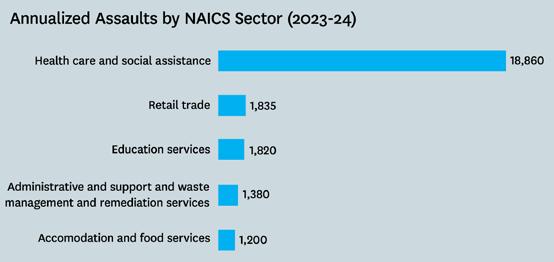
The Occupational Safety and Health Administration (OHSA) reports that acts of violence rank as the third-leading cause of fatal occupational injuries in the country. Research also shows that workplace assaults have been increasing in number, with healthcare workers and teachers most often being the victims. There are, however, indications that assaults against teachers may be declining. Workplace violence covers a wide range of behaviors including physical violence,
harassment, intimidation, and other threatening behaviors from verbal abuse to physical assaults and even homicide. Workplace violence affects employees, clients, customers, and visitors.
Workplace assaults have risen at an annual rate of 5.3% from 2011 to 2022, according to a recent National Council on Compensation Insurance (NCCI) research brief, titled “Workplace Violence: Part One, Assault Trends, Drivers and Demographics,” which analyzed information from the U.S. Bureau of Labor Statistics (BLS) assault case data.
When compared to broader societal violent assaults, workplace assaults present a growing problem. The workplace assault rate grew by 62% from 2011 to 2022, whereas the national aggravated assault rate grew by 13%, the NCCI brief noted. Workplace assault rates refer only to events severe enough to result in lost work time and those that are formally reported to the BLS.
Among all BLS Days Away From Work (DAFW) data, assaults increased from 1.3% in 2011 to a peak of 2.3% in 2019.
“Whether looking at workplace assault
shares, the assaults themselves, or rates, all indicators have shown substantial increases over the 2011 to 2023–24 period,” Matt Schutz, one of the authors of the NCCI research brief, told Insurance Journal. “Even though assaults make up a small portion of workers’ comp claims overall, the number is growing, trending up, and that’s meaningful for our stakeholders.”
The NCCI workplace violence research brief is the first in a three-part series on workplace violence.
Sectors at Risk
When it comes to workplace violence, there are certain sectors of the economy where incidents are more likely to occur. Healthcare ranks as number one.
More than 70% of private industry workplace assault claims occur in the healthcare and social assistance sector, according to NCCI’s analysis of the U.S. Bureau of Labor Statistics data. The number of annual assaults in this sector is 10 times the number of assaults in the next largest sector, retail trade.
Since the beginning of the COVID-19 pandemic, healthcare workers across the country have experienced a sharp increase in incidences of workplace violence, according to the American Hospital Association. Healthcare workers are five times more likely to experience workplace violence than those in other professions despite comprising just 10% of the workforce, according to the BLS.
The BLS reports that of the 5,283 fatal workplace injuries that occurred in the United States in 2023, 740 fatalities were due to violent acts.
Mark Walls, chief marketing officer, Safety National, said workplace violence has been one of the leading causes of loss in the healthcare space for many years.
“It’s a huge problem,” he said. “They deal with people with severe mental health challenges, but it’s beyond that. It’s people on drugs.
It’s gang violence in emergency rooms. Even in pediatric courts, they have people that will act up and be violent. It has long been one of the leading causes of accidents and severity in the healthcare space.”
Workplace violence has hit healthcare workers harder than almost any other occupation in the U.S.—not just in frequency but in severity, burnout, turnover, and mental health consequences.
“I’ve talked to some of our clients who have armed securities in their ER waiting rooms. Others have given their security staff tasers,” Walls said. Some healthcare facilities are moving to train staff in self-defense as well. “I know one healthcare facility that puts all their staff through defensive tactical training—how to fight somebody off, how to physically fight somebody off.”
Education
NCCI found that workplace assaults often involve interactions with individuals receiving care, supervision, or direct oversight. This might include, for example, students in educational environments, patients in clinical settings, or other persons “in one’s charge.”
Gallagher Bassett, a third-party insurance claims and risk partner based in Illinois, tracks workers’ compensation claims for student-on-school-employee assault. The firm defines assault claims as those that include being struck or injured by a student, bitten by a student, or any other kind of human violence and
alleged assault from a student to a school employee.
Numbers dating back to 2017 show that the student-on-school-employee assault claim count and total incurred costs hit highs during the 2022-23 school year. The claim count reached 1,426 that year, and the total incurred costs landed at $9.7 million.
‘Whether looking at workplace assault shares, the assaults themselves, or rates, all indicators have shown substantial increases over
period.’
the 2011 to 2023-24
The number of workers’ compensation claims for student-on-school-employee assault dropped significantly during the 2023-24 school year, Gallagher Bassett reported. Citing client numbers covering approximately 2,000 schools and 1.25 million students across the country, Gallagher Bassett found that such workplace injury claims were down 39% from the 2022-23 school year—with the total incurred claims cost down by almost 50%. This school year’s results have yet to be revealed as the school year’s data runs from July 1 to May 31, annually.
Greg McKenna, national practice leader, Public Sector at Gallagher Bassett, said the continued on page 30
Source: NCCI, Workplace Violence: Part One, Assault Trends, Drivers and Demographics
Special Report: Workers’ Compensation
continued from page 29
decline in student-on-employee assault claims came after two years of increasing claims following the 2020-21 school year.
“In that first full academic year, post-pandemic, we saw the incidents and the severity of these claims go way up,” McKenna said. “Whereas prior to the pandemic, we may have seen maybe one out of every five work comp injuries involving a teacher that was related to physical violence,” he said. However, post-pandemic, that rate jumped to one out of every four work comp injuries involving a teacher were due to physical violence.
“So, we were seeing that very consistent rise—5%, 6%, 7% up,” he said. “Then we were also seeing the average cost of claim or maybe a measure of the severity of the claim going up as well.” There were more claim incidents and higher dollar values on those claims in the first years following the pandemic, he said.
McKenna attributes the significant decline in both frequency and severity of teacher assault claims to good risk management. “I do believe that school districts, school boards, parents, teachers began to try to figure out what they could do to drive down this very dangerous kind of claim because this is not a good environment for anyone—not for the teachers, not for the students, not for the country—because we need to have a healthy educational environment.”
That meant focusing on de-escalation training, additional school resource officers, and additional workflow to help individuals not be alone, McKenna said. “Maybe even some segmentation of classes or recognition that certain individual students needed more personal attention and may have had a history or other factors have led that person to maybe be predisposed to act out more violently. … Just unearthing those fundamentals, I think, helped to bring down the number.”
Even so, McKenna said there continues to be heightened levels of severity with these types of assault claims.
“What we’re seeing is not only the physical altercation resulting in physical harm, but there is this overlay,” he said. “Maybe there are additional benefits owed
for psychological trauma, secondary to a physical accident. Maybe there is a period of just not healing fast enough because of the concern of going back.” He said that could be leading to both medical and indemnity cost drivers for these workers’ comp claims.
‘What we’re seeing is not only the physical altercation resulting in physical harm, but there is this overlay … Maybe there are additional benefits owed for psychological trauma, secondary to a physical accident.’
Rightfully so, he added. “It’s not the same as stepping off a ladder in the wrong way,” McKenna said. It becomes a question of trust for teachers to come back to work after an assault. “Do I feel as though I can trust this environment to not get injured again? Is this a healthy workplace environment for me?”
McKenna said that’s a concern that he hopes to better understand with this data every year.
Workplace violence is a huge issue that educators struggle with daily, Walls added. “In K through 12 schools, in some districts, it’s one of the leading causes of accident severity—students physically assaulting teachers,” Walls said.
One area that people don’t think about is special education. “Some severely developmentally disabled students have a propensity toward violence. Some of the teachers, or the aides that work in that area, say they get hit every day; it’s just part of the job,” he said. Of course, it’s not intentional, but that risk of physical assault is there. “You think of it for law enforcement, but you don’t think of it for healthcare, and you don’t think of it for schools.”
Another area where workplace violence is seeing more activity is in the retail sector, including restaurants, Walls said. “When you interact with the general public, these threats of workplace violence will keep happening, so it’s a huge issue in the
workers’ compensation space, especially in some industries, and it just doesn’t get enough attention.”
Other Key NCCI Findings
The NCCI research brief on workplace violence data also noted a few other trends, including:
• About two-thirds of all assault victims are women. The workplace assault rate for women is approximately 2.7 times the rate for men (4.0 compared with 1.5). However, women comprised about 78% of the healthcare and social assistance workforce in 2024, placing a high concentration of women in the highest-risk sector. This inherently raises women’s overall burden even before considering role differences within the sector.
• Workers aged 20 to 34 experience a disproportionate number of assaults relative to their overall presence in the workforce. In contrast, workers ages 35 to 65-plus appear underrepresented in assault cases, though to a lesser degree. This pattern suggests meaningful age-related differences in exposure risk, job duties, or reporting behavior. It may also reflect the greater concentration of younger workers in frontline, caretaking roles where workplace assaults most often occur.
• Hitting, kicking, and beating by another person accounts for nearly 93% of all workplace assaults. Although the remaining assault categories each make up only a very small share of total incidents, they often involve more severe mechanisms, such as shootings, stabbings, or sexual assault. These lower-frequency events can carry substantial per-injury medical, legal, and productivity costs, meaning that even a small number of severe assaults can have an outsized impact on employers and workers.
Taken together, NCCI suggests that the demographic patterns show that workplace assaults are not evenly distributed across the workforce but are shaped by who is exposed and where that exposure occurs. Assault risk is driven less by broad workforce characteristics and more by the sectors and roles where workers are most exposed, Schutz added.
Idea Exchange: Is It Covered?
Logic & Language and Forms & Facts
If an Endorsement Is Missing from a Policy’s Schedule of Forms, Is It Enforceable?
My new favorite quotation:
By Bill Wilson
“Insurance rarely fails loudly. It fails quietly, through definitions, territorial carve-outs, and endorsements hiding in plain sight.”
– Yehuda Daniel Katz
I wrote in my April 2019 column that there are three primary sources of coverage gaps that can lead to claim disputes. First is the failure to identify and/or quantify exposures. Second is the failure to insure or risk manage known exposures. Third is the failure to quality-control policy deliverables and risk information. It’s the third category that I return to this month.
There’s an expression, “Be careful
what you ask for.” In this case, a more cautionary phrase is, “Be careful what you DON’T ask for.” When placing coverage, there are certain forms and endorsements you will request from the carrier. However, there are probably far more endorsements the insurer will provide that you didn’t ask for, many of them disadvantageous to policyholders. All too often, when an agent quality controls policy deliverables, they focus
on the schedule of forms usually included with the policy package. What happens, though, if there are endorsements included in the package but not listed in the schedule?
This very issue came up in a LinkedIn discussion about three months ago.
Yehuda Daniel Katz of RiskRemedy was asked to review a contractor’s insurance program. The contractor had operated exclusively in Colorado for nearly 25 years with a clean loss history. The Schedule of Forms, at first glance, looked typical, and there were no listed trade exclusions. However, applying the “RTFP!” principle, buried deep in the policy on page 126 was an endorsement that did not appear on the Schedule of Forms.
The heading of this CGL endorsement in bold capital letters was “CONTRACTORS EXCLUSION – COLORADO EXCLUDED FROM COVERAGE TERRITORY.” Need I say more? The contractor arguably (or not) had no general liability coverage in the only state where they operated. Apparently, this form was not included in the original issuance of the policy but was added at the first renewal and had remained on the policy ever since—but without listing on the schedule of forms.
To me, this makes his CGL coverage illusory though, as I wrote in my March 2022 column, the courts seem to think that, if the policy covers something, coverage isn’t illusory. In his LinkedIn post, Katz makes an astute and true observation that, “Insurance rarely fails loudly. It fails quietly, through definitions, territorial carve-outs, and endorsements hiding in plain sight.”
The first response to Katz’s post was from a risk management consultant who raised the question of whether there is any case law addressing a scenario where an endorsement is not listed on the schedule of forms but included in the policy. The question is whether an unlisted form is still part of the policy and enforceable. This issue has been litigated (more on that momentarily).
Another poster questioned whether
notice of the attachment of this form was ever sent to the policyholder. If not, could that effective reduction in coverage without notice violate the state’s notice requirement? Could it make the endorsement unenforceable on the renewal policy? What about subsequent renewals where notice and reasons have never been provided and the form still is not listed on the form schedule?
The answers to these regulatory questions can be researched by reviewing Colorado law, but a cursory look at Colorado § 10-4-110.5 gives me doubts as to enforceability, especially given that we know nothing about why this form was attached.
‘All too often, when an agent quality controls policy deliverables, they focus on the schedule
of forms
.... What happens, though, if there are endorsements included in the package but not listed
in the schedule?’
But to wrap this issue up, let’s consider whether there is any case law addressing the question of whether an endorsement—especially one this exclusionary—is enforceable if it is not listed in the schedule of forms. And, even if not listed, must there be some reference IN the policy itself to indicate the endorsement modifies the policy?
In an attempt to answer these questions from the perspective of looking FOR coverage, I found several precedent-setting court cases relating to these issues.
These cases include Allstate Insurance Co. v. Dean (Cal. Ct. App. 1969), National Union Fire Insurance Co. v. Lumbermens Mutual Casualty Co. (U.S. Ct. App., 1st Cir. 2004), and Lawrence A. Smith v. Dodgeville Mutual Insurance Co. (Wis. Ct. App. 1997).
National Union is of particular
interest. The Colorado endorsement referenced in the LinkedIn post says, “THIS ENDORSEMENT CHANGES THE POLICY. PLEASE READ IT CAREFULLY.” Apparently, the endorsement in National Union also purported to form a part of the policy, but the policy itself did not refer to the endorsement. According to the court, the policy’s declarations page said: “ENDORSEMENTS ATTACHED TO THIS POLICY: SEE ATTACHED SCHEDULE.” Like the Colorado situation, the endorsement itself was not included in the forms schedule.
The court concluded that, even though the endorsement itself purported that it was part of the policy, the endorsement was “not incorporated by reference in the policy.” The court cited several other federal cases that reached similar conclusions. According to the National Union court, a statement on an endorsement that it is part of the policy does not govern coverage unless the primary policy form confirms that.
This issue about forms modifying the policy can also involve forms other than coverage-related endorsements such as applications, declarations pages, and even driver exclusion agreements on auto policies, as was the case in Allstate Insurance Co. v. Dean.
In addition, aside from the specific wording in these forms, or lack thereof, insurance statutes and regulations may govern. For example, the Lawrence A. Smith v. Dodgeville Mutual Insurance Co. case references a Wisconsin statute that the court determines supports their interpretation of the law.
The moral of the story this month is that simply scanning a list of forms included in the policy is insufficient to identify limiting or exclusionary endorsements. The “RTFP!” doctrine is real.
Wilson, CPCU, ARM, AIM, AAM is the founder and CEO of InsuranceCommentary.com and the author of six books, including “When Words Collide…Resolving Insurance Coverage and Claims Disputes,” which BookAuthority ranks as the #1 insurance book of all time. He can be reached at Bill@InsuranceCommentary.com.
2026 Workers’ Compensation Directory
Searching for a workers’ compensation market? Look no further than Insurance Journal’s 2026 Workers’ Comp Directory, a comprehensive listing of intermediaries and carriers offering workers’ compensation coverage throughout the country. The information listed in this directory serves as a resource guide for independent agents and brokers looking for workers’ compensation markets. Intermediaries and carriers writing workers’ compensation coverage and profiled in this directory submit updated information directly to Insurance Journal.
7710 Insurance Co.
Contact: William M. Wahl, CIC
Phone: 931-272-5224
Email: Bill.wahl@trean.com
Website: www.7710insurance.com
■ Markets Offered: Workers’ Comp: Fire Districts and Ambulance
■ Phone Inquiries: Accepted
■ Minimum Premium: $20,000
■ Limits: $1,000,000
■ Brokered Business: Accepted
■ States Entered in: All except monopolistic, CA NY
■ Admitted Status: Admitted
AF Group
Contact: Shannon Scholten
Phone: 517-780-5625
Email: AgencyRelations@AFGroup.com
Website: afgroup.com
■ Markets Offered: Workers’ Compensation
■ Phone Inquiries: Accepted
■ Minimum Premium: N/A
■ Limits: Varies by Program
■ Brokered Business: Yes; Varies by Program
■ States Entered in: All States
■ Admitted Status: Admitted
■ Carriers Represented: Star Ins. Co, Williamsburg National Ins. Co, Ameritrust Ins. Corp, ProCentury Ins. Co.; Accident Fund Insurance Company of America, Accident Fund General, Accident Fund National, United Wisconsin Insurance Company
We make every attempt to ensure the accuracy of all information listed in this directory. You may also view Insurance Journal’s Workers’ Comp Directory online at: www.insurancejournal.com/directories. Also visit that link to submit a listing for future workers’ compensation directories, or e-mail Kristine Honey at: khoney@insurancejournal.com. We hope you find the 2026 Workers’ Comp Directory to be a useful tool when searching for markets. To comment on this directory, or any other Insurance Journal resource, please e-mail: editorial@insurancejournal.com.
Agency Resources
A division of Innovation Growth Partners Specialty
■ Carriers Represented: We access Work Comp from 19 Carriers
AllComp Solutions
Contact: Ken Kunzman
Phone: 610-808-9534; Fax: 610-941-9889
Email: kkunzman@novacore.com
Website: www.allcompsolutions.com
■ Markets Offered: Workers’ Comp
■ Phone Inquiries: Accepted
■ Minimum Premium: $500
■ Limits: Statutory
■ Brokered Business: Accepted
■ States Entered in: All States
■ Admitted Status: Admitted
■ Carriers Represented: 30+ Carriers
Named one of the country’s top 10 workers’ compensation solutions, AllComp Solutions is a best-in-class program that has been providing high quality, low-cost workers’ comp insurance for 25+ years. We offer one-stop-shop coverage for 300+ approved class codes, work with top-rated carriers and provide agents with fast quotes.
■ Carriers: Berkely, AmTrust, Guard, Applied, Amerisafe, AIG, Crum and forster, PLM, ALU
AMERISAFE
Contact: Customer Service
Phone: 800-256-9052
Email: asksales@amerisafe.com
Website: www.amerisafe.com
■ Markets Offered: Hazardous Workers’ Comp
■ Phone Inquiries: Accepted
■ Minimum Premium: $5,000
■ Limits: Statutory
■ Brokered Business: Not Accepted
■ States Entered in: Most States
AMERISAFE has been providing specialty workers’ compensation insurance since 1986. Operating in 27 states, we serve small and mid-sized employers in high hazard industries like construction and trucking. We are a one-stop shop providing claims, safety and underwriting services.
Amerisure
Contact: Amerisure Sales Team
Phone: 800-257-1999
Email: salesteam@amerisure.com
Website: www.amerisure.com
■ Markets Offered: Construction, Manufacturing, Healthcare, Loss Sensitive
■ Phone Inquiries: Accepted
■ Minimum Premium: Varies
■ Limits: Statutory
■ Brokered Business: Not accepted
■ States Entered in: Most States
■ Admitted Status: Admitted
For more info, see our ad on page 2 (Midwest & Southeast).
■ States Entered in: AL FL GA IN KY MS NC SC TN VA
■ Admitted Status: Admitted
FFVA Mutual is a Florida-based regional insurance carrier specializing in workers’ compensation since 1956. Rated A- (Excellent) by A.M. Best, we insure a variety of businesses in all major industry groups and write business in 10 states (AL, FL, GA, IN, KY, MS, NC, SC, TN and VA).
Flux Insurance Services, LLC
Contact: Curtis Prince
Phone: 888-358-9467
Email: cprince@fluxins.com
Website: www.fluxins.com
■ Markets Offered: Workers’ Comp, Pay As You Go, HR, Payroll
■ Phone Inquiries: Accepted
■ Minimum Premium: No min / New Ventures Eligible
■ Limits: $10 MIL
■ Brokered Business: Accepted
■ States Entered in: All States
■ Admitted Status: Admitted & Non-admitted
■ Carriers Represented: Various A rated carriers including (Accredited, American Liberty, Benchmark, Berkshire Hathaway, Berkley Net, Clear Spring, Protective, Sunz)
FMIC Insurance Company
Contact: Donald Fiorini
Phone: 984-352-8691
Email: dfiorini@forestrymutual.com
Website: www.forestrymutual.com
■ Markets Offered: Workers Compensation Insurance For the Wood Products Industry
■ Phone Inquiries: Accepted
■ Minimum Premium: $2,000
■ Limits: Statutory
■ Brokered Business: Accepted
■ States Entered in: AL GA MS NC SC TN VA
■ Admitted Status: Admitted
Frank Winston Crum
Contact: Tyler Huerkamp Phone: 866-218-4219 x 1426 ; Fax: 727-450-7911
Email: AgencySupport@FWCrum.com
Website: www.frankwinstoncrum.com
■ Markets Offered: Workers’ Comp, Commercial Package, General and Excess Liability
■ Phone Inquiries: Accepted
■ Minimum Premium: $500/$1000
■ Limits: 1M/1M/1M
■ Brokered Business: Not Accepted
■ States Entered in: Most States
■ Admitted Status: Admitted
■ Carriers Represented: Frank Winston Crum Insurance, Benchmark Insurance, Clear Blue Insurance
Freedom Risk Insurance Services
Contact: Ryan Wakefield
Phone: 253-432-9495
Email: ryan.wakefield@freedomrisk.net
Website: www.freedomrisk.net
■ Markets Offered: Workers’ Comp, PEO
■ Phone Inquiries: Accepted
■ Minimum Premium: $25,000
■ Limits: Statutory
■ Brokered Business: Accepted
■ States Entered in: All States except Monopolistic
■ Admitted Status: Admitted
■ Carriers Represented: Several specialty markets for hard to place clients
Friedlander Group, Inc.
Contact: Adam Friedlander Phone: 914-59-6399 ; Fax: 914-694-6004
Email: adamf@friedlandergroup.com
Website: www.friedlandergroup.com
■ Markets Offered: Ten NYSIF Workers’ Compensation Safety Groups
■ Phone Inquiries: Accepted
■ Minimum Premium: $3,500
■ Limits: Statutory
■ Brokered Business: Accepted
■ States: NYSIF safety groups are for NY based employers and other states coverage is available.
■ Admitted Status: Admitted
■ Alliances With: New York State Insurance Fund
2026 Workers’ Compensation Directory
Gorst & Compass Insurance
Contact: Paul Laufer
Phone: 818-507-1980 ; Fax: 818-545-3818
Email: plaufer@gorstcompass.com
Website: www.gorstcompass.com
■ Markets Offered: Workers’ Comp
■ Phone Inquiries: Accepted
■ Minimum Premium: $500
■ Limits: $1M
■ Brokered Business: Accepted
■ States Entered in: AZ CA NV OR
■ Admitted Status: Admitted
■ Carriers Represented: 20+ Markets
Grundy Insurance
Contact: Clinton Deiley
Phone: 877-338-4004 ; Fax: 215-674-5716
Email: clint@grundy.com
Website: www.grundy.com/utility
■ Markets Offered: All lines including Workers’ Comp for water and sewer systems
■ Phone Inquiries: Not accepted
■ Minimum Premium: $500
■ Limits: Statutory/up to $1M Employers Liability
■ Brokered Business: Accepted
■ States Entered in: All States except HI OH WA
■ Admitted Status: Admitted
Halcyon Underwriters
Contact: Michael Carolan
Phone: 321-257-0250
Email: marketing@halcyonuw.com
Website: www.halcyonuw.com
■ Markets Offered: Workers’ Comp
■ Phone Inquiries: Accepted
■ Minimum Premium: $2,500
■ Limits: 500/500/500
■ Brokered Business: Not Accepted
■ States Entered in: All States
■ Admitted Status: Admitted & Non-admitted
■ Carriers Represented: Amerisafe, AmTrust, Chubb, CNA, Cornerstone, Crum & Forster, Employers, Everest, FFVA, FUBA, Guard Hartford, ICW, Liberty Mutual, Main Street America, Markel, Nationwide, Sentry, Starr, Travelers, Zenith, Zurich
Highview National Insurance Company
Contact: Underwriting
Phone: 845-363-0500
Email: underwriting@highviewins.com
Website: highviewins.com
■ Markets Offered: Workers’ Comp
■ Phone Inquiries: Accepted
■ Minimum Premium: $25,000
■ Brokered Business: Accepted
■ States Entered in: GA MD NJ NY PA VA
■ Admitted Status: Admitted
ICW Group Insurance Companies
Contact: Jessica Northrup
Phone: 800-877-1111
Email: enterprisemarketing@icwgroup.com
Website: www.icwgroup.com
■ Markets Offered: Workers’ Comp
■ Phone Inquiries: Not Accepted
■ Minimum Premium: $1,500
■ Limits: $1M
■ Brokered Business: Accepted
■ States Entered in: CA FL GA IA IL IN KY MD MI MN MO NC NJ NV NY OK PA SC TN TX VA WI
■ States Entered in: AL AR AZ CO GA IA IL IN KS KY LA MO MS NE NM NV OK SC SD TN TX UT WI
■ Admitted Status: Admitted
■ Carriers Represented: SiriusPoint America
Integrated Specialty Coverages (ISC)
Contact: Marketing
Phone: 760-599-7242
Email: marketing@iscmga.com
Website: www.iscmga.com
■ Markets Offered: Excess WC, Workers’ Comp
■ Phone Inquiries: Accepted
■ Minimum Premium: $650
■ Limits: $1,000,000
■ Brokered Business: Accepted
■ States Entered in: All except Monopolistic, AK, HI
■ Admitted Status: Admitted
■ Carriers Represented: Nova Casualty, Markel, AmTrust, and more!
Integrated Underwriters ®
Contact: Curtis Prince
Phone: 833-489-2667
Email: cprince@integrateduw.com
Website: www.integrateduw.com
■ Markets Offered: Workers’ Comp, Pay As You Go, HR, Payroll
■ Phone Inquiries: Accepted
■ Minimum Premium: $50,000
■ Limits: $10 MIL
■ Brokered Business: Accepted
■ States Entered in: All States
■ Admitted Status: Admitted & Non-admitted
■ Carriers Represented: Various integrated insurance programs all back by A rated carriers including (Ace, Accident Fund, AIG, AmTrust, Benchmark, Clear Spring, Sunz, Zurich)
INVO Underwriting, LLC
Contact: Jackson or Josh Phone: 833-777-2453
Email: Jackson.Holt@invounderwriting.com
Email: Josh.Willis@invounderwriting.com
Website: www.invounderwriting.com
■ Markets Offered: Excess WC, Workers’ Comp
■ Phone Inquiries: Accepted
■ Minimum Premium: Varies by state. Please inquire on specifics
■ Limits: 100k/500k/100k up to 1m/1m/1m
■ Brokered Business: Accepted
■ States Entered: All States except Monopolistic
■ Admitted Status: Admitted
■ Carriers: See website for full list of carriers
IPA Risk Management, LLC
Contact: Greg or Chase Phone: 201-797-1084 Ext. 201 or 202
Email: g. or c.heitmann@ipariskmanagement.com
Website: www.ipariskmanagement.com
■ Markets Offered: Health Insurance, HMO, Managed Care, PEO, Workers’ Comp
■ Phone Inquiries: Accepted
■ Minimum Premium: $25,000
■ Limits: $1,000,000
■ Brokered Business: Accepted
■ States Entered in: Most States & Multiple states on one account.
■ Admitted Status: Admitted & Non-admitted
■ Alliances With: Yes - health benefits are integrated with workers’ comp benefits
Ironwood Brokers & Insurance Marketing
Contact: Rudy Castro
Cell Phone: 949-370-2266 ; Office: 949-487-0057
Email: rcastro@reataholdings.net
Website: ironwoodbrokers.com
■ Markets Offered: Workers’ Comp, General Liability
■ Phone Inquiries: Accepted
■ Minimum Premium: Varies by carrier
■ Limits: Varies by carrier
■ Brokered Business: Accepted
■ States Entered in: All States
■ Admitted Status: Admitted
■ Carriers Represented: Clear Spring, Great American, ICW, Accelerant, Kinetic, Zenith, Service American, QBE, American Liberty, Hadron, Everest, National Liability & Fire, Accident Insurance
Jencap –CompensationWorkers’Division
Contact: Jeff Sandy, EVP, National Workers’ Compensation Practice
Phone: 1-816-896-8145
Email: marketing.wc@jencapgroup.com
Website: www.jencapgroup.com
■ Markets Offered: Guaranteed Cost Plans, Large Deductible Plans, Small and Mid-Sized Deductible Plans, ASO’s, PEO’s, Excess WC, USL&H , Cannabis, and both heterogeneous and homogeneous programs including captives.
■ Phone Inquiries: Accepted
■ Minimum Premium: $10,000
■ Limits: All
■ Brokered Business: Accepted
■ Program Business Welcome
■ States Entered in: All States
■ Admitted Status: Admitted
■ Carriers Represented: 70 + Work Comp Carriers
At Jencap, our worker’s compensation division offers exclusive access points and niche programs to provide you with a wide range of carriers to meet your needs. Using our size and strong relationships, we offer broader underwriting guidelines, giving you more options. And, with nationwide representation, the Jencap team has the knowledge, products & expertise to serve you.
Jimcor Agencies
Contact Marketing to Get Connected
Phone: 201-573-8200
Email: marketing@jimcor.com
staffinginsurancesolved.com & Jimcor.com
■ Markets Offered: Workers’ Comp, Temporary Staffing Workers’ Comp, Medical Workers’ Comp including Temporary Staffing
■ Phone Inquiries: Accepted
■ Minimum Premium: $500
■ Limits: Any Applicable per State
■ Brokered Business: Accepted
■ States Entered in: All Non Monopolistic States
■ Admitted Status: Admitted & Non-admitted
■ Carriers Represented: AIG, AmTrust, Applied, Employers, Hanover, National Liability & Fire, Travelers, Crum & Forster, Guard, Great American, Zurich, OneBeacon, SouthEast Personnel, Key Risk, Liberty Mutual, Markel Specialty/FirstComp, Normandy
Kinetic Insurance
Contact: Danielle Lucas-Tang
Phone: 805-368-5590
Email: danielle.lucas@kineticcomp.com
Website: kineticcomp.com
■ Markets Offered: Mid-Market & Large Workers Comp for Safety-Critical Industries
■ Phone Inquiries: Not accepted
■ Minimum Premium: $50,000
■ Limits: $1,000,000
■ Brokered Business: Accepted
■ States Entered in: All States
■ Admitted Status: Admitted
KZ Insurance Brokerage, LLC
Contact: Mark Zeanah
Phone: 916-781-6000 ; Fax: 530-926-6040
Email: info@kzib.com
Website: www.kzib.com
■ Markets Offered: Workers’ Comp
■ Phone Inquiries: Accepted
■ Minimum Premium: $1,000
■ Brokered Business: Accepted
■ States Entered in: Most States
■ Admitted Status: Admitted
■ Carriers Represented: BHHC- Oak River, Cypress, Omaha National, Redwood, Travelers and Others.
Legacy Employer Concepts, LLC
Contact: Brett Arthur
Phone: 813-460-9166
Email: brett@legacyemployerconcepts.com
Website: www.legacyemployerconcepts.com
■ Markets Offered: Excess Workers’ Comp, EPLI, Teladoc, Health Insurance, HMO, USL&H, Workers’ Comp, Human Resources, Payroll
■ Carriers Represented: biBERK, Great American, Travelers, Pie Insurance, Employers, iQue, AmTrust, GUARD, Markel
MartinoWest Business & Insurance Solutions
Contact: Chaundra Martino
Phone: 916-751-5915 ; Fax: 916-751-5911
Email: wholesale@martinowest.com
Website: www.martinowest.com
■ Markets Offered: PEO, Workers’ Comp, PayGo
■ Phone Inquiries: Accepted
■ Minimum Premium: N/A
■ Brokered Business: Accepted
■ States Entered in: All States
■ Admitted Status: Admitted & Non-admitted
■ Carriers Represented: All Carriers
Maverick Commercial Insurance Services
Contact: Mario Gomez
Phone: 818-223-0011
Email: mariogomez@maverickinsure.com
Website: www.maverickinsure.com
■ Markets Offered: Guaranteed cost WC, Large Deductible & Retro Programs, Aviation/ Aerospace, USL&H/maritime, PEO & Bitco exclusive market Construction and Oil and Gas
■ Phone Inquiries: Accepted
■ Minimum Premium: $2,500
■ Limits: $1mil/$1mil/1mil
■ Brokered Business: Accepted
■ States Entered in: All States
■ Admitted Status: Admitted
■ Carriers Represented: StarStone Insurance, Bitco Insurance, ICW, Zenith, Berkshire, AmTrust, Applied, Everest, Accredited, Nationwide, Comp Science, Arch, Old Republic, Starr, Rochdale, Falls Lake, Pie, Safety National, Omaha, Clear Springs, Service America, Palomar, Strategic/Great American, Endurance, American Summit, Arch, National Casualty, AIG, Liberty Mutual
■ States Entered in: All States except Monopolistic
■ Admitted Status: Admitted
■ Carriers: We have strategic partnerships with many carriers. Inquire for details.
SafeShore
Contact: Kristina Crady
Phone: 877-215-1125
Email: Underwriting@SignalSafeShore.com
Website: SafeShore.online
■ Markets Offered: Worker’s Comp, USL&H, MEL
■ Phone Inquiries: Accepted
■ Minimum Premium: $10,000 on USL&H, varies on state and work on Worker’s Comp & MEL
■ Limits: USL&H Statutory; $1 Mil WC, $1 Mil MEL
■ Brokered Business: Accepted
■ States Entered in: All States
■ Admitted Status: Admitted USL&H/WC; Admitted and non-Admitted MEL
■ Carriers Represented: Signal Mutual Indemnity Association, a non-profit mutual organization authorized by the Department of Labor; WC: Nationwide; MEL: Many Markets
SAGE Program Underwriters
Contact: Chuck Holdren
Phone: 833-724-3111
Email: chuck@sageuw.com
Website: www.sageuw.com
■ Markets Offered: Workers’ Comp for the Shooting Sports/Firearms and Ground Delivery/ Last Mile Industries
■ Phone Inquiries: Accepted
■ Minimum Premium: $1,000
■ Limits: $1,000,000
■ Brokered Business: Accepted upon approval
■ States Entered in: All except AK, DE, HI & MA
■ Admitted Status: Admitted
SDS General Insurance Services, Inc.
Contact: Heidi Schaible
Phone: 949-929-8743
Email: heidis@sdsins.com
Website: www.sdsins.com
■ Markets Offered: Workers’ Comp
■ Phone Inquiries: Accepted
■ Minimum Premium: $1,000
■ Limits: $1,000,000
■ Brokered Business: Not Accepted
■ States Entered in: All States
■ Admitted Status: Admitted
■ Carriers Represented: Oakriver/Cypress/Redwood, Republic Indemnity, Markel, AmTrust North America, Risk Placement Services Insurance Brokers (Atlas), Omaha National
Shield Commercial Insurance Services
Contact: Michael Blom
Phone: 760-345-9029 ; Fax: 800-345-4851
Email: info@shieldins.net
Website: www.shieldins.net
■ Markets Offered: Workers’ Compensation: cannabis, contractors, country clubs, freight forwarders, health care, hotel/motel, HVAC, indoor gun ranges, light manufacturing, restaurants, retail storage-warehouse, staffing, telecommunications, trucking
■ Phone Inquiries: Accepted
■ Minimum Premium: $5,000
■ Limits: $1,000,000
■ Brokered Business: Accepted
■ States Entered in: Most States
■ Admitted Status: Admitted & Non-admitted
Safety National Casualty Corporation
Phone: 888-995-5300 ; Fax: 314-995-3843
Email: info@safetynational.com
Website: www.safetynational.com
■ Markets Offered: Excess WC, Workers’ Comp
■ Phone Inquiries: Accepted
■ Minimum Premium: Varies by state
■ Limits: Varies by state
■ Brokered Business: Accepted
■ States Entered in: All States & Canada
■ Admitted Status: Admitted
For more info, see our ad on page 9 (National).
Safety National® is a multi-line specialty insurance carrier that offers risk solutions for large commercial and public entity clients, providing specialized expertise, flexible program design and unique claims proficiency supported by relationship-driven customer service. The company is a Tokio Marine Group member and is A.M. Best rated A++, FSC XV.
We have functioned as a program manager providing contractor insurance products to retail brokers and wholesalers since 2004. All carriers are A rated by A.M. Best. Easily register as a producer today on our website for full program access.
■ Markets Offered: Workers’ Comp for the Staffing Industry
■ Phone Inquiries: Accepted
■ Minimum Premium: $15K for Professional/ Clerical Risks; $25K for Pick/Pack and Hospitality; $10k Medical; $30k Social Services, Non-profits, schools; $50K for Light Industrial
■ Limits: Statutory
■ Brokered Business: Accepted
■ States Entered in: All States
■ Admitted Status: Admitted
■ Carriers Represented: 10
For 25+ years, Staffing Lines has been the industry leader in workers’ comp for temporary, permanent and outplacement staffing agencies across a variety of industries. We provide agents a dedicated underwriting team, access to multiple A-rated markets and unmatched service. When it comes to staffing, we are the authority!
2026 Workers’ Compensation Directory
State Compensation Insurance Fund of California
Contact: Customer Service
Phone: 888-STATEFUND (888-782-8338)
Website: www.statefundca.com
■ Markets Offered: Workers’ Comp
■ Phone Inquiries: Accepted
■ Minimum Premium: Depends on class
■ Brokered Business: Accepted
■ States Entered in: CA
■ Alliances With: State Fund Medical Provider Network
Texas Association of Manufacturers
Workers’ Comp Safety Group
Contact: Jim Sierra
Phone: 512-796-5467
Email: JSierra180@gmail.com
Website: www.TAMWorkersComp.com
■ Markets Offered: Manufacturers Workers’ Comp
■ Phone Inquiries: Accepted
■ Minimum Premium: $0
■ Brokered Business: Accepted
■ States Entered in: TX
■ Admitted Status: Admitted
■ Carriers Represented: Texas Mutual Ins. Company
Texas Mutual Insurance Company
Contact: Customer Service
Phone: 800-859-5995
Email: information@texasmutual.com
Website: www.texasmutual.com
■ Markets Offered: Workers’ Comp
■ Phone Inquiries: Accepted
■ Minimum Premium: Competitive premiums
The Mechanic Group, Inc., A Div of Specialty Programs Group, LLC
Contact: Marc Katz
Phone: 845-735-0700
Email: mkatz@mechanicgroup.com
Website: www.mechanicgroup.com
■ Markets Offered: Workers’ Comp and all other lines for Security Guards, Alarms & Investigators.
■ Phone Inquiries: Accepted
■ Minimum Manual Premium: $3,500
■ Limits: All
■ Brokered Business: Accepted
■ States Entered in: All States
■ Admitted Status: Admitted
■ Carriers: The Hartford, Berkshire Hathaway, AIG
The MEMIC Group
Contact: Ashley Fuller
Phone: 207-482-4131
Email: afuller@memic.com
Website: www.thememicdifference.com
■ Markets Offered: Workers’ Comp
■ Phone Inquiries: Accepted
StateFund First, a division of Arthur J Gallagher & Co. Insurance Brokers of CA, Inc.
Contact: Erica Bro
Phone: 855-784-4433
Email: Service@statefundfirst.com
Website: www.statefundfirst.com
■ Markets Offered: Workers’ Comp
■ Phone Inquiries: Accepted
■ Minimum Premium: Varies
■ Limits: $1,000,000
■ Brokered Business: Accepted
■ States Entered in: CA
■ Admitted Status: Admitted
■ Carriers Represented: California State Compensation Insurance Fund, ICW, Berkshire Hathaway
SWBC
Contact: Kevin Witcher
Phone: 210-321-7548 ; Fax: 210-525-0054
Email: kevin.witcher@swbc.com
Website: www.swbc.com
■ Markets Offered: Workers’ Comp
■ Phone Inquiries: Accepted
■ Minimum Premium: No minimum
■ Limits: 100/100/500 minimum
■ Brokered Business: Not Accepted
■ States Entered in: All States
■ Admitted Status: Admitted & Non-admitted
■ Carriers Represented: All Major Carriers
Target Managers Insurance Services, Inc.
Contact: Michael Kiger
Phone: 702-588-5300 ; Fax: 702-588-5310
Email: Submissions@targetmanagers.com
Website: www.targetmanagers.com
■ Markets Offered: USL&H, Workers’ Comp
■ Phone Inquiries: Accepted
■ Minimum Premium: $1,000
■ Limits: $1M
■ Brokered Business: Accepted
■ States Entered in: Most States
■ Admitted Status: Admitted
■ Carriers Represented: AIG, Amerisafe, AmTrust, California Insurance Company, Continental Indemnity, Employers Compensation, National Liability, Zurich & many others.
■ Brokered Business: Accepted
■ States Entered in: TX
The American Equity Underwriters,
Inc.
Contact: Marketing Department
Phone: 251-690-4230
Email: aeu.marketing@amequity.com
Website: www.amequity.com
■ Markets Offered: USL&H
■ Phone Inquiries: Accepted
■ Minimum Premium: $10,000
■ Limits: Federal Acts - Statutory, EL - $1M
■ Brokered Business: Accepted
■ States Entered in: All States
■ Admitted Status: N/A, U.S. Dept. of Labor Approved
■ Carriers Represented: American Longshore Mutual Association (ALMA) a U.S. Department of Labor approved group mutual association
AEU is a program administrator for a group self-insurance fund authorized by the U.S. Department of Labor to provide USL&H coverage for the liabilities of its members, which are waterfront employers of all sizes. AEU can also provide State Act workers’ compensation and MEL coverage.
The Hartford
Contact: Mike Mazzonna
Phone: 860-547-5000
Email: media.relations@thehartford.com
Website: thehartford.com
■ Markets Offered: Workers’ Comp
■ Phone Inquiries: Accepted
■ Brokered Business: Accepted
■ States Entered in: All States
■ Admitted Status: Admitted
■ Carriers Represented: The Hartford, Navigators
■ Minimum Premium: Varies
■ Brokered Business: Not Accepted
■ States Entered in: All Non-monopolistic States
■ Admitted Status: Admitted
Total Program Management
Phone: 888-773-3238
Email: TPMinfo@tpmrisk.com
Website: www.tpmrisk.com
■ Markets Offered: Workers’ Comp (Guaranteed Cost and Loss Sensitive) for Allied Health, Miscellaneous Medical, Long Term and Senior Care, along with Social Services.
■ Carriers Represented: Zurich, AIG, ACE, Liberty Mutual, ARCH, Old Republic, Travelers
Wright Specialty Insurance
Contact: Hillary Smith
Phone: 516-750-3923 ; Fax: 516-227-2352
Email: hsmith@wrightinsurance.com
Website: www.wrightinsurance.com
■ Markets Offered: Workers’ Compensation available for Educational Institutions
■ Phone Inquiries: Accepted
■ Minimum Premium: $500
■ Limits: Statutory
■ Brokered Business: Accepted
■ States Entered in: Most States
■ Admitted Status: Admitted
Idea Exchange: Legal
When Injuries Occur Over Time
Pharmaceutical Claims & The Continuous Trigger Theory
In most liability scenarios, an injury occurs at a fixed point in time that can be calculated for purposes of determining whether coverage applies. There are, however, certain situations when an injury does not take place at one point in time but gradually over an extended period.
Perhaps the most common example of such an injury occurring over time is exposure to toxic substances, such as asbestos inhalation. Injury over time can also arise with pharmaceutical-based injuries. A person ingesting or otherwise receiving a pharmaceutical that results in harm may not perceive that harm until well after the pharmaceutical was taken.
In these instances, the injury may not be discovered for some time following the initial exposure. This presents a problem when determining whether a claim submitted by the injured party against the insured falls within the policy period of a liability policy. This problem has led courts and state legislatures to craft various theories of coverage triggers, including the increasingly popular “continuous trigger theory.”
Trigger Theories & The Continuous Trigger Theory
A “trigger” for coverage purposes refers to the event used to determine whether a claim falls within the time an insurance policy is in effect. Several trigger theories have been developed to determine when a policy provides coverage for a claim.
Under the “exposure theory,” a policy is triggered if it was in effect during the claimant’s first exposure to the harm, regardless of when the claimant discovers or manifests an injury. Under the “mani-
festation theory,” a policy is triggered if it was in effect when the claimant discovers the injury or the injury otherwise manifests itself, regardless if the injury began prior to the time of discovery or manifestation. Under the “injury-in-fact theory,” a policy is triggered if it was in effect when the injury actually began even if it was not discovered or did not manifest for some time afterward. Lastly, under the “continuous trigger theory,” a policy is triggered if it was in effect either during the claimant’s exposure to the harm, during the time the injury actually occurred, or at the time the injury was discovered or manifested itself.
The continuous trigger theory is the most expansive trigger theory and encompasses the three lesser trigger theories to favor an all-encompassing view of affording coverage for injuries occurring over time. Several courts have applied the continuous trigger theory under various circumstances. The majority of the caselaw on continuous trigger theory involves application of the theory to asbestos or construction defect claims, but there are a handful of cases applying the theory to pharmaceutical injury cases. This line of cases could present support for courts to apply the theory in pharmaceutical injury cases involving professional liability policies.
Pharmaceutical Continuous Trigger Caselaw
The Fourth Circuit Court of Appeals in Pharmacists Mut. Ins. Co. v. Scyster, et al., 232 Fed.Appx. 217 (4th Cir. May 7, 2007) addressed a case in which the pharmacy and lead pharmacist defendants allegedly compounded and distributed contaminated methylprednisolone resulting in injuries to several patients. Following an investigation by the state board of pharmacy resulting in determinations of multiple violations, the professional liability insurer for the defendant pharmacist filed a declaratory judgment action, seeking an order determining the policy did not afford coverage for the patients’
claims. On appeal from the district court’s order finding coverage did extend to the patients’ claims, the insurer argued that the claims of three of the injured patients arose from methylprednisolone injections that were administered prior to the policy’s effective date. The Fourth Circuit disagreed, reasoning that the continuous trigger theory applied when the claimant’s damages are continuing. Because the patients at issue had sustained continuing damages extending within the policy period of the professional liability policy, the policy extended to the patients’ claims.
‘The majority of the caselaw on continuous trigger theory involves application of the theory to asbestos or construction defect claims, but there are a handful of cases applying the theory to pharmaceutical injury cases.’
Medical Protective Co. of Fort Wayne, Indiana v. South Carolina Medical Malpractice Liability Ins. Joint Underwriting Assoc., 648 F.Supp.2d 753 (D. SC Aug. 17, 2009) involved a malpractice claim in which the insured provider performed hip replacement surgery on a patient. The surgery resulted in an alleged infection, and the provider allegedly continued with the same course of inadequate wound care over an excessive period of time. The surgery occurred in 2002, and the patient’s condition continued to worsen until at least March 2004. Over the relevant period, the provider was covered by two separate malpractice policies. From August 2002 to October 2003, the provider was insured by the first insurer. From October 2003 to October 2006, the provider was insured by the second insurer. The claim was submitted to the second insurer in 2006.
The second insurer settled the claim and filed an action against the first insurer,
By Abbye E. Alexander
and Henry E. Norwood
seeking an order apportioning complete liability for this incident to the first insurer, as the patient’s harm was the result of a course of treatment beginning during the first policy term. The first insurer argued the two insurers should be jointly liable under the continuous trigger theory because the patient’s harm initiated during the term of the first policy but continued beyond this into the second policy period. The court agreed with the first insurer that the continuous trigger theory applied and, to the extent the patient’s harm could not be pinpointed to either policy, both insurers should bear responsibility jointly for the patient’s harm.
In American Home Products Corp. v. Liberty Mut. Ins. Co., 748 F.2d 760 (2nd Cir. May 22, 1984), however, the Second Circuit Court of Appeals rejected the use of the continuous trigger theory when the express terms of the policy supported a different trigger theory. The case involved a plaintiff drug manufacturer that brought a declaratory judgment suit against the defendant liability insurer, seeking an order determining whether the insurer was
required to extend coverage to the claims of several patients who were allegedly injured by drugs manufactured by the plaintiff. The insurer claimed it was not required to cover the claims because, under the manifestation trigger theory, the patients’ injuries did not manifest until after the policy period ended. The plaintiff argued the continuous trigger theory should apply based on the terms of the underlying policy. The United States District Court for the Southern District of New York found that the injury-in-fact trigger theory applied to the claims, and both parties appealed. On appeal, the Second Circuit agreed with the District Court in its application of the injury-in-fact trigger theory based on the express terms of the policy.
These cases demonstrate the willingness of certain courts to apply the continuous trigger theory to pharmaceutical injury claims. While only a handful of courts have applied the theory in this context, other courts handling these claims involving pharmaceutical injuries occurring over an extended time may find these existing
cases persuasive and apply the theory in their own jurisdictions. Ultimately, policy language can be crafted in a way to guide courts toward applying a different trigger theory, as the American Home case makes clear.
Conclusion
The continuous trigger theory’s use in pharmaceutical cases should be on the radar of professional liability insurers, insureds, and patients to fully understand the potential scope of coverage in cases involving pharmaceutical injuries occurring over time. Whether a court opts to apply the theory to a given case can drastically alter the coverage landscape and may be the difference between nonexistent or complete coverage of pharmaceutical injury claims.
Alexander is the chair of the Health Care/Managed Care practice group of Kaufman Dolowich LLP and Norwood is of counsel within the group. They represent health care professionals, organizations including health plans and administrators, patients, and facilities in professional liability defense matters.
Idea Exchange: Emerging Risks
Emerging Risks to Watch:
AI, Data Centers, and Autonomous Vehicles
Artificial intelligence has moved rapidly from promise to operational reality. For insurers, it’s already influencing underwriting, claims, risk selection, and customer service. As with every major technological inflection point, the conversation around AI often swings between optimism and apprehension.
By Lee Shavel
We examine how the expanding use of AI is reshaping the risk landscape for insurance—not only within the industry but across the broader economy and physical world. From cybersecurity and data privacy concerns to the infrastructure required to support AI, to its growing role in autonomous systems, understanding where AI-related risks may emerge is essential to managing them effectively.
Increased Adoption, Increased Risk?
Artificial intelligence is having a seismic
impact across numerous industries. The wide-ranging—and growing—list of AI capabilities and applications makes it difficult to determine how the transformative technology may impact potential losses across specific insurance lines of business.
But a closer examination of available data on the businesses using AI provides a starting point from which we can begin to better understand how large a footprint AI may have, and where. Public reports of AI incidents can offer insight into the types of things that can go wrong with AI and machine learning systems, while ongoing litigation can show us the types of allegations and causes of action that might be brought against AI developers and users as the technology evolves.
In addition to understanding which industries are leveraging AI, public reports of AI incidents show the types of issues businesses may face when adopting this technology. According to an analysis by the Verisk Core Lines Emerging Issues team, approximately 77% of AI incidents reported in 2025 potentially held some
form of insurance impact. Such incidents can be initiated by malicious actors—such as cybercriminals leveraging AI agents to carry out phishing attacks—or through simple human error.
‘[U]nderstanding where AI-related risks may emerge is essential to managing them effectively.’
A recently reported security incident involving data access from a popular enterprise generative AI tool highlights how the mass adoption of large language models (LLMs) and the concentration of the office software market may increase the potential for systemic liability exposure across cyber and professional and management liability lines. Earlier this year, a leading provider of office software and one of the world’s leading GenAI developers revealed that a flaw in its GenAI code enabled the tool to access, read, and summarize information that had been labeled confidential.
The bug reportedly enabled the GenAI tool to bypass data security protocols designed to ring-fence that information from it.
The company in question has since announced a fix for the issue; however, this reported incident is only the latest in a series of data privacy issues that have dogged LLMs since the public release of the first GenAI chatbot in late 2022.
The Data Center Boom
Underpinning much of this technological adoption across numerous industries is a vast and growing network of brick-andmortar data centers. Though these computing facilities have existed for decades, today’s modern iterations—requiring, in some cases, thousands of servers and miles of connection equipment—have quickly developed into a critical component in the advancing digital economy.
Accompanying this boom in computing power is a massive increase in the demand for data center construction across the U.S. According to one projection, data center construction spending is poised to increase 23% this year over last.
The rise in data center construction may present a potential growth market for brokers and reinsurers. One estimate suggests that these facilities could generate up to $10 billion in new premium in 2026.
This rapid growth is not without its share of potential risks and challenges. For insurers, these may include power failures that result in business interruption, and adjacent exposures such as fire and supply chain risks. Data center development may also increase exposure across general liability, as construction firms and contractors line up to serve this growing market.
The question of power is a primary concern. According to one growth projection, U.S. data center electricity needs could reach as high as 106 GW by 2035. (For a small sense of perspective, the U.S. had about 25 GW-worth of operating data centers just two years ago.) Even if that forecast is arguably too ambitious, data centers could still account for up to 12% of peak U.S. electricity demand by 2028.
The large demand for power from new and larger data centers may, according to the North American Electric Reliability
Corporation (NERC), add strain to the U.S. power grid over the next several years, potentially putting much of the country at elevated or high risk of energy shortfalls, brownouts, or blackouts.
These potential blackouts can also increase the risk of business interruption losses. For example, a 2025 cloud region outage in Northern Virginia led to a preliminary insured loss estimate of $581 million.
Another lingering question regarding data centers is water consumption. Estimates suggest that the average data center uses around 300,000 gallons of water per day, while larger “hyperscale” facilities can use up to 5 million gallons each day to cool servers and related IT equipment. These figures have raised public concerns over potential water shortages, especially in those communities where water scarcity is already acute.
AI Behind the Wheel
Many of today’s technological innovations depend on AI technology to operate and scale, and autonomous vehicles (AVs) are no exception. In cities and municipalities across the U.S., self-driving taxis—or “robotaxis”—are driving alongside human motorists. At the same time, autonomous semi-trailers are being tested on many of the nation’s lengthy highways. This technology depends on an intricate orchestra of sensors, cameras, and radar systems, and much of this orchestration is conducted by AI.
According to a recent report, some industry experts also believe that advances in end-to-end and hybrid AI learning models could lead to more human-like
driving behavior by self-driving vehicles.
The continued advance of AI driving capabilities underscores an important new emerging reality for auto risk: They may drive more “human-like,” but they could also fail in ways that a human driver would not. A recent study by researchers at UC Santa Cruz found that embodied AI systems increasingly integrated into the physical world—such as self-driving cars, drones, and autonomous robots—could be vulnerable to hijacking by malicious actors through the injection of misleading text into real-world environments, such as road signs.
These issues raise questions about the future of accident liability—shifting responsibility from driver to fleet managers or manufacturers. This could, some argue, cause auto insurance products to pivot away from third-party liability and eventually resemble product liability.
As insurers evaluate the next phase of AI adoption, the challenge is less about any single risk and more about how these exposures intersect. AI systems concentrate digital, physical infrastructure, and liability risks in new ways—whether through reliance on shared platforms, the growing footprint of data centers, or autonomous technologies. Navigating this shift will require insurers to continuously reassess exposures, refine coverage frameworks, and evaluate how these technologies reshape loss potential.
Shavel is president and chief executive officer of Verisk, a data analytics and technology partner to the global insurance industry. He has nearly 30 years of experience advising and leading publicly traded companies to Verisk.
Idea Exchange: Young Agents
How Young Agents Find Their Community
Insurance is an industry that carries a lot of history. Traditions run deep, and for generations the most important conversations happened at conferences and in offices. That still matters, but young agents are rewriting what community looks like.
By Cash McMillen
From conference hallways to group chats, podcasts, and social media feeds, young agents are building networks that help them navigate challenges, learn from each other, and shape the future of the independent agency channel.
So, when a principal of an agency asks, “Why would I send my staff to young agent events?” the answer is simple: professional development and networking. Not only are representatives from many of the carriers we work with in attendance, but in the depths of the hard market, I was able to rub shoulders with other agents navigating the same challenges.
Agents were looking for answers to practical questions like when to remarket accounts, how to retain business, and how to grow during a hard market. Knowing that others were dealing with the same issues was reassuring.
Yet, reassurance only went so far. The consensus was that nobody needed another webinar about how bad the hard market was or would be. We needed tactical, desk-level conversations about what we could do day-to-day.
Community Matters
Community also provides critical guidance for agents stepping into ownership for the first time. Many independent agents are on track to become owners or partners through a staged buyout, family transition, or ESOP.
Moving from agent to owner, however, is often a messy and emotional journey, and having peers going through the same transition makes the process far less isolating. In some cases, those connections have even led to agencies merging or agents deciding to go into business together.
It’s cliché that agency owners wear many hats, but trying on those hats for the first time—whether hiring, marketing, or managing carrier relationships—is easier when someone else is figuring it out alongside you and willing to share what they’ve learned.
Beyond professional support, these relationships often extend into an agent’s personal life, offering a network of peers facing similar life-stage challenges. In an era where work-life balance matters more than ever, having friends who understand the professional pressures and how they spill into personal life is invaluable.
Many agents are getting married and starting families. As a father of four, I’ve connected with other agents on that part of life, as well. It’s a support system I simply don’t get from friends outside the industry.
Young agents also find community by working together locally, often supporting charities and community initiatives. Not only does this help people in need, but it also improves the reputation of insurance professionals. The young agent communi-
ty is helping challenge stereotypes about the industry.
Digital Connections
But, of course, some stereotypes hold true. Younger professionals are digitally native and that has created another avenue for community.
Many professionals under 35 listen to podcasts monthly. That motivated the Big “I” national Young Agents Committee, of which I am chair, to create the “Young Agents Tactical Series,” a podcast series hosted on Agency Nation Radio. This podcast answers questions like how agents are communicating rate increases and what initiatives agencies are implementing to maintain morale.
Podcasts like the “Young Agents Tactical Series” can create communities of their own. Listeners connect through podcasts as well as the online pages, newsletters, group chats, and social media accounts surrounding them. Depending on your interests, there are podcasts focused on sales, marketing, AI, or supporting women in the industry. All offer opportunities for connection and belonging.
‘Digital connections often carry over in real life, making national events a chance to put faces to names and deepen those relationships.’
Social media also provides a thriving community. Meme accounts offer light relief from daily challenges. One recent post showed a disheveled Jack Nicholson with the caption: “Me rolling into the office refreshed and ready to hit my numbers again for 2026.”
Group text chats with industry friends are also a great sounding board when I need to get out of my head or I’m looking for advice from professionals I trust. Digital connections often carry over in real life, making national events a chance to put faces to names and deepen those relationships. The Big “I” hosts two major events each year: the Young Agents Leadership Institute and the Legislative
Conference. These events bring agents from across the country together. Often, I’ll see people I’ve been texting or sharing memes with for months and we simply pick up where we left off.
Young agent leaders are also increasingly involved in national Big “I” board meetings, giving them a platform to represent their views, needs, and vision for the future of the industry. This means young agents are gaining a stronger voice. And because that community exists both in person and online, that voice draws from a
May 4, 2026
American National Property and Casualty Company
American National Center, 1949 East Sunshine Springfield, MO 65899
The above company has made application to the Division of Insurance to obtain a Foreign Company License to transact Property and Casualty Insurance in the Commonwealth of Massachusetts.
Any person having any information regarding the company which relates to its suitability for the license or authority the applicant has requested is asked to notify the Division by personal letter to the Commissioner of Insurance, 1 Federal Street, Suite 700, Boston, MA 02110, Attn: Financial Surveillance and Company Licensing within 14 days of the date of this notice.
May 4, 2026
CorePointe Insurance Company Brandywine Plaza 1521 Concord Pike, STE 201 Boca Raton, FL 33487
The above company has made application to the Division of Insurance to amend their Foreign Company License to transact Life, Accident, and Health Insurance in the Commonwealth of Massachusetts.
Any person having any information regarding the company which relates to its suitability for the license or authority the applicant has requested is asked to notify the Division by personal letter to the Commissioner of Insurance, 1 Federal Street, Suite 700, Boston, MA 02110, Attn: Financial Surveillance and Company Licensing within 14 days of the date of this notice.
wider group of agents than ever before.
For me, though, the biggest value is simple: knowing that whatever challenge I’m facing, I’m not facing it alone. I have friends working toward the same goals and navigating the same obstacles. At the end of the day, that’s what this community is about: connecting people who feel the same way.
McMillen, national Big “I” Young Agents Committee (YAC) chairman and vice president at The Cashion Company in Little Rock, Arkansas.
May 4, 2026
Wichita National Life Insurance Company
HiPoint Office Building, Suite 140 Norman, OK 73072
The above company has made application to the Division of Insurance to obtain a Foreign Company License to transact Life, Accident, and Health Insurance in the Commonwealth of Massachusetts.
Any person having any information regarding the company which relates to its suitability for the license or authority the applicant has requested is asked to notify the Division by personal letter to the Commissioner of Insurance, 1 Federal Street, Suite 700, Boston, MA 02110, Attn: Financial Surveillance and Company Licensing within 14 days of the date of this notice.
Closing Quote
MGA M&A Activity in a Softening Property/Casualty Market
The MGA market remains the most fragmented segment of the wholesale insurance distribution industry, making it attractive to strategic and capital partners looking to add to or diversify their existing MGA capabilities and portfolios.
By Kaitlyn Nassab
Estimated MGA premium written by U.S. insurance companies rose roughly 16% year over year in 2025 compared to a 10% increase in the broader P&C sector, according to data from Conning, driven by increased utilization of MGAs by both traditional and fronting carriers, as well as the continued launch of new independent MGAs.
Fluctuating market conditions, however, are making buyers more disciplined, presenting new challenges and opportunities for MGA owners seeking exits.
M&A Outlook
Despite broader market uncertainty resulting from steep declines in public
market valuations, potential rising interest rates, and ongoing political instability, we anticipate the buyer appetite for MGAs will remain strong in 2026 as the MGA model has proven its value to carrier partners.
In addition to ample buyer demand, MGA supply has grown dramatically over the last five years. Amwins estimates that more than 1,500 MGAs now write over $100 billion worth of premium. As owners of these firms seek liquidity for the businesses they have built, the supply of MGA acquisition opportunities will continue to be strong, so we don’t expect a slowdown in M&A volume in the near future.
While MGA valuations remain strong, the softening pricing market is causing buyers to rethink their acquisition targets. Five years ago, strong investment returns were easier to achieve as hard market conditions created what some industry insiders called the “golden age of E&S” and a pricing and organic growth tailwind that buoyed valuations. Now, however, organic growth is slower, prompting buyers to become more disciplined on valuation to achieve their target investment returns.
Buyers with existing expertise in the MGA space will be best positioned for success and have the most strategic synergies, including proprietary capacity sources which can de-risk an MGA acquisition and enhance its growth prospects.
These players already have the operational playbook and carrier relationships needed to integrate acquisitions and generate accretive returns.
Independent MGAs and Capacity Structures
Another emerging trend is the growing strength of independent MGAs, which is now a larger segment of the MGA market than insurer-owned firms per Conning.
As MGAs separate from insurers, many are diversifying their capital strategies, securing multiple or diversified capacity sources versus relying on a single carrier, which can provide more certainty over the long term. Whole-account quota share arrangements have also emerged as a potential option, which allows platforms to place a portion of their portfolio into a single reinsurance structure rather than negotiating capacity on a per-program basis. Despite growing interest, however, only a handful of successful examples have emerged. Whole-account quota shares work only when carriers and/ or fronts, investors, reinsurers, and MGAs are fully aligned on risk appetite, data, and economics. That means platforms must consider making difficult tradeoffs as they balance concentration risk with growth goals and overall returns.
Deal-making Considerations
Successful mergers require two-way communication and a structure that benefits both the buyer and seller. As buyers become more disciplined, they seek targets that offer
sustained underwriting profitability, strong relationships with capacity providers, as well as niche expertise that can help them capture new markets.
Simultaneously, sellers need to be just as selective. They should discern which buyers are serious about partnering with their business and which have the capabilities they need to succeed post-closing through good times and tougher situations. These considerations may include accelerating distribution, offering unique capacity relationships, technology, and garnering strong commitments from existing capacity providers.
Sellers should avoid the temptation for a quick fix by trying to drive revenue quickly at the expense of long-term underwriting profit to drive a higher sale price and achieve better earnout performance. While doing so may seem financially worthwhile, buyers will see through the strategy. As competition for MGAs increases, long-term performance and expertise matter more to buyers than growth alone.
Tech Considerations
Sellers should understand that buyers no longer view technology as a competitive advantage for MGAs but as a cost of doing business. Carriers and capital partners expect full visibility into their portfolios and near-real-time data. MGAs with strong analytics and repeatable processes will secure capacity more easily.
Nassab is a vice president of M&A at Amwins.
Winning today takes dedication, expertise, and talent
Today driving distances on tour are over 320 yards.
In 1985 driving distances averaged 256 yards.
Luke Donald knows the game has evolved. As a winning Ryder Cup Captain, he chooses his players carefully.
At United Risk, we unite elite capability backed by proven results. A magnet for apex underwriting professionals committed to free enterprise and success.
The Global Choice for Apex Underwriting Professionals.
Luke Donald Ryder Cup Captain, Team Europe 2023 & 2025