CarrierManagement.com
Q4 2016
Contents
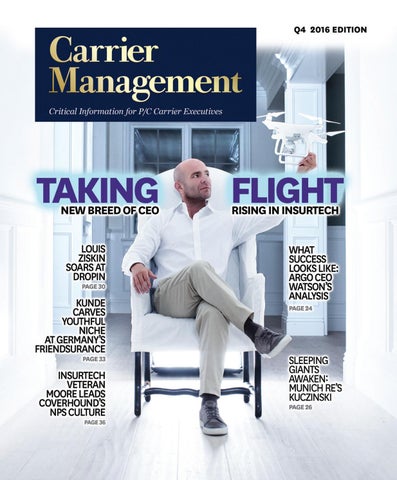
Cover photo and photo above by DAMON KIDWELL - 71 DESIGN TEAM
INSURTECH EXECUTIVE PROFILES: Innovation
30 Reversal of Fortune: How Louis Ziskin Went From Behind Bars to the Front of Insurance Technology
Louis Ziskin is soaring in his role as leader of DropIn. Taking flight in the world of InsurTech and finding backers in Silicon Valley has meant capturing the minds of believers who understand how far he has come from a difficult past. Louis Ziskin, Founder, DropIn, interviewed
33 Friendsurance Carves Out Its Youthful Insurance Industry Niche
“Starbucks tests” and comfortable workspaces are just part of the formula for engaging customers and employees at Friendsurance, a peer-to-peer insurance broker based in Germany that has expansion ideas for Australia, Europe and the U.S., according to one of the co-founders. Tim Kunde, Co-Founder and
Managing Director, Friendsurance, interviewed
36 Moving Past Disruption: CoverHound CEO Moore
While traditional insurance agents may view CoverHound.com as an early disrupter in the InsurTech space, the online agency’s current CEO, Keith Moore, faced disruption at least twice in his own career, giving him the insights and skills needed to lead a wave of positive change in the insurance industry.
Keith Moore, CEO, CoverHound, interviewed
43 Verifly CEO Seeks to Carve Out ‘On-Demand’ Niche in Drone Insurance Market
Recreational drone enthusiasts and commercial users alike can buy insurance on demand—while standing at their desired flight location—with two taps on the Verifly app. Jay Bregman, CEO, Verifly, interviewed
50 Treasure Trōv: Scott Walchek Unveils the World’s First Single-Item On-Demand Insurance
After starting some of the world’s leading interactive media and Internet technology companies—even once selling his home to meet the payroll—serial entrepreneur Scott Walchek has turned his attention to on-demand insurance for items like guitars, laptops and cameras. Scott Walchek, CEO, Trōv, interviewed Q4 2016 | 3
Features Q4 2016
24 26 15 10 12 64 28 45 53 55 56
4 | Q4 2016
EXECUTIVE VIEWPOINTS
Seven Markers of Success: An Investor’s Advice to Industry Leaders By Mark E. Watson III, CEO, Argo Group Digitalization of Insurance: Transformation or Disruption? By Tony Kuczinski, President and CEO, Munich Re U.S.
EXECUTIVE PROFILE
Beating the Odds: North Dakota Commissioner Adam Hamm Reflects on Nine-Year Tenure
EXTERNAL PERSPECTIVES
The Chicken and Egg of Employee Engagement By Jon Picoult, Founder and Principal, Watermark Consulting Take Charge of Your Own Leadership Development By Marsha Egan, CEO, The Egan Group The Disconnect Between Underwriting and Claims Handling: A Policyholder Perspective By Matthew L Jacobs, Partner, Jenner & Block
INNOVATION
Culture Clash: Marrying Traditional Insurance Business With Startup Benefits By David Squibb, Chief Sales and Marketing Officer, Xpertdoc Reporter’s Notebook: 10 Takeaways From the InsureTech Connect Conference Pretotyping Explained: Why Google, Tech Innovators Set Out to Fail Fast Customers Can Be Wary of Innovative Brands How Risk Management Can Fuel Innovation By Aaron M. Halpert, Principal, AMH Advisory LLC
Are Your Operations All They’re Quacked Up To Be?
s
ple
ic lyt
s
es
y
eg
oc Pr
rat
a An
St
Pe o
Follow The Industry Leader To Ensure Profitable Growth Operations are the foundation of your business and your productivity, performance and profitability. ReSource Pro helps you optimize your operations to unleash the full potential of your business. Contact us at 1.877.761.7276, or email: more@resourcepro.com
Features Q4 2016 VOLUME 3, NUMBER 4
58 61 79 83 87 89 21 68 72 76
6 | Q4 2016
INNOVATION
Coverage Innovation: Why and How Ironshore Developed a Cyber Warning Endorsement By Kurtis Suhs, VP and National Practice Leader, Ironshore and Jay Harmon, Consultant, BorderHawk LLC Blockchain in Insurance: Applications and Pursuing a Path to Adoption By Kaenan Hertz, an Executive Director, Dave Nuernberg, a Principal, and Angus Champion de Crespigny, a Senior Manager, all at EY
EDUCATION/LEADERSHIP DEVELOPMENT Brace for Impact: ‘Agile’ Leaders Needed to Reshape Insurance Industry
Directory: Education/Leadership Programs Don’t Let Emotions Control the Conversation Investing in Lifelong Learning By Martin Frappolli, Senior Director, Knowledge Resources, The Institutes
CONFERENCE REPORT
Wells Fargo Lesson: Maintaining Culture Hard Work for Growing Cos., Says Markel CEO
CLAIMS/LEGAL
Social Engineering Cons: Which Insurance Policy Pays? By Laurie A. Kamaiko, Partner, Sedgwick LLP Supply Chain Disruptions By Aaron Michel, Senior Engineer, AIR Worldwide
REINSURANCE
Monte Carlo Report: Has the Reinsurance Cycle Reached Bottom?
Q4 2016
www.CarrierManagement.com Critical Information for P/C Insurance Company Executives & Directors Publisher Mark Wells | mwells@wellsmedia.com CARRIER MANAGEMENT EDITORIAL Executive Editor Susanne Sclafane | ssclafane@carriermanagement.com Chief Content Officer Andrew Simpson | asimpson@wellsmedia.com Editor Mark Hollmer | mhollmer@carriermanagement.com International Editor L.S. Howard | lhoward@carriermanagement.com Copy Editor Kimberly Tallon | ktallon@carriermanagement.com CARRIER MANAGEMENT DESIGN Vice President of Design & Production Guy Boccia | gboccia@wellsmedia.com Graphic Designer Melissa Reese | mreese@wellsmedia.com CARRIER MANAGEMENT ADVERTISING/MARKETING Chief Marketing Officer Julie Tinney (800) 897-9965 x148 | jtinney@wellsmedia.com Director of Marketing Communications Derence Walk | dwalk@wellsmedia.com Chief Relationship Officer Gayle Wells | gwells@wellsmedia.com Advertising Coordinator Erin Burns (619) 584-1100 x120 | eburns@wellsmedia.com CARRIERMANAGEMENT.COM WEB Chief Technology Officer/Chief Innovation Officer Joshua Carlson | jcarlson@wellsmedia.com Web Developer Chris Thompson | cthompson@wellsmedia.com Web Developer Jeff Cardrant | jcardrant@wellsmedia.com Vice President-New Media Bobbie Dodge | bdodge@wellsmedia.com WELLS MEDIA GROUP Wells Media Group includes Carrier Management print and web publications, Insurance Journal print and web publications, Claims Journal web publication, the MyNewMarkets.com online directory, and the IJ Academy of Insurance. Executive Chairman Mark Wells | mwells@wellsmedia.com Chief Financial Officer Mark Wooster | mwooster@wellsmedia.com SUBSCRIPTIONS: Please subscribe or change your address online at: www.carriermanagement.com/subscribe Circulation Manager Elizabeth Duffy (800) 897-9965 x169 | eduffy@wellsmedia.com Carrier Management, which provides Critical Information for P/C Insurance Company Executives and Directors, is published quarterly by Wells Media Group Inc., 3570 Camino del Rio North, Suite 200, San Diego, CA 92108-1747. Phone: 1.800.897.9965. Periodicals Postage Paid at San Diego, CA and at additional mailing offices. DISCLAIMER: While the information in this publication is derived from sources believed reliable and is subject to reasonable care in preparation and editing, it is not intended to be legal, accounting, tax, technical or other professional advice. Readers are advised to consult competent professionals for application to their particular situation. Copyright 2016 Wells Media Group Inc. All Rights Reserved. Content may not be photocopied, reproduced or redistributed without written permission. POSTMASTER: Send change of address form to Carrier Management, Circulation Department, 3570 Camino del Rio North, Suite 200, San Diego, CA 92108-1747. ARTICLE REPRINTS: For reprints of articles in this issue, contact us at (800) 897-9965 x125 or reprints@carriermanagement.com for info.
www.carriermanagement.com
From the Editor
Taking Flight
I
“
t's pretty self-explanatory. I think we’ve all…probably at some point or another had a drone-related problem.”
When Cleveland Indians Manager Terry Francona spoke those words at a press briefing just prior to Game 2 of the American League Championship Series, he immediately broke into laughter, shaking his head in disbelief as he told reporters why pitcher Trevor Bauer would miss a start— because the pitcher and “drone enthusiast” had injured his pinkie finger “doing routine maintenance” on a drone. “I have no idea what that is,” the manager said, shrugging as he delivered the unexpected news. The idea that a drone repair could impact a baseball playoff game was unthinkable. The idea that an insurance industry executive would be holding a drone on the cover of our magazine wasn’t something we ever imagined either when we launched Carrier Management three years ago. And while it’s possible that the executive pictured, Louis Ziskin, envisioned being on the cover of a magazine, he probably wasn’t thinking it would be one for, and about, insurance industry executives. Ziskin’s world changed dramatically three and a half years ago, as writer Russ Banham describes in his profile of the founder of DropIn, an on-demand claims service using remote video and (soon) drone technology (page 30). Drone regulations would come to his attention a bit later, fueling a business idea. But the personal changes that brought him to helm an InsurTech startup took place over a decade. Although drone technology has some bearing on two of the InsurTech profiles we present on pages 30-52, our intent is not to drone on about drones. Instead, it is to learn about the new breed of leaders piloting new businesses taking flight on the wings of an array of emerging technologies solutions— digital, telematics, robotics, cognitive, sensors and, yes, drones. Whether these businesses are buzzing around the edges of insurance operations—tackling slices of underwriting, pricing, claims, risk mitigation, marketing and finance—or crashing head-on into traditional models with online distribution and “full-stack” insurance companies, they are increasingly capturing the attention of executives who earned their stripes in more traditional insurance organizations. Who is leading the potential disrupters? Where did they come from? How are they different? What motivates them, and how do they motivate their teams to innovate? There’s more to know about this group beyond typical generalizations about wearing jeans and sneakers. And while there are hundreds of stories to tell about the new crop of leaders, we have started with an introductory collection of seven: a surfer turned serial entrepreneur; a former Boston Consulting Group adviser; an online marketing expert; a drone enthusiast; a former meth trafficker; an actuary who has been “living and breathing insurance since age 14”; and a Chicago Booth MBA and devotee of the ancient African martial art capoeira. (The last two are available exclusively online.) Readers will no doubt find common themes in their unique stories, including one about disruption. It’s not about causing disruption, however. Instead, these leaders talk about dealing with, rebounding from and rising above disruption, adversity and failure at some point in their business careers. Drone technology may or may not be part of the winning formula for DropIn. That won’t alter Ziskin’s certainty about the road ahead. “My best days are in front of me,” he says.
Online exclusives:
• Root Debuts (carriermag.com/p5ba8) • Traity’s Network of Trust (carriermag.com/875ep)
Susanne Sclafane, Executive Editor
8 | Q4 2016
www.carriermanagement.com
External Perspective
The Chicken and Egg of Employee Engagement
Executive Summary: Watermark Consulting’s Jon Picoult tackles the question of which came first: engaged employees or business success.
By Jon Picoult
10 | Q4 2016
A
re happy, engaged employees a driver of business success or merely a consequence of it? Plenty of studies have identified a link between employee engagement and company performance. One of the most widely cited comes from the Great Place To Work Institute, the organization that produces Fortune magazine’s annual “Best Companies To Work For” list. For the past 17 years, the institute has tracked a model stock portfolio that invests in the publicly traded firms appearing on Fortune’s annual list. The results, presented on the graph on the next page, are quite engaging. The average annualized stock return for the “Best Companies To Work For” was nearly twice
that of the broad market indices. So, then, case closed—right? Happy, engaged employees appear to drive better business financial results and, consequently, increased shareholder value. Not so fast. The one vexing question that’s rarely addressed by these types of analyses is which comes first: engaged employees or business success. Take Google, for example. For seven out of the last 10 years, they’ve earned the top spot in Fortune’s “Best Company To Work For” list (including the 2016 iteration). But is the exceptional engagement of Google’s employees a consequence of the company’s success, or was it the
www.carriermanagement.com
engagement itself that helped create that success in the first place? One could argue that employees at Google and the other “Best Companies” are more engaged simply because they’re happy to be riding a winning horse. Or maybe it’s just that these companies, because they’re doing so well financially, are able to invest in workplace amenities that subsequently enhance employee engagement. The alternative explanation is that the only reason these firms are winning in the first place, and have the financial resources they do, is precisely because they had a more engaged workforce from the beginning. This is not an academic question. If engagement is more a consequence of business success than a driver behind it, that would have some interesting implications for companies’ employee engagement programs. It would suggest that business leaders should focus more directly on improving company performance, rather than on enhancing the quality of the work environment. But before you start throwing away all of your employee engagement tomes and resigning yourself to a disengaged workforce (until profits improve), listen up. This is one Chicken and Egg problem that might just have a credible answer. In 2010, researchers from Gallup and the
University of Iowa, led by Jim Harter, Ph.D., and Frank L. Schmidt, Ph.D., completed a study to determine if the link between employee engagement and company performance was really causal. They looked at the volumes of employee engagement and company financial data that Gallup had amassed in its many years as a leading research organization—data that covered over 2,000 business units in 10 large organizations across a variety of industries. Instead of just looking at the association between employee engagement and financial performance, these researchers were able to analyze the data over a time series, within specific business units. That enabled them to determine the relative causal influence, over time, between employee engagement and financial performance. Their findings, published in the journal Perspectives on Psychological Science, were clear and convincing: While a business’ financial success did help improve employee engagement, the relationship was stronger in the other direction. Employee engagement drove financial success more materially than the reverse relationship. In short, these researchers found that happy and engaged employees are a precursor to business success, not a byproduct of it. A more engaged workforce
causes lower turnover,
higher customer loyalty and better financial performance. This discovery makes the latest data from Gallup all the more concerning. According to their 2015 worker survey on the subject, less than a third of Jon Picoult is Founder and U.S. employees consider Principal of Watermark themselves engaged at Consulting, a customer work. experience advisory firm Perhaps as noteworthy, that helps companies however, is that Gallup’s impress their customers research confirms that and inspire their many of the drivers behind employees. As a consultant individual employee and keynote speaker, he engagement are well within has advised thousands of the influence of any business leaders across manager. some of the world’s This isn’t about pool foremost brands. He may tables in the office, free be reached at lunches in the cafeteria and www.watermarkconsult.net, other buzzworthy or follow him on Twitter workplace perks. It’s about @JonPicoult. managers making their employees feel valued and appreciated. It’s about showing people that you care about them as individuals, not just as workers. It’s about being as accountable to your staff as you are to your boss. These might sound like simple, common-sense leadership behaviors, but the problem is that they often get overlooked in the whirlwind of day-to-day business activities. But what managers must understand is that with every interaction in the workplace, they have an opportunity to either improve employee engagement or erode it. It’s a task that deserves the attention of every organizational leader—particularly in light of the compelling findings from Gallup’s researchers. Their study presents the best evidence yet that when managers focus on improving engagement in the workplace, it really does pay dividends—to your employees, your customers and your bottom line.
Reprinted with permission of Great Places To Work Institute. www.carriermanagement.com
Q4 2016 | 11
External Perspective
Take Charge
of Your Own
Leadership
Development Executive Summary: You want to get into management but don’t have the opportunity to learn management skills on the job. What do you do? Volunteer, says Executive Coach Marsha Egan, listing the advantages volunteering can offer and providing some tips for success.
By Marsha Egan
Y
ou’ve heard these words: “I’m frustrated that I’m not moving up fast enough at work...Why was I passed over for a promotion that I thought I deserved?…They told me I wasn’t qualified for a position because I didn’t have enough management experience…” Many people find themselves in situations like these. They want to get into management, but they don’t have the opportunity to learn management skills on the job. What can they do?
Volunteer!
Volunteering is perhaps the best-kept
career development secret. Adopt it and it will be your secret to success. Encourage those around you to take the reins and gain valuable experience in a non-jobthreatening environment. Did you ever wonder why so many successful people are also active in their communities? There is a definite relationship between voluntarism and
12 | Q4 2016
career success, and it is not only because of the good works that are done. Volunteer leadership builds these advantages that can benefit anyone as they advance in their careers: • Management and Leadership Experience. When you volunteer, you broaden your management and leadership exposure. You become involved in organizations and get to observe and participate in their workings. You witness new and different leadership styles. You learn what works and what doesn’t work.
• New and Different Leadership Models.
When you take on a volunteer leadership position, you actually gain experience managing and leading. Many times this experience is the missing piece of your career rounding, the piece that gets you “stuck.” This experience can transfer to your career. You learn planning, delegating, organizing and communicating skills. You
continued on page 14
www.carriermanagement.com
You know that propertycasualty issue that’s been troubling you? We have a course for that.
The Institutes deliver the high-impact education solutions that shape the brightest minds in the risk management and propertycasualty insurance industry today. So when it comes to designation and certification programs, leadership development, and custom educational solutions, our name is all you need to know.
Know more. Do more. TheInstitutes.org
External Perspective continued from page 12 can learn strategic planning, finance and conflict management.
• Motivation. You learn how to motivate
people without using the threat of a paycheck. You learn positive motivation. This is a great skill to have in the business world. When you work with nonpaid volunteers, who have a choice of where and when they volunteer, you learn skills that attract and engage people in your effort. If you can motivate volunteers, you can motivate just about anyone.
• Organizational Effectiveness. Volunteer groups are organizations. When you volunteer to lead one, you learn about organizational design and structure. You learn about committees and boards. You learn how to run meetings and projects. You learn how to establish backups and backup plans.
• Networking. Your volunteer efforts will
broaden your network and contact base. With each volunteer organization you join, you will meet new people. As you broaden your contact base, you broaden your experience and centers of influence. This can benefit you and your employer. You will have these contacts for the rest of your life.
• Community Contribution. As with most volunteer work, you will help your
community. This should be the sincere reason that you volunteer. The world needs volunteers, and as a result of your efforts you will grow as your community grows.
How to Get Started
Choose the volunteer effort that you know will sustain you. It's important to have a passion for the work that you will donate. Contact the chosen organization. Most readily welcome volunteers. Find the dates and times of their meetings, and plan to attend one. Attend a meeting, talk to the people and observe the group to see if it is one you will enjoy. Different organizations have different cultures, and it is important to find a match that works for you.
Join
Join a committee or task force. You will probably be asked what your interests and skills are and whether you want to participate on a committee. Some people choose committees that fit with their skills; others select committees that will develop their skills. As an example, some people will join the grants committee because they want to learn and improve their skills and knowledge about grant writing, while others who have proficiency in it might join the committee to share their skills. Volunteer for a leadership position. As
Benefits of Volunteering • Management and leadership experience • New and different leadership models • Motivation • Organizational effectiveness • Networking • Community contribution
soon as you feel comfortable, volunteer to chair a committee or do a special project that will enhance your leadership skills. The organization most likely will welcome it.
Hints for Success • Be there. When you
commit to something, do it. When you say you are going to be somewhere, be there. You can hurt your reputation by not doing these things as much as you can help it by living up to your commitments.
• Don’t overcommit.
Marsha Egan, CPCU, PCC, is a Success Strategist and CEO of The Egan Group Inc., a Nantucket, Mass.based professional coaching firm. An ICF Certified Professional Coach and Certified Speaking Professional, she is a leading authority on workplace productivity and interpersonal success strategies. She is the author of “Inbox Detox and the Habit of Email Excellence” (Acanthus 2009) available on Amazon and at http://MarshaEgan. com/IDbook. Egan is a former president of the CPCU Society. Reach her at marsha@marshaegan.com.
Take on only as much as you think you can do well. If you take on too much, you risk either burnout or not fulfilling a commitment. • Be positive. Some people in organizations like to criticize. Don’t play that game. It will show your true leadership skill. • Network. Get to know as many people as you can. Sit at different tables at meetings. Every person you get to know has potential to influence your career. • Learn from your experience. As you work to benefit your community, maximize your efforts to broaden your own experience. Vary the volunteer jobs you take on to vary your experience base. • Add value. Make a difference in your organization. • Enjoy your experience. You can enhance your own leadership development simply by volunteering. It doesn’t cost your employer. Build your community while you build your skills. That’s what leaders do.
www.carriermanagement.com
Executive Profile
Beating the Odds: North Dakota Commissioner Adam Hamm Reflects on Nine-Year Tenure
Executive Summary: Facing some long odds, North Dakota Insurance Commissioner Adam Hamm opened up the state’s health insurance market, which was dominated by one large player when he joined the department nine years ago. Similar successes at the department and the NAIC came as a result of daily hard work and a leadership style that emphasizes consensus-building.
P
By Susanne Sclafane roperty/casualty insurance executives may be worried about disrupters discovering novel ways to connect with their hard-earned policyholders, but an insurance regulator with a reputation for jumpstarting change sees positive motivations for industry action on the horizon. “What they’re really doing is they are forcing the industry to be very honest with itself, look itself in the mirror and say, ‘We had better meet this challenge. We had better figure out what our policyholders want. We better get from point A to point Z,
www.carriermanagement.com
or we are going to lose them,’” North Dakota Insurance Commissioner Adam Hamm told Carrier Management in a September interview. Asked about the creation of InsurTech competitors that include peer-to-peer insurers, on-demand coverage providers and underwriting platforms using social networking reputations instead of credit scores, Hamm delivered two calls to action: “It incentivizes the insurance industry to stay on the top of its game. And it incentivizes us as regulators to do the same thing” and to work with the industry. “If we don’t do that as regulators, then the industry is going to suffer, which is only going to hurt the insurance sector as a whole, including our insurance regulatory system,” he said. “We have the largest, most competitive insurance market on planet Earth. If we want to stay there, then we are all going to have to figure out ways to deal with these disrupters.” Hamm, who has served as North Dakota’s commissioner for the past nine years and on a national level at the
National Association of Insurance Commissioners (NAIC)—as president in 2014 and as chair of the Cybersecurity Task Force for the past two years—is actually not personally staying in either of those regulatory roles. With his term as commissioner coming to an end this year, Hamm has decided not to seek re-election. (See related textbox on page 18, “What’s Next for Adam Hamm?”) Reflecting on a career that has also taken him to Washington, D.C., where he has served as the state insurance regulator representative of the Financial Stability Oversight Council and on the Financial and Banking Information Infrastructure Committee (a national cybersecurity committee chaired by the U.S. Treasury), Hamm described one of his first accomplishments as North Dakota commissioner as a highlight—offering a lesson learned that applies directly to the current landscape of disruption. “At my initial press conference, I said one of my missions was to increase the amount
continued on next page
Q4 2016 | 15
Executive Profile continued from page 15 of health insurers doing business in our state and increase the number of products that were being offered to North Dakotans. Most folks were very skeptical,” he said, noting that Blue Cross Blue Shield of North Dakota dominated the overall health insurance market at the time, with roughly a 90 percent share of the state’s business. “Most North Dakotans said, ‘No, Adam, you’re never going to get that to occur. You’re tilting at windmills.’” But within the first couple of years, change happened in spite of the long odds. The department “started the snowball rolling downhill” toward a much more competitive health insurance market, Hamm recalled. “My senior team and I personally went out to companies. We targeted companies that were in the Midwest region, or in Minnesota and South Dakota. We went and met with those folks. We explained what our market looked like. We explained that the population base was yearning for more competition in health insurance, that whatever regulatory issues there might be, we would work with the companies to make sure that they could get their products to market in our state.” “And it wasn’t just one meeting. It was many meetings.” That hard work paid off. “We had a couple of companies that are pretty big in the Midwest area agree to come in.” And something else occurred that people said “would never happen” when Hamm staked out his position at his initial press conference. The naysayers said, “You’re never going to get Blue Cross Blue Shield to offer different products or to change what they’re doing. They have no incentive to do that because they have such a huge market share.” But once other companies started coming into the market, it spurred the dominant market share player to offer new products “and to start doing things differently than they had been doing over the course of the last 10, 15, 20 years,” he said, later drawing a parallel to the position that traditional insurers and producers find themselves in today as they see technology-focused, consumer-oriented upstarts nibbling at their heels.
16 | Q4 2016
Setbacks and Lessons Learned
But there was one obstacle that Hamm and his team could not overcome. “All of that positive momentum came to a screeching halt when the ACA [Affordable Care Act], or Obamacare, was passed in 2010. You can almost draw a line in the sand between the positive movement we achieved in 2008, 2009 and in the first quarter of 2010, with once the law was signed in March of 2010. After that, there was almost zero positive movement. In fact, in some ways it started to go backward,” the longtime Republican said. Asked to recount more personal setbacks and lessons learned over the course of his career, Hamm also draws from the health insurance market experience. “The first decision that I had to make was the largest rate increase request in the history of North Dakota” from Blue Cross Blue Shield of North Dakota. “I worked through that request the same as I’ve done every rate increase that they put in for since. But the first decision that I made—to cut their rate increase just about in half— caused a lot of consternation within that company, specifically with their CEO.” “It ended up causing a pretty significant battle between the company and the department, not just on rate increase
requests but on basically every issue that we were dealing with for that company for the better part of the first year and a half to two years I was in office.” “Even though you do everything you can to make it about the issues, to make it about the facts and the law, at some point, it did become a personality issue between the then-CEO and myself. It’s unfortunate that that happened,” Hamm recalled, ultimately appreciating the need to do everything to avoid a recurrence with any company going forward. “And then, on top of that, when those issues happen, do everything possible to make sure you’re explaining to the public why what’s happening is happening,” Hamm said. “I thought I was, but looking back I probably could have done a much better job,” he said, noting that two camps started to develop around the state in the months that followed. “It seemed like folks were talking past each other; they dug their heels in and they either completely believed that the department was right or that the company was right.” “As the elected official, if I had done a better job—not only in explaining to the public what we were doing but in doubling down on my work with the company— maybe we could have gotten past those
www.carriermanagement.com
issues” quickly, Hamm said, reporting that with the lesson learned, “things have dramatically settled down between that company and the department” and no similar issues have cropped up with any other insurer in the last seven years. “It’s certainly something that I had to learn on the fly because it hadn’t been an issue I had dealt with before,” he said.
Paying the Rent With Hard Work
Hamm, a former state prosecutor who admits that learning about insurance was a bit like “drinking from a fire hose” in the early days of his tenure, was able to apply his skills as a lawyer to rack up some other notable successes with the North Dakota department. Among them were regulating a soaring insurance market—vaulted to new heights by a booming economy—with a lean staff of just 50 employees and mining tens of millions of dollars in consumer relief for citizens of the state. “Every single case is different, and so you have to commit yourself to completely understanding your case before you would ever go into a courtroom and try it to a jury or a judge,” said Hamm, whose online biographies often cite his role in the prosecution of sex offender Kyle Bell for the murder of Jeanna North, an 11-year-old Fargo girl whose body was never recovered. “You have to have that mental commitment to doing the hard work every single day on your cases. That translated very well into being insurance commissioner because there are any number of issues in a day, a week or a year in this job, and you have to commit yourself every single day to going about the hard work of mastering the issues as much as you can,” he said, describing the early days of his transition. “Until you have that, you can’t go out and try to persuade others or build consensus on an issue.” “‘Success is only rented. And the rent is due every day.’ I really live by those words,” he said, referring to a quote he had heard as a young lawyer. “You can’t just rely on what you did yesterday or what you did a year before because, quite frankly, people
don’t care. They care about what are you doing today and what are you going to do tomorrow,” said Hamm. Among the things Hamm would do as North Dakota’s insurance commissioner would be to lead a team that delivered over
continued on next page
WE ERASE COMPLEX.
It’s no secret that most P&C policy admin solutions perform admirably when dealing with simple lines and products ... but when things get complex, most fall short. Fortunately, there’s Adaptik. Adaptik’s flexible, scalable policy administration solution guides you through the landscape of complex insurance product
implementations.
That
means
difficult-to-
administer lines – like workers’ comp and specialty casualty – can become drivers of significant and sustainable growth.
CRE AT IN G OP P O RT UN IT Y OUT O F CO M P LE X I T Y
www.adaptik.com/complexity
ADAPK004.indd 1
www.carriermanagement.com
$45 million of consumer relief to North Dakotans over nine years. “That’s everything from things like the State Health Insurance Counseling Program, Prescription Connection and individual
10/21/16 11:26 AM
Q4 2016 | 17
Executive Profile continued from page 17 assistance on complaints or inquiries that are coming into the insurance department,” fielded by veteran complaint investigators, many with 15 or more years on the job.
(Editor’s Note: SHIC offers free help with Medicare and other health insurance; Prescription Connection is a department program that connects children, families and people of all ages with free and discounted prescription drugs, according to the North
Dakota insurance department website.)
Hamm, who spent six years working in private practice for a Fargo, N.D., firm after his four-year stint in the prosecutor’s office, lists that type of activity as one of the reasons he put his name into the hat for the insurance commissioner job when the prior commissioner, Jim Poolman, resigned in 2007 to become an insurance industry consultant.
“Doing the work I did as a prosecutor or in private practice, you’re helping folks individually or you’re helping a family, or in some ways a company or an entity. As a statewide elected official, your responsibility and your scope expands upon that. You’re able to do work that can assist, in a general sense, your entire state,” he said, explaining the decision. Appointed by Gov. John Hoeven to finish
What’s Next for Adam Hamm?
W
hen Adam Hamm talks about his work at North Dakota’s insurance department and in various positions at the NAIC, he emphasizes a commitment to the tasks at hand. The idea of commitment also figured heavily in his decision not to seek a third term as commissioner, he said. “When you run for statewide office, it’s a huge commitment. At the very top of that list of commitments is the fact that it’s a four-year term,” he said. “You have to go through that mental analysis of, ‘Do I want to do this for another four years? Do I have the fire in my belly to do it?’ “When I went through that analysis four years earlier in the fall of 2011, I couldn’t wait to run for another four years. I had a number of things I wanted to get done. I was already an officer at the NAIC at that point, so I knew I’d be the president in 2014… “When I did that analysis in the fall of 2015, the fire wasn’t there. Looking at myself in the mirror, I couldn’t commit that if I ran and won in 2016 that I would serve all four years. What I didn’t want to do is run and win and then halfway through my term leave for some other opportunity. “At the end of the day, none of these elected officials are in lifetime jobs. There’s a shelf life for all of them. It’s critical for any statewide elected official to realize when their shelf life is up and that it’s time to move on.” What Hamm will move on to do is
18 | Q4 2016
still to be determined. “I would like to use the skills and experience that I’ve been fortunate to attain over the last nine years and to stay in the insurance sector in some way, shape or form. What that would entail, that’s what I’m working through at this point,” he said, when asked if his future might be insurance or politics. Hamm’s interest in politics dates back to the beginning of 1998. When he worked in the state prosecutor’s office, he was politically active in the Cass County Republican party—something that probably helped him land the insurance department spot when it opened up. “If you are in a leadership position as I was in Fargo, you get to know all of the elected officials,” which at the time included Jim Poolman, the former commissioner, and Governor John Hoeven. “We are on a first-name basis here, which is different than a lot of other states,” Hamm said, noting that Attorney General Wayne Stenehjem encouraged him to consider the commissioner opening in 2007. But when he was younger, Hamm had different career aspirations—first wanting to be a professional athlete and later redirecting his efforts to law enforcement. “I actually went to college to become a cop,” he said, noting that he attended a top criminal justice program at Sam Houston State University. But as he learned from professors who were former law enforcement agents with the FBI and DEA, he found his interests
evolving toward prosecutorial work. All these years later, as Hamm prepares for his next career chapter and takes everything in for the last time—attending his final NAIC sessions, agent forums and internal department meetings—the selfproclaimed “action junkie” said what he’ll miss most is “the variety of the work, the pace of it and the fact that within the insurance sector, you get all of the information first.” “It’s amazing how you go from one day you’re in the know on everything, and in the know immediately, to the next day when you’re no longer commissioner. You’re out of that immediate information loop,” he said. “After nine years doing this, it has become almost second nature for me to multitask a hundred different times a day.” Ex-commissioner colleagues have warned that the transition will take some getting used to, he said.
www.carriermanagement.com
Poolman’s term in October 2007, Hamm was twice elected by state voters to serve four-year terms in 2008 and 2012. Looking back on his tenure, Hamm is proud of being careful with the money of state citizens who support the state agency through tax dollars and premium tax funds. “I wanted to make sure that, to the greatest extent possible, we were spending as little as we could and still do a good job.” That's a tall order in a state of 2,300 licensed insurance companies that’s seen premium volume jump from $4 billion to $6 billion in a year and a producer base soar from between 40,000 and 50,000 to 70,000, largely driven by the uptick in economic activity and energy development. “We have a very small department, [but] we’ve been able to handle that massive growth in the insurance industry with the same number of people,” he reported. Looking for any efficiency possible, the team has gone paperless with every opportunity that it could find and engaged
in a cross-training effort for all employees. “If in a given week, month, quarter, one division or one part of a division is slower than another, they can help the others… That helps keep the FTE count down. When you have 50 folks that basically understand, in large part, how to do everybody else’s job, it helps tremendously,” Hamm explained.
Leadership Style
Hamm emphasizes consensus-building and said that a quote by Harry Truman has influenced his leadership style: “It’s amazing what you can accomplish if you don’t care who gets the credit.” “I firmly believe that when you work within a diverse group of people—and the NAIC is a perfect example—that if you show them every single day by the way you conduct yourself…that it’s not about you, that it’s about all of them and it’s about the issue and moving it forward, then people are quick to jump on board,” he said.
“As we all know, the common refrain about the NAIC is it stands for ‘no action is contemplated.’ I don’t believe that’s true. And on any number of issues in my time as insurance commissioner we have proven that that’s not true,” he said. Hamm’s most recent NAIC accomplishments come as head of the Cybersecurity Task Force, which completed four key initiatives last year and is currently developing an Insurance Data Security Model Law. (See
related article, “A Top Priority: Regulators Tackle Cybersecurity” by Adam Hamm, at carriermag.com/9fcrh and accompanying textbox, page 20.)
“In order to get 56 commissioners and an insurance regulatory system that has over 11,000 state insurance regulators to move on a given issue, as the leader of whatever that group is—whether it’s a working group or task force, a committee, or the entire membership—you have to show every day that you’re committed to working together,
continued on next page
THE PULSE OF THE INDUSTRY We put data to work for you.
Economic trends
Market dynamics
Legislation
Industrial prices
IAA keeps close watch of the factors that matter most to our clients. Visit IAA-Auctions.com/LossSolutions to learn more about how our research can help guide your business. © 2016 Insurance Auto Auctions, Inc. All rights reserved.
IAACM002.indd 1 107170-16_Ad_20160915_v2_SA.indd 1
www.carriermanagement.com
10/19/16 4:36 PM PM 9/15/16 1:33
Q4 2016 | 19
Executive Profile continued from page 19 figuring out the issues that folks have and then working to address them. If you do that, you can get big things accomplished,” he said, recalling an early role at the NAIC as chair of the Principle-Based Reserving Task Force, ultimately moving the state insurance regulatory system to a brand new reserving methodology in life insurance for the first time in a century. As was true of the health insurance
market initiatives in his state, critics said PBR couldn’t be done—that “there was no way you could ever get all the states and territories comfortable moving away from a formulaic reserving methodology that had worked for centuries.” Not only did the doubters say “it was too big a gamble,” they also said it would be too much of a resource burden for individual states. But a team of regulators that included
Hamm, Tom Sullivan (Conn.), Joe Torti (R.I.) and Julie McPeak (Tenn.) chipped away at it, little by little, one issue at a time. “It’s the same on any of the issues we work on. It is amazing what you can accomplish if you don’t care who gets the credit.”
(Online Bonus: “A Regulator’s Perspective on Future Challenges,” Hamm outlines three key issues insurance regulators need to address.)
Next Steps for Cybersecurity Model Law
H
aving faced a lot of “can’t be done” reactions to initiatives like increasing competition in North Dakota’s health insurance market and changing a centuries-old life insurance reserving method—and proving the doubters wrong—Adam Hamm isn’t overwhelmed by 180 pages of comments raising concerns about a draft model law for cybersecurity. In March 2016, state regulators first exposed the Insurance Data Security Model Law for public comment, building on a consumer bill of rights (officially known as the Roadmap for Consumer Cybersecurity Protections) adopted by the NAIC last year. The NAIC’s Cybersecurity Task Force, which Hamm chairs, released a second draft for comment on Aug. 17. The need for compromise is evident at the very top of the new draft, which revises language related to the applicability of the law and coordination with other regulations. The “purpose and intent” description previously said: The purpose and intent of this Act is to
establish the exclusive standards for data security and investigation and notification of a breach of data security applicable to licensees in this state. The revision reads: Notwithstanding any other provision of
law including [insert reference to state’s general data security breach notification law], the purpose and intent of this Act is to establish the exclusive standards in this
20 | Q4 2016
state for data security and investigation and notification of a data breach applicable to licensees, as defined in Section 3G.
In addition, careful readers of the redlined version will notice deletions of sections prescribing the use of the Framework for Improving Critical Infrastructure Cybersecurity developed by the National Institute of Standards and Technology (NIST) for risk management and the use of an Information Sharing and Analysis Organization (ISAO) to stay current on threats and share information, among other changes. Just about a week after comments on the second draft were delivered, we asked Hamm if he was disappointed by compromises or frustrated by a new round of comments. “My bottom-line answer is that we’ve done a lot of good work on the task force from the initial draft to this second draft. There are still areas and issues we need to work on over the remainder of 2016, [and] we’re starting to winnow that list down from what are the remaining huge issues for the insurance companies, insurance agents and regulators,” he said, referring to the stack of comment letters that comes in at 186 pages. “But at the end of the day, we have reached the stage of the proceedings where insurance regulators need to ask themselves, ‘What is in the best interest of consumers?’” Referring to building blocks put in place in 2015 that included development of the consumer road map, a set of 12
guiding principles for regulators, and updated regulatory exam protocols, he said, “All of that was the appetizer for the main course this year.” “In reality, we’ve been directly or indirectly working on the model for well over a year and a half now,” he said, referring to the fact that the task force actually came together in late 2014. Is it now in consumers’ interests “to keep working on all of these issues past the end of this year and continue on into next year? Or to continue working to find quality areas of consensus...but finish the model in 2016 so it can start being introduced in legislatures in 2017?” Immediately offering his own answer in favor of the latter, Hamm outlined two reasons. “First, these breaches are continuing to happen. It’s not like we have crested this wave and they are starting to slow down…They’re going to keep happening because the cyber bad guys know how much personally identifiable information the insurance sector has.” In addition, Hamm noted that “at some point the other shoe is going to drop. We’re not just going to have Americans having their PII [personally identifiable information] compromised; they’re going to start becoming real victims of fraud. Some folks will end up discovering that their PII was sold on the Dark Web and that their PII was used against them…” “It behooves us, as insurance regulators, to have our comprehensive regulatory framework done before that other shoe drops.”
www.carriermanagement.com
Executive Viewpoint
Wells Fargo Lesson:
Maintaining Culture Hard Work for Growing Cos., Says Markel CEO
Executive Summary: With the essence of Markel’s corporate culture set out in a written “style” document that is used as a gut-check against every strategic decision, the diversified specialty insurance and non-insurance company hopes to avoid problems like one that cropped up at Wells Fargo recently.
I
By Susanne Sclafane t’s not uncommon for one of the leaders of Markel Corp. to be greeted by an employee intent on giving him “what for” about something going on at the company as he exits his car in the morning. Richie Whitt, co-chief executive of the Richmond, Va.-based diversified insurance and non-insurance holding company, shared his regular employee parking lot encounters during a presentation at an insurance conference in September,
www.carriermanagement.com
explaining that he wouldn’t have it any other way. “I think that’s fantastic. Our people thoroughly believe they have the right—and they do—to stand up when they think that something is not happening the way it should in [line with] ‘The Markel Style,’” he said. Whitt explained that the right to speak up to executives and broad standards about the way things should be done are spelled out in a six-paragraph document titled “The Markel Style”—a blueprint of the firm’s culture. “We are encouraged to look for a better way to do things...to challenge management,” reads one of roughly a dozen principles. Highlighting that stated goal, along with others that speak to everything from good humor to honesty and fairness, and from building shareholder value to maintaining spontaneity and flexibility, Whitt said that every strategic decision is measured
continued on next page
Q4 2016 | 21
Executive Viewpoint continued from page 21
against the style document. “Culture is not what you do, it’s how you do it,” he said, noting that while some style statements, like “We believe in hard work and a zealous pursuit of excellence,” may sound like “motherhood and apple pie,” culture is the No. 1 competitive advantage of the $12.3 billion market cap company. That culture remained intact even as Markel made its way into the Fortune 500 this year—at No. 476, more than 400 spots below 27th-ranked Wells Fargo, where a spectacular breakdown in culture has put the bank’s name in financial headlines. Whitt offered some insight just a week after news broke that thousands of bank employees had created roughly two million fraudulent accounts for customers without their knowledge in order to meet internal sales targets—activities that have since led to regulatory fines and the dismissal of over 5,000 employees. “People have questioned the culture,” Whitt noted at the KPMG Annual Insurance conference. “I think Wells Fargo has a very good corporate culture,” he said, noting that the learning he takes away from the bank’s issues relates to the problems of massive growth. “What it points out to me is the difficulty in how hard you have to work to maintain a culture when you’re growing” at that pace, he said. “They’ve grown too fast, and they have to go back and do some work to make sure all of their employees understand what they mean by Wells culture and what it doesn’t mean. “It’s something we constantly worry about [at Markel]. We have grown very fast—nothing like a Wells Fargo, but we
22 | Q4 2016
always think about how is this growth going to impact our ability to maintain that culture,” he said. According to Whitt, “The Markel Style” statement is “a living, breathing document” that executives use each day. “As we make decisions around investments, around acquisitions, you name it, we’re asking ourselves: How does this fit with our values? Is this aligned with the Markel Style?” Among other things, the style document says: “We have the ability to make decisions or alter a course quickly. The Markel approach is one of spontaneity and flexibility. This requires a respect for authority but a disdain of bureaucracy.” Referring to Wells Fargo, Whitt said, “I would be really disappointed if we had an issue similar to that because I think our people really do feel empowered to stand up if they feel like we’re not doing things in line with our culture.”
Markel’s Growth Story
Whitt made his remarks during the KPMG Annual Insurance conference, where topics like “disruption,” “innovation,” “robotic process automation” and “autonomous vehicles” were high on the agenda. The one-time KPMG accountant said Markel executives are thinking about all these things too and are equally excited about technology and disruption that will change the industry for the better. But for the most part, he was intent on delivering a message about “some of the things that don’t change,” he said, introducing his talk on topics like culture, long-term thinking, the need for diversification—all things that have been the backbone of Markel’s growth story. “Those fundamentals—the things that
don’t change—will help you to tackle all these massive amounts of changes that are going on around us at an ever-increasing pace,” he said. “Try not to panic,” he told the crowd, offering the homespun Warren Buffett-like wisdom that’s been common from leaders of a company that traces its roots back to a family business that started in 1930. “There should be a sense of urgency around all these things that we’re dealing with today. But let’s not take our eye off the ball of some of the things that have gotten us to this point.” Tracing the history of Markel to its current position, Whitt reviewed a series of striking growth numbers that culminated in a global company that today has 10,600 employees (3,600 in insurance companies; 7,000 in non-insurance companies) working in 62 offices in 20 countries— ranging from a more than 1,000-person office in Richmond, Va., to one- and twoperson shops elsewhere. Using the 1986 date of an initial public offering as a starting point, Whitt said that: • Net income to shareholders has soared from $5 million in 1986 to $583 million in 2015. • Book value, just $16 million back in 1986, has grown at a compound annual rate of 19 percent to $7.8 billion. • Investments of $30 million in 1986 totaled $18 billion last year. • The stock price of $8.33 when Markel went public in 1986 was $833.35 at Dec. 31, 2015. Together, the global insurance operations write more than $4 billion in premium, with reinsurance adding another $800 million. The 2013 acquisition of Bermuda-based Alterra, now called Markel Global Reinsurance, was also part of the growth story, as was the acquisition last year of insurance-linked securities specialist CATCo, which manages some $3.6 billion of assets. Referring to the ILS market as a “a big area of innovation in the insurance industry,” Whitt told conference attendees, “We wanted to have a platform in that part
www.carriermanagement.com
of the market.” Markel Ventures, added to the Markel story in 2005, generates another $1 billion in revenues, Whitt reported. “Our primary businesses are insurance and reinsurance. That’s where we’ve grown up over the last eight decades.” But Markel Ventures, the investment arm through which Markel makes permanent investments in businesses outside of the specialty insurance marketplace, has given the company a great deal of diversification. “You probably know of another company that has that sort of formula,” Whitt said. “In a small way, we are trying to emulate what Berkshire Hathaway has done over many decades.”
Entrepreneurs and Disrupters
Markel traces its roots back to 1930, when Sam Markel turned an idea linked to the latest technological innovation of the time—the growing use of cars in the United States—into an insurance sales opportunity. After World War I, soldiers returning home bought cars, and to pay for them they turned them into cabs, referred to as Jitney buses, charging nickel fares for rides. (Jitney was slang for a nickel back then.) “Sam Markel was an entrepreneur. He was a disrupter, as you would say today,” said Whitt, noting that the company’s founder, then a member of the city council of Norfolk, Va., saw a business prospect. “He went to the city council and talked to them about requiring insurance for these guys. He got that set up and then decided, ‘I’ll sell these guys insurance,’” Whitt reported. “It was pretty brilliant.” Markel subsequently grew from a wholesaler and managing general agent in the transportation insurance segment—a niche that was the focus for the first five decades of Markel’s existence—into a specialty insurance operation (Essex Insurance launched in 1980) and finally into an international operation (with the acquisition of Terra Nova in 2000). While taking the company public in 1986 supported much of the subsequent change and growth, Whitt said the family roots remain important.
www.carriermanagement.com
“We want to be this interesting combination of a family and public company,” he said, noting that he and co-CEO Tom Gayner and other members of the management team are actually the first group of leaders that does not include a member of the Markel family. “We’re at a really unique time in our history where we want to maintain our culture,…but for the first time since it began, there won’t be a Markel family member at the head of the organization today like there has been for the past 80-plus years.”
What’s Next for Markel?
Whitt answered the question with regular references to the style. “We will keep our way—our culture, the principles that have helped us get here,” he said. “We think they still work in this fast-changing world. We will use them to help us adapt.” “We will innovate,” he added. “You’ve got to innovate, or you die. Maybe you have to innovate more quickly now, but it’s always been the case.”
“What it points out to me is the difficulty in how hard you have to work to maintain a culture when you’re growing.” Richie Whitt, Co-CEO, Markel In fact, he noted a special urgency in the property/ casualty insurance industry. “We’ve got anywhere from a 20 to a 50 expense ratio on some of our lines of business. Talk about something that’s ripe for disruption...Somebody seeing a product where 50 cents of each dollar doesn’t go to helping the client—it’s chewed up in expenses and moving the business around. That’s unacceptable, and somebody is
going to figure out how to attack that.” Referencing excerpts from The Markel Style as he spoke, Whitt referred often to the need for finding balance in the familyturned-public company as he highlighted lessons from an 86-year journey. “We try to keep it fairly informal at Markel,” he said, referring to the “disdain for bureaucracy” proclaimed in the style statement. But “we have to be careful not to fall into anarchy… Bureaucracy on its face is not a bad word. As you get larger, you have to have a certain amount of bureaucracy to keep the trains running.” “But it’s all about balance…We have tried to balance having the right amount of bureaucracy and no more in our organization,” he said. Whitt highlighted another balance imperative as he discussed the final sentence of The Markel Style document: “There is excitement at Markel that comes from innovating, creating, striving for a better way, sharing success with others… winning.” Whitt said: “We don’t view winning as ‘I win, that means someone else has to lose.’ It’s not binary,” he said. Markel leaders think about winning for five sets of stakeholders: shareholders, customers, partners (vendors and producers), employees and communities. “The art comes in how you balance the needs of those stakeholders,” he said. “You could argue that Wells Fargo got out of balance and was favoring the shareholders a little bit over their customers...They’re going to have to regain and re-establish the balance between their constituencies.” Making reference to broad conference themes about disruptive technology, Whitt called for balance once again. “We very much believe in relationships—that people do business with people they like and trust...Technology is critical, [but] I hope I don’t live to see the day when technology replaces relationships. In a perfect world, technology is there to enhance and enable the relationship. God forbid it replaces the relationship,” he said, offering a go-forward challenge for Markel and other insurers.
Q4 2016 | 23
Executive Viewpoint
Seven Markers of Success: An Investor’s Advice to Industry Leaders Executive Summary: Mark Watson, who once co-founded a venture capital fund and now serves as CEO of global insurer Argo Group, reveals that investing has an instinctive component. Still, his gut instincts are supported by patterns of organizational health that are common among successful companies. Here, Watson shares seven clues that guide his investment decisions.
A
By Mark E. Watson III s an investor, my goal is to find companies that can differentiate themselves strategically to drive sustainable growth. That focus may seem self-evident, but it had to be learned. In particular, I’ve had to break it into discrete categories of investigation that ultimately influence my decision to invest or not. The topics include all the typical elements of a business plan: line of business, stage of development, size and maturity of the market, product rollout, operational and marketing plans, quality and experience of the management team, intended use of the funds, and cash-flow projections. But I learned early on that, beyond clinical assessment, investing has an instinctive component. I began to get gut feelings about companies based on patterns and clues I uncovered in my research. Importantly, I began to see what a company might do differently to make its plan work, particularly as a part of Argo. Today, after 20 years working as a CEO in one of the companies I invested in, I understand a lot more about what makes a
24 | Q4 2016
company succeed. The qualities that give me the gut instinct to invest are more clear today. Here, in my opinion, are seven markers that I look for as indicators of success. Would investors find them in your company?
1. You know why you exist.
I had run an insurance company for almost 15 years when my young son asked me to explain what I did, other than ride on planes and talk on phones. I answered, “I help other businesses stay in business.” There was no doubt in my mind that, as a global underwriter, our mission as a company is simple and clear. Yet many companies—especially early-stage companies—have no compelling reason to exist other than to make money. In an age of global competition, that urge is not enough. The reason for your company’s existence must relate to the needs of your customers, and it must be both useful and true. If the reason seems misplaced or muddy, it will take much longer for your company to achieve stable growth.
2. You prove you understand innovation deeply.
It’s not enough to have great ideas about new products and services, yet that’s often all investors see in a business plan. Innovation in a growing company is a process of continuous reformation, and much of that will come from small, interactive improvements in strategy,
execution, structure, talent management and customer relationships. Because the needs of your customers change constantly, everything your company does that affects customer value must be constantly open to change. That happens only in companies that have built and maintain a culture of innovation. And that’s rare. As a test, veteran investors will ask about a company’s approach to improving its processes. A great answer is, “We take out any step that doesn’t add value for the customer.”
3. You define how you build relationships with your customers.
The best way to know what you can sell is to know exactly what your customers need. It’s often hard to
distinguish what they truly need from what they say they want. Henry Ford is famously thought to have said, “If I had given my customers what they wanted, I would have built a faster horse.” He understood better than his customers the increasingly mobile environment in which they would be working—and only then because he watched them and knew them well. In the digital world, true customer intimacy is difficult to achieve. Make a plan detailing how you will build deep relationships. It should include programs beyond mere digital communication. (How close can you really get to someone through email, text, chat lines and voice mail?) If yours is a growth-oriented company, you will take practical steps to get closer to your customers and understand their challenges. That requires finding ways to monitor and measure your success in making those relationships profitable.
4. You differentiate your company with deep domain expertise.
Any company that cannot differentiate its offerings from those of the competition will be forced in the end to compete on price alone. And that will be the end. Value is a perception that your customers hold about the relative worth of the offerings before them. While your prices are always a factor, much of
that perceived value will come from the belief that your company understands their needs better than the others. That takes deep understanding of the environment in which your customers operate. Yet too often, a company is expert only in the products it builds. Over and over again, I have seen how customers will pay a premium to a vendor that knows the customer’s world and provides value.
5. You stay flat enough.
As companies grow, their tendency is to build an ever-deepening stack of management layers, a hierarchy of hierarchies. In an earnest effort to manage their executives’ scope of control, they separate leaders from doers and unintentionally create a communication gap that stifles innovation and execution. New ideas must be quickly socialized up and down the chain of command. Work relentlessly to find the right balance between reporting structures and communication structures. Stay flat enough to make sure creative conversations about improvement flow freely through your organization.
6. You hire and reward ‘A’ players.
All CEOs admit that their people are their greatest asset. But do they back it up? The fact is that high-performance employees (typically, the top 10 percent of your company’s workforce) drive 80 percent of your company’s revenue. If you’re intent on growth, you will put concrete plans in place to hire, reward and retain high-performing people. With your executive team, determine how to build an engaged workforce and decide how you intend to move unengaged staff out of the organization.
7. You make sure every employee understands your strategy.
No matter how good your team, if they don’t understand where you’re headed, they will not perform well together. Your company’s strategy should both identify your destination and set out a plan to get there.
About Mark Watson
Mark Watson is Chief Executive Officer of Argo Group, a position he took in 2000. Prior to joining the company, he was one of two founding partners of Aquila Capital Partners, a venture capital firm based in San Antonio. Watson is still an active investor in growth-oriented companies. In 2016, he was named Ernst & Young’s Entrepreneur of the Year Transformational CEO for the Central Texas Region.
Investors look for a strategy that’s sound, but they also judge whether strategy is understood throughout the organization. Top-down communication (by email or on intranets) is less effective without face-toface dialogue.
Value is a perception that your customers hold about the relative worth of the offerings before them. Design and maintain strong programs of employee communication that rely on in-person conversation with individuals and teams at every level. Only then will your employees be able to align their activities and ambitions with the overall goals of your company.
Q4 2016 | 25
Executive Viewpoint/Innovation Executive Summary: Will the insurance industry rise to the challenge of digital disrupters? Munich Re U.S. CEO Tony Kuczinski describes the ultimate payoff for leaders who change their corporate cultures to be agile and future-focused—deeper partnerships with clients and other stakeholders.
T
By Tony Kuczinski his is a fascinating time to be working in the insurance industry. Technological and social changes are transforming the world around us and changing how we do business. Insurers and reinsurers that get ahead of the wave and bring their companies into the digital era will elevate them to a new level, providing ever greater value to their customers. For the last several years, among other initiatives, Munich Re has placed teams of professionals in Silicon Valley and other innovation hubs such as Tel Aviv and Berlin. These teams were deployed to meet with startups, venture capitalists, large tech firms and others who are part of that ecosystem. Their primary mission is to learn about trends in innovation, form new partnerships and invest in companies that have strategic value for Munich Re and our clients. In the short time we have been there, we have seen an incredible surge in InsurTech activity. Since 2014, InsurTech startups have raised equity capital of $4.5 billion compared to just $746 million in the three years prior. (Source: CB Insights
Insurance Tech blog: “Funding to Insurance Tech Startups Tops $1B in First Half of 2016,” July 5, 2016)
Why target insurance? Outsiders view our industry as being slow, technologically outdated and inefficient. In addition, they believe we are only minimally meeting customer needs. Many see an opportunity to partner with insurers and provide tech solutions for various parts of the value chain. Some, however, look to set up competing models and disrupt the industry completely. Digital disruption is one of the great challenges for all leaders today. Companies
26 | Q4 2016
Digitalization of Insurance:
Transformation or Disruption?
that are able to transform themselves and are out front in terms of digital adaptation will thrive. Gartner predicted last year that by the end of 2016, insurers leading in digitalization will financially outperform slower digital adopters by 100 percent.
(Gartner Inc. “Predicts 2015: Insurance CIOs Need to Balance Opportunities and Risks of Digitalization,” Nov. 19, 2014)
What else could deliver that kind of competitive edge? Digital technology is the engine of change today, just like the steam engine powered the Industrial Revolution. To move our industry forward, we must understand and be prepared to respond to the many drivers of digital transformation that cut across all industries.
Interconnectivity
One driver is interconnectivity. It’s been eight years since the launch of smartphones and, already, we can’t live without them. These powerful, pocket-size computers have sensors that can provide health-relevant data, GPS that tracks our movements and location, and cameras enabling each of us to be news reporters. Sensors are being placed everywhere—in drones, industrial machinery, home products—all connected to the Internet and delivering unprecedented amounts of data. Data is fueling the digital economy. The Internet of Things will be its infrastructure. What does this mean for insurers? The volume of data that insurers are gathering, managing and analyzing is
www.carriermanagement.com
growing at an exponential pace, allowing for improved risk assessment. The increased availability of risk-related data can expand the boundaries of insurability, improve the accuracy of risk modeling and pricing, and allow companies to assess risk and price products with greater precision and personalization. It can also significantly improve claims handling. The ultimate cost of claims incurred often depends on how fast losses can be detected and evaluated. Interconnectivity accelerates decisionmaking, improves loss estimation accuracy and detects fraud. But it goes further, with the potential to vastly improve loss prevention. Modern sensor technology, in combination with data communication and storage capabilities, makes it possible to monitor the environment much better and more quickly than ever before. If insurance companies can tap into this opportunity, we will achieve significant progress in the area of monitoring insured assets and actively preventing losses. As frequency declines and severity increases, the value we offer will become more about providing knowledge and services to prevent large losses from happening in the first place. This will be a game-changer.
Empowered Customers
Another defining characteristic of digital transformation is empowered customers, who are now more front and center than ever before. This is true whether the client is an individual buying an auto policy or an insurance company purchasing a complex reinsurance treaty. Their bargaining power is enhanced with greater access to information and increased competition. Customers today want more than just ease of use. They expect more customization, regular engagement and proactive experiences. With the sharing economy, or peer-to-peer markets, they are not only the consumers of goods and services; they are increasingly the suppliers. Insurance on demand is another manifestation of customer empowerment. More industries are looking to meet the
www.carriermanagement.com
needs of today’s connected consumers, who want what they want, when they want it, and only as much as they want. In our industry, companies are developing smartphone apps that allow consumers to buy insurance coverage for only what they need and for only as long as they need it.
Acceleration of Innovation
Technology companies are continually innovating, and this is flowing over to other industries as they in turn become more digitalized. Increased speed to market leads to many benefits, including the first-mover advantage and time to build market share before a product is commoditized. Agility and speed also enable companies to react more quickly to competitors’ moves or to shifting markets.
“Digital technology is the engine of change today, just like the steam engine powered the industrial revolution.” Tony Kuczinski is President and CEO of Munich Re U.S. For the
historically slow and conservative insurance industry, this is one of the greatest challenges: changing our corporate culture. Leaders need to foster a dynamic culture— one of continuous innovation—where employees are constantly creating new solutions and driving change. Embracing disruption starts with creating an environment where employees are willing to take risks and management accepts mistakes, allowing us to be iterative in our development approach and not expecting perfection right out of the gate. To accelerate innovation, we must encourage collaboration among employees, as well as with business partners, clients,
Increased availability of risk-related data, especially types of data not currently considered in risk assessment, can expand the boundaries of insurability. InsurTech startups, associations, academic organizations and government entities.
Ripe for Disruption?
Based on an extensive study, IBM warns business leaders about key indicators of an industry being ripe for disruption. (“Global
C-Suite Study: Is Your Company About to Be ‘Ubered’?”) These include:
• Sector interest from venture capitalists. • Technology being introduced within companies to cut costs rather than improve customer experience. • An aging customer base. • Poor customer satisfaction. Will the insurance industry rise to the challenge? Has all of the talk of disruption awoken the sleeping giant? We are starting to see a greater share of investment in InsurTech startups coming from traditional insurers looking to enhance their value chain. While some just want to cut costs, many seek to significantly improve customer experience and even change business models. Although some companies that do not transform will likely be disrupted, many others will thrive as disrupters challenge our industry to be better. If we truly adapt to the digital economy, there is enormous opportunity for us to drive our industry forward in a way that enables us to provide ever greater value to our shareholders, clients, employees and society. To get there, industry leaders need a digital strategy that includes how to deal with new entrants—whether to partner with them or compete by strengthening our core. We must bring in talent with the technical skills needed to build our companies for the future and to become agile—continually focused on what’s next. Whether an insurer, reinsurer or intermediary, we must become valued partners to our clients, providing continuous risk service. By driving our own disruption, I am confident we will emerge as a stronger, more vibrant industry in the future.
Q4 2016 | 27
Innovation
By David Squibb
A
pparently, 50 is the new 30 and “Orange is the New Black.” Reinvention is the word of the day, and even the traditional insurance industry is getting in on the act. Shopping and purchasing experiences in other industries have set the bar for insurance customer expectations at a level few established players will ever be able to reach, let alone vault over. Constrained by old technology, limited access to talent that can implement or integrate emerging technologies, and demands by newer buyers for product choice, speed-to-market and transparency, traditional insurance companies are struggling to compete. Conversely, insurance startups are rapidly securing funding from Day One by adapting some characteristics of the startup culture to fit a legacy industry. In spite of the tendency to occasionally play fast and loose when it comes to regulatory compliance, startups are going directly to the cloud for functionality and scalability, hiring remote workers to access a higher caliber of IT talent, and incorporating a younger demographic to help craft a new, more powerful customer experience. The question now is how to best bring these two differing cultures together for the benefit of the insurance customer—and the insurer’s bottom line.
28 | Q4 2016
A Journey, Not a Destination
A significant difference between traditional insurers and the new players is found in the realm of technological maturity. Incumbent insurers bring plenty of baggage to a relationship in the form of hardwired, code-based, rigid, segregated/siloed core systems that create the need for patches, workarounds and paperintensive processes almost as a matter of course. They are afforded few insights into customers across products and business lines, making reaction times slower and customer satisfaction more difficult to achieve. “Quick” and “agile” are terms that cannot typically apply to legacy systems, where upgrades and enhancements are rarely, if ever, planned and completed. Without millions of dollars and countless full-time employees invested in decadesold tech, new insurers have a clear advantage. Starting from scratch
www.carriermanagement.com
with technology literally built for the future, they are avoiding comprehensive, on-site implementations and expensive professional services in favor of technology platforms that are cloud-hosted, infinitely scalable and can be accessed from anywhere on the planet. Upgrades are seamless and are often performed by the technology provider without any business interruption to the insurance value chain. Traditional insurers may never fully realize the level of speed, flexibility and agility inherent to outside competitors, but technology must be modernized to a point where scalable, automated processes can be created, where access is 24x7x365 and self-service opportunities are plentiful. Change in this area won’t be easy for traditional insurers facing a workforce conditioned to prioritize “keeping the lights on” over innovation and creativity. But, by the same token, startup insurers must moderate enthusiasm for cool technology tools with serious insurance domain expertise. One cannot be successful without the other.
The Talent Gap
Traditional insurers need to become more digital and data-driven, in terms of adoption of emerging technologies and delivery models. To do it, they must cross another chasm. Lacking the IT talent needed to evaluate, implement and integrate emerging technologies, many are still spending most of their available IT hours and budgets on maintaining existing systems. That is an enormous portion of their manpower that could be better spent on customer-facing systems and activities. Unfortunately, many of those IT personnel are COBOL programmers and data entry staff, individuals not readily capable of providing support for more modern technologies without extensive— and expensive—retraining. By relying on cloud-hosted core administration software, startups minimize the need for dedicated IT staff with point-in-time tech skills in favor of more highly trained individuals who are able to perform cross-functionally. Lines between business and IT will blur faster in a startup environment than in a traditional insurance business, without a doubt. In terms of talent, traditional and startup insurers each have strengths and weaknesses that can be overcome or exploited in the quest for success. As traditional insurers upgrade existing systems and naturally start to onboard available, younger talent, the challenges created by today’s talent gap ease gradually. Startup insurers, however, will have a harder time attracting, hiring and retaining talent with solid insurance industry knowledge, giving traditional insurers a distinct advantage in this area.
Changing Consumer Expectations
Even as the rise of greenfield players begins to pressure traditional insurers to modernize and change, customers are undergoing a radical culture shift. Increasingly, consumers demand direct and on-demand access to insurer systems for policy information, billing details, and product or portfolio changes—a pain point for most traditional insurers still batch
www.carriermanagement.com
processing premium statements. To compete for new business with the customer service levels, speed and transparency of a startup, traditional insurers need the ability to deliver more personalized products and services David Squibb is the Chief across many different Sales and Marketing Officer distribution channels. for Xpertdoc. Reach him at Customer communications dsquibb@xpertdoc.com. management solutions, for example, promote omnichannel communications, integrate with existing core systems and databases for large-scale automation, and provide collaborative workflows that consumers like for both speed and visibility into day-of and historical information across products and lines of business. Startup insurers can also utilize these solutions to remain compliant with regulatory changes and reduce the IT assets necessary for operation.
It Ain’t Over ‘Til It’s Over
At first glance, startup insurers seem better positioned for a successful future, equipped with technology that makes relating to next-gen consumers more intuitive and a workforce that mirrors potential customers in age, preferences and expectations. But with traditional insurers moving toward technology maturity, naturally closing the talent gap and implementing solutions that deliver speed, access, flexibility and transparency, it would be unwise to count them out. Traditional insurers can learn a thing or two about agility from the faster-moving startups, but on the flip side, acquiring the insurance domain knowledge needed to effectively define new products and to ensure agents are licensed properly and customers are issued policies that comply with all relevant regulations will not be easy for new entrants. Companies able to successfully marry some traits of startup culture into traditional insurance environments will likely win in the end.
Q4 2016 | 29
Executive Profile/Innovation
How Louis Ziskin Went From Behind Bars to the Front of Insurance Technology
Executive Summary: Like the squadron he now commands—a crowdsourced independent contractor network of 60,000 "droperators" and more than 1,100 drone pilots—Louis Ziskin is soaring in his role as leader of DropIn. Taking flight in the world of InsurTech and finding backers in Silicon Valley has meant capturing the minds of believers who measure him in terms of how far he has come from a checkered past that’s now behind him.
By Russ Banham
30 | Q4 2016
W
hen entrepreneur Louis Ziskin says, “My best days are in front of me,” he’s not kidding. Ziskin had spectacularly built an eight-figure business in a scant four years and then lost it all in an instant. A crafty, highly capable businessman in the wrong game, he was busted for the largest-ever U.S. government seizure of the drug 3,4-methylenedioxymethamphetamine, more commonly known as Ecstasy. In 2001, Ziskin and two associates were convicted on charges of smuggling millions of doses of Ecstasy, which they had acquired in Europe and shipped by overnight courier to Los Angeles. Following the verdict, he was incarcerated for 12 years
DAMON KIDWELL - 71 DESIGN TEAM
at the U.S. Penitentiary in Lompoc, Calif. A changed man since his release in 2012, Ziskin has parlayed his estimable business chops into the launch of DropIn Inc., one of the more talked-about startups in the fastgrowing insurance technology space dubbed InsurTech. Founded in 2015, DropIn markets on-demand live video streaming services to insurers for claims processing. Using DropIn’s technology on a smartphone, a driver in a car accident can contact and communicate with a claims adjuster using video conferencing. Or the adjuster can be visually apprised of damage in real time from a “droperator”—DropIn’s term for a contracted smartphone user who sends on-demand video.
www.carriermanagement.com
That’s just one value proposition. Quite fantastically, DropIn’s technology can be paired with a video-equipped drone that can remotely inspect and evaluate the damage to residences and commercial buildings. The concept reduces the possibility of claims fraud, speeds up the lethargic claims process and makes the filing of a claim a less dispiriting experience for policyholders. Like the squadron he now commands—a crowdsourced independent contractor network of 60,000 droperators and more than 1,100 drone pilots—Ziskin is again soaring. His life is the classic tale of redemption: the smart kid enticed by fast dollars in the riskiest of all businesses. At the zenith of success, he fell hard. But rock bottom became the foundation for rebuilding his life.
The Designer Drug
Ziskin grew up modestly in Los Angeles’ West Hollywood neighborhood, an affluent area today that was grittier during the recession-plagued 1970s. He was a quick learner, did very well in school and was accepted at the University of Southern California, majoring in business. Eager to cash in during the waning days of the “Go Go” Reagan era, he dropped out after his freshman year. “I felt I already understood the fundamentals of business and had what it took to make my mark,” he said. All businesses thrive or wither depending on supply and demand—the availability of a particular product and the desire of buyers for this commodity. In Los Angeles and elsewhere in the country in the 1990s, the commodity for a certain class of buyers was Ecstasy. The designer drug also known as MDMA, X and Molly created intense feelings of euphoria and empathy. Ziskin sensed opportunity. “The demand outstripped the supply,” he explained. He started small, selling a few hundred pills at a time. “My plan was to sell the best and most reliable product at the least expensive price, gradually building market share—the secret of any business,” he said. “It was basic Business 101.”
www.carriermanagement.com
To feed rising consumer demand, Ziskin had to expand his supply. In 1998, he connected with a drug dealer in Amsterdam who knew some chemists that could make Ecstasy in large quantities. Ziskin reportedly purchased about $50,000 worth and shipped it to the U.S. via FedEx and other courier services. On another trip to Amsterdam the following year, he built the supply chain infrastructure for what would become a major transcontinental drug smuggling business. The profits were enormous in no time, in the tens of millions of dollars. “Louis Ziskin established himself as a major Ecstasy importer in the Los Angeles area, participating in and leading a large and sophisticated operation that imported the drug from sources in the Netherlands by way of other countries in Europe,” court records state. “It certainly wasn’t my lifetime ambition to be a criminal; it was all about the money,” Ziskin confided. “I saw an opportunity and had the connections to make the opportunity manifest itself. I was in way over my head, but I figured if I wasn’t greedy and was extremely careful, I’d be safe.”
“I’ve always had a head for business. Figuring out real-world, hard economic facts is the best part of my day. Now I get to do it without fearing for my life.” He figured wrong. Law enforcement agencies on both sides of the Atlantic caught wind of the enterprise and made a few low-level arrests. Those operatives informed on their higher-ups, the dominoes falling. A series of raids quickly brought down the drug ring and Ziskin. He was arrested, convicted and sentenced to Lompoc Prison for a term of 30 years. He was 29 years old.
DropIn’s technology can be paired with a video-equipped drone that can remotely inspect and evaluate the damage to residences and commercial buildings, reducing the possibility of claims fraud and speeding up the claims process. Locked in the Box
While in prison, Ziskin did a lot of soulsearching, struggling to grasp the character flaws that had led to his risky behavior. “Prison is an absolutely unbelievable place for reflection,” he said. “I recognized the depths of my depravity. I was able to understand what had motivated me. The truth was very enlightening.” He worked assiduously on a court appeal, firing his attorneys to successfully represent himself in reducing his sentence. He became a sought-after jailhouse lawyer, helping other inmates with their appeals. All the while, he read voraciously— business books, novels, the classics. And he waited. Like Ludacris raps, “If you locked in the box keep makin’ it through. Do your time; don’t let your time do you.” After his release in 2011, Ziskin spent four months in a halfway house, followed by six months in home confinement. “I was fortunate,” he said. “Most people who get to that level in the drug business end up dead or in prison the rest of their lives. But I got out alive with nobody looking for me. I owed no one and no one owed me.” On July 26, 2013, Ziskin’s federal parole started. So did the rest of his life.
A Career Beckons
A compact man with a shaved head and impressive build, Ziskin has an almost Zenlike demeanor. He’s very still and listens deeply. When he responds to a question, his comments are precise. He’s extremely articulate. “Louis is a born leader,” said Jen Friel, DropIn’s chief revenue officer. “He has the rare ability to inspire others with his plans.” Ziskin has many steadfast believers in his potential, like Charlie Ebersol, a wellknown Los Angeles producer and CEO of The Company, a TV and film production
continued on next page
Q4 2016 | 31
Executive Profile/Innovation continued from page 31
photo credit: Russ Banham
company. “The people who succeed in business take what happened to them in the past and learn from it,” said Ebersol. “Louis is the very definition of this evolution.” Ebersol met Ziskin through Friel, a mutual friend. “We got together for a onehour lunch and spent nearly five hours together; it wiped out the rest of my day,” the producer said. “Leaving aside his backstory, he just captivated me with his ideas. Plus, I’m a big believer in second chances. I had mine.” In 2004, a private chartered jet carrying Ebersol, his father and younger brother Teddy crashed, killing Teddy along with the pilot and a flight attendant. Charlie rescued his dad from the wreckage. “You go through something like that and you change,” Ebersol said. “You realize a renewed opportunity to do more with your life. You just come out of the experience willing to work harder than ever before to overcome whatever deficits you perceive in yourself. Louis understands this.” At DropIn’s headquarters a few blocks from where he grew up in West Hollywood, Ziskin regularly puts in 12-hour days, conjuring new ways to enlarge the company’s market. In September, he inked several key deals, including a strategic partnership with Majesco, a global provider of cloud-based insurance software solutions used by approximately 150 insurance companies worldwide. Majesco’s DigitalConnext platform will be pre-
32 | Q4 2016
integrated with DropIn’s solution to streamline the claims process for insurers. Earlier that month, Ziskin signed another deal, with Infinilytics Inc., a provider of insurance claims analytics software services. Infinilytics will incorporate DropIn’s live video interaction technology to better detect and evaluate possible instances of claims fraud, assisting its insurer clients to fast-track genuine claims. Interestingly, the idea for DropIn initially had nothing to do with insurance. Ziskin had read an article about proposed Federal Aviation Administration regulations governing commercial drone pilots. “I recognized that the increasing use of drones presented the opportunity for all kinds of interesting new businesses,” he said. As Ziskin pondered these possibilities, he had a light bulb moment. “I did some research into live streaming over YouTube and realized that with two-way VOIP (Voice Over Internet Protocol), a drone pilot and another party could communicate in real time to direct a drone’s path of travel,” he said. “I then started thinking about the different businesses that could benefit from these two-way interactions.” Insurance was at the top of the list, given the snail’s pace of claims processing and the high risk of claims fraud, estimated to cost insurers $80 billion a year. Ziskin contacted a software shop to build the application and hired a programmer to create a demo. For seed money, he relied on funds from friends and family. He’s now making the rounds of venture capital hubs to raise larger sums. He’d like to extend the use of drones to other insurance applications, such as geo-mapping for underwriting. Will his checkered past prove an obstacle in Silicon Valley? Ebersol doesn’t think so. “It would be a gigantic mistake if the VC community turns up its nose,” he said. “Only two things matter in business: loyalty and commitment. In everything that has been written about his past, no one ever questioned his loyalty or commitment. He’s only blamed himself for his decisions. I’ve never met anyone more honest and self-aware.” Sri Ramaswamy, CEO of Infinilytics,
shares this opinion. “When you present yourself to investors, they’ll certainly question your past, but they’re mostly interested in your ideas,” she said. “I think they will look at Louis’ background and measure him in terms of how far he has come. He’s made mistakes, but who hasn’t? He’s a very genuine person. I have nothing but admiration for him.” Can someone turn a worthless past into a worthwhile life? “I’m a true believer in redemption,” said Ebersol. “In our society, we’re constantly complaining about recidivism. Well, the key to overcoming it is to support the people who are trying to do the right things. Louis is doing that. He has visionary ideas on how to save insurance companies money and make all our lives easier. He is just the kind of person that should succeed.”
Onward and Upward
Ziskin is undoubtedly a different man today than he was 15 years ago. Despite his punishing schedule, he speaks regularly at local schools about his life experiences. Rabbis send troubled youths to his doorstep. He has little use for the trappings of success. “Even when I was in the drug business, I was more interested in making money than enjoying it,” he said. He knows his notorious past will remain the backdrop of everything he accomplishes in the future. The “world’s biggest Ecstasy bust” is just too tantalizing to file away. “Regardless of the mistakes I’ve made, no one ever said I was stupid,” he said. “I’ve always had a head for business. Figuring out real-world, Russ Banham is a former hard economic facts is newspaper reporter and the best part of my day. author of 24 books, Now I get to do it without including “Higher,” his fearing for my life.” critically acclaimed history He counts his of aerospace giant Boeing. blessings all the time. “I was caught in traffic on the way to my office today, and I looked over at the guy next to me, who was fuming,” he said. “I just enjoyed the liberty of being able to sit there, moving up inch by inch.”
www.carriermanagement.com
Executive Profile/Innovation
Carves Out
Its Youthful Insurance Industry Niche
Executive Summary: Innovation is in Friendsurance’s DNA, says co-Founder and Managing Director Tim Kunde. In a recent interview, Kunde talked about the company’s culture, how it’s looking to expand and the need to take employees seriously.
By Mark Hollmer
www.carriermanagement.com
F
riendsurance, a peer-to-peer insurance broker focused on making insurance easy and affordable to buy, seems right at home in Kreuzberg, perhaps one of the trendiest districts of south central Berlin. So does its co-founder and managing director, Tim Kunde. The neighborhood is not that far from the old Checkpoint Charlie border crossing between the former Communist East and free Western portions of the city. Today, the district houses a huge immigrant population, many of whom are Turkish.
Young 20- and 30-somethings from Germany and other countries also mill about at cafés, currywurst and doner kebab stands, shops, restaurants, bars and clubs. Friendsurance and Kunde (pronounced “Kund-eh”) moved their new headquarters into the heart of the district in late spring 2016, grabbing space on a busy block with old pre-war buildings that lack elevators but have plenty of bustle inside and out. Offices are mostly wide open, laid out loftstyle, with high ceilings and a black-painted concrete floor. Wallpaper with different kinds of dogs decorates one meeting space. There are also comfortable blue and purple couches. Foosball and ping pong tables are placed, invitingly, in the common area. Friendsurance employees don’t have a dress code. That came in handy when I visited Kunde on a hot and humid June 2016 day. Many employees wore shorts, including Kunde, the co-leader. “We love this office,” said Kunde, 36, who has salt-and-pepper hair, a short beard, and an otherwise youthful appearance and demeanor. “We invested a lot of time and thought into designing it, [and it] is supposed to be comfortable.” “Working comfortably means working and being yourself and getting respect for that,” he continued.
Looking to Expand
Friendsurance launched in 2010 with its
continued on next page
Q4 2016 | 33
Executive Profile/Innovation continued from page 33
How Friendsurance Works
Friendsurance has a hybrid model— relying on a peer-to-peer community for small claims and a traditional insurer for large and unusual claims. • Policy owners with the same type of insurance form small groups. A part of their premiums is paid into a cash-back pool. • If no claims are submitted, group members get some money back at year-end. In case of claims, the cash back decreases for everyone. • Small claims are settled with the money in the pool. • For bigger claims, a standard insurer covers any amount exceeding coverage through the group. If there is insufficient money left in the pool to cover a claim, a stop-loss insurance covers the rest. Source: Friendsurance website
peer-to-peer approach. It is an insurance broker/portal, with a pledge to give consumers cash-back bonuses at the end of each year they remain claimless. Right now, Friendsurance operates as an independent broker in the German market with about 70 domestic insurance partners that do business in the country, including carriers AXA and ERGO. But expansion is in the mix in a number of ways. According to Kunde, the company grew by 75,000 customers in 2015. While he would not quantify the total customer base, he said it's in the six-digit range. In April, Friendsurance added car insurance to the categories for which customers can get cash back from premiums. The other four categories are: private liability insurance (found in Germany, France, Austria), home content insurance, legal insurance and electronics insurance (think smartphones and laptops). Sometime this year, the company plans to add home insurance as another cash-back category, with a dual focus on enhancing services. International expansion is also on the
34 | Q4 2016
horizon. Kunde, who started his career with The Boston Consulting Group advising companies on consumer goods and insurance matters, said Friendsurance is assessing the U.S., among other markets. “It has potential and is not that different structurally from German markets,” he said. “We are also looking at France, the U.K. and other European markets.” One expansion project is already underway: setting up a beachhead in Australia. The company has an Australian investor and an eye on launching in late 2016 or early 2017. While there are no set plans to grow in the U.S., Kunde sees significant promise in the sheer size of the market and in terms of user behavior. “There are a lot of indications that the average U.S. consumer is much more open to innovation in the financial field than the average German.” Based on talks with a small fraction of the U.S. carrier market, Kunde said, “What we definitely see is an interest in what we do, a curiosity in what we do.” As in Germany, however, he expects that “the speed with which things can be implemented is limited.” What is holding those companies back? “Relatively long decision cycles [and] implementation cycles,” something Friendsurance has countered quite well in Germany. “In the German market…we have created a set of instruments that allow us to work with normal products and operations and turn these into peer-to-peer products, which means a new risk layer of peers that will cover small claims amongst each other and where only large claims will be carried by carriers,” he said. “The general openness to work with us would be enough to create an offering for customers that is cheaper and more transparent than it is today…because we can do the rest.” The Friendsurance team is also contemplating new types of property/ casualty insurance to pursue in the future. “They are either a bit more niche, like
animal [or] pet insurance, or even more tricky, such as health insurance, where the overall insurance experience is largely influenced by general health policies and frameworks.” Who does Friendsurance compete with? “There are two ways to look at competition. One is, who else does peer-topeer, and in that regard there are 15-20
“We are innovation-driven; that is in our DNA. We happen to operate in the insurance industry, but that is where we come from.”
www.carriermanagement.com
competitors across the globe,” Kunde said. “Then there is another dimension. We became a digital broker—we help the broker across all sorts of insurance-related issues. [There are] other intermediaries who want to do that” too.
‘Innovation Is in Our DNA’
In the world of insurance firms large and small, Kunde views Friendsurance as a startup in the sector, pure and simple. “We are innovationdriven; that is in our DNA. We happen to operate in the insurance industry, but
beyond millennials, however, because that demographic is just starting out and doesn’t always have items to insure. Many carriers are working hard to attract younger employees and customers alike in an industry that skews notoriously older both inside and out. There are ways to win on both fronts, Kunde said. “It’s about technology and customercentricity,” he said. “Technology, it is pretty clear, is not an end in itself. It is always a way of improving service level or reducing cost, and there are limitless possibilities [to do this] with technology.” While customers of any age appreciate
“It is very important to us that in company culture there is no politics, no egos. It is not the highest rank who decides the discussion but the best argument.”
that is where we come from.” There’s a twist, however. Both inside the company and in its customer base, Friendsurance is a startup that has made a concerted effort to appeal to younger adults as well as older customers. Of its 90 or so employees, the average age is 31. The staff is international, representing 20 countries, including Germany, the Netherlands, Norway, Ukraine, Spain, Brazil, Argentina, the United States, Israel and Iran. At 35, Friendsurance’s average customer age is not much older and is also “definitely younger than the German average,” Kunde said. Customers go well
www.carriermanagement.com
new technology, Kunde noted that “younger generations are more familiar” with, and attracted to, tech advances. Hiring younger employees in order to appeal to younger customers isn’t a slamdunk move, he added. To understand a 35-year-old customer, “it can help if you’re 35 yourself, but it can also be misleading. There can be two people at 25 who are very different from each other,” Kunde said. “What we do is try to objectively understand our customers—having them in their 20s, 30s, 40s, 50s run user tests, have surveys and build personas. [We] do everything we can to understand our customers”—including “Starbucks tests.” These involve going to a nearby café and asking questions of patrons. Friendsurance will do mockups and invite people to the
office and walk through their system with them, collect feedback and perform further tests before implementing a final version.
Take Your Employees Seriously
As far as attracting younger employees, Kunde said companies must do so as part of a larger effort and conviction to be open to change, innovation and new technology. “Just putting up a fancy office and calling it your digital incubator, and then not pushing through with the effort—if it doesn’t come from the core and is not supported by the C-suite and there is no real conviction, you should not be doing this. It’s not going to fly.” What’s more, Kunde cautions that “millennials are not the answer to everything.” At the same time, they should not be ignored as employees or customers. “They will say a lot of things around insurance that don’t work”—that won't fly with customers—“but still there are decisively different ways to pick up ideas. Use these things as a starting point.” What happens when you take both your younger and older employees seriously? “They work here because they find the work rewarding, both in terms of what they [pursue] but also...results they are able to deliver—to see the results implemented into products and services…in a very timely fashion,” Kunde said. “Our office is…a place where people can also work well,” he said. “It is easy to be in touch, easy to exchange ideas.” Within the wide-open loft spaces, there is an effort to maintain a balance of youthful freedom and a continued, concentrated push to grow a successful business. “It is very important to us that in company culture there is no politics, no egos. [It] is not the highest rank who decides the discussion but the best argument,” Kunde added. To ensure this, Friendsurance looks for positive qualities in the employees it hires and also relies on “a defined no-go list.” “A guy can be a genius, but we won’t hire him if we have the impression that his ego will negatively affect the team,” he said.
Q4 2016 | 35
CEO Profile/Innovation
Moving Past Disruption: CoverHound CEO Moore
Executive Summary: While traditional insurance agents may view CoverHound.com as an early disrupter in the InsurTech space, the online agency’s current CEO, Keith Moore, faced disruption at least twice in his own career, giving him the insights and skills he needed to lead a wave of positive change in the industry.
W
By Susanne Sclafane hen CoverHound CEO Keith Moore speaks publicly about career experiences that prepared him to lead an online insurance agency operating as “a trusted adviser for curated choice,” he highlights jobs for Internet sites like LendingTree.com. But when he has more time to describe his journey to the C-suite of one of the oldest InsurTech upstarts—now six years
36 | Q4 2016
old—Moore begins the story with his first job in the traditional insurance industry. “You’re at that magic moment of what insurance is all about,” he said, recalling his stint in the claims department of North Carolina Farm Bureau in Raleigh, N.C., while he was still in college. The student, whose early role involved taking inbound calls, doing paperwork and initial processing, would find his way back to the insurance industry again at least twice— once helping a mutual company overcome disruption and again at CoverHound, where some traditional insurance agents may view him as the disrupter. Moore, whose passions for meeting the needs of customers and skills in online marketing define his work at both companies—and all those in between— prefers to think of CoverHound as one of
“Our bread and butter is online binding and end-toend fulfillment—and not having 40 options listed out but having curated choice from the best matches based on the information you know about a consumer.” www.carriermanagement.com
“When I think of the word disruption, sometimes it sounds negative. We’re just trying to drive positive change.” the companies leading a wave of positive change in insurance distribution rather than disruption. The road to commanding the CEO spot of an InsurTech, he said, started with a love of data. “I didn’t always want to be in insurance. But I was always intrigued with the stability of the industry and the way they use data.” Starting out in college as a chemistry major, Moore enjoyed math and quantitative analytics. Professors pointed him in the direction of North Carolina Farm Bureau, and an entrée into the world of technology would follow. “This was the early ‘90s, so all the entry I was doing was on a green screen. At the time, my uncle was a colonel in the Pentagon, and he exposed me to a lot of new technologies. I was a geek, [and] in my spare time I learned HTML, and I also learned to code.” Those skills would lead to an opportunity with an Internet startup in the mid-1990s—helping to build and market websites. “I was able to learn all the different hats you have to wear in a
www.carriermanagement.com
technology startup and also in a small environment when you only have a few people to get things done.” When the startup was sold, Moore used knowledge he gained about building a tech business to set up his own consulting business. “One of my clients was Western Mutual Insurance Group based in Agoura Hills and Santa Monica, Calif. They were going through a tricky period,” he said, noting that the preferred monoline homeowners writer had a traditional agency-driven model. Its biggest source of business was Countrywide Insurance Services and Countrywide Mortgages. Countrywide acquired Balboa Insurance at the time, moving a large portion of Western’s book of business over to Balboa as part of the deal, Moore recalled. That’s when “a very savvy, very forward-looking CEO” at Western Mutual, Joe Crail, realized his company had to embrace the Internet and find a way to become a direct sales organization, hiring Moore as a consultant to start the initiative. Moore ultimately left consulting to join Western Mutual, and during his five-year tenure “helped build, design and market the first homeowners insurance instant quote and purchase in the state of California” on WesternMutual.com. “That same very innovative experience still exists today as it did almost 16 years ago,” he said, highlighting the customer-friendly aspect of the platform. “A lot of companies still don’t do this, but you’re able to go in and just put your address in without putting any other personal information [and] get an instant quote at WesternMutual.com” for California and other western states. In addition to being in charge for all the front-end technology, Moore led the direct sales team and marketing activities as the company successfully transitioned away from a traditional agency-driven platform. Within five years, the majority of sales were direct—driven through both offline channels and Internet engagement. While at Western Mutual, Moore also set up a connection for mortgage companies called EasyEndorsement.com, enabling quick endorsements of insurance for
homeowners getting mortgages for new homes or refinancing. Gaining personal connections to the mortgage industry in the process, Moore would make his next career move to LendingTree. He changed the lender’s short-form business model and headed up “the exchange for LendingTree, comprised of over 600 lenders,” including mortgage, auto, commercial and personal lines lenders. Efforts to develop satisfying digital experiences for customers culminated in LendingTree becoming the No. 1 Internet marketing company during his tenure. And Moore even started working on Insurance Tree, an emerging business that would adopt a similar model “with 100 percent fulfillment,” he said, referring to his vision to create an online independent agent with the ability to complete transactions on the web, in contrast to simple insurance aggregator price comparison sites that existed at the time.
Moving Beyond Disruption
External disruption—from the mortgage meltdown and financial crisis in 2008— brought an abrupt end to those plans at LendingTree. But Moore would soon find a kindred spirit at CoverHound. Introducing CoverHound to the world in a media statement in 2010, Founder and CEO Basil Enan, an insurance leadgeneration veteran (who had worked at comparison insurance shopping site InsWeb, according to his LinkedIn profile), vowed to take the frustration out of the process of buying car insurance. “While working in the traditional lead-generation space, I became frustrated with the consistent negative feedback I received with the way we connected people looking for car insurance with carriers and agents. Shoppers were annoyed that their personal information was sold up to eight times.” Moore gave a similar assessment during a presentation to a group of actuaries in May 2016, explaining how CoverHound—an online agency—stacks up against aggregators that sell leads to independent agents, direct channels, MGAs, brokers and
continued on next page
Q4 2016 | 37
CEO Profile/Innovation continued from page 37 captive agents. For the customer, the “experience turns into 18-20 phone calls literally within 24 hours of hitting submit on a website”—and some of those calls are from agents who represent the same carrier. Moore joined CoverHound's board of directors in 2011 with a vision for insurance distribution that lined up with the founders—seeking to create a “complete end-to-end experience where people can compare” insurance policies and access a “trusted adviser for curated choice.” That would mean “not having 30, 40 options listed” but selected ones that are matched to information about a consumer, including information from third-party data, like DMV reports for auto insurance, simplifying customer input. Explaining the concept publicly at the Casualty Actuarial Society meeting in May, Moore noted that insights gained from customer interactions during his LendingTree days helped shape his thinking. “The No. 1 thing that shoppers would say to us [at LendingTree] was: ‘Thank you for narrowing down from 600 lenders to four. But the thing I want you to tell me is which one should I select. I see the options that are here, but I still don’t have an idea of who I should select.’” Moore continued, “This is where predictive modeling and behavioral economics comes in to [advise customers that] shoppers like you are making decisions like this” about car or home insurance—or even small business (added in September 2016). Moore, who became CoverHound’s chief marketing officer in June 2013 and CEO six months later, also highlighted CoverHound’s delivery of a bindable insurance rate that doesn’t change when a shopper decides to purchase. In addition, he described expansions into areas like cyber insurance to meet the needs of customers, as well as CoverHound’s pursuit of marketing partnerships with online auto retailers and web-based real estate companies through which customers can easily select an option to buy insurance as part of an auto purchase
38 | Q4 2016
or mortgage transaction. (See related article at carriermag.com/vfset.)
Lessons Learned
Moore’s time at LendingTree offered other lessons to help shape his leadership style going forward. “When the [mortgage] market started to quickly transition and huge subsections disappeared, which at the time was subprime, a lot of executives wanted to make knee-jerk decisions. I learned then I should have probably stood up and pushed back a lot more and made people jump into the data [and] make data-driven decisions…I think that was part of the economic crisis in the first place—people not taking enough time to dive deeply enough into the data.” Reflecting on his earlier experience with disruption at Western Mutual, Moore emphasized turning a negative into a positive. “There were external forces that caused us to pivot and be a lot more websavvy and be a lot more direct businessfocused.” These days, while CoverHound is often classified among the disrupters of the traditional insurance distribution landscape, Moore politely rejects the description. “When I think of the word disruption, sometimes it sounds negative. We’re just trying to drive positive change… We’re not trying to create new channels or anything like that. We’re trying to improve the way people can transact. “We want to support and innovate… When you disrupt, you generally are putting somebody out of business, and I don’t see that happening. We’re not trying to put local agents out of business. We’re not trying to do any of that. “We’re just trying to create new ways to transact more easily on the web to address consumers that are used to shopping on Amazon or used to shopping on Apple’s iTunes,” Moore said. “Insurance is not easily sold, and it’s not a commodity. So balancing innovative technology with a great level of service and being their trusted adviser is very important,” he noted.
Keith Moore Answers
I
n addition to talking about his career journey to become CEO of CoverHound, Keith Moore answered a few questions for Carrier Management about the insurance industry and technology.
Q: What do you view as the biggest obstacle to innovation in insurance? Moore: We’re very progressive and
forward-looking on new technologies and a better way to build things. But we’re dealing with a lot of companies that have very legacy platforms. It’s as much of a pain point for the companies we work with as it is for us. So we try to figure out how [to] exceed expectations. We try to meet our career partners more than halfway. We can do a lot of the tech work...for them because we realize that they either don’t have the resources immediately available to do a lot of that, or they have a platform that needs to be completely overhauled before they are able to have a very highly interactive digital experience.
Q: Do you have advice for traditional insurers? What are some of the things that they are not quite doing right? Moore: The insurance industry’s traditional approach is to collect data and build a product and then push that product to market versus [figuring out] how do people want to transact and engage digitally, and how [do] we meet in the middle to build a product that meets that experience.
Q: CoverHound recently moved into the small-business commercial insurance segment. We also hear names like CoverWallet, Next Insurance and Embroker. Are you seeing a lot of competition on the commercial side? Moore: I don’t see them as competitors. It’s such a huge market, and there are
www.carriermanagement.com
Questions About Innovation in Insurance some established players that have been around for a while. We feel like what we’re doing is unique enough that if we do it well, it will benefit everyone. And right now, it’s not like personal lines—especially auto insurance, where you’ve got several billion dollars being spent by several companies in that space. Commercial is still undermarketed, as far as being available for small businesses to compare options and secure insurance online.
Q: What’s the most difficult aspect of running an InsurTech company? The most rewarding? Moore: The most
rewarding is seeing all the positive customer comments that come through—delivering something for shoppers that they didn’t expect. The most challenging is how you work with all these partnerships that have different technology platforms and are at different states of the technology curve, and just trying to make that as consistent and standardized across the board as possible—because the more consistent that experience is, that’s where the consumers are happy, and then, ultimately, the carriers are happy. But somebody has to sit in the middle and standardize that shopping process or that communication and data exchange.
Q: As a follower of InsurTech trends, which emerging technologies are you excited about? Moore: Definitely there’s an improvement
in the Internet of Things. And the data that comes from the Internet of Things will make the insurance companies all the more informed. The more informed insurance companies are, the better products they can build…We’re also excited about the fact that insurance companies
www.carriermanagement.com
are...updat[ing] products to meet new threats....This is a really exciting time for cybersecurity and cyber insurance because it’s not something that’s required of a small business today. But you could see a time, years from now, where...a small business could operate without that if they deal with customer data...
Q: CEOs, especially in the insurance industry, are typically former COOs, CFOs and chief underwriters. Your experience is different. You’ve been a chief marketing officer. Do you think CMOs or chief technology officers are more likely to be the future leaders in the industry? Moore: I do think that’s
true. Insurance is becoming more customer-centric. So a lot of the new products we’re going to see in the market are going to be based on how customers transact and that feedback directly from customers. I’m not saying that hasn’t always been the case, but it’s just a different approach to product development. Technology is such an important piece now that getting feedback from the customer and understanding the customer journey is more important in insurance now than it ever has been… [Insurance] has always been a high touch offline—whether it’s talking to an agent or your local broker—and it’s not easy to translate that to the web. It’s very tricky, and it takes time…It’s not going to be a company like CoverHound that does it by itself. It has to be done in partnership with large major carriers and marketing partnerships, too, that have customers either buying a home, buying a car or signing up for Amazon web services in the cloud and then thinking what insurance pieces do they need as part of this.
Putting the
‘We’
Before the
‘Me’
at CoverHound
A
By Susanne Sclafane t online insurance agency CoverHound, “putting the ‘we’ before the ‘me’” is part of the culture that’s built around tracking “net promoter scores” of customer satisfaction before premium volume, according to the chief executive officer. “That’s how we hire,” said CoverHound CEO Keith Moore. “We try to hire people who are willing to work with each other and also serve the customers—serve the needs first,” he said, responding to a question about the growth at his company over the six years it’s been in business. When Moore joined CoverHound’s board of directors in 2011 (a year after the company was founded), the workforce consisted of a half-dozen employees— mostly engineers who were building out the initial part of the platform. “Today,
continued on next page
Q4 2016 | 39
CEO Profile/Innovation continued from page 39 we’re right at a hundred employees,” Moore reported during an early September interview. CoverHound arrived on the scene well before descriptive mash-ups like “InsurTech” and “fintech” were in vogue, initially allowing customers to compare and purchase personal auto insurance online at CoverHound.com. In September, CoverHound added commercial insurance lines like workers compensation, business owners packages and commercial auto to the mix, making policies from Chubb, Liberty Mutual, Berkshire Hathaway Direct, Hiscox, Progressive and Employers available to businesses with 20 or fewer employees. Pushing the envelope further, Moore, whose personal career accomplishments include building California's first online homeowners insurance direct sales engine, led his CoverHound team of innovators to a new first—direct sales of cyber insurance bundled with cybersecurity products online—with the launch of a separate CyberPolicy.com site in October. (See related article at carriermag.com/j62r7.) “It wasn’t something that we were originally designed to do,” he said. “Cyber kept coming up over and over again because people—from a consumer perspective and a small business
perspective—don’t understand it,” he said, noting that ideas for innovation start with customers and a collaborative team of employees in tune with customer needs. How does CoverHound ensure that the connection between employees and customers stays strong to support such innovation? It starts with the hiring interview and continues with a culture built around measures of customer satisfaction known as net promoter scores, Moore said. “We try to ask questions so we can nail down if the person is able to put the ‘we’ before the ‘me,’” he said, referring to the hiring process. “That is one of our company cultural values: Is somebody able to put the ‘we’—the greater good—before the me? And are they looking to deliver a great experience? Are they always looking to go that extra mile for someone else?” That means more than just reviewing résumés to find people who have been involved in service industries. It means finding those people for whom the goal of making customers happy has been a very important part of their work satisfaction, Moore said. In addition, it means that CoverHound steers clear of people who “are very individualistic or very selfmotivated and always looking to improve their own positions.”
Building an NPS Culture
At the end of every shopping experience or policy purchase, CoverHound asks what CEO Keith Moore refers to as “the ultimate question”: How likely are you to refer us to friends and family? The answers are used to determine net promoter scores: NPS = (# promoters - # of detractors)/ total # of respondents, where promoters score 9 or 10 (out of 10) and detractors between 0 and 6. NPS data provides insights allowing CoverHound to fine-tune its processes, change questions asked (or not asked) of customers and even decide which third-party vendors to use to fill in policyholder data. “Being an NPS company is not easy,” Moore said, listing five key strategies to deliver great NPS results: 1. Build an NPS culture. 2. Hire true believers, or people that want to serve and exceed customer expectations. 3. Incentivize properly “from management down to an agent level. Everything you incentivize for has to be NPS-driven,” he said. 4. Close the loop. In other words, use the NPS data and flow it through to product, marketing and technology teams in real time to optimize the website and customer experience. 5. Put NPS data points in front of everyone in the company equally and make them highly visible.
Team Spirit at CoverHound is captured in a YouTube video (OvlwfV1kd8w) titled “This is CoverHound,” which features the CoverHound beagle making his way through an office of young workers who intermittently explain the simplicity of the CoverHound.com insurance application process and the customerfocused vision, sing about it and engage in a friendly competition with disc-flying toy guns.
continued on 42 40 | Q4 2016
www.carriermanagement.com
CEO Profile/Innovation deliver great experience and constantly get that feedback from the shoppers on how we’re going to improve the experience. We use NPS to push that through the organization so people can see how the consumers are reacting, how they’re engaging, and see the data around the conversion and how satisfied they are with the process.” “It sounds strange to say it that way. But if you get somebody [coming into] a very collaborative and team-oriented organization, and they are an individual— and they’re so strong as an individual— they seem to weed themselves out pretty quickly. We try to hire slow and fire quick when that situation occurs. “We want people who understand that NPS is our No. 1 metric. And the only way you really change industries and innovate is to deliver something that’s different—an experience that people didn’t expect,” he continued, explaining some basic tenets of the NPS-driven culture of CoverHound. “Internally we refer often to exceeding expectations. Just meeting a customer's expectations doesn’t make it likely that they’re going to recommend you to friends and family”—the essence of a high NPS, said Moore, explaining that employee compensation is based on NPS. “When we look at people’s bonuses or when they’re looking for an annual increase,…if they are delivering a great internal experience and a great external experience, and we’re seeing that through improved growth,...then that’s what we reward.” Moore continued: “It’s not just saying, ‘Hey, this person is really nice and they treat other people well.’ Their impact can be seen in the culture within the company [and] also in the product that we deliver to our customers. “We built the [CoverHound] platform to
42 | Q4 2016
Leadership Lessons
For Moore personally, the internal satisfaction that comes from delivering what his customers need—employees as well as external customers—was something he learned to value well before he knew what NPS was, before he became an Internet marketing expert, and before he even took his first job, which was in the insurance industry, during his college days. “My mother was a manager at a grocery store when I was growing up.” Working alongside her, “I was able to see firsthand how she managed her people and how she treated them. [And] she would also always tell me, ‘If you’re always exceeding somebody’s expectations and doing more for them than what they could ever repay you, then they’ll constantly repay you.’ “What she meant by repay is they’ll work hard, and everybody will stay within the common theme versus people being individualistic,” Moore said. “Seeing that early, before I even got into college, I appreciated how serving people was how you led people,” he said, noting that this “very smart Southern woman” always made sure her people had what they needed and had an environment where they could be happy. To Moore’s mind, “leadership starts with
serving. If you can’t serve, you can’t lead,” he said, noting that the ideas he picked up at an early age have been reinforced through subsequent research of different management styles. Two styles that have influenced him, in particular, are those of former University of North Carolina basketball coach Dean Smith and Patrick Lencioni, an author and management consultant whose work offers guidance on making teams stronger. Lencioni, the author of “Five Dysfunctions of a Team” and CEO of The Table Group, teaches that teamwork is the ultimate advantage. Moore not only share’s Lencioni’s books with his teams at CoverHound but has also hired his company to conduct management and leadership sessions with them. Coach Smith may seem like a natural role model for Moore, who has roots in North Carolina, but the Tar Heel actually points to some simple teachings in Smith’s book, “Carolina Way,” to explain the attraction. “I was really impressed with how he was a very organized individual—he would always plan his day—and how he made every day a teaching opportunity versus a coaching opportunity,” said Moore of Smith. The basketball coach is cited in many leadership articles for a lesson he taught to a young Michael Jordan when he was a freshman. “If you can’t pass, you can’t play,” Smith is quoted as saying, emphasizing the collaborative nature of the sport. At CoverHound, Moore said an emphasis on teamwork pays off beyond the home courts of the San Francisco and Westlake Village offices. “That’s what has allowed us to, in my opinion, have great partnerships, because we take that same approach when we have a partnership with a carrier or with marketing partnerships,” he said. The online agency represents over 30 carrier partners and is building ties to webbased real estate companies, cybersecurity vendors and online auto retailers to create seamless insurance-buying experiences for customers.
“Leadership starts with serving. If you can't
serve, you can't lead.”
www.carriermanagement.com
Innovation “We knew that the current options didn’t match the way drone users actually flew, and we wanted to create a product that could meet their needs.”
Verifly CEO Seeks to Carve Out
‘On-Demand’ Niche
in Drone Insurance Market Executive Summary: Recreational drone enthusiasts and commercial users alike can buy insurance on demand—while standing at their desired flight location—with two taps on the Verifly app. CEO Jay Bregman explains his vision.
T
By Mark Hollmer
Verifly CEO Jay Bregman (right) with CTO Eugene Hertz (holding drone).
www.carriermanagement.com
he idea of drone insurance would have been far-fetched not that long ago. Enter entrepreneur Jay Bregman, a longtime drone and radiocontrolled aircraft enthusiast. He’s the CEO and co-founder of Verifly, a startup that launched in August to provide on-demand drone insurance in what has become a fastgrowing market. Verifly has raised $2.7 million led by Slow Ventures, including angels such as Saul and Robin Klein. The cost for on-demand drone insurance starts at $10 per hour, and it can be purchased with what the company bills as
continued on next page
Innovation continued from page 43 a simple, easy-to-use app for both recreational and commercial users. It works by mapping technology and real-time conditions to advise users of potential flying risks. Down the line Verifly looks to expand its shorter-term drone liability offerings to include longer periods of time and for larger flight areas, Bregman said. While there are already drone insurance policies for commercial drone users, Bregman pitches Verifly as the “on-demand” drone insurance option, also standing out as “the easiest, lowest-cost and most-flexible offering for business use.” Recently, he spoke to Carrier Management about how the company is bringing real innovation to insurance and explained his own approach to innovation and leadership.
Q: Why is this product needed? Bregman: Commercial users need drone
insurance because their clients demand it. For personal users, just as you insure your car to protect your assets against potential damage or injury to others, you need to insure your drone with specific drone insurance since the risk of flying is not fully covered any other way.
Q: How is your company a market innovator? Bregman: Verifly’s
on-demand insurance enables a new generation of entrepreneurs: drone pilots. By giving them access to insurance when they need it, we allow them to make more money with their drones. Further, we think that the drone market as a whole is incredibly exciting—a technology on the cusp of becoming mainstream. We’re
44 | Q4 2016
A
Users just tap the “Get Insured” button when at their desired flight location, review their rate for the hour and then receive instant coverage with a second tap to purchase the insurance.
Q: How do you plan to expand access to this product? Bregman: We’re now
proud to be serving the needs of this rapidly growing group of users. I’m a drone enthusiast myself and saw a huge increase in drone use in the last years. I constantly heard from other drone enthusiasts that there wasn’t a product on the market that protected them from potential liability. So there were clear signs that something like on-demand insurance could thrive. We knew that the current options didn’t match the way drone users actually flew, and we wanted to create a product that could meet their needs.
What Is eCourier?
available in 42 states, so in the near future we’re focused on expanding to all of the United States, which we’re on pace to do by the end of the year. We want to be wherever people are flying drones so they can enjoy their flights with peace of mind.
Q: Do you have any plans to partner with larger insurance carriers? Bregman: We are currently partnered with
Global Aerospace Inc. to underwrite our policies, a company which manages a pool of some of the largest and most secure aviation insurers and reinsurers in the world.
Q: Is there room for Verifly to grow internationally? Bregman: We’re focused on
ccording to the LinkedIn description of eCourier.co.uk, Bregman’s first company is a “technology-enabled logistics company providing time-critical same-day, U.K. overnight and international delivery services, as well as inventory management, medical services, final-mile retail deliveries and film distribution.” The service is “powered by a technology platform which brings together mobile computing, location-based services, a Web 2.0 application and a real-time optimization algorithm [called] ‘Larry.’” “Larry sits at the heart of the business, assigning orders to eCouriers and building routes in real time, providing ETAs & ETDs” to satisfy clients’ delivery needs.
expanding to all of America first. We’re always looking for new ways to make the product more accessible to the entire drone community, however, and will definitely look to see what might be possible across the globe in the near future.
Q: What is your leadership style like? Bregman: We created Verifly
to solve a specific problem, so we use that problem-solving mentality to drive all of our decisions. With everything we
www.carriermanagement.com
Innovation do, we keep the overall goal at the forefront of our decision-making. I trust in my team to take that same approach and foster a culture where we all understand where we’re heading and do whatever we can to get there as individuals and as a team.
Q: How did you reach the point of starting your own company? Bregman: After finishing grad school, I was speaking to a friend of mine who was having trouble with last-mile delivery.
(Editor’s Note: According to Wikipedia, “last mile” is a term used in supply chain management and transportation planning to describe the movement of people and goods from a transportation hub to a final destination in the home.)
We discussed the problem in-depth and realized that we could create a service that far surpassed any available options. So we developed eCourier. I brought this same mentality to my next venture, Hailo, to tackle the burgeoning ride-hailing industry. These experiences with the on-demand industry and identifying gaps in the market helped me to create Verifly.
Reporter’s Notebook:
10 Takeaways From the
Y
InsureTech Connect Conference
By Andrew G. Simpson Q: Tell us what you learned from Hailo and how it helped you move Verifly forward? Bregman: What I learned the most was the
power of on-demand services and how unique they are in how fast they can grow. On-demand’s inherent speed, together with the ubiquity of smartphones and mobile technology, is an amazing combination to create industry-changing products.
Q: How do you encourage innovation? Bregman: At Verifly, and in my past
companies, I like to inspire innovation by letting passion drive my employees’ work. When we are all excited by a topic, we do our best work. So we are very careful to hire people who are eager to wake up every day to solve a problem. When launching a startup, there are going to be long hours. It’s essential that my employees and I always feel we’re pushing for that larger solution.
www.carriermanagement.com
ou’ve probably heard there is tremendous investor interest right now in technology-first insurance startups, or InsurTech firms. The first InsureTech Connect Conference in Las Vegas in early October attracted an estimated 1,500 tech entrepreneurs, investors and insurance executives from around the world. Participants discussed how technology is already changing the insurance industry and shared their ideas for transforming it even further through technology. They talked about disrupting every link in the insurance value chain, digging deep to extract costs, improving the customer experience, maximizing transparency, simplifying all processes, lessening friction, empowering and delighting customers, minimizing moral hazard and fraud, employing big data, and even making the claims process pleasurable.
Young upstarts mingled with young and old executives of carrier investment arms and venture capital firms. The result was a preview of the future of the property/ casualty insurance industry—if not of the whole, at least of an important slice. What follows are impressions from the busy two-day conference—by no means all the ideas or themes, only those from sessions I attended and people I cornered. I haven’t yet figured out how to be in more than one place at a time, although I would not be surprised if there is a technology to do it.
1. Here to stay. Even the most committed techies gunning to disrupt insurance distribution do not believe that insurance agents and brokers are going away completely. In fact, with so many set to retire within the next five years, there could very well be a shortage of agents, according to Jon Kelly, CEO of Kelly Klee,
continued on next page
Q4 2016 | 45
Innovation continued from page 45 an online insurance broker for the affluent market. Where there is complexity, agents will be able to add more value than ever, Kelly said. Agents and brokers will survive and prosper in the lines and locations where they add value as trusted advisers. Smart agents will migrate to those areas. But disruption is coming. Many tech entrepreneurs and investors see distribution as the most promising link in the insurance value chain from which to extract costs. They argue that personal lines and small commercial lines agents are the most vulnerable and that these agents may have to affiliate with large online agencies to survive. Bad agencies that do not embrace change, no matter their specialty, will struggle. Brian Duperreault, CEO of Hamilton Insurance Group, an advocate of using science to transform the insurance system, advised the tech entrepreneurs not to underestimate the “tenacity” of agents and brokers. “You won’t get rid of brokers easily,” he said. They will be around “because they are the choice of the buyer” in commercial insurance, and also because businesses do not believe they pay more for using
a broker. Larger complex risks want to negotiate across the table from a real person, he said. Matt Miller, CEO of startup Embroker, which is itself a broker offering automated insurance management for clients, also offers person-to-person contact for customers who want that. “We’re not going to dictate to our customers how to do business. A high percentage of commercial clients want to speak to a person,” he said. But he noted this preference varies by individual client rather than by industry or business type.
2. Go big or go home. Unlike a lot of other
InsurTech startups that are back-end solutions or sellers, relying on traditional insurers to bear the risk, peer-to-peer (P2P) Lemonade is a licensed insurer. Lemonade’s New York license was approved on Sept. 15—only days before it launched. (The company shared results from its first 48 hours.) Daniel Schreiber, co-founder and CEO, said that Lemonade went the more difficult route of becoming an insurer because it ultimately wants to be a vertically integrated company that is free of the legacy issues
“You won’t get rid
46 | Q4 2016
of brokers easily,” said Brian Duperreault,
Chair and CEO of Hamilton Insurance Group.
By The Numbers
In late September, CB Insights reported InsurTech deal values for the past three years: • 2014: All Insurance: $859M; P/C Insurance $161M • 2015: All Insurance: $2,671M; P/C Insurance $1,427M • 2016: All Insurance: $1,393M; P/C Insurance $483M
The 2015 figures include one large value—$931M in funding for Chinese online insurer Zhong An. Excluding that, P/C deal values for 2015 are only $13M above 2016 through nine months.
traditional insurers have and is not dependent upon any of the existing players in the insurance value chain. He said companies “create value by solving big problems” and that just “sprinkling pixie dust on top” of an existing insurance company or system would not produce the change he and Lemonade’s founders are trying to achieve. In the language of venture capitalists (and perhaps others), companies like Lemonade that opt to build an entire company or product are called “full stack” startups. They aren’t selling their technology to incumbents or adding onto existing systems; they are creating their own new operation from start to finish and completely controlling the customer experience. It’s a bigger risk—but the returns could also be bigger. Not everyone is enamored of the approach. Conference founder Caribou Honig questioned whether it was worth the extra hassle to become licensed as an insurer, suggesting entrepreneurs are better off starting out as managing general agencies rather than as risk-bearing entities. So entrepreneurs have to decide if they’d rather be Uber or a taxi industry technology vendor?
3. P2P skeptic. Brendan Dickinson, partner
www.carriermanagement.com
in Canaan Partners, downplayed the peerto-peer model from the perspective of an investor. For one, he said the P2P models in lending and other financial services may not be translatable to insurance. Yet he also said that P2P is not really new; it is what the industry now calls mutual insurance or captives. He doubts the savings will be as great as P2P sites promise. Also, as an investor he shies away because he does not believe the model is scalable. He lauded the leveraging of technology to operate more efficiently but said he doesn’t see P2P really offering major change. “We are reskinning it,” Dickinson said, suggesting he’s more interested in areas of bigger change that promise bigger returns.
(Editor’s Note: Canaan Partners led a $12.2 million May 2016 funding round for Embroker, which promises to deliver a technology-driven brokerage experience for small and midsize business owners.)
As for the appeal to millennials of many InsurTech startups, Dickinson sees this as a “moment in time” to create a brand but not by itself a long-term fundamental value. Tim Kunde, founder of German peer-topeer startup Friendsurance, said the P2P insurance movement is just getting started. He explained how his organization is a hybrid—relying on the peer-to-peer community for small claims and a traditional insurer for large and unusual claims. This hybrid model might help it attract different risks and achieve greater scale, even allowing Friendsurance to become its insureds’ broker for other products. “P2P is a starting point,” he said.
4. Not just your grandkid’s tech movement. While the InsureTech Connect crowd was definitely younger on the whole than the audience at a typical insurance industry gathering, there was plenty of gray sprinkled throughout. And traditional insurers are very much active participants in this entrepreneurial scene as investors and partners and corporate entrepreneurs. Insurer-affiliated strategic funds attending included: Allianz Group (Ruth Foxe Blader), Amtrust Ventures (Aleem
www.carriermanagement.com
Lemonade co-founders Shai Wininger and Daniel Schreiber. Lakhani), AXA Strategic Ventures (Drew Aldrich), Liberty Mutual Strategic Ventures (Russ MacTough), American Family Ventures (Kyle Nakatsuji), Munich Re (Andrew Rear, Robert Mozeika), XL Innovate (Martha Notaras) and the Global Insurance Accelerator out of Iowa (Brian Hemesath), to name some. Insurers participating as panelists included: AIG (Jeff Oberstein, Faye Sahai), Generali (Troy Thompson, Moshe Tamir), State Auto (Kim Garland), Erie (Leo Heintz), Willis (Geoff Werner), Markel (Trent Cooksley), Hiscox (Kevin Kerridge), Zhong An (John Bi), QBE (Ted Stuckey), Farmers (Deborah Aldredge, Mariel Devesa) and USAA (Jon-Mike Kowall). Insurance Hall-of-Famer Brian Duperreault was a featured speaker. Not to mention some familiar names among the consultants, lawyers and tech vendors— former N.Y. Superintendent of Financial Services Ben Lawsky of The Lawsky Group, for example. And, um, at least one youngat-heart insurance editor in the mix.
5. Duperreault’s dream. Duperreault said the whole point of his coming out of retirement to head Hamilton was to do to insurance what Two Sigma has successfully done to hedge funds, using
artificial intelligence, machine learning and other advancements. He said the current insurance industry is “grossly overexpensed” and marred by inefficiencies and inadequate use of data. Thus Hamilton is dedicated to using science and data to transform insurance and bypass some of the industry’s legacy systems, costs and even relationships. “The natural clinging to what you have inhibits real change,” he said. In September, Hamilton announced that in the fourth quarter it will launch a digital platform for small-to-medium insurance called Attune. Hamilton’s partners in the venture are Two Sigma and AIG. Duperreault was asked if there is one technology, invention or science application he would love to see introduced to the insurance world—one for which he would “write a check.” Looking around the cavernous convention hall, he thought of one. He said he’d be willing to invest in a program that would move beyond traditional building inspections to give him a constant diagnostic of a building like the convention center including its structure, health, security, traffic and other variables. A tool like this would change an underwriter’s view of a risk, he said.
continued on next page
Q4 2016 | 47
Innovation continued from page 47 6. Spock vs. Homer Simpson. Asking
customers to sign their names to affirm that the information they are about to provide is truthful at the beginning of claims or other forms dramatically improves the accuracy—or honesty—of the information they give compared to asking them to sign at the end, after they have provided it. That’s according to Josh Wright, a behavioral scientist and executive director of Ideas42. (Editor’s Note:
Ideas42, a company that grew out of research programs in psychology and economics at academic institutions, says its mission is to use research insights to design scalable ways to improve programs, policies and products in the real world—applying behavioral science to problems in economic mobility, health, education, consumer finance, energy efficiency and international development.) InsurTech startups are intrigued by how they can influence customer behavior in ways that build trust and reduce fraud. Startup Lemonade actually has a behavioral scientist, Duke University Professor Daniel Ariely, on its management team to help it design “insurance that doesn’t suck.”
There are more investment deals in insurance technology in 2016 through the end of September (120) than there were in the entire year in 2015 (118), reported Matthew Wong of CB Insights during a Sept. 27 webinar. Ideas42’s Wright asked if humans are more like robotic Mr. Spock or the emotional Homer Simpson. The answer is humans fall somewhere in between, like hybrids—both “rational and quirky.” He said context affects how humans behave
48 | Q4 2016
and thus the design of insurance systems matters. Humans are bad with probabilities and risk, often ignoring reality. Ask a married couple their chances of divorce and they will say zero, even though the real-world probability is 40 percent. Wright revealed that humans are less likely to cheat if they are told that 75 percent believe it is unfair to do so. Limiting forms and rules affects the customer experience. He shared research showing that a customer’s final experience matters. If the end of an insurance buying or claims experience is good, customers are more likely to return.
7. Data commercial. It’s no secret that
commercial auto has been a loser for insurers for years. Experts suggested that telematics technology could be the key to returning the line to profitability. Commercial auto insurers can learn from the experience of personal auto insurers that use telematics. Telematics data can reveal more than just how the vehicle is being driven; it can relay conditions, time of day, weather, geography, frequency of driving, patterns in following distance between vehicles and much more. There is, in fact, more mileage data collected with trucks than on cars, according to Chris Carver of ATG Risk Solutions; however, one problem is that most of the data remains in closed systems, owned by the customer or proprietary to a single insurer. He argued for more transparency and sharing of the data to improve safety and underwriting. The challenge is how to incentivize trucking clients to share their data. Leo Heintz, Erie Insurance, said brokers can play a critical role. “The broker is the key to working with fleets to improve,” he said. Research suggests that consumers are willing to share their data if there is something in it for them. Geoff Werner of Willis Towers Watson said too much attention is paid to the device and not enough to the quality of the data. Kim Garland of State Auto Labs said the right data can help carriers better
InsureTech Connect conference photo credit Andrew G. Simpson understand a risk and get the right rate at the point of sale. Also, the data can be used for much more than rating, including identifying bad driving behaviors, turning a bad driver into a good driver and driving the losses out of the system.
(Editor’s Note: ATG’s mission is bringing an open platform of telemetry data of the insurance market through a telematics clearinghouse of connected vehicle data and proprietary vehicle safety scoring resources for P/C underwriting and claims.) 8. Trust in change. Agents can’t be afraid to
change, and if they are to succeed they must embrace technology. Panelists said it is the agents’ responsibility to find and use technology and also data that helps them add value and makes them look smart, even when carriers and their legacy systems get in the way. “Agents are entrepreneurs. They must understand what they can do and what technology can do for them,” said Moshe Tamir, global head of digital transformation for Generali. Several experts noted that data can be used to simplify the process for customers and to better understand what
www.carriermanagement.com
is happening between agent and customer. Joey Giangola, representing the Grow program that helps agents build online brands, said agents and brokers who prosper will be those who find ways to put trust-building first, ahead of price. Building trust first builds customers who do not even question the price, he said.
9. Third-party data. Experts addressed the
InsureTech Connect entrance
www.carriermanagement.com
value of using data— especially third-party data— to streamline and improve underwriting and claims. Third-party data can shorten application and claims forms and speed up the process for customers. It can also provide more accurate and honest information for underwriting and claims. It’s like using motor vehicle records versus asking drivers for their histories— but on steroids. For example, China insurer Zhong An uses big data from online sources, including the giant data trove from Alibaba, to determine 10 dimensions of a buyer’s trustworthiness. CyberPolicy.com asks only 12 questions to underwrite a cyber policy for a small business. On the claims side, claims under Sure’s travel insurance are automatically triggered by airlines’ actual cancellation announcements. Zhong An sells an app that automatically senses damage to a smartphone screen and proactively sends the insured credit for a replacement. Caribou Honing, venture capitalist founder of the InsureTech Connect Conference, said this type of claims handling can eliminate adjusting costs. He said he expects
investments in these systems, which he called parametrics, to gain momentum.
10. Home sweet home. “It’s important to
ask: What do customers want to do and what obstacles do they face?” said Jeff Oberstein, chief customer officer for AIG’s Consumer Insurance business. Apparently, people want to share their homes while also protecting themselves and their property. In 2015, AIG’s Lexington Insurance began offering LexShare Home Rental Coverage that enhances protection for losses from property damage, theft, furnishing, even watercraft liability for homeowners sharing their digs. InsurTech startup Slice has gone further, building technology to support the purchase of insurance policies that last for the period of time one is acting as a business and then actually designing products that reflect the risks. Slice’s first product applies to homeowners renting their homes on various homeshare platforms including Airbnb, HomeAway, OneFineStay and FlipKey. Once signed up online or via the app, the homeowner’s commercial lines coverage is triggered with a tap on the Slice mobile application and covers the time period the host is renting their home, whether an hour, days or weeks. Slice’s on-demand homeshare product has been released as a private beta to select homeshare hosts in Des Moines and Iowa City. The coverage is primary insurance (thus no requirement to report claims to another insurer) with commercial liability coverage limit of $2 million plus defense costs; full replacement cost coverage for the home, other structures and contents; and no limit to the number of covered properties. There are 18 specific coverages including vandalism and malicious damage; host liquor liability; excessive use of utilities; valuable articles and electronics; infestation; and municipal citations, fines and penalties. Andrew G. Simpson is Chief Content Officer for Wells Media.
Q4 2016 | 49
CEO Profile/Innovation
Treasure : Scott Walchek Unveils Single-Item
On-Demand Insurance
Executive Summary: Scott Walchek is no novice to the test-and-learn process of building startups. After starting or helping to build some of the world’s leading interactive media and Internet technology companies—even once selling his home to meet the payroll of a technology company—the serial entrepreneur has turned his attention to on-demand insurance for items like guitars, laptops and cameras.
S
By Russ Banham cott Walchek is a serial startup specialist—the classic technology entrepreneur who conjures a way to do something better and then makes it happen. His most recent imaginings have centered on the insurance industry, which he believes is ripe for massive transformation. Walchek is the founder and CEO of Trōv (sounds like trove), an on-demand insurance platform that lets users buy insurance covering a specific item for a specific duration of time. Since Walchek is an avid surfer, let’s use the example of a surfboard to describe how Trōv works. Using a smartphone, the need to insure the surfboard is tapped into Trōv’s app, which
50 | Q4 2016
responds with a price for the coverage. The user buys the insurance. With a simple swipe right, the insurance is turned on. A simple swipe left turns it off. With Trōv, Walchek has conjured and created what he believes is the world’s first micro-duration insurance policy, which can be activated or deactivated at will, making the product more user-friendly and cost-effective than traditional insurance. The coverage on an $1,800 laptop is reportedly 50 cents a day. “It’s ‘just-in-time’ insurance,” said Walchek, borrowing a phrase from the manufacturing sector. “We think consumers will be willing to engage in new [buying] behaviors to protect things they care about, such as their laptops, skis, appliances, phones and TVs.”
He provided the example of a professional photographer taking wedding photos on a Sunday. “The person can turn on the insurance that morning to protect the camera from accidental damage, theft or loss, and then he or she can turn it off that night,” said Walchek. “This is much simpler and less costly than buying a confusing insurance policy covering all your items for a full year. It’s also how the mobile generation buys stuff nowadays. Everything from the shoes we wear to the TV shows we watch are acquired with a click or two.” Trōv launched for business in Australia in late May, backed up by insurance giant Suncorp, which has funded $5 million of the company’s $39 million in capital. Other investors include Anthemis Group and Oak
www.carriermanagement.com
HC/FT. In late 2016 or early 2017, Trōv will launch in the United Kingdom, with backing from AXA. Trōv will hit U.S. shores sometime in 2017, with backing from Munich Re, once Walchek works out the kinks down under. “We’re only insuring consumer electronics there for now, such as smartphones, computers, tablets, game consoles and headphones,” he explained. “We’re learning as we go.”
Enter the Entrepreneur
Walchek is no novice to this test-andlearn process. He’s either started or helped build some of the world’s leading interactive media and Internet technology companies. In the 1980s, he was on the founding team of Macromedia, which transformed through the years into Adobe. After the company went public in 1993, Walchek became the CEO of Sanctuary Woods, one of the earliest multimedia companies developing video games for CD-ROM distribution. After that company went public, he founded C2B Technologies in 1996 to bring product Internet search and plug-and-play e-commerce to Internet portals. Two years later, software developer Inktomi Corp acquired C2B for $130 million. Within 20 months, the stock was worth nearly $2 billion. Not content to rest on these laurels as a new millennium dawned—“I cannot sit still,” he says—Walchek co-created a venture capital firm with Greg Newman called Integrity Partners, which led the seed investments into what became Baidu, China’s dominant Internet search engine, in 2000. Eight years later, he launched DebtMarket, a platform for trading consumer debt portfolios, selling it to Integrity Partners in 2012, which he no longer co-owned at the time. Along the way, he also started a couple of music labels and was the executive producer of a few films. Somehow he still finds time to surf, snowboard, swim and ski. What he doesn’t do is play golf. Too old-fogey, one surmises. Stephen Beck, a partner at venture
www.carriermanagement.com
“No part of the insurance value chain will be left untouched by technology…Never before has there been a greater opportunity to reshape the way that risk is calculated and protection delivered to humanity.” capital firm Serra Ventures, has known Walchek since junior high school in Oakland Hills, Calif., and later worked for him at the predecessor company of C2B Technologies. “Scott is a couple years older than me, my brother’s age,” said Beck. “Our history goes very, very deep.” Beck went surfing for the first time in his life with Walchek in Santa Cruz when he 13. “Scott just got his driver’s license, and he took me out to Pleasure Point,” he recalled. “I was an inland kid growing up in Oakland Hills, just like Scott. Not a lot of us went to the ocean. But he had this adventurous spirit. Not long after we went surfing, he
moved to Lake Tahoe and became a ski race instructor. That’s where he started his first tech business.” Beck lost touch with his mentor until he was in his late 20s and a minister at a church in the Bay Area. Walchek became a member of the church, and they renewed their friendship. In 1997, when Beck felt a need to explore new opportunities, Walchek gave him a job at Beyond News, the C2B predecessor company. “I knew nothing about technology, so Scott sent me to San Francisco for a two-week software training course,” Beck recalled. “Everything else I learned on the job.” Beyond News was a private-label “push” news service backed with $2.2 million in funding, $1.5 million of it from Draper Associates. Two months after receiving the funding, the company lost its biggest customer. “We still had about $1.8 million left,” said Beck. “For two weeks, we sat around and tossed ideas at a board. Someone suggested building a product search engine, which sounds pedestrian today. But in 1998 it was pretty revolutionary.” C2B was born. Carl Dellar, a technology consultant at networking hardware and software provider Solarflare, corroborated this story. “A few days before I was to show up for work at Beyond News, Scott called to say he had just lost his biggest contract,” Dellar said. “He gave me the opportunity to change my mind. I asked if he still had some money, and he said he did. I told him I’d stay on then, and he said he’d find something for me to do.” Why did Dellar, who has a Ph.D. in network storage architecture from the University of Cambridge, jump on what looked to be a fast-sinking ship? “Honestly, I found Scott and Greg to be great business people,” he said. “Lots of technology companies have clever engineers, but these guys were topnotch entrepreneurs.” The moral to this story is not limited to entrepreneurial resourcefulness and resilience. “I’ve been involved now in startups for more than 20 years and can
continued on next page
Q4 2016 | 51
CEO Profile/Innovation continued from page 51 honestly say that in all that time, I’ve never seen anyone take more seriously the fact that he is spending someone else’s money,” said Beck. “Scott is not cavalier about his fiduciary responsibility. It’s a really big deal to him to return value to investors and to have everyone feel their work is a blessing. He’s a person of principle, which makes him a very effective leader.” Dellar shared this opinion. “Scott’s the type of person who would never let you down when times are tough,” he said. “He’d never hold back on stock options or back salary, for instance. His firm with Greg [Newman], Integrity Partners, was not named by chance. He has the most integrity of any person I’ve ever met.”
Finding the Need
These are superior leadership traits to take into any business, but why insurance? “No part of the insurance value chain will be left untouched by technology, and that includes pricing, policy management, claims handling, capital, regulation and distribution,” said Walchek. “Never before has there been a greater opportunity to reshape the way that risk is calculated and protection delivered to humanity.” He sensed this open window back in 2012, well before the term InsurTech was coined to describe the hundreds of startups now armed with billions of dollars in the insurance technology space. Initially, Trōv had nothing to do with insurance; it was created as a way to digitally store an inventory of a person’s valuable possessions. “I had this idea that there was an enormous amount of value tied up in the information about the things we own,” said Walchek. “In an analog world, we would keep this information on a piece of paper or in a spreadsheet. My thinking was to collect this data in a repository or trove in the cloud—hence the name of the company. Once we did that, we would figure out some unique ways to take advantage of this data.” The first “aha moment” arrived when Walchek considered his own homeowners insurance policy. He mulled the value of
52 | Q4 2016
unbundling the traditional blanket contents insurance policy, giving owners control over protecting just the items they actually cared about. “A blanket policy today covers your guitar when you leave it at home, but it doesn’t cover it when you’re taking it on the road to play at a gig,” he explained. “Meanwhile, it covers an old recliner you couldn’t care less for. That’s a pretty archaic product disconnected from the real need.” Another epiphany was Walchek’s recognition that app-happy millennials would not take kindly to an insurancebuying model that required a sit-down meeting with an agent to read a blinding array of contract boilerplate. “They have an entirely different relationship with ‘ownership,’ preferring to rationalize and engage the services they acquire through a mobile device. Such devices are fundamentally shifting the consumer narrative away from agents and brokers.” He added, “We’re just giving them what they’re asking for.”
A Rose Is a Rose
And once he perceives this, he believes in it 100 percent, which makes others believe in it, too.” A case in point is when C2B Technologies ran out of money soon after its formation. “Scott sold his home to meet the payroll,” said Beck. “I thought he was crazy. But then six months later, the company sold for $130 million.” Dellar is equally bullish. “Scott has an idea and goes full-steam ahead at making it happen,” he said. “This doesn’t mean he isn’t open or flexible to changing course. For instance, he originally focused Trōv on high-net-worth individuals—people with multiple houses, fine artwork, wine collections and valuable cars. Gradually, he realized that the real value proposition was [to insure] more prosaic personal items like skis and laptops. He then hit upon the micro-duration concept.” Trōv’s current incarnation isn’t its last either. “I can see us broadening the concept beyond physical objects like consumer goods,” said Walchek. “Right now, we’re looking at operating systems, wearable technologies and telematics. Sensors, beacons, GPS and the like send innumerable signals that can be used to calculate risk and modify coverages in near-real time. We just need a little more metadata to confidently price the exposures and start the chain of protection,” he noted. If all doesn’t work out according to plan, Beck said his childhood surfing buddy will scope out another wave to ride Trōv forward. “I wouldn’t bet against anyone who would sell his house to save a business,” he added. “Not by a long shot.”
“I wouldn’t bet against
While Trōv takes on no balance sheet risk at present, Walchek said this should not be construed to mean that it is not a bona fide insurer. “We handle the entire process from pricing and purchasing to billing and claims, in cooperation with our insurance partners,” he explained. “They assume the balance sheet risk and take care of the regulatory licensing for us to operate in their respective territories. We collect the gross written premiums and split part of that revenue with them.” He declined to divulge the details of this percentage split. Trōv is “in the right place at the right time with the right product,” said Beck. “Scott looks at something a more pragmatic person would think is impossible, but he sees only opportunity.
anyone who would sell his
house to save a business,”
said Stephen Beck, surfing
buddy and former colleague.
Russ Banham is a former reporter, veteran business journalist and author of 24 books, including “Higher,” a history of aerospace giant Boeing.
www.carriermanagement.com
Innovation
Pretotyping Explained: Why Google, Tech Innovators Set Out to Fail Fast
Executive Summary: In remarks that came prior to Google pulling out of the auto insurance business, Alberto Savoia, a former Google executive, explained how Google and other technology innovators use “pretotyping” to test ideas before investing time and money in more formal prototypes.
P
By Denise Johnson retotyping is the key to market innovation, according to a technology entrepreneur who once held the title of innovation agitator at Google. Alberto Savoia, the founder of Pretotype Labs and former Googler, delivered the message earlier this year at Safelite Solution's annual customer experience conference in Chandler, Ariz. The focus of the conference, according to Ohio-based Safelite, was the Future of Auto Claims. Innovation is no longer disruptive,
www.carriermanagement.com
Savoia said. It’s devastating. In large companies, innovation is usually minuscule and mostly done in what businesses consider their core competencies, he noted. But other companies aggressively innovate, he said, giving the example of Google’s entrance into the autonomous vehicle market. Savoia, the first engineering director at Google, who previously worked at Sun MicroSystems, created a set of tools called pretotyping to ensure innovation success. In a press release issued late last year, MetLife’s disruption innovation center for Asia, known as LumenLab, publicized its three-day boot camp where finalists were coached in the pretotyping theory. “Innovate like a startup; go to market like a grown-up,” Savoia said, indicating that innovation in one place spurs innovation in another. For example, ridesharing developed as a result of a combination of the iPhone and Global
Introduction to Pretotyping
In a book posted on his website titled “Pretotype It,” Savoia writes that pretotyping lies between abstract ideas and “proper prototypes” that take time and money to develop. “Fake it before you make it,” he writes as he describes examples of pretotypes—incomplete prototypes or “pretendotypes”—including an anecdote about IBM’s experiment to see if customers would buy computers with speech-to-text capabilities. Using a dummy computer and a typist in another room to simulate the capability, IBM was able to get a read on the consumer demand before investing in a proper prototype.
continued on next page
Q4 2016 | 53
Innovation continued from page 53 Positioning Satellite (GPS). Innovation can also put some businesses out to pasture, the Google agitator said, citing that a separate flashlight or guitar tuner were no longer needed since the iPhone offers both. Innovators even attack their own products as iPhones replace iPods. Savoia said no business or industry is safe and that we’re in a state of dematerialization—using fewer materials to produce more. In addition, businesses are no longer innovating by introducing new products. Instead, they are finding new ways to go to market. Working with a cosmetics company on new ways to advertise, Savoia discovered that Michelle Phan—not Michelle Obama—was the topsearched Michelle on Google. Phan, who uses YouTube to show viewers how to create new looks with makeup, has eight million followers. That means makeup companies should look to YouTube instead of television to place ads. Savoia says there are three keys to pretotyping: 1. Quantity. Test a lot of new ideas— dozens, even hundreds a year. 2. Scope. Test a wide scope of ideas— sensible to crazy, small to big, incremental and disruptive. 3. Speed. Test ideas in a short time frame— days, weeks, a month at most.
Failure Isn’t All Bad
“Most new ideas will fail miserably,” Savoia said. “Most companies are terrified of failure.” But businesses terrified of market failure should consider that more than 80 percent of new products will fail, disappoint or be canceled, according to The Nielsen Co. Even if products are competently executed, they may still fail. Examples include Crystal Pepsi’s $50 million marketing flop; Google Wave, which was expected to be a next-generation email; and Segway, which received
54 | Q4 2016
“Make sure you are building the right it before you build it right.” Alberto Savoia $180 million in funding before it failed. Failures typically occur as a result of problems with a product launch, operations or premise, Savoia said, noting that 80-90 percent of products fail due to the premise, which is essentially building the wrong thing. “Make sure you are building the right it before you build it right,” he said. Companies that remain concerned about failing can look no further than Google and Microsoft. Pinterest pages reveal a Google graveyard and a Microsoft morgue of failed products, he said. While some may look at each company’s attempts at innovation as failures, others are spurred to action. Google’s philosophy, according to Savoia, is to back a product’s viability using
numbers. Its motto: “Data beats opinion.” The more time and money invested in an idea, the more reluctant a company will be to admit failure. Pretotyping, he said, is a set of tools or metrics that allows a company to fail gracefully and inexpensively. It’s essentially innovation insurance, he said. He added that pretotyping allows a company to consider a variety of products in hours, days or weeks versus the old way of developing a prototype, which could take months. Pretotyping answers the question of should you build it, while prototyping answers the question of can we build it, he said. Savoia said the goal is to try more ideas while failing even more and faster, resulting in fewer missed opportunities and more successes. For example, to determine whether CarsDirect was a viable idea, its creator bought ads in newspapers to point consumers to the online site. When consumers visited the online site, it provided market validation even though the creator initially didn’t have any cars to offer the consumers. Some real-life example tests include: • The fake door. A product or service not yet available is advertised online with a purchase button. The number of clicks on the purchase button will determine product viability. • Infiltrate. Go to a retailer, like IKEA, and place the product there to prove consumer interest. • Impersonator. Elon Musk used a Lotus chassis and put a Tesla electric engine in it to prove it would work. Using the “fake door” example, Savoia said that a metric can be used to measure the initial level of interest—who actually tried it divided by who was invited to try it. There are a number of benefits to pretotyping, he said. Companies avoid exposing their ideas to the competition, experiments can be run cost-effectively and quickly, and it allows for easy measurement of ongoing interest in a new product or idea.
www.carriermanagement.com
Innovation
Customers Can Be Wary of
Innovative Brands By Kimberly Tallon
C
ould having a reputation as an innovative brand actually have a downside? That’s the question Kelly Goldsmith, an assistant professor of marketing at the Kellogg School, was looking to answer with a recent research study. (Kellogg Insight, Aug. 1, 2015,
“Companies Brag about Being Innovative. Should They?”)
Goldsmith and her coauthors predicted that a reputation for innovation can actually hurt a company when something about the product triggers a customer’s concern or if the customer is already in a fretful state of mind. “We weren’t predicting that a reputation for innovation is always going to have negative consequences,” Goldsmith stressed. “It’s only going to have negative consequences when consumers are prompted to worry,” she noted. “Most people, most of the time, expect their products to work.” The researchers conducted a series of experiments to test their hypothesis, priming participants to worry about a product malfunction and to question quality to see whether it soured them on innovative brands. Among their findings: • Frame of mind makes a difference. Study participants who had been primed to think about times a product had malfunctioned were much more wary of brands that seemed to focus advertising on innovation rather than quality. • Customers may avoid a product that is part of a “low-fit brand extension,” which is when companies move into new and
www.carriermanagement.com
seemingly unnatural markets—like if Häagen-Dazs decided to make cottage cheese or BMW began manufacturing skateboards. Participants who had been prompted to think about a brand’s reputation for innovation were less likely to purchase a low-fit product but no less likely to purchase the company’s flagship
“We weren’t predicting that a reputation for innovation is always going to have negative consequences. It’s only going to have negative consequences when consumers are prompted to worry.” Kelly Goldsmith product, the study found. “When consumers evaluate low-fit brand extensions, their malfunction risks are already heightened,” Goldsmith said. • Consumers may be harder on brands
that focus on both quality and innovation.
Participants who had been prompted to associate a brand only with quality gave it high marks, while those prompted to associate it with both quality and innovation gave its products low quality ratings. Surprisingly, researchers said, participants who associated the brand only with innovation did not rate the products as lower quality. In other words, having a reputation for innovation hurt the brand only if participants had been primed to also associate it with quality. • People evaluate
innovative brands differently when they are in an abstract versus concrete mindset. The study
participants evaluated a variety of products—some looking at them one by one, while others conducted sideby-side comparisons. Those participants who evaluated the products in isolation were more likely to prefer the innovative brand, while those who did the sideby-side comparison preferred the more consistent brand. “When you think about abstract, higherlevel, big-picture kinds of ideas, concerns about malfunction risk are less likely to come to mind than when you consider the concrete, nittygritty aspects of a product,” Goldsmith explained.
Q4 2016 | 55
Innovation Executive Summary: While failure provides a critical opportunity for learning and improving innovation efforts, the risk of failure must be actively managed within the innovating organization’s ERM protocols. Actuarial consultant Aaron Halpert offers some ideas from current ERM thinking on how to best use risk management tools to bolster innovation.
How Risk Management Can
W
Fuel Innovation
By Aaron M. Halpert
e generally do not tend to think of innovation and risk management as compatible themes. Innovation conjures up images of bold new ideas, thinking outside the box, disrupting established ways of doing things and breaking new ground. Outdated applications of risk management are focused almost entirely on reducing or transferring risk, primarily by imposing controls and keeping things inside the box. Contemporary enterprise risk management programs, which focus not only on the identification, measurement, mitigation, monitoring and communication of risk but also on
56 | Q4 2016
capitalizing on risk opportunities, provide a better fit with innovation. In truth, the two themes are not only compatible but having an effective ERM protocol actually fuels and enables innovation.
Minimizing Risks of New Ideas
Successful innovation requires a higher tolerance for failure. With failure comes opportunity to quickly learn from mistakes and inappropriate assumptions about a product or its market. Costly failure, however, may not be acceptable to an organization’s board or other stakeholders. How do we balance these competing imperatives? Most current approaches to ERM focus on the development of an organization’s risk appetite and related risk tolerances.
Management and the board lay out statements capturing types and amounts of risk the organization is willing to entertain. Levels of risk tolerated in different segments of the business are evaluated in light of the potential returns. The organization may be willing to tolerate more risk in a new product venture with high potential returns than it would in a mature product producing more limited returns. An articulation of the risk tolerance for innovation products and how it relates to the firm’s overall risk tolerance will provide an effective framework for pursuing innovation strategies. Once an idea has been articulated and captured by an organization (usually in a document that summarizes the concept and why it may be attractive to stake-
www.carriermanagement.com
holders), many effective innovation platforms begin with a process called Minimum Viable Product (MVP) testing. MVP testing accelerates learning by testing a product hypothesis in small-scale experimentation for a limited market using minimal resources. As such, MVP testing exemplifies the integration of risk management into the innovation process. By testing on a limited scale with limited new product features, the risk of producing disappointing results is minimized. Looking at this approach more broadly, a small investment in product testing (with relatively high tolerance for limited loss in the testing phase) will lead to product and marketing plan refinements and also result in a better understanding of the risks. In other words, risk management is not a process that is glued onto an innovation process but rather an important component integrated into the approach used to develop new ideas. With this in mind, we can sketch out how the risk management function can strengthen the innovation process. Risk management specialists can do so by:
1.
Working with the board and management to articulate their risk
appetite for new innovations and how it relates to the firm’s overall risk appetite. While setting risk tolerance is not an exact science, doing so allows the board to set risk policy for the organization and facilitates an ongoing monitoring process for management to demonstrate that risks are maintained within established tolerance levels. As noted earlier, innovation will likely only be successfully achieved through a willingness to take on more risk than an organization would normally consider. Once this is recognized, the board has an opportunity to set specified higher risk tolerances for innovation efforts with a clear vision of how this fits with the overall risk profile.
2.
Reviewing new ideas and their associated product-testing plans to develop plausible outcome scenarios and determine the risks associated with pilot-
www.carriermanagement.com
testing efforts. Scenario testing and stress testing are important elements in any ERM toolkit. At the front end, development of reasonable outcome scenarios provides the innovation team with better insights for developing controls and also helps identify which product features are most susceptible to producing adverse results.
3.
Working with the innovation team to review pilot-testing results and
redefining product attributes and marketing strategies. Concurrently, risks associated with the refined product can be recalibrated and assurance provided that the recalibrated risks are within a somewhat narrower risk tolerance level. Post-testing analysis provides clues about whether the risks were fully understood in the first place and helps to further refine the product attributes as well as controls needed to keep the full product rollout within defined risk tolerance levels.
4.
Assuring that all the relevant controls are in place when the final launch
is recommended to the board. This step brings the pieces together to help launch new ideas and provide a level of assurance that downside risk is managed at the same time. The more effective the risk management protocols, the more likely that the board and management will enthusiastically support the efforts.
An Example
To see how this process would apply, let's suppose an insurer wants to assess whether to expand mechanical breakdown coverage for autos to include damage from engine system hacking. Given limited knowledge of the exposure (how many systems are susceptible, how likely hackers are to act, how much damage will result, etc.), the insurer would have to recognize that financial results attached to this coverage expansion would be considerably more uncertain than the breakdown coverage to which it is attached. By first analyzing a wide range of scenarios about who will purchase the
coverage, the incidence of hacking, resulting damage to auto systems, etc., the team can develop estimates of underwriting loss under severely adverse conditions. If the risk is too high relative to the Aaron M. Halpert is an organization’s Associate of the Casualty innovation risk Actuarial Society and tolerance, product Principal at AMH Advisory features can be scaled LLC, an actuarial consulting back, marketing plans practice he established in can be limited to certain 2012. He was previously a market segments and Principal and Actuarial geographies, or the Practice Leader with KPMG, project can be deferred where he served for 27 to allow more time to years. better understand the potential incidence of hacking into the Internet of Things. Limited prototype versions of the coverage would be tested in limited markets, with the results further informing decisions on product features, pricing and how broadly the coverage would be marketed for the full rollout. Finally, risk management professionals can assist in developing controls to assure that the aggregate risk associated with the coverage remains within predetermined tolerance levels. In addition to traditional reinsurance considerations, and taking a page from the evolving cybersecurity world, controls for the program might reference industry data on make-andmodel hacking incidents and might include aggregate exposure monitoring based on available incident frequency and the likelihood of incidents affecting several insureds simultaneously.
Active Risk Management Is Key
While failure provides a critical opportunity for improving innovation efforts, failure risk must be actively managed within ERM protocols. By providing a framework in which innovation efforts are more confidently undertaken, risk management does not inhibit innovation—it actually fuels it.
Q4 2016 | 57
Innovation
Coverage Innovation:
Why and How Ironshore Developed a
Cyber Warning Endorsement Executive Summary: In February, Ironshore introduced a cyber insurance enhancement that alerts certain middlemarket policyholders about questionable activity involving their networks. Here, Ironshore’s Kurt Suhs and BorderHawk’s Jay Harmon explain which policyholders are eligible for the service and how the insurer and its cybersecurity partner came up with this seemingly groundbreaking idea.
Computer Hacks. In 60 percent of cases,
By Kurtis Suhs and Jay Harmon
Dwell Time. The average dwell time (the
attackers are able to compromise an organization within minutes, according to the Verizon 2015 Data Breach Investigations Report.
Data Loss. Forty-three percent of
companies were immediately put out of business by a “major loss” of computer records, and 51 percent permanently closed their doors within two years, a 2010 report by Gartner Group revealed.
time it takes to identify an attacker) is 98 days for financial service firms and 197 days for retail firms, according to a 2015 Ponemon Institute Survey sponsored by Arbor Networks. Statistics like these explain why we believe that investment in loss prevention is better than trying to recover from a data breach—and why Ironshore introduced
58 | Q4 2016
A data compromise is an incident involving the breach of a system or network environment where data is being processed, stored or transmitted. Ironshore Highly Protected Information (HPI) endorsement for middle-market companies to its network security and privacy insurance policies (Enterprise PrivaProtector 9.0 and TechDefender). The endorsement is specifically designed to provide comprehensive pre-breach expertise and loss control services to policyholders—in particular, Cyber Monitoring and Alerting Service (CMAS) provided by BorderHawk, an Atlanta-based
www.carriermanagement.com
cybersecurity firm. CMAS can alert policyholders to unknown data compromises, cutting the dwell time from weeks or months to days and allowing them to take action more quickly than they have in the past.
The CMAS Concept
In the physical world, CMAS might be thought of as analogous to having someone checking pawnshops for indications that your property might soon become available for sale. In other words, just in case alarms and other preventative security measures you have purchased for your house fail to warn you that some of your property has left your house unexpectedly, the alert provides notice that something may have happened even though you did not realize it. You will not have all the facts, only notice that something has happened. Similarly, CMAS looks across the Internet to find instances where information associated with your organization may be linked to sites or situations that suggest potential for a problem. CMAS does not watch your network, inside or out. It simply looks for references to your organization in potentially threatening situations.
data center and pretty much guarantee who had access to that data center, what applications could run and what data could be shared. That’s not the world we live in anymore. Today, data is capable of moving. Moreover, in some industries like health care, it is necessary that information be moveable and shareable. By the very nature of today’s evolving Internet technology, data networks are becoming seemingly more “connectible.” With employees and clients connecting to the Internet away from their offices or homes via phones or laptops, we accept the risk that the underlying network infrastructures that lead us to the Internet may or may not be protected. We cannot be sure. Consequently, to adjust to these changes, your perspective on information security should move from solely working to protect your information to detecting when it is at risk. The question becomes how do you detect information risk. BorderHawk zeroed in on some signs when they started building CMAS—an idea that resonated with Ironshore underwriters. CMAS was designed to reduce dwell times by alerting that potentially malicious activity might be underway within a client environment.
BorderHawk’s CMAS does not conduct analysis; it only
generates alerts indicating the client should conduct analysis to determine if a threat or vulnerability might exist.
Anatomy of an Insurance Policy Innovation Ironshore and BorderHawk executives first connected through mutual participation in Infragard, a partnership between the FBI and the private sector dedicated to sharing information and intelligence to prevent hostile acts against the United States. Together, we brainstormed how we could help policyholders given our common understanding of the changing world of information security. It used to be that you could lock down a
www.carriermanagement.com
Bad Guys Leave Their Mark
For BorderHawk, the concept of such an alert service was conceived during a client support effort. The client, an essential part of America’s critical infrastructure, was repeatedly hit by cyber attacks—by both nation states and bad actors trying to disrupt operations or steal information from its production facilities. In the process of investigating one of these incidents, Matt Caldwell,
BorderHawk’s chief security researcher, discovered misdirected data traffic transiting the client’s network. Subsequently, he isolated an innocuous network device that had apparently been Kurtis Suhs is Vice compromised prior to President and National introduction to the Practice Leader of Privacy, network. He was Security and Technology eventually able to E&O for Ironshore. He may analyze the device and be reached at kurtis.suhs@ its data delivery process. ironshore.com. Working from the premise that a compromised device will ultimately communicate with some third-party device outside of the compromised organization’s network, he started analyzing all devices within the network that were Jay Harmon is an attempting to connect Information Security and outside of the Privacy Management organization’s network. Consultant for BorderHawk Ultimately, he concluded LLC. He may be reached at that the vast majority of jay.harmon@borderhawk. traffic was legitimate. com. Nevertheless, after isolating legitimate traffic from all else, he realized he was essentially looking for connections to the Dark Web or other locations specifically designed for malevolent activity. As a result of Caldwell’s discovery and subsequent efforts, a method for identifying potentially compromised machines from the Internet was developed. The process involves BorderHawk extracting threat intelligence from a variety of Internet sources. Data from those Internet sources is then examined to detect interactions with client information. Where potentially risky data associations are detected, alerts are dynamically generated to the client.
continued on next page
Q4 2016 | 59
Innovation continued from page 59 Where Is That Data Headed?
When BorderHawk’s CMAS detects client information having been associated with risky Internet addresses or behavior, CMAS sends an email to the client’s point of contact recommending incident analysis. BorderHawk’s CMAS does not conduct analysis; it only generates alerts indicating the client should conduct analysis to determine if a threat or vulnerability might exist. Time is the clear enemy here, as illustrated by the Anthem breach, which reportedly had a six-month dwell time. By responding quickly once an event is detected, an organization can decrease the likelihood of damage.
An Insurance Enhancement
In addition to agreeing to use the CMAS tool powered by BorderHawk (and to take action to mitigate the risks generating alerts), Ironshore insureds can voluntarily achieve HPI status by also doing the following within a three-year period: • Having at least one third-party vulnerability assessment conducted by an independent third-party information
security firm or the U.S. Department of Homeland Security and remediating any high- and medium-risk vulnerabilities identified. (BorderHawk can be available to conduct third-party information risk assessments.) • Using one free hour of telephone consultation provided by a third-party on-call chief security officer. (Ironshore works with three security companies available for the on-call consultation; BorderHawk is one.)
CMAS Alerts go out to the insured and the
insurer, with the alert to
Because HPI status means a better collection of risks for Ironshore, it also means lower annual premium rates for insureds. They are eligible for a discount of up to 20 percent every third year. The overriding idea is to create better risks and long-term partners with Ironshore. BorderHawk alerts for HPI policyholders communicate two potential bits of information: threat warnings or vulnerability warnings. Threat warnings indicate that a computer within the client’s IP address range is sending spam, signaling that the insured likely has a compromised machine behind its firewall.
Ironshore constituting a
notice of a potential claim under the policy.
Vulnerability warnings
indicate an Internetwide awareness of a specific vulnerability in the insured’s system—the critical information that opens a door for bad actors to attack.
60 | Q4 2016
CMAS Alerts go out to the insured and insurer, with the alert to Ironshore constituting a notice of a potential claim under the policy. Policyholders don’t have to worry about late-notice reporting. When five or more alerts come to an Ironshore underwriter's desk for one insured, the multiple warnings will likely trigger a call to the broker requesting a voluntary meeting with the client and BorderHawk to understand the insured’s response. The goal is always to cut dwell times by not letting situations linger. The target market for the CMAS endorsement is the middle market (companies with $1 billion in revenue or less and six million records or less), a target that keeps premiums and claims manageable. The larger the revenue, the larger the potential business interruption or the cost to restore digital assets. And in terms of the liability and the privacy breach expense, the record count correlates to the amount of loss. Middle-market companies generally have some level of sophistication in terms of risk and security management, whether they’re outsourcing security services or doing everything in house. But even the best-managed companies still get compromised. Bottom line: If statesponsored actors want to get into a network, they can. While cyber insurance policies exclude acts of war, Ironshore’s cyber policies are triggered whenever a foreign country sponsors cyber actors to attack the U.S. company insured. By targeting the middle market, Ironshore can manage the costs associated with breaches on a better cost basis even as threats proliferate—and as detection rather than prevention becomes the only way to handle information security.
www.carriermanagement.com
Innovation
Blockchain in Insurance:
Applications and Pursuing a Path to Adoption Executive Summary: Distributed, secure, peerto-peer ledgers—the technology behind blockchain—have the potential to evolve into a core underlying element in the technology “stacks” of most P/C carriers, say EY consultants, who provide insights on five areas where they believe transformations to blockchain will add the most value.
By Kaenan Hertz, Dave Nuernberg and Angus Champion de Crespigny
B
lockchain, or distributed ledger technology, quickly has become a fixation in the financial services industry as a result of its potential to revolutionize and transform our thinking about data sharing and security. In considering the technology, senior business and IT leaders at property/ casualty insurance companies must balance their natural skepticism about
www.carriermanagement.com
“next big thing” trends with a clear recognition of both the large-scale impacts and significant upside. The value-creation opportunity is huge, and possible future applications are many. It’s not hard to see how distributed, secure, peer-to-peer ledgers—the mysterious technology behind blockchain—may one day be as common in the insurance industry as Structured Query Language (SQL) databases. Blockchain has the potential to evolve into a core underlying element in the technology “stacks” of most P/C carriers, supporting a diverse range of processes as part of your company’s future technology “plumbing.” P/C executives must also keep in mind that it’s still very early days. Blockchain in 2016 is roughly where the World Wide Web was in 1996—on the radar of forwardthinking companies but still a long way from adoption at scale. The question for
most P/C companies is not if they will adopt blockchain but rather what and how to start testing and proving out the value proposition. There are five key areas where we see the most potential for transformations and disruptions to play out: • Fraud detection and risk prevention. Thanks to its ability to provide a public ledger across multiple untrusted parties, blockchain has the potential to eliminate errors and detect fraudulent activity. A decentralized digital repository can independently verify the authenticity of customers, policies and transactions (such as claims) by providing a complete historical record. As such, insurers would be able to identify duplicate transactions or those involving suspicious parties. First-moving insurers (including some outside of P/C) are already exploring the
continued on next page
Q4 2016 | 61
Innovation continued from page 61 use of blockchain to reduce fraud and risks associated with payments across borders and transactions involving multiple currencies. In specialty insurance and reinsurance markets, where insurers are often removed from the end clients, blockchain may address the considerable inefficiencies, gaps and errors caused by poor data quality in both front and back offices. Health insurers and regulators in the U.S. view blockchain as a powerful tool for combatting Medicare fraud. Validation and verification, which can add value to many insurance processes, form the heart of the blockchain business case. • Claims prevention and management. Alongside big data, mobile and digital technologies, blockchain is essential to establishing an efficient, transparent and customer-focused claims model based on higher degrees of trust. Supporting claims prevention efforts, new data streams can enhance the risk selection process by combining location, external risk and analytics. A distributed ledger can enable the insurer and third parties to easily and instantly access and update relevant information (e.g., claim forms, evidence, police and third-party review reports). The use of data from mobile phones or sensors can streamline claims submission, reduce loss adjuster costs and increase customer satisfaction, with blockchain systems facilitating communications and coordination among all parties. Consider how sensors can trigger alerts to insurers that a crash has occurred (thereby initiating a new claim) and then route secure and relevant data to pre-approved and conveniently located medical teams, towing services and repair garages. Here
Smart contracting code is programming code that is self-executing and selfenforcing. When stored on a blockchain, smart contract code is executed independently and its output confirmed by multiple participants in the network, thus creating a program whose logic can be trusted by all network participants.
62 | Q4 2016
again, blockchain is the “network” connecting and ordering data from the multiple devices and apps involved in the multidimensional process. Similarly, the combination of sensor data, satellite imagery, mobile technologies and blockchain could be used to facilitate claims payments and rescue services when natural disasters occur in remote areas. Data from weather stations could determine claim amounts based on actual weather readings, with blockchain enabling greater automation, more efficient data sharing and stronger safeguards against fraud.
• IoT and Product Development. As more
devices and objects are connected to the Internet of Things (IoT), the amount of data created and collected will increase significantly. This data will be hugely valuable to insurers as they look to develop more accurate actuarial models or new products such as usage-based insurance models. In the auto insurance market, for example, consider how encrypted data gathered about driving times and distances, acceleration and braking patterns, and other behaviors can identify
high-risk drivers, validate information included on applications and give consumers more control over premiums. The challenge is how to manage the sheer volume of data and logic as thousands or millions of devices are communicating between each other. With blockchain, you can manage large, complex networks by having the devices communicate and manage each other on a peer-to-peer basis, securely, instead of building an expensive data center to handle the processing and storage load. Having these devices manage themselves is significantly cheaper than the data center model. • New distribution and payment models. A number of global insurers are developing alliances and exploring new payment business models (and bitcoin technologies) to achieve capital efficiencies through single global ledgers. Increased automation to capture risk data in contracts also offers new opportunities to build market knowledge, streamline payments and attract financing risk. At a minimum, global insurers can use blockchain to cut asset management costs by reducing the
www.carriermanagement.com
hedging fees they pay to protect themselves from currency fluctuations in international transactions. (Being able to execute trades quicker could ultimately eliminate the need for currency hedges.) Mobile wallets are another potential use case. Insurers with these offerings typically restrict consumers’ options and limit the data included. With blockchain, wallets can achieve customer engagement on a greater scale, with tailored functionalities and more integrated data. Consumers could have all their identities and insurance information available instantly. • Reinsurance. P/C insurers seeking clearer visibility into their reinsurance contracts and risk exposures may gain it through blockchain. Consider the case of an insurer seeking to offload an equal amount of risk to two separate reinsurers. A blockchain ledger could provide insight and notification if one of those reinsurers then tried to offload some of their portion to a subsidiary of the other reinsurer. It also would help insurers gain confidence that, as they pay out claims, they are appropriately rebalancing their capital exposures against specific risks. Within reinsurance, the benefits of blockchain include more accurate reserve calculations based on actual participating contracts and automatic calculation updates once underlying data is updated. Plus, insurers gain more flexibility in moving capital and enhanced transparency into known risks, capital efficiency and capital requirements for compliance. Practically speaking, audit trails become easier to follow, modeling requirements are greatly reduced, and there is less need for coordination between finance and IT.
Three Steps to Adoption and Maturation
After identifying high-impact areas for blockchain technology, insurance carriers should begin testing and proving out new models. We see a fairly clear path forward in this regard, starting with low-risk, internal prototypes and pilots in the short term, later expanding to broader deployments involving partners and third-party networks. As with firms in other industries, the adoption curve
www.carriermanagement.com
for P/C insurers involves evolution from internally focused projects to customerfacing ones and, ultimately, to widespread adoption enabled by the IoT. 1. Internal proofs of concept. For many insurers, a simple, internally focused use case will be the right place to start. Internal reconciliation of customer data sets and internal claims processing with smart contracts are two likely candidates. The opportunity to streamline internal processes, such as monthly closes, may also be attractive. By choosing narrow-scope projects to address internal business gaps in the short term, you position your organization with the right insights and strategies to appropriately address larger opportunities and business issues down the road. 2. Customer-facing processes. As the technology progresses and internally deployed solutions verify the viability of blockchain solutions, insurers will next turn to implementations that support customer-facing applications. Ideally, you can deploy strategically in an ecosystem where your enterprise is a market-maker, which provides leverage to drive adoption. Distribution networks or well-defined partnerships will also be candidates for first-generation blockchain deployments. One important step here is to develop the requisite legal, regulatory and tax frameworks to shape the development of the technology architecture. 3. IoT enablement. The long game for P/C insurers is to integrate blockchain deployments with hardware and software components that allow for communication among devices and transmission of external data streams. The intersection of big data, IoT and blockchain is the most compelling long-term value proposition. Consider how sensor hardware can deliver near real-time information about the performance of an automobile via a blockchain mechanism, allowing insurers to adjust premiums through smart contracting software.
The Blockchain Bottom Line
In an era of “point innovations,” such as mobile apps and robo-advice models,
blockchain stands out as a more foundational or architectural development. In that sense, blockchain may support, and subsequently drive, increased use and broader adoption of the many other digital innovations that have helped reshape the P/C landscape. Executives skeptical of the hype should recognize how blockchain’s enablement of increased trust and transparency speaks right to the heart of the insurance business. After all, the industry’s inherent bond of trust and “promise to pay” are based on disclosure of accurate personal data describing the insurable interests of the client, the agreement to a contract between two parties and timely exchange of payment. Blockchain can help remove friction, errors and risks from all of these essential steps. There is substance behind the hype, but the insurance industry must make investments now to be in a position to take advantage of efficiencies and opportunities blockchain technology can deliver in the long term.
This article is based on a more detailed report, “Blockchain technology as a platform for digitization: Implications for the insurance industry,” published on ey.com.
Kaenan Hertz, Ph.D., is an Executive Director in EY’s Financial Services Organization, helping clients innovate and leverage the strategic use of information and analytics.
Dave Nuernberg is a Principal with EY’s Financial Services Organization and U.S. Insurance FinTech Leader.
Angus Champion de Crespigny is a Senior Manager in EY’s Financial Services Office, leading EY’s distributed infrastructure strategy for financial companies.
Q4 2016 | 63
External Perspective: Claims/Legal
The Disconnect Between
Underwriting and Claims Handling: A Policyholder Perspective
Opinion: When submitting a claim for coverage, a policyholder expects all the information provided to the underwriter at the time of placement will be considered, analyzed and given weight by the claims department. But that rarely happens, according to Matthew Jacobs of Jenner & Block.
F
By Matthew L. Jacobs or more than 30 years I have represented policyholders in coverage disputes with their insurers. I have handled asbestos, environmental, property loss, directors
64 | Q4 2016
www.carriermanagement.com
and officers, errors and omissions, and, most recently, cyber claims. My experience in handling contested claims has demonstrated a disturbing trend among insurance companies. Claims professionals facing a multimillion-dollar claim on property/casualty policies rarely communicate with the policy underwriter after a third-party claim is submitted for coverage. No attempt is made by the insurance company claims handler to find out exactly what the underwriter represented to the policyholder at the time of placement, and very little is done to assure that the policyholder is, indeed, getting the coverage it bargained for— coverage that was promised by the underwriter at the time of placement. This strikes me as an odd way to do business. When underwriters are introduced to potential insurance buyers by a broker, the underwriters meet with a new client, they discuss the client’s risk profile, the client’s needs, the client’s appetite for risk transfer (limits and the size of deductibles/ retentions) and the scope of coverage afforded by the policy form being considered by the policyholder. Policyholders, not surprisingly, rely on what the underwriters represent about the coverage being afforded and then proceed about their business once the coverage is placed. When the policyholder opens up its financial reports, its claims history, details about its operations, its employees and its geographic locations, the policyholder expects the underwriter to appreciate and consider all of those factors in pricing. Often, with the assistance of capable brokers, the policyholder and the underwriter exchange comments on the policy wording to be offered and the meaning of that wording when applied to a potential claim that might be made on the policy. Again, policyholders rely on what the underwriters represent about the
www.carriermanagement.com
breadth and scope of the coverage being afforded, whether those representations are made directly by the underwriters to the policyholder or whether they are transmitted through the broker. The underwriter is expected to understand the breadth and scope of the coverage being afforded, whether the policy will apply to potential claims that may be discussed and what the policy wording means. After all, the underwriter often drafts either the policy itself—if it is not to be written on a standard form—or the various endorsements added to the standard-form policy to make it more relevant and responsive to the specific insured’s business operations. The bottom line is that representations are made, premiums are paid, and the policyholder expects the coverage to respond to claims as represented by the underwriter. Many, if not all, of these representations and communications are reflected in the underwriting files associated with that policyholder’s program. Thus, when a claim is made against the policyholder months after policy inception and submitted to the insurer for coverage, there is often a disconnect when the policyholder receives either a “reservation of rights” letter describing a dozen reasons why the claim may not be covered or, sometimes, an outright denial of coverage. How can this be possible when the thirdparty claim was described by the underwriter at the time of placement as exactly the type of potential claim for which the policyholder was purchasing the coverage? And, quite often, the claim is precisely the type of claim that made the proposed coverage a “good fit” for the policyholder’s business, according to the underwriter.
Hence, the Disconnect
When that claim is submitted for coverage, the policyholder expects all of the information it provided to the underwriter at the time of placement will be considered, analyzed and given weight by the claims department. The
underwriting department and claims department are both part of the same insurance company, and often underwriting and claims are housed in the same building, even if on different floors. (But their geographic proximity should not prevent Matthew L. Jacobs, Esq. these communications, is a Partner in the in any event.) Moreover, Washington, D.C., office of the policyholder expects Jenner & Block. He is a the claims department to member of the firm’s be aware of the Insurance Recovery and representations made by Counseling, Reinsurance, the underwriters to the and International policyholder at the time Arbitration Practices. He of placement. handles complex, The claims professional multiparty insurance need only request the coverage matters in state underwriting files to gain and federal courts, and has insight into what the been fully litigating parties to the contract insurance coverage discussed at the time of matters for more than 25 placement and what they years. Reach him at understood about the mjacobs@jenner.com. coverage itself. The underwriting files are a window into the give-and-take that took place at the time of placement. Why was a particular exclusion revised? Why was that exclusion removed altogether? Why was a condition to coverage modified? Why was a specific endorsement drafted and appended to the policy? Those changes and revisions to the standard-form policy language, often made by endorsement, are critical to understanding the coverage ultimately afforded to the insured. That is why, for example, if there is a claim pending against the insured at the time of placement, the underwriter insists upon a “specific event” exclusion in a D&O policy. The underwriter doesn’t want to afford coverage for an already existing claim against the policyholder. And when the underwriter explains that the specific-event exclusion is intended to apply only to that specific
continued on next page
Q4 2016 | 65
External Perspective: Claims/Legal continued from page 65 claim—the one expressly identified in the exclusion—the policyholder understands that no coverage will be afforded for that specific claim. The policyholder does not expect, however, that the specific-event exclusion will be applied broadly by a claims professional, many months later, to subsequent, different claims that may in some remote way be related to the excluded specific claim. The policyholder expects those new and different claims to be covered. After all, if the mere similarity between an excluded event and a different, subsequent claim is the policyholder’s business operations, what coverage has the policyholder purchased? All claims will arise from the policyholder’s
operations. If they can all be excluded because they resemble the specific event excluded by endorsement—or they look like “interrelated wrongful acts” merely because they arise from the insured’s operations—the coverage that has been purchased is worthless paper. Yet, this happens more often than not, because the underwriter and claims professional do not communicate once a claim is made. As a result, the claims handler has no perspective of, or appreciation for, representations made by the underwriter to the policyholder or broker at the time of placement.
Delivering the ‘Product’ Expected
Why do carriers persist in carrying out their business in this way? Is there a
Claim Denied: Interrelated Wrongful Acts
S
pecific-event exclusions aren’t the only items in insurance policies that warrant more attention. The definition of “Interrelated Wrongful Acts” should also be addressed by underwriters and policyholders at the time of placement and carefully analyzed by claims professionals once a claim is submitted for coverage. Many policies, including directors and officers liability insurance policies, contain a definition of “Interrelated Wrongful Acts,” which means “all Wrongful Acts that have as a common nexus any fact, circumstance, situation, event, transaction, cause or series of related facts, circumstances, situations,
66 | Q4 2016
events, transactions or causes.” This definition is often asserted by claims professionals to deny a claim because the claim for which coverage is being sought is asserted to “relate back” to a claim made prior to policy inception that may share some of the same characteristics as the current claim. More often than not, this definition has been used to limit or restrict coverage for claims made during the policy period that should otherwise be covered—claims that do not appear in the “exclusions” section of the policy. This has led to significant coverage litigation and ill-will between policyholders and insurers.
reason for the disconnect between the side that brings in the premium and the side that pays the claim? I was in the audience during an industry conference three years ago and posed the question to a panel of casualty underwriting executives. One offered that a concern about enterprise risk management was the reason why underwriters and claims handlers do not often talk about active claims: “There are conflicting interests that you want to have separate just for [the sake of] enterprise risk management.” (Related article on the panel discussion is available at carriermag.com/dcgku.) But ERM is not a reason why critical information bearing upon the potential coverage available for the submitted claim should be ignored—to the insured’s significant prejudice. Another panelist offered the passage of time since the original policy was underwritten—sometimes 20 years of more in the case of asbestos claims—as a practical reason that communications between underwriters and claims handlers cannot occur. Still, he concluded, “I think anyone on the panel would say we all try to connect the dots between claims and underwriting, because at the end of the day that’s the product.” That is the product that the policyholder expected: the policy language and how that policy language is applied consistently and reasonably to claims made against the policyholder once submitted for coverage. A policyholder expects that all the information shared with the insurer—both at the time of placement and once a claim comes in—will be considered in handling the claim. Insurers are rated every day on their ability to provide an excellent product. When the overall product—underwriting efforts and claims services—is not harmonized in responding to a claim for coverage, policyholders sometimes conclude that the insurer is concerned only about its financial interests, is not as concerned as it should be about the policyholder’s financial interests and may
www.carriermanagement.com
The policyholder can only conclude that it has been dealing with an enormous organization—an organization that doesn’t communicate internally—and that it has been prejudiced by the lack of internal communication. not be abiding by the promises in the policy itself. When this disconnect exists, policyholders have an unhappy experience with a claim that was denied or that generates a reservation of rights letter, leaving the insured uncertain as to whether it will be indemnified by the insurer should the policyholder settle the third-party claim or suffer a damages verdict in court. This is not to say that there are never justifiable reasons for a claim denial. Denials based on the express wording of the policy and the specific exclusions contained therein make business sense to insurers and policyholders alike. Policyholders understand that the pricing of the policy is often influenced by the scope of various exclusions to coverage. But when an underwriter in placing the coverage—and as reflected in the underwriting files—takes a position on the scope of the coverage being afforded or the limited application of various exclusions in the policy, those representations must inform the claims professional who is analyzing the existence of coverage for a claim submitted later. Otherwise, the policyholder does not receive the full coverage to which it is entitled, and as the parties understood it, at the time of placement. Insurers do not seem to realize that the
www.carriermanagement.com
claims handling experience is often the only true interaction between the insurer and the policyholder in terms of the business relationship between the two. At the time of placement, the policyholder often expresses its desire for the coverage through communications with its broker, who in turn carries that message to the underwriters. The policyholder may meet the underwriter as part of an initial information session during which many underwriters who are considering whether or not to offer the sought-after coverage hear about the policyholder’s business operations and the risks it faces in its market. Once the coverage is placed, there typically is very little or no further interaction between the policyholder and the underwriting department, even once a claim is submitted for coverage. From that point on, claims professionals handle all interactions with the insured or the policyholder’s lawyer, and the underwriter’s involvement may be limited to a notice that a claim was submitted on a policy the underwriter placed. It has rarely been my experience to see an underwriter take steps affirmatively to contact the claims department—once notified of the existence of a claim on the policy—to provide perspective on the policy itself and the policyholder’s expectations of coverage at the time of placement. These are critical considerations to be weighed in determining whether or not the insured’s claim will be covered. And they are critical issues to be addressed by the insurer in making certain that it has delivered “the product” it promised to the policyholder at the time of placement. Whether it is a concern for “separation of church and state” or some other concern about “ERM,” the lack of communication between the underwriter and the claims professional results in a breakdown of “the product.” Relevant information needed to handle the insured’s claim often goes ignored by the claims professional for many months or even years. It is not unusual for relevant underwriting information to come to the attention of claims professionals only after
a policyholder has been forced to file an action for declaratory judgment and for breach of contract. Then, the underwriting files are produced and used in motion practice or depositions. I have often demonstrated that the claims handler never saw or appreciated critical underwriting information and never considered it before denying the claim.
It has rarely been my experience to see an underwriter take steps affirmatively to contact the claims department—once notified of the existence of a claim on the policy—to provide the underwriter’s perspective on the policy itself and the policyholder’s expectations of coverage at the time of placement. When that happens, the policyholder can only conclude that it has been dealing with an enormous organization—an organization that doesn’t communicate internally—and that it has been prejudiced by that lack of internal communication. It is particularly troublesome when a claim is denied and when both parties understood that such a claim would be covered at the time of placement. That is when a policyholder swears never to do business with the insurer again, or worse, tells other risk managers about an unsatisfactory claims experience—an experience that reflected a disconnect between what was represented by the underwriter at the time of placement and what was understood by the claims professional once a claim was submitted.
Q4 2016 | 67
Claims/Legal Executive Summary: As businesses fall prey to con artists who electronically trick unsuspecting employees into authorizing payments in the thousands and millions of dollars, insurers and courts are sorting out which policies will pay for the losses—crime or cyber. Sedgwick’s Laurie Kamaiko provides an overview of the coverage debate and court rulings to date.
C
By Laurie A. Kamaiko
SOCIAL ENGINEERING CONS: Which Insurance Policy Pays? 68 | Q4 2016
on artists have been increasingly busy the past couple of years convincing employees of companies and financial institutions to transfer funds to accounts masquerading as those of legitimate vendors or business partners. Perpetrators impersonate company executives and vendors, using electronic communications and information obtained through social engineering to induce company employees to authorize requested payments. Such fund transfers can range from a few thousand dollars to many millions. These events have sparked a debate in the insurance industry: Should crime policies and fidelity bonds cover the loss, or are these cyber events to which cyber policies should apply? In addition, when professional services firms are the target and client funds are involved, professional liability policies can also come into play. Many insurers are starting to draft coverage grants or exclusions that expressly address this risk. The trend appears to be to move the risk more—but not exclusively—to crime coverages. Meanwhile, the issue facing many insurers and their policyholders is whether any of their array of insurance products is triggered by such events under their current wordings, whether or not such coverage was intended. The answer usually turns on the specific wording of the policies, as well as the particular factual circumstances of the scam.
The Risk and the Exposure It Presents
The rapid growth of these scams has been the subject of several strongly worded
www.carriermanagement.com
FBI Public Service announcements that warn of what the FBI labels “Business Email Compromise” (BEC). One FBI announcement describes this risk as a sophisticated scam targeting businesses that regularly perform wire transfer payments, particularly to foreign suppliers.
(FBI Public Service Announcement titled “Business Email Compromise: The 3.1 Billion Dollar Scam,” June 14, 2016)
The scam is usually carried out by first using social engineering (psychological manipulation) to identify a business’ legitimate vendors and business associates and those within the company authorized to pay invoices and transfer funds, as well as to find out the target’s payment procedures. The perpetrator will then use these details to impersonate a company executive, lawyer or trusted vendor, often spoofing their email address, and request a wire transfer of funds. The account designated to receive the funds is established by the perpetrator, who provides the account details to the victim company as part of or shortly before the request for funds. Funds transferred quickly become untraceable. Since 2015, there has been a reported 1,300 percent increase in identified exposed losses occurring in all 50 states and 100 countries, according to the FBI. The exposed dollar loss as of June 2016 was nearly $3.1 billion, with large losses continuing to occur after that date. A recent Wells Fargo study reports 1 in 5 companies with revenue of over $100 million have been a target, often with losses of more than $500,000. (Source:
Wells Fargo white paper, “2016 Network Security and Data Privacy Study: Are You Prepared for a Breach?” August 2016) While
there have been high-profile scams of millions of dollars, many are much smaller, with one regional office of the FBI (in Phoenix) reporting the average loss per scam to be between $25,000 and $75,000. There is not yet consensus on the label for these scams. While the FBI has adopted the term BEC as the vast majority of these events involve emails, they can also be carried out using more old-fashioned
www.carriermanagement.com
means, such as impersonation by telephone. As social engineering is usually involved, the term “social engineering fraud” is often used, as are terms such as “payment instruction fraud,” “executive impersonation fraud,” “imposter fraud” and “fraudulent funds transfer.” Generally avoided is a term implying fraud or unauthorized conduct by an insured, as the transfer is usually done by an innocent authorized employee who is duped by an outside perpetrator. Also potentially implicated are the procedures—and compliance with those procedures—of the bank accepting the instructions for the funds transfer, as well as those of the company authorizing the transfer. It is not difficult to envision a line of finger-pointing among those involved in the chain of events, with each entity’s insurers drawn into the fray.
Which Policy?
There are variations on the scam scenario that can potentially impact whether a particular policy will apply. For example, if an employee colludes in the scam, a crime policy is more likely to apply. Or if there is a hacking of a company’s network security in which online credentials were obtained and used to effectuate the fund transfer, some cyber policies may potentially be triggered. If client funds are lost, professional liability insurance of targeted entities may come into play when clients threaten or assert claims. Of course, specific policy wordings play a role. These scams often seem to fall in a gap between the coverages provided by the typical range of insurance policies purchased by businesses.
• Crime Policies
Companies victimized by these scams often look first to their crime insurance policies for coverage. After all, a crime has been committed. Whether the typical crime policy applies to this scam scenario has been heavily disputed, however, generating coverage litigation in recent years.
Crime policies are generally designed to apply to situations of employee dishonesty and certain other specified crimes such as forgeries. This differentiates
them from most other lines of insurance that expressly exclude coverage of intentional and criminal conduct. Their application to events in which there is no fraudulent conduct of employees, but rather where trusted employees are tricked by criminal outsiders to issue payments that are within the employee’s authority to make, has been called into question. Crime policies often have “computer fraud” endorsements, and requests for coverage often point to the use of a computer to generate an email request or the transfer of funds in these scams. However, these endorsements usually require there to be “direct loss” resulting from “fraudulent entry” or “fraudulent change” of “electronic data” on the insured’s computer system. Is it a fraudulent entry if an authorized person enters information that they believe to be accurate? Is it a loss “directly” resulting from “computer fraud” if there are multiple human interventions that took place between the spoofing email and the loss to the insured? The email or the use of a computer does not alone usually cause the loss of the money. Many times there is a confirming telephone call, supervisor clearance of the transaction and other human communications involved that are potentially intervening or contributing events. These are among the issues often raised. There have been a number of coverage lawsuits addressing whether the conduct involved in these scams falls within the
continued on next page
Q4 2016 | 69
Claims/Legal continued from page 69
scope of crime policies’ coverage. Courts have not all been consistent in their decisions. Scrutiny of the court decisions indicates many are based on the particular language of the policy provisions as applied to the specific fact patterns in issue, as well as how the law of the jurisdiction in issue defines and applies terms such as “direct loss.” Courts in New York and some other jurisdictions, for example, have held that crime coverage does not apply when the data is fraudulent but entered by authorized users, where the insurance policy language requires “fraudulent entry of electronic data.” (See, for example,
Universal America Corp. v. National Union Fire Insurance Co. of Pittsburgh, Pa., 25
N.Y.3d 675, N.Y. Court of Appeals, June 25, 2015. More decisions discussed in accompanying textbox, “Court Rulings Inconsistent.”) Courts in Texas have found coverage when attackers introduced a virus into the insured’s computer system that enabled
70 | Q4 2016
fraudulent wire transfers, where the crime policy provisions referred to coverage of loss resulting directly from a “fraudulent entry” of electronic data into a computer system. (Apache Corp. v. Great American Ins. Co., 2015 WL 7709584, D.D. Texas, Aug. 8, 2015, on appeal.) Crime policy provisions that refer to coverage for loss of money resulting from the “use of any computer to fraudulently cause a transfer” of money or “fraudulent instruction” may be more likely to support claims for coverage than provisions requiring “fraudulent entry.” However, even then, the loss may not be a “direct” result of that conduct as required by the policy provision in issue. (See, for example,
Taylor & Lieberman v. Federal Ins. Co.,
14-3608, U.S. Dist. Ct. Cal., Central District, June 18, 2015.) Recently, in recognition of a potential gap in insurance and the costs and frustrations this gap causes both insurers and insureds, some crime policy insurers are expressly granting coverage for this
type of scam. Thus, some new crime policy forms now specifically refer to coverage of “social engineering fraud” or client or executive impersonation. These new coverage provisions are often subject to sublimits and extensive applications directed at vetting a company’s procedures for identifying and preventing such scams.
Stay Tuned
• Ameriforge Group Inc. v. Federal Insurance Co., Case No. 2016-00197, Dist. Court Harris, Texas. • Medidata Solutions Inc. v. Federal Insurance Co., 15-cv-000907 (S.D. N. Y., March 10, 2016). Denying summary judgment without prejudice due to “insufficient factual record,” with leave to conduct expert discovery as to the method in which the perpetrator sent its emails to the insured and whether there were changes to the insured’s computer systems when the emails were received.
www.carriermanagement.com
• Cyber Policies
As many of these scams involve electronic communications, insureds have at times looked to cyber insurance policies to see if they may apply. Triggering events for most cyber coverage parts, however, are usually not involved in the typical scam. There is usually not an unauthorized acquisition of statutorily defined personally identifiable information or a failure of an insured’s network security (aside from a few factual scenarios such as those that involved the perpetrator’s intrusion into an insured’s computer systems and theft and use of information accessed there). Moreover, many cyber insurance policies expressly exclude fund transfer scenarios as outside the scope of losses to which such policies were designed to apply. Recently, however, some cyber insurers, faced with an increasingly competitive market, have added coverage for some types of fund transfers, usually under the rubric of “social engineering” coverage. Thus, there may be available under some cyber insurance policies coverage for loss of funds that are the direct result of a deliberate misrepresentation by a third party that misleads an insured’s employee into transferring funds. Issues may still arise, however, as to whether the social engineering involved the use of a covered computer system and whether there was a “direct” loss, as well as whether other specific requirements of the coverage are satisfied. When such policies are issued to insureds who also obtain crime policies with coverage of the same event, issued by different insurers, “other insurance” issues are likely to arise.
• Other Coverage Lines
Depending on the circumstances and the business of the victim company, other lines of insurance can be potentially implicated, particularly when third-party claims are asserted as a result of the loss. For example, if the scam convinces a professional services firm to erroneously release a client’s funds, a negligence claim
www.carriermanagement.com
may be made by the client, with a resulting request for coverage under a professional liability policy. When a large loss of funds is involved (and there have been eight-figure losses), directors and officers may be subject to shareholder claims alleging inadequate internal procedures. Employee disciplinary actions may result from these events, with resulting claims by employees against the entity, triggering employment liability clams. There may also be scenarios where employee funds are involved. A company faced with a large loss may also look to other entities potentially involved, from professional advisers and consultants that advised on the security systems and procedures that arguably failed to other entities along the processing chain that potentially could have questioned the financial transaction and stopped the transfer of funds. Thus, contribution and subrogation claims involving the insurers of multiple entities may become part of the landscape of these scams.
Challenges and Opportunities
These scams present both a challenge and an opportunity for the insurance
industry. Faced with an increase in these scams and resulting claims for coverage under policies that were not initially designed to apply, the industry has seen the gap in traditional insurance as an opportunity to develop responsive insurance Laurie A. Kamaiko is a coverages in a competitive Partner in the New York market. City office of Sedgwick LLP. However, without a She is on the Leadership consensus as to the line of Team of the firm’s insurance best positioned Cybersecurity & Privacy to apply, issues of Group, co-Chair of its overlapping coverage and Cyber Insurance Task Force the effect of “other and a member of the firm’s insurance” provisions may Insurance Division. She be the next issues insurers may be reached at will need to face. laurie.kamaiko@ Moreover, unless the sedgwicklaw.com. insured and the risk are vetted, insurers providing the coverage by adding it to existing forms may find themselves with more losses than expected as the frequency of these events continues.
Court Rulings Inconsistent Crime coverage does not apply. • Universal America Corp. v. National Union Fire Insurance Co. of Pittsburgh, Pa.,
25 N.Y.3d 675 (NY Court of Appeals, June 25, 2015). • Aqua Star (USA) Corp. v. Travelers Cas. & Surety, 2016 WL 3659265 (W.D. Washington, July 8, 2016). • Taylor & Lieberman v. Federal Ins. Co., 14-3608, U.S. Dist. Ct. Cal., Central District (June 18, 2015). Court granted summary judgment to insurer on grounds that insured’s loss of its client’s funds was not a “direct loss sustained by the insured” and request for repayment of client funds transferred was an attempt to improperly recover a thirdparty loss. An appeal has been filed. • State Bank of Bellingham v. BancInsure
Inc., 2014 WL 4829184 (D. Minn. Sept. 29, 2015), aff’d, 2016 WL 2943161 (8th Cir. 2016). The case addresses issues under a bank’s fidelity bond and Minnesota’s concurrent causation doctrine.
Crime coverage does apply. • Apache Corp. v. Great American Ins. Co., 2015 WL 7709584 (D.D. Texas, Aug. 8, 2015). On appeal. • Principle Solutions Group, LLC v. Ironshore Indemnity Inc., 1:15-cv-04130 (N.D. Georgia, Atlanta Division). An Aug. 30, 2016 lower court decision in Principle found in favor of coverage on grounds the policy provision in issue was ambiguous; there is no discussion of extrinsic evidence of intent.
Q4 2016 | 71
Claims
SUPPLY CHAIN
Disruptions Executive Summary: Beyond loss of life and property damage, natural and manmade disasters also disrupt the supply chain, leading to contingent business interruption risks. Lack of visibility into the manufacturers that provide essential parts at each tier of the supply chain prevents insurers from having sufficient information to price and offer comprehensive supply chain insurance products. Here, AIR Worldwide’s Aaron Michel discusses the need for new supply chain models that keep pace with increasingly complex global networks of products and provide actionable outputs for decision-makers to assess and manage risk.
C
By Aaron Michel ertain natural catastrophes, such as the 2010 floods in Thailand and the 2011 Tohoku and 2016 Kumamoto earthquakes in Japan, have served as stark reminders that loss of life, property damage and direct business interruption are only part of the story when measuring the impacts of natural and manmade disasters. These events have also highlighted a more intractable risk that concerns insurers and insureds alike: contingent business interruption (CBI).
Fragility and Lack of Visibility
CBI frequently emanates from upstream
72 | Q4 2016
supply chains that are outside of a corporation’s direct control and often comprise networks of seemingly insignificant individual parts or materials. However, the absence of any one of these parts can have catastrophic impacts on manufacturers and can unexpectedly immobilize entire industries. Corporations either explicitly or implicitly rely on the “3Rs” to mitigate the potential consequences of CBI: reserves (excess supplies), redundancy (alternative suppliers or equivalent parts) and resilience (response planning, insurance, supplier relocation or facility retrofits). Despite these well-known strategies, supply chains remain fragile, in part
www.carriermanagement.com
because of the inadequate application of the 3Rs but also from a pervasive lack of visibility into the manufacturers that provide essential parts at each tier of the supply chain. Additionally, final product manufacturers often do not fully know how or where their suppliers and subsuppliers manufacture certain parts due to purposeful obfuscation of the supply network by commodities manufacturers in order to protect trade secrets and remain cost-competitive. The absence of visibility also prevents insurers from having sufficient information to price and offer comprehensive supply chain insurance products.
experienced by each product manufacturer. 5. Calculate the expected industry losses for final product manufacturers and distribute those losses to individual suppliers, product groups or affected final product manufacturers.
A Novel Modeling Framework
A modeling Automotive industry BI+CBI loss distribution by country framework that connects each of the The supply chain model translates direct above elements and leverages standard or business interruption outputs to BI+CBI user-defined industry definitions and a losses based on historical production supply chain industry exposure database values, international trade data and can be used to calculate expected financial assumptions about the 3Rs, which act to impacts to product manufacturers. buffer the impact of the disruption and The outputs of this modeling framework collectively represent the mitigating include expected BI and CBI monetary or influence of inventory, alternate suppliers downtime losses, which corporations and and response planning. The model is insurers can use deterministically to capable of considering mitigating actions rapidly assess disruptions as an event for individual suppliers and product unfolds or probabilistically to estimate groups, but in the absence of this detailed future disruptions from stochastic events. level of information, the supply chain Further applications include detailed model can be executed using a range of corporate analyses, risk-optimized network disruption mitigation assumptions design, transportation network disruptions (between 0 and 30 days, for example), and assessment of risk from non-natural which bound the analysis and provide a catastrophe perils, to name a few. realistic range of expected losses that are conditioned on the variety of potential Automotive Industry Case Study actions taken by corporations before or To demonstrate the modeling framework after an event. in a practical application, it is used to BI+CBI loss distributions for the assess the direct and contingent business Kumamoto event are presented in the interruption losses to the global automotive accompanying figure for the 10 most industry following the April 2016 impacted countries using a baseline case of magnitude 7.0 Kumamoto-shi earthquake 0 days of mitigation. in Japan. For this analysis, the supply chain As expected, Japan incurs the largest model is populated with industry and proportion of the loss, which is in part due network default values and direct BI loss to the fact that more than 93 percent of the estimates developed by AIR Worldwide, vehicles purchased in Japan are but a corporation or insurer alternatively manufactured in Japan, according to the could use detailed information about their Japan Automobile Manufacturers continued on next page supply chain of interest.
To fully understand supply chain risk from disruptive events, corporations need to know the parts that are expected to be impacted and associated downtime estimates, while insurers need to know how that expected downtime is likely to translate to losses and subsequent claims. In reality, this full spectrum of data is rarely available, and piecemeal data is typically cobbled together to construct partial risk management strategies and tools. To build an effective framework to model global disruptions, several firstorder assumptions must be applied to: 1. Quantify the parts that are likely affected, which can be obtained via a comprehensive commodity and manufacturing facility exposure database. 2. Track the general flow of parts within the supply chain of any affected industry (e.g., petroleum, gaskets, pistons, engines, cars) and how those parts are exchanged between suppliers, both domestically and internationally. 3. Model or otherwise estimate the direct business interruption to suppliers derived from real-time events or from stochastically generated potential events. 4. Propagate the modeled disruption through each tier of the supply chain and calculate the total disruption
www.carriermanagement.com
Q4 2016 | 73
Claims continued from page 73
Automotive industry BI+CBI loss distribution by considering a range of mitigation assumptions Association (JAMA). Total event losses for different final product groups, which are composed of approximately 30 finished product classes (e.g., compact cars, trucks, SUVs, etc.), are dominated by auto manufacturing (54 percent of losses). Expected downtime in days for finished and intermediate products in different tiers (e.g., engine manufacturing, transmission manufacturing, etc.) can also be output, along with their respective BI+CBI losses. The modeled CBI losses also extend to automotive production in other regions where losses from this event may be latent, such as the United States, Germany and South Korea. The graph above illustrates the dramatic impact of the 3R mitigation assumptions for reducing expected losses. In this analysis, 30 days of mitigation—gained through inventory, dual-sourcing, back-up suppliers or
74 | Q4 2016
to determine likely assets at risk. For example, Toyota’s Japanese operations are expected to see profits significantly reduced as a result of downtime associated with the series of earthquakes that struck southern Japan. Aaron Michel is a Senior Reports indicate that Engineer at catastrophe Toyota, Honda and Nissan modeling firm AIR are the automakers most Worldwide. impacted by this event in Japan, which is consistent with the modeled results. Calculated losses in other markets, such as the United States, can be distributed similarly. Loss latency is also an important consideration in supply chains, as disruptions can remain hidden due to visibility limitations and, although unreported immediately following an event, may appear unexpectedly in the months following the initial disruption. For example, despite initial reports by General Motors of immaterial losses from this event, recent reports indicate production was impacted, which General Motors attributes to Japanese parts shortages resulting from the Kumamoto earthquake.
(General Motors Press Statements, April 22, 2016 and June 1, 2016)
disaster response—decreases disruptions to Japanese automotive manufacturers by more than 75 percent when compared to the baseline case. Considering corporate market share additionally allows for the industry-level impacts of the event to be distributed to leading automotive manufacturers. The estimated distribution of modeled BI+CBI losses to individual automotive manufacturers provides rapid impact estimation for corporations and insurers that can be used within hours of an event
The Kumamoto earthquake and other recent disruptions underscore the need for new supply chain models that keep pace with increasingly complex global networks of products and provide actionable outputs for decision-makers to assess and manage their risk. The sample outputs provided in this article by country— together with a corporate market share approach to distribute industry-level event impacts to individual manufacturers—have the potential to provide corporations and insurers the necessary information to rapidly assess disruptions as an event unfolds or to probabilistically estimate future disruptions from stochastic events.
www.carriermanagement.com
JOIN US FOR THE DINNER THAT MAKES A DIFFERENCE
6:00 PM Reception 7:00 PM Dinner and Program
HONORING Accepted by
John Keogh DINNER CO-CHAIRS
John Lupica Paul Krump
FEATURING
Join 1,000 insurance industry executives and friends at the premier industry benefit event. Your support will provide significant grants to community charities as the Insurance Industry Charitable Foundation Northeast Division tops $7 million in total grants funded in our area since 2007.
Reserve your seat now: (212) 763-8597 / IICF@cmevents.net
RUSTY STAUB
TOM COUGHLIN
Tom Coughlin Daniel J. “Rusty” Staub
Reinsurance
Monte Carlo Report:
Has the Reinsurance Cycle Reached Bottom?
I
By L.S. Howard t may be wishful thinking, but some major reinsurers sense the bottom of the reinsurance cycle at hand. “We expect price erosions to stop in the near future. We believe we are close to the bottom of this market cycle and maybe we have reached it already. We don’t know for sure,” said Matthias Weber, group chief underwriting officer of Swiss Re, during a press conference at this year’s reinsurance Rendez-Vous de Septembre in Monaco. This is true for natural catastrophe business as well as liability, he said, noting that reinsurance rates are stabilizing and rate increases can be expected if the industry’s reserve adequacy deteriorates. “We believe it’s just a matter of time until this happens,” Weber said. “It has happened already in some markets and in some segments,” he noted. He pointed to the example of motor business, which has seen prices starting to harden, although the percentage of increases vary by market. “The second quarter of this year was a reminder that natural catastrophes can happen in clusters, and this experience, combined with several years of decreasing
76 | Q4 2016
prices, shows that the industry cannot be too far away from the bottom of the cycle,” said Swiss Re in a statement. Group CEO Christian Mumenthaler echoed Weber, saying “the bottom is near.” With such market conditions, Swiss Re will focus on underwriting discipline and on “large tailored transactions, which are typically done outside the renewal season.” For the Jan. 1 treaty renewals, Hannover Re expects to see greater stability overall in both prices and conditions, as a result of the growing pressure on returns and the sharply increased burden of attritional losses. “Opportunities are available here for rate increases—for example, in Germany and Canada following the heavy losses incurred in some instances as a consequence of natural catastrophe events,” said the company in a statement. “It is evident that reinsurers strive to prevent any further drop in the price level. This was already reflected in a considerably more muted price decline for the renewals in the first half of 2016,” Chief Executive Officer Ulrich Wallin said during the company’s press conference. “What is crucial for us in this situation is to only write business that satisfies our margin
requirements, even if this leads to lower premium income.” Giving broker perspectives at their own press briefing, JLT Re executives also said the reinsurance market is looking at the cycle bottom. In many lines, pricing levels are “close to minimum technical levels,” said Ed Hochberg, CEO North America. “Some reinsurers are assessing things and they’re saying, ‘I am not covering my variable costs when I write this next contract,’” he said. “So they’re looking to withdraw capacity. But not everybody has the same view yet.” Nobody knows for sure if the bottom of the market has arrived, “but we’re far closer to it now than we were three or four years ago,” said David Flandro, global head of Analytics, JLT Re. And what will make the market harden? Both Flandro and Hochberg said a confluence of events, such as reserve inadequacies, interest rates rising and a catastrophe loss—even a moderate cat loss. “But it would have to be all those things,” said Flandro. “People associate the last hard market with Hurricane Katrina,” but it was actually a combination of the dot.com bust, liability crisis and Hurricanes Charlie,
www.carriermanagement.com
one of those events isn’t far away, suggesting that reserving problems Matthias Weber loom across the Group CUO, Swiss Re industry. JLT Re’s empirical analysis of “Swiss Re will focus on large tailored reserve development transactions, which are typically done since 1998 for the top 30 outside the renewal season.” global insurance and Christian Mumenthaler reinsurance companies Group CEO, Swiss Re (detailed in a report titled “Enough in “What is crucial for us in this situation is Reserve?”) reveals that to only write business that satisfies our the companies released margin requirements, even if this leads to the lion’s share of lower premium income.” redundancies built up Ulrich Wallin between 2003 and 2007. CEO, Hannover Re JLT Re’s report said deficient liability “Pricing is getting close to minimum insurance reserves technical levels.” arguably have been “the Ed Hochberg biggest catastrophes CEO North America, JLT Re ever to have pummeled the [insurance and reinsurance] sector” “We do need a confluence of several over its history. “In fact, events again for a hard market.” it was the liability crisis David Flandro of 2001-2005 which most Global Head of Analytics, JLT Re recently came closest to pushing the insurance sector over the brink,” “We cannot encourage the customer to the report said. Putting pay an appropriate price. They do not see the numbers in context, it as useful enough to justify a full and Flandro noted that transparent price. This is on us.” Hurricane Katrina in Mike McGavick inflation-adjusted dollars CEO, XL Group probably cost the insurance and “You have two very relevant players who reinsurance sectors feel they have to find a way to be even around $55 billion to $60 more relevant to the market…What billion, while the does that mean for the players at the liability crisis cost just lower end?” the insurance sector Robert DeRose around $300 billion. Vice President, A.M. Best “In one quarter in 2003, 6 percent of the sector’s entire capital Ivan, Jeanne, Katrina, Rita, Wilma along was wiped out by with rating agency pressures. reserve movements, and we had several quarters like that,” Flandro told reporters. Reserve Well Dry? When companies start to realize that Flandro and Hochberg cautioned that rather than being overcapitalized, they are
“We believe we are close to the bottom of this market cycle and maybe we have reached it already.”
www.carriermanagement.com
actually facing reserve deficiencies, that is when the market starts to change, he indicated. When reserves “go upside down,” it frightens boards of directors, management teams and rating agencies because nobody really knows where the reserving bottom is, Hochberg added. “If you strengthen reserves, the next question is, did you strengthen them enough.” The situation in today’s market “is eerily similar to, if less pronounced than, the comparable phase of 1998 to 2000, with the sector coming off several years of favorable underwriting results and low loss inflation and frequency,” JLT Re said. Focusing specifically on reinsurers, Standard & Poor’s noted that without lift from reserve takedowns, reinsurers’ profits will soon drop below their cost of capital. In fact, even with prior-year reserve releases and benign natural catastrophe activity helping to boost reinsurer returns, the margin for returns above their cost of capital stood at only 1.9 percent at year-end 2015 and declined further to about 1.6 percent at Aug. 1, 2016, S&P said. If the loss experience had been at normal levels and prior-year releases smaller, “the sector in aggregate would not have earned its cost of capital in 2015 or in 2016 year to date.” According to the S&P analysis, it is possible that by the end of 2016, reinsurers’ return on capital will be no higher than 6 percent and flat to their cost of capital, which S&P argued would signal “the start of a truly soft market for reinsurers.”
McGavick’s Take
During a separate Rendez-Vous address, Mike McGavick, CEO of XL Group, gave his take on cycle-turning events. The idea that the cycle is going away because the industry is much smarter is “utter nonsense” and a “fundamental misunderstanding of what it is we do and the inherent unknowability of all risk,” he said. For the most part, McGavick focused on a topic that has become a recurring theme of his talks in recent years: the industry’s relevance—or lack of it—in a technologydominated global economy. In a nutshell,
continued on next page
Q4 2016 | 77
Reinsurance continued from page 77
he said that the insurance and reinsurance industry needs to innovate and become more efficient. It is facing more risk, but premiums are declining. Some of its products have become shopworn and less relevant. Competitive pressures are immense. “The reality is we know this cycle is unsustainable. Risk is not given its full charge or price.” And yet with the industry’s current product array, “we cannot encourage the customer to pay an appropriate price. They do not see it as useful enough to justify a full and transparent price. This is on us,” he noted. “When we are in this phase of the cycle, the pressures are enormous; the pressures across the value chain are enormous, and they grind every day.” When clients are not willing to pay the full cost of their business risk, the industry slowly but surely underprices the actual risk premium, he said. “Anybody who thinks that something spectacularly unexpected can’t happen hasn’t been alive very long,” McGavick continued. “There will be an enormous event of some kind, and it is usually going to be coincident with that point in time where our comfort has gotten so great that we’re no longer appropriately charging for the risk.” When the big event does happen, the industry once again will wake up to the
78 | Q4 2016
actual purpose of insurance—the unexpected event—and briefly charge the right risk premium until competitive pressures return, he said.
The Race to Relevance
Borrowing a page from McGavick, analysts from rating agency A.M. Best said that reinsurers are engaged in a “race to remain relevant” as they reviewed the global reinsurance sector in a webinar and outlook report. Stating that “we are in the later stages of this soft market,” analysts noted that compressed investment yield and underwriting margins are putting a strain on overall risk-adjusted returns. “The market headwinds present significant longer-term challenges that industry players need to work through,” the report said, explaining a longer range for their negative outlook for global reinsurers than the typical 12-18 months. “Companies that are not proactive will not lead their own destiny. It is likely that several franchises that exist today will be sporting the logo of another brand by the time this soft market has run its full course.” In addition to predicting sector M&A activity, the analysts listed an array of strategies global reinsurers are undertaking in the face of a challenging market. These “innovations” to maintain relevance
include acquisitions of managing general agencies, building out life reinsurance platforms and increasing participation in specialty insurance lines. “They are just trying to find ways to access the market, to get closer to the client, to secure the risk and yet remain disciplined,” said Robert DeRose, an A.M. Best vice president, also listing “partnerships with competitors” as a less popular but notable strategy. DeRose and Scott Mangan, an A.M. Best senior financial analyst, also reviewed the rating agency’s ranking of top reinsurers (by 2015 assumed premiums), highlighting Berkshire’s tumble from fourth place to sixth place with a premium drop of 18 percent. (An excerpt of the ranking for the Top 25 non-life reinsurers is available at carriermag.com/peu8r.) “That’s a conscious decision on their part. They have pivoted away from the reinsurance market,” said Mangan, citing public comments by Berkshire’s leaders, including Chairman Warren Buffett, who has noted the lack of reinsurance opportunities and the emphasis on the specialty insurance segment as an alternative avenue for growth. Building on the theme of “pivots” and “innovations,” the written report highlighted another action by Berkshire—a July 2016 agreement between TransRe and Berkshire’s General Re under which the 11th largest non-life reinsurer, TransRe, serves as the exclusive underwriter for U.S. and Canadian broker-sourced treaty business on behalf of General Re. “One might be inclined to describe this deal as unfathomable,” the report said. “You have two very relevant players who feel they have to find a way to be even more relevant to the market. And if it’s successful, it will certainly improve the relevancy of both. But then you have to ask yourself...what does that mean for the players at the lower end” of the ranking, DeRose said. “Does this compel other companies to try to become more relevant or to come up with some other innovative way to bring more capacity to the market?” asked Mangan.
www.carriermanagement.com
Education/Leadership Development
Brace for Impact: ‘Agile’ Leaders Needed to Reshape Insurance Industry Executive Summary: At a time when skills like agility and change management are paramount for insurance industry executives, external leadership programs can help them connect with leaders in other industries and learn from the crisis-management experiences of pilots and astronauts as they brace for the impact of disruptive forces.
D
By Claire Wilkinson isrupters such as the Internet of Things (IoT), big data, the sharing economy and fintech are reshaping the insurance industry and those who lead it. So when Carrier Management asked a sampling of directors and organizers of top-ranked external executive education programs to identify the key qualities and skills of a
www.carriermanagement.com
successful leader in today’s increasingly complex business world, it may not be surprising that the answer most frequently given was “agile.” As Rob Dietel, director of Executive Education programs at MIT Sloan School of Management, said: “Leaders today have to be forward-looking and agile in how they lead and more effective at leading change within their organizations.” Leaders in any industry, and especially insurance, also need to have a good understanding of how their customers are changing in the global digital marketplace. Nicola Barrett, executive director of Darden Executive Education at the University of Virginia, made the point that just as insurers are being disrupted, so are the people and businesses they are insuring. “The question leaders should be asking is:
What does that mean for me as someone leading an insurance business? These tough issues are being played out. There is no one way of doing this,” Barrett said. In a business climate that is constantly changing, leaders more than ever need to empower their people. “You can’t know it all; you cannot be everywhere. Inspiring people, inviting them to be part of the solution and including people in conversations is critical,” she added. As the pace of technological change accelerates, having the dexterity to handle the present while keeping an eye on the future is critical for any leader, said Mary Greene, client director of Executive Education at the London Business School. “More so than any previous decade, leaders really do need to be ambidextrous.
continued on next page
Q4 2016 | 79
Education/Leadership Development continued from page 79
The case study of Captain Sully and the landing of the airplane with no loss of life provides a great example of how to lead through disruption, according to Jeff Jackson of The Conference Board.
On the one hand, they have to keep their established business running. On the other hand, they need to consider businesses for the future and how consumers are responding,” Greene observed. When it comes to executive education, insurers have a lot of choice. Many already run in-house leadership development programs and offer mentorship and coaching, all of which can help cultivate the next generation of leaders from within their executive ranks. But external executive education programs, such as those offered by colleges, universities and other organizations in the U.S. and overseas, can complement these in-house learning experiences and add an important dimension by bringing executives outside the office into a fresh learning environment surrounded by a diverse group of peers from wide-ranging industries and geographies. Whether a leader is about to transition to the board, take on a more senior role or move into a different area of the organization, an external executive
80 | Q4 2016
program offers the opportunity to learn as much from the other participants as from the accomplished faculty facilitating and guiding discussions. “Our programs are a great opportunity to learn from different industries and across different functions,” said Kristen Ligers, director of Open Programs, Executive Programs at the Rotman School of Management, University of Toronto. “It is an opportunity to understand you are not alone in what you are going through.” By taking this approach and looking across industries, leaders gain more options and the programs cultivate a greater willingness to share and learn from each other. For busy global executives with limited time, the types of external leadership programs on offer are many and varied, and are flexible in length and format. They range from open enrollment programs lasting one or two days to a week that bring together participants from different
“You can’t know it all; you cannot be everywhere. Inspiring people, inviting them to be part of the solution and including people in conversations is critical.” Nicola Barrett, Darden Executive Education at the UVA industries, often with world-renowned faculty, to focus on a specific topic to longer, custom programs tailored to an individual company and team of senior executives and designed to address a particular business issue or challenge over the course of several months. Partnership programs where a college or university works with an industry association to provide their membership with the strategic and leadership content relevant to their specific industry are also available. Costs range from $2,000 to $3,000 for
short courses to more than $60,000 for an advanced management program. Bersin by Deloitte research suggests that organizations are putting their money where their mouths are. U.S. spending on corporate training increased by 15 percent in 2013 to more than $70 billion and over $130 billion worldwide. (Source: “The
Corporate Learning FactBook 2014: Benchmarks, Trends and Analysis of the U.S. Training Market,” Bersin by Deloitte, February 2014) Leadership development spending was up 14 percent in 2013 and accounted for the largest share of the learning and development budget.
www.carriermanagement.com
The Making Innovation Happen program at the London Business School is a hands-on, experiential program that teaches participants how to create an environment where new ideas are encouraged and supported.
customers’ core motivations and develop the ability to influence buying decisions. Chubb has also worked with Wharton to create a week-long executive leadership development program for its top-tier agents. Over the course of three years, more than 180 agents participated in the program, which covered such issues as innovation and entrepreneurship, value creation, leadership, and management of people and resources. The program was designed to give agents insights they could immediately apply to running their businesses. That practical approach of applying what you learn is very much a hallmark of external education programs. Senior executives participating in a program shouldn’t expect to spend the week sitting in a classroom listening to lectures or reviewing case studies. In the case of MIT Sloan, participants should be prepared to roll up their sleeves. Dietel explains: “MIT’s motto mens et manus, Latin for ‘mind and hand,’ runs through all our programs.” “It is more than just about learning a concept. It is about applying what you learn,” he said.
“Leaders today have to be forward-looking and agile in how they lead and more effective at leading change within their There is a long history of partnership between the insurance industry and external leadership development programs. For example, both the American Institute for Chartered Property Casualty Underwriters (AICPCU) and the National Association of Professional Surplus Lines Offices Ltd. (NAPSLO) each have partnered with the Darden School of Business at the University of Virginia to offer their senior members the opportunity to attend individual programs focused on strategic leadership and change management in insurance. These five-day interactive programs are offered annually.
www.carriermanagement.com
Customized leadership programs tailored for executive teams from individual insurers are also popular. Such programs may take place either onsite at the higher education institution or at company locations worldwide. For example, earlier this year, Encompass Insurance announced a customized program with the Aresty Institute of Executive Education of the Wharton School at the University of Pennsylvania to provide leadership development for independent agency owners. The two-day pilot program is designed to help participants increase their awareness of
organizations.” Rob Dietel, MIT Sloan School of Management Programs at MIT Sloan often include tours and visits to major companies located in and around Kendall Square, an area in Cambridge, Mass., that is concentrated with startups and digital incubators and one of the best innovation ecosystems in the world, Dietel suggested. Learning situations outside the classroom are also an important
continued on next page
Q4 2016 | 81
Education/Leadership Development continued from page 81 component of the executive education programs offered at UVA’s Darden School of Business. “When you are sitting at lunch or dinner with a faculty member, or at a cookout talking with other participants from different industries, you are optimizing learning time. Taking those perspectives back into your business can be very powerful,” Barrett noted.
Brace for Impact
Experiential leadership programs, such as those offered by the Conference Board, are specifically designed to take senior executives out of the classroom and into the world to experience a moment in history. Whether traveling to the Johnson Space Center to relive the triumphant return of Apollo 13 or walking the Gettysburg battlefield, a site of conflict that changed the course of history, participants in these programs are using the leadership lessons learned from a moment of conflict or crisis that can then be applied to their workplace. According to Jeff Jackson, program director of The Conference Board and partner at Experience to Lead: “The history becomes a catalyst for the discussions. Whether it’s on an epic battlefield or from the historic Apollo mission control room at NASA, we engage people emotionally, physically and mentally in learning.” How to manage distraction and lead through disruption is increasingly a key focus of many of the leadership development experiences offered by The Conference Board, Jackson said. For example, next year it will offer a new experience based around the January 2009 water landing of US Airways Flight 1549 on the Hudson River by Captain ‘Sully’ Sullenberger. In the mere 208 seconds that elapsed from the bird strike that cut the aircraft’s engines to its water landing on the Hudson River in New York City, Captain Sully uttered only three words to passengers: “Brace for impact.” Jackson said the case study of Captain Sully and the landing of the airplane with no loss of life provides a great example of how to lead through disruption. “The focus of the
82 | Q4 2016
program will be on Captain Sully, on how he was able to stay clear and calm and plot the information needed to prepare for the disruption that happened.” And just as insurance industry leaders need to be flexible and agile in the face of digital distraction or disruption, so are higher education and executive education programs constantly changing to anticipate and meet the future learning needs of their clients. The content and focus of a number of the open enrollment programs offered by the University of Toronto’s Rotman School of Management developed out of the changes their clients are experiencing in the business world. Ligers pointed to Rotman’s Data Literacy Program, which focuses on leveraging big data and improving decision-making, as one such example that may appeal to insurance executives.
“On the one hand, they have to keep their established business running. On the other, they need to consider businesses for the future and how consumers are responding.” Mary Greene, London Business School Participants in this program gain a critical level of data literacy and learn how to interpret and influence the types, quality and usefulness of the data analysis being carried out in their organizations, she said. Another topic among executive education offerings that attracts a lot of interest are programs focused on the topic of innovation. In the insurance and financial services sector, where regulation can make it hard to be truly innovative, a course that tackles how to innovate and grow a business can be extremely beneficial. This is where the Making Innovation Happen program, an executive education course offered by the London
Business School, may be very relevant, Greene suggested. This hands-on, experiential program teaches participants how to harness the true value of innovation and create an environment where new ideas, products, services and ways of working are encouraged and supported. The program brings together senior executives from around the world to share and explore how their different organizations cultivate innovation to achieve a competitive advantage, she said. In addition to expanding new content and topics, the delivery of executive education programs is also constantly changing and innovating in response to client needs, time constraints and the global nature of their business. At MIT Sloan, Dietel said a number of different digital platforms are now being used, including interactive virtual classrooms that enable participants to interact in real time with peers and faculty through avatars. “In executive education we are certainly not immune to digital disruption, and we are doing a lot more digital delivery of our programs,” he said. Delivery of leadership programs at UVA’s Darden Executive Education is also increasingly going digital. “We are using digital more and more, either as a way of helping people before they come to a faceto-face program so that they know enough about the experience to be prepared or after a program to expand the learning,” Barrett said. Similarly, the executive education program at the London Business School aims to practice what it preaches in its programs. “We are always looking to experiment and drive things in a different way,” said Greene. “Digital video loops and webinars enable us to respond to the different needs of different generations of leaders, just as the insurance industry responds to the different needs of its customers and their businesses.” Claire Wilkinson is a freelance writer and editor of Terms + Conditions, the Insurance Information Institute blog. You can find her on Twitter @IIIindustryblog.
www.carriermanagement.com
Education/Leadership Development
Directory:
Education/Leadership Programs Whether they’re interested in sharpening their own leadership skills or building the next generation of leaders, P/C insurance company executives and directors have limited time to seek out external courses to help accomplish those goals. To help with the search, Carrier Management has compiled this directory of some of the offerings found in online searches, with a focus on courses in strategy, culture, communication and management for leaders in all industries. The abbreviated directory on these four pages summarizes offerings in Leadership and Management and Director courses.
LEADERSHIP & MANAGEMENT Yale University School of Management Yale Global Executive Leadership Program December 2016-October 2017 | $56,000 165 Whitney Ave., New Haven, CT 06511 203-432-5932 yalegelp@yale.edu Five-week program designed for the C-suite with a focus on global leadership and strategy through the Yale Chief Executive Institute, resulting in a certificate and all benefits of the Yale Alumni network and programming. http://som.yale.edu/programs/executive-education/ for-individuals/yale-global-executive-leadershipprogram
UCLA Anderson Executive Education, University of California, LA Executive Program March 4, 2017 | $21,500 110 Westwood Plaza, Los Angeles, CA 90077 310-825-2001 ExecEd@Anderson.ucla.edu
A 14-week program comprised of Monday classes and three weekend “immersions.” Develop organizational and team leadership and an understanding of your own and other’s styles. www.anderson.ucla.edu/executive-education/ individual-executives/executive-program
Bloch Executive Education, University of Missouri Strategic Leadership: How Leaders Inspire, Engage and Execute for Results Nov. 30, 2016 | $495 Bloch Executive Hall, Room 413, 5108 Cherry St., Kansas City, MO 64110 816-235-6071 umkcexeced@umkc.edu One-day course defining leadership vs. management. Learn how to inspire and align people by developing a leadership “voice” and strengthening leadership “muscles.” http://bloch.umkc.edu/executive-education/ documents/Strategic-Leadership-2016.pdf
Seven-day “fast track” program to master leadership and management skills, gain a stronger foundation in contemporary business theory and practice. Earn the Professional MBA Certificate and 4.2 CEUs. http://edc.bryant.edu/programs/pmba-102.htm
John M. Olin School of Business, Washington University in St. Louis Cornerstones of Leadership March 8, 2017 | $845 1 Brookings Dr., St. Louis, MO 63130 314-935-9494 execed@wustl.edu One-day course focused on effectively leveraging and improving your assets to have the greatest impact on
Bryant College Executive Education Professional MBA Certificate Program
www.carriermanagement.com
Spring 2017 March 30, 31, April 13, 14, 27, 28, May 12 | $4,995 1150 Douglas Turnpike, Smithfield, RI 02917 401-232-6323 Annette Cerilli | acerilli@bryant.edu Amy Grant | agrant2@bryant.edu Paul Dacey | pdacey@bryant.edu
continued on next page Q4 2016 | 83
Education/Leadership Development
continued from page 83 your organization while improving interaction with and influence of others. http://bit.ly/2e6aEDI
Stanford Executive Program, Stanford University
program focused on interpersonal skills and transforming you from being a good leader to a remarkable leader. www.gsb.stanford.edu/exec-ed/programs/ interpersonal-dynamics-high-performance-executives
MIT Sloan Executive Education
Be a Leader Who Matters June 25-Aug. 5, 2017 | $67,000 655 Knight Way, Stanford, CA 94305 650-498-8441 | Linda Pifer executive_education@gsb.stanford.edu
Certificate in Management and Leadership Course runs throughout the year; four courses required for completion | $3,300 per course 30 Memorial Dr., Cambridge, MA 02142 617-253-7166 sloanexeced@mit.edu
Six-week full-time program to strengthen business fundamentals, explore emerging trends and transform them into actionable insights. Learn what it takes to innovate as an organization, how to scale excellence. www.gsb.stanford.edu/exec-ed/programs/stanfordexecutive-program
Customize your course selection from the 19 leadership track topics to design a certification specific to your needs. Complete four courses over a four-year period to earn your certification. http://executive.mit.edu/article/mit-sloan-executivecertificate-in-management-and-leadership
Stanford Executive Program, Stanford University
McCombs School of Business, University of Texas
Interpersonal Dynamics for High-Performance Executives June 25-30, 2017 | $15,500 1 Chaminade Ln., Santa Cruz, CA 95065 650-724-7409 | Shalini Bhatia executive_education@gsb.stanford.edu
Executive Leadership Certificate Continuous enrollment | $2,950 for two-day course; $7,600 for five-day course; 12 credits required over two years AT&T Executive Education & Conference Center 1900 University Avenue, Austin, TX 78705 512-471-5893 execed@mccombs.utexas.edu
Six-day emotionally charged, academically rigorous
84 | Q4 2016
Choose from 24 business courses to create your own curriculum; 12 credits required to complete the certificate in two years in order to enhance your business acumen and become a more effective communicator. www.mccombs.utexas.edu/execed/earn-a-certificate/ executive-leadership-certificate
MIT Sloan Executive Education Transforming Your Leadership Strategy March 23-24, 2017 | Sept. 26-27, 2017 | $3,900 (excluding accommodations) 30 Memorial Dr., Cambridge, MA 02142 617-253-7166 sloanexeced@mit.edu Two-day course in the Distributed Leadership Model— an innovative, impactful approach to executive leadership that lies at the core of leadership development at MIT. Course offers two credits toward the Mangement and Leadership certificate track. http://executive.mit.edu/openenrollment/program/ strategic-leadership#program-details
Mendoza School of Business, Notre Dame University Executive Integral Leadership May 1-5, 2017; Oct. 9-13 2017 | $8,300 300 Stayer Center, Notre Dame, IN 46556 574-631-5285 executive.business@nd.edu
www.carriermanagement.com
One-week program based on the Integral Leadership Model, which considers you as a leader in relation to complex business challenges and focuses on an inside-out developmental approach. Gain a holistic framework and a set of tools for leadership as well as formal self-assessment and a coaching session. http://mendoza.nd.edu/programs/executiveeducation/executive-integral-leadership/
Wharton, University of Pennsylvania CEO Academy Nov. 16-17, 2016 | $20,000 (may include one board member along with CEO at no additional charge) The Harold Pratt House, 58 E. 68th St., New York, NY 10065 215-656-5348 dgregor@ceo-academy.com Two-day program for CEOs to gain actionable insights on macroeconomic trends, shareholder engagement and strategic leadership from 15 current and former CEOs. http://executiveeducation.wharton.upenn.edu/forindividuals/all-programs/ceo-academy
Fuqua School of Business, Duke University Communication for Leaders Dec. 4-7, 2016; March 21-24, 2017 |$4,700 100 Fuqua Drive, Box 90120, Durham, NC 27708-0120 919-660-8011 execed-info@fuqua.duke.edu
build the organizational future. Completion is required in one year to receive certification. http://business.rice.edu/executive-education/ graduate-certificate-leadership
Columbia Business School Executive Education, Columbia University Advanced Management April 30-May 26, 2017; Oct. 15-Nov. 10, 2017 | $52,450 Dolce Norwalk Hotel & Conference Center 32 Weed Ave., Norwalk, CT 06850 212-854-1445 jg3701@gsb.columbia.edu Four-week program designed for global senior-level executives utilizes experiential learning sessions, personal assessments, and individual and group coaching to teach you to lead authentically, think strategically and execute decisively. www8.gsb.columbia.edu/execed/program-pages/ details/814/AMP
Columbia Business School Executive Education, Columbia University Advanced Management 2X2 April 30-May 13, 2017; July 9-21, 2017 | $56,550 Dolce Norwalk Hotel & Conference Center 32 Weed Ave., Norwalk, CT 06850 212-854-1445 jg3701@gsb.columbia.edu
Four-day program teaching leadership communication. Learn skills to inspire, persuade and influence; communicate with confidence and credibility. www.fuqua.duke.edu/programs/other_programs/ executive-education/programs/communicationleaders/
Two two-week sessions offer a variation on the traditional four-week Advanced Management certificate. Coaching “on the job� between sessions. www8.gsb.columbia.edu/execed/program-pages/ details/816/AMP2x2
Jones Graduate School of Business, Rice University
Executive Leadership Courses through May 2017 | $2,405 per course 601 University Ave., Madison, WI 53715 800-292-8964 info@uwcped.org
Graduate Certificate in Leadership September 2017-May 2018 | $2,900 per course/$10,500 full certification 1900 Rice Blvd., Houston, TX 77005 713-348-2811 RUEE@rice.edu Four two-day courses prepare you to build a highperforming team, overcome communication challenges, manage change in the workplace and
www.carriermanagement.com
Wisconsin School of Business, University of Wisconsin
Completion of four courses (13 days in total), taken in any order, teach you to evaluate your leadership purpose and skills; learn to obtain an elevated, allcompany view of strategy; and gain a complete grasp of organizational design and development. https://uwcped.org/executive-leadership-certificate
Northwestern Kellogg Executive Education, Northwestern University Advanced Management Program May 7-26, 2017; Oct. 8-27, 2017 | $41,000 633 Clark St., Evanston, IL 60208 847-467-6018 execed@kellogg.northwestern.edu In three consecutive weeks, this immersive program will help you assess the impact of your leadership skills on your organization, prepare you to create markets and drive growth, and equip you to lead your organization through the challenges and opportunities of the 21st Century global marketplace. http://bit.ly/2f6lSYe
Wharton Executive Education, University of Pennsylvania Advanced Management Program May 28-June 30, 2017; Oct. 1-Nov. 3, 2017 | $55,000 255 S 38th St., Philadelphia, PA 19104 215-898-1776 execed@wharton.upenn.edu Five-week intensive program. 55 senior executives gain meaningful opportunities to acquire new leadership skills and obtain invaluable frameworks, models and practices for managing the increasing speed of change in a volatile global environment. http://executiveeducation.wharton.upenn.edu/forindividuals/all-programs/advanced-managementprogram
DIRECTOR EDUCATION Wharton Executive Education, University of Pennsylvania Boards that Lead: Corporate Governance that Builds Value Feb. 23-24, 2017 | $4,200 255 S 38th St., Philadelphia, PA 19104 215-898-1776 execed@wharton.upenn.edu Two-day course to gain new perspective on corporate board governance and what constitutes a strong board; acquiring skills to more easily collaborate, lead and motivate each other and management. http://executiveeducation.wharton.upenn.edu/forindividuals/all-programs/boards-that-lead-corporategovernance-that-builds-value
continued on next page Q4 2016 | 85
Education/Leadership Development continued from page 85 Stanford Business Executive Education, Stanford Law School, University of Chicago Booth School of Business
UCLA Anderson Executive Education, University of California LA
Director’s Consortium April 4-7, 2017 | $12,000 655 Knight Way, Stanford, CA 94305 Ryann Price (650) 497-2927
Corporate Governance April 25-27, 2017 | $8,500 110 Westwood Plaza, Suite A101 Los Angeles, CA 90095-1464 310-825-2001 nicholas.tobey@anderson.ucla.edu
Four-day program offering insights into financial reporting, compensation, fiduciary duties, CEO succession, how best to represent shareholders and other stakeholders. Develop a greater understanding of a board's oversight and advisory roles, drawing on cutting-edge research, current governance issues, emerging topics and practical knowledge. www.gsb.stanford.edu/exec-ed/programs/directorsconsortium
From this three-day program you’ll emerge with a toolkit of boardroom best practices and comprehensive frameworks for handling emerging issues that will shape the future of your organization and support your executive leadership team around the crucial issues of strategy, structure and succession. www.anderson.ucla.edu/executive-education/ individual-executives/corporate-governance
Harvard Business School Executive Education
LeBow College of Business, Drexel University
Making Corporate Boards More Effective July 26-29, 2017 | $9,250 Dillon House, Boston, MA 02163 1-800-427-5577 executive_education@hbs.edu Four-day program prepares you to strengthen the corporation’s ultimate responsibility and performance while improving your ability to contribute meaningfully to corporate oversight activities. Examines internal board functions, management interactions, overall board relations. www.exed.hbs.edu/programs/mcb/Pages/default.aspx
Northwestern Kellogg Executive Education Competitive Strategy April 23-26, 2017; Nov. 12-15, 2017 | $8,500 633 Clark St., Evanston, IL 60208 847-467-6018 execed@kellogg.northwestern.edu Four-day program to deepen your understanding of your responsibilities as a board member, develop the essential skills and strategic insight needed to serve effectively and learn how to apply them in practice, moving beyond compliance to identifying opportunities for long-term value creation. www.kellogg.northwestern.edu/executive-education/ individual-programs/executive-programs/director.aspx
86 | Q4 2016
Three-day program providing practical knowledge from real-world insights on boardroom effectiveness and emerging issues; the role and function of key committees; and the unique governance challenges facing small-cap, mid-cap and nonprofit companies. http://bit.ly/2e6cFzL
Also available from National Association of Corporate Directors NACD Advanced Director Professionalism Dec. 5-6, 2016; June 19-20, 2017; Dec. 4-5, 2017 | $4,695 members/$5,470 non-members; locations vary http://bit.ly/2ekdIK9 NACD Master Class Dec. 8-9, 2016; June 22-23, 2017; Aug. 17-18, 2017; Dec. 7-8, 2017 | $5,395 members/$6,170 non-members; locations vary. http://bit.ly/2foRV83
Certificate of Director Education Quarterly admission 3141 Chestnut St., Philadelphia, PA 19104 215-571-3273 jlv42@drexel.edu Attend two Directors Academy programs within a two-year period and earn a minimum of 24 Continuing Professional Education credits to complete this certification and gain an in-depth understanding of the challenges and key trends taking place in today’s boardrooms. www.lebow.drexel.edu/academics/certificates/ open-enrollment-programs/corporategovernance-certificate
National Association of Corporate Directors NACD Director Professionalism March 13-15, 2017; May 8-10, 2017; Aug. 21-23 2017 | $4,694 member/$5,570 non-member Locations associated with dates: March, New Orleans, LA; May, Scottsdale, AZ; Aug., Laguna Beach, CA 202-803-6764 Education@NACDonline.org
www.carriermanagement.com
Education/Leadership Development
Don’t Let Emotions Control the Conversation
Executive Summary: Effective communication is an important part of any manager’s toolkit, but how can you have a productive conversation when emotions begin to escalate? At a recent webinar, Executive Coach Kathy Ryan offered tips to help diffuse the situation before emotions get out of hand.
By Kimberly Tallon
For More Information A replay of the webinar “Dealing with Emotions at Work” is available for purchase on demand on Insurance Journal’s Academy of Insurance website (ijacademy.com). Insurance Journal, Carrier Management and IJ Academy are all part of Wells Media Group.
www.carriermanagement.com
E
ffective communication is an important part of any manager’s toolkit, but how can you have a productive conversation when emotions begin to escalate? You first need to diffuse the situation, says executive coach Kathy Ryan. Ryan, author and founder of Pinnacle Leadership Institute, gave her advice during a webinar hosted by Insurance Journal’s Academy of Insurance in June. She stressed the importance of recognizing nonverbal cues that hint at rising emotions and offered communication tools to help you maintain control of the conversation. Nonverbal cues can speak loudly, she said. While people will occasionally tell you their emotions outright by saying “I am angry” or “I’m very hurt by what you said,” more often we need to rely on tone of voice, gestures and facial expressions. Is their voice loud or does it have an edge? Are they making eye contact? Are they flushing or beginning to sweat? Are their gestures out of character—whether too large
or abnormally small? Are they leaning forward in their chair or leaning back, indicating they’re feeling defensive or disengaged? These cues indicate emotions that may get out of hand and make a productive conversation impossible, she said, going on to offer two communication tools to help get conversations back on track: I-Statements and Active Listening. An I-Statement allows you to deliver feedback in a way that minimizes the chance of triggering a person’s defenses. It’s a way of phrasing feedback as an expression of your feelings or beliefs so that it doesn’t seem like a personal attack. Ryan offered an example of standard feedback: “I just overheard your interaction with Bob. I’m very concerned. You were rude and dismissive to him.” This statement will likely make the individual defensive, leading to an emotional response. You will end up spending most of your time arguing whether or not the individual was rude and
continued on next page
Q4 2016 | 87
Education/Leadership continued from page 87 dismissive, rather than problem-solving, she advised. Rephrased with the I-Statement tool, the feedback becomes: “I just overheard your interaction with Bob, and I’m very concerned. I believe you were rude and dismissive toward him.” This small change removes some of the finger-pointing by making the feedback your beliefs or feelings. In order to argue against the feedback, the individual will have to argue your right to have the feelings, which most adults will not do. Instead, people are generally moved to ask, “Why do you feel that way?” or “Why do you believe that?” They are now inviting more feedback, promoting discussion. Other examples of I-Statements can include: “In my opinion…,” “I think that…,” or “My perception is…” Active Listening will help you acknowledge and de-escalate emotions when they're ramping up, Ryan said. It’s a way of listening that clearly communicates that you’re hearing what the other person is saying and not saying, that you’re reading their body language and tone, and that you are fully focused on them. Active Listening has four fluid elements: • Acknowledge the individual and their feelings. The goal is to show that you hear and understand what they’re telling you and encourage them to talk more. You can do that verbally by saying something like, “So, you had an argument with your co-worker. Tell me more about that.” You can also give nonverbal cues: nod; make eye contact; keep your body facing toward them; lean forward to show you’re engaged. The important thing is to really listen, she said. Don’t try to multitask. Don’t be distracted if your email dings or your phone rings. • Summarize to demonstrate that you’re listening and to check your understanding. When there’s a break in the conversation, repeat or paraphrase
88 | Q4 2016
what the individual has said. • Empathize and reflect back your understanding of the individual’s emotions. If they use feeling words, repeat those words back to them. Resist the urge to add your opinion or advice—if the individual feels like you’re judging their emotions, they will ramp it up and try to defend themselves, she warned. • Probe further by asking for details. This sends the message that you’re interested and present in the conversation.
When Things Escalate
Sometimes emotions escalate despite attempts to diffuse a situation. Ryan identified four levels of emotion, using a pyramid to illustrate. Level 1—The base of the pyramid represents the most common emotional conversations you’ll have as a manager. The individual may be using phrases like “I’m angry” or “He hurt my feelings,” but nonverbal cues are subtle, Ryan said. At Level 1, you can recognize that an emotional response is taking place, but it doesn’t impede the conversation at all. Use Active Listening skills to help acknowledge those emotions, she advised, as nine times out of 10, just identifying the individual’s emotions accurately is enough to drain the energy out of them so you can get back to a productive conversation.
Level 2—Emotion is unmistakably a part of the conversation. It’s not subtle. The
individual uses verbal and nonverbal cues to vent emotions—strong language, loud voice, red face or agitated looks. But emotions at Level 2 are still temporary, and conversation can continue if the venting is obviously productive. Use your best Active Listening skills to acknowledge the emotions and help the individual stay focused, she said.
Level 3—At Level 3, the conversation is
overwhelmed by the emotion. Body language and tone may be aggressive or dramatic. The individual may stand or pace from excess emotional energy. They may get defensive and be unwilling to accept responsibility. They may verbally attack. You need to clear the emotions before you can proceed with the conversation, Ryan said. Put your agenda aside and use your Active Listening skills. If the emotions continue to escalate, warn the individual that the conversation can’t continue unless they can calm down. Most people ramp back down when they see there’s a boundary out there, she said, adding that you should remember to use a firm but calm voice. If the individual can’t manage their emotions, take a time out and try again later.
Level 4—It’s rare for a conversation to get
to the “show-stopper” Level 4. The individual is no longer able to control their emotions, and safety becomes a concern. If you’re seeing highly aggressive language or volatile behavior, you need to stop the conversation, Ryan advised. Explain that the conversation is no longer productive and that you’re going to end it for now. Let them know that you’ll be in touch about the next step. Often in these situations the individual says or does something that impacts their employment. If you fear for the safety of yourself or others, have the individual escorted out of the building. Ryan also recommended putting people on alert ahead of time if there's reason to believe a conversation will get out of hand.
www.carriermanagement.com
Education
Investing in
Lifelong Learning
Executive Summary: It is all too common for companies to inadvertently create barriers to employee learning when attempting to trim budgets for short-term results, according to The Institutes’ Martin Frappoli. Here, he provides some ways to refocus employees on becoming lifelong learners.
K
By Martin J. Frappolli ellie Goldfien, CPCU, a principal and vice president in the international practice at Willis Towers Watson, doesn’t make a list of New Year’s resolutions. She makes a list of things to learn in the new year. What’s on her latest list? She’s currently learning more about cyber insurance and delving into the history of the Venezuelan economy. “I’m always trying to learn something new,” said Goldfien. “I don’t even know how you would stop learning.” Goldfien describes herself as a lifelong learner. She is not alone in the insurance world, where keeping up with industry trends is a career necessity.
www.carriermanagement.com
Stephanie Wells, CPCU, an associate product manager at Nationwide Insurance, has a similar mentality. “If you fail to keep up, fail to be knowledgeable, you aren’t as valuable to an employer,” said Wells. “I’d rather be at the forefront of what’s happening within the industry.” That’s a crucial point for risk management and insurance leaders to understand. After a long career in the industry, it can be difficult for executives to remember what it was like to not know the fundamentals. The feeling of being an insurance newcomer can be forgotten as institutional knowledge becomes ingrained and diving into emerging risk is an extension of everyday tasks. The result can be that leaders fail to recognize that their wealth of knowledge is not innate but learned—and can largely be credited to the support and formal education they received from their companies throughout the years.
industries were quick to offer both newhire and continuing education programs, either through in-house services or external organizations. Yet some industry veterans say that organizations no longer emphasize professional education. It’s probably no coincidence that employees today report spending more time pursuing professional training on their own than through their employers. When companies reduce the emphasis on employee education, there can be a cost down the road that exceeds any short-term savings. The risk management and insurance business often requires a significant degree of professional training because of the highly technical nature of the business and the continued evolution of both risks and coverages. Ironically, carriers aren’t addressing this knowledge and skills risk, even as the industry looks to fill half a million new positions between now and 2024, according to the U.S. Bureau of Labor Statistics.
The Danger of Sidestepping
Years ago, companies across all
continued on next page
Q4 2016 | 89
Education continued from page 89 A lack of commitment to professional development can also hurt corporate productivity. A 2012 study found that 96 percent of employers say continuing education improves job performance. This resonates deeply with Goldfien, who said employer support has been critical not only to her professional development but also to the relationship she has had with her employers. “I’ve always had more success with companies willing to invest in my training,” she said. In fact, a 2016 report by the Society for Human Resource Management notes that 42 percent of employees view job-specific training as “very important,” and 39 percent report that career development opportunities are essential. In other words, employees view learning and personal growth as a large component of job satisfaction. Fail to offer either and you risk losing top-performing employees.
Employers willing to prioritize lifelong learning can turn this last risk into opportunity, because research shows that many employees are eager to pursue learning opportunities. A study released by the Pew Research Center reveals that 73 percent of American adults consider themselves to be lifelong learners, through everything from reading books to taking classroom courses to exploring museums.
Stewarding Lifelong Learners
There are easy ways to refocus employees on becoming lifelong learners:
1. Support formal learning. Among the
for executives to remember
easiest strategies is supporting staff who choose to pursue professional designations and certifications, whether insurancespecific or broader to business. Take the example of Goldfien at Willis Towers Watson. She joined the industry after graduate school, knowing little about insurance intricacies, and says her employer’s lunchtime training program for The Institutes’ Chartered Property Casualty Underwriter (CPCU) designation was the catalyst to launching her into a career she loves.
what it was like to not know
2. Focus on culture. Pew’s research has
After a long career in the industry, it can be difficult
the fundamentals.
also found that nearly 90 percent of professional learners cite their workplace, dedicated off-site facilities or conferences as places where they most commonly learn. With that in mind, employers should encourage all employees to learn and all managers to empower learning through formal programs and informal opportunities.
3. Lead by example.
Leaders need to practice what they preach. It is equally important for everyday managers to support their
90 | Q4 2016
employees’ learning goals as it is for the executive team to participate.
4. Encourage social learning.
Consider learning opportunities outside of formal designation Martin J. Frappolli, CPCU, training, such as FIDM, AIC, is Senior networking and Director of Knowledge mentorship programs. Resources for The David Hall, CPCU, is a Institutes. section manager at State Farm who has interacted with employees from many companies through his volunteer work with the CPCU Society. He spoke of the natural synergy that follows from formal education, noting that a designation can open the door, but the opportunities to apply that knowledge, gain leadership skills and network with other professionals are powerful ways to leverage formal training. “I think that kind of support is something companies really need to figure out,” Hall said. “It’s the real-time, day-to-day learning of industry trends that keeps you current after getting your designation,” he said. “Because the industry has to shape itself around emerging technologies and legal practices, learning must happen in real time. The only way to do that is through involvement in an organization that teaches those things.” He added, “So much of what I’ve gained is because of my ability to be active, to be in a leadership position, to figure out how to lead virtually and bring people together.” In 1959, business expert and author Peter Drucker first posited the notion of the knowledge worker in his book “Landmarks of Tomorrow.” We’re fully in that world now. Regardless of the path companies choose to take in encouraging lifelong learning, the fact that they need to take that path to ensure their long-term success is clear.
www.carriermanagement.com
BE THERE WHEN IT COUNTS When disaster strikes, everyone needs a hero. Restoring a way of life for your policyholder makes you a hero in their eyes. Provide a complete property solution to your policyholders – when they need you the most. Contractor Connection – The claims solution for residential and commercial damaged property, whether during a disaster or day-to-day property claims.
GENERAL CONTRACTOR AND EMERGENCY SERVICES A leading provider of policyholder satisfaction | Servicing U.S. & Canada | 5,000 Contractors 24/7/365 | contractorconnection.com | 800.690.0174