CONTENTS
02
A message from the Editor-in-Chief
04
Quality vs. Quantity Tourism: A Case Study of the Small Island State Destination of Malta
08
Navigating the Classification of Five-Star Boutique Hotels Within Maltese Legislation
10
From Soil to Plate: A Study of Sustainable Fine Dining Through Malta’s Locally Sourced Produce
14
Discovering Tourist Motivations and Experiences in Recreational Wreck Diving Destinations in Malta
18
The Maltese Tourism Industry Now Has Its Own ‘Beautiful’ AI Solution
22
Women in Managerial Positions in 5-Star Hotels in Malta
26
The Challenges Faced by Coeliac Patrons in Local Fine-Dining Restaurants
30
The Effects of Climate Change on Maltese Wine Production
32
ITS Events Timeline
34
Culinary Flavours: Exploring the Culinary Potential of Micro Herbs and Their Impact on Modern Gastronomy in Malta
38
Malta and the Cactus: Eric Kaiser’s Poetic Gaze
40
Using AI in Education: From Competition to Working Together
46
Investigating the Key Factors Influencing the Travellers’ Selection of Airline Prior to Travelling to Malta from London
49
Exploring the Influence of French Pastry Techniques in Traditional Bakeries and Confectioneries in Malta
52
Opera in Gozo - Cultural Tourism from a Marketing Perspective
55
The Production of Local Artisanal Cheeses & its Effect on Local Tourism
59
Beyond Food Tourism: Empowering Rural Communities Through Heritage Interpretation
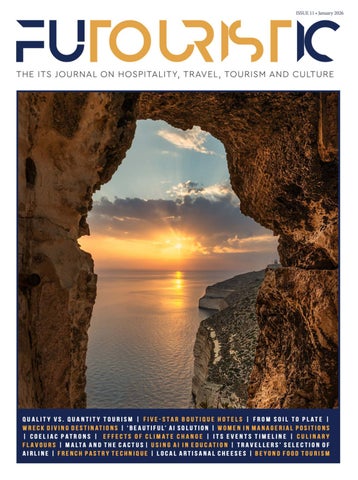
On the Cover Sunset through Ġebel Ciantar window. Photo by Marika Caruana on Wikimedia Commons. This photo was submitted to the Wiki Loves Earth in Malta 2025 competition.
A m e s s a g e f r o m t h e E d i t o r-i n-C h i e f
Future-Ready Hospitality Starts Here BY D R K AT YA D E G I OVA N N I , C H I E F O P E R AT I O N S O F F I C E R - AC A D E M I A AT I T S
I
n my previous roles at the University
are designing low-waste kitchens, re-
from exchange cohorts with Shanghai to
of Malta as a resident academic and
imagining guest journeys for accessibility,
joint projects with European schools—
also in the capacity of my profession
or building data dashboards that inform
bring diversity of methods, markets,
as an Organisational Psychologist, I’m
pricing decisions, we evaluate outcomes that
and mindsets into our classrooms and
matter to businesses and communities alike.
kitchens. Yet our compass remains distinctly
often asked what it really means to be “future-ready”. As the newly appointed Chief Operations Officer – Academia at ITS, my answer for this is simple: it means preparing people, not just programmes. Technology, sustainability, and globalisation are reshaping our sector at speed—but the real differentiator is talent that can think critically, act ethically, and apply innovation where it matters most: guest experience, community wellbeing, and resilient business models. That is the north star guiding our academic strategy at ITS.
WORKING TOWARDS A CAMPUS THAT MIRRORS THE INDUSTRY Being future-ready also means learning in live environments. From culinary labs that champion local, seasonal sourcing to frontof-house simulations that train for real-
global standards.
ITS GRADUATE •
routinely informs business decisions: pricing strategies for the London–Malta route; the operational realities of farm-to-table in fine
arrivals alone. Our island’s long-term
inclusive dining for diabetics; micro-herb
competitiveness depends on quality
supply chains; French pastry techniques in
tourism—the kind that enhances place,
traditional bakeries; and the motivations
protects heritage, and lifts standards across
that drive Malta’s wreck-diving niche. This is
the value chain. This is why our curricula
not “student work”—it is industry R&D with
place sustainability and service excellence
immediate application.
2 || Futouristic
better ones for a small-island context with
from day one. Student research now
women’s progression in five-star leadership;
“What did you change?” Whether students
copying models; it is about co-creating
model ensures graduates are productive
Malta’s success cannot be measured in
with impact: not “What did you learn?” but
Internationalisation at ITS is not about
WHAT EMPLOYERS CAN EXPECT FROM AN
dining; boutique hotel classification gaps;
competency. We are aligning assessment
our island ecology, and our social fabric.
world service recovery, our practice-based
QUALITY OVER QUANTITY—BY DESIGN
at their core, moving beyond compliance to
Maltese: we honour our culinary heritage,
Operational fluency: ready to contribute on shift two, not week two.
•
Data-informed judgment: comfortable turning numbers into narrative and action.
•
Sustainability literacy: capable of designing low-impact, high-experience services.
•
Leadership mindset: inclusive, reflective, and resilient under pressure.
GLOBAL OUTLOOK, MALTESE SOUL
These aren’t promises; they are our
Partnerships are the engine of academic
programme outcomes.
excellence. Our collaboration streams—
Editorial Board Dr Katya De Giovanni (chair) Mr Joseph Cassar Mr Martin Debattista Ms Charlotte Geronimi Ms Fleur Griscti Ms Helena Micallef Ms Stephanie Mifsud Mr Aaron Rizzo Mr Claude Scicluna Dr Rosetta Thornhill Mr James Mula (secretary) Executive Team Executive Editor: Martin Debattista Proofreading: Stephanie Mifsud Sales and Marketing: Marketing Department Design Kite Group Contact Information
THE NEXT CHAPTER
“Futouristic” is more than a theme; it is
In the coming months we’re streamlining
a commitment. At ITS we will continue
our academic pathways, strengthening
to educate professionals who are
micro-credentials for upskilling staff
technically excellent, ethically grounded,
already in industry, and scaling applied
and endlessly innovative—people who
research clusters where students,
can harness technology without losing
faculty, and employers tackle live briefs
the human touch, and who measure
together. We’ll continue to publish and
success not just by occupancy, but by
showcase the best of this work—because
impact.
transparency raises standards, and shared learning accelerates progress.
Editorial: The Futouristic Editorial Board Academic Research and Publications Board Tel: +356 23793100 Email: arpb@its.edu.mt Web: www.its.edu.mt Sales and Marketing: Tel: +356 23793100 Email: marketing@its.edu.mt Institute of Tourism Studies Aviation Park Aviation Avenue Luqa, LQA 9023 Malta
The future of hospitality is not arriving; we are building it. Together.
To our students: Be curious, be kind, be courageous, be smart! Treat every service moment as a chance to create value and every setback as a rehearsal for leadership. To our industry partners: Keep challenging us! Bring us your hardest problems and your boldest ideas; we will meet you with evidence, creativity, and pace. To our national stakeholders: Stay the course on quality. The dividends of higher standards compound— economically, environmentally, and culturally.
Dr Katya De Giovanni E ditor-in- Chief & ITS Chief Op erating Officer – Academia
Futouristic is the official journal of the Institute of Tourism Studies (Malta). The aim of this publication is to promote academic research and innovation at ITS, not just to the partners and stakeholders in the tourism industry but also to society at large. Therefore, ITS fulfills its mission to be at the forefront of this vital industry with its contribution that goes beyond the training of the workforce. Futouristic is free of charge and is distributed to all stakeholders in the Maltese travel, tourism, hospitality, and higher educational sectors. The views expressed in Futouristic do not reflect the views of the Board of Governors or of the Management or the Editorial Board of the Institute of the Tourism Studies but only that of the individual authors. This publication is governed by the Creative Commons Licence 4.0 BY-NC-ND. Anyone can share this publication in any medium, reproduce, and reuse the content with the following conditions: full attribution is given to Futouristic and the individual authors; content is reproduced as is without any remixing or modification; and such reuse does not lead to financial gains. The Institute of Tourism Studies shall have no liability for errors, omissions, or inadequacies in the information contained herein or for interpretations thereof. ISBN: – 978-99957-1-961-6 978-99957-1-962-3
Futouristic || 3
Quality vs. Quantity Tourism: A Case Study of the Small Island State Destination of Malta M A RT I N D EBAT T I STA – S EN I O R AC A D EM I C AT I TS A N D E X ECU T I V E ED I TO R O F FU TO U R I ST I C DAV I D PACE – S EN I O R AC A D EM I C AT I TS*
T
his extended abstract draws upon
official policy stressing the need for
Malta’s carrying capacity. The smaller sister
an analysis of the Maltese tourism
“quality tourism”, the core objective has
island of Gozo faces these challenges
industry’s protracted struggle to
been persistently hindered by conflicting
exacerbated by its limited size, threatening
shift from a mass-market, quantity-
priorities, limited resources, and insufficient
its unique, tranquil environment.
driven model to a sustainable, quality-
political commitment. The research provides
focused approach, covering the period
an empirical timeline of this struggle,
from 1980 to 2024. The study, published
demonstrating how the prioritisation of
as a book chapter, combines an extensive
quantity over quality has led to significant
review of academic literature with content
societal consequences, notably overtourism
analysis of local newspaper reporting and
and the degradation of the environment and
official policy documents to understand the
quality of life for local residents.
historical dissonance between stated goals and practical outcomes in a small, densely populated island nation. The full chapter is available as part of this book: Hassan, V. I. (Ed.). (2025). Navigating Mass Tourism to Island Destinations: Preservation and Cultural Heritage Challenges. IGI Global Scientific Publishing. https://doi.org/10.4018/979-83693-9107-5
LITERATURE REVIEW The Maltese tourism industry traditionally marketed itself as a “sun, sea, and culture” destination, successfully diversifying into niche markets such as MICE (meetings, incentives, conferences, and exhibitions), scuba diving, and cruise liner calls in an attempt to fill the winter and shoulder
Bramwell (2003) goes beyond Butler (1980) and explores the social context of the Maltese tourism industry and identifies reasons why the promise of quality tourism faces challenges of implementation. The key issues can be summarised as follows: a) Overdependence on mass tourism, resulting in overtourism in a destination that is one of the most densely populated countries in the world b) Pressure on natural resources and limited space with a direct negative impact on local communities
months. Historically, the British market was
c) Pressure on the country’s infrastructure,
INTRODUCTION
dominant, largely due to colonial ties, but
going back as early as the early 1980s and
Malta, a small island-state covering just 316
in recent years, the lower-spending Italian
affecting Malta’s carrying capacity
km2, is the most densely populated country
market has surpassed it, a trend linked to
in the European Union (EU), with 1,692
Maltese government subsidies provided to
persons per square kilometre. Tourism is a
low-cost airlines, especially Ryanair, which
fundamental pillar of the national economy,
has drastically increased connectivity to
contributing approximately 10% directly and
Europe.
rising to 30% when indirect contributions are factored in, while directly supporting around 17% of total employment. Since the mass tourism boom of the 1960s, arrivals have soared, increasing from half a million in 1978 to over three million in the postCovid recovery year of 2023.
The literature review established that Malta exhibits characteristics typical of island destinations confronting the downsides of mass tourism, often summarized by Butler’s (1980) Tourism Area Life Cycle theory. Key issues identified include over-dependence on mass tourism, resulting in overtourism in
This research investigates the key challenges
one of the world’s most densely populated
inherent in navigating this mass tourism
countries; pressure on natural resources
model within the environmental and
and limited space; and persistent strain
infrastructural constraints of a small
on the country’s infrastructure, a problem
island destination. Despite decades of
noted as early as the 1980s and affecting
4 || Futouristic
d) Challenging implementation of policies and strategies e) Challenges exacerbated in the smaller island of Gozo The concept of ‘quality tourism’ itself remains elusive and difficult to conceptualise. Officially, the term has evolved from attracting higher-spending tourists to defining the need to upgrade tourism products to a high standard, irrespective of the luxury level, thereby integrating customer satisfaction with responsible practices. Conversely, ‘overtourism’ is defined as the point where the impact of visitors “excessively influences perceived quality of life of citizens and/or
View of Golden Bay beach from Golden Sands Hotel by Searching for Bliss on Wikimedia Commons.
quality of visitors experiences in a negative
selected for analysis was ‘quality tourism’
DISCUSSION AND ANALYSIS
way”.
due to its earliest appearance and highest
The analysis of newspaper content confirms
prevalence in the archives, yielding 155
a long-standing and ongoing struggle for
relevant articles out of 248 initial results.
Malta to transition to quality tourism,
Despite political pronouncements and strategies, the transition to sustainability
underpinned by five dominant themes:
has been thwarted by several barriers,
Qualitative Analysis involved thematic
including the prioritization of short-term
coding of newspaper articles, official
1. A Problematic Definition of ‘Quality’:
economic gains, poor internal government
policy documents, and stakeholder
The interpretation of ‘quality tourism’
coordination, the influence of private
statements using NVIVO14. This analysis
has been inconsistent over four decades.
sector interests on local politicians, and a
tracked sentiment, identified key actors
Initially, in the 1980s, it referred to attracting
fundamental lack of political will to enact
(government, industry, civil society, citizens),
higher-income holidaymakers to counter
unpopular changes.
and charted the chronological development
capacity issues. By the 2000s, it focused
of the debate.
on attracting discerning tourists through
RESEARCH METHODS The study employed a mixed-methods
Quantitative Analysis involved time-series
approach based on iterative content
and correlation analysis, specifically a linear
analysis and time-series analysis. This
regression, measuring the relationship
comprehensive approach aimed to
between the number of mentions of ‘quality
triangulate policy intent and academic
tourism’ in the press and fluctuations in
theory with public discourse and empirical
inbound tourist numbers between 1980 and
data.
2024.
The core research involved a content
The limitations acknowledged include
analysis of historical data sourced from
the restricted scope to the term ‘quality
Times of Malta and The Sunday Times of
tourism’ (excluding ‘sustainable tourism’
Malta, which are considered reputable
to maintain focus) and the exclusion of
newspapers of record in Malta. The analysis
online-only content published after 2003,
spanned nearly 45 years, from January
acknowledging potential inherent biases in
1980 to October 2024. The key search term
the sampled sources.
niche offerings. Today, the concept remains ambiguous, often used by the government and industry concurrently to mean both high standards for all visitors and attracting high-spending clientele. However, the analysis consistently shows that regardless of the definition, the essential prerequisite— an adequate national infrastructure—is not being met, leading to local communities suffering. 2. Dominant Negativity in Recent Years: Sentiment analysis reveals a significant increase in negative sentiment regarding the tourism trajectory since 2015, driven by complex sustainability and quality-of-
Futouristic || 5
‘Tourism quality azure(d)’ - cartoon by Burlò (Times of Malta, 5 June 2016).
Sentiment score chart for the Maltese tourism industry extrapolated from newspaper content. It is quite clear how the sentiment became negative during the Covid-19 pandemic.
life concerns. This negativity is rooted in
3. A Divided Industry: The tourism sector
4. The Newspapers’ Consistent Editorial
disappointment, frustration, and deep
is fundamentally divided on the quantity
Stance: The newspaper editorials (Times
scepticism over the likelihood of genuine
vs. quality debate. Prominent hoteliers,
of Malta and The Sunday Times of Malta)
change. Critics accuse policymakers of
such as Alfred Pisani, strongly advocate for
maintain a clear and consistent stance,
paying mere “lip service” and lacking the
controlling volume and attracting higher-
acknowledging the economic benefits of
political courage to implement meaningful
spending clientele. In sharp contrast, other
tourism but continually highlighting the
change. This frustration is encapsulated
hoteliers argue that imposing limits on
negative impacts on the environment,
by the editorial warning: “You simply
tourist numbers would be “suicidal”, an
infrastructure, and residents’ quality of
cannot have five-star tourism in a one-star
argument supported by the major low-cost
life. Since 1980, they have repeatedly
environment so let’s stop trying to fool
airline, Ryanair, which has been identified
pressed for a shift away from unsustainable
ourselves”. This prioritisation of short-term
as Malta’s “unofficial airline”. This lack of
mass tourism, consistently holding the
economic gains over long-term sustainability
a coordinated, common vision among
government accountable for its lack
echoes the barriers identified in academic
stakeholders further complicates the
of political will to enact true structural
literature.
implementation of sustainable strategies.
upgrades.
6 || Futouristic
5. Overlooked and Undermined Local
metrics alone to actively address the social
Butler, R. W. (1980). The concept of a
Communities: The voices of local citizens
and environmental downsides. Policy
tourist area cycle of evolution: Implications
and civil society organisations have
decisions must involve a wider set of
for management of resources. Canadian
historically been marginalised in favour of
stakeholders, moving beyond the industry
Geographer, 24(1), 5–12.
those representing government agencies
lobby to genuinely incorporate the needs
and the business community. Although civil
and concerns of local communities and civil
society visibility has increased since the
society.
2010s, their concerns predominantly revolve around the destruction of the rural and urban environment caused by unbridled construction—a direct consequence of accommodating increasing tourist numbers. The high rate of incoming tourism is seen to be “crushed under concrete, trampled underfoot by the behemoth of the building industry”. Quantitative Insight: The regression analysis revealed a moderate relationship (R-squared 0.55) between the number of inbound tourists and the number of newspaper mentions of ‘quality tourism’. This confirms that the demand for discussing and implementing quality tourism is largely reactive, spiking when mass tourist numbers reach high levels (such as the record-breaking 3 million in 2023) and environmental pressures become intense.
Opportunity and Challenges in Sustainability, 3(1), 1–19. https://doi.org/10.56578/
and improving the quality of tourists
ocs030101
by providing a high-quality experience. This requires sustained promotion funds directed at attracting quality tourists and developing specialised products. CONCLUSION Malta’s journey towards sustainable, quality tourism is defined by persistent challenges rooted in its reliance on mass tourism and the associated infrastructural, environmental, and political constraints. Despite decades of strategies advocating for quality, the post-Covid recovery has
pressure on the island’s limited resources. The lack of political resolve to define and implement effective measures confirms the
imminent and will require fundamental, courageous political action and sustained
political will to enact potentially unpopular
research by David Pace, who died in 2025
measures, such as imposing limitations on
following a short illness.
UNWTO (2018). ‘Overtourism’? Understanding and Managing Urban Tourism Growth beyond Perceptions. Volume 2: Case Studies. https://www.e-unwto.org/doi/ book/10.18111/9789284419999
challenges, and its sustainability in an island state: Case study of Malta. International Journal of Islands Research, 1(1), 6.
policy must shift its focus from economic
the Maltese islands. [Report].
Attard, S. (2020). Evolution of tourism,
and consistent investment is required
Holistic Stakeholder Inclusion: Tourism
(2022). Carrying capacity study for tourism in
SELECT BIBLIOGRAPHY
Infrastructure Prioritisation: Substantial
star tourism in a one-star environment”.
Malta Hotels and Restaurants Association.
to effect meaningful change. *This was the last contribution to academic
residents. The country cannot support “five-
(pp. 107–128). Cham: Palgrave Macmillan.
investment over a period of 10 to 20 years
commitment and demonstrate the
standards expected by both tourists and
T. Gladkikh, T. Vo Thanh (Eds.), Overtourism
dissertation).
achieving sustainable tourism:
public transport, to meet the basic quality
in Valletta - reality or myth? In H. Séraphin,
on the Maltese economy (Bachelor’s
recommendations are essential for
infrastructure, including utilities, roads, and
Ebejer J. (2020). Case Study 1: overtourism
(surpassing 3 million in 2023) and renewed
transition away from overtourism is not
to upgrade the country’s physical
Southern Europe. Channel View Publications.
Micallef, M. (1984). The effect of tourism
systemic failures identified, several
term economic gains.
Diversification and sustainable development in
resulting in record-breaking tourist arrivals
The evidence suggests that a successful
private sector interests that prioritize short-
Dodds, R. (2007). Coastal mass tourism:
seen a rapid return to a quantity model,
Based on the long-term struggle and
volume, and resisting the undue influence of
Islands: A thirty-year analysis (1992-2022).
Efforts should focus on controlling quantity
continuation of a fragmented approach.
Policymakers must move beyond rhetorical
sustainable development in the Maltese
Strategic Focus on Quality Metrics:
RECOMMENDATIONS
Political Will and Strategic Vision:
Cassar, C. (2024). The political evolution of
Bramwell, B. (2003) ‘Maltese Response to Tourism’, Annals of Tourism Research, 30(3), pp. 581–605. Briguglio, L. & Avellino, M. (2021). Assessing Malta’s Overtourism. In Duignan, M. B. (eds) Managing the Visitor Economy: Concepts, Collaborations and Cases. CABI.
Futouristic || 7
Palazzo Consiglia, Valletta (Image credit: Continentaleurope on Wikimedia Commons)
Navigating the Classification of Five-Star Boutique Hotels Within Maltese Legislation M YA G A L E A BAC H E LO R I N I N T E R N AT I O N A L H O S P I TA L I T Y M A N AG E M E N T ( H O N S . )
T
INTRODUCTION
LITERATURE REVIEW
tactics, and guest perceptions. The literature
his research addresses the
The literature review explored classification
review also touched upon operational
growing trend of boutique hotels
systems globally and in Malta, focusing
challenges, including the importance of cyber
in Malta and the challenge they
on the evolution of star ratings and their
security to protect guest information.
face in navigating the official five-
role in setting guest expectations. It noted
star classification system within Maltese
that traditional rating systems must evolve
legislation. Boutique hotels are characterised
to keep pace with contemporary review
by their individuality and loyalty to the local
platforms like TripAdvisor and Booking.
area, setting them apart from conventional
com, which offer consumer-focused
hotel chains. While traditional star ratings
assessments. A key focus was the definition
influence guest choices, consumer behaviour
and classification of boutique hotels in
is increasingly driven by word-of-mouth
Malta, contrasting their unique selling
recommendations and online reviews.
points—such as personalized service and
This dissertation aims to grasp a deeper
local identity—with the often-rigid criteria
understanding of the consistency (or lack
of conventional five-star status. The review
thereof) between informal classification
highlighted a critical gap: despite the Malta
regulations and the operational service
Tourism Authority (MTA) playing a key role
approaches used by boutique hotels. The
in regulating and enforcing standards,
central problem explored is how Maltese
there is minimal authorised classification
authorities define and enforce five-star criteria
for boutique hotels within the Maltese
specifically for boutique hotels, given the lack
legislation. The resulting legislative ambiguity
of a legally recognised category for them.
impacts operational management, marketing
8 || Futouristic
RESEARCH METHODOLOGY The study adopted a qualitative approach to effectively examine the research questions, prioritising detailed, subjective experiences and perspectives from industry participants. Data collection utilised two main methods: semi-structured interviews and open-ended online surveys. The interviews targeted a small, purposive sample of key informants: three boutique hotel managers and one representative from the MTA specializing in legal enforcement. This ensured specific, relevant feedback concerning classification standards, operations, and policy enforcement. Interviews were audiorecorded and transcribed verbatim, with
S tudent R esearch piloting conducted beforehand to refine
on exceptional staff highlights the critical
classification, necessitate immediate policy
questions.
connection between employee engagement,
adjustment to accurately reflect and support
a positive work culture, and cultivating
this vital segment of the Maltese luxury
service excellence in boutique hotels.
tourism market.
and personal experiences regarding guest
Operational Challenges: Boutique hotels
SELECT BIBLIOGRAPHY
perceptions, luxury, and service standards.
face significant operational challenges in
Blomberg-Nygard, A., & Anderson, C.
These open-ended surveys enabled the
maintaining high standards, particularly
K. (2016). United Nations world tourism
researcher to gather a variety of responses
concerning staff engagement and retention.
organization study on online guest reviews
that closed-ended methods would not
These smaller venues are highly dependent on
and hotel classification systems: an integrated
capture authentically.
the quality and skill of individual employees,
approach. Service Sciendce, 8(2), 139-151.
The online surveys were directed toward the general public to gather broader opinions
Data analysis was conducted using thematic analysis on the transcripts and survey responses, identifying patterns and themes related to classification influence, marketing strategies, and perceptions of luxury. Data triangulation, comparing survey findings with interview insights, was used to strengthen the credibility of the findings. DISCUSSION AND ANALYSES The discussion synthesised the findings, confirming the research’s central premise: there is a lack of a legally recognized category for boutique hotels within Maltese legislation.
making issues like staff retention a critical obstacle to maintaining luxury standards consistently. Managers noted that while supportive leadership and financial allocation could mitigate staff challenges, the non-existent official classification system impacts managerial practices and decision-making. The findings confirm that the ongoing success of Maltese boutique hotels is deeply reliant on digital marketing strategies and cultivating a uniquely tailored guest experience, rather than rigid reliance on official, and currently inadequate, legislative classifications.
This absence limits proper official recognition
RECOMMENDATIONS
for these unique establishments.
The study proposes that Maltese authorities
Impact of Classification on Trust and Marketing: The traditional five-star rating still shapes guest trust and booking decisions, particularly among travellers who rely on traditional hotel standards. However, the research found that boutique hotels compensate for the lack of formal classification by excelling in alternative metrics, primarily through user-generated content (UGC) and online reputation management. Official hotel websites, Instagram, and influencer content emerged as the most dominant marketing channels used by guests to identify boutique hotels. This highlights that consumers
should formally acknowledge boutique hotels as a specific classification, separate from
interactions proved crucial for maintaining a perceived five-star standard. This reliance
and Lifestyle hotels: A Delphi Study. [Online] Available at: https://www.researchgate.net/ publication/266739501_Emerging_Definitions_ of_Boutique_and_Lifestyle_hotels_A_Delphi_ Study [Accessed 2025]. Dincer, F. I., Dincer, M. Z., & Avunduk, Z. B. (2016). Marketing strategies for boutique hotels: The case of Istanbul. Journal of Global Business Insights, 1(2), 94-106.
Hotel customers’ purchase intention in
of boutique accommodations. Additionally,
Malaysia. Tourism & Management Studies, 17(3),
the policy should focus on providing greater
51-62.
support systems to address operational challenges, particularly in staff retention and training, ensuring sustainability and longevity within this market segment. Future research is recommended to focus on comparative analysis with countries that already possess formal boutique hotel classification systems to identify best practices.
five-star classification remains relevant in
ability of staff to offer tailored, memorable
Day, J., 2013. Emerging Definitions of Boutique
media marketing influence on Boutique
based metrics.
and beyond” expected deliverables. The
handle/123456789/38120 [Accessed 2024].
reflect the unique, culture-saturated nature
This dissertation established that while the
service, often described as staff going “above
at: https://www.um.edu.mt/library/oar//
Garg, A., & Kumar, J. (2021). Social
personalized service over traditional star-
fundamentally enhanced by personalized
Manager’s Perspective. [Online] Available
should incorporate tailored standards that
CONCLUSION
Standards: Guest experience was
Study of Valletta from a Hotel
conventional hotels. This new classification
often prioritise authentic experiences and
Guest Experience and Service
Borg, Y., 2018. Boutique Hotel Experience: A Case
some guidelines within Maltese legislation, it plays a non-existent role in defining the essence of the boutique hotel sector. The successful luxury positioning of these hotels is instead achieved through robust digital reputation management and prioritizing unparalleled personalized guest experiences. The limitations imposed by the current legislation, notably the minimal authorised
Koutoulas, D., & Vagena, A. (2023). The present and future of hotel star ratings through the eyes of star rating operators. Journal of Tourism Futures, (ahead-of-print). Nyimbili, F. & Nyimbili, L., 2024. Types of Purposive Sampling Techniques with Their Examples and Application in Qualitative Research Studies. [Online] Available at: https://www.researchgate.net/ publication/378272696_Types_of_Purposive_ Sampling_Techniques_with_Their_Examples_ and_Application_in_Qualitative_Research_ Studies [Accessed 2025]. Vagena, A., & Manoussakis, G. (2021). Group analysis of official hotel classification systems: a recent study. Current Approaches in Science and Technology Research, 4(January), 1-17.
Futouristic || 9
From Soil to Plate: A Study of Sustainable Fine Dining Through Malta’s Locally Sourced Produce
NICOLE CAMILLER I BAC H E LO R I N C U L I N A RY A RTS ( H O N S . )
T
INTRODUCTION
LITERATURE REVIEW
In the Maltese context, challenges are
his dissertation investigates the
The literature review established that
amplified by the small agricultural sector,
integration of locally sourced
sustainability in fine dining involves
which limits the availability and diversity of
produce into the Maltese fine
balancing ecological stewardship with
local ingredients. The review highlighted
dining industry as a critical
gastronomic creativity, focusing on
that local restaurants, such as Ion Harbour,
component of sustainability efforts. The
environmentally responsible sourcing,
are incorporating foraging and traceable
global culinary sector is undergoing a
ethical production, waste minimisation, and
seafood, and using traditional local products
transformation where the farm-to-table
community engagement. The concept is
like ġbejna and ftira to promote authenticity.
movement is recognized as a key strategy to
often framed by three interrelated pillars:
Despite these efforts, policy conflicts, high
reduce environmental impact and support
social, environmental, and economic
initial costs, water scarcity, and insufficient
local economies. In Malta, this trend is
sustainability.
infrastructure hinder wider adoption of
particularly relevant due to the island’s limited land area, agricultural heritage, and heavy reliance on imports, estimated at 70–80% of its food supply. The core aim of this research is to critically evaluate the impact of integrating local produce into fine dining in terms of sustainability and its effects on the gastronomic landscape. This study addresses the academic gap regarding ingredient sourcing dynamics in Malta’s high-end restaurant sector by exploring the experiences of both culinary professionals and producers.
10 || Futouristic
Key practices identified internationally include adopting ‘zero-waste’ techniques like ‘nose-to-tail’ and ‘root-to-stem’ cooking, shifting towards plant-based menus, and seeking sustainability certifications such as
sustainable systems. The literature suggests that the lack of systemic coordination and the vulnerability of small-scale farmers pose ongoing barriers to strengthening local supply chains.
the Green Michelin Star. Influential chefs
RESEARCH METHODS
like Simon Rogan demonstrate the “farm-
The study adopted a qualitative research
to-fork” philosophy, prioritizing hyperlocal
design to gather detailed, experience-
and seasonal ingredients. The pursuit of
based insights into farm-to-table dynamics.
sustainability is essential given agriculture’s
The research approach employed semi-
significant contribution to global emissions.
structured interviews to explore subjective experiences and practices.
S tudent R esearch
The participants were selected using a
environmental) and gastronomy theory.
agreed on the importance of circularity and
purposive sampling approach, chosen for
Limitations included time constraints
waste minimization, reflecting the principles
their active engagement with sustainable
during interviews, communication barriers
of Kioupi and Voulvoulis (2019).
practices within the fine dining sector. The
regarding technical sustainability terms,
primary data consisted of interviews with
and the non-generalizability of the small,
six fine dining chefs (Chefs A–F) and six
purposively selected sample.
local farmers (Farmers 1–6) who directly supply these establishments, totalling 12 participants. The selection criteria for chefs prioritized those who actively promote sustainability, extensively use local produce, and demonstrate a commitment to sustainable culinary practices. Farmers were selected based on their use of organic or regenerative farming methods and collaborations with local restaurants. The data analysis utilized Braun and Clarke’s six-phase framework for thematic analysis. This thematic approach helped identify recurring patterns, relationships, and constraints, which were grounded in the philosophical paradigms of the Triple Bottom Line approach (economic, social,
Supply Chain Dynamics and Challenges: The local supply chain operates on a “relational supply chain” model, heavily
DISCUSSION AND ANALYSES
dependent on informal, personal trust and
The analysis synthesized the data from
communication between individual chefs
chefs and farmers, revealing a strong
and farmers. This system allows for custom
rhetorical and ethical commitment to local
crop planning and flexible, harvest-to-order
sourcing and sustainability, tempered
delivery. However, the research confirmed
by significant operational and economic
significant challenges, including supply
asymmetries.
inconsistencies and seasonal limitations.
Motivations and Definitions: Chefs’ primary motivations were framed as an extension of their culinary identity, ethical values, and cultural heritage, seeking to support Maltese food identity and innovation. Farmers, conversely, focused on ecological necessity, defining sustainability
Crucially, the model is asymmetrical; farmers absorb the greater risks associated with weather variability, supply fluctuations, and lack of compensation for rejected or imperfect produce. Furthermore, the lack of inter-farmer collaboration or shared logistics intensifies these inefficiencies.
primarily in terms of soil health, resource
Waste Reduction and Innovation:
conservation, and ethical growing practices
Waste reduction is a core sustainable
to build system resilience. Both groups
practice, aligning with the idea of a “fullFutouristic || 11
ethically and creatively valuable, it remains financially fragile for producers without structural support or guaranteed pricing. The regression analysis showed a moderate relationship between local sourcing and economic viability, suggesting that success relies on flexible business models. The study concluded that sustainability in Maltese fine dining is highly valued but unevenly implemented. The fragmentation of the farm-to-fork model, relying on interpersonal goodwill rather than robust infrastructure and policy, undermines the long-term potential for coherent and equitable sustainable gastronomy. RECOMMENDATIONS To transition from fragmented practices to a durable, sustainable system, this research suggests targeted interventions in four key areas. Infrastructure investment is critical, focusing on cold storage facilities and improved irrigation systems for small-scale farmers. Policy support should include introducing a national certification scheme for sustainable sourcing to benchmark quality, and establishing a formalized Chef– Farmer Network Platform to streamline communication and planning, reducing dependency on informal arrangements. Furthermore, sustained public education campaigns are needed to promote local, seasonal food as a premium ethical choice and integrate sustainability topics into hospitality training. CONCLUSION This study demonstrates that the Chef plating salmon and vegetables (Image credit: Jonathan Borba on Pexels)
integration of locally sourced produce significantly enhances the environmental and cultural sustainability of Malta’s fine dining sector. However, the ambitious
cycle kitchen”. Chefs employed root-to-
Economic Implications:
stem/nose-to-tail techniques, stock-making
Economic sustainability remains a major
from scraps, and portion control to
tension point. Local ingredients are
minimize kitchen waste. Farmers contribute
generally more expensive than imported
by composting, recycling water, and using
alternatives, driven by higher input costs
surplus produce for animal feed or selling
for small-scale regenerative farming,
“ugly produce” to willing chefs. This mutual
seasonal scarcity, and labour intensity.
adaptation marks a shift in the definition of
Chefs mitigate the resulting tight margins
quality, prioritising ecological impact over
through adaptive menu structures, rigorous
visual uniformity.
portion control, and diversifying revenue streams via catering and bespoke events. The consensus is that while local sourcing is
12 || Futouristic
farm-to-fork movement is structurally fragile, characterised by asymmetrical risks where farmers absorb the burden of supply inconsistencies and high production costs, while chefs gain the resulting brand narrative. The findings underscore that genuine, scalable sustainable gastronomy in Malta necessitates a transition from a reliance on personal trust and individual creative effort to a model underpinned by systemic coordination, infrastructural investment, and clear policy backing.
“
S tudent R esearch
This study successfully demonstrated that the integration of locally sourced produce significantly enhances the environmental and cultural sustainability of Malta’s fine dining sector.
”
Access the full text of the research here
SELECT BIBLIOGRAPHY
Fredrik Fernqvist, Spendrup, S. and
Rogan, S. (2022). Restaurants. [Online]
Batat, W. (2020). Pillars of sustainable food
Tellström, R. (2024). Understanding food
Simon Rogan. Available at: https://www.
experiences in the luxury gastronomy
choice: a systematic review of reviews.
simonrogan.co.uk/restaurants
sector: A qualitative exploration of
Heliyon, 10(12), pp.e32492–e32492.
Michelin-starred chefs’ motivations. Journal
doi:https://doi.org/10.1016/j.heliyon.2024.
of Retailing and Consumer Services, 57,
e32492.
p.102255. doi:https://doi.org/10.1016/j. jretconser.2020.102255.
Roy, H. (2022). Connecting Farmers’ Markets to Foodservice Businesses: A Qualitative Exploration of Restaurants’ Perceived
Gustavsson, J., Cederberg, C. and Sonesson,
Benefits and Challenges of Purchasing Food
U. (2011). [Title not specified in source]. (Note:
Locally. International Journal of Hospitality
Camilleri, N. and Spiteri, M. (2022). [Title not
Cited in source references as Gustavsson
& Tourism Administration, 25(3), pp.1–36.
specified in source]. (Note: Cited in text as
Christel Cederberg Ulf Sonesson, J. (2011)
doi:https://doi.org/10.1080/15256480.2022
Camilleri and Spiteri (2022) but full reference
and linked to an FAO URL).
.2142994.
not provided in source references list).
Huang, Y. and Hall, C.M. (2023). Locality in
Egli, L., Rüschhoff, J. and Priess, J. (2023). A
the Promoted Sustainability Practices of
systematic review of the ecological, social,
Michelin - Starred Restaurants. Sustainability,
and economic sustainability effects of
15(4), p.3672. doi:https://doi.org/10.3390/
community-supported agriculture. Frontiers
su15043672
in Sustainable Food Systems, 7. doi:https:// doi.org/10.3389/fsufs.2023.1136866.
Kioupi, V. and Voulvoulis, N. (2019). Education for Sustainable Development:
FAO (2023). Sustainable Food and
A Systemic Framework for Connecting
Agriculture. [Online] Food and Agriculture
the SDGs to Educational Outcomes.
Organization of the United Nations.
Sustainability, 11(21), p.6104. doi:https://doi.
Available at: https://www.fao.org/
org/10.3390/su11216104.
sustainability/en/
Futouristic || 13
Tug 2 a sunken tugboat located at Exiles Beach ( Image credit: Shaun Cardona)
Discovering Tourist Motivations and Experiences in Recreational Wreck Diving Destinations in Malta SHAUN CARDONA BAC H E LO R O F S C I E N C E I N D I V I N G S A F E T Y M A N AG E M E N T
R
ecreational wreck diving represents
authorities can improve the sustainability
policymakers in Malta. The investigation
a convergence of sport, culture, and
and competitiveness of this sector.
draws upon three complementary
environmental tourism. It appeals to tourists who seek exploration,
challenge, and personal fulfilment while engaging with submerged historical artefacts. Malta an island nation at the heart of the Mediterranean is a prime case study due to its long maritime history, outstanding underwater visibility, and accessibility to multiple shipwrecks. This dissertation explores why tourists choose Malta for wreck diving, how they experience these underwater environments, and how tourism
14 || Futouristic
LITERATURE REVIEW Globally, wreck diving has transitioned from a niche adventure activity into a mainstream component of marine tourism (Edney 2006; Dimmock & Musa 2015). Yet, the motivational psychology behind divers’ participation remains under-examined, especially in smaller island destinations. The present research therefore addresses this gap by integrating motivational theories with field data from divers and
motivational theories. Zuckerman’s Sensation-Seeking Theory posits that individuals possess varying thresholds for arousal and stimulation (The American Women’s College Psychology Department & McGrath 2021). High sensation seekers deliberately pursue risk and novelty to achieve an optimal internal state. Wreck diving, with its mix of uncertainty, danger, and exploration, is emblematic of such thrill-oriented pursuits. Self-Determination Theory (Deci & Ryan, as discussed in Cherry
S tudent R esearch 2024) emphasises intrinsic motivation,
techniques. Data analysis involved
issues persist: respondents cited a lack of
autonomy, and competence. Divers are
descriptive statistics and thematic coding to
showers, restrooms, and parking facilities,
driven by personal mastery, underwater
triangulate motivations, experiences, and
as well as crowding and limited historical
independence, and shared community
management challenges.
signage. These concerns confirm Caruana
bonds. Finally, Csikszentmihalyi’s Flow Theory (Biasutti 2017) describes a deep state of immersion where skill and challenge align an experience often reported by divers navigating confined spaces or photographing wreck interiors. Together, these frameworks clarify how intrinsic motivation, sensory fulfilment, and personal growth shape wreck-diving participation.
RESULTS AND DISCUSSION Results indicate that intrinsic motives dominated: fun, exploration, and adventure were cited by over half the respondents as primary reasons for wreck diving. Enjoyment and curiosity outweighed extrinsic considerations such as prestige or price. These findings strongly align with Self-Determination Theory and
RESEARCH METHODOLOGY
demonstrate that divers pursue wreck
A mixed-methods approach was employed.
diving as an internally rewarding activity.
Eighty recreational divers completed
Respondents also described a “sense of
questionnaires distributed through Maltese
tranquillity” and “connection to history,”
dive centres and QR codes at major wreck
reflecting elements of both flow and
sites such as Ċirkewwa Marine Park,
heritage-based fulfilment. Over 83% of
Żurrieq, and Manoel Island. These captured
divers reported that their experiences met
demographics, motivations, and satisfaction
or exceeded expectations. They praised
levels. In parallel, a semi-structured
Malta’s visibility, accessibility, and the
interview with two senior managers at the
authenticity of sites such as Um El Faroud
Malta Tourism Authority (MTA) provided
and P29. Many were emotionally moved
insight into national strategy. Sampling
by the wartime memorial significance of
combined convenience and purposive
these wrecks. Nevertheless, infrastructure
& Sultana’s (2021) earlier observations that Maltese dive sites have grown faster than their management capacity. Interviews with MTA managers contextualised these results within policy. Officials acknowledged infrastructural deficiencies but highlighted ongoing projects, including refurbishment of the Żurrieq site, expansion of diver parking, and pilot webcam systems for real-time sea condition monitoring. A proposal for an underwater museum was also discussed, aimed at integrating heritage interpretation with marine conservation. These efforts align with the 2022 strategic plan “Developing a Sustainable Diving Industry in the Maltese Islands.” Coordination across tourism, environmental, and local agencies remains a challenge, as ecological sensitivities require extensive clearance procedures. Despite this, the MTA’s focus on quality assurance underscores a longterm vision of sustainable competitiveness.
Tugboat St. Michael located in Marsaskala Bay (Image credit: Shaun Cardona)
Futouristic || 15
“
Malta must invest in consistent site upgrades to maintain its international standing.
”
MV Xlendi, a former Gozo Channel ferry. (Image credit: Shaun Cardona)
Discussion of the combined data reveals
interpretive signage suggest an emerging
will ensure adaptive management and long-
that Malta’s competitive advantage lies in
environmental ethic consistent with Edney’s
term resilience.
its synergy of environmental and cultural
(2006) assertion that informed divers
assets: warm, clear waters, accessible
become active stewards of heritage sites.
wrecks, and compelling historical narratives.
CONCLUSION In conclusion, the study confirms that
IMPLICATIONS
wreck-diving tourists in Malta is primarily
However, this advantage is threatened
The research therefore carries several
driven by intrinsic motivations centred on
by infrastructure gaps that limit diver
implications. First, Malta must invest in
enjoyment, discovery, and challenge. Malta’s
satisfaction. As Stolk et al. (2007) and
consistent site upgrades to maintain its
appeal is reinforced by its accessibility,
Garrod & Wilson (2003) argue, divers’
international standing. Second, interpretive
environmental quality, and historical depth.
experiences depend as much on surface
initiatives plaques, digital guides, and
Yet long-term competitiveness depends on
facilities and management as on underwater
museum experiences can transform wrecks
targeted infrastructural improvements and
conditions. Moreover, wreck diving holds
into educational heritage assets. Third, diver
enhanced environmental interpretation. By
a dual sustainability potential: it diverts
education programmes should promote
uniting motivational theory with empirical
pressure from natural reefs by drawing
eco-friendly behaviour and historical
tourism analysis, this research contributes
divers to artificial sites (Granan et al. 2015),
respect. Finally, diversification of dive sites
a replicable framework for balancing
but unmanaged visitation can endanger
through artificial reefs and marine parks can
adventure tourism growth with cultural
wreck integrity and marine biodiversity.
spread visitor pressure and extend seasonal
preservation and ecological sustainability.
Respondents’ repeated requests for
demand. Integrating data-driven monitoring
16 || Futouristic
S tudent R esearch
Um El Faroud, the sunken oil tanker outside Żurrieq. On the 3rd February 1995 an explosion on the tanker killed nine Maltese workers at the Malta dockyard. (Image credit: Shaun Cardona)
SELECT BIBLIOGRAPHY
Garrod, B. & Wilson, J. C. (2003). Marine
Biasutti, M. (2017). Flow and Optimal
Ecotourism: Issues and Experiences.
Experience in Sport and Adventure Tourism.
Channel View Publications.
Annals of Leisure Research, 20(4), 1–15. H Cherry, K. (2024). Self-Determination Theory Explained. Verywell Mind. Caruana, S. & Sultana, K. (2021). Diving Tourism in the Maltese Islands: Patterns, Motivations and Management Issues. Institute of Tourism Studies, Malta. Dimmock, K. & Musa, G. (2015). Scuba Diving Tourism. Routledge.
Granan, D., Kovanin, M. & Zekin, A. (2015). Artificial Reefs and Marine Life Development around Wreck Sites. Marine Biodiversity Records, 8, 89–101. Stolk, P., Markwell, K. & Jenkins, J. (2007). Artificial Reefs as Tourist Attractions: Implications for Marine Conservation. Tourism Management, 28(6), 1511–1519. The American Women’s College Psychology
Edney, J. (2006). Managing the Human
Department & McGrath, S. (2021).
Impact of Recreational Wreck Diving.
Sensation-Seeking Theory: Understanding
Tourism in Marine Environments, 3(2),
Risk Motivation. Springfield College Press.
93–107. Edney, J., Dimmock, K. & Boyd, W. E. (2021). Motivations and Experiences of Wreck Divers in the Asia-Pacific Region. Journal of Sustainable Tourism, 29(2–3), 195–217.
“
Integrating data-driven monitoring will ensure adaptive management and long-term resilience.
”
Futouristic || 17
The Maltese Tourism Industry Now Has Its Own ‘Beautiful’ AI Solution – An interview with Prof. Alexiei Dingli M A RT I N D EBAT T I STA S EN I O R AC A D EM I C A N D E X ECU TIV E ED ITO R – FU TOU R I STI C
T
he Maltese tourism industry is
What is the origin of the idea to develop
focus on the warmth and judgement that
being offered the first virtual
Bella.mt for the Maltese tourism and
define Maltese hospitality. The benefits are
concierge powered by artificial
hospitality industry? Is it simply riding
practical, not fashionable. Guests receive
intelligence (AI), with the aim
the artificial intelligence wave or are
faster replies, fewer enquiries are lost,
of providing a more efficient and more
there proven benefits for the tourism
bookings are smoother, and staff have more
personalised service to hotel guests and
industry?
time to create memorable moments.
tourists in general. Aptly named Bella
The idea did not come from a trend on
(which means ‘beautiful’ in Italian), it
social media. It came from a real challenge
The tourism and hospitality industry
comes complete with a chatbot and full
at Palazzo Ignazio in Valletta. Mark Bajada,
is very people-focused. How does the
integration with current hotel operations
who co-owns Digital Traffic Brain, faced the
implementation of artificial intelligence
and information and communication
daily challenge of finding people who were
in this industry affect human resources?
technology set-ups. Futouristic spoke to
excellent at their job, proactive with guests,
What is the typical process for a hotel
Prof. Alexiei Dingli, a leading academic on AI
and comfortable in several languages. That
to transition towards “Operational
and a designer of the solution developed by
mix is rare in a small labour market like
Transformation” using Bella, and what
Digital Brain.
Malta, where demand changes with the
support mechanisms are in place
seasons and language needs change with
to ensure seamless adoption of the
the guests who arrive each week. Bella was
technology by existing staff members?
built to handle the repetitive, always-on
This technology should protect people’s
aspects of service, allowing the team to
time, not replace it. Day to day, Bella
18 || Futouristic
Bella chatbot used by a hotel guest
handles high-volume, simple tasks such as
How specifically does Bella’s capacity
Given the focus on cutting costs and
questions about facilities, straightforward
to remember guest preferences, speak
increasing efficiency in hotels, how
bookings, and minor changes. This lets
multiple languages, and provide tailored
can you guarantee that relying on
colleagues focus on empathy, problem-
recommendations redefine what is
artificial intelligence rather than
solving, and thoughtful selling. The change
considered “luxury hospitality” for
human interaction enhances the luxury
starts with a clear talk about today’s
modern travellers?
experience for guests?
problems and what success looks like.
Luxury today means removing friction
You guarantee it by design. From the start,
We then connect Bella to the tools the
quietly. When a returning guest gets their
we set firm rules to immediately move
hotel already uses, such as reservations,
preferred pillow, their usual breakfast
any sensitive, emotional, or high-value
restaurant tables, room service, and
table, and is not asked again about dietary
situation to a person. Colleagues remain the
partner excursions. We also teach Bella
needs, the stay feels personal. When the
decision-makers for gestures of goodwill,
how the property works by adding service
conversation flows in the guest’s own
upgrades, and delicate conversations. The
standards, menus, policies, and the right
language on the channel they already use,
assistant does the groundwork by preparing
tone of voice. A short pilot follows, focused
planning feels as easy as messaging a
information, drafting options, surfacing
on everyday tasks so we can learn quickly.
friend. When suggestions change with the
preferences, and keeping everything tidy.
Staff receive short and practical coaching
day, for example, leaving earlier because
Managers review real conversations and
on supervising the assistant, taking over a
the main streets are busy or choosing a
adjust the behaviour regularly. The result is
conversation, and adding details to guest
bistro because a festival has shifted crowds,
simple. Technology clears the routine work
preference cards. Ongoing support includes
service feels thoughtful rather than routine.
so people can guide the guests with care.
an operator view for instant handover, quick
Modern travellers see luxury as being
help when questions arise, and regular
known, understood, and gently guided
improvement sessions so the system keeps
without fuss.
improving alongside the team.
Futouristic || 19
Another example of guest-chatbot interaction
The service claims to provide assistance
Considering Bella facilitates seamless
24/7. In what circumstances does Bella
booking integration for restaurant
need to hand off a request to a human
reservations, room service, and
operator?
excursion bookings, how does the system
Handover occurs when a guest requests
actively drive more direct bookings and
someone or when the tone indicates
revenue for hotel partners?
frustration, confusion, or distress. It also
It helps by letting guests ask, decide, and
happens when identity or payment needs
book in the same conversation. When the
careful checks, when a partner system fails,
answer and the action sit together, there
when safety or health is involved, or when a
is no need to jump to another site where
very special or complex itinerary appears. In
attention can drift and a booking can be
these cases, a colleague takes over through
lost. Because the conversation feels natural
the operator view and resolves the matter
and personal, the hotel can make gentle,
with human judgement.
well-timed suggestions that suit the guest’s day, such as an upgrade when rooms allow, a spa visit when the weather turns, or a later table if a flight is delayed. Each nudge is small and polite. Together, they move more business directly to the hotel and raise the value of the stay.
20 || Futouristic
“
Technology clears the routine work so people can guide the guests with care.
”
Bella offers comprehensive assistance,
records of bookings or approvals. The hotel
including “basic hotel services” up
remains the decision-maker about this
to “advanced” assistance. What is an
data, and Bella acts as a service provider.
example of a truly advanced service that
Protection is layered. Access is limited to the
Bella provides that a human concierge
right people for the right reasons, activity is
could not achieve?
logged, and retention periods are sensible.
A good example is instant itinerary re-
Guests can ask to see what is held about
planning at scale. Imagine several families
them or to have it removed. For messaging
affected simultaneously by a late flight
channels, WhatsApp supports secure
and heavy traffic. Bella can reshuffle each
conversations. Traditional text messaging
timetable in seconds, move transfers,
does not provide the same protection, so
rebook tickets, alert restaurants, and
sensitive details are avoided there.
confirm new times with all parties, quietly and accurately, even in the middle of the night. A great concierge can do this for one or two parties, but not for many at once, while also handling arrivals and other issues. This is where a digital assistant complements human excellence rather than competing with it. Given Bella offers round-the-clock concierge intelligence powered by live search, real-time flight updates, traffic conditions, and venue alerts, what is the underlying mechanism that ensures the constant immediacy and reliability of this crucial information for guests? Think of Bella as a conductor managing different sections at once. It draws information from several trusted sources, checks how recent each piece is, and resolves differences when two sources disagree. When confidence is low, it asks a clear question or passes the case to a human colleague. This mix of careful automation and human oversight keeps information timely without losing trust, which is vital when travellers must make quick decisions. What specific types of guest data does Bella collect and store, and how is this sensitive personal information secured, especially since it operates across various third-party platforms like WhatsApp, Telegram, and text messaging? Only the information needed to serve the guest well is collected. This includes name
The service is fundamentally changing how guests interact with hotels. What has been the most surprising feedback received from hotel staff regarding the introduction of Bella and the impact it has had on their day-to-day roles and workflow efficiency? Two reactions appear often. Night teams say their shifts are calmer because the stream of simple questions no longer builds a queue, and the conversations that reach them truly need human attention. Frontof-house teams say the work feels more meaningful because they spend less time repeating facts and more time creating memorable moments, such as welcoming a family celebrating something special, solving a tricky problem, or offering a welljudged upgrade. Managers also notice that new colleagues settle in faster because the assistant handles the heavy lifting while they build confidence. Anything else you would like to add?
“
This mix of careful automation and human oversight keeps information timely without losing trust, which is vital when travellers must make quick decisions.
”
Malta can lead in hospitality technology because we are small, quick to act, and proud of our welcome. Bella was born here to solve a Maltese problem at Palazzo Ignazio and has grown into a tool that lets our people do what they do best. It helps us anticipate needs, remove friction, and delight guests. If we keep people firmly in charge, measure results honestly, and invest in our teams, technology will not replace Maltese hospitality. It will make it shine even brighter.
and contact details, preferred language, dates of stay, party size, room and service choices, known preferences such as dietary needs, relevant conversation history, and
Futouristic || 21
Image credit: https:// www.flickr.com/photos/ audiolucistore/
Women in Managerial Positions in 5-Star Hotels in Malta HANNAH GONZI BAC H E LO R I N I N T E R N AT I O N A L H O S P I TA L I T Y M A N AG E M E N T ( H O N S . )
INTRODUCTION
investigating various challenges, such as
industry is still traditional, with covert
This dissertation explores the challenges
family responsibilities, work-life balance,
gender discrimination and bias still
affecting the career progression of women
gender discrimination, and bias. It seeks to
prevalent, which particularly affects women
seeking managerial positions within 5-star
identify key enablers, such as mentorship,
in hospitality. Studies indicate that few
hotels in Malta. The hospitality industry
that support women’s advancement.
women reach managerial levels due to
is traditionally seen as male-dominated, and despite a recent increase in female employees, the underrepresentation of women in senior management posts remains a significant concern. The emancipation of women has increased opportunities and empowerment but has simultaneously highlighted challenges stemming primarily from societal gender stereotyping and patriarchy. This study aims to explore the selection framework used to attain and retain these positions,
22 || Futouristic
LITERATURE REVIEW The literature review analyses the historical perspective of women’s traditional roles in hospitality, contrasting the pre-20th century context with developments post-20th century. Scholarly articles and academic journals were analysed to provide current information on the challenges women face internationally and within Malta when aspiring to managerial positions. Previous research highlights that the
interconnected factors, including household responsibilities, low experience or exposure to managerial skills, distinct leadership styles, personality clashes, and limited opportunities. The theoretical challenge often stems from societal gender stereotyping and patriarchy. Literature suggests that the selection framework for women aspiring to managerial positions often compares female candidates to the ideal “gold standard” worker, typically assumed to have a flexible schedule and be
S tudent R esearch available at the commitment of work, which
involved descriptive and inferential statistics
73.8 per cent of survey respondents feeling
inherently disadvantages women due to
using SPSS.
encouraged. Notably, the quantitative data
assumptions around family responsibilities.
DISCUSSION AND ANALYSES
RESEARCH METHODS
The discussion synthesised findings from
The study adopted a mixed methodology
both quantitative data (questionnaires)
research approach to triangulate data
and qualitative data (interviews) through
and interpret results within the context of
triangulation.
academic literature. The research design
Selection Framework and Progression
was guided by the philosophical paradigm
Challenges: While interview participants
of pragmatism, which seeks practical
asserted that selection processes are
solutions to a stated problem. The qualitative research involved conducting semi-structured interviews with five high-ranking officials working in leading 5-star hotels, including human resources managers, directors, and a general manager. Interpretivism was the philosophy applied to these interviews, facilitating a deeper understanding of real-life experiences and stories through thematic analysis. The selection of these participants was based on their direct involvement in critical functions such as recruitment, policy implementation, and leadership development, offering insight into organisational and strategic views on gender-related decisions. Thematic analysis was executed using the six phases suggested by Braun and Clarke (2006).
transparent and competence-based, relying on qualifications and experience,
“
the research revealed evidence of hidden gender bias. This bias often compares female candidates to the “ideal worker,”
between feeling encouraged to apply for a promotion and the gender of the person providing the encouragement. This finding aligns with literature suggesting that female protégés often prefer same-gender mentoring relationships. Mentorship itself emerged as a key enabler identified in the research. Operational Challenges and Retention: The central research questions probed whether women face challenges retaining managerial positions. The challenges explored included family responsibilities, work-life balance, gender discrimination, and bias. Qualitative analysis themes drawn out included: challenges
Previous research highlights that the industry is still traditional, with covert gender discrimination and bias still prevalent, which particularly affects women in hospitality.
employees in 5-star hotels in Malta, irrespective of their department or rank. This targeted the top ten 5-star hotels. The sampling method employed was convenience sampling, chosen for its accessibility to the population (all women working in 5-star hotels) and efficiency within the time frame. The final sample size
work-life balance, workplace culture, mentorship, and leadership gender dynamics. These barriers are acutely felt by women in the hospitality sector, a traditional industry where bias, albeit covert, is common. Furthermore, women in catering sections specifically noted a lack of female leaders. Conclusion on Underrepresentation: The combination of data confirmed that women are top managerial positions in
research comprised distributing questionnaires to female
to progression, retention and
still underrepresented in
The quantitative
was 62 valid responses, which aligns with
showed a statistically significant relationship
5-star hotels in Malta. The typically defined as one having a flexible
research contributes to the knowledge
schedule and availability to be constantly
gap by providing raw, honest opinions and
responsive to work commitments. This
real-life experiences, particularly focusing
standard places women at a disadvantage
on the challenges faced in ascending the
due to entrenched societal gender roles
hierarchical ranks of management.
related to caregiving. Although 73.8 per cent of respondents felt encouraged to pursue further advancements, 53.2 per cent indicated facing obstacles.
RECOMMENDATIONS To foster an equitable environment, several recommendations were drawn up. Evaluation for promotions and recruitment,
the recommended guidelines for ex-post
Roles and Support Systems: The data
as well as performance appraisals, should
facto and experimental research requiring
confirmed the importance of support and
rely solely on competences and measurable
samples of more than 30. Data analysis
encouragement for career progression, with
output. The study strongly advocates
Futouristic || 23
“
These barriers are acutely felt by women in the hospitality sector, a traditional industry where bias, albeit covert, is common.
24 || Futouristic
”
for introducing the concept of ‘care
roles. The selection process, although
masculinity’ to ensure that caregiving is
ostensibly competence-based, often
seen as a burden shared within families,
relies on an ideal worker standard that
thus breaking standard gender stereotypes
disadvantages women. While key enablers
and alleviating the disproportionate
like mentorship were identified, the findings
responsibility currently held by women.
underscore the need for organisational and
Furthermore, training should incorporate
societal reforms, notably through promoting
inclusivity and gender awareness.
equitable sharing of care responsibilities
Organisations must actively support
and implementing output-based
change through improved communication,
evaluations, to achieve genuine gender
empathy, and inclusive policies, rather than
equality in leadership within the Maltese
placing the burden of change solely on
hospitality sector.
women.
SELECT BIBLIOGRAPHY
CONCLUSION
Blake-Beard, S. (2011). Matching by race and
This study successfully investigated
gender in mentoring relationships: Keeping
the factors impeding women’s career
our eyes on the prize. Journal of Social Issues,
progression in 5-star hotels in Malta,
67(3), pp. 622–643.
confirming that structural and societal challenges, particularly covert gender bias and unbalanced family responsibilities, contribute to underrepresentation in senior
Braun, V. & Clarke, V. (2006). Using thematic analysis in psychology. Qualitative Research in Psychology, 3, pp. 77–101.
S tudent R esearch
“
The combination of data confirmed that women are still underrepresented in top managerial positions in 5-star hotels in Malta.
Couto, S. S. & M. J. (2023). Gender Bias in
Memon, M. A. et al. (2020). Sample
the Hospitality Sector: Female and Male
size for survey research: review and
Jobs. [Journal Name not specified in excerpt],
recommendations. Journal of Applied
6(1), pp. 292–297.
Structural Equation Modeling, 4(2), pp. i-xx.
Eurofound (2018). Women in management:
Mooney, I. R. & S. (2008). A woman’s
Underrepresented and overstretched?.
place in hotel management: upstairs or
Luxembourg: Publications Office of the
downstairs?. Gender in Management, 23(1),
European Union.
pp. 197–205.
Faizan R., N. S. H. A. (2018). The effectiveness
Narayanan, E. (2017). Women in
of feminine and masculine leadership
Management: Breaking Barriers on Female
styles in relation to contrasting gender’s
Career Advancement in the Hospitality
performances. Polish journal of management
Industry. Journal of Hospitality and Tourism,
studies, 17(1), pp. 78–92.
14(1).
Gravetter, F. J. & Wallnau, L. B.
Saunders, M. N. K., Lewis, P. & Thornhill,
(2015). Statistics for the Behavioral Sciences.
A. (2016). Research methods for business
10th edn. s.l.: Cencage Learning.
students. 9th edn. s.l.:s.n.
”
Futouristic || 25
The Challenges Faced by Coeliac Patrons in Local Fine-Dining Restaurants
CRAIG GAUCI BAC H E LO R I N C U L I N A RY A RTS ( H O N S . )
T
INTRODUCTION
medically vulnerable population. The
LITERATURE REVIEW
his dissertation investigates the
central research question is: “What specific
The literature review addressed coeliac
specific challenges encountered by
challenges do coeliac disease individuals
disease, gluten-free diets, and the nuances
coeliac patrons when dining in local
encounter when dining in local fine dining
of fine-dining operations in Malta. Fine-
fine-dining restaurants in Malta.
restaurants?” The study aimed to assess
dining is characterized by high quality
Coeliac disease is a lifelong autoimmune
the extent of awareness and adaptation
ingredients, sophisticated preparation,
disease requiring a strict gluten-free
among restaurants and evaluate staff
elegant service, and refined ambiance.
diet, making food safety paramount. The
training concerning allergen management.
research was motivated by a need to study whether Malta’s fine-dining sector adequately addresses the needs of this
26 || Futouristic
International and EU regulations underscore the necessity of clear allergen control and food safety policy. However, the literature
S esearch Student tudent Rresearch esearch tudent R Quantitative data analysis involved statistical presentation of patterns and descriptive findings. Face-to-face semi-structured interviews were conducted with six head chefs from finedining restaurants across Malta. Participants were selected based on the type of establishment (Michelin-starred, standalone, or five-star hotel-based) to ensure diverse industry perspectives. Thematic analysis was rigorously applied to the audiorecorded transcripts, focusing on themes such as awareness of coeliac disease, food handling practices, and staff training. Ethical guidelines, including anonymity and informed consent, were strictly followed. DISCUSSION AND ANALYSES The discussion integrated findings from patrons and chefs, highlighting consistent gaps in safety and training. Cross-Contamination Crisis: Cross-contamination emerged as the single most significant challenge. Over 83% of coeliac survey respondents reported encountering crosscontamination “sometimes” or “often” while dining out. Frequent causes identified included the use of shared fryers, utensil contamination, and unsegregated buffet zones. This high figure validates the experiences of medically vulnerable patrons and confirms alignment with international concerns regarding gluten contamination risks in food services. Staff Knowledge and Training: reveals persistent global issues regarding
sequential approach linked statistical
cross-contamination and inadequate staff
patterns from consumer feedback
knowledge in food service environments.
with qualitative insights from industry
Gluten-free food innovation focuses on
professionals to gain a comprehensive
improving the texture and nutrition of
understanding of the complex problem.
alternatives (such as using novel starches or hydrocolloids) to satisfy discerning diners. The need for standardized allergen management is paramount to ensure the safety and inclusion of coeliac patrons.
An online questionnaire (32 questions) was projected via Microsoft Forms and distributed using a purposive sampling technique, leveraging platforms like the Coeliac Association Malta Facebook
RESEARCH METHODS
page. The survey gathered a substantial
The study adopted a mixed-methods
number of responses (129 participants) and
approach to enhance validity through
covered demographics, dining habits,
triangulation, combining quantitative
challenges experienced, perception of
breadth with qualitative depth. This
gluten-free dishes, and staff feedback.
The research indicated inconsistent staff training and low customer confidence. The subsidiary research question investigated the type of training employees receive. While the interviews provided insight into current practices, the high rate of reported cross-contamination suggests that current training efforts—if present—are insufficient or inconsistent across the sector. The voluntary nature of certification implies a lack of standardisation and a reactive approach to allergen control. Menu Innovation and Inclusion: The absence of sufficient culinary innovation in gluten-free options was noted as a
Futouristic || 27
limitation. Accommodation needs to go
safety, inclusion, and communication,
dedicated equipment. Furthermore, culinary
beyond simply providing safe meals; it
suggesting a need for increased awareness
teams must prioritize menu innovation to
must also ensure the coeliac patron feels
and adaptation.
move beyond basic accommodations,
included in the fine-dining experience through thoughtful, innovative dishes. The lack of menu participation and innovation contributes to the overall low customer confidence identified in the study.
RECOMMENDATIONS The dissertation advocates for the mandatory introduction of standardised allergen training across the fine-dining
offering creative, high-quality gluten-free dishes that ensure patron inclusion and satisfaction. Open online communication regarding allergen policies is also crucial.
sector, coupled with coeliac-friendly
CONCLUSION
Industry Awareness: The findings
certifications to establish quantifiable
The study concluded that coeliac patrons
confirmed that while some restaurants
safety benchmarks. Restaurants should
face substantial, consistent challenges
show good practice (notably Michelin-
invest in rigorous protocols to eliminate
in local fine-dining restaurants, primarily
starred ones), the majority of the fine-dining
cross-contamination risks, such as utilizing
due to alarmingly high levels of cross-
sector fails to meet expectations regarding
segregated food preparation zones and
contamination (over 83% reported
28 || Futouristic
issues) and inadequate staff training.
Biesiekierski, J. R. (2017). What Is
Accommodating coeliac needs is not just
Gluten? Journal of Gastroenterology and
about satisfaction but about safety and
Hepatology, 32(S1), pp. 78–81.
positioning Malta’s fine-dining industry as reputable and compliant with international standards. Addressing these gaps through certification and enhanced training is essential to transform the fine-dining experience into one that is truly inclusive and safe. SELECT BIBLIOGRAPHY Arnaudov, K. & Naumov, K. (2022). Offering Gluten – Free Meals on Restaurant Menus. HORIZONS.A, 31.
Caio, G. et al. (2019). Celiac Disease: A Comprehensive Current Review. BMC Medicine, 17(1). Creswell, J. W. & Plano Clark, V. L. (2018). Designing and Conducting Mixed Methods Research. 3rd edn. Thousand Oaks, CA: SAGE Publications. Damasceno, R. P. B. et al. (2024). Risk of Gluten Cross-Contamination due to Food Handling Practices: A Mini-Review. Nutrients, 16(8), p. 1198. Dawadi, S., Shrestha, T. & Giri, R. A. (2021). Mixed-Methods Research: A Discussion on Its Types, Challenges, and Criticisms. Journal of Practical Studies in Education, 2(2), pp. 25–36. Figueroa-Gómez, X. et al. (2024). Experiences and Perceptions of People with Celiac Disease, Food Allergies and Food Intolerance When Dining Out. Frontiers in Nutrition, 11. Šálková, D. & Hes, A. (2015). GlutenFree Food - the Influence of Selected Qualitative Characteristics on Consumer Decision Making of Coeliacs in Hospitality Establishments. Czech Journal of Food Sciences, 33(6), pp. 513–517. Vargas, F. M. de et al. (2024). Celiac Disease: Risks of Cross-Contamination and Strategies for Gluten Removal in Food Environments. International Journal of
“
S esearch Student tudent tudent R Rresearch esearch
Accommodating coeliac needs is not just about satisfaction but about safety and positioning Malta’s finedining industry as reputable and compliant with international standards.
”
Environmental Research and Public Health, 21(2), p. 124. Witczak, M. et al. (2016). Starch and Starch Derivatives in Gluten-Free Systems – a Review. Journal of Cereal Science, 67, pp. 46–57.
Futouristic || 29
Vineyard near Zejtun, Malta (Image credit: Florival fr on Wikimedia Commons)
The Effects of Climate Change on Maltese Wine Production JAEL ELLUL BAC H E LO R I N I N T E R N AT I O N A L H O S P I TA L I T Y M A N AG E M E N T ( H O N S . )
T
INTRODUCTION
the technical challenges, noting that rising
his research investigates the
temperatures exacerbate water requirements.
effects of climate change on
Techniques covered included the effectiveness
Maltese wine production, focusing
of shading nets in reducing temperatures and
particularly on how viticulturists
water stress, the use of different yeasts in
and wine producers are adapting to climatic
fermentation, and strategies involving clones,
changes that affect vineyards and terroir in
hybrids, and indigenous grapes.
the Maltese Islands. The central research question is: “How can climate change affect the vineyards and terroir of the Maltese Islands?” The dissertation also explores the techniques used for quality winemaking amidst adaptation efforts and assesses the level of knowledge wine consumers possess regarding climate change effects on wine production. While wine is a non-essential product, viticulture is highly sensitive to fluctuations in temperature. LITERATURE REVIEW The literature review established that climate change is predicted to impact quality wine production significantly. It explored
30 || Futouristic
methods, was adopted. The qualitative research involved conducting four semi-structured interviews with experts in the field: two viticulturists (Carmel Cortis and Carmel Borg) and two winemakers/ oenologists (Anton Mangion and Gerald Vella). This method was chosen because
The review provided context regarding
the topic is highly technical, requiring
local demand, noting that Malta consumes
expert input. Questions covered the central
between twelve and fourteen million bottles
research question and the first sub-research
of wine annually, vastly exceeding the local
question (techniques used). Interviews
production of two to four million bottles. This
included both open-ended and close-ended
high demand suggests that local producers
questions to gather detailed information
should focus on expensive, high-quality wines
while maintaining focus. Thematic
rather than inexpensive ones. The lack of
analysis (Braun and Clark, 2013) was used to
precipitation and increased air temperature
interpret the responses, linking themes to
resulting from climate change place vines
the research matrix and literature review.
under stress, requiring increased irrigation.
An online survey was conducted to
RESEARCH METHODS
address the second sub-research
A mixed methodology approach, combining
question concerning the knowledge of
qualitative and quantitative research
wine consumers. This was necessary as
S tudent R esearch producers lacked a clear understanding
(89.6%) felt that the wine industry does
of their customers’ knowledge levels. The
not adequately educate consumers about
survey was disseminated through social
climate change impacts. Encouragingly, 66%
media platforms (such as “Wine Lovers
of respondents agreed that knowledge of
Malta” page) and academic channels to
climate change impacts would influence their
a target market of knowledgeable wine
purchasing decisions, suggesting a market
consumers, resulting in 109 responses. The
openness for sustainably produced wines.
survey included demographic questions (e.g., age and nationality) and knowledge questions assessed using a Likert scale.
RECOMMENDATIONS Viticulturists should invest in large rainwater reservoirs to collect rainwater during
DISCUSSION AND ANALYSES
periods of diminishing frequency and
The triangulation of interview and survey
intensity, helping to maintain vine health
data provided comprehensive answers to
and reduce irrigation costs. Although
the research questions.
drip irrigation is already in use, the study
Viticulturalists argued that the effects of climate change are not yet as drastic as predicted, noting that wine production can still operate effectively, although with increased, costly irrigation. The key climatic effect is the rise in air temperature without a corresponding increase in precipitation, leading to vine stress and decreasing yields. Older vines are struggling the most.
recommends its continued application, along with exploring clay-based irrigation technology. Furthermore, the industry must significantly increase its efforts to educate the public on the struggles and increasing production costs related to climate adaptation in Malta, potentially leading to greater consumer support for sustainable, locally produced wines.
Photo by Pinar Kucuk on Unsplash
Drori, E. et al., 2022. The Effect of Irrigation-Initiation Timing on the Phenolic Composition and Overall Quality of
Due to the high temperatures, vines are
CONCLUSION
not receding into a long dormancy stage,
The research concluded that while climate
Cabernet Sauvignon Wines Growth in a
preventing them from storing enough
change presents serious challenges,
Semi-Arid Climate. MDPI foods, Volume 11.
energy for sufficient grape production.
particularly rising temperatures and water
This also leads to an increase in high sugar
stress, Maltese wine production remains
levels, resulting in high alcohol content in
viable through costly adaptation techniques
the wines.
like extensive irrigation and the secondary
The primary adaptation technique used by interviewees is drip irrigation, administered typically once a week during summer. This technique helps keep the vines hydrated, ensuring optimum performance and good aroma, though it may decrease yield, which producers accept as a trade-off for better
benefits of shading nets. A critical finding pertains to consumer education: despite
Gisbert, C. et al. (2022). Characterization of Local Mediterranean Grapevine Varieties for their Resilience to Semi-Arid Conditions under a Rain Fed Regime. MDPI Agronomy, 12.
possessing general climate change awareness,
Jagosz, B. et al. (2022). Effects of the forecast
the public remains largely uninformed about
air temperature change on the water
local adaptation efforts. Future sustainability
needs of vines in the region of Bydgoszcz,
relies on greater water infrastructure
Northern Poland. Agronomy, 12, pp. 1–15.
investment and improved transparency between producers and consumers.
Mezei, L. et al. (2021). Meeting the demands
used, primarily to repel birds, but they also
SELECT BIBLIOGRAPHY
acceptance and sensory profiling of red
serve the critical function of protecting
A Maltese Pantry (2020). From soil to vine,
wines produced from non-traditional red
grapes from harsh sunlight and heat stress.
meeting a Maltese vigneron. A Maltese
grape varieties. Oeno one, 55.
The use of indigenous grapes is valued for
Pantry, 10 October.
quality. Shading nets are also commonly
their higher Water Use Efficiency (WUE)
of climate change: Australian consumer
Pal-Fam et al. (2022). Effects of the forecast
Balbontin et al. (2021). Effect of Shading
air temperature change on the water
Nets on Yield, Leaf Biomass and Petiole
needs of vines in the region of Bydgoszcz,
The survey results indicated that
Nutrients of a Muscat of Alexandria
Northern Poland. Agronomy, 12, pp. 1–15.
respondents have general knowledge
Vineyard growing under Hyper Arid
about the effects of climate change on
conditions. Horticulture.
Ptach et al. (2022). Effects of the forecast Air
Barber, N., Taylor, C. & Strick, S. (2023). Wine
vines on the region of Bydgoszcz, Northern
consumers environmental knowledge and
Poland.
compared to international varieties.
wine production (e.g., shorter dormancy periods, increased irrigation requirements). However, they are less knowledgeable about how Maltese viticulturists are actively tackling these issues. A large majority
temperature change on the water needs of
attitudes: Influence on willingness to purchase. pp. 59–72.
Futouristic || 31
ITS Events Timeline The last few months moved fast. We had big wins and made bold shifts. A few “did-that-really-happen?” moments. This snapshot lays out the beats and the energy that carried the Institute forward since the last issue.
29 MAY Global Hospitality Education Leaders Convene in Malta for Annual Alliance Network Meeting The Institute of Tourism Studies (ITS) has proudly hosted the annual Board of Directors meeting of The Alliance Network, a prestigious global network of top-tier hospitality educational institutions. Last week, 21 esteemed representatives from 14 different countries have gathered in Malta to chart the future of hospitality education and collaboration.
27 JUNE A new collective agreement has been signed between ITS and MUT, offering a significant improvement in conditions for ITS academics The investment includes robust salary increases, accelerated career progressions, new allowances and the introduction of Professorship. As ITS continues to grow as a centre of excellence in tourism and hospitality education, the agreement will further enhance the professional development and wellbeing of its academics through improved conditions of employment and a supportive teaching environment whilst ensuring the enhancement of the student experience, which remains central in the journey and success of its students.
3 JUNE
24 JULY
ITS and SIT Inaugurate China-Europe Tourism & Gastronomy Cultural Exchange Centre in Shanghai The event included chef-led demonstrations, symposiums, community cooking projects, and bilingual training opportunities, with participation from SIT delegations, chefs, students, and senior management. Official establishing the Cultural Exchange Centre, the launch of the Culinary Cultural Inheritance & Creativity Base, and the development of an online platform to support ongoing academic and industry exchange.
Institute of Tourism Studies expands its Asian partnerships with new agreements in China Through these partnerships, students of ITS and its partner institutions in Asia can gain exposure to European and Asian hospitality practices, establish industry contacts within international tourism networks and engage in other knowledge-sharing and cultural exchange opportunities, in a safe, English-speaking academic environment.
32 || Futouristic
26 SEPTEMBER
12 NOV
Institute of Tourism Studies Welcomes a Record of 400 New Students for 2025/26 Academic Year A highlight of the day was the cultural dance and musical presentation by students of the Malta International School (MIS), ITS’s satellite campus in Shanghai, China. These students are currently following a one-month summer programme in Malta, accompanied by Ye Yinzhong, President of the Shanghai Industrial and Commercial Polytechnic; Zhang Yang, President’s Assistant and Dean of the Malta International School; Xu Huifang, Associate Dean of the School of Education; Zhang Chao, Lecturer at the School of Jewellery and Art Design; and Ju Renbin, Lecturer of Gastronomy at PICH School of Service/ Malta International School.
The Institute of Tourism Studies and Albania’s Preca College in Korce Sign an Agreement to strengthen cross-border academic relations The agreement establishes a structured partnership through which ITS will award five annual scholarships to eligible students from Preca College. These scholarships reflect a shared commitment to nurturing talent, strengthening regional cooperation, and creating pathways for students to access world-class tourism education.
14 OCTOBER
1 DECEMBER
3 DECEMBER
Institute of Tourism Studies celebrates the opening of the academic year 2025/6 in China The Institute of Tourism Studies (ITS) officially opened the academic year 2025/6 at its satellite campuses in Shanghai and Zhengzhou in China. The opening ceremony for the academic year was held at Zhengzhou Tourism College in Zhengzhou. This marks the first cohort of 31 students enrolled in the Undergraduate Diploma in Tourism Management programme.
ITS Marks the Success of Over 300 Graduates at the Annual Graduation Ceremony Over 300 graduates marked their academic achievements during the Institute of Tourism Studies (ITS) graduation ceremony. The graduates represented various academic levels, ranging from Foundation to Master’s Degree programmes. The event also featured a special moment recognising the Honoris Causa recipients for their valuable contribution to the industry.
ITS and The Malta Trust Foundation Sign MoU to Create Disability-Inclusive Training Centre at Ta’ Saura Ta’ Saura has worn many roles throughout Malta’s history. Today, it takes on a new purpose. With a Memorandum of Understanding signed by the Institute of Tourism Studies and The Malta Trust Foundation, the old Rabat landmark is set to become something Malta has long needed: a place where young people with disabilities get practical training, real jobs, and genuine dignity.
Futouristic || 33
Image by Olly on Pexels.com
Micro herbs (Image credit: Marco Verch at https:// www.ccnull.de/fotograf/marco-verch/ )
Culinary Flavours: Exploring the Culinary Potential of Micro Herbs and Their Impact on Modern Gastronomy in Malta MIGUEL FAR RUGIA BAC H E LO R I N C U L I N A RY A RTS ( H O N S . )
T
INTRODUCTION
despite the local culinary sector’s ambition
LITERATURE REVIEW
his research investigates the
to refine itself as a fine dining destination.
The literature review established the
adoption and application of micro
This research aims to explore the culinary
definition and role of micro herbs (a type
herbs within Malta’s fine dining
potential and practical application of
of microgreen), distinguishing them by
sector. Micro herbs are delicate,
micro herbs, examining factors influencing
their more pronounced and condensed
young seedlings of vegetables and herbs,
their adoption and availability, thereby
flavour. Historically used in ancient
increasingly recognised for their ability to
contributing practical insights for chefs,
practices, micro herbs gained modern
enhance flavour, texture, and presentation.
growers, and policymakers interested in
prominence in the 1980s in high-end
In the global food industry, driven by rising
expanding the role of micro herbs in Malta’s
establishments, driven by the farm-to-table
consumer demands for functional foods
culinary future. The central question guiding
movement. Micro herbs are valued not
and aesthetic plating, micro herbs have
this study is: “How can micro herbs enhance
just for aesthetic appeal (vibrant colours,
emerged as versatile ingredients. However,
the quality and presentation of food in fine
versatility) but also for their high nutritional
within the local Maltese context, their use
dining cuisine in Malta?”
density, boasting concentrated bioactive
remains minimal and largely unexplored, 34 || Futouristic
compounds, including higher concentrations
S tudent R esearch of vitamins C, K, and E compared to their
identify recurring patterns and ideas.
go out, you wear a watch which completes
mature counterparts. For example, radish
Interpretative Phenomenological Analysis
your outfit”. Chefs gauge effectiveness
microgreens may hold up to 40 times
(IPA) was also used to delve deeper into the
primarily by visual impact and the flavour
more Vitamin C than their older versions.
personal experiences and motives of the
balance (e.g., using zesty microgreens to aid
In modern gastronomy, they contribute
growers. Descriptive statistics, calculated
palate stimulation in a fatty dish). However,
significantly to presentation, flavour
using Microsoft Excel, supported the
despite strong literature on their high
complexity, and texture in sophisticated
thematic findings by tabulating frequency
nutritional value (e.g., radish microgreens
dishes. Globally, market trends favour
data on sourcing and preferences. This
possessing 40 times more Vitamin C), chefs
micro herbs due to increasing demand for
mixed analytical approach ensured a
rarely mentioned nutritional benefits as
functional, locally sourced, and sustainable
comprehensive interpretation of the
a motivation for use, indicating a missed
products, aligning with urban farming
industry’s dynamic and fragmented system.
opportunity to leverage their full functional
techniques like hydroponics and vertical farming. However, in Malta, micro herbs are not part of the traditional pantry, and their impact remains undiscovered, providing a substantial gap in academic research. Challenges identified include the short shelf life of the herbs, high initial costs of
fertilisers. RESEARCH METHODS The study adopted a qualitative approach, underpinned by the research philosophy of Pragmatism, which suited the flexibility required to explore both agricultural realities and gastronomic motivations. The methodology used a combined approach of semi-structured interviews with local micro herb growers and qualitative questionnaires (with open-ended questions) distributed to head chefs and restaurant managers.
value.
The analysis confirmed a high degree of
While chefs and growers agree that micro
integration of micro herbs in the Maltese
herbs are inextricably linked with modern
fine dining environment, driven heavily
fine dining, the product remains largely a
by aesthetics and, secondarily, by flavour
professional-driven choice. 70.6% of chefs
“
systems like hydroponics, and supply chain issues related to the import of seeds and
DISCUSSION AND ANALYSES
complexity, but revealed systemic sourcing
reported no noticeable change in customer
challenges and limited consumer pull.
demand for dishes incorporating fresh micro herbs. This suggests a disconnection between the industry’s professional appreciation and the public’s awareness or interest. Growers, however, were unanimous and confident about future growth, linking it to the trend among younger,
The analysis confirmed a high degree of integration of micro herbs in the Maltese fine dining environment, driven heavily by aesthetics and by flavour complexity.
experimenting chefs and international influences. Most chefs (52.9%) prefer to source micro herbs from local growers. The biggest challenge reported by chefs was the limited availability from local suppliers (47.1%) and the lack of consistency in quality (41.2%). Growers cited significant challenges, including the harsh local climate (especially controlling heat and
A non-probability purposive sampling
humidity in greenhouses during
method was used, targeting participants
summer), and logistical issues related to
(chefs, restaurateurs, and growers) based
traffic and the high cost of importing seeds
on their expertise and experience in fine
and fertilisers from Europe. To counter
dining and ingredient sourcing. The final sample included 17 head chefs/managers and three local micro herb growers. This sample size was deemed sufficient to achieve data saturation within the context of the small island. Data analysis primarily employed Thematic Analysis, following Braun and Clarke’s six-phase model, to
Micro herbs are regularly used by 58.8% of surveyed chefs. The primary reason for use was enhancing the visual appeal (41.2%), followed by enhancing taste and flavour complexity (35.3%). This aesthetic priority was confirmed by growers, one of whom metaphorically described micro herbs as an “accessory, such as when you
the critical short shelf life, all interviewed growers sell their micro herbs rooted in punnets, dramatically increasing freshness retention. All growers interviewed reported adopting organic and chemical pesticide-free cultivation. They consistently implement sustainable methods, including vertical Futouristic || 35
Photo by Joanna Stołowicz on Unsplash
farming (for space saving), drip irrigation,
RECOMMENDATIONS
efficient systems like hydroponics, to
water recycling, and composting used
To ensure the long-term sustainability and
strengthen the fragile local supply chain
substrate. This innovation demonstrates
maximize the culinary impact of micro
against climate and cost pressures. Finally,
environmental awareness. Despite this
herbs in Malta, targeted recommendations
marketing efforts should emphasize the
commitment, all growers expressed
are necessary. Chefs must be encouraged
health benefits of micro herbs to expand
unanimous dissatisfaction with the lack of
to embrace the nutritional and functional
demand beyond the restaurant industry and
direct government support or incentives.
potential of micro herbs, moving beyond
into the general public.
Encouragingly, 35.3% of chefs stated they
aesthetic garnishes. Growers should
were willing to pay a premium price for
develop a seasonal availability database to
high-quality, organic, or locally grown
improve consistency and communication
products.
with chefs. Critically, policymakers must incentivize support for small-scale growers, particularly through funding for resource-
36 || Futouristic
CONCLUSION This dissertation confirms that micro herbs are firmly entrenched in Malta’s fine dining scene, primarily serving a highvalue aesthetic and flavour-enhancing role,
which aligns with international trends.
Available at: https://doi.org/10.3390/
However, the ambitious implementation of
plants13182631 .
this trend is hampered by the asymmetry of the supply chain: while chefs benefit from the perceived quality, growers bear the full brunt of climate and logistical challenges, exacerbated by insufficient governmental support. The study revealed a significant untapped potential in leveraging the nutritional benefits of micro herbs and fostering greater public awareness. Ultimately, transforming micro herbs from a high-end garnish to a stable culinary component requires systemic support, education, and political will to overcome the infrastructural and economic constraints inherent to small island agriculture. SELECT BIBLIOGRAPHY Bhaswant, M. et al. (2023) ‘Microgreens—A Comprehensive Review of Bioactive
Enssle, N. (no date) ‘Microgreens: Market Analysis, Growing Methods and Models’. https://microgreensworld.com/. Available at: https://microgreensworld.com/microgreensvs-microherbs/ (Accessed: 7 March 2025). Singh, A. et al. (2024) ‘Emergence of microgreens as a valuable food, current understanding of their market and consumer perception: A review’, Food Chemistry: X, 23, p. 101527. [Online] Available at: https://doi.org/10.1016/j. fochx.2024.101527 . Turhan, D., Sen, A. and Dogan, M. (no date) ‘Microgreens: A Innovative Source of Aesthetics and Nutritional Value in Gastronomy’.
Molecules and Health Benefits’, Molecules,
Turner, E. R., Luo, Y. and Buchanan, R.
28(2), p. 867. [Online] Available at: https://
L. (2020) ‘Microgreen nutrition, food
doi.org/10.3390/molecules28020867 .
safety, and shelf life: A review’, Journal of
Caracciolo, F. et al. (2020) ‘Sensory Attributes and Consumer Acceptability of 12 Microgreens Species’, Agronomy, 10(7),
Food Science, 85(4), pp. 870–882. [Online] Available at: https://doi.org/10.1111/17503841.15049.
p. 1043. [Online] Available at: https://doi.
Zhang, Y. et al. (2021) ‘Nutritional quality and
org/10.3390/agronomy10071043 .
health benefits of microgreens, a crop of
Dubey, S. et al. (2024) ‘Microgreens Production: Exploiting Environmental and Cultural Factors for Enhanced Agronomical
modern agriculture’, Journal of Future Foods, 1(1), pp. 58–66. [Online] Available at: https:// doi.org/10.1016/j.jfutfo.2021.07.001 .
“
S tudent R esearch
Chefs must be encouraged to embrace the nutritional and functional potential of micro herbs, moving beyond aesthetic garnishes.
”
Benefits’, Plants, 13(18), p. 2631. [Online]
Access the full text of the research here
Futouristic || 37
Malta and the Cactus: Eric Kaiser’s Poetic Gaze W I FEK AO U I N E T M I KU D I KOVA S EN I O R LEC T U R ER AT I TS
M
alta is renowned for having
1. ARTISTIC MOVEMENT AND THE PRICKLY
simply as an exotic motif, or does it retain its
welcomed many artists
PEAR CACTUS
original meaning of resistance and strength?
through the ages. The
My question:
most famous remains,
If we play the old-school game, what
despite himself, Caravaggio: each year,
artistic movement can your paintings be
nearly 500,000 visitors – as many as the
classified under, particularly those that are
Maltese population – come to see his two
disconcerting due to their abundance of
masterpieces, The Beheading of Saint John
references and that blur the lines between
the Baptist and Saint Jerome Writing. The
different styles? Despite their modernity,
same holds true for Mattia Preti, a pupil of
some are full of biblical and mythological
the master, known particularly for his Saint
references, like great classical works;
George Slaying the Dragon.
others are still lifes; some capture the
Malta is undeniably a source of inspiration, even a muse. Homer mentioned it in his writings, and even today its unique landscapes and architecture continue to
moment in the manner of Impressionist painters; and still others seem related to Art Deco, self-portraits, or even Courbet’s materialism.
Éric Kaiser’s response: “Laughing... Ultimately, it is always the viewer who constructs the meaning of the work... And it is always very interesting. It’s more prosaic than that. It was during an online class with a painting teacher. She asked us to work on everyday objects to learn how to create space and depth. At one point, she wasn’t satisfied with a composition and started drawing large lines, adding different colours to the spaces. I thought it was brilliant, and I realised I could do something different. Fascinated by the shape of cactus pads, I thought to myself, ‘If I start with a round
captivate. On this island, Éric Kaiser, a
Éric Kaiser’s response: “I steal from
shape, I can convey something that will
French painter from Alsace who settled
everywhere, a bit like Picasso. Picasso was
completely change the structure.’
in Malta, offers a fresh perspective on the
influenced by everything, and I mix things up
Originally from Alsace, having never seen
landscapes and details that many overlook.
too. There are no boundaries: neither genre
a cactus, I was immediately fascinated by
His recent works feature a subtle but ever-
nor style. Some would say that my touch is
this shrub when I arrived in Malta. At first,
present element: the prickly pear. Neither
recognisable in the colours or composition,
I didn’t understand how it grew: there is
cherished like other trees nor seen as a
but I can easily switch from still life to
no trunk, only blades that grow back and
parasite, this cactus blends seamlessly into
realism, or to something more graphic.
interlock freely with each other. No strict
the landscape, almost to the point of being
Almost all of my choices, particularly in
rules, no rigidity... it grows as it pleases...
forgotten. Under Kaiser’s brush, it comes
terms of form and composition, are driven
Even the way I organised my exhibition
alive, takes centre stage, and reveals a new
by aesthetics. It’s a genuine exercise in
mimics this process: the different phases
relationship with the island. Through this
style: I select what appeals to me visually,
follow on from each other like cactus blades
renewed focus on everyday life in Malta, he
what creates contrasts, movement and
interlocking, without forced transitions but
demonstrates how art can enrich the visitor
depth, before even considering the symbolic
in a natural way, creating a fluid and organic
experience and showcase Malta’s cultural
meaning.”
sequence, inspired by the growth of the
potential.
My question: And yet, at the heart of
shrub itself. And over time, the cactus has taken on meaning. It has become almost
We therefore decided to meet this artist
this diversity, there remains one constant
to explore his world and his unique
element — the cactus, and more specifically
way of working with this plant, which is
the prickly pear — immutable, omnipresent,
omnipresent in all his recent works. Through
almost deified, while everything else is
his approach, he is restoring the prestige
dynamic. Is this a way of freezing the
of this modest plant, which blends into the
present moment? How do you view this
2. FORMS AND COMPOSITION
landscape while asserting its presence. This
contrast between the diversity of your styles
My question: In some of your paintings,
demonstrates how artistic creation can
and the permanence of the cactus? Finally,
the ovoid shapes, which represent the
change the perception of a place and attract
a question you must have been asked more
prickly pear cactus pads, blend with other
visitors.
than once: Can the cactus be interpreted
elements without ever overlapping or
38 || Futouristic
religious, symbolic, linked to Malta, its history and the knights. I use it as a motif that is both universal and deeply personal, far beyond decorative exoticism.
superimposed. To reverse the process and
protection and resistance, respectively, in
finish the exhibition, I applied the same
Mediterranean cultures. Could they become
principle with a character placed on the
a powerful symbol of Maltese local identity,
blades: he changes colour slightly depending
beyond their already significant presence in
on where he is, like the paddles in the still
your works? Would this risk create jealousy
life. The idea was that the figure would
or cultural tensions/clashes with other
appear to be suspended, almost projected
Mediterranean regions? Finally, do you see
onto the cactus, creating a play of depth and
this motif as a central element in your future
superimposition. All of this remains, above
works?
all, an aesthetic choice. I embarked on these colour changes to create contrasts, even if sometimes they did not work perfectly. But by layering the shades, everything balances Éric Kaiser’s studio
out visually: the shapes pass over, under, and intermingle, without me having to change anything except the position of the objects. Even the crown remained intact, so as not to alter the identity of the motif.
Le Christ by Éric Kaiser
merging. They serve as visual landmarks and create a strong sense of depth. Even without clear outlines, the cactus can be perceived amidst the complexity of the composition. In this arrangement, should the cactus be considered the background or the foreground, or does this distinction not really make sense in your works?
motif as a mobile element on which I could play with colours. In my paintings Christ, Saint Ulule and Saint Sebastian, each paddle appears distinctly because it is never the same colour as the object on which it is
them, it was a real revelation: an everyday object that they had often ignored or despised suddenly took on new meaning in relation to their religious and cultural history. experiences with cacti, to show me the
in several of your works (Saint Sebastian,
ones in their gardens, to share personal
Ghost Cactus), conveys passion in its original
anecdotes... In reality, the cactus is an
sense of suffering, a state of mind that is
immigrant plant, introduced by Spanish
both physical and symbolic. Having not
knights. It is a universal metaphor:
explored all of your paintings, it is above
adaptability, protection, a source of food...
all the thorny and painful side of this
positive immigration. I may continue to use
paradoxical shrub that stands out, rather
it, but differently: less as a central motif, and
than its generous dimension. How do you
more as an aesthetic form or support for
approach this thorn in your works?
other themes.
Éric Kaiser’s response: “In the painting
5. EXPERIENCE AT MUŻA (SMUGGLER)
Christ, inspired by Guido Reni from the
My question:I didn’t have the chance to
MUŻA collection, I added the crown of
attend your Smuggler exhibition opening at
thorns to accentuate the pain and suffering.
MUŻA. Can you tell us about the choice of
In the original, Christ did not have one, but
this title? Is there a link with the way you use
I wanted to bring back the idea of pain,
prickly pears in your paintings?
arrows, and pricks. But honestly, it wasn’t a calculated symbolic approach; it was mainly the shape and aesthetics of the cactus that inspired me. Afterwards, the thorn took on this meaning of passion and suffering. I didn’t want to provoke, especially in a museum: it was an exercise in style, critique. »
style. The idea was to use the cactus pad
part of their identity: religion and cacti. For
Many came to tell me about their own
that it’s only the background or foreground;
aesthetic choice, above all an exercise in
connected two elements that are genuinely
My question: The thorn, which appears
a respectful work, not at all a religious
any case, the way I arrange it remains an
really appreciated the exhibition because I
3. THE SYMBOLISM OF THE THORN
Éric Kaiser’s response: “So no, we can’t say it really depends on the series. But in
Éric Kaiser’s response: “The Maltese
Éric Kaiser’s response: “The title Smuggler reflects my approach to some extent: I move things from one world to another, I mix styles, I circulate references. The cactus is also an immigrant object. It travelled from Mexico to Spain, then to Malta, almost as contraband, carried by travelling knights. And I have brought it into the history of art and religion. So yes, the title echoes the
4. CACTI AND MALTESE IDENTITY
role of the cactus in my work: a smuggler, a
My question: Your prickly pears have
smuggler of images, stories and symbols.”
almost created a personal mythology, likely born from your presence in Malta and your unique way of working with this element. They have practically been elevated to the same symbolic status as Athena’s olive tree
The meeting ended with a photo of the cactus standing proudly in front of his door, a symbol of both the island and Éric Kaiser’s art.
or the fig tree of Carthage, representing
Futouristic || 39
S tudent research Imagae generated by ChatGPT AI.
Using AI in Education: From Competition to Working Together
BY CH R I STO P H ER CI LIA S EN I O R M A N AG ER (LI B R A RY ) AT I TS
W
e as teachers and librarians
in real-world settings (Grubaugh and Levitt,
In The Impact of Artificial Intelligence (AI) on
need to understand that
2023).
Students’ Academic Performance, researchers
students are already using AI
evaluated students’ perceptions of AI
tools in their academics. We
In this article, I put out three primary ideas:
technologies as both possibilities and
shouldn’t see this as a problem; we should
1. The question is not if students will utilise
problems in affecting their learning habits
see it as a chance. AI is a huge component
AI, but how they will use it.
(Klimova and Pikhart, 2025).
of how we learn, work, and interact with
2. AI should be a part of teaching, not
It is vital to stress that depending on
information, and it will continue that way.
something that is barred from it.
AI dialogue systems, especially huge
So, our task is not to limit its usage, but to
3. Teachers need to adapt the way they
language models, could be problematic. A
assist students use AI in a wise, moral, and
assess, teach, and arrange lessons so that
systematic review suggested that excessive
productive way (Vieriu and Petrea, 2025).
higher-order thinking is more significant.
dependence on AI for writing or reasoning
This change is more than just a change
AI AND STUDENTS
in how we test children; it means that we
Many studies demonstrate that students
need to rethink how we teach and learn.
are already using AI tools, but not always in
It’s no longer possible to preserve technical
the best manner. A recent meta-analysis of
information inside of a classroom. In a
AI in higher education suggests exponential
world where knowledge is available right
increase in its application for adaptive
away, students need teachers to provide
learning, automated assessment, tutoring
them context, judgement, and practical
systems, and learning analytics (Bond et al.,
understanding. This entails being able to
2024).
examine, question, and grasp knowledge 40 || Futouristic
tasks can reduce critical thinking, analytical reasoning, and recall, as students may accept AI outputs without verification (Zhai, Wibowo, and Li, 2024). These data reveal that AI isn’t simply a possibility; it’s now occurring. We must now decide how to engage instead of opposing (Hanna et al., 2024).
NATIONAL STRATEGY AND POLICY IN
for instance, “interpret this AI response,
MALTA
critique it, and extend it.”
Malta is preparing ready for a future where
• Scaffolding and metacognitive education
AI skills are very crucial, just like the rest of
become crucial. Teach pupils how to reflect
the globe. Malta’s Digital Education Strategy
on what AI delivers vs. what it omits or
2025–2030 proposes that from Year 6,
distorts.
students would learn about AI ideas and how to use tools like image production, text-to-speech, and AI-enhanced searching. These policy revisions suggest that AI literacy will no longer be optional; it will have to be a basic ability that all students master (Directorate for Digital Literacy and Transversal Skills, Ministry for Education, Sport, Youth, Research and Innovation, 2025). FROM RESTRICTION TO ENGAGEMENT If we agree that learners will use AI, the next question is: Should we be teachers or police? The more forward-thinking solution is clear: we lead. One evaluation suggests that AI can’t take the role of profound thinking, but it can make it stronger if utilised correctly (Elstad, 2024).
This parallels historical precedent as calculators entered classrooms, the emphasis changed from arithmetic procedure to applications, estimation, and interpretation. Similarly, with the Internet, instructors switched from having pupils memorize facts to directing them in analysing sources. Our goal now is to duplicate that pedagogical shift for AI (Jhanson, n.d.). At the Institute of Tourism Studies (ITS), the use of Artificial Intelligence (AI) is supported when handled responsibly and ethically. ITS provides explicit standards to ensure AI is utilised in ways that promote integrity, safeguard data privacy, and encourage academic success. These principles guide all students, teachers, staff, and affiliates
A conceptual piece on incorporating AI in
in applying AI for research, administrative
the classroom argues for integrating AI
chores, or other academic purposes (Policy
literacy, prompt engineering, and critical
and Procedure: Use of Artificial Intelligence
thinking — not as add-ons, but as basic
by Students and Staff, 2024).
competencies in our pedagogy (Walter, 2024).
One of AI’s main strengths is its ability to individualize learning pathways. AI
lever for innovation in education, asking
can modify pace, style, and scaffolding
member states to support responsible,
to student needs. In Embracing AI in
human-centred adoption (UNESCO, 2023).
Education, the University of Malta discusses
In reality, this entails training students not
how AI-driven analytics might enable
just what AI can do, but how to ask it the
instructors in spotting deficiencies and
correct questions, how to validate answers,
adapting interventions (Camilleri, P. 2023).
content via a human perspective.
A broad-scale assessment of AI in higher education found that AI systems are
EDUCATION REIMAGINED
being used to adjust instruction, provide
We must reform not only how we teach, but
individualised feedback, and anticipate
how we assess. In an AI-aware environment
student achievement, especially in big
(Miller, 2024):
classes where individual attention is
• Traditional distributed exams may lose
otherwise unfeasible (Bond et al., 2024).
significance. Assessments will need to stimulate inventiveness, application, and logical reasoning that can’t be outsourced to a model. • In-class problem-solving and open-ended projects acquire prominence. Set prompts where AI can support but not dominate —
”
THE PROMISE OF AI IN EDUCATION
UNESCO likewise defines AI as a strategic
and how to understand AI-generated
“
Excessive dependence on AI for writing or reasoning tasks can reduce critical thinking, analytical reasoning, and recall, as students may accept AI outputs without verification
When mundane activities are aided by AI, students may focus on synthesis, assessment, creativity, and ethical judgment – skills that separate human intelligence from algorithmic output. A recent meta-
understand AI see potential not in replacing human minds, but in amplifying them (Bauer et al., 2025).
Generative AI technologies can function as idea catalysts – motivating students to propose alternatives, refine arguments, or explore uncharted avenues. But the actual benefit occurs when students analyse, extend, or amend AI products (Batuhan Selvi, 2024). Finally, we must realise that AI is already altering workplaces. Educators must teach students not to fight AI, but to engage with it – to ask better questions, guide intelligent systems, and integrate human values into computational frameworks.
review underlines that educators who
Futouristic || 41
Image credit: Photo by Andrea De Santis on Unsplash
As OpenAI’s education head recently
As noted previously, some students may tend
al., 2022) helps demystify the mechanisms
emphasised, students should treat AI not as
to accept AI results without critique, limiting
behind generative models (Yegin and
a “answer machine,” but as a learning aid – a
capacity for original thought and memory
Amasyalı, 2023).
tool that must be examined, changed, and
retention (Zhai, Wibowo and Li, 2024).
developed. (Katsenou et al., 2025).
• Transparency and accountability. A
• Ethical problems, bias, and hallucination. AI
proposed “Transparency Index for AI in
Challenges, Caveats, and Guardrails
models sometimes generate misleading or
Education” stresses that AI systems must
No discussion of AI in education is complete
biased remarks. Students must be taught to
be explainable and auditable — especially
without considering the hazards.
recognise inaccuracies and to check sources.
when utilised in assessment or curriculum
• Over-reliance and cognitive deterioration.
Unpacking the black box of AI (Gillani et
creation (Yegin and Amasyalı, 2023).
42 || Futouristic
• Equity and access. Not all pupils may have
students to analyse, contextualize, and
Bauer, E., Greiff, S., Graesser, A.C., Scheiter,
equal access to AI tools or training. We must
extend information.
K. and Sailer, M. (2025). Looking Beyond the
prevent against worsening digital disparities (Vesna, 2025).
• AI offers powerful affordances — individualised learning, scalability, adaptive
• Academic integrity. Concern exists that
feedback — but only inside a framework of
AI fosters plagiarism or “ghostwritten”
human oversight and ethical design.
writings. But many leading voices say that just controlling AI is insufficient; instead, we must build assessments and policies that commentary: “Educators warn AI must be a teaching — not a cheating — aid”) (Fearn,
As with any powerful instrument, our goal is not prohibition, but appropriate management (Papagiannidis, Mikalef and Conboy, 2025). CONCLUSION In conclusion, the future of education lies not in battling with AI, but in partnering with it. By embracing AI as a tool rather than a danger, educators and students may
inquiry, not dispensers of facts (Cardona, Rodríguez and Ishmael, 2023).
anticipate student use, not reject it (see FT
2024).
• Educators must become directors of
We stand at a threshold. The learners entering our doors now already carry digital
“
increase distinctively human talents such as judgment, creativity, ethical reasoning, and critical thinking. Integrating AI carefully into learning environments allows us to
tools in their pockets; the information they will need tomorrow will be more about
Hype: Understanding the Effects of AI on Learning. Educational Psychology Review, 37(2). doi:https://doi.org/10.1007/s10648025-10020-8. Bond, M., Khosravi, H., Laat, M. de , Bergdahl, N., Negrea, V., Oxley, E., Pham, P., Chong, S.W. and Siemens, G. (2024). A meta systematic review of artificial intelligence in higher education: a call for increased ethics, collaboration, and rigour. International Journal of Educational Technology in Higher Education, 21(1). doi:https://doi. org/10.1186/s41239-023-00436-z. Business Insider. (2025, August). OpenAI’s education lead says students should treat AI not as an answer machine, but as a learning aid. Retrieved from https:// www.businessinsider.com/
At the Institute of Tourism Studies (ITS), the use of Artificial Intelligence (AI) is supported when handled responsibly and ethically.
openai-education-brainrot-productive-strugglevibe-coding-chatgptstudy-2025-8 Camilleri, P. (2023, May, 16). Embracing AI in education : what’s in it for educators? Times of Malta, https:// timesofmalta.com/ articles/view/embracing-aieducation-a2.1031873.
boost engagement, support
Cardona, M., Rodríguez, R.
deeper knowledge, and prepare
and Ishmael, K. (2023). Artificial
learners for a complex, technology-
Intelligence and the Future of
driven society. Ultimately, the goal is to
Teaching and Learning Insights and
develop an educational ecosystem where
Recommendations. [online] Office
human intelligence and artificial intelligence complement each other, enabling creativity,
interpreting than accumulating. Let us guide
ethical responsibility, and lifelong learning
them intelligently, not with fear, but with
(Ukwandu et al., 2025).
confidence and humility.
In this new paradigm:
REFERENCES Batuhan Selvi (2024). The Role of Generative
• The difficulty is how students use AI, not
Artificial Intelligence Tools in Enhancing
whether they will.
Academic Writing. ResearchGate, [online]
• Our mission is to teach AI literacy, not restrict AI tools. • Assessment and education must tilt toward higher-order thinking – pushing
pp.22–56. Available at: https://www. researchgate.net/publication/387857664_ The_Role_of_Generative_Artificial_ Intelligence_Tools_in_Enhancing_Academic_
of Educational Technology. Available at: https://www.ed.gov/sites/ed/files/ documents/ai-report/ai-report.pdf. Directorate for Digital Literacy and Transversal Skills, Ministry for Education, Sport, Youth, Research and Innovation (2025) Digital Education Strategy 2025-2030. Available at: https://education.gov.mt/wpcontent/uploads/2025/03/NS_DDLTS-25_ Eng-NOBLEED.pdf (Accessed: 21 October 2025).
Writing.
Futouristic || 43
Elstad, E. (2024). Teachers’ beliefs about
Reshaping Education to Equip Students for
Learning. Modern Pathology, [online] 38(3),
generative artificial intelligence (AI) in
Future Careers. The International Journal of
pp.1–13. doi:https://doi.org/10.1016/j.
education: Opportunities and challenges.
Social Sciences and Humanities Invention,
modpat.2024.100686.
Educational Technology Journal, 20(2).
10(06), pp.7931–7941. doi:https://doi.
Retrieved from https://arxiv.org/
org/10.18535/ijsshi/v10i06.02.
abs/2412.12116
Jhanson, C. (n.d.). From Calculators to AI: From Parallel to Guideline. [online] Available
Government of Malta, Ministry for
at: https://www.apsu.edu/first-year-writing/
Fearn, N. (2024). Educators warn AI must be
Education, Sport, Youth, Research and
FromCalculatorstoAIbyChristopherJhanson.
a teaching — not a cheating — aid. Financial
Innovation. (2024). Digital Education Strategy
pdf.
Times. [online] 29 May. Available at: https://
2025–2030 (Consultation Document).
www.ft.com/content/26ff910a-d19e-444b-
Valletta: Government of Malta. Retrieved
9e4c-f06e6d546db3.
from https://education.gov.mt/wp-content/
Gillani, N., Weir, C., & Hwang, A. (2022). Understanding the black box: Transparency
uploads/2024/04/Digital-Education-StrategyConsultation-Document-ENG-Version-3.pdf
Katsenou, R., Konstantinos Kotsidis, Papadopoulou, A., Anastasiadis, P. and Ioannis Deliyannis (2025). Beyond Assistance: Embracing AI as a Collaborative Co-Agent in Education. Education Sciences,
and bias in large language models for
Hanna, M., Pantanowitz, L., Jackson, B.,
15(8), pp.1006–1006. doi:https://doi.
education. arXiv preprint. Retrieved from
Palmer, O., Visweswaran, S., Pantanowitz,
org/10.3390/educsci15081006.
https://arxiv.org/abs/2301.01602
J., Deebajah, M. and Rashidi, H. (2024).
Grubaugh, S. and Levitt, G. (2023). Artificial Intelligence and the Paradigm Shift: 44 || Futouristic
Ethical and Bias Considerations in Artificial intelligence/machine
Klimova, B. and Pikhart, M. (2025). Exploring the effects of artificial intelligence on student and academic well-being in higher
education: A mini-review. Frontiers in
unesco.org/en/digital-education/artificial-
Psychology, [online] 16(16). doi:https://doi.
intelligence
org/10.3389/fpsyg.2025.1498132.
Van der Velde, M., & Meijer, S. (2024). A
Micallef, K. (2024, September 10). The future
systematic review of AI applications in
is AI – and education must adapt. Times of
higher education. International Journal of
Malta. Retrieved from https://timesofmalta.
Educational Technology in Higher Education,
com/article/the-future-ai-education-
21(8). https://educationaltechnologyjournal.
adapt.1109561
springeropen.com/articles/10.1186/s41239-
Miller, Wi. (2024). Adapting to AI:
023-00392-8
Reimagining the Role of Assessment
Vesna, L. (2025). Digital Divide in AI-Powered
Professionals. Intersection: A Journal
Education: Challenges and Solutions for
at the Intersection of Assessment
Equitable Learning. Journal of Information
and Learning, 5(4). doi:https://doi.
Systems Engineering and Management,
org/10.61669/001c.121439.
[online] 10(21s), pp.300–308. doi:https://doi.
Ministry for Education (Malta). (2024, April).
org/10.52783/jisem.v10i21s.3327.
AI taught to Year 6 students as part of
Vieriu, A.M. and Petrea, G. (2025). The
Malta’s digital education strategy. Times of
Impact of Artificial Intelligence (AI) on
Malta. Retrieved from https://timesofmalta.
Students’ Academic Development. Education
com/article/ai-taught-year-6-students-part-
Sciences, [online] 15(3), p.343. doi:https://
malta-digital-education-strategy.1107094
doi.org/10.3390/educsci15030343.
Papagiannidis, E., Mikalef, P. and
Walter, Y. (2024). Embracing the future
Conboy, K. (2025). Responsible artificial
of Artificial Intelligence in the classroom:
intelligence governance: A review and
the relevance of AI literacy, prompt
research framework. The Journal of
engineering, and critical thinking in
Strategic Information Systems, [online]
modern education. International Journal of
34(2). doi:https://doi.org/10.1016/j.
Educational Technology in Higher Education,
jsis.2024.101885.
[online] 21(1). doi:https://doi.org/10.1186/
Policy and Procedure: Use of Artificial
s41239-024-00448-3.
Intelligence by Students and Staff. (2024.).
Yegin, M.N. and Amasyalı, M.F. (2023).
Available at: https://its.edu.mt/upload/files/
Theoretical Research on Generative
policies/P075-Use-of-Artificial-Intelligence-
Diffusion Models: An Overview. [online]
by-Students-and-Staff.pdf [Accessed 21 Oct.
doi:https://doi.org/10.2139/ssrn.4627329.
2025].
Zhai, C., Wibowo, S. and Li, L.D. (2024).
Santos, J., & Pereira, M. (2023). The impact
The effects of over-reliance on AI dialogue
of artificial intelligence (AI) on students’
systems on students’ cognitive abilities:
academic performance: A systematic review.
a systematic review. Smart Learning
Education Sciences, 15(3), 343. https://www.
Environments, [online] 11(28), pp.1–37.
mdpi.com/2227-7102/15/3/343
doi:https://doi.org/10.1186/s40561-024-
Ukwandu, E., Omisade, O., Jones, K.,
00316-7.
Thorne, S. and Castle, M. (2025). The
Zhou, R., & Li, C. (2024). AI in education:
future of teaching and learning in the
Opportunities, challenges, and future
context of emerging artificial intelligence
directions. Smart Learning Environments,
technologies. Futures, [online] 171,
11(16). https://slejournal.springeropen.com/
p.103616. doi:https://doi.org/10.1016/j.
articles/10.1186/s40561-024-00316-7
Access the full text of the research here
futures.2025.103616. UNESCO. (2023). Artificial Intelligence and Education: Guidance for policy-makers. Paris: UNESCO. Retrieved from https://www.
Futouristic || 45
A KM Malta Airlines aircraft at London Heathrow airport (Image credit: Mike Burdett on Wikimedia Commons)
Investigating the Key Factors Influencing the Travellers’ Selection of Airline Prior to Travelling to Malta from London S H A Z N AY F E N E C H BAC H E LO R I N I N T E R N AT I O N A L H O S P I TA L I T Y M A N AG E M E N T ( H O N S . )
T
INTRODUCTION
crucial. The research aimed to measure
The literature defined branding as the
his research investigates the key
the effectiveness of airline branding efforts
combination of physical and emotional
factors influencing travellers’
during periods of moderate demand.
cues derived from brand elements like
selection of airline when flying from London airports to Malta
International Airport (MLA) during the low-peak season (November to March). The study addresses a critical gap in understanding how branding, customer satisfaction metrics (such as in-flight entertainment and cabin comfort), and practical factors (such as price, flight schedules, loyalty programmes, and safety reputation) impact decision-making on this specific route. The prominence of British tourists as a key source of inbound tourism for Malta makes this investigation
46 || Futouristic
LITERATURE REVIEW The literature review established that the Maltese government’s incentives to attract low-cost carriers have significantly intensified competition within the airline industry. The UK-Malta route presents consumers with a wide choice between Full-Service Carriers (FSCs), such as KM Malta Airlines and British Airways, and Ultra Low-Cost Carriers (ULCCs), like Ryanair, and Low-Cost Carriers (LCCs), such as EasyJet.
name, logo, and colours, contrasting it with a product that can be easily replicated. However, the review quickly pivots to practical factors, noting that airline safety, pricing, and reputation significantly influence passenger choices. The importance of flight availability and connectivity was also highlighted, with travellers tending to select airlines that fly directly and regularly to their destination. The review noted a lack of recent academic literature specific to this topic, suggesting a gap in current knowledge.
S tudent R esearch RESEARCH METHODS
This highlights the importance given to
prioritizing immediate cost savings over
A mixed-method approach was employed to
price, especially for a short flight.
brand loyalty.
When asked about the influence of branding
The quantitative data confirmed that most
elements, discounts and price reductions
participants were leisure travellers, with
were rated as the most influential factor,
only 12% identifying as business travellers.
followed closely by airline reputation
Both airlines confirmed differentiating
Closed-ended questionnaires (32 questions
and the online booking platform. Formal
their strategies: focusing on price and
including Likert-scale, multiple-choice, and
advertisements were the least influential
convenience for leisure travellers while
ranking formats) were distributed to 150
factor. This divergence was evident when
emphasising premium services for business
incoming passengers from London airports
comparing the airlines’ strategies: Airline
travellers. The overall conclusion is that
(Gatwick, Heathrow, Luton, Stansted) during
A (LCC/ULCC) adopted a targeted digital
during the low-peak season on this route,
January and February 2025. Convenience
marketing strategy focusing on engaging
airline choice is strongly influenced by price
online content, while Airline B (FSC) relied
sensitivity and flight availability, emphasizing
more on its established reputation.
the need for competitive pricing strategies
ensure a comprehensive investigation, combining the objectivity of quantitative data with the contextual depth of qualitative data.
sampling was used, targeting travellers at the arrival and departure terminals at MLA. This method provided structural comparisons across a broad sample and resulted in a high response rate due to ease of completion, though it risked limited depth of feedback. Descriptive statistics were used for analysis. Two semi-structured interviews were conducted between December 2024 and February 2025 with marketing
“
representatives: one from an ULCC/LCC (referred to as Airline A) and one from an FSC (referred to as Airline B). This method allowed for flexibility, comprehensive insights into business
to fill perishable seat inventory. RECOMMENDATIONS The findings hold significant implications for airline companies operating on
The top three factors ranked as most important by passengers were Price, followed by Airline Safety and Reputation, and thirdly, Flight Schedule/Connectivity.
approaches, and perception
this route. Airlines must prioritise maintaining a competitive pricing strategy to attract the large segment of priceconscious travellers during the low-peak season, thereby maximizing the sale of perishable seats. Although branding elements are not the primary driver for selection, they remain useful to reinforce trust, particularly among firsttime travellers. For future research, it is suggested to conduct a comparative analysis
of traveller behaviour. Thematic
between low-peak and peak seasons
analysis was used to interpret the
to see if traveller priorities change, and to
structured qualitative responses and
examine longer-distance routes to compare
identify recurring themes and dissimilarities
factor influence.
in perspectives. DISCUSSION AND ANALYSES The analysis revealed a significant finding: for this specific low-peak route, branding elements have a limited impact on airline selection, while practical and cost-sensitive factors dominate travellers’ choices.
The research assessed the influence of online reviews, social media, and word of mouth. Findings indicated that the majority of participants do not actively refer to online reviews or follow airlines on social media (79%). However, among those who do check reviews, TripAdvisor was the most relied-upon platform (43%), followed by Google reviews (34%), while
The top three factors ranked as most
social media was the least favoured
important by passengers were Price,
source. This minimal engagement with
followed by Airline Safety and Reputation,
online reputation mechanisms suggests
and thirdly, Flight Schedule/Connectivity.
that low-peak travellers are transactional,
CONCLUSION The study successfully investigated the factors influencing airline selection on the London to Malta route during lowpeak season. The primary finding is that practical factors, specifically price and flight schedule availability, outweigh the influence of branding elements. Travellers in this segment are highly price-sensitive and transactional, rather than brand loyal. This necessitates that airlines adjust their strategic focus towards cost competitiveness and logistical convenience to effectively Futouristic || 47
Ryanair is one of the low-cost airlines linking London to Malta, here at Stansted airport (Image credit: M. J. Richardson on Wikimedia Commons)
cater to customer expectations during these
Hernandez, M. R. & Vazquez Sacristan, I.
Ruslin et al. (2022). Semi-structured
off-peak months.
(2024). TikTok, The New Social Platform For
interview research as a qualitative
Luxury Brands. International Visual Culture
method. Education and Humanities Journal,
Review, 16(3), pp. 197–211.
1(2).
Closer To Your Destination: The Role of
Keiran, D. (2021). Scuba Diving Industry
Soti, R. (2022). The Impact of Advertising
Available Surface Connections on the Supply
Market Size & Statistics: 2021 Edition. Amazon
on Consumer Behaviour. World Journal of
of Low-Cost Carriers in Secondary European
Digital Services LLC - KDP Print US.
Advanced Research and Reviews, 14(3), pp.
SELECT BIBLIOGRAPHY Albalate, D. & Fageda, X. (2023). Getting
Tourist Airports. Research in Transportation Business & Management, 4(100899), pp. 1–12.
Kucukaltan, B. & Topcu, I. (2019).
706–711.
Assessment of Key Airline Selection
Terblanch, N. S. (2015). Customers’
Fleischer, A., Tchetchik, A. & Toledo, T.
Indicators in A Strategic Decision Model:
Perceived Benefits of A Frequent-Flyer
(2012). The Impact Of Fear of Flying on
Passengers Perspective. Journal of Enterprise
Program. Journal of Travel & Tourism
Travelers’ Flight Choice: Choice Model With
Information Management, 32(4), pp. 646–667.
Marketing, 32(3), pp. 199–210.
Latent Variables. Journal of Travel Research, 51(5), pp. 653–663.
Pandagre, R., Pandey, A., Verma, T. L. & Dongre, N. (2021). Impact of Marketing
Golzar, J., Noor, S. & Tajik, O. (2022).
Strategies On Consumer Behaviour: A
Convenience Sampling. International Journal
Study of Bhopal City. International Journal of
of Education and Language Studies, 1(2), pp.
Creative Research Thoughts, 9(6), pp. 375–389.
72–77.
48 || Futouristic
S tudent R esearch
French parties for sale (Image credit: Andre o mob on Wikimedia Commons)
Exploring the Influence of French Pastry Techniques in Traditional Bakeries and Confectioneries in Malta MARIAH RUGGIER BAC H E LO R I N C U L I N A RY A RTS ( H O N S . )
T
INTRODUCTION
Bakeries and confectioneries in Malta,
(crumbly dough for tarts), and various forms
his dissertation investigates the
adopting French pastry techniques, over the
of Meringue (French, Italian, and Swiss).
profound influence of French
next five years.
pastry techniques on traditional bakeries and confectioneries
across Malta. The research was motivated by the author’s passion for French pastry and prior experience working and studying in pastry shops and a culinary school in France. Given that France has historically impacted Malta’s culture, language, and food habits, this study strives to identify precisely how French techniques are currently shaping local establishments and their products. The study addresses this by focusing on three core research questions: How are French pastry techniques influencing bakeries and confectioneries in Malta? In what ways can consumer behaviour be affected by French Pastry Techniques when buying bakery products? And what will be the future of Traditional
The historical context of Malta includes a
LITERATURE REVIEW
profound, albeit brief, influence from the
The literature review established that
French occupation (1798–1800), alongside
French cuisine and pastry techniques are
earlier influences from Arabic culture which
considered the foundation of the modern
introduced ingredients like candied fruits
culinary world, built on precision, passion,
and affected traditional Maltese desserts
and patience. The historical roots of French
such as mqaret,. Traditional Maltese
pastries date back to the Middle Ages, a
pastries, like pastizzi (made with flaky
time when sugar was scarce and elaborate
phyllo dough influenced by the Ottoman
desserts, often incorporating almonds, were
period), and prinjolata (a carnival cake using
reserved for the wealthy. Techniques such
meringue), demonstrate the intermingling
as puff pastry (Pâte Feuilletée) date back
of external culinary traditions. Notably, both
centuries, with an early prototype created
traditional Maltese and French pastries
by Claudius Gele in 1645, although its full
often share the use of almonds as a
origin remains unclear. Other essential
common ingredient. Globally, the demand
French pastry styles explored include Pâte à
for French pastries has continuously grown,
Choux (used for éclairs), Pâte Viennoise (used
with statistics showing high purchasing
for viennoiserie like brioche), Pâtes Battues
frequency in countries like France.
(beaten dough for sponges), Pâtes Friables
Futouristic || 49
The traditional Maltese Zeppoli are prepared using the French Pâte à Choux method.
RESEARCH METHODS
access preparation areas, the author
which aligns with the observed variety-
A mixed-methods approach, primarily
used accumulated culinary knowledge to
seeking and habitual buying behaviours
qualitative in nature, was adopted to collect
visually identify the presence of French
(72.9%). However, high involvement
a broad variety of data efficiently. The
pastry techniques in the available products.
(Dissonance-Reducing Behaviour) occurs
primary data collection methods employed
Secondary data was heavily relied upon to
for custom, high-priced items like bespoke
were consumer surveys and covert
support the primary research findings. The
cakes. Price was found to directly influence
participant observations.
results from both methods were combined
the amount of time spent making a decision
through triangulation to compare and
prior to purchase (57.1% voted ‘Yes’).
The consumer survey was qualitative, consisting of 32 questions distributed
contrast the findings.
Observation confirmed that French pastry
via Google Forms to a target audience
DISCUSSION AND ANALYSES
techniques are widely integrated into
that frequented local bakeries and
The analysis confirmed a largely positive
local bakeries and confectioneries. Every
confectioneries. A total of 71 responses
outlook for the future of the pastry scene
observed establishment displayed products
were collected, yielding a 71% response
in Malta, showing a significant and active
distinctly influenced by or prepared
rate. Demographic analysis showed that
influence of French pastry techniques on
using French techniques. This influence is
93% of respondents were Maltese and the
local establishments.
sometimes hidden; for example, traditional
largest age group was between 18–24 years old.
Regarding consumer behaviour (Subresearch Question 1), the purchasing
Maltese Zeppoli are prepared using the French Pâte à Choux method. Consumers were observed to be visibly drawn to typical
The observation phase involved covert
decision is overwhelmingly influenced
visits to five local establishments: an old
by factors related to sensory appeal and
traditional bakery, a modern bakery,
cost. Physical presentation and taste were
an artisanal bakery (all in Birkirkara
identified as the two most influential
or St Julian’s), and two commercial
factors when purchasing French pastry
confectioneries in Hamrun. The author
products (both 81.7% of respondents).
Regarding the future of the industry (Sub-
assumed the role of a participant observer
Price was the next most important factor
research Question 2), consumer optimism is
to assess pastries, consumer behaviour, and
(60.6%). The research identified that most
high. A large majority of participants (85.7%)
the relationship between the establishment
purchasing decisions require low to medium
agreed that the popularity and demand for
and the product. Although unable to
involvement, taking only a few minutes,
French pastries have increased over the
50 || Futouristic
French products like croissants, éclairs, and profiteroles, and their interest in items made with French techniques was evident, except in the most traditional bakery setting.
years, and 80% believe these products and
standards associated with French techniques
techniques will become even more popular
while adjusting pricing to appeal to the local
in the next five years. This growth is heavily
consumer base, and, most importantly,
driven by exposure via social media (80.3%)
ensuring that traditional Maltese pastries
and word of mouth (60.6%). The increased
are actively preserved and promoted to
demand has led to a recent influx of shops
safeguard the island’s cultural culinary
specialising in French pastry opening
identity. The general outlook is positive,
across Malta, including international chains.
provided the establishments successfully
Consumers show an increased interest
balance modern innovation with heritage
in trying unfamiliar foods and hybrid
preservation.
products (like the ‘Cronut’ or ‘Scuffin’) which combine French techniques with other concepts, offering market opportunities for establishments to innovate. Despite the positive outlook, locals expressed concern that this takeover of French techniques might lead to the original Maltese pastry culture becoming extinct. RECOMMENDATIONS The author proposes several recommendations based on the findings. Since physical presentation and price are the top factors influencing consumer decisions, presentation must be given utmost importance. To manage the cost sensitivity of the local market, businesses should explore preparing certain components in bulk or purchasing ingredients in larger quantities to lower the overall labour and ingredient cost, making high-quality items more affordable.
SELECT BIBLIOGRAPHY Anastopoulo, R. (2022). What is pâte à choux? Why we love this versatile French dough. [online] King Arthur Baking. Available at: https://www.kingarthurbaking.com/ blog/2022/10/24/what-is-pate-a-chouxwhy-we-love-this-versatile-french-dough [Accessed 12 Jun 2024].
baked goods in 2022 - British Bakels (2022). https://www.britishbakels.co.uk/insights/ changes-in-consumer-behaviour-towardsbaked-goods-in-2022/ [Accessed 14 Dec. 2024] Eudy, B.J. (2020). A Brief History of French Pastry. [online] Medium. Available at: https:// brandoneudyphd.medium.com/a-briefhistory-of-french-pastry-ee3898857c8c [Accessed 21 Mar. 2024]. Kliewer, G. (2008). Maltese Bread: a changing
must not be overlooked; they require
symbol of the island’s identity. [online]
dissemination of knowledge about their background and cultural story. Businesses could also consider experimenting with a Maltese-French hybrid pastry item to honour both culinary traditions and capitalise on the hybridisation trend. CONCLUSION The research conclusively demonstrated that French pastry techniques exert a significant and positive influence on traditional Maltese bakeries and confectioneries. The results indicate a rising demand, particularly among the younger generation, driven by social media exposure and a willingness to purchase new, highquality products,. However, the success of this integration hinges on two key factors: maintaining the quality and presentation
French pastry techniques exert a significant and positive influence on traditional Maltese bakeries and confectioneries
Changes in consumer behaviour towards
Crucially, traditional Maltese pastries dedicated promotion, marketing, and the
“
https://www.omertaa.org/ Available at: https://www.omertaa.org/archive/ omertaa0028.pdf . [Accessed 16 Feb 2024].
S tudent R esearch
”
and%20love%20today [Accessed 21 Mar. 2024].
Muscat, A. (2022). Eating Home: Unearthing Cultural Identity through Pastizzi. [online] Medium. Available at: https://medium. com/@anniemuscat/eating-home-
unearthing-cultural-identity-through-pastizzi34ff01a6ab69 [Accessed 21 Mar. 2024]. Patel, H. KAMK – University of Applied Sciences (2023) Impact of Consumer Behavior towards Bakery Products. Title Available at: https://www.theseus.fi/ bitstream/handle/10024/803858/Patel_Hiral. pdf.pdf;jsessionid=50ACE9E9FDCB41EFA1EB
Le Cordon Bleu (2021). What are the 5
C9B9C7EEE2CA?sequence=2 [Accessed 12
essential French pastry styles? [online]
Jun 2024].
ww.cordonbleu.edu. Available at: https:// www.cordonbleu.edu/news/5-essentialfrench-pastry-styles/en [Accessed 8 May 2024]. Mahmoud, E. (2024). Exploring The Evolution of French Pastries! [online] Amazing Food & Drink. Available at: https://amazingfoodanddrink.com/ exploring-the-evolution-of-frenchpastries/#:~:text=The%20Origins%20of%20 French%20Pastries,-Steeped%20in%20 history&text=Influenced%20by%20the%20culinary%20traditions,we%20know%20
Quiroga Souki, G et. al. (2015). The behaviour of bakery consumers [online] PDF. Available at: https://ageconsearch.umn. edu/record/265430/files/980-2759-1-PB.pdf [Accessed 14 Dec. 2024]. Roth, S. (2020). The History of French Pastries and Classic French Desserts. [online] Bonpastry. Available at: https://www. bonpastry.com/blogs/news/the-history-offrench-pastries-and-classic-french-desserts [Accessed 21 Jan. 2024].
Futouristic || 51
Opera in Gozo- Cultural Tourism from a Marketing Perspective DANIELLE DEMANUELE BAC H E LO R I N I N T E R N AT I O N A L H O S P I TA L I T Y M A N AG E M E N T ( H O N S . )
cultural tourism, emphasising that opera, despite global calls for modernisation, maintains its appeal through tradition and offering an escape from daily life. The review explored frameworks for analysing cultural tourists, noting they can be classified as intentional (attending opera as the main objective) or accidental (engaging spontaneously). A key focus was the necessary infrastructure required to support cultural events. Literature suggests that a relational approach to infrastructure must be adopted, acknowledging how infrastructural elements interact not only with various actors but also how each infrastructure element interacts with the others. Organisational decisions often shape infrastructural conditions, leading to potentially unpredictable impacts on community formation. The local perspective sections covered the historical context of opera in Gozo, existing sponsorship, governmental support, and current marketing strategies. Understanding these frameworks is essential, as the meanings assigned to cultural products are key determinants of a tourist's experience. Promotion of the Gozo opera season 2024 by the Ministry for Gozo
T
RESEARCH METHODS question is: "How effectively are Opera
A mixed methodology approach
his dissertation investigates the
cultural events in Gozo marketed to the
was adopted to triangulate data and
marketing effectiveness of opera
internal tourism market?" Addressing
tackle the complex research questions
cultural events in Gozo specifically
this provides crucial insights into the
comprehensively. This strategy was chosen
INTRODUCTION
targeting the internal tourism
mechanisms required to transform niche
because it allows for the amalgamation of
market. Gozo hosts significant operatic
cultural events into sustainable tourism
the generalisable patterns derived from
events, and this study seeks to understand
assets.
quantitative data with the contextual depth
how efficiently these are promoted, as well as assessing the sufficiency of the island's infrastructure to support this cultural internal tourism. The central research
52 || Futouristic
LITERATURE REVIEW
provided by qualitative findings.
The literature review provided the
Quantitative research involved the
theoretical context for understanding
development and distribution of an anonymous survey structured entirely
S tudent R esearch
suggested that outreach tactics could be substantially improved by leveraging data from ticketing systems and social media engagement. Interviewees also noted that value-added experiences, such as preopera discussions or artist meet-and-greets, could enhance the total offering and attract a broader audience segment. The subsidiary research question examined the efficiency of Gozitan tourism and transport infrastructure in supporting internal tourism for opera events. Qualitative interviews highlighted that decisions concerning transport and infrastructure, such as the interesting public park benches telling the story of the Opera, often shape the infrastructural conditions necessary for cultural events. Audience feedback, particularly the opentext suggestions, pointed to necessary enhancements, such as the need for air conditioning, more comfortable seating, and improved lounge services. These seemingly mundane elements of infrastructure critically impact the overall experience. Marketing, understood as satisfying
The Opera Giovanna D’Arco at Teatru Astra
human and social needs while achieving with closed-ended questions and Likert
direct personal engagement. Thematic
profit (Kotler and Keller, 2016), needs to
scales. The survey aimed to collect
analysis was applied to the verbatim
be strategically applied to niche events
quantifiable data efficiently from
transcripts of these interviews, allowing
like opera. The research confirmed the
attendees, particularly focusing on
complex, situation-specific experiences
complexity of balancing cultural heritage
audience demographics, length/type of
related to opera marketing and decision-
with economic strategy. By providing data
stay, consumer behaviour, marketing
making at the managerial level to be
on current audience profiles and their
communications effectiveness, and
explored.
behaviour, the study establishes a baseline
perception of infrastructure. The use of only structured questions was intentional, designed to be quick (under five minutes)
DISCUSSION AND ANALYSES The analysis integrated quantitative
for future evidence-based decision-making by event organizers.
audience feedback with qualitative
RECOMMENDATIONS
managerial insights to assess the marketing
Recommendations focus on enhancing
efficacy and infrastructural needs of the
marketing sophistication and infrastructure
visual summarisation.
Gozitan opera season.
improvements. Opera organisers should
The qualitative research approach
The findings reveal that internal tourists
for opera attendees to complete on the night of the performance itself. Descriptive statistics were used for data processing and
consisted of four face-to-face structured interviews with relevant tourism officials, who provided in-depth analysis of the marketing and infrastructural mechanisms at play. Semi-structured interviews were rejected in favour of a structured format to aid in coding and comparability, though the researcher aimed to gain insights through
and Gozitan opera enthusiasts perceive the opera experience, similarly, suggesting that the primary challenge lies in the marketing, positioning, and packaging of the events rather than the core cultural product provided. The quantitative analysis gauged the audience's exposure to marketing communications. The qualitative interviews
invest in gathering audience data through ticketing systems and short post-show surveys to inform promotional and programming decisions. Enhancing transport links and ensuring better integration between infrastructure components, addressing immediate comfort issues like air conditioning and seating, are crucial to fuelling internal tourism growth. Developing optional value-added
Futouristic || 53
The Opera Il Trittico at Teatru Aurora
experiences (e.g., themed cuisine, artist
Creswell, J. and Poth, C. (2023). Qualitative
Addressing Limitations, and Advancing
meetings) could further enhance the
Inquiry and Research Design. SAGE
Methodological Frontiers. II, pp. 11–14.
overall offering and widen audience
Publications, Inc.
appeal.
Grabher, B. and Lamond, I. R. (2024). Events
CONCLUSION
and infrastructures: Critical interrogations.
The dissertation concludes that while the
Abingdon, Oxon: Routledge.
Gozitan opera cultural events are highly valued by attendees, the marketing effectiveness, especially toward the internal tourism market, requires significant enhancement. The mixed methodology provided a sound analysis, confirming the influence of practical infrastructure limitations (comfort and transport) and the need for more targeted, data-driven marketing strategies to fully leverage opera's potential as a cultural tourism driver for Gozo. SELECT BIBLIOGRAPHY Byrne, J. and Humble, Á. M. (2007).
Guachalla, A. (2017). Social Inclusion and audience development at the Royal Opera House: A Tourist Perspective. International Journal of Culture, Tourism and Hospitality Research, 11(3), pp. 436–449. Harfensteller, G. (2024). The genesis of a shared world through event infrastructure. Events and Infrastructures, pp. 131–144. Kotler, P. and Keller, K. L. (2016). Marketing Management. 15th edn. Harlow: Pearson Education.
An introduction to mixed method
Munther, M., Zyoud, M., Tahani, R., Bsharat,
research. Atlantic research centre for family-
T. & Dweikat, K. (2024). Quantitative
work issues, 1, pp. 1–4.
Research Methods: Maximizing Benefits,
54 || Futouristic
Nardi, P. (2018). Doing Survey Research. 4th edn. Routledge. Scott, D. B. and Johnson, A. B. (2016). Business of Opera. S.l.: ROUTLEDGE. Thomas, G. (2022). How to Do Your Research Project. 4th edn. SAGE Publications Ltd.
S tudent R esearch The Maltese soft ġbejna, known as ‘ta’ l-ilma’ (with water) (Image credit: Jamie DC on Flickr)
The Production of Local Artisanal Cheeses & its Effect on Local Tourism ABIGAIL MICALLEF BAC H E LO R I N C U L I N A RY A RTS ( H O N S . )
T
INTRODUCTION
is that while tourism offers valuable
A major theme in the literature concerns the
his dissertation investigates the
economic opportunities, it simultaneously
delicate balance between commercialisation
impact of local tourism on the
creates challenges in maintaining
and cultural preservation. Studies
production of ġbejna (Maltese
the authenticity and sustainability of
emphasized that the multifaceted impact
cheese), focusing on how
traditional ġbejna making practices.
of tourism brings both opportunities and
economic incentives intersect with cultural preservation in the Maltese Islands. The main research aim is to explore how local tourism influences ġbejna production, with emphasis on production scaling, originality, sustainability, and economic impact. This study is timely given global concerns regarding food systems flexibility, rural depopulation, and the erosion of cultural identity in the face of economic globalisation. The implicit hypothesis
LITERATURE REVIEW The literature review explored the cultural and economic implications of cheeserelated tourism, highlighting ġbejna as a key part of Maltese culinary culture. Research demonstrated the intricate relationship between traditional goat milk production (the basis of ġbejna) and the changing socioeconomic environment.
challenges, particularly regarding the need for producers to adapt their scale without compromising traditional methods. The review also addressed the biological context of production, covering the role of the endangered Maltese goat breed, milk mineral content, and sophisticated analysis techniques like Fourier-transform infrared spectroscopy (FTIR) used to authenticate geographical origin and monitor quality. Furthermore, the threat of zoonotic diseases
Futouristic || 55
like Brucellosis was noted as a critical public
insights from both local residents and
their respective challenges. Data was audio-
health and agricultural concern impacting
international tourists. The survey focused
recorded with consent and subsequently
dairy farming.
on consumption frequency, preference for
transcribed. Thematic analysis (Braun and
artisanal versus industrial ġbejna, perceived
Clarke, 2006) was used to identify recurrent
authenticity, and awareness of tourism
patterns and themes such as "Authenticity
impact. Quantitative data was analysed
and Tradition", "Tourism Pressure and
using SPSS, relying primarily on frequency
Opportunity" and "Adaptation and Change
distributions (pie charts) and cross-
in Production."
RESEARCH METHODS A mixed methods approach was employed to combine quantitative and qualitative data to achieve methodological triangulation, which enhances both the validity and richness of the findings. An online survey via Google Forms was disseminated from February 2025 to May 2025, yielding 264 responses from both locals and tourists. The sampling strategy primarily involved convenience sampling, supported by snowball sampling, often utilizing stratified sampling to ensure
56 || Futouristic
tabulation analysis to compare local versus tourist responses.
DISCUSSION AND ANALYSES The analysis confirmed that tourism
Qualitative data collection
significantly impacts ġbejna production,
consisted of four semi-structured
acting as a double-edged sword that
interviews with ġbejna producers: two
offers economic growth while introducing
small-scale artisanal producers and two
substantial commercial pressures.
large-scale producers (one in Malta, one in Gozo). This purposive sampling ensured insights into different operational scales and
Tourism undeniably increases demand for ġbejna. Evidence showed that this
S tudent R esearch
Different types of the Maltese ġbejna (Image credit: Chattachat on Wikimedia Commons)
interest has impacted the scale and
a market that is perceived as "rigged"
compared to locals who consume it "weekly"
methods of production, but the authenticity
against traditional practices. Conversely,
or "daily", both groups generally agree
of the product has largely been maintained,
promoting ġbejna as a cultural product
that artisanal ġbejna is essential to Maltese
often through thoughtful adaptation rather
creates ripple effects benefiting related
culture.
than compromising tradition. Producers
sectors such as hospitality and retail.
deliberately manage the balance between traditional methods and growing demand. Large-scale producers noted that using 100% cow’s milk helps maintain traditional identity while conforming to industrial hygiene practices. Economic competition emerged as a serious challenge, particularly for small-scale artisanal producers who rely solely on fresh milk. Local Producer A voiced struggles due to competitive pricing from manufacturers who mix milk and use additives, creating
RECOMMENDATIONS
Key sustainability challenges arise from
Recommendations are targeted at policy,
increased tourism pressure, including the
industry, and academia. Policy-wise,
need to scale output and address seasonal
implementing a National Ġbejna Certification
demand fluctuations. The reliance on goat’s
Scheme or Protected Designation of Origin
milk links production directly to issues
(PDO) is vital to safeguard authenticity
concerning the conservation of the local
and build consumer trust. At the industry
endangered Maltese goat breed.
level, producers, especially small-scale
The quantitative results highlighted diverging views between locals and tourists. While tourists consume ġbejna less frequently (often "rarely" or "never")
operations, should be encouraged to form cooperatives to share resources (marketing, transport, packaging) and reduce individual costs while preserving artisanal methods. Academically, future
Futouristic || 57
research should expand qualitative sampling and conduct longitudinal and cross-comparative studies with other Mediterranean islands to better understand adaptation dynamics. CONCLUSION The study successfully confirmed that tourism exerts a profound, yet manageable, influence on ġbejna production in Malta. While tourism fuels economic opportunity, the main threat lies in competitive pricing undermining artisanal producers rather
study. Veterinary World, 10(4), pp. 461–466. Braun, V. and Clarke, V. (2006). Using thematic analysis in psychology. Qualitative Research in Psychology, 3(2), pp. 77–101. Bryman, A. (2016). Social research methods. 5th edn. Oxford: Oxford University Press. Creswell, J. W. (2014). Research design: Qualitative, quantitative, and mixed methods approaches. 4th edn. Thousand Oaks, CA: SAGE Publications. Everett, S. and Aitchison, C. (2008). The
The future sustainability and cultural
role of food tourism in sustaining regional
preservation of ġbejna depend on effective
identity: A case study of Cornwall, South
policy safeguards, cooperative industry
West England. Journal of Sustainable Tourism,
strategies, and placing traditional food
16(2), pp. 150–167.
development.
balance. Mediterranean Journal of Tourism Studies, 12(1), pp. 45–59. Saunders, M., Lewis, P. and Thornhill, A. (2019). Research methods for business students. 8th edn. Harlow: Pearson Education Limited. Sims, R. (2009). Food, place and authenticity: Local food and the sustainable tourism 17(3), pp. 321– the scuba diving training industry
Kulabako, C. T. et al. (2024). Understanding brucellosis: Knowledge, perceptions, and
SELECT BIBLIOGRAPHY
self-reported prevalence among agro-
Al-Bulushi, S., Shawaf, T. and Al-Hasani,
pastoralists in Nakasongola, Uganda. BMC
A. (2017). Some haematological and
Infectious Diseases, 24(1).
“
traditional food production: A fragile
experience. Journal of Sustainable Tourism,
than direct compromises to authenticity.
systems at the centre of sustainable tourism
Navarro, P. (2020). Tourism and
biochemical parameters of different goat breeds in Sultanate of Oman: A preliminary
implementing a National Ġbejna Certification Scheme or Protected Designation of Origin (PDO) is vital to safeguard authenticity and build consumer trust.
”
58 || Futouristic
Access the full text of the research here
S tudent R esearch
Beyond Food Tourism: Empowering Rural Communities through Heritage Interpretation DENISE MANGION M A ST ER O F A RTS I N H ER I TAG E I N T ER P R E TAT I O N
T
INTRODUCTION
tourism. Through a qualitative framework,
LITERATURE REVIEW
his research investigates the
the study gathers perspectives from rural
The literature review establishes a
potential of heritage interpretation
artisans, farmers, and tourism stakeholders
theoretical foundation by integrating
to enhance the visibility,
to explore how participatory and context-
heritage interpretation, community
sustainability, and cultural value
sensitive interpretation practices can
empowerment, and sustainable tourism
of rural communities in Malta, which have
contribute to cultural preservation,
development. Heritage interpretation
historically been underrepresented in the
economic resilience, and community
is defined as a dynamic process of
national tourism narrative. Focusing on
development. The ultimate goal is to offer
communicating the meaning and value
traditional practices such as sheep farming,
a roadmap for policymakers and tourism
of cultural heritage, moving beyond
sea salt harvesting, and artisanal food
planners to ensure Malta’s rural heritage is
mere information transmission towards
production, the research highlights that
meaningfully celebrated within a diversified
encouraging emotional and intellectual
these cultural expressions face the risk
and sustainable tourism framework.
connections (Tilden, 1957). In rural settings,
of fading due to modernisation and mass
this involves storytelling, demonstration,
Futouristic || 59
where communities actively shape their narratives (Moscardo, 1996), is stressed to avoid top-down management that marginalises diverse voices. The discussion also contextualises the global rise of culinary tourism, acknowledging its success in connecting visitors to local culture (Hall and Sharples, 2003) but warning that a singular focus risks marginalising other elements of rural heritage, such as crafts and agricultural practices. Alternatives like creative tourism (Richards, 2011) and integrated rural tourism models, such as the Aldeias do Xisto Network in Portugal, are highlighted as pathways to a more holistic approach. For the Maltese context, challenges include the urban-centric focus of tourism (Butler, 1980), land-use changes, and the outmigration of younger generations, which threatens the continuity of traditional knowledge (Sharpley and Roberts, 2004). Opportunities lie in developing communitybased tourism (CBT) and targeted capacitybuilding programs. The theoretical framework is enhanced by Scheyvens’ (1999) dimensions of empowerment (economic, social, psychological, political), with the study suggesting a fifth dimension: digital empowerment. A critical gap identified is the limited research on intangible cultural heritage and the unique structural constraints faced by small island states like Malta (Briguglio, 1995). RESEARCH METHODS The study adopts a qualitative, phenomenological research design to capture the depth and complexity of cultural and hands-on engagement with living
A significant challenge identified
heritage and community interactions. The
practices like beekeeping or bread
is balancing authenticity with the
phenomenological framework (Van Manen,
making. The review notes that while
commercialisation of culture (Cohen,
2016) allows for an in-depth understanding
Malta’s national marketing often focuses
1988), which can lead to the simplification
of how participants, both rural community
on coastal and historic landmarks,
or distortion of traditions (Poria,
members and tourism stakeholders,
underrepresenting rural practices (Galea
Butler, and Airey, 2003). Storytelling
perceive their heritage and roles within the
Testaferrata, 2022; Evans & Gatehouse,
is presented as a powerful medium
tourism landscape.
2018), heritage interpretation is crucial
for transmitting cultural knowledge
for cultural preservation (UNESCO, 2003)
and nurturing belonging (Sims, 2009),
and asserting local identity against
aligning with “slow tourism” models
homogenisation.
that favour immersive experiences (Fullagar, Markwell and Wilson, 2012). The importance of participatory approaches,
60 || Futouristic
Data collection employed a triangulated approach for robustness that included semistructured interviews and secondary data analysis.
S tudent R esearch The semi-structured interviews were
potential for rural empowerment, especially
often feeling the need to “sugar coat things”
conducted with five rural community
when designed collaboratively and ethically
to make them appealing. This ethical
members (sheep farmers, beekeepers, olive
(Smith, 2006). Rural practitioners desire to
dilemma underscores the challenge of
oil pressers, sea salt harvesters, and bread
narrate their own stories, shifting the focus
reconciling authenticity with profitability.
bakers) who are custodians of intangible
from the commodification of rural products
cultural heritage. This method offered the
to celebrating the people and traditions
flexibility to explore their experiences,
behind them.
challenges in preserving traditions, and aspirations for engaging with tourism (Bryman, 2016).
The greatest challenge identified was the difficulty of maintaining traditional practices against the backdrop of modernisation and
Authenticity emerged as a critical but
economic instability. Participants lamented
complex theme. While essential for
the declining interest among younger
successful heritage tourism, both groups
generations, who gravitate towards urban
Semi-structured guiding questions were
expressed strong concerns about the
opportunities for more stable employment
distributed to five key tourism stakeholders
risks of over-commercialisation, which
(Sharpley and Roberts, 2004). The olive oil
(Destination Management Company
could dilute cultural significance (Cohen,
presser noted, “The younger generations
1988) A beekeeper’s candid statement, “I
don’t always realise it’s not just about
managers and tourist guides) to gain insights into the feasibility, logistical challenges, and perceived demand for incorporating rural heritage into tourism packages (Creswell, 2014). Secondary data analysis involved reviewing academic literature, government reports (e.g., Malta Tourism Strategy 2021–2030, National Cultural Policy 2021), and industry publications to provide contextual depth and triangulate primary data (Bowen, 2009). A purposive sampling strategy (Patton, 2002; Bryman, 2016) was used to select information-rich cases relevant to the research objectives, ensuring the inclusion
“ .
Opportunities for sustainable tourism were evident through the potential for community-led initiatives, such as workshops and guided tours
a comparative analysis to examine the synergies and tensions between the two participant groups Ethical considerations .
prioritised informed consent, anonymity, confidentiality, and cultural sensitivity (BERA, 2018; Belmont Report, 1979).
access, and competition from mass-produced goods, further undermine the sustainability of traditional practices (Tosun, 2000). Malta’s context as a small island state presented unique challenges and opportunities. Rural practitioners felt “invisible” and “squeezed” between mass tourism zones, despite being only a short distance (25 minutes) from major attractions. The island’s compactness was
2004), but this required better integration
reach data saturation, a common principle
recurring ideas and patterns, followed by
production costs, limited market
destinations (Briedenhann and Wickens,
for each group was deemed sufficient to
Analysis (Braun & Clarke, 2006) to identify
place”. Structural barriers, such as high
for marketing accessible day-trip
perspectives. A sample size of five
2015). Data analysis utilised Thematic
quiet, the tradition, and the feeling of the
seen as a potential advantage
of diverse and knowledgeable
in qualitative research (Fusch and Ness,
profits, but also about preserving the
into main itineraries. am not a circus performer. If that’s their [tourism stakeholders] idea of heritage interpretation, then count me out,” captured the tension between preserving cultural truth and the pressure to perform for visitors. Rural members stressed that tourism should support their existing practices rather than demand change, highlighting the need for community agency (Scheyvens, 1999). Tourism stakeholders
DISCUSSION AND ANALYSIS
acknowledged this dissonance, noting the
The analysis confirmed that heritage
difficulty in marketing lesser-known rural
interpretation holds transformative
sites to visitors with “fixed expectations,”
Opportunities for sustainable tourism were evident through the potential for community-led initiatives, such as workshops and guided tours, which align with sustainable tourism principles (Bramwell and Lane, 1993). These activities not only preserve cultural traditions but also foster a sense of pride and ownership. The bread baker’s willingness to extend classes to tourists and the olive oil presser’s positive interactions with visitors highlighted the demand for immersive experiences that
Futouristic || 61
“
go beyond passive observation (Richards,
sustainable and inclusive rural tourism
2011).
framework. These include:
Collaboration emerged as essential,
Strengthening Infrastructure and
with stakeholders agreeing that a joint
Collaborative Governance:
effort between community expertise and
Prioritise investments in rural infrastructure
tourism expertise was needed (Jamal and
(roads, signage, eco-friendly transport) and
Getz, 1995). Tourist guides particularly
establish community advisory boards to
noted an educational gap in their training,
ensure formal, equitable participation in
True emphasising that authentic storytelling “must come from the farmers and empowerment is artisans”. Suggestions included a more multidimensional, formal network, like an expanded version of the social enterprise Merill, to facilitate requiring not packaged experiences and shared resources (Jamal and Getz, 1995). just economic A critical structural challenge was opportunities but inadequate infrastructure and accessibility in rural areas (Sharpley also autonomy, and Roberts, 2004). Poor transportation links, insufficient facilities, and limited respect for marketing were cited as major obstacles to including rural sites in tour itineraries authenticity, and Tourism stakeholders also noted that rural active collaboration experiences are “less weather-dependent” and could extend the tourism season beyond the scorching summer months among all (Attard & Buhagiar, 2020). stakeholders. The findings align with Scheyvens’ (1999) .
”
empowerment dimensions but also reveal the need to address Blackstock’s (2005) critique concerning the homogeneity of communities and internal power relations. The infrastructural gaps are consistent with Sharpley and Roberts (2004), but the study highlights the unique exacerbation of these issues in a small island context. Crucially, the study addresses a gap in the literature by foregrounding intangible rural heritage, contrasting with the historical focus on urban and monumental assets (Smith, 2006). This supports
2004; Jamal and Getz, 1995). Authenticity and Diversification: Co-create heritage experiences with rural practitioners to maintain cultural authenticity and develop more inclusive marketing strategies that diversify the narrative beyond mainstream attractions (Cohen, 1988; Richards, 2011). Policy Incentives and Sustainable Practices: Implement financial incentives (grants, subsidies) for rural entrepreneurs and promote eco-friendly practices to balance economic growth with cultural and environmental integrity (Aplin, 2002; Bramwell and Lane, 1993). Digital Tools and Youth Engagement: Invest in digital storytelling tools (AR/VR, mobile apps) to amplify rural narratives and implement educational programs and mentorship schemes to engage youth in heritage preservation, ensuring intergenerational knowledge transfer (Smith, 2006; Timothy & Boyd, 2003). Comparative and Longitudinal Studies: Conduct future research that compares Malta’s experiences with other small island states and performs longitudinal studies to assess the long-term sustainability and evolving impacts of heritage interpretation initiatives.
the argument for diversifying heritage
CONCLUSION
interpretation to enhance competitiveness
The dissertation provides a detailed,
(Timothy & Boyd, 2003). A significant
context-specific analysis of how heritage
divergence is the lack of a fully developed
interpretation can serve as a critical tool
agriturismo model in Malta and the reliance
for empowering Malta’s rural communities
on part-time, aging farmers, limiting the
and shifting the national tourism narrative
scalability of rural hospitality offerings.
from one of marginalisation to one of
RECOMMENDATIONS The study concludes with strategic recommendations aimed at creating a 62 || Futouristic
tourism planning (Sharpley and Roberts,
celebration. The findings highlight that true empowerment is multidimensional, requiring not just economic opportunities
S tudent R esearch but also autonomy, respect for authenticity,
researchgate.net/publication/292428297
Tosun, C. (2000). Limits to Community
and active collaboration among all
Slow tourism Experiences and mobilities
Participation in the Tourism Development
stakeholders. By addressing infrastructural
(Accessed: May 2025).
Process in Developing Countries, Tourism
gaps, fostering equitable partnerships, and valuing intangible heritage as a living cultural and economic asset, Malta can build a more inclusive, resilient, and sustainable tourism sector that reflects the full richness of its identity. This work is offered to spark new conversations and serve as a springboard for future community-led initiatives. SELECT BIBLIOGRAPHY Aplin, G. (2002). Heritage: Identification, Conservation, and Management. Oxford: Oxford University Press. Blackstock, K. (2005). A critical look at community based tourism. Community Development Journal, $40(1)$, pp.39-49. Available at: https://www.researchgate. net/publication/31504718 A critical look at community_based_tourism (Accessed: April 2025). Bramwell, B. & Lane, B. (1993). Sustainable tourism: An evolving global approach, Journal of Sustainable Tourism, 1(1), pp.15. Available at: https://www.tandfonline. com/doi/abs/10.1080/09669589309450696 (Accessed: November 2024). Bryman, A. (2016) Social Research Methods, 5th edn. Oxford: Oxford University Press. Cohen, E. (1988). Authenticity and commoditisation in tourism, Annals of Tourism Research, 15(3), pp.371386. Available at: https://www. sciencedirect.com/science/article/abs/
Jamal, T. and Getz, D. (1995). Collaboration theory and community tourism planning,
UNESCO (2003). Convention for the
Annals of Tourism Research, 22(1),
Safeguarding of the Intangible Cultural
pp.186-204. Available at: https://www.
Heritage. Available at: https://ich.unesco.
sciencedirect.com/science/article/abs/
org/en/convention (Accessed: February
pii/0160738394000673?via%3Dihub
2025).
(Accessed: December 2024). Moscardo, G. (1996). Mindful visitors: Heritage and tourism, Annals of Tourism Research, 23(2), pp. 376-397. Poria, Y., Butler, R., & Airey, D. (2003). The core contents of in-situ heritage interpretation in visitor attraction sites, International Journal of Heritage Studies, 9(2), pp. 109-123. Richards, G. (2011). Creativity and Tourism: The State of the Art. Annals of Tourism Research, 38(4), pp. 1225-1253. Available at: https://www.researchgate. net/publication/241854896 Creativity and Tourism The State of the Art (Accessed: May 2025). Scheyvens, R. (1999). Ecotourism and the empowerment of local communities, Tourism Management, 20(2), pp. 245-254. Sharpley, R. & Roberts, L. (2004). Rural Tourism: 10 Years On, International Journal of Tourism Research, 6(2), pp. 119-124. Silverman, L.H. (2010). The Social Value of Heritage: An Exploration of the Role of Heritage in Society. Lanham: AltaMira Press.
pii/016073838890028X?via%3Dihub
Sims, R. (2009). The value of storytelling in
(Accessed: December 2024).
heritage tourism, Tourism Management,
Creswell, J.W. (2014). Research Design:
30(2), pp. 283-290.
Qualitative, Quantitative, and Mixed
Smith, L. (2006). Uses of Heritage. London:
Methods Approaches, 4th edn. Thousand
Routledge.
Oaks: Sage Publications.
Tilden, F. (1957). Interpreting Our Heritage.
Flick, U. (2014). An Introduction to
Chapel Hill: University of North Carolina
Qualitative Research, 5th edn. London: Sage
Press.
Publications. Fullagar, S., Markwell, K. and Wilson, E.
Management, 21(6), pp. 613-633.
Access the full text of the research here
Timothy, D.J. & Boyd, S.W. (2003). Heritage Tourism. Harlow: Prentice Hall.
(2012). Slow Tourism: Experiences and Mobilities. Available at: https://www.
Futouristic || 63
Once an ITS Student, Always One of Us If you are an ITS graduate and want a network that opens doors, shares leads, and keeps you in the loop, it’s right here waiting. Scan the code. Join the ITS Alumni Network.
64 || Futouristic