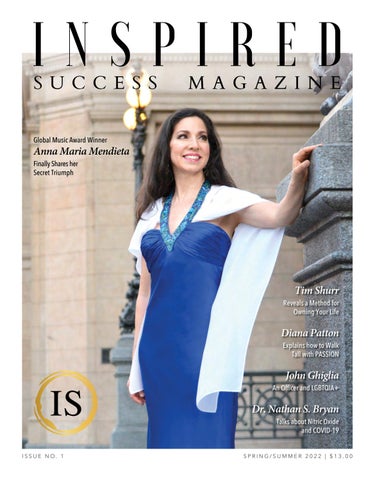
INSPIRED SUCCESS
MAGAZINE
Global Music Award Winner
Anna Maria Mendieta Finally Shares her Secret Triumph
Tim Shurr Reveals a Method for Owning Your Life
Diana Patton Explains how to Walk Tall with PASSION
John Ghiglia An Officer and LGBTQIA+
Dr. Nathan S. Bryan Talks about Nitric Oxide and COVID-19 I S S U E N O. 1
SPRING/SUMMER 2022 | $13.00
Access to and use of the golf course and other private amenities at Kohanaiki Club is available only to members of the Kohanaiki Club and are subject to the payment of additional fees. Membership to the Kohanaiki Club is by invitation only and is not included with a purchase of a property. No representation or warranty is made regarding whether a purchaser will qualify for such membership. Obtain the Property Report or its equivalent required by Federal and State law and read it before signing anything. No federal or state agency has judged the merits or value, if any, of the property shown in this advertisement. WARNING THE CALIFORNIA DEPARTMENT OF REAL ESTATE HAS NOT lNSPECTED, EXAMINED, OR QUALIFIED THIS OFFERING . Kohanaiki Realty LLC 73-2055 Ala Kohanaiki, Kailua Kona, Hawaii 96740.
THE GET AWAY FROM EVERYTHING CLUB There are clubs, and there is Kohanaiki—a private oceanfront playground that welcomes a new generation of Kona-lovers. Five minutes south of the Kona International Airport, and uniquely positioned to offer a sense of escape, Kohanaiki embraces island life in ways both new and familiar. Whether at the 67,000-square-foot Clubhouse, on the Rees Jones-designed golf course, aboard the 39-foot Kai Kea, or in the cabanas opening out to views of ancient lava flows and anchialine ponds, you’re surrounded by history, culture and adventure. Refreshingly private yet remarkably social, Kohanaiki is a new living experience unlike anywhere else in the islands.
HOMES FROM $4 MILLION 888.489.5603 • KOHANAIKI.COM/LIVING
Editor’s note began my first publication when I was ten years old. I called it News on the Mountain, a collection of stories handwritten on yellow construction paper. Raised in a rural area on the west coast with only twelve homes (our nearest neighbor was a 1/2 mile away) and growing up without a cell phone, iPad, Facebook, or Instagram, my imagination grew organically. As a child, I felt somewhat isolated. I wanted to connect with people and learn about their lives, so I asked my mom to drive me to our neighbors’ houses. I would ask them to share a story with me, which allowed me to get to know the people in the area. My mom thought it was silly, but she did it anyway. After doing the neighborhood rounds, I would write everything I could remember about those conversations onto pieces of yellow construction paper from my fourth grade class. I created a little booklet with something shared about each of them and delivered it to everyone who had spoken with me. Founder/CEO: Kat Mische Elle Photographer: Rojeena, Rozy Kat Photography Makeup: Ry-n Shimabuku
I saw the value in connecting people who might not have taken the time to connect on their own. I watched my neighbors get to know each other a little more by reading my childhood version of a magazine. Friendships began. Others strengthened. I felt like I was doing a good thing. After high school, my vision expanded, and I wanted to become a photojournalist. The truth is, I didn’t know which path to take to make that happen, so I let life’s paths lead me. And I paid attention to each step as I explored colorful, exciting, new directions along the way. You know how it goes. Those “directions” bring us to broader spectrums of ourselves and prepare us for the dreams we want to bring to life. My journey led me to create the media company Inspired Success Media and the publication Inspired Success Magazine. Inspired Success Magazine is designed to transform people’s lives, so they think better, choose better, and take action. We’re on a mission to share inspirational stories: the trials, lessons, and wisdom that lead to success. We offer practical tips and tools by interviewing thought leaders, professionals, adventurers, entrepreneurs, and influencers so our readers can bring their visions into reality. I dedicate these publications to my family, friends, acquaintances, and everyone who unknowingly reaffirmed for me where I intended to find my place in the world. I am grateful for all the moments I have shared with people while aligning and resonating with them and all the moments that were in contrasting and opposing conversations. Every exchange has helped fortify my strength and inspiration in this life. I am forever grateful. u
46
30 On the cover: Anna Maria Mendieta
10
68
6
Society & Culture 6 Diana Patton 10 Johnnie Ghiglia
Health, Wellness & Beauty 46 Dr. Nathan S. Bryan 52 Tayla Burke 56 Dr. Ben Benulis 60 Lynn DeHart Keiter
Location: Colón Theatre, Buenos Aires, Argentina. Photographer: Cristian Ardito
Business 16 Bob Summers PhD 22 Nixie & Rafael 28 Chris Lee Art & Entertainment 30 Anna Maria Mendieta 36 Sean Kanan 40 John Di Domenico
Spirituality & balance 64 Joe Vitale 68 Tim Shurr 72 Belah Rose Sports 76 Erika Sandor-Zur 80 Jeff Savage 82 Malia Costa
Journeys 88 Dr. John DeMartini 92 Traci Jeske 96 Dawn Cook Tech Zen 100 Randy Tate 104 Alex Gambino Who Inspires You? 109 Sylvan Schwab 112 Francine Sumner 116
Final Reflection
For advertising and general inquiries, contact: info@inspiredsuccessmagazine.com | 808.250.2767 For graphic design inquiries, contact: L. Dezign | info@LindsayDezign.com Inspired Success Magazine is published four times a year by Inspired Success Media, LLC. © 2022 Inspired Success Media, LLC. All rights reserved. No part of this publication may be reproduced without written permission from the publisher. I NS PI REDS U CCES S M AGAZIN E .COM
5
6
I N S P I RE D S U CC E S S MAGAZINE | SP RING/ SUMME R 2 022
DIANA PATT ON
SOCIETY & C ULT URE
Nothing Beats a Failure but a Try An Interview with Kat Mische Elle
Diana, tell us about your experiences and how they brought you to where you are today? was born to a white dad and a black mom two months after Martin Luther King was killed. They were two people who just loved each other. I have five older sisters, one younger brother, and my father was abusive. My grandmother on my mom’s side never really took a liking to my mom marrying my dad. My grandmother on my father’s side disowned my mom and dad. Because my father’s family disowned us, we grew up in black culture. I don’t remember white people being around except for my father. He was a person who was very disturbed. He sexually abused my oldest sister, which led to her running away. I remember at the age of thirteen, I started to see what was going on. I was the athlete, I ran track and played basketball and I used those activities to get out of the house. Leaving the house was something my dad didn’t like us to do. He was oddly overprotective at that time. My father tried to sexually abuse me at fourteen, and I pushed him away and prevented it from happening. I didn’t realize that moment was the beginning of me advocating for myself my whole life. Speaking up, standing up, doing the things that people didn’t normally do around my life. It was around this time that my mom started to notice me. I believed it was because of that incident with my father. By this time, my older sisters had moved out except for Cheryl and my brother Damien. This was a very big shift for me. My mom started to write notes and put them in my track shoes that I would keep placed on the steps for going upstairs. Those notes really molded me. I would keep those notes and put them in my shoes when I ran. The notes would say things like, ‘If you put God first, you’ll always be first. If you put God second, you’ll be last. Nothing beats a failure but a try.’
Photos by Natalie Anastasia
I knew I wanted to go to law school. My sister Teresa told me one day when I was younger that I would be a great lawyer. Of course, no one in the community knew of our family’s past because we kept it quiet; it’s a very small town. I didn’t really have aunts and uncles who were around for support beside me. I didn’t have anyone pouring support into me, except for my sisters. I believe God patterned me to believe and see more than what I could see with my eyes. I envisioned how I could help people, and my inspiration began. I graduated high school and I went on to college where I walked onto the track team and got a college scholarship, then I got into law school. At college, I met this guy; he was white. He was cute and interested in me, but I told him, “I don’t date or marry white guys. You’re cute, but not my type.” Fast forward and following my heart, he became my husband. My husband is the most amazing man I have ever met! But I was really against interracial marriages because of all the abuse I went through with my father, so this was big for me to overcome. This relationship healed a big part of me. I NS PI REDS U CCES S M AGAZIN E .COM
7
So, your trauma associated the abuse with the skin color, not your father’s individual behavior.
diseased, it takes away from the opportunity of that community to do its greater good.
Yes, that began my understanding of what we call bias, right? Being an advocate, understanding interracial marriages, the intersection of race, intersectionality, discrimination, all those things, all that I learned as a child played a significant role in my understanding of how I want to be an advocate and a lawyer for civil rights.
That’s why I believe that we can make the greatest impact when we love ourselves.
I became a global purchasing director; I became the head of supplier diversity. I was working at a very high level. Getting promoted was never an issue. But the way I dealt with trauma was to run and not be still. I kept busy. But this trauma, understanding it and knowing how to use my voice… It was never an issue for me to use my voice. Using my voice was how I got my jobs. People would say, ‘She knows how to speak up.’ But, I also didn’t know how to be quiet. I didn’t know how to be still. I didn’t know my inner voice. I didn’t know the strength of being still, or of really understanding myself. I really didn’t know how to do that. I could dress up, I could get in people’s faces, I could do the thing. I was shadowboxing my dad because ‘No one was gonna tell me no!’ If you told me I can’t, I’m going to do more of exactly that. That was a prescription for death. And I didn’t understand that until I started understanding the wisdom of being still. And then it all crashed and burned when George Floyd hit. It took me to a deeper understanding. And I wrote it all in my book, Inspiration in My Shoes.
When you begin to understand your unique identity proposition, you will understand who you are at the deepest core, and that learning never ends. You really begin to understand that once you get proximate to the issues in your community, you will recognize that a lot of people are not. And I say this because a lot of people want to do good in the world, but they have no clue how because they’re not close to the issue. I say if you’re really trying to find a way to stop asking others to do things, you should start leaning into where the problems are and start to understand what role you play. So again, everything starts with this reflection, “How unique am I? What can I do that no one else can do?” What situation or event led you to believe that you had gone as far as you could go when reaching for that next achievement, only to discover that you really could have gone so much further?
I believe in tangible results. We speak out. When we do hard things, and we’re willing to put our voice out there and be that person, that’s how things change.
When I wrote my book, I knew that I needed to spend the rest of my life helping young black and brown girls to see themselves, to value themselves. So that they don’t cry themselves to sleep. I want them to have visions of doing things beyond their current life’s circumstances. I realized I must help professional women overcome challenges, adversities, and trauma so that they can activate their voice from a healed space and then advocate for themselves. Then for diversity, equity, and inclusion. Because you can’t really be an effective advocate from an unhealed space.
Why is it important to build strength for self-reliance and in the unity of community? How would this support a social environment? People have to reconcile themselves with themselves. And once you reconcile yourself, I like to use the term from Dr. Joe Dispenza, where he talks about the identity gap: the person that you allow people to see, and the person that’s behind the scenes. Once those two people come together and they can become more unified, then you can have the best social impacts. Because there’s less likely to be depression, anxiety, worry, doubt, blame, guilt, and shame. When you do that, you realize your life is for service, and you are able to invest in your community. A lot of people don’t reconcile themselves with themselves, and they never really get the opportunity to have the greatest impact for social good. Because social impact, when you are a part of a community, you are a part of an ecosystem. And when that ecosystem is 8
When do you stop asking others to be the change you need for you to take action in a new direction?
I N S P I RE D S U CC E S S MAGAZINE | SP RING/ SUMME R 2 022
George Floyd. Need I say more? When this happened, I went through a serious depression. My kids had all graduated from private schools. My husband and I were able to give our children everything I know I never had. He’s an amazing father and the most amazing husband. He is a great man who has invested significantly in our kids. When George Floyd hit, I realized I needed to peel away another layer because I am about spiritual change. I am about something that is going to outlive me. The advocate work I’m doing is supposed to outlive me, my physical self.
I lost fifteen pounds. I had uncontrollable shaking. I could not speak. I realized I was taking in my family’s past racial trauma—and everything that we as black people stood for—of being noosed. Everything George Floyd experienced. I felt like all the whole world was inside of my body. And I was trying to escape it all. I was almost getting to the brink of death. That is when I relinquished it and said, “I need help, I can’t do this.” That was the significant shift to what I would like to have as enlightenment, to really learn the deepest part of who I am. I struggled. I needed to reposition my path and do more. How are you serving people now? I have my Rise Advocates Academy. It’s a course that I teach. After eight weeks, the student becomes a Certified Rise Advocate and I have continuing education to help support them to advocate for themselves. I have a membership where women work with me and help grow this Rise Advocates Community to be a support for these women. I like to say that I’m building a bench of lawyers to help these women because the biggest pain point they have is, “If I speak up, will I get fired? Will I get demoted? Will people look at me differently? I don’t know if I want to be in ‘good trouble,’ like John Lewis talks about? To be an advocate means
to get in ‘good trouble.’ Because getting in ‘good trouble,’ I could lose my job, I could lose my pension.” These women know they can trust me to help them. Are you not going to courtrooms anymore? I am not practicing mainstream law, no, that’s too narrow for me. I must be an advocate in the streets and with these women in organizations. That’s how I’m going to help them. I will also do work with organizations in leadership development and diversity, equity, and inclusion. I believe in tangible results. We speak out. When we do hard things, and we’re willing to put our voice out there and be that person, that’s how things change. Leading by example. You know what I’m tired of, Kat? I’m tired of what I call the ‘chicken- beefvegan model.’ You go to a women’s event and you pick chicken, beef, or vegetarian. It’s three days long, everybody’s trying to figure out how cute they look in their outfits. They take the little photos for social media, they post them on social media, they see that they help these young people, then they go home. And they don’t change. Then, we have the next women’s event and we talk about the same problems. Because no one’s really rolling up their sleeves, going into the community, and being of service. Because that’s where my work is. This is a daily practice. And it starts with yourself. Feed your body well because you’ve got to have certain practices that are going to help you get to the next level. If we are supposed to love our neighbors as ourselves, we must make certain that we’re loving ourselves first and providing an example. So, when you enter a room as a grown woman, your energy gives off this feeling to a young girl to help inspire her own power. And you’re speaking to someone who struggles. I don’t have it all together. My focus requires intentionality. And that requires a certain cadence of work ethic. And the first part of that ethic means getting quiet. One of my mantras is, “Shut your ass up and sit down.” And that’s hard for me. So, that’s a part of my work. When being faced with negative changes of a situation, what is the best emotional and spiritual stop, drop, and roll method to use that you have found helpful? I use my PASSION method. Pause | Assess | Space | Speak | Insight | Open | N(k)nowledge. So, you can be in response, not reaction. Yes. Who would you thank for being a major inspirational influence in your life? My mama. Enough said. Joanie Alice Jackson Pinsky. What is the best way for the readers to find you? Riseadvocates.com, Facebook, Twitter, Instagram. And I really encourage people to go to riseadvocates.com because they can sample the course if they sign up. One of my favorite chapters is obliterating hidden barriers and overcoming your adverse childhood experiences. u I NS PI REDS U CCES S M AGAZIN E .COM
9
An Officer and LGBTQIA+ An Interview with Kat Mische Elle
Johnnie, where did your adventure begin? had planned on retiring from law enforcement on January 7th last year in 2021. I picked that specific day because it was the day I graduated from the academy, 21 years ago to the day. In 1994, that was also my wedding date. Even though we are now divorced, I have a lot of good memories of that day. So, for me, that day was symbolic. I was ready to move forward and pursue what I really wanted to do. I felt that my true purpose in life was to give back as much as I possibly could to support Chase, my son, and his community. Twenty years ago, I was 35, and it was Christmas time. My wife and I were hanging out in the kitchen. She turned to me and said, “Hey, I want you to prepare yourself with something I need to tell you because I know who you are.” I was staring back at her, confused because I don’t even know what the conversation was going to be about. My wife continued, “I know who you are. I know how you were raised with your religion and being very conservative and all of that. I know your family!” I just stared at her, wondering where this was all going, and then she said, “Chase is gay.” I said, “What?! Chase is five.” This was pure mothers’ intuition. She just knew. I wasn’t in denial; I just didn’t see it, I only saw my son who I loved. And my wife was spot on. She said, “Here’s the thing. Is he asking for sporting equipment? Asking to play football, baseball, basketball, whatever?” I said, “No.” She continued, “Does he want big trucks and tractors, or does he like playing in the dirt in the back yard?” Again, I replied, “No,” and I began to smile as it all started to sink in. “What did he ask for this year?” she asked. “He wanted an Easy Bake Oven,” I said. My wife looked me in the face and said, “Right!” with a glimmer in her eyes. “Hold on… Emeril is huge right now,” I said. “Chase and I watch him every day on television. Maybe he wants to be a chef?” My wife looked at me and said again, “Johnnie, Chase is gay.” I said, “Okay, whatever, it doesn’t matter.” It was just that small of a conversation. And, to me, it was no big deal. The bottom line was he was my son. I loved him. End of subject. I was raised to be an alpha male, growing up on a 3000-acre ranch in Nevada surrounded by other strong, hardworking Christian men like my father and my grandfather. And when I wasn’t working, I was playing sports. I graduated with a master’s in sports medicine, and I worked in the NFL. I was the head athletic trainer at Grand Canyon University for three and a half years and worked at several physical therapy clinics. I began rehabbing several Scottsdale police officers, and one officer asked me if I ever thought of going into law enforcement. My first response was, “Absolutely not. I’ve never thought of doing that.” Then I became curious because I needed to think about more than just myself. I needed to consider the benefits that the career could provide for me and my family. The officer said, “We’re hiring.” 10
I N S P I RE D S U CC E SS MAGAZINE | SP RING/ SUMME R 2022
J OHNNIE GHIGL IA
SO C I ET Y & C U LT U R E
I NSPI REDS U CCES S M AGAZIN E .COM
11
I said, “My number one question is: how good is your health care?” He replied, “It’s actually really good.” Chase was born with a cleft lip and palate. So, my biggest concern was knowing how many surgeries he would need to have as he grew older. So, I put my application in, and two and a half months later, I got hired. That career, that chapter of my life, shaped who I became over time and who I hung out with. The time I had to put into that career definitely affected my family life and played a huge role in why I experienced the demise of my marriage which led to divorce. I look back, and I’m at peace with everything because it all happened for very specific reasons. If I hadn’t gone through that divorce, I wouldn’t be where I am right now, here today, with so many doors that God has opened for me. Chase was 17 when I was working at the PD, and one day, he visited his mom when she was at her work and told her that he was gay. I called him, and Chase told me that he wanted to talk to me in person. I told him that I would talk to him that night at home. However, he never came home; he spent the night with friends. My wife and I had a vacation planned the next day, and Chase was going to ride with us to the airport so he could take the car back home. I brought it up that I knew he wanted to talk to me while we were in the car. He told me he was gay, and the conversation went very well. What was your response to him? I made sure that Chase knew that—no matter what—I would always accept and support him. I told him that he is my son, and I love him unconditionally. I told him that he needed to be his own authentic, unique self, whatever that was. It did not matter who he loved. One of Chase’s main concerns was that I was a cop, and, in his opinion, I had friends who had big egos with macho, unaccepting personas. I informed him that I knew who those people were that I worked with. I told Chase that if those people could not accept my son for who he was, then they were no longer a friend of mine! Based on his reaction, as he sat in the back seat, I believe he was surprised by my response. From that moment, you could see Chase had a weight lifted away from him, and he was truly able to be who he is. How was your relationship after that subject was out in the open? Our relationship, I believe, became stronger just due to him knowing that he had my unconditional acceptance and support so he could be his authentic/unique self. At what age were you and Chase when you began creating ‘Out is the new In’? Chase was 21, and I was 51. Chase was living in Pasadena, California, and I was in Chandler, Arizona. This May 2022 will be 5 years since I had the conversation with Chase about making this idea a business to give back to the LGBTQIA+ nonprofit community. It was after going through the divorce. Months later, I was waking up with visions of logos in my head. I started drawing them out, contacted Chase, and told him there was a reason why this was happening. I sat down and googled, “How to start a business” and saw 12 steps that came up. I remember thinking that 12 was not bad at all, and I started at #1. I had no idea what I was doing since 12
I N S P I RE D S U CC E SS MAGAZINE | SP RING/ SUMME R 2022
I had never had a business before or had ever started one. We came up with an original logo that Chase liked, and I proceeded to find a screener to make shirts and hats for us. That original logo is now called ‘vintage’ on our website. How long did it take until it became an official organization? The original LLC of OITNI LLC was established in May of 2017. It took my retirement in January of 2021 to go all in and get to where I am today. I decided in late 2020 that I wanted to retire and see where this idea could go. I wanted to truly pursue my purpose. I sold my house a week after retirement and told myself that I would use those proceeds to fund what my vision was for the future with ‘Out Is the New In.’ We rebranded the logos and developed a brand-new website with a store of apparel and other items. 10% of every sale on the website and vending booth events I attend will be going to local nonprofits that focus on suicide prevention, mental health, and homelessness within the LGBTQIA+ youth community. 100% of all donations will be donated back into the community. I have also hired a grant writing company and am waiting to have my very first grant awarded so funds can go to several different nonprofits in the community as well. I was granted 501©3 status in July 2021 for ‘Out Is the New In Foundation.’ The newly rebranded website with store went live the same weekend of Phoenix Pride, (Nov. 6-7th, 2021) which you can visit at outisthenewin.org. How did your relationship change with your friends/fellow officers you worked with when you began this organization? I honestly did not notice a difference in my relationships with anyone. My personal friends and other officers I worked with would comment quite often how they thought what I was doing as a father/son collaboration was awesome and how I was supporting Chase as an ally. Growing together on that project, what did you discover about each other individually and together as father and son? For me individually, especially after attending a one-day event in Flagstaff, Pride in the Pines, by myself, I knew my purpose was to be the best ally not only to Chase but to so many other people within the LGBTQIA+ community. Telling my story of why I was there and having people on the other side of the table completely break down crying and tell me that their parents had not accepted them the way I accepted Chase was very difficult for me to absorb. I thought, “How can a parent not accept their child based on who they love, how they identify, who they were as their authentic self?” I did a lot of talking to myself on my drive back to Phoenix, realizing there were so many other people who needed to be accepted and supported. I needed to figure out what that looked like moving forward in the future. Chase has always told me that he loves the support that I have for him and the LGBTQIA+ community and what I am doing to show that support. What is the mission for ‘Out Is the New In’? About: ‘Out Is the New In’ was founded by the father and son team of Johnnie and Chase Ghiglia. It all started with a conversation while sitting in a family room discussing the potential ideas of what we could do to give back and support Chase and the LGBTQIA+ community.
Years later, that conversation developed into what our true purpose in life is today. That purpose is focusing on being the best ally and advocate a parent can be supporting the LGBTQIA+ community through volunteering, donating, collaborating, sponsoring, mentoring, and organizing. Vision: Promoting a world where inclusion, diversity, respect, support, and equal civil rights exist for all LGBTQIA+ people. Mission: Allies and Advocates coming together to show respect, support, and recognition to all LGBTQIA+ people through community service, by being authentic, being present, and creating value. How big is your support now with the LGBTQIA+ Community? The support has been overwhelmingly positive, and the size of the community and welcoming I have received in the past year has been unbelievable. I have been truly blessed with the number of doors that have opened and the amazing people that I have had the opportunity to meet. I am absolutely doing what I was meant to do! It took me 50 years to find my purpose. I am hoping for even bigger and better things in the coming year. The way I look at the future is this: the bigger I become, the more I get to give back to the community. How do you view your leadership role in this adventure and the responsibilities that have come with it? As far as leadership, I view a leadership role as being a truly authentic ally. Let as many parents and family members know that the most important thing you can do if your child comes to you and tells you they identify as queer, is to tell them you love them unconditionally. So that they are allowed to be their own unique, authentic self unapologetically! In accepting and supporting your child, you are showing them your unconditional love. Be grateful for every door that opens for you and absorb everything it has to offer. Network and develop as many friendships, collaborations, and resources as possible that you can use when that need presents itself, so you can get that person the best assistance available.
different facets, by serving through volunteering, donating, collaborating, sponsoring, mentoring, and organizing. I have several booth events scheduled up to May 1st and then they start back up in October, just due to heat. They are usually on the weekends throughout the valley. I will also have a table at the Mental Health America of Arizona SEEDS conference in March. Being a part of these events is so fulfilling for me. Just to be able to meet so many new people and have amazingly authentic conversations, getting to know them, their stories, and being able to tell them what my cause and purpose is. Soon, I am hoping to produce and present a new podcast that focuses on many different areas of mental health awareness. It will consist of guest speakers that identify within the LGBTQIA+ community as well as speaking with licensed therapists who treat both the adult and youth of the LGBTQIA+ community. My hope is to deliver a message that will inspire a conversation for people to reach out to friends and resources, so they know they are not alone. To know that they have people out there who support them in what they are going through. What is the best way for people to find and follow you? The best way to find ‘Out Is the New In’ is through Instagram and Facebook for content, updates, and what is coming up next for us. Each one is under OUTISTHENEWIN. I also have a LinkedIn page under OUTISTHENEWIN. The website is: outisthenewin.org Once the podcast is up and running, you can subscribe to the YouTube channel: OUTISTHENEWIN, you have a purpose. u
Regarding responsibilities, I plan on continuing to be educating myself regarding sexual orientation and gender identity. Listen, absorb what is said, learn daily and support the LGBTQIA+ community in so many ways. Talk less, listen more. Not only for Chase but for the entire LGBTQIA+ community. Advocate for all LGBTQIA+ people to be healthy, safe, and have equal civil rights. Confront homophobia and transphobia. And to always be a kind human! Who would you thank for your inspirational influence? First and foremost, I would thank Chase for feeling comfortable and knowing he was in a very safe place to come out when he did at 17. I would like to thank two very good friends, specifically Nicole and Michelle, who I used to work with, for all their amazing advice, opinions, and support. The amazing, authentic circle of friends I have met through this journey and have given me so much love, advice, and support to prove that I am doing exactly what I am supposed to be doing. What can we expect from ‘Out is the New In’ for the rest of this year? To continue to support the local community and give back in several I NSPI REDS U CCES S M AGAZIN E .COM
13
16
I N S P I RE D S U CC E SS MAGAZINE | SP RING/ SUMME R 2022
BOB SUMMERS Ph D
BUS I N ES S
Dr. Tequila An Interview with Kat Mische Elle
Bob, can you tell us about your back story and journey that brought you to where you are today? oming from humble beginnings is my subtle way to say we were poor growing up. There were seven of us: five boys and two girls. My mother worked as a nurse, and my father was a traveling salesman at the time. They always found a way to feed, support, encourage, and love us. Family is very important to me, and their love and support are where I draw my strength. If you do not have love and support from family, I would recommend you find it elsewhere and build on it. Your support system will be unique and beautiful; even if you must build it from scratch, you will find a way. You may notice that I use that phrase a lot, and it is sort of my life’s theme: “There is always a way.” You can always find your path to success, but it must be YOUR path—the one that works best for you and your loved ones. A wonderful example of how my parents showed me how to “find a way” was when they found a way for us to attend a good private high school, even though there was “no way” we could afford it. They moved us from our humble home, rented it out, and used that money to pay for school. It was a unique path, to say the least. We lived in a one-bedroom shack while they paid back the money. It was a struggle for all of us as there was no running water, except the creek in the back. We slept in the attic (yes, all seven of us) and had to climb a makeshift wooden ladder on the wall to get there. Every morning, we would clean up using water heated on the woodstove, pile into the station wagon, and my mother would drive us to school across town on her way to work. It was a bit of a rough patch for a while, but my parents loved us and made it fun. When I look back on it now, I recall it fondly, more like a camping adventure. I have very few regrets in life, but I do have one regret from that experience. I was embarrassed to get dropped off at the front of the school because we were the “poor kids,” so I would ask my mom to drop us off a few blocks away so we could walk in. In retrospect, I would have asked her to pull right up to the front door with the horn blasting. I would have jumped out and YELLED at the top of my lungs: “Hey everyone, look over here, look at my beautiful mother… Look at how much she loves us… Look at how hard she works and sacrifices, so we can come here… Isn’t she AMAZING!” Experiences like these formed me and taught me how important it is to keep searching for your path, no matter how many times someone tells you “It can’t be done.” After graduating high school, my twin brother and I became EMTs and worked in Reno for several years. It was so fun, and some of our patients thought they were seeing double sometimes, but it’s where I realized how much I loved healthcare, I NSPI REDS U CCES S M AGAZIN E .COM
17
“Can’t never did anything.” and I knew my path would always include some way to help people. To this day, any success I have comes from that love and desire to help others. With El Sativo Tequila, it is my love of family and the desire to help others which drives me. It is a perfect fit because I am able to work with the family to create this wonderful masterpiece, and now, I get to share it with the world. Share with us how you were led to the naming of your tequila? Yes. After I graduated high school, I became an EMT/Firefighter. My passion has always been to help people, so I would have to say, the years I spent doing that was the most fulfilling for me personally. I continued my education and became a training officer helping newcomers enter the medical field. My medical career progressed, and I became a hospital administrator, leading large teams of healthcare professionals. I eventually accepted a position as a consultant, traveling throughout the United States, helping other medical facilities run their healthcare programs. In 2014, a colleague of mine, Dr. Bob Dalrymple, asked me if I would join him in establishing a medical cannabis company in Nevada. It took a bit of soul searching, introspection, and courage, as cannabis is federally illegal, and we would conceivably be risking our careers. However, after researching the true medical benefits of the plant’s compounds, we decided to create the company NBS, Inc. I recall one of our first patients was a young girl with a severe seizure disorder. She was unable to go more than a few hours without an episode. Her parents had tried traditional medicine for years, and it was not working well and had unmanageable side effects. Through trials and adjustments, we were able to create a pure organic cannabis oil that safely reduced the number of seizures she was experiencing. This significantly improved her quality of life. Our whole team cried tears of joy the day we got a call from her parents telling us that she had gone a full day without a single seizure. I could go on for hours with similar stories about patient outcomes like hers that make this amazing journey entirely worth it. Tell us about the moment you made your discovery on the terpene’s health properties and the same component that you found in the agave? At NBS we use organic carbon processes called Critical Temperature Pressure C02 extraction to produce the medicinal-grade cannabis oil. We further refine it with steam distillation, filters, and other processes to isolate the different flavonoids, polyphenols, and other Cannabinoid compounds found in the cannabis plant. Yes, it is as complicated as it sounds, but it can yield a pure medicinal oil that is beneficial to patients. Based on the studies from Israel and other progressive countries, and our own clinical research, we became very familiar with the benefits of each compound within the cannabis plant as well as other botanicals, in particular the terpenes. 18
I N S P I RE D S U CC E SS MAGAZINE | SP RING/ SUMME R 2022
Terpenes are naturally occurring aromatic compounds found in most plant species around the world. Although recent research has focused on terpenes found in the cannabis plant, they are also found in thousands of other plant varieties such as conifers, tea, thyme, sage, citrus fruits, and even agave. Terpenes are attributed to the scent and the taste of plants; however, they also have individual health benefits. For example, pinene is a terpene found in pine trees that are known to benefit bronchial function. Linalool is a terpene found in the lavender plant which has calming and antianxiety properties. The team’s “ah-hah” moment regarding the power of the terpenes came when we learned that our young patient with a seizure disorder experienced insomnia from the oil. We increased the level of myrcene, which is a terpene known for its sedative and relaxing effects. This worked better than expected, and she has less trouble sleeping now. Individual terpenes have very powerful properties, and it is important to know how they interact with each other. This is known as the entourage effect, and it is important because terpenes influence each other; for example, some terpenes assist each other and intensify effects, while others counteract desired effects. From the culinary perspective, it is important to understand how these scents and tastes interact and influence each other as well. This is where my wife and her family come into the picture. They are a passionate group of spirits aficionados, mixologists, chefs, foodies, and artists. They have years of experience in the food and beverage industry and have an amazing understanding and grasp of how scents and flavors work. Much like the entourage effect, smells and tastes can work in harmony to create beautiful flavors or can clash with each other. Having a sophisticated palate and solid understanding of how individual flavors influence each other, combined with a profound knowledge of how spirits are distilled, led to a perfectly natural progression into the tequila world. This passion to create pure, organic products combined with the knowledge of the team led us to El Sativo tequila. I have always been conscientious about the environment and how our activity affects the planet. This is another aspect we focused on when we moved into the tequila world. To that end, El Sativo is organic, kosher, additive-free, non-GMO, 100% Blue Weber Agave tequila made the way purists have been doing it for decades. We honor the tradition and methods used by our distillers for generations. Our plants are “Single Estate” grown in the valley of the tequila volcano, in Jalisco, Mexico. Our agaves are grown, nurtured, and harvested organically in our fields and never sourced. We never use harmful pesticides or fungicides. We use organic fertilizers and harvest by hand. We slowly steam our blue agaves in small-batch stone ovens for up to 72 hours. No autoclaves. No diffusers. We ferment with naturally occurring yeast and ensure the process is accomplished in a green and environmentally friendly way. Our bottles are made from recycled glass, our labels are compostable, and with every bottle sold we give back to the Ocean Conservancy charity.
Can you share with us what those benefits are? Is tequila also an anti-depressant? Or the only alcohol that is not a depressant? Tequila is associated with fun and uplifting, good times and is often referred to as the only stimulant spirit; however, all distilled spirits contain alcohol, which is classified as a depressant. Perhaps it is considered an upper because we have all heard, (or maybe had) those stories about the energizing good times enjoyed while drinking tequila. Tequila is considered a healthier spirits choice because it contains fewer calories, and the natural sugars “Agavins” found in tequila are non-digestible like fiber and do not raise your blood sugar levels. Organic tequila has lower levels of impurities, and agave contains saponin compounds, which might have anti-inflammatory properties. Anecdotally, this means that consuming saponin in tequila may potentially reduce inflammation, but there is no solid science backing that statement. In short, tequila is the fun spirit that you have always known, and the “purer the better” when it comes to consumption. Our goal was to create the perfect ultra-premium sipping tequila, and I think we achieved it. We were so proud to win the “Best in Class” and the double gold medal from the most prestigious “San Francisco World Spirits Competition” because it is a blind taste test, which is a pure and honest assessment of the juice itself. What led you to believe you could keep moving forward while reaching for that next achievement? Once a path has been chosen as worthy, you can become unstoppable. Tenacity is a trait that I really value and has always been the thing that leads me to success. I can’t recall a specific event during my journey, but there have been plenty of challenges that shook my confidence and tested my tenacity. I truly believe that once you decide on your goal, you will find a way to get there. The power is in the decision! There will always be naysayers and obstacles along the way. The beauty of the entrepreneurial spirit is that you thrive on the uncertainty and consider it an adventure. Knowing how to do something is generally not as important as knowing that you are going to do it. The trick to staying motivated, for me, is to be an “out of the box” thinker. I don’t compete with others so much as I compete with my last best achievement. Another good practice is to celebrate your successes, so I take the time to have mini award ceremonies inside my head when I accomplish a goal; it keeps me moving forward. I always want a ticket to the next red-carpet event in my head. What was the most impactful experience during the climb to the next level of your product success? COVID-19 had an incredible impact on us, as it did most people. We initially planned to launch on Earth Day (2020), but due to COVID-19, we were unable to bring our shipment in on time. I NSPI REDS U CCES S M AGAZIN E .COM
19
We had to push everything back. There are a lot of moving parts when you are launching a new brand, so it is complicated even without COVID. Logistics were a mess because most offices and businesses were closed. Everything from the trucking and regulatory agencies, to advertising companies, etc. was disrupted. This challenge forced us to change our original “on-premises” marketing strategy for restaurants and bars due to closures. Fortunately, we have team members who specialized in off-premises and chain store venues, so we were able to pivot to that different strategy quickly. This new strategy helped us place El Sativo with large corporations such as Costco, Total Wine, and Whole Foods. This led to explosive growth in our first year, and it has been an overwhelming success. What are the goals for your company in 2022? The desire for our product is off the charts and we can barely keep up with current demand. Fortunately, we planned for this, and in 2022 we will more than double our capacity with a new distillery. We also increased our agave field and plant volume back in 2018, which will support future growth. Our goal for 2022 is to increase shelf pull as we launch our product in 6-10 new states. Currently, we are available in California, Nevada, Arizona, New Mexico, Texas, Rhode Island, Georgia, South Carolina, Massachusetts, Indiana, Illinois, and Minnesota This year we expect to launch in the following states: Florida, Colorado, Oklahoma, Arkansas, Louisiana, Tennessee, Kentucky, Pennsylvania, New York, New Jersey, Connecticut, Michigan. We have an amazing team. This makes pushing the product forward much easier. Everyone on the team has the same vision, passion, and desire for the product and the product’s legacy. We’ve spent the first year creating and developing the perfect tequila and the second year doing guerilla marketing. This year, we are focusing more energy on traditional and digital venues to increase that shelf pull and international reach. There are a lot of celebrity-based tequilas dominating the social media space currently. This means that, in order for us to occupy some of that space without major celebrity endorsement, we need to reach out to a variety of influencers to get our message out. At El Sativo we say, “Our Tequila IS the Celebrity” because our product accolades make us famous. So, this year, keep a lookout for us on your social media, TV show, movie, or billboard, and definitely give us a try! Also, I will let you in on a little secret, we are working on a specialty cask version of our Añejo which is completely unique and beautiful. It will be available in late 2022/early 2023, and it is going to be amazing! When I continually put myself into new situations by choosing interesting and challenging paths, I force myself to grow new muscles and skillsets. I use this new knowledge to make me a better person and continue to focus on growing with purpose. I try to keep that mindset as I progress forward. This helps me think of the challenges and setbacks as less negative/more positive. Just like in the gym, when you’re doing those last few reps of weight, you have to remind yourself that you’re doing it to progress, and although it may not be pleasant now, the benefits of being fit outweigh the challenge of the moment.
20
I N S P I RE D S U CC E SS MAGAZINE | SP RING/ SUMME R 2022
One of the things I recommend is to have a purpose that includes your explanation of: Why do you do it… For us, it is the love and art of making such a wonderful product that brings so much joy to others. And: How you give back… For us, it is all about being Earth-friendly. We use recycled glass, we use organic practices, and source responsibly. Every bottle sold gives money back to support ocean conservancy. What is your favorite “Motto”? Can you share how that was relevant to you in your life? “Can’t never did anything.” My mom used to say that when I was young and lamenting about having to do my chores. She still says it to this day whenever I am whining about a challenge, although I do keep my room clean now. The moral is you can always find a way to make success happen. Expect to be pushed out of your lane quite often. Knowing many rivers feed one lake, there is always a path to success. Being an out-of-the-box thinker really helps you find that path, even if it takes making an entirely new river to create that lake. I recall back in 2000, my wife and I found a perfect plot of land on top of a hill where we wanted to build our dream home. There were so many challenges because access to the home was “impossible” according to the city, fire department, neighbors, and every contractor that we spoke to. Every naysayer told me that they couldn’t build the house, so I decided to create the path myself. I became my own general contractor and all subcontractors. I built the entire house myself by researching and learning how to complete every aspect of the home build. I would do one trade section and then call an expert in that field and have them check my work. I did the same throughout the whole project with plumbing, electrical, drywall, etc. until I had the entire home built. It took several years, and it was definitely not easy. The naysayers and the challenges were many, but I kept pushing forward knowing what I wanted, and just learned how to do it along the way. Sometimes it felt like I had jumped out of the plane and was building my parachute while I fell. There were good and bad days, of course. Today, my wife and I still live in our beautiful dream home on the hill. It was my tenacity and my, “Can’t never did anything” motto that led me through that adventure and continues to drive me today. How can our readers follow you and find your tequila? El Sativo Tequila Website: www.elsativo.com Instagram: https://www.instagram.com/elsativotequila/ Facebook: https://www.facebook.com/Elsativotequila/ YouTube Cocktails: https://www.youtube.com/channel/ UCtGRntfnRHHzIw7xEjINnOw/featured LinkedIn: https://www.linkedin.com/in/robert-summers-ph-d2a21001a/ u
A Cup of Love An Interview with Kat Mische Elle
Nixie & Rafael, how did the two of you meet? he night we first met, it was out on a dance floor in a club. We connected so quickly it almost didn’t feel like we were meeting for the first time. We quickly learned that we had so many things in common! We discovered that both of our parents were born in the Dominican Republic and immigrated to the United States during the late 70s. Rafael and I are the first generation born in the U.S. and the eldest child in our families. We were both in family-owned grocery store businesses, and we lived in the same neighborhood, only about 5 minutes from each other, yet we had never crossed paths. It was incredible that we both lived in this small town in Queens and that this was the first time we met. It took a night being motivated to dance to traditional Merengue-style music of the Dominican Republic at a club about thirty minutes away from our homes for our paths to cross. Rafael: Hence the art on our coffee bag with the dance club on the logo. Before meeting Nixie, I had written about the woman I wanted in my life on a piece of paper. I was very clear and specific on that list with the descriptions of the partner that I wanted in my life. And I wasn’t going to settle for anything other than what I put on that piece of paper. Dancing had to be one of those things. That dancing partner needed to be a smart, kind, and attractive woman. That was Nixie. After that first night, Nixie and I spent about two to three months where she would come to my house every night. Nixie: There was no physical intimacy during those months, but we connected on deep intimate levels about our visions for business and life. He says he knew I was the one from the moment he met me. Rafael: Definitely. Nixie: I, on the other hand, was more reserved about my thoughts, but I knew there was a connection, and I really wanted to see him every day. Rafael: Something was pulling her and me together, and I decided to trust and follow where I was being led. Nixie: Even though we had opposite personalities, our core values, self-respect, and inspirations were an exact match! Recognizing that what we had between us was so incredibly special, it was a truth like no other, something we had never experienced before. After dating for six months, Rafael proposed, and we decided to get married! The day we said “I do” was when the journey really began. That was the yes to our marital commitment and the yes to choosing the life and business adventures we would embark on. We genuinely have the most authentic form of partnership between us. This was the beginning of our business and love story.
22
I N S P I RE D S U CC E SS MAGAZINE | SP RING/ SUMME R 2022
NIXIE & RAFAEL
BU S I N ES S
Photo by Melissa Ochoa
After many years of working in a managerial position in the family-owned grocery business, Rafael wanted to explore entrepreneurial adventures. He was invited to be a part of a growing business that sold coffee machines. With the idea of being his own boss, Rafael was inspired to spearhead the opportunity and take it to its next level. Because the grocery store industry was what we both were the most familiar with, Rafael began to sell the coffee machines there first and then moved on to hotels and then car dealerships. It was one cup, on-demand from the whole bean to grind to a fresh brewed single cup of coffee. People loved the difference in quality, freshness, and taste. It went from the bean to the cup, and this required a high-quality, great coffee bean because it was such a high-end machine. Once picked, the beans went straight to a roaster to bring out a very rich-tasting coffee bean for brewing. After creating the three fantastic roasts for the coffee machine, it was time to take it to the next level. We then ran into some blocks with the funding needed to expand the vision of selling the coffee machines. So, we took a step back to listen to where we were being guided even though, at the moment, it wasn’t apparent to us. A short time after looking at our situation, Rafael and I went to a business convention where we both decided to move past the subject of the coffee machines at that moment and focus on the coffee we had developed. I turned to Rafael and said, “You know what? Let’s become business partners. And let’s do something with that coffee because that is GREAT coffee. Even though yes, it’s the machine that brews it, BUT it’s the coffee itself that everyone is raving about!” At that moment, we both could feel the energy, excitement, and clarity around the idea of us becoming partners once again in what would end up becoming our simultaneous second marriage. Since the selling of the machines originated from our previous business partner, we decided to part ways with that aspect and instead took over the operation of the coffee beans. We were also learning more about CBD and its magical properties and decided to create CBD-infused coffee during this time. It turns out that CBD and coffee made an incredible team together, like Rafael and me. We came back home, and we started working on how to develop this brand, and that is when ‘Nixie’s Coffee’ came to life. KME: That’s a real commitment the two of you share. Sometimes those situations can break a relationship with the expansion and contraction that occurs during the business and relationships’ growth phase. It looks like you two keep going, growing, and glowing together! Nixie: I think the aspect of the two of us having very different personalities is also what makes us great and strong in our business. Because we each have what the other is missing. We can create that balance and become more powerful together. Rafael: Nixie is kind and giving and can easily envision the big picture. Nixie: And… Rafael is more results-oriented and focused on the goal. When I need direction and action, he drops in with the suggested next steps for the results I want to achieve. And then, I share with him my view on how those suggestions can expand over the whole vision before we 24
I N S P I RE D S U CC E SS MAGAZINE | SP RING/ SUMME R 2022
reach that destination. KME: So, you bring the color to his black and white. Rafael’s black and white creates guidelines to stay within so all the colors you bring into the mix don’t bleed into one another. Nixie: That’s a great analogy. KME: It looks as if the first dance in the nightclub continues to this day. Nixie: Yes! KME: But that doesn’t just happen. Success in life, love, or business – you must do the work. Nixie: It’s true. I have learned a lot, and I give thanks every day. What is the focus you use for yourself to stay in future-forward momentum heading towards your goals? Nixie: Lots of personal development. We set big goals for ourselves! Rafael: Huge. Goals that usually scare us. But we have come to know that fear and excitement are the same feelings; it depends on what thoughts we are putting into it. Nixie: And we continue to strengthen that aspect of ourselves every day. Personally, I look for ways to get out of my comfort zone. I have come to love how alive I feel when I do. For example, I became a minister at my church because I was terrified of standing in front of people, even though my character seemed outgoing. But when it came to standing in front of a large group of people, I couldn’t see myself. A part of me would hide inside. So, I decided to look that part of me in the face and heal it. Tell me how you went from selling coffee beans to becoming television producers? Nixie: When we were growing our business, we ran into several blocks during the production of the CBD-infused coffee version. We were kept from proceeding to its next level due to New York’s ban on CBD products being produced and sold in the state where our company is established. So, we reeled that back to just staying the course of our already very popular and successful original coffee beans. At that time, the same partner that Rafael had in the coffee machine business circled back into our lives and invited us to be a part of producing The Voice, Who Wants to Be a Millionaire, and soon, Shark Tank in The Dominican Republic! We loved the idea, and how it also was an opportunity to bring us back to where our families began, so we said yes! Rafael: To be able to launch these programs in the Dominican Republic is a fantastic experience. This is our homeland for our families. Nixie and I are first-generation born U.S. citizens. With the opportunities that have been provided to us here, we want to be able to bring something back to The D.R. The productions will bring a few hundred jobs to the community, giving exposure to all the incredible talent and genius that the people have in the D.R. and entertainment. Nixie: We then flew into the Dominican Republic. We sat down for the very first recording of The Voice, and oh my, I fell in love! I mean, with everything! It brought me back to the moment when I used to do backstage work in high school and college. I instantly wanted to be more involved with this and not just an investor. I told Rafael that I had
“the butterflies” confirmation. At that moment, Rafael went straight away and told his partner, “Hey, Nixie wants to work here.” Rafael will not let me sit on the sidelines if he sees anything that lights me up. He will always lovingly pull and encourage that jump. And just like that, I went from Barista/coffee entrepreneur to a hands-on television producer of The Voice. Rafael: It’s because I see you. Nixie: I was then told to come back next month and be prepared to work. I worked myself into the position very quickly. I was a natural at it. It was as if I had always been a part of television. Being reconnected to the Dominican Republic has also propelled us to grow our business for Nixie’s Coffee there. We are focused on building a solid team to give more time to the T.V. productions with our extended visits to the D.R. What is your favorite part of bringing these productions to life in the Dominican Republic? Nixie: You fall in love with the people and their stories. When we began this adventure of production, we sat in that audience so we could take in the experience purely as an observer. I cried listening to the stories of these people of whatever age. A woman in her 50s shared that she felt
that she was too old to even get up on stage and sing, yet she made it to a finalist! This woman was incredible! The Dominican Republic is a third-world country where opportunities like this are little to none. Before developing the production of The Voice in the D.R., people did not have the opportunity to get out and show their talents. Everyone has dreams to be and live something bigger in their lives, no matter where you are from, and I am happy to be a part of bringing this experience to all those who want it in the Dominican. Then you have the entire team that was extremely enthusiastic behind the scenes putting everything together. Everyone is so inspired and happy to be part of a big project. The excitement and joy are contagious when we are setting up for a show, and we all can feel how we lift each other up during the process of being a part of something so big. KME: You realize that the two of you have stopped working, right? You have created something that lights you up inside, and you now partake in tasks where you contribute your energy each day. You’re not working anymore when you have found something that feeds your soul and plate. Rafael: Absolutely. I NSPI REDS U CCES S M AGAZIN E .COM
25
What is next for you?
helps me see what I am capable of.
Nixie: In 2022, the second season of The Voice will be airing in the Dominican, and Season one of Who Wants to Be a Millionaire. Then, expansion of Nixie’s Coffee because we want to keep on growing our first baby.
KME: We can get profound information from an outside observer in helping us see ourselves where perhaps we choose not to look.
We will also be preparing to launch Shark Tank for the Dominican Republic in the fall. Who would you like to thank for all your adventures in life and love? Nixie: My deepest gratitude is for my parents and for my husband. My parents are two of the most hardworking people I think I’ve ever met. They came from a dirt-poor life. I’m talking about a very rural area, with no electricity and no running water at times. They came into this country where they knew no one. Having babies in a country where they did not know the language, the more I hear about their stories, the more inspired and motivated I get to continue to build on our success. I cannot disregard or take for granted all the work they already put into life for my siblings and me or let it go to waste. I have got to do something with all of that. It would be sinful of me not to have that gratitude for them and what they have done. And, for my husband. He has been the one who always pulls me into a clearer view of myself and
26
I N S P I RE D S U CC E SS MAGAZINE | SP RING/ SUMME R 2022
Rafael, where do you place your gratitude? My uncle. He left me in charge of running the family business. It was then that all my skills were given a push to become stronger, which helped shape my future for being a boss. I learned how to deal with people, employees, obstacles, you name it. I learned it. I can sit and envision everything that could happen before it happens. And how to correct it before it even gets to a challenging situation. I am also incredibly grateful for my wife, Nixie. The smile in her eyes reminds me that we are on the right path together every day. How can the readers follow you? They can find us at: nixies.com or at nixiescoffee.com, our website for coffee. And ‘Nixie’s Coffee’ on Instagram and Facebook. Nixie: I’m the one who is answering any questions. I also send handwritten notes to everyone who orders our coffee. I’m so thankful for every order that comes through that I want to take that extra moment to just say thank you to that person. u
CHRIS LEE
Photo by Cam McCarley
Pandemic Paradigm Prosperity An Interview with Kat Mische Elle
Chris, tell me about the reality check you had that helped you shift gears if life? began my education in technology, but I was always fascinated by how the mind works. I studied artificial intelligence and some psychology when I was in school. That was the start of the things that I dove into later in life. After school, my career began to incorporate technology. This is where I honed my skills for being a speaker and learned how to engage with audiences in an authentic way. I was also managing team productivity, and I was observing how the team was working harder and harder but not accomplishing more. Sometimes, it even seemed like less. This led me to start looking into work and life balance and the current state of human behavior. I saw that the more career success one was having, the 28
I N S P I RE D S U CC E SS MAGAZINE | SP RING/ SUMME R 2022
greater the strain on their families and personal lives began happening at the same time. Top executives, and those under them, who were reaching for the next level in their careers, were burnt out, and their families and relationships were becoming ruined. When my mother died suddenly from a rare brain condition in 2008, it was a big wake-up call for me. She had worked hard all her life; she had a very strong work ethic. I had patterned my own career behavior after her drive and began noticing similarities between us. My mother kept putting off things that she wanted to do, believing that there was plenty of time for everything. One of the things she wanted to do was travel. When she finally allowed herself to do so, she died. At the end of all that work, my mother was never able to enjoy the fruits of those labors.
BUS I N ES S Losing my mother slapped me into the reality that I was doing the exact same thing. I made a vow to myself right then that I needed to find different ways to live while reaching for my future goals and success. I didn’t know where to start so I began studying productivity and turning my attention to new, different, or more radical methods around how to be more productive. I was taking those tried and tested strategies and combining them with what I’ve learned over the years in my own career, and that led to me writing my book, Less Is the New More. Life-changing moments and decisions are there to correct and redirect your life if you are paying attention. The life I created after my mom’s passing also helped heal my challenges with being an introvert. It was easy for me to connect with people in very small groups of 3 or 4 people, I never would have believed I could get up on stage. I am now getting out on stage in front of large speaking engagements to share my message with people and to help motivate them. To encourage them to level up and live their best-balanced life and to make their best impact on all of those around them. How have you been able to bring this focus in since 2020? I’m Helping people assess their lives and to be honest with themselves before it becomes too late is my mission. We’re all seeing the impact, both currently and possibly forever, that the pandemic has caused or will be causing for us. When everything was locked down, we know that a lot of businesses came to a halt. Like everyone else, I felt that frustration and, quite often, a tightness in my chest. My first tendency was to blame the pandemic. But then I realized it wasn’t the lockdown, it was where I was putting my focus. Once that clicked with me, I stepped away from what was stressing me out, and then my body relaxed. Just seeing my body respond and change back into my natural state, people around me began responding in kind. We are now living in the pivoted alternatives. There has been a profound effect on your average person and with the determined go-getters. It left most people not knowing what they wanted to do next. I think we were all left looking inward. Except now it’s time that we shift out of that internal observation mode. Look outward and see how we can help other people and work with them by creating a win/win situation, especially in the drive for our successes. It’s a whole new world and looking out and seeing what the possibilities are and how you can serve other people will come back and serve you as well on all levels, (even financially). Your impact or reach can be a lot wider for that reason. How available are the opportunities for us now? The pandemic is bringing in possibilities that we didn’t have before. We’re getting some great lessons and new mechanisms
out of the shift that surrounds the pandemic. Once I tapped into recognizing this, people were asked to include me in podcasts and business opportunities. So, I had evidence once again that just getting right with myself opens the doors for opportunity. This inspired me to dedicate myself, even more, to focus on the things I wanted to do. Making sure I did my practice of gratefulness was always top of my list. Keeping yourself in a state of “choice” also adds a bit of power to your life. Showing up without frustration or desperation makes a difference. What is a great way to condition that focus? I firmly believe everybody should do some sort of, I guess I will call them rituals. They can be as light and easy or as involved as you want, whatever works for you. Of course, meditation is a good one, and journaling can be very powerful for people too. I like a gratitude practice because it puts your mind in an open receptive state; it’s not just to recognize the things you’re grateful for. It also helps you understand that good things are happening and that you’re in a supportive place. I also create a blend for my daily morning ‘ritual’. I start by doing things that are getting me into multitasking mode. I like to start with a gratitude exercise because that makes me not only exercise appreciation but also makes me remember that I’m accomplishing good things; good things are happening to me even if they seem like funky moments. So, that’s one. Second, I avoid my phone and emails until I sit down and do some kind of writing first. I will work for an hour at least doing creative writing. It could be some marketing copy; it could be designing some new system or whatever. But it’s something creative that I do before I get involved in anything else in the world. And that accomplishes a couple of things. It gives me a certain sort of peace, and it gets me into the flow state for the day, which is when your mind and body work the best. And, I get something that I feel is good and worthwhile done first thing, so that makes the whole day productively better. Otherwise, the distractions will take over. The other thing is regarding time. Time blocking is crucial. Time blocking means you design your week. You do certain things at certain times without wavering. Time blocking isn’t just for staying on point for achieving goals, but it gives you the opportunity to grow those personal relationships. Applying this type of structure will make a huge difference in your life. What are the best resources to find you? www.thatChrislee.com. ThatChrisLee on LinkedIn, Instagram, and Facebook. u I NSPI REDS U CCES S M AGAZIN E .COM
29
A RT & EN T ERTA I N ME NT
Heart Strings An Interview with Kat Mische Elle
Anna Maria, where did your connection to music begin? I was born and raised in San Francisco with many Hispanic influences. My grandfathers came from Spain; my grandmothers came from Mexico and Guatemala. Every time my family would get together for gatherings such as Thanksgiving and Christmas, we would roll up the floor, dance, and play music. I knew I wanted to play the harp since I was five years old and started harp lessons when I was seven. My parents were both musicians, and my siblings and I were raised listening to classical music in the house every day. My parents encouraged us to take music lessons, dance lessons, and art classes. My father used to take great pride in collecting instruments. We had everything in the house, everything except the harp. I wanted to be different. My choice was between the harp or the bagpipes. Imagine a five-year-old with bagpipes! My parents happily supported harp. My parents played a recording of Tchaikovsky’s Romeo and Juliet. In the middle of this incredibly beautiful piece with a full orchestra, there’s a sacred hush where the harp plays solo. I was mesmerized. I knew that was what I wanted to do. I had my parents play the recording over and over again. I would put my ear to the speaker just to hear the harp, and I knew that’s what I wanted to do. I wanted to play the harp. There wasn’t anything else for me. However, it took two years of begging my parents to let me play it. My parents started me on the piano first to keep me busy. Then, at age seven, they took me seriously. I started on a very small harp. I would daydream about playing the harp in concert, and with orchestras. How old were you when you started playing for an audience outside of your home? I was fourteen when I started playing the harp for community concerts, churches, and weddings. I remember playing for my first wedding. I was paid twenty dollars. After that, I kept pursuing paid performances, and the jobs came. I was performing every month through high school. I would participate in playing for musicals and orchestra concerts. I kept that going so much that when I started college, I was already playing professionally for hotels and restaurants, gigging everywhere and making money. I was so grateful. I was only a part-time student because I was performing so much. My father guided me
ANNA MARIA MENDI ETA
Anna Maria Mendieta with cellist, Joseph Hebért, in “Tango Del Cielo” touring show, Alexandria, Louisiana by: Glenn Preuett Photography I NSPI REDS U CCES SPhoto M AGAZIN E .COM 31
Anna Maria Mendieta in Kohl Mansion, Burlingame, California Gown by: John Galliano, New York; Makeup by: Maria Chang Photo by: Todd Rafalovich Photography
32
I N S P I RE D S U CC E SS MAGAZINE | SP RING/ SUMME R 2022
when it came to business, and I was able to buy my first property when I was 21 years old with just my harp jobs.
type of cancer. One of the most aggressive, and he said, “This is not survivable. You need to start chemo now!” So, we began right away.
The harp continued to be a part of my identity and was always my go-to when I needed to release my emotions. If I got distracted by a boyfriend and had a breakup, my teacher would say, “A breakup is good. It’ll make you a better musician.”
The week of Thanksgiving, I had to have my first chemo, but it did not go well. In fact, all through the treatments, every step of the way, I had intense side effects. The first round of chemo had deteriorated the interior lining of my stomach, my mouth, my nose, and my throat. I couldn’t talk for two weeks; I could barely eat at that point. The doctor warned me that my hands could be in danger of permanent neuropathy.
Because I was playing at such a young age professionally, I had already been connected with many agents and presenters. It was in high school that I became more focused on playing, not just classical music, but playing Spanish music. That opened many doors for me! I was invited to perform in Washington, DC for the National Hispanic week and was just barely twenty-one. I was invited by the director of the CIA to perform at the CIA headquarters auditorium. Definitely one of the most original venues I have ever played. When do you feel like you are your most authentic self? I’m happiest when I get to travel and share music. It has taken me to beautiful, incredible concert halls. The most memorable experience was playing a concert for Pope Benedict XVI at the Vatican in 2012. I was invited by the conductor of an orchestra from Spain. The Pope knew about this concert, but he didn’t know what was going to be on the program. When the Pope came out, he walked out on stage and sat down in the chair only a few feet away from me. I surprised him with a harp arrangement of the lullaby that his mother sang to him as a baby. I started to play, then everybody cried. It was quite amazing to be connected to the Pope in that way and play this special music. This year I was invited by the NFL to play for their Superbowl VIP Brunch. It was exciting to be a part of the Super Bowl. That was something that I would never have guessed or connected with the harp. What did you personally experience when the world came to a halt in 2020? When the pandemic began, all concerts around the world were canceled. I personally had more than 75 concerts canceled. During that time, I took advantage of my freed-up calendar to finish an album that became an incredible success! But even with the extra time to create, I was definitely overworked, and I was pushing myself to the extreme. There was the stress of all the canceled concerts and no income. With the Covid shut down, I barely made the album deadlines. Then around Thanksgiving 2020. I was diagnosed with breast cancer. It was a huge shock. I had always lived a very healthy lifestyle. I was the last person to get a cold. I really didn’t expect this. But once I was diagnosed, I found out that it was something that runs in the family and that many aunts, cousins, and relatives went through breast cancer. Did you have any indications of not feeling 100% before the diagnosis? About a month prior to the diagnosis, I felt a small lump that was growing fast. In just a month’s time, it grew to the size of a fist. It was huge. I knew something was wrong. The doctor told me that it was a very aggressive
With each treatment, there was a threat to my ability to ever play again. I was supposed to have six chemo treatments, but by the fifth one, I was starting to feel the tingling in my fingers. So, my doctor stopped it. I did cold wrap treatments with dry ice on my hands. It was very painful. These were wrapped on my hands to try to preserve my fingers from getting neuropathy. They put the cold packs on my hands, around my head, and on my feet. My doctor said they had never had anyone do all three at the same time because of how intense and painful it is. What kept me going was that I wanted to play the harp. even though I did lose a lot of my hair because of the chemo, (Thank God it grows back). I think that’s when it really hit me and what was happening. When I saw myself appearing differently, when I looked in the mirror and it wasn’t me anymore. If I had an itch on my face, I was afraid to scratch my eyebrow off. Another challenge was that my manager had told me not to tell anybody that I was going through this, to keep it private because he believed it could affect my career. I think it was good advice. And so, I had to keep going, keeping it all a secret, as difficult as that was. Through all the chemo and immunotherapy treatments, I was still performing every week. My relationship with my manager was on hold while I was going through this process. These gigs were already prescheduled even before I had the chemo. I was determined to keep up all my commitments and do whatever it took to perform. And that’s what I did. It was an incredible challenge. It was absolutely the most challenging and overwhelming time of my entire life. I didn’t stop, and nobody knew. At one point, I did have to wear a wig and extensions to just keep the illusion that I was still me. I was going back and forth to Los Angeles for the filming of different projects, and the makeup artists would do a beautiful job with makeup on my eyebrows. I was afraid to even wash off my face. This was a very difficult time, but every time I put the harp on my shoulder, It would remind me why I was here on this earth. I’m here to play music; this is why I was born. This is the gift God gave me, the gift of my music, the gift of my harp. I know that it is my vocation. I would tell this to the doctor because there would be discussions of suggested operations, (they wanted to remove all of my lymph nodes at one point). When the surgeon said, “By the way, that would mean you would probably get lymphedema and never be able to play again.” (Lymphedema is when the arms swell up and you can’t move). I told the surgeon, “Well, then that’s not a conversation we will continue. We just don’t do it.” I chose a mastectomy to avoid the radiation because
I NSPI REDS U CCES S M AGAZIN E .COM
33
34
I N S P I RE D S U CC E SS MAGAZINE | SP RING/ SUMME R 2022
that could affect my muscles which would affect my fingers, my hands, and affect my ability to play. Whatever my decision was, it had to involve that I would always still be able to play the harp no matter what. I chose quality of life. If I have to die, then I want to die playing music, playing my harp. The first surgeon didn’t really get that. She was still insisting on removing all the lymph nodes. I changed surgeons to find somebody who would be sympathetic and be willing to take the chance with me. I also worked with a health/ wellness coach who also was an Olympic athlete that overcame extreme health challenges. She also became my inspiration. My health coach would say, “Your harp is your ‘Why’. Everybody has their ‘Why’.” For her, it was her son. For me, it’s my music. It’s what keeps us focused on the end result. When I would put the harp down on my shoulder to play, time would stop. It would be a way God would talk to me and reassure me that he was with me. And then it was music that pulled me through it. It was like adding minutes back into your life. Exactly! It was what was giving me life. We are all given gifts, each one of us here on this planet. And I really believe that it is our responsibility to share those gifts, to share with one another, to help each other, to give back. When we are all doing that, that’s what’s going to uplift society. That’s what’s going to heal us as a community, not just individually. Music was very much a part of saving my life. It was my lifeline, and now I’m finally cancer-free! I’m done with treatments: No more immunotherapy, no more chemo, and no radiation. I’m done with all of it! I am so happy! I want to celebrate! I’m ready to share my experience. If this can help others, I just want to say I encourage you to stay focused on what inspires you, focused on your ‘why’ and what you’re here on this earth for…THAT is what becomes your purpose. And what is next for you on your music calendar? In 2022, I’m going to be working on the next album. It’s going to be a sequel to the album that was released in 2020, which was called Tango Del Cielo, (Tango of Heaven) which won many international awards. I’m going to be going on tour in Spain as the guest soloist with an orchestra in June. The recording that was completed in 2020 was an album that was with both harp and orchestra, performing Argentine Tango music and Flamenco music. Harp is the main voice; this was music that was specially composed and arranged for me, and even one of my own compositions is on the album too. Who would you thank for being your support and inspiration in life?
Anna Maria Mendieta with Tango dancer, Eldon Bryce Gown by: Tangoleva; Makeup by: Maria Chang Photo by: Todd Rafalovich Photography
That would be my father. Absolutely. My father, unfortunately, is no longer with us. He was an amazing leader. I owe him everything. He was so devoted; both of my parents were. But when I was young, he would carry the harp for me from job to job. He would drive me to my performances and jobs when I was too young to drive. He would coach me on business on how everything worked and help me understand my contracts. When my father was faced with his illness, his cancer, he was diagnosed to only live maybe five years. I admire his courage when he said no to all the traditional treatments and took the holistic route. By doing so, he ended up living another 17 years! He was an amazing, spiritual man who defied what the doctors were expecting. What is the best way for the readers to find and follow you? My website is AnnaMariaMendieta.com. Or very simply HarpTango.com., I’m on all the social media platforms, either under my name, Tango Del Cielo, or Harp Tango. The album site is: TangoDelCielo.com Anna Maria Mendieta, a multi award-winning harpist, enjoys a busy career as a soloist, orchestral musician, and recording artist. She has performed special concerts for royalty and dignitaries including Pope Benedict XVI, President Clinton, President Gorbachev, and the King & Queen of Spain, and concerts with Andrea Bocelli, Josh Groban, and Frank Sinatra Jr. among others. Her latest album Tango Del Cielo won nine international awards including four Global Music Awards and reached #2 on Billboard’s Top Ten Classical Crossover Chart. u
I NSPI REDS U CCES S M AGAZIN E .COM
35
Defining Success in Yourself hen I think of discussing inspiration and how it relates to success, I become immediately impassioned! When I was asked about this topic, in my exuberance I blurted out, “Inspiration serves as the genesis of all success.” Sounds good, right? Makes sense. As the author of three books, two of which tackle the subject of success and motivation (Success Factor X and Way of the COBRA), it seems reasonable that my perspective should merit some gravity. However, those words rolled out of my mouth with a little too much immediacy rather than thoughtful contemplation. Dare I say bordering on glibness. I began to give some serious thought to what I had said. While I do believe that inspiration is, in fact, the genesis of success, I needed to take a serious look at how I arrived at that belief. My contemplation brought me back to my childhood in a small blue-collar town in western Pennsylvania. As a young boy, I was overweight and painfully insecure. Both of which made me a target for bullies. The psychic scars from years of physical and emotional abuse have taken a lifetime to heal. Repetitive daily taunts, insults, and attacks were targeted at my appearance and for being Jewish. This was devastating to my self-esteem. Yet through all that pain and anguish, I eventually began to shift, and something beautiful took root. A sense of defiance was born. The legion of haters who were shouting out that I would never achieve success unintentionally inspired a relentless strength to start building inside of me. That humiliation built an inferno that still burns to this day.
SEAN KANAN
A RT & EN T ERTA I N ME NT
This newfound inspiration created the foundation for my WHY. What is a WHY and why does it play such a critical role in determining our success? Your WHY serves as the driving force that propels you to accomplish your goals. It’s that energy that gets you out of bed at five in the morning, full of passion, waiting to conquer the day. It’s what picks you up off the ground when you’ve been knocked down. When the going gets tough—and believe me, it will—your WHY will remind you in the darkest hours why you must continue the struggle to succeed.
Two types of inspiration exist. The first moves you away from something that you do not want. In my case, it was the mental image of a scared young boy unable to fend for himself. Years of training in a martial arts dojo hardened my body, built my confidence, and ultimately allowed the man I am today to emerge. It has taken many more years to finally accept and make peace with that scared young boy, my inner child. The second type of inspiration moves us towards something. Since I was a teenager, I knew that I wanted to become an actor and there was a life waiting for me beyond the horizon of my
36
I N S P I RE D S U CC E SS MAGAZINE | SP RING/ SUMME R 2022
Photo by Gilles Toucas
Having a tangible representation of your WHY is a powerful tool. It can be anything from a tattoo to a photo to a promise you have made. My wedding ring serves as my WHY. It functions as a constant and reassuring reminder of my commitment to my wife, Michele, and the love I feel for her. Whenever life momentarily appears overwhelming, all I need to do is glance down to my left hand, and I am immediately reminded of why I do what I do. I never want to see buyer’s remorse in her beautiful brown eyes. I never want to see a glimmer of disappointment that implies I am not living up to my potential.
small town. This inspiration came to me in a way that I didn’t understand at the time but now, in retrospect, seems so obvious. Sean Kanan – Movie Mentors My frequent trips to one of the three movie theaters in my town served as a sanctuary, an oasis apart from the chaos that permeated my adolescence. Alone in the dark, I could escape the slings and arrows from the outside world. When the theater doors closed and the lights faded into darkness, my hopes and dreams would take flight. I sat mesmerized by the fearless characters and exotic places that flickered before me on the silver screen. My earliest mentors were Bruce Lee in Enter the Dragon, Clint Eastwood in The Outlaw Josey Wales, and Obi-Wan Kenobi from Star Wars. These larger-than-life characters were my earliest mentors teaching me about bravery, grit, compassion, and cool. They not only inspired me to become the best version of myself, but they also planted the seeds in my heart and mind to become an actor. For years I believed that my choice to become an actor was born from the desire to escape myself and ultimately be loved. Years later, I realized that the essence of this choice, when distilled down to my core, was actually my desire to inspire the world. To achieve this, my belief was that I would need to take the path less traveled, and I definitely discovered more than a few obstacles in my way. As my parents’ only son, I was expected to take over the family business—a large chain of retail jewelry stores headquartered in my hometown. Choosing this well-worn path would have all but assured me some degree of success. However, it would have also placed my chances of true happiness in serious jeopardy. Not wanting to disappoint my father weighed heavily upon me. He had gone into the family business like his father before him, and I was expected to follow. Eventually, I stumbled upon an invaluable realization that to this day has proven one of the greatest lessons I have learned. If I were to truly be successful, that success would need to be my created achievement. Each one of us carries within our hearts a feeling of what we need to truly be successful for ourselves. Most of us share certain common denominators for what we require to feel successful: the love of our family, a fulfilling career, and a level of financial freedom and security. However, we also have some very specific requirements that, while important to you, may not necessarily be important to anyone else. It is imperative that you define YOUR success, not the success dictated to you by external forces. Let me tell you what success is not. It is not the images from television
38
I N S P I RE D S U CC E SS MAGAZINE | SP RING/ SUMME R 2022
commercials that constantly bombard us with things we must have to be successful. It is not the airbrushed pictures of nearly unattainable physical beauty that grace the covers of fitness and fashion magazines. And it is certainly not what you see on the Instagram feeds of celebrities who parade their conspicuous consumption in the form of luxury cars, yachts, and private jets. I have worked in Hollywood for over thirty years, so allow me to pull back the emerald curtain and offer a little insight. Many of the “extraordinary” lives you see these people sharing on social media are a fantasy utilizing beauty-enhancing filters and fabricated with borrowed ultra-expensive toys. There’s a saying; I’m not sure who said it, and I wish it was me, but it’s true, nonetheless. “Things aren’t always what they seem, skim milk masquerades as cream.” As a corollary to this insight, may I also suggest that gorgeous models twerking on sports cars generally don’t eat calorie-laden triple cheeseburgers, nor do athletic, ripped guys running shirtless on the beach consume a case of beer with their buddies as you will be led to believe. If you succumb to society’s definition of success, you may very well find yourself feeling hollow and tormented by the echo of dissatisfaction pinballing in your mind. Brad Pitt’s Fight Club character, Tyler Durden, said it best. “You’re not your job. You’re not how much money you have in the bank. You’re not the car you drive. You’re not the contents of your wallet. You’re not your f***ing khakis.” If material acquisition and personal wealth were the only determinants of success, a spectacular percentage of the population would be deemed unsuccessful. The English band, The Verve, captures the tragic insanity that has become the motivating force for so many of us in their epic song, Bittersweet Symphony: “It’s a bittersweet symphony, this life. Tryin’ to make ends meet, you’re a slave to the money, then you die.” True success comes in many shapes and sizes. Imagine a man in his seventies who is an immigrant, doesn’t speak English very well, and has worked as a janitor for almost his entire life. This description is most likely not the first thing that comes to mind when picturing someone who is successful. What if, however, I told you that this gentleman who worked a menial job all of his life also managed to save a significant amount of money which he used to put his only daughter through medical school? This daughter was the first person in her family to graduate university and later went on to become a brilliant research scientist, ultimately saving thousands of lives through her work. Wouldn’t you agree that our friend the janitor embodies success?
The following is an excerpt from my most recent book, Way of the COBRA: Don’t allow yourself to fall into the trap of defining success in yourself or others by superficial standards. Let character guide the path to YOUR success. Stop envying other people’s lives. Remember: Other people’s success is not your failure. Allow their success to inspire you, to motivate, and drive you to accomplish your goals and achieve the success that is yours and yours alone. Examine the success of those individuals you admire. Look for clues. Ask yourself how they achieved success and what you may learn from their journey. Chances are, they trained to get to where they are instead of just figuring it out on the fly. The difference is like a very good bar-room brawler versus a highly trained professional boxer. Nine out of ten times, the boxer will wipe the floor with the brawler because consistently working with other professionals who push you and force you to bring your A-game makes for a formidable competitor whether it’s boxing or acting. My parents raised me to appreciate education and understand the doors that it opened. When I first moved to Los Angeles to pursue my career in acting, I knew that in order to have any realistic chance at succeeding as a professional actor, I had to acquire a very specific, difficult, and expensive skill set. I was just one of many young actors from the small-town USA looking to parlay youthful good looks and untrained charisma into legitimate, trained talent and a career in film and television. Besides learning acting techniques, character analysis, script analysis, and about a hundred other things, I needed to face some old ghosts. I needed to learn how to break down the emotional walls that I created to protect me from years of bullying as a young kid. I had to access my internal vulnerability. In the acting game, naked, honest emotions are the silk required to spin gold that glitters in Tinseltown. I began studying with the late Roy London, universally considered one of the greatest acting teachers of his time. He was demanding, critical, and brutally honest. He also possessed a keen intellect, allowing him to intuitively understand the essence of a scene and convey that to his students. This made him one of the best. He was indeed a COBRA. This also made his class one of the most respected and difficult to join. I was very green, but I was very determined. Between expensive private coaching, the occasional work on a professional set, and real-life experience in the “city of lost angels,” I slowly began to improve. As hard as I worked, there were others who
had been there longer, had way more professional experience, and if I’m being honest, had a better work ethic. Something in retrospect that I wish I had cultivated at a much younger age, and I’ve had to learn as an adult through banging my head against a wall until I found a better way. One of the other young actors in my class was from Missouri. He was both incredibly handsome and highly talented. His name was Brad Pitt. In the beginning, we frequently auditioned against each other, and one time I actually beat him out of a part for a television show called Baby Boom starring Kate Jackson from the original Charlie’s Angels series. On another occasion, I remember leaving an audition for the film Days of Thunder. To say that the audition hadn’t been stellar would probably be an understatement. Although I was growing as an actor, I had a very long way to go. As I made my way into the parking lot, I remember seeing Brad sitting on the curb alone. He had auditioned just before me. I smiled at him and asked, “How’d it go?” He cracked his now-famous sideways smile. I’m not exactly sure now what he said, but it didn’t seem like he set the room on fire either. Apparently, both of us were right, because Carey Elwes wound up winning the role to play Tom Cruise’s rival, Russ Wheeler, driving the number 51 Exxon Chevrolet. Loved that film. It goes without saying that Cruise is a COBRA, as is Brad. Obviously, my career and Brad Pitt’s career have taken wildly different paths. If I were to compare my success with Brad’s success, I would find myself in a perpetual state of envy, dissatisfaction, and unhappiness. Instead, I’m inspired by his success and honestly very happy for him because he’s a good guy. Hell, I’ll say it with confidence: I’m a fan. We all have our own internal compass that lets us know when we’re moving in the right direction toward our personal definition of success; it’s called confidence. Confidence comes from knowing that you are successful, and the only way to know success is to design it for yourself. This requires several things. First, determine your WHY. Next, define YOUR success, and lastly, remain passionate and inspired. The most surefire way to accomplish that is to impassion and inspire those around you. Way of the COBRA is available on Amazon and eBook on KINDLE. u
I NSPI REDS U CCES S M AGAZIN E .COM
39
40
I N S P I RE D S U CC E SS MAGAZINE | SP RING/ SUMME R 2022
JOHN DI DOMEN ICO
ART & ENTERTA I N M EN T
Laughter Led the Way An Interview with Kat Mische Elle
John, can you share with us how your first moments of comedy began in your life? am from Ambler, Pennsylvania, which is right outside of Philadelphia. I grew up in a row home neighborhood, like the ones you’ve seen in movies. They are tightly packed houses, like 30 houses, all strung together in a neighborhood. When I was 6 years old, I would watch the afternoon and evening talk shows, I would see impersonators and impressionists who were comedians and were very funny. I found out early on at about 6 years old that I could do a lot of those voices from that late 60s, early 70s-time frame. If I wanted to try out a skit on somebody, I would approach my neighbors and do a bit on Ed Sullivan introducing his guests on the show that night, and they loved it. They thought it was hilarious. It was affirming for me to get adults’ attention. Especially in that era, it was very hard to get. During that time, it was preferred that kids were seen and not heard. For me to be entertaining and make an adult laugh was very gratifying. I had kind of a tough upbringing. We had a very stressful home situation. So, to get that positive attention from adults was a wonderful thing to me. I love the history of comedy. I love what it does for people, how it lifts people up just on a scientific level, by releasing certain chemicals and lightening your mental state a bit. It’s why people seek out ways to laugh and why they go to comedy clubs and watch funny movies. People crave that balance of life and need to laugh. And it was something I could do naturally. I was kind of fearless as a kid. I didn’t mind getting up in front of adults. I didn’t get tongue-tied, even though I couldn’t speak that well. When I went into first grade, they diagnosed me with a speech impediment. I did eight years of speech therapy, and what the speech pathologists were doing, unbeknownst to them, was that they were not just fixing not the way I spoke, but they were giving me a fundamental understanding of how to manipulate my voice in my throat where sound is made and how my voice should hit when I project it for different things. I learned about throat placement and nasal placement, actual vocal production, and projection. One day I realized that if I can do that in therapy, that meant I could do it outside of therapy and start to mimic other people like Colombo, (a childhood favorite of mine). I love being funny. I love being in front of an audience and seeing their reaction to me being funny. I’ve been doing it since I was a teenager and have been able to make a living at it. I still remember the first dollar I made. There were two huge moving guys taking furniture off a truck, and one of the neighborhood kids started talking to them, telling the men that I did voices. I immediately jumped into character with my little act, and one of the guys gave me a dollar. I was so excited! It was my first paid performance! I framed that dollar and still have it to this day. When did you know for certain that being a comedian and character actor was what you wanted to do? What inspired you to move forward with this as a desired career path? Where I grew up, I wanted what television and films showed me. An actor got to go to different places physically, spiritually, and mentally and live a different life. I knew life was far bigger than where I grew up. I was raised around great hardworking people. But at the same time, I often thought, I’ve got to get the hell out of here! So, performing comedy, was a way out. I just didn’t know how to do it. I didn’t know anyone in the entertainment industry, but I was determined to find my way. I did gigs at Elks Lodge meetings, or when the mall had a fashion show, I would find a way to be a part of it. I would also do performances in front of my dad’s company banquet. It didn’t matter what it was. Just getting I NSPI REDS U CCES S M AGAZIN E .COM
41
in front of an audience, getting a sense of an audience, and being able to read an audience was everything. I’m glad I kept doing what I did because it really paid off. At first, I thought I was destined to live out a very specific paradigm I call the James Dean paradigm. Where you work off-off-Broadway, and then off-Broadway, and then you’re on Broadway and then you get a movie. That was the standard career path that a lot of actors had. But I was also doing standup. I was auditioning for television shows and performing sketch comedy. Then, I got my very first corporate gig. It totally changed everything for me. I worked with this fantastic production team with that show, and I made more money than I ever had before. It was an amazing experience in every way. After that one night, I took a piece of paper and drew a line that went right down the middle of the page, and I wrote out every company and city that I could think of. I thought, there’s a meeting going on in all those cities. Wherever there was a meeting with a huge company taking place, I was going to put myself out there in their view. And that’s when my career changed and totally took off. I wanted to stay fresh in the minds of any creative directors for when they booked gigs. I started finding out who these creative directors were at these big production companies. I told them, “I’m your Swiss army knife. You don’t need to hire five actors; I can be those 5 different actors, not only that, I write, I have my own wardrobe and I do my own make-up.” My goal was to make their job easier and make myself indispensable. When I would work with a production company, they would use me over and over. I officially threw away the James Dean paradigm and made my own way and figured out my strengths. How has your career morphed or amplified since 2020? I was in a great position because I had been on a roll with being hired to play various characters such as Trump on a bunch of different shows like Conan O’Brien, Chelsea Handler, and James Corden. I am also the voice of Trump on shows in Australia, and in some European countries. With the lockdown and not being able to travel to different studios, I worked from an audio studio that I had built in my house years before. I also had a television studio built in my house before COVID that looks like a replica of the White House press room after Trump took office. So, when 2020 happened, I was in the best possible space, and it worked out great. It was one of my best years. How has your career been an exercise for your inspired self-care? I’m so lucky. So incredibly lucky and grateful to do what I do to make people laugh. I was going through my comments on YouTube. And one of the most gratifying things I read was, “Thank you so much
42
I N S P I RE D S U CC E SS MAGAZINE | SP RING/ SUMME R 2022
for making us laugh here in Kashmir. It’s been very tough.” When people write me from Vietnam and Kashmir or in Pakistan saying, “Thank you for making us laugh. We need it. It’s kind of a dark time.” That really elevates me and inspires me to keep doing what I’m doing. Laughter is good for the soul in both directions. Mine and theirs. I try to keep the ego out of it. If you watch any of my comedies, it’s not mean-spirited. I try to just go right down the middle of the road and make people laugh about what we as people do in the foibles and fables of all of us as humans. My career keeps me enthusiastic and humbled in gratitude. In balance. I make sure I have some serious quiet time where I can hit the yoga mat, pray, and meditate. That quiet time fuels my rejuvenation. And I love reading books about neuroscience. What has been your finest moment, something you’re truly proud of? Because I don’t have kids, my career means a great deal. In 2019, I was asked to perform in front of the European Parliament, located in Brussels. I thought that was great. They asked me to be Trump. It was a lot of fun. What are your plans with your comedy for the rest of 2022? Currently, I’m part of a show at Notoriety in Las Vegas it’s all TikTok performers and that’s running for over two months. My plan is to keep doing my corporate comedy around the country and spend more time doing comedy in clubs and larger venues plus my appearances on Howard stern, James Corden, and Jimmy Kimmel. Where do you place your biggest gratitude for learning the steps in your success? I would say my biggest gratitude would be for my father. He had a ninth-grade education, fought in World War II, and was an incredibly hard-working man. He was a steelworker who also had a weekend landscaping business. I started working with him on the weekends when I was 11 or 12. We worked hard. He helped shape my work ethic, and it reflects back to my father when people tell me I’m the hardest working man in show business. Also, people who really pushed me to read. I had dyslexia, so I couldn’t read for a long time. But when I finally was able to start reading and understanding what I read, my mind was able to open up, and I began to visualize my future. What’s the easiest way for people to follow you these days? You can go to my website, http://www.theJohnnyDshow.com. On Instagram and TikTok @theJohnnyDshow, Twitter, johnnyd23, Facebook, ‘John Di Domenico Comedy’. I’m on. LinkedIn, John Di Domenico u
I NSPI REDS U CCES S M AGAZIN E .COM
43
HE A LT H , W EL L N ES S & B E AUTY
Nitric Oxide, COVID-19, and the Breath of Life An Interview with Kat Mische Elle
he longer I live, the more obvious it becomes that my success had very little to do with me but rather a divine power that steered me in the right direction and guided me along the way. No one could ever imagine or orchestrate my life’s journey and hardships into what my life is today, not even I. I grew up in a loving family, but my parents divorced when I was 8 years old. My older brother and I attended six different schools from elementary to middle school. My dad had a car accident in 1984 leaving him paralyzed from the mid-back down. My brother and I helped take care of our dad for several years, including working jobs at 11 and 12 years old to help pay bills. When our dad moved to take a new job in a new town, my brother and I moved in with our uncle and stayed there for a couple of years. When I was 15 and my brother was 17, we moved into our own apartment to finish high school. After one year, my brother graduated high school and moved out. I kept the apartment and lived by myself for the last 2 years of high school. I was the only kid in school who could sign his own report card. As a result, I developed a strong sense of independence and responsibility very early on. I made good grades in high school despite working two jobs after school and on weekends to pay my bills and I graduated fourth in my high school class.
After graduation from UT, I spent 3 years in the industry working as a chemist and quickly realized this was not for me. There was no independent thinking, and my job was monotonous and mundane. I went through a divorce after just one year of marriage during this time. I quit my job as a chemist and spent a year or two trying to decide what to do with my life. I was financially, spiritually, and emotionally broke, divorced, and had no real sense of direction. In 2000, I enrolled at LSU School of Medicine in their Ph.D.program in Molecular and Cellular Physiology. It was there that I was introduced to the science of nitric oxide. Two years earlier in 1998, a Nobel Prize in Medicine was awarded to three U.S. scientists for their discovery of nitric oxide. I had a chance to meet one of the Nobel Prize winners and have a conversation. It then became clear to me that this was an important area of research and still so much to learn. This was really the turning point in my life. I had a new passion for science, creativity, and innovation and I had a path forward with meaning.
46
I N S P I RE D S U CC E SS MAGAZINE | SP RING/ SUMME R 2022
Photo courtesy of Bridget Daehler
It wasn’t until after high school that I had an idea of what I wanted to do and what I wanted to be when I grew up. Before then, I never really gave it much thought. I was accepted into the University of Texas at Austin College of Natural Science pursuing a degree in Biochemistry out of high school. I’ve always had an interest in science and medicine, but this really became apparent to me when I was a student at UT Austin. I had an opportunity to do undergraduate research in biochemistry. This was a time when protein overexpression in bacteria was revolutionizing science and medicine. We could overexpress specific proteins in bacteria, then isolate the protein from the bacteria and then study its activity and function. This provided science a strategy to gain a better understanding of what may go wrong in many diseases by understanding specific proteins’ structure and function.
DR. NATHAN S. BRYAN
I NSPI REDS U CCES S M AGAZIN E .COM
47
Nitric Oxide At that time in the early 2000’s nitric oxide was recognized as a gas produced in the body and once produced it is gone in less than a second. It is produced at very low levels, nanomolar concentrations (one billionth of a mole or the number of atoms of a molecule). However, over time our body’s ability to produce nitric oxide decreases. The decrease in nitric oxide is what was responsible for age-related diseases, including cardiovascular disease, the number one killer of men and women worldwide. My first challenge was to develop a method to detect this gas in biological systems at such low levels. I was able to accomplish this within a year and that provided the field with an incredible tool to then be able to measure nitric oxide in many different diseases. I published over half a dozen original papers as a student and completed my Ph.D. within2.5 years. I then was offered a fellowship at Boston University School of Medicine where I continued my research on nitric oxide in cardiology and drug design. During my 2 years at Boston Medical Center, we continued to publish many important discoveries around nitric oxide. After 2 years at Boston, I was recruited to join the faculty at the University of Texas Health Sciences Center at Houston by Ferid Murad, M.D., Ph.D., one of the three scientists that won the Nobel Prize. During my first year as Assistant Professor of Molecular Medicine, I focused on filing patents and developing nitric oxide-based therapies for different human diseases. Over the next few years, my patents were issued and today I have dozens of issued U.S. and International Patents. Once I realized there was enormous value in my discoveries and nitric oxide-based product technology, I began to explore entrepreneurship. My good friend and neighbor, Larry Covert was involved in private equity fundraising for start-up companies. He introduced me to many people, and I shared my story of nitric oxide. There was a lot of interest and after nearly 2 years of pitching investors, I found a group to license my patents from UT. The new licensee, I only learned later, was not experienced at bringing products to market. After the license was revoked due to failure to meet specific milestones, I realized as an inventor, I could start my own company and license my technology from UT. I started my first company in 2009 to commercialize my discoveries, with partners I met through the previous licensee. The company was called Neogenis Labs, Inc. Later we re-named and rebranded the company to HumanN, Inc http://www.HumanN.com. We developed an over-the-counter nitric oxide lozenge calledNeo40 and first brought it to market in 2010. At that time, most people, including consumers and health care practitioners, did not know anything about nitric oxide. In essence, we had a solution to a problem most people did not recognize. It was difficult going at first. This required educating the public and educating doctors about nitric oxide. I was still full-time in Academia and traveling extensively for the company to give lectures and seminars. In 2012, we realized that beets were becoming popularized in professional sports and the benefits were being attributed to nitric oxide. In 2013, we developed a nitric oxide sports performance product called BeetElite, now used by over 200 Professional, NCAA, and U. S. Olympic teams. Based on the success of BeetElitein the sports performance space, in 2015, we developed a consumer brand of nitric oxide-based energy product called Superbeets. Today these three 48
I N S P I RE D S U CC E SS MAGAZINE | SP RING/ SUMME R 2022
products are responsible for hundreds of millions of dollars in revenue to HumanN and provide more than 40% of the total licensing revenue to the University of Texas Health Sciences Center at Houston. My parents are some of the most successful in the history of the University in terms of revenue generated by the University. This was my first real taste of success and realization of the importance and utility of nitric oxide. COVID 19 In 2018, I started a biotech company called Nitric Oxide Innovations (NOi) www.nitricoxideinnovations.com. NOi has a separate and distinct license to my patents from the University of Texas Health Science Center at Houston. Our first drug candidates were for ischemic heart disease, pulmonary hypertension, and heart failure, conditions where there was clear science showing loss of nitric oxide contributed to these diseases. When COVID became a global pandemic in 2020, we changed our focus to developing COVID drugs as part of the Coronavirus Treatment Acceleration Program (CTAP). Today we have a nitric oxide drug for COVID-19, called NOviricid that is in phase 3 clinical trials for African Americans and Hispanics, the highest risk patients for COVID. Nitric oxide is an obvious treatment for COVID. Coronavirus has a spike protein that binds to human cells by a receptor, the angiotensin-converting enzyme-2 (ACE2). Nitric oxide is known to alter the surface protein of SARS-1 (spike protein) preventing attachment to the ACE2 receptor and thereby preventing entry into human cells. Nitric oxide is reported to improve oxygenation, an action needed as the COVID-19 disease progresses and acute respiratory disease syndrome (ARDS)develops. Nitric oxide decreases the propensity of blood to clot, a problem leading to multisystem damage in patients severely ill with COVID-19 virus or from the mRNA vaccine. All these factors; decreased oxygenation, low nitric oxide levels in at-risk patients, decreased oxygenation in severely ill COVID-19 patients, increased clotting, lead one to hypothesize that increasing NO levels in patients with COVID-19 would have an obvious benefit. We see patients getting better on the drug therapy from our clinical trials. We hope to have the FDA study completed by the third quarter of 2022and have drug approval by the end of 2022. This drug has the potential to end the current pandemic and future viral outbreaks since it is designed to affect COVID and other viruses at every conceivable step of infection and disease progression. In fact, everything we have learned about COVID can be explained by a lack of nitric oxide production. It explains the increased risk of certain patients and the systemic effects of the respiratory virus. We also have a nitric oxide topical drug under investigation for diabetic and pressure ulcers. We are exploring a drug application for a condition called ischemic, non-obstructive coronary artery disease (INOCA) where we have seen remarkable results of this growing condition. The science shows that there is really not a single disease where nitric oxide would not be beneficial. In 2019, we expanded our product technology to the skincare and beauty space with a company called Pneuma Nitric Oxide, LLC. We chose Pneuma as our company name since “pneuma” translates to “breathe of life” or “vital spirit”. This clearly describes nitric oxide. Pneuma develops and sells nitric oxide-based skincare and beauty products. Our flagship product is a nitric oxide generating serum and is used by many doctors’
offices and medical spas. Similar to organs like the heart and brain becoming dysfunctional due to decreased blood flow, the skin also fails and becomes dysfunctional when there is decreased blood flow. Without proper blood flow delivering oxygen and nutrients to the cells of the skin, the skin cells lose hydration, lose collagen, and lose their barrier function. As a consequence, the skin begins to sag, fine lines and wrinkles appear, and the skin becomes inflamed. Restoring blood flow by delivering topical nitric oxide can restore cellular function, improve collagen deposition thereby improving the appearance of fine lines and wrinkles, and restore the color, tone, and texture of the skin. There is no other skincare product on the market that does what our nitric oxide skin serum does. Last year, I started a new company called Bryan Nutriceuticals, LLC with a focus on developing second-generation nitric oxide-based consumer products. As we learn more about the science of nitric oxide, we will continue to bring to market safe and effective products that preserve the body’s nitric oxide production and availability. We have learned a lot over the past 20 years, and we are dedicated to leading the science of nitric oxide and innovating new nitric oxide products. Due to the demands of traveling and lecturing on nitric oxide and building my companies, I could no longer devote sufficient time for my academic job of writing grants and running a research lab. Furthermore, conflict of
interest issues severely handcuffed my research efforts at the University. I retired from full-time Academia in 2015 and focused on entrepreneurship and building out my portfolio of companies that could help me to provide safe and effective nitric oxide products in every major product category around the world. Today these companies have a combined enterprise value of nearly 1 billion dollars. I’ve been blessed beyond measure. I’m now dedicated to giving back through many philanthropic efforts. Most recently, my company Bryan Nitriceuticals donated $800,000 worth of nitric oxide products to the people of Nepal in an effort to help in their COVID relief. My company gives 5% of our profits to humanitarian efforts around the world. We are building and donating an 8,000 square foot weight room and gym for Lexington ISD to give our students a new and safe facility to train. As I look back over the past 25 years I could never have imagined or planned this journey. There have been many setbacks, disappointments, betrayal by people I trusted, and many sleepless nights wondering if I was doing the right thing or if it was even worth it. It was only from a strong faith in God and support from my family and friends that I survived the hard times. I always knew that the science of nitric oxide could change the world. I was fortunate and blessed enough to figure out how to deliver nitric oxide safely and effectively to humans. My guiding principle I NSPI REDS U CCES S M AGAZIN E .COM
49
The science shows that there is really not a single disease where nitric oxide would not be beneficial. in research is “to see what everyone has seen but to think what no one else has thought”. I can proudly say that I’ve thought outside the box, and this has led to many discoveries. My thoughts and ideas were challenged and questioned by my academic colleagues early on, by many people I respected and considered mentors in the field. However, I was constantly reminded of the quote by German philosopher Arthur Schopenhauer, “All truth passes through three stages. First, it is ridiculed. Second, it is violently opposed. Third, it is accepted as being self-evident.” My ideas and concepts turned out to be fundamental truths corroborated by science and clinical translation. I survived the ridicule and the opposition. Today, nitric oxide as a science and as a viable therapeutic candidate for many, if not most, human diseases is evident. I’m proud of the progress we’ve made but there is still much work to do. My mission and passion are to continue to advance the science of nitric oxide and innovate new nitric oxide product technology in every major market segment around the world. I’ve learned that with success comes competition, envy, jealousy, and you become a target. However, the most enlightening part of any journey is you truly learn who your friends are and who tries to destroy you. It still amazes and confuses me how some people try to continue to destroy and undermine the good we are doing through nitric oxide research and development. However, “if God is for us, who can be against us?” Despite the battles, I remain committed to the truth and for doing the right thing. I still travel all around the world and give lectures and training on nitric oxide. When not traveling, I spend most of my time at home at my ranch just outside of Caldwell. I have a cattle operation and manage several hundred heads of cattle. I still enjoy team roping on the weekends or just riding around the pasture. Most importantly I enjoy spending time with my family on the ranch. Despite my busy travel schedule, I still try to make time to be present at my boys’ many sporting events. With the loss of our oldest son Grant in 2018, it
50
I N S P I RE D S U CC E SS MAGAZINE | SP RING/ SUMME R 2022
constantly reminds us how precious each minute of our life is. With any success, there is enormous sacrifice, devotion, persistence, and patience required. I am not aware of any success story without those qualities. My perspective has always been to sacrifice and work hard early in life so you can enjoy the fruits of your labor later in life. “Do today what others won’t so you can do tomorrow what others can’t”. I feel blessed beyond what I deserve. Although it took a while to find my direction and purpose, there is nothing better than doing what you love to do with the people you want to do it with. I’m at that stage now where I can choose the people with whom I want to be in business rather than those with whom I have to be in business. This has been the most liberating and peaceful mindset. That brought me to my most recent partnership with Berkeley Life Professional. They are sincerely dedicated to educating the medical community on the science of nitric oxide. They distribute my topical serum along with a capsule formulation to replenish nitric oxide levels. There is also a test strip available to measure your progress. Supporting their efforts supports my continued research. I know the science of nitric oxide will change the world and change the landscape of health and wellness and the practice of medicine. My job is to continue to educate and inform the masses. Cardiovascular disease continues to be the number one killer of men and women worldwide. This is simply unacceptable. We know what causes cardiovascular disease, the loss of nitric oxide. We know how to diagnose cardiovascular disease and we know how to treat, cure, and prevent cardiovascular and other diseases through the repletion of nitric oxide. The science is clear. The problem is education and awareness. As I enter into a new phase of my career, education on the science of nitric oxide is now my major focus. I hope this will encourage many to learn more about nitric oxide and what you can do to improve your own nitric oxide production. www.berkeleylife.com. u
Get your systems back on track.
Nitric Oxide Support for Cardiovascular and Circulatory health Support Sexual Function Maintain Healthy Blood Pressure Easy 2-capsule daily supplement
ORDER AT BERKELEYLIFE.COM with practitioner code “CMELE”
TAYLA BURKE
H EALTH , WEL L NESS & BEAUT Y
My Girl An Interview with Kat Mische Elle
Tayla, tell us how you discovered the value of having a supportive community? rowing up in Orange County was a real struggle for me to make real connections and friendships. The girls who surrounded my life were so mean to each other. Instead of lifting one another up, ripping each other apart and tearing each other down was so much more the norm. Being introduced into the world in this way was how I thought life and friendships were supposed to be. That you only kept friends for a certain amount of time until you have a full, toxic blowout with them. It was a terrible experience. I switched schools a couple of times, and I never really felt like I had my own support system. I lived in this reality through middle and high school. It wasn’t until college that I realized there was another way to form connections with others. I noticed for the first time that women were coming together for good. It was really inspiring! This happened when I joined a sorority at the University of San Diego. I was inspired by this unity, and I ended up holding two leadership positions in the sorority. I loved being a voice in the community and a social chairman. I was putting on the events for our chapter and I also lead the sorority recruitment at the end of my year. This was the first time I truly found my first strong female support system with women who really inspired me. Everyone was doing something different, cool, and unique. It opened my eyes to how women coming together could be for something positive instead of negative experiences. After college, I had a little identity crisis as I entered the real adult world. It was challenging making new friendships. That is when I realized that I had never really seen a community and safe space for post-college life. It motivated me to create one based on my personal needs, and I had faith that it would also appeal to many other women and they would join. Share with us the day you decided to become your own health advocate, and what that looked like to you at the beginning of that adventure? I was working for a new company and had my hands in various aspects of the business but after a while, that career path started to get toxic. It began taking a toll on my mental and physical well-being. The experience started out as social media marketing employment, which was my first job out of college. I absolutely loved the company and the founders. It was an incredible place. But over time, other aspects began to shine through the cracks, and it ended up being a stagnant and stressful situation that took a huge toll on my health. I was miserable. I was pushing people away, I ended up breaking out in shingles because I was so stressed out. At that point, I told myself that if my career is having a negative impact on my health, something’s wrong. I decided to dive deep, finally reflecting on when was the last time I felt my best, and what I was
doing when I felt my best? I realized that it was when I was prioritizing my health and my wellness journey by supporting and balancing my mental, physical, and emotional well-being. I knew that being healthy is so much more than what you’re putting in your body and the exercises you’re doing daily. Your environment, relationships, and your lifestyle habits have a heavy impact on a complete state of health! In 2017, I decided to take my health into my own hands, get my life back on track, and get my health coaching certification. The pursuit of the certification, at first, was mainly for my own personal growth but also in hopes of utilizing it in the future to help women everywhere too. It felt like something I should be doing. Once you began your new path, how quickly did your previous perceptions of life change? Pretty instantaneously! It really allowed me to reevaluate every aspect of my life. I left my job. I let go of friendships that were no longer serving me and, to be honest, were dragging me down to start! During this time, I woke up one morning feeling this pull for the east coast. I wondered, “Why is New York calling my name?” I thought, “I’m a very introverted person, and New York is scary and loud and too busy for me.” But for some reason, I had this feeling that was guiding me there. So, I ended up leaving San Diego, and I went to New York with no plan. I had no job, no place to live, no friends, nothing. I just packed up and left and moved there and started figuring it out once I arrived. Now, looking back, I wonder why did I think that was okay? You never move somewhere and start your own business with no network! But it’s what led me to where I am now and helped me create my business. I’m so grateful for that experience. It helped you kick into high gear and exercise your true resourceful nature. Exactly! Getting scrappy and saying yes to every opportunity! No longer emotionally or socially hiding in the shadows. Every time I met someone; I would ask them to go to coffee. I began attending every event I was invited to no matter how tired I was. It really helped build my confidence. I met more people and networked more in that small amount of time arriving in New York than I had in my entire life. My life was network, network, network! No matter who it was, even if it didn’t seem beneficial. I would meet with people and connect with them, find some common ground to be able to help one another out. There is room for everyone! When you help others, you’re helping yourself too. In New York, I launched my first business. It’s a part of what I’m doing now, called Camp Conscious. I was hosting retreats in the US and Mexico, bringing together influential women and founders of companies to fly out for a few days filled with inspiring discussions, wellness treatments & I NSPI REDS U CCES S M AGAZIN E .COM
53
other activities that benefit our general well-being. I lived in New York up until COVID, and that’s when the crash of Camp Conscious happened. It was a company that was going full force and growing in a big way, and then, overnight, it completely crashed. It was one of those moments where the blessing was in disguise. I suddenly had zero income, and it allowed me to really redirect and pivot into what we now call My Girl Wellness. And Camp Conscious is now back in action under the My Girl umbrella. I probably would have never been able to get there without the obstacle of COVID coming in and putting the first business on pause. Explain the importance of following your IGS, the Internal Guidance System. Whenever I’m feeling lost or hitting a major roadblock in my life, I always lean into my Internal Guidance System. If I find myself in a moment asking myself, “Why is this happening to me?” I reframe that thought into, “What am I learning from this situation?” Or “Where is this taking me?” I know the evidence will be revealed soon for the reason why my plans stopped moving in one direction and into another. Over the years, I’ve really learned that even when I’m not sure where a road is going to take me, following that deep knowing and feeling within me has always benefited me. It may not be how I always planned it out, but it always leads me to something even greater than I imagined. When I’ve tried to fight it, I’m always presented with a very humbling lesson. It’s essential for me to follow my IGS! With your passion, self-reliance, and your self-care, what have you created from strengthening those aspects in your life? With My Girl Wellness, my mission is to encourage and inspire other women to do the same. My role is to create a safe space for any woman to come and immediately feel welcomed no matter who they are or what situation they are in. It’s a place of community, education, non-judgment, and just free rein to discuss all things that we go through on a daily basis as women. We open up about everything from periods to pooping, hormones to gut problems, relationships, and career goals. There is no rock that goes unturned! We are that voice of support, understanding, and reason. I have created a community that shuts down the taboo for women to give voice to things that we experience! Because, when more of us are talking about it as women in a collective, the loneliness disappears. What are the ages of women you support in My Girl Wellness? Women of any age who find themselves asking, “Who am I?” And wishing they had a place to connect. The general age demographic is late 20s, 30s. But to me, age is insignificant when it comes to our community because we all have something in common. We’re all women, and we all go through these experiences together. Is My Girl Wellness an online community? Yes we’re all online so anyone has access to us. We also offer in-person experiences through Camp Conscious where we have these similar discussions in a retreat setting with summits and seminars. We bring together guest speakers to host discussions on relevant and exciting topics. 54
I N S P I RE D S U CC E SS MAGAZINE | SP RING/ SUMME R 2022
With both My Girl Wellness and Camp Conscious, we also highlight various brands that we personally support and want other women to learn about and get to know because we feel they are a benefit for everyone. Tell me about the products you have created from My girl Wellness? I wanted to be able to offer women natural solutions to everything that we talk about in our discussions. My company began with the support of gut health. With the help of an award-winning formulation team of experts. MGW created a 3-step system of supplements to support your gut and overall well-being. It’s called the Better Belly System. We have a daily probiotic that helps support immunity and just overall digestion, and for women who suffer from IBS, Crohn’s, colitis, etc. It’s great for travel bugs, and for people who are on antibiotics. Then we have Eat Your Heart Out. This is a digestive enzyme that helps speed up your digestion and rid you of bloating and gas. As we get older, the digestive enzymes in our stomachs start to decrease, which is why our bodies slow down. Adding in digestive enzymes will help support and absorb all the nutrients from the food that we’re consuming. And then, last but not least, we came out with a product called, You Go Girl. For a lack of a better term, we call it a woman’s poop pill. It’s a natural herbal blend that helps support daily movements and heal your system from constipation because, the secret’s out! Girls poop! I know we’ve tried to hide it for so long, but a lot of us struggle. I developed this product to really help support the issue and create a comfortable space to talk about it. I mean, why not? It’s something that we go through, and it’s natural. And for anyone who is reading this article, I’m happy to offer a 15% discount with the code INSPIRED15 to anyone who is interested. What other exciting things can we expect from you this year? So many things! The first thing you can expect is a baby girl that I am about to bring into the world this month! She will be the guiding force of everything we do at My Girl. She will amplify my continued inspiration of everything that I do! She is the reason I want to pave the way for the future of women. As far as our product line, MGW will be launching into new categories of women’s daily wellness, starting this summer. There will be new products coming out that we’re in the thick of developing right now. We are very excited about it. Who would you thank for being a major inspirational influence in your life? Every single woman who is a part of my community! Each message and story that is shared of someone’s driving force and their ‘why’ as a woman is really what lights me up inside and keeps me going. What is the best way for people to find and follow you? My IG handle is @mygirlwellness, and our website is www. mygirlwellness.com. My personal Instagram is @taylaburke. Feel free to message us, ask us questions, and reach out. We are super interactive with our followers and community! We would love to hear your story and find a way to help! u
Your Stubborn Stomach Issues Solved Here.
Gut Goals Your Probiotic Powerhouse
Eat Your Heart Out
You Go Girl
Your Army of Digestive Enzymes
Your Bowel's New BFF
Ease digestion, rid bloating/gas, & feel your best from the inside out.
Shop 15% OFF with Code: INSPIRE15 WWW.MYGIRLWELLNESS.COM I NSPI REDS U CCES S M AGAZIN E .COM
55
Is the Body Capable of Healing from Chronic Diseases? An Interview with Kat Mische Elle
Dr. Ben, can you tell us what brought you to your profession today? loved science and technology as a kid. I remember when I was 10 years old, I was also into video games and science fiction like Star Wars. At that age, the first thing I wanted to be was a doctor who put bionic parts on people. I was playing a game that was similar to Dungeons and Dragons, but it was called Heroes Unlimited. In this game, you could have bionic arms that shot out laser beams, and I thought, “Okay, that would be a really cool job to make the bionic arms and put them on people.” So that’s what I wanted to do when I grew up. Then I realized one day that was not really a thing. I then thought maybe by the time I’m 25, that will be a thing. I was always interested in improving the human condition. As I got older, I went to college and bounced around in different science and technology majors and eventually earned a mechanical engineering degree. After I graduated, I went to work at horrible corporate jobs in cubicle farms. I was helping companies develop microchips that went into TVs in foreign countries and not really doing anything of serious value. I was making good money, and I had a prestigious job, so I didn’t have reason to complain, but I felt that this wasn’t really what I was meant to be doing. And since the bionic engineering jobs were just non-existent at the time, I stayed the course. In my late twenties, I got really sick, and I didn’t know what was wrong with me. I came down with a bunch of chronic health conditions. I had severe digestive issues, skin issues, chronic fatigue, and chronic muscle pain. At first, just like any red-blooded American guy in his late 20s, I didn’t do anything about it. It was late 2009 was when I first picked up the inklings of feeling off, and then by early 2010, I realized I’m not doing very good. Then by late 2010, I was really bad. I kept getting worse and worse. I finally decided to go to the doctor. I was given a list of labeled conditions and referrals to visit many places. I was told, “You have gastrointestinal issues, we must send you to the gastroenterologist. You have skin issues; we need to send you to the dermatologist. You’re suffering from chronic pain issues. We must send you to the rheumatologist.” I was being sent to see all these different doctors, who were running different labs and checking on things and putting me on different medications, yet I was not feeling any better. I was told by the specialists, “You know, everything comes up normal, nothing’s wrong with you.” I had multiple conversations that ended with, “Well, the piece of paper says that you’re not sick. So, you must not be. There is nothing we can do for you, bye.” I realized that these doctors worked from the assumption that they knew everything. And if my issue was not inside of their ‘everything,’ then it must not be real. It was a very frustrating experience, and I was still not getting any better. Up to this point, I had always been someone who trusted the medical system, especially since I was coming from having a science background. But it was experiences like those which eventually set me on the path to change careers and see if I could find something they hadn’t been able to figure out. I felt isolated in this experience, believing that I was the only one suffering like this. My condition kept getting worse. I couldn’t work, I had no social life, I was horribly chronically fatigued and in pain. I never wanted to go out and do anything fun with my friends, and then they started fading away. I told myself 56
I N S P I RE D S U CC E SS MAGAZINE | SP RING/ SUMME R 2022
D R. BEN BEN U L IS
HE A LT H , W EL L N ES S & B E AUTY
Photos courtesy of Anna Silva - Redd Legend Media
something has got to change. I was really motivated to address my digestion because that was the most painful thing. I needed to find food that I could eat without me feeling like I was dying. And that was all I really wanted to do. I started making smoothies, because I was trying to use fruits and vegetables as an alternative to my regular diet. I had no concept of reading a nutrition book or anything like that. It was about going back to the basics like when they taught me in kindergarten that fruits and vegetables are the healthiest foods, and I should eat them. I started throwing whatever I could together. From the fridge into the blender. Sometimes it would taste good, but most of the time it would taste bad. But I felt better drinking it, so I would just knock it back. I realized that if I wanted this to be something sustainable, then I needed to look up some actual recipes. I was reflecting over my situation, and I found it interesting that, because I had been thin and in good shape my whole life, it was very hard for me to acknowledge that I was unhealthy. I just ate whatever I wanted. I lived on a steady diet of pizza, burritos, and cheeseburgers. I remembered people would say to me, “Oh, that’s going to catch up with you when you’re older.” My usual response was, “No, it won’t. I have good genes.” And the irony is that it did catch up to me, just not in the way that anybody anticipated. I used to think it was crazy talk when I would hear people speak about trying to heal things naturally. At first, that wasn’t what I was in pursuit of, I just wanted to find some food that I could eat! But I got really immersed in it, and it became a thing for me. Out there in the real world, everybody was eating the standard American diet, getting standard American results. When I shifted my diet, I started feeling better, which motivated me to get more into it. I started reading books and reading articles educating myself on nutrition since this was the reason why I was feeling better. I had tried so many other avenues and attempts to feel this way and had gotten nowhere. In the summer of 2011, I decided that I going to eat nothing but raw fruits and vegetables for 30 days and see what happens. And that was lifechanging. Every symptom that I was dealing with disappeared. I noticed that I felt even better than I ever had before I got sick. So, you were able to discover a new point of reference for yourself? Yes! I didn’t know that it was possible to feel this good and to have this much energy. I became very evangelical about it. People thought I was crazy before when I was talking about how I didn’t feel good but didn’t show it on the outside. Then, people were hearing me flip the script on how amazing I felt, yet I still looked the same on the outside in that feeling better mode as well. After going through that whole transformative experience, I hit age 30 and realized what I was doing in my life wasn’t serving me. I had this new passion for healing through nutrition. I wanted to apply it somewhere. I really started soul searching about how I should do this. Then, this movie came out called Forks Over Knives. And it was about doctors who put people on healthy diets, and they reverse these incurable diseases. I thought to myself, “Wow! That’s a job? That’s a thing that you can do? Okay, well, sign me up, where do I sign on?” That movie helped put into action a big turning 58
I N S P I RE D S U CC E SS MAGAZINE | SP RING/ SUMME R 2022
point for me and sent me on the path that I’m on now. That was about 10 years ago, and I haven’t looked back. Have you noticed a pattern where the better you felt with your physical body, your emotions and faith/spiritual connection improved? Oh, that’s a great question! What I did notice was that once I started working on my physical body—and basically cleaned house there—that a lot of suppressed emotions and past traumas and things came up to be dealt with. Things that I had left unresolved in myself for 30 years started coming to the surface. Problems and issues I thought I really had hidden away started presenting themselves for me to look at. It was an emotional experience. I was forced to work through it and heal all that as well, for sure, and when I began to truly heal those things emotionally, it also added to my physical health improvement. So, you began to realize for the first time that the physical body, emotional body, and spiritual body, although separate houses, all intersect with one another and can affect each other? Before this whole experience, I was a mechanical engineer. I was very leftbrain, ones and zeros, atheist, you know, and I thought anything having to do with spirituality or religion or God or any of that stuff was just nonsense. I was really cut off from it. It would be nice if we could compartmentalize and say that these three systems don’t affect each other. But that’s not how nature works. It’s all interconnected, and you can’t affect one without affecting the others. And they’re always going to be interacting with each other. So, we might as well just get over that fact and acknowledge it and start treating/healing people that way. I remember when I was a week into doing the 30 days of raw food, I started to notice that I had never really dealt with my problem with anxiety before. I was becoming anxious and fearful of very inconsequential things. Such as, “Okay, did I buy enough dog food this week? What if the dogs run out of food?” And then I’d become anxious about why I was worrying. I would cycle and move through moments like this for a while, and then it would level out the longer I was eating clean. I noticed that I was having this richer experience of life. I realized that, to this point, I had been tuning off a lot of things that I wasn’t aware of. How long from when you started your new food journey did you start to create your new career? About a year and a half into it. I looked at my options. The first choices were going to medical school, but then I would have to learn about a bunch of drugs and surgery that I’m not going to want to do. The next option that matched my interests was becoming a naturopathic doctor, and at the time, I was living in Texas, and they weren’t licensed there for naturopathic practices. I decided to move in the direction of becoming a chiropractor, focusing on nutrition. Today in my practice, I split my time about 50-50 between coaching people with diet nutrition and adjustments. Do you have a book with diet guidelines and recipes based off your experiences? I do have my own book. It’s called Create Health: How to Heal from
Autoimmune Disease without Drugs or Their Side Effects. It will be coming out in April of 2022. www.createhealthbook.com is the is the website. What are the five best ways to celebrate, heal, and maintain our bodies through immune challenges and live a normal flow of life? Number one, eat a ton of fruits and vegetables as much as you can. As much as you want, as much as you can stuff in your face. Number two, get ample amounts of sleep. Go to bed early, get up early. The body heals when it rests. Three, exercise! Get movement in the body, in whatever way is fun for you. Whatever is fun! Don’t do things you don’t like to do to get fit. Fun is key to healing. If you like to ride bikes, ride bikes. If you like to dance, dance. If you like to play baseball, do that. Do you like to hike out in nature? Go! If you like to lift weights, do it. If yoga is your thing, do yoga! But if you don’t like doing it, don’t do it! If you don’t know what you like to do, think about when you were a kid and what was fun for you then, and just go back and do that as an adult. Four, have some sort of mindfulness, like breath work, meditation, Tai Chi, Qi Gong types of practice where you’re shutting off all distractions, and you are just spending time with yourself with your own thoughts. Tapping into the awareness of your own self. Because there are a lot of things that your mind and body have been trying to tell you that you’ve distracted yourself from. Making that a daily practice is huge. And five, I would say find a creative endeavor. Whether that’s music, dance, painting, drawing, or learning an instrument. The goal shouldn’t be to get good at it. The goal should just be to do it for its own sake for fun. In our culture, we consume a lot of information in media, and we watch videos, and we listen to songs and listen to everybody else creating and get swallowed up in living vicariously thru others’ experiences and we don’t spend enough
time creating for ourselves. Individual creativity is super important! Can you share with us how the health of our body builds our personal power and puts us in a leadership role over our own lives? I love this question. One of the lessons that I learned and why my book is called Create Health is that health is an inside-out job. I watched my body heal itself from all these conditions that doctors said that they couldn’t help me with. I saw it happen with my own eyes. And when you go through the experience of watching your body heal itself, when it’s given the right conditions to do so, like we talked about, then you realize that you have a lot more power than you thought you had. You don’t need piles of pills, different medications, different doctors, (for the most part), you don’t really need any of that. And you realize that you have autonomy and control over your health. All I had to do was take the right actions. Those right actions will spill over into other areas of your life. When you take the right actions, you can see how powerful you are. Despite what you may have been told, healing and getting well and experiencing vibrant health is possible! Who would you thank for being the inspirational influence in your life for where you are today? Dan McDonald, the life regenerator, he was the first person whose videos I found for smoothies. I owe a lot to him for just putting the message out there and in a way that I resonated with at the time. Dr. Alan Alan Goldhamer at True North Health Center where I interned. A brilliant person ahead of his time, he had a big influence on me. My chiropractic mentor, Dr. Christopher George. There are so many people, but those are the major ones. What is the best way for people to reach you? Drbenjaminbenulis.com u I NSPI REDS U CCES S M AGAZIN E .COM
59
LYNN DEHART KEITER
60
I N S P I RE D S U CC E SS MAGAZINE | SP RING/ SUMME R 2022
H EALTH , WEL L NESS & BEAUT Y
Let’s Dew It was born in Munich, Germany. My father was a career diplomat and we traveled and lived in many countries as a result. When I was 2 years old, we moved to Taiwan where I lived until I was 8 years old. My mother had left the family, so my brother and I were looked after by Ahma’s (a nanny and a cook). I went everywhere my nanny went and one of those places was a Chinese pharmacy, on more than one occasion. The “pharmacy” was full of glass jars loaded with roots, leaves, powders, dried animal parts and a whole world of wonder for me. I remember thinking, “What kind of magic lived in those jars?” I felt a kind of an aching that I had to know! We left Taiwan when I was 8 and my father had found a new wife. The family also grew with two new children he had with her so life wasn’t quiet anymore. We settled in Bethesda Maryland for the next 4 years. Life at home was challenging so I sought out places where I could find silence and peace. I wrote stories to myself, read a lot, and even once dug out a shelter in the snow that I could sit quietly by myself to connect with my stories and imagination. I was always thinking of things to create and how to help people when I was a child. I organized a neighborhood fair at age 9 to raise money for Muscular Dystrophy. I Don’t remember how much we raised but we were invited to the well-known Popeye show to hand the funds over to Popeye! I was thrilled. This was my first entrepreneurial effort, and it was paving the way for a future I had yet to realize. After Maryland, we moved to Adelaide, Australia. I loved moving to new countries, new cultures, different people! Everything was a mystery waiting for me to discover. When my father got a new assignment, he would bring out the globe and show us where we were going! I loved that! As I got older, my home life didn’t get better for me. My brother was sent to a boarding school, and I was living a lonely life. I was extremely independent and had to rely on myself to make life happen for me. My father, stepmother, my new siblings and I left for Hong Kong when I was 14 and I felt alienated in my home. I had a life pivoting experience with my health. I started to have severe pain in my stomach and my father took me to a doctor that had no idea what I might have but prescribed a new pill every week. I asked him what he was treating me for? He had no answers for me. So began my distrust of the medical profession. I never took one of those pills, (I lined them and up at my friend’s house on her dresser!) and after some months it was discovered I has kidney stones that passed. I have a very good relationship with my intuition, and I knew that the home I lived in was doing me emotionally a great deal of harm and I
could do better for myself, and I had no fear around that. I managed to get myself to California and have lived on my own since. I was street smart and knew where not to go. I finished high school and a year of city college. After realizing that college was not for me, I began to find ways to get out in the world. I graduated cosmetology school and moved to Sonoma to work in a hair salon. After a year, the owner offered me first opportunity to buy the salon because he was ready to retire. At that time, I was just starting to build a clientele and couldn’t buy anything. I shared with people what the salon owner proposed, and a client wanted to help me make the purchase and be my limited partner. I noticed this pattern in my life that when I knew something was meant to happen for me, people and situations appeared to support the process without me seeking them! With my years in the salon, I discovered my creativity through my work as a hairstylist and for developing clean, natural products. Ambitious as I was, I then opened a natural skincare and makeup store next to my salon as well. This was a struggle because, during that era, I was ahead of my time trying to open something like this in a small town. These concepts were really for big cities with all the foot traffic. I then tried my adventures in a clothing boutique store. It was filled with fun cute things, and I did very well until a huge storm moved thru and the store was flooded and ruined. So, on to the next thing! I have a very creative spirit and I can’t seem to be held down. It moves me forward and I trust it’s a God-given gift. I believe that in wherever it takes me, it is where I am meant to go. I have failed at some things while discovering myself in life, but I don’t look at it as a failure. I have gained so much wisdom and I enjoy being a perpetual learner. If I’m not learning something I feel like I’m wasting my time! In 2011 My husband and I went to live in Egypt, and I loved it! I spent one day in an old perfume house where they had bottles and bottles of perfumes and essential oils that they did custom blending for their customers in a beautiful hand-blown glass of all colors! Another day I discovered a glass factory, well, more like two rooms with dirt floors. It took my driver a day and a half to find it following these dirt paths and stucco dwellings. Oh, but what a find! The glassblower made some pieces just for me as I sat in awe. Once again, delighting in the concept of creations. I was now living on the Big Island of Hawaii and after visiting Egypt, returning back to Kona, I didn’t want to do hair anymore. I prayed almost daily for a new passion. Even though I was able to take care of myself and my children with these skills all my adult life, I just didn’t feel finished
I NSPI REDS U CCES S M AGAZIN E .COM
61
When I look back on my life, I am so grateful for everyone I have crossed paths with who gave me their hand to take the next step.
creating new entrepreneurial adventures. I knew there was something more to do so one day I made the decision to learn how to make soap. Which I made on Sundays in my salon when it was closed. I was making a mess and even burnt a hole in my linoleum, but I did it! I made soap! From there I took every course I could find online, devoured books, and spent lots of time experimenting. The soap adventure started me on a deep dive around healthy applications for the skin and then led me into creating herbal infusions for skin conditions, lotions for aging skin, scrubs for dull skin, and on and on. I once again experienced great success which led me to overwhelm and total burnout. I was still working in the salon with my full client schedule while creating a second very successful business and both required 100% of my time. I had created an exhausting cycle of using my busy salon schedule, which paid me well, to finance this my new passion. Everything took a toll and I decided to shut both venues down after running them simultaneously for 6 years. I sold everything and took a rest. But that love of creating was still igniting me! On my final day at the salon, I was quietly celebrating my very last haircut appointment as she arrived. But instead of just closing shop, something incredibly synchronistic took place. My last client was someone in the health business who knew about my previous body care business. She inspired me to get back in and continue my passion, research, and development with new and ever-emerging ingredients in today’s market. I am inspired and passionate about creating healthy products, so I took from my many years of research and developed 2 oil formulas. One formula is for the face and one for the body. They are on a level, food for the skin! I’m currently working on an amazing pre-sun salve to protect the skin from dehydration from sunscreens and maintain moisture in the skin prior to applying sunscreen. These natural, organic formulas are full of vitamins, minerals, and antioxidants to help with aging and moisture-deprived skin. They are also regenerating and make your skin dewy and are non-greasy! I am a firm believer that everything we need, nature provides. The hydration from these formulas gave inspiration to the new product line name, Let’s Dew it. I’m excited to be launching these first oil blends in April 2022 and this amazing next new beginning! When I look back on my life, I am so grateful for everyone I have crossed paths with who gave me their hand to take the next step. I’ve always felt supported and have attracted wonderful influencers and even those that caused me hardship, helped me to move forward into opportunity. u
62
I N S P I RE D S U CC E SS MAGAZINE | SP RING/ SUMME R 2022
SPI R I T UA L I T Y & BALANC E
Magic Boxing An Interview with Kat Mische Elle
Joe, tell us about how your life began. had an abusive father. He was an ex-marine and prizefighter. I was the firstborn when he was fresh out of the Marines. At that point, that’s after World War II in the Korean War. My father came out as a tough guy who wanted to continue that way of living, and I was just a newborn baby. I was controlled, manipulated, abused, embarrassed, and in fear most of the time in my early life because he was enraged. I think a short answer to describe my childhood would be that I was unhappy. I was an unhappy child and looking for something that was dependable, something that was safe. And what I discovered were books. Books were always there. Books were always going to be my friends that were going to hold wisdom. They held interesting people and characters and amazing experiences. And they were always readily available. My home was near a very beautiful public library in Niles, Ohio and that’s where I turned to for safety and solitude in my early years. Though I did go through a period of wondering if I was going to be a magician, (Which I was interested in because magic presented itself as an escape and a way for transformation)? Or, if I was going to be a boxer, (which I was also interested in due to the influence of my father)? I realized that I actually didn’t need to become either one. That I could write about characters who were in all those vocations if I was an author. So, at a very early age, when I discovered books and writing, I knew that becoming an author was what I wanted to do so I could create a powerful reality for my life with the pen. And an extra perk for you to retreat to the library was that it was quiet, and it commands quiet. No one could be loud within those walls. Very different from when you were at home. Exactly. Can you share with me the day you decided to investigate spirituality, and what that looked like to you at the beginning of your adventure? Well, on the spiritual side of it, I probably wouldn’t have used the word spiritual, but I would have used the word metaphysical. And that would have been when I was barely a teenager at thirteen years old. This was stemming from my reading. I was reading all kinds of books, I started to explore psychology, philosophy, metaphysics, the power of the mind, hypnosis, and anything in that genre. I was looking for a way to distract and submerge my thoughts somewhere else to escape the reality I was in at home because I didn’t feel safe. I looked for a way to tap into extra power outside of myself for protective reasons. What I discovered is that 64
I N S P I RE D S U CC E SS MAGAZINE | SP RING/ SUMME R 2022
I alone wasn’t very powerful. But I am when joining forces, which today I would use the word ‘spiritual’ for those forces. Back when I first began my self-discovery as a teenager, I probably would have said metaphysical forces. Whatever it was, it was clear to me that I was connecting with something powerful, and it would make me feel almost invincible. So, I got interested. How quickly or loudly did your life’s perceptions change once you began this new path? I think because I was a child trying to understand very adult—actually beyond adult—concepts, I found myself struggling to make sense of those things. I remember moments reading that everything was energy. I was reading material like this between the ages of thirteen to fifteen years old. I toyed with the idea that if everything’s energy, then maybe I can walk through the wall. And I would try. I would walk up to the wall thinking, well, if it’s my mind power, and I’m energy and the wall is energy, there ought to be an opening in here someplace. And of course, I did not walk through the wall. So, I was looking deeper into the concepts of everything being energy. During this time, how did you perceive your interactions with others? I had a best friend who was exploring the information in these books the same way I was. In fact, we took turns hypnotizing each other when we were probably fifteen to sixteen years old. He persisted in trying to hypnotize me, but we were not getting anywhere that way, but I could easily hypnotize him. He was a great subject, and I was able to dabble with the mind power aspect of it, even practicing regressing him to an earlier age. During these years, I felt totally alone and that nobody understands me. Nobody is connecting with me, even the best friend that I was practicing hypnosis with. He wasn’t on the same playing field as me. We didn’t see the world the same way. I saw most of what people were talking about and doing as being trivial. It was unimportant. It was almost like being caught up with an illusion. It’s almost like everybody’s involved in a dramatic television series called their life. And I was on the outside watching it feeling the way that I did. I would watch people and think to myself, “You don’t have to be this involved. You don’t have to be this upset. You don’t have to be this attached. You don’t have to play these different games and be engaged in petty arguments or childish desires or fights.” I felt very separate and very alone. I felt very misunderstood, or at least, not understood. Feeling this way kept me from being socially involved with other people in
J OE VITALE
Photos courtesy of Daran Herman
any way, shape, or form, which is one reason why I think that I was choosing a loner lifestyle. Being an author would be me and my typewriter, (because that’s what I had at the time). So, nobody else would be involved. Nobody else needed to be involved. I was in my own world. Even when I toyed with being a boxer. It was me against one other person in the ring. You’re not on a team, it’s you with somebody that you’re battling. I always felt like there wasn’t a group that I would belong in. It was a solitary experience. I’m kind of chuckling inside because I’m thinking one of my favorite songs early on was Neil Diamond’s “Solitary Man.” Because however, he meant it, I viewed it as this is my life. This is how it is, that I’m a solitary man.
the proudest and most delicious moments and memories I have ever had. Being in the audience, as people were laughing at things I wrote made me feel alive.
At what age did that shift? When did you really know yourself and start to let more people in?
I realized I didn’t need to look at life and see it as nasty, dark, or a struggle. That there was light in life. There was actually humor in it. When you look for it, you can find it.
I’m still working on that. I would say certainly a few decades ago, partly because I was pushed into it by career needs. I am connecting with more people now. Even before the movie, The Secret came out in 2006. I got more public awareness and public attention from that film. During that time, I was making a name for myself as an internet marketer. I was one of the pioneers of selling online. People were approaching me wanting me at events and would want to hang around me. And I could do it, but usually for short periods of time and usually if I was drinking. Because the alcohol would numb the situation and would make me feel like I could get through it. It made it easier for me, but ultimately, I’m still working on it. I’m still the solitary man. Did having a sense of humor play a part in your journey and open you up to an even more real part of yourself, deepening your experience? Absolutely, yes. One of the reasons that I decided to be an author was when I looked around, I saw that people were unhappy. I didn’t know at the time that I was just seeing the mirror of what was in me. I decided that what I wanted to do was write humor. I wanted to write humorous novels, plays, and columns. I don’t even remember all the different things, but humor and writing comedy was of the most interest to me. When I finally did write a play, and this was an early success for me, I wrote a play in 1972. It was a one-act comedy. It got produced in 1979 and won an award. During that time, I was in poverty, unknown, and struggling. I had a comedy play produced that I didn’t receive money for, but it was one of 66
I N S P I RE D S U CC E SS MAGAZINE | SP RING/ SUMME R 2022
My father, despite all the negative things I might say, was the most charming storyteller. He was very boisterous. He had the gift of gab. He told stories that were just remarkable. He repeated the really good stories over and over again, which meant I heard it over and over again whenever he told it to somebody else. Watching and listening to him also taught me about making people laugh, making people smile, and having that different view of life.
And then you started to add the view of light into your life to add the balance? Right. What will you be sharing with the world this year? I just started my own online television show. And I’ve done thirteen episodes so far. It’s happening for 2022 and it’s called Zero Limits Living. It can be found at zerolimitsLivingtv.com. I also have a podcast at JoeVitalepodcast.com. To date, I have written 80 books which include the two books that just came out, Karmic Marketing and Abundance Paradigm which came out this month. I have another book called Hypnotic Selling Secrets that’ll be out soon. Who gifted you with inspiration and positive influences in your life? Oh, that’s a very long list. All the people I read about when I was growing up inspired me. Definitely Bob Proctor. He was one of the people in the movie The Secret. He definitely inspired me through his writings, but he also made introductions for me. He went into the studio with me. We were on stage together in Peru, he inspired me and continues to inspire me. What is the best way to see what you are up to? On Instagram and Facebook, I’m Dr. Joe Vitale. I post brand-new original videos on there every day. u
TIM SHU RR
SPIRITUAL ITY & BA L A N C E
Preparation Plus Opportunity Equals Success An Interview with Kat Mische Elle
Tim, what inspired you to develop your life’s path and career? t wasn’t inspiration that moved me, it was perspiration. It was the fear that something bad was going to happen if I stopped my pursuit. I told myself I wanted to make the world a better place by helping people to find more peace in their life. But what was really going on was, I was trying to figure out how to get rid of my anxiety and how to feel good about myself. Instead of feeling like a big loser. That’s really what was driving me. I had so much anxiety and insecurity. I was really looking for a way to have some peace inside myself. Why did having anxiety mean that you were “a loser”? I had all kinds of head trash, all kinds of negative beliefs that I didn’t realize I had at the time. Were you conditioned to follow a particular script in your environment that led you to believe the way you thought about things was just the norm? Yes. I grew up in the 70s and everybody was sarcastic and bullying each other. I thought it was normal to feel worried or stressed and scared. I believed that something was wrong with me, and I wasn’t good enough. I was always afraid of being rejected and abandoned. So many of the experiences I had as a kid led me to have those beliefs. They floated around in my unconscious mind. I didn’t know those beliefs were driving the fears and the negative thoughts that I had about myself. During those developing years, what freed you from being mentally encapsulated in that reality and into the truth? The real change didn’t start happening until I began my Hypnosis Training. I went to school for psychology because, well, that’s where you go to figure yourself out. In my second year, as a sophomore, I was in a counseling class and they were bringing in guest speakers who discussed the types of therapy that they use. One of the speakers was a hypnotist. When he asked for a volunteer, I raised my hand and said, “I’ll cluck like a chicken.” That was as far as my knowledge went regarding hypnosis, comedic entertainment. As this speaker started counting down, I became relaxed. It was the very first time that I could recall in my life where that knot in my stomach just kind of disappeared for a little while. I said to myself, “What is this?!” I immediately wanted to learn more about hypnosis. I went to school at Indiana University, and they’re very behavioristic. They didn’t believe in applications like hypnosis. The dean of the department considered hypnosis as parlor tricks. I had to be resourceful and break away from the traditional courses and institutions to obtain what I was reaching for. I always had a very determined nature that accompanied my early life’s self-limiting beliefs. I didn’t realize that the struggle between the two was building the momentum for my future. When I was told that I couldn’t do something, I would focus and achieve that very thing. People in my life at that time would say, “You won’t get into college,” and then I did. “You will never get into grad school,” and then I did. “You won’t get into this hypnosis program, because it’s all doctors!” I NSPI REDS U CCES S M AGAZIN E .COM
69
Everybody in the class was an MD or a DO and I was a sophomore in college. And with my determination, I got in.
out of my mind.
There was evidence time and time again on how capable I was. But when I allowed that internal negative self-dialogue to appear, I wouldn’t put up much of a fight. It became so clear that the only battle I now had left as an adult, was me.
I have been in practice for 27 years this May.
The class was very powerful! I was watching people have tremendous breakthroughs right in front of me. And then I had a miracle. I used to chew my nails till they would bleed. This was the outlet I used for buffering my anxiety. I had done it my whole life. Instructor Dr. Gizella Zuskowski asked me, “What do you want to get rid of?” I said, “I want to stop chewing my nails,” (which I thought would be impossible). She proceeded with giving me a hypnosis session and the moment I came out of it something dropped off and away from my life and I haven’t bitten my nails since. And that was 32 years ago. In my courses, I learned that someone could go back to a time when a belief was formed and that they could release that emotion and be set free.
How long have you been in practice? I was always inspired to keep going. I didn’t have any other option. Where else was I going to go? You made a conscious decision that you had no other option. Because we always have options. That’s exactly right. I made the decision. I have other options. I could sell vacuum cleaners or fly helicopters. I could go do all kinds of stuff. But I decided that I wanted to help end needless emotional suffering. I didn’t have the language for that at the time. But I knew that I had a set of skills. And I was getting amazing results with people who had not received results any other way. I wanted to see how far I could take that. I also wanted to see if this law of attraction and manifesting stuff was real. Or if it was just great marketing copy. I absolutely believe it is real, but not in the way that people think. I mean, I’ve tested it a thousand times and it does work.
When I was 12 years old, my father worked as an electrician in a steel mill and one day there was a big explosion at his work. He was burned very badly from it, and we thought he was dead. He survived, he’s full of scars, but he survived. My 12-year-old brain thought that my dad died. My siblings and I moved in with my grandparents because my mom was in the burn unit trying to keep my father alive.
I have found that what gets people in trouble or why they feel blocked is because even though they’re repeating the affirmations, they’ve created vision boards, have focused on their goals, and imagine themselves having that desired outcome, it all comes down to the beliefs underneath it. If those thoughts of, “It’s not really going to happen for me” are lingering, that block is set in place.
I formed a belief in that moment that you could lose everything at any second. I was saturated with fears. I wanted to be safe with everything and to do so I made sure that I wasn’t playing to win but instead that I was playing not to lose in life.
It sounds like the fear that is underneath someone’s desire is daring them to try to live bigger.
And that is a difference! It is a big difference. After a series of little moments, I began to shift from trying to move away from pain, to enjoying the pleasure of thriving and excelling and feeling more secure and loving and accepting myself and then helping other people to do the same thing. I was extremely driven on helping other people get rid of this anxiety because I knew how it felt. After graduating I did over 15,000 hypnosis sessions over a couple of decades. I think that experience, also helped me unlock the secrets of the unconscious mind and how to really help people to make giant breakthroughs, especially people that have been in personal development for 10 or 20 years like I had been. After a series of inspirational experiences that came from giving those sessions, I was able to continue to evolve my maturity. I observed the clients that seemed to be super successful, and what they were doing, versus the clients that were continually struggling, and what they were doing. I started noticing patterns. One of them is what I call transformational vocabulary. Instead of focusing on what we’re trying to get away from, the successful people were only talking about their desired outcome and the pleasure that they’re having gone after it. So, I started changing how I described my situations to myself. I began upgrading unconscious beliefs and then learning all these cool ways of getting more 70
I N S P I RE D S U CC E SS MAGAZINE | SP RING/ SUMME R 2022
Yes, the fear underneath it. That is what I call the Whisper Subconscious. Yes. That little whisper subconscious is humming out a vibration throughout your system at all times and when it’s hooked on an old negative experience, it can keep your forward momentum at a dragging pace. It can be very frustrating and confusing when you can’t grasp the reason for the holdback. That’s exactly right. I wanted to figure out, where those whispers were coming from? That’s what I focused on. And that’s where I developed my Hypnosis Method techniques on upgrading and dissipating those unconscious or subconscious whispers. If you don’t get to the root of it, it doesn’t matter. It doesn’t change things. It doesn’t break the habit; it doesn’t create a new set of feelings or resources to draw from. If you don’t get to the core, people will go right back to what they know and what they have patterned themselves around. What has been your biggest shift since 2020? I don’t chase money or that fame for trying to be a celebrity, I don’t care about that anymore. I used to because it masked my insecurity. And I thought that’s what would make me special or make me feel like I’m good enough if I had that validation from others. I also began interviewing all the most amazing motivational speakers and authors in the world.
I have found that what kept me going was something that I will continue to do for the rest of my life. That is to focus on, “How can I get as much fun and joy out of today.” Because who knows if I will have it tomorrow? So how can I have as much joy as possible today, instead of being all stressed about what I don’t have or what I’m afraid of? I’m going to focus on having experiences that are amazing, full of miracles and opportunities show up all the time. I just had to own my courage to continue to reach for them. You know, most of our biggest breakthroughs are hidden in the places we don’t want to go, in the places where we hold back, where we procrastinate, where we feel resistance and fear. That’s where our big breakthroughs are. And how can I bring value to others while I’m having these experiences? I’m not headed toward some specific outcome; I’m just enjoying where I’m at in the moment and seeing what shows up. What would you suggest for people who have witnessed a space in their life being created for something new to emerge, but they weren’t mentally ready for it? My thoughts on that first are preparation plus opportunity equals success. Always keep your channels clear and open for receptivity because what you have been working towards will align with you sooner or later, so be prepared. Avoid asking yourself, “How do I handle it?” because what you are really saying to yourself is, “I don’t know if I’m good enough to be able to do this”. Being qualified isn’t really the issue. The issues are the beliefs that we’ve been talking about that are underneath it that are driving the insecurity. Why is it liberating to rewrite our narrative into a new paradigm, even when the old one was perceived as being comfortable? Because when you look at it, it’s not actually comfortable. It’s just familiar. Living a very intentional life can be enough to shift gears.
Being proactive instead of reactive can make all the difference in changing your story and start living a bolder life. That’s the whole point of mastery. Not being in denial, but really taking any situation and instead of subjectively calling it good or bad, we see how we can take advantage of the moment and use the experience to feel empowered from it. The quality of your life is being determined by the quality of your thinking and how you can expand your thinking and your mindset. In 2022, people are working on themselves, and people are being more loving and accepting. And of course, you’re going to have the other side of that, where people are also spewing hate, and that’s unfortunate. But life balances itself, rain and rainbow. Tim, who would you thank for being the influence of your inspirations? My wife Stacey for sure. She has been a huge inspiration. She has kicked my butt many times helping me to grow up and mature. She had her hands full because I was a mess. But she was always there, always holding me accountable and lifting me up. She has been my biggest fan and believed in me when I didn’t. We have been married now for 23 years and she’s number one. And my friends and mentors which span across my lifetime. I’ve surrounded myself with amazing people who are kind and supportive and encouraging and collaborative and they’re givers. I used to model myself after takers because my life was surrounded by them. Growing and maturing I have learned it’s so much better to be on the side of giving. How can readers find you? At Indyhypnosis.com or Timshurr.com. Or they can find my books on amazon.com If I could talk to someone, and I only had 30 seconds, I would tell them, “You need to believe in yourself that you have greatness inside of you.” u I NSPI REDS U CCES S M AGAZIN E .COM
71
BELAH ROSE
72
I N S P I RE D S U CC E SS MAGAZINE | SP RING/ SUMME R 2022
SPIRITUAL ITY & BA L A N C E
What if the Intimacy in Your Relationship Fueled Your Success? entered the barn to witness huge flames almost licking the ceiling. They were rising from on top of my wood stove which heated my room. The wood I set on top to dry apparently got too hot and burst into flames. I screamed for Dad. He quickly came from the other part of the barn – his workshop. Immediately, he sprang into action. First, he reached for my couch cover – then hesitated for some reason. Then reached for my blanket – but strangely hesitated again. Then, without hesitation, he took the shirt off his own back and snuffed out the fire – destroying it and deadening the flames. What a hero. Not only did he save my “room” – the converted space in the old tobacco barn – but there wasn’t enough room in the trailer with my parents and younger siblings. But he also, in a split second, sacrificed his own possession rather than mine. These were the moments I remember as magical heroism. He was the hardest worker I knew, and with an entrepreneurial heart – always coming up with ideas of striking a deal, a wild business venture, (farming escargot was a serious consideration for a while). My parents took risks. Previous to moving to the property with the trailer and barn, my family built a log cabin in the woods. For a while, we had no electricity or running water. Eventually, our family of seven, owned or took care of other people’s animals on our acreage – donkeys, chickens, horses, pigs, chinchillas, turkeys, goats, ducks, and lots of sheep. After a big rain, my mom would have all of us kids hunt for frog and salamander eggs in the big puddles that would form on our dirt road. Then, we’d carefully transfer them into buckets and transfer them to the permanent swamp, rescuing them from certain death when the puddles dried up. She was always encouraging adventures and benevolent acts towards our animals like this. She also loved Jesus and inspired us to live according to the principles of goodness, kindness, and integrity, which I so appreciate to this day. I have some memories of my parents happily together – like all of us dancing together listening to the record player in our living room. The warmth that still fills me when I think about those memories, is almost palpable. But what I mostly remember about their relationship was very sad. Painful words and experiences shadow most of it. Two such amazing humans didn’t have role models to show them how to love the other well. Sadly, it ended in broken hearts and disaster – leaving us kids to pick up the pieces. Their broken relationship destroyed finances, dreams for the future, and even incredible memories made together. They started out marriage with the best of intentions, but they didn’t have the right framework to get there. Our society is very pro-long-term commitment. We carry the dream that it will last and will be a forever love story. There’s a reason over $60 billion dollars each year is spent on weddings just in the US. And the average couple spends $28,000 on their wedding. So, I’m definitely not alone in craving “happily ever after.” But what about when it’s not? Intimate relationships can enhance or disable our life in dramatic ways. Our health, our mindset, our emotions, our ability to focus, and how we feel generally about life are impacted either positively or negatively based on our intimate relationship. Whether you’re married or want to be or have suffered in one (currently or previously), I think you know this to be true: I NSPI REDS U CCES S M AGAZIN E .COM
73
our intimate relationship impacts us more than any other relationship in our lives. My work has now reached hundreds of thousands around the world, starting with a story of pain and suffering. Like many of our miracles, they start from a mess, and this is mine: My Relationship Journey. I was definitely one of those little girls who dreamed of an amazing marriage one day. I wasn’t picking out my wedding dress from magazines. For me, it wasn’t the wedding I was most excited about. It was being with someone who knew me, really. And loved me for who I was at my core. I wanted someone who wanted to romance me. Where we would dance in the kitchen, making dinner together and laughing the whole time. I had never seen a lived-out marriage like that in real life, but I wanted it.
It was an extremely unsafe environment and as I look back. I felt small. I felt humiliated. I felt hopeless. It crushed my spirit. And I can only imagine how negatively it impacted him. We were both so unaware of how we were harming each other. All we could see was our own pain. We could only see how the other had been so wrong in their treatment of us. Eventually, it became impossible for me to function at my job and other responsibilities. I had physical anxiety that I could feel tangibly in my stomach. I was getting sick. I asked to take a break and that gave me the space to decide I needed to end it. We didn’t have kids, so I won’t have to see him again, ever.
Oh, and I was also excited about sex. Though I had no idea what to expect – I just hoped my husband would love it because I planned to!
If I knew then what I know now, I don’t think we ever would have gotten divorced. In fact, we could have been happy together. We could have lit the other up and made the other thrive.
Fast forward to high school, I had yet to kiss a boy. I was super involved in extracurriculars, and I had plenty of crushes. I got red in the face around them, but never a boyfriend.
I know things happened as they were meant to because if I hadn’t gone through that hell, I wouldn’t be here helping people around the world through their suffering – because now I know there’s hope.
Then it happened in college, a guy thought I was beautiful and told me so. And he wanted to take things fast, and I was flattered and ill-equipped, but excited. I fell in love fast, and we got married quickly.
In the next couple of years…
In hindsight, it was all too fast, but you couldn’t tell me that then. Oh no. Dreams quickly crumbled Almost as fast as we started, my dreams and hopes of love and intimacy (emotionally, spiritually, and sexually) were dashed. He wanted things in sex that I thought were dirty or degrading. I wanted things outside of the bedroom that he thought were signs of immaturity or plain silly. We fought to get the other to understand how they were harming us. Those cutting words left scars. I berated him as much as he criticized me. I was trying to control, my mother, teach, correct and force him to do things my way. So, he responded in the same sort of ways.
74
I N S P I RE D S U CC E SS MAGAZINE | SP RING/ SUMME R 2022
I casually dated – well, no commitments. I was hurt. I wasn’t interested in being treated that way ever again. Casual sex looked like freedom, it looked like I was confident, and untethered. But eventually, even my “no commitment” sleeping around, resulted in hurt, again. Because as much as I wanted to be numb, I became attached. And that taught me the depth of connection that comes with sex even when I didn’t want it to. I realized I was getting tired of this and needed a man who treated me as more than a piece of meat. Instead, I needed a man who would honor, respect, admire, and see who I was in a deep way – treat me as I always had longed to be treated.
Well, I wrote those three lists that Anthony Robbins told me to: 1) musthaves, 2) cannot-stands, and 3) who I needed to become to attract him. And in just 3 months guess who I met at work? When we loved well That’s where Darrow entered the picture. He was enraptured by me. But he was unique. He was shy, but also gentle. He didn’t try to wow me with his confidence, he wooed me with his kindness and wanting to hear my heart. He didn’t impose or assume sexual advances. He assumed respect for my body even when he could have taken advantage. It was all genuine. And that added fuel to my desire for him, in all ways. Through his kindheartedness, depth of care for my heart, and listening ear, he healed my past wounding. In those first months and even a couple of years of marriage, we were both loving each other well, in the ways the other receives love. But why do things break down? That marvelous “honeymoon” phase wore off. Have you been there? Somehow you wake up as roommates. But worse, you’re hurting because this person used to do all the things that lift you up. And somehow, they just… stopped. Or broke your trust. Or made you feel small. Or were flat-out mean and critical. Or rejected you sexually. Or made sex a chore. And it hurt. Now it’s not even fun to be with your spouse and intimacy in every area is lacking: emotional, spiritual, and physical. Is it possible to get back to the honeymoon? I’m happy to say that we got through the slump and are having an utterly wonderful time being in love, raising children, and yes, dancing in the kitchen while making dinner. We’re now one of “those” couples that can’t keep our hands off of each other – but we’re married, parents, in the midst of all the stressors that the rest of us have. But we enjoy our connection and intimacy in the midst. In fact, our closeness allows us to fight the challenges in life better, our intimacy fuels our success – in business, in parenting, in community involvement. We love that because we are filled up in our most intimate relationship, we can give so much more freely to others. Get back that loving feeling What I’ve learned through my own marriage and now has helped hundreds of thousands of people through my coaching, programs, and my podcast– which is in the top 1% most popular podcasts in the world–is that we humans need training. If we’re going to love our spouse well and have the kind of relationship we want, we can’t use as role models the ones who don’t have that.
When I developed this framework, through the coaching it all started to click together for my clients. Once they started seeing their spouse through this lens – in almost every situation they could see why the partner got defensive, hurt, felt humiliated, angry, or shut down. For wives… For wives to feel loved in their intimate relationship, they need to feel safe, known & whole-heartedly cherished. I believe wives want to feel safe – emotionally, (of course physically). She wants to know he cares about her feelings, about the family and can trust his character, kindness, gentleness. She also wants to feel known. That she is utterly spectacular and incredible on the inside. Not just her body (though including it – he is in awe of it all). Her intricacies, her likes/dislikes, passions, opinions, experiences, strengths/ weaknesses are known by him, matter to him and he cares about. And then she wants to feel wholeheartedly cherished. That’s the romance! She craves surprises that are unique to what she would like. He clearly thought of her and got something / said something / did something that was of his own volition to make her light up. For husbands… For husbands to feel filled up they want to be respected, admired, and whole-hearted sexual intimacy. He wants to be regarded just as he was when you met. He wants to be the fully capable man who can make his own choices without her mothering, controlling, or making him feel like what he does isn’t good enough. He also wants her admiration. When he’s doing awesome she wants her cheering him on for how he’s killing it in the boardroom, how he fathers, on the construction site, or with his sales numbers. He also wants her to trust that he can be even more than she has seen him do before now. Finally, he really cares about physical intimacy. The most important thing to his body is what’s between his legs – and to ignore it is to ignore a core part of his identity. He wants her to love him generously in this area. He wants her to enjoy it and take great pleasure in it as well, frequently and with great fierceness and variety. As a couple… If you can start this way, with a spirit of forgiveness, care, and kindness for the other person, you may be quite shocked at the transformation you’ll see if you stick with it. I usually witness shocking turnarounds in just 3 months (often when only one is doing the work). I am pulling for you to not give up on your dreams of a lifelong romance, it can happen for you too. See what Belah is up to!
If we’re not seeing the kind of marriage we want to be reflected in the stories we’re watching (movies, tv shows, friends’ divorces, parents’ marriages) how are we going to get the insights we need to do it right?
Delight Your Marriage is in the top 1% of all podcasts in the world!
You need the right framework to understand your spouse rightly.
Help spread the word and help another couple by sending them to delightyourmarriage.com. u
That’s what we created as the Intimacy Framework™.
The marriage of every DYM team member has been miraculously transformed through DYM, by God’s grace!
I NSPI REDS U CCES S M AGAZIN E .COM
75
BreakPoint –
A Story About Erika Sandor-Zur and Her Journey Through the Impossible
or some of us, even rock bottom isn’t low enough to learn from our mistakes or appreciate the life we’ve been given. Sometimes, it takes losing everyone and everything, even our will to live, to regain perspective and heal from the inside out. “I found myself in a crack house watching a mother trade sex with her child for a hit of crack. I lived in abandoned apartments that had no water or electricity to get high with other crack addicts. I started selling my body for a hit.” It takes a massive amount of heart, grit, and determination to not only make it to the other side of addiction but to then excel to the heights of elite sports on the international stage. Well, Erika Sandor-Zur never really does anything halfway. Before her downward spiral into the depths of drug and alcohol abuse, Erika was a recognized high school tennis player, ranked number one in northeastern Ohio as well as nationally ranked. And then, in a poof of smoke, quite literally, everything fell apart. “At 18 years old, in my senior year, I worked in a coffee house. A busman invited me to a party… so I went across the street… and they put a $30 hit of crack on a pipe. They showed me how to smoke it. The exact second that I inhaled; the feeling was so good that nothing else mattered. That first taste of crack ended up destroying everything around me. I literally chased that high from coast to coast for the next 15 years.” That first experience with drugs started Erika on a very slippery slope and changed the trajectory of her life. “By the time I turned 37, I was a single mother of two boys and had been in and out of 19 rehab centers. I was arrested more than 25 times. And I was getting physically abused every single day.” For years, she towed a very dangerous line without regard for the repercussions. Her addiction to crack cocaine led her to be raped, beaten, shot, and left for dead. “I didn’t want to live anymore, but – strangely — I didn’t want to die, either. And I didn’t want to get high anymore, but I didn’t know how to stop. ” It is here where Erika’s story can get misunderstood. The legal system took away her two sons which many believe is the reason Erika was finally able to stick to a sobriety program. Getting her kids back was a factor but if she’s being extremely honest, her kids were not enough of a reason to try again. That fact is shocking for some and a known truth for other addicts. Then something just clicked.
76
I N S P I RE D S U CC E SS MAGAZINE | SP RING/ SUMME R 2022
ER IKA SANDO R-ZU R
SPO RT S
Photos courtesy of TGC Worldwide and Michael Allen
I NSPI REDS U CCES S M AGAZIN E .COM
77
“I kept hearing whispers of things people were saying to me. I couldn’t understand them but I knew I was supposed to be hearing something new. One day while looking in a mirror, I told myself that getting sober would be horribly painful but it didn’t matter because I had nothing left to lose. It was a faith moment for me – one I had never felt in twenty-plus years of struggling with this demon. I have no idea why it was different this time. All I know is that I had a warm feeling all over my body and realized that if I could be honest with myself and everyone around me, I had a chance. I told myself to trust God.” The date was July 11, 2017. Erika’s inspired success came from a deep spiritual awakening, which compelled her to be completely and bluntly honest with herself and others. “I wish I could say that when my boys were taken away, that that’s what it took to get sober. Unfortunately, it wasn’t. It was the slap in the face that brought back the fight inside me I thought was lost. Committing to honesty was the mustard seed of faith that put me on the path to wellness, and honesty remains the foundation for my life and success now. Honesty cracked me open and allowed me to fill in every other crack in my life.” But her road to recovery wouldn’t be an easy one. Erika was facing her BreakPoint Definition of BreakPoint: a situation in tennis in which the receiving player can win the game by scoring the next point Also: the point so scored. There was much damage to repair and actions in which to make amends. Plus, she had to convince the legal system that she could care for her children on and off the courts. The uphill battle wasn’t one she was willing to lose. She was facing the net straight on. “I began the journey of sobriety again for the twentieth time. Only this time, I’m fighting to get my boys back, and the stakes are too high for me to fail. I was on the receiving end of my last shot. How I play next is all that matters.” Erika would succeed or wouldn’t ever come back from crack. On top of the drive to regain custody of her sons, Erika felt she still needed even more purpose to get up every day and to stay sober. So, she turned to the only thing that she thought she was ever good at — tennis. “I’m the best version of me on the tennis court. Tennis strips away all the noise. I can focus on the only thing that really matters, staying sober and my family.” Make no mistake, Erika did not trade one addiction for the other by going back to tennis. “I did the ‘impossible’ work to fill the voids once occupied by drugs, sex, shopping, gambling, and using men and women as my gods. Tennis allowed me to reunite with something that 78
I N S P I RE D S U CC E SS MAGAZINE | SP RING/ SUMME R 2022
made me a better me when I was growing up. Reviving my tennis career gave me a purpose every single morning to get up and do the work and keep filling in the voids – I still do the work. The more I focus on my routines the more confident I become in one single fact: even if I stopped playing tennis tomorrow, crack no longer has a hold on me. I have finally filled in my holes.” Now, Erika is chasing her tennis dream and riding a different high as she decided to take her career to the next level. Similar to the precise footwork routines champion tennis players practice on the court, Erika began to execute a set of strategic moves off the court. A big move was seeking out a way to meet world-renowned tennis coach, Nick Bollettieri. In one of her most calculated moves, she traveled to the acclaimed IMG training center in Florida and searched all the training courts until she was able to stand directly in front of this tennis legend. He listened to her story about wanting to win the Grand Slam after everything she’d been through. He then began to watch her on the court. “It wasn’t just luck that brought me to Nick. I put myself out there willing to fall on my face in front of him in order to prove myself. I wasted too many years waiting for that lucky day when things would work out for me. I sought him out with every anxiety-filled bone in my body, honest with myself that he could easily turn me away.”
know what? If she didn’t have a penny, I would help that lady because I’m part of the team that’s keeping them [her family] together… that makes me feel as though I’ve created another champion. I am adding her to my list of 10 number ones in the world.” Bollettieri states emphatically. Erika may not be a tennis champion yet, but she is sober. She’s a wife and a mother. She worries that she’s going to get high every day because the struggle is always there just below the surface. Yet, she refuses to concede that she may have squandered her shot at an amazing pro tennis career because it took her decades to shake her addictions. “I’m not a fool. I know this is a long shot. It’s a one in a trillion chance that I’m going to make it to the Grand Slam, but it was a one in a trillion chance I’d stay sober that twentieth time. Make no mistake, I’m sober. And I’m healthy, sober, too.” It’s BreakPoint time. If you have been inspired by Erika’s story and want to contribute to her success, you may consider sponsoring one of her tennis matches as she makes her way to the Grand Slam. To sponsor Erika, please contact TGC Worldwide and her manager Charlie Fusco – charlie@ tgcworldwide.com. u
To transform her life, Erika began doing even more hard work on and off the court so that everyone could see the determination she has in making her new dream come true. “What is amazing about Nick is that he never made fun of my dream. He never said it was too big.” According to Bollettieri, he understood what was at stake. “This was far more than playing for the US Open. She was playing for her life, baby,” says Bollettieri. She was a 41-year-old recovering from substance addiction wanting to become a professional athlete. She was starting over. Completely. “Getting my life on track meant there would be a lot of firsts for me. I was ready for my first career and my first real relationship with another person. What had me terrified was learning to be a mom for the very first time.” Erika worked within the legal system’s framework and now has full custody of her children. She also married the love of her life, ironically a man she had tried to con out of money when she was high, who has since forgiven her and also fallen deeply in love. Now she’s turned her attention to tennis, and she’s not looking to settle for just ‘great’. Again, Erika doesn’t do anything halfway. “I’m not stopping… I’ve come too far. I’ve got a lot to prove to my family and those that have believed in me. But I have even more to prove to myself. This former crackhead is going to make her dream of playing in the Grand Slam at 45 a reality. Period.” According to Bollettieri, he has no qualms about taking a chance on Erika and her tennis career. He has become her coach and assembled a winning team of trainers to work with her daily. “She’s come a long way. Believe me; it’s not going to be easy. But you I NSPI REDS U CCES S M AGAZIN E .COM
79
Photo by Vlad Kudriavtcev - Opticalkind Photography
J EFF SAVAGE Running from Something to Running with Something An Interview with Kat Mische Elle
Jeff, what was your transformation for plugging into your life? was born in Southern California, and when I was seven years old, my parents split up. My mom remarried and introduced a different parenting style into the family dynamic. My dad was very carefree and relaxed and didn’t really put a lot of restrictions on my brother and me. When my stepdad came to the picture, it became more of a militant parenting style. There were rules. There were chores. There were expectations that needed to be followed. It took a lot of adjusting. 80
I N S P I RE D S U CC E SS MAGAZINE | SP RING/ SUMME R 2022
My stepfather also had a job that moved us around the country quite a bit. I was always starting a new school and making new friends or, trying to make new friends. I was constantly trying to fit in. Feeling awkward and being picked on was the norm. It affected my self-esteem, and it affected my popularity in school. I was a little chunky-chubby kid, and I wasn’t very athletic or good at sports. I excelled in things that were more creative. I played the clarinet. And that also brought me to being teased, because it wasn’t cool like the saxophone or the drums. It was an instrument that didn’t have a lot of glamour to it.
S P O RT S And I was also one of the few guys who played that instrument. It seemed to be something that most girls gravitated towards playing. I really dove into music as a kid growing up and in school, and I was the first chair in my school marching band. I got a chance to play shows at NFL stadiums as I got older in high school, so I started to feel kind of cool. Soon after I felt more accepted in one area of my life, I began to get involved in doing things that were not very healthy. I was hanging out with the wrong crowd who smoked or drank after school and I was trying to prove myself to a whole new group of people again. When puberty hit and my voice dropped, I began to be noticed for my voice because of how deep it was, and a lot of people started suggesting that I should go into radio. By the time I was in college in Minnesota, my heart was longing to be back in Southern California because that’s where my dad still lived. So, I made the jump and moved to the ‘Sunshine State’. I was excited to have a new experience but I was still hooked on some bad habits that came with me. In my late twenties, I pursued a career in music, and I was successful. I had a job at a recording studio that put me in front of people who had influence with record producers, audio engineers, and people in the industry. In this environment, everyone I met kept commenting to me about my voice and how the voiceover career might be a great opportunity for me. It was the first time I really considered it and the opportunities to do voice work began to open up for me. After my time in California, I shifted to living in Dallas. That is when I started to really dig into my VO potential and get the proper coaching, soundproofing a studio in my house, and really become serious about making it a career. When I left California, I also left behind those things that were not good for me. I felt like I owned my life again. While moving thru these new phases of life I always had a desire to be healthy and be fit. This desired goal reaches all the way back from when I was a kid going through all the relentless teasing of my heavy and out-of-shape body. I finally had the ability to really look at my life and say, “How bad you want it, Jeff? This is the time, or you are never going to do it.” It was then and there that the choice was made. I made the decision to make health and fitness into lifestyle choices, not just a hobby or activity. With the simple choice of choosing me, everything in my life improved exponentially. Everything about my whole persona changed when I decided to make health and fitness a priority. My confidence, self-esteem, my poise, and the way I carried myself in my body language, and I was more vocally confident. It was obvious the choices for health and fitness were improving my career. I became interested in physical challenges like running marathons because of the sport and how it really was an example of life for
me. The whole symbolism of running a marathon, the beginning with the end in mind—the resilience, perseverance, dedication, grit, heart, and stamina—are all lessons that you learn from running a marathon. Those are all lessons that you learn from life. You can’t stop. You have to find a way to move past the obstacles. And once you do, you find your pace, and you find your footing again. If you take care of yourself first and you put your own best foot forward in your own way, it helps you interact with the world around you in a positive, competent manner. Getting into marathons, I use that ethic to change my mindset and I use it in my voice gig marketing material. I call myself, “The voice that goes the extra mile.” I use the lessons from running a marathon in how I operate my own business. I also use it to market to companies and brands that are in the health and fitness industry. I want to use my voice to get out positive messages to the world. If you can control what you vocally broadcast out in the world around you, you’ll find that people respond in a way that matches what you put out. You can move beyond your past complexities and experiences in life—and your traumas—it’s possible. Just keep moving forward. What are you working on now for 2022? Well, I have made the most ambitious fitness goals that I’ve ever made. In marathons, I’m running my 25th and 26th marathons three weeks apart from each other in the next month here. In addition to that, I participate in the Spartan Races, which is called OCR racing—Obstacle Course Racing. It is becoming such a craze that they are trying to introduce it as an Olympic sport. It’s become very popular, and it incorporates running and fitness together, its military boot camp that meets trail running. And I like to travel around the country and the world to participate in those events. Those are the big fitness goals on my radar this year. I am writing a book this year about the mindset of the marathon runner. It’s about how you can incorporate that focus into your daily life and about taking that first step forward, even if you are not an athlete. The guidance in this book is applicable to all people in all situations. Who do you thank for teaching the steps towards your professional and/or emotional successes? Actually, I give thanks to all the people that didn’t believe me. It was all the people who teased me growing up. It inspired how I decided to live and I like showing the world that they didn’t define me for my life. How can people find you? On Instagram @jeff_savage_VO, (for voiceover) and on my fitness page @JeffSavageFit or on my website: www.jeffsavagevo.com u I NSPI REDS U CCES S M AGAZIN E .COM
81
82
I N S P I RE D S U CC E SS MAGAZINE | SP RING/ SUMME R 2022
MALIA COSTA
S P O RT S
Saltwater Splashes An Interview with Kat Mische Elle
Malia, share with us how you began your world of design? grew up with a single mother and even though I wasn’t an only child, my siblings were 16 and 17 years older and they were already in college by the time I was starting to walk and play. I didn’t have a lot of friends to share my time with where I lived so I was left to my imagination to occupy my time in my early years. I had my sister’s leftover things remaining in the house to entertain myself with. Because my sister was a seamstress, she left behind a sewing machine with a closet full of fabrics and every type of color thread you could think of. I learned how to use the machine and to thread needles and I began making little gifts for my friends at school and clothing for my dolls. I would sew together little pencil bags and cross-stitch pillows out of fabrics. I would recycle old jeans, pillowcases, and shirts from around the house. I used whatever I could find at home because I was just a child and too young to buy anything. I was creative and worked with what I had access to. I loved giving new life to something that had once lived. I was always in creation mode, even when I was out in nature. I had the most fun when I was able to go for a hike and pick up all the flowers and green foliage, turning them into little wreaths by the time I was back home. I loved the fire I felt in me being able to create something out of anything. I could do this out of sticks, sand, flowers, fabric, and the ocean. When I decided to start making designs for clothing, I discovered how exciting it was to create something for bodies. The figures and the movements and the magic of designing material that would flow with them inspired me! How does it start for you? Do you see the person and envision how you could design an outfit for them with the right fabrics? Or do you see blends of colors, and from that create something in your designs? It can start in either place, but I’m mostly motivated by creating clothing to be beautiful and functional.
Photos courtesy of Oliver Koning
This part of me comes from designing furniture for a long-time. I designed hardwood furniture, so functionality was huge for me. When I turned to design clothes, it was going to be an important part of my creations as well. I am especially focused on that from being a mother. All my designs are classic styles. They range from 10 years ago to my most popular style that just came out. I have seen your line of clothes and I would call them Fabulous Functional Fashion pieces! Yes! They are designed to work with you through your day. They bring comfort into your life while not having to sacrifice looking great. My designs help to get things done while rocking your style and feeling young all day long. I NSPI REDS U CCES S M AGAZIN E .COM
83
How did you master this?
sew it exactly right with the right machines, then they work perfectly.
So, the journey took a full circle. After I was making furniture, I graduated from Maryland Institute College of Art where I majored in Functional Figure and Functional Sculpture. There was always a meaning behind whatever I was making. I was developing skills in all different mediums with welding, woodworking, and sculpture. When finishing school, I really wanted to be a woodworker and make amazing pieces of furniture. I did that for quite a few years until I started suffering from carpal tunnel syndrome. Woodworking is extremely physical on your body and I had to stop. I then went into interior design. When I decided to have children, I wanted to be able to work from home and that led me back to the sewing machine and I began designing clothes.
So, this is what helped you master the designs for your line.
Since this was one of the skills that I had growing up it came very easy to me to pick up where I left off except now bringing back a broader set of knowledge into the creation of my designs. I really wanted to come up with something of my own that I could wear every day that becomes a two-in-one or multifunctional outfit. I wanted to create a few looks with just one piece. When I was playing around by waring and testing patterns out and about, I was constantly asked by women who saw me in them, “Can you make me one in my size?” Being a figurative sculptor, I knew bodies. Everybody is totally different. Nobody is the same. So, it’s hard to create a line of clothes that you have a ‘small, medium, large’, etc., and truly be thinking of everyone. My designs are very adjustable. They were created so that one outfit could create a few different looks and can be adjusted to perfectly fit your body type or even your mood that day. I created these outfits to be very flattering on the figure the way it was. This was key for me because in my mind all bodies are flattering. It’s about the line on the body. Certain fabrics have horizontal lines and that goes against my design religion. I don’t see it as flattering.
Yes. Once I mastered that I was off and running. This can also be a metaphor in life, right? Finding the right fit? If we feel restrictions, we can’t move and breathe in the most expansive ways possible. Yes! And that was always important for me to be able to do so whether I was working, playing, or just living. What age were you when you had your first official clothing line and where did you start? I was 27 when I started just making things out of my home in my kitchen. Just for fun. But I knew I was going to make a business from it. I was going to come up with a line that would just totally rock in all styles and would fit any size. And what were you going for? Beachy wear dresses? Fancy? Not fancy? I was first going for active swimwear. Something that you could run around on the beach and not fall out of and that you could go surf and swim in, have waves tumbled upon you and you’d stay in your suit looking great. I quickly had women surfers coming up to me asking for custom suits once they knew that what I was wearing was something I had made. Nobody was doing custom swimwear, so it blew people’s minds. This led me to create my swimsuit line. All the swimsuits are reversible and easy to mix and match. Everything I make will compliment any of the other solids and patterns so there are many choices and creations that can take place depending on the customer’s individuality and taste. And the fabric I use is light but strong and can be worn as underwear if needed.
Tell me about your journey with your connection to fabric?
The fabric quality is very much key! I have researched the best fabrics and the Italian fabrics are the most luscious. My blends come with SPF and anti by bacterial properties too. The suits and clothing are designed to dry fast after swimming or sweating leaving you feeling clean and dry throughout the day.
I grew up as a dancer. My mom had me in dance school since I was three years old. And we had performances every year. There was a huge performance and every two years the biggest performance was held. I would practice all year long for these events and then I would get into my costume. Everything would become magic with the lights, the movement, and the music! It was such a beautiful experience for me, and I wanted to create something along those lines of movement with my designs but with breathable and organic fabric.
Through my line, I’ve created a simple way of sewing it, unlike any other swimsuit brand does. I don’t use any elastic or any kind of latex in my clothes. I don’t use any type of plastic. It’s all eco-friendly and lasts so with all that combined it’s actually very healthy for you to wear.
I recall when I was little, I was going through the fabric store one particular day, and I couldn’t stop touching and feeling all the fabrics that I could reach. I became obsessed with the touch and the opaqueness and the stretch of fabrics. I remember my sister always telling me “Stretchy fabrics are the hardest thing to sew.” She told me that I should stick with cotton and polyester. But all I could think about was how the stretchy fabric worked so well with the body. As years went on, I discovered that if you
I’m extremely mindful of all the details. For example, I avoid elastic because it’s very binding and hinders circulation Wearing a sports bra that has a huge band of elastic under it can put some restrictions on easy blood flow to your heart. And your focus for swimwear?
The fabric you use draws people in because first, they just simply like what they see and then the feel of it really shows the quality. Yes! I’m told this all the time.
84
I N S P I RE D S U CC E SS MAGAZINE | SP RING/ SUMME R 2022
Its super solid fabric that is just as light and airy as underwear. Kids can go play and swim and pass out for a nap and you don’t have to worry about what they are waring being wet. It dries fast. It’s not going to cause a rash. Parents also like buying our tops as bras for their preteen girls too. They are perfect for it! The girls can have a little color on the strap and still be
supported in a comfortable way while not having to worry about anything else that a preteen needs to worry about in clothes. They just need to be confident and have fun. Where has your clothing line now evolved? Swimsuits for adults, kids, and teens are where I started but I expanded from there. I expanded to flowy loose tops and dresses along with an entire line for young and adult men too. What about custom clothing requests? Yes! I’m excited to create with someone’s vision. What was the inspiration for your clothing line PIKAI? The name means “Saltwater Splashes” in Hawaiian. It’s also the name of a Hawaiian ancient, traditional saltwater cleansing ceremony. The ceremony cleanses you from harmful energies and toxins. This was the perfect name for my brand because I started with swimsuits, and I grew up spending time in the ocean. And how many years has PIKAI been in business now? For 12 years. We had our world-famous location where both local and international travelers would visit as a destination spot in Kona before Covid but we are just an online store now. My team and I also travel and do trunk shows around the world. These are private trunk shows at resorts or parties. It’s really fun! When we are traveling, we post on Instagram where we are and if anybody is in the vicinity, they can meet up with us!
What are some of the most important responses you have received from your customers? I have had customers reaching out to me about people who are going through cancer. Some of those experiences shared with me how they could wear my clothes and feel comfortable in them even with the sensitivity and pain their bodies might be going thru. The comfort they felt was like being in pajamas but still felt good about their appearance outside of the house with my designs. It was humbling in reading this feedback. Happy to know that I have been doing something right. Since 2020, has your vision for your clothing line has grown? I’m reaching more people now because more people are online people are coming out and asking for what they need and what makes them feel amazing. Hearing the feedback affects my vision for the next season’s designs. We have started working with two new different types of material. a lighter fabric for dresses and cover-ups. What season of this year can we expect to see those? The summer season. We are always coming up with new prints as well as new styles for the year during that season. It’s our busiest time of year. What’s the easiest way for people to find you? The best way to contact me is through my website pikaihawaii.com. Also, Instagram @PikaiSwimHawaii for our most up-to-date information. u I NSPI REDS U CCES S M AGAZIN E .COM
85
PIKAIHAWAII.COM
An Inspired Life is an Authentic Life An Interview with Kat Mische Elle
John, what was life like at the beginning for you? hen I was a child, I had learning disabilities and a speech impediment. I was also constrained and had to be put into braces as a child because I had an arm and leg deformity. When I was in first grade, I was told by my first-grade teacher in front of my parents, “I’m afraid your son is not going to be able to read or write, not be able to speak or communicate effectively, probably not go very far in life, and probably not amount to much.” I think the teacher cared, because she said, “But it seems now that he’s out of his braces, he wants to run. So, put him into some sort of sport.” At the time, baseball was significant to me. And my interest in surfing had begun. I made it through elementary school by asking the smarter kids questions, which I’m known for today—by the questions I ask. As long as other brighter kids would share what they had learned from the classes and provided me with information, I could retain a bit, and I was able to at least get by in primary school. My parents then moved from Houston, Texas to Richmond, Texas, when I turned 12 and we lived in a lower socio-economic area of the state. Without a group of smarter kids to learn from I ended up dropping out of school, left home at age 13, and became a street and then beach kid. I lived or hung out in various places – in a 24-hour bowling alley, a diner, and in a car on the streets. I lived in friends’ houses and became sort of the “resourceful street kid.” At fourteen, I hitchhiked with my surfboard to California. That journey of hitchhiking was quite challenging but inspiring. I met Ted Nugent, the Rock and Roll guy in Austin at the Armadillo club, Howard Hughes in El Paso on the street, Texas, and Timothy Leary in Idlewild, California. I then hitchhiked down into Mexico later that summer almost to Central America. At fifteen, I decided that I was going to panhandle enough money to fly from Los Angeles to Honolulu, Hawaii because I wanted to ride big waves on the North Shore of Oahu. I made it there. I slept underneath the Kamehameha highway bridge at Sunset Beach. I became a big wave rider. I wasn’t in the top tier, but I was in the second tier of surfers. I ended up though with strychnine and cyanide poisoning without realizing how it was accumulating. My diaphragm temporarily spasmed and I almost drowned. Luckily, I soon fell unconscious, was taken to my tent and left for three days but was luckily found by a lovely lady who helped me. She soon took me to a health food store. It was here, that some albino man said after seeing me with spasms, stated; “You need to take a yoga class and learn how to have mind over body.” Upon leaving the health food store I noticed a flyer on the exit door announcing a yoga class. I went to this yoga class, and Paul C. Bragg was a guest lecturer. In one night, in one hour, this one man, there in the North Shore at Sunset Recreation Center at Waimea, inspired me in a way nobody in the world ever did. I was literally in tears for probably 20 minutes. And he said, “If we take command of our thoughts, our visions, our words and our actions we can take command of and transform our lives.” He said, “We must set goals for ourselves, our family, our community, our city, our state, our nation, and our world and beyond.” He said, “What we visualize, what we affirm, what we feel, and what we think about becomes our destiny.” Paul said, “You don’t want to ever let anybody on the outside distract you from what you want to do on the inside.” Nobody ever spoke to me like that. But he was so sincere and so present that that was the night I birthed a dream, a vision, an inspiration, an epiphany. I felt inspired to want to overcome my learning problems, learn how to read, and someday become intelligent, travel the world, and be a great teacher. That night, I saw a vision of me standing on a balcony in front of a million people speaking. 88
I N S P I RE D S U CC E SS MAGAZINE | SP RING/ SUMME R 2022
DR . JOHN DEMARTIN I
J O U R N EYS
Photos courtesy of demartini
What first steps did you take to address your challenges? I started to eat differently. I started fasting. I actually went to a health food store and picked up the first book in my entire life that I ever tried to read. The title was Chico’s Organic Gardening and Natural Living. It was a gardening book. It had a long-haired hippie guy that looked like me, on the cover (I had long hair and a beard at the time). I looked through that book, and I didn’t read the words all the way through, but I got the pictures and some of the words. For the first time ever in my life, I went from cover to cover in a book. It was so inspiring to think that I actually went through a book. To somebody who takes it for granted, it wasn’t a big deal. But to me, it was a lot. I was just soon turning eighteen and I decided just months later in meditation that it was time to go home and see my parents. It had been a number of years. I flew back to Los Angeles and hitchhiked back to Texas. When I got close to the house, my father and sister drove by in a car and didn’t recognize me. They probably thought I was some character on the street looking like I did and carrying a surfboard. I made it to my parent’s house, and I opened the door. Those days, we lived in the country; you didn’t lock the door. We just walked in. I walked into the house. My mom was boiling prunes. She turns around and she first thought I was a stranger who had just entered the house and was startled. And then she said, “Oh my God! Welcome home son.” We hugged each other. A few days later, my mom and dad said, “The giant surf is not going to be back up until October. Why don’t you consider taking a GED, a high school equivalency test?” Because when I left home, I also left high school and never graduated. I dropped out. My father said, “You never know, that could help you get a job if you need one. Who knows what that could lead to?” I said, “What do I do?” And he said, “Well, you just go take this test, you got nothing to lose. You pass it, you got a high school degree. If you don’t, well, you’re no worse off. Just got to spend a day doing it.” I went to the University of Houston. I sat in there and I closed my eyes. I remembered what Paul Bragg told me to say to myself every day for the rest of my life when I told him I had learning disabilities, “I am a genius, and I apply my wisdom.” He said, that stating this statement every day will change the trajectory of my learning. So during the test, I was sitting there saying “I’m a genius, and I apply my wisdom” over and over again and closed my eyes. I took the pencil and just filled in, intuitively, a little penciled-in circle. And I did that to take the test. And an amazing thing happened; I passed! It was the most amazing thing that could have happened. I didn’t have to read to do the studying. I was kind of limited in my vocabulary. Reading wasn’t my thing because I twisted words with my dyslexia. So, when I passed, I was blown away. Suddenly, I had a diploma, a high school equivalency. I was invigorated and after hearing about my passing, my mom and dad said, “Why don’t you consider taking another test and try to go to college?” I took the second test and did the exact same thing. I closed my eyes. I was meditating. I just went with my intuition. What I could read, I’d read. If I couldn’t read it, I just guessed and did this pencil guidance thing. I passed! I was starting to think that maybe there’s some sort of magic in the special affirmation he gave me. And so, I tried to take a college class: two classes, English and History. Upon taking the first test in Dr. Baker’s History class and having the test results posted on the outside of the door the next day. When I looked at the results, I kept looking for my name, but I didn’t at first 90
I N S P I RE D S U CC E SS MAGAZINE | SP RING/ SUMME R 2022
see it. It was at the very bottom, way beneath the rest of the students. I got a 27, and you needed a 72 to pass. And there I was, way at the bottom, there was nothing in between. When I saw that, I was really humiliated and distraught. I ran to my car, and I sunk down in the car and cried. All I could hear was my first-grade teacher saying, “Your son is never going to be able to read or write or communicate and amount to anything, never go very far in life.” That was running in my head. And the fantasy of being able to be intelligent and become a great teacher and doing what I dreamed of, traveling the world, just disappeared. I drove home and I went into the living room, where my mom had a Bible stand, and for some reason, I crawled up underneath it. I laid there and sobbed. And I was thinking, “I can’t believe I was that gullible to think I could do this thing called education.” My mom came home at that moment from shopping. She saw me when she walked by the living room. She said, “Oh my god, what’s wrong, son?” I said, “I blew the test. I guess I don’t have what it takes, I guess I will never be able to effectively read. She paused for a second and then she said something that only a mother could probably say. She put her head on my shoulder and she said, “Son, whether you become a great teacher and travel the world like you dream, or you return to Hawaii and ride giant waves as you have done, or you return to the streets like panhandlers have done. I just want to let you know that your father and I are going to love you no matter whatever you do.” I needed to hear that. I then inwardly said to myself, “I’m going to master this thing called, reading, studying, and learning. I am going to master this thing called speaking and teaching. And I am going to do whatever it takes, travel whatever distance, and pay whatever price to give my teaching service of love across this planet. I’m not going to let any human being on the face of the earth stop me, not even myself.” I got up and hugged my mom. I went to my room, and I got the dictionary out. I made a commitment that I was going to memorize and spell thirty words a day. I was going to pronounce them properly and know their meaning. When you learn thirty words a day, thirty multiplied by three hundred sixty-five, at the end of a couple of years, you’re sitting on ten to twelve thousand new words a year. My vocabulary grew, and within weeks, I began to pass my classes and then even excelling. Then I was at the top of the class within months. I was more determined than most of the other students. I was now seriously wanting to understand the laws of the universe, wanted to read and get caught up and become a teacher. I was in the library one afternoon, and seventeen people came out of a class. They came in and surrounded the table and asked if they could study with me. I, of course, was so inspired by this and welcomed them to do so. Slowly but surely as I went on to the University of Houston, I began having one hundred and sometimes up to four hundred people sitting with me under the trees on the campus doing a Q&A every day at lunch, or in the cafeteria if it rained. And it just kept growing. By the time I was finished at the University of Houston, I had shared what I had been learning with thousands of students. Eventually, I was developing speed reading and devouring literature. I was expanding. I went from a local teaching position around the city to eventually speaking at conferences, in the state, the nation, and then internationally.
Fast forward to today, I’ve been blessed to speak in one hundred sixtythree countries. I have fifty countries left to meet the goal that I had when I was seventeen. At eighteen, I had a dream to exemplify an inspired and masterful life. It sounded cool. I didn’t know what it meant exactly at first, but I believe I have been fortunate enough to do exactly that. What is an inspired life to you? I believe that an inspired life is an authentic life, living by the highest priority, the most important value, the most meaningful, most fulfilling, most congruent, an authentic yearning that’s naturally, organically expressed intrinsically from within to the world. I don’t want to motivate people or be some motivational speaker. To me, that’s being extrinsically driven. I want people to access the most intrinsic calling that inspires them to fulfill what’s most meaningful to them that contributes to a sustainable fair exchange manner with the greatest number of people they can. I believe that we have control over three things in life: our sensory neuron perceptions—inter-neuron decisions, and motor neuron actions. Our perceptions, decisions, and actions are what we have governance over. What goes on around us can run our lives, and we can become victims of our history. Or we can take command of our perceptions and transform whatever is perceived in the way into on the way and become masters of our destiny. And I’m a firm believer that it is not what’s out there that dictates our results in life. It’s how we perceived it, and what we decide to do with it. You can master your perceptions, master your decisions, and master your actions. If you don’t prioritize your daily actions and live by what is truly highest in priority, and you don’t fill your day with what is most inspiring and meaningful it will fill up with distractions that aren’t a priority. I’m a firm believer in asking intuitively guided questions to take ourselves back to the center, objectively and see both sides of all events. It is wise to liberate ourselves from the baggage of any misperceptions and get on with doing what’s truly most purposeful and inspiring. Because whatever life is offering us, it’s a resource for achieving something authentic and inspiring that can contribute to the world.
I’m a firm believer in asking quality questions. Questions that make us conscious of what we were unconscious of liberates us from judgment and puts us in our heart. And if we’re not in our heart, we’re missing out on a moment of life. We age every time we’re not in our heart. We’re designed to be inspired! We’re designed to be creative and ingenious! That’s our true nature. We are designed to solve problems. Problems are nothing more than missing information. That’s all they are. They are just waiting for us to be fully informed, mindful, and awakened. So, what is next for you this year? I’m going to continue doing what I love doing, which is teaching, researching, and writing. I don’t do much else. I’m pretty well useless everywhere else. I haven’t driven a car in thirty-two-plus years. I haven’t cooked since I was twenty-four. I don’t do business management or administration anymore. I just teach and I am researching into ever more meaningful and fulfilling questions and projects right now. I will continue to do that because those are the things I love doing. I just signed a 10-book deal with a publisher. We’re going to be doing 10 books over the next five years. I’m working on new movies and film documentaries; I’m still speaking to new organizations and reaching millions of more new students every year. I’m going to keep learning and writing my books. I hope to do that until the body doesn’t allow me to do it anymore. That is my mission or primary objective. Where do you place your biggest gratitude? My mom and dad. They loved each other enough to make love one night, so I can thank them because I wouldn’t be here without that. I don’t know of anybody that I have met along my journey who hasn’t played some sort of importance in my life. I’m grateful for every interaction and experience. I do not go to bed each night until I see my day through the eyes of gratitude. I was born on Thanksgiving Day. What is the best way to keep up with you? Simply log onto and begin browsing my website: DrDemartini.com It is an inspirational resource and an educational website. u I NSPI REDS U CCES S M AGAZIN E .COM
91
TRACI JESKE
Photo courtesy of Enchanté Studios Dubai
J O URN EYS
Unapologetically Living and Creating a Stylish Second Act An Interview with Kat Mische Elle
Traci, tell me about yourself and where your inspiration for style began? am an international personal stylist and an Italy style icon. I love helping women at every age, from the early, selfdiscovering years of youth to the forty and wiser era for women unapologetically living and creating their most beautiful and stylish second act in life. I want women to stand out in a crowd, feel good, look fabulous, and be bold while doing so. I was born and raised in a very small town called Red Deer in Alberta, Canada. Most of the memories I have seem to be of living in negative fortydegree weather. With most of my childhood being indoors due to long stretches of winter, I developed a world in my bedroom and entertained by playing dress-up for myself and for my dolls. My favorite doll had pink hair, and I believe that is where my inspiration for having pink hair came from. I began seeing and developing a relationship with clothes and how they could all be wildly interchangeable and become complementary and supportive of each other when brought together. At first, this entertained me, but eventually, styling clothes evolved into becoming a part of my voice when my life was shrouded in whispers to protect a broken part of me as a young girl. I realized when I was ten years old that I was going to dress people in pretty clothes when I was older. I didn’t know what that meant, I had no clue, but I realized it already at a young age. As I hit puberty, I couldn’t deal with my body. I was terribly insecure with my appearance and so, I turned to clothes to rescue me. During high school, my clothing choices and style were always a way for me to express myself and hide at the same time. I quickly stood out in a crowd with my outfits and that’s when I realized the power of clothing. I never followed the status quo. I always made my style have a twist to it. That was the era of Madonna. I loved her style and daring nature. Being creative with clothes energized me! There was no way that I would let myself wear the same outfit twice. I always made sure I went through my closet, and I mixed and matched as best as I could. Even if I just added accessories to it, just as long as it was not exactly the same outfit as before. That was important to me. As insecure as I was, my clothing became my armor. What I wore gave me the courage to walk into a room and have people be dazzled by the display and not feel the need to go further into investigating ‘Traci.’ I was very thin growing up, my family and friends called me bones. But when I hit puberty, I put on extra weight, and I didn’t like seeing myself like that either.
You could never pay me to go back to that period of my life, but it helped me be the woman I am today. After high school, I went to university, and those were the darkest years of my life. I wasn’t good at school; it was a huge struggle for me. And in that period, I developed an eating disorder, which followed me for more than 20 years of my life. In that same first year of college, the GAP clothing store came to Canada. The GAP was in every Seventeen Magazine, showing all the American girls and boys wearing that fashion. I wanted to work there, so I applied. I was called back for an interview, and I got the job! This was the beginning of my next chapter. I was obsessed with being in this environment of people and clothes. Every time my eyes focused on a person as they walked through the store, I would start to style them in my mind. The part I loved most was the fitting rooms. I absolutely loved helping people transform themselves. And I saw it in them immediately. I’m very sensitive, and I feed off other people’s emotions. When looked into their eyes and saw the happy tears start to form with their big smiles, I knew that I helped them be seen and heard. This was no longer a job at a retail store. This was helping facilitate a shift in people. I said to myself, “This, this is what I want to do. I want to see people smile.” I would see customers come in sad or frustrated because their girlfriend or boyfriend broke up with them, they gained weight, lost too much weight, struggling with the passing of a loved one, were nervous about an event coming up, or whatever it was. By the time that person was finished letting me help them bring out that inner shine of theirs to match the surface I had styled them with, that person would say, “I want your number, I want to come back, I want you to help me, I want you to style me always.” Not long after I started college and began working at the GAP, my father passed away; I was 22. I then told my mother that I was going to quit my job and school and that I was moving to Australia. I didn’t have a plan or know anyone there, but I felt the need to expand and explore. I decided that the worst thing that could happen is I might not like it, and I could just fly back home. A month later, I was in Australia. I quickly found a job that was also in the fashion industry. Even though I was still battling with my eating disorder, it was one of the happiest experiences of my life. I felt strong and capable of anything. My eating disorder never stopped me from doing what I wanted to do. I never gave it that power. After four years in Australia, I began considering my next destination. During the time of pondering that next leap, I met a man who would one day be my husband. This incredible Italian man swept me off my feet, and I NSPI REDS U CCES S M AGAZIN E .COM
93
the decision was simple. I then left Australia and moved to Italy. Living in Italy strengthened my relationship to a new level with styling clothes. I moved to this new country, and I couldn’t speak the language. I literally couldn’t communicate with anyone on my own, and I felt invisible. My husband had to speak for me wherever I went, and I started to feel like I lost who I had become. I began to see myself disappear along with my goals and dreams. People didn’t talk to me; they just walked by me. I realized that I was going to sink if I didn’t choose to swim, and I had to use what I knew best. I thought, “How can I get people to see me and hear me?” So, I upped the artistic expression in my style even more. And then people started to notice me again. So, where you didn’t have the ability to express yourself with language, you let your clothes be your translator? Exactly! When I started to take my style to the next level, even more than what I had before, people would stop me and start talking to me. Italian women would come up to me, and they would speak in either Italian or in their bad English. I did my best with my horrible Italian, but we would begin a connection. That is how I began to create my tribe in Italy, and I reinvented myself and my life once again. It felt extremely powerful. The best way to describe the experience is from Rachel Zoe’s quote, “Fashion is a way to say who you are without saying a word.” I was having experiences where women were intrigued, and they started to approach me to strike up conversations. And that’s when the light bulb went off in my head—again—about style and what I wanted to do. This calling was to be independently styling for a living? No longer on the floor of a retail shop or clothing outlet? Yes. Women were offering to take me to lunch or pay me for my time consulting and styling them for the day. I was giving them advice and guidance with clothing ideas for events and day-to-day wear for what would work on them best. These women were excited about my vision for putting their clothes together, and they were willing to pay me for it! This was also the time I began realizing that the experience of my eating disorder gave me a keen eye for those who were also struggling emotionally and having challenges with their body image. I was able to pick up on it easily. I saw when women were struggling with the same problems I had gone through. They were playing small; they were hiding. They didn’t want to be noticed. But at the same time desperately wanting to be seen. These women were unhappy with where they were; they wanted to change. Women who were aging also felt like they had no right to have a light shined upon them or be heard. I knew I was the expert on helping someone dress in a way that they could still love themselves when they were out in the world, while they are still on their healing path for whatever personal journey they were on. I believe that every woman wants to feel beautiful regardless of fashion trends. When fabric and design are draped on the body the right way, it can be magic. It doesn’t matter whose name is on the label. Everything can change in a moment. When you positively shift someone’s emotional 94
I N S P I RE D S U CC E SS MAGAZINE | SP RING/ SUMME R 2022
vibration inside, you already start the progression of other aspects in their life to also move in that direction. I have witnessed it countless times in my career. By acknowledging your creative genius being a stylist, did it help save your life while you were discovering your truth? Yes, definitely. It’s obvious that your artistic calling really was your internal support system. Absolutely. When were you able to heal the eating disorder? The relationship I had with the disorder disappeared when this calling for me to get my voice out into the world took its place. The desire became bigger than the eating disorder ever was. This is when my relationship with God began, I gave up all my fears and insecurities to him and I stopped binging and purging. He helped me connect to the part of me that was destined for the path of healing and lifting of others. I said to God, “Please show me, tell me what I have to do.” I didn’t hear him; some people hear him. But I knew that the fact I recovered so quickly was Him saying to me, “Don’t waste any more time. I’ve given you this chance, go!” So, that’s what I did. And I never looked back. With the eating disorder behind you, how has your eye for style been enhanced from that experience? I saw even more through the eyes of love when I saw women hurting. I viewed clothing on a totally different level. When I gave up that battle, my chains were broken, and everything came to me with much more ease and grace. When clients just simply needed to feel good again, I had more strength for pure support rather than quietly commiserating with them. How has your career evolved over the years? Today, I have clients all over the world, and I truly work with the most amazing people! So, with your connection to style, it’s obvious it went from the energy of armor to embrace. Yes, still is to this day. What has changed for you since 2020? More color! I have brought more color to my life and wardrobe than ever before. During that year, from March until June 2020, we couldn’t walk out of our house. I couldn’t even take my dog for a walk. I didn’t realize how much I took for granted every day, the colors that I was used to seeing throughout my day. That is also when I came out wearing pink hair. I thrive on enhancing my vibrancy every day. I have experienced a lot of critics out there about my having pink hair at my age, and I really couldn’t care less. I do what makes me happy. My voice has gotten louder, and my cause has become bigger since the experience of the lockdown. I believe that a woman goes through a ‘new normal’ shift for herself every three to five years. What do you think? I totally agree with that.
We know that in life’s journey, we’re constantly evolving and changing, and it usually involves taking risks. And the rush of the fear is literally what keeps me alive sometimes. I’ve learned to embrace it. It used to be something that I didn’t want to go near. Now, it’s one of the connections I have to feeling alive. Fear has always led me on a positive path to the right place for awesome change. What are the top five things that can help put women back on track for coming out of a fashion slump? First thing, you must go into your wardrobe and do a detox. You need to get rid of anything that doesn’t fit you, that’s soiled or torn, and things that you haven’t worn over the past year and a half. You need to let go of all those. Then the second thing: you must understand who you want to be when you show up! You’re evolving and changing. So, whatever you’re wearing now no longer suits the future you that you are wanting to move towards. Decide on the person you want to be when you have the light shined upon you. Find who you admire and move in that direction. You don’t copy them, but you get inspiration from their choices. Third thing: add color! When you’re in a slump, often it’s also because you don’t have the colors you love. So, add color! Be daring with the infinite color palette that is available to us out there in the world! Whatever color lights you up, add it to your wardrobe. Also, accessorize. Busy women forget to accessorize. I never go out without earrings, bracelets, and a necklace. It can make or break an outfit. Who are your inspirational influences in your life? My mother. My mother is my inspiration. She’s 91. She still dresses like she’s going to a red carpet, even if she’s staying at home. She is just someone who has such a joy for life. She had six kids. And back in those days, you didn’t take your kids to the nursery. You kept your kids at home with you. I had so much fun in my childhood with her. She lost my father when she was 63, and she never remarried. She showed me how to love life, and she just wants me to be happy. If I fall, she’s there to tell me how wonderful I am, how amazing I did, and to just keep going. She is my number one fan. How can the readers find and follow you? You can find me on Instagram @TraciJeskeofficial. My website is http://www.envokestylist.com. Or on Facebook at Traci Jeske. I also have a show developing that is in the works. I will keep everyone posted on its development before it launches. Traci Jeske is a famous international personal stylist whose expertise involves styling women of all ages, situations, and stages of life. Her styling genius not only adds a new flair to your closet, but she also has an eye for assisting your healing journey while you are up-leveling your wardrobe. u Photo by Gabi @chiclebelle
96
I N S P I RE D S U CC E SS MAGAZINE | SP RING/ SUMME R 2022
DAW N COOK
J O URN EYS
‘And’ F.A.S.T. An Interview with Kat Mische Elle
Dawn tell us about what makes you, YOU, and the inspiration that brought you there. am a mother, I’m a wife, I’m a professional pilot and entrepreneur. I’m a best-selling author and co-founder of an incredible nonprofit that networks over 13,000 female pilots worldwide. But all that being said, the hats that I wear, all came about, honestly, because of another incredible woman. I love how people say, “Behind every great man, there’s an incredible woman.” But, behind every driven, determined woman, there is usually another incredible woman! “What’s caught is taught.” That came from my mother. She was a flight attendant for US Air during my high school years and I would go to work with her in the summers. This was way before 9/11, and you could bring your children to work. We would literally come up to the crew van and walk on the airplane. My mom was based in Northern Virginia, which is the National Washington, DC airport. Her route in the summer times was the DC shuttle. So that was DC to New York, DC to Boston, and back and forth all day long. So that’s what I would do. I would wake up at five o’clock in the morning, and I would go have breakfast in New York. Then I would come back to DC, and I would fly up and have lunch in Boston. Then I would come back to DC. My journey honestly started when one day I told my mom, “I want to be a flight attendant.” That was the only thing I knew for how to travel, to get paid, to see the world. My mom said, “No.” I thought, “Well, how else am I going to do this?” She said, “I saw a female pilot, you should be a pilot.” If my mom said to do that, then this is what I was going to do. I’m fortunate that my story starts with believing I could do anything because I didn’t know I couldn’t. That’s what she instilled in me, the “Yes, you can!” My mother told me that she saw another female pilot. She said, “If there’s one, there’s another. And if there’s only one, why not you?” That’s the mantra I took on. And my mother’s belief in me. My mother raised four children on her own for a very long time. She had this belief of ‘And’. She believed that she could be a great mother, AND she could leave and travel. She could see the world, AND she could raise four incredible children.
Photo courtesy of Tessa Marie Studios
Being raised not knowing “You can’t” and believing in the power of ‘And,’ they were game-changers, and that was honestly the start of so much for what was ahead of me. In the world, when you’re a minority, and if you’re a woman, if you’re a double minority, you are presented with some invisible work rules that you need to learn to follow. I knew that I had to work twice as hard to seem half as good in the eyes of my peers. Developing that drive, that determination, it’s almost like it was the platform for every decision that I made. If people are going left because it’s easy; I’m going to go right, because I know that’s what’s best for me. It might be harder having to climb that hill, I know that. But when I’m not going to follow the crowd, I’m setting myself apart, and that’s what I need to do to get where I want to be. Some situations came to a point where I had to make those decisions to get where I needed to be, but I held myself with respect the entire time because anything less is not an option. That’s a non-negotiable when it comes to the decisions that I make in my life. I got my private pilot license, which was required then, and my commercial license. But it wasn’t until I was a flight instructor, when I graduated the year of 9/11, that my flight school went under and when the world was scared to fly. But I was determined. I said to myself, “I will be a pilot. I will figure it out.” I thought, “I didn’t work this hard and come this far to quit now. Something’s got to give.”
I NSPI REDS U CCES S M AGAZIN E .COM
97
I applied to 55 flight schools on the east coast where I knew I could stay with a family member or a friend until I could build up enough clients and students and finances. I know it was 55 schools because that’s all the paper I had left. I had to go to FedEx and print them out because this is before people had iPads and personal computers and printers at their house, and I didn’t have that kind of money. I was hired at a school in the Atlanta, Georgia area. That position led to an incredible cargo position, which led me to a regional flight job, which then opened the airline job that I have now. I will be one of the most senior people to retire at this company because I was hired so young. I absolutely believe this happened because I said giving up would not happen. What is your powerful personal checklist that you use to see how strong your self-respect is ranking? I love that question. We are not taught to check in with ourselves. On a daily basis, people are conditioned to go, go, go all the time. Especially if you’re a parent, check on the kids, what are they doing? How is school? How’s your spouse? How is everything and everyone else? It’s so easy to put ourselves on the bottom of that to-do list. The first thing I do in the morning is check in with myself and ask, “How are you doing? How are you feeling?” And if I’m noticing any overwhelm, I remind myself, “If you want to speed up, you have to slow down.” And this is coming from the Queen of 500 miles per hour all the time! We have got to slow down. I do take that very seriously, just slow down. Especially with different gut decisions. It’s almost as if there are two different sides happening within me. The old Dawn who wants to go, go, go and the more experienced, not even enlightened, but just better perspective Dawn who tells herself, “Let’s just see.” So, your experiences have given you a broader sense of awareness? Yes. And when I tap into that and let that voice be louder, it helps me make decisions with so much more clarity. That clarity gives way to the confirmation of, ‘this is going to work’. It feels good. This sits well with me. Instead of being in that version of an old mindset of, “This is what everybody else is doing… go here, go there, this is bright and shiny, must follow along.” I now walk a path more of a, “How does this feel?” type of centeredness. When it comes to making decisions my check-ins are, “Is this heavy? Is this light? Does it feel okay? How does my gut feel? Is there a little frustration with it?” I go off that versus what everyone else is doing. Not so much following the crowd or what seems easy, or popular, or even practical sometimes. If it doesn’t sit well, I’m not going to do it.
regional jets, I was hired at a major airline. After I took my position at my new airline, I was assigned to be mentoring new hires coming in. This was unique because the new hires didn’t have a lot of guidance when I began my career. I stepped up and wanted to help with all the questions I wished I could have asked when I started. This was a very different situation because it was a large number of women that we were hiring. I loved seeing this! But now these women are also starting families. There was really no protocol to inform these women about situations for having a baby. I took a few under my wing and became a mentor. Other female pilots and I began discussing some ideas and we decided that we should start a group for the other women at this airline. A group for topics such as when they are starting families and going through all of the things that you don’t really want to talk about in the open because you don’t want any red flags put on you for having questions. It was to be a platform for the female pilots to be able to communicate their inquiries and curiosities in a safe way. We started a Facebook community for the women at our airline. And it was fabulous. It was a wonderful success. It contained information in an almost a step-by-step to-do list of, “Welcome to the airline. Hey, if you’re having a baby, here’s what you need to do. Here’s how you leave. Here’s how you come back to work. Where to find maternity uniforms (which are hard to find), and so on.” We were inspired to create resources and a support group for how to be a professional and a mother in an aviation career. This was so important for me to develop because the message out there was basically, ‘Or.’ You could be the pilot, but you couldn’t be the mom. ‘Or’ you could be the mom, but you had to quit being the pilot. My inspiration came from being raised to view life with ‘And,’ not ‘Or’. I knew a woman didn’t have to do that and make that kind of choice. After I started this group, other women from other airlines found out and wanted to join. We knew our contract and work rules, but we didn’t know theirs. Then the decision came to create as a collective whole and start a group where it’s all-female pilots. So, we did that. And we called it F.A.S.T. – Female Aviators Sticking Together. It was a collective of five of us that started this organization. We happen to be from the same airline, but we thought what a beautiful thing to create for all the different airlines collectively. We went from two hundred women to over a thousand within a couple of months and over three thousand in a year.
What was the most impactful experience in your life during your climb to your next level of career success or personal success? Tell me about creating F.A.S.T.
We created a nonprofit out of it in 2015. It is now 2022. We have 13,000 women worldwide who are connecting on everything for support in their career as female pilots. From beyond being a mother, to retiring, to your health, to your wealth, to your mindset, to imposter syndrome, to living in the power of ‘And,’ and even sometimes, simply stating, “I just need help.”
From the cargo flying, I went to the regional jets. From the
We have over a thousand posts a day on Facebook. We are
98
I N S P I RE D S U CC E SS MAGAZINE | SP RING/ SUMME R 2022
now building out and we’re expanding. Having that instant support and knowing, ‘I’m not alone’ is the most important aspect. That is the biggest theme that we have found in being a female pilot in the airline industry. It doesn’t matter the country, you feel so alone because you’re the first one in your family to fly. You’re the first one out of your friends to fly. You’re the only female at the flight school. I get it. You’re the only one in your training class. The need to express your feelings of frustration happens far too often. Emotional support is needed when feeling exhausted. For someone to have your back when you are constantly being questioned and nitpicked. It’s a place where other powerful, amazing women will remind you that you are good enough! It is a place where other women just get you. It’s very powerful. Where does the gratitude for your inspired life begin? Goodness, it starts with my mom, I don’t even think she knows what she did. She was just always, going to do her. And you can ask questions, but she’s going to do it, (whatever she wanted to do) anyway. Being able to witness her having that kind of mindset, it was everything. Other people who inspire me are the women who say, “Yes, I can.” Whether it’s Sonia Sotomayor or it’s Rosa Parks, it’s “Yes, I can. Yes, I can do that.” What can we expect from you and F.A.S.T. for the rest of this year?
We are creating a program that will help encourage those dreams to come true for all little girls who want to be pilots one day. Our goal is to sponsor and support 20,000 discovery flights for young girls. A discovery flight is when someone with no experience whatsoever goes into a flight with a flight instructor. And they take off, they fly around, they land, all with the guidance of a flight instructor, What I want to create with this is not just 20,000 new female pilots. But what we will create at the end of this is 20,000 young girls who have had that seed of confidence, of perseverance, of a perspective that you can’t take away from them. 20,000 young girls who have been at the controls of an aircraft, who have turned left, who have turned right, who have descended, who have landed, who have taken off, who have seen the world from a bird’s eye. That’s a gamechanger for someone’s life! Someone doesn’t need to become a pilot, but you must know it’s possible. Knowing it’s possible that you can live that dream, that you can be you, that you can do you. And what is the best way for people to find or follow you? Our nonprofit can be found at: fastpilots.org. And that’s for F.A.S.T., Female Aviators Sticking Together. I can be easily found at DawnDebbieCook.com. Or if you have a question, just email me. It’s empowered@aviatrixmindset.com. u I NSPI REDS U CCES S M AGAZIN E .COM
99
From a Farm Kid to CEO An Interview with Kat Mische Elle
Randy, tell us about who you are. n a nutshell, I’m a farm kid from Northern California. And when I say farm kid, I mean farm kid. You know, the kind that grew their own food. My dad was a contractor and my mom stayed at home. We didn’t have a lot of money, but we never were hungry. I was raised where you got up, you fed all the animals first thing. The rest of the day would include anything that involved the upkeep of the property like plowing a field and baling some hay. When I was entering my teen years, I also worked full-time as a farmhand on a real farm. It was a farm called Sodaro Orchards in Northern California that farmed peaches, almonds, and walnuts. It seemed like I worked nonstop on that farm. I was good at it, but I didn’t like it. I worked there from when I was thirteen until after my second year of junior college when left and transferred to a university. I didn’t think about it at the time, but it shaped everything I’ve ever done in my life after leaving farm work. A typical day could consist of getting up at 4 am, moving sprinkler pipes, getting to school by 6 am, asking the football coach to get to the school early so I can get into the gym, work out, then go to class all day and then go to football practice after school. After practice, I would go back and work a couple more hours on the farm. That was my daily routine. I didn’t have a grudge about it. It’s just what I did. It was the type of home I was raised in, so it was normal. The excitement came on payday, especially after the wage got increased to $4.25 an hour. Once I got into high school, I was a goody-two-shoes type of kid and stayed out of the party scene, I was borderline a nerd. But because I was a very good wrestler and a captain on the football team, I had a rare spot in the lunchroom. I wasn’t picked on, but I wasn’t the super popular kid either. I was just right down the middle of the road. I am the first person from my family to go to college, which was received with some ridicule from some members of my family because we were a family that worked. You go to work, and you use your hands. I could do it and do it well, but I didn’t want to anymore let alone the rest of my life. I have a green thumb and I can turn a wrench. But it wasn’t my thing. I’d rather write or inspire somebody or lead a team. My coaches were the driving influence behind everything I did, both football and wrestling. Their encouragement helped push me further with school so I could keep playing those sports. Not that my family wasn’t supportive about my sports, it just didn’t resonate with them. As an adult, my tolerance for laziness or excuses is very little. It’s because I never saw laziness or entitlement when I was growing up, you had to earn what you wanted. I went to college, and I paid for it, (literally). I didn’t take a loan. I worked full time, played two sports, and managed to get through college. I rode a bicycle everywhere I went. On the rare occasion, if I needed a little help my father always knew just when an extra hundred dollars was needed. Was Top Ramen your only food source for a few months at times? I have lived that reality before. Yes. I’ll never eat it again, (laughs). While in college, football and wrestling were the driving force. Being a competitor and an athlete was all that mattered and the clarity that I was going to be a coach someday. I completed school and finished with a master’s degree in Education.
100
I N S P I RE D S U CC ESS MAGAZINE | SP RING / SUMME R 2022
RANDY TAT E
TE C H Z EN
I NSPI REDS U CCES S M AGA ZI N E .COM
101
I wanted to be a schoolteacher and coach football, wrestling, and baseball. I was coaching three sports, teaching summer school, and working all the time, and I loved it. Then one day I just was staring at the paycheck, looking at the pay scale realizing that I can’t do this forever. I’m not even thirty years old and I felt stuck for a moment. This is when I began wondering what could be next?
allow you to put cryptocurrencies into the same A.I., and it will automatically trade for you as well. You can have Apple and Bitcoin in the same Smartfolio, all being managed by A.I., without any need for a wallet, a crypto key or a separate brokerage account. It’s a one-stop shop. The iFlip platform does it all and we are out to change the way the world invests.
It was being in that stuck place that actually began to inspire me. I shifted gears with everything. I knew I needed to change some perspectives in my life beyond a job. My personal life, relationships, and friendships. Once I did that, a whole new world of possibilities opened. My wife and I made a conscious choice to not have children and I began to think about the things I can do. I’m free to create at my own pace, which is not a slow one, and reap the benefits both personally and professionally. I liked the idea of being a teacher was because I was doing good in the world.
We are launching this quarter our crypto platform and merging traditional finance and equities and ETFs with modern-day cryptocurrencies. We’re putting them together in unique Smartfolios. We are doing it in a manner where the beginner can participate and use the A.I. completely for free. We are really excited about it and we are growing quite rapidly. We hatched the idea in 2016, started coding in 2017, alpha launched in 2017 through 2018 and 19. Beta launch in 2020. We were only going to run the beta for eight months, but COVID happened so we took that time to strengthen the platform. And now we are formally launching the company on April 1, 2022.
But I also started to realize that successful business owners can have as much or more of a positive impact in the world too. What are the courageous steps it took to make the change when you were leaving the previously decided path for your life? I love that question. This was tough. This question is tough, and it really does resonate with me though. I was as committed to being a schoolteacher since I was a little kid. And when I decided to leave the profession, it was more than difficult. But I asked myself two simple questions, and I put some thought into this. I said this to myself, “If this new venture works out, will my life be better? And will I have a greater impact?” These were the only questions. Once I could answer yes to them, I was full throttle! And what were the amazing adventures and benefits from doing so? I learned everything I know about being a CEO and running a company coaching freshmen high school football. If you can coordinate fifty fifteen-year-olds into cooperative cohesive action, you can coordinate adults. I’m so grateful for what I learned as a teacher; I use my education degree every day. I use the coordination of athletic programs for the discipline of punctuality, focus, and determination which are extremely important in being successful in business. Now branching out into my next chapter, I was a solo entrepreneur, and now I was executive leading a corporate team. My title was Vice President of Small Business Education and Training. We did great work and as a group, we expanded the company and helped many small businesses succeed. All these paths, even though they were very different, they prepared me to be in the role I am now which is the CEO of FlipInvestor Inc. We are a disruptive software technology company in the fintech space. We are to financial services, what Netflix was to Blockbuster. In order to be disruptive, you must be better than the existing competition, easier to use, and less expensive. We are all three. We are a simple software platform that allows the average person to participate in the stock market as if they had an entire team of Wall Street professionals doing all their trading for them at a fraction of the cost. We also 102
I N S P I RE D S U CC ESS MAGAZINE | SP RING / SUMME R 2022
What is next for iFlip this year?
Do you have a favorite quote, and how is it relevant to your life? My favorite quote is, “Life passes most people by while they are busy making grand plans for it.” I had a grand plan to be a teacher and to coach football and wrestling. And upon realizing that goal, I realized that was just one step in a grander plan. I could have kept planning. I could have planned all the other things over the next decade. I would have had an impact on lives, I would have taken all the trips and vacations I wanted to take. And that is what most of us do. We get comfortable and we plan and we plan and we plan. People get stuck, and they don’t move, they stay in the same job for 50 years. People take their little retirement, and they die. I’m never going to do that. No moss will have ever grown under my feet. If life appears mundane, it’s because it is. And the only way you do something about it is to stop planning and start doing. Who do you thank for helping you on your way to success? It’s the coaches. My high school football coach Jack Danielson and my college wrestling coach Armand Brett. Also, my current business partner, Kelly Korshack. She has taught me more about the investing world and the world of finance than I could ever imagine. And one of my other really good mentors is Chalmers Brothers. He wrote the book, Language and the Pursuit of Happiness. After reading that book, I went and hired him to coach me for the next year and now we are friends. And absolutely my wife Karen! She’s the one that encouraged me to leave teaching and to grow. Every crazy venture I do, she supports full throttle and there is no doubt, I would not be here today without her! What is the best way for people to find and follow you? Just look for Randy Tate. I’m on every social media platform on the planet. Facebook, LinkedIn, Twitter, and Instagram. You can also email me directly at Randy@iflipinvest.com. And what is your website for iFlip? www.iflipinvest.com u
A Stress-Free Automated Solution for Investment and Wealth Management.
Scan the QR Code and get started for FREE.
ALEX GA MBIN O
T EC H ZEN
Inspiring and Supportive Technology in 2022 and Beyond was born in Brooklyn, New York and I was raised around my family and extended family. It was a very close, traditional Italian family, with the, with exception of my mom who is Polish. My parents decided that they wanted to head out west to give my brother and I a better environment to grow up in. The four of us moved to Phoenix, Arizona when I was eight years old starting from scratch. I watched my parents make something from nothing, once again. I was always surrounded by that energy. I was inspired by watching my parent’s entrepreneurial spirit. They always taught me the value of, not only money, but a hard work ethic and the importance of being proud of what you do. It inspired me to explore being an entrepreneur when I was a kid, so I tried all kinds of things from a lemonade stand to going to Costco buying candies in bulk, and selling the single pieces to kids in elementary school. I also created my first eBay store when I was twelve selling my parents, 45 record collection. I was an introverted kid. I was growing up when technology was more of a constant norm and I found an outlet through online video games, online forums, and for it being creative. I didn’t realize that spending so much time with my socially-awkward-coping-mechanisms was actually preparing me for my future career. This introversion phase carried over into my late teens, but I got a job as soon as I was legally able to, and my focus became to save up money. In college everything started to click for me, and I began to open up more on all levels. It was then I started to realize and own the fact that you either run towards something or you run away from something. In my early years, I was definitely internally running away from stuff. Because I was so in tune with the value of money and hard work, I was able to really turn things around in college. I didn’t want to waste the money paying for school and not getting something out of it, so I became a better student which served me very well by doing so. I went from the kid who would sit in the back of the class to the teacher’s pet in the front row pretty much overnight. I gravitated towards degrees that supported technology and human behavior. Being the introvert that I was, I sat back and observed how people interacted quite a bit and I found human behavior interesting. I like pairing technology and human behavior together in my career and it works very well for how I bridge that gap between the two. Because let’s face it, today and future forward, we will always have both. Technology has grown to be so closely intertwined with our day-to-day lives to the point where it’s seemingly impossible to disconnect. While technology seems to be evolving exponentially, our human bodies and brains are essentially unchanged from those of our early ancestors. While our bodies are physiologically programmed to experience a “fight or flight” response when encountering a ferocious predator, most of us won’t experience it during our modern lives unless we accidentally leave our camera on while eating lunch on a Zoom call. The disparity between the evolution of technology and our own biological progression raises certain questions. Are we as humans meant to be connected to screens and touchpads so regularly? Should we double down on a transhuman future and let technology take our biological vessels to heights we’ve never even imagined? I NSPI REDS U CCES S M AGA ZI N E .COM
105
The New Normal
your phone. He said that the technology will be “instantaneous.” “Those cumbersome items will vanish, and you’ll have the ability to limit how much [digital] information you want.”
COVID-19 has been a catalyst for even more technological innovations that have already changed the world. The global crisis has undoubtedly accelerated the digital transformation and opened our eyes to the potential of technology solutions to improve and support our lives and grow our businesses.
New and more efficient ways to live and work
The question now is, “With the dizzying advancement of new technologies, how does one stay centered?” This will probably sound counter-intuitive, but the answer is to unplug as you plug into the flood of emerging technologies.
Although remote working is a concept that has been around for some time, not all organizations have fully adopted it. This was due to a variety of factors, such as the availability of technology infrastructures and the ability of employees to work remotely. We have learned from the COVID-19 restrictions that there is a way to work differently. Although there were challenges with the rapid transition caused by societal lockdowns, organizations are successfully managing businesses by using tools like Microsoft Teams, Slack, and Zoom to communicate, collaborate, and manage their business.
The one thing that’s for certain is, regardless of how we feel about it, advances in tech don’t seem to be slowing down anytime soon.
In these extraordinary times, the old adage “necessity is the mother of invention” has never been truer. Many believe that there is no way back to the “old normal” and that the new normal is here to stay. Organizations have been driven to redefine their “new normal,” and barriers that once stood in the way of technology transformation are quickly being circumvented. But first, what exactly is our new normal?
Online ordering and home delivery have been made possible by travel restrictions. The sudden increase in online use has put enormous strain on organizational and online infrastructure. These services are becoming more mainstream worldwide, which opens up the possibility to improve and increase this infrastructure and allows consumers to enjoy the convenience of eCommerce.
Dr. James Canton, who is the CEO and Chairman of the Institute for Global Futures, a San Francisco-based think tank that advises on upcoming technology and business trends, recently told Business Insider, “There’s always a delay between innovation breakthroughs and actual application on the market.” But that interval has been vastly accelerated over the last two years – and it will likely continue to accelerate, perhaps until we reach a technological singularity through advancements in artificial intelligence.
Disconnect to Reconnect: Unplug for Increased Happiness
COVID-19 has been a catalyst for even more technological innovations that have already changed the world. The global crisis has undoubtedly accelerated the digital transformation and opened our eyes to the potential of technology solutions to improve and support our lives and grow our businesses.
Technology and media are everywhere these days. It may seem impossible to find a moment of solace without notifications, social media, or digital distractions.
A reality that blends data streams and the physical environment Artificial Intelligence (AI), refers to the field that develops computers and robots that can interpret data in a context to provide the required information, supply analysis, trigger events, or trigger actions based on those findings. Companies around the world are investing in machine learning and neural networks to teach machines to “think” more like humans. Canton credits today’s AI revival to improvements in computer learning, such as reinforced machine learning and the abundance of data available to machines. He said that 3D-printed organs and other innovations will have a significant impact on healthcare, increasing lifespans. Canton also predicts that blended reality will be a hot area in the future. This is an amalgamation of augmented reality and virtual reality as well as telepresence. Canton claims that this technology will allow you to see digital information in real life without the need to use glasses or rely on
106
I N S P I RE D S U CC ESS MAGAZINE | SP RING / SUMME R 2022
“The Net’s interactivity gives us powerful new tools for finding information, expressing ourselves, and conversing with others. It also turns us into lab rats constantly pressing levers to get tiny pellets of social or intellectual nourishment.” – Nicholas G. Carr, The Shallows: What the Internet Is Doing to Our Brains
While technology does demand our attention at times, it can be a gift that allows us to connect with one another. The invention of the cell phone has enabled us to connect in ways we never imagined. Even twenty years ago, the majority of people couldn’t communicate with one another unless they had a landline phone. The smartphone’s invention has also allowed us to search directions, connect with other people via social media, and find information in a flash. The list of benefits that we’ve already experienced goes on and on, but as you’re likely well aware, there are many downsides to technology. Technology’s Negative Side Effects Stress and anxiety can be increased by constant availability. Because of the constant distractions that can be triggered by the sight of your smartphone on the table, you have less time for relaxation. This can make it harder to concentrate and tune in to what you are really doing. Multitasking, let’s face it, is a myth. It leads to decreased productivity and errors in professional and personal areas. Multitasking is a way to divert
your attention from the task at hand.
Mindfulness and Awareness
Moreover, FOMO (fear of missing out) can be increased by being connected to social media and the internet. Do you really want to miss out on the latest news, family text, or Facebook update? Compulsive checking can lead to addiction and paradoxical feelings of being disconnected from others.
Mindfulness can be practiced in everyday life. Mindfulness can be described as being present in the moment. Studies have shown that people who are more aware of the present moment are happier.
It doesn’t matter how strong you believe you are; it is difficult not to compare yourself with the lives of others online. This can lead to lower self-esteem, higher stress levels, increased depression, and general dissatisfaction. Finally, your attention span can be greatly affected by being constantly connected. Your brain doesn’t have the time it needs to process all the information that is presented to you. Our brains are so overwhelmed with information that they don’t have the time or energy to be creative or even focus on the task at hand. Use Technology Time to Be Intentional Have a rule to not check your email after a specific time. Perhaps at night or until you have completed your morning routine, which might include meditating or exercising, getting dressed, and eating breakfast. This rule is necessary because you need to take control of your health and well-being every morning when you wake up. Checking email can cause anxiety, stress, or pressure. You can take some time to unplug from notifications and stress so that you can get off to a positive start in the morning, which can oftentimes shape the entire trajectory of your day ahead. You can also set your phone to take advantage of tech features such as “Do Not Disturb,” which will remove the temptation of checking notifications as they come in. It might sound counterintuitive, but you can leverage technology to help stay away from it. Educate yourself on the power of automation from available tools and software to help streamline tasks that you would otherwise work on manually. You can also use productivity tools such as the MyMantra app to set reminders for yourself to stay mindful and mentally intentional. Spend Time in Nature
Start by picking one daily activity and putting your phone down. Then, tune in to your senses. Take note of how your body and soul are responding to the world around you. What do you see? What do you hear? How does it make you feel? While our rapidly evolving relationship with technology can feel overwhelming, the first step to taking back control is to be aware of it. If you don’t think of your smartphone as much more than an extension of your arm, then you’ve already lost. But if you recognize that all of the functions and features it offers may come at a cost, then you’re on the right track. Access Alternatives Because it’s convenient, easy, and offers entertainment on-demand, you may reach for your smartphone or TV remote more often than you realize. This can lead to problems when you get sucked into your latest binge on Netflix or spend 30 minutes stalking other people on Instagram. It’s important to be more intentional about your time and take periodic breaks from technology. You can leave magazines and books on your coffee table or nightstand. Instead of reaching for your smartphone, grab a magazine article or a chapter from the book. This will help you be more focused, learn and retain new information, and be more intentional about your time away. To reconnect with traditional entertainment methods, disconnect. Establish Boundaries With Yourself and Others You can also choose how much to connect or disconnect from your friends and loved ones. If you’re conversing online, let them know that you can only be active during certain hours. If you’re socializing in person, create rules for yourself to limit phone time so you can more actively engage instead of getting distracted by notifications. Being an active listener is an essential component of a healthy relationship. It can increase trust, respect, and intimacy while giving you a greater level of satisfaction with the relationship and your social life as a whole.
“A series of psychological studies over the past twenty years has revealed that after spending time in a quiet rural setting, close to nature, people exhibit greater attentiveness, stronger memory, and generally improved cognition. Their brains become both calmer and sharper.”
It can be easy to establish rules for disconnecting. Something as simple as agreeing to “no phones at the dinner table” can make a noticeable difference in your interactions.
– Nicholas Carr, The Shallows: What the Internet Is Doing to Our Brains
The world is changing, perhaps at a faster rate than ever before. While we as individuals may not be able to single-handedly decide humanity’s fate, we can each reflect on our own lives and work toward a healthy and beneficial relationship with technology that fits our individual needs – at least for now.
It is imperative for your mental well-being to spend time outdoors. You can take your dog for a walk through the park, have a cup of coffee in your backyard, or go for an afternoon hike. There are many ways to spend time outdoors, even if you don’t live in a city. Make it a point not to check your phone during these times.
Your New Normal
You can find us at: webgrowth.io u
I NSPI REDS U CCES S M AGA ZI N E .COM
107
W H O I N S PIR E S YOU ? 108
Nominate a Person that Inspires You Nominate a person who inspires you! This can be a family member, friend, neighbor, co-worker, or someone in your community. A person who stands out in an awesome way by just being themselves! A person who Inspires you to do better in the world. A person who leads by example. A person who you would consider a humble hero. Every quarter, Inspired Success Magazine will select two people from the submissions for an article interview and have the nominees featured in the next upcoming issue. These nominees will be featured in both online and print versions of the magazine. Visit Inspiredsuccessmagazine.com to submit your nominee!
I N S P I RE D S U CC ESS MAGAZINE | SP RING / SUMME R 2022
IN S PI RAT I O N
SYLVAN SCHWAB The Booboo Zoo An interview With Kat Mische Elle
Sylvan, you have been on a heart stretched journey. Share with us how this all began for you?
Always do the right thing.” That was the first time I remember him really connecting with me, and it has stuck with me to this day.
was born and raised in Chicago. My mother did not want animals in the house. She kept a nice, clean, sanitary household. Both my parents were immigrants from fleeing Nazi Germany, and they were grateful to be in America.
When I finished college in 1977, I had a friend who was going to Hawaii on business and then to visit the Island of Maui. He asked me if I wanted to come along because he had two tickets, and I happily went with him.
When I graduated high school, I went to college at the University of Illinois, away from home. My father was a dock worker and the strong, silent type. But when I was getting ready to leave for school, he took me aside and said, “I want you to remember one thing, and that’s to “Always do the right thing.” I said, “Yeah, sure.” He said, “No! listen.
I fell in love with Maui before we even landed. He and I took the very first hydrofoil boat trip from Oahu to Maui. On that boat, it was the two of us and a troop of hula girls. I saw Maui in the distance, and I said to myself, “Well, okay, I’ve got to start something new.” I had a degree in photography and what better place to do something with it? When I did move to Maui, the people I came with had lived in Hawaii I NSPI REDS U CCES S M AGA ZI N E .COM
109
before me, so I was able to have an easy introduction to the area. There was a girl who was staying in the condo next door to us, and her name was Suzie. Suzie and I began seeing each other, and after we were together for a few months, one morning while we were in bed, I finally told her for the first time, that I loved her. She jumped up out of bed, went running out the door down the beach. I was lying there, confused, thinking, “Okay, what did I do?” When I found her, I asked her what happened and asked why she ran out like that. Suzie told me that she found out that she had terminal cancer and that we couldn’t fall in love because she had come to Maui to die. Her doctors back home gave her a short time to live, so she didn’t want to tell anybody about it. She didn’t want to deal with people feeling sorry for her, and she just wished to live every moment to the fullest and not think about it. I convinced Suzie that we were not giving up on her getting well, and so we started flying over to Oahu three times a week to see. Dr. Jon Young. He was a Chinese medical practitioner who used various forms of Chinese traditional treatment to heal his patients even though he also had western medical doctorates. And, he never charged people for helping them. Dr. Young had Suzie living strictly on the juice of certain vegetables. The juices tasted like dirt. It was primarily beets, potatoes, carrots, and cucumber. And he supplied us with thousands of dollars of Chinese herbal medications and never charged a dime. Amazing human. His practice was in the back of a Chinese restaurant. It was the familyowned restaurant and their family’s income. He shared with me that his healing practice was his gift to the world. Dr. Young explained to me that the mind controls the body. My job was to find something that would give Suzie such a strong will to live for, that her mind would force her to say, “I have to do this” and need to live. I knew that her love of taking care of sick little animals would inspire her to stay alive. So, that became my job. To start collecting sick little animals. That’s how the Booboo Zoo started. I got introduced to people who were doing wildlife rehabilitation, and I went to the pet shops letting everyone know to call me if they had sick ones. So, we started collecting a lot of animals in the condo we were living in. I was introducing Suzie to various animals that she needed to take care of. Her motivation to get well from seeing the animals who needed her became stronger and gave her life again and filled her spirit. Instead of dying within six months, as she was told would happen when she was on the mainland, Suzie lived another 40 years! She left this world only a few years ago. We had pigeons flying in and out of the place. We had rabbits chewing the molding around the floor, and ducks everywhere. The landlord was fine with it if we fixed up the place later. But it came to a point where the landlord really encouraged us to find a new location out in the country. So, we switched gears and found a place that, at that time, the rent was $200 a month and they would let us bring the animals 110
I N S P I RE D S U CC ESS MAGAZINE | SP RING / SUMME R 2022
because the house was ready to collapse from age and deterioration. We eventually bought a property that we now call home. I was working several jobs, and we were taking in animals. Suzie and I started a boarding service on the property, which was my idea to make money and for Suzie to be able to work on the property and still create income. One day it was suggested to us to start a nonprofit since we were not making a profit from animal care. We started filing the paperwork to establish a nonprofit. And it turned out that it took us a long time to get our 501(c )3 status. In the beginning, it was tough. Fortunately, there was a lady from the Maui News who did an article about us, and from that, we became known on the island for what we were doing. We only took in animals that needed help and that were not adoptable for one reason or another. And that’s how we started the Refuge 45 years ago. How many acres do you live on, and how much of that is devoted to the animals? Two acres. Just our living room, the loft, the bedroom was our personal space but even that now is the initial area for intake and care. Everything else, the outside and the other buildings, the entire property, everything belongs to the animals and the organization. What is ahead for you for the rest of this year? Right now, the plan for this year is to have enough financial reserves to help people with their animal traumas. I decided that I should do something that we could help people, in an emergency, so they would not have to choose euthanasia if they didn’t have $2000 to sign over on the spot before emergency care that many of the veterinary clinics require. I have designed a by-donation community Veterinary Clinic that I’ve been wanting to start on the property for fifteen years. It took us six years to put up the structure and we now have a building on the property with live-in caretakers. It’s designed to have a live-in veterinarian upstairs and a clinic downstairs that is in the process of being built. I’m also building a barn next door. A rehab barn, so any large animal that needs rehabbing can have an indoor place for their recovery. Dr. Ron Moyer read the very first article that was about us titled, “All Animals Great and Small” some forty-odd years ago. Dr. Moyer had just moved to the island and read about the Booboo Zoo and called me up and offered to help us. He hadn’t even opened a practice yet, but he wanted to assist with any medical care and medications that we needed. For twenty-five years, he did just that. He took care of all our veterinary and medication needs that the animals needed. Several years ago, he passed away and he bequeathed all his clinic equipment to us. Now, we will build the infrastructure. That’s the plan for this year. When I look back and reflect on my life, meeting an angel like Suzie truly inspired my life’s purpose. Collecting animals for her, I discovered that amazing feeling of rescuing a life. Suzie opened my eyes to doing what I found out was inside of me. Combined with my dad’s words of, “Do what’s right.” I believe that I have been following the right direction.
It just all came together. I will admit that I am addicted to doing this. Suzie and I used to take one day a year off and go and spend the day at a hotel. That was our vacation/day off one day a year. One year when we were on our one day off, we were watching the whole 9/11 thing happening on television. That was the last day off I have had. I am so devoted to what I’m doing, but I’m now also so neurotic, worrying that I won’t be here when a crucial situation happens. One day many years ago, three government agents with sidearms and bulletproof vests, helicopters overhead, and seven people from another island animal rehab center showed up at our property and told me that they were going to confiscate the animals that I was supposed to euthanize, (the law states that after wildlife animals are rehabilitated but not able to return to the wild, they must be euthanized). They confiscated them, and they did euthanize them. And then they came back to me the next week and said if I wanted to continue wildlife rehabbing, I had to start euthanizing the ones that couldn’t be released. I said, “I can’t. I not only don’t want to but I also cannot. I don’t have the heart to kill an animal if I can make them comfortable.” They turned us over an agent from the Department of Agriculture who had come with them from Colorado with the Department of Wildlife. We gave up our Wildlife Rehab permit but gained a permit from the Department of Agriculture, which gives permits to zoos, a whole different situation! Zoos can have any animal they want if they are being properly cared for. It doesn’t matter if they have a disability. With the zoological permit we now have rules that are reversed. We need special permission to release an animal back into the wild, instead of requiring returning them to the wild. We get inspected at least once a year by the Department of Agriculture to confirm that we’re doing everything according to their rules and requirements.
My stubbornness of refusing to follow the law that required us to kill animals, put us into a better situation I didn’t know about. But now that I know, we can operate the way we want to operate. We don’t have to kill them. PETA, who notified all the government agencies that we were not euthanizing, believes that it’s ethical to euthanize an animal if it can’t go back into its natural habitat as the law requires. There are people who feel that way, but I do not. And our supporters don’t. That’s when the Booboo Zoo, The East Maui Animal Refuge, became official and we were granted our 501C3 accreditation. When I came up with the name, the Booboo Zoo, I loved it. The name just happened. This journey with Suzie helped me discover something within myself. I knew I loved animals, but I had no idea to what extent. What would you say that ‘something’ is? My ability to have a personal connection with every animal that comes here in need. It’s because the animals are innocent. People can judge what is right, what is wrong. Animals are instinctive. Their existence is pure. They can sense when you are trying to help them. I was told a long time ago, “You cannot domesticate deer, they’re wildlife.” I found that love conquers all. It is truly the best form of communication. I love how you are telling me this while you have a baby deer on your lap right now during the interview! What is the best way for people to seek you out? The website is the best way to see what we do. East Maui Animal Refuge AKA The Booboo Zoo. u I NSPI REDS U CCES S M AGA ZI N E .COM
111
Kid in the Corner An Interview with Kat Mische Elle
Francine, please share with us your story of strength and hope. was born in Mount Vernon, New York, and I lived there with my mom and my sister. My dad left when I was about three and a half years old, and my sister was about six weeks old. So, it was just the three of us. There was mental illness on both sides of the family. My mom struggled with mental illness pretty much throughout my entire life. She had a lot of ups and downs. My dad was mostly absent, and my sister struggled from the time she was born with various mental health issues as well. As I went through my elementary school years, it became apparent to me that I had to be the good child. Because I was the calm one in the family, I was expected to always have good grades, to not cause problems, and to be the one who didn’t disturb anything. It was a lot of pressure, but I lived up to it as best I could. I did well in school. I was a ballet dancer at that time, and I held it together. My mom struggled 112
I N S P I RE D S U CC ESS MAGAZINE | SP RING / SUMME R 2022
being a single parent. My sister gave her all kinds of trouble. These were certainly painful and difficult times for all of us. I remember being so sad that I lived in what I thought was such a broken family. I thought all the families around me were, you know, ‘perfect’. That’s how I visualized them. And they all lived their happy lives. I struggled because I didn’t have that. I remember talking to my aunt who was a psychologist, and she said, “You will be part of a happy family someday. You’ll just be in a different position in the family. You’ll be the mom.” I held on to that. I wanted to be a mom in a happier family and give my kids a different childhood than I had. As an adult years later, I had a great job at American Express, but I never felt like I was really living my passion. I thought, “I’m working hard for a company. But what am I doing for the world?” So, I decided at that point that I really wanted to be an early childhood educator. I wanted to be able to help shape children from their earliest ages in the most positive ways. I wanted to be the person I needed when I was younger.
Photo courtesy of KB Woods Studio
FRANCINE SUMNER
IN S PI RAT I O N I was transferred to Arizona with my American Express job when I was 30 and that’s where I met my first husband. We worked together and he was successful. He was what I thought a stable, financially strong, and independent man looked like. He had just bought his first condo and I thought, “Oh, here it is, I’m going to marry this guy, and I’m going to start a family.” We got married, and I stopped working. After my first two children were born I began my career in early childhood education. I also became a youth advisor, and taught religious school as well. I really focused my time on youth. We didn’t have any family nearby. But we had lots of friends who had kids, and they all became like cousins. We had big family outings, big family get-togethers, and holidays. I was where my aunt told me I would be. I was in a happy family. I was the mom and not the kid. I was able to give my kids what I thought I didn’t have. I really wanted to extend that to all youth. I always wanted to be the person for kids that I thought I needed. I’d had two kids, Jacob, and Gabrielle. And then, Zachary wound up being a bit of a surprise, and he was kind of teased about that. I remember sitting with him the day of his bar mitzvah and telling him, “You know, you are meant to be here.” About a year later, after his bar mitzvah, he was fourteen, and his dad and I had a conversation where we finally confronted what was happening in our lives outside of being parents. We discussed that when Zachary got out of high school, it would be time for us to go our separate ways. My husband needed to live the life that he was meant to live and I needed to find my own happiness. After digesting this conversation, my husband felt that he needed to move on sooner rather than later and took up residence in California. While the kids were supportive of the split, they worried about their dad being so far away. This created an enormous amount of stress on the kids, especially Zachary. Before Zachary’s struggle with mental illness, he was typical kid. He was very kind. He loved animals and was a huge animal advocate. He loved the Rubik’s Cube. He was great at math. He was a gifted student. He was the kid who brought a welcome basket to somebody who moved in next door. He always brought his friend’s homework to them if they were sick. If his teacher was having a bad day, he’d bring her a candy bar. He was just that kid. Right around the end of his first semester of sophomore year, he had his first breakdown. It was a crazy night in our house with three kids and a single mom. My daughter was getting ready to go on a birthright trip to Israel. So, her clothes were strewn all over my bed. Jacob, my oldest, wanted to know what was for dinner, the dog was barking, and Zachary comes storming in. And he jumps on the bed, and he says, “I need help studying for my final right now.” And Gabrielle said, “Hey, wait your turn. Get off my clothes!” I said, “Zachary, let me just finish up here and get dinner started. Get the dog fed, and I will come help you.” He got up and went across the house to his room, and he slammed the door. He sent me a text in all caps that said, “DON’T BOTHER.” I knew something wasn’t right. I went across the house, and I knocked on his door. He wouldn’t answer me. He wouldn’t text me back. He wouldn’t answer his phone. I said, “Zachary, I’m going to sit right outside your door.
I will wait for you. When you’re ready, I’m here to help you. I’m sorry. I didn’t realize it was such a priority.” About 45 minutes later, I heard a crash, and that was his first attempted suicide. When he came out, he was hysterically crying. He said, “Mom, why do I care so much about everybody else, but nobody cares about me?” Now, that wasn’t the truth. But that’s how he was feeling. It was awful. I had no idea what to do, where to start, where to go, who to call. And neither did he. We spent a long time talking that night. He told me about his friends, who he had been friends with since kindergarten — a great group of boys. They would have lunch together every day and they would tease each other. One day, he happened to be the butt of the jokes. Zachary took it personally. He didn’t know why he was feeling differently than he had before. He didn’t realize it was mental illness, he didn’t realize there was something going on. He never went back and ate with them again. So, for three months, he had been sitting in the media center by himself having lunch alone. No one noticed that all of a sudden, a kid who hadn’t been eating there before was isolating himself. His friends didn’t reach out to him. They didn’t realize that his feelings were hurt. They probably thought he had someplace else to eat lunch. Or maybe he joined a club. Zachary thought something was wrong with him. He never said anything. It manifested for three months until that night. The next morning, he did go to school, he finished his finals. Zachary and his brother and sister were scheduled to get in the car and drive to California to see their dad for the holidays. As a mom who had never dealt with a child with severe mental illness like that, I didn’t know what to do. I didn’t know if I should I let him go? Shouldn’t I let him go? What was the right thing to do? I remember sitting on my bed thinking, now what? I must get him help. I didn’t know where to start. I called a couple of people that I knew in the field. I got a few names. They both happened to give me one name in common. So, that’s where I started. The therapist was in our insurance, and she was happy to see him in May. This was December! I finally found somebody who wasn’t in our insurance. This therapist was $600 for the first visit, $400 a week after that. It wasn’t financially sustainable. Zachary came back from the visit, worse off than when he left. He was in a terrible depression. He couldn’t go back to school. He literally couldn’t leave my side. He moved into my room. He was on medication, and it wasn’t working. He was getting worse. It was suggested he went into inpatient care right away. Zachary was happy to do that. He just wanted his life back. He wanted to feel better. We left the doctor’s office, and we went right to the hospital. They checked him in and he was there for two weeks. He said, “I’m going to do whatever it takes in this hospital because I’m not coming back here.” And he worked very hard. When he got out of the hospital, it took him two days to tell me that when he turned his phone on, he had no texts, no voicemails, no emails, nothing. He felt invisible. He felt alone. He felt like nobody cared. Now, my phone was blowing up. I had to show him my phone and that everybody was reaching out to me, even though nobody had reached out to him. And the reason for that is because of stigma. It’s not that people didn’t care. It was that people didn’t know what to say. So, they said nothing. But for him, it felt isolating. I NSPI REDS U CCES S M AGA ZI N E .COM
113
When we finally did see the last provider in May, Zachary’s therapist asked him how he was doing. He said, “You know, I’m doing great in DBT (Dialectical behavioral therapy). I really enjoy it. And I’m learning so much, (The therapy was helping him focus on his life and how he could create the one he wanted).” Zachary continued, “I love my business — dog walking and pet sitting. It’s really helping me to feel good about what I do and feel good about myself. It is giving me a purpose, but I still have a lot of anxiety at school and at Temple.” His therapist increased the medication a bit. And over the next few weeks, I noticed him swinging the other way. Suddenly, he became really manic. He cut his hair, and he was wearing new clothes. He was buying gifts for people and he just didn’t seem himself anymore. One night, he came crying to me and he said, “Mom, I’m not feeling well, again. I feel like I’m manic. I looked it up. Can you take me to the store and help me return things that I don’t need? My thoughts are racing, and my dreams are vivid, and I can’t contain myself.” We happened to have an appointment with his provider the next day and she said, “You know, this is only my second time seeing him.” (She was the fourth provider we’d seen in a six-month period). She suggested, “Maybe he needs to be on a mood stabilizer. But let’s give it a few weeks.” The night that he died; he was watching a client’s cat. His client was in Minnesota that day and he had inadvertently locked the cat behind a door and had to break the door to get the cat out. Little did we know, he had gone back and forth to Home Depot all day trying to fix that door. He couldn’t get it fixed and he was in a very manic state because she was coming home. He panicked. At about 8:30 that night, I texted him and I said, “Zachary, it’s time to come home.” He replied, “Give me about a half-hour, just want to make sure the house is perfect for her, and I’ll be home.” Thirty minutes later, he sent a text to eight of us that said, “I love you all so much. Thank you for everything you’ve ever done for me. You’ve all been so good to me.” I jumped up. I called him, and he answered the phone, I said, “Zachary, what is going on?” He said, “Hang up, Mom, I don’t want you to hear this.” And I just knew. By the time we got there, he was gone.
create a program. I created a nonprofit called, The Kid in the Corner. Tell me about the “Penny Pledge?” Kid in the Corner developed a strategy to target youth and to target their peer-to-peer relationships. That’s how the penny pledge came to be. Zachary was a coin collector and he had lots and lots of pennies. We drill holes in them, (one of the local high schools does this for us). Every time somebody goes through our program, they take what’s called the “Penny Pledge,” which is an individual call to action. It does three things: It teaches kids how to reach out to each other, how to support each other, and why it’s important to reach out to each other and recognize each other and support each other. It teaches kids to take care of their own mental health. To know that it’s okay to not be okay and to have the strength to ask for help. It teaches kids how to be that safe and caring person. If somebody comes to them and says, “I want to hurt myself. I’m struggling. I’m feeling hopeless.” What resources can they use? How can they create an empathetic statement? We bundle it all together on a platform of kindness. The kids wear their pennies as a constant reminder of their pledge. Our mission at Kid in the Corner is to shatter the stigma that surrounds mental illness and to support the kid in the corner, whoever that may be. And we do that by using three pillars. We educate and spread awareness, we promote contagious kindness, and we connect the community to resources. It is so important that each and every person who takes the penny pledge understands that it’s our responsibility to shift to a place of kindness, to make sure that we are reaching out to others anonymously, face to face, in grocery stores, while driving, anywhere. Be kind, reach out, and also make sure that we are taking care of our own mental health, knowing that it’s okay to not be okay. We’re not supposed to be okay all the time. Where do you focus your gratitude?
He had found a loaded gun in this woman’s house. And he took his life in a very manic moment. I’m not ashamed of him. I’m not ashamed of his illness. I’m frustrated that we didn’t know where to get the help that he needed. But he died of mental illness. He died by suicide. He was sick.
You know, a life of happiness and gratitude is all good but it’s important to feel what we feel and work through it. And to know how to support somebody else! If somebody comes to you and says, “I’m struggling,” help that person get to the next best-supported level.
There is such a stigma around mental health but not around physical health. We need to be able to shatter that stigma. Start the conversations, help ourselves, and help each other. Find out where the resources are, become educated, and start the difficult conversations so that we can reduce suicide in youth and the community that supports them. After a couple of months, I knew that we needed to create an organization and
What is the focus for Kid in the Corner for the rest of the year?
114
I N S P I RE D S U CC ESS MAGAZINE | SP RING / SUMME R 2022
In 2022 our goal is to expand throughout Arizona and then branch out into other states so that mental illness is no longer stigmatized and a kid in the corner anywhere can find support. www.kidinthecorner.org u
CLINICAL-ST RENGT H C BD F OR PET S .
Founded By Veterinarians
We’re Different. Here’s Why. We’re a veterinarian-owned and operated manufacturer and education company dedicated to making evidence based, clinically effective products, not expensive pet treats. Made in the USA | 100% THC-Free | No Beef or Chicken Gluten-Free | All Natural COMPANION SOFT CHEWS for pets up to 120lbs Developed by Vets for Your Pets
companioncbd.com
F I NA L R EF L EC T I ON
Do you feel directionless with the pressure to “fit in” and wedged between decisions? Take a closer look. You are most likely trying to match yourself with the limited options suggested to you. If you feel misplaced or confused about getting from point A to point B for your desired health, wealth, or adventure, you are at the beginning of unlocking your pioneering spirit. Before you unleash the pioneer within you, let’s step back and look at the definition of fitting in. Once you identify what it means to “fit in” and realize that it might no longer be your goal, you can move toward more expansive choices. (To) Fit (in) – adjective: Of a ‘suitable quality,’ standard, or type to meet the required purpose. The conflict: ‘fitting in’ can become a whispering struggle within us. Do I accommodate the group’s status quo or align with what works best for my life? Finding the balance between the two is like standing on one leg for a long time. It’s exhausting and keeps us reaching for that ever-elusive centeredness we desire.
“Being different isn’t a bad thing. It means you’re brave enough to be yourself.” – Luna Lovegood The thing we all have in common is how incredibly different we are. What inspires, motivates, and drives you will also be as uniquely individual as your DNA and fingerprints. So, it should be no surprise that ‘fitting in’ and following a similar process for all can feel unnatural. That compliance behavior is encouraged by impressions of a superficial duty to ‘stay the course.’ When you are on the brink of greatness, it usually intersects with crossing over into the fukkit factor, which is where you are ready to drop what has been holding you back and take a chance on something new. Another way to say this is that it’s a crossover into the courage you have within, knowing there is another way to create and turn your dreams into reality. When you declare that you want to leave that ‘fitting in’ Comfort Zone (which is actually a Discomfort Zone that inhibits your creative and inspired genius from taking flight), you instantly set your life’s course in a new direction.
‘Fitting in’ becomes a campaign of perception qualifiers used to enhance a standardized script of credibility for acceptance, success, and love.
As you leave your Discomfort Zone, you will align with your more genuine self and launch into the most extraordinary adventures.
The truth is, it takes more effort to accommodate your perception of belonging in the standard norm than it does to be in unstoppable ownership of yourself and follow the independent directions you need to pursue.
Your life won’t be lived by anyone else. It’s yours! Go design your own course of action!
There is more room when you stand outside of where you don’t fit. 116
I N S P I RE D S U CC ESS MAGAZINE | SP RING / SUMME R 2022
The fact is, being different is super normal. And moving forward, acknowledging that fact will be a part of your Superpower. u
Big Island $9,995,000
Big Island
$9,995,000
Papaikou Sugar Mill Papaikou Mill Papaikou, Big Island Sugar | 36 AC Papaikou, Big Island | 36 AC MLS# 652727 | $9,995,000 MLS# 652727 | $9,995,000
With access to a stunning black sand beach and approximately 3000 feet of spectacular ocean frontage, this historical parcel access is nothing short of magical. Thebeach site isand widely known as the “Papaikou Sugar Mill,”ocean as it frontage, was originally developed With to a stunning black sand approximately 3000 feet of spectacular this historical in 1845isfor sugar short production. Remains dating back from theasmill’ operation Sugar are stillMill,” present theoriginally propertydeveloped today. parcel nothing of magical. The site is widely known thes“Papaikou as iton was in forencompasses sugar production. Remains 36 dating fromwith the mill’s operation are stillsingle-family present on the property today. The1845 parcel approximately acresback in total, a uniquely structured home that boasts The parcel encompasses 36 acres inHilo total,Bay, withand a uniquely single-family home thatmay boasts breathtaking views of theapproximately ocean, Papaikou Beach, even thestructured snow-capped Mauna Kea. There be a breathtaking views of the ocean, Papaikou Beach, Hilo Bay, and even the snow-capped Mauna Kea. There may be a possibility of subdividing. See this legacy property at: https://bit.ly/PapaikouMill
LuxuryHomeMagazine.com LuxuryHomeMagazine.com
possibility of subdividing. See this legacy property at: https://bit.ly/PapaikouMill
1 1
Eileen Eileen Lacerte Lacerte
REALTOR® Broker/Owner REALTOR® Broker/Owner 808.989.1862 808.989.1862 eileen@betterislandlifestyle.com eileen@betterislandlifestyle.com
THE MEASURE OF SUCCESS IS HOW WELL YOU ROLL WITH IT. Henry David Thoreau once wrote that ‘success usually comes to those who are too busy to be looking for it.’ It’s for the driven to achieve that we built our all-new, nearly 100,000 square foot combined Ultra Showroom and Service facility. Within you’ll find vehicles that represent the pinnacle of luxury, backed by a heightened level of concierge-style customer service and the best in after-sale care. Come visit us on South La Brea between 4th and 6th. And see how, when it comes to giving you an Ultra Experience, we’re ready to roll, too.
IMMERSE YOURSELF IN EVERYTHING LAND ROVER. LAND ROVER LOS ANGELES THE LARGEST + ONLY ULTRA SHOWROOM IN THE U.S. 400 South La Brea Ave, LA, CA 90036 | (424) 253-7527 | landroverlosangeles.com
Lake Tahoe is Calling. L A K E F R O N T. S K I . G O L F. E Q U E S T R I A N .
Your Lake Tahoe home is more than a building or an address. It’s where you experience life, family, connection, growth. Your home should be as exceptional as you are, and as you are going to be. For a lifestyle inspired by your potential, there is only Sierra Sotheby’s International Realty.
Scan QR code on your phone camera to search California and Nevada homes. sierrasothebysrealty.com
©MMXXI Sotheby’s International Realty Affiliates, Inc. All Rights Reserved. Sotheby’s International Realty® is a licensed trademark to Sotheby’s International Realty Affiliates, Inc. An Equal Opportunity Company. Each Office Is Independently Owned And Operated. Copyright© Sierra Sotheby’s International Realty 2022.