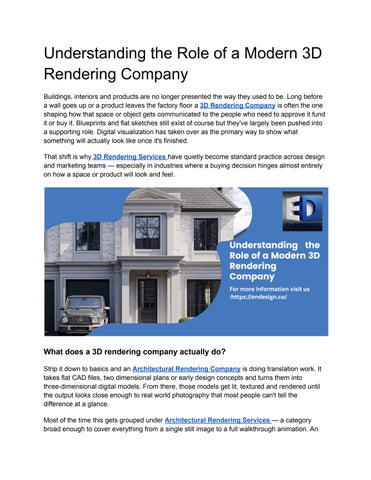
Understanding the Role of a Modern 3D Rendering Company Buildings, interiors and products are no longer presented the way they used to be. Long before a wall goes up or a product leaves the factory floor a 3D Rendering Company is often the one shaping how that space or object gets communicated to the people who need to approve it fund it or buy it. Blueprints and flat sketches still exist of course but they've largely been pushed into a supporting role. Digital visualization has taken over as the primary way to show what something will actually look like once it's finished. That shift is why 3D Rendering Services have quietly become standard practice across design and marketing teams — especially in industries where a buying decision hinges almost entirely on how a space or product will look and feel.
What does a 3D rendering company actually do? Strip it down to basics and an Architectural Rendering Company is doing translation work. It takes flat CAD files, two dimensional plans or early design concepts and turns them into three-dimensional digital models. From there, those models get lit, textured and rendered until the output looks close enough to real world photography that most people can't tell the difference at a glance. Most of the time this gets grouped under Architectural Rendering Services — a category broad enough to cover everything from a single still image to a full walkthrough animation. An
Architectural Visualization Company typically gets pulled into a project early working alongside architects and designers to turn technical drawings into something a non technical client or investor can actually read and react to. Because the process leans on computer generated imagery people also refer to this space as a CGI Rendering Company with the finished work labeled CGI Rendering Services. The terminology shifts depending on who's using it but the goal stays the same either way produce a convincing accurate picture of something before it physically exists.
Architectural rendering and visualization in practice A 3D Visualization Company rarely does its work in a single pass. Early on rough massing models help everyone involved get a feel for scale and layout — nothing polished, just enough to sanity check the basics. As the project develops the renderings get sharper lighting, materials, landscaping furnishings all layered in. That fuller more deliberate process falls under 3D Architectural Visualization which blends technical accuracy with something closer to artistic presentation. It's common enough that people searching for this kind of work often look for it under one combined phrase — 3D Rendering & Architectural Visualization — since the two disciplines rarely get handled separately anyway.
Real Estate Rendering Services Are Having a Moment Nowhere has this technology been adopted faster than in property marketing. Real Estate Rendering Services let developers show off units, lobbies, common areas, and full building exteriors well before a single floor is poured. For pre-construction sales in particular, this isn't optional — buyers have nothing else to go on besides the visuals. A Real Estate Visualization Company usually delivers a mix still renderings, animated flythroughs and marketing assets built for sales presentations, brochures and websites. Given how much early stage sales depend on visual clarity Pre-Construction Rendering Services have become close to mandatory for developments in competitive urban markets.
Interior and Exterior Rendering: Two Different Jobs Render services usually fall into two categories. Interior Render Services concentrate on particular interior spaces such as kitchens, lobbies, and amenity spaces and get to grips with such details as the finish, light fittings, and furniture arrangement. Exterior Render Services take an eagle-eyed look at the façade, landscaping, streetscape and overall positioning of the building within the environment. Both Interior and Exterior Rendering Services operate in the sphere of one and the same science, Photorealistic 3D Rendering, in which the processes of lighting simulation and material modeling provide such quality of the digital image that makes it hardly distinguishable from the
photo. It is not the icing on the cake but something expected in residential, commercial and hospitality projects. Alongside these, Interactive 3D Application Development has become an equally valued extension of this science, allowing clients to explore and interact with their spaces in real time rather than viewing static images alone.
How 3D Virtual Tours Changed Property Marketing Static images only go so far. 3D Virtual Tours gave people a way to move through a space remotely instead of just looking at it. A 3D Virtual Tour Company builds navigable digital environments — users can walk from room to room, turn to look at different angles, get a real sense of the layout without setting foot on site. 3D Virtual Tour Services are often bundled with rendering work into one complete package. Some providers lean into CGI Virtual Tours, built entirely from digital models rather than real-world photography — a good fit for spaces that don't physically exist yet.While others offer 360 Virtual Tours that make real-life pictures using panoramic photography. Interactive 3D Virtual Tours have been widely embraced in the residential real estate market. . Pre-Construction Virtual Tours let prospective buyers walk through a layout before a single wall has gone up and many of these builds get described as Matterport Style Virtual Tours borrowing the name from a widely recognized room-by-room navigation format. Taken together all of this falls under the wider umbrella of Interactive Real Estate Experiences which continue to shape how properties get marketed online.
Virtual Reality Development and Fully Immersive Experiences Some providers have pushed past screens entirely. A Virtual Reality Development Company builds experiences made specifically for VR headsets giving users a sense of scale and depth that a flat image simply can't deliver. Working with a VR Development Company usually means converting existing 3D models into interactive environments built for common VR platforms. VR Development Services can also include Custom VR Development — experiences tailored to specific hardware, use cases, or industries, whether that's real estate, product showcases or something else entirely. A 3D Virtual Reality Company typically handles both the technical build and the creative direction behind these experiences. VR Experience Development, meanwhile, tends to focus more narrowly on usability — how easy the navigation feels how intuitive the interactivity is once someone's actually inside the environment.
Why photorealistic rendering matters before anything is built There's an obvious communication gap when you're trying to present something that doesn't exist yet. Detailed, realistic visuals close that gap — they cut down on the misunderstandings
that tend to crop up between designers, developers and the people who eventually have to sign off. That's a big part of why Photorealistic 3D Rendering and tools like 3D Virtual Tours have become such a fixture in architecture, real estate and product design. Giving stakeholders something concrete to react to at multiple points along the way just makes for clearer decisions throughout the design and marketing process.
Interactive 3D application development and architectural animation Static renderings and virtual tours are not only way clients get to experience a project before i's built. A growing number of studios now offer Interactive 3D Application Development building tools that let clients manipulate a space or product directly rather than just viewing it passively. This often takes the form of an Interactive Product Configurator where a buyer can swap finishes, layouts or colour schemes in real time and immediately see the result — a feature that's become especially popular in real estate sales offices and showrooms. Firms working in this space are sometimes referred to as an Interactive 3D Software Company reflecting the fact that the deliverable is closer to a piece of software than a fixed image. Alongside this an Architectural Animation Company brings a more cinematic dimension to the process producing walkthroughs and flythroughs that tell a story about a building rather than simply documenting it — work generally grouped under Architectural Animation Services. The same force has propelled Pre Construction Virtual Tours and 360 CGI Virtual Tours into the limelight, allowing the buyer to get an immersive view of the space even before laying a single brick.
FAQS What industries commonly use a 3D Rendering Company? Architecture, residential and commercial real estate, interior design, hospitality and product development are the industries that lean on rendering and visualization work most heavily. What's the actual difference between rendering and a virtual tour? Rendering produces still images or animations — something you look at. A virtual tour is something you move through letting you navigate a digital environment at your own pace. Are virtual tours only useful for finished properties? Not at all. CGI based virtual tours in particular are built straight from architectural models which makes them a natural fit for pre construction properties that haven't been built yet. How is virtual reality different from a standard 3D rendering? Virtual reality is built for headset navigation and gives a real sense of depth and scale. Standard renderings are typically viewed flat on a screen as an image or video.
Conclusion
Visualization techniques have seeped into almost all phases of architectural presentations and discussions. Through sophisticated still images, full-fledged virtual tours and virtual reality experiences, the stakeholders have an opportunity to have a much clearer insight into the project long before it becomes a reality. As the demand for realistic and interactive previews continues to rise, such visualization technology will likely continue to be very relevant to the design process.