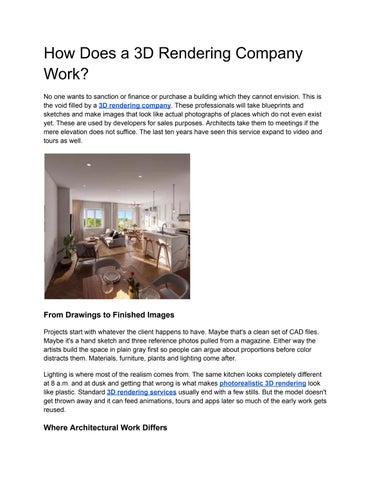
How Does a 3D Rendering Company Work? No one wants to sanction or finance or purchase a building which they cannot envision. This is the void filled by a 3D rendering company. These professionals will take blueprints and sketches and make images that look like actual photographs of places which do not even exist yet. These are used by developers for sales purposes. Architects take them to meetings if the mere elevation does not suffice. The last ten years have seen this service expand to video and tours as well.
From Drawings to Finished Images Projects start with whatever the client happens to have. Maybe that's a clean set of CAD files. Maybe it's a hand sketch and three reference photos pulled from a magazine. Either way the artists build the space in plain gray first so people can argue about proportions before color distracts them. Materials, furniture, plants and lighting come after. Lighting is where most of the realism comes from. The same kitchen looks completely different at 8 a.m. and at dusk and getting that wrong is what makes photorealistic 3D rendering look like plastic. Standard 3D rendering services usually end with a few stills. But the model doesn't get thrown away and it can feed animations, tours and apps later so much of the early work gets reused.
Where Architectural Work Differs
The simple picture comes easily. The pretty picture that is aligned with the construction drawings takes a lot more effort. An architectural rendering company hires people who know how to read drawings and this affects everything else in the process. The ceiling is supposed to be at nine feet or the window is placed two feet from the corner and these details have to be accurate or else the designer will pick up on it. Some architectural rendering services provide two or three review stages where the designers offer their feedback about angles and finishes. Some architectural visualization company help determine which images need to be rendered. The planning board requires the street view and shadows while the purchaser needs the living room view. These are two different images. The 3D visualization company may also provide product rendering, machinery and industrial space rendering and so this term covers a slightly wider scope than the others.
Inside, Outside and Everything Between Interior and exterior work usually get treated as different specialties since each tends to go wrong in its own way. Interior rendering services depend on small details: how a throw blanket drapes, how much clutter looks believable whether the light seems to come from an actual window. Exterior rendering services handle the wider scene, including landscaping, neighboring buildings, the sky and sometimes a few cars or pedestrians for scale. A CGI rendering company works with similar tools but often for advertising, film or product launches and CGI rendering services can include stylized looks that wouldn't suit a building at all. Pre-construction rendering services are defined by timing not technique. The project isn't finished or even approved yet the marketing has to start.
Selling Something That Isn't There Yet Condo towers would be the most common example. The apartments are listed a year or two in advance when no one can actually step foot into one and people want to see what will be available. These can be taken care of with real estate rendering services, which provide visual representations of lobbies, suites, roof terraces and views from a specific floor level. Real estate visualization company will usually offer you stills, video and tour images, making sure your sales center and website have an integrated look. The design teams also make use of 3D architectural visualization internally. There could be problems with a hallway that wouldn't be visible in a plan view. This is something people say in the industry: it is much easier to fix things on the computer than in real life.
Virtual Tours The virtual tour is viewer-operated and the methods of creating it differ. A virtual tour in 3D will either be captured by a photography service after construction or created entirely using a computer image if the construction of the property has not taken place. The service of virtual tours in 3D normally comes as a web link that can be accessed by your mobile device without
the need to download anything. When you look at different 3D virtual tours side-by-side, the difference is clear. 360 virtual tours let people look around from fixed points. Interactive 3D virtual tours go a step further, adding clickable floor plans, swappable finishes and little info markers that appear on hover. For projects that haven't been built pre-construction virtual tours use rendered scenes where photos would normally go and 360 CGI virtual tours do the same thing with panoramic views. Plenty of people search for Matterport style virtual tours which means that dollhouse view where you drift from room to room. A real estate virtual tour company can recreate the look from a computer model even though no scanner has ever been inside.
Moving Pictures Stills only go so far. On a large development, a film can show how the pieces connect: the street, the entrance, the courtyard, the neighbors. Architectural animation services do that with planned camera paths, moving traffic, people, and trees swaying, then set it to music and cut it down to a minute or two. An architectural animation company usually storyboards the shots first, so the client knows what's coming before anything gets rendered. 3D animation services reach into other areas, like showing how a machine goes together or how a product works. Real estate animation services stay closer to homes and amenities, and 3D real estate animation tends to be short for social media and longer for sales presentations. Property development CGI animation sits at the heavy end, covering master-planned communities where several phases have to be explained at once.
When It Becomes Software Some studios build tools not just media. Interactive 3D application development produces web and mobile apps where a person can spin a model, change a finish or walk around a site. An interactive 3D software company typically handles the 3D assets and the code together which avoids a lot of messy handoffs. An interactive product configurator is an easy example to give. A customer makes a selection for color or materials, and the product changes accordingly right then and there. They are very common among furniture companies, cabinet manufacturers and equipment manufacturers. Interactive real estate experiences follow a similar pattern in that you pick out flooring options and compare views from the twelfth floor. This brings us to the last component of a headset experience. Virtual reality architecture visualization and virtual reality real estate provide an actual physical experience within the building at life size. You know the ceiling height and room width because you're standing inside
of it. The virtual factory tour provides the opportunity to tour a factory without having to wear a hard hat.
Choosing a Studio There are several key factors that differentiate a good fit from a bad fit. The first is to check out some previous projects which are of a similar nature and scope as yours. The second is to determine how the iterations and change management process takes place. The third is to check if they have a single team which can do stills, animation, and tours because once this is split among vendors, things become very difficult to manage. FAQs What kind of services does a 3D rendering company offer? The company renders images, videos and tours of structures and items which have yet to be developed. How much time does it take to perform the rendering process? It takes several days to render images, but it may take several weeks to render videos and tours. What do you need to begin your project? Every studio can start working on a project having at hand CAD drawings, floor plans, sketches or any pictures as a reference. Would it be possible to do the virtual tour before the construction of the building itself was even completed? Yes, since the virtual tour will be created using a computer model, which does not need a complete environment and photos to be taken. What is the difference between the virtual tour and virtual reality? Yes, in that the virtual tour does not need a headset to be worn, unlike virtual reality.
Conclusion The present-day 3D rendering firm can cover many aspects from one exterior still shot to a headset tour of a building which still remains an empty plot of land. The area of 3D rendering and architectural visualization is developing constantly together with the improvement of smartphones and browsers' ability to cope with a large amount of data. The simplest approach to understanding it consists in finding out what every service is for – how it looks like, how it feels, how it works, and how it is possible to interact with it.