People Ordinary
Extraordinary Contributions
Everyda y Heroe
List your hall on Vennu and make managing your space simple, efficient, and impactful.
No upfront costs No lock-in contracts Set up in minutes
Vennu is the easiest way to connect your space with your community. Whether you're looking to reduce admin time, increase bookings, or create new opportunities for connection, our platform has you covered.
• Real-time enquiry and booking tracking
• Secure online payments direct to your nominated account
• Custom listings with photos and key details
• Easy change and cancellation management
• Automated recurring bookings for regular events
• A live availability calendar
• Targeted digital marketing to boost visibility
• Friendly support, 7 days a week
• Spend less time on admin – focus on what matters
• Turn idle space into valuable income
• Reach more people and grow your bookings
• Foster deeper community engagement
• Revitalise underused spaces with new activity and energy
“From start to finish, the whole process was incredibly simple and seamless. Booking through Venuu was easy, and the Berry Uniting Church Main Hall was absolutely perfect for my needs. Such a great experience all round. Highly recommend!”
Sonia Z, Guest at Berry Uniting Church
Be part of something bigger. Share your space. Strengthen your community.
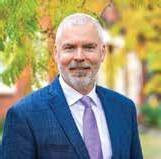
THE GENERAL SECRETARY IS APPOINTED BY THE SYNOD TO PROVIDE LEADERSHIP TO THE CHURCH BY ACTIVELY ENGAGING IN STRATEGIC THINKING ABOUT THE LIFE, DIRECTION, VISION AND MISSION OF THE CHURCH.
Lots of thought and energy is now (always?) being directed toward church structures. Yet many treasured phrases in the Basis of Union affirm the church is a movement. We are ‘a pilgrim people’. We are ‘on the way’. We have no ‘continuing city’. The church is people and relationships and activity. The church is an event. The church happens
The church certainly leaves marks of its ongoing presence. We hope its presence is primarily known in relationships, reconciliation, and lives touched by God. Traces of the church’s long-term presence are also found in texts, regulations, and buildings - in the structures of the institution. So the church is not an event that happens and then fades away. Nevertheless, while marks of the church’s presence are important, we first affirm that we are a pilgrim people; people on the move.
Perhaps a similar principle can guide our thinking about the structures for a pilgrim church. We institute the church in structures, but we constitute the church in motion. Both are needed. However, an undue focus on instituting the church in structures puts at risk our understanding of, and energy for, constituting the church in motion. The church is helped by stability, yet it must have fluidity. The fluidity is important because it provides the church event; that is where the church happens and our witness to the gospel comes to life.
To be a pilgrim people and a living church is not to be an institution in search of its ideal structure. The living church is already here. It is where Christ is now in the world. Christ in all the suffering and joy of life. The call of disciples and the church is to be with Christ in the world and to join his ministry.
So to be the living church is not to think first of ourselves and then of God. The church’s attentiveness is first and always toward God, who calls the church into being. How and where do we believe God is at work in the world? Having thought about that question we then ask: How shall we organise ourselves to faithfully follow God in mission? As Rev Dr Geoff Thompson observed, the Basis expects we will be ‘organised pilgrims’. Yet the organisation is to support the mission, not the other way around.
In the field of physics, Werner Heisenberg proposed what is called the uncertainty principle. Observing the behaviour of particles, a physicist can establish with accuracy either the position of a particle, or the travelling momentum of the particle, but not both. The more precisely the location is defined, the less sure our understanding of its momentum becomes.
The church is a network of disciple communities - people called, nourished, and led by Christ to join the mission of God. The church provides, by the grace of God, a glimpse of the communion of reconciliation intended by God for all creation by forming communities around the risen Christ that nurture the faith of those who make the decision to follow him. And the church is called to be a public witness to the gospel, drawing the attention of the powers to those who are powerless. Like Jesus, we stand up for the most vulnerable.
As we move toward three new Presbyteries, how will we become a church that balances structures and fluidity, providing stability without unnecessary constraint, so the pilgrim people can join Christ in the world? The pilgrim church organises its life, not as an end itself, but always and only so that it may offer worship, proclaim good news, pursue justice, express love, and grow the relationships that will sustain disciples as they walk with God in the world.


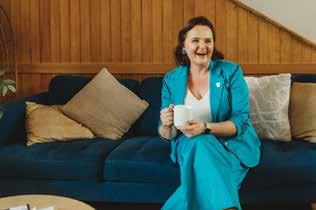
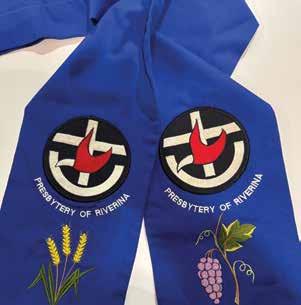

instagram.com/moderator_ucanswact Follow the Moderator on instagram:
In the vestry of Balgowlah Uniting Church where I served as Minister holds a piece of history that I often think about.
There, sits a mahogany desk and a dial-up telephone - one of the first Lifeline offices.
Lifeline was the first telephone crisis support service established in Australia in 1963 by Wesley Methodist Minister Rev. Alan Walker.
I imagined the first volunteers who answered those calls. What courage it took to pick up that receiver, wondering whether they were equipped to help these people in their darkest hours. Yet, despite their fears, they took each call, one conversation at a time.
Today, Lifeline receives more than 2.6 million requests for support annually. These volunteers have saved countless lives.
A
The Gospel story of the feeding of the five thousand reminds us of this truth. The miracle of the multiplication of bread and fish started with a spark of generosity by one boy offering five loaves and two fish amidst the starving masses. Like the volunteer taking the call, the boy surely knew he wasn’t going to save everyone, but he knew he couldn’t look away.
The same spirit lived in the work of the late Rev. Dr Jione Havea - the Prophet of the Pacific - as he came to be known through the countless voices and tributes across the Pacific, and the world. Jione’s theology challenged the Church to see beyond inherited Western frameworks. Jione reminded us that God was not carried to the Pacific on wooden ships by colonisers and missionaries, but was already present within the people, the land, the ocean - the moana itself.
Like many transformative scholars, Jione’s work was not always loud or headlinegrabbing, it was quiet, unapologetic and powerful. Through classrooms, conversations, books, sermons and patient persistence over decades, his ideas reshaped communities.
What all these individuals have in common is that they did not stand above the crowd and expect to be lauded for their good deeds. They did something much more extraordinary - they created the crowd to laud for the greater good.
Decades after those first volunteers answered calls in Balgowlah, a heroin epidemic hit the streets of Sydney’s King’s Cross.
Among those witnessing the endless suffering were the Sisters of Charity - a group of nuns at St Vincent’s hospital. Controversially, they proposed a medically supervised injecting clinic.
Many rejected the idea outright, including The Vatican, arguing it would encourage drug use. But those advocating for change had seen too much pain to accept inaction. Among those advocates stood Rev. Harry Herbert who consistently argued that the preservation of life, far outweighed being still. The advocacy was taken forward by the Uniting Church and through Uniting Care NSW/ACT Australia’s first Medically Supervised Injecting Clinic (MSIC) was established. This year, MSIC marks 25 years of service. Over that time, more than 12,000 overdoses have been managed, with zero fatalities.
Thanks to the tireless work of thousands of individuals behind the scenes, what was touted as impossible was made a reality. Daughters, mothers, brothers saved; families resuscitated and given a chance at recovery and reconciliation.
The feeding of the five thousand reminds us that the Kingdom of God is often revealed not through domination or recognition, but through willingness, and people bringing what they have.
A child with five loaves and two fish. Volunteers answering a telephone in a small church office. Nuns refusing to ignore the realities of addiction and overdose. A Tongan theologian challenging the Church to see the Gospel through the eyes of the Pacific.
Perhaps, a fitting note to end on is a quote from Transforming Communities: talanoa and food as catalysts by the late Rev. Dr Jione Havea and myself.
“In Pasifika minds, everyone has something. No matter how small – like the loaves and fish in the Matthean stories – no one is emptyhanded. Many do not have a pig or a mat to contribute, but they have something – like a piece of firewood, a mature coconut, one or a pair of strong hands (to help with cooking), the spirit of willingness to be present and to relate, and a few talanoa – which they can contribute to the umu. The Matthean stories affirm that no matter how small, everyone can contribute, participate, and share in family and village events.”

IN RESPONSE TO THE STORY LECTIO DIVINIA OR HOW UNHURRIED ATTENTION CAN SHAPE OUR FAITH
“I really appreciate anyone talking about slowing down enough to listen well… efficiency is no match for connection. I’m more and more convinced that we must counter-culturally attend to the busy in us.”
JO
HUNTINGTON
IN RESPONSE TO THE SONG MOUNTAIN BY DON WORMLEATON
"Such an awesome song!! Don may God continue to guide and bless your journey."
HEATHER MCINTOSH
IN RESPONSE TO THE STORY COMFORT TV AND THE GOSPEL ACCORDING TO REWATCHING
“LOVE these shows. Thanks for articulating so well why we keep coming back to them. My list also includes: New Girl, Felicity, and Buffy the vampire slayer!"
GREER HUDSON
IN RESPONSE TO THE POST THE MODERATOR'S ESTER MESSAGE
“I like reading the Uniting Church posts. Gives me strength."
GREGORY TAYLOR
IN RESPONSE TO THE POST WALKING ON COUNTRY
What a great event! It's so good to see the church living its calling; learning about and reconciling with the first people of this country, and how the Spirit has been alive in this land since the Beginning.
KATHRYN LYNCH
IN RESPONSE TO THE STORY WHY I DELETED SOCIAL MEDIA
"Psalms 124:6-7 (KJV) Blessed be the LORD, who hath not given us as a prey to their teeth.
Our soul is escaped as a bird out of the snare of the fowlers: the snare is broken, and we are escaped.
I had often thought about the harms of too much social media usage. And it led me to be no user of X, LinkedIn, Reddit, Facebook and Tik-Tok.
Failing to know the purpose of the latter completely. The reels can reel your mind, trying to get meanings out of them. You can’t remember the tons you scrolled yesterday. The anxiety about the likes and comments from your previous posts may be too much. It’s better to do without it. Even the very e-mails from those who write for a living is too much to bear.
We tell our Whatsapp group members: 'When you post something from TikTok, or YouTube please write a caption so that one can get the idea of what it is and decide to open or not open them–saves data!!'
It’s as though social media sites are not only full of jokes, fun, or mindblowing things as they claim, but fake “experiments” and “doctors” about herbal medicines offering false solutions to hungry minds or hurting bodies.
Because you had been there and done that, in this age of scrolling, the attraction and distraction from these handsets are no mean issue
The Christian should flee from its entrapment like a bird from the fowler. The addiction is real.
Thank you so much for this your thought out article. God led you to do it."
PR. BEN OCHAYA DERMOI
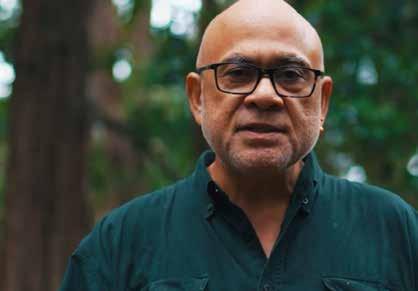
We marked with deep and profound sadness the passing of Rev. Dr Jione Havea, who died suddenly in Tonga on 29 April.
Jione was seconded to the Uniting Church in Australia from the Methodist Church of Tonga and served with generosity, insight, and a deep commitment to the life of the Church over many years. His ministry shaped communities, classrooms, and conversations across the Church.
From 1 July 2000 to 30 June 2015, Jione served in the Synod of NSW and the ACT as a lecturer in Biblical Studies at Uniting Theological College, teaching in the Hebrew Bible and Old Testament. He formed and influenced generations of students, bringing academic depth, cultural wisdom, and a grounded, faithful perspective to his teaching.
Professor Havea was a biblical scholar, a servant of God, a writer, and a researcher whose work in Pacific theology, Indigenous knowledge, and climate change shaped conversations across the globe, speaking at conferences, as well as locally across our Church.
As his students have noted, he carried the stories of the moana with depth and integrity, often reminding others that “the moana is a long journey; you add your part, then someone else adds theirs.” His scholarship and ministry were never abstract. They were rooted in people, place, and the call to care for creation and one another.
Jione remained closely connected to theological education throughout his life, serving as an adjunct lecturer with
Uniting Theological College, Pilgrim
Theological College, and Sia’atoutai
Theological College in Tonga. In October 2024, he returned to serve the Church as a UME Mission Catalyst in the area of Stewardship of the Earth, continuing his long-held commitment to justice for creation and communities most affected by climate change.
We honour his work, contributions and collaboration across our Church. Right up until his sudden, untimely death, Jione provided his wisdom to us with his AcClimatise the Lectionary project, which has provided many with a critical lens to view scripture from the perspective of care for creation, advocacy that Jione was deeply passionate about.
As countless tributes have noted on social media, he taught that the moana is a journey, and he lived that truth with humility, wisdom, and quiet conviction. His life and work pointed others toward a faith that listens deeply, walks together, and honours the stories that shape us.
We grieve his passing even as we trust that he now rests in God’s embrace. We give thanks for the part he added to this world, and for the part he played in the lives of so many.
We hold his family, friends, colleagues, and students in our prayers, and we commend him to God’s care with gratitude for a life faithfully lived.
REV. FAAIMATA (MATA) HAVEA HILIAU
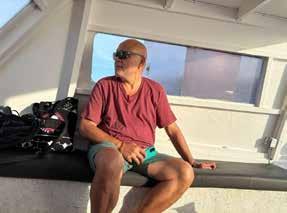










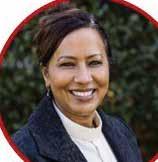











REV. BENT RECOGNISES THE PRESENT CONTEXT OF CHANGE WITHIN THE SYNOD AND THE WIDER CHURCH, INCLUDING THE 3P PROCESS, AND EXPRESSED A COMMITMENT TO SERVE WITH FAITH, HUMILITY, AND A FOCUS ON THE FUTURE LIFE OF THE CHURCH






The Synod of NSW and ACT of the Uniting Church in Australia announces the appointment of Rev. Punam Bent as Associate General Secretary. Punam will commence in the role on August 1.


Rev. Bronwyn Murphy will conclude in the role of Associate Secretary on August 31. There will be a transition and handover period over the coming months to support continuity in the life and work of the Synod. Following this transition, Bronwyn will move into the role of Synod Business Manager.
The Synod gives thanks for Bronwyn’s faithful leadership and service in the role of Associate Secretary, and for her ongoing contribution to the ministry and operations of the Synod in this new position.



Rev. Bent has accepted a call to this priority ministry placement following a period of prayer and discernment, undertaken in consultation with her family. She expressed gratitude for the affirmation of the General Secretary and Moderator, and for the support of the Placements Committee.

Rev. Bent brings experience from her current role as Presbytery Minister: Wellbeing with the Sydney Central Coast Presbytery. She acknowledged the work shared with colleagues, including the Presbytery Chair, Rev. Keith Garner, and the wider team, and expressed appreciation for the ministry undertaken together.






In accepting this role, Rev. Bent commits to fulfil the responsibilities of the placement in accordance with the standards and policies for ordained Ministers of the Uniting Church in Australia. She looks forward to working with the Synod Executive and to learning through the guidance and experience of senior leadership during this period of transition.


Rev. Bent recognises the present context of change within the Synod and the wider church, including the 3P process, and expressed a commitment to serve with faith, humility, and a focus on the future life of the Church.

Rev. Bent begins this placement with a sense of gratitude for the opportunity to continue in ministry within a broader context of leadership across the Synod.
REV. DR PETER WALKER





















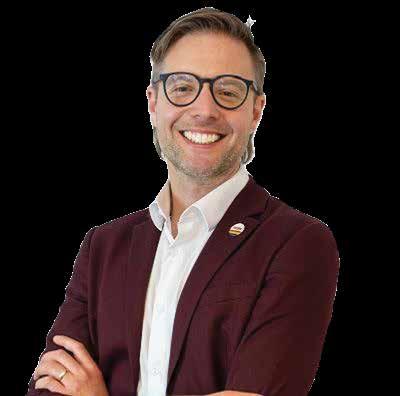





The newly created position brings together Uniting’s Mission, Social Impact and Advocacy teams, reflecting the close relationship between the organisation’s community services, advocacy work and the missional foundations of the Church.
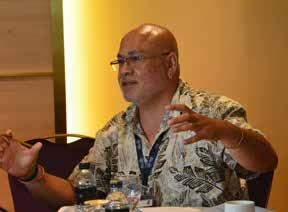
David is well known across the life of the Uniting Church Synod of NSW and ACT, having previously served for nine years on the Synod Standing Committee. He currently serves on the Uniting Board and chairs the Communities Sub-Committee and is a member of the Mission Governance and Collaboration Committee, and the Remuneration, People and Board Governance Committee.





Uniting NSW.ACT has announced the appointment of David Barrow as its new Director of Mission and Social Impact, following the earlier announcement that Rev. Suzanne Stanton will step down from her role as Director of Mission later this year.


Alongside his work with Uniting, David is currently the Regional Director of the Industrial Areas Foundation Pacific and previously served as Executive Officer and Lead Organiser of the NSW Community Alliance. Across more than two decades of leadership in community and civil society organisations, he has focused on building partnerships between churches, communities and institutions to achieve practical social outcomes.

His work has centred on leadership development, strengthening community institutions and fostering collaborative approaches to social impact across Greater Sydney, the Hunter and nationally.
David is an active member of the Uniting Church and the LGBTQIA+ community and brings a strong commitment to inclusion, dignity and justice for all people. He also served for eight years on the church council at Leichhardt Uniting Church.

Uniting said David brings a combination of leadership experience, deep knowledge of the organisation, a longstanding commitment to the Church and a strong sense of vocation for the role.
David will commence as Director of Mission and Social Impact on Wednesday 1 July 2026. Rev. Suzanne Stanton will conclude her role as Director of Mission in August 2026 following a transition period.
DAVID BRINGS A COMBINATION OF LEADERSHIP EXPERIENCE, DEEP KNOWLEDGE OF THE ORGANISATION, A LONGSTANDING COMMITMENT TO THE CHURCH AND A STRONG SENSE OF VOCATION FOR THE ROLE
Uniting expressed its gratitude for Suzanne’s significant contribution to the organisation and said it looks forward to working with David as he begins the new role.
The Disaster Recovery Chaplaincy Network (DRCN) has wound-up its Lismore Business Chaplaincy Project after several years supporting businesses and residents across the Northern Rivers.
Originally intended as a short-term initiative, the project continued beyond its planned timeframe as communities in the region faced ongoing recovery challenges following floods and Cyclone Alfred.
Coordinated by Rev. John Latta, the project built relationships with business owners and residents across Lismore and surrounding communities. Through pastoral care, practical assistance and regular visits, the program supported people navigating the financial and emotional impacts of repeated disasters.
Rev. Mark Muss, Projects and Support Manager at the Disaster Recovery Chaplaincy Network, said the project demonstrated the value of consistent presence in communities recovering from crisis.
“Rev. John has an ability to connect with people, understand their challenges and offer support that is practical and personal. His work has made a difference for many individuals and businesses,”
For local business owner Tracy Ward, the chaplaincy program provided support during some of the most difficult moments of the region’s recovery.
Ward, who operates the South Lismore Post Office, lost both her home and business during the 2022 floods in the Northern Rivers. She said Rev. Latta first visited her shop at a time when the financial and emotional toll of recovery was overwhelming.
“He walked in not with a clipboard or agenda, but with compassion. Since that day he has offered ongoing support, guidance and a sounding board. His care has made a difference to my ability to continue operating and serving my community,”
The support continued when her business was again affected by Cyclone
Alfred, which forced the temporary closure of the store and resulted in damage to the premises.
Ward said the chaplaincy’s support helped her navigate the strain of reopening and continuing to serve local residents.
Alongside pastoral care, the project also provided practical assistance. Hundreds of $100 gift cards were distributed to individuals and community organisations, allowing people to access immediate help without complex application processes.
The work of the network and its volunteers was recently acknowledged at a dinner at Invercauld House in Lismore, attended by Janelle Saffin, Member for Lismore, Minister for Small Business, Minister for Recovery and Minister for the North Coast.
Rev. Latta said the project had always focused on relationships.
“It’s about being there when things are tough, building trust and helping people take small steps toward recovery. I’m grateful for the relationships we’ve formed and the chance to stand alongside communities through challenging times.”
The Disaster Recovery Chaplaincy Network continues to support communities across NSW and the ACT. Chaplains were deployed following the Bondi Junction stabbing attack and also provided support after the terrorist attack at Bondi Beach, offering pastoral care and assistance to those affected.
JO MALONEY
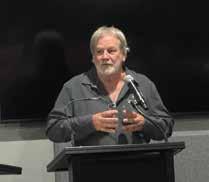
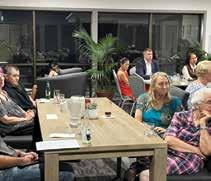
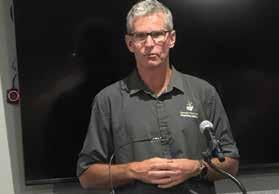
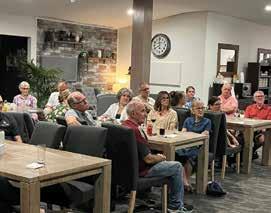
On April 29, The Ella Centre celebrated a remarkable milestone: 50 years of supporting people in Sydney’s Inner West to live connected, meaningful and joyful lives.
What began as a local vision shaped by community generosity has grown into a trusted and award-winning organisation providing vital disability, aged care and dementia support services — while still holding fast to its founding spirit of welcome and belonging.
The story of The Ella Centre began in the mid-1970s, when a group of local residents recognised a growing need for a social and support hub that would serve the whole community. In 1974, members of St David’s Presbyterian Church in Haberfield, together with local resident Henry Ella and his brother Norman, established a trust fund supported by a Federal Government grant. Their shared vision led to the purchase of the former Haberfield Methodist Church property, transforming it into a community centre dedicated to inclusion and care. The Centre was officially opened on 21 June 1975 by Dr Sidney Sax, then Chairman of the Commonwealth Hospital and Health Services Commission.
From those early beginnings, The Ella Centre has steadily evolved alongside the changing needs of the community. Today, it is a major registered provider under the National Disability Insurance Scheme (NDIS), supporting adults with disabilities, older people and their carers to remain active participants in community life. Its services also extend to people living with dementia, including early onset dementia, as well as those who are frail aged.
At the heart of The Ella Centre’s work is a deeply person-centred philosophy.
Rather than focusing solely on care needs, the organisation asks a simple guiding question: “What can we do together?” This approach places individual goals, relationships and community participation at the centre of every program, empowering participants to shape their own daily lives and experiences.
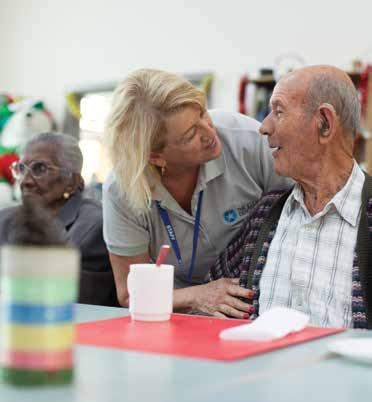
Over five decades, the Centre has expanded its programs to reflect this commitment. Weekday disability day programs provide structured support for people with a wide range of needs, while weekend social groups for young adults offer opportunities for recreation, friendship and independence. One-toone supports, both at home and in the community, help participants engage in meaningful activities and build confidence beyond the Centre’s walls.
Equally important is the Centre’s role in combating isolation. Social support groups, transport assistance and tailored activities create spaces where people can form friendships and maintain strong community connections. The Ella Centre describes its environment as safe, welcoming and inclusive — a place where individuals can spend time with others who share their interests and build lasting relationships.
The organisation’s impact has not gone unnoticed. Over the years, The Ella Centre has received numerous awards recognising its contribution to community life, including Inner West Business and Community awards and an Australia Day Award for volunteer service. Its work has also been acknowledged in Parliament for outstanding service to the local community.
Despite significant growth, the Centre continues to maintain strong ties with its origins in the Uniting Church community, reflecting a long tradition of
faith-inspired service expressed through practical care and social inclusion.
Reaching a 50-year anniversary invites both celebration and reflection. Over half a century, Australia’s disability and aged-care landscape has changed dramatically — from institutional models of care to approaches centred on dignity, choice and independence. The Ella Centre has navigated these shifts by remaining grounded in relationships, adaptability and community partnership.
As it looks toward the future, the Centre continues to focus on helping people live “full, happy lives” through connection, participation and personalised support. Fifty years on, The Ella Centre stands as more than a service provider. It is a living example of what can happen when a community recognises a need, acts with compassion, and sustains that commitment across generations — ensuring that everyone, regardless of age or ability, has a place to belong.
JO MALONEY
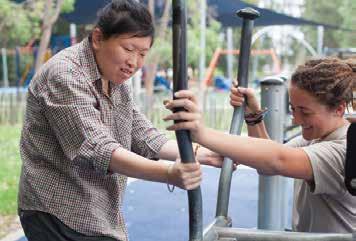
Five Uniting Church NSW & ACT church-planting teams came together last week for a threeday retreat at The Hermitage in Mittagong, a time set aside for rest, prayer, and honest conversation ahead of the next stage of their planting journeys.
Fifteen people in all gathered at the retreat, which was organised by the Synod's church planting team. The theme, Abiding in Jesus Christ, centred on the image of Christ as the Vine and church planters as the branches, a reminder as the teams prepared to launch of the importance of staying rooted in Christ.
Rev. Dr Graham Hill, who helped bring the retreat together after eight months of planning and groundwork, described the pace as intentional. Mornings began with psalms and silence. Meals were long, conversations longer. Teams prayed together and separately, sharing what God was stirring in each of them.
"There was laughter over afternoon tea, tears in team time, and a deep sense that the Spirit was
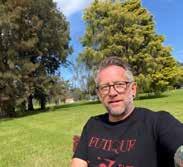
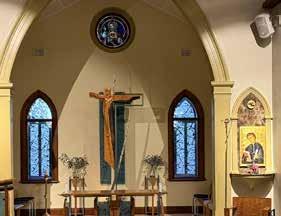
doing quiet, weighty work in each of us," Hill said.
Friday evening was a highlight for many, a time of shared worship, scripture, and communion before the teams went their separate ways. On Saturday morning, each team was prayed over and sent out.
For Andrew Smith, Team Leader at the Molonglo Church Plant, the value of the retreat was in what it made room for. "I found it very valuable to slow down as a team for important conversations that in the usual course of things get pushed aside by other practical and planning matters," he said. "Already, those conversations are bearing fruit in the life of the Molonglo Church plant."
Smith also noted the significance of the final morning's commissioning: "The time taken on the last day for praying over each team was very powerful."
Mark Watson, Resident Church Planter at the North Western Sydney Church Plant, reflected on the quality of connection the retreat fostered. "Connection with God and with others during the retreat was real and lifegiving," he said. "God spoke to us and through us, and it was a blessing and pleasure sharing this time with the Church Planting team cohort."
Kevin Crouse, who is leading the Maitland Church Plant, described the retreat as a rare opportunity to breathe. "The retreat for me was a time to reflect with plenty of space to not have to plan or accomplish," he said. "The conversations that included heaps of laughs as well as vulnerability were deeply connecting and cathartic, great processing of where we have gotten to and space to breathe deeply in preparation for the journey ahead."
The five teams leave Mittagong rested and ready to continue the work of planting new congregations across NSW & ACT.
ADITEE VORA
On April 18, members of congregations across the Riverina met at Pilgrim Uniting Church in Wagga Wagga for a gathering.
Among those who worship in the churches of the Riverina were visitors from across NSW and the ACT – some having travelled significant distance for this historic gathering.
We were greeted by Rev. Kyle Moffit on behalf of Rev. Andrew Watts and acknowledged the presence of God and the lands upon which we were gathered, hearing a story from the local Wiradjuri people.
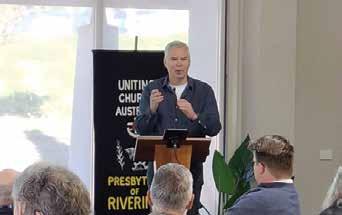
Rev. Dr Peter Walker, the General Secretary of NSW & ACT Synod, led us in conversation about the central charism of the Uniting Church – unity. To capture more of the vision offered the General Secretary’s session, you can read it here.
Later in the morning, Rev. Dr Rob McFarlane – chair of the Regional Partnership, which oversees the presbytery functions of Riverina Presbytery and the Far North Coast Presbytery, chaired a discussion session.
I participated in providing a general update on how the transition of the 4 southern presbyteries, and the broader 3P transition process was going. A proposal had recently been prepared for both the Southern Joint Standing Committee and the Regional Partnership, offering a way forward for the responsibilities and authorities of the Riverina Presbytery to be delegated in an orderly fashion when the Regional Partnership ceases on June 30 this year.
The Regional Partnership wanted to ensure that those gathered were informed about the next steps and what to expect over the coming few months as the Southern Presbytery is born and comes into operation. There has been strong support across all of the southern Presbyteries, with leaders from every space mindful of the need for geographic justice and committed to working together as a team across the distance.
What will this look like? Nobody’s quite sure yet, and these stories tend to unfold more slowly than we would like...
But for now, the southern Presbyteries are preparing to celebrate the work of Christ in their current spaces, while we look forward to what we might do together as one Presbytery.
Riverina is the first of the southern Presbyteries to celebrate their ministry and mark the ending of an era. The gathering was led in worship drawing from the vast pool of lay leaders that have kept Riverina congregations sustained and nurtured, and a beautiful liturgy prepared by Rev. Kyle Moffit.
The service recognised the coming together of the rain waters across the geographic area, Rev. Bronwyn Murphy, Associate General Secretary of the Synod, led us in reflection and the congregation named specific people who have served the Uniting Church for many faithful years into a time of silence.
We give thanks for the legacy of the Riverina Presbytery, the lessons in resilience, strong lay leadership, hospitality and nurture that will be carried by its members into the Southern
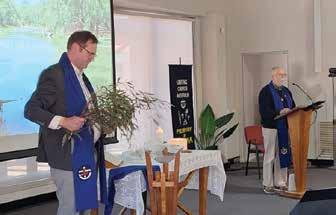
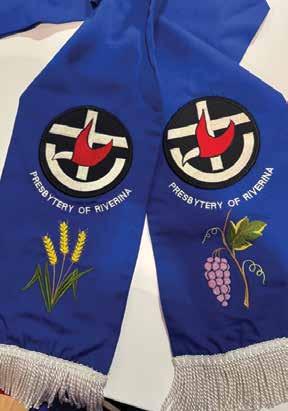
Presbytery. We give thanks for those who have served and supported, those who will continue to serve and support and those who are being prepared by God for leadership in the next season.
On Sunday April 19 Rev. Kyle Moffit and myself went to Coleambally Uniting Church for worship in the morning. The congregation there is made up of a number of young families – where the children led us in worship by showing us the actions to songs they had learned on a recent camp. The adults shared a bible study together, as the kids did puzzles and colouring; followed by outdoor games after the service.
Riverina Presbytery has a strong history of ministry with young people – and between the vibrant, joyful worship at Coleambally and stories from Wagga Wagga and Griffith; it seems to me that this legacy continues. I got in the car after the service to return home with a full heart and a renewed determination about what we are trying to accomplish in resourcing more fairly across geographic distance and generations.
REV. AMY JUNOR
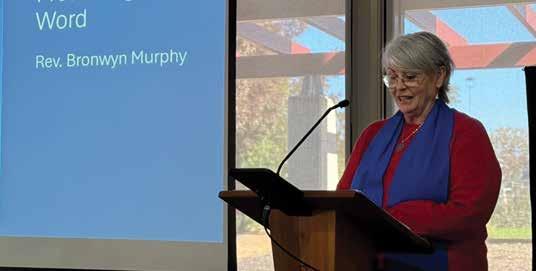
The Far North Coast (FNC) Presbytery recently celebrated the end of a very special era with singing, joy and anticipation as they prepare to refer responsibilities to the Northern Presbytery Joint Standing Committee on 30 June 2026.
The special music team of Phil, Tay and June led everyone in faithful hymns and song and concluded with ‘Into the Deep,’ for a particularly fitting finale.
Special guests who had been with the presbytery from 2019 were invited back as FNC prepare to enter a brand-new world within the Northern Presbytery. Nathan Tyson led the proceedings significantly with Acknowledgment of Country.
Rev. Phil Dokmanovic led the Prayer of Commitment echoing 22 June 1977 when it was first revealed at the Inauguration of the Uniting Church. FNC recognised with thanksgiving the faithful service of all past leaders, ordained and lay and some of the ministries of Far North Coast were recognised, Uniting Tours, Adult Fellowship Rallies, Emmaus Walks, Advocacy Group and Ladies Days. During our Prayer of Confession water was symbolically poured into the baptismal font as a sign of letting go and trusting God into the future.
Rev. Bronwyn Murphy, the current Associate Secretary, created the Regional Partnership for FNC and Riverina joined us a few years later. It was fitting to have her return and celebrate with some of the original FNC members. Bronwyn, Saltbush and many Synod staff members have walked beside FNC and empowered the presbytery immeasurably over the years.
Rev. Graham Perry from the Transition Commission then explained the next steps and placed the necessary proposals before the FNC community.
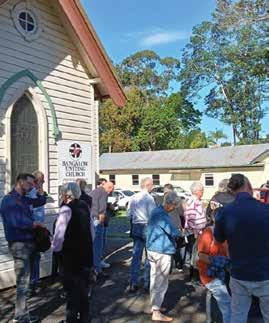
FNC completed the day together, with lunch catered for by Bangalow’s wonderful catering team, where thanks were shared, in particular to Kingsley Murphy, the now retired Synod guru.
The FNC team of Rev. Phil Dokmanovic, Rev. Daniel Yang, Mary Birch, Bob Eather and Sue Duncan were thanked sincerely for their commitment and investment in Far North Coast, particularly during the time of Regional Partnership. The day concluded with communion, prepared and led by FNC Lay Leaders. As the candle was extinguished, stones were laid of lament, joy, thanksgiving and remembrance in the baptismal font, Phil led the congregation outside and water from the font was poured out in a symbolic closing, marking the end of our chapter and faithful beginning of another.
SUE
DUNCAN FAR NORTH COAST
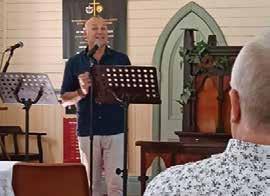
PHIL LED THE CONGREGATION OUTSIDE AND WATER FROM THE FONT WAS POURED OUT IN A SYMBOLIC CLOSING, MARKING THE END OF OUR CHAPTER AND FAITHFUL BEGINNING OF ANOTHER
This year is already half over and, as we often remark, where does the time go? It is now 16 years since I took over this column from Rev. Barry Ridge. We continue to value and appreciate our place within Insights.

With the new Three Presbytery format approaching, many of us have been attending information sessions to better understand what lies ahead. Change is evident everywhere and can sometimes feel difficult to keep up with. The NSW/ ACT UCAF Committee will remain in place and continue its work, although there may be some changes to roles and representation moving forward.
As a committee, we are trialling a monthly Zoom prayer meeting during May and June. Depending on how these gatherings unfold, we hope to extend an invitation to all who wish to join. These times of prayer will focus on our church, our nation, the world and current events. More details will be shared in the next edition.
Our most recent UCAF Synod meeting was held via Zoom rather than in person due to the petrol situation. The Illawarra Presbytery Gathering on 21 May featured Lifeline CEO Renee Green as guest speaker, with committee representatives in attendance. Further updates will follow. Secretary Laraine also managed the sales table on the day. Hunter Presbytery continues to seek a venue and host for its upcoming event.
In the Maitland region, five Uniting congregations have come together as one and are currently meeting in Bolwarra while work is completed on the historic Maitland City Church. Each of the former congregations continues its valued ministries. These include a well-supported Men’s Breakfast at East Maitland, partly sponsored by the Rotary Club of East Maitland, supporting men’s mental health through engaging speakers and community connection.
Morpeth continues to host a monthly FOCAS group, offering outings, community activities, friendship and support. Maitland City also runs the Munch program, providing meals for vulnerable people twice a week.
The Stamp Committee continues its remarkable work. Since its beginning in 1977, it has raised over $922,242. This extraordinary achievement has enabled grants to congregations supporting a wide range of programs.
The Synod Committee was saddened to accept the resignation of Estelle Crab from Far North Presbytery. Due to the closure of the Kingscliff church and subsequent restructuring, she is now part of Queensland.
We also received news of the closure of the Moree Fellowship due to declining numbers and age. Over many years, this group faithfully supported both church and community through its fundraising efforts. Moree holds special significance for me personally, and it has always been a joy to receive updates from its congregation and members.
The World Federation of Methodist and Uniting Churchwomen will hold its National Assembly in New Zealand from 25 to 29 August. In previous years, Eldrene March has represented Australia. At this stage, there has been no update regarding the Joan Stott Bursary for 2026–27, now overseen by the Assembly. This bursary was previously managed by the UCAF National Committee and has not been awarded for some years, despite ongoing correspondence from our Synod Committee.
JUDY HICKS
If you would like to share your fellowship news or have any questions, please contact Judy Hicks: judyh_rnh@hotmail.com


Over recent months, the Transition Commission has entered a new phase of its work, shaped by consultation, collaboration and careful listening across the life of the Church.
What has emerged is not simply a conversation about staffing or structures, but a broader discernment about how the Uniting Church can continue to live faithfully and sustainably into the future.
Since March, the Commission has engaged with Presbyteries, ministry leaders, Synod staff and congregations as it develops a proposed baseline staffing model for the Synod’s three Presbyteries. Importantly, the process has not been framed as a top-down restructure, but as an ongoing codesign journey. Representatives from Presbyteries gathered with Uniting Mission and Education staff in midMarch to reflect on the first draft of the model, refining an emerging framework together rather than approving a finished proposal.
That spirit of collaboration has become one of the defining characteristics of the Transition Commission’s work. Conversations throughout the consultation process have been described as warm and deeply engaged, even where differing opinions and perspectives have emerged. Rather than seeking quick consensus, the Commission has encouraged open discernment, recognising that the future of ministry and leadership across the Church cannot be shaped by one-sizefits-all solutions.
One of the strongest themes to emerge has been the recognition of complexity. Participants acknowledged that every Presbytery, congregation and ministry context carries different realities.
Geography, culture, resources and community need all shape what ministry looks like on the ground. Many contributors supported a model that provides shared baseline roles across Presbyteries while still allowing flexibility for local priorities and contexts.
The idea of “geographic justice,” first highlighted during Synod discussions earlier this year, has continued to shape conversations. For many participants, geography is not only about distance,
but also the social, intercultural and economic realities shaping congregational life. Denise Wood from Macquarie Darling Presbytery reflected that the Church must think intentionally about how it communicates with and supports communities across different generations, cultures and socioeconomic settings.
Those reflections have reinforced a growing awareness that the Church’s future structures must be relational as well as functional. Throughout the consultations, leaders repeatedly returned to the vision of living and serving as one Church across the Synod. UME leaders spoke about opportunities for greater collaboration in ministry formation, shared resources and support structures beyond regional boundaries. Lay leadership also emerged as a significant focus, particularly in rural and remote communities where congregations often rely heavily on volunteers and local leadership.
The work of the Transition Commission has extended beyond formal consultation sessions.
Throughout April, the Commission hosted nine Town Halls across the Synod to present the first draft of the baseline staffing model and hear directly from church members, Presbytery staff and ministry leaders. Sessions were held across metropolitan and regional communities.
These Town Halls created space for honest conversation about leadership, governance, communication and local ministry. Participants raised questions about sustainability, congregational vitality, shared services and how ministry teams might best work together across Presbyteries in the years ahead. The Commission also committed to transparency throughout the process, making feedback, presentation materials and transcripts publicly available through the Transition Commission website.
Alongside staffing conversations, the Commission has also begun exploring governance structures for a future three-Presbytery Standing Committee context. Representatives from Presbytery Standing Committees met with the Transition Commission in April to begin co-designing possible governance approaches, with further conversations continuing through May.
As the process unfolds, several recurring priorities have become clear. There is strong support for strengthening pastoral relationships, investing in leadership development and reducing duplication across Presbyteries. Contributors have also highlighted the value of centralising specialist roles while ensuring local communities remain supported and connected.
At the same time, the consultations have surfaced deeper questions about congregational life. Participants reflected on what makes a congregation sustainable, life-giving and mission-focused in today’s context, while exploring shared resources, collaborative ministry models and clearer expectations around congregational support. Despite the complexity of these discussions, there has been a strong commitment to remaining in relationship with one another, even amid uncertainty and differing perspectives.
The Transition Commission’s work continues to evolve, with many questions still ahead of future recommendations to Standing Committees and Synod. Yet this season of consultation has revealed a Church seeking not merely structural change, but faithful ways of supporting flourishing congregations, shared leadership and sustainable mission for the future.
ADRIAN DRAYTON
Find out more about the work of the Transition Commission at: TransitionCommission.uca.org.au




Email contactus@unitingfinancial.com.au or visit unitingfinancial.com.au
Partner Solutions and Support team
Monday-Friday 9:30am to 4:00pm (EST)
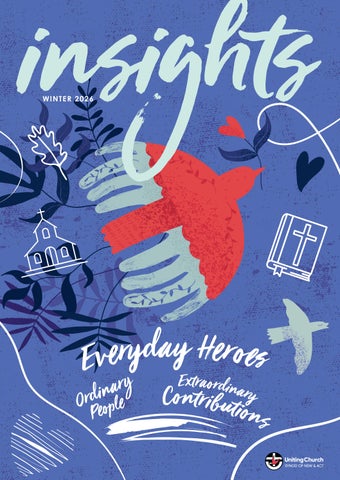
Across this church, every single week, someone is quietly doing something remarkable without thinking of it that way.
They show up to rosters without being chased, sit with someone who needs sitting with, carry things forward after the meeting has ended, and go home without mentioning it. They are in every congregation, every Presbytery, every corner of this community, and most of them would find the word "hero" faintly embarrassing. This edition is for them.
The people and communities profiled in these pages are not meant to represent an elite. They are a small window into something much larger. A church sustained, week after week, by hundreds of people who give their time, their energy, and their care without ever expecting the centre stage. What we have tried to do here is draw a few of those people a little closer, to put names and stories to a kind of contribution that usually goes unannounced.
P18-19 A Life Built Around Asking Why
What connects every story in this issue is the same thing that connects all of us at our best: a belief that people matter, and that the right response to that belief is to act on it. It shows up differently in each profile. A teenage boy leading his own Sunday School class. A community kitchen in Newtown where volunteers sit down and stay. A sewing hub in Engadine where people who are not normally seen get to feel part of something bigger. The forms are different. The impulse is the same.
If you recognise yourself somewhere in these pages, good. And if you do not, know that this is for you too. The work you do quietly, consistently, and without fanfare is what this community is actually made of.
P20-21 We Are Still Capable of Being a Better Community
P22 Service is in His DNA
P23 No One Wants to Be Saved. Everybody Wants to Belong
P24-25 Six Generations of Harm, A Lifetime of Service
P26 What Her Heart Was Singing
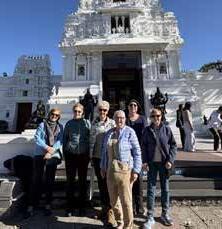
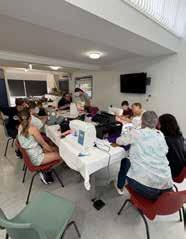
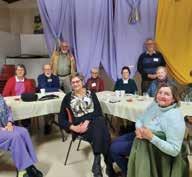
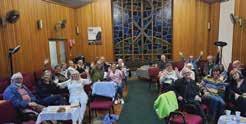
HOW DO YOU ENGAGE THE COMMUNITY IN SOMETHING THAT MATTERS, WITHOUT MAKING IT FEEL LIKE HARD WORK?
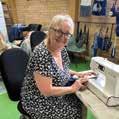
There is a particular kind of person who does not wait to be asked. Loraine Holley is one of them.
Aretired scientist with a PhD in physics and a career spanning biomedical engineering and medical physics, Loraine has spent the years since retirement doing what she has always done: noticing what is missing, gathering the right people, and quietly building something worth showing up for. She does it at Engadine Uniting Church, where she has become, in the words of Sue McKinnon, Church Council Chairperson, the driving force behind almost every effective ministry the church has in the community.
Loraine grew up in country Queensland, in a farming community where church was simply part of life and curiosity came naturally. She was encouraged, against the prevailing expectations of her era, to continue her education, first by her teachers and then by her mother, and eventually found her way into physics. It suited her perfectly. "I enjoy asking why things work and how things work," she told me when we spoke recently, "and also how can you be creative in that problemsolving." That pairing of rigorous curiosity and creative thinking has followed her out of the laboratory and into everything she has built since.
At Engadine, that has taken many shapes. There is a pop-up community choir, community film nights, and at the centre of much of it, the Eco Stitch and Sew Hub, a creative space where fabric waste finds a second life and where, as Loraine puts it, people who are not normally seen get to feel part of something bigger. She started it with a simple question she often returns to: how do you engage the community in something that matters, without making it feel like hard work?
The answer, she has found, is to start small and make the first thing tangible. The Hub's very first session involved everyone bringing a tea towel, dragging out their sewing machines, and making a tote bag. Simple enough that nobody felt out of their depth, satisfying enough that at the end of the afternoon there was something tangible to hold. She had also arranged the space to feel like a small fair rather than a workshop. It was fun, and it was entirely on purpose.
The Hub's reach has extended beyond Engadine. Through Common Grace's climate scarf project, knitters at the church translated NASA global temperature data spanning more
than a century into knitted scarves, each one gifted to a federal politician. It was work that caught the attention of the Australian Museum, and is now part of their Future Now Makers film series.
The same instinct drives the book club, which has been running since 2022. When Anthony Albanese came to power and made clear that the Uluru Statement from the Heart would be central to his government's agenda, Loraine found herself confronted by the limits of her own knowledge on Aboriginal history. Her response was to propose a book club at a community meeting. Within weeks she had two sessions running, morning and evening, with around fifteen people attending.
What followed was not a neat curriculum but a living conversation, moving through Aboriginal history, the conflict in the Middle East, ecological philosophy, and most recently a novel on artificial intelligence and what it means to be human. Along the way the book club drew people of other faiths and people of no faith at all, who simply wanted to be part of what was happening.
"That's fantastic. How can we use that?"
It is a question Loraine has been asking, and answering, for years. She is equally at ease talking about geopolitics and the ethics of artificial intelligence as she is sitting beside someone at a sewing machine. What connects all of it, she says, is the people. "These wonderful people who you're getting to know much better. They're not just pew sitters."
None of what Loraine has built would exist without the people who chose to show up and keep showing up. She is the first to say so. The groups run because enough dedicated people have made them their own, ready to carry things forward with or without her at the front. That, perhaps, is the quiet measure of whether something has truly taken root.
Her vision for what a community can be is both simple and quietly ambitious. "We can have communities which engage, which allow people to be creative, to cry, to laugh, to make mistakes and to share love with one another, so that everyone feels safe."
The book club is still meeting. The sewing hub is still humming. And the climate scarf project she brought to Engadine, which invites knitters to translate NASA temperature data into wool, caught the attention of the Australian Museum, who thought what was happening here was worth putting on film.
That is not nothing. That is, in fact, quite a lot.
ADITEE VORA
Watch Loraine and Sue talk more about The Climate Scarves here: tinyurl.com/A-Future-Now-Maker
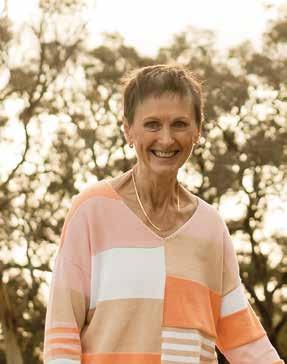
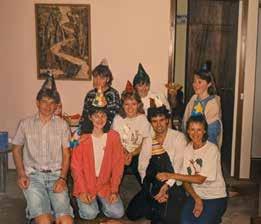
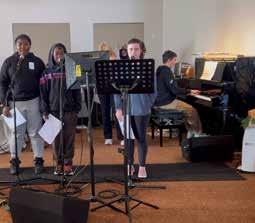
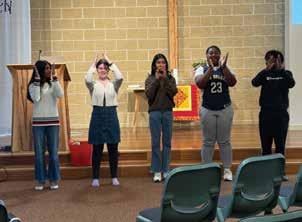
On a Sunday morning at Gungahlin Uniting Church, sixteen-year-old Lyle stands at the front of a Sunday School class he has planned himself. Later, fifteen-year-old Matthew joins Lyle to sit in on church council as junior members
rimary school children read the Bible and the Acknowledgement of Country at the service. The music team, the greeting roster, the food pantry, morning tea. Kids, everywhere, doing the actual work of the church. None of this happened by accident. There was a passion at Gungahlin to bring people together and drive the young people’s ministry forward, and someone had to be the one driving this. That person was Narelle Dodd.
Narelle came to the Uniting Church in the mid-1980s, she and her husband Chris both arriving from other traditions, she from Catholicism and Chris from a Baptist background. What drew them was not doctrine but atmosphere. “We were taken by the inclusiveness,” she says, “and by the sense that it was a denomination that was outward-looking. Not using religion to exclude people, but to include people.” Within a couple of years, they were leading a youth group at their church in Berowra, a still-developing suburb where the tight geography of the neighbourhood seemed to flow naturally into the life of the congregation. The group was only about ten young people. But something in it stayed with her. “We became friends with kids who we are still friends with today,” she says. Chris would steer the teenagers away from
easy answers, pressing them to form their own faith rather than simply absorbing someone else’s. Narelle watched what happened when young people were genuinely held by a community and given room to think. It was a picture she would carry for the next four decades.
The family moved to Canberra in 1991, spent time overseas, and eventually found their way to Gungahlin Uniting Church around 1999. It was a meeting in a school hall. “There were stacks of kids,” Narelle remembers. “Noise. Chaos. Energy. Lots of young families.” She immersed herself in children’s ministry, as a leader of the primary-school program for roughly a decade. She and her co-leaders would decorate a classroom each week, dress up in costumes, and generally make themselves look ridiculous so the children could relax into learning. “We’d dress up in superhero costumes, or as mermaids,” she says. “Just having fun with the kids, and making ourselves look silly so that they could laugh.”
When the congregation eventually moved into its own building, Narelle’s role shifted. She took on the treasurer position, then the safe church role, and found herself thinking carefully about the connection between governance and genuine welcome. Soon she came to believe that compliance was not enough on its own. Safety, in her understanding, is not just procedural. It is relational. It always has been.
A few years ago, drawing on a career in public service policy and program management, she coordinated a strategic plan for family and young people’s ministry at Gungahlin. She called on the congregation, regardless of their current or past experience in ministry or family life, to help shape it. A small team formed, led by Rev. James Baker from Pulse, to explore what makes young people’s ministry successful. The plan was deliberately ‘bite-sized’, breaking what looked like an overwhelming horizon into stages that the congregation could actually see themselves walking. The Presbytery and the Synod were encouraging. The Church council backed it. The congregation and the young people responded enthusiastically. What followed was a grant to help bring in a dedicated youth worker, a position the congregation is still working to fill.

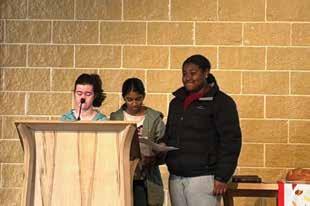
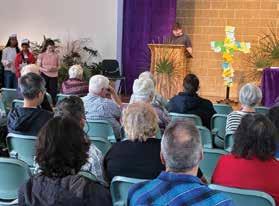
But the outcomes Narelle reflects on most warmly are not the ones written into any plan. She is someone who notices small things, and it was the small things that moved her most. Getting the children’s programs visible. Reporting back to the whole congregation about what the young people were doing, rather than letting it happen invisibly in a side room. Sending kids to Pulse camps for the first time and watching them come home lit up. “Suddenly they were meeting other kids,” she says. “They were energised. And then they would get up during the Sunday service and talk about it.” That energy spread outward into the Canberra Presbytery Youth Network, now drawing in over six congregations across the region.
And back at Gungahlin, she encouraged a re-framing of what volunteering meant. “You don’t have to be committed all year,” she says. “You could volunteer for an event. You could volunteer for a particular bit.” Volunteers more than doubled in two years. Young people began putting their names on church rosters. New volunteers put their hands up to give children’s talks and help lead various groups. Jess, a mother who had started out in a discussion group, grew into coleading music across the entire Youth Network alongside Marike Jago from Pulse. Lyle planned and led his own Sunday School term. Parents began pulling their own children into readings, prayers, and talks without being asked. Nobody told them to. The culture had simply shifted. Last year, this was tested in a way Narelle had not anticipated. She was diagnosed with breast cancer, a severe form that required chemotherapy and radiation, and complications that landed her in hospital and kept her out of large groups for months. She had to step back from almost everything. What happened next she describes as the unexpected gift inside a very hard year. “Other people stepped forward,” she says simply. “Instead of me writing the grant and getting someone to comment on it, somebody else wrote the grant and I commented on it.” The community she had spent years quietly contributing to held the line. Bronwyn took the lead on the grant. Elizabeth and Lynne stepped up to represent Gungahlin at the Canberra Youth Network. Jess, Renee, and Jenelle went as camp leaders to Pulse camps, while Rob and John drove
kids across the network. People took on fuller ownership to ensure there were no gaps. The ministry did not stall. It deepened.
When the conversation turns to what has changed between the teenagers she knew in Berowra and the teenagers at Gungahlin today, Narelle says it is not just that young people today face more noise. It is the nature of that noise. No algorithms curated a teenager’s worldview in the 1980s. There were no influencers promoting extreme positions, no architecture designed to ensure a young person only ever encountered a single viewpoint on things. “But today, there is not only so much more information to sift through, but whether that information is correct, and whether there are alternative ways of looking at things.”
IT'S NOT THE AMOUNT OF FAITH YOU HAVE, BUT THE FAITH THAT HOLDS YOU LORAINE HOLLEY
In the middle of all that, she says, young people are trying to work out who they are, what they value, and where faith fits in, or whether it does at all. Her response at Gungahlin has been to ask them directly and to keep asking. The answer that keeps coming back from the older teenagers now looking to meet for the first time this term is that they want to understand how their faith connects to the world, not what to believe but how belief sits alongside everything else. It is, Narelle notes quietly, exactly the kind of question Chris used to put to a small group of teenagers in a lounge room in Berowra more than thirty years ago.
“It’s not the amount of faith you have,” she says, “but the faith that holds you.”
She wants young people to own their version of it, however partial or uncertain, to find the part that keeps them coming back, that shapes how they live.
Four decades of watching the youth find their footing in faith has not made her more certain about what faith should look like in a young person. If anything, less so. The job, as she has always understood it, is simply to make space and trust what grows.
ADITEE VORA
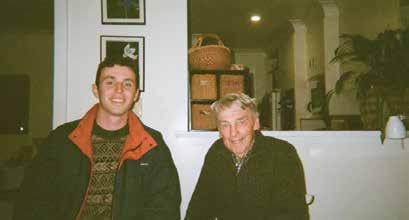
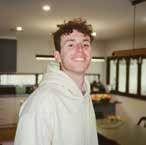
William Giacometti did not come to service through a single defining moment. He came to it the way most things that last tend to arrive, quietly, gradually, and through the people around him. When I sat down with him, he was quick to deflect. "I'm not an expert in anything," he said, laughing a little. What he is actually involved in tells a different story.
At any given point, he is either just out of a committee room, heading into one, or spending an evening with young people at Turramurra Uniting Church (TUC), a congregation on Sydney's upper north shore, where he has been a constant presence for most of his life.
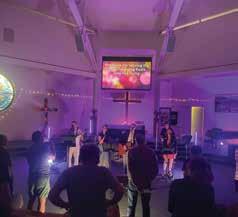
For the past two years he has been part of the leadership team at Evolve, an evening service at TUC that began in October 2023 as a complete reimagining of what church could look like for young adults. It runs largely on volunteer energy, functions in Will's words like a startup, and has grown to around thirty people each week. He also sits on the church council, bridging the two communities, and has been working in youth ministry long enough to have developed some clear-eyed views about what actually works with young people. More recently, he joined the Synod's Three Presbyteries (3P) Transition Commission to sit with regional congregations and understand challenges that look very different from anything he encounters at home.
What he has helped to built at Evolve is perhaps where his thinking is most visible. When the group started, the impulse was to strip things back, to get away from structure and liturgy and anything that felt like the church they were trying to reimagine. Over time, something shifted. "We've actually gone back the other way," Will told me. They reintroduced a call to worship. The old rhythms, held differently, began to mean something again. "If you asked us two
years ago, we would have hated that," he said. He has watched people get more connected to their faith, more willing to take it seriously. "I think it's a community that values each other but also wants to be better at witnessing Jesus Christ in their lives."
THE FUNDAMENTAL ROLE OF A LEADER IS TO SERVE THE PEOPLE THAT THEY'RE LEADING WILLIAM GIACOMETTI
His views on youth engagement are similarly unromantic. Young people, he says, have a sharp instinct for what is genuine and what is not. They are not looking for spectacle. They are not looking for something watered down either. "How do you adapt it to them in a way that doesn't water it down?" is the question he keeps returning to. He is also frank about where the broader church still falls short, scheduling things at times that only work for people who are retired or work for the church, using language that obscures rather than invites, including young people through quotas without actually drawing on what they bring.
The 3P work has added another layer to that understanding. Sitting in a meeting in rural Kempsey and hearing congregations describe not having enough people to form a church council recalibrated something in him. "I had
to pull myself back and go, well, we haven't really had it that bad," he said. It has made him more convinced that the transition, for all its messiness, is pointing in the right direction. "It's about common life and wealth across the whole of New South Wales.”
His journey has not always been fun and rewarding.
On one of the harder days, he picked up his Bible almost at random. The first line he read was from 2 Corinthians 4. ‘Do not lose heart.’ It was exactly what he needed during a deflating period where he questioned whether his work was truly changing people. That, in many ways, is how Will moves through all of it. When I asked what drives him, he did not hesitate. "To me, leadership is actually service," he said. "The fundamental role of a leader is to serve the people that they're leading." He traced that conviction back through his family. His parents, he said, are servant-hearted people. His grandfather gave his whole life to service, most recently as treasurer of Hornsby Connect, a charity that provides food to people experiencing homelessness. When his grandfather passed away in January, one of his final acts from his hospital bed was to formally resign from that role. Will did not say much about it. He did not need to. "It's part of who I am," he said. "It's part of my DNA."
And when you look at everything he is quietly building, that much is clear.
ADITEE VORA
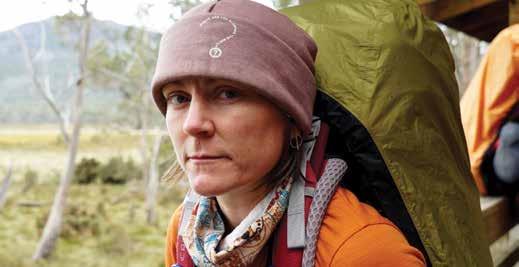
Bec Reidy does not think of herself as a good person. She will tell you that fairly early in a conversation, and she means it. "Doing what I do helps me sleep better at night," she says. "It's just as much for me as it is for anybody else."
That kind of honesty is a good introduction to Bec, a community development worker who has spent the past decade at Bidwill Uniting, a small ministry in Mount Druitt, Western Sydney. She is not interested in being held up as an example, and she is deeply uncomfortable with the idea that working for justice belongs to a certain kind of person. "Working for a better world is just as selfish as it is selfless," she says. "I just would love people to get on board with that and not outsource the good work."
Her instinct to walk alongside rather than rescue did not arrive fully formed. It grew out of a childhood shaped by her family's involvement in short-term foster care. From a young age, Bec understood something that takes many people much longer to learn. "I had this really profound understanding that lots of people don't get a good start in life," she says, "and so the problems that people end up having are not of their own making."
She grew up in a fundamentalist church, an environment she describes as damaging in some ways, but one that gave her a lasting sense of social justice. She found her own theology in the stories of Jesus, particularly the moment he sat down, made a whip, and drove the money lenders from the temple. "He didn't just lose it," she says. "He really thought about, 'this system is really unjust, and I'm going to actually sit down and make a whip.'" That image of deliberate, thoughtful action against injustice has
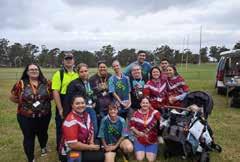
Her early working life was spent in refuges and group homes. It was necessary work, but she began to feel its limits. People were surviving, but the systems keeping them in poverty were not changing. When a community development role came up, she took it, and it opened a new world. She started to see a pattern she could not unsee. "There's a lot of good people in the church," she says, "but there's a real saviour kind of model where the church wants to be the good people that save the poor people. And I've come to believe that that actually exacerbates and reinforces the power dynamics that keep people in poverty."
TO GO FROM FEELING POWERLESS TO FEELING LIKE I CAN HAVE A SAY IS A HUGE SHIFT
BEC REIDY
That conviction sits at the heart of everything Bidwill Uniting does. The centre runs a drop-in space, an art class, family programmes, a leadership programme through the Together in 2770 Collective. But the programmes are not the point. "The biggest and most profound thing that I've learned," Bec says, "is that no one wants to be saved. No one. Everybody wants to belong, and everybody wants to contribute, and everybody wants to be the person who makes decisions in their own lives."
Earning trust took years. Bec is straightforward about what it required. Consistency, yes, but also a willingness to share of herself. She also apologises, often, and for real. "Sometimes the small things, and sometimes I make big mistakes and
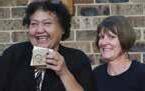
I really have to apologise," she says. "I hope that just helps people understand that I'm just a human who muddles along like everybody else."
The moments that matter to her tend to be quiet ones. A woman she had known for years, who had come through real difficulty, went on to study, rebuilt her confidence, and watched her daughter go on to university. She once told Bec that it all started at Bidwill. "I think that's really profound," Bec says, "just having a place." There are parents who once felt completely powerless now sitting on advisory committees, speaking into housing and transport policy, telling decision-makers plainly what will and will not work. "To go from feeling powerless to feeling like I can have a say," she says, "it's a huge shift. And it's not just a shift for them. It's a shift for their kids. And it's a shift for the community."
She does not have a five-year plan. She is partway through an MBA specialising in social impact, and she has come to understand that she is someone who does her best in the situation she is in and lets things emerge. Recently she was recognised with an award for her work, something that made her deeply uncomfortable. "I'm just a person doing what I think is right," she says. "And at the end of the day, that's what we all should be doing."
What she is most excited about is what she will not be there to see. "I'm very excited about what will happen after I'm gone," she says, "to see what this place might look like in 10, 20 years. And knowing that I was a small part of that, it's good. It's really good."
ADITEE VORA
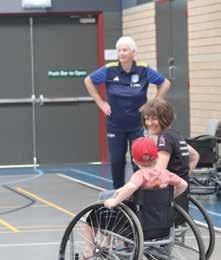
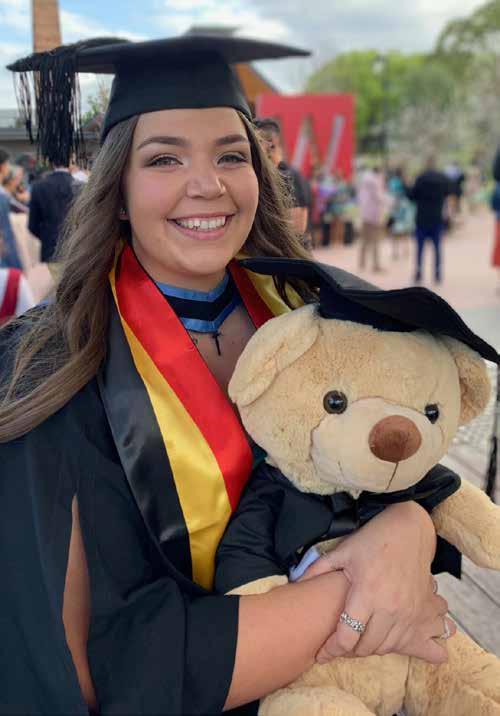
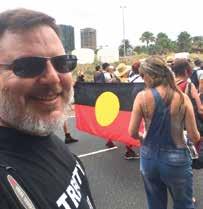
I was advised that the theme for this edition of Insights is “Everyday heroes”. I thought long and hard about the theme. Should I write about the Aboriginal community workers who turn up day in, day out, to try to make a positive difference in their communities? Or perhaps about the Aboriginal social workers who similarly turn up every day, working with people to try to and assist them to address issues impacting their lives? Or maybe about the Aboriginal health workers, nurses, doctors, and others who work with and for their communities every day? Such quiet heroes exist, but are usually unseen by wider Australian society.
When talking about “closing the Gap”, what often irritates me are the non-Aboriginal people, who don’t even know an Aboriginal person, who say “Well why don’t they do something about their own problems!”.
For roughly the first 150 years of colonisation, Aboriginal peoples and communities were subjected to racism, discrimination, dispossession, child removals, slavery, and prohibited from gaining employment and education. Racism and discrimination, sadly, remain evident today. It’s a fact.
The legacies of colonisation and the related treatment of Aboriginal and Torres Strait Islander peoples are what we see in the socio-economic inequity that is acknowledged when we speak of the need to “close the gap”. The “gap” in socioeconomic statistics did not arise because Aboriginal people are lazy, or unintelligent, or because we don’t care about the wellbeing of our families and communities. It exists because of the harm caused by systemic, institutionalised, and entrenched racism and discrimination over 150 years – impacting at least 6 generations of Aboriginal people and families.
Since colonisation began, thousands of Aboriginal people have spent their lives working quietly to try to make a difference for their families and communities.
People who, like my father, were told by their school Principal: “You’ll never amount to anything and will spend your life in the gutter.” People who have overcome significant adversity, not only to achieve tertiary qualifications, but to then focus their knowledge and skills on working with communities to try to lift our people up. To try to break the cycles of poverty, trauma, grief, and chronic health issues that impact our communities. To “do something”. I know hundreds of such “everyday heroes”. And there are thousands more.
Most non-Aboriginal people see university qualifications as a pathway to earn more money in various professions. Most Aboriginal people I’ve met who are studying or who have completed their studies, see obtaining university qualifications as a means of being able to help make a difference for their communities.
Sadly, people disparagingly refer to Aboriginal people with tertiary qualifications as the “Elites from the cities” and claim these Aboriginal people don’t understand issues of “real Aboriginal communities” etc.
Our Elders and ancestors fought for the right of Aboriginal people to attend educational institutions… and now that we are finally seeing hundreds of Aboriginal graduates each year, the racists (and politicians with ulterior motives) want non-Aboriginal people to believe that those graduates are somehow not really Aboriginal people anymore.
They apparently prefer Australians to see Aboriginal people as uneducated, disadvantaged, hopeless, and in need of paternalism. Smart, educated Aboriginal people don’t fit into their racist narratives, and confront the ideologies of white supremacy that underpin their bigotry. Let me be clear, every Aboriginal person that graduates is from an Aboriginal community, and they remain part of their families and communities. You do not somehow lose your heritage, culture, family and community ties by getting a tertiary qualification.
just want to make non-Aboriginal people feel guilty about things that happened hundreds of years ago.
Having spoken with hundreds of Aboriginal people about justice issues over the decades, nobody wants nonAboriginal people to feel “guilty”. What we seek is for non-Aboriginal people to be honest about the significant negative impact that this history has had on our lives, and to be decent human beings who will help to remedy the injustices of the past and support genuine reconciliation so that we can heal and move forward as a nation.
I KNOW HUNDREDS OF “EVERYDAY HEROES”. AND THERE ARE THOUSANDS MORE
The quiet heroes who work with and support our communities know that the issues they deal with are real and current, not relegated to some point in history. Our quiet heroes want to address the disadvantage, discrimination and injustice that continues to impact Aboriginal people. They want safer, happier, and healthier families with well-resourced communities focused on culture, employment, education and economic development. They simply want for our people, what most Australians take for granted.
So when non-Aboriginal people, who do not properly understand Australia’s colonial history and want to pretend Australia was peacefully “settled” say “Why don’t you just stop asking for handouts and help yourselves”, I get a bit annoyed. We ARE helping ourselves. We have thousands of “quiet heroes” doing the hard slog every day. We have Elders and community leaders working 24/7 - dealing with crisis, trauma, critical incidents, domestic violence, suicide, and mental health related incidents. We have professionals working alongside Elders and community leaders as social workers, teachers, health workers, nurses, doctors, police, lawyers, and so on – all dedicated to working to improve outcomes for Aboriginal families and communities. We have young people working hard to get a good education so they can help their communities.
You know who aren’t helping? The racists, the bigots, the white supremacists, the neo-Nazis, the groups promoting hate, and those who say Aboriginal people
Our quiet heroes do not want their families and communities living in chronic disadvantage. They do not want our children committing suicide because they can’t see a future for themselves in this country. They do not want our families and communities impacted by the scourge of substance abuse and domestic violence. They do not want their loved ones dying in custody from preventable causes.
Only when this country stands behind our quiet heroes, our Aboriginal Elders, community leaders, and others working on the front-line in various capacities, will we see the “gap” closed. In closing, I recognise the ongoing difficult work of our “quiet heroes” and thank them for all they have done and continue doing. I hope wider Australia will at some point stop trying to deny the brutal colonisation of this country, sweep colonisation under the carpet as “something that happened 200 years ago”, and instead work constructively with those who are already dedicated to making a positive difference for our people.
NATHAN TYSON
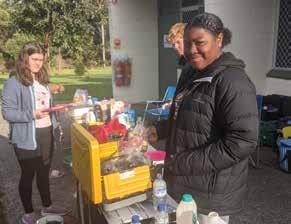
There is a moment Sarah Manche describes that stays with you. A room full of people singing happy birthday for a grown adult sitting at the table, eyes wide. People have told her, she says, that it was the first time in their life anyone had ever sung happy birthday to them.
This is how Sarah personally measures the difference being made. Not in meal numbers or hampers given out, though those matter too and she will tell you the figures are growing. It is in what people choose to share with her on their way out the door. In the person who arrives in tears and says, "I know I can always come here. There's always people here that love me." She knows not everyone hears these moments. But she is in a position where people share them with her, and she takes that seriously. Loneliness, she says, is an epidemic, and what keeps her going is the quiet evidence that something here is meeting people in it.
She is quick to turn the mirror on herself, acknowledging that she was often the one sitting back asking why rather than stepping forward. But she credits that restlessness with eventually leading her somewhere that operates differently.
For Sarah, the anchor is simple, even if living it out is not. It comes back to two things, she says, loving God and loving your neighbour as yourself. “There’s no point me believing something and it’s just in my head and it’s just for me to benefit,” she says. “That’s not real faith. Faith has to include living it out, living it in community, sharing meals with people.”
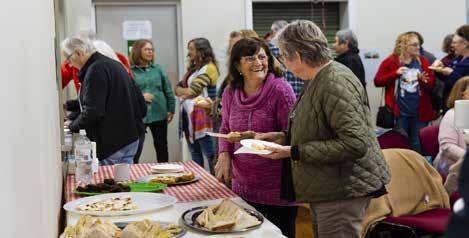
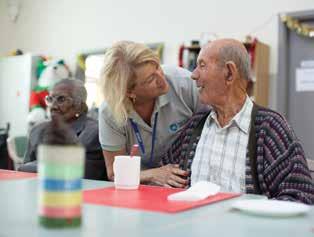
At Newtown Mission, the doors open for community lunches on Wednesdays and Fridays, and for dinner on Thursday evenings. Those meals are the highlight of Sarah’s week. She will tell you that is down to her volunteers, and she means it genuinely. Volunteers bring their own plate out and sit down beside someone. They stay. They listen.
“Being acknowledged as a human being,” Sarah says, “and having someone take the time to sit and chat and laugh, make jokes, tell you their stories. That’s what it’s all about.”
The community that gathers at Newtown Mission is as varied as the city itself. There are elderly regulars who have been coming for years. There are people who are unhoused, people in boarding houses, people from various communities. Lately there have been more new faces, and Sarah suspects the cost of living has something to do with that. Learning people’s names, she says, is one of the most quietly powerful things anyone can do.
“It’s very hard to maintain that black and white distinction when you actually know a person’s name and you’ve spoken to them. They’re not just a number or a statistic. They’re a person. They’ve got a past. They’ve got lived experiences that we all have. Any one of us can find ourselves needing a place like this."
THEY’RE NOT JUST A NUMBER OR A STATISTIC. THEY’RE A PERSON. THEY’VE GOT A PAST.
That spirit extends to who shows up to serve. Sarah’s volunteer team includes people from all walks of life and all kinds of faith backgrounds, and some with none at all. The only requirement is a desire to love and serve the community. “It’s not just for people who are like us,” she says. “It’s for anybody, for everybody.”
Sarah is the Community Development Program Coordinator at Newtown Mission, but that title only tells part of the story. She came to this work the long way around. For years, life had pulled her in a different direction, through corporate jobs that paid the bills but left something unnamed unsatisfied. A friend had once used a phrase she had never forgotten, and somewhere in that period it became her own. “It just wasn’t making her heart sing.” What she had always been drawn to, she realised, was people. Sitting with them, learning from them, being useful to them in ways that actually mattered. Newtown Mission was where that finally had a home.
“When I saw this role, I was like, I just wanted to be a part of it,” she says. “It’s people that have their heart in the same sort of place. It’s all about actions, not words.”
That gap between words and actions is something Sarah thinks about a great deal, particularly when it comes to church. She grew up attending various congregations and was often left wanting more, restless at the distance between what was preached and what was practised.
What Sarah is building at Newtown Mission is something harder to define than a program or a service. It is closer to a safe space, she says, a place where people can simply be. Where you do not have to explain yourself. Where you can sit quietly in a room full of people and feel, for an hour or two, that you are not alone.
ADITEE VORA
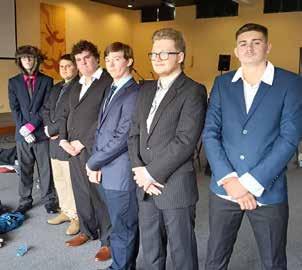
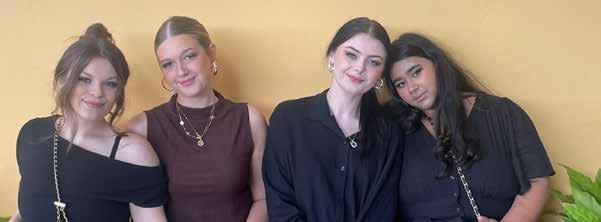
Some of the most valuable threads in a community are the ones you don't immediately notice. Shortland-Wallsend-Jesmond Park Uniting Church has been one of those threads for Margaret Jurd College for years, contributing financially, donating clothing, and providing their hall free of charge each year so senior students can spend a full day working through job readiness and wellbeing programs. It is consistent, practical support, and it makes a real difference.
The congregation has been a consistent supporter of the College for years, contributing both financially and practically to programs that help students move forward.
This support is especially evident through MJC's Style and Suit Up for Success program, an initiative designed to help students feel confident, prepared and job ready as they step into interviews, work placements and employment pathways. The program operates under two streams, Suit Up (for boys) and Style for Success (for girls), ensuring all students have access to appropriate clothing and personal care items that support dignity and self-presentation.

part of the initiative. Items such as toothbrushes, toothpaste, shampoo, conditioner, deodorant, body wash, sunscreen, laundry detergent and gift cards all contribute to supporting students in practical and meaningful ways as they prepare for work and independent living.
YOUNG PEOPLE DESERVE SUPPORT AS THEY FIND THEIR FOOTING
Margaret Jurd College is a non-government, notfor-profit independent school supporting young people in Years 9 to 12 who have experienced barriers to education. Many students arrive having faced complex personal, social, or financial challenges. The College's focus is on re-engagement, wellbeing, and equipping students with the life skills needed to move forward with confidence and independence.
Having the right clothing for an interview or work placement is a small thing that can carry real weight for a young person who doesn't have access to it.
The program relies heavily on community support. Donations of gently used business clothing are always welcome, including men's and women's professional attire, shoes, belts, ties, handbags and briefcases. For female students in particular, items such as handbags, basic make-up, hair care products and toiletries help build confidence and readiness for professional environments. Everyday essentials are also a key
Those contributions make a direct difference to what the program can offer, and for students stepping into their first interview or workplace, that difference is felt. The congregation also donates the use of their hall each year for a full day of job readiness and wellbeing activities for senior students, providing the space free of charge. It is a generous and practical contribution that the program depends on.
The relationship between Shortland-Wallsend-Jesmond Park Uniting Church and MJC is a practical one, grounded in a shared belief that young people deserve support as they find their footing. The church shows up for that consistently, and it shows in what the program can deliver.
Margaret Jurd College is grateful for the generosity of Shortland-Wallsend-Jesmond Park Uniting Church and its congregation. That support, given steadily and without expectation of recognition, makes a real difference to students as they prepare for work, training, and life beyond school.
JENNAE JEREZA AND RENEE GERSTELING OFFICE OF MARGARET JURD COLLEGE
Donations for the Suit Up and Style for Success program remain welcome and can be delivered to MJC Shortland, 272 Sandgate Road, Shortland NSW 2307, before the 10th of June.
For more information: Contact 02 4951 7314 or email enquiries@mjc.nsw.edu.au, or visit mjc.nsw.edu.au


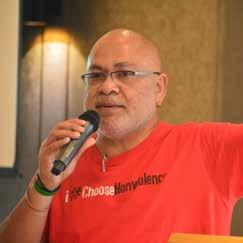
“Why are you crying? I can’t do what he does to the Bible. He doesn’t read it the way we read it at home.” (Early 2000’s, numerous students after classes)
“What are you going to do about it?” (Jione. Every year, with increasing frequency, whenever a student had an epiphany)
Ican’t read particular passages of scripture without hearing his voice in my head – Ruth, Genesis, The Lord’s Prayer… the Pacific Prophet’s voice, gentle, inquisitive and firm, posing seemingly innocent questions that cut through assumptions with the precision of a surgeon wielding a laser knife.
Jione Havea’s particular approach to formation and re-formation was often provocative, confronting, and persistently prodding.
edges of cliffs, they began to reveal scaffolding — handholds you could choose, moments of grace extended mid-fall.
I think family also brought a sense of timeliness. Don’t waste time. If you are away from home, make it count!
LAUGHTER SURFACED OFTEN. SO DID LONG PAUSES. NOTHING FELT HURRIED
I noticed a change over the years. In the early days his teaching was edgy – questions directed at deconstruction, his frustration sometimes audible beneath the brilliance. Then came marriage and fatherhood, and with them a homelife that blossomed him. As the Pacific Prophet — always on the move — home was not a place to stay, it had to be held in family. Monica and Diya would both become his sanctuary and his inspiration.
He did not soften as much as deepen. His questions were still precise, still unsettling, but now they were offered as invitations, sprinkled with pastoral tenderness. Where once they felt like
I have no idea how he wrote and edited such quantities of words. Maybe he had an army of scribes hidden away, where we could not see? He was everywhere – at home in India and Tonga, teaching in Aotearoa and the lands now called Australia, presenting in Thailand and Tahaa, committee work in London and South Africa.
A recent encounter was on the island of Moorea, in the Tahiti group. Picture the scene: late-night tea with the elders at the Deacon-house, after a long day of Bible study with young people from across the Pacific. What followed was nearly an hour of patient questioning—about MA - NA, VA, VA - NUA, MO -TU, MO - ANA — testing etymologies, turning phrases in Tongan and Samoan, listening carefully for the weight each word carried. Laughter surfaced often. So did long pauses. Nothing felt hurried. Each evening question quietly became
the next day’s teaching, as if the learning itself was a form of respect.
I wonder – did he sleep at all those nights? Did his dreams work in intersectionality – where different disciplines are in conversation with each other? Next morning, the words he had been nuancing the night before were on the presentations and marked up with highlighting. He did not just translate the words, he translated the media for communication. He could deliver an hour lecture using material he had accessed merely hours before. In that lecture, he demonstrated why God gave us the gift of many languages, because one language will never be enough to talk about the most sacred things.
Why are you crying? Because we will miss him.
What are you going to do about it? Take off my shoes.
REV. AMELIA KOH-BUTLER is a UCA Minister, currently serving as Mission Secretary (Education and Pacific Region) of the Council for World Mission (formerly London Missionary Society). Many of Jione’s works were published through the DARE programme of CWM, which he was instrumental in founding and developing. Rev. Koh-Butler was Director of the ELM Centre when Jione was the Old Testament Lecturer at UTC.


To the Synod of NSW & ACT, I have been privileged to serve as a Minister of the Synod of NSW & ACT for nearly ten years, and specifically as the Young Adult Ministry Facilitator for the last two and a half. I was ordained in the wake of the marriage plebiscite and plunged shortly after into a global pandemic that shattered our “church as usual” approach to things.
If these experiences taught me anything it was that there was nothing that those who led my formation phase of Ministry could have thrown in to prepare me (us) for that.
I learned that God doesn’t live in the perfect, or sanitised pages of our lectionaries, or the safety of our committee meetings. These are vital and form the pattern and tapestries of a life ready for God’s disruption.
But I have found God in the ordinary and deeply life changing moments of ministry with those people who show up, who choose love, in defiance to a world that’s too busy, too loud, and too scared.
Thank you for providing me with hope. Not the easy won, short and optimistic hope; but that gritty, defiant hope. I have seen it in places and people who keep fishing even when the catch has been off, the people who show up to the same structures, but refuse to allow the Joy of Jesus be extinguished by systemic and institutional fatigue. And I have seen it in those who remember that we love, because God first loved us and there is always point to the creator and invites us to recreate.
You listened when I pushed back. You invited me to extend the table. We have spoken about putting our distractions aside and listening to each other, including our children. Treating each other’s stories with the same liturgical weight as the narratives that greet us on Sunday mornings.
We talked about how breaking bread in local cafes, around kitchen tables isn’t ‘kingdom-lite”, it is exactly the breaking in of the reign of God, the remembering of the body, and the invitation for transformation.
You allowed me into your hospitals, pulpits, your lives, your grief and your joy. You allowed me to see that community is a practice, not a program.
As I prepare to move to the UK, I am forever changed by the way that you have grown and stretched my heart, my understanding and witness of the creator, and the neverending limit of grace will always be different and vast because of you.
My parting prayer for this Synod, and the Uniting Church is that you don’t stop stretching.
One of my last acts in this space will be to stand with two people and marry them. They have committed to love and cherish each other, but also to the continued integration of each other’s lives as family.
Integration is more about being made whole, through the practice of awareness, listening and invitation. My challenge to you is that you continue to integrate rather than just include. Don’t just make room at the table; change the shape of the table. Hold the stories of the margins just as sacred as those which gathered at the edges of the Nile, the Jordan and Golgotha. Don’t try and fix the radical voices which make you uncomfortable, listen to them.
Thank you for revealing to me what God might look like. It turns out, God looks a lot like a community who refuses to give up on grace, even when it might cost them everything.
Grace, peace and mercy are yours from God who is triune, Creator, Christ and Spirit, forever. Amen.
REV. JAMES BAKER
DON’T JUST MAKE ROOM AT THE TABLE; CHANGE THE SHAPE OF THE TABLE
About 18 months ago, I was invited to preach at my “home” congregation — the place where I grew up. As I stood to preach, I was struck by the faces looking back at me: the very people who had stood together at my baptism, and at countless other baptisms, proclaiming their shared faith.
They were the people who had promised to sustain a life of worship, witness, and service so that I, and all those baptised among them, might grow into lives of faith. Here they were, some 50 years later, still faithfully living into those promises. Perhaps it struck me so deeply because, in the previous week at United Theological College (UTC), we had been reflecting with candidates on the meaning and practice of presiding at baptisms.
Of course, not all those baptised within this congregation have remained part of the church. I expect not all would now claim a Christian faith. Yet as I looked at those faces on the morning I preached — some I had known all my life, others new to me — I was moved by the way this community had continued to keep its promises together, often without knowing what impact those promises may have had.
I found myself humbled by the faithfulness of the people who taught me how to be a disciple; thankful for those who gave their time and energy to lead kids’ clubs and youth groups, and to organise church concerts and musicals (I was very much a church child of the 1970s and 80s). I was, and remain, sincerely grateful for the witness of that quietly faithful community who cared enough to teach me what it means to
follow Christ through their embodiment of the love, grace, and hopeful justice of God.
I was also mindful that I was looking at people still deeply engaged in being the community of Christ within their local area. During worship, there was evidence of faithful living not only in their prayers, but also in the announcements and activities that shaped their shared life. Some of these activities were social gatherings through which they cared for one another and nurtured community. Many others were ministries within the wider community, where members of the congregation were engaged in the work of the gospel — the work of witness and service.
I have carried this experience with me into my work as Dean of Candidates at UTC.
Since that day, I have become more aware of the presence of lay people in the formation of candidates for ordination. I imagine that, for many of them, offering their time and energy to this work is itself part of living out the vows they have made at baptisms within their own congregations.
Lay people are essential to the formation of candidates for ordination. Most obviously, candidates engage with lay people through their field education placements. The gift offered by congregations is the generous welcome extended to candidates into the life and leadership of the church community. At UTC, we are deeply grateful to those congregations that allow candidates to learn and grow in their midst.
I am also thankful for those who support candidate formation and training through presbytery Ministry Committees, Formation Panels and the Synod Selection Panel. These panels carry a significant responsibility on behalf of the church. In these spaces, the discernment of the church is entrusted to people called to listen deeply — to the candidate, to one another, and to the voice of God. Participation in this work often requires substantial commitments of time, energy, and sometimes travel.
Many ordained ministers and pastors contribute faithfully to these panels, and we are grateful for their service. But here I especially want to give thanks for the lay people who serve the church in this way. As I write, I find myself recalling the faces of so many lay people who have served on these panels over the years — too many to name, and with too great a risk of unintentionally overlooking someone. I hope those who read this piece know how deeply thankful I am for all they offer.
I am also grateful for the faithful generosity of the Uniting Church Adult Fellowship Committee within our Synod. Late in 2025, I received an email from the committee advising that they had established an annual encouragement award for a candidate who would benefit from both encouragement and financial support.
I REALISED I WAS SEEING THE QUIET PERSISTENCE OF DISCIPLESHIP LIVED OVER DECADES
Many of those people may never know the full impact of their faithfulness — the ways their teaching, encouragement, welcome, and witness have shaped lives and ministries beyond what they could have imagined. Yet their steady commitment to the worship, witness, and service of the church has borne fruit in countless ways, including in my own life.
For that witness, and for all those who continue to live out those baptismal promises with quiet faithfulness, thank you. You are seen.
REV. NICOLE FLEMING DEAN OF CANDIDATES, UNITED THEOLOGICAL COLLEGE
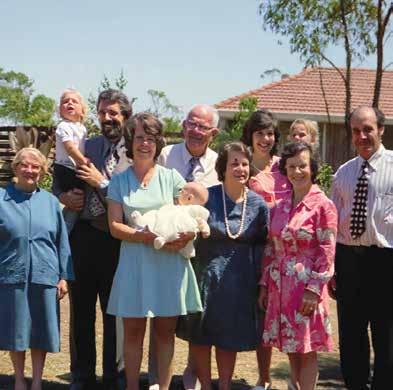
They invited me to nominate a candidate for the award — no questions asked, simply whoever I believed would benefit most. Subsequently, I was invited to lead their annual commissioning service at the beginning of this year. Once again, I found myself looking into the faces of faithful people serving the church so that, together, they might share the good news of Christ.
The commitment to faith expressed through our baptismal promises should never be underestimated. As I stood in my home congregation that morning, looking into the faces of those who had once stood around the font and promised to nurture the faith of those baptised among them, I realised I was seeing the quiet persistence of discipleship lived over decades. I see that same persistence in those lay people who contribute to candidate formation, and through the faithful serving of those on other committees across the Synod.
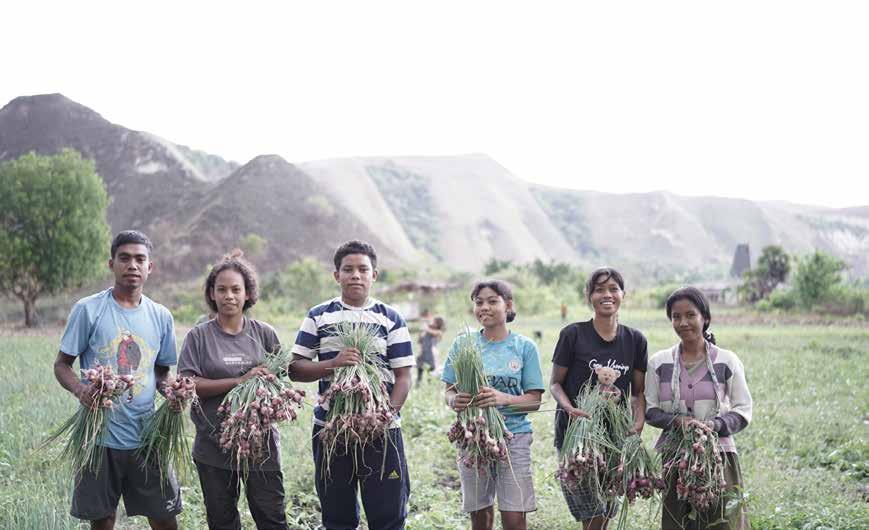
Every year, more young people leave Sumba. They go to Bali, or Java, in search of work and a future they feel their own island cannot provide. Fields go unplanted. Churches empty out. They leave and they don't come back. UnitingWorld is supporting our church partners to change that.
Petrus Pandanga has watched this happen for forty years. He is 70 years old, a farmer and member of the Sumba Christian Church, and he has spent most of his working life trying to convince people that Sumba can sustain them if they farm it differently, think longer-term, plan further ahead.
"When the planting season begins, family incomes are at their lowest," he says. "That's a huge obstacle. That's what farmers feel."
"If it continues," he says, "it will create greater dependency. Young people only think about looking for work outside. The chance of food security being disrupted in the future is quite large."
THAT HOPE, MODEST, PRACTICAL AND ENTIRELY ACHIEVABLE, IS WHAT THIS PARTNERSHIP IS WORKING TOWARD
He is describing the hungry season: the months between harvests when food runs low, rice prices double, and families with no savings and one harvest a year face a brutal choice. Borrow money they may not be able to repay just to survive, go without food, or leave.
The statistics frame it starkly. Sumba is among the poorest regions in Indonesia, with nearly a third of its population living below the poverty line. But the numbers don't capture what Petrus sees when he walks through villages: communities where virtually everyone under 40 has already gone.
Climate change has sharpened every edge of this crisis. It hasn't necessarily made Sumba drier. It has made the seasons unpredictable. Rain that farmers could once rely on every year now comes later and less often. Crops planted in hope die in the ground. Replanting costs money families don't have. An African Swine Fever outbreak stripped many households of their pigs, the traditional savings account, the financial backstop when everything else failed.
Subsistence farming families like those in Sumba sit at the most vulnerable end of global economic and environmental shocks. They have no buffer: no savings, no insurance, no alternative income. When the rains shift by two weeks, when commodity prices spike, when a disease sweeps through the livestock, the consequences land immediately on families already living on the edge of not enough. The distance between a good year and a catastrophic one is measured in days of rain.
So people leave. They take the boat to Bali, arriving without qualifications, without connections, and too often without an understanding of the cultural differences that await them. They find themselves in double poverty: struggling back home and struggling again at their destination without support.
A CHURCH THAT LOOKED TO THE ROOT CAUSES
This is the pattern Rev Dr Betha Meidyawati, Director of UnitingWorld's partner, the Maha Bhoga Marga Foundation (MBM), had been seeing in Bali for years.
MBM is a foundation of the Protestant Christian Church in Bali (GKPB). For more than 40 years, it has worked with poor and vulnerable communities in Bali, running health programs, supporting survivors of domestic violence, and accompanying families through economic hardship. It is an organisation that is trusted by the people because it is deeply rooted in the communities it serves.
But when Rev Betha reviewed MBM's direction at the start of her leadership in 2023, she kept coming back to a question: why were so many of Bali's most vulnerable migrants coming from Sumba?
The answer was exactly what Petrus described: extreme poverty. Drought. Crop failure. A hungry season that came every year without fail. Communities with no safety net and no way to plan beyond the next harvest.
"I prayed to God, asking for wisdom," she says. "I was reminded of my experiences doing outreach to urban migrants in Bali. Many migrants shared that the primary driving factor for people from Sumba to seek work in Bali was extreme poverty."
The insight that followed was simple but significant. MBM had been supporting people after they arrived in Bali, after they got into trouble and ran out of options. What if MBM went to Sumba instead, and walked alongside the Sumba Church to help communities before desperation forced the journey?
"Through this work, we hope to support vulnerable communities in Sumba at the roots of the problems, within their own villages, rather than only after they have already migrated to Bali and face new challenges."
What makes this story distinctive is that this was not a program designed in Sydney or Geneva or Canberra. It grew out of a relationship between two churches on different islands of Indonesia.
In March 2025, the leaders of the Protestant Christian Church in Bali and the Sumba Christian Church (GKS) signed a Memorandum of Understanding, formalising a partnership built through deep conversations over preceding years. MBM gained office space within the GKS compound in Sumba. GKS leaders opened doors with regional government. A new collaborative project was born.
"With the generous accompaniment of GKS leadership," Rev Betha says, "MBM has been introduced to and supported in engagements with the East Sumba Regional Government. In many respects, the management and staff of MBM have also gained trusted partners for discussion and for learning the local cultural context."
It is a model the Uniting Church has long championed but doesn't always get to see in practice: local churches leading transformation from within their own communities, with external partners walking alongside rather than dropping in with answers from outside.
The project is now working across three villages in Sumba, bringing kitchen gardens, health education, water access,
climate-resilient farming and sustained mentoring through trained village cadres. Women are at the centre. The program is built around the belief that food security, family health and women's empowerment cannot be addressed separately but as a whole.
Petrus is part of it. His demonstration farm, the place he has tended for decades, is now part of a broader network of learning and change.
"Change doesn't always start with many people," he says. "One person learns, and then brings two more. Those two tell others. Knowledge spreads like that."
For Semis, a farmer in the highlands, the vision is not abstract. She pounds rice by hand every morning to feed her family, because there is no mill nearby. She and her husband farm 20 acres of land, once a year, if the rains come. When the crop fails, they forage in the forest for wild plants and roots.
Her hope she says, is "that my child can go to school, and that there will be enough to eat."
That hope, modest, practical and entirely achievable, is what this partnership is working toward. And it is where Australian supporters enter the story.
UnitingWorld's End of Financial Year appeal is raising funds for this program and other urgent poverty alleviation and climate change projects. Through Australia's partnership with the federal government via the Australian NGO Cooperation Program (ANCP), every dollar donated is combined with government funding, multiplying the impact up to six times.
This is new ground. And the people who make it possible are not just the church leaders and staff in Bali and Sumba. They include the Uniting Church members in Australia who understand that the most powerful thing they can do to help is to stand alongside people who are already doing the hard, hopeful work of change.
"There are still many people living in poverty and vulnerability," Rev Betha says. "Through shared efforts, accompaniment and compassion, these communities can be supported to rise, regain hope, and secure decent and healthy livelihoods."
From scarcity, abundance. That is what is being built, church to church, island to island, together.
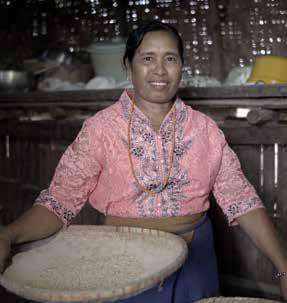
“MY
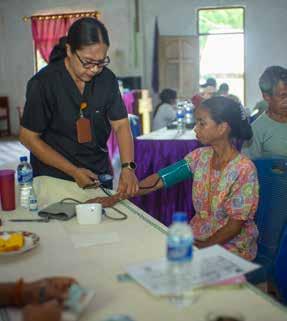
Your gift helps break the cycle of poverty and hunger in the world's poorest places.
To support the EOFY 2026 appeal:
unitingworld.org.au/eofy
All gifts are tax-deductible and every gift will be combined with Australian Government funding to have up to six times the impact.
There is a particular kind of pressure that comes with being young right now. Not the pressure of big decisions or rites of passage that every generation has known, but something more ambient, more grinding. The pressure of knowing that the road ahead looks different to the one your parents walked, and that a lot of the signposts they used namely a steady job, an affordable home, a sense of the future holding still long enough to plan, all have shifted or disappeared altogether.
That is the reality for many of the roughly 1.5 million young people aged 12 to 24 living in NSW. And yet, inside that reality, something else is happening too. Young people are not simply waiting for the world to sort itself out. They are dreaming, and in many cases, daring to act.
Ask young Australians what they want and the answers are, in many ways, deeply ordinary. According to Mission Australia’s 2025 Youth Survey, which reached more than 17,000 young people aged 14 to 19, the biggest hope that young people named for their future was not fame or influence but employment and career, followed by family connection and financial stability. Many simply hope to one day own a home.
These are not extravagant aspirations. They are the kinds of expectations that previous generations largely took for granted. The fact that they now feel uncertain is itself telling.
The 2025 Australian Youth Barometer from Monash University, which surveyed young adults aged 18 to 24, found that 85 per cent had experienced financial difficulties in the previous year, and only around half believed they were likely to achieve financial security in the future. Nearly two thirds expected to be worse off than their parents. Home ownership, once a reasonable expectation for a working adult in their late twenties, now feels to many like a different country entirely. Australian home values have risen around 47 per cent since March 2020, pushing median house prices in Sydney past 1.4 million dollars by the end of 2024.
And still, young people dream. The headspace National Youth Mental Health Survey from late 2025 found that the proportion of young people who believe they can achieve their personal goals has grown from 39 per cent in 2022 to 44 per cent in 2025. That is not a triumphant number, but in the context of everything else bearing down, it is a meaningful one.
The courage required of young people today is often quiet and largely invisible. It is the courage of getting out of bed when your mental health is poor, of finishing an assignment when you are also working two casual shifts a week to cover rent, of staying present in relationships when loneliness is pulling at the edges.
The data on youth mental health in Australia is not comfortable reading. Research from headspace found that nearly half of all young Australians, 49 per cent, are experiencing high or very high levels of psychological distress. For those aged 18 to 25, that figure climbs to 65 per cent. A report from Deloitte Access Economics noted that one in four young people aged 15 to 24 experienced loneliness in 2022, making Gen Z both the most digitally connected and the loneliest generation on record.
What makes this harder still is the backdrop against which it plays out. Climate anxiety is real and documented, with 27 per cent of young people in the Mission Australia survey naming climate change and the environment as a top national concern. Globally, young people are watching conflicts, economic instability, and rapid technological disruption and wondering what kind of world they are being asked to step into.
The journey to adulthood is not the linear progression it once appeared to be. More young Australians are living with their parents into their late twenties. Many are studying and working simultaneously, with one in seven full-time students also holding full-time jobs, double the rate from the 1990s. The path is longer, messier, and in some stretches harder to see clearly.

Daring, in this context, does not always look dramatic. Sometimes it looks like asking for help, which is itself a quiet shift. The same headspace survey that recorded high distress also found that willingness to speak to someone about a personal or emotional problem has increased since 2022, particularly among younger adolescents. That is something.

IN
COMMUNITIES ACROSS THE STATE, YOUNG PEOPLE FROM MIGRANT AND REFUGEE BACKGROUNDS ARE RUNNING MENTORING PROGRAMS, BUILDING SKILLS IN ADVOCACY AND PUBLIC POLICY, AND CO-DESIGNING SERVICES WITH THE ORGANISATIONS MEANT TO SERVE THEM
Here is where the story becomes, in its unshowy way, genuinely encouraging.
Across New South Wales, young people are doing. Not in ways that tend to make headlines, but in the kinds of grassroots, ground-level ways that build communities and carry neighbours through.
During NSW Youth Week 2025, the state government announced over 2.2 million dollars in grants through the Youth Opportunities program, funding 51 youthled projects across the state. These projects ranged across sport, cultural connection, creative arts, financial literacy, job readiness, and community engagement. They were, by design, initiated by young people and shaped around what young people said they actually needed.
In communities across the state, young people from migrant and refugee backgrounds are running mentoring programs, building skills in advocacy and public policy, and co-designing services with the organisations meant to serve them. Young workers are organising around employment conditions in industries where casual and insecure work is the norm. Young women in rural areas are writing and presenting legal papers on gender equity and violence prevention. Young people who have experienced homelessness are helping design the housing programs that follow them.
None of this is simple. Not one of these young people is operating without the weight of the challenges described above pressing on them. They are tired, often underfunded, and frequently underestimated. And they are doing it anyway.
The 2025 Mission Australia survey also noted something worth sitting with: several key wellbeing markers have improved compared to previous years. Reports of loneliness are down. Psychological distress, while still high, has eased slightly. More young people say they feel a sense of control over their lives. These are not signs of a crisis resolved. They may, however, be signs of a generation finding its footing.
Dream. Dare. Do. As a theme for NSW Youth Week that we observed in April this year, it has the ring of a slogan. What makes it worth holding onto is what it actually points to: that young people are not a problem to be managed or a cohort to be worried about from a distance, but people already shaping the communities they live in, doing so without fanfare, and doing so under real pressure.
The question for those of us further along in life is not whether young people are up to the task. The evidence suggests they are. The question is whether we are creating the conditions they need to get on with it.
ADITEE VORA

We often associate creativity with art or performance, but I’ve come to notice that it is much more woven into everyday life. As I pay attention, the more I see that creativity is found in the ordinary. It’s in how we speak, how we listen, how we care, and how we connect with the people around us. Creativity is found in the way a meal is prepared and shared, in the thoughtfulness behind a message sent at just the right time, or in the way someone rearranges a space to make it more welcoming. Creativity shows up in how we respond to interruption, how we include someone on the edges, or how we bring gentleness into a conversation that could easily become tense.
My own journey has shaped this understanding. My professional background is in hospitality and events, and for more than twenty years, I’ve found myself drawn to creating environments where people feel at ease. Over time, I’ve realised that this work has always been deeply connected to my faith. Because at its core, hospitality is about seeing people. It’s about creating space where someone feels known, valued, and able to bring their whole self and for me, that’s where creativity really lives.
In recent years, that has taken different forms. I founded At Her Table during the isolation of the pandemic, simply as a way to gather women around a table for meaningful conversation and shared food. What unfolded was something much deeper, a reminder that people are longing for spaces where they can belong without pressure, explore faith at their own pace, and feel safe to be themselves.
As I step into this role as Mission Catalyst with Uniting Creative, I carry a real sense of curiosity and hope.
There is already so much happening - creatives expressing their faith in all kinds of ways, churches experimenting with new forms of gathering, and leaders thoughtfully engaging their local communities. I hope to help notice and nurture what is already there. To connect people and ideas, create space for collaboration, and encourage people to see that their creativity, whatever it looks like, is part of how they live out their faith, not separate from it.
PEOPLE ARE LONGING FOR SPACES WHERE THEY CAN BELONG WITHOUT PRESSURE, EXPLORE FAITH AT THEIR OWN PACE, AND FEEL SAFE TO BE THEMSELVES
Alongside that, I’ve been involved in shaping physical spaces, including Sanctuary Canberra, and working with churches and communities to reimagine under utilised buildings. I’ve seen how even small, thoughtful details - a warm welcome, a carefully set table, a sense of intention - can shift an ordinary space into somewhere people feel at home. These spaces don’t need to be perfect or polished. Often it’s the simplicity and sincerity that matter most.
This is where hospitality and creativity meet. There’s a quiet energy in it, something that draws people in, softens the edges, and makes room for genuine connection. In the life of the church, I think this matters deeply. Because mission isn’t only about what we run or organise, it’s about how we show up. It’s about the environments we create and whether they reflect something of God’s welcome and presence.
I’m especially interested in how we use our spaces. Many of our church buildings hold incredible potential to become places of connection, creativity, and welcome. Reimagining them isn’t about losing their story, but about allowing them to keep serving their communities in life-giving ways.
In many ways, I don’t see my role as bringing something entirely new. It’s more about uncovering what is already present.
Because creativity is already here - in our churches, in our communities, and in the everyday ways we care for one another. The invitation, I think, is simply to notice it. To trust that God is already at work within it. And maybe, to gather, around a table or in a shared space, and see what might unfold.
LAUREN HARKNESS

Find out more:
• athertable.com.au
• sanctuarycanberra.com.au
• laurenharkness.com.au
nswact.uca.org.au/calendar/next-gen-band-camp-2026
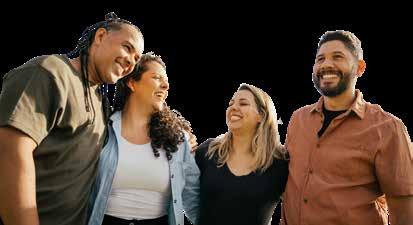
We have never been more reachable. Messages arrive in seconds. Faces appear on screens across continents. And yet, for a growing number of people, the day ends with a quiet and specific ache that all of that activity somehow fails to touch.
That ache matters more than most of us realise, both emotionally and physically. Because the research is now clear on something that humans have felt instinctively for as long as we have existed. When we lose our connection to community, we not only just feel worse but get sicker, we disengage possibly leading to early death. And when the world around us is fracturing which, by most measures it currently is; the thread that holds the individual together is the belonging.
Psychologists have understood for decades that belonging sits at the core of human need. Abraham Maslow placed it there in the 1940s, just above food and shelter. Neuroscience has since confirmed why. When we feel included, the brain releases oxytocin. When we are excluded, the same neural pathways fire as they do for physical pain. Rejection is not a metaphor. It registers in the body as injury.
The downstream effects are stark. Strong community ties reduce rates of depression, anxiety, and cardiovascular disease. Belonging buffers against psychological distress even in people who carry significant personal or genetic vulnerability. Former US Surgeon General Vivek Murthy spent years building the case, ultimately declaring loneliness a public health epidemic. His research found that chronic social isolation carries health risks comparable to smoking fifteen cigarettes a day. Not occasionally feeling alone. Chronically. Structurally. Without community.
Technology promised to close those gaps. It has largely widened them. As Murthy observed, we have moved from having confidants to contacts, from having friends to having followers. The number of connections has exploded. The quality has collapsed. The result is a generation that is perpetually reachable and structurally alone, and a world that is paying the health price for it.
Here is what the research keeps returning to, regardless of geography, income, or circumstance. Community is not a byproduct of stability and health. It is the condition that produces them.
COMMUNITY IS WHERE YOUR PRESENCE IS VALUED AND YOUR ABSENCE IS NOTICED
Australia sits in a rare and underappreciated position in that regard. As of 2026, more than 31 per cent of Australians were born overseas. Over 350 languages are spoken across the country. The Scanlon Foundation’s Mapping Social Cohesion Report 2025 found that 84 per cent of Australians agree that multiculturalism has been good for the nation. That is a remarkable number at a time when much of the world is lurching toward nationalism and exclusion. It points to something real about what becomes possible when people of different backgrounds are not merely tolerated but genuinely woven into the life of a place.
Murthy defined community in terms worth carrying around. It is, he said, the place where your presence is valued and your absence is noticed. That definition asks nothing of geography or scale. It can be a street, a congregation, a kitchen table, a sporting club. What it requires is that people actually know each other, and that they keep showing up.
And yet those conditions are eroding. A Meta Gallup survey across 140 countries found that more than a billion people experience significant social isolation. In Australia, research from Deloitte Access Economics found that one in four young people aged 15 to 24 experienced loneliness in 2022, a figure that has not meaningfully recovered. Fewer people belong to civic organisations, faith communities, or neighbourhood groups than a generation ago. We move more often. We change jobs more often. We are less rooted than any generation before us.
The same research found that community connections like neighbourhood interactions, shared social spaces, volunteering, simply knowing the people around you are the strongest drivers of a sense of belonging, even among those navigating entirely new countries and cultures. When migrants described what made them feel at home in Australia, it was rarely a policy or a program. It was a neighbour who stopped to talk. A colleague who included them. A community group where their presence was noticed. The everyday, unremarkable act of being welcomed.
That is what a multicultural community, at its best, actually offers. Not just diversity as a demographic fact, but diversity as a lived practice of human connection; one that expands the range of people any one of us can genuinely know and be known by. In a world fracturing along every visible fault line, that breadth of human connection is not just a social good but also a form of resilience. Which means that the most consequential thing any of us can invest in right now is the quality of our relationships with the people physically around us. And that is the whole point.
ADITEE VORA
Prepared by Rev. Yvonne Ghavalas
As we move through Lent we are invited Following Pentecost, the liturgical calendar moves us into Ordinary Time: an ordered sequence of weeks between the major feast days of the Christian year which give Christian communities the opportunity to reflect on the ongoing work of the Holy Spirit, to embody the mission of Jesus, and to grow in our discipleship.
JUNE 7 – PENTECOST 2
Genesis 12:1-9, Psalm 33:1-12, Romans 4:13-25, Matthew 9:9-13,18-26
Ordinary Time explores our Spirit-led call into God’s future.
Genesis frames this as a summons into holy unsettlement in which Abram leaves behind land, kinship structures, and inherited security for an as-yet-unseen promise from God. Paul insists that this promise is not a prize for the deserving, but a grace that creates a people sustained by God’s faithful presence.
Thus, Jesus’ embodies God’s desire for mercy over sacrifice in 1) his table fellowship with tax collectors and “sinners” and 2) healings that cross boundaries of status, gendered vulnerability, and ritual expectation.
A liberation lens points to God’s promises as public, and to blessing as the disruptive vocation of challenging systems that determine who is “clean”, credible, or welcome at the table. Discipleship requires movement from certainty, status, and gatekeeping to practices of mercy in Yahweh’s strange economy of grace where Jesus’ touch undoes deathly social scripts and restores dignity to bodies long written off.
JUNE 14 – PENTECOST 3
Genesis 18:1-15, (21:1-7); Psalm 116:1-2,1219; Romans 5:1-8; Matthew 9:35-10:8, (9-23)
Hospitality becomes holy work as Abraham and Sarah offer welcome to weary strangers through concrete gifts of water, bread, shade, and attentive presence. Yet, the good news of God’s promise is hard for Sarah to hear in the reality of her “written off” body; her laughter holds together desire, disappointment, and the vulnerability of long waiting for unanswered prayers.
Meanwhile, Paul proclaims a peace grounded in Christ’s love for us “while we were still weak,” the Psalmist pours out his gratitude to Yahweh who has

“rescued me from death, my eyes from tears, and my feet from stumbling,” and Jesus is so moved with compassion for the “harassed and dejected” crowds that he sends his disciples out to visit, listen, proclaim good news, and heal while making themselves dependent on the welcome of community for food and shelter.
God meets people at the margins of possibility - barrenness, weakness, hopelessness- to form mission-shaped communities through shared tables, peace, risk, and even the laughter that is part-hope and part-despair.
JUNE 21 – PENTECOST 4
Genesis 21:8-21; Psalm 86: 1-10,16-17; Romans 6:1b-11; Matthew 10:24-39
In texts that refuse easy reading, Hagar and Ishmael are expelled into the wilderness by household rivalry and power, confronting how enslaved peoples and their children are used and discarded within patriarchal culture.
The Psalm’s plea for pity holds space for honest prayer when survival is uncertain.
Paul’s baptismal imagination names a break with the death-dealing systems that have enslaved us: as we are joined to Christ’s death, we are raised to a new allegiance which puts an end to the ruling powers of our own lives.
Jesus prepares his disciples for the resistance that they will encounter in responding to his “take up the cross” call - both externally against their solidarity with the marginalised, and, internally, as temptation to flee the consequences of costly truth-telling.
This is the long obedience of liberation in which we learn to see the God who sees, choose solidarity over self-protection,
and trust that new life is found where the world says, “There is no water.”
JUNE 28 – PENTECOST 5
Genesis 22:1-14; Psalm 13; Romans 6:1223; Matthew 10:40-42
One of Scripture’s most disturbing narratives (the binding and near sacrifice of Isaac) meets lament amid anxious waiting, a baptismal exhortation to resist sin’s dominion, and Jesus’ teaching on receiving “little ones.” Together, they ask what kind of God we proclaim, what kind of obedience we commend, and what kind of community discipleship produces.
Genesis 22 has multiple interpretations but must not be domesticated into an endorsement of unquestioning obedience. The story itself turns on the angel’s “Do not lay your hand on the boy” and the provision of an alternative. Any reading that sanctifies intended harm endangers the vulnerable, especially those already subject to coercive religious, domestic, or institutional power.
Discipleship here is about discernment: recognising voices that sound “religious” but produce death, and choosing, instead, practices that protect life. We should name safeguarding as gospel work, honour the “how long” protest of our hearts as prayer, and measure worship by its mercy. Matthew’s “cold water” image invites small, consistent acts as resistance to cultures of harm.
Prepared by Rev. Yvonne Ghavalas

As the grey weariness of winter starts to settle within us, July’s readings call us gently into the kin(g)dom life of sharing burdens, cultivating “good” ground, practising neighbourly care, and trusting in God’s slow and subtle transformation.
JULY 5 – PENTECOST 6
Genesis 24:34-38,42-49,58-67; Psalm 45:10-17; Romans 7:15-25a; Matthew 11:16-19,25-30
Duty and desire are entangled as Isaac’s servant goes off in search of a bride worthy of “The Great Family’s” expectations and legacy. Isaac ends up marrying kind Rebekah and “in his love for her … was consoled for the loss of his mother.” The royal wedding song of Psalm 45 is an appropriate celebration of love that endures from generation to generation.
Yet, Romans 7 names the real condition of the divided heart in which human desire for good is constantly overcome by entrenched patterns of the past. Many communities carry crushing yokes because of past practices that span generations—under-age marriages, family violence kept secret, racism normalised as “just how things are,” and religious shame that teaches the vulnerable to endure what God never asked of them.
Jesus’ commentary on “an easy yoke” is an exposure of the weight that is loaded onto the weary and an invitation to his disciples to disrupt this past through humility, gentleness and rest.
JULY 12 – PENTECOST 7
Genesis 25:19-34; Psalm 119:105-112; Romans 8:1-11; Matthew 13:1-9,18-23
The texts invite us to examine “the ground of our being:” instead of blessing, the legacy of Isaac and Rebekah’s favouritism seems to be rivalry, scarcity, and contest over inheritance;
Psalm 119 holds God’s Word as a lamp in the real and uneven terrain of life; guidance for feet that search to walk in a particular way;
Paul proclaims liberation from condemnation and a new way of living “in the Spirit” so that we are no longer captive to past compulsions; and Jesus’ parable of the sower invites a communal examination of what hardens the ground? What chokes growth? What gets trampled? What helps the fragile take root?
A broad reading of these texts invites consideration of the social and material conditions of the overworked, traumatised, indebted, and marginalised who are often expected to be endlessly “receptive” while enduring inequity.
As God scatters grace with startling generosity, we are challenged to cultivate rhythms that soften what is hardened and clear what chokes life.
JULY 19 – INTERCULTURAL NEIGHBOURING DAY
Genesis 28:10-19a; Psalm 139:1-12,23-24; Romans 8:12-25; Matthew 13:24-30,36-43
Jacob’s dream of a laddered earth in which heaven is not distant occurs while he is travelling in vulnerability and discomfort. Like the Psalmist who confesses that God’s intimate knowledge of us reaches beyond geography and darkness, he proclaims “Surely God is in this place.”
Paul describes life in the Spirit as a reordering of relationship with God through adoption, and with creation through a shared groaning for freedom. Matthew’s parable urges patience and restraint: the servants’ impulse to purify the fields is a caution against a violent uprooting of those who do not fit our prescriptive and premature judgements. Instead, God meets people on the road, in diaspora, in intercultural spaces, and in our communal longing for a world not yet free. Intercultural neighbouring
becomes a practice of justice as we refuse narratives that make difference synonymous with threat, resist policies and speech that scapegoat vulnerable groups, and see in the sacred ground of shared space that “Surely God is in this place!”
JULY 26 – PENTECOST 9
Genesis 29:15-28; Psalm 105:1-11,45b; Romans 8:26-39; Matthew 13:31-33,44-52
Even as Psalm 105 celebrates a God who keeps covenant love alive across generations and Romans reaches its climax with the assurance that no power can separate us from the love of God, Jacob’s love for Rachel becomes the hook for a complex plot of unfair labour, deception, and patriarchal bargaining with his uncle, Laban. Genesis 29 is an uncomfortable reminder of how frequently women can become currency and work can become exploitative.
What does covenantal faithfulness look like amidst distorted power? How is Paul’s promise realised during suffering and insecurity?
Jesus’ parables offer disproportion as a key: small beginnings become sheltering growth, a little yeast transforms the whole, a hidden treasure and a single pearl are worth everything, one net thrown into the sea catches fish of every kind. In their light, covenantal faithfulness is the disproportionate practice of steadfast love within our small acts that refuse exploitation, protect dignity, keep making room for life, and, maybe most importantly, reorder what we value, desire, support, and prioritise.
A little love, these texts encourage us, can go a long way.
Prepared by Rev. Yvonne Ghavalas
August’s readings inform disciples who witness to what is real: wounds that linger, hunger that must be organised into shared bread, storms that expose fear, belonging made difficult by difference, and the liberating call that meets us on the margins.
AUGUST 2 – PENTECOST 10
Genesis 32:22-31; Psalm 17:1-7,15; Romans 9:1-5; Matthew 14:13-21
Jacob is renamed through an epic struggle and the realisation that he has seen God face to face. His resulting limp matters: bodies carry histories of struggle; blessing is not the erasure of wounds, but dignity and future carried through them.
How the Psalmist keeps watch for justice in the darkness of oppression and prays for God’s face to turn towards the vulnerable!
Paul’s anguish for his kin names the pain of belonging and exclusion.
In Matthew, Jesus refuses to dismiss the hungry crowd; instead, he involves the disciples in organising food for all: “You give them something ….” Then Jesus takes what is offered, blesses, breaks, and gives – a Eucharistic echo through the ages that frames abundance as shared provision.
AUGUST 9 – PENTECOST 11
Genesis 37:1-4,12-28; Psalm 105:1-6,1622,45b; Romans 10:5-15; Matthew 14:22-33
Through the tragic perpetuation of dysfunctional family trauma, Jospeh is sold into slavery in a narrative that exposes the commodification of life.
The Psalm’s remembering of Joseph’s suffering upholds his story of survival as sacred history, while the letter to the Romans calls on those who have been “saved” to get their beautiful feet moving among those who have not yet heard that Jesus is Lord of ALL.
The image of Jesus coming to his disciples on stormy water, in the midst of their fear and fright, and being within immediate grasp of Peter as his trembling, imperfect, yet reaching step falters is a powerful challenge to the
church to reach quickly for those who are sinking.
God does not abandon those in the pit; Christ comes toward us in the storm; the Spirit puts the gospel in our feet.
AUGUST 16 – PENTECOST 12
Genesis 45:1-15; Psalm 133; Romans 11:12a,29-31; Matthew 15:(10-20),21-28
Joseph reveals himself to his brothers and names a path toward family survival and relational repair through truth-telling and tears, while Psalm 133 sings the beauty of siblings dwelling together.
Yet, both New Testament texts touch on the complexity and cost of unity. Romans 11 insists that God has not rejected God’s people and reimagines mercy as the promise that holds open a future for insiders and outsiders alike.
Matthew pushes this frame into a concrete, contested encounter as Jesus and the Canaanite woman negotiate boundary, speech, and healing. Jesus’ initial refusal of the request and ethnicised language have rightly troubled interpreters. Yet the woman persists, argues, and secures healing; her voice drives the story toward widened mercy.
AUGUST 23 – PENTECOST 13
Exodus 1:8-2:10; Psalm 124; Rom 12:1-8; Matthew 16:13-20
Exodus opens with an anxious empire that responds to perceived threat with policy violence. The resistance of midwives, a mother, a sister, and Pharaoh’s daughter disrupt the machinery of death. Psalm 124 voices a communal testimony of survival - what Pharaoh intends as an engulfing flood becomes, by God’s sustaining presence and by the courage of these women, an escape from empire’s intent.
Paul urges the Romans to resist conforming to the age of empire through
“living sacrifice” language that directs worship away from spectacle toward shared life for the common good. Gifts are for building up, not status!
In Matthew, Peter’s confession of the Messiah is affirmed, and Jesus speaks of a community that will endure, but urges his disciples to keep this revelation quiet. In empire language, “Messiah/ King” is easily heard as a rival regime.
AUGUST 30 – FRONTIER SERVICES
SUNDAY
Exodus 3:1-15; Psalm 105:1-6,23-26,45b; Romans 12:9-21; Matthew 16:21-28
Moses encounters God in a burning bush in the everyday landscape of an exile. His ordinary work tending the flock becomes the holy ground of liberation as he cares for God’s people and advocates for their release. Psalm 105 keeps his memory alive, reminding us that God’s faithfulness is a refrain to be rehearsed and retold.
Following on from Peter’s confession, Jesus rejects empire-power as he turns decisively towards the cross and its costly allegiance. Romans 12 gives the cross shape in communal ethics of hospitality, shared joy and grief, perseverance, and non-retaliatory resistance.
Frontier Service Sunday widens community to consider ministry at the edges where presence, endurance, and justice are practised far from the centre. These readings remind us that through communal care, God meets people on the periphery where services are scarce and needs are real.

Every Home for Christ’s ‘Love Your Neighbour’ is more than a kit—it’s a growing initiative to help believers carry Christ’s love into their neighbourhoods in practical, personal ways.
‘Love Your Neighbour’ kit is one of the most tangible tools we offer through this initiative—a $120 value will be provided completely FREE to participating churches across Australia in 2027.
This is only possible because of generous people like you. If you’ve been blessed by the Lord or believe in the mission behind it, consider making a one-time gift or becoming a monthly partner. Together, we can equip more believers to carry Christ’s love into their neighbourhoods— one kit, one encounter, one ‘Neighbour’ at a time.
Sharing your faith doesn’t need to be complicated. Simple acts of kindness can open hearts and help others experience God’s love. Jesus said: “…Love your Neighbour as yourself.” (Mark 12:31). Are you ready to put that command into Gospel action? Our kit can help!
Churches across Australia are INVITED to participate – contact us at ehc@everyhome.org.au or register by clicking HERE or scanning the QR code.




Warning: This article contains spoilers for Andor, Rogue One and Star Wars: A New Hope. Full version on insights.uca.org.au
Andor has wrapped up its second and final season. The Disney Star Wars television show follows the adventures of Cassian Andor as he participates in the rebellion against the Galactic Empire after Imperial stormtroopers destroy his entire tribe as a young boy. The series leads straight into the 2016 movie Rogue One, which explores how the Rebel Alliance retrieved the plans for the first Death Star, which in turn leads straight into the original 1977 Star Wars movie, A New Hope which opens with Princess Leia trying to escape Darth Vader who is trying to regain those same plans.
Trained by his adoptive mother, and eventually recruited by one of the rebel leaders, Luthen Rael, Cassian Andor infiltrates Imperial bases, helps rebel cells achieve their missions, and tries desperately to lead some sort of “normal life”, something that proves impossible as he seeks to contribute to overthrowing the Empire.
The first season of Andor covers one year while the second season traverses four years (the show was originally designed for a five-year arc, but budgetary constraints limited it to two). Each three episode “miniseries” explores one particular development in the Rebellion, covering a single year. However, there is a four-year storyline that permeates the season. This concerns the textile manufacturing planet of Ghorman, where the Empire had previously engaged in a massacre that is memorialised in a grand square within the capital city of Palmo. The Empire is especially interested in Ghorman because its planetary core contains one of the vital elements that will power the Death Star.
A small team of Imperial elites are fully aware that to extract the required amount of “kalkite” for the Death Star’s needs would destroy the planet. They
have to develop a strategy to make that “palpable” to the Senate and the citizens of the Empire. They do so by infiltrating and manipulating the existing local insurgents, known as the Ghorman Front (inspired by the French Resistance in World War II). Not even the Imperial staff entrusted with this knew the extent of the plan. The end result is nothing less than genocide, with the planet bombarded with firepower, but justified because of the uprising of the locals who attacked Imperials. The Empire controlled media presents the situation as a tragic but necessary response to an increasingly violent planet, committed to overthrowing the ideals and the stability of the Empire. The riot that they actually started is the excuse to start systematic mining of the planet under the guise of self-defence.
THE DISTANCE BETWEEN WHAT IS SAID AND WHAT IS KNOWN TO BE TRUE HAS BECOME AN ABYSS
regime, while hiding behind a mask of being a naïve and idealistic philanthropist heading up charities for the poor and displaced. Eventually, she realises that she can’t hide any longer. She speaks truth to power, trying to expose the heinous crime that has been committed on Ghorman.
In response to this, Senator Mon Mothma from Chandrila, delivers an impassioned and scathing speech to the Imperial Senate. Until this point, she has been a part of Luthen’s resistance trying to expose the Emperor and the Empire as a corrupt and dangerous
“Fellow senators, friends, colleagues, allies, adversaries. I stand before you this morning with a heavy heart… I believe we are in crisis. The distance between what is said and what is known to be true has become an abyss. Of all the things at risk, the loss of an objective reality is perhaps the most dangerous. The death of truth is the ultimate victory of evil. When truth leaves us, when we let it slip away, when it is ripped from our hands, we become vulnerable to the appetite of whatever monster screams the loudest. This Chamber’s hold on the truth was finally lost on the Ghorman Plaza… What happened yesterday on Ghorman was unprovoked genocide!... And that truth has been exiled from this Chamber!
And the monster screaming the loudest? The monster we’ve helped to create? The monster who will come for us all soon enough is Emperor Palpatine!”
Basically, we see in science fiction, elements of our own world, in present political actions, environmental concerns, technological developments, and existential fears etc. reworked to create a plot line in a story. When Mon Mothma gives her speech, she could be speaking into our own time.
AN ALGORITHM IS OUTSOURCING THE HUMAN CHOICE INTO A MACHINE’S DECISION
She could be talking about the genocide of Palestinians by the Israeli government while they claim they are only targeting Hamas. It could be talking about the drug boats from Venezuela and the capture of its corrupt president to legitimise taking control of the nation for its oil reserves. It could be talking about ICE presence in US democratic states and now in airports, to intimidate and manipulate the midterm elections. It could be about the war on Iran, the confusion about its nuclear programme, and whether it is merely a distraction from the Epstein files or another bid for oil control. United States President Donald Trump screams that his nation is going wonderfully well in his State of Union address, while the cost of living continues to rise, health insurance skyrockets, access to Medicaid is restricted, and Americans are being terrorised. The ultra wealthy, on the other hand, seem to be doing very well out of it.
The general public can well ask, what are the actual facts in these situations? The cries of “fake news” and “alternative facts” have rung throughout much of the narrative on these topics, especially on social media.
The ABC has recently released a threepart documentary called The Matter of Facts. In it, award-winning investigative journalist Hamish McDonald, explores how technology corporations, or Big Tech, have changed how we understand facts and reality.
Fact checkers no longer exist on social media platforms which means that users have to do all the work to find out whether something is true or not. When social media is now the main source of people’s news and information, this is a huge problem.
Social media is now the biggest disseminator of false information and many users consume and share it unintentionally. This is known as misinformation. Disinformation, on the
other hand, is false information that is deliberately shared to deceive others. Unfortunately, humans are very vulnerable to being tricked. The creators of disinformation rely on this and the social media’s use of algorithms to spread their content. Algorithms learn what we click on and give us more of the same content to keep us scrolling. They learn all about a user’s gender, age, political leanings, preferences, etc. What they do, however, is tend to focus on things that anger or enrage, as these emotions are ones that are more likely to keep people scrolling. Algorithms sort for whatever is the most inflammatory and make that content the centre of attention. This practice is unseen and has become normalised over the last 10-15 years. Tristan Harris, a Technology Ethicist, believes that, “An algorithm is outsourcing the human choice into a machine’s decision”.
Disinformation or hybrid wars are being waged all around the world. It is classed as a form of warfare because its goal is the disruption and destabilisation of a population. Modern disinformation warfare thrives in current social media usage patterns. Perpetrators isolate an issue with a hint of truth, gather ingredients to make it viral, and then amplify it. This can include creating pages that look like legitimate news platforms, fake influencers or celebrities promoting the issue, and creating chats or groups around the disinformation. Everyday users, unable to tell that it is not true, inadvertently share it, perpetuating the lie.
The lieutenants in this war are “trolls”, humans perpetuating the disinformation, or “bots”, machine generated fake accounts, that act like humans by sharing the fake content. In 2024, Meta identified 4.23 billion fake Facebook accounts.
Artificial Intelligence, or AI, is an even greater threat in the disinformation war. It is particularly good at generating reality distorting imagery and information and is currently doubling its capacity to perform tasks every few months. Testing shows that, at current rates, humans can only distinguish AI generated content 51 percent of the time.
The identification and reporting on facts used to be part of the important role of journalists and a free, independent press. Truth-telling can be dangerous, however, in places where autocracy is on the rise.
One of the first things that is attacked by aspiring autocrats is the press. Think Trump’s “lament” of fighting “fake news” or Elon Musk declaring “journalism is dead – citizen journalism is the future”. Citizens, however, are not trained to deep dive to find evidence and facts and social media platforms are not designed to encourage that. But facts matter and are worth fighting for.
Three strategies that the documentary promoted included, firstly, becoming educated around the digital landscape and encouraging politicians to put robust, fair, and just legislation in place to protect citizens from AI and Big Tech. Secondly, developing critical thinking skills in order to be able to navigate the misinformation and disinformation around us. Key to this is reading outside the algorithm-created “silo” of social media and, instead, engage with books, journals, credible newspapers, and the like. Professor Maryanne Wolf from the School of Education at UCLA says that “reading is an act of resistance in an age of distraction”. Thirdly, cultivating empathy. When we see the “other” as sinister or enemy, it threatens democracy because it creates extreme polarisation. Lizzie O’Shea, a lawyer, digital rights advocate and founder of Digital Rights Watch, says, “There is nothing inevitable about the future. The future is ours to shape and the best way we can do that is by being active engagers in our democracy. It is not a spectator sport.”
Jesus was no stranger to speaking truth to power. Sometimes it was simply to correct theological understanding (Matthew 22:23-34; Mark 12:18-27; Luke 20:27-40). Occasionally it was to reprimand behaviour (Matthew 16:1-5). Most seriously, it was to expose corruption and misrepresenting God (Mark 12:38-44, Matthew 23, Mark 11:15-18, Luke 19:45-46, John 2:14-16). Christian individuals and the wider Church are also called to speak truth to power. Robyn Whitaker, Director of the Uniting Church’s Wesley Centre in Melb critiques the misuse of faith and decries the use of religion for personal, financial, or political gai ourne sees Pope Leo as performing a biblically prophetic function, as he calls for peace,n.
While it can be hard to determine truth and facts in an increasingly complex world, some of which is actually designed to hide and distort it, it is important to continually seek for truth. Not just the truth about the world we live in, but the truth of the gospel. That truth is found in the very person of the incarnated God, Jesus (John 14:6).
DR KATHERINE GROCOTT



























DA recent essay in Christianity Today has reignited an old Christian concern with a very modern setting: social media. The article, “The Social Media Navel Gaze,” argues that today’s digital culture has revived a spiritual problem long recognised by Christian thinkers: the habit of turning endlessly inward rather than outward toward God and neighbour.


rawing on figures such as G. K. Chesterton and C. S. Lewis, the piece explores how platforms built for expression can quietly reshape attention, identity, and even spirituality.


The essay also draws on Lewis, whose work repeatedly cautioned against reducing reality to subjective feeling. In books like The Abolition of Man, Lewis argued that societies collapse into confusion when meaning becomes merely personal preference rather than shared moral reality.
At the centre of the discussion sits a deceptively simple social-media experiment. The experiment referenced in the Christianity Today article involved observing how users respond to posts centred on personal reflection compared with posts oriented outward toward ideas, beauty, or shared meaning. Participants were encouraged to publish introspective content and track engagement patterns and emotional responses over time.
The results were revealing. Content focused primarily on the self-generated frequently got interaction, but often produced diminishing satisfaction. Users reported feeling more anxious, more comparative, and paradoxically more isolated despite increased visibility.
Applied to social media, this concern takes on new urgency. Online environments encourage individuals to curate personal truths, reinforcing emotional reactions as ultimate authority. The result is not deeper individuality but fragmentation — countless isolated perspectives competing for affirmation.
The experiment cited in the article appears to confirm Lewis’s intuition: when attention remains fixed on the self, meaning becomes unstable.
WHERE PRAYER SOUGHT TRANSFORMATION, ALGORITHMS SEEK RETENTION
The essay suggests this mirrors the design logic of social platforms themselves: attention loops reward self-presentation. The more one looks inward — curating identity, monitoring reactions, refining personal narratives — the more the system encourages further self-focus. In short, engagement increased while fulfillment decreased.
The article describes this pattern as a modern form of “navelgazing,” a term whose roots stretch far beyond internet culture.
The phrase originally referred to medieval critics of Eastern Christian monks who practised intense contemplative prayer. Ironically, what was once mocked as excessive inward spirituality has reappeared in a secularised version online. According to the essay, the difference is crucial: historic contemplation aimed at encounter with God, while digital selfreflection often circles back only to the self.
Where prayer sought transformation, algorithms seek retention. The distinction helps explain why modern self-expression can feel simultaneously empowering and exhausting.
Long before smartphones, Chesterton warned that excessive self-analysis shrinks rather than enlarges human experience. A person trapped inside their own thoughts, he argued, inhabits a world that grows smaller even as self-awareness increases.
The Christianity Today article applies this insight directly to social media culture. Platforms promise connection but frequently intensify comparison. Identity becomes performance; reflection becomes branding.
Chesterton’s insight was theological as much as psychological: human beings flourish not by obsessing over identity but by directing attention outward toward truth, beauty, and service.
One of the article’s most striking claims is that social media produces constant self-awareness without genuine self-knowledge. Users may articulate feelings more often yet struggle to locate purpose beyond reaction and response.
This dynamic helps explain why digital spaces can feel intensely emotional but spiritually shallow. Reflection detached from transcendence becomes repetition rather than growth.
The essay argues that Christian tradition offers an alternative rhythm: attention directed first toward God, then outward toward others, and only secondarily toward the self.
In this framework, self-understanding emerges indirectly and is discovered through love, worship, and service rather than analysis alone.
The takeaway is not a call to abandon technology but to change posture within it. Instead of asking, “How am I being seen?” the article suggests asking, “What is worth seeing?” Instead of crafting identity, attention shifts toward participation in something larger than oneself.
The social-media experiment functions as a small parable: connection grows when attention moves outward.
For Chesterton, joy began with wonder. For Lewis, meaning rested in objective truth. For the digital generation, the challenge may be learning how to look away from the mirror long enough to rediscover both.
As the Christianity Today essay concludes, the danger of modern navel-gazing is not simply distraction, it is forgetting that human life finds clarity not through endless selfexamination but through relationship beyond the self and with God.
ADRIAN DRAYTON
LEADERSHIP
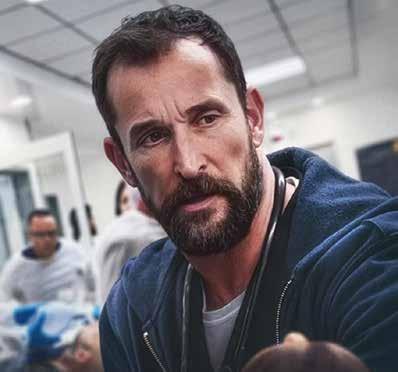
This article has spoilers from Season 2 of The Pitt , episodes 1-14.
Season 2 of The Pitt continues to press its characters into the tight corners of exhaustion, moral strain, and quiet courage. At the centre of it all is Dr. Michael “Robby” Robinavitch, played with a worn, searching gravity by Noah Wyle. This season does not simply depict burnout as a workplace hazard. It treats it as a spiritual crisis, one that reshapes how a person sees others, themselves, and the work they once believed was a calling.
Robby began the season already frayed, but viewers see the result of 10 months of burnout that plays out in a single day. The signs are familiar. Shortened patience. A tendency to withdraw. Pushing co-workers away. And as the shift wares on in season two his fraying burnout affects those around him.
It’s a tough watch seeing a main character spiral, but The Pitt doesn’t shy away from making Dr Robby the non-traditional “villain” of Season 2. His anger and frustration, fuelled by burnout, is bleeding through every relationship in the ER. This is only exacerbated by this season’s crisis of a hospital cyber attack, requiring that the whole ER go analog.
Season 1 saw Robby being stripped back by his PTSD and worsening mental state. His confidence in systems, his belief in his own indispensability, even his sense of control are all eroding. But perhaps what remains is a more fragile but more honest version of himself in Season 2 and all of the people caught in his orbit are affected. Snd the time gap between Seasons 1 and 2 has been able to make his mental state more acute.
This shows up most clearly in his mentoring. Robby has never offered polished wisdom, but he let’s his burnout show up in unhelpful ways. When Dr Mohan (Supriya Ganesh) suspects she may have a medical issue, he dismisses it as a panic attack. When nurse Dana Evans (Katherine LaNasa) sees him treating staff poorly, she calls him out, while she meanwhile, is mentoring a young nurse Emma (Laëtitia Hollard) with care and compassion. This shift reflects a theological truth that runs beneath the whole season. Leadership is not about mastery, but about
accompaniment, addressing conflict and walking with people in their distress. Robby is learning, perhaps unwillingly, that his role is not to save everyone, but to walk with others in the work of saving. This is a hard lesson for someone who has built an identity around being the one who steps in, fixes things, and moves on.
As the season moves toward its finale, the looming reality of Robby’s sabbatical casts a long shadow. On a practical level, his absence will leave a gap in leadership. On a personal level it seems he is trying to escape his demons, by driving off into the sunset on his motorbike. But the more significant question is what he leaves behind.
This season added the additional attending in Dr. Baran AlHashimi (Sepideh Moafi) who came in to make a number of changes to assist staff that initially didn’t sit well with Dr Robby, but as the season has progressed through the shift there is an uneasy alliance forming.
The sabbatical itself raises important questions. Is it an act of surrender or an escape. Is Robby stepping away because he has recognised his limits, or because he can no longer bear the cost of staying. The show wisely refuses to give a simple answer. In many ways, it is both.
Sabbath, in its original sense, is about rest that restores right relationship. It is not merely a break from work but a reorientation toward what matters most. If Robby’s sabbatical follows this pattern, it could become a turning point not only for him but for those he leaves behind. His absence will force others to step into roles they may not feel ready for. It will test whether the culture he has nurtured can sustain itself without him.
Looking ahead to Season 3, the groundwork has been laid for a different kind of story. Robby may return changed, or he may not return at all in the same capacity. Either way, the question will not simply be what happens to him, but what happens to those he has influenced.
Season 2 of The Pitt resists easy resolutions. Burnout is not cured. The pressures of the emergency department do not lessen. But something shifts. In the midst of exhaustion, there is a movement toward deeper connection and more honest leadership. It suggests that even in the most demanding environments, there can be space for grace. Not as a dramatic intervention, but as a steady, sustaining presence that changes how people carry their burdens and how they carry each other.
ADRIAN DRAYTON
Season 1 and 2 of the Pitt are streaming on HBO Max.
Synod Weekly Spotlight is an electronic newsletter that covers news from across the Synod and broader church landscape, landing in inboxes every Friday!
Subscribe via this QR code