insightnews.com
Insight News • November 16, 2026 - November 22, 2026 • Page 1
Insight News
INSIGHT NEWS WON THE MESSENGER AWARDS 2024 F OR THIRD PLACE IN WEBSITE EXCELLENCE, THIRD PLACE IN LAYOUT & DESIGN AND FIRS T PLACE F OR NEWSLETTER EXCELLENCE.
November 16, 2026 - November 22, 2026
Vol. 53 No. 46 • The Journal For Community News, Business & The Arts • insightnews.com
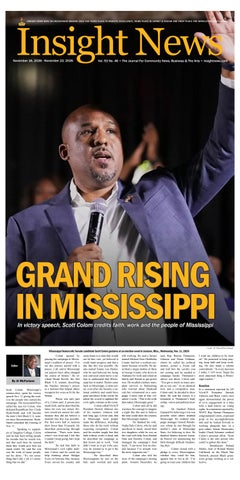
GRAND RISING IN MISSISSIPPI In victory speech, Scott Colom credits faith, work and the people of Mississippi
Mississippi Democratic Senate candidate Scott Colom gestures at an election event in Jackson, Miss., Wednesday, Nov. 11, 2026
Editor
By Al McFarlane Scott Colom, Mississippi’s senator-elect, spent his victory speech Nov. 11 giving the credit to the people who carried his campaign. The Associated Press called the race for Colom, who defeated Republican Sen. Cindy Hyde-Smith and will become the state’s first Black U.S. senator since Reconstruction. HydeSmith conceded the evening of Nov. 11. Speaking to supporters at Tougaloo College, Colom said he had been telling people for months that he would win, and that each time he warned them they would give him too much credit. He said the win was the work of many people, not his alone. “It’s not something that I did, y’all, it’s something that we did.”
Colom opened by placing the campaign in Mississippi’s tradition of prayer. “For me this journey started with a prayer, y’all, and in Mississippi our prayers have often changed the course of history.” He invoked Hiram Revels, the first Black U.S. senator, describing the Natchez minister’s prayer as a moment that helped others recognize his voice as fit for the Senate. Prayer was only part of it, Colom said. A person also needs faith, and he described the times his own was tested. Donors would not answer his calls because they did not believe a moment like this was possible. His first town hall in Jackson drew fewer than 10 people. He described persevering through exhaustion. “There were times when I was tired and I felt like I couldn’t keep going, but I kept the faith.” He tied that faith to Mississippi’s civil rights tradition. Colom said he could not help thinking about Medgar Evers on Veterans Day, because Evers served his country and
came home to a state that would not let him vote, yet believed it could make progress and that a day like this was possible. He also named Fannie Lou Hamer, who he said believed her being sick and tired could move a nation to understand that Mississippi has to matter. Hamer came back to Mississippi, Colom noted, even after she became a national celebrity and could have gone anywhere in the world. He asked the crowd to applaud the civil rights veterans in the room. Colom called NAACP President Derrick Johnson one of his mentors. Johnson told him long ago, Colom said, that in Mississippi local people make the difference, including those who do the work without expecting recognition. Colom said his mother taught him that faith without works is dead, and he described the campaign as that lesson put to work. “God didn’t want us to get it the easy way, he wanted us to get it the Mississippi way.” He described three Mississippians he met on the trail, each worried and each
still working. He said a farmer named Michael from Oktibbeha County had lost a soybean customer because of tariffs. He described a single mother of three in George County who drove to Alabama for work and relied on family and friends as gas prices rose. He recalled a kidney transplant survivor in Hattiesburg who worried about Medicaid cuts but volunteered on a campaign. Colom said of that volunteer’s work, “That is the work that makes Mississippi great.” Colom said all he did was have the courage to imagine a night like this and to believe the state could show the country that Mississippi matters. He thanked his wife, Nadia Dale Colom, who he said sacrificed so much, raised their two daughters while he was on the road with help from Brenda Dale and Dorothy Colom, and managed the campaign’s food truck. “I can never lose an election because I’ve already won the most important one.” Colom also told the story of the campaign’s turning point. Around December, he
said, Rep. Bennie Thompson, Johnson and Diane Feldman, whom he called his political mentor, joined a Zoom call and told him the cavalry was not coming and he needed to campaign harder. Thompson’s advice was direct, Colom said. “You got to touch as many people as you can.” As an identical twin and a competitive man, Colom said, he decided to show them. He said the victory is a testament to Thompson’s leadership, vision and political strategy. He thanked Patrick Gaspard for believing a win was possible when others doubted Mississippi. He credited campaign manager Gerard Henderson, whom he met through his mother’s class at Mississippi State, for believing in him. He thanked finance director Amanda Hoover for maintaining her faith through difficult fundraising days. Colom closed with a pledge to every Mississippian, whether they voted for him, against him or not at all. “I’m going to treat your children like
Credit: AP Photo/Ellen Schmidt
I want my children to be treated.” He promised to keep praying, keep faith and keep working. He also made a solemn commitment. “In every decision I make, I will never forget the most important thing is Mississippi matters.”
Reaction
In a statement reported by AP, NAACP President Derrick Johnson said Black voters once again demonstrated the power of civic engagement in a state with a hard history on voting rights. In a statement reported by WAPT, Rep. Bennie Thompson congratulated Colom, expressed pride in his accomplishments and said he looked forward to working alongside him. In a post online, Senate Democratic leader Chuck Schumer credited Colom’s personal effort. “Scott Colom is the only person who could’ve gotten this done.” Broadcaster Roland Martin, host of Roland Martin Unfiltered on the Black Star Network, praised Black grassroots groups working as a collective.
Page 2 • November 16, 2026 - November 22, 2026 • Insight News
Visit West Broadway The West Broadway Business & Area Coalition’s mission is to create an inviting and vital West Broadway Corridor, and to transform the Northside into a thriving economic community.
GET YOUR GAME DAY FAVORITES HERE 2220 W BROADWAY AVE, MPLS | 612-522-4384 | BROADWAYLIQUORS.COM | MON-SAT 10A-10P, SUN 11A-6P
insightnews.com
insightnews.com
Insight News • November 16, 2026 - November 22, 2026 • Page 3
Insight News
INSIGHT NEWS WON THE MESSENGER AWARDS 2024 F OR THIRD PLACE IN WEBSITE EXCELLENCE, THIRD PLACE IN LAYOUT & DESIGN AND FIRS T PLACE F OR NEWSLETTER EXCELLENCE.
November 16, 2026 - November 22, 2026
Vol. 53 No. 46 • The Journal For Community News, Business & The Arts • insightnews.com
Credit: AP Photo/Erica Dischino
Minnesota Lt. Gov. Peggy Flanagan, a Democratic candidate for U.S. Senate, speaks at a campaign rally at Lincoln Park Middle School Saturday, Oct. 24, 2026, in Duluth, Minn.
Flanagan names three senior staff members for Senate offices
Credit: Mississippi Today
Scott Colom
Colom: a Mississippi milestone Based on reporting by Atlanta Daily World as posted to BlackPressUSA. As of the latest Associated Press (AP) tally Insight News reviewed, Mississippi’s U.S. Senate contest remained unsettled, placing prosecutor Scott Colom within reach of a political milestone the state has not seen since Reconstruction and leaving the outcome dependent on an unfinished vote count. An AP results table labeled updated Nov. 9 at 2:37 p.m. showed the Democrat with
467,961 votes, or 49.1%, ahead of Republican incumbent Cindy Hyde-Smith’s 465,425 votes, or 48.8%. Independent Ty Pinkins had 20,032 votes, or 2.1%. Colom’s advantage was 2,536 votes, with AP estimating that 97% of votes had been counted. The AP page, Nov. 10, identified Mississippi as “Democrat leading” without declaring a winner. The figures are a dated snapshot of the count, not certified results or a declaration that Colom has won. A victory would make Colom the first Black person
to represent Mississippi in the Senate since Blanche K. Bruce left office in 1881, The Grio reported. It also would make him the first Democrat elected to the U.S. Senate from Mississippi since John C. Stennis won reelection in 1982, according to Atlanta Daily World reporting posted by BlackPressUSA. For Colom, the statewide campaign follows a career built in Mississippi’s courts. Raised in Columbus, he is a seventh-generation Mississippian whose family history includes public service and legal
work.
His mother, retired Judge Dorothy Colom, was the first Black person elected to her region’s Chancery Court, Atlanta Daily World reported. His father, Wilbur Colom, is an attorney and former Republican who worked for President Ronald Reagan, according to the same report. That background places Colom’s candidacy within a family history of legal work
MISSISSIPPI
9
Democrats’ agenda will be set by their ability to organize and compromise — not by the socialist, progressive or centrist factions all claiming victory By SoRelle Wyckoff Gaynor
Assistant Professor of Public Policy and Politics, University of Virginia The massive Democratic majority in the U.S. House and Senate that was ushered in by a historic blue midterm vote is an ideologically diverse one. Candidates spent much of the past year differentiating their positions from the mainstream Democratic coalition. The result is a freshman class filled with as many progressive liberals as moderate problem solvers.
By the morning after Election Day, pundits and current Democratic members across the political spectrum were quick to claim their ideologically aligned candidates as the “majority makers” – the group most responsible for the large victory. Centrist Democrats pointed to pragmatic moderates flipping Trump-won seats. Liberal voices highlighted the enthusiasm and turnout driven by a new, progressive vision. As a result, days after the election the focus had turned toward January: Who will become the majority maker within Congress? Party caucus leaders
Credit: Michelle Griffith/Minnesota Reformer
Sabathani fair connects lung health with community support Messages honoring loved ones, celebrating survivors and recognizing caregivers will share space with health screenings and tobacco cessation resources when Sabathani Community Center hosts its Healthy Lungs, Healthy Lives Fair & Wellness Walk on Saturday, Nov. 21, 2026. The event runs from 10 a.m. to 2 p.m. on the second floor of Sabathani, 310 E. 38th St., Minneapolis. Admission to the health fair is free and open to all. An optional indoor Wellness Walk has separate registra-
tion fees.
Sabathani, which describes itself as a Black-founded and Black-led nonprofit, is using the gathering to connect
a day of health education with continuing support for residents seeking to reduce or quit commercial tobacco use. The fair is part of a year-round effort,
ing their membership to over
DEMOCRATS
6
according to Sabathani, to offer education, connection and support. The work falls under its B.R.E.A.T.H.E. Initiative, short for Building Resilience, Equity, Awareness, Tobacco-Free Health & Empowerment. According to Sabathani's announcement, the initiative seeks to reduce the impact of commercial tobacco use and advance health equity in South Minneapolis. Sabathani says tobacco-related health disparities disproportionately affect Black communities and other historically underserved populations. Its approach, the announcement
I2H
New blood test claims to detect 50‑plus cancers before symptoms – but there’s no evidence it can reduce your risk of dying from cancer
PAGE 7
SABATHANI 10
want to live and hold Trump and his corrupt administration accountable.” According to the announcement, Lomonaco currently serves as chief of staff to outgoing U.S. Sen. Tina Smith and previously held that position for former U.S. Sen. Al Franken. He also served as Franken’s legislative director and national security policy advisor. The release says Lomonaco has worked for members of Minnesota’s congressional delegation since 2008. His first job on Capitol Hill, the release says, was in the House office of Tim Walz, now Minnesota’s governor. Before working in Washington, he taught political science at the University of Minnesota. He
FLANAGAN
6
After midterm rout, Republicans can still confirm a Supreme Court justice, but at what cost? By Paul M. Collins Jr. Professor of Legal Studies and Political Science, UMass Amherst The 2026 midterm rout that awarded Democrats decisive majorities in the Senate and House has also sparked interest in the future of the U.S. Supreme Court. With Democrats securing at least a 54-seat majority in the Senate on Jan. 3, 2027, the window is rapidly closing for President Donald Trump to appoint a new Supreme Court justice and safeguard conservative dominance on the court for decades. As a Supreme Court scholar, I know that judicial appointments have real consequences. Look no further than
Ilhan Omar with Democratic members have already started building their roster: The Progressive Caucus claims at least 25 new members in their ranks, grow-
U.S. Sen.-elect Peggy Flanagan announced three senior staff appointments Nov. 11 as her transition team prepares to establish Senate offices in Minnesota and Washington, D.C., according to a release from her office. Jeff Lomonaco will serve as chief of staff, Dominic McQuerry as state director and Aleysha Proctor as deputy chief of staff. The release describes backgrounds in Minnesota congressional offices, state government, philanthropy and community advocacy. In the release, Flanagan praised the three as devoted to serving Minnesotans. “Jeff, Dominic, and Aleysha are guided by their deep love for our state and have spent their careers serving the people of Minnesota,” she said. “I am thrilled that they will be leading our team as we work to help Minnesotans afford the lives they
Roe v. Wade: Within two years of securing a 6–3 conservative majority, the high court in 2022 eliminated the constitutional right to abortion that had existed for almost 50 years. Now that Democrats have taken the Senate, if a Republican-appointed justice retires before Jan. 3, it will trigger one of the most explosive confirmation battles in American history. Here’s how the fight is likely to play out – and why the stakes are so high.
Who is most likely to retire?
Justices Samuel Alito and Clarence Thomas top the list of potential retirees after Democrats won the Senate – even if Alito has reportedly said he will not retire immediately. Alito and
COURT 10
Noecker to leave Saint Paul council for Ramsey County Board; Ward 2 seat to be filled Saint Paul City Council President Rebecca Noecker will leave the council to serve as Ramsey County commissioner for District 5, the City Council said in a Nov. 9 news release. Noecker, who represents Ward 2, has served 10 years on the council and will remain through Dec. 31, 2026. The release said Noecker won the Nov. 3 general election, prevailing over State Rep. María Isa Pérez-Vega by 119 votes. District 5 represents downtown Saint Paul and surrounding areas from Highland Park to the West Side, the release said. On filling her council seat, the release said: “City Council plans to appoint an interim Ward 2 representative by the end of January 2027. The Council expects to begin accepting applications online from interested residents this Friday, November 13.” It said
Rebecca Noecker additional information on eligibility, deadlines and selection would follow. The release said a special election is anticipated in 2027 for Ward 2 voters to choose a council member to serve the remainder of the current term. The council will set the date by resolution in 2027, and the winner would serve through Dec. 31, 2028.
Business
Private equity is buying up more methadone clinics – access to the lifesaving drug isn’t getting easier
PAGE 8
Page 4 • November 16, 2026 - November 22, 2026 • Insight News
insightnews.com
Don’t back down! Minnesota Attorney General
By Keith Ellison They want you scared. That’s the whole strategy. When the Attorney General of the United States goes on television and says there “could be” criminal investigations of members of Congress for conducting oversight, he isn’t making a legal argument. He’s issuing a threat. When the White House counsel
writes to the incoming Oversight chairman warning that subpoenas “may cross the line into blatant criminality,” the message is simple: do your job and we’ll prosecute you for it. Here’s the thing about tough-guy tactics. They only work if you flinch. Blanche, Stephen Miller, Jim Jordan — they run the same play every time. Loud accusations, no evidence, no crime named. Asked directly what law Democrats had broken, Blanche had no answer. That’s because there isn’t one. Oversight isn’t extortion. A subpoena isn’t a threat. Asking a cabinet secretary tough ques-
tions isn’t criminal — it’s the job. The Constitution says so. So don’t back down. Subpoena. Hold the hearings. Follow the facts wherever they lead, and let them sue. Legal experts have already called these letters legally dubious. The point of the threats is to make Democrats govern scared — to trade the power voters just handed them for a quiet life. Nobody organized, marched, and voted for a majority that would knuckle under. I’ve watched bullies my whole career. They push until somebody pushes back. The moment Democrats show they
Image created with AI
can’t be intimidated, the whole
act collapses. The country is
counting on them standing firm.
pox on January 16, 1880, at approximately seventy-five years old. Today, his 186-page manuscript, The Diary of Michael Shiner Relating to the History of the Washington Navy Yard, 1813–1869, is preserved at the Library of Congress. What makes his achievement extraordinary is that an African American laborer, once considered property
under American law, became an invaluable recorder of the nation’s history. Shiner never achieved fame during his lifetime as a writer. Yet his determination to document the world around him ensured that future generations could understand American history through the eyes of someone who experienced both slavery and freedom.
Michael Shiner: the enslaved man who wrote his way into American history By Tamara Shiloh NNPA Long before African Americans could freely tell their stories, Michael G. Shiner was quietly documenting history. Born into slavery in 1805 in Piscataway, Maryland, Shiner became one of the most remarkable eyewitness chroniclers of nineteenth-century America. His writings preserved more than five decades of Washington, D.C., history, providing an extraordinary perspective on slavery, freedom, labor, and the nation’s transformation. He was born to William Pumphrey Jr., whose family owned property in Maryland and Washington, D.C. Around 1812, Shiner was brought to the nation’s capital, where he even-
tually worked at the Washington Navy Yard. Although denied the educational opportunities available to White Americans, he learned to read and write, likely through religious instruction at Washington’s First Presbyterian Church. His literacy became a powerful instrument of historical preservation. Beginning with recollections of events in 1813, Shiner recorded significant happenings in a handwritten journal he called his “book.” His observations included the British invasion of Washington during the War of 1812, particularly the burning of the Capitol and other government buildings in August 1814. His descriptions captured the fear, destruction, and confusion surrounding one of America’s most devastating wartime attacks. However, his writings
extended far beyond military events. In 1828, Thomas Howard, chief clerk of the Washington Navy Yard, acquired Shiner and hired out his labor. He worked in the Navy Yard’s paint shop, observing the everyday experiences of enslaved and free workers. His diary documented ship launches, workplace accidents, labor disputes, racial discrimination, and political developments. One of his most heartbreaking experiences occurred in 1833 when slave traders threatened to separate his family. His wife, Phillis, and their children faced the possibility of being sold away. Through determined intervention and assistance from influential individuals, Shiner obtained their release from enslavement. He petitioned for his
own freedom in 1836 and subsequently lived as a free man. By 1850, census records identified him as free, living with his second wife, Jane, and their children. His writings continued through the Civil War, documenting the changing political landscape and the struggle for African American freedom. His manuscript also revered the Emancipation Proclamation, demonstrating the importance of this historic declaration to someone who had personally experienced enslavement. Following the Civil War, he became active in Republican politics and advocated for African American rights. His remarkable memory and detailed observations made him a respected figure throughout Washington. Shiner died of small-
Campus accountability: universities must do more to address sexual assault College campuses are supposed to be places where students can learn, grow and feel safe. However, reports of sexual assault at universities across the country continue to raise questions about whether institutions are doing enough to protect their students and hold individuals accountable. From Louisiana State University to Harvard University and Cornell University, campus sexual assault cases have brought renewed attention to how colleges investigate allegations, discipline students and support survivors. For many, the concern is not only the actions of students accused of sexual misconduct but also how university administrators respond when these situations occur. At LSU, recent reporting has raised questions about the effectiveness of the university’s Title IX process. According to WBRZ, more than 300 sexual assault reports were made through LSU’s Title IX process between 2022 and 2025, with three resulting in disciplinary action. Although not every report results in a finding of responsibility, the numbers raise important questions about how institutions communicate outcomes and address reports of misconduct. Cornell University has also faced scrutiny following allegations involving seven students and an alleged sexual assault at a fraternity house in 2024. The university’s investigation resulted in different disciplinary actions, including expulsions and suspensions. However, questions about one student’s return to campus and housing arrangements have continued to draw criticism. These cases highlight a larger issue: University accountability cannot stop at having a Title IX office or publishing policies in a student handbook. Title IX prohibits sexbased discrimination in federally funded education programs and addresses sexual harass-
INSIGHT NEWS www.insightnews.com
Insight News is published weekly, every Monday by McFarlane Media Interests.
National Newspaper Publishers Association (NNPA)
CEO/Editor-In-Chief Al McFarlane
Postmaster: Send address changes to McFarlane Media Interests, Marcus Garvey House 1815 Bryant Avenue North, Minneapolis, MN, 55411
COO/Associate Publisher Trena V. Stubbs Publisher Batala-Ra McFarlane Associate Editor & Associate Publisher B.P. Ford Web Administrator Sunny Thongthi Yang Associate Editors Afrodescendientes Jesús Chucho Garcia Macdonald Anyanwu Book Review Editor W.D. Foster-Graham Image created with AI
ment and sexual violence. Universities must have procedures for responding to complaints, conducting investigations and providing supportive measures. However, having policies in place means little if students do not understand them or believe reports will be handled appropriately. Students who are found responsible for sexual misconduct should face consequences that reflect the seriousness of their actions. Universities should also examine whether their investigative procedures are timely, whether survivors receive adequate support and whether disciplinary decisions are consistently enforced. Accountability must also include university administrators. Institutions should be transparent about their procedures, provide clear reporting options and regularly review whether their policies are working. At the same time, every student involved in a disciplinary proceeding deserves a fair investigation and an opportunity to respond to allega-
tions. Protecting survivors and respecting due process should not be treated as competing priorities. Ultimately, universities have a responsibility that extends beyond academics and athletics. Students deserve to know that their safety matters and that misconduct will be
taken seriously. A university’s commitment to student safety should be measured not only by the policies it publishes but also by the actions it takes when those policies are tested. Based on reporting by Southern University – SouthernDIGEST.
Sports Editor Leahjean M. Denley Contributing Writer Pulane Choane Columnist Haley Taylor Schlitz Distribution Sound Construction Photographer Uchechukwu Iroegbu Roy Lewis - Washington D.C. Artist Donald Walker Digital Producer Jared McMullin Graphic Designer Syed Fahad Fayyaz Contact Us: McFarlane Media Interests, Inc. Marcus Garvey House 1815 Bryant Ave. N. Minneapolis. 55411 Ph.: (612) 695-0417 Member: Minnesota Multicultural Media Consortium (MMMC) Minnesota Newspaper Association (MNA)
News, opinion and advertising at Insight News Our news reporting is fair, accurate and impartial. We report in context — the historical and cultural context that explains why a story matters to this community is part of the reporting, not a departure from it. When we endorse a candidate or take a position, we say so plainly and label it as such. Endorsements and commentary are separate from news coverage. Advertising is a business function. Advertisers do not influence our news coverage, our endorsements or our commentary — and our coverage does not depend on who buys space in this paper. That wall stands, and we are telling you it stands. Insight News uses AI-assisted tools in some editorial production. Read our AI Policy & Transparency Statement at www.insightnews.com/site/ ai_policy.html.
insightnews.com
Insight News • November 16, 2026 - November 22, 2026 • Page 5
Chowdhury opposes data center expansion and questions police overtime spending Ward 12 Council Member Aurin Chowdhury wrote in her Nov. 9 newsletter that she opposes expanding data centers in Minneapolis and that the City Council is nearing a final vote on regulations on Nov. 12. She wrote that the city's data center moratorium expires Nov. 21. Chowdhury is co-au-
thoring the regulations with Council Member Elizabeth Shaffer, whom she described as taking a different position. “I am firmly opposed to expanding data centers. The potential impacts on our energy supply, water resources, climate, and neighborhoods are too signif-
icant to ignore,” Chowdhury wrote. “My co-author, by contrast, wants to invite data center development and see it expand. I entered this process and joined the policymaking table to make sure our communities, not Big Tech, have a seat at the table and that the City puts the public in-
terest first.” In the same newsletter Chowdhury criticized Minneapolis Police Department spending. She wrote: “Under Chief O'Hara and Mayor Frey, MPD overspent its 2025 budget by more than $20 million. And the problem has continued. As
of October 20, 2026, MPD has spent $23,553,192.38 on overtime, exceeding its overtime budget by $21,288,192.38.” The figures are Chowdhury's, as stated in her newsletter. The mayor's office and the police department were not asked to respond for this report.
Aurin Chowdhury
Warren tells Ward 5 residents she hears their property tax worries Ward 5 Council Member Pearll Warren told residents that she is hearing their concerns about the city's proposed budget and possible property tax increases, in a newsletter dated Nov. 6 that was her first update after a gap in October. “I know the City's proposed budget and poten-
tial property tax increases are weighing heavily on many of you,” Warren wrote. “I want you to know that I hear you. My staff and I have been reading your messages, and I understand your frustration with the possibility of paying more while safety concerns, housing conditions, and other neighborhood chal-
lenges remain unresolved.” Warren wrote that she is exploring potential solutions that could benefit residents while addressing the city's financial responsibilities, and that she would share more as those conversations develop. The newsletter did not name a specific proposal.
On Heritage Park, Warren wrote that the relocation process is moving forward, with residents beginning to transition. She said her focus is on ensuring families are heard, supported and connected to resources, and that residents can navigate the process with dignity and stability.
On public safety, she wrote: “I am a Northsider, too. What you see, I see. What you experience, I experience.” She said her office continues working toward safer neighborhoods, stronger communities and access to safe, suitable and sustainable housing for Ward 5 residents.
Pearll Warren
Wonsley urges residents to oppose data center zoning rules Ward 2 Council Member Robin Wonsley and other council members who identify as democratic socialists urged residents to speak out against proposed data center zoning regulations, according to a Nov. 10 news release issued in her name. The release said the
council is poised to pass regulations that would give developers the right to build data centers. It said Wonsley, Council Members Aisha Chughtai, Jason Chavez and Soren Stevenson supported a full ban in all areas of the city, joined by Council Member Aurin Chowdhury and Council
President Payne. The measure fell short of the seven votes needed to pass, it said, and one council member was absent. “Big Tech is spending billions lobbying local governments, but no amount of money has been able to overcome the
massive public opposition to data centers,” Wonsley, the lead author of the ban, said in the release. “A full ban is the only policy that we can honestly claim reflects resident opinion on data centers.” The release said the
same six members voted against primary zoning and for overlay zoning downtown, which it said would allow public concerns to be considered. The release said the council is scheduled to vote on regulations Nov. 12 and that the moratorium expires Nov. 21.
Robin Wonsley
Shaffer starts mid-week budget Stevenson calls current homelessness response cruel, expensive and ineffective newsletter series for Ward 7 Ward 8 Council Member Soren Stevenson wrote in an Oct. 30 newsletter that the City Council voted 9-4 the previous day to approve the Safe Parking Ordinance, a package of two ordinances to create a legal, regulated option for people experiencing homelessness to stay in their vehicles overnight in designated, managed, off-street lots. Stevenson wrote that
he co-authored the ordinance with Council Members Jason Chavez, Aisha Chughtai and Aurin Chowdhury. He urged Mayor Frey to sign it. “How we currently respond to homelessness is cruel, expensive and ineffective,” Stevenson wrote. He said changing the approach is one of the top priorities he hears from Ward 8 residents.
Soren Stevenson
Ward 7 Council Member Elizabeth Shaffer launched a midweek newsletter series to explain the city budget, with a first installment dated Nov. 10 titled “Show Me the Money: Minneapolis Budget Explained, Pt. 1.” She wrote that special mid-week editions will continue through the end of budget season in December. Shaffer wrote that Minneapolis's 2027 budget to-
tals $2.29 billion but is in practice six smaller budgets, each with its own money and rules. She said most of the focus will be on the $753 million General Fund, which pays for police, fire, streets and most everyday services. The newsletter follows an October Star Tribune op-ed in which she wrote that Minneapolis has a problem with its finances. She called for
Elizabeth Shaffer
SHAFFER
AN IMPORTANT MESSAGE FROM MEDICARE
Medicare Open Enrollment ends December 7. “ I compared my options and found a plan that saves me money.”
Compare your options now at MEDICARE.GOV, or call 1-800-MEDICARE
Open Enrollment: Find the Right Care at the Best Price Now’s the time to review and compare all your Medicare health and prescription drug plan options for next year. You may find a better plan, save money, or both.
Visit Medicare.gov to compare plan coverage and costs side by side, based on the prescription drugs you take. Find the right plan for your health needs and your budget—and make sure your drugs are covered.
6
Page 6 • November 16, 2026 - November 22, 2026 • Insight News
insightnews.com
Whiting points Ward 11 residents to council vote scorecards Ward 11 Council Member Jamison Whiting used his Nov. 6 newsletter to point residents to the scorecards his office publishes after each City Council meeting, including one for the Oct. 29 meeting. “Scorecards are documents drafted by our office
after every council meeting and include agendas of the meeting, how I voted, explanations of why I voted the way I did, and the final outcome of those votes,” Whiting wrote. “My goal is to offer complete transparency about how I am voting and why.”
Whiting wrote that Public Works crews are continuing fall street sweeping and asked residents to watch for temporary “No Parking” signs so crews can keep leaves and debris from washing into Minnehaha Creek, Diamond Lake, Pearl Park and storm drains.
He wrote that the office's main focus this month is the 2027 city budget, and he encouraged residents to watch Budget Committee hearings on the city's YouTube page. At a Public Health and Safety Committee meeting that week, Whiting wrote, the
council held a public hearing on the mayor's nomination of interim Police Chief Bill Peterson to be the permanent chief. Public testimony took up most of the meeting, he wrote, and Peterson agreed to attend the Nov. 12 council meeting to answer members' questions.
Jamison Whiting
Minneapolis council faces data center vote Nov. 12 and budget decisions in December The Minneapolis City Council is scheduled to take a final vote Nov. 12 on data center regulations, and the city's data center moratorium expires Nov. 21, according to Council Members Aurin Chowdhury and Robin
Wonsley.
Chowdhury wrote Nov. 9 that city planning staff recommended allowing data centers only in two downtown zoning districts, with white space capped at 175,000 square
feet, and that the Planning Commission recommended a 50,000-square-foot cap. A full ban supported by six council members fell short of the seven votes needed, Wonsley's Nov.
10 release said. On the budget, Council Member Elizabeth Shaffer wrote that the Board of Estimate and Taxation capped the 2027 levy increase at 11.9% on Sept.
29, that council amendments begin Dec. 10, and that the council votes on the budget and levy Dec. 15 after a Truth in Taxation hearing. Council Member
Jamison Whiting wrote that Interim Police Chief Bill Peterson, the mayor's nominee for permanent chief, agreed to attend the Nov. 12 council meeting to answer members' questions.
Saint Paul commits $300,000 to carshare; mayor nominates Melquist as fire chief Saint Paul will commit $300,000 next year to keep carshare service available after Evie Carshare shut down in October, the city said in its Nov. 6 newsletter. Mayor Kaohly Her announced Oct. 29 an additional $160,000, on top of $140,000 already earmarked before Evie closed. The
money will be used to search for an interim operator. “Saint Paul is not walking away from carshare,” Her said. “This is about the people and families who rely on this service. Climate change isn't waiting, and neither can we.” The newsletter said Evie record-
ed more than 670,000 trips before closing. The newsletter also said the Saint Paul Fire Department earned an Insurance Services Office Class 1 rating, the highest in the ISO program and the only one currently held by a Minnesota fire department.
Saint Paul council member Yang opposes closing Duluth and Case Recreation Center Saint Paul Council Vice President Nelsie Yang opposes the proposed closure of Duluth and Case Recreation Center, she wrote in her Nov. 4 Ward 6 newsletter, as city officials consider repair costs and the facility’s future in the 2027 budget. Yang said Mayor Kaohly Her’s 2027 budget proposal included plans to close the
center. She reported that no closure date had been established for 2027 and said she was working with the mayor and administration on a budget solution. Yang wrote that city staff have shared that keeping the center operating through 2027 would require one of three approaches: comprehensive repairs exceeding $6 million,
critical repairs of $1.5 million, or targeted repairs of $150,000 to $200,000 to address selected immediate deficiencies. Yang said aging systems and components presented uncertain repair needs, with the extent and cost of some problems becoming apparent only when something breaks. She said her priority
Her nominated Assistant Chief Jeramiah Melquist, who has more than 26 years with the department, to serve as Fire Chief, the newsletter said. The nomination is subject to City Council approval and will go to a vote in the coming weeks. was securing funds for urgent repairs so the center could remain safely available while the city works toward a planned replacement. “We should not lose this valuable resource before its replacement is ready,” Yang wrote. Her newsletter did not announce an approved repair allocation or a final decision on keeping the center open. She said further discussions with the administration, council colleagues and staff were needed. Separately, a Nov. 6
Mayor Kaohly Her city notice said a special City Council meeting was scheduled for Nov. 10 at 2 p.m. in Council Chambers to canvass returns from the 2026 city general election. The notice announced the meeting only; it did not report completed canvassing or certified results. Residents can direct recreation-center budget comments to the mayor’s office at 651-266-8510 or mayor@stpaul.gov, and to the City Council office at 651-266-8560 or Contact-Council@ci.stpaul. mn.us. Council agendas are
Safe Parking Ordinance becomes law in Minneapolis
Chief Jeramiah Melquist
Nelsie Yang available through the city’s legislative calendar at stpaul.legistar.com. housing,” he wrote. Passage of the legislation precedes the start of applications. “The ordinance will go into effect on January 1st, 2027,” Stevenson wrote. Residents and organizations seeking information can contact the Ward 8 office at 612673-2208 or soren.stevenson@ minneapolismn.gov.
Minneapolis will begin allowing eligible organizations to apply to host managed overnight parking sites for people experiencing homelessness on Jan. 1, 2027, under a new Safe Parking Ordinance, Council Member Soren Stevenson reported in his Nov. 7 newsletter.
The measure consists of two ordinances creating a legal, regulated option for people to stay overnight in their vehicles in designated, managed parking lots off the street. Stevenson said the legislation had passed the City Council and cleared the mayor’s office.
The application process begins when the ordinance takes effect. Governments, religious organizations and nonprofits will be eligible to apply to host sites, according to Stevenson. His announcement did not identify approved locations or opening dates for individual
sites.
Stevenson, who represents Ward 8, said he co-authored the ordinance with Council Members Jason Chavez, Aisha Chughtai and Aurin Chowdhury. He credited Chavez, who represents Ward 9, and his office with leading the effort.
The sites are intended to connect people staying in vehicles with services and support as they seek housing, Stevenson wrote. “It will allow people to have a safe place to stay, connect with services, receive support, and identify pathways to
Shaffer
bringing the proposed 2027 levy increase down from the 11.9% maximum to 6%. Shaffer wrote that this would mean finding about $30 million in savings.
Shaffer listed four challenges: a 2027 budget challenge, a structural and growing gap between what the city takes in and what it spends, a short-
term lens and an information gap. She wrote that the goal is to put facts in front of residents. “The point is not to
win an argument. It is to get the facts on the table, so we can talk honestly about what it takes to put the city on solid footing and invest in the services that make
Minneapolis thrive,” Shaffer wrote. She invited residents to send questions to ward7@minneapolismn.gov.
of the new Democratic majority provides some breathing room for policy negotiation and procedural debates. Unlike the current Republican Caucus that is reliant on keeping historically narrow majorities together to pass party goals, future Democratic leadership can stand to lose a few votes. With a minimum of 254 seats in the House and 54 seats in the Senate, small-scale Democratic defections are irrelevant. This breathing room provides the potential for negotiation, while also limiting any mandate an ideological group may claim. For instance, the 120th Congress will have eight members in the House who are backed or affiliated with the Democratic Socialists of America, known as the DSA. In raw terms of political power, when the majority has at least 36 votes to spare on any given party-line bill, this group may not matter in policymaking. But big numbers do matter. If a group – say, the entirety of the Progressive Caucus’ 100-plus membership – decides to stick together, leadership will be forced to listen. Thus, the potential power of ideological factions depends not only on their ideas but their own organizational skills.
When groups in Congress develop practices such as confidential meetings or binding rules that require members vote together on certain votes, the legitimacy of group demands can be strengthened. This is a strategy that has been employed with relative success by the far-right Republican Freedom Caucus since it was formed in 2014.
pire on Jan. 1, 2027? Or does it mean something bolder, such as Medicare for All? While there is power in numbers, the organizational strength and ultimate success of ideological groups in Congress depends on how unified they can be around specific policy goals and proposals.
Details matter
The overarching policy goals for newly elected Democrats are consistent across the ideological spectrum: lowering the cost of living and rooting out corruption. This was highlighted in acceptance speeches by Democrats from South Carolina to Texas to Michigan. All emphasized the same policy-focused promise: Instead of fighting left versus right, the fight should focus on the top versus the bottom. This shared vision is no doubt important. My research has shown that a cohesive message is a key part of winning and maintaining majority control. However, the “blue tsunami” was powered by voters with very specific policy demands. And as is always the case with policymaking, the details matter. Does healthcare reform mean reinstating the Obamacare subsidies set to ex-
This means that who is doing the unifying also matters. The success of any potential legislative package heavily relies on congressional leaders’ knowledge of congressional rules and their willingness to incorporate member viewpoints. This necessity of having leadership in place to get legislation moving is epitomized by the order of operations for a new congressional session. In the coming weeks, both parties will hold closed-door, secret-ballot elections to select their new party leaders. That’s well before any legislation is even drafted. With a Democratic caucus filled with anti-establishment candidates across the ideological spectrum, and external pressure from political pundits to dump current Democratic leadership, the future of the Democratic Party has been projected onto this otherwise ritualistic vote.
But the power and success of congressional leadership lies in its procedural acumen, not its ideological vision. Some already in Congress have noted New York Democratic Rep. Hakeem Jeffries’ experience and working relationships in discussions of whether he should be house speaker. Furthermore, groups can extract concessions during leadership selection in exchange for their support, such as seats on powerful committees or an agreement on policy agenda items. Sen. Chuck Schumer, the longtime New York lawmaker aiming to lead Senate Democrats again, faces more public criticism from his party. While no one has yet stepped up as an alternative, momentum is building for Maryland Sen. Chris Van Hollen, who has said he is “in listening mode.” To external observers, the selection of party leadership seems like a defining point for the party. But whether a new caucus translates to new leaders or new rules ultimately depends on the organizational power of new members and their already-serving co-workers – and what a party leader can offer them in terms of policy goals and procedural capabilities. Who is chosen as leader is not necessarily a signal of what the
party’s policy goals will be. That picture is not yet clear – and it may not be for some time. After all, the new Democratic margins in Congress are a result of a collection of majority makers. The margins of victory tell a story about more than presidential backlash. Across the country, progressive enthusiasm and moderate appeal turned voters toward the Democratic Party. And while everything is local, national enthusiasm matters, too. The 120th Congress will include progressives and moderates and the establishment candidates in the middle that are all required parts of the same whole. Or as political scientist E.E. Schattschneider argued in 1960 in his seminal work “The Semisovereign People,” it would be a mistake to give credit to one group for the success of an election. Rather, achieving a consequential majority in America requires coalition building – and maintenance. Disclosure statement SoRelle Wyckoff Gaynor does not work for, consult, own shares in or receive funding from any company or organization that would benefit from this article, and has disclosed no relevant affiliations beyond their academic appointment.
release. His experience also includes work as a program officer at the McKnight Foundation and director of public policy and community relations at the Wilder Foundation. The announcement credits McQuerry with leadership in advocacy coalitions including This is Medicaid and Homes for All. It says he currently advises mission-based organizations across Minnesota and holds a bachelor’s degree
in political science from the University of Minnesota and a master’s in public policy from the Humphrey School. The release says McQuerry lives in Minneapolis with his wife, their young son and their two dogs. Proctor brings 23 years of Senate experience, the release says, including senior leadership positions within Minnesota’s delegation. Her responsibilities have included
budgets, human resources, organizational initiatives and administrative oversight. According to the announcement, Proctor has independently conducted a nonpartisan, Senate-wide salary survey for more than 12 years. She holds a doctorate in business administration from Capella University, where her research examined organizational resilience and strategic
decision-making during adverse economic conditions. Flanagan’s transition is being led by Alana Petersen, Cynthia Bauerly and Alexandra Fetissoff, the release says. All three helped launch her Senate campaign in February 2025 and served as senior campaign advisors. The Nov. 11 announcement says hiring for the Minnesota and Washington of-
fices will begin in the next few weeks. It also describes three statewide campaign tours encompassing 350 events in 125 communities. “I will govern just like I campaigned, by showing up across the state and meeting folks where they are at so I can hear directly from Minnesotans about the change they need in Washington, D.C.,” Flanagan said.
From 5
Democrats From 3 100 Democratic members. The moderate Blue Dog Caucus doubled in size, from 10 to 20 new members. And in the middle, the center-left New Dems are projecting a caucus of over 140 members. I’m a political scientist who has worked in and now studies Congress. Figuring out the dynamics and direction of the 120th Congress requires looking at more than the ideological positions of the candidates who won. Instead, focusing on the number of candidates who won can provide insight into the direction of the party as a whole. The large – and at the time of writing, still growing – margins of Democratic control in the 120th Congress are the biggest since 1993, before Congress became consistently competitive and increasingly polarized. Those large margins provide essential context for understanding how this new ideological coalition will work in Congress.
Size matters
While history demonstrates that an ideologically diverse party can be hard to wrangle, the size
Flanagan From 3 holds a bachelor’s degree from Amherst College and master’s and doctoral degrees from Johns Hopkins University. McQuerry previously served as senior advisor to Flanagan in the lieutenant governor’s office, according to the
First hurdle: Pick a leader
Credit to all
insightnews.com
Insight News • November 16, 2026 - November 22, 2026 • Page 7
Insight 2 Health
New blood test claims to detect 50‑plus cancers before symptoms – but there’s no evidence it can reduce your risk of dying from cancer By Andrew Wolf Professor Emeritus of Medicine, University of Virginia Cancer isn’t the leading cause of death in the United States; heart disease ranks first in that regard. But it’s cancer that strikes fear into the hearts of many Americans. Cancer can take an excruciating toll on its millions of victims and their family members. Cancer treatments are often highly toxic, and the disease is increasingly striking people at younger ages, which is why it accounts for more years of potential life lost than heart disease. So when a blood test comes along that claims to be able to screen for over 50 cancers at once in a single blood draw before symptoms appear – as is the case for the Galleri test, by the biotech company GRAIL – it might seem like society has a Holy Grail of modern medicine at their fingertips. But a closer look at the evidence suggests that the Galleri test is not yet the universal screening breakthrough patients and doctors hope for. As a physician who studies early cancer detection, and as chair of the American Cancer Society’s screening guideline development group, I have been following this test’s development with interest. While the Galleri test certainly shows great promise, clinical trial data indicates that it struggles with early-stage cancer detection and has not yet been shown to lower the risk of death from cancer or prevent advanced cancer. Across all cancer stages, the test missed over two-thirds of cancer cases. On Sept. 23, 2026, an advisory panel to the U.S. Food and Drug Administration voted to recommend approval of the Galleri test. While a recommendation from the FDA’s advisory panel is not the same as full approval from the agency, it marks a critical first step in the process of potentially making the test widely available to the American public. The FDA has not yet announced when it will make a decision on the test. But even as the advisory panel approved the test, panelists recommended that the word “early” be removed from “early cancer detection test” in product labeling. Panel members were not convinced the test can find cancers at their earliest and most curable stages, and they expressed uncertainty about the test’s benefit to patients at this time. Given this uncertainty, careful scrutiny of the data behind the test can help doctors and patients make informed decisions about whether to use it.
What is the Galleri test? How does it work?
Galleri is part of an emerging class of multicancer early detection tests. These tests do not diagnose cancer: If a test is positive, further evaluation is necessary to determine whether cancer is present, and, if so, what type of cancer. It is offered as a screening test, similar to mammography for breast cancer screening or PSA testing for
Image created with AI
prostate cancer screening, but with the potential advantage of screening for many cancers at once, including many for which no screening test currently exists. The Galleri test looks for DNA fragments in blood that are associated with cancer. When something goes wrong with your DNA, whether because you inherited a mutation or something in your environment triggered that mutation, the processes that regulate cell division can go awry. Uncontrolled cell division can trigger the growth of cancer cells. Galleri and other multicancer early detection tests in development look for differences that distinguish the DNA produced by tumor cells from normal cells. Galleri identifies unique tags on cancer DNA called methylation markers and uses machine learning algorithms to generate a positive or negative test result.
What are the strengths of the Galleri test?
The Galleri test looks for DNA signals from over 50 cancers, including the 12 that account for almost two-thirds of cancer deaths in the U.S, such as lung and pancreas cancer. Importantly, it provides information on which organ the possible tumor likely originated from. Currently recommended cancer screenings are largely limited to four types of cancer. Many of the cancers the Galleri test looks for are not currently included in routine screening. Moreover, the test has a very low false positive rate: Only about 0.5% of people who get the test are incorrectly identified as having cancer, or one person out of every 200 tests. A false positive rate is the percentage of people who are told they have cancer but actually don’t. This requires that patients get more testing, which can be costly, sometimes risky and often worrisome. In comparison, many currently recommended screening tests, such as the Cologuard stool test for colorectal cancer, have false positive rates in the 10% range. This very low false positive rate also translates into another strength – a very high positive predictive value, or PPV, which is the probability that a positive test result actually means cancer is present. The PPV of the Galleri test was 52% across three annual screens, meaning over half the positive results actually led to a cancer diagnosis. This is good because it gives people confidence that the test is more than 50% correct. For context, the PPVs
of most recommended screening tests – such as stool tests for colorectal cancer, mammography for breast cancer, or the HPV test for cervical cancer – are typically below 10%, meaning most positive results don’t lead to a cancer diagnosis. The Galleri test also can predict with high accuracy where a cancer originated in the body. In one study of 32,000 U.S. adults age 50 and older who received a Galleri blood test, cancer was diagnosed in about 0.5% of them – 173 patients. Of these patients, the test correctly predicted the cancer type in 91%. This specificity could help clinicians select more targeted evaluations rather than looking for cancer anywhere in the body.
What are the limitations of the Galleri test?
Despite these impressive results, the Galleri test has several major shortcomings. For one, the test is not as good at detecting cancer in its earliest stages as currently recommended screening tests, which is the main point of a cancer screening test. The test’s ability to detect cancer at all stages was less than 31% over three annual rounds of screening, meaning the test missed 69% of cases. Of the cancers detected in the study, comparing outcomes from getting the Galleri test three years in a row to routine cancer screening, 60% of the cancers detected in the people who got the Galleri test were early stage, which was almost identical to those who didn’t get it. In addition, the Galleri test did not perform any better than standard screening tests at detecting cancer early. The detection rate for early-stage cancers was only 21% over three years of screening, meaning almost 80% were missed. Cancer is most curable in its early stages, so this shortcoming is a major one. Such a low detection rate can lead to false reassurance from an incorrectly negative test result. Perhaps the most important shortcoming of the Galleri test is that it hasn’t yet proved that it can save lives or even reduce the risk of being diagnosed with late-stage cancer. The main goal of the trial was to show that the test could reduce the incidence of late-stage cancers over three years of screening – and it failed to do so. In other words, one of the hopes was that the test could reduce the risk of being diagnosed with advanced cancer by finding and treating cancer early – but as of now, there is no evidence to support this. There was a hint that
MNsure Open Enrollment Update MNsure has initiated open enrollment for 2027 health coverage. Current customers must claim their accounts in the platform's upgraded system to update information, upload documents, or enroll in new plans. Two tiers of certified support are available to facilitate the application and enrollment process: • Navigators: Certified experts available at no cost. They provide guidance on applications and public programs (MinnesotaCare and Medical Assistance).
the incidence of Stage 4 cancer was trending lower by the third year of screening. But more time is needed to determine whether this is a true finding and, if so, whether it leads to a lower risk of dying from cancer. Requests for comment from GRAIL were not returned.
What did the FDA’s panel recommend?
The FDA advisory panel took three votes. While one of of these votes followed the evidence, two of them were surprisingly counterintuitive. First, the panel voted 10-0 to recommend that the Galleri test is safe. While undergoing a blood test doesn’t typically involve any substantive risk, a positive result may prompt further testing, such as biopsies, that are riskier than a blood test and can incur additional costs. These harms can be particularly hard to swallow if the test turns out to be a false alarm, as it will in about half of cases. One study evaluating Galleri’s safety found that 0.6% of those who had the test end-
ed up undergoing an invasive diagnostic procedure, but none experienced serious complications. Hence, the safety vote appears to have been warranted. Second, the panel voted 6-4 to recommend that the test is effective, though a number of the panelists cast their yes vote on the condition that the company remove the term “early” from the label “multi-cancer early detection” test. This outcome, however, does not have the evidence to back it up. Available studies indicate the Galleri test does not reduce the incidence of late-stage cancer and performs poorly in detecting early-stage cancer. Additionally, there is no evidence that it lowers the risk of dying from cancer. Finally, the panel voted 7-2 with one abstention to recommend that the benefits of the Galleri test outweigh the risk. But if there is no proven benefit to the test, how can the benefits outweigh the risks, even if the risk is low? While the advisory panel acknowledged the test’s serious limitations, it still went ahead and recommended approval. One of the panel members stated that the ability to find more early-stage cancers in a broader population is a benefit, even though that hasn’t been proved yet. “So perhaps my ‘yes’ is a hopeful (vote) rather than an accurate one,” said the panel member. The problem is that “hope” does not reduce death and disability from cancer.
Should you get the Galleri test or not?
If the FDA agrees with its advisory panel’s recommendation
and approves the Galleri test, it will likely be more widely marketed to the American public. Regardless, there remain many caveats, and I believe patients will want to be cautious. First, FDA approval does not guarantee insurance coverage. The Centers for Medicare and Medicaid Services has a separate coverage determination process, and it is not required to grant coverage to FDA-approved tests. The outof-pocket cost of the Galleri test is currently US$949. It remains unclear whether the test can reduce your risk of dying from cancer or being diagnosed with advanced cancer. However, if you’re willing to pay the annual cost of the test, are willing to undergo further testing despite a high rate of false alarms, and are not overly reassured by a falsely negative test result, you can ask your doctor for more information about the test. What doctors and researchers are certain about is the importance of staying up to date with currently recommended cancer screening tests for colon, breast, cervical and lung cancers, even if you decide to get the Galleri test. These tests are proven to detect early-stage cancer and lower your risk of dying from cancer. That’s the bottom line. Disclosure statement Andrew Wolf serves as Chair of the American Cancer Society's Guideline Development Group. This is a volunteer position. Opinions expressed in this article are those of the author and do not necessarily reflect those of the American Cancer Society.
Your health. Our priority. Appointments available.
Call 612-543-2500
Image created with AI
They do not provide plan recommendations. • Brokers: State-licensed, MNsure-certified insurance professionals. They provide enrollment assistance and coverage advice. While most services are free, any service fees must be disclosed prior to engagement.
Both groups provide support via phone, virtual meetings, or in-person sessions and offer language access services. For assistance interpreting documents or navigating the enrollment process, contact: • 651-539-2099 • 855-366-7873
northpointhealth.org
46-200-05-26_NorthPoint_AD_5_25x10_5in.indd 3
9/30/26 11:50 AM
Page 8 • November 16, 2026 - November 22, 2026 • Insight News
insightnews.com
Business Private equity is buying up more methadone clinics – access to the lifesaving drug isn’t getting easier By Yashaswini Singh Thomas J. and Alice M. Tisch Assistant Professor of Health Services, Policy and Practice, Brown University Three times a week, Amber Titus wakes up at 5 a.m. to get ready for the 45-minute drive to the methadone clinic. Titus, 38, and her husband live with their two young children in Bisbee Junction, Arizona, a rural community near the U.S.-Mexico border. The couple started taking methadone, a medication that treats opioid addiction, in early 2025. “It’s been a godsend,” she said. But accessing methadone is not easy. The closest place they can receive treatment is a clinic in Sierra Vista, about 30 miles from their home. The clinic opens on weekdays at 4:30 a.m. but closes before midday. Titus has to get her methadone dose and arrive at work in Bisbee before her shift starts at 9 a.m. Arriving just 10 to 15 minutes late for an appointment can mean missing a dose because rules are so strict, she said, even when the clinic is still open. That’s the routine when they have their own transportation. In August, their car was totaled in a crash. Until they got another one, Titus called Medicaid, her insurance provider, to schedule rides to the clinic. “They said they’d be at my house at 6 o'clock in the morning,” Titus told The Conversation. The driver was late
every day. “I missed my methadone dose for the whole week,” she said. Nationwide, more than 120 people a day died from opioid overdoses in 2025, according to federal estimates. Methadone is one of the most effective medications for opioid use disorder, cutting the risk of fatal overdose by roughly half. Yet only 22% of people with the disorder ever receive it. For more than five decades, only specialized, government-approved clinics, known as opioid treatment programs, have dispensed methadone, not regular doctors or pharmacies. Many clinics require patients to show up in person every single day, with average one-way drive times approaching 50 minutes in rural communities. Today, private equity firms have acquired large shares of the market for methadone clinics, telling lawmakers their capital has expanded treatment and modernized care. I am a healthcare economist at Brown University who studies how private equity is reshaping American medicine. My recent research on private equity’s growing footprint in addiction treatment, co-authored with researchers from the University of Pittsburgh and RAND, found that despite acquiring over one-third of methadone clinics in the U.S., private equity investments have not expanded methadone availability or the construction of new facilities. This research has informed federal investigations into the role of private equity in expanding access to medications for addiction treatment. Currently, U.S. Sen. Maggie Hassan, D-N.H., has an investi-
gation into three of the country’s largest methadone clinic operators, citing concerns that they oppose expanding treatment access for financial reasons rather than patient safety.
Why methadone fits the private equity model
Because methadone is so tightly regulated, opioid treatment programs are, in effect, a government-created monopoly. In most of the country, if you want methadone, there’s a short list of clinics licensed to give it to you and no other way to get it. Moreover, people with opioid use disorder generally must travel to opioid treatment programs every day, where staff must observe them taking methadone, with strict limits on how much methadone patients can take home and when they can do so. Take-home methadone varies based on the state, time in treatment and clinician discretion. Only 19% of people who received take-home methadone received three or more days’ supply. That kind of guaranteed, captive demand is exactly the sort of investment that can be profitable for private equity investors. Whoever controls the clinics in a region controls access to the medication and can set the terms for patients in most need of medication. Private equity firms have invested more than US$1 trillion in U.S. healthcare over the past two decades, touching everything from fertility clinics to hospice care. Many Americans have never heard the term private equity, but these firms now own more than 400 U.S. hospitals and oversee doctors in more than a quarter of the coun-
The Social Security Administration office
Credit: AP Photo/Nam Y. Huh
Credit: Daniela Dawson CC BY-ND
Amber Titus, 38, holds a take-home dose of methadone on Sept. 18 in Bisbee Junction, Ariz. try’s emergency rooms. In opioid treatment specifically, firms have used a platform and add-on strategy: buying one large clinic, then steadily acquiring smaller nearby ones, similar to a company quietly buying up every gas station in a county until, years later, one owner controls them all. Individually, each deal looks too small to matter. Collectively, a single firm can end up controlling an entire region’s methadone supply. To be clear, private investment isn’t inherently harmful. Research shows that in markets where quality is easy to see, competition is robust and there’s no government subsidy – restaurants, for instance – private equity can have neutral or even positive effects. Healthcare has none of those features. Patients often can’t judge provider quality, they rarely pay for care directly, and government programs act as both payer and regulator.
Market share grew, methadone supply didn’t
My research has quantified what actually happened after private equity acquisitions of opioid treatment programs. Previous research I have done, which my ongoing work builds upon, examined acquisitions from 2011 to 2019 and found that within two years of a private equity firm moving into a county, it typically controlled 67% of the local methadone treatment market – and in more than a quarter of counties, a single firm controlled all of it. Despite acquiring that much market power, these acquisitions generally do not result in the construction of new methadone clinics or an increase in methadone treatment. Additionally, the data shows that methadone shipments, or what clinics have to dispense to patients, and opioid-related deaths were unchanged during the study period. In plain terms: Private
equity firms haven’t been building new capacity – they’ve been buying up the capacity that already existed. As of October 2026, there are 1,572 methadone clinics registered with the Centers for Medicare & Medicaid Services. Nationally, 35% of opioid treatment providers are affiliated with private equity firms, and in 19 states and the District of Columbia more than half have private equity owners. Montana has four clinics, all owned by Community Medical Services, more commonly known as CMS. The company was operating there before it was acquired by private equity. In North Dakota, CMS owns three of the state’s four methadone clinics. In Arizona, CMS owns the Sierra Vista clinic where Titus gets her methadone. In 2018, a prospective investor advised shutting
METHADONE 10
Choose a health insurance plan that rewards you for getting care.
Social Security benefits will rise 3.6% in 2027, but that may not be enough to offset healthcare costs Pankaj Agrrawal Professor of Finance, University of Maine Monthly checks for the nearly 76 million Americans who receive Social Security benefits will rise by 3.6% in 2027. The increase, announced on Oct. 14, 2026, is the largest since the one that took effect in 2023. This cost-of-living adjustment, or COLA, is how the government tries to make sure that the value of Social Security benefits keeps up with inflation. Without it, the same payment would cover less of what recipients are spending on medical care, housing, groceries, clothing and other necessities. I am a finance professor, and one of the topics I research is how inflation affects retirees’ investment choices. And I believe the upcoming bump doesn’t capture the inflation challenges that many people who receive Social Security benefits face. The percentage increase in Social Security ben-
efits depends in part on the annual inflation rate as of September 2026. It stood at 3.7% that month, as the Bureau of Labor Statistics, a government agency, also announced on Oct. 14. But the size of the increase is only part of the issue. The index used to set the COLA reflects what working people buy, not retirees, and that is a mismatch at the heart of a long-running debate over how the adjustment should be measured.
Calculating the COLA
The government has annually increased Social Security benefits to keep up with inflation since 1975. Congress previously had to pass a law each time it increased benefits. As a result, years could pass without an adjustment, despite climbing prices. The metric that the government uses is its consumer price index for urban wage earners and clerical workers, known as the CPI-W. The Bureau of Labor Statistics tracks changes in the prices of goods and services that working households typically buy to calculate this
index.
The Social Security Administration then compares the average CPI-W reading for July, August and September with the average for those same months in the prior year to set the COLA adjustment, which kicks in the following January. If the economy contracts and prices fall, however, benefits stay the same. That happened in 2009, 2010 and 2015.
Spending much of the bump on premiums
One big problem with this calculation is that it understates healthcare inflation. Out-of-pocket health costs, including Medicare premiums, deductibles and copayments for medical care and prescription drugs, typically consume nearly 30% of Social Security benefits, according to research from the nonpartisan Center for Retirement Research at Boston College. For example, the government deducts Medicare Part
COLA 10
your community health plan
insightnews.com
Insight News • November 16, 2026 - November 22, 2026 • Page 9
Sports
Vikings seek offensive
North High player earns NFL recognition
The Minnesota Vikings entered November with six victories and no losses. Two games later, their record stood at 6-2, and an offense that produced six points against Buffalo had become the central concern as Minnesota prepared for its next NFC North matchup. The Bills defeated the Vikings 23-6 on Monday, Nov. 9, at U.S. Bank Stadium. That result followed a 19-15 loss at Detroit on Nov. 1, turning an unbeaten start into consecutive defeats and setting up Minnesota's next game, at Green Bay on Sunday, Nov. 15. This report was prepared on Nov. 11, before that game was played. Monday night also brought recognition for a Minneapolis student whose achievements extended the evening's football story beyond the professional game. Before kickoff, NFL Commissioner Roger Goodell surprised Rylee Johnson, a linebacker for the Minneapolis North High School girls' flag football team, with tickets to Super Bowl LXI. For Johnson, the recognition connected a season of high school football with one of the NFL's largest stages. For
Credit: AP/Bailey Hillesheim
Minnesota Vikings quarterback Carson Wentz (11) grimaces as he walks off the field during the second half of an NFL football game against the Buffalo Bills in Minneapolis, Monday, Nov. 9, 2026. Minnesota, the evening paired that celebration with a difficult assessment of a team trying to regain its footing. Buffalo played before a crowd of nearly 67,000 and held the Vikings to 51 rushing yards. Minnesota failed to score a touchdown and committed three turnovers. Those numbers describe an offense that generated little margin for error. Quarterback Carson Wentz threw two interceptions. Receiver Justin Jefferson caught three passes for 58 yards, but the
Vikings could not convert their possessions into touchdowns. Kicker Will Reichard supplied all six Minnesota points with two field goals, including one from 53 yards. Buffalo running back James Cook carried 31 times for 107 yards and a touchdown, providing sustained work on the ground as the Bills secured the victory. The Detroit loss had already interrupted Minnesota's winning streak. The Vikings scored 15 points at Ford Field and surrendered 19, falling to
6-1. Buffalo then handed them their second loss, leaving Minnesota with 21 points across the two games and no victory since October. That stretch changes the immediate task for head coach Kevin O'Connell and offensive coordinator Wes Phillips. Minnesota needs more productive possessions, fewer giveaways and enough scoring to support the defense. The Buffalo result offers specific measures for improvement: rushing production, ball security and
finishing drives with touchdowns. Minnesota's six victories included wins over Chicago, Tampa Bay, Miami and Indianapolis. At 6-2, the Vikings still hold a winning record, but the consecutive losses gave the next divisional meeting added importance. Green Bay offered another chance to measure whether the offense could regain its footing. The contrast between six straight wins and two consecutive losses is a reminder of how quickly a season's direction can shift. Minnesota's early results established a foundation, while November's opening games exposed the need to sustain success through a more reliable offense. Johnson's recognition brought a different measure of accomplishment to U.S. Bank Stadium. A linebacker at Minneapolis North, she plays in the Vikings-backed high school
girls' flag football league, which this season includes 104 schools across the state. Her place in the evening matters beyond the ceremony. A high school athlete from Minneapolis shared a stadium spotlight usually reserved for professional players, and she did so as a member of a Northside school's team. Girls' flag football also gives the roundup a community connection grounded in a student's play. Johnson's recognition belongs alongside the professional results as a sports achievement in its own right, one that belongs to Minneapolis North and its team. Minnesota's schedule listed Green Bay at Lambeau Field on Sunday, Nov. 15, followed by San Francisco on Sunday, Nov. 22. For Minnesota, the next step was to turn an evaluation of the Buffalo loss into better execution. For Johnson, Monday night had already delivered tickets to football's biggest game. The two stories shared a venue while reflecting distinct stakes: a professional team's response to setbacks and a Minneapolis student's earned place in football's expanding opportunities.
Timberwolves bring basketball and community connections to North Commons Park A Minnesota Timberwolves community clinic at North Commons Park on Tuesday, Nov. 10, featured basketball instruction, music, guard Na’Shon “Bones” Hyland and team mascot Crunch. William “BakeShow” Baker of 89.9 KMOJ, who said he was the event’s official DJ, described the gathering in a social media post that evening as an opportunity to encourage young people through basketball and community relationships. “The Minnesota Timberwolves Community Clinic at North Commons Park was bigger than basketball!” Baker wrote. “It was about inspiring our youth, building confidence, creating opportunities, and making memories that will last a lifetime!” Baker thanked the Timberwolves clinic coaches and staff for sharing their knowledge, training skills, patience and encouragement, and said the lessons extend beyond the basketball court. “You taught more than dribbling and shooting,” he
wrote. “You helped teach teamwork, discipline, confidence, and believing in yourself!” Baker also thanked Hyland, a Timberwolves guard, for taking time to connect with young people. He said Hyland’s path from college basketball at Virginia Commonwealth University to the NBA represents dedication, perseverance and chasing dreams. “You never know whose NBA dreams you helped ignite!” Baker wrote. Hennepin County Library staff were also on site to help families obtain “Timberwolves Library Cards,” according to a Nov. 11 email from Shawn Lewis, community relations manager for the Minneapolis Parks Foundation. Lewis shared Baker’s post along with his own photographs of the event, including Crunch and the library staff. Baker also recognized his continuing partnership with the Minneapolis Park & Recreation Board and thanked North Commons Park staff for hosting the event. “Partnerships aren’t
just about showing up,” he wrote. “They’re about building relationships, earning trust, and making a positive impact in our communities. I never take that trust for granted!” Baker praised Crunch for the excitement the mascot brought to young participants. He also thanked parents, volunteers and families, and said the young people were the real stars
of the evening. Baker closed his post by describing the different reasons children came to the clinic. “Some kids came to learn basketball. Some came to meet an NBA player. Some came for the fun. But every child left with a memory… and somebody may have left with a dream!”
Mississippi
can Sen. Roger Wicker supported the nomination, according to Atlanta Daily World. The Grio’s Nov. 5 coverage examined that dispute alongside the Senate campaign. It reported that Hyde-Smith cited Colom’s support of transgender rights. At the time, she said she was concerned about his opposition to legislation to protect female athletes, the outlet reported, citing the Mississippi Free Press. She added, “I simply cannot support his nomination to serve on the federal bench in Mississippi for a lifetime.” The Grio also reported that the Biden administration continued to support Colom after the block, and that the White House criticized Hyde-Smith’s decision. The dispute concerned a federal judgeship. The Grio reported that Colom was a district attorney at the time of the nomination, so his possible move to the federal bench met Hyde-Smith’s resistance while he held elected prosecutorial office. Colom has said that episode is not the reason he entered the Senate race. He told CNN, as Atlanta Daily World reported, “I’m a Christian. I forgive her.” His campaign priorities address household expenses
and the availability of services. According to his campaign website, as Atlanta Daily World described it, they include raising the federal minimum wage, lowering costs for families, protecting rural hospitals and restoring Affordable Care Act tax credits. He also proposes requiring data center companies to pay their own electricity and water costs. Together, those positions give voters a policy agenda to consider alongside the historical importance of his candidacy and his record as a prosecutor. The historical comparison reaches back to the years after the Civil War, when Black political participation briefly opened paths into institutions that slavery had denied Black Americans. Hiram Revels, elected in 1870, became the first Black U.S. senator. Bruce, elected in 1875, served until 1881, according to the Senate Historical Office information cited by Atlanta Daily World. Both represented Mississippi. Their service establishes the specific history against which Colom’s campaign is being measured. Coverage by BlackPressUSA and The Grio has connected that long absence of Black Senate repre-
sentation with the contemporary contest. The Grio’s article also gave readers background on the earlier clash between the two candidates. A Black Star Network election-review transcript supplied to Insight News likewise records repeated discussion of Mississippi’s changing count and the possibility of a historic result. Those election-night exchanges reflect the attention the race attracted. Mississippi’s count was continuing as of that update, and three things should not be confused: a candidate’s lead, an AP declaration of a winner and official certification. They describe different stages of an election’s resolution. The AP results table establishes a narrow Colom lead and an incomplete estimated count. It does not establish certification or resolve the outstanding ballots. Pinkins, the independent candidate, is part of that electoral picture. His 20,032 votes account for 2.1% of the total in the AP table, which lists three candidates for the seat. As of the AP’s Nov. 9 update, Colom’s pursuit of a Senate seat combines a prosecutor’s record, a family’s legal history and a possible return of Black representation after an absence that dates to 1881.
From 3 and public service. His own electoral breakthrough came in 2015, when he defeated Forrest Allgood, a district attorney who had held office for 27 years. Colom was 32 when he won election as district attorney for Mississippi’s 16th Circuit District, becoming the first Black person to hold the position, according to Mississippi Public Broadcasting reporting cited by Atlanta Daily World. His campaign points to his record as a prosecutor. It says his office has won 94% of its trials and secured convictions in more than 15 high-profile murder cases, as Atlanta Daily World reported. The Senate race also brings Colom back into direct political competition with the senator whose opposition prevented his advancement to the federal bench. Hyde-Smith blocked his judicial nomination in 2023 by not submitting a blue slip to the Senate Judiciary Committee, The Grio reported. Under that process, a nominee’s confirmation is prevented when a senator from the nominee’s state does not submit one. Republi-
SimpliDivine YOUR BUSINESS. LESS BUSYWORK.
ONE PLATFORM. REAL SUPPORT. Spend more time running your business.
We help take care of the administrative work.
01
Bookkeeping support
02
Look professional
03
Write with confidence
Dedicated account manager + reports
50+ business card styles; print your own
Letters, letterheads, fliers + templates
FIRST MONTH FREE
Then $89.99/month. No setup fee if you apply now.
Get ready for tax season. Contact us today.
info@simplidivine.com 612-326-0322 | 612-702-0725
Page 10 • November 16, 2026 - November 22, 2026 • Insight News
Sabathani From 3 says, emphasizes culturally responsive support, trusted community partnerships and opportunities for residents to make informed decisions about their health. Tisha Smith, Sabathani's program coordinator, framed the work as a matter of access to support. “At Sabathani Community Center, we believe everyone deserves access to the support and resources needed to live a healthier life,” she said in the announcement. She pointed to the center's Breathe Free Program as one way that support reaches people. “Through our Breathe Free Program, we help community members take meaningful steps toward quitting tobacco while building connections, confidence, and long-term wellness,” she added.
Methadone From 8 down CMS’ Montana and North Dakota clinics as unprofitable. Nick Stavros, CEO of CMS, opted to partner with a different private equity firm to keep the clinics open. Before private equity investment, CMS had 14 clinics in four states. It now has 79 clinics in 14 states, according to Stavros. The total includes five clinics in prisons and three mobile units. Unlike the typical private equity investment strategy of acquisitions, a majority of the company’s recent growth – 49 clinics – has come from new sites, he said. No expansion has taken place in Montana. Building a new clinic costs about $2.5 million, more than many rural areas can support, Stavros said. Proponents of private equity ownership argue it can help fill gaps left by inadequate public funding for addiction treatment. The strongest evidence in their favor: One study found clinics became significantly more likely to accept Medicare and Medicaid after acquisition, likely because large chains can afford administrative infrastructure that small, independent clinics cannot. That’s a real benefit worth acknowledging. But look past insurance acceptance and ask whether more people are actually getting – and staying on – treatment, and the picture darkens. For buprenorphine, a related medication that can be prescribed more broadly than
Court From 3 Thomas are the court’s oldest justices, at 76 and 78, respectively. Thomas is the court’s longest-serving justice, appointed by President George H.W. Bush in 1991. Perhaps more importantly, both justices have deep ties to the conservative legal movement. This is a network of lawyers, judges and politicians who seek to etch conservative principles into law. Overturning Roe v. Wade was at the top of the conservative wish list. My research suggests that both Alito and Thomas care about their legacies. And they both understand that a Democratic-controlled Senate will block another Trump-appointed nominee. Senate Minority
Cola From 8 B premiums directly from many retirees’ Social Security checks. The standard monthly Part B premium rose by US$17.90 in 2026, from $185 to $202.90. That increase alone consumed roughly one-third of the average $56 monthly gain in benefits from the 2026 COLA. More broadly, this
insightnews.com
The fair will bring together health care providers, community organizations and wellness partners. Sabathani says offerings will include respiratory health screenings, blood pressure checks, smoking and tobacco cessation resources, and information about COPD, asthma and lung cancer prevention. Family activities, giveaways and raffle prizes are also planned. Attendees can take part in the Lungs of Love Tribute Display by sharing messages honoring loved ones, celebrating survivors, recognizing caregivers or offering encouragement. The optional onemile Wellness Walk will take place indoors, with start times at 10:30 a.m. and 12:30 p.m. As of Nov. 11, Sabathani lists registration at $10 individual, $15 couple and $20 family. Registration fees support its tobacco cessation initiatives and other community wellness programming. Visitors may attend the
free health fair without participating in the paid walk. Beyond the event, the Breathe Free Program provides free tobacco cessation education and referrals. The Community Quit Club brings participants together for peer encouragement and practical strategies. Sabathani also describes outreach and engagement opportunities intended to help shape culturally relevant services. Sabathani's smoking cessation program webpage describes services for adults 18 and older who are motivated to reduce or quit smoking or tobacco use, including access to trained facilitators, peer support, and nicotine replacement resources and referrals. The page lists Smith, the program coordinator, as a contact, at 612821-2307 or tsmith@sabathani. org. The fair's activities are open to all ages, while the ongoing cessation program's stated eligibility focuses on adults seeking support with tobacco use. The initiative also en-
gages residents through a Community Advisory Group. Sabathani says the group ensures that community perspectives help guide programming and address barriers to tobacco-free living. Smith tied the fair to Sabathani's focus on South Minneapolis. “The Healthy Lungs, Healthy Lives Fair reflects our commitment to bringing education, resources, and opportunities directly to South Minneapolis,” she said. She also described what Sabathani hopes attendees take away from the day. “We hope attendees leave feeling informed, supported, and empowered, knowing that they do not have to navigate their health journey alone,” Smith said. Sabathani's tobacco cessation efforts include activities supported through two Minnesota Department of Health initiatives, Quit Partner Ambassadors and Community Driven Approaches to Cessation, according to the announcement.
methadone, one study found patient volume at private equity-acquired facilities rose about 22% after acquisition. Similar data for methadone was not available. But the same study found the share of patients who stayed continuously on buprenorphine for 180 days – the national quality benchmark – fell by nearly 8 percentage points. Early discontinuation is one of the strongest predictors of relapse and overdose.
empty street to a methadone clinic. “I realized that no matter what else is happening in the world,” Norcross said, “some of our neighbors’ lives literally revolve around getting to that building every single day.” The bill has widespread support from patient advocacy organizations and medical societies. At the same time, a STAT investigation found that the main opposition to the legislation comes from the American Association for the Treatment of Opioid Dependence, AATOD, a major trade group representing methadone clinics. This coalition argues that expanded prescribing and pharmacy dispensing of methadone would increase diversion and overdose risk. The evidence so far does not support that claim. Moreover, firms that control large shares of their local markets may have a financial incentive to keep new competitors, including doctors and pharmacies, out. Mark Parrino, AATOD’s president, told The Conversation the trade group opposes the bill for two reasons. First, the bill would let the Health and Human Services secretary determine which additional practitioners are qualified to prescribe methadone for opioid use disorder. Second, it would allow methadone to be dispensed in dispersible tablet as well as liquid form. Tablets “were definitely” involved in a rise in methadone-related deaths that began around 1999, Parrino said. The Centers for Disease Control and Prevention and a Food and Drug Administration advisory tied those deaths to
methadone prescribed for pain, not addiction treatment. Stavros, who is AATOD’s Arizona representative, said he did not see the bill as a threat to CMS’ business model, but he cited concerns that removing all regulation too quickly could allow a few bad providers to drive up methadone overdoses and increase stigma against the drug. “We need to find ways to increase access,” he said. “If somebody would come up with … a slow, gradual transition that led to pharmacy prescribing,” Stavros said he would support it. Dr. Melody Glenn, associate professor of addiction and emergency medicine at the University of Arizona, previously worked at a methadone clinic in Tucson and supports MOTAA 2.0, though she said the legislation should go further. “It’s time to remove the regulatory barriers to these lifesaving medications,” Glenn told The Conversation in an email. The bill would allow doctors specializing in addiction medicine, like her, to prescribe methadone. Glenn said it’s frustrating that such an effective treatment for opioid use disorder exists, yet many people who could benefit never receive it. “They don’t have to die,” she said.
Leader Chuck Schumer made this clear just days after the midterms. And in October 2026, Senate Judiciary Committee member Richard Blumenthal, the Democrat from Connecticut, said, “It is slim to none that we would support a nominee from this administration.” Though Alito has indicated he intends to stay on the court through its 2026 term, Thomas has made no recent public statements about retirement. And Alito is free to change his mind at any time. If Alito or Thomas announce their retirement soon, Republicans would have enough time to confirm a successor. The Senate has four and a half work weeks scheduled between Election Day and Jan. 3. Justice Amy Coney Barrett was confirmed less than a month after her nomination, making the timeline tight but doable. Democrats will like-
ly attempt to slow down the process, but they face an uphill battle with few options. Republicans stripped away key delaying tactics in recent years by ending the filibuster in 2017 and ignoring the Judiciary Committee’s quorum rules in 2020. This rule requires nine members be present to transact business, including two members of the minority party.
big jump in healthcare costs for people covered by Medicare, as most Americans getting Social Security benefits are, helps explain why there is a long-running debate over how the program measures inflation.
A proposal to expand methadone access
These findings matter beyond academic journals, because they are at the heart of an active policy debate. Congress is weighing the Modernizing Opioid Treatment Access Act 2.0, which would let regular doctors prescribe methadone and let pharmacies dispense it, breaking the decades-old rule that methadone can be dispensed only at opioid treatment programs. The Modernizing Opioid Treatment Access Act was introduced in 2023. After facing opposition, it did not reach a House or Senate vote before the end of the congressional term. Lawmakers later reintroduced the bill with changes as Modernizing Opioid Treatment Access Act 2.0, which is currently in consideration by the Energy and Commerce and Judiciary committees. The committees have not yet scheduled the next step, a markup of the bill, and the current congressional term ends in January 2027. In an email, U.S. Rep. Donald Norcross, D-N.J., one of the bill’s sponsors, recalled a snowstorm years earlier when he noticed a single track of footprints crossing an otherwise
Finding other options
Critics of the system the government uses to adjust benefits for inflation, including the Senior Citizens League and the National Committee to Preserve Social Security and Medicare, say the
The organization says it is committed to strengthening South Minneapolis through community-centered programs and services that advance health, education, economic opportunity and well-being. The November fair combines screenings and information with opportunities to learn about its
continuing cessation programs. Advance registration is encouraged for the fair. Information and registration are available at sabathani.org/ event/healthy-lungs-healthylives-fair-wellness-walk/. Details about ongoing tobacco cessation programs are available at sabathani.org/smoking-cessa-
Structural barriers to getting treatment
Two other policy responses are gaining traction. The first is ownership transparency. Regulators, researchers and patients cannot scrutinize what they cannot see, yet private equity is exempt
from the disclosure rules that apply to publicly traded companies. Indiana, California and Maine have enacted or proposed reform to disclose private equity and management company ownership as a condition of being able to bill Medicare or Medicaid. Vermont passed similar legislation this year, on which I was invited to provide expert testimony. The second is lowering the reporting threshold for acquiring a healthcare company to make them more visible to agencies enforcing U.S. antitrust laws, which are intended to promote competition and prevent monopolies. The U.S. Department of Justice and the Federal Trade Commission consider ownership of 30% or more of a local market for a product or service a red flag for anticompetitive behavior. Yet, as my research shows, private equity chains typically control at least 67% of a local methadone market within two years of their first clinic purchase in a county. The reason most never trigger the federal reporting requirement is because these acquisitions happen through a series of smaller, piecemeal deals rather than one large merger. The reporting requirement applies only to deals worth more than about $134 million. Some states have introduced proposals to lower thresholds to around $10 million specifically for healthcare deals, so the vast majority become visible to enforcement agencies before they close.
A Republican effort to confirm a Supreme Court nominee during a lame-duck Senate would spark a historic battle with Democrats. Democrats would surely point to how Republicans handled President Barack Obama’s appointment of Merrick Garland in 2016. A seat on the court opened up after conservative Antonin Scalia died on Feb. 13, almost nine months before the November presidential election.
Republicans refused to move Garland’s nomination through the confirmation process, using their majority power to set the Senate’s agenda. This marked the first time since 1866 that a Supreme Court nomination that was not withdrawn failed to receive an up-or-down vote in the Senate. To justify this, Republicans created the so-called “McConnell Rule,” named after former Senate Majority Leader Mitch McConnell of Kentucky. According to McConnell, the Senate should not fill Supreme Court vacancies “in the middle of a presidential election year.” Four years later, Senate Republicans abruptly abandoned the rule. This allowed them to push through Coney Barrett’s confirmation just days before the 2020 presidential election. Democrats did not take kindly to this reversal.
Schumer pulled no punches in a speech the day of Barrett’s confirmation vote. Schumer said the day “will go down as one of the darkest days in the 231-year history of the United States Senate.” He alleged the Republican majority made “a mockery of its own stated principle – that the American people deserve a voice in the selection of Supreme Court Justices – completing the partisan theft of two seats on the Supreme Court using completely contradictory rationales.” Democrats were clearly outraged by what they saw as two stolen Supreme Court seats. However, I believe that pushing through a nominee will trigger an even fiercer fight. Senate Democrats will see such a confirmation as a power grab that sidelines the voice of voters.
Furthermore, if a Republican justice retires after the midterms, the move will almost certainly be viewed as purely partisan. This has the potential to further erode public support for the court, which is sitting near historic lows. And it will likely fuel the fire of Supreme Court reform, including the possibility of expanding the number of justices on the court. Put simply, in securing a short-term conservative victory, Republicans may end up handing Democrats the exact justification they need to reshape the high court. Disclosure statement Paul M. Collins Jr. does not work for, consult, own shares in or receive funding from any company or organization that would benefit from this article, and has disclosed no relevant affiliations beyond their academic appointment.
CPI-W reflects the spending habits of working people, who shell out less on medical care than retirees. Retirees also tend to spend less on clothing, education and transportation than people with jobs. There are other ways the government measures inflation, including the consumer price index for Americans 62 and older, known as the CPI-E, that could be more accurate. The Bureau of Labor Statistics began to calculate this experi-
mental index in the 1980s, but the Social Security Administration has not used it to set benefits yet despite some efforts in Congress to make the switch. The National Committee to Preserve Social Security and Medicare has researched how much more older people spend on medical care. People 65 and older spend more than twice as much as younger Americans on out-of-pocket health and medical costs, the group estimates.
Those 75 and older spend nearly three times as much, the committee estimated after reviewing data from 1982 through 2014. It argues that a CPI-E weighted more toward medical care, housing and recreation would yield slightly larger cost-of-living adjustments than the CPI-W. But an index tied to how older people generally spend their money does not always lead to a bigger cost-ofliving adjustment. The CPI-E
has increased less than CPI-W in some years. What’s more, the CPI-E was not designed to set benefits and would need a larger survey sample before it could be used for that purpose. Disclosure statement Pankaj Agrrawal does not work for, consult, own shares in or receive funding from any company or organization that would benefit from this article, and has disclosed no relevant affiliations beyond their academic appointment.
A potentially historic battle
Bringing private equity deals into view
The U.S. is experiencing an ongoing and severe opioid crisis. In 2023, approximately 80% of the more than 100,000 drug overdose deaths involved an opioid. In 2024, federal data shows the number of people who died from drug overdoses declined to nearly 80,000, and more than 54,000 of those deaths involved opioids. We already have medications that work. The barriers preventing people from accessing them are not primarily clinical. They are structural – and, in this case, actively maintained by financial investors who profit from the status quo. “Addiction isn’t a choice,” Titus told The Conversation. She and her husband work for Cochise Harm Reduction, a grassroots nonprofit organization based in rural southeast Arizona that works to make life better for people who use drugs. “It’s a learning curve and eventually … you get tired of it and you want help.” Aleka Kroitzsh, researcher, and Kristi Tanner, senior accountability editor, contributed reporting. The author of this article is supported in part by Arnold Ventures, which also provides funding for accountability reporting at The Conversation. Disclosure statement Yashaswini Singh receives research funding from the National Institutes of Health, Arnold Ventures, and the Commonwealth Fund, and serves on the advisory council of the Private Equity Stakeholder Project.
insightnews.com
Insight News • November 16, 2026 - November 22, 2026 • Page 11
Despite intense Islamophobia, Abdul El‑Sayed and dozens of other Muslims elected representatives are breaking down barriers
Democrat Abdul El-Sayed made history on Nov. 3, 2026, when Michigan voters elected him the first Muslim to the U.S. Senate despite significant efforts to defeat him. He wasn’t alone. A record number of American Muslims won their races in the midterms. As political scientists who study minority politics, we think their wins raise a question that goes beyond any single race: What does it mean for Muslim Americans, and for everyone else, to see Muslims elected to public office?
pendent of the campaigns, spent more than $134 million, according to independent trackers. The largest spender was the Senate Leadership Fund, a super PAC aligned with some Senate Republican leaders. El-Sayed also broke with his party’s leadership on Gaza. As a candidate, he called for ending U.S. arms sales to Israel and opposed what he called “blank-check military aid” to any foreign country. That stance resonated with the many Arab and Muslim Americans who had split with Democrats over the war in 2024. El-Sayed also faced a barrage of openly Islamophobic attacks expressing hatred or hostility toward Islam or Muslims. President Donald Trump called him a “jihadist” and a “Muslim Brotherhood guy.” Vice President JD Vance accused him of supporting Sharia law. And in the week after ElSayed’s primary win, anti-Muslim posts targeting him online rose about twentyfold. El-Sayed won anyway. Across the country, at least 97 American Muslims won federal, state and local races this year, according to the Council on American-Islamic Relations.
A tough campaign
Why representation matters
By Nazita Lajevardi
Associate Professor of Political Science, University of Michigan
Kåre Vernby
Professor of Political Science, Stockholm University
Moa Mårtensson
Associate Professor of Political Science, Uppsala University
The August 2026 Democratic primary alone drew record-breaking outside spending from the pro-Israel lobbying group AIPAC and corporate special interests, totaling nearly US$70 million to defeat ElSayed. That is about 11 times his own spending. In the November 2026 midterm election, outside groups, including super PACs and other organizations inde-
Political scientists have long studied descriptive representation – the election of politicians who share the background of the people they serve, such as their race, ethnicity, gender or religion. One of the earliest studies came from sociologist Lawrence Bobo and political scientist Franklin Gilliam Jr., who found that Black Americans living in cities with a Black
mayor were more politically engaged than Black Americans elsewhere. Those who resided in cities with a Black mayor were more likely to report being trusting of government, more confident that they could make a difference and more attentive to politics. Later scholars called this the “minority empowerment thesis,” meaning that when members of a minority group are elected, other members of that group feel more connected to politics. For example, political scientists Susan A. Banducci, Todd Donovan and Jeffrey A. Karp found that Black Americans represented by a Black member of Congress were significantly more likely than other Black Americans to know their representative’s name. They were also more likely to have contacted their representative and to remember something they had done for the district.
Exclusion can push Muslims out of public life
For Muslim Americans, the stakes are especially high because research shows that, at times, hostility pushes them away from public life. During the 2016 presidential campaign, Trump called for “a total and complete shutdown of Muslims entering the United States.” Around that time, users of the social media platform X, then known as Twitter, who had Arabic names shared their locations 10% to 20% less often. It was a sign that they were making themselves less visible online. In the same study, Muslim Americans surveyed in early 2017 who reported experiencing societal
discrimination also indicated avoiding public places – such as restaurants, shopping malls and parks – and limiting what they posted online. Political scientist Nura Sediqe has studied what social psychologist Elizabeth Pinel called “stigma consciousness”: expecting to be judged and treated differently because of a part of one’s identity that others look down on. In a survey of Muslims in southeast Michigan, Sediqe found that the more strongly they expected this, the less likely they were to identify as American. That expectation was highest among those who had faced discrimination and among women who wear the hijab, a headscarf that is a visible marker of their faith. In other words, being made to feel like an outsider can weaken Muslims’ sense that they belong in the country, and in its democracy. Muslims also face barriers from elected officials of both parties. In an audit study of state legislators in all 50 states, for example, both Democrats and Republicans were less likely to respond to a Muslim constituent than a white one.
What our research finds
To understand what visible Muslim representation can change, we conducted two experiments in May 2022. We created a one-minute animated video showing “a day in the life of a city council member,” designed to resemble the short explainer videos that companies and government agencies use online to explain their work to the public. Survey respondents were randomly assigned to
Credit: AP Photo/Julia Demaree Nikhinson
Michigan Democratic Senate candidate Abdul El-Sayed speaks at an election night event, early Wednesday, Nov. 4, 2026, in Detroit, as his wife Sarah Jukaku watches watch one of two versions. In one, three council members were visibly Muslim. In the other, the same three characters appeared without religious symbols. Because the videos were otherwise identical, any differences in how people responded can be attributed to seeing Muslims on the council. The first study surveyed 740 American Muslims, and the second nearly 4,000 non-Muslim Americans. In both studies, people who saw the council with visibly Muslim members judged it to be fairer and more legitimate. The effect was strongest among Muslims, but non-Muslims rated the council slightly fairer and more legitimate, too. Muslim participants who saw visibly Muslim leaders were also more willing to take part in politics. On average, they were about 5 percentage points more likely to say they planned to do things like contact a public official, attend a local political meeting or join a protest in the coming year. They also showed a small increase in interest in running for office.
Representation is not zero-sum
Our research suggests that representation is not zero-sum, meaning that making a political body more inclusive for one group did not come at the expense of another. That challenges a common worry that elevating one group will alienate everyone else. Readers should note that we used short animated videos of a fictional city council, not real elected officials, so more research is need-
B L A N CO & R E P OSA D O 75 0 M L 8 8 P R O O F | 4 4 % A BV 1 0 0 % P U R O D E AG AV E D O U B L E D I ST I L L E D 5 0 % S M O K E D A N D 5 0 % ST E A M E D D I S C OV E R M O R E AT F O R YO U M A S E S P I R I T U !
R E V E L S P I R I T S .C O M
ed to know how these effects play out with real politicians and how long they last. Still, these findings do matter in a moment like this one. During the campaign, Representative Nancy Mace of South Carolina posted that “every single Muslim holding public office in America is a Trojan horse and a threat to both national security and our republic.” But our research points the other way. Seeing Muslims in office made both Muslims and non-Muslims alike view a political body as fairer and more legitimate. We argue that ElSayed’s presence in the Senate, alongside the record number of Muslims elected across the country, has the potential to not only show Muslim Americans that they belong in American democracy, but also to show everyone else that the country’s institutions are stronger for it. Disclosure statement Financial support for this project came from the Swedish Research Council (#2018-01887). Nazita Lajevardi continues to receive financial support from the Swedish Research Council. Kåre Vernby currently receives research funding from the Swedish Research Council. Moa Mårtensson currently receives research funding from the Swedish Research Council, the Swedish Government Research Council for Sustainable Development (Formas), and the Marianne and Marcus Wallenberg Foundation.
Page 12 • November 16, 2026 - November 22, 2026 • Insight News
insightnews.com
HELPING BLACK FAMILIES OWN A HOME! Build Wealth MN & partners are closing the Homeownership Gap! FINANCIAL EDUCATION SUPPORT The 9000 Equities Fund will provide affordable first mortgages to households struggling to access financial support in the African American community!
CREDIT REPAIR FAVORABLE MORTGAGE LOAN PRODUCTS DOWN PAYMENT ASSISTANCE ACCESS TO REPUTABLE LICENSED PROFESSIONALS
Since 2004, Build Wealth MN, has helped thousands of first time homebuyers not just buy a home...but keep it!
THIS COULD BE YOU!
612-871-9000
info@9000Equities.com
www.9000Equities.com