insightnews.com
Insight News • November 09, 2026 - November 15, 2026 • Page 1
Insight News
INSIGHT NEWS WON THE MESSENGER AWARDS 2024 F OR THIRD PLACE IN WEBSITE EXCELLENCE, THIRD PLACE IN LAYOUT & DESIGN AND FIRS T PLACE F OR NEWSLETTER EXCELLENCE.
November 09, 2026 - November 15, 2026
Vol. 53 No. 45 • The Journal For Community News, Business & The Arts • insightnews.com
Bobby Joe Champion
Bobby Joe Champion brings a community legacy to Senate leadership
Beyond the Celebration
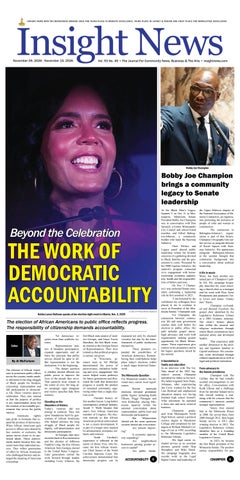
THE WORK OF DEMOCRATIC ACCOUNTABILITY Keisha Lance Bottoms speaks at her election night event in Atlanta, Nov. 3, 2026
Credit:AP Photo/Brynn Anderson
The election of African Americans to public office reflects progress. The responsibility of citizenship demands accountability.
Editor
By Al McFarlane The election of African Americans to prominent public offices across the country marks another milestone in the long struggle of Black people for freedom, citizenship, representation and full participation in democratic life. These victories deserve celebration. They also remind us that the purpose of politics is not representation alone but the creation of accountable government that serves the public interest. Americans rightly take pride in moments that expand the promise of democracy. When African Americans gain access to offices once denied by law, custom, or exclusion, the nation moves closer to its professed ideals. These achievements matter because they represent more than individual success. They reflect generations of effort by African Americans who challenged barriers and enlarged the meaning of American citizenship.
Yet democracy requires more than symbolic victories. Representation matters. It broadens participation, expands opportunity and affirms the principle that public service should be open to all. But representation is not the destination. It is the beginning. The deeper question is whether elected officials use public power to improve the lives of the people they serve. That question must remain at the center of civic life long after campaign signs disappear and victory speeches fade from memory.
Standing on the Shoulders of History
Today's victories did not emerge in isolation. They rest upon foundations built by generations of African Americans who helped advance the long struggle of Black people for dignity, self-determination and democratic participation. In Georgia, that story stretches back to Reconstruction and the election of Jefferson Franklin Long, the first African American from Georgia elected to the United States Congress. Later generations carried the work forward through leaders including Leroy Johnson, the
first Black state senator of modern Georgia, and Grace Towns Hamilton, the first Black woman elected to the Georgia House of Representatives. Their lives remind us that political progress is earned, not given. In Wisconsin, pioneers such as Vel Phillips demonstrated the power of perseverance, institution building and civic engagement. Her career helped create pathways for future generations and illustrated the truth that democratic progress is usually the product of sustained community organizing rather than a single election cycle. Florida's history offers another lesson. Long before contemporary political debates, Josiah T. Walls became that state's first African American member of Congress. His election reminds us that African American political achievement is not a recent development. It is part of a longer story marked by advancement, resistance, setbacks and renewal. North Carolina's experience is reflected in the career of Henry Frye, who became the first African American Chief Justice of the North Carolina Supreme Court. His achievement demonstrated that democratic progress can be
measured not only by electoral victories but also by the transformation of public institutions themselves. These pioneers expanded the possibilities of American democracy. Remembering their contributions helps place today's elections within a much larger historical framework.
The Minnesota Question
For Minnesota readers, the national story carries local significance. Recent statewide elections elevated prominent public figures including Keith Ellison, Peggy Flanagan and Amy Klobuchar, placing Minnesota squarely within the national conversation about representation, public trust and democratic participation. But Minnesotans should ask the same questions citizens should ask everywhere. Are schools improving? Is economic opportunity expanding? Are neighborhood businesses gaining greater access to capital? Are public institu-
ACCOUNTABILITY
6
At the Black Men’s Legacy Summit V on Oct. 31 in Minneapolis, Minnesota Senate President Bobby Joe Champion was in conversation with Don Samuels, a former Minneapolis City Council and school board member, and Alfred Babington-Johnson, a community builder who leads the Stairstep Initiative. Their Politics and Legacy panel placed public leadership within the broader concerns of a gathering devoted to Black families and the generations to come. Presented by the 9000 Equities Initiative, the summit’s program connected civic engagement with homeownership, economic opportunity, health and the responsibilities of fathers and sons. On Nov. 5 Champion’s was reelected Senate president, continuing a leadership role he first assumed in 2023. “I am honored by the confidence my colleagues have placed in me to continue to serve as President of the Minnesota Senate,” Champion said. For Champion, the connection between community life and state government reaches back well before his election to public office. His path includes gospel music, legal advocacy and work with organizations seeking greater opportunity for Black Minnesotans. Those experiences give context to his presidency and to the legacy questions raised by the summit.
A foundation in family and education
In an interview with The UpTake ahead of the 2023 legislative session, Champion identified his father as his hero. His father migrated from Hope, Arkansas, after experiencing Jim Crow, worked for the Soo Line Railroad and emphasized education despite not having finished high school himself. After retirement, he operated a lawn care and snow removal business. Champion graduated from Minneapolis North High School, earned a political science degree at Macalester College and completed his law degree at William Mitchell College of Law in 1995, according to the Minnesota Legislative Reference Library. His legal career included service as an assistant attorney general under Skip Humphrey and Mike Hatch. His campaign biography also records work at the Legal Rights Center and leadership of
the Upper Midwest chapter of the National Association of Minority Contractors, an organization promoting the inclusion of people of color and women in construction. The connection to Babington-Johnson’s organization is part of that history. Champion’s biography lists earlier service as program director of Social Spaces with Stairstep Initiative. His appearance alongside Babington-Johnson at the summit brought that community background into a conversation about political leadership.
A life in music
Music has been another sustained part of Champion’s public life. His campaign biography describes his years directing a church choir as a teenager and his work with Flyte Tyme Productions and producers Terry Lewis and James “Jimmy Jam” Harris. Champion co-founded and directed Excelsior, the gospel choir identified by the Legislative Reference Library as a 2003 Grammy nominee. The choir’s history places him within the musical and religious institutions through which Black communities have nurtured artists and developed leaders. That experience adds another dimension to the attorney and legislator familiar to Capitol audiences. His community work developed through cultural organizations as well as legal and political institutions.
From advocacy to the Senate presidency
Champion told The UpTake that he had initially resisted encouragement to run for office. Conversations with Keith Ellison and a challenge from his minister helped move him toward seeking a seat, along with his concern that the community’s interests needed stronger representation. Voters first elected him to the Minnesota House in 2008. He served there from 2009 through 2012, then began Senate service in 2013 after winning election in 2012. The Legislative Reference Library identifies him as a founding member of the United Black Legislative Caucus. In 2023, he became the first Black president of the Minnesota Senate. The position carries responsibility for pre-
CHAMPION
6
Page 2 • November 09, 2026 - November 15, 2026 • Insight News
Visit West Broadway The West Broadway Business & Area Coalition’s mission is to create an inviting and vital West Broadway Corridor, and to transform the Northside into a thriving economic community.
"GREAT PRICES AND FRIENDLY STAFF" - DJ S.
2220 W BROADWAY AVE, MPLS | 612-522-4384 | BROADWAYLIQUORS.COM | MON-SAT 10A-10P, SUN 11A-6P
insightnews.com
insightnews.com
Insight News • November 09, 2026 - November 15, 2026 • Page 3
Insight News
INSIGHT NEWS WON THE MESSENGER AWARDS 2024 F OR THIRD PLACE IN WEBSITE EXCELLENCE, THIRD PLACE IN LAYOUT & DESIGN AND FIRS T PLACE F OR NEWSLETTER EXCELLENCE.
November 09, 2026 - November 15, 2026
Vol. 53 No. 45 • The Journal For Community News, Business & The Arts • insightnews.com
Credit: Lazar Berman/The Times of Israel
Pastor Michael A. Stevens, Sr. speaks in Jerusalem ahead of the Unfinished Business Pilgrimage, November 4, 2026
Hundreds of Black Christian leaders arriving in Israel for Martin Luther King-inspired mission By Lazar Berman, The Times of Israel
Credit: House Photography file photo
DFLers won full control of the Minnesota Legislature on Election Day, with the party on track to hold a 77-57 advantage in the House of Representatives
DFL regains control of Minnesota House After two years of a tied House, the DFL has regained the majority. In a year when anger flared on both political sides — DFLers over Operation Metro Surge and Republicans over fraud in state programs — the DFL came out ahead in Tuesday’s general election and is projected to hold a 77-57 advantage for the 2027-28 biennium. Voters also kept the DFL in control of the Senate, 39-28, and all five constitutional officers remain DFL. The DFL previously had a legisla-
tive trifecta in 2023-24. “Minnesotans chose leaders who will work for them, who ran on making their lives better and more affordable. These leaders will put the good of their neighbors first in everything they do. We’re honored to earn Minnesotans’ trust, and we’re ready to deliver,” House DFL Caucus Leader Zack Stephenson (DFL-Coon Rapids) said in a statement. “These candidates and their dedicated supporters knocked over a million doors and had 333,000 conversations with Minnesotans. That
means they’ve already shown their ability to work hard and they know exactly what their neighbors need for their future. I am confident this dedication will carry over into the legislative session.” House Republican Floor Leader Harry Niska (R-Ramsey) said in a statement, “House Democrats campaigned on free healthcare, free childcare, and other costly promises. We already know from the last trifecta that Democrats are willing to raise taxes by billions to pay for their wish list. The
question now is whether Governor-elect Klobuchar will stand up to the tax-and-spend wing of her party, or whether she'll be another rubber stamp for the far-left agenda, like Tim Walz was. House Republicans will be watching, and we'll be fighting for Minnesota families who can't afford more of the same." Election results are not official until they are certified by the state canvassing board. That is scheduled to oc-
DFL
6
Democrats in House poised to investigate the Trump Administration, taking up a long‑standing power GOP‑led Congress ignored for the past two years By Drew Kurlowski Associate Professor of Political Science, Coastal Carolina University Gibbs Knotts Professor of Political Science, Coastal Carolina University Oversight is coming for the Trump administration. That’s been the message of congressional Democrats throughout the closing days of the 2026 midterm campaign. Now that the party’s candidates have reportedly won
control of the House of Representatives, that campaign promise is likely to be carried out. Democratic Rep. Jamie Raskin told The New York Times in late October that among the potential oversight targets were pardons granted by President Donald Trump, possible corruption in government contracting and the Trump family’s cryptocurrency deals. Routine congressional oversight hearings usually don’t make headlines. That changed during the second Trump administration. When Attorney General Pam Bondi appeared before the Senate Judiciary Committee
As support for Israel declines precipitously in the US, hundreds of African-American and African pastors and Christian leaders are arriving in Israel this week for a mission inspired by the slain US civil rights leader Rev. Dr. Martin Luther King. King planned to bring thousands of pilgrims to Israel and Jordan in 1967, but that trip was postponed because of the Six Day War and the political implications of such a trip. He said he would look into coming the next year, but was assassinated in April 1968. “There were no mass pilgrimages” back then, says Pastor Dumisani Washington, a pro-Israel activist, at a press conference in Jerusalem. “We
as Black Americans recognize that Black Americans were about to start something that no one else was doing.” The “Unfinished Business Pilgrimage” will expand to thousands of participants next year, say organizers, to mark 60 years since King’s planned visit. “We felt a burden in our heart,” Washington continues. “We see the rising antisemitism on the right and on the left.” There is a “mountain of support rising from the Black church,” says Pastor Michael A. Stevens, Sr. The leaders of the pilgrimage present gifts to victims of the Hamas-led October 7, 2023, massacre, including freed
PILGRIMAGE
6
The Insight News Voters Guide: Election Results The Insight News Voters Guide ran in six weekly editions, from Sept. 14 through Oct. 19, profiling candidates in the statewide, congressional and legislative races on Minnesota's Nov. 3 ballot, with its focus on Hennepin and Ramsey counties. The results are in, and the biggest of them came in Hennepin County. Cedrick Frazier, an attorney and DFL state representative from New Hope who was the first African American on that city's council, narrowly won Hennepin County Attorney over Anders Folk, 257,445 votes (50.55%) to 249,145 (48.92%), a margin of 8,300 votes. He takes charge of the largest prosecutor's office in Minnesota. At the top of the ticket, every statewide candidate the guide featured won. Amy Klobuchar and Ben Schierer took the governor's office with
55.46% of the vote. Lt. Gov. Peggy Flanagan won the U.S. Senate seat with 53.71%, and Attorney General Keith Ellison won re-election with 54.29%. Rep. Ilhan Omar won another term in CD5 with 76.48%. In the legislative races the guide covered, the DFL candidate won all 24 State Senate districts and 44 of the 46 State House districts. Chris Ford flipped Senate District 32 in Anoka County from the Republicans, unseating Sen. Michael Kreun, 23,761 votes (53.07%) to 20,978 (46.85%). The two House exceptions were District 37A, where Republican Tom McKee defeated DFL candidate Darci Smith, 13,808 to 12,728, and District 45A, where Republican Andrew Myers held his seat over Tracey Breazeale,
RESULTS 10
Credit: AP Photo/Andrew Harnik
Under Democratic control, the House is likely to exercise its oversight powers on Oct. 7, 2025, what took place was a contentious, highly partisan, made-for-TV-and-socialmedia confrontation.
OVERSIGHT
DOJ fights to keep Rep. Ilhan Omar’s search warrant sealed: report
5
‘Epic’ blue wave helps Democrats take Congress in overwhelming rebuke to President Trump By Charlie Hunt Associate Professor of Political Science, Boise State University Voters turned out in massive numbers on Election Day to hand Democrats control of Congress, in a sweeping snub of President Donald Trump and Republicans. Democrats won several statewide races in places long considered GOP bastions, including races that were considered insurmountable even weeks ago. Democrats took con-
trol of the House and Senate, flipping Senate seats in Texas, South Carolina, North Carolina, Kansas and Ohio. The results reflected broad dissatisfaction across the country with Trump, his agenda and the candidates he had endorsed. The Conversation’s senior politics editor, Alfonso Serrano, spoke on election night with Charlie Hunt, a scholar at Boise State University who studies Congress and elections. It was obviously a strong showing for Democrats on Election Day, something that was even evident in the margin of some Democratic
Rep. Ilhan Omar
Credit: AP Photo/Mic Smith
Supporters of South Carolina Democratic Senate candidate Annie Andrews cheer during her election night watch party on Nov. 3, 2026, in Charleston, S.C. losses. What does it tell you, for example, that democratic socialist Angie Nixon fought a competitive race for the Senate in Florida?
There is this big uniform shift toward the Demo-
I2H
Pediatric palliative care addresses the unique needs of seriously ill children and their families
PAGE 7
BLUE WAVE
6
Federal prosecutors are trying to keep sealed the search warrant and related records from and FBI search of Rep. Ilhan Omar’s Washington, D.C., home earlier this month. According to The Washington Post, a coalition of more than a dozen media organizations, including the Post, is seeking access to the warrant and related records. U.S. District Judge James Boasberg, an
Credit: NNPA
appointee of former President Barack Obama, is overseeing the dispute. In a Tuesday (October 27) court filing, U.S. Attorney Jeanine Pirro argued that the request was premature because investigators are still reviewing evidence seized during the October 12 search and have
OMAR
6
Business
Companies may be held liable when AI harms their clients and customers
PAGE 8
Page 4 • November 09, 2026 - November 15, 2026 • Insight News
insightnews.com
What you don't know can hurt you: check before it's too late By Dr. Bernadeia H. Johnson, Associate Professor, Minnesota State University, Mankato The second of three monthly articles In my last article, I shared how kidney disease quietly changed my life. Before my kidney transplant on April 30, 2024, I spent years living with conditions that were damaging my kidneys without my full understanding of the consequences. Like many people, I believed that if something serious was happening inside my body, I would know it. I was wrong. Kidney disease often develops silently. There may be no pain, no coughing, no obvious symptoms, and no signal that something is wrong until significant damage has already occurred. That is why I often say,“Kidneys don’t cough.” The good news is that kidney disease is often preventable or manageable when detected early. The key is knowing your numbers and taking charge of your health before a crisis occurs.
The Three Numbers That Matter
If you remember nothing else from this article, remember these three things: Know your blood pressure. Know your blood sugar. Know your kidney function. These numbers tell an important story about your health. High blood pressure and diabetes are the two leading causes of kidney failure. They are also conditions that disproportionately affect Black Americans. When left untreated or poorly controlled, both can gradually damage the kidneys. Many people monitor their weight or cholesterol, but never ask about their kidney function.
Yet a simple blood test and urine test can identify problems long before symptoms appear.
What I Wish I Had Known
Looking back, I wish I had understood years earlier what I know today. As Superintendent of Minneapolis Public Schools, my days were filled with responsibility. Thousands of students depended on my decisions. There were meetings, crises, public scrutiny, long hours, and constant pressure. I told myself I would focus on my health later. Later never seemed to come. Like many Black women, I spent years caring for others while neglecting myself. I put my career, my family, and my community first. I ignored warning signs. I accepted stress as normal. I did not fully appreciate the damage that uncontrolled hypertension, diabetes, poor nutrition, inactivity, and chronic stress were doing to my body. Today, I understand that self-care is not selfish. It is essential.
Why We Delay Medical Care
Many Black adults delay routine medical visits for understandable reasons. Some lack access to healthcare. Some have experienced bias or discrimination in medical settings. Others are juggling multiple jobs, caregiving responsibilities, transportation challenges, or financial pressures. Still others simply feel fine and assume there is no reason to see a doctor. I understand those realities. But waiting until symptoms appear can be dangerous, especially with kidney disease. Preventive care allows problems to be identified early, when treatment options are often most successful. Annual physicals, routine screenings, and regular conversations with healthcare providers can make a life-changing difference.
Beyond the Numbers
Good health is about more than
laboratory results. Managing stress matters. Getting enough sleep matters. Physical activity matters. Healthy food choices matter. Each of these factors affects blood pressure, blood sugar, heart health, and kidney health. The goal is not perfection. The goal is progress. Small changes made consistently over time often have a greater impact than dramatic changes that cannot be sustained. Take a walk. Drink more water. Reduce sodium. Take your medications as prescribed. Schedule the appointment you have been postponing. Each step matters.
Advocate for Yourself
One of the most important lessons I learned is that patients must advocate for themselves. When you visit your healthcare provider, ask questions. Ask one or all of the following: What is my blood pressure today? What is my A1C or blood sugar level? How well are my kidneys functioning? Am I at risk for chronic kidney disease? What lifestyle changes would most improve my health? How often should I be screened? Another question I started asking my doctors: “Pretend I am your mother sitting before you, what questions would you want her to ask, or what would you want her to know?" Now, this is assuming they love their mother. I also list these questions before each doctor's appointment in a small journal so I don't forget them. I am often reminded of the Portal's ability to retain a summary of appointment notes, but for me, writing helps me retain information better. And when I am not feeling as confident, I take close friends
Early detection, prevention, and taking control of your health
Image created with AI
I trust with me to take notes. Never be afraid to ask for clarification. You have a right to understand your health and your treatment options. From my experience with my transplant team, they appreciated and respected my engagement as a patient.
A Message to Our Community
Black communities have always demonstrated resilience, strength, and determination in the face of challenges. We bring that same spirit to our families, churches, schools, and neighborhoods. Now we must bring that same commitment to our health. Talk openly about high blood pressure, diabetes, and kidney disease. Encourage family members to schedule checkups. Share information with friends. Support loved ones who are managing chronic conditions. Personally, I have committed to reminding people that it is okay to prioritize themselves an maybe even a little selfish and before I start most conversations with Black women leaders; those who are now walkinging my footsteps to remember to make and keep their doctor’s appointments. Most importantly, do not assume that feeling fine means everything is fine. Kid-
North Minneapolis food lockers and a $1.3 million city grant open new doors to healthy food Neighbors in north Minneapolis can now pick up free food at any hour. Shiloh Cares Food Shelf recently installed a row of lockers that open with a code, so families reach groceries long after the doors close for the day. Pastor Jalilia Abdul-Brown, executive director of Change Starts with Community at Shiloh Temple church, led the project and described it in an interview with MPR News host Emily Bright. The lockers now have company in the city's plans. The City of Minneapolis won $1.3 million from the Minnesota Pollution Control Agency (MPCA) prevention of wasted food grant, which draws on the state's $33 million Climate-Smart Food Systems initiative. The money will fund the Minneapolis Food Waste Prevention and Recovery Initiative, a citywide effort to cut wasted food, rescue more of it, and widen access to healthy meals. Shiloh Cares, Community Emergency Services, and the University of Minnesota will help place climate-controlled food lockers across the city. The Foundation for Essential Needs will give technical help to food shelves. Twin Cities Food Justice and five Minneapolis farmers market organizations will gather surplus local produce and share it with neighbors. The city will also grow its Food Forward program, which helps businesses prevent food waste. The work arrives as the problem grows. A new MPCA report, the most thorough look at Minnesota's trash in years, shows residents throwing away more food even after a decade of state spending on composting. The state set a goal of cutting food waste to half its 2013 level by 2030. The agency reports the increase is slowing, and it credits state and local efforts. School meals also play a role in food access. Jenny Breen, a member of the Home-
ney disease often develops in silence.
Closing
I cannot change the choices I made decades ago, but I can share what I have learned. My kidney transplant gave me a second chance, and with that second chance comes a responsibility to help others avoid the path I traveled. Knowing your
INSIGHT NEWS www.insightnews.com
Insight News is published weekly, every Monday by McFarlane Media Interests.
National Newspaper Publishers Association (NNPA)
CEO/Editor-In-Chief Al McFarlane
Postmaster: Send address changes to McFarlane Media Interests, Marcus Garvey House 1815 Bryant Avenue North, Minneapolis, MN, 55411
COO/Associate Publisher Trena V. Stubbs Publisher Batala-Ra McFarlane Associate Editor & Associate Publisher B.P. Ford Web Administrator Sunny Thongthi Yang Courtesy of Jalilia Abdul-Brown
Shiloh Cares Food Shelf in north Minneapolis is opening a new "Hope Vault" on Oct. 21. The row of food lockers will allow users to pick up food when the building is closed. grown Minneapolis Food Council, calls school food a form of preventive health care. She encourages families to support universal school meals, join school wellness efforts, and vote for policies that build a healthy, fair, and sustainable food system.
Coming up in the community
Winter farmers markets: Four indoor markets across Minneapolis open this month and run on various weekends through April. Emerging Farmers Conference, Nov. 13-14: The conference supports emerging farmers, immigrant farmers, and farmers of color. It meets Nov. 13 from 11 a.m. to 7 p.m. and Nov. 14 from 8 a.m. to 6 p.m. at the Heritage Center, 6155 Earle Brown Dr., Brooklyn Center. Attendees build practical skills, gain resources, and connect with farming professionals. FEAST! Local Foods Marketplace, Nov. 17: The event runs from 10 a.m. to 4 p.m. at the Mayo Civic Center in Rochester, with local treats, cooking demos, live music, and kids activities. Homegrown Minneapolis Food Council, Nov. 18: The council meets in person at 5:30 p.m. at Powderhorn Park, 3400 15th Ave. S. The agenda covers zoning code updates for
food access and the future of Homegrown Minneapolis. Attendees bring pumpkin, squash, and other cozy fall dishes to share. Robin Greenfield book reading, Nov. 18: Greenfield reads from his upcoming foraging book, Foraging for Freedom, and from Food Freedom, from 6 to 8 p.m. at Inkwell Booksellers, 426 E. Hennepin Ave.
Grants with deadlines ahead
Midwest Farmers of Color Collective Rapid Response Fund, Nov. 15: Farmers of color facing crises or transitions can receive unrestricted emergency support for housing, food access, farm safety, wellness, and education. The current cycle prioritizes Minnesota's Metro Surge regions. Urban Agriculture Resilience Program, Nov. 17: The U.S. Botanic Garden and the American Public Gardens Association fund public gardens and partners that run urban agriculture and community gardening projects. MPCA statewide organics management program, Nov. 25: About $6 million will support collection programs, outreach and education, and market development for finished compost. MDA Agricultural
Research and Education Grant, Nov. 25: The Minnesota Department of Agriculture offers $1.4 million for research and education on soil fertility, regenerative agriculture, and water quality. Applications close at 4 p.m. CST. Cenex Harvest States Backyard Giving Grant, Nov. 30: Organizations near CHS headquarters can apply for up to $5,000 to host community events, teach young people about agriculture, or connect Twin Cities residents with healthy food and stable housing. Lawns to Legumes, Nov. 30: Minnesota residents can receive up to $400 in reimbursement for native plantings that support pollinators such as the monarch butterfly and the rusty patched bumble bee. North Central Regional SARE grants, Dec. 3: Four open programs fund sustainable agriculture research and education across 12 Midwestern states.
Food jobs open now
Open Arms is hiring a meal expediter. The Wedge Community Co-ops list multiple openings. Keystone Community Services seeks a food market assistant. The Sanneh Foundation seeks a Food Access and Community Partnerships VISTA through AmeriCorps.
numbers may seem like a small step, but it could save your kidneys, your future, and your life. Remember, kidneys do not cough. And by the time they demand your attention, it may already be too late. Take a minute for Kidneys: A 60-second test @ https://www.kidney. org/kidney-quiz/ on your phone to see if you are at risk for kidney disease.
Associate Editors Afrodescendientes Jesús Chucho Garcia Macdonald Anyanwu Book Review Editor W.D. Foster-Graham Sports Editor Leahjean M. Denley Contributing Writer Pulane Choane Columnist Haley Taylor Schlitz Distribution Sound Construction Photographer Uchechukwu Iroegbu Roy Lewis - Washington D.C. Artist Donald Walker Digital Producer Jared McMullin Graphic Designer Syed Fahad Fayyaz Contact Us: McFarlane Media Interests, Inc. Marcus Garvey House 1815 Bryant Ave. N. Minneapolis. 55411 Ph.: (612) 695-0417 Member: Minnesota Multicultural Media Consortium (MMMC) Minnesota Newspaper Association (MNA)
News, opinion and advertising at Insight News Our news reporting is fair, accurate and impartial. We report in context — the historical and cultural context that explains why a story matters to this community is part of the reporting, not a departure from it. When we endorse a candidate or take a position, we say so plainly and label it as such. Endorsements and commentary are separate from news coverage. Advertising is a business function. Advertisers do not influence our news coverage, our endorsements or our commentary — and our coverage does not depend on who buys space in this paper. That wall stands, and we are telling you it stands. Insight News uses AI-assisted tools in some editorial production. Read our AI Policy & Transparency Statement at www.insightnews.com/site/ ai_policy.html.
insightnews.com
Insight News • November 09, 2026 - November 15, 2026 • Page 5
Oversight From 3 Bondi refused to answer many questions from Democrats, instead launching personal attacks against these members of the U.S. Senate. The episode captures a basic tension in congressional oversight: Congress can demand answers, but getting them often depends on the cooperation of the branch it is investigating. That tension is about to sharpen when Democrats control the oversight process. Their hearings will likely be anything but routine. From our perspective as political scientists who study the U.S. Congress, congressional oversight has played an important role in American democracy. Here’s a brief history.
Inquisitory powers
In simple terms, oversight is the ability of Congress to ensure that the laws it passes are faithfully executed. This generally means asking questions, demanding information, convening hearings and holding the executive branch accountable for its actions. Oversight isn’t specifically mentioned in the Constitution. Article 1, Section 8, which lists the powers of Congress, includes the power “to make all laws which shall be necessary and proper,” without identifying an oversight role. Once laws are enacted, Article 2, Section 3, states that the president “shall take Care that the Laws be faithfully executed.” However, the framers viewed congressional oversight as a key component of legislative authority. They wanted presidents to take Congress seriously and structured the Constitution to ensure that the executive would be accountable to the legislature. As James Madison urged in Federalist 51, the separate branches of government should have the power to keep
Credit: Library of Congress, U.S. News & World Report Collection
President Gerald Ford testifies before a House Judiciary subcommittee about his pardon of Richard Nixon, Oct. 17, 1974
each other from becoming too powerful. “Ambition must be made to counteract ambition,” Madison wrote. The framers drew from the examples of the British Parliament and Colonial legislatures. In 1621, Sir Francis Bacon was charged with corruption and impeached as Lord High Chancellor after an investigation by a committee of the British Parliament. And in 1768, the Massachusetts Assembly conducted an investigation of Gov. Francis Bernard that led to a formal request to the King of England for his removal. At the Federal Convention in 1787 that produced the Constitution, Delegate George Mason noted that members of Congress possessed “inquisitory powers” and “must meet frequently to inspect the Conduct of public officials.” Even though this idea was never written down, it was a habit of self-government that early Congresses put into practice.
Early oversight hearings
Congressional oversight began almost as soon as the first Congress met. In 1790, Robert Morris, the superintendent of finances during the Continental Congress and a financier of the American Revolution, asked Congress to investigate his handling of the country’s finances and was exonerated of any wrongdoing. During this period, congressional investigations were often referred to select committees – bodies created
to perform special functions. These panels had the power to issue subpoenas and hold individuals in contempt. Since there was no official record of debates and proceedings, the public relied on newspaper accounts to learn about what had happened. In March 1792, congressional oversight exposed businessman William Duer, who signed contracts with the War Department but failed to furnish the needed military supplies. This shortfall contributed to a stunning U.S. military defeat against a confederation of Native American tribes in the Northwest Territory. Congress eventually removed the quartermaster general from his role for mismanaging the contracts. Throughout the 19th century, Congress continued to quietly exercise this power. Hearings from December 1861 to May 1865 on the conduct of the U.S. Civil War produced a detailed record of the war, exposed military wrongdoing and condemned slavery. In 1871, the Senate created a select committee to investigate Ku Klux Klan violence during Reconstruction.
Investigating corruption and criminal acts
Congress started to use its oversight power more aggressively in the 1920s with the Senate Committee on Public Land and Surveys’ high-profile investigations into the Teapot Dome scandal. Hearings revealed
that Interior Secretary Albert Bacon Fall had secretly leased federal oil reserves in Wyoming to two private corporations and had received personal loans and gifts from the companies in return. The investigation found clear evidence of corruption. Fall was indicted and became the first U.S. Cabinet member to be convicted of a felony. The U.S. Supreme Court helped to shape the legal foundation of congressional oversight. In McGrain v. Daugherty, decided in 1927, the court held that congressional committees could issue subpoenas, force witnesses to testify and hold them in contempt if they fail to appear. Two years later, in Sinclair v. United States, the court ruled that witnesses who lied to Congress could be charged with perjury. These cases granted the judicial branch’s sanction to what had long been an implied legislative power, cementing the constitutionality of congressional oversight.
Oversight highs and lows
The modern era of congressional oversight has produced some very important reforms – and some truly regrettable spectacles. The most important example of bipartisan congressional oversight came in response to reporting by The Washington Post’s Carl Bernstein and Bob Woodward. The two journalists wrote about the
1972 burgling of Democratic National Committee offices in Washington, D.C.’s Watergate Hotel and subsequent cover-up efforts by the Nixon administration – and President Richard Nixon himself. On Feb. 7, 1973, the U.S. Senate voted 77-0 to establish a Select Committee on Presidential Campaign Activities, which brought together Democrats and Republicans to investigate what came to be known as the “Watergate scandal.” The committee’s work spurred action in Congress to impeach Nixon, leading to Nixon’s resignation in 1974 and to the enactment of legal reforms to provide an institutional check on presidential power. Another high point for congressional oversight came after the 9/11 terrorist attacks in 2001. Seeking to learn how the deadliest terrorist strike on American soil had occurred, Democratic Sen. Bob Graham and Republican Rep. Porter Goss, who chaired the Senate and House Intelligence committees, formed a joint committee to investigate intelligence failures before and after the attacks. This inquiry produced several important recommendations that were ultimately adopted, including the creation of a director of national intelligence and a Department of Homeland Security, as well as better information sharing among law enforcement agencies. Congress’ oversight can extend beyond the executive branch when the actions of
private actors raise questions about existing laws or spur the need for new ones. Investigations into medical device safety and Enron’s 2001 collapse examined malfeasance in the private sphere that existing regulations failed to prevent. However, the power to expose corruption can also be used as a tool to score partisan points and generate outrage, rather than holding the executive branch accountable for actual malfeasance. Notably, in the 1950s, Wisconsin Sen. Joseph McCarthy turned oversight into inquisition and used the power of media to amplify his accusations of communist influence within the federal government.
Democracy needs oversight
As we see it, the problem with allowing oversight to become political theater is that it distracts Congress from quieter and more meaningful oversight work. Slow, procedural work isn’t likely to go viral, but it helps keep government accountable. The task of a deliberate legislative body is to reconcile those very different impulses. Congressional oversight has strengthened the democratic system at many points. But it can also be stymied by an uncooperative executive branch. After the 2018 midterm elections put Democrats in charge of the House of Representatives, their many attempts to exercise oversight were rejected by the first Trump administration, which refused to send officials to testify at hearings, failed to turn over documents and ignored subpoenas. Will the next two years of divided government look the same? Disclosure statement The authors do not work for, consult, own shares in or receive funding from any company or organization that would benefit from this article, and have disclosed no relevant affiliations beyond their academic appointment.
AN IMPORTANT MESSAGE FROM MEDICARE
Medicare Open Enrollment ends December 7. “ I compared my options and found a plan that saves me money.”
Compare your options now at MEDICARE.GOV, or call 1-800-MEDICARE
Open Enrollment: Find the Right Care at the Best Price Now’s the time to review and compare all your Medicare health and prescription drug plan options for next year. You may find a better plan, save money, or both.
Visit Medicare.gov to compare plan coverage and costs side by side, based on the prescription drugs you take. Find the right plan for your health needs and your budget—and make sure your drugs are covered.
Page 6 • November 09, 2026 - November 15, 2026 • Insight News
Accountability From Cover tions becoming more transparent and responsive? Are wealth gaps narrowing? Are families experiencing measurable improvements in their quality of life? These questions are neither partisan nor ideological. They focus attention where democracy ultimately succeeds or fails: in the daily experience of ordinary people. The value of representation is not diminished by these questions. Representation acquires meaning when elected officials deliver measurable im-
Champion From Cover siding over chamber proceedings and applying the rules that govern legislative debate. The presidency also places a Black Minneapolis leader in one of the institution’s most visible roles. His work can be assessed through both that representation and the legislation he has helped enact.
Restoring access to the ballot
Restore the Vote is one of the clearest examples. Champion carried the measure in the Senate in 2023, helping change when Minnesotans with felony convictions could regain their voting rights.
provements in the lives of the people who entrusted them with public authority.
insightnews.com
trepreneurs and small businesses? Can they strengthen public education? Can they reduce disparities in health outcomes? Can they build economies that create wealth in communities historically denied access to capital and opportunity? These are measurable questions. They are also democratic questions. The answers reveal whether political power is producing public benefit. That is why journalism matters. That is why civic organizations matter. That is why citizen engagement matters. A healthy democracy depends not only on elections but also on an informed and active public willing to examine the exercise of power after the votes
have been counted.
ness development and access to resources. Whether those commitments produce lasting gains depends on their implementation and the experiences of the people and businesses they are intended to reach.
Champion’s legislative record
also includes the 2023 jobs and economic development budget law, which he sponsored with Rep. Hodan Hassan. Minnesota House Public Information Services reported that it authorized $1.37 billion for jobs, economic development, labor and industry during the 2024–25 biennium. Among its provisions were $50 million for targeted population workforce grants supporting skills training and businesses that hire and retain people of color. The law also funded small-business assistance, an emerging developer program and community wealth-building grants. These appropriations connect to the summit’s focus on opportunity and generational wealth. They represent public commitments to training, busi-
Cedrick Frazier
Amy Klobuchar
Peggy Flanagan
Keith Ellison
Chris Ford
(0.5 percent). ... A publicly funded recount will occur if the apparent losing candidate requests one by filing a notice with the appropriate filing officer within 48 hours after the canvassing
board meeting." Candidates can pay for a recount themselves for larger margins. The DFL flipped House districts in the Duluth, Mankato and Winona areas,
as well as several in the Twin Cities. If all numbers hold, the House will have 33 new members: 20 DFL and 13 Republican. The 101 House members who won re-election Tuesday
included 13 members who ran unopposed. The 2027 session is scheduled to begin at noon Jan. 12. It must end by May 17. Of-
fice numbers and committee information will be determined in coming weeks by the majority caucus.
whose son Yaron was murdered alongside his fiancée Sarah Milgrim at an Israeli embassy event in Washington, DC. Ther rest of the participants arrive tomorrow, and will visit biblical sites across the country, as well as the site of the Nova massacre. Steven says that Jewish and Black Americans had a
tradition of coming together to “establish what was right, and to set the tone for the nation and for the world.” “If anyone should stand with our Jewish brothers and sisters, it ought to be African-Americans, it ought to be Africans,” he continues. Though rates of antisemitism have risen among
people of color, Stevens tells The Times of Israel, “I still think we are the lowest-hanging fruit to educate and to learn.” He says, “The African-American Church is still the most influential institution in all of America, in fact, at least in the Black community.” Stevens says one of the objectives of the mission is
to spread awareness that “we cannot have antisemitism in our culture, period.” At the same time, he says that Israel could improve its approach to Black America: “I believe Israel could be more attentive to the fact that a lot of the loss of lives that we see looks like us. Whether it’s in Gaza, whether it’s Ethiopians
and racism.” Reverend Dr. Benjamin F. Chavis. Jr. is on this delegation representing the Black Press of America and Spill the Honey as a present-day fulfillment of the dream and prior plan of Reverend Dr. Martin Luther King, Jr in 1967 to lead a 5000 Black Clergy Pilgrimage to Israel.
rash because it is rash,” Pirro wrote, according to The Hill. She argued that releasing the records could expose investigative sources and compromise the probe. “Unsealing everything now imperils the investigation,” the Justice Department wrote, according to the Post.
The media organizations argue that the warrant application and supporting affidavit could reveal the investigation’s targets, the evidence investigators have gathered, and how the probe began, according to the Post. The October 12 search was part of a federal in-
vestigation into allegations that Omar or members of her family misrepresented information on immigration paperwork. The congresswoman has denied wrongdoing and accused the Trump administration of politically targeting her. As BIN previously reported, the Trump administra-
tion has also explored whether Omar could be stripped of her U.S. citizenship. During an MS NOW interview on Wednesday (October 21), Omar announced plans to move out of her Washington residence, citing safety concerns after the search made her address public.
According to The Washington Post, prosecutors said in the filing that they may not oppose releasing some warrant records, with appropriate redactions, once the warrant has been fully executed and a public charging decision has been announced.
keep the number of seats they had in Florida in the House that they had before the election, which is incredible when you consider that Florida did this mid-decade gerrymander to try to get them out of a bunch of those seats. Some rural areas of the country were also more competitive than expected, like North Carolina’s 11th Congressional District, where Democrat Jaime Ager flipped a conservative district. What does that tell you? It’s definitely an indicator of at least one of these two things. One is just really massive Democratic turnout across the board. Regardless of where they live, Democrats were so enthusiastic and energized to turn out that they did so across all different types of districts and counties. It could also be an indicator of some cross-party voting, where Republicans are crossing over in some cases and voting for the Democrat. I don’t
imagine there’s a ton of that, but in a lot of these close districts, and if you’ve got enough of those folks in places like Texas, it really does make a big difference, those small shifts. I think we’re probably also likely to see, and we saw some of this in the exit polling, a major shift in independent voters, unaffiliated voters, toward the Democrats, whereas in 2024 they had been closer to Trump. I’d like to go back to turnout briefly. Turnout looks like it was strong across the country. In Georgia, for example, Election Day’s turnout was on pace to beat turnout in the 2024 presidential elections. That’s unprecedented, at least in modern elections. In Texas, for example, in some counties we saw James Talarico getting as many raw votes as Kamala Harris did in a presidential election. This isn’t a very political science term, but that’s insane. In a midterm election you typically see 10%
or 15% less turnout than you would in a presidential election. But Democrats voted in presidential-level numbers in a lot of these really key areas, and that’s explaining how they’re able to overperform at levels we haven’t seen in at least 20 years. Elon Musk spent nearly half a billion dollars supporting Republican candidates, including some US$200 million in Texas to elect Ken Paxton for the Senate, who lost. What does that tell you about the influence of political spending? Republican PACs, super PACs and billionaire donors like Elon Musk may have raised more money compared to Democrats, but Democratic candidates themselves outraised Republican candidates through donors that gave directly to their campaigns. This is important for a couple of reasons. Number one, because candidates get much better rates on TV ad buys than outside spenders. And so they get more bang for their
buck when they’re spending on advertisements, which is the most expensive component of any campaign. And more to the point, that is an indicator of sort of dedicated grassroots donors who turn into voters, whereas Musk gets one vote at the end of the day. And there is no amount of money that can make up for a really flawed candidate like Ken Paxton. And more to the point, a lot of this money, once you get into the tens, the hundreds of millions of dollars, a lot of the research talks about the diminishing returns that you get on that. Going from zero dollars spent to $10 million spent, that’s a very different kind of campaign. But once you go from $500 million to $510 million, that’s not going to get you a whole lot more votes. Any final thoughts? The territory that Democrats covered is unbelievable. The South Carolina Senate race went to Annie Andrews, the Democrat, which was un-
fathomable even a few months ago. Mississippi still appears to be somewhat in play. The blue wave turned into something approaching a tsunami. I think a lot of Democrats saw the polling and didn’t want to believe it or couldn’t bring themselves to believe it. But some of this late polling seems to have gotten things on the mark. What we’ve seen in these midterm elections is a massive rebuke of the last two years of the Trump administration, and a sort of blue wave of epic proportions toward the Democrats, the likes of which we haven’t seen in 20 or more years. It’s a huge confirmation of the approach that Democrats took in this election. Disclosure statement Charlie Hunt does not work for, consult, own shares in or receive funding from any company or organization that would benefit from this article, and has disclosed no relevant affiliations beyond their academic appointment.
Beyond Symbolism
Too often, public discourse stops at symbolism. Historic firsts make headlines. They should. But headlines are not governance. Government is budgets. Government is policy. Government is infrastructure. Government is public safety, education, economic development, health care, housing and opportunity. Citizens should celebrate history while demanding performance. Can elected officials expand pathways to homeownership? Can they support enGov. Tim Walz signed the legislation March 3, 2023. It restored voting rights upon release from incarceration, allowing people still on probation or other community supervision to vote. At signing, the governor’s office said the law would restore voting rights to more than 55,000 people. The legislation addressed a basic question of participation: whether people living, working and raising families in Minnesota communities could help choose the officials who governed them. Its passage made a change in state law that reached beyond the Capitol to thousands of households.
Public investment and economic opportunity
The Real Meaning of Victory
The achievements of this election cycle deserve recognition. They reflect generations of sacrifice by African Americans who believed the nation could become more democratic than it was yesterday and whose work advanced the continuing struggle of Black people for justice, opportunity and full citizenship. Their achievements belong in our collective memory. Their courage deserves our gratitude. But the highest tribute we can pay those who expanded democracy is not merely to celebrate electoral success. It is to practice citizenship with equal determination. That means staying
Accountability in public office
Champion’s legislative work has also drawn scrutiny. In 2025, Republican senators filed an ethics complaint concerning funding he advocated for 21 Days of Peace, a violence-prevention organization led by the Rev. Jerry McAfee, whom Champion had represented as an attorney. Champion said the legal work was unpaid. His attorney argued that he had followed Senate financial-conflict rules. The Minnesota Reformer reported that an advisory
Credit: U.S. House of Representatives
Byron Donalds
Courtesy of Milwaukee County
David Crowley
informed.
longs in our memory. The exercise of power belongs under public examination, every week. History should be celebrated. Government should be examined. And accountability should never take a day off.
proceeding found no financial conflict regarding additional funding proposed in 2025, while making no findings about his 2023 actions. On May 5, 2025, the evenly divided ethics panel deadlocked on related motions and took no action on the complaint. That outcome did not amount to a finding on the disputed 2023 conduct.
brings those concerns together: a father’s insistence on education, years of musical and community work, and a legislative career that has included expanding access to the ballot and directing resources toward economic opportunity. In the earlier UpTake interview, he expressed a hope that reaches beyond his own place in Minnesota history. “I don’t want me to be the only Black person who has been in that position,” he said. As Champion’s office announces his continuing Senate leadership, that hope offers a measure for the years ahead: who gains access to public institutions, who benefits from their decisions and who is prepared to lead next.
That means asking questions. That means measuring results. That means holding every leader, every institution and every public agency to the same standard of accountability. The achievement be-
The generations that follow
The summit offered a setting for considering such public careers alongside the work of families and community institutions. Its theme, Legacy Under Fire— Stand Your Ground, asked participants to consider how to protect what earlier generations had built while creating opportunities for those coming next. Champion’s history
DFL From 3 cur Nov. 19. According to the unofficial results at the Office of the Secretary of State, one race won by Republicans — Rep. Nolan West (R-Blaine) over DFL candidate Amanda Matchett in District 32A — is eligible for a state-funded recount. West won by 0.09% (22 votes amongst 23,644 cast). By law, “A publicly funded recount of the results of an election for a state legislative office may occur if the difference in the number of votes cast for the apparent winning candidate and any other candidate is less than one-half of 1 percent
Pilgrimage From 3 hostage Elkana Bohbot; Hila Abir, whose brother Lotan was murdered at the Nova music festival; and Daniel Lischinsky,
Omar From 3 not decided whether to file charges or whom to charge. “This request sounds
Blue Wave From 3 crats that we’re seeing really across virtually all kinds of locations and geographies and counties. What I think is particularly notable here, and something we were on the lookout for in this election, and we’re seeing it, is the substantial shift in the Hispanic vote from 2024 in places like Texas and Florida, where you’re getting these 30-to-35 point shifts from how Donald Trump performed in 2024. That was a big part of what helped him win, and it seems like it has snapped right back and even farther in the other direction. This is what made Florida, I think, closer than a lot of folks thought. It’s what put a number of really, really right-leaning districts in play, particularly in South Florida. And it looks like it is going to help Democrats
insightnews.com
Insight News • November 09, 2026 - November 15, 2026 • Page 7
Insight 2 Health
Pediatric palliative care addresses the unique needs of seriously ill children and their families By Khaliah Johnson Associate Professor of Pediatrics, Emory University Emilee Flynn Assistant Professor of Pediatrics, Emory University Pediatric medicine generally entails caring for patients at the beginning of their lives – performing newborn checkups, treating childhood illnesses and supporting adolescents in their health as they move toward adulthood. So people are often surprised to hear about specialists like us who work in pediatric palliative care, helping children facing serious illness who may be nearing the end of their lives. This approach to care focuses on relieving suffering and addressing quality of life for children and families facing complex, life-limiting medical conditions. We also work to ensure that every family who needs it has access to this care, because right now, these programs aren’t available to most families globally who need them.
Holistic, empathetic care
Pediatric palliative care is an approach that emerged out of the adult hospice and palliative care movement in the 1990s to early 2000s as a distinct discipline. Globally, an estimated 7 million children die annually. Children with life-threatening health conditions often live longer between the time of diagnosis and death than adults. They benefit from approaches to care that consider the needs of their caregivers and family members. Pediatric palliative care is provided by a team of professionals, including physicians, nurses, social workers, child life specialists, chaplains and other allied health profes-
Image created with AI
sionals who take a comprehensive approach to a child’s care as they live with serious illness and ultimately approach the end of their life. The goal of this care is to support families in making every day as good as it possibly can be, regardless of whether or not a child’s life remaining is short. At the heart of this approach is the belief that each child has a right to holistic, empathetic care during illness and throughout end of their life that considers their unique social, cultural, physical and spiritual needs. For example, an infant who is diagnosed with a rare genetic disorder that affects vital organ function and shortens life expectancy may need to be in and out of the hospital to manage acute illnesses and complex symptoms, such as pain and difficulty breathing. In turn, her parents may need help with deciding which treatments will be most helpful or may cause more suffering than benefit. A palliative care team works with patients and caregivers to formulate a plan that ensures this baby gets care that affords her opportunities to experience as many happy moments as possible. This can improve the lived experience of this child and her parents.
Avoiding unnecessary care
Children and families who have benefited from pediatric palliative care describe these services as the supportive lifeline that
helped them to navigate the complexities of diagnosis, life with serious illness and, ultimately, death and bereavement. Over the past 20 years, there has been growing evidence suggesting the benefits of this approach. Children who receive care from pediatric palliative care specialists have less pain, nausea and other distressing symptoms that can affect their day-to-day function and overall quality of life. Research also shows that children admitted to intensive care settings for managing life-threatening illness are more likely to receive care that aligns with their goals. When a palliative care specialist is consulted, patients are less likely to opt for life-sustaining therapies that would not change their longterm prognosis.
The US on the cutting edge
The U.S. is on the global forefront of pediatric palliative care: Nearly 80% of U.S. children’s hospitals have formal, interdisciplinary programs to provide this specialized care. But access to services in a clinic setting or at home is less consistent. Not every hospital-based palliative care program is connected to outpatient or home-based services, creating gaps for patients and families who need to access this supportive care between hospitalizations. Generally, palliative care in the U.S. is more readily available in urban settings and at academic medical centers
than in rural areas and community hospitals. These differences are most pronounced in rural states and the Southeast, a region of the country that has historically had health disparities across racial and socioeconomic differences. It can be difficult for children in these places to access patient-centered, interdisciplinary supportive services.
Global disparities
Outside the U.S., pediatric palliative care can be even more difficult to access. Though it’s hard to measure, estimates suggest that more than 21 million children worldwide would benefit from a pediatric palliative care approach. More than half of the world’s population live in countries where the availability of any palliative care is defined as either emerging or progressing, according to the World Health Organization. Only 14% of countries – 28 total – are considered to have advanced levels of palliative care development. The numbers are fairly similar for pediatrics, with one study
identifying only 11 countries as reaching the highest level of pediatric palliative care development. As many as 97% of children in need of this approach live in low- and middle-income countries. Children in these countries have less access to medical diagnostic and therapeutic interventions and are often diagnosed at later stages of illness with less access to curative therapy. The types of pediatric serious illnesses seen in the developing world are also very different from the landscape in the U.S. The greatest need for pediatric palliative care in developing nations – about 30% of cases – is in children with HIV. Among other children needing palliative care, about 18% are living with complications from prematurity, roughly 16% suffer from congenital malformations, and about 16% are dealing with injuries leading to severe neurologic impairment. In contrast to many high-income settings, children with malignant diseases such as leukemias and solid tumors represent a relatively small proportion – about 4% – of patients who would benefit from a palliative care approach. In these regions, the predominant ailments are HIV/AIDS, premature birth and birth trauma, congenital anomalies and injuries.
Filling in the care gaps
In low- and middle-income countries, essential medications like morphine, used for controlling pain and other symptoms, often aren’t available. In addition, healthcare workers
often haven’t been trained in foundational principles of palliative care. On top of that, many of these countries don’t have the political infrastructure to provide basic healthcare, much less facilitate developing a comprehensive palliative care program for children. The good news is that there are existing models for countries that are starting from scratch to build upon. And there’s room for innovation. Established community partnerships and technologies can be leveraged in new ways – for instance, using online learning and video conferencing to help train healthcare workers and build relationships. We believe pediatric palliative care is the heart of what healthcare should be when a child faces a serious, life-limiting illness, regardless of where they live in the world. Because even when medicine cannot cure, it can always heal and comfort. Disclosure statement Khaliah Johnson has received funding from the Cambia Health Foundation to support her leadership and scholarship in pediatric palliative care. She is on the board of the Georgia Hospice and Palliative Care Organization and a non-profit organization entitled "Families First." Emilee Flynn does not work for, consult, own shares in or receive funding from any company or organization that would benefit from this article, and has disclosed no relevant affiliations beyond their academic appointment.
Credit: Safari Consoler/Pexels
The number of people in Africa living with disabilities is rising.
Health progress in Africa leaves more people living with disabilities: rehabilitation is the next challenge By Ukachukwu Abaraogu Senior Lecturer Public Health, Evidence Synthesis & Rehabilitation, University of the West of Scotland Conversations around health progress in Africa usually focus on lives saved. And rightly so. Across the continent, people are living longer than they did a generation ago. Advances in prevention, treatment and public health have reduced deaths from many major diseases and improved survival for millions. But there is another side to this success story that receives far less attention: quality of life. As a physiotherapist and rehabilitation researcher, I am interested not only in wheth-
er people survive illness, but also in how they live afterwards. The latest findings from the Global Burden of Disease 2023 study, to which I contributed, suggest that while mortality is falling, the number of people living with disability and chronic health conditions that affect everyday functioning is rising. The study shows that globally, healthy life expectancy at birth increased from 61.1 years in 2010 to 63.1 years in 2023. But the gap between living longer and living healthier is widening. Globally, years lived with disability rose from 786 million to 990 million between 2010 and 2023. These numbers suggest that many people are spending more years living with the consequences of disease and injury. In many African countries, this is occurring alongside a growing burden of noncommunicable diseases
such as heart disease, stroke and diabetes. Health systems have become increasingly effective at reducing mortality, but they have not expanded rehabilitation services at the same pace. Many health systems are still poorly equipped to help people live well after illness or injury. This matters because health is about more than survival. It is also about whether people can move, work, learn, care for their families and participate fully in their communities. And that is where rehabilitation has a crucial role to play. Rehabilitation can help people recover after illness or injury, maintain independence and participate fully in society. Yet it remains overlooked in many health systems. To address this grow-
Your health. Our priority. Appointments available.
Call 612-543-2500
northpointhealth.org
REHAB 11 46-200-05-26_NorthPoint_AD_5_25x10_5in.indd 3
9/30/26 11:50 AM
Page 8 • November 09, 2026 - November 15, 2026 • Insight News
insightnews.com
Business Companies may be held liable when AI harms their clients and customers By Sarah Webber Associate Professor of Accounting, University of Dayton Kaitlin Newkirk Assistant Professor of Accounting, Xavier University Artificial intelligence has moved quickly from a novelty on the job to a common workplace tool. Gallup found that 52% of U.S. employees and 68% of professional services workers were using AI by February 2026. Thomson Reuters similarly found in spring 2026 that 74% of professionals use AI several times a week for work. This widespread use shouldn’t surprise anyone. For accountants, attorneys, consultants and other professionals, AI can accelerate research, summarize complex information and assist with writing and other forms of communication. But its rapid adoption has a big downside – AI can produce information that sounds authoritative and looks polished while being completely wrong. And when AI generates mistakes, responsibility for those errors belongs to the professional or business relying on the AI output – not companies that develop AI systems. AI errors have led to lawsuits, court fines, financial consequences and public embarrassment from fabricated citations, nonexistent sources and inaccurate AI-generated information. These cases raise an increasingly important question: How can professionals benefit from AI without outsourcing the
judgment their work requires?
Fake citations
We are two certified public accountants who research tax accounting. In the September 2026 issue of Journal of Accountancy, we examined what happened in Clinco v. Commissioner, a case before the U.S. Tax Court where an attorney submitted a brief to the court with allegedly fake citations. The Tax Court is a specialized federal court that resolves disputes between taxpayers and the IRS. This case involved a restaurant owner accused of underreporting more than US$2 million in business receipts and claiming unsupported depreciation deductions on rental properties. The main issue concerned Clinco’s accounting records used to determined how much of their income to tax. The taxpayers’ attorney, Abraham Wagner, cited four cases to support his argument that an IRS notice assessing additional taxes was invalid. The court determined that three of the citations appeared to be AI-generated hallucinations that cited nonexistent Tax Court cases. The court rejected the taxpayer’s argument and warned Wagner that submitting fake citations could lead to sanctions from the court, including financial penalties or disciplinary action against Wagner. Ultimately, the court did not sanction Wagner in the case, but the decision stands to put attorneys and other professionals in Tax Court on notice that AI hallucinations will not be tolerated.
When AI gets it wrong
AI errors made on behalf of clients are not limited to briefs drafted by attorneys. Nor are these mishaps limited to the United States. When Deloitte produced a 237-page report in 2025 for the Australian government examining its automated system for penalizing welfare recipients who failed to meet job-seeking requirements, it contained nonexistent academic citations and a fabricated quotation it attributed to a federal court judgment. The global consulting firm later issued a revised version of the error-ridden report. Deloitte blamed generative AI for the errors in the original and agreed to partially refund its fees. Like most airlines, Air Canada has a chatbot on its website to respond to its customers’ questions. The chatbot told a customer in November 2022 that he could buy a plane ticket under a bereavement policy and be reimbursed later. This was not company policy, and Air Canada refused to honor what the chatbot had told the customer. The customer sued the airline and won 812 Canadian dollars in damages. The British Columbia Civil Resolution Tribunal ruled that Air Canada had failed to take reasonable care to ensure that its AI bot provided accurate information and agreed with the customer that the airline had negligently misrepresented the bereavement policy.
AI lawsuits
There have been other lawsuits filed against AI platforms and providers.
Credit: AP Photo/Alex Brandon
Trump leaves the stage after speaking at the Bitcoin 2024 conference in Nashville, July 27, 2024
How Trump’s crypto winnings undermined the industry’s push for looser regulation By Lee Reiners Director of Global Financial Markets Center, Duke University The crypto industry has just suffered a paradoxical defeat: Its biggest backer, President Donald Trump, inadvertently helped scuttle chances for a major legislative win thanks to revelations of the riches he and his family have made off of their crypto ventures. The industry is now scrambling to advance its agenda through crypto-friendly regulation instead of legislation. But the prospect of Democratic control of one or both chambers of Congress after the November 2026 midterm elections, as well as potentially winning the White House in 2028, leaves the long-term durability of those gains uncertain. At stake was legislation that would have provided light-touch regulation over crypto assets. The industry, which had enjoyed a series of wins since Trump started his
second term, had secured bipartisan support for the measure, dubbed the Clarity Act, and poured hundreds of millions into lobbying. But the steady drip of news in the spring and summer of 2026 about the Trump family’s lucrative crypto businesses ultimately undermined those efforts. Democratic support in the Senate faltered, and after several attempts at a compromise, the bill died on a procedural vote on Sept. 15, 2026, falling short of the required 60-vote majority. As a scholar of financial regulation, I believe the growing backlash against Trump’s conflicts of interest surrounding his crypto wealth changed the political calculus. The Senate Democrats who had initially supported the measure increasingly feared they would be seen as voting to further enrich Trump. While the final bill contained some ethics provisions, they didn’t suffice to keep those Democrats on board. This outcome leaves the industry in limbo and unsure of how to spend its considerable campaign war chest ahead of the midterms. If it de-
cides to invest heavily to defeat crypto-skeptical Democrats, I believe it could risk a backlash should Democrats retake the House, the Senate, or both. Under that scenario, Democrats could launch congressional investigations or introduce legislation to impose stringent oversight over the industry. Furthermore, if voters see the industry as overly partisan, that perception could further erode trust in a sector that has desperately tried to repair its image since the collapse of crypto exchange FTX in 2022.
Crypto interests seize an opening
The Clarity Act was designed to answer a long-standing question: Should crypto assets be regulated as securities, like stocks, or commodities, like gold? Companies that sell securities face more scrutiny, as they’re required to register with the Securities and Exchange Commission and disclose detailed information to investors.
CRYPTO 11
Image created with AI
In 2025, for example, a Georgia court dismissed a defamation lawsuit against OpenAI after its ChatGPT tool falsely accused Mark Walters, a radio host, of embezzlement. The court ruled in favor of summary judgment for OpenAI and found Walters had not established fault and damages. There is also an ongoing case, Keene v. Google LLC, that is similar to the Walters case. Keene, a TV producer, sued after Google’s AI summaries allegedly published false information about Keene’s criminal history. In September 2026 the court ruled that some of his defamation claims may proceed, without deciding yet whether Google was liable.
The National Institute of Standards and Technology issued a report on AI risk management in July 2024 that calls AI mistakes and hallucinations “confabulations” – the confident presentation of erroneous or false information. Some researchers draw a more specific distinction between hallucinations, in which AI invents information outright, and confabulations, in which it fills gaps or distorts real information in a plausible way. Either kind of problem can be hard to detect without independent verification, but confabulations mimic actual research so closely they can trick AI users into believing the AI output is valid.
Hallucinations and ‘confabulations’
AI errors in the workplace
Unfortunately, for anyone using AI to save time and use less labor, AI errors are often hard to spot. Unlike most obvious mistakes humans make, an AI-generated error may include supporting explanations, citations or references that make a passage appear complete and credible.
A 2024 Stanford University study of specialized AI tools for legal research found erroneous results in 17% to 33% of the responses tested. Yet those findings and other grounds for concern about accuracy have not stopped many law firms from embracing AI tools due to their potential to save time and improve efficiency.
Recent surveys indicate law firms and other employers have not adopted enough workplace safeguards to spot and root out AI-generated mistakes. A 2026 survey by the Nationwide insurance company found that only 36% of surveyed businesses have written AI policies, and only 37% provide any training on responsible AI use. As AI becomes more and more common in the workplace, we believe it’s clear that telling employees simply to “check the AI” is not enough. Businesses and the people working for them need clear expectations about when it’s appropriate to use AI, which outputs require independent verification, and who is ultimately responsible for the final work. AI may change how professional work gets done, but it does not change where the buck stops. Disclosure statement The University of Dayton is an academic partner of The Conversation. Kaitlin Newkirk is affiliated with the Ohio Society of CPAs.
Choose a health insurance plan that rewards you for getting care.
your community health plan
insightnews.com
Insight News • November 09, 2026 - November 15, 2026 • Page 9
Who mapped Africa? Debunking the myth that Europeans alone plotted the continent By Thomas J Bassett Professor Emeritus, University of Illinois Urbana-Champaign After the United Nations adopted a resolution in September 2026 endorsing a map that more fairly represents the size of Earth’s landmasses, author and journalist Moky Makura of Africa No Filter – a main sponsor of the Correct the Map initiative – asked: “What else about Africa is the world underestimating that’s also hidden in plain sight?” It is a fair question. The initiative brought attention to the way continents are distorted by projections that display our rotund planet on two-dimensional maps, something that has long made Africa especially appear far smaller than it actually is. But it left another assumption untouched: that European maps of Africa – which became the basis of how we see African countries today – are based solely on the observations of the Europeans who made them. As an expert on the map history of Africa, I know that this is a misconception which deserves rethinking. Recent research by myself and others on colonial-era mapping of West Africa demonstrates that much of the geographical information these maps show is based on African observations. It’s just that Europeans largely took the credit.
A line in the sand
Most African map traditions are undocumented or ephemeral. But ground and oral mapping was common in the pre-colonial period, and often highly valued. European explorers relied upon these indigenous mapping practices during their travels and sometimes incorporated them into their own maps. For example, sections of French explorer Henri Duveyrier’s 1861 map of the Sahara owed much to the maps drawn in the sand by his guide, Cheikh‘Othmàn. Indeed, more than a third of Duveyrier’s map is based on information provided by local sources. A common objective of mapping is to solve a spa-
Image created with AI
tial problem. Route mapping is all about finding one’s way between points A and B and determining the distances between them. For Europeans, it was important to know where African leaders resided or the most direct route to important trade centers. When European explorers and soldier-surveyors inquired, African guides, interpreters and merchants described the road ahead and often drew these routes on the ground with a stick. Europeans valued African oral and ground-mapping practices for their contributions to knowledge; they were also useful for empire building. In his 1892 travel memoir, French Navy Lt. Lou-
is-Gustave Binger reproduced the plan of Niellé, a city in contemporary northern Ivory Coast that was drawn on the ground by his interpreter, Fofana Diawé. Niellé’s chief prohibited Binger from visiting the town, making Diawé’s drawing particularly valuable. In another instance, Binger reports that an African intermediary placed varied lengths of straw on the ground to indicate the distances between localities in the Kong region. In his exploration of the area between the Niger River and the Gulf of Guinea in the early 1890s, Navy Lt. Jean-Baptiste Marchand routinely collected route information from local inhabitants about places
he could not visit. This “locally sourced route information,” as he described it, appears as dashed lines on his landmark map of the region. The routes of Marchand and other European explorers appear as solid lines. When the total distance of all routes is calculated, African sources account for
65% of routes on Marchand’s map. Thanks to African intermediaries guiding these military explorers, Binger discovered that the fabled Kong Mountains, which stretched across most 19th-century maps, did not exist. And Marchand learned that the savanna penetrated more deeply into the rainforest in south-central Ivory Coast. The elimination of the imaginary Kong Mountains and knowledge of a shorter travel distance through the dense tropical forest accelerated French colonization of the region. But this practice of displaying locally sourced route information on European maps was debated among European geographers and military officers. Some mapmakers refused to display African mapping because it did not follow the standards of scientific cartography. They argued that the geographical information was based on hearsay rather than measurement. Others, partic-
MAPS 10
What we talk about when we talk about US strategic ‘credibility’ – from Vietnam to Iran By Christopher Nichols Professor of History, Hayes Chair National Security Studies, The Ohio State University Kaveri Sarkar PhD Candidate in Political Science, The Ohio State University Where has more than seven months of intermittent war, economic threats, stalled diplomacy and promises of a ceasefire in Iran left the concept of U.S. strategic credibility? It is a question that political scientists and security and foreign policy experts like us have had to grapple with at each turn of the conflict. Some commentators have argued that the bombings and multiple ceasefires actually strengthen American credibility by demonstrating American deterrence capabilities and resolve toward adversaries. Others cite the lack of a persuasive justification for conflict, the strikes themselves and subsequent fits and starts of peacemaking as evidence that America’s global image has been undermined, as has the persuasiveness of its public claims. And this, in turn, has undercut the credibility of future pronouncements by the U.S. administration. Either way, most observers insist that for the United States, “credibility is on the line in Iran.” But that has long been a central concern of U.S. foreign policy. As political scientist Stephen Walt observed in 2022, one of the most predictable aspects of virtually any debate over Washington’s involvement overseas is the “ritual invoking of ‘credibility.’” But what, exactly, is “American credibility”? And why is there apparently so much groupthink about the concept and practice?
Vietnam and the credibility discourse
For policymakers, diplomats and scholars the technical definition is straightforward: Credibility refers to the perceived likelihood that a country will reliably keeps its promises, carry out its threats
Image created with AI
and deliver on its pledges. In this manner, a country is credible if allies and adversaries alike will believe it the next time. But as suggested by contemporary debates and usage, credibility, in practice, often means something more than simply keeping up with commitments. Credibility is not only about whether nations successfully signal resolve, but also whether relevant audiences perceive their commitments as credible. In other words, contemplating a nation’s credibility is about assumptions over the “strategic culture” that undergird it – and this can include everything from a country’s military resources to abstract notions about its values. Historical examples are useful here, in particular the Vietnam War, during which American credibility was at stake in unprecedented ways. On the surface, Vietnam posed little intrinsic value to the United States – it was not a primary theater of the Cold War by most measures. Yet policymakers repeatedly insisted that Vietnam was the place where American credibility had to be demonstrated and established. Why? Secretary of State John Foster Dulles warned in 1954 that communist expansion in Asia posed “a grave threat to the whole free community” and insisted that demonstrating resolve would prevent greater dangers later. National security adviser McGeorge Bundy similarly argued that the “international prestige of the United States” was deeply invested in
Vietnam.
Credibility, to them, meant more than simply honoring commitments. Rather, it was bound up with broader questions of power, honor and America’s place in the world between competing powers.
Prestige, or the lack thereof
As diplomatic historian Robert McMahon observed decades ago, credibility has often been treated as if it were a concrete and measurable concept. Yet in practice it has always carried an important symbolic dimension – credibility has come to be a shorthand for American prestige itself. And that variant of American credibility has in particular rested on anxieties about the continued dominance and superiority of the U.S.-led world order. During one congressional discussion in 1965, U.S. policymakers warned that withdrawing from Vietnam would mean surrendering “all Asia to Communists,” prompting the reflection: “If a nation with 14 million can make Uncle Sam run, what will China think?” An exchange between President Lyndon Johnson and Undersecretary of State George Ball in 1965 is even more illustrative. President Johnson worried that abandoning Vietnam would make “all these countries say that Uncle Sam was a paper tiger” and wondered whether America would lose the credibility built by three presidents. Ball’s response was, “No sir. The worst blow would be that the mightiest power on earth is
unable to defeat a handful of guerrillas.” The anxiety was not that America might fail to keep up with its word, but that the leader of the “free world” might fail to defeat a non-Western, technologically inferior opponent. The credibility at stake was both America’s sense of national self and the perceived superiority of a Western-led world order. Counterintuitively, while the Vietnam War was fought in the eyes of many policymakers to defend U.S. credibility, its conclusion shattered conventional notions of credibility. It called into question the U.S.’s place in the world in an era historians have termed an “Age of Fracture,” characterized by economic challenges such as stagflation, oil shocks and rising distrust in politics, government and institutions. For many observers within and outside the U.S., images of the helicopters lifting off and fleeing from Saigon – and thereby deserting allies and a purportedly essential cause in the process – signaled a moment of American and Western decline. The phenomenon even led to a widely used term – “Vietnam Syndrome” – referring to the public’s unwillingness thereafter to commit to largescale foreign interventions and nation-building exercises.
Credibility up to the present
SimpliDivine YOUR BUSINESS. LESS BUSYWORK.
ONE PLATFORM. REAL SUPPORT. Spend more time running your business.
We help take care of the administrative work.
01
Bookkeeping support
02
Look professional
03
Write with confidence
Dedicated account manager + reports
50+ business card styles; print your own
Letters, letterheads, fliers + templates
FIRST MONTH FREE
Then $89.99/month. No setup fee if you apply now.
That image of U.S.
Get ready for tax season. Contact us today.
CREDIBILITY 10
612-326-0322 | 612-702-0725
info@simplidivine.com
Page 10 • November 09, 2026 - November 15, 2026 • Insight News
Results From 3 13,546 to 12,304. Statewide, unofficial returns show DFL candidates leading in 77 of the 134 House seats and 39 of the 67 Senate seats, a majority in both chambers (68 and 34 are needed). With Governor-elect Klobuchar, that gives the party a trifecta, MPR News reports. Three races are close enough that
recounts are expected: Senate District 4, where Republican Austin Peterson leads DFL Sen. Rob Kupec by 4 votes; Senate District 33, where Republican Karin Housley leads DFLer Nat Smith by 42 votes; and House District 32A, where Republican Nolan West leads DFLer Amanda Matchett by 22 votes. None of the three is a district the guide covered. Republicans lost incumbents in both chambers, MPR News reports. The Secretary of State's results confirm that the named Republicans
trailed: Sens. Jim Abeler (District 35), Bill Lieske (District 58) and Michael Kreun (District 32), and Reps. Danny Nadeau (34A), Jeff Dotseth (11A), Erica Schwartz (18A), Aaron Repinski (26A) and Wayne Johnson (41A). MPR News reports that DFL Sen. Rob Kupec of Moorhead could be his party's only incumbent loss. House DFL Leader Zack Stephenson is in line to be House speaker, and Senate Majority Leader Erin Murphy named stalled legislation on certain high-power guns and ammunition clips as among
State House
insightnews.com the first items for 2027. This report does not count how many people of color were elected to the Legislature, because the Secretary of State's results do not record race or ethnicity. For comparison, Sahan Journal counted at least 35 of 201 legislators of color after the 2022 election, then a state record.
Bottom line
Every statewide, congressional and county attorney candidate the guide featured won: Klo-
buchar and Schierer for governor, Flanagan for U.S. Senate, Ellison, Simon and Filipovich for the other statewide offices, Morrison, McCollum and Omar in CD3, CD4 and CD5, and Frazier for Hennepin County Attorney. In the 70 legislative races the guide covered, the DFL candidate won 68. Republicans won two House seats, 37A and 45A. The closest guide races were all in the House: 34A, where Jason Heaser (DFL) beat Danny Nadeau by 1,061 votes, 37A, where McKee beat
Smith by 1,080, and 36A, where Jim DeMay (DFL) beat Sebastian Stoss by 1,187. Thirteen of the 46 House seats and four of the 24 Senate seats were uncontested. Coverage is complete for the guide's races: all 9 statewide, congressional and county attorney races, all 24 State Senate districts and all 46 State House districts. County offices in Hennepin and Ramsey counties follow the legislative tables.
State Senate
Statewide, Congress and County Attorney
Hennepin and Ramsey county offices
Maps From 9 ularly military officers trying to expand colonial boundaries, appreciated locally made maps’ practical value. Embedded in this debate was the self-claimed civilizing mission ideology underpinning colonialism, which assumed the superiority of European knowledge. The dashed lines suggest that locally sourced information was tentative and would eventually be replaced by solid lines based on European measurements.
Filling in the blanks
Credibility From 9 decline and impotence is one that has resonated ever since in foreign policy debates. The perception of the loss of credibility in Vietnam has served as a yardstick for planning, assessing and implementing interventions in other regions. It has been both a way
The appearance of blank spaces on maps is typically seen as demonstrating the scientific standard of accuracy: Cartographers don’t show what we don’t know. Blank spaces were also viewed as instrumental to imperial expansion. That’s because they suggested vacant areas open to colonization. The common denominator of both views is that Europeans determine what is shown and not shown on maps of Africa. But a closer look at explorers’ and soldier-surveyors’ reports indicates that blank spaces often emerged from the refusal of African authorities to allow Europeans to travel through
their territory. Wisely, these African rulers understood the ultimate goals of European soldier-surveyors – to map the road to colonial conquest. In the memoir of his exploration of contemporary Mali, Ivory Coast and Burkina Faso, Binger explained the blank spaces on his four-sheet map as deriving from his lack of “a good guide and a travel permit [from African authorities].” To try to overcome this lack of access, colonial officials employed Africans to explore and map. Traces of their little-known expeditions appear in late 19th- and early 20th-century compilation maps assembled by European mapmakers.
The travel routes of two Senegalese explorers, Roger Panet in 1850 and Bou El Mogdad Seck around a decade later, appear in Hermann Habenicht’s tensheet map of Africa published in 1885-1886. The central Africa mapping of two Africans working as Portuguese trade agents, Pedro Joao Baptista and Amaro José, is depicted on the “Kabébé” sheet of Régnauld de Lannoy de Bissy’s 63-sheet map of Africa. The display of their itineraries in solid lines alongside those of Europeans indicates their equal treatment by Lannoy. Lannoy also used the dashed-line symbol to show
locally sourced geographical information. More than twothirds of the route information displayed in his 1882 SegouSikoro sheet stems from African mapping practices. Both maps were used at the Berlin Africa Conference of 1884-85 to determine the boundaries of free trade zones in the Congo and Niger river basins. The conference kick-started the “scramble for Africa” that was to last into the 20th century. Paradoxically, the maps that Africans helped construct were later used to divide their territories into European colonies. Decades after decol-
onization, when we open the drawers of national archives, we find these remarkable maps with their solid and dashed lines. And map historians are finally acknowledging that these maps, cataloged as purely European achievements, are in fact hybrid productions that emerged from complex intercultural encounters. The evidence was hidden in plain sight. Disclosure statement Thomas J Bassett does not work for, consult, own shares in or receive funding from any company or organization that would benefit from this article, and has disclosed no relevant affiliations beyond their academic appointment.
of warning about the dangers of rash interventionism and the consequences of hubris, as well as a rallying cry to avoid repeating past errors. yet maintain credibility through actions in places from the Middle East to Latin America. The credibility issues central to the U.S. administration’s actions today in Iran – and Ukraine, Venezuela and elsewhere – are thus about the U.S.’s living up to pledges and following through to achieve
objectives. As with Vietnam, they also concern clustering around nebulous concepts. of and aims about not looking weak militarily or diplomatically. But the Iran example – and particularly the ongoing episodic closures of the Strait of Hormuz – is one of the best illustrations today of how merely invoking credibility to act is not the same as having an overall endgame strategy. While some com-
mentators view this currently as a sign of a lack of resolve, or credibility, if we turn to Iranian actions and to the words of Iran’s acting Defense Minister Majid Ebn-e-Reza we find something else. Namely, Tehran views all threats from the United States as “real and credible” and “as a reason to bolster its defense.” The U.S. and Iran agree on one thing in terms of credibility: America can credibly be relied on to carry out
overwhelming violence. But the problem, as it was in the Vietnam War, is that credibly engaging in war and violence is not a substitute for strategy. Credibility is affected deeply by strategic cultural assessments about superiority and inferiority, and notions about when, where, how and for whom the credibility matters. Moreover, merely establishing credibility to act cannot necessarily overwhelm a resolute adversary, as has been
borne out in Iran. In fact, it can also perpetuate never-ending conflict that serves to undermine the very prestige and world power that it was supposed to enhance. Disclosure statement The authors do not work for, consult, own shares in or receive funding from any company or organization that would benefit from this article, and have disclosed no relevant affiliations beyond their academic appointment.
insightnews.com
Rehab From 7 ing challenge, governments, health systems and development partners need to make rehabilitation a core part of healthcare rather than an afterthought. This means integrating rehabilitation into primary care, expanding the rehabilitation workforce and ensuring that services are available in communities, where people live and work.
Looking beyond deaths
To understand what is happening to population health in Africa, I worked with colleagues from around the world as part of the Global Burden of Disease 2023 study, one of the largest and most comprehensive health research collaborations ever undertaken.
Crypto From 8 But commodity trading follows looser rules. There’s another agency, the Commodity Futures Trading Commission, that oversees markets for commodity derivatives. But it doesn’t supervise the markets where people buy and sell commodities directly, known as “spot” markets. Under President Joe Biden, SEC Chairman Gary Gensler took a stringent approach. He treated most crypto tokens as securities and brought dozens of enforcement cases against crypto issuers and exchanges. Many of those cases involved charges of fraud or unregistered offering of securities. The industry fought back, arguing that many tokens were decentralized, meaning that no single company controlled them. The implication, in turn, was that there was no one who could make the required disclosures to regulators. The industry saw a major opening with the 2024
Insight News • November 09, 2026 - November 15, 2026 • Page 11 The latest studies examined trends in life expectancy, causes of death and disability across the world. This provides one of the clearest pictures yet of how health is changing in Africa. I was particularly interested in the findings related to disability. Public health discussions often focus on reducing mortality. But surviving a health condition does not necessarily mean returning to full health. The studies show that although life expectancy is improving across much of sub-Saharan Africa, the amount of time people spend living with disability is also increasing. These trends are increasingly visible in sub-Saharan Africa, where long-term conditions such as heart disease and diabetes are becoming more common. Several forces are driving this trend. More people are surviving conditions
such as HIV, tuberculosis and neonatal complications. At the same time, population growth, ageing and the rising prevalence of noncommunicable diseases such as stroke, heart disease, diabetes and musculoskeletal disorders mean that more people are living with conditions that affect their functioning. From a rehabilitation perspective, this is a critical finding. It suggests that Africa’s health systems are increasingly caring for people who need support not only to survive, but also to maintain independence, mobility, communication and participation in everyday life. This growing need for rehabilitation is one of the most important, yet least recognised public health challenges emerging from the latest global health evidence.
election, prompting hopes of a more crypto-friendly administration and Congress. It spent unprecedented sums – over US$119 million – to back pro-crypto candidates in both parties. Trump also sensed an opportunity, reversing earlier criticism. At one bitcoin conference, he told the crowd that he would fire Gensler “on day one” of his administration and make the United States “the crypto capital of the planet.” But Trump’s victory didn’t end the industry’s political spending. The crypto exchange Coinbase sponsored the U.S. Army’s 250th anniversary parade and joined several other crypto companies and executives in donating funds to the White House ballroom. That lobbying blitz secured some immediate wins for the industry. In July 2025, Trump signed the GENIUS Act, establishing a federal regulatory framework for stablecoins – digital tokens designed to hold a steady value of one dollar and backed by liquid reserves like Treasury bills.
Revelations of riches
What the findings tell us
What stood out most to me was not simply that disability is in-
The biggest prize for the crypto industry was the prospect of legislation that would permanently impose light-touch regulation over crypto trading. That framework, in my view, would also have legalized a business model laden with conflicts of interest. The Clarity Act was the vehicle for this push. It would have permanently placed most crypto trading under the Commodity Futures Trading Commission and no longer treat most tokens as securities. This means investors in cryptocurrencies wouldn’t have had the same rights and protections that exist in securities markets. At first, the bill’s prospects looked good. In the summer of 2025, the House of Representatives passed its version 294-134, with 78 Democrats, including former Speaker Nancy Pelosi, voting in favor. The bill’s chances in the Senate, while less certain, still seemed likely at that point, with multiple Senate Democrats expressing support. But just before the Senate Banking Committee was set to vote on its
creasing, but why it is increasing. For many years, policymakers, researchers and development organisations often viewed disability in Africa primarily as a consequence of weak health systems. The underlying assumption in many policy and public health discussions was that if healthcare improved, disability would naturally decline. The Global Burden of Disease 2023 findings tell a more complex story. In many cases, rising disability is linked to health system success. More people now survive conditions that were once fatal. But survival often comes with consequences that can last for years or even a lifetime. The studies show that noncommunicable diseases are becoming a larger contributor to health loss across sub-Saharan Africa. Someone who survives a stroke, for example, may live
for many years afterwards but continue to experience weakness, mobility difficulties or communication problems that require ongoing rehabilitation and support. At the same time, injuries remain a major cause of long-term disability, particularly among younger adults. Improvements in survival from infectious diseases also mean more people are living with chronic health needs.
draft in January 2026, Coinbase CEO Brian Armstrong posted on the social media platform X that his company wouldn’t support the measure. Coming from the chief of the largest U.S. crypto exchange, that opposition would have doomed the bill. That unexpected wrinkle forced a postponement of the vote, followed by more rounds of revisions. The panel finally approved the rewrite in May, but the delay proved costly. In those intervening months, new reports shed light on the Trump family’s crypto businesses, including World Liberty Financial and its stablecoin USD1, the $TRUMP memecoin and a bitcoin mining company, among others. Then came Trump’s own financial disclosures in June, which reported more than $1.4 billion in crypto-related income for 2025. Separately, a Reuters investigation put the Trump family’s take from four crypto ventures at about $2.3 billion since the 2024 election.
Trump’s crypto conflicts quickly changed the political calculus. Once-supportive Senate Democrats insisted that the final bill contain ethics provisions barring the president and other government officials from profiting off crypto while in office. The new draft required officials to either sell significant crypto interests or place them in a qualified blind trust. It also barred them from issuing cryptocurrencies while in office. But those protections fell short of Senate Democratic demands, in part because Trump’s sons would be excluded from those requirements. Meanwhile, the crypto lobby also ran into strong opposition from banks. At issue was the fact that the crypto exchanges were paying customers interest, or what they called “rewards,” on their stablecoin balances. That loophole came through the GENIUS Act, which prohibits stablecoin issuers from paying interest to stablecoin holders but doesn’t expressly extend that prohibition to crypto exchanges. That’s why Coinbase offers rewards on
Headwinds from banks
The growing backlash against
The way forward
Governments and development partners can change the lack of rehabilitation capabilities by integrating rehabilitation into primary healthcare, investing in workforce development and expanding access to community-based services. Africa’s health gains over recent decades are worth celebrating. But success should not be measured only by lives saved. It should also be mea-
B L A N CO & R E P OSA D O 75 0 M L 8 8 P R O O F | 4 4 % A BV 1 0 0 % P U R O D E AG AV E D O U B L E D I ST I L L E D 5 0 % S M O K E D A N D 5 0 % ST E A M E D D I S C OV E R M O R E AT F O R YO U M A S E S P I R I T U !
R E V E L S P I R I T S .C O M
sured by whether people can live well after survival. Disclosure statement U k a c h u k w u Abaraogu receives research funding from the National Institute for Health and Care Research(NIHR), the Royal Society of Edinburgh (RSE), and the Chief Scientist Office (CSO) Scotland. These awards supported research in evidence synthesis method, rehabilitation, behaviour change, physical activity, dementia, chronic pain, and vascular health. He is co-Lead of Cochrane Heart, Stroke and Circulation, Honorary Senior Lecturer Population Health, Health Services Research & Primary Care University of Manchester at the University of Manchester, and Senior Collaborator within the Global Burden of Disease Programme at University of Washington.
customers’ stablecoin balances and receives a share of the reserve income from stablecoin issuer Circle. Banks wanted Congress to close this loophole, fearing customers would move savings into stablecoins in search of higher yields and leave banks with less deposit funding. In response, the final text of the Clarity Act included a compromise, letting the Treasury Department restrict stablecoin rewards – but only if significant deposit flight had already occurred. Banking groups vehemently rejected that language. In the end, the compromise on ethics language failed to win over any Democrats, while the opposition from banks prompted an additional defection of three Republicans, dooming the bill. Disclosure statement Lee Reiners does not work for, consult, own shares in or receive funding from any company or organization that would benefit from this article, and has disclosed no relevant affiliations beyond their academic appointment.
Page 12 • November 09, 2026 - November 15, 2026 • Insight News
insightnews.com
HELPING BLACK FAMILIES OWN A HOME! Build Wealth MN & partners are closing the Homeownership Gap! FINANCIAL EDUCATION SUPPORT The 9000 Equities Fund will provide affordable first mortgages to households struggling to access financial support in the African American community!
CREDIT REPAIR FAVORABLE MORTGAGE LOAN PRODUCTS DOWN PAYMENT ASSISTANCE ACCESS TO REPUTABLE LICENSED PROFESSIONALS
Since 2004, Build Wealth MN, has helped thousands of first time homebuyers not just buy a home...but keep it!
THIS COULD BE YOU!
612-871-9000
info@9000Equities.com
www.9000Equities.com