insightnews.com
Insight News • November 02, 2026 - November 08, 2026 • Page 1
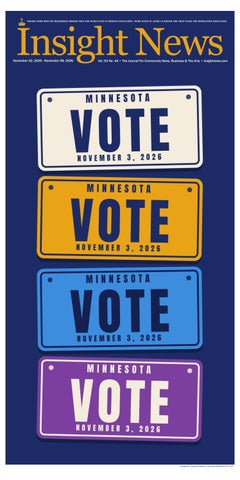
Insight News
INSIGHT NEWS WON THE MESSENGER AWARDS 2024 F OR THIRD PLACE IN WEBSITE EXCELLENCE, THIRD PLACE IN LAYOUT & DESIGN AND FIRS T PLACE F OR NEWSLETTER EXCELLENCE.
November 02, 2026 - November 08, 2026
Vol. 53 No. 44 • The Journal For Community News, Business & The Arts • insightnews.com
Concept by: Associate Editor & Associate Publisher B.P. Ford
Page 2 • November 02, 2026 - November 08, 2026 • Insight News
insightnews.com
Visit West Broadway The West Broadway Business & Area Coalition’s mission is to create an inviting and vital West Broadway Corridor, and to transform the Northside into a thriving economic community.
BLO IS THE BASKETBALL LOVER'S OUTLET 2220 W BROADWAY AVE, MPLS | 612-522-4384 | BROADWAYLIQUORS.COM | MON-SAT 10A-10P, SUN 11A-6P
insightnews.com
Insight News • November 02, 2026 - November 08, 2026 • Page 3
Insight News
INSIGHT NEWS WON THE MESSENGER AWARDS 2024 F OR THIRD PLACE IN WEBSITE EXCELLENCE, THIRD PLACE IN LAYOUT & DESIGN AND FIRS T PLACE F OR NEWSLETTER EXCELLENCE.
November 02, 2026 - November 08, 2026
Vol. 53 No. 44 • The Journal For Community News, Business & The Arts • insightnews.com
Why your vote for local chief prosecutor will matter on Election Day By Ronald Wright
Professor of Criminal Law, Wake Forest University
Cedrick Frazier
Anders Folk
Hennepin County attorney candidates debate justice, policing and accountability
Before most Americans step into the voting booth in November, they will already know their choices at the top of the ballot, in races for governor, the Senate and House of Representatives. But a race near the bottom of the ballot – for the chief prosecutor in their local district – will probably affect the voters’ lives more directly. As a former prosecutor and as a scholar of the criminal courts for over three decades, I have seen how local district attorneys take the lead in responding to crime. This vote matters.
A prosecutor’s portfolio
The chief prosecutor in local criminal courts – the titles vary, such as district attorney, prosecuting attorney, state’s attorney or county attorney – has enormous discretionary power over criminal law enforcement. While state legislators pass the statutes that define crimes, local prosecutors decide where to spend limited enforcement dollars. They decide which cases to file and work with the police to address the crimes that matter most in each county. Prosecutors also choose how to negotiate guilty pleas. While judges select criminal sentences in each
PROSECUTOR 11
Cedrick Frazier and Anders Folk answered questions on community trust, mandatory minimums, child protection, youth violence and federal agents at an Oct. 26 forum in North Minneapolis
Editor
By Al McFarlane State Rep. Cedrick Frazier, the DFL-endorsed candidate for Hennepin County attorney, said he wants every community in the county to feel it when crime rates fall. He said: “When we’re looking at crime data and we’re
saying that crime rates are going down, I want to make sure every single community within the county feels that.” Frazier and Anders Folk, a nonpartisan candidate and former acting U.S. attorney, took questions at an Oct. 26 debate at Sanctuary Covenant Church on West Broadway in North Minneapolis from moderator Justin Terrell, executive director of the Minnesota Justice Research Center, and from the audience. Insight News was a media partner for the forum. Frazier, who grew
up in Chicago’s Englewood neighborhood and has served six years in the Legislature, said his vision is simple: make sure the office works for everybody. Folk described the job as chief prosecutor and chief lawyer for county government. He centered his vision on crime victims and equal treatment: “Everybody deserves the same justice, everybody deserves the same accountability.” On the office’s relationship with Black residents, Frazier rejected the assumption that the Black community does
not want more safety. He said: “We want more safety. We’re not saying we need to get rid of police.” Folk said he was proud of launching, as acting U.S. attorney, a federal pattern-or-practice investigation into the Minneapolis Police Department. He described communities of color as historically over-policed for minor offenses and under-policed on violent crime. Both candidates described how they would use
HENNEPIN 11
Paul Wickstrom calls for fraud oversight, public safety and broader outreach
Sharon El-Amin emphasizes accessible county government, health care and housing
Paul Wickstrom
Sharon El-Amin
This interview aired live on The Conversation with Al McFarlane on KFAI 90.3 FM on Tuesday, October 27, 2026. Paul Wickstrom, the Republican-endorsed candidate for U.S. House, Congressional District 4, told Insight News Editor-in-Chief Al McFarlane, host of The Conversation with Al McFarlane on KFAI 90.3 FM, that fraud, affordability, a stronger economy and public safety are the center of his campaign. He is challenging incumbent U.S. Rep. Betty
McCollum. The interview also turned to how Republicans engage Black voters and where he stands on reparations. Election Day is Tuesday. Wickstrom responded to the general invitation that went to every candidate featured in the Insight News voters guide series. McFarlane opened by telling Wickstrom that few Republican-endorsed candidates
WICKSTROM
6
Sharon El-Amin, a Minneapolis School Board member running for the Hennepin County Board's District 2 seat, said county government should be easier for residents to reach and quicker to respond on health care, housing assistance and other services. In an interview on The Conversation with Al McFarlane on KFAI 90.3 FM ElAmin described her candidacy as building on 30 years of relationships in the community. Election Day is Tues-
What we are saying about the midterms By Al McFarlane Editor-In-Chief Black political representation, voting access and the administration of justice connect the races Black publications are following ahead of Election Day, Tuesday, November 3. This roundup draws on Black Press USA, Ebony, theGrio and Insight News. Their reports span February 27 through October 26; candidate descriptions and figures below come from those dated accounts.
Voting rights and political power
day.
El-Amin said she moved to Minnesota from Chicago in 1991 with her threeyear-old daughter and has lived in Minneapolis about 34 years. She said she married into the El-Amin family, which she called "a very strong family here in North Minneapolis." She has owned a daycare and, for 13 years, Ella Mae's Fish House at Broadway and Penn.
EL-AMIN
6
Lauren Victoria Burke, writing for Black Press USA on February 27, reported that a group of pro-Trump activists was circulating a draft executive order that would claim, without evidence, that China interfered in the 2020 election, and
By Guilherme Casarões
From Bahia, a lesson in the power of organizing This interview was recorded on StreamYard on Oct. 26, 2026, for The Conversation with Al McFarlane on KFAI 90.3 FM. It streamed to social media on Friday, October 30, 2026. The KFAI broadcast date is pending. "We won." That was the message Yoji Senna Adewale Ogunsola gave Al McFarlane by phone from Bahia, Brazil, on the morning after the country's Oct. 25 presidential runoff. A short time later, in an interview recorded for The Conversation with Al McFarlane, Ogunsola described the victory of President Luiz Inácio Lula da Silva as a win for people long discriminated against inside their own country.
Three weeks ago, Brazilian President Luiz Inácio Lula da Silva’s political obituaries had all been written. The far-right presidential candidate, Flávio Bolsonaro, son of the jailed former President Jair Bolsonaro, had come out of the first round of the presidential election with a lead that looked impossible to overcome. At 80 years old, Lula seemed headed for a quiet exit after four decades at the centre of Brazilian political life. On Sunday, however, Lula proved everyone wrong. He won the runoff and secured a fourth non-consecutive term
said, call Nordestinos undereducated and dependent on social welfare. Lula is himself a Nordestino, Ogunsola noted, one who migrated south looking for a better job. He described Lula's rise from a child shoeshiner to factory work and to organizing workers' strikes during the last years of Brazil's military dictatorship. He tied the region's politics to questions of development. The Northeast has historically suffered droughts, he said, and still lacks investment. He credited Lula with the transposition of the São Francisco River, a large infrastructure project to bring irrigation to places that
I2H
How the law protecting Americans from surprise medical bills is driving up healthcare costs
PAGE 7
Yoji Senna
POWER
6
MIDTERMS
6
Lula wins a ‘miracle’ election in Brazil. Now comes the hard part: putting the country back on the right track Associate Professor of Brazilian Studies, Florida International University
Ogunsola, a capoeira master who lives in Bahia, spoke as a supporter of Lula. He framed the result in moral terms. "I say that the good won over evil," he said. By "we," he explained, he meant the people of Brazil's Northeast, and of Bahia in particular, who he said tipped the balance in the previous election and were fundamental in this one. Ogunsola focused on the Nordestinos, the people of the Northeast, who he said migrate to Brazil's industrial areas in search of work. He compared their place in Brazilian society to that of Latino and Mexican immigrants in the United States. Many people in the South, he
would use that claim to justify a national emergency and new authority over voting systems. She said The Washington Post first reported the effort. Burke also reported that the Justice Department sued five new states on February 26 to demand access to their unredacted voter rolls, citing Democracy Docket. Burke added her own political assessment: Republicans are widely expected to lose amid a failing economy under Trump and are about to be hit by a blue wave of Democratic victories. Ebony’s A.J. Weddington reported August 26 that eight Black major-party gubernatorial candidates would appear on November ballots, a record the publication attributed to The Associated Press. The coverage connects representa-
as Brazil’s president.
A night of firsts
The election result is unprecedented in Brazilian politics in at least three ways. First, no Brazilian presidential candidate had ever won the first round and then lost the runoff. Since the two-round system was adopted by the 1988 Brazilian Constitution, the firstround leader had always gone on to win. Lula broke that pattern by turning a defeat of around 2.2 million votes in the first round into a solid victory, in three weeks. Second, no Brazilian president has ever been elected to four terms. When his new term ends, Lula will have governed Brazil for 16 (non-con-
ELECTION
9
Business
Social Security benefits will rise 3.6% in 2027, but that may not be enough to offset healthcare costs
PAGE 8
Page 4 • November 02, 2026 - November 08, 2026 • Insight News
insightnews.com
Commentary Who gets to decide what matters? A lesson from Black women's hair Columnist
By Haley Taylor Schlitz, Esq. At a beauty pageant, I once watched a white woman coordinating the event ask another Black woman whether she would be willing to straighten her hair. The question was asked almost casually, as though changing something so personal were simply another detail to work out before the competition. But I remember how much that small exchange revealed. Here was an event devoted to celebrating women's beauty, yet a Black woman's natural appearance could still be treated as negotiable, subject to someone else's approval. I thought about that moment often during the years I spent helping advocate for the CROWN Act in Texas. It captured something Black girls learn long before we have the language to explain it: Our hair
Image created with AI
can become a public conversation even when we never invited anyone to participate. The questions begin early. Is that your real hair? Can I touch it? How do you wash it? Why don't you straighten it? Sometimes a stranger's hand reaches toward your head before you can answer. Sometimes the questions come wrapped in compliments or curiosity. Yet beneath them is the expectation that Black girls should explain something about themselves that others are simply allowed to possess.
Our hair is also one of the most intimate and joyful parts of Black life. It is family, memory, creativity and culture. It is the conversations that happen during hours spent getting braids, the excitement of trying a new style and the confidence of discovering what makes you feel beautiful. But those experiences coexist with a reality generations of Black women know: The way we wear our hair can influence judgments about our professionalism, intelligence, attractiveness and belonging. That is why I testified
in support of the Texas CROWN Act and joined others working for its passage. We were not simply asking lawmakers to affirm that natural Black hair is beautiful. We were asking them to recognize that judgments about our hair can have consequences in classrooms and workplaces, and that those consequences warrant legal protection. I could not claim every Black girl had the same experience. But I knew how often the expectation to accommodate someone else begins with a supposedly harmless question, and
how easily that expectation can harden into a rule. Texas enacted the CROWN Act in 2023. Minnesota passed its own version that same year. Neither eliminated the prejudices that made it necessary, but both recognized experiences Black people had spent generations navigating privately as matters of public responsibility. I carried that history with me when I read the lawsuit Minnesota Attorney General Keith Ellison filed against L’Oréal and several related companies on October 22. The complaint alleges that chemical hair relaxers marketed to Black women and girls were sold without adequate disclosure of serious health risks associated with their use. It identifies familiar brands, including Dark and Lovely, Optimum and Mizani. On page 20, a little Black girl smiles from a bright
pink package of hair relaxer. The product line is called *Beautiful Beginnings*. Other advertisements promise gentle straightening, nourishment and protection, including one assuring families that girls can achieve straight hair without hurting their scalps. I found myself lingering over those images. A girl looking at the box would see a vision of beauty; her mother might see a promise of care. Neither should be expected to investigate years of scientific studies while standing in a store aisle. For generations, Black mothers have made decisions about their daughters' hair in a world that has not always been kind to Black girls. A mother choosing a relaxer may have been seeking convenience,
HAIR 11
INSIGHT NEWS www.insightnews.com
Insight News is published weekly, every Monday by McFarlane Media Interests.
National Newspaper Publishers Association (NNPA)
CEO/Editor-In-Chief Al McFarlane
Postmaster: Send address changes to McFarlane Media Interests, Marcus Garvey House 1815 Bryant Avenue North, Minneapolis, MN, 55411
COO/Associate Publisher Trena V. Stubbs Publisher Batala-Ra McFarlane Associate Editor & Associate Publisher B.P. Ford Web Administrator Sunny Thongthi Yang Associate Editors Afrodescendientes Jesús Chucho Garcia Macdonald Anyanwu Book Review Editor W.D. Foster-Graham Sports Editor Leahjean M. Denley Contributing Writer Pulane Choane Columnist Haley Taylor Schlitz
KEITH ELLISON fo r Att o r n e y G e n e ra l
STEVE SIMON
fo r S e c re t a r y of State
AMY KLOBUCHAR
PEGGY FLANAGAN
fo r G ove r n o r
fo r U. S . S e n a t e
BEN SCHIERER
ZACK FILIPOVICH
fo r L i e u t e n a n t G ove r n o r
fo r S t a t e Auditor
OFFICIAL 2026 GENERAL ELECTION SAMPLE BALLOT V O T E B Y N O V E M B E R 3 R D | I W I L LV O T E . C O M
PAID FOR BY THE MINNESOTA DEMOCRATIC-FARMER-LABOR PARTY (DFL.ORG), AND AUTHORIZED BY PEGGY FLANAGAN FOR MINNESOTA.
Distribution Sound Construction Photographer Uchechukwu Iroegbu Roy Lewis - Washington D.C. Artist Donald Walker Digital Producer Jared McMullin Graphic Designer Syed Fahad Fayyaz Contact Us: McFarlane Media Interests, Inc. Marcus Garvey House 1815 Bryant Ave. N. Minneapolis. 55411 Ph.: (612) 695-0417 Member: Minnesota Multicultural Media Consortium (MMMC) Minnesota Newspaper Association (MNA)
News, opinion and advertising at Insight News Our news reporting is fair, accurate and impartial. We report in context — the historical and cultural context that explains why a story matters to this community is part of the reporting, not a departure from it. When we endorse a candidate or take a position, we say so plainly and label it as such. Endorsements and commentary are separate from news coverage. Advertising is a business function. Advertisers do not influence our news coverage, our endorsements or our commentary — and our coverage does not depend on who buys space in this paper. That wall stands, and we are telling you it stands. Insight News uses AI-assisted tools in some editorial production. Read our AI Policy & Transparency Statement at www.insightnews.com/site/ ai_policy.html.
insightnews.com
Insight News • November 02, 2026 - November 08, 2026 • Page 5
Credit: AP: Gregorio Borgia
Activists in front of the Colosseum in Rome on Saturday
Europe’s youth protests and the great remembering By Jim Embry Guest Commentary I am writing from Montgomery, Alabama, where I am attending Tuskegee University’s Professional Agricultural Workers Conference. From this city, whose streets helped change the course of the freedom struggle, I am thinking about young people filling streets across Europe. Their demands for decent schools, affordable homes, and a livable future reach me across an ocean. I recognize something
of the moral insistence that brought my generation into the civil rights movement. I left Italy on September 28 after my ninth journey to Terra Madre, the international Slow Food gathering, and spent several days in Paris before leaving on October 3. The French student movement was already beginning; its subsequent expansion has made these reflections especially immediate. I write as a recent visitor, an elder, and an agrarian intellectual activist who supports young people’s right to challenge the conditions shaping their lives.
Reporting describes protests in France, Belgium, Italy, Spain, Portugal, and Albania, with related mobilizations elsewhere. These movements have different beginnings and demands. They are not one organization, and they did not all originate in France. Yet they reveal overlapping grievances: institutions that ask young people to prepare for the future while making that future increasingly difficult to inhabit. French students describe inadequate facilities, missing teachers, and overcrowded classrooms. Housing
IWILLVOTE.COM LEAD THE FIGHT AGAINST DONALD TRUMP INVESTIGATE ICE’S MURDERS AND STOP THEM FROM TERRORIZING OUR COMMUNITIES TAKE ON GUN MAKERS AND MAKE OPIOID COMPANIES PAY FOR THE LIVES THEY DESTROYED HOLD BAD LANDLORDS ACCOUNTABLE AND STOP THEM FROM RIGGING RENT PRICES PREPARED AND PAID FOR BY THE KEITH ELLISON FOR ATTORNEY GENERAL CAMPAIGN
and living costs feature prominently in the wider European unrest. A young person’s education cannot be separated from whether their family can afford rent, food, heating, and transportation. A school building belongs to the same social world as an unaffordable apartment and an insecure job. This is what I mean by poly pandemics. In my 2020 Lexington Herald-Leader commentary during COVID-19, I used that language to describe the overlapping crises through which we were living. I return to it now
because a vocabulary limited to separate emergencies cannot adequately describe a life lived under their combined weight. Here, “pandemics” names interconnected social and ecological harms as well as the infectious disease that exposed them. Racism compounds economic insecurity. Unaffordable housing undermines education and health. Environmental devastation makes precarious lives more dangerous. War destroys communities and diverts resources from the work of sustaining them. The suffering of Palestinians belongs within this
moral reckoning, alongside the wider costs of perpetual militarism. I do not assume that every European protester shares this entire analysis. It is the larger relationship I see. Extreme heat makes these connections tangible. A classroom that becomes unsafe in summer is simultaneously an educational problem, an infrastructure problem, and a climate problem. Families cannot adapt to dangerous temperatures if they cannot afford adequate
PROTESTS 10
Page 6 • November 02, 2026 - November 08, 2026 • Insight News
Midterms From 3 tion to decisions on education, health care, voting rights and economic opportunity. Gerren Keith Gaynor’s October 1 theGrio report estimated approximately 35 million eligible Black voters nationally, including 4 million in Texas.
Texas U.S. Senate
Democratic state Rep. James Talarico faces Republican Attorney General Ken Paxton, according to theGrio. Talarico held a small lead, as theGrio reported October 1. Talarico previously told theGrio that Black voters are essential to winning the state: “There is no way to win Texas without Black Texans, and there’s no way to effectively represent this state in the United States Senate without listening to and showing up for Black communities.” The same account described allegations that Paxton engaged in bribery, abuse of official office and retaliation against whistleblowers, and reported his 2023 impeachment by the Texas House and subsequent acquittal by the state Senate. “We have an affordability crisis because we have a corruption crisis,” Talarico also told theGrio.
Georgia governor
Democrat Keisha Lance Bottoms, Atlanta’s former mayor, faces Republican businessman Rick Jackson. They were in a dead heat, as theGrio reported October 1. TheGrio said Bottoms could become the first Black woman elected governor in U.S. history. It described her proposals to expand Medicaid, provide universal pre-K and eliminate state income taxes for teachers. Bottoms previously told theGrio that she would be a fighter for Georgia and for democracy: “It may not be perfect, but I believe it’s still worth
Wickstrom From 3 have appeared on the program despite invitations, and he said he was raising that as a complaint about the party's posture toward the Black and progressive communities. Wickstrom answered, "I accept your complaint with humility, and I would also say that I'm not your typical Republican." He said he has been at Rondo Days and Selby Days and wants to understand the needs of communities across the district. Wickstrom said he was born and raised in Montana and North Dakota, and that one of the defining things that happened to him was "my brother committed suicide when I was 16 years old." He said he lived with friends, family and then in foster care during his senior year of high school. After work-
El-Amin From 3 She said her faith is Islam and that she is a member of Masjid An-Nur. "I say all the time I live, work, and worship right in my community," she said. El-Amin has served six years on the Minneapolis School Board, representing District 2, and is executive director of McKinley Community Center. She said she first sought office because she saw something missing at the table: someone rooted in the community. She traced that to her time on the PTA when her sons
Power From 3 were historically dry. The conversation also turned to organization. Flávio Bolsonaro, Lula's opponent in the runoff, and his allies won the first round, Ogunsola said, and believed the contest was over. "That was their mistake: they got complacent," he said. Bolsonaro, who lost
fighting for, and part of fighting for our democracy means fighting to maintain the integrity and the sanctity of our right to vote.”
Illinois U.S. Senate
Democratic Lt. Gov. Juliana Stratton faces Republican nominee Don Tracy, theGrio reported October 1. Its coverage emphasizes Black women’s Senate representation and Stratton’s proposals to abolish ICE, establish Medicare for All and raise the minimum wage. TheGrio reported that Stratton wants federal agents and President Trump held accountable for actions she believes broke the law, and that she called on them to be investigated and prosecuted.
Wisconsin governor
describes El-Sayed as a physician and former Wayne County health director, and Rogers as a former congressman and FBI agent. Separately, theGrio’s October 1 report quotes El-Sayed, who told a political influencer that his commitment to Black communities was no photo op: “It started when I left my tenure-track job at an Ivy League school to come back to rebuild the health department in the city of Detroit, which is the largest majority-Black city in the country.” TheGrio identifies Medicare for All and universal child care among his priorities. On “The Clay Cane Show” on SiriusXM, theGrio reported, El-Sayed said Rogers and the Trump administration are pushing policies that go after people of color, and added: “We can come together around this and say that proximity, that shared fight, is something that can bring us together, help us to heal divides.”
insightnews.com publication identifies James as a former Army officer and businessman who could become Michigan’s first Black governor. It frames the race around leadership of a key swing state.
Nevada governor
Democratic Attorney General Aaron Ford challenges Republican Gov. Joe Lombardo, according to Ebony’s August 26 account. Ford could become Nevada’s first Black governor. The publication connects the contest to education, economic opportunity, abortion and voting access in a diversifying state.
South Carolina governor
Democratic state Rep. Jermaine Johnson faces Republican Attorney General Alan Wilson, Ebony reported August 26. Its account places Johnson among the Black major-party gubernatorial candidates and considers what his candidacy means for representation in the Deep South.
Figures faces Republican state Rep. Rhett Marques, according to Ebony’s August 26 report. Its account says revised boundaries reduced the district’s Black voting-age population from about 48% to about 40%, linking the contest to the U.S. Supreme Court’s weakening of a major part of the Voting Rights Act and to Black congressional representation.
Michigan 13th Congressional District
Democratic state Rep. Donavan McKinney faces Republican Taras Nykoriak, Ebony reported August 26. The publication describes McKinney’s campaign as seeking stronger Black representation for Detroit following his primary victory over incumbent U.S. Rep. Shri Thanedar.
Justin Terrell Minnesota: justice on the ballot
Alabama 2nd Congressional District
Democratic U.S. Rep. Shomari
TheGrio’s October 1 report names N’Kiyla “Jasmine” Thomas in discussing Black women seeking Senate seats.
Justin Terrell, Minnesota Justice Research Center executive director, wrote in Insight News October 26 that justice is on the ballot in the offices of Hennepin County attorney, Minnesota attorney general, judges, sheriffs and prosecutors across the state. His column names offices rather than candidates. Citing polling from the end of 2025, Terrell reported that 61% of Minnesotans supported major changes or a complete overhaul of the criminal legal system. Terrell wrote that the center paused its annual Reimagining Justice Conference to focus on civic engagement through interviews with Hennepin County attorney candidates, civic education and neighborhood canvassing. Terrell wrote: “This election and every election, justice is on the ballot.” The center’s efforts included a democracy fair for justice-impacted Minnesotans and a conversation about neighbors building safer communities. Terrell wrote that the officials elected to these offices would respond to the next officer-involved shooting, investigate human trafficking and sexual assault, and address racial disparities.
unstated. He said Congress is responsible for the budget and oversight. Wickstrom said McCollum has been silent on fraud. "I would go to Washington, I would want to shut off the deficit spending," he said. Asked whether Republicans are providing that oversight, he answered, "Well, there's definitely some challenges and some gaps there." He did not name programs or agencies that should face expanded audits. On taxes, Wickstrom said property taxes are the concern he hears most in the district. He attributed rising property taxes partly to unfunded or partially funded federal and state mandates passed down to local governments, and said renters feel the effect when landlords pass costs along. On immigration, Wickstrom said the United States is a country of immigrants. He did not address McFarlane's question about cartel supply lines and fentanyl. He
said he supports legal immigration and strong border-control laws, wants newcomers admitted in a controlled way, and wants them off public assistance five years after they arrive. He described an order of priority: "Priorities should be given to U.S. citizens first, people who are legally applying to be here second, and then those who are illegal immigrants, we really need to make sure that they're not here." He added that exceptions could be made in some cases for people who are living good lives and contributing. Early in the interview, Wickstrom said, "I'm really concerned about the sweeping Somali gang violence that we've had in the last three, four, or five weeks in the Twin Cities." Asked later about the Somali community and youth violence, he said fraud and gang violence in that community must be pursued through law enforcement and the criminal justice system. "It's tragic what's happened," he
said. Wickstrom said McCollum has been silent on the violence. Asked whether fraud and youth violence are connected, he said, "I think they're separate matters, but when you step back and look at it, it seems like there's a possible connection there, and it's one that I'm concerned about." He said Somali community leaders need to lead efforts to stop the violence. He proposed federal funding for more police officers and tying federal funds to cities meeting their charter obligations to provide public safety. Wickstrom said he thinks Minneapolis is supposed to have "seven hundred and some" officers and is below 500 now. McFarlane then asked how Black people view the Republican Party under President Trump, including whether Wickstrom understands fears that its policies would return Black people to second-class status. "I have a perception of
what you just said-there's fear," Wickstrom said. "I don't presume to know what's in everybody's head as far as what their concerns are." He added, "I do not view the Black community as a second-class group." McFarlane asked how calls for reparations resonate with him, citing stolen labor and public policy that enabled it. "I don't agree with the concept of reparations," Wickstrom said. He said that "we're talking generations later than the infraction or the injustice that happened leading up to the Civil War and since." He said Americans should work together going forward toward equal footing and equal opportunity. In closing, Wickstrom said, "We Republicans have to do more to get engaged into the communities and the cities, and I am committed to doing that." He directed listeners to his Wickstrom for Congress website and social media.
attended North High School. She said leaders with access to what North Minneapolis needs are not making the right decisions and partnerships. Moving to the county, she said, would let her bring more resources to the community, invest in youth, build local business and make health and human services easier to reach. McFarlane asked whether the incumbent has been accessible and how El-Amin would do things differently. "I govern in a different way than our current incumbent does," she said. She proposed quarterly meetings among county commissioners, the mayor and city council members to discuss budgets, challenges, road construction and other in-
frastructure, and a newsletter every week or two tailored to each area, because the county extends beyond North Minneapolis. "I plan to lead the same way that I am campaigning right now-with keeping folks engaged, making sure they can find me, answering calls, and responding to emails," she said. Asked about Hennepin Healthcare and Hennepin County Medical Center, which McFarlane described as a safety-net hospital facing financial and administrative pressures, El-Amin said she has spoken with state legislators and hospital employees. She said she was glad to see a board coming back that would include county staff, community members and people doing the work on the ground.
"That board should have never dissolved back in 2023," she said. She said commissioners and community members need a seat at the table as budgets are reviewed, and that partnerships can help ensure families receive services. She said the $705 million the state legislature provided for the hospital was welcome and is a one-time fund. "So these conversations need to be happening now in real time so that we don't wait until there's a crisis and have to pivot," she said. On mental health and crisis response, El-Amin said she would partner with community agencies already doing the work and invest more in youth through music, art and
swimming, which she said can help ease stress and mental illness in the community. She said sheriff's officers and police should have the resources they need, and she cited the difference between two EMTs in an ambulance and one. She said she believes crime would fall as the county builds business, strengthens partnerships and gives people alternatives. On housing, El-Amin said people she has heard from, including family members, have received letters approving emergency assistance after they were already evicted. She proposed faster, more equitable applications and an approval letter issued once all information is in the system, so that the letter
can stop an eviction. She said one person told her they were on hold for about three hours. "We should have access to information at our fingertips," she said. She said the county has vacant land and that she supports bringing in developers to build affordable homes and homes for working families. Asked for a final word, El-Amin urged voters to turn out Tuesday. She said that "when you choose not to vote, that is your vote, and your voice is your vote." She said people can vote now or on Election Day, asked them to tell a friend and make voting a family event, and pointed to the school referendum and other races on the ballot.
the runoff, rejected the results, according to CBS News. Ogunsola described a digital campaign as the other half of that effort. After the first-round loss, he said, federal deputy André Janones of Minas Gerais mobilized an online network in the last two weeks of the campaign. The network goes by O Exército de Lula, or Lula's Army. Supporters, Ogunsola said, used WhatsApp lists to coordinate actions against what he called big tech, meaning In-
stagram and Facebook, and to launch hashtags on X. He called the combination of street action and online mobilization a model for defeating what he calls fascists. "I think what we did is we gave a blueprint [for] how to defeat fascists in the twenty-first century," he said. He then spelled out the two parts of the strategy. "It's not only necessary [to have] the streets, boots on the streets, but it's necessary [to have] that same mobilization online," he
said. He warned, "By doing just protests, we're going to be gassed, we're going to be killed, beaten up." Demonstrations need a strategy to keep people safe, he said, paired with coordinated action on social media. Ogunsola drew parallels with the United States. Brazil, he said, is a large country of immigrants and of descendants of enslaved and Indigenous people, much like the United States, and what happens culturally and politically in the United States
tends to reach Brazil sooner or later. He said the rise of the MAGA movement empowered Brazil's far right. He also pointed to higher education. Free federal universities and quota policies, he said, mean many students are now the sons and daughters of maids, bricklayers, factory workers and market vendors. After the first-round loss, he said, university students began protesting. Ogunsola said Lula
"recognized that ... he lost in the first [round] because ... the sympathizers were not mobilized." McFarlane closed the interview by saying Ogunsola had described the benefit of aggressive grassroots organizing and of aggressively adopting the technology that others have used against their communities. Ogunsola's message from Bahia was a two-part strategy: boots on the ground and a swarm of voices online.
Democratic Milwaukee County Executive David Crowley faces Republican U.S. Rep. Tom Tiffany. The contest stood at a statistical tie, as theGrio reported October 1. Ebony’s August 26 account said Crowley could become Wisconsin’s first Black governor. Crowley told theGrio his priorities include utility and housing costs and access to child care and health care. Crowley told the publication: “We need a governor who’s going to be steady, who’s going to be responsible, who’s going to be focused on getting things done.”
Georgia U.S. Senate
Florida governor
Ebony reported August 26 that Republican U.S. Rep. Byron Donalds faces Democrat David Jolly, a former Republican congressman who changed parties. Its coverage identifies the possibility of Donalds becoming Florida’s first Black governor and examines the coalition a Black Republican would need to win statewide.
Democratic Sen. Jon Ossoff faces Republican U.S. Rep. Mike Collins. TheGrio’s October 1 account links Black turnout to Ossoff’s 2021 election. It reports that Ossoff accused Collins of being a known bigot. TheGrio’s account did not include a response from Collins. Ebony’s August 26 report describes Collins campaigning on veterans’ issues, living costs and conservative policies.
Florida U.S. Senate
Michigan U.S. Senate
Democrat Abdul El-Sayed faces Republican Mike Rogers. Ebony’s August 26 account
Democratic Secretary of State Jocelyn Benson faces Republican U.S. Rep. John James, Ebony reported August 26. The
ing in the oil fields, he said, he earned an electrical engineering degree at the University of Minnesota and built a career in aerospace and medical devices. "I'm a problem solver," he said. He also said that in 2024 he opposed a legislative candidate who he said did not live in the district and was disqualified. If you or someone you know needs support, call or text the 988 Suicide & Crisis Lifeline at 988. Wickstrom said his seven-point plan to fight fraud includes extending the statute of limitations for fraud charges, using artificial intelligence and other analytics to follow the flow of money, and holding states accountable, which he called the biggest gap. He said the national debt stood at $40 trillion a few months ago and that deficit spending is $2.1 trillion a year, and he said onefourth of that deficit is estimated to be fraud. The interview left the source of that estimate
Democratic state Rep. Angie Nixon faces Republican Sen. Ashley Moody, according to Ebony’s August 26 report. Nixon’s candidacy raises the possibility of Florida electing its first Black U.S. senator. Ebony identifies Moody as a former state attorney general appointed to the Senate after Marco Rubio became secretary of state.
Michigan governor
Mississippi U.S. Senate
Democratic prosecutor Scott Colom challenges Republican Sen. Cindy Hyde-Smith, according to Ebony’s August 26 report. The publication identifies jobs and health care as Colom’s campaign concerns and says he could become Mississippi’s first Black U.S. senator. Its analysis stresses the need for a coalition extending beyond Black voters.
North Carolina U.S. Senate
Former Democratic Gov. Roy Cooper faces Republican Michael Whatley, a former Republican National Committee chairman, Ebony reported August 26. The publication identifies the seat as being vacated by Republican Sen. Thom Tillis and places Black electoral influence and Senate control among the stakes.
Florida 20th Congressional District
Democratic U.S. Rep. Debbie Wasserman Schultz faces Republican businessman Brent Andersen, according to Ebony’s August 26 report. Its coverage examines redistricting and the debate over representation in a district historically represented by Black lawmakers. Ebony named former U.S. Rep. Sheila Cherfilus-McCormick, Dale Holness and Elijah Manley among the Black candidates who challenged Wasserman Schultz in the primary.
Georgia 13th Congressional District
Democratic state Rep. Jasmine Clark faces Republican Jonathan Chavez, Ebony reported August 26. The publication identifies Clark as a microbiologist and Emory University lecturer and places the contest within the succession to the late Democratic U.S. Rep. David Scott.
Oklahoma U.S. Senate
insightnews.com
Insight News • November 02, 2026 - November 08, 2026 • Page 7
Insight 2 Health
How the law protecting Americans from surprise medical bills is driving up healthcare costs By Lindsey Murtagh Distinguished Senior Fellow in Health Law, Brown University Imagine you get hit by a car. An ambulance brings you to the nearest hospital. Your private health insurance covers emergency care, but the hospital isn’t in your plan’s network. Before 2022, if you received emergency care from an out-of-network provider or hospital, you could get hit with an extra, often huge bill on top of what you owe as a copay, coinsurance or deductible. A law called the No Surprises Act, which took effect in 2022, was designed to protect people with private health insurance from just these situations. It limits your costs to what you would have paid if the ambulance had brought you to an in-network hospital or you were treated by an in-network provider instead. As a health policy researcher and a former federal employee who helped draft the rules to implement the No Surprises Act, I applaud the law’s success in preventing patients from being hit with surprise medical bills in most cases. However, a small number of out-of-network providers are using the law to extract enormous payments from health plans. This behavior is starting to drive up the cost of coverage for both employers and individuals. In my view, if left unaddressed, these increases will only get steeper.
Medical bill concerns
The No Surprises Act was designed to address a troublesome feature of the U.S. healthcare system: It is notoriously difficult to predict how much your healthcare will cost. This is especially true when someone receives out-of-network care. Before the law went into effect, roughly 20% of inpatient emergency department visits resulted in a surprise bill from an out-of-network provider. Surprise bills are common for other types of care too. One study found roughly 40% of air ambulance rides resulted in a surprise bill, costing an average
Image created with AI
of almost US$20,000. The threat of these bills exacted an enormous emotional and financial toll. Roughly two-thirds of Americans reported being very or somewhat worried about unexpected medical bills, according to a 2020 poll conducted by KFF, a national health policy nonprofit.
Security from surprises
The No Surprises Act protects Americans from certain instances of a practice called balance billing, in which an outof-network hospital or doctor asks you to pay the difference between what they billed for a service and what your insurance agreed to pay for it. When a provider joins your plan’s network, they agree to accept a specific payment for a given service or procedure. They agree to charge you only for cost sharing, such as a copayment, coinsurance or deductible, and they aren’t allowed to balance bill you. However, plans can’t prevent out-of-network providers or facilities from balance billing. On top of that, your own plan may also charge you a higher copayment, coinsurance or deductible when you go out of network. That’s why out-ofnetwork care can be much more expensive than in-network care. The No Surprises Act protects consumers from these extra costs in cases where they have little or no control over whether they see an in- or outof-network doctor. The law prohibits balance billing and requires cost sharing to be at
approximately in-network levels in three cases where surprise medical bills were common: If you receive outof-network emergency care at a hospital or independent freestanding emergency facility. In a medical emergency, you’re not expected to figure out whether the closest hospital is in-network. You can’t be balance billed. If an out-of-network provider treats you during a visit to an in-network hospital or ambulatory surgical center. For example, if an out-of-network anesthesiologist cares for you during a surgery at an in-network hospital, that anesthesiologist cannot balance bill you. If you receive out-ofnetwork air ambulance services. The No Surprises Act doesn’t prevent big, unexpected medical bills in all cases. For example, you can still get balance billed for ground ambulance services or if you see an out-of-network doctor outside of a hospital or ambulatory surgical center.
ing how much insurance plans should pay out-of-network providers, the law allows providers who are dissatisfied with the plan’s payment to bring disputes to arbitration. Each side submits an offer. The arbitrator must select one party’s offer as the outof-network payment. To choose an offer, the arbitrator considers information submitted by both parties. Information can vary by case. But the law requires the arbitrator to always consider an amount that is basically the middle amount the health plan pays in-network providers for the same service. Health policy experts like me anticipated most disputes would be settled close to this amount. Over time, experts expected this would put downward pressure on the cost of healthcare and result in payments to both in- and out-ofnetwork providers going down. The Congressional Budget Office predicted these lower payments would reduce premi-
ums for consumers by 1% and reduce federal deficits by $17 billion. As a federal employee, I worked on rules that would have required the arbitrators to treat the middle amount as a strong benchmark. I expected those rules to achieve savings like those predicted by the Congressional Budget Office. But lawsuits from providers blocked those rules from going into effect. Without those rules, arbitrators are selecting offers that are far above what plans would pay in-network. The winning offers are also much larger than what Medicare would pay for the same service. Providers are winning the vast majority – roughly 85% – of these disputes. They are also using arbitration more than expected. The federal government estimated there would be 17,000 disputes annually. Last year, there were more than 2 million disputes, many brought by providers with private equity investment. And the volume of disputes has grown every year. Frequent and big provider wins at arbitration will not put downward pressure on healthcare prices. They will likely do the opposite.
Consumers bear the cost
When a provider wins an arbitration dispute, an individual patient’s cost sharing doesn’t change. It is capped at what the in-network amount would have been. However, consumers as a group are the ones who ultimately will pay for the cost of arbitration. Researchers estimate the arbitration process alone cost health plans $22.4
billion in the law’s first four years. This doesn’t include the increases in in-network rates that are likely to occur if arbitration trends continue on pace. I’m concerned that to pay for this, insurance companies will increase rates. Employers will need to budget more to pay for health insurance or increase the amount their employees pay. We’re already seeing the costs of arbitration affect the price of health insurance. The New York state employee plan reported that the No Surprises Act was a key driver behind the plan’s 10% rate hike for 2027. A Texas city reported the No Surprises Act caused its employee plan to exceed its 2026 budget by $40 million. Right now, only a small portion of providers use arbitration. If volume continues to grow and providers continue to win big, the cost of arbitration will grow as well – and so too will costs for consumers.
Looking forward
With healthcare costs a huge concern for Americans and a major issue in the 2026 midterm elections, the No Surprises Act is under scrutiny. Congress appears interested in addressing this threat to affordability. In September 2026, the Senate Health, Education, Labor and Pensions Committee hosted a roundtable to discuss options to fix the law. In October, U.S. Rep. Frank Pallone, a New Jersey Democrat, introduced legislation to scuttle the arbitration system entirely. Absent action by Congress, I fear that the protection the No Surprises Act offers Americans will come at a cost that ultimately limits consumers’ access to health insurance. Disclosure statement Lindsey Murtagh receives funding from Arnold Ventures.
Providers win big
The No Surprises Act is working as promised for patients – as of September 2026, it has prevented approximately 50 million surprise medical bills. But there’s a downside: Employers and unions are raising the alarm that the No Surprises Act is increasing the cost of providing health insurance. What’s driving up costs is an arbitration process run amok. Rather than specify-
Plans with cheaper premiums are risky business for Americans seeking lower healthcare costs By Thomas Buchmueller Professor of Business Economics and Public Policy, University of Michigan Helen Levy Research Professor in Health Management and Policy, University of Michigan Healthcare costs are a major concern for Americans, and health insurance premiums are a primary fuel for that anxiety. Shrinking federal subsidies for Affordable Care Act plans led to large premium increases for millions of Americans in 2025, causing many people to drop coverage. With premiums expected to rise further and Medicaid work requirements set to begin in January 2027, many Americans are left scrambling for affordable options. We are health economists who study public policies aimed at expanding health insurance coverage. When it comes to our own health insurance, we are fortunate: We are among the roughly 160 million Americans who receive coverage through their employers. But if you don’t work for a large employer that provides health benefits, finding coverage for your family can
Image created with AI
be confusing and, increasingly, expensive. People looking for low-cost alternatives have no doubt encountered several options. They may look appealing and, in some cases, may be appropriate, but they can also carry real risks.
Navigating trade-offs
Historically, people who didn’t have access to employer-sponsored coverage had limited health insurance options. Before the Affordable Care Act went into effect in 2014, insurers could charge you a higher premium based on your health status, exclude coverage for preexisting medical conditions, or deny you coverage altogether. The ACA eliminated this kind of discrimination, established a minimum standard of 10 essential benefits that health insurance plans had to cover, and required plans to fully cover the cost of preventive care. It also introduced income-based subsidies that could
be used to purchase coverage in newly established online marketplaces. Low-cost plans that aren’t available through ACA marketplaces are essentially vestiges of the pre-ACA health insurance landscape. Regardless of where you get coverage, choosing health insurance involves tradeoffs. The more you pay in premiums, the more comprehensive your coverage will be in terms of how much you must pay when you need care and the breadth of the network of covered providers. Some trade-offs are clear when you choose a plan, but some lower-cost options may have limitations that are not immediately obvious.
Your health. Our priority. Appointments available.
Call 612-543-2500
Less costly short-term plans
As their name suggests, shortterm, limited-duration plans are designed for people with temporary gaps in coverage, such
northpointhealth.org
HEALTHCARE 10 46-200-05-26_NorthPoint_AD_5_25x10_5in.indd 3
9/30/26 11:50 AM
Page 8 • November 02, 2026 - November 08, 2026 • Insight News
insightnews.com
Business Social Security benefits will rise 3.6% in 2027, but that may not be enough to offset healthcare costs retirees’ Social Security checks. The standard monthly Part B premium rose by US$17.90 in 2026, from $185 to $202.90. That increase alone consumed roughly one-third of the average $56 monthly gain in benefits from the 2026 COLA. More broadly, this big jump in healthcare costs for people covered by Medicare, as most Americans getting Social Security benefits are, helps explain why there is a long-running debate over how the program measures inflation.
By Pankaj Agrrawal Professor of Finance, University of Maine Monthly checks for the nearly 76 million Americans who receive Social Security benefits will rise by 3.6% in 2027. The increase, announced on Oct. 14, 2026, is the largest since the one that took effect in 2023. This cost-of-living adjustment, or COLA, is how the government tries to make sure that the value of Social Security benefits keeps up with inflation. Without it, the same payment would cover less of what recipients are spending on medical care, housing, groceries, clothing and other necessities. I am a finance professor, and one of the topics I research is how inflation affects retirees’ investment choices. And I believe the upcoming bump doesn’t capture the inflation challenges that many people who receive Social Security benefits face. The percentage increase in Social Security benefits depends in part on the annual inflation rate as of September 2026. It stood at 3.7% that month, as the Bureau of Labor Statistics, a government agency, also announced on Oct. 14. But the size of the
Finding other options Image created with AI
increase is only part of the issue. The index used to set the COLA reflects what working people buy, not retirees, and that is a mismatch at the heart of a long-running debate over how the adjustment should be measured.
Calculating the COLA
The government has annually increased Social Security benefits to keep up with inflation since 1975. Congress previously had to pass a law each time it increased benefits. As a result, years could pass without an adjustment, despite climbing prices. The metric that the
government uses is its consumer price index for urban wage earners and clerical workers, known as the CPI-W. The Bureau of Labor Statistics tracks changes in the prices of goods and services that working households typically buy to calculate this index. The Social Security Administration then compares the average CPI-W reading for July, August and September with the average for those same months in the prior year to set the COLA adjustment, which kicks in the following January. If the economy contracts and prices fall, however, benefits stay the same. That happened in 2009, 2010 and
2015.
Spending much of the bump on premiums
One big problem with this calculation is that it understates healthcare inflation. Out-of-pocket health costs, including Medicare premiums, deductibles and copayments for medical care and prescription drugs, typically consume nearly 30% of Social Security benefits, according to research from the nonpartisan Center for Retirement Research at Boston College. For example, the government deducts Medicare Part B premiums directly from many
Critics of the system the government uses to adjust benefits for inflation, including the Senior Citizens League and the National Committee to Preserve Social Security and Medicare, say the CPI-W reflects the spending habits of working people, who shell out less on medical care than retirees. Retirees also tend to spend less on clothing, education and transportation than people with jobs. There are other ways the government measures inflation, including the consumer price index for Americans 62 and older, known as the CPI-E, that could be more accurate. The Bureau of Labor Statistics began to calculate this experimental index in the 1980s, but the Social Security Administration has not used it to set ben-
efits yet despite some efforts in Congress to make the switch. The National Committee to Preserve Social Security and Medicare has researched how much more older people spend on medical care. People 65 and older spend more than twice as much as younger Americans on out-of-pocket health and medical costs, the group estimates. Those 75 and older spend nearly three times as much, the committee estimated after reviewing data from 1982 through 2014. It argues that a CPI-E weighted more toward medical care, housing and recreation would yield slightly larger cost-of-living adjustments than the CPI-W. But an index tied to how older people generally spend their money does not always lead to a bigger cost-ofliving adjustment. The CPI-E has increased less than CPI-W in some years. What’s more, the CPI-E was not designed to set benefits and would need a larger survey sample before it could be used for that purpose. Disclosure statement Pankaj Agrrawal does not work for, consult, own shares in or receive funding from any company or organization that would benefit from this article, and has disclosed no relevant affiliations beyond their academic appointment.
Some states are stepping up after federal childcare cuts and now offer lessons for the future
these shortfalls on their own. In some cases, they took significant steps at a policy level to channel more support to working parents. We believe these investments could serve as exam-
ples for the rest of the country. One is Vermont, which in 2023 became the first state to pass a law establishing a childcare entitlement. Following more than a decade of advo-
cacy and bipartisan support, the law established a near-universal public childcare system, funded
CHILDCARE 10
Choose a health insurance plan that rewards you for getting care. Image created with AI
By Caitlyn Collins Associate Professor of Sociology, Washington University in St. Louis Chloe Gibbs Director, Early Childhood Policy Lab, University of Notre Dame While affordability pressures are hitting Americans in many facets of their lives, from groceries to gas prices to housing costs, one important expense often gets less attention – childcare. After a huge infusion of federal funds into childcare dried up at the end of the Biden administration, experts warned that this sharp cutoff, sometimes dubbed the “childcare cliff,” would force parents to either scale back work to handle the extra caretaking or pay steep costs out of pocket. The potential effects of the federal cuts are hard to estimate, in part because states took different approaches in the aftermath. In some cases, they offset the sharp cuts in part by redirecting other funds to childcare.
But several states, including Vermont, New Mexico and Kentucky, have gone further and innovated on their own to shore up support for working parents and their young children. Meanwhile, New York City is expanding free toddler slots for lower-income families, following Mayor Zohran Mamdani’s announcement to build a universal early childcare system. Taken together, these experiments point to bipartisan ways to support working parents, especially if the results of the November 2026 midterms signal a new willingness to tackle one of the biggest cost burdens for families. As researchers of sociology and childcare policy with six children from 1 to 16 years old between us, we have also gained insights from our own data gathered over 75 interviews with parents in St. Louis, Missouri, over the past few years. We see them struggling with a fragmented childcare system that’s in need of a deep strategic investment. These families face limited choices and soaring costs for an essential good that allows a parent to go to work. Out-of-pocket expenses for parents using cen-
ter-based care in childcare centers and private preschool programs have more than doubled since 2019. In 2024, the national average price of childcare was US$13,128 annually, which rivals housing as the most expensive item in family budgets.
States go their own way
The disruption caused by the COVID-19 pandemic laid bare the critical role that reliable, high-quality childcare plays for working families. But we believe it also presented an opportunity for innovative investments in the nation’s fractured childcare landscape. Pandemic relief legislation in 2021 directed nearly $40 billion to shore up the supply and quality of childcare. This funding increase, which was a fourfold jump over previous levels, supported childcare staff with higher wages and allowed for other investments to improve the quality of care. The reach was vast, with stabilization funds flowing to 220,000 providers serving 9.6 million children. Many states also provided grants to create new slots and improve how providers got paid. As those funds began drying up in September 2023, some states started to address
your community health plan
insightnews.com
Insight News • November 02, 2026 - November 08, 2026 • Page 9
Election
Three questions for Lula’s next term
From 3 secutive) years – the longest democratically elected tenure in the country’s history. Only Getúlio Vargas governed longer. He held power for almost two decades through a revolution, dictatorship and democratic election from the 1930–50s, and is widely considered Brazil’s most consequential president. Third, no runoff campaign in Brazil has ever brought so many people to the streets and onto social media, supporting both sides. Unlike the first round, the second round was not quiet, nor was it decided by television ads. Brazil saw a mass mobilization of voters, and it was ferocious. The Brazilian left fought an uphill battle against social media platforms, economic elites, and a Supreme Electoral Court whose president was accused of trying to tip the balance to favour Bolsonaro. Lula has a long record of political miracles, and he has added another one to the list.
An election result that matters beyond Brazil
Lula’s victory matters well beyond Brazil’s borders, also in three ways. Globally, Brazil remains a bulwark against the rise of the far right. In recent elections across Latin America and Europe, far-right parties and leaders have advanced almost everywhere. Brazil, the world’s fourth-largest democracy, has now bucked the trend, and is a symbol that democrats elsewhere will not ignore. Regionally, Lula has defied the so-called “incumbent curse”. Over the past decade in Latin America, governing parties have lost election after election, punished by voters for inflation, insecurity and economic stagnation. Brazil’s economy was in reasonable shape, but its gains were modest and unevenly felt.
Luiz Inacio Lula da Silva
Flávio Bolsonaro
Everything pointed to a defeat, and Lula beat the odds anyway. His win is also a check on what critics have called the “Donroe Doctrine”, referring to the Trump administration’s push to bring the Western Hemisphere more firmly into the US sphere of influence through tariffs, threats and political patronage. Bolsonaro had campaigned as Washington’s preferred partner in South America. Brazil’s voters turned that offer down. Domestically, the result also shows the power of popular mobilisation on the left. After Lula’s poor first-round showing, Lula’s campaign re-energised demoralised supporters and built a broad coalition of voters, some of whom were voting less for Lula than against what Bolsonaro represents. It also mobilised people who had stayed home in the first round to get out to vote.
cian, however experienced he may be. But he now has to govern a country more polarised than ever. Political violence on the streets has increased, and hate speech circulates freely online. Prominent figures on the far right, including Nikolas Ferreira and Lucas Pavanato, have already said they will not accept this election result. Bolsonaro said late Sunday he will not concede, and will seek an annulment of the vote. And then there is Washington. Given the White House’s close ties to the Bolsonaro family, there is a real risk the Trump administration will question, or even refuse to recognise, the outcome of the election. That would be extraordinary, and a few years ago, it would have been unthinkable. Things are further complicated by a legal battle on election day itself. After allegations of voter suppression of Lula’s supporters in several cities, the justices of Brazil’s Supreme Court and Supreme Electoral Court clashed over whether to extend voting hours. Whatever the legal merits, the dispute gives the losing side a ready-made narrative of “voting irregularities”. This could be a matter of serious concern, and it may last for weeks.
The battle is not over
Lula should not mistake survival for vindication. Yes, he corrected course. In three weeks, he acknowledged the mistakes he made over four years in office, especially during a lacklustre first-round campaign. He sharpened his message, widened his alliances and spoke directly to the voters he had lost. That is no small achievement for a politi-
Amy Klobuchar will fight for every Minnesotan Strengthen our economy by making it easier to start and grow a small business, adding 10,000 apprenticeships so everyone can get the skills they need to build a good life, and lowering the cost of:
Health care by reducing premiums and drug costs. Housing by building more homes we can afford to buy and cracking down on out-of-state companies ripping off renters. Child care by expanding affordable child care options for families.
Prepared and Paid for by Minnesotans for Klobuchar, PO Box 4009 St. Paul, MN 55104
When Lula is inaugurated on January 5, three questions will define his fourth term. The first is how Lula will govern a deeply divided country with a conservative majority in Congress and over a dozen right-wing state governors. The legislature that held him hostage over the past four years has grown more hostile, not less. Every budget, every reform and every appointment will be a tough negotiation, with the possibility of an impeachment hanging over Lula’s head. The second is repair. How will he deal with problems that go well beyond partisan disputes? These include fiscal pressures from rising government spending, a steady loss of trust in democratic institutions, and an institutional system that no longer works as designed. The Supreme Court, once the guarantor of the democratic order, has seen its legitimacy eroded by a major financial scandal surrounding Banco Master. Although the president cannot “repair” a court, he can refuse to treat the crisis as someone else’s problem. The third question is the most important. Will Lula, his Workers’ Party (PT) and Brazil’s broader democratic forces use this reprieve to renew Brazilian politics? That would mean: • new political leadership alternatives beyond the ageing leaders who have dominated the left for 40 years • new forms of popular political participation that do not depend on a single charismatic figure • a new narrative that speaks to the precarious workers, religious families and angry voters who have drifted toward the far right. This is the only real antidote to polarisation, and it will not come from a single election or a single leader. Lula’s comeback has bought Brazil time. Whether it buys anything more depends on
what he and his allies do over the next four years, one step at a time. Lula has worked another miracle. His last task is to make sure Brazil does not need another one. Disclosure statement
Guilherme Casarões does not work for, consult, own shares in or receive funding from any company or organization that would benefit from this article, and has disclosed no relevant affiliations beyond their academic appointment.
Page 10 • November 02, 2026 - November 08, 2026 • Insight News
Protests From 5 housing. Our budgets must answer an elementary question: why do we repeatedly accept scarcity in the institutions that care for people while treating military expenditure as an overriding necessity? Young people are also confronting accumulated failures of political leadership. A government’s label cannot substitute for its record. Leaders who call themselves progressive must answer for unaffordable housing and neglected schools, just as conservative leaders must. Spain’s housing protests make that question unavoidable. Political differences matter, but every government should be judged by whether people can live with dignity and exercise meaningful power over their lives.
The unfinished industrial question
These developments bring me back to Jimmy Boggs, whose thinking helped shape my own. In The American Revolution: Pages from a Negro Worker’s Notebook, published in 1963, he examined how automation and cybernation could displace workers permanently. He challenged the assumption that industrial employment would continue to provide everyone with a place in society. His deeper question concerned how people would organize their relationships and responsibilities when production required less human labor. The ending of Packard production in Detroit in
Childcare From 8 partially through a payroll tax of 0.44% split between employers and employees. Through an expansion of subsidies along income tiers, the number of families covered rose by 55% from July 2022 to May 2025, while flexible grants increased the number of providers and focused on improving the quality of care. About 12,000 children are now covered under this program. New Mexico went even further. In November 2025, the state became the first in the nation to offer universal childcare. Based on an older program that provided free childcare to low-income families, the initiative expanded support to all working parents regardless of income. Before the expansion, 32,000 children were covered, a number the state aims to double by 2028. On average, the state estimates that the program will save families $12,000 a year. Meanwhile, the Kentucky legislature in April 2026 passed a measure with strong bipartisan support to make major investments in the state’s childcare infrastructure. Key provisions include free childcare for the children of childcare center
Healthcare From 7 as those who are between jobs or months away from qualifying for Medicare. These plans, which can be purchased for periods of up to six months, tend to be cheaper than marketplace coverage for two reasons. First, because they are not subject to ACA rules, they may not provide the full range of essential health benefits. Short-term, limited-duration plans often do not cover maternity care and commonly don’t have an annual limit on out-of-pocket costs. In fact, these plans may cap how much they will pay in a year, leaving policyholders stuck with large, unexpected expenses. Second, unlike plans offered through the ACA marketplaces, short-term, limited-duration plans are allowed to deny coverage based on your health status. Screening out higher-cost consumers reduces premiums, but if you are not in
insightnews.com
1956 provides a historical marker for this transformation. Drawing on the Boggses’ thinking, I understand the upheaval as a long unraveling of the industrial promise. Factories still operate; industrial power has not simply disappeared. What has become increasingly insecure is the promise that technological progress will reliably deliver stable livelihoods and collective well-being. Through my years with the James and Grace Lee Boggs Center in Detroit, I came to understand the importance of asking what people could create as inherited institutions failed them. That question travels with me from Detroit to Kentucky and into these reflections on Europe. Artificial intelligence gives the question renewed urgency. AI is part of a longer history of tools that extend human capacities and reorganize work. Its consequences are not predetermined. Employers can use it to eliminate positions, intensify surveillance, and weaken workers’ bargaining power. Communities can also seek uses that improve accessibility, support learning, and reduce exhausting tasks. We should resist confident predictions that every job will disappear while confronting the real possibility that benefits will be concentrated and harms widely distributed. Technology itself is not the enemy. Human beings have long made tools. The responsibility lies in how we design them, who owns them, what resources they consume, and who decides their purposes. If a tool makes production easier, why should the result be deeper insecurity? Why should
the gains not support shorter working hours, shared prosperity, and more time for caregiving and community life?
employees, increased state-subsidized reimbursement rates, and required training to support very young special needs children. The Kentucky measure also loosened regulations that had made it tough for employers to share costs for care, such as renting facilities, while pitching a pilot program to open one-room “microcenters” in communities that lacked sufficient childcare options. In addition, Gov. Andy Beshear launched a complementary Pre-K for All pilot program in several counties. Another example is New York City, where Mamdani has announced an expansion for toddlers as young as 2 years old in all five of the city’s boroughs, building on the city’s programs for free childcare for 3-K and pre-K. To date, this effort has increased some slots, although the rollout in September hit bumps.
and West, are more likely to run into cost as a barrier. On the supply side, three-quarters of providers say they have to turn many families away or put them on waiting lists. Center-based care for an infant costs more than in-state college tuition at a public university in 32 states, yet childcare workers, who are overwhelmingly women of color, earn the same as parking lot attendants and dog walkers. That makes them some of the lowest-paid workers in the entire economy. Amid soaring costs and scarce supply, roughly half of all U.S. families live in socalled childcare deserts – areas where there are three children under 5 for every licensed-care slot. The answer for many families in these cases is to rely on ad hoc and irregular informal care. Some parents told us they’re turning to relatives and neighbors for help. Others resorted to using unlicensed, and potentially unsafe, childcare providers because they found no other viable options. And for some remote workers, the daunting solution is to care for their kids themselves while working. The problem with such makeshift arrangements is that they tend, on average, to offer fewer of the learning opportunities linked to children’s long-term development and social mobility. And even these
arrangements can be tough to afford: One single mother we interviewed told us she paid for a week’s childcare in kind with her own breast milk, which went to feed the care provider’s grandchildren. We also spoke to parents who reported choosing between childcare bills and heat, electricity or rent. Another mom told us about a more unconventional solution. She and her husband work full time but can’t afford the childcare options in their community, so she decided to join a gym that provides free childcare while its members exercise. She brings her laptop and works, rather than working out, while her toddler plays. These parents are scraping by in the absence of the affordable, subsidized childcare options commonplace in other countries. But this crunch is also a lose-lose proposition for the economy. The U.S. could lose as much as $290 billion per year by 2030 in forgone economic activity due to women not working or not working as much due to childcare pressures, according to the consultancy BCG.
eral requirements. There is also no guarantee that the ministry will cover your medical expenses when you submit a claim. Like short-term, limited-duration plans, healthcare sharing ministries may deny coverage based on your health history, exclude coverage for preexisting conditions and put a limit on the dollar amount they will pay in benefits. Another lower-cost option available in 14 states is health coverage offered by a farm bureau. These plans are similar to healthcare sharing ministries in that they are limited to a certain group of people – to enroll, you must be a member of the state’s farm bureau, though that does not mean you necessarily have to work in agriculture. These plans are also not subject to federal or state insurance regulations. This means that, like short-term, limited-duration plans, they can offer lower prices by not offering certain benefits required by the ACA and by screening out high-cost consumers. Unlike short-term, limited-duration plans, there is
no limit on how long you can hold farm bureau coverage.
The childcare crunch by the numbers
Given the skyrocketing costs, over 70% of families who sought care say it’s difficult to find childcare – and that doesn’t count the 11% who fail to find any at all, according to a 2023 government survey. That report found that families with Black or Hispanic children or infants, and those living in the South perfect health, you may not be able to find an insurer that will sell you one of these more limited plans. Because of a concern that they destabilize the market by siphoning off healthy consumers, short-term, limited-duration plans are banned in five states.
Alternatives that look like insurance
Another seemingly affordable option is healthcare sharing ministries, arrangements through which consumers with common religious beliefs agree to share medical expenses. Their websites resemble those of health insurance companies – for example, they often present different plan options offering different levels of benefits – but they avoid using standard insurance terms like “premium” or “deductible” because these offerings are not insurance. Because they are not regulated as insurance companies, healthcare sharing ministries are not subject to consumer protections or other state or fed-
Remembering the young people who came before
There is a history here that reaches beyond Europe. Occupy Wall Street began in 2011, in the aftermath of the 2008 financial crisis, and challenged the concentration of wealth and power. France’s Yellow Vests emerged in 2018 around fuel costs and wider grievances. Today’s protests belong in conversation with those struggles, without assuming identical politics or an unbroken organizational lineage. From Montgomery, I also remember young people who entered the freedom struggle before anyone granted them permission. At fifteen, I helped organize youth participation in Kentucky’s 1964 March on Frankfort. I know something of what it means to be young and unwilling to wait quietly for justice. In Birmingham in 1963, young demonstrators faced police dogs, fire hoses, and imprisonment. Later that year, white supremacist terrorists bombed the Sixteenth Street Baptist Church, killing Addie Mae Collins, Denise McNair, Carole Robertson, and Cynthia Wesley. We must remember their names and the futures stolen from them. Reports from France include a fifteen-year-old who lost a hand in an incident involving a police stun grenade. Such injuries demand investigation and accountability. They also awaken painful memories. The Birmingham bombing and po-
licing in contemporary Europe have different perpetrators, histories, and circumstances. Their connection in my reflection is the moral question of how societies respond when young lives challenge established power. I understand these struggles within a longer confrontation with empire, white supremacy, patriarchy, and economic arrangements that subordinate life to profit. That is my interpretation, not a claim that every demonstrator uses these terms. Solidarity requires attending to what people actually demand, while examining the structures that repeatedly produce their grievances.
The Six Pathways as a practice of possibility
My book, The Great Remembering: From Kentucky Soil to Global Table, grows from Black Appalachian family memory, agrarian practice, movement relationships, and international exchange. Remembering helps us recover knowledge we need to build institutions worthy of our children. The Six Pathways to a Sustainable Future, developed through this work with Jennifer Bailey and our Systems Transformation Partnership, offer an invitation to that work. The first pathway, Earth and Woman Centered Ways of Knowing, places the conditions of life and the work of care at the center of public decisions. Applied to these protests, it asks whether budgets protect children, caregivers, and the living systems on which communities depend. It recognizes women’s leadership while making care everyone’s responsibility. The second, Indige-
A path forward
The Trump administration has laid out its own vision. Vice President JD Vance announced in September 2026 a prelim-
What should you do?
Although the cost of marketplace coverage has increased dramatically since 2025, for many consumers who need coverage for more than six months, it remains the best option. If you are single with an annual income below US$64,000, a couple with an annual income below $87,000, or a family of four with an annual income less than $132,000, you should still be eligible for a premium subsidy. And you will know that the plan you are purchasing is real insurance that covers a standard set of benefits and is subject to robust consumer protections. If you are considering an alternative to marketplace coverage, there are a few things you should do to protect yourself: Make sure you ask for a summary of benefits and coverage. This is a plain language summary of a health plan’s benefits and coverage with ex-
nous Wisdom and Ecological Knowledge, calls for learning through relationships accountable to Indigenous peoples and their sovereignty. It challenges the treatment of land as an expendable commodity. Housing, energy, food, and education must be considered within our obligations to place and to future generations. The third, George Washington Carver and the African American Agrarian Ethos, brings me directly back to Tuskegee. In our framework, Carver’s legacy joins scientific inquiry with ecological care and community service. It invites schools and universities to help communities meet material needs. Cooperative food systems, gardens, and practical ecological education can become part of how we reorganize learning and livelihoods. The fourth, Youth Art Culture and Hip Hop, recognizes young people as makers of knowledge and culture with authority to shape decisions. Their music, images, and storytelling can carry political insight. Adults should share resources and movement experience while giving young people room to determine their own work. A place on a publicity poster is insufficient; they need a consequential voice in governance. The fifth, Seeds Biodiversity and Terra Madre, connects local nourishment with global solidarity. My nine Terra Madre journeys have strengthened my conviction that farmers, seed keepers, cooks, and communities can learn across borders. That solidarity can help movements connect demands for affordable food with the livelihoods of those who grow it
and the ecological conditions of its production. The sixth, Transformative Vision and Future Making, asks what will sustain change beyond the demonstration. It points toward cooperative enterprises, community control of resources, accountable public institutions, and education rooted in place. These require organizing, financing, and durable governance. Community projects should strengthen demands for structural change, never become an excuse for governments to abandon their responsibilities. Together, the pathways connect resistance with regeneration and transformation. They offer practices to test and adapt, not a finished program to impose on European movements. Young people must participate in defining the future they are being asked to inherit. Frantz Fanon, the Martinique-born thinker and participant in Algeria’s liberation struggle, wrote: “Each generation must discover its mission, fulfill it or betray it, in relative opacity.” That responsibility belongs to elders as well. We can listen, defend the right to protest, share what earlier struggles taught us, and help secure the resources through which another future becomes possible. From Montgomery, with Kentucky soil and the global table in my heart, I stand with young people demanding a world in which their lives can flourish. The Great Remembering asks what wisdom we will bring to that work—and what we will have the courage to build together.
inary proposal to repurpose existing funds for childcare subsidies as a cash transfer to married parents, provided that one spouse stays home. We believe, however, this approach fails to reflect the real needs of the millions of U.S. parents who can’t pay their bills if they only get one paycheck. In fact, under the subsidy program that Vance cited, only 16% of eligible children are reached today anyway. We believe, based on our research, that any comprehensive overhaul has four important components. First is a robust national policy for paid family leave, which would let families make the best care decisions for newborns, infants and parents themselves rather than sprinting back to work. Paid family leave would also ease demand for scarce infant care in the market. Second is an expansion of early childhood care and education programs. By publicly subsidizing childcare, particularly for low-income families and special needs kids, policymakers can help close the affordability gap for high-quality care. Third is a greater investment in childcare workers. Qualified caregivers are the cornerstone of high-quality childcare. If their wages and working conditions improve, it means
fewer will have to take side hustles or quit for better jobs. Finally, providers will need more incentives to open in underserved areas. Childcare is expensive to provide and runs on thin margins. In low-income and rural areas, many families can’t pay prices that cover the true cost of care, and subsidy payments are often set below that cost. So opening a center there doesn’t make much financial sense. Startup grants, higher subsidy rates and operating support help close that gap, which makes it possible to open and stay open where need is greatest. Disclosure statement Caitlyn Collins receives funding from Pivotal, Arnold Ventures, and the Weidenbaum Center on the Economy, Government, and Public Policy at Washington University in St. Louis. She is affiliated with the American Sociological Association, Work and Family Researchers Network, and Council on Contemporary Families. Chloe Gibbs currently receives research funding from Arnold Ventures and Pivotal. She previously served with the President's Council of Economic Advisers from 2022-23 with fellowship support from the Federation of American Scientists.
amples of how much the plan would cover for two specific conditions – diabetes and childbirth. Insurers and employers who offer coverage are required to provide this document to anyone applying for coverage. If they cannot provide one, what they are selling may not actually be insurance. If they do provide a summary of benefits and coverage, read it carefully. As we noted earlier, one reason some options might be less expensive than a marketplace plan is that they provide much less coverage. Don’t assume that they cover all the benefits you would expect from a health insurance plan, or that they will cover the full cost of the care you receive. Finally, never enter your phone number into a “do you need insurance” website. This area is rife with fraud, including multiple cases in which telemarketers misled consumers into paying hundreds of dollars per month to purchase sham health insurance. Health insurance is expensive because healthcare is
expensive – which means that consumers have to make difficult trade-offs. There is no easy answer, but beware of options that look too good to be true. They very well might be. Disclosure statement Thomas Buchmueller is a Non-Resident Senior Fellow at the Brookings Institution. He was part of a team that received state funding from 2015 to 2022 to evaluate the Healthy Michigan Plan, Michigan's ACA Medicaid expansion. In 20112012 he was the Senior Health Economist at the White House Council of Economic Advisers and from 2023-2025 he was Deputy Assistant Secretary for Planning and Evaluation at the U.S. Department of Health and Human Services. Helen Levy was part of a team that received state funding from 2015 to 2022 to evaluate the Healthy Michigan Plan, Michigan's ACA Medicaid expansion. She served as a Senior Economist at the White House Council of Economic Advisers in 2010-2011.
insightnews.com
Hennepin From 3 data. Frazier cited legislation he carried to fund nonfatal-shooting units. Folk said he would track charging decisions, the sentences prosecutors request and victim-advocate caseloads. Asked about Heritage Park, the North Minneapolis public housing complex, Frazier said he grew up in public housing and would use civil lawsuits or criminal prosecution to improve residents’ lives. Folk said the facts were still coming to light but called for an investigation, and said the office should be aggressive on the civil side
Prosecutor From 3 case, prosecutors influence that choice with their own recommended sentence. No official matters more than the chief prosecutor when it comes to using the resources of the courts and prisons.
Prison: A central tool
Until the early 2010s, party labels did not matter in these local races, because Republicans and Democrats backed similar priorities. Prison was the central tool at every prosecutor’s disposal. The prosecutor’s job centered on charging as many people as possible with crimes that could result in the longest possible prison term. Convictions for less serious crimes were valuable ways to build
Hair From 4 embracing a style her daughter loved or preparing her for expectations she knew too well. Those choices deserve understanding, not judgment. What those mothers also deserved was accurate information about the products they were purchasing. The scientific concerns cited in Minnesota's lawsuit are serious. In 2022, National Institutes of Health researchers reported that women who frequently used chemical hair-straightening products were more than twice as likely to develop uterine cancer as women who did not use them. The findings establish an association, not proof that any particular product caused an individual's illness, and further study is needed. L’Oréal disputes the allegations, maintains that its products are safe and argues that the research does not establish causation. Minnesota will have to prove its case. As an attorney, I understand the importance of that distinction. I also understand that consumer protection asks what companies represented, what information they possessed and whether people could make informed decisions. The longer I considered the lawsuit, the more I thought about the public authority being used to bring it. Keith Ellison is Minnesota's first Black statewide elected official. He leads an office authorized to investigate consumer fraud allegations and bring legal action on behalf of Minnesotans. Here, that authority has been directed toward allegations concerning products marketed to Black women and girls, an issue inseparable from racial expectations too often dismissed as matters of personal beauty. I previously served
Insight News • November 02, 2026 - November 08, 2026 • Page 11 if county commissioners ask for its help. On policing, Frazier called the state’s consent decree with the Minneapolis Police Department a good document and said the next county attorney and the new police chief must work together to carry it forward. Folk said race-based policing is unconstitutional and credited the state officials behind the decree. Both voiced concerns about mandatory minimum sentences. Frazier, a former public defender, described a Duluth case in which a man on probation was arrested after reporting a gun he found in his late brother’s vehicle. Folk said the sentences take discretion away
from judges, though he might view murder or gun cases differently. On child protection, Frazier described the African American Family Preservation Act as meant to keep families together and said he helped win another $15 million for the program. Folk said Hennepin County will be watched closely on how it carries out the law. For young people, Frazier favored prevention and early intervention. He said he would hold young people accountable if they make wrong choices. Folk said the county has drifted from accountability for young offenders. He backed the youth group violence intervention model and a secure
residential option in Hennepin County. Both candidates said federal agents who break state law during Operation Metro Surge should be prosecuted. Frazier said he would evaluate the evidence, prosecute any federal agent who violated state law and continue a partnership with attorneys already working the cases. Folk said two such cases have been charged and are likely to move to federal court. He said: “To be clear, full stop, any federal agent who violated Minnesota law during Operation Metro Surge needs to be held accountable, period.” An audience question read by Terrell asked what each candidate would have done
differently in the case of Zaria McKeever, a Black woman killed in Brooklyn Park. Gov. Tim Walz assigned the case to Attorney General Keith Ellison in 2023, a rarely used step, after Ellison said Hennepin County Attorney Mary Moriarty’s office declined his request to refer it. Frazier said his understanding was that the family had been given a proposed resolution that was later taken back, and that he would have proceeded as originally outlined. Folk said the county got its charging decisions wrong and owed the family and the community more transparency. Asked whether they would work for whichever of them wins, both said yes. On
federal authorities, Frazier said these are not normal times and he wants a fighter standing between the community and federal harm. Folk said he does not expect cooperation from the U.S. Department of Justice on prosecuting federal agents for the foreseeable future. Asked who they are doing the work for, Frazier named his younger self and friends he lost to violence. Folk named his children, his supporters and people with no voice of their own. Election Day is Tuesday, Nov. 3. Polls are open from 7 a.m. to 8 p.m., and anyone in line by 8 p.m. may vote, organizers reminded the audience.
the defendant’s criminal record, making it easy to obtain prison sentences in the future. Democratic and Republican candidates figured that voters wanted them to be “tough on crime.” Because the easiest way to send that signal was to press for more prisons, the size and cost of prisons mushroomed for decades. And because most prosecutors presented the same basic options to voters, incumbents usually ran unopposed. Even when opposed, they beat the challengers in most races. Over the past 10 to 15 years, however, prosecutor candidates have offered voters some real choices. In King County, Washington, for example, voters in 2022 chose a candidate who emphasized prevention and mental health services alongside traditional criminal
prosecutions. Her opponent had instead promised to file more criminal cases. Voters today have more power to decide how many jail cells they want to fund and use. More traditional prosecutor candidates might continue to focus on prisons in their responses to crime, relying on its presumed power to incapacitate criminals. This was the campaign strategy of a 2025 challenger in Norfolk, Virginia, who called for a return to heavier prison use after four years of efforts by the incumbent to reduce incarceration. Voters rejected this proposal and returned the incumbent to office. Reform-oriented prosecutors, such as the district attorney in Milwaukee, are depending on less expensive nonprison punishments, including treatment programs for a wider range of crimes, reserving prison for more serious violent
offenses. These reordered priorities seem to work as designed. They reduce prison use without increasing crime rates. These reform-oriented prosecutors, like the county attorney in Minneapolis, might also develop diversion programs, sending some defendants into community service programs. Typically, prosecutors offer diversion to defendants under age 18. Some offices, such as the Pima County attorney in Arizona, offer diversion to adults accused of less serious crimes. Some prosecutors, like the district attorney in Lancaster, Pennsylvania, design and lead some of these programs themselves. Often they partner with nonprofit groups that promote public safety.
at public expense, while their charges are pending. Some offices have reduced or eliminated the use of cash bail, without increasing local crime. Candidates also give voters choices about new approaches to victim support services and programs designed to improve the reentry of convicted people into the community. Apart from the various options that prosecutor candidates can offer, voters can expect prosecutors to work transparently. Candidates can commit to routinely releasing data about office operations. That’s what the Democratic candidate did in her successful race for commonwealth attorney in Arlington, Virginia. That data can allow journalists and researchers to evaluate trends over time, not just information about individual cases. There are many offices – such as Jacksonville, Florida, and Boulder, Colorado – that show their work on data
dashboards. That transparency allows the public to judge, between elections, how well the prosecutor delivers on campaign promises. Recent political trends show that prosecutor elections are becoming more competitive, with more incumbents facing challengers. These races are also being driven by politics at the national level, as voters increasingly elect prosecutor candidates from the same party they prefer in national and state offices. In this changing environment, I believe it’s worth voters’ time to explore expanded options in prosecutor races Disclosure statement Ronald Wright does not work for, consult, own shares in or receive funding from any company or organisation that would benefit from this article, and has disclosed no relevant affiliations beyond their academic appointment.
as an assistant attorney general in Minnesota. That experience deepened my appreciation for how consequential decisions inside government can be. Laws establish authority, but people determine how it is exercised. They decide what receives attention, what warrants investigation and when the resources of the state should be brought to bear. I think about that especially when I hear people question whether political participation makes any difference. I understand the doubt. My generation has watched institutions promise reform while injustices persist, and public officials speak eloquently about problems without always resolving them. After enough disappointment, it can seem that politicians are interchangeable, that government doesn't care and that voting is a ritual without consequence. But that conclusion overlooks something fundamental. The studies examining chemical hair relaxers existed before Minnesota filed this lawsuit. So did the state's consumer-protection laws. Neither automatically placed allegations against a powerful multinational corporation before a court. Ellison and the attorneys under his leadership chose to bring the case. That choice does not establish wrongdoing or guarantee relief. It does, however, demonstrate how consequential public office can be. Allegations affecting generations of Black women and girls are now being examined through the authority of the state's legal system. I do not believe representation automatically produces justice. Nor can only Black elected officials recognize harm to Black communities. But representation can mean something deeper than the satisfaction of seeing someone who looks like us occupy an important office. It can matter when public officials recognize that experiences long regarded as private concerns
deserve serious institutional attention. For decades, beauty companies understood the commercial value of Black women's hair. They developed products, cultivated loyalty and placed Black faces on packaging designed to speak to our communities. Black girls were worth studying as consumers and reaching through advertising. The question now is whether their interests received comparable attention when it came to protection. There is a difference between being represented in an advertisement and being represented in the exercise of public power. One recognizes the value of your purchasing decisions. The other can determine whether allegations of wrongdoing are investigated and answered. Minnesota's CROWN Act addresses discrimination against people because of their natural hair. The L’Oréal lawsuit examines allegations that companies misled consumers about products marketed to change that hair. They involve different legal questions, but both reveal how much depends on whether institutions recognize a problem as worthy of action. This is why I resist the idea that political power is irrelevant to ordinary life. We tend to discuss elections through the grandest questions facing the country: the economy, immigration, national security and the direction of democracy. But the consequences of public office can also be found in a child's classroom, in a workplace grooming policy or in the products a mother chooses for her daughter's hair. A lawsuit is a beginning, not a verdict, and public officials must ultimately be judged by the evidence, fairness and results of their actions. But the authority attached to elected office is neither abstract nor inconsequential. Someone decides whether government will act. Those decisions influence what corporations must answer
for and what protections people may ultimately receive. I think about that now when I remember the pageant coordinator's question. Would the Black woman straighten her hair? At the time, the burden of answering rested with her. She was being asked whether she would change something about herself to satisfy an expectation someone else had the power to
impose.
For generations, Black women have been expected to explain our hair, defend our choices and accommodate the judgments of others. In this case, a public institution is demanding answers from a company that profited from selling products to us. For once, Black women are not the only ones being asked to explain themselves.
Expanding options
More competitive races
Prosecutor candidates also give voters choices on which defendants to hold in the local jail,
Years later, a different kind of question is being asked in Minnesota. This time, the state is asking a beauty company to answer allegations about what it told Black women who purchased products to change their hair. The outcome remains uncertain, but there is meaning in the reversal.
VOTE NOV 3
Prepare an pai for by a pion for tate enate, 1501 all urve, inneapolis, 55411
Page 12 • November 02, 2026 - November 08, 2026 • Insight News
insightnews.com
HELPING BLACK FAMILIES OWN A HOME! Build Wealth MN & partners are closing the Homeownership Gap! FINANCIAL EDUCATION SUPPORT The 9000 Equities Fund will provide affordable first mortgages to households struggling to access financial support in the African American community!
CREDIT REPAIR FAVORABLE MORTGAGE LOAN PRODUCTS DOWN PAYMENT ASSISTANCE ACCESS TO REPUTABLE LICENSED PROFESSIONALS
Since 2004, Build Wealth MN, has helped thousands of first time homebuyers not just buy a home...but keep it!
THIS COULD BE YOU!
612-871-9000
info@9000Equities.com
www.9000Equities.com