insightnews.com
Insight News • October 5, 2026 - October 11, 2026 • Page 1
Insight News
INSIGHT NEWS WON THE MESSENGER AWARDS 2024 F OR THIRD PLACE IN WEBSITE EXCELLENCE, THIRD PLACE IN LAYOUT & DESIGN AND FIRS T PLACE F OR NEWSLETTER EXCELLENCE.
October 5, 2026 - October 11, 2026
Vol. 53 No. 40 • The Journal For Community News, Business & The Arts • insightnews.com
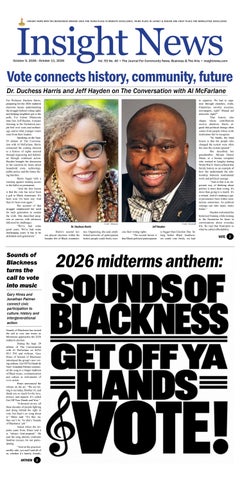
Vote connects history, community, future Dr. Duchess Harris and Jeff Hayden on The Conversation with Al McFarlane For Professor Duchess Harris, preparing for the 2026 midterm elections means understanding the struggle behind voting rights and helping neighbors get to the polls. For former Minnesota state Sen. Jeff Hayden, it means listening to the frustration people feel over costs and technology, and to what younger voters want from their leaders. Speaking on the Sept. 29 edition of The Conversation with Al McFarlane, Harris connected the coming election to a history of rights secured through organizing and defended through continued action. Hayden brought the discussion to the concerns he hears about household costs, technology, public policy and the future facing families. Harris began with a warning against treating access to the ballot as permanent. “And the first lesson is that the vote has never been a gift to Black Americans. It's been won. It's been lost. And then it's been won again.” Her account of that struggle emphasized the need for each generation to sustain the work. She described progress as uneven, with advances followed by challenges. “We've had some good years. We've had some challenging years. It has to be defended each generation.”
Sounds of Blackness turns the call to vote into music Gary Hines and Jonathan Palmer connect civic participation to culture, history and intergenerational action Sounds of Blackness has turned the call to vote into music as Minnesota approaches the 2026 midterm election. During the Sept. 29 edition of The Conversation with Al McFarlane on KFAI 90.3 FM and webcast, Gary Hines of Sounds of Blackness introduced the group’s new voting anthem, Get Off Ya Hands & Vote! Jonathan Palmer connected the song to a longer tradition of Black music, communication and culture as instruments of civic action. Hines announced the release on the air: “We are letting it out today, Brother Al, and thank you so much for the love, always, and support. It’s called Get Off Your Hands and Vote.” “It dawned on me, all these decades of people fighting and dying behind the right to vote, but there’s no song about it,” Hines said. “It’s like, no, that can’t be. So that’s Sounds of Blackness’ job.” Asked where the impulse came from, Hines said it is “always God-inspired.” He said the song directly confronts familiar excuses for not participating. “And on the practical, earthly side, you and I and all of us, whether it’s family, friends,
ANTHEM
2
Dr. Duchess Harris Harris's second lesson placed elections within the broader life of Black communi-
Credit: Minnpost
ties. Organizing, she said, established networks of participation before people could freely exer-
Jeff Hayden cise their voting rights. “The second lesson is that Black political participation
Credit: Senatedfl
is bigger than Election Day. So long before Black Southerners could vote freely, we had
to organize. We had to organize through churches, clubs, fraternities, sorority societies, newspapers, right? Mutual aid networks, right?” That history also shapes whose contributions receive attention. Harris argued that political change often comes from people whose work institutions fail to recognize. “So finally, the third lesson is that the people who changed the system were often the ones the system ignored.” She described her grandmother, Miriam Daniel Mann, as a human computer who worked at Langley during World War II. Harris offered that family history as an example of how she understands the relationship between institutional work and political courage. “And so that is an important way of thinking about politics is more than voting. It's more than going to a march. It's a refusal. And it's making a quiet persistence from within institutions sometimes. So political courage can take many, many forms.” Hayden welcomed the historical framing while turning to the frustration he hears in conversations about everyday life. He tied that frustration to what he called affordability.
VOTE
2026 midterms anthem:
2
Page 2 • October 5, 2026 - October 11, 2026 • Insight News
insightnews.com
Anthem From Cover relatives, at the barbershop, wherever, always have those people and elders and down to teens that always have that reason for not voting,” Hines said. “It ain’t going to make no difference. I can’t go. I got this. I got that.” In the lyric of the song, he said, it “literally says there ain’t no excuse.” Hines described the work as part of Sounds of Blackness’ longstanding commitment to music tied to culture and social movements. He said hearing that work on the air is both humbling and affirming, particularly when songs carrying a conscious message can face resistance in corporate-owned radio. “It’s laced with and motivated by and fueled by ancestor energy,” Hines said. He described Sounds of Blackness as making “the music of the culture and about the movement.” Palmer, an Afrofuturist who joined McFarlane as co-pilot for the conversation, placed the anthem within a much older communications tradition. “I think one of the key things is that arts and culture have always played a significant role in moving our people forward,” Palmer said. “Music especially has reflected the times and what’s going on.” He traced that tradition through oral culture, newspapers carried by Pullman porters, music and contemporary storytelling. At the Rondo Commemorative Plaza, Palmer said, an installation designed by Seitu Jones uses chimes, each representing a street in Rondo, to call back the ancestors from that street. Of the vote, he said: “We are calling on the ancestors. We’re calling on the story to be told. The music that Sounds of Blackness is doing goes ahead and helps people understand this is how important it is.” “In the Black community, we’ve always used
Vote From Cover “But people seem to be really frustrated. They seem to be frustrated not only about the bread and butter things that we're terming affordability. Gas is high. Food is high.” He also raised artificial intelligence and data centers as issues requiring public oversight. His concern centered on how government responds as people confront unfamiliar technologies and uncertainty about their consequences. “The government's fundamental job on those kind of issues is regulation, make sure that things don't get out of control.” For Hayden, questions about the future are also family conversations. He said his adult children want political leadership that speaks to their expectations and gives them reasons to participate. “But they're not so sure that they understand what their future is going to look like. And they keep telling me that they want to vote for somebody that is going to start to talk to them about that and that they can be inspired by and that they're sure that the future is going to be there for them, not necessarily just those who have been there for a long time.” Discussing the policy choices ahead, Hayden said those choices come down to which leaders bring good ideas and can drive an equitable process. “That all gets into who has really good ideas, who is really going to take all that's in front of us and drive a process that's equitable for everybody, not just for those at the top.” McFarlane framed the discussion as a question about democracy's future. “Actually, the topic is the future of our country, perhaps of the world. It's certainly saving democracy. I think de-
Gary Hines communication,” Palmer said. “We’ve always used sound and music as a way, drum beats that go ahead and tell different kinds of stories.” McFarlane added his own memory of movement technology. As a Morehouse freshman in 1965, he said, he saw activists use “this marvelous technology that they used to motivate. It was called the mimeograph machine.” He said communities have both the responsibility and the right to deploy artificial intelligence in ways that protect people, rather than simply fear it. Palmer extended the cultural thread into Afrofuturism and comics, citing Superman and Black Panther as characters who reflected the issues of their days. He later pointed to Octavia Butler, whom he said is widely considered the mother of Afrofuturism, and to other Black women writers as storytellers who carry the tradition forward. Hines connected the same idea to musical lineage. mocracy is at risk.” Harris returned to the organizing that makes electoral participation possible. She singled out voter registration and credited the people doing that work on the ground. “We don't get the progress that we've gotten at all without the people on the ground.” Her invitation to younger people was direct, encouraging engagement and leadership rather than withdrawal. “And so I encourage young people to be critically engaged, not cynical and absent, and let the young people lead, right? I mean, I'm almost sixty. Lead me, please. Somebody.” Asked what responsibility she would leave with students and listeners, Harris turned that invitation into a practical commitment. “I think the message that I will leave, particularly with young people, is to help other people vote.” She suggested volunteering to assist older residents and providing transportation to the polls. Her emphasis was on participation across generations. “This is what community means. We need to be intergenerational. This isn't just vote yourself. Bring everybody with you because that is what we have done for centuries and that's the only reason why we are where we are today.” Hayden urged voters to examine candidates beyond campaign advertising, research their positions and attend candidate forums. He linked that preparation to the issues people identify in their own lives. “Anything that allows you to be able to do some research on the people that represent you, and where do they stand on the things that you care most about?” His closing appeal tied the future to participation. “If you care about the future, if you care about democracy, the way that you can handle that is to get out and vote.”
Jonathan Palmer
Responding to Palmer’s observation that the anthem carries an imperative to make change rather than wait for it, Hines said, “It’s all ancestor energy in the African tradition.” He added that, in that tradition, “art and music are not about art’s sake, but about life’s
KEITH ELLISON fo r Atto r n e y G e n e ra l
STEVE SIMON
fo r S e c re ta r y o f S ta t e
sake.”
That lineage is personal for Hines. He spoke about his late mother, entertainer Doris Hines, whose autobiography is titled Snowball, and recalled her connections to artists including Ella Fitzgerald, Sarah Vaughan, Duke Ellington and
Nat King Cole. Hines also recalled the late Harry Belafonte telling him that he regarded himself as “an activist first and an artist second.” Hines said that description applied to his mother as well. Later in the conversation, Hines used the African
concept of Sankofa to describe how tradition and new vision can coexist. “What’s old is new,” Hines said. “I think our remedy for that is tied up in the African word that you’re fully familiar with, Sankofa.” Palmer brought the discussion back to the ballot, saying communities must turn cultural energy into participation. “We’ve got to get up off of our hands, get up off of the different parts that we have, and move,” Palmer said. He said the task is to “channel that power, channel that energy and get out to the polls, make sure our voices are heard and make sure that we are representing the needs of our people.” Hines said the song’s feel was deliberate: “We wanted it to have both a contemporary and a legacy feel because this is not a new movement.” Hines said on Sept. 29 that the single was being released that day and was expected to become available through iTunes and other formats by the following day. The song is now available. As the segment wound down, Palmer told listeners to “get off your hands and vote, and go ahead and take that music that’ll carry you right on down to the polling station.”
AMY KLOBUCHAR
PEGGY FLANAGAN
fo r G overnor
for U.S. Senate
BEN SCHIERER
ZACK FILIPOVICH
fo r L i e u tenant G ove rn or
for State A uditor
OFFICIAL 2026 GENERAL ELECTION SAMPLE BALLOT V O T E B Y N O V E M B E R 3 R D | I W I L LV O T E . C O M
PAID FOR BY THE MINNESOTA DEMOCRATIC-FARMER-LABOR PARTY (DFL.ORG), AND AUTHORIZED BY PEGGY FLANAGAN FOR MINNESOTA.
insightnews.com
Insight News • October 5, 2026 - October 11, 2026 • Page 3
Insight News
INSIGHT NEWS WON THE MESSENGER AWARDS 2024 F OR THIRD PLACE IN WEBSITE EXCELLENCE, THIRD PLACE IN LAYOUT & DESIGN AND FIRS T PLACE F OR NEWSLETTER EXCELLENCE.
October 5, 2026 - October 11, 2026
Vol. 53 No. 40 • The Journal For Community News, Business & The Arts • insightnews.com
Image created with AI
Kidneys don't cough
Cornel West
Gage Skidmore/Flickr
Cornel West keynotes Black Men's Legacy Summit V Fifth annual gathering will connect fathers, youth, health, civic engagement and homeownership with a broader conversation about building and protecting generational wealth Black men will gather in Minneapolis Oct. 31 for the fifth annual Black Men’s Legacy Summit, a day organizers are framing around a central question: What legacy are families and communities building for the generations that follow? Presented by 9000 Equities, the summit will run from 10 a.m. to 3 p.m., with doors opening at 9:30 a.m., at the Regional Access Center, 1256 Penn Ave. N., fifth floor, in Minneapolis. Admission is free and open to the public, with space limited and available on a first-come, first-served basis. This year’s theme, “Legacy Under Fire—Stand Your Ground,” places the fo-
cus on preserving what earlier generations built while creating new opportunities for those coming behind them. Organizers list six topics for the day: Black fathers and their sons; youth; the Collective Kitchen; economic opportunity; health and wellness; and politics and legacy. Dr. Cornel West, the scholar, author and public philosopher, will deliver the keynote address, “The State of the Nation.” Organizers say his address will examine DEI, voting power and access to ownership. West is the Dietrich Bonhoeffer Professor of Philosophy and Christian Practice at Union Theological Seminary
and professor emeritus at Princeton University. He earned his doctorate in philosophy from Princeton in 1980 and is the author of numerous books, including Race Matters, Democracy Matters and Black Prophetic Fire. The program connects family relationships with questions of ownership and long-term community capacity. The Black Fathers and Their Sons topic will focus on strengthening relationships, responsibility, mentorship and what one generation passes to the next. A youth topic, “Next In Line: Our Turn to Build,” will bring younger participants
into conversations about opportunity, leadership, wealth and the futures they want to create. The Collective Kitchen will explore connection and collaboration and what organizers describe as the potential created when people work together to strengthen families and communities. Economic questions will receive a dedicated topic, “Thriving Economic Opportunities to Build Legacies.” The announced discussion includes ownership, entrepreneurship, homeownership and other pathways toward long-term wealth
LEGACY SUMMIT 11
By Steve Karnowski and Rebecca Boone, Associated Press
A Personal Story and a Call to Action for Black Communities
The first of three monthly articles On April 30, 2024, I received the gift of life through a kidney transplant. For years, I lived with hypertension and diabetes that were not adequately controlled. As the former Superintendent of Minneapolis Public Schools, I held one of the most visible and demanding leadership positions in Minnesota. Each day brought difficult decisions, long hours, public scrutiny, and the responsibility of serving thousands of students, families, and employees. While I was deeply committed to my work, I paid far less attention to my own health. I knew I was not in the best physical condition. I was overweight, inactive, and often made poor nutritional choices. What I did not fully understand was that uncontrolled hypertension and diabetes, combined with years of chronic stress and neglecting my own well-being, were silently damaging my kidneys. Like many Black women, I spent much of my time caring for others, meeting professional obligations, serving my community, and pushing through the demands of everyday life. I convinced myself
that I would eventually make time for my health. Instead, my health continued to deteriorate in ways I could not see or feel. By the time I recognized the seriousness of my condition, my kidneys had already sustained significant damage and were beginning to fail, setting me on a path toward end-stage kidney disease and, ultimately, a life-saving transplant. What makes kidney disease especially dangerous is that it often develops silently. Unlike a cold, pneumonia, or other illnesses, kidneys do not announce that they are in trouble. Kidneys don’t cough. They do not ache in obvious ways. They quietly lose function over time, often without symptoms, until significant damage has already occurred. That is why I am sharing my story. I want Black families to understand that kidney disease is not someone else's problem. It is our problem. It is affecting our mothers and fathers, sisters and brothers, pastors, teachers, neighbors, and friends. Most importantly, early detection and preventive care can save lives.
KIDNEYS 10
Up‑and‑down progress of voting rights in America Sabathani nears geothermal has been shaped by these 10 key moments milestone as October brings By Gibbs Knotts Professor of Political Science, Coastal Carolina University Christopher A. Cooper Professor of Political Science & Public Affairs, Western Carolina University As the 2026 midterm elections approach, the U.S. Supreme Court has been busy with voting rights cases. In mid-September, the court barred the Trump
Image created with AI
administration from carrying out its proposed restrictions on mail-in voting for the midterm elections. In late September,
the court ruled that the Trump administration could continue with a plan for various federal agencies to use a controversial database to identify and cull in-
eligible voters on the voter rolls. These decisions highlight the long history of struggles in the United States over who can vote, how votes are counted and who sets the rules that govern elections. As scholars of elections and Southern politics, we have selected 10 important moments in U.S. voting history. The point is not to identify the definitive 10, but rather to underscore that battles over the franchise are long-standing and do not move in a single direc-
RIGHTS 11
The trouble with Flock cameras is the surveillance system’s architecture, not just some of its users By Henry F. Fradella Professor of Criminology and Criminal Justice, Arizona State University Wherever Marci Bakely went, her ex-boyfriend seemed to know. When the Georgia single mother drove to the grocery store or a date, he often texted within minutes. According to a Wash-
ington Post investigation, Bakely’s ex-boyfriend, Braselton Police Chief Michael Steffman, searched her license plates and those of her teenage daughter roughly 600 times through Flock Safety, a company that makes and operates networks of automated license plate readers, or ALPRs. The Georgia Bureau of Investigation arrested Steffman in November 2025 on charges of stalking, harassment
and misuse of an ALPR. He was found dead before trial. Bakely’s case is not unique. The Post identified at least 50 officers accused of misusing ALPRs, including 26 who used Flock’s cameras to spy on current or former partners or people they hoped to meet. Its investigation has since identified at least 100 police department employees charged with or accused of misuse. Flock says these peo-
ple represent a tiny share of its more than 140,000 monthly users and that permanent audit logs help uncover misconduct. But these abuses required no hacking or stolen credentials. Each user walked through the front door. I’m a criminal procedure scholar and I direct a school devoted to forensics. I
CAMERAS 10
Business
US regulators want to make corporate earnings reports less frequent, but investors have doubts
PAGE 5
full community calendar
Sabathani Community Center Sabathani Community Center is entering October with a major infrastructure milestone on the horizon and a full calendar of health, recreation and community programs for youth, older adults and families. Sabathani’s new geothermal system is expected to become operational in mid-October as part of its Community Energy Project. Geothermal wells and underground piping are complete, major mechanical equipment has been installed, and work is progressing throughout the building. Crews are preparing for rooftop solar installation and planning restoration of the community garden and green space around the geothermal well field. Construction will affect access Oct. 6, when a crane
on 3rd Avenue will require a street closure for the day. Sabathani said the building will remain open and programs and services will continue. The center is also developing a Smoking Cessation Program, including an upcoming Community Quit Club. The club meets Oct. 22 from 4 to 5 p.m. October’s featured programs begin with a Healthcare Career Pathways information session Oct. 8 from 5 to 6:30 p.m. The Community Baby Shower and Maternal Health Resource Fair follows Oct. 17, with the fair from 11 a.m. to noon and the shower from noon to 2 p.m.
SABATHANI 10
Nina Simone, Langston Hughes and their forgotten creative collaboration PAGE 7
Page 4 • October 5, 2026 - October 11, 2026 • Insight News
insightnews.com
Commentary The schoolhouse door was never the end of the fight boardcertified emergency medicine physician
By Dr. Myiesha Taylor
Columnist
By Haley Taylor Schlitz, Esq. When I was in third grade, I wanted to be the golden retriever. Our class had read a book that used animals to describe different personalities, and we began assigning the animals to one another. The golden retriever was kind, gentle, friendly and pretty. Everybody liked the golden retriever. I announced that was me. My classmates disagreed. They told me I was more like the lion. To an adult, that might have sounded like a compliment. The lion was strong, protective, serious, a leader. But that was not what I heard as an 8-year-old girl. I heard that the lion was intimidating. The lion was not soft. The lion scared away the butterflies. So I began trying to become less like one. I stopped suggesting games as often. When someone said something that bothered me, I sometimes stayed quiet. I watched the children who seemed to be liked easily and tried to imitate them. By fourth grade, when a friend climbed through a hole in the school fence to leave campus and go to Burger King, I did not tell a teacher. In my child's logic, reporting her would have violated the agreeable version of myself I was trying so hard to become. My mother was watching. She had not set out to become a homeschool parent. She was a product of public schools herself and remembered her own experience fondly. Like many parents, she believed the responsible thing to do was find good schools, remain involved, supplement what was missing and trust trained educators to do their jobs. Before kindergarten, our search for the right environment had already taken me through several schools, public, private and religious. During breaks, my mother developed what she called the “Taylored Curriculum,” filling summers and weekends with things she believed school either overlooked or did not have time to explore: culture, politics, self-knowledge, history, music, mathematics and the wider world. For a while, that arrangement seemed workable. School would provide the foundation, and home would fill the gaps. Then fifth grade came. The gaps were becoming harder to ignore. So was my boredom. So was the amount of energy my family spent correcting, supplementing, and explaining what happened during the school day. And race was not incidental to any of it. During our Civil War studies, my teacher divided the class into two fictional families, one Northern and one Southern, and assigned each student a role. I was one of only two Black students in the class. I was assigned the role of the “mulatto slave girl.” There were countless other possibilities. I could have been placed in the Northern family. I could have been a teacher, an abolitionist, or a free Black woman, a person whose identity in the exercise was not defined by someone else's ownership of me. Instead, a classmate looked at the roles we had been given and told me that, back then, she
would have owned me. The lesson was supposed to be about the Civil War. I was learning something else. Years earlier, I had already begun trying to soften the lion in myself so other children would find me easier to like. Now the curriculum was offering another lesson about where a Black girl belonged. My mother later wrote that by fifth grade, there was no longer enough time after school to “undo” what school was doing. That word still matters to us: undo. We often talk about education as though the central question is what children are learning from the curriculum. Sometimes parents also have to ask what children are learning about themselves. My mother was watching a child who needed more academic challenge, but she was also watching a Black girl learn to negotiate how much confidence, curiosity and Blackness a room seemed prepared to receive. Our family had repeatedly found itself explaining to otherwise well-meaning teachers and administrators why certain choices in performances, music or classroom life were racially inappropriate. After we left traditional school, my mother later wrote that energy could finally be spent doing rather than undoing. So she proposed something that initially frightened our family: bring me home. There was no master plan for producing a teenage college graduate or a 19-yearold law school graduate. My mother was not even convinced she had the temperament to sit at a kitchen table teaching elementary lessons all day. My father worried about structure and socialization. My mother had imagined homeschooling as one exhausted parent trying to become the child's math teacher, science teacher, English teacher and principal all at once. Then she realized she did not have to become every teacher. She had to become responsible for the architecture. A math teacher could teach math. A tutor could support. A hybrid school could provide group discussion. An online course could supply expertise unavailable locally. A music instructor could teach an instrument. A psychologist could help us understand how a child learned, and who they were. A college could provide advanced coursework when the time came, and help develop a child into who they would become. The family could use institutions without surrendering final authority to them. That distinction changed our lives. We have been thinking about it again after reading Nikole Hannah-Jones's extraordinary and painful essay about the education of her daughter, Najya. Hannah-Jones has spent much of her career documenting the racial inequality built into American education. When Najya was young, she and her husband deliberately enrolled her in a predominantly Black, low-income public school rather than use their resources to secure a different educational environment. Their reasoning deserves to be taken seriously. Families with money possess more than money. They bring networks, institutional knowledge, confidence in challenging authority, professional expertise and the ability to write a check when a school needs something. When those families cluster in some schools and disappear from others, inequality deepens. Hannah-Jones believed families like hers could help interrupt that pattern. There is moral seriousness in that decision. There is also, as her essay reveals, a cost. Years later, Hannah-Jones discovered substantial gaps in Najya's academic preparation despite good grades and reassuring signals from
Image created with AI
schools along the way. Eventually, her daughter asked why her parents, knowing they had other options, had not done more to ensure that she received the education she wanted. The question exposed a collision between two obligations: What do we owe our children, and what do we owe children who are not ours? Black families know this tension particularly well. For generations, our individual choices have carried collective meaning: where we live, where we send our children, whether we remain in a neighborhood or leave it, whether we enter an institution or build one of our own. School integration gave that tension an especially powerful moral history. Black families fought, marched, sued and sometimes sent their children into openly hostile environments to break legal barriers that denied Black children equal access to public institutions. Those sacrifices changed America. But we should be careful about turning a strategy born of necessity into a permanent obligation for Black children. The schoolhouse door was never supposed to be the finish line. Access answered one question: Can Black children enter? It did not answer another: What happens to them once they are inside? Can the school see their intelligence? Will teachers recognize their gifts? Will the curriculum allow them to encounter Black people as something other than enslaved people, victims or occasional historical exceptions? Will strength in a Black girl be cultivated as leadership, or treated as something she should soften? Will a Black child in an affluent, predominantly white school be expected to carry the emotional burden of explaining race to classmates and adults? Will an institution organized around groups of children recognize when one particular child needs something radically different? Those questions are not answered by a school district's reputation. Our family lived in a community with schools many families considered desirable. That did not mean those schools automatically knew what to do with our children. Race mattered. So did individuality. Haley's experience was not that of her siblings. One child loved busy schedules, classrooms and discussion. Another preferred quiet, independent work and online learning. Each child is unique, and has different needs to be met. For any form or setting of education, we must ask: Does this institution see our child fully? We eventually came to believe that question should precede almost every other educational question. Not: Is this considered a good school? Not: Is this the prestigious program? Not: Is this where children like ours are supposed to go? Does this environment recognize this child's humanity, ability, vulnerabilities and possibility? Our answer was to take greater responsibility for education ourselves. That statement re-
quires an important qualification. We are not saying families can parent their way out of structural racism. They cannot. Nor are we arguing that every family can or should homeschool. We said explicitly in The Homeschool Alternative that some children receive resources through public schools their families could never reproduce at home, that some children thrive in traditional classrooms and that homeschooling demands time, stability, money, transportation and enormous parental labor. An answer available to a physician's family with resources cannot simply be prescribed to a parent working multiple jobs and struggling to keep the lights on. That reality is precisely why public education remains essential. But there is another mistake we should resist: believing that because an option is not equally available to everyone, families who can exercise greater educational agency should decline to do so. We wrestled with that tension years ago. In 2019, we devoted an entire chapter of our book to what we called “survivor's remorse.” Black parents can feel guilty leaving institutions that generations of Black people fought so hard to enter. If involved families leave, who remains to advocate? If families with resources choose something else, do they make the system worse for families without those choices? Those are real questions. But our conclusion then remains our conclusion now. Children should not be required to absorb educational harm in order to prove their parents' commitment to educational justice. It is not a child's responsibility to repair a system by enduring its failures. Adults should do the repairing. Children should inherit the opportunities that work creates. That does not mean other people's children cease to matter the moment we protect our own. It means the burden falls where the power is. Haley's own life later tested that proposition. After graduating from law school, she did not immediately begin practicing law. She became a fifthgrade social studies teacher in Fort Worth. People understandably wondered why. She had moved quickly through higher education. She had earned the credential she had worked years to obtain. Why postpone the legal career waiting for her? Her answer was blunt in its simplicity: those children mattered enough to deserve someone who could have been practicing law and chose to teach them instead. For Haley, that decision was inseparable from her own fifth-grade experience. There is a symmetry she did not fully appreciate at the time. As a fifth grader, a social studies lesson had assigned her the role of an enslaved Black girl. Years later, after earning a law degree, she walked into another fifth-grade social studies classroom, this time as the teacher. She could not rewrite her own childhood classroom. But she could decide what kind of classroom another child would enter.
She knew from experience that teachers do more than transmit information. A teacher can widen a child's sense of possibility or quietly narrow it. A teacher can recognize ability another adult might miss. A teacher can decide whether history helps a Black child understand the fullness of her inheritance or leaves her believing her people entered the American story only in chains. And Black teachers matter especially. Our own book explored research showing that Black students can experience different academic outcomes when they encounter Black educators, including differences in how giftedness is recognized. Haley did not leave traditional school and conclude that schools did not matter. She left understanding how much they matter. That is an important distinction. Protecting your own child from an institution that is failing her does not require withdrawing from the public work of making institutions better for everyone else's children. Adults can vote, organize, teach, tutor, mentor, serve on boards, challenge discriminatory policies, fight for equitable funding, support teachers, build new institutions and share information and resources with other families. The child's body does not have to be the parent's principal contribution to reform. And that is where our experience leads us beyond the question of homeschooling. What Myiesha ultimately reclaimed was not
simply the location where her children learned. She reclaimed educational authority. For most families, the traditional model encourages a handoff. Find the right school. Enroll the child. Follow the curriculum. Progress through grades. Graduate. Apply to college. Follow another prescribed sequence. We slowly began treating institutions differently. They became tools. Useful tools, sometimes extraordinary ones, but tools nonetheless. When a psychologist evaluated Haley after Myiesha worried that perhaps she needed more time in middle school, the recommendation startled us. The problem was not that Haley needed to slow down. She needed to be challenged more. Preventing her from moving at her own pace could itself become damaging. The family began investigating early college. That moment taught us another lesson: some boundaries we treat as natural are actually administrative. Grade levels. Age cohorts. Seat time. The expectation that every child should spend approximately the same number of years mastering approximately the same material. The assumption that college starts around 18. These structures make mass education manageable. They are not laws of human development. Haley's eventual path was unusual. She began college young, graduated early and
SCHOOLHOUSE 10
INSIGHT NEWS www.insightnews.com
Insight News is published weekly, every Monday by McFarlane Media Interests.
National Newspaper Publishers Association (NNPA)
CEO/Editor-In-Chief Al McFarlane
Postmaster: Send address changes to McFarlane Media Interests, Marcus Garvey House 1815 Bryant Avenue North, Minneapolis, MN, 55411
COO/Associate Publisher Trena V. Stubbs Publisher Batala-Ra McFarlane Associate Editor & Associate Publisher B.P. Ford Web Administrator Sunny Thongthi Yang Associate Editors Afrodescendientes Jesús Chucho Garcia Macdonald Anyanwu Book Review Editor W.D. Foster-Graham Sports Editor Leahjean M. Denley Contributing Writer Pulane Choane Columnist Haley Taylor Schlitz Distribution Sound Construction Photographer Uchechukwu Iroegbu Roy Lewis - Washington D.C. Artist Donald Walker Digital Producer Jared McMullin Graphic Designer Syed Fahad Fayyaz Contact Us: McFarlane Media Interests, Inc. Marcus Garvey House 1815 Bryant Ave. N. Minneapolis. 55411 Ph.: (612) 695-0417 Member: Minnesota Multicultural Media Consortium (MMMC) Minnesota Newspaper Association (MNA)
News, opinion and advertising at Insight News Our news reporting is fair, accurate and impartial. We report in context — the historical and cultural context that explains why a story matters to this community is part of the reporting, not a departure from it. When we endorse a candidate or take a position, we say so plainly and label it as such. Endorsements and commentary are separate from news coverage. Advertising is a business function. Advertisers do not influence our news coverage, our endorsements or our commentary — and our coverage does not depend on who buys space in this paper. That wall stands, and we are telling you it stands. Insight News uses AI-assisted tools in some editorial production. Read our AI Policy & Transparency Statement at www.insightnews.com/site/ ai_policy.html.
insightnews.com
Insight News • October 5, 2026 - October 11, 2026 • Page 5
Business
US regulators want to make corporate earnings reports less frequent, but investors have doubts By Tzachi Zach Professor of Accounting, The Ohio State University The U.S. government has pitched an obscure accounting rule change that has ignited a firestorm of opposition. If enacted, its effects might be felt from the capital markets to your retirement savings account. At issue is a proposal by the Securities and Exchange Commission that would scrap a long-standing requirement for registered companies to disclose their earnings every three months. Instead, they would have the option to do so only every six months. The agency says its proposal has two goals: One is to reduce a company’s compliance costs needed to prepare financial statements; the other is to promote longer-term planning rather than a short-term fixation on earnings. A final decision is expected by late 2026. These ideas may sound in the weeds to the average American, but the proposal has prompted opposition that is literally record-breaking ever since it was released for comments in May 2026. To date, over 280,000 letters have come in, with the vast majority against. By comparison, one study that covered 417 different proposals over 30 years tallied more than 65,000 letters total. I’m an accounting professor who has constructed a tracker that lets people scour the SEC docket and decipher
Image created with AI
the general sentiment of these comments. I found that the main driver of this hostility is concern that less frequent reporting would make it harder for investors to monitor companies’ performance and decision-making, because key information is withheld for longer periods. This reduction in transparency carries another risk as well: It would likely make it more expensive for companies to raise capital. Once external monitoring is reduced, investors may demand a higher rate of return because they have less information about the company’s health. That means the company would need to pay more for that uncertainty, whether through selling shares, borrowing from lenders or issuing bonds.
A tsunami of opposition
If a business wants to be a publicly traded company, it has to register with the SEC, which
governs and regulates this process. Once registered, the company has to disclose its financial performance every three months, a requirement that has held since 1970. Whenever the agency issues a new rule, it opens it up to comments first, just like other government agencies do. That feedback is meant to shape the final rule before it becomes codified. What’s unusual in this case is the overwhelming degree of opposition – more than 99% of all comments, many from retail and individual investors, according to my tracker. “My husband worked for Enron. We lost most of our retirement savings when their fraudulent activity came to light,” wrote one commenter. “We were still young enough to make some of that income back, but we knew many retirees who ended up working into
their 80’s. Quarterly reporting is a gate keeper. Keep it.” Wrote another: “I rely on quarterly reporting for the same reason your child gets a quarterly report card. … There the metaphor ends, because a good teacher can catch failing performance and course correct with parents long before report cards are issued. Investors do not have that luxury.” Some point out that the commission’s claim of company savings on compliance costs is overblown. The estimated average savings, according to the proposal, is around US$200,000 a year per firm, which is a drop in the bucket for a typical public corporation. But more broadly, the comments reveal how much this rule could matter to ordinary investors. Retirement savings, through accounts like 401(k) plans and individual retirement
accounts, are directly exposed to company performance, whether or not the fund in question is diversified. That means any reduction in financial transparency has direct implications on how the investments of the funds are monitored. That risk was laid out in a letter from the Securities Industry and Financial Markets Association, or SIFMA. The trade group wrote that the estimated net savings “could be offset or outweighed by an increase in the cost of capital as investors demand higher risk premia for less timely information.” Federated Hermes, an asset manager, also pointed to this scenario: “Issuers that elect semiannual reporting may face signaling risks, as investors could interpret such a choice as reflecting reduced transparency,” the letter said. “This may affect analyst coverage and cost of capital.”
Companies weigh in
As for the companies themselves, it’s too early to say whether they would take advantage of the six-month option. But several have said they would choose to report less frequently. Drugmaker Eli Lilly is one example, making clear its preference in its official comment, while letters from Financial Executives International, an industry lobby, stated that 58% of the member companies it surveyed suggested they would change. For its part, the commission is still evaluating all the
feedback before its leadership takes a vote. Traditionally, it’s led by five commissioners, with three representing the party in power and two from the opposition. However, in this case, the two Democratic seats in the minority are currently vacant, and one Republican seat is about to be vacated. With so few votes on hand, the commission may in fact change its rules so that this proposal could clear with support from only two commissioners. On Sept. 30, 2026, it suggested a rule change so that the two votes would suffice. For now, SEC Chair Paul Atkins seems undeterred and has stated that the commission is moving ahead. How many companies will make the move given the concerns laid out in the comments, however, remains an open question. As the SEC’s own Investor Advisory Committee, an independent body, put it: “The evidence does not support the view that short-termism is a major problem for U.S. public companies today, nor is there strong evidence to support the view that costs for public companies would be significantly reduced.” Disclosure statement Tzachi Zach does not work for, consult, own shares in or receive funding from any company or organization that would benefit from this article, and has disclosed no relevant affiliations beyond their academic appointment.
Why making Americans bet with cash could protect people from gambling problems By Jay L. Zagorsky Associate Professor of Business, Boston University Gambling has exploded in the United States. American casinos and sportsbooks earned US$79 billion in 2025, up nearly 20% from the $66.5 billion just two years earlier. That doesn’t include the enormous sums earned by prediction market companies, which are technically not considered gambling but instead help forecast future events. Regrettably, but not unexpectedly, the widespread ability to gamble is also causing major scandals. For example, the chief of police in New Haven, Connecticut, allegedly embezzled government funds to bet almost $4.5 million on sports. And major basketball stars are accused of betting on their own games. Even politicians are betting on election outcomes. I’m an economist who has been studying gambling since before there was an internet. While I support people having the ability to gamble legally, betting today is too easy, in my view, and it is now time to make it harder. I think there’s a relatively simple way to reduce its spread: making gamblers bet with cash.
3 big problems
What caused this major increase in gambling? In 2018, the Supreme Court ruled in Murphy v. National Collegiate Athletic Association that individual states have the power to decide whether to legalize sports betting inside their borders. More recently, companies like Kalshi and Polymarket have exploded in popularity. They offer customers the ability to bet in prediction markets, which have opened the door to
a form of gambling on events beyond sports. These markets operate outside of state control, bypassing gaming regulations because they are regulated at the federal level by the Commodity Futures Trading Commission. For example, those prediction markets aren’t subjected to Montana’s and Nebraska’s rules that all sports betting is done in person. Age restrictions, such as those on the books in Massachusetts, and blanket prohibitions on sports betting like those currently in California, Texas, and some other states, don’t apply. Three of the biggest problems with gambling are addiction, insider trading and anonymous big bettors called whales. For a small number of people, gambling is highly addictive, often leading to financial ruin. While most people see gambling as a fun, occasional event, there are others who gamble all the time. The World Health Organization estimates about 1.2% of the world has a gambling problem. U.S. estimates suggest around 20 million Americans are problem gamblers – about 6% of the population. Given that both the “house” and the government take a cut of all gambled money, in the long run the odds are not in any gambler’s favor. Second, prediction markets are prone to insider trading. If you have knowledge of if or when an event will happen, then prediction markets are a simple method of illegally cashing in. For example, a Special Forces soldier was arrested and charged on April 23, 2026, for winning more than $400,000 on bets based on classified information of when the military would take out Venezuelan strongman Nicolás Maduro. Third, sporting events and prediction markets are prone to manipulation. One way is by people betting on their
own actions, like sports stars shaving points. Another is by people anonymously making very large bets compared to the size of the market. These “whales” can influence outcomes simply by changing the odds, which shifts the narrative about an event, like the French gambler who bet heavily on Donald Trump winning the 2024 presidential election.
Probably here to stay
Gaming proponents claim that the industry creates jobs. But its employment gains don’t appear to be benefiting the economy enough to offset all the other problems. The U.S. Census Bureau tracks the number of people employed in online gambling and also includes lottery, high-stakes bingo and poker room workers in this group. The number of those jobs peaked in 2007, over a decade before the pivotal Supreme Court decision, at almost 70,000 workers. The number fell to less than 47,000 during the COVID-19 pandemic and subsequently rebounded to 67,000 in 2024 – slightly below the 2007 peak. But I highly doubt that gambling will be outlawed or restricted the way it once was. Many states have become dependent on gambling taxes, making politicians reluctant to kill this golden goose no matter how many bad eggs it lays. The media is addicted to the billions in advertising dollars spent by gambling companies. Plus, professional sports leagues love gambling because it keeps fans watching, even in lopsided games.
Cash-only betting
People have been gambling for thousands of years, making its abolition an impossible goal. However, I think there’s a way to reduce gambling-related problems and boost employ-
Image created with AI
ment: Force gamblers to use paper money when making bets or funding their accounts. Cash betting is not a new idea. Walk into a casino and sit down at a table. The dealer always wants paper money before sliding over chips. Cash also rules at racetracks. Elsewhere, gambling has become a frictionless experience. Placing a bet or buying a contract in a prediction market happens instantly by pulling out a phone, opening an app and tapping or clicking. When actions are frictionless, people do them more often. More importantly, they may do them without thinking about it. E-commerce websites understand this; the easier they make it to order items online, the more we buy. As I point out in my latest book, requiring the use of cash puts barriers in the way of making a bet. Since the highest-denomination U.S. bill is $100, it publicly reveals anyone making big wagers by forcing them to pull out many Benjamins. In other words, requiring cash, instead of debit or credit cards, introduces friction. Gamblers have to get paper money and then physically go somewhere to make a bet. This takes time, energy and scheduling, which gives people a moment to think about what they are doing.
Because handing over your own cold hard cash requires leaving your home or office, taking this step gives the people around you the opportunity to notice. It makes hiding bets by sneaking looks at a phone harder to pull off before you’ve drained your bank account. High rollers also face friction with making cash bets. In the U.S., any cash transaction of $10,000 or more must be reported with a Currency Transaction Report, which banks and casinos do automatically when cashing in or out large amounts of paper money.
A possible labor market boon
Forcing people to use cash would likely provide an economic boost for convenience stores, bars and other places where people would have to make bets or load their online accounts while doing face-toface transactions. But gambling companies would, of course, hate this proposal. They would likely spend millions fighting it, since they want to make gambling as seamless as possible. To get gambling companies onboard, my idea is to allow the pre-funding of accounts with limited amounts of cash. Before a big game, people can walk over with dollars in their nondigital wallets to a store or gambling kiosk and preload
only their own accounts. Loading someone else’s account or putting in more than a maximum weekly amount would be illegal. If gamblers lose their shirts, they cannot bet until the account is reloaded with cash. Winners can keep gambling as long as they wish. Do I think that using cash would solve all gambling problems? Absolutely not. But it would prevent front-line soldiers from betting on their own operation, since places to reload their gambling accounts are probably not going to be available in war zones. It would make it harder for police chiefs to bet without anyone noticing. It would make it harder for sports stars to gamble since they have to publicly load their own accounts with cash and celebrities are easy to spot. Most importantly, it would force all gamblers to physically see where their hardearned money is going each time they hand over a wad of cash. Perhaps they’d pause before making more bets. Disclosure statement Jay L. Zagorsky does not work for, consult, own shares in or receive funding from any company or organization that would benefit from this article, and has disclosed no relevant affiliations beyond their academic appointment.
Page 6 • October 5, 2026 - October 11, 2026 • Insight News
insightnews.com
INSIGHT NEWS VOTERS GUIDE ON YOUR BALLOT THIS WEEK State Senate 44 Sam Rosemark, DFL James Tacheny, Republican
State Senate 66 Clare Oumou Verbeten, DFL (incumbent) Kathleen Bart, Republican
State Senate 67 State House 44A State House 44B T.J. Hawthorne, Independent
State House 66A, 66B, 67A, 67B County, school board, judicial
Sam Rosemark
T.J. Hawthorne
Peter Fischer
Senate District 44 · DFL Sam Rosemark won the Aug. 11 DFL primary for Senate District 44, an open seat. He serves on the North St. Paul-Maplewood school board. His campaign lists strong public schools first, ahead of affordability, sustainability and opportunity. He says he would expand access to Pre-K and fully support special education. His Republican opponent is James Tacheny. “In the State Senate, I will work tirelessly to fully fund public education so every student—no matter their background—has the support, opportunities, and safe schools they need to succeed.”
House District 44B · Independent T.J. Hawthorne is the Independent candidate in House District 44B. He says he is running as an Independent because he thinks for himself and wants to represent his district, not a party. Asked what he would do first for voters, he named one issue: working to pass Defend the Guard legislation, which he says matters because voters are tired of sending young men and women to fight wars. “Defend The Guard is simple legislation that would not allow our federal government to deploy the MN National Guard to fight in another country unless Congress declares war according to the Constitution.”
House District 44A or 44B “I will continue to build out the Behavioral Health System in the State of Minnesota.”
NOT SURE OF YOUR DISTRICT? Look up your district and your sample ballot.
EIGHT WEEKS, EVERY DISTRICT Sept. 14: statewide, Congress 3/4/5 · Sept. 21: SD 59–62 · Sept. 28: SD 63, 64, 65, 43 · Oct. 5: SD 44, 66, 67 · Oct. 12: SD 34, 38, 46 · Oct. 19: SD 36, 39, 40 · Oct. 26: SD 37, 42, 45 · Nov. 2: SD 49, 50, 51.
COMING UP: FIND YOUR DISTRICT’S WEEK The Insight News Voters Guide runs every week through Election Day. Your district’s candidates appear in the edition below.
OCT. 12
OCT. 19
Breast Cancer Awareness issue
Read on Issuu and InsightNews.com
Out Friday, Oct. 9
Out Monday, Oct. 19
In this edition Senate Districts 34, 38 and 46
In this edition Senate Districts 36, 39 and 40
Up to 18 candidate profiles
Up to 18 candidate profiles
OCT. 26
Nov. 2
Business + Economic Development issue
The last guide before Election Day
Out Friday, Oct. 23
Out Monday, Nov. 2
In this edition Senate Districts 37, 42 and 45
In this edition Senate Districts 49, 50 and 51
Up to 18 candidate profiles
Up to 18 candidate profiles
Print edition
Print edition
Digital edition
Digital edition
insightnews.com
Insight News • October 5, 2026 - October 11, 2026 • Page 7
Nina Simone, Langston Hughes and their forgotten creative collaboration By Jason Miller Assistant Lecturer, North Carolina State University Many music fans know that Nina Simone’s 1965 hit “I Put a Spell on You” helped establish the 32-year-old singer as the “High Priestess of Soul.” Few probably realize that it was Langston Hughes – the pioneering poet and face of the Harlem Renaissance – who had encouraged Simone to record it. As a Langston Hughes scholar, I’ve spent the past six years documenting Hughes’ largely overlooked friendship with Simone. I explore the creative bond they shared in my newest book, “Don’t Let Me Be Misunderstood: Nina Simone, Langston Hughes, and the Birth of Black Power,” which details how the two supported and inspired each other. The seeds of this relationship were planted in 1949, when Hughes delivered a lecture featuring his own poetry at Simone’s high school in Asheville, North Carolina. Simone – then known by her birth name, Eunice Waymon – was just 16 years old. As part of the programming, Simone played the piano. Hughes was impressed. Even though she was just a teenager, Hughes saw her as a “somebody” – a budding talent who would one day join figures such as classical singer Marian Anderson in the pantheon of legendary Black performance artists. Simone’s performance that day went on to inspire his poem “To Be Somebody”: Little girl Dreaming of a baby grand piano (Not knowing there’s a Steinway bigger, bigger) Dreaming of a baby grand to play
Simone’s big booster
As Simone matured into adulthood, she and Hughes became close friends. Once she permanently moved to New York City in 1959, the two routinely visited each other’s homes. Hughes’ relationship with Simone remained strictly professional. As far as scholars know, the poet did not harbor romantic feelings for her. Simone performed at clubs across New York City, including the famous Village Gate in Greenwich Village. And her debut album, “Little Girl Blue,” was well received in 1959. But Hughes also used his considerable fame to elevate the rising star. He secured her a spot at the 1960 Newport Jazz Festival, where she performed songs like “Trouble in Mind” and “Little Liza Jane.” Hughes himself wrote the final song of the festival, “Goodbye Newport Blues,” which Muddy Waters’ pianist, Otis Spann, sang. At the conclusion of the festival, Hughes and Simone slipped off to the nearby Rebel Festival, an “anti-festival” organized by jazz icons Charles Mingus and Max Roach. There, Simone joined Little Richard for an impromptu performance. Later that year, Hughes published an article in the Black newspaper The Chicago Defender, headlined “Spotlight on Nina Simone.” A regular columnist, Hughes rarely devoted an entire article to one artist. And with a cultural status in 1960 that rivaled that of Oprah Winfrey’s today, Hughes’ endorsement of Simone’s talent as a singer, performer and pianist carried exceptional weight. The article was important for another reason. At the time, Simone couldn’t seem to shake comparisons to Billie Holiday, who had died in 1959. Like Holiday, Simone sang with a husky, blues-inflected voice. And like Holiday, she had covered a song from George and Ira Gershwin’s “Porgy and Bess,” “I Loves You Porgy.” Hughes put those
Credit:Wikimedia commons
Nina Simone 1965 comparisons to rest. In repeatedly highlighting Simone’s masterful piano playing – an instrument over which Holiday had no command – he was able to signal that Simone was completely unlike “Lady Day.” Not only did quotes from the review appear on Carnegie Hall concert posters advertising Simone’s performances, but a revised version of the article also ended up being included as the liner notes on the back of Simone’s 1964 album, “Broadway-Blues-Ballads.”
A source of inspiration
Beyond using his considerable fame to elevate Simone, Hughes also inspired her songwriting. Largely known as a poet, Hughes considered himself a songwriter as well. But he never achieved the same stature or success as a lyricist, which ended up being a source of some frustration. Still, roughly 60 of his songs were eventually recorded by a variety of artists, and he provided Simone with more than a dozen original lyrics of his own. In 1964, Hughes suggested Simone consider singing the lyrics of an obscure song that his personal assistant,
George Bass, uncovered while preparing archival material for his radio show broadcast. Bass went on to quietly copyright the unpublished folk song himself. Simone performed the song, “See-Line Woman,” for the first time at a March 21, 1964, concert in Carnegie Hall, where Hughes was in attendance. Often spelled various ways – “Sea-Lion,” “C-Line” or “She-Lyin’” – the tune describes sex workers who greet sailors as they arrive in port, with their different-colored dresses conveying the services they are willing to provide: See-line woman (See-line) Black dress on (See-line) For a thousand dollars (See-line) She wail and she moan (Seeline) The birth of the spellcaster Sometime between November 1964 and January 1965, Hughes approached Simone in person with a new concept. Buoyed by his success at pitching “See-Line Woman,” Hughes suggested what he called “Incantations for Nina Simone.” These were what Hughes titled “Songs of Enticement, Bewitchment, Voodoo,
Hoodoo, Conjuration, Bedevilment” and, most importantly, “Spell Casting.” In one song he’d written – which Hughes titled “You Cast a Spell on Me” – he imagined Simone as a witch riding a broomstick brewing magic potions. It included uninspired lyrics such as: I’ll work my black and white magic And the other color, too, So come on, baby bunting, Let me cast a spell on You. It’s easy to see Hughes’ suggestions as an effort to typecast Simone as a hypnotic Black woman. And perhaps there was an element of that at play. But Simone accepted the concept, which she saw as a nod to Hoodoo, a set of African American folk-magic traditions that developed primarily in the American South. And she found a way around using Hughes’ verses, turning instead to “I Put a Spell on You,” which the eccentric R&B singer Screamin’ Jay Hawkins had recorded in 1956. “I Put a Spell on You” ended up becoming the title track of Simone’s album, which she released in June 1965. It
helped forge her identity as a sultry, mysterious singer and eventually served as the title of her 1991 autobiography. Over the years, when Simone performed the song live, she would sometimes leave the stage, only to return in a trance, as if she possessed the hypnotic powers of a spiritual shaman. Simone’s follow-up album, 1967’s “The High Priestess of Soul,” featured a startling cover that continued the Hoodoo theme: Simone appears as a sorceress smoking a pipe. Fans and critics have been responding to her spellbinding performances ever since.
Keep on workin’
Simone may have passed on Hughes’ version of “You Cast a Spell on Me,” but the poet would get another chance a year later. In 1966, Hughes gave a copy of a poem he had written to Simone. He wanted to know if she would be interested in performing it. Simone agreed, and Hughes was in the audience at the Lincoln Center’s Phil-
harmonic Hall on Nov. 22, 1966, when Simone performed “Backlash Blues” for likely the first time. Simone received a standing ovation, and “Backlash Blues” became a staple of her performances. It was later featured in the 2021 Academy Award-winning documentary film “Summer of Soul.” After Hughes died in May 1967, Simone added a new verse during her live performances of the song, paying homage to its author: When Langston Hughes died, he told me many months before “Nina, keep on workin’, till they open up the door. One of these days, when the doors are open wide, Make sure you tell ‘em where it’s at, so they’ll have no place to hide.” Disclosure statement Jason Miller does not work for, consult, own shares in or receive funding from any company or organization that would benefit from this article, and has disclosed no relevant affiliations beyond their academic appointment.
Page 8 • October 5, 2026 - October 11, 2026 • Insight News
insightnews.com
Books, Arts & Culture Nothing can keep us apart:
Ruthless! Sharing Our Stories
By W.D. Foster-Graham Book Review Editor I love reading a good series of novels, and this one has all the earmarks of a TV miniseries on the same-gender-loving side. That being said, I bring to you the third installment of a returning author to my column, Wyatt O’Brian Evans’ Nothing Can Keep Us Apart series, Ruthless. Uber-wealthy mogul Wesley Laurence (Wes)
Kelly and his partner Antonio Miguel (Tonio) Rios, Jr., our protagonists, have been going through dramatic, painful, and life-changing events. Villain Supreme and crime lord Winston Kendrickson (aka Ruffkut) has had an ongoing vendetta against Wes, which has culminated in the murder of Wes’ son Waseem, and said vendetta has no signs of abating. Waseem’s death has put Wes in a spiral, pushing away the people close to him, including Tonio. During this spiral of grief, his alternate personality Walker is triggered, and Walker wants 1) control as the dominant personality, 2) to have Tonio for himself, and 3) full revenge on Ruffkut. Tonio and others in Wes’ inner circle gradually sense that something about him
is off, but they haven’t put together that the Walker personality is in control, and Walker has been clever about pretending to be Wes and staying in character to minimize suspicion. Meanwhile, thirsty for revenge and wanting to force Ruffkut out into the open for law enforcement to deliver justice, Walker enlists the aid of TRANSparent hosts Zoe and Zion to give an exclusive interview expose’ of Ruffkut, supposedly including a witness from the evil psycho’s gang. As the internal power struggle between Walker and Wes escalates, the carefully constructed reveal to flush out Ruffkut for the broadcast doesn’t go as planned… Evans certainly keeps the reader guessing what will happen next in this urban series
of D.C.’s Black LGBT community. He provides drama, intrigue, opulence, grittiness, honesty, and plenty of hawtness. He deals with the seriousness of such issues as Intimate Partner Violence and Assault (IPV/A), Dissociative Identity Disorder, and childhood trauma. And every so often in the course of Ruthless, he will break the Fourth Wall to speak to the reader. Expect to see well-developed secondary characters who have their own backstories, an amazing musical playlist, and descriptions that will put you right in the surroundings and the action. At the end of the day, Wes and Tonio are still together in spite of the ordeals they experience, and as in the title, noth-
ing will keep them apart. Nothing Can Tear Us Apart: Ruthless will be available through Amazon and his website, www.wyattevans. com. Thank you, Wyatt, for
giving us a series that has all the earmarks and delicious flavor of a nighttime TV drama that keeps Wes and Tonio together, but still has you wondering what will happen next.
A study in empathy: John Kani’s Kunene and the King makes its Minnesota debut at the Guthrie Theater This October, the Guthrie Theater is set to host a profound exploration of reconciliation and human connection with the arrival of Kunene and the King. Written by celebrated Tony Award-winning playwright and actor John Kani, the production offers a poignant look at the complexities of post-apartheid South Africa, tracing the fragile work of truth-telling in a nation still actively shaped by its history. Directed by Ruben
Santiago-Hudson, the play serves as both a cultural bridge and a masterclass in performance. The story unfolds 25 years after the end of apartheid, centering on two men from vastly different worlds who are thrust together by circumstance. Lunga Kunene, a no-nonsense Black caregiver with little patience for privilege, begins providing in-home care for Jack Morris, a stubborn and celebrated white actor facing a life-altering medical diagnosis.
As the two men navigate their differences in race, class, and politics, they find an unexpected common ground in the language of William Shakespeare—specifically as Morris rehearses for the title role in King Lear. Through their evolving relationship, Kani’s script examines the power of empathy, revealing how transcending the past may be the only way to truly see one another. Artistic Director Joseph Haj underscored the pro-
duction’s profound relevance for Twin Cities audiences. “The play takes place 25 years after apartheid, and we see two very different men enter into a tenuous understanding that begins with an exploration of Shakespeare,” Haj noted. “Their unexpected common ground—and the complexities of the conversations that follow—has a lot to teach us about overcoming dif-
GUTHRIE 10
John Kani, right performs as Lunga Kunene, and Edward Gero, reprises the role of Jack Morris.
B L A N CO & R E P OSA D O 75 0 M L 8 8 P R O O F | 4 4 % A BV 1 0 0 % P U R O D E AG AV E D O U B L E D I ST I L L E D 5 0 % S M O K E D A N D 5 0 % ST E A M E D D I S C OV E R M O R E AT F O R YO U M A S E S P I R I T U !
R E V E L S P I R I T S .C O M
insightnews.com
Insight News • October 5, 2026 - October 11, 2026 • Page 9
At Minneapolis City Hall
Stevenson raises MPD spending concerns as 38th and Chicago work advances Council Member Soren Stevenson is raising concerns about Minneapolis finances and attributing part of the city’s budget pressures to what he characterizes as unsustainable and unaccountable spending within the Minneapolis Police Department. That assessment represents Stevenson’s characterization of city finances and is not an independent finding by Insight News. In his Ward 8 newsletters of Sept. 18 and Sept. 25,
Stevenson linked current financial pressure to MPD spending and referenced a letter from three members of the Board of Estimate and Taxation outlining concerns about the pattern. The board voted 4-2 on Sept. 29 to approve a maximum 2027 levy increase of 11.87%, according to KSTP, after deadlocking the week before. The City Council must adopt the final levy by mid-December. The newsletters also provided an update on construction at 38th Street and Chicago
Avenue, where the first phase of street reconstruction is expected to be substantially complete and streets reopened by Oct. 9. A second phase is scheduled to start in early 2027. The intersection is part of broader city and community work surrounding George Floyd Square, where the city has opened a second request for qualifications for the Peoples’ Way site at 3744 Chicago Ave. Proposals are due Oct. 19. Stevenson also announced a community dis-
cussion on data centers with Council Member Aurin Chowdhury from 6 to 8 p.m. Oct. 8 at Sabathani Community Center, ahead of the Planning Commission’s public hearing at 4:30 p.m. Oct. 13 at 250 S. 4th St., Room 350. He said the administration dropped a proposed overlay district from its staff recommendations after community feedback. Other items included an Oct. 7 open house on a proposed 34th Street neighborhood greenway, the Oct. 13 voter
pre-registration deadline and a city survey on renting experiences open through Oct. 15. He also pointed residents to the Lyndale Neighborhood Association’s Swigs & Swag Passport, with deals running through Nov. 30. Stevenson was among the sponsors of a resolution calling on Hennepin County and the University of Minnesota to end their use of Flock Safety cameras. The City Council approved it 9-4 on Oct. 1, according to the city’s Council Wrapped summary.
Soren Stevenson
Wonsley challenges City Hall information limits, highlights Pratt school fight Ward 2 Council Member Robin Wonsley is challenging restrictions on city staff participation in council committee meetings while opposing the proposed closure of Pratt Community School. In her Sept. 25 Ward 2 update, Wonsley said Mayor Jacob Frey had sent the City Council a letter earlier in September announcing restrictions on professional city staff reporting to committees. Wonsley said the change raised concerns about the information available to council members when making decisions involving prop-
erty taxes, city operations and service levels. Council leadership formally responded to the mayor, according to Wonsley’s newsletter, asserting the council’s need for information to carry out policymaking, budgeting and oversight. Wonsley said city staff had expressed willingness to collaborate with the council but had been directed by the mayor’s office not to participate in the same manner. That description represents Wonsley’s account of the dispute. Education is anoth-
er immediate Ward 2 concern. Wonsley’s newsletter said MPS is proposing to close Pratt Community School. Wonsley also highlighted Workers Drive Minneapolis, an ordinance she authored with Council Vice President Jamal Osman and Council Members Jason Chavez and Aurin Chowdhury. Wonsley described the proposal as an effort to establish local protections as autonomous commercial vehicles enter the transportation market. On Oct. 1, the City Council voted 7-6 to approve the ordinance, according to the
city’s Council Wrapped summary. The ordinance requires a license for companies that originate rides in Minneapolis and paid human safety monitors in the driver’s seat. It takes effect Oct. 1, 2027. CBS Minnesota reported that Mayor Jacob Frey intends to veto it; overriding a veto requires nine votes. Her newsletter also reported committee approval of a resolution she worked on with Chavez, Soren Stevenson and Osman calling on the University of Minnesota Police Department and Hennepin County Sheriff’s Office to end use of Flock auto-
mated license-plate-reader cameras in Minneapolis. On Oct. 1, the full City Council voted 9-4 to approve the resolution, which calls on Hennepin County and the University of Minnesota to end their use of the cameras. The city’s summary said it does not require them to do so. It also goes to the mayor for review. Transparency note: The school-transformation portion of this report is based on Wonsley’s communication and public information referenced in it. No direct MPS administration response was included in the reporting packet.
Robin Wonsley
Rainville focuses on police and fire staffing as Minneapolis adds new officers Ward 3 Council Member Michael Rainville is pointing to police and fire staffing as a major factor in Minneapolis overtime costs while reporting that the city has added new public-safety personnel. In his Sept. 25 weekly update, Rainville said 15 firefighters and 30 police officers had recently been sworn in. Rainville said both departments remain understaffed and connected that
shortage to overtime expenses. He reported that Minneapolis had applied for a federal grant to hire 15 additional firefighters. Rainville said the new police hires brought MPD staffing to 643 sworn officers, compared with more than 900 in 2020. He said staffing shortages continue to require officers to work overtime to fill patrol shifts. The newsletter also provided an update on the city’s
search for its next police chief. Rainville reported that the application period had closed and eight candidates were being interviewed by two panels — one composed of law-enforcement officials and another of community members. He said the community panel includes two current council members and former Council Member Andrea Jenkins. Rainville also discussed selection of a new
Behavioral Crisis Response vendor. He said the planned contract calls for closer coordination with Hennepin County to connect clients with continuing services. Another goal, he said, is to explore reimbursement for services provided to clients covered by Medicare and Medicaid. Rainville framed that coordination as a potential way to reduce costs borne by Minneapolis taxpayers.
Beyond public safety, Rainville highlighted the city’s call for an artist to create work inside the new pedestrian and bicycle tunnel connecting Graco Park and Boom Island Park. He also directed residents toward Minneapolis 311 for service requests, asking constituents to make an initial 311 report before contacting his office so the city has a record of the problem.
Michael Rainville
Vetaw says she will work to keep Loring Elementary open Ward 4 Council Member LaTrisha Vetaw says she will work with families, school officials and community members to oppose the proposed closure of Loring Elementary School as Minneapolis Public Schools considers its broader transformation plan. In a letter to constituents dated Sept. 9, Vetaw said residents had contacted her about proposed school closures,
particularly Loring Elementary. She emphasized that the proposals had not become final decisions and that students, families, staff and community members would have opportunities to provide feedback. “I know how important Loring is to its students, families, staff and the surrounding Northside community,” Vetaw wrote. Vetaw said she had
communicated with District 2 School Board Member Sharon El-Amin and at-large School Board Member Joyner Emerick and had spoken with MPS leadership about the proposal. She said she was committed to working to keep Loring open while seeking additional information about the district’s plans and their potential effects on families. Vetaw urged residents
to complete the district’s community survey so their comments are formally captured for the Board of Education. The remaining MPS community meetings are scheduled from 6 to 7:30 p.m. at South Oct. 6; North Oct. 7; Southwest Oct. 8; and Roosevelt Oct. 9. Vetaw’s notice said Spanish, Hmong and Somali interpretation and childcare would be available.
“Our students, families and educators deserve a meaningful voice in decisions that directly impact their schools and communities,” Vetaw wrote. Transparency note: This report is based on Vetaw’s council communication and public information referenced in it. The reporting packet does not include a direct MPS administration response.
LaTrisha Vetaw
Shaffer calls for spending cuts as Minneapolis weighs 2027 levy Ward 7 Council Member Elizabeth Shaffer is calling for Minneapolis to reduce spending as officials consider the city’s 2027 budget and proposed property-tax levy. Following a Ward 7 community conversation that included Budget Director Shawn Greene, Shaffer reported that Minneapolis maintains its AAA bond rating but faces expenses growing faster than non-property-tax revenue. Shaffer also reported that declining commercial prop-
erty values are shifting more of the property-tax burden toward residential property. The mayor’s proposed levy increase is 11.3%, according to Shaffer’s newsletter. She said reducing that figure by one percentage point would require approximately $5.5 million in reductions, which she compared with roughly 100 full-time positions. Shaffer argued that the city should identify between $25 million and $30 million in reductions from its approx-
imately $2.3 billion budget. Those proposed reductions represent Shaffer’s policy position. The Board of Estimate and Taxation had deadlocked 3-3 on the maximum levy when Shaffer’s communication was issued. The board voted 4-2 on Sept. 29 to approve a maximum 2027 levy increase of 11.87%, KSTP reported. That figure gives the Park Board its full 5.86% request on top of the mayor’s 11.3% proposal. Frey, who sits on the board, voted against it. A maximum levy sets
a ceiling, not the final amount, and the City Council must adopt the final levy by mid-December. Shaffer also reported that Mayor Jacob Frey had directed departments to reduce staff attendance at committee and council meetings and rely more on written memoranda. Insight News did not receive the underlying mayoral directive. That description is therefore attributed specifically to Shaffer’s newsletter. Shaffer separately addressed the MPS School Trans-
formation Plan and how different options could affect Ward 7 attendance pathways, including Kenwood Elementary, Anthony Middle School and Southwest High School. Transparency note: The school portion of this report draws on Shaffer’s communication and public MPS information referenced through it. No direct MPS administration response was included in the reporting packet.
Elizabeth Shaffer
Payne calls Minneapolis school transformation timeline rushed City Council President Elliott Payne is urging Minneapolis families to participate in Minneapolis Public Schools’ School Transformation Plan process, saying the district is moving too quickly toward potentially closing more than a dozen schools. In his Sept. 25 Ward 1 update, Payne said families had
contacted him with concerns about the plan. He questioned introducing major changes during the opening weeks of the school year while anticipating a final School Board vote in November. “After COVID, the CDD, and Operation Metro Surge our students need sta-
bility,” Payne wrote. He said too many questions remain unanswered for the plan to move forward on its current timeline. Payne encouraged residents to complete the MPS survey and attend district community meetings from 6 to 7:30 p.m. The remaining meetings are set for South Oct. 6; North
Oct. 7; Southwest Oct. 8; and Roosevelt Oct. 9. Spanish, Hmong and Somali interpreters and childcare are expected to be available. Payne also announced Ward 1 office hours from 5 to 7 p.m. Oct. 21 at Sociable Cider Werks, 1500 Fillmore St. NE. Transparency note:
School-transformation coverage is based on council-member communications and public information referenced in those communications. The reporting packet contains no direct MPS administration response.
Elliott Payne
Chavez raises concerns over MPS transformation plan and South Minneapolis impacts Ward 9 Council Member Jason Chavez is raising concerns about Minneapolis Public Schools’ School Transformation Plan and its potential effects on families in South Minneapolis as the district considers closing multiple schools. Chavez’s Sept. 25 Ward 9 communication alerted constituents to the district proposal and discussed impacts on families in East Phillips and
other South Minneapolis neighborhoods. His communication places the school debate within broader concerns about educational access and equity as MPS considers major changes to its school network. The Ward 9 update also addressed redevelopment of the Peoples’ Way property at 3744 Chicago Ave. at George Floyd Square, where Minneap-
olis has reopened its search for a development partner. Chavez discussed the city’s previous selection process and said he wants the new process to reflect community input. The city has issued a new Request for Qualifications, with applications due Oct. 19. The Ward 9 newsletter also announced an Oct. 7 open house for a proposed 34th Street neighborhood gre-
enway between Hennepin and Hiawatha avenues. The meeting is scheduled from 5 to 7 p.m. at Powderhorn Recreation Center, 3400 15th Ave. S. Chavez also announced an Oct. 8 worker-protection town hall with Hennepin County Attorney Mary Moriarty at COPAL, 2712 E. Lake St. The event is expected to address the county attorney office’s Worker Protection Unit, workers’ rights,
victims’ rights and U/T visa policy. Spanish interpretation is scheduled to be available. Transparency note: The school-transformation portion of this report is based on Chavez’s council communication and public notices referenced through council sources. The reporting packet contains no direct MPS administration response.
Jason Chavez
Page 10 • October 5, 2026 - October 11, 2026 • Insight News
Sabathani From 3 The Youth Empowerment Program, or YEP!, for ages 13–17 meets Mondays Oct. 12, 19 and 26 from 4 to 6:30 p.m. Youth can also attend Open Gym Mondays, Wednesdays and Fridays, from 3 to 5:30 p.m. for ages 10–17 and 5:30 to 8 p.m. for ages 18–24. Game Night for ages 10–17 is Oct. 30 from 6 to 8:30 p.m. A Community Conversation with Dr. David Ham-
Kidneys From 3 A Silent Health Crisis
Kidney disease disproportionately affects Black Americans. According to the U.S. Department of Health and Human Services Office of Minority Health, Black adults are 47% more likely to have chronic kidney disease than the overall U.S. population and are 95% more likely to die from kidney disease.
Schoolhouse From 4 completed law school at 19. That should not become another formula imposed on children. Very few children should follow her path. That is precisely the point. Education should not require every child to follow anyone else's path. The same question continues into higher education. Universities can open worlds. They provide knowledge, mentors, credentials, libraries, communities and net-
Cameras From 3 believe the controversy over ALPRs points to a defect in the surveillance system’s architecture, not just the criminality of some of its users.
A search engine for movements
Flock cameras capture a vehicle’s plate, location and distinguishing marks down to dents or a bumper sticker. AI can sort license plate photographs by date taken. Police departments across the network can then conduct searches without warrants or supervisory approval. In September 2026, news outlets Wired and 404 Media analyzed data that hackers had copied from one Flock camera. About 21 days of logs contained roughly 50,200 vehicles and 1.6 million images. The software detected people and bicycles, and it even isolated an American flag patch on a motorcyclist’s saddlebag. Flock said it lacked enough information to assess the hackers’ technical claims about security vulnerabilities in the camera. Flock says customers control their data, yet a department that leaves sharing enabled may not know who is looking. In 2025, U.S. Customs
insightnews.com
lar is scheduled Oct. 28 from 6 to 7:30 p.m. Sabathani’s description says the program will address sickle cell disease, blood donations and “the vital role Black blood donors can play in helping patients receive compatible blood.” Sabathani is also accepting Southside Hero nominations through Nov. 30. The campaign asks the community to nominate people whose leadership, service and contributions have shaped South Minneapolis for induction into Sabathani’s Living History Museum in February 2027. Programming for
older adults includes Senior Strength, Mobility & Balance on Tuesdays from 10 to 11 a.m.; Ready Steady on Wednesdays through Oct. 21 from 11 a.m. to noon; Medicare information sessions Oct. 8, 13 and 22 and Nov. 4 at 1 p.m.; a Senior Movie Matinee Oct. 15 from 1 to 3 p.m.; Senior Bingo Social Oct. 27 from 1 to 3 p.m.; and Senior Card Games Fridays from noon to 4 p.m. Activities open to the broader community include Accessible Yoga Mondays from 6 to 7 p.m.; Walking Club Tuesdays at 9 a.m. and Thursdays at 9:30 a.m.; Chair Yoga with
Carmen Tuesdays through Oct. 20 from 11:15 a.m. to 12:15 p.m.; Painting Made Simple Wednesdays from 11 a.m. to 1 p.m.; free one-on-one Reiki sessions Oct. 7 from 10 to 11:45 a.m.; The Mindful Body Thursdays through Oct. 22 from 10 to 11 a.m.; and Tai Chi Chuan Thursdays through Oct. 22 from 11:15 a.m. to 12:15 p.m. Additional activities include Latin Dance Oct. 10 from 11 a.m. to noon; a 2nd Chance Saturdays Expungement Clinic Oct. 10 from 11 a.m. to 3 p.m.; Harris Parks Soul Line Dance Oct. 10 from 12:30 to 2 p.m. and Oct. 24
from 10:30 a.m. to noon; Gentle Moves with Marjorie Oct. 24 from 12:30 to 1:30 p.m.; and a Ready Camp emergency-preparedness workshop Nov. 5 from 5 to 7 p.m. Maternal-health programming includes Mommies & Mocktails Oct. 15 from noon to 2 p.m.; virtual Sister Circle Support Group meetings Oct. 6 and 20 from 6 to 7:30 p.m.; Mamas in Motion perinatal yoga Oct. 13 and 27 from 4 to 5 p.m.; in-person Sister Circle meetings Oct. 13 and 27 from 6 to 7:30 p.m.; and Rooted in Maternal Wellness Oct. 21 from 5 to 7:30 p.m.
Sabathani’s October newsletter also highlights Minnesota People of Color Pride, Suite 228, as a building partner. MNPOC Pride will hold a free, family-friendly Trunk or Treat in Sabathani’s parking lot Oct. 31 from 2 to 5 p.m. Other community opportunities listed are The H.O.M.E. Fair Oct. 24 and a Parks & Trails Focus Group listed for fall 2026. Sabathani continues to offer core assistance through Food Distribution, Clothing Closet, Housing Services, Maternal Health Matters and Workforce Strategies.
The National Kidney Foundation (NKF) reports that Black Americans are more than three times as likely to develop kidney failure compared to White Americans. The disparities continue once treatment becomes necessary. Black Americans make up approximately 13.5% of the U.S. population, yet account for more than 35% of dialysis patients. Black patients also face barriers throughout the transplant process, including delays in referrals, longer wait-
ing periods, and reduced access to transplantation. These statistics are alarming, but behind every number is a human story. I know because I became one of those statistics.
That is why regular health screenings matter.
The two leading causes of kidney failure are high blood pressure and diabetes. Both conditions occur at disproportionately high rates in Black communities.
When high blood pressure remains uncontrolled, it damages the small blood vessels in the kidneys. Over time, the kidneys lose their ability to remove waste and excess fluids from the body. Diabetes can also damage those blood vessels and strain the kidneys' filtering system. Many people assume they'll know if something is wrong. Unfortunately, kidney disease often progresses without warning signs. You can feel healthy while kidney function is steadily declining.
One lesson I learned through my journey is the importance of knowing your numbers. Know your blood pressure. Know your blood sugar. Know your kidney function. Ask your healthcare provider about simple blood and urine tests that can identify kidney problems early. Early detection can slow or even prevent progression to kidney failure. Take a minute for Kidneys: A
60-second test @ https://www. kidney.org/kidney-quiz/ on your phone. Too many people wait until symptoms appear. By then, kidney disease may already be advanced. I often tell people, "Kidneys don't cough." They do not give us the obvious warning signs we expect from other illnesses. We must be proactive, not reactive. AI generates specific information on kidney disease; the journey is mine.
works that individuals cannot easily reproduce alone. Haley's life has been profoundly enriched by higher education. But universities are institutions too. They decide who enters, which knowledge counts, how long programs take, which prerequisites matter and who receives access to research, mentorship, opportunity and prestige. Black Americans fought for access to those institutions as well. That access remains essential. But perhaps access is not the final measure of educational freedom. Perhaps the next question is: Once we enter, who holds the power? For too long, Black
educational progress has understandably been measured by whether institutions that once excluded us would finally admit us. There is another measure. Can we build enough educational authority that those institutions no longer possess unquestioned power to define our pace, our intelligence, our history or the limits of our ambition? That is why Hannah-Jones's essay matters to us. She does not give herself an easy answer. She allows her daughter to complicate a decision rooted in serious moral commitments. She confronts the possibility that pursuing justice for other children imposed a cost on her own.
We do not read that as evidence that she failed. We read it as an invitation to widen the question. Maybe educational justice is not only about deciding which schools Black children should enter. Maybe it is about building enough power that no school gets unquestioned authority to determine what a Black child's potential looks like. Maybe it means using public schools when they work, demanding better when they do not, building alternatives when necessary and refusing to confuse institutional approval with education itself. Years ago, an elementary-school girl tried to become
the golden retriever because she believed acceptance required becoming less like the lion her classmates saw. By fifth grade, a classroom exercise had assigned that same Black girl the role of an enslaved person, and a classmate had turned the lesson into an assertion of ownership. Her mother eventually stopped asking how to make her daughter fit the institution and began asking what kind of education could fit the child. Years later, that daughter returned to a fifthgrade social studies classroom carrying a law degree, not because schools did not matter, but because they mattered too much to leave entirely to someone else.
Our children will encounter enough barriers that we cannot remove. They should not also have to spend their childhoods waiting inside institutions for adults to decide they are finally worthy of being fully seen. We should fight for schools capable of recognizing the full potential of every child. And until they do, we should remember where educational power can begin. At home. Not because home can replace society, but because no school, district or university should possess the final authority to decide the limits of who our children are allowed to become.
and Border Protection accessed more than 80,000 cameras during an undisclosed nationwide vehicle-tracking pilot, including one police department’s cameras without its knowledge. Logs record misconduct only after it happens, and only if someone reads them. Indianapolis police did not regularly audit Flock searches until The Washington Post flagged thousands of questionable inquiries by one officer. A systemwide audit found alleged misuse by four more officers. Other police departments likewise learned of officers’ misuse from reporters. Flock’s August 2026 changes shorten recommended data retention from 30 to seven days and require misuse detection and case codes to document searches. But customers may retain data longer, emergencies may bypass case codes, and entering a case number can be done without judicial approval.
Customs Enforcement had no Flock contract. A 2026 study similarly found 11,935 immigration-related searches in partial records from eight college police departments. Federal immigration agencies sometimes accessed campus camera data without campus officials’ knowledge. The network also enables searches in other legally contested areas. In May 2025, a Texas sheriff’s office searched more than 83,000 cameras for a woman who had self-managed an abortion. The logged reason was “had an abortion, search for female.” The search reached Illinois, where state law forbids sharing plate data to enforce another state’s abortion ban. The sheriff called it a welfare check. Whatever the motive, one deputy triggered a national dragnet without independent review. These examples reflect more than individual misuse. The platform makes the cameras easy to use by a second party, difficult to monitor and hard to control once local cameras are connected.
Norfolk’s 172-camera network because they showed vehicles, not people. But later findings about Flock’s people-detection capabilities weaken that distinction. Analysis of the hacked camera showed that its software could identify a person and record that person’s location within an image. In January 2026 a federal judge held that Norfolk’s then-176-camera network did not violate Fourth Amendment protections. The system did not capture anyone’s entire movements, the court reasoned, although it photographed two plaintiffs’ vehicles 475 and 325 times over four and a half months. The ruling is being appealed. In 2018 the Supreme Court held in Carpenter v. United States that acquiring seven days of historical cellphone location records generally requires a warrant because they can reconstruct someone’s past movements. Flock’s architecture raises a related but unresolved question: Its database can also reconstruct movements, yet police officers may search it without a warrant. Both Norfolk rulings predate the Supreme Court’s June 2026 decision in Chatrie v. United States, which held that police conducted a search under the Fourth Amendment when they obtained two hours of stored Google location his-
tory. The court did not decide whether the search was lawful. Instead, it returned the case to the lower court to determine whether the warrant satisfied the Fourth Amendment’s requirements. That did not make the access automatically unconstitutional: The Fourth Amendment prohibits unreasonable searches, not all searches. But the police generally need a warrant supported by probable cause once their conduct is classified as a search. The Chatrie decision distinguished vehicles exposed to public view from phone-location data that can follow someone into a home or other sensitive place. But it also expressed concern about comprehensive archives that can be searched retroactively. A license plate reader network can create a similar archive of a driver’s public movements. The constitutional question in Norfolk, therefore, turns not only on the seven minutes retrieved, but also on the surveillance power of the 172-camera network.
for independent or judicial oversight. I believe five safeguards could preserve Flock’s benefits while curbing abuse:
Examples of user overreach
Flock’s architecture turns local cameras into a cross-jurisdictional surveillance network that agencies that never purchased the cameras may query. Public records from Danville, Illinois, revealed more than 4,000 searches by federal agencies, including some with a potential immigration-enforcement focus, although U.S. Immigration and
How Does Kidney Disease Happen?
Why the Fourth Amendment matters
The law remains unsettled on ALPR use. In October 2025 a Virginia appeals court held that police officers needed no warrant to retrieve three images spanning seven minutes from
Know Your Numbers
Enforceable limits
The Indianapolis cases expose the limits of internal controls in Flock’s system. Marion County Prosecutor Ryan Mears said many proposed guardrails would not have prevented the conduct. He pointed to the need The engagement is set for a limited run on the McGuire Proscenium Stage. Previews will begin on Saturday, October 10, 2026, with the official opening on Thursday, October 15. The production will play through Sunday, November 8. Beyond the mainstage performances, the Guthrie is fostering deeper community engagement through a series of post-play discussions facilitated by theater staff, allowing patrons to reflect on the production’s themes. Additionally, the theater is hosting a special community event, “Community Creates: Kunene and the King,” on Thursday, October 29, which invites participants to explore adaptations of Shakespeare’s work. In keeping with the
Guthrie From 8 ferences to truly see each other. Renowned activist and artist John Kani has devoted several years of his career to this powerful play, and we’re so excited to have his work and his presence with us at the Guthrie.” The production features the return of the powerhouse duo who brought the play to the Shakespeare Theatre Company in Washington, D.C.: John Kani, who will perform as Lunga Kunene, and Edward Gero, who reprises the role of Jack Morris. The cast is rounded out by Ntebo, making their Guthrie debut as Isithunywa.
John Kani
1.
Judicial authorization for retrospective regional or national searches based on individualized suspicion, preferably a probable-cause warrant, with an emergency exception. 2. Technical access controls restricting immigration and reproductive-health searches. 3. Deletion of data after a short period. 4. Opt-in interstate data sharing, rather than by default. 5. Independent audits of search logs and device security. Flock’s new safeguards show that the company concedes that design matters, but private settings cannot substitute for laws. It’s not a matter of making sure officers follow the rules. It’s about creating enforceable limits. Disclosure statement Henry F. Fradella does not work for, consult, own shares in or receive funding from any company or organization that would benefit from this article, and has disclosed no relevant affiliations beyond their academic appointment. Guthrie’s commitment to inclusivity, the production will offer a robust array of accessibility services, including ASL-interpreted, audio-described, and open-captioned performances on select dates. Detailed information on these services, along with ticket purchasing, is available through the official Guthrie Theater Box Office at 612.377.2224 or online at guthrietheater.org. As the theater emphasizes, the Box Office is the only official source for tickets. With its blend of classic literary resonance and contemporary political weight, Kunene and the King promises to be a standout addition to the 2026–2027 season, inviting all of Minneapolis to participate in a vital, timely conversation.
insightnews.com
Legacy Summit From 3 building.
The “Health is Wealth” topic broadens that discussion by examining health, wellness and longevity as components of sustaining a legacy. Another topic, “Politics and Legacy,” will focus on civic engagement and policy and on how decisions made today can affect families, communities, ownership and opportunity across generations. Taken together, the six topics give the summit’s use of the word “legacy” a practical meaning. The agenda moves from relationships inside families to health, economic participation, ownership and civic engagement, treating each as part of what can be built and transferred from one generation to another. That emphasis on practical outcomes mirrors the mission of Build Wealth MN, the nonprofit that created the 9000 Equities initiative with partners. Founded in 2004, Build Wealth MN describes its work as helping people develop new approaches to giving, saving, banking, investing, homeownership and the creation of generational wealth. According to the organization, it has served thousands of clients and supported more than 7,000 families in attaining homeownership since its founding. Its programs include the Family Stabilization Plan, Youth Stabilization Program, Rent Smart-Wise and Ready, PEEP (Pathways to Increase Employment and Earnings Po-
Rights From 3 tion.
The 15th Amendment
Passed by Congress in 1869, the 15th Amendment was the final Reconstruction-era amendment. It said that “the right of citizens of the United States to vote shall not be denied or abridged by the United States or by any State on account of race, color, or previous condition of servitude.” This amendment helped bring about widespread participation by Black men and the election of many Black candidates to key positions in Southern states. In South Carolina, over 250 African American men were elected during Reconstruction, and South Carolina’s Joseph H. Rainey became the first African American to serve in the U.S. House. The amendment’s language was clear and permanent, but much of the progress that followed was short-lived. During the Jim Crow era, Southern states used literacy tests, grandfather clauses and other barriers to deny Black citizens the vote.
The 17th Amendment
Aiming to provide a check on the popular will, the framers of the U.S. Constitution specified that U.S. senators should be elected by state legislatures. But problems with this system emerged. Disputes within legislatures sometimes led to deadlocks, and many states opted to select senators in partisan primaries or a general election. As a result, Congress sent the 17th Amendment to the states in 1912. Ratified in 1913, it transferred the selection of senators from state legislatures to direct election by the people.
The 19th Amendment
The result of a long struggle for women’s suffrage, the 19th Amendment was first introduced in Congress in 1878 but did not pass over many years and subsequent introductions. Support increased after President Woodrow Wilson changed his position in 1917 to support it. Congress passed the amendment in 1919, and the states ratified it in 1920. It dramatically expanded the potential electorate. Because of the lingering effects of Jim Crow laws and racial discrimination, however, many Black women were still denied the franchise.
Insight News • October 5, 2026 - October 11, 2026 • Page 11 tential), mortgage loans and down payment assistance, and housing development. Homeownership is also central to the work of 9000 Equities. According to 9000 Equities, the initiative is working with partners toward financing 9,000 new Black homeowners over five to seven years, with a stated objective of reducing Minnesota’s homeownership gap by 15 percent. Those figures are the initiative’s own targets. The state data behind that target is stark. A March 2025 report from the Minnesota State Demographic Center found that Black homeownership in Minnesota is less than half the statewide rate of 72 percent, while white homeownership is 77 percent. The report, written by demographer Jeff Howison, found that the rate for Black households has fallen by about one-third since 1970 and declined in every decade since the 1960s except the 1990s. Black homeowners grew from 4,338 to 30,544 between 1970 and 2020, while Black renters grew from 6,027 to 94,488. Some newer immigrant communities have made modest gains, the report says, but U.S.-born African Americans have not. One-year Census data for 2023 showed Black homeownership rising to 32 percent, a change the report’s long-term figures do not capture. The Council for Minnesotans of African Heritage, a state council created by the Legislature to advise the governor and lawmakers, has pointed to the same gap. In a March 2025 factsheet supporting a proposed Black homeownership program, the council said fewer than 30 percent of Black Minnesotans own their homes and that 60 percent of Black Minnesotans
pay more than they can afford for housing, compared with 30 percent of all Minnesota households. At the federal level, the Trump administration’s Department of Housing and Urban Development proposed in January to repeal its Fair Housing Act regulations on disparate impact, the standard for challenging housing practices that disadvantage a protected group even without proof of discriminatory intent. HUD said the change would leave questions about that liability to the courts, and it cited an April 2025 executive order stating that the law guarantees “equality of opportunity, not outcomes.” HUD’s notice acknowledges the Supreme Court’s 2015 ruling that disparate-impact claims are allowed under the Fair Housing Act, and it says the proposal changes no rights or obligations. In August, HUD added a supplemental proposal covering its Title VI rules for recipients of federal housing aid and reopened public comment on the January proposal. The Justice Department finalized a similar change to its own Title VI rules in December 2025, HUD’s August notice says. HUD has been direct about its aim. Secretary Scott Turner wrote in a Jan. 19 National Review column that HUD is moving to end the agency’s use of disparate-impact theory in fair housing and related civil rights enforcement. HUD’s notice says the change would not alter any rights or obligations and that courts, not a federal agency, should determine how disparate-impact liability is interpreted. HUD has also turned its attention to Minne- apolis. In a Jan. 15 letter to Mayor Ja-
cob Frey, Craig Trainor, HUD’s assistant secretary for fair housing, opened an investigation into whether the city’s housing policies violate the Fair Housing Act and Title VI of the Civil Rights Act. The letter opens with allegations of fraud involving Minnesota’s Somali community and says what it calls racial favoritism “appears to extend to Minneapolis’s housing policy.” It points to the Minneapolis 2040 plan’s priority for cultural districts, the plan’s pledge to focus on people of color and Indigenous people in expanding support for homeowners, and a city department’s plan to prioritize rental housing for communities of color and immigrants. Turner said the agency would not stand for racial and ethnic preferences. A city spokesperson said the investigation appears to be “about politics, not affordable housing.” The proposal drew organized opposition. The Legal Defense Fund, known as LDF, the civil rights law organization founded in 1940, told HUD in a Feb. 13 comment that the agency was abdicating its duty to fight housing discrimination. Demetria McCain, LDF’s director of policy, said the attacks on disparate impact are “part of the administration’s broader efforts to undermine civil rights law.” She added that HUD itself concedes courts still recognize such claims. The National Fair Housing Alliance led a coalition of 174 civil rights, fair housing and fair lending organizations in urging HUD not to finalize the change. Nikitra Bailey, the alliance’s executive vice president, said the Supreme Court has already made clear that disparate impact is recognized under the Fair Housing Act. The alliance said its campaign helped drive
1,426 comments filed with HUD. The ACLU and the Impact Fund told HUD in a Feb. 12 comment that the proposal conflicts with the Supreme Court’s 2015 ruling, disregards the reliance that people and institutions have placed on the rule for more than a decade, and allowed only 30 days for comment when HUD’s own policy calls for 60. The ACLU cited its analysis finding that landlords filed eviction cases against Black renters at more than twice the rate they did against white renters from 2012 to 2016. LeadingAge, which represents more than 5,400 aging-services providers, also urged HUD to keep the rules, saying their removal would reduce protections for older adults. Comment on HUD’s August proposal closes Oct. 9. The stakes are concrete for Black homeowners. On Jan. 12, the Supreme Court declined to hear an appeal by Emigrant Bank and Emigrant Mortgage Company, leaving in place a jury verdict that awarded $722,000 in compensatory damages to eight New York homeowners. Their lawyers said the bank marketed highcost refinance loans, issued between 1999 and 2008, to Black and Latino homeowners with poor credit and significant equity, and that the borrowers lost that equity and, in some cases, their homes. According to the ACLU, the bank had asked the justices to consider whether the 2015 ruling recognizing disparate-impact claims “has proven unworkable.” The Court denied the petition without explanation. For the summit, the debate lands close to home. Its theme, “Legacy Under Fire— Stand Your Ground,” is about
protecting what earlier generations built while creating opportunity for those who follow. The Fair Housing Act of 1968 is one of those inheritances, and disparate impact is one of the tools used to enforce it. Organizers describe the Politics and Legacy topic as exploring how decisions made today affect ownership and opportunity across generations. HUD’s proposal is one such decision. In the summit’s terms, the work has two fronts: building ownership, as 9000 Equities aims to do, and defending the rules that protect that ownership from discrimination. Organizers say the objective of the summit is not simply to talk about legacy but to help Black men identify practical pathways to build, protect and sustain wealth and opportunity for their families and communities. Participants will be encouraged to connect with resources and consider how ideas discussed during the summit can be turned into action afterward. The announcement names no speaker other than West. For organizers, the summit connects the immediate work of strengthening families with the longer work of building ownership and assets that can move from one generation to the next. Registration for Black Men’s Legacy Summit V is open through Eventbrite. The event is free and open to the public, although space is limited. Additional information is available through Build Wealth MN at bwealthe.org and through 9000 Equities at 9000equities.com.
Voting Rights Act
are selected and shifting power from party leaders to primary voters.
on the ballots as well as voting equipment and the “butterfly” ballots themselves became central to discussion of elections in America. It also led to the passage of the Help America Vote Act in 2002 that set federal requirements for polling place accessibility, voting systems and voter registration.
Recent research shows that this decision has resulted in several racially discriminatory voting policies.
the subject, the history of voting and elections in America doesn’t follow a steady path toward progress or retreat. It is marked by intense struggles, monumental victories and devastating losses. And many of the events on this timeline may represent all three, depending on a person’s experience and perspective. Another set of 10 events might provide different examples, but they would be unlikely to bring us to a different conclusion. Disclosure statement The authors do not work for, consult, own shares in or receive funding from any company or organization that would benefit from this article, and have disclosed no relevant affiliations beyond their academic appointment.
The Voting Rights Act of 1965 dramatically reduced barriers to voting and created a process under which localities with a history of discrimination were required to obtain federal approval, known as “preclearance,” before making changes to voting rules. The results were immediate and substantial, resulting in increased Black political participation and representation, particularly in the South. According to one analysis, “Prior to the adoption of the Voting Rights Act, the median proportion of Blacks who had registered (in the southern states) stood at 39.4 percent. Just a couple of years after adoption of the legislation the median figure had increased to 58.9 percent.” The law was reauthorized in 1970, 1975, 1982 and 2006, transforming Southern politics and altering representation by increasing the voice and representation of African Americans in the region.
McGovern-Fraser Commission
The tumultuous 1968 Democratic National Convention, marked by riots, violence against protesters and dissent over the Vietnam War, led to the establishment of the McGovern-Fraser Commission by the Democratic Party, which proposed new procedures for selecting delegates to the national convention. Most notably, the changes opened the process to greater public participation and reduced the power of party leaders to choose delegates behind closed doors. McGovern-Fraser helped produce the modern primary system by changing the way presidential candidates
The 26th Amendment
This amendment, ratified in July 1971, lowered the voting age from 21 to 18. The argument was simple — a person who is old enough to be drafted for military service is also old enough to vote. Support for lowering the voting age emerged during World War II, but the amendment was passed and ratified in 1971 in record time as support for the Vietnam War declined. It was the last constitutional amendment to expand the franchise.
The National Voter Registration Act
Also called the “motor voter bill,” the National Voter Registration Act of 1993 marked an important step in moving elections in America toward greater standardization by requiring state driver’s license offices to provide a way for people to register to vote. It also mandated other rules about how states must implement voter registration and how they must maintain voter registration databases.
Bush v. Gore
Following a closely contested 2000 presidential election in Florida, the Florida Supreme Court ordered a hand recount of contested ballots from Miami-Dade County. In the legal case Bush v. Gore, the U.S. Supreme Court stopped the recount, leaving Republican George W. Bush ahead of Democrat Al Gore in Florida and securing his election as president. The case focused attention on the administration of elections, as problems with what were known as “hanging chads”
Shelby County v. Holder
In this 2013 case, the U.S. Supreme Court ruled that the formula used to determine which localities were required to have their voting policies reviewed and approved by the Department of Justice no longer reflected current conditions and therefore was unconstitutional. Although Congress could create a new formula, it has not done so, and as a result the Shelby County decision effectively gutted the preclearance process created by the Voting Rights Act.
Louisiana v. Callais
In late April 2026, the U.S. Supreme Court issued a 6-3 ruling that a Louisiana congressional map devised to create a majority Black voting district was an unconstitutional racial gerrymander and that the Voting Rights Act did not require the state to draw it. In addition to affecting the specifics of the Louisiana map, Louisiana v. Callais made it much more difficult for plaintiffs to prove racial vote dilution claims under the Voting Rights Act. Many analysts believe that this may result in far fewer minority members of Congress.
Not a straight line
As is clear in this abbreviated tour of history, as well as in more extended treatises of
Page 12 • October 5, 2026 - October 11, 2026 • Insight News
insightnews.com
HELPING BLACK FAMILIES OWN A HOME! Build Wealth MN & partners are closing the Homeownership Gap! FINANCIAL EDUCATION SUPPORT The 9000 Equities Fund will provide affordable first mortgages to households struggling to access financial support in the African American community!
CREDIT REPAIR FAVORABLE MORTGAGE LOAN PRODUCTS DOWN PAYMENT ASSISTANCE ACCESS TO REPUTABLE LICENSED PROFESSIONALS
Since 2004, Build Wealth MN, has helped thousands of first time homebuyers not just buy a home...but keep it!
THIS COULD BE YOU!
612-871-9000
info@9000Equities.com
www.9000Equities.com