insightnews.com
Insight News • September 21, 2026 - September 27, 2026 • Page 1
Insight News
INSIGHT NEWS WON THE MESSENGER AWARDS 2024 F OR THIRD PLACE IN WEBSITE EXCELLENCE, THIRD PLACE IN LAYOUT & DESIGN AND FIRS T PLACE F OR NEWSLETTER EXCELLENCE.
September 21, 2026 - September 27, 2026
Vol. 53 No. 38 • The Journal For Community News, Business & The Arts • insightnews.com
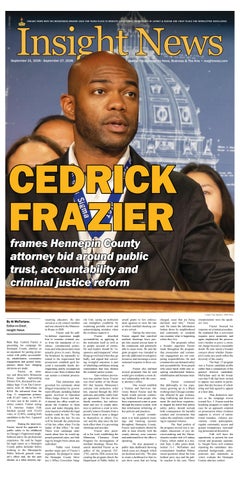
CEDRICK FRAZIER frames Hennepin County attorney bid around public trust, accountability and criminal justice reform
Credit: Clay Masters | MPR News
By Al McFarlane, Editor-in-Chief, Insight News State Rep. Cedrick Frazier is presenting his campaign for Hennepin County attorney as an argument for pairing prosecution with public accountability, rehabilitation, community engagement and greater transparency about how charging decisions are made. Frazier, an attorney and three-term Minnesota House member representing District 43A, discussed his candidacy Sept. 15 on The Conversation with Al McFarlane on KFAI. He advanced from the Aug. 11 nonpartisan primary with 87,447 votes, or 35.95% of votes cast in the county attorney contest. Former acting U.S. Attorney Anders Folk finished second with 55,610 votes, or 22.86%, sending both candidates to the Nov. 3 general election. During the interview, Frazier traced his approach to public safety to his childhood in Chicago’s Englewood neighborhood and to his professional experience. He said he began his legal career as a Hennepin County public defender before working in the Minneapolis Public Schools general counsel’s office and, for the past decade, as a labor attorney rep-
resenting educators. He also served as a city council member and was elected to the Minnesota House in 2020. Frazier said his public-defense experience taught him to examine criminal cases from the standpoint of evidence, constitutional protections and what prosecutors must actually prove in court. During the broadcast, he repeatedly returned to the requirement that prosecutors establish guilt beyond a reasonable doubt, distinguishing public assumptions about a case from evidence that can sustain a criminal prosecution. That distinction also governed his comments about alleged misconduct by government officials, including federal agents involved in Operation Metro Surge. Frazier said that, if elected, his office would examine the evidence in those cases and make charging decisions based on whether the legal burden could be met. “No one will be above the law. No one will be beneath the protections of the law either when I’m the leader of that office,” he said. Those were campaign statements about how he would approach potential cases, not findings by Insight News about any individual. Public trust formed another major part of Frazier’s argument. He pledged to retain the Hennepin County Attorney’s Office Conviction Integ-
rity Unit, saying an institution can strengthen credibility by examining possible errors and acknowledging mistakes when the evidence requires it. Frazier described accountability as applying to the institution itself as well as to people accused of crimes. He said leaders should be “responsive and transparent” when things go well and when they go badly, and argued that correcting wrongful outcomes is part of rebuilding confidence among communities that may distrust the criminal justice system. Gun-violence prevention was another focus. Frazier was chief author of the House bill that became Minnesota’s extreme risk protection order law, enacted through the 2023 judiciary and public safety budget agreement. The law allows family members, law enforcement and city or county attorneys to petition a court to temporarily remove firearms from a person found to pose a danger to themselves or others. Frazier said the data since the law took effect show it is preventing shootings and suicides. Frazier also pointed to his work establishing the Minnesota Clearance Grant Program for investigations of nonfatal shootings. House Research identified Frazier as an author of the proposal, H.F. 2742, and the 2026 session law creating the program directs the Department of Public Safety to
award grants to law enforcement agencies to raise the rate at which nonfatal shooting cases are solved. During the interview, Frazier argued that unsolved nonfatal shootings leave people who caused serious harm in the community and potentially able to cause more. He said the grant program was intended to provide additional investigative resources and encourage a more sustained response to those cases. Frazier also outlined several proposals that he said would give residents a more direct relationship with the county attorney’s office. One would establish a Victims and Survivors Advisory Board. Frazier said the board would provide continuing feedback from people who have experienced crime or gone through the justice system, with that information informing office policies and practices. A second commitment is to hold quarterly meetings and listening sessions throughout Hennepin County. Frazier said residents should be able to meet directly with the county attorney, raise concerns and understand how the office is operating. He also proposed a public data dashboard showing which cases are charged, which are declined and why. “We plan to create a dashboard so that we can show cases that are being
charged, cases that are being declined, and why,” Frazier said. He wants the information broken down by neighborhood and community so residents can examine what is happening where they live. The proposals reflect a broader argument Frazier made throughout the program: that prosecution and community engagement are not competing responsibilities. He said communities can demand safety and accountability from people who cause harm while also requiring constitutional fairness, rehabilitation and humane treatment. Frazier connected that philosophy to his experience growing up in a Black working-class Chicago community affected by gun violence, drug trafficking and disinvestment. He said those experiences shaped his belief that public safety policy should include both consequences for harmful conduct and investments that reduce the conditions contributing to repeated violence. The final portion of the program moved into a secondary discussion of jury decision-making and the Massachusetts murder trial of Lindsay Clancy, which ended in a mistrial Sept. 4 after jurors deadlocked 11-1. McFarlane and commentator Jonathan Palmer raised questions about the lone holdout juror, race and the public reaction to the case. Those
interpretations were the speakers’ own. Frazier focused his response on criminal procedure. He explained that a conviction requires juror unanimity and again emphasized the prosecution’s burden to prove a criminal charge beyond a reasonable doubt. He also raised a broader concern about whether Hennepin County jury pools reflect the diversity of the county. The Sept. 15 program was a Frazier candidate profile rather than a comparison of the general election candidates. McFarlane said on the broadcast that Folk had been invited to appear, was unable to participate that day because of scheduling and had agreed to appear at a later date. That distinction matters as the campaign moves toward Nov. 3. Frazier used the hourlong program to make his case for an approach centered on prosecution where evidence supports it, review of institutional mistakes, violence prevention, victim participation, regular community access and greater transparency surrounding prosecutorial discretion. Folk will have the opportunity to present his own record and proposals separately. Insight News will continue reporting the candidates’ documented backgrounds, policy positions and statements as voters evaluate the Hennepin County attorney contest.
Page 2 • September 21, 2026 - September 27, 2026 • Insight News
insightnews.com
HELPING BLACK FAMILIES OWN A HOME! Build Wealth MN & partners are closing the Homeownership Gap! FINANCIAL EDUCATION SUPPORT The 9000 Equities Fund will provide affordable first mortgages to households struggling to access financial support in the African American community!
CREDIT REPAIR FAVORABLE MORTGAGE LOAN PRODUCTS DOWN PAYMENT ASSISTANCE ACCESS TO REPUTABLE LICENSED PROFESSIONALS
Since 2004, Build Wealth MN, has helped thousands of first time homebuyers not just buy a home...but keep it!
THIS COULD BE YOU!
612-871-9000
info@9000Equities.com
www.9000Equities.com
insightnews.com
Insight News • September 21, 2026 - September 27, 2026 • Page 3
Insight News
INSIGHT NEWS WON THE MESSENGER AWARDS 2024 F OR THIRD PLACE IN WEBSITE EXCELLENCE, THIRD PLACE IN LAYOUT & DESIGN AND FIRS T PLACE F OR NEWSLETTER EXCELLENCE.
September 21, 2026 - September 27, 2026
Vol. 53 No. 38 • The Journal For Community News, Business & The Arts • insightnews.com
Image created with AI
8 rules to help you understand what campaign finance reporting reveals about influence and support – or doesn’t Credit: Fuse.org
Melvin Carter
Melvin Carter named CEO of national nonprofit FUSE Former St. Paul Mayor Melvin Carter has taken over as chief executive officer of FUSE, a national nonprofit focused on helping local governments solve problems. The appointment followed a months-long national search that drew more than 1,100 applicants, according to FUSE. Carter succeeds James Weinberg, who led the organization for more than a decade. Weinberg will remain with FUSE as a senior adviser through the end of 2026 to help with the transition. “Local communities are a powerful engine of innovation and progress,” Carter said. “I’m excited to join FUSE and continue helping civic leaders execute, innovate, and work together to lead our country forward.” Jeff Hébert, FUSE board chair and CEO of HR&A
of Minnesota’s capital city to an organization whose stated mission is helping local governments across the country address their problems. Details of FUSE’s specific programs were not part of the announcement as reported by KSTP-TV. Carter’s move follows a change in leadership at St. Paul City Hall. In November 2025, Kaohly Her defeated Carter in the second round of the city’s ranked-choice mayoral election. Her received 47.76% of the vote to Carter’s 44.98%, a margin of 1,877 votes, according to KSTP. FUSE’s selection of Carter after its national search places a former Twin Cities mayor at the head of a national organization, while St. Paul continues under the administration of Her, the mayor voters chose to succeed him.
“Local communities are a powerful engine of innovation and progress.” - Melvin Carter Advisors, said the board’s decision was unanimous. “Melvin was our first and unanimous choice,” Hébert said. “He’s spent his career building systems that last, and he understands how to turn that kind of change into real results. That gives us a lot of confidence and excitement about where he’ll take this organization.”
Carter served as mayor of St. Paul from 2017 through 2025. In explaining the hire, FUSE pointed to initiatives from his tenure, including universal college savings accounts for children born in St. Paul and 20-year infrastructure and housing investments. The appointment moves Carter from leadership
By Robert Boatright Professor of Political Science, Clark University; Institute for Humane Studies News stories about campaign finance are frequent in any election season, and this year is no exception. In Ohio, for instance, NBC reported in August 2026 that there had been over US$130 million in outside spending in the state’s U.S. Senate race. The story also summarized how much money the two candidates had raised from different categories of supporters, such as the proprietors of nursing homes, labor unions and small donors. It can be hard for the average person to think about these things. It’s hard to know what a normal amount of money is, what it means for a candidate to receive money from particular kinds of donors, or what the impact of this money has on elections. Money is an essential part of elections, yet many Americans view campaign finance as a sign of corruption. They may have a point – but it is still important to understand the nuances of our system in order to decide what is corruption and what is just regular politics. Campaign funding
has changed dramatically in the past two decades. In the most competitive races, spending by outside groups – organizations other than candidates or parties – has increased from a small percentage of spending in the early 2000s to an amount that exceeds what candidates themselves spend. Super PACs or “dark money” groups can spend millions of dollars quickly, putting pressure on candidates to raise more money just in case. I’m a political scientist who studies and writes about campaign finance laws and practices. As confusing as campaign spending may appear to be, there are still some basic rules anyone can use to understand information about money in elections. While most of my examples here are about federal elections, these rules apply to state and local campaigns as well.
Rule #1: Every campaign is more expensive than the last one.
This is partly a matter of inflation, but the cost of the average campaign has grown at a rate even faster than inflation. According to the Center for Responsive Politics, a nonpartisan group that tracks money in politics, $9.5 billion was spent on congressional elections in
FINANCE 12
U.S. sole nation to oppose U.N. resolution Rapid Houthi advances in Yemen correcting Africa’s size on world maps pose massive strategic risks for
The United States stood alone Friday as the only country to vote against a United Nations resolution encouraging the use of world maps that more accurately depict the size of Africa and other regions near the equator. The U.N. General Assembly adopted the “Correct the Map” resolution Sept. 4 by a vote of 164-1, with six countries abstaining, according to reports from The Independent, BBC and The Hill. The non-binding measure, led by Togo and backed by African Union members, calls for wider use of the Equal Earth projection and other equal-area maps when the
comparative size of continents matters. The resolution does not ban the traditional Mercator projection, which has been widely used for centuries. Developed by Flemish cartographer Gerardus Mercator in 1569, the Mercator projection was designed to aid navigation. However, the map increasingly distorts the size of landmasses farther from the equator, making northern regions appear substantially larger while areas near the equator appear smaller, BBC reported. Africa provides one of the most striking examples. The Mercator projection can
Saudi Arabia in the Gulf
make Africa and Greenland appear similar in size, although Africa is actually about 14 times larger than Greenland, according to BBC and The Independent. The Equal Earth projection was created by a team of cartographers in 2018 to more accurately preserve the relative sizes of land areas. The African Union’s 54 member states adopted the projection earlier this year, according to BBC. The resolution encourages governments, schools, international organizations and technology companies to use Equal Earth or other equal-area projections in appropriate set-
Credit: Euronews
Houthi forces entered the port city of Mokha Credit: iStockphoto / NNPA
RESOLUTION 10
Georgia's pre-k program leads nation By National Institute for Early Education Research Georgia’s state-funded pre-k program for 4-year-olds was recently recognized as the largest state-funded preschool program in the nation to meet all 10 quality benchmarks, and the first universal program to do so. Georgia’s recognition is the top finding in the National Institute
for Early Education Research’s new 2025 State of Preschool Yearbook. The yearbook provides an annual snapshot of state-funded preschool across the country. Forty-four states and the District of Columbia fund preschool programs. Only five additional states meet all 10 of NIEER’s research-based benchmarks for quality —Alabama, Hawaii, Michigan, Mississippi, and Rhode Island—in this year’s report. None of those programs
have the reach of Georgia Pre-K. NIEER’s benchmarks measure essential preschool quality indicators, including teacher qualifications, class sizes, early learning standards, and program assessments. “Other states should take note: Georgia proves that state-funded preschool with well-qualified teachers, pay parity with K-12, small classes, and strong continuous improvement systems can be scaled as a universal program,” said NIEER
Credit: iStockphoto / NNPA
PRE-K 10
Business
US consumers and businesses are now facing a future of more expensive borrowing
PAGE 5
By Kristian Coates Ulrichsen Fellow for the Middle East at the Baker Institute, Rice University An advance by Yemen’s Houthi rebels, which has included the targeting of Saudi cities and infrastructure, has quickly complicated a widening Middle East war. Not only has it all but unraveled a 2022 truce putting a lid on Yemen’s civil war – in which the Iran-aligned Houthis were fighting a Saudi-led coalition – but the seizure of territory next to the Red Sea has further threatened Saudi energy exports. On Sept. 13, Saudi Arabia and other Arab Gulf
nations were due to take part in crucial Omani-hosted talks with Iran in a bid to reopen the Strait of Hormuz. But they were called off, seemingly over attacks by both the Houthis and Iraqi groups aligned with Tehran. The Conversation spoke with Gulf analyst Kristian Coates Ulrichsen to help make sense of the dizzying array of intersecting news developments.
What happened with the Oman talks?
Periodically since the war in Iran began on Feb. 28, 2026, and particularly since the signing of the Iran-U.S. memoran-
HOUTHI 10
I2H
CDC vs. Pennsylvania: Why conflicting public health messages jeopardize public safety
PAGE 9
Page 4 • September 21, 2026 - September 27, 2026 • Insight News
insightnews.com
Commentary Before calling Gen Z soft, ask what we prepared them for Columnist
By Haley Taylor Schlitz, Esq. Soft. Fragile. Anxious. Unprepared for the real world. The verdict on Gen Z was already waiting. It did not begin with the University of Michigan’s decision to change how some freshmen will be graded during their first semester beginning in 2027. Older Americans have been making versions of that argument about young people for years. Michigan simply gave the stereotype a new place to land. Roland Martin called the university’s first-semester grading experiment “stupid” and warned that it would make a “soft generation” even softer. Almost immediately, a narrow academic policy became another piece of evidence in a much larger prosecution of young people. Maybe that is why Gen Z can seem so drawn to horror stories about unstable worlds, while feeling nostalgic for decades most of us never lived through. We have grown up hearing that something about us is deficient. Less often do we ask whether the institutions preparing us for adulthood might deserve examination, too. That is what interests
Image created with AI
me about Michigan. The university is not eliminating grades. Professors will still evaluate students. The grades will still exist internally. For one semester, freshmen in the College of Literature, Science, and the Arts will simply see pass or no credit on their external transcripts. Michigan says it wants students to adjust to college and take intellectual risks without treating every course as a threat to a permanent GPA. The experiment may work. It may fail. But reducing it to another argument about whether young people are tough enough allows us to avoid the more difficult question: What if the problem is not that students need more pressure, but that we have spent years teaching them to respond to the wrong kinds of it? I have reason to wonder.
For most of my education, I was the youngest person in the room. I took community college courses while being homeschooled, then attended Texas Woman’s University, and later entered law school at 16. In each of those spaces, I was learning beside people older than me. Homeschooling required me to manage time early, organize my work and understand that assignments still had to be completed even when nobody was standing at the front of a room directing every hour. I learned alongside adults. I learned when to ask for help and when to figure something out myself. I learned that my education ultimately belonged to me. That followed me into college and law school. When COVID-19 abruptly moved my first year of law school into emergency distance learning,
the disruption was real. But the fundamental demand was familiar. The structure changed. The responsibility did not. That experience shapes the way I hear arguments about making education tougher. Tougher how? During his discussion of Michigan, Martin offered a story from his own college years that deserves more attention than his criticism of the policy. He knew he wanted to become a journalist. While in college, he worked at newspapers, television stations and radio stations. He described telling a professor that he was willing to earn a lower grade in a class he considered less relevant because he wanted to spend his time developing the journalism skills that would de-
If AI is the new language of power, then NAN wants Black communities fluent
termine whether he succeeded professionally. He was not trying to maximize every grade. He was deciding what mattered, accepting the academic consequence and choosing experience over optimization because he knew the person he was trying to become. That is not an argument for making education easier. It is an argument for agency. And agency may be one of the things our education system has become remarkably good at postponing. Think about the path many ambitious teenagers are encouraged to follow. Take honors classes. Add AP classes. Protect the GPA. Build the activities list. Demonstrate leadership. Volunteer. Prepare for the SAT or ACT. Learn which choices will look impressive to someone reading an application years from now. There is nothing wrong with ambition. Advanced coursework can be enormously valuable. Academic excellence should mean something. But at some point, preparation can quietly become optimization. A student becomes skilled at asking: What will this do to my GPA? Will this look good to an admissions officer? Those may be rational questions inside the system we have built. They are not the same questions adulthood asks. Adulthood asks what deserves your attention when several things are urgent at
once, how you respond when you do not know something, and what you do when there is no rubric. There is no AP course in recovering from a bad decision. No class rank for knowing when to ask for help. No standardized test for judgment. Yet we often wait until young people arrive on a college campus to expect those capacities to appear. Then, when some struggle with the transition, we call them fragile. Maybe that is backward. Michigan’s experiment interests me for that reason. The university is not declaring excellence irrelevant. It is asking whether the first months of college might serve a different purpose than immediately sorting every student’s performance into a permanent GPA. MIT has been using a version of that idea since 1968. Yes 1968. Its first-semester students receive Pass or No Record grades on their official transcripts while instructors still submit underlying letter grades for advising purposes. MIT is not generally accused of lacking academic rigor. That does not mean Michigan’s experiment will succeed. A pass/no-credit semester could reduce motivation for some students. There are legitimate questions about what happens when the difference
GEN Z 10
INSIGHT NEWS www.insightnews.com
Insight News is published weekly, every Monday by McFarlane Media Interests.
National Newspaper Publishers Association (NNPA)
American civil rights activist
CEO/Editor-In-Chief Al McFarlane
By Rev. Al Sharpton
Publisher Batala-Ra McFarlane
Postmaster: Send address changes to McFarlane Media Interests, Marcus Garvey House 1815 Bryant Avenue North, Minneapolis, MN, 55411
Through a new National Action Network initiative, artificial intelligence is framed as a practical tool for industry preparedness. We are at the forefront of a fundamental shift of access and opportunity. When new technology emerges, marginalized communities are often told to catch up to systems we did not design, and adjust to landscapes that would sooner leave us behind than include us in their architecture. Often during these shifts, our communities become the least resourced, and must navigate industries whose rate of change outpaces their rate of exposure. To combat this, these communities must develop emerging systems of knowledge through internal networks of education, skill-exchange, and entrepreneurship.
Associate Editor & Associate Publisher B.P. Ford
COO/Associate Publisher Trena V. Stubbs
Web Administrator Sunny Thongthi Yang
Image created with AI
This is a civil rights issue. Now, at the dawn of the artificial intelligence era, the same systems our communities have always built for ourselves must rise again. We have had to teach one another how to navigate every new language of power, often because nobody was coming to teach us. AI cannot be different. If Black and Brown communities are going to compete at the highest levels of industry, then practical AI training
cannot be reserved for Silicon Valley boardrooms, elite universities, or people who already have a seat at the table. It has to reach our residents, our clergy, our organizers, our entrepreneurs, our young people, and our families. For this reason, National Action Network is putting AI education directly in the hands of the community with a new initiative led by AI fluency strategist Susan Hearn. The AI Fluency Initiative’s premise
combines the doctrines of racial equity with technology and culture, elevating how access makes AI such a consequential force in determining who gets to shape the next era of American life. Too often, our communities are spoken for as populations that technology is happening to, rather than working for. We hear about the jobs AI
NAN 12
Statewide outreach expands as Office for Missing and Murdered Black Women and Girls connects in Rochester The interaction took place during Safe City Nights, a summer series designed for Rochester residents to interact with local city and public safety organizations in a casual setting. Participation in events outside the Twin Cities metro area reflects the agency's commitment to delivering resources, support, and safety initiatives across all regions of Minnesota. According to agency leaders, issues surrounding violence, exploitation, and disappearances affect families statewide, including rural and Greater Minnesota communities that are sometimes overlooked in statewide policy discussions. “Our staff is being
very intentional about meeting community where they are to engage them in our work, receive their input and be support-
ive where needed,” said MMBWG Director Kaleena Burkes. Throughout the event, staff engaged with attendees—
many of whom were learning about the state office for the first time—to build trust, share educational materials, and raise awareness. For Nelson-Brown, the interaction in Rochester remains a powerful reminder of the underlying purpose behind the state’s public safety and advocacy efforts. “Seeing them safe, happy and proudly carrying their MMBWG bags was a renewing moment and a glimpse of the future MMBWG is fighting for,” Nelson-Brown said. “One where Black women and girls can simply live, grow, play and be together without fear.”
Associate Editors Afrodescendientes Jesús Chucho Garcia Macdonald Anyanwu Book Review Editor W.D. Foster-Graham Sports Editor Leahjean M. Denley Contributing Writer Pulane Choane Columnist Haley Taylor Schlitz Distribution Sound Construction Photographer Uchechukwu Iroegbu Roy Lewis - Washington D.C. Artist Donald Walker Digital Producer Jared McMullin Graphic Designer Syed Fahad Fayyaz Contact Us: McFarlane Media Interests, Inc. Marcus Garvey House 1815 Bryant Ave. N. Minneapolis. 55411 Ph.: (612) 695-0417 Member: Minnesota Multicultural Media Consortium (MMMC) Minnesota Newspaper Association (MNA)
News, opinion and advertising at Insight News Our news reporting is fair, accurate and impartial. We report in context — the historical and cultural context that explains why a story matters to this community is part of the reporting, not a departure from it. When we endorse a candidate or take a position, we say so plainly and label it as such. Endorsements and commentary are separate from news coverage. Advertising is a business function. Advertisers do not influence our news coverage, our endorsements or our commentary — and our coverage does not depend on who buys space in this paper. That wall stands, and we are telling you it stands. Insight News uses AI-assisted tools in some editorial production. Read our AI Policy & Transparency Statement at www.insightnews.com/site/ ai_policy.html.
insightnews.com
Insight News • September 21, 2026 - September 27, 2026 • Page 5
Business
US consumers and businesses are now facing a future of more expensive borrowing By John W. Diamond Director of the Center for Public Finance at the Baker Institute, Rice University From mortgages to auto loans to credit cards, borrowing is set to get even pricier. But the Federal Reserve’s decision on Sept. 16, 2026, to hike its baseline interest rate also highlighted an increasingly confounding dilemma: It can raise the price of money across the economy, but it can’t determine which sectors are most affected. That means the rate increase may further slow the weaker parts of the economy, such as housing, while barely affecting the strongest, namely the relentless investment in artificial intelligence. In its statement summarizing its unanimous vote, the Fed’s policymaking committee said it was raising its benchmark rate by a quarter percentage point so that it now stands at a new target range of 3.75% to 4%. It described inflation as still “elevated” and noted that other economic indicators remain strong, from productivity to investment, to domestic spending. As a scholar of public finance, I believe the Fed probably had little choice but to raise rates given its commitment to maintain inflation-fighting credibility. Markets had already expected the hike, and if the Fed had failed to deliver, it might have pushed longer-term interest rates even higher amid concerns it was becoming less wedded to that target. But the Fed’s action also underscores that the U.S. increasingly looks like an economy moving at two very different speeds. Investment in AI – whether through data centers, computing capacity or related infrastructure – has been boom-
Image created with AI
ing, while it’s crowding out other kinds of investment. Meanwhile, the housing market is getting crushed by high mortgage rates and diminishing affordability, while consumers are carrying ever more expensive credit card and auto debt. Many small and traditional businesses are also in a bind as they face substantially higher financing costs than they did several years ago. Those costs reflect the rising yields on longer-term U.S. government debt, which have been going up for months on a mix of factors: Longer-term inflation concerns due to soaring U.S. government debt, geopolitical risks driving up energy costs, and ongoing financing demand for AI. On Sept. 14, the yield on the 10-year Treasury crossed 5% for the first time since 2023.
An elusive inflation target
When the Fed hikes short-term interest rates, it slows down economic activity by making borrowing more expensive and saving more attractive. That mechanism works particularly well when
consumers are deciding whether to finance a house, purchase a car or take on additional debt. It also discourages businesses from making investments when the expected return is only modestly above their financing costs. As demand slows, businesses have less room to raise prices, easing inflationary pressures. In this case, the Fed justified its move by citing “elevated” inflation and noting that it “will support a timelier return” to its goal of an annual inflation target of 2%. It also suggested the economy would be able to absorb the tightening and described economic activity as “expanding at a solid pace.” The decision aligns with Fed Chairman Kevin Warsh’s recent comments that restoring price stability is central to the Fed’s credibility. In a key speech in August, he underscored his commitment to bringing annualized inflation back down to 2%, an objective he called a “firm, fixed target” – a turnaround from his more ambiguous comments in July. But in recent months, the economic data has shown
that the 2% annual target remains elusive. Consumer prices rose 0.4% in August and 3.4% over the past year. Meanwhile, the war with Iran has pushed oil prices back above US$100 a barrel, adding a new source of inflation pressure through gasoline, diesel, transportation and production costs. At the same time, the labor market isn’t faltering. The economy added 162,000 jobs in August, while the unemployment rate remained at 4.1%. The one notable concern is the persistence of long-term joblessness despite the strong headline numbers. More than one-quarter of unemployed Americans have now been out of work for at least six months. Taken together, those numbers suggested there was room for the Fed to hike rates, given that the economy isn’t sliding into recession. So investors overwhelmingly expected the Fed’s rate increase.
An uneven economic hit
However, tighter monetary policy carries a risk: It falls disproportionately on sectors that are already struggling and highly
AI is supercharging money scams; here’s what you can do to protect yourself By Pawan Jain Associate Professor of Finance, University of Michigan Flint The phone rings, and it’s your grandson’s shaken voice. There’s been an accident, he says, and he needs money before anyone finds out. Except it isn’t him. It’s software that learned his voice from a clip posted online, run by a stranger working through a list of phone numbers. For years, warnings about artificial intelligence and cybersecurity have focused on corporate networks and government systems. Those threats are real. But if you follow the money in the FBI’s fraud data, a different picture emerges: Staggering sums are flowing out of household accounts. In its 2025 annual report, the FBI’s Internet Crime Complaint Center began tracking complaints with an AI connection for the first time. Americans filed more than 22,000 such cases and reported roughly US$893 million in losses. Investment fraud accounted for $632 million of that, and people over 60 accounted for $352 million of the losses. Those figures include only victims who reported to the FBI, and only cases where AI’s role could be identified. The consulting firm Deloitte projects that the actual hit from AI will be much bigger and help push U.S. fraud losses overall to $40 billion by 2027, up from
sensitive to interest rates, while having less effect on one of the economy’s strongest sources of demand – the booming AI investment cycle. Housing provides the clearest example. Persistently high mortgage rates are reinforcing the “lock-in” effect for current homeowners. Millions of homeowners financed their houses when mortgage rates were 3% or 4%, so they’re staying put, with little incentive to sell their home and purchase another at much higher rates. Mortgage rates are mostly influenced by longer-term factors, including Treasury yields, inflation expectations and market expectations about the future path of interest rates. But the Fed’s decision still matters. Markets increasingly expect today’s hike to be followed by additional increases, signaling that it views inflation as a more persistent risk and putting upward pressure on longer-term interest rates. That expectation will keep mortgage rates high – probably resulting in fewer home sales, less mobility and continued headwinds for prospective buyers. It’s also likely to make renting relatively more attractive for potential homebuyers who are priced out of buying. H i g h e r- f o r- l o n g e r rates also change how consumers save. When interest rates were near zero, they earned almost nothing on safe assets. Today, Treasury securities, money market funds and other relatively safe assets offer meaningful returns. Higher rates therefore tend to shift incentives throughout the economy away from borrowing and spending and toward saving. With consumers stretched by inflation and increasingly dipping into their savings, however, this effect may be less pronounced. ernment agency’s letterhead, because most people defer to it. Fluency matters as well. My own research examines how the smoothness of AI-generated communication leads people to trust it. A message with no typos, in a voice that sounds exactly right, sails past defenses that a clumsy fake would have tripped. Nobody plans to make a major financial decision mid-panic. That’s exactly why scammers manufacture the panic.
The quiet version of the attack
Image created with AI
$12.3 billion in 2023. I’m a finance professor who studies household finance and how people use AI to make money decisions. And I believe the most consequential AI security story right now isn’t unfolding in server rooms, but at kitchen tables.
Old cons, new machinery
None of these scams are new. What AI changed is the cost and the quality of the cons. Cloning a voice now takes a few seconds of audio and cheap consumer tools. In one study, listeners were able to identify an AI-generated voice only about 60% of the time. Video is heading the same way. In 2024, a finance employee at
the architecture and design firm Arup was tricked into wiring about $25 million to fraudsters after they set up a video meeting “staffed” by deepfakes of the chief financial officer and several colleagues. Phishing has improved, too. Clumsy wording and odd formatting used to give fraudulent emails away. Language models now write clean, fluent messages and can personalize them at scale using details scraped from social media. Deepfake videos of well-known business figures pitch bogus trading platforms. The same pressure is visible in business losses. The cyber insurer Resilience reported that more than 85% of the
losses in its claims portfolio in the first half of 2026 stemmed from attacks aimed at people rather than systems.
Why careful people fall for it
We’d like to believe that only careless people get taken. Research in behavioral finance says otherwise. These scams are engineered around fear and urgency: a panicked grandchild, a boss demanding a same-day transfer, an investment window that closes tonight. Stress narrows attention and pushes people toward fast, intuitive judgments at the very moment they need slow, deliberate ones. Fraudsters also strike a pose of authority, whether a CFO’s face or a gov-
AI-enabled theft doesn’t necessarily involve talking to the victim. Stolen personal data sells for a few dollars on dark web markets. Criminals then feed it to automated AI agents that probe bank and fintech systems around the clock, testing credentials and hunting for weak points at a speed no human crew could match. Last fall, the AI company Anthropic disrupted an espionage campaign in which an AI agent performed 80% to 90% of the intrusion work against roughly 30 targets, including financial institutions. When an attacker gets into a customer account, the takeover can be over in minutes. Instant payment platforms like Zelle, built for speed and convenience, become the getaway car. The money typically moves within minutes, and getting it back is almost impossible.
How to protect you and your loved ones
Banks defend their own wire rooms with procedures, not vigilance. Households can borrow those procedures. Check by calling back. When you get a suspicious call, hang up and dial a number you already know – like your bank’s fraud hotline – and never
The AI sugar high
When it comes to the AI investment boom, it’s a different picture. Warsh noted in August that more than half of recent capital-spending growth could be attributed to the AI buildout. The companies that are spending billions of dollars on computing infrastructure are doing so because they expect potentially enormous returns from AI. If those expected returns on investment are exceptionally high, a modest increase in borrowing costs may do little to alter their investment decisions. That stands in sharp contrast to a prospective homebuyer getting sticker shock from mortgage rates nearing 7%. The federal government, for its part, faces a slower adjustment. A Fed rate hike doesn’t immediately increase the interest rate on all outstanding federal debt. Most Treasury notes and bonds carry fixed rates until they mature. But as the Treasury issues new debt and refinances maturing securities, today’s higher rates gradually become tomorrow’s higher federal interest expense. That rise in interest costs is a main reason some economists are sounding alarms about the national debt, which recently topped $40 trillion. In effect, the U.S. economy is facing a reality in which both short- and long-term rates stay higher for longer. The federal government, households and businesses are all adjusting to a borrowing environment that looks substantially different from the one that prevailed for much of the previous decade. Disclosure statement John W. Diamond does not work for, consult, own shares in or receive funding from any company or organization that would benefit from this article, and has disclosed no relevant affiliations beyond their academic appointment. one the caller or message supplies. The point is to leave the channel the scammer controls. A cloned voice can’t answer your grandson’s real phone. Trust and verify. You should agree on a robust family code word for emergencies and treat any request for money that lacks it as fake. Require two people in your household to sign off on any large transfer, so nobody moves serious money alone and under pressure. And build in a delay, such as a self-imposed 24-hour wait, before any big payment. Urgency is the scammer’s tool. Slowness is yours. Add layers of protection. Protect the accounts themselves, too. Turn on two-factor login for financial accounts, and never share a verification code with someone who contacts you. That code is the second lock on your door, and the only reason a caller wants it is to get in. You should also switch on your bank’s transaction alerts so a takeover announces itself in minutes, and consider a credit freeze, which is free and blocks thieves from opening new accounts with data bought on the dark web. Protect older people. With $352 million of reported AI-related losses coming from Americans over 60, conversations with older family members are key. Walk through the callback rule and the code word, and ask their bank or brokerage about adding a trusted contact they can call. It costs nothing, and it gives the institution a way to raise an alarm before the money moves. If money has already moved, you should call your bank immediately, ask it to at-
SCAMS 10
Page 6 • September 21, 2026 - September 27, 2026 • Insight News
insightnews.com
INSIGHT NEWS The Roster rail STATEWIDE U.S. Senator: Peggy Flanagan (DFL) · Michele Tafoya (R) · Marisa Simonetti (IND) · Rebecca Whiting (LIB) Governor
&
Lt.
Governor:
Amy
Klobuchar and Ben Schierer (DFL) · Lisa Demuth and Ryan Wilson (R) · Steven Young and Jane Kirby (GP) Attorney General: Keith Ellison (DFL) · Ronald J. Schutz (R) Secretary of State: Steve Simon (DFL) · Tad Jude (R) · Seth Kuhl-Stennes (GP) · George "Chip" Tangen (LIB) State Auditor: Zack Filipovich (DFL) · Scott Jensen (R) · Jay Reeves (FI)
U.S. HOUSE CD3: Kelly Morrison (DFL) · Tyler Bass (R) CD4: Betty McCollum (DFL) · Paul Wikstrom (R) CD5: Ilhan Omar (DFL) · John Nagel (R) · DeVelle L. Jackson (IND)
Bobby Joe Champion
Doron Clark
Abigail Wolters
PUBLIC SAFETY Champion's first-listed priority is public safety. His campaign says every Minnesotan deserves to make it home at the end of the day, names Jamar Clark, George Floyd and Amir Locke, and calls for a "both and" approach of more social workers, more police and community safety programming, plus violence interrupters and juvenile justice reform. It also backs universal background checks, penalties for straw buyers and a ban on assault-style weapons. "I am working for a 'both and' approach– more social workers, more police, and more imaginative community safety programming."
PUBLIC EDUCATION FOR EVERYONE Clark's first-listed priority is public education. His campaign says the Minneapolis and St. Paul budget shortfalls show the state has not fully funded its schools, and pledges to push for higher per-pupil funding and reimbursement of mandated services. It sets a floor of $60,000 for teacher pay and $25 an hour for every school employee, backs full-service community schools and universal child care and pre-K, and supports a moratorium on new charter schools. "For many of our kids, school is the only place they see a nurse, receive mental health services, or have a hot meal."
SAFE NEIGHBORHOODS Wolters's first-listed priority is public safety. Her campaign says safety concerns in Minneapolis are real and deserve solutions rather than politics, and calls for fully staffed law enforcement, stronger minimum sentences for repeat offenders, an end to release after half a sentence, and judicial retention elections so voters have a say on judges. A software engineer and University of Minnesota graduate, she says she is a neighbor, not a politician. "Abby believes in effective public safety, fair accountability in the justice system, and making our neighborhoods and campus areas welcoming, affordable places for us to live, work, and go to school."
Scott Dibble
Omar Fateh
Fue Lee
TRANSPORTATION Dibble's site carries a record rather than an issues page; its first-listed section is transportation. The campaign names him chief author of the 2023 transportation bill, which it calls the most comprehensive in state history, funding transit, biking and pedestrian routes and road and bridge repair, stabilizing Metro Mobility, and adding suicide-prevention barriers on the Washington Avenue Bridge. It also lists him as author of the 2013 marriage equality law. "Scott played a key leadership role in one of the most transformational sessions in state history."
ADVOCATE FOR WORKING PEOPLE Incumbent, first elected in 2020. Fateh describes himself as a Southside senator, husband, father, renter, son of Somali immigrants and long-time advocate for working people. His most recent public post points to behavioral health: after touring Wayside Women's Treatment Center, he highlighted the nonprofit's residential care for women recovering from substance use and mental illness. In his words: "As a non-profit, Wayside provides residential treatment for women, supporting recovery from substance use and mental health services."
COMMUNITY CAPITAL INVESTMENT Lee's site carries no issues page; its hero is a list of 2021 accomplishments, first among them the Targeted Community Capital Grant Program. Chair of the House Capital Investment Committee, he is credited on the site with $2.5 million for Northgate clean-energy job training, stronger lead-exposure protections, a zero-emission transit plan for the Met Council, and after-school funding for culturally specific organizations serving underserved students. "$24 million for the new Targeted Community Capital Grant Program, which allows communities like ours the opportunity to see state capital investments that reflect their needs and backgrounds."
STATE SENATE SD34: John Hoffman (DFL) · Karen Attia (R) SD36: Heather Gustafson (DFL) · Heidi Heino (R) SD37: Kristy Janigo (DFL) · Brady Hoag (R) SD38: Susan Pha (DFL) · Brad Olson (R) SD39: Mary K Kunesh (DFL) · Pam Wolf (R) · Ngone Saliou Niang (GP) SD40: John Marty (DFL) · Rachel Japuntich (R) SD42: Bonnie Westlin (DFL) · Kevin Peterson (R) SD43:
Mike
Freiberg
(DFL)
—
unopposed SD44: Sam Rosemark (DFL) · James Tacheny (R) SD45: Ann Johnson Stewart (DFL) · Shannon Bruce (R) SD46: Ron Latz (DFL) · Kayla Wright (R) SD49: Krish Subrahmanian (DFL) · Dustin R. DuFault (R) · Kris Babler (IND) SD50: Karla Hult (DFL) · Owen Michaelson (R) SD51: Simon Trautmann Cordova (DFL) · Juline Birgersson (R) SD59: Bobby Joe Champion (DFL) — unopposed SD60: Doron Clark (DFL) · Abigail Wolters (R) SD61: Scott Dibble (DFL) — unopposed SD62: Omar Fateh (DFL) — unopposed SD63: Zaynab Mohamed (DFL) · Diane Napper (R) SD64: Erin Murphy (DFL) · Robert Bushard (R) SD65: Robyn Gulley (DFL) · Rocco (R) SD66: Clare Oumou Verbeten (DFL) · Kathleen Bart (R) SD67: Foung Hawj (DFL) · Toby Hesselgrave (R)
Esther Agbaje
Kenneth Smoron
AFFORDABLE HOUSING Agbaje's first-listed priority is housing. Her campaign says everyone deserves a safe and stable home and points to support for first-generation homebuyers, stronger tenant rights and programs that keep families housed; her bio credits her with $150 million in down-payment assistance for first-generation buyers. A renter and transit rider, she also lists safety through mental-health services and crime prevention, reliable transit, and a fairer tax system. "I'm working to make housing affordable and accessible for all, by supporting first-generation homebuyers, strengthening tenant rights, and investing in programs that help families stay in their homes."
PUBLIC SAFETY No campaign website was found. Smoron's most recent published statement is his 2024 Ballotpedia candidate survey, which leads with public safety: police as part of a comprehensive strategy, with sufficient staffing, transparency, officer-community engagement, de-escalation and mental-crisis training, and data-driven prevention. He also calls for an all-of-the-above energy strategy to address rising costs. Ballotpedia notes an affiliation with the Log Cabin Republicans. "Downtown Minneapolis deserve a representative that supports law enforcement as part of a robust public safety program."
insightnews.com
Insight News • September 21, 2026 - September 27, 2026 • Page 7
VOTERS GUIDE The Roster rail STATE HOUSE 34A: Jason Heaser (DFL) · Danny Nadeau (R) 34B: Xp Lee (DFL) · Ruth Bittner (R) 36A: Jim DeMay (DFL) · Sebastian Stoss (R) 36B: Brion Curran (DFL) · Patty Bradway (R)
No Photo Available
37A: Darci Smith (DFL) · Tom McKee (R) 37B: Kristin Bahner (DFL) · Luke Doerer (R)
John Holmberg
Mohamud Noor
Katie Jones
John Holmberg (Republican Party) is running for election to the Minnesota House of Representatives to represent District 60A. He is on the ballot in the general election on November 3, 2026
EQUITABLE EDUCATION Noor's first-listed priority is education, which his site calls critical to a thriving society; the homepage shows only the opening line of each issue. It also lists economic inclusion — no one working full time should live in poverty — and racial and social justice. As chair of the House Workforce and Economic Development Committee, he is credited with advancing economic opportunity, job creation and business growth. "As Chair of Workforce and Economic Development, Noor is responsible for advancing economic opportunity for Minnesotans, and supporting job creation and business growth."
CLIMATE AND TRANSPORTATION Jones's homepage leads with her work alongside Rep. Frank Hornstein on the climate and transportation policies she says made Minnesota a national leader, and her wish to continue it. An engineer, she says the House has few legislators with science backgrounds, and names climate change, racial and gender justice, community safety, public schools, housing and struggling business nodes as issues needing real solutions. "I'm running to continue that work because there is still so much to be done."
38A: Huldah Momanyi-Hiltsley (DFL) · Charlie Kistler (R) 38B: Samantha Vang (DFL) · Robert Marvin (R) 39A: Aaron Klemz (DFL) · Andy Macko (R) 39B: Amada Marquez Simula (DFL) · KT Jacobs (R) 40A: Aisha Elmquist (DFL) · Luis Withrow (R) 40B: David Gottfried (DFL) · Allen Shen (R) 42A: Ned Carroll (DFL) · Kathy Burkett (R) 42B: Ginny Klevorn (DFL) — unopposed 43A: Kyrstin Schuette (DFL) · Todd Hesemann (R) 43B: Jess Lewis (DFL) — unopposed 44A: Peter M Fischer (DFL) · Justin Middaugh (R) 44B: Leon M. Lillie (DFL) · TJ Hawthorne (IND) 45A: Tracey Breazeale (DFL) · Andrew Myers (R) 45B: Patty Acomb (DFL) · Thomas Bergerson (R) 46A: Larry Kraft (DFL) · Karl Olson (R) 46B: Cheryl Youakim (DFL) · Kim Rich (R) 49A: Alex Falconer (DFL) · Jeff Houdek (R)
Jamie Long
Aisha Gomez
Anquam Mahamoud
CLIMATE ACTION Long's homepage lists climate action first, followed by ICE accountability, school funding, democracy, reproductive rights, gun-violence prevention, criminal-justice reform, a public option and universal child care. The DFL House floor leader and former majority leader, he says real change comes from the community first and that investment in health care, education, child care and climate will create opportunity. "He believes that investments in healthcare, education, childcare, and climate initiatives will create more opportunities — and a brighter future — for all Minnesotans."
TAX FAIRNESS Gomez's homepage leads with her work as Tax Committee chair: a bill she says has the rich pay more of their fair share, a child tax credit projected to cut child poverty by a third, $35 million a year in Tribal aid, and a restructured renter's credit reaching 100,000 more renters. She calls Minnesota's tax code the most progressive and equitable in the country. "I was named Chair of the Tax Committee and passed a bill that has the rich pay more of their fair share and invests in our communities."
HEALTH CARE Mahamoud's homepage frames 2026 around federal attacks on immigrant neighbors and two killings in the district, and says residents are holding the line. A former MNsure planning director, she says she has worked to remove barriers to health care in underserved communities and expand affordable housing. Her vision page cites the district's overdose disparities and backs harm reduction, safe recovery sites and wider naloxone access. "I know that all Minnesotans are looking for the same holistically rooted foundation when they lay down at night: Health, Education, Affordable Housing, Clean Air and Water, and a bright future for their families."
49B: Carlie Kotyza-Witthuhn (DFL) · Wendy Cregg (R) 50A: Julie Greene (DFL) · Chris Wedum (R) 50B: Steve Elkins (DFL) — unopposed 51A: Michael Howard (DFL) · Frank Pafko (R) 51B: Nathan Coulter (DFL) · Jim Lund (R) 59A: Fue Lee (DFL) — unopposed 59B: Esther Agbaje (DFL) · Kenneth Smoron (R) 60A: Sydney Jordan (DFL) · John Holmberg (R) 60B: Mohamud Noor (DFL) — unopposed 61A: Katie Jones (DFL) — unopposed 61B: Jamie Long (DFL) — unopposed 62A: Aisha Gomez (DFL) — unopposed
Which district are you in? Enter your address at mnvotes.gov to see your Senate and House districts, your polling place and a sample ballot. Early voting is open now at the Minneapolis Early Vote Center and Ramsey County Elections. Election Day is Tuesday, Nov. 3.
62B: Anquam Mahamoud (DFL) · Bob Sullentrop (R) 63A: Samantha Sencer-Mura (DFL) · Kyle Bragg (R) 63B: Emma Greenman (DFL) · Nicholas Peters (R) 64A: Meg Luger-Nikolai (DFL) — unopposed 64B: Dave Pinto (DFL) — unopposed 65A:
Samakab
Hussein
(DFL)
—
Ellefson
(DFL)
—
unopposed 65B:
Sebastian
unopposed
Bob Sullentrop FRAUD Sullentrop's site carries one issue: fraud in state programs. It reproduces a Star Tribune poll story, then says he has learned from more than one source that fraud has gone unchecked for years, costing billions in mostly Medicaid funds, and that he would join Speaker Lisa Demuth's push against it. A retired civil engineer and Marine Corps veteran who worked at the Pollution Control Agency, he chairs the Senate District 62 Republicans. "Bob has learned from more than one source that fraud has been occurring in Minnesota for quite some time."
Sydney Jordan FULLY FUNDED PUBLIC SCHOOLS Jordan's campaign describes her as an education, environmental and labor organizer and commits to fully funded public schools, a protected environment and a community that leaves no one behind. Her vision page adds cleanup of the Northeast and Como superfund sites, continued monitoring of the Northern Metals site, and opposition to right-towork legislation. "As your state representative, Sydney will fight to make sure every neighborhood has a fully-funded public school, our environment is protected, and our community doesn't leave anyone behind."
Your November Ballot: the schedule Sept. 14 Statewide · Congress Sept. 21 SD59 · 60 · 61 · 62 (this week) Sept. 28 SD63 · 64 · 65 · 43 Oct. 5 SD66 · 67 · 44 Oct. 12 SD34 · 38 · 46 Oct. 19 SD36 · 39 · 40 Oct. 26 SD37 · 42 · 45 Nov. 2 SD49 · 50 · 51 Nov. 3 Election Day
66A: Leigh Finke (DFL) · Mark Born (R) 66B: Athena Hollins (DFL) · Mary O'Neal (R) 67A: Liz Lee (DFL) · Jennifer McPherson (R) 67B: Jay Xiong (DFL) — unopposed
Page 8 • September 21, 2026 - September 27, 2026 • Insight News
insightnews.com
Books, Arts & Culture Curved air: a biography of sickle cell anemia and the quest to cure the first molecular disease Four weeks of testing, and you’re exhausted. Two gallons of blood, maybe three, have been removed. No lie. You’ve laid on tables, slid through machines, been scanned so much you lost count and finally, your doctors have a diagnosis. As in the new book “Curved Air” by Kevin Davies, you have hope there’s a what next? Though the disease was known in parts of Africa and likely existed here in the United States for hundreds of years, sickle cell disease (SCD) is a relative newcomer in disease research. Says Davies, “Sickle cell was first identified more than 120 years ago” and it was considered as a “Black disease.” Because of that, discrimination followed “sickle cell warriors” and research was scant, though
white people can and do get SCD. With “agonizing” pain as a major symptom, “SCD is one of roughly seven thousand genetic diseases” currently known to science. When someone has SCD, a genetic mutation causes their red blood cells to curve and get stuck in blood vessels, rather than flowing freely as they should. This diminishes the oxygen supply “to various parts of the body… which causes inflammation and pain,” jaundice, stroke, and damaged organs. Anemia, Davies says, can leave a patient fatigued and short of breath. Anticipating pain crises causes anxiety and PTSD. Says Davies, “More than forty million people carry” one copy of the genetic mutation that causes SCD, and “five hundred thousand affected” ba-
bies are born with the disease per year, worldwide. Over decades, research was done haphazardly. Papers were written; treatments were tried, used, or discarded. Doctors discovered that genetic testing could prevent new cases, a heartbreak for would-be parents. Researchers discovered that “a perfect storm” of confluence spread SCD: malaria, human population, and mosquitoes. There was always hope that someday, sickle cell disease might be cured. Then, Clustered Regularly Interspaced Short Palindromic Repeats (CRISPR) gene-editing therapy was approved by the FDA, and a brave volunteer named Victoria Gray stepped forward… So, you want to – need to – learn more about sick-
le cell disease? Is it imperative for you? Then, this is your book. But there are things you’ll want to know before you dive into “Curved Air.” Because author Kevin Davies is the editor of The CRISPR Journal, you can expect up-to-date, cutting-edge information; but that’s a two-sided coin: the information is heavy-duty, not always easy to grasp, and it’s burdened by acronyms that can be overwhelming. Yes, that’ll inform you, but it may also send you elsewhere for further understanding, which really should’ve come from this book. And yet, if you or someone you love has SCD, this is your book. It explains where the disease came from, why it hasn’t been completely cured yet, and what kind of hope you can hold. It’s a good start on a
path to comprehension. Also, be aware that the narrative here is sometimes padded with journalistic fluff
that might annoy you if you’re eager to get to the science. Indeed, “Curved Air” will teach you. Then again, it also might test you.
The Minnesota Orchestra welcomes five new full-time musicians The Minnesota Orchestra introduces five new full-time musicians to its ranks this fall. Sumin Kim will take up a position as assistant principal viola, while Nicholas Gallitano and Joshua Kail join as section violists. Abraham Feder is the Orchestra’s newest cellist, and Mike Alexander joins the horn section. Each of the new players will perform in the Orchestra’s Season Opening concerts featuring Stravinsky’s The Firebird on September 25-26 at Orchestra Hall, led by Music
Left to Right: Sumin Kim, Nicholas Gallitano, Joshua Kail, Abraham Feder, Mike Alexander Director Thomas Søndergård, with the exception of Nicholas
Gallitano, who will begin his position in November.
Born in Seoul, Sumin Kim (assistant principal vio-
la) began music studies on the violin. While pursuing her bachelor of music degree in violin performance, she developed a deep passion for the viola expanding her artistic repertoire to encompass both instruments. Prior to joining the Minnesota Orchestra, Kim performed with the Los Angeles Philharmonic as a substitute violist and with the Philadelphia Orchestra as a substitute in both the viola and violin sections. She also served as principal viola of the Curtis Symphony Orchestra, as well as section violinist, violist and
B L A N CO & R E P OSA D O 75 0 M L 8 8 P R O O F | 4 4 % A BV 1 0 0 % P U R O D E AG AV E D O U B L E D I ST I L L E D 5 0 % S M O K E D A N D 5 0 % ST E A M E D D I S C OV E R M O R E AT F O R YO U M A S E S P I R I T U !
R E V E L S P I R I T S .C O M
acting principal violist with the Symphony in C. She earned her bachelor’s degree at the Curtis Institute of Music and her master’s degree at the Juilliard School. Nicholas Gallitano (viola) found his love of orchestra in high school as a member of youth orchestra in the Greater Boston area. He joins the Minnesota Orchestra after two seasons as acting section viola in the Indianapolis Sym-
MUSICIANS 10
insightnews.com
Insight News • September 21, 2026 - September 27, 2026 • Page 9
Insight 2 Health
CDC vs. Pennsylvania: Why conflicting public health messages jeopardize public safety By Katrine L. Wallace Assistant Professor of Epidemiology and Biostatistics, University of Illinois Chicago If you’ve been following the dispute between Pennsylvania Gov. Josh Shapiro and Health and Human Services Secretary Robert F. Kennedy Jr., you probably know that it centers on the deaths of two infants in Lancaster County in late August 2026. And you may be aware that despite the county coroner’s confirmation that one infant died due to measles, while the other’s death was “measles-associated,” the measles dashboard on the Centers for Disease Control and Prevention website counts neither death as of Sept. 10. It’s easy to dismiss the squabble as political posturing between public officials. But as an epidemiologist who studies vaccine-preventable illnesses and health communication, I worry that for people seeking accurate information about how to keep their families safe – in this case, families in Lancaster County – there’s an enormous cost when health authorities no longer speak in one voice. In the confusion that such rifts create, the public has no way of knowing which disagreements are about evidence and which are driven by ideology and narrative control.
Deaths in dispute
The U.S. government issues a certificate for every death, confirming its underlying cause following a physician’s examination. The death certificate poses a narrow question: What single condition set in motion the chain of events that ended in this person’s death? This is recorded as the cause of death. Because measles is what the CDC calls a notifiable condition, or a reportable disease, measles deaths get added to a national count. Contributing conditions go on a separate line in the document and are not counted. Nobody disputes that both infants had measles when they died. The argument is which line on the death certificate “measles” belongs on. The Pennsylvania Department of Health has called both deaths measles-associated. This term is used when there’s evidence the person had measles, but there’s no settled official cause of death yet. It’s a holding category, not
The cost of fracture
Image created with AI
a verdict.
The job of determining the official cause – that is, certifying a death – falls to the county coroner. Lancaster County Coroner Stephen Diamantoni concluded that for one of the infants, a newborn boy who died in mid-August, the cause was a ruptured spleen unrelated to the measles infection. For a 6-week-old girl who died Aug. 18, he found that measles was the cause. These are not competing conclusions. They come from two different systems asking two different questions. County coroners’ decisions on cause of death are legal finding, made one case at a time, that feed national vital statistics. State health departments, on the other hand, run disease surveillance. They track who got sick and who died during an outbreak so they can contain it. Surveillance moves in days because it has to; death certification moves in weeks because it should. The two rarely line up in real time.
A moving target
While the apparent divergence between county and state data was basically a technicality, the exchange between Shapiro and Kennedy was more of a brawl. Shapiro announced the infants’ deaths on Aug. 25 and blamed anti-vaccine rhetoric for falling vaccination rates and increasing cases. The CDC posted condolences on the social media platform X, using Pennsylvania’s language calling the deaths measles-associated. But in response, Kennedy suggested the deaths might have been fabricated by a member of the governor’s staff. Two days after Shapiro’s announcement, the CDC walked back its
post, expressing appreciation for Kennedy’s efforts to clarify conflicting information from Pennsylvania officials about whether the two reported deaths were caused by measles. Then, in an unusual move, on Aug. 30, the CDC changed the death count on its measles dashboard from 2 to an asterisk, with a footnote stating that the National Center for Health Statistics currently has no death records from 2026 that indicate measles is the underlying cause. No new evidence arrived in those two days that would explain the CDC’s new position. HHS now says it is working with a national network of disease tracking experts on a standardized case definition for measles deaths. Standard case definitions exist for measles infections but not for measles deaths, for the simple reason that until recently, dying from measles in the U.S. was an extremely rare occurrence: Between 2001 and 2022, the U.S. recorded roughly 4,000 cases and three deaths. But writing a definition in the middle of a count – and applying it to a single state’s deaths – is a departure from protocol. Previously, during outbreaks in Texas and New Mexico in 2025, the CDC did count three measles-associated deaths while they were still being investigated. Declining to do so now is inconsistent and confusing, and breeds mistrust. Unnamed officials told news outlets that CDC Director Erica Schwartz removed the deaths at Kennedy’s request, after CDC staff had accepted the state’s data. HHS disputes this, and Kennedy said in a post on X that the coroner’s finding
– that the newborn boy’s death was caused by a ruptured spleen – vindicated federal caution. A parent sifting through all this information has no way to gauge who is right. The usual shortcut – check the CDC numbers on the measles dashboard – now yields an asterisk leading to a footnote that contradicts statements from state officials, a county coroner and the agency’s own condolence post from 10 days earlier. There’s no neutral tiebreaker left, which means the decision falls back on which institution you already trusted most.
A broader split in public health guidance
While that argument played out, a second rift was widening on a different track. On Sept. 2, four physician groups – the American Academy of Pediatrics, the American Academy of Family Physicians, the American College of Obstetricians and Gynecologists, and the Infectious Diseases Society of America – issued their own vaccine recommendations for the fall respiratory season. The pediatricians association had already split from the CDC’s childhood immunization schedule in 2025, ending a 30-year practice of publishing one agreed-upon set of recommendations for families. What’s new is that three more societies have now joined this public health separatist movement, and that the split has extended to the shots most adults get. On influenza, the physician groups’ advice matches the CDC’s: Everyone 6 months and older should get a flu vaccine. On COVID-19 they go further, recommending vaccination for children 6 to 23
months, whereas the CDC tells parents to consult a doctor. For decades, the CDC has issued fall vaccine recommendations each year, offering a unified slate of federal advice for everyone across the U.S. to follow. Now, with the federal advisory committee that makes those recommendations sidelined and embroiled in a legal battle, the agency has issued no new federal vaccine guidance for this season. The four physician groups stepped forward to fill the gap. Yet technically, the CDC’s previous seasonal recommendations – and its revised childhood immunization schedule – still stand, creating a confusing doubling of critical health guidance.
This confusion has a measurable cost. Measles is among the most contagious diseases known. Roughly 1 to 3 in 1,000 children who catch it die, and in 2025, 11% of cases required a hospital stay. A 2025 study put the average cost at roughly US$43,000 per case. The national case count reached 3,134 on Sept. 4, the highest since 1991. As of the same date, Pennsylvania had recorded 624 cases – 91 in the previous week. More than 40% of Pennsylvania’s cases have been in Lancaster County. Parents must now reconcile a recently revised federal immunization schedule, a set of physician-society recommendations that departs from it, a state count of two deaths and a national count of none. Each of those positions has an institution behind it. None of them explains how it relates to the others – and that is what’s most damaging. Public trust doesn’t only collapse when officials lie. It erodes when people are handed different information that can’t be squared, or misleading information, and are left to sort it out alone. Disclosure statement Katrine L. Wallace does not work for, consult, own shares in or receive funding from any company or organization that would benefit from this article, and has disclosed no relevant affiliations beyond their academic appointment.
Page 10 • September 21, 2026 - September 27, 2026 • Insight News
Resolution From 3
Pre-K From 3 director Steve Barnett. “With new initiatives to support quality, Georgia can expect increased enrollment, but leaders should also actively promote increased enrollment.” Nationally, state support for preschool education hit record highs in enrollment and funding in 2024-2025. The pace of growth slowed, however, compared to the prior year, and many states continue to lag behind pre-pandemic enrollment levels. Preschool enrollment increased by 44,000 children nationally, reaching almost 1.8 million, including 37% of U.S. four-year-olds and 9% of threeyear-olds. California, Colora-
Houthi From 3 dum of understanding in midJune, Omani and Iranian officials have been meeting to discuss how to resolve the blockage in the Strait of Hormuz. Oman and Iran are the two coastal Gulf States through which the waterway passes, despite Iranian rhetoric about securing and maintaining control over the strait. The challenges facing the negotiators is that Oman will need to build consensus among the other Gulf States for any agreement, as well as the United States, given that one Iranian demand is for passage to be limited to civilian vessels, which would effectively bar U.S. naval ships from the Gulf, including the U.S. Navy’s 5th Fleet, which is headquartered in Bahrain. Gulf officials – and their U.S. counterparts – would strenuously resist any Iranian
Gen Z From 4 between excellent work and adequate work temporarily disappears from the external record. But perhaps Michigan’s most useful contribution is the question it allows us to push further down the educational pipeline. What should students experience before they ever arrive at college?
Scams From 5 tempt a recovery, then report the scam to the Federal Trade Commission.
Where habits end, rules should begin
Good habits raise the cost of every one of these scams, but they can’t do it all. This is where the U.S. regulations have fallen be-
Musicians From 8 phony. He has also performed extensively with the New York Philharmonic, including tours and residencies across the United States and Asia, and has performed as guest violist of the Juilliard String Quartet. He holds degrees from the Juilliard School and Oberlin College and Conservatory. A native of New York City, Joshua Kail (viola) began playing violin at a young age before switching to viola at 15 under the instruction of Suzanne Wagor. He received his bachelor’s degree from the Juilliard School and went on to study at the Norwegian Academy of Music with Lars Anders Tomter, where he served as an orchestral fellow with the Oslo Philharmonic Orchestra. Since 2023 he has performed as a
insightnews.com
tings, The Independent reported. Supporters say the issue extends beyond geography, arguing that distorted maps can influence how people perceive
Africa’s size, importance and potential. “A map is never neutral,” Togolese Foreign Minister Robert Dussey said during a U.N. briefing, according to The
Independent. “It shapes perceptions, influences how the place of peoples and continents in the world is understood.” Dussey said African nations are not seeking special
do, Michigan, Minnesota, and Missouri contributed the most to increased enrollment, adding more than 52,000 new seats. States spent nearly $14.4 billion on preschool in 2024-2025. Including federal and local dollars, total spending was almost $17.7 billion. Three states each spent more than $1 billion last year: California ($4.1 billion), New Jersey ($1.2 billion), and New York ($1 billion). Together, these three states account for 45% of all state preschool spending. Texas adds almost another $1 billion. Spending increased by $434 million, or 3%, adjusted for inflation. Twenty-eight states increased preschool funding, including Michigan and New Jersey, which each added more than $100 million. “Not only does preschool access vary
by which state a child happens to live in, but so does the quality of that preschool experience,” said Allison Friedman-Krauss, lead author of the report. “Only high-quality early care and education programs support children’s development enough to result in lasting academic and other gains that ultimately deliver savings for taxpayers.” A record six states met all 10 of NIEER’s recommended quality standards, with Alabama doing so for the 20th consecutive year. Georgia joined this list this year after improving its teacher-to-child ratio from 1:11 to 1:10 and lowering maximum class sizes to 20. Several states met 9 of 10 benchmarks, including New Mexico, which is working toward universal access for both three- and four-year-olds. Once New Mex-
ico requires all lead teachers to have a bachelor’s degree in early childhood education, it will be on par with Georgia in terms of both quality and quantity. Not all states moved forward. Twenty states enrolled fewer preschoolers in 20242025 than the prior year, with enrollment dropping by more than 1,000 children in Arizona, Florida, New York, Ohio, Oklahoma, and Wisconsin. Seventeen states spent less on preschool than the prior year, adjusted for inflation, with Arizona, North Carolina, Oregon, and Texas seeing the largest percentage declines. Additional information about the State of Preschool Yearbook, including individual state profiles and maps, graphs, and state rankings, can be found at www. nieer.org.
attempt to convert their wartime leverage over the strait into a postwar deal that formalizes and regularizes that control. The postponement of the planned meeting in Oman’s capital Muscat illustrates that the time is not yet right for the talks to proceed and that further dialogue is needed in order to build a consensual framework that can best enable them to succeed.
The uptick in attacks on Saudi energy infrastructure has put in jeopardy the viability of the work-around to Hormuz that enabled the kingdom to maintain oil exports at about half their prewar levels. Saudi vessels have already started to avoid transiting the Bab el-Mandeb Strait and taking the far longer route through the Suez Canal into the Mediterranean and around the coast of Africa. That adds weeks and associated costs to oil exports to predominantly Asian markets.
While the damage to a pumping station that led to the temporary closure of the Saudi’s East-West Pipeline was reportedly done by a drone launched from Iraq, the kingdom faces attacks from both its northern and southern neighbors with the range, intent and capability to hit critical energy targets. Saudi officials may respond to the latest attacks by rerouting oil back to its east coast facilities on the Persian Gulf, and there has been a steady increase in the volume of oil making its way through Hormuz in recent days and weeks. This return to using the Saudi port at Ras Tanura nevertheless makes oil transportation remain vulnerable to Iranian attacks on shipping in the strait. Moreover, should the Saudis face a “double choke point” crisis whereby the Strait of Hormuz and the Bab al-Mandeb Strait are both effectively shut, there will be no safe and secure way to continue Saudi oil and other industrial exports, or the import of non-oil goods and commodities by ship.
Minnesota’s Postsecondary Enrollment Options program offers one doorway, allowing high school students to take college courses while earning both high school and college credit. Its value is not only acceleration. Students begin practicing how to manage an environment that is no longer organized entirely around their age. That was one of the great advantages of my own unconventional education. Not that I got to adulthood faster.
That I practiced independence earlier. We could create more opportunities for young people to do that without requiring them to follow my path: more dual enrollment, apprenticeships, meaningful internships, independent research and longterm projects that require students to manage their own time. The point is not to remove structure from children. It is to gradually teach them what to do without it. That distinction matters even more now, when
hind the technology. Federal law is supposed to protect consumers from unauthorized electronic transfers, and regulators have said that a transfer set in motion by a fraudster counts as unauthorized even when the victim was tricked into handing over account credentials. In practice, though, victims of instant-payment fraud often recover little. Banks frequently classify losses as “authorized” when a customer was deceived into approving the member of the Finnish Radio Symphony Orchestra. He has also served as guest principal viola of the Tampere Philharmonic and the Turku Philharmonic and performed chamber music in festivals such as the Fjord Classics, Creative Dialogue France and Music Academy of the West. Abraham Feder (cello) was appointed to his new role as a full-time member of the Minnesota Orchestra cello section in May 2026. Previously he served as assistant principal cello of the Detroit Symphony (2018-24), a member of the Dallas Symphony (2016-2018) and as assistant principal cello of the Santa Fe Opera in the summer of 2018. Beginning his career as principal cellist of the Sarasota Orchestra, Feder has been a featured soloist with the Detroit Symphony, Sarasota Orchestra and Duluth Superior Symphony, among others. He earned his master’s degree at Rice University's Shepherd
How serious are the new attacks on Saudi assets?
treatment, but a more accurate representation of the continent. The United States was the only nation to oppose the resolution. U.S. officials characterized the initiative as
In the National Institute for Early Education Research (NIEER) State of Preschool Yearbook report, Minnesota's rankings for state-funded preschool are as follows:
NIEER National Rankings & Metrics
• 4-Year-Old Access: 35th (enrolling 18% of 4-yearolds, up from 11% the previous year) • 3-Year-Old Access: 35th (enrolling 0.5% of 3-yearolds) • State Spending per Child: 25th ($6,283 per child) • All Reported Spending per Child: 35th ($6,283 per
child) • Quality Standards Benchmarks Met: 5.2 out of 10 average
Key Highlights
• Enrollment Expansion: Minnesota was highlighted as one of five states (along with California, Colorado, Michigan, and Missouri) that led the nation in new pre-K seat creation, adding 4,747 children for a total enrollment of 12,615 across its state-funded programs. • Funding: Total state pre-K spending increased by 44% (inflation-adjusted) to $79.26 million.
Saudi officials, along with counterparts in other Gulf States, urged the U.S. and Iran to reach
a diplomatic resolution prior to the launch of the war on Feb. 28 and have found themselves caught in the middle of a conflict they sought to avoid. The perception that the U.S. began the war without a “Plan B” has intersected with the feeling that the U.S. has done little to protect Saudi Arabia and the other Gulf States. If the White House continues to struggle to make progress in negotiating an end to the war and a resumption of unrestricted passage through the Strait of Hormuz, it may be that regional states step in to make a deal of their own. The postponement of the Oman meeting suggests we are not yet at that point. Yet patience may certainly be wearing thin in Riyadh. Disclosure statement Kristian Coates Ulrichsen does not work for, consult, own shares in or receive funding from any company or organization that would benefit from this article, and has disclosed no relevant affiliations beyond their academic appointment.
young people and their families are questioning the cost and value of higher education and weighing four-year colleges against community colleges, trades, certificates, apprenticeships and other paths. In that world, knowing how to direct your own learning becomes more important, not less. Young people need demanding teachers. We need difficult work. We need deadlines, standards and the experience of discovering that wanting something does not mean
we have earned it. But difficulty is not valuable merely because it is difficult. Pressure is not preparation simply because someone survived it before us. The better measure is what the difficulty teaches us to do when the structure disappears. That is what gets lost when a one-semester experiment at Michigan becomes another opportunity to call young people soft. For most of my edu-
cation, I walked into rooms built for people older than me. Being younger did not lower what was expected of me. It required me to learn something more enduring than how to protect a perfect grade. I had to learn how to enter a room that was not built around me, understand what it demanded, and decide for myself what to do next. Maybe before asking whether an entire generation has become too soft for the real world, we should ask how often we let them practice living in it.
payment, and even obvious victims of such takeovers can face long fights over reimbursement. For example, the Consumer Financial Protection Bureau sued Zelle’s operator and three of the country’s largest banks over their response to alleged fraud in late 2024, then dropped the case in March 2025. New York’s attorney general has since filed her own lawsuit, which a judge allowed to proceed in July. Zelle’s operator denies the allegations and says it will appeal.
The U.K. has taken a different path. Since late 2024, U.K. banks have been required to reimburse most scam victims up to £85,000, roughly $115,000, with the cost split between the sending and receiving institutions. The logic is that banks are best equipped to fight fraud, since they run security teams and networkwide analytics that can spot suspicious patterns across millions of transactions. What they had lacked was a strong financial reason to
deploy them fully, and the reimbursement rule supplied it. The regulator’s own dashboard shows that 88% of the money lost to eligible scams has been returned to victims since the rules took effect. More telling: An independent evaluation found that scam losses fell by roughly a fifth in the rule’s first year. That shows that when banks bear the losses, they find ways to prevent them. I believe American regulators and Congress should
study that model closely. When payments are instant and irreversible, the risk cannot rest almost entirely on the customer, who is the least-equipped party in the chain. Disclosure statementPawan Jain does not work for, consult, own shares in or receive funding from any company or organization that would benefit from this article, and has disclosed no relevant affiliations beyond their academic appointment.
School of Music and his bachelor of music at the Curtis Institute of Music. Originally from Duluth, Mike Alexander (third horn) most recently served as third horn of the Baltimore Symphony Orchestra and, prior to that, principal horn of the Minnesota Opera Orchestra. For a decade, Alexander was an active member of the Twin Cities' freelance music community, performing for ballet, choral and operatic productions, as well as Broadway shows and a range of notable acts from The Who to Weird Al Yankovic. He also performed regularly with The Saint Paul Chamber Orchestra and the Minnesota Orchestra. Alexander earned a bachelor’s degree and performer’s certificate from the Eastman School of Music in 2011 and a master’s degree from the New England Conservatory in 2014.
Minnesota Orchestra is known for acclaimed performances in its home state and around the world; award-winning educational programs; and a commitment to building the orchestral repertoire of tomorrow, all based on the belief that music is for everyone. Each year, Minnesota Orchestra concerts and recordings are seen and heard by more than two million people via television, radio, digital streaming and on-demand platforms. The upcoming season marks Music Director Thomas Søndergård’s fourth with the Orchestra and features largescale orchestral works from Corigliano’s First Symphony to Mahler’s Fifth; the return of the acclaimed Nordic Soundscapes festival; theatrical performances of Stravinsky’s Firebird and Puccini’s Tosca as part of the Sound Unbound series; and the biennial Minnesota Orchestra Composer Institute, which gives voice to some of the nation’s top emerging composers.
Minnesota Orchestra
The Grammy Award-winning
What options does Saudi Arabia have to respond?
Saudi Arabia intervened militarily in Yemen in March 2015 at the head of an Arab coalition but quickly got bogged down in an unwinnable conflict. In fact, the major successes in ground operations against the Houthis and other adversaries in Yemen were achieved by the United Arab Emirates rather than Saudi forces. There is very little appetite in Riyadh for a new military operation in Yemen, especially since the Houthis are skilled in asymmetric combat and have far more advanced drone and other technological capabilities than they possessed during the previous rounds of conflict with Saudi Arabia. The fact that the Houthis outlasted the twomonth U.S. Operation Rough Rider between March and May 2025 indicates that bombing from the air will not force the Houthis into submission. And the rapid advance made by the Houthis to take Mokha and
other positions in southwestern Yemen since Sept. 3 suggest that Saudi-trained forces on the ground are insufficient. The Saudi leadership, led by de facto ruler Crown Prince Mohammed bin Salman, is instead seeking to put together a multilateral coalition of states that may be able to contribute, in different ways, to ensuring maritime and regional security in and around the Red Sea. This will include the recent signatories Pakistan and Turkey, alongside Saudi Arabia, to the Mecca Joint Defense Agreement and may also include Egypt, which Crown Prince Mohammed visited on Sept. 15. Egypt and Turkey may be able to contribute naval assets to assist with maritime patrols in the Red Sea, while Pakistan has long provided Saudi Arabia with soldiers to help protect the kingdom.
promoting an ideological agenda and distracting from more pressing international issues. Based on reporting by Tennessee Tribune.
How could this all affect USSaudi relations?
Insight News
FREE TO THE COMMUNITY
insightnews.com The Journal for Community News, Business & the Arts
INSIGHTNEWS.COM Insight News • September 21, 2026 - September 27, 2026 • Page 11
PICK UP YOUR FREE COPY
Insight is Everywhere! Find Insight News at 377 locations across the Twin Cities — free to every reader, every edition.
377
7
LOCATIONS
MINNEAPOLIS — NEAR NORTH
MINNEAPOLIS — NEAR NORTH
NEAR NORTH
NEAR NORTH (CONT.)
Harrison Center
Amstor Food Mart
DOWNTOWN
Summit Academy
Village Social Services
818 Dunwoody Blvd
Park Plaza Apts
Crystal Beauty Salon
10th & Marquette
525 Humboldt Ave
1100 W Broadway
Glenwood Market
YMCA
Penn-Wood Market
W Broadway & Fermont Ave
501 Irving Ave
935 Olson Memorial Hwy
1821 Glenwood Ave 2125 Glenwood Ave
Fleetwood Gross & Deli 2007 Glenwood Ave
Milda's Café 1720 Glenwood Ave
So Low Food
3111 Emerson Ave N
E & L Food
1122 Lowry Ave
Metro Check Cashing 2211 Lowry Ave
Lowry & Penn Market 2211 Lowry Ave
True Vine - New Bethel 2639 Thomas
Great Is Thy Faithfullnes 2901 Emerson Ave
The Purpose
3001 Russell Ave
New Salem Missionary Baptist 2507 Bryant
Proverbs Christian 2114 Lowry
Penn Gas Stop 2606 Penn Ave
All Washed Up Laundromat 3008 Penn Ave
Wally's 1840 Penn Ave
GV Apartments (two bldgs)
Golden Avalley Rd & Penn Ave
Thor Building 3 racks Plymouth & Penn
Minneapolis Urban League 2200 Plymouth Avenue
Comcast Don’t drop 801 Plymouth Ave
NCDC
1000 Plymouth Ave
Micky's Liqour
1104 Plymouth Ave
Karate School/Energy Company 1200 Plymouth Ave
UROC 2001 Plymouth Ave
NRRC
1303 Golden Valley
North Community M B 3951 5th Ave S.
Turning Point
1500 Golden Valley Rd
North Commons 2801 James Ave
North Star School 2410 Girard Ave
Wayman AME Church 1221 7th Ave
Zion Baptist
621 Elwood Ave
Shiloh Temple 1201 Broadway Ave
New Rewsurrection MB 1301 N. 10th St.
United Faith 1156 Aldrich
Spirit of The Lord 1001 Penn Ave
High Praise 1200 N. 7th At
Hospitality House 1220 Logan Ave
Greater Mt. Nebo 1530 Russell
North Community M B 1832 Penn Ave
DTLR 509 W Broadway Ave
Boost Mobile
523 W Broadway Ave
7 Mile Discount
611 W Broadway Ave
Winner Gas
626 W Broadway Ave
Cub Food 701 W Broadway Ave
Elizabeth Hall Elen School 1101 Aldrich Ave
Afrocetric Educational 1501 Aldrich Ave
Merwin Liquor
700 Broadway Ave
US Bank 1030 Broadway Ave
50+
COVERAGE AREAS
1604 W Broadway 1007 W Broadway
1711 W Broadway
Olympic Café
2117 W Broadway
Broadway Liquor Outlet 2201 W Broadway
Sanctuary Covenant 2018 Aldrich
Minneapolis Central 1922 4 th Ave
Greater Mt. Vernon 1800 Dupont
The Movement 1801 James
Griot Ministry 1601 Penn
NuWay MB 1530 Russell
Redeemer Lutheran 1800 Glenwood
Glendale Seventh 1138 Glenwood
United Christian Church 4300 Queen Ave
North United
4350 Fremont Ave
Watchmen Outreach 4150 Dupont
New Oil Christian 4050 Upton
New Mount Calvary 3859 Fremont
Liberty Community 3700 Bryant
Christian Restoration 4350 Fremont Ave
North Market
44th Ave & Humboldt Ave
Fremont Market 3558 Fremont Ave
Camden Market
42nd Ave & Fremont Ave
Super - USA
3807 Fremont Ave
Pump & Munch
45th Ave & Lyndale Ave
Clark Gas 41th Ave & Lyndale Ave
Fremont Clinic
3300 Fremont Ave
Northside Food Market 3559 N Lyndale Ave
Lowry Food Market 628 Lowry Ave
Star Food Market 818 Lowry Ave
Felowship Missionary Church 3355 4th St
Good News 3400 4th St
Northside Oriental Grocery 3201 Penn Ave
Quick Stop 3601 Penn Ave
Union Liquor 3219 Penn Ave
Spirit of Truth 3254 Penn Ave
New Covenant MB
1115 30th Avenue North
Holland Highrise
MINNEAPOLIS — DOWNTOWN & UPTOWN
Dunwoody College
MINNEAPOLIS — SOUTH POWDERHORN
UNIVERSITY AVENUE
Sabathani Center
3440 University Ave
McDonald Liquors
2389 University Av
Outdoor Stand 7th & Nicollet 7th & Nicollet
Outdoor Stand 1st St & 2nd Ave S 1st St & 2nd Ave S
Outdoor Stand N. 1st St & 4th Ave N. 1st St & 4th Ave
Harbor Lights
310 38th St
5010 S. 34th St
2199 University Ave
S. 34th St
Amoco Gas
3900 10th Ave S
4454 Chicago Ave
1225 8th St KENWOOD
825 Summit Ave S
Cup Foods
1600 Chicago Ave
3729 Chicago Ave
Black Heart Bar Cub Food
LA Fitness
1370 University Ave
Project For Pride In Living
Pillsbury House
1182 University
Walgreens
Chicago Ave
3240 W. Lake St
Laundratmat
Hennepin Liquor
Chicago Ave
1200 W. Lake St
Saigon Uptown Restaurant 30 Lyndale Ave S
Gaffrey Deli & Sub
Wield Shop Chicago Ave
3008 Lyndale Ave S
Subway
Walgreens Lunds & Berlys Henepin Liquor Speedway Gas
2200 Lyndale Ave
2525 E. Franklyn Ave
Holiday Gas
LONGFELLOW
Long Fellow Market
LAKE STREET
3815 E. Lake St
Chicago Liquors
East Lake Liquor 3916 E. Lake St
Speedway Gas
920 E. Lake St
4320 E. Lake St
Bryant & Lake Bowl
Recovery Center
810 W. Lake St
3400 S. 34th Ave
Speedway Gas
HD Coin Laundry
801 E. Lake St
3225 E. Lake St
Speedway Gas
Hennep Library 2727 E. Lake St
Maytag Laundry 5747 E. 34th Ave S HIAWATHA
Walgreens
Street Box Selby & Western
Mississippi Market 622 Selby Ave
E & J Cleaners 642 Selby Ave
Selby Wine & Spirits 778 Selby Ave
Scoops Ice Cream 920 Selby
Carolyn Flowers 921 Selby
Golden Thyme Coffee Café 934 Selby Av
GRAND AVENUE
Kowalski's Market 1261 Grand Ave
Walgreens
734 Grand Ave
Perrier Liquor 666 Grand Ave
Mobil Gas
236 Grand Ave RICE STREET
Merwin Liquors 1700 Rice St.
W. 78th St Nicollet Ave
Holiday Gas
Tobacco Shop
Prime Market & Deli
2409 E. Franklyn Ave
Cub Foods
Merwns Liquor
8348 Lyndale Ave S
Holiday Gas
86th Lyndale Ave S
Mahiripiri Gallery
Emmanuel Church
9001 Penn Ave S & W. 90th St
6030 Xerxes Ave
AM Food & Tobacco
8936 Lyndale Ave S
Speedway
1814 Nicollet Ave
5100 James Ave
One Touch Beauty Salon 7710 Brooklyn Ste 202
Twin Cities Rise
1011 Broadway Ave
Axis Medical Center 1801 Nicollet Ave
Cub Food
980 Payne Ave
3245 County 10 Rd.
CVS
Outdoor News Rack
810 Maryland Ave
Xerxes & Bass Lake Rd
Walgreens
African A to Z Mart 6930 Brooklyn Blvd.
1180 Arcade St.
M & H Gas
Brooklyn Center Liquor
721 Arcade St
1350A Shingle Creek Crossing
Liquor Ware House
Holiday
854 E 7th St.
5710 Xerxes Avenue N
Speedway
RICHFIELD
846 Johnson Pkwy
Cub Food East Side Liquor
1361 Maryland Ave
Sana's Market
1541 Maryland Ave
Jimmy's Food
532 White Bear Ave
Holiday 1770 White Bear Ave
SAINT PAUL
1750 White Bear Ave
Holiday
D & L Foods
Capitol liquor
Liquor Barrel
Cedar & 5th
161 Victoria
7848 Portland Ave S
Otto's Liquors 7850 Portland Ave S
6601 Penn Ave S
CVS 6540 Penn Ave S EDINA
50th France Ave
Edina Liquors Walgreen's
1201 Larpenteur Ave
Big Bottle Liquors
1149 Larpenteur Ave
Grand Ave & Snelling Ave
Noble Laundromat
Beauty Paradise
100 Larpenteur
Grand Ave & Hamline Ave
9056 Lyndale Ave S
Super Casa
6755 York Ave
BP Gas
MGM Liquor
7846 Portland Ave S
Outdoor Box
CVS
Cub Food
Upper Guts Barber Shop
France Ave
301 Mississippi St.
Merwin Liquors
7836 Portland Ave S
Speedway Gas
626 Larpentuer
El Gordo
TBS Mart Foods
BP Gas
Cedar & 6th
LARPENTEUR AVENUE
6000 Portland
7940 Penn Ave S
urban Lights
Outdoor News Box
531 Rice
Speedway Gas
Walgreen's
Snap Market
629 Rice St.
6444 Lyndale Ave S
7845 Portland Ave S
2197 Old Hudson
Outdoor News Box
957 Rice St.
7700 Lyndale Ave S
Walgreens
275 White Bear
Big Discount Liquors 945 Rice St.
Richfield Liquor Richfield Liquor
1177 Clarence St
1559 Larpenteur Ave
9001 Lyndale Ave S
1812 Nicollet Ave
5801 Brooklyn Blvd
Payne Ave Wine & Spirits
Speedway
1196 Rice St.
6044 Brooklyn Blvd
CVS
Cub Food
The Hillock Apt
696 Rice Street
3301 Hiawatha
6930 Brooklyn Blvd
296 E 7th St
MGM Liquor
Moto Market
African Deli
Speedway
Nanny's Jamaican Kitchen
Clinton Laundry Mat
1700 Rice St.
Dragon Star Super Market BROOKLYN CENTER
500 E 7th St
Speedway
46th St Hiawatha Ave
2001 Central Ave NE
Pilgrim Rest Church
Brooklyn Blvd & Starlite Ctr 8020 Brooklyn Blvd
633 W 7th St
Walgreens
1908 4th Ave S
Metro by T-Mobile
Cub Food
B P Gas
University & Rice
137 Maryland Ave
9200 West Broadway
6390 Brooklyn Blvd
8401 Lyndale Ave S
1901 57th Ave N
913B Payne
Holiday
2455 Hennepin Ave S
2501 E. 22nd St
Ebenezer Church
SELBY AVENUE
City Gyro
Brookdale Christian Center
9200 West Broadway
EAST SIDE
Walgreens
8421 Lyndale Ave S
6321 Zane Ave
Ebenezer Church
2057 Marshall Ave
1734 W 7th St
Nomadic Oasis Barber
2124 E. Franklyn Ave
7710 Brooklyn Ste 100
Amoco Gas
6930 Brooklyn Blvd
Minnoco Gas
Fast N Fresh Deli
Family Dentistry
2027 Marshall Ave
Speedway
Uptown Ballons
Holiday Gas
71st & Brooklyn Blvd
Marshall Liquor
Outdoor News Box
1625 Rice St.
4801 63rd Ave
Outdoor News Rack
981 Marshall Ave
Speedway
3541 Cedar Ave S
2622 Franklyn Ave
Welcome Ave & Brooklyn Blvd
1445 W 7th St
438 University Ave
Speedway Gas
Unity Temple
Outdoor News Rack
Book of Acts Church International COGIC
6930 Brooklyn Blvd
2501 Hennepin Ave S
Zipps Liquor
9401 Zane Ave
585 Fuller Ave
Speedway
BLOOMINGTON AVE
2951 Central Ave NE
Hy Vee Gas
Wolter Bros Liquor
Subway
Franklin Ave
9300 Zane Ave
Camphor Memorial United Methodist
Cooper's Food
Check Cash
Liferack Resources
Speedway
Unidale Mall
4440 Snelling Ave S
2329 Central Ave NE
8517 Zane Ave
KFAL Radio
3333 Cedar Ave S
Franklin Ave
Super - USA
451 W Central Ave
Tin Cup liquors
2000 S. 4th Ave & Franklyn
Wells Fargo Bank
5200 85th Ave
B.C. Liquor
Winner Gas
Health Center
Brooklyn Park City Hall
Mount Olivet Baptist Church
Boost Mobil
Walgreens
1815 Central Ave NE
7700 Brooklyn Blvd
1125 W 7th St
The Uptown Diner
Franklin Ave
678 Aurora Ave
Gentlemen's Cuts
Ele. Fetus
Senior High-Rise
St Albans Church of God in Christ
Hook Fish-chicken
1717 Washington Ave NE 2610 Central Ave NE
983 Central Ave. W
Walgreens
440 University Ave
317 E. 38th St
1902 Clinton Ave
New Birth Missionary Baptist
5716 Brookdale Dr
SEWARD
2404 Hennepin Ave S
Grace Temple Church
732 West Central Ave
The Gold Key Liquor Store
Speedway
Seward Co-op
1905 3rd Ave S
Pilgrim Baptist Church
Sunrise Grocery
Spy House
Third Ave Food Market
7 Mile
5700 Brookdale Dr
665 W 7th St
3620 E. 26th St
WHITTIER
608 University
QUICK AFRICAN MARKET
446 University Ave
2327 Hennepin Ave S
801 E. Lake St
Earth's Beauty Supply
7636 Brooklyn Blvd
Outdoor Box
Imaai Church
Global Market
Merwin Liquors
Liquor Barrel
Fit 1st Run
825 E. Lake St
839 University
7638 Brooklyn Blvd
Glamour Cuts
2600 E. 26th St
2448 Hennepin Ave S
Dale & Univrsity
University & Dale
2105 Lyndale Ave
Speedway Gas
Outdoor News Box
Shop
Cedar Food and Grill
2547 Hennepin Ave S
Family Dollar
7525 Brooklyn Blvd
605 University
1808 Riverside Ave
Wedge Co-op
DALE / WESTERN
St. Peter Church
W. 38th St Nicollet Ave
1200 W. Lake St
Brownstone
600 University Ave
Chicago Ave
1450 W. Lake St
970 University Ave
Park Ave Church
401 E. 41st
3240 W. Lake St
Speedway
University & Dale
3400 Park Ave S
2252 Lyndale Ave S
Hair & Wigs
Terriost Shop Chicago Ave
Speedway
756 Snelling Ave
CENTRAL / WEST SIDE
UPTOWN
Auto Shop
7410 Brooklyn Blvd
Speedway
Tobacco Shop
3740 Chicago Ave
1450 W. Lake St
Nice Family African
717 Snelling Ave
6930 Brooklyn Blvd 7330 Brooklyn Blvd #100
589 Dale Ave
1515 Park S
3501 Chicago Ave
Speedway
1539 University Av
1305 University Ave
Lunds & Berly's
Bubble Fresh Laundromat
600 Snelling Ave
Speedy Market
Coffeehouse
Park Elder Center
Holiday
Metro T Moble
1440 University Ave
Elliott Park Grocery
Nails & Tanning
510 Snelling Ave N.
604 Western Ave
Smoke in the Pit 3733 Chicago Ave
Fasika Restaurant
1685 University Ave
1475 University Ave
SUBURBS & NEARBY BROOKLYN PARK
W & T Market
1415 University
ELLIOT PARK
SAINT PAUL — EAST & WEST SNELLING AVENUE
Milburn Clothing
Just Turkey Restaurant 3731 Chicago Ave
The Kenwood
YMCA 1761 University Ave
Family Dental Clinic
Elliott Towers
Holiday
Believer Church
4432 Chicago Ave
730 S. 8th St
Speedway
Laundrat Mat
Chrysali Center
HCMC
Sharret"s Liquor
3357 University Ave SE
3800 Bloomington Ave
53 Glenwood
First Independence Bank
Speedway Gas 5101 S. 34th St
ALWAYS & FOREVER
SAINT PAUL — UNIVERSITY & SELBY
Greater Church 2600 E. 38th St
Outdoor Stand 10th & Marquette
Free
YEARS IN PRINT
Holiday
1345 Hamline Ave
CVS
6975 York Ave
CVS
6905 York Ave
30 Fairview Ave
Cub Foods
6775 York Ave CRYSTAL
Holiday
African Market
9066 Lyndale Ave S
Bottine Blvd & Wilshire Blvd
Walgreen's
9800 Lyndale Ave S
Crystal City Hall
Next Supermarkes
Holiday Gas
Crystal Liquor Warehouse
Walgreen's
HennCty Library - Rockford Rd
Speedway Gas
Liquor Barrel
1280 W. 98th St S
5628 W Broadway
WINDOM
ROBBINSDALE
Holiday Gas
Hy Vee
Cub Foods
Arco Food Mart
Walgreen
COLUMBIA HEIGHTS
1823 Nicollet Ave 1845 Nicollet Ave
4141 Douglas Dr N
50 W. 98th St S
Family Tree Clinic 1919 Nicollet Ave
Flowers by Miss Bertha 2100 Nicollet Ave
A Slice of New York 2407 Nicollet Ave
Park Avenue Center
56 Ave & Elmhurst
9800 Lyndale Ave S
6401 N 42nd Ave
5444 Nicollet Ave
2430 Nicollet Ave
Glam Doll Donuts
3505 Bottineau Blvd
5937 Nicollet Ave
2607 Nicollet Ave
Shawns Hor Supermarket 2712 Nicollet Ave
Caravelle Photo
Bottineau & 42nd Ave
Speedway
W. 66th St Nicollet Ave
Subway
5000 Central Ave NE
Laundermat
4950 Central Ave NE
Top Value Liquor
W. 66th St Nicollet Ave
2529 Nicollet Ave
Pancho
W. 66th St Nicollet Ave
2539 Nicollet Ave
BP Gas
Speedway Gas
W. 35th St Nicollet Ave
PPL Career Center
5400 Lyndale Ave S
CBD Health & Wellness 5315 Lyndale Ave S
1021 E. Franklyn Ave
Outdoor Box
50th Grant Ave S
Super USA
5965 Penn Ave S
Know a spot we missed?
LOCATION NAME
Help us grow our reach. Tell us where else to drop Insight News — a business, church, clinic, laundromat, barbershop, library, or community space near you.
ADDRESS
YOUR NAME & CONTACT (OPTIONAL)
SEND IT TO US:
Mail: 1815 Bryant Ave N, Mpls 55411 Call: 612-695-0417 Email: advertise@insightnews.com production@insightnews.com Web: insightnews.com
INSIGHT NEWS · INSIGHTNEWS.COM 1815 BRYANT AVE N, MINNEAPOLIS · 612-695-0417
Page 12 • September 21, 2026 - September 27, 2026 • Insight News
Finance From 3 2024, compared with $8.8 billion in 2020. This looks like an increase, but when you adjust for inflation, it’s not. But if you compare elections over the past decade, overall spending has nearly doubled, from $5.1 billion – adjusted for inflation – in 2014 to $9.5 billion in 2024. The decline in the number of congressional seats that are truly competitive in the general election means that this money is now concentrated in far fewer races than it was in the past.
Rule #2: Smart donors don’t give money to candidates with no chance of winning.
If you compare the candidates in each of the 468 or so congressional races, the candidate with the most money wins over 90% of the time. But most of these races feature a popular incumbent who is almost certain to win. Such candidates tend to raise respectable sums of money, but they don’t win because they have raised more – they raise more because they are certain to win. Who would want to give money to a candidate who is doomed to lose?
Rule #3: It’s good to have money – but it’s better not to need it.
NAN From 4 might eliminate, the algorithms that discriminate, and the industries being disrupted. Those concerns are real, but that cannot be where the conversation ends. We must proactively shift this narrative. We are not just workers to be displaced and demographics to be reached after AI has already disrupted the landscape. We are purveyors and engineers of this technology and should be considered active participants in its use. Our initiative seeks to interrupt that sequence, refusing to let us become passive figures in a shift that should be empowering us. For over three-decades, NAN has understood that civil rights advocacy must be practiced wherever inequality shows up. Technology education is included in this conversation because of what it bestows on the communities it reaches. It is one component of a broader commitment, ensuring that communities historically excluded from emerging industries have the tools to participate fully in the economic and cultural shifts of our future. Economic self-determination is just as much a pillar of equity as it is a part of voting rights and equal legal protections. For us, access is not meaningful if it arrives after everyone else has already learned the rules. So, we start with the fundamentals. The AI Fluency Initiative is designed as a repeated working session to meet people where they are. Students are introduced to the technology across various use cases, then sent home with usable skills based on the work produced during the session. NAN has always
If you consider the most competitive races, it becomes clear that the candidates who raise the most money overall are usually the ones who need it most. In the case of incumbents, these are the ones who face the toughest reelection challenges and are the most likely to lose. These are the races that draw the most money from out of state or from outside groups. In the most expensive races – the ones where both candidates raise a lot – it matters a lot less who has raised the most than in the less competitive ones. It’s one thing to outraise your opponent by $500,000 or more in a race where neither of you has raised more than $1 million. But it’s another thing to outraise your opponent by a similar amount in a race where each of you has raised $20 million or more.
Rule #4: Home state donors matter more.
If a candidate has raised a lot of money from interest groups or from wealthy residents of another state, that is helpful to their campaign, but those people cannot vote for the candidate. Conversely, if a candidate has raised that money from people in their community, the contributions are a sign that those same people will likely vote for them, campaign for them, and tell their friends to support them. The total value of these contributions, then, fought to ensure that no community is locked out of the economy. From the fight for fair employment and access to capital to the push for equity in education and homeownership, we have consistently been at the forefront of keeping the doors of opportunity open to all. This fight is no different. AI is the next gate through which the mechanisms of opportunity will pass through. It is quickly becoming part of how people apply for jobs, build businesses, and articulate themselves. The use cases are vast and the adoption has been swift. If these tools are becoming part of everyday life, then access to understanding them must become an element of everyday empowerment. It is paramount to us that Black communities are not only exposed, but at the helm. We know that progress does not always distribute evenly. Communities have to demand access and request inclusion in the infrastructure of change. This self-advocacy is often the only way to ensure that hegemony does not continue to inflict exclusion and disenfranchisement on those who could most benefit from seismic shifts in industry. We must refuse to be told to wait our turn, and instead harness the tools of self-education and empowerment. To be serious about the wealth gap means confronting the technologies reshaping work culture. Amending the academic achievement gap requires us to refuse a literacy discrepancy from arising in the first place. Equity requires preparation, and we are in the unique position to harness these emerging tools so that it is our voices that are heard, our perspectives that are amplified, and our communities that are enfranchised. The AI Fluency Initiative is an access measure addressing an economic gap.
is less important than what they signify.
Rule #5: Small donations, particularly from out of state, suggest that a campaign has some sort of unique appeal.
Some candidates will boast about receiving much of their money from small donations. U.S. Rep. Alexandria Ocasio-Cortez, a New York Democrat, proudly says that her average contribution is $21. Candidates who can do this – attract support from regular people who give modest sums – tend to be more progressive or conservative than the average candidate, or to have some sort of feature that makes them stand out to people across the country. Just as importantly, the types of people who make small contributions also tend to be more ideologically extreme than the average voter. Many of these donors do not reside in the district where the campaign is happening, but are mobilized by emails or other online communications.
Rule #6: Super PACs can spend money quickly, but they can’t do the things candidates can.
KEITH ELLISON for Att or ne y G e ne ra l
STEVE SIMON
for S e c re t a r y of S t a t e
insightnews.com Super PACS are political committees that engage in advocacy about candidates but cannot give money to candidates or communicate directly with them. Many news stories compare candidate fundraising to super PAC support. To an extent, it’s better for a candidate to have money in their own campaign fund than to have super PAC support. That’s because candidates know better than outside groups the best way to spend money, they have an easier time spending money on grassroots campaigning, and their money comes from a larger number of people – and therefore it is a sign of broader support. But it is not difficult for super PACs to learn how they can help candidates even though their staff cannot speak directly with them. A careful look at a candidate’s webpage or candidate advertising can tell groups what a candidate wants to talk about and who the candidate is trying to reach. Because super PACs can raise unlimited amounts of money from a single donor, they can jump into a race and spend millions of dollars quickly. Even though they may not get more bang for the buck,
they can change a race with a large advertising buy.
Rule #7: Party money can be more helpful to candidates than super PAC money.
The Supreme Court recently abolished limits on coordinated spending by political parties for candidates. Because they do not always know local politics as well as their candidates do, parties cannot spend money quite as efficiently as candidates. However, they tend to have larger, more experienced staffs than super PACs, and therefore they know more about how best to help their candidates than super PACs do. Parties also have access to voter information that super PACs do not. Parties and candidates also can now receive discounts on advertising expenses that outside groups do not.
Rule #8: Little is gained from knowing donor occupations or employers.
The Federal Election Commission requires people who give more than $200 to a federal candidate to disclose their employer. Some analyses will report the money that candidates get from the employees
of particular companies. This is misleading – just because someone is employed in a certain business or company doesn’t mean they are giving to help their employer. The University of California, for instance, has many reasonably well-paid employees, and some of them give money to candidates. This doesn’t mean the University of California has any role in the election. Similarly, the most common occupations of donors are often “retired” and “self-employed.” Campaign contributors tend to be older than other Americans, but beyond this, there is little to be gained from knowing this employer information. And the “self-employed” include such a wide range of people – from consultants to landscapers – that this category is similarly meaningless. Disclosure statement Robert Boatright does not work for, consult, own shares in or receive funding from any company or organization that would benefit from this article, and has disclosed no relevant affiliations beyond their academic appointment.
AMY KLOBUCHAR
PEGGY FLANAGAN
for G ove r n o r
fo r U. S . S e n a t e
BEN SCHIERER
ZACK FILIPOVICH
for L i e u t e n a n t G ove r no r
fo r S t a t e Auditor
OFFICIAL 2026 GENERAL ELECTION SAMPLE BALLOT V O T E B Y N O V E M B E R 3 R D | I W I L LV O T E . C O M
PAID FOR BY THE MINNESOTA DEMOCRATIC-FARMER-LABOR PARTY (DFL.ORG), AND AUTHORIZED BY PEGGY FLANAGAN FOR MINNESOTA.