insightnews.com
Insight News • August 10, 2026 - August 16, 2026 • Page 1
Insight News
INSIGHT NEWS WON THE MESSENGER AWARDS 2024 F OR THIRD PLACE IN WEBSITE EXCELLENCE, THIRD PLACE IN LAYOUT & DESIGN AND FIRS T PLACE F OR NEWSLETTER EXCELLENCE.
August 10, 2026 - August 16, 2026
Vol. 53 No. 32 • The Journal For Community News, Business & The Arts • insightnews.com
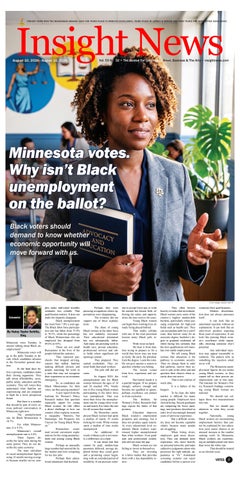
Minnesota votes. Why isn’t Black unemployment on the ballot? Black voters should demand to know whether economic opportunity will move forward with us.
Cover image created with AI
Columnist
By Haley Taylor Schlitz, Esq. Minnesota votes Tuesday. Is anyone talking about Black unemployment? Minnesota voters will go to the polls Tuesday to decide which candidates advance to the November general election. In the final days before a primary, candidates make their closing arguments. They talk about affordability, taxes, public safety, education and the economy. They tell voters they understand what families are experiencing and are prepared to fight for a more prosperous future. But there is a number that should be part of every serious political conversation in Minnesota right now. The unemployment rate for Black Minnesotans is 10.7%. For white Minnesotans, it is 4.2%. Minnesota’s overall unemployment rate is 4.4%. These figures describe the same state during the same period. They do not describe the same economy. The state calculates its racial unemployment figures using 12-month moving averages because smaller survey sam-
ples make individual monthly estimates less reliable. That qualification matters. It does not make the disparity disappear. Black unemployment has risen from 7.8% a year ago. The Black labor force participation rate has fallen from 75.4% to 70.5%, while the percentage of Black Minnesotans who are employed has dropped from 69.6% to 63%. Those are not small fluctuations in the lives of the people behind the statistics. They represent paychecks that stopped arriving, careers that stalled, families making difficult choices and people searching for work in a state that may not recognize their experience as an economic emergency. So, as candidates ask Black Minnesotans for their votes, are they paying attention? A new report from the Institute for Women’s Policy Research makes that question especially urgent for young Black women. Its title offers a direct challenge to how our country often explains economic inequality: “Barriers, Not Bootstraps: Job Prospects Are Uneven for Young Black Women.” Researchers examined several convenient explanations for the rising unemployment rate among young Black women. Perhaps an unusually large number had entered the labor market and were competing for too few jobs. Perhaps their educational attainment had declined.
Perhaps they were pursuing occupations where opportunities were disappearing. The evidence did not support any of those explanations. The share of young Black women in the labor force has not suddenly increased. Their educational attainment has not substantially fallen. And many are pursuing work in health care, private education, professional services and other fields where significant job openings remain. They prepared. They earned credentials. They entered fields that need workers. The jobs still did not come. In August 2025, the unemployment rate for Black women between the ages of 16 and 24 reached 19%. Nearly one in five young Black women participating in the labor force was unemployed. That was more than twice the unemployment rate for young white women and nearly five times the rate for all women that month. By December, unemployed Black women had spent a median of nearly 19 weeks looking for work. White women spent a median of nine weeks unemployed. An additional 10 weeks without a job is not merely a difference on a chart. It can mean rent that cannot be paid, student-loan payments deferred, savings depleted before they could grow and a promising career beginning with an extended period of instability. It can pressure some-
one to accept lower pay or work far outside her chosen field, affecting the salary and opportunities she may receive for years. Young Black women can begin their working lives already being placed behind. That reality collides with one of the most persistent lessons many Black girls receive. Work twice as hard. We hear it from families trying to prepare us for a world they know may not treat us fairly. Be early. Be polished. Earn the degree. Learn the rules. Do not give anyone a reason to question whether you belong. The lesson comes from love, experience and survival. But buried inside it is a painful bargain. If we prepare enough, achieve enough and become too qualified to ignore, perhaps excellence can protect us from exclusion. The Institute for Women’s Policy Research findings expose the limits of that promise. Education improves Black women’s employment prospects and earnings, but it does not produce equal returns. At every educational level examined, Black workers experienced higher unemployment than white workers. Even graduate and professional credentials did not erase the gap. Black women are not failing to invest in themselves. They are investing in a labor market that provides them with a less dependable return.
They often borrow heavily to make that investment. Black women carry some of the country’s highest student-debt burdens, particularly when pursuing credentials for high-cost fields such as health care. They can accumulate debt for a certificate, then borrow more for an associate degree, bachelor’s degree or graduate credential, all while facing less certainty that the next qualification will translate into stable employment. We tell young Black women that education is the pathway to economic security. Then we charge them to enter that pathway, narrow their access to jobs at the other end and question their choices when security does not arrive. That is not a failure of work ethic. It is a failure of the bargain. To be clear, the labor market is difficult for many young people. Employers have slowed hiring. Recent graduates are competing for fewer openings, and positions described as entry level increasingly demand years of previous experience. But a difficult economy does not become equitable simply because many people are struggling. When hiring slows, employers gain more discretion. They can demand more experience, rely more heavily on personal networks and make subjective judgments about who possesses the right attitude, appearance or “fit.” Automated screening systems can reject candidates before a person ever
examines their qualifications. Modern discrimination does not always announce itself. It can look like an automated rejection without an explanation. It can look like an entry-level position requiring three years of experience. It can look like praising Black women’s excellence while repeatedly choosing someone else’s potential. Any individual rejection may appear reasonable in isolation. The pattern tells us something the rejection email never will. The Minnesota unemployment figures do not isolate young Black women, so they cannot tell us their precise unemployment rate in this state. The Institute for Women’s Policy Research findings concerning young Black women are national. We should not collapse those two measurements into one. But we should pay attention to what they reveal together. Nationally, young Black women are encountering employment barriers that cannot be explained by less education, poor career choices or an unusual increase in the number seeking work. In Minnesota, Black workers are experiencing an unemployment rate more than twice the white rate. That should be treated as an election issue.
VOTES 7