

By Pulane Choane Contributing Writer
In a wide-ranging community conversation hosted by veteran journalist Al McFarlane
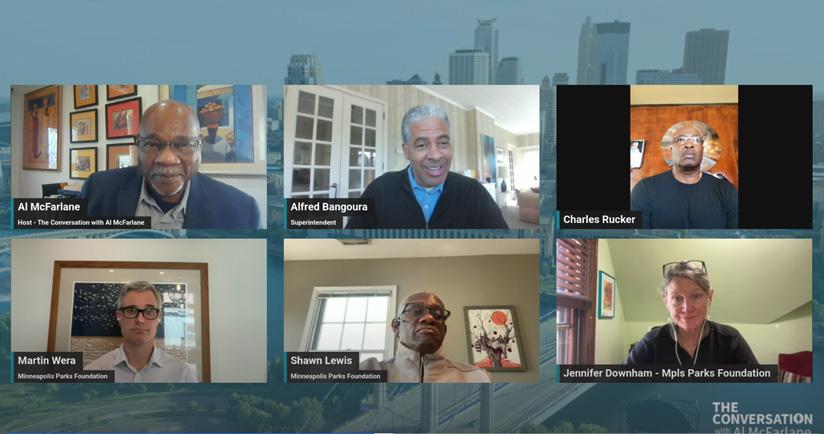
— part of an ongoing series of North Minneapolis investment and equity dialogues sponsored by U.S. Bank — leaders from across Minneapolis' park system and its supporting institutions gathered to reflect on North Commons Park, its past, its future, and what it represents for North Minneapolis.
At the table were Superintendent Alfred Bangoura, Park Board Commissioner Charles Rucker, community advocate Shawn Lewis, and leadership from the Minneapolis Parks Foundation, including Martin Wera and Chief Development Officer Jennifer Downham. What emerged was more than a discussion about redevelopment. It was a layered reflection on memory, access, and what it means for a community to be fully seen.
In North Minneapolis, North Commons Park has never needed explanation. It has always been there. In the background of childhood. In the rhythm of summers. In the routines that quietly shape community life. What has changed is not what the park means. What has changed is whether that meaning is being matched with investment.
In June 2020, as Minneapolis faced the aftermath of George Floyd's killing, Bangoura brought that question directly
to state leadership. Speaking before Gov. Tim Walz, he framed North Commons not as an upgrade, but as a matter of equity.
“We knew there were disinvestments, especially on the North Side. We had to do better.”
— Alfred Bangoura, Superintendent, Minneapolis Park and Recreation Board
That moment led to a $5.125 million state bonding allocation, the starting point for what has grown into a nearly $49 million redevelopment of North Commons Park, now the largest neighborhood park investment in Minneapolis history.
In conversation, Bangoura returned to the park system not as policy, but as lived experience. “Everybody has a story connected to this park system,” he said. “People grew up in it. They worked in it. It's rooted in who we are.” He spoke about navigating parks as a young person, moving across the city and discovering what those spaces made possible.
“We played, we explored, we learned through the parks,” he said. “Even though there were barriers, those spaces opened doors.”
That tension between access and exclusion surfaced across the discussion. For Commissioner Charles Rucker, the conversation turned to what parks once felt like in practice. “I was born and raised here in Minneapolis,” he said. “I've seen the park system from what it was to where it is now.” What stands out most is participation.
“I wanted to get it back to how it used to be where parks were full of kids. We had so many kids, you didn't turn anybody away. You just made another team.”
— Commissioner Charles Rucker, Minneapolis Park and Recreation Board
That memory reflects a version of North Commons that functioned as a constant, a place where belonging did not have to be negotiated. Today, that same park serves more than 32,000 residents annually, many of them young people, in a community shaped by decades of disinvestment. The infrastructure, for years, did not reflect that demand. That gap is what the current redevelopment is attempting to address.
Shawn Lewis, whose work spans multiple community institutions on the North Side, described North Commons as part of a broader ecosystem. “Parks are not just
for sports or leisure,” he said.
“They're part of people's lives.”
In his early work, Lewis spent time listening to residents and observing how the park connects to surrounding spaces, from schools to health services.
“They're gathering places where people can connect across backgrounds,” he said. “When you think about disconnection in our country, parks are one of the ways we come back together.” That framing shifts the conversation from infrastructure to impact.
The path from 2020 to now has not been straightforward. Plans evolved. Costs increased. Funding gaps required new approaches. What sustained the project was coordination. Public funding from the city, state, and federal government combined with private philanthropy to move the project forward. The Minneapolis Parks Foundation played a central role in that effort.
The Minneapolis Parks Foundation worked alongside the Park Board to raise funds and build support for the project. Martin Wera explained that the foundation's work focuses on connecting people who care about the parks with the resources needed to help them grow and improve.
“This park is a promise made to the community,” he said. “And we want to help keep that promise.”
For Jennifer Downham, who leads fundraising for the project, the timeline reflects the scale of that work. “This has been a marathon,” she said. “It didn't happen overnight.” Part of that effort has involved building a culture of giving around public space. “We're building awareness that people can give back to something they love,” she said.
Construction is now underway, with completion expected in 2027. The rede-
velopment will include a new fieldhouse, expanded athletic facilities, a rebuilt water park, and upgraded community spaces designed to meet the needs of a growing population.
For Bangoura, the significance remains grounded in accountability. “This is a promise that needs to be kept in this community,” he said. It is also about access. “We designed this system to be accessible to everyone,” he said. “There should be no barriers.”
For North Minneapolis, North Commons has always been a place where life happens. Now, it is also becoming something else. A visible acknowledgment of value. A response that has taken years to materialize. And a reminder that sometimes the most important work is not creating something new but finally investing in what has always been there. Construction continues through 2027, with the community watching closely as the promise takes shape.
About this series This conversation is part of an ongoing Insight News series of community dialogues on investment, equity, and the future of North Minneapolis, sponsored by U.S. Bank. The series brings together civic leaders, public officials, community advocates, and institutional partners to examine the decisions and dollars shaping the North Side, and to create space for the voices that should be at the center of those decisions. Insight News gratefully acknowledges U.S. Bank's support of this work.
















Begin with Sunday. Before the sun was up in Shreveport, Louisiana, a thirty-one-yearold man named Shamar Elkins walked through two houses a few blocks apart and executed eight children. Three boys and five girls. Ages three to eleven. Seven were his own. The eighth was a cousin. He shot his wife
Eight children in Shreveport. A dentist in Annandale. A vice mayor in Coral Springs.
in the face. He shot the woman believed to be his girlfriend. A thirteen-year-old survived by jumping off the roof.
The mayor of Shreveport, Tom Arceneaux, called it maybe the worst tragic situation the city has ever had. A city councilwoman, Tabatha Taylor, broke down at the microphone and said what everyone already knew: thirty percent of homicides in Shreveport are domestic in nature, and the women inside that number are over-
whelmingly African American. That's how close it is. That's how close the crisis lives to our kitchen tables, our church pews, our Sunday mornings. Now walk it back.
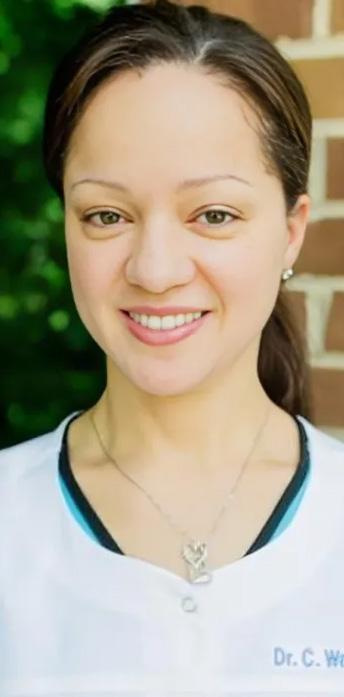
Three days before Shreveport, on April 16, Dr. Cerina Wanzer Fairfax, a forty-nine-year-old dentist in Annandale, Virginia, was shot to death inside her own home by her estranged husband, former Virginia Lieutenant Governor Justin Fairfax. He then killed himself. Their teen-
age son made the 911 call. Both children were in the house. Dr. Fairfax had filed for divorce.
A judge had given her primary physical custody of the children just over two weeks before her death. The same judge had ordered Justin Fairfax to move out by the end of April. He did not make it to the end of April. Walk it back further.
On April 9, Ashly Robinson,
Lawmakers advance legislation to stabilize local radio stations jeopardized by federal cuts
Better known as AMPERS, the Association of Minnesota Public Educational Radio Stations is an association of 17 independent locally programmed and managed radio stations across the state.
Affiliated with a school, college or university, tribal nation or licensed to a community, many are in areas not served by traditional media.
Already operating on shoestring budgets, the stations lost a combined $3.5 million in federal funding earlier this year, more than 40% of the operating budget for some stations.
KKWE, which serves the White Earth Indian Reservation, took a $239,000 hit, or 48% of its operating budget. A $172,000 loss for KOJB that serves the Leech Lake Indian Reservation is about 44% of its budget. In the Thief River Falls area, KSRQ is out $169,000, or about 40% of its budget.
“These are just amazing community institutions that do all kinds of things for all kinds of people,” said Rep. Aisha Gomez (DFL-Mpls), whose community is served by AMPERS stations KBEM, KFAI and KMOJ. Her comments came moments before a bill that could provide a small bit of assistance was overwhelmingly approved
Building stronger together:
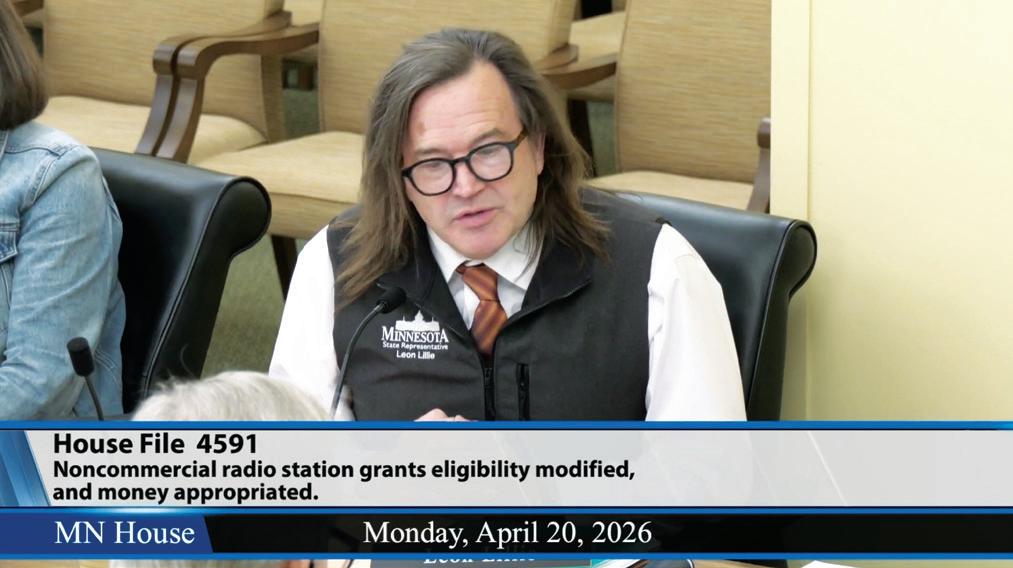
Monday by the House Ways and Means Committee and sent to the House Floor.
There are some weeks when the news does not feel like information. It feels like intrusion.
It enters through the small glowing screen in your hand, through the algorithm that seems to know before you do that something terrible has happened. A name appears once, then again, then again. A screenshot. A caption. A post moving at digital speed. And if you are Gen Z, you know that rhythm well. Significant news reaches us first in fragments. Then it drives us toward traditional reporting, because some stories are too heavy to leave in the hands of reposts and reaction. We go looking for the full truth.
That is how the news of Dr. Cerina Wanzer Fairfax traveled. Then the facts arrived, cold and devastating. Her husband murdered her.
That sentence should not be difficult for the public to say. It should not be softened into “family tragedy,” or wrapped in so much nostalgia for the man who killed her that the woman he killed begins to
disappear inside the sentence. But that is what so many of us watched happen in real time. Instead of moral clarity, there were euphemisms. Instead of naming her murder plainly, there were tributes centered on his friendships, his affiliations, his image, his fall. What many Black Gen Z women saw in those responses was not confusion. It was instinct. A very old instinct. Protect the man’s complexity. Protect the man’s reputation. Protect the memory of the smile in the photograph. Then, if there is room left, mourn the woman whose life he took.
That is why the bluntness of those who refused to make excuses mattered. In moments like these, clarity is not cruelty. It is respect. Respect for the dead woman. Respect for the truth. Respect for the children left to carry what adults are too often too cowardly to name. And those children
KBEM, KFAI, KMOJ: Three Twin Cities stations the whole metro tunes to
A state lawmaker names three community stations — rooted in Minneapolis, heard across the
Sponsored by Rep. Jim Nash (R-Waconia), HF4591 would provide $165,000 in Fiscal Year 2027 “to provide resources, software, training and assistance to help its member stations consolidate resources and expenses.” And it would decrease the statutory minimum number of required staff per station needed to qualify for state funding from two full-time equivalents to 1.5.
Ramsey County puts $320 million on the table, the question is who the table seats
The county's new economic development plan is anchored in a 2021 framework that named redlining, Rondo, and the racial wealth gap. The spending must be measured against that promise.
On April 14, 2026, at River Park Plaza in downtown Saint Paul, the Ramsey County Board of Commissioners voted unanimously to launch Building Stronger Together, an economic development plan that commits more than $320 million — without raising property taxes — to accelerate downtown housing, activate business corridors, and prepare county-owned land for redevelopment. Commissioner and Board Chair Rafael Ortega called it decisive action. County Manager Ling Becker called downtown Saint Paul essential to the region. Mayor Kaohly Her called it focused and high-impact. They are all correct. And that is where the conversation begins, not where it ends.

Of the $320 million, roughly $250 million is aimed at a dynamic downtown: a housing fund backed by Housing and Redevelopment Authority bonds, office-to-residential conversions, streets and lighting and public realm work, a business activation fund, and the RiversEdge site on Kellogg Boulevard — the bluff where West Publishing and the old Ramsey County jail once stood.
they lose their

About $70 million is aimed countywide, including infrastructure at Rice Creek Commons in Arden Hills and parcels on the East Side and in Maplewood. The county says it owns more than 630 acres ripe for higher and better use. The money comes from existing project accounts, the HRA levy, the
When Rep. Aisha Gomez (DFL-Mpls) told the House Ways and Means Committee on Monday that the three AMPERS stations in her community are “amazing community institutions that do all kinds of things for all kinds of people,” the second half of that sentence was doing quiet work. KBEM, KFAI and KMOJ are licensed in Minneapolis. Their transmitters, though, reach across Hennepin and Ramsey counties and well beyond — into Bloomington and Brooklyn Park, into Eagan and Edina, into Maplewood and Woodbury, into every car on every interstate that passes through the metro. The three stations Gomez named are rooted in specific neighborhoods — the North Side, Cedar-Riverside, North High — but their audiences are a metro audience. They are where a commuter from Saint Paul gets jazz on a Monday morning, where an Oromo family in Burnsville hears news in their own language on a Wednesday night, where a teenager in Richfield finds hip-hop and gospel on the same Sunday dial. A combined $3.5 million federal cut across the AMPERS network — more
than 40 percent of the operating budget at some stations — is not a Minneapolis story. It is a metro story that happens to be anchored in Minneapolis. The bill moving through the House, HF4591, would put $165,000 toward shared services for AMPERS member stations and lower the minimum full-time staffing requirement from two FTEs to 1.5. AMPERS president Joel Glaser has said plainly that this is a consolidation measure, not a backfill. For the three stations Gomez highlighted, the relief is modest and the risk is not. Here is who these stations are, and what the whole Twin Cities loses if any of them goes dark. KMOJ 89.9 FM The people’s station KMOJ went on the air on June 22, 1976, as WMOJ, a very low-power AM sig-
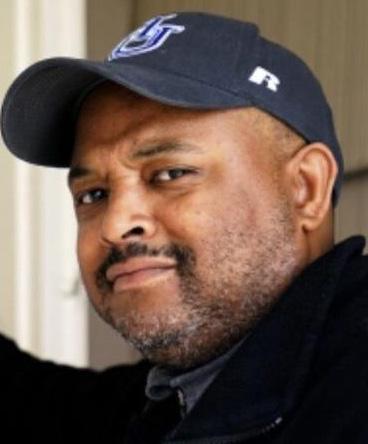
By Brett Buckner
Warmer days remind us of the nearing summer months where Minnesotans can enjoy the weather that justifies our living here during the long winter. But with the good weather comes an unwanted companion: crime.
It’s no secret that crime rates in Minneapolis rise with the temperatures. Data from 2019 to 2023 shows that come May, crime rates jump and reach a peak of roughly 4,250 incidents per month, staying above 4,000 incidents through October. This seasonal surge isn’t just a statistic – it’s something residents feel in their neighborhoods, on their commutes, and in their sense of safety.
Certain categories of crime have been especially troubling. In recent years, Minneapolis has seen spikes in carjackings, many of them brazen and
occurring in broad daylight. In 2021 alone, the city experienced an unprecedented surge in carjackings, with more than 640 reported incidents – a dramatic increase from prior years. While numbers have fluctuated since, the ripple effects remain: higher insurance costs, shaken public confidence, and real trauma for victims.
For many Minnesotans, these aren’t abstract policy debates. They’re lived experiences. It’s the parent who hesitates before stopping at a gas station at night. It’s the small business owner who installs extra security after a break-in. It’s the neighbor who checks their car twice before heading inside. Public safety isn’t theoretical –it’s personal.
Over recent years, Minneapolis leaders have considered and introduced new programs to combat crime, with mixed results. It is always encouraging to see investment in creating a city that wants to keep its residents safe. But it is also true that public safety requires using all the tools at our disposal – especially those that have demonstrated real-world results.
That’s why I have
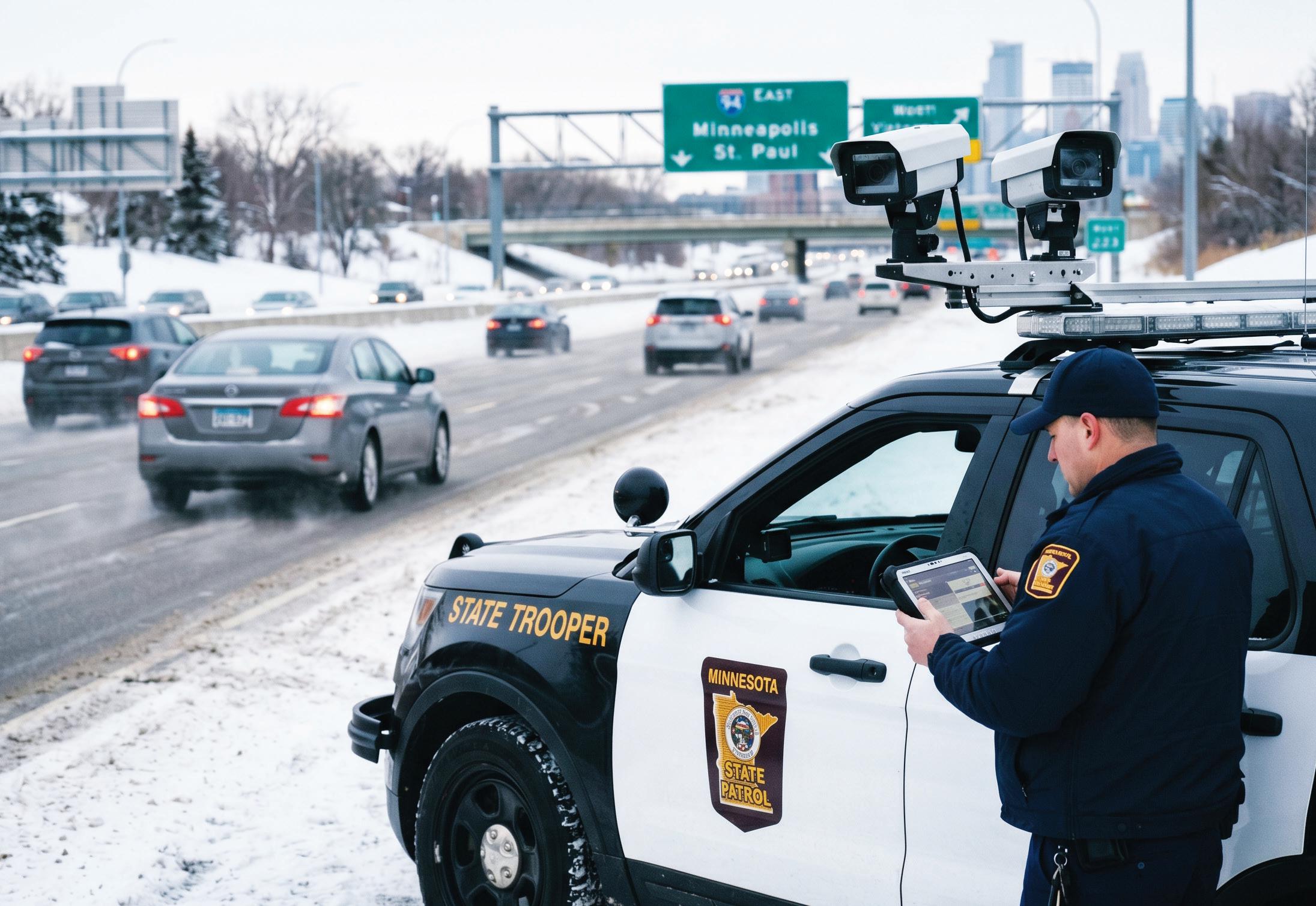
been encouraged to see cities across Minnesota embracing License Plate Reader (LPR) technology. This technology isn’t being used to catch speeders or issue minor traffic tickets. Instead, it serves a focused and practical purpose: helping law enforcement identify vehicles connected to serious crimes like carjackings, shootings, and kidnappings, as well as assisting in AMBER Alerts.
And they work. In communities where LPR technology has been deployed, law enforcement has been able to quickly identify stolen vehicles, track suspects across jurisdictions, and piece together critical timelines in investigations. In some cases, suspects involved in violent crimes have been apprehended within hours because a vehicle was flagged by an LPR system. What once might have taken
should come with appropriate guardrails. Data privacy, limited retention policies, and clear oversight are essential to ensuring these tools are used responsibly.
stay with me. Because they are not abstract. They are Black Gen Z children whose lives now have a before and after. They are children who must grow up with the knowledge that their mother was murdered by the man who should have been her closest confidant, her friend, her partner in raising them. They are children whose grief now lives not only in memory, but in search engines, headlines, clips, screenshots, and reposts. For my generation, sorrow has a digital afterlife. The worst moment of your life can remain waiting for you in the palm of your hand.
That is part of what has made these past weeks feel so spiritually heavy. It is not only that there have been too many killings. It is that many Black women, especially Black Gen Z women, have had the suffocating feeling of watching a pattern emerge in public while still being asked to question our own eyes. One story after another. One Black woman after another. And behind the headlines, the same awful intimacy, violence from the very people who should have been safest.
But as these stories moved through the public, so did something else, an atmosphere.
An atmosphere in which Black women are not only asked to survive violence, but to survive the culture that keeps rehearsing it.
That is the deeper
truth I cannot ignore as a Black Gen Z woman. We are not navigating these murders in isolation from the rest of our lives. We are coming of age in an environment where misogyny is ambient. It is in the podcast clip. It is in the comment section. It is in the joke that never feels like only a joke. It is in the algorithmic reward system that turns contempt for women into engagement, engagement into money, and money into influence. It is in TikTok and YouTube. It is in Discord servers and gaming chats and digital spaces adults still too often dismiss as unserious, even though many of us know they are among the first places boys learn how to perform cruelty for each other.
Black Gen Z women know what that normalization feels like long before a headline ever arrives.
It feels like learning, in small daily doses, that many people still experience womanhood as something they are entitled to discipline. It feels like seeing bold, self-possessed women reduced to slurs, mocked for ambition, punished for boundaries, and disbelieved when harmed. It feels like watching the manosphere mutate into a thousand versions of the same sermon, that women are the problem, women are lying, women are too loud, women are too educated, women are too unwilling to submit. And for Black women, that contempt is often racialized too. When I read Nene Mokonchu’s 2025 paper, This Is a Man’s World, I was struck
less by surprise than by recognition. It gave scholarly language to what many Black women already know in our bones: misogynoir is not abstract, and the digital dehumanization of Black women does not remain neatly online. It shapes what gets normalized, what gets dismissed, and too often, whose pain the public is willing to look away from.
That is why this moment feels bigger than a tragic cluster of headlines. It feels like the collision of two realities Black Gen Z women have been forced to navigate at once. We are watching Black women be killed, and we are watching a digital culture that has spent years normalizing disrespect, suspicion, domination, and hate toward women. We are being asked to see both the violence and the environment that makes it easier to excuse.
Then came the reporting on online communities where men exchanged advice and tactics related to drugging and sexually assaulting wives and girlfriends. The horror of that story was not simply that such depravity exists somewhere hidden. It was that the threat to women is so often imagined as external and strange, even when it is closest to home.
That, too, is why this feels personal.
I think about the spaces that shaped me, spaces that poured into Black girls and taught us that we were brilliant, capable, and worthy. I think about sisterhood. I think about
days of investigative work can now happen in real time.
Just as importantly, the presence of these cameras can serve as a deterrent. Criminals are far less likely to use a vehicle in the commission of a crime if they know it can be tracked. That added layer of accountability matters, especially when dealing with organized or repeat offenders.
Of course, any use of technology in public safety
organizations where Black girls are nurtured, affirmed, and told to lead. I think about the women who teach us to move through the world like we belong in it fully.
And I think about the grief of realizing that while Black girls are still being taught to shine, the broader culture is still too often trying to drag women backward.
Backward toward a world in which a woman’s autonomy is treated like provocation. Backward toward a world in which men’s disappointment becomes women’s danger. Backward toward a world in which women are still expected to endure, absorb, forgive, and keep quiet.
That is why efforts like Minnesota’s Office for Missing and Murdered Black Women and Girls matter. They begin from a truth too often ignored, that Black women and girls have been denied urgency, denied visibility, and denied justice. They reflect what families have always known, that silence is not neutral. It is part of the harm.
What I want, after these past weeks, is not more elegant language for male violence.
I do not want us to become more sophisticated in how we soften murder. I do not want another Black woman’s life translated into a story so sentimental about the man who killed her that her own name starts to dim inside it.
I want us to tell the truth plainly enough to honor her.
I want men to develop the courage to check one another before a vigil, not only after one. I want more people to understand that misogyny online is not detached from the world we live in offline. I want us to stop pretending that the atmosphere does not matter, that the jokes do not matter, that the digital rituals of contempt do not matter. They do.
Because by the time a woman is dead, a culture has often been preparing for that moment for years. And Black Gen Z women know it. We know it because we have been watching. We know it because we have been listening. We know it because some of us have felt that chill long before the headline arrived, that recognition that what looks sudden is often not sudden at all. It is the flowering of something ugly that has been fed in public, joked about in public, monetized in public, and excused in public.
Dr. Cerina Wanzer Fairfax was murdered by her husband.
There should be no shortage of tenderness for her children, no shortage of grief for a life stolen, and no shortage of prayer for the loved ones left behind. But there should also be no shortage of clarity. Because if we cannot tell the truth about what is happening to Black women, then we are leaving Black girls to inherit not just our sorrow, but our silence.






thirty-one, known online as Ashlee Jenae, was found dead in a hotel room in Zanzibar. She had gone to celebrate her birthday with her fiancé. Hotel staff had separated the couple after a dispute. Tanzanian authorities have ruled her death a suicide. Her family is not accepting that answer. They say they learned of her death from the hotel, not from the man she was traveling with. Her passport-holding fiancé remains in Zanzibar, his own passport confiscated, the investigation described as ongoing. Right? The question will not resolve itself by being waited out. Walk it back further still. April 8, Atlanta. Qualeisha Barnes, thirty-six, known by her stage name Siditty, a Detroit-bred rapper, a nursing student two semesters from her degree, the CEO of her own online clothing line, fourteen weeks pregnant. She was found in the driver's seat of her white Range Rover, shot four times in the face. Police believe the shooter fired from outside the vehicle. No arrests. Her mother believes more than one person was involved. Her sister said she was known at home as LeLe. They buried LeLe.
The day before that, April 7, Imani Ringgold, twenty years old, walked out of a pizza shop in West Philadelphia on her way to her job as a home health aide. She was on the phone with her grandmother. Three men jumped out of a black Mazda and opened fire. Police now say she was not the intended target. Her grandmother heard every last cry. Imani Ringgold was twelve days away from her twenty-first birthday.
And then, April 1, the thread leads to Coral Springs, Florida. Vice Mayor Nancy Metayer Bowen, thirty-eight, environmental scientist, graduate of Johns Hopkins and Florida A&M, the first Black and Haitian-American woman ever elected to the Coral Springs City Commission, Vice Chair of Haitian Outreach for the Florida Democratic Party, preparing to
From 3
Transportation and Transit Sales Tax, and the Regional Railroad Authority — plus a legislative bonding request for the Park at RiversEdge that Sen. Sandra Pappas and Rep. María Isa Pérez-Vega say they will carry.
That is the plan. Now the question.
Stronger together with whom?
Five years ago, in March 2021, Ramsey County adopted its Economic Competitiveness and Inclusion Plan — the ECI Plan. That document, produced under the leadership of thenBoard Chair Toni Carter, did something most economic development plans in this country still refuse to do. It named the problem by name. It said that racial inequities affect GDP, growth, and well-being. It said that the extraction of wealth and the devaluation of Black homes, Black businesses, and Black bodies was not a novel occurrence. It committed to mapping the history of redlining in Ramsey County. It made racial equity the center of the framework, not a footnote to it.
The ECI Plan was released in the year Minneapolis police killed George Floyd. That timing was not incidental. The document says so plainly. It names the global racial justice uprising as part of the reason the county had to reimagine its economy. It identifies the four cross-sector workgroups that were supposed to carry the work forward: housing development and affordability, community investment and wealth building, jobs and industry growth, and place-based assets. It points at Interstate 94 running through the Rondo neighborhood as an
announce a run for Congress. She was shot inside her home. Her husband, Stephen Bowen, is charged with premeditated murder and with tampering with evidence. According to the affidavit, he wrapped her body in garbage bags. When asked by his uncle why he had killed her, he said he couldn't take it anymore.
Six women. One mother of seven. Eight children. Three weeks. One country. This is not a coincidence. A coincidence is when two unrelated things happen at the same time. This is a pattern. And a pattern has a name.
What the numbers have been telling us all along The week these women died, researchers at the University of New Mexico published an update to a body of work that has been shouting the same thing for years. In 2020, Black women were murdered at a rate of 11.6 per 100,000, while white women were murdered at 3 per 100,000. In Wisconsin, Black women were twenty times more likely to be killed than white women. Between 2014 and 2020, the homicide rate for Black women between twenty-five and forty-four jumped seventy-three percent. Ninety percent of Black women who are murdered knew the person who killed them. More than half were killed by current or former romantic partners. Between 2000 and 2019, homicide became a leading cause of death for Black women during and after pregnancy.
Now hold that last sentence next to Qualeisha Barnes, fourteen weeks pregnant, in the driver's seat of her own car. Hold it next to the mother of seven in Shreveport, shot in the face while her children were being executed in the next house. Hold it next to Dr. Cerina Fairfax, whose divorce file had just produced a custody order, because the period of separation — every researcher in this field will tell you — is the most dangerous window a woman ever passes through.
Dr. Tameka Gillum, the lead author on that UNM study, used a phrase that de-
example of the policy violence the plan was written to answer.
Building Stronger Together, the county says, will direct its investments toward projects that reduce racial disparities in housing, redevelopment, and small business district growth — consistent with the Economic Competitiveness and Inclusion Plan. That sentence is in the county's own materials. It is the hinge on which the whole $320 million turns.
The ECI Plan is the promise. Building Stronger Together is the spending. The community's job is to make sure the second is measured against the first.
What the plan funds
The Building a Dynamic Downtown strategy is organized around four moves. The first is RiversEdge. That is the big one — and the complicated one. Longtime development partner AECOM, which had worked with the county since 2018 on an $800 million vision of towers along Kellogg, has walked away. The county is now seeking a new master developer. What remains in the county's hands is the Park at RiversEdge itself: a cliffside parking structure, green space, and a connection from the bluff down to the river. Commissioner Ortega told reporters the towers will come later. The crucial piece, he said, is a park that goes down to the river. That is a telling reframing. It moves the public asset ahead of the private one.
The second move is a $50 million downtown housing fund, anchored by HRA bonds, aimed at mixed-use development — the kind of project that puts apartments above storefronts and people on sidewalks after five o'clock. Commissioner Mai Chong Xiong, who chairs the HRA, put it directly: bringing more resi-
serves to be repeated: for any other health disparity of this magnitude, we would be drawing due attention and investing appropriate resources. But since it is Black women's lives at stake, the issue fades to the background. That's how she said it. That's how it is.
What the coverage has not said out loud
There is a second pattern sitting underneath the first one, and it is about who gets named and who does not. Ashlee Jenae had over 100,000 Instagram followers, and her death became international news within days. Dr. Cerina Fairfax was married to a former statewide officeholder, and her killing commanded the front page of every paper in Virginia and several beyond. Nancy Metayer Bowen was a sitting elected official on the edge of a Congressional announcement, and the Florida political class turned out to grieve. These women deserved every word and every camera. But right alongside them, in the same ten-day window, Imani Ringgold walked out of a pizza shop and died on a Philadelphia sidewalk, and most of America never learned her name. Amarie Alowonle was nineteen when she was shot in Sanborn Park in Robbinsdale, Minnesota, in May of last year.
dents into downtown is crucial for strengthening the tax base. Bonding against the HRA levy, she said, will catalyze the development the county needs. The third move is $50 million for downtown infrastructure — streets, sidewalks, lighting, the public realm. The fourth is a business activation fund to recruit and support new downtown businesses.
The countywide strategy — the other $70 million — is largely about making county-owned land ready for someone else to build on. Much of that money goes to a new spine road, Rice Creek Boulevard, at the former Twin Cities Army Ammunition Plant site in Arden Hills. Other parcels at Payne and Maryland in Saint Paul, on the East Side, and in Maplewood are named for sale and redevelopment. Josh Olson, the county's director of Community and Economic Development, framed the county as one of the region's largest landowners, positioned to drive meaningful growth.
What the plan does not yet answer
Four questions sit at the center of this investment, and they are the questions that matter for the communities Insight News serves.
Who builds it? The ECI Plan flagged the undercapitalization of Black, Latinx, Asian, and Indigenous business enterprises as a drag on the entire county economy. Ramsey County's own Purchasing and Contracting Transformation — the PACT initiative — was built to open procurement pathways to those firms. A $320 million construction and infrastructure pipeline is exactly the kind of deployment that will either prove PACT works or expose that it does not. The county will need to report, publicly and
Nearly a year later, no one has been arrested. Her mother Tatiana Kilgore has had to write the letters, organize the vigils, and hunt down the reward money herself. That's what the research says too. Media coverage of Black women's murders is inconsistent, late, and thin — and the families feel every inch of that absence.
Here in Minnesota, we have an answer to at least part of that silence. The state's Office of Missing and Murdered Black Women and Girls, one of the few of its kind in the country, held its 2026 Day on the Hill at the Capitol on April 13. Director Kaleena Burkes and her six-person team are building the scaffolding that, in most states, simply does not exist. Lt. Governor Peggy Flanagan was there. Tatiana Kilgore was there, carrying a picture of her daughter. The work is not a favor. The work is a debt being paid down.
Every Black woman killed leaves behind family and community members dealing with trauma and loss. That is a sentence from a public health paper. It could also be a sentence about every household on every block in every Black neighborhood in this country.
What the home has become
The researcher Jacquelyn Campbell, who has given most of her professional life to the study of intimate partner homicide, keeps returning to a single line that the rest of us should memorize: the home is the most dangerous place for women. And children are not spared. Forty percent of children murdered in domestic violence mass shootings are killed by a parent, and the surviving children find the body or witness the homicide in roughly seventy percent of cases. Cerina Fairfax's teenage son was the one who dialed 911. Read that again. A sixteenyear-old boy called the police on his own father and then waited for them inside the house where his mother's body was.
There are warning signs. There are always warning signs. Firearm access in the home. A recent separation or a pending divorce. A prior histo-
regularly, on who is getting the contracts.
Who lives there?
The downtown housing fund is meant to grow the tax base. That is an honest goal. But the ECI Plan documented that Black, Brown, Asian, and Indigenous households in Ramsey County face the deepest housing cost burdens and the widest homeownership gap, and it warned that roughly 45 percent of cost-burdened renters in the county spend more than half their income on housing. A housing fund that produces only market-rate units downtown, without deep affordability and a clear pathway to ownership, does not answer the disparities the county itself named. Mixeduse is not the same as mixed-income.
Who is not displaced?
Rice Creek Commons sits on the former Army ammunition plant. The East Side and Maplewood parcels sit inside living neighborhoods. Redevelopment, done badly, is displacement with a better press release. The ECI Plan's own community engagement recorded the line that should govern the next five years of this work: development should happen with the community and anti-displacement in mind. That is a standard, not a slogan. Who holds the county accountable? Building Stronger Together, the county's own language acknowledges, is the synthesis of many efforts — some already board-approved, others still to come. Dollars will move through future board actions over years. That creates real risk that the equity framework gets narrated at the announcement and quietly optimized away at implementation. The answer is sustained public oversight. Quarterly reporting. Community seats on the decision tables. Disparity data published as rou-
ry of violence or coercive control. Threats. Stalking. Public professions of love on social media from men who are, days later, disposing of their wives' bodies. The Shreveport shooter posted on Easter. The Coral Springs husband told his mother he was having a panic attack before he went home to speak with his wife. Justin Fairfax had been ordered out of the house by month's end. These are not mysteries. They are chapters in a book we have all read before.
What Black Minneapolis, and Black America, is being asked to do The work in front of us is neither simple nor single. It is three works at once, and they have to move in parallel.
First, name every one of them. Ashly Robinson. Qualeisha Barnes. Imani Ringgold. Cerina Wanzer Fairfax. Nancy Metayer Bowen. The unnamed mother of seven in Cedar Grove who, as of this writing, is fighting through a gunshot to the face. The seven children who carried her last name and the eighth child who was their cousin. Jayla. Shayla. Kayla. Layla. Markaydon. Sariahh. Khedarrion. Braylon. Say all eight of them. Say them out loud. The ancestors taught us that a name spoken is a life not erased.
Second, fund the structures that do the structural work. The Minnesota Office of Missing and Murdered Black Women and Girls. The National Alliance for Eating Disorders' sister agencies in the domestic-violence space. The local shelters. The Black-woman-led mental health practices. The churches that have opened their basements as safe houses without asking for a press release. Money follows attention. Attention follows naming. Naming is where it begins.
Third, tell the truth about the home. This is the hardest part for a community that has always had to defend itself against the outside world, because it asks us to look clearly at an inside world that is hurting its own. Thirty percent of homicides in Shreve-
tinely as tax base projections.
The politics of the moment Mayor Her said at the announcement that a strong downtown Saint Paul is essential to a strong region. She is right. Saint Paul's Assistant Mayor for Housing, Economic Vibrancy, and Infrastructure, Nick Stumo-Langer, described the announcement as a slap-the-money-on-the-table moment. That is the right posture. For years, downtown Saint Paul has been told, implicitly and explicitly, that its struggles are its own fault — that office vacancy is destiny, that the tax base erosion is a natural weather system rather than a set of policy choices. Building Stronger Together rejects that story. It says the county will act.
The deeper politics is the property tax politics. County Manager Becker said residents are footing 47 percent of the county budget through property taxes, and that the pressure is unsustainable. She is right about that too. The plan's theory of the case is that growing the tax base — through new housing, new businesses, new activity downtown — is the most sustainable way to ease the burden on existing homeowners. That theory is sound. But the question, again, is who bears the near-term cost and who captures the long-term gain. Property tax relief is a collective good only if the growth underneath it is broadly shared. Redevelopment done badly is displacement with a better press release.
Where the community comes in The county has named its values — well-being, prosperity, opportunity, accountability — and its framework — the ECI Plan.
It has voted the money. It has convened the state delegation. It has aligned with the Saint Paul Downtown Alliance's own
port are domestic. The UNM data says the figure is higher than thirty percent nationally for Black women. That's what Councilwoman Tabatha Taylor was saying through tears on Sunday afternoon. That's what the research has been saying for twenty years. Our homes are not free of the violence we know our neighborhoods to be saturated with. That is not an indictment of Black men as a class. It is a call to Black men as brothers, fathers, uncles, pastors, and cousins to stand in the gap where another brother is losing himself.
The old folks taught us this, and every tradition we carry carries the same lesson: the family is the first government. If the first government fails, the woman and the child pay first. Right? That's how close it is.
Insight News has been publishing continuously since 1974. In those fifty-two years, I have written too many versions of this story. Each time, I have tried to honor the women by refusing the euphemism. A domestic incident is a murder. A messy divorce is a risk assessment that failed. A rising star with a big personality is a human being whose family is now planning a funeral. Eight children are not a statistic. They are eight obituaries, and every one of them had a favorite color. We do not get to keep looking past this. Not this time. Not after Shreveport. Redemption is at hand, but redemption, in the tradition our people carry, is not a feeling. It is a turning. A turning toward the women. A turning toward the children. A turning toward the uncomfortable truth that the people we love are dying inside the houses we built for them.
Disclosure statement
Insight News uses AI-assisted tools in some editorial production. Read our AI Policy & Transparency Statement at www.insightnews.com/ site/ai_policy.html.
Downtown Investment Strategy, which called two years ago for office-to-residential conversions and public realm improvements. The pieces are in place. What is not yet in place, and what cannot be delivered from any boardroom, is the civic infrastructure of accountability. That is work for the Urban League of the Greater Twin Cities. For the African American Leadership Forum. For the Center for Economic Inclusion, whose Racial Equity Dividends Index the county has already cited as a measurement tool. For the Minnesota Black Chamber of Commerce. For Rondo community organizations with memory of what I-94 cost them. For the Somali, Hmong, Latino, and American Indian business associations that have been named in the ECI Plan and must now be at the procurement tables. Ramsey County has made a serious commitment. Saint Paul's leadership stands ready, in Assistant Mayor Stumo-Langer's phrase, to make the investment an enormous success. The community's role is to hold everyone to the full meaning of the word together. Stronger together means Rondo. Stronger together means Frogtown. Stronger together means the East Side. Stronger together means the downtown worker and the downtown resident and the entrepreneur whose storefront has not yet opened. The county has put $320 million on the table. Redemption is at hand — if the work that follows matches the framework the county itself wrote.
Disclosure statement Insight News uses AI-assisted tools in some editorial production. Read our AI Policy & Transparency Statement at www.insightnews.com/ site/ai_policy.html.
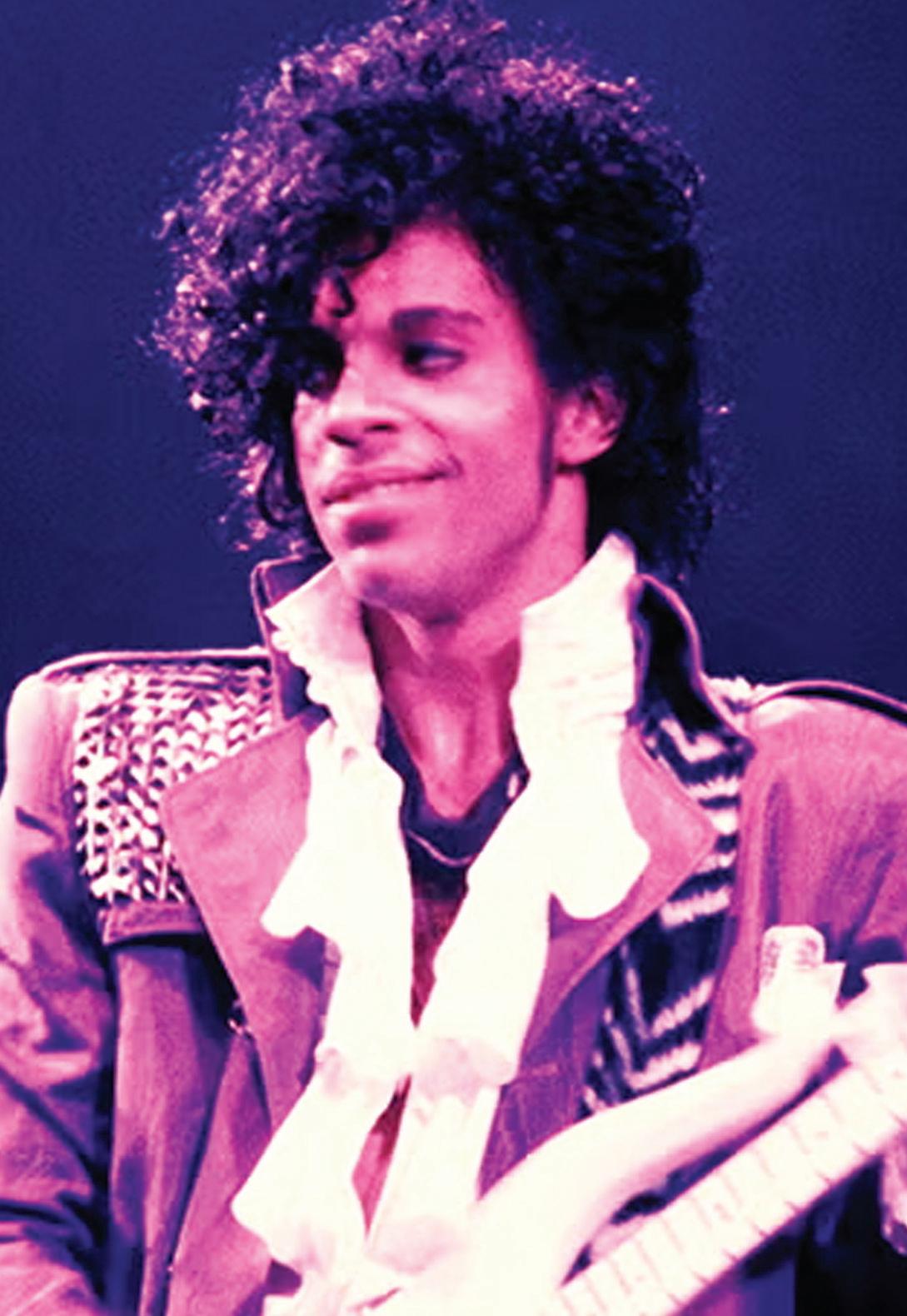
Ten years after his passing, we remember Prince Rogers Nelson — the quiet Northside boy who sat alone on the Plymouth Avenue bus and grew into the voice that authored a world.
Editor
By Al McFarlane
He called himself The Kid.
That is the name Prince Rogers Nelson gave his character in Purple Rain, the 1984 blockbuster he wrote, scored, and starred in. The Kid. Not the Star. Not the Prodigy. The Kid — as if to say, whatever the world came to see, what he himself saw when he looked in the mirror was the boy from Minneapolis who taught himself piano by mimicking television theme songs in the basement bedroom of a modest yellow rambler on the Northside.
Ten years ago today, on April 21, 2016, that boy died. He was 57. He left behind a catalog of albums, films, concert tours, side projects, alter egos, and protégés that will take generations to fully map.
He left Paisley Park. He left the symbol. He left "Purple Rain," "When Doves Cry," "Kiss," "1999," "Adore," "Sometimes It Snows in April." And he left a question that Minneapolis — Black Minneapolis in particular — has been answering ever since: how did a boy from the Northside become, and remain, the most visionary Black artist of his generation?
From Insight News, from the Marcus Garvey House at 1815 Bryant Avenue North, we answer the way we always have. We tell the story from where we stand. From the blocks Prince walked. From the buses he rode. From the neighbors who remember.
8th and Upton — where it all happened
The house is at 2620 8th Avenue North, on the northeast corner of 8th and Upton. A one-story Ranch-style rambler, yellow, built in 1956. The Nelson family — John Lewis Nelson the pianist, Mattie Shaw the jazz singer, and their children — moved in on March 26, 1965, a few months before Prince's seventh birthday. He lived there until he was 12.
Those six years were, as his second cousin Charles Smith later put it, where "it all
Stations
From 3
nal broadcasting from inside the Sumner-Olson and Glenwood-Lyndale public housing developments on the North Side. The call letters come from umoja, the Swahili word for unity. For its first years the signal carried only a few blocks. Today KMOJ is a full-power FM station at 89.9, owned and operated by the nonprofit Center for Communication and Development, with a 6,200-watt transmitter in Arden Hills that reaches the entire Twin Cities metro — an estimated 140,000 unduplicated weekly listeners, north to south, east to west. Its format — soul, blues, urban gospel, reggae, jazz, hip-hop, spoken word and talk — is only part of what it is. KMOJ’s stated mission is to teach members of the Black community media skills that reinstate the affirmative Black image. It is a training site for onair announcers, producers and programmers, and it commits more than sixteen hours a week to public affairs programming focused on issues affecting African Americans and other communities of color. It partners
came together." This is where Prince taught himself piano on his father's upright, where he wrote his first song, where he began the disciplined practice that would define the rest of his life. The Minneapolis Heritage Preservation Commission designated the Nelson House a local historic landmark in November 2025 — recognizing, finally and officially, what Northside residents have always known: this block produced a world-changer.
That block sits about four blocks from where Insight News began — in my own residence, at 12th and Thomas, in 1974. Prince was 16 that year. He was a junior at Central High School. He was already jamming for hours in the Central music room, already writing songs, already the quiet kid everyone in the neighborhood had heard was going to be something. We launched a newspaper a few blocks away and called it Insight. He launched a sound and eventually called it the Minneapolis Sound. Two projects, same ZIP code, same era, same conviction that Black voice and Black vision deserve their own platform.
That's how close it is.
“Two projects, same ZIP code, same era, same conviction that Black voice and Black vision deserve their own platform.”
A Northside kid. A Southside kid. A Minneapolis kid. Here is a fact that Minneapolis sometimes forgets. Prince was not only a Northside kid. He was a Southside kid too.
When his parents separated and his mother remarried, he began bouncing — as so many Black children have bounced in this city — between his father's place on the North Side, his aunt Olivia Lewis's home on the South Side, and eventually the home of Bernadette Anderson, whom the neighborhood called “Queen Bernie,” mother of his best friend and first collaborator André Anderson (later André Cymone). Prince spent most of 7th and 8th grade at Bryant Junior High in South Minneapolis — the building now known as Sabathani Community Center on East 38th Street. He graduated from Central High School, at 3416 South 4th Avenue, in 1976.
with Minneapolis and St. Paul Public Schools, several suburban districts, the American Red Cross, Catholic Charities, Big Brothers Big Sisters, the Urban League, and community media outlets including Insight News, the Spokesman-Recorder and North News.
The studios sit on West Broadway Avenue, but the signal sits on every dashboard in the metro.
KFAI 90.3 FM — Fresh Air, many languages KFAI signed on May 1, 1978, from the belfry of Walker Community Church in South Minneapolis with a 10-watt signal. Today it broadcasts at 90.3 FM in Minneapolis and 106.7 FM in Saint Paul from its studios on Riverside Avenue in Cedar-Riverside. The call letters stand for Fresh Air, Inc., the nonprofit that operates it. Two frequencies means two bookends — KFAI is genuinely a Twin Cities station, picked up cleanly from downtown Minneapolis through downtown Saint Paul and into the first ring of suburbs.
KFAI carries 89 programs in ten languages — Amharic, Dari, English, Filipino, French, Oromo, Somali, Spanish, Tigrinya and Vietnamese
So when we say he came from here, we mean all of here. The alphabet streets of North between Thomas and Upton. The churches and community centers where his father's Prince Rogers Trio played. The Sabathani block where he ran intramural basketball. The music room at Central where the teachers, recognizing what they had, locked the doors at lunchtime so he could practice without interruption. The South Side basement of the Anderson house where he and André listened to Joni Mitchell and Carlos Santana on KQRS, and soul and funk on the small Black-owned AM station KUXL. North and South, Prince was ours. And every school day, a bus ride connected the two.
The boy who boarded at Russell Insight News Associate Publisher B.P. Ford remembers seeing him. Not at a concert. Not at a club. On the bus.
B.P. would board the Plymouth Avenue line at Thomas Avenue North, heading east toward downtown. Two blocks on — past Sheridan, pulling up to Russell Avenue North — a slight, quiet teenager with an Afro would step on. He did not engage fellow passengers. He did not perform. He sat alone, looked out the window, and rode. Every time. Always alone. That teenager was Prince. Russell Avenue North was his block in those years; the Nelson family had moved on from 8th and Upton by then, and Prince was living on Russell through his teenage years into 1977. Two city blocks separated where B.P. boarded and where Prince boarded. Two blocks of alphabet streets — Thomas to Sheridan to Russell — laid out like a scale on a keyboard. And on that bus, B.P. was watching, without yet knowing what he was watching, the composition of an era.
Peering, as B.P. puts it, into the future of the world he would one day author.
Think about the interior life of a Black boy on a city bus in Minneapolis, already carrying inside him the arrangements, the changes, the melodies, the lyrics, the films, the choreography that would stop the world. He did not need an audience on the bus. He was rehearsing. He was composing.
— with 84 of them produced locally in house. People of color, LGBTQIA+ community members, and neighbors with intersectional identities lead more than half of the shows on the schedule. It is the home of Fresh Fruit, described by the station as the longest-running LGBTQIA+ radio program in the nation. Its mission, in its own words, is to amplify voices often misrepresented or ignored by mainstream media, fostering democracy, social justice and cross-cultural understanding. For immigrant, refugee and new Minnesotan communities — the East African families in Cedar-Riverside and Rochester, the Hmong and Vietnamese households in Saint Paul, the Latino neighborhoods in Minneapolis and the first ring — KFAI is often the only place on the FM dial where an elder, a newcomer and a second-generation kid can hear their own language back on a Tuesday night.
KBEM 88.5 FM — Jazz 88, a school and a signal KBEM first took to the air in October 1970, out of Minneapolis Vocational High School downtown. In 1983 it moved to North Community High School as part of the Minneapolis Public Schools desegregation initia-
He was listening. This is what discipline looks like before it looks like anything. It looks like a quiet kid on a bus.
“BP boarded at Thomas. Two blocks east, at Russell, Prince stepped on. Always alone. Looking out the window — peering into the future of the world he would one day author.”
The kid who owned the Central music room
My next-door neighbor Kevin — now a celebrated bluegrass musician — attended Central High School with Prince. Kevin remembers competing with him for time in the school's music studio. It was not a memory of a performer. It was the memory of a competitor for a scarce resource, and of losing that competition, cheerfully and completely, over and over again.
"Prince owned that studio," Kevin says. Not because he was the loudest or the showiest student in the room. He owned it because he was disciplined. He was relentlessly dedicated to the voice and vision that was his gift. He got there first. He stayed latest. He would not be moved.
Central High School stood at 3416 South 4th Avenue. The building was closed in 1982 and later demolished, replaced by what is now Richard R. Green Central Park School. But while Prince walked those halls from 1973 to 1976, he was already a published working musician, already touring community centers and proms with Grand Central, the band he formed in junior high with André Anderson and his cousin Charles “Chazz” Smith. Classmates who went on the record years later described the same pattern Kevin remembers. Football players coming in from practice at dusk could still hear Prince in the music room, banging on piano and guitar hours after everyone else had gone home. During lunch hours the music teachers locked the door so he could practice without interruption. In a 1976 interview with The Central High Pioneer — the first press he ever received — Prince said he liked Central “because his music teachers let him work on his own.”
This was not a boy waiting for a break. This was a boy building a craft. And Kevin,
tive, and its studios have been on the North High campus on James Avenue North ever since. The B-E-M in the call letters stands for Board of Education, Minneapolis. The license is held by Special School District No. 1. The transmitter is in Falcon Heights, putting the signal clean across both downtowns and the inner suburbs.
Branded as Jazz88, KBEM is the only full-time jazz station in Minnesota, and regularly one of the top-rated jazz stations in the country by local audience share. It is also a classroom. North High and Minneapolis Career and Technical Education Center students write, board-op, voice promos and take on-air shifts. Graduates of KBEM’s broadcast program have gone on to WCCO, Minnesota Public Radio, KFAI, and stations from Los Angeles to Miami. The station has carried Minneapolis School Board and City Council meetings live, produces 60-second Black history features scripted and read by Minneapolis high school students, and provides MnDOT’s First Alert highway traffic reports — the traffic reports metro commuters from Lakeville to Forest Lake depend on every rush hour.
By the station’s own
a gifted musician himself, had the rare privilege of watching it happen up close — and the harder privilege of getting out of the way. That's how he rolled.
Acknowledge the gift
In Purple Rain, the climax arrives when The Kid finally plays a song his bandmates Wendy and Lisa had written — a song he had rejected, dismissed, refused to let into the set. When he finally plays it, the song is "Purple Rain." It is the song that the movie, the album, and the tour are named for. It is the song that ran up the charts and into the canon.
The lesson inside the film, which is really the lesson inside Prince's entire life, is that the gift does not belong to the one who carries it. The gift is collective. The gift moves through us. The gift demands that we receive it, refine it, and pass it on. Prince understood this. That is why he mentored Sheila E. and Morris Day and Apollonia and the members of The Time. That is why he rebuilt First Avenue on his own terms. That is why he built Paisley Park in Chanhassen — not in Los Angeles, not in New York, but here. That is why he saved the Joffrey Ballet. That is why he quietly wrote checks to Black farmers, to libraries, to schools, to community centers, most of which we did not learn about until after he died. He was The Kid because he never stopped being the Northside boy who taught himself piano on his father's up-
accounting, the federal cut has opened a roughly $120,000 annual hole in its budget — about ten percent. For a station that doubles as a public school CTE program on the North Side and as the metro’s official traffic voice, “going dark” would take a signal off the air and close a classroom at the same time.
What Rep. Gomez was naming “Institutions” is the word she chose, and it is the right one. Each of these three stations is older than most of the civic infrastructure around it. KBEM is 55. KMOJ is 49. KFAI is 47. They predate the Green Line and the Blue Line. They predate US Bank Stadium. They predate every mayor currently in office in the Twin Cities. They were on the air for Rondo’s memory work, for the 1992 and 2020 watch nights, for every election and every budget fight and every neighborhood cleanup in between. And they are heard — by design — across the whole metro. KMOJ reaches 140,000 weekly listeners across Hennepin, Ramsey and the surrounding counties. KFAI runs two frequencies that cover the Minneapolis and Saint Paul cores cleanly. KBEM’s signal and its
right. He was The Kid because he never forgot where the gift came from, or who it was for.
What we owe him now
On this 10th anniversary, what we owe Prince is not another round of streaming numbers, another nostalgia tour, another purple-lit landmark. What we owe him is the discipline he modeled. The seriousness. The refusal to be moved off his voice. The willingness to build institutions here, in Minneapolis, for his people, on his terms. The Nelson House at 2620 8th Avenue North is a landmark now. But a landmark is only as alive as the community that honors it. The historian Kristen Zschomler, who did the archival work that led to designation, has said the house's future is still uncertain — its ownership unsettled, its condition in peril. The Northside that made Prince deserves more than a plaque. It deserves investment. It deserves a museum, a music program, a youth studio, a working tribute that returns the gift to the next generation of Black children sitting quietly on the Plymouth Avenue bus right now, peering out the window, carrying a world inside them that this city has not yet heard. That is the work. That is what the Kid would expect. Disclosure statement Insight News uses AI-assisted tools in some editorial production. Read our AI Policy & Transparency Statement at www.insightnews.com/ site/ai_policy.html.
MnDOT traffic reports are a fixture in cars from Lakeville to Forest Lake. These are not neighborhood stations. They are stations with neighborhood studios and a metro signal, which is a very different thing. The federal cut does not distinguish between a signal and a scaffold. But listeners do. So do the North High students learning to run a board. So do the Oromo-speaking elders in Cedar-Riverside. So do the jazz fans in Edina and the hip-hop fans in Brooklyn Center and the commuters in Woodbury who don’t know the call letters but know the voices. HF4591 will not backfill what was taken. It is, as Glaser put it, a way to help stations share costs so fewer of them go dark. That is the floor. The question for the Twin Cities — and for the lawmakers representing this metro — is what the ceiling should look like. And whether a region that lets these three stations fade is a region that can still claim to know who lives here. Disclosure statement Insight News uses AI-assisted tools in some editorial production. Read our AI Policy & Transparency Statement at www.insightnews.com/ site/ai_policy.html.
By Insight News Staff
Two months is a long time inside a state budget. On February 27, Minnesota Management and Budget released the forecast that gave this story its original frame. The projected balance for the 2026-27 biennium climbed to $3.7 billion, up $1.3 billion from the November estimate. The agency said, plainly, that the budget outlook had improved. No deficit was projected for the next biennium. That was the moment the word stable got attached to the conversation, and the Session Daily headline wrote itself.
Then the ground moved. On April 10, MMB's quarterly Revenue and Economic Update reported that net general fund receipts for February and March came in at $3.8 billion — $182 million, or 4.6 percent, under forecast. Individual income taxes and corporate franchise taxes trailed the February projection. Sales tax revenue was slightly above. That is a small window of data, and MMB itself warned that monthly variances should be read with caution. But it is the first hard reading since the forecast that built the February optimism, and it points the other direction.
One week later, on April 17 at 5 p.m., the legislature hit its third committee
A February forecast promised a $3.7 billion cushion and no deficit in the next biennium. By April, revenue was running $182 million under forecast and the fights inside the omnibus bills told a different story.
deadline — the one that matters for spending. By that deadline, major appropriation and finance bills had to clear committee or effectively die for the session. What came out of those final committee rooms tells us more about what legislators actually believe about the budget than any press conference has.
"The February forecast said stable. The April receipts said slower. The omnibus bills said — quietly, in the margins — we are not all that sure."
Consider three moments from the final 48 hours before the deadline.
The House Human Services committee rejected sustained funding for the Medicaid fraud investigation unit. Read that again. In a session where fraud has been the stated priority of the Republican caucus and a permanent anxiety of the governor's office, the committee could not agree to keep a fraud investigation unit fully funded. That is not a fight about theft. That is a fight about what the state can afford to watch, and who gets to control the watching.
The health finance bill was framed around compliance with the federal One Big Beautiful Bill — the Trump-era leg-
islation that is already forcing states to absorb Medicaid and nutrition costs that Washington used to carry. Minnesota is not writing a 2026 health budget in a vacuum. It is writing a budget that has to catch whatever the federal government drops. Every dollar spent on compliance and cost-shift absorption is a dollar that is not spent on expansion.
The higher education omnibus cleared committee with lawmakers openly wrestling with a financial aid deficit. The State Grant program, which is the thing that puts working-class students inside classrooms, is short. That was not the story in February.
Governor Walz's supplemental budget, released after the February forecast, already signaled where the pressure would land. The proposal added a net $63 million in spending this year but built in significant cuts to projected 2028-29 spending at the Department of Human Services and the Department of Education. Local government aid was held harmless. DHS and education were the offsets. That is the architecture of a budget that says stable now but does not trust the outyears, and it is the architecture
that tracks through the omnibus bills finalized last Friday. There is a structural story underneath this. The February forecast itself, even in its optimistic frame, warned that spending growth was projected to outpace revenue growth through fiscal year 2029. The $377 million projected balance for the 2028-29 biennium was thin to begin with. Shave $182 million in under-forecast revenue off the current biennium and shift federal costs onto the state, and the long view gets harder, not easier.
The politics of this session are shaped by the 6767 House tie, a one-seat DFL Senate majority, and the fact that every legislator is on the November 2026 ballot. Neither caucus can govern without the other. Neither caucus wants to own cuts in an election year. That is why the word stable was useful — it let both sides talk about the budget without talking about what they would actually do if the numbers turned. The numbers turned. For Black Minnesota, for the North Side, for every community that lives downstream of state human services funding, this matters in specific ways. Medicaid enforce-
passes legislation to extend window for prosecuting medical assistance fraud
By Tim Walker
Combating fraud in state programs has been a consistent theme this session, with many anti-fraud bills being discussed, including a high-profile bill that would create an independent Office of the Inspector General. But there are many other ways to fight fraud, says Rep. Andrew Myers (R-Tonka Bay).
He sponsors HF4425 that would increase the statute of limitations period for medical assistance fraud and other thefts of government funds from six years to 10 years after the commission of the crime.
“This bill isn’t just about protecting taxpayer dollars,” he said. “It’s about protecting the integrity of the programs that we have that serve Minnesotans.”
ment and its companion payment-withhold practices have already tightened the squeeze on community-based providers. A weakened fraud investigation unit does not help honest providers; it simply raises the odds that the next round of enforcement will again be blunt, broad, and punishing to the legitimate actors caught near it. Federal cost-shifts under the One Big Beautiful Bill will land hardest on the same populations that have the least federal-to-state insulation. And a higher education aid shortfall lands where it always lands — on the students whose place at the table depends on the grant clearing in time. The 2026 session must conclude by May 18. Between now and then, omnibus bills move to Ways and Means and Finance, conference committees begin the trading, and the governor's pen waits at the end of it. What to watch over the next four weeks is not the headline number. It is three things.
does
Senate restore the Medicaid fraud investigation unit funding the House committee rejected? Two, does the final higher ed bill close the financial aid gap, or does it push that problem into the 2027 session? Three, when the May revenue numbers post, do they confirm the April shortfall or correct it? The February
closing."
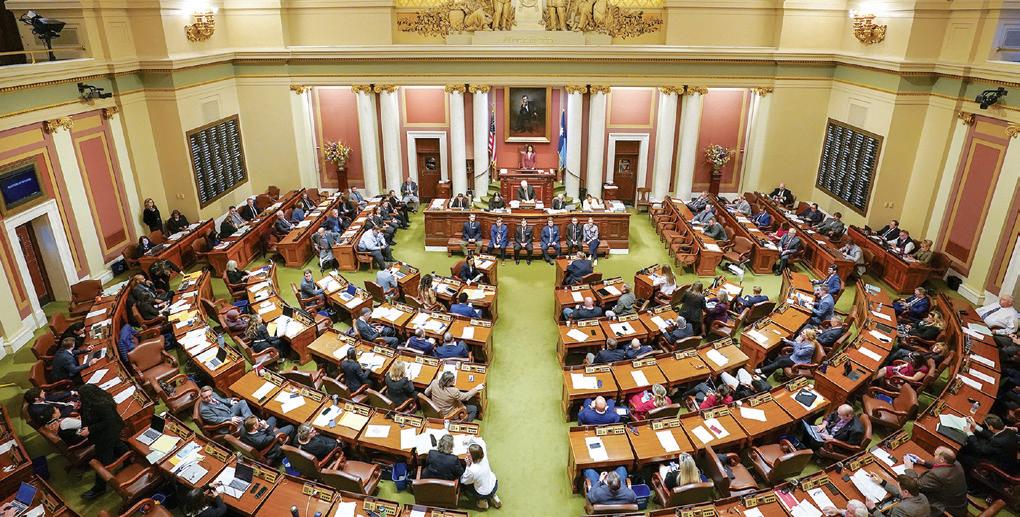
His fellow representatives overwhelmingly agreed by passing it 133-0 Monday. The bill’s next stop is the Senate. These types of fraud are complex, can involve layered transactions in multiple different organizations, and can take years to uncover, Myers said. “By the time some of these investigators identify what’s happening, the
Lawmakers weigh legislation that would expand Minneapolis' downtown taxing area, seek golf events
By Rob Hubbard
At first glance, HF4361 looks something like a grab bag of almost unrelated items.
But a closer look at the bill sponsored by Rep. Esther Agbaje (DFL-Mpls) reveals four provisions designed to raise revenues in one area and disperse them in another. The bill was laid over by the House Taxes Committee on Tuesday, as amended, for possible omnibus bill inclusion.
So here’s the essence of HF4361: Minneapolis has a designated Downtown Taxing Area in which it currently imposes a 3% sales tax on liquor and beer and another 3% tax on food at restaurants. The bill
proposes expanding that taxing area to include more of the popular restaurant and bar district known as the North Loop, which has seen a lot of development in recent years.
Meanwhile, there’s a provision in statute that earmarks a portion of those tax proceeds for infrastructure and capital improvements for the Minnesota Vikings’ home, U.S. Bank Stadium, at the east end of Downtown Minneapolis. HF4361 would strike that provision.
And speaking of sports: The bill would also appropriate $7 million from the General Fund in Fiscal Year 2027 for a grant to the City of Chaska to attract future PGA of America championship-level golf events.
That would be paid for by canceling $7 million of a 2023 Minnesota Forward Fund appropriation designed to match federal funds and transferring that amount to the General Fund.
Agbaje said that Downtown Minneapolis has changed since the taxing district was launched in 1986.
“The North Loop neighborhood now has many of the same amenities and attractions as Downtown and should be part of the current-day Downtown Entertainment District,” she said.
Agbaje added that Minneapolis intends to uphold its obligation to pay for U.S. Bank Stadium’s operating and capital costs, which she said will amount to “over $500 mil-
lion over the next 20 years. … With this change, the city will be recouping approximately $62 million until about 2046.”
Rep. John Huot (DFL-Rosemount) expressed disgruntlement with the Minnesota Sports Facilities Authority, which is responsible for overseeing the operations and longterm maintenance of the stateowned U.S. Bank Stadium.
“I’ve been on this board two out of the four terms
I’ve been in the House,” he said.
“They’ve met zero [times]. This is a serious thing. As legislators, we’re supposed to sit on these boards. The board is supposed to call these meetings and they don’t.
“I am sick and tired of these fake boards out there that we are apparently a part of. This
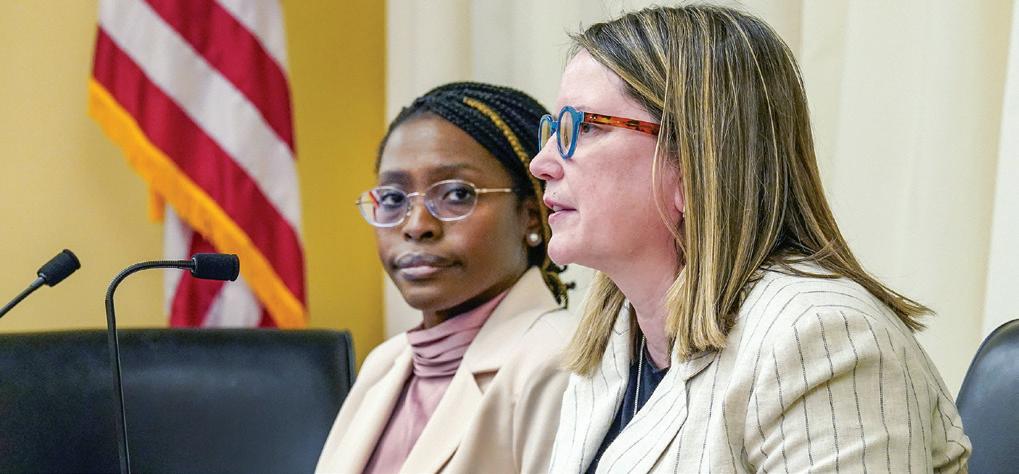
is a state facility that we should be looking at. We have these big obligations to the Vikings and the Twins that we’re signed on the bottom line for.”
The board chair sent a letter to the committee objecting to the proposal.
The committee’s co-chair, Rep. Greg Davids (R-Preston), said he was pleased that “finally, we recognize the importance of the PGA Championship events.”
“It’s such a good thing for the state, and the money that will come in is going to
be tremendous,” he said. “I will support that, but not with this funding mechanism. … I remember trying to raid the fund that we’re trying to raid here to build veterans’ homes. And you would have thought that I had taken somebody’s firstborn. I got beat down so bad.” Davids is against eliminating funding for the maintenance of U.S. Bank Stadium.
“That’s a commitment the city made and the state has, and we need to keep that in there.”
State patrol details impact of new weapons screening protocols at Minnesota Capitol
By Graham Johnson
To date, 121,598 people have passed through the weapons screening to enter the Capitol during the 2026 legislative session.
Capitol Security has turned away 52 weapons, the majority of which have been knives, but they have included other prohibited items like camping marshmallow skewers and screwdrivers. Those 52 weapons don’t include any firearms, and Capitol Security has verified 548 permits to carry, State Patrol Col. Christina Bogojevic told the Advisory Committee on Capitol Area Security Monday.
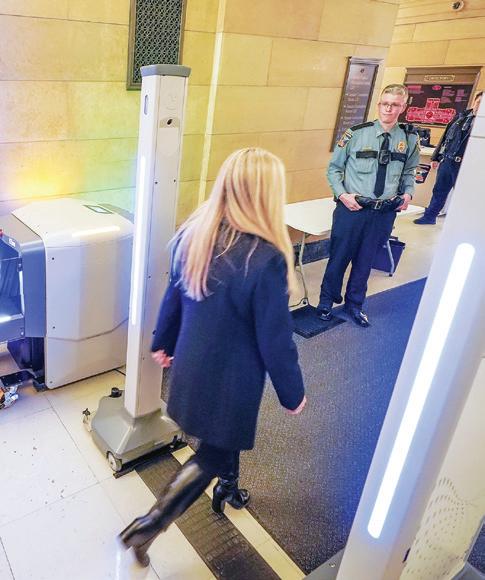
“This time last year, Minnesota was an outlier when it came to Capitol security. We are no longer an outlier and made great progress by implementing weapon screening this session,” said Lt. Gov. Peggy Flanagan, who chairs
committee.
“The people who have conducted screening and set up the implementation have been phenomenal,” Bogojevic said. The “vast majority” of State Capitol visitors have entered through the south entrance to the building, she said, with the longest wait times being 15-17 minutes.
The biggest issue with the new security has been the wait on checking permits to carry, which comes down to staffing at each entrance. Enhanced security measures were authorized by an executive order issued by Gov. Tim Walz on Jan. 26, which directed the public safety department to “put in place
the equipment and trained personnel necessary to implement weapons screening to ensure that unlawful dangerous items
are not introduced into the Minnesota State Capitol.” The measures come from committee recommen-
dations outlined in its January 2026 annual report.
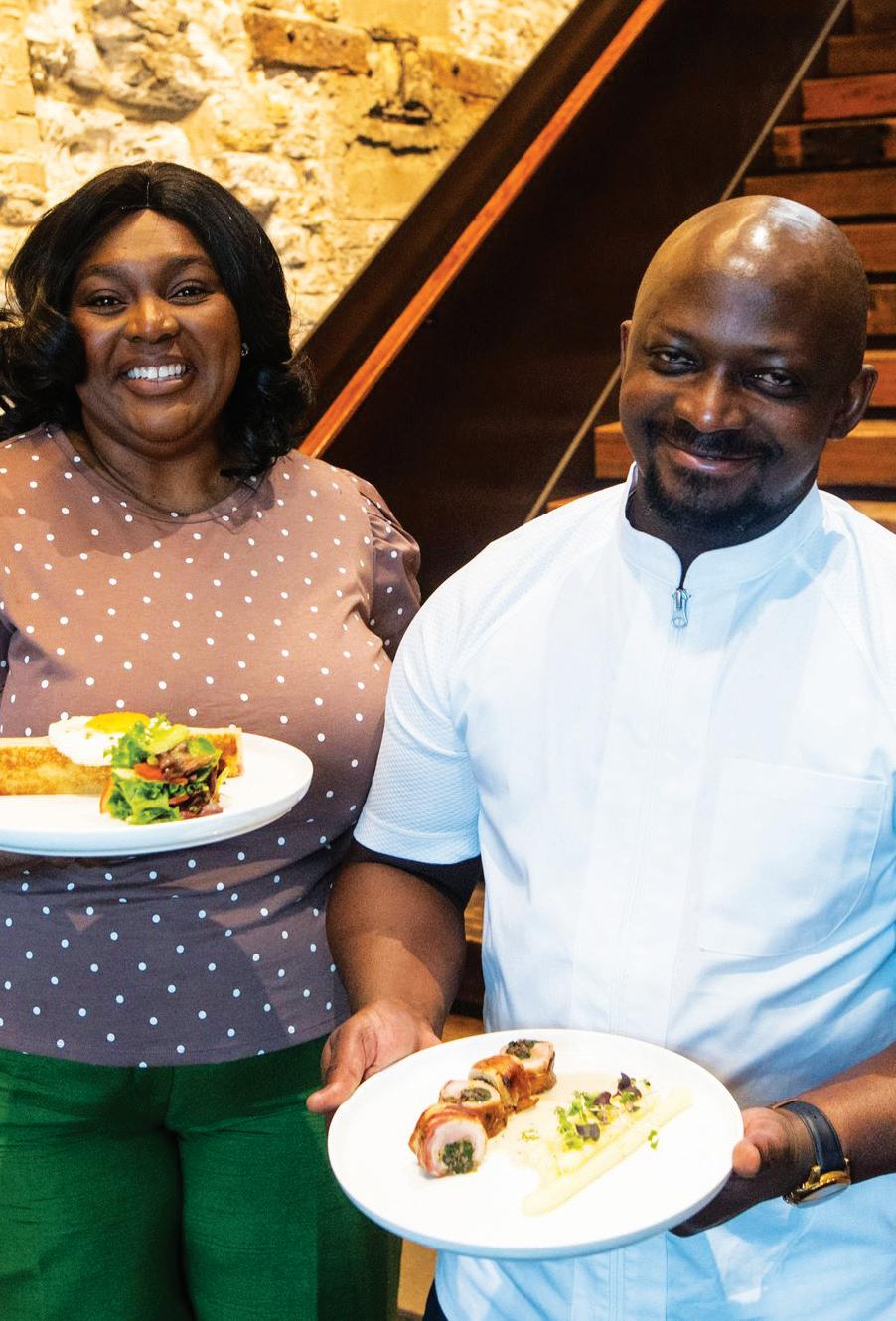
Diane Moukouri and Fritz Ebanda, founders of B’beri Desserts, are about to become the operators of one of the most visible restaurant spaces in Minneapolis
By Insight News Team
They met as teenagers, in the same neighborhood in Cameroon, in what used to be the French colonial portion of that country — two kids who would grow up, marry each other, work in luxury hotel kitchens on three continents, and then, improbably, end up with the keys to the riverfront pavilion at the foot of the Stone Arch Bridge.
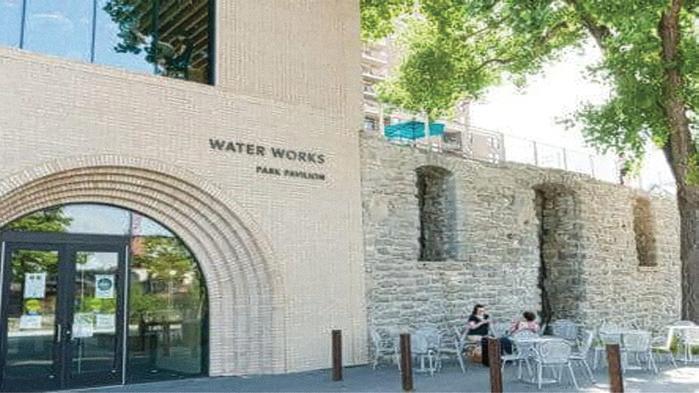
That is the story about to become official on April 29, when the Minneapolis Park and Recreation Board is scheduled to approve a five-year concessions agreement with Arch and River, LLC — the new restaurant company formed by Diane Moukouri and Fritz Ebanda, the Cameroonian-born couple already known to Twin Cities diners as the proprietors of B’beri Desserts.
Their restaurant, which will take over the Water Works Pavilion space in Mill Ruins Park after Sean Sherman’s James Beard Award-winning Owamni relocates to the Guthrie Theater, is described by its founders as French bistronomie with an Afro-Caribbean twist. On paper, that is a menu concept. In practice, it is the biography of the two people about to serve it.
The kitchen where Fritz learned Fritz Ebanda grew up in the former French part of Cameroon, in a household where his grandmother cooked, and where a small boy took careful notes of what she put in her food. His first professional training came in a luxury hotel in his native country, where he learned the classical discipline of French cuisine and French pastry — the laminated doughs, the ganaches, the pastry creams, the long list of things that have to be made correctly before anything else is possible in a French kitchen.
He did not stay in one place. He cooked in Sierra Leone. He cooked in the Republic of the Congo. He worked the grand openings of beach resorts. He worked offshore, on oil platforms, as a pastry chef — a specialty that demands technical precision in environments where precision is hardest to maintain. He eventually moved to Montreal, the French-speaking capital of Canadian cuisine, where he worked in the kitchen of the Fairmont The Queen Elizabeth — one of Canada’s great historic hotels — and in the kitchen of Europea, once ranked among the top restaurants in the world.
By the time he arrived in Minneapolis to reunite with Diane and his stepson, he had been cooking French classical cuisine for more than two decades, on four continents, in some of the most demanding kitchens a young pastry chef can work in.
The business Diane built Diane Moukouri is the operations half of the partnership — the one who, in the founders’ own telling of the story, made B’beri Desserts into a business. When the couple launched the company in late 2019, Fritz’s role was to bake. Diane’s role was everything else.
In the early weeks of 2020, nobody was sure there would be farmers markets that summer. When the pandemic hit, the Ebandas did not have a storefront, and the delivery-only model they had imagined for B’beri Desserts became, for several weeks, the only model available to any food business in the state. Then the farmers markets were designated essential services, and the pastries the Ebandas had been baking in their home kitchen began traveling to customers across the Twin Cities.
The brand took off faster than they expected. Fritz baked. Diane drove. She did de-
liveries personally, met customers on their front porches, built a reputation for warmth that the Star Tribune singled out in one of the paper’s earliest write-ups of the business. The menu did not compromise. Kouign amann — the sugar-crusted Breton pastry that is one of the hardest things a home baker can attempt — traveled alongside laminated croissants, opera cake, chocolate profiteroles, eclairs. Fritz made the quiche crust himself. He dusted the choux with rolled powdered sugar that fell, Diane told one interviewer, “like snow.”
The couple added farmers market stands. They picked up a pastry counter inside Le Café AF at Alliance Française MSP in the North
Loop district of downtown Minneapolis when that café opened in July 2024, serving what Fritz describes as classical French desserts: chocolate tarts, lemon meringue choux, opera cakes. Their work was added to the Minnesota BlackOwned Business Directory. The Star Tribune, *Mpls.St.Paul Magazine,* Voyage Minnesota, and Family Fun Twin Cities all profiled them. They became, in the language of the Twin Cities food press, “farmers market stars.”
What they did not have, yet, was their own restaurant.
The menu Fritz has been waiting to serve When Moukouri and Eban-
da describe what they plan to serve at Water Works, they are describing a menu they have been constructing, in their heads and in their home kitchen, for longer than the RFP has existed.
Breakfast will be coffee and pastries — the brioche, the kouign amann, the laminated croissants that B’beri’s customers already know. Midday will be brunch, lunch, and goûter, the French afternoon-snack tradition. Evenings will be dinner with a dessert bar. Fritz will be the executive chef. Diane will manage restaurant operations. The dishes Moukouri volunteered when a reporter from Mpls.St.Paul Magazine asked what she and Fritz were most looking forward to serving read like a specific argument about what French-Afro-Caribbean cooking actually means at the plate level: filet mignon with roasted foie gras and gratin dauphinois; a savory mille-feuille of eggplant and butternut squash served in a tomato-basil jus alongside a potato pavé; a savory tart of leeks confit and blue cheese. For dessert: a mille-feuille layered with vanilla bourbon cream and ginger confit; crêpes Suzette in caramelized orange sauce; classic chocolate profiteroles.
“We want fresh food,” Moukouri told the magazine. “Even in our upbringing, we always cooked our food, it was never processed. We want food with plenty of colors.”
The place they are walking into Water Works Pavilion is not an ordinary restaurant location. The three-acre site, embedded into the remains of the Bassett Sawmill (built in 1870, burned in 1897) and the Columbia Flour Mill (built in 1882, collapsed in 1941), was acquired by MPRB in 1990 and sat dormant for more than 20 years.
After the 2010 international
riverfront design competition and the launch of RiverFirst, it became one of the first projects to move forward. The pavilion itself, designed by HGA around the preserved mill ruins, opened in 2021.
The surrounding Central Mississippi Riverfront Regional Park draws an estimated 2.5 million visits annually. It is the fourth most-visited park in the Twin Cities. It sits alongside the Stone Arch Bridge, St. Anthony Falls, the Guthrie Theater, the Mill City Museum, and the lock and dam. It is, by the measures tourism professionals use, the single most photographed segment of public land in Minnesota.
To walk into that site as a new operator — especially as an independent restaurant rather than a hotel group or a national chain — is to inherit a marketing position that no amount of advertising purchases. Moukouri and Ebanda are taking it on with a concept rooted not in the riverfront’s history but in their own.
Opening MPRB anticipates the new restaurant will open in May. Members of the public may attend the April 29 board meeting in person, watch live on MPRB’s YouTube channel, or submit written comment to OpenTime@minneapolisparks. org by noon on the day of the meeting.
Two kids from the same neighborhood in Cameroon, who learned to cook French food in a hotel kitchen in West Africa, who worked their way through Sierra Leone and the Republic of the Congo and the Fairmont in Montreal and the offshore platforms in between, are about to open a restaurant at the foot of the Stone Arch Bridge. That’s how close it is. Disclosure statement Insight News uses AI-assisted tools in some editorial production. Read our AI Policy & Transparency Statement at www.insightnews.com/ site/ai_policy.html.
Prediction markets have been legal in the United States for less than 18 months. Cable news already cites them, and lawmakers are already worried about insider trading
By Parker Bach PhD Student in Media and Communication, University of North Carolina at Chapel Hill
Though prediction markets have been legal in the U.S. for less than 18 months, they can’t stop making news and making money.
On prediction markets such as Kalshi and Polymarket, users can stake real money on just about anything, from the winner of the 2028 U.S. presidential election to when Taylor Swift will get married.
But this isn’t simple entertainment: In theory, these wagers serve as a means of collecting the public’s insights into the future.
That’s why you may have seen CNN’s pundits casually mention Kalshi’s election odds for the 2026 primaries, or watched CBS offer real-time Polymarket projections of which actors would win awards during the Golden Globes.
Existing research on the principles and history of prediction markets suggests they can be a valuable way of pooling collective knowledge about the future.
But as researchers like me, journalists and legislators race to understand the impact these markets are having on society and politics, several questions have emerged about the regulation of these platforms and their forecasting abilities.

The what and why of prediction markets In practice, prediction markets are quite simple.
Each market offers what are known as “event contracts” on whether some future outcome will occur. Each contract costs between 1 and 99 cents, paying out US$1 if the event occurs or nothing if it does not.
Similar to sports betting, purchasing a contract represents a wager. There are higher returns for positions on outcomes deemed less likely. Like in the stock market, a trader can buy and sell contracts over time, as odds – and thus prices – fluctuate. At the time of writing, Kalshi traders put the odds of the passage of the SAVE Act, legislation centered on requiring proof of U.S. citizenship to register to vote, at about 10%. So each contract for this outcome
costs 10 cents. If I think the act is more likely to pass than that, I could purchase some “shares” and sell them at a higher price if the odds go up in the future. If I hold them and the bill ultimately becomes law, I would receive a return that’s 10 times what I originally paid.
Two theories support the idea that prediction markets should excel at forecasting: the wisdom of crowds and the efficient market hypothesis.
First described over a century ago, the wisdom of crowds refers to the idea that the median judgment of a large, diverse group of people operating independently is often more accurate than that of a single expert.
A related argument appears in the efficient market hypothesis, which emerged in the mid-20th century among economists who championed free markets. It holds that prices
encode all available information, reflecting the collective judgments of profit-seeking sellers and deal-seeking buyers.
At their best, then, prediction markets aggregate collective intelligence to weigh the likelihood of future events.
Polling’s credibility crisis creates an opening Gambling on the outcomes of the day’s events has a long history. In 16th-century Italy, gamblers could wager on the election of civic magistrates and the outcome of papal conclaves. And from the 1880s to 1930s, New York City was the hub of political wagering, which sometimes exceeded the stock market in daily volume.
Reporting on bets ahead of the 1924 presidential election, The New York Times observed, “It is an old axiom in the financial district that Wall Street betting odds are ‘never wrong.’”
However, the rise of scientific polling and legal crackdowns on political wagering forced prediction markets to fade to the background.
That changed in 2024.
One month before the U.S. elections, a federal court granted the prediction market startup Kalshi permission to legally operate prediction markets concerning U.S. election results.
Around the same time, Elon Musk posted on X about Donald Trump leading Kamala Harris in prediction market odds. Trump followed
suit. Kalshi put up billboards with live election odds in Times Square. Users and dollars flowed in. By election day, a volume of over $500 million in presidential election bets had been traded on Kalshi alone.
Polymarket featured over $3.6 billion more in volume.
Political polling, meanwhile, was facing a crisis of confidence. Response rates had been declining for decades, and Trump voters had been undercounted in 2016 and 2020.
The polls forecast the presidential election as a coin toss. The prediction market, meanwhile, favored Trump at roughly 60% odds to win.
After Trump won at the ballot box, prediction markets declared victory over polling as the new, trustworthy forecasters of public opinion.
The utility of the markets
Over the past 50 years, journalists have increasingly incorporated quantitative data in their reporting, and audiences have come to expect political forecasting as part of their news diet.
With polling experiencing a crisis of confidence, prediction markets have become an increasingly attractive way for journalists to offer a data-backed snapshot of public beliefs. Prediction markets have other advantages over polls for journalists. They respond to events in real time, and they’re free to access. Polls, meanwhile, take time and money to administer. They provide
forecasts for political outcomes that go beyond elections – such as Cabinet nominations and Supreme Court decisions – which are usually outside the purview of polling.
In recent months, Kalshi and Polymarket have inked several partnership deals with news outlets. There’s a symbiotic relationship at play: Prediction markets provide journalists with data to report and discuss. Journalists, in turn, legitimize prediction markets by citing them as a trusted source. Prediction markets have historically performed well on elections. Whether they’re more accurate than polls on other kinds of questions is still up for debate.
If traders behave purely rationally, in the economic sense, they might flit between positions to maximize profit based on new information, personal biases aside. But when wagering on elections, most traders have seemed to consistently buy and sell only one position, rather than switching between them. They may think they’re trading rationally while exhibiting a “wishful thinking” bias. Or, like many sports bettors, they may be wagering out of fandom or for entertainment.
All of these scenarios could undercut the accuracy of these markets.
The elephant in the room Many journalists are embracing the data even as their news outlets run stories about concerns over insider trading in predictive markets. Because the outcome of events is often deter-

Most patients never ask their doctors about cost. Researchers say that silence is driving billions in avoidable out-of-pocket spending.
By Helen Colby Assistant Professor of Marketing, Indiana University
Deidre Popovich Associate Professor of Marketing, Texas Tech University
As health care costs rise, patients aren’t just shouldering higher bills. They’re bearing more and more responsibility for getting information.
Americans are facing a health care affordability crunch on multiple fronts. In 2025, the Republican-controlled Congress approved a sweeping tax law that scaled back premium subsidies for Americans accessing care through the Affordable Care Act starting in 2026. As a result, millions on ACA plans now face much higher premiums, with many dropping out or expecting to drop out and risk going uninsured as premiums surge. By March 2026, about 1 in 10 people on ACA plans had dropped out, and that share is expected to rise.
Meanwhile, high-deductible insurance plans have become more common, requiring patients to pay thousands of dollars before coverage fully kicks in. The rise of those plans, along with surging drug prices and the growing share of Americans who are under- or uninsured, means that medical debt remains a leading source of financial strain.
Nearly half of U.S. adults now report difficulty affording health care. Together, these shifts are accelerating the “consumerization” of health care. Patients now have the ability to comparison shop, evaluate options and manage costs – but often without clear pricing. In this environment, knowing how to ask the right questions may be one of the most important tools patients have.
We are professors who study how perceptions of health care costs shape patients’ decisions about their care. Our
research examines how factors such as price-transparency regulations influence patient choices. Across our work, we consistently hear from patients about rising costs and how conversations about price with their providers too often never happen.
Why speaking up about cost matters
When one of us took our child to the doctor for pink eye, the pediatrician quickly sent a prescription for antibiotic drops to the pharmacy. At the pickup, the pharmacist dropped the news that the drops would cost more than US$300. A follow-up phone call to the doctor’s office, however, yielded important information: A generic version of the same medication offered the same treatment and the same results, but at a fraction of the price.
That quick phone call saved her a lot of money. It also raised a broader question: Why don’t more people have these conversations about cost? In fact, one study shows that cost conversations occur in only about 30% of medical visits.
These discussions aren’t just for medications. They can be crucial when a recommended procedure has multiple alternatives; when out-of-pocket costs might affect whether you follow through on care; or when a sudden medical bill could create financial strain. Speaking up about price can help patients stay healthier and avoid the all-too-common trade-off between medical care and household expenses.
The study mentioned above also found that doctors and patients identified ways to reduce out-of-pocket costs –such as switching to a generic drug or adjusting the timing of care – in nearly half of those cases. Importantly, these conversations were typically brief and did not compromise the quality of care, the researchers found.
Patients actually prefer doctors who bring up costs, other research has found. Still, most patients remain hesitant.
While a majority say they want to discuss cost, only a minority actually do, often waiting until a bill arrives – often when it’s too late to consider alternatives. That’s why it’s important that consumers feel empowered to ask the right questions. Here are three that can help make care more affordable.
Is there a generic or lowercost alternative?
One of the simplest ways to reduce drug costs is to ask whether a less expensive option is available. Brand-name medications can cost significantly more than generics, even when they are equally effective. One industry survey estimated that 90% of all prescriptions filled in 2024 were generic or biosimilar, but these accounted for only 12% of drug spending. In many cases, physicians can substitute a generic drug or recommend a similar treatment that achieves the same outcome at a lower price. And when no direct generic exists, there may be therapeutic alternatives worth considering. For example, if a brand-name eye drop or inhaler isn’t available in generic form, doctors can often prescribe a different medication in the same class that works just as well but costs far less. Research on physician–patient cost conversations shows that switching to lower-cost, clinically similar alternatives within the same drug class is a common strategy for reducing out-of-pocket spending without compromising care.
Is there any financial assistance available?
Some hospitals and large health systems have specific programs aimed at making care more affordable for lower-income patients. In many states, government programs address this same goal. These programs often offer discounts on care, but they can be complex to navigate and require significant paperwork. Many health care offices have staff who are knowledgeable about these programs and can help patients determine el-
Placebo effect can work as well as real medicine – but your body may need permission to use it
By Phil Starks Associate Professor of Biology, Tufts University
The first time the placebo effect really got under my skin was when I read that roughly onethird of people with irritable bowel syndrome improve on placebo treatments alone. Usually this statistic is presented as a fascinating quirk of medicine. My reaction was anger.
Humanity possesses an extremely effective treatment, with essentially zero side effects – and patients need someone else’s permission to use it.
The placebo effect refers to the improvements in symptoms that patients experience after they’re given an inert treatment like a sugar pill.
Driven by expectation, context and social cues rather than pharmacology, the placebo effect is often dismissed as all in the mind. But decades of research have shown it is anything but imaginary.
Placebo treatments can trigger measurable changes in the brain, immune system and hormone function. In studies on pain, placebos cause the brain to release endorphins, the body’s natural opioids. In Parkinson’s
disease, placebo injections increase dopamine activity in the brain. The placebo effect isn’t magic. It’s biology.
Having spent nearly a quarter-century teaching evolutionary medicine, I’ve come to see placebos not as curiosities of clinical trials but as windows into how human biology responds to social signals. And it’s that relationship that is exactly what makes the placebo effect unsettling.
Medicine works, even when it isn’t medicine
The placebo effect is so reliable that researchers must account for it in nearly every clinical trial.
When testing a new drug, scientists compare its effects to what patients experience on a placebo treatment like sugar pills, saline injections or sham surgery. If the drug doesn’t outperform the placebo, it rarely reaches the public. Placebo responses are common and powerful enough to rival active treatments.
Even surgery isn’t immune to the placebo effect. In several well-documented studies of knee procedures, patients who received sham operations –incisions without the full surgical repair – improved almost as much as those who received the
real procedure.
Clearly something real is happening inside the body. But the strangest part of the placebo effect is not that it works. It’s what makes it work.
The prescription of belief Placebo treatments tend to be more effective when delivered by credible authorities. Pills work better when prescribed by doctors wearing white coats. Expensive pills outperform cheap ones. Injections produce stronger responses than tablets.
Some researchers have even removed the deception from placebo experiments entirely. In open-label placebo studies, patients are directly told they are receiving a placebo; and yet many still report significant improvement.
But look more closely at how these studies are run. Patients are not simply handed a sugar pill and sent home. They receive an explanation from a clinician, in a medical setting, within a structured ritual of care: a context that may be doing much of the biological work.
Even when the deception disappears, the social scaffolding remains. The permission
"how much"

igibility and sometimes even assist with applications, although the Trump administration has cut funding.
Patients can often find these programs through hospital or health system websites, which typically include financial assistance or “charity care” pages outlining eligibility and how to apply. State Medicaid offices and insurance marketplaces are also key entry points for coverage and subsidy programs. Nonprofit organizations and patient advocacy groups may also offer or list assistance tailored to specific conditions or medications.
It’s also important to remember that for prescription medications, what you’re quoted isn’t always the final price. Many medications come with options to reduce costs, including manufacturer coupons, copay assistance programs and patient assistance programs. Doctors’ offices and pharmacists may also know practical ways to save money, such as using a
different pharmacy, switching to mail order or adjusting how a prescription is written. Asking about these options can uncover savings that aren’t immediately obvious.
What will this cost me, and are there other options?
Health care pricing is often opaque, and costs can vary widely depending on where and how care is delivered. Asking up front about your expected out-of-pocket cost can help you avoid surprises later.
This question also opens the door to alternatives. For example, patients may be able to choose a lower-cost imaging center, opt for outpatient rather than hospital-based care, or delay nonurgent services until insurance coverage improves.
Speaking up is part of taking care of your health
Health care decisions shouldn’t feel like a choice between your well-being and your wallet. A
sustainable care. Physicians can’t address financial concerns they don’t hear about, and most want to help their patients access care they can realistically follow through on. As costs continue to shift toward the patient’s burden, asking these questions isn’t just helpful – it’s essential. The next time you’re handed a prescription or a referral, remember: One simple question about price could make all the difference. Disclosure
Deidre Popovich has received grant funding from BlueCross
of Texas and Providence Health. Helen Colby does not work for, consult, own shares in or receive funding from any company or organization that would benefit from this article, and has disclosed no relevant affiliations beyond their academic appointment.


The Earth Day work is already done, and the Earth Day work has only just begun. That's the Northside rhythm, right? By the time this edition reaches you, the Spring Fling Senior Social at UROC has come and gone. Arbor Day at Bethune Park has come and gone. The Saturday cleanup at the US Bank lot on West Broadway has come and gone. Sixty trees — if the Minneapolis Parks crews and the neighbors who showed up had their way — are in the ground at Bethune, and a stretch of Broadway is a little cleaner than it was the Friday before. And still, the calendar keeps moving. That's the point. The Northside Residents Redevelopment Council, in its latest community bulletin, has laid out a season's worth of neighborhood work that doesn't stop with a single holiday on the calendar. Mother Earth, the elders used to tell us, does not keep office hours. Neither, it turns out, does the NRRC.
A season of stewardship, not a single day Read the NRRC bulletin carefully and a pattern emerges. The organization is not treating Earth Day as a photo opportunity. It is treating it as the opening bell of a months-long program: a foraging class with Minneapolis Edible Boulevards on May
From
to heal is still being granted by someone else.
The placebo effect extends beyond the patient
The placebo effect is often framed as something happening inside an individual. But it does not operate in isolation. Consider what happens in veterinary medicine. Dogs and cats cannot believe a treatment they’re given will work; they have no concept of receiving medication. Yet when owners and vets believe an animal is being treated, they consistently report improvements in pain and mobility that medical tests do not confirm.
In one study of dogs with osteoarthritis, owners reported improvement roughly 57% of the time for animals receiving only a placebo.
The animals themselves may not have improved. But the humans caring for them perceived they had. The healing signal, it turns out, travels through the humans in the room.
When healing makes things worse
There have been times when going to the doctor made you less likely to survive. In the 19th century, mainstream medicine was built on bloodletting, purging and doses of mercury and arsenic – treatments that killed as often as they cured.
Homeopathy emerged in the late 18th century precisely in this context. Its founder, Samuel Hahnemann, was a physician horrified by the harm the conventional medicine of his time was causing. His highly diluted versions of contemporary remedies did nothing pharmacologically. But they also did not kill people, which put them decisively ahead of the competition.
Homeopathic patients not only survived but also reported dramatic recoveries from chronic ailments and acute infections alike. During the cholera epidemics of the mid-1800s, patients at homeopathic hospitals had lower death rates than those receiving standard care. Why was that?
The standard cholera treatment of the era was aggressive and exhausting; for a disease that already caused massive fluid loss, doctors often prescribed further bloodletting, along with toxic purgatives such as calomel – a form of mercury – to “flush” the system.
9, free and open to anyone who registers; guided Saturday birding walks at the Eloise Butler Wildflower Garden inside Theodore Wirth Regional Park, led by a naturalist, meeting at the Martha Crone Visitor Shelter each weekend; and Free Fresh Food Fridays at NorthPoint's main campus, set to run the second and fourth Fridays of every month from May through September.
This is what community-scale environmentalism looks like when it is actually organized by the community. It is not a slogan. It is a schedule. It is a naturalist at 7:30 in the morning. It is a produce table at Penn and Fourteenth, rain or shine. It is, as our elders would put it, the work.
“Mother Earth does not keep office hours. Neither, it turns out, does the NRRC.”
Awesome money, by and for the Northside The bulletin also announces that the Northside Awesome Fund has reopened, with applications accepted through May 14 and grants decided at the end of the month. The model is familiar to longtime readers of this paper, and worth naming again: community members pool their own dollars, and then give $1,000 grants — no strings attached — to projects their neighbors

dream up. More than eighty such projects have already been funded, according to the organization's own accounting at northsideawesome.org.
Pay attention to the phrase no strings attached. In a philanthropic landscape that too often arrives with reporting requirements thicker than the check itself, a fund run by neighbors, for neighbors, with trust built in, is a quiet act of political imagination. It says the Northside can be trusted with its own money. That is not a small claim. That is a whole theology.
Renter relief, before the eviction filing
Perhaps the most consequential line in the NRRC bulletin has nothing to do with trees or birds. It has to do with keeping people housed. The City of Minneapolis, alongside a $1 million private gift from the Wilson Foundation, has made $2 million in emergency rental assistance available through Hennepin County — and crucially, the
funds do not require an eviction filing before a resident can access them. Read that sentence twice. In a housing system that has, for decades, treated the eviction court filing as the gateway to help rather than the wound that help is supposed to prevent, this is a structural correction. The NRRC is flagging it because the deadline for action is not when the sheriff arrives. The deadline is now. Renters experiencing sudden financial hardship are pointed toward the Hennepin County application portal, with the aid designed to move quickly through trusted community partners.
Traffic calming, and the politics of the residential street
The city's 2026 neighborhood traffic calming program is another thread worth pulling. The NRRC is urging Northsiders to mark safety concerns on the project feedback map and to complete a short survey by May
In contrast, homeopathic care involved extreme dilutions of substances in water or alcohol, effectively providing hydration and a calm, structured environment without the physiological assault.
Death rates were lower not because homeopathy worked but because the placebo effect – combined with not poisoning patients – was more effective than the medicine of the day.
Healing is not free
The body needs resources to heal from injury and disease. Activating systems such as immune responses, tissue repair and inflammation at the wrong time can be dangerous.
A full-scale immune response is metabolically expensive, with fever increasing metabolic rate by roughly 10% per degree Celsius rise in body temperature. Triggered at the wrong time, this can deplete critical energy reserves needed for immediate survival, such as escaping a predator. Furthermore, misplaced or overzealous inflammation causes collateral damage to healthy tissues, potentially leading to chronic dysfunction.
Some researchers have proposed that placebo responses reflect a kind of biological health governor: a system that regulates when the body invests heavily in recovery. Cues from trusted individuals may be exactly the signal the body waits for before committing resources to recovery. A caregiver’s reassurance, a physician’s authority and the rituals of medicine may tell the body that conditions are finally stable enough to devote energy to healing.
If that interpretation is correct, the placebo effect is not a trick of the mind. It is an ancient biological system responding to social information.
Body
with today: the stress response.
Stress evolved to keep you alive in the face of acute danger – predators, famine, immediate physical threat. These days, this useful piece of biological engineering might fire when someone hasn’t replied to your email. The system that once saved people’s lives now makes many miserable over things that would have been unimaginable to their ancestors.
You can talk back to the stress response, consciously reappraising the threat – in oth-
er words, reframing a looming deadline not as a catastrophe but as a manageable challenge – to help quiet it. But notice what you cannot do: You cannot simply decide to activate your placebo response. You cannot will yourself to release pain-relieving endorphins by believing hard enough in a sugar pill. For that, you still need the ritual, the white coat, the authority figure. You need someone else.
The stress response, misfiring as it is, remains yours. The placebo response has been
1. Open houses have already happened — the South and Uptown session at Whittier Recreation Center on April 21, the Northeast session at Van Cleve Recreation Center on April 22 — but the comment window remains open. Which means the conversation remains open. Which means your block is still negotiable, if you're willing to file the paperwork.
Memory, too, is infrastructure Two more items in the bulletin deserve note. The Hennepin History Museum, at 2303 Third Avenue South, has opened Five Years Later: In Honor of George Floyd, an installation of yard signs, tribute portraits, photographs of George Floyd Square by Terry Barczak, and performance work by seangarrison. The museum is open Thursday and Friday from 10 a.m. to 3 p.m., and Saturdays from 10 a.m. to 5 p.m. This paper's own George Floyd Week programming, Amplified Voices: Year Six, is scheduled for May 19 through 25 at the outdoor tent at
outsourced: not because it wasn’t always social, but because even now, people still can’t seem to access it on their own.
The uncomfortable implication
The placebo effect is not a trick of the mind. It is a feature of human biology that people have largely surrendered to whoever performs authority most convincingly.
If belief can activate biological healing pathways, belief can also be manipulated.
Charismatic figures, elaborate medical rituals and expensive treatments may produce real improvement in symptoms even when the underlying treatment is physiologically inert. That is how wellness culture works.
It leverages the same social scaffolding of care to trigger the body’s internal pharmacy, regardless of whether the treatment itself does anything.
The placebo effect is often celebrated as proof that the mind can heal the body. But I believe that may not be its
Worldwide Outreach for Christ, 3808 Chicago Avenue South. The exhibits and the broadcasts are companion works. Memory, on the Northside, is treated as infrastructure — something you tend, something you resource, something you build. And finally, a note of congratulations the
most interesting lesson. It also reveals that human physiology evolved to take its cues from other people. Your brain, immune system and pain response are not isolated machines. They are deeply intertwined with social signals, expectations and trust.
In a world filled with doctors, advertisements, wellness influencers and elaborate medical rituals, that insight is both fascinating and profoundly maddening. People are walking around with one of the most powerful healing systems ever documented locked inside them, and they can reliably access it only when someone in a position of authority gives them permission.
Disclosure statement Phil Starks does not work for, consult, own shares in or receive funding from any company or organization that would benefit from this article, and has disclosed no relevant affiliations beyond their academic appointment.





















sider trading, and in early 2026 it fined and suspended two high-profile traders who were using inside information.
mined by human actors, those privy to certain plans – say, a looming ceasefire deal – would have access to information not available to the public and could profit handsomely off that information.
Two anonymous accounts made hundreds of thousands of dollars predicting the downfall of Nicolás Maduro and betting on the toppling of Ayatollah Ali Khamenei, with traders putting their money down just before the U.S. took military action. This timing has raised some eyebrows.
Kalshi prohibits in-
Likely in response to bad press and statements from lawmakers seeking to regulate the platforms, Kalshi and Polymarket also announced new insider trading rules on March 23, 2026, centered on politics and sports.
The legal mechanisms for enforcing these rules, however, are less clear. SEC Rule 10b5-1 prohibits trading securities on the basis of material nonpublic information.
But event contracts are not governed by the SEC. They’re under the purview of the Commodity Futures Trading Commission, a much small-



















24.3 cents of each dollar spent on the Minnesota Lottery helps fund projects and resources that benefit us all, such as projects to preserve our unique environmental landscapes, general funds spread all across the state, resources for responsible gambling and more. When you play your part, it all makes cents.




























er agency. As things stand, the small agency has too few employees to regulate the legality of specific event contracts, which are governed by the Commodity Exchange Act. Kalshi and certain other prediction market platforms are instead given the latitude to self-certify the legality of each contract. Any efforts to meaningfully regulate insider trading would, in my view, require clear rules and viable enforcement mechanisms.
From participation to profit
As I conduct my research, I often consider what the booming popularity of prediction markets says about American culture and politics in 2026. In 1969, sociologist Erving Goffman theorized that Americans’ attraction to gambling stemmed from a need for “action” in an increasingly bureaucratized society. Similarly, studies have suggested that betting on sports makes fans feel like they’re participating, not just observing. Congress is less productive than ever. Most Americans feel they have little influence over the workings of the government, with many looking on helplessly as democratic guardrails have been dismantled.
Who knows what will happen in the coming year. The filibuster might be weakened, or the U.S. could invade Cuba. Most Americans will have little say. But prediction markets at least offer the chance to make a buck off the action.
Disclosure statement
Parker Bach does not work for, consult, own shares in or receive funding from any company or organization that would benefit from this article, and has disclosed no relevant affiliations beyond their academic appointment.