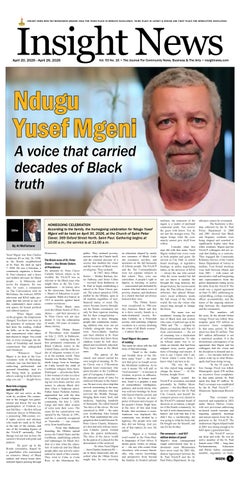

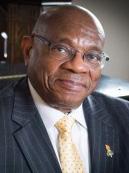
A voice that carried decades of Black truth Ndugu Yusef Mgeni

Editor By Al McFarlane
Yusef Mgeni was born Charles Anderson III on July 26, 1948, in the Rondo neighborhood of St. Paul. He died on April 7, 2026. He was a historian, a community organizer, a former St. Paul educator, and a fierce and faithful advocate for Black people — in Minnesota and across the diaspora. He was also, for years, a companion on The Conversation with Al McFarlane, the webcast, SPNN television and KFAI radio program that has served as one of this community's most consistent spaces for honest political and cultural analysis.
When Mgeni came on the program, the temperature changed. You knew you were in the presence of someone who had done the reading, walked the halls, sat in the meetings, and remembered what others had chosen to forget. You could feel, in every exchange, the decades of friendship and shared commitment that undergirded each broadcast.
“Whenever Yusef Mgeni is on deck at the Conversations with Al McFarlane webcast, you can feel their decades-long professional and personal friendship. And it’s like being back in graduate school, soaking in all the knowledge you can.” — Insight News
Born into a legacy and worthy of it Mgeni did not arrive at this work by accident. His connection to the struggle was generational and literal. He was the grandnephew of Fredrick Lamar McGhee — the first African American lawyer in Minnesota, a pioneering 20th-century civil rights activist and attorney who made his mark in St. Paul at the turn of the century, and one of the founding figures of the NAACP nationally. That lineage was not lost on him. He carried it forward with pride and purpose. He grew up in the Rondo community, shaped by a grandfather who maintained an extensive library of Black authors and whose home drew national figures passing through
HOMEGOING CELEBRATION
According to the family, the homegoing celebration for Ndugu Yusef Mgeni will be held on April 30, 2026, at the Church of Saint Peter Claver, 369 Oxford Street North, Saint Paul. Gathering begins at 10:00 a.m.; the service is at 11:00 a.m.
Minnesota.
The Black nuns of St. Peter Claver — the Oblate Sisters of Providence He attended St. Peter Claver Catholic School, where, as he recalled, the NAACP was as relevant to the Black nuns who taught there as the Ten Commandments — its history alive in the classroom, from Brown v. Board of Education to pickets against ‘Birth of a Nation’ in 1915 to marches against lunch counter exclusions.
Those Black nuns were the Oblate Sisters of Providence — and their presence at St. Peter Claver was not incidental. It was the culmination of nearly 120 years of extraordinary history.
The Oblate Sisters of Providence were founded on July 2, 1829, in Baltimore, Maryland — making them the first permanent community of Black Catholic sisters in the United States, and the oldest order of religious women of color in the modern world. Their founder was Mother Mary Elizabeth Lange, born in Santiago de Cuba, herself the child of Caribbean refugees from SaintDomingue — present-day Haiti. A free woman of color in a slave state, she had already been using her own home and her own money to educate Black children when a Sulpician priest, Father James Nicholas Joubert, approached her with the idea of founding a formal religious community. On July 2, 1829, Lange and three other women of color took their vows. The cause for her canonization was opened by the Vatican in 1991, and she is currently recognized as Venerable — one miracle away from beatification.
From that Baltimore founding, the Oblates spread across the United States and the Caribbean, establishing schools and orphanages for Black children at a time when the education of enslaved and free Black people alike was actively criminalized in much of this country. They went to Cuba, to Costa Rica, to the Dominican Re-
public. They endured poverty, racism within the Church itself, and the constant pressure of a society that doubted the virtue and the vocation of Black women religious. They endured.
In 1947, three Oblate Sisters — Mother Barbara, Sister Anthony, and Sister Celine — traveled from Baltimore to St. Paul to begin establishing a school at St. Peter Claver parish. The school opened in 1950, staffed by the Oblates, open to all students regardless of race, financial status, or creed. The sisters became known throughout the Rondo community not only for their rigorous teaching but for their evangelization — going door to door, bringing people into community, nurturing children who were not yet Catholic alongside those who were. Non-Catholic families sent their children to St. Peter Claver because they knew those children would be well disciplined and excellently educated. They knew them as the Black nuns.
The patron of the church and school carried his own weight of meaning. St. Peter Claver was a 17th-century Spanish Jesuit missionary who spent decades at the Caribbean port of Cartagena, Colombia — the principal point of entry for enslaved Africans in the Americas. He met every slave ship that arrived, ministering to the men, women, and children who had survived the Middle Passage, bringing them water, food, and medicine, baptizing hundreds of thousands. He called himself ‘the slave of the slaves.’ He was canonized in 1888 — the same year Archbishop John Ireland of St. Paul established the congregation that would become St. Peter Claver Church, Minnesota’s first and only African American Catholic parish. Ireland chose the patron deliberately. The slave of the slaves would be the patron of a church for the descendants of the enslaved.
So when Yusef Mgeni — born Charles Anderson III — sat in those classrooms and absorbed what the Oblate Sisters taught him, he was receiving
an education shaped by nearly two centuries of Black Catholic resistance, sacrifice, and insistence on the full humanity of African people. The NAACP and the Ten Commandments were not separate subjects in that school. They were one curriculum. A people’s right to dignity, to learning, to justice — consecrated and defended by women who had taken vows of poverty, chastity, and obedience in a church that had not always honored their own.
“The Oblate Sisters were exceptional in 19th-century America: Black and free in a slave society, female in a male-dominated society, Roman Catholic in a Protestant society, and pursuing religious vocations in a society doubting the virtue of all Black women.”
— Catholic Review
Yusef Mgeni: the power of naming
The name he chose tells the full story of that becoming.
Yusef is the Arabic and Swahili form of the Hebrew name Yosef — the same root that gives us Joseph across the Abrahamic traditions. At its core it means ‘He will add’ or ‘God increases’ — to increase in wisdom, in power, in influence, in abundance. In Islamic tradition, Yusef is a prophet: a man of extraordinary intelligence, patience, and moral clarity, who was sold into bondage by those who feared what he carried, and who rose to become an interpreter of dreams and a keeper of his people’s future. Right here, in the story of this man from Rondo, that resonance is exact. Anderson was displaced. His community was divided by a highway. His people were told they did not belong. And yet, out of that rupture, he rose. He added.
Mgeni is a Swahili word rooted in the Proto-Bantu languages of East Africa. It means guest, visitor, or stranger — the one who comes from elsewhere, who crosses thresholds, who carries knowledge and perspective from beyond the familiar. In Swahili cultural
tradition, the treatment of the mgeni is a matter of profound communal pride. You receive the guest with honor. You do not turn the stranger away. The mgeni brings what the community cannot give itself from within.
Consider what this man did with that name. Yusef Mgeni walked into every room as both prophet and guest. He arrived at City Hall, at school board meetings, at legislative hearings, at police negotiating tables, at the airwaves of KFAI — always the one who carried what the room needed but did not yet know it needed. He brought the long memory, the deeper history, the inconvenient data, the Pan-African frame of reference that placed Minnesota’s racial arithmetic inside the full sweep of the African world. He was the visitor who stayed long enough to change the house.
The name was not incidental. Among the generation of Black men and women who came of political age in the 1960s and ’70s — shaped by Black nationalism and Pan-African consciousness — the act of renaming was a declaration of self-determination. To take an African name was to reclaim an identity that had been stripped away across generations of bondage and erasure. It was to say: I know who I am. I know where I come from. I know what I am here to do.
“He was the visitor who stayed long enough to change the house.” — Al McFarlane, Insight News
Mgeni joined the NAACP at seventeen, recruited personally by Debbie Montgomery — the first Black woman ever elected to the St. Paul City Council, and herself the youngest person ever elected to the NAACP’s national board of directors at seventeen, a daughter of the Rondo community. As he told it with characteristic dry humor: she told him that if he didn’t buy a membership, she was going to whip his back end. He bought one for himself, and one for his brother.
The covenant — and $67 million dollars of proof Mgeni’s most consequential single achievement may be a document most Minnesotans have never read: the 2001 Mediation Agreement between the St. Paul NAACP and the St. Paul Police Department. Its sig-
nificance cannot be overstated.
The backstory is this: data collected by the St. Paul Police Department in 2000 and 2001 showed that Black and Hispanic residents were being stopped and searched at significantly higher rates than white residents. Mgeni and his NAACP colleagues did not accept that finding as a curiosity. They engaged the Community Relations Service of the United States Department of Justice to mediate. Four formal meetings were held between March and June 2001 — with senior administrative staff and bargaining unit representatives from the police department sitting across the table from the NAACP. The result was a signed agreement on June 19, 2001, addressing racial profiling, civilian oversight, officer accountability, and the terms of the ongoing relationship between the department and the community. The numbers tell the story. In the decade before George Floyd was killed, Minneapolis spent $70 million on excessive force complaints. In that same period, St. Paul spent less than $3 million. That $67 million differential is not a statistical accident. It is the downstream consequence of an agreement that Mgeni and his colleagues had the vision and the discipline to demand and secure — two decades before the nation woke up to what Minneapolis had been doing wrong.
“In the 10 years before George Floyd was killed, Minneapolis spent $70 million on excessive force complaints. In that same period, St. Paul spent less than $3 million. St. Paul’s covenant was established by the St. Paul NAACP.” — Minnesota Spokesman-Recorder That covenant was renewed and expanded in 2022 under Mayor Melvin Carter, with new provisions addressing no-knock search warrants and requiring quarterly meetings and annual reports from the department to the NAACP. The architecture Mgeni helped build in 2001 was strong enough to be built upon a generation later. His NAACP service ran deep and wide. He was an active member of the St. Paul branch since 1988 — long-time Parliamentarian, Education and Public Safety committee member, negotiator on bodyMGENI 8















Report: United We Walk Forward in Power
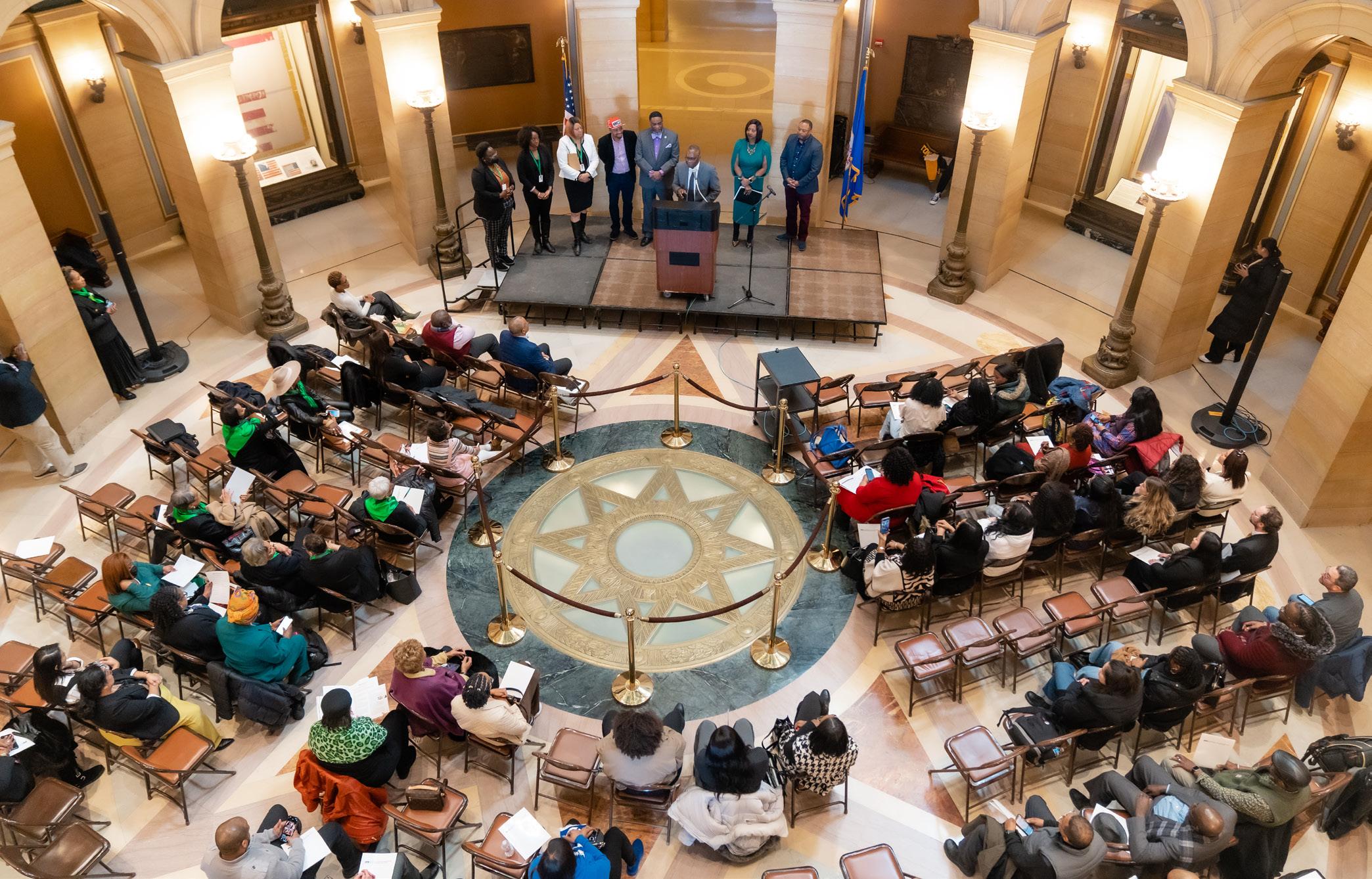
African Heritage Day on the Hill returns to the Capitol Friday, April 24 — and CMAH has named four bills to carry

The Council for Minnesotans of African Heritage has confirmed that African Heritage Day on the Hill 2026, originally scheduled for February 12 and listed in the Council’s 2025 Annual Report calendar, will now take place on Friday, April 24, 2026 in the Minnesota State Capitol Rotunda. The reschedule places the convening squarely in the
final weeks of the legislative session, which is set to adjourn on May 18. The Day on the Hill brings together constituents, elected leaders, and community leaders to discuss policies impacting Minnesotans of African Heritage and to encourage civic engagement. The event will includes a session for youth. For information, the Council asks
Black micro-schools deserve recognition: Council for Minnesotans of African Heritage
In a year defined by political violence, immigration fear, and budget contraction, CMAH leaned into bridge-building, youth leadership, and the unfinished work of Black homeownership — while a four-bill 2026 agenda waits at the Capitol for community to carry it forward.
The Council for Minnesotans of African Heritage earlier this year released its 2025 Annual Report under a banner that doubles as a thesis: United, We Walk Forward in Power. The Council is telling us what kind of year 2025 was, and what kind of year 2026 must become. The document is organized around four legislative and engagement priorities, a landscape analysis of the African Heritage community in Minnesota, a 2026 forward calendar, and a budget. But
the spine of the report — the through-line that gives meaning to every chart, every event listing, every committee assignment — is in the Chair’s message and the Executive Director’s message at the front. Read together, they describe a Council operating under pressure: fiscal pressure, federal pressure, civic pressure, and the human pressure of fear.
Two openings, one diagnosis Council Chair Wayne Doe opens with the language of a pastor and a community elder. He names what is happening in plain terms. Families are anxious. Neighbors are afraid. Many are choosing silence over visibility, fear over fellowship. The realities of immigration enforcement and widening disparities, he writes, feel close to home. He acknowledges this
truth, he writes, “without fear and denial.” That phrasing matters. It refuses two postures that often substitute for leadership in difficult seasons — the posture of denial, which pretends nothing is wrong, and the posture of paralysis, which says everything is wrong and nothing can be done. Doe rejects both. He calls instead for steadiness rooted in community, faith, resilience, and the discipline to keep striving.
Executive Director Linda Sloan’s message is more clinical, as the office requires, but she does not flinch from the year’s defining wounds. She names the killing of Speaker Melissa Hortman and her husband Mark, and the shooting of Senator John Hoffman and his wife Yvette. She places these acts of political violence at the front of the report — not as a
sidebar, not as a moment of silence — but as context for the entire year of legislative work. The implication is direct. A council that is asked to do equity work in a state where elected officials are being assassinated is doing equity work under conditions that the standard reporting templates were not built to describe.
“A council that is asked to do equity work in a state where elected officials are being assassinated is doing equity work under conditions that the standard reporting templates were not built to describe.”
Sloan’s diagnosis of the year is precise: economic uncertainty, extended legislative negotiations, heightened concerns about equity, access, and public trust. The bipartisan

By Al McFarlane, Editor
Washington, DC — Three Democratic members of the United States Senate have written to Secretary of State Marco Rubio demanding that the State Department reject a reported plan to withhold lifesaving HIV treatment from more than one million Zambians unless the Zambian government agrees to grant American businesses favorable access to its copper mines. Read that sentence again. That is a sentence worth reading twice. In the year 2026, a branch of the government of the United States of America, in a policy proposal now in circulation inside the Department of State, is reported to be considering whether the antiretroviral medicines that keep a million Zambian mothers, fathers, and children alive can be converted into leverage over the price American corporations pay for copper. That is the business under discussion. That is how close it is.


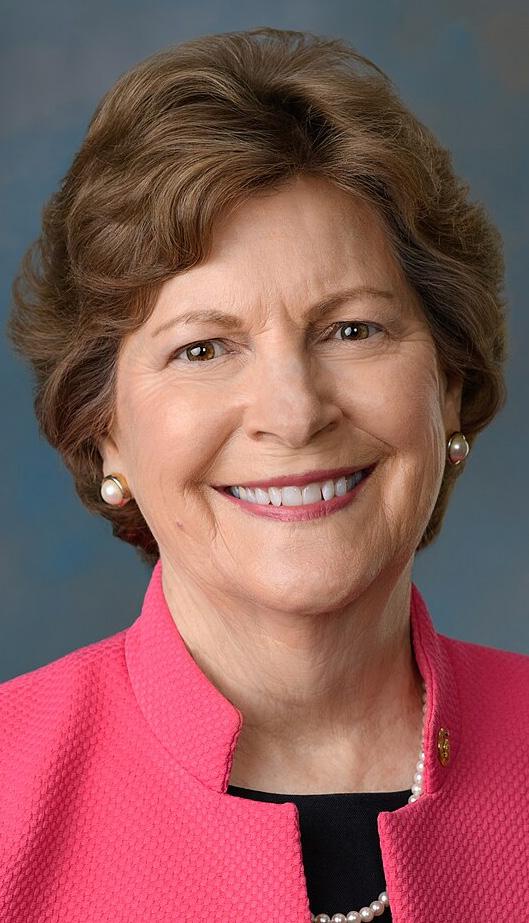
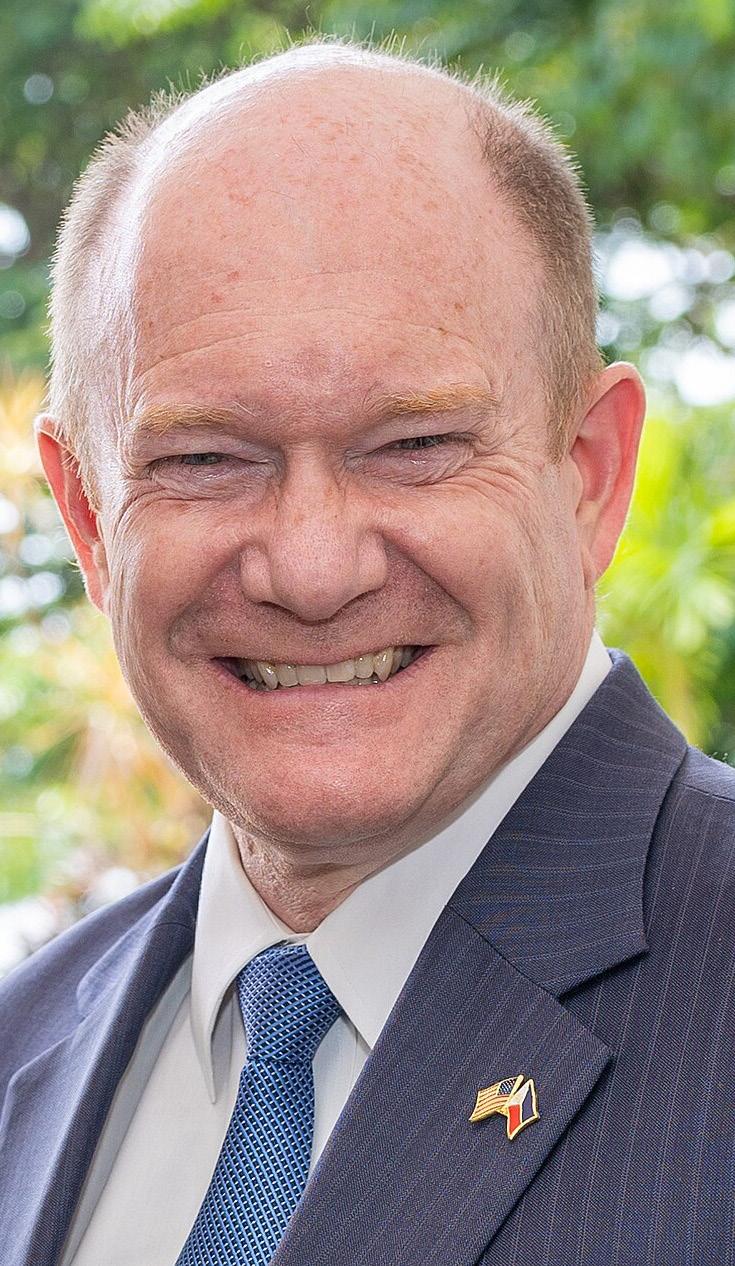
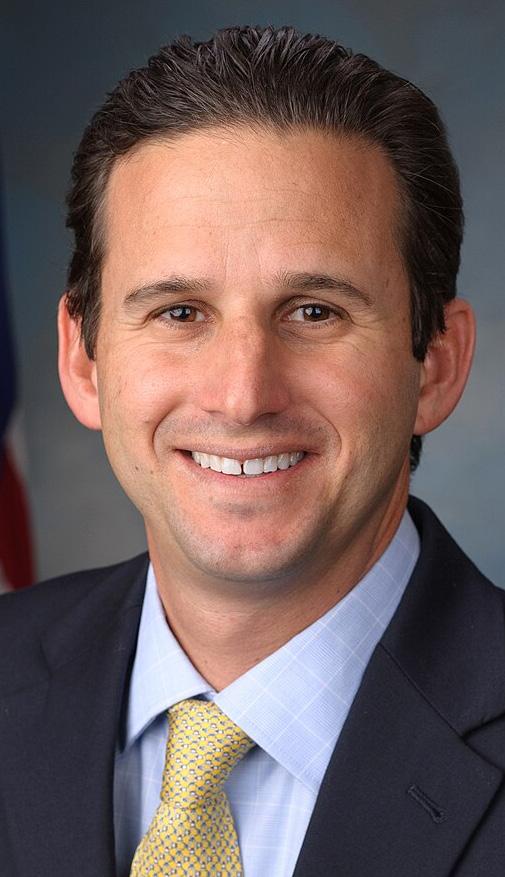
Senator Jeanne Shaheen, the ranking Democrat on the Senate Foreign Relations Committee, together with Senator Chris Coons and Senator Brian Schatz, laid out the objection in a letter first shared with Semafor. The senators called the reported approach “economic coercion” and “a disturbing break from the long-held bipartisan support for PEPFAR,” the President’s Emergency Plan for AIDS Relief. PEPFAR, launched in 2003 under a Republican administration and sustained through four presidencies thereafter, is
one of the most consequential public health investments in the history of African survival. To put it on the table as a trade concession is to announce, out loud, that African lives have an asking price, and that copper is a fair medium of exchange.
“We urge you to reject this tactic of economic coercion.”
— Sens. Jeanne Shaheen, Chris Coons, and Brian Schatz, letter to Secretary of State Marco Rubio, April 16, 2026
The senators’ letter followed reporting that the State Department had crafted a
plan to pressure Lusaka on mining policy by threatening to end health support “on a massive scale.” Neither the State Department nor the White House has publicly denied the existence of such a plan. The senators noted, correctly, that a bipartisan congressional commitment to PEPFAR cannot be quietly converted by career or political staff into a bargaining posture over minerals without breaking faith with the program’s origins and with the African families it
Public school advocates and politicians typically spearhead the attack on microschools, focusing on their perceived “lack of oversight and public accountability.” Yet Black families are the fastest-growing demographic in alternative education. This shift is driven by the recognition that traditional public education cannot change quickly enough to serve its children’s needs. The National Association of Black Micro-School Leaders is an organization working to counter this
narrative and fill a critical gap. Nicole Stewart, the founder, told The Carolinian that “Black families are the fastest-growing group in alternative education, but Black microschool founders have had no national home, no unified voice, no shared resources, and no collective power.”
Nicole Stewart, a former educator with nearly 20 years of experience in public education, retired to start her education consulting company and later opened her own school. That experience led her to discover microschools. Stewart advocates for a bal-
Cuban president vows to defend the country against US
Cuban President Miguel DíazCanel has declared that the island will defend itself against any potential military action by the United States, warning of serious regional consequences if tensions escalate further.
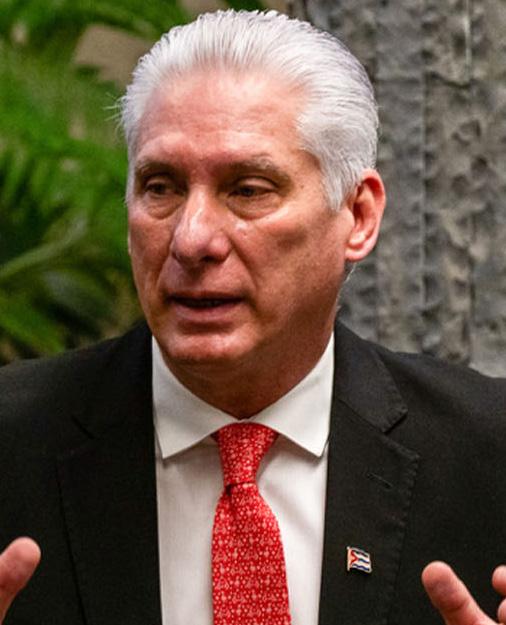
In an interview conducted in Havana with NBC’s Kristen Welker, Díaz-Canel emphasized that there is “no justification” for U.S. aggression against Cuba, while stressing that any invasion would provoke resistance. “If that happens, there will be fighting, and there will be a struggle, and we will defend ourselves,” he said, underscoring Cuba’s readiness to protect its sovereignty. The remarks come amid heightened rhetoric from U.S. President Donald Trump, whose administration has increased pressure on the communist-led nation. Trump recently suggested that a “takeover” of Cuba, potentially unfriendly, remains a possibility, while se-

Nicole Stewart, Founder of National Association of Black Micro-School Leaders
Credit: CMAH/Flicker African Heritage Day on the Hill 2023
Credit: New York Carib News
Cuban President Miguel DíazCanel
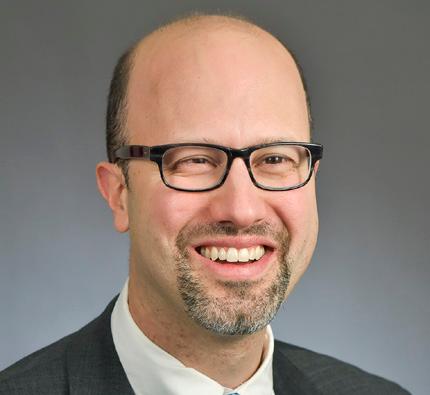
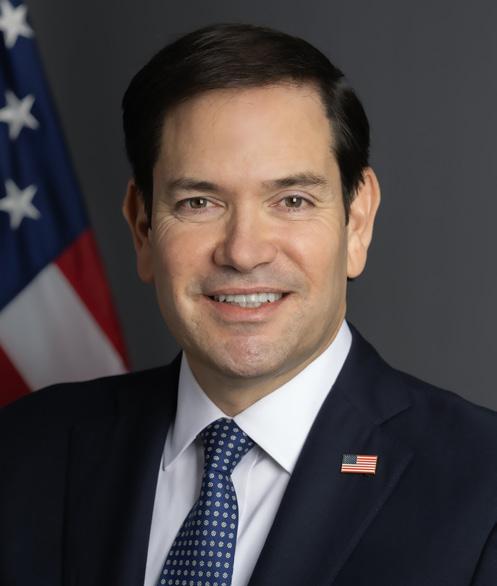
U.S. Secretary of State Marco Rubio
By Dawn Montgomery BlackPressUSA Contributor
By Insight News Team
By New York Carib News
Editor
By Al McFarlane
What Cedrick Frazier understands about harm that others still will not name

By Haley Taylor Schlitz, Esq.
A budget hearing can look deceptively ordinary.
A few lawmakers in committee. A row of testifiers. A stack of fiscal notes and policy language. The kind of proceeding most people assume belongs to the back rooms of government, far from the moral center of public life.
But some hearings are about more than money.
Some are about whether a state is willing to tell the truth.
That was the deeper question beneath this week’s hearing before the Minnesota House Ways and Means Committee on the economic fallout of Operation Metro Surge. The agenda itself made clear that this was never going to be a narrow conversation. Business owners, mayors, school leaders, advocates, and public officials were all called to describe what happens when fear enters ordinary life and refuses to leave.
House Ways and Means Co-Chair Cedrick Frazier understood that from the start. In his interview with MPR after the hearing, he said committee members needed to hear directly from those harmed because any relief package would move through the state’s finance process. He also stressed that the impact was not limited to Minneapolis and Saint Paul, but was felt across Minnesota, and that fear still lingers strongly enough that some businesses may close for good if the state does nothing.
That is what makes Frazier’s bill, HF 4342, more important than the phrase “small-business relief” can fully capture. Yes, it would estab-
lish a relief program for small businesses negatively impacted by federal enforcement activity between July 1, 2025, and February 28, 2026. Yes, it would require applicants to show at least a 20 percent decline in revenue or sales during the covered period. Yes, it would appropriate $100 million, set up a grant process, and require a report on how the funds were used.
But if that is all one sees, one misses the larger act of leadership.
Frazier is not merely proposing aid. He is insisting that Minnesota confront what happens after public fear has already done its work. He is trying to move this discussion beyond vague acknowledgment and into the harder terrain of repair.
That matters because too many people still want to talk about Operation Metro Surge as if the injury ended when the most visible phase of the operation receded. As if the convoys moved on, the headlines cooled, and what remained was simply a private matter for families and neighborhoods to absorb on their own.
The hearing record says otherwise.
A coalition supporting relief legislation estimated $213 million in losses across 14 Twin Cities cultural corridors and urged lawmakers to support $100 million in small business relief grants. The City of Minneapolis estimated at least $203.1 million in impact in one month alone, with at least 76,000 people in need of urgent relief assistance across livelihoods, shelter, food, mental health, and city operations. The city’s assessment described the surge as an ongoing community protection crisis marked by deaths, detentions, loss of livelihoods, education disruption, and severe trauma for residents facing near-daily encounters with masked, heavily armed federal agents.
Those figures matter. But what matters even more is what produced them.
This was not an or-
dinary downturn. It was not a bad quarter or a generic business climate problem. It was a civic wound with an economic expression.
The collective letter submitted by impacted businesses told lawmakers that the effects of enforcement were abrupt and extreme. Businesses described deep drops in sales, layoffs, lost workers, mounting debt, cancelled growth plans, and the possibility that some may never recover if disruption returns. They wrote that customers are only slowly regaining trust to be in public.
That word, trust, is central here.
A healthy economy does not run on spreadsheets alone. It runs on the expectation that daily life is safe enough to be lived. It runs on workers leaving home for a shift, parents sending children to school, families going to markets and restaurants, patients keeping appointments, and neighbors believing that public space is still public, not a site of lurking danger.
When that trust is ruptured, the damage does not remain psychological. It becomes financial. It becomes educational. It becomes civic. It becomes generational.
Children’s Defense Fund Minnesota told lawmakers exactly that. In testimony submitted to the committee, the organization said children did not experience Operation Metro Surge as policy, they experienced it as fear. They saw masked, armed agents near bus stops, schools, child care settings, and homes. They watched caregivers arrested during routine moments. The group warned that those experiences did not end when the operation ended, and concluded with a line that should stay with every policymaker in this state: Operation Metro Surge did not just disrupt families in the moment, it altered childhoods.
As a Black Gen Z woman, I read that record with a familiarity I wish I did not possess. There is a long American tradition of asking certain communities to endure extraordinary disruption, then demanding that they prove afterward that the damage was serious enough to merit public concern. First survive the upheaval. Then explain it in a vocabulary the powerful will accept. Then wait while others debate whether
your suffering fits neatly enough into their politics to be taken seriously. That expectation is its own form of cruelty. It is also why Cedrick Frazier’s leadership matters. He is not asking people who lived through this to settle for belated sympathy. He is doing the more difficult work of translating harm into governance. He is saying that if the state can count revenue, payroll, sales tax, and economic growth, then it can also count the cost of fear when fear tears through neighborhoods and hollows out public life.
That is what moral seriousness looks like in government. And it is why Representative Dave Baker’s posture in this debate has been so revealing.
Northern News Now reported that Baker said he saw the hardship some businesses endured and wanted to “make it right,” but then quickly pivoted to saying Minnesota must become a “better business state,” while also advocating changes to the state’s Paid Family and Medical Leave Program. That rhetorical move is not just clumsy. It is morally evasive.
During the hearing, Baker also tried to place the emergency overtime costs tied to Operation Metro Surge into the same conceptual frame as broader government “mandates.” Yet Minneapolis’ own assessment estimated $6,037,603 in city operational expenses from January 7 through February 1, including $5,288,729 in police overtime and standby pay, more than double the city’s entire 2026 general fund budget for police overtime. Paid family and medical leave can be debated on the merits. Reasonable people can argue about cost and structure. But to rhetorically yoke a family-support policy to Operation Metro Surge is to flatten distinctions that any honest public servant should be desperate to preserve. One is a law designed to help working Minnesotans care for a sick loved one, welcome a child, or navigate family crisis without financial ruin. The other was a deliberate federal enforcement operation that involved roughly 4,000 arrests and left behind lasting trauma, business disruption, school loss-
es, and deep economic damage. Minnesota cannot become a “better business state” by refusing to say what broke these businesses in the first place.
That is the sleight of hand in Baker’s framing. It takes a specific injury and launders it into a generic complaint about government burdens on business. It moves too quickly from trauma to talking point. It offers concern only after the damage can be translated into the neutral language of ledgers and line items, and even then tries to redirect the conversation toward an old ideological script. But the record before the committee does not permit that kind of sanitization.
It shows that children withdrew from school and play.
It shows that workers stayed home out of fear. It shows that restaurants, retailers, farmers, and small businesses from the Twin Cities to greater Minnesota saw sharp declines in customers, labor, and confidence. It shows that the harm spread into the state’s economic bloodstream because communities no longer trusted ordinary life to remain ordinary.
That is why HF 4342 matters.
Not because it will solve everything. It will not. No bill can restore every lost paycheck, every frightened morning, every shuttered day of
business, or every child’s interrupted sense of safety. But Frazier’s bill does something profoundly important all the same.
It refuses erasure. It refuses the lie that once the visible surge receded, the crisis was over. It refuses to let harmed communities carry the burden alone while others arrive late to the aftermath with softened language and familiar excuses. It says that damage of this magnitude is not private misfortune. It is public harm. And public harm demands public response.
As an attorney, I am trained to care about evidence, causation, and what the record actually shows. As a Gen Z Black woman, I am equally attuned to what happens when public institutions try to speak around pain instead of through it. Those two instincts meet here.
The evidence is clear. The harm was real. The fear lingered. The damage spread. And Cedrick Frazier has chosen to treat that truth not as an inconvenience to be managed, but as a reality that demands action.
That is not just good policy.
It is civic clarity. It is moral proportion. It is leadership. And Minnesota should recognize it as such.
By Sarah Burns



Lawmakers in the U.S. House of Representatives set April 21, 2026, as the date to hear from and question top Pentagon officials Adm. Brad Cooper, the head of U.S. Central Command, and Gen. Dagvin R.M. Anderson, head of U.S. Africa Command, about the war in Iran. But Republican legislators put off the hearing for a month, giving up – for now – the opportunity to exercise oversight of the war. Adam Smith, the top Democratic member of the House Armed Services Committee, told The New York Times, “We are six weeks into this conflict. And we still haven’t gotten a public briefing from anyone in the administra-
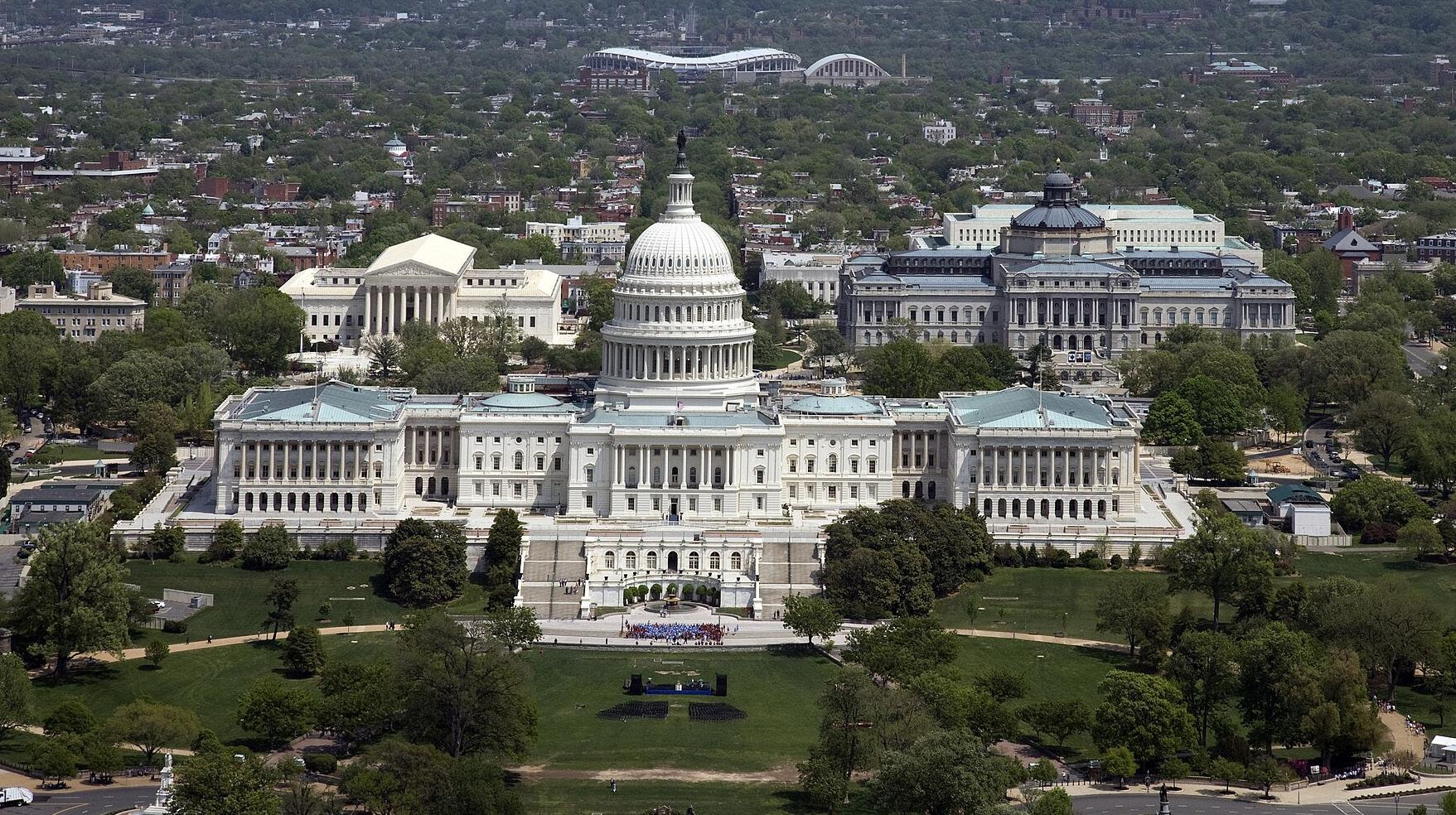
tion about the war.” President Donald Trump’s military campaign against the Iranian regime is currently in a ceasefire. Despite the low approval rating of the war, the president has not drawn the conflict to a close, and the result of the operation is so far unclear. The postponed hearing was only one example of how Congress has been noticeably meek about the war, with
most Republicans killing the many Democratic efforts to ex
ercise constitutionally granted power over engaging in such military conflicts. For the fourth time, the Senate on April 16, 2026, rejected a war powers resolution.
Columnist
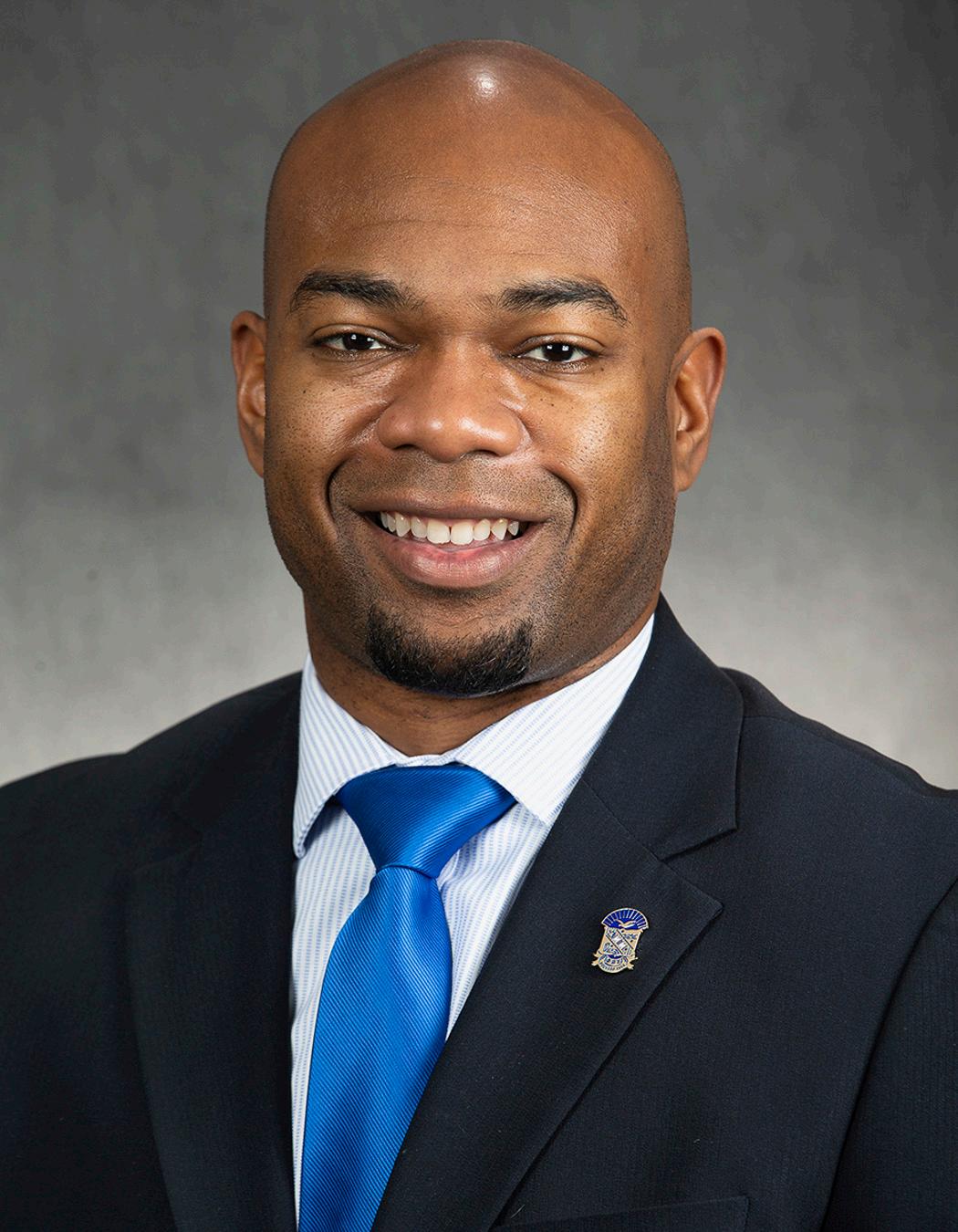
Rep. Cedrick Frazier
Credit: Carol M. Highsmith
has served.
What a different model of health diplomacy looks like: Cuba
The Zambia report raises a question that Insight News has been sitting with in its editorial work this month. What does it look like when a nation extends health assistance to another nation without converting that assistance into leverage for the extraction of resources? One answer, however imperfect, is on the record. It is Cuba.
This newspaper hosted a breakfast briefing on Friday, April 3, 2026, at Northpoint Health & Wellness in North Minneapolis, with the Ambassador of the Republic of Cuba to the United States. The conversation was conducted under off-the-record ground rules, and its substance is not reported here. What can be reported, because it is on the public record and has been for years, is the body of Cuban health policy and health diplomacy that forms the context for any such briefing. That record deserves a hearing, and it deserves it in the same column that reports the Zambia story — because the two stories, read together, describe two radically different ideas of what one country owes another. Inside its own borders, Cuba in 2015 became the first country in the world to receive World Health Organization validation for eliminating mother-to-child transmission of HIV and syphilis. That milestone was not a slogan; it was the measurable outcome of free antiretroviral therapy provided to every Cuban who needs it, a nationwide system of primary care polyclinics and family doctor-and-nurse teams in place since 1959, and a domestic biotech industry that since 2001 has produced generic HIV medicines on the island. Cuba’s HIV prevalence among adults aged fifteen to forty-nine sits at approximately 0.2 to 0.3 percent, among the lowest in the Western Hemisphere. Sex reassignment surgery and hormone replacement therapy have been provided free of charge since 2008. The Cuban National Center for Sex Education, directed by Mariela Castro, explicitly centers the rights of lesbian, gay, bisexual, transgender, and intersex Cubans inside the national AIDS response. Acknowledge the record. It is on paper. It is in the United Nations data. Beyond its own borders, Cuba has dispatched medical brigades to more than 165 countries across six decades —
more medical personnel to the developing world, by several counts, than all the G8 countries combined. Cuban doctors helped contain the Ebola outbreak in West Africa. Cuban teams deployed to Italy in the early weeks of the COVID pandemic. Cuba developed its own COVID vaccines, produced them domestically, and made them available to partner nations. The “Integrated Health Program” framework, operating since 1998, provides substantial medical cooperation free of charge to the receiving country. Cooperation arrangements do exist — Cuba’s long-running partnership with Venezuela involves subsidized oil flowing in one direction and medical personnel in the other, and several middle- and high-income host countries have paid Cuba in hard currency — but the arrangement the United States is reportedly preparing for Zambia has no analogue in Cuban practice. Cuba has not, on the public record, conditioned the provision of disease treatment on preferential access to another country’s minerals. That is a distinction worth marking, and marking sharply.
“I praise Cuba for its universal health-care coverage. Its welfare and social protection system has ensured that people living with HIV have access to health services and treatment free of charge.” — Michel Sidibé, then-Executive Director, UNAIDS, Havana, November 2015
None of this is to sanctify the Cuban program. The labor-rights critique of Cuba’s medical internationalism is real and serious, and this paper will not pretend it is not. The Cuban government retains between seventy-five and ninety percent of the wages paid by host countries for the service of Cuban doctors abroad, according to State Department findings and testimony from participating physicians. The United Nations Office of the High Commissioner for Human Rights has raised credible concerns about working conditions, restrictions on movement, and punishment of family members when a doctor leaves a mission. Those concerns are the subject of active litigation and active international review. An honest paper sits with the contradiction. A healthcare model that saves lives at scale can also mistreat the workers who provide the care, and both of those sentences can be true at the same time. Insight News reports both.
The contrast that matters for the Zambia story, though, is not about whether any given health-diplomacy arrangement is perfect. It is
about what is being exchanged for what. Cuba’s program, at its core, exchanges medical labor for diplomatic solidarity, hard currency, and at times discounted oil — transactions between sovereigns who have each decided what they want to trade. The Zambia proposal, as reported, exchanges the lives of over a million people living with HIV for a discount on copper, in a transaction Zambia has not chosen and in which the commodity being withheld is not labor but survival. That is a categorical difference. That is how close it is.
Meanwhile, Africa absorbs the fuel shock
The Zambia report did not arrive in a quiet week. It arrived in the same news cycle in which Aliko Dangote, founder of the Dangote Group and owner of the largest oil refinery on the African continent, warned at the Semafor World Economy gathering in Washington that rising oil prices driven by the Strait of Hormuz blockade are threatening to devastate African airlines and African farmers. Nigerian carriers have already announced that they will suspend operations by April 20 if prices are not reduced. “The majority of African airlines won’t be able to survive,” Dangote told the conference.
“Between morning and night, you see the oil moving up and down ten dollars. I’ve never seen it like that. Never.” — Aliko Dangote, at Semafor World Economy, April 17, 2026
The fertilizer arithmetic is worse. Two months ago, Dangote said, a ton of fertilizer was selling for roughly four hundred dollars. Today it is eight hundred and fifty. That is not a commodity chart. That is planting season for West African smallholder farmers. “This farming season the governments have to actually give subsidies,” Dangote said — a sentence that, from Africa’s richest man, is not
mediated that relationship with the language of partnership and development are being asked to operate in a colder, more transactional register. The Cuba counter-example, flawed where it is flawed, at least proposes a different question: not what Africa owes in exchange for survival, but what solidarity between sovereigns can look like when the terms are set between them.
community members to contact Outreach.CMAH@state.mn.us or call 651-757-1752.
Why this Day on the Hill, and why now
The reschedule matters because the legislative landscape it now meets is qualitatively different from what it would have met in February. Minnesota Management and Budget projected a $3.7 billion FY26-27 surplus — a $1.3 billion increase over prior estimates — giving the 2026 session a fiscal context that the 2025 session, working through structural imbalance, did not have. CMAH has framed its 2026 agenda as a response to three intersecting crises: affordability, democracy, and immigration. The surplus, the Council has indicated, represents an opportunity rather than a constraint.
The session is also operating in the long shadow of political violence. The killing of Speaker Emerita Melissa Hortman and her husband Mark, and the shooting of Senator John
Hoffman and his wife Yvette, are named in Linda Sloan’s Executive Director letter at the front of the 2025 Annual Report as defining context for the year of work that report covers. When the Capitol Rotunda fills with African Heritage community members on April 24, that fact will be in the room. So will the federal climate. At last year’s African Heritage Day on the Hill on Tuesday, March 4, 2025, Mshale reporter Richard Ooga documented how the Trump administration’s funding freeze was already hitting Minnesota organizations directly. Nelima Sitati Munene, executive director of ACER, told Mshale that ACER had not been reimbursed by the federal government for work completed in the quarter before the freeze, and that layoffs at federal agencies had left grantees unable to reach their case managers. Kamaty Diahn, executive director of the Organization for Liberians in Minnesota, attended the 2025 event in solidarity with community members facing deportation exposure under Trump executive orders on immigration. That federal pressure has not eased. Community members arriving at the Capitol on April 24 will
nior officials, including Secretary of State Marco Rubio, have called for political change on the island.
Despite the rising ten-
do so against a backdrop in which federal retrenchment on Medicaid, food assistance, and immigration enforcement continues to shape what state-level action can and must absorb.
Four bills, four pillars
CMAH has publicly named a four-bill 2026 legislative agenda, framed by the Council as a roadmap for reparative justice. Each of the four bills connects directly to one of the four engagement pillars documented in the 2025 Annual Report. Community members preparing to engage legislators on April 24 can use the four-bill agenda as a starting framework for those conversations.
The Minnesota Great Migration Act is a push to scale up measures aimed at addressing historical inequities — a legislative shape for the reparative justice framework that runs throughout CMAH’s 2025 work. The MinneKIDS Act would establish statewide Children’s Savings Accounts to build long-term educational assets for African Heritage students, translating the Council’s 2025 endorsement of child savings accounts into named legislation. The Housing Stabil-
ideology. It is arithmetic. Even a best-case scenario involving a United States-Iran agreement easing fears over the Hormuz waterway would, Dangote cautioned, still leave another two to three months before supply chains normalize. The ten-day Israel-Lebanon ceasefire that took effect on Thursday is a first breath, not a resolution.
Pretoria refuses the global ‘wait-and-see’ posture
Lesetja Kganyago, governor of the South African Reserve Bank, broke sharply on Thursday with the global central-banking consensus that has mostly chosen to wait and see how the Iran war filters into prices. The South African central bank, he said, cannot afford to be complacent and will not wait for early price shocks to pass through Africa’s biggest economy before it acts. His comments open the possibility of interest rate hikes — not cuts — before fuel and fertilizer shocks reach wages and transport and the broader price-setting behavior of the economy.
“You don’t wait for the second-round effects to arrive; by that time it’s too late.”
— Lesetja Kganyago, Governor, South African Reserve Bank
This is an African economy acting on its own clock rather than waiting for the Federal Reserve in Washington or the European Central Bank in Frankfurt to signal the next move. Kganyago described the environment not as a single shock but as a sequence of shocks arriving simultaneously through fuel and fertilizer. The South African Reserve Bank is among the first emerging-market central banks to state publicly that cuts are not guaranteed and hikes remain possible. Sovereignty of monetary posture is itself a form of power.
A ‘structural reset’ in development finance
Leslie Maasdorp, chief execu-
ity package includes Just Cause Eviction protections and emergency rental assistance, picking up the unfinished work of the African American Affordable Homeownership and Workforce bill (SF2423/HF2507) that was dropped from the 2025 omnibus housing budget. The Justice Reform package would end forced prison labor and ensure full implementation of the Minnesota African American Family Preservation and Child Welfare Disproportionality Act, extending CMAH’s 2025 work with the End Slavery in Prisons coalition and the MAAFPCWDA implementation work group.
“The Minnesota Great Migration Act. The MinneKIDS Act. Housing Stability. Justice Reform. Four bills. One Capitol. One Friday.”
Housing: the 2025 unfinished work
Of the four bills, the Housing Stability package carries the most documented unfinished business. The 2025 Annual Report records, in plain language, that SF2423/HF2507 — championed by Senate President Bobby Joe Champion and Representative Huldah Momanyi-Hiltsley — was heard in
tive officer of British International Investment, the United Kingdom’s development finance agency, used the same Semafor stage to announce, in effect, that the old development finance era is ending. The system, Maasdorp said, is undergoing a “structural reset.” The evidence is on the record. The United Kingdom this year cut its overseas aid budget in favor of defense spending, mirroring similar moves in France and Germany. The United States Agency for International Development, which had disbursed roughly forty billion dollars annually to some one hundred and thirty countries, was shuttered last year. The old donor-recipient architecture, Maasdorp said — “almost a paternalistic” relationship, in his own words — no longer fits the moment. In its place, Maasdorp called for a pivot toward investment, capital mobilization, and regional integration, and toward partnerships that de-risk investment in markets long dismissed as too volatile. This pivot is worth watching, and worth questioning. Investment is not aid, and de-risking is not solidarity. The question for African governments, and the question for every Black-led economic development institution in the United States that has watched foundations and federal partners pivot away since 2020, is who sets the terms of the new deal. Ancestral memory answers that question with a question: whose risk is being de-risked, and whose labor is doing the de-risking?
What this means for Black America
These four stories — Zambia copper-for-HIV, Dangote on fuel and fertilizer, Kganyago on monetary posture, Maasdorp on the finance reset — are one story told from four angles. The global order is re-pricing African labor, African land, and African life in real time, and the institutions that previously
the Senate Housing Committee, the Senate Jobs Committee, and the House Housing Committee, and was then not included in the omnibus housing budget the Legislature passed in May 2025.
The numbers behind that bill have not changed. More than 70 percent of Minnesota households own their home, but less than 30 percent of Black Minnesotans are homeowners. Black Minnesotans face housing cost burden at twice the statewide rate — 60 percent compared to 30 percent. About 67,000 Black children in Minnesota, nearly half of all Black children in the state, live in households spending more than 30 percent of monthly income on housing. Majority Black neighborhoods in Minnesota are undervalued by approximately $48,000 per home. The bill that did not pass in 2025 was the legislative answer to those numbers. The Day on the Hill in 2026 is the community’s opportunity to ask legislators what their plan is for those numbers in this session.
African Heritage Day on the Hill is not a ceremonial event. It is the most visible expression of CMAH’s convening function — the day on which
This newspaper has argued for fifty years that the condition of the African on the continent and the condition of the African in America are not two conditions. They are one condition, mediated by distance and by accents. When fertilizer doubles in sixty days in Kaduna, the price of food on an American grocery shelf does not stay where it was. When a central bank governor in Pretoria has to hold the line against imported inflation, the cost of credit on a Black-owned business loan in North Minneapolis feels the tremor eventually. And when Washington quietly prepares to turn PEPFAR into a bargaining chip for copper, every Black family in the United States that has watched a relative in Lusaka or Gaborone or Kingston stay alive because of a clinic funded by that program should ask a sharper question of the next congressional appropriation, and should ask it of both parties.
Growing our power — the editorial series this paper launched this month — begins with this recognition. Cooperative economics, wealth building, and political power for Black people in Minnesota are not a local conversation. They are a continental conversation, and they are an ancestral one. Lizzie Harrison, my maternal great grandmother, who I knew personally, born enslaved, knew that. Marcus Garvey, born in the same town as my paternal grandfather Roland McFarlane, - St. Ann’s, Jamaica, said it a hundred years ago and they put him in a federal prison for saying it. A farmer in Kaduna watching her fertilizer price double in sixty days knows it in her hands. A mother in Lusaka waking up in April 2026 to read that her antiretroviral supply has been quietly reclassified as a copper-pricing lever knows it in her chest.
The arithmetic is unforgiving. The response has to be sovereign. That’s how close it is.
Acknowledge the gift. Redemption is at hand. Disclosure statement Insight News uses AI-assisted tools in some editorial production. Read our AI Policy & Transparency Statement at www.insightnews.com/ site/ai_policy.html.
the Council’s legislative work, its community engagement work, and the lived priorities of 565,477 Minnesotans become a face-to-face encounter with the lawmakers who will or will not move those priorities forward. The 2025 Annual Report frames the Council’s work under the banner United we walk forward in power. April 24 is the day the community gets to test whether that banner means what it says.
Practical information
Date: Friday, April 24, 2026
Location: Minnesota State Capitol Rotunda, 75 Rev. Dr. Martin Luther King Jr. Boulevard, St. Paul, MN 55155
Format: Day program with a session for youth, concluding with a reception Contact: Outreach. CMAH@state.mn.us | 651757-1752
Issue Groups sign-up: available on the CMAH website at mn.gov/cmah
Disclosure statement Insight News uses AI-assisted tools in some editorial production. Read our AI Policy & Transparency Statement at www.insightnews.com/ site/ai_policy.html.
sions, Díaz-Canel insisted that Cuba’s position remains defensive, not aggressive. He reiterated a willingness to engage in dialogue but rejected U.S. demands related to political reforms, including multiparty elections and the release of individuals described internationally as political prisoners. Cuban authorities, however, deny holding such prisoners and argue that these claims are part of efforts to discredit the revolution. The decades-old U.S. embargo remains a central point of contention. First imposed in 1962 following the Cuban Revolution led by Fidel Castro, the policy continues to shape Cuba’s economic challenges, including fuel shortages, power outages, and limited access to essential goods. Díaz-Canel described the embargo as “cruel” and a major factor behind the country’s ongoing hardships. At the same time, the Cuban leader signaled openness to economic engagement, including potential foreign investment in the island’s energy sector, an area currently restricted for U.S. companies under existing sanctions laws. While both Washington and Havana have acknowledged preliminary talks, deep mistrust persists. Díaz-Canel pointed to past U.S. actions in other regions as a source of skepticism, warning that negotiations conducted alongside military pressure undermine confidence. As geopolitical tensions continue to rise, Cuba’s leadership is positioning itself firmly against external intervention while leaving the door open, albeit cautiously, to diplomatic engagement.
From left to right: Senators Jeanne Shaheen, Chris Coons, and Brian Schatz

Technology
The AI backlash turns physical: Firebombs, gunfire and a rezoning fight over the industry’s future
By Syed Fahad Fayyaz Contributing Writer
In the dark hours of April 10, a 20-year-old man from Spring, Texas allegedly hurled a Molotov cocktail at the gate of OpenAI chief executive Sam Altman’s San Francisco home. Less than an hour later, he was arrested outside the company’s headquarters with a can of kerosene, incendiary devices and a 23-page document that federal investigators describe as a manifesto calling for the death of the people building the world’s most powerful artificial intelligence systems.
Four days earlier and nearly 2,000 miles east, gunmen had fired 13 rounds into the home of an Indianapolis city councilman who had supported a data center project in the neighborhood. A handwritten note found near the doormat carried three words: “No Data Centers.”
The two attacks, connected only by the technology industry that both suspects appear to have feared, mark the moment when a long-running debate about artificial intelligence moved from opinion pages and television panels to driveways and glass doors.
They arrived alongside the first statewide moratorium on large data centers in the country, a sharp collapse in young Americans’ confidence in AI, and a public accounting dispute between the industry’s two leading laboratories that is rattling investors ahead of planned initial public offerings later this year.
Two attacks, one climate
The suspect in the San Francisco incident, identified by the Justice Department as Daniel Alejandro Moreno-Gama, has been charged with two counts of attempted murder in California state court and with federal offenses including destruction of property by means of explosives. According to a federal criminal complaint, he told building security at OpenAI that he had come to “burn it down and kill anyone inside.” Investigators recovered a jug of kerosene, additional incendiary devices and a list of names and home addresses of other executives, board members and investors.
Moreno-Gama had traveled from the Houston area earlier in the week and stayed two nights at a Union Square hotel without raising suspicion, according to court filings.

Andrew Marantz in The New Yorker, published in early April, drew on more than 100 interviews to question Altman’s honesty and his commitment to the company’s stated safety mission. The profile reported that OpenAI’s internal safety team received only a fraction of the computing resources the company had publicly committed to safety research. Altman, in his post-attack blog entry, acknowledged the article by name and said he had “made many other mistakes,” while accusing the magazine of publishing an inflammatory piece at a moment of real danger.
their legal counsel have asserted that Article 2 of the Constitution allows the president to use the military in certain situations without prior congressional approval – and have acted on that, sending troops into conflicts from Panama to Libya with no regard for Congress’ will.
Based on the 1973 War Powers Resolution –passed over President Richard Nixon’s veto – the president has an obligation to inform Congress about his actions within 48 hours of initiating military action and requires him to seek legislative authorization if the military operation will last over 60 days.
Since its passage, presidents have dutifully informed Congress within the 48-hour window when they unilaterally initiate military operations. Typically, they use the following language: “Pursuant to” their power as commander in chief and chief executive, they are initiating an operation.
Yet presidents since Nixon have never formally acknowledged the constitutionality of the War Powers Resolu-
Online, he had used the alias “Butlerian Jihadist,” a reference to the anti-machine crusade in Frank Herbert’s novel “Dune.”
Matt Cobo, the FBI’s acting special agent in charge of the San Francisco office, told reporters the attack was planned, targeted and not spontaneous.
A second incident, which San Francisco police and OpenAI have said appears unrelated, followed on April 12.
A Honda sedan stopped outside Altman’s Russian Hill home shortly before 2 a.m., and a passenger allegedly fired a single round toward the property. Suspects were arrested later that day, and three firearms were seized from a residence on Taylor Street.
Altman addressed the attacks in an unusually personal blog post the night after the firebombing, accompanied by a photograph of his family. The fear and anxiety about AI, he wrote, is justified, and he urged both the industry and its critics to “de-escalate the rhetoric and tactics.” The admission was notable coming from an executive who has likened the AI project to the Manhattan Project and who has publicly discussed extinction-level risks for years.
A councilman’s house, a neighborhood’s question The Indianapolis shooting, on April 6, has drawn less national attention but carries a particular weight. City-County Councilman Ron Gibson’s home was struck with 13 bullets shortly after midnight. No one was injured. The note left at the scene referred directly to a $500 million rezoning Gibson had supported for a data center project by a firm called Metrobloks.
tion. They have, however, mentioned it in their letters to Congress about their actions, and for the most part they have abided by its restrictions. So language is crucial and presidents tend to use the phrase “consistent with” the War Powers Resolution when they inform Congress about military operations.
The second Trump administration has broken with that standard. In Trump’s message to Congress about the Iran war, sent on March 2, 2026, he did not acknowledge the War Powers Resolution or the Constitution, let alone pay lip service to either.
Instead, Trump has sidestepped the traditional use of the War Powers Resolution – and avoided the congressional oversight that comes with it –by relying on executive orders to convey his intent to use military power against the Iranian regime. That move, whether legal or not, has provided the president with a great deal of freedom to decide what the military can do, what tools they can use to do it and how long they can do it. His decision to send another carrier group and the addition of thousands of U.S. troops to the region is just the latest example.
Congress has proved
A resident group called Protect Martindale-Brightwood has condemned the violence against the councilman. The group has also continued to describe the Metrobloks project as a “predatory” use of land in a neighborhood that has absorbed more than its share of industrial siting decisions over the past half-century.
Data Center Watch, an industry research group, counts at least 142 active opposition groups in 24 states, and estimates that community resistance blocked or delayed tens of billions of dollars in projects in 2025 alone. The grievances are consistent: cooling fans that residents describe as jet-engine loud, heavy water consumption in drought-stressed regions, and higher utility rates to underwrite facilities that residents do not see themselves benefiting from. In Northern Virginia, which has the nation’s densest cluster of data centers, public support for the facilities fell from 69 percent in 2023 to 35 percent in recent polling, according to reporting by The Spokesman-Review.
Maine draws a line
On April 15, Maine became the first state in the country to adopt a full moratorium on large new data centers. The law, LD 307, pauses permitting for any facility drawing more than 20 megawatts of power until October 2027 and creates a state council to study the cumulative impact on electricity rates and the environment.
According to MultiState, a legislative tracking firm, at least 12 other states have introduced similar bills this
incapable or unwilling to check this presidential unilateralism. Shortly after the start of the military campaign against Iran, Democratic Sen. Chris Murphy introduced war powers legislation to constrain Trump that failed to pass the Senate. In the House on March 5, members narrowly rejected a resolution to impede a broader or longer operation.
To a meaningful extent, we are watching history repeat itself: Over the past seven decades during times of war, members of Congress have not wanted to act, and presidents have not wanted to ask permission.
From alacrity to deference
Presidents Woodrow Wilson and Franklin D. Roosevelt made their case for war and obtained a formal declaration from Congress within three days in 1917 and within the same afternoon in 1941, respectively.
Since the start of the Korean War, however, members of Congress have demonstrated more deference and less assertiveness.
In Korea, President Truman did not get congressional authorization for the war.
Following North Ko-
session, including New York, Vermont, Oklahoma, Virginia and Maryland. At the federal level, Senator Bernie Sanders of Vermont and Representative Alexandria Ocasio-Cortez of New York introduced the AI Data Center Moratorium Act in March, proposing a national construction freeze until federal safeguards are in place.
The standoff is not a partisan fight in any clean sense. Data Center Watch’s tally of local officials who have taken public positions against data centers is roughly 55 percent Republican and 45 percent Democrat. Republicans tend to cite tax incentives and strain on the electrical grid. Democrats tend to cite environmental justice and water conservation. Both groups land in the same place: against the project in front of them.
A generation’s disillusionment Behind the headlines is a striking shift in public sentiment, with the sharpest movement among young adults. A Gallup survey released in early April found that Gen Z excitement about AI fell from 36 percent to 22 percent in a single year, while anger climbed from 22 percent to 31 percent. The Stanford Institute for Human-Centered Artificial Intelligence’s 2026 AI Index, released April 15, reported that only 31 percent of Americans said they trusted the federal government to regulate AI, the lowest figure of any country surveyed.
A Bloomberg analysis this month found that 43 percent of recent United States college graduates are underemployed, a multi-year high. Zach Hrynowski, a senior education researcher
rea’s invasion of the South in June 1950, Truman bypassed Congress, making his case for war to the United Nations Security Council. In July 1950, United Nations Security Council Resolution 84 “authorized the United States to establish and lead a unified command comprised of all military forces from UN member states, and authorized that command to operate under the UN flag.”
Truman’s rhetoric about American combat operations on the Korean peninsula being part of a U.N. “police action” became increasingly tenuous, but he managed to avoid seeking congressional permission. In doing so, Truman created a precedent in which a congressional declaration of war was no longer necessary for the American military to carry out combat operations. Sen. Robert Taft, a Republican, opposed this lack of congressional deliberation, declaring that Truman’s actions represented a “usurpation” of the war powers authority. But Congress did nothing to stop the war as the tactical and strategic picture in Korea stalemated.
In Vietnam, in the aftermath of the 1964 Gulf of Tonkin incident – a purported
at Gallup, told reporters that the sharpest anger is concentrated among the oldest members of Gen Z, who are entering a job market in which entry-level positions are being aggressively automated. That group includes many first-generation college graduates and a disproportionate number of Black and Latino workers who have historically used entry-level office jobs as a ladder into professional careers. Alex Hanna, a research director at the Distributed AI Research Institute, told Fortune that the backlash reflects a gap between what AI companies promise and what ordinary Americans are experiencing in their finances and job searches. Mauro Lubrano, a researcher at the University of Bath, framed the moment as an inheritor of the Luddite tradition, telling the same outlet that artificial intelligence has become “the sum of all fears” about modern technology because it touches warfare, workplace surveillance and political control at once.
An industry at war with itself
The external pressure has arrived as the two companies at the frontier of the industry have begun a public feud over money. Anthropic announced in late March that its annualized revenue had crossed $30 billion, which would put it ahead of OpenAI for the first time. OpenAI’s chief revenue officer, Denise Dresser, responded with a leaked internal memo accusing Anthropic of inflating its figures by as much as $8 billion through its method of recognizing cloud-partner revenue.
At roughly the same time, a 16,000-word investigation by Ronan Farrow and
attack by the North Vietnamese on American naval vessels that did not, in fact, occur – President Lyndon Johnson used the alleged crisis to push for congressional authorization for the escalation of force in Southeast Asia.
Johnson presented the Gulf of Tonkin Resolution to Congress, which quickly passed it. The resolution allowed Johnson to freely escalate American military involvement in Southeast Asia with a vague authorization to engage militarily as he saw fit, in contrast to the very clear declarations of war that came before it for previous wars.
Col. Harry G. Summers, who wrote an influential strategic analysis of the Vietnam War, points to the Gulf of Tonkin Resolution as evidence that the relevant actors – the executive, Congress and the military – failed to foresee the scale of the course of action they were embarking on.
The resolution significantly increased the president’s freedom of action – and freedom from oversight – and marked a major step toward the Americanization and escalation of the war in July 1965. Despite the deeply troubled engagement
A question of standing Moreno-Gama is scheduled for arraignment on May 5. Pause AI, a nonviolent advocacy group that the suspect had joined on Discord, said none of his 34 messages on its server explicitly called for violence, though one post was flagged by moderators as ambiguous. Stop AI, a more radical splinter, said Moreno-Gama had asked whether “speaking about violence” would get him banned and stopped posting after being told that it would.
Anthony Aguirre, the chief executive of the Future of Life Institute, which has long argued for caution around AI development, said in a statement that violence and intimidation have no place in the conversation about the future of AI. Executive protection firms, according to security industry analysts, are reporting a surge in demand from technology clients. Several of the largest AI laboratories are expected to disclose expanded security budgets in their next quarterly filings. For communities from the Twin Cities to the Gulf Coast, the more durable question is less about any one suspect than about who has standing in the decisions that shape the physical and economic footprint of the industry. Who decides whether a neighborhood absorbs a data center, whether a graduate’s first job still exists in five years, whether a 20-megawatt facility is worth the ratepayer increase it will require? For most of the past decade, the people who answered those questions worked in Silicon Valley. For the first time in the history of the AI industry, the answer looks less settled. Disclosure statement Insight News uses AI-assisted tools in some editorial production. Read our AI Policy & Transparency Statement at www.insightnews.com/ site/ai_policy.html.
in South Vietnam and the passage of the War Powers Resolution, we still see presidents acting alone, without consulting members of Congress, let alone getting authorization.
Refusing responsibility
In Summers’ Vietnam postmortem, he relates a telling anecdote of a professor at West Point. The professor, an Army officer, remarked, "When people ask me why I went to Vietnam I say, ‘I thought you knew. You sent me,’” a comment indicative of “the civilian sector’s growing refusal to take responsibility for the kind of army it needs.” In the case of Trump’s decision-making concerning hostilities with Iran, Americans will one day need answers to the questions: Why did the United States engage in this war with unclear political objectives? And why did Congress allow it to continue?
Disclosure statement
The authors do not work for, consult, own shares in or receive funding from any company or organization that would benefit from this article, and have disclosed no relevant affiliations beyond their academic appointment.
Credit: TechCrunch
OpenAI Co-Founder & CEO Sam Altman
Credit: indy.gov
Councilman Ron Gibson
Five weeks left: At The Legislature
DFL lawmakers press for Metro Surge economic relief and real fraud reform
Rep. Dave Pinto says a tied Minnesota House has tried to adjourn early while families, small businesses and workers still wait for answers
By Insight News Staff
Five weeks remain in the 2026 Minnesota legislative session, and Rep. Dave Pinto (DFL-St. Paul) says the work of meeting the moment is harder than it should be. In a constituent update issued April 17, the cochair of the House Workforce, Labor, and Economic Development Finance and Policy Committee reported that nearly every House Republican recently voted to adjourn the session early. Pinto said he and his DFL colleagues successfully opposed that motion.
"The tied House makes all of this very challenging," Pinto wrote. He said DFL members will keep working toward outcomes that help Minnesotans live a better life. The statement came as committees across the Capitol approached the first major policy deadline of the session — the last day for most bills to clear their committees of origin.
Helping communities, businesses, and families get back on their feet should be priorities we all share.
Economic support after
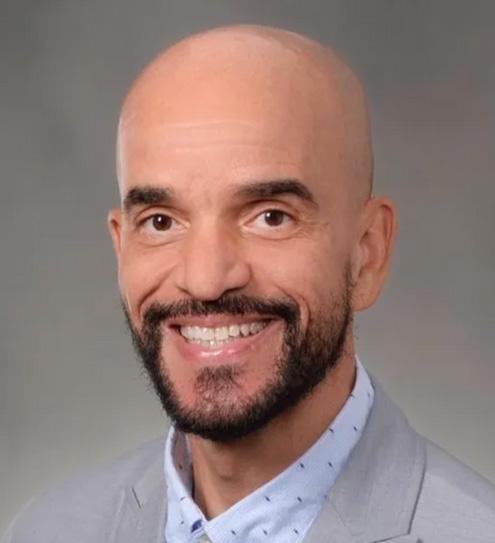
Mgeni
From Cover
worn camera policy, trainer on NAACP bylaws and practices, and a key player in the Cruz Guzman litigation recruitment effort. He created and continually updated a lawyer and redress resource list that countless families relied upon. In 2023, the St. Paul branch honored him with its Lifetime Achievement Award.
In what colleagues describe as an act of extraordinary commitment, he conducted a final training session for branch leadership while bed-ridden — teaching right up until the end, unwilling to let the work go unfinished.
In retirement, he remained the NAACP’s front line — answering emails and voicemails from residents facing evictions, car repossessions, warrants, and systemic barriers. ‘We assist in navigating the system,’ he said — ‘filing complaints with the EEOC, with the state or local human rights department, or obtaining legal counsel.’
Schools, segregation, and the district at odds with itself
Mgeni brought the same discipline to the education front. As a former St. Paul district administrator serving on the NAACP’s executive board — and earlier as director of the Office of Educational Equity for the St. Paul schools — he tracked the resegregation of Twin Cities schools with precision and alarm. When the district’s Strong Schools, Strong Communities plan dismantled many citywide magnet programs in favor of neighborhood schools, he watched the data and called what he saw: the number of St. Paul elementary schools with 95 percent students of color had grown from five to nine, evidence of a district at ‘odds with itself’ in its stated commitment to closing achievement gaps.
‘Ethnic studies is also American history,’ he said.
‘The fact that the legislature and the Minnesota Department of Education (MDE) have both endorsed ethnic studies require-
Operation Metro Surge Pinto has used his committee gavel to train the Legislature's attention on what he calls the unconstitutional occupation of Minnesota during Operation Metro Surge. He dedicated the first hearing of his committee this session to testimony documenting the damage: lost revenue for businesses, lost income for workers, and sharp drops in school attendance as families kept children home.
Earlier this week, the House Ways and Means Committee held its own hearing on the same impacts. Pinto and fellow House DFL members have since introduced an economic-support package, anchored by funding for affected small businesses, and intended to help employees, communities and the state recover. Pinto chaired a hearing on the measure and said the moment calls for a response.
Tackling fraud: beyond the talking points
Pinto devoted a substantial portion of his update to the work of the Fraud Prevention and Agency Oversight Committee, where he serves as the DFL lead. He described fraud as a rising business model engineered by what he called greedy people — one
ments in schools is a real plus for giving people the opportunity to explore and learn more about American history, and more importantly, to see themselves reflected in that learning.’
The Urban Coalition — a chapter still being documented
The obituaries name the Urban Coalition among the institutions Mgeni served, and a 1995 MPR Midday broadcast confirms his role: host Gary Eichten identified him as ‘the President of the Urban Coalition in the Twin Cities, longtime activist in the civil rights movement in the Twin Cities.’ Broadcast journalist Robyne Robinson, in a 2018 Minnesota Spokesman-Recorder interview, recalled that she had expected him — whom she associated with the Urban Coalition — to be among the first Black figures inducted into the Twin Cities broadcast hall of fame, noting that he had been on television years before her. The full record of that chapter of his work — the specific campaigns, coalitions, and colleagues — lives primarily in community memory and in the archives of institutions like the Minnesota Historical Society, where he participated in the Rondo neighborhood oral history project. That archive, and the testimony of those who worked alongside him, will be essential to a complete account of his contributions.
EDITOR'S NOTE — To family, colleagues, and contemporaries: Insight News is actively seeking firsthand accounts of Yusef Mgeni's work with the Urban Coalition and other institutions not yet fully documented in the public record. Please contact the newsroom at trena@insightnews.com or mcfarlanemedia@gmail. com.
Building the infrastructure of Black voice Before KMOJ, before The Conversation, before Twin Cities Black Communicators — there was KUXL-AM and the Malcolm X Pan Afrikan Institute.
In the early 1970s, while serving as radio-television program
that has cost Minnesota programs real dollars that should be reaching families in need of child care, health care and housing.
The DFL agenda, he said, builds on prior sessions. Key components include investments in modernizing human services information technology, much of which still relies on 1980s-era systems; expanded authority for state agencies to pause payments when credible allegations of fraud arise; and stronger front-end screening. Lawmakers are also moving to boost resources for the Minnesota Attorney General's Medicaid Fraud Control Unit, which Pinto said is among the most effective of its kind in the country.
A committee hearing this week turned the spotlight on charter school reform, an area Insight News readers have long flagged as overdue. Pinto cited a 2024 Star Tribune series documenting self-dealing, misuse of funds, contract opacity and misleading financial reporting at some Minnesota charter schools. The 2025 Legislature responded with expanded transparency requirements, tighter financial and governance rules and enhanced enforcement au-
supervisor at KUOM, the University of Minnesota’s radio station, Mgeni was also a member of the Malcolm X Pan Afrikan Institute, which produced programming for KUXL-AM 1570, then the only radio outlet in the Twin Cities oriented toward the Black community. When KUXL’s management moved in January 1973 to abandon its R&B and community programming — citing the inability to sell advertising to a Black audience — it was Mgeni who stood up publicly and challenged that decision, accusing the program director of racist and oppressive views. He understood what was at stake: the airwaves were not merely entertainment. They were a classroom.
The Pan Afrikan Institute program carried that conviction in its very architecture. Each broadcast closed with the recorded voice of Twin Cities historian and scholar Professor Mahmoud El-Kati, quoting the great Pan-African historian Dr. John Henrik Clarke. The words were these:
“History is not everything, but it is a starting point. History is a clock that people use to tell their political and cultural time of day. It is a compass they use to find themselves on the map of human geography. It tells them where they are, but more importantly, what they must be.” — Dr. John Henrik Clarke
Mahmoud El-Kati’s voice, quoting Dr. Clarke, became the classroom bell — calling our people to the study of our history and the nurture of our future. Week after week, that closing carried the full weight of what Charles Anderson III had become when he took the name Yusef Mgeni and picked up the work.
Mgeni went on to play a foundational role in the early development of KMOJ Radio — helping to establish a platform that amplified Black voices in Minnesota long before that was common or convenient. His work in Black media was never siloed: he carried a Pan-African framework into every broadcast space he entered, connecting the struggles of Black Minnesota to the wider movements of the Af-
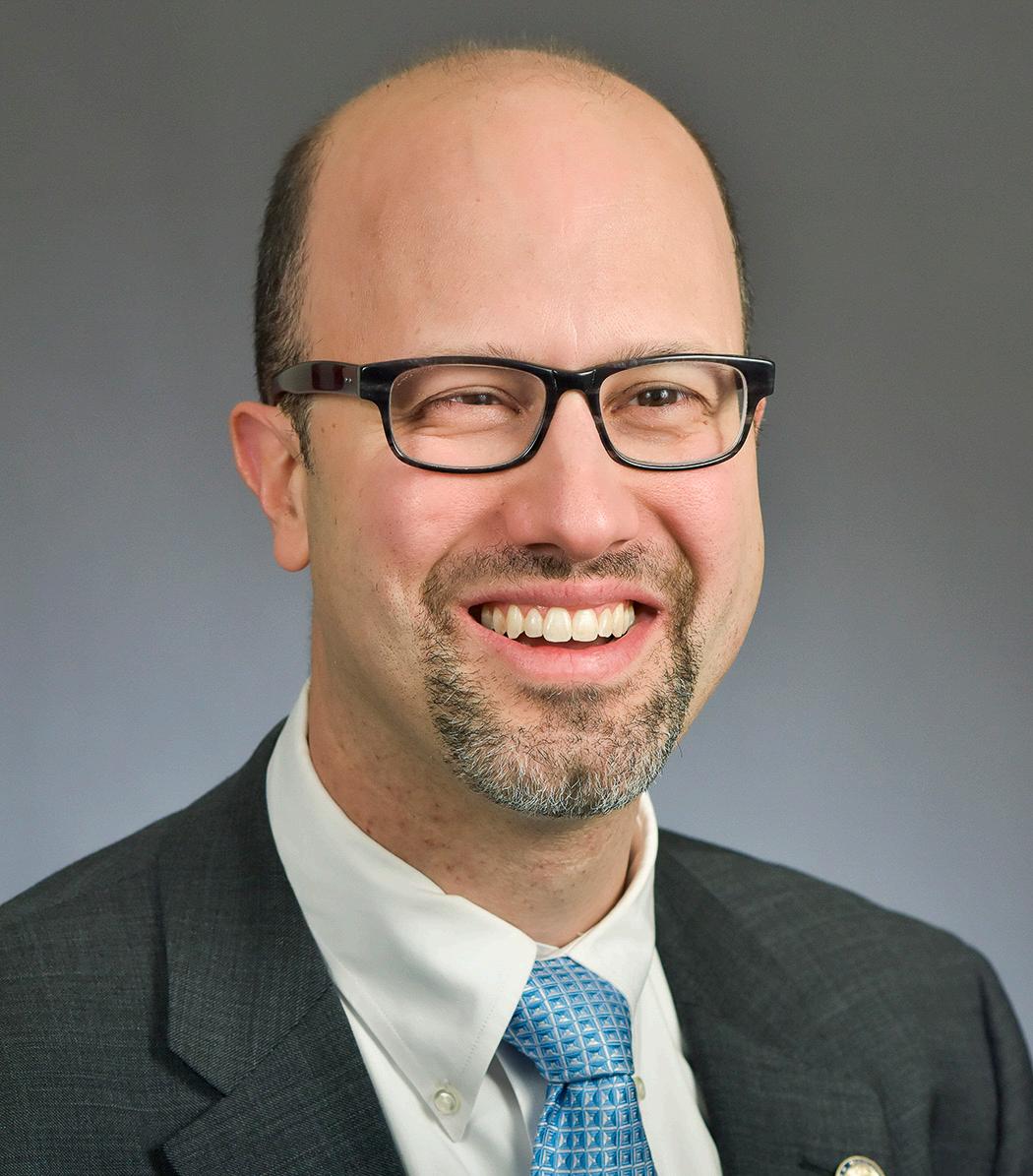
thority. Pinto signaled that more work remains.
Simply using fraud as a political talking point won't get us there.
Pinto's caution is pointed. He said meaningful reform before session's end will require bipartisan cooperation and genuine commitment — not rhetoric. He discussed the issue with KARE 11 this week.
What the tie means for the session's final weeks
The tied 67-67 House has defined the tempo of this session. Procedural votes that once passed quietly now surface as
rican world — from the Sahel to the Caribbean, from the civil rights movement to the liberation movements on the continent.
Together, Mgeni and I co-founded Twin Cities Black Communicators, an organization that formalized the network of Black media professionals in the Twin Cities and gave institutional shape to what had long existed as individual relationships and shared purpose. It was an act of infrastructure — the same instinct that drove his work at KMOJ, at the NAACP, at Sabathani, at the Urban Coalition. Yusef Mgeni understood that Black power required Black institutions, and he never stopped building them. He was a contributor to the Minnesota Spokesman-Recorder and to the Saint Paul Almanac. He was a presence in the community journalism ecosystem — not as a bystander, but as a builder, calling NAACP leaders and community figures to identify the issues that mattered most and writing about them in a platform he understood and respected deeply.
On the air — the sessions that shaped public understanding On The Conversation with Al McFarlane, Mgeni was not a guest. He was a companion — the intellectual counterpart without whom the conversation was less than what it needed to be.
His analysis of Dr. King was among his most enduring contributions to the program. He would not accept the sanitized version. ‘The real test of time is whether we will be able to educate successive generations about the real contributions of Dr. King and not the sanitized version that’s dusted off around this time each year,’ he said. He traced King’s full radicalism — including the Riverside Church speech of April 4, 1967, delivered one year before King’s assassination, in which King came out against the Vietnam War — and reminded listeners that in his final year, King had been frozen out of publication, excluded from national gatherings, barred from legisla-
pressure tests — including the recent motion to adjourn early, which Pinto pointed to as evidence that some members are ready to leave the work undone. Affordability, gun violence prevention and the Operation Metro Surge response all remain on the table. So does the fraud package.
The Insight News frame For Black Minnesota, the stakes at the Capitol right now are not abstract. Every dollar lost to fraud is a dollar not spent on child care subsidies, on Medicaid services, on housing stability. Every small business that
tive forums. ‘They told him he should pay attention to the domestic agenda and not meddle in international affairs. What a travesty of logic.’
During the charged weeks before the 2024 election, Mgeni brought characteristic precision to the panel — naming what others hesitated to say about growing Trump support among Black and Latino men, connecting modern voter suppression in North Carolina directly to the structural logic of the three-fifths compromise. On the Israel-Hamas conflict, he did not retreat. He reported the humanitarian data, tracked the geopolitical entanglements, and refused to let geographic distance become an excuse for moral disengagement. ‘We must fight for peace in Gaza, here in Minnesota, and everywhere. But we also have to play the long game.’
When Biden stepped aside and Harris rose, Mgeni joined former University of South Carolina Law School dean Burnele Powell and the program to work through the implications in real time — welcoming the shift as necessary, but bringing the kind of nuance that distinguishes analysis from cheerleading. He raised the debate over identity, the dual-female ticket, and her legal preparation to face a man accused of 34 felony crimes. He honored complexity. He did not flatten difficult questions into comfortable answers.
And on local economic conditions, he marshaled Census Bureau data to make visible what too many preferred to ignore: that the Twin Cities had one of the highest percentages of people of color below the poverty line among the 25 largest U.S. cities; that Black homeownership had fallen to 21 to 22 percent after the foreclosure wave; that Black life expectancy had dropped 2.5 years since the pandemic began. He offered these not as abstractions, but as indictments — and as calls to action.
Family
Yusef Mgeni was a family man who spoke of his people — as
closed during Operation Metro Surge was a wage lost in a community that was already carrying a disparity gap the state has never closed. Every hearing canceled because a committee has quit for the year is a voice that will not be heard before the gavel falls.
Pinto's update is a map of what remains winnable between now and May. Insight News will continue to track the economic-support package, the fraud reform agenda and the committee calendar through adjournment.
Acknowledge the gift. Redemption is at hand.
Sources Rep. Dave Pinto, Legislative Update newsletter, April 17, 2026. Minnesota House DFL, Workforce, Labor, and Economic Development Finance and Policy Committee hearings, February–April 2026. Minnesota House Ways and Means Committee hearing, week of April 13, 2026. Star Tribune investigative series on Minnesota charter schools, 2024. KARE 11 interview with Rep. Dave Pinto on fraud reform, April 2026. Disclosure statement Insight News uses AI-assisted tools in some editorial production. Read our AI Policy & Transparency Statement at www.insightnews.com/ site/ai_policy.html.
a colleague who visited him at home reported — with warmth, with pride, and with purpose. His roots ran through the Rondo community and through the Anderson family line, connecting back to Fredrick Lamar McGhee. The Minnesota Historical Society’s Rondo Oral History Project records that he discovered biological siblings in adulthood, a reminder that his family story, like so much of Black family history in America, carries layers of complexity and revelation.
Insight News has not been able to independently confirm the full list of survivors and those who preceded Mgeni in death prior to publication. We invite the family to share those names so that a complete listing may be published in a subsequent edition. Those who wish to provide this information may contact the newsroom at trena@ insightnews.com.
What he leaves Yusef Mgeni’s knowledge was not just deep. It was generational. Talk to him about any subject concerning Black history and he would give you a dissertation — not from performance, but from genuine love of the work, and from his conviction that the community’s survival depended on people knowing their own story.
He was a man who built institutions, held them accountable, preserved their history, and served their people — all at once, across decades, with discipline and love. In him, the St. Paul NAACP found a leader who understood that the difference between $3 million and $70 million in excessive force costs was not luck. It was a covenant, negotiated and enforced by people willing to do the work. And who, even from a sickbed, kept teaching. We are diminished by his passing. We are instructed by his example. Do the reading. Do the work. Remember what others would prefer we forget. Play the long game. Rest in power, Ndugu Yusef Mgeni.
Acknowledge the gift. Redemption is at hand.
Rep. Dave Pinto
How Trump’s repeated efforts to fire Federal Reserve Chair
By Ana Carolina Garriga Professor of Political Science, Department of Government, University of Essex
Bodea Professor of Political Science, Michigan State University
President Donald Trump has again threatened to oust Federal Reserve Chair Jerome Powell, putting at risk a keystone of good economic policy and inflation management: central bank independence.
The president said on April 15, 2026, that he would fire Powell if the Fed chair stayed on in that role after his term officially ends on May 15. Powell has said he intends to remain at the helm after that if his replacement has not yet been confirmed by the Senate. Legally, Powell is allowed to do this.
Trump has promised to fire Powell a number of times, and his Department of Justice has launched a criminal investigation into renovations at the Fed building. Trump has also tried to oust another Fed governor, Lisa Cook, over allegations of mortgage fraud. In an unprecedented video response to the investigation, Powell called it and other actions “pretexts” for Trump’s ultimate goal of getting the Fed to lower interest rates.
While Trump’s actions are seen as particularly aggressive, as political economists, we are not surprised to see politicians try to exert influence on central banks. For one thing, central banks remain part
of the government bureaucracy, and independence granted to them can always be reversed – either by changing laws or backtracking on established practices.
An economic power struggle At the heart of threats to Powell and Cook – and other moves to undermine the Fed by the Trump administration – is a power struggle.
Central banks, which are public institutions that manage a country’s currency and its monetary policy, have an extraordinary amount of power. By controlling the flow of money and credit in a country, they can affect economic growth, inflation, employment and financial stability.
These are powers that many politicians would like to control or at least manipulate.
That’s because monetary policy can provide governments with economic boosts at key times, such as around elections or during periods of falling popularity.
The problem is that short-lived, politically motivated moves may be detrimental to the long-term economic well-being of a nation. They may, in other words, saddle the economy with problems further down the line.
That is why central banks across the globe tend to receive significant leeway to set interest rates independently and free from the electoral wishes of politicians.
In fact, monetary policymaking that is data-driven and technocratic, rather than politically motivated, has been seen as the gold standard of governance of national finances

since the early 1990s and has largely achieved its main purpose of keeping inflation relatively low and stable.
But despite independence being seen to work, central banks over the past decade have come under increased pressure from politicians.
Trump is one recent example. In his first term as president, he criticized his own choice to head the Federal Reserve and demanded lower interest rates.
Attacks on the Fed have accelerated in Trump’s second administration. In April
2025, Trump lashed out at Pow-
ell in an online post, accusing him of being “TOO LATE AND WRONG” on interest rate cuts, while suggesting that the central banker’s “termination cannot come fast enough!” And in August, Trump took the unprecedented step of firing Cook, which a court later blocked. The Supreme Court is expected to issue a ruling in the case this year.
Moreover, the reason politicians may want to interfere in monetary policy is that low interest rates remain a potent, quick method to boost an economy. And while politicians know that there are costs to besieging an independent central bank – financial markets may react negatively, or inflation may flare up – short-term control of a powerful policy tool can prove irresistible.
Legislating independence
If monetary policy is such a coveted policy tool, how have central banks held off politicians and stayed independent? And is this independence being eroded?
Broadly, central banks are protected by laws that offer long tenures to their leadership, allow them to focus policy primarily on inflation, and severely limit lending to the government.


Of course, such legislation cannot anticipate all future contingencies, which may open the door for political interference or for practices that break the law. And sometimes, central bankers are unceremoniously fired.
However, laws do keep politicians in line. For example, even in authoritarian countries, laws protecting central banks from political interference have helped reduce inflation and restricted central bank lending to the government.
In our own research, we have detailed the ways that laws have insulated central banks from the rest of the government, but also the recent trend of eroding this legal independence.
Politicizing appointees
Around the world, appointments to central bank leadership are political – elected politicians select candidates based on career credentials, political affiliation and, importantly, their dislike or tolerance of inflation.
But lawmakers in different countries exercise different degrees of political control.
A 2025 study shows that the large majority of central bank leaders – about 70% – are appointed by the head of government alone or with the intervention of other members of the executive branch. This ensures that the preferences of the central bank are closer to the government’s, which can boost the central bank’s legitimacy in
democratic countries, but at the risk of permeability to political influence.
Alternatively, appointments can involve the legislative power or even the central bank’s own board. In the U.S., while the president nominates members of the Federal Reserve Board, the Senate can and has rejected unconventional or incompetent candidates.
Moreover, even if appointments are political, many central bankers stay in office long after the people who appointed them have been voted out. At the end of 2023, the most common length of the governors’ appointment was five years, and in 41 countries, the legal mandate was six years or longer.
And the Fed chair position has traditionally been protected by law, as Powell himself acknowledged in November 2024: “We’re not removable except for cause. We serve very long terms, seemingly endless terms. So we’re protected into law. Congress could change that law, but I don’t think there’s any danger of that.”
In the 2000s, several countries shortened the tenure of their central banks’ governors to four or five years. Sometimes, this was part of broader restrictions in central bank independence, as was the case in Iceland in 2001, Ghana in 2002 and Romania in 2004.
The low inflation objective
As of 2023, all but six central banks globally had low inflation as their main goal. Yet many central banks are required by law to try to achieve additional and sometimes conflicting goals, such as financial stability, full employment or support for the government’s policies.
This is the case for 38 central banks that either have the explicit dual mandate of price stability and employment or more complex goals. In Argentina, for example, the central bank’s mandate is to provide “employment and economic development with social equity.”
Conflicting objectives can open central banks to politicization. In the U.S., the Federal Reserve has a dual mandate of stable prices and maximum sustainable employment. These goals are often complementary, and economists have argued that low inflation is a prerequisite for sustainable high levels of employment.
But in times of overlapping high inflation and high unemployment, such as in the late 1970s or when the COVID-19 crisis was winding down in 2022, the Fed’s dual mandate has become active territory for political wrangling.
Since 2000, at least 23 countries have expanded the focus of their central banks beyond just inflation.
Limits on government lending
The first central banks were created to help secure finance for governments fighting wars. But today, limiting lending to governments is at the core of protecting price stability from unsustainable fiscal spending. History is dotted with the consequences of not doing so. In the 1960s and 1970s, for example, central banks in Latin America printed money to support their governments’ spending goals. But it resulted in massive inflation while not securing growth or political stability. Today, limits on lending are strongly associated with lower inflation in the developing world. And central banks with high levels of independence can reject a government’s financing requests or dictate the terms of loans.
Yet over the past two decades, almost 40 countries have made their central banks less able to limit central government funding. In the more extreme examples – such as in Belarus, Ecuador or even New Zealand – they have turned the central bank into a potential financier for the government.
Scapegoating central bankers In recent years, governments have tried to influence central banks by pushing for lower interest rates, making statements criticizing bank policy or calling for meetings with central bank leadership.
At the same time, politicians have blamed the same central bankers for a number of perceived failings: not anticipating economic shocks such as the 2007-09 financial crisis; exceeding their authority with quantitative easing; or creating massive inequality or instability while trying to save the financial sector.
And since mid-2021, major central banks have struggled to keep inflation low, raising questions from populist and antidemocratic politicians about the merits of an arm’s-length relationship.
But chipping away at central bank independence, particularly in the name of lowering interest rates to boost the economy, as Trump appears to be doing by threatening to fire the Fed chair and his attempted removal of a member of the bank’s Board of Governors, is a historically sure way to high inflation.
Disclosure statement
The authors do not work for, consult, own shares in or receive funding from any company or organization that would benefit from this article, and have disclosed no relevant affiliations beyond their academic appointment.
Credit: AP Photo/Julia Demaree Nikhinson
President Donald Trump has repeatedly threatened to fire Fed Chair Jerome Powell
25 million people lost Medicaid after the COVID‑19 pandemic and state policies shaped who stayed covered
By Aparna Soni Associate Professor of Health Policy and Management, Indiana University
During the COVID-19 pandemic, the number of people covered by Medicaid rose month after month – an unusual pattern for the government’s insurance program for people with low incomes and disabilities.
Why? A policy of continuous coverage during the pandemic essentially halted Medicaid disenrollment to make it easier for people to stay insured during the public health emergency. By early 2023, enrollment had reached an all-time high of more than 94 million people.
Then the trend abruptly reversed.
Between April 2023 – when states began resuming eligibility checks that had been paused during the pandemic – and mid-2025, more than 25 million people were disenrolled from Medicaid. The process became known as the “Great Unwinding.”
As a health economist who studies the effects of public policy on insurance coverage and health outcomes, I’ve been following these enrollment shifts closely. Now that the unwinding has mostly played out, Medicaid enrollment data reveal a fragmented, state-by-state picture. Coverage losses were not evenly distributed, reflecting differences in how states carried out eligibility checks and how much administrative burden they placed on eligible people trying to stay enrolled.

That patchwork of state policies still matters now. Under the 2025 budget law, widely referred to as the One Big Beautiful Bill Act, as of Jan. 1, 2027, states will have to enforce new Medicaid work rules and more frequently check eligibility for many adults who gained coverage during the expansion. So the same administrative differences exposed by the rollback of Medicaid coverage after the pandemic are likely to play a role again in who keeps their coverage and who loses it.
Pandemic enrollment jump Before the pandemic, Medicaid and the Children’s Health Insurance Program, which provides coverage for children in families with modest incomes, together covered about 71 million Americans.
Normally, people must regularly renew their eligibility for these programs by confirming their income and household information. States remove people who no longer
qualify or who fail to complete paperwork.
During the pandemic, however, those routine disenrollments largely stopped as part of the March 2020 Families First Coronavirus Response Act, which included a provision requiring states to keep most people continuously enrolled in Medicaid in exchange for additional federal funding. At the same time, job losses and income declines made more Americans eligible for Medicaid.
Together, those factors caused Medicaid enrollment to surge. Enrollment increased by roughly 23 million people during the COVID-19 pandemic, reaching about 94.1 million by 2023.
While the national uninsured rate fell to a record low of 8% during the pandemic, the increase in Medicaid enrollment did not translate one-forone into fewer uninsured people. Some of those who gained Medicaid coverage had previously been insured through em-
Black women in rural areas grapple with stark decline in obstetric care

Health Equity Under Medicaid Act to raise federal matching rates to 90 percent for Medicaid expenditures on maternal healthcare.
Black women in rural areas are facing the brunt of declining medical services, including access to obstetric care as new policies threaten clinic and hospital closures.
Under the current White House administration’s summer spending package, federal reimbursement for services covered through Medicaid and the Affordable Care Act severely declined leaving rural healthcare providers to fend for themselves amid pressing patient concerns.
“The risks facing women in rural communities is due to hardship in receiving routine screenings and also access for treatment if conditions/ diseases arise. Also, in rural areas there are few specialists,” Dr. Sonya Buchanan, a preventative medicine physician and Meharry Medical College graduate, told the AFRO.
“Most specialists practice in larger cities with larger populations. Commuting to and from for treatment of chronic illnesses or cancer may not be possible for a number of reasons including financial, logistics or missing time from work,” she added.
In response to the 47th president’s spending bill, Georgia Rep. Nikema Williams (D) introduced the Maternal
Nearly 1 in 5 or 20 percent of rural adults and 40 percent of rural children rely on Medicaid or Children Health Insurance Program. Amid cost concerns, rural Americans also face geographic challenges that present threats to healthcare.
Most live an average of 10.5 miles from the nearest hospital, versus just 4.4 miles for their urban counterparts, according to the National Rural Health Association.
“Medicaid is the largest payer of maternity care in this country and must be part of the solution to the maternal health crisis. Too many people are still falling through cracks in our healthcare system, especially Black mamas who continue to face a worsening maternal health crisis,” Williams said in a statement noting that 42 percent of births are financed by Medicaid.
Still, women who enroll in Medicaid in their third trimester have a 4.7 times higher likelihood of experiencing maternal mortality and a 1.5 times higher risk for infant mortality, according to her office.
“Raising the federal match for maternal care will give states the resources they need to expand care and save lives. As Republicans threaten devastating Medicaid cuts, this
ployer-sponsored plans, reflecting shifts in coverage as well as new coverage gains.
The ‘Great Unwinding’
The pandemic era’s continuous coverage policy was always meant to be temporary. Congress ended it in late 2022, allowing states to restart eligibility reviews beginning April 1, 2023.
That process required tens of millions of people to confirm they were still eligible or else lose their Medicaid coverage.
By the time most states finished the process, more than 25 million people had been disenrolled, while about 56 million had their coverage renewed.
One striking feature of the unwinding is that the majority – 69% of people who lost coverage – did so not because they were formally determined to be ineligible but because of administrative reasons, such as failure to return renewal forms or outdated contact information. These are known as “procedural disenrollments.”
Administrative hurdles during the unwinding disrupted continuity of coverage and, in turn, access to care. Racial and ethnic minorities and those with greater health needs were most affected.
State policy shapes coverage losses
As the number of people covered by Medicaid plunged, many states adopted policies to reduce unnecessary coverage loss. These administrative choices ultimately influenced how many eligible people re-
mained covered.
The most common and most effective administrative tool was ex parte – or automatic – renewals. Instead of requiring beneficiaries to submit paperwork, states used existing government data such as tax records or participation in other assistance programs to automatically verify eligibility.
Six months into the unwinding process, more than half of Medicaid renewals were being completed automatically.
States that relied more heavily on ex parte renewals had lower disenrollment rates.
States also experimented with other approaches, including extending deadlines for renewal paperwork, adding more staff to answer phones and help people complete renewals, and running outreach campaigns reminding people to update contact information.
Where Medicaid enrollment stands now
The most recent data shows that Medicaid enrollment has largely stabilized after several years of dramatic change. As of December 2025, the most recent month for which data is available, total enrollment stands at roughly 76 million – above prepandemic levels of about 71 million but below the pandemic peak of 94.1 million.
The unwinding offers a clear picture of how Medicaid functions when its rules change.
During the pandemic, continuous coverage policies largely eliminated the usual cycle of people moving in and out of the program. When those policies ended, that churn returned –often driven not by changes in
eligibility but by how renewal processes were implemented. Looking ahead, the same state-by-state differences in policies that helped or hindered people’s ability to maintain Medicaid enrollment as pandemic coverage wound down are likely to matter again. Under the 2025 budget law, states must begin checking eligibility for many adults every six months instead of once a year. States must also enforce new work requirements for many adults starting in 2027. The law also delayed some federal changes that were supposed to make Medicaid enrollment and renewal easier. So even when the rules come from Washington, who keeps their coverage may still depend heavily on how much paperwork, automation and hands-on help each state builds into the process.
Together, these trends suggest that future enrollment levels will be shaped by both expanding and constraining forces. These forces will have real consequences for the millions of people who rely on Medicaid – not just for coverage, but for consistent access to care, medications and financial protection during periods of instability.
Disclosure statement
Aparna Soni receives funding from the American Lung Association, the Centers for Disease Control & Prevention, the National Institutes of Health, the Indiana Department of Health, Eli Lilly & Corporation, the Indiana Business Health Collaborative, and the Upjohn Institute.
legislation is a clear statement: we must invest in care, not cruelty,” the Georgia lawmaker said.
As of 2022, more than two-thirds of rural hospitals in eight states were without obstetric services, according to a Health Affairs study. From 2010- 2022, 12 states also reported the loss of 25 percent or more obstetric services in rural hospitals.
“The mass closures of obstetric wings in rural hospitals have been a major issue for years now. In North Carolina, 40 percent of our counties have no facilities at all for maternity care. The passage of the Big Beautiful Bill—I like to call it the Big Ugly Bill—is only going to make these issues so much worse. Labor and delivery units are often the first to get cut when hospital budgets get low,” Rep. Alma Adams (D-N.C.) told the AFRO.
“This bill made major cuts to Medicaid dollars, which hospitals rely on to stay afloat. It also created new restrictions making it more difficult to remain eligible for Medicaid,” she added.
The United States remains the only developed country with a rising maternal mortality rate, according to UNICEF, with deaths skewed towards women of color. Black women are

By Ashleigh Fields, Special to the AFRO
National/Global
Ancient teeth reveal clues to the environment humans’ early ancestors evolved in millions of years ago
By Zelalem Bedaso Associate Professor of Earth and Environmental Geosciences, University of Dayton
Teeth are like tiny biological time capsules. They tell stories about ancient diets and environments long after their owners have died and landscapes have changed.
After bones break down, tooth enamel stays hard and unchanged, even in fossilized teeth that have been buried under sediment and rock for millions of years and are now being uncovered by erosion or excavation.
Tooth enamel forms when an animal is young, and it remains chemically stable for the rest of that animal’s life. The food an animal eats and the water it drinks during its youth leave chemical signals within the enamel.
Because of that, hidden within the enamel of fossilized teeth, scientists can find traces of extinct forests, expanding savanna grasslands, shifting climates and evolving animal communities.
Over the past 30 years, my colleagues and I have been analyzing chemical traces in fossil teeth from Ethiopia’s Afar region in the East African Rift Valley – often referred to as the cradle of humanity – to uncover what animals ate there millions of years ago, around the time early human ancestors were evolving, and what the world looked like around them.
These clues from ancient meals are enabling scien-

tists to reconstruct pictures of entire ecosystems, including forests, wetlands and grasslands that existed at the time. It’s a reminder that in a very real sense, organisms are what they eat.
Traces of ancient diets in fossil teeth
To determine which plants ancient animals ate, my colleagues and I collect a small amount of enamel powder from fossilized teeth. We then analyze this powder in the laboratory using specialized instruments that detect chemical signals preserved in the enamel.
Trees and grasses have different ways of using photosynthesis to convert sunlight into energy. These methods leave distinct chemical patterns in plant tissues, which then become incorporated into the teeth of animals that eat those plants. By examining these
One‑way attack
chemical patterns in tooth enamel, we can determine whether animals primarily fed on trees and shrubs or on grass, providing insight into the vegetation that once covered the ancient landscape.
We can then figure out how an environment changed over time by collecting fossil teeth from different rock layers. Each layer formed at a different time in the past, so teeth found in deeper layers are typically older than those closer to the surface.
By analyzing tooth enamel from fossils across these layers, we can compare the chemical signals preserved in the teeth and see how animal diets and the plants growing in the landscape changed through time.
Adding that knowledge to data from different types of fossils, we can track
drones: Low‑cost,
high‑tech weapons ‘democratize’ precision warfare
By Michael C. Horowitz Professor of Political Science, University of Pennsylvania
Lauren Kahn Senior Research Analyst, Center for Security and Emerging Technology, Georgetown University
Wars in Ukraine and the Middle East have propelled drones into the headlines. The word “drone” now stretches to cover everything from hobbyist camera rigs available on Amazon to the Predator and Reaper systems the United States has relied on to fight terrorist organizations over the past 20 years. A common ancestor in the animal kingdom can give rise, under sufficient environmental pressure, to distinct species that demand their own classification. Drones have undergone their own rapid speciation: the one-way attack drone, the medium-altitude, long-endurance and high-altitude, long-endurance drones, the collaborative combat aircraft drone – these share a lineage and a label, but in terms of cost, range and use, increasingly little else.
Nowhere is this variation more consequential than in the category of one-way attack drones: systems designed not to return home like an airplane, but to fly directly into a target and destroy it, like a bullet or a missile. Russia and Ukraine have fired millions of these at each other since 2022, and Iran has launched thousands at United States military bases and embassies, Israel and other countries in the Middle East in 2026.
The world is now in
an era we call “precise mass.”
In the past, military power was often determined by size – the number of knights, soldiers, guns or tanks, depending on the era, that an army had. Since the Cold War, advanced militaries have emphasized precise munitions, such as cruise missiles, gaining advantage with fewer but more accurately targeted weapons. Inexpensive but technologically sophisticated drones bring mass and precision together.
Commercial manufacturing, precision guidance and advances in artificial intelligence and autonomy have democratized the ability of militaries and militant groups to accurately strike their adversaries. This includes first-person-view, or FPV, drones – a type of oneway attack drone with interfaces like video games – that groups aligned with Iran are already using to target American forces in the Middle East.
One-way attack drones
One-way attack drones have featured most prominently in the war between Russia and Ukraine, and in the Middle East today. The first category of one-way attack drones is longer range and can travel hundreds or even thousands of miles to strike targets deep in an adversary’s territory. They are like extremely cheap cruise missiles – Iran’s Shahed-136 one-way attack drone, for instance, has a reported range of up to 1,250 miles (2,000 km) and costs between US$20,000 and $50,000 each. In comparison, America’s Tomahawk cruise missile costs $2 million each.
Russia acquired the Shahed technology almost immediately after Iran debuted it in 2022, creating its own ver-
sion, the Geran-2, and has since used these drones to pummel Ukrainian cities and energy infrastructure. Most recently, the U.S. military has followed Russia’s lead and reverse-engineered its own version, the LUCAS, which debuted in the earliest days of Operation Epic Fury, the U.S. military operation against Iran that started on Feb. 28, 2026.
Since late February 2026, Tehran has fired thousands of one-way attack drones at targets across the Middle East. Iran’s one-way attack drones have hit buildings in Bahrain, Kuwait and the United Arab Emirates, and damaged the United States Embassy in Saudi Arabia. The UAE alone was targeted by nearly 700 Iranian drones in the war’s early days. Iran’s one-way attack drones have killed U.S. service members and destroyed critical American radar systems.
Because long-range, one-way attack drones are so slow, they are easier to shoot down than, say, a Tomahawk missile, but attackers can fire so many of them that they can overwhelm air defense systems. The second category of one-way attack drones operates more like traditional artillery – typically from short distances, up to about 100 miles (160 km). Ukraine’s battlefield has showcased these systems extensively, where they generate 60%-70% of the casualties on the front lines.
FPV drones
One of the most common types of short-range, one-way attack drones is the FPV drone, sometimes built for a few hundred dollars each from commercial parts purchased online. In Ukraine, operators wearing
long-term shifts in vegetation, climate and ecosystems. A changing landscape in the last 4 million years
Four million years ago, the Afar region looked very different from the dry landscape you will see there today.
Fossils, including tooth enamel, reveal that the area supported a diverse range of environments. Rivers flowed through wooded areas, lakes were scattered across the landscape, and grassy plains stretched across the basin.
Fossilized teeth from animals like antelopes, giraffes, pigs, horses, hippos and elephants show a wide range of diets. Some animals browsed on leaves and shrubs, while others grazed on grass in open habitats.
Around 2 million to 3 million years ago, the environment shifted more drastically toward open grasslands.
The East African Rift Valley gets its shape from three tectonic plates that have been slowly pulling apart. This tectonic activity has changed the landscape over time, altering the regional climate and drainage. Two to three million years ago, it helped shift environments from more wooded habitats to a mix of grasslands and open savannas.
Animals that relied on grass flourished, and the populations of those that didn’t adapt declined. Horses and certain antelopes, for example, developed teeth that could grind tough, gritty plants. This adaptation is recorded on their enamel.
Early humans in a mosaic world
Early human ancestors, like the famous “Lucy,” whose skeleton was discovered in the Afar region, lived in this dynamic landscape.
Fossil teeth from Australopithecus afarensis, an early human that lived in eastern Africa between about 2.9 million and 3.8 million years ago, indicate that early human relatives did not rely heavily on grass. Instead, the chemical signal in their enamel indicates mixed diets and dietary flexibility, which included fruits, leaves and roots, depending on what was available.
The chemical signals in the teeth indicate that grasslands were expanding at the time, but forests still played an important role. They show that animals moved through this environment and adapted to the food sources around them.
This period of environmental change coincided with several important evolutionary developments and morphological changes in pre-humans. Early human ancestors were walking upright. Brain size also gradually increased, allowing for more complex behavior and problem-solving. During this time, early humans began making and using stone tools, marking a major step in technological innovation and helping them adapt to changing environments.
Diet shapes destiny The dietary changes in the East African Rift Valley over the past 4 million years, documented through tooth enamel, are providing important clues for reconstructing the environment in which humans’ ancestors lived and how those environments changed. They also show that species that adjusted their diets as landscapes changed were the ones most likely to survive. This ongoing research helps explore profound questions of how environmental shifts shaped life on Earth, including human trajectories. And that is helping humanity unlock its collective past.
Disclosure statement Zelalem Bedaso does not work for, consult, own shares in or receive funding from any company or organization that would benefit from this article, and has disclosed no relevant affiliations beyond their academic appointment.
In a landscape that combined woodland patches and open savanna, that adaptability may have been key to survival.

video goggles fly FPV drones directly into Russian vehicles, fortifications and troops, and they feature guidance interfaces for remote operators that are not dissimilar to those of first-person video games. FPV drones are not magic. Operating them requires a continuous data link between the operator and the drone, making them vulnerable to electronic jamming that can disrupt radio signals. To address this vulnerability, many Ukrainian FPV drones now use physical communication lines in the form of fiber-optic cables to avoid jamming, but the cables can be cut, and that limits the range of these systems. FPV drones with fiber-optic cables have ranges of about 12 miles (20 km). Effectively using FPV drones also requires skilled operators. America and Israel’s war with Iran hit the pause button on April 7, but if it starts again and the U.S. deploys ground forces, they would likely face the kind of short-range, one-way attack drone barrages that have come to terrorize both Russian and Ukrainian forces alike. The threat has proved so hard to stop that Ukraine has resorted to low-tech solutions: Hundreds of kilometers of roads are now covered with nets, donated by European fishermen
and farmers. The nets stop FPV drones by tangling their propellers. Nets cover tanks and hospital courtyards and line supply routes and city streets. Ukraine’s government plans to install about 2,500 miles (4,000 km) of them on key roads by the end of 2026. Iranian forces could similarly deploy one-way attack drones against American convoys, personnel or parked aircraft in ways that are difficult to defend against. Additionally, just as American adversaries such as ISIS and al-Qaida used video footage of attacks to try to scare the American public, Iran is likely to use FPV strike footage – the operator’s-eye view of the attack, easily edited and uploaded – to try to shape American attitudes.
In March 2026, an Iran-backed militia used FPV drones to strike a parked U.S. Army medevac Black Hawk helicopter and destroy an air defense radar at the Victory Base Complex near Baghdad. The attackers then released footage from the drone’s perspective as propaganda, blurring out the red crosses identifying the Black Hawk as a medevac aircraft.
The new reality
Short-range, one-way attack drones have redefined the front lines; long-range ones have
changed what it means to wage war at strategic distances. Iran’s battlefield record – thousands of drones launched, air defenses nearing exhaustion across multiple targeted countries, American troops killed – demonstrates what a mid-tier military can achieve with precise mass. Any military that fails to invest in these capabilities – and in the ability to defend against them – places itself at risk, including the U.S. military. Disclosure statement Michael C. Horowitz is a senior fellow with the Council on Foreign Relations. From 2022 to 2024 he was Deputy Assistant Secretary of Defense and Director of the Emerging Capabilities Policy Office at the United States Department of Defense. The views, thoughts, and opinions expressed in an article are solely those of the author and do not represent the official policy, position, or endorsement of any U.S. government department, agency, or branch of service Lauren Kahn does not work for, consult, own shares in or receive funding from any company or organization that would benefit from this article, and has disclosed no relevant affiliations beyond their academic appointment.
Credit: Zelalem Bedaso
Chemicals in your tooth enamel record evidence of your diet that can last millions of years.
budget fight ran past the end of the regular session and into a June special session. Federal posture toward immigrants, Medicaid, and food assistance shifted the ground beneath state programming. And inside this turbulence, CMAH held its mandate: ensure that African American and African Immigrant communities in Minnesota are informed, engaged, and positioned to influence the policy decisions that shape their lives.
The landscape: who we are, in numbers
The Council’s landscape section is essential reading for anyone who still thinks of the African Heritage community in Minnesota as a small or marginal demographic. The numbers do not support that framing. The community is 565,477 people — 9.7 percent of the state’s total population, and the second-largest population group in Minnesota. It includes African Americans, Somali, Ethiopian, Nigerian, and Liberian communities as the five largest sub-groups, with the majority concentrated in Hennepin, Ramsey, and Dakota counties, and a substantial Greater Minnesota presence anchored in the Central and Southern regions.
The economic profile is equally consequential.
The African Heritage economy in Minnesota is estimated at approximately $18 billion in earned income and residential real estate combined, with consumer buying power exceeding $10 billion. Black-owned non-employer businesses number approximately 48,500 — nearly double the 2017 figure — and account for roughly 11 percent of all non-employer businesses statewide. Black-owned businesses with paid employees number 2,110, employ 33,129 workers, and generate annual payroll of approximately $924 million. More than 167,000 African Heritage Minnesotans participate in the workforce, generating an estimated $58 billion in economic output and supporting roughly 300,000 jobs across the state.
These are not the numbers of a community that is asking to be included. These are the numbers of a community that is already carrying the state. The political question the report implicitly poses is whether Minnesota’s public investment in this community matches the return this community generates.
The four pillars of work
CMAH structured its legislative and engagement work around four explicit priorities: amplifying community voices and concerns; empowering community participation in public policy; promoting culturally based
health and wellness strategies; and building relationships between African American and African Immigrant communities. Each priority is documented in the report with specific events, partners, and outcomes.
On voice and participation, CMAH convened African Heritage Day on the Hill on March 5, 2025 in partnership with the African American Leadership Forum, ACER, the Minneapolis-St. Paul and Greater Twin Cities chapters of The Links Incorporated, and others. The Council’s African Heritage Youth Summit threaded together listening sessions, policy workshops, leadership trainings, and storytelling development with a culminating day of rallies and legislative meet-and-greets. Partners included Duluth Public Schools, KIPP Minnesota Public Schools, NAACP Minneapolis, and the West Africa Collaborative — and the report names Spike Moss and Dr. Mahmoud El-Kati as elder participants. That naming matters. It signals the deliberate intergenerational architecture of the work.
On housing and wealth, CMAH worked with Senate President Bobby Joe Champion and Representative Huldah Momanyi-Hiltsley to organize three public hearings on the African American Affordable Homeownership and Workforce bill, SF2423/ HF2507. The bill was heard in the Senate Housing Committee, the Senate Jobs Committee, and the House Housing Committee. The report records the outcome plainly: the bill was not included in the omnibus housing budget the Legislature passed in May 2025.
“More than 70 percent of Minnesota households own their home, but less than 30 percent of Black Minnesotans are homeowners. About 67,000 Black children in Minnesota live in households spending more than 30 percent of monthly income on housing.”
The accompanying data tells the story the bill was meant to address. Black Minnesotans experience housing instability at twice the rate of the average Minnesotan; 60 percent face cost burden compared to 30 percent overall. Majority Black neighborhoods in Minnesota are undervalued by approximately $48,000 per home — about 23 percent below comparable nonBlack neighborhoods. Nationally, the Council cites Brookings research placing the cumulative cost of Black home devaluation at approximately $162 billion. The bill’s defeat in the omnibus is therefore not a procedural footnote. It is a measurable continuation of the wealth gap, recorded in the same report that documents the gap.
Health, wellness, and the implementation work that does not make headlines
On the health and wellness front, the report documents
CMAH’s ongoing role on the statewide work group
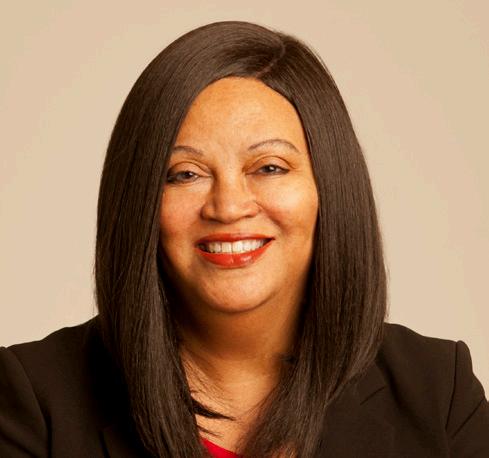
implementing the Minnesota African American Family Preservation and Child Welfare Disproportionality Act, the landmark 2024 law known by the acronym MAAFPCWDA. This is the slow work — the implementation work — that determines whether a passed bill becomes a lived reality. CMAH’s stated frame for this work centers cultural integrity, family preservation, harm reduction, racial equity, and systemic transformation.
The mental health calendar in the report is dense: the African Mental Health Summit hosted by Restoration for All, Inc. and Progressive Individual Resources, Inc., the Multi-Faith African Leadership Roundtable, the Black Family Blueprint discussion on Black family mental health, the Cultural Wellness Center’s 17th Annual Women United to Win. CMAH’s framing of these convenings is theoretically grounded — naming historical and intergenerational trauma and immigrant and migrant hardship as social determinants of mental health, not as clinical conditions to be addressed in isolation.
The maternal and infant health data the report includes is the kind of statistic that should stop a reader. Pregnancy-related mortality per 100,000 births in 2023 stood at 49.4 for Black women, compared to 14.9 for white women, 12.3 for Hispanic women, and 10.7 for Asian women. Black women die in connection with pregnancy at more than three times the rate of white women in this state. CMAH’s spring 2025 partnership with the Minnesota Council on Latino Affairs to advocate for immigrant inclusion in Minnesota’s health programs is part of the response, but the gap remains the gap.
Bridging the Gap: shared roots, diverse journeys
The fourth pillar — building healthy dialogue and relations across Minnesota’s African American and African Immigrant communities — is described in the report as a goal the Council board identified as a top priority at the beginning of the year. The signature event was Bridging the Gap: Shared Roots, Diverse Journeys, convened on October 4, 2025 at the NorthPoint Health & Wellness Center in North Minneapolis. Insight News covered that gathering at the time, reporting on the day of learning, dialogue, and cultural connection focused on debunking myths and dismantling stereotypes that have historically divided
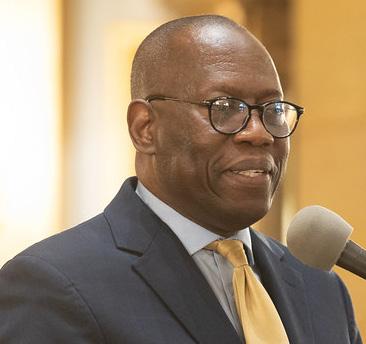
Black and African immigrant communities. The convening centered active listening, intentional learning, and storytelling as ethical practices for building cross-cultural relations, and it issued a call for public initiatives that leverage Pan-African connections in employment, entrepreneurship, healthcare, and housing. This is the framework the Insight News editorial project has long advanced. The report’s explicit invocation of Pan-African values as policy infrastructure is a meaningful institutional articulation. CMAH also names listening sessions with the Freedmen Descendants of Minnesota, presentations from Minnesotans for American Community Survey and 2030 Census, and a deepened presence in Greater Minnesota — Duluth, Mankato, Rochester, St. Cloud — as part of this work.
The 2026 agenda the Annual Report does not itemize Read in isolation, the 2025 Annual Report leaves a gap where a substantive 2026 legislative call to action ought to be. The 2026 Activities timeline at the back of the report lays out a clear convening cadence — African Heritage Day on the Hill, the legislative session opening, Juneteenth, a July session debrief, summer statewide outreach, a September legislative training, a November Fall Policy Summit — but it does not itemize the bills the Council intends to press. That gap is an artifact of the document, not of the work. The work is further along than the report suggests. In a March 1, 2026 dispatch covered by Insight News under the headline “Keeping Hope Alive,” CMAH publicly named a four-bill 2026 legislative agenda framed around what the Council called three intersecting crises — affordability, democracy, and immigration — and a $3.7 billion FY26-27 budget surplus projected by Minnesota Management and Budget, a $1.3 billion increase over the prior estimate. The four bills are: the Minnesota Great Migration Act, scaling reparative justice measures aimed at addressing historical inequities; the MinneKIDS Act, establishing statewide Children’s Savings Accounts to build long-term educational assets for African Heritage students; a Housing Stability package featuring Just Cause Eviction protections and emergency rental assistance; and Justice Reform measures to end forced prison labor and ensure full implementation of
MAAFPCWDA.
“Affordability, democracy, and immigration. A $3.7 billion budget surplus. Four bills. The agenda is named. The question is whether the community shows up to carry it.”
Each of these four bills connects directly back to the 2025 Annual Report’s pillars. The Housing Stability package picks up the unfinished work of SF2423/HF2507, which was dropped from the 2025 omnibus. The MinneKIDS Act translates the report’s child savings account endorsement into named legislation. Justice Reform extends the Council’s 2025 work on the End Slavery in Prisons coalition and the MAAFPCWDA implementation work group. The Minnesota Great Migration Act gives a legislative shape to the reparative justice framework that runs throughout the report. The bills are the answer to the report’s implicit question about what comes next.
The budget, the staff, and the structural reality
The financial picture in the report deserves attention. CMAH started fiscal year 2025 with an appropriation of $816,000 plus carryover from FY24, expended $877,000 reflecting expanded community engagement, and entered FY26 with an appropriation of $828,000. New legislation passed in 2025 allowed unspent FY25 funds to carry forward into FY26 — a procedural change that gives the Council more operational flexibility than the prior biennium structure permitted. FY27 is projected at $840,000. Set this budget against the landscape numbers. The Council is charged with advising the Governor, the Legislature, and federal, local, and private partners on issues facing 565,477 Minnesotans who generate $58 billion in economic output. It does this work with five full-time-equivalent staff and two interns. The arithmetic of that is its own commentary. Whatever else can be said about the 2025 report, it cannot be said that this Council is over-resourced for the mandate it carries.
Staff transitions documented in the report include the departure of office manager Ash Musana in March, the hiring of Adrian Lowe in July, and the addition of Capitol Pathways interns Sarah Jilaow and Famatta Rogers. Two new Capitol Pathways interns have since joined for 2026, named in the March CMAH dispatch as Karen G., a University of Minnesota senior, and Leah M., a University of St. Thomas student. Wayne Doe serves as Chair, Carl Crawford as Vice Chair, Twauna Mullins as Treasurer, Yolonde Adams-Lee as Secretary. Linda Sloan continues as Executive Director, with Theodore Rose as Managing Director for Policy, Lolita Davis Carter as Legislative and Policy Director, and
tainability.
ance between joy and rigor in education, designing learning experiences that honor identity, strength, and purpose. She understands that microschools can be tailored to address the specific needs of the families and communities they serve. The oversight criticism is legitimate. This concern is precisely why NABML is establishing the national benchmark for community-led education. NABML’s certifi-
Care
From 10
three to four times more likely to die from pregnancy-related complications and twice as likely to lose an infant to premature death. Women in rural communities are threatened the most.
All 50 states were given access to the federal Rural Health Transformation Fund which provides over $100,000 to strengthen and modernize health care in rural communities across the country.
“While it won’t ful-
cation is that seal of approval, signaling to families, funders, and policymakers that a school is not merely functioning but is outstanding. Additionally, the organization emphasizes the importance of legal structures, fiscal stewardship frameworks, and community involvement as foundational to sustainability and accountability.
NABML realizes this vision via four main support systems: Community Design Day: NABML facilitates a process in which the neighborhood tells us what its children deserve. You get to explore new learning approaches and define
ly alleviate the burden of these Medicaid cuts, our state will be using some of these dollars to keep rural hospitals in business and expand maternity care access in our state, focusing on non-medical barriers to care, too,” Rep. Adams said.
“Let’s be honest, though—this is a band-aid to our country’s Black maternal health crisis. We need comprehensive legislation to address it, like the Momnibus Act, which we’re reintroducing soon with Rep. Underwood and Sen. Booker. We need major action soon, because our country is reaching a boiling point, and our moms deserve better,” Ad-
educational priorities for your community. A community task force is then formed to implement these ideas, and NABML supports you along the way. This creates a space where you can be a part of the process as a founding member of a microschool.
Founders Launch Lab: This professional development experience equips Black microschool founders and educational leaders with the training, operational, and strategic skills to launch and sustain thriving schools. Participants gain the business acumen and pedagogical frameworks necessary to navigate the transition
ams continued.
The Momnibus Act is a package of 13-bill acts that address social determinants, mental health, workforce diversification, and data collection, with over $1 billion in proposed investments dedicated to solving the maternal mortality crisis.
While lawmakers address issues through policy, doulas have also been stepping in to bridge the gap by providing travel services to address the lack of care in rural communities.
“Historically, doulas were responsible for assisting those giving birth and midwives,
from traditional educator roles to entrepreneurial school leaders.
Membership (The Vault): Members gain instant, 24/7 access to proprietary legal templates, student handbook builders, fiscal stewardship frameworks, and zoning blueprints designed specifically for the microschool model. They also join a curated community of mission-aligned founders through monthly “Brilliance Circles” and a private digital forum. Membership unlocks the NABML Fund, a curated capital pool designed specifically for the network, removing a major barrier to school launch and sus-
and were often among the few enslaved individuals who were allowed to travel due to the indispensability of their services. However, as births moved into hospitals, the non-clinical support system declined — removing an invaluable service for expectant mothers, particularly those within communities disproportionately affected by maternal mortality rates and limited access to medical care and birthing services,” according to Valerie Rochester, chief health equity officer at Creating Healthier Communities (CHC).
“Increasingly, research suggests that doulas are
MJ Lansana as Community Engagement Director.
Looking toward the rest of 2026 The 2026 forward calendar in the report sets out a steady program structure: the legislative session, Juneteenth, the July Council retreat and session debrief, summer statewide outreach, September legislative training, and a November Fall Policy Summit. African Heritage Day on the Hill, originally scheduled for February 12 in the report, has been rescheduled to Friday, April 24, 2026 in the Minnesota Capitol Rotunda. CMAH is also hosting a virtual Policy Priorities meeting on April 2, 2026 via Microsoft Teams, and is actively recruiting community members into its Issue Groups on education, health, economic opportunity, public safety, and immigrant and refugee rights.
Read together, the Annual Report, the March CMAH dispatch, and the rescheduled Day on the Hill function as a single integrated invitation. The report is the retrospective. The dispatch is the agenda. The Day on the Hill is the in-person convening where community members deliver that agenda to lawmakers face to face.
What the report asks of us Reports to the Legislature are written in a particular register. They have to be. They sit on shelves and in databases as the official record of what a state agency did and what it intends to do. But the CMAH 2025 Annual Report rewards a closer reading. Wayne Doe’s opening line — gratitude, courage, and concern — is the emotional architecture of the entire document. Linda Sloan’s naming of political violence as the year’s defining context is the political architecture. The landscape numbers are the economic architecture. The four pillars and the 2026 calendar are the program architecture. The four-bill agenda named in the March dispatch is the legislative architecture. What the report ultimately asks of its readers in the African Heritage community is this: do not read it as a bureaucratic artifact. Read it as a mirror and as a map. The mirror shows a community of 565,477 people generating $58 billion in economic output and dying in childbirth at three times the rate of white women. The map shows the Council’s plan for moving from the first set of numbers toward closing the second. Whether that map gets walked — and how far — depends on what the community does with what the Council has put on the page, what the Council named in March, and who shows up at the Capitol on April 24. Acknowledge the gift. Redemption is at hand.
Certification: This is the seal of approval that tells families, funders, and policymakers that your school isn’t just operating; it is also excelling. NABML is currently developing the national benchmark for community-led education, making sure that certified schools meet rigorous standards for student outcomes, community engagement, and fiscal responsibility. Whether you’re a parent seeking educational alternatives, an educator ready to launch a microschool, or a policymaker committed to expanding equitable education options,
not only beneficial in better health outcomes, but also in reducing unnecessary medical procedures and, therefore, healthcare costs. A recent study of Medicaid beneficiaries found that women who received doula support had both lower cesarean and preterm birth rates,” she added.
Jacque Souza, a self-employed doula, said families in areas without immediate access to healthcare or concerns about care in hospitals have benefitted from the at-home services doulas provide.
“A birth doula holds space so birth can unfold with
NABML invites you to be part of this transformation. Ready to start or support a microschool? Visit https:// nabml.org/ to learn more, access resources, or join the Founders Launch Lab. Want to invest in Black educational futures? Make a donation at https://secure.qgiv.com/for/naobml/ to support founders in building schools that serve their communities. Every microschool launched is a community transformed. Every founder supported is a generation of Black children empowered to thrive.
dignity. She does not replace medical care but helps mothers make the best decisions when bringing a baby into the world,” Souza told the AFRO. Doulas also provide extensive treatment after babies are born.
“A postpartum doula also has an important, though often less visible, role. She helps families navigate the unique and delicate time of postpartum. Those days when nights are long and the days feel endless. A postpartum doula guides and cares for new mothers during this profound transition,” Souza said.
Linda Sloan Wayne Doe